CUET Question Papers are the most important study material for effective exam preparation. We at Zollege have provided all CUET Previous Year Papers with Solution PDFs here. CUET 2024 Psychology was conducted successfully on May 15 by NTA.
Students can freely download the CUET previous year's question paper PDFs along with their solutions here. We strongly encourage cuet aspirants to scan through all the CUET Question Paper to know the overall difficulty level, CUET Syllabus and understand the changes in CUET Exam Pattern over the years.
CUET 2024 Psychology Question Paper with Answer Key PDF
| CUET 2024 Psychology Question Paper PDF |  Download Download |
Check Solution |
CUET 2024 Psychology Solution
| Question | Answer | Detailed Solution | ||||||||||
|---|---|---|---|---|---|---|---|---|---|---|---|---|
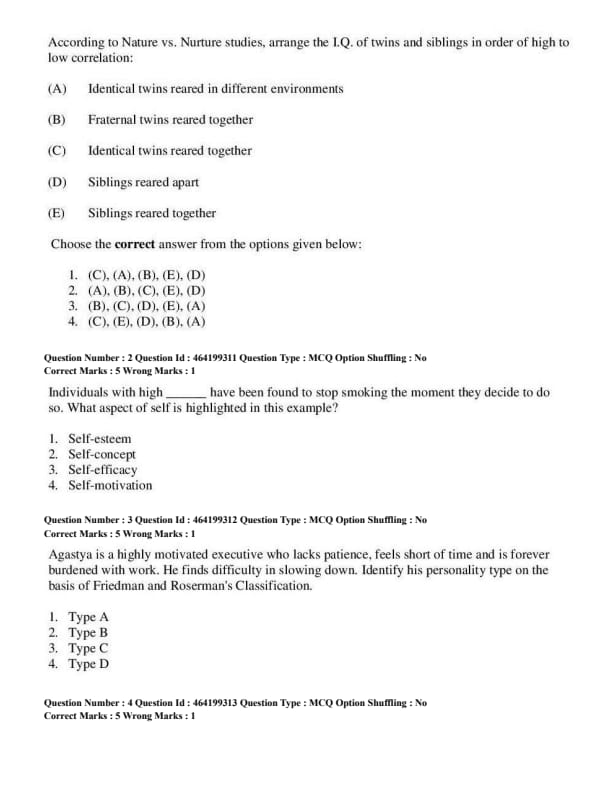
| Q1. According to Nature vs. Nurture studies, arrange the I.Q. of twins and siblings in order of high to low correlation: (A) Identical twins reared in different environments (B) Fraternal twins reared together (C) Identical twins reared together (D) Siblings reared apart (E) Siblings reared together Choose the correct answer from the options given below: (1) (C), (A), (B), (E), (D) (2) (A), (B), (C), (E), (D) (3) (B), (C), (D), (E), (A) (4) (C), (E), (D), (B), (A) |
1. (C), (A), (B), (E), (D) | Studies on the nature vs. nurture debate have shown that identical twins raised together have the highest IQ correlation, followed by identical twins raised apart, fraternal twins raised together, siblings raised together, and siblings raised apart. | ||||||||||
| Q2. Individuals with high have been found to stop smoking the moment they decide to do so. What aspect of self is highlighted in this example? Choose the correct answer from the options given below: (1) Self-esteem (2) Self-concept (3) Self-efficacy (4) Self-motivation |
3. Self-efficacy | The conviction that one can succeed in particular circumstances or complete tasks is known as self-efficacy. In this instance, great self-efficacy is highlighted by the person's confidence in their ability to stop smoking. | ||||||||||
| Q3. Agastya is a highly motivated executive who lacks patience, feels short of time and is forever burdened with work. He finds difficulty in slowing down. Identify his personality type on the basis of Friedman and Roserman’s Classification. Choose the correct answer from the options given below: (1) Type A (2) Type B (3) Type C (4) Type D |
1. Type A | Impatience, a sense of urgency, competitiveness, and stress-prone behavior are traits of type A personalities, and these traits also apply to Agastya. | ||||||||||
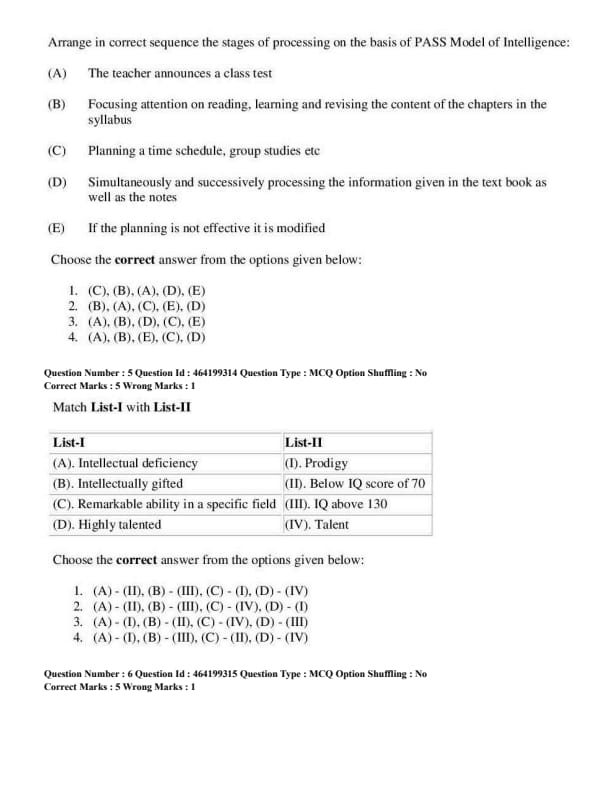
| Q4. Arrange in correct sequence the stages of processing on the basis of PASS Model of Intelligence: (A) The teacher announces a class test (B) Focusing attention on reading, learning and revising the content of the chapters in the syllabus (C) Planning a time schedule, group studies etc. (D) Simultaneously and successively processing the information given in the text book as well as the notes (E) If the planning is not effective it is modified Choose the correct answer from the options given below: (1) (C), (B), (A), (D), (E) (2) (B), (A), (C), (E), (D) (3) (A), (B), (D), (C), (E) (4) (A), (B), (E), (C), (D) |
3. (A), (B), (D), (C), (E) | Stages like planning, attention, and sequential processing are all part of the PASS model. These cognitive processes are reflected in the proper order when answering a class test. | ||||||||||
Q5. Match List-I with List-II:
Choose the correct answer from the options given below: |
1. (A) - (II), (B) - (III), (C) - (I), (D) - (IV) | An IQ below 70 indicates intellectual inadequacy, an IQ above 130 indicates intellectual giftedness, a prodigy is an expert in a particular field, and exceptionally talented people exhibit extraordinary talent. | ||||||||||
|
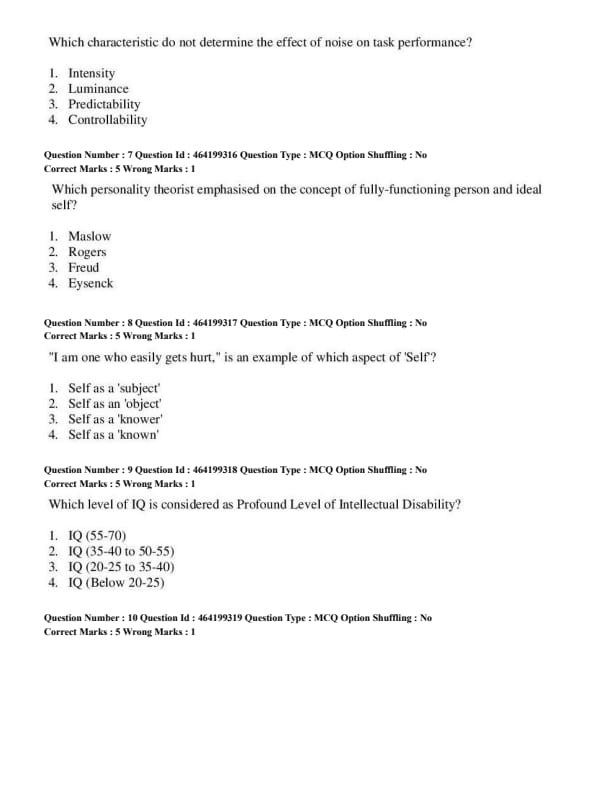
Q6. Which characteristic does not determine the effect of noise on task performance? |
2. Luminance | Light brightness is referred to as luminance, which has nothing to do with how noise affects task performance. A number of variables, including intensity, predictability, and controllability, affect the impact of noise. | ||||||||||
| Q7. Which personality theorist emphasized the concept of fully-functioning person and ideal self? Choose the correct answer from the options given below: (1) Maslow (2) Rogers (3) Freud (4) Eysenck |
2 Rogers | Carl Rogers, a prominent humanistic psychologist, emphasized the concepts of the fully-functioning person and the ideal self. He believed that for a person to achieve self-actualization and personal growth, they must strive to align their real self with their ideal self. | ||||||||||
| Q8. "I am one who easily gets hurt," is an example of which aspect of ’Self’? Choose the correct answer from the options given below: (1) Self as a ’subject’ (2) Self as an ’object’ (3) Self as a ’knower’ (4) Self as a ’known’ |
2 Self as an ’object’ | The statement "I am one who easily gets hurt" reflects the self as an ’object’. In this context, the self is viewed from an external perspective, where the individual assesses their own emotional sensitivity and vulnerability. This contrasts with the self as a ’subject,’ which would involve the individual’s experiences and thoughts from a first-person perspective. | ||||||||||
| Q9. Which level of IQ is considered as Profound Level of Intellectual Disability? Choose the correct answer from the options given below: (1) IQ (55-70) (2) IQ (35-40 to 50-55) (3) IQ (20-25 to 35-40) (4) IQ (Below 20-25) |
4 IQ (Below 20-25) | The profound level of intellectual disability is typically defined by an IQ score of below 20-25. | ||||||||||
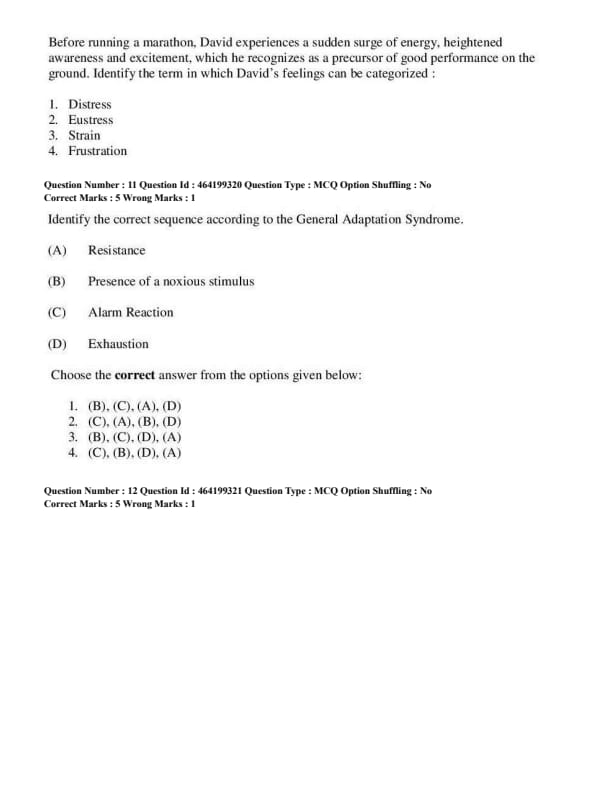
| Q10. Before running a marathon, David experiences a sudden surge of energy, heightened awareness, and excitement, which he recognizes as a precursor of good performance on the ground. Identify the term in which David’s feelings can be categorized: Choose the correct answer from the options given below: (1) Distress (2) Eustress (3) Strain (4) Frustration |
2 Eustress | David’s feelings of a sudden surge of energy, heightened awareness, and excitement are indicative of eustress, which is the positive form of stress that can enhance performance. | ||||||||||
| Q11. Identify the correct sequence according to the General Adaptation Syndrome. Sequence: (A) Resistance (B) Presence of a noxious stimulus (C) Alarm Reaction (D) Exhaustion Choose the correct answer from the options given below: (1) (B), (C), (A), (D) (2) (C), (A), (B), (D) (3) (B), (C), (D), (A) (4) (C), (B), (D), (A) |
1. (B), (C), (A), (D) | Hans Selye created the General Adaptation Syndrome (GAS) model, which describes the body's reaction to stress in three phases. When a stressor is detected, the body goes through the alarm reaction, which is the initial stage. The resistance stage follows, during which the body attempts to adjust to the stressor. When the stressor continues, the body finally reaches the fatigue stage, at which point its resources are exhausted. | ||||||||||
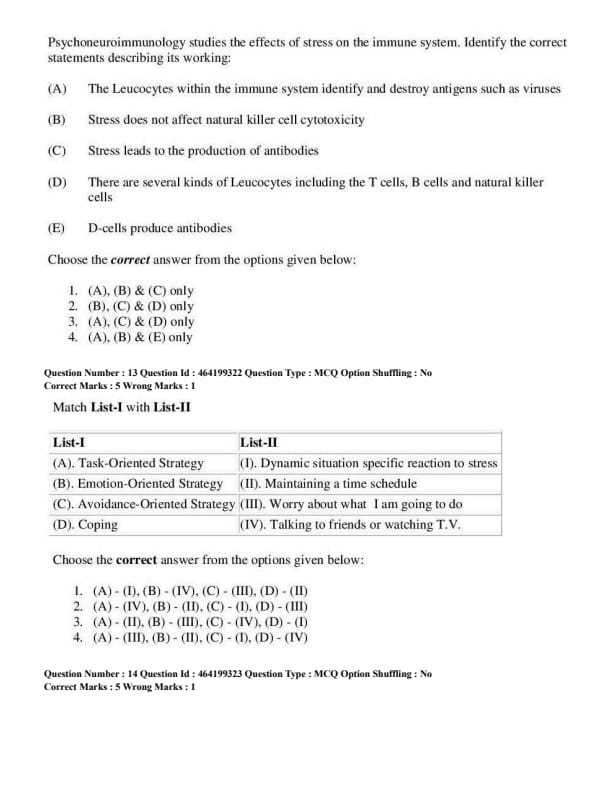
| Q12. Psychoneuroimmunology studies the effects of stress on the immune system. Identify the correct statements describing its working: (A) The Leucocytes within the immune system identify and destroy antigens such as viruses. (B) Stress does not affect natural killer cell cytotoxicity. (C) Stress leads to the production of antibodies. (D) There are several kinds of Leucocytes including the T cells, B cells, and natural killer cells. (E) D-cells produce antibodies. Choose the correct answer from the options given below: (1) (A), (B) (C) only (2) (B), (C) (D) only (3) (A), (C) (D) only (4) (A), (B) (E) only |
3. (A), (C), & (D) only | Psychoneuroimmunology examines the relationship between the immunological and neurological systems and psychological processes. As a component of the immune system, leucocytes—which include T cells, B cells, and natural killer cells—help recognize and eliminate antigens. Stress has an impact on the immune system and can both boost the generation of antibodies and inhibit other immunological processes. | ||||||||||
Q13. Match List-I with List-II. List-I:
Choose the correct answer from the options given below: |
1. (A) - (II), B) - (IV), (C) - (III), (D) - (I) | Emotion-oriented techniques deal with emotional responses to stress (III), task-oriented strategies deal with time and responsibility management (II), and avoidance-oriented strategies deal with distracting activities like watching television (IV). The dynamic process of responding to stress is called coping (I). | ||||||||||
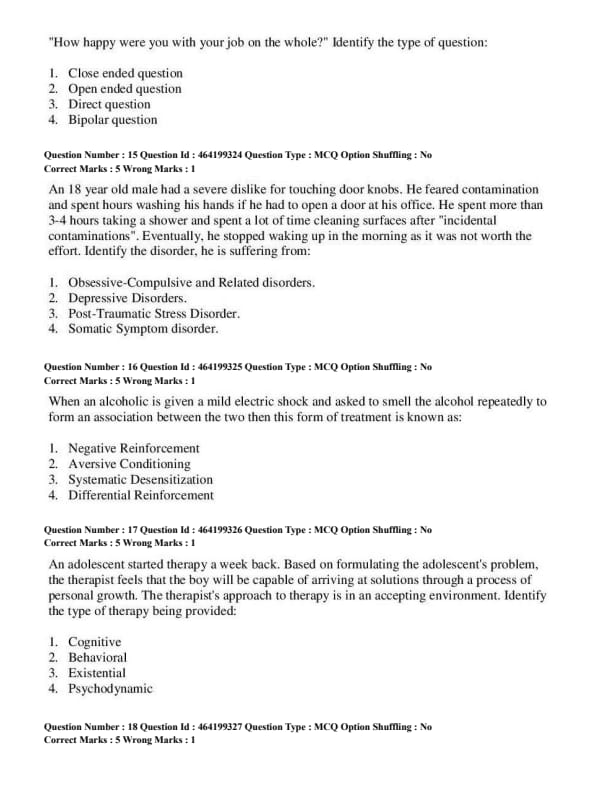
| Q14. ”How happy were you with your job on the whole?” Identify the type of question: Choose the correct answer from the options given below: (1) Close ended question (2) Open ended question (3) Direct question (4) Bipolar question |
3. Direct question | A direct question does not provide multiple choice answers or guide the respondent to a predetermined response; instead, it asks for specific information or feelings. | ||||||||||
| Q15. An 18-year-old male had a severe dislike for touching door knobs. He feared contamination and spent hours washing his hands if he had to open a door at his office. He spent more than 3-4 hours taking a shower and spent a lot of time cleaning surfaces after ”incidental contaminations”. Eventually, he stopped waking up in the morning as it was not worth the effort. Identify the disorder he is suffering from: Choose the correct answer from the options given below: (1) Obsessive-Compulsive and Related disorders (2) Depressive Disorders (3) Post-Traumatic Stress Disorder (4) Somatic Symptom disorder |
1. Obsessive-Compulsive and Related Disorders | Excessive handwashing is one of the recurrent actions (compulsions) that result from unwanted and intrusive thoughts (obsessions) in obsessive-compulsive disorder (OCD). This instance exhibits typical OCD symptoms. | ||||||||||
|
Q16. When an alcoholic is given a mild electric shock and asked to smell the alcohol repeatedly to form an association between the two, then this form of treatment is known as: Choose the correct answer from the options given below: |
2. Aversive Conditioning | By associating an undesirable activity (such as the scent of alcohol) with an unpleasant stimulus, aversive conditioning reduces the behavior by establishing a negative connection. | ||||||||||
|
Q17. An adolescent started therapy a week back. Based on formulating the adolescent’s problem, the therapist feels that the boy will be capable of arriving at solutions through a process of personal growth. The therapist’s approach to therapy is in an accepting environment. Identify the type of therapy being provided: Choose the correct answer from the options given below: |
3. Existential | The main goals of existential therapy are self-awareness, personal development, and taking ownership of one's actions. It frequently provides a safe, tolerant setting for people to deal with problems like anxiety and discover purpose. | ||||||||||
|
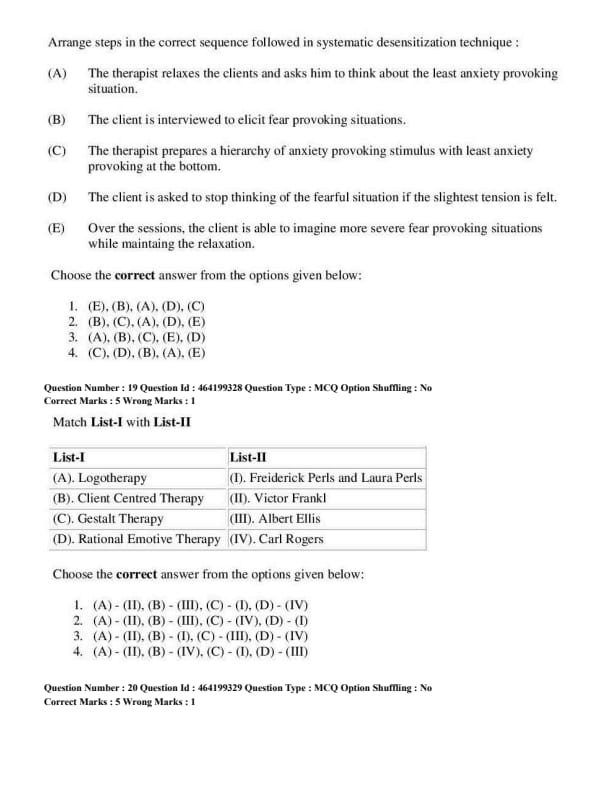
Q18. Arrange the steps in the correct sequence followed in the systematic desensitization technique: Choose the correct answer from the options given below: |
2. (B), (C), (A), (D), (E) | Identifying the situations that cause anxiety (B), ranking the fears (C), practicing relaxation techniques (A), urging the client to pause when tension builds (D), and progressively exposing the client to more extreme fears (E) are all steps in the systematic desensitization process. | ||||||||||
Q19. Match List-I with List-II. List-I:
Choose the correct answer from the options given below: |
2. (A) - (II), (B) - (IV), (C) - (I), (D) - (III) | Carl Rogers created Client-Centered Therapy, Frederick and Laura Perls created Gestalt Therapy, Albert Ellis created Rational Emotive Therapy, and Victor Frankl created Logotherapy. | ||||||||||
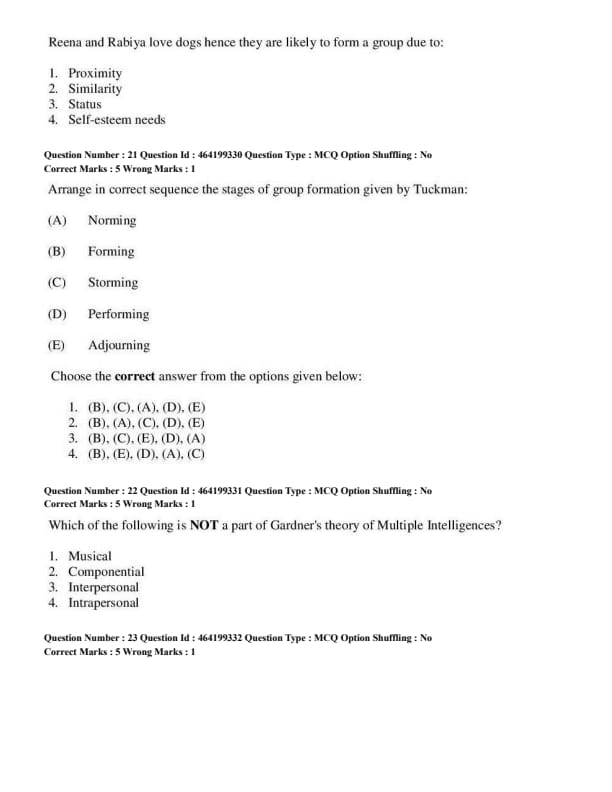
| Q20. Reena and Rabiya love dogs; hence they are likely to form a group due to: (1) Proximity (2) Similarity (3) Status (4) Self-esteem needs |
2. Similarity | Reena and Rabiya's love of dogs is an example of how people establish groups based on common interests, according to social psychology. | ||||||||||
| Q21. Arrange in correct sequence the stages of group formation given by Tuckman: (A) Norming (B) Forming (C) Storming (D) Performing (E) Adjourning Choose the correct answer from the options given below: (1) (B), (C), (A), (D), (E) (2) (B), (A), (C), (D), (E) (3) (B), (C), (E), (D), (A) (4) (B), (E), (D), (A), (C) |
1. (B), (C), (A), (D), (E) | The following are the phases of group formation as per Tuckman's model: 1. Establishing; 2. Storming; 3. Norming; 4. Executing 5. Postponing | ||||||||||
| Q22. Which of the following is NOT a part of Gardner’s theory of Multiple Intelligences? (1) Musical (2) Componential (3) Interpersonal (4) Intrapersonal |
2. Componential | According to Howard Gardner's hypothesis of multiple intelligences, there are intrapersonal, interpersonal, and musical intelligences. Gardner's thesis is not "componential"; rather, it is a component of Sternberg's Triarchic thesis of Intelligence. | ||||||||||
|
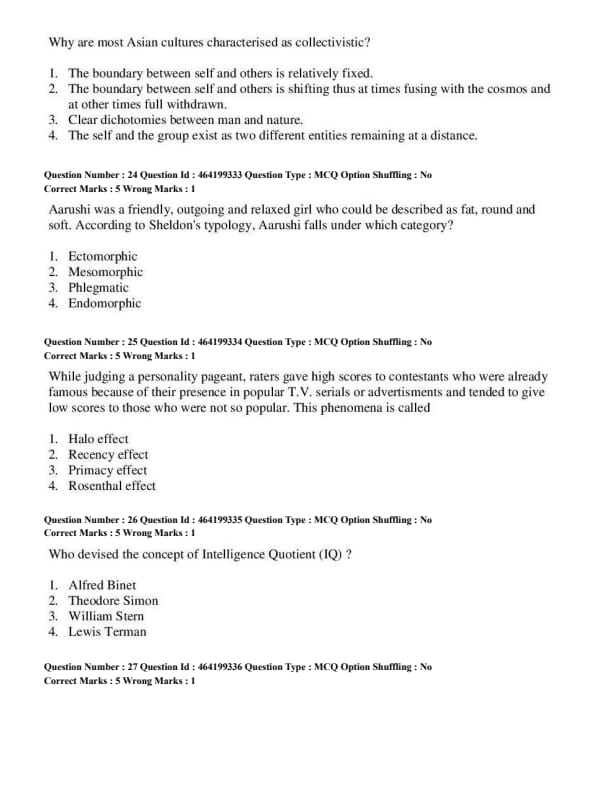
Q23. Why are most Asian cultures characterized as collectivistic? (1) The boundary between self and others is relatively fixed. (2) The boundary between self and others is shifting, thus at times fusing with the cosmos and at other times fully withdrawn. |
1. The boundary between self and others is shifting thus at times fusing with the cosmos and at other times fully withdrawn. | The line between the self and other people is blurred in collectivistic societies, and it occasionally blends with the larger environment, such as society or the universe, highlighting interdependence. | ||||||||||
| Q24. Aarushi was a friendly, outgoing and relaxed girl who could be described as fat, round and soft. According to Sheldon’s typology, Aarushi falls under which category? (1) Ectomorphic (2) Mesomorphic (3) Phlegmatic (4) Endomorphic |
1. Endomorphic | William Sheldon's somatotype hypothesis states that endomorphs have a laid-back, gregarious temperament and are spherical and squishy. | ||||||||||
| Q25. While judging a personality pageant, raters gave high scores to contestants who were already famous because of their presence in popular T.V. serials or advertisements and tended to give low scores to those who were not so popular. This phenomenon is called (1) Halo effect (2) Recency effect (3) Primacy effect (4) Rosenthal effect |
1. Halo effect | The halo effect happens when one favorable trait—such as celebrity—influences opinions about a person in general, causing bias in ratings. | ||||||||||
|
Q26. Who devised the concept of Intelligence Quotient (IQ)? (1) Alfred Binet |
3. William Stern | William Stern came up with the idea of IQ, which calculates intelligence by multiplying by 100 and dividing mental age by chronological age. | ||||||||||
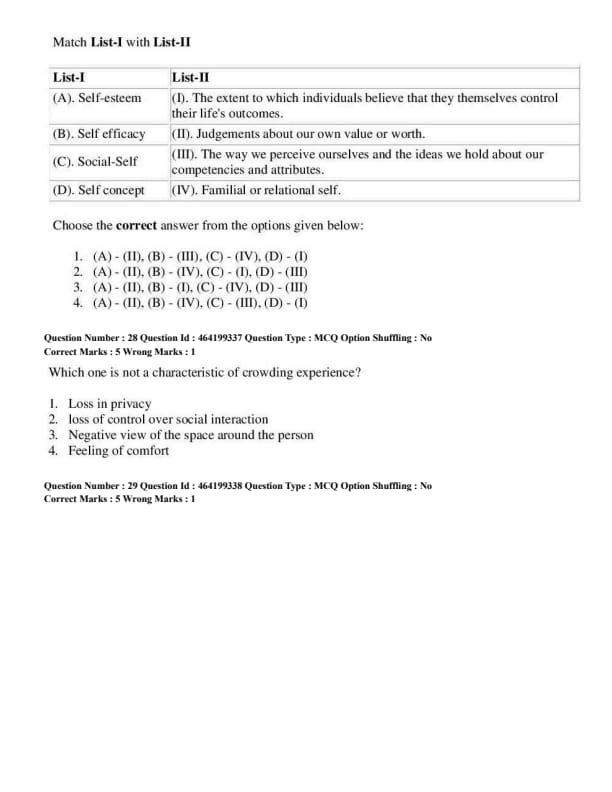
Q27. Match List-I with List-II: List-I:
|
3. (A) - (II), (B) - (I), (C) - (IV), (D) - (III) | (A) Self-esteem: Judgments about our own value or worth (II). (B) Self-efficacy: Beliefs about control over life's outcomes (I). (C) Social-Self: Familial or relational self (IV). (D) Self-concept: How we perceive ourselves, our competencies, and attributes (III). | ||||||||||
| Q28. Which one is not a characteristic of crowding experience? (1) Loss in privacy (2) Loss of control over social interaction (3) Negative view of the space around the person (4) Feeling of comfort |
4. Feeling of comfort | Rather than a sense of comfort, crowding is linked to unpleasant experiences including discomfort and a lack of privacy and control. | ||||||||||
|
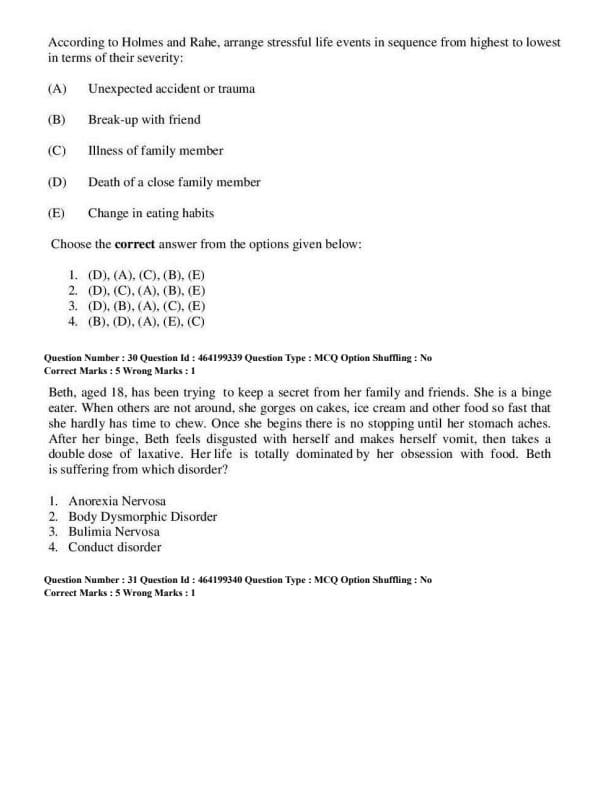
Q29. According to Holmes and Rahe, arrange stressful life events in sequence from highest to lowest in terms of their severity: (1) (D), (A), (C), (B), (E) |
1. (D), (A), (C), (B), (E) | In bulimia nervosa, binge eating is followed by compensatory behaviors like vomiting or overusing laxatives to avoid gaining weight. | ||||||||||
| Q30. Beth, aged 18, has been trying to keep a secret from her family and friends. She is a binge eater. When others are not around, she gorges on cakes, ice cream and other food so fast that she hardly has time to chew. Once she begins there is no stopping until her stomach aches. After her binge, Beth feels disgusted with herself and makes herself vomit, then takes a double dose of laxative. Her life is totally dominated by her obsession with food. Beth is suffering from which disorder? (1) Anorexia Nervosa (2) Body Dysmorphic Disorder (3) Bulimia Nervosa (4) Conduct disorder |
3. Bulimia Nervosa | In order to avoid gaining weight, bulimia nervosa patients engage in compensatory behaviors like vomiting or overusing laxatives after binge eating. | ||||||||||
|
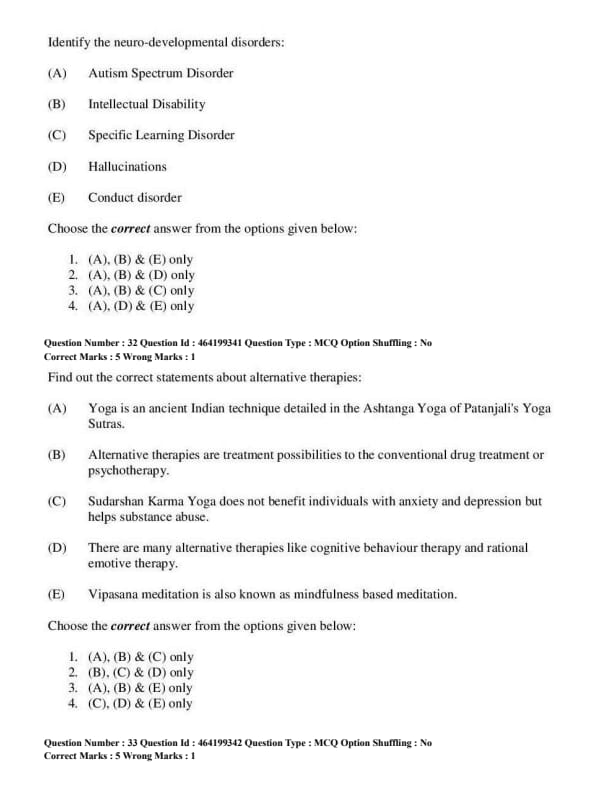
Q31. Identify the neuro-developmental disorders: (A) Autism Spectrum Disorder Choose the correct answer from the options given below: |
3. (A), (B) & (C) only | Autism Spectrum Disorder, Specific Learning Disorder, and Intellectual Disability are examples of neurodevelopmental disorders. Conduct disorders and hallucinations do not fall within the neurodevelopmental group. | ||||||||||
|
Q32. Find out the correct statements about alternative therapies: Choose the correct answer from the options given below: (1) (A), (B) & (C) only |
3. (A), (B) & (E) only | The claims (A), (B), and (E) are true. (D) wrongly classifies cognitive behavior therapy as an alternative therapy since it is a type of psychotherapy, and (C) is deceptive because Sudarshan Karma Yoga can help with anxiety and depression. | ||||||||||
|
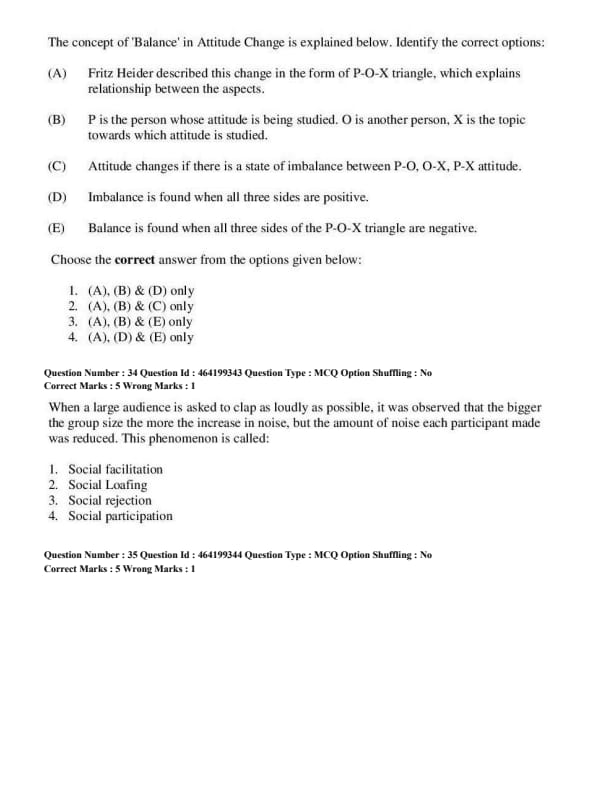
Q33. The concept of ’Balance’ in Attitude Change is explained below. Identify the correct options:
(1) (A), (B) & (D) only |
2. (A), (B) & (C) only | The assertions (A), (B), and (C) regarding Fritz Heider's Balance Theory are accurate. In this situation, the definitions of balance and imbalance in (D) and (E) are inaccurate. | ||||||||||
| Q34. When a large audience is asked to clap as loudly as possible, it was observed that the bigger the group size, the more the increase in noise, but the amount of noise each participant made was reduced. This phenomenon is called: (1) Social facilitation (2) Social loafing (3) Social rejection (4) Social participation |
2. Social Loafing | Social loafing is the phenomenon wherein people work less hard in a group setting than they do alone, as evidenced by the fact that each participant makes less noise. | ||||||||||
|
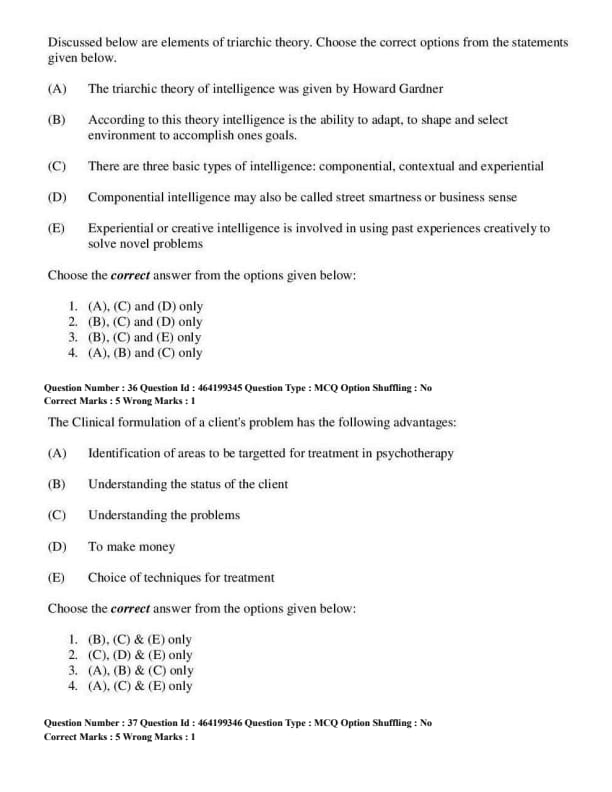
Q35. Discussed below are elements of triarchic theory. Choose the correct options from the statements given below: Choose the correct answer from the options given below: |
3. (B), (C) and (E) only | Not Howard Gardner, but Robert Sternberg was the one who first put forth the triarchic theory. The theory's elements are appropriately described in (B), (C), and (E). | ||||||||||
|
Q36. The Clinical formulation of a client’s problem has the following advantages: Choose the correct answer from the options given below: (1) (B), (C) (E) only |
4. (A), (C) & (E) only | Valid benefits of clinical formulation include (A), (C), and (E). Since profit motives are not a benefit of therapeutic formulation, (D) is improper. | ||||||||||
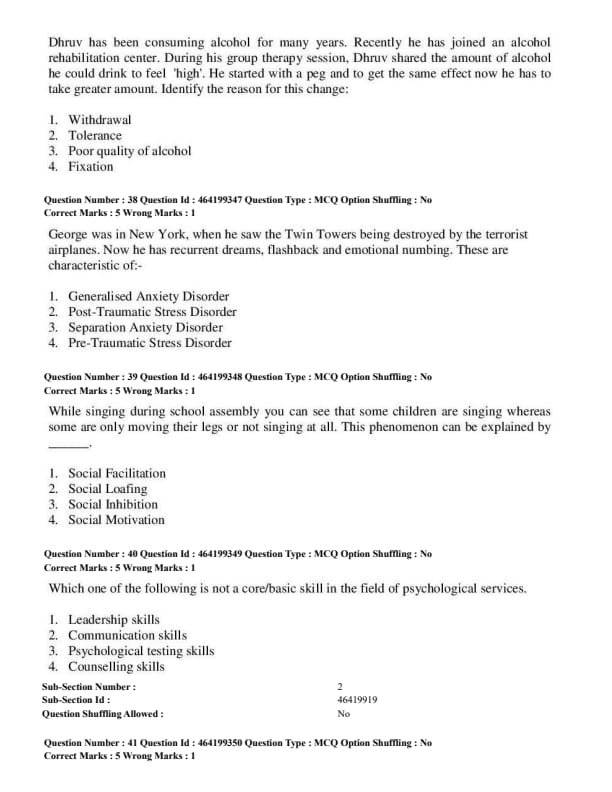
| Q37. Dhruv has been consuming alcohol for many years. Recently he has joined an alcohol rehabilitation center. During his group therapy session, Dhruv shared the amount of alcohol he could drink to feel ’high’. He started with a peg and to get the same effect now he has to take a greater amount. Identify the reason for this change: 1. Withdrawal 2. Tolerance 3. Poor quality of alcohol 4. Fixation |
2. Tolerance | The body's adaptation to alcohol is known as tolerance, and it takes higher doses to provide the same effects. | ||||||||||
| Q38. George was in New York when he saw the Twin Towers being destroyed by the terrorist airplanes. Now he has recurrent dreams, flashbacks, and emotional numbing. These are characteristic of: (1) Generalised Anxiety Disorder (2) Post-Traumatic Stress Disorder (3) Separation Anxiety Disorder (4) Pre-Traumatic Stress Disorder |
2. Post-Traumatic Stress Disorder | Recurrent dreams, flashbacks, and emotional numbness are all signs of post-traumatic stress disorder (PTSD) that George is experiencing. | ||||||||||
| Q39. While singing during the school assembly, you can see that some children are singing, whereas some are only moving their legs or not singing at all. This phenomenon can be explained by: (1) Social Facilitation (2) Social Loafing (3) Social Inhibition (4) Social Motivation |
2. Social Loafing | The phenomena of certain children putting up less effort in a group environment is one example of social loafing. | ||||||||||
| Q40. Which one of the following is not a core/basic skill in the field of psychological services? (1) Leadership skills (2) Communication skills (3) Psychological testing skills (4) Counselling skills |
1. Leadership skills | In contrast to other abilities, leadership is not seen as a key competency in psychological services, despite its importance. | ||||||||||
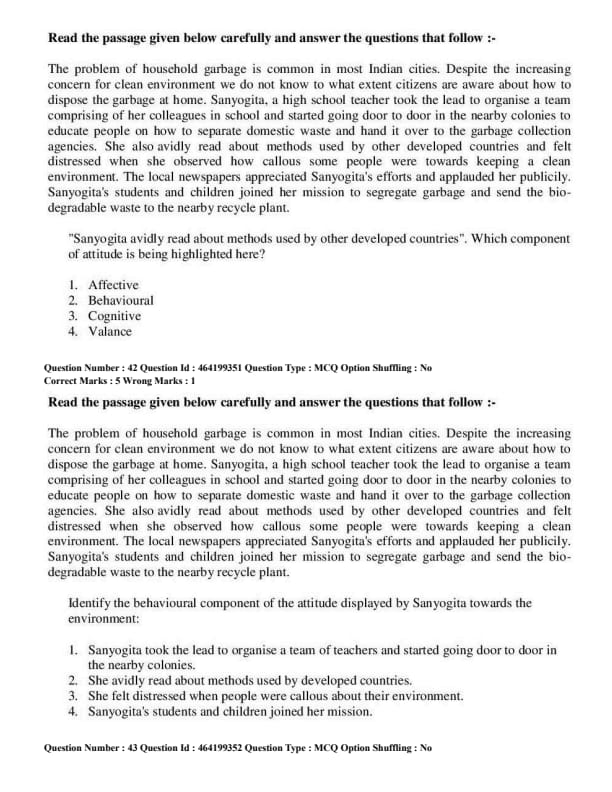
| Q41. ”Sanyogita avidly read about methods used by other developed countries.” Which component of attitude is being highlighted here? (1) Affective (2) Behavioural (3) Cognitive (4) Valance |
3. Cognitive | By reading and learning, Sanyogita exemplifies the concepts and thoughts that make up the cognitive component of attitude. | ||||||||||
|
Q42. Read the passage given below carefully and answer the questions that follow: The problem of household garbage is common in most Indian cities. Despite the increasing concern for a clean environment, we do not know to what extent citizens are aware of how to dispose of the garbage at home. Sanyogita, a high school teacher, took the lead to organize a team comprising of her colleagues in school and started going door to door in the nearby colonies to educate people on how to separate domestic waste and hand it over to the garbage collection agencies. She also avidly read about methods used by other developed countries and felt distressed when she observed how callous some people were towards keeping a clean environment. The local newspapers appreciated Sanyogita’s efforts and applauded her publicly. Sanyogita’s students and children joined her mission to segregate garbage and send the biodegradable waste to the nearby recycle plant. Identify the behavioral component of the attitude displayed by Sanyogita towards the environment: |
4. Sanyogita took the lead to organize a team of teachers. | As demonstrated by Sanyogita's anguish, the affective component deals with feelings and emotions. | ||||||||||
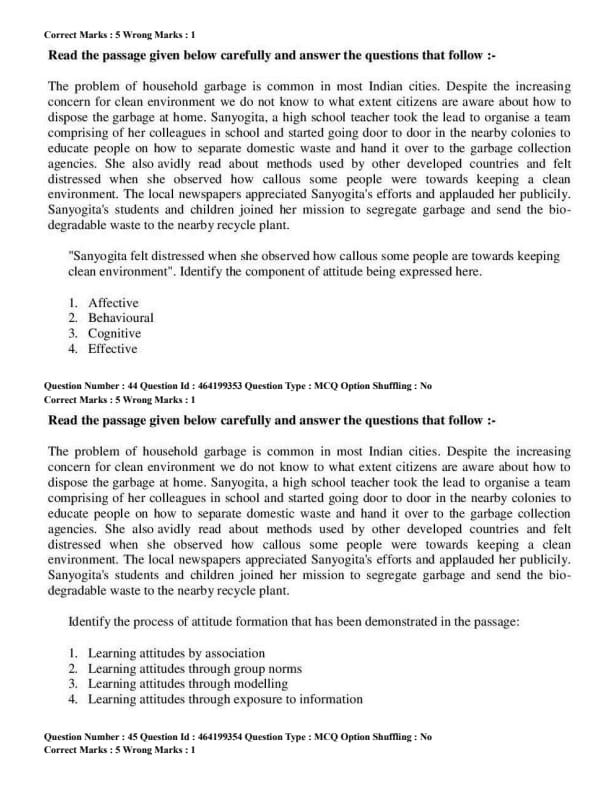
| Q43. Read the passage given below carefully and answer the questions that follow: The problem of household garbage is common in most Indian cities. Despite the increasing concern for a clean environment, we do not know to what extent citizens are aware of how to dispose of the garbage at home. Sanyogita, a high school teacher, took the lead to organize a team comprising her colleagues in school and started going door to door in the nearby colonies to educate people on how to separate domestic waste and hand it over to the garbage collection agencies. She also avidly read about methods used by other developed countries and felt distressed when she observed how callous some people were towards keeping a clean environment. The local newspapers appreciated Sanyogita’s efforts and applauded her publicly. Sanyogita’s students and children joined her mission to segregate garbage and send the biodegradable waste to the nearby recycle plant. ”Sanyogita felt distressed when she observed how callous some people are towards keeping a clean environment”. Identify the component of attitude being expressed here: (1) Affective (2) Behavioural (3) Cognitive (4) Effective |
1. Affective | The affective component pertains to feelings and emotions, evident in Sanyogita's distress. | ||||||||||
|
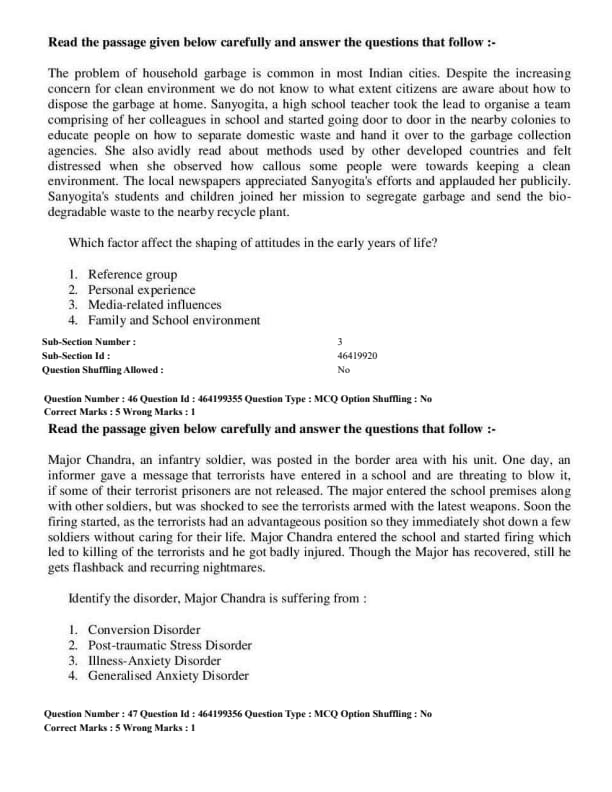
Q44. Read the passage given below carefully and answer the questions that follow: The problem of household garbage is common in most Indian cities. Despite the increasing concern for a clean environment, we do not know to what extent citizens are aware of how to dispose of the garbage at home. Sanyogita, a high school teacher, took the lead to organize a team comprising her colleagues in school and started going door to door in the nearby colonies to educate people on how to separate domestic waste and hand it over to the garbage collection agencies. She also avidly read about methods used by other developed countries and felt distressed when she observed how callous some people were towards keeping a clean environment. The local newspapers appreciated Sanyogita’s efforts and applauded her publicly. Sanyogita’s students and children joined her mission to segregate garbage and send the biodegradable waste to the nearby recycle plant.
|
4. Learning attitudes through exposure to information | Exposure to knowledge about efficient waste management techniques shapes Sanyogita's mindset. | ||||||||||
|
Q45. Read the passage given below carefully and answer the questions that follow: The problem of household garbage is common in most Indian cities. Despite the increasing concern for a clean environment, we do not know to what extent citizens are aware of how to dispose of the garbage at home. Sanyogita, a high school teacher, took the lead to organize a team comprising her colleagues in school and started going door to door in the nearby colonies to educate people on how to separate domestic waste and hand it over to the garbage collection agencies. She also avidly read about methods used by other developed countries and felt distressed when she observed how callous some people were towards keeping a clean environment. The local newspapers appreciated Sanyogita’s efforts and applauded her publicly. Sanyogita’s students and children joined her mission to segregate garbage and send the biodegradable waste to the nearby recycle plant
|
4. Family and School environment | The main factors influencing the development of attitudes in early life are family and school. | ||||||||||
|
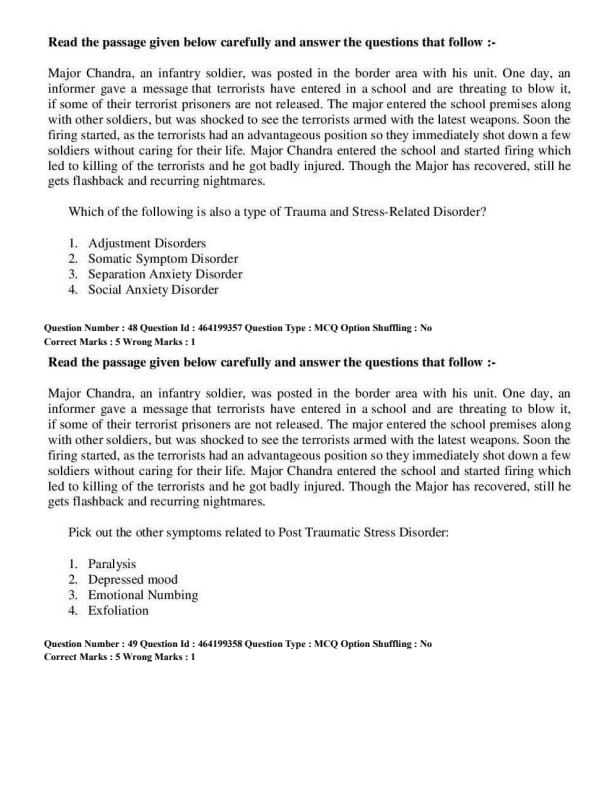
Q46. Read the passage given below carefully and answer the questions that follow: Major Chandra, an infantry soldier, was posted in the border area with his unit. One day, an informer gave a message that terrorists had entered a school and were threatening to blow it up if some of their terrorist prisoners were not released. The major entered the school premises along with other soldiers but was shocked to see the terrorists armed with the latest weapons. Soon the firing started; the terrorists had an advantageous position and immediately shot down a few soldiers without caring for their lives. Major Chandra entered the school and started firing, which led to the killing of the terrorists, and he got badly injured. Though the Major has recovered, he still gets flashbacks and recurring nightmares
|
2. Post-Traumatic Stress Disorder | His nightmares and flashbacks are typical of PTSD. | ||||||||||
|
Q47. Read the passage given below carefully and answer the questions that follow: Major Chandra, an infantry soldier, was posted in the border area with his unit. One day, an informer gave a message that terrorists had entered a school and were threatening to blow it up if some of their terrorist prisoners were not released. The major entered the school premises along with other soldiers but was shocked to see the terrorists armed with the latest weapons. Soon the firing started; the terrorists had an advantageous position and immediately shot down a few soldiers without caring for their lives. Major Chandra entered the school and started firing, which led to the killing of the terrorists, and he got badly injured. Though the Major has recovered, he still gets flashbacks and recurring nightmares Which of the following is also a type of Trauma and Stress-Related Disorder? |
1. Adjustment Disorders | Trauma and stress-related disorders are the categories under which adjustment disorders fall. | ||||||||||
|
Q48. Read the passage given below carefully and answer the questions that follow: Major Chandra, an infantry soldier, was posted in the border area with his unit. One day, an informer gave a message that terrorists had entered a school and were threatening to blow it up if some of their terrorist prisoners were not released. The major entered the school premises along with other soldiers but was shocked to see the terrorists armed with the latest weapons. Soon the firing started; the terrorists had an advantageous position and immediately shot down a few soldiers without caring for their lives. Major Chandra entered the school and started firing, which led to the killing of the terrorists, and he got badly injured. Though the Major has recovered, he still gets flashbacks and recurring nightmares
|
3. Emotional Numbing | Paralysis and exfoliation are not linked to PTSD, but emotional numbness is a typical symptom. | ||||||||||
|
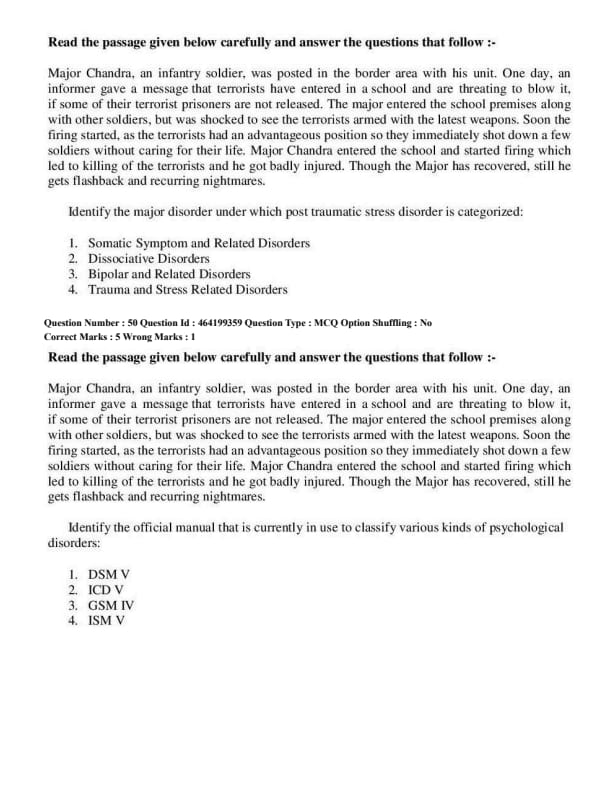
Q49. Read the passage given below carefully and answer the questions that follow: Major Chandra, an infantry soldier, was posted in the border area with his unit. One day, an informer gave a message that terrorists had entered a school and were threatening to blow it up if some of their terrorist prisoners were not released. The major entered the school premises along with other soldiers but was shocked to see the terrorists armed with the latest weapons. Soon the firing started; the terrorists had an advantageous position and immediately shot down a few soldiers without caring for their lives. Major Chandra entered the school and started firing, which led to the killing of the terrorists, and he got badly injured. Though the Major has recovered, he still gets flashbacks and recurring nightmares. Identify the major disorder under which PTSD is categorized: |
4. Trauma and Stress Related Disorders | PTSD is classified as a trauma and stress-related disorder. | ||||||||||
|
Q50. Read the passage given below carefully and answer the questions that follow: Major Chandra, an infantry soldier, was posted in the border area with his unit. One day, an informer gave a message that terrorists had entered a school and were threatening to blow it up if some of their terrorist prisoners were not released. The major entered the school premises along with other soldiers but was shocked to see the terrorists armed with the latest weapons. Soon the firing started; the terrorists had an advantageous position and immediately shot down a few soldiers without caring for their lives. Major Chandra entered the school and started firing, which led to the killing of the terrorists, and he got badly injured. Though the Major has recovered, he still gets flashbacks and recurring nightmares. Identify the official manual which describes the diagnostic criteria for PTSD: |
1. Diagnostic and Statistical Manual of Mental Disorders (DSM-5) | The diagnostic standards for PTSD and other mental health conditions are described in the DSM-5. |