Australia is a world-class educational destination, offering three intakes in Australia. The Australian intake sessions are February, July, and November. The February Intake is the most popular with most applications, accepted by all top universities in Australia and available for all programs. The November Intake, in stark contrast, remains least popular with the lowest applications and limited course availability. July Intakes are average intake seasons which means except for few courses all courses are available. The July intakes in Australia applications only slightly lesser than February Intake. The Australian Universities require academic transcripts (65% score). English Language Proficiency like IELTS Scores of 6.5 or higher and Student Visa etc. for intakes in Australia for international students
- Types of Intakes in Australia
- February Intake in Australia
2.1 Timeline for February Intake
2.2 February Intake Universities in Australia - July Intake in Australia
3.1 Timeline of July Intake
3.2 July Intake Universities in Australia - November Intake in Australia
4.1 November Intakes in Australia Timeline
4.2 Universities for November Intake - Document Required for Intakes in Australia
- FAQs
Types of Intakes in Australia
Candidates might ask what are the intakes in Australia. There are three primary and three secondary intakes that the Australian educational system offers each year. Some courses, in the given intake season, can offer several rounds of admission. The details of major intakes in Australia for students who want to immigrate to Australia are given in the table given below:
| Primary Intake | Intake Deadline | Available Programs | Scholarships |
| July Intake | Late July/early August through to November | All Programs | February or Early March – Late May or Early June |
| November Intake | Late October/early November through to February | Majority Programs | Late July or Early August – November |
| February Intake | Late February/early March to late/ early June | Limited Programs | Late November - January |
The details of secondary intake of Australia are given in the table below:
| Secondary Intake | Intake Deadline | Available Programs | Scholarships |
| Semester 1 Intake | Late February/early March to late/ early June | All Programs | February or Early March – Late May or Early June |
| Semester 2 Intake | Late July/early August through to November | Majority of Programs | Late July or Early August – November |
| Semester 3 Intake | Late October/early November through to February | Limited seats, less popular | Late November - January |
February Intake in Australia
February Intake or the Semester 1 or T1 Intake in the Australian Universities accepts applications between Late February/early March to late/ early June. It covers all study programs offered within Australia. The February intakes in Australia invites most applications for the best intake for international students for higher education in Australia.
Advantages of February Intake:
- Almost all programs are available
- Abundant scholarship opportunities are available
- Accepts the majority bulk of admission applications
Disadvantages of February Intake:
- Due to popularity, the competition is the toughest
- The Indian courses end in April or June which makes them wait a whole year for this intake.
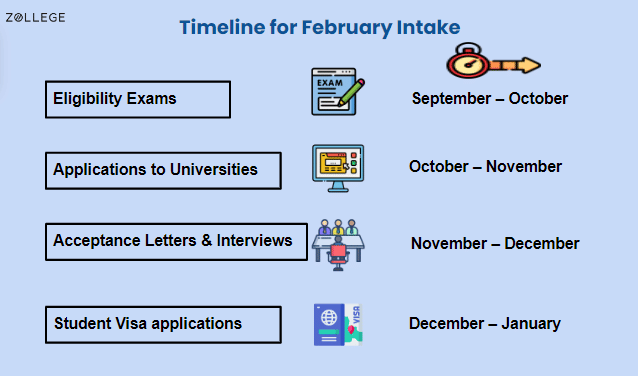
Timeline for February Intake
Candidates must check deadlines in Australia for top universities. The timeline for applying for the February study intakes in Australia is given in the table below
February Intake Universities in Australia
There are many universities offering February intakes in Australia. Candidates can also take up part time jobs in Australia to fund their living. University intakes in Australia offering February Intake are listed below:
- University of Sydney
- University of Melbourne
- University of Queensland
- University of Adelaide
- University of Wollongong
- University of New South Wales
- University of Western Australia
July Intake in Australia
July Intake or the Semester 2/T2 Intake in the Australian universities accepts applications between Late July/early August through November. MBA in Australia without work experience candidates can apply for universities in July intake. It covers numerous study program barring a few of them; there are enormous applications in this Australian intake making it popular but not the most popular.
Advantages of July Intake:
- Less competitive when compared to February Intake.
- More courses available when compared to November Intake
- Reasonable number of financial aid options
Disadvantage of July Intake:
- Indian courses end in April/June which means July Intake will not leave them with sufficient time to take tests and arrange documents.
- Limited courses, Limited seats, and Limited Scholarships
Timeline of July Intake
The timeline for applying in the July Intakes of Australia is as follows:
| Particulars | Timeline |
| Eligibility Exams | December – February |
| Applications to Universities | February – March |
| Acceptance Letters & Interviews | March – April |
| Student Visa applications | May – July |
July Intake Universities in Australia
Universities offering July Intakes of Australia are listed below:
- Australian National University
- Monash University
- University of Technology, Sydney
- Curtin University
- Macquarie University
- RMIT University
- Queensland University of Technology
November Intake in Australia
November Intake or the Semester 3 or T3 Intake in the Australian Universities accepts applications between Late October/early November through to February. It covers limited number of study program and is offered by the least of the universities. This study intakes in Australia sees the least influx of applications and happens to be the least popular season for admission seekers.
Advantages of November Intake:
- Lowest competition because it isn’t preferred by many students.
- Vocational courses are mainly available in this intake
Disadvantages of November Intake:
- Limited courses
- Limited universities offering this intake
- Lowest Scholarship opportunities
November Intakes in Australia Timeline
Candidates must check the exam eligibility for Australian universities. The timeline for applying in the November Intake in Australia is as follows:
| Particulars | Timeline |
| Eligibility Exams | May – June |
| Applications to Universities | June – July |
| Acceptance Letters & Interviews | July – August |
| Student Visa applications | August – September |
Universities for November Intake
Scholarships in Australia for international students to cover the tuition and accommodation expenses. University intakes in Australia offering November Intake are listed below:
- Bond University
- Charles Sturt University
- CQ University
- University of Southern Queensland
Document Required for Intakes in Australia
Candidates wonder “How to Apply to Australian Universities?” Australian Universities like all other institutions have some requirements that need to be fulfilled for admission. These requirements can be proved via documentation and the document checklist for admission into Australian Universities is as follows:
- Official Academic Transcripts of all previous academic qualifications
- English Language Proficiency Scores like July Intake requires an IELTS Score of 6.0 – 6.5+ for undergraduate program and 7.0 – 7.5 for graduate program.
- University-specific test scores (whichever required)
- Statement of Purpose
- Resume or Curriculum Vitae
- Letters of Recommendations – At least two.
- Passport size photographs of candidate (recent)
- Australia Student Visa
Australia is a great place to study and a tourist hot spot as well. Candidates might ask how many intakes are in Australia. The Australian educational system has made provision for three intakes every year which means admission are taken year-round. While the February Intake remains the most popular, November Intake is the least popular. Similarly, there are more scholarships on the offer in February as compared to both July and November Intakes.
FAQs
Ques. How much does it cost to study in Australia?
Ans. Although the tuition fees for study programs offered in Australia vary highly but on an average 20,000 AUD is what one needs to study in Australia.
Ques. How long does it take to get a student visa for Australia?
Ans. Once an application for student visa is made and all the medical tests have been done, one can expect a response from the Australian foreign missions. This response typically takes anywhere between 8 weeks to three months.
Ques. Can International students work in Australia while studying?
Ans. Yes, an International Student can work in Australia in part-time jobs while pursuing a study program in the country. The labour rights of such students are on par with any other worker in Australia. But the student visa holders in Australia are restricted to work 48 hours in a fortnight.
Ques. What is the cost of living in Australia?
Ans. The cost of a single person living in Australia comes to be around 1600 AUD when rent is excluded. The rent at the city centre comes to be around 2,500 AUD while outside the city centre, a one-bedroom flat costs around 1,800 AUD.
Ques. Does Australia accept study gap?
Ans. A study gap of 1 – 2 years is considered normal and is generally accepted by a lot of Australian Universities. For a study gap of more than 2 years, one will have to look into the policy of the specific university.
Ques. Which intake has the least competition in Australia?
Ans. The November/ Semester 3/T3 Intake receives the least number of applications making it one of the least competitive intake seasons. But courses and universities offering this intake are limited in number. Its good for applying to vocational courses.
Ques. Which is the most popular intake in Australia?
Ans. February/Semester 1/T1 Intake is the most popular Intake in Australia because it receives the most applications, offers almost all program of study and every university accepts admission herein.?
![Australian National University [ANU]](https://static.zollege.in/public/college_data/images/studyabroad/logos/college_597_12-11:31_anu_logo_fb_350.png?tr=w-50,h-50,c-force?tr=h-40,w-35,c-force)
![The University of Melbourne [unimelb]](https://static.zollege.in/public/college_data/images/studyabroad/logos/college_609_20-15:00_mel-Logo.jpeg?tr=w-50,h-50,c-force?tr=h-40,w-35,c-force)
![University of New South Wales [UNSW]](https://static.zollege.in/public/college_data/images/studyabroad/logos/college_603_29-10:36_logo.jpeg?tr=w-50,h-50,c-force?tr=h-40,w-35,c-force)
![The University of Sydney [USYD]](https://static.zollege.in/public/college_data/images/studyabroad/logos/college_620_29-11:04_logo.jpeg?tr=w-50,h-50,c-force?tr=h-40,w-35,c-force)
![The University of Queensland [UQ]](https://static.zollege.in/public/college_data/images/studyabroad/logos/college_596_29-11:20_queensland_Logo.jpeg?tr=w-50,h-50,c-force?tr=h-40,w-35,c-force)