
IELTS Score: Section Wise IELTS Score, Marking Criteria, and Score Validity
- IELTS Coaching Chandigarh
- IELTS Coaching in Kerala
- IELTS Coaching in Chennai
- IELTS Coaching Hyderabad
- IELTS Coaching Bangalore
- IELTS Coaching in Kolkata
- IELTS Coaching Ahmedabad
- IELTS Institute Amritsar
- IELTS Coaching In Delhi
- IELTS Classes in Pune
- IELTS Coaching in Mumbai
- IELTS Coaching Ernakulam
- IELTS Coaching Gurgaon


Content Curator | Updated On - May 10, 2024
Highlights -
- IELTS scores are valid for two years from the date of the test taken.
- Your IELTS test band score are given as whole or half-band scores and are rounded up to the nearest half or whole-band score.
- For example, if you get a 6.5 in Reading, 5 in Writing, 7 in Speaking, and 6.5 in Listening, the average of these 4 scores would be 6.25. This score would be rounded up to 6.5 for your overall band score.
- It takes 7-8 days after the exam for the IELTS results. IELTS TRF holds the overall bands and individual bands for each section and you will receive the IELTS TRF within 13 days of the exam.
IELTS score is the overall score accumulating your speaking, writing, listening, and reading skills score. IELTS score and band scale range from 0 to 9, each of the band scores corresponding to a level of English-language competence. What is the difference between raw and band scores?IELTS listening and reading sections have 40 questions and for each right answer, you will be given 1 mark each, which is the raw score. For example, if you score 35 out of 40, then it will be converted to the band score of 8. All the four section scores of the IELTS are converted into band scores from 0 to 9, with increments of 0.25, 0.5, and 0.75.
IELTS Scores Calculation
Calculating IELTS score is a simple process which includes average of all the four sections and then overall band to the nearest whole or half. Try to achieve a higher score to score above the IELTS cutoff for top universities. This can be easily understood through following examples:
- Listening: 6.5
Reading: 5.5
Writing: 6.0
Speaking: 7.0
Overall: 6.5 + 5.5 + 6.0 + 7.0= 25/4 (divided by 4 because of 4 sections)
= 6.25 this is the average score.
This is then calculated to the nearest half which is 6.5 because 6.25 lies between 6.0 and 6.5. - Listening: 5.0
Reading: 6.0
Writing: 6.5
Speaking: 5.5
Overall: 5.0 + 6.0 + 6.5 + 5.5= 23/4 = 5.75
So the overall band will be 6.0 because 5.75 is near to 6.0.
IELTS Band Descriptors
There are various skill levels associated with each band along with a different description for each. While the IELTS Band 9 is the highest, IELTS Band 0 or 1 is the lowest. The required IELTS Band scores depend upon the eligibility criteria of a particular university one is seeking admission into. The following table shows band range with skill level and description:
| IELTS Band | Skill Level | Description |
|---|---|---|
| 9 | Expert |
|
| 8 | Very Good |
|
| 7 | Good |
|
| 6 | Competent |
|
| 5 | Modest |
|
| 4 | Limited |
|
| 3 | Extremely limited |
|
| 2 | Intermittent | Not fluent in written and spoken English |
| 1 | Non-user | Don't know anything about speaking and writing English. |
| 0 | Not attempted the test | - |
IELTS Validity
Candidates can appear for as many times as they wish for IELTS. IELTS score validity is for 2 years or 24 months. Within this period one can take admission to abroad universities or institutions as per different intakes. If 2-3 months have passed after the official IELTS validity this gap can be filled. Any professional job done or English related course or any course done during this period can be shown to fill the gap.
IELTS Section-Wise Scores
There are four sections in IELTS and each section is scored individually based on some set of skills or criteria. These criteria form the basis of the English proficiency level of the candidates. All the scores range from 0 to 9. While there are different sets of skills required for each section, the score of each section has an equal share in overall band.IELTS TRF contains the scores of all the four sections ofthe test.
IELTS Reading Band Scores
IELTS Reading band scores range from 0 to 9, where 0 is referred to as not attempted and 9 is the highest. These IELTS Reading scores have an increment of 0.5 in the middle. There are a total of 40 questions given in the reading section. These questions are based on the paragraphs. The total correct answers are awarded the raw scores. For each correct answer 1 mark is rewarded and no mark is deducted for incorrect answers. The following skills impact the IELTS Reading scores:
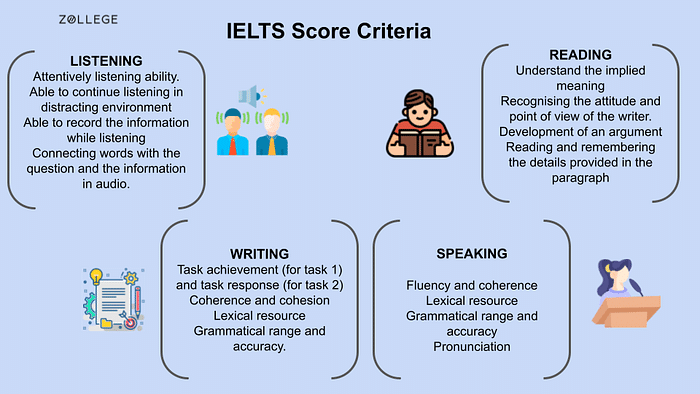
- Understand the implied meaning
- Recognising the attitude and point of view of the writer.
- Development of an argument
- Reading and remembering the details provided in the paragraph
IELTS Reading Scores Calculation
IELTS reading scores are calculated based on the total number of questions answered correctly. While no mark is deducted or rewarded for the incorrect answers. Total number of questions is 40, so the raw score is 40. The scores are calculated differently for both IELTS Academic reading and IELTS General training. The following table shows the IELTS Reading scores -
For Academic Reading:
| Raw Scores | IELTS Band |
|---|---|
| 40-39 | 9 |
| 38-37 | 8.5 |
| 36-35 | 8 |
| 34-33 | 7.5 |
| 30-32 | 7 |
| 29-27 | 6.5 |
| 26-23 | 6 |
| 22-19 | 5.5 |
| 18-15 | 5 |
| 14-13 | 4.5 |
| 12-10 | 4 |
| 9-8 | 3.5 |
| 7-6 | 3 |
| 5-4 | 2.5 |
For General Training:
| Raw scores | IELTS Band |
|---|---|
| 40 | 9 |
| 39 | 8.5 |
| 37-38 | 8 |
| 36 | 7.5 |
| 34-35 | 7 |
| 32-33 | 6.5 |
| 30-31 | 6 |
| 27-29 | 5.5 |
| 23-26 | 5 |
| 19-22 | 4.5 |
| 15-18 | 4 |
| 12-14 | 3.5 |
| 9-11 | 3 |
| 6-8 | 2.5 |
Following are a few examples which show the calculation of IELTS academic reading score:
- Raw score: 36
Total correct answers: 36
Overall Band: 8 - Raw scores: 24
Total Correct answers: 24
Overall Band: 6 - Raw Scores: 19
Total Correct answers: 19
Overall Band: 5.5
IELTS Writing Band Scores
IELTS writing scores range from 0 to 9 with 0.5 increment. The scores of the writing section share an equal value in the overall band calculations. IELTS Writing includes 2 tasks: IELTS Writing Task 1 and IELTS Writing Task 2. These tasks are evaluated on certain criteria. These criteria are listed below along with its meaning:
| Criteria | Meaning |
|---|---|
| Task Response |
|
| Cohesion and Coherence |
|
| Lexical Resource |
|
| Grammatical accuracy |
|
IELTS Writing Scores Calculation
IELTS writing sections scores are calculated by calculating the above mentioned criteria. There are writing task 1 and writing task 2. The scores obtained by these two sections are averaged and then overall band produced to the next whole or half band. Each of the above mentioned criteria have a score range from 0 to 9. Following examples show the calculation of IELTS writing scores for task 1 and task 2.
- IELTS Writing Task 1
Task Response: 5.5
Cohesion and Coherence: 6.0
Lexical Resource: 6.5
Grammatical accuracy: 5.0
Overall band: 5.5 + 6.0 + 6.5 + 5.0 = 23/4 = 5.75 ( the overall band for writing task 1 will be 6.0 because 5.75 is nearest to whole 6.0) - IELTS Writing Task 2
Task Response: 6.5
Cohesion and Coherence: 6.5
Lexical Resource: 7.0
Grammatical accuracy: 5.5
Overall band: 6.5 + 6.5 + 7.0 + 5.5 = 25.5/4 = 6.375 (the last figure is .75 which is nearest to the next whole) so, the overall band for writing task 2 will be 7.0
Total writing task band: the writing task 2 holds double value as compared to writing task 1. So the calculation will be 6.0 + 7.0 + 7.0 = 20/3 = 6.66 which is nearest to 6.5 so overall writing Task band is 6.5
IELTS Listening Band Scores
Listening band scores range one a scale from 0 to 9 bands. IELTS Listening band scores are calculated on the basis of correct answers. There are 4 audio transits based on which 40 questions are provided. The total correct answers provide the raw scores and IELTS Listening Band scores are calculated as per raw scores. One mark is awarded for each correct answer. These are based on the listening ability of the candidate. Following criteria impact the overall IELTS Listening Band scores:
- Attentively listening ability.
- Able to continue listening in distracting environment
- Able to record the information while listening
- Connecting words with the question and the information in audio.
IELTS Listening Score Calculation
There are no negative markings for the unattempted or incorrect answers. However, it affects the raw scores of the candidate. IELTS Listening scores are calculated based on the number of correct answers out of 40 given questions. Listening band score academic and general training both are same with no difference. The following table shows the raw scores and IELTS Listening scores:
| Raw Scores | IELTS Band |
|---|---|
| 39-40 | 9 |
| 37-38 | 8.5 |
| 35-36 | 8 |
| 32-34 | 7.5 |
| 30-31 | 7 |
| 26-29 | 6.5 |
| 23-25 | 6 |
| 18-22 | 5.5 |
| 16-17 | 5 |
| 13-15 | 4.5 |
| 10-12 | 4 |
| 8-9 | 3.5 |
| 6-7 | 3 |
| 4-5 | 2.5 |
The following are a few examples showing the IELTS Listening scores:
- Raw score: 37
Total correct answers: 37
Overall Band: 8.5 - Raw scores: 22
Total Correct answers: 22
Overall Band: 5.5 - Raw Scores: 11
Total Correct answers: 11
Overall Band: 4
IELTS Speaking Band Scores
IELTS Speaking bands are calculated based on the answers spoken to the interviewer. There are a total of three tasks which include introduction, cue card topic and discussion. Based on these tasks there are 4 criteria which impact the speaking bands. IELTS Speaking band 9 is the highest and maximum, IELTS Speaking band 6 is required to get a high overall IELTS Band score. Following are the four criteria for IELTS Speaking:
- Fluency
- Pronunciation
- Coherence and Cohesion
- Grammatical accuracy
IELTS Speaking Score Calculation
Based on the above four criteria the interviewer also evaluated the creative vocabulary used and creative ideas. Discussion about the cue card IELTS Speaking topic is a very important step which gives an opportunity to the candidate to score high. Following example which show the calculation of IELTS speaking band scores:
- Fluency: 7.0
pronunciation: 5.5
Coherence and Cohesion: 6.0
Grammatical accuracy: 7.0
Total IELTS Band: 7.0+5.5+6.0+7.0= 25.5/4 = 6.375
So, the last figure is .75 which will be calculated to the nearest whole. So, it is calculated as IELTS Speaking band 7. - Fluency: 7.5
Pronunciation: 8.0
Coherence and Cohesion: 8.0
Grammatical accuracy: 8.0
Total IELTS band: 7.5+8.0+8.0+8.0 = 31.5/4 = 7.875
So, the last figure is .75 and it will be calculated to the next whole. It is calculated as IELTS Speaking band 8.
IELTS Band scores for each section are different and then all are averaged and overall band is calculated using IELTS score calculator. IDP IELTS Result time is as per US time and generally takes 7 days after the exam. PTE scores and IELTS scores are different but both are English proficiency tests. IELTS Result checker can be used while practicing for IELTS. There are several free IDP Result checkers online which calculate overall IELTS Band scores.
FAQs
Ques: How much is 33 in IELTS reading?
Ans: 33 in IELTS Academic reading means a score of 7.5 in reading section and 6.5 for IELTS general reading section.
Ques: Is 7.5 IELTS good?
Ques: What is 16 out of 40 in IELTS reading?
Ques: Can anyone get 9.5 in IELTS?
Ques: What is 29 out of 40 in IELTS listening?
Ques: How much is 27 in IELTS reading?
Ques: Is IELTS 7 score a best score?
Ques: How can I score 9 in IELTS?
Ques: Is IELTS 9 a good score?
Ques: Is IELTS out of 9 or 10?
Ques: What is a good IELTS score?
*The article might have information for the previous academic years, please refer the official website of the exam.