
IELTS Speaking: Exam Format, Scores, Topics, and Preparation Tips
- IELTS Coaching Chandigarh
- IELTS Coaching in Kerala
- IELTS Coaching in Chennai
- IELTS Coaching Hyderabad
- IELTS Coaching Bangalore
- IELTS Coaching in Kolkata
- IELTS Coaching Ahmedabad
- IELTS Institute Amritsar
- IELTS Coaching In Delhi
- IELTS Classes in Pune
- IELTS Coaching in Mumbai
- IELTS Coaching Ernakulam
- IELTS Coaching Gurgaon


Content Curator | Updated On - Jun 1, 2024
Highlights
- Exam type: It is a face-to-face interview session for IELTS speaking exam
- Duration and exam segment: The total time for the speaking test is 11–14 minutes, divided into 3 segments
- Assessment criteria: There will be four assessment criteria namely fluency and coherence, lexical resource, grammatical range and accuracy, pronunciation
- Skill check: Key skills like your ability to give an opinion on a topic, speak at length, and how you explain your opinion.
- Speaking score: The speaking score ranges from 0-9 where you have to score band 7 to get into any top university.
- Common IELTS speaking topics: The common topics are related to home, family, work, study, and so on.
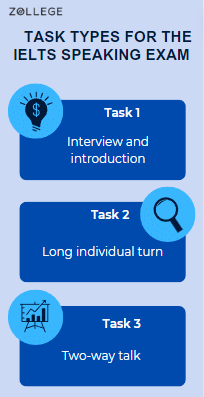
IELTS Speaking Format
IELTS speaking test topics for both academic and general are similar and consist of an 1-1 interview. Cue cards are given to students to evaluate their English-speaking abilities IELTS exam speaking topics. The group discussion part of IELTS syllabus analyze the candidates how they share their idea in detail.
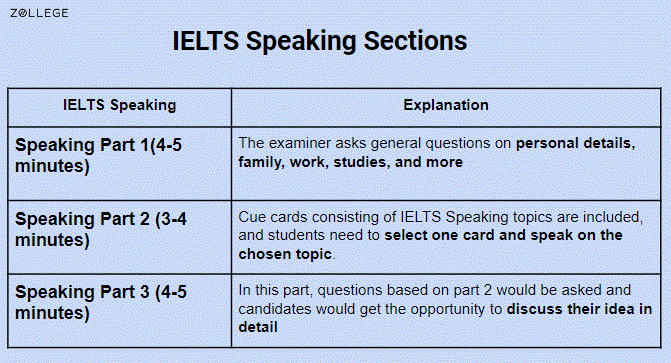
IELTS Speaking Part 1
IELTS speaking part1 requires candidates to introduce themselves to the examiner. Mentioned below are the points that summarize IELTS Speaking part1:
- Candidates are required to answer general questions like; city they avail from, profession etc.
- Aspirants necessarily need to produce name, present passport/ID, and share the name by which they want to be addressed by the examiner
- Assesses an aspirant's ability to present their views, opinions and ideas.
IELTS Speaking Part 2
IELTS speaking part2 test format included cue cards, and students need to select one card and speak on the chosen topic.
- Test-takers are provided with a cue card
- One minute for preparation of the cue card topic is given
- Candidates are required to speak on the topic for two minutes
- Entire speaking part2 comprises a total of 3–4 minutes
IELTS Speaking Part 3
On the IELTS Speaking part3 candidates required to discuss on provided topics. IELTS speaking topics for part 3 has been mentioned below:
- In-depth explanation of opinions of candidates is required in this subsection
- Evaluation is based on ability to assess a topic, share and justify the statements
- Examiners expect longer answers for four-five questions asked
- Questions deal with daily happenings in life of the candidates
- Speaking part 3 is of four-five minutes duration
IELTS Speaking Score
IELTS speaking test score is marked through the number of correct attempts by students. IELTS band score for speaking ranges from 0-9. Speaking band 7 or higher is necessary for IELTS eligibility in top universities worldwide.
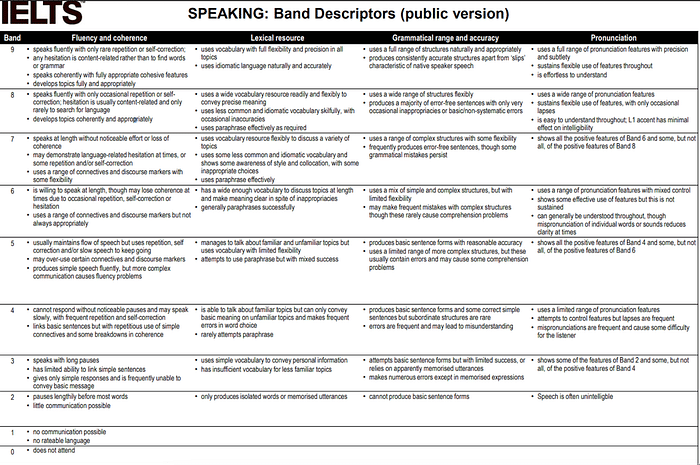
IELTS Speaking Marking Criteria
IELTS scores of speaking section are based on four different criteria by examiners. Candidates need top practice regularly IELTS speaking topics and answers to get their desired results. The table below-mentioned IELTS speaking marking Criteria for :
| Fluency and coherence (25%) | Assesses how well the examinee can speak at a normal speed without hesitation. It includes putting ideas in a logical order. |
| Lexical Resource (25%) | Assesses the range of vocabulary and how accurately and appropriately you use the words to express meaning. |
| Pronunciation (25%) | Assesses the range of grammar and how accurately and appropriately you use it. |
| Grammatical range and accuracy (25%) | Assesses the range of grammar and how accurately and appropriately you use it. |
IELTS Speaking Topics
IELTS Speaking topics contains a wide variety of contents that come across on a daily basis. Candidates can prepare effectively with IELTS speaking practice papers for better improvement. IELTS speaking exam is divided into three different parts; Part 1, Part 2 and Part 3. Every part in the IELTS talking topics has a different type of IELTS academic and general topics.
| IELTS Speaking Topics for Part 1 | |
|---|---|
| Studies |
|
| Family |
|
| Work |
|
| Timing |
|
| IELTS Speaking Topics for Part 2 | |
|---|---|
| An Interesting Animal You Have Seen | Describe an interesting animal you have seen, You should say:
|
| A Crowded Place You Went To | Describe a crowded place you’ve been to, You should say:
|
| A Person Often in the News | Describe a person who is often in the news, and who you would like to meet. You should say:
|
| A performance you enjoyed watching | Describe a performance you enjoyed watching. You should say:
|
| One Thing You Are Going To Do Next Week Cue Card | Describe one thing you are going to do next week - What is it? |
| Favorite Day of the Week | Talk About Your Favorite Day of the Week - What day is it? |
| Person who is good at making people feel welcome in his/her home | Describe a person who is good at making people feel welcome in his/her home - Who this person is. |
| City You Would Like To Stay For a Short Time | Describe Another City You Would Like To Stay For a Short Time |
| IELTS Speaking Topics for Part 3 | |
|---|---|
| An Article to Help People Improve Their Health |
|
| A uniform you have worn |
|
| The Desired Change to Your Local Area |
|
| A Successful Small Business |
|
IELTS Speaking Preparation Tips
IELTS speaking preparation tips are important to be prepared for IELTS exam dates. Candidates must understand the basics about the test by going through IELTS speaking topics with answers. Candidates are advised to check the tips for better understanding.
- Before doing IELTS registration, start talking with friends, family in English. Candidates can also record themselves to hear how confident they sound and work on pronunciation.
- Don’t be scared of giving wrong or right answers in the test. Remember, the examiner will see how articulate the candidates are in expressing their opinions in English.
- There is no need to be stressed in the speaking test. The examiner is not giving marks on the given answers, but on how well they can speak on their opinion of thought.
- Avoid repetition of examiner’s question as a part of the answer, understand the question.
- Do not slow down or pace up speaking. Be natural, like how talks to people in regular life. Speaking quickly may end up in pronunciation mistakes.
- Try being as detailed when answering. Develop responses to each question, rather than just answering in a ‘yes’ or ‘no’.
- Practise how to pronounce the numbers clearly. For instance, when spoken, numbers like ‘Forty’ and ‘Fourteen’ may sound similar.
- Try to provide answer with reasons. This helps use a wider range of grammar and vocabulary.
IELTS Speaking Books
IELTS preparation books contains previous year question papers and sample tests. These books provide comprehensive study materials, and practice tests for students. There are many IELTS books online which candidates can consider for the self preparation.
- The Official Cambridge Guide to IELTS- Check PDF
- IELTS Trainer 2 Academic: Six Practice Tests- Check PDF
- Simone Braverman’s Target Band 7- Check PDF
- Official IELTS Practice Materials 2 with DVD- Check PDF
- Focus on IELTS Foundation Coursebook- Check PDF
- Barron’s IELTS Superpack- Check PDF
IELTS Speaking Sample Papers
IELTS Sample paper helps candidates in understanding the IELTS exam speaking test pattern. IELTS speaking practise includes solving previous year question papers, and mock tests. IELTS speaking topics 2023 - 2024 include three sections. Regular practice with IELTS speaking examples, can help students prepare for the IELTS exam centers.
Better understanding of IELTS speaking topic is important for candidates. With regular practice of IELTS speaking test topics, candidates can achieve their desired band scores.
FAQs
Ques - How can I practice speaking for IELTS?
Ans - Use a range of grammatical structures, don't memorize answers, don't use big and unfamiliar words, and don't worry about accent.
Ques - How can I get 8 speaking in IELTS?
Ans - Speak English in daily lives, give full answers, understand the question properly, and took practice test regularly, can help a candidate to achieve 8 in IELTS speaking.
Ques - What is good IELTS speaking score?
Ans - IELTS speaking score ranges from 0-9. Scoring a band score of 8 is considered as a good IELTS score, that proves the candidate's English-speaking abilities.
Ques - How can I improve my speaking?
Ans - Speak regularly with English language, Listen to English podcasts, and read English magazines, newspapers regularly and practice mock tests of IELTS speaking sections.
Ques - Is IELTS speaking easy?
Ans - Most of the aspirants consider IELTS speaking section as the hardest section of IELTS.
Ques - How to start English speaking?
Ans - Talking with friends, family members or record own voices to understand what needs to be improved.
Ques - Can I memorize IELTS speaking?
Ans - Candidates are never advisable to memorize answers in IELTS speaking test.
Ques - Can I skip a question in IELTS speaking?
Ans - Skipping a question in IELTS speaking topics, can affect the candidates score a bit.
Ques - What are the 3 parts of IELTS speaking test?
Ans - Interview, cue card topics, and discussion are the three parts of IELTS speaking test.
Ques - How can I score 7 in IELTS speaking?
Ans - Understand what the examiner needs, never memorize answers, and do regular English speaking warm up to score 7 in IELTS speaking topics.
Ques – What is the IELTS Speaking test?
Ans - The IELTS Speaking test is a face-to-face interview with a certified examiner. It assesses your ability to communicate effectively in English. You will be tested on grammar, vocabulary and other parts of English speaking test.
Ques – How long does the Speaking test last?
Ans - The IELTS Speaking test lasts for about 11-14 minutes. There are three parts of the test. In the first part, you need to introduce yourself and the next two parts will be discussion. One topic will be given to speak for 2-3 minutes and then questions will be asked on that topic.
Ques – What are the different parts of the IELTS Speaking test?
Ans - The Speaking test consists of three parts: Part 1 (Introduction and Interview), Part 2 (Long Turn), and Part 3 (Discussion). In the first part you need to speak about yourself and introduce yourself. Part wilkl be a topic on which you need to speak and the last part is a discussion on the topic.
Ques – What topics are covered in Part 1 of the Speaking test?
Ans - Part 1 of the IELTS Speaking test usually includes questions about familiar topics such as work, studies, hometown, hobbies, and interests. You need to be true and speak everything with utmost clearance.
Ques – How should I prepare for Part 1 of the Speaking test?
Ans - You should prepare for the first section of IELTS Speaking by practicing common questions about yourself, your daily routine, your family, and your experiences. You must focus on fluency and coherence while talking about yourselves.
Ques – What is Part 2 of the Speaking test?
Ans - The Part 2 requires you to speak for 1-2 minutes on a given topic. You will be given multiple flashcards from which you need to choose one. You have 1 minute to prepare before you start speaking.You must speak for atleast 2-3 minutes.
Ques – How can I perform well in Part 2?
Ans - To perform well in Part 2 of IE:LTS Speaking, you must use the one-minute preparation time wisely to outline your response. You should make notes on key points to cover during your speech. Once this is done, you can start speaking.
Ques – What types of topics can I expect in Part 2?
Ans - There are multiple topics in the second part of the IELTS test. Part 2 topics can range from describing a person, place, or event to expressing opinions or giving advice on a particular issue. You can expect various social, ecomnomical or recent event topics.
Ques – Is there a specific structure I should follow in Part 2?
Ans - No, there's no strict structure in part 2 of the IELTS Speaking section. It's helpful to introduce the topic, give details, and conclude with a summary or final thoughts. You must also express your thoughts while speaking on the topic.
Ques – What is Part 3 of the Speaking test?
Ans - The Part 3 of the IELTS Speaking test involves a discussion with the examiner on more abstract and complex topics related to Part 2. Once you are done speaking, the examiner will ask questions about the topic.
Ques – How can I improve my performance in Part 3?
Ans - To improve your performance in part 3 of IELTS Speaking, you must practice discussing various issues and expressing opinions clearly. You must pay attention to developing ideas and supporting them with examples.
*The article might have information for the previous academic years, please refer the official website of the exam.