
IELTS Listening Tips: Question Types and Strategies
- IELTS Coaching Chandigarh
- IELTS Coaching in Kerala
- IELTS Coaching in Chennai
- IELTS Coaching Hyderabad
- IELTS Coaching Bangalore
- IELTS Coaching in Kolkata
- IELTS Coaching Ahmedabad
- IELTS Institute Amritsar
- IELTS Coaching In Delhi
- IELTS Classes in Pune
- IELTS Coaching in Mumbai
- IELTS Coaching Ernakulam
- IELTS Coaching Gurgaon


Content Curator | Updated On - May 8, 2024
Highlights -
- The IELTS listening test consists of 40 questions with a mix of monologues and conversations from a range of native speakers.
- IELTS listening tips and tricks include points for answering the MCQ, and matching.
- You must also follow tips and tricks for IELTS listening to answer the questions from diagram labeling, summary completion, and sentence completion.
- IELTS listening tips may vary for paper and computer-delivered tests.
IELTS listening tips will help you in achieving a high band score, which will contribute to the overall IELTS score. Tips on listening IELTS makes you prepared for the test in terms of time management skills, a proper task response, and tricks to handle difficult questions. IELTS listening has four recordings with 40 questions, and you have 30- minutes to complete this section. IELTS listening advice will help you to interpret a situation, or analyze the ideas from, a given recording with varied recordings. IELTS listening tips and tricks for band 9 focus on improving your listening skills through practicing various audio transcripts, and podcasts with different accents.
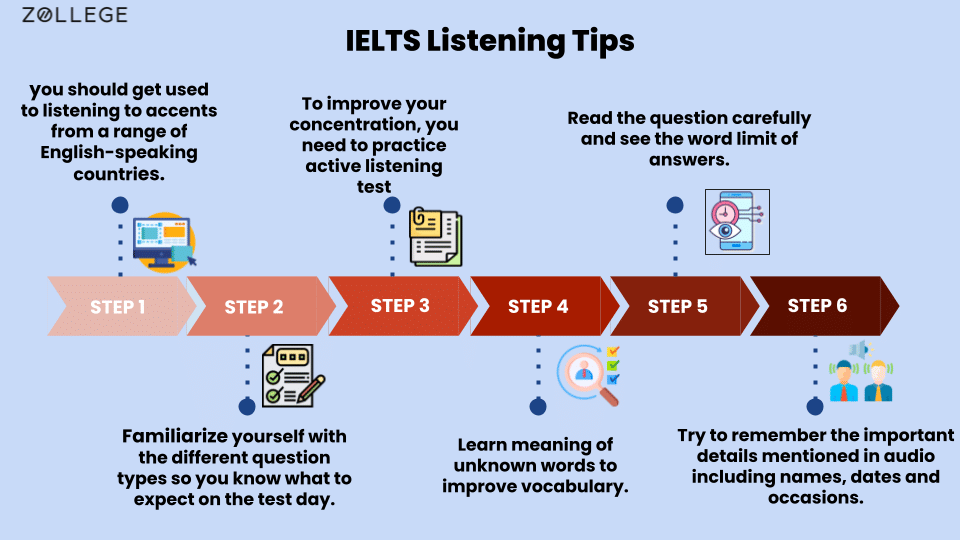
IELTS Listening Tips and Tricks
There are various IELTS Academic listening tips for different question types. These tips benefit the candidate to solve different sections and types of questions effectively. Following are IELTS listening tricks for each question type:
IELTS Listening MCQ
There are a total of 40 questions of IELTS Listening out of which there are MCQ-based questions. In these questions students have to select the most appropriate choice out of given options which is necessary for tricks for listening in IELTS. You must register for IELTS before checking the question pattern.
Example:
Question: What is the reason given by the author behind watching horror movies?
- Thrill
- Adventure
- To get scared
- It is based on fantasy conspiracies
Out of these 4 options candidates have to select the most appropriate based on the audio transit.
IELTS Listening MCQ Tips and Tricks
Answering the Listening MCQ questions correctly will also helo you to meet the IELTS cutoff for colleges. Following are a few IELTS listening multiple choice questions tips and tricks which assist the candidates to accomplish maximum number of correct responses in MCQ based questions:
- Avoid marking the answer while listening to the audio transit in a paper-based test.
- Read all the MCQ questions carefully before listening to audio.
- Use a pencil and cross the options which are wrong as per audio.
- Listen to the words which have been included in the question statement.
- Look for keywords and the main idea behind the question statement.
- Don't mark the answer before completing the audio because some words might seem confusing.
IELTS Plan, Map, Diagram Labeling
There are several plans, maps or diagrams presented based on audio transit. Having an organised IELTS study plan will save you enough time to practice all the question types in detail. These are labeled properly from the information provided through audio.
Example:
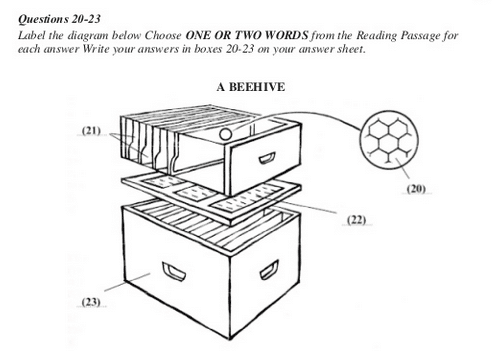
In this several numbers are marked defining a particular part of the object. The candidates have to label these based on the audio.
Tips for Labeling Questions
Labeling questions can seem complicated and many students lose marks by incorrectly labeling the diagram provided. You can enroll in IELTS coaching classes that will teach you all the tricks for solving different question types. There are several tricks which makes the labeling questions easy as states below:
- Look for description details provided in the audio.
- Have a look at the diagram, map or plan while listening to the audio. Label the visuals along with details provided in audio.
- Note the word limit of answer provided in the question statement.
- Listen to the use of a particular machine or main purpose of visual representation and understand the importance of each of its labeling parts.
- Do not guess the answer.
IELTS Listening Table, Flow Chart, and Summary Completion
Based on the audio transit there are several flow charts and tables provided with blanks to be filled. You can explore the IELTS listening topics to get an idea of the most common question topics. A small paragraph-like summary can also be included in the question with several blanks which have to be completed.
Example:
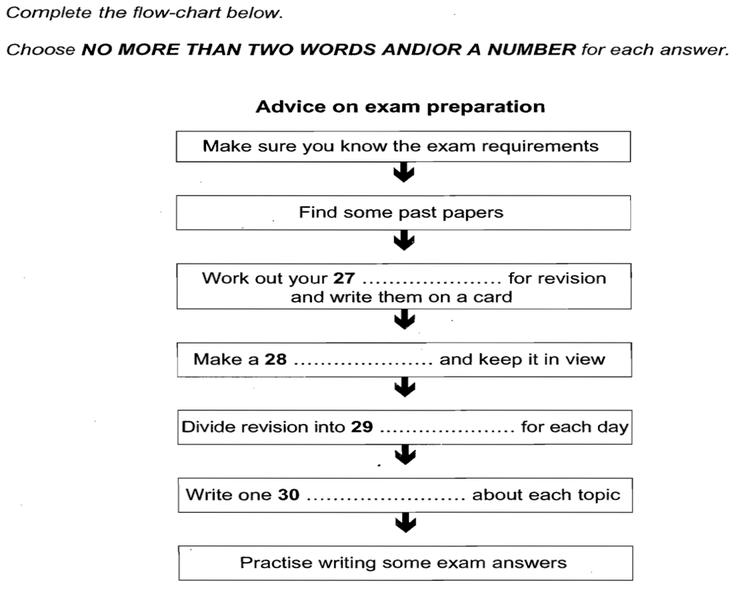
In the above presented flow chart there are several blank spaces which have to be filled by using information given in audio. Each of these blanks carry one mark each.
Tips to Fill in the Blanks
The listening question types is similar for both the IELTS general and academic. Following are few tips and strategies for Listening IELTS to solve the blank solving and flow chart or summary completion:
- Remember important dates or numbers being spoken in audio.
- Analyze the summary of the chart before listening to audio and keep in mind the key points.
- Note the word limit of the answer stated in the question.
- Do not guess the answer and write a sentence explaining the meaning.
- Note the location names mentioned in the audio.
- If there are steps mentioned, note the main focus of each step.
IELTS Listening Matching
Tips for IELTS listening also requires you to get familiar with the IELTS syllabus along with the score pattern. Matching the correct answers are given in IELTS Listening in a form of table. There are a few words or location names mentioned along with different statements. These statements have to be connected and matched with the location names or particular details mentioned in a box.
Example:

In the above image, there are five locations mentioned following four statements describing special features. These have to be matched with the correct name of the location.
IELTS Listening Matching Tips
Matching based questions can be easily solved and attempted using the following mentioned tips to get a high IELTS band score –
- Do not get confused with the details.
- Remember the name of places, locations or characters mentioned along with special features about them.
- Read the question beforehand and retain the matching options to be related to the statements.
- Do not get stuck on a particular detail. Move on to further and answer it later.
- Try to mark the matching correspondingly while listening to audio.
IELTS Listening Sentence Completion
There are several sentences provided in the IELTS Listening which have to be completed by filling in the missing detail or completing the ending. IELTS score validity is for two years, so it is better that you try to take the test in one go and apppply within those two years. These have to be answered briefly with one or two words.
Example:

In the above image, there are spaces left at the end of the sentence which have to be filled within one or two words.
Tips to solve sentence completion
Following are a few IELTS Listening important tips which help the candidates in attempting sentence completion and ultimately improve the IELTS listening score –
- Do not exceed the word limit.
- Read sentences carefully and understand what the missing space demands.
- The information in the question statement might be related to previous questions based on the same audio. Look for clues in previous answers.
- Do not get stuck on a single answer. Don't leave questions unattempted but guess the answers at the end.
- Write the answers about which you are sure.
IELTS Listening Short answer questions
There are answers in brief questions given based on audio transits. These have to be answered within one or two words. Scoring a decent marks in the test, will also make you eligible for IELTS scholarships.The answers of these questions can be easily identified by the important details mentioned in the question statement itself.
Example:
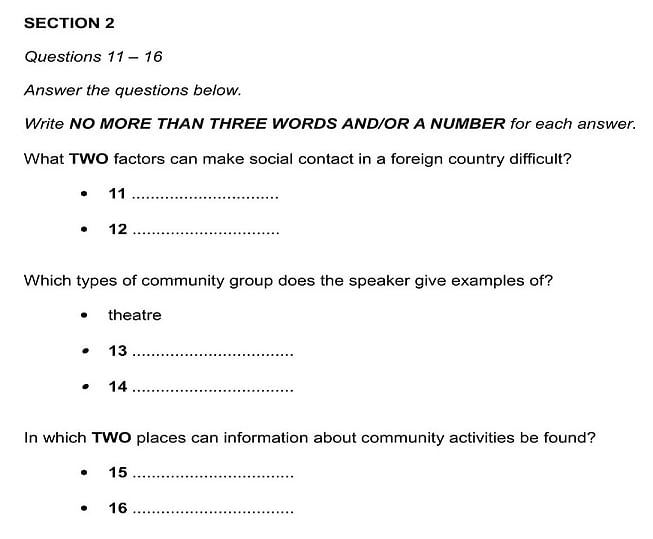
In the above image, main keywords are mentioned in the question statement. The answers have to be the major details stated in audio.
Tips to Solve Short Answer Questions
The short answer questions can be answered easily by remembering the main details. There are a few more IELTS tips that help in short answer questions as given below:
- Read the question carefully and see the word limit of answers.
- Try to remember the important details mentioned in audio including names, dates and occasions.
- Try to answer these questions while listening to audio but don't miss the other details.
- Look for synonym words.
- Take hints from previous questions of the same audio.
How to Improve Listening Skills in IELTS
Candidates must improve their Listening to achieve IELTS score high and avoid incorrect answers. There is no negative marking for the incorrect answer but the maximum number of correct answers results in high band scores. There are several ways in which candidates can improve Listening skills IELTS:
- Practice papers
- Listen, read questions and repeat audio.
- Try to get familiar with all different accents.
- Learn meaning of unknown words to improve vocabulary.
- Use the 10 minutes given to transfer the answer to the answer sheet.
- Do not rush while marking the answers.
- Take online mock tests
- Listen and Multitask
- Try to maintain focus on distracting environment.
How to Guess the Answer ?
There might be some questions which are left unanswered. It is advised to not submit the unsolved questions and try to guess the answers. There are a few tips and tricks for IELTS listening which help in guessing the answer at the last minute. There are many websites for IELTS where you can practice the listenining sections and improve your skills.
- Write the answer most appropriately suitable to the question.
- Don't use words on your own. Use the words mentioned in the audio.
- Try to write a synonym of a word which seems best fitting to the question.
- Guess the answer based on previous answers.
- Understand the audio and guess accordingly.
IELTS Listening test tips and tricks increase the chances of scoring high. Listening tricks for IELTS help like a guide to understand the exam solving strategy and learn to answer different types of questions. There are several strategies for Listening IELTS including proper time management and using the extra 10 minutes wisely.
FAQs
Ques. How can I improve my IELTS listening skills?
Ques. What are some effective strategies for IELTS listening?
Ques. Should I take notes during the IELTS listening section?
Ques. How can I improve my listening speed for the IELTS?
Ques. Are there any specific types of questions I should focus on in IELTS listening practice?
Ques. What should I do if I miss a question during the IELTS listening section?
Ques. How can I stay focused during the IELTS listening section?
Ques. Should I read the questions before listening to the audio in the IELTS?
Ques. How can I improve my vocabulary for the IELTS listening section?
Ques. Is it important to listen for specific details during the IELTS listening section?
Ques. What is considered a good score for the IELTS listening section?
Ques. How can I improve the IELTS listening experience during practice?
Ques. What should I do if I encounter a difficult accent or unfamiliar vocabulary during the IELTS listening section?
Ques. How can I assess my progress in IELTS listening preparation?
Ques. Are there any additional resources or tips for IELTS listening preparation?
*The article might have information for the previous academic years, please refer the official website of the exam.