
IELTS Speaking Tips: Top Mistakes to Avoid
- IELTS Coaching Chandigarh
- IELTS Coaching in Kerala
- IELTS Coaching in Chennai
- IELTS Coaching Hyderabad
- IELTS Coaching Bangalore
- IELTS Coaching in Kolkata
- IELTS Coaching Ahmedabad
- IELTS Institute Amritsar
- IELTS Coaching In Delhi
- IELTS Classes in Pune
- IELTS Coaching in Mumbai
- IELTS Coaching Ernakulam
- IELTS Coaching Gurgaon


Content Curator | Updated On - Dec 4, 2023
IELTS speaking tips help to improve a candidate's English language communication abilities. Questions for IELTS speaking are divided into three parts. The first IELTS speaking exam section is an introduction and interview, then candidates are given a topic on a cue card, and allotted 1 minute to make notes. The third part is a two-way discussion about the topic of part 2. The overall Test duration for IELTS speaking is 11–14 minutes, for both Academic and General Training tests. The score for IELTS speaking test ranges on a scale of 0-9 band. IELTS speaking exam is conducted 7 days before or after the scheduled exam date. IELTS speaking score depends on 4 criteria: fluency and coherence, lexical resource, grammatical range and accuracy, and pronunciation.
Questions for IELTS Speaking
Questions for IELTS speaking are the same for both academic and general training exams. IELTS speaking exam questions are divided into three parts and consist of a 1-1 interview, cue cards, and a group discussion. There are different types of topics given in IELTS speaking like; family, country, personal experience, or recent activity-related questions. Candidates require regular practice of IELTS speaking test question and answer and follow the IELTS speaking tips to achieve a good band.
IELTS Speaking Part 1
Candidates will have 4 to 5 minutes for IELTS speaking part 1. This part consists of general questions related to the candidate’s life. Speaking part 1 includes topics related to work, family, home life, and personal interests.
IELTS Speaking Part 2
In part 2 of IELTS speaking exam, candidates are given a cue card with a topic. The total time given for IELTS speaking is 3–4 minutes, and candidates are given one minute to take notes on the given topic. Candidates need to practice with IELTS speaking answer and question regularly to understand the cue card topics
IELTS Speaking Part 3
Questions for IELTS speaking part 3, the candidate will have a conversation with the examiner about the part 2 topic. Part 3 requires discussing the given topic in detail and takes 4–5 minutes to complete.
IELTS Speaking Test Tips
Following the IELTS speaking tips can help the candidates to achieve their desired IELTS score. Candidates need to practice speaking with fluency, incorporate vocabulary words, avoid grammatical errors, and ensure correct pronunciation. Many coaching centers provide effective IELTS preparation. Here are the top 10 IELTS speaking tips to ace the exam preparation:
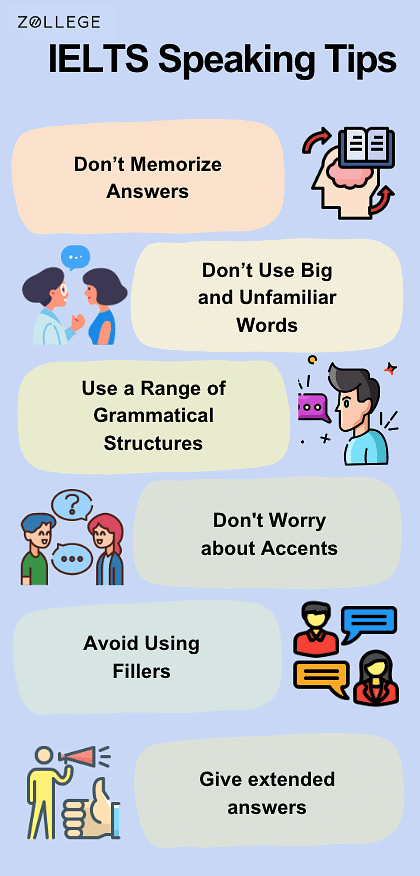
Don't memorize answers: The examiner will be able to analyze, that the candidates have memorized their answers. Memorized answers don't give the examiner accurate answers about the candidate’s English language skills, and this may cost the final band score.
Don't use big and unfamiliar words: Most candidates want to impress the examiner with big and complex words. Try to avoid using words that are not familiar. There is a higher chance of making mistakes by either mispronouncing words or using them in the wrong context. Candidates should remember IELTS exam speaking tips to ace the exam.
Use a range of grammatical structures: One of the important IELTS speaking tips is to try and use a range of grammatical structures, using complex and simple sentences to express what want to say. Candidates should know errors and should practice speaking to friends in English, or record their voices to spot errors.
Don't worry about accents: In the face-to-face Speaking test, the IELTS examiner is experienced in understanding what the candidate says. If the candidate can communicate well, then there is nothing to worry about. But do be aware of sounds that have difficulty. Practice with friends, and take feedback.
Pause to think: Candidates can take a brief pause to think about what to say. Candidates can use phrases to take time to think during the Speaking test.
Avoid using fillers: Try to Speak confidently and avoid using filler words. Most Candidates use fillers when they don't know what to say. It's important to avoid fillers because that shows candidates can't access the appropriate language or ideas.
Give extended answers: Always try to give full answers to the examiner's questions. Extend the answers and don't wait for the examiner's next question. If the answers are short, this shows that the candidate cannot talk in detail about a topic.
Smiling helps pronunciation: Smiling can help in pronunciation. Always make sure to pronounce it clearly, and open the mouth wide enough so that sounds come out clearly. When we smile, our mouth is bigger and the tone of voice is more friendly.
Don't speak in a monotone: Sometimes when we speak continuously, we talk in a monotone, with little variation. Focus on certain words and pausing at sections while speaking can make the conversation with the IELTS Eligibility examiner more engaging.
Practice common IELTS topics: Part 2 of the IELTS Speaking test includes speaking on a given topic for about 2 minutes. Practice common cue card for IELTS speaking topics with friends, family, or colleagues to improve speaking and learn more vocabulary and grammar.
IELTS Books for Speaking
IELTS books consist of updated study materials, practice papers, and the best IELTS speaking advice. These preparation books also provide IELTS speaking test questions and answers to understand the exam pattern. Here are some IELTS books that provide the best and customized study materials, tips in speaking IELTS, and a wide range of vocabulary for IELTS speaking practice:
- The Official Cambridge Guide to IELTS- Check PDF
- IELTS Trainer 2 Academic: Six Practice Tests- Check PDF
- Simone Braverman’s Target Band 7- Check PDF
- Official IELTS Practice Materials 2 with DVD- Check PDF
- Focus on IELTS Foundation Coursebook- Check PDF
- Barron’s IELTS Superpack- Check PDF
IELTS Speaking Test Sample Questions
IELTS sample papers are one of the best options for preparing for the speaking section. Regular IELTS speaking test practice helps candidates to be exam-ready before the IELTS exam date. Candidates can go through the below-mentioned IELTS speaking exam practice papers for better understanding:
Candidates who are planning to move abroad must follow the IELTS speaking tips for better scores. IELTS speaking exam questions are designed to evaluate the aspirant's English communication abilities. Talk with friends and family members in the English language daily. Improving the English vocabulary and grammatical skills is the main topic of IELTS speaking tips.
FAQs
Ques - How can I improve my speaking in IELTS?
Ans - To improve speaking in IELTS, candidates need to practice a wide range of grammatical structures, avoid using fillers, and unfamiliar words, and don’t memorize answers.
Ques - How can I get good speaking score in IELTS?
Ans - To get a good speaking score in IELTS, candidates need a proper study plan, updated books, and regular practice with sample papers.
Ques - How can I succeed in IELTS speaking?
Ans - One can succeed in IELTS speaking by taking coaching classes and reading the best books. Following IELTS speaking tips provided by experts can help to achieve a good score.
Ques - Why is IELTS speaking difficult?
Ans - Most of the students feel IELTS speaking is difficult because it’s a face-to-face discussion, and checking the candidate's English grammar, pronunciation, and fluency.
Ques - How do I start speaking test?
Ans - One can start speaking test practice by talking with family members, and friends in English. Following the strategies and IELTS speaking tips by experts can help to ace the exam preparation.
Ques - What are the 3 parts of IELTS speaking test?
Ans - There are 3 parts of the IELTS speaking test; part 1 consists of an interview with the examiner. In part 2, students need to talk about a given topic, and part 3 requires a detailed discussion about the given topics in part 2.
Ques - Is it easy to pass IELTS speaking?
Ans - It is easy to pass IELTS speaking if a candidate has good command and fluency in the English language. Regular practice and IELTS speaking tips help the aspirants to achieve success.
Ques - What are common mistakes in IELTS speaking?
Ans - The common mistakes in IELTS speaking are lack of confidence, answering silently, and using unnecessary fillers. Poor pronunciation and repeating the same phrases are some common mistakes by the candidates in the speaking exam.
Ques - Who checks IELTS Speaking test?
Ans - IELTS speaking test is checked by trained and certified examiners. Candidates need proper preparation and follow the exam day IELTS speaking tips to achieve a good score.
Ques - Which part is most important in IELTS speaking?
Ans - Most of the students believe that pronunciation is the most important part of IELTS speaking.
*The article might have information for the previous academic years, please refer the official website of the exam.