
IELTS Score for New Zealand: Universities and Student Visa Score Requirements
- IELTS Coaching Chandigarh
- IELTS Coaching in Kerala
- IELTS Coaching in Chennai
- IELTS Coaching Hyderabad
- IELTS Coaching Bangalore
- IELTS Coaching in Kolkata
- IELTS Coaching Ahmedabad
- IELTS Institute Amritsar
- IELTS Coaching In Delhi
- IELTS Classes in Pune
- IELTS Coaching in Mumbai
- IELTS Coaching Ernakulam
- IELTS Coaching Gurgaon


Content Curator | Updated On - Mar 18, 2024
IELTS New Zealand score requirements for studies are set by Rule 22 of the Program Approval, Recognition, and Accreditation Rules. The rules are framed under New Zealand Education and Training Act 2020 to ensure uniform score requirements in all institutions. For the bachelor's program, overall IELTS band score requirement is 6. Additionally, in no IELTS section, students should secure less than 5.5. The score requirement for the Master's program is 6.5.
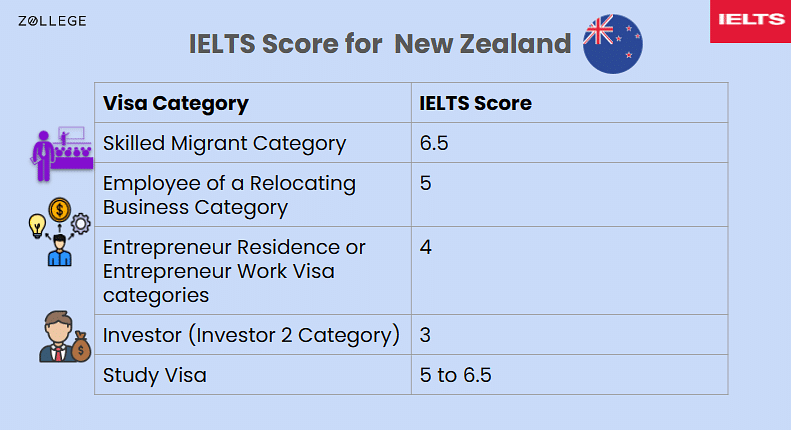
The IELTS band score requirement for a Doctoral degree is 6.5. For a Certificate or Diploma at Level 5, the score required in IELTS is 5.5. The IELTS requirement for an NZ residence visa is 6.5 or above. Candidates applying for Skilled category should have a minimum score of 6.5 in the Academic or General exam.
All New Zealand Universities accept Academic IELTS and, some schools, workplaces and immigration authorities accept General Training IELTS. IELTS score for NewZealand not only helps you with a New Zealand study visa but also for admissions and jobs. With 6 prestigious universities, New Zealand has been one of the top places to study.
New Zealand IELTS Requirement for Courses
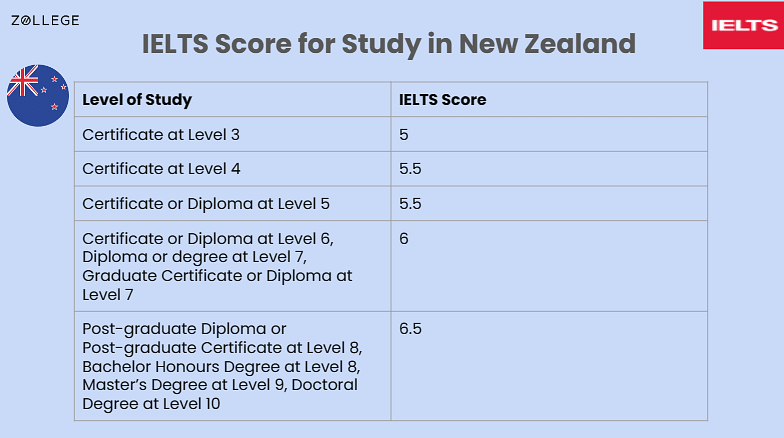
IELTS Academic is required for New Zealand studies purposes. So, students have to take the exam. The IELTS exam fee is INR 17,000. Score requirement varies for Certificate, Diploma, UG, Graduate Diploma, PG, and Doctoral level. The higher the education level, the more is the score requirement. For example, Certificate at Level 3 course requirement is 5, but Certificate at Level 4 score requirement is 5.5. The IELTS band for New Zealand depending on the course level is shown in the below image:
IELTS Score for New Zealand Top Universities
The good IELTS score for New Zealand is 6 or above, with no bands below 5.5 for admission to undergraduate programs in top universities. IELTS NZ good score for admission to postgraduate programs in top universities is 6.5, with no bands below 6 in the 4 sections. The top universities' IELTS cut off for UG and PG courses are given below. For some courses, universities have set higher than the below-mentioned scores. IELTS band required for New Zealand universities are as follows:
| Top Universites in New Zealand | IELTS Score for New Zealand Top Universities |
|---|---|
| University of Auckland | UG: 6 (no bands below 5.5) PG: 6.5 (no bands below 6 in IELTS Reading, Listening, Speaking, and IELTS Writing) |
| University of Otago | UG: 6 (no bands below 5.5) PG: 6.5 (no bands below 6) For some programs, the institution has higher score requirements. |
| Massey University | UG: 6 (no bands below 5.5) PG: 6.5 (no bands below 6 in IELTS Reading, Listening, Speaking, and Writing) |
| Victoria University of Wellington | UG: 6 (no bands below 5.5) PG: 6.5 (no bands below 6) |
| University of Waikato | UG: 6 (no bands below 5.5) PG: 6.5 (no bands below 6 in IELTS Reading, Listening, IELTS Speaking, and Writing)) |
| University of Canterbury | UG: 6 (no bands below 5.5) PG: 6.5 (no bands below 6) For teaching qualification, an IELTS score of 7 is required. |
| Lincoln University | 5 to 6.5 |
| Auckland University of Technology | UG: 6 (no bands below 5.5) PG: 6.5 (no bands below 6) Doctoral degrees: 6.5 |
IELTS Requirement for New Zealand Polytechnic Institutions
The IELTS score validity is 2 years from the date of the exam. IELTS score required for a Diploma in New Zealand is 5.5 or above. Te Pukega, New Zealand Institute of Technology and Polytechnics offers Diploma, UG, Postgraduate Diploma and Masters program for international students. These institutions are the largest vocational education provider in the country. IELTS score requirements for NZ Polytechnic institutions are given below:
| Institutes of Technology and Polytechnics | IELTS score for New Zealand |
|---|---|
| Eastern Institute of Technology | Diploma (Level 5): 5.5 Level 6 or 7 courses: 6 Level 8 or 9 program: 6.5 |
| Manukau Institute of Technology | 5.5 to 6.5 |
| Otago Polytechnic | Certificate or Diploma at Level 5: 5.5 Diploma at Level 6 or Degree at Level 7 or Graduate certificate at Level 7: 6 PG Diploma at Level 8: 6.5 Masters: 6.5 Doctoral degree: 6.5 |
| Unitec Institute of Technology | Certificate or Diploma at Level 5: 5.5 Diploma at Level 6 or Degree at Level 7 or Graduate certificate at Level 7: 6 PG Diploma at Level 8: 6.5 Masters: 6.5 Doctoral degree: 6.5 |
IELTS Requirement for New Zealand Study Visa
Students can go New Zealand without IELTS provided they take other English exams, such as PTE or TOEFL. IELTS is not compulsory for a student visa, but if the student takes the exam, the score criteria should be met. New Zealand band requirements for student visa depends on the level of course. The band requirement for New Zealand study visa for Diploma courses is 5.5. New Zealand band requirement for student visa for UG and PG students is 6 and 6.5, respectively. IELTS is not valid for 3 years in New Zealand but for 2 years. You can complete the IELTS regiatration online from the British Council website. So, students should apply for the student visa before the score validity expires.
Study in New Zealand without IELTS
IELTS is not compulsory for New Zealand. Students can study NZ without IELTS if candidates opt for an alternative English language proficiency exam, such as TOEFL, CAE, CPE, and MELAB. The score requirement in any other English language exam should be met by the candidate. University of Auckland UG TOEFL score requirement is 80, and PG score requirement is 90. Therefore, studying in New Zealand no IELTS is possible. If the candidate has completed 5 years of secondary education or entire primary education and 3 years of secondary education from selected countries, the candidate does not need to take IELTS syllabus. The selected countries are New Zealand, Australia, UK, USA, South Africa or the Republic of Ireland. For candidates who completed education in New Zealand, Australia, UK, USA, South Africa or Republic of Ireland, IELTS score is not required.
New Zealand Band Requirement for Work
IELTS is required for New Zealand for work, as the government requires it. The score is needed to prove English language proficiency since it is an English-speaking country. The IELTS requirement for NZ is set by the government, and the score requirement is different for skilled migrants, investors, and entrepreneurs. IELTS score for New Zealand work visa for different categories are given below.
- Skilled Migrant Category: For this category, IELTS requirement for NZ is 6.5 in IELTS General or IELTS Academic. Partner and children of a candidate should also fulfill the IELTS score requirement. The score requirement for a partner and children is 5 in IELTS General or Academic.
- Business Categories: In the business category, there are three types. The three types are Employee of a Relocating Business category, Entrepreneur Residence or Entrepreneur Work Visa category, and Investor (Investor 2 Category). The New Zealand IELTS band for employees of a relocating business is 5. To apply for the Entrepreneur Residence or Entrepreneur Work Visa category, an applicant should have 4 in IELTS General or Academic. For Investors, IELTS New Zealand requirements are 3 in IELTS General or IELTS Academic. Partners and children of candidates applying for the Business Category should have overall score of 4 in IELTS.
- Residence from Work Category: Candidates who have stayed in New Zealand for 2 years on Work to Residence visa can apply for Residence status. The band score required for it is 5.
IELTS for PR in New Zealand
Candidates can get a Permanent Residency in New Zealand through multiple ways. But before applying for PR, candidates must reside in New Zealand for two years. Some of the ways to stay in New Zealand for 2 years is to get a postgraduate study visa or skilled migrant category resident visa or entrepreneur work visa or work visa, or parent resident visa. To get these visa, the IELTS requirement has to be fulfilled. The below-mentioned table shows the IELTS requirement to get visa for residing in New Zealand for 2 years
| Category | IELTS Score |
|---|---|
| Skilled Migrant Category Resident Visa | 6.5 or above in IELTS Academic or General |
| Entrepreneur Work Visa | 4 or above |
| Residence from Work Visa | 5 or higher |
| Parent Resident VisAa | 4 or above |
Students opt for IELTS for New Zealand as the results are declared in 3-5 days, and the paper-based exam is held at least 4 times a month. If the New Zealand study visa band requirement is not met, the candidate can retake the IELTS exam.
FAQs
Ques: Is Gap accepted in New Zealand?
Ans: Yes, gap is accepted in New Zealand. But students should justify the gap years in Statement of Purpose. To justify the gap years, it is better to provide evidence, such as exam admit card, or score result.
Ques: What is the reason for visa rejection in New Zealand?
Ans: The reasons for visa rejection in New Zealand are false information and incomplete information in the documents submitted. Additionally, insufficient funds for studies, criminal records against candidates, and invalid passport can also lead to visa rejection.
Ques: How much bank balance is required for New Zealand student visa?
Ans: The bank balance required for a New Zealand student visa for compulsory education is NZD 17,000 for one year. For other levels of studies, bank balance required is NZD 20,000 for one year.
Ques: Who can sponsor for New Zealand study visa?
Ans: Candidate’s friend or family members, such as father, mother, sister, and brother can sponsor the New Zealand study visa. If the student aims to go for further studies, sponsors cannot be changed.
Ques: What are the disadvantages of studying in New Zealand?
Ans: The disadvantage of studying in New Zealand is that its tuition fees are higher than other countries, such as UK. Additionally, the rent and living cost is higher due to inflation.
Ques: Can I stay in New Zealand after study?
Ans: Yes, candidates can study in New Zealand after study. Students can get a post-study work visa for up to 3 years after studies. On a post-study work visa, student can work if the education pursued was Level 7 or above that.
Ques: How do I become a permanent resident of New Zealand?
Ans: There are 5 ways to become a permanent resident of New Zealand. Candidate should have spent minimum 184 days in the country on a resident visa in each of the two years stayed before applying for PR. Candidate should have a New Zealand tax residence status. Applicant should have invested in the country. Candidate should have a business or have established a base in the country.
Ques: What documents are needed for study visa NZ?
Ans: Documents needed for study visa NZ are copy of passport, offer letter from the institution, proof of funds (cost of living and tuition fees), chest x-ray, bank statement of sponsor, SOP, and Police Clarification Certificate.
Ques: Is it easy to get PR in New Zealand?
Ans: It is easy to get PR in New Zealand if the candidate fulfills the requirement. If the requirements are not met, candidate will not get PR. Some of the requirements making candidate eligible for PR are investment or business in the country.
Ques: Which intake is best for New Zealand?
Ans: July intake is the best intake for New Zealand, as a majority of the courses are open for admissions. For October intake, not all the courses are open for international students.
Ques: What is the minimum IELTS score required for admission to universities in New Zealand?
Ans: The minimum IELTS score required for admission to universities in New Zealand varies depending on the institution and the program you are applying to. However, a common benchmark is an overall band score of 6.0 or above.
Ques: Do all universities in New Zealand require IELTS scores for admission?
Ans: Yes, most universities in New Zealand require international students to submit IELTS scores as proof of English language proficiency. However, some universities may accept alternative English language proficiency tests.
Ques: Can I apply to a New Zealand university with a lower IELTS score if I meet other admission criteria?
Ans: Yes, some universities may consider applicants with slightly lower IELTS scores if they meet other admission criteria such as academic qualifications or relevant work experience. However, this varies depending on the institution and program.
Ques: Is there a specific IELTS score requirement for each section of the test?
Ans: No, there is no such requirements for individual sections. Some universities may have specific requirements for individual sections of the IELTS test (listening, reading, writing, and speaking), most institutions focus on the overall band score. However, it's essential to check the specific requirements of the university and program you are applying to.
Ques: Can IELTS scores be waived for applicants from English-speaking countries?
Ans: Yes, applicants from English-speaking countries or those who have completed their education in English may be exempt from providing IELTS scores. However, policies vary among universities, and it's advisable to check with the specific institution.
Ques: What happens if I don't meet the minimum IELTS score requirement for my desired program?
Ans: If you do not meet the minimum IELTS score requirement for your desired program, you may be required to take English language courses or retake the IELTS test to improve your score. Some universities offer pathway programs or conditional admission for students who need to improve their English proficiency.
Ques: Is there a validity period for IELTS scores when applying to universities in New Zealand?
Ans: Most universities accept IELTS scores that are no more than two years old at the time of application. It's essential to check the specific requirements of the university you are applying to regarding the validity period of IELTS scores.
Ques: Can I submit scores from other English proficiency tests instead of IELTS?
Ans: Some universities in New Zealand accept alternative English proficiency tests such as TOEFL or Cambridge English exams. However, it's crucial to verify whether the specific test you have taken is accepted by the university you are applying to.
Ques: Do universities in New Zealand offer English language support for international students who need to improve their proficiency?
Ans: Yes, many universities in New Zealand offer English language support services such as English language courses, tutoring, and language labs to help international students improve their proficiency and succeed academically.
Ques: Is there any flexibility in the IELTS score requirement for certain programs or disciplines?
Ans: Some universities may offer flexibility in the IELTS score requirement for certain programs or disciplines, especially those that do not heavily rely on verbal communication skills. However, this depends on the university's policies and the specific requirements of the program.
*The article might have information for the previous academic years, please refer the official website of the exam.