
AP SSC 2025 English Third Language Question Paper with Solution Pdf


| Updated On - Nov 25, 2025
AP SSC 2025 English Third Language Question Paper with Solution PDF is available here for download. AP SSC 2025 English Third Language Question Paper consists of 37 questions with a total weightage of 100 marks.
AP SSC 2025 English Third Language Question Paper with Solution PDF
| AP SSC 2025 English Third Language Question Paper | Download PDF | Check Solutions |

What unique tradition do Coorgi homes have?
Coorgi homes have a tradition of hospitality. The people of Coorg are known for warmly welcoming guests and sharing stories of valor related to their sons and fathers. This unique custom of hospitality reflects their culture, pride, and respect for guests, which is a notable aspect of Coorgi social life.
View Solution
The passage states that Coorgi homes have a tradition of hospitality, emphasizing their warmth and storytelling about family valor.
Quick Tip: Look for phrases in the passage like “have a tradition of hospitality” to answer comprehension questions directly.
Who was the first Chief of the Indian Army, and what was his connection with Coorg?
The first Chief of the Indian Army was General Cariappa, who was a Coorgi. His connection with Coorg highlights the significant contributions of Kodavus (people of Coorg) to the Indian Army. The Coorg Regiment, also mentioned in the passage, is one of the most decorated regiments, showcasing the bravery and military tradition of the Coorg community.
View Solution
General Cariappa, a Coorgi, became the first Chief of the Indian Army, linking Coorg to Indian military history.
Quick Tip: Identify proper nouns and their connections in the passage, such as “General Cariappa” and “Coorgi.”
What type of fish is mentioned as being abundant in the waters of river Kaveri?
A) Gold fish
B) Mahaseer
C) Kingfisher
View Solution
The passage clearly states that Mahaseer, a large freshwater fish, is abundant in the waters of the river Kaveri.
Quick Tip: Focus on descriptive details in the passage, especially animals or objects mentioned with abundance.
What is the primary source of water for the river, Kaveri?
A) The Himalayas
B) The hills and forests of Coorg
C) Nilgiri mountains
View Solution
The passage mentions that the river Kaveri obtains its water from the hills and forests of Coorg.
Quick Tip: Always look for phrases like “obtains its water from” to answer questions about sources or origins.
What activity do elephants enjoy in the river?
A) Swimming
B) Bathing and scrubbing
C) Sunbathing
View Solution
The passage states that elephants enjoy being bathed and scrubbed in the river by their mahouts.
Quick Tip: Focus on direct statements describing animal behavior in comprehension passages.
Where is the tiger in the first stanza?
The tiger is in his cage, taking only a few steps within it. The first stanza describes the tiger pacing quietly on pads of velvet, showing restraint and confinement.
View Solution
The words “few steps of his cage” indicate the tiger is in captivity.
Quick Tip: Focus on specific phrases like “few steps of his cage” to locate the tiger.
Why should the tiger lurk in the shadow?
The tiger should lurk in the shadow to remain hidden while stalking its prey. Shadows provide cover and help the tiger move stealthily in its natural habitat, which contrasts with its confinement in the zoo.
View Solution
Shadows allow the tiger to remain unseen, as mentioned in the second stanza.
Quick Tip: In poetry, consider natural behavior of animals when interpreting metaphors like “lurking in shadow.”
What emotion does the tiger show?
A) Unexposed anger
B) Unexposed hunger
C) Unexposed happiness
View Solution
The tiger exhibits quiet rage and restrained anger, which is not fully visible due to the cage. Words like “quiet rage” indicate suppressed emotion.
Quick Tip: Look for descriptive phrases like “quiet rage” to infer emotions in poetry.
Who passes by the water hole?
A) Fat deer
B) Fat elephant
C) Fat hound
View Solution
The passage mentions “where plump deer pass,” indicating that deer are present near the water hole.
Quick Tip: Pay attention to nouns in the passage that indicate movement or presence near locations.
Where should the tiger hide himself?
A) Near the tree
B) In the long grass
C) Near the water hole
View Solution
The passage says the tiger should be “sliding through long grass,” which shows the tiger’s preferred hiding place while stalking prey.
Quick Tip: Look for descriptive actions like “sliding through long grass” to determine location in poetry comprehension.
What kind of books did he love?
A) Story books
B) Rare and expensive books
C) Adventurous books
View Solution
The passage clearly states that Horace loved rare, expensive books, which motivated his thefts.
Quick Tip: Look for phrases like “he loved rare, expensive books” to identify preferences in comprehension passages.
Where did he serve his first and only sentence?
A) In a school library
B) In a college library
C) In a prison library
View Solution
The passage mentions that Horace served his first and only sentence in a prison library.
Quick Tip: Focus on the initial lines of the passage for information about character background.
Why did he buy the books secretly?
A) Because he bought them to donate others
B) Because he bought them with stolen money
C) Because he bought them for prize distribution
View Solution
Horace stole money to buy the rare books he loved and used an agent to bring them secretly, indicating secrecy due to the illegal source.
Quick Tip: Look for cause-effect relationships in the passage to answer why an action was done.
He was preparing himself for a robbery at
A) Shotover Grange
B) Rocksby Grange
C) Thrushcross Grange
View Solution
The passage states that Horace studied the house at Shotover Grange carefully before planning the robbery.
Quick Tip: Look for proper nouns and locations mentioned explicitly for questions on place.
Where had the two servants gone that afternoon?
A) London
B) Movies
C) Garden
View Solution
The passage mentions that the two servants had gone to the movies while the family was in London.
Quick Tip: For questions about actions of secondary characters, look for sentences describing what they did during the main events.
Study the following Pie-chart carefully.
Problems faced by people in a city

Now, answer the following questions.
i) What does the Pie-chart show?
ii) What is the percentage of water supply problem in the above Pie-chart?
iii)______ percentage of crime is mentioned in the above Pie-chart.
a) 12% \quad b) 13% \quad c) 18%
iv) The least worried problem is
a) Crime \quad b) Garbage \quad c) Corruption
v) Choose the correct statement based on the Pie-chart.
a) The burning issue in the Pie-chart is unemployment
b) Garbage problem is so heavy as road conditions
c) Road conditions and crime together constitute more than half of the total percentage of problems
Road conditions and crime together constitute more than half of the total percentage of problems
i) The Pie-chart shows the different problems faced by people in a city, including water supply issues, crime, garbage, corruption, road conditions, and unemployment, with their respective percentages.
ii) The percentage of water supply problem is 18%.
iii) The percentage of crime mentioned is 12%.
iv) The least worried problem is crime.
v) The correct statement based on the Pie-chart is: Road conditions and crime together constitute more than half of the total percentage of problems.
View Solution
The Pie-chart categorizes the major issues affecting people in the city. By examining each segment, one can read the percentage for water supply (18%) and crime (12%). Crime is the smallest segment, making it the least worried problem. Comparing the percentages, road conditions and crime combined exceed 50%, which makes statement (v) correct.
Quick Tip: In Pie-chart questions, carefully read each segment and calculate or note the percentages. Compare segments to find least, most, or combined values.
Read the following passage carefully.
It was a cyclonic season. There was flood everywhere. Many houses were drowned in the flood. There were a copper pot and earthen pot in a house. Both of them were washed away in the flood to a river.
The copper pot laughed at the earthen pot and said, ``My friend, you are made of mud. You are so weak.'' ``Please, come near me. I will save you''.
The earthen pot replied, ``Thank you for your kindness, my friend. But let me swim to the bank myself''. The earthen pot began to swim towards the bank of the river.
As the copper pot tried to swim forward, water got into the pot and the copper pot was drowned. But the earthen pot reached the bank safely.
Now, arrange the following jumbled sentences into a meaningful order.
a) The copper pot belittled the earthen pot and advised to take its help.
b) There were two pots in a house. One is copper and the other is earthen.
c) But the earthen pot swam towards the bank of the river and reached safely.
d) Water got into the proud copper pot and so it was drowned.
e) One day, these two pots were washed away in the flood to a river.
b) — e) — a) — c) — d)
View Solution
b) introduces the two pots.
e) describes the flood incident.
a) shows the copper pot’s arrogance and offer.
c) shows the earthen pot’s success.
d) explains the copper pot’s failure.
This order follows the chronological sequence and moral of the story.
Quick Tip: Look for the introduction first, then events in time order, and finally the conclusion or moral.
Combine the following sentences using 'which'.
I often go to Mumbai. Mumbai is the commercial capital of India.
I often go to Mumbai, which is the commercial capital of India.
View Solution
The two sentences are combined using the relative pronoun "which" to refer to Mumbai.
Quick Tip: Use “which” to combine sentences when the second part gives additional information about a noun in the first sentence.
Change the following sentence into 'passive voice'.
My sister has drawn this portrait.
This portrait has been drawn by my sister.
View Solution
Active voice is converted into passive by making the object the subject and using the correct tense of “to be” + past participle.
Quick Tip: Remember: Active → Passive: Object + appropriate form of “to be” + past participle + by + subject.
Change the following into reported speech.
The old woman asked Valli, "Why do you travel alone?"
The old woman asked Valli why she traveled alone.
View Solution
Direct speech is converted into reported speech by removing quotation marks, changing pronouns, and adjusting the tense.
Quick Tip: For reported speech, shift present tense to past tense and change pronouns appropriately.
Fill in the blanks with suitable prepositions.
i) Geetha jumped ______ the river to help her sister. (in/into/on)
ii) Gowtham is good ______ English. (at/in/of)
i) into
ii) at
View Solution
“Jumped into the river” is correct for entering the river, and “good at English” is the proper collocation.
Quick Tip: Use “into” for movement inside something and “at” with skills or abilities.
Edit the following passage.
Air pollution is emerging like (a)
global problem among (b) the
world. Much (c)
of our cities have
industries which is (d) responsible
for 20% of the pollutants.
(a) as
(b) in
(c) Many
(d) are
View Solution
Corrected passage: Air pollution is emerging as a global problem in the world. Many of our cities have industries which are responsible for 20% of the pollutants.
Quick Tip: Check prepositions, verb forms, and redundant words when editing passages.
Fill in the blanks with suitable articles.
i) Can you turn off ______ light?
ii) He has taken ______ taxi to the station.
i) the
ii) a
View Solution
“the light” is specific, and “a taxi” refers to any taxi.
Quick Tip: Use “the” for definite items and “a/an” for indefinite items.
Change the following into repeated action in the past using 'would/used to'.
i) He played for hours with a selection of toys.
ii) When I was five years old, I followed my brother all over the place.
i) He would play for hours with a selection of toys.
ii) When I was five years old, I used to follow my brother all over the place.
View Solution
Use “would” or “used to” to indicate habitual past actions.
Quick Tip: “Would” or “used to” express repeated or habitual actions in the past.
Rewrite the sentences into a single sentence using Noun-modifiers.
i) The teacher used a marker. The marker is black and permanent.
ii) He bought a shirt. The shirt is white and cotton.
i) The teacher used a black permanent marker.
ii) He bought a white cotton shirt.
View Solution
Combine the noun and its description into a single noun phrase using adjectives.
Quick Tip: Use adjectives before nouns to create noun-modifier phrases.
Give a suitable advice for the situation given below.
Your brother rides the bike very fast. Advise him to be cautious.
You should ride the bike slowly and carefully to avoid accidents.
View Solution
The advice emphasizes caution and safety while riding the bike.
Quick Tip: Always give advice politely and include a reason for caution or action.
Read the following paragraph and write synonyms of the underlined words, choosing the words given in the box.

Even when each of his brothers and his little sister, whose wings were far shorter than his
own, ran to the \underline{brink (a) flapped their wings, and flew away, he failed to \underline{muster up (b)
courage to take that \underline{plunge (c) which appeared to him so \underline{desperate (d).
(a) edge \quad (b) gather \quad (c) dive \quad (d) hopeless
View Solution
The underlined words are matched with their synonyms from the given box: brink → edge, muster up → gather, plunge → dive, desperate → hopeless.
Quick Tip: Always read the context to choose the most appropriate synonym from the given options.
Read the following paragraph and write the antonyms of the underlined words.
\underline{Luckily (a) the seat \underline{booked (b) for me was at the extreme \underline{front (c). I \underline{covered (d) the floor
around my feet with newspapers.
(a) unluckily \quad (b) cancelled \quad (c) back \quad (d) uncovered
View Solution
Antonyms are formed or chosen based on meaning: luckily → unluckily, booked → cancelled, front → back, covered → uncovered.
Quick Tip: Antonyms should directly oppose the meaning of the underlined word in context.
Fill in the blanks with the right form of words given in the brackets.
Kisa Gotami became weary and ________ (a) (hope, hoped, hopeless), and sat down at
the wayside watching the lights of the city, as they flickered up and were ________(b)
(extinguish, extinguishes, extinguished) again.
(a) hopeless \quad (b) extinguished
View Solution
(a) The adjective “hopeless” fits the context of despair. (b) The past participle “extinguished” is used in the passive construction “were extinguished”.
Quick Tip: Choose the word form that matches the grammatical structure and tense of the sentence.
Complete the words with correct prefixes and suffixes given in the brackets.
i) He gave the editor a honest (dis/mis) account of events.
ii) I was not mind (ful/full) ofthe fact that not so many years before they would not have saluted but arrested me.
i) dishonest \quad ii) mindful
View Solution
i) “dis” is the correct prefix to form “dishonest” (opposite of honest).
ii) “ful” is the correct suffix to form “mindful” (meaning aware).
Quick Tip: Prefixes change meaning (dis- = not); suffixes change word class or nuance (ful = full of).
Find the wrongly spelt word and write correct spelling.
i) Palpitation, tracking, beetels, interfere
ii) Tempre, partridge, squeezer, remember
i) beetels → beetles
ii) Tempre → Temper
View Solution
i) “beetels” is misspelled; correct spelling is “beetles”.
ii) “Tempre” is misspelled; correct spelling is “Temper”.
Quick Tip: Double-check vowel sequences and common spelling patterns (ee, ea, etc.).
Read the following dictionary entry of the word given below.

Now, answer the following questions using the information above.
i) What is the part of speech of the word deny?
ii) What is the noun form of deny?
i) verb
ii) denial
View Solution
i) The dictionary entry begins with ``verb'', indicating that \textit{deny is a verb.
ii) Under ``WORD FAMILY'', the noun form is explicitly given as \textit{denial noun.
Quick Tip: Dictionary entries list the part of speech immediately after the headword and phonetic transcription. Word families show related forms (noun, adjective, adverb).
Use the following expressions in sentences of your own.
i) Phrasal verb: Plunge in
Ans: ______
ii) Idiomatic expression: Caught my eye.
Ans ______
i) Without hesitation, she decided to \underline{plunge in} and start her own business despite the risks.
ii) A bright red dress in the shop window \underline{caught my eye} as I walked past.
View Solution
i) ``Plunge in'' means to start doing something enthusiastically or suddenly.
ii) ``Caught my eye'' means something attracted attention immediately.
Quick Tip: Phrasal verbs and idioms must be used in natural, meaningful sentences that reflect their correct sense.
Match the following:
\begin{tabular{p{4cm p{8cm
Part -A & Part -B
i) heartbreaking & (a) obeying and respecting the law
ii) homesick & (b) producing great sadness
iii) blockhead & (c) missing home and family very much
iv) law-abiding & (d) an informal word which means a very stupid person
\end{tabular
i) — (b)
ii) — (c)
iii) — (d)
iv) — (a)
View Solution
i) heartbreaking → producing great sadness
ii) homesick → missing home and family very much
iii) blockhead → an informal word which means a very stupid person
iv) law-abiding → obeying and respecting the law
Quick Tip: Match by understanding the core meaning of each word in Part-A with the definition in Part-B.
In the lesson `A letter to God' Lencho wrote a letter to God to send him 100 pesos to
sow his field again and to live until the crop comes. He addressed the letter to `God.' On
seeing the letter addressed to God, the Postman was astonished. He showed the letter to the
Postmaster. He broke out laughing. Now, write a possible conversation between Postman
and the Postmaster.
OR
(B)
In the lesson `Madam Rides the Bus' Valli was able to fulfill her strong desire to travel to
the town by bus. It was a great experience for her. She was overwhelmed with joy but she
was unable to share her experiences with anybody since it was done incognito. She wished
to share the feelings of her wonderful journey to the town with her diary.
Imagine you are Valli and write a diary entry in the above context.
Postman: Sir, you won’t believe this! A letter addressed to \underline{God}! Postmaster: (laughing) What? Let me see that! Postman: Here it is. A farmer named Lencho. He’s asking for 100 pesos to sow his field again. Postmaster: (still chuckling) Only Lencho could think God delivers through the post office! Postman: Should we throw it away, sir? Postmaster: No, no. This man has faith. Let’s collect some money and help him. God works in mysterious ways, doesn’t He?
\textbf{OR}
\textbf{(B) Diary Entry (as Valli)}
\textit{8th April} Dear Diary, Today was the happiest day of my life! I finally rode the bus to town—all alone! The big wheels, the green curtains, the wind in my hair—everything was just like I dreamed. I saw the canal, the palm trees, and even a cow running in front of the bus! The conductor called me “Madam”—I felt so grown-up. I was careful not to talk to anyone so no one would tell Amma. But oh, how I wish I could shout it from the rooftop! This secret ride will stay with me forever. Good night, Valli
View Solution
(A) The dialogue reflects the postman’s surprise and the postmaster’s initial amusement turning into compassion—true to their characters in the story.
(B) The diary entry is written in first person as Valli, using simple, excited language. It includes specific details (canal, cow, conductor calling “Madam”) and her secret joy.
Quick Tip: In dialogues, use natural speech and show character emotions. In diary entries, use “I”, express feelings, and include sensory details.
You are a student of class X, Bright Public School, Amaravathi. The road leading to your school has become notorious for fast running vehicles. Students coming to the school in the morning and leaving in the evening are put to a great difficulty. School buses and parents who come to leave and take their children from school are put to inconvenience. Write a letter to the Deputy Commissioner, Amaravathi police to post traffic constables on duty infront of the school in the morning as well as in the evening.
OR
(B)
``Anger Management is more important thing in humans''.
Based on the topic, prepare a script for speech using the following hints/clues given below.
Some people tend to get angry quickly, while others remain calm.
As humans, one important thing to learn is how to manage their temper.
Ill effects that result from anger.
Suggest ways to avoid losing temper in such situations.
\textbf{(A) Letter to the Deputy Commissioner}
Bright Public School
Amaravathi
1st November, 2025
The Deputy Commissioner of Police
Amaravathi
\textbf{Subject: Request to Post Traffic Constables in Front of Bright Public School}
Dear Sir, I am Ravi Kumar, a Class X student of Bright Public School, Amaravathi. I am writing to bring to your kind notice the dangerous traffic situation on the road leading to our school.
Fast-running vehicles make the road notorious, causing great difficulty to students arriving in the morning and leaving in the evening. School buses and parents face inconvenience while dropping off and picking up children. Many near-accidents have occurred due to reckless driving.
I kindly request you to post traffic constables in front of the school during morning (8:00--9:00 AM) and evening (3:00--4:00 PM) hours to regulate traffic and ensure student safety.
Thanking you in anticipation.
Yours sincerely,
Ravi Kumar
Class X
Bright Public School
\textbf{OR}
\textbf{(B) Speech Script on ``Anger Management is More Important Thing in Humans''}
Respected Principal, Teachers, and Dear Friends,
Good morning! Today, I speak on ``Anger Management is More Important Thing in Humans''.
Some people tend to get angry quickly, while others remain calm. As humans, one important thing to learn is how to manage our temper.
Uncontrolled anger leads to ill effects: it harms relationships, causes health problems like high blood pressure, and results in regrettable actions or violence.
To avoid losing temper, take deep breaths, count to ten, walk away from the situation, or talk calmly. Practice mindfulness and exercise regularly.
Remember, managing anger makes us stronger and happier. Let us all practice it!
Thank you.
View Solution
(A) The letter follows formal format: sender's address, date, receiver's address, subject, salutation, body (introduction, problem, request, conclusion), complimentary close, signature. Language is polite and clear.
(B) The speech script uses all hints: introduction with topic, individual differences, importance of management, ill effects, suggestions. It is structured (greeting, body, conclusion) and engaging for oral delivery.
Quick Tip: Letters: Use formal tone, clear subject, precise details. Speeches: Start with greeting, cover all points logically, end with thanks. Keep both concise (150--200 words).
Read the following passage carefully focussing on the underlined parts.
Bholi was seven years \underline{(A) old when Mangla was married. The same year a primary school for
girls \underline{(B) was opened in their village. The Tehsildar Sahib came to perform its opening ceremony \underline{(C).
He said to Ramlal, ``As a revenue official you are the representative of the government in
the village and so you must set an example to the villagers'' \underline{(D). You must send your daughters
to school \underline{(E).
Now frame `WH' questions to get the underlined parts as answers.
OR
(B)
Study the following table and write a paragraph based on the information given in it.
\textbf{(A) WH Questions} (A) \underline{What} was the age of Bholi when Mangla was married?
(B) \underline{What} was opened in their village the same year?
(C) \underline{Who} came to perform the opening ceremony of the school?
(D) \underline{To whom} did the Tehsildar say that Ramlal must set an example?
(E) \underline{Where} must Ramlal send his daughters?
\textbf{OR}
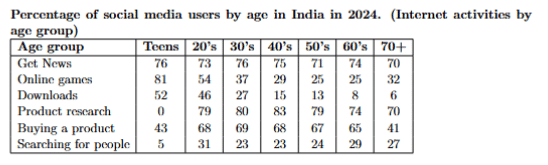
\textbf{(B) Paragraph} According to the 2024 data on social media usage in India, internet activities vary significantly across age groups. \underline{Getting news} remains consistently high across all ages, ranging from 70% (70+) to 76% (Teens and 30s). \underline{Online gaming} is most popular among teens (81%), dropping sharply to 54% in the 20s and further to 25% in the 50s--60s. \underline{Product research} is negligible among teens (0%) but peaks in the 40s (83%) and remains strong through the 60s (74%). \underline{Online buying} is highest in the 30s (69%) and lowest in teens (43%) and 70+ (41%). \underline{Downloading content} declines steadily from 52% in teens to just 6% in the 70+ group. Surprisingly, \underline{searching for people} is lowest among teens (5%) and rises slightly in older groups, peaking at 31% in the 20s. Overall, younger users dominate entertainment and downloads, while middle-aged and senior users lead in information-seeking and e-commerce.
View Solution
(A) Each WH question is framed to directly elicit the underlined part as the answer. Correct WH word is chosen based on the type of information (age → how old; action → what; person → who; recipient → to whom; place → where).
(B) The paragraph summarizes trends, uses data accurately, compares age groups, and highlights contrasts (e.g., 0% vs 83% in product research). Language is formal and analytical. Quick Tip: For WH questions: Identify the information type and match the correct question word. For data interpretation: State the source, highlight key trends, use percentages, and compare groups.
*The article might have information for the previous academic years, please refer the official website of the exam.