
AP SSC 2025 General Science (Paper I) - Physical Science - 19E Question Paper with Solution Pdf


| Updated On - Jan 24, 2026
AP SSC 2025 General Science (Paper I) Physical Science 19E Question Paper with Solution PDF is available here for download. AP SSC 2025 General Science (Paper I) Physical Science 19E Question Paper consists of 33 questions with a total weightage of 100 marks.
AP SSC 2025 General Science (Paper I) Physical Science 19E Question Paper with Solution PDF
| AP SSC 2025 General Science (Paper I) Physical Science 19E Question Paper | Download PDF | Check Solutions |

Predict and write why preparation of lime water is considered as an exothermic reaction.
View Solution
Step 1: Understanding the Concept:
An exothermic reaction is a chemical reaction that releases energy, usually in the form of heat. In such reactions, the enthalpy of the products is lower than the enthalpy of the reactants, and the change in enthalpy (\(\Delta\)H) is negative. The preparation of lime water (a saturated solution of calcium hydroxide) involves the reaction of quicklime with water, which is a classic example of an exothermic process.
Step 2: Key Formula or Approach:
The chemical equation for the reaction is:
\[ CaO (s) + H_2O (l) \rightarrow Ca(OH)_2 (aq) + Heat \]
Here, CaO is calcium oxide (quicklime), H\(_2\)O is water, and Ca(OH)\(_2\) is calcium hydroxide (slaked lime). The explicit inclusion of "Heat" on the product side of the equation signifies that the reaction is exothermic.
Step 3: Detailed Explanation:
When solid calcium oxide (quicklime) is added to water, it vigorously reacts to form calcium hydroxide.
During this process, the strong ionic bonds in calcium oxide are broken, and new bonds are formed in calcium hydroxide.
The energy released when the new, more stable bonds are formed in Ca(OH)\(_2\) is greater than the energy required to break the bonds in CaO and H\(_2\)O.
This excess energy is released into the surroundings as heat, causing the temperature of the mixture to rise significantly. You can often observe the water boiling or steam being produced if a large amount of quicklime is used. This release of heat is the reason the preparation of lime water is considered an exothermic reaction.
Step 4: Final Answer:
The preparation of lime water involves the reaction of calcium oxide with water, which is a highly exothermic chemical combination reaction. It releases a large amount of heat energy because the formation of new bonds in the product (calcium hydroxide) releases more energy than is consumed to break the bonds in the reactants (calcium oxide and water).
Quick Tip: Remember that exothermic reactions feel hot because they release heat into the environment. A common real-world example is a hand warmer. Conversely, endothermic reactions absorb heat and feel cold.
Acidic nature of a substance is due to the formation of __________ ions in solution.
View Solution
Step 1: Understanding the Concept:
According to the Arrhenius theory of acids and bases, an acid is a substance that increases the concentration of hydrogen ions (H\(^+\)) when dissolved in water. The acidic properties of a substance, such as its sour taste and its ability to turn blue litmus paper red, are all attributed to the presence of these H\(^+\) ions.
Step 2: Detailed Explanation:
When an acid, for example, hydrochloric acid (HCl), is dissolved in water, it dissociates or ionizes.
The HCl molecule splits into a positively charged hydrogen ion (H\(^+\)) and a negatively charged chloride ion (Cl\(^-\)).
The chemical equation is:
\[ HCl (aq) \rightarrow H^+ (aq) + Cl^- (aq) \]
However, a free hydrogen ion (which is just a proton) is highly reactive and does not exist independently in an aqueous solution. It immediately combines with a water molecule (H\(_2\)O) to form a hydronium ion (H\(_3\)O\(^+\)).
\[ H^+ (aq) + H_2O (l) \rightarrow H_3O^+ (aq) \]
Therefore, it is more accurate to say that the acidic nature is due to the formation of hydronium ions. However, for simplicity, it is often referred to as being due to hydrogen ions.
Step 3: Final Answer:
The acidic nature of a substance is due to the formation of hydrogen (H\(^+\)) ions, or more precisely, hydronium (H\(_3\)O\(^+\)) ions, in solution.
Quick Tip: For exam purposes, both H\(^+\) (hydrogen ion) and H\(_3\)O\(^+\) (hydronium ion) are generally accepted as correct answers for the ion responsible for acidity. The hydronium ion is the more chemically accurate representation in aqueous solutions.
Observe the following table:

In the above table which is strong acid ?
View Solution
Step 1: Understanding the Concept:
The pH scale is a logarithmic scale used to specify the acidity or basicity of an aqueous solution. The scale ranges from 0 to 14.
- A pH value less than 7 indicates an acidic solution.
- A pH value of 7 indicates a neutral solution.
- A pH value greater than 7 indicates a basic (or alkaline) solution.
The strength of an acid is inversely related to its pH value. The lower the pH value (closer to 0), the stronger the acid.
Step 2: Detailed Explanation:
We need to compare the pH values of the substances given in the table to determine which is the strong acid.
The given pH values are:
- Lemon juice: pH = 2.2
- Blood: pH = 7.4
- Milk of magnesia: pH = 10
Analyzing these values based on the pH scale:
- Lemon juice (pH = 2.2) is acidic because its pH is less than 7.
- Blood (pH = 7.4) is slightly basic because its pH is just above 7.
- Milk of magnesia (pH = 10) is basic because its pH is greater than 7.
To find the strong acid, we look for the substance with the lowest pH value. Comparing the values, 2.2 is the lowest pH.
Step 3: Final Answer:
Lemon juice, with a pH value of 2.2, is the strongest acid among the given substances because it has the lowest pH value.
Quick Tip: Remember: Lower pH means higher concentration of H\(^+\) ions and stronger acidity. Higher pH means lower concentration of H\(^+\) ions (and higher concentration of OH\(^-\) ions) and stronger basicity.
Which is the most ductile metal in nature?
View Solution
Step 1: Understanding the Concept:
Ductility is a physical property of a material that describes its ability to be stretched or drawn into a thin wire without breaking. This property is characteristic of metals and is a measure of their plastic deformation capacity under tensile stress.
Step 2: Detailed Explanation:
Many metals like copper, aluminum, silver, and gold are ductile. However, among all metals found in nature, gold (Au) exhibits the highest ductility.
The ductility of gold is exceptional. It is so ductile that a single gram of gold can be drawn into a wire that is over 2 kilometers (about 1.2 miles) long. Its unique atomic structure allows its atoms to slide over one another easily without breaking the metallic bonds, which accounts for this extreme property.
Besides being the most ductile, gold is also the most malleable metal, meaning it can be hammered or pressed into extremely thin sheets (gold leaf) without breaking.
Step 3: Final Answer:
The most ductile metal in nature is Gold (Au).
Quick Tip: Do not confuse ductility with malleability. \textbf{Ductility} = Ability to be drawn into a \textbf{wire}. \textbf{Malleability} = Ability to be hammered into a \textbf{sheet}. Gold is the top performer in both categories.
Write any one use of vinegar.
View Solution
Step 1: Understanding the Concept:
Vinegar is an aqueous solution of acetic acid (ethanoic acid) and trace compounds that may include flavourings. It typically contains 5–8% acetic acid by volume. The acidic nature of vinegar gives it its characteristic sour taste and its useful properties.
Step 2: Detailed Explanation of a Use:
One of the most common uses of vinegar is as a food preservative, especially in pickling.
The process of pickling involves preserving food in an acidic medium. The acetic acid in vinegar lowers the pH of the food (like cucumbers, onions, etc.) to a level where most harmful bacteria and microorganisms cannot survive or multiply.
This antimicrobial property of vinegar helps to prevent spoilage and significantly extends the shelf life of the food.
Step 3: Other Common Uses:
- Food Flavouring: It is widely used in salad dressings, marinades, and sauces to add a sour, tangy flavour.
- Cleaning Agent: Due to its acidic nature, vinegar can be used as a natural and effective cleaning agent to dissolve mineral deposits (like limescale), grease, and other grime on various surfaces.
Step 4: Final Answer:
One use of vinegar is as a food preservative in pickles, where its acidity prevents the growth of spoilage-causing bacteria.
Quick Tip: Remember that the active ingredient in vinegar is ethanoic acid (CH\(_3\)COOH). This chemical name is often required in chemistry exams.
The human eye forms the image of an object at its ______.
View Solution
Step 1: Understanding the Concept:
The human eye functions like a camera, where light from an object enters the eye and is focused to form an image. This process involves several parts of the eye working together.
Step 2: Detailed Explanation of the Parts:
- (A) Cornea: This is the transparent outer layer at the very front of the eye. Its main function is to refract, or bend, the light that enters the eye. It is responsible for most of the eye's focusing power.
- (B) Iris: This is the colored part of the eye. It is a muscular diaphragm that controls the size of the pupil, thereby regulating the amount of light that reaches the retina.
- (C) Pupil: This is the black opening in the center of the iris. It allows light to enter the eye and strike the retina. Its size changes based on the intensity of light, controlled by the iris.
- (D) Retina: This is the light-sensitive layer of tissue at the back of the eyeball. It acts like the film in a camera or the sensor in a digital camera. The eye's lens focuses light onto the retina, where an image is formed. The retina contains millions of photoreceptor cells (rods and cones) that detect the light and convert it into electrical signals, which are then sent to the brain via the optic nerve for interpretation. The image formed on the retina is real and inverted.
Step 3: Final Answer:
The cornea and the lens work together to focus light from an object to form a sharp, inverted, and real image on the retina. Therefore, the retina is the part of the eye where the image is formed.
Quick Tip: Think of the eye as a camera: The lens focuses the light, and the retina is the screen or film where the final image is projected. The cornea is like a fixed primary lens, and the iris is the aperture that controls light intake.
Draw the symbol of an 'Ammeter'.
View Solution
Step 1: Understanding the Concept:
In electrical circuit diagrams, standardized symbols are used to represent different components like batteries, resistors, switches, and measuring instruments. An ammeter is an instrument used to measure the electric current in a circuit.
Step 2: Description of the Symbol:
The universally recognized symbol for an ammeter is constructed as follows:
1. A circle is drawn to represent the body of the instrument.
2. Inside the circle, the capital letter 'A' is written. The 'A' stands for Ampere, the unit of current, and signifies that the instrument is an Ammeter.
3. A straight horizontal line is drawn from the left side of the circle, and another from the right side. These lines represent the wires connecting the ammeter into the circuit.
A textual representation of the symbol is: ---(A)---
Step 3: Usage in a Circuit:
It is crucial to remember that an ammeter must always be connected in series with the component through which the current is to be measured. This is because the current has to flow through the ammeter for it to be measured. An ideal ammeter has zero resistance so that it does not affect the current it is measuring.
Quick Tip: Remember the connection rules: \textbf{A}mmeter is connected in \textbf{S}eries (\textbf{A-S}), and \textbf{V}oltmeter is connected in \textbf{P}arallel (\textbf{V-P}). This is a common point of confusion and a frequent exam question.
What is the commercial unit of electric energy?
View Solution
Step 1: Understanding the Concept:
Electric energy is the energy derived from electric potential energy or kinetic energy. The SI unit of energy is the Joule (J). However, the Joule is a very small unit for measuring energy consumption on a large scale, such as in households or industries. Therefore, a larger, more practical unit is used for commercial purposes.
Step 2: Defining the Commercial Unit:
The commercial unit of electric energy is the kilowatt-hour (kWh).
It is defined as the amount of electrical energy consumed when an electrical appliance with a power rating of 1 kilowatt (1 kW) is operated for 1 hour (1 h).
Energy = Power \(\times\) Time
1 kWh = 1 kilowatt \(\times\) 1 hour
Step 3: Conversion to SI Unit (Joules):
We can convert kilowatt-hour to Joules as follows:
We know that 1 kilowatt = 1000 watts, and 1 hour = 3600 seconds.
Since Power (in watts) = Energy (in joules) / Time (in seconds), we have Energy = Power \(\times\) Time.
\[ 1 kWh = 1 kW \times 1 h \] \[ 1 kWh = (1000 W) \times (3600 s) \] \[ 1 kWh = 3,600,000 W \cdot s \]
Since 1 Watt-second is equal to 1 Joule,
\[ 1 kWh = 3,600,000 J \] \[ 1 kWh = 3.6 \times 10^6 J \]
This unit is also referred to as one 'Unit' in electricity bills.
Quick Tip: Do not confuse kilowatt (kW) with kilowatt-hour (kWh). Kilowatt is a unit of \textbf{power} (the rate of energy consumption), while kilowatt-hour is a unit of \textbf{energy} (the total amount consumed).
Fill the table:
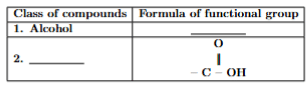
1. For Alcohol, the functional group is \textbf{--OH} (Hydroxyl group).
2. For the functional group --COOH, the class of compounds is \textbf{Carboxylic acid}.
View Solution
Step 1: Understanding Functional Groups:
A functional group is an atom or a group of atoms within a molecule that is responsible for the characteristic chemical reactions of that molecule. Different classes of organic compounds are defined by their specific functional groups.
Step 2: Solving for Part 1 (Alcohol):
The class of compounds given is Alcohol.
Alcohols are organic compounds characterized by the presence of one or more hydroxyl (--OH) groups attached to a saturated carbon atom.
Therefore, the formula of the functional group for an alcohol is --OH.
Step 3: Solving for Part 2 (Carboxylic Acid):
The formula of the functional group is given as --C(=O)OH, which is commonly written as --COOH.
This functional group is called the carboxyl group.
Organic compounds containing the carboxyl group (--COOH) are known as carboxylic acids. Examples include methanoic acid (HCOOH) and ethanoic acid (CH\(_3\)COOH).
Step 4: Completed Table:
The completed table is as follows:
\begin{tabular{|l|c|
\hline
Class of compounds & Formula of functional group
\hline
1. Alcohol & --OH
\hline
2. Carboxylic acid & \begin{tabular{c O
\textbardbl
-- C -- OH \end{tabular
\hline
\end{tabular
Quick Tip: Memorize the common functional groups and their corresponding class names: - \textbf{--OH} (Hydroxyl) \(\rightarrow\) Alcohol - \textbf{--CHO} (Aldehyde) \(\rightarrow\) Aldehyde - \textbf{>C=O} (Carbonyl/Keto) \(\rightarrow\) Ketone - \textbf{--COOH} (Carboxyl) \(\rightarrow\) Carboxylic Acid - \textbf{--O--} (Ether) \(\rightarrow\) Ether
Frame any two questions to understand the concept of refraction.
1. Why does a pencil partially immersed in a glass of water appear to be bent at the water's surface?
2. Why do stars appear to twinkle when viewed from Earth?
View Solution
Step 1: Understanding the Concept of Refraction:
Refraction is the phenomenon of the bending of light as it passes from one transparent medium to another (e.g., from air to water, or from air to glass). This bending occurs because the speed of light is different in different media. A good question to test the understanding of this concept should relate to an observable phenomenon that is a direct consequence of refraction.
Step 2: Framing the First Question:
A classic and easily observable example of refraction is the apparent bending of an object at the interface of two media.
Question 1: Why does a pencil or a straw partially immersed in a glass of water appear to be bent at the point where it enters the water?
\textit{Explanation: This question requires an understanding that light rays traveling from the part of the pencil in the water travel into the air before reaching our eyes. As the light rays pass from a denser medium (water) to a rarer medium (air), they bend away from the normal. Our brain interprets these bent rays as coming from a shallower, apparent position, making the pencil look bent.
Step 3: Framing the Second Question:
Another common phenomenon caused by refraction is related to atmospheric effects.
Question 2: Why do stars appear to twinkle, while planets do not?
\textit{Explanation: The answer lies in atmospheric refraction. Starlight, coming from a very distant point source, passes through the Earth's atmosphere, which has continuously changing layers of different densities and temperatures. This causes the light to refract multiple times and in random directions, making the apparent position of the star fluctuate and its brightness vary, which we perceive as twinkling. Planets are much closer and are extended sources, so the light variations from different points on the planet average out, and they do not appear to twinkle.
Quick Tip: When asked to frame questions about a scientific concept, think of real-world applications or everyday observations that are explained by that concept. Questions starting with "Why..." are often effective for testing conceptual understanding.
Predict and write why the tungsten is used as filament in electric lamps?
View Solution
Step 1: Understanding the Principle of Incandescent Lamps:
An incandescent electric lamp produces light by heating a wire filament to a very high temperature until it glows (incandescence). The material used for this filament must have specific properties to withstand these extreme conditions.
Step 2: Key Properties of Tungsten:
Tungsten (W) is the metal of choice for filaments due to two primary properties:
1. High Melting Point: The filament needs to be heated to over 2200\(^\circ\)C to produce a significant amount of visible light. Tungsten has the highest melting point of all pure metals, at approximately 3422\(^\circ\)C. This allows it to be heated to the required high temperatures without melting and breaking.
2. High Resistivity: The heat in the filament is generated due to the resistance it offers to the flow of electric current, a phenomenon known as Joule heating (Heat \( \propto I^2R\)). Tungsten has a relatively high resistivity, which means that even a thin and long wire of it offers enough resistance to generate the immense amount of heat required for incandescence when current passes through it.
Step 3: Other Favourable Properties:
- Low Rate of Evaporation (Vaporization): At high temperatures, materials can turn into vapor. Tungsten has a low vapor pressure, meaning it evaporates very slowly even when extremely hot. This increases the lifespan of the filament.
- High Tensile Strength: It is strong and does not break easily, even when drawn into very thin wires.
Step 4: Final Answer:
Tungsten is used for the filament of electric lamps because its very high melting point allows it to get white-hot without melting, and its high resistivity enables it to generate a large amount of heat to produce light when an electric current flows through it.
Quick Tip: In addition to its properties, remember that the glass bulb of an incandescent lamp is filled with an inert gas like argon or nitrogen. This is to create an oxygen-free environment, which prevents the hot tungsten filament from oxidizing (burning) and breaking, thereby extending its life.
Draw the ray diagrams of image formed when the object is placed in front of a concave mirror in the following position: at 'C'
View Solution
Step 1: Understanding the Concept and Rules for Ray Tracing:
To determine the position and nature of an image formed by a concave mirror, we can use ray diagrams. The following rules are used:
- A ray parallel to the principal axis, after reflection, will pass through the principal focus (F).
- A ray passing through the principal focus (F), after reflection, will emerge parallel to the principal axis.
- A ray passing through the center of curvature (C) will reflect back along the same path.
The intersection of at least two reflected rays gives the position of the image.
Step 2: Description of the Ray Diagram for an Object at C:
1. Setup: Draw a concave mirror and its principal axis. Mark the pole (P), the principal focus (F), and the center of curvature (C). Remember that F is the midpoint between P and C.
2. Object Placement: Place an object (represented by an upward-pointing arrow, say AB, with B on the principal axis) at the center of curvature, C.
3. Ray 1 (Parallel to Axis): Draw a ray of light from the top of the object (point A) parallel to the principal axis. After reflecting from the mirror's surface, this ray will pass through the principal focus (F).
4. Ray 2 (Through Focus): Draw a second ray of light from the top of the object (point A) passing through the principal focus (F). After reflecting from the mirror, this ray will become parallel to the principal axis.
5. Image Formation: The two reflected rays will intersect at a point directly below C. This point of intersection is the image of point A, let's call it A'. The image of point B (on the axis) will be at B itself (now B'). The complete image A'B' is formed at C.
Step 3: Characteristics of the Image:
Based on the ray diagram:
- Position: The image is formed at the center of curvature (C).
- Nature: The image is real (since the reflected rays actually intersect) and inverted (the image arrow points downwards).
- Size: The image is of the same size as the object.
Quick Tip: A useful mnemonic for concave mirrors: As the object moves from infinity towards the mirror, the real image moves from the focus (F) away from the mirror. When the object is at C, the object and image "meet" at the same location with the same size.
Draw the ray diagrams of image formed when the object is placed in front of a concave mirror in the following position: between P and F
View Solution
Step 1: Understanding the Concept and Rules for Ray Tracing:
The same rules for ray tracing apply as in the previous question. This specific case is unique for a concave mirror as it's the only position that produces a virtual image.
- A ray parallel to the principal axis reflects through the focus (F).
- A ray appearing to pass through the center of curvature (C) reflects back along the same path.
Step 2: Description of the Ray Diagram for an Object between P and F:
1. Setup: Draw a concave mirror and its principal axis. Mark the pole (P), principal focus (F), and center of curvature (C).
2. Object Placement: Place an object (an upward-pointing arrow, AB) anywhere between the pole P and the focus F.
3. Ray 1 (Parallel to Axis): Draw a ray of light from the top of the object (point A) parallel to the principal axis. After reflection, this ray passes through the principal focus (F).
4. Ray 2 (Towards Center of Curvature): Draw a second ray of light from the top of the object (point A) that is directed as if it is coming from the center of curvature (C). This ray will strike the mirror perpendicularly and reflect back along the same path.
5. Image Formation: The two reflected rays (one that passed through F and the other that reflected back along the C-line) will be diverging; they will not intersect in front of the mirror. However, if we extend these reflected rays backwards (behind the mirror) using dotted lines, they will appear to intersect at a point. This point of apparent intersection is the virtual image of point A, let's call it A'. The complete image A'B' is formed behind the mirror.
Step 3: Characteristics of the Image:
Based on the ray diagram:
- Position: The image is formed behind the mirror.
- Nature: The image is virtual (since the reflected rays do not actually intersect, but only appear to) and erect (the image arrow points upwards, same as the object).
- Size: The image is magnified (larger than the object).
Quick Tip: This is the principle behind shaving mirrors and dentists' mirrors. They are concave mirrors, and you place your face (the object) within the focal length (between P and F) to get a magnified, upright (erect) image.
Draw the diagram which shows that acid solution in water conducts electricity.
View Solution
Step 1: Understanding the Concept:
For a solution to conduct electricity, it must contain mobile charge carriers. In metallic wires, these carriers are electrons. In an electrolyte solution (like an acid in water), these carriers are ions. Acids, when dissolved in water, dissociate into positive ions (cations, e.g., H\(^+\)) and negative ions (anions, e.g., Cl\(^-\)). The movement of these ions through the solution allows it to conduct electricity.
Step 2: Description of the Experimental Setup Diagram:
1. Beaker and Solution: Draw a beaker. Fill it with water and label the liquid as "Dilute Acid Solution" (e.g., Dil. HCl).
2. Electrodes: Draw two conductive rods (e.g., graphite rods or iron nails) immersed in the solution. These are the electrodes. Ensure they are not touching each other. Label them as 'Anode' (connected to the positive terminal) and 'Cathode' (connected to the negative terminal).
3. External Circuit: Connect the electrodes using wires to form an external circuit. The circuit should contain the following components in series:
- A Battery or DC power source (show the '+' and '-' terminals). The wire from the positive terminal connects to one electrode (anode), and the wire from the negative terminal eventually connects to the other electrode (cathode).
- A Bulb.
- A Switch (in the closed position to show the circuit is complete).
4. Indication of Conduction: Draw the bulb with rays emanating from it to indicate that it is glowing.
5. Labels and Explanation: Label all components clearly. Optionally, you can add small circles with '+' and '-' signs in the solution, along with arrows showing their movement towards the oppositely charged electrodes (cations like H\(^+\) towards the cathode, anions like Cl\(^-\) towards the anode) to illustrate the mechanism of conduction.
Step 3: Explanation of the Phenomenon:
When the switch is closed, the circuit is complete. The acid (e.g., HCl) in the water dissociates into H\(^+\) and Cl\(^-\) ions. The H\(^+\) ions are attracted to the negatively charged cathode, and the Cl\(^-\) ions are attracted to the positively charged anode. This movement of ions within the solution constitutes an electric current. The flow of current through the entire circuit causes the bulb to glow, demonstrating that the acid solution conducts electricity.
Quick Tip: This experiment can also be used to distinguish between strong and weak acids. A strong acid (which dissociates completely) will result in a brightly glowing bulb, while a weak acid (which dissociates partially) will cause the bulb to glow dimly due to fewer charge-carrying ions.
Give two important uses of the following: Bleaching powder
1. It is used as a bleaching agent for cotton and linen in the textile industry and for wood pulp in paper factories.
2. It is used as a disinfectant for drinking water to make it free of germs.
View Solution
Step 1: Understanding the Substance:
Bleaching powder is chemically known as Calcium Oxychloride (CaOCl\(_2\)). It is a pale yellowish powder with a strong smell of chlorine. Its properties are primarily due to the release of chlorine when it reacts with acids or even moisture and carbon dioxide in the air.
Step 2: Use 1 - Bleaching Agent:
The name "bleaching powder" itself suggests its primary use. It is a powerful oxidizing agent. When it reacts with dilute acids, it releases nascent oxygen and chlorine, which are responsible for its bleaching action. This property is extensively used in industries:
- Textile Industry: For bleaching cotton and linen fabrics.
- Paper Industry: For bleaching wood pulp to produce white paper.
- Laundry: For bleaching washed clothes.
Step 3: Use 2 - Disinfectant:
Bleaching powder releases chlorine, which is a potent disinfectant. Chlorine has the ability to kill harmful microorganisms like bacteria and viruses.
- Water Purification: It is widely used to sterilize drinking water supplies. A small, controlled amount is added to water reservoirs to make the water safe for consumption by killing germs. This is a common and cost-effective method of water treatment.
- Sanitation: It is also used as a general disinfectant for swimming pools, drains, and toilets.
Quick Tip: Remember the chemical formula CaOCl\(_2\). The 'Cl\(_2\)' part is a good reminder of its key properties related to chlorine: bleaching and disinfection.
Give two important uses of the following: Baking soda
1. It is used as an antacid to relieve indigestion and heartburn.
2. It is used in baking cakes and bread, as a component of baking powder.
View Solution
Step 1: Understanding the Substance:
Baking soda is chemically known as Sodium Bicarbonate or Sodium Hydrogen Carbonate (NaHCO\(_3\)). It is a mild, non-corrosive base. Its properties stem from its ability to neutralize acids and to produce carbon dioxide gas upon heating or reaction with an acid.
Step 2: Use 1 - Antacid:
Our stomach produces hydrochloric acid (HCl) for digestion. Sometimes, excess acid is produced, leading to a condition called acidity or indigestion, which causes pain and irritation (heartburn).
- Since baking soda (NaHCO\(_3\)) is a mild alkali (base), it can neutralize the excess acid in the stomach, providing quick relief. The neutralization reaction is:
\[ NaHCO_3 + HCl \rightarrow NaCl + H_2O + CO_2 \]
This makes it a common ingredient in many commercial antacid tablets and powders.
Step 3: Use 2 - Baking:
Baking soda is a key leavening agent in baking.
- It is a major component of baking powder (a mixture of baking soda, a mild edible acid like tartaric acid, and a starch). When baking powder is mixed with water or heated, the baking soda reacts with the acid to produce carbon dioxide gas.
\[ NaHCO_3 (s) + H^+ (aq) \rightarrow Na^+ (aq) + H_2O (l) + CO_2 (g) \]
- The bubbles of CO\(_2\) gas get trapped in the dough or batter, causing it to rise and making the cake, bread, or pastry soft and spongy.
- It is also used in soda-acid fire extinguishers for the same reason: its rapid reaction with an acid produces a large volume of CO\(_2\) gas, which smothers the fire.
Quick Tip: Don't confuse baking soda (NaHCO\(_3\)) with washing soda (Na\(_2\)CO\(_3 \cdot\)10H\(_2\)O). Remember 'bi' in bicarbonate for 'baking'. Baking soda is edible and used in food, while washing soda is a stronger base used for cleaning.
Observe the following table and answer the following questions.

Which medium has highest optical density?
View Solution
Step 1: Understanding the Concept:
Optical density is a measure of how much a material can slow down the speed of light passing through it. It is not the same as mass density. The refractive index (n) of a medium is a direct measure of its optical density. A higher refractive index indicates a higher optical density.
Step 2: Analyzing the Data:
We need to find the medium with the highest optical density by looking for the highest refractive index in the given table.
- Air: n = 1.0003
- Rock salt: n = 1.54
- Water: n = 1.33
- Diamond: n = 2.42
- Benzene: n = 1.50
Comparing these values, the highest value is 2.42.
Step 3: Final Answer:
The highest refractive index is 2.42, which corresponds to Diamond. Therefore, Diamond has the highest optical density among the given media.
Quick Tip: Remember the direct relationship: Higher Refractive Index = Higher Optical Density = Slower Speed of Light. This simple rule helps answer all parts of this question.
In which medium speed of light is minimum?
View Solution
Step 1: Understanding the Concept:
The speed of light in a medium is inversely related to the refractive index of that medium. The refractive index (n) is defined as the ratio of the speed of light in a vacuum (c) to the speed of light in the medium (v).
\[ n = \frac{c}{v} \quad or \quad v = \frac{c}{n} \]
This formula shows that as the refractive index (n) increases, the speed of light in the medium (v) decreases. Therefore, the medium with the highest refractive index will have the minimum speed of light.
Step 2: Analyzing the Data:
From the previous question, we identified that Diamond has the highest refractive index (n = 2.42).
Using the relationship \(v = c/n\), the speed of light will be the slowest in the medium with the largest value of n.
Step 3: Final Answer:
Since Diamond has the highest refractive index (2.42), the speed of light will be minimum in Diamond.
Quick Tip: You don't need to calculate the actual speed. Just remember the inverse relationship: the medium that bends light the most (highest 'n') also slows it down the most.
In which medium the light travels faster?
View Solution
Step 1: Understanding the Concept:
As established, the speed of light in a medium (v) is inversely proportional to its refractive index (n), according to the formula \(v = c/n\). To find the medium where light travels the fastest, we need to find the medium with the lowest refractive index.
Step 2: Analyzing the Data:
We need to find the medium with the lowest refractive index in the given table.
- Air: n = 1.0003
- Rock salt: n = 1.54
- Water: n = 1.33
- Diamond: n = 2.42
- Benzene: n = 1.50
Comparing these values, the lowest value is 1.0003.
Step 3: Final Answer:
The lowest refractive index is 1.0003, which corresponds to Air. Therefore, light travels fastest in Air among the given media. (Its speed is very close to the speed of light in a vacuum).
Quick Tip: For all practical purposes in school-level physics, the refractive index of air is taken as 1, the same as a vacuum. This makes it the benchmark for the fastest speed of light.
Which medium has least optical density?
View Solution
Step 1: Understanding the Concept:
Optical density is directly proportional to the refractive index of the medium. A medium with a lower refractive index has a lower optical density, meaning it impedes the passage of light less than a medium with a higher optical density. To find the medium with the least optical density, we must look for the lowest refractive index.
Step 2: Analyzing the Data:
As determined in the previous question, we need to find the minimum value in the list of refractive indices: 1.0003, 1.54, 1.33, 2.42, 1.50.
The lowest value is 1.0003.
Step 3: Final Answer:
The lowest refractive index of 1.0003 corresponds to Air. Therefore, Air has the least optical density among the given media.
Quick Tip: Remember the inverse relationship: Least Optical Density = Lowest Refractive Index = Fastest Speed of Light. Answering one of these questions often helps you answer the others.
Explain what is Myopia and how can you rectify it.
View Solution
Step 1: Understanding Myopia (Near-sightedness):
Myopia is a common refractive error of the eye. A myopic eye has a far point that is closer than infinity. This means the person can see objects clearly up to a certain distance, but objects beyond this far point appear blurry.
Step 2: Causes of Myopia:
This defect occurs when the light rays from a distant object are focused in front of the retina, instead of directly on the retina. This can be due to two main reasons:
1. Elongation of the eyeball: The eyeball is too long from front to back.
2. Excessive curvature of the eye lens: The eye lens is too converging (has a shorter focal length than normal), causing it to bend the light rays too much.
Step 3: Rectification of Myopia:
To correct this defect, a lens is needed that can diverge the incoming light rays before they enter the eye. This will move the final point of focus backward, onto the retina.
- A concave lens (diverging lens) is used for this purpose.
- When placed in front of a myopic eye, the concave lens diverges the parallel rays coming from a distant object. These diverged rays then appear to the eye lens as if they are coming from the eye's own far point.
- The eye lens can then comfortably converge these rays to form a sharp image on the retina.
- The focal length of the required concave lens is chosen such that for an object at infinity, the lens forms a virtual image at the far point of the myopic eye. The power of the lens used is negative.
Quick Tip: A simple way to remember the correction: \textbf{My}opia is corrected by a \textbf{conca-ve} lens. (My-Cave). For hypermetropia (far-sightedness), a convex lens is used.
OR
Question 15(i):
Define the following terms: Electric current
View Solution
Step 1: Definition:
Electric current (symbolized by 'I') is the flow of electric charge. In a metallic conductor, this charge is carried by moving electrons. Conventionally, the direction of electric current is taken as the direction of flow of positive charge, which is opposite to the direction of flow of electrons.
Step 2: Formula:
If a net charge 'Q' flows across any cross-section of a conductor in time 't', then the current 'I' through the cross-section is given by:
\[ I = \frac{Q}{t} \]
Step 3: SI Unit:
The SI unit of electric charge (Q) is the Coulomb (C), and the unit of time (t) is the second (s). Therefore, the SI unit of electric current (I) is the Ampere (A).
One Ampere is defined as the flow of one Coulomb of charge per second.
\[ 1 Ampere = \frac{1 Coulomb}{1 second} \]
Current is measured using an instrument called an Ammeter, which is always connected in series in the circuit.
Quick Tip: Remember the water analogy: Electric current is like the flow rate of water in a pipe (e.g., liters per second), while charge is like the amount of water (liters).
Define the following terms: Potential difference
View Solution
Step 1: Definition:
Potential difference (also known as voltage, symbolized by 'V') is the "push" or "pressure" that causes electric charges to flow in a circuit. It represents the difference in electric potential energy per unit charge between two points. A potential difference is required for a current to flow.
Step 2: Formula:
If 'W' is the work done in moving a charge 'Q' from one point to another, then the potential difference 'V' between those two points is:
\[ V = \frac{W}{Q} \]
Step 3: SI Unit:
The SI unit of work (W) is the Joule (J), and the unit of charge (Q) is the Coulomb (C). Therefore, the SI unit of potential difference (V) is the Volt (V).
One Volt is defined as the potential difference between two points when one Joule of work is done to move a charge of one Coulomb from one point to the other.
\[ 1 Volt = \frac{1 Joule}{1 Coulomb} \]
Potential difference is measured using an instrument called a Voltmeter, which is always connected in parallel across the two points where the difference is to be measured.
Quick Tip: Continuing the water analogy: Potential difference is like the difference in water pressure (or height) between two points in a pipe, which causes the water to flow.
Define the following terms: Electric Resistance
View Solution
Step 1: Definition:
Resistance (symbolized by 'R') is a measure of the opposition to current flow in an electrical circuit. When electrons flow through a conductor, they collide with the ions/atoms of the conductor. These collisions impede the flow of electrons and cause resistance. This electrical energy is converted into heat.
Step 2: Formula (from Ohm's Law):
According to Ohm's law, the potential difference (V) across the ends of a conductor is directly proportional to the current (I) flowing through it, provided the temperature and other physical conditions remain unchanged. The constant of proportionality is the resistance (R).
\[ V = I \times R \quad or \quad R = \frac{V}{I} \]
Step 3: SI Unit:
The SI unit of resistance is the Ohm (symbolized by the Greek letter omega, \(\Omega\)).
One Ohm is defined as the resistance of a conductor through which a current of one Ampere flows when the potential difference across its ends is one Volt.
\[ 1 Ohm = \frac{1 Volt}{1 Ampere} \] Quick Tip: Water analogy: Resistance is like the narrowness or obstruction in a pipe, which restricts the flow of water. A narrower pipe has higher resistance to water flow.
Define the following terms: Electric power
View Solution
Step 1: Definition:
Electric power (symbolized by 'P') is the rate of doing work or the rate of energy transfer. It tells us how fast electrical energy is being converted into another form of energy, such as heat, light, or mechanical energy.
Step 2: Formula:
Power is the work done (or energy consumed, E) per unit time (t).
\[ P = \frac{W}{t} = \frac{E}{t} \]
Using the definitions of potential difference (\(V = W/Q\)) and current (\(I = Q/t\)), we can derive other common formulas for power:
\[ P = V \times I \]
Using Ohm's law (\(V=IR\)), we can also express power as:
\[ P = I^2 R \quad and \quad P = \frac{V^2}{R} \]
Step 3: SI Unit:
The SI unit of power is the Watt (W).
One Watt is the power consumed by a device that carries a current of one Ampere when operated at a potential difference of one Volt.
\[ 1 Watt = 1 Volt \times 1 Ampere \] Quick Tip: Don't confuse energy and power. Power is the rate, while energy is the total amount. A 100 Watt bulb consumes energy at a rate of 100 Joules per second. If it is on for 10 seconds, the total energy consumed is Power \(\times\) Time = 100 W \(\times\) 10 s = 1000 Joules.
Write the balanced chemical equations for the following reactions.
Calcium hydroxide + Carbon dioxide \(\rightarrow\) Calcium carbonate + Water
View Solution
Step 1: Write the skeletal chemical equation.
First, we need to write the correct chemical formulas for all the reactants and products.
- Calcium hydroxide: Ca(OH)\(_2\)
- Carbon dioxide: CO\(_2\)
- Calcium carbonate: CaCO\(_3\)
- Water: H\(_2\)O
The skeletal equation is:
\[ Ca(OH)_2 + CO_2 \rightarrow CaCO_3 + H_2O \]
Step 2: Check the balance of atoms on both sides.
We will count the number of atoms of each element on the reactant side (left) and the product side (right).
\begin{tabular{|l|c|c|
\hline
Element & Reactant Side (LHS) & Product Side (RHS)
\hline
Calcium (Ca) & 1 & 1
Oxygen (O) & 2 (from OH) + 2 (from CO\(_2\)) = 4 & 3 (from CO\(_3\)) + 1 (from H\(_2\)O) = 4
Hydrogen (H) & 2 (from OH) & 2 (from H\(_2\)O)
Carbon (C) & 1 & 1
\hline
\end{tabular
Since the number of atoms of each element is the same on both sides of the equation, the equation is already balanced.
Step 3: Final Balanced Equation.
\[ Ca(OH)_2 (aq) + CO_2 (g) \rightarrow CaCO_3 (s) + H_2O (l) \]
This is the reaction that occurs when carbon dioxide is passed through lime water (a solution of calcium hydroxide), causing it to turn milky due to the formation of the white precipitate, calcium carbonate.
Quick Tip: This reaction is a classic test for carbon dioxide gas. Remember that if you continue to pass CO\(_2\) through the milky solution, the precipitate will dissolve to form calcium bicarbonate, Ca(HCO\(_3\))\(_2\), and the solution will become clear again.
Write the balanced chemical equations for the following reactions.
Zinc + Silver nitrate \(\rightarrow\) Zinc nitrate + Silver
View Solution
Step 1: Write the skeletal chemical equation.
- Zinc: Zn
- Silver nitrate: AgNO\(_3\)
- Zinc nitrate: Zn(NO\(_3\))\(_2\) (The valency of Zn is +2, and the nitrate ion NO\(_3\) has a charge of -1)
- Silver: Ag
The skeletal equation is:
\[ Zn + AgNO_3 \rightarrow Zn(NO_3)_2 + Ag \]
Step 2: Check the balance of atoms on both sides.
\begin{tabular{|l|c|c|
\hline
Element/Group & Reactant Side (LHS) & Product Side (RHS)
\hline
Zinc (Zn) & 1 & 1
Silver (Ag) & 1 & 1
Nitrate (NO\(_3\)) & 1 & 2
\hline
\end{tabular
The nitrate group (NO\(_3\)) is not balanced. We have 1 on the left and 2 on the right.
Step 3: Balance the equation.
To balance the nitrate groups, we place a coefficient of 2 in front of AgNO\(_3\) on the reactant side.
\[ Zn + 2AgNO_3 \rightarrow Zn(NO_3)_2 + Ag \]
Now, let's re-check the atom count.
\begin{tabular{|l|c|c|
\hline
Element/Group & Reactant Side (LHS) & Product Side (RHS)
\hline
Zinc (Zn) & 1 & 1
Silver (Ag) & 2 & 1
Nitrate (NO\(_3\)) & 2 & 2
\hline
\end{tabular
Now the silver atoms are unbalanced. To balance Ag, we place a coefficient of 2 in front of Ag on the product side.
\[ Zn + 2AgNO_3 \rightarrow Zn(NO_3)_2 + 2Ag \]
The equation is now fully balanced.
Step 4: Final Balanced Equation.
\[ Zn(s) + 2AgNO_3 (aq) \rightarrow Zn(NO_3)_2 (aq) + 2Ag (s) \]
This is an example of a single displacement reaction, where the more reactive metal (Zinc) displaces the less reactive metal (Silver) from its salt solution.
Quick Tip: When balancing equations with polyatomic ions like nitrate (NO\(_3\)) or sulphate (SO\(_4\)), treat them as a single unit if they appear unchanged on both sides. This simplifies the counting process.
Write the balanced chemical equations for the following reactions.
Aluminium + Copper chloride \(\rightarrow\) Aluminium chloride + Copper
View Solution
Step 1: Write the skeletal chemical equation.
- Aluminium: Al
- Copper chloride: CuCl\(_2\) (Assuming it is Copper(II) chloride, which is the most common form)
- Aluminium chloride: AlCl\(_3\) (Valency of Al is +3, and Cl is -1)
- Copper: Cu
The skeletal equation is:
\[ Al + CuCl_2 \rightarrow AlCl_3 + Cu \]
Step 2: Check the balance of atoms on both sides.
\begin{tabular{|l|c|c|
\hline
Element & Reactant Side (LHS) & Product Side (RHS)
\hline
Aluminium (Al) & 1 & 1
Copper (Cu) & 1 & 1
Chlorine (Cl) & 2 & 3
\hline
\end{tabular
The chlorine atoms are unbalanced. We have 2 on the left and 3 on the right.
Step 3: Balance the equation.
To balance the Cl atoms, we find the least common multiple (LCM) of 2 and 3, which is 6.
- Place a coefficient of 3 in front of CuCl\(_2\) (to get 3 \(\times\) 2 = 6 Cl atoms).
- Place a coefficient of 2 in front of AlCl\(_3\) (to get 2 \(\times\) 3 = 6 Cl atoms).
The equation becomes:
\[ Al + 3CuCl_2 \rightarrow 2AlCl_3 + Cu \]
Now, let's re-check the atom count.
- Al: 1 on LHS, 2 on RHS (unbalanced)
- Cu: 3 on LHS, 1 on RHS (unbalanced)
- Cl: 6 on LHS, 6 on RHS (balanced)
To balance Al, place a 2 in front of Al on the LHS. To balance Cu, place a 3 in front of Cu on the RHS.
\[ 2Al + 3CuCl_2 \rightarrow 2AlCl_3 + 3Cu \]
The equation is now fully balanced.
Step 4: Final Balanced Equation.
\[ 2Al (s) + 3CuCl_2 (aq) \rightarrow 2AlCl_3 (aq) + 3Cu (s) \]
This is another example of a single displacement reaction.
Quick Tip: When an element has an odd number of atoms on one side and an even number on the other (like Chlorine here), a good strategy is to find their LCM to determine the coefficients.
Write the balanced chemical equations for the following reactions.
Barium chloride + Potassium sulphate \(\rightarrow\) Barium sulphate + Potassium chloride
View Solution
Step 1: Write the skeletal chemical equation.
- Barium chloride: BaCl\(_2\) (Valency of Ba is +2, Cl is -1)
- Potassium sulphate: K\(_2\)SO\(_4\) (Valency of K is +1, sulphate ion SO\(_4\) is -2)
- Barium sulphate: BaSO\(_4\)
- Potassium chloride: KCl
The skeletal equation is:
\[ BaCl_2 + K_2SO_4 \rightarrow BaSO_4 + KCl \]
Step 2: Check the balance of atoms on both sides.
\begin{tabular{|l|c|c|
\hline
Element/Group & Reactant Side (LHS) & Product Side (RHS)
\hline
Barium (Ba) & 1 & 1
Chlorine (Cl) & 2 & 1
Potassium (K) & 2 & 1
Sulphate (SO\(_4\)) & 1 & 1
\hline
\end{tabular
The Chlorine and Potassium atoms are unbalanced.
Step 3: Balance the equation.
We have 2 Cl atoms and 2 K atoms on the left, but only 1 of each on the right.
To balance both, we can place a coefficient of 2 in front of KCl on the product side.
\[ BaCl_2 + K_2SO_4 \rightarrow BaSO_4 + 2KCl \]
Now, let's re-check the atom count.
\begin{tabular{|l|c|c|
\hline
Element/Group & Reactant Side (LHS) & Product Side (RHS)
\hline
Barium (Ba) & 1 & 1
Chlorine (Cl) & 2 & 2
Potassium (K) & 2 & 2
Sulphate (SO\(_4\)) & 1 & 1
\hline
\end{tabular
The equation is now fully balanced.
Step 4: Final Balanced Equation.
\[ BaCl_2 (aq) + K_2SO_4 (aq) \rightarrow BaSO_4 (s) + 2KCl (aq) \]
This is an example of a double displacement reaction, specifically a precipitation reaction, as barium sulphate is an insoluble white precipitate.
Quick Tip: Double displacement reactions often involve the exchange of ions between two aqueous ionic compounds. Look for the "switching of partners" pattern: AB + CD \(\rightarrow\) AD + CB.
OR
Question 16:
Explain the mechanism of the cleaning action of soaps.
View Solution
Step 1: Understanding the Structure of a Soap Molecule:
A soap molecule is the sodium or potassium salt of a long-chain carboxylic acid. It has two distinct parts with different properties:
1. A Long Hydrocarbon Tail: This part is made of a long chain of carbon and hydrogen atoms (e.g., C\(_{17}\)H\(_{35}\)--). It is non-polar and hydrophobic (water-repelling). However, it is lipophilic (oil-loving) and can dissolve in oil, grease, or dirt.
2. An Ionic Head: This is the carboxylate part (--COO\(^-\)Na\(^+\)). It is polar and hydrophilic (water-attracting). It can dissolve in water but not in oil.
Step 2: The Formation of Micelles:
Most dirt is oily in nature and does not dissolve in water. When soap is added to water, the soap molecules arrange themselves in a unique way to overcome this.
- The hydrophobic tails of the soap molecules avoid water and cluster together.
- The hydrophilic heads remain on the outer surface, in contact with the water.
- This spherical, cluster-like structure is called a micelle. In a micelle, the tails are in the interior of the cluster, and the ionic heads are on the surface.
Step 3: The Cleaning Action:
When soapy water is applied to a dirty surface (e.g., a cloth with a grease spot):
1. Attachment: The hydrophobic tails of the soap molecules in the micelles attach themselves to the oily dirt particle. The oil-loving tails dissolve into the grease.
2. Encapsulation: A micelle forms around the dirt particle, with the tails pointing inwards into the dirt and the hydrophilic heads pointing outwards towards the water. The dirt particle is effectively trapped in the center of the micelle.
3. Emulsification and Removal: The outer surface of the micelle is covered with negatively charged heads (--COO\(^-\)). These negatively charged micelles repel each other, preventing the grease droplets from clumping back together. This forms a stable emulsion of oil in water. When the cloth is rinsed with water, the water molecules, being attracted to the hydrophilic heads, wash the micelles away, carrying the trapped dirt with them. This leaves the surface of the cloth clean.
Quick Tip: Remember the key terms: \textbf{Hydrophilic} (water-loving) head, \textbf{Hydrophobic} (water-fearing) tail, and \textbf{Micelle} (the spherical structure that traps dirt). A simple diagram showing a micelle around a grease spot can be very effective in an exam.
Explain the experimental procedure to show that a current-carrying conductor placed in a magnetic field experiences force on it.
View Solution
Aim: To demonstrate that a force is exerted on a current-carrying conductor when it is placed in a magnetic field.
Step 1: Apparatus Required:
- A small aluminum rod (about 5 cm long).
- A strong horseshoe magnet.
- A stand to suspend the rod.
- A DC power source (battery).
- A switch or key.
- Connecting wires.
Step 2: Experimental Procedure:
1. Setup: Arrange the apparatus as follows:
- Suspend the aluminum rod horizontally from the stand using two connecting wires, one at each end.
- Place the strong horseshoe magnet in such a way that the aluminum rod lies between its two poles (North and South). The magnetic field should be directed vertically upwards or downwards, perpendicular to the length of the rod.
- Connect the two suspension wires to a battery and a switch in series, so that a complete circuit is formed through the aluminum rod.
2. Observation 1 (Current Flow): Close the switch to allow current to flow through the aluminum rod. Observe the rod carefully.
3. Observation 2 (Reversing Current): Reverse the polarity of the battery connections and close the switch again. Observe the direction of movement of the rod.
4. Observation 3 (Reversing Magnetic Field): Keep the current direction the same as in the first step, but reverse the poles of the horseshoe magnet. Observe the direction of movement of the rod.
Step 3: Observations and Conclusion:
- Observation 1: When the current is switched on, the aluminum rod is deflected and moves either into or out of the magnet.
- Observation 2: When the direction of the current is reversed, the direction of the rod's deflection is also reversed.
- Observation 3: When the direction of the magnetic field is reversed (by flipping the magnet), the direction of the rod's deflection is reversed again.
- Conclusion: These observations conclusively prove that a current-carrying conductor experiences a force when placed in a magnetic field. The direction of this force depends on both the direction of the current and the direction of the magnetic field. This phenomenon is known as the motor effect.
Step 4: Governing Principle:
The direction of the force experienced by the conductor can be determined using Fleming's Left-Hand Rule. It states that if you stretch the thumb, forefinger, and middle finger of your left hand so they are mutually perpendicular, and if the forefinger points in the direction of the magnetic Field and the middle finger points in the direction of the Current, then the thumb will point in the direction of the Motion or Force. (Mnemonic: Father-Mother-Child for Force-Field-Current).
Quick Tip: This experiment is the fundamental principle behind electric motors. In a motor, a coil carrying current is placed in a magnetic field, and the continuous force on the coil causes it to rotate.
OR
Question 17:
Explain the experimental procedure to investigate the conditions under which iron rusts.
View Solution
Aim: To investigate the conditions necessary for the rusting of iron.
Step 1: Apparatus and Materials Required:
- Three clean test tubes (labeled A, B, and C).
- Three clean iron nails.
- Anhydrous calcium chloride (a drying agent).
- Distilled water.
- Oil (any cooking oil).
- Test tube stand and corks.
Step 2: Experimental Procedure:
Set up the three test tubes as follows to create three different environments for the iron nails:
1. Test Tube A (Presence of Air, Absence of Water):
- Place an iron nail in test tube A.
- Add a small amount of anhydrous calcium chloride powder. This chemical will absorb any moisture present in the air inside the test tube.
- Seal the test tube with a cork.
\textit{Condition: Nail is exposed to dry air only.
2. Test Tube B (Presence of Water, Absence of Air):
- Boil some distilled water for a few minutes. Boiling removes any dissolved air (oxygen) from the water.
- Pour this boiled water into test tube B until an iron nail placed inside is fully submerged.
- Carefully add a layer of oil (about 1 cm thick) on top of the water. The oil layer prevents air from the outside from dissolving back into the water.
- Seal the test tube with a cork.
\textit{Condition: Nail is exposed to water only (devoid of air).
3. Test Tube C (Control - Presence of both Air and Water):
- Place an iron nail in test tube C.
- Add some tap water or distilled water so that the nail is partially submerged. This ensures the nail is exposed to both water and air.
- Leave the test tube open or seal it with a cork.
\textit{Condition: Nail is exposed to both air and water.
Step 3: Observation and Conclusion:
- Leave the test tube stand undisturbed for a few days and observe the nails.
- Observation:
- The iron nail in test tube A does not rust.
- The iron nail in test tube B does not rust.
- The iron nail in test tube C develops a reddish-brown flaky layer, which is rust.
- Conclusion:
- From test tube A, we conclude that air (oxygen) alone cannot cause rusting.
- From test tube B, we conclude that water alone cannot cause rusting.
- From test tube C, we conclude that the presence of both air (oxygen) and water (moisture) is essential for the rusting of iron.
Quick Tip: Rusting is an oxidation process. The chemical formula for rust is hydrated iron(III) oxide, Fe\(_2\)O\(_3\)\(\cdot\)xH\(_2\)O. Remember this experiment as the "three test tubes" setup, a classic way to demonstrate the necessary conditions for a chemical process by isolating variables.
*The article might have information for the previous academic years, please refer the official website of the exam.