
AP SSC 2025 General Science (Paper II) - Biological Science - 20E Question Paper with Solution Pdf


| Updated On - Jan 23, 2026
AP SSC 2025 General Science (Paper II) Biological Science 20E Question Paper with Solution PDF is available here for download. AP SSC 2025 General Science (Paper II) Biological Science 20E Question Paper consists of 33 questions with a total weightage of 100 marks.
AP SSC 2025 General Science (Paper II) Biological Science 20E Question Paper with Solution PDF
| AP SSC 2025 General Science (Paper II) Biological Science 20E Question Paper | Download PDF | Check Solutions |
Which phenomenon acts as a driving force to pull water from the root xylem cells to leaf cells in the plant, during the day time?
View Solution
\
Step 1: Understanding the Concept: \
The question asks for the primary driving force that moves water from the roots to the leaves in a plant during the day. This process is a key part of water transport in vascular plants.
Step 2: Detailed Explanation: \
The phenomenon responsible for this is the transpiration pull or cohesion-tension theory.
1. Transpiration: During the day, water evaporates from the surfaces of leaf cells (mesophyll cells) and exits the leaf through small pores called stomata. This loss of water is called transpiration.
2. Creation of Tension: As water evaporates from the leaf cells, it lowers the water potential in these cells. This creates a negative pressure or tension (a pulling force) in the xylem of the leaves.
3. Cohesion and Adhesion: Water molecules are cohesive (they stick to each other due to hydrogen bonds) and adhesive (they stick to the walls of the xylem vessels).
4. Water Column: Due to cohesion, the water molecules in the xylem form a continuous, unbroken column from the leaves down to the roots. The tension created by transpiration pulls this entire column of water upwards, from the root xylem to the leaf cells. This pull is strong enough to move water against gravity to the top of the tallest trees.
Step 3: Final Answer: \
The phenomenon is transpiration pull. It acts as a suction force created by the evaporation of water from the leaves, which pulls water up through the xylem from the roots.
Quick Tip: Remember that transpiration is the main driving force for water movement in plants, especially during the day when stomata are open for photosynthesis. It's often described as a necessary evil because while it drives water transport, the plant also loses a significant amount of water.
Write a slogan to "Save our Earth".
View Solution
\
Step 1: Understanding the Concept: \
The question requires creating a slogan, which is a short and striking or memorable phrase used in advertising, or for a political or social campaign. The theme is environmental protection.
Step 2: Detailed Explanation: \
A good slogan for "Save our Earth" should be concise, impactful, and easy to remember. It should encourage action or raise awareness about environmental issues. Here are a few examples:
Don't be mean, keep the Earth clean. (Focuses on cleanliness and personal responsibility).
Reduce, Reuse, Recycle: The only solution to stop pollution. (Highlights the 3R's principle).
Heal the Earth, heal our future. (Connects the planet's health to human destiny).
There is no Planet B. (Emphasizes the uniqueness and irreplaceability of Earth).
Plant a tree, make the Earth pollution-free. (Suggests a simple, direct action).
Step 3: Final Answer: \
One possible slogan is: "There is no Planet B, let's protect our Earth for you and me."
Quick Tip: When asked to write a slogan, think about the core message you want to convey. Use simple words, rhyme, or alliteration to make it catchy. The goal is to create a memorable phrase that inspires action.
Identify the instrument used in the given picture.

View Solution
\
Step 1: Understanding the Concept: \
The question asks to identify the medical instrument shown in the picture. The picture displays a device wrapped around a person's upper arm, with a rubber bulb and a pressure gauge.
Step 2: Detailed Explanation: \
The instrument shown is a Sphygmomanometer.
Purpose: It is used to measure blood pressure.
Components shown:
Inflatable cuff: This is wrapped around the upper arm.
Inflation bulb: A rubber bulb that is squeezed to pump air into the cuff.
Manometer (pressure gauge): This measures the air pressure in the cuff. In the given diagram, it appears to be an aneroid manometer with a dial.
How it works: The cuff is inflated to a pressure high enough to stop the blood flow in the brachial artery. Then, the pressure is slowly released. The healthcare professional listens with a stethoscope (not fully shown but implied in the context of its use) for the sound of blood flow returning (systolic pressure) and the sound disappearing (diastolic pressure). These values are read from the manometer.
Step 3: Final Answer: \
The instrument is a Sphygmomanometer, used for measuring blood pressure.
Quick Tip: To remember the name, break it down: "Sphygmo" relates to the pulse, and a "manometer" is an instrument for measuring pressure. Therefore, it's a device for measuring the pressure related to the pulse.
Define the term 'Heredity'.
View Solution
\
Step 1: Understanding the Concept: \
This question requires the definition of a fundamental term in genetics, 'Heredity'.
Step 2: Detailed Explanation: \
Heredity, also known as inheritance, is the biological process by which genetic information is passed on from parents to their offspring. It is the reason why offspring resemble their parents.
The traits (like eye color, height, blood type) are controlled by genes, which are segments of DNA.
These genes are located on chromosomes.
During reproduction, parents pass on their genes to their children, which results in the inheritance of parental traits.
Heredity explains why family members have similar characteristics, but it also allows for variations among individuals.
The scientific study of heredity and the variation of inherited characteristics is called genetics.
Step 3: Final Answer: \
Heredity is the process of transmitting genetic characters or traits from parents to their offspring.
Quick Tip: Distinguish between 'Heredity' and 'Variation'. Heredity explains the similarities between generations, while variation explains the differences. Both are key concepts in genetics and evolution.
What happens, if variations do not occur in a species?
View Solution
\
Step 1: Understanding the Concept: \
This question explores the importance of genetic variation for the survival and evolution of a species. Variation refers to the differences in genetic traits among individuals within a species.
Step 2: Detailed Explanation: \
If variations do not occur in a species, several critical consequences would arise:
Inability to Adapt: The primary role of variation is to provide the raw material for natural selection. Environmental conditions are constantly changing (e.g., climate change, emergence of new diseases, changes in food availability). Variations ensure that some individuals in a population will have traits that make them better suited to survive and reproduce in the new conditions. Without variation, the entire population would have the same traits, and if these traits are not suitable for a new environmental challenge, the entire species could be wiped out.
Stagnation of Evolution: Evolution is the change in heritable characteristics of biological populations over successive generations. This change is driven by natural selection acting on variations. Without variation, there would be no new traits for selection to act upon, and the species would not be able to evolve or give rise to new species.
Increased Vulnerability to Diseases: If all individuals are genetically identical, they will be equally susceptible to certain diseases or parasites. A single pathogen could potentially infect and kill every individual in the population, leading to extinction.
Step 3: Final Answer: \
If variations do not occur in a species, the species would lose its ability to adapt to changing environments. This would make it highly vulnerable to extinction from challenges like climate change, new diseases, or predators. Essentially, evolution by natural selection would halt for that species.
Quick Tip: Remember that variation is the foundation of evolution. No variation means no adaptation, which ultimately leads to a dead end for a species in a dynamic world. Sexual reproduction is a major source of variation in many species.
Read the paragraph and answer the given question.
Ozone at the higher levels of the atmosphere, protects us from the ultraviolet radiation from the Sun. This radiation is one of the cause of skin cancer in the human beings.
i) Which rays cause skin cancer to us?
View Solution
\
Step 1: Understanding the Concept: \
The question asks to identify the type of radiation that causes skin cancer, based on the information provided in the paragraph.
Step 2: Detailed Explanation: \
The provided paragraph explicitly states: "Ozone at the higher levels of the atmosphere, protects us from the ultraviolet radiation from the Sun. This radiation is one of the cause of skin cancer in the human beings."
By directly reading this text, we can conclude that the rays responsible for causing skin cancer mentioned in this context are ultraviolet radiation. These are often abbreviated as UV rays.
Step 3: Final Answer: \
According to the paragraph, ultraviolet (UV) radiation from the Sun causes skin cancer in human beings.
Quick Tip: For reading comprehension questions, always locate the answer directly within the provided text first. The paragraph often contains all the necessary information to answer the question accurately. The ozone layer is particularly effective at blocking the most harmful types of UV radiation (UV-C and most of UV-B).
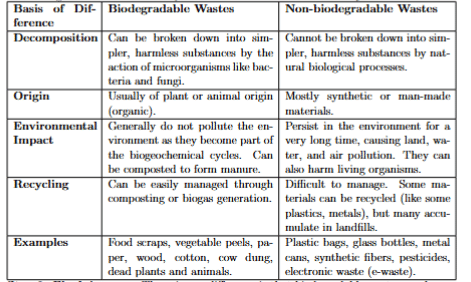
Write the differences between biodegradable and non-biodegradable wastes.
View Solution
\
Step 1: Understanding the Concept: \
This question requires a comparison between two categories of waste: biodegradable and non-biodegradable. The key difference lies in their ability to be broken down by natural processes.
Step 2: Detailed Explanation: \
The differences between biodegradable and non-biodegradable wastes can be presented in a table format for clarity:
Step 3: Final Answer: \
The primary difference is that biodegradable wastes can be decomposed by microorganisms, while non-biodegradable wastes cannot. This leads to biodegradable wastes being environmentally friendly and non-biodegradable wastes being a major source of long-term pollution.
Quick Tip: Remember the prefixes: 'Bio-' means life. 'Degradable' means breakable. So, 'biodegradable' means something that can be broken down by living organisms. 'Non-' is a prefix meaning 'not'.
If haemoglobin level may decreases in our blood, what happens?
View Solution
\
Step 1: Understanding the Concept: \
This question asks about the consequences of having a decreased level of haemoglobin in the blood. Haemoglobin is a crucial protein in red blood cells.
Step 2: Detailed Explanation: \
Haemoglobin is an iron-rich protein found in red blood cells (RBCs). Its primary function is to bind with oxygen in the lungs and transport it to all the cells and tissues of the body for cellular respiration.
If the haemoglobin level decreases, the following will happen:
Reduced Oxygen-Carrying Capacity: The blood's ability to transport oxygen will be significantly reduced.
Development of Anemia: A low level of haemoglobin or red blood cells is a condition known as anemia.
Symptoms of Oxygen Deficiency: Since the body's cells are not receiving enough oxygen, a person will experience symptoms such as:
Fatigue and Weakness: Lack of oxygen for energy production in cells leads to constant tiredness.
Shortness of Breath (Dyspnea): The body tries to compensate for low oxygen levels by increasing the breathing rate.
Pale Skin: Haemoglobin gives blood its red color. A lower concentration can make the skin, lips, and nail beds appear pale.
Dizziness and Headaches: The brain is very sensitive to oxygen levels, and a deficit can cause these symptoms.
Cold Hands and Feet: Reduced circulation and oxygen supply can lead to a feeling of coldness in the extremities.
Rapid or Irregular Heartbeat: The heart has to work harder to pump the oxygen-deficient blood throughout the body to meet the tissues' demands.
Step 3: Final Answer: \
If the haemoglobin level in our blood decreases, the oxygen-carrying capacity of the blood is reduced. This leads to a condition called anemia, causing symptoms like fatigue, weakness, shortness of breath, and paleness due to insufficient oxygen supply to the body tissues.
Quick Tip: Remember the direct link: Haemoglobin \(\rightarrow\) Oxygen Transport. Therefore, Low Haemoglobin \(\rightarrow\) Low Oxygen Transport \(\rightarrow\) Low Energy Production \(\rightarrow\) Fatigue and other symptoms of Anemia. Iron is a key component of haemoglobin, so iron deficiency is a common cause of anemia.
Read the given table and answer the following questions.

i) Which hormone promotes the cell division?
View Solution
\
Step 1: Understanding the Concept: \
The question requires identifying the plant hormone responsible for promoting cell division, using the information provided in the table.
Step 2: Detailed Explanation: \
The table lists three plant hormones and their primary functions:
Auxins: Stimulate cells to grow longer (cell elongation).
Cytokinins: Promote cell division.
Abscisic Acid: Inhibits growth.
By looking at the "Function" column corresponding to each hormone, we can see that "Promote cell division" is the function of Cytokinins.
Step 3: Final Answer: \
Based on the given table, the hormone that promotes cell division is Cytokinins.
Quick Tip: The name of the hormone itself is a clue. "Cyto" refers to the cell, and "kinesis" refers to division or movement. Thus, 'Cytokinin' literally relates to cell division.
View Solution
\
Step 1: Understanding the Concept: \
The question asks to identify the plant hormone that inhibits growth, based on the data in the provided table.
Step 2: Detailed Explanation: \
We need to examine the table to find which hormone is associated with the function of inhibiting growth.
Auxins: Stimulate cells to grow longer (Growth promotion).
Cytokinins: Promote cell division (Growth promotion).
Abscisic Acid: Inhibits growth (Growth inhibition).
The table clearly states that Abscisic Acid has the function of inhibiting growth.
Step 3: Final Answer: \
The growth inhibiting hormone listed in the table is Abscisic Acid.
Quick Tip: Plant hormones can be broadly categorized as growth promoters (like Auxins, Gibberellins, Cytokinins) and growth inhibitors (like Abscisic Acid and Ethylene). Abscisic acid is also known as the "stress hormone" as it helps plants cope with unfavorable conditions, for instance, by causing stomata to close during a drought.
What questions will you ask your teacher to know more about ecological systems?
View Solution
\
Step 1: Understanding the Concept: \
This question asks you to formulate inquisitive questions about ecology. Good questions should demonstrate curiosity and a desire to understand the complex interactions within ecosystems.
Step 2: Detailed Explanation: \
To learn more about ecological systems, one could ask questions that cover different aspects of ecology, such as energy flow, nutrient cycling, population dynamics, and human impact. Here are some examples of questions you could ask your teacher:
About Energy Flow:
How is energy transferred from one trophic level to the next in a food chain, and why is so much energy lost at each step?
What is the difference between a food chain and a food web, and why are food webs a more realistic representation of an ecosystem?
About Nutrient Cycling:
How do essential nutrients like carbon and nitrogen cycle through an ecosystem, moving between living organisms and the non-living environment?
What is the role of decomposers, like bacteria and fungi, in nutrient cycling?
About Interactions and Stability:
What is meant by the 'carrying capacity' of an ecosystem, and what factors determine it?
How does the removal of a top predator (a keystone species) affect the stability and biodiversity of an entire ecosystem?
About Human Impact:
What are the long-term ecological consequences of deforestation and plastic pollution?
How does biomagnification work, and why are organisms at the top of the food chain most affected by toxins like pesticides?
Step 3: Final Answer: \
Example questions:
1. How does energy flow through an ecosystem, and why is it not recycled like nutrients?
2. What happens to an ecological system if a keystone species is removed from it?
3. What is biomagnification and how does it impact the food web?
4. How do human activities like urbanization and pollution disrupt natural biogeochemical cycles?
Quick Tip: When formulating scientific questions, think about the "How?", "Why?", and "What if?" scenarios. This leads to deeper inquiry beyond simple definitions. For example, instead of asking "What is a food web?", ask "How does the complexity of a food web contribute to the stability of an ecosystem?".
Write the differences between arteries and veins.
View Solution
\
Step 1: Understanding the Concept: \
The question requires a comparison between arteries and veins, which are the two main types of blood vessels in the circulatory system. The comparison should highlight their structural and functional differences.
Step 2: Detailed Explanation: \
The key differences between arteries and veins are as follows:
\begin{tabular{|p{3cm|p{6cm|p{6cm|
\hline
Feature & Arteries & Veins
\hline
Function & Carry blood away from the heart to various parts of the body. & Carry blood from various parts of the body towards the heart.
\hline
Blood Pressure & Blood flows under high pressure as it is pumped directly by the heart. & Blood flows under low pressure.
\hline
Walls & Have thick, muscular, and highly elastic walls to withstand high pressure. & Have thin, less muscular, and less elastic walls.
\hline
Lumen & Have a narrow lumen (the inside space of the vessel). & Have a wide lumen to facilitate blood flow with less resistance.
\hline
Valves & Do not have valves (except for the semilunar valves at the exit of the heart). & Have valves at regular intervals to prevent the backflow of blood, especially in the limbs.
\hline
Type of Blood & Carry oxygenated blood, except for the pulmonary artery which carries deoxygenated blood to the lungs. & Carry deoxygenated blood, except for the pulmonary vein which carries oxygenated blood from the lungs.
\hline
Location & Usually located deeper within the body for protection. & Usually located closer to the surface of the skin (superficial).
\hline
\end{tabular
Step 3: Final Answer: \
Arteries carry blood away from the heart under high pressure, hence they have thick, elastic walls and no valves. Veins carry blood towards the heart under low pressure, so they have thinner walls and contain valves to prevent backflow.
Quick Tip: Use mnemonics to remember the differences. \textbf{A}rtery = \textbf{A}way from the heart. Veins have \textbf{V}alves. Remember the exceptions to the oxygenation rule: the Pulmonary Artery and Pulmonary Vein are opposites of the general rule.
Draw a neat labelled diagram of neuron.
View Solution
\
Step 1: Understanding the Concept: \
This question requires drawing and labeling the basic structural unit of the nervous system, the neuron (or nerve cell). A good diagram should be clear, well-proportioned, and accurately labeled.
Step 2: Detailed Explanation: \
Since drawing is not possible in this format, a detailed description of the structure and its labeled parts is provided.
Description of the structure of a Neuron:
A neuron consists of three main parts: the cell body, dendrites, and the axon.
Cell Body (or Soma/Cyton): This is the main part of the neuron, which contains the nucleus and other major organelles like the mitochondria and endoplasmic reticulum (Nissl's granules). It is the metabolic center of the cell.
Dendrites: These are short, branched, tree-like extensions that project from the cell body. Their primary function is to receive nerve impulses (signals) from other neurons and transmit them towards the cell body.
Axon: This is a single, long, slender projection that arises from the cell body. Its function is to carry nerve impulses away from the cell body to other neurons, muscles, or glands. The end of the axon branches into several axon terminals.
Myelin Sheath: Many axons are covered by a fatty insulating layer called the myelin sheath. It is formed by Schwann cells in the peripheral nervous system. This sheath is not continuous and has gaps.
Nodes of Ranvier: These are the periodic gaps in the myelin sheath. They are crucial for speeding up the transmission of the nerve impulse through a process called saltatory conduction.
Axon Terminals (or Synaptic Knobs): These are the bulbous endings of the axon branches. They form junctions (synapses) with other cells and contain neurotransmitters, which are chemicals used to transmit the signal across the synapse.
Essential Labels for the Diagram:
Nucleus
Cell Body (Soma)
Dendrites
Axon
Myelin Sheath
Schwann Cell
Node of Ranvier
Axon Terminal
Step 3: Final Answer: \
A neat, labeled diagram of a neuron should be drawn showing the three main parts: the cell body (containing the nucleus), dendrites (receiving inputs), and the axon (transmitting output), which may be covered by a myelin sheath and ends in axon terminals.
Quick Tip: When drawing biological diagrams, use a pencil for easy correction. Make your diagram large and clear. Use straight lines for labels and write the labels horizontally. Ensure your drawing accurately reflects the structure, for instance, showing dendrites as short and branched, and the axon as a single long fiber.
Observe the given diagram and answer the following questions.
Identify the Parts 'A' and 'B'.
View Solution
\
Step 1: Understanding the Concept: \
The question requires the identification of specific parts of the human female reproductive system as labeled in the provided diagram. 'A' points to the tube connecting the ovary to the uterus, and 'B' points to the main pear-shaped organ.
Step 2: Detailed Explanation: \
Based on the standard anatomical diagram of the human female reproductive system:
Part 'A': This label points to the tube-like structure that extends from near the ovary towards the uterus. This structure is the Fallopian tube, also known as the Oviduct. Its function is to transport the egg from the ovary to the uterus. It is also the site of fertilization.
Part 'B': This label points to the large, muscular, pear-shaped organ in the center. This is the Uterus (or womb). Its primary function is to house and nourish the developing fetus during pregnancy.
Step 3: Final Answer: \
Part 'A' is the Fallopian tube (Oviduct).
Part 'B' is the Uterus.
Quick Tip: Always study biological diagrams carefully. In the female reproductive system, remember the pathway of the egg: Ovary \(\rightarrow\) Fallopian Tube (where fertilization occurs) \(\rightarrow\) Uterus (where implantation and development occur).
Observe the given diagram and answer the following questions.

Fertilization of the egg cell occurs in which part?
View Solution
\
Step 1: Understanding the Concept: \
This question asks to identify the location of fertilization in the female reproductive system, referring to the previously identified parts in the diagram.
Step 2: Detailed Explanation: \
Fertilization is the process where a male gamete (sperm) fuses with a female gamete (egg or ovum) to form a zygote.
After ovulation, the egg is released from the ovary and enters the fallopian tube.
Sperm, after being deposited in the vagina, travel through the cervix and uterus to reach the fallopian tubes.
The fusion of the sperm and egg typically occurs in the upper part of the Fallopian tube (Oviduct), which is labeled as Part 'A' in the diagram.
Step 3: Final Answer: \
Fertilization of the egg cell occurs in the Fallopian tube (Oviduct), which is Part 'A'.
Quick Tip: A common misconception is that fertilization happens in the uterus. Remember, fertilization happens in the fallopian tube, and only after fertilization and a few days of development does the embryo travel to the uterus for implantation.
Observe the given diagram and answer the following questions.
Implantation of the embryo occurs in which part?
View Solution
\
Step 1: Understanding the Concept: \
This question asks to identify the site of embryo implantation within the female reproductive system, based on the provided diagram.
Step 2: Detailed Explanation: \
Implantation is the process by which the developing embryo attaches to the wall of the uterus.
After fertilization in the fallopian tube, the resulting zygote undergoes several cell divisions to become an embryo (specifically, a blastocyst).
This embryo travels down the fallopian tube over several days.
Upon reaching the uterus, the embryo embeds itself into the inner lining of the uterine wall (the endometrium). This process is called implantation.
The part labeled 'B' in the diagram is the Uterus. Therefore, implantation occurs here.
Step 3: Final Answer: \
Implantation of the embryo occurs in the Uterus, which is Part 'B'.
Quick Tip: Remember the sequence of events in early pregnancy: 1. Ovulation (release of egg), 2. Fertilization (in fallopian tube), 3. Cell Division (embryo forms while traveling), 4. Implantation (in uterus).
Write the different types of contraceptive methods.
View Solution
\
Step 1: Understanding the Concept: \
The question asks for a list and description of various contraceptive methods. Contraceptive methods are ways to prevent pregnancy. They can be categorized based on their mechanism of action.
Step 2: Detailed Explanation: \
The different types of contraceptive methods are:
Barrier Methods: These methods physically prevent the sperm from reaching the egg.
Condoms (Male and Female): A sheath that covers the penis (male condom) or lines the vagina (female condom) to collect semen. They also protect against sexually transmitted infections (STIs).
Diaphragm/Cervical Cap: A dome-shaped device placed over the cervix to block sperm.
Hormonal Methods: These methods use hormones (estrogen and/or progestin) to prevent ovulation, thicken cervical mucus to block sperm, or thin the uterine lining to prevent implantation.
Oral Contraceptives (The Pill): Pills taken daily.
Injections: Hormonal shots given every 1-3 months.
Patches and Vaginal Rings: Release hormones that are absorbed through the skin or vaginal wall.
Intrauterine Devices (IUDs): Small, T-shaped devices inserted into the uterus by a healthcare provider.
Copper IUD: Releases copper ions that are toxic to sperm and prevent fertilization.
Hormonal IUD: Releases progestin to thicken cervical mucus and thin the uterine lining.
Surgical Methods (Sterilization): Permanent methods of contraception.
Vasectomy (for males): The vas deferens (tubes that carry sperm) are cut and sealed, preventing sperm from being ejaculated.
Tubal Ligation/Tubectomy (for females): The fallopian tubes are cut and sealed, preventing the egg from reaching the uterus and sperm from reaching the egg.
Chemical Methods:
Spermicides: Foams, creams, or jellies that kill sperm. They are often used in combination with barrier methods.
Natural Methods (Fertility Awareness):
Rhythm Method/Calendar Method: Involves tracking the menstrual cycle to predict fertile days and avoiding intercourse during that time. This method has a higher failure rate.
Step 3: Final Answer: \
The different types of contraceptive methods include barrier methods (e.g., condoms), hormonal methods (e.g., pills), intrauterine devices (IUDs), surgical methods (e.g., vasectomy, tubectomy), and natural methods.
Quick Tip: When answering such a question, it's best to categorize the methods as shown above (Barrier, Hormonal, etc.) and give at least one example for each category. This shows a structured and comprehensive understanding of the topic.
Suggest some environment-friendly practices to protect our nature.
View Solution
\
Step 1: Understanding the Concept: \
This question asks for practical, everyday actions that individuals can take to help protect the environment and conserve natural resources.
Step 2: Detailed Explanation: \
Here are some environment-friendly practices to protect our nature, often categorized under the "Rs" of conservation:
The 3 R's: Reduce, Reuse, Recycle
Reduce: Decrease consumption of resources. For example, switch off lights and fans when not in use to save electricity, use less water during daily activities, and buy products with minimal packaging.
Reuse: Use items multiple times before discarding them. For example, use cloth bags for shopping instead of single-use plastic bags, reuse glass jars for storage, and refill water bottles.
Recycle: Segregate waste (paper, plastic, glass, metal) so that it can be processed and made into new products. This reduces the need to extract new raw materials.
Conserve Water
Fix leaky taps and pipes immediately.
Practice rainwater harvesting to collect and store rainwater for later use.
Take shorter showers and turn off the tap while brushing teeth.
Conserve Energy
Use energy-efficient appliances (like LED bulbs and 5-star rated devices).
Utilize natural light during the day.
Use public transport, carpool, walk, or cycle instead of using private vehicles to reduce fuel consumption and air pollution.
Protect Biodiversity
Plant trees: Afforestation helps combat air pollution, soil erosion, and climate change.
Do not purchase products made from endangered animals or plants.
Create a small garden or keep potted plants to support local insects and birds.
Proper Waste Disposal
Do not litter. Dispose of waste in proper bins.
Compost biodegradable waste like kitchen scraps to create natural fertilizer for plants, reducing the waste sent to landfills.
Step 3: Final Answer: \
Environment-friendly practices include following the 3 R's (Reduce, Reuse, Recycle), conserving water and electricity, using sustainable transportation, planting trees, and practicing proper waste management like composting.
Quick Tip: To make your answer more effective, try to link each practice to a specific environmental benefit. For example, "Using public transport reduces the emission of greenhouse gases, which helps in mitigating climate change." This shows a deeper understanding of the issue.
Observe the given chart and answer the following questions.
i) What is the first step that occurs in the respiration of the cell?

View Solution
Step 1: Understanding the Concept:
Cellular respiration is the process by which organisms break down glucose to produce ATP (energy). It begins with a universal first step, regardless of whether oxygen is present or not.
Step 2: Detailed Explanation:
Looking at the provided flowchart, the process starts with Glucose (a 6-carbon molecule). An arrow points from Glucose to Pyruvate (a 3-carbon molecule), and this transformation is labeled as occurring "In cytoplasm". This initial breakdown of glucose in the cytoplasm is the first stage of cellular respiration. This stage is known as glycolysis. Energy is also released during this step.
Step 3: Final Answer:
The chart clearly shows that the first step is the conversion of a 6-carbon glucose molecule into a 3-carbon pyruvate molecule in the cytoplasm. Therefore, the first step is the breakdown of glucose into pyruvate.
Quick Tip: Always analyze flowcharts step-by-step. The starting point is usually at the top or left, and arrows indicate the sequence of events. In this chart, the process begins with 'Glucose'.
View Solution
Step 1: Understanding the Concept:
When there is a lack of oxygen (anaerobic conditions), cells can still produce energy through a process called anaerobic respiration or fermentation. The end product of this process varies depending on the type of cell.
Step 2: Detailed Explanation:
Following the path from Pyruvate in the flowchart, there are three possible routes. The second route is labeled "Lack of oxygen (in our muscle cells)". The arrow for this path points to the products "Lactic acid + Energy". This indicates that under conditions of oxygen deficiency, such as during strenuous exercise, muscle cells convert pyruvate into lactic acid to generate energy.
Step 3: Final Answer:
According to the chart, the formation of lactic acid from pyruvate occurs in our muscle cells during a lack of oxygen.
Quick Tip: Pay close attention to the labels associated with each pathway in a diagram. The labels "(in yeast)", "(in our muscle cells)", and "(in mitochondria)" are crucial for identifying the location of each process.
Aerobic respiration occurs in which organelle of the cell?
View Solution
Step 1: Understanding the Concept:
Aerobic respiration is the process of producing cellular energy involving oxygen. It is the most efficient form of respiration and takes place within a specific organelle inside the cell after the initial step of glycolysis in the cytoplasm.
Step 2: Detailed Explanation:
The flowchart shows that from Pyruvate, the third pathway is labeled "Presence of oxygen". This pathway leads to the formation of "Carbon dioxide + Water + Energy". This process, which requires oxygen, is aerobic respiration. The chart explicitly states that this occurs "(in mitochondria)". The mitochondrion is known as the "powerhouse of the cell" because it is the site of the main energy-releasing steps of aerobic respiration.
Step 3: Final Answer:
Based on the information provided in the chart, aerobic respiration takes place in the mitochondria.
Quick Tip: Remember the key difference: Glycolysis (the first step) occurs in the cytoplasm for both aerobic and anaerobic respiration. The subsequent steps of aerobic respiration occur in the mitochondria, while anaerobic respiration is completed in the cytoplasm.
What are the end products released in the anaerobic respiration of yeast cells?
View Solution
Step 1: Understanding the Concept:
Yeast undergoes anaerobic respiration, also known as alcoholic fermentation, in the absence of oxygen. This process breaks down pyruvate into different products than those seen in muscle cells or in aerobic respiration.
Step 2: Detailed Explanation:
In the given chart, the first pathway from Pyruvate is labeled "Absence of oxygen (in yeast)". Following the arrow from this pathway, we see the products are "Ethanol + Carbon dioxide + Energy". Ethanol is a 2-carbon molecule, which is consistent with the breakdown of the 3-carbon pyruvate molecule.
Step 3: Final Answer:
The chart shows that in yeast, under anaerobic conditions, pyruvate is converted into Ethanol, Carbon dioxide, and Energy. These are the final end products of this process.
Quick Tip: Anaerobic respiration in yeast is commercially important for baking (the CO2 produced makes bread rise) and brewing (the ethanol produced is the alcohol in beverages). Remembering these applications can help you recall the end products.
Describe the experiment to prove that carbon dioxide is essential for photosynthesis in plants.
\textbf{Procedure:}
1. Take a destarched potted plant.
2. Insert half of one of its leaves into a glass bottle containing potassium hydroxide (KOH) solution, which absorbs CO2. The other half remains outside in the air.
3. Make the bottle airtight and place the setup in sunlight for a few hours.
4. Perform a starch test on the leaf.
\textbf{Observation:} The part of the leaf that was outside the bottle turns blue-black, while the part inside the bottle does not.
\textbf{Conclusion:} This shows that the part of the leaf that received CO2 could photosynthesize and produce starch, while the part without CO2 could not. Thus, CO2 is essential for photosynthesis.
View Solution
Step 1: Understanding the Concept:
Photosynthesis is the process by which green plants use sunlight, water, and carbon dioxide to create their own food (glucose/starch) and release oxygen. To prove that a specific factor like carbon dioxide is essential, we must design an experiment where this factor is absent in the test setup but present in the control setup, keeping all other conditions the same.
Step 2: Detailed Explanation of the Experiment (Moll's Half-Leaf Experiment):
Aim: To prove that carbon dioxide is essential for photosynthesis.
Apparatus: A potted plant with long leaves, a wide-mouthed glass bottle with a split cork, potassium hydroxide (KOH) solution, iodine solution, water, beaker.
Procedure:
1. Destarching the plant: Keep the potted plant in a dark room for 2-3 days to ensure that the leaves are free from any stored starch.
2. Setting up the experiment: Take a wide-mouthed bottle and fill it with a small amount of concentrated potassium hydroxide (KOH) solution. KOH is a chemical that absorbs carbon dioxide.
3. Inserting the leaf: Select a healthy leaf from the destarched plant. Insert half of the leaf into the bottle through a split cork, ensuring the setup is airtight to prevent atmospheric CO2 from entering. The other half of the leaf should remain exposed to the outside air.
4. Exposure to sunlight: Place the entire setup in sunlight for several hours (4-6 hours).
5. Starch Test: After a few hours, detach the leaf from the plant. Remove the chlorophyll by first boiling the leaf in water and then in alcohol over a water bath. Wash the leaf with water and then add a few drops of iodine solution.
Observation:
- The part of the leaf that was inside the bottle (and thus did not have access to CO2) will show no color change or will turn yellowish-brown.
- The part of the leaf that was outside the bottle (exposed to atmospheric CO2) will turn blue-black.
Conclusion:
The blue-black color indicates the presence of starch, which is a product of photosynthesis. Since only the part of the leaf exposed to atmospheric CO2 could produce starch, this proves that carbon dioxide is essential for the process of photosynthesis. The part inside the bottle had all other factors (light, water, chlorophyll) but lacked CO2, and hence could not photosynthesize.
Quick Tip: When describing an experiment, always follow a structured format: Aim, Apparatus, Procedure, Observation, and Conclusion. This ensures clarity and covers all necessary points. Remember the role of the control (the part of the leaf outside the bottle) in a biological experiment.
Describe the experiment you conduct to show the response of a plant to the direction of light.
\textbf{Procedure:}
1. Take a potted plant and place it in a light-proof box (a cardboard box).
2. Cut a small opening on one side of the box to allow light to enter from only one direction.
3. Keep the setup undisturbed for a few days, watering the plant regularly.
\textbf{Observation:} After a few days, the shoot of the plant will be seen bending and growing towards the opening in the box where light is coming from.
\textbf{Conclusion:} This demonstrates that plant shoots are positively phototropic, meaning they grow towards a light stimulus.
View Solution
Step 1: Understanding the Concept:
Tropism is the directional growth movement of a part of a plant in response to an external stimulus. The response to a light stimulus is called phototropism. Plant shoots typically exhibit positive phototropism (growing towards light), while roots exhibit negative phototropism (growing away from light).
Step 2: Detailed Explanation of the Experiment:
Aim: To demonstrate that the plant shoot responds to the direction of light (phototropism).
Apparatus: A healthy potted plant, a light-proof cardboard box large enough to contain the plant.
Procedure:
1. Preparation: Take a healthy, well-watered potted plant.
2. Setting up the experiment: Place the potted plant inside a cardboard box. Ensure the box is completely light-proof.
3. Creating a light source direction: Make a small hole or window on one side of the cardboard box. This will ensure that light can enter the box from only one direction.
4. Observation period: Place the box in a location where it receives sunlight through the opening. Leave the setup undisturbed for several days. Remember to water the plant as needed.
Observation:
After a few days, when you open the box, you will observe that the stem or shoot of the plant has bent and grown towards the hole through which light was entering.
Conclusion:
The bending of the shoot towards the light source demonstrates a positive phototropic response. This occurs due to the hormone auxin, which accumulates on the shaded side of the stem, promoting cell elongation there and causing the stem to bend towards the light. This experiment successfully shows the response of a plant to the direction of light.
Quick Tip: To make your answer more comprehensive, mention the hormone responsible for phototropism, which is auxin. The unequal distribution of auxin in response to unilateral light causes differential growth, leading to the bending of the shoot.
Explain the process of sexual reproduction in flowering plants briefly.
\textbf{1. Pollination:} The transfer of pollen grains from the anther (male part) to the stigma (female part) of a flower.
\textbf{2. Pollen Germination:} The pollen grain germinates on the stigma and a pollen tube grows down through the style towards the ovary.
\textbf{3. Fertilization:} The male gamete from the pollen tube fuses with the female gamete (egg cell) inside the ovule to form a zygote. In flowering plants, a second male gamete fuses with the polar nuclei to form the endosperm. This is called double fertilization.
\textbf{4. Post-Fertilization:} After fertilization, the zygote develops into an embryo, the ovule develops into a seed, and the ovary develops into a fruit.
View Solution
Step 1: Understanding the Concept:
Sexual reproduction is a process that involves the fusion of male and female gametes to form a zygote, which develops into a new individual. In flowering plants (angiosperms), this process occurs within the flower, which contains the reproductive organs.
Step 2: Detailed Explanation of the Process:
The process of sexual reproduction in flowering plants can be broken down into the following key events:
1. Pollination:
- This is the first step, involving the transfer of pollen grains from the anther (the male reproductive part) to the stigma (the receptive tip of the female reproductive part).
- Pollination can be of two types: self-pollination (pollen from the anther lands on the stigma of the same flower or another flower on the same plant) and cross-pollination (pollen is transferred to the stigma of a flower on a different plant). This transfer is facilitated by agents like wind, water, insects, and birds.
2. Pollen Germination and Pollen Tube Growth:
- Once a compatible pollen grain lands on the stigma, it absorbs moisture and nutrients and germinates.
- A thin tube, called the pollen tube, emerges from the pollen grain. This tube grows down through the style, carrying the two male gametes, towards the ovule located inside the ovary.
3. Fertilization (Double Fertilization):
- The pollen tube enters the ovule through an opening called the micropyle.
- Inside the ovule, the pollen tube releases the two male gametes into the embryo sac.
- First Fertilization (Syngamy): One of the male gametes fuses with the female gamete (egg cell) to form a diploid zygote. This zygote will later develop into the embryo.
- Second Fertilization (Triple Fusion): The other male gamete fuses with the two polar nuclei present in the central cell of the embryo sac. This fusion results in the formation of a triploid primary endosperm nucleus (PEN). This process is called triple fusion.
- Since two fertilization events (syngamy and triple fusion) occur, this phenomenon is unique to flowering plants and is called double fertilization.
4. Post-Fertilization Changes:
- After double fertilization, a series of changes occur. The primary endosperm nucleus develops into the endosperm, which provides nourishment to the developing embryo.
- The zygote develops into an embryo.
- The ovule matures into a seed, which contains the embryo and endosperm, protected by a seed coat.
- The ovary develops and ripens into a fruit, which encloses the seed(s). Other parts of the flower, like petals and sepals, usually wither and fall off.
Quick Tip: A key term to remember for flowering plants is "double fertilization." Highlighting this unique process in your answer shows a deeper understanding of the topic and can fetch better marks.
How is the sex of a child determined in human beings?
- Females have two X chromosomes (XX) and produce eggs that all contain a single X chromosome.
- Males have one X and one Y chromosome (XY) and produce two types of sperm: 50% carry an X chromosome and 50% carry a Y chromosome.
- If a sperm carrying an X chromosome fertilizes the egg, the zygote will be XX, and the child will be a female.
- If a sperm carrying a Y chromosome fertilizes the egg, the zygote will be XY, and the child will be a male.
Thus, the sperm from the father determines the sex of the child.
View Solution
Step 1: Understanding the Concept:
Sex determination is the biological system that determines the development of sexual characteristics in an organism. In humans, this is determined genetically at the time of fertilization by a pair of chromosomes known as sex chromosomes.
Step 2: Key Information - The Sex Chromosomes:
- Human beings have 23 pairs of chromosomes in each cell. 22 pairs are autosomes, which control body characteristics, and the 23rd pair are the sex chromosomes, which determine the sex.
- There are two types of sex chromosomes: X and Y.
- Females have a homologous pair of X chromosomes. Their genetic makeup for sex is XX.
- Males have one X chromosome and one Y chromosome. Their genetic makeup for sex is XY.
Step 3: Detailed Explanation of Determination:
1. Gamete Formation:
- During meiosis (gamete formation), the chromosome pairs separate.
- Since females are XX, all the eggs (ova) they produce will contain a single X chromosome.
- Since males are XY, they produce two types of sperm in roughly equal numbers: 50% of the sperm carry an X chromosome, and the other 50% carry a Y chromosome.
2. Fertilization:
- The sex of the child is determined at the moment of fertilization and depends on which type of sperm fertilizes the egg.
- Scenario 1 (Formation of a Female Child): If a sperm carrying an X chromosome fertilizes the egg (which always carries an X chromosome), the resulting zygote will have the combination XX. This zygote will develop into a female child.
\[ Egg (X) + Sperm (X) \rightarrow Zygote (XX) \rightarrow Female \]
- Scenario 2 (Formation of a Male Child): If a sperm carrying a Y chromosome fertilizes the egg (X), the resulting zygote will have the combination XY. This zygote will develop into a male child.
\[ Egg (X) + Sperm (Y) \rightarrow Zygote (XY) \rightarrow Male \]
4. Final Answer:
Since the egg from the mother always contributes an X chromosome, it is the chromosome from the father's sperm (either X or Y) that ultimately determines the sex of the child. There is a 50% probability of the child being male and a 50% probability of the child being female.
Quick Tip: Using a Punnett square is an excellent way to visually represent this process in an exam. It clearly shows the possible combinations and the 50-50 probability of having a male or female child, making your answer more structured and easy to understand.
*The article might have information for the previous academic years, please refer the official website of the exam.