
IISER 2026 Question Paper with Solutions PDF


Content Curator | Updated On - Jun 9, 2026
IISER 2026 Exam Conducted on June 7 in a single shift from 9 AM to 12 PM for admission into the 5-year BS-MS Dual Degree programme across all 7 IISERs (Indian Institutes of Science Education and Research) in India.
The IISER IAT 2026 Question Paper consists of 60 MCQs from Biology, Chemistry, Mathematics, and Physics, based on the NCERT Class 11 and 12 syllabus, to be completed within 180 minutes.
The IISER 2026 Question Paper with solution Pdf is available here for download.
IISER 2026 Question Paper with Solutions PDF
| IISER 2026 Question Paper with Solution Pdf | Download PDF | Check Solutions |
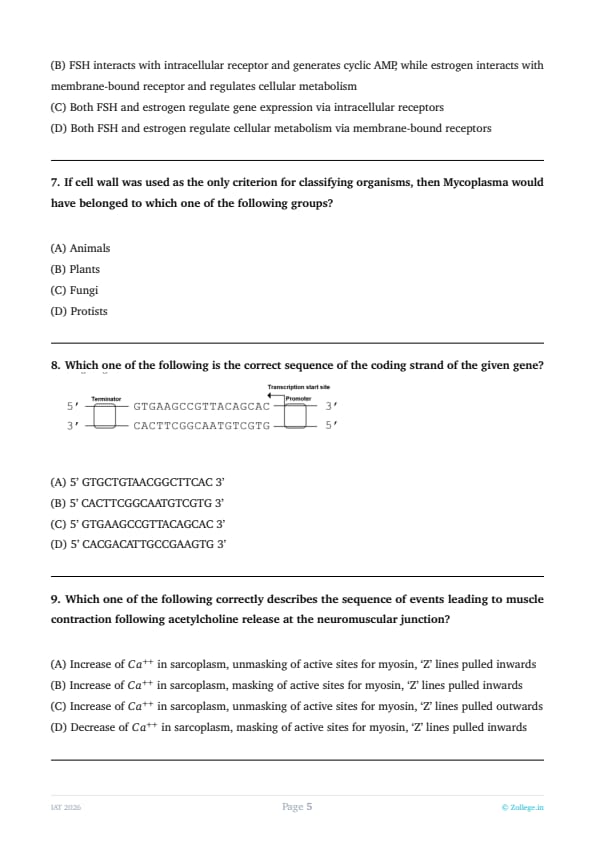
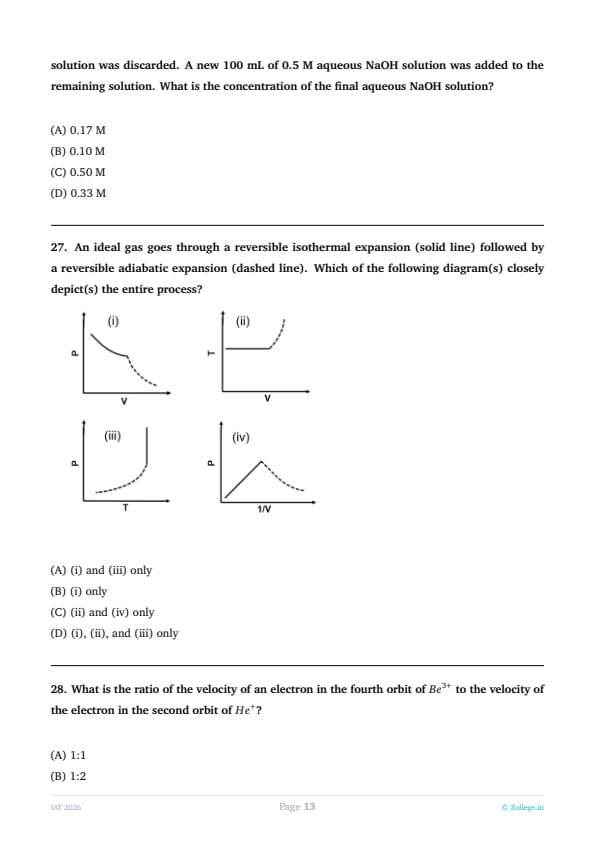
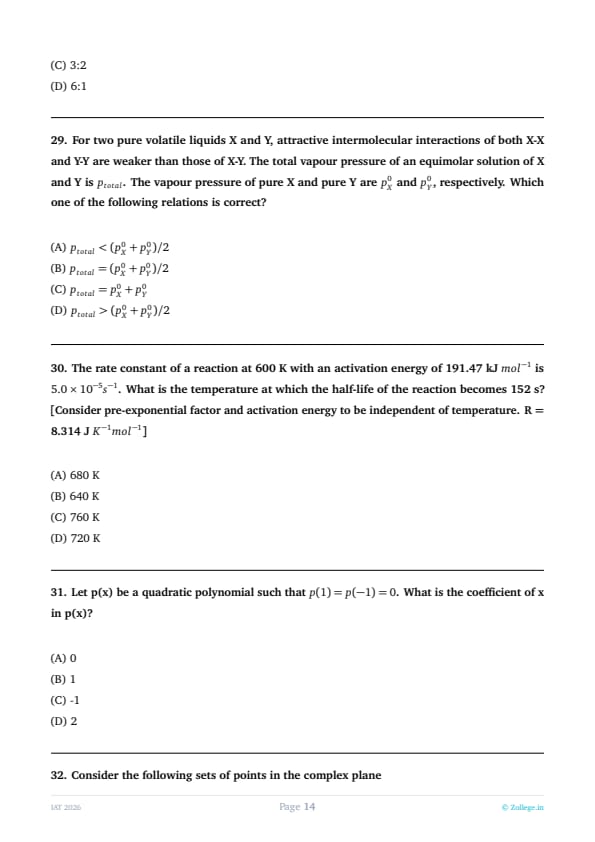
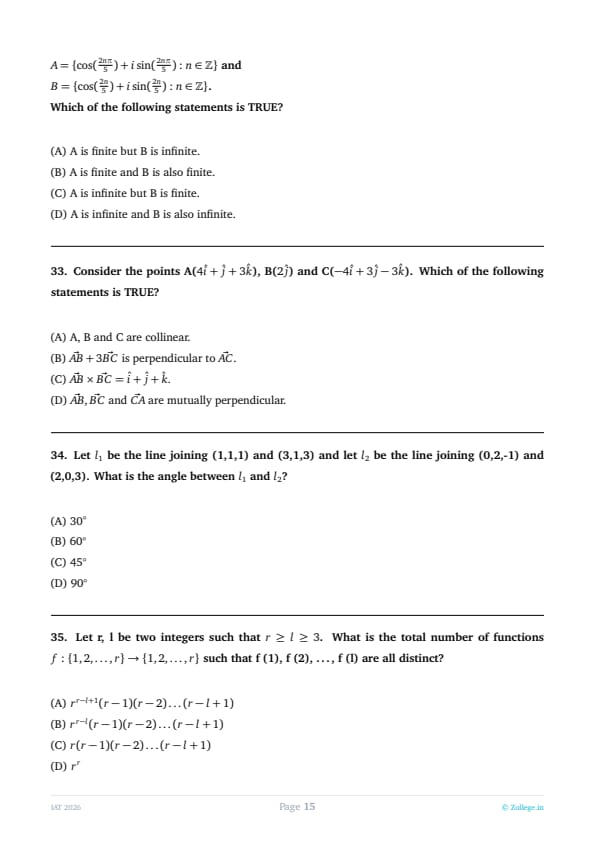
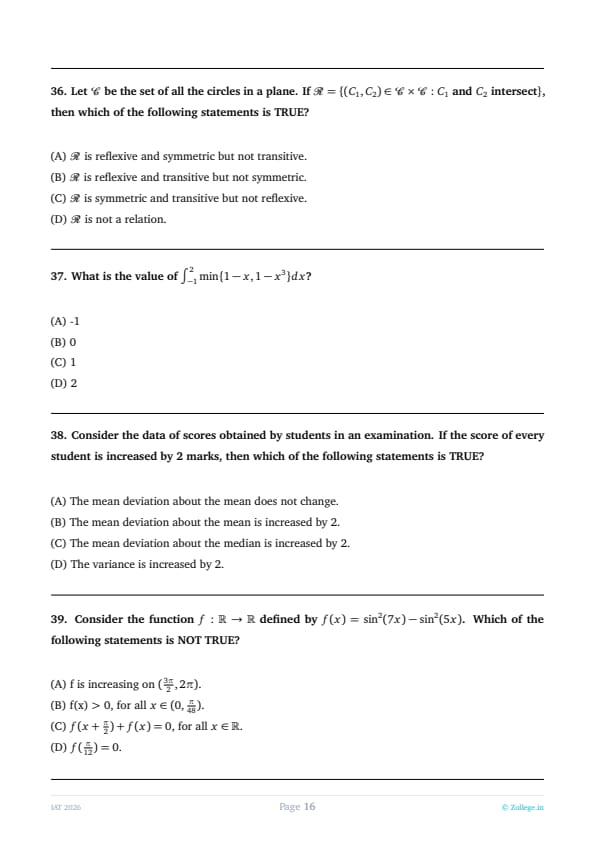
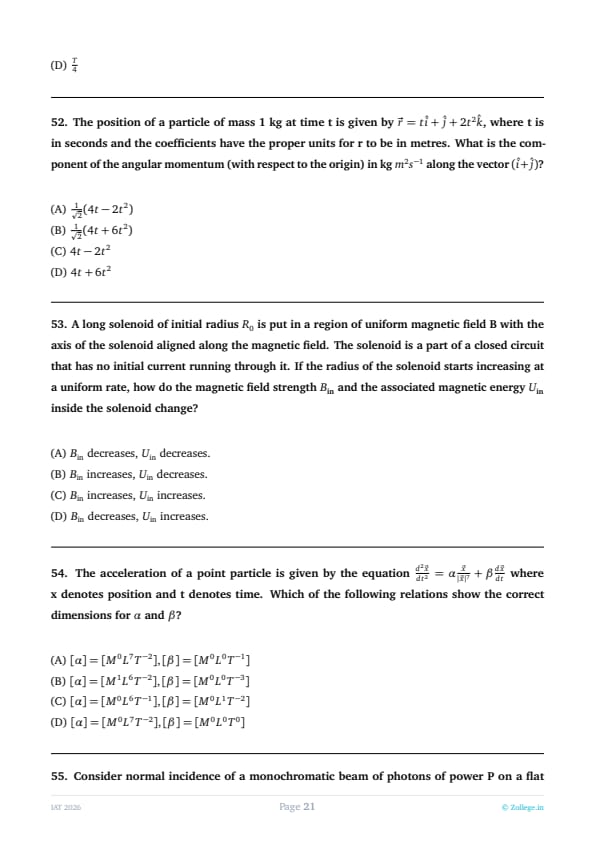
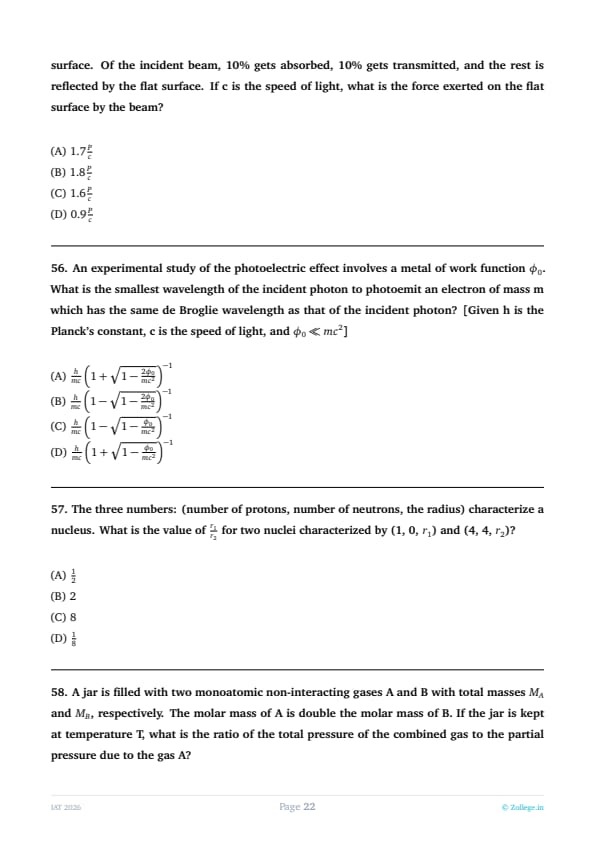
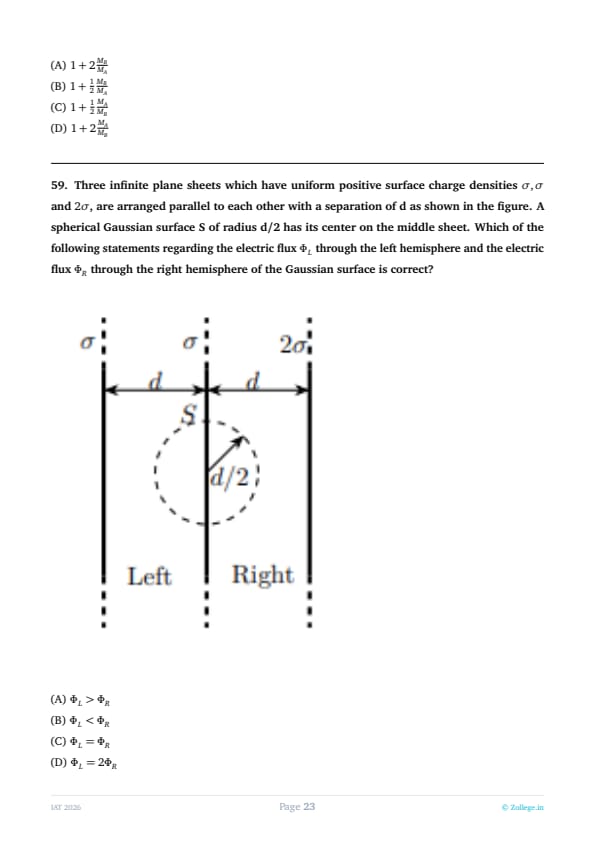
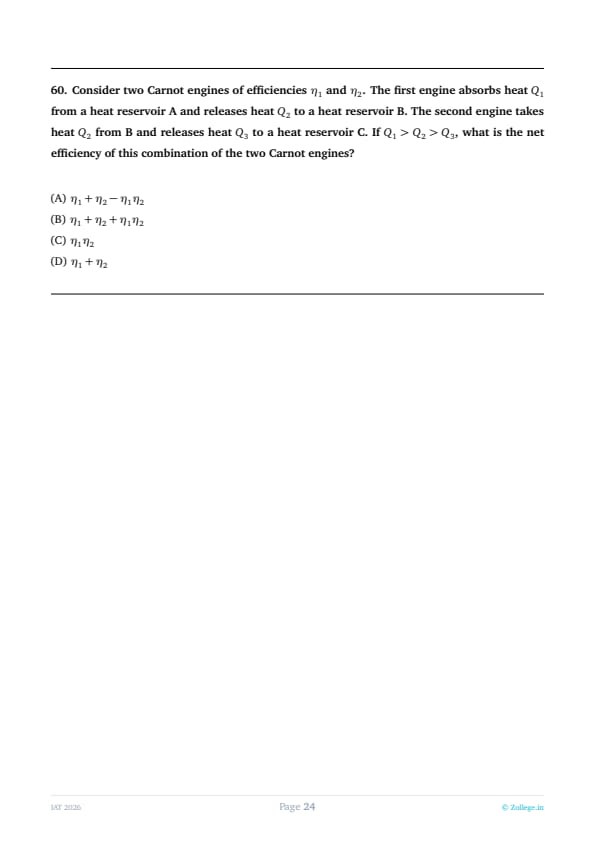
Which of the following processes result in development of a proton gradient across the thylakoid membrane during photosynthesis?
i. Release of protons into the lumen of the thylakoid by plastoquinone
ii. Consumption of protons in the stroma during the reduction of NADP\(^{+}\)
iii. Release of protons into the lumen of the thylakoid by ATP synthase
iv. Release of protons into the lumen of the thylakoid by water splitting reaction
View Solution
Step 1: Understanding the Concept:
The development of a proton gradient (\(\Delta\)pH) across the thylakoid membrane is essential for ATP synthesis via chemiosmosis.
The objective is to create a high concentration of protons (\(H^{+}\)) in the thylakoid lumen (acidic) and a low concentration in the stroma (basic).
Key Formula or Approach:
The gradient is developed through three main actions:
1. Adding protons to the lumen.
2. Removing protons from the stroma.
Step 2: Detailed Explanation:
Let's analyze the statements:
\(\bullet\) Statement i (Correct): Plastoquinone (PQ) is a mobile electron carrier. It picks up \(H^{+}\) from the stroma and, upon transferring electrons to the cytochrome \(b_{6}f\) complex, releases those protons into the lumen.
\(\bullet\) Statement ii (Correct): Protons are consumed in the stroma when NADP\(^{+}\) is reduced to NADPH by NADP reductase. This lowers the stromal \(H^{+}\) concentration.
\(\bullet\) Statement iii (Incorrect): ATP synthase does not release protons into the lumen; instead, it provides a channel for protons to flow out of the lumen into the stroma, which dissipates the gradient.
\(\bullet\) Statement iv (Correct): The photolysis of water (\( 2H_{2}O \rightarrow O_{2} + 4H^{+} + 4e^{-} \)) occurs on the inner side of the thylakoid membrane, releasing protons directly into the lumen.
Step 3: Final Answer:
The correct processes are i, ii, and iv.
This matches option (A).
Quick Tip: To remember the gradient: Protons go {IN} the lumen (water splitting and PQ pumping) and are {TAKEN OUT} of the stroma (NADP\(^{+}\) reduction).
ATP synthase is the "drain" that lets them escape to make ATP.
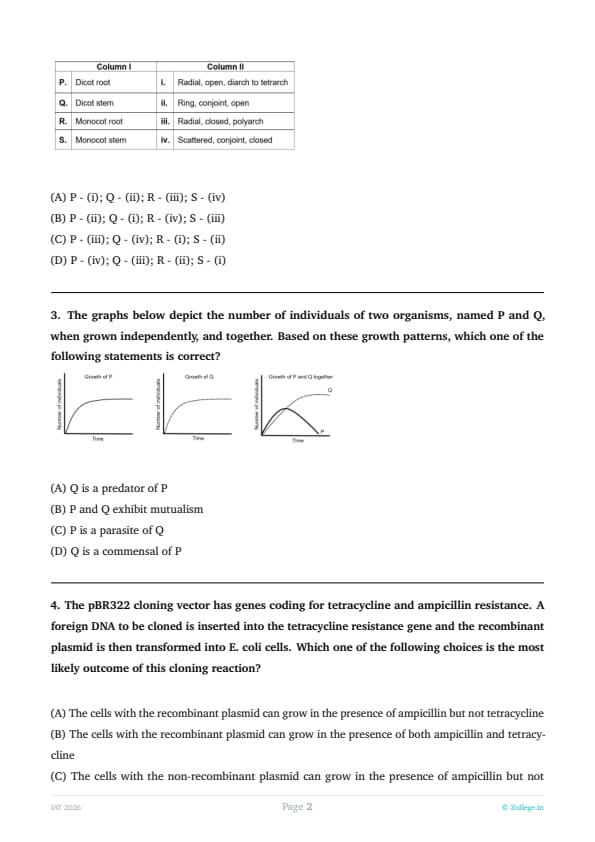
Which one of the following choices matches the organs in column I with their vascular system arrangement described in column II?

View Solution
Step 1: Understanding the Concept:
Plant anatomy differentiates between roots and stems of monocots and dicots based on the arrangement of vascular bundles (xylem and phloem).
Key Formula or Approach:
1. Roots: Always "Radial" (xylem and phloem on different radii).
2. Stems: Always "Conjoint" (xylem and phloem on the same radius).
3. Dicot: "Open" (contains cambium for secondary growth).
4. Monocot: "Closed" (no cambium).
Step 2: Detailed Explanation:
\(\bullet\) P. Dicot root: Radial arrangement; typically diarch to tetrarch (2-4 xylem bundles). It is technically "open" in a developmental sense as secondary growth occurs later. \(\rightarrow\) (i)
\(\bullet\) Q. Dicot stem: Vascular bundles are arranged in a ring; they are conjoint, collateral, and open. \(\rightarrow\) (ii)
\(\bullet\) R. Monocot root: Radial arrangement; polyarch (more than 6 xylem bundles); no cambium (closed). \(\rightarrow\) (iii)
\(\bullet\) S. Monocot stem: Vascular bundles are scattered throughout the ground tissue; they are conjoint and closed. \(\rightarrow\) (iv)
Step 3: Final Answer:
The matching is P-(i), Q-(ii), R-(iii), S-(iv).
This corresponds to option (A).
Quick Tip: Use the "RR" rule: {R}oot = {R}adial.
Use the "SC" rule: {S}tem = {C}onjoint.
Monocot roots have {Polyarch} (many) bundles, while dicot roots have few.
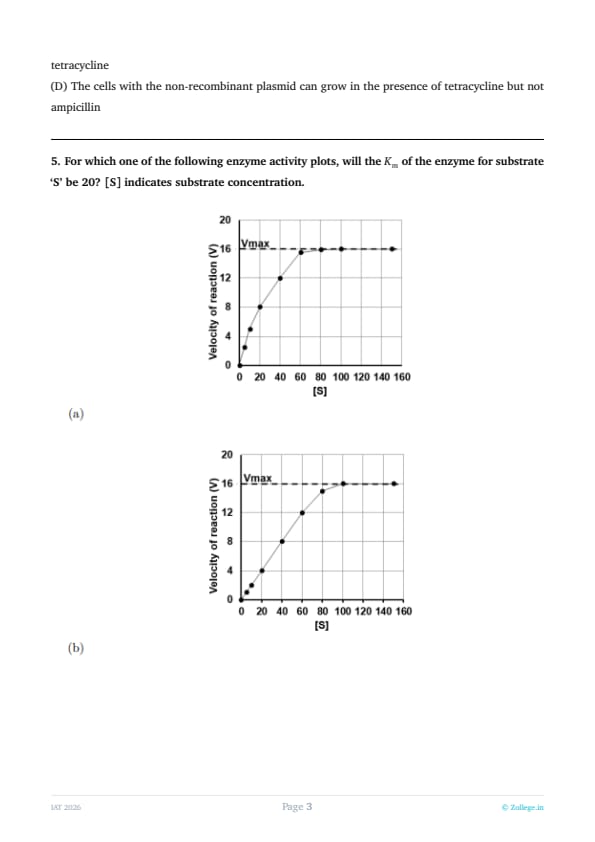
The graphs below depict the number of individuals of two organisms, named P and Q, when grown independently, and together. Based on these growth patterns, which one of the following statements is correct?

View Solution
Step 1: Understanding the Concept:
Population growth curves help determine the nature of ecological interactions (predation, competition, symbiosis).
Step 2: Detailed Explanation:
\(\bullet\) Independent Growth: Both P and Q show typical sigmoidal (logistic) growth curves when alone, meaning they can survive independently.
\(\bullet\) Mixed Growth: When grown together, Q's population grows successfully to its carrying capacity, whereas P's population initially rises slightly and then crashes rapidly to zero (extinction).
\(\bullet\) Reasoning: The complete elimination of P in the presence of Q indicates that Q is either an extremely efficient competitor or a predator that consumes all of P. In predation, the predator (Q) thrives while the prey (P) is eliminated in a closed system.
\(\bullet\) Mutualism (+/+) is ruled out because P dies. Commensalism (+/0) is ruled out because P is negatively affected. Parasitism (+/-) usually doesn't involve the immediate extinction of the host if the parasite is to survive.
Step 3: Final Answer:
The crash of P's population while Q thrives suggests that Q is a predator of P.
This corresponds to option (A).
Quick Tip: In ecological graphs, if one species goes to zero while the other thrives when together, think {Predation} or {Competitive Exclusion}. Since competition isn't an option, Predation is the best fit.
The pBR322 cloning vector has genes coding for tetracycline and ampicillin resistance. A foreign DNA to be cloned is inserted into the tetracycline resistance gene and the recombinant plasmid is then transformed into E. coli cells. Which one of the following choices is the most likely outcome of this cloning reaction?
View Solution
Step 1: Understanding the Concept:
This question deals with insertional inactivation. When a foreign DNA fragment is inserted into the coding sequence of a selectable marker gene (like an antibiotic resistance gene), that gene is disrupted and becomes non-functional.
Step 2: Detailed Explanation:
\(\bullet\) The pBR322 plasmid contains two resistance genes: \(amp^{R}\) (ampicillin) and \(tet^{R}\) (tetracycline).
\(\bullet\) In this experiment, foreign DNA is inserted into the \(tet^{R}\) gene.
\(\bullet\) As a result, the \(tet^{R}\) gene is inactivated. The transformed cell loses its resistance to tetracycline.
\(\bullet\) However, the \(amp^{R}\) gene remains intact because no DNA was inserted there. Therefore, the cell remains resistant to ampicillin.
\(\bullet\) Non-recombinant plasmids (those that didn't take the insert) would retain both resistances.
Step 3: Final Answer:
Recombinant cells will be ampicillin-resistant (\(Amp^{R}\)) but tetracycline-sensitive (\(Tet^{S}\)).
This corresponds to option (A).
Quick Tip: Insertional Inactivation Rule: You lose the resistance of the gene you "break" by inserting DNA.
Insert in \(Tet \rightarrow\) lose \(Tet\) resistance.
Insert in \(Amp \rightarrow\) lose \(Amp\) resistance.
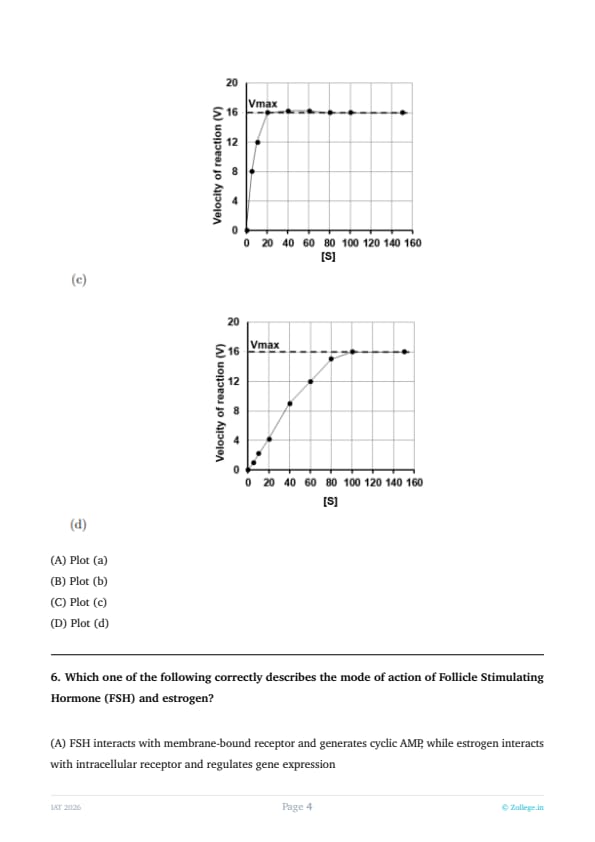
For which one of the following enzyme activity plots, will the \(K_{m}\) of the enzyme for substrate ‘S’ be 20? [S] indicates substrate concentration.


View Solution
Step 1: Understanding the Concept:
The Michaelis constant (\(K_{m}\)) is the substrate concentration \([S]\) at which the reaction velocity (\(V\)) is exactly half of the maximum velocity (\(V_{max}\)).
Key Formula or Approach:
Identify \(V_{max}\) from the plateau of the curves and then find the corresponding \([S]\) for \(V = V_{max}/2\).
Step 2: Detailed Explanation:
\(\bullet\) In all four provided plots, the horizontal dashed line representing \(V_{max}\) is at \(V = 16\).
\(\bullet\) Therefore, \(V_{max}/2 = 16 / 2 = 8\).
\(\bullet\) We need to find the plot where the curve crosses \(V = 8\) at the point where the x-axis value \([S] = 20\).
\(\bullet\) Plot (a): At \([S] = 20\), the velocity \(V\) is exactly 8. This satisfies \(K_{m} = 20\).
\(\bullet\) Plot (b): At \([S] = 20\), \(V\) is around 4. The velocity 8 is reached at \([S] = 40\). Thus \(K_{m} = 40\).
\(\bullet\) Plot (c): At \([S] = 20\), the velocity is already near 16. \(V = 8\) is reached at a much lower concentration (approx \([S] = 5\)).
\(\bullet\) Plot (d): The curve is sigmoidal and doesn't reach \(V = 8\) until well past \([S] = 20\).
Step 3: Final Answer:
Only Plot (a) shows \(V_{max}/2\) at \([S] = 20\).
This corresponds to option (A).
Quick Tip: To find \(K_{m}\) graphically:
1. Find the top value (\(V_{max}\)).
2. Divide it by 2.
3. Go "right" to the curve and "down" to the x-axis. That value is \(K_{m}\).
Which one of the following correctly describes the mode of action of Follicle Stimulating Hormone (FSH) and estrogen?
View Solution
Step 1: Understanding the Concept:
Hormones are classified by their chemical nature, which determines their mechanism of action (signal transduction).
Step 2: Detailed Explanation:
\(\bullet\) FSH (Follicle Stimulating Hormone): This is a protein/peptide hormone. Protein hormones are large and hydrophilic; they cannot cross the lipid bilayer of the cell membrane. They bind to extracellular receptors (membrane-bound) and trigger second messengers like cyclic AMP (cAMP) to relay the signal.
\(\bullet\) Estrogen: This is a steroid hormone derived from cholesterol. Steroid hormones are lipophilic and can easily diffuse through the plasma membrane. They bind to intracellular receptors (cytoplasmic or nuclear). The hormone-receptor complex then binds to DNA to directly regulate gene expression.
Step 3: Final Answer:
FSH uses membrane receptors/cAMP, and estrogen uses intracellular receptors/gene regulation.
This matches option (A).
Quick Tip: Peptide/Protein Hormones (FSH, Insulin) = Surface Receptors + Second Messengers (cAMP).
Steroid Hormones (Estrogen, Testosterone) = Inside Receptors + Direct DNA binding.
If cell wall was used as the only criterion for classifying organisms, then Mycoplasma would have belonged to which one of the following groups?
View Solution
Step 1: Understanding the Concept:
Classification criteria determine which groups organisms are placed in. If "presence or absence of cell wall" is the only rule, we must look at which group lacks this structure.
Step 2: Detailed Explanation:
\(\bullet\) Mycoplasma: These are the smallest known living cells and are prokaryotes. Their most unique feature is the complete absence of a cell wall.
\(\bullet\) Plants: Universally possess a cellulosic cell wall.
\(\bullet\) Fungi: Universally possess a chitinous cell wall.
\(\bullet\) Protists: A diverse group; some have cell walls (algae, slime molds), and some do not (amoeba). However, they are not defined by the absence of a wall.
\(\bullet\) Animals: Every organism in Kingdom Animalia is characterized by the total lack of a cell wall.
\(\bullet\) Therefore, under this specific criterion, an organism without a cell wall like Mycoplasma would be grouped with Animals.
Step 3: Final Answer:
Mycoplasma would be grouped with Animals due to the lack of a cell wall.
This corresponds to option (A).
Quick Tip: Mycoplasma = "Joker of the Plant Kingdom" (historically) but biologically animal-like in their lack of a cell wall!
No wall = Animal-like in this context.
Which one of the following is the correct sequence of the coding strand of the given gene?

View Solution
Step 1: Understanding the Concept:
In a gene, the template strand is read by RNA polymerase in the 3’ \(\rightarrow\) 5’ direction. The coding strand (non-template) runs in the 5’ \(\rightarrow\) 3’ direction and has the same sequence as the resulting mRNA (with T instead of U).
Step 2: Detailed Explanation:
\(\bullet\) Look at the diagram: The promoter is on the right, and the terminator is on the left. The "Transcription start site" arrow points to the left.
\(\bullet\) This means transcription proceeds from right to left.
\(\bullet\) The template strand must be the one that runs 3’ \(\rightarrow\) 5’ from right to left.
\(\bullet\) Top strand: 5’ (Left) \(\dots\) 3’ (Right). So, from right to left, it is 3’ \(\rightarrow\) 5’. This is the template strand.
\(\bullet\) Bottom strand: 3’ (Left) \(\dots\) 5’ (Right). From right to left, it is 5’ \(\rightarrow\) 3’. This is the coding strand.
\(\bullet\) To write the sequence of the coding strand in the standard 5’ \(\rightarrow\) 3’ format, we must read the bottom strand from right to left.
\(\bullet\) Bottom strand (Right to Left): G-T-G-C-T-G-T-A-A-C-G-G-C-T-T-C-A-C.
Step 3: Final Answer:
The coding strand sequence is 5’ GTGCTGTAACGGCTTCAC 3’.
This corresponds to option (A).
Quick Tip: Always identify the promoter/arrow first. Transcription goes {away} from the promoter.
Coding strand is the one that runs 5' \(\rightarrow\) 3' in the direction of the arrow.
Read that specific strand in that direction to get your answer!
Which one of the following correctly describes the sequence of events leading to muscle contraction following acetylcholine release at the neuromuscular junction?
View Solution
Step 1: Understanding the Concept:
Muscle contraction follows the sliding filament theory, initiated by an action potential at the neuromuscular junction.
Step 2: Detailed Explanation:
The sequence of events is as follows:
1. Acetylcholine release triggers an action potential on the sarcolemma.
2. The signal spreads through T-tubules, causing the sarcoplasmic reticulum to release Calcium ions (\(Ca^{++}\)) into the sarcoplasm.
3. \(Ca^{++}\) binds to Troponin C on the actin filaments.
4. This binding causes a conformational change that moves Tropomyosin, thus unmasking the active binding sites for myosin on the actin strand.
5. Myosin heads bind to actin, forming cross-bridges.
6. The power stroke occurs, pulling the actin filaments toward the center of the sarcomere. Since actin is attached to Z-lines, the Z-lines are pulled inwards, shortening the sarcomere and causing contraction.
Step 3: Final Answer:
The correct sequence is: Increase of \(Ca^{++} \rightarrow\) unmasking sites \(\rightarrow\) Z-lines pulled inwards.
This matches option (A).
Quick Tip: Contraction = \(Ca^{++}\) UP + Active sites OPEN + Sarcomere SHORTENS (Z-lines move {IN}).
Relarxation = \(Ca^{++}\) DOWN + Active sites CLOSED + Z-lines move {OUT}.
In which one of the following cases, will an anti-Rh antibody treatment prevent erythroblastosis foetalis?
View Solution
Step 1: Understanding the Concept:
Erythroblastosis foetalis (Hemolytic Disease of the Newborn) occurs due to Rh-incompatibility between an Rh-negative mother and an Rh-positive fetus.
Step 2: Detailed Explanation:
\(\bullet\) During the birth of the first Rh-positive child, there is a risk of fetal Rh-positive blood entering the mother's Rh-negative circulation.
\(\bullet\) The mother's immune system recognizes the Rh antigen as foreign and produces anti-Rh antibodies (sensitization).
\(\bullet\) In subsequent pregnancies with an Rh-positive fetus, these antibodies can cross the placenta and destroy fetal red blood cells.
\(\bullet\) Prevention: To prevent sensitization, exogenous anti-Rh antibodies (RhoGAM) are given to the Rh-negative mother immediately after the delivery of the first Rh-positive child. These antibodies destroy any fetal cells in her bloodstream before her own immune system can respond.
Step 3: Final Answer:
Treatment is given to the Rh-negative mother after the birth of an Rh-positive child.
This matches option (A).
Quick Tip: Rh Disease = Rh- Negative Mother + Rh- Positive Baby.
Only the mother needs the "shield" (antibody) to stop her body from learning how to attack the next baby.
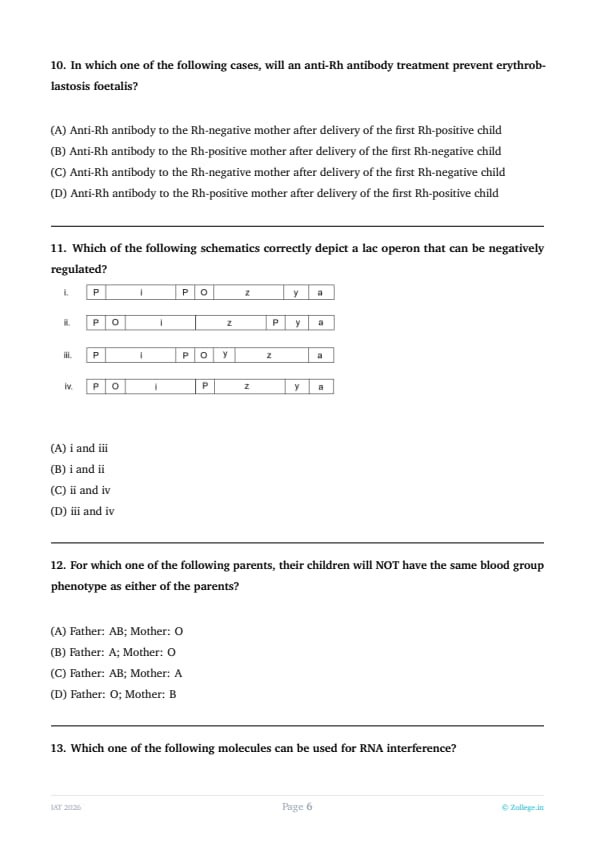
Which of the following schematics correctly depict a lac operon that can be negatively regulated?

View Solution
Step 1: Understanding the Concept:
Negative regulation of the \(lac\) operon occurs when the repressor protein (produced by the \(i\) gene) binds to the Operator (O) and physically blocks RNA polymerase from transcribing the structural genes from the Promoter (P).
Key Formula or Approach:
For successful regulation, the Operator must be positioned downstream of the Promoter and upstream of the structural genes (\(z, y, a\)).
Step 2: Detailed Explanation:
\(\bullet\) Schematic i: \(P - i - P - O - z - y - a\). This is the standard functional arrangement. The repressor binds to \(O\) and stops transcription of \(z, y, a\). \(\rightarrow\) Possible.
\(\bullet\) Schematic ii: Elements are scrambled (\(P - O - i - z \dots\)). This arrangement disrupts the coordinated control. \(\rightarrow\) Impossible.
\(\bullet\) Schematic iii: \(P - i - P - O - y - z - a\). Here, the order of structural genes is swapped (\(y\) and \(z\) are switched), but the regulatory elements (\(P\) and \(O\)) are correctly placed before the genes. RNA polymerase can still be blocked. \(\rightarrow\) Possible.
\(\bullet\) Schematic iv: \(P - O - i - P - z \dots\). There is no operator between the second promoter and the genes. The repressor cannot block transcription from that promoter. \(\rightarrow\) Impossible.
Step 3: Final Answer:
Only i and iii can be negatively regulated.
This matches option (A).
Quick Tip: For the \(lac\) operon to work, the "Stop Sign" (Operator) must be right after the "Green Light" (Promoter) but {before} the "Store" (Genes). Swapping the genes (\(z, y\)) doesn't stop the regulation!
For which one of the following parents, their children will NOT have the same blood group phenotype as either of the parents?
View Solution
Step 1: Understanding the Concept:
Blood group inheritance follows the multiple alleles system (\(I^{A}, I^{B}, i\)).
Step 2: Detailed Explanation:
Let's analyze the crosses:
\(\bullet\) Option (A): Father AB (\(I^{A}I^{B}\)) \(\times\) Mother O (\(ii\)):
Possible gametes: Father (\(I^{A}\) or \(I^{B}\)), Mother (\(i\)).
Offspring: \(I^{A}i\) (Group A) or \(I^{B}i\) (Group B).
Result: Children are A or B. Parents are AB and O. None match the parents.
\(\bullet\) Option (B): Father A \(\times\) Mother O: Children could be A or O (if father is heterozygous). O matches mother.
\(\bullet\) Option (C): Father AB \(\times\) Mother A: Children could be A or AB. Both match parents.
\(\bullet\) Option (D): Father O \(\times\) Mother B: Children could be B or O. Both match parents.
Step 3: Final Answer:
In cross (A), 100% of children will have a different phenotype than both parents.
This matches option (A).
Quick Tip: Classic Genetic Puzzle: A Group AB parent and a Group O parent {never} have AB or O children. Their kids are always A or B!
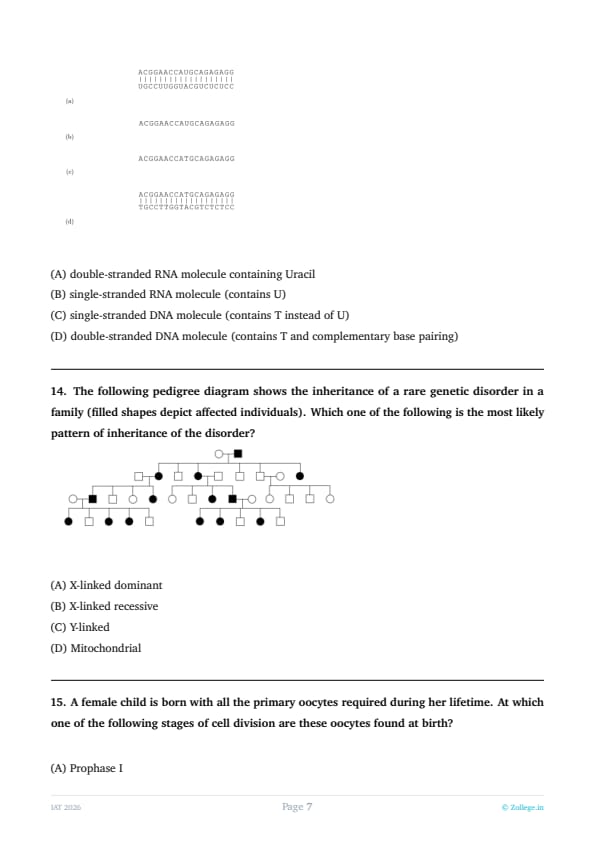
Which one of the following molecules can be used for RNA interference?

View Solution
Step 1: Understanding the Concept:
RNA interference (RNAi) is a gene-silencing mechanism triggered by double-stranded RNA (dsRNA) molecules.
Step 2: Detailed Explanation:
\(\bullet\) The process begins when long dsRNA is recognized and cleaved by the enzyme Dicer into small interfering RNAs (siRNAs).
\(\bullet\) Molecular check: RNA contains the nitrogenous base Uracil (U) instead of Thymine (T).
\(\bullet\) Analysis of structure (A): It shows two complementary strands held together by base-pairing bars (\(|\)), and the presence of 'U' confirms it is RNA.
\(\bullet\) DNA (C and D) cannot trigger RNAi directly. Single-stranded RNA (B) does not initiate the standard RNAi pathway.
Step 3: Final Answer:
The required molecule is double-stranded RNA.
This matches option (A).
Quick Tip: RNAi = {dsRNA} (Double-Stranded RNA).
Look for "U" for RNA and "T" for DNA. Only dsRNA starts the silencing!
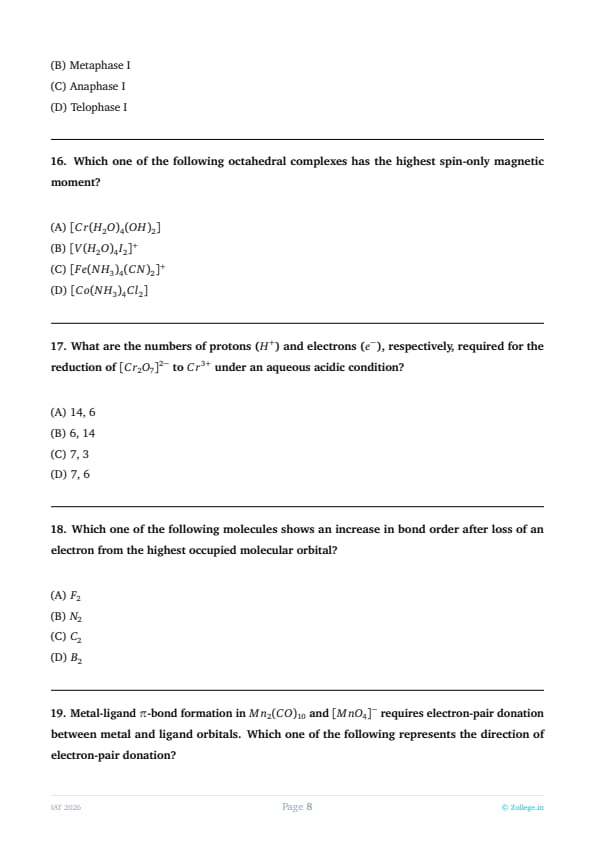
The following pedigree diagram shows the inheritance of a rare genetic disorder in a family (filled shapes depict affected individuals). Which one of the following is the most likely pattern of inheritance of the disorder?

View Solution
Step 1: Understanding the Concept:
Pedigree analysis involves checking patterns: skipping generations (recessive), male-only (Y-linked), or maternal-only (Mitochondrial).
Step 2: Detailed Explanation:
\(\bullet\) Generations: The disorder appears in every single generation (does not skip). This suggests a Dominant trait.
\(\bullet\) Mitochondrial Elimination: In generation I, the father is affected, and he passes it to his daughters. If it were mitochondrial, only an affected mother would pass it on. \(\rightarrow\) Ruled out.
\(\bullet\) Y-linked Elimination: Affected females are present. \(\rightarrow\) Ruled out.
\(\bullet\) X-linked Dominant Pattern: An affected father (\(X^{D}Y\)) must pass his only X chromosome to all his daughters and none of his sons.
\(\bullet\) Trace Gen I affected male: All 3 daughters in Gen II are affected; son is normal.
\(\bullet\) Trace Gen III affected male: All 2 daughters in Gen IV are affected; son is normal.
\(\bullet\) This perfect pattern of affected fathers giving it to 100% daughters and 0% sons is the hallmark of X-linked dominant inheritance.
Step 3: Final Answer:
The pattern is X-linked dominant.
This matches option (A).
Quick Tip: The "Gold Standard" for X-linked Dominant: Affected Dad \(\rightarrow\) {ALL} daughters affected, {NO} sons affected. If you see this twice in a tree, pick it immediately!
A female child is born with all the primary oocytes required during her lifetime. At which one of the following stages of cell division are these oocytes found at birth?
View Solution
Step 1: Understanding the Concept:
Oogenesis is the process of female gamete formation, which involves specific arrest points in meiosis.
Step 2: Detailed Explanation:
\(\bullet\) During fetal development, oogonia divide by mitosis and differentiate into primary oocytes.
\(\bullet\) These primary oocytes enter Meiosis I before the child is born.
\(\bullet\) However, they do not complete the division. They are arrested during the first stage of meiosis, which is Prophase I (specifically the diplotene stage).
\(\bullet\) They remain in this dormant state (dictyate stage) for years until puberty, when hormonal changes cause a few to complete Meiosis I each month.
Step 3: Final Answer:
At birth, primary oocytes are arrested in Prophase I.
This matches option (A).
Quick Tip: Remember the two "Wait" stages for eggs:
1. Birth: Wait in {Prophase I}.
2. Ovulation: Wait in {Metaphase II} (until sperm arrives).
Which one of the following octahedral complexes has the highest spin-only magnetic moment?
View Solution
Step 1: Understanding the Concept:
The spin-only magnetic moment (\(\mu_{s}\)) depends on the number of unpaired electrons (\(n\)). Higher \(n\) means higher \(\mu_{s}\).
Key Formula or Approach:
\[ \mu_{s} = \sqrt{n(n + 2)} B.M. \]
We must find the oxidation state and configuration for each metal ion.
Step 2: Detailed Explanation:
\(\bullet\) (A) \([Cr(H_{2}O)_{4}(OH)_{2}]\): Cr is \(+2\) (\(d^{4}\)). \(H_{2}O/OH^{-}\) are weak ligands.
Configuration: \(t_{2g}^{3} e_{g}^{1} \implies n = 4\) unpaired.
\(\bullet\) (B) \([V(H_{2}O)_{4}I_{2}]^{+}\): V is \(+3\) (\(d^{2}\)).
Configuration: \(t_{2g}^{2} e_{g}^{0} \implies n = 2\) unpaired.
\(\bullet\) (C) \([Fe(NH_{3})_{4}(CN)_{2}]^{+}\): Fe is \(+3\) (\(d^{5}\)). \(CN^{-}\) is very strong \(\rightarrow\) low spin.
Configuration: \(t_{2g}^{5} e_{g}^{0} \implies n = 1\) unpaired.
\(\bullet\) (D) \([Co(NH_{3})_{4}Cl_{2}]\): Co is \(+2\) (\(d^{7}\)). \(Cl^{-}\) is weak \(\rightarrow\) high spin.
Configuration: \(t_{2g}^{5} e_{g}^{2} \implies n = 3\) unpaired.
Step 3: Final Answer:
Complex (A) has the highest \(n\) value (4).
This matches option (A).
Quick Tip: To get the answer fast, don't calculate \(\sqrt{n(n+2)}\). Just count the unpaired electrons! The more the merrier!
What are the numbers of protons (\(H^{+}\)) and electrons (\(e^{-}\)), respectively, required for the reduction of \([Cr_{2}O_{7}]^{2-}\) to \(Cr^{3+}\) under an aqueous acidic condition?
View Solution
Step 1: Understanding the Concept:
We need to balance the reduction half-reaction of the dichromate ion in acidic media.
Step 2: Detailed Explanation:
1. Balance Atoms: \([Cr_{2}O_{7}]^{2-} \rightarrow 2Cr^{3+}\)
2. Balance Oxygen with Water: \([Cr_{2}O_{7}]^{2-} \rightarrow 2Cr^{3+} + 7H_{2}O\)
3. Balance Hydrogen with Protons: \([Cr_{2}O_{7}]^{2-} + 14H^{+} \rightarrow 2Cr^{3+} + 7H_{2}O\)
4. Balance Charge with Electrons:
LHS: \((-2) + (+14) = +12\)
RHS: \(2 \times (+3) = +6\)
To go from \(+12\) to \(+6\), we must add \(6e^{-}\) to the LHS.
\([Cr_{2}O_{7}]^{2-} + 14H^{+} + 6e^{-} \rightarrow 2Cr^{3+} + 7H_{2}O\).
Step 3: Final Answer:
Protons = 14, Electrons = 6.
This matches option (A).
Quick Tip: Dichromate involves \(Cr^{6+}\) going to \(Cr^{3+}\). That is a change of 3 per atom. Since there are 2 Cr atoms, the electrons must be \(2 \times 3 = 6\).
Which one of the following molecules shows an increase in bond order after loss of an electron from the highest occupied molecular orbital?
View Solution
Step 1: Understanding the Concept:
According to Molecular Orbital (MO) Theory:
- Loss of a bonding electron decreases bond order.
- Loss of an anti-bonding electron increases bond order.
Step 2: Detailed Explanation:
\(\bullet\) (A) \(F_{2}\) (18e): Configuration \(\sigma_{1s}^{2} \sigma_{1s}^{*2} \dots \pi_{2p}^{4} \pi_{2p}^{*4}\). The HOMO is \(\pi_{2p}^{*}\), which is an anti-bonding orbital. Removing an electron (\(F_{2} \rightarrow F_{2}^{+}\)) increases bond order from 1 to 1.5.
\(\bullet\) (B) \(N_{2}\) (14e): HOMO is \(\sigma_{2p_{z}}\) (bonding). Loss \(\rightarrow\) BO decreases (\(3 \rightarrow 2.5\)).
\(\bullet\) (C) \(C_{2}\) (12e): HOMO is \(\pi_{2p}\) (bonding). Loss \(\rightarrow\) BO decreases (\(2 \rightarrow 1.5\)).
\(\bullet\) (D) \(B_{2}\) (10e): HOMO is \(\pi_{2p}\) (bonding). Loss \(\rightarrow\) BO decreases (\(1 \rightarrow 0.5\)).
Step 3: Final Answer:
Only \(F_{2}\) has its HOMO as an anti-bonding orbital.
This corresponds to option (A).
Quick Tip: Molecules with more than 14 electrons (like \(O_{2}\) and \(F_{2}\)) have anti-bonding electrons at the top. Removing them makes the bond {stronger}!
Metal-ligand \(\pi\)-bond formation in \(Mn_{2}(CO)_{10}\) and \([MnO_{4}]^{-}\) requires electron-pair donation between metal and ligand orbitals. Which one of the following represents the direction of electron-pair donation?
View Solution
Step 1: Understanding the Concept:
We need to distinguish between \(\pi\)-back-bonding (metal to ligand) and \(\pi\)-donation from ligands (ligand to metal).
Step 2: Detailed Explanation:
\(\bullet\) \(Mn_{2}(CO)_{10}\) (Metal Carbonyl): Carbon monoxide is a \(\pi\)-acid ligand. It accepts electron density from the metal's filled d-orbitals into its empty \(\pi^{*}\) orbitals. This is called back-donation. Direction: Metal \(\rightarrow\) Ligand.
\(\bullet\) \([MnO_{4}]^{-}\) (Permanganate): In this oxo-complex, Manganese is in its highest oxidation state (\(+7\), \(d^{0}\)). It has no electrons to give. Instead, the oxo ligands (\(O^{2-}\)) act as \(\pi\)-donors, donating electron density from their filled p-orbitals into the empty d-orbitals of the metal. Direction: Ligand \(\rightarrow\) Metal.
Step 3: Final Answer:
Direction for Carbonyl is M\(\rightarrow\)L; direction for Permanganate is L\(\rightarrow\)M.
This matches option (A).
Quick Tip: Low-valent metals with CO \(\rightarrow\) Back-bonding (M\(\rightarrow\)L).
High-valent metals (\(d^{0}\)) with Oxygen \(\rightarrow\) \(\pi\)-donation (L\(\rightarrow\)M).
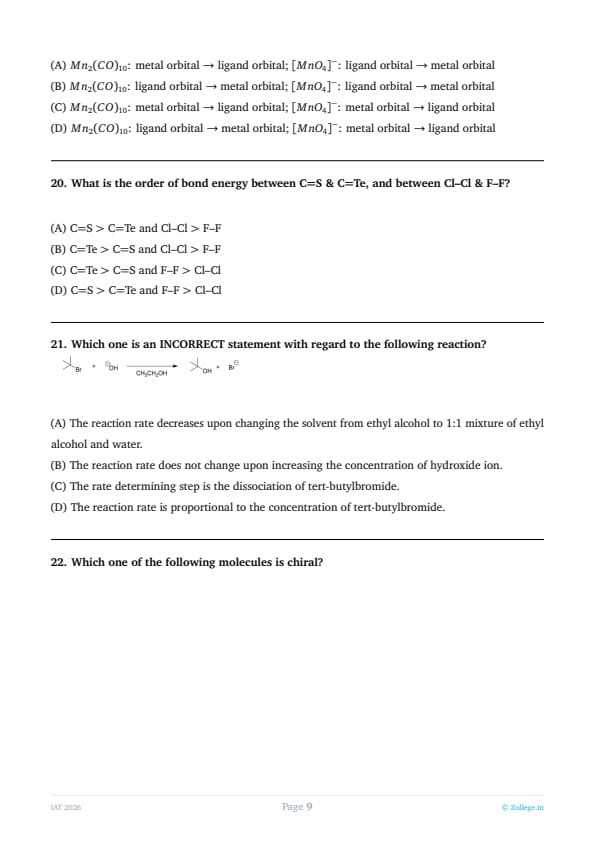
What is the order of bond energy between C=S & C=Te, and between Cl–Cl & F–F?
View Solution
Step 1: Understanding the Concept:
Bond energy depends on the effectiveness of orbital overlap and the presence of destabilizing factors like lone-pair repulsions.
Step 2: Detailed Explanation:
\(\bullet\) C=S vs C=Te: Carbon is in period 2. Sulfur is period 3, while Tellurium is period 5. The overlap between \(2p\) (Carbon) and \(3p\) (Sulfur) is much more effective than between \(2p\) and the large, diffuse \(5p\) (Tellurium). Smaller atoms and better size matching lead to stronger bonds. Thus, C=S \(>\) C=Te.
\(\bullet\) Cl–Cl vs F–F: This is a famous exception. Usually, bond energy increases as atoms get smaller. However, Fluorine is so small that the lone-pair-lone-pair repulsions on the two F atoms are extremely intense, weakening the bond significantly. Chlorine, being larger, minimizes these repulsions. Thus, Cl–Cl \(>\) F–F.
Step 3: Final Answer:
The orders are C=S \(>\) C=Te and Cl–Cl \(>\) F–F.
This corresponds to option (A).
Quick Tip: The "Small Atom Trap": Tiny atoms like F or N often have weaker single bonds than expected because their electrons are crammed too close together and repel!
Which one is an INCORRECT statement with regard to the following reaction?

View Solution
Step 1: Understanding the Concept:
The reaction involves tert-butyl bromide (a tertiary alkyl halide) and a hydroxide ion in a polar protic solvent.
Tertiary alkyl halides undergo nucleophilic substitution via the \(S_{N}1\) mechanism (unimolecular) because they form highly stable tertiary carbocations.
Key Formula or Approach:
For an \(S_{N}1\) reaction:
1. Rate Law: \( Rate = k[Substrate] \).
2. Rate depends on the stability of the carbocation intermediate.
3. Polar protic solvents stabilize the transition state and the ionic intermediates through solvation.
Step 2: Detailed Explanation:
\(\bullet\) Statement (B): In \(S_{N}1\), the nucleophile (OH\(^{-}\)) is not involved in the rate-determining step. Increasing its concentration has no effect. This is a correct statement.
\(\bullet\) Statement (C): The first step is the slow ionization of the C-Br bond to form the carbocation. This is the rate-determining step (RDS). This is a correct statement.
\(\bullet\) Statement (D): Since it is a first-order reaction, the rate is directly proportional to the substrate concentration. This is a correct statement.
\(\bullet\) Statement (A): Water is significantly more polar than ethanol (dielectric constant \(\approx 80\) vs \(24.5\)). Adding water to the solvent increases the overall polarity, which enhances the stabilization of the carbocation and increases the reaction rate. Statement (A) says the rate decreases, making it incorrect.
Step 3: Final Answer:
The incorrect statement is (A).
Quick Tip: For \(S_{N}1\) reactions, {Polarity is Power}.
More polar solvent = Better stabilization of ions = Faster reaction.
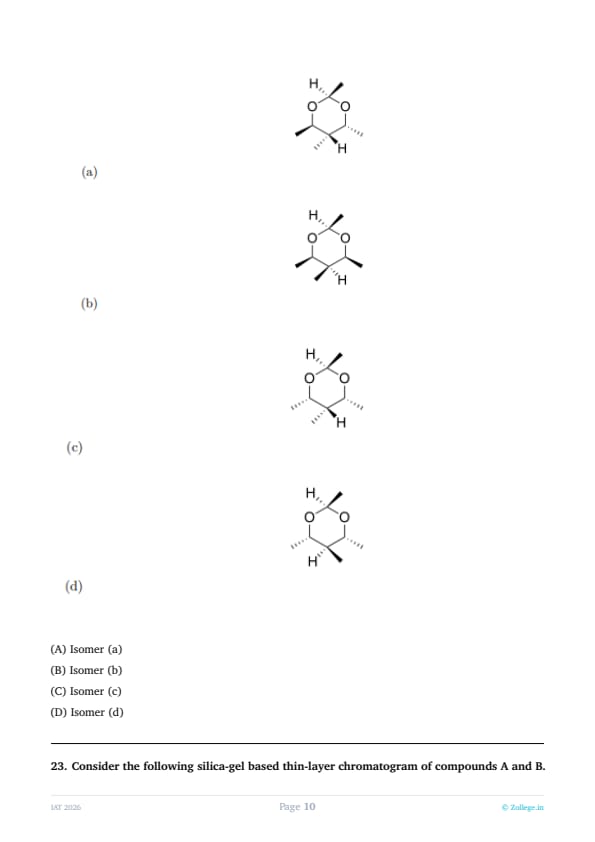
Which one of the following molecules is chiral?


View Solution
Step 1: Understanding the Concept:
A molecule is chiral if it lacks any element of symmetry (specifically a plane of symmetry \(\sigma\) or a center of inversion \(i\)) and is non-superimposable on its mirror image.
Step 2: Detailed Explanation:
We analyze the symmetry of the substituted 1,3-dioxane isomers by looking for a vertical plane of symmetry bisecting the ring.
\(\bullet\) Isomer (b): Both methyl groups are on "wedges" (pointing up). A vertical plane bisecting the molecule reflects one wedge onto the other. It has a plane of symmetry and is achiral (meso).
\(\bullet\) Isomer (c): Both methyl groups are on "dashes" (pointing down). Similar to (b), it has a vertical plane of symmetry and is achiral.
\(\bullet\) Isomer (d): Both methyl groups are on dashes. This structure also possesses a plane of symmetry and is achiral.
\(\bullet\) Isomer (a): One methyl group is on a wedge and the other is on a dash. When you try to bisect the molecule, the wedge does not reflect into a dash. There is no plane of symmetry, making this molecule chiral.
Step 3: Final Answer:
Isomer (a) is the only chiral molecule.
This corresponds to option (A).
Quick Tip: In cyclic systems, if substituents at equivalent positions have {opposite} stereochemistry (one wedge, one dash) and there is no other symmetry, the molecule is likely chiral.
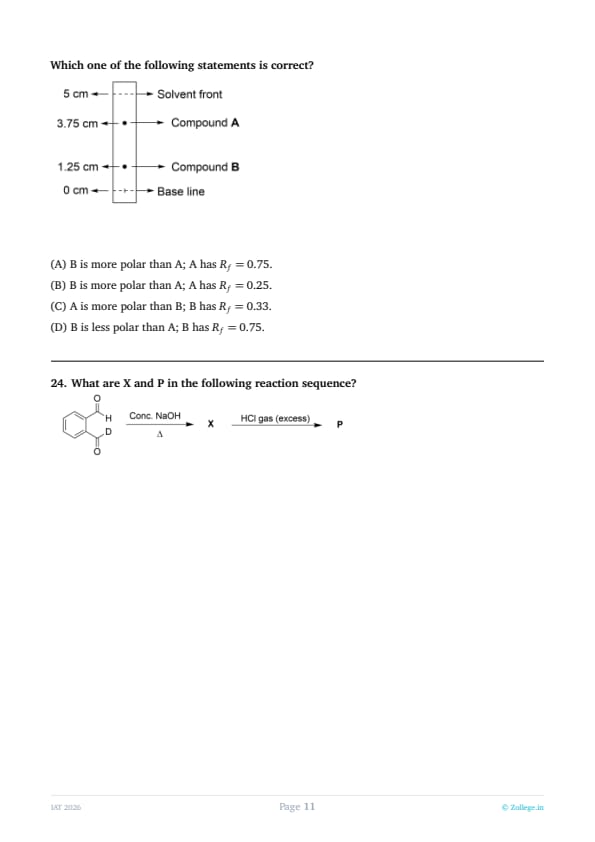
Consider the following silica-gel based thin-layer chromatogram of compounds A and B. Which one of the following statements is correct?

View Solution
Step 1: Understanding the Concept:
Thin-layer chromatography (TLC) on silica gel (a polar stationary phase) separates components based on polarity.
Polar compounds interact strongly with silica and move slower (lower spot), while non-polar compounds move faster (higher spot).
Key Formula or Approach:
The Retardation Factor (\( R_{f} \)) is calculated as:
\[ R_{f} = \frac{Distance traveled by compound}{Distance traveled by solvent front} \]
Step 2: Detailed Explanation:
From the chromatogram scale:
\(\bullet\) Solvent front distance: 5.0 units.
\(\bullet\) Compound A distance: 3.75 units.
\[ R_{f}(A) = \frac{3.75}{5.0} = 0.75 \]
\(\bullet\) Compound B distance: 1.25 units.
\[ R_{f}(B) = \frac{1.25}{5.0} = 0.25 \]
\(\bullet\) Polarity Analysis: Compound B has a much lower \(R_{f}\) value than A. This means B adhered more strongly to the polar silica gel, indicating that B is more polar than A.
Step 3: Final Answer:
B is more polar and \(R_{f}\) of A is 0.75.
This matches option (A).
Quick Tip: TLC Rule: "High spot = Low polarity" and "Low spot = High polarity".
\(R_{f}\) is always (Small Distance / Large Distance) and is always between 0 and 1.
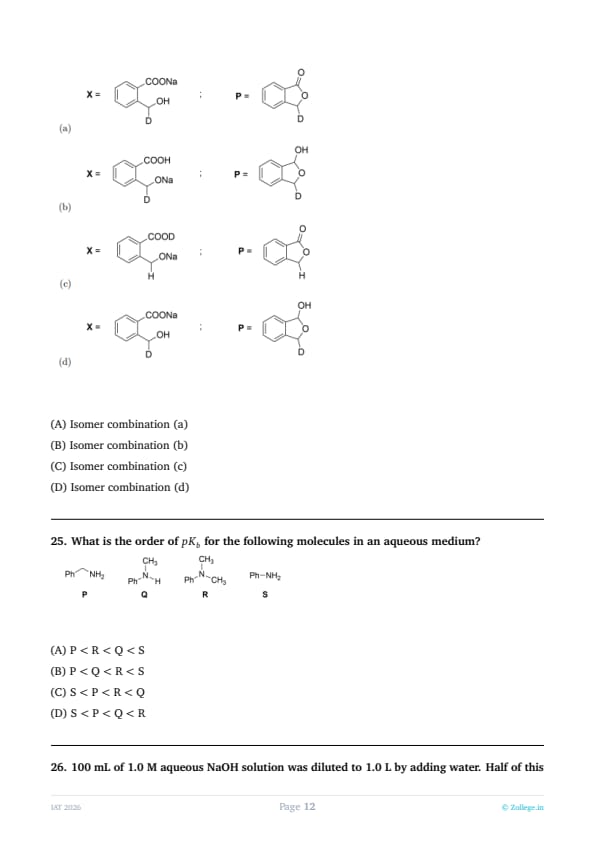
What are X and P in the following reaction sequence?


View Solution
Step 1: Understanding the Concept:
The reaction sequence involves an intramolecular Cannizzaro reaction of a phthalaldehyde derivative followed by an acid-catalyzed lactonization.
Step 2: Detailed Explanation:
\(\bullet\) Step 1 (NaOH, Heat): The starting material has one -CHO and one -CDO group. In a Cannizzaro reaction, a hydride/deuteride is transferred.
\(\bullet\) Because the C-H bond is weaker than the C-D bond, the transfer of hydride (H\(^{-}\)) from the -CHO group is kinetically preferred.
\(\bullet\) Thus, the -CHO is oxidized to -COONa, and the -CDO group is reduced to a deuterated alcohol group: -CH(OH)D. This is intermediate X.
\(\bullet\) Step 2 (HCl gas): The acid protonates the carboxylate. Since the -COOH and the -CH(OH)D alcohol are in ortho positions, they undergo spontaneous dehydration to form a cyclic ester (lactone).
\(\bullet\) The resulting product P is a phthalide containing a CHD group in the ring.
Step 3: Final Answer:
Structure X has -COONa and -CH(OH)D, and structure P is the corresponding lactone.
This matches Option (A).
Quick Tip: Kinetic Isotope Effect: C-H bonds break faster than C-D bonds. In Cannizzaro, the "H" moves while the "D" stays put!
What is the order of \(pK_{b}\) for the following molecules in an aqueous medium?

View Solution
Step 1: Understanding the Concept:
\(pK_{b}\) is inversely proportional to base strength. A lower \(pK_{b}\) means a stronger base.
We need to determine the basicity order of the four amines: Benzylamine (P), N,N-dimethylaniline (R), N-methylaniline (Q), and Aniline (S).
Step 2: Detailed Explanation:
\(\bullet\) P (Benzylamine): The lone pair on Nitrogen is on an \(sp^{3}\) carbon separated from the ring. It cannot participate in resonance. It is an aliphatic-like amine and is the strongest base (Lowest \(pK_{b}\)).
\(\bullet\) S, Q, R (Aromatic Amines): The lone pair is in resonance with the benzene ring, making them significantly weaker bases than P.
\(\bullet\) Among them, the methyl groups are electron-donating (+I effect). More methyl groups increase the electron density on N and stabilize the conjugate acid.
\(\bullet\) R (N,N-dimethylaniline): Two methyl groups. Strongest of the aromatics.
\(\bullet\) Q (N-methylaniline): One methyl group.
\(\bullet\) S (Aniline): No methyl groups. Weakest base (Highest \(pK_{b}\)).
\(\bullet\) Basicity Order: P \(>\) R \(>\) Q \(>\) S.
\(\bullet\) \(pK_{b}\) Order: P \(<\) R \(<\) Q \(<\) S.
Step 3: Final Answer:
The order is P \(<\) R \(<\) Q \(<\) S.
This matches option (A).
Quick Tip: Basicity Order: Aliphatic Amines \(>\) Ammonia \(>\) Aromatic Amines.
For aromatic amines, "More Aliphatic Characters (like methyls) = More Basic".
100 mL of 1.0 M aqueous NaOH solution was diluted to 1.0 L by adding water. Half of this solution was discarded. A new 100 mL of 0.5 M aqueous NaOH solution was added to the remaining solution. What is the concentration of the final aqueous NaOH solution?
View Solution
Step 1: Understanding the Concept:
Concentration calculation involves tracking the total moles of solute and the final total volume of the mixture.
Key Formula or Approach:
\[ Moles (n) = Molarity (M) \times Volume (V, in Liters) \]
\[ M_{final} = \frac{n_{total}}{V_{total}} \]
Step 2: Detailed Explanation:
1. Initial Solution: \(100 mL of 1.0 M NaOH\).
Moles \(n_{1} = 0.1 L \times 1.0 mol/L = 0.1 mol\).
2. Dilution: Diluted to \(1.0 L\). Moles remain \(0.1 mol\).
3. Discard half: \(500 mL\) is discarded. The remaining \(500 mL\) (\(0.5 L\)) contains half the moles.
Remaining moles \(n_{rem} = \frac{0.1}{2} = 0.05 mol\).
4. Addition: \(100 mL of 0.5 M NaOH\) is added.
Added moles \(n_{add} = 0.1 L \times 0.5 mol/L = 0.05 mol\).
5. Final Totals:
Total moles \(n_{total} = 0.05 + 0.05 = 0.10 mol\).
Total volume \(V_{total} = 500 mL + 100 mL = 600 mL = 0.6 L\).
6. Final Molarity:
\[ M_{final} = \frac{0.10 mol}{0.6 L} = 0.1666... M \approx 0.17 M \]
Step 3: Final Answer:
The final concentration is 0.17 M.
This matches option (A).
Quick Tip: Always count the actual number of moles when mixing solutions.
"Diluting to 1L" then "throwing away half" is just a fancy way of saying you have \(0.05 moles\) left in \(500 mL\).
An ideal gas goes through a reversible isothermal expansion (solid line) followed by a reversible adiabatic expansion (dashed line). Which of the following diagram(s) closely depict(s) the entire process?

View Solution
Step 1: Understanding the Concept:
Isothermal Expansion: \(T = const\), \(P \downarrow\), \(V \uparrow\).
Adiabatic Expansion: \(Q = 0\), \(P \downarrow\) (more sharply), \(V \uparrow\), \(T \downarrow\).
Step 2: Detailed Explanation:
\(\bullet\) Diagram (i) [P vs V]: Solid line shows \(P\) decreasing as \(V\) increases. Dashed line (adiabatic) continues the trend but with a steeper slope (\(-\gamma P/V\)). This is correct.
\(\bullet\) Diagram (ii) [T vs V]: Isothermal is a horizontal line (\(T = const\)). Adiabatic expansion must show \(T\) decreasing as \(V\) increases. The graph shows \(T\) increasing, which is wrong.
\(\bullet\) Diagram (iii) [P vs T]: Isothermal is a vertical line at \(T = const\) (moving down as \(P \downarrow\)). Adiabatic expansion shows both \(P\) and \(T\) decreasing together, curving toward the origin. This is correct.
\(\bullet\) Diagram (iv) [P vs 1/V]: For isothermal, \(P \propto 1/V\) (straight line through origin). The peak shown makes no thermodynamic sense for these processes.
Step 3: Final Answer:
Graphs (i) and (iii) are correct.
This matches option (A).
Quick Tip: On a \(P-V\) diagram, "Adiabatic is Steeper".
Expansion always cools the gas in an adiabatic process.
What is the ratio of the velocity of an electron in the fourth orbit of \(Be^{3+}\) to the velocity of the electron in the second orbit of \(He^{+}\)?
View Solution
Step 1: Understanding the Concept:
Bohr's atomic model gives formulas for the velocity of electrons in hydrogen-like ions.
Key Formula or Approach:
The velocity of an electron in the \(n\)-th orbit is:
\[ v_{n} = v_{0} \frac{Z}{n} \]
where \(v_{0} \approx 2.18 \times 10^{6} m/s\), \(Z\) is the atomic number, and \(n\) is the orbit number.
Step 2: Detailed Explanation:
\(\bullet\) For \(Be^{3+}\) (fourth orbit):
Atomic number \(Z_{1} = 4\) (Beryllium).
Orbit number \(n_{1} = 4\).
\(v_{Be^{3+}} \propto \frac{4}{4} = 1\).
\(\bullet\) For \(He^{+}\) (second orbit):
Atomic number \(Z_{2} = 2\) (Helium).
Orbit number \(n_{2} = 2\).
\(v_{He^{+}} \propto \frac{2}{2} = 1\).
\(\bullet\) Ratio:
\[ Ratio = \frac{v_{Be^{3+}}}{v_{He^{+}}} = \frac{1}{1} = 1:1 \]
Step 3: Final Answer:
The ratio is 1:1.
This corresponds to option (A).
Quick Tip: Velocity \(v \propto Z/n\). If \(Z=n\), the electron always travels at the same speed as it does in the first orbit of Hydrogen!
For two pure volatile liquids X and Y, attractive intermolecular interactions of both X-X and Y-Y are weaker than those of X-Y. The total vapour pressure of an equimolar solution of X and Y is \(p_{total}\). The vapour pressure of pure X and pure Y are \(p_{X}^{0}\) and \(p_{Y}^{0}\), respectively. Which one of the following relations is correct?
View Solution
Step 1: Understanding the Concept:
This question concerns Raoult's Law and non-ideal solutions.
The strength of intermolecular forces determines the deviation from ideality.
Step 2: Detailed Explanation:
\(\bullet\) We are told that X-Y interactions are stronger than X-X and Y-Y interactions.
\(\bullet\) This means molecules in the mixture are held more tightly together than in their pure states.
\(\bullet\) Stronger attraction results in fewer molecules escaping into the vapor phase (less evaporation).
\(\bullet\) This leads to a negative deviation from Raoult's Law.
\(\bullet\) For an equimolar solution (\(x_{X} = x_{Y} = 0.5\)), the ideal pressure would be \(p_{ideal} = 0.5 p_{X}^{0} + 0.5 p_{Y}^{0} = \frac{p_{X}^{0} + p_{Y}^{0}}{2}\).
\(\bullet\) Due to the negative deviation, the actual pressure \(p_{total}\) will be less than the ideal pressure.
Step 3: Final Answer:
\(p_{total} < \frac{p_{X}^{0} + p_{Y}^{0}}{2}\).
This matches option (A).
Quick Tip: Stronger bonds in solution (X-Y) \(\rightarrow\) Molecules are "lazy" to evaporate \(\rightarrow\) Lower pressure (Negative Deviation).
The rate constant of a reaction at 600 K with an activation energy of 191.47 kJ \(mol^{-1}\) is \(5.0 \times 10^{-5} s^{-1}\). What is the temperature at which the half-life of the reaction becomes 152 s? [Consider pre-exponential factor and activation energy to be independent of temperature. R = 8.314 J \(K^{-1}mol^{-1}\)]
View Solution
Step 1: Understanding the Concept:
The unit of the rate constant (\(s^{-1}\)) indicates a first-order reaction.
We need to use the Arrhenius equation to find the temperature \(T_{2}\).
Key Formula or Approach:
1. First-order half-life: \( k = \frac{\ln 2}{t_{1/2}} \).
2. Arrhenius equation: \( \ln\left(\frac{k_{2}}{k_{1}}\right) = \frac{E_{a}}{R} \left( \frac{1}{T_{1}} - \frac{1}{T_{2}} \right) \).
Step 2: Detailed Explanation:
1. Find \(k_{2}\) at temperature \(T_{2}\):
\(t_{1/2} = 152 s\).
\(k_{2} = \frac{0.693}{152} \approx 4.56 \times 10^{-3} s^{-1}\).
2. Ratio of rate constants:
\(k_{1} = 5.0 \times 10^{-5} s^{-1}\).
\(\frac{k_{2}}{k_{1}} = \frac{4.56 \times 10^{-3}}{5.0 \times 10^{-5}} = 91.2\).
\(\ln(91.2) \approx 4.513\).
3. Apply Arrhenius equation:
\(E_{a} = 191470 J/mol\); \(R = 8.314\); \(T_{1} = 600 K\).
\[ 4.513 = \frac{191470}{8.314} \left( \frac{1}{600} - \frac{1}{T_{2}} \right) \]
\[ 4.513 = 23030 \left( 0.001666 - \frac{1}{T_{2}} \right) \]
\[ 0.000196 = 0.001666 - \frac{1}{T_{2}} \implies \frac{1}{T_{2}} \approx 0.00147 \]
\[ T_{2} \approx \frac{1}{0.00147} \approx 680 K \]
Step 3: Final Answer:
The required temperature is approximately 680 K.
This matches option (A).
Quick Tip: Always convert kJ to J before using the Arrhenius equation with R=8.314.
Keep track of the number of zeros in \(10^{-3}\) and \(10^{-5}\)!
Let p(x) be a quadratic polynomial such that \(p(1) = p(-1) = 0\). What is the coefficient of x in p(x)?
View Solution
Step 1: Understanding the Concept:
The values for which \(p(x) = 0\) are the roots of the polynomial.
Key Formula or Approach:
A quadratic with roots \(\alpha, \beta\) is \( p(x) = a(x - \alpha)(x - \beta) \).
Step 2: Detailed Explanation:
Roots are \(\alpha = 1\) and \(\beta = -1\).
\[ p(x) = a(x - 1)(x - (-1)) = a(x - 1)(x + 1) \]
Using the identity \((x-1)(x+1) = x^{2} - 1\):
\[ p(x) = a(x^{2} - 1) = ax^{2} - a \]
In the standard form \(ax^{2} + bx + c\), the coefficient of \(x\) is \(b\).
Here, the polynomial has no \(x\) term, so \(b = 0\).
Step 3: Final Answer:
The coefficient is 0.
This matches option (A).
Quick Tip: If roots are symmetric about the origin (\(k\) and \(-k\)), the sum of roots is 0.
Since the coefficient of \(x\) is \((- sum of roots) \times a\), it must be 0.
Consider the following sets of points in the complex plane
\(A = \{ \cos(\frac{2n\pi}{5}) + i \sin(\frac{2n\pi}{5}) : n \in \mathbb{Z} \}\) and
\(B = \{ \cos(\frac{2n}{5}) + i \sin(\frac{2n}{5}) : n \in \mathbb{Z} \}\).
Which of the following statements is TRUE?
View Solution
Step 1: Understanding the Concept:
Complex numbers of the form \( e^{i\theta} \) represent points on the unit circle.
The set is finite if and only if the values repeat after a certain integer \(n\) (periodicity).
Step 2: Detailed Explanation:
\(\bullet\) Set A: The angle is \(\theta_{n} = \frac{2n\pi}{5}\).
Values are identical if \(\theta_{n} - \theta_{m} = 2k\pi\).
\(\frac{2\pi}{5}(n - m) = 2k\pi \implies \frac{n - m}{5} = k \implies n - m = 5k\).
This set repeats every 5 integers (\(n=0, 1, 2, 3, 4\)). Thus, A contains 5 unique points (roots of unity). A is finite.
\(\bullet\) Set B: The angle is \(\phi_{n} = \frac{2n}{5}\).
Condition for repetition: \(\frac{2}{5}(n - m) = 2k\pi \implies n - m = 5k\pi\).
Since \(n, m, k\) are integers and \(\pi\) is irrational, this equality can only hold if \(k=0\) and \(n=m\).
No two different integers \(n\) give the same point. Thus, B contains infinite unique points.
Step 3: Final Answer:
A is finite; B is infinite.
This matches option (A).
Quick Tip: For \(e^{i \alpha n}\), the set is finite if \(\alpha/\pi\) is a {rational number}.
In A: \(\alpha = 2\pi/5 \implies \alpha/\pi = 2/5\) (Rational).
In B: \(\alpha = 2/5 \implies \alpha/\pi = 2/5\pi\) (Irrational).
Consider the points A(\(4\hat{i} + \hat{j} + 3\hat{k}\)), B(\(2\hat{j}\)) and C(\(-4\hat{i} + 3\hat{j} - 3\hat{k}\)). Which of the following statements is TRUE?
View Solution
Step 1: Understanding the Concept:
Points are collinear if the vectors formed between them are parallel (\(\vec{u} = \lambda \vec{v}\)).
Step 2: Detailed Explanation:
1. Calculate vector \(\vec{AB}\):
\(\vec{AB} = \vec{B} - \vec{A} = (0 - 4)\hat{i} + (2 - 1)\hat{j} + (0 - 3)\hat{k} = -4\hat{i} + \hat{j} - 3\hat{k}\).
2. Calculate vector \(\vec{BC}\):
\(\vec{BC} = \vec{C} - \vec{B} = (-4 - 0)\hat{i} + (3 - 2)\hat{j} + (-3 - 0)\hat{k} = -4\hat{i} + \hat{j} - 3\hat{k}\).
3. Comparison:
\(\vec{AB} = \vec{BC}\) (Scalar \(\lambda = 1\)).
Since the vectors are identical and share a common point (B), the points A, B, and C lie on the same straight line.
Step 3: Final Answer:
The points are collinear.
This matches option (A).
Quick Tip: To check collinearity: find \(\vec{AB}\) and \(\vec{BC}\). If one is just a multiple of the other, they are collinear. Here they are exactly the same!
Let \(l_{1}\) be the line joining (1,1,1) and (3,1,3) and let \(l_{2}\) be the line joining (0,2,-1) and (2,0,3). What is the angle between \(l_{1}\) and \(l_{2}\)?
View Solution
Step 1: Understanding the Concept:
The angle between two lines is the angle between their direction vectors.
Key Formula or Approach:
Direction vector \(\vec{v} = (x_{2}-x_{1})\hat{i} + (y_{2}-y_{1})\hat{j} + (z_{2}-z_{1})\hat{k}\).
\(\cos \theta = \frac{|\vec{v}_{1} \cdot \vec{v}_{2}|}{|\vec{v}_{1}| |\vec{v}_{2}|}\).
Step 2: Detailed Explanation:
1. Direction vector \(\vec{v}_{1}\) for \(l_{1}\):
\(\vec{v}_{1} = (3-1)\hat{i} + (1-1)\hat{j} + (3-1)\hat{k} = 2\hat{i} + 0\hat{j} + 2\hat{k}\).
2. Direction vector \(\vec{v}_{2}\) for \(l_{2}\):
\(\vec{v}_{2} = (2-0)\hat{i} + (0-2)\hat{j} + (3-(-1))\hat{k} = 2\hat{i} - 2\hat{j} + 4\hat{k}\).
3. Calculate magnitudes and dot product:
\(|\vec{v}_{1}| = \sqrt{2^{2} + 0^{2} + 2^{2}} = \sqrt{8} = 2\sqrt{2}\).
\(|\vec{v}_{2}| = \sqrt{2^{2} + (-2)^{2} + 4^{2}} = \sqrt{24} = 2\sqrt{6}\).
\(\vec{v}_{1} \cdot \vec{v}_{2} = (2)(2) + (0)(-2) + (2)(4) = 4 + 0 + 8 = 12\).
4. Find angle:
\(\cos \theta = \frac{12}{(2\sqrt{2})(2\sqrt{6})} = \frac{12}{4\sqrt{12}} = \frac{3}{2\sqrt{3}} = \frac{\sqrt{3}}{2}\).
\(\theta = \cos^{-1}(\frac{\sqrt{3}}{2}) = 30^{\circ}\).
Step 3: Final Answer:
The angle is \(30^{\circ}\).
This matches option (A).
Quick Tip: Simplify direction vectors before calculating!
\(\vec{v}_{1} = (1, 0, 1)\) and \(\vec{v}_{2} = (1, -1, 2)\).
\(\cos \theta = \frac{1+0+2}{\sqrt{2}\sqrt{6}} = \frac{3}{\sqrt{12}} = \frac{3}{2\sqrt{3}} = \frac{\sqrt{3}}{2}\). Much easier!
Let r, l be two integers such that \(r \ge l \ge 3\). What is the total number of functions \(f : \{1, 2, \dots, r\} \rightarrow \{1, 2, \dots, r\}\) such that f (1), f (2), \dots, f (l) are all distinct?
View Solution
Step 1: Understanding the Concept:
We are counting functions with a specific constraint on a subset of the domain.
Key Formula or Approach:
Multiplication Principle: Total ways = (Ways for restricted elements) \(\times\) (Ways for unrestricted elements).
Step 2: Detailed Explanation:
\(\bullet\) Restricted Elements (\(1, 2, \dots, l\)): These must map to distinct values in the codomain of size \(r\).
Ways to pick and arrange \(l\) distinct images = \(r \times (r-1) \times (r-2) \times \dots \times (r-l+1)\).
This is equal to \({}^{r}P_{l}\).
\(\bullet\) Unrestricted Elements (\(l+1, l+2, \dots, r\)): There are \(r - l\) such elements.
Each of these can map to any of the \(r\) values in the codomain.
Ways = \(r \times r \times \dots \times r\) (\(r-l\) times) = \(r^{r-l}\).
\(\bullet\) Total Functions:
Total = \([r(r-1)(r-2)\dots(r-l+1)] \times r^{r-l}\).
Rearranging to match the options (bringing one \(r\) inside the \(r^{r-l}\) term):
Total = \(r^{r-l+1} \times (r-1)(r-2)\dots(r-l+1)\).
Step 3: Final Answer:
The count is \(r^{r-l+1}(r-1)(r-2)\dots(r-l+1)\).
This matches option (A).
Quick Tip: Think of it step-by-step: Pick images for the first \(l\) people uniquely (\({}^{r}P_{l}\)), then let everyone else pick whatever they want (\(r^{r-l}\)).
Let \(\mathcal{C}\) be the set of all the circles in a plane. If \(\mathcal{R} = \{(C_{1}, C_{2}) \in \mathcal{C} \times \mathcal{C} : C_{1} and C_{2} intersect \}\), then which of the following statements is TRUE?
View Solution
Step 1: Understanding the Concept:
We evaluate the properties of the "intersection" relation on the set of circles.
Step 2: Detailed Explanation:
\(\bullet\) Reflexive: Does every circle intersect itself? Yes, a circle shares all its points with itself. \((C_{1}, C_{1}) \in \mathcal{R}\). True.
\(\bullet\) Symmetric: If \(C_{1}\) intersects \(C_{2}\), does \(C_{2}\) intersect \(C_{1}\)? Yes, the property of sharing a point is mutual. True.
\(\bullet\) Transitive: If \(C_{1}\) intersects \(C_{2}\), and \(C_{2}\) intersects \(C_{3}\), does \(C_{1}\) necessarily intersect \(C_{3}\)?
Consider three circles in a row: \(C_{1}\) on the left, \(C_{2}\) in the middle overlapping with both, and \(C_{3}\) on the right. \(C_{1}\) and \(C_{3}\) can be far apart and not touch each other at all. Thus, it is not transitive.
Step 3: Final Answer:
The relation is reflexive, symmetric, but not transitive.
This matches option (A).
Quick Tip: Physical relations like "touches", "intersects", or "is friend with" are almost always symmetric but rarely transitive. Draw a simple chain to find the counter-example!
What is the value of \(\int_{-1}^{2} \min \{1 - x, 1 - x^{3}\} dx\)?
View Solution
Step 1: Understanding the Concept:
To integrate a "min" function, we must find where the two internal functions intersect and determine which is smaller on different intervals.
Step 2: Detailed Explanation:
1. Intersection Points:
\(1 - x = 1 - x^{3} \implies x^{3} - x = 0 \implies x(x^{2} - 1) = 0 \implies x = -1, 0, 1\).
2. Determine "min" in intervals:
\(\bullet\) For \(x \in [-1, 0]\): Let \(x = -0.5\). \(1-x = 1.5\); \(1-x^{3} = 1.125\). Min is \(1-x^{3}\).
\(\bullet\) For \(x \in [0, 1]\): Let \(x = 0.5\). \(1-x = 0.5\); \(1-x^{3} = 0.875\). Min is \(1-x\).
\(\bullet\) For \(x \in [1, 2]\): Let \(x = 1.5\). \(1-x = -0.5\); \(1-x^{3} = -2.375\). Min is \(1-x^{3}\).
3. Set up the integrals:
\(I = \int_{-1}^{0} (1 - x^{3}) dx + \int_{0}^{1} (1 - x) dx + \int_{1}^{2} (1 - x^{3}) dx\).
4. Calculate:
\(\int_{-1}^{0} (1 - x^{3}) dx = [x - \frac{x^{4}}{4}]_{-1}^{0} = 0 - (-1 - \frac{1}{4}) = \frac{5}{4}\).
\(\int_{0}^{1} (1 - x) dx = [x - \frac{x^{2}}{2}]_{0}^{1} = (1 - \frac{1}{2}) - 0 = \frac{1}{2}\).
\(\int_{1}^{2} (1 - x^{3}) dx = [x - \frac{x^{4}}{4}]_{1}^{2} = (2 - \frac{16}{4}) - (1 - \frac{1}{4}) = -2 - \frac{3}{4} = -\frac{11}{4}\).
5. Sum:
\(I = \frac{5}{4} + \frac{2}{4} - \frac{11}{4} = \frac{-4}{4} = -1\).
Step 3: Final Answer:
The integral value is -1.
This matches option (A).
Quick Tip: When evaluating "min" or "max" integrals, always find the intersection points first. They are your new limits of integration!
Consider the data of scores obtained by students in an examination. If the score of every student is increased by 2 marks, then which of the following statements is TRUE?
View Solution
Step 1: Understanding the Concept:
Measures of dispersion (like Range, Mean Deviation, Variance) measure the "spread" of data.
Step 2: Detailed Explanation:
\(\bullet\) Let original scores be \(x_{i}\). The new scores are \(y_{i} = x_{i} + 2\).
\(\bullet\) The new mean is \(\bar{y} = \bar{x} + 2\).
\(\bullet\) The distance of any point from the mean is \(|y_{i} - \bar{y}| = |(x_{i} + 2) - (\bar{x} + 2)| = |x_{i} - \bar{x}|\).
\(\bullet\) Since the individual deviations from the mean are identical to the original ones, the average of these deviations (Mean Deviation) will remain unchanged.
\(\bullet\) Similarly, Variance depends on \((x_{i} - \bar{x})^{2}\), which also remains unchanged. Dispersion measures are independent of the change of origin.
Step 3: Final Answer:
The mean deviation about the mean does not change.
This matches option (A).
Quick Tip: Dispersion Constants:
\(\bullet\) Adding/Subtracting a constant: Range, MD, SD, Variance stay the SAME.
\(\bullet\) Multiplying by a constant \(k\): SD and MD are multiplied by \(|k|\); Variance is multiplied by \(k^{2}\).
Consider the function \(f : \mathbb{R} \rightarrow \mathbb{R}\) defined by \(f(x) = \sin^{2}(7x) - \sin^{2}(5x)\). Which of the following statements is NOT TRUE?
View Solution
Step 1: Understanding the Concept:
We simplify the trigonometric expression using the identity \(\sin^{2}A - \sin^{2}B = \sin(A+B)\sin(A-B)\).
Step 2: Detailed Explanation:
\(f(x) = \sin(7x+5x)\sin(7x-5x) = \sin(12x)\sin(2x)\).
\(\bullet\) Check (D): \(f(\pi/12) = \sin(12 \cdot \pi/12)\sin(2 \cdot \pi/12) = \sin(\pi)\sin(\pi/6) = 0 \times 0.5 = 0\). (True)
\(\bullet\) Check (C): \(f(x + \pi/2) = \sin(12x + 6\pi)\sin(2x + \pi) = \sin(12x) \cdot (-\sin 2x) = -f(x)\). Thus, \(f(x+\pi/2) + f(x) = 0\). (True)
\(\bullet\) Check (B): In \((0, \pi/48)\), \(12x \in (0, \pi/4)\) and \(2x \in (0, \pi/24)\). Both sines are positive, so \(f(x) > 0\). (True)
\(\bullet\) Check (A): In \((3\pi/2, 2\pi)\), \(12x\) spans an interval of \(6\pi\). This means the term \(\sin(12x)\) will oscillate through three complete periods, changing signs many times. The function cannot be monotonically increasing. (NOT True)
Step 3: Final Answer:
Statement (A) is false.
Quick Tip: Always use the \(\sin^{2}A - \sin^{2}B\) identity first! It turns a complex difference into a simple product of two waves.
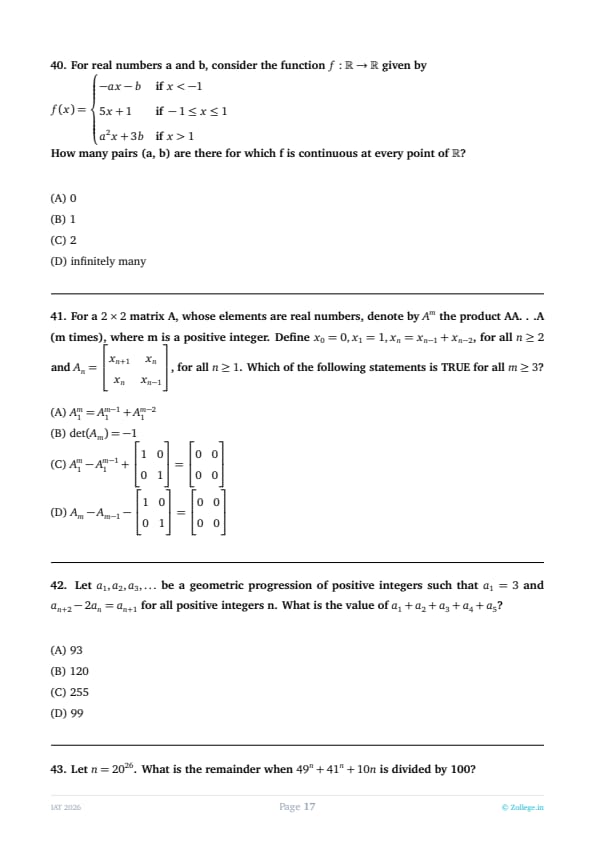
For real numbers a and b, consider the function \(f : \mathbb{R} \rightarrow \mathbb{R}\) given by
\(f(x) = \begin{cases} -ax - b & if x < -1
5x + 1 & if -1 \le x \le 1
a^{2}x + 3b & if x > 1 \end{cases} \)
How many pairs (a, b) are there for which f is continuous at every point of \(\mathbb{R}\)?
View Solution
Step 1: Understanding the Concept:
For a piecewise function to be continuous everywhere, the left-hand limit (LHL) must equal the right-hand limit (RHL) at every transition point.
Step 2: Detailed Explanation:
1. Continuity at \(x = -1\):
LHL: \(-a(-1) - b = a - b\).
RHL: \(5(-1) + 1 = -4\).
Equation 1: \(a - b = -4 \implies b = a + 4\).
2. Continuity at \(x = 1\):
LHL: \(5(1) + 1 = 6\).
RHL: \(a^{2}(1) + 3b = a^{2} + 3b\).
Equation 2: \(a^{2} + 3b = 6\).
3. Solve for a:
Substitute \(b = a + 4\) into Equation 2:
\(a^{2} + 3(a + 4) = 6 \implies a^{2} + 3a + 12 = 6\).
\(a^{2} + 3a + 6 = 0\).
4. Check for real solutions:
Discriminant \(D = b^{2} - 4ac = 3^{2} - 4(1)(6) = 9 - 24 = -15\).
Since \(D < 0\), there are no real values of \(a\) that satisfy this. Since \(a\) and \(b\) must be real, no pairs exist.
Step 3: Final Answer:
The number of pairs is 0.
This matches option (A).
Quick Tip: Always check the Discriminant (\(b^{2}-4ac\)) of the final quadratic. If it's negative, the condition can never be met by real numbers!
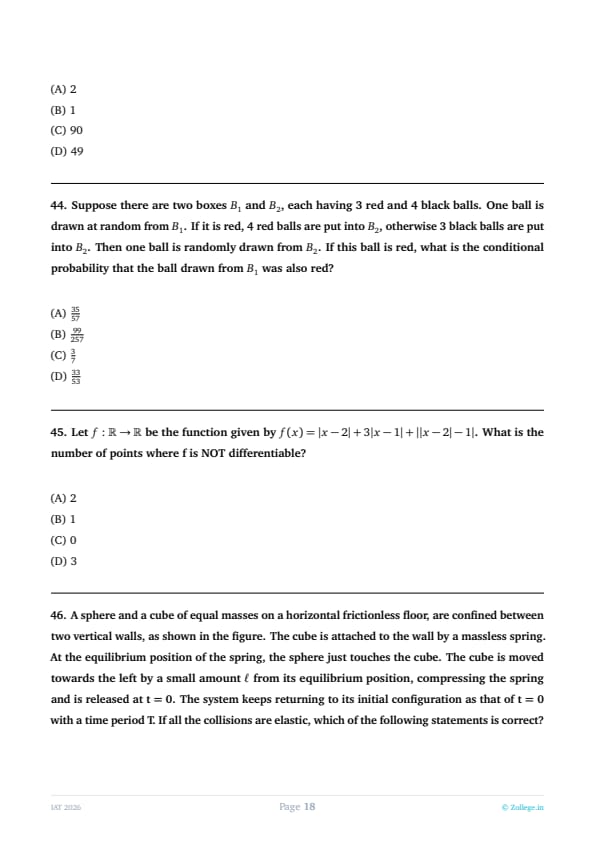
For a \( 2\times2 \) matrix A, whose elements are real numbers, denote by \( A^{m} \) the product AA. . .A (m times), where m is a positive integer. Define \( x_{0} = 0, x_{1} = 1, x_{n} = x_{n-1} + x_{n-2} \), for all \( n \ge 2 \) and \( A_{n} = \begin{bmatrix} x_{n+1} & x_{n}
x_{n} & x_{n-1} \end{bmatrix} \), for all \( n \ge 1 \). Which of the following statements is TRUE for all \( m \ge 3 \)?
View Solution
Step 1: Understanding the Concept:
The sequence \( x_{n} \) is the standard Fibonacci sequence starting with \( x_{0} = 0 \) and \( x_{1} = 1 \).
The matrix \( A_{1} \) is defined as \( \begin{bmatrix} x_{2} & x_{1}
x_{1} & x_{0} \end{bmatrix} \).
Key Formula or Approach:
We use the Cayley-Hamilton Theorem, which states that every square matrix satisfies its own characteristic equation.
Step 2: Detailed Explanation:
1. Determine \( A_{1} \):
Given \( x_{0} = 0, x_{1} = 1 \), then \( x_{2} = x_{1} + x_{0} = 1 \).
\[ A_{1} = \begin{bmatrix} 1 & 1
1 & 0 \end{bmatrix} \]
2. Find Characteristic Equation:
The characteristic equation is \( \det(A_{1} - \lambda I) = 0 \):
\[ \det \begin{bmatrix} 1-\lambda & 1
1 & -\lambda \end{bmatrix} = (1-\lambda)(-\lambda) - 1 = 0 \implies \lambda^{2} - \lambda - 1 = 0 \]
3. Apply Cayley-Hamilton Theorem:
Substituting \( A_{1} \) for \( \lambda \):
\[ A_{1}^{2} - A_{1} - I = 0 \implies A_{1}^{2} = A_{1} + I \]
4. Generalize for power \( m \):
Multiply both sides of the identity by \( A_{1}^{m-2} \) (valid for \( m \ge 2 \)):
\[ A_{1}^{2} \cdot A_{1}^{m-2} = (A_{1} + I) \cdot A_{1}^{m-2} \implies A_{1}^{m} = A_{1}^{m-1} + A_{1}^{m-2} \]
Step 3: Final Answer:
The recurrence relation \( A_{1}^{m} = A_{1}^{m-1} + A_{1}^{m-2} \) holds true for all \( m \ge 3 \).
Quick Tip: The matrix \( \begin{bmatrix} 1 & 1
1 & 0 \end{bmatrix} \) is known as the Fibonacci generator matrix.
Its powers \( A^{n} \) directly provide the Fibonacci numbers \( \begin{bmatrix} F_{n+1} & F_{n}
F_{n} & F_{n-1} \end{bmatrix} \).
Let \( a_{1}, a_{2}, a_{3}, \dots \) be a geometric progression of positive integers such that \( a_{1} = 3 \) and \( a_{n+2} - 2a_{n} = a_{n+1} \) for all positive integers n. What is the value of \( a_{1} + a_{2} + a_{3} + a_{4} + a_{5} \)?
View Solution
Step 1: Understanding the Concept:
We are given a geometric progression (GP) that also satisfies a linear recurrence relation.
Key Formula or Approach:
For a GP, the general term is \( a_{n} = a_{1}r^{n-1} \).
The sum of the first \( n \) terms is \( S_{n} = \frac{a_{1}(r^{n}-1)}{r-1} \).
Step 2: Detailed Explanation:
1. Find the common ratio \( r \):
Substitute the GP terms into the recurrence relation \( a_{n+2} - a_{n+1} - 2a_{n} = 0 \):
\[ a_{1}r^{n+1} - a_{1}r^{n} - 2a_{1}r^{n-1} = 0 \]
Divide by \( a_{1}r^{n-1} \) (as \( a_{1}, r > 0 \)):
\[ r^{2} - r - 2 = 0 \implies (r-2)(r+1) = 0 \]
Since the terms are positive integers, \( r \) must be positive, so \( r = 2 \).
2. Calculate the sum of the first 5 terms:
Using \( a_{1} = 3 \) and \( r = 2 \):
\[ S_{5} = \frac{3(2^{5}-1)}{2-1} = 3(32-1) = 3 \times 31 = 93 \]
Step 3: Final Answer:
The value of the sum is 93.
Quick Tip: For any GP satisfying a linear recurrence, the common ratio \( r \) is simply the root of the characteristic equation derived from the recurrence coefficients.
Let \( n = 20^{26} \). What is the remainder when \( 49^{n} + 41^{n} + 10n \) is divided by 100?
View Solution
Step 1: Understanding the Concept:
This is a modular arithmetic problem. We need to find \( (49^{n} + 41^{n} + 10n) \pmod{100} \).
Key Formula or Approach:
Use Euler's Totient Theorem: \( a^{\phi(m)} \equiv 1 \pmod{m} \) if \( \gcd(a, m) = 1 \).
For \( m = 100 \), \( \phi(100) = 100(1-1/2)(1-1/5) = 40 \).
Step 2: Detailed Explanation:
1. Evaluate \( n \pmod{40} \):
\( n = 20^{26} = 20^{2} \times 20^{24} = 400 \times 20^{24} \).
Since 400 is a multiple of 40, \( n \equiv 0 \pmod{40} \). Thus \( n = 40k \).
2. Evaluate \( 49^{n} \pmod{100} \):
Since \( \gcd(49, 100) = 1 \), by Euler's theorem:
\[ 49^{40} \equiv 1 \pmod{100} \implies 49^{40k} \equiv (49^{40})^{k} \equiv 1^{k} \equiv 1 \pmod{100} \]
3. Evaluate \( 41^{n} \pmod{100} \):
Similarly, \( \gcd(41, 100) = 1 \):
\[ 41^{n} = 41^{40k} \equiv 1 \pmod{100} \]
4. Evaluate \( 10n \pmod{100} \):
\( 10n = 10 \times 20^{26} = 10 \times (20^{2} \times 20^{24}) = 4000 \times 20^{24} \).
Since 4000 is a multiple of 100, \( 10n \equiv 0 \pmod{100} \).
5. Total Remainder:
\[ 1 + 1 + 0 = 2 \]
Step 3: Final Answer:
The remainder is 2.
Quick Tip: To find a remainder modulo 100, always check if the exponent is a multiple of \( \phi(100) = 40 \).
If \( a^{multiple of 40} \pmod{100} \) and \( \gcd(a,100)=1 \), the answer is always 1.
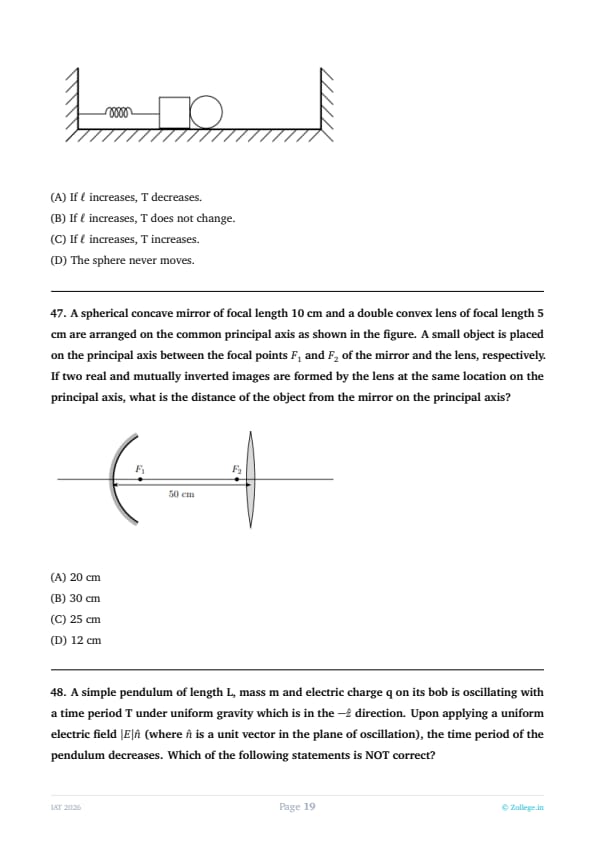
Suppose there are two boxes \( B_{1} \) and \( B_{2} \), each having 3 red and 4 black balls. One ball is drawn at random from \( B_{1} \). If it is red, 4 red balls are put into \( B_{2} \), otherwise 3 black balls are put into \( B_{2} \). Then one ball is randomly drawn from \( B_{2} \). If this ball is red, what is the conditional probability that the ball drawn from \( B_{1} \) was also red?
View Solution
Step 1: Understanding the Concept:
This is a conditional probability problem that can be solved using Bayes' Theorem.
Key Formula or Approach:
Let \( R_{1} \) be the event that red ball is drawn from \( B_{1} \), and \( R_{2} \) be the event that red ball is drawn from \( B_{2} \).
\[ P(R_{1}|R_{2}) = \frac{P(R_{1})P(R_{2}|R_{1})}{P(R_{1})P(R_{2}|R_{1}) + P(B_{1})P(R_{2}|B_{1})} \]
Step 2: Detailed Explanation:
1. Probabilities from \( B_{1} \):
\( P(R_{1}) = 3/7 \) and \( P(B_{1}) = 4/7 \).
2. Conditional probabilities for \( B_{2} \):
\(\bullet\) If \( R_{1} \) occurs, 4 red balls are added to \( B_{2} \). Total balls in \( B_{2} \) become \( 7+4=11 \), with \( 3+4=7 \) red balls.
\( P(R_{2}|R_{1}) = 7/11 \).
\(\bullet\) If \( B_{1} \) occurs (black ball), 3 black balls are added to \( B_{2} \). Total balls in \( B_{2} \) become \( 7+3=10 \), with 3 red balls remaining.
\( P(R_{2}|B_{1}) = 3/10 \).
3. Apply Bayes' Theorem:
\[ P(R_{1}|R_{2}) = \frac{(3/7) \times (7/11)}{(3/7 \times 7/11) + (4/7 \times 3/10)} \]
\[ P(R_{1}|R_{2}) = \frac{3/11}{3/11 + 12/70} = \frac{3/11}{3/11 + 6/35} \]
\[ P(R_{1}|R_{2}) = \frac{3/11}{(105+66)/385} = \frac{3/11}{171/385} = \frac{3 \times 35}{171} = \frac{105}{171} = \frac{35}{57} \]
Step 3: Final Answer:
The conditional probability is \( \frac{35}{57} \).
Quick Tip: In Bayes' Theorem, always simplify the common denominator as soon as possible to make the final fraction calculation easier.
Let \( f : \mathbb{R} \rightarrow \mathbb{R} \) be the function given by \( f(x) = |x - 2| + 3|x - 1| + ||x - 2| - 1| \). What is the number of points where f is NOT differentiable?
View Solution
Step 1: Understanding the Concept:
Absolute value functions \( |g(x)| \) are typically non-differentiable at points where \( g(x) = 0 \), provided the derivative of \( g(x) \) is non-zero there.
Step 2: Detailed Explanation:
1. Identify potential critical points:
\(\bullet\) From \( |x-2| \): \( x = 2 \).
\(\bullet\) From \( 3|x-1| \): \( x = 1 \).
\(\bullet\) From \( ||x-2|-1| \): \( |x-2|-1 = 0 \implies x-2 = \pm1 \implies x = 3 \) or \( x = 1 \).
The set of critical points is \( \{1, 2, 3\} \).
2. Check differentiability at \( x=2 \):
Just to the left and right of 2, the term \( ||x-2|-1| \) behaves like \( |(2-x)-1| = |1-x| \). Since we are near 2, \( 1-x \) is negative, so it is \( -(1-x) = x-1 \).
The derivative from the left (LHD) and right (RHD) will be identical at \( x=2 \) because the slopes of the other terms cancel out the "kink".
LHD of \( |x-2| \) is -1, RHD is +1. The derivative of \( ||x-2|-1| \) near 2 is +1 from the left and -1 from the right. Total change is 0.
3. Check at \( x=1 \) and \( x=3 \):
At \( x=1 \) and \( x=3 \), the slopes do not cancel out, resulting in "sharp turns" (kinks) in the graph.
Step 3: Final Answer:
The function is not differentiable at 2 points: \( x=1 \) and \( x=3 \).
Quick Tip: For sum of absolute values, check if the "jump" in slope at a critical point is cancelled by another term. At \( x=2 \), the slopes of \( |x-2| \) and \( ||x-2|-1| \) cancel each other out!
A sphere and a cube of equal masses on a horizontal frictionless floor, are confined between two vertical walls, as shown in the figure. The cube is attached to the wall by a massless spring. At the equilibrium position of the spring, the sphere just touches the cube. The cube is moved towards the left by a small amount \( \ell \) from its equilibrium position, compressing the spring and is released at t = 0. The system keeps returning to its initial configuration as that of t = 0 with a time period T. If all the collisions are elastic, which of the following statements is correct?

View Solution
Step 1: Understanding the Concept:
The system undergoes a series of harmonic motions and elastic collisions. Because the masses are equal, they perfectly exchange velocities during elastic collisions.
Step 2: Detailed Explanation:
1. Sequence of Motion:
\(\bullet\) Cube is released from \( x = -\ell \). It reaches \( x = 0 \) in time \( t_{1} = \frac{\pi}{2\omega} \).
\(\bullet\) At \( x=0 \), it has max speed \( v = \omega \ell \). It hits the stationary sphere.
\(\bullet\) Velocity exchange: Cube stops, sphere moves right with speed \( \omega \ell \).
\(\bullet\) Sphere travels distance \( D \) to the wall and back. Time taken: \( t_{2} = \frac{2D}{\omega \ell} \).
\(\bullet\) Sphere hits stationary cube at \( x=0 \). Velocity exchange: Sphere stops, cube moves left with \( \omega \ell \).
\(\bullet\) Cube returns to \( x = -\ell \) in time \( t_{3} = \frac{\pi}{2\omega} \).
2. Total Time Period:
\[ T = \frac{\pi}{\omega} + \frac{2D}{\omega \ell} \]
3. Dependence on \( \ell \):
As \( \ell \) increases, the term \( \frac{2D}{\omega \ell} \) decreases while \( \frac{\pi}{\omega} \) remains constant. Therefore, the total period \( T \) decreases.
Step 3: Final Answer:
Increasing the initial compression \( \ell \) leads to a decrease in the time period T.
Quick Tip: Increasing amplitude \( \ell \) increases the speed of the sphere. Since the sphere's travel distance \( 2D \) is fixed, it covers it faster, reducing the non-harmonic part of the cycle.
A spherical concave mirror of focal length 10 cm and a double convex lens of focal length 5 cm are arranged on the common principal axis as shown in the figure. A small object is placed on the principal axis between the focal points \( F_{1} \) and \( F_{2} \) of the mirror and the lens, respectively. If two real and mutually inverted images are formed by the lens at the same location on the principal axis, what is the distance of the object from the mirror on the principal axis?

View Solution
Step 1: Understanding the Concept:
For two optical paths to produce images at the same final location, the rays must either follow the same path or be projected by the lens from the same virtual or real point.
Step 2: Detailed Explanation:
1. Path 1: Rays go from object through the lens directly.
2. Path 2: Rays go from object, reflect off the mirror, and then through the lens.
3. Condition for Coincidence: If the object is placed at the center of curvature of the concave mirror, the rays striking the mirror reflect directly back along their own path.
4. Verification: If rays reflect back to the object position, then for the lens, the "reflected image" and the "original object" are at the exact same location. The lens will then project both to the same final image point on the other side.
5. Calculation: Focal length of mirror \( f_{m} = 10 cm \). Center of curvature \( C = 2f_{m} = 20 cm \).
Step 3: Final Answer:
The object must be 20 cm from the mirror.
Quick Tip: When a mirror and lens share an axis and images coincide, check if the object is at the center of curvature of the mirror (\( u = 2f \)), making the mirror reflect light back to the source.
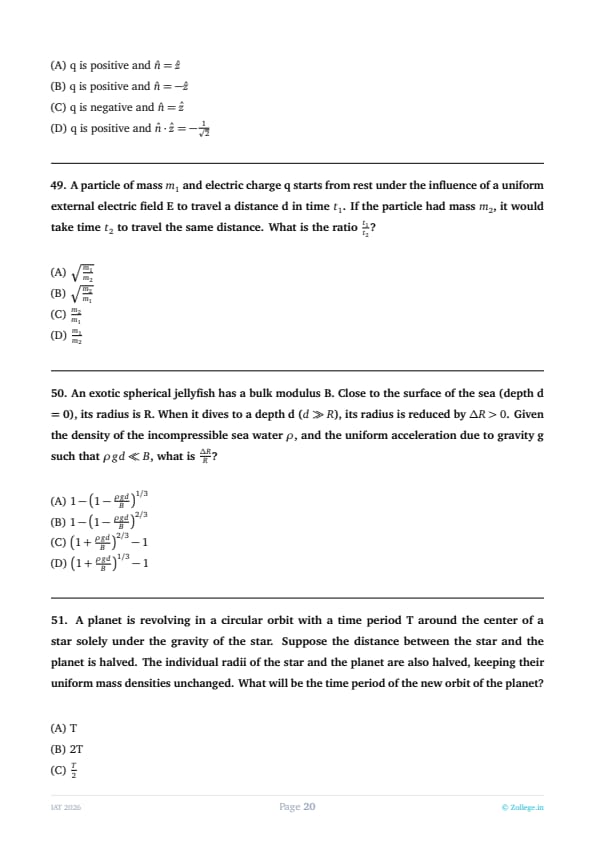
A simple pendulum of length L, mass m and electric charge q on its bob is oscillating with a time period T under uniform gravity which is in the \( -\hat{z} \) direction. Upon applying a uniform electric field \( |E|\hat{n} \) (where \( \hat{n} \) is a unit vector in the plane of oscillation), the time period of the pendulum decreases. Which of the following statements is NOT correct?
View Solution
Step 1: Understanding the Concept:
The time period of a pendulum is \( T = 2\pi\sqrt{L/g_{eff}} \). For \( T \) to decrease, the effective acceleration \( g_{eff} \) must increase.
Key Formula or Approach:
The effective acceleration is the vector sum of gravitational and electric accelerations:
\[ \vec{g}_{eff} = \vec{g} + \frac{q\vec{E}}{m} \]
Step 2: Detailed Explanation:
1. Gravity: Points in \( -\hat{z} \).
2. Condition: We need \( |\vec{g}_{eff}| > g \). This happens if the electric force has a downward component (along \( -\hat{z} \)).
3. Analyze Options:
\(\bullet\) (B) \( q>0, \hat{n} = -\hat{z} \): Force is downward. \( g_{eff} = g + qE/m \). Correct (T decreases).
\(\bullet\) (C) \( q<0, \hat{n} = \hat{z} \): Force is \( q\vec{E} = (-|q|)(|E|\hat{z}) \), which is downward. Correct (T decreases).
\(\bullet\) (D) \( \hat{n} \cdot \hat{z} = -1/\sqrt{2} \): The unit vector has a downward component. For \( q>0 \), force has a downward component. Correct (T decreases).
\(\bullet\) (A) \( q>0, \hat{n} = \hat{z} \): Force is upward (along \( +\hat{z} \)). \( g_{eff} = g - qE/m \), which is less than \( g \). This makes \( T \) increase. Therefore, this statement is incorrect.
Step 3: Final Answer:
Statement (A) is the incorrect one.
Quick Tip: To make a pendulum swing faster (shorter period), you need to "help" gravity by pulling the bob down harder. An upward force always slows it down.
A particle of mass \( m_{1} \) and electric charge q starts from rest under the influence of a uniform external electric field E to travel a distance d in time \( t_{1} \). If the particle had mass \( m_{2} \), it would take time \( t_{2} \) to travel the same distance. What is the ratio \( \frac{t_{1}}{t_{2}} \)?
View Solution
Step 1: Understanding the Concept:
The particle undergoes constant acceleration motion starting from rest.
Key Formula or Approach:
Force \( F = qE = ma \implies a = \frac{qE}{m} \).
Distance \( d = \frac{1}{2}at^{2} \).
Step 2: Detailed Explanation:
For a fixed distance \( d \):
\[ d = \frac{1}{2} \left( \frac{qE}{m} \right) t^{2} \implies t^{2} = \frac{2md}{qE} \]
Since \( q, E, d \) are constants for both cases:
\[ t^{2} \propto m \implies t \propto \sqrt{m} \]
Taking the ratio for masses \( m_{1} \) and \( m_{2} \):
\[ \frac{t_{1}}{t_{2}} = \sqrt{\frac{m_{1}}{m_{2}}} \]
Step 3: Final Answer:
The ratio is \( \sqrt{\frac{m_{1}}{m_{2}}} \).
Quick Tip: Heavier particles accelerate slower (\( a \propto 1/m \)). Since time squared is inversely proportional to acceleration, time is directly proportional to the square root of mass.
An exotic spherical jellyfish has a bulk modulus B. Close to the surface of the sea (depth d = 0), its radius is R. When it dives to a depth d (\( d \gg R \)), its radius is reduced by \( \Delta R > 0 \). Given the density of the incompressible sea water \( \rho \), and the uniform acceleration due to gravity g such that \( \rho gd \ll B \), what is \( \frac{\Delta R}{R} \)?
View Solution
Step 1: Understanding the Concept:
Bulk Modulus relates the change in pressure to the fractional change in volume of an object.
Key Formula or Approach:
Bulk Modulus \( B = -\frac{\Delta P}{\Delta V / V} \implies \frac{\Delta V}{V} = \frac{\rho gd}{B} \).
Step 2: Detailed Explanation:
1. Volume relation: Let \( V_{0} \) be initial volume and \( V \) be final volume.
\( \frac{V_{0} - V}{V_{0}} = \frac{\rho gd}{B} \implies \frac{V}{V_{0}} = 1 - \frac{\rho gd}{B} \).
2. Radius relation: For a sphere, \( V = \frac{4}{3}\pi r^{3} \).
\( \frac{\frac{4}{3}\pi(R - \Delta R)^{3}}{\frac{4}{3}\pi R^{3}} = 1 - \frac{\rho gd}{B} \)
\[ \left( \frac{R - \Delta R}{R} \right)^{3} = 1 - \frac{\rho gd}{B} \]
3. Solve for fractional change:
\[ 1 - \frac{\Delta R}{R} = \left( 1 - \frac{\rho gd}{B} \right)^{1/3} \implies \frac{\Delta R}{R} = 1 - \left( 1 - \frac{\rho gd}{B} \right)^{1/3} \]
Step 3: Final Answer:
The ratio is \( 1 - (1 - \rho gd/B)^{1/3} \).
Quick Tip: For small changes, the volumetric strain is approximately 3 times the linear strain. Since \( \Delta V/V \approx 3 \Delta R/R \), you could use binomial expansion for an approximation, but the exact form is required here.
A planet is revolving in a circular orbit with a time period T around the center of a star solely under the gravity of the star. Suppose the distance between the star and the planet is halved. The individual radii of the star and the planet are also halved, keeping their uniform mass densities unchanged. What will be the time period of the new orbit of the planet?
View Solution
Step 1: Understanding the Concept:
Kepler's Third Law relates the orbital period to the orbital radius and the mass of the central body.
Key Formula or Approach:
\( T^{2} = \frac{4\pi^{2}r^{3}}{GM} \).
Mass \( M = \rho \times Volume = \rho \times \frac{4}{3}\pi R^{3} \).
Step 2: Detailed Explanation:
1. Initial Case: Period \( T \) at radius \( r \) around star of mass \( M \).
2. Final Case:
\(\bullet\) Orbital radius becomes \( r' = r/2 \).
\(\bullet\) Star radius becomes \( R' = R/2 \). Since density \( \rho \) is constant, the new mass is \( M' = \rho \frac{4}{3}\pi (R/2)^{3} = M/8 \).
3. New Period \( T' \):
\[ (T')^{2} \propto \frac{(r/2)^{3}}{M/8} = \frac{r^{3}/8}{M/8} = \frac{r^{3}}{M} \]
Since the ratio \( r^{3}/M \) remains the same, \( (T')^{2} = T^{2} \).
Step 3: Final Answer:
The time period remains unchanged as T.
Quick Tip: In gravitational systems, if all linear dimensions are scaled by factor \( k \), and densities are constant, the time scales remain the same!
The position of a particle of mass 1 kg at time t is given by \( \vec{r} = t\hat{i} + \hat{j} + 2t^{2}\hat{k} \), where t is in seconds and the coefficients have the proper units for r to be in metres. What is the component of the angular momentum (with respect to the origin) in kg \( m^{2}s^{-1} \) along the vector \( (\hat{i} + \hat{j}) \)?
View Solution
Step 1: Understanding the Concept:
Angular momentum \( \vec{L} \) is defined as \( \vec{r} \times \vec{p} \). To find a scalar component along a vector \( \vec{A} \), we take the dot product with the unit vector of \( \vec{A} \).
Step 2: Detailed Explanation:
1. Velocity Vector: \( \vec{v} = \frac{d\vec{r}}{dt} = \hat{i} + 0\hat{j} + 4t\hat{k} \).
2. Angular Momentum (\( m = 1 kg \)):
\[ \vec{L} = \vec{r} \times \vec{v} = \begin{vmatrix} \hat{i} & \hat{j} & \hat{k}
t & 1 & 2t^{2}
1 & 0 & 4t \end{vmatrix} \]
\[ \vec{L} = \hat{i}(4t - 0) - \hat{j}(4t^{2} - 2t^{2}) + \hat{k}(0 - 1) = 4t\hat{i} - 2t^{2}\hat{j} - \hat{k} \]
3. Component along \( \vec{A} = \hat{i} + \hat{j} \):
The unit vector is \( \hat{u} = \frac{\hat{i} + \hat{j}}{\sqrt{2}} \).
\[ L_{comp} = \vec{L} \cdot \hat{u} = (4t\hat{i} - 2t^{2}\hat{j} - \hat{k}) \cdot \left( \frac{\hat{i} + \hat{j}}{\sqrt{2}} \right) \]
\[ L_{comp} = \frac{4t - 2t^{2}}{\sqrt{2}} \]
Step 3: Final Answer:
The component is \( \frac{1}{\sqrt{2}}(4t - 2t^{2}) \).
Quick Tip: Always normalize the target vector to a unit vector first before taking the dot product to find a "component along a vector".
A long solenoid of initial radius \( R_{0} \) is put in a region of uniform magnetic field B with the axis of the solenoid aligned along the magnetic field. The solenoid is a part of a closed circuit that has no initial current running through it. If the radius of the solenoid starts increasing at a uniform rate, how do the magnetic field strength \( B_{in} \) and the associated magnetic energy \( U_{in} \) inside the solenoid change?
View Solution
Step 1: Understanding the Concept:
In a closed loop with low resistance, the total magnetic flux must remain constant to oppose any external change (Lenz's Law / Flux Conservation).
Step 2: Detailed Explanation:
1. Flux Conservation: Total flux \( \Phi = B_{in} \times Area = B_{in} \times \pi R^{2} = constant \).
As the radius \( R \) increases, the area increases. To keep \( \Phi \) constant, the magnetic field \( B_{in} \) must decrease.
2. Energy Analysis: Magnetic energy \( U_{in} = \frac{B_{in}^{2}}{2\mu_{0}} \times Volume \).
Volume of solenoid \( V = Area \times length = A \cdot \ell \).
Since \( B_{in} \propto 1/A \), then:
\[ U_{in} \propto \left(\frac{1}{A}\right)^{2} \times (A \cdot \ell) = \frac{1}{A} \]
As the area \( A \) increases, the total magnetic energy \( U_{in} \) decreases.
Step 3: Final Answer:
Both \( B_{in} \) and \( U_{in} \) decrease as the radius increases.
Quick Tip: For superconducting or low-resistance loops, think of flux as "trapped". If you stretch the loop, the field "thins out" (decreases) and energy spreads out.
The acceleration of a point particle is given by the equation \( \frac{d^{2}\vec{x}}{dt^{2}} = \alpha \frac{\vec{x}}{|\vec{x}|^{7}} + \beta \frac{d\vec{x}}{dt} \) where x denotes position and t denotes time. Which of the following relations show the correct dimensions for \( \alpha \) and \( \beta \)?
View Solution
Step 1: Understanding the Concept:
By the principle of dimensional homogeneity, all terms in a sum must have the same dimensions as the result (acceleration).
Step 2: Detailed Explanation:
1. Left-Hand Side (Acceleration): Dimensions = \( [LT^{-2}] \).
2. Dimension of \( \alpha \) term:
\[ [\alpha] \frac{[L]}{[L^{7}]} = [LT^{-2}] \implies [\alpha] [L^{-6}] = [LT^{-2}] \implies [\alpha] = [L^{7}T^{-2}] \]
3. Dimension of \( \beta \) term:
\[ [\beta] [LT^{-1}] = [LT^{-2}] \implies [\beta] = [T^{-1}] \]
Step 3: Final Answer:
The dimensions are \( [\alpha] = [L^{7}T^{-2}] \) and \( [\beta] = [T^{-1}] \). This matches option (A).
Quick Tip: Always simplify the geometric parts first (like \( x/x^{7} = 1/x^{6} \)) to quickly see what dimensions the constant must provide to reach the target unit.
Consider normal incidence of a monochromatic beam of photons of power P on a flat surface. Of the incident beam, 10% gets absorbed, 10% gets transmitted, and the rest is reflected by the flat surface. If c is the speed of light, what is the force exerted on the flat surface by the beam?
View Solution
Step 1: Understanding the Concept:
Force is defined as the rate of change of momentum. A beam of power P carries momentum per second equal to \( P/c \).
Step 2: Detailed Explanation:
1. Momentum per second (\( p_{s} \)): \( P/c \).
2. Individual Contributions:
\(\bullet\) Absorbed (10%): Force \( F_{a} = 0.1 \times \frac{P}{c} \) (photon stops, transfers all momentum).
\(\bullet\) Transmitted (10%): Force \( F_{t} = 0 \) (photon passes through with no momentum change).
\(\bullet\) Reflected (80%): Force \( F_{r} = 0.8 \times \left( \frac{2P}{c} \right) = 1.6 \frac{P}{c} \) (photon bounces back, transfer is \( p - (-p) = 2p \)).
3. Total Force:
\[ F_{total} = 0.1\frac{P}{c} + 0 + 1.6\frac{P}{c} = 1.7\frac{P}{c} \]
Step 3: Final Answer:
The total force is \( 1.7 P/c \).
Quick Tip: Radiation pressure/force rule: Absorption transfers \( p \), reflection transfers \( 2p \). Think of it like a ball hitting a wall vs a ball sticking to it!
An experimental study of the photoelectric effect involves a metal of work function \( \phi_{0} \). What is the smallest wavelength of the incident photon to photoemit an electron of mass m which has the same de Broglie wavelength as that of the incident photon? [Given h is the Planck’s constant, c is the speed of light, and \( \phi_{0} \ll mc^{2} \)]
View Solution
Step 1: Understanding the Concept:
This problem combines the Einstein Photoelectric Equation with the de Broglie wavelength hypothesis.
Key Formula or Approach:
1. Photoelectric Eq: \( \frac{hc}{\lambda} = \phi_{0} + K \).
2. de Broglie Eq: \( \lambda_{e} = \frac{h}{p} \). Given \( \lambda_{e} = \lambda \), then \( p = \frac{h}{\lambda} \).
3. Kinetic Energy: \( K = \frac{p^{2}}{2m} = \frac{h^{2}}{2m\lambda^{2}} \).
Step 2: Detailed Explanation:
1. Substitute into equation:
\[ \frac{hc}{\lambda} = \phi_{0} + \frac{h^{2}}{2m\lambda^{2}} \]
2. Rearrange into a quadratic in \( (1/\lambda) \):
\[ \frac{h^{2}}{2m} \left( \frac{1}{\lambda} \right)^{2} - hc \left( \frac{1}{\lambda} \right) + \phi_{0} = 0 \]
3. Solve using Quadratic Formula for \( x = 1/\lambda \):
\[ x = \frac{hc \pm \sqrt{(hc)^{2} - 4(\frac{h^{2}}{2m})\phi_{0}}}{2(\frac{h^{2}}{2m})} = \frac{mc}{h} \left( 1 \pm \sqrt{1 - \frac{2\phi_{0}}{mc^{2}}} \right) \]
4. Choose smallest wavelength: Smallest \( \lambda \) corresponds to largest \( 1/\lambda \), so we take the positive root.
\[ \frac{1}{\lambda} = \frac{mc}{h} \left( 1 + \sqrt{1 - \frac{2\phi_{0}}{mc^{2}}} \right) \implies \lambda = \frac{h}{mc} \left( 1 + \sqrt{1 - \frac{2\phi_{0}}{mc^{2}}} \right)^{-1} \]
Step 3: Final Answer:
The wavelength is \( \frac{h}{mc} \left( 1 + \sqrt{1 - \frac{2\phi_{0}}{mc^{2}}} \right)^{-1} \).
Quick Tip: In competitive physics, "smallest value of X" usually translates to "largest value of 1/X" in a quadratic solution. Always double-check if the question asks for wavelength or frequency!
The three numbers: (number of protons, number of neutrons, the radius) characterize a nucleus. What is the value of \( \frac{r_{1}}{r_{2}} \) for two nuclei characterized by (1, 0, \( r_{1} \)) and (4, 4, \( r_{2} \))?
View Solution
Step 1: Understanding the Concept:
The radius of a nucleus is directly related to its mass number (total nucleons).
Key Formula or Approach:
\( R = R_{0}A^{1/3} \), where \( A = Z + N \).
Step 2: Detailed Explanation:
1. Nucleus 1: Protons = 1, Neutrons = 0. Mass number \( A_{1} = 1 \).
\( r_{1} = R_{0}(1)^{1/3} \).
2. Nucleus 2: Protons = 4, Neutrons = 4. Mass number \( A_{2} = 8 \).
\( r_{2} = R_{0}(8)^{1/3} = 2R_{0} \).
3. Ratio:
\[ \frac{r_{1}}{r_{2}} = \frac{R_{0} \times 1}{2R_{0}} = \frac{1}{2} \]
Step 3: Final Answer:
The ratio is 1/2.
Quick Tip: Remember that nuclear density is constant, so radius scales with the cube root of the volume (and mass). 8 times the mass = 2 times the radius!
A jar is filled with two monoatomic non-interacting gases A and B with total masses \( M_{A} \) and \( M_{B} \), respectively. The molar mass of A is double the molar mass of B. If the jar is kept at temperature T, what is the ratio of the total pressure of the combined gas to the partial pressure due to the gas A?
View Solution
Step 1: Understanding the Concept:
By Dalton's Law of Partial Pressures, the ratio of pressures is the same as the ratio of the number of moles of the gases.
Step 2: Detailed Explanation:
1. Mole Ratios: Let molar mass of B be \( m \). Then molar mass of A is \( 2m \).
Number of moles of A, \( n_{A} = M_{A} / 2m \).
Number of moles of B, \( n_{B} = M_{B} / m \).
2. Pressure Ratio:
\[ \frac{P_{total}}{P_{A}} = \frac{n_{A} + n_{B}}{n_{A}} = 1 + \frac{n_{B}}{n_{A}} \]
3. Calculation:
\[ \frac{n_{B}}{n_{A}} = \frac{M_{B}/m}{M_{A}/2m} = \frac{M_{B}}{m} \times \frac{2m}{M_{A}} = 2\frac{M_{B}}{M_{A}} \]
\[ \frac{P_{total}}{P_{A}} = 1 + 2 \frac{M_{B}}{M_{A}} \]
Step 3: Final Answer:
The ratio is \( 1 + 2 M_{B}/M_{A} \).
Quick Tip: Partial pressure is just the mole fraction. To find the ratio of total to partial pressure of A, you just need the ratio of total moles to moles of A.
Three infinite plane sheets which have uniform positive surface charge densities \( \sigma, \sigma \) and \( 2\sigma \), are arranged parallel to each other with a separation of d as shown in the figure. A spherical Gaussian surface S of radius d/2 has its center on the middle sheet. Which of the following statements regarding the electric flux \( \Phi_{L} \) through the left hemisphere and the electric flux \( \Phi_{R} \) through the right hemisphere of the Gaussian surface is correct?

View Solution
Step 1: Understanding the Concept:
The flux through a surface depends on the magnitude and direction of the net electric field vector integrated over that surface.
Step 2: Detailed Explanation:
1. Field from one sheet: \( E = \frac{\sigma}{2\epsilon_{0}} \).
2. Left region (between left and middle sheets):
\(\bullet\) From Left sheet (\( \sigma \)): Field is \( E_{0} \) to the right.
\(\bullet\) From Middle sheet (\( \sigma \)): Field is \( E_{0} \) to the left.
\(\bullet\) From Right sheet (\( 2\sigma \)): Field is \( 2E_{0} \) to the left.
Net field \( E_{L} = E_{0} - E_{0} - 2E_{0} = -2E_{0} \) (towards left).
3. Right region (between middle and right sheets):
\(\bullet\) From Left sheet: \( E_{0} \) to right.
\(\bullet\) From Middle sheet: \( E_{0} \) to right.
\(\bullet\) From Right sheet: \( 2E_{0} \) to left.
Net field \( E_{R} = E_{0} + E_{0} - 2E_{0} = 0 \).
4. Flux comparison:
\(\Phi_{R}\) is 0 because the field in that region is zero. \(\Phi_{L}\) is non-zero (and positive as it points out of the sphere). Therefore \( \Phi_{L} > \Phi_{R} \).
Step 3: Final Answer:
The flux through the left hemisphere is greater.
Quick Tip: Use superposition to calculate the net field in each gap first. A zero field region automatically has zero flux through the corresponding surface.
Consider two Carnot engines of efficiencies \( \eta_{1} \) and \( \eta_{2} \). The first engine absorbs heat \( Q_{1} \) from a heat reservoir A and releases heat \( Q_{2} \) to a heat reservoir B. The second engine takes heat \( Q_{2} \) from B and releases heat \( Q_{3} \) to a heat reservoir C. If \( Q_{1} > Q_{2} > Q_{3} \), what is the net efficiency of this combination of the two Carnot engines?
View Solution
Step 1: Understanding the Concept:
Efficiency is defined as \( 1 - Q_{out}/Q_{in} \). When engines work in series, the "fraction of heat remaining" multiplies.
Step 2: Detailed Explanation:
1. Engine 1: \( \eta_{1} = 1 - \frac{Q_{2}}{Q_{1}} \implies \frac{Q_{2}}{Q_{1}} = 1 - \eta_{1} \).
2. Engine 2: \( \eta_{2} = 1 - \frac{Q_{3}}{Q_{2}} \implies \frac{Q_{3}}{Q_{2}} = 1 - \eta_{2} \).
3. Net efficiency (\( \eta \)):
\[ \eta = 1 - \frac{Q_{3}}{Q_{1}} \]
Substitute \( \frac{Q_{3}}{Q_{1}} = \frac{Q_{3}}{Q_{2}} \times \frac{Q_{2}}{Q_{1}} \):
\[ \eta = 1 - (1 - \eta_{2})(1 - \eta_{1}) \]
\[ \eta = 1 - (1 - \eta_{1} - \eta_{2} + \eta_{1}\eta_{2}) \]
\[ \eta = \eta_{1} + \eta_{2} - \eta_{1}\eta_{2} \]
Step 3: Final Answer:
The net efficiency is \( \eta_{1} + \eta_{2} - \eta_{1}\eta_{2} \).
Quick Tip: For engines in series, always multiply the "rejection ratios" \( (1-\eta) \). The final efficiency is just 1 minus that total product.
IISER (IAT) 2026 Full Paper Solution
*The article might have information for the previous academic years, please refer the official website of the exam.