
NEST 2026 Question Paper with Solution PDF


Content Curator | Updated On - Jul 8, 2026
NISER conducted the NEST 2026 Exam on June 6 from 2 PM to 5 PM in CBT Mode
The NEST 2026 Question Paper consists of 80 Questions, divided into 4 sections: Physics, Chemistry, Biology, and Mathematics, carrying a total of 240 Marks, to be completed in 3 hours. As Per Marking Scheme + 3 Marks for each correct answer and -1 for every incorrect answer
NEST 2026 Question Paper with solution PDF is available here for download.
NEST 2026 Question Paper with Solution PDF
| NEST Question Paper 2026 | Download PDF | Check Solutions |
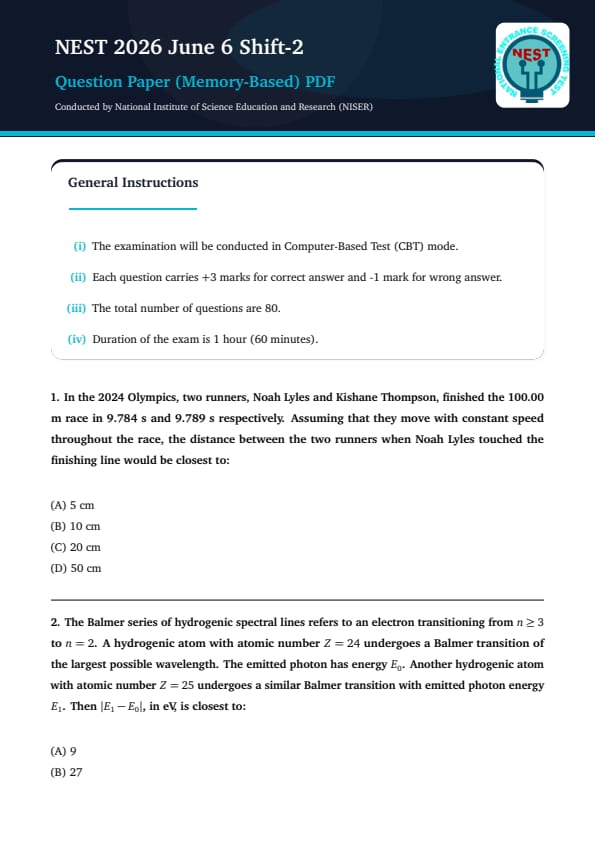
In the 2024 Olympics, two runners, Noah Lyles and Kishane Thompson, finished the 100.00 m race in 9.784 s and 9.789 s respectively. Assuming that they move with constant speed throughout the race, the distance between the two runners when Noah Lyles touched the finishing line would be closest to:
The Balmer series of hydrogenic spectral lines refers to an electron transitioning from \(n \ge 3\) to \(n = 2\). A hydrogenic atom with atomic number \(Z = 24\) undergoes a Balmer transition of the largest possible wavelength. The emitted photon has energy \(E_0\). Another hydrogenic atom with atomic number \(Z = 25\) undergoes a similar Balmer transition with emitted photon energy \(E_1\). Then \(|E_1 - E_0|\), in eV, is closest to:
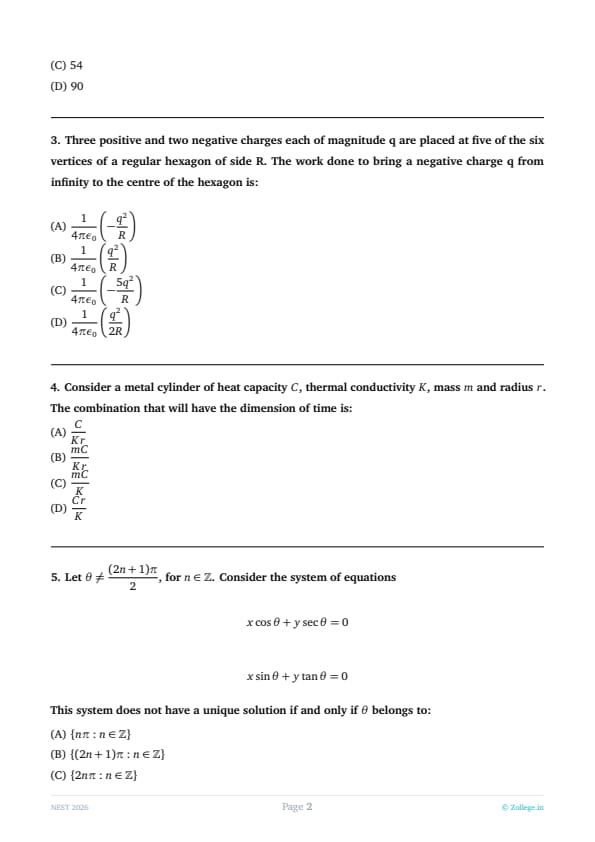
Three positive and two negative charges each of magnitude q are placed at five of the six vertices of a regular hexagon of side R. The work done to bring a negative charge −q from infinity to the centre of the hexagon is:
Consider a metal cylinder of heat capacity \(C\), thermal conductivity \(K\), mass \(m\) and radius \(r\). The combination that will have the dimension of time is:
Let \(\theta \neq \dfrac{(2n+1)\pi}{2}\), for \(n\in\mathbb{Z}\). Consider the system of equations
\[ x\cos\theta+y\sec\theta=0 \]
\[ x\sin\theta+y\tan\theta=0 \]
This system does not have a unique solution if and only if \(\theta\) belongs to:
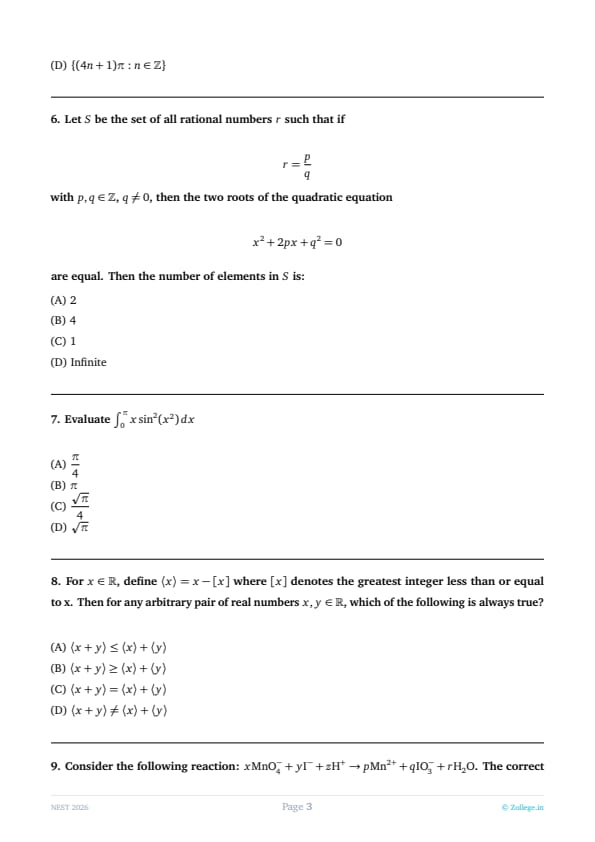
Let \(S\) be the set of all rational numbers \(r\) such that if
\[ r=\frac{p}{q} \]
with \(p,q\in\mathbb{Z}\), \(q\neq0\), then the two roots of the quadratic equation
\[ x^{2}+2px+q^{2}=0 \]
are equal. Then the number of elements in \(S\) is:
Evaluate \(\int_0^{\pi} x \sin^2(x^2) \, dx\)
For \(x \in \mathbb{R}\), define \(\langle x \rangle = x - [x]\) where \([x]\) denotes the greatest integer less than or equal to x. Then for any arbitrary pair of real numbers \(x, y \in \mathbb{R}\), which of the following is always true?
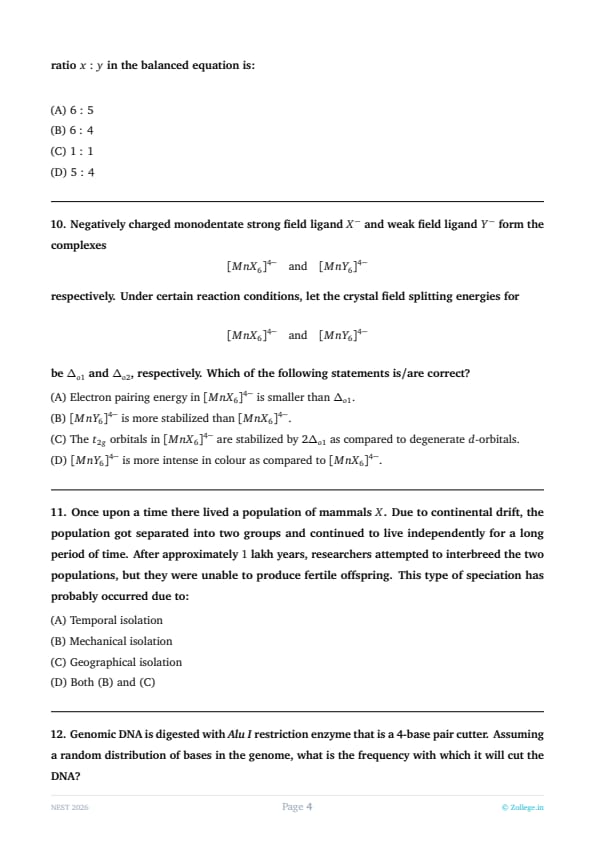
Consider the following reaction: \(x \mathrm{MnO_4^-} + y \mathrm{I^-} + z \mathrm{H^+} \rightarrow p \mathrm{Mn^{2+}} + q \mathrm{IO_3^-} + r \mathrm{H_2O}\). The correct ratio \(x : y\) in the balanced equation is:
Negatively charged monodentate strong field ligand \(X^-\) and weak field ligand \(Y^-\) form the complexes \[ [MnX_6]^{4-} \quad and \quad [MnY_6]^{4-} \]
respectively. Under certain reaction conditions, let the crystal field splitting energies for \[ [MnX_6]^{4-} \quad and \quad [MnY_6]^{4-} \]
be \(\Delta_{o1}\) and \(\Delta_{o2}\), respectively. Which of the following statements is/are correct?
Once upon a time there lived a population of mammals \(X\). Due to continental drift, the population got separated into two groups and continued to live independently for a long period of time. After approximately \(1\) lakh years, researchers attempted to interbreed the two populations, but they were unable to produce fertile offspring. This type of speciation has probably occurred due to:
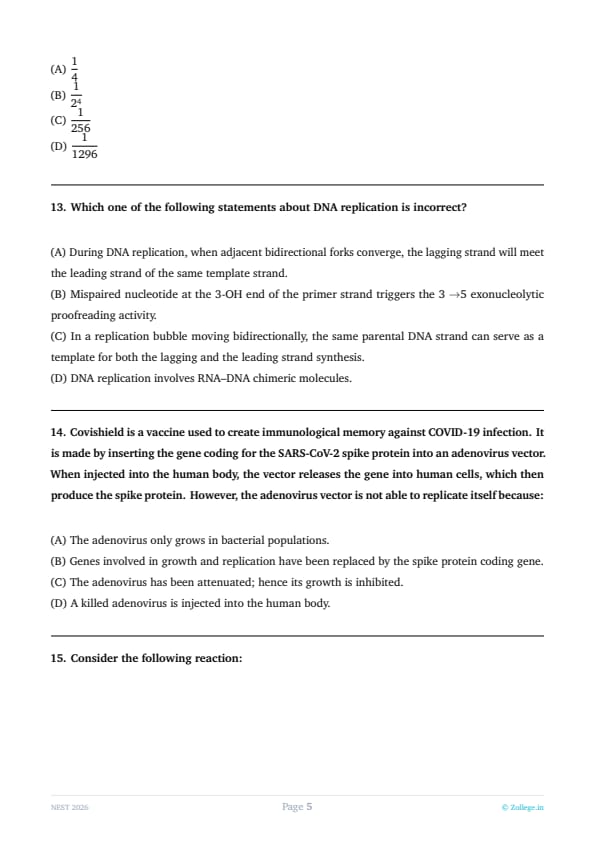
Genomic DNA is digested with Alu I restriction enzyme that is a 4-base pair cutter. Assuming a random distribution of bases in the genome, what is the frequency with which it will cut the DNA?
Which one of the following statements about DNA replication is incorrect?
Covishield is a vaccine used to create immunological memory against COVID-19 infection. It is made by inserting the gene coding for the SARS-CoV-2 spike protein into an adenovirus vector. When injected into the human body, the vector releases the gene into human cells, which then produce the spike protein. However, the adenovirus vector is not able to replicate itself because:
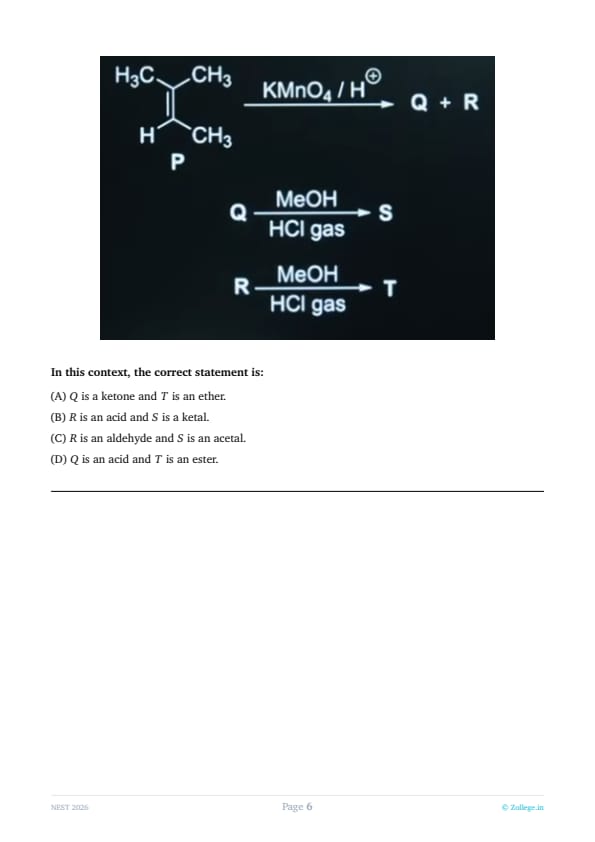
Consider the following reaction:

In this context, the correct statement is:
| Detail | Info |
| Total Questions | 80 MCQs |
| Total Marks | 240 |
| Sections | Physics, Chemistry, Biology, Mathematics |
| Questions per Section | 20 |
| Marks per Section | 60 |
| Correct Answer | +3 Marks |
| Incorrect Answer | −1 Mark |
| Unattempted | No Penalty |
| Duration | 3 Hours |
| Mode | Online (CBT) |
NEST 2026 Exam Pattern and Strategy
*The article might have information for the previous academic years, please refer the official website of the exam.