
TS LAWCET 2022 LLB 3 Years Question Paper Shift 2 with Solution PDF


Content Writer | Updated On - Feb 6, 2026
TS LAWCET 2022 LLB 3 Years Question Paper for July 21 Shift 2 is available here for download. TS LAWCET 2022 LLB 3 Years Question Paper consists of 120 questions carrying 1 mark each.TS LAWCET 2023 LLB 3 Years includes three subjects, General Knowledge and Mental Ability, Current Affairs and Aptitude for study of Law . The General Knowledge and Mental Ability and Current Affairs section of the paper includes 30 questions each while the Aptitude for study of Law section includes a total of 60 questions. Download TS LAWCET 2023 Question Paper July 21 Shift 2 with Solution PDF from link below.
TS LAWCET 2022 LLB 3 Years Question Paper for July 21 Shift 2
| TS LAWCET 2022 LLB 3 Years Question Paper for July 21 Shift 2 | Download PDF | Check Solutions |

Who is the author of the book ``Why I am a Hindu?''
View Solution
Step 1: Understanding the Concept:
This question explores contemporary Indian literature and its intersection with political and religious philosophy.
The book serves as an exploration of the personal and historical aspects of Hinduism.
Step 2: Detailed Explanation:
The book titled ``Why I am a Hindu?'' was written by Dr. Shashi Tharoor and published in 2018.
Shashi Tharoor is a well-known Indian politician, a Member of Parliament, and a former international diplomat at the United Nations.
The book is divided into two parts:
1. In the first part, Tharoor provides a brief history of Hinduism and its major tenets, including the views of various sages and reformers.
2. In the second part, he offers a critique of the rise of political Hindutva, contrasting it with the pluralistic and inclusive nature of traditional Hinduism.
Regarding the other options:
- Bal Gangadhar Tilak is famous for his work ``The Arctic Home in the Vedas'' and his commentary on the Gita, ``Gita Rahasya''.
- Kanche Ilaiah wrote a famous book with a contrasting title called ``Why I am Not a Hindu'', which focuses on a Dalit-Bahujan perspective.
- Deendayal Upadhyaya is the architect of the ``Integral Humanism'' philosophy.
Step 3: Final Answer:
The author of the book ``Why I am a Hindu?'' is Shashi Tharoor.
Quick Tip: Always look for the exact title of the book; a slight variation like ``Why I am \textbf{Not} a Hindu'' (Kanche Ilaiah) leads to a completely different author and perspective.
Ram Prasad Bismil, Thakur Roshan Singh, Rajendranath Lahiri and Ashfaqullah Khan were charged with robbery and murder, and hanged to death in the noted Kakori Train Robbery Case. Which revolutionary organization fuelled the robbery?
View Solution
Step 1: Understanding the Concept:
The Kakori Train Robbery (1925) was a pivotal event in the Indian independence movement, involving armed revolution against British rule.
Step 2: Detailed Explanation:
The Kakori Train Robbery took place on August 9, 1925, near the town of Kakori in Uttar Pradesh.
The operation was planned and executed by the members of the Hindustan Republican Association (HRA).
The HRA was a revolutionary organization founded in 1924 in Kanpur by Sachindra Nath Sanyal and Jogesh Chandra Chatterjee.
The primary motive for the robbery of the 8-Down train (carrying government money) was to secure funds to purchase weapons and equipment for the revolutionary struggle against the British Raj.
While many participants managed to escape initially, the British authorities eventually arrested several leaders.
Ram Prasad Bismil, Ashfaqullah Khan, Rajendra Lahiri, and Roshan Singh were sentenced to death and hanged in 1927.
Chandrashekhar Azad was also a key member but managed to evade arrest at that time.
Later, in 1928, the HRA was reorganized into the HSRA (Hindustan Socialist Republican Association) under Bhagat Singh's influence.
Step 3: Final Answer:
The revolutionary organization responsible for the Kakori robbery was the Hindustan Republican Association (HRA).
Quick Tip: Remember that the HRA became the HSRA after 1928 at Feroz Shah Kotla, Delhi, adding ``Socialist'' to its name to reflect its changing ideological goals.
Who was Gandhi's personal secretary and also translated his autobiography into English, which was originally written in Gujarati?
View Solution
Step 1: Understanding the Concept:
This question focuses on the primary associates of Mahatma Gandhi and the translation of his most famous literary work.
Step 2: Detailed Explanation:
Mahatma Gandhi's autobiography is titled ``The Story of My Experiments with Truth''.
He wrote it originally in his mother tongue, Gujarati, while he was in prison and through columns in his journal ``Navajivan''.
Mahadev Desai, who joined Gandhi in 1917, served as his personal secretary for 25 years until his death in Aga Khan Palace in 1942.
Desai was more than just a secretary; he was a close confidant and a prolific chronicler of Gandhi's life.
He translated the autobiography from Gujarati into English to ensure that Gandhi's message and experiences reached a global audience.
His translation is widely regarded as authoritative and captures the essence of Gandhi's simple yet profound prose.
Step 3: Final Answer:
The individual who served as Gandhi's secretary and translated his autobiography was Mahadev Desai.
Quick Tip: Mahadev Desai is often described as ``Gandhi's Boswell'' because of the detailed diaries he kept, which provide an intimate look at the Mahatma's daily activities.
What is the full-form of ``UPI'' in the context of online payments?
View Solution
Step 1: Understanding the Concept:
UPI is a technology framework that has revolutionized digital banking and retail payments in India by allowing instant bank-to-bank transfers.
Step 2: Detailed Explanation:
UPI stands for Unified Payments Interface.
It was developed by the National Payments Corporation of India (NPCI) and officially launched in April 2016.
Key features of UPI include:
1. Instant Transfer: It allows 24/7/365 money transfers using a mobile device.
2. Virtual Payment Address (VPA): Users do not need to share sensitive bank details like account numbers or IFSC codes; they can use a simple ID like name@bank.
3. Interoperability: A single mobile application (like BHIM, Google Pay, or PhonePe) can be used to access multiple bank accounts.
4. Security: It uses 2-factor authentication (M-PIN) for every transaction.
Step 3: Final Answer:
The correct full-form is Unified Payments Interface.
Quick Tip: NPCI is the umbrella organization for all retail payment systems in India, also responsible for RuPay, IMPS, and Bharat BillPay.
This is the biggest stadium in India and is currently known as ``Vivekananda Yuba Bharati Krirangan''. How is it better known as?
View Solution
Step 1: Understanding the Concept:
This question identifies a major sporting venue in India by its official and popular names.
Step 2: Detailed Explanation:
The Vivekananda Yuba Bharati Krirangan is located in Bidhannagar, Kolkata (West Bengal).
It is popularly known as the Salt Lake Stadium because of the area in which it is situated.
For many decades, it was the largest stadium in India by capacity, capable of holding over 120,000 spectators before its renovation for the 2017 FIFA U-17 World Cup.
Post-renovation, its capacity was reduced to approximately 85,000 for safety and comfort, but it remains one of the largest in Asia.
It is primarily used for football and is the home ground for iconic clubs like Mohun Bagan and East Bengal.
Note: While the Narendra Modi Stadium in Ahmedabad (Motera) is now the largest cricket stadium by capacity (\(>\)130,000), Salt Lake Stadium remains the most iconic football stadium with the name mentioned in the question.
Step 3: Final Answer:
Vivekananda Yuba Bharati Krirangan is better known as the Salt Lake Stadium.
Quick Tip: Do not confuse it with Eden Gardens, which is also in Kolkata but is a historic Cricket stadium, whereas Salt Lake Stadium is primarily for Football.
Which Institution launched the Deep Ocean Mission?
View Solution
Step 1: Understanding the Concept:
The Deep Ocean Mission is a flagship initiative of the Indian government aimed at exploring the vast, untapped resources of the ocean depths.
Step 2: Detailed Explanation:
The Deep Ocean Mission (DOM) was approved and launched by the Ministry of Earth Sciences (MoES), Government of India.
The mission is crucial for India's ``Blue Economy'' policy, which aims for sustainable use of ocean resources for economic growth.
The mission has several key components:
1. Development of Technologies for Deep Sea Mining: This includes a manned submersible called ``Matsya 6000'' to carry three people to a depth of 6,000 meters.
2. Exploration of Polymetallic Nodules: These are potato-shaped minerals found on the sea floor containing Nickel, Cobalt, Copper, and Manganese.
3. Ocean Climate Change Advisory Services: To understand and predict changes in the ocean environment.
4. Deep-sea Biodiversity Exploration: To study and conserve rare deep-sea flora and fauna.
Step 3: Final Answer:
The Ministry of Earth Sciences is the lead institution that launched the Deep Ocean Mission.
Quick Tip: The mission is part of the Samudrayaan project, making India one of the elite few nations (like USA, Russia, France, Japan, and China) to have technology for deep-sea manned submersibles.
When is International Human Solidarity Day observed globally?
View Solution
Step 1: Understanding the Concept:
International days are observed to highlight global cooperation and human rights. Solidarity is considered a core value of the United Nations.
Step 2: Detailed Explanation:
International Human Solidarity Day is observed every year on December 20.
The UN General Assembly, in resolution 60/209 on December 22, 2005, identified solidarity as one of the fundamental and universal values that should underlie relations between peoples in the twenty-first century.
The objectives of the day include:
1. Celebrating our unity in diversity.
2. Reminding governments to respect their commitments to international agreements.
3. Raising public awareness of the importance of solidarity.
4. Encouraging debate on ways to promote solidarity for the achievement of the Sustainable Development Goals (SDGs), especially poverty eradication.
Step 3: Final Answer:
International Human Solidarity Day is observed on 20th December.
Quick Tip: To remember this, associate it with the end of the year, where global unity and reflections on helping others are often emphasized before the holiday season.
What is the name of the app developed by NIMHANS Bengaluru, AFMC Pune and C-DAC Pune, which aims at mental wellbeing of Indian citizens?
View Solution
Step 1: Understanding the Concept:
The question relates to a specific digital health intervention launched to address the mental health challenges faced by the Indian population.
Step 2: Detailed Explanation:
The MANAS App (Mental Health and Normalcy Augmentation System) was launched by the Principal Scientific Adviser (PSA) to the Government of India.
It is a national digital platform that integrates the health and wellness efforts of various government ministries.
The development of the app was a collaborative effort involving:
1. NIMHANS (National Institute of Mental Health and Neuro-Sciences), Bengaluru.
2. AFMC (Armed Forces Medical College), Pune.
3. C-DAC (Centre for Development of Advanced Computing), Pune.
The app is designed to promote mental well-being across all age groups, using gamified interfaces and evidence-based psychological tools to help users manage stress and anxiety.
Step 3: Final Answer:
The app is named MANAS.
Quick Tip: The acronym MANAS means ``mind'' in Sanskrit, making it easy to remember in the context of mental health and psychology.
What is the degenerative brain disease, that usually starts in late middle age or in old age, resulting in progressive memory loss, impaired thinking, disorientation and changes in personality and mood?
View Solution
Step 1: Understanding the Concept:
This question identifies a specific medical condition categorized as a neurodegenerative disorder, primarily affecting the elderly.
Step 2: Detailed Explanation:
Alzheimer's Disease is a progressive, irreversible brain disorder that slowly destroys memory and thinking skills.
It is characterized by the build-up of amyloid plaques and tau tangles in the brain, which lead to the death of neurons.
The symptoms described in the question are classic indicators:
- Progressive Memory Loss: Initially forgetting recent conversations or events.
- Cognitive Impairment: Difficulty in performing multi-step tasks like balancing a checkbook.
- Disorientation: Getting lost in familiar places or losing track of dates.
- Personality Changes: Increased irritability, depression, or social withdrawal.
Comparison with other options:
- Narcolepsy is a sleep disorder involving sudden daytime sleepiness.
- Parkinson's primarily affects the motor system (tremors and rigidity), though dementia can occur in later stages.
- Insomnia is the persistent difficulty in falling or staying asleep.
Step 3: Final Answer:
The degenerative brain disease described is Alzheimer's Disease.
Quick Tip: Alzheimer's is the most common cause of dementia, accounting for roughly 60--80% of all cases worldwide.
Which technology is used by crypto currencies to record and secure every transaction in a public ledger?
View Solution
Step 1: Understanding the Concept:
Cryptocurrencies like Bitcoin and Ethereum operate without a central authority (like a bank) by using a decentralized digital infrastructure.
Step 2: Detailed Explanation:
Block-chain Technology is the foundational system for cryptocurrencies.
A blockchain is essentially a distributed database or ledger that is shared among the nodes of a computer network.
How it works:
1. Transaction: When a transaction occurs, it is broadcast to a network of computers (nodes).
2. Verification: The network solves complex mathematical equations to verify the transaction's validity.
3. Block: Once verified, the transaction is combined with others to form a new block of data.
4. Hashing: Each block is linked to the previous one through a cryptographic hash, creating a permanent chain.
Security: Because the ledger is distributed across thousands of computers, it is nearly impossible to alter or hack, as a hacker would need to change more than 50% of the copies simultaneously.
Step 3: Final Answer:
The technology used is Block-chain Technology.
Quick Tip: Blockchain is often described as ``Distributed Ledger Technology'' (DLT). Its applications extend beyond finance to supply chain, voting systems, and smart contracts.
The Central Board of Direct Taxes (CBDT) has set up National e-Assessment Centre (NeAC) in ______.
View Solution
Step 1: Understanding the Concept:
The National e-Assessment Centre (NeAC) is a specialized unit of the Income Tax Department designed to implement the "Faceless Assessment Scheme."
The objective is to eliminate physical interaction between taxpayers and tax officers to promote transparency.
Step 2: Detailed Explanation:
The NeAC was formally inaugurated in October 2019.
It serves as a central nodal agency that coordinates all assessment activities across the country.
The headquarters of the National e-Assessment Centre is located in New Delhi.
While there are Regional e-Assessment Centres (ReAC) in other major cities like Mumbai and Bengaluru, the primary national authority is based in the capital.
Step 3: Final Answer:
The National e-Assessment Centre (NeAC) has been set up in New Delhi.
Quick Tip: Central administrative and regulatory bodies in India usually have their "National" headquarters in New Delhi.
Which IIT has launched KISAN mobile application for the farmers as a part of 'Gramin Krishi Mausam Sewa' (GKMS)?
View Solution
Step 1: Understanding the Concept:
The 'Gramin Krishi Mausam Sewa' (GKMS) is an initiative to provide agro-meteorological services to farmers.
Technology-based solutions like mobile apps help deliver weather-related advice directly to the field.
Step 2: Detailed Explanation:
IIT Roorkee developed the KISAN mobile app to provide weather-based advisories.
The app helps farmers in planning their agricultural activities by providing district-level weather forecasts.
The project was launched specifically for farmers in Haridwar, Dehradun, and Pauri Garhwal districts.
It facilitates two-way communication where farmers can also provide feedback or seek clarifications.
Step 3: Final Answer:
IIT Roorkee is the institution that launched the KISAN mobile application.
Quick Tip: For exams, associate IIT Roorkee with significant agricultural technology and regional weather advisory projects in Uttarakhand.
Which is the only institution in India to issue 'Electoral Bonds'?
View Solution
Step 1: Understanding the Concept:
Electoral Bonds were introduced in 2018 as a tool to facilitate anonymous political donations.
Step 2: Detailed Explanation:
Under the Electoral Bond Scheme, the State Bank of India (SBI) was designated as the sole authorized bank.
Bonds could only be purchased from specified SBI branches across India.
These bonds could then be donated to political parties that fulfilled certain criteria (securing 1% of votes in previous elections).
Note: In February 2024, the Supreme Court of India struck down the scheme as unconstitutional, but historically, SBI was the exclusive issuer.
Step 3: Final Answer:
The State Bank of India is the only institution in India authorized to issue Electoral Bonds.
Quick Tip: SBI is the largest public sector bank in India, and the government frequently utilizes its extensive branch network for specific financial schemes like Electoral Bonds.
Who is the author of the book 'Fearless Governance'?
View Solution
Step 1: Understanding the Concept:
This question tests knowledge of books written by prominent Indian public figures.
Step 2: Detailed Explanation:
'Fearless Governance' is a book authored by Dr. Kiran Bedi.
Dr. Kiran Bedi was the first woman officer in the Indian Police Service (IPS).
The book chronicles her experiences and administrative reforms during her tenure as the Lieutenant Governor of Puducherry (2016-2021).
It highlights leadership, accountability, and the "creative governance" model she implemented.
Step 3: Final Answer:
The author of the book 'Fearless Governance' is Kiran Bedi.
Quick Tip: Kiran Bedi's books often focus on reform, leadership, and policing. Another famous book by her is 'It’s Always Possible'.
Consider the following statements:
a. He formed the Praja Socialist Party.
b. He is popularly known as 'Loknayak'.
c. He gave the call for Total Revolution.
The above statements most appropriately describe which of the following Indian political leaders.
View Solution
Step 1: Understanding the Concept:
The question provides identifying facts about a major political activist and socialist leader in India.
Step 2: Detailed Explanation:
Statement (a): Jayaprakash Narayan (JP) co-founded the Socialist Party and later helped form the Praja Socialist Party (PSP).
Statement (b): He is revered as 'Loknayak', which means "People's Leader".
Statement (c): During the 1970s, he led the movement against the Emergency and advocated for 'Total Revolution' (Sampoorna Kranti) to reform society and politics.
Distinction: Lokmanya Tilak is Bal Gangadhar Tilak, whereas Loknayak is Jayaprakash Narayan.
Step 3: Final Answer:
The leader described is Jayaprakash Narayan.
Quick Tip: Jayaprakash Narayan is the central figure of the anti-Emergency movement (1975-1977). Remember the term "Total Revolution" specifically for him.
Who wrote the famous song "Sare Jahan Se Achha"?
View Solution
Step 1: Understanding the Concept:
This patriotic poem, also known as 'Tarana-e-Hindi', is a classic anthem of the Indian independence era.
Step 2: Detailed Explanation:
The poem was written by Muhammad Iqbal in 1904.
It was first published in the journal 'Ittehad' and later became a symbol of national pride.
Other options: Rabindranath Tagore composed the National Anthem "Jana Gana Mana"; Bankim Chandra Chattopadhyay wrote the National Song "Vande Mataram".
Step 3: Final Answer:
Mohammad Iqbal is the author of "Sare Jahan Se Achha".
Quick Tip: Do not confuse authors of patriotic songs:
1. National Anthem: Tagore
2. National Song: Bankim Chandra
3. Sare Jahan Se Achha: Mohammad Iqbal
Who won the first ICC T20 World Cup in 2007?
View Solution
Step 1: Understanding the Concept:
The ICC T20 World Cup is the flagship international Twenty20 cricket tournament. The first edition took place in 2007.
Step 2: Detailed Explanation:
The inaugural T20 World Cup was hosted by South Africa.
The final match was played between India and Pakistan in Johannesburg.
India won the match by 5 runs in a dramatic last-over finish.
MS Dhoni was the captain of the winning Indian team.
Step 3: Final Answer:
India won the first ICC T20 World Cup in 2007.
Quick Tip: India recently won their second T20 World Cup in 2024, but the 2007 win remains iconic as the first-ever edition.
What is the full form of CPU?
View Solution
Step 1: Understanding the Concept:
The CPU is the hardware within a computer that carries out the instructions of a computer program.
Step 2: Detailed Explanation:
CPU stands for Central Processing Unit.
It is often referred to as the "Brain of the Computer" because it handles all processing and calculations.
It consists of the ALU (Arithmetic Logic Unit) and CU (Control Unit).
Step 3: Final Answer:
The full form of CPU is Central Processing Unit.
Quick Tip: Standard computer acronyms usually include "Central" to denote the main hardware hub.
Who is the author of the book 'Nineteen Eighty Four'?
View Solution
Step 1: Understanding the Concept:
This is a famous dystopian novel published in 1949, focusing on themes of totalitarianism and surveillance.
Step 2: Detailed Explanation:
The novel was written by the English author George Orwell (the pen name of Eric Arthur Blair).
The book introduced concepts like "Big Brother," "Thought Police," and "Doublethink."
Orwell is also famous for writing the political satire 'Animal Farm'.
Step 3: Final Answer:
The author of 'Nineteen Eighty Four' is George Orwell.
Quick Tip: George Orwell's works are highly influential in political science and literature for their critique of authoritarian regimes.
The first radio programme in India was broadcast by the Radio Club of ______ in the year 1923.
View Solution
Step 1: Understanding the Concept:
Broadcasting in India began as a private venture before being taken over by the government.
Step 2: Detailed Explanation:
The very first radio program was broadcast in June 1923 by the Radio Club of Bombay.
This was followed by the Radio Club of Calcutta in November 1923.
The Indian Broadcasting Company (IBC) was formed later in 1927, which eventually became All India Radio (AIR) in 1936.
Step 3: Final Answer:
The first radio programme was broadcast by the Radio Club of Bombay.
Quick Tip: Bombay was the starting point for both Indian Railways (1853) and Indian Radio Broadcasting (1923).
Siddhanth is the 11th from either end of the row of boys, how many boys are there in the row?
View Solution
Step 1: Understanding the Concept:
In a linear arrangement or ranking question, if the position of a single person is given from both ends (left and right or top and bottom), the total number of people can be calculated using a simple arithmetic formula.
Step 2: Key Formula or Approach:
The formula to find the total number of people in a row is:
\[ Total = (Position from Left + Position from Right) - 1 \]
The subtraction of 1 is necessary because the same person is counted twice (once from each end).
Step 3: Detailed Explanation:
Given:
Position of Siddhanth from the left end = 11
Position of Siddhanth from the right end = 11
Applying the formula:
\[ Total boys = (11 + 11) - 1 \]
\[ Total boys = 22 - 1 \]
\[ Total boys = 21 \]
Step 4: Final Answer:
There are 21 boys in the row.
Quick Tip: If the position is \(n\) from both ends, the total is always \((2n - 1)\).
For example, if the position is 10th from both ends, total \(= 2(10) - 1 = 19\).
Arav and Aman go for a swim after a gap of every 2 days and every 3 days respectively. If on 1st January both of them went for a swim together, when will they go together next?
View Solution
Step 1: Understanding the Concept:
The phrase "after a gap of every \(n\) days" determines the frequency or periodicity of the event. To find when two cyclic events occur together again, we find the Least Common Multiple (LCM) of their periods.
Step 2: Key Formula or Approach:
Identify the interval period for each person:
Period \(= (Gap days) + 1\)
Then find the LCM of these periods and add it to the initial date.
Step 3: Detailed Explanation:
1. Determine the periods:
Arav has a gap of 2 days. This means he swims on Day 1, then skips Day 2 and Day 3, and swims again on Day 4.
So, Arav's interval period is \(2 + 1 = 3\) days.
Aman has a gap of 3 days. This means he swims on Day 1, skips Day 2, 3, and 4, and swims again on Day 5.
So, Aman's interval period is \(3 + 1 = 4\) days.
2. Find the LCM:
We need the LCM of 3 and 4.
\[ LCM(3, 4) = 12 \]
This means they will meet again after 12 days.
3. Calculate the date:
Initial meeting = 1st January.
Next meeting = 1st January + 12 days = 13th January.
Step 4: Final Answer:
They will go together next on 13th January.
Quick Tip: Be careful with language: "Every 2 days" means periodicity is 2. "After a gap of 2 days" means periodicity is 3. Always check the phrasing!
A, B and C are three towns. The distance between A and B is 60 Km, whereas the distance between A and C is 80 Km. B is in the west of A and C is in the South of A. what is the distance between B and C.
View Solution
Step 1: Understanding the Concept:
This is a direction-sense problem that forms a right-angled triangle. We can use the Pythagorean theorem to find the direct distance (hypotenuse) between the two towns.
Step 2: Key Formula or Approach:
Pythagorean Theorem:
\[ a^2 + b^2 = c^2 \]
where \(c\) is the distance between B and C.
Step 3: Detailed Explanation:
1. Let town A be the origin.
2. Town B is 60 km West of A.
3. Town C is 80 km South of A.
4. The path from B to A (West-East) and A to C (North-South) forms a \(90^{\circ}\) angle at point A.
5. Distance AB (base) = 60 km.
6. Distance AC (height) = 80 km.
7. Distance BC (hypotenuse):
\[ BC = \sqrt{AB^2 + AC^2} \]
\[ BC = \sqrt{60^2 + 80^2} \]
\[ BC = \sqrt{3600 + 6400} \]
\[ BC = \sqrt{10000} \]
\[ BC = 100 km \]
Step 4: Final Answer:
The distance between town B and town C is 100 km.
Quick Tip: Recognize the common Pythagorean triplet: \((3, 4, 5)\).
Multiply by 20: \((60, 80, 100)\). This allows you to solve the calculation mentally!
Consider the following matrix:
\begin{tabular}{|c|c|c|}
\hline
3 & 370 & 7
\hline
2 & 224 & 6
\hline
1 & 730 & X
\hline
\end{tabular}
What is the number at 'X' in the above matrix?
View Solution
Step 1: Understanding the Concept:
In number matrix puzzles, the middle number is usually derived by performing mathematical operations on the two outer numbers in the same row or column. Common operations include sum of squares, sum of cubes, or multiplication.
Step 2: Detailed Explanation:
Let the numbers in the row be \(a, b, c\) where \(b\) is the middle term.
Looking at Row 1:
\(a = 3, c = 7, b = 370\)
Check sum of cubes: \( 3^3 + 7^3 = 27 + 343 = 370 \).
This matches the middle number.
Looking at Row 2:
\(a = 2, c = 6, b = 224\)
Check sum of cubes: \( 2^3 + 6^3 = 8 + 216 = 224 \).
This also matches.
Looking at Row 3:
\(a = 1, c = X, b = 730\)
The logic should be: \( 1^3 + X^3 = 730 \)
\[ 1 + X^3 = 730 \]
\[ X^3 = 730 - 1 \]
\[ X^3 = 729 \]
Since \( 9 \times 9 \times 9 = 729 \), we have \( X = 9 \).
Step 3: Final Answer:
The number at 'X' is 9.
Quick Tip: Memorize cubes of numbers up to 10 (\(1^3=1, 2^3=8, 3^3=27, 4^3=64, 5^3=125, 6^3=216, 7^3=343, 8^3=512, 9^3=729, 10^3=1000\)) to quickly spot such patterns.
'A' is 'B's sister. 'C' is 'B's mother. 'D' is 'C's father. 'E' is 'D's mother. Then how is 'A' related to 'D'?
View Solution
Step 1: Understanding the Concept:
Blood relation problems are best solved by creating a family tree generation by generation.
Step 2: Detailed Explanation:
1. Analyze the relations:
- "A is B's sister" \(\implies\) A and B are in the same generation. A is female.
- "C is B's mother" \(\implies\) C is one generation above A and B. C is mother to both A and B.
- "D is C's father" \(\implies\) D is one generation above C. D is the maternal grandfather of A and B.
- "E is D's mother" \(\implies\) E is one generation above D (Great-grandmother of A).
2. Determine the relation between A and D:
- D is the father of A's mother (C).
- Therefore, D is the Grandfather of A.
- The question asks: "How is A related to D?".
- Since A is the female grandchild of D, A is the Granddaughter of D.
Step 3: Final Answer:
A is the Grand daughter of D.
Quick Tip: Always pay attention to the "direction" of the relation. If the question asks "How is D related to A", the answer would be Grandfather. But "How is A related to D" requires the relation from D's perspective.
Find out the two signs to be interchanged for making following equation correct: \( 5 + 3 \times 8 - 12 / 4 = 3 \)
View Solution
Step 1: Understanding the Concept:
To solve this, we must test the options by substituting the interchanged signs and checking the result using the BODMAS rule (Brackets, Orders, Division, Multiplication, Addition, Subtraction).
Step 2: Detailed Explanation:
The original equation is \( 5 + 3 \times 8 - 12 / 4 \).
Calculating original: \( 5 + 24 - 3 = 26 \) (Incorrect).
Testing Option (B): Interchange '-' and '/'
New equation: \( 5 + 3 \times 8 / 12 - 4 \)
Apply BODMAS:
1. Division: \( 8 / 12 = \frac{2}{3} \)
2. Multiplication: \( 3 \times \frac{2}{3} = 2 \)
3. Equation now: \( 5 + 2 - 4 \)
4. Addition/Subtraction: \( 7 - 4 = 3 \)
This matches the RHS (3).
Step 3: Final Answer:
The signs to be interchanged are '-' and '/'.
Quick Tip: Start by looking for signs that would result in whole numbers. In Option B, \( (3 \times 8) / 12 = 2 \), which is a clean integer, making it a strong candidate to test first.
What should come in place of the question mark(?) in the following question? \( 3 \frac{1}{6} + 4 \frac{1}{2} - 2 \frac{2}{3} - 1 \frac{11}{12} = ? \)
View Solution
Step 1: Understanding the Concept:
To add or subtract mixed fractions, convert them to improper fractions first or solve the whole numbers and fractional parts separately.
Step 2: Detailed Explanation:
Convert each mixed fraction to an improper fraction:
\( 3 \frac{1}{6} = \frac{19}{6} \)
\( 4 \frac{1}{2} = \frac{9}{2} \)
\( 2 \frac{2}{3} = \frac{8}{3} \)
\( 1 \frac{11}{12} = \frac{23}{12} \)
The equation is: \( \frac{19}{6} + \frac{9}{2} - \frac{8}{3} - \frac{23}{12} \).
Find common denominator (LCM of 6, 2, 3, 12 is 12):
\[ = \frac{38}{12} + \frac{54}{12} - \frac{32}{12} - \frac{23}{12} \]
\[ = \frac{38 + 54 - 32 - 23}{12} \]
\[ = \frac{92 - 55}{12} = \frac{37}{12} \]
Convert back to mixed fraction:
\[ \frac{37}{12} = 3 \frac{1}{12} \]
Step 3: Final Answer:
The missing value is \( 3 \frac{1}{12} \).
Quick Tip: Alternatively, solve whole numbers first: \( 3+4-2-1 = 4 \).
Then solve fractions: \( \frac{1}{6} + \frac{1}{2} - \frac{2}{3} - \frac{11}{12} = \frac{2+6-8-11}{12} = -\frac{11}{12} \).
Final Answer: \( 4 - \frac{11}{12} = 3 \frac{1}{12} \).
In a group of persons travelling in a bus, 6 persons can speak Tamil, 15 can speak Hindi and 6 can speak Gujarati. In that group, none can speak any other language. If 2 persons in the group can speak two languages and one person can speak all the three languages, then how many persons are there in the group?
View Solution
Step 1: Understanding the Concept:
This problem involves the principle of inclusion-exclusion for three sets (Tamil, Hindi, Gujarati). We need to find the total unique number of persons.
Step 2: Detailed Explanation:
Let \(T\) = Tamil, \(H\) = Hindi, \(G\) = Gujarati.
Given:
- \(n(T) = 6\)
- \(n(H) = 15\)
- \(n(G) = 6\)
- Persons speaking exactly three languages = 1.
- Persons speaking exactly two languages = 2.
We want to find the total number of unique persons:
\[ Total = (Speaking only 1) + (Speaking exactly 2) + (Speaking all 3) \]
Total counts given (\(6 + 15 + 6 = 27\)) count people as many times as the languages they speak.
Sum of counts \(= 1 \times (Only 1) + 2 \times (Exactly 2) + 3 \times (All 3)\)
\[ 27 = (Only 1) + 2(2) + 3(1) \]
\[ 27 = (Only 1) + 4 + 3 \]
\[ 27 = (Only 1) + 7 \]
\[ Only 1 language speakers = 20 \]
Now, Total people \(= 20 (only 1) + 2 (exactly 2) + 1 (all 3) = 23 \).
Step 3: Final Answer:
There are 23 persons in the group.
Quick Tip: A quick way to get the unique total is: \( Sum of individual sets - (Exactly 2) - 2 \times (All 3) \).
Calculation: \( 27 - 2 - 2(1) = 23 \).
Find the missing number in the series?
6, 18, ?, 100, 180, 294, 448
View Solution
Step 1: Understanding the Concept:
Number series often follow polynomial patterns like \(n^2, n^3\), or combinations like \(n^3 - n^2\).
Step 2: Detailed Explanation:
Let's check the pattern for known terms:
- \( 100 = 5^3 - 5^2 = 125 - 25 \)
- \( 180 = 6^3 - 6^2 = 216 - 36 \)
- \( 294 = 7^3 - 7^2 = 343 - 49 \)
- \( 448 = 8^3 - 8^2 = 512 - 64 \)
The pattern is \( n^3 - n^2 \).
Let's check the beginning of the series:
- If \(n = 3\): \( 3^3 - 3^2 = 27 - 9 = 18 \). (Matches 2nd term)
- If \(n = 4\): \( 4^3 - 4^2 = 64 - 16 = 48 \). (Potential answer)
- Note: If \(n = 2\): \( 2^3 - 2^2 = 4 \). (The first term in image says 6, which might be a typo or different start, but the rest of the sequence fits \( n^3 - n^2 \) perfectly).
Checking the difference method:
18, 48, 100, 180, 294, 448
Diffs: 30, 52, 80, 114, 154
2nd Diffs: 22, 28, 34, 40 (Common difference of 6)
The value 48 fits the progression of second differences perfectly.
Step 3: Final Answer:
The missing number is 48.
Quick Tip: Terms like 100, 180, 294, and 448 are iconic indicators of the \( n^3 - n^2 \) series in competitive exam reasoning.
Which newspaper has the motto - Journalism of Courage?
View Solution
Step 1: Understanding the Concept:
This is a factual question based on the corporate identity and branding of major Indian news organizations.
Step 2: Detailed Explanation:
"Journalism of Courage" is the official tagline/motto of The Indian Express.
The newspaper, founded by Ramnath Goenka, is known for its investigative journalism and its stand against the Emergency in 1975, which defined its reputation for courage.
Other mottos:
- The Washington Post: "Democracy Dies in Darkness"
- The Guardian: "Truth is sacred" (attributed to CP Scott)
Step 3: Final Answer:
The Indian Express has the motto "Journalism of Courage".
Quick Tip: Competitive exams often ask about mottos of famous institutions, newspapers, and government bodies (e.g., Satyameva Jayate for India).
India holds ______ in Global Health Security (GHS) Index, 2021.
View Solution
Step 1: Understanding the Concept:
The Global Health Security (GHS) Index is a comprehensive assessment and benchmarking of health security and related capabilities across 195 countries.
It measures a country's ability to prevent, detect, and respond to health emergencies.
Step 2: Detailed Explanation:
In the 2021 GHS Index, India was ranked 66th out of 195 countries.
India received an overall score of 42.8 out of 100.
This index is a joint project of the Nuclear Threat Initiative (NTI) and the Johns Hopkins Center for Health Security.
While India showed improvements in some categories compared to 2019, the report highlighted that the world, in general, remains poorly prepared for future epidemic and pandemic threats.
Step 3: Final Answer:
Therefore, India holds the 66th rank in the GHS Index 2021.
Quick Tip: For international indices, always note the ranking of India, the top-performing country (USA in 2021), and the publishing organization.
Which State Government has recently started the ‘Milk Price Incentive Scheme’ in December, 2021?
View Solution
Step 1: Understanding the Concept:
Governments often launch incentive schemes for farmers to boost local production and provide financial support to rural households.
Step 2: Detailed Explanation:
The ‘Milk Price Incentive Scheme’ was launched by the Chief Minister of Uttarakhand, Pushkar Singh Dhami, in December 2021.
The scheme was inaugurated in Dehradun with the aim of providing direct financial benefits to approximately 53,000 dairy farmers in the state.
Under this initiative, the incentive amount is directly transferred to the bank accounts of the beneficiaries via Direct Benefit Transfer (DBT).
The state government allocated funds to ensure that milk producers receive a fair price for their produce, thereby encouraging the dairy industry in the region.
Step 3: Final Answer:
The ‘Milk Price Incentive Scheme’ was started by the Uttarakhand government.
Quick Tip: Schemes launched just before state elections (like Uttarakhand in early 2022) are frequently asked in competitive exams of that period.
Who won the 2022 Australian Open Women’s Singles Title in Tennis?
View Solution
Step 1: Understanding the Concept:
The Australian Open is one of the four Grand Slam tennis tournaments held annually.
Step 2: Detailed Explanation:
Ashleigh Barty, an Australian professional tennis player, won the 2022 Australian Open Women's Singles title.
She defeated Danielle Collins of the USA in the final with a score of 6-3, 7-6(2).
With this victory, Barty became the first Australian woman to win the home Grand Slam in 44 years (since Chris O'Neil in 1978).
This was her third Grand Slam title after winning the French Open (2019) and Wimbledon (2021).
Shortly after this historic win, she announced her retirement from professional tennis while still holding the World No. 1 ranking.
Step 3: Final Answer:
Ashleigh Barty won the 2022 Australian Open Women's Singles Title.
Quick Tip: Remember winners of all four Grand Slams (Australian Open, French Open, Wimbledon, US Open) for the current and previous year as they are high-priority sports topics.
With which intergovernmental organisation did India recently approve Digital Work Plan, 2022?
View Solution
Step 1: Understanding the Concept:
India engages with various regional and global organizations to enhance bilateral cooperation in technology, trade, and security.
Step 2: Detailed Explanation:
India and the Association of Southeast Asian Nations (ASEAN) approved the India-ASEAN Digital Work Plan 2022.
This approval came during the 2nd ASEAN-India Digital Ministers (ADGSOM) meeting held virtually in January 2022.
The work plan focuses on collaboration in various areas, including:
1. Combatting the use of stolen and counterfeit mobile handsets.
2. Capacity building and knowledge sharing in the field of Internet of Things (IoT) and 5G.
3. Cooperation in Cyber Security and ICT (Information and Communication Technology).
Step 3: Final Answer:
India approved the Digital Work Plan 2022 with ASEAN.
Quick Tip: ASEAN-India relations are a pillar of India's "Act East Policy." Pay attention to summit-level digital and trade agreements.
Who is the Speaker of Lok Sabha as of June, 2022?
View Solution
Step 1: Understanding the Concept:
The Speaker of the Lok Sabha is the presiding officer of the lower house of the Parliament of India.
Step 2: Detailed Explanation:
Om Birla is the current Speaker of the 17th Lok Sabha.
He was elected unopposed on June 19, 2019, following the 2019 General Elections.
He represents the Kota constituency in Rajasthan and is a member of the Bharatiya Janata Party (BJP).
Other options:
1. Meira Kumar was the first woman Speaker (2009–2014).
2. Ramnath Kovind was the President of India as of June 2022.
3. Ram Vilas Paswan was a senior Union Minister who passed away in 2020.
Step 3: Final Answer:
Om Birla was the Speaker of Lok Sabha as of June 2022.
Quick Tip: The Speaker is elected by the members of the Lok Sabha from among themselves. The term usually coincides with the life of the Lok Sabha (5 years).
Who has been named the Time Magazine’s 2021 “Person of the Year”?
View Solution
Step 1: Understanding the Concept:
Time Magazine's "Person of the Year" is an annual issue that features and profiles a person, group, idea, or object that has done the most to influence the events of the year.
Step 2: Detailed Explanation:
Elon Musk, the CEO of Tesla and SpaceX, was named Time Magazine's 2021 Person of the Year.
He was chosen for his influence on earth with his electric car company and his reach for the stars with his rocket company.
In 2021, SpaceX launched the first all-civilian crew into orbit, and Tesla became a trillion-dollar company.
Time described him as "the man who aspires to save our planet and get us a new one to inhabit."
Step 3: Final Answer:
Elon Musk was named the 2021 Person of the Year.
Quick Tip: Joe Biden and Kamala Harris were jointly named "Person of the Year" in 2020, following the US Presidential Election.
Who has been appointed as the new Deputy Director of the International Monetary Fund (IMF) in January, 2022?
View Solution
Step 1: Understanding the Concept:
High-level appointments in international financial institutions like the IMF and World Bank are significant for global economic governance.
Step 2: Detailed Explanation:
Indian-American economist Gita Gopinath took over as the First Deputy Managing Director (FDMD) of the IMF in January 2022.
The FDMD is the second-ranking official at the IMF, just below the Managing Director.
Before this appointment, she served as the Chief Economist of the IMF from 2019 to 2022.
She replaced Geoffrey Okamoto in this position.
Kristalina Georgieva is the Managing Director (the top official) of the IMF.
Step 3: Final Answer:
Gita Gopinath was appointed as the new (First) Deputy Managing Director of the IMF in January 2022.
Quick Tip: Gita Gopinath was the first woman to serve as the Chief Economist of the IMF. Her promotion to FDMD makes her the highest-ranking Indian in the IMF's history.
NITI Aayog has entered into an agreement with United Nations World Food Programme (WFP) in December, 2021 to address issues related to inclusion of ______ in government programmes.
View Solution
Step 1: Understanding the Concept:
Nutritional security is a key focus for NITI Aayog, and collaboration with international agencies like WFP helps in policy formulation and implementation.
Step 2: Detailed Explanation:
In December 2021, NITI Aayog signed a Statement of Intent (SoI) with the United Nations World Food Programme (WFP) to support the mainstreaming of millets into government schemes.
The agreement focuses on:
1. Strengthening the climate-resilient agriculture sector.
2. Diversifying the food basket under the Public Distribution System (PDS) by including millets.
3. Promoting millets as a "superfood" due to their high nutritional value.
The Government of India also observed 2023 as the International Year of Millets (IYM) following a proposal approved by the UN.
Step 3: Final Answer:
The agreement focused on the inclusion of millets in government programmes.
Quick Tip: Millets are often referred to as "Shree Anna" in India. Look for questions related to millets in current affairs of 2021-2023.
Omicron Covid variant was first discovered in which among the following countries?
View Solution
Step 1: Understanding the Concept:
The identification and reporting of new virus variants are crucial for global health monitoring and response.
Step 2: Detailed Explanation:
The Omicron variant (B.1.1.529) of SARS-CoV-2 was first reported to the World Health Organization (WHO) from South Africa on November 24, 2021.
The first known specimen was collected on November 9, 2021.
Following the report from South African scientists, the WHO designated it as a Variant of Concern (VOC) on November 26, 2021.
It was characterized by a high number of mutations in the spike protein, which made it highly transmissible compared to previous variants like Delta.
Step 3: Final Answer:
The Omicron variant was first discovered/reported in South Africa.
Quick Tip: While South Africa was the first to report it, it doesn't necessarily mean the variant originated there; it highlights the strength of South Africa's genomic sequencing capabilities.
The First-ever Aharbal festival was celebrated in the State of ______?
View Solution
Step 1: Understanding the Concept:
Festivals are often organized by state administrations to promote local culture, handicrafts, and tourism in specific tourist destinations.
Step 2: Detailed Explanation:
The first-ever Aharbal festival was celebrated in the Kulgam district of Jammu and Kashmir in November 2021.
The festival was organized by the Kulgam District Administration in collaboration with the Tourism Department.
It was held at the Aharbal Waterfall, which is often called the "Niagara Falls of Kashmir."
The primary objective was to promote Aharbal as a prime tourist destination and to showcase local traditions and culture.
Step 3: Final Answer:
The Aharbal festival was celebrated in Jammu and Kashmir.
Quick Tip: Aharbal waterfall is located on the Veshav River, a tributary of the Jhelum River.
The 'New India Literacy Programme' approved by the Government of India for the financial years 2022-2027 will cover ______ in all Union Territories and States.
View Solution
Step 1: Understanding the Concept:
The 'New India Literacy Programme' (NILP), also known as the Nav Bharat Saksharta Karyakram, is a Centrally Sponsored Scheme aimed at aligning adult education with the National Education Policy (NEP) 2020.
Step 2: Detailed Explanation:
The scheme targets non-literates aged 15 years and above across the country.
It goes beyond just "Foundational Literacy and Numeracy" to include other essential components like Critical Life Skills (financial literacy, digital literacy, healthcare), Vocational Skills, and Basic Education.
The programme is implemented through volunteerism and uses an Online Teaching, Learning, and Assessment System (OTLAS).
The target for the five-year period (2022-2027) is to cover 5 crore non-literates.
Step 3: Final Answer:
The programme covers non-literates of the age of 15 years and above.
Quick Tip: Remember that the age criteria for NILP (15+) matches the age criteria for defining the "working-age population" in many international labor statistics, which helps in identifying the target group for adult education.
The Prime Minister of India has been recently conferred the "Ngadag Pel gi Khorlo" award. It is the highest civilian award of which of the following countries?
View Solution
Step 1: Understanding the Concept:
This question pertains to international relations and state honors conferred upon the Indian Prime Minister by foreign nations.
Step 2: Detailed Explanation:
The "Ngadag Pel gi Khorlo" (also known as the Order of the Druk Gyalpo) is the highest civilian honor of Bhutan.
In December 2021, the King of Bhutan, Jigme Khesar Namgyel Wangchuck, announced the award for Prime Minister Narendra Modi.
The award was conferred in recognition of PM Modi's contribution to strengthening the bilateral ties between India and Bhutan, particularly during the COVID-19 pandemic.
PM Modi is the first foreigner to receive this prestigious Bhutanese award.
Step 3: Final Answer:
The award belongs to Bhutan.
Quick Tip: Prime Minister Narendra Modi has received the highest civilian awards from several countries, including the UAE (Order of Zayed), Saudi Arabia (Order of Abdulaziz Al Saud), and Russia (Order of St. Andrew).
Bribery Risk Matrix 2021 has been released by which of the following institutions?
View Solution
Step 1: Understanding the Concept:
The Bribery Risk Matrix is an index that measures business bribery risk in various countries based on factors like government interactions and anti-bribery enforcement.
Step 2: Detailed Explanation:
The Matrix is released by TRACE, a non-profit business association dedicated to anti-bribery, compliance, and good governance.
In the 2021 edition, India was ranked 82nd with a risk score of 45.
The matrix evaluates four domains: Business Interactions with Government, Anti-Bribery Deterrence and Enforcement, Government and Civil Service Transparency, and Capacity for Civil Society Oversight.
Denmark, Norway, and Sweden were identified as having the lowest bribery risk.
Step 3: Final Answer:
The Bribery Risk Matrix is released by TRACE.
Quick Tip: Do not confuse the TRACE Bribery Risk Matrix with the Corruption Perceptions Index (CPI), which is released annually by Transparency International.
India's first Bio-methane based bus was launched by which of the following Indian Company.
View Solution
Step 1: Understanding the Concept:
Bio-methane is a sustainable alternative to fossil fuels, produced by the processing of organic waste. Its use in public transport helps in reducing carbon emissions.
Step 2: Detailed Explanation:
Tata Motors developed and launched India's first bio-methane (Bio-CNG) bus.
The bus was unveiled at the 'Urja Utsav' in 2017 organized by the Ministry of Petroleum and Natural Gas.
Bio-methane is produced from biodegradable waste like kitchen waste, sewage, and manure.
Tata Motors used its existing CNG engine technology (LPO 1613) and modified it to run on bio-methane, making it a pioneer in green energy for heavy commercial vehicles in India.
Step 3: Final Answer:
The company is TATA (Tata Motors).
Quick Tip: Bio-CNG or Bio-methane is chemically identical to natural gas (methane) but is categorized as renewable because it is derived from biomass rather than fossil sources.
Consider the following statement
a. It is the largest running joint military training and defence cooperation endeavor between India and the US.
b. It was started under the US Army Pacific Partnership Program and is hosted alternately between both countries.
c. The 16th edition of the exercise was held in February 2021 in Bikaner's Mahajan Field Firing Ranges (Rajasthan).
The above statements most appropriately describe which of the following exercises?
View Solution
Step 1: Understanding the Concept:
India and the USA conduct several bilateral military exercises involving different wings of the armed forces to enhance interoperability.
Step 2: Detailed Explanation:
Statement (a) confirms that Yudh Abhyas is the longest-running joint military training program between India and the US.
Statement (b) explains the hosting mechanism (alternating locations) and the primary partnering command.
Statement (c) provides the specific geographical and temporal data: the 16th edition was indeed held at the Mahajan Field Firing Range in Rajasthan in February 2021.
Other options:
1. Cope India: Air Force exercise.
2. Tiger Triumph: Tri-services exercise.
3. Vajra Prahar: Special Forces exercise.
Step 3: Final Answer:
The exercise described is Yudh Abhyas.
Quick Tip: To identify military exercises, look for the specific branch involved (Army, Navy, Air Force) and the serial number/edition mentioned in current affairs.
Which nation won the Under-19 Asia Cup in Cricket on December 31, 2021?
View Solution
Step 1: Understanding the Concept:
The ACC Under-19 Asia Cup is a cricket tournament organized by the Asian Cricket Council (ACC) for national under-19 teams.
Step 2: Detailed Explanation:
In the final held on December 31, 2021, India defeated Sri Lanka to win the title.
The match took place at the Dubai International Cricket Stadium.
India won the final by nine wickets (via the DLS method).
This was India's eighth Under-19 Asia Cup title, consolidating their position as the most successful team in the tournament's history.
Step 3: Final Answer:
India won the Under-19 Asia Cup 2021.
Quick Tip: India has a dominant record in the Under-19 format at both the Asian and global levels (U-19 World Cup).
Which film won the Golden Globe Award, 2022 in Best Motion Picture- Drama category?
View Solution
Step 1: Understanding the Concept:
The Golden Globe Awards are accolades bestowed by the Hollywood Foreign Press Association (HFPA) recognizing excellence in film and television.
Step 2: Detailed Explanation:
At the 79th Golden Globe Awards (2022), 'The Power of the Dog' was named the Best Motion Picture - Drama.
The film was directed by Jane Campion, who also won the Best Director award.
It is a western psychological drama starring Benedict Cumberbatch.
The ceremony was held privately in 2022 without a televised broadcast due to controversies surrounding the HFPA.
Step 3: Final Answer:
The winner was 'The Power of the Dog'.
Quick Tip: For major awards like the Golden Globes or Oscars, usually, the film that wins "Best Motion Picture" and "Best Director" is the same.
Who among the following won gold medal at the 2022 IBA Women's World Boxing Championships in Flyweight category?
View Solution
Step 1: Understanding the Concept:
The IBA Women's World Boxing Championships is the premier international boxing competition for female amateur boxers.
Step 2: Detailed Explanation:
Nikhat Zareen won the gold medal in the flyweight (52 kg) category at the 2022 IBA Women's World Boxing Championships held in Istanbul, Turkey.
She defeated Thailand's Jutamas Jitpong in the final by a unanimous 5-0 decision.
With this victory, she became the fifth Indian woman to win a World Championship gold medal, joining the ranks of Mary Kom, Sarita Devi, Jenny RL, and Lekha KC.
Step 3: Final Answer:
Nikhat Zareen won the gold medal.
Quick Tip: Nikhat Zareen's victory marked India's return to the top of the podium in women's boxing after a gap of four years (since Mary Kom in 2018).
David Sassoli passed away on January 11, 2022. He was the President of which prominent international body?
View Solution
Step 1: Understanding the Concept:
David Sassoli was a major figure in European politics, serving in one of the primary legislative roles of the European Union.
Step 2: Detailed Explanation:
David Sassoli was an Italian politician and journalist who served as the President of the European Parliament from 2019 until his death in January 2022.
The European Parliament is the legislative branch of the European Union and one of its seven institutions.
Following his passing, Roberta Metsola was elected as his successor.
Step 3: Final Answer:
He was the President of the EU Parliament.
Quick Tip: The President of the European Parliament represents the parliament internationally and presides over its sessions. The term is for 2.5 years (half of the parliament's term).
'Ekuverin' is a Joint Military Exercise between Indian Army and military forces of ______.
View Solution
Step 1: Understanding the Concept:
Exercise Ekuverin is a series of bilateral military exercises conducted to foster better coordination and training between the Indian and Maldivian defense forces.
Step 2: Detailed Explanation:
The word 'Ekuverin' means "Friends" in the Dhivehi language (the national language of Maldives).
The exercise focuses on enhancing interoperability between the two armies for counter-insurgency and counter-terrorism operations.
It has been held annually since 2009, alternating between India and the Maldives.
The 11th edition of the exercise was held in December 2021 at Kadhdhoo Island, Maldives.
Step 3: Final Answer:
The exercise is between India and the Maldives.
Quick Tip: Match these exercises:
1. India-Maldives: Ekuverin
2. India-Sri Lanka: Mitra Shakti
3. India-Japan: Dharma Guardian
4. India-Russia: Indra
Which State Government has launched the crop insurance portal of 'Mukhyamantri Bagwani Bima Yojana' in April, 2022?
View Solution
Step 1: Understanding the Concept:
The 'Mukhyamantri Bagwani Bima Yojana' is a scheme designed to protect horticultural farmers against crop loss due to adverse weather conditions or natural calamities.
Step 2: Detailed Explanation:
The Haryana state government launched the portal for this scheme in April 2022.
The scheme covers 21 crops, including 14 vegetables, 2 spices, and 5 fruits.
Under this yojana, farmers are compensated at a fixed rate (e.g., ₹30,000 per acre for vegetables and ₹40,000 for fruits) if the crop is damaged.
The farmer pays a nominal premium (2.5% of the sum assured), while the rest is subsidized by the government.
Step 3: Final Answer:
The State Government of Haryana launched the portal.
Quick Tip: 'Bagwani' refers to Horticulture. Most central schemes like PM Fasal Bima Yojana cover main crops, while states often launch specific schemes for high-value horticulture crops.
International Labour Organisation has projected ______ global unemployment in 2022?
View Solution
Step 1: Understanding the Concept:
The International Labour Organisation (ILO) releases the 'World Employment and Social Outlook (WESO) Trends' report, which provides projections and analysis of global labor markets.
Step 2: Detailed Explanation:
In its WESO Trends 2022 report, the ILO projected that global unemployment would reach 207 million in 2022.
This was significantly higher than the pre-pandemic level of 186 million in 2019.
The report highlighted that the global labor market recovery was being stalled by the ongoing impact of COVID-19 variants (like Delta and Omicron) and continuing uncertainty.
It also noted that many people remained out of the labor force entirely (the "participation gap").
Step 3: Final Answer:
The projected global unemployment was 207 million.
Quick Tip: The ILO, headquartered in Geneva, Switzerland, is the only tripartite UN agency, bringing together governments, employers, and workers.
The tableau of which Union Ministry has won the best tableau award under the Ministries and Departments category at the Republic Day Parade 2022?
View Solution
Step 1: Understanding the Concept:
Every year, during the Republic Day Parade at Rajpath (now Kartavya Path), various states and Union Ministries showcase their tableaux.
A panel of judges evaluates these based on theme, execution, and aesthetics to award the best among them.
Step 2: Detailed Explanation:
For the Republic Day Parade 2022, the Ministry of Education and the Ministry of Civil Aviation were declared joint winners in the category of Central Ministries and Departments.
The theme of the Ministry of Education's tableau was the 'National Education Policy' (NEP).
The tableau highlighted the vision of NEP 2020, focusing on skill development, cognitive development, and the integration of traditional and modern learning.
Since "Education" is the only option provided among the winners, it is the correct choice.
Step 3: Final Answer:
The Ministry of Education won the best tableau award in the Ministries/Departments category in 2022.
Quick Tip: For the 2022 parade, Uttar Pradesh won the best state tableau award for its 'One District One Product and Kashi Vishwanath Dham' theme.
Which State / Union Territory Police has launched ‘Project Abhaya’, for the safety and security of girls?
View Solution
Step 1: Understanding the Concept:
State police departments often launch specialized projects to ensure the safety of vulnerable sections of society, particularly women and children.
Step 2: Detailed Explanation:
'Project Abhaya' was launched by the Delhi Police.
The initiative aims to provide safety and security to girls and women, focusing on self-defense training and awareness about legal rights.
It involves community outreach programs where police personnel visit schools, colleges, and residential areas to educate citizens on how to report crimes and protect themselves.
The project also focuses on sensitizing the police force towards gender-based crimes.
Step 3: Final Answer:
The Delhi Police launched ‘Project Abhaya’.
Quick Tip: Delhi Police is under the administrative control of the Ministry of Home Affairs (MHA), Government of India, unlike other state police forces.
Who assumed the charge of Secretary, Department of Space and Chairman, ISRO on 14 January 2022?
View Solution
Step 1: Understanding the Concept:
The Chairman of the Indian Space Research Organisation (ISRO) also serves as the Secretary to the Government of India, Department of Space.
Step 2: Detailed Explanation:
S. Somanath, a distinguished scientist and rocket specialist, assumed charge as the Chairman of ISRO on January 14, 2022.
He succeeded Dr. K. Sivan, whose extended tenure ended in early 2022.
Before this appointment, Somanath served as the Director of the Vikram Sarabhai Space Centre (VSSC) in Thiruvananthapuram.
He is well-known for his contributions to the design and development of launch vehicles like GSLV Mk-III (LVM3) and the Polar Satellite Launch Vehicle (PSLV).
Step 3: Final Answer:
S. Somanath took over as the ISRO Chairman in January 2022.
Quick Tip: The Chairman of ISRO is also the ex-officio Chairman of the Space Commission.
Prime Minister Narendra Modi inaugurated India’s first greenfield industrial smart city in
View Solution
Step 1: Understanding the Concept:
A "Greenfield" project refers to an initiative built on previously undeveloped land, starting from scratch with planned infrastructure.
Step 2: Detailed Explanation:
AURIC (Aurangabad Industrial City) is India’s first greenfield industrial smart city.
It was inaugurated by Prime Minister Narendra Modi in September 2019.
It is part of the Delhi-Mumbai Industrial Corridor (DMIC) and is designed to be a self-sustained industrial ecosystem with world-class infrastructure.
The city integrates smart features like high-speed internet, smart waste management, and energy-efficient utilities to attract global manufacturing giants.
Step 3: Final Answer:
India’s first greenfield industrial smart city is located in Aurangabad.
Quick Tip: Aurangabad has recently been officially renamed to Chhatrapati Sambhajinagar.
Reserve Bank of India (RBI) has cautioned the public against which carpooling App.
View Solution
Step 1: Understanding the Concept:
The Reserve Bank of India (RBI) regulates all payment systems and prepaid instruments (wallets) in the country to protect consumer interests.
Step 2: Detailed Explanation:
In February 2022, the RBI issued a public advisory cautioning against the carpooling app 'sRide'.
The caution was issued because the app was operating a semi-closed prepaid instrument (digital wallet) without obtaining the necessary authorization from the RBI under the Payment and Settlement Systems Act, 2007.
RBI advised users to be careful while dealing with such entities that do not hold a valid license to operate payment systems.
Step 3: Final Answer:
RBI cautioned the public against the 'sRide' app.
Quick Tip: Always check the official list of authorized payment system operators on the RBI website before using digital wallets for financial transactions.
What is the new name of the Lucknow IPL team, 2022?
View Solution
Step 1: Understanding the Concept:
In the 2022 edition of the Indian Premier League (IPL), two new teams were added, representing Lucknow and Ahmedabad.
Step 2: Detailed Explanation:
The Lucknow franchise, owned by the RPSG Group, officially named its team "Lucknow Super Giants".
The name was chosen following a crowdsourcing campaign where fans were invited to suggest names for the team.
The team was led by captain KL Rahul in its debut season.
The owner of the RPSG Group, Sanjiv Goenka, had previously owned the Pune-based franchise named "Rising Pune Supergiant".
Step 3: Final Answer:
The Lucknow IPL team is named Lucknow Super Giants.
Quick Tip: The other new team in IPL 2022 was Gujarat Titans, which went on to win the championship in its very first year.
What is the theme of The Global Recycling Day, 2022?
View Solution
Step 1: Understanding the Concept:
Global Recycling Day is observed annually on March 18th to raise awareness about the importance of recycling and the preservation of our primary resources.
Step 2: Detailed Explanation:
The theme for Global Recycling Day 2022 was "Recycling Fraternity".
This theme emphasized the collective responsibility of the global community to work together as a unified group to promote circular economy practices.
It highlighted that recycling is a global issue that requires cross-border cooperation and shared values.
The primary mission is to recognize recycling as the "Seventh Resource" of the world.
Step 3: Final Answer:
The theme for 2022 was "Recycling Fraternity".
Quick Tip: "Recycling Heroes" was a key focus area in previous years, but "Recycling Fraternity" was the specific tagline highlighted for 2022.
Which Indian Chess Player won the 2022 ‘Kvika Reykjavik Open Tournament’ in Iceland?
View Solution
Step 1: Understanding the Concept:
The Reykjavik Open is one of the most prestigious open chess tournaments in the world, attracting top Grandmasters globally.
Step 2: Detailed Explanation:
Rameshbabu Praggnanandhaa, the young Indian Grandmaster, won the Reykjavik Open 2022.
He secured the title after defeating compatriot Gukesh D in the final round, finishing with 7.5 points out of 9.
Praggnanandhaa gained worldwide attention earlier in 2022 when he defeated World Champion Magnus Carlsen in an online rapid tournament.
This victory in Iceland further established his reputation as one of the brightest talents in world chess.
Step 3: Final Answer:
The tournament was won by Praggnanandhaa R.
Quick Tip: India currently has over 80 Grandmasters, reflecting a massive surge in chess talent since the era of Viswanathan Anand.
Which of the following countries has unwritten Constitution?
View Solution
Step 1: Understanding the Concept:
A constitution can be classified as "written" (codified) or "unwritten" (uncodified).
A written constitution is a single formal document, whereas an unwritten constitution is a collection of various laws, traditions, and precedents.
Step 2: Detailed Explanation:
England (part of the United Kingdom) is the most famous example of a country with an unwritten or uncodified constitution.
It does not have a single supreme document. Instead, its constitutional rules are found in:
1. Acts of Parliament (Statutory Law)
2. Common Law (decisions made by judges)
3. Constitutional Conventions (traditions)
4. Works of authority and international treaties.
In contrast, the USA has the world's oldest written constitution, and countries like Australia and Canada also have codified constitutional documents.
Step 3: Final Answer:
Therefore, England has an unwritten constitution.
Quick Tip: Other countries with uncodified constitutions include Israel, New Zealand, and Saudi Arabia. Most modern democratic nations prefer written constitutions for clarity and legal supremacy.
Which of the following articles in the Indian Constitution says that "no tax shall be levied or collected except by authority of law"?
View Solution
Step 1: Understanding the Concept:
In a democratic setup, the power of the government to tax its citizens is not absolute. It must be backed by a specific law passed by the legislature.
Step 2: Detailed Explanation:
Article 265 of the Indian Constitution acts as a fundamental safeguard for taxpayers.
It states: "No tax shall be levied or collected except by authority of law."
This means:
1. The executive (government) cannot impose a tax through a mere administrative order.
2. A tax can only be imposed if there is a valid law enacted by the Parliament or the State Legislature.
3. The law must be within the legislative competence of the body enacting it (according to the Seventh Schedule).
Other mentioned articles:
- Article 262: Deals with adjudication of disputes relating to waters of inter-state rivers.
- Article 263: Provisions with respect to an Inter-State Council.
Step 3: Final Answer:
Article 265 contains the provision that no tax shall be levied or collected except by authority of law.
Quick Tip: Remember that "authority of law" refers specifically to a law made by the legislature. This ensures "no taxation without representation," a core principle of democracy.
Smt. Indira Gandhi was defeated in the election of 1977 from which of the following constituency?
View Solution
Step 1: Understanding the Concept:
The 1977 General Elections were historic in India as they were the first elections held after the 21-month Emergency period.
Step 2: Detailed Explanation:
During the 1977 Lok Sabha elections, there was a massive wave of public anger against the Congress party due to the excesses committed during the Emergency.
Smt. Indira Gandhi contested from her traditional stronghold, the Raebareli constituency in Uttar Pradesh.
She was defeated by Raj Narain, the candidate of the Janata Party.
Her son, Sanjay Gandhi, also lost his seat in the neighboring Amethi constituency.
This marked the first time since independence that the Congress party lost power at the center.
Step 3: Final Answer:
Smt. Indira Gandhi was defeated in the election of 1977 from the Raebareli constituency.
Quick Tip: Indira Gandhi returned to power in the 1980 elections, contesting from two seats: Medak (Andhra Pradesh) and Raebareli.
In which case, Supreme Court said that 'secularism' is a basic feature of Indian Constitution?
View Solution
Step 1: Understanding the Concept:
The "Basic Structure Doctrine" ensures that certain fundamental features of the Constitution cannot be amended or abrogated by the Parliament.
Step 2: Detailed Explanation:
In the landmark case of S.R. Bommai v. Union of India (1994), a nine-judge bench of the Supreme Court dealt extensively with the misuse of Article 356 (President's Rule).
The Court held that:
1. Secularism is one of the "basic features" or part of the "basic structure" of the Constitution of India.
2. Any state government following anti-secular policies can be dismissed under Article 356.
3. Positive secularism means equal respect for all religions and neutrality of the State.
Other cases:
- Indra Sawhney case (1992): Related to reservations and "creamy layer".
- E.P. Royappa case (1974): Established the new concept of Equality under Article 14 as "non-arbitrariness".
Step 3: Final Answer:
In S.R. Bommai v. Union of India, the Supreme Court declared secularism as a basic feature.
Quick Tip: While the word "Secular" was added to the Preamble by the 42nd Amendment (1976), the Supreme Court's judicial recognition of it as part of the basic structure came prominently through the Bommai judgment.
Which Constitutional Amendment removed the reserved seats for the Anglo-Indian community in the Lok Sabha and State Assemblies?
View Solution
Step 1: Understanding the Concept:
Reserved seats for certain communities were provided in the Constitution to ensure representation, initially intended to last for ten years but extended periodically.
Step 2: Detailed Explanation:
The \(104^{th}\) Constitutional Amendment Act, 2020, brought significant changes to Article 334.
1. It extended the reservation of seats for SCs and STs in the Lok Sabha and State Legislative Assemblies for another 10 years (until 2030).
2. However, it did not extend the provision for nominating members of the Anglo-Indian community.
Previously, the President could nominate two members from the Anglo-Indian community to the Lok Sabha, and Governors could nominate one member to State Assemblies if they were not adequately represented.
This nomination system was discontinued through this amendment.
Step 3: Final Answer:
The \(104^{th}\) Constitutional Amendment removed the reserved seats (nominations) for the Anglo-Indian community.
Quick Tip: Reservation for SCs and STs has been extended for 80 years since the inception of the Constitution (\(10 \times 8\)), while Anglo-Indian reservation ended after 70 years (\(10 \times 7\)).
Dowry Prohibition Act was passed in the year:
View Solution
Step 1: Understanding the Concept:
The Dowry Prohibition Act is a social legislation aimed at prohibiting the practice of giving or taking dowry in India.
Step 2: Detailed Explanation:
The Dowry Prohibition Act was passed by the Indian Parliament in 1961.
It came into force on May 20, 1961.
The Act defines "dowry" as any property or valuable security given or agreed to be given either directly or indirectly in connection with the marriage.
It makes the act of giving, taking, or abetting the giving/taking of dowry a punishable offense.
The Act was significantly amended in 1984 and 1986 to make its provisions more stringent and effective.
Step 3: Final Answer:
The Dowry Prohibition Act was passed in the year 1961.
Quick Tip: This Act was the result of the first-ever joint sitting of the two houses of the Indian Parliament (Lok Sabha and Rajya Sabha) because of a deadlock between them.
Who is the Attorney General of India as of June 2022?
View Solution
Step 1: Understanding the Concept:
The Attorney General for India is the Central Government’s chief legal advisor and its primary lawyer in the Supreme Court of India.
Step 2: Detailed Explanation:
As of June 2022, senior advocate K.K. Venugopal held the office of the Attorney General of India.
He was appointed as the \(15^{th}\) Attorney General in July 2017, succeeding Mukul Rohatgi.
His tenure was extended multiple times by the Government.
In late June 2022, his term was extended for another three months. He eventually demitted office on September 30, 2022, and was succeeded by R. Venkataramani.
The Attorney General is appointed by the President under Article 76 of the Constitution.
Step 3: Final Answer:
K.K. Venugopal was the Attorney General of India in June 2022.
Quick Tip: The Attorney General is the highest law officer in India. They have the right of audience in all courts in India and also the right to speak and participate in the proceedings of both Houses of Parliament, but without the right to vote.
Section 124-A of Indian Penal Code deals with :
View Solution
Step 1: Understanding the Concept:
The Indian Penal Code (IPC) defines various offenses and their punishments.
Specific sections are dedicated to offenses against the State.
Step 2: Detailed Explanation:
Section 124-A was introduced into the IPC in 1870.
It defines Sedition as an act that brings or attempts to bring into hatred or contempt, or excites or attempts to excite disaffection towards the Government established by law in India.
This can be done by words (spoken or written), signs, or visible representation.
The Supreme Court of India has recently put this section in abeyance pending review, but historically and academically, it remains the section for Sedition.
Step 3: Final Answer:
Section 124-A of the IPC deals with Sedition.
Quick Tip: Remember that Section 124-A is under Chapter VI of the IPC, which deals with "Offences against the State."
International Labour Organization (ILO) was formed in the year ________.
View Solution
Step 1: Understanding the Concept:
The International Labour Organization (ILO) is a United Nations agency whose mandate is to advance social and economic justice by setting international labor standards.
Step 2: Detailed Explanation:
The ILO was established in October 1919 under the Treaty of Versailles as an affiliated agency of the League of Nations.
It became the first specialized agency of the UN in 1946.
Its headquarters is located in Geneva, Switzerland.
The organization was created to promote "social justice" as a foundation for universal and lasting peace.
Step 3: Final Answer:
The ILO was formed in the year 1919.
Quick Tip: A key fact often asked is that the ILO was awarded the Nobel Peace Prize in 1969.
The salary and other conditions of service of the Comptroller and Auditor General shall be determined by the ____________.
View Solution
Step 1: Understanding the Concept:
The Comptroller and Auditor General (CAG) of India is a constitutional authority established under Article 148 of the Constitution of India.
Step 2: Detailed Explanation:
According to Article 148(3) of the Indian Constitution, the salary and other conditions of service of the Comptroller and Auditor-General shall be such as may be determined by Parliament by law.
Until they are so determined, they are specified in the Second Schedule.
Neither the salary nor the rights in respect of leave of absence, pension, or age of retirement can be varied to the disadvantage of the CAG after appointment.
This ensures the independence of the office from executive interference.
Step 3: Final Answer:
The salary and conditions of service of the CAG are determined by the Parliament.
Quick Tip: The CAG is often referred to as the "Guardian of the Public Purse."
During the absence of the Chairman from any sitting of Council of States, the __________shall act as Chairman.
View Solution
Step 1: Understanding the Concept:
The Council of States (Rajya Sabha) has a Chairman and a Deputy Chairman to preside over its sittings.
Step 2: Detailed Explanation:
The Vice-President of India is the ex-officio Chairman of the Rajya Sabha.
In the absence of the Chairman, the Deputy Chairman presides over the sittings of the House.
If both the Chairman and Deputy Chairman are absent, a person from the Panel of Vice-Chairmen (as determined by the rules of the House) presides.
The Speaker and Deputy Speaker are presiding officers for the Lok Sabha (House of the People).
Step 3: Final Answer:
The Deputy Chairman acts as the Chairman in the latter's absence.
Quick Tip: The Chairman of Rajya Sabha is not a member of the House, but the Deputy Chairman is a member elected from within the House.
Which of the following has power to make legislation for giving effect to international agreements?
View Solution
Step 1: Understanding the Concept:
The distribution of legislative powers between the Union and the States is defined in the Indian Constitution.
Step 2: Detailed Explanation:
Article 253 of the Indian Constitution grants Parliament the power to make any law for the whole or any part of the territory of India for implementing any treaty, agreement, or convention with any other country or countries.
This power is absolute and overrides the normal distribution of powers; Parliament can legislate even on subjects mentioned in the State List to fulfill international obligations.
Step 3: Final Answer:
The Parliament has the power to make legislation for giving effect to international agreements.
Quick Tip: Article 253 is a key example of the "unitary bias" in India's federal structure.
Which system of government has been adopted for India by our Constitution?
View Solution
Step 1: Understanding the Concept:
The system of government defines the relationship between the legislative and executive branches.
Step 2: Detailed Explanation:
India adopted the Parliamentary system of government, largely modeled after the British (Westminster) system.
In this system, the executive is a part of the legislature and is responsible to it.
The President is the nominal (titular) head of state, while the Prime Minister is the real head of government.
Key features include the presence of nominal and real executives, majority party rule, and collective responsibility of the executive to the legislature.
Step 3: Final Answer:
The Parliamentary system of government has been adopted for India.
Quick Tip: India chose the Parliamentary system because of the familiarity with it during the British rule and to ensure a more responsible executive.
Which Schedule of the Indian Constitution contains provisions in relation to the administration of tribal areas in the States of Assam, Meghalaya, Tripura and Mizoram?
View Solution
Step 1: Understanding the Concept:
The Indian Constitution contains schedules that provide specialized administrative arrangements for certain areas and topics.
Step 2: Detailed Explanation:
The Sixth Schedule (Articles 244(2) and 275(1)) deals with the administration of tribal areas in the four North-Eastern states: Assam, Meghalaya, Tripura, and Mizoram.
It provides for the creation of Autonomous District Councils (ADCs) that have legislative, judicial, and executive powers.
The Fifth Schedule, on the other hand, deals with the administration and control of Scheduled Areas and Scheduled Tribes in any state other than the four mentioned above.
Step 3: Final Answer:
The Sixth Schedule contains provisions for the administration of tribal areas in Assam, Meghalaya, Tripura, and Mizoram.
Quick Tip: Use the acronym "AMTM" (Assam, Meghalaya, Tripura, Mizoram) to remember the states under the Sixth Schedule.
Which of the following case is popularly known as Ayodhya Case?
View Solution
Step 1: Understanding the Concept:
The Ayodhya land dispute was a long-standing legal battle regarding the ownership of land in Ayodhya, Uttar Pradesh.
Step 2: Detailed Explanation:
The final judgment of the Supreme Court of India in the Ayodhya title suit was delivered in November 2019.
The lead case representing the Muslim side (originally filed by the Sunni Central Waqf Board) that reached the Supreme Court was M Siddiq (D) Thr Lrs v. Mahant Suresh Das \& Ors.
The court awarded the disputed site to the Hindu side for the construction of a temple and directed the government to provide an alternative site for a mosque.
Step 3: Final Answer:
The case popularly known as the Ayodhya Case is M Siddiq (D) Thr Lrs v. Mahant Suresh Das \& Ors.
Quick Tip: In legal studies, always keep track of the formal names of landmark Supreme Court judgments as they are often tested.
The Copyright Office under the Copyright Act, 1957 is currently located in
View Solution
Step 1: Understanding the Concept:
The Copyright Office provides registration services for various literary, dramatic, musical, artistic, and cinematograph works.
Step 2: Detailed Explanation:
The Copyright Office was established under Section 9 of the Copyright Act, 1957.
It is under the administrative control of the Department for Promotion of Industry and Internal Trade (DPIIT), Ministry of Commerce and Industry.
The headquarters of the Copyright Office is located in New Delhi.
It is headed by a Registrar of Copyrights.
Step 3: Final Answer:
The Copyright Office is currently located in New Delhi.
Quick Tip: Most national regulatory offices under Central Ministries are headquartered in the national capital, New Delhi.
The Human Immunodeficiency Virus and Acquired Immune Deficiency Syndrome (Prevention and Control) Act, was passed in which year?
View Solution
Step 1: Understanding the Concept:
Legislation is often enacted to protect the rights of individuals suffering from specific health conditions and to prevent discrimination.
Step 2: Detailed Explanation:
The Human Immunodeficiency Virus and Acquired Immune Deficiency Syndrome (Prevention and Control) Act was passed by the Indian Parliament in 2017.
It aims to prevent and control the spread of HIV and AIDS.
Crucially, it prohibits discrimination against persons with HIV and AIDS in areas such as employment, education, healthcare, and insurance.
It also provides for legal accountability and informed consent for testing and treatment.
Step 3: Final Answer:
The Act was passed in 2017.
Quick Tip: This Act is significant because it was the first national law in India to specifically protect the rights of people living with HIV.
Who among the following judges has been called a Green Judge in India?
View Solution
Step 1: Understanding the Concept:
A "Green Judge" is a term used for members of the judiciary who have made significant contributions to environmental jurisprudence.
Step 2: Detailed Explanation:
Justice Kuldip Singh is famously known as the "Green Judge" of India.
During his tenure in the Supreme Court, he presided over numerous landmark environmental cases, many of which were filed as Public Interest Litigations (PILs).
He was instrumental in the creation of the "Green Bench."
Notable cases includes the Taj Trapezium Case, the Vellore Citizens Welfare Forum case (introducing the Precautionary Principle and Polluter Pays Principle), and the Delhi Gas Leak case.
Note: M.C. Mehta is a famous environmental \textit{lawyer, not a judge, and T.N. Godavarman was a \textit{litigant whose case led to major forestry reforms.
Step 3: Final Answer:
Justice Kuldip Singh is called the Green Judge in India.
Quick Tip: Always distinguish between famous lawyers (advocates) and judges in landmark cases.
Agreements entered into between parties under the condition that money is payable by the first party to the second party on the happening of a future uncertain event, and the second party to the first party when the event does not happen, are called-
View Solution
Step 1: Understanding the Concept:
The question describes a situation where parties stake money on the outcome of a future uncertain event.
This is essentially a "bet" where one party wins and the other loses depending on whether the event occurs.
Step 2: Detailed Explanation:
A Wagering Agreement is defined as an agreement to pay money or money's worth on the happening or non-happening of a future uncertain event.
The essence of a wager is that each side has a chance to win or lose.
Section 30 of the Indian Contract Act, 1872, declares Wagering Agreements to be void.
It differs from a Contingent Contract because in a wager, the parties have no interest in the event other than the stake they will win or lose, whereas in a contingent contract, the event is collateral to the main contract.
Step 3: Final Answer:
Since the agreement involves mutual chances of gain or loss based on an uncertain event, it is classified as a Wagering Agreement.
Quick Tip: Remember: All wagering agreements are contingent, but not all contingent agreements are wagers. Wagers are void (Section 30), while contingent contracts are valid (Section 31-36).
Laws on ``preservation, protection and improvement of stock and prevention of animal diseases'' can be enacted by the ________.
View Solution
Step 1: Understanding the Concept:
The Constitution of India distributes legislative powers between the Union and the States through the Seventh Schedule, which contains three lists: Union List, State List, and Concurrent List.
Step 2: Detailed Explanation:
The subject of ``Preservation, protection and improvement of stock and prevention of animal diseases; veterinary training and practice'' falls under Entry 15 of the State List (List II).
Subjects mentioned in the State List are within the exclusive legislative jurisdiction of the State Legislatures.
While the Union can pass laws for the prevention of cruelty to animals (Concurrent List, Entry 17), the specific management of livestock and animal health is a State subject.
Step 3: Final Answer:
Therefore, the power to enact laws on the preservation and protection of animal stock lies with the States.
Quick Tip: Agriculture, Fisheries, and Animal Husbandry are primarily State subjects under the Seventh Schedule of the Indian Constitution.
Which Constitutional Amendment abolished Privy Purses and privileges of the former Rulers of Indian States?
View Solution
Step 1: Understanding the Concept:
Privy Purses were payments made to the former royal families of princely states as part of their agreements to integrate with India after independence in 1947.
Step 2: Detailed Explanation:
In 1971, the Government of India, led by Prime Minister Indira Gandhi, introduced the 26th Constitutional Amendment Act.
This amendment omitted Articles 291 and 362 of the Constitution, which guaranteed these payments and privileges.
It also inserted a new Article 363A, which formally derecognized the Rulers and abolished the Privy Purses.
The rationale was that such privileges were incompatible with the concepts of equality and social justice enshrined in the Preamble.
Step 3: Final Answer:
The 26th Amendment Act, 1971, is the legislation that abolished the Privy Purses.
Quick Tip: The 26th Amendment was a significant step toward egalitarianism in India, removing the hereditary financial rights of former royalty.
Vis major is an
View Solution
Step 1: Understanding the Concept:
Vis major is a Latin legal term meaning "Superior Force." It is more commonly known in English law as an "Act of God."
Step 2: Detailed Explanation:
In the Law of Torts and Contract Law, \textit{Vis major serves as a defense.
It refers to events caused exclusively by natural forces without any human intervention, such as earthquakes, floods, or lightning strikes.
For an event to qualify as \textit{Vis major, it must be extraordinary and something that could not have been reasonably anticipated or prevented by human foresight or care.
Step 3: Final Answer:
Thus, \textit{Vis major refers to inevitable accidents due to natural forces beyond human control.
Quick Tip: Key requirements for \textit{Vis major: 1. Operation of natural forces. 2. No human intervention. 3. Event must be extraordinary (unforeseeable).
Which of the following States was first to make daughter, a coparcener?
View Solution
Step 1: Understanding the Concept:
A coparcener is a person who shares equally with others in the inheritance of an undivided estate. Traditionally, under Mitakshara Hindu Law, only male members were coparceners.
Step 2: Detailed Explanation:
While the Central Hindu Succession (Amendment) Act, 2005, gave daughters equal coparcenary rights across India, several southern states had already introduced similar reforms.
Andhra Pradesh was the pioneer in this regard, enacting the Hindu Succession (Andhra Pradesh Amendment) Act in 1986.
This state amendment granted daughters the right to be coparceners by birth in the same manner as sons.
Kerala had abolished the joint family system entirely in 1975, but Andhra Pradesh was the first to specifically grant "coparcenary" status.
Step 3: Final Answer:
Andhra Pradesh was the first state to provide coparcenary rights to daughters in 1986.
Quick Tip: The 2005 Central Amendment to the Hindu Succession Act was modeled after the progressive reforms initiated by states like Andhra Pradesh, Tamil Nadu, and Karnataka.
A patent granted for an invention is protected for a period of ________.
View Solution
Step 1: Understanding the Concept:
A patent is an exclusive right granted for an invention, which is a product or a process that provides a new way of doing something or offers a new technical solution to a problem.
Step 2: Detailed Explanation:
Under the Indian Patents Act, 1970 (as amended to comply with the TRIPS Agreement), the term of every patent granted is 20 years.
This 20-year period is counted from the date of filing of the application for the patent.
Once the term expires, the invention enters the public domain, and anyone can use it without the patentee's permission.
Step 3: Final Answer:
The protection period for a patent in India is 20 years from the date of filing.
Quick Tip: Copyright duration is usually lifetime of author + 60 years, whereas Patents are strictly limited to 20 years to encourage innovation and public access.
Which of the following methods denotes the process of securing a confession or information from a suspect or prisoner by prolonged questioning, the use of threats or actual violence?
View Solution
Step 1: Understanding the Concept:
In criminal investigation terminology, various degrees are used to describe the intensity of interrogation or interaction with a suspect.
Step 2: Detailed Explanation:
``Third degree'' is a colloquial term used to describe the use of physical or mental torture to extract information or a confession.
It includes methods such as prolonged isolation, deprivation of sleep, threats, or direct physical violence.
In India, the use of third-degree methods is illegal and violates fundamental rights under Article 20(3) (Right against self-incrimination) and Article 21 (Right to life and personal liberty) of the Constitution.
Step 3: Final Answer:
The method described in the question is known as the ``Third Degree.''
Quick Tip: Evidence obtained through coercion or "third degree" is inadmissible in court under Section 24 of the Indian Evidence Act (now Bharatiya Sakshya Adhiniyam).
Which legislation was passed in India to authorise for taking measurements of convicts and other persons for the purposes of identification and investigation in criminal matters and to preserve records, in the year 2022?
View Solution
Step 1: Understanding the Concept:
To keep pace with modern technology and improve the efficiency of criminal investigations, India updated its century-old law regarding the collection of biometric data from convicts.
Step 2: Detailed Explanation:
The Criminal Procedure (Identification) Act, 2022, was passed to replace the Identification of Prisoners Act, 1920.
The new Act expands the scope of ``measurements'' that can be taken. It now includes finger impressions, palm-print impressions, footprint impressions, photographs, iris and retina scans, physical, biological samples (like DNA), and behavioral attributes.
The National Crime Records Bureau (NCRB) is authorized to store and preserve these records for 75 years.
Step 3: Final Answer:
The legislation passed in 2022 is The Criminal Procedure (Identification) Act.
Quick Tip: This Act significantly expanded the scope of data collection from just "fingerprints and footprints" (1920 Act) to comprehensive "biological and behavioral attributes" (2022 Act).
Which of the following are grounds for impeaching Supreme Court and High Court Judges in India?
View Solution
Step 1: Understanding the Concept:
The removal process for a judge of the Supreme Court or a High Court is rigorous to ensure judicial independence. It is often referred to as "impeachment" in common parlance, though the Constitution uses the word "removal."
Step 2: Detailed Explanation:
Article 124(4) of the Constitution of India specifies the grounds for the removal of a Supreme Court judge. The same grounds apply to High Court judges via Article 217.
The two specific grounds mentioned in the Constitution are:
1. Proved Misbehaviour
2. Incapacity
The term "Violation of the Constitution" is specifically a ground for the impeachment of the President (Article 61), not for judges.
Political affiliation is not a constitutional ground for removal.
Step 3: Final Answer:
The constitutional grounds for the removal of judges are Incapacity or Proved Misbehaviour.
Quick Tip: Note the difference: The President is impeached for "Violation of the Constitution," while Judges are removed for "Proved Misbehaviour or Incapacity."
Which of the following is NOT considered as a Tort?
View Solution
Step 1: Understanding the Concept:
A Tort is a civil wrong (other than a breach of contract or breach of trust) for which the remedy is a common law action for unliquidated damages.
Step 2: Detailed Explanation:
Defamation, Negligence, and Private Nuisance are all classic examples of civil torts.
1. Defamation: Injury to the reputation of a person.
2. Negligence: Breach of a legal duty to care which results in damage.
3. Private Nuisance: Unlawful interference with a person's use or enjoyment of land.
Culpable Homicide is a serious criminal offense defined under the Indian Penal Code (Section 299). It involves the causing of death of a human being and is prosecuted by the State in criminal courts, not civil courts.
Step 3: Final Answer:
Culpable Homicide is a crime, not a tort.
Quick Tip: Torts are civil wrongs resulting in damages (compensation), whereas Crimes (like Homicide) are public wrongs resulting in punishment (imprisonment/fine).
A master is liable for the acts committed by his servant in the course of employment. It is called ________.
View Solution
Step 1: Understanding the Concept:
Vicarious liability is a legal doctrine where one person is held responsible for the harmful actions of another.
This occurs because of a specific legal relationship between the two parties, even if the person held responsible did not personally perform the wrongful act.
Step 2: Detailed Explanation:
In the Law of Torts, the relationship between a master (employer) and a servant (employee) is the most common example of this liability.
For the master to be held liable, two essential conditions must be satisfied:
1. There must be a master-servant relationship between the parties.
2. The wrongful act must be committed by the servant while acting in the "course of employment."
The doctrine is based on the legal maxim \textit{Qui facit per alium facit per se, which means "he who acts through another acts himself."
Additionally, the maxim \textit{Respondeat superior ("let the superior be responsible") justifies the master's liability because the master has control over the servant's actions and usually has greater financial capacity to compensate the victim.
Step 3: Final Answer:
The liability arising from a master-servant relationship is specifically known as Vicarious Liability.
Quick Tip: An act is in the "course of employment" if it is authorized by the master or is a wrongful and unauthorized mode of doing some act authorized by the master.
________ is an act which is twisted, crooked, which is not straight and lawful.
View Solution
Step 1: Understanding the Concept:
This question explores the etymological roots of legal terminology to define a specific type of civil wrong.
Step 2: Detailed Explanation:
The word "Tort" is derived from the French equivalent of the English word "wrong."
More deeply, it traces back to the Latin term tortum, which means "to twist."
In a legal sense, a "Tort" refers to conduct that is "twisted" or "crooked" away from the straight path of lawfulness.
While "Wrong" is a general term encompassing both civil and criminal acts, "Tort" is the specific legal designation for a civil wrong (other than a breach of contract) that is unstraight or unlawful in its nature.
It implies a deviation from the duty of care or conduct that one owes to others in society.
Step 3: Final Answer:
Based on the literal meaning of the word \textit{tortum, the correct answer is Tort.
Quick Tip: Always look for Latin roots in legal exams. \textit{Tortum (twisted) leads to Tort, just as Mens (mind) leads to Mens Rea.
The maxim `actus non facit reum nisi mens sit rea' denotes:
View Solution
Step 1: Understanding the Concept:
This maxim serves as the foundation of criminal jurisprudence, defining the two pillars of criminal responsibility.
Step 2: Detailed Explanation:
The literal translation of actus non facit reum nisi mens sit rea is "the act does not make a person guilty unless the mind is also guilty."
For a person to be convicted of most crimes, the prosecution must prove two distinct elements:
1. Actus Reus: The physical act or omission that constitutes a crime (e.g., pulling a trigger).
2. Mens Rea: The mental intent, knowledge, or negligence required for that crime (e.g., the intent to kill).
If a person performs a prohibited act by accident or without any guilty intent (unless it is a "strict liability" offense), they generally cannot be held criminally liable because their mind was not "guilty."
This principle ensures that individuals are not punished for conduct they did not intend or could not foresee.
Step 3: Final Answer:
The maxim indicates that criminal guilt requires both a prohibited act and a guilty state of mind.
Quick Tip: Exception: "Strict Liability" offenses (like environmental pollution or minor traffic violations) can result in guilt even without \textit{mens rea, but the general rule follows this maxim.
Which of the following is NOT a part of the criminal justice system?
View Solution
Step 1: Understanding the Concept:
The Criminal Justice System (CJS) refers to the collective group of agencies and institutions that handle the investigation, prosecution, and adjudication of criminal behavior.
Step 2: Detailed Explanation:
The functional components of the CJS include:
1. The Police: Their role is to maintain order, prevent crime, and investigate offenses.
2. The Prosecution: They represent the state and the victims to bring criminal charges against suspects in court.
3. The Judiciary: Courts like Magistrates and Sessions Courts interpret the law and decide the guilt or innocence of the accused.
4. Prisons/Correctional Services: Responsible for the custody and rehabilitation of offenders.
The Fire Service is an essential public safety utility meant for fire-fighting and rescue operations. While it is an emergency service, it does not participate in the legal process of identifying, prosecuting, or punishing criminals.
Step 3: Final Answer:
The Fire Service is a safety service, not a component of the criminal law enforcement or judicial machinery.
Quick Tip: Think of the CJS as the "3 Ps": Police, Prosecution, and Penal institutions (plus the Courts). If a service doesn't fit into these roles, it's not part of the CJS.
The draft of the Indian Penal Code was prepared by the First Law Commission, chaired by ________ in 1834.
View Solution
Step 1: Understanding the Concept:
The Indian Penal Code (IPC) is the primary criminal code of India. Its creation was a result of the first major attempt to codify laws in colonial India.
Step 2: Detailed Explanation:
The First Law Commission was established in 1834 under the Charter Act of 1833.
Lord Thomas Babington Macaulay was appointed as its first Chairman.
Under his leadership, the Commission drafted the Indian Penal Code between 1834 and 1837.
Macaulay aimed to create a uniform law that replaced the diverse and often conflicting systems of personal and religious laws that governed criminal matters at the time.
Although the draft was completed in 1837, its implementation was delayed due to various factors, eventually being enacted in 1860 and coming into force on January 1, 1862.
Step 3: Final Answer:
Lord Macaulay is credited with being the primary architect and chairman of the commission that drafted the IPC.
Quick Tip: Macaulay is often called the "Father of the Indian Penal Code." Note that Sir James Stephen was later responsible for drafting the Indian Evidence Act.
Which of the following does NOT vitiate free consent in a Contract?
View Solution
Step 1: Understanding the Concept:
According to Section 10 of the Indian Contract Act, 1872, "Free Consent" is a fundamental requirement for a valid agreement.
Step 2: Detailed Explanation:
Section 14 of the Act defines "Free Consent" by listing what should not be present. Consent is NOT free if it is obtained through:
1. Coercion (Section 15): Using force or threats.
2. Undue Influence (Section 16): Using a position of power to dominate one's will.
3. Fraud (Section 17): Deceiving the other party.
4. Misrepresentation (Section 18): Unintentional false statements.
5. Mistake (Sections 20, 21, 22): Errors regarding facts or law.
Consideration (Section 25) is an entirely different requirement. It refers to the "quid pro quo" or the something-in-return that makes an agreement legally binding. It is a necessary element for a contract, not a factor that ruins (vitiates) the freedom of the parties' will.
Step 3: Final Answer:
Since consideration is a mandatory positive requirement for a contract, it does not vitiate (invalidate) consent.
Quick Tip: A contract without free consent is "voidable" (the victim can cancel it). A contract without consideration is generally "void" (invalid from the start).
Who has the power to dissolve the Rajya Sabha?
View Solution
Step 1: Understanding the Concept:
The Constitution of India defines the structure and tenure of the two houses of Parliament: the Lok Sabha (Lower House) and the Rajya Sabha (Upper House).
Step 2: Detailed Explanation:
As per Article 83(1) of the Indian Constitution, the Rajya Sabha (the Council of States) is a "permanent body" and is not subject to dissolution.
While the Lok Sabha has a term of 5 years and can be dissolved by the President, the Rajya Sabha stays in existence continuously.
To maintain fresh representation, one-third of its members retire every second year upon the completion of their six-year term.
The Vice-President of India is the ex-officio Chairman of the Rajya Sabha, but even the Vice-President or the President does not have the constitutional authority to dissolve this house.
Step 3: Final Answer:
Because it is a permanent house, the Rajya Sabha cannot be dissolved by any authority.
Quick Tip: Rajya Sabha members are elected for a term of 6 years. Note that "Prorogation" (ending a session) is possible for both houses, but "Dissolution" only applies to Lok Sabha.
Vote-on-account is meant for ________.
View Solution
Step 1: Understanding the Concept:
The annual budget (Annual Financial Statement) undergoes a lengthy process of discussion and voting in the Parliament before it becomes law.
Step 2: Detailed Explanation:
The financial year begins on April 1st. Usually, the full budget is not passed until May or June.
However, the government needs money to pay salaries and run its daily operations from April 1st onwards.
Article 116 of the Constitution allows the Lok Sabha to make a grant in advance to the government to meet the expenditure for a part of the year. This is known as the "Vote on Account."
It is typically passed for two months for a sum equivalent to one-sixth of the total estimated expenditure for the whole year.
This ensures the "wheels of government" do not stop turning while the budget is being debated.
Step 3: Final Answer:
Vote-on-account is a mechanism to provide funds for the interim period while the main budget is pending approval.
Quick Tip: Vote on Account is strictly an expenditure-related grant. An "Interim Budget," used in election years, includes both income (receipts) and expenditure.
Right to freedom of religion in India cannot be restricted on the ground of:
View Solution
Step 1: Understanding the Concept:
Article 25 of the Indian Constitution provides the Right to Freedom of Religion. Like other fundamental rights, it is subject to specific "reasonable restrictions."
Step 2: Detailed Explanation:
Article 25(1) states: "Subject to public order, morality and health and to the other provisions of this Part, all persons are equally entitled to freedom of conscience and the right freely to profess, practise and propagate religion."
The Constitution explicitly lists only three specific grounds for restricting religious freedom:
1. Public Order: To prevent riots or disturbances.
2. Morality: To prevent acts that society deems unethical.
3. Health: To prevent religious practices that harm the physical health of citizens (e.g., stopping a gathering during a pandemic).
While "Security of the State" is a ground for restricting Freedom of Speech (Article 19), it is not an explicitly mentioned ground for restricting Freedom of Religion under Article 25.
Step 3: Final Answer:
Security of State is the correct answer as it is not listed as a restriction for Article 25.
Quick Tip: Remember the "PO-M-H" rule for Article 25: Public Order, Morality, and Health. These are the three pillars of restriction for religious freedom.
Who is the ex-officio Chairperson of the Goods and Services Tax Council?
View Solution
Step 1: Understanding the Concept:
The Goods and Services Tax (GST) Council is a constitutional body created to manage and coordinate tax policies between the Central and State governments.
Step 2: Detailed Explanation:
The GST Council was introduced by the 101st Constitutional Amendment Act of 2016 and is governed by Article 279A.
The Council is a joint forum that includes:
1. The Union Finance Minister, who serves as the Chairperson.
2. The Union Minister of State in charge of Revenue or Finance.
3. The Ministers in charge of Finance or Taxation nominated by each State Government.
Decisions in the Council are made by a three-fourths majority of the weighted votes of the members present and voting, where the Union has one-third weightage and States have two-thirds.
Step 3: Final Answer:
The Union Finance Minister is the ex-officio Chairperson of the GST Council.
Quick Tip: GST Council is unique because it is a federal body where the States have more collective voting power (2/3) than the Union (1/3).
A marriage between an Indian Citizen and an American Citizen is governed by the rules of ________.
View Solution
Step 1: Understanding the Concept:
When a legal situation involves individuals from different nations, it introduces a "conflict of laws" or a "foreign element" that must be resolved.
Step 2: Detailed Explanation:
Private International Law (also called "Conflict of Laws") is the branch of law that applies to disputes between private individuals when there is a connection to more than one country.
It helps determine three main things:
1. Which court has jurisdiction to hear the case?
2. Which country's internal law applies to the dispute (e.g., marriage validity)?
3. How will a foreign judgment be recognized or enforced?
In contrast, Public International Law deals with the conduct of sovereign states (e.g., treaties, war, or maritime boundaries).
Because marriage is a private legal relationship between individuals, a cross-border marriage falls squarely under Private International Law.
Step 3: Final Answer:
Rules regarding marriages between citizens of different nations are handled by Private International Law.
Quick Tip: Remember: "Private" relates to individuals (marriage, contracts), while "Public" relates to Governments (diplomacy, UN rules).
Right of a husband/wife to the consortium of the other is called ________.
View Solution
Step 1: Understanding the Concept:
The concept of marriage in law implies that both spouses have a right to the society, companionship, and assistance of each other.
This mutual right is legally referred to as the right to "consortium."
Step 2: Detailed Explanation:
When one spouse, without reasonable excuse, withdraws from the society of the other, the aggrieved party may apply for the "Restitution of Conjugal Rights."
In India, this is governed by Section 9 of the Hindu Marriage Act, 1955, and similar provisions in other personal laws.
The term "Conjugal Rights" encompasses the right to live together, have sexual intercourse, and share the responsibilities of a household.
While the "Right of residence" and "Right to shared household" are specific components (often discussed under the Domestic Violence Act), the broad legal term for the right to a spouse's consortium is "Conjugal Right."
Step 3: Final Answer:
The right to a spouse's consortium is termed a Conjugal Right.
Quick Tip: Consortium refers to the "company" of the spouse. A decree for Restitution of Conjugal Rights is the legal remedy to resume cohabitation if one spouse leaves without a valid reason.
Power of the State to acquire private property for public use is called ________.
View Solution
Step 1: Understanding the Concept:
The State possesses an inherent power to take over private property for public welfare or utility, provided it follows the due process of law.
Step 2: Detailed Explanation:
This power is known as the doctrine of "Eminent Domain."
It is based on two Latin maxims:
1. \textit{Salus Populi est Suprema Lex: The welfare of the people is the supreme law.
2. \textit{Necessitas Publica est Major Quam Privata: Public necessity is greater than private necessity.
In India, although the Right to Property is no longer a Fundamental Right (it is a Constitutional Right under Article 300A), the State can still acquire land for "public use" (like building highways or dams) after paying fair compensation to the owner.
Contrastingly, "Escheat" and "Bona vacantia" refer to the State's right to property that has no legal heir or owner.
Step 3: Final Answer:
The power to acquire private property for public use is called Eminent Domain.
Quick Tip: Eminent Domain requires two things: 1. Public Purpose and 2. Just Compensation. Without these, the acquisition can be challenged in court.
An arrangement by which the accused may agree to plead guilty in a criminal case, in order to receive lesser sentence is called ________.
View Solution
Step 1: Understanding the Concept:
Plea-bargaining is a pre-trial negotiation between the accused and the prosecution where the accused agrees to plead guilty in exchange for certain concessions.
Step 2: Detailed Explanation:
In India, Plea-bargaining was introduced by the Criminal Law (Amendment) Act, 2005, and is contained in Chapter XXI-A of the Code of Criminal Procedure (Sections 265A to 265L).
The concessions usually include:
1. Charge bargaining (reducing the severity of charges).
2. Sentence bargaining (receiving a lesser sentence than the maximum prescribed).
It is applicable only to offences where the maximum punishment is less than 7 years, and it does not apply to offences committed against women, children, or those affecting the socio-economic conditions of the country.
Step 3: Final Answer:
The arrangement of pleading guilty for a lenient sentence is known as Plea-bargaining.
Quick Tip: Plea-bargaining helps reduce the backlog of cases in courts. However, it must be voluntary and not coerced by the police or prosecution.
________ is a contract to do or not to do something, if some event collateral to such contract does or does not happen.
View Solution
Step 1: Understanding the Concept:
The question provides the exact statutory definition of a specific type of contract where performance depends on an uncertainty.
Step 2: Detailed Explanation:
Section 31 of the Indian Contract Act, 1872, defines a "Contingent Contract" as:
"A contract to do or not to do something, if some event, collateral to such contract, does or does not happen."
Essential elements:
1. The performance depends on the happening or non-happening of a future event.
2. The event must be uncertain.
3. The event must be collateral (accessory) to the main contract.
Example: An insurance contract is a contingent contract because the insurer pays only if a specific loss (the collateral event) occurs.
Step 3: Final Answer:
The definition matches that of a Contingent Contract.
Quick Tip: In a Contingent Contract, the parties have a real interest in the subject matter. This distinguishes it from a "Wagering Agreement," which is purely a bet and is void.
Hearing and determining a dispute between the parties by a third person or persons chosen by the parties, is known as ________.
View Solution
Step 1: Understanding the Concept:
Alternative Dispute Resolution (ADR) provides various methods to resolve conflicts outside of traditional courtroom litigation.
Step 2: Detailed Explanation:
Arbitration is a formal ADR process where a neutral third party (an arbitrator) is chosen by the parties to hear their evidence and make a binding decision, called an "award."
The key differences from other options are:
1. Mediation/Conciliation: The third party helps parties reach their own agreement; the mediator does not "determine" or impose a decision.
2. Negotiation: No third party is involved; the parties talk directly.
3. Arbitration: The arbitrator acts like a private judge and issues a final, legally enforceable determination.
Step 3: Final Answer:
The process of hearing and \textit{determining a dispute by a chosen third party is Arbitration.
Quick Tip: The Arbitration and Conciliation Act, 1996, governs this process in India. The decision of an arbitrator is called an "Award" and is generally binding on parties.
________ is a malicious software program loaded onto a user's computer without the user's knowledge and performs malicious actions.
View Solution
Step 1: Understanding the Concept:
Cybercrimes involve the use of technology to commit illegal acts, often using "malware" (malicious software).
Step 2: Detailed Explanation:
A Computer Virus is a type of software program that, when executed, replicates itself by modifying other computer programs and inserting its own code. It is designed to damage, disrupt, or gain unauthorized access to a computer system.
Other options explained:
1. Phishing: A fraudulent attempt to obtain sensitive information (like passwords) by disguising as a trustworthy entity in electronic communication. (Method, not a program).
2. Spoofing: The act of disguising a communication from an unknown source as being from a known, trusted source.
3. Stalking: A pattern of harassing behavior (can be online/Cyberstalking).
Step 3: Final Answer:
A malicious software program that performs harmful actions without consent is a Computer Virus.
Quick Tip: While "Malware" is the general umbrella term, "Virus" specifically refers to code that attaches itself to other files to spread and cause harm.
Information Technology (Intermediary Guidelines and Digital Media Ethics Code) Rules were issued in the year ________.
View Solution
Step 1: Understanding the Concept:
The IT Rules serve to regulate social media intermediaries, OTT (Over-the-Top) platforms, and digital news publishers in India.
Step 2: Detailed Explanation:
The Government of India notified the "Information Technology (Intermediary Guidelines and Digital Media Ethics Code) Rules" on February 25, 2021.
These rules were framed under Section 87 of the Information Technology Act, 2000.
Key mandates include:
1. Appointment of a Chief Compliance Officer and Grievance Officer by social media companies.
2. A three-tier grievance redressal mechanism for digital content.
3. Requirements for "Significant Social Media Intermediaries" to identify the first originator of a message (traceability).
Step 3: Final Answer:
The IT (Intermediary Guidelines) Rules were issued in 2021.
Quick Tip: These 2021 rules replaced the earlier Intermediary Guidelines of 2011 to address modern challenges like fake news and harmful digital content.
Which of the following is NOT a recognized ground for a contested divorce in India?
View Solution
Step 1: Understanding the Concept:
In India, divorce under the Hindu Marriage Act, 1955, is primarily based on the "Fault Theory," where one spouse must prove that the other has committed a specific matrimonial wrong.
Step 2: Detailed Explanation:
Under Section 13(1) of the Hindu Marriage Act, the statutory grounds for a contested divorce include:
1. Adultery: Voluntary sexual intercourse with a person other than the spouse.
2. Cruelty: Physical or mental harm making cohabitation impossible.
3. Desertion: Abandonment of the spouse for at least 2 continuous years.
4. Conversion, Insanity, Leprosy (now removed), Venereal disease, etc.
Incompatibility (often termed "irretrievable breakdown of marriage") is not a ground for contested divorce mentioned in the statute. While it may lead to a divorce by "Mutual Consent" (Section 13B), or the Supreme Court may grant divorce under Article 142 on this basis, it is not a recognized fault-based ground in the Act itself.
Step 3: Final Answer:
Incompatibility is not a statutory ground for contested divorce.
Quick Tip: A "Contested" divorce requires proving a fault. "Mutual Consent" divorce (Section 13B) is the only path where you don't need to prove a specific fault like cruelty or adultery.
In case of emergency, the President acts on communication being made to him through ________.
View Solution
Step 1: Understanding the Concept:
The President of India, while being the executive head, generally acts on the aid and advice of the Council of Ministers.
Specific constitutional provisions dictate the process for declaring a National Emergency.
Step 2: Detailed Explanation:
According to Article 352 of the Indian Constitution, the President can only issue a Proclamation of Emergency when the decision of the Union Cabinet (the Council consisting of the Prime Minister and other Ministers of Cabinet rank) has been communicated to him in writing.
This requirement was inserted by the 44th Amendment Act, 1978, to ensure that the President does not act solely on the advice of the Prime Minister, as happened in 1975.
The provided passage also explicitly mentions that "the President acts on communication being made to him through union cabinet" in case of emergency.
Step 3: Final Answer:
The President acts based on communication from the Union Cabinet.
Quick Tip: Remember that the "Union Cabinet" is a smaller, more powerful body within the larger "Council of Ministers." For National Emergency (Art. 352), written advice from the Cabinet is mandatory.
Governors of the States hold office during the pleasure of ________.
View Solution
Step 1: Understanding the Concept:
The Governor is the constitutional head of a State and acts as a bridge between the Center and the State.
Step 2: Detailed Explanation:
As per Article 155 of the Indian Constitution, the Governor of a State is appointed by the President by warrant under his hand and seal.
Article 156(1) further specifies that the Governor shall hold office during the "pleasure of the President."
This means that while the term of a Governor is generally 5 years, the President has the power to remove them at any time without assigning any reason.
The passage supports this by stating: "One of such bodies appointed by the President is the Governors of States who holds office during the pleasure of the President."
Step 3: Final Answer:
Governors hold office at the pleasure of the President.
Quick Tip: "During the pleasure of the President" implies that the Governor does not have a fixed security of tenure in the same way a Judge or the President does.
Supreme Court on several occasions opposed the ________ as arbitrary exercise of power.
View Solution
Step 1: Understanding the Concept:
Ordinances are temporary laws passed by the executive when the legislature is not in session.
Repromulgation occurs when an ordinance is issued again after the first one expires without being passed by Parliament.
Step 2: Detailed Explanation:
The passage mentions that "government approves Re-promulgation of Ordinances if situation arises and the Supreme Court in several occasion opposed this action of executive as arbitrary exercise of its power."
In landmark cases like \textit{D.C. Wadhwa v. State of Bihar and \textit{Krishna Kumar Singh v. State of Bihar, the Supreme Court ruled that repromulgating an ordinance without attempting to pass it in the legislature is a "fraud on the Constitution."
It bypasses the democratic legislative process and turns temporary executive power into permanent law-making authority.
Step 3: Final Answer:
The Supreme Court has specifically opposed the "Repromulgation of Ordinances" as an arbitrary exercise of power.
Quick Tip: An ordinance is meant to handle emergencies when Parliament is in recess. Repromulgation is seen as an attempt to avoid parliamentary scrutiny.
Promulgation of Ordinances by the President falls within his ________ powers.
View Solution
Step 1: Understanding the Concept:
The President of India possesses several categories of powers, including Executive, Legislative, Financial, and Judicial.
Step 2: Detailed Explanation:
Legislative powers are those that involve the making of laws.
Under Article 123, the President has the power to promulgate ordinances during the recess of Parliament.
An ordinance has the same force and effect as an Act of Parliament.
The passage clearly classifies this power, stating: "One of the interesting powers vested in the President is the legislative powers. When it comes to legislative powers, the President has the power to promulgate Ordinances..."
Step 3: Final Answer:
The power to issue ordinances is a Legislative power because it involves law-making.
Quick Tip: The ordinance-making power is the most important legislative power of the President. It is used to fill gaps when the law-making body (Parliament) is not meeting.
President can declare emergency:
View Solution
Step 1: Understanding the Concept:
The scope of a National Emergency can vary based on the gravity of the threat to the security of India.
Step 2: Detailed Explanation:
The 42nd Amendment Act, 1976, enabled the President to limit the operation of a National Emergency (under Article 352) to a specific part of India.
Previously, it was understood to apply to the whole country.
The passage confirms this by stating: "one of the major powers given to the President is to declare emergency in either whole territory of India or in any States or part of it."
This allows for a targeted response to internal disturbances or external threats localized in one region.
Step 3: Final Answer:
A National Emergency can be declared for the whole of India or any specific part/state.
Quick Tip: Article 352 refers to National Emergency (War/External Aggression/Armed Rebellion). Article 356 refers to State Emergency (President's Rule) in a specific state.
Parliament for the Union of India consists of ________.
View Solution
Step 1: Understanding the Concept:
The Parliament is the supreme legislative body of India. Its composition is defined by the Constitution to include both the houses and the head of the state.
Step 2: Detailed Explanation:
Article 79 of the Indian Constitution states: "There shall be a Parliament for the Union which shall consist of the President and two Houses to be known respectively as the Council of States (Rajya Sabha) and the House of the People (Lok Sabha)."
The President is a part of Parliament because no bill can become a law (Act) without the President's assent.
The passage reinforces this: "there is a Parliament for the Union which shall consist of the President and the two houses."
Step 3: Final Answer:
The Parliament consists of the President, the Lok Sabha, and the Rajya Sabha.
Quick Tip: While the President is a member of neither House of Parliament, he is an integral part of the Parliament itself because he performs legislative functions like summoning houses and giving assent to bills.
In parliamentary form of Government, the Prime Minister is ________.
View Solution
Step 1: Understanding the Concept:
In a Parliamentary system, the Prime Minister leads the executive branch but does so as a member of a collective body known as the Council of Ministers.
Step 2: Detailed Explanation:
The phrase \textit{Primus Inter Pares, meaning ``First Among Equals,'' is a Latin term used to describe the position of the Prime Minister.
This denotes that although the Prime Minister is the head of the government and the leader of the Cabinet, they technically share the same constitutional status as other ministers.
The Prime Minister does not have absolute or monarchical power; their authority is derived from the support of the majority in the legislature and the cooperation of the Council of Ministers.
As mentioned in the comprehension passage: ``in a Parliamentary form of government, the Prime Minister is the first among the equals in his Council of Ministers.''
Options A, B, and C are incorrect because the monarch or ceremonial/nominal head is the President in India (or the King/Queen in the UK).
Step 3: Final Answer:
The Prime Minister is considered the first among equals in the Council of Ministers.
Quick Tip: The Prime Minister is the "Real Executive" (de facto), while the President is the "Nominal Executive" (de jure). This is a hallmark of the Westminster model of government.
Which of the following is NOT a federal feature?
View Solution
Step 1: Understanding the Concept:
Federalism is a system of government where power is shared between a central authority and constituent political units (like States).
Step 2: Detailed Explanation:
A federal structure typically requires:
1. Written Constitution: To clearly define the powers of different levels of government.
2. Division of Powers: Explicitly allocating subjects to the Union and the States (e.g., the Seventh Schedule in India).
3. Independence of Judiciary: To act as an impartial arbiter in disputes between the Center and the States.
The ``Subordination of States to the Union'' is not a federal feature; it is a unitary feature.
In a true federation, States are not subordinates or agents of the Union; they are coordinate and independent within their assigned spheres.
While India is often described as a ``Quasi-federal'' state because the Center has more power, the principle of subordination itself contradicts the core idea of federalism.
Step 3: Final Answer:
Subordination of States is a characteristic of a Unitary government, not a Federal one.
Quick Tip: India is described as "Federal in form but Unitary in spirit." Unitary features include a Single Constitution, Single Citizenship, and the power of the Center over States during emergencies.
Who among the following cast their vote in the Presidential elections?
View Solution
Step 1: Understanding the Concept:
The President of India is elected by an Electoral College. This process is indirect, as noted in the comprehension passage.
Step 2: Detailed Explanation:
Under Article 54 of the Constitution, the Electoral College for the President consists of:
1. The elected members of both Houses of Parliament (Lok Sabha and Rajya Sabha).
2. The elected members of the Legislative Assemblies of the States (including NCT of Delhi and Puducherry).
The following are excluded from voting:
- Nominated members of Parliament.
- Nominated members of State Legislative Assemblies.
- Members of the State Legislative Councils (MLCs), both elected and nominated.
Option (C) correctly describes this composition: the ``elected representatives'' (voted for by the people) in the Union (MP) and State (MLA) legislatures are included, while the Legislative Councils (upper house of states) are excluded.
Step 3: Final Answer:
The Presidential Electoral College includes elected MPs and elected MLAs, but excludes MLCs.
Quick Tip: Simple trick: Only "Elected" members of the "Lower House" of states (Assemblies) and "Both Houses" of center (Parliament) vote. No "Nominated" members or "Council" members participate.
The Ordinance shall be laid before both the Houses of Parliament and shall cease to operate at the expiration of ________ from the reassembly of Parliament.
View Solution
Step 1: Understanding the Concept:
An Ordinance issued by the President is a temporary law that must be ratified by the legislature once it meets.
Step 2: Detailed Explanation:
According to Article 123 of the Indian Constitution, an ordinance has the same force as an Act of Parliament but is subject to a time limit.
Once Parliament reassembles, the ordinance must be laid before it.
The law stipulates that the ordinance will cease to operate at the expiration of six weeks from the date of the reassembly of Parliament.
If Parliament passes a resolution disapproving the ordinance before the end of six weeks, it ceases to operate immediately.
The passage clearly states: ``Every ordinance must be laid before both houses of Parliament. It ceases to operate at the expiration of 6-weeks from the reassembly of parliament...''
Step 3: Final Answer:
The lifespan of an ordinance after the reassembly of Parliament is limited to 6 weeks.
Quick Tip: Maximum life of an Ordinance: Since the maximum gap between two sessions of Parliament is 6 months, and the ordinance lasts 6 weeks after reassembly, its maximum total life is 6 months and 6 weeks.

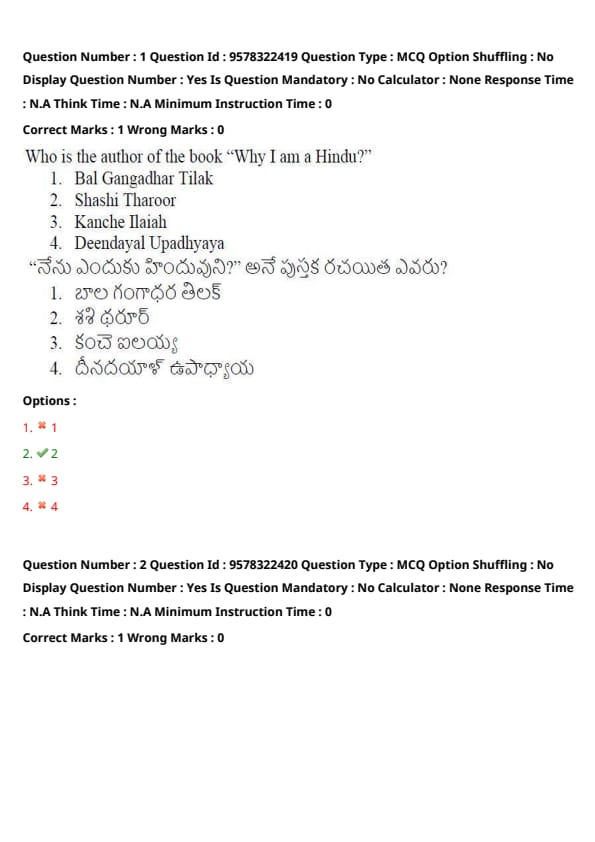
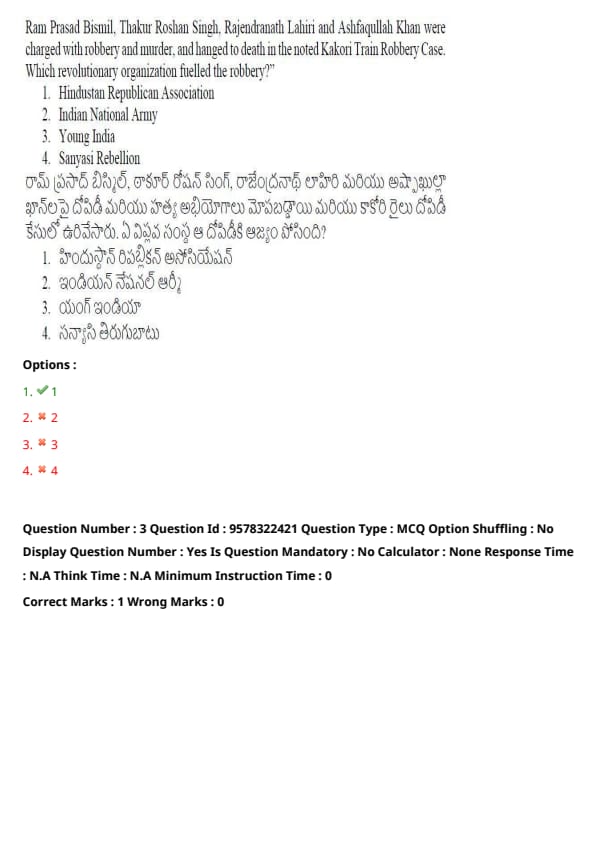
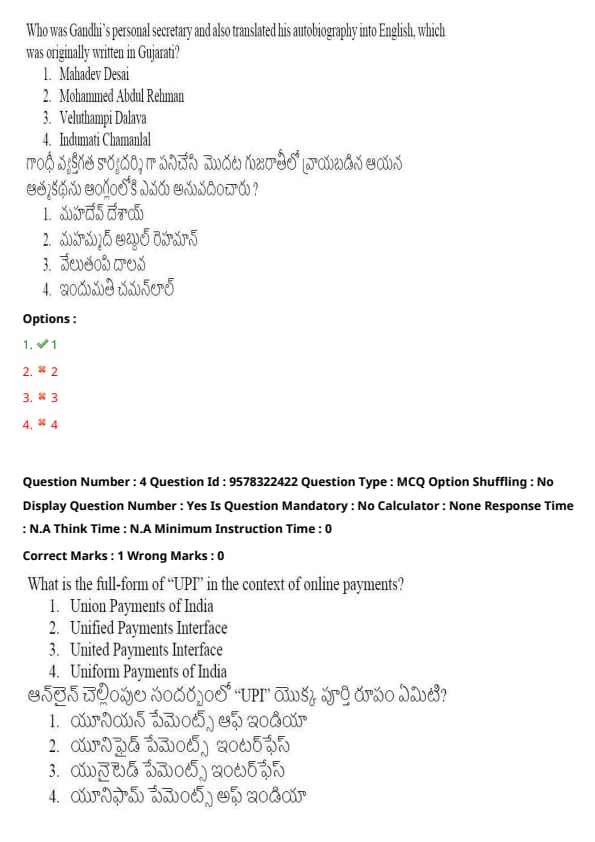

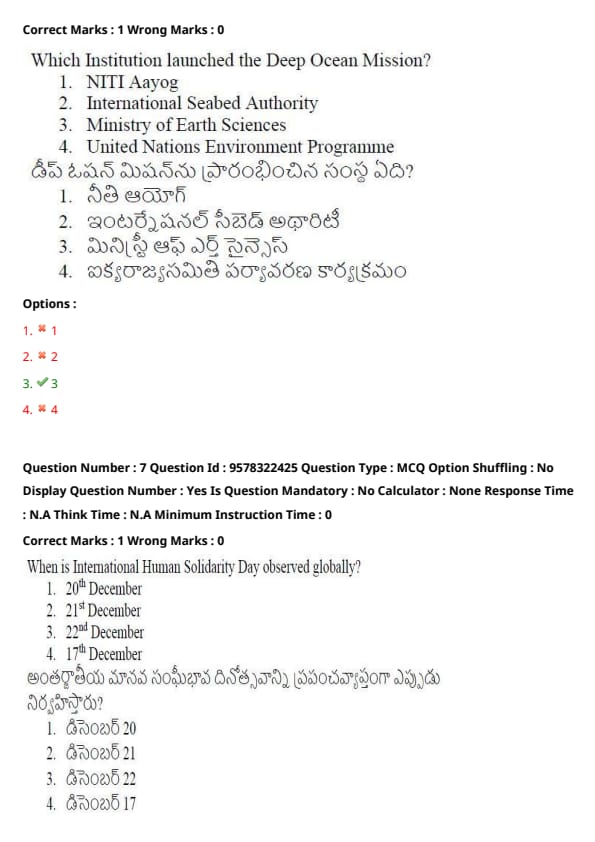
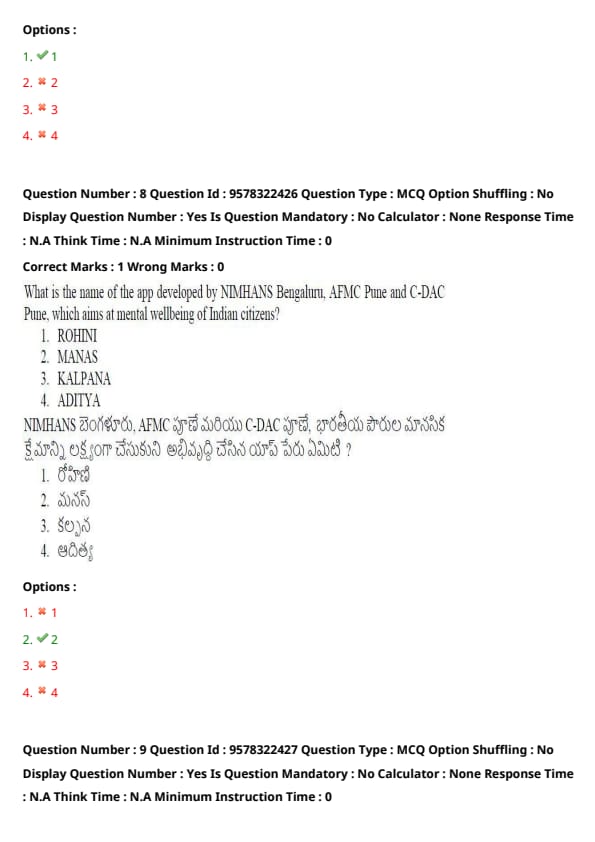
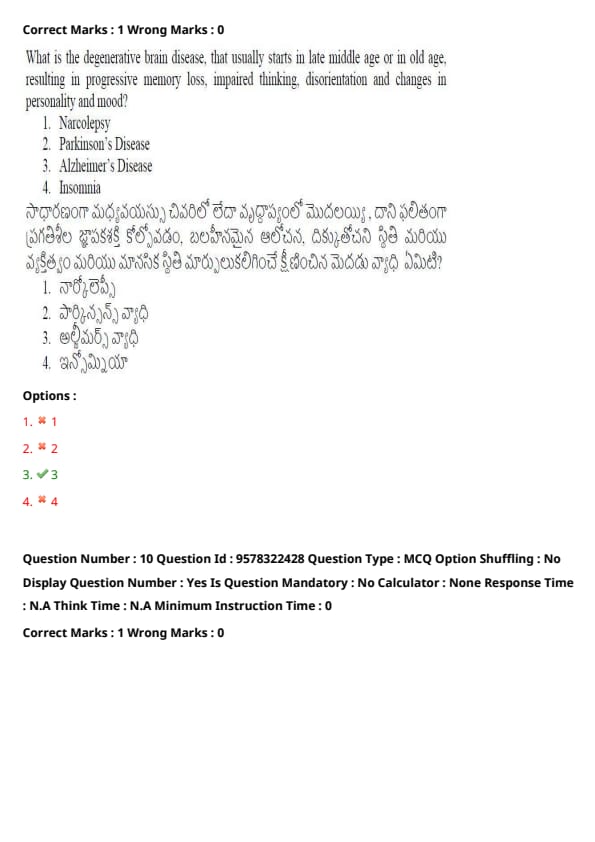
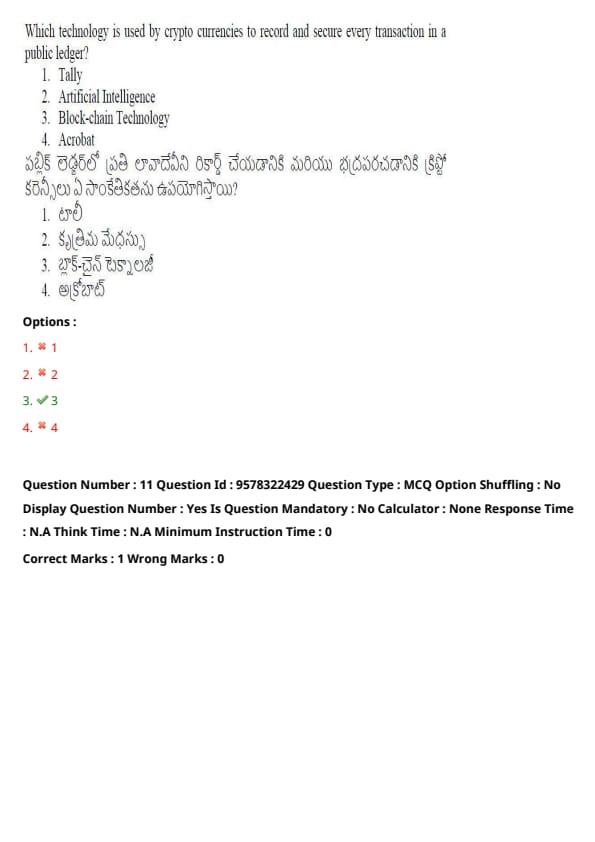
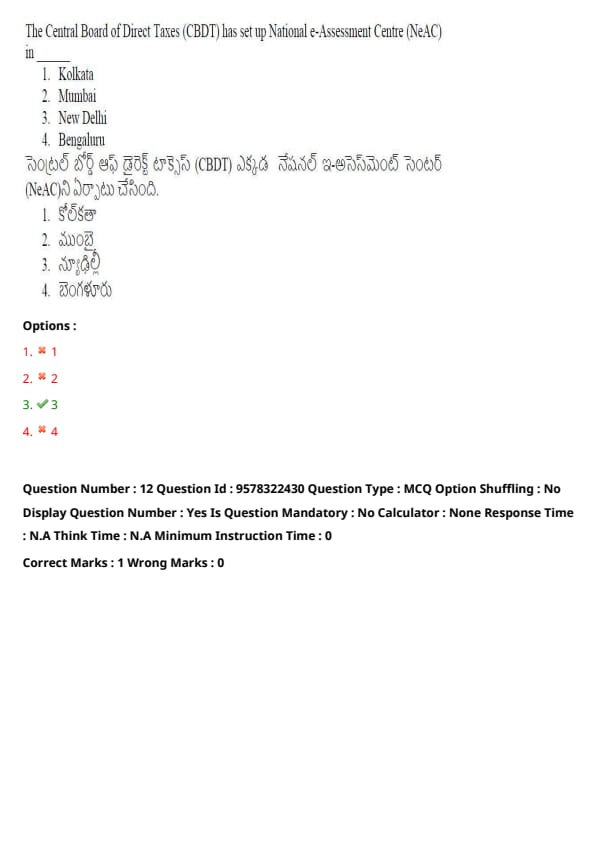
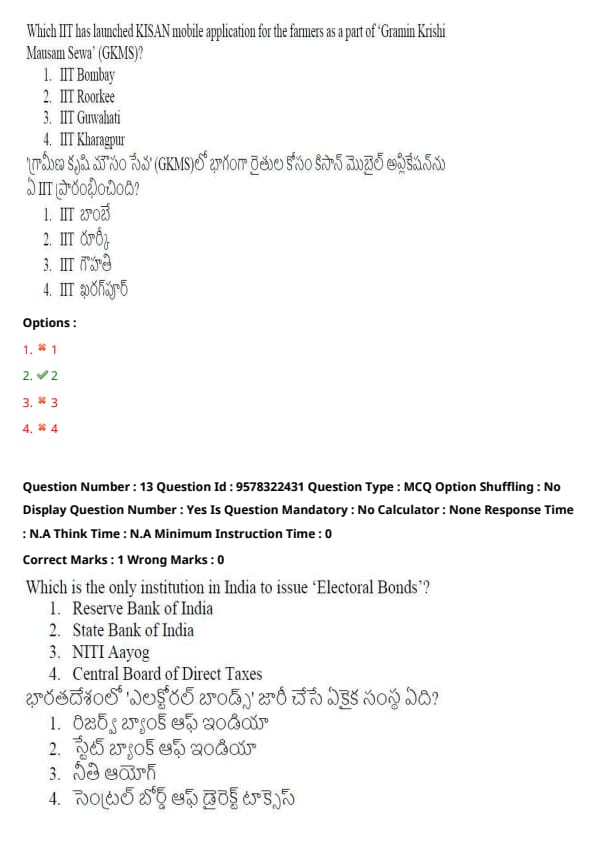
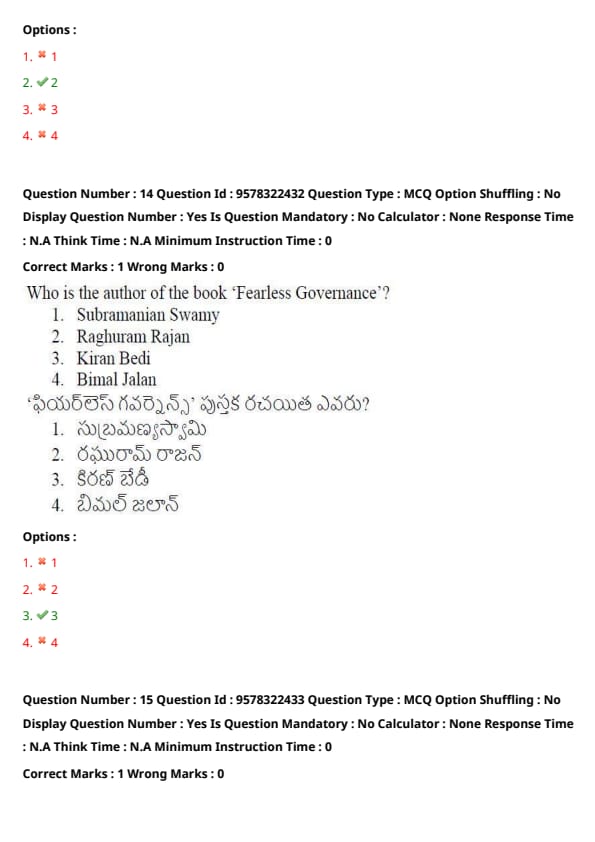
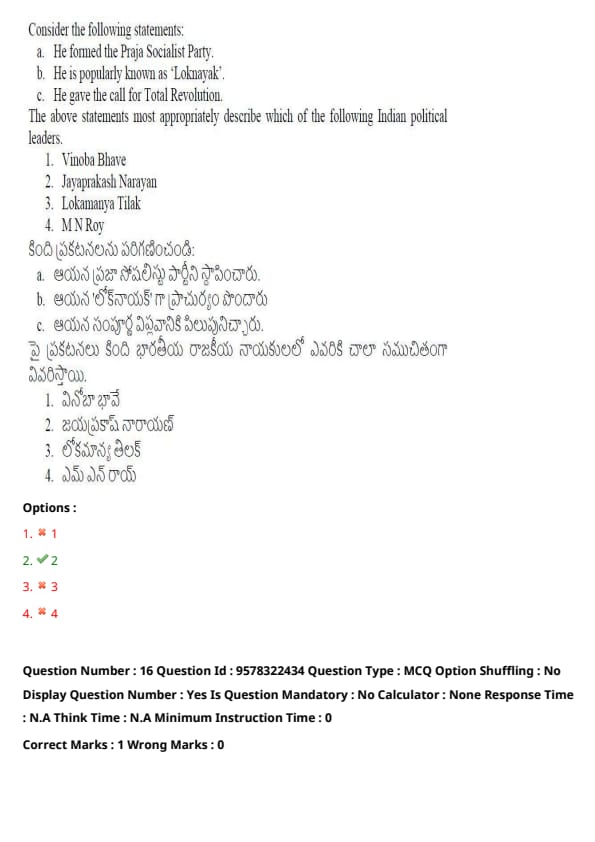
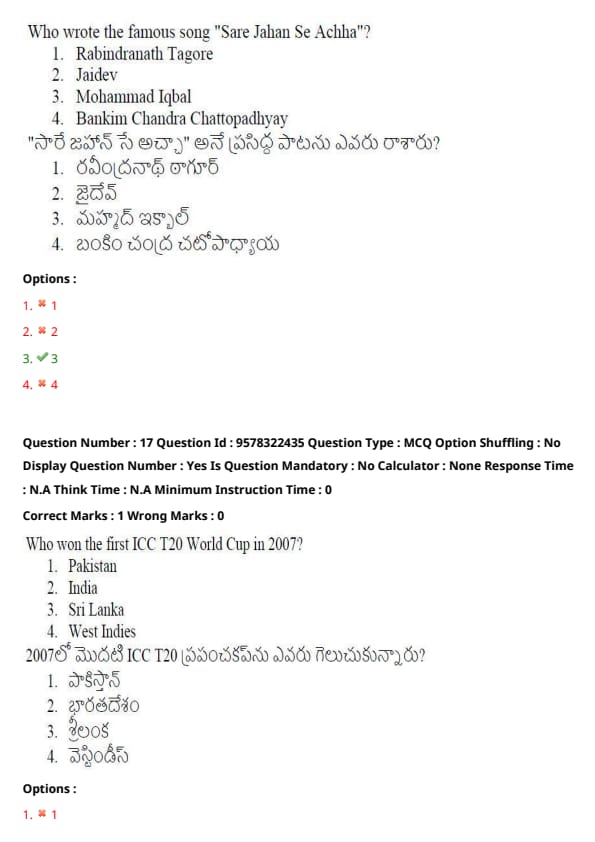
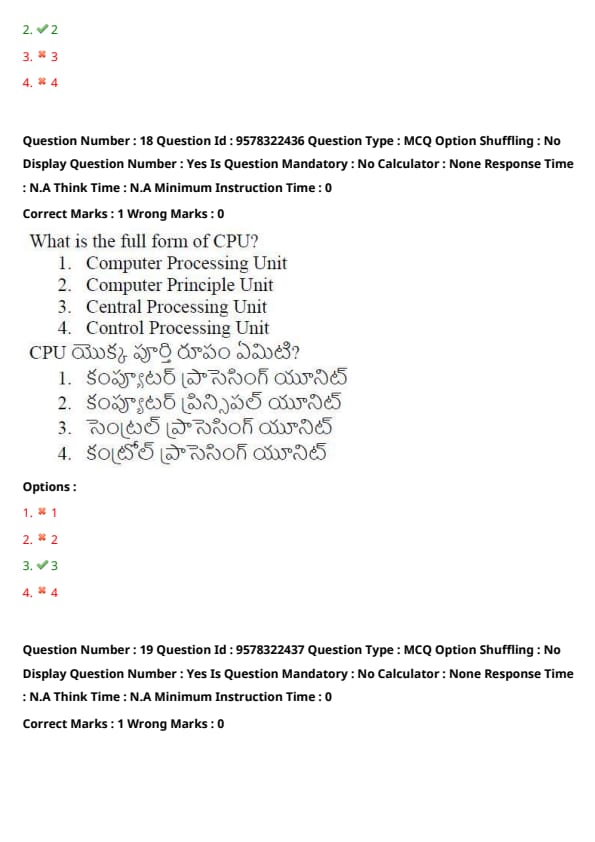
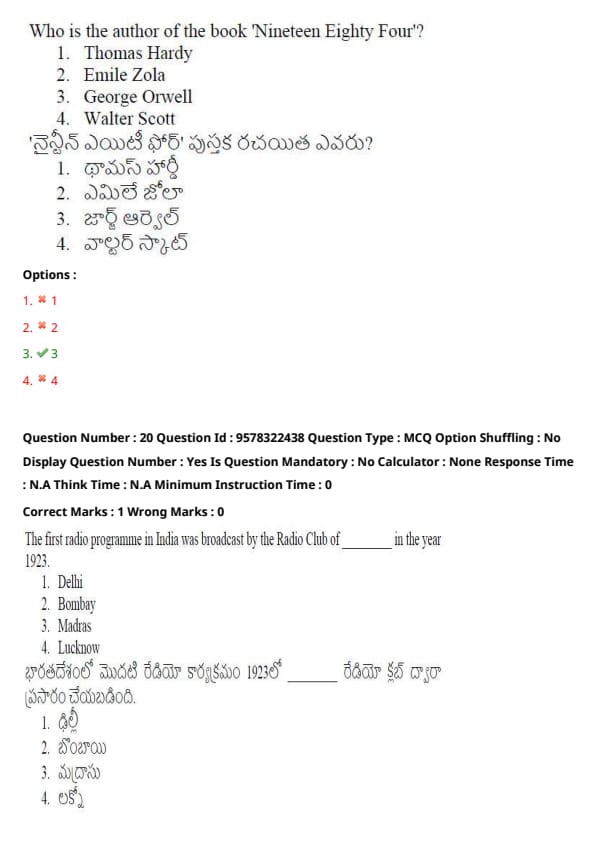
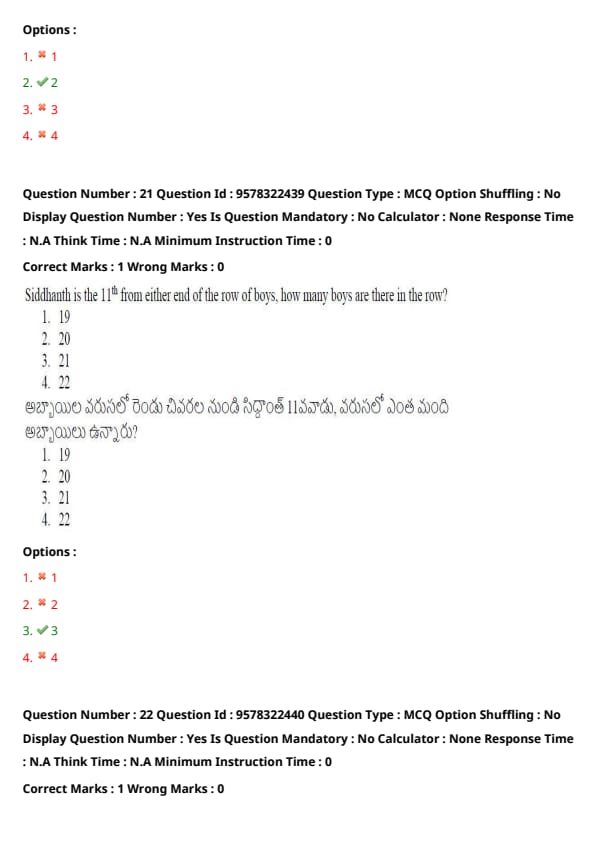
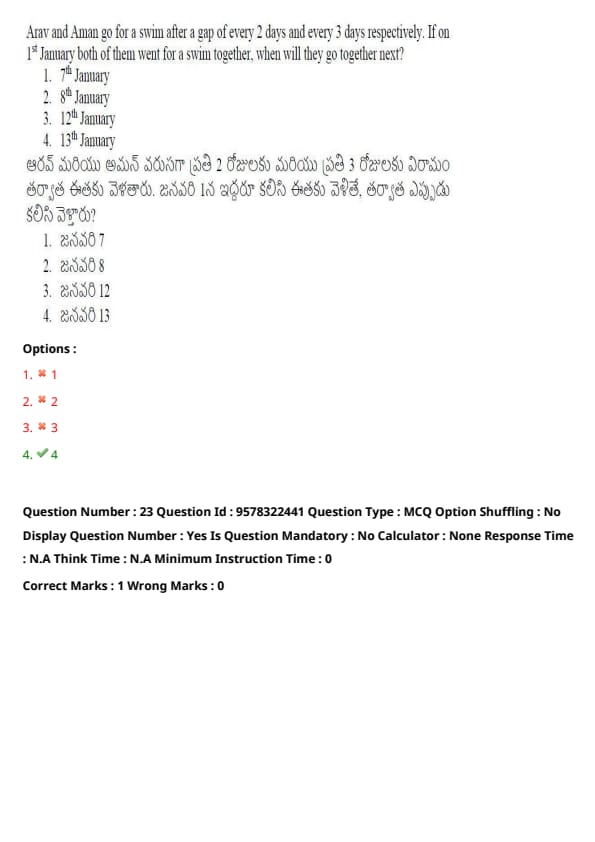
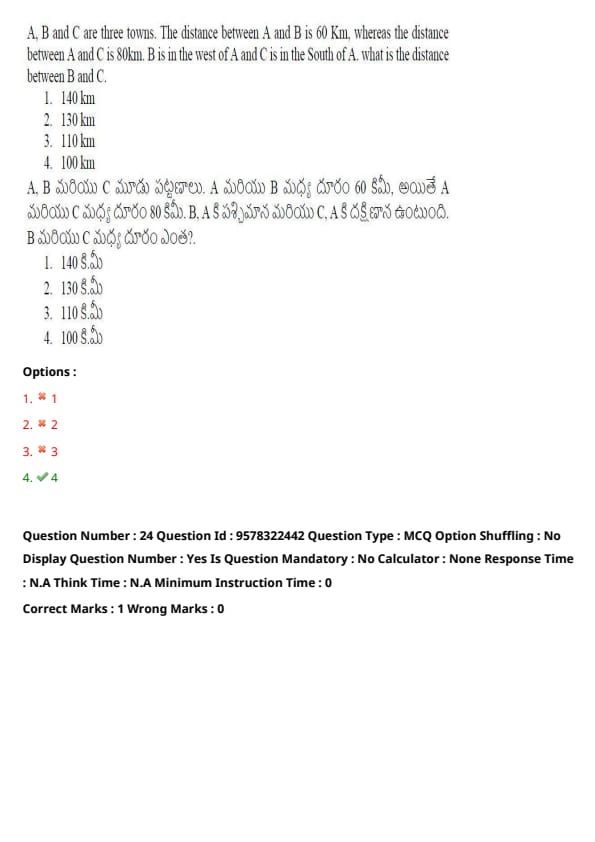
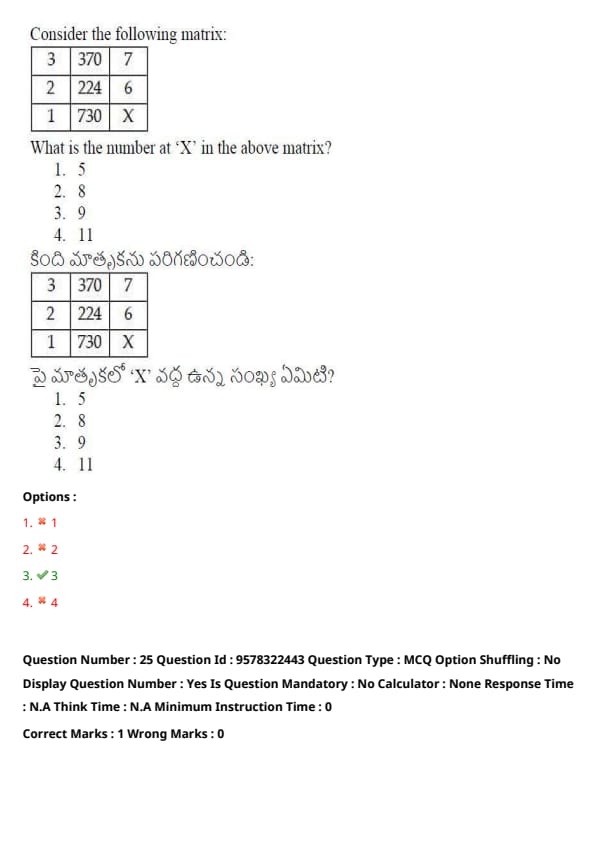
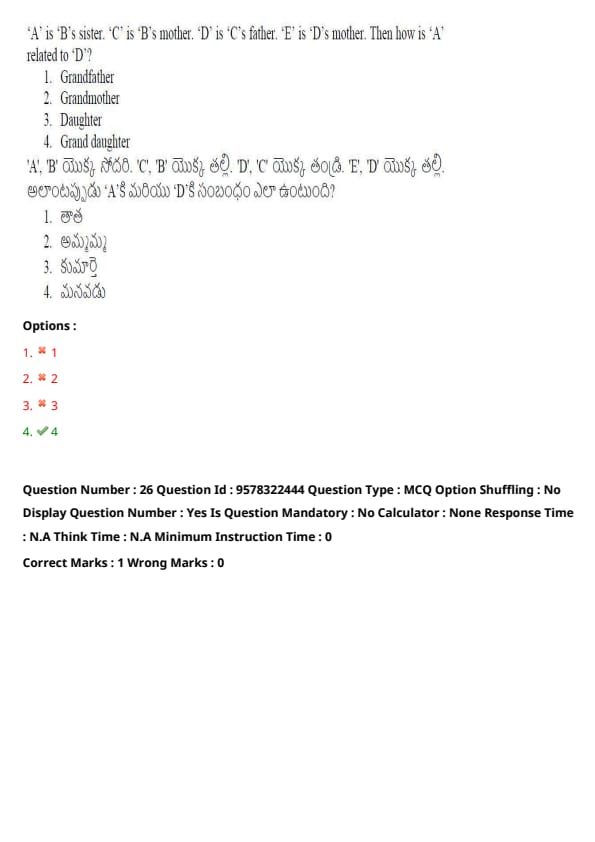
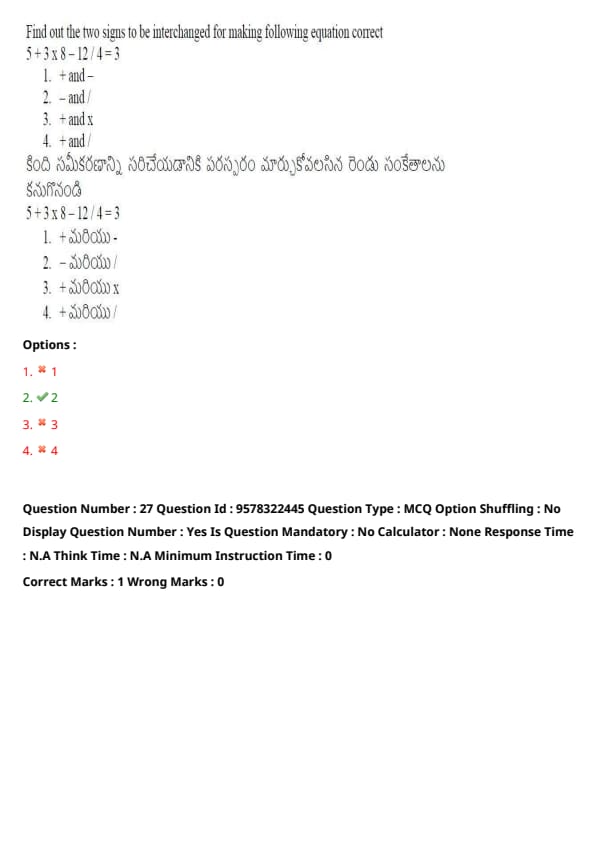
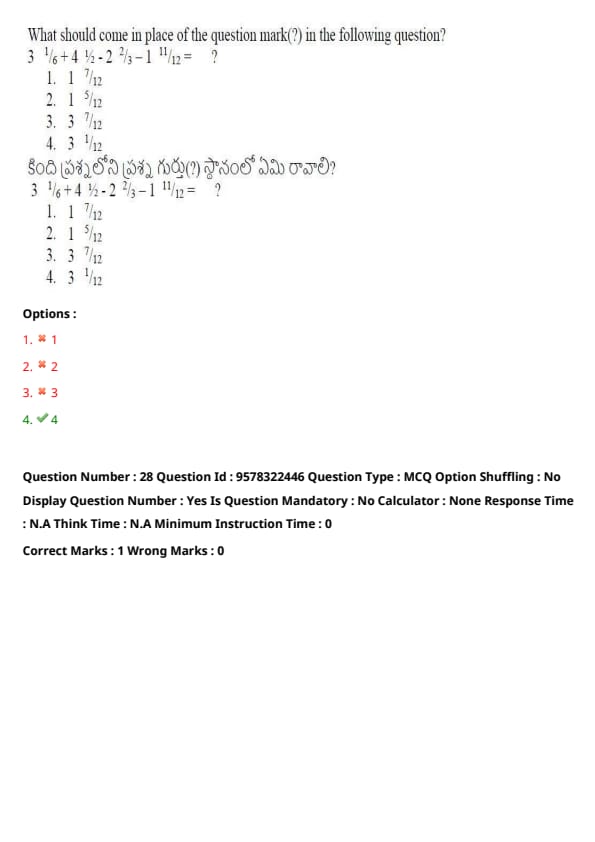
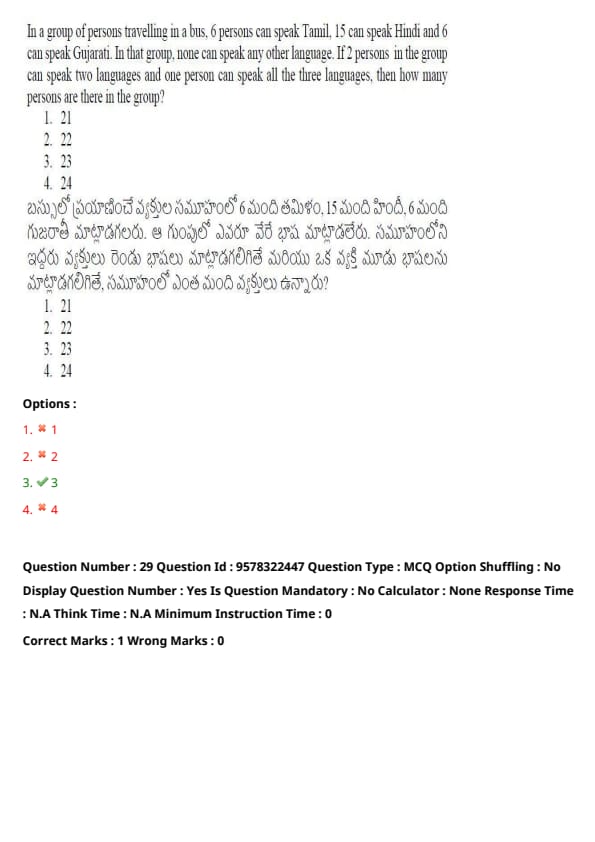
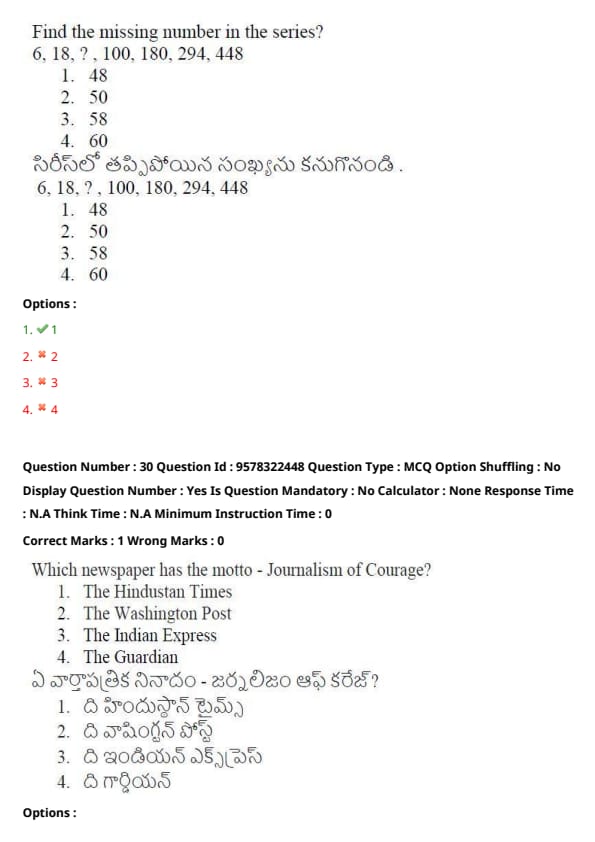

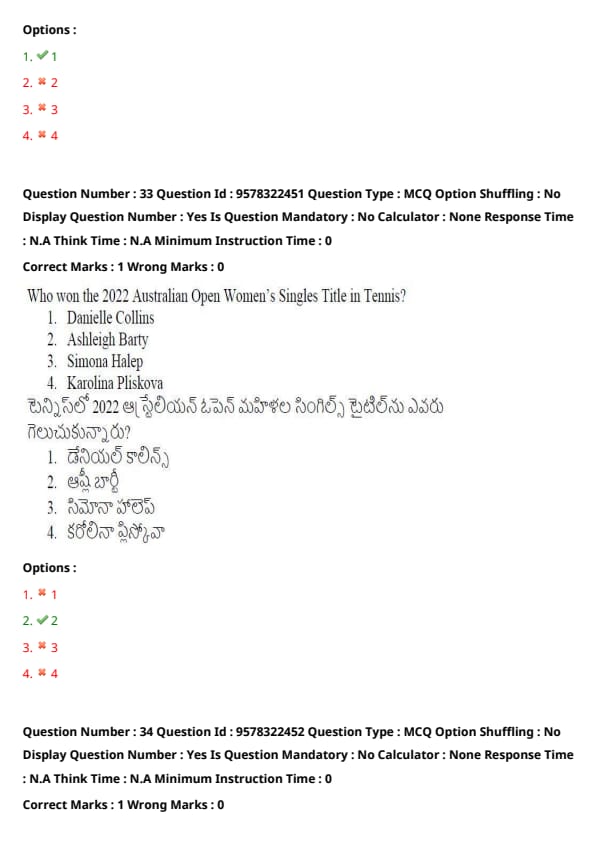

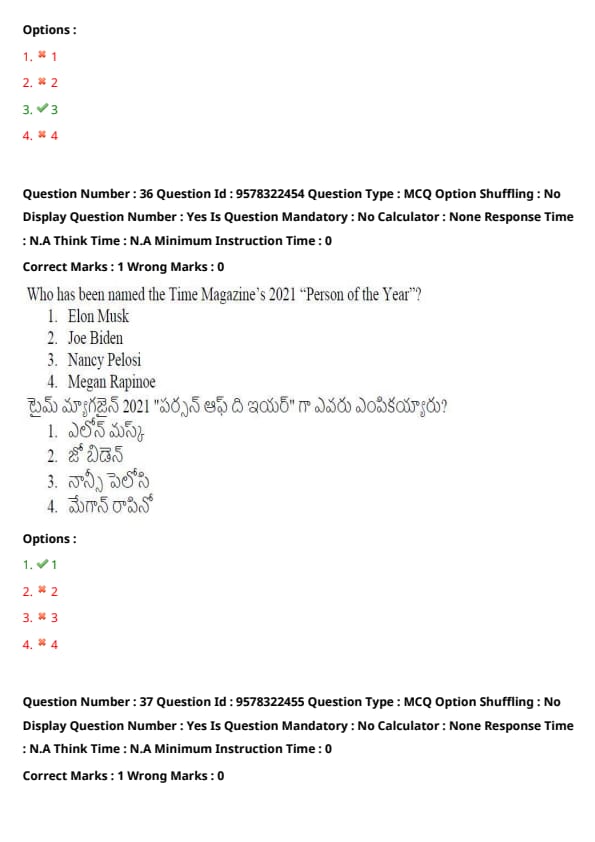
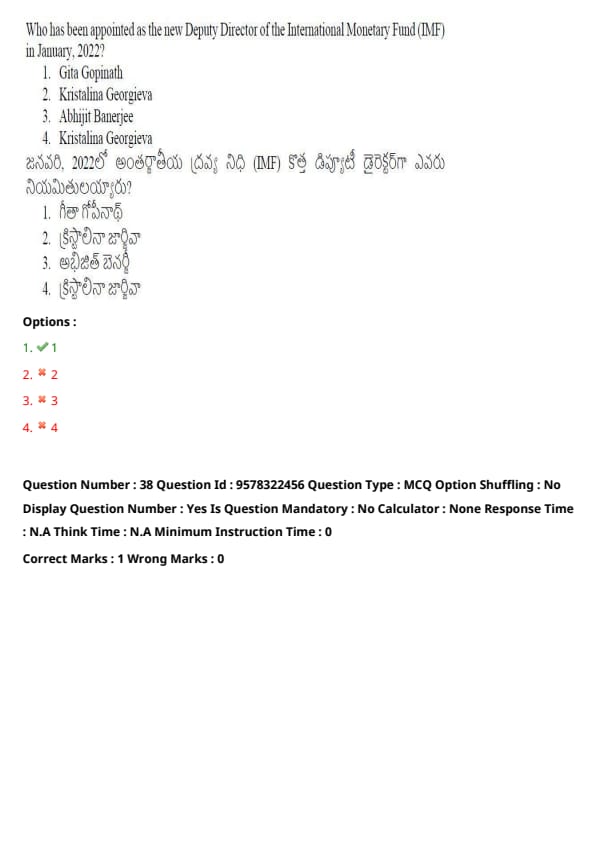
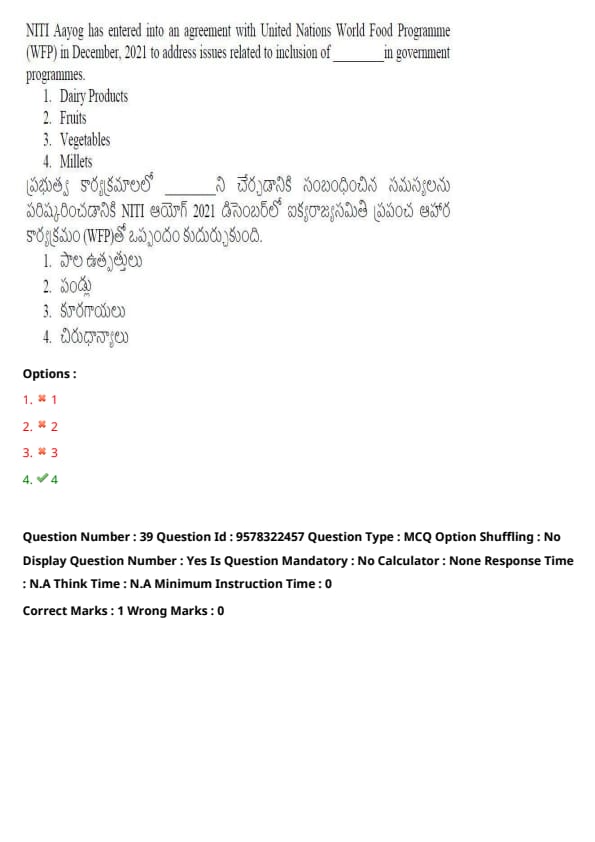
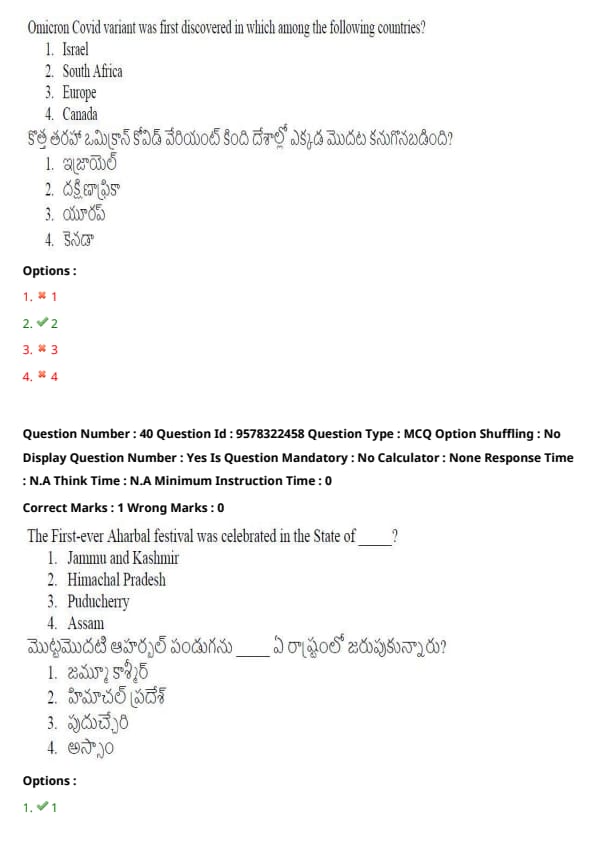


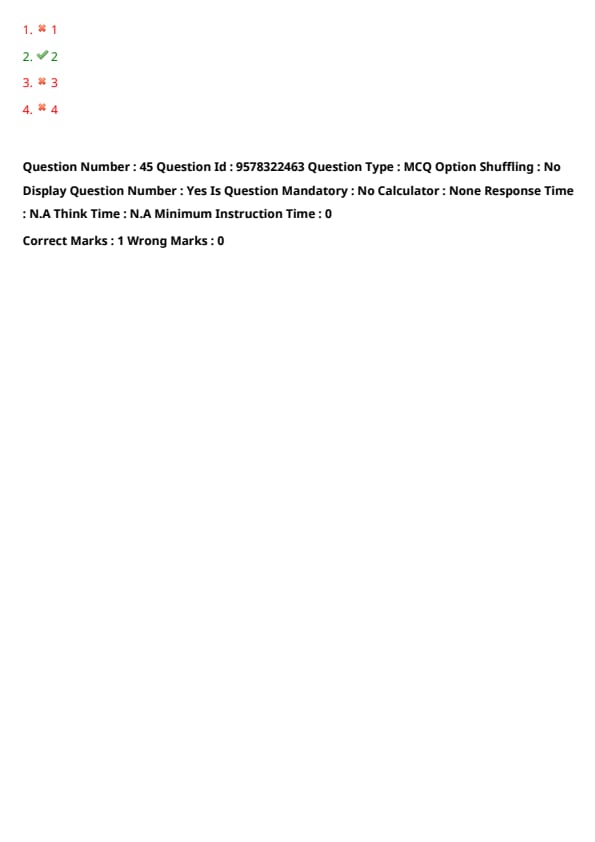
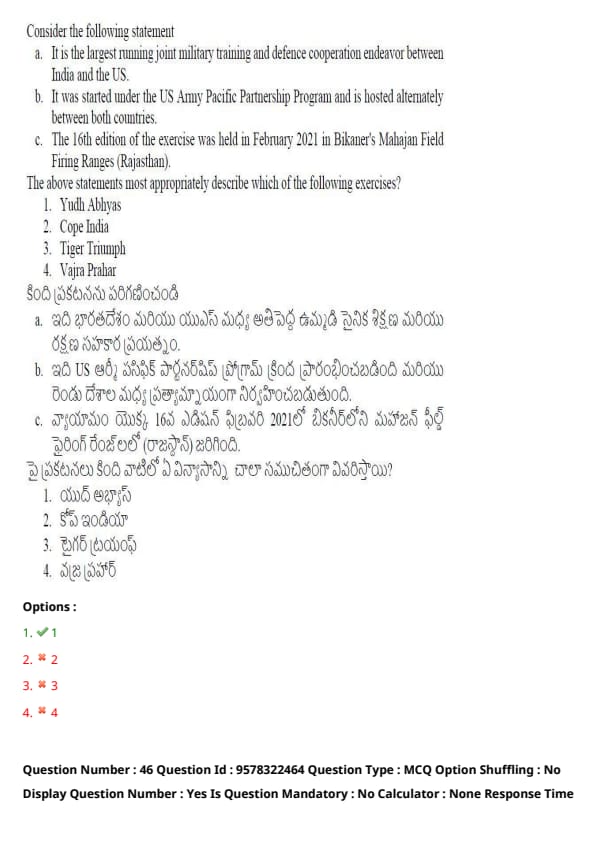






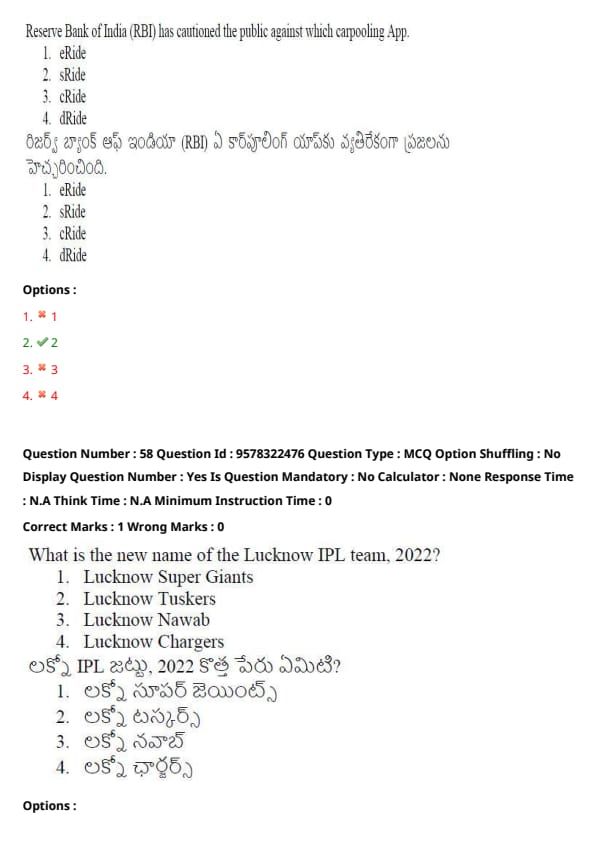

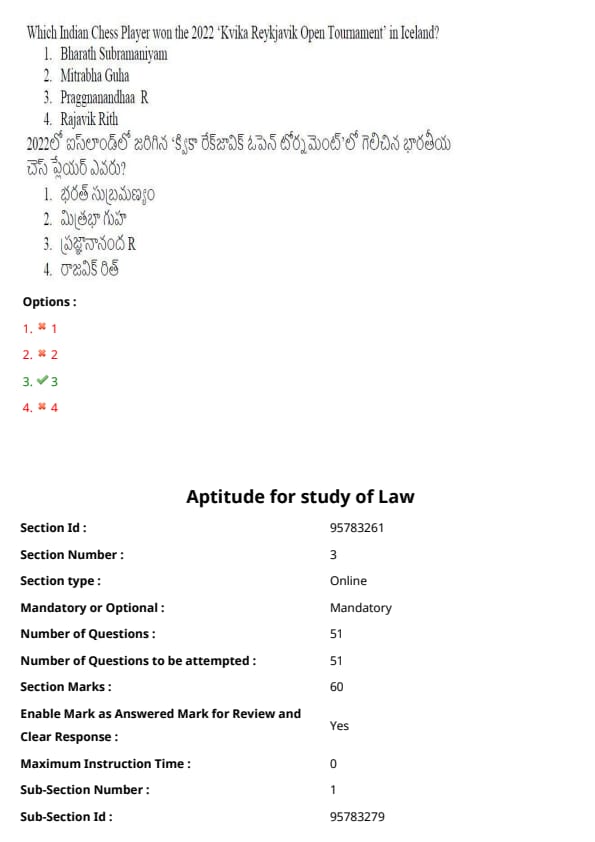


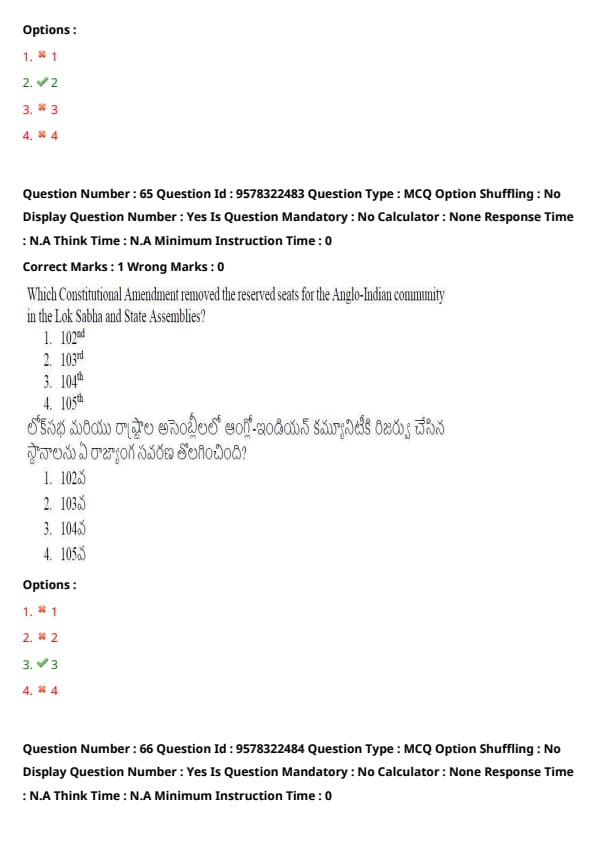
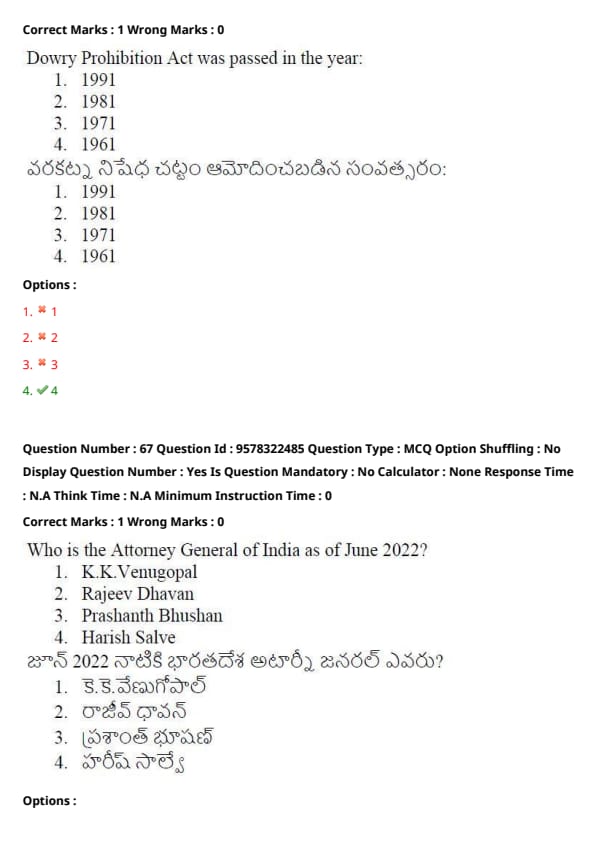
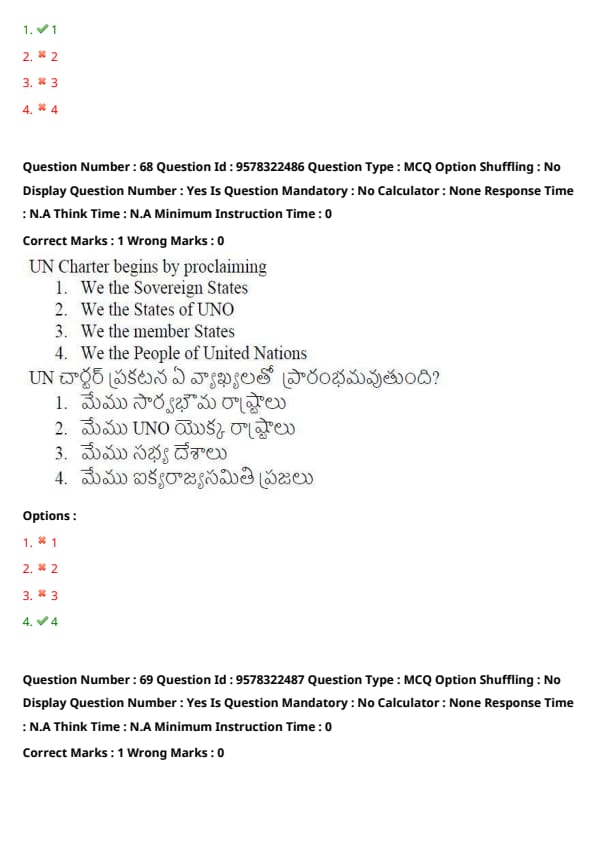
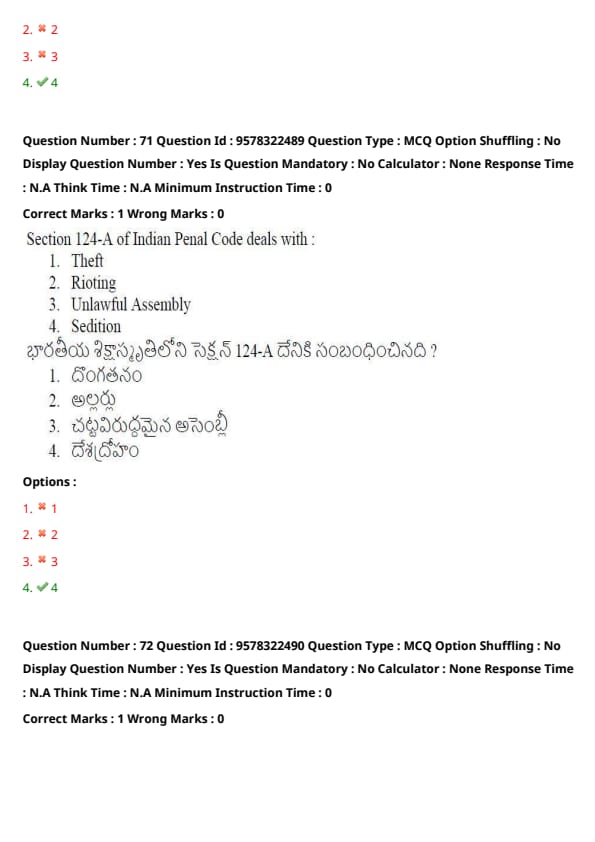


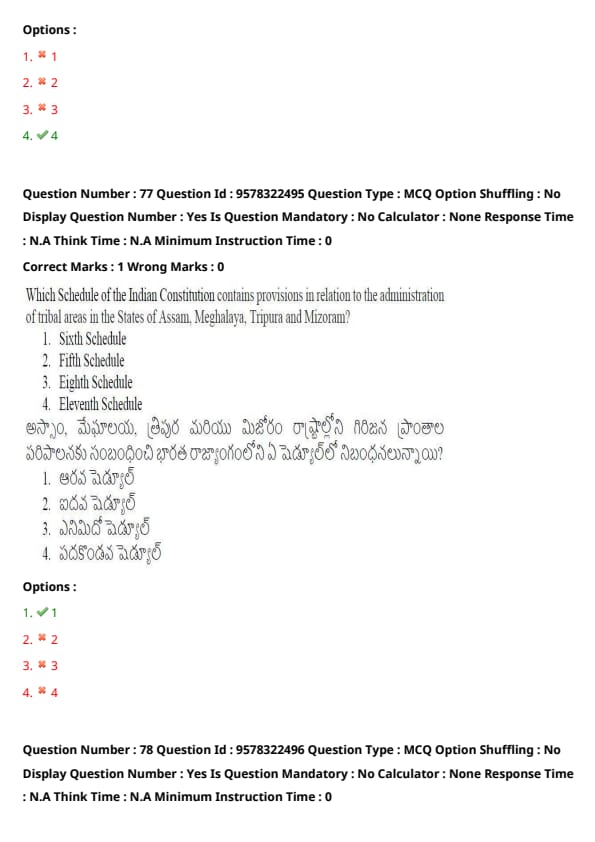
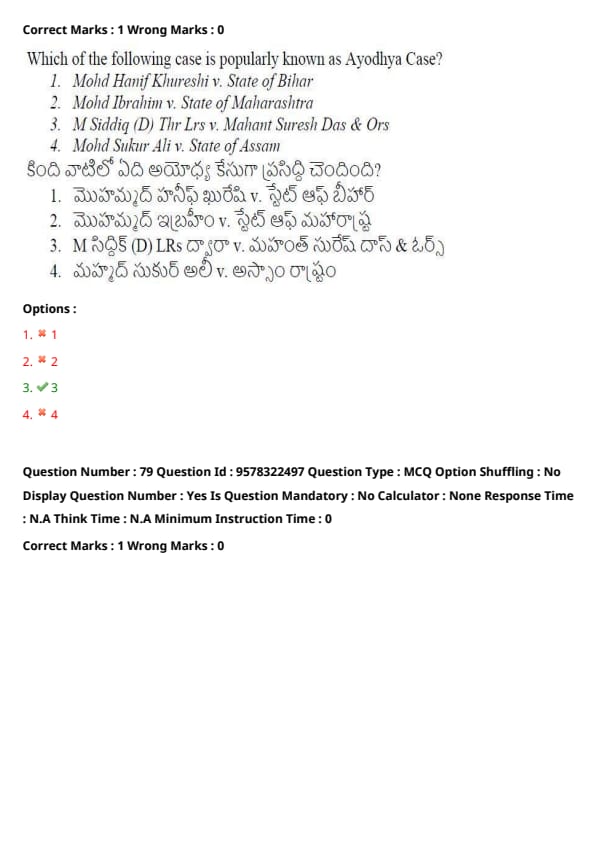


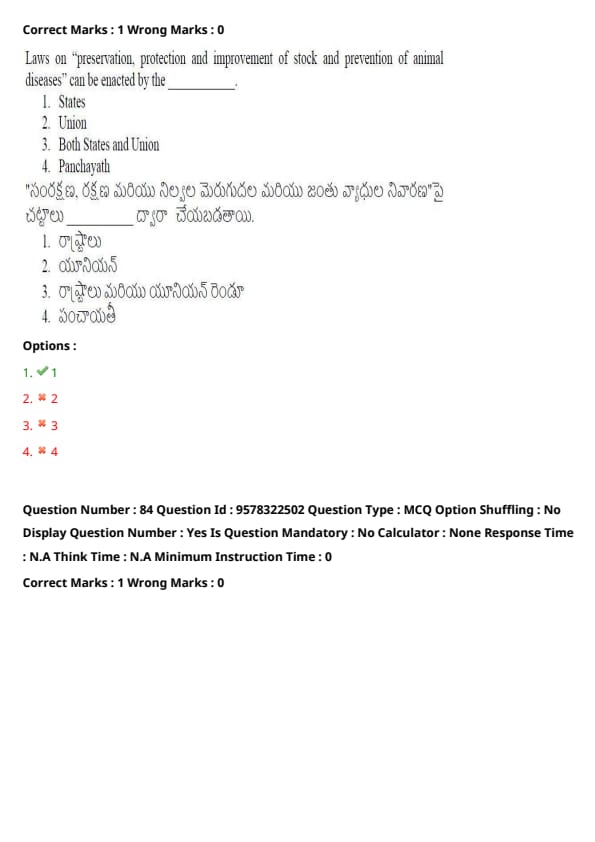
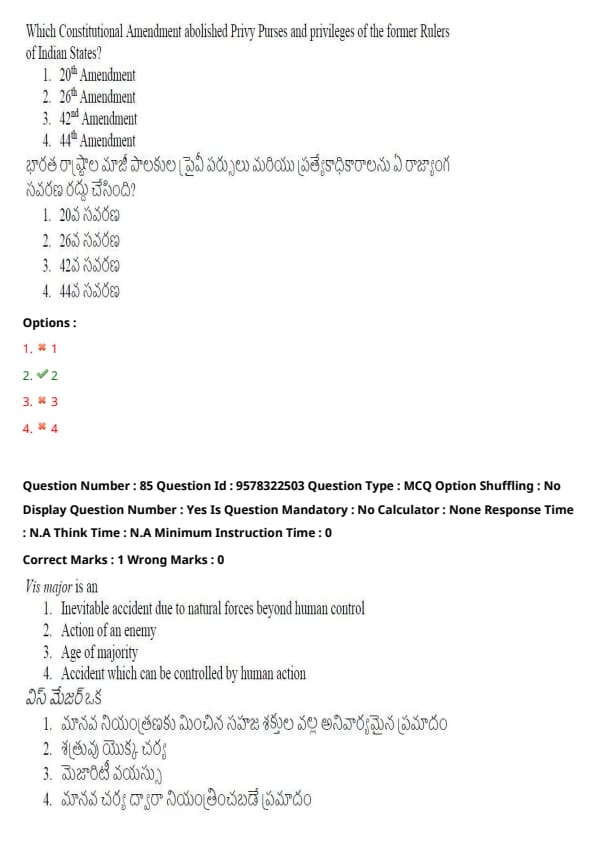

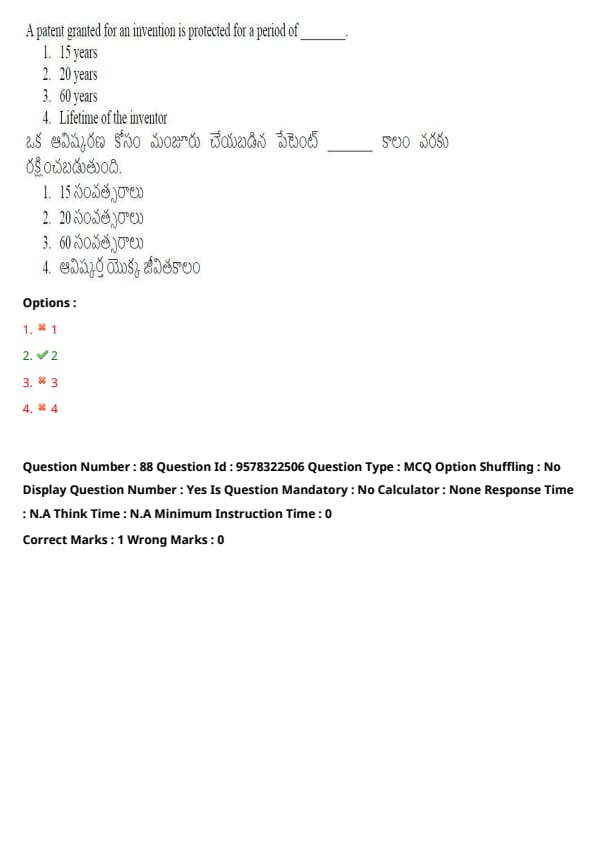


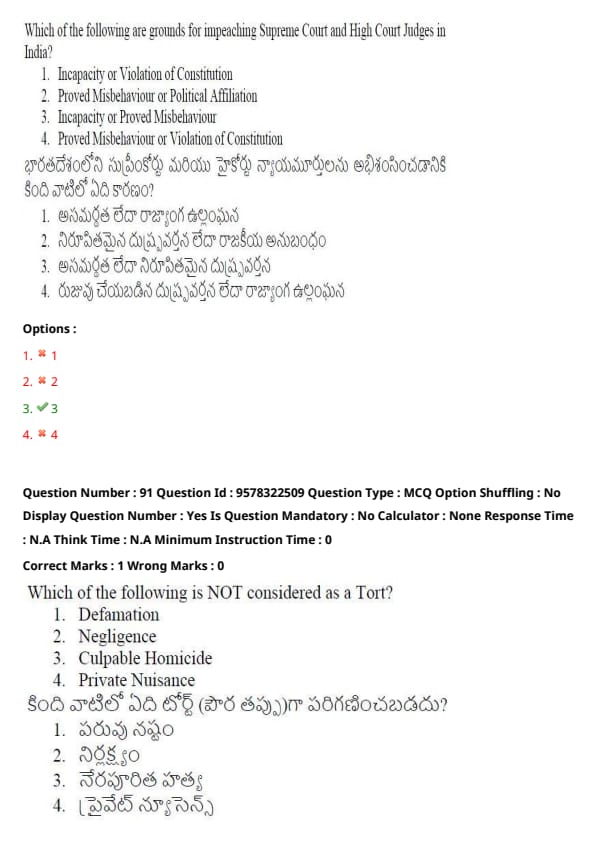

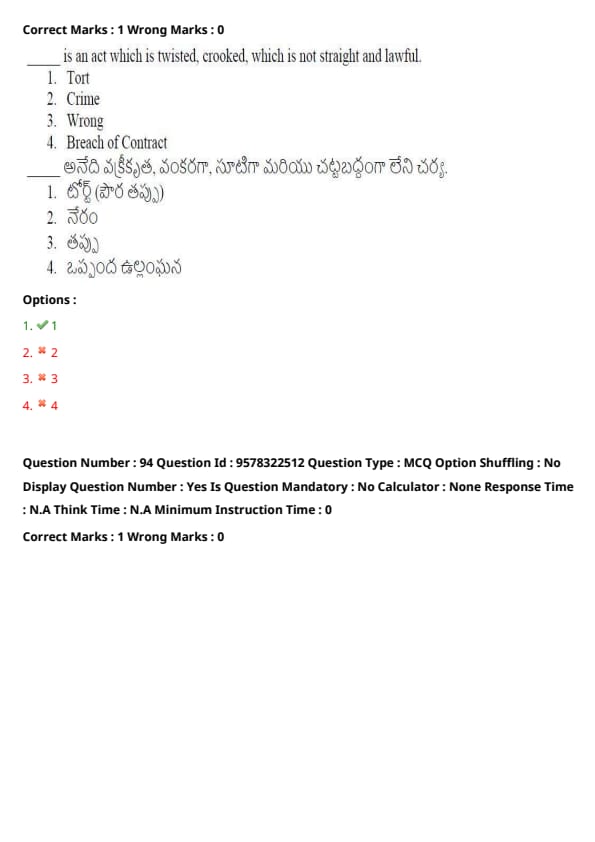


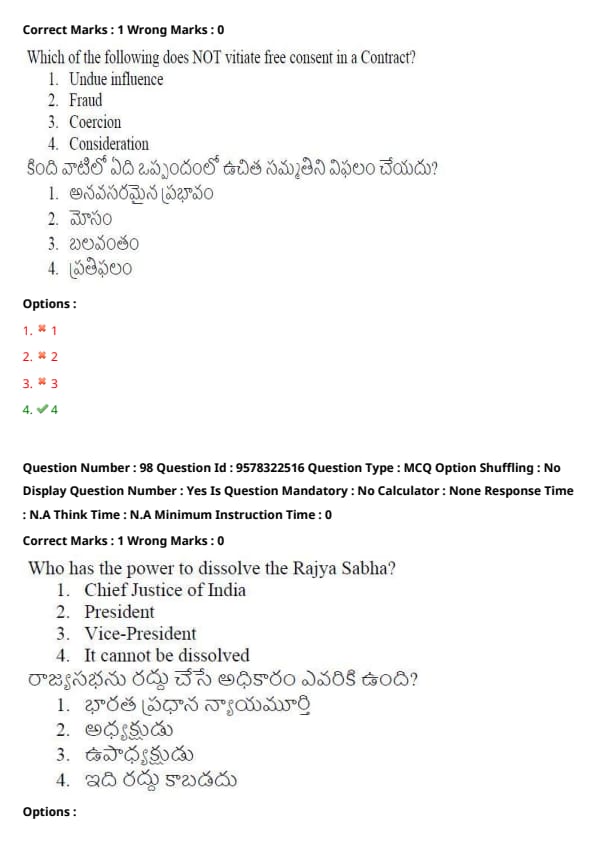


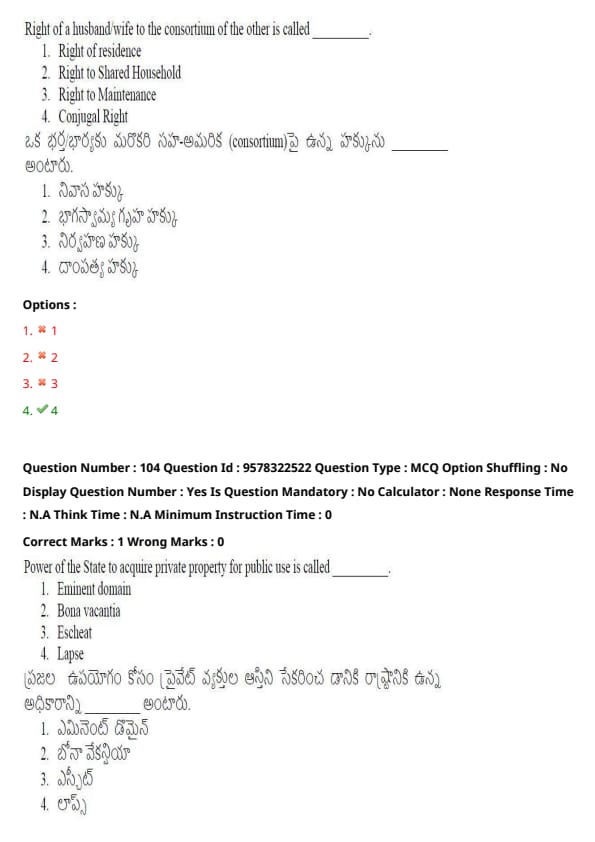


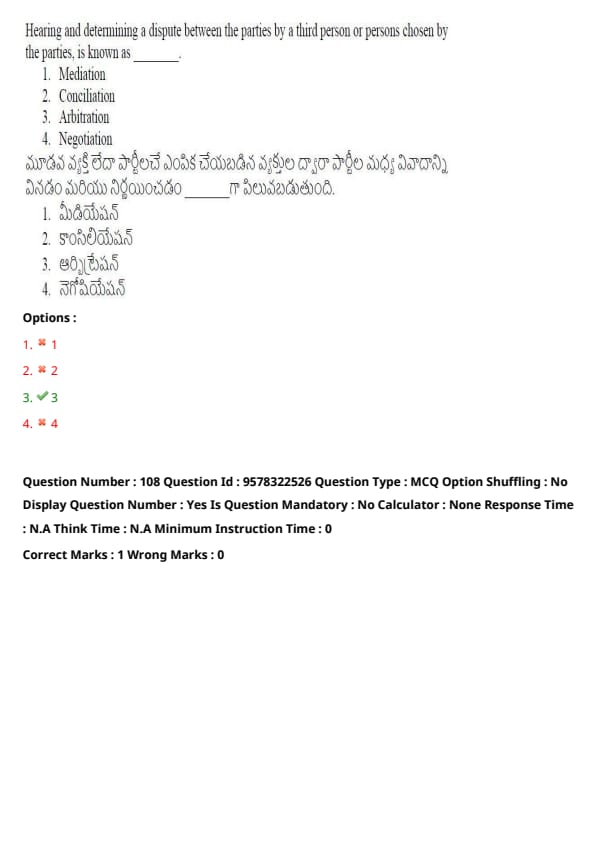


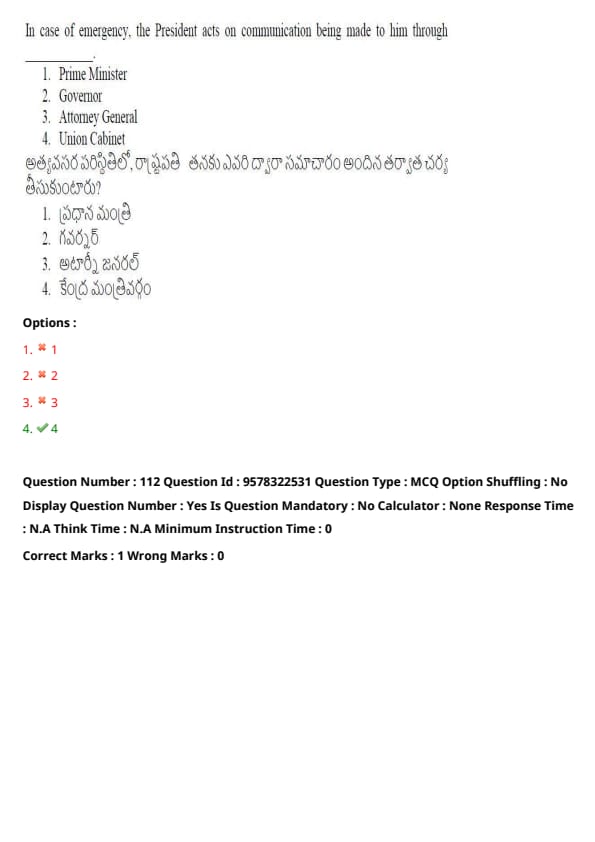


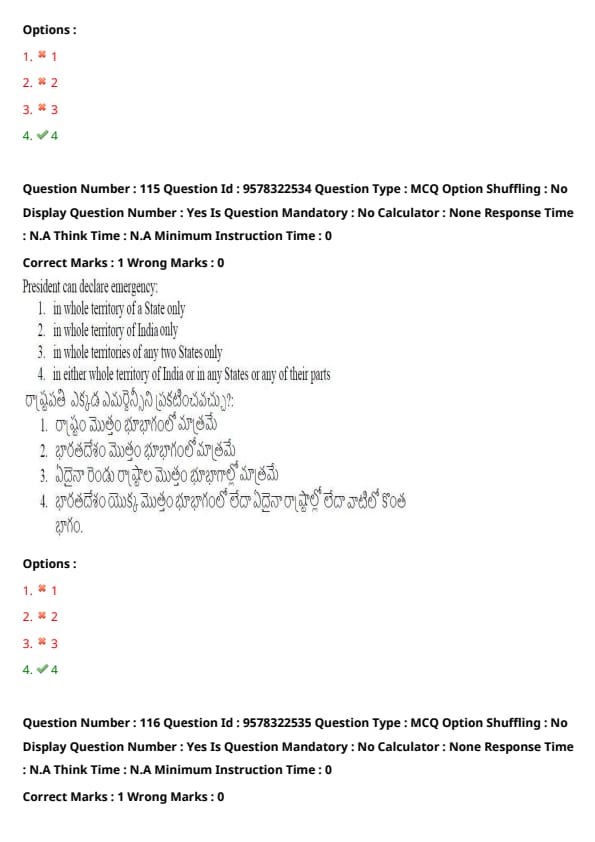
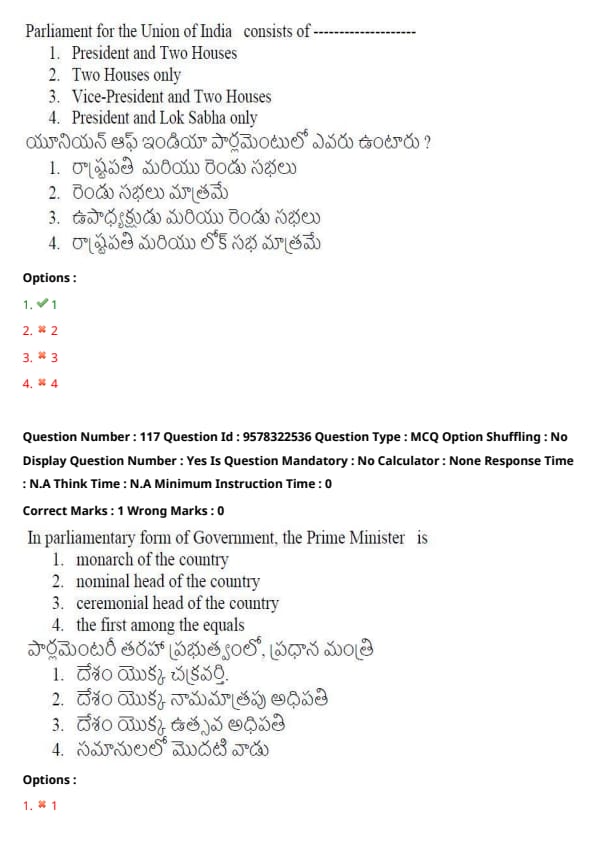
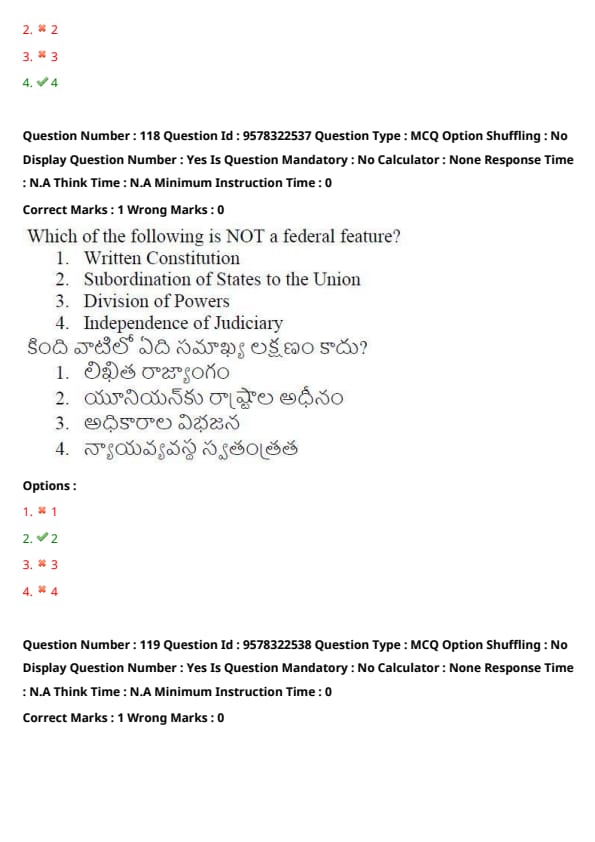
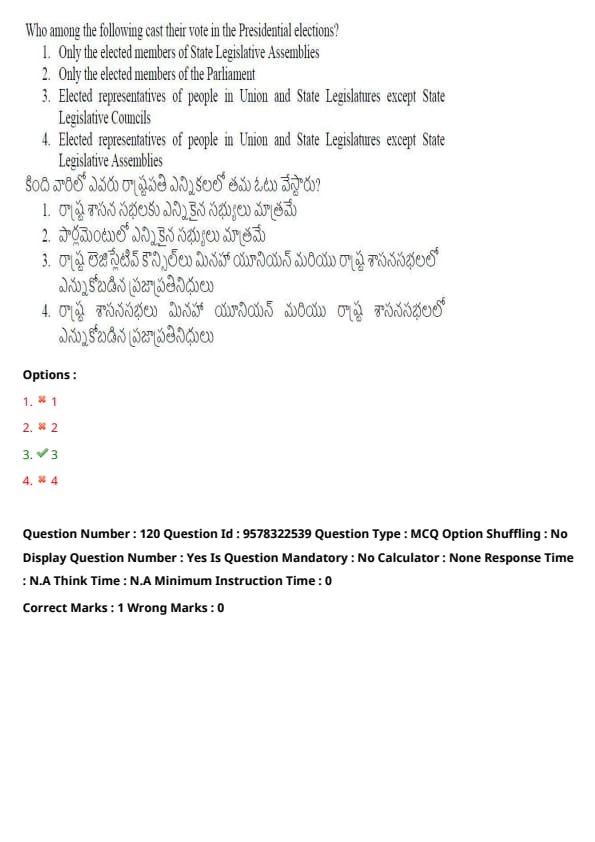
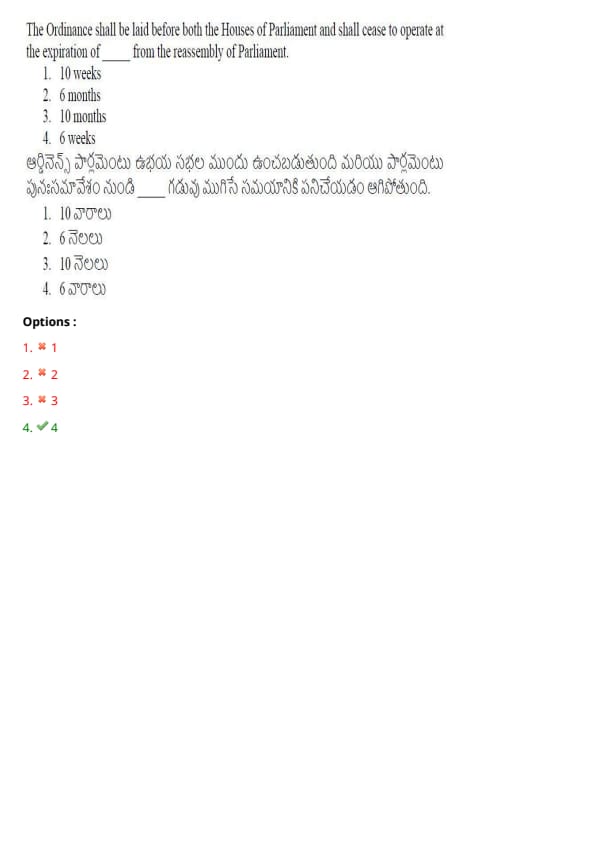
*The article might have information for the previous academic years, please refer the official website of the exam.