
TS LAWCET 2024 LLB 3 Years Question Paper Shift 1 with Solution PDF


Content Writer | Updated On - Jan 31, 2026
TS LAWCET 2025 LLB 3 Years Question Paper for June 3 Shift 1 is available here for download. TS LAWCET 2025 LLB 3 Years Question Paper consists of 120 questions carrying 1 mark each.TS LAWCET 2025 LLB 3 Years includes three subjects, General Knowledge and Mental Ability, Current Affairs and Aptitude for study of Law . The General Knowledge and Mental Ability and Current Affairs section of the paper includes 30 questions each while the Aptitude for study of Law section includes a total of 60 questions. Download TS LAWCET 2025 Question Paper June 6 Shift 1 with Solution PDF from link below.
TS LAWCET 2024 LLB 3 Years Question Paper for June 3 Shift 1
| TS LAWCET 2025 LLB 3 Years Question Paper for June 3 Shift 1 | Download PDF | Check Solutions |

Manikaran in Himachal Pradesh is known for:
View Solution
Step 1: Understanding the Concept:
Geothermal energy is the thermal energy generated and stored in the Earth's interior.
In certain geological regions, groundwater comes into contact with hot rocks and emerges as hot springs or steam.
This energy is sustainable and can be used for heating or electricity generation.
Step 2: Detailed Explanation:
Manikaran is located in the Parvati Valley on the banks of the Parvati River in the Kullu District of Himachal Pradesh.
It is famous for its natural hot springs, which are high in sulphur and reach temperatures near boiling point.
The heat originates from the radioactive decay of minerals and the volcanic activity deep within the crust in the Himalayan geothermal belt.
The Geological Survey of India (GSI) has identified Manikaran as a potential site for a geothermal power plant.
Apart from energy potential, these springs are culturally significant for both Hindus and Sikhs, and the heat is used to cook community meals (Langar).
Step 3: Final Answer:
Manikaran is associated with Geothermal Energy due to its abundant hot springs.
Quick Tip: Other prominent geothermal sites in India include Puga Valley in Ladakh and Tattapani in Chhattisgarh. Always remember that areas near tectonic plate boundaries or young fold mountains (like the Himalayas) are hotspots for geothermal energy.
Which one of the following is not covered under GST in India?
View Solution
Step 1: Understanding the Concept:
The Goods and Services Tax (GST) is a comprehensive indirect tax implemented in India on July 1, 2017.
It replaced multiple central and state taxes to create a unified market.
However, certain strategic goods were kept out of the GST net to allow states to retain their revenue-collecting powers.
Step 2: Detailed Explanation:
According to Article 279A of the Indian Constitution, five petroleum products are currently excluded from GST:
1. Crude oil
2. High-speed diesel
3. Petrol (Motor Spirit)
4. Natural gas
5. Aviation turbine fuel
These items are still subject to Central Excise Duty and State Value Added Tax (VAT).
Other items like Cosmetics (standard GST rates), Medical Grade Oxygen (12% GST, though varied during COVID-19), and Jewellery (3% GST) are well within the GST framework.
Alcohol for human consumption is also constitutionally excluded from GST.
Step 3: Final Answer:
Among the given choices, Petrol is the item not covered under the current GST regime.
Quick Tip: The GST Council has the power to recommend the date on which GST shall be levied on petroleum products, but as of now, they remain under the old tax regime to ensure revenue flexibility for the State Governments.
Which one of the following methods is followed in electing the President of India?
View Solution
Step 1: Understanding the Concept:
The President of India is the head of the state but not the executive head (who is the PM).
The election is indirect, meaning the citizens do not vote directly; instead, their elected representatives (MPs and MLAs) vote.
Step 2: Detailed Explanation:
Article 55 of the Constitution mandates that the election be held in accordance with the system of Proportional Representation by means of the Single Transferable Vote (STV).
1. Proportional Representation: This ensures that the value of votes of all states is proportionate to their population, and there is parity between the Union and the States.
2. Single Transferable Vote: This means a voter doesn't just vote for one candidate but ranks candidates in order of preference (1st, 2nd, 3rd...).
If no candidate gets the required quota (50% + 1) in the first count, the candidate with the least votes is eliminated, and their votes are transferred to the next preferred candidate until a winner is found.
3. Secret Ballot: This ensures the privacy of the vote.
Step 3: Final Answer:
The correct method is Proportional Representation and Single Transferable Vote System.
Quick Tip: The "First-Past-the-Post" (FPTP) system is used for Lok Sabha and State Assembly elections where the candidate with the highest number of votes wins, regardless of whether they cross the 50% mark.
Match the following pairs of vaccine and category/type:
a) Covaxin: Inactivated pathogen-based vaccine.
b) Covishield: mRNA Vaccine.
c) Sputnik V: Viral vector-based vaccine.
View Solution
Step 1: Understanding the Concept:
Vaccines work by training the immune system. Different technologies include using dead viruses (Inactivated), using a different harmless virus to carry genetic material (Viral Vector), or using genetic code (mRNA).
Step 2: Detailed Explanation:
1. Covaxin (Pair 'a'): Developed by Bharat Biotech in collaboration with ICMR. It is an inactivated vaccine, meaning it uses dead SARS-CoV-2 viruses to trigger an immune response. This pair is Correct.
2. Covishield (Pair 'b'): Developed by Oxford-AstraZeneca and manufactured by the Serum Institute of India. It is a Viral Vector vaccine (using a weakened chimpanzee adenovirus), not an mRNA vaccine. This pair is Incorrect.
3. Sputnik V (Pair 'c'): Developed by Russia's Gamaleya Institute. It uses two different human adenoviruses as vectors to deliver the genetic material of the spike protein. This pair is Correct.
Note: Pfizer and Moderna are the primary examples of mRNA vaccines.
Step 3: Final Answer:
Only pairs 'a' and 'c' are correctly matched.
Quick Tip: Always remember: Covaxin = Traditional (Dead virus), Covishield/Sputnik = Modern Carrier (Viral Vector), Pfizer/Moderna = Advanced Code (mRNA).
\textunderscore\textunderscore\textunderscore\textunderscore\textunderscore\textunderscore\textunderscore\textunderscore\textunderscore female-looking spacefaring humanoid robot being developed by the Indian Space Research Organisation to function on-board the Gaganyaan.
View Solution
Step 1: Understanding the Concept:
Gaganyaan is India's ambitious Human Spaceflight Programme.
To ensure the safety of astronauts, ISRO decided to fly a humanoid robot in the unmanned test flights to simulate human biological functions and test life-support systems.
Step 2: Detailed Explanation:
The robot is named Vyommitra.
The name comes from the Sanskrit words 'Vyoma' (Space) and 'Mitra' (Friend).
It is a "half-humanoid" because it consists of only the upper body (head, torso, and arms) without legs.
Its capabilities include:
- Speaking in two languages (Hindi and English).
- Operating switch panels and performing environmental control tasks.
- Recognizing and interacting with human astronauts.
- Monitoring system parameters to provide feedback to ground control.
Step 3: Final Answer:
The humanoid robot is Vyommitra.
Quick Tip: Vyommitra is designed to mimic human activity and withstand the vibrations and atmospheric changes during a space mission, acting as a "test subject" before the actual human crew.
National Disaster Management Authority is headed by \textunderscore\textunderscore\textunderscore\textunderscore\textunderscore\textunderscore\textunderscore\textunderscore\textunderscore.
View Solution
Step 1: Understanding the Concept:
The National Disaster Management Authority (NDMA) is the apex statutory body for disaster management in India.
It was established under the Disaster Management Act of 2005.
Step 2: Detailed Explanation:
The NDMA is chaired by the Prime Minister of India ex-officio.
It consists of a Vice-Chairperson (of Cabinet rank) and other members (of Minister of State rank).
Its primary mandate is to:
- Lay down policies and plans for disaster management.
- Approve National Plans for disaster mitigation.
- Coordinate the enforcement and implementation of policies.
- Provide support to other countries affected by major disasters if determined by the Central Government.
Step 3: Final Answer:
The Prime Minister heads the NDMA.
Quick Tip: While the PM heads the NDMA, the Minister of Home Affairs heads the NEC (National Executive Committee), which handles the day-to-day administration of disaster relief operations.
Who founded the Central Hindu School at Banaras which was later developed into Banaras Hindu University?
View Solution
Step 1: Understanding the Concept:
During the late 19th and early 20th centuries, several leaders sought to establish educational institutions that blended Western science with Indian culture.
Step 2: Detailed Explanation:
The Central Hindu School (CHS) was founded in July 1898 by Annie Besant, a prominent Theosophist and social reformer.
Her goal was to build an institution where Hindu youth could be educated in their own religion and culture alongside modern subjects.
A few years later, Pandit Madan Mohan Malaviya met Besant and proposed the creation of a Hindu University.
In 1916, the Central Hindu School was handed over to the BHU Society to form the nucleus of the newly established Banaras Hindu University (BHU).
While Malaviya is the founder of the University, the specific foundation of the school belongs to Besant.
Step 3: Final Answer:
Annie Besant founded the Central Hindu School.
Quick Tip: Note the distinction: Annie Besant = Central Hindu School (1898); Madan Mohan Malaviya = Banaras Hindu University (1916). Always check the specific name of the institution in the question.
Who among the following founded the Marathi Newspaper 'Kesari'?
View Solution
Step 1: Understanding the Concept:
The "Indian Unrest" and the rise of extremism in the freedom struggle were fueled by nationalist literature and newspapers.
Step 2: Detailed Explanation:
Bal Gangadhar Tilak (known as Lokmanya) was a central figure in the Extremist phase of the Indian National Congress.
In 1881, he founded two newspapers to voice his views:
1. Kesari: A Marathi newspaper that addressed the common people.
2. Mahratta: An English newspaper for a more scholarly or elite audience.
Through Kesari, Tilak criticized the British government's policies, especially during the Bubonic Plague in Pune and the Partition of Bengal.
His writings were so influential that he was charged with sedition multiple times by the British authorities.
Step 3: Final Answer:
The Marathi newspaper 'Kesari' was founded by Lokmanya Tilak.
Quick Tip: Tilak also popularized the Ganpati and Shivaji festivals to mobilize people against British rule. He is famous for the slogan: "Swaraj is my birthright and I shall have it!"
Advaita Philosophy was propounded by \textunderscore\textunderscore\textunderscore\textunderscore\textunderscore\textunderscore\textunderscore\textunderscore\textunderscore.
View Solution
Step 1: Understanding the Concept:
The Vedanta school of philosophy interprets the Upanishads. There are different schools based on the relationship between the Individual Soul (Atman) and the Supreme Reality (Brahman).
Step 2: Detailed Explanation:
Adi Shankaracharya (8th Century CE) was the greatest exponent of the Advaita (Non-Dualism) school.
The core tenets are:
- Brahman Satyam Jagat Mithya: Brahman alone is real, the world is an illusion (Maya).
- Jivo Brahmaiva Naparah: The individual soul is identical to Brahman; there is no difference.
Other options:
- Ramanujacharya: Propounded Vishishtadvaita (Qualified Non-dualism) - God is qualified by the soul and matter.
- Madhvacharya: Propounded Dvaita (Dualism) - God and the soul are eternally separate.
Step 3: Final Answer:
Advaita Philosophy was propounded by Adi Shankaracharya.
Quick Tip: Shankaracharya established four Mathas in the four corners of India: Badrinath (North), Puri (East), Dwaraka (West), and Sringeri (South) to unify the Hindu faith.
International Gender equality prize is given by which country?
View Solution
Step 1: Understanding the Concept:
This prize is a global initiative to recognize outstanding contributions to the advancement of gender equality.
Step 2: Detailed Explanation:
The International Gender Equality Prize (IGEP) was launched by the Government of Finland in 2017 to mark its 100th anniversary of independence.
Finland was the first country in the world to grant full political rights to women (both the right to vote and the right to stand for election) in 1906.
The prize is awarded every two years to an individual or organization that has worked globally to promote gender equality.
The recipient does not get the money personally; instead, they designate the prize money (hundreds of thousands of euros) to a specific project or cause that promotes the rights of women and girls.
Step 3: Final Answer:
The prize is awarded by Finland.
Quick Tip: The first recipient of this prize was Angela Merkel, the then Chancellor of Germany, for her efforts in promoting the rights of women and girls worldwide.
National Rural Employment Guarantee Act (NREGA) was first passed by which of the following coalition governments?
View Solution
Step 1: Understanding the Concept:
NREGA (now MGNREGA) is one of the largest social security schemes in the world, guaranteeing the 'right to work' by providing 100 days of manual wage employment in rural areas.
Step 2: Detailed Explanation:
The NREGA was enacted in September 2005 under the premiership of Dr. Manmohan Singh.
During this period, the United Progressive Alliance - I (UPA-I), a coalition led by the Indian National Congress, was in power.
The Act was a flagship program of the Common Minimum Programme of the UPA-I government.
It was initially launched in 200 most backward districts and later expanded nationwide.
In 2009, during the start of UPA-II, it was renamed as the Mahatma Gandhi National Rural Employment Guarantee Act (MGNREGA).
Step 3: Final Answer:
It was passed by the UPA-I government.
Quick Tip: The primary aim of MGNREGA is to enhance livelihood security in rural areas by creating durable assets (like ponds or roads) while providing guaranteed employment.
Which tennis player has won more number of grand slam tournaments?
View Solution
Step 1: Understanding the Concept:
The Grand Slam consists of the four most prestigious tennis tournaments: Australian Open, French Open, Wimbledon, and US Open. Winning these titles is considered the ultimate achievement in the sport.
Step 2: Detailed Explanation:
As of the current statistics (mid-2024):
- Novak Djokovic: 24 Grand Slam titles. He holds the all-time record for the most Grand Slam titles in men's singles.
- Rafael Nadal: 22 Grand Slam titles. Known as the "King of Clay" for his dominance at the French Open.
- Roger Federer: 20 Grand Slam titles. He was the first of the 'Big Three' to reach 20 titles before retiring.
- Boris Becker: 6 Grand Slam titles. A legend of the 1980s and 90s.
Djokovic's consistency across all surfaces (hard, grass, and clay) has allowed him to surpass his rivals.
Step 3: Final Answer:
Novak Djokovic has won the highest number of Grand Slam titles.
Quick Tip: Novak Djokovic also holds the record for the most weeks spent as world number one in the history of tennis rankings.
Who was the first woman to travel into space?
View Solution
Step 1: Understanding the Concept:
The "Space Race" between the USSR and the USA led to several historical milestones in the 1960s.
Step 2: Detailed Explanation:
Valentina Tereshkova, a Soviet cosmonaut, became the first woman to go to space on June 16, 1963.
She piloted the Vostok 6 spacecraft and spent almost three days in space, orbiting the Earth 48 times.
Before her recruitment, she was a textile factory worker and an amateur skydiver.
Comparatively, the first American woman in space was Sally Ride, who flew on the Space Shuttle Challenger in 1983, exactly 20 years after Tereshkova.
Step 3: Final Answer:
Valentina Tereshkova was the first woman in space.
Quick Tip: To date, Valentina Tereshkova remains the only woman to have been on a solo space mission. All other female astronauts/cosmonauts have been part of multi-person crews.
BrahMos, supersonic cruise missile, is the outcome of a joint collaboration between \textunderscore\textunderscore\textunderscore\textunderscore\textunderscore\textunderscore\textunderscore\textunderscore\textunderscore.
View Solution
Step 1: Understanding the Concept:
A cruise missile is a guided missile used against terrestrial targets that remains in the atmosphere and flies the major portion of its flight path at approximately constant speed.
Step 2: Detailed Explanation:
BrahMos is a joint venture between India's DRDO (Defence Research and Development Organisation) and Russia's NPO Mashinostroyeniya.
The name 'BrahMos' is a portmanteau representing two rivers:
- Brahmaputra of India.
- Moskva of Russia.
It is the world's fastest supersonic cruise missile, capable of reaching speeds of Mach 2.8 to 3.0.
The missile can be launched from land, sea (ships and submarines), and air (Su-30MKI).
Step 3: Final Answer:
The collaboration is between India and Russia.
Quick Tip: Recent developments include the BrahMos-NG (Next Generation), which is a smaller and lighter version designed to be carried by a wider range of aircraft.
Who is the present Governor of Reserve Bank of India?
View Solution
Step 1: Understanding the Concept:
The Governor of the Reserve Bank of India (RBI) is the chief executive of the nation's central bank. The Governor plays a crucial role in framing monetary policy and maintaining financial stability.
Step 2: Detailed Explanation:
Shaktikanta Das is the current and 25th Governor of the RBI.
He is a retired IAS officer of the 1980 batch.
He took office in December 2018, succeeding Urjit Patel.
In 2021, the Government of India extended his tenure for another three years.
He is the first RBI Governor to be awarded the "Governor of the Year" award by Central Banking (a prominent international publication) in 2023 for his leadership during the pandemic and global crises.
Step 3: Final Answer:
Shaktikanta Das is the present Governor of RBI.
Quick Tip: The Governor of RBI is the ex-officio Chairperson of the Monetary Policy Committee (MPC), which decides the repo rate and other key interest rates in India.
If the 'cook' is called 'butler', 'butler' is called 'manager', 'manager' is called 'teacher', 'teacher' is called 'clerk', and 'clerk' is called 'principal', who will teach in the class?
View Solution
Step 1: Understanding the Concept:
This is a coding-decoding problem based on substitution.
In such questions, specific names or roles are substituted with other names.
To solve this, we first identify the actual person who performs the action and then find the code assigned to that person.
Step 2: Detailed Explanation:
1. First, identify who actually teaches in a class.
The person who teaches in a class is a 'teacher'.
2. Now, look at the given substitutions to find what a 'teacher' is called in this specific code:
- 'cook' is called 'butler'
- 'butler' is called 'manager'
- 'manager' is called 'teacher'
- 'teacher' is called 'clerk'
- 'clerk' is called 'principal'
3. Since a 'teacher' is substituted by the word 'clerk', the person who teaches in the class will be called a 'clerk'.
Step 3: Final Answer:
In this coded language, the 'clerk' will teach in the class.
Quick Tip: Always find the "real-world" answer first, then check the substitution logic. Ignore the intermediate links (like butler calling manager) and focus only on the specific target word.
The radius of a right circular cone is increased by 50%, then its volume increases by \textunderscore\textunderscore.
View Solution
Step 1: Understanding the Concept:
The volume of a cone depends on the square of its radius and its height.
When one dimension changes, we can calculate the new volume using ratios or percentages.
Step 2: Key Formula or Approach:
The volume of a right circular cone is given by:
\[ V = \frac{1}{3} \pi r^2 h \]
Where \( r \) is the radius and \( h \) is the height.
Step 3: Detailed Explanation:
Let the initial radius be \( r \) and initial volume be \( V_1 \).
Let the height \( h \) remain constant (as no change is mentioned for height).
The new radius \( r' \) is increased by 50%:
\[ r' = r + 0.5r = 1.5r \]
Now, calculate the new volume \( V_2 \):
\[ V_2 = \frac{1}{3} \pi (r')^2 h \]
\[ V_2 = \frac{1}{3} \pi (1.5r)^2 h \]
\[ V_2 = \frac{1}{3} \pi (2.25 r^2) h \]
\[ V_2 = 2.25 \times \left( \frac{1}{3} \pi r^2 h \right) \]
\[ V_2 = 2.25 V_1 \]
Percentage increase in volume:
\[ Increase % = \frac{V_2 - V_1}{V_1} \times 100 \]
\[ Increase % = \frac{2.25V_1 - V_1}{V_1} \times 100 \]
\[ Increase % = 1.25 \times 100 = 125% \]
Step 4: Final Answer:
The volume of the cone increases by 125%.
Quick Tip: For area or volume problems with percentage changes, use the successive percentage formula for \( r^2 \): \( x + y + \frac{xy}{100} \).
Here: \( 50 + 50 + \frac{50 \times 50}{100} = 100 + 25 = 125% \).
A group of eight members sitting in a circle. 'D' is between 'A' and 'F' and is opposite to 'G'. 'E' is to the right of 'A' but not on the left of 'C', whose right hand neighbour is 'G'. 'B' enjoys having 'H' to his left. Find the member who is diagonally opposite to 'A' --
View Solution
Step 1: Understanding the Concept:
This is a circular seating arrangement problem involving 8 people.
We assume all members are facing the center.
"Diagonally opposite" in an 8-person circle means there are 3 people between them on either side.
Step 2: Detailed Explanation:
1. Place D and G: D is opposite G. Let's place G at the bottom (say position 5) and D at the top (position 1).
2. Position C: "C's right hand neighbour is G". In a circle facing center, "right" is anti-clockwise. So C must be at position 6 (to the left of G) for G to be on C's right.
3. Position A and F: D is between A and F. So A and F are at positions 2 and 8.
4. Refine A based on E: "E is to the right of A but not on the left of C".
- If A is at position 2, its right is position 1 (D), but E must be there. This contradicts D being at 1.
- If A is at position 8, its right is position 7. So E is at position 7.
- Check C: E (pos 7) is to the right of C (pos 6), so E is "not on the left of C". This fits.
- Therefore, A is at 8, F is at 2 (since D is between them), and E is at 7.
5. Position B and H: "B has H to his left". The remaining spots are 3 and 4.
- Left of position 4 is position 3. So B is at 4 and H is at 3.
6. Final Arrangement (Clockwise 1-8): D(1), F(2), H(3), B(4), G(5), C(6), E(7), A(8).
7. Find opposite of A: The person opposite position 8 is position 4.
- Position 4 is occupied by B.
Step 3: Final Answer:
The member diagonally opposite to A is B.
Quick Tip: In a circle of 8, if you number positions 1 to 8, the opposite of position \( n \) is \( (n+4) \).
Always start with the fixed "opposite" pair (D and G) to build the skeleton of the arrangement.
Find the odd one out
View Solution
Step 1: Understanding the Concept:
This is a classification problem. We need to identify the common biological characteristic among three options and find the one that doesn't fit.
Step 2: Detailed Explanation:
1. Snake: Belongs to the class Reptilia. It is cold-blooded and lays eggs.
2. Turtle: Belongs to the class Reptilia. It is cold-blooded and lays eggs.
3. Crocodile: Belongs to the class Reptilia. It is cold-blooded and lays eggs.
4. Whale: Belongs to the class Mammalia. It is warm-blooded, breathes air through lungs, and gives birth to live young.
Step 3: Final Answer:
Snake, Turtle, and Crocodile are all reptiles, whereas a Whale is a mammal. Therefore, Whale is the odd one out.
Quick Tip: When animals are listed, check for classification (Mammal, Reptile, Bird, Fish) or habitat (Land, Water, Both). Mammals vs Reptiles is a very common distinction in competitive exams.
How many meaningful English words can be formed by using \( 2^{nd} \), \( 4^{th} \), \( 7^{th} \) and \( 9^{th} \) letter of the word 'WONDERFUL'? Use each letter only once, but in different sequence.
View Solution
Step 1: Understanding the Concept:
This question requires identifying specific letters from a given word and rearranging them to form valid English dictionary words.
Step 2: Detailed Explanation:
The given word is W O N D E R F U L.
Let's find the required letters:
- \( 2^{nd} \) letter: O
- \( 4^{th} \) letter: D
- \( 7^{th} \) letter: F
- \( 9^{th} \) letter: L
The letters we have are: O, D, F, L.
Now, try to form meaningful words using these four letters exactly once:
1. FOLD - This is a valid English word meaning to bend something over itself.
No other meaningful four-letter word can be formed using these specific letters in English.
Step 3: Final Answer:
Only one word (FOLD) can be formed.
Quick Tip: Systematically rearrange the letters by starting with each letter as the first letter (e.g., F..., O..., L..., D...) to ensure you haven't missed any possibilities.
What will be the next term in the series BKS, DJT, FIU, HHV, \textunderscore\textunderscore\textunderscore\textunderscore\textunderscore.
View Solution
Step 1: Understanding the Concept:
This is a mixed letter series where each term consists of three letters. We analyze the pattern for each position (first, second, and third) separately.
Step 2: Detailed Explanation:
Let's break down the series: BKS, DJT, FIU, HHV
Position 1 (First letter):
B \( \xrightarrow{+2} \) D \( \xrightarrow{+2} \) F \( \xrightarrow{+2} \) H \( \xrightarrow{+2} \) J
(Skipping one letter each time: C, E, G, I)
Position 2 (Second letter):
K \( \xrightarrow{-1} \) J \( \xrightarrow{-1} \) I \( \xrightarrow{-1} \) H \( \xrightarrow{-1} \) G
(The letters are in reverse alphabetical order)
Position 3 (Third letter):
S \( \xrightarrow{+1} \) T \( \xrightarrow{+1} \) U \( \xrightarrow{+1} \) V \( \xrightarrow{+1} \) W
(Consecutive alphabetical order)
Combining these, the next term is JGW.
Step 3: Final Answer:
The next term in the series is JGW.
Quick Tip: Write down the numerical values of the alphabet (A=1, B=2... Z=26) quickly during the exam. It makes identifying \( +2 \) or \( -1 \) shifts much faster and less prone to error.
Solve the equation: 18B12P4M8Q6
If 'P' denotes \( \div \), 'Q' denotes \( + \), 'M' denotes \( - \), 'B' denotes \( \times \)
View Solution
Step 1: Understanding the Concept:
This is a mathematical operations problem. We must replace the letters with their respective arithmetic symbols and then solve the expression using the BODMAS rule (Brackets, Orders, Division, Multiplication, Addition, Subtraction).
Step 2: Detailed Explanation:
Given substitutes:
- B \( \to \times \)
- P \( \to \div \)
- M \( \to - \)
- Q \( \to + \)
Original expression: 18 B 12 P 4 M 8 Q 6
Replace the letters:
\[ 18 \times 12 \div 4 - 8 + 6 \]
Now apply BODMAS:
1. Division: \( 12 \div 4 = 3 \)
\[ 18 \times 3 - 8 + 6 \]
2. Multiplication: \( 18 \times 3 = 54 \)
\[ 54 - 8 + 6 \]
3. Addition: \( 54 + 6 = 60 \) (Combining positive terms first)
\[ 60 - 8 \]
4. Subtraction: \( 60 - 8 = 52 \)
Step 3: Final Answer:
The result of the equation is 52.
Quick Tip: Never solve the expression from left to right. Always follow BODMAS. A common mistake is doing \( 54 - 8 = 46 \), then \( 46 + 6 = 52 \). While it gives the same result here, it can cause errors in more complex equations.
Twenty-five children are standing in a row. "R" is in \( 16^{th} \) place from the right end and "B" is in \( 18^{th} \) place from left end. How many children are there between "R" and "B"?
View Solution
Step 1: Understanding the Concept:
This is a ranking problem. To find the number of people between two individuals, we should convert their positions to the same reference point (either both from the left or both from the right).
Step 2: Key Formula or Approach:
Position from left = \( (Total - Position from right) + 1 \)
Step 3: Detailed Explanation:
Total children = 25.
1. Position of B: Given as \( 18^{th} \) from the left end.
2. Position of R: Given as \( 16^{th} \) from the right end.
Let's find R's position from the left end:
\[ R's position from left = (25 - 16) + 1 = 9 + 1 = 10^{th} from left \]
3. Number of children between them:
Since R is \( 10^{th} \) and B is \( 18^{th} \), we count the positions between 10 and 18.
These are positions: 11, 12, 13, 14, 15, 16, 17.
Number of children = \( (Higher position - Lower position) - 1 \)
\[ Number of children = (18 - 10) - 1 \]
\[ Number of children = 8 - 1 = 7 \]
Step 4: Final Answer:
There are 7 children between "R" and "B".
Quick Tip: If the sum of positions from left and right (\( 18 + 16 = 34 \)) is greater than the total number of people (\( 25 \)), it indicates an overlap. In case of overlap, the number of people between is: \( (Sum of positions - Total) - 2 \).
Check: \( (34 - 25) - 2 = 9 - 2 = 7 \). This is a much faster method!
Rahim's salary was reduced by 10% and then the reduced salary was increased by 10%. What was his ultimate loss?
View Solution
Step 1: Understanding the Concept:
This problem involves successive percentage changes. When a value is changed and then changed again, the second percentage is applied to the already modified value, not the original.
Step 2: Detailed Explanation:
Method 1: Using a base value of 100.
1. Let Rahim's initial salary be \( 100 \).
2. It is reduced by 10%:
\[ Reduced salary = 100 - (10% of 100) = 100 - 10 = 90 \]
3. The reduced salary is then increased by 10%:
\[ Final salary = 90 + (10% of 90) = 90 + 9 = 99 \]
4. Ultimate loss = Original Salary - Final Salary:
\[ 100 - 99 = 1 \]
\[ Loss % = \frac{1}{100} \times 100 = 1% \]
Method 2: Using the formula.
Net change = \( x + y + \frac{xy}{100} \)
Here, \( x = -10 \) (reduction) and \( y = +10 \) (increase).
\[ Net change = -10 + 10 + \frac{(-10)(10)}{100} \]
\[ Net change = 0 - \frac{100}{100} = -1% \]
The negative sign indicates a loss.
Step 3: Final Answer:
The ultimate loss is 1%.
Quick Tip: When a quantity is increased by \( x% \) and then decreased by \( x% \) (or vice versa), there is always a net loss given by \( \frac{x^2}{100} % \).
Here: \( \frac{10^2}{100} = \frac{100}{100} = 1% \).
The present ages of Sriyaan and Srihaan are in the ratio of 5:4 respectively. After three years the ratio of their ages will become 11:9 respectively. What is Srihaan's present age in years?
View Solution
Step 1: Understanding the Concept:
This problem involves solving linear equations based on age ratios. We define the ages in terms of a variable and set up an equation for the future state.
Step 2: Detailed Explanation:
1. Let the present age of Sriyaan be \( 5x \) and Srihaan be \( 4x \).
2. After 3 years:
- Sriyaan's age will be \( 5x + 3 \).
- Srihaan's age will be \( 4x + 3 \).
3. According to the problem, the new ratio is 11:9. So:
\[ \frac{5x + 3}{4x + 3} = \frac{11}{9} \]
4. Cross-multiply to solve for \( x \):
\[ 9(5x + 3) = 11(4x + 3) \]
\[ 45x + 27 = 44x + 33 \]
\[ 45x - 44x = 33 - 27 \]
\[ x = 6 \]
5. Now, find Srihaan's present age:
\[ Srihaan's present age = 4x = 4 \times 6 = 24 years \]
Step 3: Final Answer:
Srihaan's present age is 24 years.
Quick Tip: Since Srihaan's age is in the ratio part 4, his age must be a multiple of 4. Looking at the options: 24 (yes), 27 (no), 29 (no), 33 (no). Thus, 24 is the only logical choice!
What is the angle between the hour hand and the minute hand when the time is 7:30?
View Solution
Step 1: Understanding the Concept:
The hour hand and minute hand move at different speeds. The angle between them at any time can be found by calculating their positions relative to the 12 o'clock mark.
Step 2: Key Formula or Approach:
Angle \( \theta = |30H - \frac{11}{2}M| \)
Where \( H \) is hours and \( M \) is minutes.
Step 3: Detailed Explanation:
Given time is 7:30.
So, \( H = 7 \) and \( M = 30 \).
Substitute values into the formula:
\[ \theta = |30(7) - \frac{11}{2}(30)| \]
\[ \theta = |210 - 11 \times 15| \]
\[ \theta = |210 - 165| \]
\[ \theta = 45^\circ \]
Alternatively, logic based:
At 7:30, the minute hand is exactly at 6.
The hour hand is exactly halfway between 7 and 8.
Each "hour mark" represents \( 30^\circ \).
Distance between 6 and 7 = \( 30^\circ \).
Distance from 7 to halfway to 8 = \( 0.5 \times 30^\circ = 15^\circ \).
Total angle = \( 30^\circ + 15^\circ = 45^\circ \).
Step 4: Final Answer:
The angle between the hands at 7:30 is 45 degrees.
Quick Tip: For any time where minutes are half of an hour (like 7:30, 8:30), the angle is always the absolute difference of the hour and minute mark \( \times 30 \) adjusted by half the minutes. Memorizing the formula \( |30H - 5.5M| \) is usually the safest bet for all exams.
Find out the wrong figure in the series: 325, 259, 202, 160, 127, 105, 94
View Solution
Step 1: Understanding the Concept:
In a number series problem with a "wrong term", we calculate the differences between consecutive terms to find a underlying mathematical pattern (usually related to multiples, squares, or primes).
Step 2: Detailed Explanation:
Let's find the differences between the numbers in the series:
- \( 105 - 94 = 11 \)
- \( 127 - 105 = 22 \)
- \( 160 - 127 = 33 \)
- \( 202 - 160 = 42 \) (Potential error here)
- \( 259 - 202 = 57 \) (Potential error here)
- \( 325 - 259 = 66 \)
Looking at the differences: 11, 22, 33, 42, 57, 66.
The pattern clearly involves multiples of 11. The expected differences should be: 11, 22, 33, 44, 55, 66.
Let's re-calculate the series starting from 160 using the correct difference (+44):
\[ 160 + 44 = 204 \]
Check if the next difference (55) works with 204:
\[ 204 + 55 = 259 \] (This matches the next term!)
Therefore, the number 202 should have been 204.
Step 3: Final Answer:
The wrong figure in the series is 202.
Quick Tip: If you find one difference is wrong, look at the next one too. A single wrong number in a series will usually result in \textbf{two} consecutive incorrect differences.
A goods train runs at the speed of 72 kmph and crosses a 250m long platform in 26 seconds. What is the length of the goods train?
View Solution
Step 1: Understanding the Concept:
When a train crosses a platform, the total distance covered by the train is the sum of the length of the train and the length of the platform.
Step 2: Key Formula or Approach:
1. Total Distance = Length of Train + Length of Platform
2. Distance = Speed \( \times \) Time
3. To convert kmph to m/s, multiply by \( \frac{5}{18} \).
Step 3: Detailed Explanation:
1. Convert Speed:
\[ Speed = 72 kmph = 72 \times \frac{5}{18} = 4 \times 5 = 20 m/s \]
2. Calculate Total Distance:
\[ Time = 26 seconds \]
\[ Total Distance = Speed \times Time = 20 \times 26 = 520 meters \]
3. Find Train Length:
\[ Total Distance = Length of Train + Length of Platform \]
\[ 520 = Length of Train + 250 \]
\[ Length of Train = 520 - 250 = 270 meters \]
Step 4: Final Answer:
The length of the goods train is 270 meters.
Quick Tip: Always ensure units are consistent before starting calculations. In train problems, usually, time is in seconds and distance in meters, so always convert speed from kmph to m/s immediately.
Identify the missing alphabets
A D C F
C F E H
O R ? ?
View Solution
Step 1: Understanding the Concept:
This is an alphabet matrix problem. We analyze the relationship between letters in each row or column to find a consistent logical pattern.
Step 2: Detailed Explanation:
Let's convert letters to their numerical positions (A=1, B=2, C=3...):
Row 1: A(1), D(4), C(3), F(6)
Pattern: \( 1 \xrightarrow{+3} 4 \xrightarrow{-1} 3 \xrightarrow{+3} 6 \)
Row 2: C(3), F(6), E(5), H(8)
Pattern: \( 3 \xrightarrow{+3} 6 \xrightarrow{-1} 5 \xrightarrow{+3} 8 \)
Row 3: O(15), R(18), ?, ?
Following the same logic:
- 1st to 2nd: \( 15 \xrightarrow{+3} 18 \) (Matches R)
- 2nd to 3rd: \( 18 \xrightarrow{-1} 17 \). Letter 17 is Q.
- 3rd to 4th: \( 17 \xrightarrow{+3} 20 \). Letter 20 is T.
The missing alphabets are Q and T.
Step 3: Final Answer:
The correct missing alphabets are QT.
Quick Tip: Check patterns both horizontally and vertically. Here, vertically: A to C is \( +2 \), C to O is \( +12 \). That's inconsistent. Horizontal patterns are usually the primary logic in 4-column matrices.
The sum of ages of 5 children born at the intervals of 3 years each is 50 years. What is the age of the youngest child?
View Solution
Step 1: Understanding the Concept:
This problem involves determining individual values (ages) based on a known sum and a fixed difference between consecutive values.
Since the children are born at regular intervals of 3 years, their ages form an Arithmetic Progression (A.P.) with a common difference of 3.
Step 2: Key Formula or Approach:
We can represent the ages algebraically.
Let the age of the youngest child be \( x \).
Then, the ages of the subsequent children will be \( (x + 3) \), \( (x + 6) \), \( (x + 9) \), and \( (x + 12) \).
Step 3: Detailed Explanation:
According to the question, the sum of these five ages is 50 years.
We can set up the following equation:
\[ x + (x + 3) + (x + 6) + (x + 9) + (x + 12) = 50 \]
Combine the like terms (the variable \( x \) and the constants):
\[ 5x + (3 + 6 + 9 + 12) = 50 \]
Calculate the sum of the constants:
\[ 3 + 6 + 9 + 12 = 30 \]
Now, substitute this back into the equation:
\[ 5x + 30 = 50 \]
Subtract 30 from both sides to isolate the term with \( x \):
\[ 5x = 50 - 30 \]
\[ 5x = 20 \]
Divide by 5 to find the value of \( x \):
\[ x = \frac{20}{5} \]
\[ x = 4 \]
The value \( x \) represents the age of the youngest child.
Step 4: Final Answer:
The age of the youngest child is 4 years.
Quick Tip: For an odd number of terms in an Arithmetic Progression, the average is always the middle term.
Average age \( = \frac{50}{5} = 10 \) years.
This 10 years is the age of the middle child (the \( 3^{rd} \) child).
Age of \( 2^{nd} \) child \( = 10 - 3 = 7 \) years.
Age of \( 1^{st} \) (youngest) child \( = 7 - 3 = 4 \) years.
This method is much faster for competitive exams!
To which State Government the Supreme Court of India ordered the closing of 68 mines operating in marble, dolomite and limestone mining to protect wildlife in that area?
View Solution
Step 1: Understanding the Concept:
Environmental law in India often involves judicial intervention to protect fragile ecosystems from industrial activities.
The Supreme Court of India frequently issues directives to state governments to halt illegal or ecologically damaging mining operations, especially near national parks and wildlife sanctuaries.
Step 2: Detailed Explanation:
In a significant move to protect wildlife and the environment, the Supreme Court ordered the Rajasthan state government to close 68 mines.
These mines were operating in areas categorized as forest land or ecologically sensitive zones within the Aravalli hills, specifically impacting the Sariska Tiger Reserve and surrounding wildlife habitats.
The mining operations for marble, dolomite, and limestone were found to be in violation of environmental clearances and were deemed a threat to the local biodiversity and the habitat of the tigers.
The court emphasized that economic activities like mining cannot take precedence over the conservation of forests and wildlife.
Step 3: Final Answer:
The Supreme Court issued this order to the state government of Rajasthan.
Quick Tip: Environmental issues related to the Aravalli Range and mining restrictions are almost always associated with the state of Rajasthan in competitive exams.
Which Union Ministry released the 'Endorsements Know-hows!' guide for celebrities and influencers on social media platforms?
View Solution
Step 1: Understanding the Concept:
With the rise of social media marketing, the government introduced regulations to ensure transparency and protect consumers from misleading advertisements by influencers.
Step 2: Detailed Explanation:
The Department of Consumer Affairs, under the Ministry of Consumer Affairs, Food and Public Distribution, released the 'Endorsements Know-hows!' guide.
The guide targets celebrities, influencers, and virtual influencers on social media platforms to ensure they do not mislead their followers.
It mandates that influencers must disclose any "material connection" with a brand they are endorsing.
Material connections include monetary compensation, free products, trips, or hotel stays.
Failure to comply with these guidelines can lead to penalties under the Consumer Protection Act, 2019.
Step 3: Final Answer:
The guide was released by the Ministry of Consumer Affairs.
Quick Tip: Rules regarding advertisements, misleading claims, and consumer rights are handled by the Department of Consumer Affairs (Central Consumer Protection Authority - CCPA).
Who was given the Nobel Peace Prize 2023?
View Solution
Step 1: Understanding the Concept:
The Nobel Peace Prize is awarded annually to individuals or organizations that have made significant contributions to peace, human rights, and democracy.
Step 2: Detailed Explanation:
The Norwegian Nobel Committee decided to award the Nobel Peace Prize for 2023 to Narges Mohammadi.
She is an Iranian human rights activist and the vice-president of the Defenders of Human Rights Center (DHRC).
The award recognized her courageous fight against the oppression of women in Iran and her tireless struggle to promote human rights and freedom for all.
At the time of the announcement, she was imprisoned by the Iranian authorities for her activism.
Ales Bialiatski (2022), Nadia Murad (2018), and Kailash Satyarthi (2014) are also Nobel Peace Prize winners from previous years.
Step 3: Final Answer:
The Nobel Peace Prize 2023 was awarded to Narges Mohammadi.
Quick Tip: Current Nobel Prize winners are high-yield topics. Always remember the theme: Narges Mohammadi was awarded for her fight for "Women, Life, Freedom".
Which institution has conducted maiden flight trial of Sea-based endo-atmospheric interceptor missile?
View Solution
Step 1: Understanding the Concept:
Ballistic Missile Defence (BMD) is a multi-layered system designed to protect a country from incoming missile attacks.
Step 2: Detailed Explanation:
The Defence Research and Development Organisation (DRDO) and the Indian Navy successfully conducted the maiden flight trial of a sea-based endo-atmospheric interceptor missile.
The trial took place off the coast of Odisha in the Bay of Bengal.
The purpose of this trial was to engage and neutralize a hostile ballistic missile threat from a ship, effectively taking India's BMD capabilities to the sea.
Endo-atmospheric refers to an intercept that occurs within the Earth's atmosphere (typically below 100 km).
This successful test made India part of an elite club of nations possessing naval BMD capabilities.
Step 3: Final Answer:
The trial was conducted by the DRDO in collaboration with the Indian Navy.
Quick Tip: DRDO is the primary body for missile development in India. Any question mentioning "flight trial" of a "missile" is most likely associated with DRDO.
Rashmi Kumari, won National Women's Carrom Championship for 12 times. How many times, she won World Championship in Carrom?
View Solution
Step 1: Understanding the Concept:
Rashmi Kumari is one of India's most successful sports personalities in the field of Carrom, achieving both national and international glory.
Step 2: Detailed Explanation:
Rashmi Kumari is a three-time World Carrom Champion.
She won the World Championship titles in 2012 (Colombo), 2014 (Male), and her most recent one in 2022 (Langkawi).
Apart from her 3 World Championship titles, she has a record 12 National Women's Carrom Championship titles, making her the most decorated player in Indian Carrom history.
She works as a manager at the Union Bank of India.
Step 3: Final Answer:
She has won the World Championship 3 times.
Quick Tip: India dominates the sport of Carrom globally. Knowing the names of top players like Rashmi Kumari and S. Apurwa is essential for sports GK.
Tushar Shelke and Sangeeta, are associated with which sport?
View Solution
Step 1: Understanding the Concept:
Sports-related current affairs often require identifying famous players and their respective sports disciplines based on recent performances in national or international events.
Step 2: Detailed Explanation:
Tushar Shelke and Sangeeta are professional Archers from India.
They have represented the country in various international events, including the Asian Games and World Cups.
Tushar Shelke is known for his performance in the men's recurve category, having won medals at the Asian Games.
Sangeeta is a prominent name in women's archery in India.
Step 3: Final Answer:
They are associated with Archery.
Quick Tip: Archery is a sport where India has been consistently winning medals at the Asian level. Names like Deepika Kumari and Atanu Das are well-known, but emerging archers are often tested in exams.
National Crime Records Bureau (NCRB) functions under which Union Ministry?
View Solution
Step 1: Understanding the Concept:
The NCRB is an Indian government agency responsible for collecting and analyzing crime data as defined by the Indian Penal Code (IPC) and Special and Local Laws (SLL).
Step 2: Detailed Explanation:
The National Crime Records Bureau (NCRB) was set up in 1986 and functions under the Ministry of Home Affairs (MHA).
It was established based on the recommendations of the National Police Commission (1977-1981) and the MHA's Task Force (1985).
NCRB is the nodal agency for authentic data on crimes in India, including the annual 'Crime in India' report.
It also implements and maintains the Crime and Criminal Tracking Network and Systems (CCTNS).
Step 3: Final Answer:
NCRB functions under the Ministry of Home Affairs.
Quick Tip: Almost all law-enforcement, police-related, and internal security organizations (like CBI, IB, NCRB, BSF) come under the Ministry of Home Affairs.
“Bharat 5G Portal- an integrated portal”, recently, launched by which ministry?
View Solution
Step 1: Understanding the Concept:
The government creates integrated portals to consolidate resources, research, and information related to specific technological advancements like 5G.
Step 2: Detailed Explanation:
The Ministry of Communication launched the "Bharat 5G Portal" as an integrated portal.
The portal was unveiled during a Bharat 5G/6G event by the Department of Telecommunications (DoT).
It aims to act as a one-stop solution for all quantum, 5G, and 6G related intellectual property rights (IPR) and startups.
The portal provides information on 5G labs, testing centers, and indigenous development projects to foster innovation in the telecom sector.
Step 3: Final Answer:
The portal was launched by the Ministry of Communication.
Quick Tip: Portals related to Telecom, 5G, 6G, and Post offices are managed by the Ministry of Communication.
When is the 'World Braille Day' observed every year?
View Solution
Step 1: Understanding the Concept:
International days are observed to raise awareness about specific social, medical, or human rights issues.
Step 2: Detailed Explanation:
World Braille Day is observed annually on January 4.
This date marks the birth anniversary of Louis Braille, the inventor of the Braille script.
The day is dedicated to recognizing the importance of Braille as a means of communication in the full realization of the human rights for blind and partially sighted people.
The United Nations has officially observed this day since 2019.
Step 3: Final Answer:
World Braille Day is observed on January 4.
Quick Tip: Remember: January 4 is the birthday of Louis Braille, who became blind at a young age and later developed the system of raised dots used worldwide.
Who is the author of book titled “Why Bharat Matters”?
View Solution
Step 1: Understanding the Concept:
Books written by prominent leaders often discuss a country's foreign policy, vision, and place in the global order.
Step 2: Detailed Explanation:
The book titled “Why Bharat Matters” is authored by India’s External Affairs Minister, S. Jaishankar.
In this book, he discusses India's transformation into "Bharat" and how its foreign policy is evolving to represent the civilizational identity of the country.
He analyzes geopolitics, the impact of the Ramayana on strategic thinking, and India's role as a "Vishwa Mitra" (friend to the world).
His previous well-known book is "The India Way: Strategies for an Uncertain World".
Step 3: Final Answer:
The author of the book is S. Jaishankar.
Quick Tip: Books by the External Affairs Minister or the Prime Minister are frequently asked in current affairs sections of competitive exams.
Which team won the Indian Premier League title in 2022?
View Solution
Step 1: Understanding the Concept:
The Indian Premier League (IPL) is a professional T20 cricket league in India, and its winners are significant for sports GK.
Step 2: Detailed Explanation:
The Gujarat Titans (GT) won the Indian Premier League (IPL) title in 2022.
This was the 15th edition of the tournament.
Interestingly, 2022 was the debut season for the Gujarat Titans franchise.
They defeated Rajasthan Royals in the final held at the Narendra Modi Stadium in Ahmedabad.
The team was led by captain Hardik Pandya.
Step 3: Final Answer:
The 2022 IPL title was won by Gujarat Titans.
Quick Tip: Gujarat Titans became the second team after Rajasthan Royals (in 2008) to win the IPL in their very first season of participation.
Which technology company partnered with Amazon Web Services (AWS) to launch GenAI-focused innovation lab in India?
View Solution
Step 1: Understanding the Concept:
Global technology leaders often collaborate to establish specialized labs to research emerging technologies like Generative AI (GenAI) and 5G/6G.
Step 2: Detailed Explanation:
Nokia partnered with Amazon Web Services (AWS) to launch a Generative AI-focused innovation lab in India.
The lab is located at Nokia's Global R\&D center in Bangalore.
The primary focus of this collaboration is to develop and test use cases combining Nokia’s 5G/6G communication technologies with AWS’s cloud and GenAI capabilities.
This partnership aims to drive innovation for telecom operators and enterprise customers by utilizing AI for network automation and operational efficiency.
Step 3: Final Answer:
Nokia is the company that partnered with AWS.
Quick Tip: Collaborations involving "India-based labs" and "GenAI" are trending topics in Science \& Tech current affairs.
Which city hosted the 'International Convention on Millets'?
View Solution
Step 1: Understanding the Concept:
The United Nations declared 2023 as the International Year of Millets (IYM) following a proposal by the Government of India.
To promote these "nutri-cereals," various states and organizations conducted conventions to discuss cultivation, processing, and global market reach.
Step 2: Detailed Explanation:
The 'International Convention on Millets' was hosted by the Government of Odisha in Bhubaneswar on November 9-10, 2023.
Odisha has been a pioneer in millet promotion through its "Odisha Millets Mission" (OMM), which aims to revive millets in the diet and fields of the state.
The convention saw participation from international experts, farmers, and entrepreneurs, focusing on the theme of millets as a solution for food security and climate change.
Step 3: Final Answer:
The city that hosted the convention is Bhubaneswar.
Quick Tip: While Hyderabad is home to the Indian Institute of Millets Research (IIMR), major promotional events in late 2023 were centered in Bhubaneswar due to the success of the Odisha Millets Mission.
Which country is the first to score over 500 runs on day 1 of a test cricket match?
View Solution
Step 1: Understanding the Concept:
Test cricket is traditionally a slow-paced format, but recent tactical shifts (like the "Bazball" approach) have led to unprecedented scoring rates.
Step 2: Detailed Explanation:
England created history in December 2022 by becoming the first team to score more than 500 runs on the first day of a Test match.
During the first Test against Pakistan in Rawalpindi, England reached a massive total of 506/4 in just 75 overs on Day 1.
Four English batsmen—Zak Crawley, Ben Duckett, Ollie Pope, and Harry Brook—scored centuries on the same day.
This shattered the previous record held by Australia, who scored 494 runs on Day 1 against South Africa in 1910.
Step 3: Final Answer:
England is the first country to achieve this feat.
Quick Tip: England's aggressive style of play under coach Brendon McCullum and captain Ben Stokes is often referred to as "Bazball," which has redefined scoring benchmarks in modern Test cricket.
Which Railway Station was awarded the 'Green Railway Station' certification with the highest rating of Platinum by the Indian Green Building Council?
View Solution
Step 1: Understanding the Concept:
The 'Green Railway Station' rating system is developed by the Indian Green Building Council (IGBC) in collaboration with the Environment Directorate of Indian Railways.
Stations are rated as Silver, Gold, or Platinum based on their environmental performance, waste management, and energy efficiency.
Step 2: Detailed Explanation:
Vijayawada Railway Station in Andhra Pradesh was awarded the "Platinum" rating (the highest possible) in 2023.
The station demonstrated excellence in several categories, including:
1. Efficient use of water through recycling and rain-water harvesting.
2. Solar power generation on rooftops.
3. Effective waste segregation and management.
4. Provision of eco-friendly passenger amenities and green cover.
Step 3: Final Answer:
The award went to Vijayawada Railway Station.
Quick Tip: Platinum is the highest level of certification, followed by Gold and Silver. Always look for the specific station that received the "Platinum" tag in current affairs.
Which badminton player has clinched the Japan Open 2023 singles men's title?
View Solution
Step 1: Understanding the Concept:
The Japan Open is an annual badminton tournament that is part of the BWF World Tour Super 750 series.
Step 2: Detailed Explanation:
Denmark's Viktor Axelsen, the world number one at the time, clinched the men's singles title at the Japan Open 2023.
In the final held in Tokyo, Axelsen defeated Jonatan Christie of Indonesia in straight sets (21-7, 21-18).
This victory added to his dominant run in the international badminton circuit.
Lakshya Sen (India) also reached the semi-finals of this tournament but lost to Jonatan Christie.
Step 3: Final Answer:
The title was won by Viktor Axelsen.
Quick Tip: Viktor Axelsen has been the most dominant player in men's badminton for the past few years; if you're unsure of a singles winner in a major BWF tournament between 2021-2023, he is often the most likely answer.
What is DCS, that has been launched by the Union Agricultural Ministry?
View Solution
Step 1: Understanding the Concept:
Modernizing agriculture requires accurate data at the plot level to provide better insurance, credit, and crop advisory services to farmers.
Step 2: Detailed Explanation:
DCS stands for Digital Crop Survey.
Launched by the Ministry of Agriculture and Farmers Welfare, it is a project that uses advanced technologies like Geo-referencing, Remote Sensing, and AI.
The goal is to create a "Single Source of Truth" regarding the crops sown by farmers across the country in each season.
This data helps in crop production estimation, effective implementation of the Pradhan Mantri Fasal Bima Yojana (PMFBY), and ensuring that farmers receive the right support based on their actual sowing patterns.
Step 3: Final Answer:
The full form of DCS is Digital Crop Survey.
Quick Tip: Most recent government initiatives in agriculture focus on "Digital" integration (like Digital Public Infrastructure for Agriculture). Associate 'D' in these acronyms with 'Digital' for better guessing.
Which Asian country recorded a 27% rise in tiger population since 2015?
View Solution
Step 1: Understanding the Concept:
Tiger conservation is a global priority, particularly in the 13 tiger-range countries in Asia.
Step 2: Detailed Explanation:
Bhutan announced a 27% increase in its wild tiger population following its National Tiger Survey in 2023.
The number of tigers in Bhutan rose from 103 in the 2015 survey to 131 in 2023.
The survey covered 85% of the country's land area, showing that tigers are thriving in Bhutan’s diverse landscapes, from low-altitude jungles to high-altitude mountains.
Bhutan's success is attributed to its high forest cover (nearly 72%) and strong community-based conservation efforts.
Step 3: Final Answer:
The country is Bhutan.
Quick Tip: While India also saw a significant rise in tiger numbers (reaching 3,682 in 2022), the specific "27% rise since 2015" statistic refers to the results of the Bhutanese national survey released in mid-2023.
The Comptroller and Auditor General (CAG) of India has flagged irregularities in which scheme of NHAI?
View Solution
Step 1: Understanding the Concept:
The CAG performs audits of government expenditure to ensure accountability and highlight financial mismanagement or procedural lapses.
Step 2: Detailed Explanation:
In a report tabled in Parliament in 2023, the CAG flagged significant irregularities in the Bharatmala Pariyojana Phase-I.
The Bharatmala programme is a mega-infrastructure project managed by the National Highways Authority of India (NHAI).
The CAG pointed out:
1. Massive cost escalations (from sanctioned costs to actual costs per km).
2. Deficiencies in the appraisal and approval process.
3. Irregularities in the bidding process and high costs in specific projects like the Dwarka Expressway.
Step 3: Final Answer:
The irregularities were flagged in the Bharatmala programme.
Quick Tip: NHAI (National Highways Authority of India) is the implementing agency for Bharatmala. Since the question mentions NHAI, the correct answer must be the highway-related scheme.
What is the full form of FMR regarding India's border with Myanmar?
View Solution
Step 1: Understanding the Concept:
Border management often involves specific agreements to allow locals living near the border to maintain ethnic and social ties across the boundary.
Step 2: Detailed Explanation:
FMR stands for Free Movement Regime.
It is a unique arrangement between India and Myanmar that allowed people residing on either side of the border to venture up to 16 km into the other country without a visa.
Locals could stay for a few days by producing a border pass.
This was implemented to protect the traditional ties of the hill tribes living along the 1,643 km long India-Myanmar border.
However, in early 2024, the Indian government announced the suspension/ending of the FMR to check illegal immigration and insurgent movements.
Step 3: Final Answer:
FMR stands for Free Movement Regime.
Quick Tip: FMR is a specific term used for the Myanmar border (states of Mizoram, Manipur, Nagaland, and Arunachal Pradesh). It has been in news recently due to security concerns.
Which IIT has recently developed 'Work4Food' solution to guarantee minimum wages for food delivery workers?
View Solution
Step 1: Understanding the Concept:
The gig economy (like Swiggy, Zomato) often faces criticism regarding low earnings and lack of social security for delivery partners.
Step 2: Detailed Explanation:
Researchers from IIT Delhi developed the 'Work4Food' framework.
This is an AI-based mathematical solution designed to ensure that food delivery workers earn at least the government-mandated minimum wage.
The model optimizes order assignments and payout structures for platforms while balancing customer satisfaction and worker earnings.
It addresses the volatility in gig work by guaranteeing a minimum income based on the active hours spent by the worker on the platform.
Step 3: Final Answer:
The solution was developed by IIT Delhi.
Quick Tip: IIT Delhi is often in the news for social-impact technological solutions related to labor and urban mobility.
Ganga Sagar Mela, India's second-largest fair after Kumbh Mela, is celebrated in which State of India?
View Solution
Step 1: Understanding the Concept:
India is home to several massive religious congregations, with the Kumbh Mela being the largest. Other major fairs are held at confluence points of holy rivers or sea.
Step 2: Detailed Explanation:
The Ganga Sagar Mela is celebrated annually in West Bengal on Sagar Island.
It takes place during the festival of Makar Sankranti (mid-January).
Sagar Island is the point where the River Ganga meets the Bay of Bengal (the 'Sagar').
Devotees believe that taking a holy dip at this confluence on Makar Sankranti washes away sins.
It is traditionally described by the phrase "Sab Tirtha Bar Bar, Ganga Sagar Ekbar" (All other pilgrimages many times, but Ganga Sagar once).
Step 3: Final Answer:
The fair is celebrated in West Bengal.
Quick Tip: Remember the geography: The Ganga river delta is in West Bengal, so any festival named "Ganga Sagar" (where Ganga meets the sea) must be in this state.
What target has the Government set to reduce accidental deaths by 2030?
View Solution
Step 1: Understanding the Concept:
Road safety is a major public health concern in India. The government aligns its domestic targets with international declarations (like the Brasilia Declaration) to reduce road fatalities.
Step 2: Detailed Explanation:
The Government of India, particularly the Ministry of Road Transport and Highways (MoRTH), has set a goal to reduce road accidental deaths and injuries by 50 % by the year 2030.
Union Minister Nitin Gadkari has frequently emphasized this target, focusing on the "4 Es" of road safety: Engineering (roads and vehicles), Enforcement, Education, and Emergency care.
This target is in line with the United Nations' Second Decade of Action for Road Safety.
Step 3: Final Answer:
The target is a 50 % reduction.
Quick Tip: "50 % by 2030" is a standard target for various sustainable development and safety goals globally. It is the most common figure for such government pledges.
'Ayutthaya' is a maritime exercise conducted by which two countries?
View Solution
Step 1: Understanding the Concept:
Bilateral maritime exercises strengthen naval cooperation and interoperability between countries. Names of exercises often reflect shared cultural or historical links.
Step 2: Detailed Explanation:
Exercise 'Ayutthaya' is a bilateral maritime exercise between the Indian Navy and the Royal Thai Navy.
The maiden edition was conducted in December 2023.
The name 'Ayutthaya' translates to "The Invincible One" or "Undefeatable."
It is highly symbolic as it connects two ancient cities: Ayodhya in India and Ayutthaya in Thailand, reflecting the deep-rooted historical and cultural ties between the two nations.
This was conducted alongside the 36th edition of the Indo-Thai Coordinated Patrol (CORPAT).
Step 3: Final Answer:
The exercise is conducted by India and Thailand.
Quick Tip: The phonetic similarity between "Ayodhya" and "Ayutthaya" is your best hint for this question!
Purple Revolution, is associated with which one of the following?
View Solution
Step 1: Understanding the Concept:
In India, various "revolutions" represent the sudden and significant increase in the production of specific agricultural or industrial goods (e.g., Green for grains, Blue for fish).
Step 2: Detailed Explanation:
The Purple Revolution (also known as the Lavender Revolution) is associated with the large-scale cultivation of Lavender.
It was launched by the Union Ministry of Science \& Technology through the Council of Scientific and Industrial Research's (CSIR) Aroma Mission.
The revolution primarily centered in the Jammu and Kashmir region (specifically Doda district).
Farmers are encouraged to shift from traditional crops like maize to lavender because of its high profitability and demand in the perfume and cosmetic industries.
The CSIR-IIIM Jammu provides high-quality essential oil extraction technology and quality planting material to farmers.
Step 3: Final Answer:
The Purple Revolution is associated with Lavender flower cultivation.
Quick Tip: Lavender flowers are naturally purple in color; hence the name "Purple Revolution." Similarly, "Sweet Revolution" is for Honey.
'India Energy Week' is observed in India, during which month?
View Solution
Step 1: Understanding the Concept:
India Energy Week (IEW) is a flagship event organized by the Ministry of Petroleum and Natural Gas, Government of India.
It serves as a global platform to discuss energy transition, security, and sustainability while showcasing India's prowess in the energy sector.
Step 2: Detailed Explanation:
The first edition of India Energy Week (IEW 2023) was held from February 6th to 8th, 2023, in Bengaluru, Karnataka.
It was inaugurated by Prime Minister Narendra Modi and was the first major event under India’s G20 Presidency.
The event brought together global energy leaders, ministers, and CEOs to deliberate on the challenges and opportunities in the energy sector.
Following its success, it has become an annual landmark event scheduled in the month of February.
Step 3: Final Answer:
India Energy Week is observed in the month of February.
Quick Tip: Major government flagship exhibitions like India Energy Week or Aero India (also in Bengaluru) are typically scheduled in the first quarter of the year, with February being a very frequent choice.
What is the theme of the 'World Radio Day' 2023?
View Solution
Step 1: Understanding the Concept:
World Radio Day is observed annually on February 13th to celebrate radio as a medium and to improve international cooperation between broadcasters.
UNESCO sets a specific theme each year to highlight different aspects of radio's impact on society.
Step 2: Detailed Explanation:
The theme for the 12th edition of World Radio Day in 2023 was "Radio and Peace".
This theme aimed to emphasize the role of independent radio as a pillar for conflict prevention and peacebuilding.
Radio provides an accessible platform for dialogue and democratic debate, which can help in reducing tensions and preventing the escalation of conflicts.
UNESCO highlighted that by providing information and promoting balanced reporting, radio can contribute to more peaceful and inclusive societies.
Step 3: Final Answer:
The theme for 'World Radio Day' 2023 was "Radio and Peace".
Quick Tip: World Radio Day marks the anniversary of the establishment of United Nations Radio in 1946. Always link the date (Feb 13) with the medium.
'Jal-Jan Abhiyan' was recently inaugurated in which State?
View Solution
Step 1: Understanding the Concept:
The 'Jal-Jan Abhiyan' is a joint nationwide awareness campaign focused on water conservation and security.
Step 2: Detailed Explanation:
The Jal-Jan Abhiyan was virtually inaugurated by Prime Minister Narendra Modi in February 2023.
The event took place at Abu Road in the Sirohi district of Rajasthan.
It is a collaborative initiative between the Ministry of Jal Shakti and the Brahma Kumaris organization.
The campaign aims to promote water harvesting, the preservation of water bodies, and awareness about the judicious use of water resources by involving the public.
The primary focus is to reach millions of people through social workers and volunteers to encourage sustainable water management practices.
Step 3: Final Answer:
The Jal-Jan Abhiyan was inaugurated in the state of Rajasthan.
Quick Tip: Rajasthan, being an arid state, is often the launchpad or focus area for major water conservation initiatives in India.
Which institution introduced the 'Global Greenhouse Gas Monitoring Infrastructure'?
View Solution
Step 1: Understanding the Concept:
Greenhouse gas (GHG) monitoring is crucial for tracking the progress of international climate agreements like the Paris Agreement.
International scientific organizations work to establish standardized global frameworks for environmental data.
Step 2: Detailed Explanation:
The World Meteorological Organization (WMO) introduced and approved the Global Greenhouse Gas Watch (G3W) or Global Greenhouse Gas Monitoring Infrastructure in 2023.
This initiative aims to provide a standardized, global approach to monitoring greenhouse gas concentrations.
It integrates satellite-based and surface-based observations to provide more accurate and timely data on carbon dioxide, methane, and nitrous oxide.
This infrastructure helps fill critical gaps in our knowledge of where greenhouse gases go and how they are absorbed by the oceans and land biosphere.
Step 3: Final Answer:
The Global Greenhouse Gas Monitoring Infrastructure was introduced by the WMO.
Quick Tip: WMO is the specialized agency of the UN for meteorology, operational hydrology, and related geophysical sciences. Any global monitoring infrastructure for "Weather" or "Atmosphere" is usually under WMO.
Which recently discovered species has been named after KN Ganeshaiah a famous agricultural scientist and a Kannada writer?
View Solution
Step 1: Understanding the Concept:
Biologists often name newly discovered species in honor of prominent scientists, researchers, or contributors to a specific field or region.
Step 2: Detailed Explanation:
A new species of jumping spider was discovered in the Kudremukh National Park, Western Ghats of Karnataka.
The species was named Siler ganeshaiahi in honor of Dr. K.N. Ganeshaiah.
Dr. K.N. Ganeshaiah is a renowned agricultural scientist, professor at UAS Bangalore, and a celebrated Kannada novelist/writer known for his historical thrillers.
The discovery was made by researchers from Christ (Deemed to be University) and the National Centre for Biological Sciences (NCBS).
The naming recognizes his extensive work in the field of biodiversity and his influence in the cultural and scientific sphere of Karnataka.
Step 3: Final Answer:
The recently discovered species named after KN Ganeshaiah is a Spider.
Quick Tip: Note that another species, a day gecko (Cnemaspis ganeshaiahi), was also named after him previously. However, the discovery of the jumping spider (Siler ganeshaiahi) was the more "recent" headline-making event in 2023 news cycles.
Which of the following is NOT a source of law in common law systems?
View Solution
Step 1: Understanding the Concept:
Common law systems are legal frameworks where laws are developed primarily through judicial decisions (precedents) and legislative acts (statutes).
While certain legal traditions may incorporate religious principles, the foundational "Common Law" structure (originating in England) is secular in its sources.
Step 2: Detailed Explanation:
1. Statutes: These are written laws enacted by a legislative body (like Parliament). They are a primary source of law in most modern systems.
2. Precedent: Also known as "stare decisis," this is the core of common law, where previous court decisions are binding on lower courts.
3. Custom: Long-standing practices that have gained the force of law through consistent social usage and judicial recognition are valid sources.
4. Religious texts: These form the basis of "Theocratic" or "Personal Law" systems (e.g., Sharia law or Canon law) rather than the general Common Law system, which separates law from specific religious scriptures.
Step 3: Final Answer:
Therefore, Religious texts are not considered a general source of law in the Common Law system.
Quick Tip: Remember the "Three S" of Common Law sources: Statutes, Stare Decisis (Precedent), and Shared Customs.
What is the role of an Arbitrator in dispute resolution?
View Solution
Step 1: Understanding the Concept:
Arbitration is a form of Alternative Dispute Resolution (ADR) where parties submit their conflict to a neutral third party instead of going to a public court.
Step 2: Detailed Explanation:
Unlike a mediator who only facilitates a "compromise," an Arbitrator acts as a private judge.
The process involves hearing arguments, reviewing evidence, and then delivering a binding decision called an "Award."
This process of hearing and determining the outcome of a case is formally known as adjudication.
The arbitrator does not represent a party (that is the lawyer's role) nor does he simply enforce orders (that is the bailiff's or court's role).
Step 3: Final Answer:
The role of an arbitrator is to adjudicate on the dispute and provide a final, binding decision.
Quick Tip: Distinguish ADR roles: Mediator = Facilitator; Conciliator = Evaluator; Arbitrator = Adjudicator (Private Judge).
What does the term "voir dire" refer to in legal proceedings?
View Solution
Step 1: Understanding the Concept:
"Voir dire" is a French term used in legal systems that employ a jury. It literally translates to "to speak the truth."
Step 2: Detailed Explanation:
During a trial, it is crucial that the jury remains unbiased and competent.
Voir dire is the preliminary examination conducted by the judge or attorneys to evaluate the suitability of prospective jurors.
During this phase, jurors are questioned about their backgrounds and potential biases to determine if they can be fair.
It can also refer to a "trial within a trial" to determine the admissibility of certain evidence or the competency of a witness.
Step 3: Final Answer:
The term "voir dire" refers to the process of selecting a jury.
Quick Tip: In the context of witnesses, voir dire is used to challenge their expertise before they testify. In jury trials, it is the standard "screening" process.
Which among the following is described as Lawyer's Paradise by Sir Ivor Jennings?
View Solution
Step 1: Understanding the Concept:
Sir Ivor Jennings was a prominent British constitutional expert who analyzed the Indian Constitution shortly after its adoption.
Step 2: Detailed Explanation:
Jennings described the Constitution of India as a "Lawyer's Paradise."
He used this term because the Indian Constitution is the longest and most detailed written constitution in the world.
He argued that the excessive detail, complexity, and legalistic language used by the Constituent Assembly (which was dominated by lawyers) would lead to endless litigation and interpretations in courts.
Step 3: Final Answer:
The Constitution of India was described as a Lawyer's Paradise.
Quick Tip: Many critics called the Indian Constitution a "Bag of Borrowings" or a "Slavish Imitation," but the specific term "Lawyer's Paradise" is uniquely attributed to Sir Ivor Jennings.
In which landmark case did the Supreme Court of India recognize the principle of Absolute Liability in environmental law, stating that enterprises engaged in inherently dangerous activities are strictly liable for any harm caused to the environment?
View Solution
Step 1: Understanding the Concept:
Strict Liability (from Rylands v. Fletcher) allows for certain exceptions. However, the Indian judiciary realized that modern industrial hazards require a more rigorous standard.
Step 2: Detailed Explanation:
In the case of M.C. Mehta v. Union of India (1987), also known as the Oleum Gas Leak case, the Supreme Court evolved the principle of Absolute Liability.
The court ruled that an enterprise engaged in a hazardous or inherently dangerous industry owes an absolute and non-delegable duty to the community.
Unlike "Strict Liability," Absolute Liability has no exceptions (like act of God or sabotage).
This ensured that industries could not escape paying compensation by proving they took reasonable care.
Step 3: Final Answer:
The landmark case is M.C. Mehta v. Union of India.
Quick Tip: Absolute Liability = No Exceptions. This Indian contribution to global jurisprudence was born out of the tragedy of the Shriram Food and Fertilizers gas leak.
Who is eligible for alimony under the Hindu Marriage Act?
View Solution
Step 1: Understanding the Concept:
Maintenance and alimony laws vary across different personal laws. The Hindu Marriage Act (HMA), 1955, is unique in its gender-neutral approach to spousal support.
Step 2: Detailed Explanation:
Under Section 24 (maintenance pendente lite) and Section 25 (permanent alimony and maintenance) of the Hindu Marriage Act, 1955, either the husband or the wife is eligible to claim alimony.
If either spouse has no independent income sufficient for their support, the court may order the other spouse to pay a monthly or lump sum amount.
While in most personal laws (and Section 125 of CrPC), only the wife can claim maintenance, the HMA specifically allows a husband to claim from the wife if he is unable to support himself.
Step 3: Final Answer:
Both husband and wife are eligible for alimony under the Hindu Marriage Act.
Quick Tip: HMA is one of the few personal laws in India that provides for "Gender-Neutral Alimony."
Based on which case the Sexual Harassment of Women at Workplace (Prevention, Prohibition, and Redressal) Act, 2013 was enacted?
View Solution
Step 1: Understanding the Concept:
In the absence of a specific law, the Supreme Court has the power to issue guidelines that function as law until the legislature acts (under Article 141).
Step 2: Detailed Explanation:
In the case of Vishaka v. State of Rajasthan (1997), the Supreme Court recognized that sexual harassment at the workplace is a violation of the Fundamental Rights to Equality (Art. 14) and Life (Art. 21).
The court laid down the Vishaka Guidelines, which mandated every employer to set up an Internal Complaints Committee.
These judicial guidelines eventually formed the foundation and led to the enactment of the POSH Act, 2013 by the Parliament.
Step 3: Final Answer:
The Act was enacted based on the judgment in Vishaka v. State of Rajasthan.
Quick Tip: POSH Act = Vishaka Guidelines. It is a classic example of "Judicial Legislation" in India.
Private International Law is also called as \textunderscore\textunderscore\textunderscore\textunderscore\textunderscore\textunderscore\textunderscore\textunderscore\textunderscore.
View Solution
Step 1: Understanding the Concept:
Private International Law deals with legal disputes between private individuals or entities that involve a "foreign element" (e.g., a contract between an Indian and an American).
Step 2: Detailed Explanation:
This branch of law is also known as Conflict of Laws.
It is called so because it helps resolve conflicts when the laws of two or more countries apply to a single transaction or relationship.
It answers three main questions:
1. Does the local court have jurisdiction?
2. Which country's law should be applied?
3. Can a foreign judgment be recognized and enforced locally?
Step 3: Final Answer:
Private International Law is also called Conflict of Laws.
Quick Tip: Public International Law = Law of Nations; Private International Law = Conflict of Laws.
Dishonour of a cheque is an offence punishable under \textunderscore\textunderscore\textunderscore\textunderscore\textunderscore\textunderscore\textunderscore\textunderscore\textunderscore.
View Solution
Step 1: Understanding the Concept:
When a bank refuses to pay the amount of a cheque to the payee due to insufficient funds, it is called the dishonour of a cheque.
Step 2: Detailed Explanation:
The dishonour of a cheque for insufficiency of funds is a criminal offence under Section 138 of the Negotiable Instruments Act, 1881.
The law aims to maintain the credibility of cheques as a mode of payment.
The punishment can include imprisonment for a term up to two years, or a fine which may extend to twice the amount of the cheque, or both.
Step 3: Final Answer:
Cheque dishonour is punishable under the Negotiable Instruments Act.
Quick Tip: Section 138 of the NI Act is one of the most litigated sections in Indian criminal law regarding financial transactions.
The Information Technology Act came into operation on \textunderscore\textunderscore\textunderscore\textunderscore\textunderscore\textunderscore\textunderscore\textunderscore\textunderscore.
View Solution
Step 1: Understanding the Concept:
The Information Technology (IT) Act, 2000, is the primary law in India dealing with cybercrime and electronic commerce.
Step 2: Detailed Explanation:
The Information Technology Bill was passed by the Parliament and received the assent of the President of India on 9th June 2000.
While it was formally notified and came into force on 17th October 2000, the date of presidential assent (9th June 2000) is often used in competitive exams to identify the legislative starting point of the Act.
The Act provides legal recognition for transactions carried out by means of electronic data interchange.
Step 3: Final Answer:
The Information Technology Act is dated to 9th June 2000.
Quick Tip: Most acts are known by the year they received presidential assent (IT Act, 2000).
In which year did the Supreme Court of India give the verdict on the Ayodhya dispute?
View Solution
Step 1: Understanding the Concept:
The Ayodhya land dispute was one of the longest-running legal battles in Indian history, involving religious, historical, and property rights claims.
Step 2: Detailed Explanation:
A five-judge Constitution Bench of the Supreme Court, led by Chief Justice Ranjan Gogoi, delivered a unanimous verdict on 9th November 2019.
The court awarded the disputed land to a trust (Shri Ram Janmabhoomi Teerth Kshetra) for the construction of a temple.
Simultaneously, it ordered the government to allot an alternative 5-acre plot to the Sunni Waqf Board for the construction of a mosque.
Step 3: Final Answer:
The Ayodhya verdict was given in the year 2019.
Quick Tip: The case name is formally "M Siddiq (D) Thr Lrs v. Mahant Suresh Das \& Ors."
Which statement is correct regarding \( 42^{nd} \) Amendment of the Indian Constitution?
(a) \( 42^{nd} \) Amendment gave the directive principles precedence over fundamental rights wherever there was a conflict, however, the subsequent amendment revoked this provision.
(b) The \( 42^{nd} \) Amendment act laid down certain fundamental duties, which had to be observed by all nationals and non-compliance with them was made punishable under the law.
(c) The \( 42^{nd} \) amendment prevented declaration of emergency on account of internal conflict and empowered for declaration of emergency only if there is an armed rebellion.
View Solution
Step 1: Understanding the Concept:
The \( 42^{nd} \) Amendment (1976) is known as the "Mini Constitution" because it brought massive changes during the Emergency. The \( 44^{th} \) Amendment (1978) was later passed to undo some of its controversial provisions.
Step 2: Detailed Explanation:
1. Statement (a) is correct: The \( 42^{nd} \) Amendment amended Article 31C to give all Directive Principles (DPSPs) precedence over Fundamental Rights (Articles 14, 19, 31). This was later struck down in the Minerva Mills case and adjusted by the \( 44^{th} \) Amendment.
2. Statement (b) is correct: It added Part IV-A (Article 51A) containing 10 Fundamental Duties on the recommendation of the Swaran Singh Committee. Non-compliance was intended to be addressed by law.
3. Statement (c) is incorrect: The provision to replace "internal disturbance" with "armed rebellion" for declaring a National Emergency was introduced by the \( 44^{th} \) Amendment, not the \( 42^{nd} \).
Step 3: Final Answer:
Since statements (a) and (b) are correct, the answer is (B).
Quick Tip: 42nd Amendment = Added "Socialist, Secular, Integrity"; 44th Amendment = Safeguards against Emergency powers.
Headquarters of the World Intellectual Property Organization (WIPO) is located at \textunderscore\textunderscore\textunderscore\textunderscore\textunderscore\textunderscore\textunderscore\textunderscore\textunderscore.
View Solution
Step 1: Understanding the Concept:
WIPO is one of the 15 specialized agencies of the United Nations. Its mission is to lead the development of a balanced and effective international intellectual property (IP) system.
Step 2: Detailed Explanation:
The World Intellectual Property Organization was established in 1967 and its headquarters is located in Geneva, Switzerland.
Geneva is home to many UN organizations due to Switzerland's neutral international status.
Step 3: Final Answer:
The headquarters of WIPO is in Geneva.
Quick Tip: Geneva is the hub for many international organizations: WHO, ILO, WTO, and WIPO all have their headquarters there.
Which Article of the Indian Constitution deals with the “Right against self-incrimination”?
View Solution
Step 1: Understanding the Concept:
Article 20 of the Indian Constitution provides protection in respect of conviction for offences. It contains three distinct clauses.
Step 2: Detailed Explanation:
1. Article 20 (1): Protection against Ex-post facto laws (laws applied retrospectively).
2. Article 20 (2): Protection against Double Jeopardy (being punished twice for the same offence).
3. Article 20 (3): Right against self-incrimination. It states that "No person accused of any offence shall be compelled to be a witness against himself."
Step 3: Final Answer:
Article 20 (3) deals with the right against self-incrimination.
Quick Tip: The "Nandini Satpathy" case and "Selvi v. State of Karnataka" are landmark judgments interpreting the scope of Article 20(3).
Any act due to directly or exclusively without human intervention and it is nature’s destruction, the act is called as \textunderscore\textunderscore\textunderscore\textunderscore\textunderscore\textunderscore\textunderscore\textunderscore\textunderscore.
View Solution
Step 1: Understanding the Concept:
In the law of Torts, "Vis major" is a Latin term that serves as a complete defense for a defendant when an injury is caused by natural forces.
Step 2: Detailed Explanation:
Vis major is also commonly known as an "Act of God".
It refers to events that occur exclusively due to natural causes without any human intervention (e.g., lightning, storms, floods) and which could not have been foreseen or prevented by reasonable care.
An "Inevitable Accident" involves human intervention but remains unpreventable despite reasonable care. Vis major specifically emphasizes the exclusive role of nature.
Step 3: Final Answer:
The act is called Vis major.
Quick Tip: Vis major = Force of Nature. It is one of the specific exceptions to the rule of Strict Liability.
“Right to life under Article 21” of the Indian Constitution does not include “Right to die”. This observation was made by the Supreme Court in which case\textunderscore\textunderscore\textunderscore\textunderscore\textunderscore\textunderscore\textunderscore\textunderscore\textunderscore?
View Solution
Step 1: Understanding the Concept:
Article 21 guarantees the "Right to Life." The question of whether this includes a "Right to Die" (decriminalizing suicide) has been a significant point of debate in the Supreme Court.
Step 2: Detailed Explanation:
1. In P. Rathinam v. Union of India (1994), the SC initially held that Article 21 includes the right to die and struck down Section 309 of the IPC (punishment for attempted suicide).
2. However, in Gian Kaur v. State of Punjab (1996), a five-judge bench overruled the Rathinam case. The court held that "Right to Life" is a natural right, but "death" is an unnatural extinction of life. Therefore, the Right to Life does not include the Right to Die.
3. Later, in the Aruna Shanbaug case, "Passive Euthanasia" was permitted under strict guidelines, but the Gian Kaur principle remains the standard regarding suicide.
Step 3: Final Answer:
The observation was made in Gian Kaur v. State of Punjab.
Quick Tip: Gian Kaur (1996) clarified that Right to Life (Positive) is fundamentally different from Right to Die (Negative).
Which of the following International Treaties is considered the cornerstone of Modern Human Rights Law?
View Solution
Step 1: Understanding the Concept:
International human rights law consists of treaties and declarations that establish the fundamental rights and freedoms to which all human beings are entitled.
The "International Bill of Human Rights" consists of the Universal Declaration of Human Rights (UDHR) along with two major covenants.
Step 2: Detailed Explanation:
The Universal Declaration of Human Rights (UDHR) was adopted by the United Nations General Assembly on December 10, 1948.
It was the first global expression of what many believe are the rights to which all human beings are inherently entitled.
It consists of 30 articles detailing an individual's "fundamental rights and freedoms" and has served as the foundation for all subsequent international human rights treaties.
While the ICCPR and ICESCR are legally binding treaties, the UDHR is the non-binding declaration that set the precedent and is widely recognized as the primary "cornerstone" of the entire system.
The Geneva Convention primarily deals with the laws of war and the treatment of prisoners/civilians during conflict, rather than general human rights.
Step 3: Final Answer:
The Universal Declaration of Human Rights is considered the cornerstone of Modern Human Rights Law.
Quick Tip: Remember that Human Rights Day is celebrated every year on December 10 to commemorate the day the UDHR was adopted in 1948.
Sarojini Naidu was the first woman Governor of \textunderscore\textunderscore\textunderscore\textunderscore\textunderscore\textunderscore\textunderscore\textunderscore\textunderscore State in Independent India.
View Solution
Step 1: Understanding the Concept:
In Indian history, several prominent women leaders played crucial roles in the independence movement and held administrative positions in the newly independent nation.
Step 2: Detailed Explanation:
Sarojini Naidu, also known as the "Nightingale of India," was a distinguished poet and freedom fighter.
After India gained independence in 1947, she was appointed as the Governor of the United Provinces, which is now known as Uttar Pradesh.
She held this office from August 15, 1947, until her death on March 2, 1949.
This appointment made her the first woman to hold the office of Governor in any Indian state.
Step 3: Final Answer:
Sarojini Naidu was the first woman Governor of Uttar Pradesh.
Quick Tip: Do not confuse the first woman Governor (Sarojini Naidu) with the first woman Chief Minister of an Indian state (Sucheta Kriplani), who also served in Uttar Pradesh.
Which doctrine states that a person cannot be tried for the same offence twice?
View Solution
Step 1: Understanding the Concept:
Constitutional law provides several protections to individuals against arbitrary or repeated legal actions by the state.
The protection against repeated trials for the same act is a fundamental principle of criminal justice.
Step 2: Detailed Explanation:
The doctrine of Double Jeopardy prohibits a person from being prosecuted or punished twice for the same offense.
In the Constitution of India, this is enshrined as a Fundamental Right under Article 20(2), which states: "No person shall be prosecuted and punished for the same offence more than once."
Other terms explained:
- Due process: The legal requirement that the state must respect all legal rights owed to a person.
- Ex post facto: Laws that make an act illegal after it has been committed (prohibited by Article 20(1)).
- Habeas corpus: A writ used to bring a person who is under arrest before a court to determine if their detention is lawful.
Step 3: Final Answer:
The doctrine is known as Double jeopardy.
Quick Tip: Article 20 of the Indian Constitution provides three specific protections: (1) Against Ex Post Facto Laws, (2) Against Double Jeopardy, and (3) Against Self-Incrimination.
Which famous English case is also known as “the snail in the bottle case”?
View Solution
Step 1: Understanding the Concept:
Modern negligence law in Torts is based on a few landmark cases that established the duty of care owed by one person to another.
Step 2: Detailed Explanation:
The case of Donoghue v. Stevenson (1932) is famously known as the "snail in the bottle case."
In this case, Mrs. Donoghue drank ginger beer from an opaque bottle that contained the decomposed remains of a snail.
She suffered from nervous shock and gastroenteritis and sued the manufacturer, Mr. Stevenson.
The House of Lords established the "Neighbour Principle," stating that manufacturers owe a duty of care to the ultimate consumers of their products.
This case laid the foundation for the modern law of negligence.
Other cases:
- Ashby v. White: Related to \textit{Injuria sine damno (legal injury without actual damage).
- Rylands v. Fletcher: Related to the rule of Strict Liability.
Step 3: Final Answer:
Donoghue vs. Stevenson is known as the snail in the bottle case.
Quick Tip: Lord Atkin’s judgment in this case defined a "neighbour" as anyone who is so closely and directly affected by my act that I ought to have them in contemplation.
In Contract Law, what is the term for an agreement between two parties where both parties make promises to do something?
View Solution
Step 1: Understanding the Concept:
Contracts are classified based on the nature of the promises and performance involved between the parties.
Step 2: Detailed Explanation:
A Bilateral Contract is an agreement where both parties exchange mutual promises.
In this scenario, Party A promises to do something in exchange for Party B's promise to do something else (e.g., selling a car where A promises the car and B promises the money).
- Unilateral contract: A "one-sided" contract where only one party makes a promise (e.g., a reward for finding a lost dog).
- Void contract: An agreement that is not enforceable by law.
- Executed contract: A contract where both parties have already fulfilled their obligations.
Step 3: Final Answer:
The term for such an agreement is a Bilateral contract.
Quick Tip: Most everyday business transactions and sales agreements are examples of bilateral contracts because they involve an exchange of promises.
M. C. Mehta v. State of Tamilnadu case relates to \textunderscore\textunderscore\textunderscore\textunderscore\textunderscore\textunderscore\textunderscore\textunderscore\textunderscore.
View Solution
Step 1: Understanding the Concept:
The Indian Constitution provides special protections for children, specifically prohibiting their employment in hazardous industries to ensure their safety and development.
Step 2: Detailed Explanation:
The case of M.C. Mehta v. State of Tamil Nadu (1996) is a landmark judgment concerning child labor in the matchstick and firework industries of Sivakasi.
The Supreme Court addressed the violation of Article 24, which prohibits the employment of children below the age of 14 in any factory, mine, or hazardous occupation.
The court directed that children should not be employed in such hazardous environments and ordered the establishment of the Child Labour Rehabilitation Welfare Fund.
The court emphasized that the state must ensure the compulsory education of children removed from labor.
Step 3: Final Answer:
The case relates to the violation of Fundamental Rights of children under Article 24.
Quick Tip: Associate M.C. Mehta with Public Interest Litigation (PIL). While he is famous for environmental cases (Taj Mahal case), his name is also tied to this major child labor case.
What is the term for a legal document that gives someone else the authority to act on your behalf in legal matters?
View Solution
Step 1: Understanding the Concept:
Legal procedures often require individuals to appoint representatives or provide written statements under oath. Specific terms are used for these various documents.
Step 2: Detailed Explanation:
A Power of Attorney (PoA) is a legal document that authorizes one person (the agent or attorney-in-fact) to act on behalf of another person (the principal).
This authority can be specific (for a single transaction) or general (to manage all affairs).
Other terms explained:
- Subpoena: A writ ordering a person to attend a court to give evidence.
- Affidavit: A written statement confirmed by oath or affirmation, used as evidence in court.
- Summons: An order to appear before a judge or magistrate.
Step 3: Final Answer:
The document is called a Power of attorney.
Quick Tip: A "General Power of Attorney" gives broad authority, while a "Special Power of Attorney" is limited to specific tasks like selling a particular piece of property.
Select the correct statements regarding Fair trial:
(a) Hear the other side
(b) Judge must be impartial
(c) Presumption of innocence before and after the trial
(d) Delayed justice is denied justice
View Solution
Step 1: Understanding the Concept:
A fair trial is a fundamental principle of justice that ensures that any legal proceeding is conducted in a manner that protects the rights of all parties involved, especially the accused.
Step 2: Detailed Explanation:
A fair trial includes several critical pillars:
1. Audi Alteram Partem (Hear the other side): No person should be condemned unheard. This is a fundamental principle of natural justice.
2. Impartiality: The judge must not have any personal interest or bias in the case.
3. Presumption of Innocence: An accused person is considered innocent until proven guilty. This presumption guides the entire trial process.
4. Speedy Trial: The adage "Justice delayed is justice denied" emphasizes that legal proceedings must be completed within a reasonable timeframe to be effective.
Since all the provided statements are essential components of a fair trial, they are all correct.
Step 3: Final Answer:
The correct combination is a, b, c, d.
Quick Tip: Fair trial rights are recognized globally under Article 14 of the ICCPR and in India under Articles 14, 20, and 21 of the Constitution.
In which case the Highest Court of the country imposed Rs. 25 lakhs on a litigant for initiating criminal proceedings in a civil dispute in 2024?
View Solution
Step 1: Understanding the Concept:
The Supreme Court of India often penalizes litigants who abuse the legal process by using criminal laws to settle purely civil or commercial disputes.
Step 2: Detailed Explanation:
In the case of Dinesh Gupta v. State of Uttar Pradesh (2024), the Supreme Court expressed strong displeasure over the trend of converting civil disputes into criminal cases to harass opponents.
The Court observed that the criminal justice system should not be used as a tool for recovery of money or settling property disputes.
To send a strong message against such "frivolous and malicious" litigation, the Court imposed a cost of Rs. 25 lakhs on the respondent who had initiated the criminal proceedings.
The court highlighted that such actions clog the judicial system and waste the court's precious time.
Step 3: Final Answer:
The case is Dinesh Gupta v. State of Uttar Pradesh and Others.
Quick Tip: The Supreme Court has repeatedly held that "criminal color" should not be given to "civil disputes." Penalties like these are known as "exemplary costs."
Bilkis Yakub Rasool v. Union of India and others was decided by \textunderscore\textunderscore\textunderscore\textunderscore\textunderscore\textunderscore.
View Solution
Step 1: Understanding the Concept:
Major Supreme Court judgments on sensitive issues like the remission of convicts are usually decided by a bench of two or more judges.
Step 2: Detailed Explanation:
The case of Bilkis Yakub Rasool v. Union of India (2024) challenged the premature release/remission of 11 convicts who were sentenced to life imprisonment for the gang rape of Bilkis Bano and the murder of her family members during the 2002 Gujarat riots.
The judgment was delivered by a division bench comprising Justice B.V. Nagarathna and Justice Ujjal Bhuyan.
The court set aside the remission orders passed by the Gujarat government, ruling that the state of Gujarat did not have the jurisdiction to grant remission in this case as the trial had taken place in Maharashtra.
Step 3: Final Answer:
The case was decided by Justice Ujjal Bhuyan and Justice B V Nagarathna.
Quick Tip: Justice B.V. Nagarathna is famously slated to be the first female Chief Justice of India in 2027. Remembering her key judgments is important for current affairs.
The National Human Rights Commission (NHRC) of India is constituted under which Act?
View Solution
Step 1: Understanding the Concept:
The NHRC is a statutory body, meaning it was created by an Act of Parliament rather than being established directly by the Constitution.
Step 2: Detailed Explanation:
The National Human Rights Commission (NHRC) was established on October 12, 1993.
It was constituted under the Protection of Human Rights Act (PHRA), 1993, as amended by the Protection of Human Rights (Amendment) Act, 2006 and 2019.
The Act provides for the establishment of a National Human Rights Commission, State Human Rights Commissions, and Human Rights Courts for better protection of human rights.
It is in conformity with the "Paris Principles" adopted at the first international workshop on national institutions for the promotion and protection of human rights.
Step 3: Final Answer:
The NHRC is constituted under the Protection of Human Rights Act, 1993.
Quick Tip: Always check if a body is "Constitutional" (like the Election Commission) or "Statutory" (like NHRC or SEBI). Statutory bodies are created by a specific law passed by Parliament.
What is the main statute in India governing direct taxation?
View Solution
Step 1: Understanding the Concept:
Taxes are categorized as "Direct Taxes" (paid directly by an individual/entity to the government) and "Indirect Taxes" (passed on to consumers through prices).
Step 2: Detailed Explanation:
1. Income Tax Act, 1961: This is the primary law governing Direct Taxes in India. It applies to individuals, Hindu Undivided Families (HUFs), companies, firms, etc., on their annual income.
2. GST Act, 2017: This is a major Indirect Tax that replaced several other taxes like VAT and Service Tax.
3. Central Excise Act: Governs the duty on goods manufactured in India (mostly subsumed under GST now).
4. Customs Act: Governs the duty on imports and exports (an indirect tax).
Step 3: Final Answer:
The main statute for direct taxation is the Income Tax Act.
Quick Tip: Corporate Tax and Personal Income Tax are the two biggest components of direct tax revenue for the Indian government.
Which international agreement aims to combat climate change by limiting global warming to well below 2 degrees Celsius above pre-industrial levels?
View Solution
Step 1: Understanding the Concept:
International environmental law includes various treaties designed to address specific ecological crises such as climate change, ozone depletion, and hazardous waste.
Step 2: Detailed Explanation:
The Paris Agreement is a legally binding international treaty on climate change adopted at COP21 in Paris in 2015.
Its primary goal is to limit global warming to well below 2 degrees Celsius, preferably to 1.5 degrees Celsius, compared to pre-industrial levels.
Other options explained:
- Kyoto Protocol: Focused on reducing greenhouse gas emissions by industrialized nations.
- Montreal Protocol: Aims to protect the ozone layer by phasing out ozone-depleting substances.
- Basel Convention: Regulates the transboundary movement of hazardous wastes and their disposal.
Step 3: Final Answer:
The agreement is the Paris Agreement.
Quick Tip: The "2 degree" or "1.5 degree" target is the defining characteristic of the Paris Agreement often mentioned in competitive exams.
Defense by an accused person of having been elsewhere at the time an alleged offense was committed is called as \textunderscore\textunderscore\textunderscore\textunderscore\textunderscore\textunderscore\textunderscore\textunderscore\textunderscore.
View Solution
Step 1: Understanding the Concept:
In criminal law, the burden of proof is on the prosecution. However, an accused can take specific legal defenses to prove they could not have committed the crime.
Step 2: Detailed Explanation:
The plea of Alibi (meaning "elsewhere" in Latin) is a defense where the accused claims that they were at a different location at the exact time the crime took place.
If successfully proven, it becomes physically impossible for the accused to have been the perpetrator.
- Confession: A statement admitting to the crime.
- Plea-bargain: An agreement where the accused pleads guilty to a lesser charge for a lenient sentence.
- Compounding: A settlement where the victim agrees to drop charges against the accused, usually in minor offenses.
Step 3: Final Answer:
The defense is called an Alibi.
Quick Tip: In India, the plea of Alibi is governed by \textbf{Section 11} of the Indian Evidence Act, 1872 (now Section 11 of the Bharatiya Sakshya Adhiniyam, 2023).
Which type of tort involves causing harm to someone's reputation through spoken words?
View Solution
Step 1: Understanding the Concept:
Defamation is a civil wrong (tort) that occurs when a person makes a false statement about another person that harms their reputation.
In legal terms, defamation is divided into two categories based on the medium used: Libel and Slander.
Step 2: Detailed Explanation:
1. Libel refers to defamatory statements made in a permanent form, such as writing, printing, or pictures.
2. Slander refers to defamatory statements made in a transient or temporary form, primarily through spoken words, gestures, or oral communication.
In the given options:
- Trespass involves unauthorized entry onto someone else's property.
- Nuisance involves an unlawful interference with a person's use or enjoyment of land.
- Negligence is a failure to exercise appropriate and/or ethical ruled care expected to be exercised amongst specified circumstances.
Step 3: Final Answer:
The type of tort that involves harming reputation through spoken words is Slander.
Quick Tip: Remember: \textbf{S}lander is for \textbf{S}poken words (both start with 'S'), while \textbf{L}ibel is for \textbf{L}iterary or written works (both start with 'L').
Which landmark case dealt with the issue of “marriage after conversion” and declared it illegal under Personal Law?
View Solution
Step 1: Understanding the Concept:
The issue concerns whether a person married under a monogamous personal law (like Hindu law) can convert to another religion (like Islam) solely to contract a second marriage without dissolving the first.
Step 2: Detailed Explanation:
In the landmark case of Sarla Mudgal v. Union of India (1995), the Supreme Court of India addressed the practice where Hindu husbands converted to Islam to embrace polygamy.
The Court ruled that a second marriage contracted by a Hindu husband after converting to Islam, without dissolving the first marriage, is illegal and void under the Hindu Marriage Act.
The Court held that such a conversion does not automatically dissolve the first marriage, and the person can be prosecuted for bigamy under Section 494 of the Indian Penal Code.
Other options:
- Shah Bano case: Dealt with maintenance for Muslim women.
- Shayara Bano case: Dealt with the constitutionality of Triple Talaq.
Step 3: Final Answer:
The landmark case is Sarla Mudgal v. Union of India.
Quick Tip: This case also emphasized the need for a \textbf{Uniform Civil Code (UCC)} in India to prevent people from misusing personal laws for illegal gains.
Intellectual Property law protects an invention by grant of\textunderscore\textunderscore\textunderscore\textunderscore\textunderscore\textunderscore\textunderscore\textunderscore\textunderscore.
View Solution
Step 1: Understanding the Concept:
Intellectual Property Rights (IPR) are legal rights that provide protection to creators for their original works or inventions. Different types of IPR protect different forms of creativity.
Step 2: Detailed Explanation:
- Patent: A patent is an exclusive right granted for an invention, which is a product or a process that provides a new way of doing something or offers a new technical solution to a problem.
- Copyright: Protects literary, dramatic, musical, and artistic works (e.g., books, movies, music).
- Trademark: Protects signs, symbols, logos, or words used to distinguish goods or services of one enterprise from those of others.
- Geographical Indication (GI): Used on products that have a specific geographical origin and possess qualities or a reputation that are due to that origin.
Step 3: Final Answer:
Inventions are specifically protected by the grant of a Patent.
Quick Tip: In India, the term of a patent is generally \textbf{20 years} from the date of filing the application.
The legal term “caveat emptor” means\textunderscore\textunderscore\textunderscore\textunderscore\textunderscore\textunderscore\textunderscore\textunderscore\textunderscore.
View Solution
Step 1: Understanding the Concept:
Legal maxims are short, pithy expressions of a fundamental principle of law. "Caveat emptor" is one of the most common maxims in the law of sale of goods.
Step 2: Detailed Explanation:
The Latin phrase “Caveat Emptor” literally translates to “Let the buyer beware”.
This principle implies that a buyer must examine the goods they are purchasing and satisfy themselves that the goods are suitable for their purpose.
Under this doctrine, the seller is not responsible for any defects in the goods that the buyer could have discovered through reasonable inspection.
In modern consumer law, this has been largely balanced by the principle of “Caveat Venditor” (Let the seller beware).
Step 3: Final Answer:
The legal term means Let the buyer beware.
Quick Tip: This principle is found in \textbf{Section 16} of the Indian Sale of Goods Act, 1930.
Maintenance of wife, children and old parents is given under section \textunderscore\textunderscore\textunderscore\textunderscore\textunderscore\textunderscore\textunderscore\textunderscore\textunderscore of CrPC.
View Solution
Step 1: Understanding the Concept:
While maintenance can be claimed under various personal laws, the Code of Criminal Procedure (CrPC) provides a secular and summary procedure for maintenance to prevent vagrancy.
Step 2: Detailed Explanation:
Section 125 of the CrPC (now Section 144 of BNSS) deals with the order for maintenance of wives, children, and parents.
It states that if any person having sufficient means neglects or refuses to maintain:
1. His wife, unable to maintain herself.
2. His legitimate or illegitimate minor child.
3. His father or mother, unable to maintain themselves.
The Magistrate may order such person to make a monthly allowance for the maintenance of such dependents.
Step 3: Final Answer:
The relevant provision is Section 125 of the CrPC.
Quick Tip: Section 125 is a \textbf{secular} provision, meaning it applies to all citizens irrespective of their religion.
India’s first e-waste management clinic is set up in\textunderscore\textunderscore\textunderscore\textunderscore\textunderscore\textunderscore\textunderscore\textunderscore\textunderscore.
View Solution
Step 1: Understanding the Concept:
E-waste (Electronic waste) refers to discarded electrical or electronic devices. Managing this waste is crucial for environmental protection.
Step 2: Detailed Explanation:
India's first e-waste management clinic was inaugurated in Bhopal, Madhya Pradesh in January 2020.
It was established as a joint venture between the Central Pollution Control Board (CPCB) and the Bhopal Municipal Corporation (BMC).
The clinic was set up for the segregation, processing, and disposal of waste from both household and commercial units.
The facility aims to ensure safe and scientific disposal of electronic components like computers, mobile phones, and batteries.
Step 3: Final Answer:
The clinic is set up in Bhopal.
Quick Tip: Bhopal is often in the news for environmental initiatives and cleanliness rankings (Swachh Bharat Abhiyan).
A company “Z”, agrees to pay all the employees Rs. 10,000/- salary per month. The employer failed to pay the salary because they wanted to go for lay off. Both the employer and employee want to settle the matter amicably by appointing a person and place of their choice. This process is known as \textunderscore\textunderscore\textunderscore\textunderscore\textunderscore\textunderscore\textunderscore\textunderscore\textunderscore.
View Solution
Step 1: Understanding the Concept:
Disputes can be resolved outside of courts using Alternative Dispute Resolution (ADR) methods. These include Mediation, Arbitration, and Negotiation.
Step 2: Detailed Explanation:
The process described involves:
1. Amicable settlement outside of formal court.
2. Appointment of a neutral person (Arbitrator) by mutual consent.
3. Choice of place (Seat of arbitration).
This specific structure, where parties choose a private adjudicator to provide a binding or non-binding decision based on the facts, is the hallmark of Arbitration.
- Mediation involves a facilitator but usually doesn't focus on "appointing a place of choice" as formally as arbitration does in a business context.
- Negotiation is direct communication between parties without a third person.
- Litigation is the formal court process.
Step 3: Final Answer:
The process described is Arbitration.
Quick Tip: In business contracts, an "Arbitration Clause" usually specifies that any dispute will be settled by an arbitrator at a place of the parties' choice.
A previous judgment cited by the court to decide on a similar set of facts is called as\textunderscore\textunderscore\textunderscore\textunderscore\textunderscore\textunderscore\textunderscore\textunderscore\textunderscore.
View Solution
Step 1: Understanding the Concept:
The doctrine of Stare Decisis (to stand by things decided) forms the basis of the common law system. It ensures consistency and predictability in law.
Step 2: Detailed Explanation:
- Precedent: A previous legal decision or case that is either binding on or persuasive for a court when deciding subsequent cases with similar issues or facts.
- Ratio decidendi: The actual legal reason or principle on which the judgment is based (binding part).
- Obiter dicta: Comments or observations made by a judge that are not necessary for the decision (persuasive but not binding).
Step 3: Final Answer:
A previous judgment cited for similar facts is known as a Precedent.
Quick Tip: Under \textbf{Article 141} of the Indian Constitution, the law declared by the Supreme Court is binding on all courts within the territory of India.
\textunderscore\textunderscore\textunderscore\textunderscore\textunderscore\textunderscore\textunderscore\textunderscore\textunderscore is known as the Fifth wheel of the Indian Constitution.
View Solution
Step 1: Understanding the Concept:
This term is a critical observation made by legal scholars/experts about the functioning of certain constitutional or statutory bodies in India's federal structure.
Step 2: Detailed Explanation:
The Finance Commission has been described as the “Fifth Wheel of the Coach” or the "Fifth wheel of the Indian Constitution" by Paul Appleby.
This observation was made because, at the time, the Planning Commission (now Niti Aayog) performed overlapping functions regarding the transfer of resources from the Center to the States.
Appleby suggested that the Planning Commission had a more significant impact on fiscal federalism, making the constitutional Finance Commission seem less influential in comparison.
Step 3: Final Answer:
The Finance Commission is referred to as the Fifth wheel of the Indian Constitution.
Quick Tip: The Finance Commission is a \textbf{Constitutional body} established under \textbf{Article 280}.
“An eye for an eye and a tooth for a tooth” relates to \textunderscore\textunderscore\textunderscore\textunderscore\textunderscore\textunderscore\textunderscore\textunderscore\textunderscore theory.
View Solution
Step 1: Understanding the Concept:
Theories of punishment explain the philosophy behind why the state punishes criminals. There are four major theories: Retributive, Deterrent, Preventive, and Reformative.
Step 2: Detailed Explanation:
- Retributive Theory: Based on the concept of "lex talionis" (the law of retaliation). It suggests that the punishment should be equal to the crime committed. The phrase "An eye for an eye" perfectly encapsulates this philosophy.
- Reformative Theory: Focuses on curing the criminal rather than punishing them.
- Deterrent Theory: Aims to set an example to the public to discourage others from committing similar crimes.
- Preventive Theory: Aims to prevent the offender from committing more crimes by incapacitating them (e.g., imprisonment).
Step 3: Final Answer:
The phrase relates to the Retributive theory of punishment.
Quick Tip: The Retributive theory is the \textbf{oldest theory} of punishment, found in ancient legal codes like the Code of Hammurabi.
Who propounded the legal theory called “Utilitarian Individualism”?
View Solution
Step 1: Understanding the Concept:
Utilitarianism is a philosophical and legal doctrine which posits that the purpose of law is to achieve the "greatest happiness of the greatest number."
Step 2: Detailed Explanation:
Jeremy Bentham is the father of Utilitarianism. He believed that human behavior is governed by two "sovereign masters": Pleasure and Pain.
His theory of Utilitarian Individualism suggests that individuals act to maximize their own pleasure and minimize pain, and the law should be constructed to harmonize these individual interests for the collective good.
Bentham's ideas laid the foundation for the Analytical School of Jurisprudence, later developed by John Austin.
Step 3: Final Answer:
The theory was propounded by Jeremy Bentham.
Quick Tip: Bentham also coined the term \textbf{“Codification”} and was a staunch advocate for writing laws down clearly.
Citizenship Amendment Act, 2019 (CAA) intends to protect \textunderscore\textunderscore\textunderscore\textunderscore\textunderscore\textunderscore\textunderscore\textunderscore\textunderscore.
View Solution
Step 1: Understanding the Concept:
The Citizenship (Amendment) Act, 2019 seeks to amend the Citizenship Act, 1955 to grant Indian citizenship to certain persecuted religious minorities from neighboring countries.
Step 2: Detailed Explanation:
The Act provides for the grant of Indian citizenship to six specific minority communities:
1. Hindus
2. Sikhs
3. Buddhists
4. Jains
5. Parsis
6. Christians
Who have fled religious persecution from three specific countries:
1. Afghanistan
2. Bangladesh
3. Pakistan
And who entered India on or before December 31, 2014.
Step 3: Final Answer:
The CAA protects six minority communities from three countries.
Quick Tip: The Act reduced the naturalization residency requirement from \textbf{11 years to 5 years} for these specific groups.
When two or more persons fighting in a public place disturb the public peace, they are said to commit \textunderscore\textunderscore\textunderscore\textunderscore\textunderscore\textunderscore\textunderscore\textunderscore\textunderscore.
View Solution
Step 1: Understanding the Concept:
The Indian Penal Code (IPC) defines various offenses against public tranquility. Understanding the specific elements of each crime is essential.
Step 2: Detailed Explanation:
Section 159 of the IPC (now Section 192 of BNS) defines Affray. The essential elements are:
1. Fighting by two or more persons.
2. The fighting must take place in a public place.
3. Such fighting must disturb the public peace.
- Assault: Involves making someone fear immediate physical violence.
- Libel: Is written defamation.
- Conspiracy: Is an agreement between two or more persons to commit an illegal act.
Step 3: Final Answer:
The act described is known as committing an Affray.
Quick Tip: An affray must happen in a \textbf{public place}. If the same fight happens in a private house, it is not an affray.
The States of Chattisgarh and Jharkhand were formed by the \textunderscore\textunderscore\textunderscore\textunderscore\textunderscore\textunderscore\textunderscore\textunderscore\textunderscore Constitutional Amendment.
View Solution
Step 1: Understanding the Concept:
The creation of new states in India is governed by Article 3 of the Constitution. While the formation itself is done via Acts of Parliament, sometimes Amendments are needed to update specific constitutional provisions regarding those states.
Step 2: Detailed Explanation:
The states of Chhattisgarh and Jharkhand (along with Uttarakhand) were formed in the year 2000 through the MP Reorganisation Act and Bihar Reorganisation Act respectively.
The \( 94^{th} \) Constitutional Amendment Act, 2006 is associated with these states. It amended Article 164(1) of the Constitution.
The original provision required the states of Bihar, Madhya Pradesh, and Odisha to have a Minister in charge of tribal welfare. Since Chhattisgarh and Jharkhand were carved out of MP and Bihar and have significant tribal populations, the \( 94^{th} \) Amendment added Chhattisgarh and Jharkhand to this list and removed the requirement for Bihar (as its tribal population had decreased post-bifurcation).
Step 3: Final Answer:
These states are associated with the \( 94^{th} \) Constitutional Amendment.
Quick Tip: Remember: \textbf{Chhattisgarh} was carved from MP, \textbf{Uttarakhand} from UP, and \textbf{Jharkhand} from Bihar.
Which of the following is not a feature of the Indian Constitution?
View Solution
Step 1: Understanding the Concept:
The Indian Constitution has several "salient features" that define the political and legal character of the nation. These features distinguish it from other global constitutions.
Step 2: Detailed Explanation:
- Parliamentary form of Government: India follows the British Westminster model, where the executive is responsible to the legislature. It is not a Presidential form (like the USA).
- Single Citizenship: Unlike the USA (dual citizenship), India provides for only one national citizenship to promote unity.
- Independent Judiciary: The judiciary is protected from executive and legislative interference to uphold the Rule of Law.
- Universal Adult Franchise: Article 326 ensures every citizen above 18 has the right to vote.
Step 3: Final Answer:
Presidential form of Government is NOT a feature of the Indian Constitution.
Quick Tip: In a Parliamentary system, the \textbf{Head of State} (President) is nominal, while the \textbf{Head of Government} (Prime Minister) is real.
\textunderscore\textunderscore\textunderscore\textunderscore\textunderscore\textunderscore\textunderscore was nominated as member of Rajya Sabha by the President in 2024.
View Solution
Step 1: Understanding the Concept:
The Rajya Sabha, the Upper House of the Indian Parliament, has a provision under Article 80 of the Constitution for the nomination of 12 members by the President.
These individuals are selected based on their special knowledge or practical experience in fields such as Art, Literature, Science, and Social Service.
Step 2: Detailed Explanation:
In March 2024, coinciding with International Women's Day, President Droupadi Murmu nominated renowned author and philanthropist Sudha Murty to the Rajya Sabha.
Sudha Murty is the former chairperson of the Infosys Foundation and is widely recognized for her immense contribution to social work, education, and literature.
Prime Minister Narendra Modi announced the nomination, highlighting her presence in the Rajya Sabha as a powerful testament to "Nari Shakti" (Women's Power).
Other options like P.T. Usha were nominated in earlier years (2022), while Jaya Bachchan is an elected member from the Samajwadi Party.
Step 3: Final Answer:
Sudha Murty was the individual nominated as a member of Rajya Sabha by the President in 2024.
Quick Tip: Nominated members in Rajya Sabha do not have the right to vote in the election of the President of India, but they can participate and vote in the election of the Vice-President.
Public Interest Disclosure and Protection of Informer Resolution of the Government of India, designates Central Vigilance Commission as the designated agency for obtaining complaints and giving protection to \textunderscore\textunderscore\textunderscore\textunderscore\textunderscore\textunderscore\textunderscore\textunderscore\textunderscore of a company.
View Solution
Step 1: Understanding the Concept:
A whistleblower is a person who exposes secretive information or activity within a private or public organization that is deemed illegal, unethical, or incorrect.
The PIDPI (Public Interest Disclosure and Protection of Informers) Resolution was passed by the Government of India to protect such individuals.
Step 2: Detailed Explanation:
The Government of India passed the PIDPI Resolution in 2004, authorizing the Central Vigilance Commission (CVC) as the "Designated Agency" to receive written complaints on any allegation of corruption or misuse of office by employees of the Central Government or public sector undertakings.
The primary objective of this resolution is to provide protection to the "Whistleblower" against any form of victimization, harassment, or administrative action for exposing truth.
The CVC is mandated to keep the identity of the informant secret and can recommend action if the whistleblower is harassed.
Step 3: Final Answer:
The resolution designates the CVC to provide protection to the Whistleblower.
Quick Tip: The PIDPI Resolution was followed by the enactment of the Whistleblowers Protection Act, 2014, although the Resolution remains a key administrative tool for complaints involving corruption.
The method of impeachment of the President of India has been adopted from the Constitution of \textunderscore\textunderscore\textunderscore\textunderscore\textunderscore\textunderscore\textunderscore\textunderscore\textunderscore.
View Solution
Step 1: Understanding the Concept:
The Indian Constitution is often described as a "Bag of Borrowings" as it has adopted several features from different constitutions across the world while adapting them to Indian requirements.
Step 2: Detailed Explanation:
The procedure for the impeachment of the President of India, detailed in Article 61 of the Indian Constitution, is a quasi-judicial process.
This specific feature was borrowed from the Constitution of the United States of America (USA).
In the USA, the President can be removed for treason, bribery, or other high crimes; in India, the only ground for impeachment is "Violation of the Constitution".
Other features borrowed from the USA include Fundamental Rights, the Independence of the Judiciary, Judicial Review, and the removal of Supreme Court and High Court judges.
Step 3: Final Answer:
The method of impeachment of the President of India was adopted from the USA.
Quick Tip: Impeachment charges can be initiated by either House of Parliament (Lok Sabha or Rajya Sabha) and must be signed by at least one-fourth of the total members of that House.
Chairman, Railway Board v. Chandrimadas case relates to \textunderscore\textunderscore\textunderscore\textunderscore\textunderscore\textunderscore\textunderscore\textunderscore\textunderscore.
View Solution
Step 1: Understanding the Concept:
The Supreme Court of India has often used Article 21 (Right to Life and Personal Liberty) to provide relief in cases of gross violations of human rights, including awarding compensation in public law.
Step 2: Detailed Explanation:
The case Chairman, Railway Board v. Chandrimadas (2000) is a landmark judgment regarding the protection of foreign nationals and the award of compensation for tortious acts of government employees.
In this case, a Bangladeshi national was gang-raped by employees of the Indian Railways in a room at the Howrah Railway Station.
The Supreme Court held that the Fundamental Right to Life guaranteed under Article 21 is available to "every person", including non-citizens.
The court awarded compensation to the victim, holding the Railways vicariously liable for the heinous act committed by its employees on its premises.
Step 3: Final Answer:
The case relates to the award of compensation to a rape victim under public law.
Quick Tip: This case is a classic example of "Vicarious Liability" of the State for the criminal acts of its servants that violate fundamental rights.
Which of the following statement is true regarding the Doctrine of Pith and Substance:
(1) It protects the rights of the people by ensuring that laws are enacted within the constitutional limits of the Government
(2) It encroaches on the powers of the State Government by the Central Government
(3) It helps to resolve disputes between the Central Government and the State Government over the distribution of legislative powers
(4) It promotes cooperation and coordination between the Central Government and the State Government
View Solution
Step 1: Understanding the Concept:
The Doctrine of Pith and Substance is used by the courts to determine the legislative competence of a legislature (Union or State) when a law enacted by one seems to encroach upon a subject assigned to the other.
Step 2: Detailed Explanation:
1. Statement 1: It ensures that a legislature stays within its constitutional boundaries while allowing for incidental overlaps, thus maintaining the spirit of the law. This is True.
2. Statement 2: The doctrine does not aim to "encroach" on powers; rather, it validates laws despite incidental encroachment if the "pith and substance" (true nature) belongs to the enacting legislature. This statement is conceptually Incorrect in its negative phrasing.
3. Statement 3: It is a primary tool for resolving conflicts between List I (Union) and List II (State) when there is an apparent overlap. This is True.
4. Statement 4: By allowing incidental overlaps, it prevents the rigid separation of powers from hindering effective governance, thereby supporting federal coordination. This is True.
Step 3: Final Answer:
Statements 1, 3, and 4 are correct features or outcomes of this doctrine. Therefore, the answer is (A).
Quick Tip: Pith and Substance means the "true nature and character" of a law. If the substance falls within the legislature's list, the law is valid even if it "incidentally" touches upon another list.
What are the instances, where the defendant is liable for not committing any wrong?
View Solution
Step 1: Understanding the Concept:
In general Tort law, liability is usually based on "fault" (intention or negligence).
However, certain doctrines allow for liability even when the defendant is not personally at fault or has not committed a "wrong" in the traditional sense of having a guilty mind or failing to take care.
Step 2: Detailed Explanation:
According to the passage, there are specific instances where a defendant is held responsible regardless of their behavior:
1. Strict or Absolute Liability: The passage states, "In some torts, the defendant is liable even though the harm to the plaintiff occurred without intention or negligence... the defendant is held liable without fault. It is called strict or Absolute liability." This directly answers the question about being liable without committing a personal wrong.
2. Vicarious Liability: This involves being liable for the wrong committed by another person (like a servant). While the defendant (employer) hasn't committed the wrong, they are legally responsible.
3. Negligence: This is incorrect because negligence itself is a "wrong" (breach of a duty of care).
While both (A) and (B) involve liability without the defendant's personal fault, the passage specifically defines the concept of being "liable without fault" under the heading of Strict or Absolute liability.
Step 3: Final Answer:
Based on the explicit text of the passage, the primary instance of being held liable without fault is Strict liability.
Quick Tip: Liability without fault is the hallmark of "Strict Liability." It applies to inherently dangerous activities where the law prioritizes the victim's right to compensation over the defendant's lack of intent.
Which of the following is a correct statement regarding vicarious liability?
1. Master is liable for the acts committed by his servant within the course of employment
2. Master is liable for the acts committed by his agent outside the course of employment doing authorised act
3. Master is liable for the acts committed by his agent within the course of employment doing unauthorised act
4. Master is not at all held liable for the act of his servant
View Solution
Step 1: Understanding the Concept:
Vicarious liability refers to the legal responsibility of one person for the torts committed by another, typically in a Master-Servant or Principal-Agent relationship.
Step 2: Detailed Explanation:
We must evaluate each statement based on the rules provided in the passage:
1. Statement 1 (Correct): The passage explicitly states, "An employer is liable whenever his servant... commits a tort in the course of his employment."
2. Statement 2 (Correct): While the phrase "outside the course of employment" usually negates liability, if the master "authorized" the specific act, the master is liable under the principles of Agency (Quifacit per alium facit per se). The passage mentions an act is in the course of employment if it is "a wrongful act authorized by the employer."
3. Statement 3 (Correct): The passage confirms that an employer is liable for "a wrongful and unauthorized mode of doing some act authorized by the employer." This means even if the \textit{mode was unauthorized, if the \textit{act was within the scope, the master is liable.
4. Statement 4 (Incorrect): This contradicts the entire doctrine of vicarious liability described in the text.
Since statements 1, 2, and 3 are legally valid in the context of employer/master liability, option (B) is the most suitable.
Step 3: Final Answer:
The correct statements are 1, 2, and 3.
Quick Tip: The test for vicarious liability is the "Course of Employment." If an employee does an authorized task in a forbidden way, the employer remains liable.
Which of the following statement is TRUE?
View Solution
Step 1: Understanding the Concept:
Tort law distinguishes between "actual loss" (financial or physical harm) and "legal damage" (violation of a legal right). This is the principle of Injuria sine damno.
Step 2: Detailed Explanation:
The passage provides a very clear explanation for this:
1. It states: "...every person whose legal rights... are violated without legal excuse, has a right of action... whether loss results from such violation or not."
2. This implies that the Actual Loss (money, physical pain) is NOT essential to bring a case.
3. However, the violation of a Legal Right (legal damage) is absolutely necessary. The passage clarifies: "It is not every damage that is a damage in the eye of law. It must be a damage which the law recognizes as such."
4. Therefore, "Legal damage" (the infringement of a right like reputation or bodily safety) is the essential requirement to award damages.
Step 3: Final Answer:
As per the passage, legal damage is essential to award damages in Tort, regardless of whether actual financial loss occurred.
Quick Tip: Think of \textit{Injuria sine damno: Injuria (Legal injury) is the key. Even if you lose nothing financially, if your right (like the right to vote) is blocked, you can sue.
Tort is not a \textunderscore\textunderscore\textunderscore\textunderscore\textunderscore\textunderscore\textunderscore\textunderscore\textunderscore
1. Breach of Contract
2. Breach of Trust
3. Criminal Wrong
4. Civil Wrong
View Solution
Step 1: Understanding the Concept:
The definition of Tort is often given by exclusion. It is a civil wrong, but not every civil wrong is a tort.
Step 2: Detailed Explanation:
Let's analyze the statements based on the first paragraph of the passage:
1. Statement 4 (What it is): The passage says, "Tort is really a kind of civil wrong as opposed to criminal wrong." So, Tort is a civil wrong.
2. Statements 1, 2, and 3 (What it is not): The passage explicitly defines Tort by saying: "'Tort' means a civil wrong which is not exclusively the breach of a contract (1) or the breach of a trust (2)." It also states it is "as opposed to criminal wrong (3)."
3. Therefore, a Tort is not a breach of contract, not a breach of trust, and not a criminal wrong.
Step 3: Final Answer:
Tort is not a breach of contract, breach of trust, or criminal wrong. Thus, 1, 2, and 3 are the correct exclusions.
Quick Tip: A Tort is a residuary civil wrong. If a wrong is civil and doesn't fit into contract or trust law, it's usually a Tort.
Which of the following are legal rights according to the passage?
1. Right to freedom
2. Right to person's bodily safety
3. Right to damage
4. Right of reputation
View Solution
Step 1: Understanding the Concept:
The passage lists specific examples of legal rights whose violation constitutes a tort and gives the victim a right of action.
Step 2: Detailed Explanation:
Let's check the rights mentioned in the text:
- "every person whose legal rights, e.g., right of reputation (4), right of bodily safety (2) and freedom (1), and right to property are violated..."
- Regarding "Right to damage" (3): While not explicitly listed as a named right like "freedom," the passage states that the violation of a right results in "damage in the eye of law" and gives a "right of action." In legal theory, the "Right to be free from damage" or "Right to claim damages for legal injury" is central to the passage's argument.
- Given the option sets, if we look for 1, 2, and 4 (which are explicitly named), they appear in option (A) alongside 3. Since the passage defines that violation of rights results in legal damage, we can infer all four are considered components of the legal framework discussed.
Step 3: Final Answer:
According to the passage, the legal rights include freedom, bodily safety, reputation, and the resulting legal damage/right of action.
Quick Tip: Rights in rem (available against the whole world) such as reputation, safety, and property are the primary rights protected by the Law of Torts.
Agreements relating to social matters are \textunderscore\textunderscore\textunderscore\textunderscore\textunderscore\textunderscore.
View Solution
Step 1: Understanding the Concept:
The core of a contract is the intention to create a legal obligation.
If an agreement is made without the intention that it should be legally binding, it does not qualify as a contract.
Step 2: Detailed Explanation:
The passage explicitly states: "Agreements relating to social matters in which the idea of bargain is absent and there is no intention to create legal relations are not contracts."
In social agreements, such as an invitation to dinner or a promise to go for a walk, the parties do not usually intend for legal consequences to follow if the promise is broken.
Since a "Contract" is defined as an "agreement enforceable by law," and social matters lack this enforceability due to the absence of legal intent, they remain mere agreements and never become valid contracts.
Step 3: Final Answer:
Agreements relating to social matters are not a valid contract.
Quick Tip: Remember the famous case of Balfour v. Balfour, which established that domestic or social agreements do not create legal relations unless specifically intended.
What are the various types of contracts in the Indian Contract Act?
View Solution
Step 1: Understanding the Concept:
The Indian Contract Act, 1872, covers general principles of contract and also specific types of special contracts.
Step 2: Detailed Explanation:
According to the passage: "...the various types of contracts including those of indemnity and guarantee, bailment and pledge and agency."
Let's analyze the options based on the text:
- Option (A) contains "Bailment" and "Guarantee," both of which are explicitly mentioned in the passage.
- Option (B) mentions "Mortgage," which is governed by the Transfer of Property Act, not the primary sections of the Contract Act.
- Option (C) mentions "Lease," which is also governed by the Transfer of Property Act.
- Option (D) mentions "Sale," which is governed by the Sale of Goods Act, 1930 (which was originally part of the Contract Act but is now a separate statute).
Based strictly on the provided text, Bailment and Guarantee are the correct types listed.
Step 3: Final Answer:
The types mentioned in the Act (per the passage) include Bailment and Guarantee.
Quick Tip: Specific contracts are found in the latter half of the Indian Contract Act (Sections 124 to 238), covering Indemnity, Guarantee, Bailment, Pledge, and Agency.
Every promise and every set of promises, forming the consideration for each other is \textunderscore\textunderscore\textunderscore\textunderscore\textunderscore\textunderscore.
View Solution
Step 1: Understanding the Concept:
The building blocks of a contract start with a proposal, which when accepted, becomes a promise.
When there is a mutual exchange of promises (consideration), it forms an agreement.
Step 2: Detailed Explanation:
The passage directly quotes the law: "As per Section 2(e) of the Indian Contract Act, every promise and every set of promises, forming the consideration for each other, is an agreement."
1. A proposal + Acceptance = Promise.
2. Promise + Consideration = Agreement.
3. Agreement + Enforceability by law = Contract.
The question asks for the term that represents promises forming consideration for each other, which is the legal definition of an "Agreement".
Step 3: Final Answer:
The term for every promise forming consideration for each other is an Agreement.
Quick Tip: Think of the hierarchy: Offer \(\rightarrow\) Acceptance \(\rightarrow\) Promise \(\rightarrow\) Consideration \(\rightarrow\) Agreement \(\rightarrow\) Enforceability \(\rightarrow\) Contract.
An agreement between two persons to go together to the cinema, is \textunderscore\textunderscore\textunderscore\textunderscore\textunderscore\textunderscore.
View Solution
Step 1: Understanding the Concept:
Not every agreement reached between parties is intended to be a legal contract.
Social or domestic arrangements are generally presumed to lack legal intent.
Step 2: Detailed Explanation:
An agreement to go to the cinema is a classic example of a "social matter."
According to the passage: "Agreements relating to social matters... there is no intention to create legal relations are not contracts."
Because there is no intention to create a legal bond, if one person fails to show up at the cinema, the other person cannot sue them for damages in a court of law.
Therefore, the agreement lacks the second essential part of a contract: "enforceability by law."
Step 3: Final Answer:
An agreement to go to the cinema is not enforceable under law.
Quick Tip: Social, domestic, and religious agreements are generally outside the purview of the Indian Contract Act because of the lack of animus contrahendi (intention to contract).
What are the essentials of a valid contract?
View Solution
Step 1: Understanding the Concept:
A valid contract requires several elements to be present simultaneously. If any one of these is missing or defective (e.g., consent is forced), the contract is not valid.
Step 2: Detailed Explanation:
The passage lists the following essentials for a valid contract:
1. Agreement: Arrived at via "offer and acceptance" and a "meeting of the minds."
2. Genuine Consent: The passage mentions "genuine consent" (often referred to as free consent).
3. Lawful Consideration: Supported by "lawful consideration."
4. Lawful Object: Made for a "lawful object."
5. Competency: Between "competent parties."
Comparing this with the options:
- (A) is wrong because of "Forced Consent" and "Incompetency."
- (B) is wrong because of "Social Obligation" and "Forced Consent."
- (C) is wrong because of "Social Obligation" and "Incompetency."
- (D) correctly identifies Offer, Acceptance, Consideration, free Consent, and competency of Parties.
Step 3: Final Answer:
The essentials of a valid contract are Offer, Acceptance, Consideration, free Consent and competency of Parties.
Quick Tip: In the Indian Contract Act, Section 10 explicitly lists these essentials: Free consent, competency of parties, lawful consideration, and lawful object.


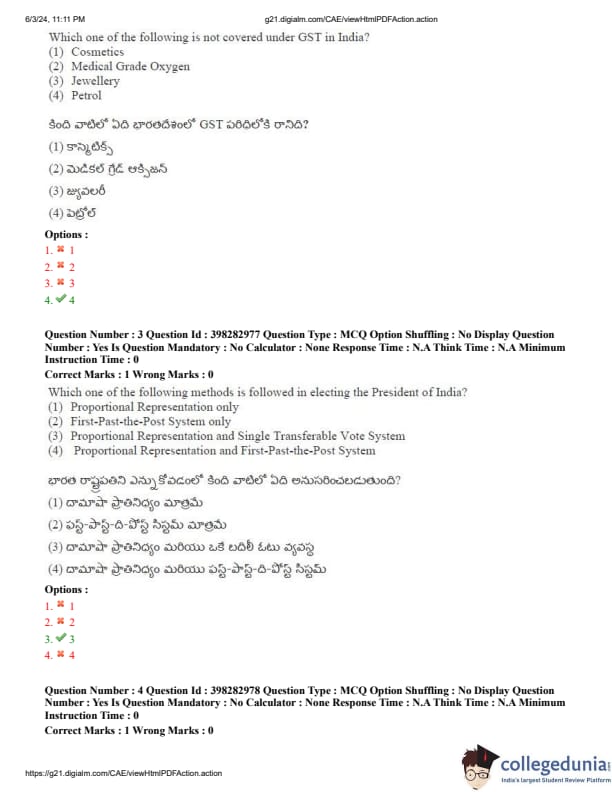
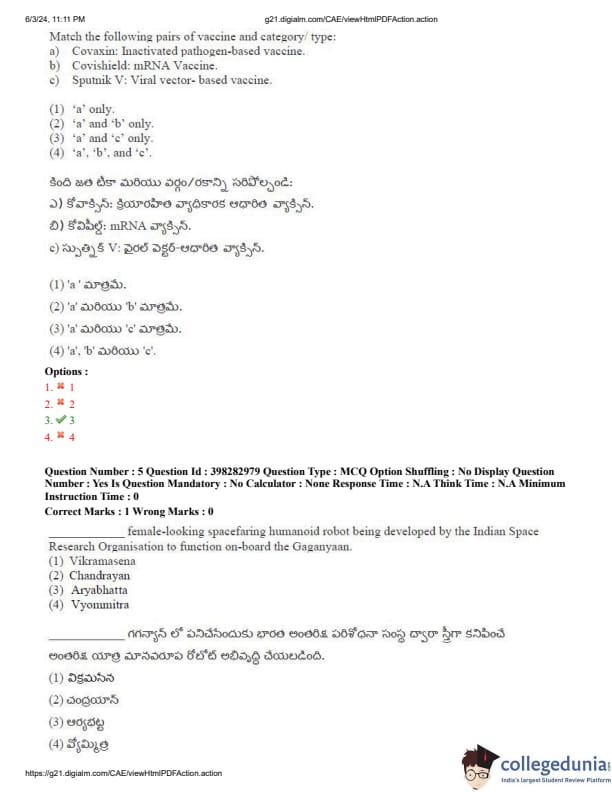
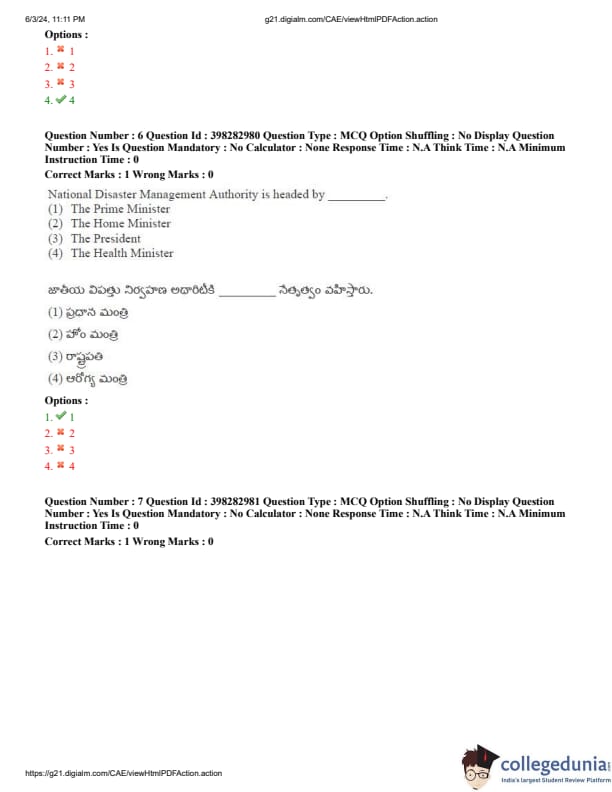
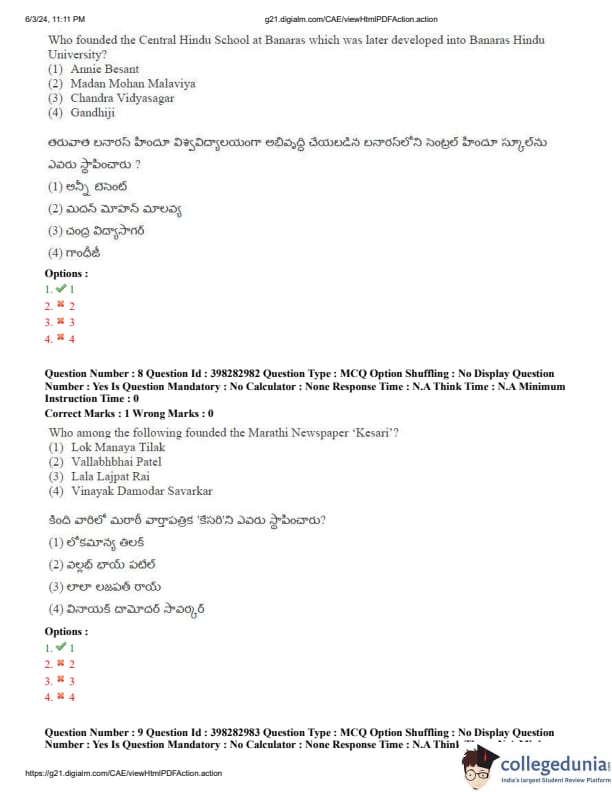






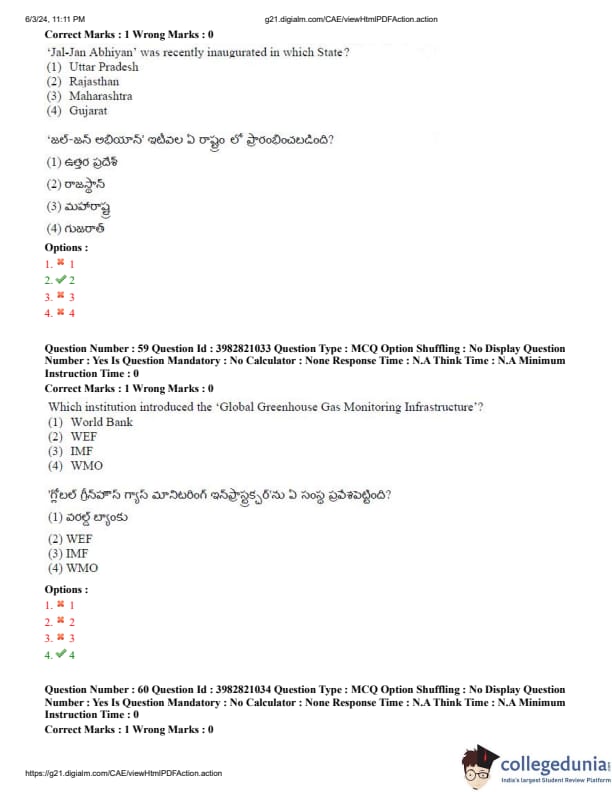

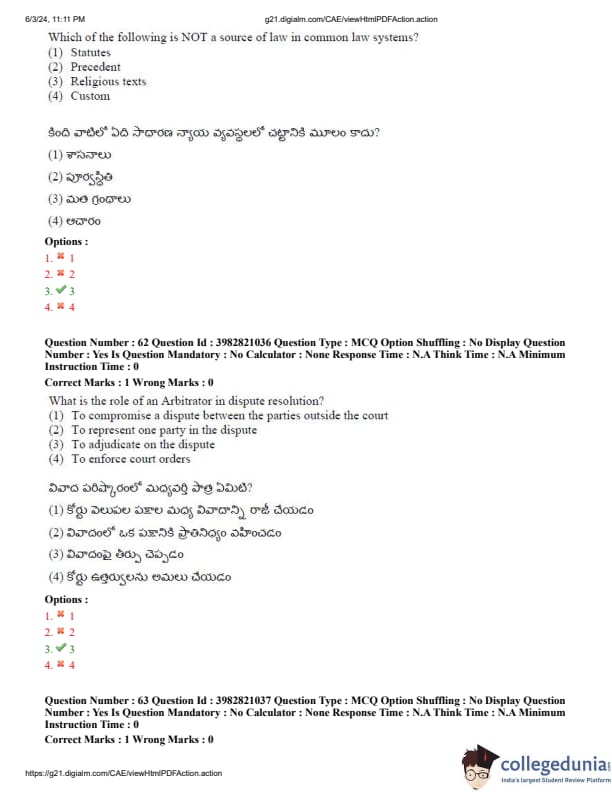
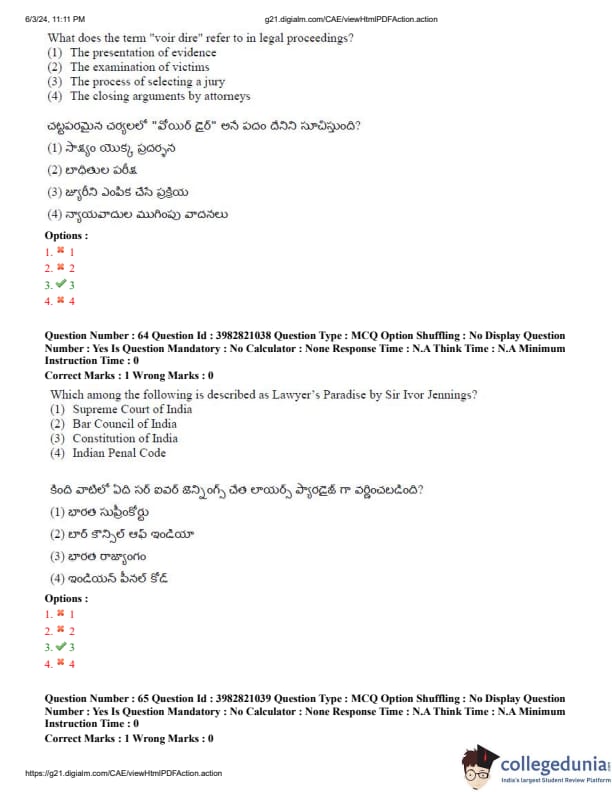
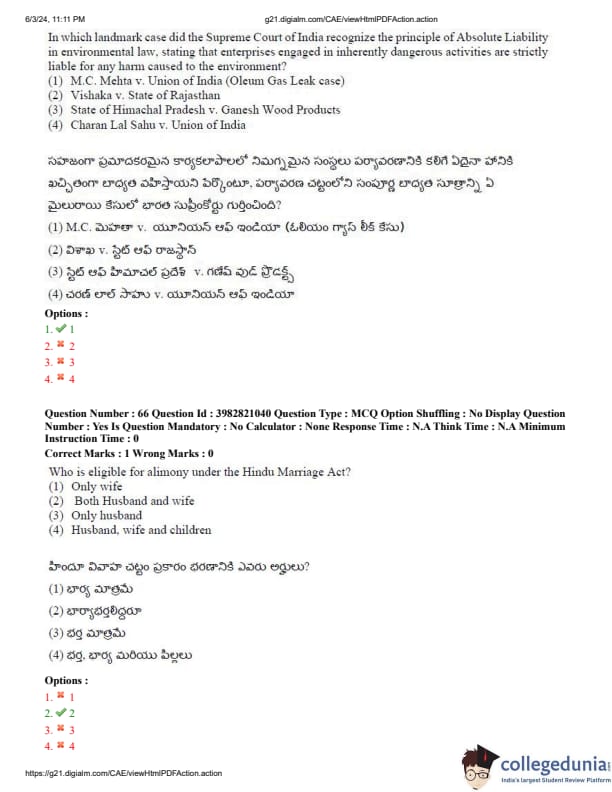


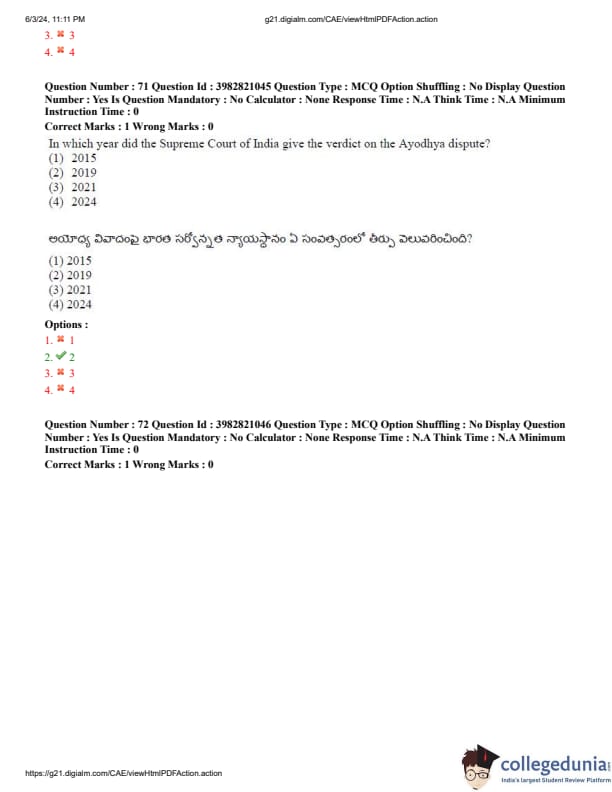
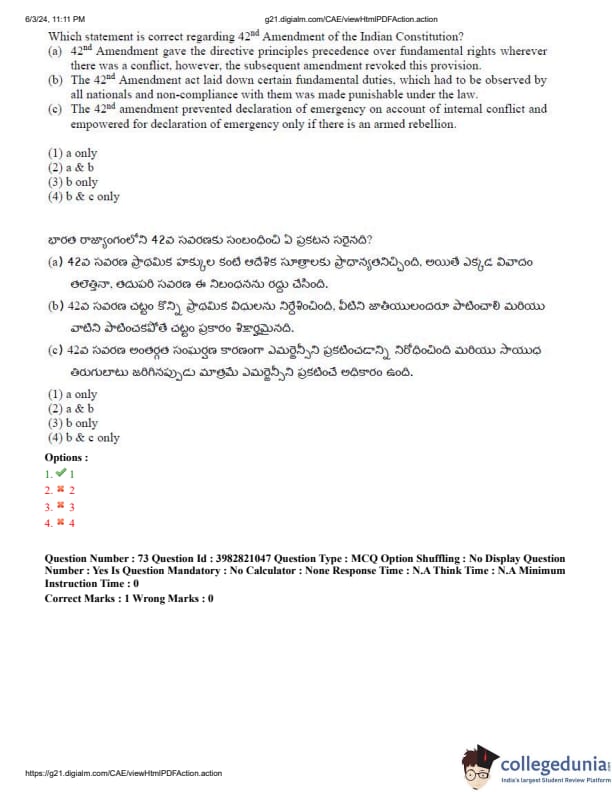


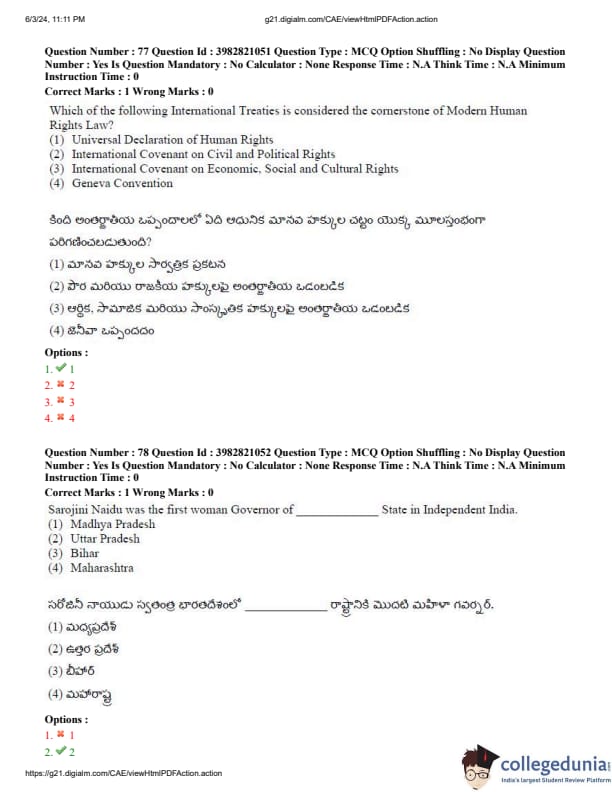
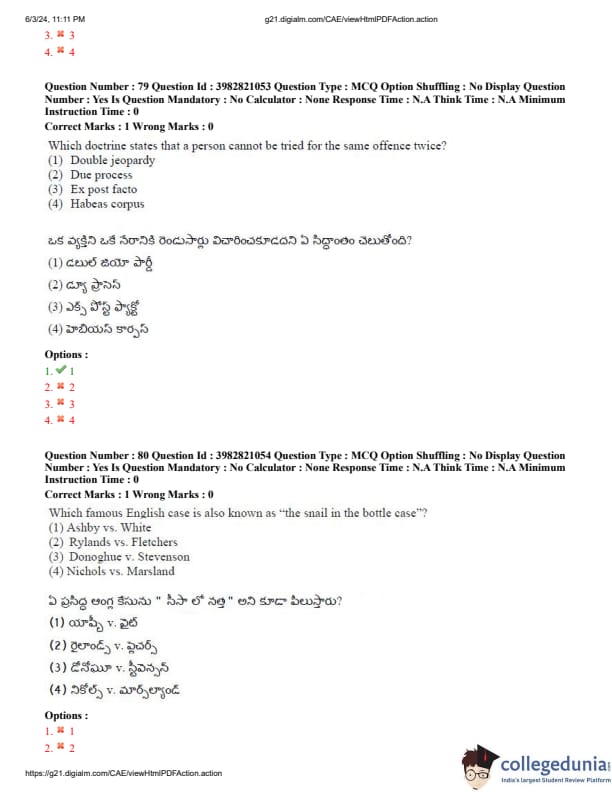
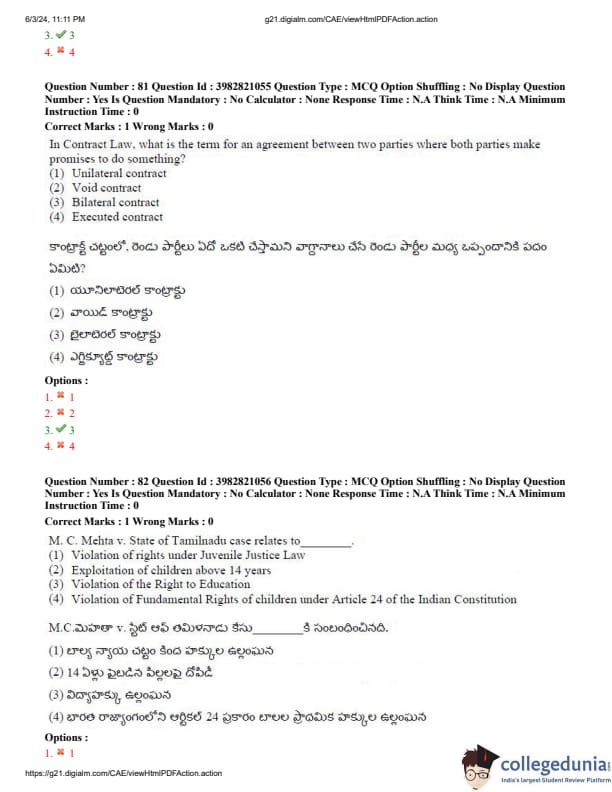

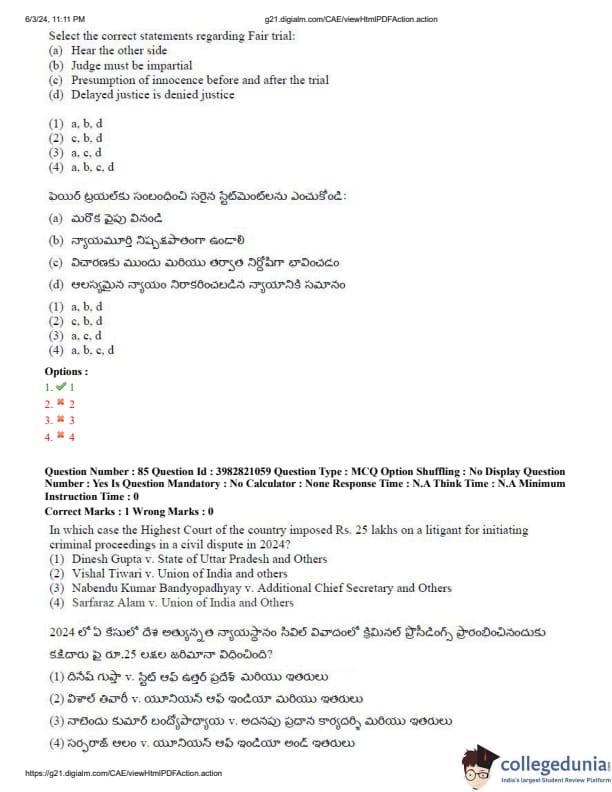


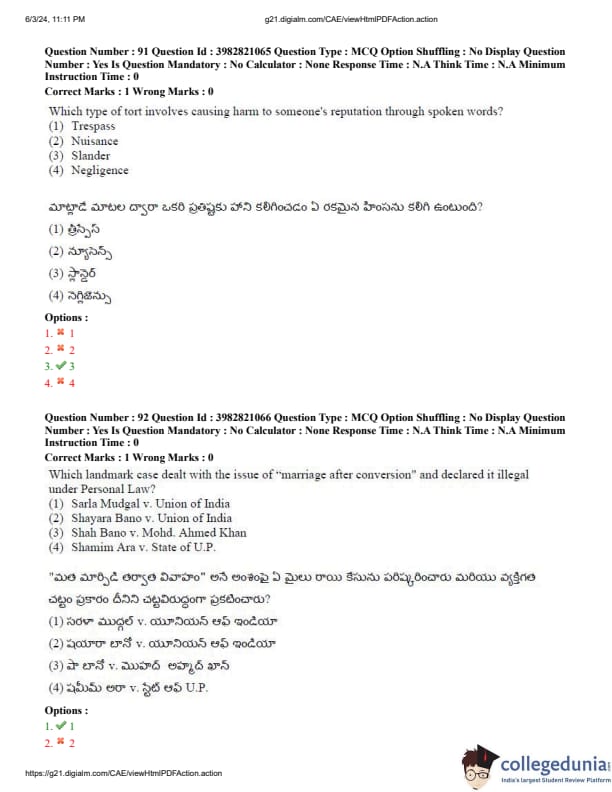


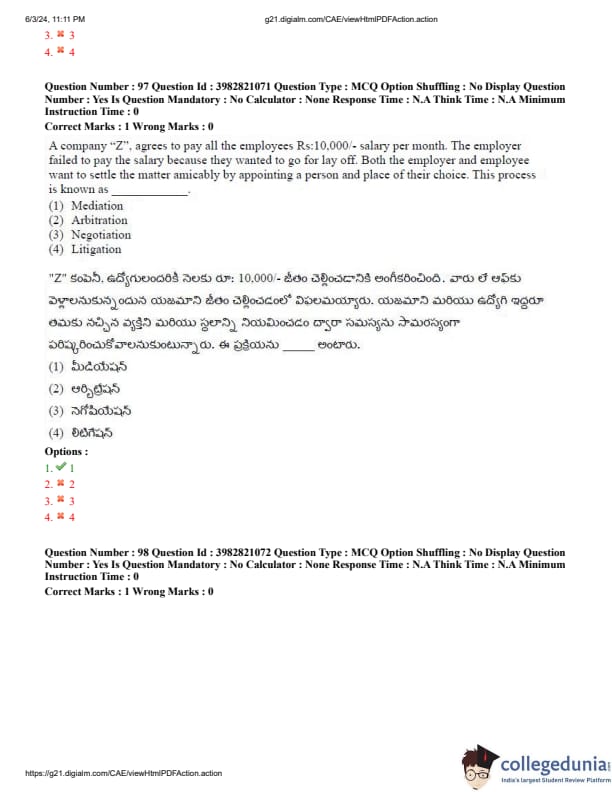
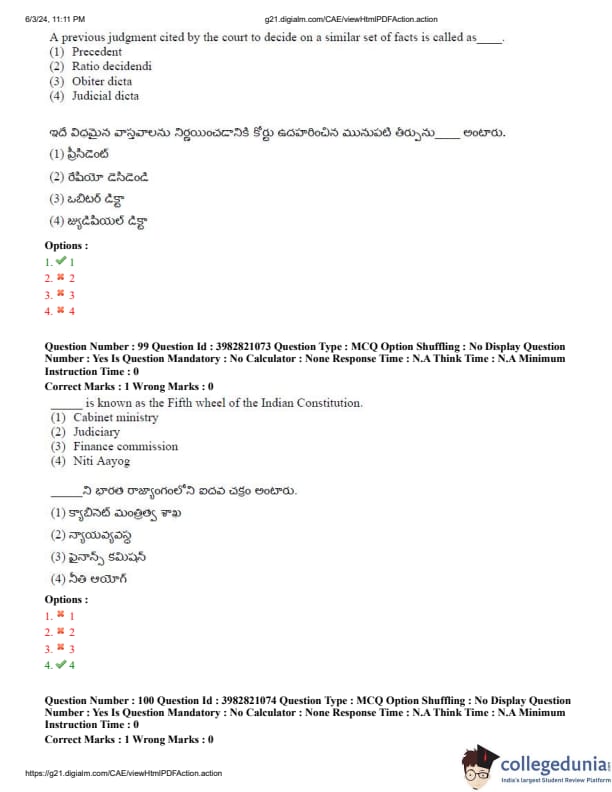


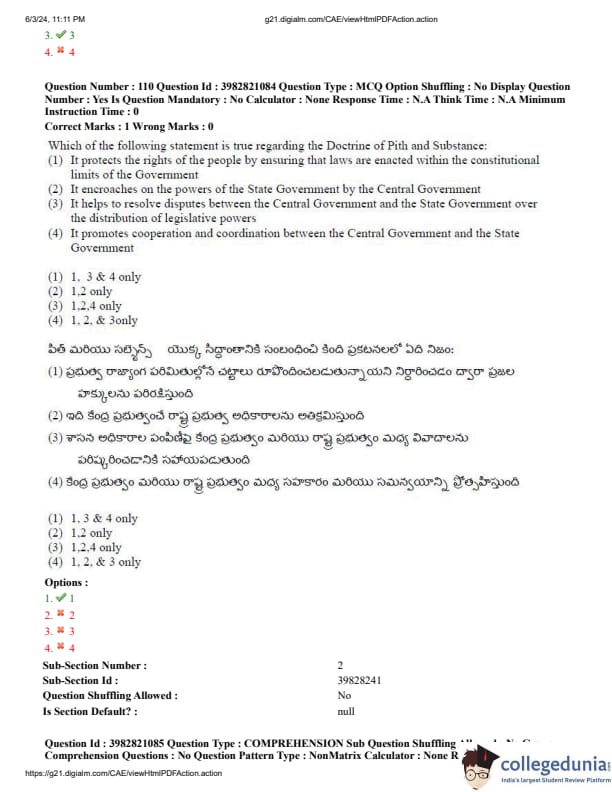
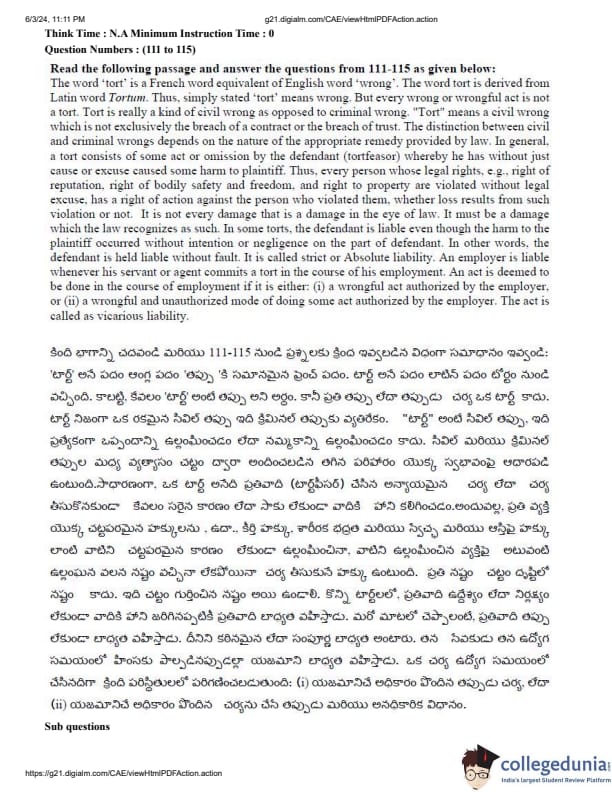
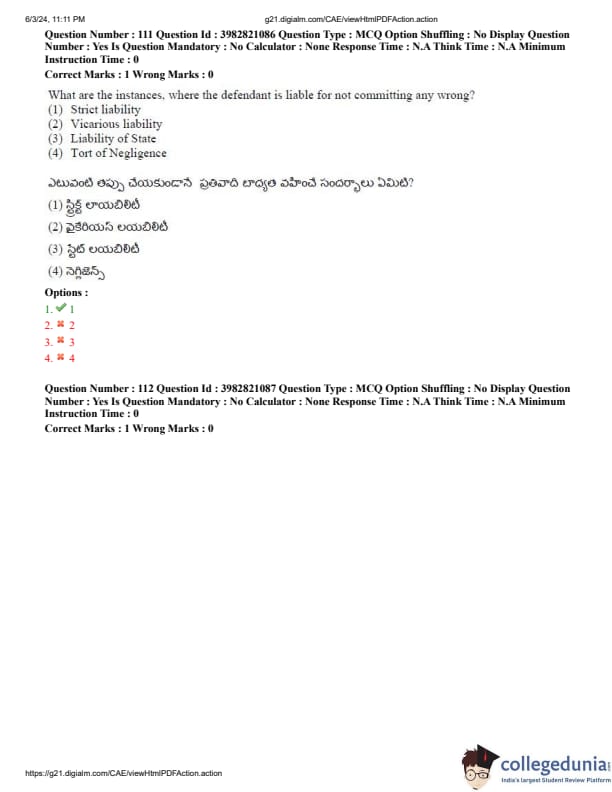
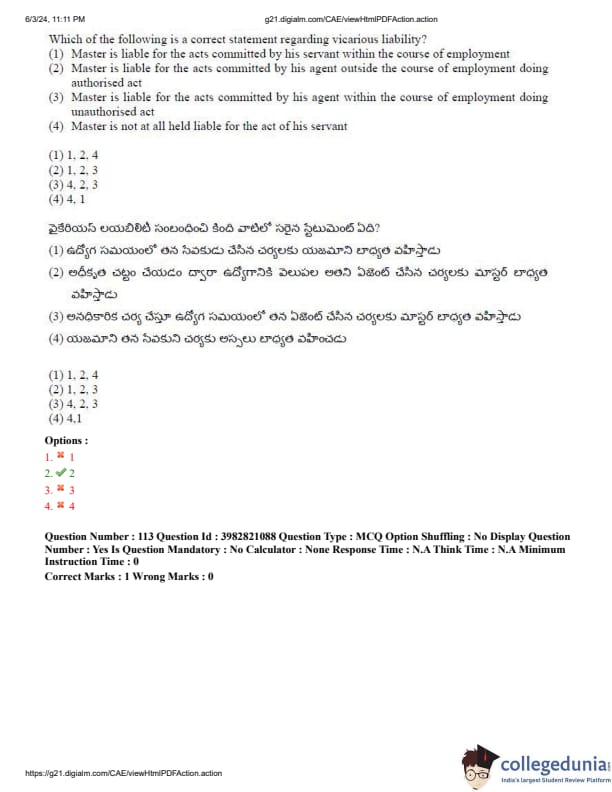

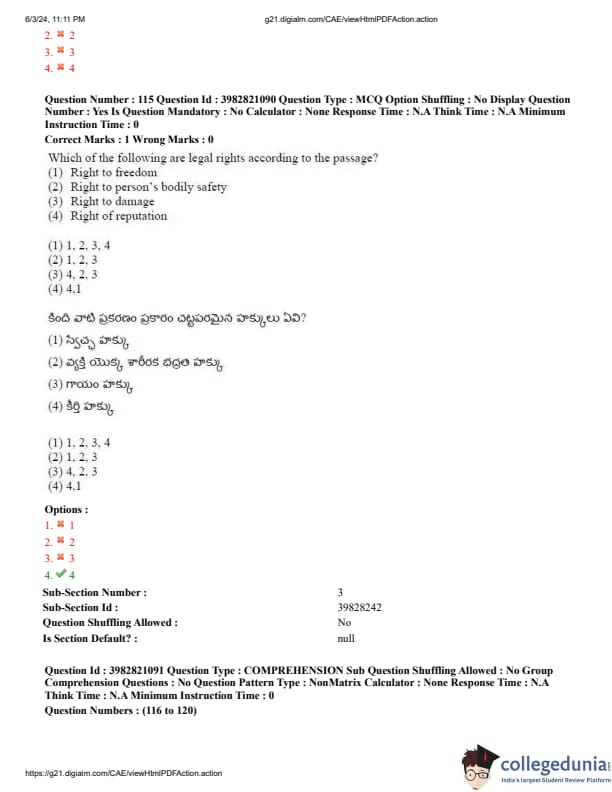

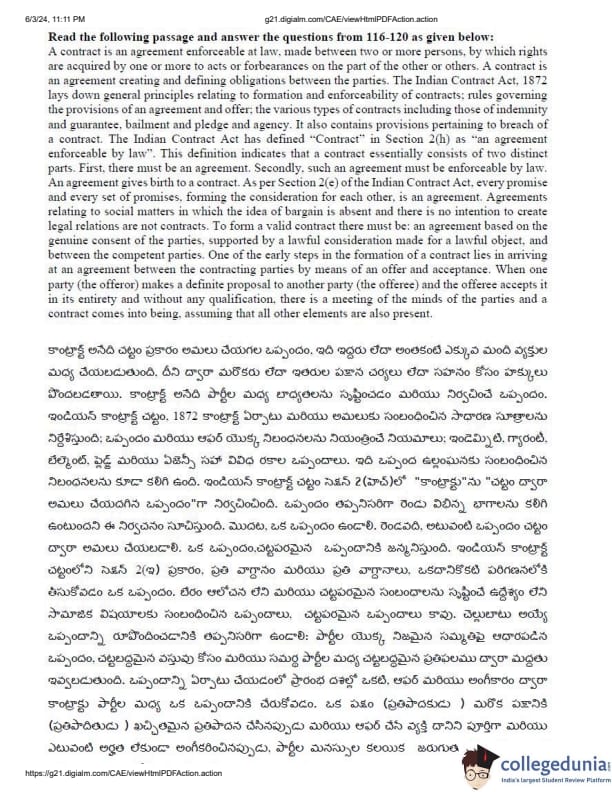

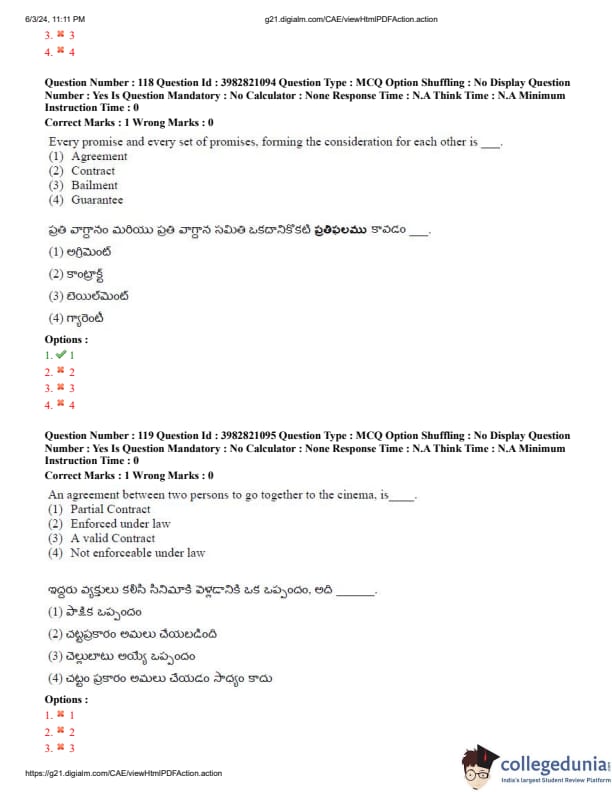
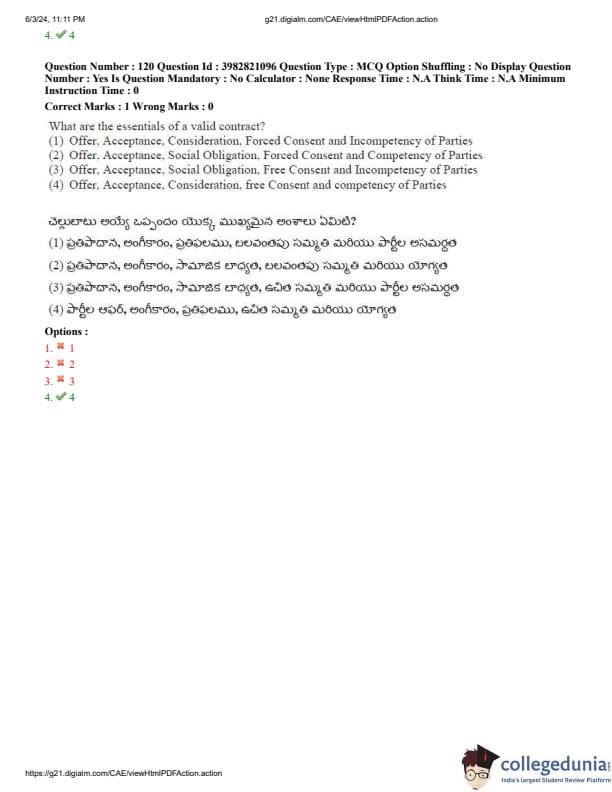
*The article might have information for the previous academic years, please refer the official website of the exam.