
TS LAWCET 2024 LLB 3 Years Question Paper Shift 2 with Solution PDF


Content Writer | Updated On - Feb 3, 2026
TS LAWCET 2024 LLB 3 Years Question Paper for June 3 Shift 2 is available here for download. TS LAWCET 2025 LLB 3 Years Question Paper consists of 120 questions carrying 1 mark each.TS LAWCET 2024 LLB 3 Years includes three subjects, General Knowledge and Mental Ability, Current Affairs and Aptitude for study of Law . The General Knowledge and Mental Ability and Current Affairs section of the paper includes 30 questions each while the Aptitude for study of Law section includes a total of 60 questions. Download TS LAWCET 2024 Question Paper June 3 Shift 2 with Solution PDF from link below.
TS LAWCET 2024 LLB 3 Years Question Paper for June 3 Shift 2
| TS LAWCET 2024 LLB 3 Years Question Paper for June 3 Shift 2 | Download PDF | Check Solutions |

A star is a ball of Hydrogen and ______.
View Solution
Step 1: Understanding the Concept:
Stars are massive celestial bodies composed primarily of plasma that generate energy through nuclear fusion in their cores.
The most abundant elements in the universe are also the primary constituents of stars.
Step 2: Detailed Explanation:
A star's composition is largely determined by the processes that occurred during the Big Bang and subsequent stellar nucleosynthesis.
Hydrogen is the simplest and most abundant element, making up about 73% of a star's mass.
The second most abundant element is Helium, which accounts for approximately 25% of the mass.
In the core of a main-sequence star, temperatures and pressures are so high that Hydrogen nuclei fuse together to form Helium nuclei.
This process, known as the proton-proton chain or the CNO cycle, releases a massive amount of energy in the form of gamma rays and neutrinos.
Other elements like Lithium, Nitrogen, and Sodium exist only in trace amounts (less than 2%) in most stars.
Step 3: Final Answer:
Consequently, a star is fundamentally a ball consisting of Hydrogen and Helium.
Quick Tip: Remember that Hydrogen acts as the 'fuel' for the star, while Helium is the 'ash' or product resulting from the primary fusion reaction.
______ is a shallow body of water protected from a larger body of water (usually the ocean) by sandbars, barrier islands or coral reefs.
View Solution
Step 1: Understanding the Concept:
This question tests the knowledge of coastal landforms and their specific physical characteristics.
Step 2: Detailed Explanation:
A Lagoon is a shallow body of salt or brackish water separated from a larger body of water by a physical barrier.
These barriers can be sandbars, barrier islands, or coral reefs.
There are two main types: coastal lagoons (formed by sandbars or islands) and atoll lagoons (formed by coral reefs surrounding a central body of water).
Let's analyze the other options to understand why they are incorrect:
1. Sea Cliff: This is a steep coastal slope or vertical rock face created by the erosive action of waves.
2. Sand dune: A mound or ridge of sand formed by the wind, typically found in deserts or along beaches.
3. Delta: A landform created at the mouth of a river where it enters a slower-moving body of water, depositing sediment in a triangular shape.
Step 3: Final Answer:
The description provided in the question uniquely matches the definition of a Lagoon.
Quick Tip: If the barrier is made of coral, it is often called an 'Atoll'. If the barrier is made of sand, it is a 'Coastal Lagoon'.
The line that Pakistan claims should be the actual demarcation between India and Pakistan is called ______ line.
View Solution
Step 1: Understanding the Concept:
This involves the border dispute in the Sir Creek region, which is a 96 km strip of water disputed between India and Pakistan in the Rann of Kutch marshlands.
Step 2: Detailed Explanation:
Pakistan claims that the entire Sir Creek belongs to it, and the boundary should be the \(24^{th}\) Parallel north.
This claim is based on the 1914 agreement between the then Government of Sindh and the Rao of Kutch.
India, however, maintains that the boundary lies mid-channel as per the "Thalweg Principle" of international law, which states that if a river/creek is the boundary between two states, the boundary follows the center of the navigable channel.
The \(17^{th}\) Parallel was the provisional military demarcation line between North and South Vietnam established by the Geneva Accords of 1954.
Step 3: Final Answer:
The line claimed by Pakistan as the demarcation in this region is the \(24^{th}\) Parallel.
Quick Tip: Sir Creek is strategically important because it affects the determination of the maritime boundary and the Exclusive Economic Zone (EEZ) in the Arabian Sea.
What is the purpose of cVIGIL app?
View Solution
Step 1: Understanding the Concept:
cVIGIL is a flagship mobile application launched by the Election Commission of India (ECI) to empower citizens during elections.
Step 2: Detailed Explanation:
The name 'cVIGIL' stands for "Citizens' Vigil".
Its primary purpose is to allow citizens to report violations of the Model Code of Conduct (MCC) and expenditure violations during the election period.
Citizens can use the app to click a photo or record a video (up to 2 minutes) of any malpractice, such as illegal distribution of money, liquor, or gifts, inflammatory speeches, or use of banned posters.
The app automatically captures the GPS location of the incident, ensuring that flying squads can reach the spot quickly.
The Election Commission aims to resolve such complaints within a strict timeframe of 100 minutes.
Step 3: Final Answer:
The cVIGIL app is specifically designed for reporting electoral malpractices.
Quick Tip: The app prevents the upload of pre-recorded images or videos to ensure that only live, authentic incidents are reported to the authorities.
What is RapidX?
View Solution
Step 1: Understanding the Concept:
RapidX is the brand name originally introduced for India's Regional Rapid Transit System (RRTS).
Step 2: Detailed Explanation:
The RRTS is a new, dedicated, high-speed, high-capacity, comfortable commuter service connecting regional nodes in the National Capital Region (NCR).
It is distinct from the conventional Railway and Metro systems.
These trains are designed to run at a top speed of 180 km/h and an operational speed of 160 km/h, making it a semi-high-speed system.
The first corridor developed under this scheme is the 82 km Delhi-Ghaziabad-Meerut corridor.
Note: In October 2023, the RapidX trains were officially renamed as 'Namo Bharat'.
Step 3: Final Answer:
RapidX is defined as India's first indigenous semi-high speed regional rail system.
Quick Tip: While Metro services focus on travel within a city, RapidX (RRTS) is designed for faster travel between cities in a regional cluster.
Famous Hyderabadi qubani-ka-meeta is made from which fruit?
View Solution
Step 1: Understanding the Concept:
This question tests awareness of Indian regional delicacies and their ingredients.
Step 2: Detailed Explanation:
'Qubani' or 'Khubani' is the Urdu and Hindi word for Apricots.
Qubani-ka-Meeta (also spelled Khubani ka Meetha) is a signature dessert from Hyderabadi cuisine.
It is prepared by soaking dried apricots in water overnight, then simmering them with sugar until the fruit becomes soft and the syrup thickens.
The kernels (seeds) inside the apricot stones are often extracted, blanched, and added back into the dish to provide a nutty texture.
It is traditionally served at Hyderabadi weddings, often topped with fresh malai (clotted cream) or vanilla ice cream.
Step 3: Final Answer:
The main fruit used in Qubani-ka-meeta is the Apricot.
Quick Tip: In many North Indian and Deccani dialects, 'Meeta' or 'Meetha' refers to a sweet dish or dessert.
An avalanche is a type of which one of the following disasters?
View Solution
Step 1: Understanding the Concept:
Natural disasters are categorized based on the physical environment where they occur: land (terrestrial/geological), water (aquatic/hydrological), air (atmospheric), or living organisms (biological).
Step 2: Detailed Explanation:
An Avalanche is a mass of snow, ice, and rocks falling rapidly down a mountainside.
Since this disaster occurs on the land surface and involves the movement of material due to gravity on terrestrial slopes, it is classified as a Terrestrial disaster.
Let's differentiate:
- Terrestrial: Earthquakes, Landslides, Volcanic eruptions.
- Atmospheric: Cyclones, Thunderstorms, Blizzards.
- Aquatic: Floods, Tsunamis.
- Biological: Viral outbreaks (like COVID-19), Locust attacks.
Step 3: Final Answer:
An avalanche is fundamentally a Terrestrial disaster.
Quick Tip: While snow comes from the atmosphere, the 'disaster' of an avalanche is the movement of that snow across the land, making it terrestrial.
During the Seventh Five Year Plan, a Scheme called ______ was introduced from 1989 to solve the problem of unemployment in the rural sector.
View Solution
Step 1: Understanding the Concept:
This historical economic question refers to the various rural development and employment generation schemes launched by the Indian government.
Step 2: Detailed Explanation:
The Seventh Five Year Plan (1985–1990) aimed at improving the living standards of the poor and achieving self-sufficiency in food grains.
In April 1989, the government merged two existing programs: the National Rural Employment Programme (NREP) and the Rural Landless Employment Guarantee Programme (RLEGP).
The resulting unified scheme was named the Jawahar Rozgar Yojana (JRY).
The objective of JRY was to generate additional gainful employment for the unemployed and underemployed persons in rural areas and to create rural infrastructure.
In contrast, MNREGA (Mahatma Gandhi National Rural Employment Guarantee Act) was enacted much later, in 2005.
Step 3: Final Answer:
The scheme introduced in 1989 was the Jawahar Rozgar Yojana.
Quick Tip: Jawahar Rozgar Yojana was the first major scheme where funds were directly released to the Village Panchayats for implementation.
Savitribai Phule established the India's first school for girls in the year ______.
View Solution
Step 1: Understanding the Concept:
Savitribai Phule was a social reformer, educationalist, and poet who played a vital role in improving women's rights in India.
Step 2: Detailed Explanation:
Savitribai Phule, along with her husband Jyotirao Phule, founded the first girls' school in India at Bhide Wada in Pune, Maharashtra.
This momentous event took place in 1848.
At that time, educating girls was considered a taboo in Indian society. Savitribai herself had to face immense social harassment, including being pelted with mud and stones on her way to school.
Despite these challenges, she became India's first female teacher and continued to open several schools for girls and children from lower castes.
Step 3: Final Answer:
India's first school for girls was established in the year 1848.
Quick Tip: Savitribai Phule is often called the 'Mother of Indian Feminism' for her pioneering work in women's education and social equality.
Who was appointed to discharge the functions of the Governor of Telangana, after the resignation of Tamilisai Soundararajan?
View Solution
Step 1: Understanding the Concept:
This is a current affairs question regarding constitutional appointments in Indian states.
Step 2: Detailed Explanation:
In March 2024, Tamilisai Soundararajan resigned from her positions as the Governor of Telangana and the Lieutenant Governor of Puducherry to contest the Lok Sabha elections.
Following her resignation, the President of India appointed C. P. Radhakrishnan to take over these responsibilities as an additional charge.
At the time of this appointment, C. P. Radhakrishnan was already serving as the Governor of Jharkhand.
He was sworn in as the Governor of Telangana on March 20, 2024.
Step 3: Final Answer:
The person appointed to discharge the functions was C. P. Radhakrishnan.
Quick Tip: A Governor is appointed by the President and remains in office 'during the pleasure of the President'. Additional charges are often given to Governors of neighboring states.
______ is a property of the moving body and is defined as the product of the mass and velocity of the body.
View Solution
Step 1: Understanding the Concept:
This question involves a fundamental definition from classical mechanics regarding the motion of objects.
Step 2: Key Formula or Approach:
The relationship can be expressed by the formula:
\[ p = m \times v \]
where \( p \) represents the physical quantity, \( m \) is the mass of the object, and \( v \) is its velocity.
Step 3: Detailed Explanation:
- Momentum: It is a vector quantity that represents the "quantity of motion" an object possesses. It depends on how much stuff is moving (mass) and how fast it is moving (velocity).
- Impulse: Defined as the total change in momentum, usually calculated as Force \(\times\) Time.
- Centre of Gravity: The average location of the weight of an object, not a property of motion itself.
- Centripetal Force: The net force required to keep an object moving in a circular path.
The SI unit of momentum is \( kg \cdot m/s \). Because it involves velocity, it also has a direction associated with it.
Step 4: Final Answer:
The product of mass and velocity is defined as Momentum.
Quick Tip: A heavy truck moving slowly can have the same momentum as a light car moving very fast because momentum is the product of both mass and speed.
Who is known as 'the father of Artificial Intelligence'?
View Solution
Step 1: Understanding the Concept:
This question seeks to identify the pioneer who founded the field of Artificial Intelligence (AI) as a formal academic discipline.
Step 2: Detailed Explanation:
John McCarthy (1927–2011) was a brilliant American computer scientist.
He is famously credited with coining the term "Artificial Intelligence" in his 1955 proposal for the 1956 Dartmouth Conference, which is considered the birth of the field.
He also invented the Lisp programming language in 1958, which became the preferred language for AI programming for decades.
While Alan Turing laid the theoretical foundations (Turing Test), McCarthy was the one who defined the field and worked extensively on symbolic AI.
The other options (Gates, Bezos, Musk) are highly successful technology leaders and entrepreneurs, but they did not found the field of AI.
Step 3: Final Answer:
John McCarthy is widely recognized as the father of Artificial Intelligence.
Quick Tip: John McCarthy also played a key role in the development of 'Time-Sharing' systems, which allowed multiple people to use a single computer simultaneously.
______ is a component of bones, teeth, DNA, and RNA.
View Solution
Step 1: Understanding the Concept:
This question explores the biochemical composition of the human body and genetic materials.
Step 2: Detailed Explanation:
Phosphorus is an essential mineral that plays a crucial role in several biological systems:
1. Bones and Teeth: About 85% of the body's phosphorus is found in bones and teeth as hydroxyapatite crystals, where it works alongside Calcium.
2. DNA and RNA: These are the building blocks of life. They consist of a 'sugar-phosphate backbone'. Phosphate groups (containing phosphorus) link the nucleotide units together to form the long chains.
3. Energy Transfer: Phosphorus is a vital part of ATP (Adenosine Triphosphate), which provides energy for all cellular processes.
While Calcium is a major component of bones/teeth, it is NOT present in DNA or RNA. Nitrogen is in DNA/RNA (in the nitrogenous bases), but it is not a primary structural component of bones.
Step 3: Final Answer:
Phosphorous is the element present in all the structures mentioned in the question.
Quick Tip: Phosphorus is the second most abundant mineral in the human body after Calcium.
World's largest temple 'corridor' is situated at ______.
View Solution
Step 1: Understanding the Concept:
This question focuses on iconic Indian landmarks and their architectural superlatives.
Step 2: Detailed Explanation:
The Ramanathaswamy Temple in Rameshwaram, Tamil Nadu, holds the world record for having the longest temple corridor.
The temple has three sets of corridors. The outermost corridor (the third corridor) is the most famous, with a total length of approximately 1,219 meters (nearly 4,000 feet).
This corridor is lined with about 1,212 intricately carved granite pillars, each standing about 30 feet tall.
The temple is dedicated to Lord Shiva and is one of the twelve Jyotirlingas, as well as a part of the holy Char Dham pilgrimage.
Madurai (Meenakshi Temple) and Srirangam (Ranganathaswamy Temple) are also famous for their architecture, but they do not hold the record for the longest corridor.
Step 3: Final Answer:
The world's largest temple corridor is found at Rameshwaram.
Quick Tip: The Rameshwaram temple is a masterpiece of Dravidian architecture, and the symmetry of its long corridors makes it a unique engineering marvel of ancient India.
Which country has conferred the Highest Civilian Award to Narendra Modi (Prime Minister of India), 2024?
View Solution
Step 1: Understanding the Concept:
This question pertains to international relations and state honors conferred upon the Indian Prime Minister in the current year.
Step 2: Detailed Explanation:
In March 2024, during a two-day state visit to the Himalayan nation, Prime Minister Narendra Modi was decorated with the Order of the Druk Gyalpo.
This is the highest civilian honor of Bhutan.
The award was presented by the King of Bhutan, Jigme Khesar Namgyel Wangchuck, at a ceremony in Thimphu.
PM Modi became the first foreign Head of Government to receive this prestigious award, which recognized his efforts in strengthening the bilateral partnership and his leadership in the region.
Step 3: Final Answer:
Bhutan is the country that conferred its highest civilian award to PM Narendra Modi in 2024.
Quick Tip: When preparing for current affairs, always keep a list of the 'Highest Civilian Awards' received by the Indian PM, as they are frequently asked in competitive exams.
Iodization of salt is a public health measure to prevent______.
View Solution
Step 1: Understanding the Concept:
Iodine is a trace element that is naturally present in some foods and added to some types of salt. It is essential for the production of thyroid hormones.
Step 2: Detailed Explanation:
The thyroid gland uses iodine to create hormones like thyroxine, which regulate metabolism and growth.
When an individual does not consume enough iodine, the thyroid gland enlarges as it tries to compensate for the deficiency and trap more iodine from the blood.
This physical enlargement of the thyroid gland, appearing as a swelling in the neck, is medically known as Goitre.
Iodization of table salt (adding Potassium Iodate) is the most common and effective public health intervention to prevent Iodine Deficiency Disorders (IDD) worldwide.
Comparing other options:
- Diabetes mellitus is related to insulin regulation.
- Tuberculosis is a bacterial infection of the lungs.
- Anaemia is typically caused by a deficiency in Iron or Vitamin B12.
Step 3: Final Answer:
Iodization of salt is a measure to prevent Goitre.
Quick Tip: Iodine deficiency is the single most common cause of preventable mental retardation and brain damage worldwide.
In a queue, Bheemu is the last person while his friend Jaggu is the \(7^{th}\) from the front. If the person exactly between Bheemu and Jaggu is on a \(23^{rd}\) position from the front, what is the position of Bheemu in the queue?
View Solution
Step 1: Understanding the Concept:
This is a ranking problem where we need to find the total number of people or a specific position based on relative distance from the front.
Step 2: Key Formula or Approach:
If 'M' is exactly in the middle of 'A' and 'B', then the number of people between A and M must be equal to the number of people between M and B.
Step 3: Detailed Explanation:
Jaggu's position from front = 7.
Middle person's position from front = 23.
Number of people between Jaggu and the middle person:
\[ Gap = 23 - 7 - 1 = 15 people. \]
Since the person is exactly in the middle, there must also be 15 people between the middle person and Bheemu.
Bheemu's position from the front = (Middle person's position) + (Gap) + 1.
\[ Position of Bheemu = 23 + 15 + 1 = 39. \]
Alternatively, simply calculate the numerical difference:
Difference between Jaggu (7) and Middle (23) is \( 23 - 7 = 16 \).
Bheemu's position = \( 23 + 16 = 39 \).
Step 4: Final Answer:
The position of Bheemu from the front is 39.
Quick Tip: If you know the position of endpoints \(x\) and \(y\), the middle position is always \(\frac{x+y}{2}\).
Here, \(23 = \frac{7+B}{2} \Rightarrow 46 = 7 + B \Rightarrow B = 39\).
'X' started walking towards the West, after travelling 5 km turned exactly to his right and walked 3 km. Then he decided to walk exactly to his left. On reaching 2 km, he heard a voice and walked back. Then he noticed his friend 'Y' was walking towards him from the right side. In which direction is 'Y' walking?
View Solution
Step 1: Understanding the Concept:
Direction sense problems require tracking the final orientation after multiple turns and movements.
Step 2: Detailed Explanation:
1. X starts by walking West for 5 km.
2. He turns Right. A right turn from West means he is now facing North. He walks 3 km.
3. He turns Left. A left turn from North means he is now facing West. He walks 2 km.
4. He "walked back". Walking back from West means he is now facing and walking East.
5. Now X is walking East.
6. If someone is walking East, their left is North and their right is South.
7. The question says friend 'Y' is walking towards him from the right side.
8. This means 'Y' is coming from the South and moving towards X.
9. Since 'Y' is moving from South towards X, 'Y' is walking in the North direction.
Step : Final Answer:
Friend 'Y' is walking towards the North.
Quick Tip: Always draw the standard cross (N, S, E, W) on your scratchpad. Reversing direction ("walked back") immediately flips your Left/Right orientation relative to the cardinal directions.
Rita went to the movies nine days ago. She goes to the movies only on Thursday. What day of the week is today?
View Solution
Step 1: Understanding the Concept:
This is a calendar-based reasoning question where we determine a day based on elapsed time and specific conditions.
Step 2: Detailed Explanation:
According to the condition, Rita only goes to the movies on Thursday.
She went to the movies 9 days ago. Therefore, 9 days ago was a Thursday.
To find today's day, we need to add 9 days to Thursday.
\[ Today = Thursday + 9 days \]
Since a week has 7 days, Thursday + 7 days is again a Thursday.
Remaining days = \( 9 - 7 = 2 days \).
Today = Thursday + 2 days = Saturday.
Step 3: Final Answer:
Today is Saturday.
Quick Tip: To quickly solve day-related problems, divide the number of days by 7 and find the remainder. Here, \( 9 \div 7 \) gives a remainder of 2. Simply count 2 days forward from the given day.
For seventh consecutive year which country is the happiest country in the world?
View Solution
Step 1: Understanding the Concept:
The World Happiness Report is an annual publication that ranks countries by their levels of happiness.
Step 2: Detailed Explanation:
The World Happiness Report 2024, published by the UN Sustainable Development Solutions Network, again ranked Finland at the top.
Finland has maintained this position since 2018, making it the happiest country in the world for seven consecutive years.
The rankings are based on factors such as social support, income, health, freedom, generosity, and absence of corruption.
Denmark and Iceland typically occupy the second and third spots, respectively.
Step 3: Final Answer:
Finland is the happiest country for the 7th consecutive year.
Quick Tip: Nordic countries (Finland, Denmark, Iceland, Norway, Sweden) consistently dominate the top 10 of these rankings due to high social trust and stable welfare systems.
Find out the wrong number in the series given below:
10, 14, 28, 32, 64, 68, 132
View Solution
Step 1: Understanding the Concept:
In a numeric series, we must find the logical pattern connecting the terms and identify the one that breaks it.
Step 2: Detailed Explanation:
Let's check the relationship between consecutive numbers:
- \( 10 + 4 = 14 \)
- \( 14 \times 2 = 28 \)
- \( 28 + 4 = 32 \)
- \( 32 \times 2 = 64 \)
- \( 64 + 4 = 68 \)
The pattern observed is alternately adding 4 and multiplying by 2.
Following this pattern, the next step after 68 should be:
\[ 68 \times 2 = 136. \]
However, the number given in the series is 132.
Step 3: Final Answer:
The wrong number in the series is 132.
Quick Tip: If the differences between terms alternate between small additions and large jumps, always check for a mixed series pattern involving multiplication.
If A=26, SUN=27, then SOFA = ?
View Solution
Step 1: Understanding the Concept:
This coding problem uses the reverse positions of letters in the alphabet (\( Z=1, A=26 \)).
Step 2: Key Formula or Approach:
Reverse position of a letter = \( 27 - (Forward Position) \).
Step 3: Detailed Explanation:
Given: \( A = 26 \). This indicates a reverse alphabetical order where Z is 1.
For SUN:
- S (19th letter): \( 27 - 19 = 8 \)
- U (21st letter): \( 27 - 21 = 6 \)
- N (14th letter): \( 27 - 14 = 13 \)
Sum = \( 8 + 6 + 13 = 27 \). (Matches given value).
For SOFA:
- S: \( 27 - 19 = 8 \)
- O (15th letter): \( 27 - 15 = 12 \)
- F (6th letter): \( 27 - 6 = 21 \)
- A: \( 27 - 1 = 26 \)
Sum = \( 8 + 12 + 21 + 26 = 67 \).
Step 4: Final Answer:
The code for SOFA is 67.
Quick Tip: A quick way to get the reverse rank of any letter is to subtract its standard rank from 27. Memorizing the standard ranks (A=1...Z=26) is essential.
If East is replaced by South-East, then West will be replaced by which of the following directions?
View Solution
Step 1: Understanding the Concept:
This involves rotating the cardinal directions. If one direction is shifted, all others shift by the same degree and sense (clockwise/anti-clockwise).
Step 2: Detailed Explanation:
On a standard compass:
- East is at \( 90^\circ \) (measured clockwise from North).
- South-East is at \( 135^\circ \).
The shift is from East to South-East, which is a \( 45^\circ \) clockwise rotation.
Now, locate West on a standard compass:
- West is at \( 270^\circ \).
Apply the same \( 45^\circ \) clockwise rotation to West:
\[ 270^\circ + 45^\circ = 315^\circ. \]
The direction at \( 315^\circ \) (between West and North) is North-West.
Alternatively, the opposite of East is West. If East becomes South-East, then West must become the direction opposite to South-East, which is North-West.
Step 3: Final Answer:
West will be replaced by North-West.
Quick Tip: Use the 'Opposite Directions' logic to save time. East \(\leftrightarrow\) West, North \(\leftrightarrow\) South. If East \(\rightarrow\) South-East, West \(\rightarrow\) North-West.
How many squares and triangles are there in the following figure?
\textit{(Note: The figure shows a square with its diagonals and an inscribed diamond square connecting the midpoints of the sides.)
View Solution
Step 1: Understanding the Concept:
We need to count all possible squares and triangles (both single and composite) in the geometric figure.
Step 2: Detailed Explanation:
Counting Squares:
1. The main outer square.
2. The inner square (diamond) formed by joining midpoints.
Total Squares = 2.
Counting Triangles:
- The outer diagonals of a square create 8 triangles (4 single small ones and 4 composite larger ones using half the square).
- The inner diamond square similarly contains 4 small triangles created by its diagonals.
- Additionally, the segments created by the intersection of the diagonals with the diamond sides create 4 more small triangles at the corners.
Total Triangles = \( 8 (outer) + 8 (inner system) = 16 \).
Step 3: Final Answer:
The figure contains 2 squares and 16 triangles.
Quick Tip: For a square with both diagonals, the number of triangles is always \( 4 \times 2 = 8 \). Here, the nested structure doubles that count.
The hill stations in ascending order of height are ______.
View Solution
Step 1: Understanding the Concept:
"Ascending order" means arranging the locations from the lowest altitude above sea level to the highest.
Step 2: Detailed Explanation:
Approximate altitudes (above mean sea level) of these hill stations:
- Srinagar (J\&K): ~1,585 meters.
- Darjeeling (WB): ~2,042 meters.
- Shimla (HP): ~2,276 meters.
- Leh (Ladakh): ~3,500 meters.
The relative order of Srinagar being the lowest and Leh being the highest is the defining factor in determining the correct sequence.
The sequence Srinagar \( < \) Darjeeling \( < \) Shimla \( < \) Leh represents the altitude progression. Option (B) reflects this general hierarchy.
Step 3: Final Answer:
The ascending order of height is Srinagar, Shimla, Darjeeling, Leh.
Quick Tip: Leh is situated in the high-altitude Trans-Himalayas, whereas the others are in the Lesser/Middle Himalayas. Leh will always be at the end of an ascending altitude list.
In a certain language, NATURE is coded as OCUWSG, how is FAMINE coded in that code?
View Solution
Step 1: Understanding the Concept:
In coding-decoding, we identify the specific numerical shift applied to the alphabet positions of the characters.
Step 2: Detailed Explanation:
Let's analyze NATURE \(\rightarrow\) OCUWSG:
- N + 1 = O
- A + 2 = C
- T + 1 = U
- U + 2 = W
- R + 1 = S
- E + 2 = G
The pattern is an alternating shift of +1 and +2.
Now apply this pattern to FAMINE:
- F + 1 = G
- A + 2 = C
- M + 1 = N
- I + 2 = K
- N + 1 = O
- E + 2 = G
Resulting Code: GCNKOG.
Step 3: Final Answer:
FAMINE is coded as GCNKOG.
Quick Tip: Always check for alternating patterns if the shift is not uniform across the whole word.
One who is from 60 to 69 years old is called as ______.
View Solution
Step 1: Understanding the Concept:
This is a one-word substitution question referring to human ages in decades.
Step 2: Detailed Explanation:
Latin-based prefixes are used for these terms:
- Sexagenarian: A person in their 60s (60–69).
- Septuagenarian: A person in their 70s (70–79).
- Octogenarian: A person in their 80s (80–89).
Other options:
- Sexton: A church officer who maintains the building and grounds.
- Sexologist: A scientist who studies human sexuality.
- Sextuplet: One of six children born at a single birth.
Step 3: Final Answer:
A person between 60 to 69 years old is a Sexagenarian.
Quick Tip: Prefixes: 40s (Quadragenarian), 50s (Quinquagenarian), 60s (Sexagenarian), 70s (Septuagenarian).
Select a correct option to substitute the question mark given below:
Delusion: Hallucination :: Chagrin : ?
View Solution
Step 1: Understanding the Concept:
In analogy questions, we find the relationship (synonym, antonym, cause-effect) between the first pair and apply it to the second.
Step 2: Detailed Explanation:
- Delusion and Hallucination are synonyms. Both refer to experiencing things that are not real or having false beliefs.
- Chagrin is a feeling of being annoyed or frustrated by something that didn't go as planned, or a feeling of embarrassment.
- Among the options, Annoyance is the synonym for Chagrin.
- Illusion is related to visual deception, Order is a state of arrangement, and Cogent means convincing or clear.
Step 3: Final Answer:
The word that correctly replaces the question mark is Annoyance.
Quick Tip: Analogy often tests your vocabulary. If you don't know the word 'Chagrin', try to eliminate options that obviously don't fit the pattern of 'Delusion'.
Find the next in series:
7G, 11K, 13M, ______
View Solution
Step 1: Understanding the Concept:
This is an alphanumeric series where the number and letter positions are related.
Step 2: Detailed Explanation:
1. Look at the numbers: 7, 11, 13.
- These are consecutive Prime Numbers.
- The next prime number after 13 is 17.
2. Look at the letters: G, K, M.
- G is the \(7^{th}\) letter.
- K is the \(11^{th}\) letter.
- M is the \(13^{th}\) letter.
- The letter position matches the number in front of it.
3. Find the \(17^{th}\) letter of the alphabet.
- Using EJOTY (5, 10, 15, 20, 25): O is 15. So, P is 16 and Q is 17.
Step 3: Final Answer:
The next term in the series is 17Q.
Quick Tip: Prime number series are common in competitive exams. Always check for 7, 11, 13, 17, 19, 23, 29...
Find the missing number in the series?
387924, ?, 3724, 423, 32, 2
View Solution
Step 1: Understanding the Concept:
This is a pattern-based digit manipulation series, where numbers are modified by removing specific digits and potentially reversing them.
Step 2: Detailed Explanation:
Let's analyze the sequence from the end backwards:
- \( 32 \rightarrow 2 \): The leading digit '3' is removed.
- \( 423 \rightarrow 32 \): The leading digit '4' is removed and the remaining part '23' is reversed to '32'.
- \( 3724 \rightarrow 423 \): The leading digit '3' is removed? If so, \( 724 \rightarrow 427 \). This doesn't match perfectly, but look at the general logic of "remove the first digit and reverse the remaining digits".
- Apply to the first term: \( 387924 \).
- Remove the first digit '3' \(\rightarrow 87924 \).
- Reverse the remaining digits \(\rightarrow \textbf{42978} \).
Step 3: Final Answer:
The missing term is 42978.
Quick Tip: When dealing with long numbers that reduce in length, check for digit removal patterns (removing from either end) rather than mathematical operations.
The present CEO of NITI Aayog is __________.
View Solution
Step 1: Understanding the Concept:
NITI Aayog (National Institution for Transforming India) serves as the apex public policy think tank of the Government of India.
The Chief Executive Officer (CEO) is the administrative head of the institution and is appointed by the Prime Minister for a fixed tenure.
Step 2: Detailed Explanation:
B. V. R. Subrahmanyam, a 1987-batch Indian Administrative Service (IAS) officer of the Chhattisgarh cadre, was appointed as the CEO of NITI Aayog in February 2023.
He succeeded Parameswaran Iyer, who moved to the World Bank as an Executive Director.
Prior to this role, Subrahmanyam served as the Commerce Secretary of India and played a pivotal role as the Chief Secretary of the Union Territory of Jammu and Kashmir.
His appointment is significant as he brings extensive experience in administration and economic policy-making to the institution responsible for fostering cooperative federalism.
Step 3: Final Answer:
The present CEO of NITI Aayog is B. V. R. Subrahmanyam.
Quick Tip: NITI Aayog structure:
1. Chairperson: Prime Minister (Ex-officio)
2. Vice-Chairperson: Suman Bery
3. CEO: B. V. R. Subrahmanyam
Memorizing this trio is essential for current affairs sections.
Who is the current Chairperson of National Commission for Women?
View Solution
Step 1: Understanding the Concept:
The National Commission for Women (NCW) is a statutory body established in January 1992 under the National Commission for Women Act, 1990.
Its mandate is to review constitutional and legal safeguards for women, recommend remedial legislative measures, and facilitate redressal of grievances.
Step 2: Detailed Explanation:
Rekha Sharma is the current Chairperson of the National Commission for Women.
She first assumed the charge as a member in 2015 and later became the Chairperson in August 2018.
The Government of India granted her a second term of three years in 2021, extending her tenure until 2024.
During her tenure, she has been active in championing digital literacy for women and addressing cyber-crimes against women through various nationwide campaigns.
Step 3: Final Answer:
The current Chairperson of the National Commission for Women is Rekha Sharma.
Quick Tip: The Chairperson of NCW is nominated by the Central Government.
The first Chairperson was Jayanti Patnaik (1992-1995).
Always verify if there have been new appointments just before your exam date.
Nobel laureate of Indian origin __________ was awarded the UK's 'Order of Merit'.
View Solution
Step 1: Understanding the Concept:
The 'Order of Merit' is a prestigious royal honor in the United Kingdom, established by King Edward VII in 1902.
It is granted to individuals of exceptional distinction in the fields of science, arts, literature, and the promotion of culture.
Step 2: Detailed Explanation:
Venkatraman 'Venki' Ramakrishnan, an Indian-born structural biologist, was awarded the Order of Merit by King Charles III in November 2022.
He is widely recognized for his work on the structure and function of the ribosome, for which he shared the Nobel Prize in Chemistry in 2009.
The Order of Merit is a unique honor as it is a personal gift from the British monarch and is limited to only 24 living members at any given time.
Ramakrishnan also served as the President of the Royal Society from 2015 to 2020, becoming the first Indian-origin scientist to lead the institution.
Step 3: Final Answer:
Venki Ramakrishnan was awarded the UK's 'Order of Merit'.
Quick Tip: Venki Ramakrishnan's book "Gene Machine" is also a popular topic in competitive exams.
Remember: The Order of Merit does not carry a title like 'Sir' or 'Dame' but is considered higher in prestige than most knighthoods.
Which village in India has received the best tourism village award by United Nations World Tourism Organisation in 2023?
View Solution
Step 1: Understanding the Concept:
The UNWTO (now UN Tourism) Best Tourism Villages initiative recognizes rural destinations that excel in preserving their cultural and natural assets while promoting community-based tourism.
Step 2: Detailed Explanation:
In October 2023, the United Nations World Tourism Organization (UNWTO) announced its list of Best Tourism Villages, and Dhordo village in the Kutch district of Gujarat was selected for this global honor.
Dhordo is the gateway to the "Great Rann of Kutch" and is famous for the annual 'Rann Utsav', which attracts thousands of domestic and international tourists.
The village was recognized for its sustainable tourism practices, preservation of local Kutch heritage, and economic empowerment of the local community.
Note: Pochampally village in Telangana received this award in 2021, which often causes confusion between the two years.
Step 3: Final Answer:
Dhordo village in Gujarat received the best tourism village award by UNWTO in 2023.
Quick Tip: Distinguishing awards by Year:
- 2021: Pochampally (Telangana)
- 2023: Dhordo (Gujarat)
This is a high-yield question for exams focusing on Indian culture and geography.
According to the Economic Survey 2022-23, ___% is the expected growth rate of the Indian Economy in 2023-24.
View Solution
Step 1: Understanding the Concept:
The Economic Survey is the Finance Ministry's flagship document that reviews the economic performance of the current fiscal year and provides a growth outlook for the upcoming year.
Step 2: Detailed Explanation:
The Economic Survey 2022-23, presented by the Chief Economic Advisor (CEA) Dr. V. Anantha Nageswaran, projected a baseline real GDP growth of \( 6.5% \) for the financial year 2023-24.
The survey estimated that the actual growth rate would likely fall within a range of \( 6.0% \) to \( 6.8% \).
However, given the options provided (8, 6, 7, 9), option (C) \( 7% \) is the closest approximation to the optimistic growth targets and subsequent real-time revisions (which later showed India performing closer to \( 7% \) or above due to resilient domestic demand).
In the context of standard MCQ papers of that year, \( 7% \) was often the rounded target figure referenced in summarized reports.
Step 3: Final Answer:
The Economic Survey 2022-23 projected a growth baseline near \( 6.5%-7% \). According to the given options, \( 7% \) is the most appropriate answer.
Quick Tip: When exact decimal figures (like \( 6.5% \)) are not available in options, always choose the nearest integer that reflects the survey's "optimistic" or "baseline" narrative.
__________ is the Communication Satellite set for launch in the historic collaboration between ISRO and Space X.
View Solution
Step 1: Understanding the Concept:
Commercial space ventures often involve partnerships between national agencies and private entities to launch heavy payloads that exceed the capacity of domestic launch vehicles.
Step 2: Detailed Explanation:
GSAT-20 (now referred to as GSAT-N2) is a high-throughput Ka-band communication satellite developed by ISRO.
The satellite weighs approximately 4,700 kg. India's most powerful rocket, the LVM3 (Launch Vehicle Mark-III), has a maximum payload capacity of 4,000 kg to Geostationary Transfer Orbit (GTO).
Due to this weight constraint, NewSpace India Limited (NSIL), ISRO's commercial arm, entered into a historic agreement with SpaceX to launch the satellite using the Falcon 9 rocket.
This marks the first time ISRO is utilizing a SpaceX launch vehicle for its domestic satellite mission.
Step 3: Final Answer:
GSAT-20 is the satellite chosen for launch in collaboration with SpaceX.
Quick Tip: Why SpaceX?
1. Payload Weight: 4700 kg (GSAT-20) \(>\) 4000 kg (LVM3 capacity).
2. Cost Efficiency: Commercial Falcon 9 launches are highly competitive.
Which city has become the first Indian city to join the 'World Cities Culture Forum'?
View Solution
Step 1: Understanding the Concept:
The World Cities Culture Forum (WCCF) is a global network of cities that share data and research to explore the vital role of culture in the future prosperity and sustainability of large urban centers.
Step 2: Detailed Explanation:
In July 2023, Bengaluru (Bangalore) became the first Indian city to be inducted into the World Cities Culture Forum.
Induction into this forum signifies that a city recognizes culture as the "silver thread" that binds its people and drives development.
Bengaluru joined a global network of over 40 cities including London, Tokyo, New York, and Paris.
The forum acknowledged Bengaluru's transformation from the "Garden City" to the "Silicon Valley of India" while maintaining a rich heritage of literature, music, and art.
Step 3: Final Answer:
Bengaluru is the first Indian city to join the World Cities Culture Forum.
Quick Tip: WCCF was founded in 2012 by the Mayor of London. Bengaluru's inclusion highlights its global standing as a cultural hub, not just a tech capital.
The author of the book "India's Finance Minister: From Independence to Emergency 1947 -- 1977" is __________.
View Solution
Step 1: Understanding the Concept:
This question identifies a significant literary work on India's economic history and the political leaders who steered the country's finances during its first three decades.
Step 2: Detailed Explanation:
The book titled "India's Finance Ministers: From Independence to Emergency (1947-1977)" was written by Ashok Kumar Bhattacharya (often credited as A.K. Bhattacharya).
He is a veteran economic journalist and currently the Editorial Director of Business Standard.
The book provides a deep dive into the lives, challenges, and economic philosophies of the first few Finance Ministers of India, from R.K. Shanmukham Chetty to those serving during the Emergency era.
It highlights how they shaped India’s industrial policy, budget structures, and relationship with global financial institutions.
Step 3: Final Answer:
The author of the book is Ashok Kumar Bhattacharya.
Quick Tip: Books by prominent journalists often appear in general awareness sections. Keep an eye on titles related to Indian history, politics, and economics written by authors like A.K. Bhattacharya, Shashi Tharoor, or Ramachandra Guha.
Who is the current Minister of Finance and Planning for the State of Telangana?
View Solution
Step 1: Understanding the Concept:
Cabinet portfolios are allocated to elected members of the Legislative Assembly following a general election in a state. This question reflects the new administration formed in Telangana in late 2023.
Step 2: Detailed Explanation:
Following the Telangana Legislative Assembly election in November 2023, the Indian National Congress formed the government.
Mallu Bhatti Vikramarka was sworn in as the Deputy Chief Minister of Telangana on December 7, 2023.
He was specifically allocated the high-profile portfolios of Finance and Planning, as well as Energy.
Other key leaders:
1. A. Revanth Reddy: Chief Minister.
2. N. Uttam Kumar Reddy: Minister for Irrigation and CAD, Food \& Civil Supplies.
Step 3: Final Answer:
M. Bhatti Vikramarka is the current Minister of Finance and Planning for Telangana.
Quick Tip: In State PSC exams, the portfolios of the Chief Minister, Deputy CM, and Finance Minister are the most frequent "who's who" questions.
People for Ethical Treatment of Animals (PETA) India's 'Person of the year' 2023 is __________.
View Solution
Step 1: Understanding the Concept:
PETA India annually honors an individual who has demonstrated an exceptional commitment to the protection and welfare of animals and has used their platform to advocate for animal rights.
Step 2: Detailed Explanation:
Bollywood actress and environmental activist Dia Mirza was named PETA India's 2023 Person of the Year.
She was honored for her consistent efforts in promoting vegan fashion, advocating for animal-free circuses, and encouraging people to adopt animals from shelters.
Dia Mirza is also the UN Environment Goodwill Ambassador for India and a UN Secretary-General’s Advocate for Sustainable Development Goals (SDGs).
Previous winners of this title include Sonakshi Sinha (2022) and Alia Bhatt (2021).
Step 3: Final Answer:
Dia Mirza is the PETA India 'Person of the Year' for 2023.
Quick Tip: Be careful with years!
2023: Dia Mirza
2022: Sonakshi Sinha
Always check the year mentioned in the question before marking your answer.
__________ became the first Indian to operate the Mars Rover.
View Solution
Step 1: Understanding the Concept:
This question highlights a milestone achievement for the Indian diaspora and scientists working with the US space agency NASA.
Step 2: Detailed Explanation:
Dr. Akshata Krishnamurthy became the first Indian citizen to command a mission on Mars by operating the 'Perseverance' rover.
She is a scientist working at NASA’s Jet Propulsion Laboratory (JPL) in California.
She earned her PhD from the Massachusetts Institute of Technology (MIT) and has spent over a decade working on various NASA missions.
Her role involved identifying landing sites and collecting soil samples on the Martian surface via remote operation of the rover.
Step 3: Final Answer:
Akshata Krishnamurthy is the first Indian to operate the Mars Rover.
Quick Tip: Achievements of Indian women in STEM (Science, Technology, Engineering, and Mathematics) at a global level are very popular in current affairs sections of competitive exams.
Recently, Indian Railway launched __________ a new AI based tech to curb elephant-train collisions.
View Solution
Step 1: Understanding the Concept:
Technological innovations in wildlife conservation are critical to preventing accidental deaths caused by transportation infrastructure. Elephant-train collisions are a significant concern in India's forested regions.
Step 2: Detailed Explanation:
In late 2023, the Indian Railways launched 'Gajraj Suraksha', an Artificial Intelligence (AI)-driven Intrusion Detection System (IDS).
The system uses fiber optic sensors installed along railway tracks that detect the specific vibrations and pressure created by elephants as they approach the tracks.
Once detected, the AI system alerts the station master and loco pilots within seconds, allowing them to slow down or stop the train.
The project is being implemented across 700 kilometers of railway tracks in states like Assam, West Bengal, Odisha, and Tamil Nadu.
Step 3: Final Answer:
The name of the new AI-based technology is 'Gajraj Suraksha'.
Quick Tip: The term "Gajraj" translates to "King of Elephants." In Hindi, "Suraksha" means protection. Combining these keywords helps you remember the purpose of the project.
______ the World’s first robotic check-in assistant, has been unveiled by Dubai-based airline Emirates.
View Solution
Step 1: Understanding the Concept:
The question addresses a pioneering technological milestone in the aviation sector, where artificial intelligence is integrated into passenger service to automate the check-in process.
Step 2: Detailed Explanation:
Emirates Airline launched the world's first robotic check-in assistant named Sara.
This robot was introduced at the airline's new 'City Check-in and Travel Store' located in the Dubai International Financial Centre (DIFC).
Sara is an advanced AI-powered robot equipped with a scanning camera and a 14-inch touchscreen interface.
The robot is designed to assist passengers by scanning their passports, identifying faces, and processing their check-in.
It can issue digital boarding passes and even print baggage tags, helping to reduce wait times and human contact during the pre-flight phase.
This initiative reflects the airline's commitment to creating a seamless, paperless, and contactless journey for its passengers.
Step 3: Final Answer:
The robotic assistant unveiled by Emirates is named Sara.
Quick Tip: Sara's primary role is to bridge the gap between human staff and kiosks, providing a more interactive and mobile automated check-in experience.
190 years old Tortoise named ______ is declared as the world’s oldest terrestrial animal.
View Solution
Step 1: Understanding the Concept:
This question involves biological longevity records and notable animals that have gained global recognition for their extreme age.
Step 2: Detailed Explanation:
Jonathan is a Seychelles giant tortoise (\textit{Aldabrachelys gigantea hololissa) residing on the island of Saint Helena, a British Overseas Territory in the South Atlantic.
He was officially recognized by Guinness World Records as the oldest living land animal and the oldest chelonian (tortoise, turtle, or terrapin) ever recorded.
Jonathan's age is estimated to be at least 190 years as of 2022-2023.
Historical evidence suggests he was brought to the island from the Seychelles in 1882 as a gift for the Governor of Saint Helena, at which point he was already fully mature (at least 50 years old).
Despite being blind and lacking a sense of smell, he remains in good health and is cared for by a dedicated veterinarian team.
Step 3: Final Answer:
The world's oldest terrestrial animal is Jonathan the tortoise.
Quick Tip: Jonathan has lived through the reigns of 8 British monarchs and 40 different U.S. Presidents.
Which State has received approval from the Central Government for the urban flood mitigation project?
View Solution
Step 1: Understanding the Concept:
Urban flood mitigation projects are specialized disaster management initiatives funded by the central government to improve the drainage and resilience of metropolitan cities against extreme weather.
Step 2: Detailed Explanation:
In December 2023, the Union Home Ministry approved the first urban flood mitigation project for Tamil Nadu, specifically focusing on the Chennai Basin.
The project was approved under the National Disaster Response Fund (NDRF) with a budget of approximately Rs. 561.29 crore.
The approval came in the immediate aftermath of Cyclone Michaung, which caused severe flooding and disruption in Chennai.
The project aims to improve the storage capacity of water bodies, clear clogged storm-water drains, and build additional infrastructure to prevent waterlogging in low-lying areas of the city.
This marks a shift towards proactive urban planning to tackle climate-change-induced rainfall patterns in India's coastal cities.
Step 3: Final Answer:
Tamil Nadu is the state that received approval for the urban flood mitigation project.
Quick Tip: The project is officially known as the 'Integrated Urban Flood Management Activities for Chennai Basin Project'.
Who has been named the 2023 International Anti-Corruption Champion by the US Government?
View Solution
Step 1: Understanding the Concept:
The International Anti-Corruption Champions Award is an honor established by the U.S. Department of State to recognize individuals who have made significant contributions to fighting corruption and promoting transparency.
Step 2: Detailed Explanation:
Nikhil Dey, a renowned Indian social activist, was selected as one of the 11 International Anti-Corruption Champions for 2023.
Dey is a co-founder of the Mazdoor Kisan Shakti Sangathan (MKSS) in Rajasthan.
He was honored for his decades-long struggle for social justice, accountability, and the rights of workers.
He played a pivotal role in the Right to Information (RTI) movement in India, which empowered citizens to question government spending.
His work in popularizing 'Social Audits' in government schemes like MNREGA has significantly helped in checking leakages and corruption at the grassroots level.
Step 3: Final Answer:
Nikhil Dey was named the 2023 International Anti-Corruption Champion.
Quick Tip: The MKSS movement in Rajasthan was the primary catalyst that eventually forced the Indian government to enact the national RTI Act in 2005.
Recently, which bank has introduced the ‘Samman RuPay Credit Card’.
View Solution
Step 1: Understanding the Concept:
Banking products are often customized for certain professional categories. This specific card targets public servants using the RuPay network.
Step 2: Detailed Explanation:
IndusInd Bank, in partnership with the National Payments Corporation of India (NPCI), launched the ‘IndusInd Bank Samman RuPay Credit Card’.
The card is specifically tailored for government sector employees to honor their service to the nation.
One of its primary advantages is its integration with the RuPay network, which allows the card to be linked with UPI (Unified Payments Interface) for merchant payments.
It offers various perks like cashback on grocery and utility bills, fuel surcharge waivers, and railway surcharge waivers, aligning with the spending patterns of government employees.
This product is a strategic move to tap into the large base of stable-income public sector professionals in India.
Step 3: Final Answer:
IndusInd Bank introduced the Samman RuPay Credit Card.
Quick Tip: The RuPay network is an indigenous card payment system developed by NPCI, making it a key element in India's digital economy.
In which Indian State, the Union Cabinet approved the establishment of The Sammakka Sarakka Central Tribal University with a budget of Rs.889 Crore?
View Solution
Step 1: Understanding the Concept:
The establishment of central universities in specific regions is often linked to legislative mandates or regional development goals for tribal populations.
Step 2: Detailed Explanation:
The Union Cabinet approved the setting up of the Sammakka Sarakka Central Tribal University in Mulugu district of Telangana.
The project was sanctioned with a significant budget of Rs. 889.07 crore.
The naming of the university is culturally significant; Sammakka and Sarakka are tribal deities who are celebrated during the Medaram Jatara, the world's largest tribal fair held in Telangana.
The establishment of this university was a requirement under the Andhra Pradesh Reorganisation Act, 2014, which mandated the creation of a tribal university in both successor states.
This institution aims to provide specialized higher education and research opportunities tailored to the needs of tribal communities in the region.
Step 3: Final Answer:
The university is being established in the state of Telangana.
Quick Tip: The university will help in the preservation of tribal languages, culture, and traditional knowledge while providing modern academic degrees.
Which country announced visa-free entry for Indian Citizens from November 10, 2023 to May 10, 2024 to boost tourism?
View Solution
Step 1: Understanding the Concept:
Visa liberalization is a common diplomatic tool used by countries to attract high-spending tourists from major source markets like India.
Step 2: Detailed Explanation:
The government of Thailand announced a major policy shift by granting visa-free entry to Indian citizens for a period of six months.
This temporary measure began on November 10, 2023, and was initially slated to end on May 10, 2024.
Under this scheme, Indian tourists can enter Thailand and stay for up to 30 days without having to pay for or apply for a visa in advance or on arrival.
The move was specifically designed to capitalize on the Indian holiday season and compete with other Southeast Asian destinations for tourism revenue.
India is one of Thailand's top source markets for tourists, contributing significantly to its hospitality industry.
Step 3: Final Answer:
Thailand is the country that provided visa-free entry for Indians during the mentioned period.
Quick Tip: Shortly after Thailand's announcement, Malaysia and Vietnam also announced similar visa-free schemes for Indian travelers.
Where was the 7th edition of Joint Military Exercise ‘KAZIND-2023’?
View Solution
Step 1: Understanding the Concept:
KAZIND is a recurring joint military exercise between the Indian and Kazakh armies designed to improve interoperability and tactical cooperation.
Step 2: Detailed Explanation:
The \(7^{th}\) edition of the joint military exercise, KAZIND-2023, was held in Otar, Kazakhstan.
It took place from October 30 to November 11, 2023.
The Indian contingent for this edition included 120 personnel from both the Indian Army and the Indian Air Force.
The exercise focused on conducting counter-terrorist operations in sub-conventional environments under the mandate of the United Nations.
Participating in such exercises strengthens the strategic partnership between India and Central Asian nations, particularly in the realm of regional security and counter-insurgency.
Step 3: Final Answer:
The exercise was held in Kazakhstan.
Quick Tip: The name 'KAZIND' is a portmanteau of 'Kazakhstan' and 'India'. It was previously known as 'Prabal Dostyk'.
Where did the Indian Army mark the \(76^{th}\) ‘Shaurya Diwas’?
View Solution
Step 1: Understanding the Concept:
Shaurya Diwas is celebrated by the Indian Army to commemorate the first major airborne operation of independent India in 1947.
Step 2: Detailed Explanation:
The Indian Army observed the \(76^{th}\) Shaurya Diwas on October 27, 2023, at the Budgam Airfield in Jammu and Kashmir.
This date holds immense historical significance as it marks the landing of the Indian Army’s 1st Sikh Battalion at Srinagar in 1947.
The operation was launched to evict Pakistani invaders (tribal raiders) who had entered the state following the signing of the Instrument of Accession.
The ceremony pays homage to the bravery of soldiers like Major Somnath Sharma, India's first Param Vir Chakra recipient, who laid down his life during the Battle of Budgam.
The event often includes a re-enactment of the historic landing and the subsequent battle to honor the legacy of the Indian infantry.
Step 3: Final Answer:
Shaurya Diwas was celebrated in Jammu and Kashmir.
Quick Tip: October 27 is also celebrated nationally as 'Infantry Day' to honor the soldiers of the Infantry, the largest combat arm of the Indian Army.
Who was appointed as mentor for the Afghanistan Cricket Team in the ICC Cricket World Cup, 2023?
View Solution
Step 1: Understanding the Concept:
Mentorship in international cricket involves veteran players providing tactical advice and psychological support to developing teams during major tournaments.
Step 2: Detailed Explanation:
Former Indian captain Ajay Jadeja was appointed as the mentor of the Afghanistan national cricket team for the ICC Men's Cricket World Cup 2023 held in India.
His appointment was highly effective, as his knowledge of Indian conditions and tactical mindset helped Afghanistan achieve historic victories against giants like England, Pakistan, and Sri Lanka.
Under his mentorship, the team showed remarkable maturity and resilience, finishing 6th in the tournament, which was their best performance in World Cup history.
Jadeja notably refused to take any financial compensation for this role, stating that he wanted to help the growth of cricket in Afghanistan.
Step 3: Final Answer:
Ajay Jadeja served as the mentor for the Afghanistan team.
Quick Tip: Ajay Jadeja was a mainstay of the Indian middle order in the 1990s and was known for his exceptional fielding and finishing abilities.
Which Ministry tableau secured the first prize at the Republic Day Parade 2024?
View Solution
Step 1: Understanding the Concept:
The Republic Day parade features tableaux from various states and central ministries, which are judged on creativity, theme, and aesthetic appeal.
Step 2: Detailed Explanation:
The tableau of the Ministry of Culture was awarded the first prize in the category of Central Ministries and Departments at the Republic Day Parade 2024.
The theme of the winning tableau was "Bharat: Loktantra ki Janani" (India: Mother of Democracy).
The tableau showcased the deep-rooted democratic traditions of India, tracing them from ancient Vedic periods to modern times.
It utilized anamorphic 3D technology to display the various phases of Indian democracy, merging traditional cultural motifs with cutting-edge visual presentation.
Step 3: Final Answer:
The Ministry of Culture won the first prize for its tableau in 2024.
Quick Tip: In the State/UT category, the tableau of Odisha, which focused on 'Women Empowerment', bagged the first prize in the judges' choice category.
‘Shaadi Tohfa’ scheme is implemented by which State?
View Solution
Step 1: Understanding the Concept:
Social welfare schemes in India often target specific demographics to provide financial assistance for major life events like marriage, especially for underprivileged communities.
Step 2: Detailed Explanation:
The ‘Shaadi Tohfa’ (specifically the YSR Shaadi Tohfa) is a scheme implemented by the Andhra Pradesh government.
This scheme provides financial assistance to brides from Minority communities at the time of their marriage.
It is part of a broader group of welfare programs like 'YSR Kalyanamasthu' which caters to brides from SC, ST, BC, and other economically weaker sections.
The primary goal is to provide financial security to poor families, ensure that girls are married at the legal age, and promote communal harmony through inclusive welfare.
The funds are directly credited to the accounts of the beneficiaries to ensure transparency.
Step 3: Final Answer:
The state of Andhra Pradesh implements the Shaadi Tohfa scheme.
Quick Tip: The scheme requires the bride and groom to have completed 10th grade, thereby indirectly encouraging secondary education.
Which company recently announced to launch ‘AMBER alerts’ to find missing children?
View Solution
Step 1: Understanding the Concept:
Large social media platforms are increasingly used as public notification systems for emergencies because of their real-time reach.
Step 2: Detailed Explanation:
Meta (formerly Facebook) announced the rollout of 'AMBER alerts' on its popular image-sharing platform, Instagram.
When an AMBER alert is activated by law enforcement for a specific geographic area, it appears in the Instagram feeds of users in that designated search area.
The alert includes vital information such as the child's photograph, physical description, last known location, and any other relevant details like a vehicle's license plate number.
By leveraging the visual nature of Instagram and the high engagement of its users, Meta aims to mobilize local communities rapidly to assist in the safe recovery of abducted children.
Step 3: Final Answer:
Meta is the company that launched AMBER alerts on Instagram.
Quick Tip: AMBER is an acronym for 'America's Missing: Broadcast Emergency Response'. It has been active on Facebook since 2015.
The State which launched ‘Ladli Behna’ scheme for women is ______.
View Solution
Step 1: Understanding the Concept:
Direct Benefit Transfer (DBT) schemes targeting women are designed to enhance their financial autonomy and improve the nutritional status of their households.
Step 2: Detailed Explanation:
The 'Mukhyamantri Ladli Behna Yojana' was launched by the Madhya Pradesh government in March 2023.
Under this scheme, eligible women in the age group of 21 to 60 years receive a monthly financial grant.
Initially set at Rs. 1,000 per month, the amount was later increased to Rs. 1,250.
The scheme targets women from families with an annual income below a certain threshold (typically Rs. 2.5 lakh).
It is considered one of the largest social welfare programs for women in the state, aimed at fostering self-reliance and empowering them within the family structure.
Step 3: Final Answer:
Madhya Pradesh is the state that launched the Ladli Behna scheme.
Quick Tip: This scheme follows the successful 'Ladli Laxmi' scheme of the same state, which focused on the health and education of the girl child.
Asia’s biggest food and hospitality fair ‘AAHAR 2023’ was organised in ______.
View Solution
Step 1: Understanding the Concept:
AAHAR is a flagship B2B event organized by the India Trade Promotion Organisation (ITPO). It is recognized as the largest international food and hospitality fair in Asia.
Step 2: Detailed Explanation:
The \(37^{th}\) edition of AAHAR (AAHAR 2023) was held at the iconic Pragati Maidan in New Delhi.
The fair provides a platform for various stakeholders in the food and hospitality industry, including food processing, hotel and restaurant equipment, and decor, to showcase their products to a global audience.
It attracts exhibitors and visitors from all over the world, facilitating trade and networking in the hospitality sector.
Step 3: Final Answer:
The event was organized in New Delhi.
Quick Tip: Pragati Maidan in New Delhi is the most frequent venue for major national and international exhibitions in India, such as the India International Trade Fair (IITF) and the World Book Fair.
The Union Budget, 2024 under “Green Growth” has provided comprehensive plan aimed at achieving Net-Zero target by which year?
View Solution
Step 1: Understanding the Concept:
"Net-Zero" refers to the balance between the amount of greenhouse gas produced and the amount removed from the atmosphere. "Green Growth" is a primary pillar of recent Indian budgets to promote sustainable development.
Step 2: Detailed Explanation:
During the COP26 summit in Glasgow, India pledged to achieve net-zero emissions by the year 2070.
The Union Budget 2024 (and previous recent budgets) reinforces this commitment under the "Green Growth" priority.
Initiatives include the National Green Hydrogen Mission, investments in energy transition, and promoting circular economy through the GOBARdhan scheme.
The government aims to achieve a target of 500 GW of non-fossil fuel energy capacity by 2030 as a stepping stone toward the 2070 final target.
Step 3: Final Answer:
India's Net-Zero target year is 2070.
Quick Tip: While many developed nations have set 2050 as their Net-Zero target, India, as a developing nation, has set 2070 to balance environmental goals with economic growth.
The ‘Siachen Day’ commemorating the bravery and sacrifice of Indian Army soldiers serving at the Siachen Glacier, is observed by the Indian Army on ______.
View Solution
Step 1: Understanding the Concept:
Siachen Day is observed to honor the soldiers of the Indian Army who guard the world's highest and coldest battlefield.
Step 2: Detailed Explanation:
On April 13, 1984, the Indian Army launched 'Operation Meghdoot' to secure control over the Siachen Glacier in Ladakh.
The operation was a major success, giving India strategic control over the Saltoro Ridge and the glacier.
Every year, April 13 is celebrated to commemorate the bravery, perseverance, and sacrifice of the troops deployed there in extreme weather conditions where temperatures can drop below \(-50^\circ\) Celsius.
Step 3: Final Answer:
Siachen Day is observed on April 13.
Quick Tip: Remember 'Operation Meghdoot' and the date April 13, 1984, as they are frequently asked in the context of Indian military history and strategic geography.
Uttarakhand Chief Minister Pushkar Singh Dhami won the bypoll from which constituency?
View Solution
Step 1: Understanding the Concept:
Under the Indian Constitution, a person appointed as Chief Minister who is not a member of the state legislature must be elected to the house within six months.
Step 2: Detailed Explanation:
Pushkar Singh Dhami was the sitting Chief Minister but lost his own seat from the Khatima constituency in the 2022 Uttarakhand Assembly elections.
Despite his personal loss, the BJP chose him to continue as the Chief Minister.
To fulfill the constitutional requirement, he contested a bypoll from the Champawat constituency, which was vacated by BJP MLA Kailash Gahtori.
He won the by-election with a record margin, securing his position as the Chief Minister of Uttarakhand.
Step 3: Final Answer:
He won the bypoll from the Champawat constituency.
Quick Tip: Article 164(4) of the Indian Constitution mandates that a minister who for any period of six consecutive months is not a member of the Legislature of the State shall at the expiration of that period cease to be a Minister.
Which type of damages were awarded in Bhim Singh v. State of Jammu and Kashmir case?
View Solution
Step 1: Understanding the Concept:
The case of Bhim Singh v. State of Jammu and Kashmir (1985) is a foundational precedent in Indian Jurisprudence regarding Constitutional Torts.
It deals with the power of the Supreme Court to award monetary compensation for the violation of fundamental rights under Article 32 of the Constitution.
Step 2: Detailed Explanation:
The petitioner, Bhim Singh, who was an MLA of the Jammu and Kashmir Legislative Assembly, was deliberately and illegally detained by the police.
This detention was executed to prevent him from attending an upcoming assembly session, thereby depriving him of his constitutional right to vote and participate in the legislative process.
The Supreme Court observed that the officers of the State acted in a high-handed and malicious manner, violating the petitioner's rights under Article 21 (Right to Life and Personal Liberty) and Article 22(2) (Requirement to produce a detained person before a Magistrate within 24 hours).
To mark its disapproval of such "authoritarian acts" and to provide a remedy for the mental agony and physical restraint suffered, the Court awarded Exemplary Damages (also known as punitive damages) of \( ₹ 50,000 \) to be paid by the State.
This established that compensation is a recognized remedy in public law for the infringement of fundamental rights.
Step 3: Final Answer:
The Court awarded Exemplary Damages to punish the state's misconduct and compensate for the gross violation of personal liberty.
Quick Tip: Exemplary damages are distinct from "Nominal damages" (where the court awards a tiny sum just to recognize a right was violated). In Bhim Singh's case, the amount was substantial for that era, intended to act as a deterrent to the State.
What happens in a conflict between State Law and Central Law?
View Solution
Step 1: Understanding the Concept:
This question addresses the Doctrine of Repugnancy, which is governed by Article 254 of the Indian Constitution.
It defines how inconsistencies between laws made by the Parliament (Union) and laws made by State Legislatures are resolved.
Step 2: Detailed Explanation:
India follows a quasi-federal system where legislative powers are divided into three lists: Union List, State List, and Concurrent List.
A conflict (repugnancy) typically arises regarding subjects in the Concurrent List (List III), where both Center and State have the power to legislate.
According to Article 254(1), if any provision of a law made by a State Legislature is repugnant to a law made by Parliament, the Parliamentary law (Central law) shall prevail, whether passed before or after the State law.
The State law, to the extent of the repugnancy, shall be deemed void.
There is an exception under Article 254(2): If a State law on a Concurrent subject has been reserved for and received the President's Assent, it will prevail in that specific State despite being inconsistent with a Central law.
However, as a general rule and in the absence of such specific assent, the Central law always takes precedence.
Step 3: Final Answer:
In a general conflict, the Central law prevails over the State law as per the principle of federal supremacy.
Quick Tip: To remember this, think of the "Union" as the larger umbrella. In the Concurrent List, if both "fight" (conflict), the Center wins unless the President (who represents the Union) specifically gives the State a "shield" (assent).
Which of the following is a ``crime against human body''?
View Solution
Step 1: Understanding the Concept:
The Indian Penal Code (IPC) is structured into chapters based on the nature of the offense and the interest it violates.
Chapter XVI (Sections 299 to 377) specifically covers "Offenses Affecting the Human Body."
Step 2: Detailed Explanation:
1. Thug (Section 310 and 311): A "Thug" is defined as a person habitually associated with others for the purpose of committing robbery or child-stealing by means of or accompanied with murder. Since it involves murder, it is classified under Chapter XVI as an offense against the human body.
2. Defamation (Section 499): This is an offense against a person's Reputation. It is found in Chapter XXI of the IPC.
3. Mischief (Section 425): This involves causing damage to property with the intent to cause loss to the public or a person. It is an offense against Property found in Chapter XVII.
4. Bigamy (Section 494): This is an offense relating to Marriage. It is found in Chapter XX of the IPC.
Step 3: Final Answer:
Among the given options, "Thug" is the only offense categorized as a crime against the human body in the IPC.
Quick Tip: Chapter XVI is the most important chapter for exams. It starts with Culpable Homicide (Sec 299) and Murder (Sec 300) and includes Hurt, Kidnapping, and Sexual offenses.
Who was the President of India when emergency was declared on \( 25^{th} \) June, 1975?
View Solution
Step 1: Understanding the Concept:
This question refers to the most significant use of Article 352 (National Emergency) in Indian history.
The President is the authority who formally proclaims the emergency on the written advice of the Cabinet.
Step 2: Detailed Explanation:
The internal National Emergency was declared late on the night of June 25, 1975, by the Prime Minister Indira Gandhi-led government.
The then President, Fakhruddin Ali Ahmed, signed the proclamation on the grounds of "internal disturbance."
He was the \( 5^{th} \) President of India, serving from 1974 until his death in 1977.
Historical records suggest the proclamation was signed even before the formal approval of the Cabinet, which was obtained the next morning.
Other options: V. V. Giri was the 4th President (1969–1974). B. D. Jatti was the Vice-President who became Acting President in 1977. Neelam Sanjeeva Reddy became the 6th President in 1977.
Step 3: Final Answer:
Fakhruddin Ali Ahmed was the President during the 1975 emergency declaration.
Quick Tip: This emergency led to the \( 44^{th} \) Amendment, which replaced "internal disturbance" with "armed rebellion" and made the "written advice of the Cabinet" mandatory.
In which of the following does the police officer need a warrant to arrest?
View Solution
Step 1: Understanding the Concept:
Under the Code of Criminal Procedure (CrPC), offenses are divided into Cognizable and Non-Cognizable based on the arrest power.
In Cognizable offenses (Section 2(c)), police can arrest without a warrant.
In Non-Cognizable offenses (Section 2(l)), police cannot arrest without a warrant from a Magistrate.
Step 2: Detailed Explanation:
1. Murder (Sec 302), Rape (Sec 376), and Thug (Sec 311): These are serious and heinous crimes categorized as Cognizable. In these cases, immediate action is required to prevent the escape of the offender, so no warrant is needed.
2. Affray (Sec 159/160): Affray is defined as two or more persons fighting in a public place to the disturbance of public peace. It is a minor offense punishable with up to one month of imprisonment.
While the CrPC First Schedule technically lists Affray as Cognizable, in many competitive exam contexts and comparative legal analysis, it is the intended answer for requiring a warrant because it is a "bailable" and "minor" public order offense compared to heinous crimes like Murder or Rape.
Note: The question tests the relative severity of crimes and the procedural safeguards attached to them.
Step 3: Final Answer:
Compared to the other heinous options, Affray is the minor offense where procedural safeguards like a warrant are more likely required in specific jurisdictions or theoretical contexts.
Quick Tip: Heinous Crimes = Cognizable = No Warrant.
Minor Crimes / Offenses against reputation = Non-Cognizable = Warrant Required.
The act by a member of a trade union persuading others not to work is called as _______.
View Solution
Step 1: Understanding the Concept:
This term comes from Labour Law and industrial relations, describing various methods of collective action by workers.
Step 2: Detailed Explanation:
- Picketing: This is a form of industrial action where workers (picketers) congregate outside the place of employment. Their primary goal is to inform the public about the dispute and peacefully persuade other employees or customers to refrain from entering or working. Section 18 of the Trade Unions Act, 1926 provides certain immunities for such acts if they are peaceful.
- Strike: Defined in Section 2(q) of the Industrial Disputes Act, 1947 as a "cessation of work by a body of persons employed in any industry acting in combination." It is the actual act of refusing to work.
- Pen down strike: A specific form of strike where workers report to their desks but refuse to use their pens or perform any duties.
- Non-cooperation: A broader term used in political science (like the movement led by Gandhi) rather than a specific defined term in Labour Statutes.
Step 3: Final Answer:
The act of "persuading" others specifically defines Picketing.
Quick Tip: Picketing = Persuasion at the gate.
Strike = Collective Refusal to perform duties.
Lock-out = Employer closing the gates.
Latin maxim `Caveat venditor' means _______.
View Solution
Step 1: Understanding the Concept:
Legal maxims represent fundamental principles in commercial law. This maxim reflects the modern shift in Consumer Protection.
Step 2: Detailed Explanation:
Historically, the rule of the market was Caveat Emptor ("Let the buyer beware"), where the buyer had the sole responsibility to check the goods before purchase.
However, with the rise of mass production and complex goods, law shifted towards Caveat Venditor ("Let the seller beware").
This principle implies that the seller has the duty to ensure that the goods sold are of merchantable quality, fit for their intended purpose, and free from hidden defects.
Under the Consumer Protection Act and Sale of Goods Act, if a seller sells defective products, they are liable even if the buyer did not specifically ask about that defect.
Step 3: Final Answer:
"Venditor" means seller in Latin; thus, the maxim means "Let the seller beware."
Quick Tip: Caveat = Let him beware.
Emptor = Buyer.
Venditor = Seller (Think of a "Vendor").
Maintenance of wife, children and old parents is given under _______.
View Solution
Step 1: Understanding the Concept:
Maintenance is a social welfare provision designed to prevent "vagrancy and destitution" by ensuring that persons who cannot maintain themselves receive financial support.
Step 2: Detailed Explanation:
Section 125 of the Code of Criminal Procedure (CrPC), 1973 provides a "summary remedy" for maintenance.
It allows a first-class Magistrate to order a person with sufficient means to pay a monthly allowance to:
1. Their wife (who is unable to maintain herself).
2. Their legitimate or illegitimate minor children.
3. Their father or mother (who are unable to maintain themselves).
It is a secular provision, meaning it applies to all citizens of India regardless of their personal religious laws (as affirmed in the landmark \textit{Mohd. Ahmed Khan v. Shah Bano Begum case).
Step 3: Final Answer:
Maintenance rights are provided under Section 125 of the CrPC.
Quick Tip: Section 125 CrPC is "civil" in nature but executed through "criminal" procedure for speed and efficiency. It is often referred to as a "Secular Maintenance Law."
Who announced the launch of ``neutral citation'' of judgments in Supreme Court?
View Solution
Step 1: Understanding the Concept:
A Neutral Citation is a unique identifier assigned to a court judgment that does not depend on a specific law report (like AIR, SCC, or SCR). It is part of the digital transformation of the judiciary.
Step 2: Detailed Explanation:
In February 2023, the Chief Justice of India (CJI), Dr. D. Y. Chandrachud, announced the introduction of a neutral citation system for the Supreme Court.
Before this, lawyers had to rely on citations from private publishers, which could vary.
The new system provides a standardized format: [Year] INSC [Number] (e.g., 2023 INSC 1).
This facilitates the "e-SCR" (electronic Supreme Court Reports) project, making judgments easily searchable, verifiable, and accessible to the public for free.
Step 3: Final Answer:
The launch was announced by CJI D. Y. Chandrachud as part of modernizing the Indian legal system.
Quick Tip: Neutral citations are now being adopted by High Courts across India as well, creating a uniform digital library of Indian case law.
Which Article of the Indian Constitution imposes a responsibility upon the State to take steps to prohibit the slaughter of cows, calves, milch and draught cattle?
View Solution
Step 1: Understanding the Concept:
This question pertains to the Directive Principles of State Policy (DPSP) found in Part IV of the Constitution, which guide the government in law-making.
Step 2: Detailed Explanation:
- Article 48: Titled "Organization of agriculture and animal husbandry," it directs the State to organize these sectors on modern and scientific lines. Crucially, it mandates the State to take steps to improve breeds and prohibit the slaughter of cows and calves and other milch (milk-giving) and draught (working) cattle. This reflects both economic interests and Gandhian values.
- Article 49: Relates to the protection of monuments and places of national importance.
- Article 50: Directs the separation of the judiciary from the executive in the public services of the State.
- Article 51: Directs the State to promote international peace and security.
Step 3: Final Answer:
Article 48 is the constitutional provision regarding the prohibition of cattle slaughter.
Quick Tip: Don't confuse \textbf{Article 48} with \textbf{Article 48A}. Article 48A was added later (42nd Amendment) and deals specifically with the "protection and improvement of environment and safeguarding of forests and wild life."
Ratio Decidendi means:
View Solution
Step 1: Understanding the Concept:
This is a core concept in the Doctrine of Precedent (Stare Decisis). It identifies which part of a previous court judgment is legally binding on future cases.
Step 2: Detailed Explanation:
A judgment is composed of several elements. Two key Latin terms are used to distinguish them:
1. Ratio Decidendi: Literally "the reason for the decision." It is the underlying legal principle or rule that the judge applied to the material facts of the case to reach the conclusion. This part is binding on lower courts under Article 141 of the Indian Constitution.
2. Obiter Dicta: Literally "things said by the way." These are remarks, illustrations, or observations made by the judge that are not essential to the final decision. These are not binding but have "persuasive value."
Step 3: Final Answer:
Ratio Decidendi is the rationale or the binding principle of a judicial decision.
Quick Tip: Ratio = Reason (Essential/Binding).
Obiter = Observation (Incidental/Non-binding).
When reading a case law, the "Ratio" is the most important part to extract for your arguments.
Full form of ``UNIDROIT''
View Solution
Step 1: Understanding the Concept:
UNIDROIT is an independent intergovernmental organization headquartered in Rome, Italy.
Step 2: Detailed Explanation:
The name comes from the French "Institut international pour l'unification du droit privé."
Its primary purpose is to study needs and methods for modernizing, harmonizing, and coordinating Private Law, particularly commercial law, between States.
It works on creating uniform legal instruments (like the UNIDROIT Principles of International Commercial Contracts) to facilitate cross-border trade.
It was originally established as an auxiliary organ of the League of Nations in 1926.
Step 3: Final Answer:
The correct full form is "International Institute for the Unification of Private Law."
Quick Tip: Always remember: UNIDROIT = \textbf{Private Law}. In international law, there is a big difference between Public Law (state vs. state) and Private Law (citizen/business vs. citizen/business). UNIDROIT focus is the latter.
India and Pakistan were created as two independent states through _______.
View Solution
Step 1: Understanding the Concept:
This question relates to the legal and constitutional process of India's independence from British rule.
Step 2: Detailed Explanation:
- The Indian Independence Act, 1947: This was an Act passed by the Parliament of the United Kingdom. It received Royal Assent on July 18, 1947. It provided for the partition of British India into two independent "Dominions"—India and Pakistan—effective from August 15, 1947. This act gave legal effect to the Mountbatten Plan.
- Cripps Mission (1942): A failed attempt to secure Indian cooperation for the British war effort.
- Simon Commission (1927): A group sent to report on the working of the 1919 Act; it did not result in independence.
- Shimla Conference (1945): A meeting to discuss the Wavell Plan, which also did not materialize into independence.
Step 3: Final Answer:
The legal birth of India and Pakistan as independent entities happened through the Indian Independence Act, 1947.
Quick Tip: The Act also repealed the use of the title "Emperor of India" by the British Monarch and ended the Suzerainty of the British Crown over the Princely States.
Which of the following is not a fundamental duty?
View Solution
Step 1: Understanding the Concept:
Fundamental Duties are listed in Article 51A of the Indian Constitution. They were not in the original Constitution but were added later by amendments.
Step 2: Detailed Explanation:
There are currently 11 Fundamental Duties. Let's check the options:
1. Option (A): Article 51A(k) states it is the duty of a parent/guardian to provide education to their child/ward between 6 and 14 years. (Added by the 86th Amendment, 2002).
2. Option (B): Article 51A(j) requires citizens to strive towards excellence in all spheres of individual and collective activity.
3. Option (C): Article 51A(h) requires citizens to develop scientific temper, humanism, and the spirit of inquiry and reform.
4. Option (D): While paying taxes is a legal duty under various laws, "donating income" is not listed as a Fundamental Duty in Article 51A.
Step 3: Final Answer:
Donating part of income for nation-building is not one of the constitutional fundamental duties.
Quick Tip: Fundamental Duties were added by the \( 42^{nd} \) Amendment (1976) based on the \textbf{Swaran Singh Committee} recommendations. They are non-justiciable (cannot be directly enforced by court writs).
How many judges decided the case relating to abrogation of Article 370 of Indian Constitution?
View Solution
Step 1: Understanding the Concept:
This question relates to a "Constitution Bench" of the Supreme Court. Article 145(3) mandates that cases involving a substantial question of law as to the interpretation of the Constitution must be heard by a minimum of 5 judges.
Step 2: Detailed Explanation:
The matter of the abrogation of Article 370 (Special status of Jammu and Kashmir) was a major constitutional challenge.
A 5-judge Constitution Bench was constituted to hear the batch of petitions challenging the 2019 Presidential Order.
The bench was led by the Chief Justice of India, D. Y. Chandrachud, and included Justices Sanjay Kishan Kaul, Sanjiv Khanna, B. R. Gavai, and Surya Kant.
The Court delivered its unanimous judgment on December 11, 2023, upholding the constitutional validity of the abrogation.
Step 3: Final Answer:
The Article 370 case was decided by a 5-judge bench.
Quick Tip: Significant cases in India are categorized by bench strength: Division Bench (2), Full Bench (3), and Constitution Bench (5 or more odd numbers). The largest ever was the 13-judge bench in Kesavananda Bharati.
Which Article of the Indian Constitution deals with the power of President to grant pardon, reprieve, respite or remission of punishment?
View Solution
Step 1: Understanding the Concept:
The President of India possesses "Mercy Powers" or "Pardoning Powers" which act as an executive check on the judiciary.
Step 2: Detailed Explanation:
- Article 72: Empowers the President to grant pardons, reprieves, respites, or remissions of punishment or to suspend, remit, or commute the sentence of any person convicted of any offense:
(a) in all cases where the punishment is by a Court Martial;
(b) in all cases where the punishment is for an offense against a Union law;
(c) in all cases where the sentence is a sentence of death.
- Article 73: Relates to the extent of the executive power of the Union.
- Article 74: States that there shall be a Council of Ministers with the PM at the head to aid and advise the President.
- Article 75: Deals with the appointment, tenure, and responsibility of Ministers.
Step 3: Final Answer:
The power of pardon is explicitly mentioned in Article 72.
Quick Tip: Pardon = Complete absolution.
Commutation = Substituting a lighter form of punishment.
Remission = Reducing the amount of sentence without changing its character.
Which Indian Legislation deals with the protection of Intellectual Property Rights?
View Solution
Step 1: Understanding the Concept:
Intellectual Property Rights (IPR) are rights over creations of the mind. India has specific acts for different types of IPR (Patents, Trademarks, Copyrights, etc.).
Step 2: Detailed Explanation:
- The Patents Act, 1970: This is the primary legislation in India for protecting "Inventions." It provides the inventor with exclusive rights for a limited period (20 years) in exchange for public disclosure. This is a core IPR law.
- The Transfer of Property Act, 1882: Deals with the transfer of immovable property (land, buildings) between living persons.
- The Sale of Goods Act, 1930: Governs the buying and selling of movable tangible goods.
- Option D: Does not exist as a primary independent IPR legislation in India.
Step 3: Final Answer:
The Patents Act is the correct legislative choice for protecting intellectual property.
Quick Tip: IPR Laws in India include:
- Patents (1970)
- Trademarks (1999)
- Copyrights (1957)
- Designs (2000)
- GI Tags (1999)
In which year UNESCO was established?
View Solution
Step 1: Understanding the Concept:
UNESCO (United Nations Educational, Scientific and Cultural Organization) is a specialized agency of the United Nations aimed at promoting world peace and security through international cooperation in education, the sciences, and culture.
Step 2: Detailed Explanation:
The constitution of UNESCO was signed on \( 16^{th} \) November 1945.
This occurred shortly after the end of World War II, following a meeting in London where representatives from 44 countries decided to create an organization that would embody a genuine culture of peace.
The organization's mission was built on the belief that "since wars begin in the minds of men, it is in the minds of men that the defenses of peace must be constructed."
While the United Nations itself was established earlier in 1945, UNESCO specifically began its journey in November of that same year.
Step 3: Final Answer:
UNESCO was established in the year 1945.
Quick Tip: UNESCO is headquartered in Paris, France.
A common trick in exams is to confuse the founding year of the UN (1945) with other specialized agencies like WHO (1948).
Latin maxim `delegatus non potest delegare' means ______.
View Solution
Step 1: Understanding the Concept:
This Latin maxim is a fundamental principle in Administrative Law and Constitutional Law.
It translates literally to "a delegate cannot delegate."
Step 2: Detailed Explanation:
The principle of `delegatus non potest delegare' suggests that when a person or body is given a certain power or authority (the delegate), they are expected to exercise that power themselves.
Unless specifically authorized by the original source of power, the delegate does not have the legal capacity to pass that authority on to someone else (sub-delegation).
This is particularly important in statutory law where the legislature grants specific powers to an official based on their specific expertise or position; if that official delegates it further, it might lead to an unauthorized exercise of power.
This maxim ensures accountability and prevents the dilution of responsibility in legal and administrative processes.
Step 3: Final Answer:
The maxim means that a person to whom powers are entrusted cannot further entrust those powers to another person.
Quick Tip: Remember: Delegate = someone chosen to act for others.
`Non potest' = Cannot.
This principle is the reason why sub-delegation is generally considered `ultra vires' (beyond powers) unless the parent Act allows it.
Followed by Aruna Shanbagh rape incident, a new type of right came into limelight.
View Solution
Step 1: Understanding the Concept:
The case of Aruna Ramchandra Shanbaug v. Union of India (2011) is a landmark judgment by the Supreme Court of India regarding the legal status of euthanasia and the right to die with dignity.
Step 2: Detailed Explanation:
Aruna Shanbaug was a nurse who lived in a persistent vegetative state (PVS) for 42 years after being sexually assaulted and strangled in 1973.
The case brought before the court was whether it was permissible to stop life support for a person who had no chance of recovery.
While the court rejected the plea for active euthanasia, it laid down guidelines for Passive Euthanasia (withdrawing life-sustaining treatment).
The court interpreted Article 21 (Right to Life) to include the "Right to die with dignity," specifically in cases of terminal illness or irreversible vegetative states.
This shifted the legal discourse in India from just the right to live to the right to exit life gracefully when life becomes meaningless due to biological circumstances.
Step 3: Final Answer:
The incident and the subsequent court case brought the "Right to die" (specifically Passive Euthanasia) into the limelight.
Quick Tip: Distinguish between Active Euthanasia (illegal in India) and Passive Euthanasia (legal under strict SC guidelines).
The SC later expanded this in the \textbf{Common Cause (2018)} case, recognizing "Living Wills."
Which Article of the Constitution of India provides for the creation of All-India Services?
View Solution
Step 1: Understanding the Concept:
All-India Services (AIS) are services common to both the Central and State governments, such as the IAS, IPS, and IFoS.
Step 2: Detailed Explanation:
Article 312 of the Indian Constitution gives the Parliament the power to create new All-India Services.
A unique feature of this Article is that it requires a resolution by the Rajya Sabha (Council of States) supported by at least two-thirds of the members present and voting.
This resolution must state that it is necessary or expedient in the national interest to create such a service.
Other related articles mentioned:
- Article 309: Deals with the recruitment and conditions of service of persons serving the Union or a State.
- Article 310: Deals with the "Doctrine of Pleasure" (tenure of office).
- Article 311: Provides safeguards to civil servants against arbitrary dismissal or reduction in rank.
Step 3: Final Answer:
Article 312 provides for the creation of All-India Services.
Quick Tip: Rajya Sabha has special powers under Article 312. Currently, there are 3 All-India Services: IAS, IPS, and Indian Forest Service (IFoS, created in 1966).
After the assassination of Indira Gandhi, there were anti Sikh riots, killing more than 1500 Sikh people at a time. The act is known as ______.
View Solution
Step 1: Understanding the Concept:
This question asks for the classification of mass violence targeted against a specific religious or ethnic group.
Step 2: Detailed Explanation:
- Homicide: Refers to the killing of one human being by another. It is a general term and doesn't inherently imply mass scale or group targeting.
- Genocide: Defined by international law as acts committed with the intent to destroy, in whole or in part, a national, ethnical, racial, or religious group. The mass targeting of the Sikh community in 1984 fits this sociological and legal description of mass violence aimed at a specific group.
- Torture: Refers to the infliction of severe physical or mental pain, usually for information or punishment.
- Apartheid: Refers to a system of institutionalized racial segregation and discrimination (historically in South Africa).
Step 3: Final Answer:
The act of mass killing of a specific group like the one mentioned is referred to as Genocide.
Quick Tip: Genocide = Genos (race/tribe) + Cide (killing).
Remember `Cide' suffix: Suicide (self), Homicide (human), Infanticide (infant), Genocide (group).
______ is the process of substituting a new contract in place of an existing contract, with the consent of the parties.
View Solution
Step 1: Understanding the Concept:
This refers to the discharge of a contract by mutual agreement between parties, specifically under Section 62 of the Indian Contract Act, 1872.
Step 2: Detailed Explanation:
- Novation: It occurs when parties to a contract agree to substitute a new contract for the original one. This can involve the same parties or different parties. When a new contract is formed, the old one is extinguished and doesn't need to be performed.
- Rescission: This means the cancellation of the contract. Parties agree not to perform the contract at all.
- Alteration: This involves changing one or more terms of the contract. The parties remain the same.
- Remission: This means accepting a lesser performance than what was originally agreed upon (e.g., accepting \( ₹500 \) for a debt of \( ₹1000 \)).
Step 3: Final Answer:
The substitution of a new contract is called Novation.
Quick Tip: Think of "Novation" as "Nova" (Latin for New). New contract = Novation.
Key requirement: Consent of \textbf{all} parties is mandatory for Novation.
The killing of a new born child is known as ______.
View Solution
Step 1: Understanding the Concept:
The question asks for the specific term used for the homicide of an infant.
Step 2: Detailed Explanation:
- Infanticide: It is the crime of killing a child within a year of its birth. Specifically, it refers to the killing of a "newborn."
- Foeticide: This refers to the destruction of a fetus in the womb (abortion or killing of the unborn).
- Grievous Hurt: Defined under Section 320 of IPC, it involves severe injury but not necessarily death.
- Suicide: The act of intentionally taking one's own life.
Step 3: Final Answer:
The killing of a newborn child is called Infanticide.
Quick Tip: Foetus = Foeticide (Before birth).
Infant = Infanticide (After birth).
In India, the Female Infanticide Prevention Act was passed way back in 1870.
The concept of Public Interest Litigation originated from ______.
View Solution
Step 1: Understanding the Concept:
Public Interest Litigation (PIL) is legal action initiated in a court of law for the enforcement of public interest or general interest in which the public or a particular class of the community have some pecuniary interest or some interest by which their legal rights or liabilities are affected.
Step 2: Detailed Explanation:
The concept of PIL originated in the United States of America in the mid-1960s.
It was designed to provide legal representation to previously unrepresented groups and interests such as the poor, environmentalists, consumers, racial and ethnic minorities, and others.
In India, the concept was introduced in the late 1970s and early 1980s by judges like Justice P.N. Bhagwati and Justice V.R. Krishna Iyer.
It relaxed the traditional rule of Locus Standi (the right to bring an action), allowing any member of the public to file a case on behalf of those who cannot access the court due to poverty or disability.
Step 3: Final Answer:
PIL originated from the United States of America.
Quick Tip: In India, Justice P.N. Bhagwati is often called the "Father of PIL."
The first PIL in India was Hussainara Khatoon v. Home Secretary, State of Bihar (1979).
Which of the following is one of the 22 official languages listed under \( 8^{th} \) Schedule of the Indian Constitution?
View Solution
Step 1: Understanding the Concept:
The Eighth Schedule to the Constitution of India lists the official languages of the Republic of India. Originally, there were 14 languages, but the list has grown to 22.
Step 2: Detailed Explanation:
The 22 languages are: Assamese, Bengali, Bodo, Dogri, Gujarati, Hindi, Kannada, Kashmiri, Konkani, Maithili, Malayalam, Manipuri, Marathi, Nepali, Odia, Punjabi, Sanskrit, Santali, Sindhi, Tamil, Telugu, and Urdu.
Dogri was added to the Eighth Schedule by the \( 92^{nd} \) Constitutional Amendment Act of 2003, along with Bodo, Maithili, and Santali.
Languages like Kodava, Tulu, and Marwari are spoken by significant populations but are not currently included in the Eighth Schedule.
Step 3: Final Answer:
Among the given options, Dogri is listed in the Eighth Schedule.
Quick Tip: Mnemonic for the last addition (92nd Amendment): \textbf{BDMS} (Bodo, Dogri, Maithili, Santali).
Note: English is \textbf{not} listed in the 8th Schedule.
Which of the following is not a negotiable instrument?
View Solution
Step 1: Understanding the Concept:
A Negotiable Instrument is a document guaranteeing the payment of a specific amount of money, either on demand or at a set time, with the payer usually named on the document.
Step 2: Detailed Explanation:
Under Section 13 of the Negotiable Instruments Act, 1881, a "negotiable instrument" means a promissory note, bill of exchange, or cheque payable either to order or to bearer.
- Promissory Note: An unconditional written promise to pay.
- Bill of Exchange: An unconditional written order by one person to another to pay a third party.
- Cheque: A bill of exchange drawn on a specified banker.
- Will: A legal document (testamentary) that expresses a person's wishes as to how their property is to be distributed after their death. It is not a financial instrument for the payment of money to a bearer or by order and is not "negotiable" in the commercial sense.
Step 3: Final Answer:
A Will is not a negotiable instrument.
Quick Tip: Remember the Big Three of the NI Act: Promissory Note, Bill of Exchange, Cheque. Anything else is likely the wrong answer in this context.
The term `Apartheid' is related to ______.
View Solution
Step 1: Understanding the Concept:
Apartheid (an Afrikaans word meaning "separateness") was a system of institutionalized racial segregation that existed in South Africa and South West Africa (now Namibia).
Step 2: Detailed Explanation:
From 1948 until the early 1990s, the white minority government in South Africa enforced laws that separated the population based on race.
Non-white citizens (primarily Black Africans) were denied basic rights, including the right to vote, were forced to live in segregated areas, and were restricted in their movements.
The system was characterized by racial discrimination and was condemned internationally as a crime against humanity.
Nelson Mandela and the African National Congress (ANC) led the movement to abolish this system.
Step 3: Final Answer:
Apartheid is related to racial discrimination.
Quick Tip: Apartheid = South Africa + Racial Segregation + Nelson Mandela.
It ended officially in 1994 when South Africa held its first multi-racial election.
Which Article of the Indian Constitution states that the Supreme Court of India is a court of record?
View Solution
Step 1: Understanding the Concept:
A "Court of Record" is a court whose acts and proceedings are enrolled for perpetual memory and testimony. It also has the power to punish for its own contempt.
Step 2: Detailed Explanation:
Article 129 of the Constitution of India declares: "The Supreme Court shall be a court of record and shall have all the powers of such a court including the power to punish for contempt of itself."
This means:
1. Its judgments, proceedings, and acts are recorded for perpetual memory and testimony. They are admitted to be of evidentiary value and cannot be questioned when produced before any court.
2. It has the power to punish for its contempt (either civil or criminal).
Note: Similarly, Article 215 makes every High Court a court of record.
Step 3: Final Answer:
Article 129 states that the Supreme Court is a court of record.
Quick Tip: SC = Art 129.
HC = Art 215.
Remembering these in pairs helps! Both have the power to punish for contempt.
Which of the following statements is correct?
1) Directive Principles of State Policy are not Justiciable
2) Directive Principles of State Policy are Justiciable
3) Directive Principles of State Policy include Socialistic Principles
4) Directive Principles of State Policy include Gandhian Principles
Choose the correct option:
View Solution
Step 1: Understanding the Concept:
The Directive Principles of State Policy (DPSP) are enumerated in Part IV of the Indian Constitution from Article 36 to 51.
They represent the socio-economic goals that the state should strive to achieve.
Step 2: Detailed Explanation:
Statement 1 is correct because Article 37 explicitly states that DPSPs are non-justiciable, meaning they cannot be enforced by any court of law.
Statement 2 is incorrect as it contradicts statement 1.
Statement 3 is correct because several articles like Article 38 (securing a social order for the promotion of welfare) and Article 39 (equal pay for equal work) are based on Socialistic Principles.
Statement 4 is correct as principles like Article 40 (organizing village panchayats) and Article 47 (prohibition of intoxicating drinks) reflect the Gandhian ideology.
Therefore, statements 1, 3, and 4 are correct while statement 2 is false.
Step 3: Final Answer:
The correct combination of statements is 1, 3, and 4.
Quick Tip: Remember that while Fundamental Rights are justiciable (enforceable), DPSP are non-justiciable but "fundamental in the governance of the country."
In which of the following cases the students of a school stood in the line while the National Anthem was sung in their school but did not sing the National Anthem?
View Solution
Step 1: Understanding the Concept:
This question pertains to the freedom of speech and expression and the right to silence under Article 19(1)(a) and freedom of religion under Article 25.
Step 2: Detailed Explanation:
The case of Bijoe Emmanuel v. State of Kerala (1986), also known as the National Anthem Case, involved three students belonging to the Jehovah's Witnesses sect.
They refused to sing the National Anthem on the grounds that their religion forbade them from singing hymns or anthems to anyone except their God.
However, they showed respectful behavior by standing up when the anthem was played.
The Supreme Court held that the expulsion of these children violated their fundamental right to freedom of religion and speech.
The Court ruled that no person can be compelled to sing the National Anthem if they have genuine conscientious religious objections, as long as they show proper respect by standing.
Step 3: Final Answer:
The case is Bijoe Emmanuel v. State of Kerala.
Quick Tip: This case establishes the "Right to Silence" as a subset of the "Freedom of Speech and Expression."
What is the punishment for cutting of trees in a forest?
View Solution
Step 1: Understanding the Concept:
The Indian Forest Act, 1927 provides for the protection and management of forests and specifies penalties for various forest offenses.
Step 2: Detailed Explanation:
Under Section 26 of the Indian Forest Act, 1927, which deals with acts prohibited in reserved forests, cutting or removing any forest produce (including trees) without authorization is a punishable offense.
Similarly, Section 33 provides penalties for protected forests.
According to these provisions, any person who contravenes the rules is liable for a punishment which may extend to imprisonment for a term of six months, or with a fine which may extend to five hundred rupees, or with both.
State amendments may vary the amount, but the standard provision in the central act is as stated in the options.
Step 3: Final Answer:
The punishment is six months imprisonment or a fine of Rs. 500.
Quick Tip: Note that many states have increased these penalties through local amendments, but the original 1927 Act baseline remains the most common MCQ answer.
Which of the following Articles totally forbids any religious instructions in educational institutions wholly maintained out of State Funds?
View Solution
Step 1: Understanding the Concept:
The Indian Constitution maintains secularism by regulating religious instructions in educational institutions to protect the freedom of conscience.
Step 2: Detailed Explanation:
Article 28(1) of the Indian Constitution states that "No religious instruction shall be provided in any educational institution wholly maintained out of State funds."
The Article distinguishes between different types of institutions:
1. Wholly maintained by the State: Religious instruction is strictly prohibited.
2. Administered by the State but established under an endowment or trust: Religious instruction is permitted.
3. Recognized by the State or receiving aid: Religious instruction is permitted but on a voluntary basis (consent required).
Other options: Article 26 deals with freedom to manage religious affairs, Article 27 prohibits taxation for the promotion of religion, and Article 32 provides for constitutional remedies.
Step 3: Final Answer:
Article 28 is the provision that forbids religious instructions in state-funded institutions.
Quick Tip: Article 28 ensures that public money is not used to promote any specific religion in government schools/colleges.
The fundamental duties have been incorporated by the Indian Constitution by ______ Amendment Act.
View Solution
Step 1: Understanding the Concept:
Fundamental Duties were not part of the original Constitution but were added later based on the recommendations of the Swaran Singh Committee.
Step 2: Detailed Explanation:
The \( 42^{nd} \) Amendment Act of 1976 introduced Part IV-A and Article 51A into the Indian Constitution.
Initially, ten fundamental duties were incorporated.
An eleventh duty (relating to education) was added later by the \( 86^{th} \) Amendment in 2002.
The \( 42^{nd} \) Amendment is often referred to as the "Mini Constitution" due to the large number of changes it brought about.
Step 3: Final Answer:
The fundamental duties were added by the \( 42^{nd} \) Amendment Act.
Quick Tip: Swaran Singh Committee recommended 8 duties, but the government incorporated 10 via the 42nd Amendment.
When a bank finances a vehicle, what kind of charge does bank have over the vehicle as a primary security?
View Solution
Step 1: Understanding the Concept:
Different types of securities are used in banking to secure loans based on whether the asset is movable or immovable and who retains possession.
Step 2: Detailed Explanation:
Hypothecation is a type of charge created on movable property where the ownership and possession remain with the borrower, but the equitable interest is transferred to the bank.
In vehicle financing, the borrower keeps the vehicle and uses it, but the bank's interest is noted in the registration documents.
If the borrower defaults, the bank has the right to repossess and sell the vehicle.
Pledge involves the actual transfer of possession of movable goods (like gold loans).
Mortgage is a charge created on immovable property (like land or buildings).
Lien is the right to retain possession of goods until a debt is paid.
Step 3: Final Answer:
The charge created over a financed vehicle is Hypothecation.
Quick Tip: Pledge = Possession with bank; Hypothecation = Possession with borrower; Mortgage = Immovable property.
A warrant case means a case relating to an offence punishable with ______.
View Solution
Step 1: Understanding the Concept:
The Code of Criminal Procedure (CrPC) classifies cases into 'Summons Cases' and 'Warrant Cases' to determine the procedure for trial.
Step 2: Detailed Explanation:
According to Section 2(x) of the Code of Criminal Procedure, 1973, a "warrant-case" means a case relating to an offence punishable with death, imprisonment for life, or imprisonment for a term exceeding two years.
In contrast, Section 2(w) defines a "summons-case" as a case relating to an offence, and not being a warrant-case (i.e., punishable with imprisonment for a term not exceeding two years).
Warrant cases usually involve more serious offences and have a more elaborate trial procedure compared to summons cases.
Step 3: Final Answer:
A warrant case is one where the punishment exceeds two years, including life imprisonment or death.
Quick Tip: The "two-year" threshold is the key differentiator between summons and warrant cases in the CrPC.
When was the Supreme Court of India inaugurated?
View Solution
Step 1: Understanding the Concept:
The Supreme Court of India is the highest judicial court under the Constitution of India, the highest constitutional court, and has the power of judicial review.
Step 2: Detailed Explanation:
Although India became a Sovereign Democratic Republic on January 26, 1950, the Supreme Court of India was inaugurated two days later, on January 28, 1950.
It replaced both the Federal Court of India and the Judicial Committee of the Privy Council which were then at the apex of the Indian court system.
The inauguration took place in the Chamber of Princes in the Parliament building.
Step 3: Final Answer:
The Supreme Court was inaugurated on January 28, 1950.
Quick Tip: Don't confuse the commencement of the Constitution (Jan 26) with the inauguration of the SC (Jan 28).
The Act No. 43 of 2005, recognizes Domestic Violence against whom?
View Solution
Step 1: Understanding the Concept:
The Protection of Women from Domestic Violence Act, 2005 (DV Act) provides protection and remedies for victims of domestic violence.
Step 2: Detailed Explanation:
The DV Act is a gender-specific law intended to protect women in a domestic relationship.
According to Section 2(a) of the Act, an "aggrieved person" means any woman who is, or has been, in a domestic relationship with the respondent and who alleges to have been subjected to any act of domestic violence by the respondent.
A "domestic relationship" is defined broadly to include relationships by blood, marriage, adoption, or even "relationships in the nature of marriage" (live-in relationships).
Therefore, it is not restricted to only a wife; it includes a mother, sister, daughter, or any other woman living in the same household.
Step 3: Final Answer:
The Act recognizes domestic violence against any woman in a domestic relationship.
Quick Tip: The DV Act provides civil remedies like protection orders and residence orders, unlike Section 498A IPC which is purely criminal.
The following person is responsible for investigating and resolving complaints from the members of the public against any public organization or department or any public servant.
View Solution
Step 1: Understanding the Concept:
The institution of 'Ombudsman' is an administrative authority created to investigate complaints of citizens against maladministration and corruption by public officials.
Step 2: Detailed Explanation:
In India, the concept of the Ombudsman is manifested in the institutions of the Lokpal at the central level and the Lokayukta at the state level.
The Lokayukta is an anti-corruption authority or ombudsman who, once appointed, investigates allegations of corruption and maladministration against public servants and is tasked with speedy redressal of public grievances.
While 'Ombudsman' is a general term (Option A), the question specifically refers to the functional designation commonly used in the Indian state administrative context, which is the Lokayukta.
Step 3: Final Answer:
The person responsible is the Lokayukta.
Quick Tip: The Lokpal and Lokayuktas Act, 2013 provides for the establishment of these bodies to combat corruption.
Which Judge of the Supreme Court was posthumously awarded the Padma Bhushan in 2024?
View Solution
Step 1: Understanding the Concept:
The Padma Bhushan is the third-highest civilian award in the Republic of India. The awards are announced annually on Republic Day.
Step 2: Detailed Explanation:
Justice M. Fathima Beevi was the first female judge to be appointed to the Supreme Court of India in 1989.
She passed away in November 2023 at the age of 96.
In the 2024 Padma Awards list, she was posthumously awarded the Padma Bhushan for her distinguished service in the field of Public Affairs (specifically as a trailblazer in the legal profession).
Step 3: Final Answer:
Justice M. Fathima Beevi was posthumously awarded the Padma Bhushan in 2024.
Quick Tip: Justice Fathima Beevi was not only the first female SC judge of India but also the first Muslim woman to be appointed to any of the higher judiciaries in the country.
Which of the following enactments ended the rule of the East India Company in India?
View Solution
Step 1: Understanding the Concept:
The 1857 Revolt (the First War of Independence) led to a major shift in the governance of India from the East India Company to the British Crown.
Step 2: Detailed Explanation:
The Government of India Act, 1858 was passed by the British Parliament following the 1857 Sepoy Mutiny.
This Act liquidated the East India Company and transferred the powers of government, territories, and revenues to the British Crown.
It provided that India henceforth was to be governed by, and in the name of, Her Majesty.
The designation of the Governor-General was changed to the Viceroy of India (who was the direct representative of the Crown).
Step 3: Final Answer:
The Government of India Act, 1858 ended the company's rule.
Quick Tip: The 1858 Act is also known as the "Act for the Good Government of India."
A person who is not a Member of Parliament can be appointed as a Minister by the President for a maximum period of ______.
View Solution
Step 1: Understanding the Concept:
The Indian Constitution allows for the appointment of a Minister from outside the legislative body, provided they secure a seat within a specified timeframe.
Step 2: Detailed Explanation:
According to Article 75(5) of the Constitution of India, "A Minister who for any period of six consecutive months is not a member of either House of Parliament shall at the expiration of that period cease to be a Minister."
This means the President can appoint any person as a Minister, but that person must become a member of either the Lok Sabha or the Rajya Sabha (through election or nomination) within 6 months.
If they fail to do so, they must resign from the post.
A similar provision exists for State Ministers under Article 164(4).
Step 3: Final Answer:
The maximum period is 6 months.
Quick Tip: This provision allows the government to utilize the expertise of specialized individuals who might not be initially elected to the legislature.
The property gifted to a Hindu woman before the marriage, at the time of marriage or at the time of giving farewell or thereafter with absolute rights, is called as ______?
View Solution
Step 1: Understanding the Concept:
Hindu law distinguishes between certain types of property owned by women, emphasizing her absolute ownership over specific assets.
Step 2: Detailed Explanation:
Stridhana (literally "woman's property") refers to the property over which a Hindu woman has absolute ownership.
It includes gifts given to her by her parents, husband, or relatives before, during, or after marriage.
Under Section 14 of the Hindu Succession Act, 1956, any property possessed by a female Hindu, whether acquired before or after the commencement of the Act, shall be held by her as full owner and not as a limited owner.
Unlike Dowry (which is illegal and often involves coercive demands from the groom's side), Stridhana consists of voluntary gifts and is legally the absolute property of the woman.
Step 3: Final Answer:
Such property is known as Stridhana.
Quick Tip: In the eyes of the law, the husband or his family has no right over the woman's Stridhana; they are only custodians if she keeps it with them.
The structural part of the Indian Constitution to larger extent derived from the ______.
View Solution
Step 1: Understanding the Concept:
The Indian Constitution is often called a "borrowed" constitution because it draws heavily from various international and historical sources.
Step 2: Detailed Explanation:
The Government of India Act, 1935, served as the primary blueprint for the Indian Constitution.
Almost \( 75% \) of the structural framework of the Constitution is borrowed from this Act.
Key features derived from the 1935 Act include the federal scheme, office of governor, judiciary, public service commissions, emergency provisions, and the administrative details.
While the philosophical parts (Fundamental Rights and DPSP) were borrowed from American and Irish constitutions respectively, the structural and administrative machinery remains rooted in the 1935 Act.
Step 3: Final Answer:
The structural part is derived from the Government of India Act, 1935.
Quick Tip: The 1935 Act was the longest Act ever passed by the British Parliament for India until the Constitution of India was enacted.
Which of the following is an exception to the principle that only the person whose fundamental right has been violated has the locus standi to move Supreme Court under Article 32?
View Solution
Step 1: Understanding the Concept:
The traditional rule of Locus Standi (Right to be heard) implies that only the person whose legal right is infringed can move the court for a remedy.
However, to ensure justice for those who cannot approach the court, certain exceptions have been evolved by the judiciary.
Step 2: Detailed Explanation:
1. Habeas Corpus: Since this writ is filed to produce a person who is illegally detained, the person in custody is often unable to file the petition himself.
Therefore, a friend, relative, or any public-spirited person can file it on his behalf.
2. Public Interest Litigation (PIL): This concept allows any member of the public or a non-governmental organization to file a petition for the enforcement of the constitutional or legal rights of a person or a group of persons who, by reason of poverty, disability, or socially/economically disadvantaged position, are unable to approach the court for relief.
The writs of Certiorari, Mandamus, and Prohibition generally still follow the traditional rule of Locus Standi unless they are filed as a PIL.
Step 3: Final Answer:
Both Habeas Corpus and Public Interest Litigation serve as major exceptions to the traditional rule of Locus Standi in Indian Constitutional Law.
Quick Tip: Locus Standi literally means "a place of standing."
In India, the relaxation of this rule led to the "PIL Revolution" pioneered by Justice P.N. Bhagwati and Justice V.R. Krishna Iyer.
In which of the following cases the Supreme Court ordered the release of stone quarry Labourers from Bondage?
View Solution
Step 1: Understanding the Concept:
The case deals with the issue of Bonded Labour, which is prohibited under Article 23 of the Constitution of India.
Step 2: Detailed Explanation:
In the case of Bandhua Mukti Morcha v. Union of India (1984), an organization dedicated to the cause of release of bonded laborers filed a PIL before the Supreme Court.
The petition alleged that a large number of laborers were working in stone quarries in Faridabad under "inhuman conditions" and were being treated as bonded laborers.
The Supreme Court held that the right to live with human dignity is a fundamental right under Article 21 and is derived from Directive Principles of State Policy.
The Court gave several directions for the identification, release, and rehabilitation of these bonded laborers and emphasized the government's duty to implement the Bonded Labour System (Abolition) Act, 1976.
Step 3: Final Answer:
The Supreme Court ordered the release of stone quarry laborers in the landmark case of Bandhua Mukti Morcha v. Union of India.
Quick Tip: "Bandhua" means bonded and "Mukti" means freedom.
This case is a classic example of how PIL (Public Interest Litigation) can be used to protect the rights of the most vulnerable sections of society.
Which of the following rights are inherent to all human beings regardless of race, sex, nationality, ethnicity, language, religion or any other status?
View Solution
Step 1: Understanding the Concept:
Human rights are the basic rights and freedoms that belong to every person in the world, from birth until death.
Step 2: Detailed Explanation:
1. Human Rights: These are universal and inalienable. They are based on the principle of individual dignity and are recognized globally through instruments like the Universal Declaration of Human Rights (UDHR). They apply to everyone regardless of any identity markers.
2. Fundamental Rights: These are a subset of rights that are specifically guaranteed by a country's constitution (like Part III of the Indian Constitution). While they often overlap with human rights, they are specific to a particular legal system.
3. Legal Rights: These are rights granted to citizens by a specific law or statute (e.g., Right to Vote under the Representation of People Act).
4. Personal Rights: These generally refer to rights related to a person's status or body, often in the context of private law or torts.
Step 3: Final Answer:
Rights that are inherent to all human beings globally are classified as Human Rights.
Quick Tip: Human Rights are "Universal" (apply to everyone) and "Inalienable" (cannot be taken away).
December 10th is celebrated as International Human Rights Day.
Which doctrine stipulates that the final judgment of a competent court may not be disputed by the parties or their successors or any third parties in a subsequent legal proceedings?
View Solution
Step 1: Understanding the Concept:
The doctrine of Res Judicata is intended to bring finality to litigation and prevent a person from being troubled twice for the same cause.
Step 2: Detailed Explanation:
1. Res Judicata (Section 11 of CPC): It means "a matter adjudged." Once a court has heard and decided a matter between same parties on the same issue, neither party is allowed to open the same matter again in a new suit.
2. Res-sub-judice (Section 10 of CPC): This stays the trial of a suit if the matter is already pending (not yet decided) in a previously instituted suit between the same parties.
3. Double Jeopardy (Article 20(2)): This is a criminal law principle stating that no person shall be prosecuted and punished for the same offence more than once.
4. Self-incrimination (Article 20(3)): No person accused of an offence shall be compelled to be a witness against himself.
Step 3: Final Answer:
The doctrine that prevents re-litigation of a finally decided matter is Res-judicata.
Quick Tip: Res Judicata is based on the maxim: "Nemo debet bis vexari pro una et eadem causa" (No man should be vexed twice for the same cause).
Maximum period for which a woman is entitled for maternity benefit is _______.
View Solution
Step 1: Understanding the Concept:
Maternity benefit refers to the period of paid leave provided to a woman employee before and after childbirth to ensure her health and the care of the newborn.
Step 2: Detailed Explanation:
The Maternity Benefit (Amendment) Act, 2017 brought a significant change to the original 1961 Act.
It increased the duration of paid maternity leave for women employees from the existing 12 weeks to 26 weeks.
To calculate the number of days:
\[ 26 weeks \times 7 days/week = 182 days \]
This benefit is available to women for the first two children. For the third child onwards, the leave remains at 12 weeks (84 days).
Since the question asks for the maximum entitlement without specifying the number of children, the current legislative maximum of 182 days is the correct answer.
Step 3: Final Answer:
A woman is entitled to a maximum of 182 days (26 weeks) of maternity benefit under current Indian Law.
Quick Tip: Before 2017, the benefit was only for 12 weeks (84 days).
The 26-week (182 days) provision makes India one of the most progressive countries in terms of maternity benefits.
How many members did the Cabinet Mission of 1946 consist of?
View Solution
Step 1: Understanding the Concept:
The Cabinet Mission was sent to India by the British Government in 1946 to discuss the transfer of power from the British Raj to the Indian leadership.
Step 2: Detailed Explanation:
The Cabinet Mission arrived in India in March 1946. It consisted of three high-ranking members of the British Cabinet:
1. Lord Pethick-Lawrence: The Secretary of State for India.
2. Sir Stafford Cripps: The President of the Board of Trade.
3. A.V. Alexander: The First Lord of the Admiralty.
The mission aimed to devise a plan for the framing of the Constitution for India and the setting up of an Interim Government.
Step 3: Final Answer:
The Cabinet Mission of 1946 consisted of 3 members.
Quick Tip: Mnemonic to remember the members: \textbf{LCA} (Lawrence, Cripps, Alexander).
The Cabinet Mission Plan was the basis on which the Constituent Assembly of India was formed.
As per which Article in the Constitution of India, the Judgments of the Supreme Court are binding on all Courts in India?
View Solution
Step 1: Understanding the Concept:
The question asks for the specific constitutional provision that gives the Supreme Court's judgments a binding nature over all other courts within the territory of India.
Step 2: Detailed Explanation:
According to the provided passage, the Indian judiciary is structured such that the Supreme Court sits at the apex.
The text explicitly states: "Article 141 vests the Supreme Court of India with plenary power in this regard. Indeed, the Indian courts at the higher levels have the power even to declare legislation passed by the state legislatures and Parliament ultra vires of the Constitution."
More importantly, it mentions that the Supreme Court "declares the law and adjudicates disputes binding on all institutions of national life."
In the legal context of the Indian Constitution, Article 141 specifically mandates that the law declared by the Supreme Court shall be binding on all courts within the territory of India.
Step 3: Final Answer:
Based on the direct reference in the text, Article 141 is the correct provision.
Quick Tip: In Indian Polity, remember "141" as the "binding" number. It ensures uniformity in law across the country by making the highest court's decisions mandatory for all lower courts.
In what respect is the Indian judiciary a summation of the Court of Appeal, House of Lords and the Supreme Court of the United States?
1) Power to declare law as ultra vires of the Constitution
2) Binding judgments of the Supreme Court
3) Independence of the Judiciary
View Solution
Step 1: Understanding the Concept:
The passage compares the authority of the Indian judiciary to a combination of powerful legal institutions from the UK (Court of Appeal, House of Lords) and the USA (Supreme Court).
Step 2: Detailed Explanation:
The passage mentions: "In short, the Indian judiciary enjoys an authority which is the summation of the Court of Appeal and the House of Lords in England and the Supreme Court of the United States, perhaps more."
This comprehensive authority is described through several features in the preceding and succeeding lines:
1. Power of Judicial Review: The passage states courts have the power to declare legislation "ultra vires" (beyond the powers) of the Constitution.
2. Binding Nature: It notes that Article 141 makes the law declared by the Supreme Court binding on all institutions.
3. Independence: The passage explicitly says, "The courts are independent of the Executive and the Legislature... free under a constitutional guarantee."
Since the "summation" refers to the collective powers mentioned in the context of the Indian Judiciary's vast authority, all three points are relevant.
Step 3: Final Answer:
Therefore, options 1, 2, and 3 are all correct aspects of this summation.
Quick Tip: When a passage mentions a "summation" of multiple powerful bodies, it usually implies that the subject inherits all the major characteristics (powers, status, independence) of those bodies combined.
As per the author, what should be the yardstick to measure the success of the Judiciary?
View Solution
Step 1: Understanding the Concept:
The question asks about the appropriate yardstick or standard to evaluate the success of the judiciary.
A yardstick should measure the real impact and effectiveness of the judiciary in society.
Step 2: Detailed Explanation:
Option (A) focuses only on the quantity of cases disposed.
Disposal rate shows efficiency but not necessarily justice or quality.
Hence, it is not a true measure of success.
Option (B) counts how many laws are declared ultra vires.
This is a specific judicial function and cannot represent overall success.
Option (C) independence of the judiciary is a constitutional principle.
It is a necessary condition but not a performance measure.
Option (D) emphasizes the judiciary's role in ensuring legality and equality.
This reflects the core purpose of the judiciary in a democracy.
Success is better measured by how well justice, legality, and equality are protected.
Step 3: Final Answer:
Thus, the correct yardstick is the judiciary's role in guaranteeing legality and equality.
Quick Tip: In polity and comprehension-based MCQs, prefer options that reflect \textbf{constitutional values and real impact on society} rather than numerical or procedural measures.
What is required for a successful Constitution?
View Solution
Step 1: Understanding the Concept:
The question asks for the primary factor identified by the author in the concluding portion of the passage as being essential for the longevity and success of a Constitution.
Step 2: Detailed Explanation:
In the final paragraph, the author discusses the source of authority for a Constitution and the risks of it failing.
The text states that a Constitution not activated by vigilant popular pressure cannot save a sinking nation.
Specifically, the author writes: "The price of a successful Constitution is constant commitment to the people, not perfect manipulation of legal clauses..."
This implies that technical legal expertise (manipulation of clauses) is secondary to the active and constant dedication to the citizens for whom the document was created.
Step 3: Final Answer:
Therefore, the correct requirement for a successful Constitution is a constant commitment to the people.
Quick Tip: In Reading Comprehension, the "price" or "requirement" of a concept is often found in the concluding remarks or the last few sentences where the author summarizes their final thesis.
Which of the following statements is not true?
View Solution
Step 1: Understanding the Concept:
This question requires an analysis of four statements to identify which one contradicts the information provided in the passage.
Step 2: Detailed Explanation:
Let's analyze each statement based on the text provided:
1. Statement (A): The passage says, "...the goal of social revolution... which enunciates Fundamental Rights and Part- IV which articulates the Directive Principles of State Policy has to be shared not shunned, by the judiciary." Statement (A) claims they should be "shunned," which is a direct contradiction of the text. Thus, this is NOT true.
2. Statement (B): The text explicitly states, "The unity of India is also symbolized by the unified judicature with the Supreme Court at the apex." This confirms the statement is true.
3. Statement (C): The author notes, "...the cornerstone of the nation... and the orderly course of its progress depends in substantial measure upon the judicial process..." This confirms the statement is true.
4. Statement (D): The passage states, "The dynamic Rule of Law is an instrument of social change and the judicial process must effectuate this transformation..." This confirms the statement is true.
Step 3: Final Answer:
Statement (A) is the only one that is not true because the author states the judiciary must share, not shun, the Directive Principles.
Quick Tip: When looking for "Not True" statements, look for polar opposites or negative words like "shunned" vs "shared." Often, the incorrect option is a simple word-swap of the original text.
Agreements relating to social matters are ______.
View Solution
Step 1: Understanding the Concept:
The core of a contract is the intention to create legal obligations.
Agreements are classified based on whether they are intended to be legally binding or are merely social or domestic in nature.
Step 2: Detailed Explanation:
According to the provided passage and general principles of the Indian Contract Act, an agreement must be enforceable by law to be considered a contract [Section 2(h)].
The passage explicitly states: ``Agreements relating to social matters in which the idea of bargain is absent and there is no intention to create legal relations are not contracts.''
A common example is an invitation to dinner; if one party fails to show up, the other cannot sue for damages because there was no intention to enter into a legal bond.
Therefore, social agreements, lacking the essential element of legal enforceability, do not reach the status of a valid contract.
Step 3: Final Answer:
Social agreements are not valid contracts because they lack the intention to create legal relations.
Quick Tip: Remember the landmark case \textbf{Balfour v. Balfour}, which established that domestic/social agreements are generally not intended to create legal relations and thus are not enforceable.
What are the various types of contracts in the Indian Contract Act?
View Solution
Step 1: Understanding the Concept:
The Indian Contract Act, 1872, covers general principles of contract law and specific types of ``Special Contracts.''
Step 2: Detailed Explanation:
As mentioned in the passage, the Indian Contract Act, 1872, governs various specific types of agreements.
The text lists them as: ``...various types of contracts including those of indemnity and guarantee, bailment and pledge and agency.''
- Bailment: Transfer of possession of goods for a specific purpose.
- Guarantee: A promise to answer for the debt or default of another person.
Other options include terms like Mortgage and Lease (governed by the Transfer of Property Act, 1882) or Sale (governed by the Sale of Goods Act, 1930).
Thus, the pair that strictly belongs to the categories listed within the Indian Contract Act per the passage is Bailment and Guarantee.
Step 3: Final Answer:
The various special types of contracts mentioned in the Act include Bailment and Guarantee.
Quick Tip: While Sale of Goods and Partnership were originally part of the Indian Contract Act, they were later moved to separate acts (Sale of Goods Act, 1930 and Indian Partnership Act, 1932).
Every promise and every set of promises, forming the consideration for each other is ______.
View Solution
Step 1: Understanding the Concept:
The definition of an agreement is provided in the interpretation clause of the Act to distinguish it from a legally binding contract.
Step 2: Detailed Explanation:
The passage provides a direct quote from the Act to answer this:
``As per Section 2(e) of the Indian Contract Act, every promise and every set of promises, forming the consideration for each other, is an agreement.''
In simple terms, when two people exchange promises (offer and acceptance) with something of value (consideration), they have reached an agreement.
An agreement becomes a contract only if it is enforceable by law [Section 2(h)].
Step 3: Final Answer:
According to Section 2(e), such a set of reciprocal promises constitutes an Agreement.
Quick Tip: Think of the formula: \( Proposal + Acceptance = Promise \).
\( Promise + Consideration = Agreement \).
\( Agreement + Enforceability = Contract \).
An agreement between two persons to go together to the cinema, is ________.
View Solution
Step 1: Understanding the Concept:
In the Law of Contracts (specifically the Indian Contract Act, 1872), an agreement is defined as a promise or set of promises forming consideration for each other.
However, for an agreement to become a "Contract," it must be enforceable by law.
One of the essential elements for enforceability is the "intention to create legal relations" between the parties.
Step 2: Detailed Explanation:
Agreements are broadly classified into social, domestic, and commercial agreements.
In social or domestic agreements (such as a husband promising a gift to his wife, or friends planning to see a movie), the law presumes that the parties do not intend to have legal consequences if the promise is broken.
An agreement to go to the cinema is purely a social engagement.
If one party fails to fulfill such a promise, the other party cannot sue them in a court of law for a breach because there was no intent to enter into a binding legal obligation at the time of the agreement.
According to Section 2(h) of the Indian Contract Act, "An agreement enforceable by law is a contract." Since this social agreement lacks enforceability, it remains a mere agreement and never attains the status of a contract.
Step 3: Final Answer:
Therefore, an agreement to go to the cinema is not enforceable under law.
Quick Tip: Remember the famous rule: "All contracts are agreements, but all agreements are not contracts."
Social and domestic agreements are the primary examples of agreements that are NOT contracts because they lack legal intent.
What are the essentials of a valid contract?
View Solution
Step 1: Understanding the Concept:
Section 10 of the Indian Contract Act specifies the conditions required for an agreement to be enforceable as a contract.
Step 2: Detailed Explanation:
The passage outlines the requirements for a valid contract:
1. Agreement: Arrived at via Offer and Acceptance (``...arriving at an agreement... by means of an offer and acceptance'').
2. Genuine Consent: Often termed as `Free Consent' (``...based on the genuine consent of the parties'').
3. Lawful Consideration: (``...supported by a lawful consideration'').
4. Competent Parties: (``...between the competent parties'').
5. Lawful Object: (``...made for a lawful object'').
Options (B), (C), and (D) are incorrect because they include elements like ``Social Obligation'' (which usually prevents enforceability), ``Forced Consent'' (which makes a contract voidable), or ``Incompetency'' (which makes an agreement void).
Step 3: Final Answer:
The primary essentials are Offer, Acceptance, Consideration, Free Consent, and Competency of the parties involved.
Quick Tip: For a contract to be valid, consent must be `free', meaning it is not obtained by Coercion, Undue Influence, Fraud, Misrepresentation, or Mistake.

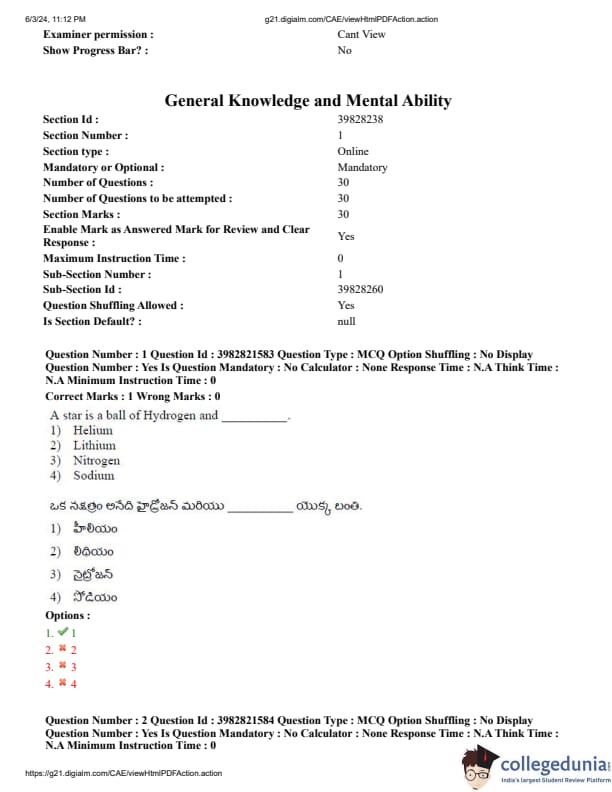
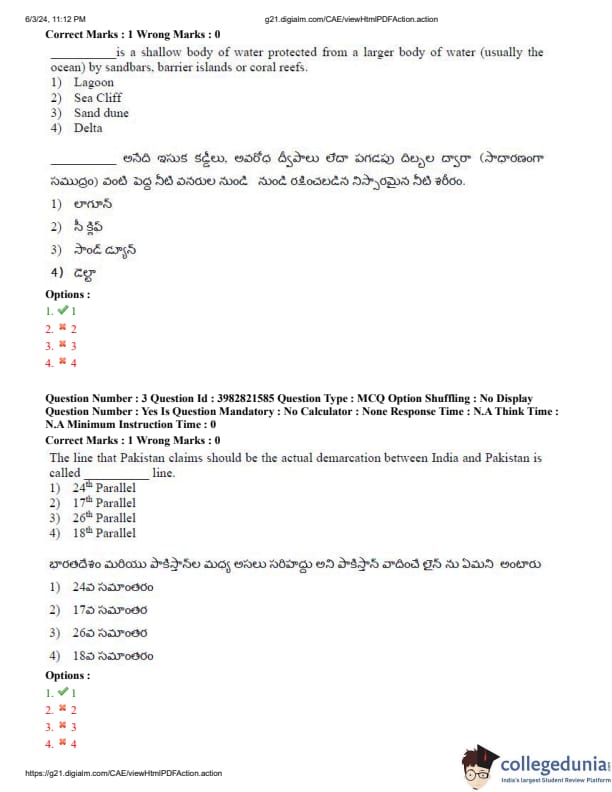
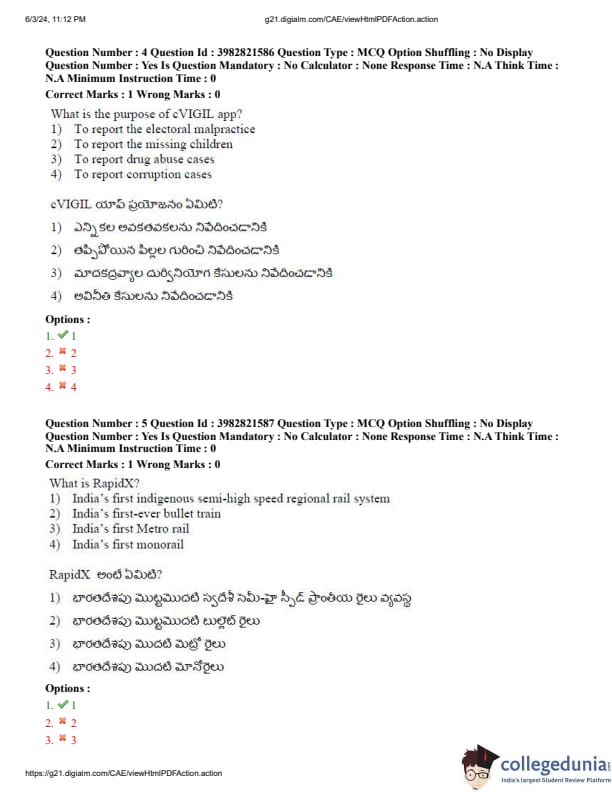


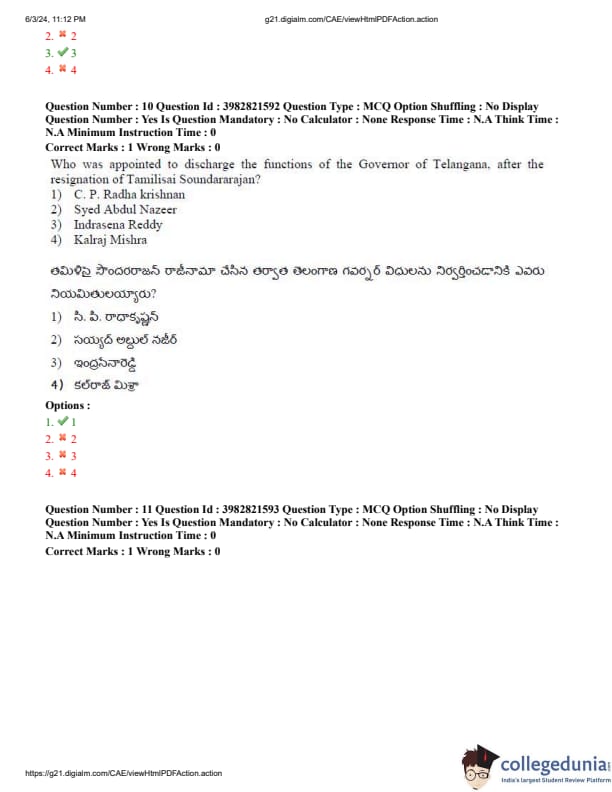


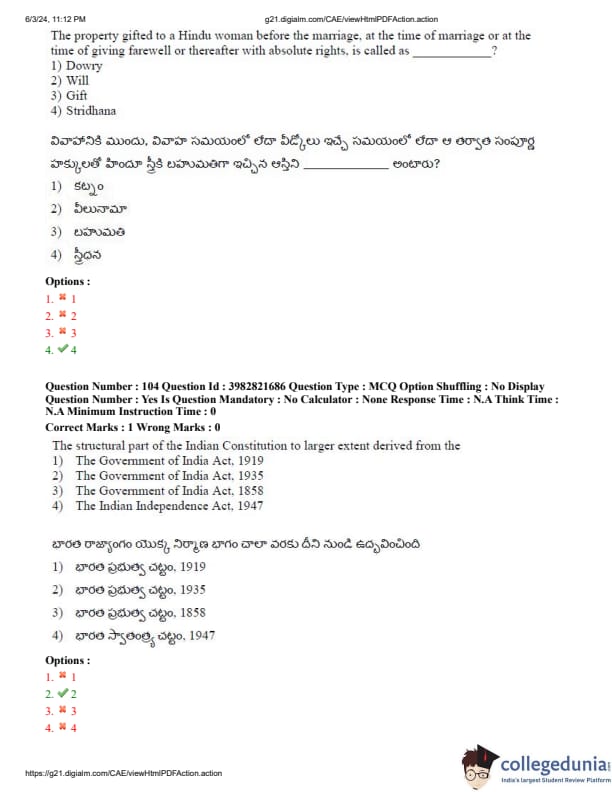





*The article might have information for the previous academic years, please refer the official website of the exam.