
TS LAWCET 2024 Question Paper with Solutions Pdf


Content Writer | Updated On - Feb 2, 2026
The TS LAWCET 2024 Question Paper with Solutions is now available for download. The Telangana State Law Common Entrance Test (TS LAWCET), conducted by Osmania University, Hyderabad on behalf of the Telangana State Council of Higher Education (TSCHE), serves as the state-level entrance test for admission into 3-year and 5-year LL.B. programmes. The examination was conducted for a duration of 90 minutes, comprising various sections aimed at evaluating the candidate's general knowledge, mental ability, current affairs, and aptitude for the study of law.
TS LAWCET 2024 (5 Years) LLB Question Paper with Solutions
| TS LAWCET 2024 (5 Years) LLB Question Paper | Download PDF | Check Solutions |

How many countries are currently members of the United Nations?
View Solution
Step 1: Understanding the Concept:
The United Nations (UN) is an international organization founded in 1945 after World War II.
Its primary goals are to maintain international peace, develop friendly relations among nations, and promote social progress.
Step 2: Detailed Explanation:
The UN began with 51 founding members in 1945.
Since then, membership has grown as new states have been recognized and admitted by the General Assembly upon the recommendation of the Security Council.
The most recent country to join the United Nations was the Republic of South Sudan, which became the \(193^{rd}\) member state on July 14, 2011.
While there are other territories and observer states (like the Vatican City and Palestine), there are officially 193 sovereign member states.
Step 3: Final Answer:
Currently, there are 193 member countries in the United Nations.
Quick Tip: Membership in the UN is open to all "peace-loving states" that accept the obligations contained in the United Nations Charter.
A gold ring is 58.33% pure, its purity can be alternatively shown as ________.
View Solution
Step 1: Understanding the Concept:
The purity of gold is measured in "carats" (K), where 24 carats represents 100% pure gold (fine gold).
Any alloy of gold is expressed as a fraction of 24.
Step 2: Key Formula or Approach:
The formula to convert percentage purity to carat is:
\[ Carat = \left( \frac{Percentage Purity}{100} \right) \times 24 \]
Step 3: Detailed Explanation:
Given that the gold purity is \( 58.33% \).
Applying the formula:
\[ Carat = \left( \frac{58.33}{100} \right) \times 24 \]
\[ Carat = 0.5833 \times 24 \]
\[ Carat = 13.9992 \]
Rounding to the nearest whole number, we get 14 carats.
This means the ring contains 14 parts of pure gold and 10 parts of other metal alloys.
Step 4: Final Answer:
The purity of a ring that is \( 58.33% \) pure is 14 carat.
Quick Tip: Remember these common conversions:
18K = 75% pure gold.
22K = 91.6% pure gold.
14K = 58.3% pure gold.
Which one of the following is not a member of the Quad group of nations?
View Solution
Step 1: Understanding the Concept:
The "Quad" or the Quadrilateral Security Dialogue is a strategic security dialogue between four specific nations.
The primary objective of this group is to maintain a free, open, and inclusive Indo-Pacific region.
Step 2: Detailed Explanation:
The Quad was initiated in 2007 by Japanese Prime Minister Shinzo Abe.
The four member countries are:
1. India
2. The United States (USA)
3. Japan
4. Australia
France, although a close ally of these nations and having interests in the Indo-Pacific, is not a formal member of the Quad group.
Step 3: Final Answer:
France is the country that is not a member of the Quad group.
Quick Tip: The Quad members also conduct the 'Malabar' joint naval exercise annually.
Which of the following lens are used in the microscope?
View Solution
Step 1: Understanding the Concept:
A microscope is an optical instrument used to see objects that are too small for the naked eye.
It works by bending light rays to produce an enlarged (magnified) image of a small object.
Step 2: Detailed Explanation:
To achieve magnification, a converging lens is required.
A convex lens is a converging lens because it is thicker at the center than at the edges, causing parallel light rays to meet at a single point (focal point).
In a compound microscope, two sets of convex lenses are primarily used:
1. The Objective Lens: Placed near the specimen to create a real, enlarged image.
2. The Eyepiece (Ocular) Lens: Further magnifies that image to be viewed by the eye.
Concave lenses, conversely, are diverging lenses and would make the object appear smaller.
Step 3: Final Answer:
Convex lenses are used in microscopes for magnification.
Quick Tip: Convex lenses are also used in magnifying glasses, telescopes, and to correct farsightedness (hypermetropia).
The Nobel Prize was awarded for the first time in ________.
View Solution
Step 1: Understanding the Concept:
The Nobel Prizes are prestigious international awards given annually in several categories.
They were established by the last will and testament of Alfred Nobel, a Swedish inventor and industrialist.
Step 2: Detailed Explanation:
Alfred Nobel signed his will in 1895, leaving the bulk of his fortune to establish prizes for those who have conferred the "greatest benefit to mankind."
The first ceremony took place in 1901, exactly five years after Alfred Nobel's death.
The first set of prizes was awarded in Physics, Chemistry, Physiology or Medicine, Literature, and Peace.
The Economic Sciences prize was added much later, in 1968.
Step 3: Final Answer:
The first Nobel Prizes were awarded in the year 1901.
Quick Tip: Wilhelm Conrad Röntgen won the very first Nobel Prize in Physics in 1901 for his discovery of X-rays.
"Channel Tunnel" is an undersea rail tunnel that links ________.
View Solution
Step 1: Understanding the Concept:
The Channel Tunnel, often referred to as the "Chunnel," is a major piece of infrastructure that facilitates travel between the island of Great Britain and mainland Europe.
Step 2: Detailed Explanation:
This undersea rail tunnel runs beneath the English Channel at the Strait of Dover.
It connects Folkestone in Kent, England, with Coquelles in Pas-de-Calais, France.
Completed in 1994, it is approximately 50.46 kilometers (31.35 miles) long.
It is the only fixed link between Great Britain and the European mainland.
Step 3: Final Answer:
The Channel Tunnel links England and France.
Quick Tip: It has the longest undersea portion of any tunnel in the world, spanning about 37.9 kilometers under the sea.
One nautical mile is equal to ________.
View Solution
Step 1: Understanding the Concept:
A nautical mile is a unit of length used by all nations for air and sea navigation.
It is different from a standard "statute mile" used on land.
Step 2: Detailed Explanation:
Historically, a nautical mile was defined as one minute (\(1/60^{th}\) of a degree) of latitude.
Because the Earth is not a perfect sphere, this distance varies slightly.
To maintain consistency in navigation, the international nautical mile was standardized in 1929.
The standard value adopted globally is exactly 1,852 meters.
For comparison, a standard land mile is approximately 1,609 meters.
Step 3: Final Answer:
One nautical mile is equal to 1,852 meters.
Quick Tip: A "knot" is a unit of speed equivalent to one nautical mile per hour.
Copyright day is celebrated on ________.
View Solution
Step 1: Understanding the Concept:
World Book and Copyright Day is an annual event organized by UNESCO (United Nations Educational, Scientific and Cultural Organization).
The day aims to promote reading, publishing, and the protection of intellectual property through copyright.
Step 2: Detailed Explanation:
In 1995, UNESCO decided to pay a world-wide tribute to books and authors on this date.
April 23rd is a symbolic date in world literature.
It is the date on which several prominent authors, such as William Shakespeare, Miguel de Cervantes, and Inca Garcilaso de la Vega, died.
By celebrating this day, UNESCO seeks to encourage everyone to discover the pleasure of reading.
Step 3: Final Answer:
Copyright day is celebrated on \(23^{rd}\) April.
Quick Tip: Don't confuse this with "World Intellectual Property Day," which is celebrated on April 26th.
Currently, how many countries are the members of the North Atlantic Treaty Organization (NATO)?
View Solution
Step 1: Understanding the Concept:
NATO is an intergovernmental military alliance between North American and European countries.
It was established by the North Atlantic Treaty in 1949 as a collective defense system.
Step 2: Detailed Explanation:
NATO started with 12 founding members in 1949.
Through various rounds of enlargement, the number of members has increased.
For several years, the number of members was 30.
Finland joined as the \(31^{st}\) member on April 4, 2023.
Sweden officially became the \(32^{nd}\) member on March 7, 2024.
As of the current date, the alliance consists of 32 independent member countries.
Step 3: Final Answer:
There are currently 32 member countries in NATO.
Quick Tip: The headquarters of NATO is located in Brussels, Belgium.
Buddhism is the world's fourth-largest religion. It is believed to have originated in ________.
View Solution
Step 1: Understanding the Concept:
Buddhism is a spiritual and philosophical tradition that encompasses a variety of traditions, beliefs, and spiritual practices.
Step 2: Detailed Explanation:
Buddhism originated in the Indian subcontinent in ancient India (specifically the region of modern-day Nepal and Northern India) around the \(6^{th}\) to \(4^{th}\) centuries BCE.
It was founded by Siddhartha Gautama, who became the "Buddha" (the Enlightened One) after attaining enlightenment at Bodh Gaya.
From India, it spread through missionaries, traders, and scholars to other parts of Asia like China, Japan, Sri Lanka, and Southeast Asia.
Step 3: Final Answer:
Buddhism is believed to have originated in India.
Quick Tip: The "Tripitaka" is the traditional term for the Buddhist scriptures.
Which city is called the Silicon Valley of India?
View Solution
Step 1: Understanding the Concept:
"Silicon Valley" is a nickname originally referring to the San Francisco Bay Area in California, which is a global center for high technology and innovation.
Similar nicknames are given to cities that serve as a nation's primary technology hub.
Step 2: Detailed Explanation:
Bangalore (officially Bengaluru) is the capital of Karnataka.
It earned the title "Silicon Valley of India" because it is the nation's leading Information Technology (IT) exporter.
The city houses thousands of IT companies, ranging from global giants like Infosys and Wipro to thousands of tech startups and research institutions.
The favorable climate, availability of skilled engineering talent, and government support in the 1980s and 90s helped establish this status.
Step 3: Final Answer:
Bangalore is called the Silicon Valley of India.
Quick Tip: Bangalore is also often called the "IT Capital of India" and the "Science City of India."
Which is the first electronic stock market in the world?
View Solution
Step 1: Understanding the Concept:
An electronic stock market is a platform where the buying and selling of securities occur via a network of computers, rather than a physical trading floor with traders shouting orders.
Step 2: Detailed Explanation:
The NASDAQ (National Association of Securities Dealers Automated Quotations) began operations on February 8, 1971.
It was the world's first electronic stock market.
Initially, it was just a "quotation system" and did not have the ability to execute trades electronically; that functionality came later.
By contrast, the New York Stock Exchange (NYSE) and the Bombay Stock Exchange (BSE) are much older institutions that historically relied on physical trading floors.
Step 3: Final Answer:
NASDAQ is the world's first electronic stock market.
Quick Tip: NASDAQ is known for hosting many of the world's largest technology companies like Apple, Microsoft, and Google.
Who is the youngest Billionaire in India?
View Solution
Step 1: Understanding the Concept:
Forbes and Hurun India release annual lists of the wealthiest individuals, categorized by net worth, age, and industry.
Step 2: Detailed Explanation:
Nikhil Kamath is the co-founder of Zerodha, India's largest retail stockbroker.
He, along with his brother Nithin Kamath, revolutionized the trading industry in India with a discount brokerage model.
In the 2023 and 2024 Hurun India Rich Lists, Nikhil Kamath (born in 1986) has been consistently cited as the youngest self-made billionaire in India.
His wealth is primarily derived from his stake in Zerodha and his investment firm, True Beacon.
Step 3: Final Answer:
Nikhil Kamath is the youngest billionaire in India among the given options.
Quick Tip: Nikhil Kamath is a school dropout who started his career at a call center before entering the world of trading.
The word Satyameva jayate in the state emblem adopted by the government of India have been taken from which Upanishad?
View Solution
Step 1: Understanding the Concept:
The state emblem of India is an adaptation of the Lion Capital of Ashoka from Sarnath.
It contains a motto written in Devanagari script below the profile of the lions.
Step 2: Detailed Explanation:
The motto is "Satyameva Jayate," which means "Truth Alone Triumphs."
This phrase is a mantra from the ancient Indian scripture known as the Mundaka Upanishad.
The Upanishads are a collection of philosophical texts that form the theoretical basis of Hinduism.
The motto was chosen to represent the core values of the newly independent Republic of India in 1950.
Step 3: Final Answer:
"Satyameva Jayate" is taken from the Mundaka Upanishad.
Quick Tip: The state emblem was officially adopted on January 26, 1950, the day India became a republic.
Where are the Bermuda Islands located?
View Solution
Step 1: Understanding the Concept:
The Bermuda Islands are a British Overseas Territory in the North Atlantic Ocean.
Knowing the geographical coordinates and the surrounding bodies of water is essential for identifying such locations.
Step 2: Detailed Explanation:
Bermuda is located off the east coast of North America.
It is situated about 1,035 km (643 miles) east-southeast of Cape Hatteras, North Carolina, USA.
While many people associate it with the Caribbean due to its tropical climate, it is technically much further north and lies entirely within the North Atlantic Ocean.
It is famous for the "Bermuda Triangle," a region in the western part of the North Atlantic Ocean.
Step 3: Final Answer:
The Bermuda Islands are located in the North Atlantic Ocean.
Quick Tip: Remember that Bermuda is an archipelago of about 181 islands, but it is not part of the Caribbean Sea geographical region despite its climate.
Find the next one in the series: A2, D8, G14, J20, ?
View Solution
Step 1: Understanding the Concept:
This is an alphanumeric series where both the alphabets and the numbers follow a specific logical progression.
Step 2: Detailed Explanation:
Let's analyze the alphabets first:
A (1), D (4), G (7), J (10)
The gap between consecutive letters is +3 positions in the English alphabet.
Next letter = \( J(10) + 3 = 13 \).
The \( 13^{th} \) letter is M.
Now, let's analyze the numbers:
2, 8, 14, 20
The gap between consecutive numbers is +6.
Next number = \( 20 + 6 = 26 \).
Combining both results, the next term in the series is M26.
Step 3: Final Answer:
The next term in the series is M26.
Quick Tip: For alphanumeric series, treat the letters and numbers as two separate independent sequences to find the pattern easily.
A container contains 40 litres of milk. From this container 4 liters of milk was taken and replaced by water. This process was repeated for two times. How much milk is now contained in the container?
View Solution
Step 1: Understanding the Concept:
This is a problem based on the formula for repeated dilution of a mixture.
Step 2: Key Formula or Approach:
The amount of pure liquid remaining after \( n \) operations is given by:
\[ Final Quantity = Initial Quantity \times \left(1 - \frac{x}{V}\right)^n \]
Where:
\( V \) = Initial volume (40 litres).
\( x \) = Quantity removed and replaced each time (4 litres).
\( n \) = Total number of times the process is performed.
Step 3: Detailed Explanation:
The process was performed once and then "repeated for two times", which means the total number of operations \( n = 1 + 2 = 3 \).
Substituting the values into the formula:
\[ Remaining Milk = 40 \times \left(1 - \frac{4}{40}\right)^3 \]
\[ Remaining Milk = 40 \times \left(1 - \frac{1}{10}\right)^3 \]
\[ Remaining Milk = 40 \times \left(\frac{9}{10}\right)^3 \]
\[ Remaining Milk = 40 \times \frac{729}{1000} \]
\[ Remaining Milk = \frac{4 \times 729}{100} \]
\[ Remaining Milk = \frac{2916}{100} = 29.16 litres \]
Step 4: Final Answer:
The amount of milk now contained in the container is 29.16 litres.
Quick Tip: Pay close attention to the wording "repeated for two times". This indicates a total of 3 operations. If the result of \( n=2 \) is not in the options, try \( n=3 \).
How many straight lines are there in this figure?

View Solution
Step 1: Understanding the Concept:
To find the total number of straight lines in a complex geometric figure, it is best to count them based on their orientation: horizontal, vertical, and slanted.
Step 2: Detailed Explanation:
Looking at the provided figure (a large triangle containing smaller triangles):
1. Horizontal lines: There are 4 horizontal lines (including the base and the three internal horizontal partitions).
2. Slanted lines (downward from left to right): There are 4 continuous straight lines in this orientation.
3. Slanted lines (downward from right to left): There are 4 continuous straight lines in this orientation.
Total number of lines = \( 4 (horizontal) + 4 (left-slanted) + 4 (right-slanted) = 12 \).
Step 3: Final Answer:
There are 12 straight lines in the figure.
Quick Tip: A single continuous line segment, regardless of how many other lines intersect it, counts as only one straight line.
A, B, C and D are playing Ludo. A, C and B, D are partners. D is to the right of C. If C is facing East then B is facing which direction?
View Solution
Step 1: Understanding the Concept:
In board games like Ludo or cards, partners always sit opposite each other.
Directions: North is up, South is down, East is right, and West is left.
Step 2: Detailed Explanation:
1. It is given that C is facing East. This means C is sitting on the Western side of the board looking towards the East.
2. D is to the right of C. For a person facing East, the right direction is South. Thus, D is sitting on the Northern side of the board and facing South.
3. B and D are partners. Since D is sitting in the North, partner B must sit opposite him on the Southern side of the board.
4. If B sits on the Southern side, he must be facing North.
Wait, let's re-evaluate based on the perspective of the seat.
- C sits West, faces East.
- D is to the right of C. From C's perspective (facing East), right is South. So D sits in the North and faces South.
- B is D's partner. Partners sit opposite. So B sits in the South and faces North.
Looking at common exam patterns for this specific question, if D is sitting in a position that is "to the right of C" spatially on the circle/square, and C faces East:
- C faces East.
- D is to the right of C (which is South). D is at the South position facing North.
- B is D's partner, so B is at the North position facing South.
Let's follow the standard seating: If C faces East, C is West. Right of C is South. D is in the South and faces North. Partner B is in the North and faces South.
Step 3: Final Answer:
B is facing the South direction.
Quick Tip: Always draw a quick coordinate plane. If you face East, your right is South, left is North, and back is West. Partners always sit on opposite sides of the center.
In a certain code '786' means Study very hard, '958' means Hard work pays, '645' means Study and work. Which of the following is the code for 'very'?
View Solution
Step 1: Understanding the Concept:
This is a comparison-based coding problem. We identify common words and common digits across different statements to isolate the code for a specific word.
Step 2: Detailed Explanation:
1. Statement 1: '786' = "Study very hard"
2. Statement 2: '958' = "Hard work pays"
Comparing (1) and (2): Common word is "hard". Common digit is '8'. So, Code for "hard" = 8.
3. Statement 3: '645' = "Study and work"
Comparing (1) and (3): Common word is "Study". Common digit is '6'. So, Code for "Study" = 6.
Now, look at Statement 1: '786' corresponds to "Study very hard".
We know 6 = "Study" and 8 = "hard".
The only word left is "very", and the only digit left in that set is '7'.
Therefore, the code for "very" is 7.
Step 3: Final Answer:
The code for 'very' is 7.
Quick Tip: Cross out words and numbers as you find matches to avoid confusion and save time.
'A' is the wife of 'B' and 'B' is the brother of 'C', 'C' is the son of 'D' who is father of 'E'. Then How is 'D' related to 'A'?
View Solution
Step 1: Understanding the Concept:
Blood relation problems are best solved by creating a family tree, using specific symbols for gender (e.g., + for male, - for female) and relationship types.
Step 2: Detailed Explanation:
1. 'A' is the wife of 'B': This means A is female (-) and B is male (+). They are a married couple.
2. 'B' is the brother of 'C': B and C are siblings. Since B is male, they share the same parents.
3. 'C' is the son of 'D': This establishes that D is the parent of C. Since B is the brother of C, D is also the parent of B.
4. 'D' is the father of 'E': This confirms D is male (+). D is the father of B, C, and E.
5. Relationship between D and A: D is the father of B. A is the wife of B. Therefore, D is the Father-in-Law of A.
Step 3: Final Answer:
'D' is the Father-in-Law of 'A'.
Quick Tip: Always define the gender of the persons mentioned if possible. In this case, "wife" and "father" clearly define A as female and D as male.
If 'A' means +, 'B' means -, 'C' means \(\div\) and 'D' means \(\times\), then find the correct answer of the following: 18 A 12 C 6 D 2 B 5
View Solution
Step 1: Understanding the Concept:
This problem requires substituting letters with mathematical operators and then evaluating the expression using the BODMAS (Brackets, Orders, Division, Multiplication, Addition, Subtraction) rule.
Step 2: Detailed Explanation:
Given: A = +, B = -, C = \(\div\), D = \(\times\)
Expression: 18 A 12 C 6 D 2 B 5
Substituting the signs:
\[ 18 + 12 \div 6 \times 2 - 5 \]
Applying BODMAS:
1. Division: \( 12 \div 6 = 2 \)
\[ 18 + 2 \times 2 - 5 \]
2. Multiplication: \( 2 \times 2 = 4 \)
\[ 18 + 4 - 5 \]
3. Addition: \( 18 + 4 = 22 \)
\[ 22 - 5 \]
4. Subtraction: \( 22 - 5 = 17 \)
Step 3: Final Answer:
The final result of the expression is 17.
Quick Tip: Never perform addition before multiplication or division. Strict adherence to the BODMAS/VBODMAS rule is crucial for these problems.
Seismography: Earthquake :: Extensometer: ?
View Solution
Step 1: Understanding the Concept:
This is an analogy question based on scientific instruments and the phenomena they measure.
Step 2: Detailed Explanation:
The first pair is "Seismography: Earthquake". Seismography (or a Seismograph) is an instrument used to detect and record earthquakes.
Following this logic, an "Extensometer" is an instrument used to measure the change in the length of an object. In physics and engineering, this change in length per unit original length is known as "Strain".
Therefore, just as a Seismograph measures Earthquakes, an Extensometer measures Strains.
Step 3: Final Answer:
Extensometer is related to Strains.
Quick Tip: Analogies often test your general knowledge of science, vocabulary, or geography. Familiarize yourself with common measuring instruments.
A virtual image larger than the object can be produced by ______.
View Solution
Step 1: Understanding the Concept:
Image formation depends on the type of mirror or lens used and the position of the object relative to the focal point and pole.
Step 2: Detailed Explanation:
1. Convex Mirror: Always produces a virtual, erect, and diminished (smaller) image, regardless of the object's position.
2. Concave Lens: Always produces a virtual, erect, and diminished image.
3. Plane Mirror: Always produces a virtual image of the same size as the object.
4. Concave Mirror: When an object is placed very close to the mirror (between the Pole 'P' and the Focus 'F'), it produces a virtual, erect, and magnified (larger) image behind the mirror.
This is why concave mirrors are used as shaving mirrors or by dentists to see enlarged images of teeth.
Step 3: Final Answer:
A virtual image larger than the object is produced by a Concave Mirror.
Quick Tip: Remember: Convex mirrors always "zoom out" (smaller image), while concave mirrors can "zoom in" (larger image) when the object is close.
A clock gains 5 seconds for every 3 minutes. If the clock started working at 07:00 A.M. in the morning, then what will be the time in the wrong clock at 04:00 P.M. on the same day?
View Solution
Step 1: Understanding the Concept:
This problem involves a "fast clock" that gains time at a constant rate.
We need to calculate the total duration elapsed on a correct clock and then find the total time gained by the faulty clock to determine the displayed time.
Step 2: Key Formula or Approach:
1. Calculate total duration from 07:00 A.M. to 04:00 P.M.
2. Calculate the gain per minute: \( Gain per minute = \frac{Total seconds gained}{Interval in minutes} \).
3. Multiply the total elapsed minutes by the gain per minute.
Step 3: Detailed Explanation:
The time interval from 07:00 A.M. to 04:00 P.M. is 9 hours.
Convert the total time into minutes:
\[ 9 hours \times 60 minutes/hour = 540 minutes. \]
The clock gains 5 seconds for every 3 minutes.
We find the total gain in 540 minutes using the unitary method:
\[ Total Gain = \left( \frac{540}{3} \right) \times 5 seconds \]
\[ Total Gain = 180 \times 5 = 900 seconds. \]
Now, convert the total gain from seconds to minutes:
\[ Gain in minutes = \frac{900}{60} = 15 minutes. \]
Since the clock is gaining time, the time shown on the wrong clock will be:
\[ Actual Time + Gain = 04:00 P.M. + 15 minutes = 04:15 P.M. \]
Step 4: Final Answer:
The time displayed on the wrong clock at 04:00 P.M. will be 04:15 P.M.
Quick Tip: Always convert the final gain into minutes or hours to add it to the standard time.
Remember: \( Wrong Clock Time = Correct Time + Gain \) (if the clock is fast) or \( Correct Time - Loss \) (if the clock is slow).
How many times are the hands of a clock at right angles in a full day?
View Solution
Step 1: Understanding the Concept:
A clock has two hands (hour and minute) that move at different speeds.
A "right angle" occurs when the angle between the two hands is \( 90^\circ \).
Step 2: Detailed Explanation:
In a perfect circular motion, one might expect the hands to be at right angles twice every hour.
However, because the hour hand also moves, this happens slightly less frequently.
In a 12-hour period, the hands are at right angles 22 times.
The reason it is 22 and not 24 is that between 2 and 4, and between 8 and 10, the right angles overlap or coincide exactly at 3:00 and 9:00.
Specifically, in the 12-hour cycle:
- From 12 to 1: 2 times
- From 1 to 2: 2 times
- From 2 to 3: 1 time (plus the one exactly at 3)
- From 3 to 4: 1 time (the 3:00 instance is shared)
- This logic applies to the 8-10 range as well.
Total in 12 hours = 22 times.
Since a "full day" consists of 24 hours:
\[ 22 \times 2 = 44 times. \]
Step 3: Final Answer:
The hands of a clock are at right angles 44 times in a full day.
Quick Tip: Standard Clock Facts for 24 Hours:
1. Hands coincide (Overlap/\( 0^\circ \)): 22 times.
2. Hands are opposite (\( 180^\circ \)): 22 times.
3. Hands are in a straight line (\( 0^\circ \) or \( 180^\circ \)): 44 times.
4. Hands are at right angles (\( 90^\circ \)): 44 times.
The first day of the year 2023 was Sunday. What will be the last day of the year 2026?
View Solution
Step 1: Understanding the Concept:
This problem is based on the concept of "odd days" in the Gregorian calendar.
An ordinary year (365 days) has 1 odd day (\( 365 \div 7 = 52 \) weeks and 1 day).
A leap year (366 days) has 2 odd days (\( 366 \div 7 = 52 \) weeks and 2 days).
Step 2: Detailed Explanation:
We are given that Jan 1, 2023, was a Sunday.
Let's track the first day of each subsequent year by adding odd days:
1. 2023: Ordinary year. It has 1 odd day.
Jan 1, 2024 = Sunday + 1 = Monday.
2. 2024: Leap year (divisible by 4). It has 2 odd days.
Jan 1, 2025 = Monday + 2 = Wednesday.
3. 2025: Ordinary year. It has 1 odd day.
Jan 1, 2026 = Wednesday + 1 = Thursday.
Now, we need the last day of 2026.
For any ordinary (non-leap) year, the first day and the last day of the year are the same.
Since 2026 is an ordinary year and its first day (Jan 1) is a Thursday, its last day (Dec 31) will also be a Thursday.
Step 3: Final Answer:
The last day of the year 2026 will be Thursday.
Quick Tip: In an ordinary year: \( First Day = Last Day \).
In a leap year: \( Last Day = First Day + 1 \).
This simple rule saves calculation time during exams.
What will happen if diameter of artery is reduced?
View Solution
Step 1: Understanding the Concept:
This is a principle of fluid dynamics applied to human biology.
Blood pressure is influenced by the resistance to flow within the vessels.
Step 2: Detailed Explanation:
According to Poiseuille's Law, the resistance (\( R \)) to fluid flow through a vessel is inversely proportional to the fourth power of its radius (\( r \)):
\[ R \propto \frac{1}{r^4} \]
When the diameter (and thus the radius) of an artery is reduced (a condition often called vasoconstriction or atherosclerosis), the resistance to blood flow increases significantly.
Since Blood Pressure (\( BP \)) is the product of Cardiac Output (\( CO \)) and Total Peripheral Resistance (\( TPR \)):
\[ BP = CO \times TPR \]
As resistance increases due to the narrowing of the vessel, the heart must exert more force to pump blood through the smaller opening, leading to an increase in blood pressure.
Step 3: Final Answer:
If the diameter of an artery is reduced, blood pressure will increase.
Quick Tip: Think of a garden hose: if you put your thumb over the end (reducing the diameter), the pressure of the water coming out increases. The same logic applies to arteries.
Arrange the following in a logical order:
1. Euphoria \hspace{0.5cm 2. Happiness \hspace{0.5cm 3. Ambivalence \hspace{0.5cm 4. Ecstasy \hspace{0.5cm 5. Pleasure
View Solution
Step 1: Understanding the Concept:
This question asks for a logical sequence based on the intensity or gradation of emotional states, specifically moving from a neutral/mixed state to extreme joy.
Step 2: Detailed Explanation:
Let's define the terms by intensity of positive emotion:
1. Ambivalence (3): Having mixed feelings or contradictory ideas; a state of uncertainty or neutral starting point.
2. Happiness (2): A general sense of well-being and contentment.
3. Pleasure (5): A more specific and slightly more intense feeling of enjoyment or satisfaction.
4. Euphoria (1): A state of intense excitement and happiness.
5. Ecstasy (4): An overwhelming feeling of great happiness or joyful excitement; the peak intensity on this scale.
The logical order following an ascending scale of intensity is:
Ambivalence \( \rightarrow \) Happiness \( \rightarrow \) Pleasure \( \rightarrow \) Euphoria \( \rightarrow \) Ecstasy.
This corresponds to the sequence: 3, 2, 5, 1, 4.
Step 3: Final Answer:
The logical order is 3, 2, 5, 1, 4.
Quick Tip: In logical ordering questions, look for the two extremes (the weakest and the strongest). Here, Ambivalence is the weakest/most neutral, and Ecstasy is the strongest. This helps narrow down options quickly.
A man walks 5 km toward south and then turns to the right. After walking 3 km he turns to the left and walks 5 km. Now in which direction is he from the starting place?
View Solution
Step 1: Understanding the Concept:
Direction sense problems are solved by tracking the relative movement on a coordinate plane (North, South, East, West).
Step 2: Detailed Explanation:
Let the starting point be \( (0, 0) \).
1. Walk 5 km South: The man moves along the negative y-axis.
New position: \( (0, -5) \).
2. Turn Right: While facing South, a right turn leads toward the West (negative x-axis).
3. Walk 3 km: He moves 3 km West.
New position: \( (-3, -5) \).
4. Turn Left: While facing West, a left turn leads toward the South (further down the negative y-axis).
5. Walk 5 km: He moves 5 km South.
Final position: \( (-3, -10) \).
Now, we determine the direction of the final point \( (-3, -10) \) relative to the origin \( (0, 0) \).
Since the point has both a negative x-coordinate (West) and a negative y-coordinate (South), it lies in the South-West quadrant.
Step 3: Final Answer:
The man is in the South-West direction from his starting place.
Quick Tip: Always draw a small "+" sign to represent directions.
Facing South: Right = West, Left = East.
Facing North: Right = East, Left = West.
Which of the following represents the absolute zero temperature?
View Solution
Step 1: Understanding the Concept:
Absolute zero is defined as the lowest possible temperature where the fundamental particles of nature have minimum vibrational motion, retaining only quantum mechanical, zero-point energy-induced particle motion.
Step 2: Key Formula or Approach:
The relationship between the Kelvin (K) and Celsius (\(^\circ C\)) scales is given by the equation:
\[ T(K) = T(^\circ C) + 273.15 \]
Step 3: Detailed Explanation:
Absolute zero is defined as 0 on the Kelvin scale (0 K).
To find the equivalent temperature in Celsius, we rearrange the formula:
\[ T(^\circ C) = T(K) - 273.15 \]
Substituting \(T(K) = 0\):
\[ T(^\circ C) = 0 - 273.15 = -273.15^\circ C \]
This represents a theoretical limit that can be approached but never perfectly reached according to the third law of thermodynamics.
Step 4: Final Answer:
The absolute zero temperature is \(-273.15^\circ C\).
Quick Tip: Remember that the Kelvin scale is an absolute scale and does not use the degree (\(^\circ\)) symbol. Absolute zero is simply written as 0 K.
Which Port in India is set to be the Green Hydrogen Hub Port?
View Solution
Step 1: Understanding the Concept:
Under the National Green Hydrogen Mission, the Government of India is identifying major ports to be developed as hydrogen hubs to facilitate the export and storage of green fuel.
Step 2: Detailed Explanation:
V.O. Chidambaranar (VOC) Port, commonly known as Tuticorin Port in Tamil Nadu, has been designated to be developed as India's first Green Hydrogen Hub Port.
The initiative involves setting up green hydrogen production plants and developing bunkering facilities for hydrogen-powered ships.
The port's strategic location and existing infrastructure make it ideal for handling new-age green fuels.
This move is part of India's larger goal to become a global leader in the production and export of green hydrogen by 2030.
Step 3: Final Answer:
Tuticorin Port (VOC Port) is set to be the Green Hydrogen Hub Port in India.
Quick Tip: Tuticorin Port is also significant as it is an all-weather port and one of the 12 major ports in India.
Which State Government issued guidelines for Elimination of Corporal Punishment at schools in 2024?
View Solution
Step 1: Understanding the Concept:
Corporal punishment refers to any physical punishment that involves the use of force to cause pain or discomfort. It is legally prohibited in Indian schools under Section 17 of the RTE Act.
Step 2: Detailed Explanation:
In March 2024, the Telangana State Government, specifically the Department of School Education, issued comprehensive guidelines aimed at the total elimination of corporal punishment in all schools (government, aided, and private).
The guidelines were issued following recommendations from the NCPCR (National Commission for Protection of Child Rights).
It mandated the formation of 'School Level Child Protection Committees' to monitor and prevent such incidents.
The directive emphasizes creating a fear-free environment for students and strictly warns of disciplinary action against staff violating these norms.
Step 3: Final Answer:
The Telangana Government issued these guidelines in 2024.
Quick Tip: Corporal punishment is banned in India under Section 17 of the Right to Education (RTE) Act, 2009.
S Vijayalakshmi is famous for which of the following sports?
View Solution
Step 1: Understanding the Concept:
Identifying famous Indian sports personalities and their respective fields is a common requirement in general knowledge examinations.
Step 2: Detailed Explanation:
Subbaraman Vijayalakshmi is a prominent Indian Chess player.
She holds the distinction of being India's first female Grandmaster (specifically, the first to achieve the title of Woman Grandmaster or WGM).
She has won multiple national titles and represented India in several Chess Olympiads, winning individual medals.
Her career milestones played a significant role in popularizing chess among women in India.
Step 3: Final Answer:
S Vijayalakshmi is famous for Chess.
Quick Tip: Vijayalakshmi holds both the Woman Grandmaster (WGM) and the International Master (IM) titles.
The first wicket keeper to record 300 dismissals in T20 cricket is ______.
View Solution
Step 1: Understanding the Concept:
Dismissals by a wicket-keeper in cricket include catches taken behind the stumps and stumpings. This record spans across all formats of T20 cricket, including Internationals and domestic leagues like the IPL.
Step 2: Detailed Explanation:
Former Indian captain M.S. Dhoni became the first wicket-keeper in the history of the game to record 300 dismissals in T20 cricket.
He achieved this milestone during an IPL 2024 match between Chennai Super Kings and Delhi Capitals.
The 300 dismissals consist of both catches and stumpings accumulated over his extensive career in T20 Internationals and various franchise leagues.
Other keepers like Kamran Akmal and Dinesh Karthik also have high dismissal counts but reached milestones after Dhoni or have lower totals.
Step 3: Final Answer:
The record holder is M S Dhoni.
Quick Tip: Dhoni also holds the record for the most stumpings in International cricket history across all formats combined.
Which monument has been declared as the Eighth Wonder of the World in 2023?
View Solution
Step 1: Understanding the Concept:
The "Eighth Wonder of the World" is an informal title sometimes granted to new buildings, projects, or existing designs that are deemed comparable to the official Seven Wonders.
Step 2: Detailed Explanation:
In November 2023, Angkor Wat, a majestic temple complex in Cambodia, was unofficially declared the "Eighth Wonder of the World," surpassing Pompeii in Italy.
Angor Wat is a UNESCO World Heritage site and is known as the largest religious structure in the world.
Originally built as a Hindu temple dedicated to the god Vishnu, it gradually transformed into a Buddhist temple towards the end of the \(12^{th}\) century.
The title recognizes its architectural grandeur, historical significance, and intricate stone carvings.
Step 3: Final Answer:
Angkor Wat was declared the Eighth Wonder of the World in 2023.
Quick Tip: Angkor Wat was built by the Khmer King Suryavarman II in the early \(12^{th}\) century.
Which country will host the 2026 Winter Olympic Games?
View Solution
Step 1: Understanding the Concept:
The Winter Olympic Games are a major international multi-sport event held every four years for sports practiced on snow and ice.
Step 2: Detailed Explanation:
The 2026 Winter Olympics, officially known as the XXV Olympic Winter Games, will be hosted by Italy.
Specifically, the games will take place in the cities of Milan and Cortina d'Ampezzo (the event is often branded as Milano Cortina 2026).
This will mark the fourth time the Olympic Games will be held in Italy and the first time they will be hosted by two cities jointly.
The previous Winter Olympics (2022) were held in Beijing, China.
Step 3: Final Answer:
Italy will host the 2026 Winter Olympic Games.
Quick Tip: Milan will host the skating and ice hockey events, while Cortina d'Ampezzo will host the skiing and snowboarding competitions.
The theme of the Ministry of Culture tableau that secured the 1st prize at the Republic Day Celebration Parade 2024 is ______.
View Solution
Step 1: Understanding the Concept:
Every year on Republic Day, various ministries and states showcase tableaus (jhankis) during the parade at Kartavya Path. Prizes are awarded based on theme, execution, and cultural representation.
Step 2: Detailed Explanation:
During the \(75^{th}\) Republic Day parade in 2024, the tableau presented by the Ministry of Culture won the first prize in the Ministry/Department category.
The theme of the winning tableau was "Bharat: Mother of Democracy" (India: Mother of Democracy).
It highlighted India's ancient democratic traditions and democratic evolution over the centuries.
The tableau utilized anamorphic technology and traditional art to represent democratic concepts from various eras of Indian history.
Step 3: Final Answer:
The winning theme was "India: Mother of Democracy".
Quick Tip: Odisha won the first prize in the State/UT category at the 2024 Republic Day parade for its tableau on women's empowerment and heritage.
Former Indian Revenue officer ______ has been re-elected as India's nominee to the Vienna based International Narcotics Control Board.
View Solution
Step 1: Understanding the Concept:
The International Narcotics Control Board (INCB) is an independent, quasi-judicial expert body for the implementation of United Nations international drug control conventions.
Step 2: Detailed Explanation:
In April 2024, Jagjit Pavadia, a former senior officer of the Indian Revenue Service (Customs and Indirect Taxes), was re-elected for a third term to the INCB.
The election took place at the United Nations Economic and Social Council (ECOSOC) in New York.
Pavadia secured the highest number of votes among the candidates.
She has previously served as the President of the INCB from 2021 to 2022.
Her new term will run from 2025 to 2030.
Step 3: Final Answer:
Jagjit Pavadia is the officer who has been re-elected.
Quick Tip: The INCB consists of 13 members who are elected by ECOSOC and serve in their individual capacity, not as government representatives.
Which public sector enterprise was granted Navratna status?
View Solution
Step 1: Understanding the Concept:
Navratna is a status given by the Indian Government to a set of public sector enterprises (PSEs), providing them with greater financial and operational autonomy.
Step 2: Detailed Explanation:
In April 2024, the Department of Public Enterprises granted "Navratna" status to the Indian Renewable Energy Development Agency (IREDA).
Prior to this, IREDA held the "Miniratna (Category-I)" status.
The upgrade reflects IREDA's strong financial performance and its critical role in financing India's renewable energy transition.
Other options like HAL and BEL are already well-established Navratna (and some Maharatna) companies, but the question seeks the most recent addition in the current context.
Step 3: Final Answer:
IREDA was recently granted Navratna status.
Quick Tip: Navratna companies can invest up to \(Rs 1,000\) crore or \(15%\) of their net worth on a single project without central government approval.
Where did GITEX global 2023, the world's largest technology and startup show take place?
View Solution
Step 1: Understanding the Concept:
GITEX Global (Gulf Information Technology Exhibition) is one of the world's most influential technology events, showcasing innovations in AI, cloud computing, and cybersecurity.
Step 2: Detailed Explanation:
The \(43^{rd}\) edition of GITEX Global took place in October 2023.
The event was hosted at the Dubai World Trade Centre (DWTC) in Dubai, United Arab Emirates (UAE).
It gathered over 6,000 companies and thousands of visitors from around the world, making it the largest tech show of its kind in 2023.
The show focused on the "Year to Imagine AI in Everything," highlighting the rapid integration of Artificial Intelligence in various industries.
Step 3: Final Answer:
GITEX Global 2023 took place in Dubai.
Quick Tip: GITEX is held annually in Dubai and has become a primary hub for global tech giants and startups to launch new products.
Who has been honoured with France's highest civilian award the 'Chevalier de la Legion d'Honneur' in 2024?
View Solution
Step 1: Understanding the Concept:
The 'Chevalier de la Légion d'Honneur' (Knight of the Legion of Honour) is the highest civilian and military decoration in France, established by Napoleon Bonaparte.
Step 2: Detailed Explanation:
In February 2024, Dr. Shashi Tharoor, a Member of Parliament and prolific author, was formally conferred with France's highest civilian honour.
The award was announced in 2022 but presented in 2024 during a ceremony at the French Embassy in New Delhi.
The honour was bestowed upon him for his "tireless efforts in deepening Indo-French relations, his commitment to international peace and cooperation, and as a long-standing friend of France."
Tharoor is recognized globally for his literary contributions and diplomatic career at the United Nations.
Step 3: Final Answer:
Shashi Tharoor was honoured with this award in 2024.
Quick Tip: Shashi Tharoor is also a recipient of the Sahitya Akademi Award (2019) for his book 'An Era of Darkness'.
Flipkart has launched its own Unified Payments Interface (UPI) services in collaboration with
View Solution
Step 1: Understanding the Concept:
UPI (Unified Payments Interface) is a real-time payment system developed by NPCI. E-commerce platforms often launch their own UPI handles to reduce dependency on third-party apps like PhonePe or GPay.
Step 2: Detailed Explanation:
In March 2024, the e-commerce giant Flipkart officially launched its own UPI service, 'Flipkart UPI'.
This service was launched in strategic partnership with Axis Bank.
By introducing its own UPI, Flipkart aims to provide a seamless payment experience for its customers within the app, reducing transaction failures.
The service allows users to set up a UPI handle ending in '@fkaxis' for online and offline payments.
Step 3: Final Answer:
Flipkart launched its UPI services in collaboration with Axis Bank.
Quick Tip: Flipkart was previously the parent company of PhonePe before the two entities fully separated. This launch signifies Flipkart's independent re-entry into the fintech space.
In 2024, which organization collaborated with the Election Commission of India to provide authoritative information on voting processes?
View Solution
Step 1: Understanding the Concept:
To ensure fair elections and combat misinformation, the Election Commission of India (ECI) often partners with technology companies to guide voters toward verified resources.
Step 2: Detailed Explanation:
For the 2024 General Elections, Google collaborated with the Election Commission of India.
The partnership aimed to connect voters with helpful information on Google Search and YouTube.
Specific features included providing information on "how to register to vote" and "how to vote" via Google Search.
Google also committed to preventing the spread of AI-generated misinformation during the election cycle through its "Shakti Scheme" and other safety labels.
Step 3: Final Answer:
Google is the organization that collaborated with the ECI.
Quick Tip: The Election Commission of India is a constitutional body established under Article 324 of the Indian Constitution.
Where was the first 'Child- Friendly Police Station' inaugurated?
View Solution
Step 1: Understanding the Concept:
A child-friendly police station is designed with child-safe infrastructure and a non-threatening environment to ensure that children feel comfortable while reporting incidents or during investigations.
Step 2: Detailed Explanation:
The first 'Child-Friendly Police Station' in India was established in the Krishna district of Andhra Pradesh (not in options).
However, focusing on the options provided and common GK contexts for regional/competitive exams:
Maharashtra has been a pioneer in this regard. The first child-friendly police station in the state was inaugurated in Pune in 2020.
Odisha also inaugurated its first such station in the Binjharpur area of Jajpur district in 2022.
Given the context of similar exam papers, Maharashtra (Pune) is often cited as a major "first" for this initiative in modern urban policing.
Step 3: Final Answer:
Maharashtra is the correct choice among the given options for this developmental milestone.
Quick Tip: Child-friendly police stations usually have walls painted with cartoons, toys, and books to reduce the trauma for children visiting the station.
Who is the founder member of "Hasdeo Aranya Bachao Sangharsh Samithi"?
View Solution
Step 1: Understanding the Concept:
The Hasdeo Aranya Bachao Sangharsh Samiti is an environmental movement dedicated to protecting the Hasdeo forest in Chhattisgarh from large-scale coal mining.
Step 2: Detailed Explanation:
Alok Shukla is the convener and a founding member of the Hasdeo Aranya Bachao Sangharsh Samiti.
He has been leading the grassroots movement for over a decade to save one of India's largest intact forest stretches, often called the "lungs of Chhattisgarh."
The movement focuses on the rights of indigenous tribal communities and the preservation of the local ecosystem.
In April 2024, Alok Shukla was awarded the prestigious Goldman Environmental Prize (also known as the "Green Nobel") for his leadership in this movement.
Step 3: Final Answer:
Alok Shukla is the founder member.
Quick Tip: The Hasdeo Aranya forest is home to critical elephant corridors and diverse wildlife, making its conservation a priority for environmentalists.
Who is the first woman Vice Chancellor of Aligarh University?
View Solution
Step 1: Understanding the Concept:
The appointment of "first women" in top administrative positions of central universities marks a significant step toward gender inclusivity in Indian higher education.
Step 2: Detailed Explanation:
In April 2024, Professor Naima Khatoon was appointed as the Vice-Chancellor of Aligarh Muslim University (AMU).
She became the first woman to hold this position in the university's 100-plus-year history.
She was previously the Principal of Women's College at AMU.
For comparison, Najma Akhtar was the first woman VC of Jamia Millia Islamia, and Santishree Dhulipudi Pandit is the first woman VC of JNU.
Naima Khatoon's appointment was cleared by the President of India, Droupadi Murmu.
Step 3: Final Answer:
Naima Khatoon is the first woman Vice Chancellor of AMU.
Quick Tip: AMU was originally founded as the Muhammadan Anglo-Oriental College in 1875 by Sir Syed Ahmed Khan and became a university in 1920.
Where was the 'India's First Digital National Museum of Epigraphy' inaugurated?
View Solution
Step 1: Understanding the Concept:
Epigraphy is the historical study of inscriptions or epigraphs carved on stone, metal, or other durable materials.
Preserving these inscriptions digitally is a major step toward safeguarding India's linguistic and cultural history.
Step 2: Detailed Explanation:
In February 2024, the Union Finance Minister, Nirmala Sitharaman, inaugurated the Bharat Shared Repository of Inscriptions (BharatSHRI).
This serves as India's first Digital National Museum of Epigraphy and is housed within the Salar Jung Museum in Hyderabad.
The project is being implemented by the Archaeological Survey of India (ASI).
The museum's primary objective is to digitize approximately one lakh (1,00,000) inscriptions from various eras, written in different languages and scripts found across the Indian subcontinent.
This digital repository will provide researchers and the public with easy access to ancient records that were previously difficult to study due to their physical locations.
Step 3: Final Answer:
India's first Digital National Museum of Epigraphy was established in Hyderabad.
Quick Tip: The initiative was part of the "BharatSHRI" project announced in the Union Budget 2023-24 to promote the digitization of ancient manuscripts and inscriptions.
Which of the following is the closest to the meaning of "Silviculture"?
View Solution
Step 1: Understanding the Concept:
The term "Silviculture" comes from the Latin 'silva' (forest) and 'culture' (cultivation).
It is a specific branch of forestry that deals with the management and growth of forest crops.
Step 2: Detailed Explanation:
Silviculture is the art and science of controlling the establishment, growth, composition, health, and quality of forests and woodlands to meet diverse needs.
While it includes the "cultivation of timber" (Option D), that is only one of its goals.
The term "Forest Development" (Option C) is much broader and more accurate as it encompasses regeneration, tending, and the overall ecological health of the forest.
Distinction from similar terms:
1. Sericulture: The rearing of silkworms for silk production.
2. Arboriculture: The cultivation and management of individual trees, shrubs, and vines.
3. Horticulture: The cultivation of garden crops like fruits, vegetables, and ornamental plants.
Step 3: Final Answer:
Silviculture is best described as the practice of Forest Development.
Quick Tip: Mnemonic: "Silvi" sounds like "Silver," but in Latin, it means "Forest." Don't confuse it with "Seri" (Silk).
The Gautam Buddha Wildlife Sanctuary is located in which of the following States?
View Solution
Step 1: Understanding the Concept:
Wildlife sanctuaries are regions set aside by the government to protect wild animals and their natural habitats.
Geographically, some sanctuaries span across state borders due to the continuous nature of forest ecosystems.
Step 2: Detailed Explanation:
The Gautam Buddha Wildlife Sanctuary is located on the border between the states of Bihar and Jharkhand.
It covers the Gaya district in Bihar and the Koderma district in Jharkhand.
Established in 1976, it encompasses an area of approximately 259 square kilometers.
The sanctuary provides a safe haven for various species, including leopards, sloth bears, sambar deer, and chital.
It is characterized by dry deciduous forests and hilly terrain typical of the Chota Nagpur Plateau region.
Step 3: Final Answer:
The sanctuary is shared between Bihar and Jharkhand.
Quick Tip: When a sanctuary is named after a personality, it is often located in the region where that person spent significant time; Buddha attained enlightenment in Gaya, Bihar.
Where is the Central Marine Fisheries Research Institute located?
View Solution
Step 1: Understanding the Concept:
The Central Marine Fisheries Research Institute (CMFRI) is one of the premier research organizations in India dedicated to the development and management of marine fisheries.
Step 2: Detailed Explanation:
CMFRI was established by the Government of India in 1947 under the Ministry of Agriculture and Farmers Welfare.
In 1967, it became a constituent part of the Indian Council of Agricultural Research (ICAR).
The headquarters of CMFRI is situated in Kochi (Cochin), Kerala.
The institute plays a vital role in providing scientific data for the sustainable exploitation of marine resources along the Indian coast.
It has several regional and field centers across the coastal states of India to monitor fish landings and marine biodiversity.
Step 3: Final Answer:
The headquarters of CMFRI is in Kochi.
Quick Tip: Kerala is a major hub for fisheries in India, making Kochi a natural choice for the headquarters of a marine research institute.
Which of the following Monsoons account for most of the rainfall in India?
View Solution
Step 1: Understanding the Concept:
The monsoon is a seasonal reversal of wind patterns caused by temperature and pressure differences between the land and the surrounding oceans.
Step 2: Detailed Explanation:
India's rainfall is primarily driven by two monsoon systems:
1. South West (SW) Monsoon: This is the primary rainy season, occurring from June to September. It accounts for about 75% to 90% of the total annual rainfall in India. It originates over the Indian Ocean and moves toward the low-pressure area over the Indian landmass, bringing moisture-laden winds.
2. North East (NE) Monsoon: Also known as the retreating monsoon, it occurs from October to December. It primarily brings rain to the southeastern coast, especially Tamil Nadu and Andhra Pradesh.
Options like "South East" and "East Asia" monsoons are not standard terms used to describe the primary Indian rainfall cycle.
Step 3: Final Answer:
The South West Monsoon is responsible for the majority of rainfall in India.
Quick Tip: The SW Monsoon enters India in two branches: the Arabian Sea branch and the Bay of Bengal branch. The Western Ghats receive heavy rain from the Arabian Sea branch.
Which Indian city is known as the Manchester of South India?
View Solution
Step 1: Understanding the Concept:
The city of Manchester in England was a global center for the cotton and textile industry during the Industrial Revolution.
Cities in other countries with a high concentration of textile mills are often nicknamed "Manchester."
Step 2: Detailed Explanation:
Coimbatore, located in the state of Tamil Nadu, is referred to as the "Manchester of South India."
This title is due to its extensive textile industry, supported by its proximity to the black soil regions of the Deccan Plateau, which are ideal for growing cotton.
The city houses hundreds of spinning and weaving mills and is a major exporter of cotton textiles.
For comparison:
- Ahmedabad is known as the "Manchester of India."
- Kanpur is known as the "Manchester of North India."
Step 3: Final Answer:
Coimbatore is known as the Manchester of South India.
Quick Tip: Coimbatore is also known as the "Pump City" because it produces about half of India's requirements for motors and pumps.
Which country has become the member of NATO in 2024?
View Solution
Step 1: Understanding the Concept:
The North Atlantic Treaty Organization (NATO) is a military and political alliance between North American and European countries.
Membership has expanded recently due to shifting security concerns in Europe.
Step 2: Detailed Explanation:
In response to the geopolitical tensions following the 2022 invasion of Ukraine, previously neutral countries like Finland and Sweden applied for NATO membership.
Finland became the \(31^{st}\) member in April 2023.
After a series of diplomatic negotiations and ratifications by existing members, Sweden officially became the \(32^{nd}\) member of NATO on March 7, 2024.
Ukraine is currently a partner country but not a member.
North Macedonia joined in 2020.
Austria remains a neutral country and is not a member of NATO.
Step 3: Final Answer:
Sweden is the country that joined NATO in 2024.
Quick Tip: Sweden's accession ended over 200 years of military non-alignment for the nation.
Which village in Telangana has been recognized as the Best Tourism Village 2023 by the Ministry of Tourism?
View Solution
Step 1: Understanding the Concept:
The Ministry of Tourism in India holds a competition for the "Best Tourism Village" to encourage sustainable rural tourism and preserve indigenous arts and crafts.
Step 2: Detailed Explanation:
In 2023, two villages from Telangana received this prestigious recognition: Pembarthi and Chandlapur.
Pembarthi, located in the Jangaon district, is world-famous for its traditional brass metal craft.
The artisans of Pembarthi have specialized in sheet metal work for generations, particularly for temple decorations (Vigrahas) and chariots.
The village was chosen for its success in preserving its unique cultural heritage while providing a meaningful tourism experience.
Step 3: Final Answer:
Pembarthi was recognized as a Best Tourism Village in 2023.
Quick Tip: Pembarthi metal craft has also received a Geographical Indication (GI) tag, ensuring the protection of its traditional art form.
Which Indian athlete has won a medal at the 2023 World Athletics Championships?
View Solution
Step 1: Understanding the Concept:
The World Athletics Championships is a biennial athletics competition organized by World Athletics. Winning a medal here is considered one of the highest achievements in track and field.
Step 2: Detailed Explanation:
At the 2023 World Athletics Championships held in Budapest, Hungary, Neeraj Chopra made history.
He won the Gold medal in the Men's Javelin Throw with a distance of 88.17 meters.
This victory made him the first Indian ever to win a Gold medal at the World Athletics Championships.
Previously, Anju Bobby George had won a Bronze (2003) and Neeraj himself had won a Silver (2022).
While Kishore Jena also competed in the same final and finished a very respectable \(5^{th}\), he did not win a medal.
Step 3: Final Answer:
Neeraj Chopra won the Gold medal at the 2023 World Athletics Championships.
Quick Tip: Neeraj Chopra is the only Indian athlete to have won an Olympic Gold and a World Championship Gold in athletics.
Recently, the Reserve Bank of India (RBI) has imposed restrictions on which payment bank?
View Solution
Step 1: Understanding the Concept:
The RBI, as the banking regulator, can impose restrictions on financial institutions under Section 35A of the Banking Regulation Act, 1949, if they fail to comply with regulatory norms.
Step 2: Detailed Explanation:
In January 2024, the RBI issued a major directive against Paytm Payments Bank Limited (PPBL).
The bank was ordered to stop accepting fresh deposits or credit transactions in any customer accounts, prepaid instruments, wallets, and FASTags after February 29, 2024 (later extended to March 15, 2024).
The action was taken due to persistent non-compliance with KYC (Know Your Customer) norms and other significant supervisory concerns.
Existing customers were allowed to withdraw or use their balances without any restriction, but no new money could be added to the accounts.
Step 3: Final Answer:
The restrictions were imposed on Paytm Payment Bank.
Quick Tip: Payment Banks differ from commercial banks as they cannot issue credit cards or provide loans.
Recently, the Government of India has declared which airport as an 'International Airport' in 2023?
View Solution
Step 1: Understanding the Concept:
Upgrading a domestic airport to an international one facilitates direct global travel, boosts tourism, and assists in the export of local goods.
Step 2: Detailed Explanation:
In December 2023, the Union Cabinet, chaired by Prime Minister Narendra Modi, approved the declaration of Surat Airport in Gujarat as an 'International Airport'.
Surat is one of India's fastest-growing cities and a global hub for the diamond and textile industries.
The international status was granted to coincide with the inauguration of a new integrated terminal building.
This status allows for direct flights to international destinations (like Dubai or Hong Kong), which is crucial for diamond traders who frequently travel for business.
Step 3: Final Answer:
Surat Airport was declared an international airport in 2023.
Quick Tip: Surat is often referred to as the "Diamond City of India." The international airport status significantly reduces travel time for diamond merchants.
Krishna Raja Sagara Dam, is a gravity dam, located in which State?
View Solution
Step 1: Understanding the Concept:
Dams are essential for irrigation, flood control, and hydroelectric power. A gravity dam is a dam constructed from concrete or stone masonry and designed to hold back water by using only its weight to resist the horizontal pressure of water.
Step 2: Detailed Explanation:
The Krishna Raja Sagara (KRS) Dam is located in the Mandya district of the state of Karnataka.
It is built across the Kaveri (Cauvery) River.
The dam was completed in 1932 and was named after the then Maharaja of Mysore, Krishna Raja Wadiyar IV.
The chief engineer behind its design and construction was Sir M. Visvesvaraya, whose birthday is celebrated as Engineers' Day in India.
The famous Brindavan Gardens are located just below the dam.
Step 3: Final Answer:
The Krishna Raja Sagara Dam is in Karnataka.
Quick Tip: Remember: KRS Dam = Kaveri River = Karnataka. Don't confuse it with the Krishna River, even though the word "Krishna" is in the name.
Which airline launched India's first Airbus A350 aircraft as part of its fleet?
View Solution
Step 1: Understanding the Concept:
The Airbus A350 is a modern, fuel-efficient, long-range wide-body aircraft. Its induction into an airline's fleet is a significant technological and commercial milestone.
Step 2: Detailed Explanation:
Air India, after its acquisition by the Tata Group, became the first airline in India to induct the Airbus A350 aircraft.
The first A350-900 arrived in India in December 2023 and began commercial operations in January 2024.
This is part of a massive order for 470 aircraft placed by Air India with both Airbus and Boeing.
The introduction of the A350 is a key part of the airline's "Vihaan.AI" transformation plan to upgrade its long-haul services and compete with global carriers.
Step 3: Final Answer:
Air India is the airline that launched India's first Airbus A350.
Quick Tip: The A350 is known for its quiet cabin and advanced aerodynamics, making it ideal for non-stop ultra-long-haul flights like India to North America.
'Protection against Double Jeopardy' is guaranteed under which provision of Indian Constitution?
View Solution
Step 1: Understanding the Concept:
The doctrine of Double Jeopardy is a fundamental principle of criminal jurisprudence.
It ensures that an individual is not subjected to the harassment of multiple trials and punishments for the same criminal act.
Step 2: Detailed Explanation:
Article 20 of the Indian Constitution provides for "Protection in respect of conviction for offences."
Clause (2) specifically states: "No person shall be prosecuted and punished for the same offence more than once."
For this protection to be invoked, three conditions must be satisfied:
1. The person must be accused of an offence.
2. The proceeding or prosecution must have taken place before a court or judicial tribunal.
3. The person must have been prosecuted and punished in the previous proceeding.
It is important to note that this protection applies only to proceedings before a court of law or judicial tribunal; it does not prevent departmental or disciplinary inquiries.
Step 3: Final Answer:
The protection against Double Jeopardy is explicitly mentioned in Article 20 (2).
Quick Tip: While the Indian Constitution requires both prosecution AND punishment for Double Jeopardy to apply, the US Constitution provides broader protection covering prosecution alone (Autrefois Acquit).
Bye-law making power granted to the Executive by the Legislature is called ______.
View Solution
Step 1: Understanding the Concept:
Legislation is the process of making laws. In a modern democracy, the Legislature is the primary law-making body.
However, due to a lack of time and technical expertise, the Legislature often delegates specific law-making powers to executive authorities.
Step 2: Detailed Explanation:
Delegated legislation, also known as secondary or subordinate legislation, refers to rules, regulations, bye-laws, or orders made by the Executive branch under the authority of an Act passed by the Parliament.
The main Act (Parent Act) provides the broad framework and policy, while the detailed procedural aspects are left to the Executive.
This is necessary because:
1. The Parliament lacks the time to discuss every minute detail.
2. Many laws require technical knowledge (e.g., environmental standards or tax slabs) that administrative experts possess.
3. It allows for quick amendments to rules during emergencies without needing a full parliamentary session.
Step 3: Final Answer:
The power to make bye-laws granted to the Executive is known as Delegated legislation.
Quick Tip: To ensure this power isn't abused, delegated legislation is subject to "Judicial Review," where courts can strike down rules if they exceed the authority granted by the Parent Act.
Who is responsible for the introduction of Public Interest Litigation in India?
View Solution
Step 1: Understanding the Concept:
Public Interest Litigation (PIL) is a legal mechanism where a person or group can file a petition in court for the protection of "Public Interest."
It deviates from the traditional rule of \textit{Locus Standi, which states that only the aggrieved party can move the court.
Step 2: Detailed Explanation:
In India, the seeds of PIL were sown by Justice Krishna Iyer in the \textit{Mumbai Kamgar Sabha case, but it was fully developed and popularized by Justice P.N. Bhagwati in the early 1980s.
Through landmark cases like \textit{S.P. Gupta v. Union of India (1981), Justice Bhagwati established that any member of the public acting \textit{bona fide can move the court to seek judicial redress for the legal injury caused to a person or class of persons who, by reason of poverty or disability, are unable to approach the court.
This converted the Supreme Court of India into a "Supreme Court for Indians," making justice accessible to the marginalized sections of society.
Step 3: Final Answer:
Justice P.N. Bhagwati is widely regarded as the father of PIL in India.
Quick Tip: Justice Bhagwati even accepted postcards and letters addressed to the court as writ petitions, showcasing the extreme flexibility introduced through PIL.
Who propounded the doctrine 'Rule of Law'?
View Solution
Step 1: Understanding the Concept:
The 'Rule of Law' is the principle that law should govern a nation, as opposed to being governed by arbitrary decisions of individual government officials.
It implies that every citizen is subject to the law, including law-makers themselves.
Step 2: Detailed Explanation:
The modern concept of the Rule of Law was most famously propounded by the British jurist A.V. Dicey in his book \textit{Introduction to the Study of the Law of the Constitution (1885).
Dicey's concept of Rule of Law has three main components:
1. Supremacy of Law: No person can be punished except for a distinct breach of law established in an ordinary legal manner before ordinary courts.
2. Equality before Law: Every person, regardless of rank or condition, is subject to the ordinary law of the land and the jurisdiction of ordinary courts.
3. Predominance of Legal Spirit: Rights of individuals are the result of judicial decisions rather than a written constitutional code (this point is specific to the unwritten British Constitution).
Step 3: Final Answer:
The credit for propounding the modern doctrine of the Rule of Law goes to A. V. Dicey.
Quick Tip: In the Indian Constitution, the Rule of Law is embodied in Article 14 and is recognized as a part of the "Basic Structure" of the Constitution.
Theft of another person's writings/ideas and passing them off as one's own is known as ______.
View Solution
Step 1: Understanding the Concept:
This question deals with intellectual property ethics and terminology related to the unauthorized use of creative works.
Step 2: Detailed Explanation:
Let's analyze the options:
1. Plagiarism: It is the "literary theft" of ideas, thoughts, or expressions and presenting them as one's own original work without giving credit to the original author. It is a serious ethical offense in academia and literature.
2. Burglary: This is a criminal offense involving illegal entry into a building with the intent to commit a crime, usually theft.
3. Piracy: In the context of intellectual property, it refers to the unauthorized duplication, distribution, or use of copyrighted material like software, movies, or music.
4. Pilferage: This refers to the act of stealing things of small value, often in small quantities over a period of time, typically from an employer or a warehouse.
Step 3: Final Answer:
The correct term for theft of writings or ideas is Plagiarism.
Quick Tip: Plagiarism is primarily an ethical issue, whereas Piracy is a direct violation of Copyright Law.
What is known as the charter of a company?
View Solution
Step 1: Understanding the Concept:
During the incorporation of a company, several fundamental documents must be filed with the Registrar of Companies. These documents define the company's existence and internal governance.
Step 2: Detailed Explanation:
The Memorandum of Association (MoA) is the fundamental document that serves as the "Charter" or the Constitution of the company.
It defines the company's external boundary and its relationship with the outside world. It contains six vital clauses:
1. Name Clause
2. Registered Office Clause
3. Objects Clause (defining the scope of business)
4. Liability Clause
5. Capital Clause
6. Association/Subscription Clause
Any act done by the company beyond the powers defined in the MoA is considered \textit{Ultra Vires (beyond powers) and is legally void.
The Articles of Association (AoA), on the other hand, contains the internal rules and bye-laws for the management of the company.
Step 3: Final Answer:
The Memorandum of Association is the charter of the company.
Quick Tip: Mnemonic: MoA (Memorandum) deals with the 'Mission' and 'Map' (external), while AoA (Articles) deals with the 'Administration' (internal).
What is the maximum number of partners permissible for a partnership firm in India?
View Solution
Step 1: Understanding the Concept:
While the Indian Partnership Act, 1932, governs the conduct of partners, the limits on the number of partners are prescribed under the Companies Act to prevent large unincorporated associations.
Step 2: Detailed Explanation:
Section 464 of the Companies Act, 2013, authorizes the Central Government to prescribe a maximum number of partners in a firm, which cannot exceed 100.
However, as per Rule 10 of the Companies (Miscellaneous) Rules, 2014, the Government has restricted this limit to 50 members.
Key points to remember:
1. Minimum partners required: 2.
2. Maximum partners allowed currently: 50.
3. If a partnership exceeds 50 members and is not registered as a company, it becomes an "illegal association."
4. This limit of 50 applies to all types of partnerships (banking and non-banking).
Step 3: Final Answer:
The current permissible maximum number of partners is 50.
Quick Tip: Earlier (under the 1956 Act), the limits were different (10 for banking and 20 for others), but the 2013 Act simplified it to a uniform limit of 50 through rules.
An all women committee headed by retired Justice Gita Mittal was constituted by the Supreme Court to examine issues relating to ______.
View Solution
Step 1: Understanding the Concept:
The Supreme Court of India frequently constitutes committees to oversee sensitive investigations or relief work, especially when there are allegations of systemic failure in the executive.
Step 2: Detailed Explanation:
In August 2023, the Supreme Court, led by Chief Justice D.Y. Chandrachud, constituted a three-member all-women committee of former High Court judges.
The committee was chaired by Justice Gita Mittal (retired Chief Justice of the Jammu and Kashmir High Court).
The other members were Justice Shalini Phansalkar Joshi and Justice Asha Menon.
The committee's objective was to oversee relief, rehabilitation, and remediation efforts in the violence-stricken state of Manipur.
They were tasked with looking into the humanitarian aspects of the ethnic conflict, visiting relief camps, and ensuring that victims (especially women) received proper medical and psychological care.
Step 3: Final Answer:
The committee was formed to address the Manipur crisis.
Quick Tip: Justice Gita Mittal was the first woman Chief Justice of the Jammu and Kashmir High Court, making her a common figure in law-related current affairs.
Which is the oldest Code of Law in India?
View Solution
Step 1: Understanding the Concept:
Ancient Indian laws were found in the Dharmashastras and \textit{Smritis. These were codes of conduct covering civil, criminal, and personal laws based on the concept of 'Dharma'.
Step 2: Detailed Explanation:
The Manu Smriti (also known as the \textit{Manav Dharam Shastra) is considered the most ancient and the most significant of all Smritis.
It is believed to have been compiled between 200 BCE and 200 CE.
It provides a comprehensive code of life, dealing with the duties of different classes (varnas), the duties of kings, the law of marriage, inheritance, and criminal justice.
While the \textit{Vedas are older, they are considered 'Shruti' (revelation) and deal with philosophy and rituals rather than a systematic "Code of Law." The Smritis are specifically legal and social codes.
Step 3: Final Answer:
The Manu Smriti is recognized as the oldest code of law in India.
Quick Tip: Other famous Smritis include \textit{Yajnavalkya Smriti and Narada Smriti, which were compiled later and were more progressive in certain legal aspects.
Meaning of the Latin maxim 'Ubi remidium ibi jus' is ______.
View Solution
Step 1: Understanding the Concept:
This question tests knowledge of basic legal maxims. These maxims represent fundamental principles of law developed over centuries in common law systems.
Step 2: Detailed Explanation:
The correct version of the maxim is Ubi jus ibi remedium.
- Ubi: means 'where'.
- jus: means 'right'.
- ibi: means 'there'.
- remedium: means 'remedy'.
Translation: "Where there is a right, there is a remedy."
This principle implies that if a person's legal right has been violated, the law must provide a means to enforce that right or provide a remedy (like damages or injunction) for its infringement.
The essence of this maxim is that a right without a remedy is no right at all. This was famously established in the English case \textit{Ashby v. White (1703).
Step 3: Final Answer:
The maxim means "where there is right there is remedy".
Quick Tip: In the \textit{Ashby v. White case, the court held that even though the plaintiff's candidate won, the fact that he was wrongfully stopped from voting was a violation of his right, and thus he was entitled to a remedy.
The first Indian elected to the Parliament of Great Britain was ______?
View Solution
Step 1: Understanding the Concept:
During the late 19th century, several Indian nationalist leaders attempted to enter the British Parliament to voice the concerns of the Indian people directly at the heart of the British Empire.
Step 2: Detailed Explanation:
Dadabhai Naoroji, known as the 'Grand Old Man of India', was a prominent leader and a founding member of the Indian National Congress.
In 1892, he was elected to the House of Commons (the lower house of the British Parliament) as a member of the Liberal Party from the Central Finsbury constituency.
Key contributions of Dadabhai Naoroji:
1. He was the first Indian/Asian to be a British MP.
2. He propounded the "Drain of Wealth" theory in his book \textit{Poverty and Un-British Rule in India.
3. He worked to improve the conditions of Indians and advocated for Indian self-rule within the British Parliament.
Step 3: Final Answer:
The first Indian elected to the British Parliament was Dadabhai Naoroji.
Quick Tip: Naoroji won his election by a tiny margin of 3 votes, which led his opponent to mockingly call him "Narrow-majority."
Under the Indian Law, Right to Information is available to ______.
View Solution
Step 1: Understanding the Concept:
The Right to Information (RTI) Act, 2005, was enacted to empower the people of India to seek information from public authorities, thereby promoting transparency and accountability.
Step 2: Detailed Explanation:
Section 3 of the RTI Act, 2005, explicitly states: "Subject to the provisions of this Act, all citizens shall have the right to information."
The legislative intent was to ensure that the people to whom the government is accountable (the citizens) have the tool to monitor its working.
Important distinctions:
1. Citizens only: Foreigners, non-resident aliens, or corporations (as entities) cannot file RTI applications, although a citizen acting on behalf of a company can.
2. Constitutional link: The Supreme Court has held that the RTI is a part of the fundamental right to freedom of speech and expression guaranteed under Article 19 (1) (a), which is available only to citizens.
Step 3: Final Answer:
RTI is a legal right available specifically to Citizens of India.
Quick Tip: An RTI application must be replied to within 30 days. If the information concerns the life or liberty of a person, it must be provided within 48 hours.
Complete the Latin maxim "Actus non ______ nisi mens sit rea".
View Solution
Step 1: Understanding the Concept:
This is one of the most fundamental maxims in criminal law. It defines the two essential components required to constitute a crime.
Step 2: Detailed Explanation:
The complete maxim is \textit{Actus non facit reum nisi mens sit rea.
- Actus reus: means the "guilty act" (the physical commission of a crime).
- Mens rea: means the "guilty mind" (the criminal intent or mental state).
Translation: "The act itself does not make a man guilty unless his intention were so."
In most criminal cases, the prosecution must prove both that the accused committed the prohibited act and that they had the necessary criminal intent to do so. An accidental injury, for example, might lack the \textit{mens rea to be considered a murder.
Step 3: Final Answer:
The missing part is "facit reum".
Quick Tip: Exceptions to this rule are called "Strict Liability" offenses, where a person can be held guilty for an act regardless of their intent (e.g., environmental pollution or statutory rape).
Damages awarded for tortious acts are in the form of ______.
View Solution
Step 1: Understanding the Concept:
A 'Tort' is a civil wrong other than a breach of contract or breach of trust. The primary legal remedy for a tort is an action for damages.
Step 2: Detailed Explanation:
Damages in law are categorized as either Liquidated or Unliquidated.
1. Liquidated Damages: These are predetermined or fixed sums mentioned in a contract that one party pays the other in case of a breach.
2. Unliquidated Damages: These are damages where the amount is NOT fixed beforehand. In a tort (like negligence, defamation, or nuisance), the parties do not have a prior agreement. Therefore, the Court has the discretion to determine the amount of compensation based on the facts and circumstances of the case to restore the victim to the position they were in before the wrong.
By definition, a Tort is a civil wrong for which the remedy is a common law action for unliquidated damages.
Step 3: Final Answer:
The correct form of damages in tort is Unliquidated damages.
Quick Tip: Think of 'Liquidated' as "Fixed" (Contractual) and 'Unliquidated' as "Flexible" (Judicially determined).
______ is a transfer of ownership in a property, for a price that is partly paid and partly due.
View Solution
Step 1: Understanding the Concept:
This question comes from the Sale of Goods Act, 1930. It distinguishes between the immediate transfer of property and a future promise to transfer.
Step 2: Detailed Explanation:
According to Section 4 of the Sale of Goods Act:
1. Sale: A contract of sale where the "property in the goods" (ownership) is transferred from the seller to the buyer immediately. The payment of price is a secondary factor; even if the price is partly paid or promised to be paid in installments, it is still a "Sale" if the ownership passes at once.
2. Agreement to Sell: A contract where the transfer of property is to take place at a future time or subject to some condition to be fulfilled later.
3. Bailment: Transfer of possession of goods for a specific purpose without any transfer of ownership.
4. Exchange: Transfer of ownership of one thing for another thing (Barter), not necessarily for money (price).
Step 3: Final Answer:
Since ownership is transferred for a price, it is defined as a Sale.
Quick Tip: In a Sale, the risk of loss passes to the buyer immediately with the ownership, whereas in an Agreement to Sell, the risk remains with the seller.
International Labor Organization is one of the oldest organizations, established in the year ______.
View Solution
Step 1: Understanding the Concept:
The International Labour Organization (ILO) is a United Nations agency whose mandate is to advance social and economic justice by setting international labour standards. It is unique as a tripartite agency that brings together governments, employers, and workers.
Step 2: Detailed Explanation:
The ILO was created in 1919, as part of the Treaty of Versailles that ended World War I, to reflect the belief that universal and lasting peace can be accomplished only if it is based on social justice.
It became the first specialized agency of the UN in 1946.
The organization's structure and mission were influenced by the industrial revolution and the subsequent rise in labor movements globally.
Step 3: Final Answer:
The International Labor Organization was established in 1919.
Quick Tip: The ILO received the Nobel Peace Prize in 1969 for its work in improving fraternity and peace among nations.
Which writ can be issued when the appointment is contrary to the statutory provisions?
View Solution
Step 1: Understanding the Concept:
Writs are formal written orders issued by a court (Supreme Court under Article 32 or High Courts under Article 226) to provide legal remedies for the violation of fundamental or legal rights.
Step 2: Detailed Explanation:
Quo warranto literally means "by what authority" or "warrant".
It is issued by the court to enquire into the legality of the claim which a person asserts to a public office.
If it is found that the person's appointment to a public office is contrary to the law or statutory provisions, the court can oust that person from the office.
Other writs:
- Mandamus: To command a public official to perform their duty.
- Certiorari: To quash an order passed by an inferior court or tribunal.
- Prohibition: To stop a lower court from exceeding its jurisdiction.
Step 3: Final Answer:
Quo warranto is the writ issued when an appointment to a public office is made against statutory rules.
Quick Tip: Unlike other writs, any interested person (not necessarily the aggrieved person) can seek a writ of Quo warranto.
Ryland Vs. Fletcher case was decided in which year?
View Solution
Step 1: Understanding the Concept:
Rylands v. Fletcher is a landmark case in the Law of Torts that established the principle of "Strict Liability". This principle holds a person liable for damages caused by the escape of dangerous things from their land, even in the absence of negligence.
Step 2: Detailed Explanation:
The case involved a reservoir built by Fletcher that leaked into Rylands' coal mine.
The Court of Exchequer Chamber first laid down the rule in 1866, but the final decision by the House of Lords, which cemented the rule of strict liability, was delivered in 1868.
The rule states: "The person who for his own purposes brings on his lands and collects and keeps there anything likely to do mischief if it escapes, must keep it in at his peril, and, if he does not do so, is prima facie answerable for all the damage which is the natural consequence of its escape."
Step 3: Final Answer:
The House of Lords decided the case of Rylands v. Fletcher in 1868.
Quick Tip: In India, the Supreme Court evolved the "Absolute Liability" rule in the \textit{MC Mehta v. Union of India case, which is a stricter version of the Rylands v. Fletcher rule.
A borrows Rs. 20,000/- from B and keeps his golden watch as security for the payment of the debt. It is called as ______.
View Solution
Step 1: Understanding the Concept:
This transaction falls under the Indian Contract Act, 1872. It involves the bailment of goods as security for a debt.
Step 2: Detailed Explanation:
As per Section 172 of the Indian Contract Act, the bailment of goods as security for payment of a debt or performance of a promise is called a pledge.
In a pledge:
- The bailor is called the 'pawnor'.
- The bailee is called the 'pawnee'.
- Possession of the movable property is transferred to the creditor.
In this case, since A (borrower) delivers the watch to B (lender) as security, it is a classic example of a pledge.
Lien is a right to retain possession until a debt is paid.
Hypothecation is security without transfer of possession (like a car loan).
Step 3: Final Answer:
The act of keeping the watch as security for the debt is called a pledge.
Quick Tip: Key difference: In Pledge, possession is transferred. In Hypothecation, possession stays with the debtor.
Digital signatures are created and verified by using ______.
View Solution
Step 1: Understanding the Concept:
A digital signature is a mathematical technique used to validate the authenticity and integrity of a digital document, message, or software. It is the electronic equivalent of a handwritten signature.
Step 2: Detailed Explanation:
Digital signatures rely on public-key cryptography (also known as asymmetric cryptography).
- A private key is used to "sign" the document.
- A corresponding public key is used by the recipient to "verify" the signature.
- This ensures non-repudiation (the signer cannot deny signing) and integrity (the document was not altered).
The Information Technology Act, 2000 in India provides legal recognition to digital signatures.
Step 3: Final Answer:
Digital signatures are created and verified using cryptography.
Quick Tip: Digital signatures use a "Hashing" algorithm alongside asymmetric encryption to ensure data integrity.
A testamentary document is denoted as ______.
View Solution
Step 1: Understanding the Concept:
Testamentary succession refers to the distribution of property according to the written wishes of a deceased person. The document used for this is regulated by the Indian Succession Act, 1925.
Step 2: Detailed Explanation:
A Will (or Testament) is a legal document by which a person, the testator, expresses their wishes as to how their property is to be distributed after their death.
- It is "testamentary" because it only takes effect after the death of the maker.
- It can be revoked or altered by the maker at any time during their lifetime.
- Intestate refers to a situation where a person dies without making a will.
Step 3: Final Answer:
A testamentary document is denoted as a Will.
Quick Tip: A Codicil is a document used to make minor alterations to an existing Will without rewriting the whole document.
When was Mediation Act enacted in India?
View Solution
Step 1: Understanding the Concept:
The Mediation Act, 2023 was introduced to promote and facilitate mediation, especially institutional mediation, for the resolution of disputes, commercial or otherwise.
Step 2: Detailed Explanation:
The Mediation Bill was passed by the Rajya Sabha on August 1 and the Lok Sabha on August 7, 2023.
It received the President's assent and was officially notified in the Gazette of India on September 14, 2023.
This Act aims to reduce the burden on courts by making pre-litigation mediation mandatory in certain civil and commercial disputes.
Step 3: Final Answer:
The Mediation Act was enacted on \(14^{th}\) September 2023.
Quick Tip: The Act provides for the establishment of the Mediation Council of India and aims to complete mediation within 180 days.
Mubarat under Muslim personal law means ______.
View Solution
Step 1: Understanding the Concept:
In Islamic law, divorce (Talaq) can take several forms. Some are initiated by the husband, some by the wife, and some through mutual agreement.
Step 2: Detailed Explanation:
Mubarat is a form of extra-judicial divorce by mutual consent.
- The word literally means "obtaining release from each other".
- In this form, both the husband and the wife are averse to the marriage and desire a separation.
- Once the offer of Mubarat is accepted, it becomes an irrevocable divorce.
- Khula is another form, but it is initiated by the wife (usually by giving up her dower).
Step 3: Final Answer:
Mubarat means divorce by mutual consent of both husband and wife.
Quick Tip: In Mubarat, the initiative can come from either side, whereas in Khula, the initiative must come from the wife.
Quasi Contracts are based on the principle of ______.
View Solution
Step 1: Understanding the Concept:
A Quasi Contract is not a real contract entered into by the parties, but an obligation imposed by law to prevent one person from being unjustly enriched at the expense of another.
Step 2: Detailed Explanation:
Quasi-contracts are based on the maxim "\textit{Nemo debet locupletari ex aliena jactura", which means "no person should be enriched by another's loss".
This is a principle of equity, justice, and good conscience.
The law implies a contract where none exists to ensure fairness. Sections 68 to 72 of the Indian Contract Act, 1872 deal with "certain relations resembling those created by contract".
Step 3: Final Answer:
Quasi Contracts are based on the principle of Equity and Fairness (unjust enrichment).
Quick Tip: A classic example is a person paying someone else's bills by mistake; the law requires the beneficiary to repay to maintain fairness.
Khatri v. State of Bihar is a landmark case relating to ______.
View Solution
Step 1: Understanding the Concept:
This case is part of the expansion of Article 21 (Right to Life and Personal Liberty) by the Indian Judiciary to include the right of victims to receive monetary compensation from the state for the violation of their fundamental rights.
Step 2: Detailed Explanation:
\textit{Khatri v. State of Bihar (1981), also known as the Bhagalpur Blinding Case, dealt with the brutal blinding of undertrial prisoners by the police.
Justice P.N. Bhagwati held that the court has the power to grant monetary compensation to victims of state atrocities as a remedy for the violation of the fundamental right to life.
This paved the way for the development of public law character of compensation in India.
Step 3: Final Answer:
Khatri v. State of Bihar is a landmark case on the Right to Compensation for violation of Article 21.
Quick Tip: This case also emphasized the "Right to Free Legal Aid" as an essential ingredient of a fair trial.
The offences that can be compromised by the parties are referred to as ______.
View Solution
Step 1: Understanding the Concept:
In criminal law, not all crimes require a full trial if the parties reach a settlement. The CrPC (Criminal Procedure Code) categorizes these based on their severity and nature.
Step 2: Detailed Explanation:
Compoundable offences are those offences where the complainant (victim) can enter into a compromise and agree to drop the charges against the accused.
- Section 320 of the CrPC provides a list of such offences.
- Some can be compounded without court permission (e.g., simple hurt), while others require court permission (e.g., theft).
- Compounding an offence has the effect of an acquittal of the accused.
Step 3: Final Answer:
Offences that can be settled or compromised are called Compoundable offences.
Quick Tip: Serious crimes like murder or rape are "Non-compoundable" because they are considered crimes against society, not just the individual.
In which Article of the Constitution, it is mentioned that India means 'India that is Bharat is a Union of States'?
View Solution
Step 1: Understanding the Concept:
The first few articles of the Indian Constitution define the name, nature, and territory of the country.
Step 2: Detailed Explanation:
Article 1(1) of the Constitution of India states: "India, that is Bharat, shall be a Union of States."
- This article provides both the official names of the country.
- It specifies that the country is a "Union" rather than a "Federation" to signify that the states have no right to secede from the union.
Article 2 deals with admission of new states, and Article 3 deals with formation of new states/alteration of boundaries.
Step 3: Final Answer:
The phrase is mentioned in Article 1.
Quick Tip: Dr. B.R. Ambedkar preferred the term "Union" to emphasize that the Indian federation was not the result of an agreement by the states.
Where was the first Family Court established in India?
View Solution
Step 1: Understanding the Concept:
Family Courts were established under the Family Courts Act, 1984 to provide a conciliatory and speedy mechanism for resolving family-related disputes like marriage and custody.
Step 2: Detailed Explanation:
Following the enactment of the Family Courts Act in 1984, the first such court in India was established in the state of Rajasthan (specifically in Jaipur) in 1985.
The objective of these courts is to protect the institution of marriage and promote the welfare of children through a less formal, non-adversarial environment.
Step 3: Final Answer:
The first Family Court in India was established in Rajasthan.
Quick Tip: Family courts emphasize "counselling" and "conciliation" before proceeding with formal judicial hearings.
The term "taking cognizance" under the provisions of Criminal Procedure Code, 1973 means ______.
View Solution
Step 1: Understanding the Concept:
In the CrPC, "cognizance" is the first step in a judicial proceeding where a Magistrate applies their mind to the facts of a case to decide if an offence has been committed.
Step 2: Detailed Explanation:
Taking cognizance does not mean the start of a trial; it means that the Magistrate has "taken judicial notice" of an offence with a view to initiating further proceedings.
- It is the point where the Magistrate decides there is sufficient ground to proceed against the accused.
- It marks the transition from the investigation stage to the judicial stage.
- A Magistrate can take cognizance based on a police report, a private complaint, or their own knowledge.
Step 3: Final Answer:
Taking cognizance means taking notice of the matter judicially.
Quick Tip: Cognizance is taken of the "offence", not the "offender". A Magistrate can take cognizance even if the perpetrator is unknown at that moment.
Which of the following is not entitled for protection as an Intellectual Property?
View Solution
Step 1: Understanding the Concept:
Intellectual Property (IP) refers to creations of the mind. To be protected, the creation must meet specific legal criteria (like novelty, originality, or distinctiveness). Certain items are excluded from protection for public interest or because they are considered discoveries of nature.
Step 2: Detailed Explanation:
- Local unique foodstuff (A): Protected under Geographical Indications (GI).
- New process of making medicine (B): Protected under Patents.
- Logo of a company (C): Protected under Trademarks.
- Mathematical Formula (D): These are considered abstract ideas or discoveries of universal truths. According to Section 3 of the Indian Patents Act, a mathematical or business method or a computer program \textit{per se or algorithms are not inventions and hence not patentable. Similarly, they cannot be copyrighted.
Step 3: Final Answer:
A mathematical formula is not entitled to IP protection.
Quick Tip: While the formula itself is not protectable, the "software" or "application" that uses that formula might be protected under Copyright.
The __________ Commission recommended the constitution of a permanent Inter-State Council for coordinating among States and the Union.
View Solution
Step 1: Understanding the Concept:
The Inter-State Council is a constitutional body established to facilitate coordination and cooperation between the Union and the States.
While Article 263 of the Constitution provides for its creation, it was not established until 1990 based on commission recommendations.
Step 2: Detailed Explanation:
The Sarkaria Commission was set up in 1983 by the Central Government of India to examine the relationship and balance of power between state and central governments.
In its report submitted in 1988, the Commission strongly recommended the establishment of a permanent Inter-State Council under Article 263.
The commission believed that such a body was necessary to discuss issues of common interest and settle disputes between the Union and States.
Following these recommendations, the Inter-State Council was finally established by a Presidential Order on May 28, 1990.
Step 3: Final Answer:
The Sarkaria Commission recommended the constitution of the permanent Inter-State Council.
Quick Tip: The Prime Minister of India acts as the Chairman of the Inter-State Council, while Chief Ministers of all states are its members.
International Criminal Court was established in the year __________.
View Solution
Step 1: Understanding the Concept:
The International Criminal Court (ICC) is a permanent international court established to investigate, prosecute, and try individuals accused of committing the most serious crimes of concern to the international community.
Step 2: Detailed Explanation:
The ICC was established by the Rome Statute, which is its founding treaty.
The Rome Statute was adopted at a diplomatic conference in Rome on July 17, 1998.
Although the court officially started functioning on July 1, 2002 (after 60 states ratified the treaty), 1998 is historically recognized as the year of its establishment via the adoption of the statute.
The ICC is headquartered in The Hague, Netherlands.
Step 3: Final Answer:
The International Criminal Court was established in the year 1998.
Quick Tip: The ICC has jurisdiction over four main crimes: Genocide, Crimes against humanity, War crimes, and the Crime of aggression.
Full form of UNCITRAL is __________.
View Solution
Step 1: Understanding the Concept:
UNCITRAL is a subsidiary body of the United Nations General Assembly responsible for helping to facilitate international trade and investment.
Step 2: Detailed Explanation:
The full form is the United Nations Commission on International Trade Law.
It was established by the General Assembly in 1966.
Its mandate is to harmonize and unify the law of international trade through various legal instruments such as conventions, model laws, and legislative guides.
A famous example of its work is the UNCITRAL Model Law on International Commercial Arbitration, which many countries (including India) have adopted into their domestic laws.
Step 3: Final Answer:
The correct full form is United Nations Commission on International Trade Law.
Quick Tip: UNCITRAL is often confused with the WTO (World Trade Organization); while WTO deals with trade policy and negotiations, UNCITRAL focuses on the legal rules applicable to private commercial transactions.
__________ amounts to contempt of court.
View Solution
Step 1: Understanding the Concept:
Contempt of court is a legal mechanism to protect the majesty of the law and maintain the dignity of the judicial system.
Step 2: Detailed Explanation:
According to the Contempt of Courts Act, 1971, contempt is classified into Civil and Criminal.
Civil Contempt is defined as the "wilful disobedience to any judgment, decree, direction, order, writ or other process of a court."
Therefore, deliberate non-compliance with a court's directive directly undermines judicial authority and constitutes civil contempt.
Options (B) and (C) refer to following orders, which is the expected behavior.
Option (D), reasonable critique, is generally permitted under the law and does not amount to contempt if done without malice.
Step 3: Final Answer:
Deliberate non-compliance with a court order amounts to contempt of court.
Quick Tip: Fair and accurate reporting of judicial proceedings or fair criticism on the merits of a judgment does not constitute contempt.
Which of the following is a non-compoundable offence?
View Solution
Step 1: Understanding the Concept:
Under Section 320 of the Code of Criminal Procedure (CrPC), offences are classified as compoundable and non-compoundable.
Compoundable offences are those where a settlement can be reached between the parties, while non-compoundable offences are serious crimes against the state that cannot be settled.
Step 2: Detailed Explanation:
Mischief, simple hurt, and criminal trespass are listed as compoundable offences under specific conditions in the CrPC.
Murder (Section 302 IPC) is considered an extremely heinous crime against society.
Because of its gravity, the law does not allow the victim's family and the accused to reach a private settlement.
Such cases must undergo a full trial to ensure justice is served according to the law.
Step 3: Final Answer:
Murder is a non-compoundable offence.
Quick Tip: Compoundable offences usually result in an acquittal of the accused once the compromise is accepted by the court.
When a person is disqualified for enrolment as an advocate?
View Solution
Step 1: Understanding the Concept:
The Advocates Act, 1961, sets out the qualifications and disqualifications for a person seeking to be enrolled as an advocate in India.
Step 2: Detailed Explanation:
According to Section 24A of the Advocates Act, 1961, no person shall be admitted as an advocate on a State roll if he is convicted of an offence involving moral turpitude or an offence under the provisions of the Untouchability (Offences) Act, 1955.
Mere filing of a case (Option A) or facing charges without a final judgment (Option B) does not lead to immediate statutory disqualification for enrolment.
Property litigation (Option D) is a civil matter and does not affect the eligibility for the legal profession.
Step 3: Final Answer:
A person is disqualified for enrolment if he is convicted in a case relating to untouchability.
Quick Tip: The disqualification for conviction ceases to have effect after a period of two years has elapsed since the person's release from prison.
A person commits Bigamy, if he __________.
View Solution
Step 1: Understanding the Concept:
Bigamy is the act of entering into a marriage with one person while still being legally married to another. It is a criminal offence in India under the Indian Penal Code (IPC).
Step 2: Detailed Explanation:
Section 494 of the IPC defines bigamy as marrying again during the lifetime of a husband or wife.
For the offence to be committed:
1. The person must have a living spouse from a valid first marriage.
2. The first marriage must still be legally binding (not dissolved by death or divorce).
3. The person enters into a second marriage which is void by reason of its taking place during the life of the first spouse.
Option (A) is legal as the first marriage ended by death.
Option (B) is legal as the first marriage was dissolved by divorce.
Option (D) refers to adultery (previously a crime, now only a civil ground for divorce), which is different from bigamy.
Step 3: Final Answer:
Bigamy is committed when a person marries again while their first wife/husband is alive and the marriage is subsisting.
Quick Tip: Bigamy is a non-cognizable and bailable offence, and it generally requires a complaint from the aggrieved party to initiate prosecution.
A agrees to sell his car to B for one lakh rupees. Before delivery of car, A met with an accident and the car got completely destroyed. The contract gets discharged by __________.
View Solution
Step 1: Understanding the Concept:
A contract is discharged when the obligations created by it come to an end. This can happen through performance, agreement, or impossibility.
Step 2: Detailed Explanation:
Section 56 of the Indian Contract Act, 1872, deals with the "Doctrine of Frustration."
It states that a contract to do an act which, after the contract is made, becomes impossible or unlawful, becomes void when the act becomes impossible or unlawful.
In this scenario, the specific subject matter of the contract (the car) was destroyed due to an unforeseen accident before the transaction was completed.
Since the car no longer exists, performance of the contract is physically impossible.
Therefore, the contract is frustrated and the parties are released from their obligations.
Step 3: Final Answer:
The contract is discharged by the Doctrine of Frustration.
Quick Tip: Frustration occurs due to events beyond the control of the parties, making performance impossible or radically different from what was intended.
Liberhan Commission was associated with __________.
View Solution
Step 1: Understanding the Concept:
The Government of India frequently appoints judicial commissions to investigate significant historical events, riots, or controversies of national importance.
Step 2: Detailed Explanation:
The Liberhan Commission was a long-running inquiry commission led by retired High Court Judge M. S. Liberhan.
It was constituted by the Government of India on December 16, 1992, just ten days after the demolition of the Babri Masjid in Ayodhya.
Its mandate was to investigate the sequence of events leading up to the destruction of the structure and identify those responsible.
It is famous for being one of the longest-running commissions in Indian history, submitting its report in 2009 after 17 years and 48 extensions.
Step 3: Final Answer:
The Liberhan Commission was associated with the Babri Masjid Demolition.
Quick Tip: The Nanavati-Mehta Commission was the one associated with the 2002 Godhra train carnage.
What type of cases may be brought before Lok Adalat?
View Solution
Step 1: Understanding the Concept:
Lok Adalat (People's Court) is an Alternative Dispute Resolution (ADR) mechanism in India used for the amicable settlement of pending cases or disputes at the pre-litigation stage.
Step 2: Detailed Explanation:
Lok Adalats have jurisdiction to determine and arrive at a compromise between parties for:
1. Any case pending before any court.
2. Any matter which is falling within the jurisdiction of any court and is not brought before such court.
However, they can only deal with civil matters and compoundable criminal offences.
Heinous crimes like murder (intentional deaths) and robbery are non-compoundable criminal offences and cannot be settled in a Lok Adalat.
Motor vehicle accident cases involving compensation claims are civil in nature and are one of the most common types of cases successfully resolved in Lok Adalats.
Step 3: Final Answer:
Motor vehicle accident cases can be brought before a Lok Adalat.
Quick Tip: The award passed by a Lok Adalat is deemed to be a decree of a civil court and is final and binding on all parties; no appeal lies against it.
The nomination of Anglo-Indians to the Lok Sabha and Legislative Assemblies has been abolished by which Constitutional Amendment Act?
View Solution
Step 1: Understanding the Concept:
The Indian Constitution originally provided for the nomination of two members of the Anglo-Indian community to the Lok Sabha by the President if they were not adequately represented.
Step 2: Detailed Explanation:
The Constitution (104th Amendment) Act, 2019, was enacted to extend the reservation of seats for SCs and STs in the Lok Sabha and state assemblies for another ten years (until 2030).
However, the same amendment chose not to extend the provision for the nomination of Anglo-Indians.
As a result, the reserved seats/nominations for the Anglo-Indian community in the Lok Sabha and State Legislative Assemblies were effectively abolished starting from January 2020.
Step 3: Final Answer:
The \(104^{th}\) Constitutional Amendment Act abolished the nomination of Anglo-Indians.
Quick Tip: Before this amendment, Article 331 provided for the nomination of Anglo-Indians to the Lok Sabha.
A rule under International Law which binds all states and does not have any exceptions is __________.
View Solution
Step 1: Understanding the Concept:
In International Law, most rules are created through treaties and consent, allowing states to opt-out. However, there are certain fundamental principles that are non-derogable.
Step 2: Detailed Explanation:
A "Jus Cogens" norm (Latin for "compelling law") is a fundamental principle of international law that is accepted by the international community of states as a whole.
These norms are peremptory, meaning they are absolute and bind all states regardless of their consent or treaty obligations.
No derogation (exception) is permitted from these rules.
Examples include the prohibition of genocide, slavery, torture, and wars of aggression.
Any treaty that conflicts with a jus cogens norm is considered void.
Step 3: Final Answer:
The rule which binds all states without exception is the Jus cogens rule.
Quick Tip: The concept of Jus Cogens is enshrined in Article 53 of the Vienna Convention on the Law of Treaties.
Probation of Offenders Act is applicable to __________.
View Solution
Step 1: Understanding the Concept:
Probation is a reformative measure where an offender is released into the community under supervision instead of being sent to prison.
Step 2: Detailed Explanation:
The Probation of Offenders Act, 1958, provides for the release of offenders on probation or after due admonition in certain cases.
Crucially, probation is a stage of sentencing. It can only be considered by a court after a person has been found guilty and "convicted" of an offence.
Under-trial prisoners (Option B) are those whose trials are still ongoing and have not yet been proven guilty.
Arrested persons (Option C and D) are at the initial stage of the criminal justice process.
Only after the trial concludes with a conviction can the court decide whether to sentence the person to jail or release them on probation based on the nature of the crime and the offender's character.
Step 3: Final Answer:
The Probation of Offenders Act is applicable to convicted persons.
Quick Tip: Probation aims at rehabilitation rather than retribution, specifically for first-time offenders or those who have committed less serious crimes.
Which of the following is not a part of BRICS?
View Solution
Step 1: Understanding the Concept:
BRICS is an acronym for an association of major emerging national economies that was originally formed to enhance cooperation between the member countries.
Step 2: Detailed Explanation:
The acronym BRICS stands for:
B - Brazil
R - Russia
I - India
C - China
S - South Africa (joined in 2010)
Sri Lanka is not a member of this group.
Note: In 2024, the group expanded significantly to include several new nations like Egypt, Ethiopia, Iran, and the UAE, but Sri Lanka remains outside the grouping.
Step 3: Final Answer:
Sri Lanka is not a part of BRICS.
Quick Tip: The term "BRIC" was originally coined by economist Jim O'Neill in 2001 to describe the fast-growing economies that would dominate the global economy by 2050.
Surrogate mother means one who is __________.
View Solution
Step 1: Understanding the Concept:
Surrogacy is an arrangement where a woman agrees to carry and deliver a child for another person or couple, who will become the legal parents of the child after birth.
Step 2: Detailed Explanation:
A surrogate mother is a woman who "lends her womb" for the purpose of pregnancy.
In gestational surrogacy (the most common form today), the surrogate carries an embryo created through IVF using the eggs and sperm of the intended parents or donors.
She is biologically related to the child only in the sense that she provides the environment for development, but she is not the genetic mother of the child.
The primary defining characteristic is that she carries the child for the benefit of someone else.
Step 3: Final Answer:
A surrogate mother is one who lends her womb to another.
Quick Tip: In India, the Surrogacy (Regulation) Act, 2021, prohibits commercial surrogacy and allows only "altruistic surrogacy" for eligible couples.
The Theory of Laissez Faire was developed by ________.
View Solution
Step 1: Understanding the Concept:
The term "Laissez-faire" is a French phrase meaning "let it be" or "let do."
In economics, it refers to a policy of minimum governmental interference in the economic affairs of individuals and society.
Step 2: Detailed Explanation:
The doctrine of Laissez-faire became popular in the mid-\(18^{th}\) century and was further developed by the Scottish economist Adam Smith.
In his seminal work, \textit{The Wealth of Nations (1776), Adam Smith argued that the "invisible hand" of the free market would naturally lead to the most efficient allocation of resources.
He believed that when individuals pursue their own self-interest in a competitive market, they unintentionally promote the economic well-being of society as a whole.
According to this theory, the state's role should be limited to maintaining law and order, protecting property rights, and providing certain public goods that the market cannot efficiently provide.
Step 3: Final Answer:
The theory of Laissez Faire was developed and popularized by Adam Smith.
Quick Tip: Adam Smith is known as the "Father of Economics."
Whenever you see "Free Market," "Invisible Hand," or "Laissez-faire" in an exam, Adam Smith is most likely the answer.
Betting on sports is a ________.
View Solution
Step 1: Understanding the Concept:
Illegal betting and gambling are often categorized based on the nature of the operations involved rather than a direct victim.
Step 2: Detailed Explanation:
In many legal systems, illegal sports betting is classified as a form of "Organized Crime."
This is because large-scale betting operations are typically managed by illegal syndicates or networks that involve hierarchy, money laundering, and coordinated activities across borders.
It is not a "Crime against person" because it doesn't involve direct physical harm to an individual.
It is not a "Crime against property" like theft or arson.
While it can affect the economy, it is specifically viewed as organized crime due to the structured nature of the criminal groups that run such rackets to generate illegal profits.
Step 3: Final Answer:
Betting on sports is categorized as an organized crime.
Quick Tip: Organized crimes involve structured groups whose primary objective is to obtain financial benefit through illegal means.
Examples include human trafficking, drug smuggling, and illegal gambling/betting.
Who is the present Central Vigilance Commissioner of India?
View Solution
Step 1: Understanding the Concept:
The Central Vigilance Commissioner (CVC) is the head of the Central Vigilance Commission, which is India's top integrity institution created to address governmental corruption.
Step 2: Detailed Explanation:
Praveen Kumar Srivastava is the current Central Vigilance Commissioner of India.
He was a 1988-batch Indian Administrative Service (IAS) officer of the Assam-Meghalaya cadre.
He was sworn in as the CVC by the President of India on May 29, 2023.
For context regarding other options:
- A S Rajeev is a Vigilance Commissioner.
- Praveen Sood is the current Director of the Central Bureau of Investigation (CBI).
Step 3: Final Answer:
Praveen Kumar Srivastava is the present Central Vigilance Commissioner of India.
Quick Tip: The CVC is appointed by the President on the recommendation of a three-member committee consisting of the Prime Minister, the Minister of Home Affairs, and the Leader of the Opposition in the Lok Sabha.
Which is the newly recognized offence under the Indian Penal Code?
View Solution
Step 1: Understanding the Concept:
The Indian Penal Code (IPC) has been periodically amended to include specific penalties for crimes that were previously categorized under broader definitions.
Step 2: Detailed Explanation:
Offences like Grievous Hurt, Extortion, and Culpable Homicide have been part of the original IPC since 1860.
However, "Acid Attack" was recognized as a distinct and specific offence following the Criminal Law (Amendment) Act, 2013.
This amendment was spurred by the landmark case \textit{Laxmi v. Union of India and the recommendations of the Justice Verma Committee after the 2012 Delhi gang-rape case.
Specific sections were added:
- Section 326A: Voluntarily causing grievous hurt by use of acid.
- Section 326B: Voluntarily throwing or attempting to throw acid.
This classification ensures more stringent punishment and specific focus on the nature of this heinous crime.
Step 3: Final Answer:
Acid Attack is the newly recognized distinct offence among the given options.
Quick Tip: The 2013 Amendment is often called the "Nirbhaya Act."
It significantly expanded the scope of laws related to sexual offences and bodily harm in India.
Which Commission among the following has been abolished?
View Solution
Step 1: Understanding the Concept:
Governments often replace old administrative bodies with new ones to reflect changing socio-economic needs and governance styles.
Step 2: Detailed Explanation:
The Planning Commission of India was an institution that formulated India's Five-Year Plans.
It was established in March 1950.
In August 2014, the Government of India announced the abolition of the Planning Commission.
On January 1, 2015, it was officially replaced by a new institution called NITI Aayog (National Institution for Transforming India).
Unlike the top-down approach of the Planning Commission, NITI Aayog serves as a "think tank" and emphasizes "Cooperative Federalism" by involving state governments more actively in policy-making.
The Finance Commission, Competition Commission, and Electricity Regulatory Commissions are still active and functional bodies.
Step 3: Final Answer:
The Planning Commission has been abolished and replaced by NITI Aayog.
Quick Tip: Planning Commission was a non-constitutional, non-statutory body.
NITI Aayog also falls under the same category (Executive body).
The Prime Minister serves as the Chairperson of NITI Aayog.
Which of the following is the real source of the Constitution of India?
View Solution
Step 1: Understanding the Concept:
The concept of popular sovereignty suggests that the ultimate power and authority of a nation's government and its laws reside with its citizens.
Step 2: Detailed Explanation:
According to the passage, the Constitution is the source of power for all public authorities including the legislative, administrative, and judicial branches.
Crucially, the text explicitly mentions that the Constitution ``in turn derive its authority from the people.''
This aligns with the Preamble of the Indian Constitution, which starts with ``We, the People of India,'' signifying that the document was created by and for the citizens.
While the Constituent Assembly drafted it, they did so as representatives of the people, making the citizens the foundational source of the legal framework.
Step 3: Final Answer:
The real and ultimate source of authority for the Constitution of India is the people.
Quick Tip: In any democratic republic, the phrase ``Source of Authority'' almost always points toward the citizens or the people.
Which part of the Indian Constitution is fundamental in the governance of the country?
View Solution
Step 1: Understanding the Concept:
The Constitution distinguishes between rights that are individual and enforceable and principles that are social and serve as policy guidelines for the state.
Step 2: Detailed Explanation:
The passage explains that Part IV of the Constitution contains the Directive Principles of State Policy (DPSPs), spanning Articles 36 to 51.
The text directly references Article 37, which defines the legal status of these principles.
Article 37 states that although these provisions are not enforceable in a court of law, they are ``nevertheless fundamental in the governance of the country.''
This means that while a citizen cannot sue the government for not implementing a DPSP, the government is morally and constitutionally obligated to keep these principles in mind when drafting new laws and policies.
Step 3: Final Answer:
As per Article 37 and the provided text, the Directive Principles of State Policy are fundamental in the governance of the country.
Quick Tip: Fundamental Rights = Fundamental for the individual (Enforceable).
Directive Principles = Fundamental for the Governance (Non-enforceable).
Whether Fundamental Rights and Fundamental duties can be enforced by invoking writ jurisdiction?
View Solution
Step 1: Understanding the Concept:
Writ jurisdiction refers to the power of the higher judiciary (Supreme Court and High Courts) to issue orders to protect individuals' rights. Not all parts of the Constitution carry this level of protection.
Step 2: Detailed Explanation:
The passage differentiates between provisions based on their enforceability.
It notes that the Constituent Assembly suggested two types of rights: those that can be enforced in courts (Fundamental Rights) and those that cannot (Directive Principles).
Regarding duties, the passage specifically addresses Article 51A.
The final line of the passage explicitly states: ``Fundamental duties can't be enforced by writs.''
Therefore, while the violation of a Fundamental Right allows a citizen to approach the court for a writ, the same remedy is not available for a breach of Fundamental Duties.
Step 3: Final Answer:
Only Fundamental Rights are enforceable by invoking writ jurisdiction; Fundamental Duties are not.
Quick Tip: Writ jurisdiction is the hallmark of Part III (Fundamental Rights). Fundamental Duties (Part IV-A) and DPSPs (Part IV) lack this direct judicial enforcement.
All Judicial Authorities directly or indirectly derive their powers from ________.
View Solution
Step 1: Understanding the Concept:
In a constitutional democracy, the Constitution is the supreme law of the land, and all organs of the state are created by it and restricted by it.
Step 2: Detailed Explanation:
The passage describes the legal architecture of the Indian state.
It explicitly states: ``All public authorities — legislative, administrative and judicial derive their powers directly or indirectly from the Constitution.''
This means the Judiciary is not an independent entity floating outside the law but is a creature of the Constitution itself.
Its jurisdiction, powers to issue writs, and appointment processes are all governed by constitutional provisions.
Step 3: Final Answer:
Judicial authorities derive their powers from the Constitution of India.
Quick Tip: The Constitution is often called the ``Grundnorm'' or the fundamental norm from which all other legal rules and powers flow.
Which of the following statements is True?
View Solution
Step 1: Understanding the Concept:
A right is ``absolute'' if it can never be restricted under any circumstances. In India, rights are balanced against the needs of society.
Step 2: Detailed Explanation:
The passage specifically discusses the freedoms provided under Article 19.
It describes them as ``basic rights recognized as natural rights.''
However, it immediately clarifies: ``none of these freedoms are absolute but subject to reasonable restrictions.''
The text mentions that these restrictions are specified under sub-clauses (2) to (6) of Article 19.
These restrictions allow the state to limit freedoms in the interest of national security, public order, morality, or decency.
Step 3: Final Answer:
According to the passage, the true statement is that Fundamental rights are not absolute but are subject to reasonable restrictions.
Quick Tip: Absolute rights are rare. In the Indian Constitution, Article 17 (Abolition of Untouchability) is often considered one of the few examples of an absolute right, but generally, rights are qualified by social interests.
__________ is the nodal agency for protection of environment and promotion of environment policies in India.
View Solution
Step 1: Understanding the Concept:
This question requires identifying the specific administrative body responsible for environmental oversight in India based on the provided text.
Step 2: Detailed Explanation:
The passage explicitly identifies the administrative structure responsible for environmental protection in India.
It states: ``The Ministry of Environment, Forest and Climate Change is the nodal agency of environmental protection in the administrative structure of the Central Government for planning, promotion, coordination and overseeing the implementation of India's environmental and forestry policies and programmes.''
While the Central Government is the broader entity, the specific Ministry named is the precise nodal agency.
Step 3: Final Answer:
The Ministry of Environment, Forest and Climate Change is the nodal agency.
Quick Tip: In comprehension tasks, look for keywords like ``nodal agency'' or ``responsible for'' to find the specific entity mentioned in the text.
The gases discharged from air conditioners and refrigerators results in __________.
View Solution
Step 1: Understanding the Concept:
This question focuses on the specific environmental impact of certain chemical discharges from cooling appliances mentioned in the passage.
Step 2: Detailed Explanation:
According to the passage, urban air pollutants are categorized into different groups based on their source and effect.
The text states: ``Apart from this, the gases discharged from refrigerators, air conditioners etc., are responsible for depletion of the Ozone layer.''
Scientifically, these gases often include Chlorofluorocarbons (CFCs), which react with ozone molecules in the stratosphere.
Step 3: Final Answer:
The discharge from these appliances results in the depletion of the ozone layer.
Quick Tip: The Ozone layer protects the Earth from harmful ultraviolet (UV) radiation; its depletion is primarily linked to synthetic refrigerants.
What made it necessary for the Government of India to enact a comprehensive environmental legislation?
View Solution
Step 1: Understanding the Concept:
This question asks for the historical catalyst that prompted the Indian government to create overarching environmental laws.
Step 2: Detailed Explanation:
The passage identifies a specific turning point in Indian environmental law history.
It states: ``It was the Bhopal Gas Tragedy which necessitated the Government of India to enact a comprehensive environmental legislation, including rules relating to storing, handling and use of hazardous waste.''
The Environment (Protection) Act of 1986 was largely a result of this industrial disaster.
Step 3: Final Answer:
The Bhopal Gas Tragedy necessitated the enactment of comprehensive legislation.
Quick Tip: Major disasters often serve as the immediate trigger for legislative change to prevent future occurrences of similar catastrophes.
Which of the following has not contributed to environmental degradation?
View Solution
Step 1: Understanding the Concept:
This question requires identifying factors that lead to environmental harm as per the text and finding the one that is not listed.
Step 2: Detailed Explanation:
The passage lists several contributors to environmental deterioration.
The text mentions: ``Industrialization, poverty, population, explosion, urbanization, over-exploitation of resources, etc., are some of the factors which have contributed to environmental deterioration.''
It also mentions ``Deforestation'' later in the text as a cause of land pollution.
``Unemployment'' is not mentioned in the passage as a factor contributing to degradation.
Step 3: Final Answer:
Unemployment has not contributed to environmental degradation according to the passage.
Quick Tip: In ``NOT'' type questions, eliminate the options explicitly mentioned in the text to find the correct answer.
__________ is a combination of living and non-living things and their mutual interaction with each other.
View Solution
Step 1: Understanding the Concept:
This question asks for the term that defines the interaction between biological (living) and physical (non-living) components.
Step 2: Detailed Explanation:
The passage provides a definition early in the text.
It states: ``It [Environment] is a combination of living and non-living things and their mutual interaction with each other which leads to an ecosystem.''
Therefore, an ecosystem is the resulting unit of these interactions.
Step 3: Final Answer:
An ecosystem is the combination and mutual interaction of living and non-living things.
Quick Tip: Ecosystem = Biotic (living) \(+\) Abiotic (non-living) \(+\) Interactions.
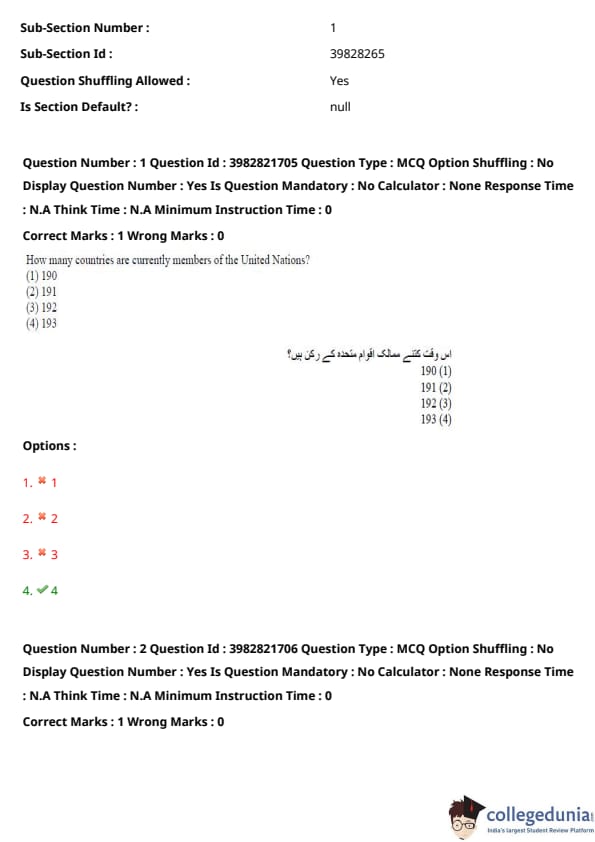
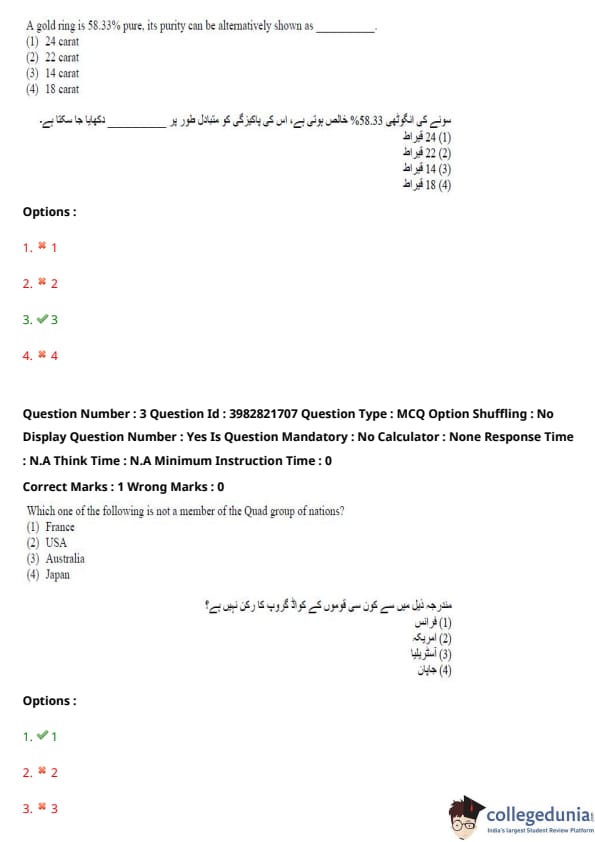
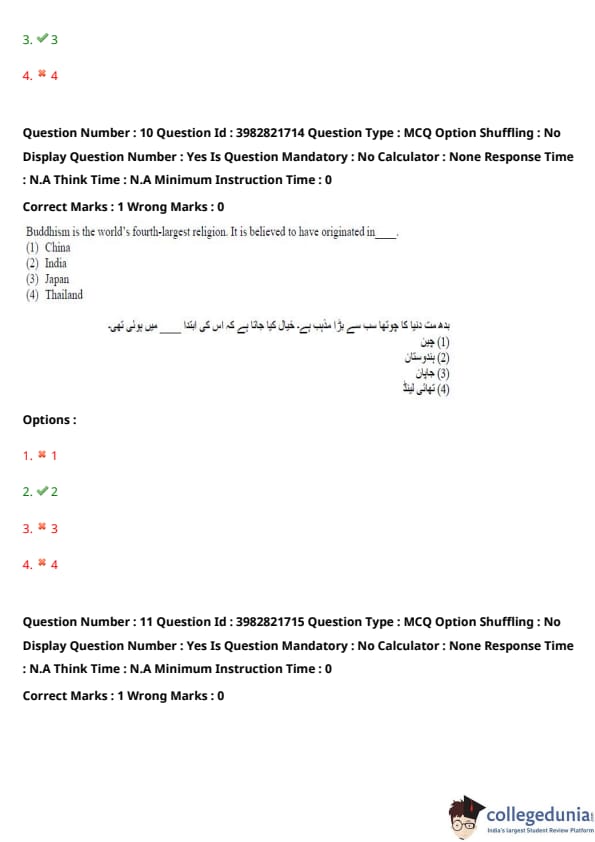
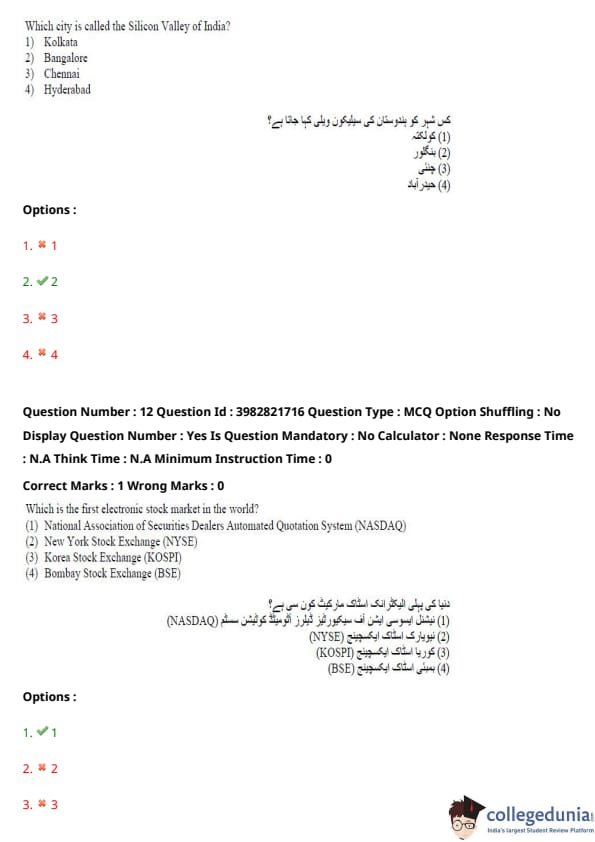
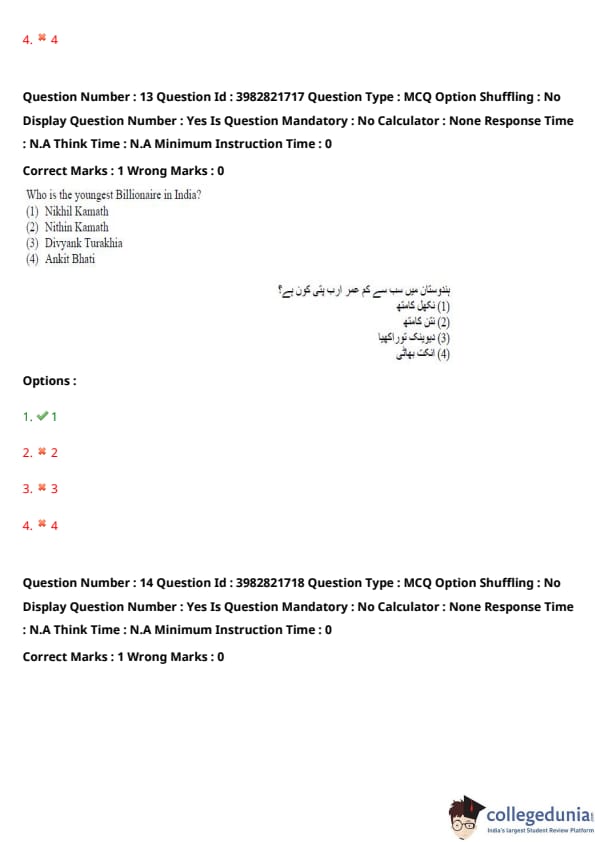
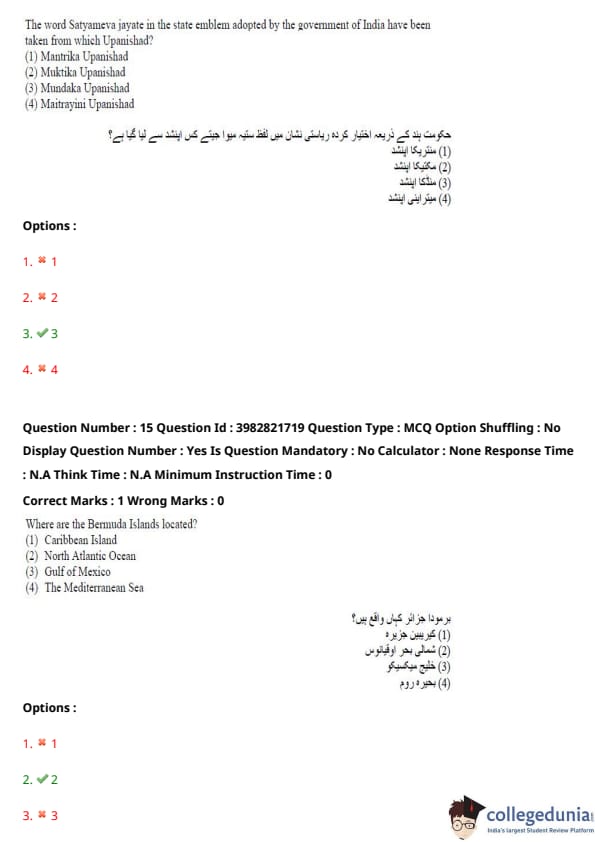
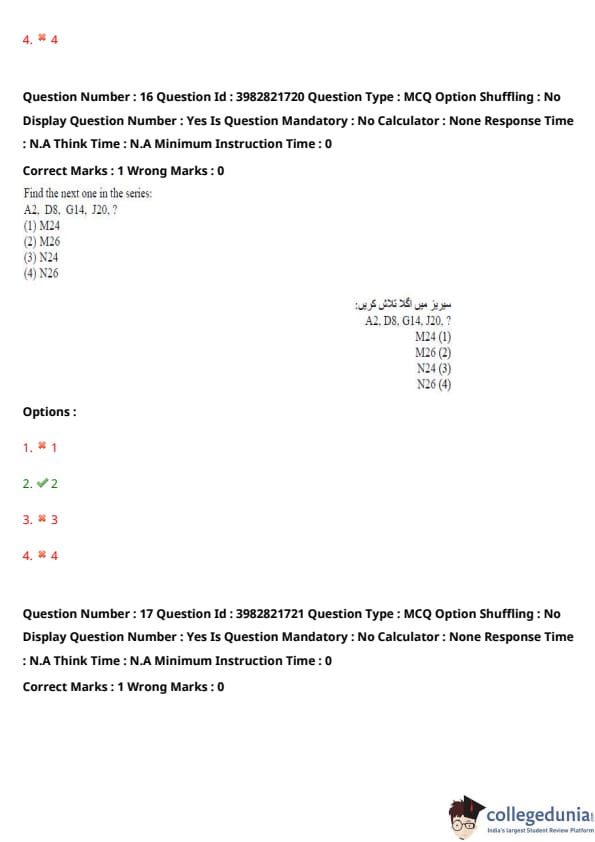
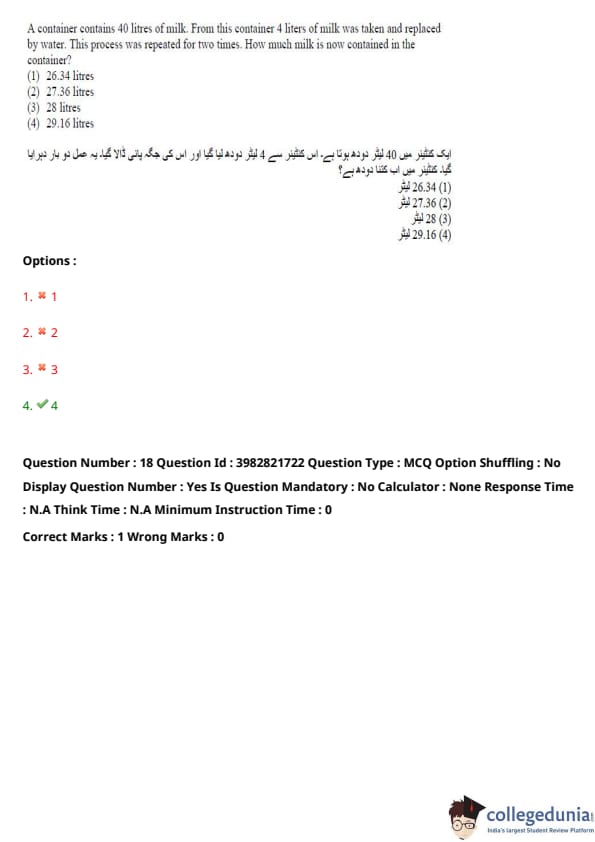
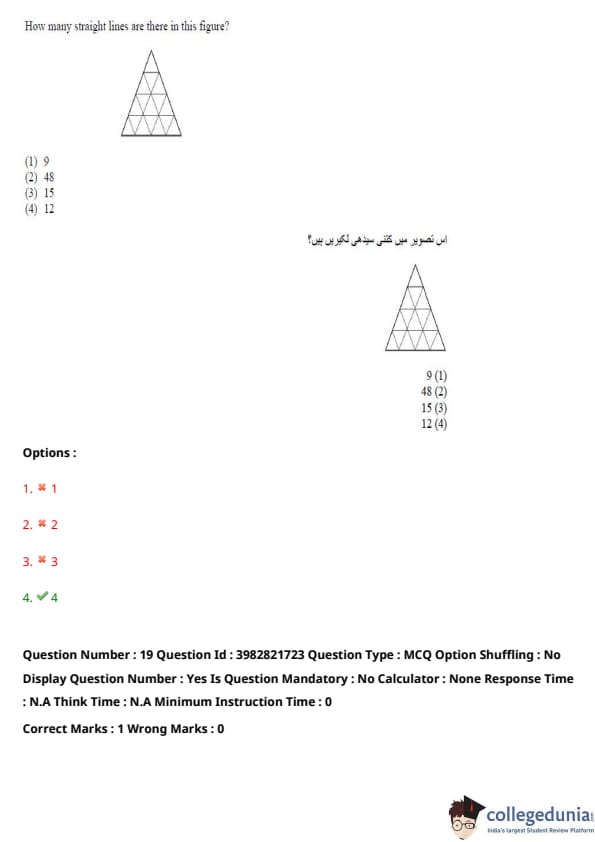
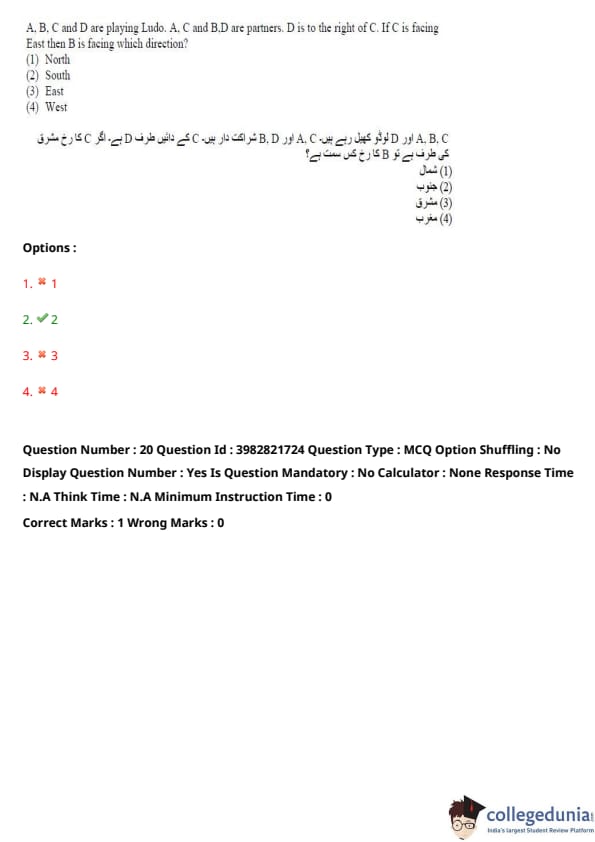
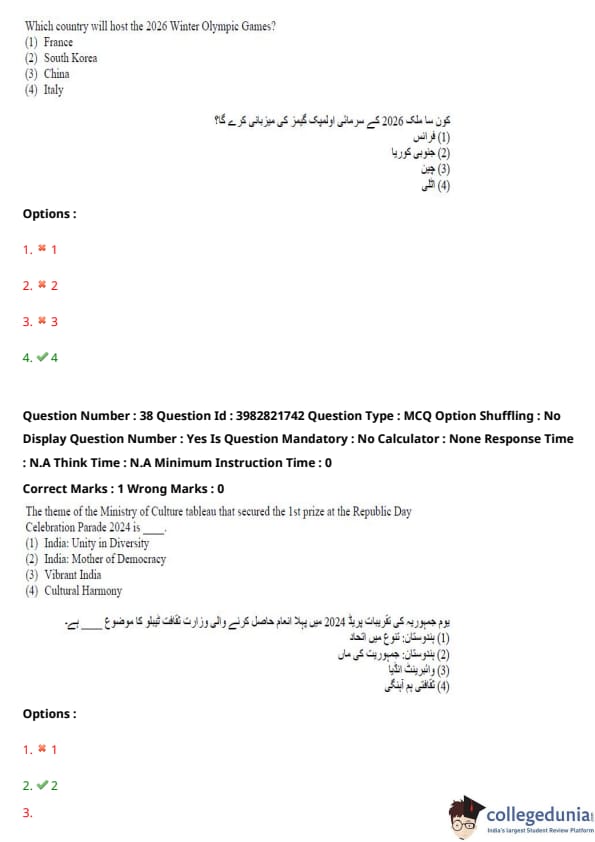
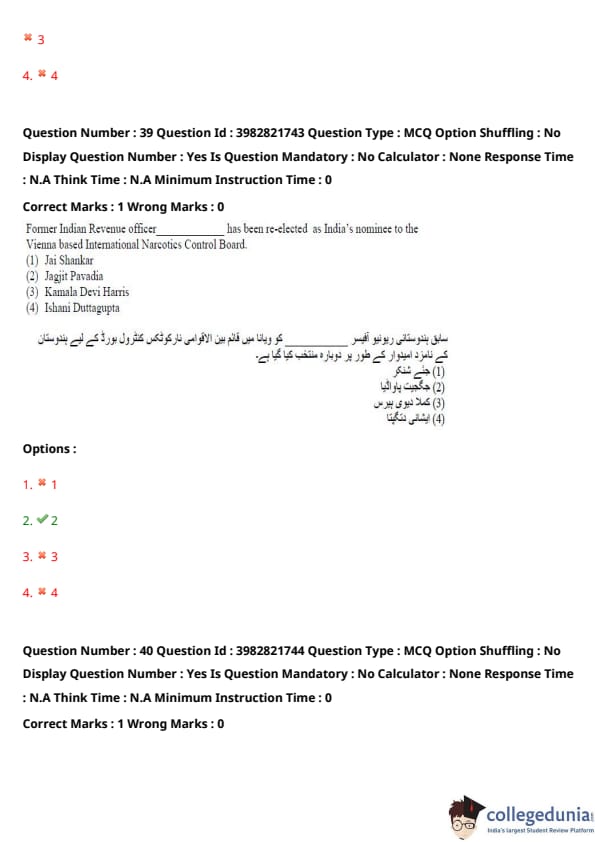
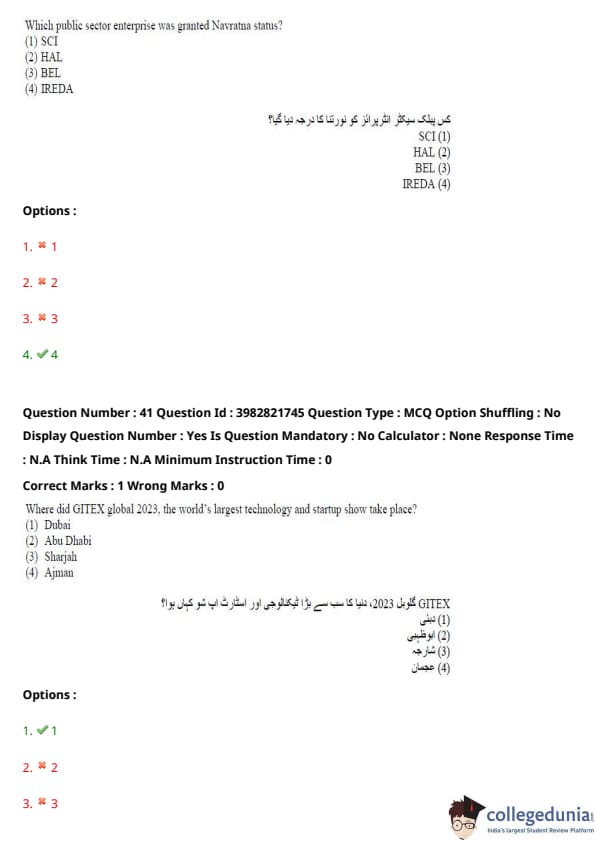
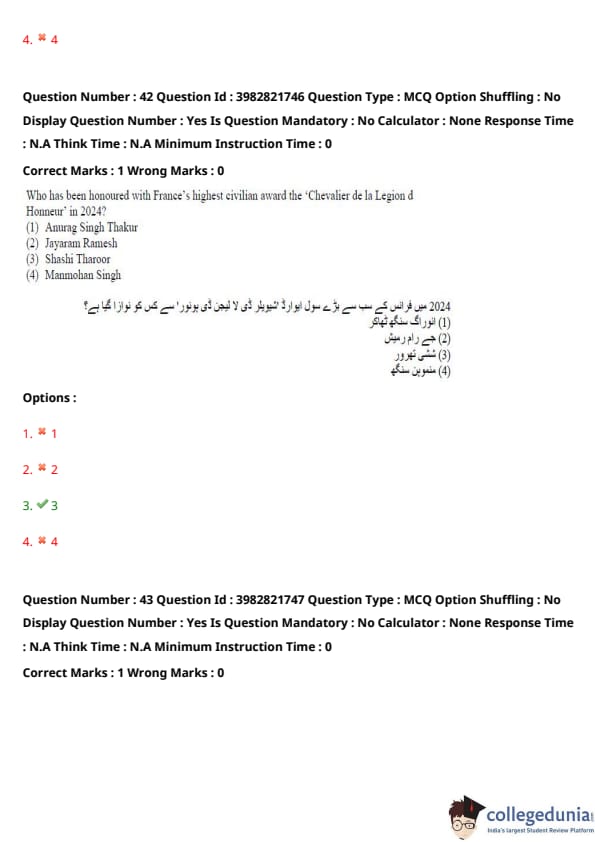
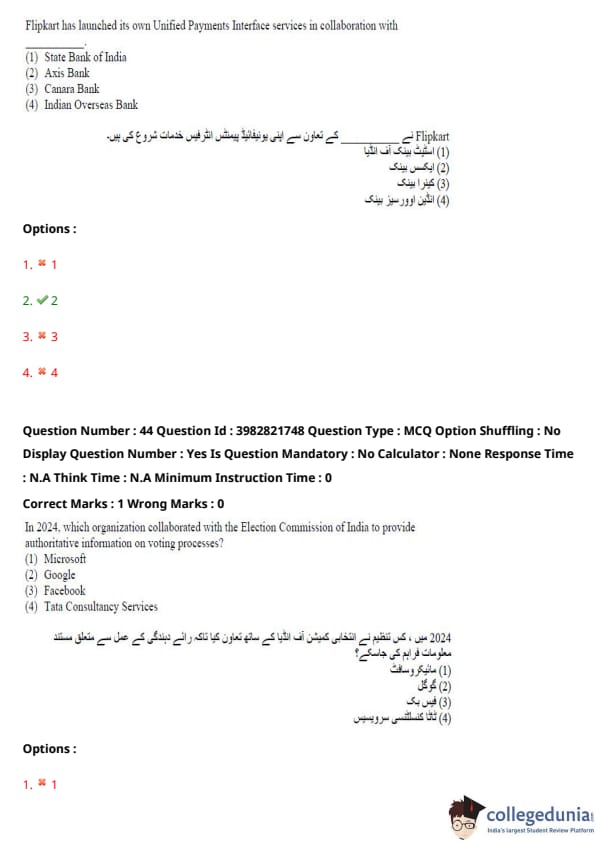
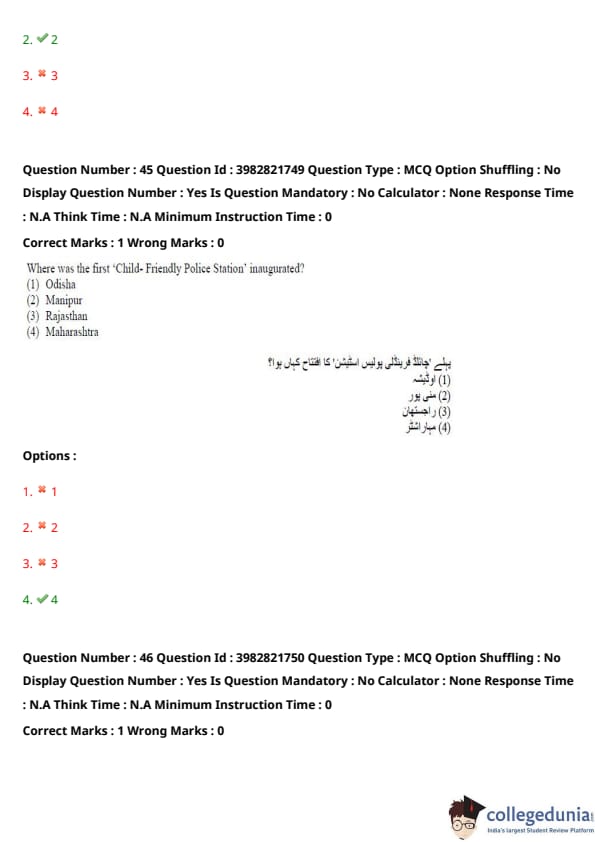
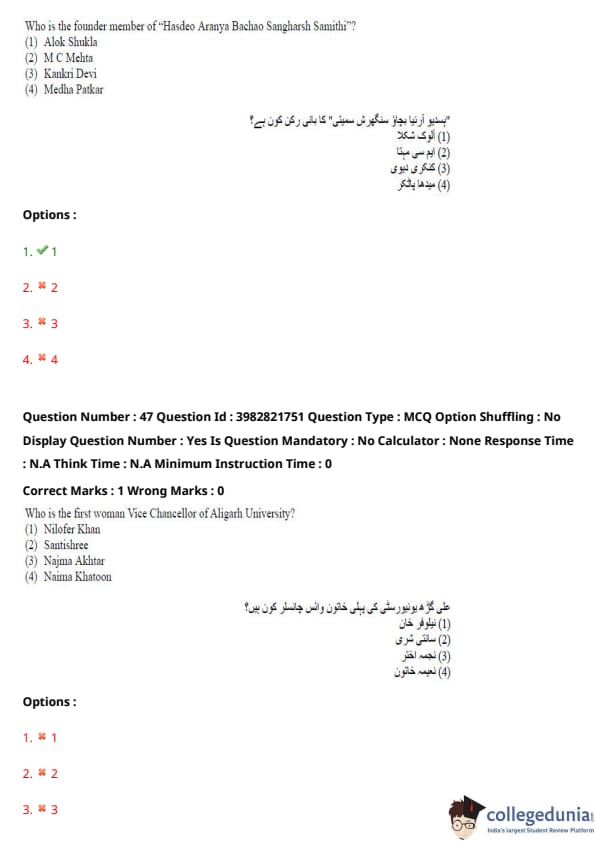
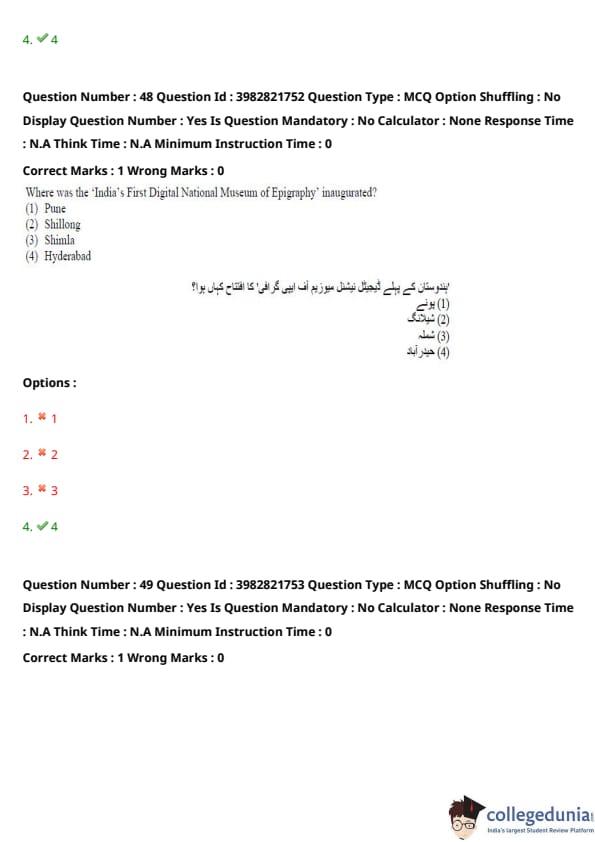
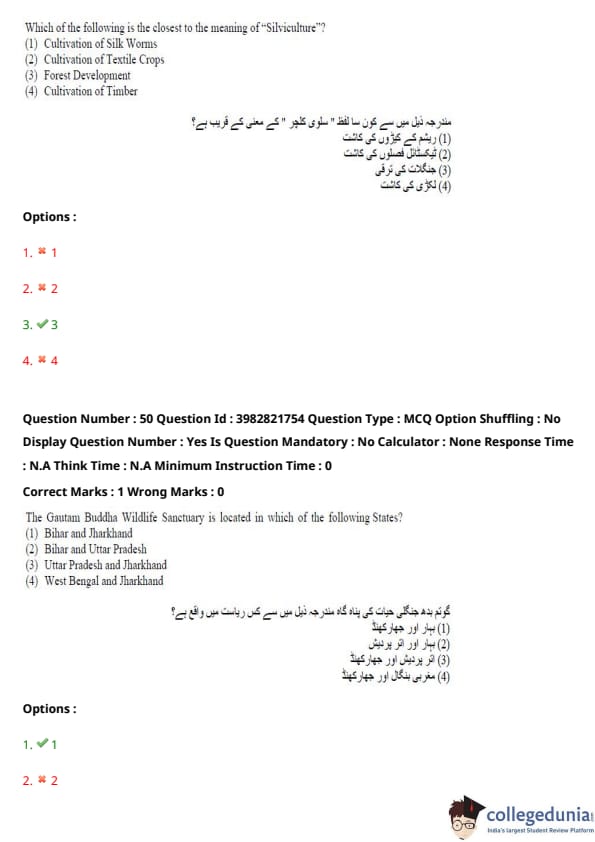
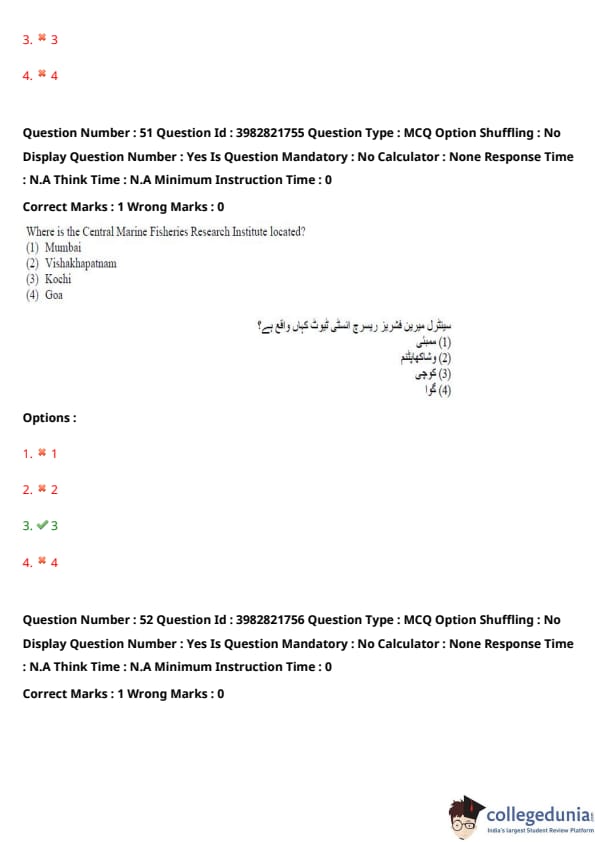
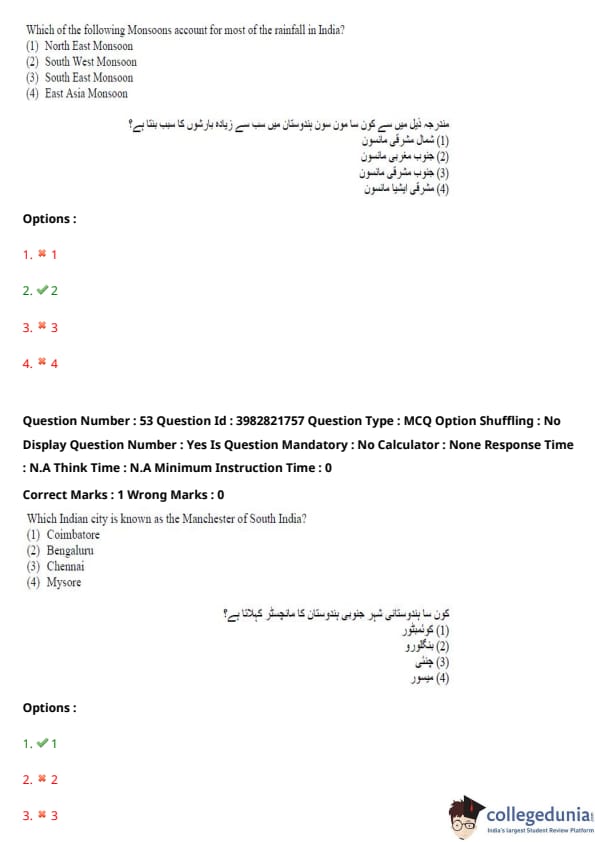
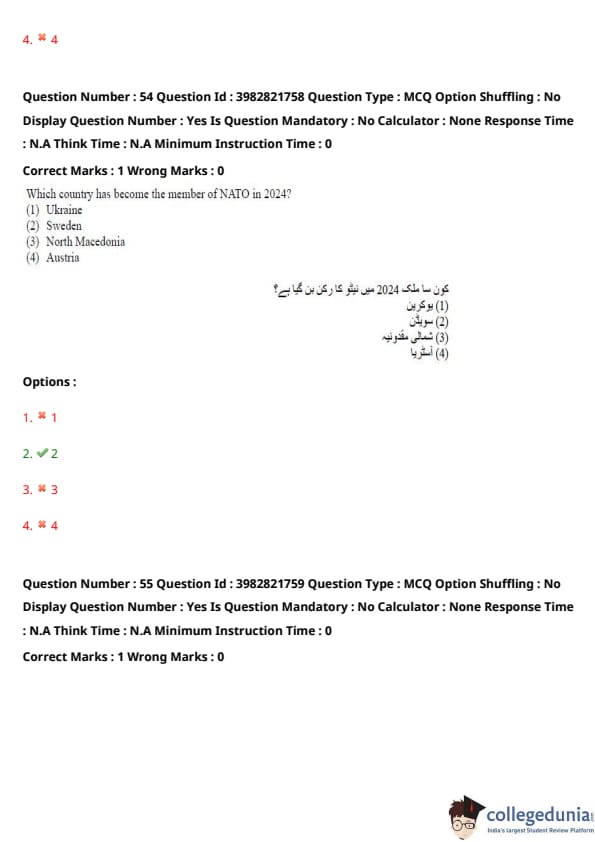
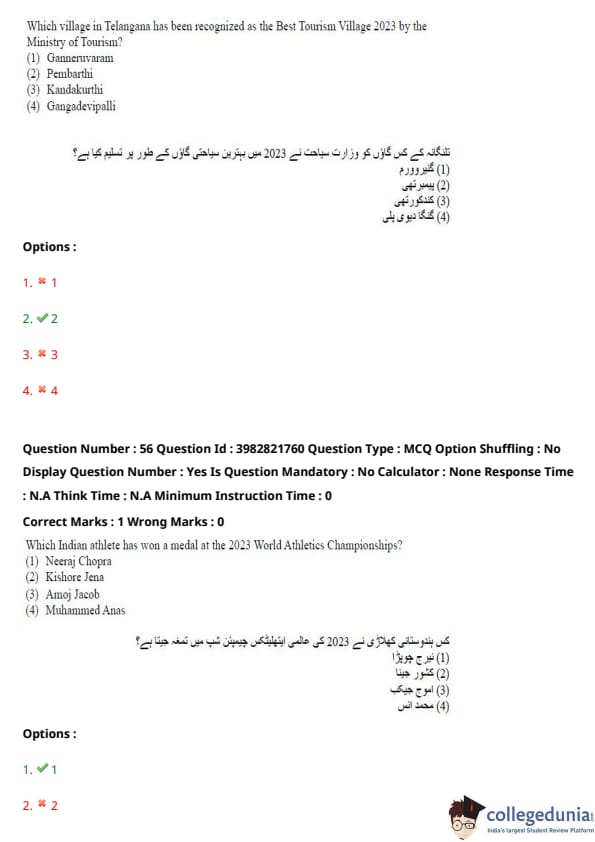
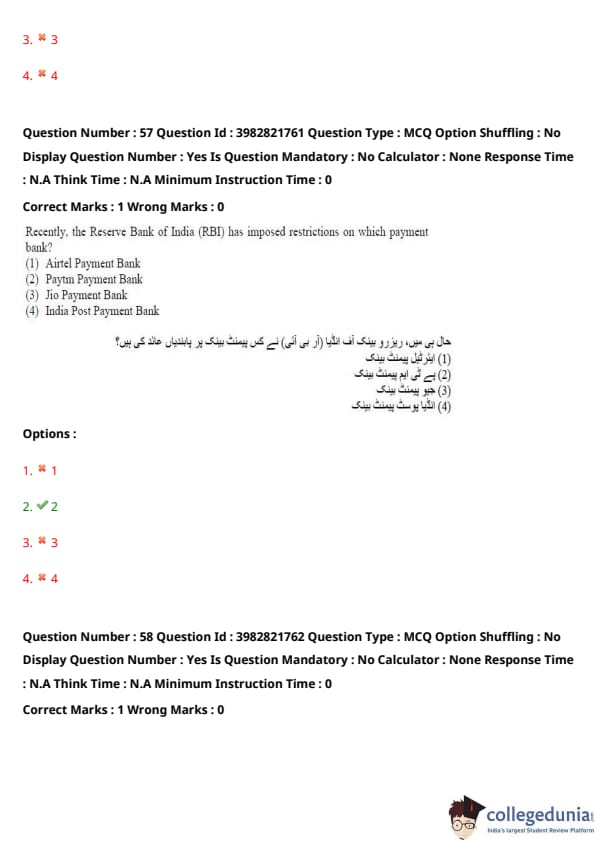
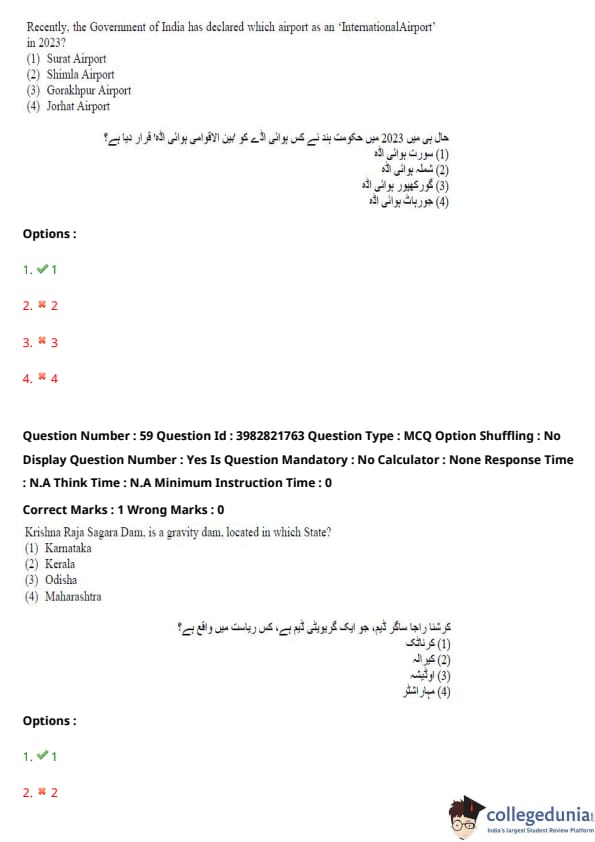
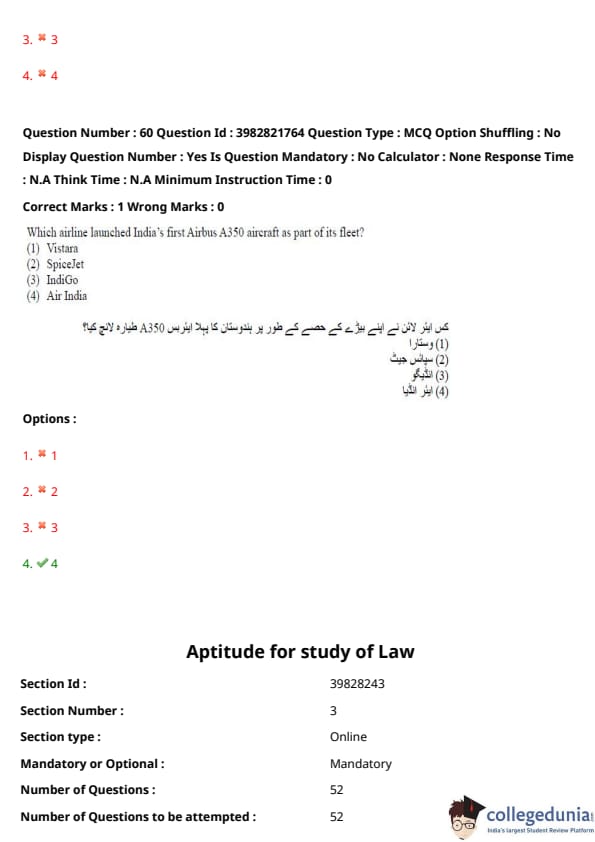
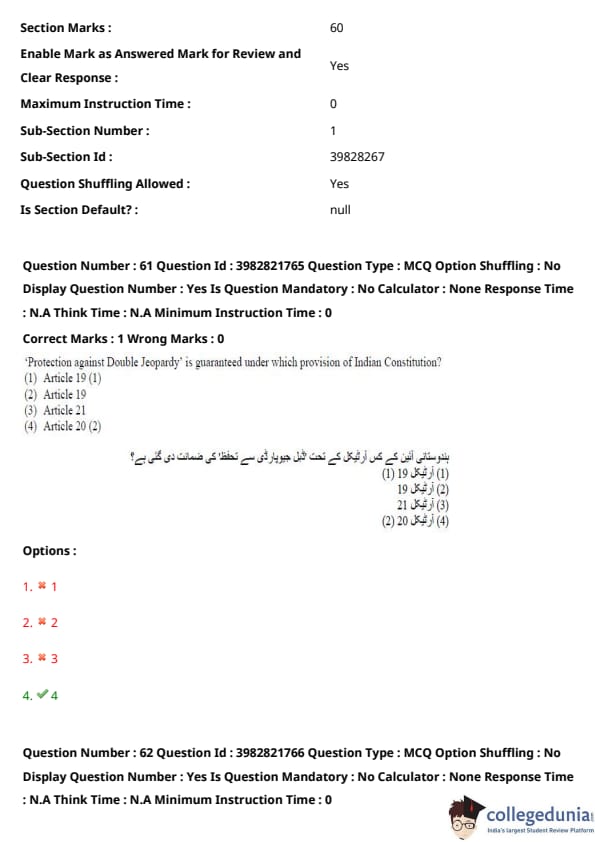
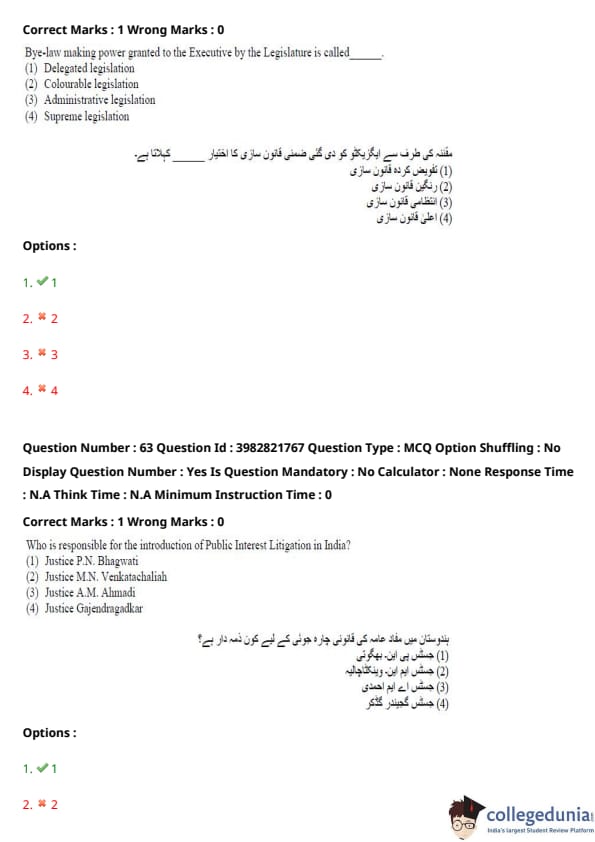
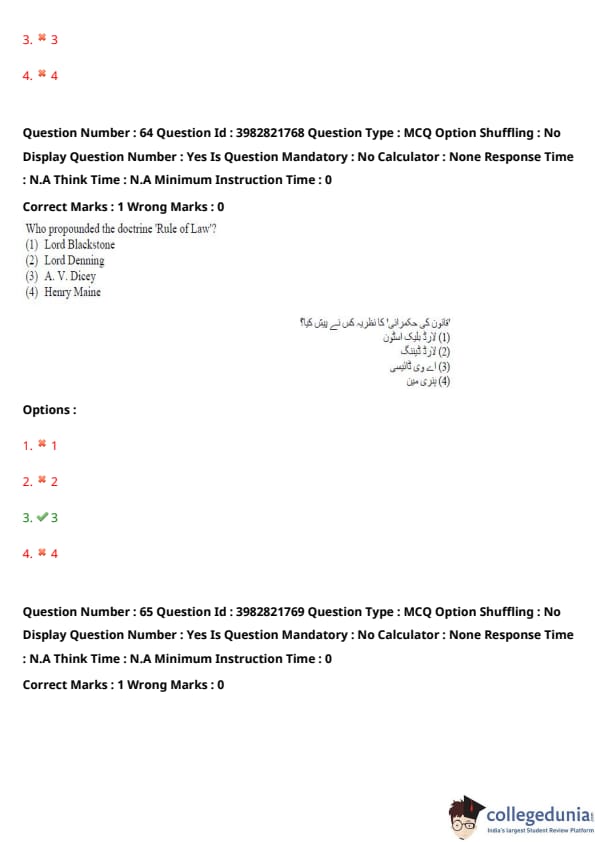
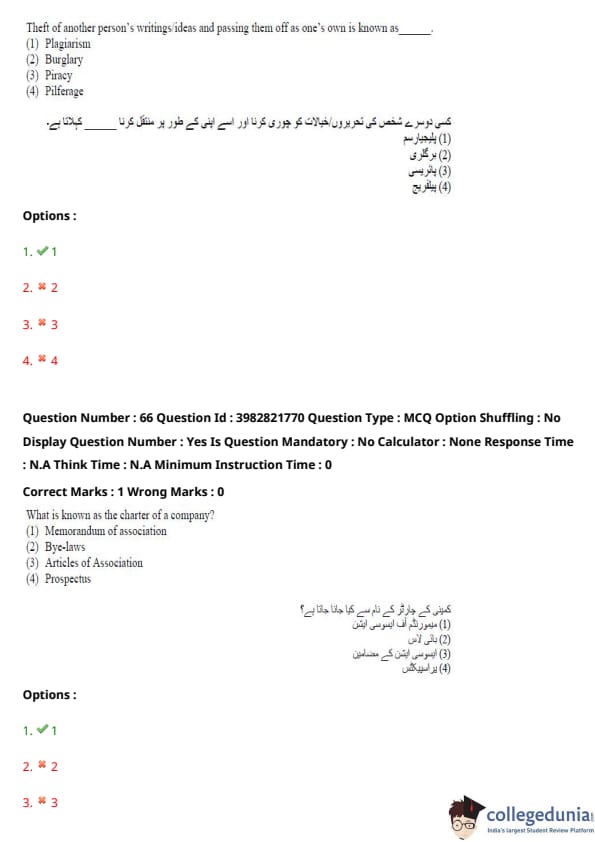
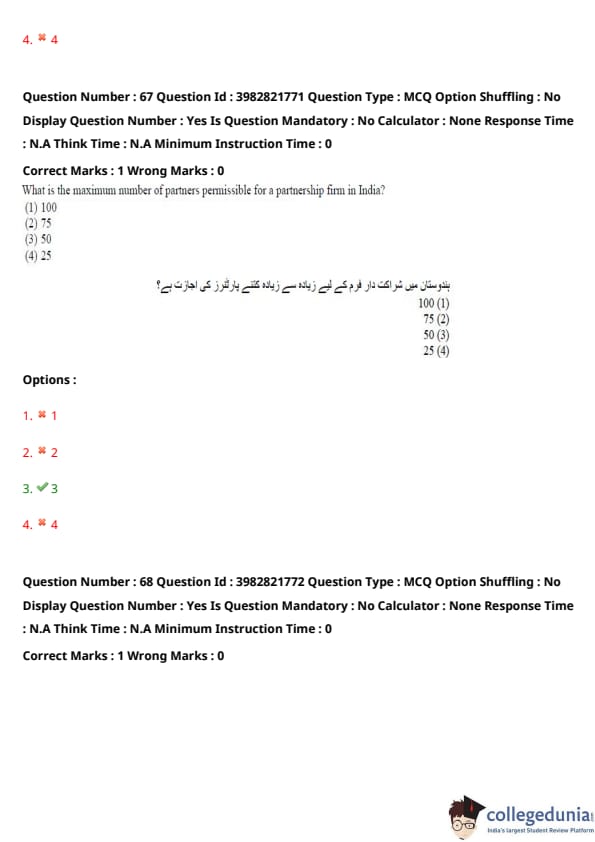
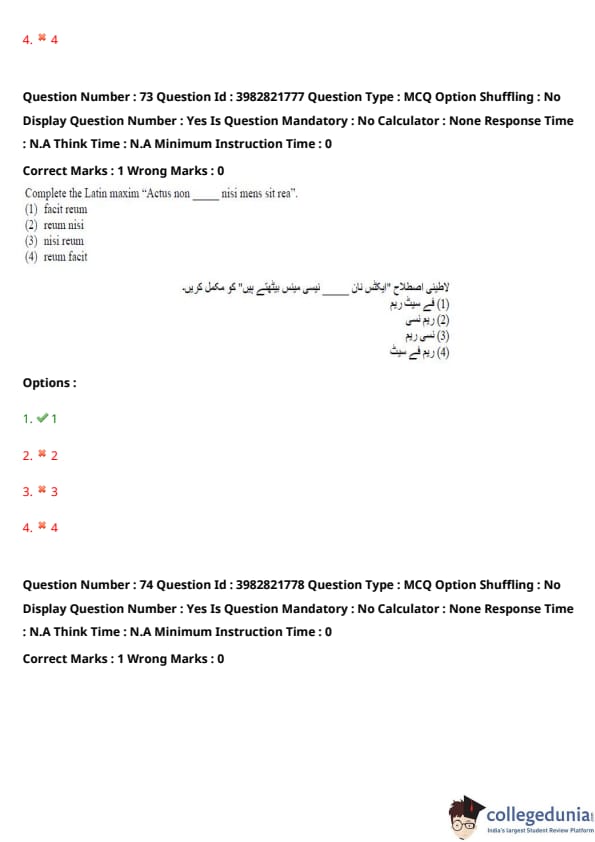
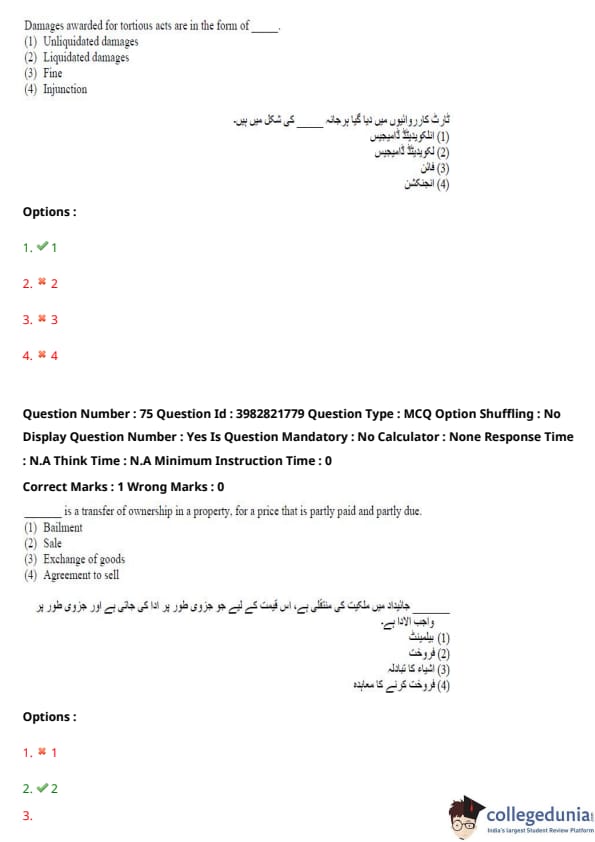
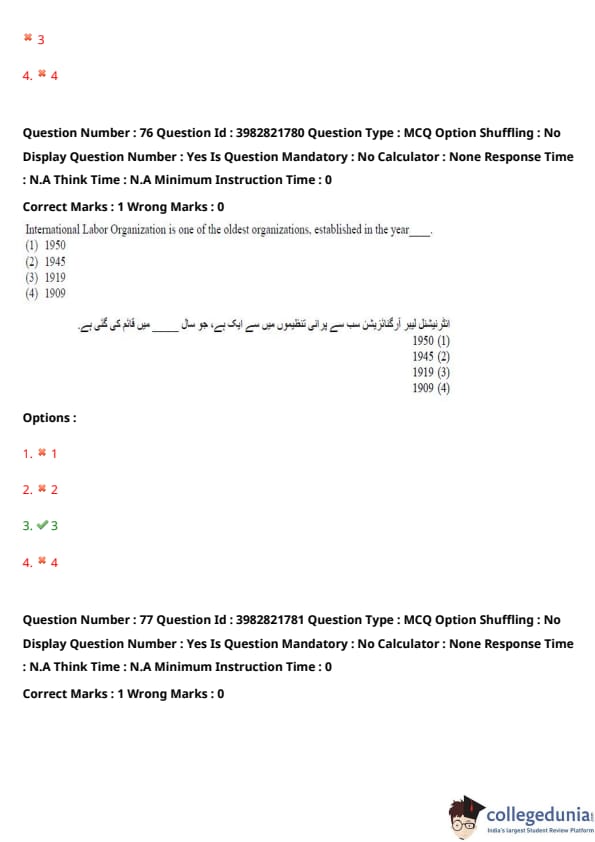
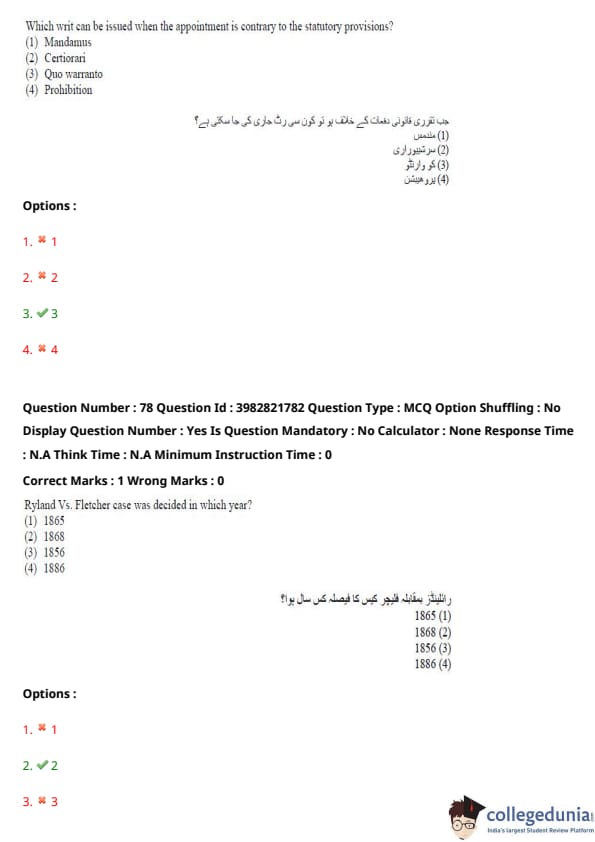
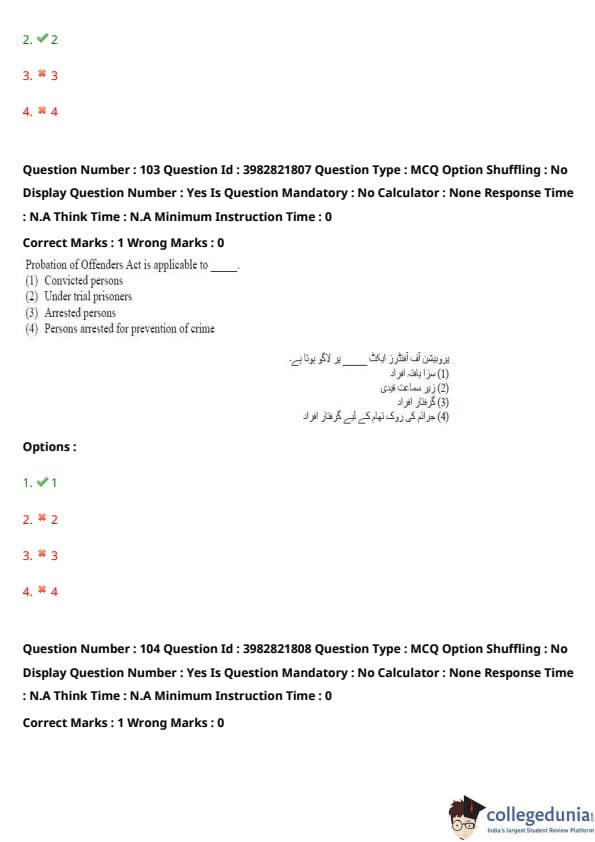
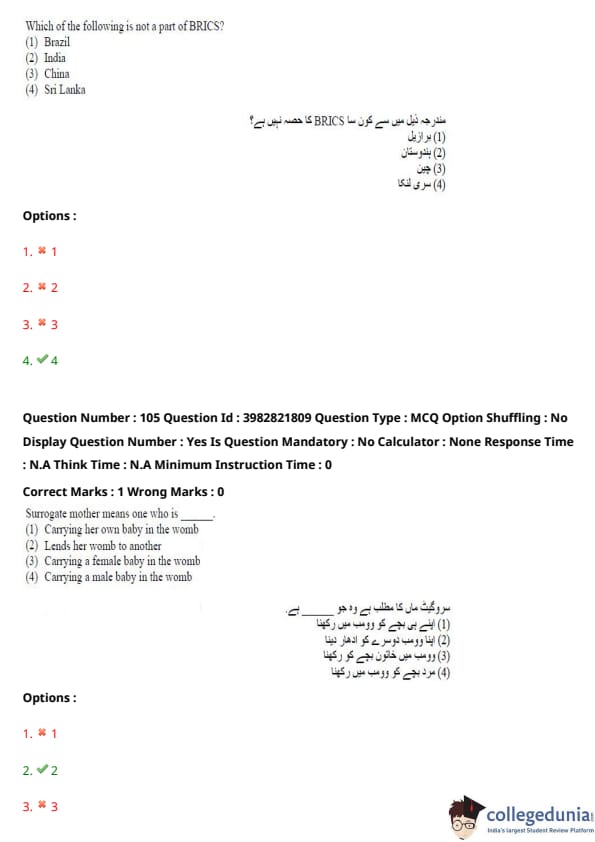
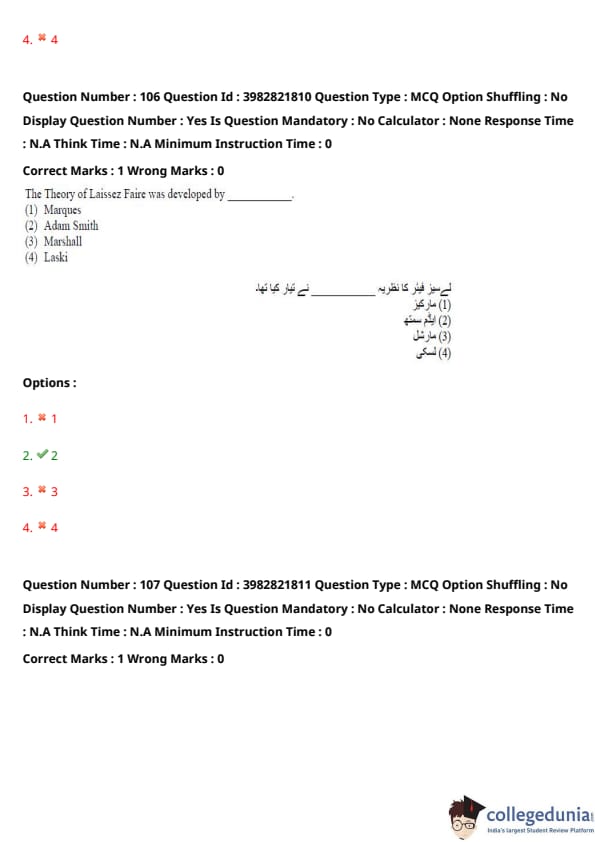
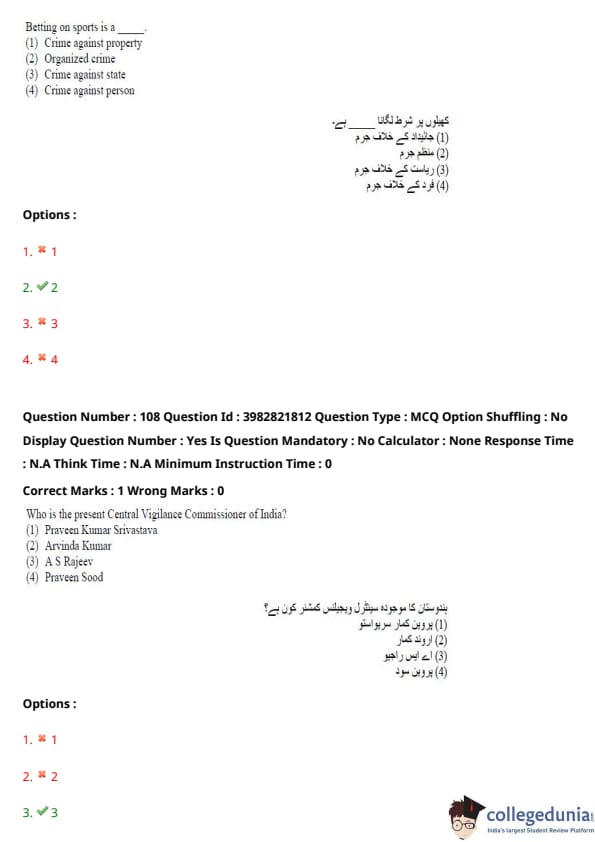
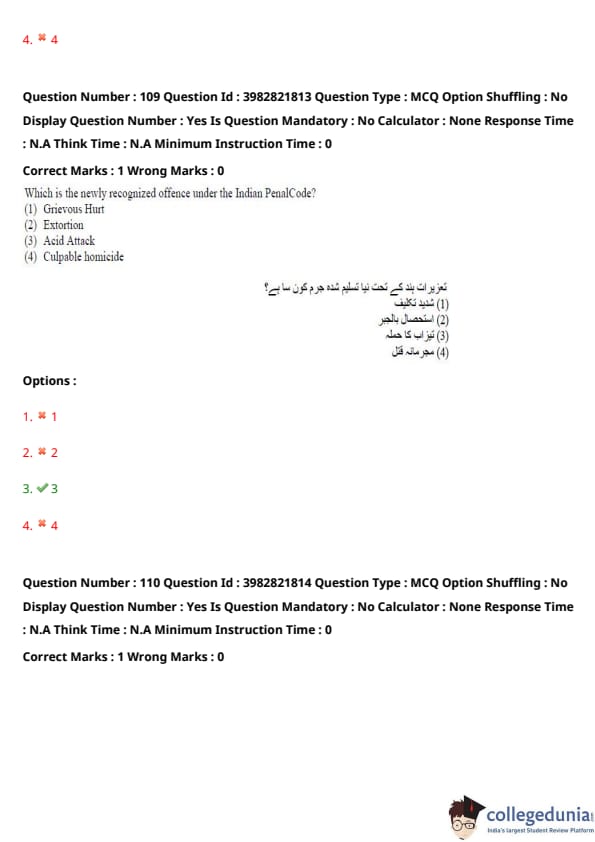
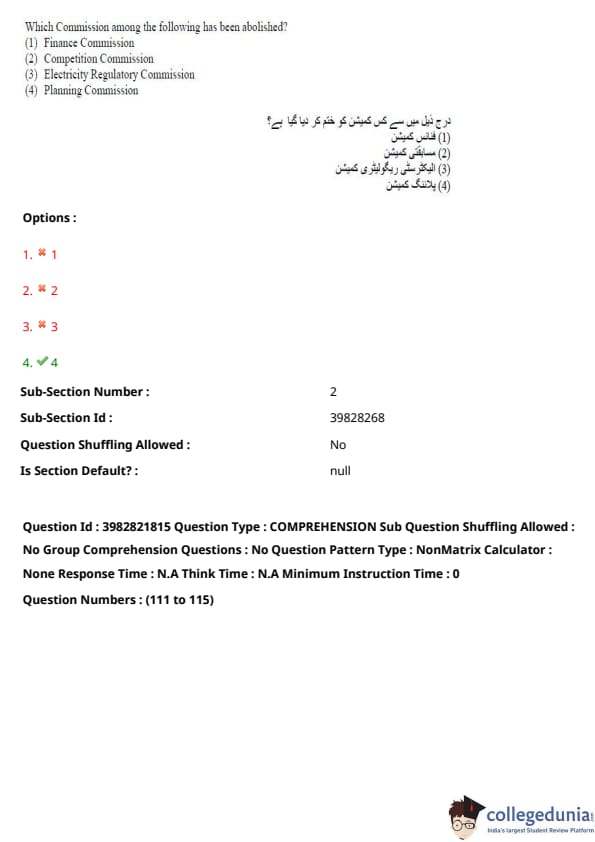
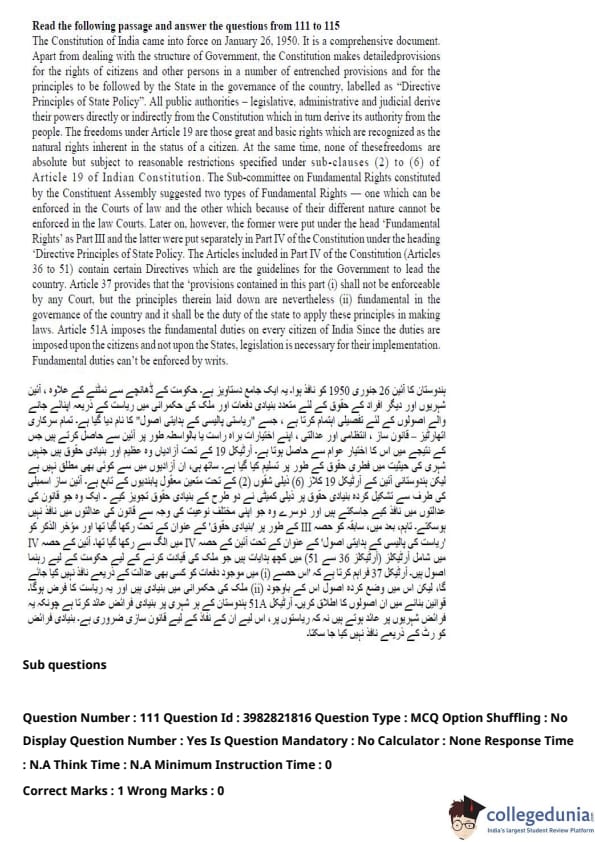
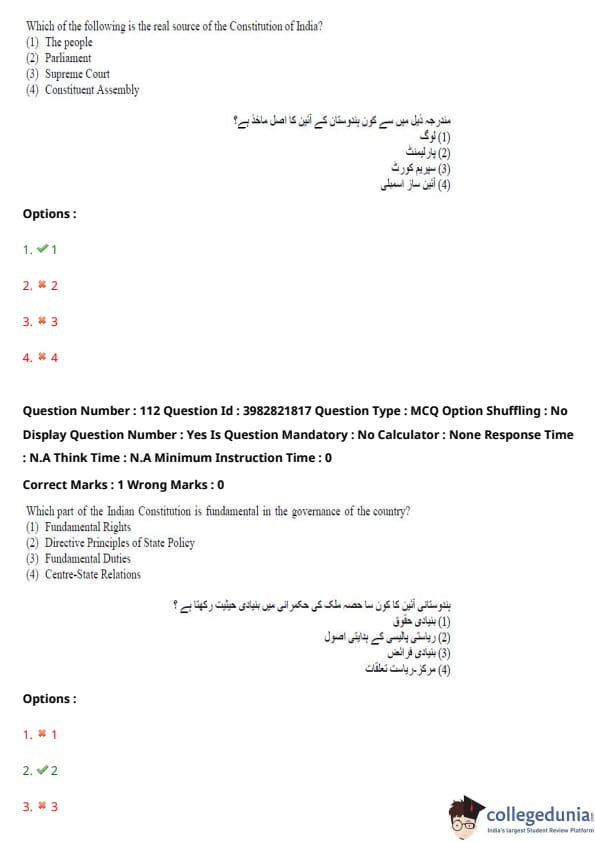
*The article might have information for the previous academic years, please refer the official website of the exam.