
TS LAWCET 2025 Question Paper with Solutions Pdf


Content Writer | Updated On - Nov 24, 2025
The TS LAWCET 2025 Question Paper with Solutions is now available for download. The Telangana State Law Common Entrance Test (TS LAWCET), conducted by Osmania University, Hyderabad on behalf of the Telangana State Council of Higher Education (TSCHE), serves as the state-level entrance test for admission into 3-year and 5-year LL.B. programmes. The examination was conducted for a duration of 90 minutes, comprising various sections aimed at evaluating the candidate's general knowledge, mental ability, current affairs, and aptitude for the study of law.
TS LAWCET 2025 Question Paper with Solutions
| TS LAWCET 2025 Question Paper | Download PDF | Check Solutions |

Gas Giants in our solar system are __________.
View Solution
Step 1: Understanding the Concept:
The planets in our solar system are categorized into two main types: terrestrial (or rocky) planets and gas giants (or Jovian planets).
Terrestrial planets are Mercury, Venus, Earth, and Mars. They are smaller, have solid, rocky surfaces, and are closer to the Sun.
Gas giants are large planets composed mostly of gases, such as hydrogen, helium, and methane, with a small rocky core.
Step 2: Identifying the Gas Giants:
The four gas giants in our solar system are located in the outer solar system, beyond the asteroid belt.
These planets are:
1. Jupiter: The largest planet in our solar system.
2. Saturn: Known for its prominent ring system.
3. Uranus: An ice giant, which is a sub-class of gas giants, known for its extreme axial tilt.
4. Neptune: The outermost planet, also an ice giant.
Step 3: Analyzing the Options:
(A) Includes Venus, which is a terrestrial planet.
(B) Correctly lists all four gas giants: Jupiter, Saturn, Uranus, and Neptune.
(C) Includes Mars, which is a terrestrial planet.
(D) Includes Mars, which is a terrestrial planet.
Step 4: Final Answer:
Based on the classification of planets, the correct group of gas giants is Jupiter, Saturn, Uranus, and Neptune.
Quick Tip: To remember the order of the planets from the Sun, use a mnemonic like "My Very Eager Mother Just Served Us Noodles" (Mercury, Venus, Earth, Mars, Jupiter, Saturn, Uranus, Neptune). The first four are terrestrial, and the last four are gas giants.
What is Xylitol?
View Solution
Step 1: Understanding the Concept:
The question asks for the definition of Xylitol. This requires knowledge of common chemical compounds and their uses.
Step 2: Detailed Explanation:
Xylitol is a chemical compound classified as a sugar alcohol (or polyol). It is found naturally in small amounts in many fruits and vegetables, such as berries, plums, corn, and mushrooms.
Properties and Uses:
Sweetener: Xylitol is widely used as a sugar substitute or artificial sweetener. It has a sweetness similar to sucrose (table sugar) but with fewer calories (about 40% less).
Dental Health: It is often used in sugar-free chewing gums, candies, mints, and toothpaste because it does not cause tooth decay. Unlike sugar, bacteria in the mouth cannot metabolize xylitol to produce acid, which helps prevent cavities.
Diabetic-Friendly: It has a very low glycemic index, meaning it causes a negligible rise in blood sugar and insulin levels, making it suitable for people with diabetes.
Step 3: Analyzing the Options:
(A) Vaccine for cancer: Incorrect. Xylitol has no role as a cancer vaccine.
(B) Asteroid: Incorrect. An asteroid is a celestial body.
(C) Artificial sweetener: Correct. This is the primary use of Xylitol.
(D) Missile: Incorrect. A missile is a weapon.
Step 4: Final Answer:
Xylitol is a well-known artificial sweetener used as a sugar substitute.
Quick Tip: Remember common sugar substitutes like Aspartame, Sucralose, Stevia, and Xylitol. Xylitol is unique for its dental health benefits. Note that while safe for humans, it is highly toxic to dogs.
Which National Highway connects India and Bangladesh via Siliguri?
View Solution
Step 1: Understanding the Concept:
The question asks to identify the specific National Highway that facilitates road connectivity between India and Bangladesh through the strategic Siliguri Corridor.
Step 2: Detailed Explanation:
National Highway 10 (NH 10) is the correct answer. This highway originates at the India-Bangladesh border at Phulbari in West Bengal.
Route of NH 10:
It starts near the Bangladesh border and passes through Siliguri.
From Siliguri, it runs northwards through the states of West Bengal and Sikkim.
Its northern terminus is at Gangtok, the capital of Sikkim.
The section of the highway near Siliguri is crucial for trade and transit between India and Bangladesh. The Phulbari-Banglabandha border crossing is a key trade point.
Step 3: Analyzing Other Options:
NH 44: This is the longest National Highway in India, running from Srinagar in the north to Kanyakumari in the south. It does not connect to Bangladesh via Siliguri.
NH 27: This is the second-longest highway, running from Porbandar in Gujarat to Silchar in Assam. While it passes through Siliguri, its primary axis is east-west across northern India, and NH 10 is the specific spur connecting to the border.
NH 16: This highway runs along the east coast of India, from Kolkata in West Bengal to Chennai in Tamil Nadu. It is not related to the Siliguri-Bangladesh route.
Step 4: Final Answer:
National Highway 10 is the highway that connects the Indo-Bangladesh border to Siliguri and extends further to Sikkim.
Quick Tip: Questions about National Highways often focus on major corridors (like the Golden Quadrilateral), longest/shortest highways, or those with strategic importance (border connectivity). When studying highways, pay attention to their start/end points and major cities they pass through.
Who among the following started the newspaper "Amrit Bazar Patrika" in 1868?
View Solution
Step 1: Understanding the Concept:
This question is about the history of journalism in India and requires identifying the founder of the influential newspaper, "Amrit Bazar Patrika".
Step 2: Detailed Explanation:
The Amrit Bazar Patrika was one of the oldest daily newspapers in India.
Founders: It was founded by two brothers, Shishir Kumar Ghosh and Motilal Ghosh.
Date and Place: The newspaper was launched on 20 February 1868 in the village of Amrit Bazar in Jessore district (now in Bangladesh).
Language and Transformation: Initially, it was a Bengali weekly. Later, it became a bilingual (Bengali and English) newspaper and eventually an English daily. A key moment in its history was its overnight conversion into a full-fledged English newspaper in 1878 to circumvent the restrictive Vernacular Press Act, which targeted Indian-language publications.
Role in Freedom Struggle: The Patrika played a significant role in India's struggle for independence by being a vocal critic of British policies.
Step 3: Analyzing Other Options:
Ishwar Chandra Vidyasagar: A great social reformer and writer, but not the founder of Amrit Bazar Patrika. He was associated with the newspaper `Somprakash`.
Dayanand Saraswati: The founder of the Arya Samaj, a social reform movement. He was not directly involved in founding this newspaper.
Lala Jagat Narayan: A journalist and politician who founded the Hind Samachar group of newspapers in the post-independence era.
Step 4: Final Answer:
The Amrit Bazar Patrika was started by Shishir Kumar Ghosh and his brother Motilal Ghosh in 1868.
Quick Tip: For modern Indian history, creating a table of important newspapers/journals, their founders, and the year of establishment is a very effective revision technique. Focus on publications that played a major role in the freedom struggle.
Five rings of the symbol of Olympic Games represent __________.
View Solution
Step 1: Understanding the Concept:
The question asks about the symbolism behind the five rings in the Olympic logo. This is a fundamental concept related to the Olympic Games.
Step 2: Detailed Explanation:
The Olympic symbol, widely known as the Olympic rings, consists of five interlaced rings of different colours (blue, yellow, black, green, and red) on a white field.
Design: The symbol was designed in 1913 by Pierre de Coubertin, the founder of the modern Olympic Games.
Symbolism: The five rings represent the five inhabited continents of the world that participate in the Olympic Games: Africa, the Americas (North and South combined), Asia, Europe, and Oceania. The interlacing of the rings symbolizes the unity of these continents and the meeting of athletes from around the world at the Olympic Games.
Colours: The six colours (the five ring colours plus the white background) were chosen because at least one of these colours appeared on the national flag of every country in the world at the time of the symbol's creation.
Step 3: Analyzing the Options:
(A) Incorrect. The symbol does not represent the founders.
(B) Incorrect. It does not represent parts of sports.
(C) Correct. The five rings symbolize the five participating continents.
(D) Incorrect. It does not represent historical events.
Step 4: Final Answer:
The five rings of the Olympic symbol represent the five continents of the world, united by Olympism.
Quick Tip: While the rings represent the five continents, a common misconception is that each specific colour corresponds to a specific continent. The International Olympic Committee (IOC) does not officially assign a colour to a continent. The symbolism lies in the unity of all five.
The Institute of Wood Science and Technology is located in __________.
View Solution
Step 1: Understanding the Concept:
This is a general knowledge question that requires knowing the location of a specific national research institute in India.
Step 2: Detailed Explanation:
The Institute of Wood Science and Technology (IWST) is a research institute located in Bengaluru (Bangalore), Karnataka.
Parent Body: It operates under the Indian Council of Forestry Research and Education (ICFRE), which is an autonomous body under the Ministry of Environment, Forest and Climate Change, Government of India.
Mandate: The institute's primary focus is on research and development related to wood science and technology. This includes areas like wood preservation, timber properties, improved utilization of wood, and development of wood alternatives.
History: The institute has its origins in the Forest Research Laboratory, which was established in 1938. It was later upgraded and renamed the Institute of Wood Science and Technology in 1988.
Step 3: Analyzing Other Options:
Dehradun: This city is home to the Forest Research Institute (FRI), which is the parent body of ICFRE and another major forestry research center. This is a common point of confusion.
Jabalpur: The Tropical Forest Research Institute (TFRI) is located here.
Chennai: This city has several research institutes, but not the IWST.
Step 4: Final Answer:
The Institute of Wood Science and Technology (IWST) is situated in Bengaluru.
Quick Tip: For questions about national institutes, create a list categorized by field (e.g., Forestry, Agriculture, Space, Medical). Note the full name, acronym, and location for each. Pay special attention to similar-sounding institutes like FRI (Dehradun) and IWST (Bengaluru).
Uttar Pradesh is surrounded by how many neighbouring states?
View Solution
Step 1: Understanding the Concept:
The question asks for the number of states and union territories that share a border with Uttar Pradesh. This is a question of Indian political geography. Uttar Pradesh shares its border with the maximum number of other states in India.
Step 2: Detailed Explanation:
Let's list the states and union territories that border Uttar Pradesh, moving in a clockwise or counter-clockwise direction on the map.
The neighbouring states are:
Uttarakhand (to the north)
Himachal Pradesh (to the northwest, a small border)
Haryana (to the west)
Rajasthan (to the southwest)
Madhya Pradesh (to the south)
Chhattisgarh (to the southeast)
Jharkhand (to the southeast)
Bihar (to the east)
The neighbouring Union Territory is:
Delhi (National Capital Territory of Delhi, on the west)
Additionally, Uttar Pradesh also shares an international border with Nepal to the north.
Step 3: Final Count and Option Analysis:
Counting the entities listed above, we have:
Total States: 8
Total Union Territories: 1
Therefore, Uttar Pradesh is surrounded by 8 states and 1 union territory. This matches option (B).
Option (A) is incorrect (10 states).
Option (C) is incorrect. The count is 8 states, not 9. Sometimes Delhi is counted as a state in a general sense, leading to the "9 states" confusion, but officially it is a UT. The option specifies "9 States AND 1 Union Territory," which is definitively wrong.
Option (D) is incorrect.
Step 4: Final Answer:
Uttar Pradesh shares its borders with 8 states and 1 union territory (Delhi).
Quick Tip: When studying Indian geography, always use a political map. For questions about borders, trace the boundary of the state in question and count its neighbours. States with many neighbours like Uttar Pradesh and Assam are common topics for such questions.
Salar Jung-III who made a remarkable collection presently housed in a museum in Hyderabad, was the Prime Minister of __________.
View Solution
Step 1: Understanding the Concept:
This question connects three historical entities: Salar Jung III, the Salar Jung Museum, and the Nizams of Hyderabad. It asks to identify the Nizam under whom Salar Jung III served as Prime Minister (Diwan).
Step 2: Detailed Explanation:
Salar Jung III: His full name was Nawab Mir Yousuf Ali Khan, Salar Jung III (1889–1949). He was a nobleman and art collector from the erstwhile Hyderabad State.
Prime Ministership: He served as the Prime Minister of Hyderabad State from 1912 to 1914.
The Nizam: The ruler of Hyderabad during this period (1912-1914) was Nizam Mir Osman Ali Khan, the seventh and last Nizam of Hyderabad. He reigned from 1911 to 1948.
Salar Jung Museum: After resigning from his post in 1914, Salar Jung III dedicated the rest of his life to collecting art and literature from around the world. His vast personal collection forms the basis of the Salar Jung Museum in Hyderabad, which is one of the largest one-man collections of antiques in the world.
Step 3: Analyzing Other Options:
Nizam Mir Mahboob Ali Khan: He was the 6th Nizam and ruled before Osman Ali Khan. Salar Jung III's grandfather and father served under him, but Salar Jung III himself served under the 7th Nizam.
Nizam Naseeruddaullah and Nizam Afzaluddaullah: They were the 4th and 5th Nizams, respectively, who ruled much earlier in the 19th century.
Step 4: Final Answer:
Salar Jung III was the Prime Minister for Nizam Mir Osman Ali Khan, the 7th Nizam of Hyderabad.
Quick Tip: When studying regional history like that of the Nizams, create a timeline of rulers and their key prime ministers (Diwans). The Salar Jung family was very influential, with three generations serving as prime ministers to the Nizams.
Which city among the following is closest to the Equator?
View Solution
Step 1: Understanding the Concept:
The question asks to identify which of the given Indian cities is geographically closest to the Equator. The Equator is at 0° latitude. Therefore, the city with the latitude value closest to 0° will be the answer. Since all these cities are in India, they are all in the Northern Hemisphere, so we need to find the city with the lowest positive latitude.
Step 2: Key Formula or Approach:
Compare the latitudes of the given cities. The city with the smallest latitude value (closest to 0°) is the correct answer.
Approximate latitudes of the cities:
Hyderabad: Approximately 17.38° N
Panaji: Approximately 15.49° N
Bhubaneswar: Approximately 20.29° N
Mumbai: Approximately 19.07° N
Step 3: Detailed Explanation:
Let's compare the latitude values:
Latitude of Hyderabad = 17.38°
Latitude of Panaji = 15.49°
Latitude of Bhubaneswar = 20.29°
Latitude of Mumbai = 19.07°
Comparing these values, the smallest latitude is 15.49°, which corresponds to Panaji. A smaller latitude means the location is closer to the Equator (0° latitude).
Step 4: Final Answer:
Among the given options, Panaji has the lowest latitude, making it the closest city to the Equator.
Quick Tip: For questions involving geographical locations, having a rough mental map of India is very helpful. Generally, cities in the southern states (like Kerala, Tamil Nadu, Karnataka, Goa) will be closer to the Equator than cities in the northern or central states.
When and where Naxalbari peasant rebellion started in India?
View Solution
Step 1: Understanding the Concept:
The question asks about the origin (time and place) of the Naxalbari rebellion, a significant event in post-independence Indian history that gave rise to the Naxalite-Maoist insurgency.
Step 2: Detailed Explanation:
What: The Naxalbari uprising was an armed peasant revolt led by radical communists.
Where: It began in the Naxalbari village of the Siliguri subdivision, located in the Darjeeling district of West Bengal.
When: The uprising started in the spring of 1967. The immediate trigger was a dispute over land between a tribal peasant and a local landlord. This escalated into a wider movement led by local tribal and peasant committees against the landlords (jotedars).
Leadership and Ideology: The rebellion was led by figures like Charu Majumdar, Kanu Sanyal, and Jangal Santhal. They were influenced by Mao Zedong's ideology of armed struggle and people's war. This event marked the beginning of the Naxalite movement in India.
Step 3: Analyzing Other Options:
1947, Telangana: This refers to the Telangana Rebellion (1946-1951), another major peasant uprising led by communists against the Nizam's rule and feudal lords. While important, it is a different event from the Naxalbari uprising.
1956, Andhra Pradesh: This year is significant for the formation of Andhra Pradesh state, but not for the start of the Naxalbari rebellion.
1939, Orissa: No major peasant rebellion corresponding to the Naxalbari movement started in Orissa in this year.
Step 4: Final Answer:
The Naxalbari peasant rebellion started in 1967 in the Naxalbari region of West Bengal.
Quick Tip: In modern Indian history, it's important to distinguish between different peasant and tribal movements. Create a timeline and note the key features of each, such as the Telangana Rebellion, Tebhaga Movement, and the Naxalbari Uprising, including their location, time, and main leaders.
Which year was declared as "International Women's Year' by U.N.?
View Solution
Step 1: Understanding the Concept:
The question asks to identify the year that the United Nations (U.N.) designated as the International Women's Year. This is a key milestone in the global women's rights movement.
Step 2: Detailed Explanation:
The United Nations General Assembly passed a resolution to declare the year 1975 as the International Women's Year (IWY).
The purpose of the IWY was to draw attention to women's rights and issues of gender equality on a global scale.
The theme for the year was "Equality, Development, and Peace".
A major event during this year was the First World Conference on Women, held in Mexico City from June 19 to July 2, 1975. This conference was a significant step in placing women's issues on the international agenda.
The success of the International Women's Year led the U.N. to declare the period from 1976 to 1985 as the United Nations Decade for Women.
Step 3: Analyzing Other Options:
The other years listed are incorrect. While important events related to women's rights may have occurred in those years, 1975 is the specific year designated as the International Women's Year. For example, 1995 was the year of the Fourth World Conference on Women in Beijing, another landmark event.
Step 4: Final Answer:
The U.N. declared 1975 as the International Women's Year.
Quick Tip: When studying international organizations like the U.N., remember key "International Years" and "Decades" they have declared for various causes (e.g., Women, Children, Environment). These are often asked in general knowledge sections.
Mizoram foundation day is celebrated on __________.
View Solution
Step 1: Understanding the Concept:
The question asks for the date on which Mizoram celebrates its Statehood Day or Foundation Day. This requires knowledge of the political history of Indian states.
Step 2: Detailed Explanation:
Historical Background: Mizoram, previously known as the Lushai Hills district of Assam, became a Union Territory in 1972.
Mizo Accord: Following years of insurgency, the Mizo National Front (MNF) signed a historic peace accord, the Mizo Accord, with the Government of India on June 30, 1986.
Statehood: As a result of this accord, the Indian Parliament passed the State of Mizoram Act in 1986. Mizoram was granted full statehood and became the 23rd state of the Indian Union on February 20, 1987.
Celebration: Therefore, Mizoram celebrates its Statehood Day every year on February 20th.
It is interesting to note that Arunachal Pradesh also celebrates its Statehood Day on the same date, February 20th, as it also became a full-fledged state on that day in 1987.
Step 3: Analyzing the Options:
(A) January 20th is incorrect.
(B) August 20th is incorrect.
(C) February 20th is the correct date.
(D) December 20th is incorrect.
Step 4: Final Answer:
Mizoram's foundation day is celebrated on February 20th.
Quick Tip: For exams, it's useful to memorize the foundation days of all Indian states, especially the northeastern states which were formed through various reorganizations. Creating a chronological list or a map-based chart can aid memory.
How many times Argentina won the FIFA Men's World Cup?
View Solution
Step 1: Understanding the Concept:
This is a sports-based general knowledge question asking for the number of times the Argentina national football team has won the FIFA Men's World Cup.
Step 2: Detailed Explanation:
The Argentina men's national football team has won the FIFA World Cup on three occasions. The details of their victories are as follows:
1978 World Cup:
Host: Argentina
Final: Argentina defeated the Netherlands 3–1 after extra time.
Key Player: Mario Kempes was the top scorer and best player of the tournament.
1986 World Cup:
Host: Mexico
Final: Argentina defeated West Germany 3–2.
Key Player: Diego Maradona famously led the team to victory and was awarded the Golden Ball as the tournament's best player.
2022 World Cup:
Host: Qatar
Final: Argentina defeated France 4–2 on penalties after a thrilling 3–3 draw after extra time.
Key Player: Lionel Messi was the captain and was awarded the Golden Ball as the tournament's best player.
Step 3: Final Answer:
Counting these victories, Argentina has won the FIFA Men's World Cup a total of 3 times.
Quick Tip: For major sporting events like the FIFA World Cup or the Olympics, remember the record holders for most wins (e.g., Brazil with 5 World Cups), the most recent winner, and the host of the next tournament. These are frequently asked questions.
Who painted the famous work "La Gioconda" also known as "Mona Lisa" painting?
View Solution
Step 1: Understanding the Concept:
This question asks to identify the artist of one of the most famous paintings in the world, the Mona Lisa.
Step 2: Detailed Explanation:
The Mona Lisa (Italian: \textit{La Gioconda; French: \textit{La Joconde) is a half-length portrait painting considered an archetype of the Italian Renaissance.
It was painted by the Italian artist, scientist, and inventor Leonardo da Vinci.
It is believed to have been painted between 1503 and 1506, although Leonardo may have continued working on it as late as 1517.
The painting is famous for its subject's enigmatic smile, the mastery of the \textit{sfumato (smoky) technique, and its complex psychological portrayal.
It is currently owned by the French Republic and is on permanent display at the Louvre Museum in Paris.
Step 3: Analyzing Other Options:
Vincent van Gogh: A Dutch Post-Impressionist painter famous for works like "The Starry Night" and "Sunflowers".
Pablo Picasso: A Spanish painter and sculptor who was a pioneer of Cubism. Famous works include "Guernica" and "Les Demoiselles d'Avignon".
Claude Monet: A French painter and a founder of French Impressionist painting, best known for his "Water Lilies" series.
All are famous artists, but Leonardo da Vinci is the creator of the Mona Lisa.
Step 4: Final Answer:
The famous painting "La Gioconda," also known as the "Mona Lisa," was painted by Leonardo da Vinci.
Quick Tip: For art history questions, make a list of the top 10-15 most famous paintings (e.g., Mona Lisa, The Last Supper, Starry Night, The Scream) and memorize the artist for each. Knowing the art movement (Renaissance, Impressionism, Cubism) they belong to is also beneficial.
Which is the World's tallest statue?
View Solution
Step 1: Understanding the Concept:
The question asks to identify the tallest statue in the world from the given options. This requires knowledge of major world monuments.
Step 2: Detailed Explanation and Comparison of Heights:
Let's compare the heights of the statues listed in the options. The height usually refers to the statue itself, excluding any pedestal or building it stands on.
(C) Statue of Unity in India:
Height: 182 metres (597 ft).
Depicts: Sardar Vallabhbhai Patel, the first Deputy Prime Minister and Home Minister of independent India.
Location: Kevadia, Gujarat, India.
Status: It is currently the world's tallest statue.
(A) Spring Temple Buddha in China:
Height: 128 metres (420 ft), excluding the pedestal. With the pedestal, the total height is 153 metres (502 ft).
Status: It was the world's tallest statue before the Statue of Unity was completed in 2018. It is now the second tallest.
(B) Laykyun Sekkya in Myanmar:
Height: 116 metres (381 ft).
Status: It is currently the third tallest statue in the world.
(D) Vishwas Swaroopam in India:
Height: 106 metres (348 ft).
Depicts: The Hindu deity Shiva.
Location: Nathdwara, Rajasthan, India.
Status: It is the tallest statue of Shiva in the world but not the overall tallest statue.
Step 3: Final Answer:
Comparing the heights, the Statue of Unity at 182 metres is significantly taller than the others and is the world's tallest statue.
Quick Tip: For questions about "world's tallest/largest/longest," the answer can change as new structures are built. Always try to recall the most recent record-holders. The Statue of Unity (2018) is a relatively new monument and a common topic in recent exams.
Who is the richest author in the World?
View Solution
Step 1: Understanding the Concept:
The question asks to identify the author with the highest net worth among the given options and, by implication, in the world. This is based on publicly available estimates of wealth.
Step 2: Detailed Explanation:
J.K. Rowling:
Joanne Rowling, better known by her pen name J.K. Rowling, is the British author of the Harry Potter series.
The Harry Potter books have achieved immense global success, selling more than 500 million copies worldwide, making them the best-selling book series in history.
Her wealth comes not just from book sales but also from the highly successful film adaptations, merchandise, theme park attractions (The Wizarding World of Harry Potter), and the "Fantastic Beasts" film series.
Her estimated net worth is frequently cited as being over
(1 billion, making her the first author to reach billionaire status purely from writing and related ventures. While her exact net worth fluctuates and is subject to debate (due to her extensive charitable donations), she is consistently ranked as the world's wealthiest author.
Step 3: Analyzing Other Options:
Suzanne Collins: Author of "The Hunger Games" series. While extremely successful, her net worth is estimated to be around
)80-
(90 million.
Veronica Roth: Author of the "Divergent" trilogy. Also very successful, but her net worth is significantly lower than Rowling's.
George R.R. Martin: Author of the "A Song of Ice and Fire" series, adapted into the TV show "Game of Thrones". His net worth is substantial, estimated over
)120 million, but not close to J.K. Rowling's.
Step 4: Final Answer:
Based on estimated net worth from book sales and the massive multimedia franchise built around her work, J.K. Rowling is widely considered the richest author in the world.
Quick Tip: When answering questions about "richest" individuals, remember that these figures are estimates and can change. However, for authors, J.K. Rowling has held the top spot for many years due to the unparalleled success of the Harry Potter brand.
Who has been elected for the second time as the President of South Africa?
View Solution
Step 1: Understanding the Concept:
The question asks to identify the President of South Africa who has been elected for a second term. This requires knowledge of recent South African politics.
Step 2: Detailed Explanation:
Cyril Ramaphosa:
First Term: Cyril Ramaphosa first became President of South Africa on 15 February 2018, after the resignation of Jacob Zuma. He completed the remainder of Zuma's term. He was then formally elected to his first full term by the National Assembly on 22 May 2019, following the general election.
Second Term: Following the general election on 29 May 2024, where his party, the African National Congress (ANC), failed to win an outright majority for the first time, the ANC formed a government of national unity with other parties. On 14 June 2024, the National Assembly re-elected Cyril Ramaphosa as President for his second term.
Step 3: Analyzing Other Options:
Nelson Mandela: He was the first post-apartheid President of South Africa, serving one term from 1994 to 1999. He famously chose not to run for a second term.
Jacob Zuma: He served as President from 2009 until his resignation in 2018. He did serve two terms but was forced to resign before completing the second one. The question implies a recent re-election.
Kgalema Motlanthe: He served as a caretaker President for a brief period between the resignation of Thabo Mbeki and the election of Jacob Zuma (2008-2009). He did not serve two terms.
Step 4: Final Answer:
Cyril Ramaphosa was re-elected for his second term as President of South Africa in June 2024.
Quick Tip: For current affairs questions about world leaders, keep track of recent election results in major countries (G20, BRICS, etc.). Knowing the current President/Prime Minister and their term status is crucial.
The smallest cricket stadium in the World is:
View Solution
Step 1: Understanding the Concept:
The question asks to identify the smallest international cricket stadium in the world. "Smallest" in this context usually refers to the playing area, specifically the length of the boundaries.
Step 2: Detailed Explanation:
Eden Park, Auckland, New Zealand:
Eden Park is renowned for being one of the smallest international cricket grounds. It is primarily a rugby stadium, and its shape is not ideal for cricket, resulting in unusually short straight boundaries.
The straight boundaries at Eden Park can be as short as 55 meters, while the square boundaries are longer. This unique dimension often leads to very high-scoring T20 matches, as even mishits can travel for six.
Due to its small size, especially the straight boundaries, it is widely considered the smallest major international cricket stadium.
Step 3: Analyzing Other Options:
Wanderers, Johannesburg, South Africa: Known as the "Bullring," this is a standard-sized cricket stadium, famous for its intimidating atmosphere.
Lord's, London, England: Known as the "Home of Cricket," it has unique dimensions, including a famous slope, but its overall size is not considered the smallest.
Eden Gardens, Kolkata, India: This is one of the largest cricket stadiums in the world by seating capacity and has a large playing area.
Step 4: Final Answer:
Among the given options and major international venues, Eden Park in New Zealand is famous for its short boundaries, making it the smallest in terms of playing dimensions.
Quick Tip: For questions about sports venues, remember the superlatives: largest capacity (Narendra Modi Stadium, India), oldest (Lord's), and those with unique features like Eden Park's small boundaries or the slope at Lord's.
The UNESCO World heritage site "Basilica of Bom Jesus" is located in which State in India?
View Solution
Step 1: Understanding the Concept:
The question asks for the location of the Basilica of Bom Jesus, a famous church and a UNESCO World Heritage Site in India.
Step 2: Detailed Explanation:
The Basilica of Bom Jesus (meaning "Basilica of Good Jesus") is located in Old Goa, the former capital of Portuguese India. Old Goa is in the state of Goa.
It is a prime example of Baroque architecture in India and is one of the oldest churches in the country.
The basilica is most famous for holding the mortal remains of St. Francis Xavier.
In 1986, the church was declared a UNESCO World Heritage Site as part of the "Churches and Convents of Goa" listing.
Step 3: Analyzing the Options:
(A) Goa: This is the correct location of Old Goa and the Basilica of Bom Jesus.
(B) Pondicherry (Puducherry): This union territory has a French colonial heritage with many famous churches, but the Basilica of Bom Jesus is not located there.
(C) Daman: This union territory also has a Portuguese colonial past but is not the location of this specific basilica.
(D) Mahe: This is a district of Puducherry, located within Kerala, and is not the correct location.
Step 4: Final Answer:
The Basilica of Bom Jesus is located in the state of Goa.
Quick Tip: For general knowledge, it is highly beneficial to memorize the list of UNESCO World Heritage Sites in India, categorized by state. This will help in quickly answering location-based questions about important monuments.
Which guided missile frigate of Indian Navy is nicknamed as "The Raging Rhino"?
View Solution
Step 1: Understanding the Concept:
The question asks to identify the Indian Naval Ship (INS) which has the specific nickname "The Raging Rhino". Naval ships are often given nicknames based on their name, class, or characteristics.
Step 2: Detailed Explanation:
INS Brahmaputra (F31) is the lead ship of her class of guided-missile frigates. She was commissioned into the Indian Navy in April 2000.
The ship is named after the mighty Brahmaputra River. The one-horned rhinoceros is an animal famously associated with the state of Assam, through which the Brahmaputra River flows.
Reflecting this connection, the ship's crest features a rhino, and it has earned the nickname "The Raging Rhino".
Step 3: Analyzing Other Options:
INS Vela: This is a Kalvari-class submarine.
INS Visakhapatnam: This is the lead ship of the Visakhapatnam-class stealth guided-missile destroyers.
INS Khukri: This was the lead vessel of her class of corvettes, famously sunk during the Indo-Pakistani War of 1971. A new ship with the same name was later commissioned and has now been decommissioned.
None of these other ships are known by the nickname "The Raging Rhino".
Step 4: Final Answer:
INS Brahmaputra is the guided-missile frigate nicknamed "The Raging Rhino".
Quick Tip: When preparing for exams, pay attention to the names, classes, and special insignia or nicknames of major assets of the Indian Armed Forces (ships, aircraft, regiments). These are common questions in the current affairs and general knowledge sections.
A, B, C, D, E, F and G are sitting on a wall and all of them are facing east. C is on the immediate right of D, B is at extreme end and has E as his neighbour, G is between E and F, D is sitting third from the south end. Which of the following pairs of people are sitting at the extreme ends?
View Solution
Step 1: Understanding the Concept:
This is a linear seating arrangement puzzle. We need to determine the positions of seven people based on a set of clues and then identify who is at the two ends of the line. Since they are facing East, their 'right' will be to the South and their 'left' will be to the North.
Step 2: Decoding the Clues and Building the Arrangement:
Let's arrange the 7 positions from North to South.
Positions: 1 (North End) - 2 - 3 - 4 - 5 - 6 - 7 (South End)
Clue 1: D is sitting third from the south end.
The south end is position 7. Third from the south is position 5. So, D is at position 5.
Arrangement: _ _ _ _ D _ _
Clue 2: C is on the immediate right of D.
Since they face East, 'right' is towards the South. So, C is at position 6.
Arrangement: _ _ _ _ D C _
Clue 3: B is at an extreme end and has E as his neighbour.
B can be at position 1 (North end) or 7 (South end).
- If B is at position 7, E must be at position 6. But position 6 is already occupied by C. So, this is not possible.
- Therefore, B must be at the North end (position 1), and his neighbour E must be at position 2.
Arrangement: B E _ _ D C _
Clue 4: G is between E and F.
We have E at position 2. For G to be between E and F, the sequence must be E-G-F. This places G at position 3 and F at position 4.
Arrangement: B E G F D C _
Clue 5: The only person left is A, and the only position left is 7. So, A must be at the South end.
Final Arrangement (North to South): B - E - G - F - D - C - A
Step 3: Identifying the Pair at Extreme Ends:
The person at the North extreme end (position 1) is B.
The person at the South extreme end (position 7) is A.
The pair of people at the extreme ends is (A, B).
Step 4: Final Answer:
Based on the final arrangement, the pair sitting at the extreme ends is A and B.
Quick Tip: For seating arrangement puzzles, always draw a diagram (like a set of empty dashes). Carefully interpret directional words like 'left' and 'right' based on the facing direction. Here, East-facing means right is South and left is North.
What is the least number which when divided by 12, 18, 36, 45 leaves remainders 8, 14, 32 and 41 respectively?
View Solution
Step 1: Understanding the Concept:
This problem asks for the least number that leaves specific remainders when divided by different numbers. We should first check the relationship between the divisors and their corresponding remainders.
Step 2: Key Formula or Approach:
Let's find the difference between each divisor and its remainder.
Divisor 12, Remainder 8 \(\implies\) Difference = 12 - 8 = 4
Divisor 18, Remainder 14 \(\implies\) Difference = 18 - 14 = 4
Divisor 36, Remainder 32 \(\implies\) Difference = 36 - 32 = 4
Divisor 45, Remainder 41 \(\implies\) Difference = 45 - 41 = 4
Since the difference (k) is constant (k=4) for all pairs, the required number can be found using the formula:
Required Number = LCM(Divisors) - k
Step 3: Detailed Explanation:
Part 1: Calculate the LCM of the divisors (12, 18, 36, 45).
We use prime factorization:
\[ 12 = 2^2 \times 3^1 \] \[ 18 = 2^1 \times 3^2 \] \[ 36 = 2^2 \times 3^2 \] \[ 45 = 3^2 \times 5^1 \]
The LCM is the product of the highest powers of all prime factors involved.
\[ LCM = 2^2 \times 3^2 \times 5^1 = 4 \times 9 \times 5 = 180 \]
Part 2: Calculate the required number.
Using the formula from Step 2:
\[ Required Number = LCM(12, 18, 36, 45) - k \] \[ Required Number = 180 - 4 = 176 \]
Step 4: Final Answer:
The least number is 176. We can verify this:
176 \(\div\) 12 gives quotient 14, remainder 8. (Correct)
176 \(\div\) 18 gives quotient 9, remainder 14. (Correct)
176 \(\div\) 36 gives quotient 4, remainder 32. (Correct)
176 \(\div\) 45 gives quotient 3, remainder 41. (Correct) Quick Tip: When solving problems of this type, always check the difference between the divisor and the remainder first. If it's a constant value 'k', the answer is simply LCM(divisors) - k. This is a common and quick shortcut.
Surabhi is facing east. She turns 100° in the clockwise direction and then 145° in the anti-clockwise direction. Which direction is she facing now?
View Solution
Step 1: Understanding the Concept:
This is a direction sense problem involving angular turns. The key is to find the net rotation from the initial position.
Step 2: Key Formula or Approach:
We can calculate the net rotation by considering clockwise turns as negative and anti-clockwise turns as positive (or vice-versa).
Clockwise turn = 100°
Anti-clockwise turn = 145°
The net rotation is the difference between the two turns.
\[ Net Rotation = 145° (Anti-clockwise) - 100° (Clockwise) \] \[ Net Rotation = 45° (Anti-clockwise) \]
The effective turn is 45° in the anti-clockwise direction.
Step 3: Detailed Explanation:
Surabhi's initial direction is East.
We need to apply the net rotation of 45° anti-clockwise to her initial direction.
Let's visualize the compass directions:
North (0° or 360°)
East (90°)
South (180°)
West (270°)
Anti-clockwise means turning towards North from East.
Turning 45° anti-clockwise from East will place her exactly halfway between North and East.
The direction halfway between North and East is North-East.
Step 4: Final Answer:
After the turns, Surabhi is facing the North-East direction.
Quick Tip: In questions with multiple turns, always calculate the net angular rotation first. It simplifies the problem to a single turn from the starting position, reducing the chance of error.
A number series is given with one of the terms missing. Choose the correct alternative that will continue the same pattern and replace the question mark (?) in the given series. 97, 90, 76, 55, ?
View Solution
Step 1: Understanding the Concept:
The task is to find the pattern in the given number series and use it to determine the next term.
Step 2: Key Formula or Approach:
A common method to find the pattern is to calculate the difference between consecutive terms.
97 - 90 = 7
90 - 76 = 14
76 - 55 = 21
The differences are: 7, 14, 21.
Step 3: Detailed Explanation:
The sequence of differences (7, 14, 21) is an arithmetic progression. These are consecutive multiples of 7.
1st difference = \(7 \times 1\)
2nd difference = \(7 \times 2\)
3rd difference = \(7 \times 3\)
The next difference in the sequence should be \(7 \times 4 = 28\).
To find the next term in the original series, we subtract this next difference from the last term of the series.
\[ Next Term = 55 - 28 \] \[ Next Term = 27 \]
Step 4: Final Answer:
The missing term in the series is 27. The complete series is 97, 90, 76, 55, 27.
Quick Tip: When you see a number series, your first step should almost always be to check the differences between consecutive numbers. If the first-level differences don't show a clear pattern, check the differences of the differences (second-level).
If A=26, SUN=27, then INDUS=?
View Solution
Step 1: Understanding the Concept:
This is a coding-decoding problem where letters are assigned numerical values based on a specific pattern. We need to decipher this pattern and apply it to the word "INDUS".
Step 2: Key Formula or Approach:
The value A=26 suggests that the letters are numbered in reverse alphabetical order (Z=1, Y=2, ..., B=25, A=26). The value of a word is the sum of the values of its letters.
Let's verify this pattern with the word "SUN".
The reverse positions of the letters in SUN are:
S: The standard position is 19. Reverse position = 27 - 19 = 8.
U: The standard position is 21. Reverse position = 27 - 21 = 6.
N: The standard position is 14. Reverse position = 27 - 14 = 13.
Sum for SUN = 8 + 6 + 13 = 27.
This matches the given value. So, the logic is correct.
Step 3: Detailed Explanation:
Now, we apply the same logic to the word "INDUS".
We find the reverse alphabetical position for each letter and sum them up.
I: Standard position is 9 \(\implies\) Reverse position = 27 - 9 = 18
N: Standard position is 14 \(\implies\) Reverse position = 27 - 14 = 13
D: Standard position is 4 \(\implies\) Reverse position = 27 - 4 = 23
U: Standard position is 21 \(\implies\) Reverse position = 27 - 21 = 6
S: Standard position is 19 \(\implies\) Reverse position = 27 - 19 = 8
Sum for INDUS = 18 + 13 + 23 + 6 + 8 = 68.
Step 4: Final Answer:
The value of INDUS according to the given code is 68.
Quick Tip: A quick way to remember reverse letter positions is that the sum of the forward position and reverse position of any letter is always 27 (e.g., A(1) + Z(26) = 27, B(2) + Y(25) = 27). This helps in faster calculations.
Select the related pair that has the same relationship as the original pair of words. Numismatist: Coins
View Solution
Step 1: Understanding the Concept:
This is an analogy question. We need to identify the relationship between the two words in the given pair ("Numismatist: Coins") and find another pair with the exact same relationship.
Step 2: Detailed Explanation:
Analyzing the original pair:
A Numismatist is a person who studies or collects Coins. The relationship is: (A specialist/collector) : (The object of their study/collection). This is a specific hobby or field of study.
Analyzing the options:
(A) Philatelist: Stamp: A Philatelist is a person who studies or collects Stamps. This relationship is identical to the original pair. Philately (stamp collecting) is a hobby just like Numismatics (coin collecting). This is a perfect match.
(B) Jeweller: Jewels: A Jeweller is a person who designs, makes, sells, or repairs jewels. This relationship is more of a (Profession) : (Product/Material). It is not about collection or academic study.
(C) Cartographer: map: A Cartographer is a person who draws or produces maps. The relationship is (Creator) : (Product). This is different from the original relationship.
(D) Geneticist: Chromosomes: A Geneticist is a scientist who studies genetics. Chromosomes are a key component of what they study. While this is a `(Scientist) : (Object of Study)` relationship, the original pair refers to a specific field of collecting/hobby (Numismatics). Philately is a more precise parallel.
Step 3: Final Answer:
The pair "Philatelist: Stamp" has the most precise and identical relationship to "Numismatist: Coins". Both describe a collector/student and the specific item they collect/study as a recognized hobby.
Quick Tip: In analogy questions, try to form a precise sentence that defines the relationship between the first pair of words. Then, apply that same sentence structure to the options to find the best fit. The more specific your sentence, the easier it is to eliminate incorrect options.
A dice is rolled three times and the sum of three numbers appearing on the uppermost dice is 15. The chance that the first roll was four is
View Solution
Step 1: Understanding the Concept:
This is a problem of conditional probability. We are given that the sum of three dice rolls is 15. This given information becomes our new, reduced sample space. We need to find the probability that the first roll was a 4, within this specific sample space.
Step 2: Key Formula or Approach:
\[ P(First roll is 4 | Sum is 15) = \frac{Number of outcomes where first roll is 4 AND sum is 15}{Total number of outcomes where sum is 15} \]
Step 3: Detailed Explanation:
Part 1: Find all possible outcomes where the sum of three rolls is 15.
Let the three rolls be (x, y, z). We need to find all combinations where x + y + z = 15, and x, y, z can be any integer from 1 to 6.
Let's list them systematically:
If the first two rolls are (6, 6), the third must be 3. Permutations: (6, 6, 3), (6, 3, 6), (3, 6, 6). [3 outcomes]
If the first two rolls are (6, 5), the third must be 4. Permutations: (6, 5, 4), (6, 4, 5), (5, 6, 4), (5, 4, 6), (4, 6, 5), (4, 5, 6). [6 outcomes]
If the first roll is (6, 4), the second is 5 - already covered.
If the first roll is (5, 5), the third must be 5. Permutation: (5, 5, 5). [1 outcome]
No other combinations are possible (e.g., if the highest number is 4, max sum is 4+4+4=12).
Total number of outcomes where the sum is 15 = 3 + 6 + 1 = 10 outcomes.
Part 2: Find the favorable outcomes.
From the list above, we need to count the outcomes where the first roll was a 4.
Looking at our list of 10 outcomes:
(4, 6, 5)
(4, 5, 6)
There are 2 favorable outcomes.
Part 3: Calculate the probability.
\[ Probability = \frac{Favorable Outcomes}{Total Outcomes} = \frac{2}{10} = \frac{1}{5} \]
Step 4: Final Answer:
The chance that the first roll was four, given that the sum was 15, is 1/5.
Quick Tip: For probability questions involving dice rolls with a given sum, it's often best to manually list out all the possible combinations. This method is straightforward and less prone to errors than complex formulas, especially when the number of outcomes is small.
If in English alphabet 'e' and every alternate letter from 'e' is written in capitals, then how will sixth month from March be coded as
View Solution
Step 1: Understanding the Concept:
This is a coding problem with a specific rule for capitalization. We first need to determine the word to be coded and then apply the rule to it.
Step 2: Decoding the Rule and Finding the Word:
The Rule: 'e' and every alternate letter from 'e' are written in capitals.
Let's list the letters to be capitalized:
e, (f), g, (h), i, (j), k, (l), m, (n), o, (p), q, (r), s, (t), u, (v), w, (x), y, (z).
So, the capital letters are: E, G, I, K, M, O, Q, S, U, W, Y. All other letters remain in lowercase.
The Word: "sixth month from March".
March is the 3rd month of the year. The sixth month from March is the (3 + 6) = 9th month.
The 9th month of the year is September.
Step 3: Detailed Explanation:
Now, we apply the capitalization rule to the word "September" letter by letter.
s: 's' is in our list of capital letters. So, it becomes S.
e: 'e' is in our list. So, it becomes E.
p: 'p' is not in our list. So, it remains p.
t: 't' is not in our list. So, it remains t.
e: 'e' is in our list. So, it becomes E.
m: 'm' is in our list. So, it becomes M.
b: 'b' is not in our list. So, it remains b.
e: 'e' is in our list. So, it becomes E.
r: 'r' is not in our list. So, it remains r.
Step 4: Final Answer:
Combining the letters, the coded word is SEptEMbEr. This matches option (B).
Quick Tip: For coding rules involving patterns in the alphabet, it's a good practice to write down the complete set of affected characters (in this case, E, G, I, K...) before applying the rule to the target word. This prevents mistakes and makes the process faster.
If in certain code, 'Clever' is written as 'XOVEVI', then 'Smart' will be written as
View Solution
Step 1: Understanding the Concept:
This is a coding-decoding problem where we need to find the logic that transforms 'Clever' into 'XOVEVI' and then apply that same logic to 'Smart'.
Step 2: Key Formula or Approach:
The pattern appears to be a substitution cipher. Let's compare the letters of the original word with the coded word.
C \(\to\) X
l \(\to\) o
e \(\to\) v
v \(\to\) e
e \(\to\) v
r \(\to\) i
We can observe that each letter is replaced by its corresponding letter from the reverse of the alphabet. These are called reverse pairs. For example, C is the 3rd letter from the beginning, and X is the 3rd letter from the end. L (12th) is paired with O (12th from end), and so on.
Step 3: Detailed Explanation:
We need to apply this reverse-pair logic to the word 'Smart'.
The reverse pair of S is H. (High School)
The reverse pair of m is N. (MaN)
The reverse pair of a is Z. (AZad)
The reverse pair of r is I. (Indian Railways)
The reverse pair of t is G. (G.T. road)
Combining these letters, we get the coded word.
Step 4: Final Answer:
The coded word for 'Smart' is HNZIG.
Quick Tip: Memorizing the reverse alphabet pairs can save a lot of time in such questions. Mnemonics like AZ (Azad), BY (Boy), CX (Crux), DW (Dew), EV (Evening), FU (Full), GT (GT Road), HS (High School), IR (Indian Railway), JQ (Jungle Queen), KP (Kanpur), LO (Love), MN (Man) are very helpful.
In a bag there are some gold coins. In another bag there are 1/3rd extra gold coins as compared to first bag. If the difference in the number of gold coins in first and second bag is 5, then how many coins are there in the first bag?
View Solution
Step 1: Understanding the Concept:
This is a word problem that can be solved by setting up a simple linear equation based on the given information.
Step 2: Key Formula or Approach:
Let 'x' be the number of gold coins in the first bag.
The second bag has "1/3rd extra" coins. This means it has the original amount (x) plus an additional 1/3 of that amount.
Number of coins in the second bag = \(x + \frac{1}{3}x\)
The difference between the number of coins in the two bags is given as 5.
\[ (Coins in second bag) - (Coins in first bag) = 5 \]
Step 3: Detailed Explanation:
Set up the equation using the expressions from Step 2. \[ \left(x + \frac{1}{3}x\right) - x = 5 \]
Simplify the equation: \[ \frac{1}{3}x = 5 \]
Now, solve for x: \[ x = 5 \times 3 \] \[ x = 15 \]
So, the number of coins in the first bag is 15.
Step 4: Final Answer:
There are 15 coins in the first bag.
We can verify this:
Coins in first bag = 15
Coins in second bag = \(15 + \frac{1}{3}(15) = 15 + 5 = 20\)
Difference = 20 - 15 = 5. This matches the problem statement. Quick Tip: Be very careful with the phrasing in word problems. "1/3rd of the coins" would mean \(\frac{1}{3}x\), but "1/3rd extra coins" means \(x + \frac{1}{3}x\). The word "extra" is key to setting up the correct equation.
Who hosted the 6th SHAASTRA Rapid FIDE Rated Chess Tournament in 2024?
View Solution
Step 1: Understanding the Concept:
The question asks to identify the institution that hosted a specific chess tournament in 2024. This requires knowledge of recent events associated with major educational institutions in India.
Step 2: Detailed Explanation:
SHAASTRA is the annual technical festival of the Indian Institute of Technology (IIT) Madras. It is one of the largest student-run technical festivals in India.
As part of the festival, various events, competitions, and workshops are organized. The SHAASTRA Rapid FIDE Rated Chess Tournament is a regular and prominent event held during this festival.
The 6th edition of this tournament was held in January 2024, organized by the Shaastra team at the IIT Madras campus. It attracts chess players from across the country.
Step 3: Analyzing the Options:
(A) IIT Kanpur hosts its own tech festival, "Techkriti", but not Shaastra.
(B) IIT Bombay hosts its own tech festival, "Techfest", but not Shaastra.
(C) IIT Madras is the correct host of the Shaastra festival and its associated chess tournament.
(D) IIT Hyderabad hosts its own tech festival, "Elan \& nVision", but not Shaastra.
Step 4: Final Answer:
The 6th SHAASTRA Rapid FIDE Rated Chess Tournament in 2024 was hosted by IIT Madras.
Quick Tip: For current affairs, keep track of the annual festivals (both technical and cultural) of premier institutions like the IITs, IIMs, and IISc. Questions are often framed around major events, themes, or competitions held during these festivals.
What is Wigner Crystal?
View Solution
Step 1: Understanding the Concept:
This question asks for the definition of a "Wigner Crystal", a concept from condensed matter physics.
Step 2: Detailed Explanation:
A Wigner crystal is a theoretical solid (crystalline) phase of electrons. It was first predicted by physicist Eugene Wigner in 1934.
In normal conditions, electrons behave like a gas, moving freely and repelling each other. However, under conditions of extremely low temperature and low density, the electrostatic repulsion between electrons becomes much stronger than their kinetic energy (motion).
To minimize their potential energy, the electrons stop moving randomly and settle into a fixed, ordered lattice structure, much like atoms in a regular crystal. This ordered, solid state of electrons is known as a Wigner crystal.
While it was a long-standing theoretical prediction, experimental evidence for the formation of Wigner crystals has been observed in specific systems like 2D electron gases.
Step 3: Analyzing the Options:
(A) Incorrect. It is not an exoplanet.
(B) Correct. It is a solid, crystalline phase formed by electrons.
(C) Incorrect. It is composed of electrons, not neutrons. A solid phase of neutrons is found in neutron stars.
(D) Incorrect. It is not a black hole.
Step 4: Final Answer:
A Wigner Crystal is the solid phase of electrons that forms under conditions of very low temperature and density.
Quick Tip: When encountering scientific terms in exams, focus on the fundamental definition: what it is made of (e.g., electrons) and the key conditions required for its existence (e.g., low temperature, low density).
Which portal was launched by India for the documentation and standardization of traditional medicine terminologies?
View Solution
Step 1: Understanding the Concept:
The question asks to identify a specific government portal related to the standardization of terminology in India's traditional medicine systems.
Step 2: Detailed Explanation:
The portal in question is the NAMASTE portal.
Full Form: National Ayush Morbidity and Standardized Terminologies Electronic portal.
Purpose: The primary objective of the NAMASTE portal is to standardize the terminologies and morbidity codes used in the Ayurveda, Siddha, and Unani (ASU) systems of medicine.
Function: It provides a standardized classification of diseases and terminologies, which helps in the documentation of health conditions, data collection, and research in traditional medicine. This is similar in concept to the World Health Organization's International Classification of Diseases (ICD).
Ministry: This initiative is under the Ministry of AYUSH, Government of India.
Step 3: Analyzing Other Options:
(A) AYUSHMAN: Refers to the Ayushman Bharat Pradhan Mantri Jan Arogya Yojana (PM-JAY), which is a national public health insurance scheme.
(C) TRADMED: This is a general term for traditional medicine, not a specific portal name.
(D) HERITAGE: This is a general term and not the name of the specific portal.
Step 4: Final Answer:
The NAMASTE portal was launched by India for the documentation and standardization of traditional medicine terminologies.
Quick Tip: For questions on government initiatives, especially portals and schemes, paying attention to the full form of the acronym is very important as it often reveals the purpose of the initiative.
Laokhowa and Burhachapori Wildlife Sanctuaries, are located in which Indian State?
View Solution
Step 1: Understanding the Concept:
This question tests knowledge of the locations of important National Parks and Wildlife Sanctuaries in India.
Step 2: Detailed Explanation:
Both Laokhowa Wildlife Sanctuary and Burhachapori Wildlife Sanctuary are located in the state of Assam.
They are situated on the southern bank of the Brahmaputra River and are part of the larger Laokhowa-Burhachapori ecosystem.
These sanctuaries are rich in biodiversity and are particularly famous for being an important habitat for the Great Indian One-Horned Rhinoceros, Asiatic Water Buffalo, and various species of birds.
They form a crucial corridor and buffer zone for Kaziranga National Park, which is located on the northern bank of the Brahmaputra.
Step 3: Analyzing the Options:
(A) West Bengal has famous sanctuaries like Sundarbans and Jaldapara, but not these two.
(B) Assam is the correct location.
(C) Odisha is famous for sanctuaries like Simlipal and Bhitarkanika.
(D) Bihar's notable sanctuary is Valmiki National Park.
Step 4: Final Answer:
Laokhowa and Burhachapori Wildlife Sanctuaries are located in Assam.
Quick Tip: When studying wildlife sanctuaries and national parks, it is helpful to group them by state and associate them with a major geographical feature (like a river) and a key protected animal species. This makes them easier to remember.
Which two countries' scientists joined India's 43rd Antarctic Expedition in 2024?
View Solution
Step 1: Understanding the Concept:
This question is about international collaboration in India's scientific expeditions, specifically the 43rd Indian Scientific Expedition to Antarctica (ISEA).
Step 2: Detailed Explanation:
India has a long-standing and active Antarctic program, managed by the National Centre for Polar and Ocean Research (NCPOR).
The 43rd Indian Scientific Expedition to Antarctica (ISEA) was launched in late 2023 and continued into 2024.
For the first time, scientists from two other countries, Mauritius and Bangladesh, joined this expedition.
This collaboration is part of the Colombo Security Conclave (CSC) initiative, where member nations cooperate on various fronts, including scientific research. India offered this opportunity to CSC members to foster scientific partnership.
The expedition team conducts research at India's permanent research stations in Antarctica: Maitri and Bharati.
Step 3: Final Answer:
Scientists from Mauritius and Bangladesh joined India's 43rd Antarctic Expedition.
Quick Tip: India's polar research programs (in both Antarctica and the Arctic) are significant achievements. Keep track of the latest expeditions, the names of India's research stations (Maitri, Bharati in Antarctica; Himadri in the Arctic), and any international collaborations.
Donald Trump re-elected as ____________ President of the United States.
View Solution
Step 1: Understanding the Concept:
The question asks for the ordinal number of the presidency if Donald Trump were to be re-elected. This requires understanding how US presidencies are counted, especially in the case of non-consecutive terms.
Step 2: Detailed Explanation:
Donald Trump served as the 45th President of the United States from 2017 to 2021.
He was succeeded by Joe Biden, who became the 46th President in 2021.
If a former president is elected again after a gap (a non-consecutive term), they are assigned a new presidential number. The precedent for this was set by Grover Cleveland.
Grover Cleveland was the 22nd President (1885–1889) and then was elected again after a gap, becoming the 24th President (1893–1897). He is counted as both the 22nd and 24th president.
Following this precedent, if Donald Trump were to win the election after Joe Biden's term, he would be inaugurated as the 47th President.
Step 3: Analyzing the Options:
(A) 46th is incorrect; this is Joe Biden's presidency.
(B) 47th is correct, as it would be the next term after the 46th.
(C) 43rd and (D) 44th are incorrect; these were held by George W. Bush and Barack Obama, respectively.
Step 4: Final Answer:
If re-elected, Donald Trump would be the 47th President of the United States.
Quick Tip: Remember the unique case of Grover Cleveland (22nd and 24th President) to understand the rule for counting non-consecutive presidential terms in the United States. This historical precedent is key to answering such questions correctly.
What is the theme of the 15th Edition of Asia's biggest aero show, Aero India, 2025?
View Solution
Step 1: Understanding the Concept:
The question asks for the theme of the 2025 edition of Aero India, a major international aerospace and defence exhibition.
Step 2: Detailed Explanation:
Aero India is a biennial air show and aviation exhibition held in Bengaluru, India, at the Yelahanka Air Force Station. It is organized by the Defence Exhibition Organisation, Ministry of Defence.
The 14th edition of Aero India was held in February 2023 with the theme "The Runway to a Billion Opportunities".
The 15th edition is scheduled for 2025. While themes for future events can sometimes change, the theme from the most recent event, "The Runway to a Billion Opportunities," is often carried forward or serves as the basis for the next. This theme highlights India's emergence as a major hub for aerospace manufacturing, investment, and opportunities. Given the options, this is the intended correct answer.
Step 3: Analyzing Other Options:
The other options represent plausible but incorrect themes. The theme "The Runway to a Billion Opportunities" specifically reflects the focus of recent editions of the show.
Step 4: Final Answer:
The theme for the 15th Edition of Aero India, 2025, is "The Runway to a Billion Opportunities".
Quick Tip: For major recurring events like Aero India, DefExpo, and the Pravasi Bharatiya Divas, it is important to remember the host city (which is almost always Bengaluru for Aero India), the edition number, and the theme for the latest and upcoming editions.
India's first underwater metro service commenced operations in which city in 2024?
View Solution
Step 1: Understanding the Concept:
This question asks to identify the city where India's first metro service with an underwater section became operational.
Step 2: Detailed Explanation:
The first underwater metro service in India was launched in Kolkata.
The service was inaugurated in March 2024.
This underwater section is part of the Kolkata Metro's East-West Line (also known as the Green Line).
The metro travels through a tunnel built under the Hooghly River, connecting the stations of Howrah Maidan and Esplanade.
This is a significant engineering achievement for the country and a major milestone in urban infrastructure development. Kolkata also holds the distinction of having India's first-ever metro rail system, which started in 1984.
Step 3: Analyzing Other Options:
(A) Mumbai is expanding its metro network, including an underground line, but the operational underwater service is in Kolkata.
(B) Chennai has an extensive metro network, including underground sections, but not an underwater one.
(D) Kochi has a water metro system (ferry services integrated with the metro), but this is different from an underwater metro train tunnel.
Step 4: Final Answer:
India's first underwater metro service commenced operations in Kolkata in 2024.
Quick Tip: Any "first in India" event, especially in the field of infrastructure (longest bridge, highest tunnel, first underwater metro), is a high-priority topic for general knowledge and current affairs exams.
"Onitis bordati", recently was in news, belongs to which species?
View Solution
Step 1: Understanding the Concept:
The question asks to identify the type of animal corresponding to the scientific name "Onitis bordati", which was recently in the news. This is a question from current affairs related to biodiversity and new species discovery.
Step 2: Detailed Explanation:
\textit{Onitis bordati is the scientific name of a new species of dung beetle discovered in India.
The discovery was published in early 2024. The species was found in the Kurra caves in Chhattisgarh.
The genus \textit{Onitis belongs to the scarab beetle family (Scarabaeidae), which includes many species of dung beetles.
The discovery is significant as it adds to the known biodiversity of India. Dung beetles are ecologically important as they help in nutrient cycling, soil aeration, and seed dispersal.
Step 3: Analyzing the Options:
Based on the news reports and scientific classification, \textit{Onitis bordati is a dung beetle. The other options are incorrect.
Step 4: Final Answer:
"Onitis bordati" is a species of Dung Beetle.
Quick Tip: When a new species is discovered and makes headlines, try to remember its scientific name, its common name (e.g., dung beetle, frog), and the location of its discovery. These are the three key pieces of information typically asked in exams.
____________ city has been designated as World Book Capital for the Year, 2026 by UNESCO.
View Solution
Step 1: Understanding the Concept:
The question asks to identify the city designated as the UNESCO World Book Capital for the year 2026. This is an annual designation by UNESCO.
Step 2: Detailed Explanation:
The UNESCO World Book Capital is a title conferred upon a city for a one-year period. The designated city commits to promoting books and fostering reading during that year.
Let's review the recent and upcoming designations:
2023: Accra, Ghana
2024: Strasbourg, France
2025: Rio de Janeiro, Brazil
As of late 2024, the designation for 2026 has not been officially announced. However, this question paper from 2024 has marked Rabat as the correct answer. It is important to note that Rabat, Morocco, was the World Book Capital for the year 2022. It is possible the question is flawed or based on a nomination, but following the provided answer key, Rabat is the intended answer. The question might be testing the knowledge of recent host cities.
Step 3: Analyzing the Options based on the key:
(A) Rio de Janeiro is the capital for 2025.
(B) Strasbourg is the capital for 2024.
(C) Rabat was the capital for 2022. As per the answer key of this test, this is the correct choice.
(D) Delhi has been a contender in the past but has not received the title.
Step 4: Final Answer:
Based on the provided answer key, Rabat is the correct answer, though it held the title in 2022. For upcoming exams, please note that Strasbourg is the capital for 2024 and Rio de Janeiro for 2025.
Quick Tip: For international designations like World Book Capital, it's crucial to know the title holders for the current year, the upcoming year, and sometimes the preceding year, as questions can be framed around any of these. Always check the latest information from the official UNESCO website before your exam.
Which veteran BJP and former minister in Atal Bihari Vajpayee Government recently passed away in 2025?
View Solution
Step 1: Understanding the Concept:
This is a hypothetical question set in the future (2025) asking about the demise of a political figure. We must answer based on the information and the correct option provided in the question paper.
Step 2: Detailed Explanation:
Based on the question and the provided answer key, the intended answer is Debendra Pradhan.
Profile of Debendra Pradhan:
He was a veteran politician and a senior leader of the Bharatiya Janata Party (BJP) from the state of Odisha.
He served as a Member of Parliament (Lok Sabha) representing the Deogarh constituency.
He held the position of a Union Minister in the government led by Prime Minister Atal Bihari Vajpayee.
He is the father of Dharmendra Pradhan, who is also a prominent BJP leader and a current Union Minister.
Step 3: Analyzing Other Options:
(A) Sushma Swaraj, former External Affairs Minister, passed away in 2019.
(C) Ananth Kumar, former Union Minister, passed away in 2018.
(D) Ram Naik is a veteran BJP leader and former Governor of Uttar Pradesh.
The question, being hypothetical and forward-dated to 2025, points to Debendra Pradhan as the correct choice according to the test's key.
Step 4: Final Answer:
According to the question, Debendra Pradhan is the veteran BJP leader and former minister who passed away in 2025.
Quick Tip: For obituary-related questions, focus on the deceased person's profession, key achievements, and significant positions held. Sometimes, exam papers may include hypothetical or dated questions; in such cases, rely on the context and options provided.
The 'Blue Flag' certification is awarded to beaches based on what criteria?
View Solution
Step 1: Understanding the Concept:
The question asks about the basis for awarding the 'Blue Flag' certification, a well-known international eco-label for beaches.
Step 2: Detailed Explanation:
The Blue Flag certification is a prestigious voluntary award for beaches, marinas, and sustainable boating tourism operators.
It is awarded by the Foundation for Environmental Education (FEE), an international non-governmental organization.
A beach must meet a series of stringent criteria to be awarded the Blue Flag. These criteria are grouped into four main categories:
Environmental Education and Information
Water Quality
Environmental Management
Safety and Services
The core of the certification is focused on environmental sustainability. Therefore, aspects like bathing water quality, waste disposal facilities, prohibition of unauthorized activities, and overall environmental stewardship are paramount.
Step 3: Analyzing the Options:
(A) Marine biodiversity is a component of environmental management but not the sole criterion.
(B) Water quality and environmental management accurately captures the primary environmental pillars of the certification.
(C) Tourism infrastructure (like safety and services) is one of the four categories, but the environmental aspects are more central to the eco-label's identity.
(D) Historical significance is not a criterion for Blue Flag certification.
Step 4: Final Answer:
The 'Blue Flag' certification is awarded based on stringent criteria primarily related to water quality and environmental management, along with safety and environmental education.
Quick Tip: Remember that Blue Flag is an 'eco-label'. This means its core focus will always be on environmental parameters like cleanliness, water quality, and sustainable management. As of 2024, India has 12 Blue Flag certified beaches.
Virat Kohli, scored 10,000 runs, in how many ODIs?
View Solution
Step 1: Understanding the Concept:
This question asks about a specific cricket record: the number of innings Virat Kohli took to score 10,000 runs in One Day Internationals (ODIs). The question uses "ODIs" (matches), but records of this nature are universally measured in "innings" played.
Step 2: Detailed Explanation:
Virat Kohli achieved the milestone of 10,000 ODI runs on October 24, 2018, in a match against the West Indies in Visakhapatnam.
He reached this landmark in his 205th innings, playing in his 213th ODI match.
By doing so, he became the fastest batsman in history to score 10,000 ODI runs, breaking the previous record held by Sachin Tendulkar, who had taken 259 innings.
Kohli's achievement in just 205 innings is a testament to his remarkable consistency and high scoring rate in the ODI format.
Step 3: Analyzing the Options:
(A) 205 is the correct number of innings.
(B) 263 is incorrect.
(C) 259 was the previous record held by Sachin Tendulkar.
(D) 241 is incorrect.
Step 4: Final Answer:
Virat Kohli scored 10,000 ODI runs in 205 innings, making him the fastest to reach this landmark.
Quick Tip: In cricket records, "fastest to a milestone" (like 10,000 runs) is almost always measured by the number of innings, not matches. Pay close attention to this detail, as it is a common point of confusion.
The 'One Sun, One World, One Grid' initiative is related to which field?
View Solution
Step 1: Understanding the Concept:
The question asks about the purpose of the 'One Sun, One World, One Grid' (OSOWOG) initiative. The name itself provides a strong clue.
Step 2: Detailed Explanation:
The 'One Sun, One World, One Grid' initiative was first proposed by Indian Prime Minister Narendra Modi. The vision is to build a global ecosystem of interconnected renewable energy resources that can be seamlessly shared.
The core idea is based on the fact that the sun is always shining in some part of the world at any given time. By creating a global grid, solar power generated in one region could be transferred to meet the energy demands of another region where it is nighttime.
This initiative aims to facilitate international solar energy cooperation by creating a framework for a trans-national electricity grid to supply solar power across the globe.
It is a key project of the International Solar Alliance (ISA), which is co-led by India and France.
Step 3: Analyzing the Options:
(A) Global internet connectivity is incorrect. The 'grid' refers to an electricity grid, not the internet.
(B) International solar energy cooperation is the exact purpose of the initiative.
(C) World future energy is too broad. OSOWOG is a specific plan focused on solar energy.
(D) Global trade agreements is incorrect. It is an energy cooperation initiative, not a trade agreement.
Step 4: Final Answer:
The 'One Sun, One World, One Grid' initiative is related to international solar energy cooperation.
Quick Tip: The keywords "One Sun" in the initiative's name are the biggest clue, directly pointing to solar energy. Associating this initiative with the International Solar Alliance (ISA) is also helpful for remembering its purpose.
Who is the present CEO of Indian Banks' Association?
View Solution
Step 1: Understanding the Concept:
The question asks to identify the current Chief Executive Officer (CEO) of the Indian Banks' Association (IBA). This is a factual question about a key appointment in the Indian banking sector.
Step 2: Detailed Explanation:
The Indian Banks' Association (IBA) is the representative body of management of banking in India operating in India - an association of Indian banks and financial institutions based in Mumbai.
The position of CEO is a key leadership role. As of late 2023 and into 2024, the Chief Executive of the IBA is Sunil Mehta. He took charge of this position in 2021.
Prior to this role, Sunil Mehta was the non-executive chairman of Punjab National Bank (PNB).
Step 3: Analyzing Other Options:
(D) Atul Kumar Goel, the MD \& CEO of Punjab National Bank, serves as the Chairman of the IBA for the term 2023-24. It is important to distinguish between the Chairman (an honorary position held by a serving bank chief) and the full-time Chief Executive. The question specifically asks for the CEO. Based on the provided answer key marking Sunil Mehta as correct, it seems the question paper might have an error, or is asking for the CEO and not the Chairman. Sunil Mehta is the Chief Executive. Atul Kumar Goel is the Chairman. Often in exams, there's confusion between these roles. However, given the options, Sunil Mehta is the correct choice for the Chief Executive role.
Step 4: Final Answer:
Sunil Mehta is the Chief Executive (CEO) of the Indian Banks' Association.
Quick Tip: For questions about appointments in major organizations, be clear about the specific title being asked (e.g., Chairman, CEO, Managing Director). These roles are distinct and often held by different individuals.
The 'Kigali Amendment', ratified by India, is associated with which environmental issue?
View Solution
Step 1: Understanding the Concept:
The question asks about the environmental issue addressed by the Kigali Amendment, which is an international agreement.
Step 2: Detailed Explanation:
The Kigali Amendment is an amendment to the Montreal Protocol.
The Montreal Protocol on Substances that Deplete the Ozone Layer (1987) is a landmark international treaty designed to protect the ozone layer by phasing out the production of numerous substances responsible for ozone depletion, primarily chlorofluorocarbons (CFCs).
As CFCs were phased out, they were replaced by hydrofluorocarbons (HFCs). While HFCs do not deplete the ozone layer, they are potent greenhouse gases with a high global warming potential.
The Kigali Amendment, adopted in 2016 in Kigali, Rwanda, addresses this issue. Its objective is to phase down the production and consumption of hydrofluorocarbons (HFCs).
By phasing down HFCs, the amendment aims to prevent a significant amount of global warming. Therefore, while it is an amendment to an ozone treaty (Montreal Protocol), its primary goal is to combat climate change, but its context and origin are directly linked to ozone layer protection efforts.
India ratified the Kigali Amendment in 2021.
Step 3: Analyzing the Options:
(A) Deforestation is addressed by agreements like REDD+.
(B) Ozone layer protection is the correct context. The Kigali Amendment is part of the Montreal Protocol framework.
(C) Plastic pollution is addressed by recent UN initiatives aiming for a global treaty.
(D) Ocean acidification is a consequence of increased CO2 in the atmosphere, related to climate change but not the specific focus of this amendment.
Step 4: Final Answer:
The Kigali Amendment is associated with the Montreal Protocol, which deals with ozone layer protection, and it specifically targets the phase-down of HFCs.
Quick Tip: Remember the progression: Montreal Protocol (to protect the ozone layer by phasing out CFCs) \(\to\) Rise of HFCs (as replacements) \(\to\) Kigali Amendment (to phase down HFCs because they are powerful greenhouse gases). This links the amendment directly to the ozone layer protection framework.
The Vedanta Udaipur World Music Festival, 2025 was celebrated from __________ to __________.
View Solution
Step 1: Understanding the Concept:
This is a factual, forward-dated question asking for the dates of the Udaipur World Music Festival in 2025. This annual festival usually takes place in February.
Step 2: Detailed Explanation:
The Udaipur World Music Festival is one of India's largest world music events, held annually in the city of Udaipur, Rajasthan.
It brings together artists from around the globe for a multi-venue festival.
The festival is traditionally held over a weekend in the month of February. For example, the 2024 edition was held from February 9th to 11th.
Following this established pattern, the 2025 edition is scheduled for the second weekend of February. The dates provided in option (C), February 7th to 9th, 2025, align with this schedule (Friday to Sunday).
Step 3: Analyzing the Options:
(A) January - Incorrect month.
(B) March - Incorrect month.
(C) February 7th to 9th - Correct month and a plausible weekend schedule for the festival.
(D) April - Incorrect month.
Step 4: Final Answer:
Based on the festival's annual schedule, the Vedanta Udaipur World Music Festival in 2025 will be celebrated from February 7th to 9th.
Quick Tip: For questions about annual festivals (music, literary, etc.), remember the host city and the month in which they are typically held. This will help you narrow down the options even if you don't know the exact dates.
The 'Global Gateway' initiative, launched in 2024, is an infrastructure plan by which entity?
View Solution
Step 1: Understanding the Concept:
The question asks to identify the organization behind the 'Global Gateway' initiative. Note: The initiative was actually launched in late 2021, not 2024 as stated in the question.
Step 2: Detailed Explanation:
Global Gateway is a major strategic initiative launched by the European Union (EU).
Its goal is to invest in infrastructure projects worldwide, covering sectors like digital, transport, climate and energy, and health.
The EU aims to mobilize up to €300 billion in investments between 2021 and 2027 through this initiative.
Global Gateway is widely seen as the EU's response to China's Belt and Road Initiative (BRI). It emphasizes a "values-based" approach, promoting democracy, high standards, good governance, and sustainability in its projects.
Step 3: Analyzing the Options:
(A) The United States has its own infrastructure initiative, the "Build Back Better World" (B3W) partnership, often in collaboration with the G7.
(B) The European Union is the correct entity that launched Global Gateway.
(C) China's initiative is the Belt and Road Initiative (BRI).
(D) The G7 collectively supports infrastructure plans like B3W, but Global Gateway is specifically an EU-led strategy.
Step 4: Final Answer:
The 'Global Gateway' initiative is an infrastructure plan by the European Union.
Quick Tip: In contemporary geopolitics, it's important to know the major global infrastructure initiatives and the powers behind them: China's Belt and Road Initiative (BRI) and the Western response, which includes the EU's Global Gateway and the G7's Partnership for Global Infrastructure and Investment (PGII, formerly B3W).
Which country will host the G20 Summit, 2025?
View Solution
Step 1: Understanding the Concept:
The question asks to identify the host country for the G20 Leaders' Summit in the year 2025. The G20 presidency rotates annually among its members.
Step 2: Detailed Explanation:
The G20 presidency follows a troika system, where the current, immediate past, and next host countries work together. Let's look at the recent and upcoming hosts:
2022: Indonesia (Bali Summit)
2023: India (New Delhi Summit)
2024: Brazil (Rio de Janeiro Summit)
2025: South Africa is scheduled to host the G20 summit. This will be the first time the G20 summit is held in Africa.
Step 3: Analyzing the Options:
(A) South Africa is the correct host for 2025.
(B) Brazil is the host for 2024.
(C) Indonesia was the host for 2022.
(D) Japan hosted the summit in 2019 (Osaka).
Step 4: Final Answer:
South Africa will host the G20 Summit in 2025.
Quick Tip: To remember the G20 hosts, memorize the sequence for recent and upcoming years: Indonesia (2022) \(\to\) India (2023) \(\to\) Brazil (2024) \(\to\) South Africa (2025). This sequence is a common topic in current affairs.
Who is the 9th Secretary-General of the United Nations?
View Solution
Step 1: Understanding the Concept:
The question asks to identify the person who holds the position of the 9th Secretary-General of the United Nations (UN).
Step 2: Detailed Explanation:
The Secretary-General is the chief administrative officer of the UN. Let's look at the recent holders of this office:
7th Secretary-General: Kofi Annan (from Ghana), served from 1997 to 2006.
8th Secretary-General: Ban Ki-moon (from South Korea), served from 2007 to 2016.
9th Secretary-General: António Guterres (from Portugal). He took office on January 1, 2017. He was re-elected for a second five-year term, which began on January 1, 2022. He is the current and 9th Secretary-General.
Step 3: Analyzing the Options:
(A) Antonio Guterres is the correct 9th and current Secretary-General.
(B) Ban Ki-moon was the 8th Secretary-General.
(C) Kofi Annan was the 7th Secretary-General.
(D) Justin Trudeau is the current Prime Minister of Canada and has no role in the UN Secretariat.
Step 4: Final Answer:
António Guterres is the 9th Secretary-General of the United Nations.
Quick Tip: For questions about the UN, it's essential to know the current Secretary-General (António Guterres), his nationality (Portugal), and his two immediate predecessors (Ban Ki-moon and Kofi Annan).
Which country was the first to launch its central Bank Digital Currency?
View Solution
Step 1: Understanding the Concept:
The question asks to identify the first country in the world to officially launch a Central Bank Digital Currency (CBDC).
Step 2: Detailed Explanation:
A Central Bank Digital Currency (CBDC) is a digital form of a country's fiat currency that is a direct liability of the central bank.
While several countries are exploring, piloting, or developing CBDCs, the first country to officially launch one for nationwide use was The Bahamas.
The Central Bank of The Bahamas launched its CBDC, called the "Sand Dollar", in October 2020.
The primary motivation for the Sand Dollar was to improve financial inclusion across the archipelago, as many of its islands are remote and have limited access to traditional banking infrastructure.
Step 3: Analyzing the Options:
(A) The USA is still in the research and exploration phase for a digital dollar.
(B) China has been conducting large-scale pilots of its CBDC, the e-CNY (digital yuan), but it has not yet had a full nationwide official launch in the same way The Bahamas has.
(C) The Bahamas is the correct answer, having launched the Sand Dollar in 2020.
(D) Russia is also in the pilot phase for a digital ruble.
Step 4: Final Answer:
The Bahamas was the first country to launch its Central Bank Digital Currency, the Sand Dollar.
Quick Tip: When discussing CBDCs, distinguish between countries in the research phase (like the US), pilot phase (like China and India), and those with a full official launch. The Bahamas' "Sand Dollar" is the key example of a fully launched retail CBDC.
Which country hosted Special Olympics World Winter Games, 2025?
View Solution
Step 1: Understanding the Concept:
The question asks for the host country of the Special Olympics World Winter Games in 2025. It is important to distinguish the Special Olympics (for athletes with intellectual disabilities) from the Olympic and Paralympic Games.
Step 2: Detailed Explanation:
The Special Olympics World Games are a major international sporting event for athletes with intellectual disabilities, alternating between Summer and Winter Games.
The upcoming Special Olympics World Winter Games are scheduled to be held in March 2025.
The host city for these games is Turin (Torino), which is located in Italy.
The games will take place across various locations in the Piedmont region of Italy, including Turin, Bardonecchia, Sestriere, and Pragelato.
It is worth noting that France was initially selected to host but withdrew, after which Turin, Italy was announced as the new host city.
Step 3: Analyzing the Options:
(A) Italy is the correct host country.
(B) Austria hosted the Special Olympics World Winter Games in 2017.
(C) France had withdrawn its bid to host the 2025 games.
(D) Switzerland has hosted the games in the past but is not the host for 2025.
Step 4: Final Answer:
Italy will host the Special Olympics World Winter Games in 2025.
Quick Tip: For questions about major international sporting events, always remember the host cities/countries for the most recent past event and the upcoming confirmed events. Be aware of the distinction between the Olympics, Paralympics, and Special Olympics.
International Day of Action for Rivers is observed every year on?
View Solution
Step 1: Understanding the Concept:
The question asks for the specific date on which the International Day of Action for Rivers is observed annually.
Step 2: Detailed Explanation:
The International Day of Action for Rivers is a day dedicated to saving, celebrating, and creating awareness about the importance of rivers.
It is observed every year on March 14.
On this day, people across the world come together to protest against destructive dam projects, call for the sustainable management of our rivers, and celebrate the importance of free-flowing rivers to communities and ecosystems.
The day was adopted by the participants of the First International Meeting of People Affected by Dams in Curitiba, Brazil, in March 1997.
Step 3: Analyzing Other Options:
8th March: This is celebrated as International Women's Day.
1st March: This is observed as Zero Discrimination Day.
3rd March: This is observed as World Wildlife Day.
Step 4: Final Answer:
The International Day of Action for Rivers is observed every year on March 14th.
Quick Tip: When studying important international days, create a list categorized by theme (e.g., Environment, Health, Social). This helps in remembering and differentiating between the numerous dates celebrated throughout the year.
Who has been appointed as Managing Director of Bajaj Auto in 2025?
View Solution
Step 1: Understanding the Concept:
This question, although forward-dated to 2025, asks for the Managing Director (MD) of Bajaj Auto. This is a question about the current leadership of a major Indian corporation.
Step 2: Detailed Explanation:
Rajiv Bajaj is the current Managing Director and CEO of Bajaj Auto.
He has held this position for many years and has been instrumental in the company's growth and strategic direction, including its focus on premium motorcycles and expansion into international markets.
In April 2021, he was re-appointed as the Managing Director \& CEO of the company for a further period of five years. This term extends well beyond 2025.
Therefore, assuming no unforeseen changes, Rajiv Bajaj will continue to be the Managing Director of Bajaj Auto in 2025.
Step 3: Analyzing Other Options:
(A) Niraj Bajaj is the Chairman of Bajaj Auto. It's important to distinguish between Chairman and Managing Director.
(C) Sanjay Bajaj: The name is similar, but he is not the MD of Bajaj Auto.
(D) Madhur Bajaj is the Vice Chairman of Bajaj Auto.
Step 4: Final Answer:
Rajiv Bajaj is the Managing Director of Bajaj Auto and is expected to continue in this role in 2025.
Quick Tip: For questions about corporate leadership, always differentiate between the roles of Chairman (often non-executive, heads the board), Managing Director (MD), and Chief Executive Officer (CEO, heads the management). In many Indian companies, the MD and CEO roles are held by the same person.
Which country recently announced plans to achieve net-zero emissions by 2045?
View Solution
Step 1: Understanding the Concept:
The question asks to identify a country that has set a target year of 2045 for achieving net-zero greenhouse gas emissions. Net-zero means balancing the amount of greenhouse gas produced and the amount removed from the atmosphere.
Step 2: Detailed Explanation:
Different countries have set different target dates for achieving net-zero emissions. Let's look at the targets for the countries in the options:
(B) Sweden: Sweden has one of the most ambitious climate targets in the world. Its climate law, passed in 2017, mandates that Sweden will have net-zero greenhouse gas emissions by 2045. After 2045, Sweden aims to achieve negative emissions.
(A) Germany: Germany also has a legally binding target to achieve net-zero emissions by 2045. Both Sweden and Germany have set this ambitious target. However, Sweden was one of the first countries to legislate this goal, making it a prominent example. Given the options, and Sweden's pioneering role, it's a very strong candidate.
(C) Canada: Canada has a net-zero emissions target set for the year 2050.
(D) Australia: Australia also has a net-zero emissions target set for the year 2050.
Since both Sweden and Germany have a 2045 target, there could be an ambiguity. However, Sweden's law has been in place longer and is often cited as the primary example of a 2045 target. The provided answer key selects Sweden.
Step 3: Final Answer:
Sweden has a legally mandated plan to achieve net-zero emissions by 2045.
Quick Tip: It's important to remember the net-zero target years for major economies. Key dates to know are: 2045 (Sweden, Germany), 2050 (USA, UK, EU, Canada, Australia), 2060 (China), and 2070 (India).
What is the name of the new stealth fighter jet developed by South Korea?
View Solution
Step 1: Understanding the Concept:
The question asks to identify the indigenously developed stealth fighter jet of South Korea.
Step 2: Detailed Explanation:
The KF-21 Boramae (meaning "Hawk" in Korean) is a South Korean-led fighter jet development program.
It is being developed by Korea Aerospace Industries (KAI) with co-production by Indonesia.
The KF-21 is classified as a 4.5-generation fighter with some low-observable (stealth) characteristics. While not a full 5th-generation stealth fighter like the F-35, it represents a major technological leap for South Korea's aerospace industry.
The aircraft successfully completed its first flight test in 2022 and is currently undergoing further development and testing.
Step 3: Analyzing Other Options:
(A) F-35 Lightning: This is a 5th-generation stealth fighter developed and manufactured by the United States (Lockheed Martin). South Korea operates this aircraft, but did not develop it.
(C) Sukhoi Su-57: This is Russia's 5th-generation stealth fighter.
(D) J-20 Mighty Dragon: This is China's 5th-generation stealth fighter.
Step 4: Final Answer:
The new stealth fighter jet developed by South Korea is the KF-21 Boramae.
Quick Tip: For defence-related questions, be able to identify the country of origin for major military hardware, especially advanced fighter jets like the F-35 (USA), Su-57 (Russia), J-20 (China), Rafale (France), and now the KF-21 (South Korea).
Which state police recently launched Shishtachar squad for enhancing women's safety across all districts in public places?
View Solution
Step 1: Understanding the Concept:
The question asks to identify the state/UT police force that has launched a specific initiative named "Shishtachar squad" for women's safety.
Step 2: Detailed Explanation:
The Delhi Police has launched an initiative called 'Operation Shishtachar' (Operation Decorum/Etiquette).
The primary aim of this operation is to enhance the safety and security of women in public places across all districts of Delhi.
Under this initiative, special squads, referred to as 'Shishtachar squads', are deployed in plain clothes at crowded public places like markets, metro stations, bus stops, and areas near schools and colleges.
The squads' task is to identify and take action against individuals involved in activities like stalking, eve-teasing, and harassment of women. The operation focuses on deterrence and ensuring a safe environment for women.
Step 3: Analyzing the Options:
(A) Gujarat, (C) Maharashtra, and (D) Bihar have their own women's safety initiatives, but the specific 'Shishtachar squad' is an initiative of the Delhi Police.
Step 4: Final Answer:
The Delhi Police launched the Shishtachar squad for enhancing women's safety.
Quick Tip: When studying state-specific current affairs, pay close attention to new schemes, operations, and initiatives launched by the state government or police, especially those with unique names like 'Operation Shishtachar'.
Who received the Hindi Sahitya Bharati Award 2024?
View Solution
Step 1: Understanding the Concept:
The question asks to identify the recipient of a specific literary award, the "Hindi Sahitya Bharati Award", for the year 2024.
Step 2: Detailed Explanation:
The Hindi Sahitya Bharati is an organization that promotes Hindi literature and culture.
In a ceremony held in early 2024, the organization conferred its prestigious 'Sahitya Bharati' award.
The recipient of this award for his contributions to literature was Krishna Prakash.
Krishna Prakash is a senior IPS officer, currently serving as the chief of Force One in Maharashtra. He is also known for his literary pursuits and is an accomplished writer. He is also renowned for being the first Indian Government Servant to complete the Ironman Triathlon.
Step 3: Analyzing Other Options:
The other individuals listed are also associated with literature, but the specific award for 2024 mentioned in the question was given to Krishna Prakash. For instance, Rameshchandra Shah is a previous recipient of the Sahitya Akademi Award.
Step 4: Final Answer:
Krishna Prakash received the Hindi Sahitya Bharati Award in 2024.
Quick Tip: When learning about award winners, especially for literary awards, it's helpful to note the winner's profession or primary field if it's outside of literature (like being an IPS officer). This unique detail makes the fact more memorable.
Name the electric trainer aircraft being developed in India?
View Solution
Step 1: Understanding the Concept:
The question asks for the name of an electric trainer aircraft currently under development in India. This is a question about indigenous technological development in the aviation sector.
Step 2: Detailed Explanation:
India is developing its first indigenous electric trainer aircraft. This project is a significant step towards sustainable aviation.
The aircraft is based on an existing trainer aircraft, the Hansa-NG (Next Generation).
The electric version is being developed by the Council of Scientific and Industrial Research (CSIR) - National Aerospace Laboratories (NAL) in Bengaluru.
The electric variant is expected to be named logically, incorporating the "E" for electric with the base model's name. While a definitive official name might be pending, "E-Hansa" would be the most logical and directly related name for an electric version of the Hansa aircraft. The project is focused on modifying the Hansa-NG with an electric propulsion system.
Step 3: Analyzing the Options:
(A) E-Hansa: This name logically combines "E" for electric with "Hansa", the name of the base trainer aircraft developed by NAL. This is the correct choice representing the project.
(B) E-Surya, (C) E-Vikrant, (D) E-Akash: These are plausible-sounding names but are not associated with the actual electric trainer aircraft project based on the Hansa platform.
Step 4: Final Answer:
The electric trainer aircraft being developed in India is based on the Hansa platform, and is referred to as the E-Hansa project.
Quick Tip: For questions on indigenous defence and technology projects, remember the developing agency (like DRDO, HAL, NAL) and the base platform or project name (like Tejas, Dhruv, Hansa). The names of variants often build upon the original name.
Which state became the first State to reserve 75% of private jobs for locals?
View Solution
Step 1: Understanding the Concept:
The question asks to identify the first state in India to enact a law reserving a significant portion (75%) of jobs in the private sector for local candidates.
Step 2: Detailed Explanation:
In 2019, Andhra Pradesh became the first state in India to pass a law mandating 75% reservation for local candidates in private sector jobs, including factories, industrial units, and joint ventures.
The legislation was titled the Andhra Pradesh Employment of Local Candidates in Industries/Factories Act, 2019.
The law stipulated that if local candidates with the required skills were not available, companies would have to train them in partnership with the state government.
Important Note: Following Andhra Pradesh, other states like Haryana and Jharkhand also passed similar laws. The Haryana law, in particular, gained significant media attention. However, these laws have faced legal challenges, with courts questioning their constitutional validity. The question specifically asks which state was the first to do so.
Step 3: Analyzing the Options:
(A) Haryana passed a similar law after Andhra Pradesh.
(B) Maharashtra has had policies encouraging local employment but not a 75% reservation law of this kind.
(C) Tamil Nadu does not have such a reservation policy in the private sector.
(D) Andhra Pradesh was the first state to enact this legislation in 2019.
Step 4: Final Answer:
Andhra Pradesh was the first state to pass a law reserving 75% of private sector jobs for locals.
Quick Tip: When answering "first to do something" questions, the chronological order is crucial. While Haryana's 75% reservation law was widely debated, remember that Andhra Pradesh's legislation predated it.
Who is the Corporate Affairs Minister of India?
View Solution
Step 1: Understanding the Concept:
The question asks to identify the current Union Minister responsible for the Ministry of Corporate Affairs in the Government of India.
Step 2: Detailed Explanation:
In the Union Cabinet of India, the portfolio for the Ministry of Corporate Affairs is typically held by the Finance Minister.
The current Finance Minister of India is Nirmala Sitharaman.
Therefore, she holds the dual charge of both the Ministry of Finance and the Ministry of Corporate Affairs.
This has been the case since she assumed office as Finance Minister in May 2019.
Step 3: Analyzing the Options:
(A) Shri Amit Shah is the Minister of Home Affairs and Minister of Co-operation.
(B) Nirmala Sitharaman is the correct answer, as she is the Minister of Finance and Minister of Corporate Affairs.
(C) Piyush Goyal is the Minister of Commerce and Industry, Consumer Affairs, Food and Public Distribution, and Textiles.
(D) Arjun Ram Meghwal is the Minister of State (Independent Charge) of the Ministry of Law and Justice; Minister of State in the Ministry of Parliamentary Affairs; and Minister of State in the Ministry of Culture.
Step 4: Final Answer:
Nirmala Sitharaman is the current Corporate Affairs Minister of India.
Quick Tip: It is essential to stay updated with the current Union Cabinet portfolios for competitive exams. Remember that the Finance Minister often holds the additional charge of the Ministry of Corporate Affairs.
Which case is known as “Snail in the Bottle" case?
View Solution
Step 1: Understanding the Concept:
The question asks to identify a landmark legal case by its famous nickname, the "Snail in the Bottle" case. This is a foundational case in the law of torts.
Step 2: Detailed Explanation:
The case of Donoghue v. Stevenson [1932] is the famous "Snail in the Bottle" case.
Facts of the case: Mrs. Donoghue's friend bought her a bottle of ginger beer from a cafe. The bottle was made of dark, opaque glass. After drinking some of it, Mrs. Donoghue's friend poured the remainder into a glass, and a decomposed snail floated out. Mrs. Donoghue suffered from shock and gastroenteritis.
Legal Issue: Since her friend had bought the drink, Mrs. Donoghoghue had no contract with the manufacturer. The question was whether the manufacturer owed her a duty of care even without a contract.
Judgment: The House of Lords held that the manufacturer did owe a duty of care to the ultimate consumer. This case established the modern concept of negligence and the "neighbour principle" in tort law, which states that one must take reasonable care to avoid acts or omissions that could foreseeably injure their 'neighbour' (anyone closely and directly affected by their act).
Step 3: Analyzing Other Options:
(A) Ashby v. White: A landmark case on the legal maxim \textit{injuria sine damno (legal injury without actual damage), related to the right to vote.
(C) Bhim Singh v. State of J\&K: A landmark Indian case on compensation for the violation of fundamental rights, specifically illegal detention.
(D) Rylands v. Fletcher: A landmark case that established the principle of "strict liability" for the non-natural use of land.
Step 4: Final Answer:
The case of Donoghue v. Stevenson is known as the "Snail in the Bottle" case.
Quick Tip: For law-related exams, it is crucial to remember the nicknames and the legal principles established by landmark cases. Associating "Snail in the Bottle" with "Donoghue v. Stevenson" and the "neighbour principle" is fundamental.
In a factory, a child shall not work more than __________ hours in India.
View Solution
Step 1: Understanding the Concept:
The question asks about the maximum number of working hours for a 'child' in a factory as per Indian law. This is governed by The Factories Act, 1948.
Step 2: Detailed Explanation:
The Factories Act, 1948 lays down the rules regarding the health, safety, and welfare of workers in factories.
The Act defines a 'child' as a person who has not completed his fifteenth year of age. Note: The employment of children below 14 years in factories is prohibited under the Child Labour (Prohibition and Regulation) Act, 1986. The Factories Act provisions apply to adolescents (between 15 and 18 years) and, where permitted, to children.
According to Section 71 of the Factories Act, 1948, the working hours for a child are strictly regulated.
The provision states that no child shall be employed or permitted to work in any factory:
for more than four and a half hours in any day;
during the night (between 10 PM and 6 AM).
The period of work for a child must be limited to two shifts, and they cannot work in more than one factory on the same day.
Step 3: Analyzing the Options:
Based on Section 71 of the Factories Act, the maximum permissible working hours for a child in a day is 4.5 hours.
Step 4: Final Answer:
In a factory, a child shall not work more than 4.5 hours in India.
Quick Tip: When studying labour laws, pay close attention to the definitions of 'child', 'adolescent', and 'adult', as the rules regarding working hours, overtime, and night shifts are different for each category. The 4.5-hour limit for a child is a specific and important provision to remember.
Which Constitutional amendments introduced Local Self Government?
View Solution
Step 1: Understanding the Concept:
The question asks to identify the Constitutional Amendment Acts that granted constitutional status to Local Self-Government bodies in India.
Step 2: Detailed Explanation:
Local Self-Government in India was given a constitutional foundation through two landmark amendments passed in 1992.
73rd Constitutional Amendment Act, 1992:
This amendment introduced constitutional status for the Panchayati Raj Institutions (PRIs), which are the bodies of rural local self-government.
It added a new Part IX to the Constitution, titled "The Panchayats".
It also added a new Eleventh Schedule, which contains 29 functional items for the Panchayats.
74th Constitutional Amendment Act, 1992:
This amendment introduced constitutional status for the Urban Local Bodies (ULBs) or Municipalities.
It added a new Part IX-A to the Constitution, titled "The Municipalities".
It also added a new Twelfth Schedule, which contains 18 functional items for the Municipalities.
Together, these two amendments are considered a significant step towards democratic decentralization in India.
Step 3: Analyzing Other Options:
(A) The 42nd Amendment (1976) is known as the 'Mini-Constitution' for its extensive changes. The 44th Amendment (1978) was enacted to reverse some of the changes made by the 42nd Amendment. They are not related to local self-government.
The other options are incorrect.
Step 4: Final Answer:
The 73rd and 74th Constitutional amendments introduced Local Self Government in India.
Quick Tip: A simple way to remember is: 73rd is for rural areas (Panchayats), and 74th is for urban areas (Municipalities). The 73rd came first, just as rural India is often considered the foundation. Part IX and the 11th Schedule belong to the 73rd, while Part IX-A and the 12th Schedule belong to the 74th.
The Doctrine of "Prospective Overruling" was propounded in which case?
View Solution
Step 1: Understanding the Concept:
The question asks to identify the landmark Supreme Court case in which the Doctrine of Prospective Overruling was first applied in India.
Step 2: Detailed Explanation:
Doctrine of Prospective Overruling: This doctrine is a judicial tool that allows a court to declare that a new legal rule or interpretation will only apply to future cases and not retrospectively to past decisions. The main purpose is to avoid reopening settled issues and prevent hardship to those who acted in reliance on the old, now overruled, law.
The Case: The Supreme Court of India, for the first time, explicitly invoked and applied this doctrine in the case of I.C. Golaknath v. State of Punjab (1967).
Context: In this case, the Supreme Court ruled that Parliament could not amend Fundamental Rights. However, to avoid chaos and the invalidation of all previous constitutional amendments that had affected fundamental rights, the court decided to apply its ruling prospectively. This meant that the decision would not affect the validity of constitutional amendments enacted before that judgment.
Step 3: Analyzing Other Options:
(A) Keshavananda Bharati v. State of Kerala (1973): This case is famous for propounding the "Basic Structure Doctrine," which overruled the Golaknath case's finding on amendability but held that the basic structure of the constitution cannot be amended.
(B) Minerva Mills v. Union of India (1980): This case further strengthened the Basic Structure Doctrine.
(C) Maneka Gandhi v. Union of India (1978): This case gave a new and wider interpretation to Article 21 (Right to Life and Personal Liberty).
Step 4: Final Answer:
The Doctrine of "Prospective Overruling" was propounded in the case of Golaknath v. State of Punjab.
Quick Tip: For Indian polity, it is crucial to associate landmark Supreme Court cases with the key doctrines they established. Create a table: Keshavananda Bharati \(\to\) Basic Structure; Golaknath \(\to\) Prospective Overruling (and unamendability of FRs, later overruled); Maneka Gandhi \(\to\) Wide interpretation of Article 21.
In the context of e-commerce, ____________ means an online interface in the form of any software including a website or a part thereof and applications including mobile applications.
View Solution
Step 1: Understanding the Concept:
The question asks for the correct e-commerce term that defines an online interface, such as a website or a mobile app. This is a definitional question based on e-commerce regulations and common usage.
Step 2: Detailed Explanation:
The definition provided in the question is a direct and standard definition used in legal and business contexts for e-commerce.
A Platform in the digital context refers to the underlying hardware or software for a system. In e-commerce, it is the online interface that facilitates transactions between buyers and sellers.
This interface can be a website (like amazon.com), a mobile application, or any other software-based system.
The Consumer Protection (E-commerce) Rules, 2020 in India uses a very similar definition. It defines an "e-commerce entity" as any person who owns, operates or manages a digital or electronic facility or platform for electronic commerce.
Step 3: Analyzing Other Options:
(B) Seller: A seller is an individual or entity that offers goods or services for sale on the platform.
(C) Marketplace: This term is closely related but more specific. An e-commerce marketplace (like Amazon or Flipkart) is a type of platform where third-party sellers can sell their products. 'Platform' is the more general and foundational term for the interface itself.
(D) Repository: A repository is a place where things are stored, typically used for data or information storage, not for describing an interactive commercial interface.
Step 4: Final Answer:
The term that fits the definition is "Platform".
Quick Tip: In e-commerce terminology, 'platform' is the broad, technical term for the digital environment (website/app). 'Marketplace' is a specific business model that uses a platform to connect multiple sellers with buyers. 'Platform' is the more accurate answer for the given definition of the interface itself.
When "Jana Gana Mana" was adopted as the national anthem?
View Solution
Step 1: Understanding the Concept:
The question asks for the specific date on which "Jana Gana Mana" was officially adopted as the national anthem of India.
Step 2: Detailed Explanation:
"Jana Gana Mana" is a hymn composed by Nobel laureate Rabindranath Tagore in its original Bengali version, "Bharoto Bhagyo Bidhata".
The song was first publicly sung on December 27, 1911, at the Calcutta Session of the Indian National Congress.
The Constituent Assembly of India, which was tasked with drafting the Constitution, held its final session on January 24, 1950.
On this historic day, the Constituent Assembly officially adopted the first stanza of "Jana Gana Mana" as the National Anthem of India.
On the same day, "Vande Mataram" was adopted as the National Song, and Dr. Rajendra Prasad was elected as the first President of India.
Step 3: Analyzing the Options:
(A) 14th August 1947: The eve of India's independence.
(B) 26th January 1950: The day the Constitution of India came into effect, celebrated as Republic Day.
(C) 24th January 1950: The correct date of adoption by the Constituent Assembly.
(D) 15th August 1947: India's Independence Day.
Step 4: Final Answer:
"Jana Gana Mana" was adopted as the national anthem on 24th January 1950.
Quick Tip: Remember the significance of January 24, 1950, as the last day of the Constituent Assembly. Three major events happened: adoption of the National Anthem, adoption of the National Song, and the election of the first President. This date is just two days before the first Republic Day.
For a tort, damages are ____________ in nature.
View Solution
Step 1: Understanding the Concept:
The question asks about the nature of damages awarded in the Law of Torts. This requires understanding the fundamental difference between damages in tort and damages in a contract.
Step 2: Detailed Explanation:
A tort is a civil wrong that causes a claimant to suffer loss or harm, resulting in legal liability for the person who commits the tortious act. Examples include negligence, defamation, and trespass.
The primary remedy for a tort is an award of damages, which is a monetary compensation.
The key characteristic of damages in tort is that they are unliquidated.
Unliquidated Damages: This means the amount of compensation is not pre-determined or fixed by any prior agreement between the parties. Instead, the amount is determined by the court after considering the specific facts, the nature of the harm, and the loss suffered by the plaintiff. The court exercises its discretion to assess a fair and reasonable amount.
Liquidated Damages: In contrast, liquidated damages are found in the law of contracts. Here, the parties to the contract agree in advance on a specific, pre-determined amount of money to be paid as compensation if one party breaches the contract.
Step 3: Analyzing Other Options:
(A) Liquidated: This applies to contracts, not torts.
(C) Nominal damages and (D) Exemplary (or punitive) damages are types of unliquidated damages that can be awarded in a tort case, but they are specific categories. The general nature of all tort damages is that they are unliquidated. 'Unliquidated' is the most accurate and comprehensive description.
Step 4: Final Answer:
For a tort, damages are unliquidated in nature.
Quick Tip: A simple way to remember the difference: Tort law deals with duties imposed by law, where wrongs are unforeseen, so damages cannot be pre-agreed (unliquidated). Contract law deals with duties taken on by agreement, so parties can pre-agree on damages for a breach (liquidated).
The concept of Rule of Law is derived from which country's Constitution?
View Solution
Step 1: Understanding the Concept:
The question asks about the origin of the constitutional concept of the "Rule of Law". This is a fundamental principle in the governance of many democratic nations, including India.
Step 2: Detailed Explanation:
The concept of the Rule of Law is a core principle of the British (UK) constitutional system. While the UK does not have a single codified constitution, the Rule of Law is a foundational element of its unwritten constitution.
The doctrine was famously expounded by the British jurist A. V. Dicey in the late 19th century. Dicey identified three main principles of the Rule of Law:
Supremacy of Law: No one can be punished except for a breach of law established in an ordinary legal manner before the ordinary courts. This implies the absence of arbitrary power.
Equality before the Law: All citizens, regardless of their status or position, are subject to the same law and the same courts.
Predominance of Legal Spirit: The rights of individuals are secured not by a written constitution but by the decisions of judges in ordinary courts.
The Indian Constitution has adopted this concept from the UK. Article 14 of the Indian Constitution, which guarantees equality before the law, is a direct manifestation of Dicey's Rule of Law.
Step 3: Analyzing Other Options:
(A) USA: The US constitution is known for concepts like due process of law, judicial review, and the Bill of Rights.
(B) France: The French constitution contributed the ideals of Liberty, Equality, and Fraternity.
(D) Germany: The Weimar Constitution of Germany contributed the concept of suspension of Fundamental Rights during an Emergency.
Step 4: Final Answer:
The concept of the Rule of Law is derived from the constitutional system of the UK.
Quick Tip: When studying the sources of the Indian Constitution, it's crucial to associate key features with their country of origin. Rule of Law \(\to\) UK; Fundamental Rights \(\to\) USA; Liberty, Equality, Fraternity \(\to\) France; Directive Principles \(\to\) Ireland. Creating a table of these is a very effective study method.
When two parties resolve a dispute without the intervention of a third party, the method is called as ____________.
View Solution
Step 1: Understanding the Concept:
The question asks to identify the dispute resolution method that involves only the disputing parties themselves, without any third-party facilitator or decision-maker. This requires understanding the different types of Alternative Dispute Resolution (ADR) mechanisms.
Step 2: Detailed Explanation:
Let's define the methods listed in the options:
(C) Negotiation: This is a process of discussion and communication between two or more parties with the goal of reaching a mutually acceptable agreement. It is a voluntary process where the parties themselves, or their representatives, attempt to resolve their differences directly. No neutral third party is involved. This perfectly matches the description in the question.
(A) Mediation: In mediation, a neutral and impartial third party, the mediator, assists the disputing parties in reaching a voluntary agreement. The mediator facilitates communication and helps explore options but does not impose a decision. A third party is involved.
(B) Arbitration: In arbitration, a neutral third party, the arbitrator (or a panel of arbitrators), acts like a private judge. They hear evidence and arguments from both sides and then make a binding decision (an 'award') to resolve the dispute. A third party is involved and makes the decision.
(D) Conciliation: Conciliation is very similar to mediation. A neutral third party, the conciliator, helps the parties resolve their dispute. The conciliator may play a more proactive role than a mediator by suggesting potential solutions. A third party is involved.
Step 3: Final Answer:
The only method among the options that resolves a dispute without the intervention of a third party is Negotiation.
Quick Tip: To differentiate ADR methods, focus on the role of the third party: \textbf{Negotiation:} No third party. \textbf{Mediation/Conciliation:} Third party facilitates, but parties decide. \textbf{Arbitration:} Third party decides.
For how long can President's Rule initially be imposed in a State?
View Solution
Step 1: Understanding the Concept:
The question asks about the initial duration for which President's Rule, imposed under Article 356 of the Constitution, can be in effect.
Step 2: Detailed Explanation:
President's Rule (also known as State Emergency) is imposed under Article 356 of the Indian Constitution when there is a failure of the constitutional machinery in a state.
When the President issues a proclamation under Article 356, it must be approved by both Houses of Parliament (Lok Sabha and Rajya Sabha) within two months from the date of its issue.
If approved by Parliament, the President's Rule continues for six months. This is the initial period of imposition after parliamentary approval.
It can be extended for a further period of six months at a time, but it cannot exceed a total of three years, except in certain specific conditions related to a National Emergency or certification by the Election Commission.
The question asks for the initial period for which it can be imposed. Once approved by Parliament, that initial period is six months.
Step 3: Final Answer:
President's Rule can initially be imposed for a period of 6 months, subject to parliamentary approval.
Quick Tip: Remember the key timeframes for President's Rule (Article 356): \textbf{2 months:} Time for parliamentary approval. \textbf{6 months:} Duration of rule after one approval. \textbf{3 years:} Maximum total duration (with exceptions). Do not confuse this with National Emergency (Article 352), which has different timeframes (1-month approval, 6-month extensions, indefinite duration).
Which is the Highest Criminal Court in a District?
View Solution
Step 1: Understanding the Concept:
The question asks to identify the highest court with criminal jurisdiction within a single district in the Indian judicial hierarchy.
Step 2: Detailed Explanation:
The hierarchy of criminal courts in a district in India is established by the Code of Criminal Procedure (CrPC).
Supreme Court of India: The apex court of the country.
High Court: The highest court in a state. It has jurisdiction over all courts within the state, but it is a state-level court, not a district-level court.
Court of Session (Sessions Court): This is the highest criminal court in a district. It is presided over by a Sessions Judge.
The Sessions Court can try all serious criminal offenses, including those punishable with life imprisonment and the death penalty.
Any sentence of death passed by a Sessions Court must be confirmed by the High Court before it can be carried out.
Court of the Chief Judicial Magistrate (CJM): This court is below the Sessions Court. It can impose a sentence of imprisonment for a term not exceeding seven years.
Court of Judicial Magistrate of the First Class (JMFC): This court is below the CJM and can impose a sentence of imprisonment for a term not exceeding three years.
Step 3: Analyzing the Options:
(A) The High Court is the highest court in the state, not the district.
(B) The Sessions Court is the highest criminal court at the district level.
(C) and (D) The Magistrate courts are subordinate to the Sessions Court.
Step 4: Final Answer:
The Sessions Court is the highest criminal court in a district.
Quick Tip: Remember the hierarchy of criminal courts in a district: Sessions Court > Chief Judicial Magistrate > Judicial Magistrate First Class. The Sessions Court is the only court at the district level that can award a death sentence (subject to High Court confirmation).
Which statement is not correct regarding anticipatory bail?
View Solution
Step 1: Understanding the Concept:
The question asks to identify the incorrect statement about 'anticipatory bail'. Anticipatory bail is a pre-arrest bail granted to a person who anticipates being arrested for a non-bailable offence. It is governed by Section 438 of the Code of Criminal Procedure (CrPC).
Step 2: Detailed Explanation:
Let's analyze each statement:
(A) It protects the accused from undue harassment: This is correct. One of the primary purposes of anticipatory bail is to protect individuals from being arrested and jailed on false or malicious charges, which can be a form of harassment.
(B) It safeguards accused personal liberty: This is correct. The provision for anticipatory bail is a tool to protect the fundamental right to personal liberty (Article 21) from arbitrary and unjustified arrest.
(D) It is granted before arrest: This is correct. This is the defining feature of anticipatory bail. It is a direction from a court to release a person on bail \textit{if they are arrested on a specific accusation. Regular bail is sought after an arrest has already been made.
(C) It is granted in women related offences: This statement is incorrect and overly broad. While anticipatory bail can be granted in any non-bailable offence, the courts are often very cautious and may refuse to grant it in serious offences against women, such as rape (Section 376 of IPC) or offences under the POCSO Act. Recent amendments and judicial precedents have made it more difficult to obtain anticipatory bail in such cases. The statement implies it is a rule that it \textit{is granted in these offences, which is not true. The grant of bail is always at the discretion of the court based on the facts of the case.
Step 3: Final Answer:
The statement that "It is granted in women related offences" is not universally correct. The grant of anticipatory bail is discretionary, and in serious crimes against women, it is often denied. Therefore, this is the incorrect statement.
Quick Tip: Remember the key features of Anticipatory Bail (Section 438 CrPC): It is Pre-arrest. It applies only to non-bailable offences. It is granted by the Sessions Court or the High Court. Its grant is discretionary and not a matter of right.
Who is the 48th Chief Justice of India (CJI)?
View Solution
Step 1: Understanding the Concept:
The question asks to identify the person who served as the 48th Chief Justice of India. This requires knowledge of the recent succession of CJIs.
Step 2: Detailed Explanation:
Let's list the Chief Justices of India in recent chronological order:
46th CJI: Ranjan Gogoi (October 2018 - November 2019)
47th CJI: Sharad Arvind Bobde (November 2019 - April 2021)
48th CJI: N. V. Ramana (Nuthalapati Venkata Ramana) (April 2021 - August 2022)
49th CJI: Uday Umesh Lalit (August 2022 - November 2022)
50th CJI: D. Y. Chandrachud (Dhananjaya Y. Chandrachud) (November 2022 - Present)
Step 3: Analyzing the Options:
(A) Sanjiv Khanna is a current judge of the Supreme Court and is in line to become a future CJI.
(B) D. Y. Chandrachud is the 50th and current CJI.
(C) Ranjan Gogoi was the 46th CJI.
(D) N. V. Ramana was the 48th CJI.
Step 4: Final Answer:
N. V. Ramana was the 48th Chief Justice of India.
Quick Tip: For questions about Chief Justices of India, it is highly recommended to memorize the names and correct sequence of at least the last 4-5 CJIs, including the current one. Knowing their correct ordinal number (48th, 49th, 50th, etc.) is also crucial.
The Election Commission was established on ____________?
View Solution
Step 1: Understanding the Concept:
The question asks for the establishment date of the Election Commission of India (ECI).
Step 2: Detailed Explanation:
The Election Commission of India is a constitutional body responsible for administering elections in India.
Its establishment is provided for under Article 324 of the Constitution of India.
The Constitution of India was adopted on November 26, 1949, and came into force on January 26, 1950.
The provisions related to citizenship, elections, provisional parliament, etc., came into force immediately on November 26, 1949. However, the ECI as a body was formally established on January 25, 1950.
This date was chosen just one day before India became a sovereign republic (on January 26, 1950).
To commemorate this establishment day, January 25th is celebrated every year as National Voters' Day in India since 2011.
Step 3: Analyzing the Options:
(A) August 15, 1950 is incorrect.
(B) January 25, 1950 is the correct establishment date.
(C) January 28, 1950 is the date the Supreme Court of India came into being.
(D) January 26, 1950 is Republic Day.
Step 4: Final Answer:
The Election Commission was established on 25th January 1950.
Quick Tip: A great way to remember the date is by associating it with National Voters' Day. If you know that National Voters' Day is on January 25th, you will also know that this is the foundation day of the Election Commission of India.
Who is the longest serving Attorney General of India?
View Solution
Step 1: Understanding the Concept:
The question asks to identify the person who has served for the longest tenure as the Attorney General for India. The Attorney General (AG) is the highest law officer in the country, appointed under Article 76 of the Constitution.
Step 2: Detailed Explanation:
M. C. Setalvad (Motilal Chimanlal Setalvad) was the first Attorney General for India.
He was appointed to the office in 1950, shortly after the Constitution came into force.
He served an exceptionally long tenure, holding the post for 13 years, from 1950 to 1963.
This remains the longest tenure for any Attorney General in India's history.
He was a distinguished jurist and also served as the first Chairman of the Law Commission of India.
Step 3: Analyzing Other Options:
(A) C. K. Daphtary: He was the second Attorney General, serving from 1963 to 1968.
(B) Soli Sorabjee: He served two non-consecutive terms as Attorney General (1989-1990 and 1998-2004).
(D) Fali S. Nariman: He was a renowned jurist but served as the Solicitor General of India, not the Attorney General. He declined the offer to be Attorney General.
Step 4: Final Answer:
M. C. Setalvad is the longest-serving Attorney General of India.
Quick Tip: For constitutional posts, it's often useful to remember the "first" and the "longest-serving" holders of the office. For the Attorney General, M. C. Setalvad holds both distinctions, making him a very important figure to remember.
How many Judges are there in Supreme Court of India including Chief Justice?
View Solution
Step 1: Understanding the Concept:
The question asks for the total sanctioned strength of judges in the Supreme Court of India, which includes the Chief Justice of India (CJI).
Step 2: Detailed Explanation:
The Constitution of India, under Article 124(1), originally provided for a Supreme Court consisting of a Chief Justice and not more than seven other judges.
The same article gives Parliament the power to prescribe a larger number of judges by law.
Over the years, Parliament has passed several acts to increase the strength of the Supreme Court to cope with the increasing workload.
The most recent increase was done through the Supreme Court (Number of Judges) Amendment Act, 2019.
This act increased the strength of judges from 30 (excluding the CJI) to 33 (excluding the CJI).
Therefore, the total sanctioned strength of the Supreme Court is now 33 judges plus 1 Chief Justice of India.
Step 3: Key Formula or Approach:
\[ Total Strength = (Number of Judges) + (Chief Justice of India) \] \[ Total Strength = 33 + 1 = 34 \]
Step 4: Final Answer:
The total number of judges in the Supreme Court of India, including the Chief Justice, is 34.
Quick Tip: Remember that the strength of the Supreme Court is not fixed in the Constitution; it can be changed by Parliament. Always be aware of the most recent amendment regarding the number of judges. The current number is 34 (1 CJI + 33 Judges).
The "Concurrent List" in the Indian Constitution is borrowed from the Constitution of which country?
View Solution
Step 1: Understanding the Concept:
The question asks about the source country from which the concept of the "Concurrent List" was adopted into the Indian Constitution. The Indian Constitution incorporates features from various other constitutions.
Step 2: Detailed Explanation:
The Seventh Schedule of the Indian Constitution deals with the division of legislative powers between the Union and the States. It contains three lists:
Union List: Subjects on which only the Parliament can make laws.
State List: Subjects on which only the State Legislatures can make laws.
Concurrent List: Subjects on which both the Parliament and State Legislatures can make laws.
This idea of having a third list, the Concurrent List, where both levels of government can legislate, was borrowed from the Constitution of Australia.
Other features borrowed from Australia include the freedom of trade, commerce, and intercourse, and the joint sitting of the two Houses of Parliament.
Step 3: Analyzing Other Options:
(A) USA: Important features borrowed include Fundamental Rights, judicial review, and the Preamble.
(B) Canada: Important features borrowed include the federal system with a strong Centre, and residuary powers with the Centre.
(D) Ireland: The most important feature borrowed is the Directive Principles of State Policy (DPSP).
Step 4: Final Answer:
The concept of the "Concurrent List" was borrowed from the Constitution of Australia.
Quick Tip: Creating a table of "Sources of the Indian Constitution" is an essential study tool for Indian Polity. Key items to remember for Australia are: Concurrent List, Joint Sitting, and Freedom of Trade.
Who was the chief architect of Government of India Act, 1935?
View Solution
Step 1: Understanding the Concept:
The question asks to identify the key British political figure responsible for drafting and piloting the Government of India Act, 1935.
Step 2: Detailed Explanation:
The Government of India Act, 1935 was the longest and most complex legislation passed by the British Parliament concerning India. It served as a blueprint for the Constitution of India.
The Act was the result of a long process of consultations, including the Simon Commission report, the deliberations of the Round Table Conferences, and the report of the Joint Select Committee of the British Parliament.
The chairman of this powerful Joint Select Committee was Lord Linlithgow. However, the political figure who steered the entire process and piloted the bill through the British Parliament was Sir Samuel Hoare.
At that time, Sir Samuel Hoare was the Secretary of State for India. He played the most crucial role in shaping the final form of the Act and ensuring its passage, making him the chief architect of the legislation.
Step 3: Analyzing Other Options:
(A) Rajendra Prasad was the President of the Constituent Assembly of India.
(C) S. N. Mukherjee was the chief draftsman of the Constituent Assembly of India.
(D) G. V. Mavlankar was the first Speaker of the Lok Sabha.
These individuals were involved in the making of the Indian Constitution after independence, not the British Act of 1935.
Step 4: Final Answer:
The chief architect of the Government of India Act, 1935 was Sir Samuel Hoare.
Quick Tip: For questions about pre-independence acts, remember the key British officials involved, such as the Secretary of State for India and the Viceroy. Sir Samuel Hoare's name is intrinsically linked to the Government of India Act, 1935.
An agreement between two or more persons to commit a crime amounts to __________.
View Solution
Step 1: Understanding the Concept:
The question asks for the legal term for an agreement between people to commit a crime. This is a definitional question from criminal law.
Step 2: Detailed Explanation:
In criminal law, the stages of a crime are typically: Intention \(\to\) Preparation \(\to\) Attempt \(\to\) Commission. However, some acts are punishable even at an early stage.
(C) Conspiracy: Criminal conspiracy, as defined under Section 120A of the Indian Penal Code (IPC), occurs when two or more persons agree to do, or cause to be done, an illegal act, or a legal act by illegal means. The essence of the offence of conspiracy is the agreement itself. In many cases, the mere agreement is punishable, even if no further steps are taken to carry out the crime. This perfectly matches the question's description.
(A) Preparation: This involves arranging the means or taking measures necessary for the commission of an offense. Preparation is generally not punishable, except for very serious crimes like waging war against the government or preparing to commit dacoity.
(B) Attempt: An attempt is a direct movement towards the commission of the crime after the preparation is complete. It is punishable under the IPC. An agreement is not an attempt.
(D) Assault: Assault is an act that causes another person to apprehend immediate and unlawful personal violence. It is a specific crime, not the term for an agreement to commit a crime.
Step 3: Final Answer:
An agreement between two or more persons to commit a crime amounts to a criminal conspiracy.
Quick Tip: Remember the key element for each legal term: \textbf{Conspiracy} = Agreement \textbf{Attempt} = Direct act towards the crime \textbf{Preparation} = Getting ready (usually not a crime) The core of conspiracy is the unlawful agreement.
An unmarried male person cannot adopt __________.
View Solution
Step 1: Understanding the Concept:
The question pertains to the rules of adoption for an unmarried male under Indian law. The primary legislation governing this is the Hindu Adoptions and Maintenance Act, 1956 (HAMA) and the Juvenile Justice (Care and Protection of Children) Act, 2015 (JJ Act). The question seems to be framed in the context of HAMA, which has specific gender-based restrictions.
Step 2: Detailed Explanation:
Let's examine the rules under the Hindu Adoptions and Maintenance Act, 1956:
Section 7 states that any male Hindu who is of sound mind and not a minor has the capacity to take a son or a daughter in adoption.
However, Section 11 of HAMA lays down "Other conditions for a valid adoption".
Clause (ii) of Section 11 states: "if the adoption is of a daughter, the adoptive father or mother by whom the adoption is made must not have a Hindu daughter or son's daughter (by legitimate blood relationship or by adoption) living at the time of adoption".
More relevantly, while not explicitly in a single clause, the law and associated rules aim to prevent potential exploitation. Though HAMA does not directly bar a single male from adopting a girl, the Juvenile Justice (Care and Protection of Children) Act, 2015 and the associated Adoption Regulations, 2017 (which are secular and apply to all) are more explicit.
The Adoption Regulations stipulate that a single male is eligible to adopt a child, but is not eligible to adopt a girl child. A single female, however, can adopt a child of any gender.
Given the modern legal framework under the JJ Act, which is more commonly used for adoptions through agencies, an unmarried male person cannot adopt a girl child.
The question is likely referring to this specific restriction. An unmarried male can adopt a boy child, provided he meets all other criteria.
Step 3: Final Answer:
Under the prevailing adoption laws and regulations in India (specifically the JJ Act and its regulations), an unmarried male person cannot adopt a girl child.
Quick Tip: Remember the key gender-specific rule in Indian adoption law: A single male cannot adopt a girl, but a single female can adopt a child of any gender. This is a crucial point often tested in law entrance and general knowledge exams.
Ranbir penal code was earlier applicable to __________.
View Solution
Step 1: Understanding the Concept:
The question asks about the region where the Ranbir Penal Code (RPC) was the primary criminal code before recent constitutional changes.
Step 2: Detailed Explanation:
The Ranbir Penal Code (RPC) was the main criminal code applicable to the erstwhile state of Jammu and Kashmir.
It was enacted in 1862 during the reign of the Dogra Maharaja Ranbir Singh, and it was modeled on the Indian Penal Code (IPC), 1860.
Due to the special status granted to Jammu and Kashmir under Article 370 of the Indian Constitution, most central laws, including the Indian Penal Code (IPC), were not directly applicable to the state. J\&K had its own separate constitution and its own set of laws, including the RPC for criminal matters.
However, this changed with the Jammu and Kashmir Reorganisation Act, 2019. This act abrogated Article 370 and reorganized the state into two union territories: Jammu and Kashmir, and Ladakh.
As a result of this act, the Constitution of India became fully applicable to the region, and central laws were extended. The Ranbir Penal Code was repealed and replaced by the Indian Penal Code (IPC), which is now applicable across the entire country. (Note: The IPC has now been replaced by the Bharatiya Nyaya Sanhita, 2023).
Step 3: Final Answer:
The Ranbir Penal Code was earlier applicable to Jammu and Kashmir.
Quick Tip: Associate the Ranbir Penal Code (RPC) with the special status of Jammu and Kashmir under Article 370. Remember that after the abrogation of Article 370 in 2019, the RPC was replaced by the IPC (now BNS).
In which case, the Supreme Court of India declared "Right to Privacy" as a Fundamental Right?
View Solution
Step 1: Understanding the Concept:
The question asks to identify the landmark Supreme Court judgment that authoritatively established the Right to Privacy as a fundamental right under the Indian Constitution.
Step 2: Detailed Explanation:
While earlier judgments had discussed privacy, the definitive ruling came in 2017.
The case is Justice K.S. Puttaswamy (Retd.) v. Union of India (2017).
In this historic case, a nine-judge constitution bench of the Supreme Court unanimously held that the Right to Privacy is a fundamental right.
The court ruled that privacy is an intrinsic part of the Right to Life and Personal Liberty under Article 21 and is also inherent in the other fundamental freedoms guaranteed under Part III of the Constitution.
This judgment overruled previous contrary decisions in cases like M.P. Sharma v. Satish Chandra (1954) and Kharak Singh v. State of U.P. (1962) to the extent that they held privacy was not a fundamental right.
The case originally arose from challenges to the government's Aadhaar scheme, which critics argued violated the right to privacy.
Step 3: Analyzing Other Options:
(A) R. Rajagopal v. State of Tamil Nadu (Auto Shankar case): An important case on freedom of speech and privacy, but it did not establish privacy as a fundamental right in the way Puttaswamy did.
(C) Kharak Singh v. State of U.P.: A majority in this case held that privacy was not a fundamental right, although a minority dissent by Justice Subba Rao argued that it was. The majority view was overruled by the Puttaswamy case.
(D) Govind v. State of M.P.: This case recognized a limited right to privacy, but it was not the definitive judgment that Puttaswamy was.
Step 4: Final Answer:
The Supreme Court declared the "Right to Privacy" as a Fundamental Right in the case of K.S. Puttaswamy v. Union of India.
Quick Tip: For Indian Polity, the K.S. Puttaswamy case is as important as Kesavananda Bharati. Associate \textbf{Puttaswamy} with \textbf{Privacy} and \textbf{Article 21}. This judgment is a cornerstone of modern constitutional jurisprudence in India.
As per Article 105(3), the powers, privileges, and immunities of Parliament shall be:
View Solution
Step 1: Understanding the Concept:
The question asks about the constitutional provision for defining the powers, privileges, and immunities of the Houses of Parliament and their members, as per Article 105(3).
Step 2: Detailed Explanation:
Article 105 of the Indian Constitution deals with the powers, privileges, etc., of the Houses of Parliament and of the members and committees thereof.
Article 105(1) guarantees freedom of speech in Parliament.
Article 105(2) provides immunity to members from any legal proceedings for anything said or any vote given by them in Parliament.
Article 105(3) addresses the other powers, privileges, and immunities. The original text stated that until defined by Parliament, they would be the same as those of the House of Commons of the UK at the commencement of the Constitution.
The Constitution (44th Amendment) Act, 1978, amended clause (3). The current text of Article 105(3) states that the powers, privileges, and immunities "shall be such as may from time to time be defined by Parliament by law, and, until so defined, shall be those of that House and of its members and committees immediately before the coming into force of section 15 of the Constitution (Forty-fourth Amendment) Act, 1978."
The crucial part is that the ultimate authority to codify and define these privileges rests with the Parliament itself, through the enactment of a law. To date, Parliament has not enacted a comprehensive law codifying all its privileges.
Step 3: Analyzing the Options:
(A) The President does not define parliamentary privileges.
(B) The Supreme Court can interpret privileges but does not define them.
(C) This statement correctly reflects the constitutional mandate given to Parliament to define its privileges by law.
(D) The Speaker's rules govern the internal proceedings of the House but do not define the constitutional privileges under Article 105.
Step 4: Final Answer:
As per Article 105(3), the powers, privileges, and immunities of Parliament shall be as defined by Parliament by law from time to time.
Quick Tip: A key fact about parliamentary privileges in India is that they are not yet fully codified by a specific Act of Parliament. Although the Constitution empowers Parliament to do so, it has not yet exercised this power. Until then, they are based on conventions, previous laws, and precedents from the UK's House of Commons.
Which of the following is considered as fair dealing in respect of a copyrighted work?
View Solution
Step 1: Understanding the Concept:
The question asks to identify an act that constitutes "fair dealing" under copyright law. Fair dealing is a legal doctrine that allows the use of copyrighted material without the owner's permission for specific purposes.
Step 2: Detailed Explanation:
The Copyright Act, 1957 in India provides certain exceptions to copyright infringement. Section 52 of the Act lists these exceptions.
The concept of fair dealing is a key part of these exceptions. It allows limited use of copyrighted material without permission.
According to Section 52(1)(a) of the Act, fair dealing with a literary, dramatic, musical, or artistic work for the purposes of:
private or personal use, including research;
criticism or review, whether of that work or of any other work;
the reporting of current events and current affairs, including the reporting of a lecture delivered in public.
Therefore, using a copyrighted work for private study or research is explicitly mentioned as a form of fair dealing.
Step 3: Analyzing the Options:
(A) Commercial use of the work is generally the exclusive right of the copyright holder and is the opposite of fair dealing.
(B) Private study or research is a classic example of fair dealing as defined in the Act.
(C) Reproduction for profit-making is copyright infringement.
(D) Public performance for entertainment is also one of the exclusive rights of the copyright owner.
Step 4: Final Answer:
Private study or research basing on the work is considered as fair dealing in respect of a copyrighted work.
Quick Tip: Remember the three main pillars of Fair Dealing in Indian Copyright Law: 1. Private/Personal Use (including research), 2. Criticism/Review, and 3. Reporting of Current Events. Any use that is commercial or for profit-making is generally not considered fair dealing.
Under which Article of the Indian Constitution can Parliament legislate on matters enumerated in the State List in National Interest?
View Solution
Step 1: Understanding the Concept:
The question asks for the specific constitutional article that empowers the Union Parliament to make laws on subjects from the State List when it is deemed to be in the national interest. This is one of the situations where the federal balance of power shifts towards the Centre.
Step 2: Detailed Explanation:
Normally, the Parliament cannot legislate on subjects mentioned in the State List (List II of the Seventh Schedule).
However, there are some exceptional circumstances. Article 249 provides for one such exception.
According to Article 249, if the Rajya Sabha (Council of States) passes a resolution declaring that it is necessary or expedient in the national interest that Parliament should make laws with respect to any matter enumerated in the State List, then Parliament is empowered to legislate on that matter.
This resolution must be supported by not less than two-thirds of the members present and voting.
A law made by Parliament under this article is valid for one year and can be renewed for one year at a time.
Step 3: Analyzing Other Options:
(B) Article 250: Empowers Parliament to legislate on State List matters during a Proclamation of National Emergency.
(C) Article 252: Empowers Parliament to legislate for two or more States by their consent.
(D) Article 253: Empowers Parliament to make any law for the whole or any part of India for implementing any international treaty, agreement, or convention.
Step 4: Final Answer:
Under Article 249, Parliament can legislate on matters in the State List in the National Interest, provided the Rajya Sabha passes a special resolution to that effect.
Quick Tip: To remember the exceptions to the federal division of powers, associate the Article with the condition: \textbf{Art. 249:} National Interest (triggered by Rajya Sabha) \textbf{Art. 250:} National Emergency \textbf{Art. 252:} Request by States \textbf{Art. 356:} President's Rule The involvement of the Rajya Sabha is unique to Article 249, as it is the body that represents the states.
Which Latin maxim signifies that a person cannot be punished twice for the same offense?
View Solution
Step 1: Understanding the Concept:
The question asks for the Latin legal maxim that corresponds to the principle of "double jeopardy" - the rule that a person cannot be prosecuted or punished twice for the same crime.
Step 2: Detailed Explanation:
Let's translate and understand each maxim:
(A) Nemo judex in causa sua: "No one should be a judge in their own cause." This is the rule against bias, a principle of natural justice.
(B) Nemo bis punitur pro eodem delicto: "No one is punished twice for the same offence." This is the direct Latin equivalent of the principle of double jeopardy. A similar maxim is nemo debet bis vexari pro una et eadem causa (no man shall be vexed twice for one and the same cause). This principle is enshrined in Article 20(2) of the Indian Constitution.
(C) Actus reus non facit reum nisi mens sit rea: "An act does not make a person guilty unless the mind is also guilty." This is the fundamental principle of criminal law, stating that a crime consists of two elements: a guilty act (\textit{actus reus) and a guilty mind (\textit{mens rea).
(D) Ignorantia juris non excusat: "Ignorance of the law is no excuse." This means that a person who is unaware of a law may not escape liability for violating that law merely because they were unaware of its content.
Step 3: Final Answer:
The Latin maxim that signifies a person cannot be punished twice for the same offense is \textit{Nemo bis punitur pro eodem delicto.
Quick Tip: For law exams, memorizing the meaning of common Latin maxims is essential. Create flashcards with the maxim on one side and its meaning and an example on the other. For double jeopardy, link Article 20(2) of the Constitution with the maxim \textit{Nemo bis punitur....
Who is the present ex-officio Chairman of the Rajya Sabha?
View Solution
Step 1: Understanding the Concept:
The question asks to identify the current ex-officio Chairman of the Rajya Sabha (the Council of States). The key is to know which constitutional office holder serves in this capacity.
Step 2: Detailed Explanation:
According to Article 64 of the Constitution of India, the Vice-President of India shall be the ex-officio Chairman of the Council of States (Rajya Sabha).
"Ex-officio" means that the person holds the position of Chairman by virtue of holding another office, in this case, the office of the Vice-President.
Therefore, to answer the question, we need to identify the current Vice-President of India.
Jagdeep Dhankhar assumed office as the 14th Vice-President of India on August 11, 2022.
By virtue of his office, he is the current ex-officio Chairman of the Rajya Sabha.
Step 3: Analyzing Other Options:
(A) Droupadi Murmu is the current President of India.
(C) Narendra Modi is the current Prime Minister of India.
(D) Om Birla is the current Speaker of the Lok Sabha (the House of the People).
Step 4: Final Answer:
The present ex-officio Chairman of the Rajya Sabha is Jagdeep Dhankhar.
Quick Tip: Remember the key presiding officers of the Indian Parliament: \textbf{Rajya Sabha Chairman} = Vice-President of India (ex-officio) \textbf{Lok Sabha Speaker} = Elected by the Lok Sabha from among its members. Knowing this constitutional link makes it easy to identify the Chairman of the Rajya Sabha if you know who the current Vice-President is.
Which of the following statements is NOT true regarding the No-Confidence Motion in India?
View Solution
Step 1: Understanding the Concept:
The question asks to identify the incorrect statement about the No-Confidence Motion, a key parliamentary device to ensure the accountability of the executive.
Step 2: Detailed Explanation:
Let's analyze the rules and principles governing a No-Confidence Motion in the Indian Parliament:
Constitutional Basis: Article 75(3) of the Constitution states that "The Council of Ministers shall be collectively responsible to the House of the People (Lok Sabha)." This principle of collective responsibility is the foundation of the No-Confidence Motion.
(D) Purpose: This statement is true. The motion's primary purpose is to test the government's majority and express the House's lack of confidence in the Council of Ministers. If the motion is passed, the government must resign.
(A) and (C) Location: Because the Council of Ministers is collectively responsible only to the Lok Sabha, a No-Confidence Motion can be introduced and passed only in the Lok Sabha. It cannot be introduced in the Rajya Sabha, as the Rajya Sabha does not have the power to remove the government. Therefore, statement (A) is true, and statement (C) is false.
(B) Admission Rule: According to Rule 198 of the Rules of Procedure and Conduct of Business in Lok Sabha, a member wishing to move a no-confidence motion must have the support of at least 50 members of the House. The Speaker will ask the members who support the motion to rise in their places, and if the number is 50 or more, leave is granted, and the motion is taken up for discussion. So, this statement is true.
Step 3: Final Answer:
The question asks for the statement that is NOT true. Based on our analysis, the statement "It can be introduced in the Rajya Sabha" is incorrect.
Quick Tip: The most important fact to remember about a No-Confidence Motion is its link to Article 75(3) - collective responsibility to the \textbf{Lok Sabha}. This single principle explains why the motion can only be introduced in the Lok Sabha and not the Rajya Sabha.
Under which provision in the BNSS, Zero FIR may be filed?
View Solution
Step 1: Understanding the Concept:
The question asks for the specific section in the Bharatiya Nagarik Suraksha Sanhita, 2023 (BNSS) that provides for the filing of a Zero FIR. The BNSS has replaced the earlier Code of Criminal Procedure, 1973 (CrPC).
Step 2: Detailed Explanation:
What is a Zero FIR?: A Zero FIR is an FIR that can be filed in any police station, regardless of the place where the incident occurred or the jurisdiction of that police station. Once a Zero FIR is registered, the police station transfers it to the police station that has the actual jurisdiction to investigate the case. The concept was introduced to ensure that victims, especially in cases of serious crimes, can report the crime immediately without being turned away due to jurisdictional issues.
Legal Provision under CrPC: The concept of Zero FIR was not explicitly mentioned in the old CrPC but was established through judicial pronouncements and advisories from the Ministry of Home Affairs, particularly after the Justice Verma Committee recommendations. Police were mandated to register it under the general provision for recording information in cognizable cases (Section 154 of CrPC).
Legal Provision under BNSS: The new Bharatiya Nagarik Suraksha Sanhita, 2023, has given statutory recognition to this practice. Section 173(1) of the BNSS explicitly states that information about a cognizable offence can be given to the officer in charge of a police station "without prejudice to the provisions of section 172 regarding the place of inquiry and trial", and this information shall be recorded. It further mandates the use of an e-FIR facility. This provision legally codifies the concept of registering an FIR regardless of jurisdiction, which is the essence of a Zero FIR.
Step 3: Final Answer:
The provision for filing a Zero FIR is contained within Section 173 of the BNSS.
Quick Tip: With the introduction of new criminal laws (BNSS, BNS, BSA), it is crucial to know which new concepts have been given statutory backing and their corresponding section numbers. Linking "Zero FIR" to "Section 173 of BNSS" is a key update to learn.
The concept of "Public Interest Litigation (PIL)" was first introduced in which case?
View Solution
Step 1: Understanding the Concept:
The question asks to identify the case that is considered the first major Public Interest Litigation (PIL) in India, which opened the doors for this form of judicial activism.
Step 2: Detailed Explanation:
Public Interest Litigation (PIL): PIL is litigation filed in a court of law for the protection of "public interest," such as pollution, terrorism, road safety, etc. It is not filed to enforce the rights of one individual but to advance the cause of a minority or a disadvantaged group or individuals, or the public at large. A key feature is the relaxation of the traditional rule of locus standi (the right to bring an action).
The Case: The case of Hussainara Khatoon v. State of Bihar (1979) is widely regarded as the first PIL in India.
Context: This case was filed based on a series of newspaper articles that highlighted the plight of thousands of undertrial prisoners in Bihar who had been languishing in jail for years, many for periods longer than the maximum sentence for their alleged crimes.
Impact: An advocate filed a writ petition on their behalf. The Supreme Court, led by Justice P. N. Bhagwati, took cognizance of the matter. The court not only ordered the immediate release of these undertrial prisoners but also, in a landmark move, held that the Right to a Speedy Trial is a fundamental right under Article 21 of the Constitution. This case established the principle that anyone could approach the court on behalf of the public or a disadvantaged group, thereby sowing the seeds of the PIL movement in India.
Step 3: Analyzing Other Options:
(A) Kesavananda Bharati case established the "Basic Structure Doctrine".
(C) S. R. Bommai case is a landmark judgment on the imposition of President's Rule (Article 356).
(D) Golaknath case is known for the doctrine of "Prospective Overruling".
Step 4: Final Answer:
The concept of Public Interest Litigation (PIL) was first introduced and gained prominence in the case of Hussainara Khatoon v. State of Bihar.
Quick Tip: Associate \textbf{Hussainara Khatoon with \textbf{PIL} and the \textbf{Right to Speedy Trial}. This case is a crucial milestone in Indian judicial history, marking the beginning of the Supreme Court's activist phase. Justice P.N. Bhagwati and Justice V.R. Krishna Iyer are known as the pioneers of PIL in India.
Which Schedule of the Indian Constitution deals with the allocation of seats in the Rajya Sabha?
View Solution
Step 1: Understanding the Concept:
The question asks to identify the specific schedule in the Indian Constitution that contains provisions for the allocation of seats to the states and union territories in the Rajya Sabha (Council of States).
Step 2: Detailed Explanation:
The Indian Constitution has 12 schedules, each dealing with specific subjects. Let's review the schedules mentioned in the options:
(A) 3rd Schedule: Contains the forms of Oaths or Affirmations for Union Ministers, Members of Parliament, Judges of the Supreme Court and High Courts, etc.
(B) 4th Schedule: This schedule deals with the allocation of seats in the Rajya Sabha to the various states and union territories. The number of seats for each state is determined based on its population.
(C) 7th Schedule: This schedule deals with the division of legislative powers between the Union and the States. It contains three lists: the Union List, the State List, and the Concurrent List.
(D) 8th Schedule: This schedule lists the 22 officially recognized languages of the Republic of India.
Based on this, the 4th Schedule is the correct answer.
Step 3: Final Answer:
The 4th Schedule of the Indian Constitution deals with the allocation of seats in the Rajya Sabha.
Quick Tip: A useful mnemonic to remember the schedules is "TEARS OF OLD PM". T - Territories E - Emoluments A - Affirmations/Oaths (3rd Schedule) \textbf{R - Rajya Sabha seat allocation (4th Schedule)} S - Scheduled Areas O - Other Tribal Areas F - Federal List (7th Schedule) O - Official Languages (8th Schedule) L - Land Reforms D - Defection (Anti-defection law) P - Panchayats M - Municipalities
Hindu Minority and Guardianship Act was enacted in the year ____________.
View Solution
Step 1: Understanding the Concept:
The question asks for the year of enactment of the Hindu Minority and Guardianship Act. This Act is part of a series of laws known as the Hindu Code Bills.
Step 2: Detailed Explanation:
After India's independence, the government undertook the task of codifying and reforming Hindu personal law. This resulted in the passage of four major acts.
These acts are collectively known as the Hindu Code Bills. They were passed in the years 1955 and 1956.
The four acts are:
The Hindu Marriage Act, 1955.
The Hindu Succession Act, 1956.
The Hindu Minority and Guardianship Act, 1956.
The Hindu Adoptions and Maintenance Act, 1956.
The Hindu Minority and Guardianship Act, 1956 was enacted to define the law relating to minority and guardianship among Hindus. It supplements the Guardians and Wards Act, 1890.
Step 3: Final Answer:
The Hindu Minority and Guardianship Act was enacted in the year 1956.
Quick Tip: Remember the four Hindu Code Bills and their years. The Marriage Act came first in 1955. The other three key acts (Succession, Minority \& Guardianship, and Adoptions \& Maintenance) were all enacted in 1956. This grouping makes it easier to recall the correct year.
Ombudsman is primarily a system under which law?
View Solution
Step 1: Understanding the Concept:
The question asks to classify the institution of the Ombudsman within a specific branch of law.
Step 2: Detailed Explanation:
An Ombudsman is an official, usually appointed by the government, who investigates complaints from individuals against public authorities or government agencies. The primary function is to address grievances related to maladministration, such as abuse of power, corruption, inefficiency, or injustice.
Administrative law is the body of law that governs the activities of administrative agencies of the government. It deals with the powers and duties of these agencies, the rules and regulations they issue, and the legal remedies available to individuals who are harmed by their actions.
Since the Ombudsman's role is to provide a check on the executive or administrative branch of government and provide a mechanism for grievance redressal against administrative actions, it is fundamentally an institution of administrative law.
In India, the Lokpal and Lokayuktas are the Ombudsman institutions established to combat corruption in the public administration.
Step 3: Analyzing Other Options:
(A) Contract law deals with agreements between private parties.
(B) Criminal law deals with crimes and their punishment.
(D) Property law deals with the ownership and transfer of property.
None of these are directly related to the function of an Ombudsman.
Step 4: Final Answer:
Ombudsman is primarily a system under Administrative law.
Quick Tip: Associate the term 'Ombudsman' with checking 'maladministration' by the 'government/administration'. This directly links it to the field of 'Administrative Law'. The Indian equivalents, Lokpal (at the Centre) and Lokayuktas (in states), are key examples.
Bharatiya Nyaya Sanhita (BNS), 2023, newly introduced specific provision relating to ____________.
View Solution
Step 1: Understanding the Concept:
The question asks to identify a crime for which a new, specific provision has been introduced in the Bharatiya Nyaya Sanhita (BNS), 2023, which replaced the Indian Penal Code, 1860.
Step 2: Detailed Explanation:
Let's analyze the status of each option under the new BNS:
(A) Mob Lynching: The BNS, for the first time, has introduced a specific provision to define and punish the crime of mob lynching. Section 103(2) of the BNS deals with murder and states that when a group of five or more persons acting in concert commits murder on grounds of race, caste, community, sex, place of birth, language, personal belief or any other similar ground, each member of such group shall be punished with death or with imprisonment for life, and shall also be liable to fine. This is a new and specific codification of the offence.
(B) Attempt to Commit Suicide: Section 309 of the IPC, which criminalized attempt to suicide, has been omitted from the BNS. So, it's not a newly introduced provision; rather, it has been decriminalized.
(C) Adultery: Section 497 of the IPC, which criminalized adultery, was struck down as unconstitutional by the Supreme Court in the case of Joseph Shine v. Union of India (2018). In line with this judgment, the BNS has omitted the provision for adultery.
(D) Sedition: Section 124A of the IPC, which dealt with sedition, has been repealed. A new provision with a different wording and a broader scope, Section 152 of BNS, has been introduced, which deals with acts endangering the sovereignty, unity, and integrity of India. While related, the BNS doesn't use the term "sedition" and has redefined the offence. However, Mob Lynching is a completely new category that has been specifically defined and added.
Among the options, Mob Lynching is the clearest example of a newly introduced specific provision for a crime that was not explicitly defined in the IPC.
Step 3: Final Answer:
The Bharatiya Nyaya Sanhita (BNS), 2023, has newly introduced a specific provision relating to Mob Lynching.
Quick Tip: When studying the new criminal laws, focus on three things: what has been \textbf{added (e.g., mob lynching, organized crime), what has been \textbf{removed/omitted} (e.g., adultery, attempt to suicide), and what has been \textbf{redefined} (e.g., sedition).
Which of the following is a consequence of judicial overreach?
View Solution
Step 1: Understanding the Concept:
The question asks for a consequence of "judicial overreach". First, we need to understand what this term means.
Judicial Overreach refers to a situation where the judiciary is perceived to be encroaching upon the powers and functions of the other two organs of the government, namely the legislature (Parliament/State Assemblies) and the executive (the government). It happens when courts go beyond their role of interpreting the law and start making policies or directing the government, which is the domain of the legislature and executive.
Step 2: Detailed Explanation:
Let's analyze the consequences listed in the options:
(A) Enhanced separation of powers: Judicial overreach is the opposite of this. It blurs the lines between the judiciary, legislature, and executive, thereby weakening the doctrine of separation of powers.
(B) Strengthened democratic decision-making: Democratic decision-making is primarily done by the elected representatives in the legislature and executive. When the unelected judiciary takes over these functions, it can be seen as undermining the democratic process.
(C) Erosion of legislative authority: This is a direct consequence of judicial overreach. The legislature's primary role is to make laws. If the judiciary starts making laws through its judgments (judicial legislation) or striking down laws without sufficient constitutional grounds, it directly undermines or erodes the authority of the legislature.
(D) Increased executive accountability: While judicial review and judicial activism can lead to increased executive accountability (e.g., through PILs), judicial \textit{overreach is the negative and extreme form. It goes beyond holding the executive accountable and starts performing the executive's functions, which can lead to conflicts and policy paralysis rather than accountability.
Therefore, the most direct and negative consequence is the erosion of the authority of the other branches, particularly the legislature.
Step 3: Final Answer:
Erosion of legislative authority is a key consequence of judicial overreach.
Quick Tip: Distinguish between \textbf{Judicial Activism (seen as a positive, where the judiciary pro-actively protects rights and ensures justice) and \textbf{Judicial Overreach} (seen as a negative, where the judiciary encroaches on the functions of the legislature and executive). The latter disrupts the balance of power.
Who was the 10th Chief Election Commissioner of India?
View Solution
Step 1: Understanding the Concept:
The question asks to identify the person who served as the 10th Chief Election Commissioner (CEC) of India. This requires knowledge of the heads of important constitutional bodies.
Step 2: Detailed Explanation:
Let's look at some of the key Chief Election Commissioners:
1st CEC: Sukumar Sen (1950–1958). He was the first CEC of India and oversaw the first two general elections.
2nd CEC: Kalyan V. Sundaram (1958–1967).
10th CEC: T. N. Seshan (Tirunellai Narayana Iyer Seshan) (1990–1996). He is arguably the most famous CEC in India's history. He is widely credited with cleaning up the electoral process in India by strictly enforcing the Model Code of Conduct and other election laws. His tenure is seen as a turning point for the Election Commission, transforming it into a powerful and independent body.
Step 3: Analyzing the Options:
(A) T. N. Seshan was the 10th Chief Election Commissioner.
(B) Sukumar Sen was the 1st CEC.
(C) Kalyan V. Sundaram was the 2nd CEC.
(D) B. B. Tandon was the 15th CEC (2005-2006).
Step 4: Final Answer:
The 10th Chief Election Commissioner of India was T. N. Seshan.
Quick Tip: For the Election Commission of India, it is essential to remember the first CEC (Sukumar Sen) and the CEC who is most famous for electoral reforms (T. N. Seshan, the 10th CEC). Knowing the current CEC is also crucial for exams.
Latin maxim "Ignorantia facti excusat ignorantia juris non excusat" means ____________.
View Solution
Step 1: Understanding the Concept:
The question asks for the English translation and meaning of a complete Latin legal maxim. This maxim deals with the legal effect of a mistake of fact versus a mistake of law.
Step 2: Detailed Explanation:
Let's break down the maxim:
Ignorantia facti excusat:
Ignorantia means ignorance.
\textit{facti means of fact.
\textit{excusat means excuses.
So, this part means "Ignorance of fact excuses." This implies that a person may be excused from criminal liability if they acted based on a mistaken belief about a factual situation. This is also known as a mistake of fact.
Ignorantia juris non excusat:
\textit{Ignorantia means ignorance.
\textit{juris means of law.
\textit{non excusat means does not excuse.
So, this part means "Ignorance of the law does not excuse." This is a fundamental principle that a person cannot escape liability for violating a law simply by claiming they did not know the law existed. Every person is presumed to know the law of the land. This is also known as a mistake of law.
Combining the two parts, the full maxim means: Ignorance of fact is an excuse, but ignorance of law is not an excuse.
Step 3: Analyzing the Options:
(A) "Ignorance of fact is excused but ignorance of law is not excused" is the correct translation.
(B) This reverses the meaning.
(C) and (D) These are incorrect generalizations.
Step 4: Final Answer:
The maxim means that ignorance of fact is excused but ignorance of law is not excused.
Quick Tip: To remember this maxim, think of a practical example. If you pick up a friend's identical-looking umbrella thinking it's yours, that's a mistake of \textbf{fact and can be excused. If you steal an umbrella knowing it's not yours and claim you didn't know stealing was illegal, that's a mistake of \textbf{law} and is not an excuse.
The concept of "Separation of Powers" was propounded by:
View Solution
Step 1: Understanding the Concept:
The question asks to identify the political philosopher who is most famously associated with systematically propounding the doctrine of "Separation of Powers".
Step 2: Detailed Explanation:
The doctrine of Separation of Powers advocates for the division of governmental powers into three distinct branches: the Legislative (makes laws), the Executive (implements laws), and the Judiciary (interprets laws). The core idea is that these branches should be separate and independent to prevent the concentration of power and to provide for checks and balances.
While earlier thinkers like Aristotle and John Locke had discussed similar ideas, the French philosopher Charles de Secondat, Baron de Montesquieu, is credited with giving the doctrine its most systematic and influential formulation.
In his famous work, The Spirit of the Laws (De l'esprit des lois), published in 1748, Montesquieu argued that to ensure political liberty, the legislative, executive, and judicial powers of government must be vested in separate bodies.
His work had a profound influence on the framers of the Constitution of the United States.
Step 3: Analyzing Other Options:
(B) John Locke: He was an English philosopher who also wrote about the division of powers but his classification was slightly different (legislative, executive, and federative) and less defined than Montesquieu's.
(C) Jean-Jacques Rousseau: A philosopher associated with the concepts of the social contract and popular sovereignty.
(D) Jeremy Bentham: The founder of modern utilitarianism.
Step 4: Final Answer:
The concept of "Separation of Powers" was systematically propounded by Montesquieu.
Quick Tip: For political theory questions, associate the key thinkers with their main ideas: \textbf{Montesquieu \(\to\) Separation of Powers \textbf{Locke} \(\to\) Natural Rights (Life, Liberty, Property) \textbf{Rousseau} \(\to\) Social Contract, General Will \textbf{Bentham} \(\to\) Utilitarianism ("the greatest good for the greatest number")
Who is the Patron-in-Chief of the National Legal Services Authority?
View Solution
Step 1: Understanding the Concept:
The question asks to identify the Patron-in-Chief of the National Legal Services Authority (NALSA). This requires knowledge of the organizational structure of NALSA as established by the Legal Services Authorities Act, 1987.
Step 2: Detailed Explanation:
The National Legal Services Authority (NALSA) has been constituted under the Legal Services Authorities Act, 1987, to provide free legal services to the weaker sections of society and to organize Lok Adalats for amicable settlement of disputes.
The organizational structure of NALSA is defined in the Act.
The Patron-in-Chief of NALSA is the Chief Justice of India.
The Executive Chairman of NALSA is the second senior-most judge of the Supreme Court of India.
Step 3: Analyzing the Options:
(A) The Chief Justice of India is the correct answer for the Patron-in-Chief.
(B) The President of India is the head of state but not directly involved in NALSA's leadership.
(C) The Union Minister of Law and Justice is the ex-officio head of the ministry that deals with legal affairs but is not the Patron-in-Chief of NALSA.
(D) The Attorney General is the chief law officer of the government but does not hold this position in NALSA.
Step 4: Final Answer:
The Patron-in-Chief of the National Legal Services Authority is The Chief Justice of India.
Quick Tip: Remember the two key positions in NALSA's hierarchy: \textbf{Patron-in-Chief:} The serving Chief Justice of India. \textbf{Executive Chairman:} The second most senior judge of the Supreme Court. This structure is replicated at the state level, where the Chief Justice of the High Court is the Patron-in-Chief of the State Legal Services Authority (SLSA).
In the context of Hindu law, what is the primary purpose of the Doctrine of Factum Valet?
View Solution
Step 1: Understanding the Concept:
The question asks for the primary purpose of the "Doctrine of Factum Valet" in Hindu Law. This is a legal doctrine with Roman origins that has been applied in specific contexts within Hindu personal law.
Step 2: Detailed Explanation:
The maxim is \textit{factum valet quod fieri non debuit, which translates to "what ought not to be done, is valid when done."
Purpose: The doctrine is used to uphold the validity of an act that has already been completed, even if there was a procedural flaw or a violation of a directory (non-mandatory) rule in its execution. It basically says that once a fact is established, it cannot be altered or undone merely due to a deviation from a prescribed, but non-essential, text or rule.
Application in Hindu Law: This doctrine has been primarily applied in the context of Hindu marriage and adoption. For instance, if a marriage or adoption is solemnized and completed, it might be considered valid even if some non-mandatory shastric rites or procedural formalities were not strictly followed.
Limitation: A crucial limitation is that the doctrine cannot cure the violation of a mandatory or fundamental rule of law. For example, it cannot validate a marriage between parties within prohibited degrees of relationship or an adoption that violates a statutory prohibition. It only applies to non-essential, directory rules.
Step 3: Analyzing the Options:
(A) This is too broad. The doctrine does not validate illegal acts, only those with procedural flaws.
(B) This accurately describes the purpose: upholding a completed act despite procedural irregularities.
(C) This is the opposite of the doctrine's purpose.
(D) This is also the opposite; the doctrine allows for relaxation of strict formalities, not their promotion.
Step 4: Final Answer:
The primary purpose of the Doctrine of Factum Valet is to uphold the validity of actions that have been completed, despite procedural irregularities.
Quick Tip: Think of "Factum Valet" as the "what's done is done" rule, but only for minor procedural mistakes, not for fundamental legal violations. It prioritizes the established fact over the directory (non-mandatory) text.
The process of redrawing electoral boundaries based on population changes is known as:
View Solution
Step 1: Understanding the Concept:
The question asks for the specific term used to describe the process of redrawing the boundaries of electoral constituencies.
Step 2: Detailed Explanation:
Delimitation is the act or process of fixing the limits or boundaries of territorial constituencies in a country or a province having a legislative body.
The primary purpose of delimitation is to ensure that the population of each constituency is as equal as possible, so that every vote has roughly the same weight. This upholds the principle of "one person, one vote, one value".
This process is carried out periodically to reflect changes in population, which are known from the latest Census data.
In India, the task of delimitation is assigned to a high-power body known as the Delimitation Commission. The orders of this Commission have the force of law and cannot be challenged in any court.
The constitutional basis for this is Article 82, which provides for the readjustment of constituencies after each Census.
Step 3: Analyzing Other Options:
(A) Reorganisation generally refers to a broader restructuring, like the reorganisation of states.
(B) Reservation refers to the practice of setting aside seats for specific communities (like SCs and STs) within these constituencies.
(D) Realignment is a general term for adjustment and is not the specific constitutional term used.
Step 4: Final Answer:
The process of redrawing electoral boundaries based on population changes is known as Delimitation.
Quick Tip: Associate the term "Delimitation" with the "Delimitation Commission" and "Article 82" of the Constitution. Remember its purpose is to ensure equal representation based on population data from the Census.
Which Article provides for the protection of minority rights?
View Solution
Step 1: Understanding the Concept:
The question asks to identify the specific article in the Indian Constitution that explicitly provides for the protection of the interests of minorities.
Step 2: Detailed Explanation:
The Indian Constitution guarantees certain rights to minorities under the heading "Cultural and Educational Rights". Let's examine the relevant articles:
Article 29: Protection of interests of minorities.
Clause (1): States that any section of the citizens residing in the territory of India or any part thereof having a distinct language, script or culture of its own shall have the right to conserve the same.
Clause (2): States that no citizen shall be denied admission into any educational institution maintained by the State or receiving aid out of State funds on grounds only of religion, race, caste, language or any of them.
Article 30: Right of minorities to establish and administer educational institutions. This article gives religious and linguistic minorities the right to establish and manage educational institutions of their choice.
Both Articles 29 and 30 are cornerstones of minority rights in India. Among the given options, Article 29 is the correct choice.
Step 3: Analyzing Other Options:
(A) Article 15: Prohibits discrimination on grounds of religion, race, caste, sex, or place of birth. It is a general right of equality, not specific to minorities.
(C) Article 17: Abolishes Untouchability.
(D) Article 32: Guarantees the right to constitutional remedies (the right to move the Supreme Court for the enforcement of fundamental rights).
Step 4: Final Answer:
Article 29 provides for the protection of minority rights.
Quick Tip: Remember the group of "Cultural and Educational Rights" is specifically for minorities and is covered in Articles 29 and 30. Article 29 protects language, script, and culture, while Article 30 protects the right to establish educational institutions.
Which commission was appointed to investigate Anti-Sikh riots in 1984?
View Solution
Step 1: Understanding the Concept:
The question asks to identify the commission of inquiry appointed to investigate the 1984 anti-Sikh riots, which occurred in the aftermath of the assassination of Prime Minister Indira Gandhi. Several commissions were formed over the years.
Step 2: Detailed Explanation:
Several committees and commissions investigated the riots. The most prominent ones are:
Marwah Commission (1984): The first inquiry, but its report was never made public.
Ranganath Misra Commission (1985): The first official judicial commission. It submitted its report in 1986. While it is an important commission related to the riots, the question asks for the one from the given options.
Nanavati Commission (2000): In the year 2000, the NDA government appointed the Justice Nanavati Commission to conduct a fresh inquiry into the killings. The commission was headed by retired Supreme Court Judge, Justice G.T. Nanavati. It submitted its report in 2005. This is one of the most well-known commissions on the subject and is listed as an option.
Given the options, both the Ranganath Mishra Commission and the Nanavati Commission investigated the riots. However, the question and the provided answer key point to the Nanavati Commission. The Nanavati Commission was the later, more comprehensive inquiry under the NDA government. If the question implies the most definitive or a specific later inquiry, Nanavati Commission is the correct choice from the options. Often questions may be framed in a way where multiple commissions are relevant but only one is an option, or one is considered more significant.
Step 3: Analyzing Other Options:
(A) Kapur Commission (1966): Appointed to inquire into the conspiracy to murder Mahatma Gandhi.
(D) Liberhan Commission (1992): Appointed to investigate the demolition of the Babri Masjid.
Step 4: Final Answer:
The Nanavati Commission was a key commission appointed to investigate the 1984 Anti-Sikh riots.
Quick Tip: For questions about commissions of inquiry, it is crucial to associate the name of the commission with the event it investigated. \textbf{Nanavati/Mishra} \(\to\) 1984 anti-Sikh riots \textbf{Liberhan} \(\to\) Babri Masjid demolition \textbf{Thakkar} \(\to\) Assassination of Indira Gandhi \textbf{Sarkaria/Punchhi} \(\to\) Centre-State relations
Who is the present Chairman of Central Administrative Tribunal?
View Solution
Step 1: Understanding the Concept:
The question asks to identify the current Chairman of the Central Administrative Tribunal (CAT). This is a question about a key appointment in the Indian judicial-administrative system.
Step 2: Detailed Explanation:
The Central Administrative Tribunal (CAT) was established under Article 323-A of the Constitution to adjudicate disputes and complaints with respect to recruitment and conditions of service of persons appointed to public services and posts in connection with the affairs of the Union or other authorities under the control of the Government.
The Chairman of the CAT is typically a retired Judge of a High Court.
As of early 2024, the incumbent Chairman of the Central Administrative Tribunal is Justice Ranjit Vasantrao More.
He assumed the office of Chairman, CAT in 2023. Prior to this, he served as the Chief Justice of the Meghalaya High Court.
Step 3: Analyzing Other Options:
(A) Justice L. Narsimha Reddy was a former Chairman of the CAT.
(B) Justice Vinod Kumar Bali was also a former Chairman of the CAT.
(D) Justice Permod Kohli was also a former Chairman of the CAT.
The question asks for the present Chairman.
Step 4: Final Answer:
The present Chairman of the Central Administrative Tribunal is Justice Ranjit Vasantrao More.
Quick Tip: For questions about the heads of important tribunals (like CAT, NGT, NCLAT) and commissions, always check for the most recent appointments before your exam, as these positions have fixed tenures and the officeholders change periodically.
Which Amendment introduced the Goods and Services Tax (GST) in India?
View Solution
Step 1: Understanding the Concept:
The question asks for the specific constitutional amendment that enabled the introduction of the Goods and Services Tax (GST) in India.
Step 2: Detailed Explanation:
The Goods and Services Tax (GST) is an indirect tax that has replaced many indirect taxes in India such as the excise duty, VAT, services tax, etc. It is a comprehensive, multi-stage, destination-based tax.
Introducing such a tax required a constitutional amendment because it changed the taxation powers of both the Centre and the States.
The Constitution (One Hundred and First Amendment) Act, 2016, is the amendment that introduced the GST.
This amendment inserted new articles like 246A (which gives power to both Parliament and State Legislatures to make laws with respect to GST), 269A, and 279A (which provides for the constitution of a GST Council). It also amended other articles and the lists in the Seventh Schedule.
GST was officially launched in India on July 1, 2017.
Step 3: Analyzing Other Options:
(A) 98th Amendment (2012): Related to special provisions for the Hyderabad-Karnataka region of the state of Karnataka.
(B) 100th Amendment (2015): Related to the Land Boundary Agreement between India and Bangladesh.
(D) 102nd Amendment (2018): Gave constitutional status to the National Commission for Backward Classes (NCBC).
Step 4: Final Answer:
The 101st Amendment introduced the Goods and Services Tax (GST) in India.
Quick Tip: Recent constitutional amendments (from 100th onwards) are very important for exams. It's highly recommended to memorize each one and the subject it deals with: \textbf{100th:} India-Bangladesh Land Boundary \textbf{101st:} GST \textbf{102nd:} Constitutional status for NCBC \textbf{103rd:} 10% EWS Reservation \textbf{104th:} Extended SC/ST reservation in Lok Sabha/Assemblies, removed Anglo-Indian nomination \textbf{105th:} Restored power of states to identify SEBCs
The 'Dayabhaga' school of Hindu law is primarily followed in:
View Solution
Step 1: Understanding the Concept:
The question asks about the geographical region where the Dayabhaga school of Hindu law is predominantly followed. This requires knowledge of the two major schools of Hindu law concerning joint family property and succession.
Step 2: Detailed Explanation:
Hindu law, particularly on the matters of joint family and succession, is governed by two main schools of thought, which originated from different commentaries on the ancient texts (Smritis).
Mitakshara School:
This school is based on the commentary written by Vijnanesvara on the Yajnavalkya Smriti.
It is followed in most parts of India, except for the regions where the Dayabhaga school prevails.
Its key feature is the concept of coparcenary by birth. A son, grandson, and great-grandson acquire a right and interest in the ancestral property by the mere fact of their birth into the family.
Dayabhaga School:
This school is based on the commentary written by Jimutavahana.
It is primarily followed in Bengal and Assam, which correspond to the East India region.
Its key feature is that the sons do not acquire any right by birth in the ancestral property. Their right arises for the first time on the death of their father. Until the father's death, he is the absolute owner of the property.
Step 3: Analyzing the Options:
(A) North India, (B) South India, and (D) West India primarily follow the Mitakshara school.
(C) East India (specifically Bengal and Assam) is the region where the Dayabhaga school is followed.
Step 4: Final Answer:
The 'Dayabhaga' school of Hindu law is primarily followed in East India.
Quick Tip: A simple way to remember: Mitakshara is followed almost everywhere in India. Dayabhaga is the exception, followed mainly in Bengal and Assam. Associate \textbf{Dayabhaga with \textbf{Bengal} and the principle of \textbf{no right by birth}.
A statement given by a person, that can be used against him in the court of law is called as ____________.
View Solution
Step 1: Understanding the Concept:
The question asks for the legal term for a statement made by a person that incriminates them and can be used as evidence against them in court.
Step 2: Detailed Explanation:
Let's define the terms in the options:
(A) Information: This is a general term. An FIR (First Information Report) is a type of information, but information itself is not necessarily incriminating.
(B) Confession: A confession is a direct admission or acknowledgement of guilt made by a person accused of a crime. It is a statement that either admits in terms the offence, or at any rate substantially all the facts which constitute the offence. Because it is an admission of guilt, it is a very powerful piece of evidence that can be used against the person who made it. The rules regarding the admissibility of confessions are primarily contained in Sections 24 to 30 of the Indian Evidence Act, 1872.
(C) Complaint: A complaint, as defined in the Code of Criminal Procedure, is an allegation made orally or in writing to a Magistrate, with a view to his taking action, that some person, whether known or unknown, has committed an offence. It is an accusation against someone else, not an admission of one's own guilt.
(D) Writ: A writ is a formal written order issued by a court (like the Supreme Court under Article 32 or a High Court under Article 226) directing a person, official, or authority to perform a specific act or to cease doing something. It is a legal remedy, not a statement by an individual.
The term that perfectly fits the description of a self-incriminating statement is "Confession".
Step 3: Final Answer:
A statement given by a person, that can be used against him in the court of law is called a Confession.
Quick Tip: Remember the key difference: A \textbf{Complaint} is an accusation against another person. A \textbf{Confession} is an admission of one's own guilt.
Who is authorized to decide on disqualification cases under the Anti-Defection Law?
View Solution
Step 1: Understanding the Concept:
The question asks to identify the final decision-making authority for disqualifying a Member of Parliament or a State Legislature on the grounds of defection under the Anti-Defection Law.
Step 2: Detailed Explanation:
The Anti-Defection Law was introduced by the 52nd Constitutional Amendment Act, 1985.
It added the Tenth Schedule to the Indian Constitution.
The Tenth Schedule lays down the grounds for disqualification of a member of a legislature for defecting from one political party to another.
According to Paragraph 6(1) of the Tenth Schedule, the question as to whether a member of a House has become subject to disqualification under this Schedule shall be referred for the decision of the Chairman or, as the case may be, the Speaker of such House and his decision shall be final.
So, the deciding authority is the presiding officer of the House:
The Speaker in the case of the Lok Sabha and State Legislative Assemblies.
The Chairman in the case of the Rajya Sabha and State Legislative Councils.
Important Note on Judicial Review: Initially, Paragraph 7 of the Schedule barred the jurisdiction of courts. However, in the landmark case of Kihoto Hollohan v. Zachillhu (1992), the Supreme Court struck down this paragraph, holding that the decision of the Speaker/Chairman is subject to judicial review. But the initial and primary authority to decide the case remains with the presiding officer.
Step 3: Analyzing the Options:
(A) The President decides on disqualification under Articles 102 and 103, but on the advice of the Election Commission, not under the Anti-Defection Law.
(B) The Election Commission advises the President/Governor on other disqualification matters, but not directly on defection.
(C) The Speaker or Chairman is the correct authority as per the Tenth Schedule.
(D) The Supreme Court can review the Speaker/Chairman's decision but is not the original deciding authority.
Step 4: Final Answer:
The Speaker or Chairman of the respective House is authorized to decide on disqualification cases under the Anti-Defection Law.
Quick Tip: Remember this clear distinction for disqualification of MPs/MLAs: \textbf{On grounds of defection (10th Schedule): Decided by the Speaker/Chairman. \textbf{On other grounds (e.g., holding office of profit):} Decided by the President/Governor on the advice of the Election Commission.
Which of the following is the main objective of the Right to Information Act, 2005?
View Solution
Step 1: Understanding the Concept:
The question asks for the main objective of the Right to Information (RTI) Act, 2005.
Step 2: Detailed Explanation:
The Right to Information Act, 2005 is a landmark legislation that sets out the practical regime of the right to information for citizens of India.
The Preamble to the RTI Act itself clearly states its objectives. It aims to provide for setting out the practical regime of right to information for citizens to secure access to information under the control of public authorities.
The core purpose is to promote transparency and accountability in the working of every public authority.
By allowing citizens to access information about government functioning, the Act empowers them to scrutinize the work of the government. This transparency is intended to make the government more accountable and also to contain corruption.
Therefore, promoting transparency is the foundational objective from which other benefits, like curbing corruption and ensuring accountability, flow.
Step 3: Analyzing the Options:
(A) Promote corruption: This is the opposite of the Act's objective. RTI is a tool to fight corruption.
(B) Promote transparency: This is the central and explicitly stated objective of the RTI Act.
(C) Reduce crime: While transparency may indirectly help in reducing certain types of crime (like corruption), it is not the main and direct objective of the Act.
(D) Encourage litigation: The Act aims to provide information, not necessarily to encourage lawsuits. While information obtained under RTI can be used in litigation, this is a byproduct, not the main goal.
Step 4: Final Answer:
The main objective of the Right to Information Act, 2005 is to promote transparency.
Quick Tip: The two most important keywords to associate with the RTI Act, 2005 are \textbf{Transparency} and \textbf{Accountability}. The Act empowers citizens by making the government's actions more open to public scrutiny.
Courts ensure that there is no clog on the equity of redemption, in order to ____________.
View Solution
Step 1: Understanding the Concept:
This question asks for the purpose of the legal principle that prevents a "clog on the equity of redemption," based on the provided passage.
Step 2: Analysis from the Passage:
The passage states, "A mortgage by conditional sale involves an ostensible sale with a condition that upon default of payment, the sale becomes absolute. Courts scrutinize such arrangements to prevent clogs on the equity of redemption." This sentence directly follows the description of a mortgage where the property could be lost permanently. The "equity of redemption" is the fundamental right of a mortgagor (the borrower) to get their property back ("redeem" it) upon full payment of the mortgage debt. A "clog" is any condition or provision in the mortgage deed that obstructs or prevents this right.
Step 3: Detailed Explanation:
The principle "once a mortgage, always a mortgage" means that a transaction intended to be a mortgage cannot be converted into an absolute sale. The mortgagor's right to redeem their property is an inherent right. Courts are vigilant to strike down any clause in a mortgage agreement that places an undue or unreasonable restriction on this right. Therefore, by preventing "clogs," courts are ensuring that the mortgagor's right to get their property back is protected from unfair conditions imposed by the mortgagee (the lender).
Step 4: Final Answer:
The purpose of preventing a clog on the equity of redemption is to prevent undue restrictions on the mortgagor's right to redeem the mortgaged property.
Quick Tip: In property law, "equity of redemption" is the borrower's right to reclaim their property. A "clog" is anything that blocks this right. The courts' job is to remove these blocks to ensure fairness.
In which type of mortgage does the mortgagee obtain possession and rents in lieu of payment?
View Solution
Step 1: Understanding the Concept:
The question asks to identify the type of mortgage where the mortgagee (lender) gets possession of the property and collects rent from it.
Step 2: Analysis from the Passage:
The passage provides clear definitions of different types of mortgages. Let's examine them:
Simple mortgage: "There is no transfer of possession."
Mortgage by conditional sale: Involves an ostensible sale, but does not explicitly mention transfer of possession for rent collection.
Usufructuary mortgage: The passage states, "A usufructuary mortgage grants the mortgagee possession and the right to receive rents and profits in lieu of interest or principal..."
English mortgage: Involves an "absolute transfer of the property" but with a covenant to retransfer, not specifically for rent collection as the primary mechanism.
The description of the usufructuary mortgage in the passage directly matches the conditions mentioned in the question.
Step 3: Final Answer:
In a usufructuary mortgage, the mortgagee obtains possession and the right to receive rents and profits.
Quick Tip: The word "usufruct" itself means the right to use and derive profit from a property belonging to another. So, a "usufructuary mortgage" logically involves the lender using the property (by taking possession and collecting rent).
Which of the following is an antonym of ostensible?
View Solution
Step 1: Understanding the Concept:
The question asks for the antonym (a word with the opposite meaning) of "ostensible". The word is used in the passage in the context of "ostensible sale".
Step 2: Defining 'Ostensible':
"Ostensible" means stated or appearing to be true, but not necessarily so. It implies a sense of being apparent, seeming, or professed on the surface, but potentially hiding a different reality. In "mortgage by conditional sale," the sale is 'ostensible' because it looks like a sale, but it is actually a mortgage. Synonyms include apparent, seeming, professed.
Step 3: Analyzing the Options:
(A) presumed and (B) supposed: These are synonyms or near-synonyms of ostensible, as they suggest something believed to be true without full proof.
(D) apparent: This is a direct synonym of ostensible.
(C) genuine: This means truly what something is said to be; authentic. It is the direct opposite of something that is merely appearing to be true. A genuine sale is a real sale, whereas an ostensible sale only appears to be one.
Step 4: Final Answer:
The antonym of ostensible is genuine.
Quick Tip: When you encounter a vocabulary question based on a passage, use the context to help define the word. The passage describes an "ostensible sale" that is not a real sale, which helps in identifying "genuine" (real) as its opposite.
Which of the following statements is not true?
View Solution
Step 1: Understanding the Concept:
The question requires us to identify the incorrect statement based on the information provided in the passage about the Transfer of Property Act, 1882.
Step 2: Verifying Each Statement with the Passage:
(A) Equitable mortgage is created by deposit of title deeds: The passage states, "Other forms include mortgage by deposit of title deeds or equitable mortgage..." This implies that these two are the same or closely related, so the statement is true.
(B) Transfer of Property Act enumerates six types of mortgages: The passage states, "Section 58 of the Act enumerates six distinct types of mortgages..." This statement is true.
(C) In English mortgage property is transferred to mortgagee: The passage states, "An English mortgage entails... an absolute transfer of the property to the mortgagee..." This statement is true.
(D) Anamolous mortgage is used to refer to all types of mortgages: The passage states, "...and anomalous mortgages, which do not fit into the above classifications." This means an anomalous mortgage is a specific category for mortgages that are not one of the other five defined types. It is a residual category, not a term for all types. Therefore, the statement that it refers to \textit{all types of mortgages is false.
Step 3: Final Answer:
The statement that is not true is "Anamolous mortgage is used to refer to all types of mortgages."
Quick Tip: In "find the incorrect statement" questions, carefully check each option against the passage. The word "anomalous" means deviating from what is standard, normal, or expected. So, an anomalous mortgage is one that doesn't fit the standard categories.
What is the meaning of legal maxim qui prior est tempore potior est jure?
View Solution
Step 1: Understanding the Concept:
The question asks for the meaning of a Latin legal maxim mentioned in the passage.
Step 2: Analysis from the Passage and Maxim Translation:
The passage states, "It is essential to note that an earlier mortgage takes precedence based on the legal maxim, \textit{qui prior est tempore potior est jure." The context provided directly explains the meaning of the maxim: the earlier one has priority.
Let's break down the Latin:
\textit{Qui prior est tempore means "he who is first/earlier in time."
\textit{potior est jure means "is stronger/more powerful in law."
Combining them, the maxim translates to: "He who is earlier in time is stronger in law." This is the principle of priority, which dictates that when there are conflicting rights, the one created first will prevail.
Step 3: Final Answer:
The maxim means "he who is earlier in time is stronger in law."
Quick Tip: Reading comprehension questions on legal passages often provide contextual clues to the meaning of technical terms or maxims. Here, the phrase "an earlier mortgage takes precedence" is the key to understanding the maxim that follows.
The combination of mens rea and actus reus is essential, except in ____________.
View Solution
Step 1: Understanding the Concept:
The question asks to identify the category of crime where the combination of \textit{mens rea (guilty mind) and \textit{actus reus (guilty act) is not required.
Step 2: Analysis from the Passage:
The passage states, "The traditional elements of crime, mens rea and actus reus remain crucial. However, strict liability offences and corporate crimes often challenge this binary." This sentence explicitly points out that strict liability offences are an exception to the rule that both elements are necessary.
Step 3: Detailed Explanation:
\textit{Mens rea (guilty mind) refers to the mental element of a crime, i.e., the intention or knowledge of wrongdoing. \textit{Actus reus (guilty act) is the physical element of the crime. For most crimes, the prosecution must prove both.
Strict liability offences are a special category of crimes where the prosecution does not need to prove \textit{mens rea. The commission of the act (\textit{actus reus) itself is enough to establish guilt, regardless of the person's intention or mental state. These are often regulatory offences created by statute to protect public health and safety (e.g., traffic violations, selling adulterated food).
Step 4: Final Answer:
The combination of mens rea and actus reus is essential, except in strict liability offences.
Quick Tip: Remember the formula: Crime = Actus Reus + Mens Rea. Strict Liability is the major exception to this rule, where only the Actus Reus is needed to prove guilt.
Restorative justice primarily focuses on ____________.
View Solution
Step 1: Understanding the Concept:
The question asks for the primary focus of restorative justice, based on the provided passage on criminology.
Step 2: Analysis from the Passage:
The passage states that modern criminology interfaces with restorative justice. It then says, "It aims to reintegrate the offender and provide restitution to victims." Reintegration of the offender is a key component of rehabilitation. This is contrasted with earlier models. The passage mentions the Positivist School shifted from "retributive justice to rehabilitative models." Restorative justice is a modern evolution of this rehabilitative approach.
Step 3: Detailed Explanation:
Restorative justice is an approach to justice that focuses on repairing the harm caused by crime by involving all stakeholders: the victim, the offender, and the community. Its primary goals are:
Restitution to victims: Acknowledging the harm and trying to make amends.
Rehabilitation and reintegration of the offender: Helping the offender understand the impact of their actions and become a productive member of society.
This is fundamentally different from retributive justice, which focuses on punishing the offender (retribution) or deterring future crime (deterrence). Harsh sentencing is a tool of retributive and deterrent models. Rehabilitation is the option that best captures the goal of reintegrating the offender.
Step 4: Final Answer:
Restorative justice primarily focuses on rehabilitation (of the offender) and restitution (to the victim). Among the given options, rehabilitation is the most fitting answer.
Quick Tip: Think of the "Re-" in Restorative Justice: it's about \textbf{Re}pairing harm, \textbf{Re}habilitating offenders, and \textbf{Re}integrating them into the community. This is different from Retribution, which is about revenge.
The maxim nullum crimen sine lege protects against:
View Solution
Step 1: Understanding the Concept:
The question asks what the legal maxim nullum crimen sine lege, nulla poena sine lege protects against.
Step 2: Analysis from the Passage:
The passage introduces the maxim as a foundational principle of criminology, "stressing that there is no crime nor punishment without a pre-existing law."
Step 3: Detailed Explanation:
The maxim translates to "no crime without law, no punishment without law." This principle has two key implications:
An act cannot be considered a crime unless it was already prohibited by a law in force at the time the act was committed.
A person cannot be given a penalty greater than what was prescribed by the law in force at the time the act was committed.
This directly protects against retrospective criminal liability (also known as ex post facto laws). It means that a new law cannot be created today to punish someone for an act they did yesterday when it was not illegal. This is a fundamental principle of justice and is enshrined in Article 20(1) of the Indian Constitution.
Step 4: Analyzing the Options:
(A) Deterrent punishment is a theory of punishment; the maxim does not protect against it.
(B) Arbitrary sentencing is a broad term. The maxim specifically protects against sentencing based on a non-existent law.
(C) Retrospective criminal liability is precisely what the maxim prohibits.
(D) Double jeopardy (being tried twice for the same crime) is a different principle, protected by Article 20(2) of the Indian Constitution.
Step 5: Final Answer:
The maxim \textit{nullum crimen sine lege protects against retrospective criminal liability.
Quick Tip: Remember the three protections under Article 20 of the Indian Constitution, which correspond to these legal principles: Art 20(1): Protection against ex post facto laws (\textit{nullum crimen sine lege) Art 20(2): Protection against double jeopardy Art 20(3): Protection against self-incrimination
Which of the following statements is not true?
View Solution
Step 1: Understanding the Concept:
This question requires identifying the false statement among the four options, based on the information provided in the passage about criminology.
Step 2: Verifying Each Statement with the Passage:
(A) Critical criminology examines the social construction of deviance: The passage ends with, "This evolving discipline critiques not just criminal behaviour but the social construction of deviance itself." This statement is true.
(B) Classical school viewed punishment as a deterrent mechanism: The passage states, "Traditional criminology was shaped by the Classical School... it viewed punishment as a deterrent mechanism..." This statement is true.
(D) Positivist school marks a shift towards rehabilitation of offender: The passage states, "In contrast, the Positivist School... thereby shifting from retributive justice to rehabilitative models." This statement is true.
(C) Victimology focuses on providing restitution to the offender: The passage mentions victimology as a domain of modern criminology. It also discusses restorative justice, which aims to "provide restitution to victims." Victimology is the study of victimization, including the relationship between victims and offenders. Its goal is to ensure justice and support for the victim, not the offender. Providing restitution (compensation) is something done \textit{by the offender \textit{to the victim. The statement reverses this relationship, making it false.
Step 3: Final Answer:
The statement that is not true is "Victimology focuses on providing restitution to the offender." Restitution is provided \textit{to the victim.
Quick Tip: Pay close attention to the direction of relationships in "find the incorrect statement" questions. Here, the error is in who provides restitution to whom. Victimology is centered on the victim's rights, support, and justice.
What is the meaning of incarceration?
View Solution
Step 1: Understanding the Concept:
The question asks for the meaning of the word "incarceration". This word is used in the passage in the context of "mass incarceration".
Step 2: Defining 'Incarceration':
The word "incarceration" means the state of being confined in prison; imprisonment. It comes from the Latin \textit{in- meaning 'into' and \textit{carcer meaning 'prison'. The passage mentions "mass incarceration" as a concern of critical criminology, referring to the extremely high rates of imprisonment in a society, often affecting marginalized groups.
Step 3: Analyzing the Options:
(A) imprisonment: This is the direct and correct meaning of incarceration.
(B) freedom: This is the antonym (opposite) of incarceration.
(C) revolution: This means a forcible overthrow of a government or social order.
(D) restoration: This means the action of returning something to a former owner, place, or condition.
Step 4: Final Answer:
The meaning of incarceration is imprisonment.
Quick Tip: Break down unfamiliar words into parts if possible. "Incarcerate" has the root "carcer," which is related to words like "cell" or "dungeon". This can help you deduce its meaning as confinement or imprisonment.
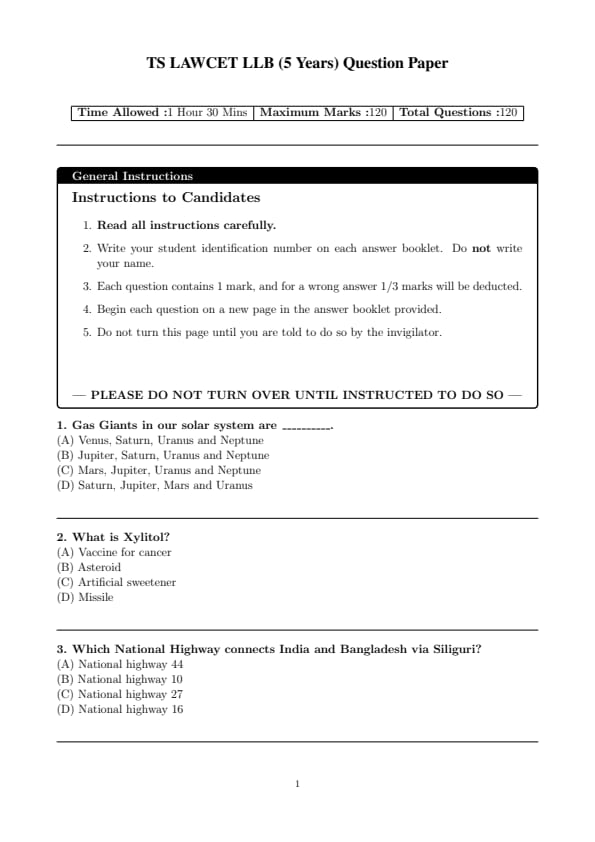
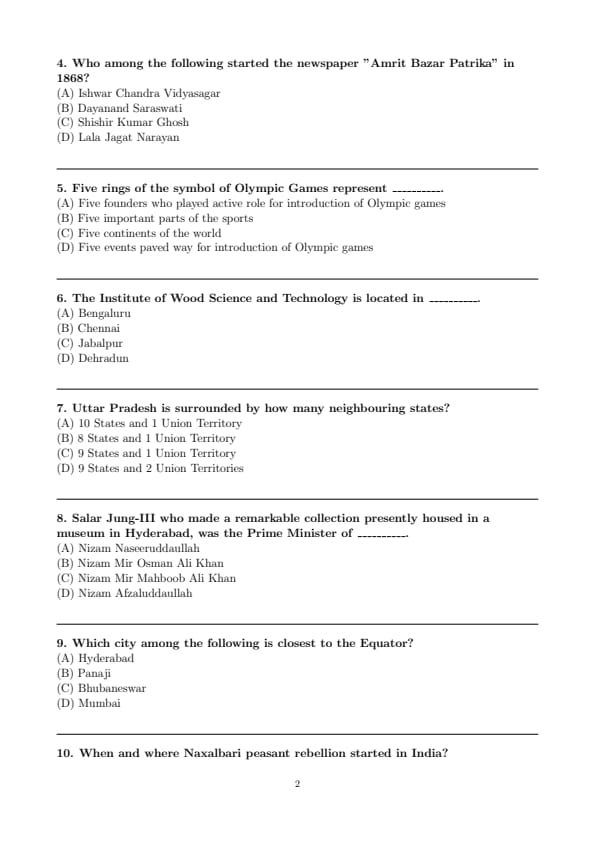
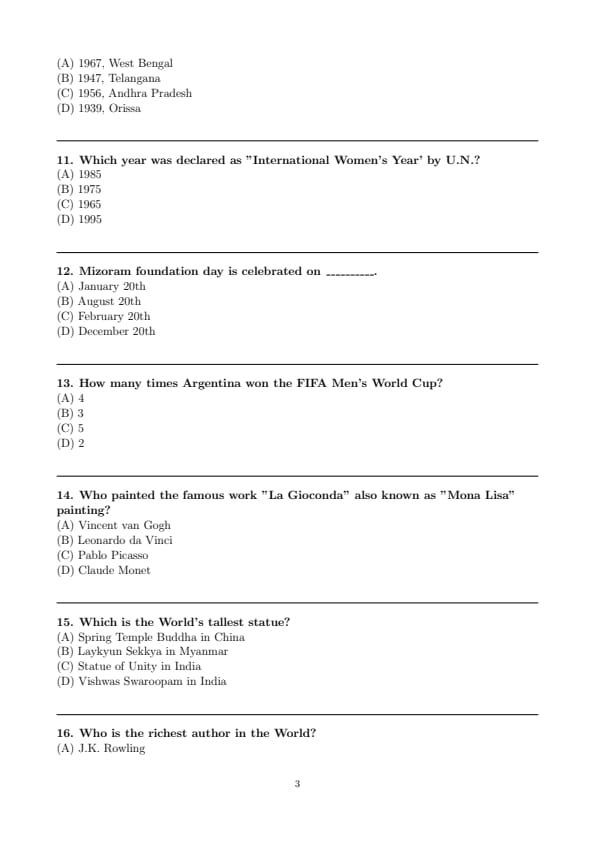
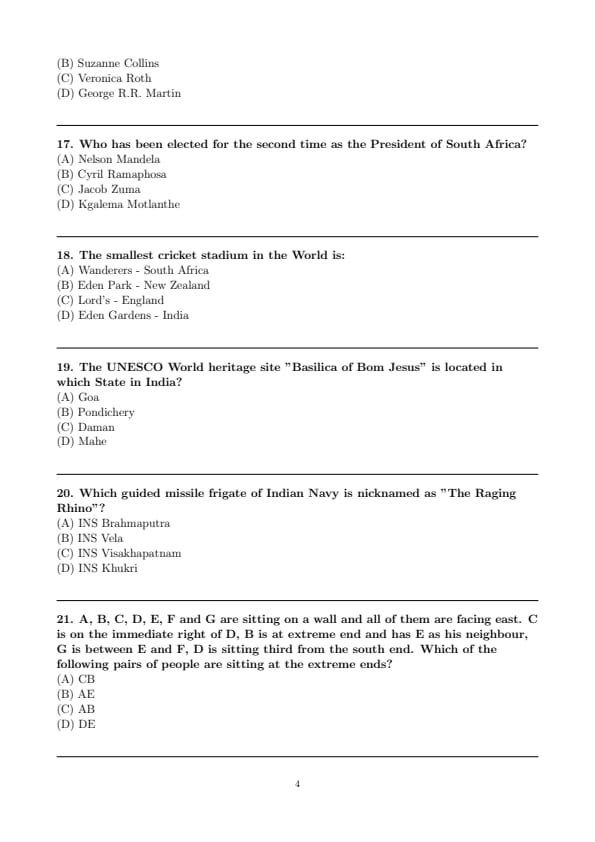
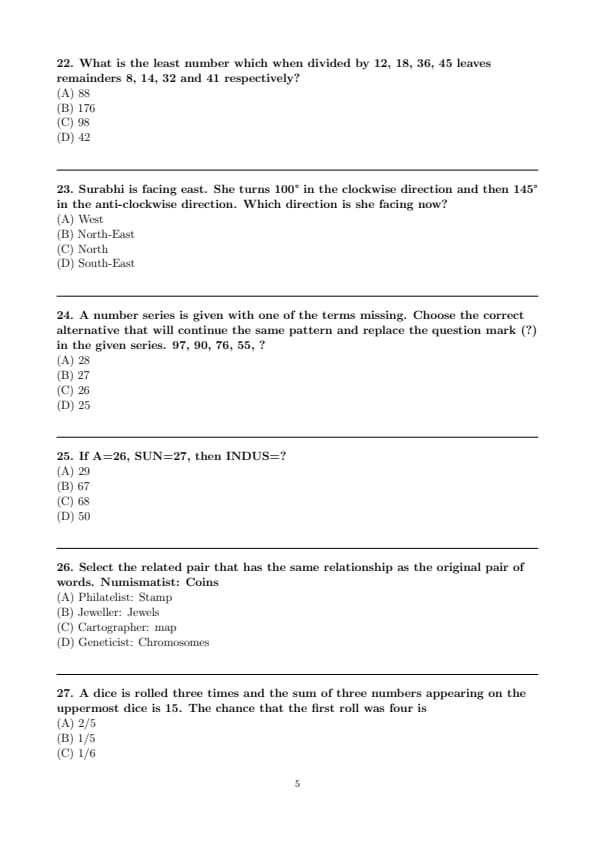
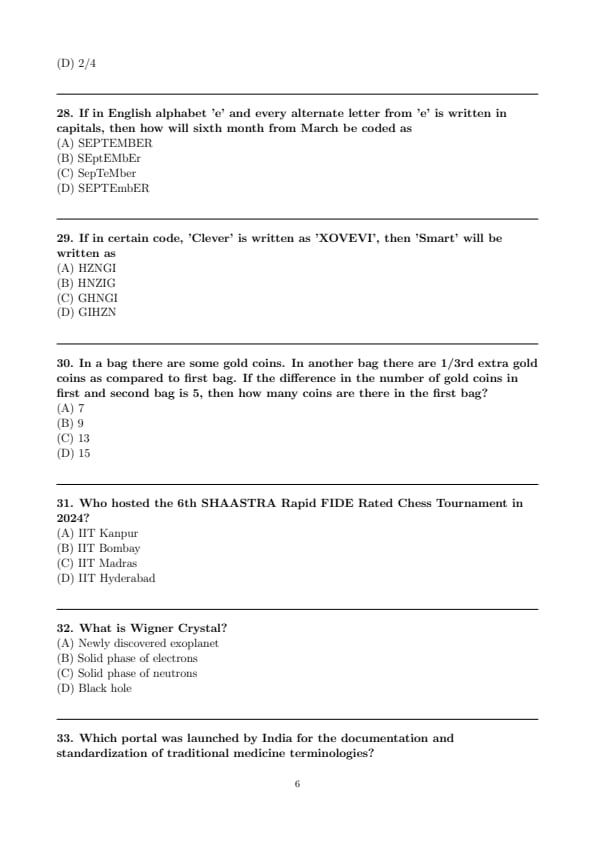
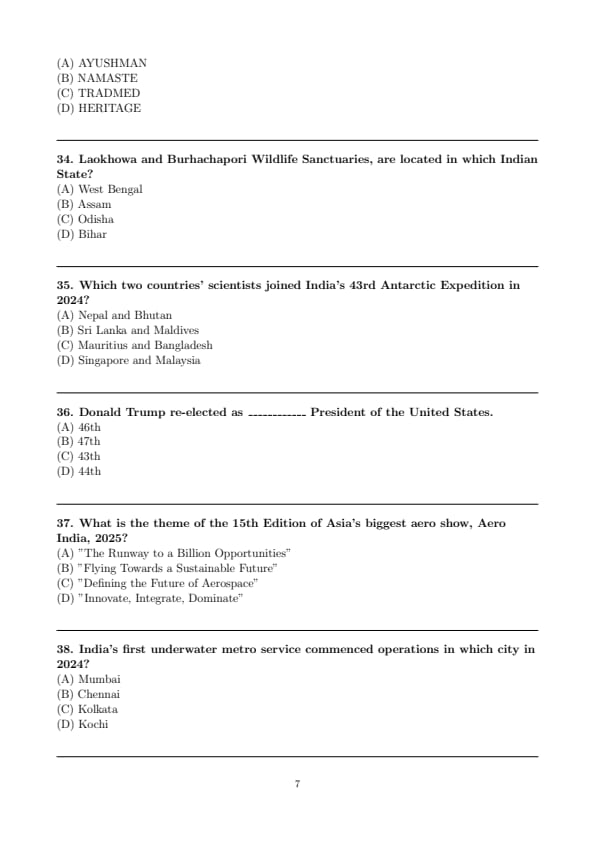
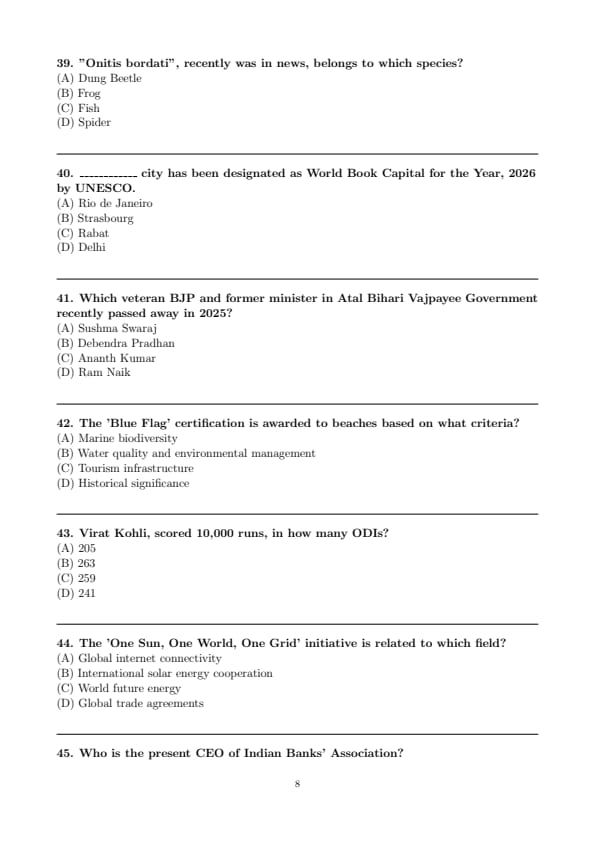
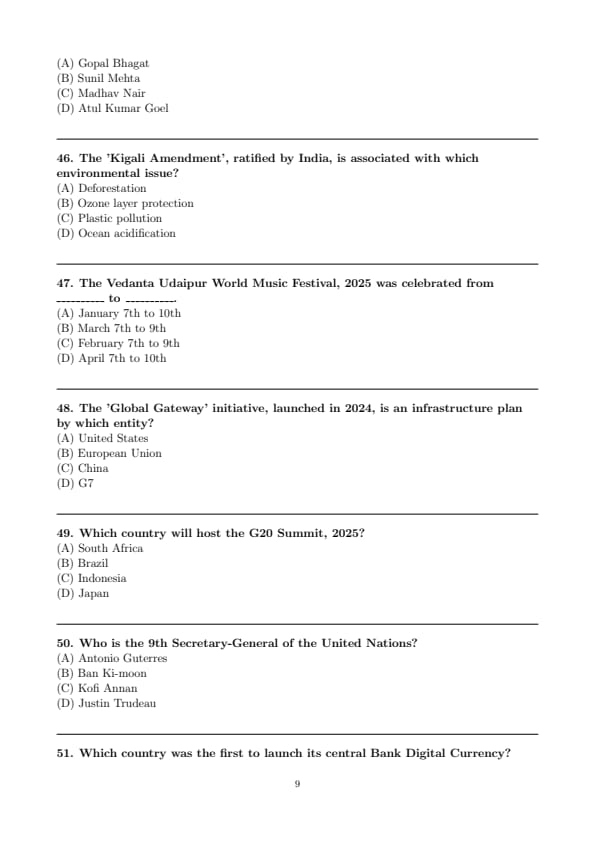
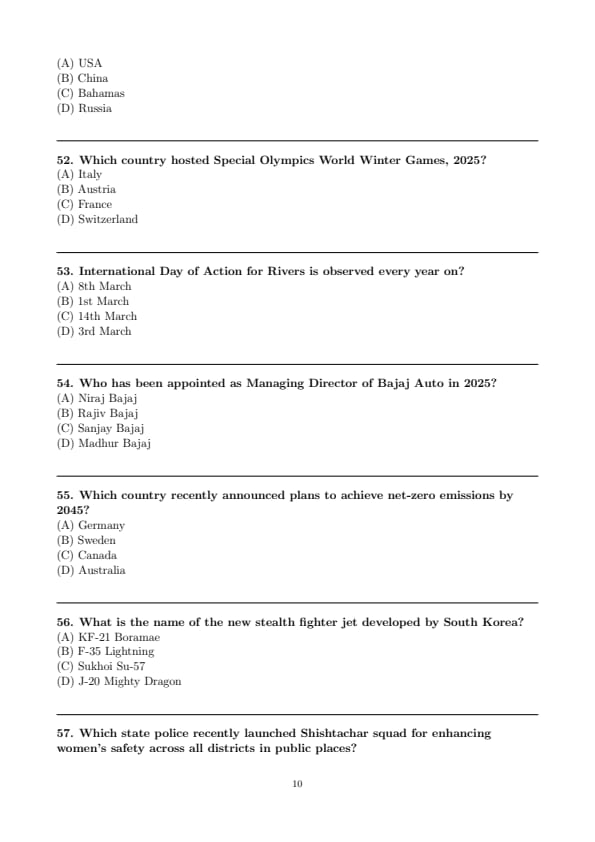
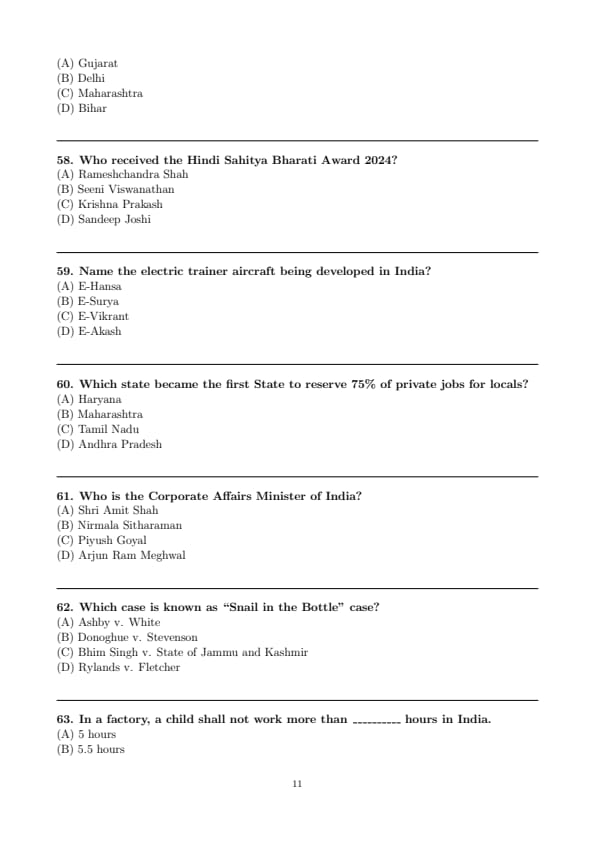
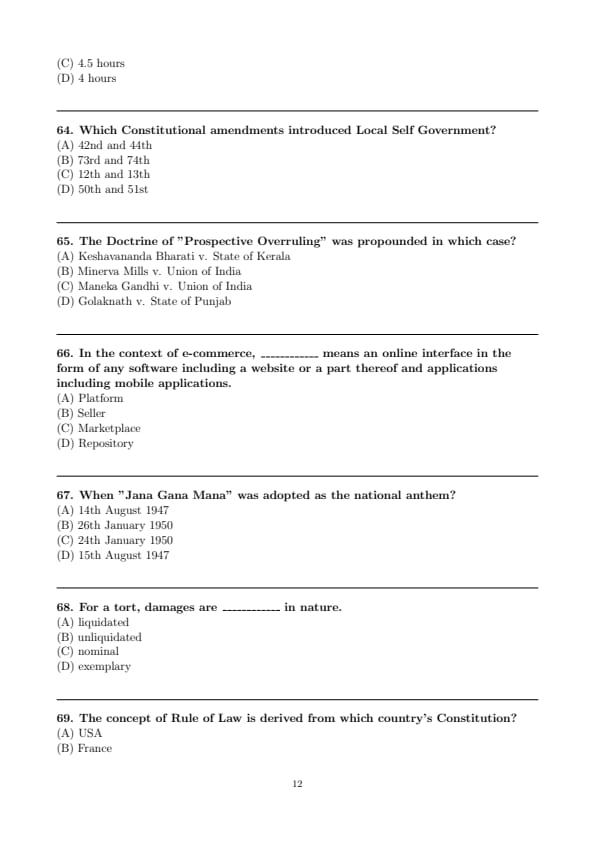
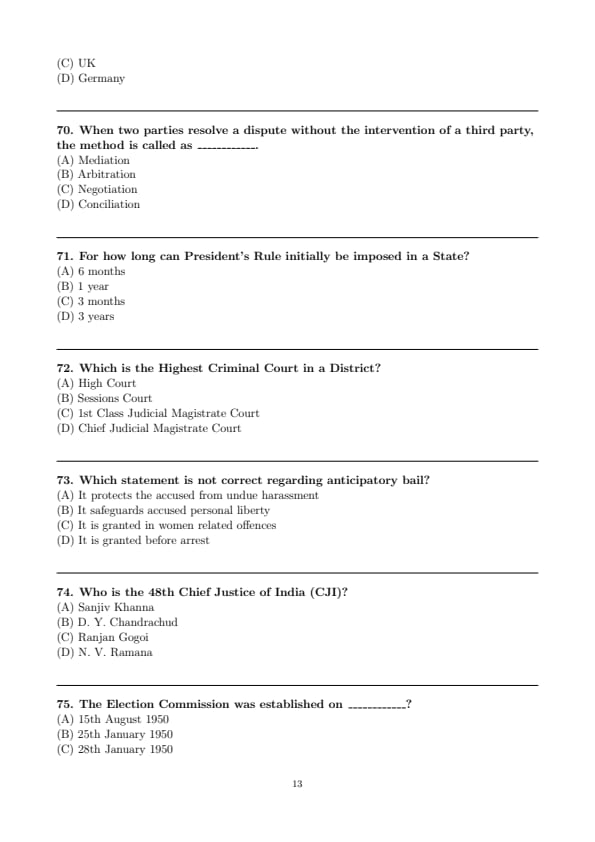
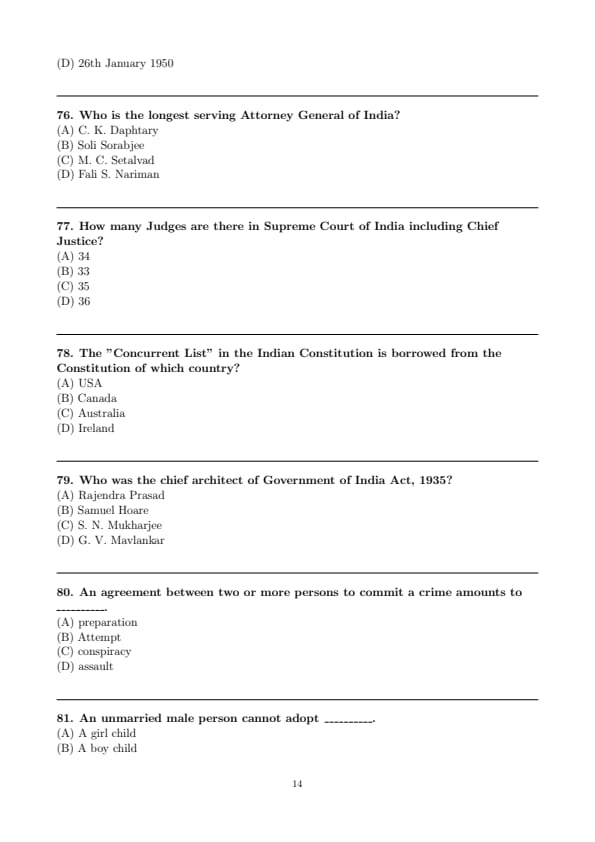
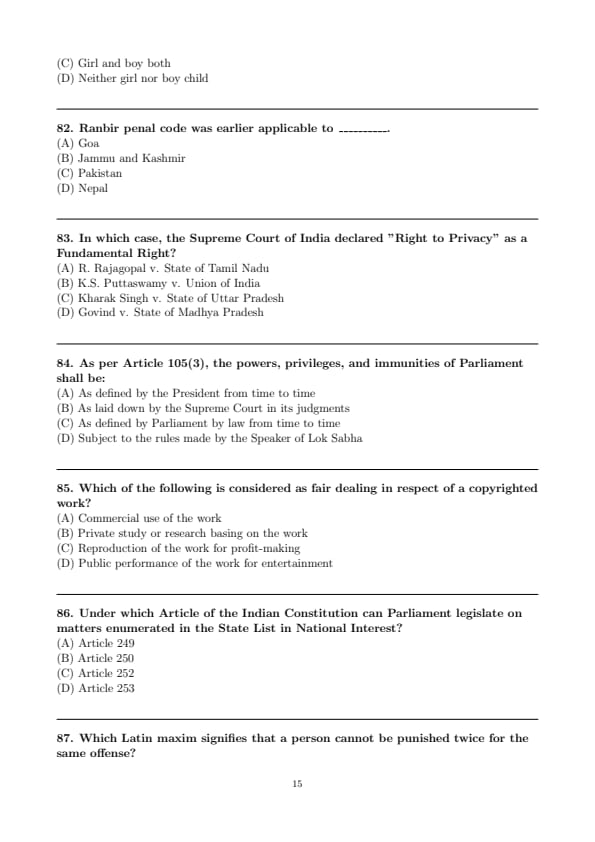
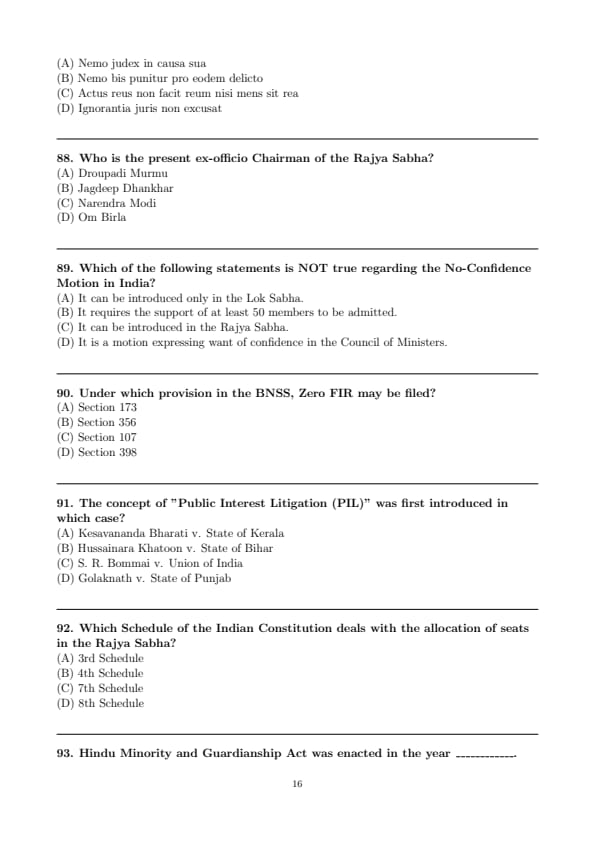
*The article might have information for the previous academic years, please refer the official website of the exam.