
TS LAWCET 2026 LLB 3 Years Question Paper with Solution Pdf (May 18 Shift 1)


| Updated On - May 18, 2026
TS LAWCET 2026 LLB 3 Years Shift 1 Question Paper with Solution PDF is available here for download. Osmania University conducted TS LAWCET 2026 for LLB 3 Years on May 18, Shift 1, from 9:30 AM to 11 AM in CBT Mode.
The TS LAWCET 2026 Question Paper consists of 120 questions comprising of 120 marks. The question paper is divided into 3 sections – Part A : General Knowledge and Mental Ability, Part B : Current Affairs and Part C : Aptitude for the Study of Law. As per the TS LAWCET marking scheme, +1 mark is awarded for every correct answer, and there is no negative marking for wrong answer.
TS LAWCET 2026 LLB 3 Years Question Paper May 18 Shift 1 with Solution PDF
| TS LAWCET 2026 Question Paper | Download PDF | Check Solutions |
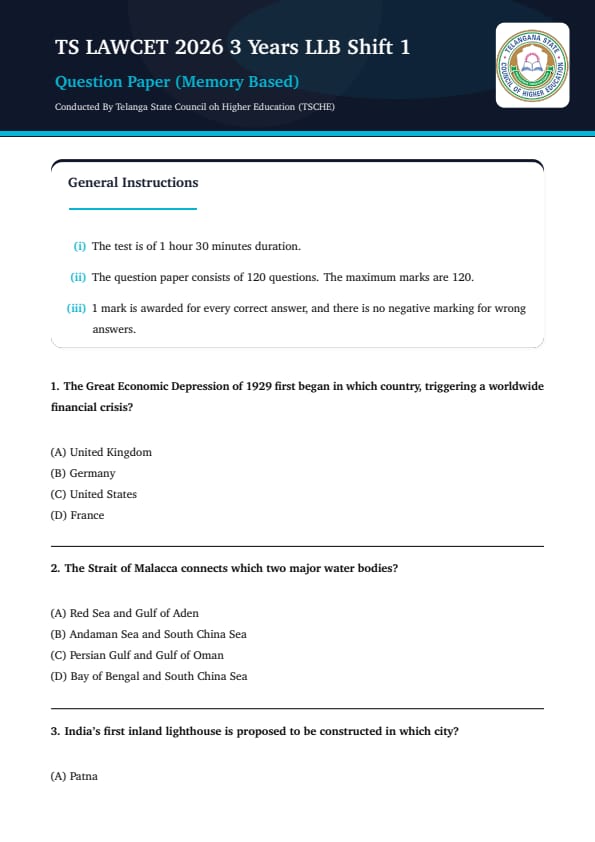
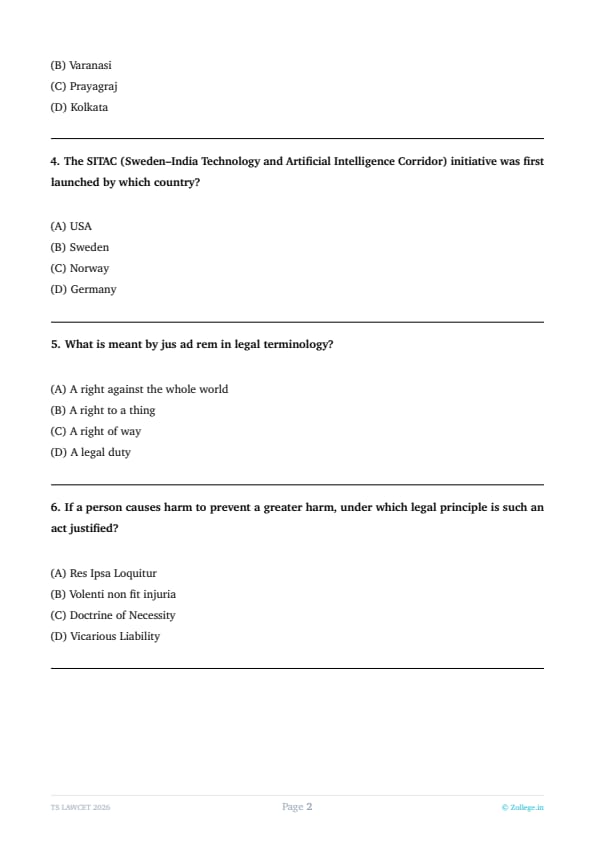
The Great Economic Depression of 1929 first began in which country, triggering a worldwide financial crisis?
View Solution
Step 1: Understanding the Concept:
The Great Depression was a severe worldwide economic downturn that took place mostly during the 1930s, beginning in the late 1920s. It was the longest, deepest, and most widespread depression of the 20th century. Understanding its origins requires looking at the post-World War I economic climate, characterized by the "Roaring Twenties" in the U.S., which saw unsustainable credit expansion, speculative stock market bubbles, and agricultural overproduction. The crash signaled the end of this prosperity and initiated a decade of high unemployment and deflation.
Step 2: Key Formula or Approach:
The analysis of this historical event focuses on several key economic indicators and events:
1. The "Black Tuesday" stock market crash of October 29, 1929.
2. The failure of the banking system due to mass withdrawals and unpaid loans.
3. The Gold Standard and international trade policies (like the Smoot-Hawley Tariff Act) that exported the crisis globally.
4. The subsequent decline in Gross Domestic Product (GDP) and the massive rise in unemployment rates.
Step 3: Detailed Explanation:
The Great Economic Depression officially traces its roots to the United States. Following a decade of rapid economic growth known as the Roaring Twenties, the U.S. stock market underwent a massive expansion, reaching its peak in August 1929.
By then, production had already declined and unemployment had risen, leaving stock prices much higher than their actual value. Additionally, wages at that time were low, consumer debt was proliferating, and the agricultural sector of the economy was struggling due to falling food prices and drought.
On October 24, 1929 ("Black Thursday"), a record 12.9 million shares were traded. Five days later, on "Black Tuesday" (October 29), some 16 million shares were traded as panic set in on Wall Street. Millions of shares ended up worthless, and those investors who had bought stocks "on margin" (with borrowed money) were wiped out completely.
As consumer confidence vanished in the wake of the stock market crash, the downturn in spending and investment led factories and other businesses to slow down production and begin firing workers. For those who were lucky enough to remain employed, wages fell and buying power decreased.
Many Americans forced to buy on credit fell into debt, and the number of foreclosures and bankruptcies climbed steadily. The adherence to the gold standard, which linked different countries' currencies, meant that the economic collapse in the U.S. quickly spread to Europe and the rest of the world.
In the U.S., the depression lasted until the late 1930s. The mobilization for World War II eventually helped stimulate the economy and end the era of mass unemployment.
Step 4: Final Answer:
The Great Economic Depression of 1929 first began in the United States.
Quick Tip: To remember the timeline, associate "1929" with "Wall Street" and "USA." The event is often referred to as the "Wall Street Crash," which immediately identifies the financial heart of America as the starting point.
The Strait of Malacca connects which two major water bodies?
View Solution
Step 1: Understanding the Concept:
In physical geography, a strait is a naturally formed, narrow waterway that connects two larger bodies of water. The Strait of Malacca is one of the most important shipping lanes in the world, serving as the main shipping channel between the Indian Ocean and the Pacific Ocean. It is located between the Malay Peninsula (Peninsular Malaysia and Southern Thailand) and the Indonesian island of Sumatra. Understanding the geography of Southeast Asia is key to identifying the specific seas it bridges.
Step 2: Key Formula or Approach:
Geographical identification involves:
1. Locating the maritime boundary of the Indian Ocean (represented here by the Andaman Sea).
2. Locating the maritime boundary of the Pacific Ocean (represented here by the South China Sea).
3. Identifying the narrow stretch of water passing through the Indonesian and Malaysian archipelagos.
Step 3: Detailed Explanation:
The Strait of Malacca is a funnel-shaped waterway that spans approximately 580 miles (930 kilometers) in length. It is the primary maritime route for most of the world's trade between Europe, the Middle East, and East Asia.
Geographically, the northwestern end of the strait connects to the Andaman Sea, which is part of the Indian Ocean. This area is situated to the west of the Malay Peninsula.
The southeastern end of the strait leads into the South China Sea, which is a marginal sea of the Pacific Ocean. This transition occurs through the Singapore Strait, located at the tip of the Malay Peninsula.
From an economic perspective, the strait is a vital "chokepoint." Approximately one-quarter of the world's traded goods and one-third of the world's oil shipments pass through this narrow passage.
Major economies like China, Japan, and South Korea rely heavily on this route for their energy imports from the Persian Gulf. Because of its strategic importance, the security and openness of the Strait of Malacca are major concerns for international maritime safety.
The strait is also ecologically significant, home to diverse marine life and coral reefs, though it faces challenges from high traffic volumes and potential pollution.
Step 4: Final Answer:
The Strait of Malacca connects the Andaman Sea with the South China Sea.
Quick Tip: Visualize the map of Southeast Asia: The Strait of Malacca acts as a bridge between the Indian and Pacific Oceans. The Andaman Sea represents the Indian side, while the South China Sea represents the Pacific side.
India's first inland lighthouse is proposed to be constructed in which city?
View Solution
Step 1: Understanding the Concept:
Lighthouses are traditionally coastal structures used to guide maritime pilots at sea or on inland waterways. India has a long coastline with numerous lighthouses, but the concept of an "inland lighthouse" on a river is a relatively new development in India's infrastructure planning. This initiative is part of the government's push to develop inland waterways (National Waterways) for transport, cargo movement, and river tourism, particularly along the Ganga River.
Step 2: Key Formula or Approach:
The identification of this project relies on current developments in Indian infrastructure:
1. The role of the Directorate General of Lighthouses and Lightships (DGLL).
2. The National Waterway-1 (NW-1) project, which stretches from Haldia to Varanasi.
3. The promotion of Varanasi as a cultural and tourism hub by the Ministry of Ports, Shipping, and Waterways.
Step 3: Detailed Explanation:
India's first inland lighthouse is proposed to be built in Varanasi, Uttar Pradesh. Varanasi, one of the world's oldest living cities, is situated on the banks of the holy river Ganga.
Traditionally, lighthouses were meant for the deep sea or coastal areas to help ships navigate near land. The proposed inland lighthouse in Varanasi is intended to assist vessels navigating the Ganga as part of the inland water transport system.
This project is being developed by the Directorate General of Lighthouses and Lightships (DGLL). The objective is not just navigation but also to serve as a major tourist attraction, providing a panoramic view of the river and the historic ghats of Varanasi.
The construction is part of a larger plan to modernize India's water transport. Varanasi already hosts India's first multi-modal terminal on the Ganga, making it a pivotal point for National Waterway-1.
The lighthouse will be equipped with modern lighting systems and radar technology to ensure safe navigation during the night and in foggy conditions, which is common in Northern India during winter.
By integrating history with modern infrastructure, the inland lighthouse aims to showcase the cultural significance of the Ganga while promoting the river as a viable alternative for bulk cargo movement and luxury cruises.
Step 4: Final Answer:
India's first inland lighthouse is proposed to be constructed in Varanasi.
Quick Tip: Associate "Ganga," "Inland Waterways," and "Spiritual Hub" together. Varanasi is the primary focus of most modern river-based infrastructure projects in India, making it the most logical choice for such a first-of-its-kind initiative.
The SITAC (Sweden–India Technology and Artificial Intelligence Corridor) initiative was first launched by which country?
View Solution
Step 1: Understanding the Concept:
International bilateral corridors in technology and Artificial Intelligence (AI) are strategic partnerships designed to foster innovation, research, and economic growth between two nations. SITAC represents a collaborative effort between Sweden and India to leverage their respective strengths—Sweden’s advanced technological ecosystem and India’s massive talent pool and digital infrastructure. Such initiatives are crucial in the modern era to establish ethical AI standards and competitive digital markets.
Step 2: Key Formula or Approach:
Tracking international relations and technological partnerships:
1. Identifying the acronym: Sweden-India Technology and Artificial Intelligence Corridor (SITAC).
2. Recognizing the lead country in proposing the collaborative framework.
3. Understanding the focus areas: startups, academic research, and industrial AI application.
Step 3: Detailed Explanation:
The SITAC initiative was first launched by Sweden as a bridge to deepen its technological engagement with India. Sweden has consistently been ranked as one of the world's most innovative nations, while India is a global leader in IT services and is rapidly becoming an AI powerhouse.
The corridor was established to promote collaborative research and development (R&D) in high-growth areas like Artificial Intelligence, machine learning, and green technology.
One of the primary goals of SITAC is to facilitate "soft landing" for startups in both countries. This means Swedish startups can find easier access to the Indian market, and Indian tech firms can leverage Swedish expertise to enter European markets.
The initiative also emphasizes digital transformation in traditional industries. By sharing knowledge, the two nations aim to automate processes and increase efficiency in sectors like manufacturing, healthcare, and urban planning.
SITAC often involves partnerships between academic institutions, such as the Indian Institutes of Technology (IITs) and Swedish universities like KTH Royal Institute of Technology, to train the next generation of tech professionals.
This partnership reflects a broader trend of "Technology Diplomacy," where nations use their digital capabilities to strengthen political and economic ties, ensuring that the development of AI remains transparent, secure, and beneficial for both societies.
Step 4: Final Answer:
The SITAC initiative was first launched by Sweden.
Quick Tip: The name of the initiative itself starts with "Sweden," which is a major hint. In bilateral corridor names, the initiating or primary partner is often mentioned first or is the driving force behind the diplomatic announcement.
What is meant by jus ad rem in legal terminology?
View Solution
Step 1: Understanding the Concept:
Legal maxims and Latin terms are the foundation of many legal systems, including Indian law. Understanding the distinction between different types of rights is essential in property law and contract law. A "right" can be absolute or contingent. The term "jus ad rem" refers to a specific category of personal rights that have not yet matured into full proprietary rights over a physical object.
Step 2: Key Formula or Approach:
Distinguishing between "Jus in rem" and "Jus ad rem":
1. *Jus in rem*: A right against the world at large (e.g., ownership of a house).
2. *Jus ad rem*: A right *to* a thing, typically arising out of an obligation or a contract.
3. Focus on the word "ad" (towards) and "rem" (thing).
Step 3: Detailed Explanation:
The Latin phrase "Jus ad rem" literally translates to "a right to a thing." In legal jurisprudence, it represents an inchoate or incomplete right.
It refers to a right that gives a person the legal power to demand or claim a specific object or property in the future, but they do not yet have physical possession or absolute ownership over it.
For example, if Person A enters into an agreement to buy a specific car from Person B, Person A has a "jus ad rem"—a right to that car. However, until the title is transferred and the sale is complete, Person A does not have a "jus in rem" (a right against everyone else regarding the car).
This term is often used in the context of personal obligations. If someone owes you a specific item based on a contract, your legal standing is "jus ad rem." You can sue that person to fulfill the obligation.
It is distinguished from "jus in personam," which is a right directed against a specific person (like the right to be paid a debt), and "jus in rem," which is an absolute right enforceable against everyone.
Historically, in Roman law, this distinction helped clarify when a claimant could pursue the property itself versus when they could only pursue the individual who promised it. In modern property law, it remains a vital concept for determining the priority of claims in bankruptcy or property disputes.
Step 4: Final Answer:
Jus ad rem means "a right to a thing."
Quick Tip: Remember the "Ad" in *Jus ad rem*. In Latin, "ad" means "towards." So, it is a right moving *towards* the thing—meaning you don't have it yet, but you have a claim to get it!
If a person causes harm to prevent a greater harm, under which legal principle is such an act justified?
View Solution
Step 1: Understanding the Concept:
In both Criminal Law and the Law of Torts, there are certain "General Exceptions" or "Defenses" that can excuse an act that would otherwise be considered an offense or a civil wrong. One such defense is based on the idea that in an emergency, it is sometimes necessary to choose the "lesser of two evils." This prevents the law from being overly rigid when a person acts in good faith to avoid a catastrophic outcome.
Step 2: Key Formula or Approach:
The legal framework for this principle involves:
1. Section 81 of the Indian Penal Code (IPC).
2. The absence of "criminal intent" (mens rea) to cause harm.
3. The presence of "good faith" to prevent other harm to person or property.
4. The requirement that the harm to be prevented must be "greater" than the harm caused.
Step 3: Detailed Explanation:
The justification for causing a smaller harm to prevent a larger one falls under the "Doctrine of Necessity." This is expressed in the maxim *quod necessitas non habet legem* (necessity knows no law).
Under Section 81 of the Indian Penal Code, an act is not an offense merely by reason of its being done with the knowledge that it is likely to cause harm, if it be done without any criminal intention to cause harm, and in good faith for the purpose of preventing or avoiding other harm to person or property.
A classic example is a fire spreading through a row of houses. If a person pulls down a house that is not yet on fire to create a "firebreak" and stop the fire from destroying the entire village, they have caused harm (property damage) to prevent a greater harm (total destruction). Under the Doctrine of Necessity, they would not be held criminally liable.
However, for this defense to succeed, the harm prevented must be significantly greater than the harm caused. The act must also be reasonable and done in an emergency where no other alternative was available.
In the famous case of *R v. Dudley and Stephens*, the court clarified that necessity cannot be used as a defense for murder (killing an innocent person to save one's own life), as the value of lives cannot be objectively compared.
Therefore, while the doctrine is a vital shield for protecting life and property in emergencies, its application is strictly monitored by the courts to prevent misuse.
Step 4: Final Answer:
Such an act is justified under the "Doctrine of Necessity."
Quick Tip: When you see a scenario where someone has to "choose between two bad options," the answer is almost always "Necessity." It is the legal way of saying the person did the right thing under terrible circumstances.
TS LAWCET 2026 Exam | Last Minute Tips
*The article might have information for the previous academic years, please refer the official website of the exam.