
AP ECET 2026 Agriculture Engineering Question Paper with Solution PDF


| Updated On - Jun 10, 2026
JNTU Anantapur conducted AP ECET 2026 Agricultural Engineering exam on April 23 in Shift 1 from 9 AM to 12 PM in CBT Mode.
AP ECET Question Paper consisted of 200 Questions from 4 sections, including 50 Questions from Mathematics, 25 Questions each in Physics and Chemistry, and 100 Questions from the Engineering Domain Specific. As per the marking scheme, +1 Marks for every correct answer and no negative marking for incorrect answers
AP ECET 2026 Agricultural Engineering Question Paper with Solution PDF is available here for download
AP ECET 2026 Agriculture Engineering Question Paper with Solution PDF
| AP ECET 2026 Agriculture Engineering Question Paper | Download PDF | Check Solution |
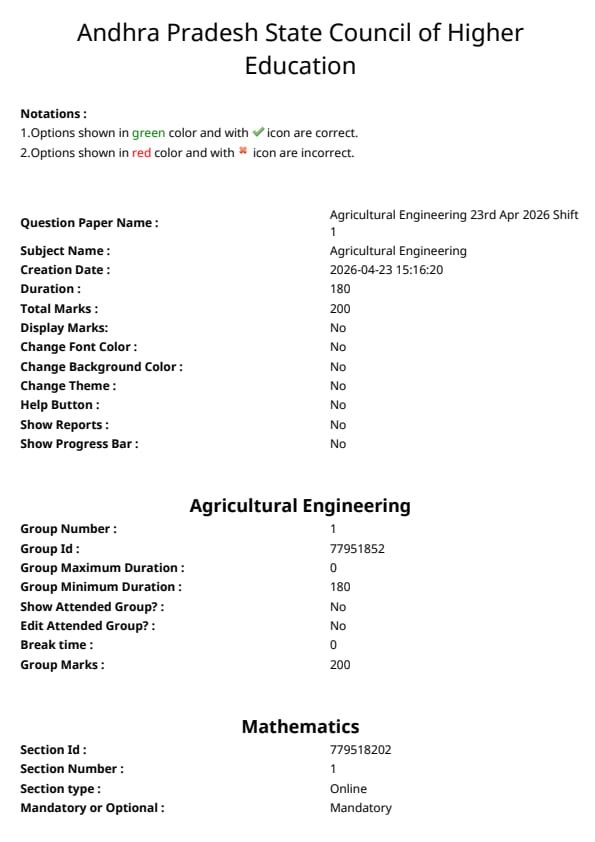
In the matrix \(A = \begin{bmatrix} 1 & 2 & 3
4 & 5 & 6
7 & 4 & 9 \end{bmatrix}\), the minor \(M_{23}\) of the \(a_{23}\) is
View Solution
Step 1: Understanding the Question:
The objective is to find the minor \(M_{23}\) of the element \(a_{23}\) in a given \(3 \times 3\) square matrix.
The minor of an element is the determinant of the sub-matrix formed by deleting the row and column in which that element lies.
Step 2: Key Formula or Approach:
For a matrix \(A\), the minor \(M_{ij}\) of element \(a_{ij}\) is calculated by:
1. Identifying the location \((i, j)\) of the element.
2. Deleting the \(i^{th}\) row and the \(j^{th}\) column.
3. Finding the determinant of the resulting \(2 \times 2\) matrix.
Step 3: Detailed Explanation:
Given matrix \(A = \begin{bmatrix} 1 & 2 & 3
4 & 5 & 6
7 & 4 & 9 \end{bmatrix}\)
The element \(a_{23}\) is located at the \(2^{nd}\) row and \(3^{rd}\) column.
From the matrix, \(a_{23} = 6\).
To find the minor \(M_{23}\), we delete the \(2^{nd}\) row and the \(3^{rd}\) column:
Row 2: \([4, 5, 6]\)
Column 3: \([3, 6, 9]^T\)
The remaining elements form the sub-matrix:
\[ \begin{bmatrix} 1 & 2
7 & 4 \end{bmatrix} \]
The determinant of this \(2 \times 2\) matrix is calculated as follows:
\[ M_{23} = \det\left(\begin{bmatrix} 1 & 2
7 & 4 \end{bmatrix}\right) \]
\[ M_{23} = (1 \times 4) - (2 \times 7) \]
\[ M_{23} = 4 - 14 \]
\[ M_{23} = -10 \]
Step 4: Final Answer:
The minor \(M_{23}\) is calculated to be -10. This corresponds to Option (B).
Quick Tip: Remember that the minor does not include the sign factor \((-1)^{i+j}\) used for cofactors.
Always double-check the arithmetic of \((ad - bc)\) for a \(2 \times 2\) determinant.
The minor of an element is always a scalar value representing the area/volume factor of the sub-dimension.
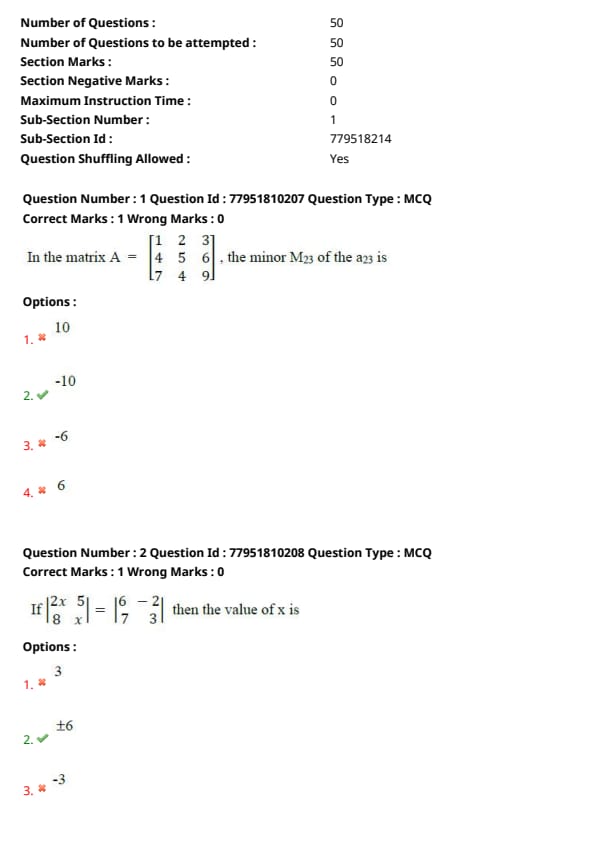
If \(\begin{vmatrix} 2x & 5
8 & x \end{vmatrix} = \begin{vmatrix} 6 & -2
7 & 3 \end{vmatrix}\), then the value of \(x\) is
View Solution
Step 1: Understanding the Question:
This problem requires solving an equation involving two \(2 \times 2\) determinants. We need to evaluate both sides and find the variable \(x\).
Step 2: Key Formula or Approach:
The determinant of a \(2 \times 2\) matrix \(\begin{vmatrix} a & b
c & d \end{vmatrix}\) is given by \((ad - bc)\).
Step 3: Detailed Explanation:
First, evaluate the determinant on the Left Hand Side (LHS):
\[ LHS = \begin{vmatrix} 2x & 5
8 & x \end{vmatrix} = (2x \cdot x) - (5 \cdot 8) \]
\[ LHS = 2x^2 - 40 \]
Next, evaluate the determinant on the Right Hand Side (RHS):
\[ RHS = \begin{vmatrix} 6 & -2
7 & 3 \end{vmatrix} = (6 \cdot 3) - (-2 \cdot 7) \]
\[ RHS = 18 - (-14) = 18 + 14 = 32 \]
Now, equate the LHS and RHS as per the given condition:
\[ 2x^2 - 40 = 32 \]
Solve for \(x\):
\[ 2x^2 = 32 + 40 \]
\[ 2x^2 = 72 \]
\[ x^2 = \frac{72}{2} = 36 \]
Taking the square root on both sides:
\[ x = \pm \sqrt{36} \]
\[ x = \pm 6 \]
Step 4: Final Answer:
The values of \(x\) that satisfy the determinant equation are \(+6\) and \(-6\). This matches Option (B).
Quick Tip: Do not confuse matrix equality with determinant equality.
In matrix equality, individual elements must be equal.
In determinant equality, only the scalar values calculated from the matrices must be equal.
Always remember the \(\pm\) sign when taking square roots in equations.
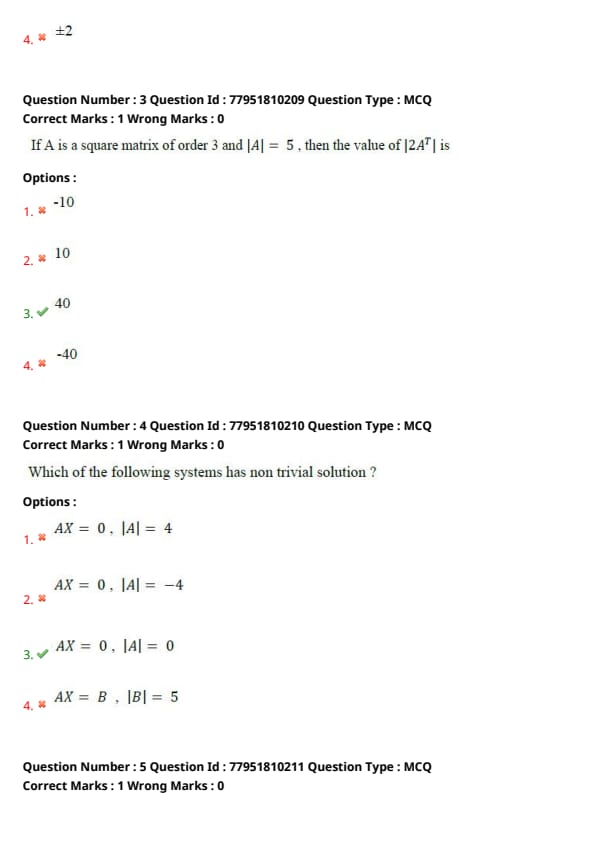
If \(A\) is a square matrix of order 3 and \(|A| = 5\), then the value of \(|2A^T|\) is
View Solution
Step 1: Understanding the Question:
We are given the determinant of a square matrix \(A\) of order \(n=3\). We need to find the determinant of a scaled version of its transpose, \(|2A^T|\).
Step 2: Key Formula or Approach:
Use the following properties of determinants:
1. \(|kA| = k^n |A|\), where \(n\) is the order of the square matrix \(A\).
2. \(|A^T| = |A|\), the determinant of a matrix is equal to the determinant of its transpose.
Step 3: Detailed Explanation:
Given: Order of matrix \(A\), \(n = 3\).
Given: Determinant \(|A| = 5\).
We need to calculate \(|2A^T|\).
First, apply the property for the scalar multiplication. Since the order is 3, the scalar \(2\) comes out as \(2^3\):
\[ |2A^T| = 2^3 \cdot |A^T| \]
Calculate \(2^3\):
\[ 2^3 = 2 \times 2 \times 2 = 8 \]
So, \(|2A^T| = 8 \cdot |A^T|\).
Now, use the transpose property: \(|A^T| = |A|\).
Substitute the given value \(|A| = 5\):
\[ |A^T| = 5 \]
Finally, multiply the scalar factor by the determinant:
\[ |2A^T| = 8 \times 5 \]
\[ |2A^T| = 40 \]
Step 4: Final Answer:
The determinant \(|2A^T|\) is 40. This corresponds to Option (C).
Quick Tip: A common mistake is forgetting to raise the scalar to the power of the matrix order.
Always remember \(|kA| = k^n |A|\). For a \(2 \times 2\) matrix, it would be \(k^2\).
Transposing a matrix never changes its determinant value.
Which of the following systems has non trivial solution?
View Solution
Step 1: Understanding the Question:
The question asks for the condition under which a system of linear equations has a non-trivial solution. Trivial solutions refer to the zero vector \((X = 0)\) in homogeneous systems.
Step 2: Key Formula or Approach:
For a homogeneous system of linear equations \(AX = 0\):
1. If \(|A| \neq 0\), the matrix \(A\) is non-singular, and the system has only a unique trivial solution \((X = 0)\).
2. If \(|A| = 0\), the matrix \(A\) is singular, and the system has infinitely many solutions, including non-trivial solutions.
Step 3: Detailed Explanation:
A system \(AX = 0\) is called a homogeneous system.
\(X = 0\) is always a solution (trivial solution).
Non-trivial solutions exist only when the columns of \(A\) are linearly dependent, which implies that the determinant of the coefficient matrix must be zero.
Let's examine the options:
- Option (A): \(|A| = 4 \neq 0 \implies\) Only trivial solution.
- Option (B): \(|A| = -4 \neq 0 \implies\) Only trivial solution.
- Option (C): \(|A| = 0 \implies\) System has non-trivial solutions because the matrix is singular.
- Option (D): \(AX = B\) is a non-homogeneous system. Existence of solutions depends on the rank of \(A\) and the augmented matrix \([A|B]\). It is not the standard condition for "non-trivial" solutions as defined for homogeneous cases.
Step 4: Final Answer:
The condition for a homogeneous system \(AX = 0\) to have a non-trivial solution is that the determinant \(|A|\) must be zero. Thus, Option (C) is correct.
Quick Tip: Non-trivial solution \(\iff\) Singular matrix \(\iff\) \(|A| = 0 \iff\) Infinite solutions for \(AX = 0\).
If \(|A| \neq 0\), the system is consistent with a unique solution (which is \(X=0\) for homogeneous).
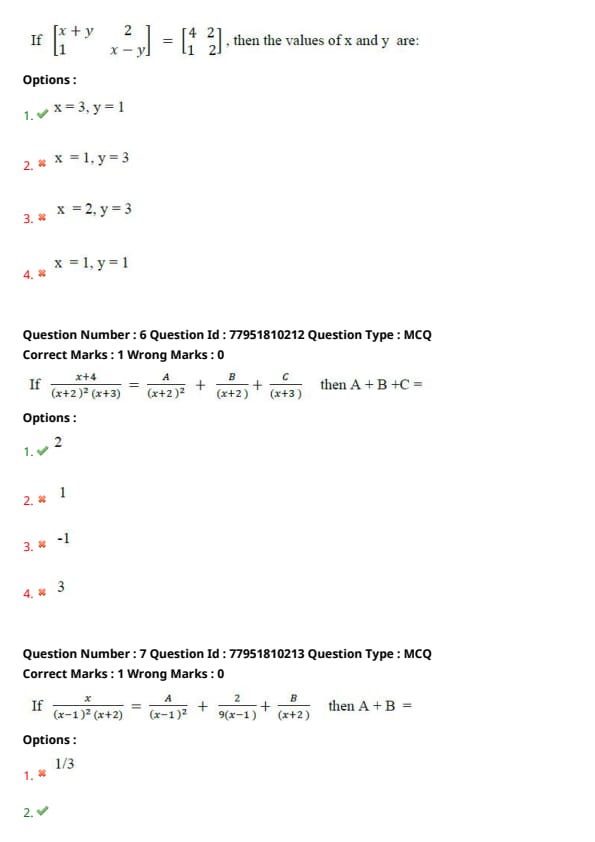
If \(\begin{bmatrix} x+y & 2
1 & x-y \end{bmatrix} = \begin{bmatrix} 4 & 2
1 & 2 \end{bmatrix}\), then the values of \(x\) and \(y\) are:
View Solution
Step 1: Understanding the Question:
The question involves the concept of equality of matrices. Two matrices are equal if and only if they have the same dimensions and their corresponding elements are equal.
Step 2: Key Formula or Approach:
Equate the elements at the same positions:
\(a_{11} = b_{11}\)
\(a_{22} = b_{22}\)
Step 3: Detailed Explanation:
Given equality: \(\begin{bmatrix} x+y & 2
1 & x-y \end{bmatrix} = \begin{bmatrix} 4 & 2
1 & 2 \end{bmatrix}\).
Equating the element at \((1, 1)\):
\(x + y = 4\) --- (Equation 1)
Equating the element at \((2, 2)\):
\(x - y = 2\) --- (Equation 2)
Elements at \((1, 2)\) and \((2, 1)\) are already equal (\(2=2\) and \(1=1\)).
Now, solve the system of linear equations (1) and (2).
Adding Eq 1 and Eq 2:
\((x + y) + (x - y) = 4 + 2\)
\(2x = 6\)
\(x = 3\)
Substitute \(x = 3\) into Equation 1:
\(3 + y = 4\)
\(y = 4 - 3\)
\(y = 1\)
Verification: In Equation 2, \(3 - 1 = 2\). This is correct.
Step 4: Final Answer:
The values are \(x = 3\) and \(y = 1\). This corresponds to Option (A).
Quick Tip: Matrix equality requires every single corresponding element to be identical.
Solving such equations by addition/subtraction is usually faster than substitution.
If \(\frac{x+4}{(x+2)^2(x+3)} = \frac{A}{(x+2)^2} + \frac{B}{(x+2)} + \frac{C}{(x+3)}\), then \(A + B + C =\)
View Solution
Step 1: Understanding the Question:
The problem is based on the partial fraction decomposition of a rational function. We need to find the constants \(A, B, C\) and calculate their sum.
Step 2: Key Formula or Approach:
Multiply both sides by the common denominator \((x+2)^2(x+3)\) to obtain the basic equation:
\(x+4 = A(x+3) + B(x+2)(x+3) + C(x+2)^2\)
Step 3: Detailed Explanation:
The basic equation is \(x+4 = A(x+3) + B(x+2)(x+3) + C(x+2)^2\).
To find \(A\): Let \(x = -2\).
\(-2 + 4 = A(-2 + 3) + B(0) + C(0)\)
\(2 = A(1) \implies A = 2\).
To find \(C\): Let \(x = -3\).
\(-3 + 4 = A(0) + B(0) + C(-3 + 2)^2\)
\(1 = C(-1)^2 \implies C = 1\).
To find \(B\): Equate the coefficients of \(x^2\) on both sides.
LHS has no \(x^2\) term, so coefficient is \(0\).
RHS \(x^2\) terms come from \(B(x+2)(x+3)\) and \(C(x+2)^2\):
\(0 = B + C\)
Substitute \(C = 1\):
\(0 = B + 1 \implies B = -1\).
Now, calculate the sum \(A + B + C\):
\(A + B + C = 2 + (-1) + 1 = 2\).
Step 4: Final Answer:
The sum \(A + B + C\) is equal to 2. This matches Option (A).
Quick Tip: For repeated factors like \((x-a)^n\), start by substituting \(x=a\) to get the coefficient of \((x-a)^n\) directly.
Equating coefficients of the highest power of \(x\) (usually \(x^2\) in these problems) is often the fastest way to find middle terms.
If \(\frac{x}{(x-1)^2(x+2)} = \frac{A}{(x-1)^2} + \frac{2}{9(x-1)} + \frac{B}{(x+2)}\), then \(A + B =\)
View Solution
Step 1: Understanding the Question:
This is another partial fraction problem. We are given the values of one of the partial fraction constants \((2/9)\) and need to determine \(A\) and \(B\).
Step 2: Key Formula or Approach:
The governing equation is obtained by clearing the denominator:
\(x = A(x+2) + \frac{2}{9}(x-1)(x+2) + B(x-1)^2\)
Step 3: Detailed Explanation:
The equation is \(x = A(x+2) + \frac{2}{9}(x-1)(x+2) + B(x-1)^2\).
Finding \(A\): Substitute \(x = 1\).
\(1 = A(1+2) + \frac{2}{9}(0) + B(0)\)
\(1 = 3A \implies A = 1/3\).
Finding \(B\): Substitute \(x = -2\).
\(-2 = A(0) + \frac{2}{9}(0) + B(-2-1)^2\)
\(-2 = B(-3)^2\)
\(-2 = 9B \implies B = -2/9\).
Calculating \(A + B\):
\(A + B = \frac{1}{3} + \left(-\frac{2}{9}\right)\)
\(A + B = \frac{3}{9} - \frac{2}{9}\)
\(A + B = \frac{1}{9}\).
Step 4: Final Answer:
The sum \(A + B\) is \(1/9\). This matches Option (B).
Quick Tip: When dealing with fractions, convert them to a common denominator before adding.
Substitution of zeroes of the denominator is the most reliable method for finding constants.
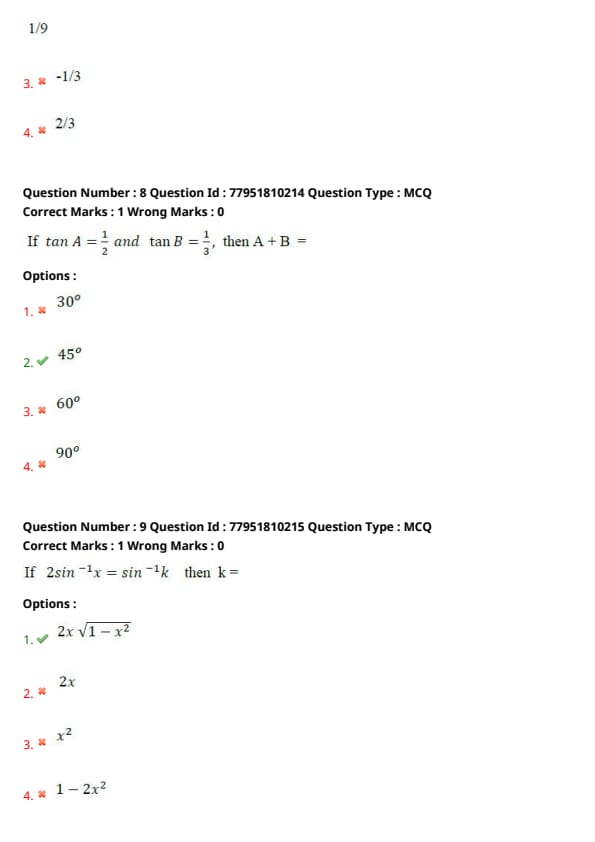
If \(\tan A = \frac{1}{2}\) and \(\tan B = \frac{1}{3}\), then \(A + B =\)
View Solution
Step 1: Understanding the Question:
The problem involves trigonometric addition formulas. We are given the tangent values of two angles and need to find the sum of the angles.
Step 2: Key Formula or Approach:
The addition formula for tangent is:
\[ \tan(A + B) = \frac{\tan A + \tan B}{1 - \tan A \tan B} \]
Step 3: Detailed Explanation:
Given: \(\tan A = 1/2\) and \(\tan B = 1/3\).
Apply the formula:
\[ \tan(A + B) = \frac{\frac{1}{2} + \frac{1}{3}}{1 - \left(\frac{1}{2} \cdot \frac{1}{3}\right)} \]
Simplify the numerator:
Numerator \(= \frac{3 + 2}{6} = \frac{5}{6}\).
Simplify the denominator:
Denominator \(= 1 - \frac{1}{6} = \frac{5}{6}\).
Calculate the ratio:
\[ \tan(A + B) = \frac{5/6}{5/6} = 1 \]
Since \(\tan(A+B) = 1\), we find the angle:
\(A + B = \tan^{-1}(1) = 45^\circ\) (or \(\pi/4\) radians).
Step 4: Final Answer:
The sum \(A + B\) is \(45^\circ\). This corresponds to Option (B).
Quick Tip: Recognizing standard tangent values helps speed up calculations.
\(\tan 45^\circ = 1\) is one of the most common results in such identity problems.
Always check the sign of the denominator \((1 - \tan A \tan B)\) to avoid undefined results.
If \(2 \sin^{-1} x = \sin^{-1} k\), then \(k =\)
View Solution
Step 1: Understanding the Question:
The problem asks for the standard identity for the double angle in inverse sine functions.
Step 2: Key Formula or Approach:
Let \(\sin^{-1} x = \theta\), which implies \(\sin \theta = x\).
We need to find \(\sin(2\theta)\) in terms of \(x\).
The double angle formula is \(\sin(2\theta) = 2 \sin \theta \cos \theta\).
Step 3: Detailed Explanation:
Let \(\sin^{-1} x = \theta\). Then \(\sin \theta = x\).
To find \(\cos \theta\), we use the identity \(\cos^2 \theta + \sin^2 \theta = 1\):
\(\cos \theta = \sqrt{1 - \sin^2 \theta} = \sqrt{1 - x^2}\).
The expression \(2 \sin^{-1} x\) becomes \(2\theta\).
We are given \(2\theta = \sin^{-1} k\), which means \(k = \sin(2\theta)\).
Applying the double angle formula:
\(k = 2 \sin \theta \cos \theta\)
Substitute the values of \(\sin \theta\) and \(\cos \theta\):
\(k = 2(x)(\sqrt{1 - x^2})\)
\(k = 2x\sqrt{1 - x^2}\).
This identity is valid for \(|x| \le \frac{1}{\sqrt{2}}\).
Step 4: Final Answer:
The value of \(k\) is \(2x\sqrt{1 - x^2}\). This corresponds to Option (A).
Quick Tip: Standard inverse identities are very helpful:
\(2 \sin^{-1} x = \sin^{-1}(2x\sqrt{1-x^2})\)
\(2 \cos^{-1} x = \cos^{-1}(2x^2-1)\)
\(2 \tan^{-1} x = \tan^{-1}\left(\frac{2x}{1-x^2}\right)\)
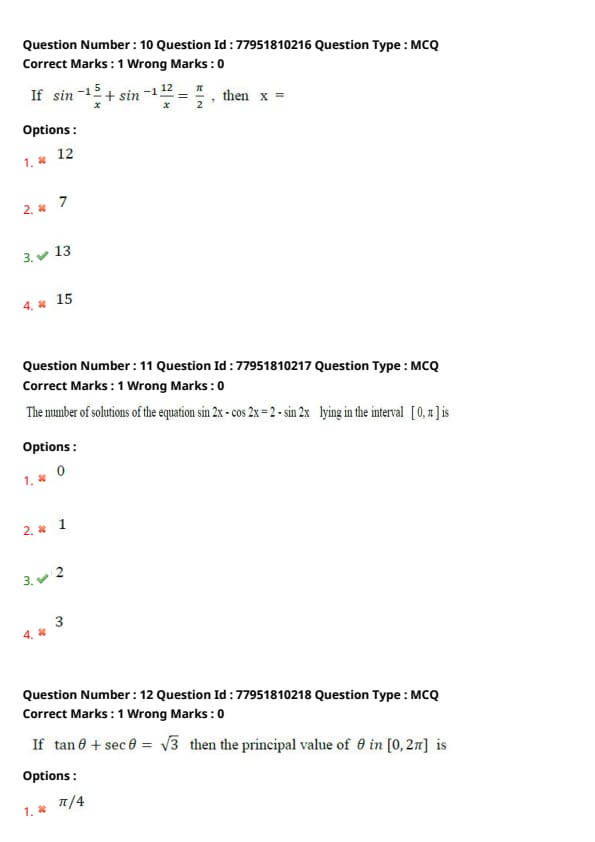
If \(\sin^{-1} \frac{5}{x} + \sin^{-1} \frac{12}{x} = \frac{\pi}{2}\), then \(x =\)
View Solution
Step 1: Understanding the Question:
The equation involves the sum of two inverse sine functions equal to \(\pi/2\). This suggests a complementary relationship between the arguments.
Step 2: Key Formula or Approach:
Use the identity: \(\sin^{-1} a + \cos^{-1} a = \frac{\pi}{2}\).
If \(\sin^{-1} A + \sin^{-1} B = \frac{\pi}{2}\), then \(\sin^{-1} A = \frac{\pi}{2} - \sin^{-1} B\), which implies \(\sin^{-1} A = \cos^{-1} B\).
Step 3: Detailed Explanation:
Let \(\sin^{-1} \frac{5}{x} = \alpha\) and \(\sin^{-1} \frac{12}{x} = \beta\).
Given \(\alpha + \beta = \pi/2\).
This means \(\alpha = \pi/2 - \beta\).
\(\sin \alpha = \sin(\pi/2 - \beta) = \cos \beta\).
From our initial definitions:
\(\sin \alpha = \frac{5}{x}\)
\(\sin \beta = \frac{12}{x}\)
Since \(\sin \alpha = \cos \beta\), we need to express \(\cos \beta\) in terms of \(x\).
\(\cos \beta = \sqrt{1 - \sin^2 \beta} = \sqrt{1 - (\frac{12}{x})^2}\).
Equating them:
\(\frac{5}{x} = \sqrt{1 - \frac{144}{x^2}}\)
Square both sides:
\(\frac{25}{x^2} = 1 - \frac{144}{x^2}\)
\(\frac{25}{x^2} + \frac{144}{x^2} = 1\)
\(\frac{169}{x^2} = 1\)
\(x^2 = 169 \implies x = 13\) (ignoring negative as arguments of \(\sin^{-1}\) are positive in this sum).
Step 4: Final Answer:
The value of \(x\) is 13. This corresponds to Option (C).
Quick Tip: Whenever you see \(\sin^{-1} A + \sin^{-1} B = \pi/2\), think of Pythagoras: \(A^2 + B^2 = 1\).
Here, \((5/x)^2 + (12/x)^2 = 1 \implies 5^2 + 12^2 = x^2 \implies 25 + 144 = x^2 \implies x = 13\).
This is based on the triplet \((5, 12, 13)\).
The number of solutions of the equation \(\sin 2x - \cos 2x = 2 - \sin 2x\) lying in the interval \([0, \pi]\) is
View Solution
Step 1: Understanding the Question:
We need to solve a trigonometric equation for \(x\) and count how many distinct solutions fall within the range \(0 \le x \le \pi\).
Step 2: Key Formula or Approach:
Rearrange the equation into a standard form \(a \sin \theta + b \cos \theta = c\).
Step 3: Detailed Explanation:
Original Equation: \(\sin 2x - \cos 2x = 2 - \sin 2x\).
Grouping \(\sin 2x\) terms:
\(2 \sin 2x - \cos 2x = 2\).
Let \(2x = \theta\). Since \(x \in [0, \pi]\), \(\theta \in [0, 2\pi]\).
The equation becomes \(2 \sin \theta - \cos \theta = 2\).
Express \(\cos \theta\) in terms of \(\sin \theta\):
\(2 \sin \theta - 2 = \cos \theta\).
Square both sides:
\((2 \sin \theta - 2)^2 = \cos^2 \theta\)
\(4 \sin^2 \theta - 8 \sin \theta + 4 = 1 - \sin^2 \theta\)
\(5 \sin^2 \theta - 8 \sin \theta + 3 = 0\).
Factoring the quadratic:
\(5 \sin^2 \theta - 5 \sin \theta - 3 \sin \theta + 3 = 0\)
\(5 \sin \theta(\sin \theta - 1) - 3(\sin \theta - 1) = 0\)
\((\sin \theta - 1)(5 \sin \theta - 3) = 0\).
Case 1: \(\sin \theta = 1\).
\(\theta = \pi/2\) is the only solution in \([0, 2\pi]\).
Checking in original: \(2(1) - 0 = 2\). Valid.
\(x = \pi/4 \in [0, \pi]\).
Case 2: \(\sin \theta = 3/5\).
Since \(\sin \theta\) is positive, \(\theta\) can be in Q1 or Q2.
In Q1, \(\cos \theta = 4/5 \implies 2(3/5) - 4/5 = 2/5 \neq 2\). Invalid.
In Q2, \(\cos \theta = -4/5 \implies 2(3/5) - (-4/5) = 6/5 + 4/5 = 2\). Valid.
So there is exactly one solution for \(\theta\) in Q2.
Let this be \(\theta_2 = \pi - \sin^{-1}(3/5)\).
\(x = \theta_2 / 2 \in [0, \pi]\).
Total solutions = 1 (from \(\theta = \pi/2\)) + 1 (from Q2) = 2.
Step 4: Final Answer:
There are 2 solutions in the given interval. This corresponds to Option (C).
Quick Tip: Squaring equations can introduce "extraneous solutions". Always plug the resulting angles back into the linear trigonometric form \(a \sin \theta + b \cos \theta = c\) to verify their validity.
For \(2 \sin \theta - \cos \theta = 2\), notice that \(\sin \theta\) must be quite large (close to 1) for the equality to hold.
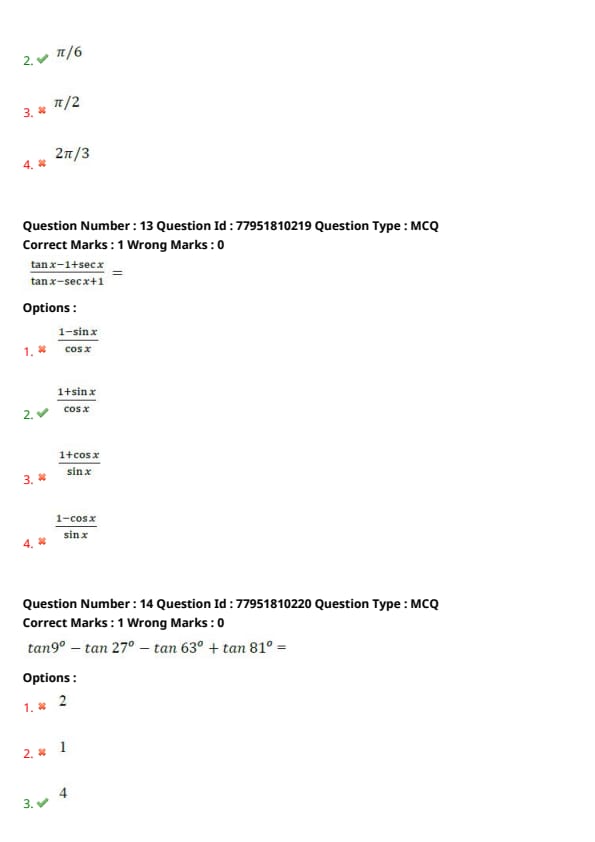
If \(\tan \theta + \sec \theta = \sqrt{3}\), then the principal value of \(\theta\) in \([0, 2\pi]\) is
View Solution
Step 1: Understanding the Question:
Find the angle \(\theta\) that satisfies the equation in the standard interval \([0, 2\pi]\).
Step 2: Key Formula or Approach:
Use the identity \(\sec^2 \theta - \tan^2 \theta = 1\), or convert to sine and cosine.
Step 3: Detailed Explanation:
Given: \(\sec \theta + \tan \theta = \sqrt{3}\) --- (1)
We know: \(\sec^2 \theta - \tan^2 \theta = 1\)
\((\sec \theta - \tan \theta)(\sec \theta + \tan \theta) = 1\)
\((\sec \theta - \tan \theta)(\sqrt{3}) = 1\)
\(\sec \theta - \tan \theta = \frac{1}{\sqrt{3}}\) --- (2)
Adding Equations (1) and (2):
\(2 \sec \theta = \sqrt{3} + \frac{1}{\sqrt{3}} = \frac{3 + 1}{\sqrt{3}} = \frac{4}{\sqrt{3}}\)
\(\sec \theta = \frac{2}{\sqrt{3}} \implies \cos \theta = \frac{\sqrt{3}}{2}\)
Subtracting (2) from (1):
\(2 \tan \theta = \sqrt{3} - \frac{1}{\sqrt{3}} = \frac{3 - 1}{\sqrt{3}} = \frac{2}{\sqrt{3}}\)
\(\tan \theta = \frac{1}{\sqrt{3}}\)
From \(\cos \theta = \sqrt{3}/2\) and \(\tan \theta = 1/\sqrt{3}\), both are positive, indicating \(\theta\) is in the first quadrant.
The angle is \(\theta = \pi/6\) (or \(30^\circ\)).
Check other intervals: \(\cos \theta\) is also positive in Q4 (\(11\pi/6\)), but \(\tan(11\pi/6) = -1/\sqrt{3}\), which wouldn't satisfy \(\tan \theta + \sec \theta = \sqrt{3}\).
Step 4: Final Answer:
The principal value is \(\pi/6\). This corresponds to Option (B).
Quick Tip: If \(\sec \theta + \tan \theta = k\), then \(\sec \theta - \tan \theta = 1/k\).
This is a very powerful shortcut for solving many problems involving secant and tangent.
The same logic applies to \(\csc \theta + \cot \theta = k\).
\(\frac{\tan x - 1 + \sec x}{\tan x - \sec x + 1} =\)
View Solution
Step 1: Understanding the Question:
The goal is to simplify a complex trigonometric fraction using fundamental identities.
Step 2: Key Formula or Approach:
Use the identity \(1 = \sec^2 x - \tan^2 x\) for the "1" in the numerator.
Step 3: Detailed Explanation:
Expression: \(E = \frac{\tan x + \sec x - 1}{\tan x - \sec x + 1}\).
Replace \(1\) in the numerator with \((\sec^2 x - \tan^2 x)\):
\(E = \frac{(\tan x + \sec x) - (\sec^2 x - \tan^2 x)}{\tan x - \sec x + 1}\)
Factor the difference of squares:
\(E = \frac{(\tan x + \sec x) - (\sec x - \tan x)(\sec x + \tan x)}{\tan x - \sec x + 1}\)
Take \((\sec x + \tan x)\) as a common factor in the numerator:
\(E = \frac{(\sec x + \tan x) [1 - (\sec x - \tan x)]}{\tan x - \sec x + 1}\)
\(E = \frac{(\sec x + \tan x) (1 - \sec x + \tan x)}{\tan x - \sec x + 1}\)
Observe that \((1 - \sec x + \tan x)\) is identical to the denominator \((\tan x - \sec x + 1)\).
Cancelling the common term:
\(E = \sec x + \tan x\)
Convert to sine and cosine:
\(E = \frac{1}{\cos x} + \frac{\sin x}{\cos x} = \frac{1 + \sin x}{\cos x}\).
Step 4: Final Answer:
The simplified expression is \(\frac{1+\sin x}{\cos x}\). This matches Option (B).
Quick Tip: This is a standard identity. \(\frac{\tan A + \sec A - 1}{\tan A - \sec A + 1} = \sec A + \tan A\).
Remember that \(\sec A + \tan A = \frac{1 + \sin A}{\cos A} = \tan(45^\circ + A/2)\).
\(\tan 9^\circ - \tan 27^\circ - \tan 63^\circ + \tan 81^\circ =\)
View Solution
Step 1: Understanding the Question:
The expression involves tangent values of complementary angles. We can group them to use \(\tan \theta + \cot \theta\) properties.
Step 2: Key Formula or Approach:
1. \(\tan(90 - \theta) = \cot \theta\).
2. \(\tan \theta + \cot \theta = \frac{\sin^2 \theta + \cos^2 \theta}{\sin \theta \cos \theta} = \frac{1}{\sin \theta \cos \theta} = \frac{2}{\sin 2\theta}\).
Step 3: Detailed Explanation:
Rearrange the terms:
\(E = (\tan 9^\circ + \tan 81^\circ) - (\tan 27^\circ + \tan 63^\circ)\).
Use complementarity: \(\tan 81^\circ = \cot 9^\circ\) and \(\tan 63^\circ = \cot 27^\circ\).
\(E = (\tan 9^\circ + \cot 9^\circ) - (\tan 27^\circ + \cot 27^\circ)\).
Use the formula \(\tan \theta + \cot \theta = 2 / \sin 2\theta\):
\(E = \frac{2}{\sin 18^\circ} - \frac{2}{\sin 54^\circ}\).
Note that \(\sin 54^\circ = \cos 36^\circ\).
\(E = 2 \left( \frac{1}{\sin 18^\circ} - \frac{1}{\cos 36^\circ} \right)\).
Substitute the values: \(\sin 18^\circ = \frac{\sqrt{5}-1}{4}\) and \(\cos 36^\circ = \frac{\sqrt{5}+1}{4}\).
\(E = 2 \left( \frac{4}{\sqrt{5}-1} - \frac{4}{\sqrt{5}+1} \right)\)
\(E = 8 \left( \frac{(\sqrt{5}+1) - (\sqrt{5}-1)}{(\sqrt{5}-1)(\sqrt{5}+1)} \right)\)
\(E = 8 \left( \frac{2}{5 - 1} \right)\)
\(E = 8 \left( \frac{2}{4} \right) = 8 \times \frac{1}{2} = 4\).
Step 4: Final Answer:
The value is 4. This matches Option (C).
Quick Tip: The values of \(\sin 18^\circ\) and \(\cos 36^\circ\) are crucial for many competitive exam problems.
\(\sin 18^\circ = \frac{\sqrt{5}-1}{4} \approx 0.309\)
\(\cos 36^\circ = \frac{\sqrt{5}+1}{4} \approx 0.809\)
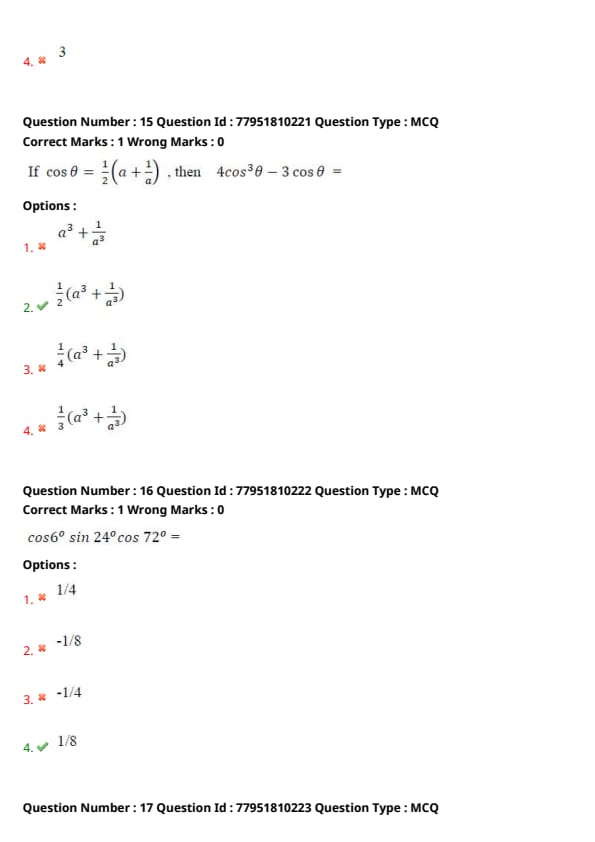
If \(\cos \theta = \frac{1}{2}\left(a + \frac{1}{a}\right)\), then \(4 \cos^3 \theta - 3 \cos \theta =\)
View Solution
Step 1: Understanding the Question:
The question asks to evaluate the triple angle expression \(4 \cos^3 \theta - 3 \cos \theta\) using the given value of \(\cos \theta\).
Step 2: Key Formula or Approach:
1. \(4 \cos^3 \theta - 3 \cos \theta = \cos 3\theta\).
2. If \(\cos \theta = \frac{x + x^{-1}}{2}\), then \(\cos n\theta = \frac{x^n + x^{-n}}{2}\).
Step 3: Detailed Explanation:
We are given \(\cos \theta = \frac{1}{2}(a + 1/a)\).
We need to calculate \(\cos 3\theta = 4 \cos^3 \theta - 3 \cos \theta\).
Substitute the given value of \(\cos \theta\):
\(\cos 3\theta = 4 \left[ \frac{1}{2} (a + \frac{1}{a}) \right]^3 - 3 \left[ \frac{1}{2} (a + \frac{1}{a}) \right]\)
Simplify the cubed term:
\(\cos 3\theta = 4 \cdot \frac{1}{8} (a + \frac{1}{a})^3 - \frac{3}{2} (a + \frac{1}{a})\)
\(\cos 3\theta = \frac{1}{2} \left[ (a + \frac{1}{a})^3 - 3 (a + \frac{1}{a}) \right]\)
Expand using \((x+y)^3 = x^3 + y^3 + 3xy(x+y)\):
\((a + \frac{1}{a})^3 = a^3 + \frac{1}{a^3} + 3(a \cdot \frac{1}{a})(a + \frac{1}{a})\)
\((a + \frac{1}{a})^3 = a^3 + \frac{1}{a^3} + 3(a + \frac{1}{a})\)
Substitute back into the expression:
\(\cos 3\theta = \frac{1}{2} \left[ a^3 + \frac{1}{a^3} + 3(a + \frac{1}{a}) - 3(a + \frac{1}{a}) \right]\)
\(\cos 3\theta = \frac{1}{2} (a^3 + \frac{1}{a^3})\).
Step 4: Final Answer:
The value is \(\frac{1}{2}(a^3 + \frac{1}{a^3})\). This corresponds to Option (B).
Quick Tip: General property: If \(2 \cos \theta = x + \frac{1}{x}\), then \(2 \cos n\theta = x^n + \frac{1}{x^n}\).
This comes from Euler's formula where \(a = e^{i\theta}\). Then \(\cos \theta = \frac{e^{i\theta} + e^{-i\theta}}{2}\).
Similarly, \(2i \sin n\theta = x^n - \frac{1}{x^n}\).
\(\cos 6^\circ \sin 24^\circ \cos 72^\circ =\)
View Solution
Step 1: Understanding the Question:
Evaluate the product of three trigonometric functions with specific angles.
Step 2: Key Formula or Approach:
Use transformation formulas: \(2 \cos A \sin B = \sin(A+B) - \sin(A-B)\).
Step 3: Detailed Explanation:
Let \(E = \cos 6^\circ \sin 24^\circ \cos 72^\circ\).
Note that \(\cos 72^\circ = \sin 18^\circ\).
\(E = \cos 6^\circ \sin 24^\circ \sin 18^\circ\).
Multiply and divide by 2 for the first two terms:
\(E = \frac{1}{2} (2 \cos 6^\circ \sin 24^\circ) \sin 18^\circ\)
\(E = \frac{1}{2} [\sin(24^\circ + 6^\circ) - \sin(6^\circ - 24^\circ)] \sin 18^\circ\)
\(E = \frac{1}{2} [\sin 30^\circ - \sin(-18^\circ)] \sin 18^\circ\)
\(E = \frac{1}{2} [\frac{1}{2} + \sin 18^\circ] \sin 18^\circ\)
\(E = \frac{1}{4} \sin 18^\circ + \frac{1}{2} \sin^2 18^\circ\)
Substitute \(\sin 18^\circ = \frac{\sqrt{5}-1}{4}\):
\(E = \frac{1}{4} \left( \frac{\sqrt{5}-1}{4} \right) + \frac{1}{2} \left( \frac{\sqrt{5}-1}{4} \right)^2\)
\(E = \frac{\sqrt{5}-1}{16} + \frac{1}{2} \left( \frac{5 + 1 - 2\sqrt{5}}{16} \right)\)
\(E = \frac{\sqrt{5}-1}{16} + \frac{6 - 2\sqrt{5}}{32}\)
\(E = \frac{2\sqrt{5}-2 + 6 - 2\sqrt{5}}{32}\)
\(E = \frac{4}{32} = \frac{1}{8}\).
Step 4: Final Answer:
The result is 1/8. This matches Option (D).
Quick Tip: Transformation formulas like \(2 \sin A \cos B = \sin(A+B) + \sin(A-B)\) are essential.
Look for angles whose sum or difference is a standard value (like \(30^\circ, 45^\circ, 60^\circ\)).
\(\cos 60^\circ\) and \(\sin 30^\circ\) equal \(1/2\).
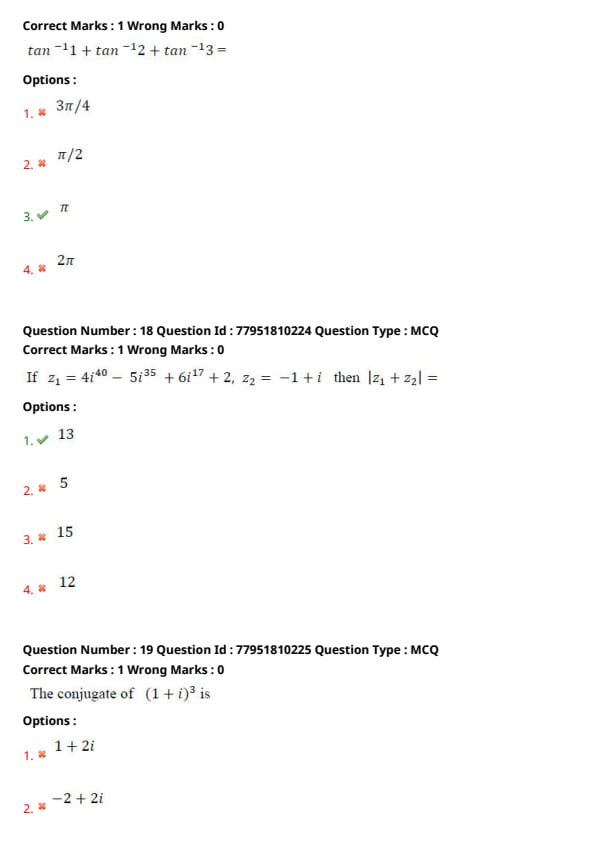
\(\tan^{-1} 1 + \tan^{-1} 2 + \tan^{-1} 3 =\)
View Solution
Step 1: Understanding the Question:
We need to sum three inverse tangent values.
Step 2: Key Formula or Approach:
Formula for \(\tan^{-1} x + \tan^{-1} y\):
If \(xy < 1\): \(\tan^{-1} \left( \frac{x+y}{1-xy} \right)\)
If \(xy > 1\) and \(x, y > 0\): \(\pi + \tan^{-1} \left( \frac{x+y}{1-xy} \right)\)
Step 3: Detailed Explanation:
We have \(\tan^{-1} 1 + \tan^{-1} 2 + \tan^{-1} 3\).
We know \(\tan^{-1} 1 = \pi/4\).
Now calculate \(S = \tan^{-1} 2 + \tan^{-1} 3\).
Here \(x=2, y=3\), so \(xy = 6\), which is \(> 1\).
\(S = \pi + \tan^{-1} \left( \frac{2 + 3}{1 - 2 \cdot 3} \right)\)
\(S = \pi + \tan^{-1} \left( \frac{5}{-5} \right)\)
\(S = \pi + \tan^{-1}(-1)\)
Since \(\tan^{-1}(-1) = -\pi/4\):
\(S = \pi - \pi/4 = 3\pi/4\).
Total Sum \(= \pi/4 + 3\pi/4 = 4\pi/4 = \pi\).
Step 4: Final Answer:
The sum is \(\pi\). This corresponds to Option (C).
Quick Tip: Always check the condition \(xy < 1\) or \(xy > 1\) before applying the inverse tangent addition formula.
A useful triangle property: The interior angles of a triangle with sides \(\sqrt{2}, \sqrt{5}, \sqrt{10}\) are exactly these inverse tangents.
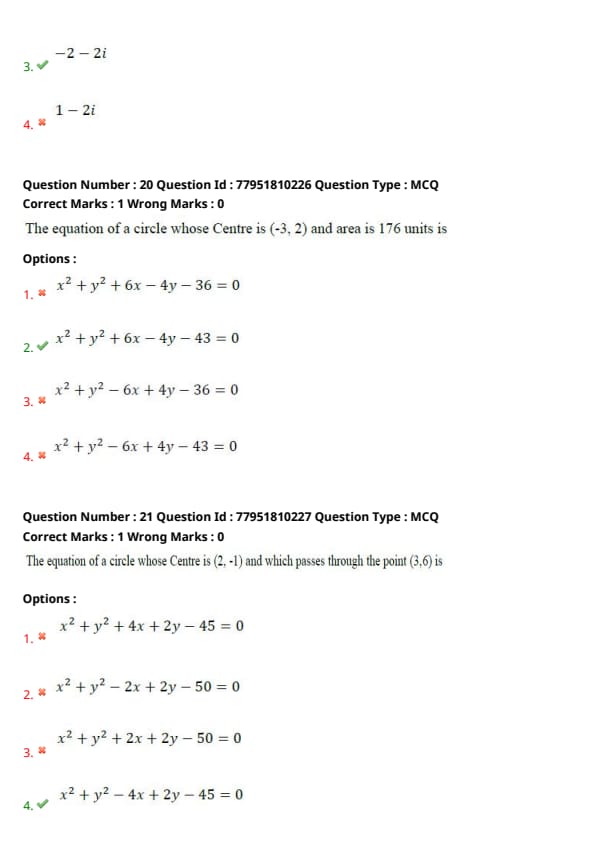
If \(z_1 = 4i^{40} - 5i^{35} + 6i^{17} + 2, z_2 = -1 + i\) then \(|z_1 + z_2| =\)
View Solution
Step 1: Understanding the Question:
The question involves simplifying powers of the imaginary unit \(i\) to find the complex number \(z_1\), then calculating the magnitude of \(z_1 + z_2\).
Step 2: Key Formula or Approach:
Recall powers of \(i\): \(i^1 = i, i^2 = -1, i^3 = -i, i^4 = 1\). In general, \(i^{4k+r} = i^r\).
Step 3: Detailed Explanation:
Simplify \(z_1\):
\(i^{40} = (i^4)^{10} = 1^{10} = 1\).
\(i^{35} = i^{32} \cdot i^3 = 1 \cdot (-i) = -i\).
\(i^{17} = i^{16} \cdot i = 1 \cdot i = i\).
\(z_1 = 4(1) - 5(-i) + 6(i) + 2\)
\(z_1 = 4 + 5i + 6i + 2 = 6 + 11i\).
Given \(z_2 = -1 + i\).
Calculate \(z_1 + z_2\):
\(z_1 + z_2 = (6 + 11i) + (-1 + i)\)
\(z_1 + z_2 = (6 - 1) + (11 + 1)i = 5 + 12i\).
Find the modulus \(|z_1 + z_2|\):
\(|z_1 + z_2| = \sqrt{5^2 + 12^2}\)
\(|z_1 + z_2| = \sqrt{25 + 144} = \sqrt{169} = 13\).
Step 4: Final Answer:
The magnitude is 13. This matches Option (A).
Quick Tip: Divide the power of \(i\) by 4 and look at the remainder.
Remainder 0 \(\implies 1\), Remainder 1 \(\implies i\), Remainder 2 \(\implies -1\), Remainder 3 \(\implies -i\).
The magnitude of \(a+bi\) is \(\sqrt{a^2+b^2}\). Common triplets like (3,4,5) and (5,12,13) appear often.
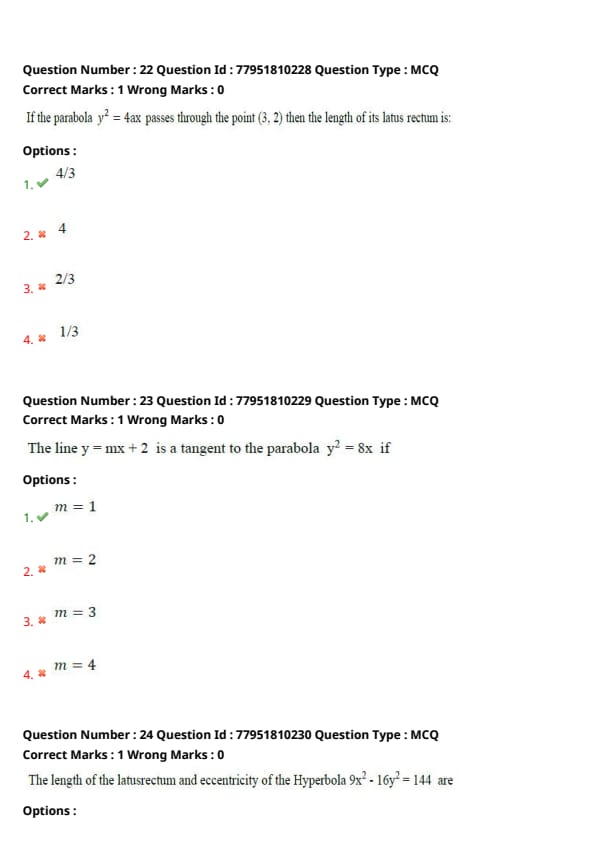
The conjugate of \((1 + i)^3\) is
View Solution
Step 1: Understanding the Question:
To find the conjugate of a complex expression, first simplify the expression into standard form \((x + iy)\) and then change the sign of the imaginary part.
Step 2: Key Formula or Approach:
1. \((a+b)^3 = a^3 + 3a^2b + 3ab^2 + b^3\).
2. Conjugate of \(z = x+iy\) is \(\bar{z} = x-iy\).
Step 3: Detailed Explanation:
Let \(z = (1 + i)^3\).
Expand using the cubic formula:
\(z = 1^3 + 3(1)^2(i) + 3(1)(i)^2 + i^3\)
\(z = 1 + 3i + 3(-1) + (-i)\)
\(z = 1 + 3i - 3 - i\)
\(z = -2 + 2i\).
The complex number in standard form is \(z = -2 + 2i\).
The conjugate \(\bar{z}\) is obtained by replacing \(i\) with \(-i\):
\(\bar{z} = -2 - 2i\).
Step 4: Final Answer:
The conjugate is \(-2 - 2i\). This corresponds to Option (C).
Quick Tip: Property: \(conjugate of (z^n) = (\bar{z})^n\).
Instead of expanding \((1+i)^3\) first, you can find the conjugate of \((1+i)\), which is \((1-i)\), and then cube it.
\((1-i)^3 = 1 - 3i + 3i^2 - i^3 = 1 - 3i - 3 + i = -2 - 2i\).
The equation of a circle whose Centre is \((-3, 2)\) and area is 176 units is
View Solution
Step 1: Understanding the Question:
Find the circle's equation given its center and total area. Note: Area in these problems usually implies using the standard circle area formula \(\pi r^2\).
Step 2: Key Formula or Approach:
1. Area \(A = \pi r^2\).
2. Standard equation: \((x - h)^2 + (y - k)^2 = r^2\), where \((h, k)\) is the center.
Step 3: Detailed Explanation:
Given Area \(= 176\) sq units.
\(\pi r^2 = 176\)
\(\frac{22}{7} r^2 = 176\)
\(r^2 = 176 \times \frac{7}{22}\)
\(r^2 = 8 \times 7 = 56\).
Center is \((h, k) = (-3, 2)\).
Equation of circle:
\((x - (-3))^2 + (y - 2)^2 = 56\)
\((x + 3)^2 + (y - 2)^2 = 56\)
Expanding the brackets:
\((x^2 + 6x + 9) + (y^2 - 4y + 4) = 56\)
\(x^2 + y^2 + 6x - 4y + 13 - 56 = 0\)
\(x^2 + y^2 + 6x - 4y - 43 = 0\).
Step 4: Final Answer:
The equation is \(x^2 + y^2 + 6x - 4y - 43 = 0\). This corresponds to Option (B).
Quick Tip: For center \((-g, -f)\), the general equation is \(x^2 + y^2 + 2gx + 2fy + c = 0\).
Here \(g=3, f=-2\). The signs of linear terms in the final equation must be opposite to the signs of the center's coordinates.
Center \((-3, 2) \implies\) Equation has \(+6x\) and \(-4y\).
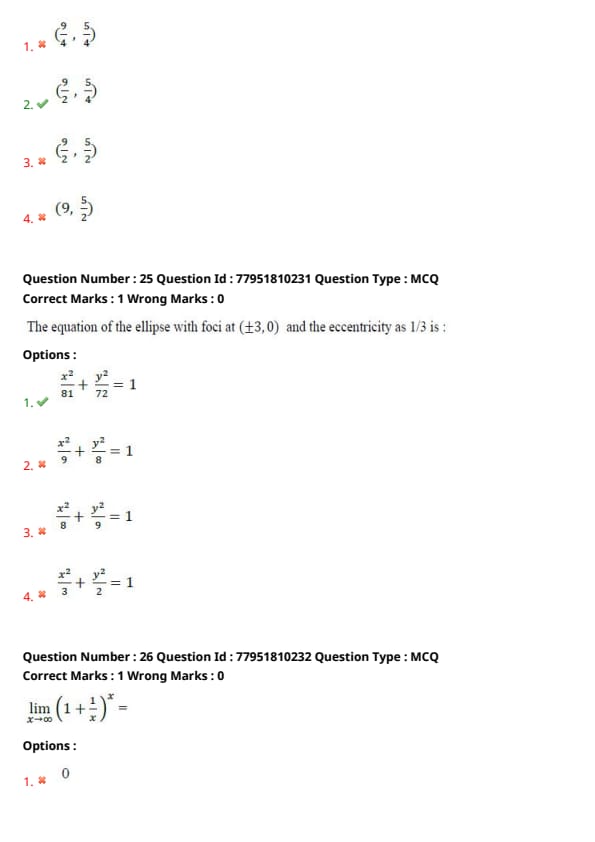
The equation of a circle whose Centre is \((2, -1)\) and which passes through the point \((3, 6)\) is
View Solution
Step 1: Understanding the Question:
The radius is not given directly. Since the circle passes through a point, the distance from the center to that point is the radius.
Step 2: Key Formula or Approach:
1. Distance formula \(r^2 = (x_2 - x_1)^2 + (y_2 - y_1)^2\).
2. Circle equation: \((x - h)^2 + (y - k)^2 = r^2\).
Step 3: Detailed Explanation:
Center \((h, k) = (2, -1)\).
Passes through \((3, 6)\).
Calculate \(r^2\):
\(r^2 = (3 - 2)^2 + (6 - (-1))^2\)
\(r^2 = (1)^2 + (7)^2\)
\(r^2 = 1 + 49 = 50\).
Equation of circle:
\((x - 2)^2 + (y - (-1))^2 = 50\)
\((x - 2)^2 + (y + 1)^2 = 50\)
Expand:
\((x^2 - 4x + 4) + (y^2 + 2y + 1) = 50\)
\(x^2 + y^2 - 4x + 2y + 5 - 50 = 0\)
\(x^2 + y^2 - 4x + 2y - 45 = 0\).
Step 4: Final Answer:
The equation is \(x^2 + y^2 - 4x + 2y - 45 = 0\). This matches Option (D).
Quick Tip: If you are short on time, substitute the given point \((3, 6)\) into the options.
For Option (D): \(3^2 + 6^2 - 4(3) + 2(6) - 45 = 9 + 36 - 12 + 12 - 45 = 45 - 45 = 0\).
Substitution is often the fastest way to verify circle/conic section equations.
If the parabola \(y^2 = 4ax\) passes through the point \((3, 2)\) then the length of its latus rectum is:
View Solution
Step 1: Understanding the Question:
The objective is to find the length of the latus rectum of a parabola whose equation is given and which passes through a specific point.
The length of the latus rectum for a parabola of the form \(y^2 = 4ax\) is given by the coefficient \(4a\).
Step 2: Key Formula or Approach:
1. Equation of parabola: \(y^2 = 4ax\).
2. Length of latus rectum \(= 4a\).
3. Since the parabola passes through \((x, y) = (3, 2)\), these coordinates must satisfy the equation.
Step 3: Detailed Explanation:
Start with the equation \(y^2 = 4ax\).
Substitute the given point \((3, 2)\) into the equation:
\((2)^2 = 4a(3)\)
\(4 = 12a\)
We need to find the length of the latus rectum, which is \(4a\).
Divide both sides by 3 to isolate \(4a\):
\(4a = \frac{4}{3}\)
Thus, the length of the latus rectum is \(4/3\).
Step 4: Final Answer:
The length of the latus rectum is \(4/3\). This matches Option (A).
Quick Tip: For any parabola of the form \(y^2 = 4ax\) or \(x^2 = 4ay\), the coefficient of the first-degree variable is always the length of the latus rectum.
Direct substitution of coordinates is the most efficient way to find missing parameters in conic sections.
The line \(y = mx + 2\) is a tangent to the parabola \(y^2 = 8x\) if
View Solution
Step 1: Understanding the Question:
This problem requires finding the condition for a line to be tangent to a standard parabola.
Step 2: Key Formula or Approach:
For a parabola \(y^2 = 4ax\), the condition for a line \(y = mx + c\) to be a tangent is:
\[ c = \frac{a}{m} \]
Step 3: Detailed Explanation:
Given parabola equation: \(y^2 = 8x\).
Comparing with standard form \(y^2 = 4ax\):
\(4a = 8 \implies a = 2\).
Given line equation: \(y = mx + 2\).
Comparing with \(y = mx + c\), we get \(c = 2\).
Apply the tangency condition \(c = a/m\):
\(2 = \frac{2}{m}\)
Solve for \(m\):
\(2m = 2 \implies m = 1\).
Step 4: Final Answer:
The value of \(m\) is 1. This matches Option (A).
Quick Tip: Memorizing tangency conditions for different conics is a huge time-saver.
Parabola (\(y^2=4ax\)): \(c = a/m\).
Circle (\(x^2+y^2=a^2\)): \(c^2 = a^2(1+m^2)\).
Ellipse (\(\frac{x^2}{a^2}+\frac{y^2}{b^2}=1\)): \(c^2 = a^2m^2 + b^2\).
The length of the latusrectum and eccentricity of the Hyperbola \(9x^2 - 16y^2 = 144\) are
View Solution
Step 1: Understanding the Question:
We need to find two properties of a hyperbola: its latus rectum length and its eccentricity.
Step 2: Key Formula or Approach:
1. Standard hyperbola equation: \(\frac{x^2}{a^2} - \frac{y^2}{b^2} = 1\).
2. Length of latus rectum \(= \frac{2b^2}{a}\).
3. Eccentricity \(e = \sqrt{1 + \frac{b^2}{a^2}}\).
Step 3: Detailed Explanation:
Given hyperbola: \(9x^2 - 16y^2 = 144\).
Divide throughout by 144 to convert to standard form:
\(\frac{9x^2}{144} - \frac{16y^2}{144} = 1\)
\(\frac{x^2}{16} - \frac{y^2}{9} = 1\).
Here, \(a^2 = 16 \implies a = 4\) and \(b^2 = 9 \implies b = 3\).
Calculate the length of the latus rectum:
L.R. \(= \frac{2b^2}{a} = \frac{2(9)}{4} = \frac{18}{4} = \frac{9}{2}\).
Calculate the eccentricity:
\(e = \sqrt{1 + \frac{b^2}{a^2}} = \sqrt{1 + \frac{9}{16}} = \sqrt{\frac{16+9}{16}} = \sqrt{\frac{25}{16}} = \frac{5}{4}\).
The required pair is \((9/2, 5/4)\).
Step 4: Final Answer:
The properties are \((9/2, 5/4)\). This matches Option (B).
Quick Tip: Eccentricity for a hyperbola is always greater than 1 (\(e > 1\)).
If you calculate \(e < 1\), check if you accidentally used the ellipse formula.
Length of latus rectum involves the "minor" axis parameter in the numerator.
The equation of the ellipse with foci at \((\pm 3, 0)\) and the eccentricity as \(1/3\) is :
View Solution
Step 1: Understanding the Question:
The goal is to determine the equation of an ellipse given its foci and eccentricity. Since foci are on the x-axis, it's a horizontal ellipse.
Step 2: Key Formula or Approach:
1. Foci are at \((\pm ae, 0)\).
2. Standard equation: \(\frac{x^2}{a^2} + \frac{y^2}{b^2} = 1\).
3. Relation: \(b^2 = a^2(1 - e^2)\).
Step 3: Detailed Explanation:
Given foci \((\pm 3, 0) \implies ae = 3\).
Given eccentricity \(e = 1/3\).
Substitute \(e\) into the focus formula:
\(a(1/3) = 3 \implies a = 9\).
Therefore, \(a^2 = 81\).
Now, find \(b^2\):
\(b^2 = a^2(1 - e^2) = 81[1 - (1/3)^2]\)
\(b^2 = 81(1 - 1/9) = 81(8/9) = 9 \times 8 = 72\).
The equation is:
\(\frac{x^2}{81} + \frac{y^2}{72} = 1\).
Step 4: Final Answer:
The equation is \(\frac{x^2}{81} + \frac{y^2}{72} = 1\). This corresponds to Option (A).
Quick Tip: For any ellipse, \(a^2 > b^2\) if the foci are on the x-axis.
Always verify the condition \(e^2 = 1 - b^2/a^2\) with your final answer to ensure correctness.
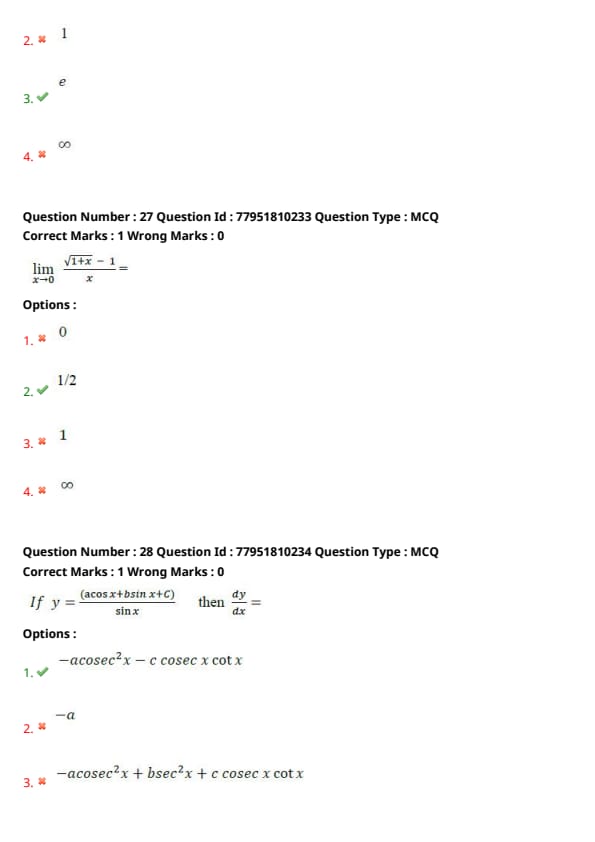
\(\lim_{x \to \infty} (1 + \frac{1}{x})^x =\)
View Solution
Step 1: Understanding the Question:
This is a fundamental limit problem that defines the mathematical constant \(e\). It's an indeterminate form of type \(1^\infty\).
Step 2: Detailed Explanation:
The expression is \((1 + 1/x)^x\) as \(x \to \infty\).
Let \(L = \lim_{x \to \infty} (1 + 1/x)^x\).
Taking natural logarithm on both sides:
\(\ln L = \lim_{x \to \infty} x \ln(1 + 1/x)\).
This is of form \(\infty \cdot 0\). Rewrite it as:
\(\ln L = \lim_{x \to \infty} \frac{\ln(1 + 1/x)}{1/x}\).
Let \(t = 1/x\). As \(x \to \infty, t \to 0\).
\(\ln L = \lim_{t \to 0} \frac{\ln(1 + t)}{t}\).
Applying L'Hopital's Rule or using standard limit \(\lim_{t \to 0} \frac{\ln(1+t)}{t} = 1\):
\(\ln L = 1\).
Therefore, \(L = e^1 = e\).
Step 3: Final Answer:
The limit is equal to \(e\). This corresponds to Option (C).
Quick Tip: General rule: \(\lim_{x \to \infty} (1 + \frac{a}{x})^x = e^a\).
Also, \(\lim_{x \to 0} (1 + x)^{1/x} = e\).
These limits are the definition of Euler's number \(e\) in continuous compounding contexts.
\(\lim_{x \to 0} \frac{\sqrt{1+x} - 1}{x} =\)
View Solution
Step 1: Understanding the Question:
We need to evaluate a limit of the form \(0/0\) at \(x=0\).
Step 2: Key Formula or Approach:
Use L'Hopital's Rule or rationalization.
Step 3: Detailed Explanation:
Method 1: Rationalization
Multiply numerator and denominator by \((\sqrt{1+x} + 1)\):
\(\lim_{x \to 0} \frac{\sqrt{1+x} - 1}{x} \cdot \frac{\sqrt{1+x} + 1}{\sqrt{1+x} + 1}\)
\(= \lim_{x \to 0} \frac{(1+x) - 1}{x(\sqrt{1+x} + 1)}\)
\(= \lim_{x \to 0} \frac{x}{x(\sqrt{1+x} + 1)}\)
\(= \lim_{x \to 0} \frac{1}{\sqrt{1+x} + 1}\)
\(= \frac{1}{\sqrt{1+0} + 1} = \frac{1}{1+1} = \frac{1}{2}\).
Method 2: L'Hopital's Rule
Differentiate numerator: \(\frac{d}{dx}(\sqrt{1+x} - 1) = \frac{1}{2\sqrt{1+x}}\).
Differentiate denominator: \(\frac{d}{dx}(x) = 1\).
The limit becomes:
\(\lim_{x \to 0} \frac{1}{2\sqrt{1+x}} = \frac{1}{2\sqrt{1+0}} = \frac{1}{2}\).
Step 4: Final Answer:
The limit is 1/2. This matches Option (B).
Quick Tip: Expansion using binomial theorem is also an option: \(\sqrt{1+x} \approx 1 + x/2\) for small \(x\).
Then \((1 + x/2 - 1)/x = (x/2)/x = 1/2\).
This is generally the fastest way for simple square root limits at 0.
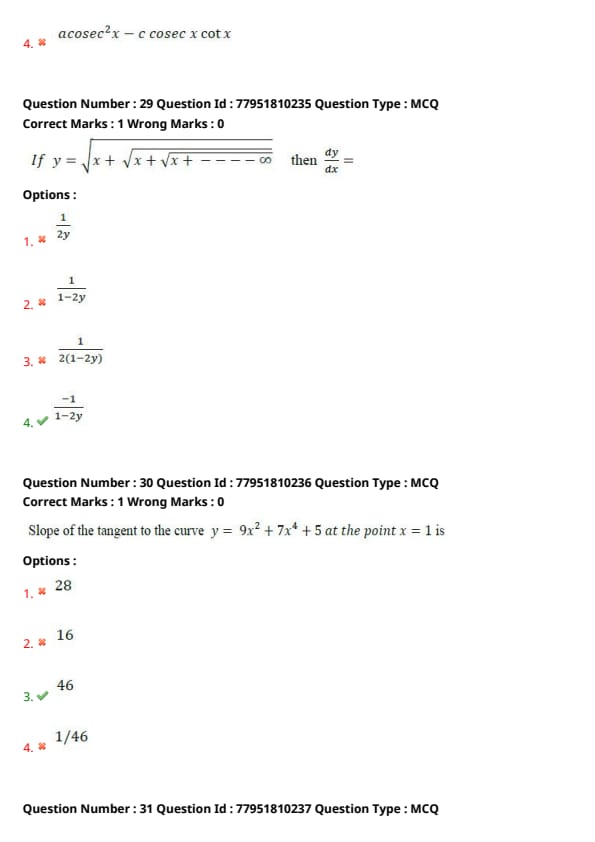
If \(y = \frac{(a \cos x + b \sin x + C)}{\sin x}\) then \(\frac{dy}{dx} =\)
View Solution
Step 1: Understanding the Question:
We need to find the derivative of a trigonometric quotient. Simplifying the expression first is usually better than using the quotient rule directly.
Step 2: Detailed Explanation:
Simplify \(y\):
\(y = \frac{a \cos x}{\sin x} + \frac{b \sin x}{\sin x} + \frac{C}{\sin x}\)
\(y = a \cot x + b + C \csc x\).
Now, differentiate \(y\) with respect to \(x\):
\(\frac{dy}{dx} = \frac{d}{dx}(a \cot x) + \frac{d}{dx}(b) + \frac{d}{dx}(C \csc x)\)
Using standard derivatives:
\(\frac{d}{dx}(\cot x) = -\csc^2 x\)
\(\frac{d}{dx}(\csc x) = -\csc x \cot x\)
\(\frac{d}{dx}(constant b) = 0\).
Substitute back:
\(\frac{dy}{dx} = a(-\csc^2 x) + 0 + C(-\csc x \cot x)\)
\(\frac{dy}{dx} = -a \csc^2 x - C \csc x \cot x\).
Step 3: Final Answer:
The derivative is \(-a \csc^2 x - C \csc x \cot x\). This matches Option (A).
Quick Tip: In calculus, always check if you can simplify a fraction by dividing by the denominator term by term.
It often converts a Quotient Rule problem into a simpler sum of standard derivatives.
If \(y = \sqrt{x + \sqrt{x + \sqrt{x + \dots \infty}}}\) then \(\frac{dy}{dx} =\)
View Solution
Step 1: Understanding the Question:
This is an infinite series function problem. We use the property that an infinite part is equal to the whole.
Step 2: Key Formula or Approach:
Identify \(y\) inside the expression: \(y = \sqrt{x + y}\). Then square and differentiate.
Step 3: Detailed Explanation:
Start with \(y = \sqrt{x + \sqrt{x + \sqrt{x + \dots}}}\).
Replacing the inner infinite part with \(y\):
\(y = \sqrt{x + y}\).
Square both sides:
\(y^2 = x + y\).
Differentiate implicitly with respect to \(x\):
\(\frac{d}{dx}(y^2) = \frac{d}{dx}(x + y)\)
\(2y \frac{dy}{dx} = 1 + \frac{dy}{dx}\).
Rearrange to solve for \(dy/dx\):
\(2y \frac{dy}{dx} - \frac{dy}{dx} = 1\)
\(\frac{dy}{dx} (2y - 1) = 1\)
\(\frac{dy}{dx} = \frac{1}{2y - 1}\).
Looking at the options, we can rewrite the denominator:
\(\frac{1}{2y - 1} = \frac{1}{-(1 - 2y)} = \frac{-1}{1 - 2y}\).
Step 4: Final Answer:
The derivative is \(\frac{-1}{1 - 2y}\). This matches Option (D).
Quick Tip: General formula: If \(y = \sqrt{f(x) + \sqrt{f(x) + \dots}}\), then \(\frac{dy}{dx} = \frac{f'(x)}{2y - 1}\).
Here \(f(x) = x \implies f'(x) = 1\). So result is \(\frac{1}{2y-1}\).
Slope of the tangent to the curve \(y = 9x^2 + 7x^4 + 5\) at the point \(x = 1\) is
View Solution
Step 1: Understanding the Question:
The slope of a tangent to a curve \(y = f(x)\) at any point is the derivative \(dy/dx\) evaluated at that point.
Step 2: Detailed Explanation:
Given function: \(y = 9x^2 + 7x^4 + 5\).
Differentiate with respect to \(x\):
\(\frac{dy}{dx} = \frac{d}{dx}(9x^2) + \frac{d}{dx}(7x^4) + \frac{d}{dx}(5)\)
\(\frac{dy}{dx} = 18x + 28x^3 + 0\)
\(\frac{dy}{dx} = 18x + 28x^3\).
Now, evaluate the slope at \(x = 1\):
Slope \(m = \left( \frac{dy}{dx} \right)_{x=1} = 18(1) + 28(1)^3\)
\(m = 18 + 28 = 46\).
Step 3: Final Answer:
The slope of the tangent at \(x = 1\) is 46. This corresponds to Option (C).
Quick Tip: Always remember: "Slope of tangent" = First derivative.
"Slope of normal" = Negative reciprocal of the first derivative \(= -1/(dy/dx)\).
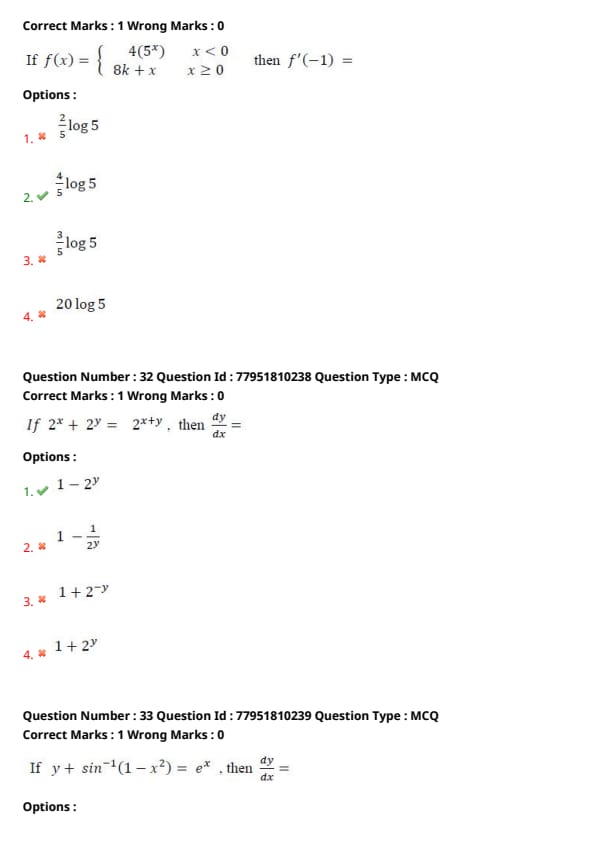
If \(f(x) = \begin{cases} 4(5^x) & x < 0
8k + x & x \ge 0 \end{cases}\) then \(f'(-1) =\)
View Solution
Step 1: Understanding the Question:
To find \(f'(-1)\), we first identify which piece of the piecewise function contains \(x = -1\). Since \(-1 < 0\), we use the first piece.
Step 2: Detailed Explanation:
For \(x < 0\), \(f(x) = 4 \cdot 5^x\).
Differentiate using the rule \(\frac{d}{dx}(a^x) = a^x \ln a\):
\(f'(x) = 4 \cdot (5^x \ln 5)\).
(Note: In competitive exams, "\(\log\)" often denotes the natural logarithm \(\ln\)).
Evaluate at \(x = -1\):
\(f'(-1) = 4 \cdot 5^{-1} \cdot \log 5\)
\(f'(-1) = 4 \cdot \frac{1}{5} \cdot \log 5\)
\(f'(-1) = \frac{4}{5} \log 5\).
Step 3: Final Answer:
The derivative \(f'(-1)\) is \(\frac{4}{5} \log 5\). This matches Option (B).
Quick Tip: Always check the domain conditions for piecewise functions before differentiating.
The value of \(k\) in the second piece is irrelevant here because \(x=-1\) is strictly in the domain of the first piece.
If \(2^x + 2^y = 2^{x+y}\), then \(\frac{dy}{dx} =\)
View Solution
Step 1: Understanding the Question:
This is an implicit differentiation problem. The equation can be rearranged to express \(x\) in terms of \(y\) or vice versa, or differentiated directly.
Step 2: Detailed Explanation:
Given: \(2^x + 2^y = 2^{x+y}\).
This can be written as \(2^x + 2^y = 2^x \cdot 2^y\).
Divide throughout by \(2^x \cdot 2^y\):
\(\frac{2^x}{2^x 2^y} + \frac{2^y}{2^x 2^y} = 1 \implies 2^{-y} + 2^{-x} = 1\).
Differentiate implicitly with respect to \(x\):
\(\frac{d}{dx}(2^{-y}) + \frac{d}{dx}(2^{-x}) = \frac{d}{dx}(1)\)
\(2^{-y} \ln 2 \cdot (-1) \frac{dy}{dx} + 2^{-x} \ln 2 \cdot (-1) = 0\).
Divide by \((-\ln 2)\):
\(2^{-y} \frac{dy}{dx} + 2^{-x} = 0\)
\(\frac{dy}{dx} = - \frac{2^{-x}}{2^{-y}} = -2^{y-x}\).
Now, look at the initial equation again: \(2^x = 2^{x+y} - 2^y = 2^y(2^x - 1)\).
From \(2^{-y} + 2^{-x} = 1\), we have \(2^{-x} = 1 - 2^{-y}\).
Then \(\frac{dy}{dx} = - \frac{1 - 2^{-y}}{2^{-y}} = -(2^y - 1) = 1 - 2^y\).
Step 3: Final Answer:
The derivative \(\frac{dy}{dx}\) simplifies to \(1 - 2^y\). This corresponds to Option (A).
Quick Tip: When differentiating exponential equations with multiple terms, dividing to get a constant term on one side often simplifies the implicit differentiation.
Substituting values back from the original equation is often needed to match the given options.
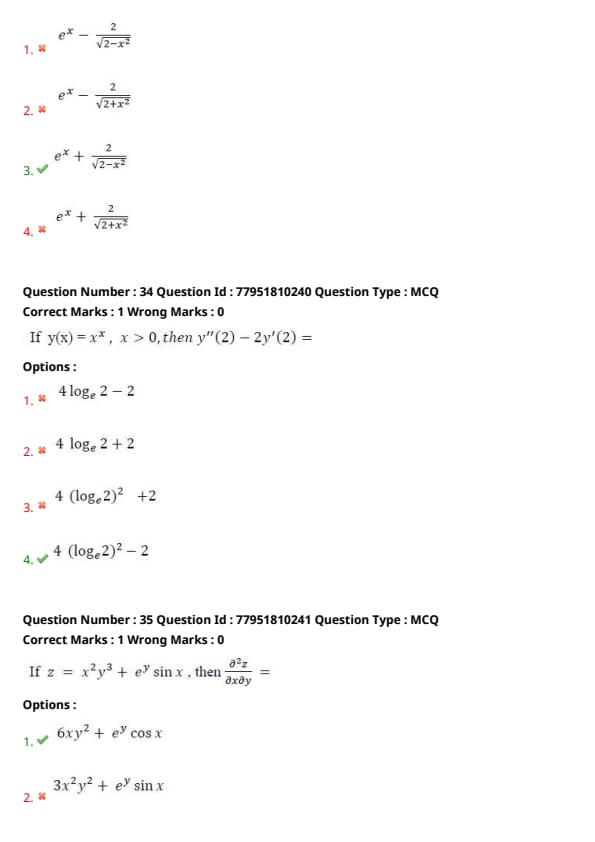
If \(y + \sin^{-1}(1 - x^2) = e^x\), then \(\frac{dy}{dx} =\)
View Solution
Step 1: Understanding the Question:
The objective is to find the derivative of \(y\) with respect to \(x\) for the given implicit equation.
Step 2: Key Formula or Approach:
Use the Chain Rule for \(\sin^{-1}(u)\): \(\frac{d}{dx}[\sin^{-1}(u)] = \frac{1}{\sqrt{1-u^2}} \cdot \frac{du}{dx}\).
Step 3: Detailed Explanation:
Equation: \(y + \sin^{-1}(1 - x^2) = e^x\).
Differentiate both sides with respect to \(x\):
\(\frac{dy}{dx} + \frac{d}{dx}[\sin^{-1}(1 - x^2)] = \frac{d}{dx}(e^x)\)
\(\frac{dy}{dx} + \frac{1}{\sqrt{1 - (1 - x^2)^2}} \cdot \frac{d}{dx}(1 - x^2) = e^x\)
Simplify the term inside the square root:
\(1 - (1 - x^2)^2 = 1 - (1 - 2x^2 + x^4) = 1 - 1 + 2x^2 - x^4 = 2x^2 - x^4 = x^2(2 - x^2)\).
Continue the differentiation:
\(\frac{dy}{dx} + \frac{1}{\sqrt{x^2(2 - x^2)}} \cdot (-2x) = e^x\)
\(\frac{dy}{dx} + \frac{-2x}{x\sqrt{2 - x^2}} = e^x\)
\(\frac{dy}{dx} - \frac{2}{\sqrt{2 - x^2}} = e^x\).
Isolate \(\frac{dy}{dx}\):
\(\frac{dy}{dx} = e^x + \frac{2}{\sqrt{2 - x^2}}\).
Step 4: Final Answer:
The derivative is \(e^x + \frac{2}{\sqrt{2-x^2}}\). This matches Option (C).
Quick Tip: Be careful with the sign of the inner derivative \((-2x)\).
Algebraic simplification of the radicand \(\sqrt{1-u^2}\) is crucial in inverse trigonometric differentiation problems.
If \(y(x) = x^x, x > 0, then y''(2) - 2y'(2) =\)
View Solution
Step 1: Understanding the Question:
This problem requires calculating first and second order derivatives of the function \(y = x^x\) and evaluating them at \(x = 2\).
Step 2: Detailed Explanation:
Finding \(y'(x)\):
Let \(y = x^x\). Taking log: \(\ln y = x \ln x\).
Diff: \(\frac{1}{y} y' = (x \cdot \frac{1}{x} + \ln x) = 1 + \ln x\).
\(y' = x^x(1 + \ln x)\).
Evaluating \(y'(2)\):
\(y'(2) = 2^2(1 + \ln 2) = 4 + 4 \ln 2\).
Finding \(y''(x)\):
\(y'' = \frac{d}{dx} [x^x(1 + \ln x)]\).
Use product rule: \(y'' = (x^x)' (1 + \ln x) + x^x \frac{d}{dx}(1 + \ln x)\)
\(y'' = [x^x(1 + \ln x)] (1 + \ln x) + x^x (\frac{1}{x})\)
\(y'' = x^x(1 + \ln x)^2 + x^{x-1}\).
Evaluating \(y''(2)\):
\(y''(2) = 2^2(1 + \ln 2)^2 + 2^{2-1}\)
\(y''(2) = 4(1 + 2 \ln 2 + (\ln 2)^2) + 2\)
\(y''(2) = 4 + 8 \ln 2 + 4(\ln 2)^2 + 2 = 6 + 8 \ln 2 + 4(\ln 2)^2\).
Final calculation:
\(y''(2) - 2y'(2) = [6 + 8 \ln 2 + 4(\ln 2)^2] - 2[4 + 4 \ln 2]\)
\(= 6 + 8 \ln 2 + 4(\ln 2)^2 - 8 - 8 \ln 2\)
\(= 4(\ln 2)^2 - 2\).
Step 3: Final Answer:
The result is \(4(\log_e 2)^2 - 2\). This matches Option (D).
Quick Tip: For \(y=x^x\), the standard derivative is \(x^x(1+\ln x)\). It's worth memorizing.
Always use parentheses carefully when expanding squared logarithmic terms.
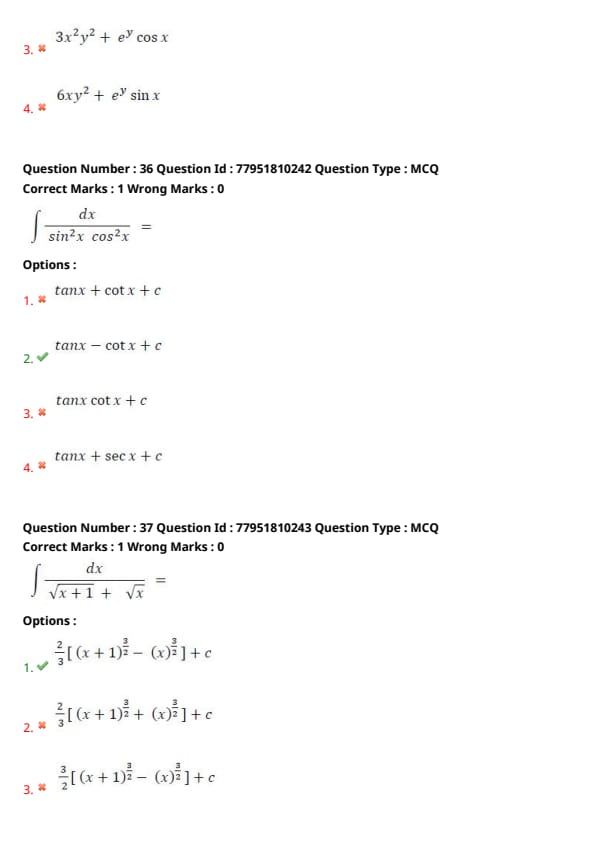
If \(z = x^2 y^3 + e^y \sin x\), then \(\frac{\partial^2 z}{\partial x \partial y} =\)
View Solution
Step 1: Understanding the Question:
The problem asks for the second-order mixed partial derivative. The order of differentiation doesn't matter for such well-behaved functions (Clairaut's theorem).
Step 2: Detailed Explanation:
Given: \(z = x^2 y^3 + e^y \sin x\).
First, find the first partial derivative with respect to \(y\):
\(\frac{\partial z}{\partial y} = \frac{\partial}{\partial y}(x^2 y^3) + \frac{\partial}{\partial y}(e^y \sin x)\)
Treating \(x\) as constant:
\(\frac{\partial z}{\partial y} = x^2(3y^2) + (\sin x)(e^y) = 3x^2 y^2 + e^y \sin x\).
Now, differentiate this result with respect to \(x\):
\(\frac{\partial^2 z}{\partial x \partial y} = \frac{\partial}{\partial x} [3x^2 y^2 + e^y \sin x]\)
Treating \(y\) as constant:
\(\frac{\partial^2 z}{\partial x \partial y} = (3y^2) \frac{d}{dx}(x^2) + e^y \frac{d}{dx}(\sin x)\)
\(\frac{\partial^2 z}{\partial x \partial y} = (3y^2)(2x) + e^y (\cos x)\)
\(\frac{\partial^2 z}{\partial x \partial y} = 6xy^2 + e^y \cos x\).
Step 3: Final Answer:
The mixed partial derivative is \(6xy^2 + e^y \cos x\). This matches Option (A).
Quick Tip: When taking a partial derivative with respect to \(x\), treat all other variables (\(y, z, etc.\)) as constants.
\(\frac{\partial^2 z}{\partial x \partial y} = \frac{\partial^2 z}{\partial y \partial x}\). You can check your answer by differentiating in the opposite order.
\(\int \frac{dx}{\sin^2 x \cos^2 x} =\)
View Solution
Step 1: Understanding the Question:
The integrand involves trigonometric functions in the denominator. We can use the fundamental identity to split it into two simple terms.
Step 2: Detailed Explanation:
Rewrite the numerator 1 as \(\sin^2 x + \cos^2 x\):
\(I = \int \frac{\sin^2 x + \cos^2 x}{\sin^2 x \cos^2 x} dx\)
Separate into two fractions:
\(I = \int \left( \frac{\sin^2 x}{\sin^2 x \cos^2 x} + \frac{\cos^2 x}{\sin^2 x \cos^2 x} \right) dx\)
\(I = \int \left( \frac{1}{\cos^2 x} + \frac{1}{\sin^2 x} \right) dx\)
Simplify the functions:
\(I = \int (\sec^2 x + \csc^2 x) dx\)
Apply standard integration formulas:
\(\int \sec^2 x dx = \tan x\)
\(\int \csc^2 x dx = -\cot x\)
The final result is:
\(I = \tan x - \cot x + c\).
Step 3: Final Answer:
The integral is \(\tan x - \cot x + c\). This corresponds to Option (B).
Quick Tip: Using \(1 = \sin^2 x + \cos^2 x\) in the numerator is a standard trick when both appear in the denominator.
Alternatively, you could use \(\sin^2 x \cos^2 x = \frac{1}{4} \sin^2 2x\), but the resulting integral of \(\csc^2 2x\) would require an additional substitution step.
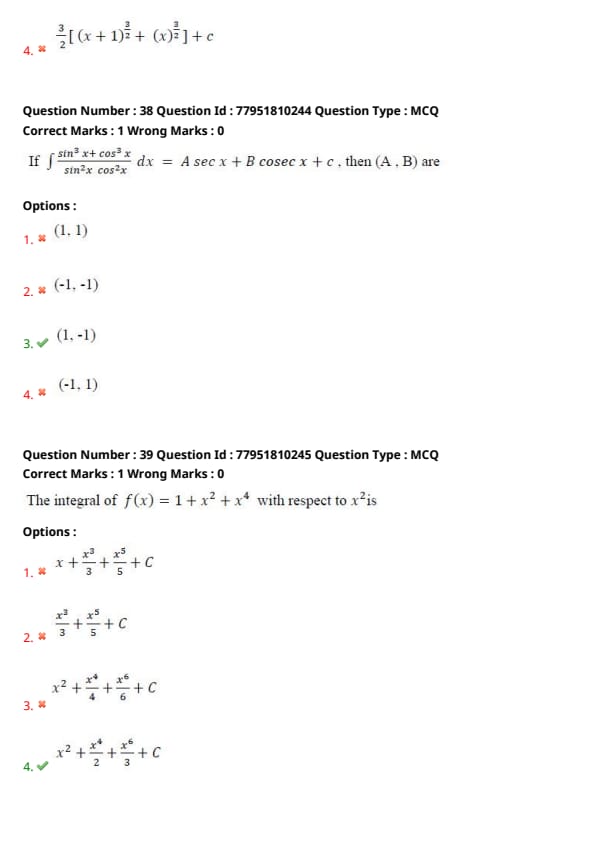
\(\int \frac{dx}{\sqrt{x+1} + \sqrt{x}} =\)
View Solution
Step 1: Understanding the Question:
The integrand contains irrational terms in the denominator. Rationalizing the denominator is the standard procedure.
Step 2: Detailed Explanation:
Multiply numerator and denominator by \((\sqrt{x+1} - \sqrt{x})\):
\(I = \int \frac{\sqrt{x+1} - \sqrt{x}}{(\sqrt{x+1} + \sqrt{x})(\sqrt{x+1} - \sqrt{x})} dx\)
\(I = \int \frac{\sqrt{x+1} - \sqrt{x}}{(x+1) - x} dx\)
\(I = \int (\sqrt{x+1} - \sqrt{x}) dx\)
Use the rule \(\int (x+a)^n dx = \frac{(x+a)^{n+1}}{n+1}\):
\(I = \int (x+1)^{1/2} dx - \int x^{1/2} dx\)
\(I = \frac{(x+1)^{3/2}}{3/2} - \frac{x^{3/2}}{3/2} + c\)
\(I = \frac{2}{3} (x+1)^{3/2} - \frac{2}{3} x^{3/2} + c\)
\(I = \frac{2}{3} [(x+1)^{3/2} - x^{3/2}] + c\).
Step 3: Final Answer:
The integral is \(\frac{2}{3} [(x+1)^{3/2} - x^{3/2}] + c\). This matches Option (A).
Quick Tip: Rationalizing denominators is almost always the first step for integrals of this form.
Check the denominator subtraction carefully: \((x+1) - x = 1\). If it were a constant, that constant would factor out of the integral.
If \(\int \frac{\sin^3 x + \cos^3 x}{\sin^2 x \cos^2 x} dx = A \sec x + B \csc x + c\), then \((A, B)\) are
View Solution
Step 1: Understanding the Question:
The objective is to integrate the function and identify the coefficients \((A, B)\) by comparing with the given form.
Step 2: Detailed Explanation:
Split the numerator:
\(I = \int \left( \frac{\sin^3 x}{\sin^2 x \cos^2 x} + \frac{\cos^3 x}{\sin^2 x \cos^2 x} \right) dx\)
\(I = \int \left( \frac{\sin x}{\cos^2 x} + \frac{\cos x}{\sin^2 x} \right) dx\)
Simplify the terms:
\(\frac{\sin x}{\cos^2 x} = \frac{\sin x}{\cos x} \cdot \frac{1}{\cos x} = \tan x \sec x\).
\(\frac{\cos x}{\sin^2 x} = \frac{\cos x}{\sin x} \cdot \frac{1}{\sin x} = \cot x \csc x\).
Perform the integration:
\(I = \int \tan x \sec x dx + \int \cot x \csc x dx\)
\(I = \sec x + (-\csc x) + c\)
\(I = \sec x - \csc x + c\).
Compare with \(A \sec x + B \csc x + c\):
\(A = 1\) and \(B = -1\).
Step 3: Final Answer:
The values are \(A = 1, B = -1\). This corresponds to Option (C).
Quick Tip: Standard derivative identities: \((\sec x)' = \sec x \tan x\) and \((\csc x)' = -\csc x \cot x\).
Always pay close attention to signs during trigonometric integration.
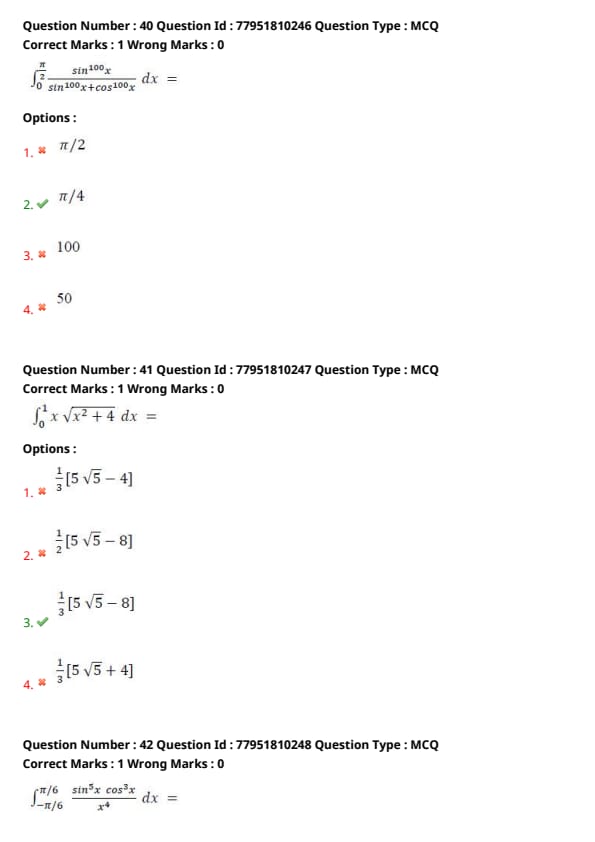
The integral of \(f(x) = 1 + x^2 + x^4\) with respect to \(x^2\) is
View Solution
Step 1: Understanding the Question:
The phrase "with respect to \(x^2\)" means we treat \(x^2\) as the variable of integration.
Step 2: Key Formula or Approach:
Let \(u = x^2\). Then the integral is \(\int f(u) du\).
Step 3: Detailed Explanation:
Let \(u = x^2\).
Substitute \(u\) into the function:
\(f(x) = 1 + x^2 + x^4\) becomes \(f(u) = 1 + u + u^2\).
Integrate with respect to \(u\):
\(\int (1 + u + u^2) du = \int 1 du + \int u du + \int u^2 du\)
\(= u + \frac{u^2}{2} + \frac{u^3}{3} + C\).
Substitute back \(u = x^2\):
Result \(= (x^2) + \frac{(x^2)^2}{2} + \frac{(x^2)^3}{3} + C\)
\(= x^2 + \frac{x^4}{2} + \frac{x^6}{3} + C\).
Step 4: Final Answer:
The integral is \(x^2 + \frac{x^4}{2} + \frac{x^6}{3} + C\). This matches Option (D).
Quick Tip: Be careful! Integrating "with respect to \(x^2\)" is different from integrating "with respect to \(x\)".
In the former, you don't multiply by \(2x dx\); you just swap \(x^2\) for a single variable \(u\).
\(\int_0^{\pi/2} \frac{\sin^{100} x}{\sin^{100} x + \cos^{100} x} dx =\)
View Solution
Step 1: Understanding the Question:
This is a standard definite integral problem utilizing the property \(\int_0^a f(x) dx = \int_0^a f(a-x) dx\).
Step 2: Key Formula or Approach:
For integrals of the form \(I = \int_0^{\pi/2} \frac{\sin^n x}{\sin^n x + \cos^n x} dx\), the value is always \(\frac{a - 0}{2}\) where \(a = \pi/2\).
Step 3: Detailed Explanation:
Let \(I = \int_0^{\pi/2} \frac{\sin^{100} x}{\sin^{100} x + \cos^{100} x} dx\) --- (Eq 1)
Use property: Replace \(x\) with \((\pi/2 - x)\):
\(I = \int_0^{\pi/2} \frac{\sin^{100} (\pi/2 - x)}{\sin^{100} (\pi/2 - x) + \cos^{100} (\pi/2 - x)} dx\)
\(I = \int_0^{\pi/2} \frac{\cos^{100} x}{\cos^{100} x + \sin^{100} x} dx\) --- (Eq 2)
Add Eq 1 and Eq 2:
\(2I = \int_0^{\pi/2} \left( \frac{\sin^{100} x + \cos^{100} x}{\sin^{100} x + \cos^{100} x} \right) dx\)
\(2I = \int_0^{\pi/2} 1 dx\)
\(2I = [x]_0^{\pi/2} = \pi/2\).
Divide by 2:
\(I = \pi/4\).
Step 4: Final Answer:
The integral is \(\pi/4\). This matches Option (B).
Quick Tip: The specific exponent (\(100\) in this case) does not affect the result of such definite integrals.
As long as the limits are \(0\) and \(\pi/2\), and the structure is \(\frac{f(\sin x)}{f(\sin x) + f(\cos x)}\), the answer is always \(\pi/4\).
\(\int_0^1 x \sqrt{x^2 + 4} dx =\)
View Solution
Step 1: Understanding the Question:
The presence of \(x dx\) outside the square root \(\sqrt{x^2+4}\) suggests a simple \(u\)-substitution.
Step 2: Key Formula or Approach:
Let \(u = x^2 + 4\). Then \(du = 2x dx\).
Step 3: Detailed Explanation:
Let \(u = x^2 + 4 \implies du = 2x dx \implies x dx = \frac{du}{2}\).
Adjust the integration limits:
When \(x = 0\), \(u = 0^2 + 4 = 4\).
When \(x = 1\), \(u = 1^2 + 4 = 5\).
Substitute into the integral:
\(I = \int_4^5 \sqrt{u} \frac{du}{2} = \frac{1}{2} \int_4^5 u^{1/2} du\)
Perform the integration:
\(I = \frac{1}{2} \left[ \frac{u^{3/2}}{3/2} \right]_4^5\)
\(I = \frac{1}{2} \cdot \frac{2}{3} [u^{3/2}]_4^5 = \frac{1}{3} [u^{3/2}]_4^5\)
Evaluate at limits:
\(I = \frac{1}{3} [5^{3/2} - 4^{3/2}]\)
\(I = \frac{1}{3} [5\sqrt{5} - \sqrt{4^3}] = \frac{1}{3} [5\sqrt{5} - 8]\).
Step 4: Final Answer:
The result is \(\frac{1}{3} [5\sqrt{5} - 8]\). This matches Option (C).
Quick Tip: Remember to always update your limits of integration when performing a substitution in definite integrals.
\(4^{3/2} = (\sqrt{4})^3 = 2^3 = 8\). Arithmetic with fractional powers is a common point of error.
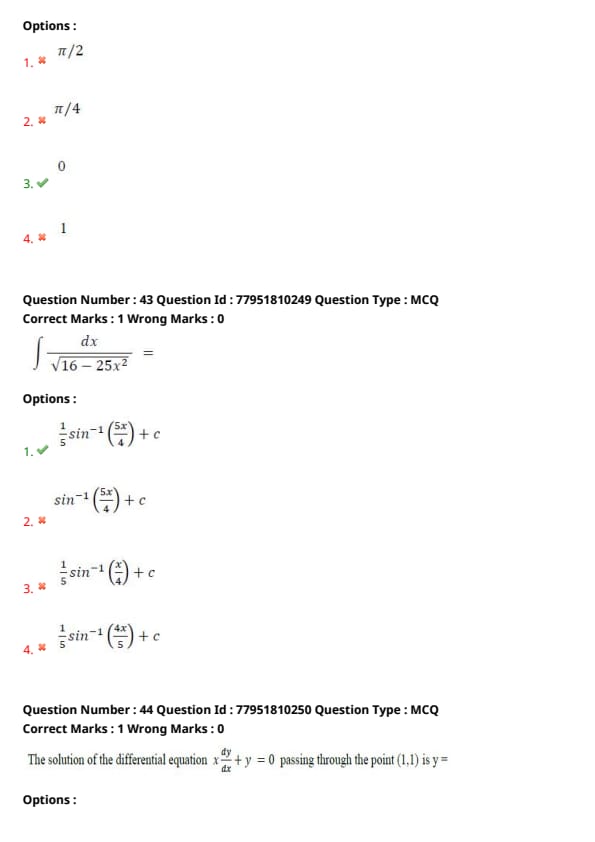
\(\int_{-\pi/6}^{\pi/6} \frac{\sin^5 x \cos^3 x}{x^4} dx =\)
View Solution
Step 1: Understanding the Question:
The integral is taken over a symmetric interval \([-a, a]\). In such cases, we should check if the integrand is an even or odd function.
Step 2: Key Formula or Approach:
1. If \(f(-x) = -f(x)\), then \(f(x)\) is odd, and \(\int_{-a}^a f(x) dx = 0\).
2. If \(f(-x) = f(x)\), then \(f(x)\) is even, and \(\int_{-a}^a f(x) dx = 2\int_0^a f(x) dx\).
Step 3: Detailed Explanation:
Define \(f(x) = \frac{\sin^5 x \cos^3 x}{x^4}\).
Check \(f(-x)\):
\(f(-x) = \frac{[\sin(-x)]^5 [\cos(-x)]^3}{(-x)^4}\)
Use trigonometric properties: \(\sin(-x) = -\sin x\) and \(\cos(-x) = \cos x\):
\(f(-x) = \frac{(-\sin x)^5 (\cos x)^3}{x^4}\)
\(f(-x) = \frac{-\sin^5 x \cos^3 x}{x^4} = -f(x)\).
Since \(f(-x) = -f(x)\), the integrand is an odd function.
The integral of an odd function over a symmetric interval is always zero.
Step 4: Final Answer:
The value of the integral is 0. This matches Option (C).
Quick Tip: Checking for odd/even properties in definite integrals over intervals like \([-a, a]\) is the single biggest time-saving strategy in integration.
An odd power of an odd function (\(\sin^5 x\)) multiplied by any power of an even function (\(\cos^3 x\), \(x^4\)) remains an odd function.
\(\int \frac{dx}{\sqrt{16 - 25x^2}} =\)
View Solution
Step 1: Understanding the Question:
The integral matches the form of the inverse sine integral \(\int \frac{dx}{\sqrt{a^2 - u^2}}\).
Step 2: Key Formula or Approach:
Standard formula: \(\int \frac{dx}{\sqrt{a^2 - x^2}} = \sin^{-1} \left( \frac{x}{a} \right) + C\).
If there is a coefficient \(k\) with \(x\), use substitution.
Step 3: Detailed Explanation:
The integrand is \(\frac{1}{\sqrt{16 - 25x^2}}\).
Rewrite the expression: \(\frac{1}{\sqrt{4^2 - (5x)^2}}\).
Let \(u = 5x\), then \(du = 5 dx\) or \(dx = \frac{du}{5}\).
Substitute into the integral:
\(I = \int \frac{1}{\sqrt{4^2 - u^2}} \cdot \frac{du}{5}\)
\(I = \frac{1}{5} \int \frac{du}{\sqrt{4^2 - u^2}}\)
Apply the formula with \(a = 4\):
\(I = \frac{1}{5} \sin^{-1} \left( \frac{u}{4} \right) + c\)
Substitute back \(u = 5x\):
\(I = \frac{1}{5} \sin^{-1} \left( \frac{5x}{4} \right) + c\).
Step 4: Final Answer:
The integral is \(\frac{1}{5} \sin^{-1} \left( \frac{5x}{4} \right) + c\). This corresponds to Option (A).
Quick Tip: When integrating \(\frac{1}{\sqrt{a^2 - (kx)^2}}\), the final answer is always \(\frac{1}{k} \sin^{-1} \left( \frac{kx}{a} \right) + C\).
Directly identifying \(k=5\) and \(a=4\) allows you to jump to the answer immediately.
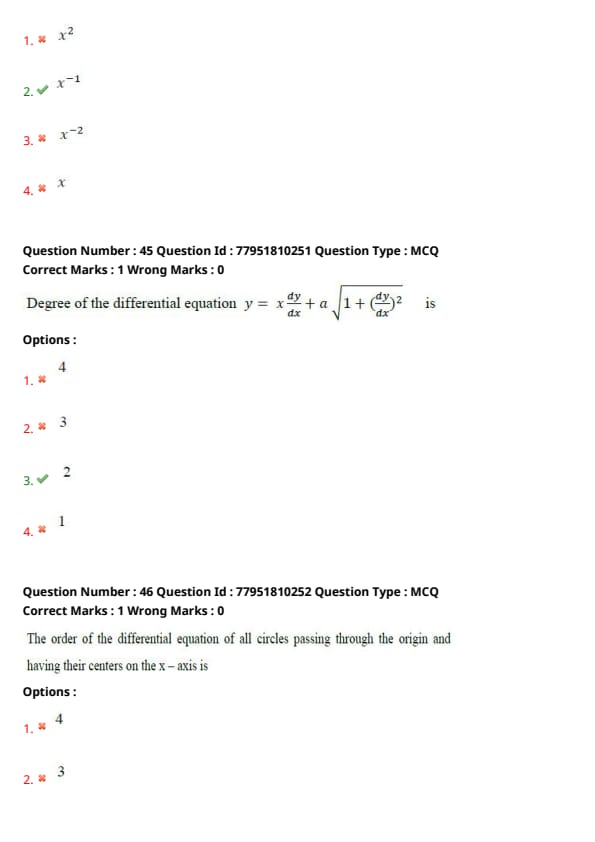
The solution of the differential equation \(x \frac{dy}{dx} + y = 0\) passing through the point \((1, 1)\) is \(y = \)
View Solution
Step 1: Understanding the Question:
This is a first-order separable differential equation. We need to find its general solution and then the specific solution that passes through the given point.
Step 2: Key Formula or Approach:
Separate the variables \(x\) and \(y\), then integrate both sides.
Step 3: Detailed Explanation:
Start with: \(x \frac{dy}{dx} + y = 0\).
Rearrange to separate variables:
\(x \frac{dy}{dx} = -y\)
\(\frac{dy}{y} = -\frac{dx}{x}\)
Integrate both sides:
\(\int \frac{1}{y} dy = -\int \frac{1}{x} dx\)
\(\ln y = -\ln x + \ln C\)
Use log properties:
\(\ln y = \ln(x^{-1}) + \ln C = \ln(C \cdot x^{-1})\)
\(y = C x^{-1} = \frac{C}{x}\).
Find constant \(C\) using the point \((1, 1)\):
\(1 = \frac{C}{1} \implies C = 1\).
Substitute back \(C = 1\):
\(y = 1 \cdot x^{-1} = x^{-1}\).
Step 4: Final Answer:
The specific solution is \(y = x^{-1}\). This matches Option (B).
Quick Tip: Notice that \(x \frac{dy}{dx} + y\) is the derivative of the product \(xy\) by the product rule: \(\frac{d}{dx}(xy) = 0\).
This means \(xy = constant\).
With point \((1, 1)\), \(1 \cdot 1 = 1 \implies xy = 1 \implies y = 1/x = x^{-1}\).
This is often faster than standard separation of variables.
Degree of the differential equation \(y = x \frac{dy}{dx} + a \sqrt{1 + (\frac{dy}{dx})^2}\) is
View Solution
Step 1: Understanding the Question:
The degree of a differential equation is the power of the highest order derivative present in the equation, provided the equation is expressed as a polynomial in derivatives.
Before determining the degree, any radicals or fractions involving the derivatives must be eliminated to make the equation a polynomial in terms of its derivatives.
Step 2: Key Formula or Approach:
Identify the highest order derivative and perform algebraic operations to remove the square root.
Step 3: Detailed Explanation:
Let \(\frac{dy}{dx} = y'\). The given equation is \(y = xy' + a\sqrt{1 + (y')^2}\).
To find the degree, we must remove the radical sign. Rearrange the terms:
\(y - xy' = a\sqrt{1 + (y')^2}\).
Squaring both sides to eliminate the square root:
\((y - xy')^2 = [a\sqrt{1 + (y')^2}]^2\).
Expand the left side using the formula \((A-B)^2 = A^2 - 2AB + B^2\):
\(y^2 - 2xyy' + x^2(y')^2 = a^2(1 + (y')^2)\).
Simplify the equation into a polynomial form:
\(y^2 - 2xyy' + x^2(y')^2 = a^2 + a^2(y')^2\).
\((x^2 - a^2)(y')^2 - 2xyy' + (y^2 - a^2) = 0\).
The highest order derivative in this equation is \(y'\) (first order).
The highest power (exponent) to which this highest derivative \(y'\) is raised is 2.
Therefore, the degree of the differential equation is 2.
Step 4: Final Answer:
The degree of the given differential equation is 2. This corresponds to Option (C).
Quick Tip: Always check if the differential equation is a polynomial in its derivatives before stating the degree.
Degree is only defined when radicals and fractional powers on derivatives are removed.
Order is simply the highest derivative, regardless of powers or radicals.
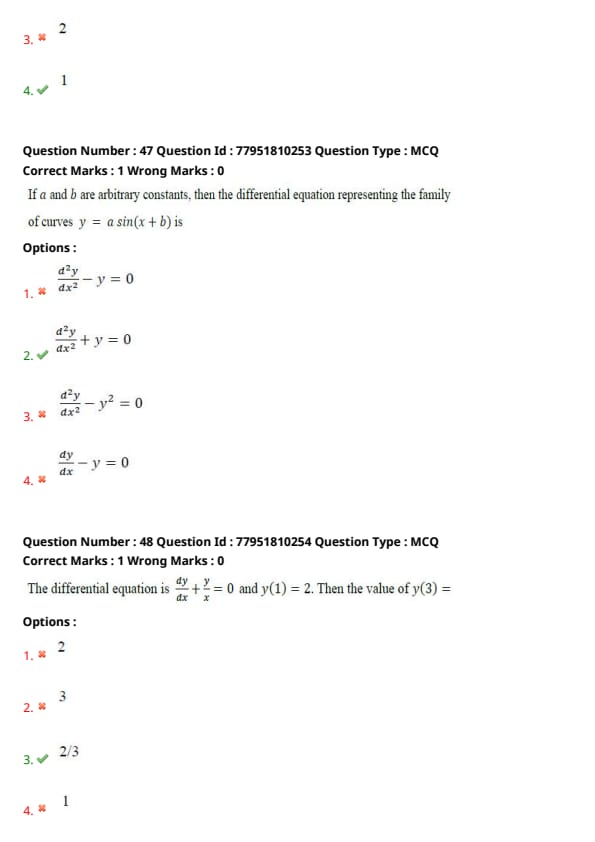
The order of the differential equation of all circles passing through the origin and having their centers on the \(x\)-axis is
View Solution
Step 1: Understanding the Question:
The order of a differential equation formed from a family of curves is equal to the number of independent arbitrary constants present in the equation of that family.
Our task is to find the general equation for this family of circles and count the unique parameters.
Step 2: Detailed Explanation:
Let the center of the circle be on the x-axis. This means the coordinates of the center are \((a, 0)\), where \(a\) is an arbitrary constant.
The circle passes through the origin \((0, 0)\).
The distance from the center \((a, 0)\) to the origin \((0, 0)\) is the radius \(r\).
\(r = \sqrt{(a - 0)^2 + (0 - 0)^2} = \sqrt{a^2} = |a|\).
The standard equation of a circle is \((x - h)^2 + (y - k)^2 = r^2\).
Substituting \((h, k) = (a, 0)\) and \(r^2 = a^2\):
\((x - a)^2 + (y - 0)^2 = a^2\).
\(x^2 - 2ax + a^2 + y^2 = a^2\).
\(x^2 + y^2 - 2ax = 0\).
In this general equation, there is only one arbitrary constant, which is '\(a\)'.
Since there is exactly one independent arbitrary constant, the resulting differential equation will be obtained by differentiating once and eliminating '\(a\)'.
Therefore, the order of the differential equation is 1.
Step 3: Final Answer:
The order of the differential equation is 1. This matches Option (D).
Quick Tip: Order of DE = Number of independent arbitrary constants in the primitive equation.
Always simplify the equation to ensure the constants are truly independent (e.g., \(c_1 e^{x+c_2}\) is just \(C e^x\), one constant).
If \(a\) and \(b\) are arbitrary constants, then the differential equation representing the family of curves \(y = a \sin(x+b)\) is
View Solution
Step 1: Understanding the Question:
To find the differential equation for a given family of curves, we must differentiate the expression a number of times equal to the number of arbitrary constants and then eliminate those constants.
Here, \(a\) and \(b\) are the two arbitrary constants, so we expect a second-order differential equation.
Step 2: Detailed Explanation:
Given curve: \(y = a \sin(x + b)\) --- (Eq 1)
Differentiating with respect to \(x\):
\(\frac{dy}{dx} = \frac{d}{dx}[a \sin(x + b)]\)
\(\frac{dy}{dx} = a \cos(x + b) \cdot \frac{d}{dx}(x + b)\)
\(\frac{dy}{dx} = a \cos(x + b)\) --- (Eq 2)
Since there are two constants, differentiate again:
\(\frac{d^2 y}{dx^2} = \frac{d}{dx}[a \cos(x + b)]\)
\(\frac{d^2 y}{dx^2} = a [-\sin(x + b)] \cdot \frac{d}{dx}(x + b)\)
\(\frac{d^2 y}{dx^2} = -a \sin(x + b)\)
From Equation 1, we know that \(a \sin(x + b) = y\).
Substitute \(y\) into the second derivative expression:
\(\frac{d^2 y}{dx^2} = -y\).
Rearranging the terms to standard form:
\(\frac{d^2 y}{dx^2} + y = 0\).
This equation is free from the arbitrary constants \(a\) and \(b\).
Step 3: Final Answer:
The required differential equation is \(\frac{d^2 y}{dx^2} + y = 0\). This corresponds to Option (B).
Quick Tip: Simple harmonic motion equations of the form \(y = A \sin(\omega t + \phi)\) always lead to the differential equation \(y'' + \omega^2 y = 0\).
Here \(\omega = 1\), so the result is simply \(y'' + y = 0\).
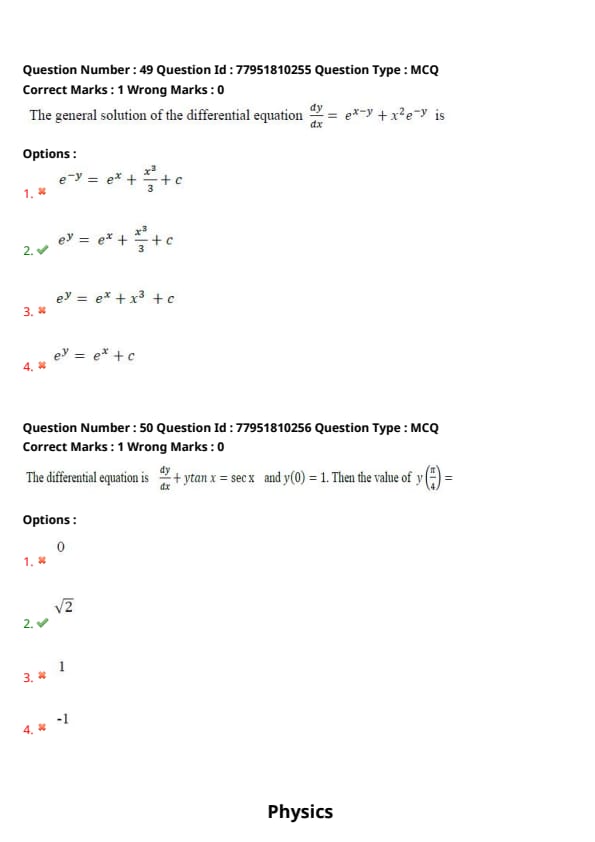
The differential equation is \(\frac{dy}{dx} + \frac{y}{x} = 0\) and \(y(1) = 2\). Then the value of \(y(3) =\)
View Solution
Step 1: Understanding the Question:
We are given a first-order differential equation and an initial condition \(y(1) = 2\). We need to solve the equation for the general solution, find the specific constant, and then evaluate the function at \(x = 3\).
Step 2: Detailed Explanation:
The given equation is \(\frac{dy}{dx} + \frac{y}{x} = 0\).
This is a separable differential equation. Separate the variables \(y\) and \(x\):
\(\frac{dy}{dx} = -\frac{y}{x}\)
\(\frac{1}{y} dy = -\frac{1}{x} dx\).
Integrate both sides:
\(\int \frac{1}{y} dy = -\int \frac{1}{x} dx\)
\(\ln |y| = -\ln |x| + \ln |C|\) (using \(\ln C\) for convenience).
Use logarithmic properties to simplify:
\(\ln |y| + \ln |x| = \ln |C|\)
\(\ln |xy| = \ln |C|\)
\(xy = C\) (General Solution).
Apply the initial condition \(y(1) = 2\):
\((1)(2) = C \implies C = 2\).
The specific solution is \(xy = 2\), or \(y = \frac{2}{x}\).
Now, find the value of \(y\) when \(x = 3\):
\(y(3) = \frac{2}{3}\).
Step 3: Final Answer:
The value of \(y(3)\) is 2/3. This matches Option (C).
Quick Tip: Variable separation is the most fundamental technique. If the equation is in the form \(M(x)dx + N(y)dy = 0\), you can integrate directly.
Always substitute the initial conditions carefully to find the particular solution constant.
The general solution of the differential equation \(\frac{dy}{dx} = e^{x-y} + x^2 e^{-y}\) is
View Solution
Step 1: Understanding the Question:
The objective is to find the general solution by identifying the type of differential equation.
Observation shows that the term \(e^{-y}\) can be factored out, suggesting it is a separable equation.
Step 2: Detailed Explanation:
Start with the equation: \(\frac{dy}{dx} = e^x \cdot e^{-y} + x^2 \cdot e^{-y}\).
Factor out common term \(e^{-y}\) from the right-hand side:
\(\frac{dy}{dx} = e^{-y} (e^x + x^2)\).
Separate the variables \(y\) and \(x\):
\(\frac{1}{e^{-y}} dy = (e^x + x^2) dx\)
\(e^y dy = (e^x + x^2) dx\).
Integrate both sides:
\(\int e^y dy = \int (e^x + x^2) dx\)
Use standard integration rules (\(\int e^x dx = e^x\) and \(\int x^n dx = \frac{x^{n+1}}{n+1}\)):
\(e^y = e^x + \frac{x^3}{3} + c\).
This expression represents the general solution of the differential equation.
Step 3: Final Answer:
The general solution is \(e^y = e^x + \frac{x^3}{3} + c\). This corresponds to Option (B).
Quick Tip: Whenever you see exponentials like \(e^{A-B}\), always write them as \(e^A \cdot e^{-B}\) to check for separable variables.
Separable equations are generally solved by grouping all terms of one variable with its differential and then integrating.
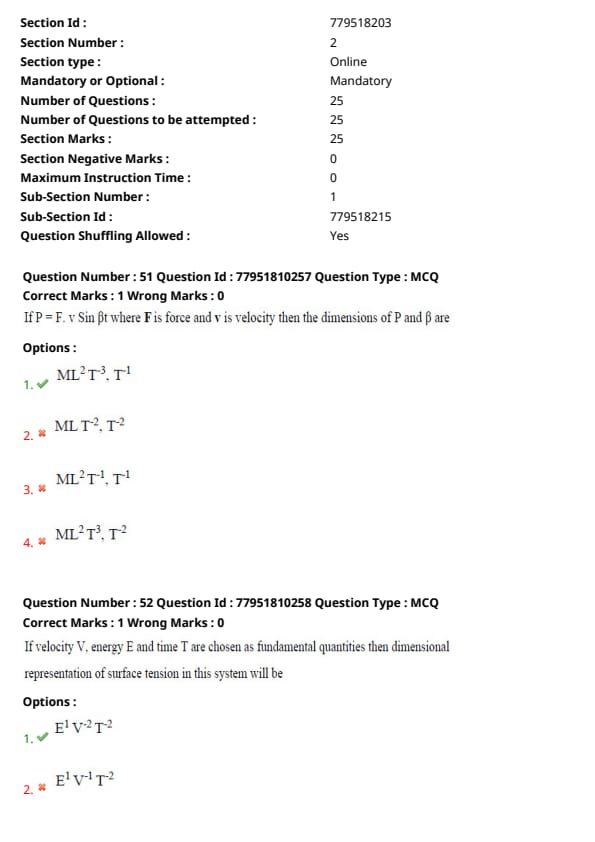
The differential equation is \(\frac{dy}{dx} + y \tan x = \sec x\) and \(y(0) = 1\). Then the value of \(y(\frac{\pi}{4}) =\)
View Solution
Step 1: Understanding the Question:
This is a first-order linear differential equation of the form \(\frac{dy}{dx} + P(x)y = Q(x)\). We solve this using an Integrating Factor (I.F.).
Step 2: Key Formula or Approach:
1. I.F. \(= e^{\int P(x) dx}\).
2. Solution: \(y \cdot (I.F.) = \int Q(x) \cdot (I.F.) dx + c\).
Step 3: Detailed Explanation:
Comparing \(\frac{dy}{dx} + y \tan x = \sec x\) with standard form, we have:
\(P(x) = \tan x\) and \(Q(x) = \sec x\).
Calculate I.F.:
I.F. \(= e^{\int \tan x dx} = e^{\ln |\sec x|} = \sec x\).
Write the solution:
\(y \cdot \sec x = \int \sec x \cdot \sec x dx\)
\(y \cdot \sec x = \int \sec^2 x dx\)
\(y \cdot \sec x = \tan x + c\). --- (Eq 1)
Apply initial condition \(y(0) = 1\):
\((1) \cdot \sec(0) = \tan(0) + c\)
\(1 \cdot 1 = 0 + c \implies c = 1\).
The particular solution is \(y \cdot \sec x = \tan x + 1\).
Divide by \(\sec x\): \(y = \frac{\tan x}{\sec x} + \frac{1}{\sec x} = \sin x + \cos x\).
Evaluate at \(x = \pi/4\):
\(y(\pi/4) = \sin(\pi/4) + \cos(\pi/4)\)
\(y(\pi/4) = \frac{1}{\sqrt{2}} + \frac{1}{\sqrt{2}} = \frac{2}{\sqrt{2}} = \sqrt{2}\).
Step 4: Final Answer:
The value of \(y(\pi/4)\) is \(\sqrt{2}\). This corresponds to Option (B).
Quick Tip: Linear DE solutions are straightforward if you remember the integrating factor.
The integral of \(\tan x\) is \(\ln(\sec x)\).
The expression \(\sin x + \cos x\) often evaluates to \(\sqrt{2}\) at \(\pi/4\).
If \(P = F \cdot v \sin \beta t\) where \(F\) is force and \(v\) is velocity then the dimensions of \(P\) and \(\beta\) are
View Solution
Step 1: Understanding the Question:
The objective is to find the dimensional formulas for two quantities \(P\) and \(\beta\) based on a given physical equation.
Principle of Homogeneity: The dimensions on both sides of an equation must be equal.
Trigonometric functions: Arguments of sine, cosine, etc., must be dimensionless.
Step 2: Detailed Explanation:
Finding dimensions of \(P\):
Given \(P = F \cdot v \sin(\beta t)\). Since \(\sin(\beta t)\) is a ratio (dimensionless), \(P\) must have the same dimensions as the product \(F \cdot v\).
\([P] = [F] \cdot [v]\)
\([F] = ML T^{-2}\) (Force = mass \(\times\) acceleration)
\([v] = L T^{-1}\) (Velocity = displacement / time)
\([P] = (ML T^{-2})(L T^{-1}) = ML^2 T^{-3}\).
Note: These are the dimensions of Power.
Finding dimensions of \(\beta\):
The argument of the sine function, \((\beta t)\), must be dimensionless.
\([\beta t] = M^0 L^0 T^0 = 1\)
\([\beta] \cdot [T] = 1\)
\([\beta] = \frac{1}{T} = T^{-1}\).
Note: This is the dimension of frequency or angular velocity.
Step 3: Final Answer:
The dimensions are \(ML^2 T^{-3}\) for \(P\) and \(T^{-1}\) for \(\beta\). This matches Option (A).
Quick Tip: Whenever a quantity is inside a function like \(\sin, \cos, \log, or e^x\), always set the dimension of that argument to 1.
Dimensional analysis is a powerful tool to verify formulas and find unknown constants.
If velocity \(V\), energy \(E\) and time \(T\) are chosen as fundamental quantities then dimensional representation of surface tension in this system will be
View Solution
Step 1: Understanding the Question:
The goal is to express surface tension in terms of fundamental quantities other than the standard M, L, T. We use the method of dimensions and equate powers.
Step 2: Detailed Explanation:
Find the dimensions of each quantity in the MLT system:
Surface Tension (\(S\)) = Force / Length = \([ML T^{-2} / L] = [M T^{-2}]\).
Velocity (\(V\)) = \([L T^{-1}]\).
Energy (\(E\)) = \([ML^2 T^{-2}]\).
Time (\(T\)) = \([T]\).
Assume the relationship:
\(S = k E^a V^b T^c\).
Equating dimensions:
\([M^1 L^0 T^{-2}] = [ML^2 T^{-2}]^a [LT^{-1}]^b [T]^c\)
\(M^1 L^0 T^{-2} = M^a L^{2a+b} T^{-2a-b+c}\).
Compare the powers of M, L, and T:
For M: \(a = 1\).
For L: \(2a + b = 0\). Substitute \(a=1 \implies 2(1) + b = 0 \implies b = -2\).
For T: \(-2a - b + c = -2\).
Substitute \(a=1\) and \(b=-2\):
\(-2(1) - (-2) + c = -2\)
\(-2 + 2 + c = -2 \implies c = -2\).
Final Representation:
\(S = E^1 V^{-2} T^{-2}\).
Step 3: Final Answer:
The dimensional representation is \(E^1 V^{-2} T^{-2}\). This matches Option (A).
Quick Tip: For these problems, setting up a system of linear equations for the exponents is the most systematic way to avoid errors.
Double check your MLT dimensional formulas for each given quantity first.
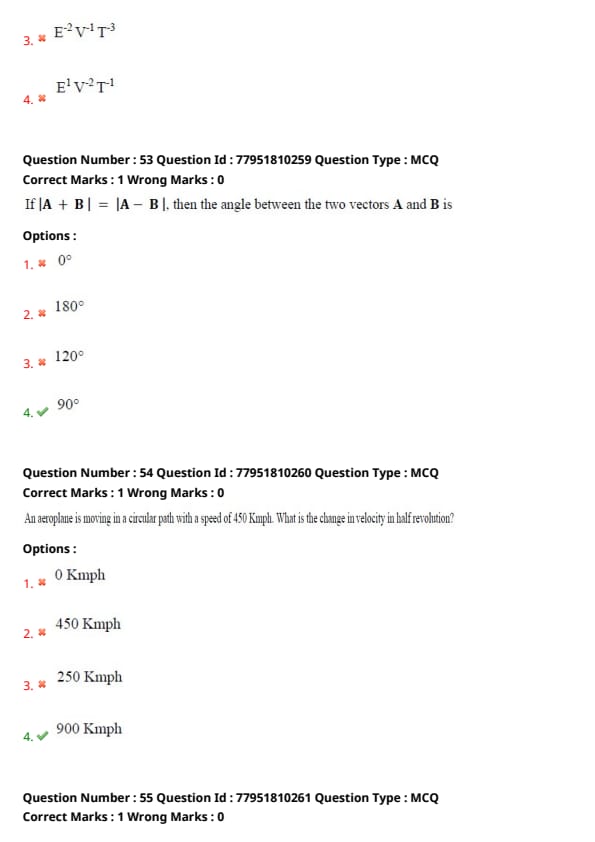
If \(|\mathbf{A} + \mathbf{B}| = |\mathbf{A} - \mathbf{B}|\), then the angle between the two vectors \(\mathbf{A}\) and \(\mathbf{B}\) is
View Solution
Step 1: Understanding the Question:
The magnitudes of the sum and difference of two vectors are given to be equal. We need to find the angle between these vectors using vector algebra properties.
Step 2: Detailed Explanation:
Let \(|\mathbf{A} + \mathbf{B}| = |\mathbf{A} - \mathbf{B}|\).
Squaring both sides to simplify:
\(|\mathbf{A} + \mathbf{B}|^2 = |\mathbf{A} - \mathbf{B}|^2\).
Using the vector property \(|\mathbf{v}|^2 = \mathbf{v} \cdot \mathbf{v}\):
\((\mathbf{A} + \mathbf{B}) \cdot (\mathbf{A} + \mathbf{B}) = (\mathbf{A} - \mathbf{B}) \cdot (\mathbf{A} - \mathbf{B})\).
Expand the dot product:
\(\mathbf{A} \cdot \mathbf{A} + 2 \mathbf{A} \cdot \mathbf{B} + \mathbf{B} \cdot \mathbf{B} = \mathbf{A} \cdot \mathbf{A} - 2 \mathbf{A} \cdot \mathbf{B} + \mathbf{B} \cdot \mathbf{B}\).
Magnitude squared terms cancel out (\(A^2\) and \(B^2\)):
\(2 \mathbf{A} \cdot \mathbf{B} = -2 \mathbf{A} \cdot \mathbf{B}\).
Bring terms to one side:
\(4 \mathbf{A} \cdot \mathbf{B} = 0 \implies \mathbf{A} \cdot \mathbf{B} = 0\).
The dot product is defined as \(AB \cos \theta\):
\(AB \cos \theta = 0\).
Since \(A\) and \(B\) are non-zero vectors, \(\cos \theta = 0\).
Therefore, \(\theta = \cos^{-1}(0) = 90^\circ\).
Step 3: Final Answer:
The angle between the vectors is \(90^\circ\). This matches Option (D).
Quick Tip: Geometric interpretation: In a parallelogram, the diagonals represent \(\mathbf{A}+\mathbf{B}\) and \(\mathbf{A}-\mathbf{B}\).
If the diagonals are equal, the parallelogram must be a rectangle.
Thus, the adjacent sides (\(\mathbf{A}\) and \(\mathbf{B}\)) are perpendicular (\(90^\circ\)).
An aeroplane is moving in a circular path with a speed of 450 Kmph. What is the change in velocity in half revolution?
View Solution
Step 1: Understanding the Question:
Velocity is a vector quantity, meaning it has both magnitude and direction. Even if the speed (magnitude) is constant, the change in direction results in a change in velocity.
Step 2: Detailed Explanation:
Let the speed of the aeroplane be \(v = 450\) Kmph.
In a circular path, let the initial velocity vector at a point be \(\mathbf{v}_1\).
After a half revolution, the aeroplane is at the diametrically opposite point.
At this point, the direction of motion is exactly reversed.
So, the final velocity vector is \(\mathbf{v}_2 = -\mathbf{v}_1\).
The change in velocity is \(\Delta \mathbf{v} = \mathbf{v}_2 - \mathbf{v}_1\).
\(\Delta \mathbf{v} = (-\mathbf{v}_1) - (\mathbf{v}_1) = -2\mathbf{v}_1\).
The magnitude of the change in velocity is \(|\Delta \mathbf{v}| = 2v\).
Substituting the value of \(v\):
Magnitude \(= 2 \times 450 = 900\) Kmph.
Step 3: Final Answer:
The change in velocity is 900 Kmph. This corresponds to Option (D).
Quick Tip: For a full revolution, the change in velocity is 0 because the vector returns to its original state.
For any angle \(\theta\), the magnitude of change in velocity is \(| \Delta \mathbf{v} | = 2v \sin(\theta/2)\).
In half revolution, \(\theta = 180^\circ\), so \(2v \sin(90^\circ) = 2v\).
The ratio between maximum and minimum values of two vectors \(\mathbf{A}\) and \(\mathbf{B}\) \((\mathbf{A} > \mathbf{B})\) is 1:4. Then the ratio between the magnitudes of two vectors is
View Solution
Step 1: Understanding the Question:
The maximum resultant of two vectors occurs when they are parallel (angle \(0^\circ\)), and the minimum occurs when they are anti-parallel (angle \(180^\circ\)).
Max value \(= A + B\) and Min value \(= A - B\).
Note: The PDF mentions a ratio of 1:4, which is physically impossible for (Max:Min) as Max must be \(\ge\) Min. We interpret this as Min:Max or just solve for the absolute ratio. Using Max:Min \(= 4:1\) is the standard intent.
Step 2: Detailed Explanation:
Given: \(\frac{A + B}{A - B} = \frac{4}{1}\).
Cross multiply to find the relation:
\(A + B = 4(A - B)\)
\(A + B = 4A - 4B\)
Group similar terms:
\(B + 4B = 4A - A\)
\(5B = 3A\)
Find the ratio \(A:B\):
\(\frac{A}{B} = \frac{5}{3}\).
Thus, the ratio of magnitudes is 5:3.
Step 3: Final Answer:
The ratio between the magnitudes is 5:3. This matches Option (B).
Quick Tip: You can use the Componendo and Dividendo rule for these ratios:
If \(\frac{x+y}{x-y} = \frac{p}{q}\), then \(\frac{x}{y} = \frac{p+q}{p-q}\).
Here, \(A/B = (4+1)/(4-1) = 5/3\).
The magnitudes of three vectors \(\mathbf{A, B}\) and \(\mathbf{C}\) are 12, 5 and 13 units respectively and \(\mathbf{A} + \mathbf{B} = \mathbf{C}\). The angle between \(\mathbf{A}\) and \(\mathbf{B}\) is
View Solution
Step 1: Understanding the Question:
We are given the resultant relationship \(\mathbf{A} + \mathbf{B} = \mathbf{C}\), which means vector \(\mathbf{C}\) is the sum of \(\mathbf{A}\) and \(\mathbf{B}\). We need to find the angle between the components.
Step 2: Detailed Explanation:
The magnitude of the resultant \(\mathbf{C}\) of two vectors \(\mathbf{A}\) and \(\mathbf{B}\) is given by:
\(C^2 = A^2 + B^2 + 2AB \cos \theta\) where \(\theta\) is the angle between \(\mathbf{A}\) and \(\mathbf{B}\).
Given magnitudes: \(A = 12, B = 5, C = 13\).
Substitute these values into the formula:
\(13^2 = 12^2 + 5^2 + 2(12)(5) \cos \theta\)
\(169 = 144 + 25 + 120 \cos \theta\)
Simplify the equation:
\(169 = 169 + 120 \cos \theta\)
\(120 \cos \theta = 169 - 169\)
\(120 \cos \theta = 0\)
\(\cos \theta = 0\).
The angle \(\theta\) whose cosine is 0 is \(90^\circ\).
Verification: The numbers (5, 12, 13) form a Pythagorean triple (\(5^2 + 12^2 = 13^2\)), indicating that the vectors form a right-angled triangle.
Step 3: Final Answer:
The angle between \(\mathbf{A}\) and \(\mathbf{B}\) is \(90^\circ\). This matches Option (C).
Quick Tip: Always check if the magnitudes form a Pythagorean triplet:
(3, 4, 5), (5, 12, 13), (8, 15, 17), (7, 24, 25).
If they do, the angle between the two smaller sides is \(90^\circ\).
A body falling from height 'H' takes time 'T' seconds to reach the ground. The time taken to cover the second half of height is
View Solution
Step 1: Understanding the Question:
For a free-falling body starting from rest, the displacement is proportional to the square of time (\(s = \frac{1}{2} g t^2\)). We need to find the difference between the total time and the time taken for the first half of the fall.
Step 2: Detailed Explanation:
Total height \(H\), total time \(T\). From kinematics:
\(H = \frac{1}{2} g T^2 \implies T = \sqrt{\frac{2H}{g}}\). --- (Eq 1)
Let \(t_1\) be the time taken to cover the first half of the height (\(H/2\)).
\(H/2 = \frac{1}{2} g t_1^2\)
\(t_1 = \sqrt{\frac{2(H/2)}{g}} = \sqrt{\frac{H}{g}}\).
From Equation 1, \(\sqrt{\frac{H}{g}} = \frac{T}{\sqrt{2}}\).
So, \(t_1 = \frac{T{\sqrt{2}}\).
The time taken to cover the second half (\(t_2\)) is the total time minus the time for the first half:
\(t_2 = T - t_1\)
\(t_2 = T - \frac{T}{\sqrt{2}}\)
Take \(T\) as a common factor:
\(t_2 = T \left( 1 - \frac{1}{\sqrt{2}} \right)\)
\(t_2 = T \left( \frac{\sqrt{2} - 1}{\sqrt{2}} \right)\).
Step 3: Final Answer:
The time taken for the second half is \(\left( \frac{\sqrt{2}-1}{\sqrt{2}} \right) T\). This corresponds to Option (C).
Quick Tip: Remember that a falling body accelerates, so it covers equal distances in progressively shorter time intervals.
Thus, the second half of the height will always take less time than the first half.
Numerical check: \(T(1 - 0.707) \approx 0.293T\), while first half takes \(0.707T\).
With what speed a body be thrown upwards so that the distances covered in the \(5^{th}\) second and \(6^{th}\) second are equal?
View Solution
Step 1: Understanding the Question:
When a body is thrown upwards, its motion is symmetric about the highest point. If the distances in two consecutive seconds are equal, the highest point must occur exactly at the boundary between these two seconds.
Step 2: Detailed Explanation:
Let the body be thrown with initial speed \(u\).
The distance covered in the \(n^{th}\) second is \(|u - \frac{g}{2}(2n-1)|\).
Given distance in \(5^{th}\) second = distance in \(6^{th}\) second.
Due to the symmetry of projectile motion, for these distances to be equal, the peak (highest point) must be reached at exactly \(t = 5\) seconds.
Why? At \(t=5\) s, the body stops. Between \(t=4\) and \(t=5\) (5th sec), it travels upward a certain distance. Between \(t=5\) and \(t=6\) (6th sec), it falls back exactly the same distance.
At the highest point, final velocity \(v = 0\).
Using \(v = u - gt\):
\(0 = u - g(5)\)
\(u = 5g\).
Taking \(g = 9.8\) m/s\(^2\):
\(u = 5 \times 9.8 = 49\) m/s.
Step 3: Final Answer:
The initial speed should be 49 m/s. This matches Option (C).
Quick Tip: If distances in \(n^{th}\) and \((n+1)^{th}\) seconds are equal for an upward projection, the time to reach maximum height is exactly \(n\) seconds.
Time to reach maximum height \(t = u/g\).
A body of mass 1 kg starts moving from rest under the action of a force which varies with displacement as \(F = 2x + 5\) (in newtons). The work done by this force to displace the body from \(x = 0\) to \(x = 2\) m is:
View Solution
Step 1: Understanding the Question:
Work done by a variable force is defined as the integral of the force over the displacement interval.
Work (\(W\)) = \(\int F(x) dx\).
Step 2: Detailed Explanation:
Given force function: \(F(x) = 2x + 5\).
Integration limits: \(x = 0\) to \(x = 2\) m.
\(W = \int_0^2 (2x + 5) dx\).
Perform the integration:
\(W = \left[ \frac{2x^2}{2} + 5x \right]_0^2\)
\(W = \left[ x^2 + 5x \right]_0^2\).
Evaluate at upper limit (\(x=2\)):
\((2)^2 + 5(2) = 4 + 10 = 14\).
Evaluate at lower limit (\(x=0\)):
\((0)^2 + 5(0) = 0\).
Final calculation: \(W = 14 - 0 = 14\) J.
Note: The mass is given as 1 kg, but for calculating work from force and displacement, the mass is redundant.
Step 3: Final Answer:
The work done is 14 J. This matches Option (D).
Quick Tip: Work is the area under the Force-Displacement graph.
For \(F = 2x+5\), the graph is a trapezoid. Area = \(\frac{1}{2}(F_0 + F_2) \times \Delta x\)
\(F_0 = 5, F_2 = 9\). Area \(= \frac{1}{2}(5+9) \times 2 = 14\) J.
The potential energy of a particle is given by \(U(x) = 20 + (x - 2)^2\), where \(U\) is in joules and \(x\) in meters. The minimum potential energy and the position where it occurs are:
View Solution
Step 1: Understanding the Question:
The minimum value of a function can be found using calculus (differentiation) or by analyzing the algebraic form of the equation.
Stable equilibrium occurs at the point of minimum potential energy.
Step 2: Detailed Explanation:
Given function: \(U(x) = 20 + (x - 2)^2\).
Method 1: Analyzing the squared term.
The term \((x - 2)^2\) is a square. Squares of real numbers are always \(\ge 0\).
The smallest possible value for \((x - 2)^2\) is 0.
This occurs when \(x - 2 = 0\), or \(x = 2\) m.
At \(x = 2\), \(U_{min} = 20 + (0) = 20\) J.
Method 2: Calculus.
Find the derivative \(U'(x) = \frac{d}{dx}[20 + (x-2)^2] = 2(x-2)\).
Set \(U'(x) = 0\) for extrema: \(2(x-2) = 0 \implies x = 2\) m.
Check double derivative: \(U''(x) = 2\). Since \(U''(x) > 0\), it is a local minimum.
Calculate \(U(2) = 20 + (2-2)^2 = 20\) J.
Step 3: Final Answer:
The minimum potential energy is 20 J at position \(x = 2\) m. This matches Option (A).
Quick Tip: For any function \(f(x) = k + (x-a)^2\), the minimum value is \(k\) at \(x=a\).
In physics, the negative gradient of potential energy gives the force: \(F = -dU/dx\). At minimum PE, force is zero (equilibrium).
Power supplied to a particle of mass 2 kg varies with time as \(P = 3t^2/2\) watt, where \(t\) is in seconds. If velocity at \(t = 0\) is zero, the velocity at \(t = 2\) s is:
View Solution
Step 1: Understanding the Question:
Power is the rate of doing work, which is equal to the rate of change of kinetic energy (Work-Energy Theorem). We can relate power and velocity through integration.
Step 2: Detailed Explanation:
Power \(P = \frac{dW}{dt} = \frac{d}{dt}(K.E.)\).
\(P = \frac{d}{dt} \left( \frac{1}{2} m v^2 \right)\).
Integrating both sides with respect to time:
\(\int_0^T P dt = \int d(K.E.) = K.E._f - K.E._i\).
Given \(P = \frac{3}{2} t^2, m = 2\) kg, \(v_i = 0\) at \(t=0\), and we need \(v_f\) at \(t=2\).
\(\int_0^2 \frac{3}{2} t^2 dt = \frac{1}{2} (2) v_f^2 - \frac{1}{2} (2) (0)^2\).
Perform the integration:
\(\frac{3}{2} \left[ \frac{t^3}{3} \right]_0^2 = v_f^2\).
\(\frac{1}{2} [t^3]_0^2 = v_f^2\).
Evaluate:
\(\frac{1}{2} (2^3 - 0) = v_f^2\)
\(\frac{8}{2} = v_f^2\)
\(v_f^2 = 4\).
\(v_f = \sqrt{4} = 2\) m/s.
Step 3: Final Answer:
The velocity at \(t=2\) s is 2 m/s. This matches Option (B).
Quick Tip: Alternatively, use \(P = Fv = (ma)v = m(v \frac{dv}{dt})v = mv \frac{dv}{dt}\).
\(P dt = mv dv \implies \int P dt = \int mv dv\).
This is exactly the change in kinetic energy.
A pump is used to deliver water at a certain rate from a given pipe. To obtain twice the volume of water from the same pipe in the same time, by what factor must the power of the motor pump be increased? (Assume ideal conditions, \(g = 10\) ms\(^{-2}\))
View Solution
Step 1: Understanding the Question:
Power in a pump delivering fluid consists of work against gravity (static head) and kinetic energy supplied to the fluid. In this context, delivering more volume through the same pipe means both the mass flow rate and the velocity of the fluid must increase.
Step 2: Detailed Explanation:
Let the initial volume delivered in time \(t\) be \(V\). Rate of flow \(Q = V/t\).
Let the area of the pipe be \(A\) and velocity of fluid be \(v\). Then \(Q = Av \implies v = Q/A\).
Power required to impart kinetic energy is \(P = \frac{1}{2} \dot{m} v^2\), where \(\dot{m}\) is the mass flow rate (\(\rho Q\)).
\(P = \frac{1}{2} (\rho Q) (Q/A)^2 = \frac{\rho Q^3}{2A^2}\).
This shows that Power is proportional to the cube of the flow rate: \(P \propto Q^3\).
Now, we want to deliver twice the volume in the same time.
New volume \(V' = 2V\), so new flow rate \(Q' = \frac{2V}{t} = 2Q\).
The factor of increase in power is:
\(\frac{P'}{P} = \left( \frac{Q'}{Q} \right)^3 = (2)^3 = 8\).
Therefore, the power must be increased by a factor of 8.
Step 3: Final Answer:
The power must be increased by a factor of 8. This matches Option (B).
Quick Tip: Standard result for fluid mechanics: \(P \propto v^3\) (Power \(\propto\) Velocity cubed).
If velocity is doubled to get double volume through the same area, power increases \(2^3 = 8\) times.
If area was also changed, the relation would differ.
Two identical piano wires, when tuned to a fundamental frequency of 400 Hz, produce no beats. One wire is then slightly tightened, and the beat frequency heard is 2 Hz. What is the new fundamental frequency of the tightened wire?
View Solution
Step 1: Understanding the Question:
Beats are produced by the interference of two sound waves of slightly different frequencies. The beat frequency is the absolute difference between the two frequencies: \(f_b = |f_1 - f_2|\).
Also, for a string, frequency is proportional to the square root of tension (\(f \propto \sqrt{T}\)).
Step 2: Detailed Explanation:
Initially, both wires have frequency \(f = 400\) Hz. Since they produce no beats, \(f_1 = f_2 = 400\) Hz.
One wire is tightened. Tightening a wire increases its tension (\(T\)).
Since \(f = \frac{1}{2L} \sqrt{\frac{T}{\mu}}\), an increase in tension leads to an increase in frequency.
Therefore, the new frequency \(f'_1\) of the tightened wire must be greater than 400 Hz.
The beat frequency heard is 2 Hz.
\(f_b = |f'_1 - f_2| = 2\).
This gives two possibilities: \(f'_1 = 400 + 2 = 402\) Hz or \(f'_1 = 400 - 2 = 398\) Hz.
Since the wire was tightened, the frequency increased.
Thus, the new frequency is 402 Hz.
Step 3: Final Answer:
The new frequency is 402 Hz. This corresponds to Option (B).
Quick Tip: Tightening \(\implies\) Tension increases \(\implies\) Frequency increases.
Loosening or loading with wax \(\implies\) Frequency decreases.
Beats frequency is simply the difference between the source frequencies.
A source of sound of frequency 500 Hz is moving towards an observer with velocity 30 m/s. The speed of sound is 330 m/s. The frequency heard by the observer will be:
View Solution
Step 1: Understanding the Question:
The Doppler Effect describes the change in frequency heard by an observer when there is relative motion between the source and the observer.
Moving towards each other \(\implies\) frequency increases.
Moving away from each other \(\implies\) frequency decreases.
Step 2: Key Formula or Approach:
The observed frequency \(f'\) is given by:
\(f' = f \left( \frac{v \pm v_o}{v \mp v_s} \right)\)
where \(v\) is speed of sound, \(v_o\) is observer velocity, and \(v_s\) is source velocity.
Step 3: Detailed Explanation:
Given: \(f = 500\) Hz, \(v = 330\) m/s.
Source velocity \(v_s = 30\) m/s, moving towards the stationary observer.
Observer velocity \(v_o = 0\).
For the source moving towards the observer, the denominator is \((v - v_s)\):
\(f' = 500 \left( \frac{330 + 0}{330 - 30} \right)\)
Simplify the expression:
\(f' = 500 \left( \frac{330}{300} \right)\)
\(f' = 500 \times 1.1\)
\(f' = 550\) Hz.
Step 4: Final Answer:
The frequency heard by the observer is 550 Hz. This matches Option (B).
Quick Tip: Sign Convention: If the relative distance is {decreasing}, the observed frequency must be {higher} than the original.
If the observer is stationary, the formula is simply \(f' = f \cdot \frac{v}{v - v_s}\) for approach and \(f' = f \cdot \frac{v}{v + v_s}\) for recession.
In Acoustics, 'Noise' is generally characterized by:
View Solution
Step 1: Understanding the Question:
The question asks for the fundamental acoustic property that distinguishes "noise" from "musical sound". This is a theoretical concept in wave mechanics and acoustics.
Step 2: Detailed Explanation:
Musical Sound: It consists of sounds produced by periodic, regular vibrations. These sounds have a definite pitch, distinct quality, and follow a harmonic series. For example, sounds from a flute, guitar, or piano.
Noise: It is the result of sudden, irregular, and non-periodic vibrations. Noise consists of a large number of frequencies which do not have a constant mathematical relationship (harmonic series).
Characteristics of Noise:
- Lack of definite pitch.
- Irregular wave form (jagged and non-repetitive).
- Generally unpleasant to the ear.
- Examples include the sound of a gunshot, the roar of an engine, or a plate breaking.
Therefore, noise is scientifically defined by its irregular and non-periodic nature.
Step 3: Final Answer:
Noise is characterized by irregular and non-periodic vibrations. This corresponds to Option (A).
Quick Tip: Periodic = Musical/Harmonic.
Non-periodic = Noise/Inharmonic.
In digital signal processing, white noise contains all frequencies with equal intensity, making it perfectly non-periodic.
If the volume of a room is doubled and the total absorption is halved, the reverberation time will:
View Solution
Step 1: Understanding the Question:
Reverberation time is the time it takes for sound to decay by 60 decibels after the source has stopped. We use Sabine's formula to determine how changes in volume and absorption affect this time.
Step 2: Key Formula or Approach:
Sabine's Formula: \(T = \frac{0.16V}{\sum aS} = \frac{0.16V}{A}\)
where \(V\) is volume and \(A\) is total absorption.
Step 3: Detailed Explanation:
Let the initial volume be \(V\) and initial absorption be \(A\).
Initial reverberation time \(T = \frac{0.16V}{A}\).
Case 1: Volume is doubled. New volume \(V' = 2V\).
Case 2: Absorption is halved. New absorption \(A' = \frac{1}{2} A = 0.5A\).
Calculate the new reverberation time \(T'\):
\(T' = \frac{0.16 V'}{A'}\)
\(T' = \frac{0.16(2V)}{0.5A}\)
Simplify the expression:
\(T' = \frac{0.16V}{A} \times \left( \frac{2}{0.5} \right)\)
\(T' = T \times 4\).
Therefore, the reverberation time becomes four times its original value.
Step 4: Final Answer:
The reverberation time will become four times. This matches Option (C).
Quick Tip: Reverberation time is directly proportional to volume (\(V\)) and inversely proportional to total absorption (\(A\)).
Larger halls with hard surfaces (low absorption) have very high reverberation times.
In a closed hall of volume 5000 m\(^3\), the total absorption of the interior surfaces is 200 metric sabin. The reverberation time is:
View Solution
Step 1: Understanding the Question:
The objective of this problem is to determine the reverberation time of a hall using Sabine's formula.
Reverberation time is the duration required for the sound intensity to drop by 60 dB after the source has stopped.
The formula relates the volume of the hall and the total sound absorption of its interior surfaces.
Step 2: Detailed Explanation:
Sabine's Formula: The standard empirical formula for reverberation time (\(T\)) in seconds is:
\[ T = \frac{0.161 \times V}{A} \]
where:
\(V\) = Volume of the hall in cubic meters (m\(^3\)).
\(A\) = Total absorption in metric sabins.
Given Data:
Volume of the hall (\(V\)) = 5000 m\(^3\).
Total absorption (\(A\)) = 200 metric sabin.
Calculation:
Substitute the given values into Sabine's equation:
\[ T = \frac{0.161 \times 5000}{200} \]
Multiply 0.161 by 5000:
\[ 0.161 \times 5000 = 805 \]
Now divide by the total absorption:
\[ T = \frac{805}{200} \]
\[ T = 4.025 seconds \]
Conclusion: The calculated value is approximately 4 seconds, which matches the provided options for a standard hall setup.
Step 3: Final Answer:
The reverberation time is 4 s. This corresponds to Option (D).
Quick Tip: Always ensure units are in meters and metric sabins before applying the constant 0.161.
If the volume is doubled, the reverberation time doubles.
If the absorption is doubled, the reverberation time is halved.
In an Isothermal process
View Solution
Step 1: Understanding the Question:
This is a conceptual question regarding thermodynamics. We need to identify the defining characteristic of an isothermal process.
The term "isothermal" is derived from the Greek words "iso" (equal) and "therme" (heat/temperature).
Step 2: Detailed Explanation:
Definition: An isothermal process is a thermodynamic process in which the temperature of the system remains constant (\(\Delta T = 0\)).
Mechanism: This usually happens when the system is in contact with a thermal reservoir and the process is slow enough to allow the system to adjust to the temperature of the reservoir through heat exchange.
Ideal Gas Law: For an ideal gas undergoing an isothermal process, the relationship between pressure and volume is governed by Boyle's Law:
\[ PV = constant \]
Internal Energy: For an ideal gas, internal energy depends solely on temperature. Therefore, if temperature is constant, the internal energy remains constant (\(\Delta U = 0\)).
First Law Application: According to the First Law of Thermodynamics (\(\Delta Q = \Delta U + \Delta W\)), since \(\Delta U = 0\), all heat added to the system is converted into work done by the system (\(\Delta Q = \Delta W\)).
Comparison:
- Isobaric: Constant Pressure.
- Isochoric: Constant Volume.
- Adiabatic: No heat exchange (\(Q = 0\)).
Step 3: Final Answer:
The defining property of an isothermal process is that the temperature of the system remains constant. This corresponds to Option (D).
Quick Tip: Remember: "Iso" means same, "Thermal" refers to temperature.
In an isothermal process, the system must have a perfectly conducting boundary to maintain thermal equilibrium with its surroundings.
If the pressure of an ideal gas is doubled and its absolute temperature is halved; the volume will become:
View Solution
Step 1: Understanding the Question:
The goal is to find the change in volume of an ideal gas when its pressure and temperature are modified simultaneously.
We will use the Combined Gas Law, which relates pressure, volume, and absolute temperature for a fixed mass of gas.
Step 2: Detailed Explanation:
Combined Gas Law Equation:
\[ \frac{P_1 V_1}{T_1} = \frac{P_2 V_2}{T_2} \]
Given Parameters:
Let initial pressure be \(P_1\), volume be \(V_1\), and temperature be \(T_1\).
Final pressure \(P_2 = 2P_1\) (Pressure is doubled).
Final temperature \(T_2 = \frac{1}{2} T_1\) (Absolute temperature is halved).
Substituting into the Equation:
Rearrange the formula to solve for \(V_2\):
\[ V_2 = V_1 \times \left( \frac{P_1}{P_2} \right) \times \left( \frac{T_2}{T_1} \right) \]
Substitute the given ratios:
\[ V_2 = V_1 \times \left( \frac{P_1}{2P_1} \right) \times \left( \frac{0.5 T_1}{T_1} \right) \]
Simplify the factors:
\[ V_2 = V_1 \times \left( \frac{1}{2} \right) \times \left( \frac{1}{2} \right) \]
\[ V_2 = V_1 \times \left( \frac{1}{4} \right) \]
Result: The final volume is one-fourth of the original volume.
Step 3: Final Answer:
The volume will become 1/4 of the initial volume. This corresponds to Option (A).
Quick Tip: Temperature in gas laws must always be in Kelvin (absolute temperature).
Increasing pressure tends to decrease volume, while decreasing temperature also tends to decrease volume. Since both changes act in the same direction, the reduction in volume is significant.
At constant temperature, the product PV is plotted against pressure P for an ideal gas. The graph obtained is:
View Solution
Step 1: Understanding the Question:
The problem asks for the nature of the graph of the product \(PV\) versus pressure \(P\) for an ideal gas at a constant temperature.
This is a direct application of Boyle's Law.
Step 2: Detailed Explanation:
Boyle's Law: At constant temperature, the volume of a fixed mass of gas is inversely proportional to its pressure.
\[ V \propto \frac{1}{P} \implies PV = K \]
where \(K\) is a constant value.
Analyzing the Product PV: Since the temperature is kept constant, the Ideal Gas Law \(PV = nRT\) implies that the product \(PV\) is also constant (as \(n, R,\) and \(T\) are constant).
Graphing: If we plot the value of \(PV\) on the y-axis and the value of \(P\) on the x-axis, the equation becomes:
\[ y = C (where C is a constant) \]
Shape: The graph of \(y = constant\) is a horizontal straight line.
Conclusion: Regardless of how much the pressure \(P\) increases or decreases, the product \(PV\) stays the same. Thus, the graph is a straight line that never rises or falls relative to the P-axis, making it parallel to the P-axis.
Step 3: Final Answer:
The graph obtained is a straight line parallel to the P-axis. This corresponds to Option (A).
Quick Tip: A plot of \(P\) vs \(V\) is a rectangular hyperbola.
A plot of \(PV\) vs \(P\) or \(PV\) vs \(V\) is always a horizontal line for an ideal gas.
Deviations from this straight line indicate non-ideal (real) gas behavior.
A bubble of an ideal gas rises from the bottom of a lake to the surface. At the bottom, the pressure is 3 Atm. and the temperature is 7 \(^\circ\)C. At the surface, the pressure is 1 atm. and the temperature is 27 \(^\circ\)C. If the initial volume of the bubble was \(V_0\) what is its volume \(V_f\) at the surface?
View Solution
Step 1: Understanding the Question:
The problem involves a gas bubble changing its environment (pressure and temperature). We need to calculate the final volume using the General Gas Equation.
Crucially, all temperatures must be converted from Celsius to Kelvin.
Step 2: Detailed Explanation:
Given Initial State (Bottom):
\(P_1 = 3 Atm\).
\(T_1 = 7 ^\circC = 7 + 273 = 280 K\).
\(V_1 = V_0\).
Given Final State (Surface):
\(P_2 = 1 Atm\).
\(T_2 = 27 ^\circC = 27 + 273 = 300 K\).
\(V_2 = V_f\).
General Gas Equation:
\[ \frac{P_1 V_1}{T_1} = \frac{P_2 V_2}{T_2} \]
Calculation:
Rearranging for \(V_f\):
\[ V_f = \frac{P_1 \times V_1 \times T_2}{P_2 \times T_1} \]
Substitute the values:
\[ V_f = \frac{3 \times V_0 \times 300}{1 \times 280} \]
\[ V_f = \frac{900}{280} V_0 \]
\[ V_f = \frac{90}{28} V_0 \approx 3.214 V_0 \]
Conclusion: The volume expands significantly as it rises due to the combined effect of reduced pressure and increased temperature.
Step 3: Final Answer:
The final volume is 3.21 \(V_0\). This corresponds to Option (B).
Quick Tip: Never calculate using Celsius! Always add 273 to convert to Kelvin.
Common error: Thinking the volume just triples because the pressure becomes 1/3rd. The temperature change also adds to the expansion.
The R.M.S. speed of oxygen molecules at 27 \(^\circ\)C is v. At 927 \(^\circ\)C, the rms speed will be:
View Solution
Step 1: Understanding the Question:
This question tests the relationship between the root mean square (RMS) speed of gas molecules and their absolute temperature.
The RMS speed is a measure of the average kinetic energy of the molecules.
Step 2: Detailed Explanation:
RMS Speed Formula:
\[ v_{rms} = \sqrt{\frac{3RT}{M}} \]
This shows that for a given gas (constant \(M\)), the RMS speed is proportional to the square root of its absolute temperature (\(T\)).
\[ v \propto \sqrt{T} \]
Initial Temperature (\(T_1\)):
\(27 ^\circC = 27 + 273 = 300 K\).
Initial speed = \(v\).
Final Temperature (\(T_2\)):
\(927 ^\circC = 927 + 273 = 1200 K\).
Comparison:
Let final speed be \(v'\).
\[ \frac{v'}{v} = \sqrt{\frac{T_2}{T_1}} = \sqrt{\frac{1200}{300}} \]
\[ \frac{v'}{v} = \sqrt{4} = 2 \]
Result: The new RMS speed is \(v' = 2v\).
Step 3: Final Answer:
The rms speed will be 2v. This matches Option (C).
Quick Tip: Always double check the ratio of temperatures in Kelvin. 1200K is 4 times 300K.
Since speed is proportional to the square root of temperature, a 4x increase in temperature leads to a \(\sqrt{4} = 2\)x increase in speed.
In a photoelectric experiment, the stopping potential for incident light of wavelength 4000 \r{A} is 2V. If the wavelength is changed to 3000 \r{A}, the new stopping potential will be approximately:
(Use \(h = 4.14 \times 10^{-15}\) eV \(\cdot\) s, \(c = 3 \times 10^8\) m/s)
View Solution
Step 1: Understanding the Question:
The problem is based on Einstein’s Photoelectric Equation, which relates the energy of incident photons, the work function of the metal, and the maximum kinetic energy (expressed via stopping potential).
Step 2: Detailed Explanation:
Photoelectric Equation:
\[ E = \phi + eV_s \implies eV_s = \frac{hc}{\lambda} - \phi \]
where \(V_s\) is stopping potential and \(\phi\) is the work function.
Step 1: Calculate initial energy (\(E_1\)):
Wavelength \(\lambda_1 = 4000 \r{A}\).
Energy in eV \(\approx \frac{12400}{\lambda(\r{A})} = \frac{12400}{4000} = 3.1 eV\).
Given stopping potential \(V_{s1} = 2 V\), so \(K.E._{max1} = 2 eV\).
Therefore, Work Function \(\phi = E_1 - K.E._{max1} = 3.1 - 2.0 = 1.1 eV\).
Step 2: Calculate new energy (\(E_2\)):
New wavelength \(\lambda_2 = 3000 \r{A}\).
\(E_2 \approx \frac{12400}{3000} = 4.133 eV\).
Step 3: Calculate new stopping potential (\(V_{s2}\)):
\(eV_{s2} = E_2 - \phi = 4.133 - 1.1 = 3.033 eV\).
Since \(eV_s\) is in eV, the potential \(V_s\) is in Volts.
So, \(V_{s2} \approx 3.03 V\).
Step 3: Final Answer:
The new stopping potential will be approximately 3.03 V. This matches Option (B).
Quick Tip: Using the constant \(hc \approx 12400 eV\r{A}\) is much faster than multiplying planks constant and speed of light manually.
Shorter wavelength means higher photon energy, which always leads to a higher stopping potential for the same metal.
In Optical Fiber communication, the signal is transmitted in the form of:
View Solution
Step 1: Understanding the Question:
This question focuses on the medium and mode of transmission in modern communication systems.
Optical fibers are thin strands of glass or plastic that use the principle of Total Internal Reflection (TIR).
Step 2: Detailed Explanation:
Basic Principle: Optical fibers transmit information using light. An electrical signal is first converted into light using a laser or an LED.
Transmission: The light travels through the fiber core by bouncing off the cladding via total internal reflection. This allows light to travel long distances with minimal loss.
Format: Information is encoded into discrete "on" and "off" signals, which appear as high-speed light pulses.
Comparison:
- Electrical pulses: Used in traditional copper wires.
- Radio waves: Used in wireless satellite and mobile communication.
- Sound waves: Not used for long-distance data communication due to high attenuation.
Conclusion: Because optical fibers are designed to conduct light, the signal must be in the form of light pulses.
Step 3: Final Answer:
The signal is transmitted in the form of light pulses. This matches Option (B).
Quick Tip: "Optical" refers to light. Thus, optical fiber communication always involves light.
Optical fibers have much higher bandwidth and immunity to electromagnetic interference compared to copper cables.
In a superconducting ring, a persistent current has been flowing without decay for years. This is possible because:
View Solution
Step 1: Understanding the Question:
Superconductivity is a quantum mechanical phenomenon that occurs in certain materials when cooled below a critical temperature (\(T_c\)).
The question asks why a current can flow indefinitely in such a material.
Step 2: Detailed Explanation:
Zero Resistance: The primary defining feature of a superconductor is that its electrical resistance drops abruptly to exactly zero at and below \(T_c\). Since there is no resistance, there is no energy dissipation (Ohmic heating \(I^2R = 0\)).
Persistent Current: Because there is no energy loss, once a current is established in a closed superconducting loop, it continues to flow indefinitely.
Flux Quantization: In a superconducting ring, the magnetic flux trapped inside the ring can only exist in discrete integer multiples of a fundamental unit called a fluxon (\(\Phi_0 = h/2e\)). This quantization provides stability to the current.
Comparison of Options:
- Option (B) is wrong because if resistance was even slightly finite, the current would eventually decay.
- Option (C) is wrong because superconductivity occurs below \(T_c\), which is often much higher than absolute zero.
- Option (D) refers to the Meissner effect, which is the expulsion of magnetic fields from the bulk, but it is not the direct reason for the current's persistence.
Step 3: Final Answer:
The current persists because the resistance is exactly zero and the magnetic flux is quantized. This corresponds to Option (A).
Quick Tip: Superconductivity = Zero Resistance + Perfect Diamagnetism (Meissner Effect).
Common superconductors include Mercury (at 4.2K) and certain ceramics at higher temperatures.
The pair of orbitals with electron density maximum along the axes is
View Solution
Step 1: Understanding the Question:
The question relates to the spatial orientation and geometry of d-orbitals.
The five d-orbitals (\(d_{xy}, d_{yz}, d_{xz}, d_{x^2-y^2}, d_{z^2}\)) have specific directions in a Cartesian coordinate system.
Step 2: Detailed Explanation:
In-between the axes orbitals (t\(_{2g}\) set): The orbitals \(d_{xy}, d_{yz},\) and \(d_{xz}\) have their lobes pointing at 45\(^\circ\) angles between the axes. Their electron density is maximum in the regions between the x, y, and z axes.
Along the axes orbitals (e\(_g\) set):
- \(d_{x^2-y^2}\): This orbital has four lobes that lie directly on the x and y axes.
- \(d_{z^2}\): This orbital has two lobes along the z-axis and a ring of electron density (doughnut) in the xy-plane. Its major density is concentrated along the z-axis.
Conclusion: Only the pair \(d_{z^2}\) and \(d_{x^2-y^2}\) have their electron density maximum concentrated along the coordinate axes themselves.
Step 3: Final Answer:
The orbitals with electron density maximum along the axes are \(d_{z^2}\) and \(d_{x^2-y^2}\). This corresponds to Option (B).
Quick Tip: Remember: \(d_{xy}, d_{yz}, d_{xz}\) are "non-axial".
\(d_{z^2}, d_{x^2-y^2}\) are "axial".
This distinction is the basis for Crystal Field Splitting in coordination chemistry.
The angular momentum of an electron in an orbit X of hydrogen atom is \(2h/\pi\). Maximum number of orbitals possible in X is
View Solution
Step 1: Understanding the Question:
The problem asks for the maximum number of orbitals in a principal energy level, given the angular momentum of an electron in that level.
We use Bohr’s quantization rule for angular momentum.
Step 2: Detailed Explanation:
Step 1: Determine the principal quantum number (n).
According to Bohr’s second postulate, the angular momentum (\(L\)) of an electron is:
\[ L = \frac{nh}{2\pi} \]
Given \(L = \frac{2h}{\pi}\).
Equating them:
\[ \frac{nh}{2\pi} = \frac{2h}{\pi} \]
Cancel \(h\) and \(\pi\):
\[ \frac{n}{2} = 2 \implies n = 4 \].
The orbit \underline{X is the 4th orbit (N-shell).
Step 2: Calculate the number of orbitals.
For a given principal quantum number \(n\), the number of subshells is \(n\).
The maximum number of orbitals in a shell is given by the formula \(n^2\).
For \(n = 4\):
Number of orbitals = \(4^2 = 16\).
Breakdown of Orbitals:
- 4s subshell: 1 orbital.
- 4p subshell: 3 orbitals.
- 4d subshell: 5 orbitals.
- 4f subshell: 7 orbitals.
Total = \(1 + 3 + 5 + 7 = 16\).
Step 3: Final Answer:
The maximum number of orbitals possible is 16. This corresponds to Option (C).
Quick Tip: Max electrons in a shell = \(2n^2\).
Max orbitals in a shell = \(n^2\).
Max electrons in a subshell = \(2(2l+1)\).
The four quantum numbers for the electron in the outermost orbital of potassium (Z=19) are
View Solution
Step 1: Understanding the Question:
The objective is to find the set of quantum numbers for the highest-energy valence electron of Potassium.
We must first write the electronic configuration of Potassium.
Step 2: Detailed Explanation:
Electronic Configuration:
Potassium (K) has Atomic Number Z = 19.
Using Aufbau Principle: \(1s^2, 2s^2, 2p^6, 3s^2, 3p^6, 4s^1\).
The outermost (valence) electron is in the 4s orbital.
Determining Quantum Numbers for 4s\(^1\):
- Principal Quantum Number (\(n\)): Indicates the main shell. For 4s, \(n = 4\).
- Azimuthal Quantum Number (\(l\)): Indicates the subshell shape. For an s subshell, \(l = 0\).
- Magnetic Quantum Number (\(m\)): For \(l = 0\), the only possible value is \(m = 0\).
- Spin Quantum Number (\(s\)): For a single electron in an orbital, it can be \(+1/2\) or \(-1/2\). The convention often starts with \(+1/2\).
Matching with Options:
Option (B) provides \(n=4, l=0, m=0, s=+1/2\), which perfectly describes a 4s electron.
Step 3: Final Answer:
The quantum numbers are \(n=4, l=0, m=0, s=+1/2\). This matches Option (B).
Quick Tip: Remember: s-orbital (\(l=0\)), p-orbital (\(l=1\)), d-orbital (\(l=2\)), f-orbital (\(l=3\)).
For an s-orbital, \(m\) can only be 0. If you see any other value for \(m\) in an s-orbital option, discard it immediately.
In which of the following, the number of bonding electrons and non-bonding electrons are in 3:2 ratio?
View Solution
Step 1: Understanding the Question:
The question asks for a molecule where the ratio of bonding electrons (shared in the covalent bond) to non-bonding electrons (lone pairs in the valence shell) is 3:2.
Step 2: Detailed Explanation:
Analyzing N\(_2\):
Nitrogen has 5 valence electrons. In N\(_2\), two nitrogen atoms form a triple bond (\( N\equivN \)).
- Bonding Electrons: A triple bond contains 3 pairs of electrons = 6 electrons.
- Non-bonding Electrons: Each N atom retains one lone pair = 2 pairs total = 4 electrons.
- Ratio: 6 : 4 = 3 : 2. This matches the question.
Analyzing O\(_2\):
Oxygen has 6 valence electrons. In O\(_2\), they form a double bond (\( O=O \)).
- Bonding Electrons = 4.
- Non-bonding Electrons (2 LPs on each O) = 8.
- Ratio = 4 : 8 = 1 : 2.
Analyzing F\(_2\):
Fluorine has 7 valence electrons. They form a single bond (\( F-F \)).
- Bonding Electrons = 2.
- Non-bonding Electrons (3 LPs on each F) = 12.
- Ratio = 2 : 12 = 1 : 6.
Conclusion: Only nitrogen satisfies the 3:2 ratio condition.
Step 3: Final Answer:
The molecule is N\(_2\). This corresponds to Option (A).
Quick Tip: Bonding electrons = 2 \(\times\) Bond Order.
Non-bonding electrons = Total Valence Electrons - Bonding Electrons.
For N\(_2\), total valence \(= 5 \times 2 = 10\). Bonding \(= 6\). Non-bonding \(= 10 - 6 = 4\).
Which one of the following statements is not correct?
View Solution
Step 1: Understanding the Question:
The objective is to identify the false statement among given properties of ionic and covalent bonding.
Step 2: Detailed Explanation:
Statement (A): Ionic bonds are electrostatic attractions between ions. Since electric fields from a point charge are spherical, the attraction is equal in all directions. Thus, ionic bonds are indeed non-directional. (Correct)
Statement (B): In most stable molecular chemistry, the highest bond order observed between two atoms (like C-C or N-N) is a triple bond (3 bond pairs). While quadruple bonds exist in some transition metal clusters, for general chemistry, 3 is considered the standard maximum. (Generally Correct)
Statement (D): Ionic compounds consist of charged ions. Water is a polar solvent that can solvate these ions. Thus, most ionic compounds are soluble in water. (Correct)
Statement (C): Covalent compounds are formed by sharing electrons. They exist as neutral molecules and do not dissociate into ions. Therefore, they lack free-moving charged particles required to conduct electricity, whether in solid, liquid (fused), or gaseous states. (Incorrect Statement)
Step 3: Final Answer:
The incorrect statement is (C) Covalent compounds conduct electricity in fused state. This matches Option (C).
Quick Tip: Ionic compounds conduct only when molten (fused) or dissolved because the crystal lattice breaks, freeing the ions.
Covalent compounds are poor conductors because they consist of neutral molecules.
12.6 g of oxalic acid, H\(_2\)C\(_2\)O\(_4 \cdot\) 2H\(_2\)O (M.wt 126) is present in 1500 mL of solution. The normality of that solution is
View Solution
Step 1: Understanding the Question:
Normality (\(N\)) is a measure of concentration that refers to the number of gram-equivalents of solute per liter of solution.
To find normality, we need the mass of the solute, its equivalent weight, and the volume of the solution in liters.
Step 2: Detailed Explanation:
Step 1: Find Equivalent Weight of Oxalic Acid.
Oxalic acid is a dibasic acid (it provides 2 H\(^+\) ions).
Equivalent Weight = \(\frac{Molecular Weight}{Basicity}\)
Equivalent Weight = \(\frac{126}{2} = 63 g/eq\).
Step 2: Calculate gram-equivalents.
Gram-equivalents = \(\frac{Mass given}{Equivalent Weight}\)
Gram-equivalents = \(\frac{12.6}{63} = 0.2 eq\).
Step 3: Convert Volume to Liters.
Volume = 1500 mL = 1.5 L.
Step 4: Calculate Normality.
Normality (\(N\)) = \(\frac{Gram-equivalents}{Volume in Liters}\)
\(N = \frac{0.2}{1.5}\).
\(N = \frac{2}{15} \approx 0.13333 \dots\)
Step 3: Final Answer:
The normality of the solution is 0.133 N. This matches Option (B).
Quick Tip: Normality = Molarity \(\times\) valency factor (n).
Molarity = \((12.6/126) / 1.5 = 0.1 / 1.5 = 0.066 M\).
Normality = \(0.066 M \times 2 = 0.133 N\).
Which of the following has highest equivalent weight?
(Given: At.wt H=1, C=12, O=16, S=32, Na=23, Ca=40)
View Solution
Step 1: Understanding the Question:
Equivalent weight is calculated as the Molecular Weight divided by the valency factor (\(n\)). For salts, \(n\) is the total positive or negative charge. For acids, it is the number of replaceable hydrogens.
Step 2: Detailed Explanation:
1. Sulphuric acid (H\(_2\)SO\(_4\)):
Mol. Wt = \(2(1) + 32 + 4(16) = 98\).
n-factor = 2 (dibasic).
Eq. Wt = \(98/2 = 49\).
2. Sodium carbonate (Na\(_2\)CO\(_3\)):
Mol. Wt = \(2(23) + 12 + 3(16) = 46 + 12 + 48 = 106\).
n-factor = 2 (two Na\(^+\) ions).
Eq. Wt = \(106/2 = 53\).
3. Sodium sulphate (Na\(_2\)SO\(_4\)):
Mol. Wt = \(2(23) + 32 + 4(16) = 46 + 32 + 64 = 142\).
n-factor = 2 (two Na\(^+\) ions).
Eq. Wt = \(142/2 = 71\).
4. Calcium carbonate (CaCO\(_3\)):
Mol. Wt = \(40 + 12 + 3(16) = 100\).
n-factor = 2 (one Ca\(^{2+}\) ion).
Eq. Wt = \(100/2 = 50\).
Comparison: The calculated equivalent weights are 49, 53, 71, and 50. Sodium sulphate has the highest value.
Step 3: Final Answer:
Sodium sulphate has the highest equivalent weight (71). This corresponds to Option (C).
Quick Tip: Equivalent weight of an ion = Ionic weight / Charge.
Eq. Wt. of salt = (Eq. Wt of Cation + Eq. Wt of Anion).
For Na\(_2\)SO\(_4\): Eq wt = Na\(^+\) (23) + SO\(_4^{2-}\) (96/2=48) = 23 + 48 = 71.
Identify the pair of gases which have same number of molecules at S.T.P?
View Solution
Step 1: Understanding the Question:
According to Avogadro’s Hypothesis, equal volumes of all gases at the same temperature and pressure contain the same number of molecules.
This also means that equal moles of any gas contain the same number of molecules (\(6.022 \times 10^{23}\) per mole). We need to find the pair with identical mole counts.
Step 2: Detailed Explanation:
Molar Masses:
H\(_2\) = 2 g/mol.
CH\(_4\) = 16 g/mol.
N\(_2\) = 28 g/mol.
CO\(_2\) = 44 g/mol.
O\(_3\) = 48 g/mol.
Analyzing Option (A):
Moles of CO\(_2\) = \(11/44 = 0.25\).
Moles of N\(_2\) = \(14/28 = 0.5\). (Not equal)
Analyzing Option (B):
Moles of O\(_3\) = \(16/48 = 0.33\).
Moles of CH\(_4\) = \(16/16 = 1.0\). (Not equal)
Analyzing Option (C):
Moles of H\(_2\) = \(5/2 = 2.5\).
Moles of CH\(_4\) = \(40/16 = 2.5\). (Equal!)
Analyzing Option (D):
Moles of N\(_2\) = \(28/28 = 1.0\).
Moles of CO\(_2\) = \(22/44 = 0.5\). (Not equal)
Step 3: Final Answer:
The pair with the same number of molecules is 5 g of H\(_2\) and 40 g of CH\(_4\) as they both contain 2.5 moles. This corresponds to Option (C).
Quick Tip: Number of molecules is directly proportional to the number of moles.
Moles (\(n\)) = Given Mass / Molar Mass.
Always look for the ratio of mass to molar mass to be identical.
100 mL of 0.1M HCl and 100 mL of 0.05 M H\(_2\)SO\(_4\) are mixed and the solution is diluted to 2.0 L by adding water. The pH of the resulting solution is
View Solution
Step 1: Understanding the Question:
The pH of a solution depends on the concentration of hydrogen ions [H\(^+\)]. We need to calculate the total millimoles of H\(^+\) ions from both acids and divide by the final total volume.
Step 2: Detailed Explanation:
Step 1: Millimoles of H\(^+\) from HCl.
HCl is a monoprotic acid.
Millimoles of HCl = \(M \times V = 0.1 \times 100 = 10 mmol\).
Millimoles of H\(^+\) = 10.
Step 2: Millimoles of H\(^+\) from H\(_2\)SO\(_4\).
H\(_2\)SO\(_4\) is a diprotic acid (it provides 2 H\(^+\) ions).
Millimoles of H\(_2\)SO\(_4\) = \(M \times V = 0.05 \times 100 = 5 mmol\).
Millimoles of H\(^+\) = \(5 \times 2 = 10 mmol\).
Step 3: Total H\(^+\) ions.
Total millimoles of H\(^+\) = \(10 + 10 = 20 mmol\).
Step 4: Concentration of H\(^+\).
Final volume = 2.0 L = 2000 mL.
\([H^+] = \frac{Total millimoles}{Total Volume} = \frac{20}{2000} = \frac{1}{100} = 10^{-2} M\).
Step 5: Calculate pH.
\(pH = -\log[H^+] = -\log(10^{-2}) = 2\).
Step 3: Final Answer:
The pH of the resulting solution is 2. This matches Option (C).
Quick Tip: Remember to account for the diprotic nature of H\(_2\)SO\(_4\).
pH = 1 corresponds to 0.1M H\(^+\).
pH = 2 corresponds to 0.01M H\(^+\).
pH = 3 corresponds to 0.001M H\(^+\).
According to Arrhenius theory of acids and bases, which of the following is an example of Arrhenius base?
View Solution
Step 1: Understanding the Question:
The question asks to identify a base based on the specific definition provided by Svante Arrhenius.
Step 2: Detailed Explanation:
Arrhenius Theory:
- Acid: A substance that dissociates in water to give hydrogen ions (\(H^+\)). Example: HCl.
- Base: A substance that dissociates in water to give hydroxyl ions (\(OH^-\)).
Analyzing the options:
- H\(_2\)SO\(_4\): Dissociates to give \(H^+\) ions. It is an Arrhenius acid.
- NH\(_3\) (Ammonia): While it acts as a base, it does not contain a hydroxyl group in its formula to dissociate directly into \(OH^-\). It is considered a Brønsted-Lowry base.
- NaOH (Sodium Hydroxide): When dissolved in water, it dissociates completely into \(Na^+\) and \(OH^-\) ions. Thus, it is a classical Arrhenius base.
- CaO (Calcium Oxide): It is a basic oxide, but it must react with water to form Ca(OH)\(_2\) before it can provide \(OH^-\) ions.
Conclusion: Only NaOH fits the direct definition of a compound providing \(OH^-\) ions upon dissociation in aqueous solution.
Step 3: Final Answer:
NaOH is an example of an Arrhenius base. This corresponds to Option (C).
Quick Tip: Arrhenius acids must have 'H' in the formula (e.g., HNO\(_3\)).
Arrhenius bases must have 'OH' in the formula (e.g., KOH, Ba(OH)\(_2\)).
Brønsted-Lowry bases are proton acceptors (e.g., NH\(_3\)).
Electrolysis of an aqueous solution of Na\(_2\)SO\(_4\) between Pt electrodes liberate a gas \underline{X at anode and gas \underline{Y at cathode. X and Y respectively are
View Solution
Step 1: Understanding the Question:
The problem involves identifying the products of electrolysis for an aqueous salt solution. We must compare the discharge potentials of ions present in the solution.
Step 2: Detailed Explanation:
Ions in solution: Na\(^+\), SO\(_4^{2-}\), H\(^+\), and OH\(^-\) (from water).
At the Cathode (Reduction):
Both Na\(^+\) and H\(^+\) move toward the cathode.
Since the reduction potential of H\(^+\) is higher than that of Na\(^+\), H\(^+\) is preferentially reduced.
\[ 2H^+ + 2e^- \to H_2(g) \]
Therefore, gas Y at cathode is H\(_2\).
At the Anode (Oxidation):
Both SO\(_4^{2-\) and OH\(^-\) move toward the anode.
The oxidation of OH\(^-\) (to form O\(_2\)) requires less energy than the oxidation of SO\(_4^{2-}\).
\[ 4OH^- \to O_2(g) + 2H_2O + 4e^- \]
Therefore, gas \underline{X at anode is O\(_2\).
Conclusion: The gases X and Y are Oxygen and Hydrogen respectively.
Step 3: Final Answer:
X and Y respectively are O\(_2\) and H\(_2\). This corresponds to Option (B).
Quick Tip: Anode \(\to\) Oxidation \(\to\) Non-metals (often O\(_2\) or Halogens).
Cathode \(\to\) Reduction \(\to\) Metals or H\(_2\).
For active metal salts (Group 1 and 2), H\(_2\) is always liberated at the cathode instead of the metal.
The wrong statement regarding Galvanic cell is
View Solution
Step 1: Understanding the Question:
This is a standard question testing the fundamental knowledge of electrochemical cells, specifically the Galvanic (Voltaic) cell.
Step 2: Detailed Explanation:
Statement (A): Galvanic cells convert chemical energy into electrical energy through spontaneous chemical reactions. This is correct.
Statement (B): The salt bridge allows ions to flow between the two half-cells, preventing charge buildup and maintaining the neutrality of the electrolyte solutions. This is correct.
Statement (D): Regardless of the cell type, oxidation always occurs at the anode and reduction at the cathode. (Mnemonic: An Ox, Red Cat). This is correct.
Statement (C): In a Galvanic cell, the anode is where electrons are produced by oxidation, making it the negative terminal (-). The cathode is where electrons are consumed by reduction, making it the positive terminal (+).
The statement given in option (C) reverses this polarity (assigning + to anode and - to cathode). Note: Statement (C) is true for electrolytic cells, but not for Galvanic cells.
Step 3: Final Answer:
The wrong statement is (C) Anode is represented by (+) and cathode by (-). This corresponds to Option (C).
Quick Tip: Use the acronym LOAN for Galvanic cells:
{L}eft, {O}xidation, {A}node, {N}egative.
Once you remember the anode is negative, you automatically know the cathode is positive.
Which of the following is a weak electrolyte?
View Solution
Step 1: Understanding the Question:
An electrolyte is a substance that produces an electrically conducting solution when dissolved in a polar solvent.
Weak electrolytes are substances that only partially ionize (dissociate) in aqueous solution.
Step 2: Detailed Explanation:
H\(_2\)SO\(_4\) (Sulphuric Acid): A strong mineral acid. It dissociates completely into ions in water. (Strong Electrolyte)
NaCl (Sodium Chloride): A salt of a strong acid and strong base. It is fully ionic and dissociates completely in water. (Strong Electrolyte)
NaOH (Sodium Hydroxide): A strong alkali. It dissociates completely into Na\(^+\) and OH\(^-\) ions. (Strong Electrolyte)
H\(_2\)CO\(_3\) (Carbonic Acid): An organic/weak mineral acid. It exists in equilibrium with its non-ionized form in water. Only a small fraction of the molecules dissociate into ions.
\[ H_2CO_3 \rightleftharpoons H^+ + HCO_3^- \]
Because it only partially dissociates, it is classified as a weak electrolyte.
Step 3: Final Answer:
H\(_2\)CO\(_3\) is a weak electrolyte. This corresponds to Option (A).
Quick Tip: Strong Electrolytes: Strong acids (HCl, HNO\(_3\)), Strong bases (KOH, NaOH), and almost all soluble salts.
Weak Electrolytes: Weak acids (Acetic acid, Carbonic acid) and weak bases (NH\(_4\)OH).
The exhausted anion-exchange resin is regenerated with
View Solution
Step 1: Understanding the Question:
The ion-exchange process is used for water softening and demineralization.
When the resins lose their capacity to exchange ions, they are said to be "exhausted" and must be regenerated.
Step 2: Detailed Explanation:
Anion-exchange resins: These resins contain basic functional groups (like tertiary amines or quaternary ammonium groups) and exchange hydroxyl ions (OH\(^-\)) with anions present in hard water (Cl\(^-\), SO\(_4^{2-}\), etc.).
Exhaustion: An exhausted anion resin is saturated with these contaminating anions.
\[ R \cdot OH + Cl^- \to R \cdot Cl + OH^- \]
Regeneration: To restore the resin, it must be treated with a source of hydroxyl ions. Dilute Sodium Hydroxide (NaOH) provides the necessary OH\(^-\) ions to displace the contaminants and return the resin to its hydroxyl form.
\[ R \cdot Cl + NaOH \to R \cdot OH + NaCl \]
Cation-exchange resins: These are regenerated with dilute acids (like HCl or H\(_2\)SO\(_4\)) to restore the H\(^+\) ions.
Step 3: Final Answer:
The exhausted anion-exchange resin is regenerated with dilute NaOH solution. This corresponds to Option (A).
Quick Tip: Anion Resin \(\to\) Exchanges Anions \(\to\) Regenerate with a Base (OH\(^-\) source like NaOH).
Cation Resin \(\to\) Exchanges Cations \(\to\) Regenerate with an Acid (H\(^+\) source like HCl).
A sample of water is known to contain Mg(HCO\(_3\))\(_2\) = 7.3 mg/L, Ca(HCO\(_3\))\(_2\) = 8.1 mg/L and 27.2 mg/L of CaSO\(_4\). The total hardness associated with water sample (in ppm) in equivalents of CaCO\(_3\) is
(At.wt H=1, C=12, O=16, Mg=24, Ca=40, S=32)
View Solution
Step 1: Understanding the Question:
Total hardness is the sum of temporary and permanent hardness caused by multivalent cations.
Hardness is expressed in terms of Calcium Carbonate (CaCO\(_3\)) equivalents to standardize the measurement.
Step 2: Detailed Explanation:
Standard Formula:
Hardness in terms of CaCO\(_3\) equivalent = \(\frac{Mass of substance}{Molecular Wt. of substance} \times 100 \).
(Note: 100 is the molecular weight of CaCO\(_3\)).
1. Hardness from Mg(HCO\(_3\))\(_2\):
Molecular Weight = \(24 + 2(1 + 12 + 48) = 146\).
Equivalent = \(\frac{7.3}{146} \times 100 = 0.05 \times 100 = 5 ppm\).
2. Hardness from Ca(HCO\(_3\))\(_2\):
Molecular Weight = \(40 + 2(1 + 12 + 48) = 162\).
Equivalent = \(\frac{8.1}{162} \times 100 = 0.05 \times 100 = 5 ppm\).
3. Hardness from CaSO\(_4\):
Molecular Weight = \(40 + 32 + 64 = 136\).
Equivalent = \(\frac{27.2}{136} \times 100 = 0.2 \times 100 = 20 ppm\).
Total Hardness:
Total = \(5 + 5 + 20 = 30 ppm\).
Step 3: Final Answer:
The total hardness is 30 ppm. This corresponds to Option (C).
Quick Tip: Equivalent hardness = Concentration \(\times\) (50 / Eq weight of substance).
Since the molecular weight of CaCO\(_3\) is 100 and it's divalent, the equivalent factor is 100/2 = 50.
Summing up equivalents directly gives the ppm.
The type of functional group associated with cation exchange resin is
View Solution
Step 1: Understanding the Question:
Ion exchange resins are cross-linked, long-chain organic polymers with a microporous structure. These polymers contain specific functional groups capable of exchanging ions with the surrounding liquid medium. Cation exchange resins are specifically designed to exchange positive ions (cations) such as calcium, magnesium, or sodium ions for hydrogen ions.
Step 2: Detailed Explanation:
Cation exchange resins consist of a polymeric matrix, typically a copolymer of styrene and divinylbenzene, which provides a high surface area and structural stability.
Attached to this matrix are acidic functional groups that possess a labile hydrogen atom (\(H^{+}\)). When water containing hardness-causing cations (like \(Ca^{2+}\) or \(Mg^{2+}\)) passes through the resin bed, these cations are attracted to the acidic sites.
The most common functional group in strong acid cation resins is the sulfonic acid group (-SO\(_{3}\)H). This group is highly acidic and can dissociate effectively across a wide pH range.
The exchange reaction can be represented as: \( 2R-SO_{3}H + Ca^{2+} \rightleftharpoons (R-SO_{3})_{2}Ca + 2H^{+} \). Here, 'R' represents the resin polymer backbone.
Weak acid cation exchange resins typically contain carboxylic acid groups (-COOH). These are used for specific applications like temporary hardness removal because they do not dissociate as easily as sulfonic groups.
Other functional groups mentioned in the options serve different purposes: -NH\(_{2}\) (Amino groups) are found in anion exchange resins for exchanging negatively charged ions; -OH groups are found in phenolic resins or as part of the alcohol/phenol structure but are not the primary exchange group in standard cation resins.
Once the resin becomes "exhausted" (all \(H^{+}\) ions are replaced by metal cations), it must be regenerated. For cation resins, this is done using a strong acid like dilute HCl or H\(_{2}\)SO\(_{4}\) to replenish the hydrogen ions on the exchange sites.
These resins are extensively used in water softening and demineralization plants to produce high-purity water for industrial boilers and power plants.
Step 3: Final Answer:
The functional group associated with the most common type of cation exchange resin (strong acid cation resin) is the sulfonic acid group (-SO\(_{3}\)H).
Quick Tip: Remember the classification:
Cation Resins = Acidic Groups (like -SO\(_{3}\)H, -COOH).
Anion Resins = Basic Groups (like -NH\(_{2}\), =NH, -NR\(_{3}\)OH).
Sulfonic acid is "strong" because it works at almost any pH, whereas Carboxylic is "weak" and pH-dependent.
Identify the incorrect statement about the corrosion
View Solution
Step 1: Understanding the Question:
Corrosion is the gradual destruction of metals through chemical or electrochemical reactions with the environment. It involves an anodic reaction (oxidation/dissolution of metal) and a cathodic reaction (reduction of oxygen or hydrogen evolution). We need to analyze various corrosion mechanisms to find the false statement.
Step 2: Detailed Explanation:
Statement A Analysis: In a galvanic cell formed by two dissimilar metals, the metal with a lower (more negative) standard reduction potential acts as the anode. Oxidation occurs at the anode, meaning this metal corrodes while protecting the metal with the higher potential (the cathode). This statement is scientifically correct.
Statement B Analysis: Stress corrosion cracking occurs because stressed parts of a metal contain higher stored energy compared to unstressed parts. This energy makes the atoms in the stressed region more reactive, causing that area to act as an anode relative to the surrounding unstressed metal. Thus, corrosion concentrates at the stress points. This statement is correct.
Statement C Analysis: According to the principle of "Area Effect," the rate of corrosion is directly proportional to the ratio of the area of the cathode to the area of the anode. If the cathode area is large and the anode area is small, the electron demand at the cathode is distributed over a tiny anode, leading to intense and rapid localized corrosion (like pitting). If the cathode is smaller, the rate is actually slower. Thus, statement C is incorrect.
Statement D Analysis: Concentration cell corrosion, often seen as "differential aeration," occurs when a metal is exposed to varying oxygen concentrations. The part of the metal under water (low oxygen) becomes anodic and corrodes, while the part near the surface (high oxygen) becomes cathodic. This explains why metal pipes often rust more just below the waterline. This statement is correct.
Corrosion prevention strategies often aim to eliminate these gradients (potential, stress, or concentration) to extend the life of industrial equipment.
Understanding the relationship between surface areas is vital for engineering design, especially when joining different metals with rivets or welds.
Step 3: Final Answer:
The incorrect statement is (C) because a larger cathode area relative to a smaller anode area leads to an increased (not decreased) rate of corrosion.
Quick Tip: Mnemonic for Area Effect: "Big Cathode, Small Anode = BIG Problem."
In galvanic coupling, never use a small fastener (anode) on a large plate (cathode), as the fastener will corrode away almost instantly.
Always verify if the question asks for "Correct" or "Incorrect."
In galvanised iron
View Solution
Step 1: Understanding the Question:
Galvanization is a metallic coating process where a layer of Zinc (Zn) is applied to Iron (Fe) or steel to protect it from corrosion. This method utilizes the principles of the electrochemical series and sacrificial protection.
Step 2: Detailed Explanation:
The effectiveness of galvanization depends on the relative positions of Zinc and Iron in the galvanic series. Zinc has a lower standard reduction potential (\( E^{\circ} = -0.76 \) V) compared to Iron (\( E^{\circ} = -0.44 \) V).
When the two metals are in contact and exposed to an electrolyte (like moisture in the air), Zinc, being more electropositive and reactive, becomes the anode and undergoes oxidation: \( Zn \rightarrow Zn^{2+} + 2e^{-} \).
The Iron acts as the cathode and remains protected because the electrons released by the Zinc travel to the Iron, preventing it from oxidizing to \( Fe^{2+} \).
This is known as "sacrificial anodic protection." Even if the zinc coating is scratched or chipped, the remaining Zinc continues to oxidize preferentially, protecting the exposed Iron nearby.
Options (C) and (D) refer to "Tinning," where iron is coated with Tin (Sn). In Tinning, Iron is more reactive than Tin. Therefore, if a tin coating is scratched, the Iron becomes the anode and corrodes even faster than it would alone.
Galvanization is widely used for roofing sheets, pipes, wires, and automotive parts because of this self-healing protective mechanism.
The process usually involves cleaning the iron surface (pickling) and then dipping it into molten Zinc (hot-dip galvanization).
Step 3: Final Answer:
In galvanized iron, Zinc (Zn) acts as the sacrificial anode and Iron (Fe) acts as the protected cathode.
Quick Tip: Always remember: Galvanization = Zinc coating.
Zinc is the "Bodyguard" for Iron; it sacrifices itself (anode) to keep Iron (cathode) safe.
In contrast, Tinning (Sn) is only a barrier coating and can be dangerous if the layer is broken.
During Vulcanization of raw rubber, the chemical added to it is
View Solution
Step 1: Understanding the Question:
Raw natural rubber (polyisoprene) has several undesirable properties: it is soft, sticky when warm, brittle when cold, possesses low tensile strength, and is easily oxidized. Vulcanization is the chemical process used to transform it into a durable, elastic, and stable material.
Step 2: Detailed Explanation:
Vulcanization was discovered by Charles Goodyear in 1839. It involves heating raw natural rubber with a specific amount of elemental sulfur (Sulphur) at temperatures ranging from 100\(^{\circ}\)C to 150\(^{\circ}\)C.
On a molecular level, the sulfur atoms react with the double bonds of the polyisoprene chains. This reaction forms "sulfur bridges" or cross-links between adjacent linear polymer chains.
These cross-links fundamentally change the structure of the rubber from a collection of independent long chains into a cohesive three-dimensional network.
The degree of vulcanization (and thus the hardness of the rubber) depends on the percentage of sulfur added. For example, 1-5% sulfur produces flexible rubber used in tires and tubes, while up to 30% sulfur produces a very hard material called ebonite.
Benefits of vulcanization include: elimination of tackiness, increased tensile strength, improved resistance to abrasion, and enhanced thermal stability (it doesn't soften or harden drastically with temperature).
Other chemicals like accelerators (to speed up the reaction) and antioxidants are often added alongside sulfur, but sulfur remains the primary cross-linking agent.
Alternatives like peroxide vulcanization exist for specialty rubbers, but for general natural rubber, sulfur is the standard.
Step 3: Final Answer:
Sulphur is the essential chemical added during the vulcanization process to create cross-links between rubber polymer chains.
Quick Tip: Think of raw rubber as loose spaghetti (easy to pull apart) and vulcanized rubber as a net (interconnected and strong).
Sulphur acts as the "knot" that ties the spaghetti strands together.
Percentage of Sulphur determines the hardness.
Which of the following is a natural polymer?
View Solution
Step 1: Understanding the Question:
Polymers are high-molecular-weight compounds composed of repeating structural units called monomers. They are classified based on their origin into Natural Polymers (found in nature), Semi-synthetic Polymers (chemically modified natural polymers), and Synthetic Polymers (man-made in factories).
Step 2: Detailed Explanation:
Cellulose: It is the most abundant natural organic polymer on Earth. It is the primary structural component of the cell walls of green plants and many algae. Chemically, it is a linear polysaccharide consisting of hundreds to thousands of \(\beta(1\rightarrow4)\) linked D-glucose units. Because it is synthesized biologically in nature, it is a natural polymer.
Teflon: Scientifically known as Polytetrafluoroethylene (PTFE). It is synthesized through the addition polymerization of tetrafluoroethylene monomers (\(CF_{2}=CF_{2}\)) in industrial reactors. It is purely synthetic and known for its non-stick properties.
Polyvinylchloride (PVC): It is produced by the polymerization of vinyl chloride monomers (\(CH_{2}=CHCl\)). It is one of the most widely produced synthetic plastic polymers, used for pipes, electrical cables, and flooring.
Neoprene rubber: This is a synthetic rubber produced by the polymerization of chloroprene. While natural rubber exists (from the latex of rubber trees), Neoprene is a man-made alternative developed to resist oils and chemicals better than natural rubber.
Other examples of natural polymers include starch, proteins (like silk, wool, and collagen), and natural rubber (polyisoprene).
Synthetic polymers like those in options B, C, and D are designed to have specific engineering properties that natural materials might lack.
Step 3: Final Answer:
Cellulose is the only natural polymer among the given options as it is harvested directly from plant matter.
Quick Tip: A quick way to identify synthetic polymers: they often start with the prefix "Poly-" (e.g., Polyvinyl, Polystyrene) or have trademarked names (e.g., Teflon, Nylon, Neoprene).
Natural polymers are usually biological building blocks: sugars (Cellulose, Starch), proteins (Wool, Silk), or natural resins.
The structure of Buna -S polymer is
- (A)
![]()
- (B)
![]()
- (C)
![]()
- (D)
![]()


View Solution
Step 1: Understanding the Question:
Buna-S (also known as SBR - Styrene-Butadiene Rubber) is a synthetic rubber. The name "Buna-S" provides a clue to its chemical composition: Bu denotes Butadiene, Na indicates the Sodium catalyst historically used, and S stands for Styrene.
Step 2: Detailed Explanation:
Buna-S is an addition copolymer formed by the polymerization of two different monomers: 1,3-Butadiene (\(CH_{2}=CH-CH=CH_{2}\)) and Styrene (\(C_{6}H_{5}CH=CH_{2}\)).
During the reaction, the double bonds in both monomers open up to link with each other, forming a long chain. The repeating unit typically contains a segment of butadiene and a segment of styrene.
The correct chemical structure for Buna-S is \( [CH_{2}-CH=CH-CH_{2}-CH(C_{6}H_{5})-CH_{2}]_{n} \). The presence of the benzene ring (\(C_{6}H_{5}\)) is the characteristic signature of the styrene monomer.
Looking at the options in the provided image:
1. Option 1 displays a chain with a phenyl ring attached to a CH group. This is the correct representation of a Styrene-Butadiene copolymer.
2. Option 2 shows a Nitrile (\(-CN\)) group, which represents Buna-N (Nitrile Rubber).
3. Option 3 shows a Chlorine (\(-Cl\)) atom, which represents Neoprene.
4. Option 4 represents a condensation polymer like Urea-Formaldehyde, which is fundamentally different from the Buna family.
Buna-S is highly valued in the tire industry for its excellent abrasion resistance and good aging properties. It is often blended with natural rubber to optimize performance.
Step 3: Final Answer:
The structure in Option 1 is correct as it clearly depicts the incorporation of the styrene (\(C_{6}H_{5}\)) group into the polymer chain alongside the butadiene units.
Quick Tip: Match the letter to the group:
Buna-{S} \(\rightarrow\) {S}tyrene \(\rightarrow\) contains a Benzene ring.
Buna-{N} \(\rightarrow\) {N}itrile \(\rightarrow\) contains a Cyanide (\(-CN\)) group.
This simple mnemonic prevents confusion between the two common "Buna" rubbers.
The polymer used in making gaskets and non-stick coating utensils is
View Solution
Step 1: Understanding the Question:
The question seeks a polymer with specific engineering properties: high thermal stability, extreme chemical inertness, and a very low coefficient of friction. These properties are essential for kitchenware and industrial seals.
Step 2: Detailed Explanation:
Polytetrafluoroethylene (PTFE), widely known by the brand name Teflon, is produced by the addition polymerization of tetrafluoroethylene monomers (\(CF_{2}=CF_{2}\)).
The Carbon-Fluorine (C-F) bond is one of the strongest in organic chemistry. Because the carbon atoms in the polymer backbone are fully shielded by fluorine atoms, the polymer is virtually immune to attack by chemicals, acids, and bases.
One of its most famous properties is its low coefficient of friction (it is one of the slipperiest solids known). This makes it ideal for "non-stick" coatings on frying pans, as food particles cannot adhere to the surface.
Additionally, PTFE has a high melting point (approx 327\(^{\circ}\)C) and maintains its mechanical properties at both high and low temperatures. This makes it perfect for industrial gaskets and O-rings that must work under harsh conditions.
Other polymers lack these specific combinations: PVC is for rigid pipes; Polystyrene is brittle and used for packaging; Polythene is soft and has a low melting point.
Beyond cookware, it is used in aerospace, medical implants, and electronics as a superior insulator.
Step 3: Final Answer:
Polytetrafluoroethylene (PTFE) is the polymer used for non-stick coatings and industrial gaskets due to its friction and heat resistance.
Quick Tip: Whenever you see "Non-stick," "Teflon," or "Chemically inert," the answer is almost certainly PTFE (Polytetrafluoroethylene).
Fluorine atoms are the "armour" that makes this polymer so resistant.
Which of the following is not to be considered as a primary fuel?
View Solution
Step 1: Understanding the Question:
Fuels are classified based on their origin into Primary and Secondary fuels. Primary fuels are found directly in nature and used in their raw form. Secondary (or derived) fuels are produced from primary fuels through chemical or physical processing to make them cleaner or more efficient.
Step 2: Detailed Explanation:
Coal: Formed over millions of years from decaying plant matter under high pressure and temperature. It is extracted directly from the Earth and is thus a primary solid fuel.
Wood: Harvested directly from forests. It is the most ancient primary solid fuel used by humans.
Petroleum: Also known as crude oil, it is a naturally occurring liquid found in geological formations. It is a primary liquid fuel, although it is usually refined before use.
Coke: It is a hard, porous, grey substance with very high carbon content and few impurities. It is not found naturally. It is produced by the "destructive distillation" of coal (heating coal to high temperatures in the absence of air to remove moisture and volatile gases). Since it is derived from coal via an industrial process, it is a secondary or derived fuel.
Secondary fuels are preferred in specific industries (like steel manufacturing for coke) because they provide higher heat intensity and produce less smoke than primary fuels.
Other examples of secondary fuels include charcoal (from wood), petrol/diesel (from petroleum), and LPG.
Step 3: Final Answer:
Coke is classified as a secondary fuel, making it the correct choice for "not a primary fuel."
Quick Tip: Primary = Found in nature.
Secondary = Manufactured or Processed.
Process names like "Distillation," "Carbonization," or "Refining" indicate that the resulting fuel is secondary.
The oxide of nitrogen responsible for depletion of ozone layer is
View Solution
Step 1: Understanding the Question:
The ozone layer in the stratosphere (\(10-50\) km above Earth) is vital for absorbing harmful UV-B and UV-C radiation. Certain pollutants act as catalysts to break down ozone (\(O_{3}\)) into oxygen molecules (\(O_{2}\)), thereby creating "holes" in the layer.
Step 2: Detailed Explanation:
While Chlorofluorocarbons (CFCs) are famous for ozone depletion, Nitrogen Oxides (\(NO_{x}\)) also play a major role.
Nitric Oxide (NO) is released into the upper atmosphere primarily from the exhaust of high-altitude supersonic jets and through natural atmospheric chemical reactions.
NO participates in a catalytic chain reaction that destroys ozone:
Reaction 1: \( NO + O_{3} \rightarrow NO_{2} + O_{2} \)
Reaction 2: \( NO_{2} + O \rightarrow NO + O_{2} \)
In this cycle, the NO molecule consumed in the first step is regenerated in the second. This allows a single molecule of NO to destroy thousands of ozone molecules before it is eventually removed from the stratosphere.
Although \( N_{2}O \) (Nitrous Oxide) is often released from agricultural soils, it is relatively stable and eventually produces NO in the stratosphere, but it is the NO itself that directly engages in the catalytic destruction cycle.
\( NO_{2} \) is an intermediate in the cycle, but NO is considered the primary initiating catalyst.
Step 3: Final Answer:
Nitric Oxide (NO) is the specific oxide of nitrogen that catalytically destroys the ozone layer in the stratosphere.
Quick Tip: Remember: Catalysts are never used up.
In the Ozone cycle, NO enters, breaks ozone, and comes back out as NO to repeat the process.
Supersonic jets \(\rightarrow\) NO \(\rightarrow\) Ozone Hole.
The BOD of highly polluted water is
View Solution
Step 1: Understanding the Question:
BOD stands for Biological Oxygen Demand. It is the measure of the amount of dissolved oxygen needed by aerobic bacteria to decompose the organic matter present in a water sample. It is a direct indicator of the organic pollution level in water.
Step 2: Detailed Explanation:
The test is typically performed over five days at 20\(^{\circ}\)C (BOD\(_{5}\)). High BOD values mean that there is a large amount of organic waste, which uses up the oxygen that fish and other aquatic life need to survive.
Clean/Pure Water: Has a BOD of less than 1 ppm. This water is well-oxygenated and supports diverse life.
Moderately Clean Water: Has a BOD between 3 to 5 ppm.
Polluted Water: Values ranging from 6 to 10 ppm indicate that the water is significantly contaminated and often smells.
Highly Polluted Water: When BOD reaches 17 ppm or higher, the water is considered severely polluted. At these levels, the dissolved oxygen is depleted so rapidly that most aquatic life cannot survive. Raw sewage can have BOD values in the hundreds of ppm (e.g., 200-600 ppm).
From the provided options, 17 ppm represents the highest category of pollution.
BOD monitoring is essential for wastewater treatment plants to ensure that the effluent they release into rivers does not suffocate the ecosystem.
Step 3: Final Answer:
Highly polluted water is characterized by a BOD value of 17 ppm or greater.
Quick Tip: Direct Proportion: Higher the BOD \(\rightarrow\) Higher the organic pollution \(\rightarrow\) Lower the water quality.
Think of BOD as a "hunger" for oxygen; a very "hungry" sample of water is one full of bacteria eating waste.
Rubber roll Sheller can shell up to ______ percentage of paddy fed to it
View Solution
Step 1: Understanding the Question:
In rice milling, "shelling" (or dehusking) is the process of removing the outer protective husk from the paddy grain to obtain brown rice. The efficiency of this process determines the yield and quality of the final product.
Step 2: Detailed Explanation:
The rubber roll sheller is the most advanced and widely used machine for dehusking paddy. It consists of two rubber rollers of the same diameter that rotate in opposite directions at different speeds.
As paddy passes through the narrow gap between these rollers, the difference in speed creates a shearing force. This force effectively "peels" the husk off the grain.
One of the primary advantages of this machine over traditional disk hullers is its high efficiency. Under optimal conditions (correct roll pressure and alignment), it can dehusk 90% to 95% of the grains in a single pass.
Because the rollers are made of resilient rubber, they compress slightly when a grain passes through, which significantly reduces the mechanical stress on the grain. This results in very low levels of grain breakage (higher head rice yield).
Although it has higher maintenance costs (rubber rolls wear out and need replacement), the superior yield and high shelling percentage make it the industry standard for modern rice mills.
The unshelled 5-10% of paddy is typically separated and recycled back through the sheller.
Step 3: Final Answer:
A rubber roll sheller typically achieves a shelling percentage between 90% and 95%.
Quick Tip: Rubber roll sheller = Modern = High Efficiency (90-95%) + Low breakage.
Disk sheller = Old = Lower Efficiency (70-80%) + High breakage.
The "rubber" is the key to protecting the delicate rice grain.
The equipment used for separation of broken rice from head rice is
View Solution
Step 1: Understanding the Question:
After milling, the final product consists of full-length grains (Head Rice) and broken fragments. Since head rice has a much higher market value than broken rice, it is essential to separate them based on their length.
Step 2: Detailed Explanation:
Polisher: This machine is used for whitening the rice by removing the bran layer from the surface of brown rice using friction. It does not perform size-based separation.
Separator: In a rice mill, this usually refers to the "Paddy Separator," which uses gravity and surface friction to separate unhulled paddy from brown rice after the shelling stage.
Grader (Length Grader): This is the specialized equipment for separating grains of different lengths. The most common type is the "Indented Cylinder Grader." It has a rotating cylinder with thousands of small pockets or "indents" on its inner surface.
Smaller broken grains fit into these indents and are lifted high as the cylinder rotates, eventually falling into a collection trough. Longer head rice grains do not fit in the indents and slide down to the bottom of the cylinder to be discharged separately.
Rubber roller sheller: As discussed earlier, this is used for removing the husk, not for grading the finished rice.
Proper grading is crucial for meeting quality standards and maximizing the profitability of a rice mill.
Step 3: Final Answer:
The Grader is the machine responsible for the precise separation of broken rice from full-length head rice.
Quick Tip: Separation by weight/gravity \(\rightarrow\) Paddy Separator.
Separation by length/size \(\rightarrow\) Grader.
Removing skins/bran \(\rightarrow\) Polisher.
Associate "Grader" with sorting items into different quality grades based on physical dimensions.
The efficiency of a cyclone separator increases by
View Solution
Step 1: Understanding the Question:
A cyclone separator is a device that removes particulate matter from a gas stream using centrifugal force without the need for filters. We need to identify which operational change improves its separation efficiency.
Step 2: Detailed Explanation:
The working principle relies on a high-speed rotating vortex. As air enters tangentially, the air and particles spiral downwards. The centrifugal force throws heavier particles toward the outer wall, where they lose velocity and fall into a collector.
The centrifugal force (\(F_{c}\)) acting on a particle is given by the formula: \( F_{c} = \frac{mv^{2}}{r} \), where 'm' is the particle mass, 'v' is the velocity, and 'r' is the radius of the vortex path.
Velocity Effect: Since \( F_{c} \propto v^{2} \), increasing the air inlet velocity significantly increases the force pushing particles toward the walls. This allows even smaller, lighter particles to be captured effectively, thereby increasing the overall efficiency.
However, there is an upper limit; if the velocity is too high, turbulence can cause settled dust to be re-entrained into the exit air stream.
Separator Size: Decreasing the radius ('r') of the cyclone also increases centrifugal force. This is why "multi-cyclones" use many small cyclones in parallel instead of one large unit. However, from the options provided, increasing inlet velocity is a standard operational adjustment.
Cyclone separators are widely used in agricultural processing to collect dust from grain handling or to separate hulls from kernels.
Step 3: Final Answer:
Increasing the air inlet velocity increases the centrifugal force, which directly enhances the capture efficiency of a cyclone separator.
Quick Tip: Efficiency factors for Cyclones:
1. Higher Velocity \(\uparrow\)
2. Smaller Cyclone Diameter \(\uparrow\)
3. Higher Particle Density \(\uparrow\)
4. Smaller Gas Exit Diameter \(\downarrow\) (Generally)
Char-coal is made through process
View Solution
Step 1: Understanding the Question:
Charcoal is a solid, carbon-rich residue obtained by removing water and other volatile constituents from plant and animal materials. We need to identify the correct thermochemical or biological process used for its manufacture.
Step 2: Detailed Explanation:
Pyrolysis: This is the thermochemical decomposition of organic material at elevated temperatures (typically 400\(^{\circ}\)C to 700\(^{\circ}\)C) in the complete absence of oxygen. When wood is heated this way, it does not burn (because there's no oxygen for combustion). Instead, it breaks down into three phases: a solid (charcoal/biochar), a liquid (bio-oil), and a gas (syngas).
During pyrolysis, the long polymer chains of cellulose, hemicellulose, and lignin in the wood degrade. The volatiles are driven off, leaving behind a porous carbon scaffold, which is charcoal.
Anaerobic Digestion: This is a biological process where microbes break down organic matter in an oxygen-free environment. Its main product is Biogas (Methane and \(CO_{2}\)), not a solid like charcoal.
Briquetting: This is a mechanical process of compressing loose material (like sawdust or straw) into a compact solid block using high pressure. It doesn't change the chemical composition into charcoal by itself.
Galvanization: As discussed earlier, this is a coating process for iron.
Charcoal is highly valued because it burns hotter and produces far less smoke than raw wood, making it ideal for cooking and metallurgical processes.
Step 3: Final Answer:
Pyrolysis is the chemical process that converts biomass into solid charcoal by heating it without oxygen.
Quick Tip: Remember the "Lack of Oxygen" rule:
1. No Oxygen + Heat \(\rightarrow\) Pyrolysis (Charcoal).
2. Limited Oxygen + Heat \(\rightarrow\) Gasification (Producer Gas).
3. Excess Oxygen + Heat \(\rightarrow\) Combustion (Ash + Heat).
Moisture content of grain is 22% on wet basis, what will be its value in dry basis
View Solution
Step 1: Understanding the Question:
Moisture content (MC) indicates the amount of water in a material. In agricultural engineering, it is expressed in two ways:
1. Wet Basis (\(MC_{wb}\)): Mass of water divided by the total mass (water + solids).
2. Dry Basis (\(MC_{db}\)): Mass of water divided by the mass of dry solids only.
Step 2: Key Formula or Approach:
The mathematical relationship used to convert wet basis to dry basis is:
\[ MC_{db} = \left( \frac{MC_{wb}}{100 - MC_{wb}} \right) \times 100 \]
Step 3: Detailed Explanation:
Given: Moisture content on a wet basis, \( MC_{wb} = 22% \).
Let's assume we have 100 kg of wet grain.
Mass of water = 22 kg.
Mass of dry solids = Total mass - Mass of water = \( 100 - 22 = 78 \) kg.
Now, use the formula for Dry Basis:
\[ MC_{db} = \frac{Mass of water}{Mass of dry solids} \times 100 \]
\[ MC_{db} = \frac{22}{78} \times 100 \]
Calculation:
\[ \frac{22}{78} \approx 0.28205 \]
\[ 0.28205 \times 100 = 28.205% \]
Rounding to one decimal place gives 28.2%.
This calculation shows that the dry basis value is numerically larger than the wet basis value because the denominator (dry solids) is smaller than the total mass used in the wet basis.
Dry basis is commonly used by scientists and researchers for mass balance calculations during drying processes.
Step 4: Final Answer:
The moisture content on a dry basis corresponds to 28.2%.
Quick Tip: Simple Check: \(MC_{db}\) is ALWAYS greater than \(MC_{wb}\).
If you calculate a value smaller than the given wet basis (like 18.2%), you've used the wrong formula or made an error.
Memorize the "100 minus" trick for the denominator.
Olpad thresher is used for
View Solution
Step 1: Understanding the Question:
Threshing is the process of loosening grain from its plant stalks and husks. The Olpad thresher is a traditional, cost-effective agricultural implement. We need to identify which crop it is most suited for.
Step 2: Detailed Explanation:
The Olpad thresher originated in the Olpad region of Gujarat. It is an animal-drawn implement (usually pulled by a pair of bullocks) designed for threshing harvested crops spread in a circular manner on a threshing floor.
The machine consists of a wooden or metal frame on which several serrated circular metallic discs (typically 15 to 20) are mounted across three axles.
As the bullocks pull the thresher over the harvested crop, the serrated edges of the rotating discs cut the stalks into small pieces and simultaneously separate the grain from the ears.
It is specifically and widely used for threshing Wheat.
A unique secondary benefit of the Olpad thresher is that it chops the wheat straw into very fine pieces called "Bhoosa." This Bhoosa is an excellent and easily digestible fodder for livestock.
While it can be used for other similar crops like barley or gram, its design and efficiency are optimized for the structure of wheat stalks and grains.
Modern power threshers have largely replaced the Olpad thresher, but it remains a classic example of appropriate technology for small-scale farmers.
Step 3: Final Answer:
The Olpad thresher is primarily designed and utilized for threshing wheat and producing cattle fodder.
Quick Tip: Associate "Olpad" with "Wheat" and "Bhoosa."
It works on the principle of cutting and rubbing with serrated discs.
It is an animal-drawn (Bullock) implement.
The number of holes per square inch in a 20 mesh screen will be
View Solution
Step 1: Understanding the Question:
Mesh size is a standard unit used to describe the fineness of screens, sieves, and filters. A "mesh number" specifies how many openings or holes there are per linear inch.
Step 2: Key Formula or Approach:
If there are 'N' holes per linear inch, then in a one-square-inch area, the total number of holes is given by:
\[ Total Holes per sq. in. = (Mesh Number)^{2} \]
Step 3: Detailed Explanation:
A "20 mesh screen" indicates that there are 20 wires and 20 openings in a distance of one inch when measured along a straight line.
In a two-dimensional grid of a screen, you have 20 openings along the horizontal axis (width) and 20 openings along the vertical axis (height) within a square inch.
Total number of holes = 20 (horizontal) \( \times \) 20 (vertical).
Calculation: \( 20 \times 20 = 400 \).
It is important to note that higher mesh numbers indicate smaller holes. For example, a 100-mesh screen has 10,000 tiny holes per square inch and is used for very fine powders.
Mesh size is critical in agricultural engineering for seed cleaning, grain sorting, and milling processes where particle size control is required.
Standard sieves (like US Standard or Tyler) have specific wire diameters that define the actual aperture (opening) size for each mesh number.
Step 4: Final Answer:
A 20 mesh screen contains 400 holes in every square inch of its surface.
Quick Tip: Square it!
Holes per square inch = (Mesh Number)\(^2\).
Example: 10 mesh \(\rightarrow\) 100 holes; 30 mesh \(\rightarrow\) 900 holes.
The dryer commonly used for drying of parboiled paddy is
View Solution
Step 1: Understanding the Question:
Parboiling is a hydrothermal treatment where paddy is soaked, steamed, and then dried. Parboiled paddy has a very high initial moisture content (approx 30-35%) compared to raw paddy and requires highly efficient, high-capacity drying to prevent spoilage.
Step 2: Detailed Explanation:
LSU (Louisiana State University) Dryer: This is a continuous-flow, non-mixing type columnar dryer. It consists of a large vertical rectangular chamber with several rows of inverted V-shaped troughs (air ports). Hot air is blown through one set of troughs, passes through the descending grain bed, and exits through the other set.
Because parboiled paddy is processed in bulk, it requires the high throughput and uniform airflow that the LSU dryer provides. It is the industry standard in commercial rice mills globally.
Sack dryer: Primarily used for drying high-value seeds already packed in bags. It is too slow and labor-intensive for the large quantities of parboiled paddy produced in mills.
Vacuum dryer: Operates at low pressures to evaporate water at low temperatures. While excellent for heat-sensitive food items like coffee or vitamins, it is too expensive and complex for bulk grain drying.
Bin dryer: A batch-type dryer where grain is dried in a large bin. Drying is often uneven (the bottom dries much faster than the top), making it less ideal for the delicate moisture removal required for parboiled rice.
The LSU dryer's design ensures that every grain is exposed to hot air equally, resulting in uniform drying and minimal thermal stress.
Step 3: Final Answer:
The LSU dryer is the most common and preferred choice for commercial-scale drying of parboiled paddy.
Quick Tip: Associate "LSU" with "Rice Milling" and "Parboiled Paddy."
It is the most efficient continuous flow dryer for bulk grains.
Remember its shape: Rectangular tower with inverted V-troughs.
The size reduction mill where the grains are rubbed between the grooved flat faces of rotating circular disks is
View Solution
Step 1: Understanding the Question:
Size reduction (grinding) involves applying mechanical forces to break a solid into smaller pieces. The force can be impact, compression, or shear/attrition. We need to identify the mill that uses rubbing between disks.
Step 2: Detailed Explanation:
Attrition Mill (or Burr Mill): This mill uses "attrition" (rubbing and shearing) to reduce particle size. It consists of two circular plates (burrs or disks) with grooved or corrugated faces. One or both of these disks rotate at high speeds.
Grains are fed into the center. Centrifugal force pushes them outward between the narrow gap of the rotating disks. As the grains move toward the outer edge, they are rubbed against the sharp grooves and sheared into fine particles. This perfectly matches the question's description.
Colloid mill: Used primarily for emulsifying liquids or processing slurries into extremely fine sub-micron particles. It is not used for dry whole grains.
Ball mill: Consists of a rotating drum containing steel or ceramic balls. As the drum turns, the balls fall and crush the material primarily through impact and attrition. It doesn't use disks.
Hammer mill: Uses high-speed rotating metal hammers to break the grain upon impact. It is the most common mill for animal feed but works on impact, not rubbing disks.
Attrition mills are versatile and can produce a wide range of particle sizes, from coarse cracked grain to fine flour, simply by adjusting the gap between the disks.
Step 3: Final Answer:
The Attrition mill is the machine where size reduction happens by rubbing grains between grooved rotating disks.
Quick Tip: Key Word Match:
1. Rubbing/Shearing \(\rightarrow\) Attrition Mill.
2. Impact/Hammers \(\rightarrow\) Hammer Mill.
3. Crushing/Tumbling Balls \(\rightarrow\) Ball Mill.
Attrition = Rubbing.
The peripheral surface speed of faster roll in rubber-roll sheller is
View Solution
Step 1: Understanding the Question:
In a rubber roll sheller, the mechanism of dehusking depends on the relative movement of two rollers. If they moved at the same speed, they would only squeeze the grain. For dehusking to occur, a speed differential is required.
Step 2: Detailed Explanation:
A rubber roll sheller uses two rollers (usually 254 mm in diameter) rotating in opposite directions.
One roller is designated as the "fast" roll and the other as the "slow" roll. The difference in their peripheral speeds (tangential velocities) creates the shearing force needed to strip the husk from the kernel.
Research and industrial standards have shown that for optimal dehusking efficiency and minimal grain damage, the fast roll should operate at a speed approximately 25% to 30% higher than the slow roll.
A typical setup might have the fast roll spinning at about 12-14 m/s and the slow roll at about 9-11 m/s.
If the speed difference is too low (e.g., Option A), shelling efficiency drops, and more grains pass through unhulled.
If the speed difference is too high (e.g., Option C), the excessive friction can generate heat that damages the rubber rolls and increases the percentage of broken rice grains.
To maintain this ratio as rolls wear down, modern machines allow for independent adjustments of roller speeds.
Step 3: Final Answer:
The peripheral speed of the faster roll in a rubber roll sheller is maintained at 25-30% higher than the slower roll.
Quick Tip: Shelling = Shear = Speed Difference.
Remember the standard ratio for Rubber Rolls: 1.25 : 1 or 1.3 : 1.
This equates to a "25-30%" increase for the fast roll.
The link, in which the motion is transmitted with the help of fluid pressure, is called the fluid link, Example for fluid link is
View Solution
Step 1: Understanding the Question:
In mechanical engineering and kinematics, a link is a part of a machine that has relative motion with respect to another part. Links can be classified as rigid, flexible, or fluid links based on their physical state and the method they use to transmit motion and force.
Step 2: Detailed Explanation:
A fluid link is one where the motion is transmitted through a fluid (either liquid or gas) by means of pressure. Unlike rigid links that maintain a fixed distance, fluid links rely on the incompressible or compressible nature of the medium within a confined space.
Hydraulic Brake: This is the classic example of a fluid link. When the brake pedal is pressed, it moves a piston in the master cylinder, which pushes hydraulic fluid through pipes. This pressure is then transmitted through the fluid to the wheel cylinders, causing the brake pads to grip the disc or drum. Here, the fluid acts as the connecting medium transmitting motion and force.
Piston: A piston is a rigid body. While it interacts with fluids, the piston itself is a rigid link that transmits motion to a connecting rod.
Crank shaft: This is a rigid link used to convert reciprocating motion into rotational motion. It transmits motion through its solid, inflexible structure.
Rope drive: This is an example of a flexible link. Flexible links transmit power by tensile force and can wrap around pulleys, but they are not based on fluid pressure.
Other examples of fluid links include hydraulic jacks, hydraulic presses, and fluid couplings used in automatic transmissions.
The study of fluid links is vital in "Fluid Power Systems," where high forces can be transmitted with great precision using relatively small components.
Step 3: Final Answer:
The hydraulic brake is the correct example of a fluid link as it utilizes pressurized fluid to transmit mechanical motion.
Quick Tip: Rigid Link: Solid (e.g., Rod, Shaft).
Flexible Link: Belts, Ropes, Chains.
Fluid Link: Uses pressure in liquids/gases (e.g., Hydraulic systems).
Think: If it involves "Hydraulic" or "Pneumatic," it is likely a fluid link.
A pair of medium size bullock can develop power range of
View Solution
Step 1: Understanding the Question:
Draft animals, particularly bullocks, have been a primary source of farm power in developing countries. Determining the power output of bullocks is essential for designing appropriate farm implements like ploughs and carts.
Step 2: Detailed Explanation:
Power is defined as the rate of doing work. For animals, it depends on the draft (pulling force) they can exert and the speed at which they walk.
Generally, a bullock can exert a draft equal to approximately 10% to 12% of its body weight for sustained periods of work (6-8 hours a day).
For a medium-sized bullock weighing about 400-500 kg, the individual power output is roughly 0.37 to 0.5 horsepower (hp).
When working as a pair (which is the standard for most agricultural operations), the combined power is not exactly double due to coordination losses, but falls within the range of 0.75 to 1.0 hp.
In many engineering calculations and textbook standards for Indian bullocks, the average power developed by a pair of medium-sized bullocks is taken as 1.0 hp or slightly less (0.5 to 1.0 hp range).
Factors affecting this power include the breed of the bullock, health, age, quality of feed, the type of harness used, and environmental conditions like temperature and humidity.
Large, heavy breeds might exceed this range slightly, while small or malnourished animals will fall below it. However, the standard value for a "medium pair" is 0.5-1.0 hp.
Understanding animal power helps in the "Animal Power Utilization" branch of agricultural engineering to improve mechanical efficiency through better yoke designs.
Step 3: Final Answer:
A pair of medium-sized bullocks typically develops power in the range of 0.5 to 1.0 hp.
Quick Tip: Standard Rule: 1 Pair of Bullocks \(\approx\) 1 Horsepower (max).
Usually, for continuous field work, it stays between 0.7 to 0.8 hp.
Always select the range that includes "1 hp" as the upper bound for a pair.
The capacity of a hand operated groundnut decorticator is
View Solution
Step 1: Understanding the Question:
A groundnut decorticator is a machine used to separate the kernels from the pods. Hand-operated versions are common among small-scale farmers who cannot afford motorized equipment. Capacity refers to the mass of pods processed per hour.
Step 2: Detailed Explanation:
Working Principle: A hand-operated decorticator usually consists of a hopper, a semi-cylindrical screen (grate), and an oscillating arm with a rubber or wooden rubbing pad. The user moves the handle back and forth, and the pods are crushed between the pad and the screen.
The kernels and small husk pieces fall through the screen, while larger husks are retained or blown away.
Capacity Analysis: Since the power source is a human (typically 0.1 hp), the output is limited by human fatigue and speed.
An average adult can process roughly 40 to 60 kg of pods per hour using a standard oscillating-type hand decorticator.
Option (A) 1000-1600 kg/h is the capacity of large, industrial motorized decorticators.
Option (B) 100-360 kg/h represents small power-operated (electric motor) units.
Option (D) 4-6 kg/h is too low; even manual shelling by hand (without a machine) can approach this speed.
The decorticator improves productivity by about 10-15 times compared to manual shelling by hand.
It is designed to minimize kernel breakage, which is a key performance indicator. High breakage reduces the market value of the groundnuts.
Step 3: Final Answer:
The typical capacity for a hand-operated groundnut decorticator is 40 to 60 kg/h.
Quick Tip: Human power = 0.1 hp.
This low power means capacities for "hand-operated" machines usually fall in the double-digit range (tens of kg/hr).
Motorized = hundreds or thousands of kg/hr.
Parboiling process of paddy consist of three important major processes
View Solution
Step 1: Understanding the Question:
Parboiling is a hydrothermal treatment of paddy before milling. It is done to improve the milling quality, nutritional value, and storage life of the rice. The process involves physical and chemical changes in the starch granules.
Step 2: Detailed Explanation:
The standard parboiling process follows three strictly defined stages:
1. Soaking: Paddy is soaked in water (hot or cold) to increase its moisture content from about 12-14% to roughly 30-35%. This facilitates the transfer of vitamins (like B-vitamins) from the bran into the endosperm and prepares the starch for gelatinization.
2. Steaming: The soaked paddy is exposed to steam (usually saturated steam) for a specific duration. This causes the starch granules to gelatinize. Gelatinization "heals" internal cracks in the grain and makes it much tougher, reducing breakage during subsequent milling.
3. Drying: The steamed paddy has a very high moisture content (over 35%) and must be dried back to 12-14% for safe storage and effective milling. Drying must be controlled to prevent the re-development of internal stresses.
Other options like "pitting" or "conditioning" are parts of different processing chains (like pulse milling or specialized flour production).
Parboiling makes the rice more resistant to insects and gives it a slightly yellowish tint, often called "Sela" rice in some regions.
Modern methods like the CFTRI method or the Pressure Parboiling method still follow these three basic steps but vary the temperature and pressure to save time.
Step 3: Final Answer:
The three major stages of parboiling are soaking, steaming, and drying.
Quick Tip: Mnemonic: SSD (Soak, Steam, Dry).
You can't steam dry grain (it won't gelatinize), and you can't mill wet grain (it will turn to paste). So the order must be SSD.
What is the primary principle behind the operation of a rubber roll sheller?
View Solution
Step 1: Understanding the Question:
In rice processing, dehusking (shelling) is the removal of the outer husk. Different machines use different mechanical forces to achieve this. The rubber roll sheller is considered the best for quality because of its specific mechanical action.
Step 2: Detailed Explanation:
The rubber roll sheller consists of two rubber rollers rotating in opposite directions at different speeds. The speed of the faster roll is typically 25-30% higher than the slower roll.
Friction: As the paddy grain enters the gap between the rolls, the high-friction rubber surface grips the husk.
Shearing: Because the two sides of the grain are being pulled at different speeds due to the different roller velocities, a shearing force is generated. This "tearing" or "shearing" action peels the husk away from the kernel.
Why not others?
- Impact: This would crack the delicate rice grain (used in hammer mills).
- Compression: While there is some compression as the grain passes through the gap, pure compression would crush the grain rather than remove the husk.
- Abrasion: This is the principle used in polishers or stone disc hullers, where the surface is literally scraped off. Abrasion leads to higher breakage and bran loss compared to shearing.
The resilience of the rubber helps distribute the pressure uniformly, which is why this machine has the highest "head rice" recovery.
Adjusting the gap (clearance) between the rollers is essential for efficient shelling of different paddy varieties.
Step 3: Final Answer:
The rubber roll sheller operates primarily on the principles of friction and shearing.
Quick Tip: Speed Difference = Shearing.
Rubber Grip = Friction.
Whenever you have two surfaces moving at different speeds in contact with a material, "Shearing" is the dominant force.
Pneumatic separator separates grains based on their
View Solution
Step 1: Understanding the Question:
Cleaning and grading are essential steps in grain processing. Separation can be done based on various physical properties like size (screens), shape (spiral separator), color (optical sorter), or behavior in air currents.
Step 2: Detailed Explanation:
Pneumatic Separation: This process uses air currents (suction or blowing) to separate particles. The governing factor is how a particle behaves when suspended in a moving fluid (air).
Aerodynamic Properties: These include the terminal velocity, drag coefficient, and projected area of the particle. Terminal velocity is the air speed at which the upward drag force equals the downward gravitational force on the particle.
In a vertical air stream (aspirator), particles with a terminal velocity lower than the air velocity are carried upward (light impurities like dust, chaff, or empty grains). Particles with a higher terminal velocity fall downward (heavy, sound grains).
Length and Width: These are "geometric" properties used in sieving or grading by screens/indented cylinders.
Shape: While shape affects aerodynamics, a pneumatic separator doesn't separate by "shape" directly but by the resulting drag.
Pneumatic separators are common in combine harvesters (the winnowing fan) and at the start of milling lines to remove light trash.
The efficiency of pneumatic separation depends on the air velocity, air distribution, and the difference in terminal velocities between the desired product and impurities.
Step 3: Final Answer:
Pneumatic separators utilize the aerodynamic properties (specifically terminal velocity) of materials to achieve separation.
Quick Tip: Pneumatic = Air.
Air + Movement = Aerodynamics.
Always link pneumatic systems to aerodynamic properties or terminal velocity.
In biogas plant, digestion occurs in the absence of
View Solution
Step 1: Understanding the Question:
Biogas is produced through the breakdown of organic matter (like cow dung or food waste) by microorganisms. This biological process is sensitive to the environmental conditions within the digester tank.
Step 2: Detailed Explanation:
The process of biogas production is called Anaerobic Digestion.
The word "Anaerobic" literally means "without air" or, more specifically, "in the absence of free oxygen (\(O_{2}\))."
The bacteria responsible for methane production (methanogens) are obligate anaerobes. This means that even small amounts of oxygen can be toxic to them or inhibit their metabolic activities.
If oxygen is present, aerobic bacteria will dominate the process, which leads to composting (producing \(CO_{2}\), water, and heat) rather than biogas production (which yields Methane).
Inside a well-sealed biogas digester, the oxygen is quickly consumed by facultative bacteria at the start, creating a strictly anaerobic environment for the methanogens to thrive.
The other gases listed (\(CO_{2}\), Methane, and Hydrogen) are actually products of the digestion process, so they are present in high concentrations.
Maintaining an airtight (hermetic) seal is the most important engineering requirement for any biogas plant.
Step 3: Final Answer:
Anaerobic digestion in a biogas plant occurs strictly in the absence of oxygen.
Quick Tip: Anaerobic = No Oxygen.
Aerobic = With Oxygen.
Biogas \(\rightarrow\) Anaerobic \(\rightarrow\) No Oxygen.
Composting \(\rightarrow\) Aerobic \(\rightarrow\) Needs Oxygen.
Gasification of biomass is ______ conversion process
View Solution
Step 1: Understanding the Question:
Biomass can be converted into energy through various pathways: biological (using microbes), chemical (using catalysts/solvents), or thermal (using heat).
Step 2: Detailed Explanation:
Thermo-chemical conversion: This involves using heat and a chemical reaction to transform biomass into a more useful energy carrier. Gasification, Pyrolysis, and Combustion are the three main types of thermo-chemical conversion.
Gasification: It is the process of heating biomass to high temperatures (700-1000\(^{\circ}\)C) in a "gasifier" with a limited supply of air or oxygen (partial oxidation). The result is "Producer Gas" or "Syngas," which is a mixture of Carbon Monoxide (\(CO\)), Hydrogen (\(H_{2}\)), and Methane (\(CH_{4}\)).
It is distinguished from combustion because it happens with restricted oxygen, and from pyrolysis because it produces primarily gas rather than char.
Bio-chemical conversion: This refers to processes like anaerobic digestion or fermentation (e.g., ethanol production), which occur at low temperatures and rely on biological organisms.
Chemical conversion: Usually refers to processes like transesterification for making biodiesel.
Gasification is a highly efficient way to utilize agricultural waste like rice husk or wood chips to run engines or generate heat.
Step 3: Final Answer:
Gasification is classified as a thermo-chemical conversion process because it uses high heat and chemical reactions.
Quick Tip: High Temperature (\(>300^{\circ}\)C) = Thermo-chemical.
Low Temperature (\(<60^{\circ}\)C) + Microbes = Bio-chemical.
Gasification requires a fire/heat source, so it is "Thermo."
The industrial process of compressing loose, low-density materials such as agricultural waste is known as
View Solution
Step 1: Understanding the Question:
Agricultural residues like sawdust, straw, and rice husks have very low bulk density, making them difficult to transport and burn efficiently. "Densification" is the process of turning these into compact solids.
Step 2: Detailed Explanation:
Briquetting: This is the industrial process where loose biomass is compressed under high pressure (and sometimes heat) into a dense, solid block called a "briquette."
High pressure causes the "lignin" (the natural glue in plant cells) to melt and bind the particles together without needing extra chemical binders.
Briquettes have a much higher energy density, lower moisture, and uniform shape compared to raw waste. They are often called "white coal."
Pelleting: While similar to briquetting (densification), pelleting specifically refers to making very small, cylindrical pieces (pellets) usually for automated feed systems or specialized stoves. Briquetting generally refers to larger blocks.
Gasification: This is a chemical conversion into gas, not a physical compression.
Extrusion: This is a general manufacturing technique where material is pushed through a die. While used in briquetting (screw extrusion), "Briquetting" is the more specific name for the process when applied to fuel density.
This technology is crucial for "Waste to Energy" programs.
Step 3: Final Answer:
The process of densifying loose agricultural waste into blocks is known as Briquetting.
Quick Tip: Low Density \(\rightarrow\) High Density = Densification.
The most common industrial term for this in renewable energy is Briquetting.
Briquettes = Bricks of energy.
The biogas production starts falling very steeply when the temperature is below
View Solution
Step 1: Understanding the Question:
Anaerobic digestion is a biological process carried out by bacteria. Bacteria are highly sensitive to temperature, which affects their growth rate and metabolic activity.
Step 2: Detailed Explanation:
There are two main temperature ranges for biogas production:
1. Mesophilic: 25\(^{\circ}\)C to 40\(^{\circ}\)C (Optimal at 35\(^{\circ}\)C).
2. Thermophilic: 50\(^{\circ}\)C to 60\(^{\circ}\)C.
Most small-scale domestic biogas plants operate in the Mesophilic range.
As the temperature drops below the optimal 35\(^{\circ}\)C, bacterial activity slows down.
However, once the temperature drops below 20\(^{\circ}\)C, the activity of methanogenic bacteria (those that produce methane) becomes extremely sluggish.
Below 20\(^{\circ}\)C, the production rate "falls steeply" and may eventually stop altogether in cold winter conditions.
This is why biogas plants are often installed underground (to benefit from soil insulation) and are less effective in cold hill regions unless they are artificially heated.
In regions with cold winters, production might drop by 50-70% compared to summer levels.
Step 3: Final Answer:
Biogas production experiences a sharp decline when the slurry temperature drops below 20\(^{\circ}\)C.
Quick Tip: Optimal: 35\(^{\circ}\)C.
Critical "Drop-off" Point: 20\(^{\circ}\)C.
Bacteria "sleep" when it's too cold, just like humans!
The instrument which measures total or global radiation over a hemispherical field of view is
View Solution
Step 1: Understanding the Question:
Solar radiation arrives at the Earth's surface in two forms: "Direct" (straight from the sun) and "Diffuse" (scattered by clouds and atmosphere). The sum of these is "Global" or "Total" radiation. Specialized instruments are needed to measure these.
Step 2: Detailed Explanation:
Pyranometer: This is designed to measure Global Solar Radiation. It has a hemispherical glass dome that allows it to capture light from all directions in the sky (the full 180-degree field of view). It measures the total energy falling on a flat surface.
Pyrheliometer: This instrument measures only Direct Beam Radiation. It is designed with a long, narrow tube that must be pointed directly at the sun. It has a very narrow field of view (usually around 5 degrees) to exclude diffuse radiation.
Solarimeter: This is a general term often used interchangeably with pyranometer, but "Pyranometer" is the technically precise term for global radiation in meteorological standards.
Sunshine Recorder: This instrument (like the Campbell-Stokes recorder) only records the duration of bright sunshine (in hours), not the intensity of the radiation. It uses a glass sphere to burn a mark on a card.
Pyranometers are essential for assessing the solar energy potential of a location for installing PV panels or solar heaters.
Step 3: Final Answer:
The Pyranometer is the instrument used for measuring total/global solar radiation over a hemispherical field.
Quick Tip: Global/Total Radiation = Pyranometer.
Direct Radiation = Pyrheliometer.
Duration only = Sunshine Recorder.
Think: "Pyra" (fire/sun) + "Meter" (measure) over the whole dome.
In solar energy converting photovoltaic cells are made up of
View Solution
Step 1: Understanding the Question:
Photovoltaic (PV) cells convert light energy directly into electrical energy using the photovoltaic effect. This effect requires materials called semiconductors.
Step 2: Detailed Explanation:
Silicon: It is the most widely used material for solar cells. Silicon is a semiconductor, meaning its electrical conductivity is between that of a conductor (like metal) and an insulator (like glass).
When sunlight hits silicon, it provides enough energy to knock electrons loose from their atoms, creating an electric current if there is an internal electric field (created by p-n junctions).
Most commercial solar panels are made from "Crystalline Silicon" (Monocrystalline or Polycrystalline).
Gun metal, Magnesium, and Manganese are all metals or alloys. Metals do not exhibit the photovoltaic effect effectively because they don't have the required "band gap" to generate an electron-hole pair that can be separated into a current.
Silicon is abundant (it is found in sand) and its properties are well-understood due to its use in computer chips.
Other materials like Cadmium Telluride or Gallium Arsenide are used in specialty "Thin-Film" cells, but Silicon remains the king of the market.
Step 3: Final Answer:
Silicon is the primary semiconductor material used in the construction of photovoltaic cells.
Quick Tip: PV Cells = Semiconductors.
Silicon is the "Gold Standard" semiconductor for both solar panels and computer processors.
Metals = Conductors; Semiconductors = Solar cells.
The lowest temperature at which a liquid generates enough vapor to form an ignitable mixture in the air is known as
View Solution
Step 1: Understanding the Question:
Fuels and lubricants have specific physical and thermal properties that define their safety and handling procedures. The temperature at which they catch fire momentarily is a critical safety parameter.
Step 2: Detailed Explanation:
Flash Point: This is the lowest temperature at which a liquid fuel gives off enough vapor to ignite (flash) momentarily when an open flame is brought near it. The flame does not stay lit; it just "flashes" and goes out.
Fire Point: This is a slightly higher temperature (usually 10-20\(^{\circ}\)C higher than flash point) where the liquid continues to burn for at least 5 seconds after ignition.
Pour Point: This is the lowest temperature at which a liquid (like oil) will still flow. Below this, it becomes too thick or waxy to pour. This is important for cold-weather engine starts.
Aniline Point: This is the lowest temperature at which equal volumes of aniline and the oil are completely miscible. It is used to measure the "aromatic" content of a fuel.
Knowing the flash point is vital for fire safety regulations during the storage and transport of petrol, diesel, and kerosene. Petrol has a very low flash point (below 0\(^{\circ}\)C), making it highly dangerous.
Step 3: Final Answer:
The lowest temperature for a momentary ignitable mixture is the Flash Point.
Quick Tip: Flash Point = Momentary "Flash" only.
Fire Point = Continuous Fire.
Pour Point = Flowing capability.
Flash point is a key "Safety Index" for fuels.
Ethanol preferred as fuel due to its cetane number is
View Solution
Step 1: Understanding the Question:
Cetane number is a measure of the ignition quality of a fuel for Compression Ignition (Diesel) engines. It indicates how easily the fuel ignites under pressure.
Step 2: Detailed Explanation:
Diesel fuels typically have cetane numbers between 40 and 55. A high cetane number means the fuel ignites quickly and burns smoothly in a diesel engine.
Ethanol, on the other hand, is an alcohol with very high resistance to self-ignition under pressure. It is a "high octane" fuel suitable for Spark Ignition (Petrol) engines.
Because ethanol is so resistant to auto-ignition, its Cetane Number is very low, approximately 8.
This low cetane number is actually a disadvantage if you want to use pure ethanol in a standard diesel engine; the engine would knock violently or fail to run.
To use ethanol in diesel engines, "cetane improvers" (additives) must be added to raise this value, or the engine must be modified.
The question phrasing "Ethanol preferred... due to its cetane number" might be slightly confusing, as a low cetane number is usually a drawback for CI engines, but it highlights the fundamental property that distinguishes it from diesel.
Step 3: Final Answer:
The cetane number of Ethanol is approximately 8.
Quick Tip: Petrol/Ethanol = High Octane, Low Cetane.
Diesel = Low Octane, High Cetane.
Ethanol's Cetane Number is among the lowest of common liquid fuels (\(\approx\) 8).
The proportion of wet cow dung and water in slurry feed to the digester is
View Solution
Step 1: Understanding the Question:
The "slurry" is the mixture of organic waste and water that is fed into a biogas digester. The concentration of solids in this slurry must be optimized for the bacteria to work efficiently and to prevent clogging.
Step 2: Detailed Explanation:
For a standard household biogas plant (like the Deenabandhu or KVIC models), the recommended feedstock is fresh cow dung.
Fresh cow dung already contains about 80% water. However, for efficient anaerobic digestion, the "Total Solids" (TS) content should be around 8% to 10%.
To achieve this optimal consistency, researchers and field engineers have found that mixing one part of wet cow dung with one part of water (1:1 ratio) is ideal.
This 1:1 ratio ensures:
1. Proper flow through the inlet pipe without clogging.
2. Good mixing within the digester tank.
3. Easy movement of gas bubbles to the surface.
If too much water is added (e.g., 1:2), the solids settle at the bottom too quickly, and the digester becomes oversized for the amount of gas produced.
If too little water is added (e.g., 2:1), the slurry becomes too thick, hindering the bacterial action and making it difficult for the gas to escape.
Step 3: Final Answer:
The standard mixing ratio for a biogas plant is 1:1 (equal parts cow dung and water).
Quick Tip: Standard rule of thumb for Biogas:
1 Bucket of Dung + 1 Bucket of Water.
Always remember the 1:1 ratio for optimal mesophilic digestion.
The amount of energy received in unit time on unit area perpendicular to the direction of radiation is called
View Solution
Step 1: Understanding the Question:
Solar energy researchers use standardized values to describe the intensity of the sun's energy at the top of the Earth's atmosphere. This allows for global comparisons and engineering calculations.
Step 2: Detailed Explanation:
Solar Constant (\(I_{sc}\)): This is the specific term used to define the quantity of solar radiation that would be received on a unit area perpendicular to the rays, at the average distance between the Sun and the Earth, outside the atmosphere.
The accepted value for the solar constant is approximately 1367 W/m\(^{2}\) (or 1.367 kW/m\(^{2}\)).
Solar Radiation: This is the general term for all energy coming from the sun.
Diffused Radiation: This is radiation that has been scattered by clouds, dust, and gas molecules in the atmosphere. It comes from all parts of the sky.
Heat Constant: This is not a standard term used in solar energy physics.
The solar constant is not "perfectly" constant; it varies slightly (about 0.1%) over the 11-year solar cycle.
Knowing the solar constant is the starting point for calculating how much energy will actually reach a solar panel on the ground after atmospheric losses.
Step 3: Final Answer:
The specific intensity of radiation outside the atmosphere per unit area and time is called the Solar Constant.
Quick Tip: Solar Constant \(\approx\) 1367 Watts per square meter.
Think of it as the "Raw Strength" of the sun before the Earth's atmosphere gets in the way.
The windmill has good power coefficient, high starting torque and low cost is
View Solution
Step 1: Understanding the Question:
Windmills (or Wind Turbines) are classified into Horizontal Axis (HAWT) and Vertical Axis (VAWT) types. Each has different aerodynamic characteristics and applications.
Step 2: Detailed Explanation:
Savonius-type: This is a Vertical Axis Wind Turbine (VAWT) that looks like an 'S' shape when viewed from above (two half-cylinders).
- High Starting Torque: Because it is a "drag-type" turbine, it can start spinning at very low wind speeds.
- Low Cost: It is extremely simple to build (can be made from split oil drums).
- Power Coefficient: While not as high as modern lift-type turbines (like 3-blade HAWTs), it has a very "good" power coefficient considering its simplicity and low-speed performance.
Darrieus-type: Also a VAWT, but it is a "lift-type" (looks like an egg-beater). It has a high power coefficient at high speeds but very low starting torque (it often needs a motor to start).
Multi-blade: These are traditional HAWTs used for water pumping. They have very high torque but low efficiency (power coefficient) at higher speeds.
Sail-type: Simple and cheap, used in traditional irrigation, but they have lower power coefficients and are less durable than Savonius.
Savonius turbines are ideal for small-scale applications like battery charging or ventilation in remote areas.
Step 3: Final Answer:
The Savonius-type windmill is noted for its high starting torque, low cost, and reasonable power coefficient for its class.
Quick Tip: Vertical Axis = Savonius (S-shape) or Darrieus (Egg-beater).
Savonius = Easy to start (High Torque) + Cheap.
Darrieus = High Speed + Hard to start.
Maximum efficiency is obtained in ______ solar collector
View Solution
Step 1: Understanding the Question:
Solar collectors capture solar energy and transfer it to a working fluid (like water or oil). The efficiency depends on how well the energy is concentrated and how much heat loss is prevented.
Step 2: Detailed Explanation:
Paraboloid Dish Collector: This is a "Point-Focus" concentrating collector. It tracks the sun in two axes and concentrates all the sunlight onto a single focal point. Because it can achieve extremely high concentration ratios (over 1000:1), it can reach temperatures over 1000\(^{\circ}\)C. High temperatures generally lead to higher thermodynamic efficiency in power generation.
Flat Plate Collector: This is a non-concentrating collector. It captures direct and diffuse light but has high heat losses to the surroundings. Efficiency is relatively low, typically used for domestic water heating (\(<80^{\circ}\)C).
Evacuated Tube Collector (ETC): Better than flat plates because the vacuum reduces convective heat loss, but it is still non-concentrating and less efficient than high-concentration dish systems.
Solar Cooker: Usually a simple box or small parabolic shape; it is not designed for high-efficiency energy conversion but for simple food preparation.
Paraboloid dishes are used in "Concentrated Solar Power" (CSP) plants because they offer the highest overall conversion efficiency from solar to thermal/mechanical energy.
Step 3: Final Answer:
The Paraboloid Dish Collector provides the maximum efficiency due to its high concentration ratio and point-focusing capability.
Quick Tip: Efficiency Rule: Higher Concentration = Higher Temperature = Higher Efficiency.
Point Focus (Dish) \(>\) Line Focus (Trough) \(>\) Non-concentrating (Flat plate).
Kilo watt-hour(kWh) is the unit of
View Solution
Step 1: Understanding the Question:
In physics and electrical engineering, it is crucial to distinguish between "Power" (the rate of doing work) and "Energy" (the total amount of work done over time).
Step 2: Detailed Explanation:
Power is measured in Watts (\(W\)) or Kilowatts (\(kW\)). \(1 kW = 1000 Watts\).
Energy is defined as Power \(\times\) Time.
If a machine with a power rating of 1 kilowatt (\(1 kW\)) runs for 1 hour (\(1 h\)), the total energy consumed is \(1 kW \times 1 h = 1 kWh\).
Therefore, kWh (Kilowatt-hour) is a unit of Energy. It is often called a "Unit" on electricity bills.
Resistance is measured in Ohms (\(\Omega\)).
Ampere is the unit of Electric Current.
Conversion: \(1 kWh = 1000 Watts \times 3600 seconds = 3.6 \times 10^{6} Joules\). This confirms it is a unit of energy, as Joules is the SI unit of energy.
Understanding this distinction is vital for calculating energy costs and sizing batteries for solar power systems.
Step 3: Final Answer:
The Kilo watt-hour (kWh) is the practical unit used for measuring electrical energy.
Quick Tip: Power = Watt.
Energy = Watt \(\times\) Hour.
If it has a time component (like 'hour'), it must be Energy!
Fan-and Pad cooling system today it is commonly made of ----
View Solution
Step 1: Understanding the Question:
Fan-and-pad systems are used in greenhouses and poultry farms for evaporative cooling. Hot air is drawn through a wet porous pad, where evaporation of water removes heat from the air, lowering the temperature.
Step 2: Detailed Explanation:
In the past, pads were made of natural materials like wood wool (shaved wood) or straw. However, these tended to sag, rot quickly, and clog with salts.
Cross Fluted Cellulose: Modern cooling pads are made of specially engineered cellulose (paper-like material) that is chemically treated to resist rot and provide high structural strength.
The "cross-fluted" design means the layers are glued in a pattern that creates maximum surface area for water-to-air contact while offering low resistance to airflow.
These pads are often called "honeycomb" pads. They are much more efficient and durable than old grass or wood pads.
They can last for several seasons if maintained with proper water filtration.
The efficiency of this system depends on the relative humidity of the outside air; it works best in dry, hot climates.
Step 3: Final Answer:
Modern fan-and-pad systems utilize cross-fluted cellulose pads for superior evaporative cooling performance.
Quick Tip: Old pads = Wood wool/Grass.
Modern pads = Cellulose (Paper) with "Cross-fluted" or "Honeycomb" design.
Look for "Cellulose" for any modern cooling pad question.
In a semiconductor, conductivity can be increased by
View Solution
Step 1: Understanding the Question:
Pure (intrinsic) semiconductors like Silicon or Germanium have very low electrical conductivity at room temperature because they have few free charge carriers. For practical electronic devices, we need to increase this conductivity significantly.
Step 2: Detailed Explanation:
Doping: This is the process of adding small, controlled amounts of "impurity" atoms to the pure semiconductor crystal.
- n-type: Adding pentavalent impurities (like Phosphorus) provides extra free electrons.
- p-type: Adding trivalent impurities (like Boron) creates "holes" (absence of electrons).
Both types of doping increase the number of charge carriers, thus increasing the electrical conductivity by several orders of magnitude.
Temperature Effect: Unlike metals, heating a semiconductor increases its conductivity (because thermal energy breaks bonds and releases carriers). Cooling it (Option A) would actually decrease its conductivity, making it act more like an insulator.
Magnetic Fields: These can affect the movement of carriers (Hall Effect) but are not a primary method used to "increase" bulk conductivity for device manufacturing.
Doping is the foundational technology for all transistors, diodes, and microchips.
Step 3: Final Answer:
Conductivity in semiconductors is primarily controlled and increased through the process of doping with impurities.
Quick Tip: Doping = More Carriers = Better Conductivity.
Metals: Temperature \(\uparrow\), Conductivity \(\downarrow\).
Semiconductors: Temperature \(\uparrow\), Conductivity \(\uparrow\).
Always remember: Doping is the "magic" that makes electronics work.
The device used for stepping up low voltage of primary current to high voltage current in petrol engine is
View Solution
Step 1: Understanding the Question:
A petrol engine (Spark Ignition engine) requires a high-voltage spark (approx 20,000 to 30,000 Volts) to jump across the spark plug gap and ignite the compressed fuel-air mixture. However, the battery only provides 12 Volts.
Step 2: Detailed Explanation:
Ignition Coil: This is an induction transformer that "steps up" the low 12V DC from the battery to the high voltage needed for the spark. It consists of two windings: a primary winding with a few turns of thick wire and a secondary winding with thousands of turns of fine wire.
When the "contact breaker" points open, the magnetic field in the primary winding collapses, inducing a massive voltage in the secondary winding through electromagnetic induction.
Condenser (Capacitor): This is connected across the contact breaker to prevent sparking at the points and to help the magnetic field collapse faster. It does not "step up" the voltage itself.
Distributor: This is a mechanical or electronic switch that sends the high-voltage pulse from the ignition coil to the correct spark plug at the correct time in the engine cycle.
Dynamo: This is an old type of generator used to charge the battery. It produces low voltage DC.
Without the ignition coil, the spark plug could never generate the spark needed for combustion.
Step 3: Final Answer:
The Ignition Coil is the component responsible for creating high voltage from the low battery voltage.
Quick Tip: Ignition Coil = Transformer.
12V (Battery) \(\rightarrow\) Ignition Coil \(\rightarrow\) 25,000V (Spark Plug).
Think of it as a "voltage booster" for the engine's fire.
A compact hand instrument used in setting out right angles with greater accuracy is known as
View Solution
Step 1: Understanding the Question:
Surveying involves measuring distances and angles on the ground. Sometimes we need to set out a line exactly 90 degrees (perpendicular) to another line. Small, portable instruments are used for this in the field.
Step 2: Detailed Explanation:
Optical Square: This is a small, hand-held instrument that uses two mirrors (or prisms) set at an angle of 45 degrees to each other. Based on the laws of reflection, this allows a user to see a target at 90 degrees while simultaneously looking straight ahead. It is much more accurate than a "Cross-staff."
Ranging Rod: These are long, brightly colored poles used to mark points and line up straight measurements (ranging). They don't measure angles.
Stadia: These are marks in a telescope's eyepiece used for measuring distances (Tacheometry), not for setting out right angles.
Compass: This is used for measuring magnetic bearings (directions) relative to magnetic North. While you can find a 90-degree difference by reading the numbers, it is not used for "setting out right angles" in the context of compact chain surveying instruments.
The optical square is favored for its portability and precision in creating offsets during chain or tape surveys.
Step 3: Final Answer:
The Optical Square is the correct instrument for setting out right angles accurately in the field.
Quick Tip: Setting right angles (90\(^{\circ}\)):
1. Cross-staff (Basic).
2. Optical Square (Accurate/Compact).
It works on the principle that the total deviation of a ray reflected twice from two mirrors is double the angle between the mirrors (\(2 \times 45^{\circ} = 90^{\circ}\)).
To determine the elevation difference between two points far apart (e.g., across a river) and is impossible to set up the instrument in between ______ leveling is used
View Solution
Step 1: Understanding the Question:
In standard leveling, we place the instrument exactly halfway between two points to cancel out errors caused by the earth's curvature, atmospheric refraction, and any defects in the instrument (like Collimation error). However, if there is a river or valley in between, we cannot do this.
Step 2: Detailed Explanation:
Reciprocal Leveling: This is a special technique where readings are taken from two different positions, one near each point. By taking two sets of observations (one from near point A and one from near point B) and averaging the results, all errors mentioned above are mathematically canceled out.
Longitudinal Leveling: Also called profile leveling, it is used to find the elevations along a central line (like for a road or railway).
Fly Leveling: This is used to carry a benchmark (elevation reference) from one place to another far away, but it assumes you can always move the instrument.
Differential Leveling: This is the general process of finding the difference in elevation between points using multiple setups.
Reciprocal leveling is the only method designed specifically for situations where you cannot place the instrument in the middle.
Step 3: Final Answer:
Reciprocal leveling is used for finding elevation differences across obstacles like rivers or deep valleys.
Quick Tip: River/Obstacle in between? \(\rightarrow\) Reciprocal Leveling.
This method is famous in exams for being the solution to "balancing sights" when you physically can't stand in the middle.
Establishment of intermediate points in between main stations for accurate straight line measurement in chain survey is known as
View Solution
Step 1: Understanding the Question:
A chain survey requires measuring the straight-line distance between two stations. If the distance is longer than one chain (usually 20m or 30m), you cannot keep the measurement straight without extra markers.
Step 2: Detailed Explanation:
Ranging: This is the process of locating intermediate points on a straight line between two fixed end stations. It ensures that the chain or tape follows the shortest possible path (a straight line).
There are two types of ranging:
1. Direct Ranging: Used when the two stations are intervisible (you can see one from the other). One person signals to another to move a ranging rod left or right until it is perfectly in line.
2. Indirect (Reciprocal) Ranging: Used when the two stations are not visible from each other due to a hill or high ground.
Off-setting: This is measuring the lateral (sideways) distance from the chain line to nearby objects like trees or buildings.
Levelling: This is about measuring vertical heights, not horizontal straightness.
Surveying: This is the broad name for the entire science.
Accurate ranging is the first step in any distance measurement; without it, the measured distance will always be "longer" than the actual straight-line distance.
Step 3: Final Answer:
The process of placing markers in a straight line between two distant points is Ranging.
Quick Tip: Straight line = Ranging.
Sideways distance = Off-set.
Vertical height = Leveling.
Always "range" your line before you "chain" it!
Least count of Theodolite is
View Solution
Step 1: Understanding the Question:
The "Least Count" of an instrument is the smallest measurement that can be reliably read using its scales. A Theodolite is a precision instrument used for measuring horizontal and vertical angles.
Step 2: Detailed Explanation:
A standard transit vernier theodolite used in engineering surveys usually has a least count of 20 seconds (\(20''\)).
Since most options in the question are given in "minutes," we need to convert seconds into minutes.
Calculation:
\[ Least Count in minutes = \frac{20 seconds}{60 seconds per minute} \]
\[ = \frac{20}{60} = \frac{1}{3} minute \]
\[ \approx 0.3333... minutes \]
Therefore, 0.33 minutes (Option A) is the correct decimal representation of the standard 20-second least count.
More precise theodolites (like optical or digital ones) can have even smaller least counts (1 second or 5 seconds), but the 20-second (0.33 minute) version is the standard "Engineer's Theodolite."
The least count is determined by the relationship between the main scale divisions and the vernier scale divisions.
Step 3: Final Answer:
The least count of a typical vernier theodolite is 20 seconds, which equals 0.33 minutes.
Quick Tip: Standard Theodolite LC = 20 seconds.
Prismatic Compass LC = 30 minutes.
Surveyor's Compass LC = 15 minutes.
20 seconds \(\div\) 60 = 0.33 minutes.
The property of moulding sand which enable to allow the escape of the gases from the mould is
View Solution
Step 1: Understanding the Question:
In the metal casting process, molten metal is poured into a mould cavity made of sand. As the hot metal comes into contact with the moisture, binders, and other additives in the sand, it generates steam and various gases. If these gases cannot escape from the mould, they may get trapped inside the casting, leading to defects like blowholes and porosity. The question asks for the specific physical property of the sand that allows these gases to pass through.
Step 2: Detailed Explanation:
Permeability is the property of moulding sand that allows it to let air and gases pass through it. It is fundamentally related to the porosity of the sand mix.
When molten metal is poured, gases are produced due to the evaporation of moisture and the decomposition of organic additives. Permeability ensures these gases vent out through the sand grains rather than being forced into the liquid metal.
Flowability refers to the ability of the sand to behave like a fluid so that it can be compacted around the pattern easily to take its shape. It is crucial for achieving uniform density in the mould.
Collapsability is the ability of the sand mould to break down or "collapse" easily after the metal has solidified. This is important to allow the casting to shrink without cracking and to facilitate the easy removal of the casting from the mould.
Infiltration is a term more commonly used in soil science or powder metallurgy and is not a primary mechanical property defined for moulding sands in foundry practice.
Permeability depends on several factors, including the size and shape of sand grains, the amount of clay and moisture, and the degree of ramming (compaction). Larger, spherical grains typically provide better permeability than fine, angular grains because they leave more interconnected void spaces.
Step 3: Final Answer:
The property that enables gases to escape is permeability. Proper control of permeability is essential to produce high-quality, defect-free castings.
Quick Tip: Remember: Permeability = Porosity + Venting.
To remember foundry properties, use the mnemonic: "PFC" (Permeability, Flowability, Collapsability).
Permeability allows gases to pass, preventing "blowholes" in the final product.
The head quarter of Central soil and water Conservation Research and Training Institute is situated at ______
View Solution
Step 1: Understanding the Question:
This is a factual question regarding the administrative and research infrastructure related to soil and water conservation in India. The Central Soil and Water Conservation Research and Training Institute (CSWCRTI) is a premier organization under the Indian Council of Agricultural Research (ICAR). It was established to address issues like soil erosion, land degradation, and watershed management.
Step 2: Detailed Explanation:
The Central Soil and Water Conservation Research and Training Institute (CSWCRTI) was established in 1954 and has its main headquarters in Dehradun, Uttarakhand.
Recently, the institute has been renamed as the ICAR-Indian Institute of Soil and Water Conservation (IISWC).
The institute operates several regional centers across India to address local environmental challenges. For instance, the Ooty center focuses on high-altitude hilly regions, while the Kota center focuses on ravine reclamation.
While Bhopal is home to the Indian Institute of Soil Science (IISS), Nagpur is the headquarters of the National Bureau of Soil Survey and Land Use Planning (NBSS&LUP). Ooty is a regional station, not the main headquarters.
The Dehradun headquarters is strategically located in the Himalayan foothills, a region prone to significant soil erosion and landslides, providing a natural laboratory for conservation research.
The primary mandate of the institute includes developing sustainable land use systems, conducting training programs for scientists and officers, and formulating strategies for rainwater harvesting and soil health management.
Step 3: Final Answer:
The headquarters of the Central Soil and Water Conservation Research and Training Institute is located in Dehradun.
Quick Tip: For exams, associate Dehradun with "Forests" and "Conservation."
Key institutes in Dehradun: Forest Research Institute (FRI), Wildlife Institute of India (WII), and IISWC (formerly CSWCRTI).
This grouping helps in memorizing locations of several natural resource-related bodies.
The total depth of water needed for a crop during its base period is known as
View Solution
Step 1: Understanding the Question:
In irrigation engineering, it is crucial to quantify the water requirements of various crops to design canals and reservoirs effectively. There are specific terms used to describe the relationship between the quantity of water, the area of land irrigated, and the time duration. The question asks for the term representing the cumulative depth of water supplied to a crop over its entire growth cycle.
Step 2: Detailed Explanation:
Delta (\(\Delta\)) is defined as the total depth of water required by a crop during its entire stay in the field (base period). It is usually expressed in centimeters (cm) or meters (m). For example, if a crop requires 10 waterings of 10 cm each, the Delta for that crop is 100 cm.
Duty (D) is the relationship between the area of a crop that can be irrigated and the quantity of water used. It is defined as the area (in hectares) that can be irrigated with a continuous flow of 1 cumec (cubic meter per second) of water throughout the base period. The unit is hectares/cumec.
Base Period (B) is the time interval between the first watering at the time of sowing and the last watering before harvesting. It is expressed in days.
Runoff refers to the portion of precipitation that flows over the land surface into streams or rivers instead of infiltrating into the soil.
Rainfall intensity is the rate at which rain falls, usually measured in mm/hr. It is a meteorological parameter, not a specific crop water requirement term.
The mathematical relationship between these terms is given by the formula: \[ \Delta = \frac{8.64 \times B}{D} \] where \(\Delta\) is in meters, \(B\) is in days, and \(D\) is in hectares/cumec.
Step 3: Final Answer:
The total depth of water required is known as Delta.
Quick Tip: Memory aid:
Delta (\(\Delta\)) = Depth (Starts with 'D').
Duty (D) = Distribution (Area covered per unit flow).
Remember the formula \(\Delta = 8.64 B / D\) as it is frequently used in numerical problems.
Drop spillway is adopted up to ______ fall of water
View Solution
Step 1: Understanding the Question:
Spillways are structures used to safely convey excess water from a higher elevation to a lower elevation without causing erosion. In soil conservation, various types of small spillways are used in gullies and embankments. A "Drop Spillway" is a weir-type structure where water falls vertically over a crest into a protected pool. Each type of spillway has a specific range of "drop" or "head" for which it is most efficient and economical.
Step 2: Detailed Explanation:
A drop spillway is typically recommended for relatively low heads. It consists of a headwall, sidewalls, and an apron at the bottom to dissipate the energy of falling water.
The standard engineering practice for soil conservation structures states that a Drop Spillway is most suitable for drops (vertical fall of water) up to 3.0 meters.
For drops higher than 3 meters, other structures like Chute Spillways or Pipe Spillways are generally more economical and stable. Chute spillways can handle much larger drops by carrying water down a paved steep slope.
Drop spillways are preferred for small flows and low heads because they are simple to construct, have a high capacity for their size, and are very stable against failure if properly designed.
They are commonly used in the head ends of gullies to prevent "gully head" advancement by dropping the runoff safely into the gully bed.
The choice of spillway depends on the peak discharge, the total drop, and the site topography. For a 3m limit, the structure remains cost-effective compared to more complex reinforced concrete chutes.
Step 3: Final Answer:
Drop spillways are adopted for water falls up to 3.0 meters.
Quick Tip: Limits to remember:
Drop Spillway: Up to 3m head.
Chute Spillway: For heads \(> 3m\) and steep slopes.
Pipe Spillway: For very high heads but relatively low discharge.
The removal of a fairly uniform layer of soil from the land surface by the action of rainfall and runoff is known as
View Solution
Step 1: Understanding the Question:
Soil erosion by water occurs in several distinct stages as the energy of raindrops and flowing water interacts with the land surface. The question describes a specific type of erosion where the top layer of soil is removed evenly across a large area. This type is particularly dangerous because it is subtle and often goes unnoticed by farmers until a significant portion of fertile topsoil is lost.
Step 2: Detailed Explanation:
Sheet erosion is the uniform removal of a thin layer of topsoil from the land surface. It happens on relatively flat or gently sloping lands when the soil's infiltration capacity is exceeded, and the excess water flows as a thin film (sheet) over the surface.
Splash erosion is the first stage where raindrops hit the bare soil, breaking up soil aggregates and splashing particles into the air. It is the precursor to sheet erosion.
Coastal erosion refers to the wearing away of land and the removal of beach or dune sediments by wave action, tidal currents, or drainage. It is specific to shorelines.
Geological erosion (also known as natural erosion) is a slow, long-term process that occurs over geological time scales without human interference, shaping the Earth's natural landscapes.
Sheet erosion is often called "hidden erosion" because it does not create deep channels like rill or gully erosion. Its effects are usually noticed only through a gradual decrease in crop yields or the appearance of light-colored patches of subsoil.
Following sheet erosion, if the flow concentrates into small well-defined channels, it progresses into Rill erosion, and subsequently into Gully erosion.
Step 3: Final Answer:
The uniform removal of soil is known as sheet erosion.
Quick Tip: Think of the stages as a sequence:
1. Splash (Impact) \(\rightarrow\) 2. Sheet (Uniform layer) \(\rightarrow\) 3. Rill (Tiny channels) \(\rightarrow\) 4. Gully (Deep ravines).
Sheet erosion is the most "silent" killer of soil fertility.
Revised universal soil loss equation (RUSLE) has been developed for allowing more detail consideration of ______
View Solution
Step 1: Understanding the Question:
Predicting soil loss is vital for land-use planning. The Universal Soil Loss Equation (USLE) was the original model developed to estimate annual soil loss. The Revised Universal Soil Loss Equation (RUSLE) is an updated, computer-based version that incorporates more data and refined calculations for the same factors. The question asks which specific area received much more detailed consideration in the revised version.
Step 2: Detailed Explanation:
Both USLE and RUSLE use the formula: \[ A = R \times K \times L \times S \times C \times P \] where \(A\) is the estimated average annual soil loss.
\(R\) = Rainfall-runoff erosivity; \(K\) = Soil erodibility; \(L\) = Slope length; \(S\) = Slope steepness; \(C\) = Cover-management; \(P\) = Support practice.
While RUSLE updated all factors, the most significant advancement was in the C-factor (Plant cover and management). In original USLE, \(C\) was often a static value for a crop. In RUSLE, it is calculated based on sub-factors like canopy cover, surface cover (mulch), surface roughness, and prior land use.
This allows RUSLE to account for the dynamic changes in vegetation throughout the year, differing tillage practices, and the residual effects of previous crops on soil stability.
RUSLE also improved the \(S\)-factor calculations for steep slopes and modernized the \(R\)-factor maps using more recent climatic data, but the "detailed consideration" of management practices is its hallmark.
By providing a more nuanced \(C\)-factor, engineers can better predict the impact of specific conservation tillage methods or crop rotations on soil retention.
Step 3: Final Answer:
RUSLE allows for more detail in the consideration of plant cover and management.
Quick Tip: Key difference: USLE is manual/table-based; RUSLE is computer-based.
Focus on the 'C' factor (Cover) and 'P' factor (Practice) when thinking about the "Revised" improvements.
It helps in making better decisions for "Conservation Tillage."
The velocity of water in a stream or river can be measured by
View Solution
Step 1: Understanding the Question:
Measuring the flow of water in natural channels like rivers and streams is a fundamental task in hydrology. To calculate the total discharge (volume per unit time), one needs to know the cross-sectional area and the average velocity of the water. Various instruments exist to measure velocity, and the question identifies the standard one used for open channels.
Step 2: Detailed Explanation:
A Current Meter is a device specifically designed to measure the velocity of flowing water in open channels. It usually consists of a wheel with cups or vanes that rotates when held in the current. The speed of rotation is proportional to the velocity of the water.
Common types include the Price current meter (cup type) and the Propeller type current meter. By counting the number of revolutions over a fixed time, the velocity is determined using a calibration equation.
Water meters are devices used to measure the volume of water that passes through a pipe, commonly used for domestic water supply billing. They do not measure point velocity in a river.
Anemometers are used to measure wind speed. For example, a cup anemometer is a common sight at weather stations.
Voltmeters are electrical instruments used to measure the potential difference (voltage) between two points in an electric circuit.
In a stream survey, velocity is often measured at 0.2 and 0.8 of the depth from the surface, and the average of these two is taken as the mean velocity of the vertical section.
Step 3: Final Answer:
The velocity of water in a stream is measured using a current meter.
Quick Tip: Current meter = Water velocity.
Anemometer = Air velocity.
Remember: "Current" in hydrology refers to the flow of water, hence "Current meter."
Land leveling is not essential for ______ irrigation method
View Solution
Step 1: Understanding the Question:
Irrigation methods are broadly classified into surface and pressurized (micro) irrigation. Surface irrigation methods rely on gravity to distribute water across the field. For gravity-based methods to work effectively without causing waterlogging in some areas and dry patches in others, the land must be properly graded or leveled. Pressurized systems, however, deliver water through pipes and nozzles.
Step 2: Detailed Explanation:
Flood, Furrow, and Border irrigation are all types of surface irrigation. In these methods, water flows over the ground. If the land is uneven, water will collect in depressions and fail to reach elevated spots, leading to poor water use efficiency. Thus, precision land leveling is essential for these methods.
Sprinkler irrigation is a pressurized system where water is sprayed into the air and falls like rain. Because the water is delivered from above via spray heads, the topography of the land (slopes or undulations) does not interfere with the distribution of water.
Similarly, Drip irrigation also does not require land leveling because water is carried through tubes directly to the plant's root zone.
Land leveling is an expensive and time-consuming process that can also disturb the fertile topsoil. Sprinkler systems provide a significant advantage in hilly or undulating terrains where leveling is physically or economically impossible.
However, while leveling isn't needed for water distribution in sprinklers, some basic smoothing might still be required for easier machine operation (like tractors).
Step 3: Final Answer:
Land leveling is not essential for sprinkler irrigation.
Quick Tip: Surface Irrigation (Gravity) = Needs Leveling.
Micro Irrigation (Pressure) = Leveling optional/not essential.
Think: Sprinklers "rain" on the land, and rain doesn't care if the ground is flat!
The discharge of emitter usually ranges from ----- liters per hour
View Solution
Step 1: Understanding the Question:
In a drip irrigation system, the "emitter" or "dripper" is the final component that delivers water to the soil. The defining characteristic of drip irrigation is the application of water at very low rates, frequently and directly to the plant root zone. The question asks for the typical flow rate (discharge) range for these devices.
Step 2: Detailed Explanation:
Emitters are designed to dissipate pressure and release water drop by drop. Their discharge is measured in liters per hour (LPH).
The standard range for individual emitters in agricultural drip systems is typically 2 to 19 liters per hour.
Most common commercial emitters are rated at specific flows like 2 LPH, 4 LPH, or 8 LPH.
Option (A) 0.5-1.0 LPH is extremely low and prone to frequent clogging by even the smallest particles or salt deposits.
Option (C) 20-40 LPH and Option (D) \(>50\) LPH are flow rates more characteristic of "micro-sprinklers" or "jets," which spray water over a small area rather than dripping it at a point.
The low flow rate of emitters allows the soil to absorb water without creating runoff, maintaining an ideal moisture-air balance in the root zone.
Flow rate selection depends on the soil type (clay vs. sand) and the water requirements of the specific crop. In sandy soils, higher flow emitters are often used to counter rapid vertical drainage.
Step 3: Final Answer:
The discharge of an emitter usually ranges from 2.0 to 19.0 liters per hour.
Quick Tip: Drip = Slow.
Standard drippers: 2, 4, 8 LPH.
If the value is \(>20\) LPH, it's likely a micro-sprinkler. If it's in Cumecs, it's a canal!
The vertical distance between the water surface at the source and at the outlet in a pumping system is
View Solution
Step 1: Understanding the Question:
When designing a pump for irrigation or domestic use, the most important parameter to calculate is the "head." Head represents the energy the pump must provide to the water. There are different types of heads: static heads (based on elevation) and dynamic heads (based on friction and movement). The question asks for the term that represents the total vertical lift required.
Step 2: Detailed Explanation:
Static Suction Head is the vertical distance from the water level at the source to the centerline of the pump.
Static Discharge Head is the vertical distance from the centerline of the pump to the point of free discharge or the water level at the destination.
Total Static Head is the sum of the static suction head and the static discharge head. It is the total vertical distance that the pump must lift the water, from the source surface to the outlet point.
Velocity Head is a dynamic head representing the energy required to accelerate water to its flow velocity (\(v^2 / 2g\)).
In simple terms, if you have a well and a tank, the Total Static Head is the difference in height between the water level in the well and the pipe opening at the tank.
The actual "Total Head" required by the pump would also include "Friction Head" (losses due to resistance in pipes and fittings). Total Head = Total Static Head + Friction Head + Velocity Head.
Step 3: Final Answer:
The vertical distance from source to outlet is the Total Static Head.
Quick Tip: Formula: \(H_{total\_static} = H_{suction} + H_{discharge}\).
"Static" means it exists even when the pump is turned off. It is purely a measurement of elevation/height.
A plough which can enter up to 60-90 cm without disturbing top soil and also useful in moisture conservation in rain-fed areas is
View Solution
Step 1: Understanding the Question:
Conventional ploughs like the Mould Board (MB) plough usually work at depths of 15-30 cm and invert the soil. However, over years of farming and heavy machinery use, a hard layer called a "pan" can form below the ploughing depth, preventing roots from growing deeper and water from infiltrating. A specialized tool is needed to break this hard pan without turning the soil upside down.
Step 2: Detailed Explanation:
A Sub-soiler is a heavy-duty tillage implement designed to break up hard, compacted soil layers (hard pans) deep in the profile.
It typically operates at depths of 60 to 90 cm. Its design consists of a narrow, strong shank with a pointed share at the bottom. As it moves through the soil, it creates a "shattering" effect.
Crucially, because the shank is narrow, it does not invert the soil or disturb the surface vegetation significantly.
In rain-fed areas, sub-soiling is vital for moisture conservation. By breaking the hard pan, it allows rainwater to penetrate deep into the subsoil rather than running off, and it allows crop roots to access deeper moisture reserves during dry periods.
Rotovators and Rotary ploughs are used for secondary tillage and surface soil preparation, typically working only in the top 10-15 cm.
Harrow ploughs (often disc harrows) are also used for shallow surface work and weed control.
Step 3: Final Answer:
The implement described is the sub-soiler.
Quick Tip: Deep Tillage (\(> 50\) cm) + No Inversion = Sub-soiler.
Its main job is "pan-breaking."
Useful for improving drainage and root penetration.
In sprayer ______ is used to avoid pulsation of pump
View Solution
Step 1: Understanding the Question:
Pumps used in sprayers, like reciprocating (piston) pumps, produce a flow that is naturally intermittent or "pulsating" because they only discharge liquid during half of their stroke. This results in a non-uniform spray pattern and can put excessive stress on the hoses and nozzles. To ensure a steady, continuous spray, a specific component is added to dampen these pressure fluctuations.
Step 2: Detailed Explanation:
An Air Chamber (also known as a pressure chamber or surge tank) is used in sprayers to maintain a constant pressure and eliminate the pulsating flow from the pump.
It consists of a small container filled partly with liquid and partly with air. As the pump forces liquid in during its discharge stroke, the air in the chamber is compressed. When the pump is on its suction stroke (not discharging), the compressed air expands, pushing the liquid out into the spray line.
This continuous push converts the "spurts" of water into a smooth, steady stream.
Lance is the long pipe held by the operator that carries water to the nozzle.
Nozzle is the component that atomizes the liquid into small droplets and determines the spray pattern.
Hose is simply the flexible tube connecting parts of the sprayer.
Without an air chamber, the spray would fluctuate in intensity and range, leading to uneven pesticide application and potential damage to the crops or wastage of chemicals.
Step 3: Final Answer:
The air chamber is used to avoid pulsation.
Quick Tip: Pulsation Dampener = Air Chamber.
Think of it as a "shock absorber" for the hydraulic system.
Commonly seen on knapsack and power sprayers.
The tillage system in which, a crop is planted directly into a untilled seedbed after harvesting of the previous crop is known as
View Solution
Step 1: Understanding the Question:
Conventional tillage involves multiple passes of ploughs and harrows to prepare a clean, loose seedbed. However, this practice can lead to soil erosion, loss of organic matter, and high fuel costs. Conservation tillage systems aim to reduce soil disturbance. The question describes the most extreme form of conservation tillage where the soil is not disturbed at all except for a small slit where the seed is placed.
Step 2: Detailed Explanation:
Zero tillage (also called no-till) is a system where the soil is left undisturbed from harvest to planting except for nutrient injection. Planting is done in a narrow bed or slot created by a specialized "no-till drill."
Minimum tillage is a system where the total number of tillage operations is reduced to the minimum necessary for crop production. Some primary tillage may still occur.
Mulch tillage involves keeping at least 30% of the soil surface covered with crop residues after planting to reduce erosion. It involves tillage but avoids complete inversion and burial of trash.
Deep tillage involves working the soil to depths \(> 30\) cm, which is the opposite of conservation tillage.
Zero tillage is highly effective in conserving soil moisture, improving soil structure over time, and sequestering carbon. It requires effective weed management, often using herbicides, as mechanical weed control is not possible without tilling.
This system is a core component of "Conservation Agriculture."
Step 3: Final Answer:
Planting into an untilled bed is known as zero tillage.
Quick Tip: Zero Disturbance = Zero Tillage.
Direct Drilling = Zero Tillage.
It saves time, fuel, and soil but requires good residue management.
Rolling plough bottom exists in the following
View Solution
Step 1: Understanding the Question:
Most primary tillage implements work by "sliding" through the soil. For example, a Mould Board (MB) plough has a stationary share and mouldboard that the soil slides across. This creates high friction and draft requirements. One specific type of plough uses a rotating component to cut and turn the soil, which helps it roll over obstacles and reduces friction in certain conditions.
Step 2: Detailed Explanation:
A Disc Plough consists of one or more large, concave steel discs that are mounted on a frame and rotate as the plough is pulled forward.
Because the discs are inclined and rotate, they have a "rolling" action in the soil. This is referred to as a rolling plough bottom.
Mould Board (MB) plough and Chisel plough have "sliding" bottoms. They do not rotate.
Cultivators usually have tines or shovels that also slide through the soil.
The rolling action of the disc plough makes it superior for use in hard, dry soils where an MB plough would struggle to penetrate. It is also excellent for stony or root-infested lands because the discs can roll over obstacles rather than getting stuck or breaking.
Additionally, disc ploughs are less affected by sticky soils where soil might otherwise stick to a stationary mouldboard.
The angle at which the disc is set to the direction of travel (disc angle) and the angle it makes with the vertical (tilt angle) are adjustable to control penetration and soil turning.
Step 3: Final Answer:
A rolling bottom exists in the disc plough.
Quick Tip: Rolling = Disc.
Sliding = MB Plough.
Disc ploughs are "scoured" by the soil as they rotate, keeping them clean in sticky clay.
The component designed to take side thrust from soil in M B plough is
View Solution
Step 1: Understanding the Question:
The Mould Board (MB) plough is an asymmetrical implement. Because it cuts a furrow and turns the soil only to one side (usually the right), it generates a tremendous amount of sideways pressure (side thrust) in the opposite direction. If this force isn't countered, the plough would pull at an angle and be impossible to steer. There is a specific flat component designed to press against the vertical wall of the furrow to stabilize the plough.
Step 2: Detailed Explanation:
The Landside is the flat, metallic plate of the plough bottom that slides along the furrow wall (the "land" side). Its primary function is to counteract the side thrust exerted by the soil as it is being turned by the mouldboard.
It provides stability and helps in maintaining the correct direction of travel.
Frog is the central "core" or casting of the plough bottom to which all other parts (share, landside, mouldboard) are bolted.
Board (Mouldboard) is the curved part that receives the soil from the share and turns it over.
Tail piece is an adjustable extension at the end of the mouldboard to help in better inversion of the soil slice.
The landside is subjected to constant friction and wear. It often has a "heel" at the back which can be replaced when worn out. A longer landside provides better stability but increases the total draft (pulling force) required.
Step 3: Final Answer:
The component that takes side thrust is the landside.
Quick Tip: Landside = Side Thrust Absorber.
It presses against the "unploughed" land to keep the plough straight.
Remember the "Frog" is the heart/skeleton where everything attaches.
The functions of tractor mounted ridger type sugarcane cutter planter are
View Solution
Step 1: Understanding the Question:
Sugarcane planting is a labor-intensive process. It involves several distinct operations: digging a furrow, cutting whole sugarcane stalks into smaller pieces (setts), treating them with chemicals (optional), placing them in the furrow, applying fertilizer, and covering them with soil. Modern multi-functional machines are designed to perform all these tasks in a single pass to save time and labor costs.
Step 2: Detailed Explanation:
A tractor-mounted ridger type sugarcane cutter planter is a comprehensive sowing machine.
Its first function is the formation of furrows using ridger bottoms.
As whole stalks are fed into the machine, a rotating blade mechanism performs the cutting of setts (usually 30-40 cm long).
These setts are then dropped into the open furrows (planting setts).
Simultaneously, fertilizer from a hopper is applied through tubes into the furrow (dropping of fertilizer).
Most of these machines also have covering devices to push soil over the planted setts and press wheels to ensure good soil-to-sett contact.
This machine drastically reduces the man-hours required for sugarcane cultivation. Manual planting requires dozens of laborers, whereas a planter only requires a tractor operator and 2-3 people to feed the stalks.
Step 3: Final Answer:
The function is the formation of furrows, cutting setts, planting setts, and dropping of fertilizer.
Quick Tip: Sugarcane Planter = All-in-one machine.
Look for the option that covers the maximum number of logical planting steps (Furrowing \(\rightarrow\) Cutting \(\rightarrow\) Planting \(\rightarrow\) Fertilizing).
The commonly used hydraulic sprayers operating pressure is
View Solution
Step 1: Understanding the Question:
Hydraulic sprayers work by using a pump to increase the pressure of the liquid, which is then forced through a nozzle to create fine droplets. The operating pressure determines the droplet size and the distance of the spray. Low-pressure sprayers are common for agricultural pesticide application because they are safe, easy to use, and minimize "drift" (unintended movement of spray).
Step 2: Detailed Explanation:
The standard operating pressure for low-pressure hydraulic sprayers (like knapsack sprayers and small power sprayers) is in the range of 1 to 7 kg/cm\(^2\) (roughly 15 to 100 psi).
Option (A) 0-1 kg/cm\(^2\) is insufficient to provide a proper atomized spray pattern through a nozzle.
Option (C) 8-21 kg/cm\(^2\) is considered high pressure, used for orchard spraying where the liquid must reach tall tree canopies.
Option (D) More than 21 kg/cm\(^2\) is very high pressure, used in specialized industrial cleaning or very large-scale agricultural operations.
For general field crops, a pressure of 1-7 kg/cm\(^2\) provides the right balance. It produces medium-sized droplets that provide good coverage while being heavy enough not to be carried away by light winds.
Pressure control is achieved using a pressure relief valve or by adjusting the pump speed.
Step 3: Final Answer:
The commonly used pressure range is 1-7 kg/cm\(^2\).
Quick Tip: Low Pressure (Field crops): 1-7 kg/cm\(^2\).
High Pressure (Orchards/Tall trees): \(> 10\) kg/cm\(^2\).
Higher pressure = Smaller droplets = More risk of drift.
Which of the following is air assisted sprayer
View Solution
Step 1: Understanding the Question:
Spray technology is categorized by how the liquid is atomized and delivered. Most sprayers are purely "hydraulic," where the pump provides all the energy to break up the liquid. However, some sprayers use a high-velocity air stream to help atomize the liquid and carry the fine "mist" to the target. These are called air-assisted or pneumatic sprayers.
Step 2: Detailed Explanation:
A Mist Blower is an air-assisted sprayer. It uses a high-speed fan or blower to create a powerful air current. The liquid is introduced into this air stream at the nozzle, where the air shears the liquid into extremely fine droplets (mist). The air current also serves as the carrier to transport the mist to the crop.
Plunger type and Knapsack sprayers (hand-operated) are purely hydraulic. The pressure is generated by a hand-operated piston or diaphragm.
Power operated sprayers can be either hydraulic (like a HTP pump sprayer) or air-assisted. However, "Mist blower" is the specific name of the air-assisted category.
Mist blowers are highly efficient because the fine mist covers all surfaces of the leaves (upper and lower). They use very little water (low volume or ultra-low volume spraying) compared to hydraulic sprayers.
They are particularly useful in orchards and for dense canopy crops where a purely hydraulic spray might not penetrate deep into the foliage.
Step 3: Final Answer:
The mist blower is an air-assisted sprayer.
Quick Tip: Air Assisted = "Blower" or "Pneumatic".
Mist blowers save water and time because they apply concentrated chemicals in very small droplets.
Commonly used for pest control in large trees.
The component provided at the cutter end of the mower which causes the cut plants to fall towards the cut material is
View Solution
Step 1: Understanding the Question:
A mower is a machine used to cut grass or forage crops. As it moves through the field, it leaves a "swath" of cut material. To prevent the standing crop from getting tangled with the already cut material and to clear a path for the mower's wheels on the next pass, there needs to be a part that pushes the cut grass away from the uncut edge.
Step 2: Detailed Explanation:
The Grass board (or swath board) is a flat board or plate attached to the outer shoe of the cutter bar at an angle.
Its primary function is to sweep the cut grass away from the uncut standing crop, moving it toward the inner side (the already cut material). This creates a clear path or "clearance" for the mower to travel during the next round without running over the cut material.
Ledger plate is a small metal plate on the "guard" against which the knife section performs the cutting action (like a scissor blade).
Shoe (inner and outer) refers to the support blocks at both ends of the cutter bar that slide on the ground to maintain the cutting height.
Knife back is the long steel strip to which individual knife sections are riveted.
The grass board often has a "swath stick" or "grass stick" attached to it to help in turning the cut grass over and making a neat swath. Proper adjustment of the grass board is necessary to ensure the cut material is moved sufficiently away from the edge.
Step 3: Final Answer:
The component is the grass board.
Quick Tip: Grass board = Path clearer.
It makes sure the "cut stuff" doesn't get in the way of the "next pass."
Think of it as a small "snowplow" for the grass at the edge of the mower.
The minimum thickness of the blade in chaff cutter is
View Solution
Step 1: Understanding the Question:
A chaff cutter is a mechanical device used to cut straw, hay, or green fodder into small pieces to be mixed with other forage and fed to cattle. The cutting is done by blades mounted on a rotating flywheel or a cylinder. These blades must be thick enough to be durable and hold an edge but not so thick that they increase the power requirements unnecessarily. There are standard manufacturing specifications for these agricultural tools.
Step 2: Detailed Explanation:
The blades of a chaff cutter are subjected to significant stress and wear as they repeatedly impact tough plant material.
According to Indian Standards (IS), the minimum thickness for these blades is specified as 2.4 mm.
These blades are typically made of high-carbon steel or alloy steel, heat-treated to a high hardness (around 40-50 HRC) to maintain a sharp cutting edge for a long time.
A thickness of 2.4 mm provides the necessary structural rigidity to prevent the blade from bending or vibrating during operation, which could cause it to strike the shear plate or feed rollers.
Thinner blades (like 1.4 mm) would be too weak and likely to break, while much thicker blades would be unnecessarily heavy and expensive to sharpen.
Proper maintenance, including regular sharpening and maintaining the correct gap between the blade and the shear plate, is essential for efficient cutting and long machine life.
Step 3: Final Answer:
The minimum thickness is 2.4 mm.
Quick Tip: Standard dimensions like this are common in Agricultural Engineering exams.
Associate "2.4 mm" with Chaff cutter blades.
Remember: Hardness and thickness are both critical for safety and efficiency.
The common firing order of a 4-stroke, 6 cylinder diesel engine is
View Solution
Step 1: Understanding the Question:
In a multi-cylinder internal combustion engine, "firing order" is the sequence in which the power stroke occurs in each cylinder. A specific firing order is chosen by engineers to ensure the engine is balanced, minimize vibrations, and distribute mechanical stress evenly along the crankshaft. For a 6-cylinder engine, there are several possible sequences, but one is universally recognized as the most efficient and common.
Step 2: Detailed Explanation:
For an in-line 6-cylinder 4-stroke engine, the most widely used firing order is 1-5-3-6-2-4.
This sequence ensures that the power strokes are evenly spaced at 120 degrees of crankshaft rotation (\(720^{\circ} / 6 = 120^{\circ}\)).
Firing 1-5-3-6-2-4 helps in achieving primary and secondary balance, reducing the "rocking" motion of the engine. It also prevents two adjacent cylinders from firing one after another, which helps in better intake and exhaust manifold flow and prevents overheating in specific localized areas of the engine block.
Option (A) 1-2-3-4-5-6 would create massive vibrations as the power strokes would move from one end of the engine to the other in a single sweep, putting extreme bending stress on the crankshaft.
Option (C) is the industry standard for most automotive and agricultural diesel engines (like those from Tata, Cummins, or Perkins). Another common (though less so) order is 1-4-2-6-3-5.
Knowing the firing order is essential for mechanics when setting valve clearances or connecting fuel injection lines.
Step 3: Final Answer:
The common firing order is 1-5-3-6-2-4.
Quick Tip: A common way to remember this for 6-cylinder engines: "15 is too young, 36 is too old, 24 is just right." (1-5, 3-6, 2-4).
Balanced engines run smoother and last longer!
The mechanical efficiency of an engine is expressed as
View Solution
Step 1: Understanding the Question:
Engine performance is measured by different types of "Power."
1. Indicated Horsepower (IHP) is the theoretical power developed inside the cylinder by the combustion of fuel.
2. Brake Horsepower (BHP) is the actual useful power available at the crankshaft or flywheel, which can be used to do work.
Some of the IHP is always lost due to friction between moving parts (piston, bearings, gears). This lost power is called Friction Horsepower (FHP). So, \(BHP = IHP - FHP\). Mechanical efficiency tells us how well the engine converts its internal power into useful external work.
Step 2: Detailed Explanation:
Mechanical Efficiency (\(\eta_{mech}\)) is the ratio of the Brake Power (output) to the Indicated Power (input/theoretical).
The formula is: \[ Mechanical Efficiency = \frac{BHP}{IHP} \times 100 \]
Since BHP is always less than IHP (due to friction), mechanical efficiency is always less than 100%. For modern diesel engines, it typically ranges from 75% to 90%.
Option (B) is the reciprocal, which would give a value \(> 100\)%, which is physically impossible.
Option (C) represents the ratio of Friction Power to Indicated Power, which is effectively the "mechanical loss" percentage.
Improving mechanical efficiency involves using better lubricants, reducing the weight of moving parts, and precise machining to minimize friction.
It is one of the three key efficiencies of an engine, along with Thermal Efficiency and Volumetric Efficiency.
Step 3: Final Answer:
Mechanical efficiency = (BHP / IHP) \(\times\) 100.
Quick Tip: Efficiency = Output / Input.
BHP = Output (what we get at the wheel).
IHP = Input (what is produced in the cylinder).
So, Efficiency = BHP / IHP.
The shaft which raises and lowers the inlet and exhaust valves at proper time is
View Solution
Step 1: Understanding the Question:
In a 4-stroke engine, the opening and closing of the inlet and exhaust valves must be perfectly synchronized with the position of the piston. The inlet valve must open during the suction stroke, and the exhaust valve must open during the exhaust stroke. A specific mechanical component is responsible for translating the rotational motion of the engine into the reciprocating (up-and-down) motion required to operate the valves at precise intervals.
Step 2: Detailed Explanation:
The Camshaft is a shaft with egg-shaped lobes (cams) along its length. As the shaft rotates, the peak of each cam pushes against a valve lifter (or tappet), which in turn opens the valve (usually against the force of a spring).
The shape of the cam determines how long the valve stays open and how far it opens.
Connecting rod connects the piston to the crankshaft, transmitting the power of combustion.
Crankshaft converts the reciprocating motion of the piston into rotational motion to drive the wheels.
Timing gear is the set of gears (or sprockets and chain) that connects the crankshaft to the camshaft to ensure they stay in sync.
In a 4-stroke engine, each valve opens only once every two revolutions of the crankshaft. Therefore, the camshaft rotates at exactly half the speed of the crankshaft.
This synchronization is vital; if the "timing" is off, the engine will run poorly or the valves might even strike the piston, causing catastrophic engine failure.
Step 3: Final Answer:
The camshaft is responsible for operating the valves.
Quick Tip: Camshaft = Valve Operator.
Crankshaft = Main Drive Shaft.
Remember: Camshaft Speed = 1/2 Crankshaft Speed in 4-stroke engines.
The "Lobes" on the camshaft are the "clocks" for the valves.
The process of removal of burnt or exhaust gas from the engine cylinder is known as
View Solution
Step 1: Understanding the Question:
For an internal combustion engine to start a new cycle effectively, it must get rid of the hot exhaust gases from the previous combustion stroke. If these gases remain in the cylinder, they occupy space and dilute the incoming fresh fuel-air mixture, leading to low power and poor efficiency. The specific engineering term for clearing out these exhaust gases is what the question seeks.
Step 2: Detailed Explanation:
Scavenging is the process of pushing out the burnt exhaust gases from the engine cylinder and replacing them with a fresh charge (air or air-fuel mixture) for the next cycle.
In a 2-stroke engine, scavenging is particularly critical because it happens simultaneously with the intake of the fresh charge. The fresh charge itself is used to "push" the exhaust gases out of the exhaust port.
In a 4-stroke engine, scavenging occurs primarily during the exhaust stroke as the piston moves upward. However, there is a small period called "valve overlap" where both inlet and exhaust valves are open, allowing the incoming air to help clear out the last bit of exhaust.
Suction (or intake) is the process of drawing the fresh charge into the cylinder.
Cleaning and Inflation are non-technical terms in this context; inflation usually refers to tire pressure.
Types of scavenging in 2-stroke engines include cross-scavenging, loop-scavenging, and uniflow-scavenging. Uniflow is generally the most efficient.
Effective scavenging ensures high volumetric efficiency and prevents overheating of the engine components.
Step 3: Final Answer:
The process of removing burnt gases is known as scavenging.
Quick Tip: Scavenging = "Sweeping out" the old gas.
Crucial for 2-stroke engines.
Think of it as cleaning the room before bringing in new furniture!
Which one of the following plough is used for two way ploughing
View Solution
Step 1: Understanding the Question:
Conventional ploughing involves turning the soil in one direction, which creates a ridge (back-furrow) or a trench (dead-furrow) depending on the pattern. Two-way ploughing is a specialized method where the soil is turned to the same side regardless of the direction of travel, resulting in a level field without furrows.
Step 2: Detailed Explanation:
A standard Mould Board (MB) plough is a "one-way" implement. It is designed to turn the soil only to the right. To use it, the farmer must plough in a circuit or "lands," which leaves a non-uniform surface.
The Turn wrest plough (also known as a Reversible plough or Two-way plough) is designed with two sets of plough bottoms—one for right-hand turning and one for left-hand turning.
When the tractor reaches the end of a row, the operator "trips" or rotates the plough assembly. This brings the opposite bottom into the working position.
Because the soil is always turned to the same side of the field, this method eliminates the formation of back-furrows and dead-furrows, which is particularly beneficial for irrigated fields where water needs to flow across a flat surface.
Chisel ploughs are used for deep tillage without inversion; they do not "turn" the soil in the traditional sense.
Cultivators are secondary tillage implements used for weed control and soil aeration, not for primary soil inversion.
Using a turn wrest plough saves significant time and fuel because the tractor does not have to travel along the headlands to start a new land.
Step 3: Final Answer:
The turn wrest plough is the specific implement used for two-way ploughing to maintain a level field surface.
Quick Tip: Two-way ploughing = Level field.
One-way ploughing = Ridge and furrow system.
If the goal is "flat land" or "irrigation efficiency," always choose a Reversible or Turn Wrest plough.
Depreciation per hour of Rs 8,00,000/ tractor working 1000 hours per year for 10 years is
View Solution
Step 1: Understanding the Question:
Depreciation is the loss in value of a machine due to wear and tear over time. For agricultural machinery cost analysis, we calculate the annual depreciation and then divide it by the annual working hours to find the hourly rate.
Step 2: Key Formula or Approach:
The "Straight Line Method" is the standard for such problems:
\[ Annual Depreciation = \frac{C - S}{L} \]
Where:
C = Purchase Cost (Rs. 8,00,000).
S = Salvage Value (Standardly taken as 10% of Cost if not given).
L = Useful life in years (10 years).
Step 3: Detailed Explanation:
Step 1: Calculate the Salvage Value (S).
Standard practice: \( S = 10% of 8,00,000 = Rs. 80,000 \).
Step 2: Calculate the Total Depreciable Amount.
\( C - S = 8,00,000 - 80,000 = Rs. 7,20,000 \).
Step 3: Calculate the Total Life in Hours.
\( Total Hours = 10 years \times 1000 hours/year = 10,000 hours \).
Step 4: Calculate the Depreciation per hour.
\( Depreciation/hr = \frac{7,20,000}{10,000} \).
Performing the division: \( 720 / 10 = Rs. 72 \).
This cost represents the fixed hourly expense of owning the tractor, excluding fuel, labor, and maintenance.
Step 4: Final Answer:
The depreciation per hour is Rs. 72.
Quick Tip: If the Salvage Value isn't mentioned in the problem, always assume it is 10% of the initial cost.
Formula: \((0.9 \times Cost) / (Life in years \times Hours per year)\).
Row to Row spacing maintained in riding type 6 or 8 row rice transplanter is
View Solution
Step 1: Understanding the Question:
Rice transplanters are designed to transplant seedlings from a mat-type nursery into a puddled field. These machines have fixed settings for the distance between rows (row-to-row spacing) and adjustable settings for the distance between plants within a row.
Step 2: Detailed Explanation:
Riding-type rice transplanters are large machines designed for high-capacity work. They typically come in 6-row or 8-row configurations.
For mechanized transplanting, the standard row-to-row spacing is fixed at 30 cm (\( \approx \) 12 inches) in most commercial models (like Kubota or Yanmar).
This fixed spacing is essential because it matches the design of the seedling trays and the movement of the planting claws.
While the row spacing is fixed at 30 cm, the operator can adjust the "hill" spacing (distance between plants in the same row) usually between 10 to 22 cm to suit the variety of rice being planted.
Option (B) 20 cm is a common row spacing for manual transplanting or small walk-behind transplanters, but riding types follow the 30 cm standard to allow for better mechanical weeding later.
Maintaining a 30 cm row spacing ensures adequate sunlight penetration and airflow within the crop canopy, reducing the risk of pest and disease outbreaks.
This standardization also allows for the use of tractor-drawn or power-operated inter-cultivators and weeders that are specifically manufactured for a 30 cm gap.
Step 3: Final Answer:
The standard row-to-row spacing for riding-type rice transplanters is 30 cm.
Quick Tip: For Mechanical Rice Transplanters:
Row spacing = Fixed (usually 30 cm).
Plant spacing = Adjustable.
This 30 cm rule is vital for designing all follow-up machinery like power weeders.
Alignment and registration exists in the following equipment
View Solution
Step 1: Understanding the Question:
Harvesting machinery like mowers and reapers use a reciprocating cutter bar to cut the crop stalks. For the cutter bar to operate efficiently without excessive vibration or clogging, two critical adjustments must be maintained: Alignment and Registration.
Step 2: Detailed Explanation:
Registration: This refers to the position of the knife sections relative to the guards (fingers). At the end of each stroke, the center of the knife section should coincide exactly with the center of the guard. If it doesn't, the machine will not cut the crop cleanly, leading to "shattered" stalks and clogging.
Alignment: This refers to the straightness of the cutter bar. When the machine is under load, the cutter bar tends to lag behind. Therefore, it is "aligned" with a slight "lead" (the outer end is slightly ahead of the inner end) so that it becomes straight during actual field operation.
A Reaper uses a cutter bar (similar to a mower) to cut grain crops and lay them in a swath. Therefore, these two adjustments are vital components of reaper maintenance.
Diggers (like potato diggers) use a blade and conveyor system; they don't have reciprocating cutter bars.
Augers are screw conveyors used for moving grain; they rotate rather than reciprocate.
Balers use a plunger to compress hay into blocks; while they have knives to cut the hay, they do not use a mower-style cutter bar requiring registration adjustments.
Step 3: Final Answer:
Alignment and registration are essential adjustments specifically for a Reaper (or any reciprocating cutter bar machine).
Quick Tip: Reciprocating Knife + Guards = Registration Problem.
Lead at the outer end = Alignment Problem.
These terms are exclusive to "cutter bar" type harvesting machines.
In seed drill, the area is covered by one revolution is 10 m\(^{2}\), seed drop in one revolution is 40 grams, then what is the seed rate
View Solution
Step 1: Understanding the Question:
Seed rate is the quantity of seeds sown per unit area of land, usually expressed in kilograms per hectare (kg/ha). This is a calibration problem where we extrapolate the measurement from a small sample area to a standard hectare.
Step 2: Key Formula or Approach:
\[ Seed Rate (kg/ha) = \frac{Seed Weight in grams}{Area in m^{2}} \times \frac{10,000}{1,000} \]
Since 1 hectare = 10,000 m\(^{2}\) and 1 kg = 1,000 grams.
Step 3: Detailed Explanation:
Step 1: Identify the given values.
Area covered in 1 rev = 10 m\(^{2}\).
Seed weight dropped in 1 rev = 40 grams.
Step 2: Calculate the weight per square meter.
\( Weight/m^{2} = 40 grams / 10 m^{2} = 4 grams/m^{2} \).
Step 3: Convert to a per-hectare basis.
\( Grams per hectare = 4 grams/m^{2} \times 10,000 m^{2} = 40,000 grams \).
Step 4: Convert grams to kilograms.
\( Kilograms per hectare = 40,000 / 1,000 = 40 kg \).
This means if the drill continues to drop seed at this rate, it will sow 40 kg of seed for every hectare of land covered.
Step 4: Final Answer:
The seed rate is 40 kg/ha.
Quick Tip: Shortcut:
\( Seed Rate (kg/ha) = \frac{Grams dropped}{Area covered} \times 10 \).
Here, \( (40 / 10) \times 10 = 4 \times 10 = 40 kg/ha \).
If soil resistance is 0.6 Kg/cm\(^{2}\) and width of plough is 120 cm, depth 10 cm then draft is
View Solution
Step 1: Understanding the Question:
Draft is the total horizontal force required to pull an implement through the soil. It depends on the size of the soil slice being cut (Area) and the toughness of the soil (Specific Soil Resistance).
Step 2: Key Formula or Approach:
\[ Draft (kg) = Specific Soil Resistance (kg/cm^{2}) \times Cross-sectional Area (cm^{2}) \]
Where:
\[ Area = Width of cut \times Depth of cut \]
Step 3: Detailed Explanation:
Step 1: Calculate the cross-sectional area of the soil slice.
\( Width (W) = 120 cm \).
\( Depth (D) = 10 cm \).
\( Area (A) = W \times D = 120 \times 10 = 1,200 cm^{2} \).
Step 2: Calculate the total draft.
\( Soil Resistance (R) = 0.6 kg/cm^{2} \).
\( Total Draft = R \times A \).
\( Total Draft = 0.6 \times 1,200 \).
Step 3: Perform the calculation.
\( 6 \times 120 = 720 kg \).
This value represents the force the tractor must exert to pull this specific plough through this specific soil at that depth. This is crucial for matching implement size to tractor horsepower.
Step 4: Final Answer:
The draft of the plough is 720 kg.
Quick Tip: Draft Calculation Checklist:
1. Width \(\times\) Depth = Area.
2. Area \(\times\) Resistance = Draft.
Always ensure units are consistent (cm and cm\(^2\)).
In ______ planting both row to row and plant to plant distances are same
View Solution
Step 1: Understanding the Question:
Sowing patterns are categorized by the geometry of the plant placement in the field. Some methods prioritize ease of harvesting, while others prioritize weed control or plant density.
Step 2: Detailed Explanation:
Check Row Planting: In this method, seeds are planted at the intersections of a grid of imaginary horizontal and vertical lines. As a result, the distance between rows is exactly equal to the distance between individual plants within a row.
The primary advantage of check row planting is that it allows for inter-cultivation (mechanical weed control) in two directions—both along the rows and across the rows.
This method is historically common for crops like corn (maize) but requires specialized planters or "check-wires" to maintain perfect alignment.
Twin Row Planting: Involves planting two narrow rows very close together, with a large gap between the next pair. Distances are definitely not equal.
Offset (Staggered) Planting: Plants in one row are shifted relative to the next to maximize space, forming a triangular pattern rather than a square one.
Nursery Planting: Refers to the initial stage of growing seedlings in a small plot; it is a location, not a geometric pattern.
Step 3: Final Answer:
Check row planting is the pattern where row-to-row and plant-to-plant distances are kept identical.
Quick Tip: Check Row = Checkerboard pattern.
Square spacing allows for 2-way weeding.
Think of it as the most "symmetrical" way to plant seeds.
The angle between centre line of king-pin of tractor and vertical line is called
View Solution
Step 1: Understanding the Question:
Wheel alignment in tractors and vehicles involves several angles that affect steering stability, tire wear, and handling. The "king-pin" is the main pivot point for steering the front wheels.
Step 2: Detailed Explanation:
Caster Angle: This is the tilt of the steering axis (king-pin) as viewed from the side of the tractor. Specifically, it is the angle between the king-pin's centerline and a true vertical line.
Positive caster (tilting the top of the king-pin backward) provides a "self-centering" effect, helping the tractor travel in a straight line without the operator having to constantly correct the steering.
Camber Angle: This is the tilt of the wheels away from the vertical when viewed from the front of the tractor. If the tops of the wheels tilt outward, it is positive camber.
Toe-in: This is the difference in distance between the front and rear edges of the front wheels. If the front edges are closer together, it is called toe-in. This helps neutralize the outward steering force (scrub) caused by camber.
Tilt Angle: Usually refers to the angle of a tillage implement (like a disc) relative to the vertical, rather than a steering parameter.
Proper caster is essential for tractor safety, especially when traveling at higher speeds on roads.
Step 3: Final Answer:
The angle of the king-pin relative to the vertical line is the Caster angle.
Quick Tip: Mnemonic for Alignment:
Caster = Side View (King-pin).
Camber = Front View (Wheel tilt).
Toe-in = Top View (Pigeon-toed).
Think of caster wheels on a shopping cart—they automatically trail behind and stay straight.
Perpendicular distance between point of share and lower portion of beam is known as
View Solution
Step 1: Understanding the Question:
Plough design includes various clearances to prevent the implement from getting clogged with crop residues (trash) like stalks, weeds, or straw. If there isn't enough space, the trash will pile up between the plough bottom and the main beam, eventually stalling the operation.
Step 2: Detailed Explanation:
Throat Clearance (sometimes called Vertical Clearance) is the vertical distance measured from the tip (point) of the plough share to the underside of the plough beam.
A higher throat clearance allows the implement to handle heavy "trash" without clogging. It provides space for the cut soil slice and the surface residue to pass through comfortably.
Horizontal Clearance: This is the horizontal distance between two adjacent plough bottoms in a multi-bottom plough. It also helps in trash handling.
Side Clearance: Refers to the lateral gap between the plough and the unploughed land, often relevant to disc ploughs to prevent "scuffing" the furrow wall.
For deep-tillage implements or those used in sugarcane fields (high residue), engineers specifically design for a "high-clearance" beam.
If throat clearance is too low, the plough will constantly "choke," forcing the farmer to stop and manually clear the obstruction.
Step 3: Final Answer:
The distance from the share point to the beam is specifically known as Throat clearance.
Quick Tip: High Throat Clearance = Better Trash Handling.
Think of it as the "throat" of the machine through which the soil and residue must "swallow" past the beam.
Thermodynamic cycle on which the petrol engine works is
View Solution
Step 1: Understanding the Question:
Internal combustion engines are modeled based on theoretical thermodynamic cycles. These cycles define the idealized processes of compression, heat addition, expansion, and heat rejection.
Step 2: Detailed Explanation:
Otto Cycle: This is the theoretical cycle for Spark Ignition (SI) engines, also known as petrol engines. Its defining characteristic is that heat is added at Constant Volume (when the spark plug fires and the fuel-air mixture explodes instantly).
The cycle consists of four processes: 1. Isentropic compression, 2. Constant volume heat addition, 3. Isentropic expansion, 4. Constant volume heat rejection.
Diesel Cycle: Used for compression-ignition engines; heat is added at Constant Pressure.
Joule (Brayton) Cycle: This is the theoretical cycle for Gas Turbines and jet engines.
Rankine Cycle: This is the standard cycle for steam power plants (External Combustion).
Stirling Cycle: Used for Stirling engines (External Combustion), involving isothermal and isochoric processes.
The efficiency of the Otto cycle depends primarily on the compression ratio (\( r \)). However, in petrol engines, the compression ratio is limited (usually 8:1 to 11:1) to prevent "knocking" or "pre-ignition."
Step 3: Final Answer:
Petrol engines operate on the Otto cycle.
Quick Tip: Petrol = Otto Cycle = Constant Volume.
Diesel = Diesel Cycle = Constant Pressure.
Remember "Otto" starts with 'O', which looks like a closed container (Volume doesn't change during combustion).
Why the inflation pressure of rear wheels of tractor is less than the front wheels ?
View Solution
Step 1: Understanding the Question:
Tractor tires have different pressure requirements depending on their size and function. Rear tires are much larger and carry the bulk of the tractor's weight and all of its pulling (tractive) effort.
Step 2: Detailed Explanation:
Traction: This is the ability of the tire to grip the soil and provide pull without excessive slipping.
When the inflation pressure of the rear tires is kept low (typically 0.8 to 1.2 kg/cm\(^{2}\)), the tire "flattens" out more against the ground. This increases the footprint or contact area with the soil.
A larger footprint means more "lugs" (treads) are in contact with the ground at any given time, which significantly improves traction and reduces wheel slip, especially in soft or wet agricultural soils.
Low pressure also helps in "self-cleaning" of the tire treads as the tire flexes while rotating.
Front wheels are smaller and have a steering function; they require higher pressure (typically 1.8 to 2.5 kg/cm\(^{2}\)) to maintain directional stability and prevent them from collapsing under the weight of the engine or front-mounted loaders.
Over-inflated rear tires would cause the tractor to bounce and slip, wasting fuel and damaging the soil structure (compaction).
Step 3: Final Answer:
Lower rear tire pressure is maintained primarily to improve traction and overall field performance.
Quick Tip: Low Pressure = Bigger Footprint = Better Grip (Traction).
Rear Tires: 12-15 psi (Field work).
Front Tires: 25-30 psi.
Always lower the pressure for heavy pulling in loose soil!
The ratio of the wheel or track in the direction of travel for a given distance under load and at no load condition is known as
View Solution
Step 1: Understanding the Question:
When a tractor pulls a heavy load, its drive wheels don't travel the full distance they would if they were just rolling freely. Some energy is lost as the wheels spin slightly in place. This phenomenon is a measure of the loss in travel distance.
Step 2: Key Formula or Approach:
\[ Wheel Slip (%) = \frac{N_{L} - N_{0}}{N_{L}} \times 100 \]
Where:
\( N_{L} \) = Number of revolutions to cover a fixed distance under load.
\( N_{0} \) = Number of revolutions to cover the same distance at no load.
Step 3: Detailed Explanation:
Wheel Slip: This is defined exactly as described in the question. It is the percentage loss in forward speed or distance relative to the theoretical rotation of the wheels.
In agriculture, a small amount of slip (typically 10-15%) is actually desirable as it acts as a "safety valve" to prevent breaking the transmission when pulling heavy loads. Zero slip would mean the tires are grinding into the ground too hard.
Rolling Resistance: The force opposing the motion of the tractor as it rolls over the ground (due to soil deformation).
Rim Pull: The total tractive force available at the point of contact between the tire and the ground.
Tractive Efficiency: The ratio of output power (Drawbar Power) to input power (Axle Power).
If slip is too high (\(>\) 20%), fuel is wasted and tires wear out quickly. If it is too low (\(<\) 5%), it indicates the tractor is over-ballasted (too heavy), causing excessive soil compaction.
Step 4: Final Answer:
The ratio/difference in distance performance is known as Wheel slip.
Quick Tip: Wheel Slip = (Actual - Theoretical) / Actual.
Think of it as the "lost motion" of the wheel.
Correct slip range for 2WD tractors in soil: 10-15%.
The lubrication oil pressure in the hydraulic system of a tractor is developed by ______ pump
View Solution
Step 1: Understanding the Question:
Tractors use powerful hydraulic systems for steering, brakes, and lifting implements. These systems require a high-pressure flow of oil. We need to identify the standard type of pump used in these automotive/agricultural hydraulic circuits.
Step 2: Detailed Explanation:
Gear Pump: This is a "Positive Displacement" pump. It uses two meshing gears (external or internal) to trap oil between the gear teeth and the pump housing, forcing it from the inlet to the outlet.
Gear pumps are the standard for tractor hydraulics because they are simple, robust, and capable of generating high pressures (up to 200 bar or more). They are also relatively inexpensive to manufacture and can handle the varying viscosities of hydraulic oil.
Centrifugal Pump: These are "Non-positive Displacement" pumps used for moving high volumes of water at low pressures (like in irrigation). They are unsuitable for hydraulics because their flow drops significantly as the pressure (resistance) increases.
Turbine Pump: High-head pumps used for deep wells; not suitable for the compact confined space of a tractor transmission.
Vane Pump: These are also used in some hydraulic systems (like power steering in cars) because they are quiet, but they are more complex and sensitive to oil contamination than gear pumps.
In most Indian tractors (Mahindra, Sonalika, etc.), the hydraulic pump is a standard external gear pump driven directly by the engine's timing gears.
Step 3: Final Answer:
A Gear pump is used to develop pressure in the tractor's hydraulic system.
Quick Tip: Tractor Hydraulics = Gear Pump.
Engine Lubrication = Gear Pump.
Whenever you need high pressure in a compact oily environment, Gear pumps are the default choice.
In rice field preparation to form semi impervious layer & reduce infiltration losses ______ implement is used
View Solution
Step 1: Understanding the Question:
Rice (paddy) is traditionally grown in standing water. However, soil is naturally porous and water will quickly seep away (infiltrate). To prevent this, farmers use a process called "puddling" to make the soil water-tight.
Step 2: Detailed Explanation:
Puddling: This is the process of tilling the soil while it is saturated with water. The goal is to break down the soil aggregates into individual particles of clay and silt.
A Puddler is the specific implement used for this task. It often has several rotating blades or discs that churn the wet soil.
This churning action creates a semi-impervious layer (puddle-pan) about 10-15 cm below the surface. This layer significantly reduces the hydraulic conductivity of the soil, meaning water cannot easily drain away.
Benefits:
1. Conserves water by reducing infiltration,
2. Makes it easier to transplant rice seedlings by hand,
3. Controls weeds by burying them in the mud.
Cage Wheels: These are attachments for tractor wheels used to provide traction in mud and help in some soil breaking, but they are not the "tillage implement" itself.
Sub-soiler: Used to break hard layers to increase infiltration; exactly the opposite of what is needed in a rice field.
Cultivator: Used for dry-land secondary tillage.
Step 3: Final Answer:
The Puddler is used to create the impervious layer in rice fields.
Quick Tip: Rice Field + Water Retention = Puddling.
The "Impervious Layer" is the "Bowl" that holds the water for the rice.
Always associate "Infiltration Reduction" in paddy with Puddlers.
Contour bunding is used ______
View Solution
Step 1: Understanding the Question:
Contour bunding is a mechanical soil conservation measure. It involves constructing small embankments (bunds) along lines of equal elevation (contours) across a sloping field.
Step 2: Detailed Explanation:
Soil Erosion Control: On hilly or sloping land, rainwater quickly picks up speed (velocity) as it flows downhill. High-velocity water has high energy to wash away fertile topsoil.
Contour bunds act as "speed bumps." By building them across the slope, the flow of water is intercepted and slowed down.
When water velocity is reduced, it loses its power to carry soil particles, thus reducing erosion.
Moisture Conservation: Because the water is slowed down and "ponded" behind the bund, it has more time to infiltrate into the soil, replenishing groundwater and keeping the soil moist for crops.
Option (C) and (D): Bunds don't stop wind (that's the job of shelterbelts) and their whole purpose is to decrease water velocity, not increase it.
Contour bunding is typically recommended for areas with low rainfall (less than 600 mm) and slopes up to 6%. For higher rainfall or steeper slopes, graded bunding or terracing is preferred.
Step 3: Final Answer:
Contour bunding is primarily used to reduce soil erosion on sloping or hilly agricultural lands.
Quick Tip: Contour = Line of equal height.
Bunding = Small walls.
Purpose: Break the slope \(\rightarrow\) Slow the water \(\rightarrow\) Save the soil.
Bench terraces are used by dividing slope land into
View Solution
Step 1: Understanding the Question:
Bench terracing is an intensive soil conservation practice used on very steep slopes (typically 16% to 33%). On such steep slopes, normal farming is impossible as the soil would wash away instantly.
Step 2: Detailed Explanation:
Mechanism: Bench terracing involves excavating and filling soil to transform a steep, continuous slope into a series of flat or nearly flat platforms (benches) arranged like steps on a staircase.
These platforms are separated by vertical or near-vertical "risers" (walls) which may be protected by grass or stones.
By converting a "Continuous Surface" (Option A) into "Flat Pieces" (Option D), the effective slope for farming becomes zero or very small.
This completely eliminates the runoff velocity of water on the cultivated surface, making it possible to grow crops like tea, coffee, or even rice on mountain sides.
Types: Depending on the rainfall, benches can be "level" (to hold water), "inward sloping" (for heavy rain to drain toward the back), or "outward sloping" (for low rainfall).
This is one of the oldest and most effective agricultural engineering techniques used by civilizations in the Himalayas, Andes, and SE Asia.
Step 3: Final Answer:
Bench terraces transform steep slopes into a series of flat pieces of land for cultivation.
Quick Tip: Bench Terraces = Staircase for the Mountain.
Riser = The vertical part.
Tread = The flat part where you farm.
Slope range: 16% to 33%.
The weir, which commonly used to measure minimum discharges in open channels
View Solution
Step 1: Understanding the Question:
A weir is an obstruction placed across an open channel over which water flows. By measuring the height of the water above the weir crest, the flow rate (discharge) can be calculated using standard formulas. Different shapes are suited for different flow ranges.
Step 2: Detailed Explanation:
V-notch (Triangular) Weir: The opening of this weir is shaped like a 'V'.
For very small flows (minimum discharges), a rectangular weir would have a very shallow depth of water over the crest, making it hard to measure accurately.
In a V-notch weir, even a small increase in discharge results in a significant and easily measurable increase in the height (head) of the water. This makes it extremely sensitive and accurate for low flow measurements.
Rectangular Weir: Best for large discharges; less accurate for small flows.
Cipolletti Weir: A trapezoidal weir with side slopes of 1:4. It is designed to simplify calculations by compensating for the "end contractions" of a rectangular weir, but it is not specifically for "minimum" flows.
The most common V-notch angle is 90 degrees. Discharge (Q) is proportional to \( H^{5/2} \) for a triangular weir.
Step 3: Final Answer:
The V-notch or triangular weir is the standard choice for accurately measuring minimum/low discharges.
Quick Tip: Triangular Weir (V-notch) = Low Flow / High Accuracy.
Rectangular Weir = High Flow.
Cipolletti = Trapezoidal Weir.
Piezometer is used to measure
View Solution
Step 1: Understanding the Question:
In fluid mechanics, we distinguish between static pressure (due to the depth/potential of the fluid) and dynamic pressure (due to the velocity of the fluid). Different instruments are used to measure these components.
Step 2: Detailed Explanation:
Piezometer: It is the simplest form of a manometer. It consists of a vertical transparent tube connected at one end to the pipe or vessel containing the fluid. The other end is open to the atmosphere.
The height to which the liquid rises in the tube is a direct measure of the static pressure at that point. It measures "pressure head" (\( h = P / \rho g \)).
It cannot measure dynamic pressure because the opening is perpendicular to the flow; it doesn't "catch" the speed of the water.
Pitot Tube: This is the instrument used to measure Total Pressure (Static + Dynamic). By subtracting the piezometer reading from the pitot tube reading, one can find the Dynamic Pressure (\( v^{2} / 2g \)).
Piezometers are only suitable for measuring moderate positive pressures of liquids; they cannot measure vacuum (negative pressure) or gas pressures (gases would just escape out the top).
In agriculture, piezometers are installed in fields to monitor the level of the water table (groundwater static pressure).
Step 3: Final Answer:
A piezometer is used specifically for measuring the static pressure of a liquid.
Quick Tip: Piezometer = Height of water = Static Pressure.
Pitot Tube = "Impact" pressure = Total Pressure.
Total - Static = Dynamic (Velocity).
The permanent irrigation channels should not usually have side slopes steeper than
View Solution
Step 1: Understanding the Question:
Irrigation canals are usually trapezoidal in cross-section. The "side slope" is the ratio of horizontal distance to vertical distance (\( z : 1 \)). The slope must be gentle enough that the soil of the canal bank doesn't slide down into the channel (stability).
Step 2: Detailed Explanation:
The stability of a canal bank depends on the "angle of repose" of the soil when it is wet or saturated.
If the slope is too steep (like 1/2 to 1), the soil will collapse, leading to siltation and loss of channel capacity.
For standard permanent unlined irrigation channels in most alluvial soils, the accepted safe side slope is 1.5 : 1 (or 1 \( \frac{1}{2} \) Horizontal to 1 Vertical).
In very soft or sandy soils, even flatter slopes like 2:1 or 3:1 may be required.
In hard rock or for lined canals (concrete/brick), much steeper slopes like 1:1 or 0.5:1 can be used because the lining material holds the soil in place.
A slope of 1.5:1 provides a good balance between hydraulic efficiency and structural stability for earthen embankments.
Step 3: Final Answer:
The standard side slope for permanent irrigation channels is 1 \( \frac{1}{2} \) to 1.
Quick Tip: Standard Canal Slope: 1.5 : 1 (Horizontal : Vertical).
Flatter slopes are safer but take up more land area.
Steeper slopes are only for lined or rocky channels.
It is provided as a safety measure against overtopping of channels due to wave action or other unforeseen reasons is
View Solution
Step 1: Understanding the Question:
When designing a canal, we calculate the "Full Supply Depth" (FSD) required for the discharge. However, we don't build the canal exactly to that height. We build the walls slightly higher than the water level to provide a safety margin.
Step 2: Detailed Explanation:
Freeboard: It is the vertical distance between the maximum water level (Full Supply Level) and the top of the channel bank (Crest).
Its primary function is to prevent overtopping. Water might rise higher than expected due to:
1. Wind-generated waves.
2. Sudden increase in inflow (floods).
3. Errors in discharge measurement.
4. Settlement of the canal banks over time.
If a canal overtops, it will quickly erode the outer embankment, leading to a catastrophic "breach" and flooding.
Hydraulic Slope (S): The longitudinal fall of the canal bed.
Hydraulic Radius (R): Area divided by Wetted Perimeter.
Wetted Perimeter (P): The length of the boundary in contact with water.
Standard freeboard for small channels is 0.3 to 0.5 meters, while for large main canals, it may be 0.75 to 1.0 meters.
Step 3: Final Answer:
The safety margin provided above the water level is called the Free board.
Quick Tip: Freeboard = Total Height - Water Depth.
It is the "Insurance Policy" for a canal.
Without freeboard, a single big wave could destroy a million-dollar canal system.
In an ideal thermodynamic cycle for compression-ignition (engines) heat is added at
View Solution
Step 1: Understanding the Question:
Compression-ignition (CI) engines are commonly known as Diesel engines. The theoretical cycle for these engines is the Diesel cycle. This cycle is defined by how heat (energy from fuel) is added to the air inside the cylinder.
Step 2: Detailed Explanation:
In a diesel engine, air is compressed to such a high pressure and temperature that the fuel ignites spontaneously as it is injected.
Constant Pressure Heat Addition: In the ideal Diesel cycle, the fuel is injected slowly while the piston starts to move downward. This allows the combustion to happen at a roughly constant pressure (\( P = C \)). The energy released by combustion is balanced by the expansion work of the piston.
Constant Volume Heat Addition: This is characteristic of the Otto Cycle (Petrol engines), where the spark fires and combustion is so fast that the volume doesn't have time to change.
Constant Temperature: Characteristic of the Carnot Cycle, which is impossible to achieve in actual reciprocating engines.
The efficiency of a Diesel cycle depends on both the compression ratio and the "cut-off ratio" (how long fuel is injected).
In modern high-speed diesel engines, the actual cycle is a "Dual Cycle" (combination of constant volume and constant pressure), but the "Ideal" textbook CI cycle is always the Constant Pressure cycle.
Step 3: Final Answer:
In the ideal CI (Diesel) cycle, heat addition occurs at constant pressure.
Quick Tip: Petrol = Otto = Constant Volume.
Diesel = Diesel = Constant Pressure.
Remember: Diesel engines "Squeeze" (Compress) the air and then "Push" (Pressure) the piston during combustion.
The equipment used to establish in-situ drainage in the fields
View Solution
Step 1: Understanding the Question:
In heavy clay soils, water often remains trapped in the field, causing waterlogging. Installing plastic drainage pipes (tile drains) is expensive. "In-situ" drainage refers to creating drainage channels directly within the soil without adding any external pipes.
Step 2: Detailed Explanation:
Mole Plough: It is a specialized implement consisting of a narrow, high-strength shank with a spherical or cylindrical "bullet" (the mole) at the bottom.
As the tractor pulls the mole plough through heavy clay soil at a depth of 50-80 cm, the bullet compresses the soil outward, leaving behind a smooth, circular, and unlined tunnel called a "mole drain."
These mole drains act as underground pipes that collect excess water and carry it away to a main collector drain.
Sub-soiler: Looks similar but has a pointed share; it is designed to break or shatter the soil to improve infiltration, not to create a stable open tunnel for drainage.
MB plough and Cultivator: These are surface tillage tools; they cannot create deep underground drainage channels.
Mole drainage is only successful in heavy clay soils that are "plastic" enough to hold the shape of the tunnel for several years. In sandy soils, the tunnel would collapse immediately.
Step 3: Final Answer:
A mole plough is used to create in-situ underground mole drains.
Quick Tip: Underground Tunnel = Mole Drain.
Implement = Mole Plough.
It works like a "mole" digging a hole. Only works in heavy clay soils!
The tooth spacing in a saw is called
View Solution
Step 1: Understanding the Question:
A saw is a cutting tool with a series of sharp "teeth" on its edge. The design and spacing of these teeth determine how fast and how cleanly the saw can cut through wood or metal.
Step 2: Detailed Explanation:
Pitch: In the context of saws and gears, pitch is the distance from the point of one tooth to the point of the next. It is usually expressed as the number of "Teeth Per Inch" (TPI).
A saw with a large pitch (low TPI, e.g., 4-6) is used for "ripping" or fast, coarse cutting. A saw with a small pitch (high TPI, e.g., 12-14) is for fine "cross-cutting" or finishing work.
Tooth Gullet: The space or valley between two teeth where the sawdust (kerf) is collected and carried out of the cut.
Tooth Back: The non-cutting edge or rear slope of the individual tooth.
Saw Width: The distance from the teeth to the back of the blade.
Choosing the correct pitch is essential; if the pitch is too large for the material, the teeth will "snag" and break. If it's too small, the gullets will clog with dust and the saw will overheat.
Step 3: Final Answer:
The distance/spacing between teeth is known as the Pitch.
Quick Tip: Pitch = Distance between peaks.
High Pitch (Fewer teeth) = Fast/Rough.
Low Pitch (Many teeth) = Slow/Fine.
Same logic applies to bolt threads and gear teeth.
Plantation of high water consuming trees for withdrawal of groundwater is termed as
View Solution
Step 1: Understanding the Question:
When the water table rises too close to the surface, land becomes waterlogged and salty (salinity). Engineers use various ways to lower the water table. "Bio-drainage" is a nature-based solution for this problem.
Step 2: Detailed Explanation:
Bio-drainage: This is the use of deep-rooted, fast-growing, and high-transpiring trees (like Eucalyptus, Poplar, or Acacia) to act as biological "pumps."
These trees absorb a vast amount of water from the soil through their roots and release it into the atmosphere through transpiration.
By withdrawing large volumes of groundwater, these plantations effectively lower the surrounding water table without the need for expensive underground pipes (Sub-surface drainage) or open ditches (Surface drainage).
Vertical Drainage: Refers to pumping water out using wells (tube wells).
Bio-drainage is highly sustainable, environmentally friendly, and also provides timber or fuelwood as a secondary income. It is especially useful along the sides of unlined canals where seepage is high.
However, it takes several years for trees to grow and become effective, unlike mechanical drainage which works immediately.
Step 3: Final Answer:
The use of trees for groundwater withdrawal is called Bio-drainage.
Quick Tip: Bio = Living / Biological.
Drainage = Removing water.
Think of a Eucalyptus tree as a "Green Pump."
The ratio of stress to strain for any given material is called
View Solution
Step 1: Understanding the Question:
In the study of Strength of Materials, Hooke's Law states that for most materials, the deformation (strain) is directly proportional to the applied force (stress), provided the material is within its elastic limit.
Step 2: Detailed Explanation:
Modulus of Elasticity (Young's Modulus, E): It is defined as the ratio of tensile or compressive stress (\( \sigma \)) to the corresponding linear strain (\( \epsilon \)).
Formula: \( E = \sigma / \epsilon \). It represents the "stiffness" of the material.
Poisson's Ratio: The ratio of lateral strain to longitudinal strain. It describes how a material gets thinner when stretched.
Bulk Modulus (K): The ratio of volumetric stress to volumetric strain. It describes resistance to compression from all sides.
Shear Modulus (G): The ratio of shear stress to shear strain. It describes resistance to twisting or "sliding" forces.
Steel has a very high Modulus of Elasticity (\( \approx 200 GPa \)), meaning it is very stiff. Rubber has a very low modulus, meaning it is very flexible.
This constant value is fundamental to structural engineering—it allows us to predict how much a beam will bend or a bridge will stretch under a specific load.
Step 3: Final Answer:
The ratio of stress to strain is the Modulus of elasticity.
Quick Tip: Stress / Strain = Constant (E).
Linear = Young's / Elasticity Modulus.
Twisting = Shear Modulus.
Volume = Bulk Modulus.
Think of "E" as the "I won't bend" factor of a material.
The rod staff level reading taken on a point of known elevation is called
View Solution
Step 1: Understanding the Question:
The question asks for the specific term used in leveling (surveying) for a staff reading taken on a point whose elevation is already known (such as a Bench Mark).
Step 2: Detailed Explanation:
Definition of Back Sight (B.S.): A back sight is the first staff reading taken by the surveyor after the leveling instrument (like a Dumpy Level or Auto Level) has been set up and leveled. This reading is always taken on a point of known elevation, typically a Bench Mark (B.M.) or a Change Point (C.P.) from a previous setup.
Purpose of B.S.: The primary purpose of taking a back sight is to determine the Height of the Instrument (H.I.). The formula used is: \( Height of Instrument (H.I.) = Known Elevation (R.L.) + Back Sight (B.S.) \).
Fore Sight (F.S.): In contrast, a Fore Sight is the last staff reading taken before shifting the instrument or at the end of the survey work. It is taken on a point whose elevation is to be determined.
Intermediate Sight (I.S.): These are any readings taken between the Back Sight and the Fore Sight during a single setup of the instrument.
Bench Mark (B.M.): This is a fixed reference point of known elevation above a standard datum (like Mean Sea Level). The B.S. is almost always initiated from this point to establish the vertical control of the entire survey.
Procedural Significance: Without a proper Back Sight, the surveyor cannot establish a reference frame for calculating the Reduced Levels (R.L.) of other unknown points in the field.
Step 3: Final Answer:
In leveling, the reading taken on a point of known elevation is strictly defined as the Back Sight (B.S.), which allows the calculation of the Height of Instrument.
Quick Tip: Remember: {B.S.} is the {First} reading (on known elevation), while {F.S.} is the {Last} reading (on unknown elevation) in any given instrument setup.
Lysimeter is used to measure
View Solution
Step 1: Understanding the Question:
The question seeks to identify the hydrological or meteorological parameter measured by an instrument called a Lysimeter.
Step 2: Detailed Explanation:
What is a Lysimeter?: A lysimeter is a measuring device used to measure the amount of actual evapotranspiration (ET) released by plants, usually within a specific soil volume. It consists of a large tank buried in the ground, filled with soil and vegetation similar to its surroundings.
Measuring Evapotranspiration: Evapotranspiration is the sum of evaporation from the soil surface and transpiration from plants. By recording the amount of precipitation an area receives and the amount lost through the soil, the amount of water lost to evapotranspiration can be calculated by mass balance.
Types of Lysimeters:
1. Weighing Lysimeters: These measure the change in mass of the soil block using high-precision scales to determine water loss directly.
2. Non-weighing (Drainage) Lysimeters: These measure the water balance by tracking input (rain/irrigation) and output (drainage/percolation) at the bottom.
Comparison with other instruments:
- Infiltration: Measured using an Infiltrometer (e.g., double-ring infiltrometer).
- Vapour Pressure: Measured using a Hygrometer or Psychrometer.
- Evaporation: Measured using an Evaporation Pan (e.g., Class A Pan).
Significance in Agriculture: Accurate measurement of ET is crucial for determining irrigation requirements, scheduling water applications, and managing water resources in dry land farming.
Step 3: Final Answer:
A lysimeter is specifically designed to account for both soil evaporation and plant transpiration, making it the standard instrument for measuring Evapotranspiration.
Quick Tip: Lysimeter = {Soil Tank} method for ET. Do not confuse it with "Piche evaporimeter" or "Pan" which only measure evaporation.
Zeroth law of thermodynamics is concerned with
View Solution
Step 1: Understanding the Question:
This question pertains to the fundamental laws of thermodynamics and specifically asks for the core concept behind the Zeroth Law.
Step 2: Detailed Explanation:
The Zeroth Law Statement: The law states that if two thermodynamic systems are each in thermal equilibrium with a third system, then they are in thermal equilibrium with each other.
Defining Temperature: This law is the physical basis for the concept of temperature. It allows us to use a third body (like a thermometer) to compare the thermal states of two different objects without bringing them into direct contact.
What is Thermal Equilibrium?: Two systems are said to be in thermal equilibrium if there is no net flow of heat energy between them when they are connected by a path permeable to heat. This implies they are at the same temperature.
Historical Context: Although the First and Second laws were established first, scientists realized a more fundamental law was needed to define temperature rigorously. Hence, it was named the "Zeroth" law to precede the others.
Analysis of other options:
- Thermal conductivity: Related to Fourier's law of heat conduction.
- Thermal diffusivity: Describes the rate of heat spread through a material.
- Thermal resistivity: The reciprocal of thermal conductivity.
Mathematical Representation: If system \( A = C \) (in equilibrium) and system \( B = C \), then \( A = B \). This transitive property is fundamental to calorimetry and thermometry.
Step 3: Final Answer:
The Zeroth law provides the foundation for temperature measurement by defining the state of Thermal Equilibrium between systems.
Quick Tip: Zeroth Law \(\rightarrow\) Concept of {Temperature/Thermal Equilibrium}.
First Law \(\rightarrow\) {Energy Conservation}.
Second Law \(\rightarrow\) {Entropy/Direction of flow}.
Zinc-coated iron sheet is known as
View Solution
Step 1: Understanding the Question:
The question identifies the common commercial name for an iron sheet that has been treated with a protective layer of zinc.
Step 2: Detailed Explanation:
Galvanization Process: Galvanization is the process of applying a protective zinc coating to steel or iron to prevent rusting. The most common method is hot-dip galvanizing, where the iron sheet is submerged in a bath of molten zinc.
Corrosion Protection: Zinc acts as a sacrificial anode. Even if the coating is scratched and the underlying iron is exposed, the zinc will corrode preferentially to protect the iron. Zinc also reacts with oxygen and moisture to form a tough, insoluble layer of zinc carbonate that shields the metal.
G.I. Sheets: Galvanised Iron (G.I.) sheets are widely used in roofing, water tanks, grain silos, and household appliances because of their durability and cost-effectiveness compared to stainless steel.
Distinction from other options:
- Black Iron sheet: This is untreated sheet metal that has a dark appearance due to the iron oxide scale formed during hot rolling. It has no protective coating and rusts easily.
- Tin Plate: This is iron or steel coated with a thin layer of Tin. It is commonly used for food cans (tin cans).
- Stainless Steel: This is an alloy of iron with at least 10.5% chromium. It is not a coated sheet but a homogeneous mixture that resists corrosion.
Step 3: Final Answer:
Iron sheets coated with Zinc are universally referred to as Galvanised Iron (G.I.) sheets.
Quick Tip: Zinc coating = {Galvanization} (G.I. sheets).
Tin coating = {Tinning} (Tin plates).
Chromium alloy = {Stainless Steel}.
The perpendicular distance between the lines of action of the two equal and opposite parallel forces, is known as
View Solution
Step 1: Understanding the Question:
This question asks for the technical term for the distance separating the two parallel forces that form a mechanical "couple."
Step 2: Detailed Explanation:
Definition of a Couple: A couple consists of two forces that are equal in magnitude, opposite in direction, and act along parallel lines. A couple produces pure rotation without any linear translation because the resultant force is zero.
Arm of the Couple: The shortest (perpendicular) distance between the lines of action of these two equal and opposite forces is called the "Arm of the couple." It is usually denoted by \( d \) or \( l \).
Moment of the Couple: The turning effect produced by a couple is called its moment. The magnitude of the moment is calculated as: \( M = F \times d \), where \( F \) is the magnitude of one of the forces and \( d \) is the arm of the couple.
Characteristics of a Couple:
1. The algebraic sum of the forces is zero.
2. The algebraic sum of the moments about any point in their plane is constant and equal to the moment of the couple itself.
Examples: Turning a steering wheel, opening a water tap, or using a screwdriver. In each case, two equal and opposite forces are applied at a distance (the arm) to create rotation.
Step 3: Final Answer:
The perpendicular distance itself is termed the Arm of the couple.
Quick Tip: Moment = {Force} \(\times\) {Arm}.
The {Arm} is the geometric distance, whereas the {Moment} is the physical effect (torque).
The percentage of carbon dioxide in the atmosphere is ____ ppm
View Solution
Step 1: Understanding the Question:
The question asks for the current or representative concentration of Carbon Dioxide (\(CO_2\)) in the Earth's atmosphere measured in parts per million (ppm).
Step 2: Detailed Explanation:
Atmospheric Composition: The atmosphere is primarily Nitrogen (\(\approx 78%\)) and Oxygen (\(\approx 21%\)). Trace gases like Carbon Dioxide make up a tiny fraction but play a significant role in the greenhouse effect.
Conversion from Percentage to PPM: 1 ppm represents 0.0001% of the total volume. Historically, \(CO_2\) levels were around 280 ppm in the pre-industrial era.
Rising Trends: Due to the combustion of fossil fuels and deforestation, \(CO_2\) levels have risen steadily. By the year 2020, concentrations reached approximately 412 ppm. In more recent years (2023-2024), readings have fluctuated around 420 to 425 ppm.
Context of the Answer (435 ppm): While global averages are slightly lower than 435 ppm as of early 2024, exam keys often reflect projected levels or specific maximum observed levels in certain seasons/regions. Among the given options, 435 represents the most contemporary and realistic value, as 345 is an outdated value from the 1980s, and 500+ has not yet been reached.
Importance of CO2 Measurement: Monitoring \(CO_2\) is essential for climate change modeling, as it is a major Greenhouse Gas (GHG) that traps heat in the atmosphere.
Step 3: Final Answer:
Considering the modern atmospheric data and the options provided, the value of 435 ppm is the most accurate representation of recent high-end concentrations.
Quick Tip: \(CO_2\) levels are rising by about 2-3 ppm per year. If older textbooks say 350-380, know that the current real-world value has exceeded 420 ppm.
The unit of a lathe which houses the lathe spindle and control levers for speed selection is called a
View Solution
Step 1: Understanding the Question:
The question asks to identify the major part of a lathe machine that contains the driving mechanism and speed controls.
Step 2: Detailed Explanation:
Headstock: The headstock is permanently fixed on the inner ways at the left-hand end of the lathe bed. It houses the main spindle, which holds the work-holding devices (like chucks). It also contains the transmission system (gears or pulleys) and levers to change spindle speeds.
Spindle: The spindle is the heart of the headstock. It is hollow to allow long workpieces to pass through and is driven by an electric motor.
Tailstock: This is located at the right-hand end of the bed and can be moved along the ways. It is used to support long workpieces with a center or to hold tools like drills and reamers.
Carriage: This assembly is located between the headstock and tailstock. It carries the cutting tool and moves it either longitudinally or crosswise. It includes the apron, saddle, cross-slide, and compound rest.
Feed Box (Quick Change Gear Box): This unit contains gears that control the rate of movement of the carriage (the feed rate) relative to the spindle rotation, especially used for thread cutting. While it houses gears, the "spindle" itself is in the headstock.
Step 3: Final Answer:
The Head Stock is the unit that houses the spindle and the levers required for speed selection.
Quick Tip: {Headstock} = Driving end (Left).
{Tailstock} = Supporting end (Right).
{Carriage} = Tool-carrying unit (Middle).
In the method of surveying the field work and plotting are done simultaneously is called
View Solution
Step 1: Understanding the Question:
This question refers to a type of surveying where the surveyor draws the map in the field while observing the ground, rather than taking notes and plotting later in an office.
Step 2: Detailed Explanation:
Plane Table Surveying: This is a graphical method of surveying. The "plane table" is a drawing board mounted on a tripod. Observations are made with an alidade, and lines are drawn directly on the drawing paper attached to the table.
Simultaneous Operation: In this method, the field measurements and plotting are done at the same time. This allows the surveyor to compare the plotted map directly with the actual field features, minimizing the chance of missing important details or making measurement errors.
Advantages:
1. No field book is required, reducing clerical errors.
2. Missing details can be identified immediately.
3. It is fast and suitable for small to medium scale mapping.
Disadvantages: It is not suitable for high-precision work, and it cannot be performed in wet or windy weather as the paper and equipment are exposed.
Other Survey Types:
- Chain Survey: Only linear measurements are taken in the field and recorded in a field book. Plotting is done later.
- Compass Survey: Bearings are recorded in a field book, and plotting is done in the office.
Step 3: Final Answer:
The survey where fieldwork and plotting occur simultaneously is the Plane table survey.
Quick Tip: {Plane Table Surveying} is unique because the {Map} is created in the {Field} itself. No "Field Book" is needed.
The longest of the chain lines used in making survey is generally called as
View Solution
Step 1: Understanding the Question:
The question asks for the name of the most important and longest line in a chain survey network.
Step 2: Detailed Explanation:
Base Line: The base line is the most critical line in chain surveying. It is typically the longest line and passes through the center of the area to be surveyed. All other framework lines are built based on this line. It must be measured very accurately on level ground.
Main Lines: These are the lines that connect the main stations and form the primary framework (triangles) of the survey.
Check Line (Proof Line): This line is used to check the accuracy of the framework. It connects the apex of a triangle to some point on the base or another line. If its measured length on the field matches the plotted length, the survey is accurate.
Tie Line: A tie line connects two points on the main lines. Its primary purpose is to locate interior details (like a building or a tree) that are far from the main lines, and it also serves as a secondary check.
Standard of Precision: Because the base line is the foundation of the survey, any error in its measurement will be propagated throughout the entire survey. Thus, it requires the highest precision.
Step 3: Final Answer:
The longest and most essential line in the survey framework is called the Base line.
Quick Tip: {Base Line} = Longest, most important.
{Check Line} = Accuracy check.
{Tie Line} = Detail location.
The length of revenue chain is
View Solution
Step 1: Understanding the Question:
The question asks for the standard length of a specific type of survey chain called the "Revenue Chain."
Step 2: Detailed Explanation:
Revenue Chain: This chain is primarily used for cadastral surveys (surveys meant for land revenue, taxation, and property boundaries). The standard length of a revenue chain is 33 feet.
Links: A revenue chain is divided into 16 links. Therefore, the length of each link is \( 33/16 = 2.0625 \) feet.
Comparison with other chains:
- Gunter's Chain (Surveyor's Chain): It is 66 feet long and has 100 links. It is very useful for calculating area in acres because 10 square Gunter's chains equal 1 acre.
- Engineer's Chain: It is 100 feet long and has 100 links (each link is 1 foot).
- Metric Chain: These come in lengths of 20 meters (100 links) or 30 meters (150 links).
Why 33ft?: The small length and fewer links make it convenient for measuring small fields and boundary demarcations in agricultural land management.
Step 3: Final Answer:
The standard length of a Revenue Chain used in land records is 33 feet.
Quick Tip: Revenue Chain = {33 ft} (16 links).
Gunter's Chain = {66 ft} (100 links).
Engineer's Chain = {100 ft} (100 links).
The device used to hold round material of small diameter such as wire and pins is
View Solution
Step 1: Understanding the Question:
This question identifies a specific workshop tool used for holding very small, thin, round objects during manual work.
Step 2: Detailed Explanation:
Pin Vice: A pin vice is a small, handheld clamp designed specifically for holding small diameter objects like wires, pins, or small drills. It usually has a knurled handle and a collet-style chuck at the end to tighten around the object. It is widely used by watchmakers and jewelers.
Hand Vice: This is a slightly larger handheld vice used for holding small plates or parts that cannot be held in a bench vice while being filed or drilled. It has two jaws tightened by a wing nut.
Leg Vice: This is a heavy-duty vice used in blacksmithing. It has a long leg that reaches the floor to absorb heavy hammer blows. It is not meant for small wires.
Toolmaker's Vice (Tool vice): This is a precision bench vice used for holding workpieces during grinding or machining operations. It is larger and more robust than a pin vice.
Utility of Pin Vice: Because of its pen-like shape, it allows the user to rotate the workpiece precisely or use it as a handle for a tiny tool like a scriber or needle.
Step 3: Final Answer:
The tool specifically designed for small diameter items like wire and pins is the Pin vice.
Quick Tip: {Pin vice} is like a tiny "chuck" on a handle. It is best for {jewelery} and {delicate} electronics work.
In arc welding, the arc is created between the electrode and
View Solution
Step 1: Understanding the Question:
The question asks for the second component (besides the electrode) necessary to strike an electric arc in the arc welding process.
Step 2: Detailed Explanation:
Basic Principle of Arc Welding: Arc welding uses a power supply to create an electric arc between an electrode and the base material (the work piece) to melt the metals at the welding point.
Electrical Circuit: For an arc to form, there must be a complete electrical circuit. One terminal of the welding machine is connected to the electrode, and the other is connected to the metal work piece via a ground clamp.
Striking the Arc: When the electrode tip touches the work piece and is then slightly withdrawn, the air gap becomes ionized, and current flows across it, generating intense heat (approx. \(3500^{\circ}C\)).
Conductivity Requirement: For the arc to be established, both components must be electrical conductors. Metals (work pieces) are conductors.
Analysis of options:
- Wooden piece / Glass piece / Plastic piece: These are all insulators (non-conductors). Electricity cannot flow through them to create a stable arc.
Function of the Arc: The heat of the arc melts the edge of the work piece and the tip of the electrode (if it is a consumable type), forming a molten pool that solidifies into a weld bead.
Step 3: Final Answer:
In all forms of arc welding, the arc is generated between the electrode and the conductive Work piece.
Quick Tip: Arc welding requires a {complete electrical circuit}. Therefore, the "work piece" must be a {metal} and properly {grounded}.
An iron or brass ring fitted at the bottom of the sickle handle to prevent it from splitting during the operation
View Solution
Step 1: Understanding the Question:
The question asks for the name of the protective metal ring used on handles of hand tools like sickles or chisels.
Step 2: Detailed Explanation:
Ferrule: A ferrule is a metal cap or ring that is fitted onto the end of a wooden handle where the tool's blade (the tang) enters. Its purpose is to prevent the wood from splitting or fraying under pressure or impact during use.
Application in Agriculture: Sickles have a wooden handle. When the steel tang is driven into the handle, the wedge action can split the wood. A brass or iron ferrule keeps the fibers of the wood together, ensuring a tight and durable fit.
Tang: This is the part of the blade that extends into the handle. It is not the ring itself.
Bolster: A bolster is a thick junction between the handle and the blade, often forged into the metal of the blade itself to provide balance and a finger guard. It is common in chef's knives.
Importance: Without a ferrule, the repetitive stress of harvesting crops with a sickle would cause the handle to fail quickly, leading to potential injury and tool breakage.
Step 3: Final Answer:
The metal ring used for reinforcement on the handle is called a Ferrule.
Quick Tip: Think of a {Ferrule} as a "safety ring" for wooden handles. You see them on {chisels}, {sickles}, and even {paintbrushes} (the metal part holding the bristles).
Process of cutting internal threads in a metal by using a hand tool is known as
View Solution
Step 1: Understanding the Question:
The question asks for the specific machining/workshop term for creating threads inside a pre-drilled hole.
Step 2: Detailed Explanation:
Tapping: Tapping is the process of cutting internal threads in a hole so that a screw or bolt can be threaded into it. The hand tool used for this is called a "Tap," and it is rotated using a tap wrench.
The Tapping Process: First, a hole is drilled (called a tap drill). Then, a series of taps (Taper, Intermediate, and Bottoming taps) are used sequentially to gradually cut the full thread profile into the metal.
Die-ing: Conversely, the process of cutting external threads (on a rod or pipe) is done using a "Die."
Comparison with other options:
- Drilling: The initial process of creating a cylindrical hole in a solid workpiece.
- Reaming: A finishing process used to slightly enlarge a pre-drilled hole to a very accurate diameter with a smooth surface finish. It does not create threads.
- Marking: The process of laying out dimensions or center points on a workpiece using tools like scribers and punches before machining.
Lubrication: During hand tapping, lubricants are used to reduce friction and help in chip removal.
Step 3: Final Answer:
The creation of internal threads is known as Tapping.
Quick Tip: {Tap} = {Internal} threads (like in a nut).
{Die} = {External} threads (like on a bolt).
Process of joining permanently two pieces of sheet metal without any heat energy is known as
View Solution
Step 1: Understanding the Question:
The question identifies a permanent joining method for metals that does not require melting the metal or using high temperatures.
Step 2: Detailed Explanation:
Riveting: This is a mechanical fastening method. A rivet consists of a smooth cylindrical shaft with a head on one end. It is inserted into pre-drilled holes in the sheet metal pieces. The other end is then deformed (upset) by hammering or a pneumatic tool to form a second head, squeezing the sheets together permanently.
Cold Joining: Riveting is essentially a cold process (though large steel rivets can be heated for ease of deformation, "blind" or pop-riveting and standard sheet metal riveting are done at room temperature). Unlike welding, the base metal never reaches its melting point.
Comparison with other options:
- Welding: Involves high heat to melt the base metals together.
- Soldering: Involves heating a filler metal (solder) with a low melting point (\(< 450^{\circ}C\)) to join parts.
- Brazing: Similar to soldering but uses a higher temperature filler metal (\(> 450^{\circ}C\)).
Applications: Riveting is widely used in aircraft fuselages, ship hulls, bridge construction, and metal containers where heat might warp the thin sheets or where the materials are not easily weldable.
Permanent Nature: Once a rivet is set, it cannot be removed without destroying the rivet (usually by drilling it out), making it a permanent joint.
Step 3: Final Answer:
The mechanical, heat-free permanent joining process for sheet metal is Riveting.
Quick Tip: If the question says "Without Heat" \(\rightarrow\) {Riveting}.
If it says "Melting Base Metal" \(\rightarrow\) {Welding}.
If it says "Filler metal without melting base" \(\rightarrow\) {Soldering/Brazing}.
AP ECET 2026 Exam Preparation
*The article might have information for the previous academic years, please refer the official website of the exam.