
AP ECET 2026 Ceramic Technology Question Paper with Solution PDF


| Updated On - Jun 10, 2026
JNTU Anantapur conducted AP ECET 2026 Ceramic Technology exam on April 23 in Shift 1 from 9 AM to 12 PM in CBT Mode.
AP ECET Question Paper consisted of 200 Questions from 4 sections, including 50 Questions from Mathematics, 25 Questions each in Physics and Chemistry, and 100 Questions from the Engineering Domain Specific. As per the marking scheme, +1 Marks for every correct answer and no negative marking for incorrect answers
AP ECET 2026 Ceramic Technology Question Paper is available here for download
AP ECET 2026 Ceramic Technology Question Paper with Solution PDF
| AP ECET 2026 Ceramic Technology Question Paper | Download PDF | Check Solution |
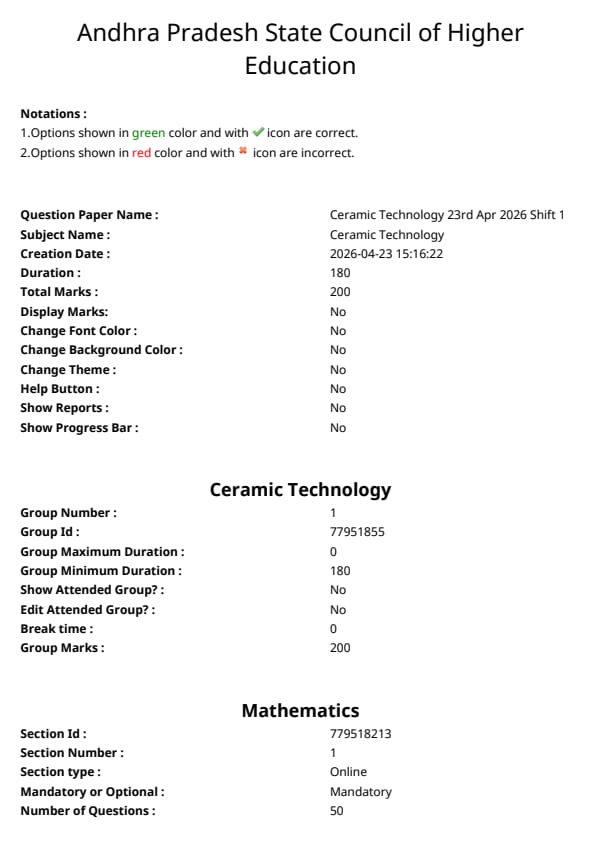
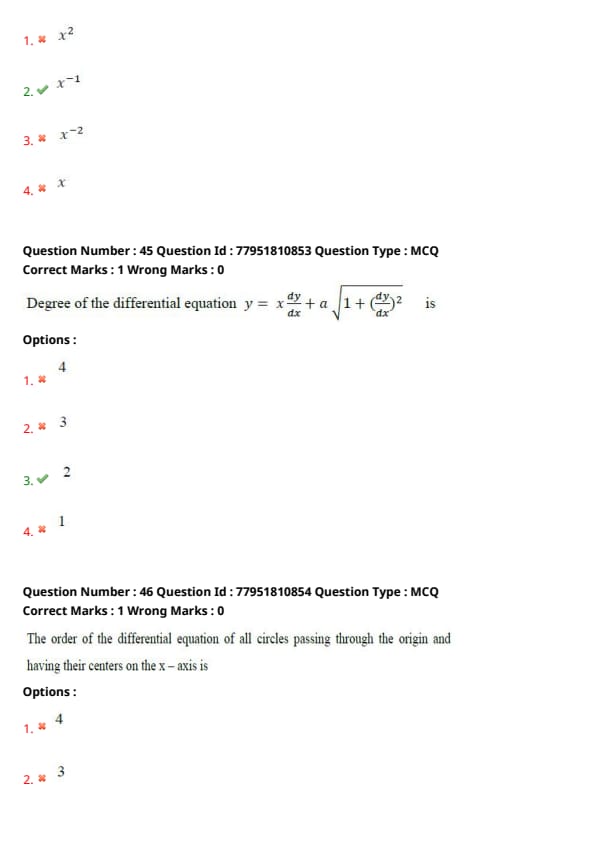
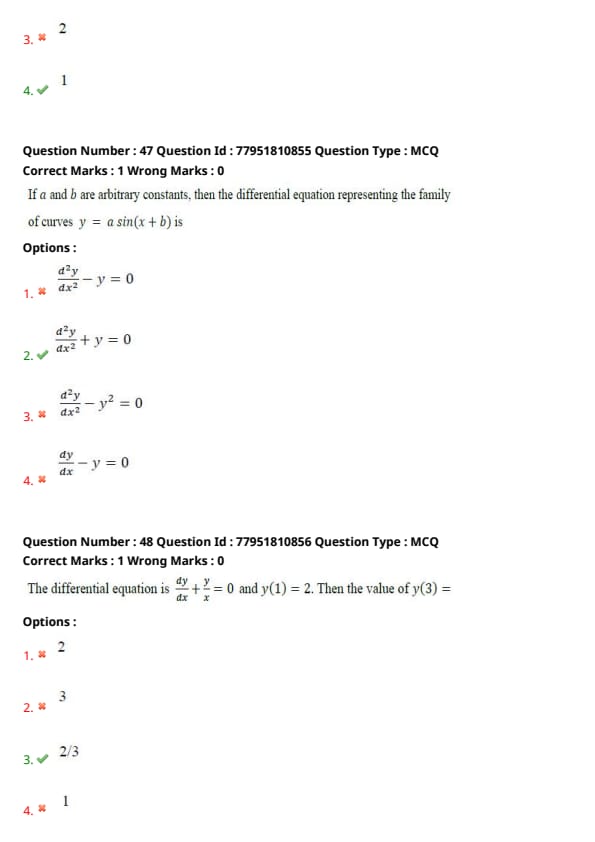
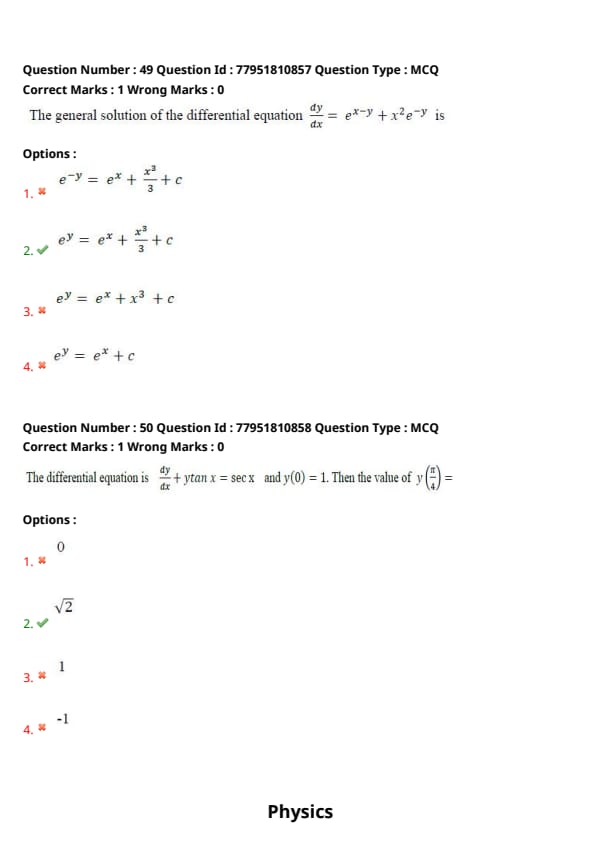
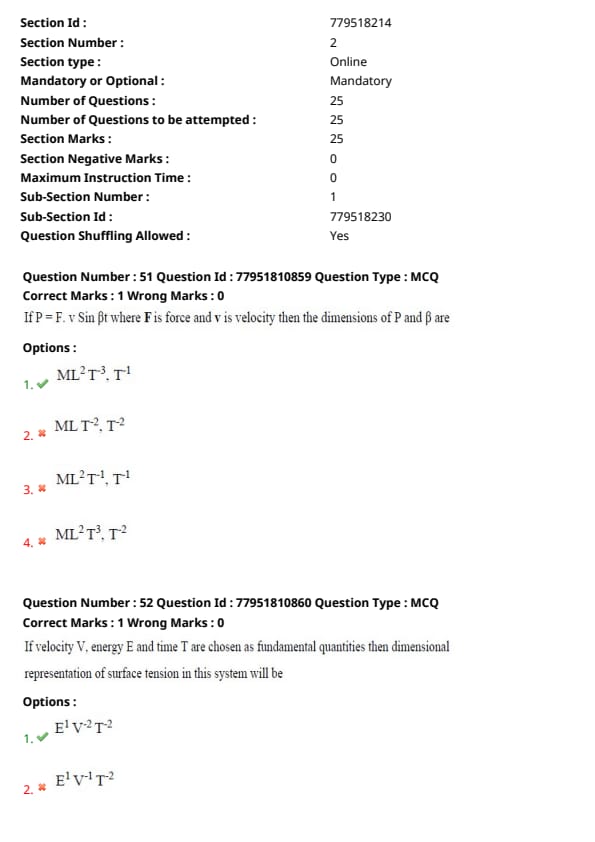
In the matrix \( A = \begin{bmatrix} 1 & 2 & 3
4 & 5 & 6
7 & 4 & 9 \end{bmatrix} \), the minor \( M_{23} \) of the element \( a_{23} \) is
View Solution
Step 1: Understanding the Question:
The objective of this problem is to find the minor \( M_{ij} \) of a specific element in a given \( 3 \times 3 \) square matrix.
In matrix algebra, the minor of an element \( a_{ij} \) is defined as the determinant of the submatrix formed by deleting the \( i \)-th row and the \( j \)-th column in which that element lies.
Here, we are specifically asked for \( M_{23} \), which corresponds to the element in the second row and third column (\( a_{23} = 6 \)).
Step 2: Key Formula or Approach:
To calculate the minor \( M_{23} \):
1. Identify the position of the element \( a_{23} \).
2. Strike out the 2nd row and the 3rd column of the matrix \( A \).
3. Form a \( 2 \times 2 \) determinant from the remaining elements.
4. Calculate the value of this determinant using the formula \( \det\begin{bmatrix} a & b
c & d \end{bmatrix} = ad - bc \).
Step 3: Detailed Explanation:
The given matrix is \( A = \begin{bmatrix} 1 & 2 & 3
4 & 5 & 6
7 & 4 & 9 \end{bmatrix} \).
To find \( M_{23} \), we remove the second row \( [4, 5, 6] \) and the third column \( [3, 6, 9]^T \).
The remaining elements form the submatrix: \( \begin{bmatrix} 1 & 2
7 & 4 \end{bmatrix} \).
Now, we calculate the determinant of this submatrix:
\[ M_{23} = \begin{vmatrix} 1 & 2
7 & 4 \end{vmatrix} \]
Applying the cross-multiplication rule:
\[ M_{23} = (1 \times 4) - (7 \times 2) \]
\[ M_{23} = 4 - 14 \]
\[ M_{23} = -10 \]
Note that a cofactor would involve a sign change based on \( (-1)^{i+j} \), but a minor is simply the value of the determinant itself.
Step 4: Final Answer:
The minor \( M_{23} \) of the element \( a_{23} \) is -10.
Quick Tip: Always remember that a Minor is just the determinant of the remaining submatrix.
A Cofactor \( C_{ij} \) is calculated as \( (-1)^{i+j} \times M_{ij} \).
For \( M_{23} \), the cofactor would be \( (-1)^{2+3} \times (-10) = 10 \).
In exams, double-check if the question asks for the 'Minor' or 'Cofactor' to avoid sign errors.
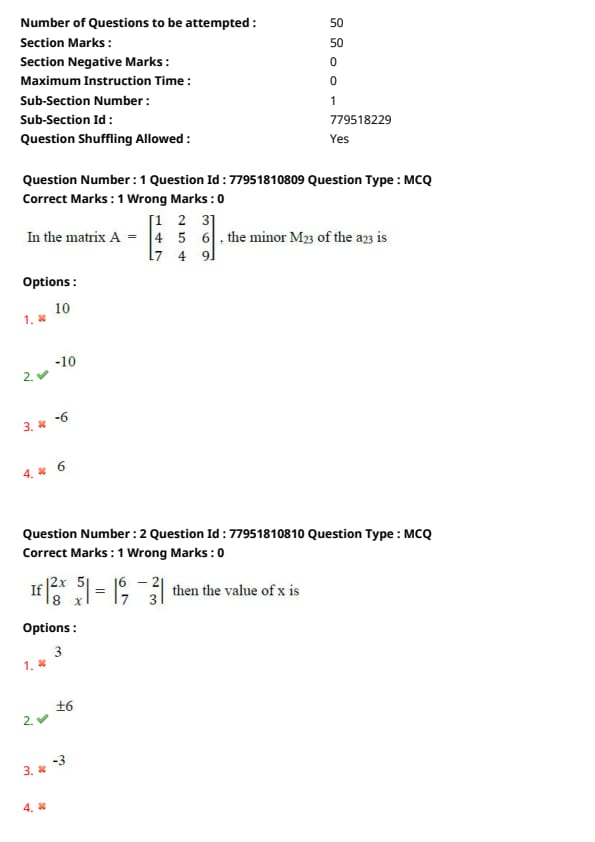
If \( \begin{vmatrix} 2x & 5
8 & x \end{vmatrix} = \begin{vmatrix} 6 & -2
7 & 3 \end{vmatrix} \), then the value of \( x \) is
View Solution
Step 1: Understanding the Question:
This problem requires solving for an unknown variable \( x \) given an equation where two second-order determinants are equal.
Unlike matrices, where corresponding elements are equated, for determinants, we must evaluate the value of each side and then solve the resulting algebraic equation.
Step 2: Key Formula or Approach:
The determinant of a \( 2 \times 2 \) matrix \( \begin{bmatrix} a & b
c & d \end{bmatrix} \) is calculated as \( ad - bc \).
We will expand both the left-hand side (LHS) and the right-hand side (RHS) and set them equal to each other.
Step 3: Detailed Explanation:
Expanding the LHS:
The determinant is \( \begin{vmatrix} 2x & 5
8 & x \end{vmatrix} \).
LHS \( = (2x \cdot x) - (8 \cdot 5) = 2x^2 - 40 \).
Expanding the RHS:
The determinant is \( \begin{vmatrix} 6 & -2
7 & 3 \end{vmatrix} \).
RHS \( = (6 \cdot 3) - (7 \cdot (-2)) = 18 - (-14) = 18 + 14 = 32 \).
Equating LHS and RHS:
\[ 2x^2 - 40 = 32 \]
Solving for x:
Add 40 to both sides:
\[ 2x^2 = 32 + 40 \]
\[ 2x^2 = 72 \]
Divide by 2:
\[ x^2 = 36 \]
Taking the square root of both sides:
\[ x = \pm \sqrt{36} \]
\[ x = \pm 6 \]
Step 4: Final Answer:
The values of \( x \) that satisfy the equation are \( +6 \) and \( -6 \), denoted as \( \pm 6 \).
Quick Tip: Never equate elements directly like \( 2x = 6 \) in determinant problems.
Determinants are scalar values, so you must always simplify the expression to an equation first.
Also, when taking a square root of a variable squared (\( x^2 \)), always include both the positive and negative roots.
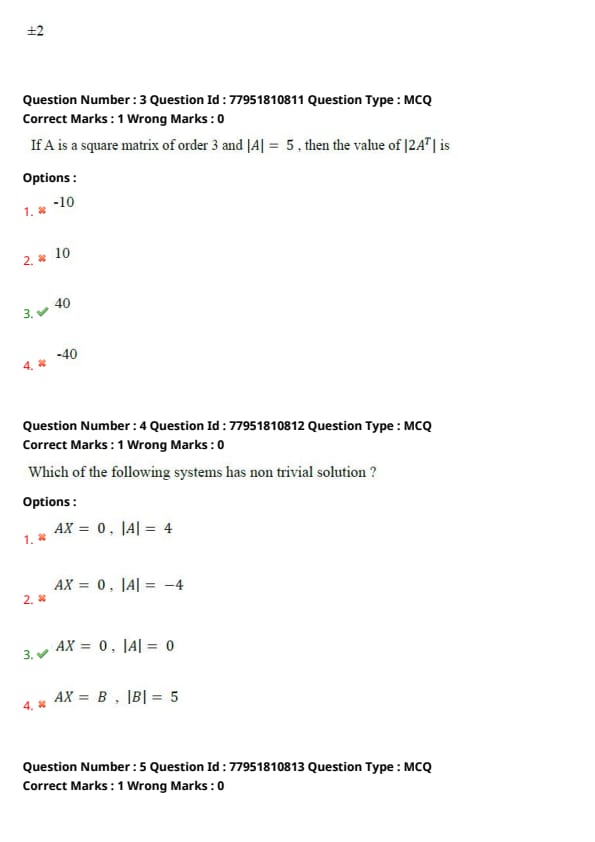
If \( A \) is a square matrix of order 3 and \( |A| = 5 \), then the value of \( |2A^T| \) is
View Solution
Step 1: Understanding the Question:
We are given the determinant of a square matrix \( A \) of order \( n = 3 \) and asked to find the determinant of a scalar multiple of its transpose.
This question tests knowledge of the properties of determinants related to scalar multiplication and matrix transposition.
Step 2: Key Formula or Approach:
We use two fundamental properties of determinants:
1. Property of Transpose: The determinant of a matrix is equal to the determinant of its transpose. \( |A^T| = |A| \).
2. Property of Scalar Multiplication: If \( A \) is an \( n \times n \) matrix and \( k \) is a scalar, then \( |kA| = k^n |A| \).
Step 3: Detailed Explanation:
Given: Order of matrix \( n = 3 \).
Given: \( |A| = 5 \).
We need to find \( |2A^T| \).
Let's treat \( 2A^T \) as a matrix. Using the scalar multiplication property where \( k = 2 \) and the matrix is \( A^T \):
\[ |2A^T| = 2^n |A^T| \]
Since the order \( n \) is 3, we have:
\[ |2A^T| = 2^3 |A^T| \]
Next, we apply the property that transposition does not change the determinant:
\[ |A^T| = |A| = 5 \]
Substituting the values back into our equation:
\[ |2A^T| = 8 \times 5 \]
\[ |2A^T| = 40 \]
Step 4: Final Answer:
The value of \( |2A^T| \) is 40.
Quick Tip: A common mistake is to simply multiply the determinant by the scalar (e.g., \( 2 \times 5 = 10 \)).
Always remember to raise the scalar to the power of the order of the matrix: \( k^n \).
For a \( 2 \times 2 \) matrix, it would be \( 2^2 \), and for a \( 3 \times 3 \) matrix, it is \( 2^3 \).
Which of the following systems has non-trivial solution?
View Solution
Step 1: Understanding the Question:
The question asks to identify the condition under which a system of linear equations has a non-trivial solution.
A system \( AX = 0 \) is called a homogeneous system. It always has at least one solution, \( X = 0 \), which is known as the trivial solution.
Step 2: Key Formula or Approach:
For a homogeneous system of linear equations \( AX = 0 \):
1. If \( |A| \neq 0 \), the system has only the trivial solution (\( X = 0 \)).
2. If \( |A| = 0 \), the system has infinitely many solutions, including non-trivial solutions (solutions where at least one variable is non-zero).
Step 3: Detailed Explanation:
Let's analyze the given options.
Option (A): \( AX = 0, |A| = 4 \). Since the determinant is non-zero, the matrix \( A \) is non-singular. The inverse \( A^{-1} \) exists. Multiplying both sides by \( A^{-1} \) gives \( X = A^{-1}0 = 0 \). Thus, it has only a trivial solution.
Option (B): \( AX = 0, |A| = -4 \). Similar to option A, the determinant is non-zero. The system possesses only the trivial solution.
Option (C): \( AX = 0, |A| = 0 \). Here, the determinant is zero, meaning the matrix \( A \) is singular. In this case, the system has infinitely many solutions, which means non-trivial solutions exist.
Option (D): \( AX = B \) is a non-homogeneous system. The concept of "non-trivial" vs "trivial" is usually discussed in the context of homogeneous systems. Even so, the condition \( |B| = 5 \) is not a standard condition for determining solution types for \( AX = B \).
Step 4: Final Answer:
The condition for a system to have a non-trivial solution is \( AX = 0 \) and \( |A| = 0 \).
Quick Tip: Remember: Homogeneous = \( AX = 0 \).
Unique Solution (Trivial) \( \implies |A| \neq 0 \).
Infinite Solutions (Non-Trivial) \( \implies |A| = 0 \).
This is a very common theoretical question in competitive engineering entrance exams.
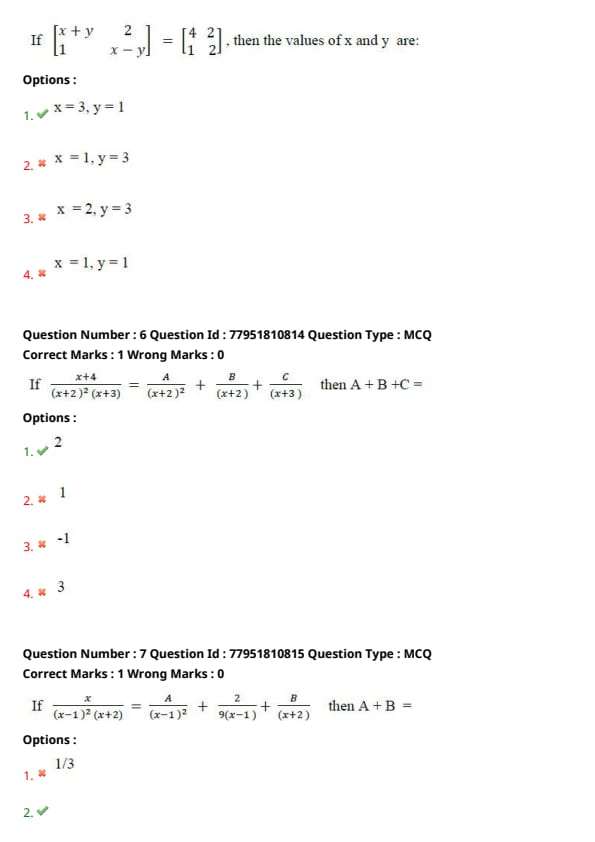
If \( \begin{bmatrix} x+y & 2
1 & x-y \end{bmatrix} = \begin{bmatrix} 4 & 2
1 & 2 \end{bmatrix} \), then the values of \( x \) and \( y \) are:
View Solution
Step 1: Understanding the Question:
This problem involves the equality of two matrices. Two matrices are equal if and only if they have the same order and their corresponding elements are identical.
We are given two \( 2 \times 2 \) matrices and need to solve for the variables \( x \) and \( y \).
Step 2: Key Formula or Approach:
We will equate the corresponding entries of the matrices to form a system of linear equations:
1. \( a_{11} \) of LHS = \( a_{11} \) of RHS.
2. \( a_{22} \) of LHS = \( a_{22} \) of RHS.
Step 3: Detailed Explanation:
From the top-left element:
\[ x + y = 4 \quad \dots (Equation 1) \]
From the bottom-right element:
\[ x - y = 2 \quad \dots (Equation 2) \]
Note that elements \( a_{12} = 2 \) and \( a_{21} = 1 \) are already equal in both matrices, which confirms the matrices are compatible for equality.
To solve the system, we add Equation 1 and Equation 2:
\[ (x + y) + (x - y) = 4 + 2 \]
\[ 2x = 6 \]
\[ x = 3 \]
Now, substitute the value of \( x \) into Equation 1:
\[ 3 + y = 4 \]
\[ y = 4 - 3 \]
\[ y = 1 \]
Step 4: Final Answer:
The values are \( x = 3 \) and \( y = 1 \).
Quick Tip: When dealing with matrix equality, always check all variables.
If you have multiple equations for the same variable, they must yield the same result for the equality to hold.
Adding and subtracting simple linear equations (\( x+y \) and \( x-y \)) is the fastest way to solve for \( x \) and \( y \).
If \( \frac{x+4}{(x+2)^2(x+3)} = \frac{A}{(x+2)^2} + \frac{B}{(x+2)} + \frac{C}{(x+3)} \) then \( A + B + C = \)
View Solution
Step 1: Understanding the Question:
This question involves resolving a proper rational fraction into partial fractions.
The denominator contains a repeated linear factor \( (x+2)^2 \) and a simple linear factor \( (x+3) \).
We need to find the constants \( A, B, \) and \( C \) and calculate their sum.
Step 2: Key Formula or Approach:
Multiply both sides by the common denominator \( (x+2)^2(x+3) \) to obtain the identity:
\[ x + 4 = A(x+3) + B(x+2)(x+3) + C(x+2)^2 \]
We can solve for the constants by substituting specific values for \( x \) or equating coefficients.
Step 3: Detailed Explanation:
Finding A: Let \( x = -2 \).
\[ -2 + 4 = A(-2 + 3) + B(0) + C(0) \]
\[ 2 = A(1) \implies A = 2 \]
Finding C: Let \( x = -3 \).
\[ -3 + 4 = A(0) + B(0) + C(-3 + 2)^2 \]
\[ 1 = C(-1)^2 \implies 1 = C(1) \implies C = 1 \]
Finding B: Let's compare the coefficient of \( x^2 \) on both sides.
On the LHS, the coefficient of \( x^2 \) is 0.
On the RHS, \( x^2 \) terms come from \( B(x^2 + \dots) \) and \( C(x^2 + \dots) \).
\[ 0 = B + C \]
Substitute \( C = 1 \):
\[ 0 = B + 1 \implies B = -1 \]
Calculating A + B + C:
\[ A + B + C = 2 + (-1) + 1 = 2 \]
Step 4: Final Answer:
The value of \( A + B + C \) is 2.
Quick Tip: To find the sum of coefficients in a partial fraction expansion quickly, sometimes you can substitute a value for \( x \).
For example, substituting \( x = 0 \) gives \( \frac{4}{4 \times 3} = \frac{A}{4} + \frac{B}{2} + \frac{C}{3} \).
However, the method of equating coefficients for the highest power (like \( x^2 \) here) is often the most reliable way to find the non-residue constants like \( B \).
If \( \frac{x}{(x-1)^2(x+2)} = \frac{A}{(x-1)^2} + \frac{2}{9(x-1)} + \frac{B}{(x+2)} \) then \( A + B = \)
View Solution
Step 1: Understanding the Question:
This is another partial fraction problem. One of the constants is already given as \( 2/9 \).
We need to determine the values of \( A \) and \( B \) to find their sum.
Step 2: Key Formula or Approach:
Multiply both sides by \( (x-1)^2(x+2) \) to clear the denominator:
\[ x = A(x+2) + \frac{2}{9}(x-1)(x+2) + B(x-1)^2 \]
Step 3: Detailed Explanation:
Solve for A: Let \( x = 1 \).
\[ 1 = A(1+2) + \frac{2}{9}(0) + B(0) \]
\[ 1 = 3A \implies A = \frac{1}{3} \]
Solve for B: Let \( x = -2 \).
\[ -2 = A(0) + \frac{2}{9}(0) + B(-2-1)^2 \]
\[ -2 = B(-3)^2 \]
\[ -2 = 9B \implies B = -\frac{2}{9} \]
Calculate A + B:
\[ A + B = \frac{1}{3} + \left(-\frac{2}{9}\right) \]
To add these, convert to a common denominator of 9:
\[ A + B = \frac{3}{9} - \frac{2}{9} \]
\[ A + B = \frac{1}{9} \]
Step 4: Final Answer:
The value of \( A + B \) is \( 1/9 \).
Quick Tip: When you have terms like \( (x-a)^2 \), substituting \( x=a \) directly gives you the constant above the highest power of that factor.
This "Heaviside cover-up method" is a great time saver for competitive exams like the ECET.
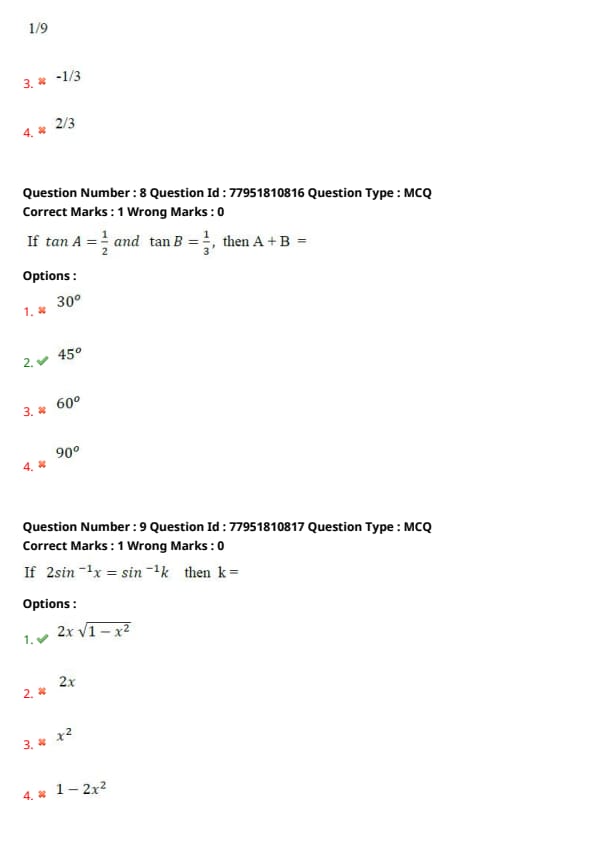
If \( \tan A = \frac{1}{2} \) and \( \tan B = \frac{1}{3} \), then \( A + B = \)
View Solution
Step 1: Understanding the Question:
We are given the tangent values of two angles \( A \) and \( B \) and need to find the sum of the angles \( A + B \).
This is a standard application of the tangent addition formula.
Step 2: Key Formula or Approach:
The formula for the tangent of a sum of two angles is:
\[ \tan(A + B) = \frac{\tan A + \tan B}{1 - \tan A \tan B} \]
Step 3: Detailed Explanation:
Substitute the given values into the formula:
\[ \tan(A + B) = \frac{\frac{1}{2} + \frac{1}{3}}{1 - \left(\frac{1}{2} \cdot \frac{1}{3}\right)} \]
Simplify the numerator:
\[ Numerator = \frac{3 + 2}{6} = \frac{5}{6} \]
Simplify the denominator:
\[ Denominator = 1 - \frac{1}{6} = \frac{6 - 1}{6} = \frac{5}{6} \]
Evaluate the fraction:
\[ \tan(A + B) = \frac{5/6}{5/6} = 1 \]
Find the angle whose tangent is 1:
Since \( \tan 45^\circ = 1 \), we have:
\[ A + B = 45^\circ \]
Step 4: Final Answer:
The sum \( A + B \) is \( 45^\circ \).
Quick Tip: The values \( \tan A = 1/2 \) and \( \tan B = 1/3 \) are common in geometry and trigonometry problems.
Recognizing that their sum leads to \( 45^\circ \) (or \( \pi/4 \) radians) immediately can save you calculation time.
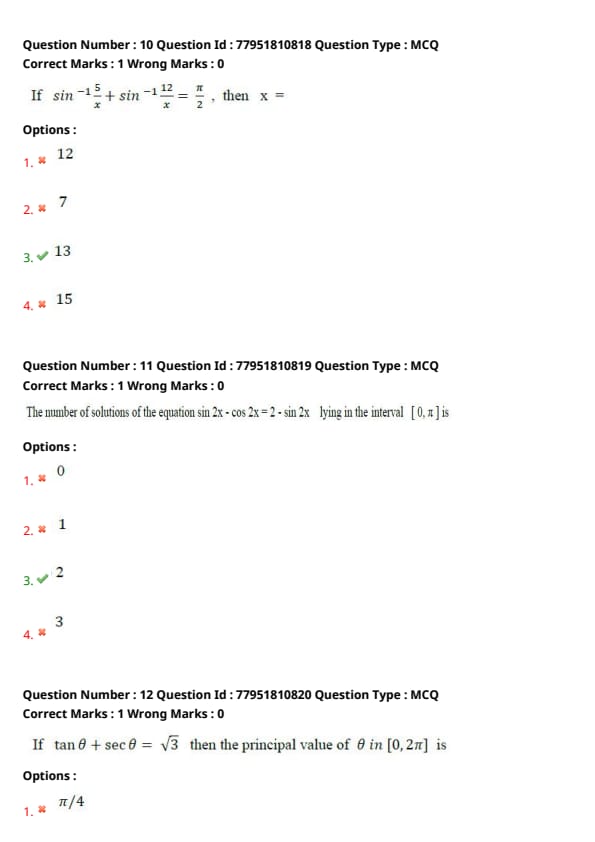
If \( 2\sin^{-1} x = \sin^{-1} k \) then \( k = \)
View Solution
Step 1: Understanding the Question:
This question asks for a standard identity involving inverse trigonometric functions. Specifically, the double angle formula for the sine inverse function.
Step 2: Key Formula or Approach:
Let \( \sin^{-1} x = \theta \). Then \( x = \sin \theta \).
The expression \( 2\sin^{-1} x \) becomes \( 2\theta \).
We use the sine double angle formula: \( \sin(2\theta) = 2 \sin \theta \cos \theta \).
Step 3: Detailed Explanation:
From \( \sin \theta = x \), we can find \( \cos \theta \) using the identity \( \cos \theta = \sqrt{1 - \sin^2 \theta} \).
So, \( \cos \theta = \sqrt{1 - x^2} \).
Now, applying the double angle formula:
\[ \sin(2\theta) = 2x\sqrt{1-x^2} \]
To find \( 2\theta \), we take the inverse sine of both sides:
\[ 2\theta = \sin^{-1}(2x\sqrt{1-x^2}) \]
Substituting back \( \theta = \sin^{-1} x \):
\[ 2\sin^{-1} x = \sin^{-1}(2x\sqrt{1-x^2}) \]
Comparing this with the given equation \( 2\sin^{-1} x = \sin^{-1} k \), we conclude:
\[ k = 2x\sqrt{1-x^2} \]
Step 4: Final Answer:
The value of \( k \) is \( 2x\sqrt{1-x^2} \).
Quick Tip: Memorize basic double-angle inverse formulas:
\( 2\sin^{-1} x = \sin^{-1}(2x\sqrt{1-x^2}) \)
\( 2\cos^{-1} x = \cos^{-1}(2x^2 - 1) \)
\( 2\tan^{-1} x = \tan^{-1}(2x / (1 - x^2)) \)
This will help you solve calculus and trigonometry problems much faster.
If \( \sin^{-1} \frac{5}{x} + \sin^{-1} \frac{12}{x} = \frac{\pi}{2} \), then \( x = \)
View Solution
Step 1: Understanding the Question:
We are given an equation involving the sum of two inverse sine functions equal to \( \pi/2 \).
The goal is to solve for the denominator variable \( x \).
Step 2: Key Formula or Approach:
Use the property: \( \sin^{-1} \theta + \cos^{-1} \theta = \pi/2 \).
This implies that if \( \sin^{-1} A + \sin^{-1} B = \pi/2 \), then \( \sin^{-1} B \) must be equal to \( \cos^{-1} A \).
Step 3: Detailed Explanation:
The given equation is \( \sin^{-1} \frac{5}{x} + \sin^{-1} \frac{12}{x} = \frac{\pi}{2} \).
Rearranging, we get \( \sin^{-1} \frac{5}{x} = \frac{\pi}{2} - \sin^{-1} \frac{12}{x} \).
Using the identity \( \frac{\pi}{2} - \sin^{-1} \theta = \cos^{-1} \theta \), we have:
\[ \sin^{-1} \frac{5}{x} = \cos^{-1} \frac{12}{x} \]
To relate these, convert \( \cos^{-1} \frac{12}{x} \) to a sine inverse function.
Let \( \cos^{-1} \frac{12}{x} = \alpha \implies \cos \alpha = \frac{12}{x} \).
Using a right triangle where base = 12 and hypotenuse = \( x \), the perpendicular is \( \sqrt{x^2 - 12^2} \).
Thus, \( \sin \alpha = \frac{\sqrt{x^2 - 144}}{x} \implies \alpha = \sin^{-1} \frac{\sqrt{x^2 - 144}}{x} \).
Now we can equate the arguments of the sine inverse functions:
\[ \frac{5}{x} = \frac{\sqrt{x^2 - 144}}{x} \]
Canceling \( x \) (assuming \( x \neq 0 \)) and squaring both sides:
\[ 25 = x^2 - 144 \]
\[ x^2 = 144 + 25 \]
\[ x^2 = 169 \]
\[ x = \sqrt{169} = 13 \]
Step 4: Final Answer:
The value of \( x \) is 13.
Quick Tip: Notice that 5, 12, and 13 form a Pythagorean triplet (\( 5^2 + 12^2 = 13^2 \)).
In problems of the form \( \sin^{-1}(a/x) + \sin^{-1}(b/x) = \pi/2 \), the solution is always \( x = \sqrt{a^2 + b^2} \).
The number of solutions of the equation \( \sin 2x - \cos 2x = 2 - \sin 2x \) lying in the interval \( [0, \pi] \) is
View Solution
Step 1: Understanding the Question:
We need to find the count of distinct values of \( x \) within the closed interval \( [0, \pi] \) that satisfy the given trigonometric equation.
Step 2: Key Formula or Approach:
1. Simplify the equation to the form \( a \sin \theta + b \cos \theta = c \).
2. Divide by \( \sqrt{a^2 + b^2} \) to express it as a single sine or cosine function.
3. Determine the range of the argument and count solutions.
Step 3: Detailed Explanation:
Simplify the equation:
\( \sin 2x - \cos 2x = 2 - \sin 2x \)
\( 2\sin 2x - \cos 2x = 2 \)
Here \( a = 2 \), \( b = -1 \). \( \sqrt{a^2 + b^2} = \sqrt{2^2 + (-1)^2} = \sqrt{5} \).
Divide the whole equation by \( \sqrt{5} \):
\[ \frac{2}{\sqrt{5}} \sin 2x - \frac{1}{\sqrt{5}} \cos 2x = \frac{2}{\sqrt{5}} \]
Let \( \cos \alpha = \frac{2}{\sqrt{5}} \) and \( \sin \alpha = \frac{1}{\sqrt{5}} \). Then the equation is:
\[ \sin(2x - \alpha) = \frac{2}{\sqrt{5}} \]
We know \( \frac{2}{\sqrt{5}} \approx 0.894 \). Since \( 0 < 0.894 < 1 \), the sine function can take this value twice in one full rotation (\( 2\pi \)).
Range check: If \( x \in [0, \pi] \), then \( 2x \in [0, 2\pi] \).
The expression \( 2x - \alpha \) roughly spans from \( -\alpha \) to \( 2\pi - \alpha \).
In a interval of length \( 2\pi \), the equation \( \sin \theta = constant \) (where \( |constant| < 1 \)) generally has 2 solutions.
Specifically, \( \sin \theta = \sin \alpha \). The solutions are \( \theta = \alpha \) and \( \theta = \pi - \alpha \).
\( 2x - \alpha = \alpha \implies 2x = 2\alpha \implies x = \alpha \).
\( 2x - \alpha = \pi - \alpha \implies 2x = \pi \implies x = \pi/2 \).
Both \( \alpha \) (which is about \( 26.5^\circ \)) and \( \pi/2 \) (\( 90^\circ \)) are within \( [0, \pi] \).
Step 4: Final Answer:
There are 2 solutions in the given interval.
Quick Tip: When solving \( \sin \theta = k \), remember there are usually two solutions in each period \( (0, 2\pi) \).
Carefully check your interval boundaries. For ECET, sketching a rough sine wave can help visualize the number of intersection points with the line \( y = k \).
If \( \tan \theta + \sec \theta = \sqrt{3} \) then the principal value of \( \theta \) in \( [0, 2\pi] \) is
View Solution
Step 1: Understanding the Question:
This problem asks for the specific angle \( \theta \) in the primary circular range that satisfies the equation \( \tan \theta + \sec \theta = \sqrt{3} \).
Step 2: Key Formula or Approach:
Method 1: Use the identity \( \sec^2 \theta - \tan^2 \theta = 1 \).
Method 2: Convert everything to \( \sin \) and \( \cos \).
Step 3: Detailed Explanation:
Method 1: We have \( \sec \theta + \tan \theta = \sqrt{3} \).
We know \( (\sec \theta - \tan \theta)(\sec \theta + \tan \theta) = 1 \).
Therefore, \( \sec \theta - \tan \theta = \frac{1}{\sqrt{3}} \).
Now, add the two equations:
\[ 2 \sec \theta = \sqrt{3} + \frac{1}{\sqrt{3}} \]
\[ 2 \sec \theta = \frac{3 + 1}{\sqrt{3}} = \frac{4}{\sqrt{3}} \]
\[ \sec \theta = \frac{2}{\sqrt{3}} \implies \cos \theta = \frac{\sqrt{3}}{2} \]
Next, subtract the two equations:
\[ 2 \tan \theta = \sqrt{3} - \frac{1}{\sqrt{3}} \]
\[ 2 \tan \theta = \frac{3 - 1}{\sqrt{3}} = \frac{2}{\sqrt{3}} \]
\[ \tan \theta = \frac{1}{\sqrt{3}} \]
From \( \cos \theta = \frac{\sqrt{3}}{2} \) and \( \tan \theta = \frac{1}{\sqrt{3}} \), the angle in the first quadrant that satisfies both is \( \theta = 30^\circ \) or \( \pi/6 \).
Step 4: Final Answer:
The principal value is \( \pi/6 \).
Quick Tip: Using the identity \( \sec^2 \theta - \tan^2 \theta = 1 \) is usually much faster than converting to sine and cosine for these types of equations.
It allows you to form a system of linear equations in \( \sec \theta \) and \( \tan \theta \) immediately.
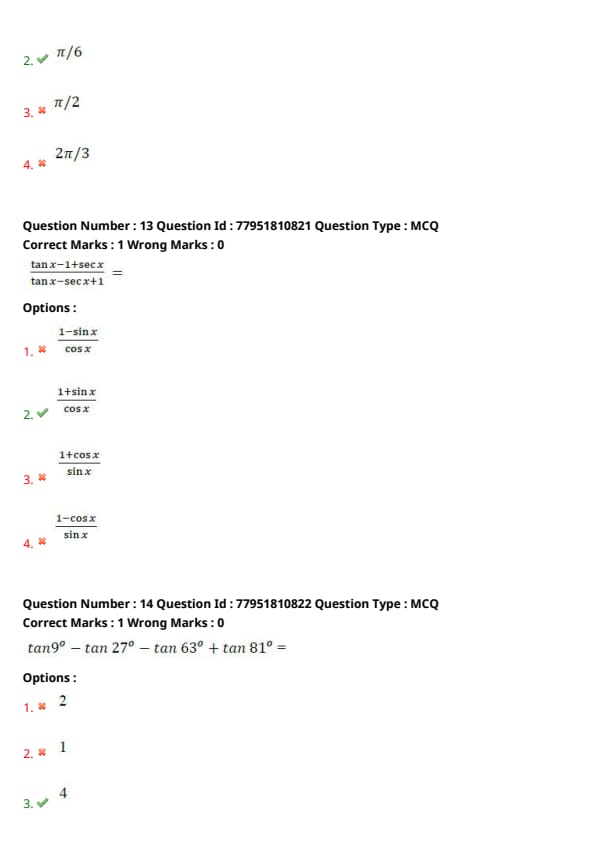
\( \frac{\tan x - 1 + \sec x}{\tan x - \sec x + 1} = \)
View Solution
Step 1: Understanding the Question:
This problem requires simplifying a trigonometric expression containing tangents and secants into a simpler form involving sines and cosines.
Step 2: Key Formula or Approach:
A clever trick for expressions of the form \( \frac{\tan \theta + \sec \theta - 1}{\tan \theta - \sec \theta + 1} \) is to substitute \( 1 = \sec^2 \theta - \tan^2 \theta \) only in the numerator.
Step 3: Detailed Explanation:
Rewrite the numerator as \( (\tan x + \sec x) - 1 \).
Substitute \( 1 = \sec^2 x - \tan^2 x \):
\[ Num = (\tan x + \sec x) - (\sec^2 x - \tan^2 x) \]
Factorize the difference of squares:
\[ Num = (\sec x + \tan x) - [(\sec x - \tan x)(\sec x + \tan x)] \]
Take \( (\sec x + \tan x) \) as a common factor:
\[ Num = (\sec x + \tan x) [1 - (\sec x - \tan x)] \]
\[ Num = (\sec x + \tan x) (1 - \sec x + \tan x) \]
Now look at the denominator: \( \tan x - \sec x + 1 \). This matches the second factor in our numerator exactly!
Divide numerator by denominator:
\[ \frac{(\sec x + \tan x) (1 - \sec x + \tan x)}{1 - \sec x + \tan x} = \sec x + \tan x \]
Convert to sine and cosine:
\[ \sec x + \tan x = \frac{1}{\cos x} + \frac{\sin x}{\cos x} = \frac{1 + \sin x}{\cos x} \]
Step 4: Final Answer:
The expression simplifies to \( \frac{1 + \sin x}{\cos x} \).
Quick Tip: This is a "classic" identity. Whenever you see \( \tan x, \sec x \) and \( 1 \) arranged in this way, the answer is usually either \( \sec x + \tan x \) or its reciprocal.
Try to remember the pattern: \( \frac{T + S - 1}{T - S + 1} = S + T \).
\( \tan 9^\circ - \tan 27^\circ - \tan 63^\circ + \tan 81^\circ = \)
View Solution
Step 1: Understanding the Question:
We need to evaluate a numerical trigonometric expression. Notice the relationship between the angles: \( 9 + 81 = 90 \) and \( 27 + 63 = 90 \). These are complementary angles.
Step 2: Key Formula or Approach:
1. Use complementary angle identities: \( \tan(90 - \theta) = \cot \theta \).
2. Use the identity \( \tan \theta + \cot \theta = \frac{2}{\sin 2\theta} \).
Step 3: Detailed Explanation:
Group the terms:
\( (\tan 9^\circ + \tan 81^\circ) - (\tan 27^\circ + \tan 63^\circ) \)
Apply complementarity:
\( \tan 81^\circ = \cot 9^\circ \) and \( \tan 63^\circ = \cot 27^\circ \)
The expression becomes:
\( (\tan 9^\circ + \cot 9^\circ) - (\tan 27^\circ + \cot 27^\circ) \)
Using \( \tan \theta + \cot \theta = \frac{\sin \theta}{\cos \theta} + \frac{\cos \theta}{\sin \theta} = \frac{\sin^2 \theta + \cos^2 \theta}{\sin \theta \cos \theta} = \frac{1}{\sin \theta \cos \theta} = \frac{2}{\sin 2\theta} \):
\[ \frac{2}{\sin 18^\circ} - \frac{2}{\sin 54^\circ} \]
We know specific values: \( \sin 18^\circ = \frac{\sqrt{5}-1}{4} \) and \( \sin 54^\circ = \cos 36^\circ = \frac{\sqrt{5}+1}{4} \).
Substitute these:
\[ \frac{2}{(\sqrt{5}-1)/4} - \frac{2}{(\sqrt{5}+1)/4} = \frac{8}{\sqrt{5}-1} - \frac{8}{\sqrt{5}+1} \]
Take 8 as common and rationalize:
\[ 8 \left( \frac{(\sqrt{5}+1) - (\sqrt{5}-1)}{(\sqrt{5}-1)(\sqrt{5}+1)} \right) = 8 \left( \frac{2}{5-1} \right) = 8 \left( \frac{2}{4} \right) = 4 \]
Step 4: Final Answer:
The numerical value of the expression is 4.
Quick Tip: Remembering the values of \( \sin 18^\circ \) and \( \cos 36^\circ \) is extremely helpful for many difficult trigonometry problems in competitive exams.
A good way to remember is: \( \sin 18^\circ = (root 5 minus 1) / 4 \) and \( \cos 36^\circ = (root 5 plus 1) / 4 \).
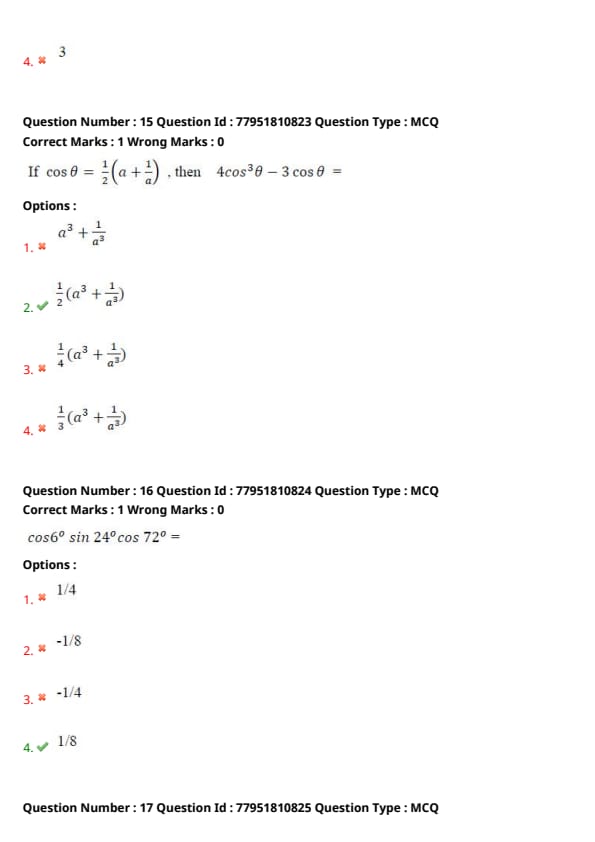
If \( \cos \theta = \frac{1}{2}\left(a + \frac{1}{a}\right) \), then \( 4\cos^3 \theta - 3\cos \theta = \)
View Solution
Step 1: Understanding the Question:
The question asks to find the value of a specific cubic expression in \( \cos \theta \) given an expression for \( \cos \theta \) in terms of a variable \( a \).
Step 2: Key Formula or Approach:
1. Identify the cubic expression as the triple angle formula: \( \cos 3\theta = 4\cos^3 \theta - 3\cos \theta \).
2. Use De Moivre's Theorem concepts where \( \cos \theta = \frac{e^{i\theta} + e^{-i\theta}}{2} \).
Step 3: Detailed Explanation:
Let's associate the variable \( a \) with the complex exponential \( e^{i\theta} \).
If \( a = e^{i\theta} \), then \( \frac{1}{a} = e^{-i\theta} \).
Then \( \frac{1}{2}(a + 1/a) = \frac{e^{i\theta} + e^{-i\theta}}{2} \), which is exactly the definition of \( \cos \theta \).
We need to find \( \cos 3\theta \).
Using the same logic, if \( a = e^{i\theta} \), then \( a^3 = (e^{i\theta})^3 = e^{i3\theta} \) and \( \frac{1}{a^3} = e^{-i3\theta} \).
By definition, \( \cos 3\theta = \frac{e^{i3\theta} + e^{-i3\theta}}{2} \).
Substituting the terms of \( a \):
\[ \cos 3\theta = \frac{1}{2}\left(a^3 + \frac{1}{a^3}\right) \]
Since \( \cos 3\theta = 4\cos^3 \theta - 3\cos \theta \), the answer is:
\[ \frac{1}{2}\left(a^3 + \frac{1}{a^3}\right) \]
Step 4: Final Answer:
The result of the expression is \( \frac{1}{2}\left(a^3 + \frac{1}{a^3}\right) \).
Quick Tip: The relationship \( \cos n\theta = \frac{1}{2}(a^n + 1/a^n) \) when \( \cos \theta = \frac{1}{2}(a + 1/a) \) is a general property derived from De Moivre's theorem.
This pattern holds for any integer \( n \). It simplifies many complex trigonometric problems.
\( \cos 6^\circ \sin 24^\circ \cos 72^\circ = \)
View Solution
Step 1: Understanding the Question:
We are asked to find the product of three trigonometric values at specific angles.
Step 2: Key Formula or Approach:
1. Use product-to-sum identities: \( 2 \sin A \cos B = \sin(A+B) + \sin(A-B) \).
2. Recognize complementary relationships like \( \cos 72^\circ = \sin 18^\circ \).
Step 3: Detailed Explanation:
First, convert \( \cos 72^\circ \) to \( \sin 18^\circ \). The expression is \( \cos 6^\circ \sin 24^\circ \sin 18^\circ \).
Focus on \( \cos 6^\circ \sin 24^\circ \):
\[ \cos 6^\circ \sin 24^\circ = \frac{1}{2} [ \sin(24 + 6) + \sin(24 - 6) ] = \frac{1}{2} [ \sin 30^\circ + \sin 18^\circ ] \]
Substitute \( \sin 30^\circ = 1/2 \):
\[ \frac{1}{2} [ 1/2 + \sin 18^\circ ] = \frac{1}{4} + \frac{1}{2} \sin 18^\circ \]
Now multiply by the remaining factor \( \sin 18^\circ \):
\[ \left(\frac{1}{4} + \frac{1}{2} \sin 18^\circ\right) \sin 18^\circ = \frac{1}{4} \sin 18^\circ + \frac{1}{2} \sin^2 18^\circ \]
Recall \( \sin 18^\circ = \frac{\sqrt{5}-1}{4} \). Then \( \sin^2 18^\circ = \frac{5 + 1 - 2\sqrt{5}}{16} = \frac{6 - 2\sqrt{5}}{16} = \frac{3 - \sqrt{5}}{8} \).
Plug these in:
\[ \frac{1}{4} \left(\frac{\sqrt{5}-1}{4}\right) + \frac{1}{2} \left(\frac{3-\sqrt{5}}{8}\right) = \frac{\sqrt{5}-1}{16} + \frac{3-\sqrt{5}}{16} \]
Add the fractions:
\[ \frac{\sqrt{5} - 1 + 3 - \sqrt{5}}{16} = \frac{2}{16} = \frac{1}{8} \]
Step 4: Final Answer:
The value is 1/8.
Quick Tip: Look for angles like \( 18^\circ, 36^\circ, 54^\circ, 72^\circ \).
They almost always hint that the solution will involve the golden ratio values \( \frac{\sqrt{5} \pm 1}{4} \).
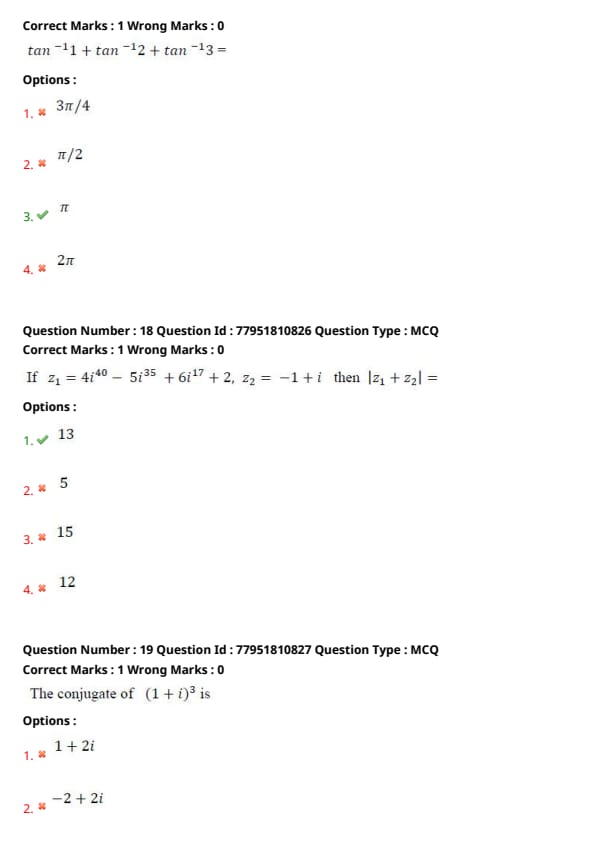
\( \tan^{-1} 1 + \tan^{-1} 2 + \tan^{-1} 3 = \)
View Solution
Step 1: Understanding the Question:
We need to sum three inverse tangent values. This is a common property problem in inverse trigonometry.
Step 2: Key Formula or Approach:
The addition formula for \( \tan^{-1} x + \tan^{-1} y \):
1. If \( xy < 1 \): \( \tan^{-1} x + \tan^{-1} y = \tan^{-1}(\frac{x+y}{1-xy}) \).
2. If \( xy > 1 \) and \( x, y > 0 \): \( \tan^{-1} x + \tan^{-1} y = \pi + \tan^{-1}(\frac{x+y}{1-xy}) \).
Step 3: Detailed Explanation:
We know \( \tan^{-1} 1 = \pi/4 \).
Now consider \( \tan^{-1} 2 + \tan^{-1} 3 \).
Here \( x = 2 \) and \( y = 3 \). Product \( xy = 6 \), which is \( > 1 \).
Apply the second case of the addition formula:
\[ \tan^{-1} 2 + \tan^{-1} 3 = \pi + \tan^{-1}\left(\frac{2+3}{1-2(3)}\right) \]
\[ = \pi + \tan^{-1}\left(\frac{5}{-5}\right) = \pi + \tan^{-1}(-1) \]
Since \( \tan^{-1}(-1) = -\pi/4 \):
\[ \tan^{-1} 2 + \tan^{-1} 3 = \pi - \frac{\pi}{4} = \frac{3\pi}{4} \]
Finally, sum all three terms:
\[ \tan^{-1} 1 + (\tan^{-1} 2 + \tan^{-1} 3) = \frac{\pi}{4} + \frac{3\pi}{4} = \frac{4\pi}{4} = \pi \]
Step 4: Final Answer:
The sum is \( \pi \).
Quick Tip: Be careful with the \( xy > 1 \) condition in the inverse tangent addition formula.
A common mistake is to get 0 or \( \tan^{-1}(0) \) without the \( \pi \) shift.
Geometrically, \( \tan^{-1} 1 = 45^\circ \), \( \tan^{-1} 2 \approx 63.4^\circ \), and \( \tan^{-1} 3 \approx 71.6^\circ \). Summing these clearly exceeds \( 90^\circ \), so the answer must be \( 180^\circ \) (\( \pi \)).
If \( z_1 = 4i^{40} - 5i^{35} + 6i^{17} + 2 \), \( z_2 = -1 + i \) then \( |z_1 + z_2| = \)
View Solution
Step 1: Understanding the Question:
This question involves simplifying powers of the imaginary unit \( i \) to find the complex number \( z_1 \), then adding it to \( z_2 \), and finally calculating the modulus of the result.
Step 2: Key Formula or Approach:
1. Remember that \( i^1 = i, i^2 = -1, i^3 = -i, i^4 = 1 \).
2. Any \( i^n \) where \( n \) is a multiple of 4 is 1. Divide high powers by 4 to find the remainder.
3. Modulus \( |x + iy| = \sqrt{x^2 + y^2} \).
Step 3: Detailed Explanation:
Simplify \( z_1 \):
\( i^{40} = (i^4)^{10} = 1^{10} = 1 \).
\( i^{35} = (i^4)^8 \cdot i^3 = 1 \cdot (-i) = -i \).
\( i^{17} = (i^4)^4 \cdot i = 1 \cdot i = i \).
Substitute back into \( z_1 \):
\( z_1 = 4(1) - 5(-i) + 6(i) + 2 \)
\( z_1 = 4 + 5i + 6i + 2 = 6 + 11i \).
Now add \( z_1 \) and \( z_2 \):
\( z_1 + z_2 = (6 + 11i) + (-1 + i) \)
\( z_1 + z_2 = (6 - 1) + (11 + 1)i = 5 + 12i \).
Calculate the modulus:
\( |z_1 + z_2| = \sqrt{5^2 + 12^2} = \sqrt{25 + 144} = \sqrt{169} = 13 \).
Step 4: Final Answer:
The value of \( |z_1 + z_2| \) is 13.
Quick Tip: To simplify \( i^n \), look at the last two digits of \( n \). If they are divisible by 4, the result is 1.
If the last two digits give a remainder of 1, 2, or 3 when divided by 4, the result is \( i, -1, \) or \( -i \) respectively.
The modulus of \( 5 + 12i \) is a standard Pythagorean triple calculation.
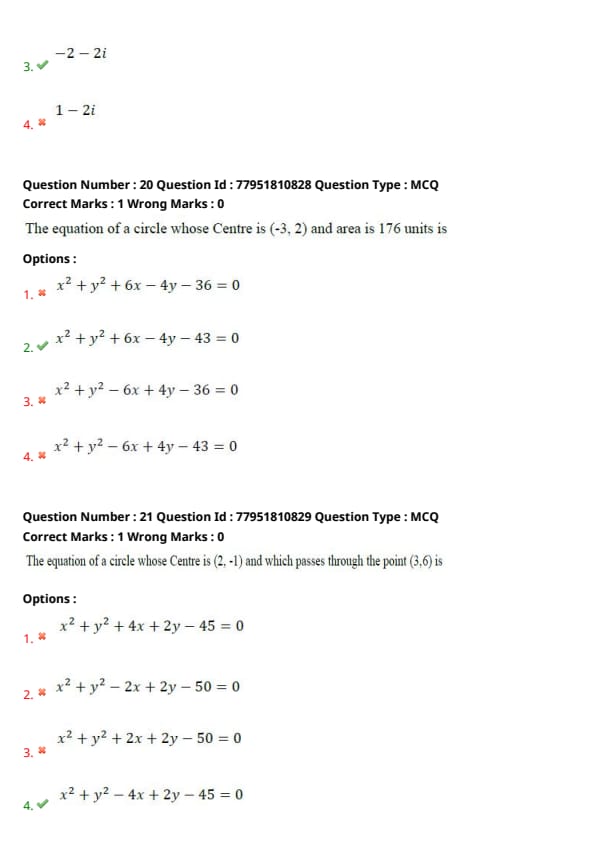
The conjugate of \( (1 + i)^3 \) is
View Solution
Step 1: Understanding the Question:
The goal is to find the conjugate of a complex number raised to the third power. We can either compute the power first then conjugate, or conjugate first then compute the power.
Step 2: Key Formula or Approach:
1. Binomial expansion: \( (a+b)^3 = a^3 + 3a^2b + 3ab^2 + b^3 \).
2. Conjugate property: \( \overline{z^n} = (\overline{z})^n \).
Step 3: Detailed Explanation:
Let \( z = (1 + i)^3 \).
First, expand \( (1 + i)^3 \):
\( (1 + i)^3 = 1^3 + 3(1^2)(i) + 3(1)(i^2) + i^3 \)
\( = 1 + 3i + 3(-1) + (-i) \)
\( = 1 + 3i - 3 - i \)
\( = -2 + 2i \).
Now, find the conjugate \( \overline{z} \).
The conjugate of \( a + bi \) is \( a - bi \).
Therefore, the conjugate of \( -2 + 2i \) is \( -2 - 2i \).
Step 4: Final Answer:
The conjugate is \( -2 - 2i \).
Quick Tip: Useful shortcut: \( (1 + i)^2 = 2i \).
So, \( (1 + i)^3 = (1 + i)^2 (1 + i) = 2i(1 + i) = 2i - 2 = -2 + 2i \).
This is often faster than the full binomial expansion.
The equation of a circle whose Centre is (-3, 2) and area is 176 units is
View Solution
Step 1: Understanding the Question:
We need to find the general equation of a circle given its center coordinates and its area.
Step 2: Key Formula or Approach:
1. Area of circle \( A = \pi r^2 \). Use \( \pi \approx 22/7 \).
2. Standard equation of circle: \( (x - h)^2 + (y - k)^2 = r^2 \), where \( (h, k) \) is the center.
3. General form: \( x^2 + y^2 + 2gx + 2fy + c = 0 \).
Step 3: Detailed Explanation:
Step 3.1: Find the radius squared (\( r^2 \)):
Area = 176.
\( \frac{22}{7} \times r^2 = 176 \)
\( r^2 = 176 \times \frac{7}{22} \)
\( r^2 = 8 \times 7 = 56 \).
Step 3.2: Use the center-radius form:
Center \( (h, k) = (-3, 2) \).
Equation: \( (x - (-3))^2 + (y - 2)^2 = 56 \)
\( (x + 3)^2 + (y - 2)^2 = 56 \)
Step 3.3: Expand to general form:
\( (x^2 + 6x + 9) + (y^2 - 4y + 4) = 56 \)
\( x^2 + y^2 + 6x - 4y + 13 = 56 \)
\( x^2 + y^2 + 6x - 4y + 13 - 56 = 0 \)
\( x^2 + y^2 + 6x - 4y - 43 = 0 \).
Step 4: Final Answer:
The equation of the circle is \( x^2 + y^2 + 6x - 4y - 43 = 0 \).
Quick Tip: If the center is \( (h, k) \), the terms in the general equation will be \( -2h x \) and \( -2k y \).
For center \( (-3, 2) \), terms must be \( -2(-3)x = +6x \) and \( -2(2)y = -4y \).
Looking at the options, only (A) and (B) have \( +6x - 4y \). You can then just check the constant term by calculating \( h^2 + k^2 - r^2 \).
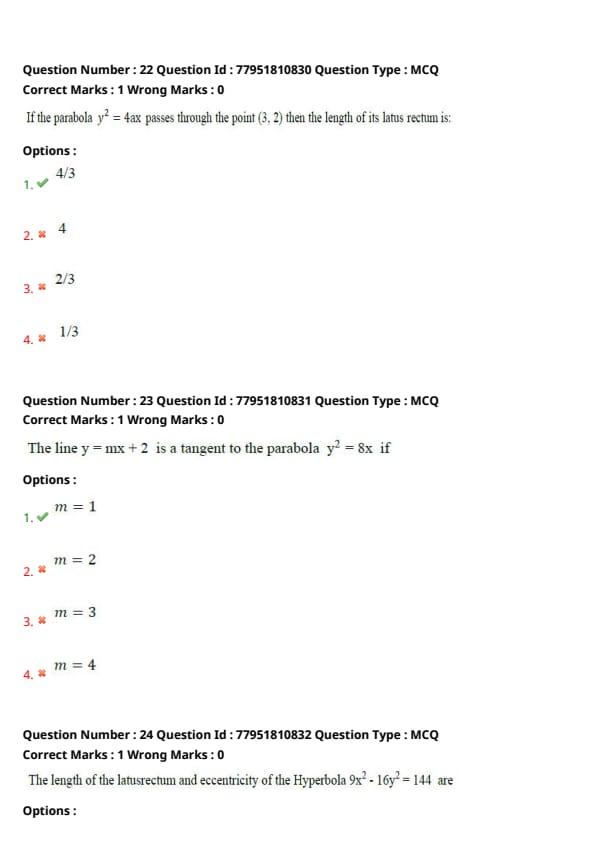
The equation of a circle whose Centre is (2, -1) and which passes through the point (3,6) is
View Solution
Step 1: Understanding the Question:
The objective of this problem is to determine the general equation of a circle given its center and one point lying on its circumference.
A circle is defined by its center \( (h, k) \) and its radius \( r \).
The radius is the distance from the center to any point on the boundary of the circle.
Once we have both the center and the radius, we can write the equation in central form and then expand it into the general form \( x^2 + y^2 + 2gx + 2fy + c = 0 \).
Step 2: Key Formula or Approach:
1. Use the distance formula to find the radius \( r \): \( r = \sqrt{(x_2 - x_1)^2 + (y_2 - y_1)^2} \).
2. Use the standard form of the circle equation: \( (x - h)^2 + (y - k)^2 = r^2 \).
3. Expand and rearrange the equation to the general form.
Step 3: Detailed Explanation:
Calculating the radius squared (\( r^2 \)):
The center is given as \( (h, k) = (2, -1) \) and the circle passes through \( (3, 6) \).
By applying the distance formula between these two points:
\[ r^2 = (3 - 2)^2 + (6 - (-1))^2 \]
\[ r^2 = (1)^2 + (7)^2 \]
\[ r^2 = 1 + 49 = 50 \]
Writing the equation in standard form:
Substituting the center \( (2, -1) \) and \( r^2 = 50 \) into the equation \( (x - h)^2 + (y - k)^2 = r^2 \):
\[ (x - 2)^2 + (y - (-1))^2 = 50 \]
\[ (x - 2)^2 + (y + 1)^2 = 50 \]
Expanding the equation:
Applying algebraic identities \( (a-b)^2 = a^2 - 2ab + b^2 \) and \( (a+b)^2 = a^2 + 2ab + b^2 \):
\[ (x^2 - 4x + 4) + (y^2 + 2y + 1) = 50 \]
\[ x^2 + y^2 - 4x + 2y + 5 = 50 \]
\[ x^2 + y^2 - 4x + 2y + 5 - 50 = 0 \]
\[ x^2 + y^2 - 4x + 2y - 45 = 0 \]
Comparing this with the given options, we see that it matches Option (D) exactly.
Step 4: Final Answer:
The final equation of the circle is \( x^2 + y^2 - 4x + 2y - 45 = 0 \).
Quick Tip: If the center is \( (h, k) \), the general equation will have terms \( -2hx \) and \( -2ky \).
For center \( (2, -1) \), we look for \( -4x + 2y \). This immediately eliminates options (B) and (C).
Simply plugging the coordinates of the point \( (3, 6) \) into the remaining options is a fast way to verify the answer.
If the parabola \( y^2 = 4ax \) passes through the point (3, 2) then the length of its latus rectum is:
View Solution
Step 1: Understanding the Question:
A parabola is defined as the set of points equidistant from a fixed point (focus) and a fixed line (directrix).
The standard equation \( y^2 = 4ax \) represents a parabola opening to the right with its vertex at the origin.
The "length of the latus rectum" is a standard property of parabolas and is numerically equal to the coefficient \( 4a \) in the standard equation.
Our goal is to find this value \( 4a \) by using a given point on the curve.
Step 2: Key Formula or Approach:
1. Substitute the coordinates of the point \( (x, y) = (3, 2) \) into the parabola equation \( y^2 = 4ax \).
2. Solve the resulting linear equation for the parameter \( a \).
3. Calculate the length of the latus rectum, which is defined as \( LR = 4a \).
Step 3: Detailed Explanation:
The point \( (3, 2) \) lies on the parabola \( y^2 = 4ax \).
This means when we set \( x = 3 \) and \( y = 2 \), the equation must hold true.
Substituting these values into the equation:
\[ (2)^2 = 4a(3) \]
\[ 4 = 12a \]
We can solve for \( a \) by dividing both sides by 12:
\[ a = \frac{4}{12} = \frac{1}{3} \]
The question asks for the length of the latus rectum.
By definition, for the parabola \( y^2 = 4ax \), the length of the latus rectum is the absolute value of the coefficient \( 4a \).
\[ Length of Latus Rectum = 4 \times \left(\frac{1}{3}\right) = \frac{4}{3} \]
Thus, the constant parameter \( a \) is \( 1/3 \) and the characteristic length of the chord passing through the focus is \( 4/3 \).
Step 4: Final Answer:
The length of the latus rectum is 4/3.
Quick Tip: Always remember that for a parabola in standard form \( y^2 = 4ax \) or \( x^2 = 4ay \), the coefficient of the linear term is directly the length of the latus rectum.
You don't necessarily need to solve for 'a' individually; you can solve for the whole group '4a' in one step.
Here, \( 4a \cdot 3 = 4 \implies 4a = 4/3 \). This saves one step in calculations.
The line \( y = mx + 2 \) is a tangent to the parabola \( y^2 = 8x \) if
View Solution
Step 1: Understanding the Question:
Tangency occurs when a line touches a curve at exactly one point.
In coordinate geometry, there are specific algebraic conditions that relate the slope and intercept of a line to the parameters of a conic section for tangency to occur.
We are given a linear equation \( y = mx + 2 \) and a parabola \( y^2 = 8x \) and need to find the specific value of \( m \) that satisfies this condition.
Step 2: Key Formula or Approach:
1. For the standard parabola \( y^2 = 4ax \), the condition for a line \( y = mx + c \) to be a tangent is given by the formula: \( c = \frac{a}{m} \).
2. First, identify the parameter \( a \) from the parabola's equation.
3. Then, identify \( c \) from the line's equation and solve for \( m \).
Step 3: Detailed Explanation:
Identify the parameters:
The given parabola is \( y^2 = 8x \).
Comparing this with \( y^2 = 4ax \), we have \( 4a = 8 \), which implies \( a = 2 \).
The given line is \( y = mx + 2 \).
Comparing this with \( y = mx + c \), we find that the y-intercept is \( c = 2 \).
Applying the condition of tangency:
Substitute \( a = 2 \) and \( c = 2 \) into the condition \( c = \frac{a}{m} \):
\[ 2 = \frac{2}{m} \]
Solving for m:
Cross-multiplying gives:
\[ 2m = 2 \]
\[ m = 1 \]
Verification:
If \( m = 1 \), the line is \( y = x + 2 \).
Substituting into the parabola: \( (x+2)^2 = 8x \implies x^2 + 4x + 4 = 8x \implies x^2 - 4x + 4 = 0 \).
Since this is a perfect square \( (x-2)^2 = 0 \), there is only one point of intersection (\( x=2, y=4 \)), which confirms the line is a tangent.
Step 4: Final Answer:
The condition for tangency is met when \( m = 1 \).
Quick Tip: Memorize tangency conditions for all standard conics:
For \( y^2 = 4ax \), it is \( c = a/m \).
For \( x^2 + y^2 = r^2 \), it is \( c^2 = r^2(1 + m^2) \).
For \( \frac{x^2}{a^2} + \frac{y^2}{b^2} = 1 \), it is \( c^2 = a^2m^2 + b^2 \).
These formulas help avoid solving quadratic equations during the exam.
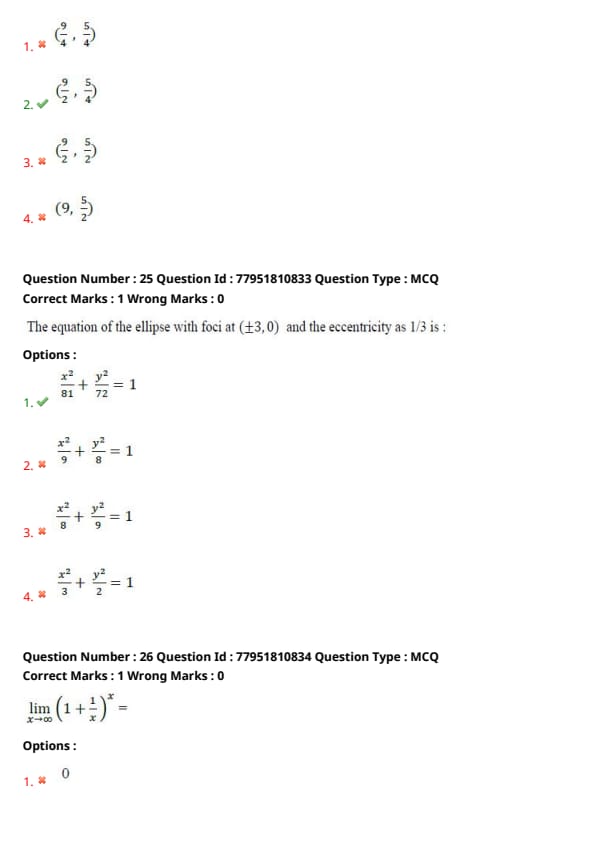
The length of the latusrectum and eccentricity of the Hyperbola \( 9x^2 - 16y^2 = 144 \) are
View Solution
Step 1: Understanding the Question:
A hyperbola is a conic section with an eccentricity greater than 1.
To find its properties, we must first convert its equation into the standard intercept form \( \frac{x^2}{a^2} - \frac{y^2}{b^2} = 1 \).
From the standard form, we can identify the semi-transverse axis \( a \) and the semi-conjugate axis \( b \), which are used to calculate the latus rectum and eccentricity.
Step 2: Key Formula or Approach:
1. Standard form: \( \frac{x^2}{a^2} - \frac{y^2}{b^2} = 1 \).
2. Eccentricity formula: \( e = \sqrt{1 + \frac{b^2}{a^2}} \).
3. Length of Latus Rectum (\( LR \)): \( LR = \frac{2b^2}{a} \).
Step 3: Detailed Explanation:
Step 3.1: Converting to standard form:
Divide the entire equation \( 9x^2 - 16y^2 = 144 \) by 144:
\[ \frac{9x^2}{144} - \frac{16y^2}{144} = \frac{144}{144} \]
\[ \frac{x^2}{16} - \frac{y^2}{9} = 1 \]
Comparing this with \( \frac{x^2}{a^2} - \frac{y^2}{b^2} = 1 \), we get:
\( a^2 = 16 \implies a = 4 \)
\( b^2 = 9 \implies b = 3 \)
Step 3.2: Calculating eccentricity (\( e \)):
\[ e = \sqrt{1 + \frac{b^2}{a^2}} = \sqrt{1 + \frac{9}{16}} \]
\[ e = \sqrt{\frac{16 + 9}{16}} = \sqrt{\frac{25}{16}} = \frac{5}{4} \]
Step 3.3: Calculating Length of Latus Rectum (\( LR \)):
\[ LR = \frac{2b^2}{a} = \frac{2(9)}{4} \]
\[ LR = \frac{18}{4} = \frac{9}{2} \]
The pair of values is \( (LR, e) = (9/2, 5/4) \).
Step 4: Final Answer:
The length of the latus rectum is \( 9/2 \) and the eccentricity is \( 5/4 \).
Quick Tip: For a horizontal hyperbola, \( e > 1 \). In the options, all eccentricities are \( > 1 \).
A quick check: the product \( a^2 \cdot e^2 = a^2 + b^2 \).
Here, \( 16 \cdot (25/16) = 25 \), and \( a^2 + b^2 = 16 + 9 = 25 \). This confirms the eccentricity is correct.
Using mental math to divide by the RHS constant is the fastest way to start.
The equation of the ellipse with foci at (\( \pm 3, 0 \)) and the eccentricity as 1/3 is :
View Solution
Step 1: Understanding the Question:
An ellipse is a closed curve where the sum of distances from any point on the curve to two fixed points (foci) is constant.
Foci located at \( (\pm 3, 0) \) indicate that the ellipse is centered at the origin and its major axis lies along the x-axis.
Our goal is to find the values of \( a^2 \) and \( b^2 \) for the standard equation \( \frac{x^2}{a^2} + \frac{y^2}{b^2} = 1 \) using the given focus coordinates and eccentricity.
Step 2: Key Formula or Approach:
1. Coordinates of foci for a horizontal ellipse: \( (\pm ae, 0) \).
2. Relation between axes and eccentricity: \( b^2 = a^2(1 - e^2) \).
3. Given: \( ae = 3 \) and \( e = 1/3 \).
Step 3: Detailed Explanation:
Step 3.1: Finding 'a':
We know that the distance of each focus from the center is \( ae \).
\[ ae = 3 \]
Substitute the given value of \( e = 1/3 \):
\[ a \times \frac{1}{3} = 3 \]
\[ a = 3 \times 3 = 9 \]
Thus, \( a^2 = 9^2 = 81 \).
Step 3.2: Finding 'b\(^2\)':
Use the identity \( b^2 = a^2(1 - e^2) \):
\[ b^2 = 81 \left(1 - \left(\frac{1}{3}\right)^2\right) \]
\[ b^2 = 81 \left(1 - \frac{1}{9}\right) \]
\[ b^2 = 81 \left(\frac{8}{9}\right) \]
\[ b^2 = 9 \times 8 = 72 \]
Step 3.3: Writing the final equation:
Substitute \( a^2 = 81 \) and \( b^2 = 72 \) into the standard form:
\[ \frac{x^2}{81} + \frac{y^2}{72} = 1 \]
Step 4: Final Answer:
The equation of the ellipse is \( \frac{x^2}{81} + \frac{y^2}{72} = 1 \).
Quick Tip: Notice that the focus distance \( 3 \) is \( 1/3 \) of the semi-major axis \( a \). This implies \( a = 9 \) directly.
If you are in a hurry, check which option has \( a^2 = 81 \) or \( a = 9 \). Option (A) is the only one fitting this perfectly.
Also, for an ellipse, the denominator under \( x^2 \) must be larger than the denominator under \( y^2 \) if the foci are on the x-axis.
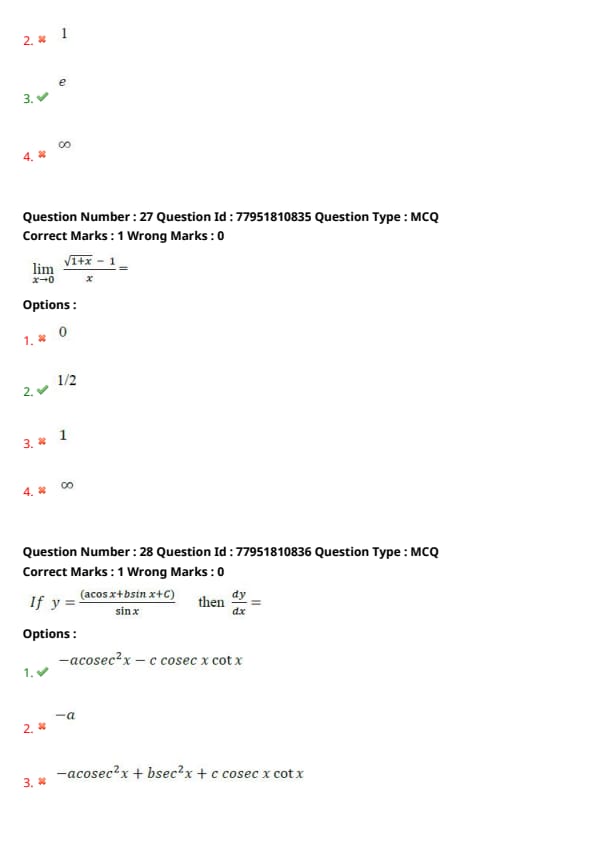
\( \lim_{x \to \infty} \left(1 + \frac{1}{x}\right)^x = \)
View Solution
Step 1: Understanding the Question:
This question involves evaluating a fundamental limit in calculus that arises from the study of continuous compounding and growth.
The expression is of the form \( 1^\infty \), which is an indeterminate form.
This particular limit is used to define Euler's number, denoted as \( e \).
Step 2: Key Formula or Approach:
1. If a limit is of the form \( \lim_{x \to a} [f(x)]^{g(x)} \) where \( f(x) \to 1 \) and \( g(x) \to \infty \), it can be evaluated as \( e^{\lim_{x \to a} (f(x) - 1) g(x)} \).
2. Alternatively, recognize this as the standard definition of the exponential constant \( e \).
Step 3: Detailed Explanation:
Let the limit be \( L = \lim_{x \to \infty} \left(1 + \frac{1}{x}\right)^x \).
As \( x \) approaches infinity, \( 1/x \) approaches 0. Thus the base \( (1 + 1/x) \) approaches 1.
The exponent \( x \) approaches infinity. This gives us the \( 1^\infty \) form.
Let's use the natural logarithm to simplify:
\[ \ln L = \lim_{x \to \infty} x \ln\left(1 + \frac{1}{x}\right) \]
Rewrite as:
\[ \ln L = \lim_{x \to \infty} \frac{\ln(1 + 1/x)}{1/x} \]
Let \( t = 1/x \). As \( x \to \infty \), \( t \to 0 \).
\[ \ln L = \lim_{t \to 0} \frac{\ln(1 + t)}{t} \]
Using the standard limit property \( \lim_{t \to 0} \frac{\ln(1 + t)}{t} = 1 \):
\[ \ln L = 1 \]
Taking the exponential of both sides:
\[ L = e^1 = e \]
Therefore, the limiting value of the growth sequence is the irrational constant \( e \approx 2.71828 \).
Step 4: Final Answer:
The value of the limit is \( e \).
Quick Tip: This is a "base" limit in calculus. You should memorize it along with its variation: \( \lim_{x \to 0} (1 + x)^{1/x} = e \).
In general, \( \lim_{x \to \infty} (1 + k/x)^x = e^k \). For this problem, \( k=1 \), so the answer is \( e^1 \).
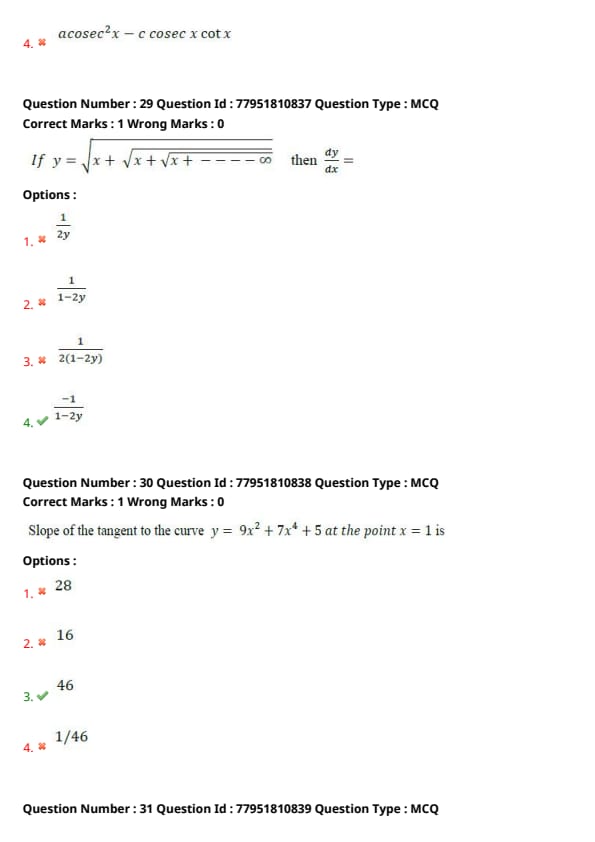
\( \lim_{x \to 0} \frac{\sqrt{1+x} - 1}{x} = \)
View Solution
Step 1: Understanding the Question:
Evaluating the limit as \( x \to 0 \) results in the indeterminate form \( 0/0 \) because \( \sqrt{1+0} - 1 = 0 \) and the denominator is 0.
To resolve this, we can use algebraic techniques like rationalization or differentiation rules like L'Hospital's rule.
Step 2: Key Formula or Approach:
Method 1: Rationalization (multiply numerator and denominator by the conjugate).
Method 2: L'Hospital's Rule (differentiate top and bottom separately).
Step 3: Detailed Explanation:
Using Rationalization:
Multiply numerator and denominator by \( (\sqrt{1+x} + 1) \):
\[ \lim_{x \to 0} \frac{(\sqrt{1+x} - 1)(\sqrt{1+x} + 1)}{x(\sqrt{1+x} + 1)} \]
Apply the identity \( (a-b)(a+b) = a^2 - b^2 \):
\[ \lim_{x \to 0} \frac{(1+x) - 1}{x(\sqrt{1+x} + 1)} = \lim_{x \to 0} \frac{x}{x(\sqrt{1+x} + 1)} \]
Cancel \( x \) from the top and bottom:
\[ \lim_{x \to 0} \frac{1}{\sqrt{1+x} + 1} \]
Now, substitute \( x = 0 \):
\[ \frac{1}{\sqrt{1+0} + 1} = \frac{1}{1 + 1} = \frac{1}{2} \]
Using L'Hospital's Rule:
Differentiate numerator: \( \frac{d}{dx}(\sqrt{1+x} - 1) = \frac{1}{2\sqrt{1+x}} \).
Differentiate denominator: \( \frac{d}{dx}(x) = 1 \).
The limit becomes:
\[ \lim_{x \to 0} \frac{1/(2\sqrt{1+x})}{1} = \frac{1}{2\sqrt{1+0}} = \frac{1}{2} \]
Step 4: Final Answer:
The value of the limit is 1/2.
Quick Tip: For square root limits leading to \( 0/0 \), rationalization is usually reliable.
However, if you are comfortable with derivatives, L'Hospital's rule is often much faster and less prone to algebraic sign errors.
Also, using binomial approximation \( (1+x)^n \approx 1 + nx \) for small \( x \), we get \( \sqrt{1+x} \approx 1 + \frac{1}{2}x \), so the limit is \( \frac{1 + x/2 - 1}{x} = 1/2 \).
If \( y = \frac{acosx + bsinx + C}{sinx} \) then \( \frac{dy}{dx} = \)
View Solution
Step 1: Understanding the Question:
We are given a function \( y \) defined as a quotient of a sum of trigonometric terms.
The goal is to find its first derivative with respect to \( x \).
Instead of using the Quotient Rule directly, it is easier to split the fraction first and simplify the expression into basic trigonometric functions.
Step 2: Key Formula or Approach:
1. Simplify: \( \frac{U+V+W}{Z} = \frac{U}{Z} + \frac{V}{Z} + \frac{W}{Z} \).
2. Basic derivatives:
\( \frac{d}{dx}(\cot x) = -cosec^2x \).
\( \frac{d}{dx}(constant) = 0 \).
\( \frac{d}{dx}(cosecx) = -cosecx \cot x \).
Step 3: Detailed Explanation:
Rewrite the original function by dividing each term in the numerator by \( \sin x \):
\[ y = \frac{a \cos x}{\sin x} + \frac{b \sin x}{\sin x} + \frac{C}{\sin x} \]
Use trigonometric identities \( \cot x = \frac{\cos x}{\sin x} \) and \( cosec x = \frac{1}{\sin x} \):
\[ y = a \cot x + b + C cosec x \]
Now, differentiate both sides with respect to \( x \):
\[ \frac{dy}{dx} = \frac{d}{dx}(a \cot x) + \frac{d}{dx}(b) + \frac{d}{dx}(C cosec x) \]
Apply the power rule and basic trigonometric derivative rules:
The derivative of \( \cot x \) is \( -cosec^2x \).
The derivative of the constant \( b \) is 0.
The derivative of \( cosec x \) is \( -cosec x \cot x \).
Substituting these back into the expression:
\[ \frac{dy}{dx} = a(-cosec^2x) + 0 + C(-cosec x \cot x) \]
\[ \frac{dy}{dx} = -a \cdot cosec^2x - C \cdot cosec x \cot x \]
Step 4: Final Answer:
The derivative is \( -acosec^2x - C cosec x \cot x \).
Quick Tip: Always look to simplify trigonometric fractions before differentiating.
Using the Quotient Rule on \( \frac{acosx + bsinx + C}{sinx} \) would be much more tedious and prone to algebraic errors.
Splitting the fraction into basic terms makes the derivation straightforward.
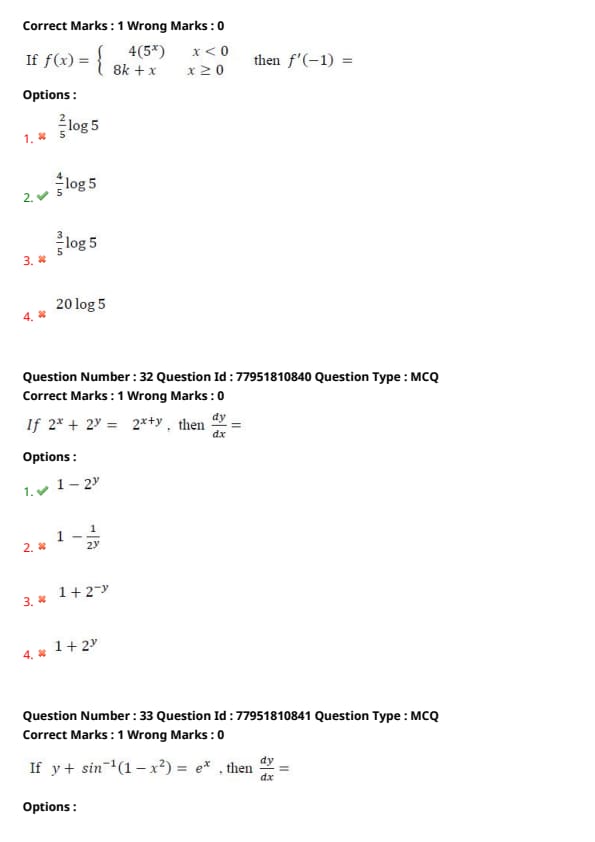
If \( y = \sqrt{x + \sqrt{x + \sqrt{x + \dots \infty}}} \) then \( \frac{dy}{dx} = \)
View Solution
Step 1: Understanding the Question:
This problem deals with an infinite nested square root function. Because the expression is recursive and extends to infinity, the part inside the first square root (starting from the second \( x \)) is identical to the original function \( y \).
This allows us to convert the infinite expression into a finite algebraic equation.
Step 2: Key Formula or Approach:
1. Replace the infinite recursive part with \( y \).
2. Square both sides to eliminate the outer radical.
3. Use implicit differentiation to find \( dy/dx \).
Step 3: Detailed Explanation:
Given: \( y = \sqrt{x + \sqrt{x + \sqrt{x + \dots}}} \)
Since the pattern continues infinitely, the term under the first radical is \( x + y \).
\[ y = \sqrt{x + y} \]
Square both sides to remove the root:
\[ y^2 = x + y \]
Differentiate both sides with respect to \( x \) implicitly:
\[ \frac{d}{dx}(y^2) = \frac{d}{dx}(x + y) \]
\[ 2y \frac{dy}{dx} = 1 + \frac{dy}{dx} \]
Collect the terms containing \( dy/dx \) on one side:
\[ 2y \frac{dy}{dx} - \frac{dy}{dx} = 1 \]
\[ \frac{dy}{dx} (2y - 1) = 1 \]
Solve for \( dy/dx \):
\[ \frac{dy}{dx} = \frac{1}{2y - 1} \]
To match the given options, we can multiply the numerator and denominator by -1:
\[ \frac{dy}{dx} = \frac{-1}{1 - 2y} \]
This corresponds to Option (D).
Step 4: Final Answer:
The derivative \( dy/dx \) is \( \frac{-1}{1-2y} \).
Quick Tip: For any infinite function \( y = \sqrt{f(x) + \sqrt{f(x) + \dots}} \), the derivative is always \( \frac{f'(x)}{2y - 1} \).
Here \( f(x) = x \), so \( f'(x) = 1 \), giving the result \( 1 / (2y - 1) \).
Memorizing this shortcut can save significant time on competitive exams like ECET.
Slope of the tangent to the curve \( y = 9x^2 + 7x^4 + 5 \) at the point \( x = 1 \) is
View Solution
Step 1: Understanding the Question:
The slope of a tangent line to a curve at a given point is physically and geometrically represented by the value of the first derivative of the curve's equation at that point.
Therefore, the task is to differentiate the polynomial function \( y \) and evaluate the resulting expression at the specific input \( x = 1 \).
Step 2: Key Formula or Approach:
1. Derivative of a polynomial: \( \frac{d}{dx}(x^n) = nx^{n-1} \).
2. Slope of tangent \( m = \left. \frac{dy}{dx} \right|_{x=x_0} \).
Step 3: Detailed Explanation:
The given curve equation is \( y = 9x^2 + 7x^4 + 5 \).
Differentiate each term using the power rule:
\[ \frac{dy}{dx} = \frac{d}{dx}(9x^2) + \frac{d}{dx}(7x^4) + \frac{d}{dx}(5) \]
\[ \frac{dy}{dx} = 9(2x) + 7(4x^3) + 0 \]
\[ \frac{dy}{dx} = 18x + 28x^3 \]
Now, we evaluate this derivative at the point where \( x = 1 \):
\[ m = 18(1) + 28(1)^3 \]
\[ m = 18 + 28(1) \]
\[ m = 18 + 28 \]
\[ m = 46 \]
Thus, the instantaneous rate of change of the function at \( x=1 \), which is the slope of the tangent line, is 46.
Step 4: Final Answer:
The slope of the tangent is 46.
Quick Tip: For polynomials, the slope at \( x=1 \) is simply the sum of the coefficients of the differentiated terms.
Coefficients of original terms: 9, 7.
Powers of original terms: 2, 4.
Sum of (coefficient \( \times \) power): \( (9 \times 2) + (7 \times 4) = 18 + 28 = 46 \).
Constants (\( +5 \)) always differentiate to zero and do not affect the slope.
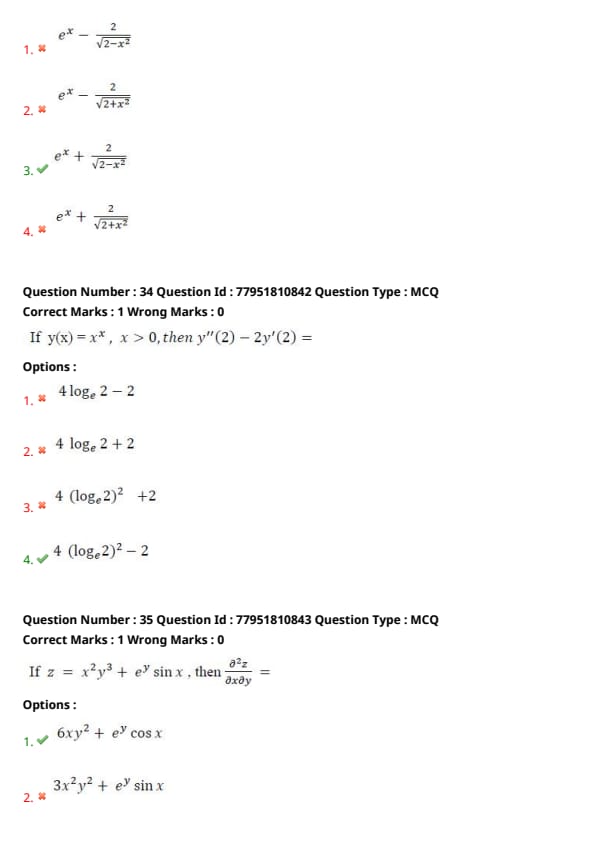
If \( f(x) = \begin{cases} 4(5^x) & x < 0
8k + x & x \geq 0 \end{cases} \), then \( f'(-1) = \)
View Solution
Step 1: Understanding the Question:
This problem involves a piecewise function. To find the derivative at a specific point, we must first identify which "piece" or interval the point falls into.
The point in question is \( x = -1 \). Since \( -1 < 0 \), we only need to consider the first part of the function definition, which is \( f(x) = 4(5^x) \).
Step 2: Key Formula or Approach:
1. Derivative of exponential function \( a^x \): \( \frac{d}{dx}(a^x) = a^x \ln a \).
2. Power rule for constants: \( \frac{d}{dx}(c \cdot g(x)) = c \cdot g'(x) \).
Step 3: Detailed Explanation:
For \( x < 0 \), the function is defined as \( f(x) = 4 \cdot 5^x \).
We find the general derivative expression for this piece:
\[ f'(x) = \frac{d}{dx}(4 \cdot 5^x) = 4 \cdot \frac{d}{dx}(5^x) \]
Applying the exponential derivative rule with base 5:
\[ f'(x) = 4 \cdot 5^x \cdot \ln 5 \]
Now, we substitute the value \( x = -1 \) into this derivative formula:
\[ f'(-1) = 4 \cdot 5^{-1} \cdot \ln 5 \]
Simplify the term \( 5^{-1} \):
\[ f'(-1) = 4 \cdot \frac{1}{5} \cdot \ln 5 \]
\[ f'(-1) = \frac{4}{5} \ln 5 \]
Note: In these options, "log" refers to the natural logarithm \( \ln \).
Step 4: Final Answer:
The value of \( f'(-1) \) is \( \frac{4}{5} \log 5 \).
Quick Tip: In piecewise function problems, always check the interval boundaries first.
If the question asked for \( f'(0) \), you would need to check for continuity and differentiability at the transition point.
But for points far from the boundary like \( x = -1 \), just differentiate the relevant branch directly.
If \( 2^x + 2^y = 2^{x+y} \), then \( \frac{dy}{dx} = \)
View Solution
Step 1: Understanding the Question:
This is an implicit differentiation problem involving exponential functions. The relationship between \( x \) and \( y \) is given by an equation that cannot be easily solved for \( y \) explicitly.
We will differentiate both sides with respect to \( x \) and solve for the derivative \( y' \).
Step 2: Key Formula or Approach:
1. Derivative of \( a^u \): \( \frac{d}{dx}(a^u) = a^u \ln a \frac{du}{dx} \).
2. Implicit differentiation principle.
Step 3: Detailed Explanation:
Differentiating the equation:
Differentiate \( 2^x + 2^y = 2^{x+y} \) with respect to \( x \):
\[ 2^x \ln 2 + 2^y \ln 2 \cdot \frac{dy}{dx} = 2^{x+y} \ln 2 \cdot \frac{d}{dx}(x+y) \]
\[ 2^x \ln 2 + 2^y \ln 2 \cdot \frac{dy}{dx} = 2^{x+y} \ln 2 \cdot \left(1 + \frac{dy}{dx}\right) \]
Simplifying:
Cancel the common factor \( \ln 2 \) from all terms:
\[ 2^x + 2^y \frac{dy}{dx} = 2^{x+y} + 2^{x+y} \frac{dy}{dx} \]
Isolating the derivative:
\[ 2^y \frac{dy}{dx} - 2^{x+y} \frac{dy}{dx} = 2^{x+y} - 2^x \]
\[ \frac{dy}{dx} (2^y - 2^{x+y}) = 2^{x+y} - 2^x \]
\[ \frac{dy}{dx} = \frac{2^{x+y} - 2^x}{2^y - 2^{x+y}} \]
Using the original equation to simplify:
Substitute \( 2^{x+y} = 2^x + 2^y \):
\[ \frac{dy}{dx} = \frac{(2^x + 2^y) - 2^x}{2^y - (2^x + 2^y)} \]
\[ \frac{dy}{dx} = \frac{2^y}{-2^x} = -2^{y-x} \]
Alternative simplification for options:
From \( 2^x + 2^y = 2^{x+y} \), divide by \( 2^{x+y} \): \( 2^{-y} + 2^{-x} = 1 \).
So, \( 2^{-x} = 1 - 2^{-y} \).
Then \( \frac{dy}{dx} = -2^{y-x} = -2^y \cdot 2^{-x} = -2^y (1 - 2^{-y}) = -2^y + 1 = 1 - 2^y \).
Step 4: Final Answer:
The derivative is \( 1 - 2^y \).
Quick Tip: For equations of the form \( a^x + a^y = a^{x+y} \), the derivatives \( -a^{y-x} \) and \( 1 - a^y \) and \( \frac{1}{1 - a^x} \) are all mathematically equivalent.
Try to recognize these common forms in MCQ options to save time rearranging at the end.
If \( y + \sin^{-1}(1 - x^2) = e^x \), then \( \frac{dy}{dx} = \)
View Solution
Step 1: Understanding the Question:
This problem requires the differentiation of an implicit function containing an inverse trigonometric term and an exponential term.
The derivative of \( \sin^{-1} u \) is \( \frac{1}{\sqrt{1-u^2}} \frac{du}{dx} \).
Step 2: Key Formula or Approach:
1. Rewrite as \( y = e^x - \sin^{-1}(1-x^2) \).
2. Apply chain rule for the inverse sine term.
Step 3: Detailed Explanation:
Differentiate the equation with respect to \( x \):
\[ \frac{dy}{dx} + \frac{d}{dx}(\sin^{-1}(1-x^2)) = \frac{d}{dx}(e^x) \]
Evaluate the inverse sine derivative:
Let \( u = 1 - x^2 \). Then \( \frac{du}{dx} = -2x \).
The derivative is \( \frac{1}{\sqrt{1 - u^2}} \cdot \frac{du}{dx} = \frac{-2x}{\sqrt{1 - (1 - x^2)^2}} \).
Simplify the denominator:
\( 1 - (1 - x^2)^2 = 1 - (1 - 2x^2 + x^4) = 2x^2 - x^4 = x^2(2 - x^2) \).
The square root is \( |x|\sqrt{2 - x^2} \).
So, \( \frac{dy}{dx} + \frac{-2x}{x\sqrt{2-x^2}} = e^x \) (assuming \( x > 0 \)).
\[ \frac{dy}{dx} - \frac{2}{\sqrt{2-x^2}} = e^x \]
Move the term to the other side:
\[ \frac{dy}{dx} = e^x + \frac{2}{\sqrt{2-x^2}} \]
Step 4: Final Answer:
The derivative is \( e^x + \frac{2}{\sqrt{2-x^2}} \).
Quick Tip: Be very careful when simplifying roots of terms like \( \sqrt{x^2} \). In most competitive exam contexts, we assume \( x \) is positive and simplify to \( x \).
Simplifying the expression under the radical before finalizing the differentiation is the key to matching the options.
If \( y(x) = x^x , x > 0 \), then \( y''(2) - 2y'(2) = \)
View Solution
Step 1: Understanding the Question:
This problem requires calculating the first and second derivatives of the function \( x^x \) and evaluating their combination at \( x = 2 \).
The function \( x^x \) is differentiated using logarithmic differentiation.
Step 2: Key Formula or Approach:
1. Derivative of \( x^x \): \( y' = x^x (1 + \ln x) \).
2. Second derivative using product rule.
Step 3: Detailed Explanation:
Finding \( y' \):
Let \( y = x^x \). Then \( \ln y = x \ln x \).
Differentiating: \( \frac{1}{y} y' = 1 \cdot \ln x + x \cdot \frac{1}{x} = 1 + \ln x \).
So, \( y' = x^x(1 + \ln x) \).
At \( x = 2 \): \( y'(2) = 2^2(1 + \ln 2) = 4(1 + \ln 2) = 4 + 4 \ln 2 \).
Finding \( y'' \):
Differentiate \( y' = x^x(1 + \ln x) \) using product rule:
\[ y'' = \frac{d}{dx}(x^x) \cdot (1 + \ln x) + x^x \cdot \frac{d}{dx}(1 + \ln x) \]
\[ y'' = x^x(1 + \ln x)^2 + x^x \left(\frac{1}{x}\right) \]
At \( x = 2 \):
\[ y''(2) = 2^2(1 + \ln 2)^2 + 2^2 \left(\frac{1}{2}\right) \]
\[ y''(2) = 4(1 + 2\ln 2 + (\ln 2)^2) + 2 = 4 + 8\ln 2 + 4(\ln 2)^2 + 2 \]
\[ y''(2) = 6 + 8\ln 2 + 4(\ln 2)^2 \]
Evaluating the expression \( y''(2) - 2y'(2) \):
\[ (6 + 8\ln 2 + 4(\ln 2)^2) - 2(4 + 4\ln 2) \]
\[ 6 + 8\ln 2 + 4(\ln 2)^2 - 8 - 8\ln 2 \]
\[ 4(\ln 2)^2 - 2 \]
Step 4: Final Answer:
The result is \( 4(\log_e 2)^2 - 2 \).
Quick Tip: The derivative of \( x^x \) is such a common result that it's worth memorizing: \( y' = y(1 + \ln x) \).
This makes the second derivative calculation much faster as \( y'' = y'(1 + \ln x) + y/x \).
Always ensure you are consistent with using natural logarithms (\( \ln \) or \( \log_e \)).
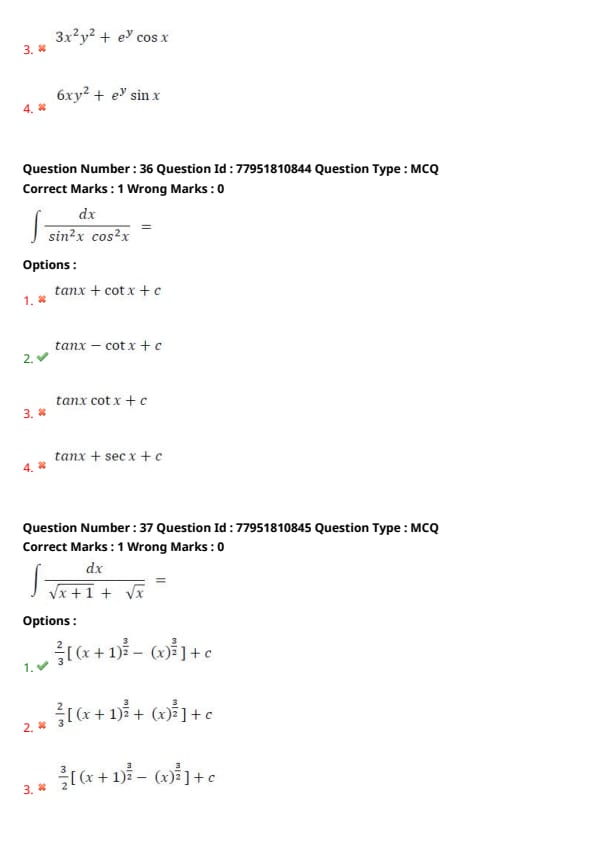
If \( z = x^2 y^3 + e^y \sin x \), then \( \frac{\partial^2 z}{\partial x \partial y} = \)
View Solution
Step 1: Understanding the Question:
This is a problem in partial differentiation. We need to find the mixed second-order partial derivative of the function \( z \) with respect to \( y \) and then \( x \).
Partial differentiation with respect to one variable involves treating all other variables as constants.
Step 2: Key Formula or Approach:
1. First find \( \frac{\partial z}{\partial y} \).
2. Then differentiate the result with respect to \( x \).
Step 3: Detailed Explanation:
First Partial Derivative (\( \partial z / \partial y \)):
Given \( z = x^2 y^3 + e^y \sin x \).
Treat \( x \) as a constant:
\[ \frac{\partial z}{\partial y} = x^2 \frac{\partial}{\partial y}(y^3) + (\sin x) \frac{\partial}{\partial y}(e^y) \]
\[ \frac{\partial z}{\partial y} = x^2 (3y^2) + (\sin x) (e^y) = 3x^2 y^2 + e^y \sin x \]
Second Mixed Partial Derivative (\( \partial^2 z / \partial x \partial y \)):
Now, differentiate the above result with respect to \( x \), treating \( y \) as a constant:
\[ \frac{\partial}{\partial x} \left(3x^2 y^2 + e^y \sin x\right) = 3y^2 \frac{\partial}{\partial x}(x^2) + e^y \frac{\partial}{\partial x}(\sin x) \]
\[ = 3y^2 (2x) + e^y (\cos x) \]
\[ = 6xy^2 + e^y \cos x \]
Step 4: Final Answer:
The mixed partial derivative is \( 6xy^2 + e^y \cos x \).
Quick Tip: Clairaut's Theorem states that for most well-behaved functions, the order of mixed partial derivatives does not matter: \( \frac{\partial^2 z}{\partial x \partial y} = \frac{\partial^2 z}{\partial y \partial x} \).
You can choose to differentiate with respect to \( x \) first if it looks easier, then \( y \). The result will be identical.
\( \int \frac{dx}{\sin^2 x \cos^2 x} = \)
View Solution
Step 1: Understanding the Question:
This is a standard trigonometric integration problem. The integrand contains terms in the denominator that make direct integration difficult.
The goal is to transform the integrand using trigonometric identities into basic forms that can be integrated directly.
Step 2: Key Formula or Approach:
1. Pythagorean identity: \( 1 = \sin^2 x + \cos^2 x \).
2. Standard integrals: \( \int \sec^2 x dx = \tan x + c \) and \( \int cosec^2 x dx = -\cot x + c \).
Step 3: Detailed Explanation:
Start by substituting the constant 1 in the numerator with \( \sin^2 x + \cos^2 x \):
\[ \int \frac{1}{\sin^2 x \cos^2 x} dx = \int \frac{\sin^2 x + \cos^2 x}{\sin^2 x \cos^2 x} dx \]
Split the integral into two separate fractions:
\[ \int \left(\frac{\sin^2 x}{\sin^2 x \cos^2 x} + \frac{\cos^2 x}{\sin^2 x \cos^2 x}\right) dx \]
Simplify each term by canceling common factors:
\[ \int \left(\frac{1}{\cos^2 x} + \frac{1}{\sin^2 x}\right) dx \]
Use reciprocal identities:
\[ \int (\sec^2 x + cosec^2 x) dx \]
Integrate each term independently:
\[ \int \sec^2 x dx = \tan x \]
\[ \int cosec^2 x dx = -\cot x \]
Combining the results and adding the constant of integration \( c \):
\[ \tan x - \cot x + c \]
Step 4: Final Answer:
The integral is \( \tan x - \cot x + c \).
Quick Tip: Another approach is to use the double-angle formula: \( \sin x \cos x = \frac{1}{2}\sin 2x \).
Then the integrand becomes \( \frac{4}{\sin^2 2x} = 4 cosec^2 2x \).
Integrating gives \( 4 \cdot \frac{-\cot 2x}{2} = -2 \cot 2x + c \).
Note that \( -2 \cot 2x = \tan x - \cot x \). Both forms are valid!
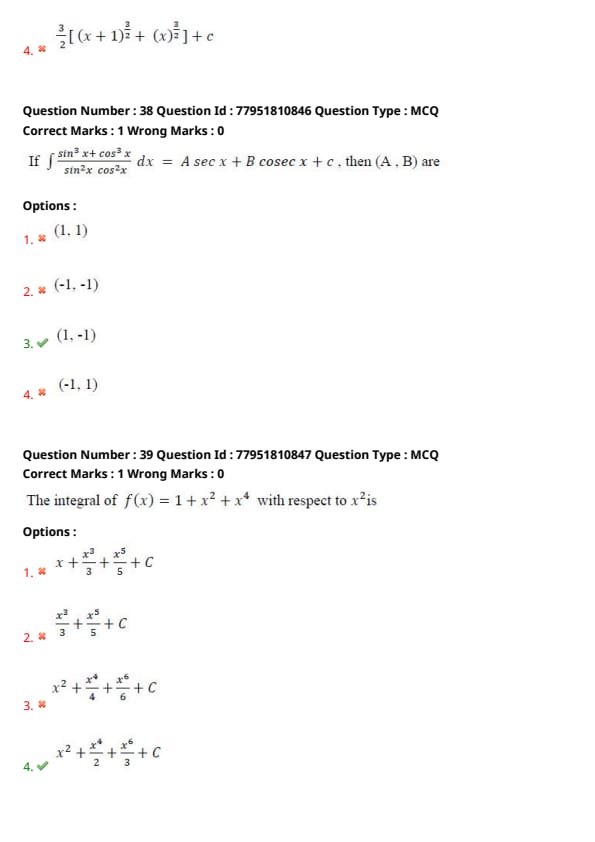
\( \int \frac{dx}{\sqrt{x+1} + \sqrt{x}} = \)
View Solution
Step 1: Understanding the Question:
We are asked to integrate a function with a sum of square roots in the denominator.
This is a classic problem that is solved by rationalizing the denominator, which converts the complex denominator into a simple expression (usually a constant).
Step 2: Key Formula or Approach:
1. Rationalization: multiply numerator and denominator by \( \sqrt{x+1} - \sqrt{x} \).
2. Power rule for integration: \( \int x^n dx = \frac{x^{n+1}}{n+1} + c \).
Step 3: Detailed Explanation:
Rationalizing the denominator:
\[ \frac{1}{\sqrt{x+1} + \sqrt{x}} \cdot \frac{\sqrt{x+1} - \sqrt{x}}{\sqrt{x+1} - \sqrt{x}} = \frac{\sqrt{x+1} - \sqrt{x}}{(x+1) - (x)} \]
\[ = \frac{\sqrt{x+1} - \sqrt{x}}{1} = \sqrt{x+1} - \sqrt{x} \]
Setting up the integral:
\[ \int (\sqrt{x+1} - \sqrt{x}) dx = \int (x+1)^{1/2} dx - \int x^{1/2} dx \]
Integrating each term:
For the first term, let \( u = x+1, du = dx \):
\[ \int (x+1)^{1/2} dx = \frac{(x+1)^{3/2}}{3/2} = \frac{2}{3}(x+1)^{3/2} \]
For the second term:
\[ \int x^{1/2} dx = \frac{x^{3/2}}{3/2} = \frac{2}{3}x^{3/2} \]
Combining the results:
\[ \frac{2}{3}(x+1)^{3/2} - \frac{2}{3}x^{3/2} + c = \frac{2}{3} [(x+1)^{3/2} - (x)^{3/2}] + c \]
Step 4: Final Answer:
The integral is \( \frac{2}{3} [(x+1)^{3/2} - (x)^{3/2}] + c \).
Quick Tip: Whenever you see a sum or difference of roots in the denominator of an integral, rationalization should be your first thought.
This technique transforms a quotient into a simple sum of powers, which is much easier to manage.
If \( \int \frac{\sin^3 x + \cos^3 x}{\sin^2 x \cos^2 x} dx = A \sec x + B cosec x + c \), then \( (A, B) \) are
View Solution
Step 1: Understanding the Question:
This is an integration problem where the result is given in terms of unknown coefficients \( A \) and \( B \).
By performing the integration ourselves, we can compare our result with the provided form to find the values of the constants.
Step 2: Key Formula or Approach:
1. Split the fraction into two parts.
2. Standard integral rules for trigonometric functions.
Step 3: Detailed Explanation:
Split the integrand:
\[ \int \left(\frac{\sin^3 x}{\sin^2 x \cos^2 x} + \frac{\cos^3 x}{\sin^2 x \cos^2 x}\right) dx \]
Simplify each term by canceling common factors:
\[ \int \left(\frac{\sin x}{\cos^2 x} + \frac{\cos x}{\sin^2 x}\right) dx \]
Rewrite as products of reciprocal functions:
\[ \int \left(\frac{\sin x}{\cos x} \cdot \frac{1}{\cos x} + \frac{\cos x}{\sin x} \cdot \frac{1}{\sin x}\right) dx \]
\[ \int (\tan x \sec x + \cot x cosec x) dx \]
Use standard integration formulas:
\( \int \sec x \tan x dx = \sec x \)
\( \int cosec x \cot x dx = -cosec x \)
The total integral result is:
\[ \sec x - cosec x + c \]
Compare this with the given form \( A \sec x + B cosec x + c \):
Comparing coefficients: \( A = 1 \) and \( B = -1 \).
The pair \( (A, B) \) is \( (1, -1) \).
Step 4: Final Answer:
The values of the constants are \( A = 1 \) and \( B = -1 \).
Quick Tip: Splitting fractions is the most powerful technique for integrating trigonometric expressions where the denominator is a product.
Always double-check the signs: \( \int cosec x \cot x \) is \( - cosec x \), but \( \int \sec x \tan x \) is \( + \sec x \). Mixing these up is a common source of error.
The integral of \( f(x) = 1 + x^2 + x^4 \) with respect to \( x^2 \) is
View Solution
Step 1: Understanding the Question:
Usually, integration is performed with respect to \( x \) (the symbol \( dx \)).
However, this question specifically asks for integration "with respect to \( x^2 \)". This means the variable of integration is not \( x \) but \( u = x^2 \).
The symbol \( dx^2 \) effectively means we treat \( x^2 \) as the single variable in the power rule.
Step 2: Key Formula or Approach:
1. Let \( u = x^2 \).
2. Rewrite the function \( f(x) \) in terms of \( u \).
3. Perform integration \( \int f(u) du \).
Step 3: Detailed Explanation:
Let \( u = x^2 \). Then the function \( f(x) \) becomes:
\[ f(u) = 1 + u + u^2 \]
The question asks for the integral \( \int (1 + u + u^2) du \).
Apply the basic power rule \( \int u^n du = \frac{u^{n+1}}{n+1} \):
\[ \int (1) du = u \]
\[ \int (u) du = \frac{u^2}{2} \]
\[ \int (u^2) du = \frac{u^3}{3} \]
Summing these together with a constant \( C \):
\[ Integral = u + \frac{u^2}{2} + \frac{u^3}{3} + C \]
Now, substitute back \( u = x^2 \):
\[ Result = (x^2) + \frac{(x^2)^2}{2} + \frac{(x^2)^3}{3} + C \]
\[ = x^2 + \frac{x^4}{2} + \frac{x^6}{3} + C \]
Step 4: Final Answer:
The integral with respect to \( x^2 \) is \( x^2 + \frac{x^4}{2} + \frac{x^6}{3} + C \).
Quick Tip: Read the phrase "with respect to" very carefully.
If you integrated with respect to \( x \), you would get Option (A), which is incorrect in this specific context.
Change of variable is the safest way to avoid confusion in such problems.
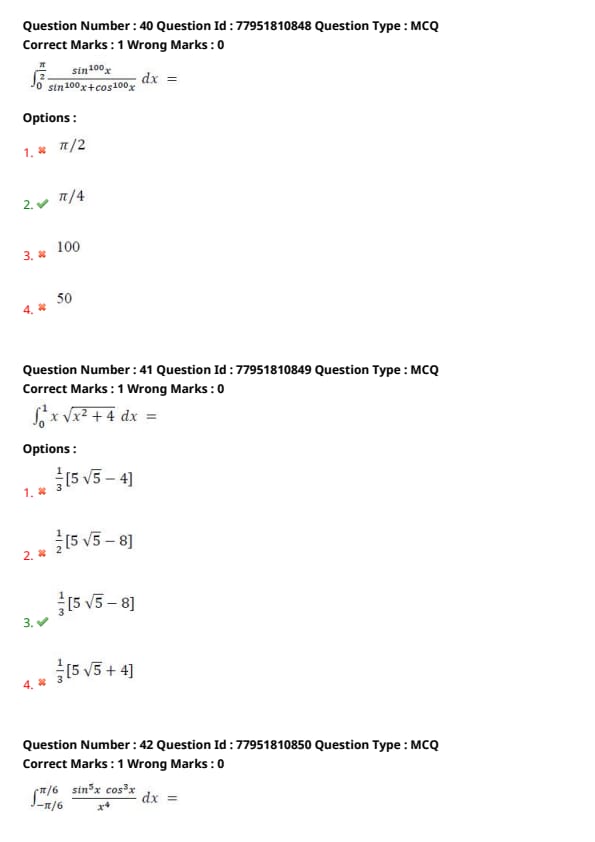
\( \int_0^{\pi/2} \frac{\sin^{100} x}{\sin^{100} x + \cos^{100} x} dx = \)
View Solution
Step 1: Understanding the Question:
This is a classic definite integral problem that appears complex due to the high exponent (100).
However, it is easily solvable using a symmetry property of definite integrals often referred to as the "King's Rule".
Step 2: Key Formula or Approach:
Property: \( \int_0^a f(x) dx = \int_0^a f(a - x) dx \).
Also, \( \sin(\pi/2 - x) = \cos x \) and \( \cos(\pi/2 - x) = \sin x \).
Step 3: Detailed Explanation:
Let the given integral be \( I \):
\[ I = \int_0^{\pi/2} \frac{\sin^{100} x}{\sin^{100} x + \cos^{100} x} dx \quad \dots (Eq 1) \]
Applying the property \( \int_0^a f(x) dx = \int_0^a f(a - x) dx \) where \( a = \pi/2 \):
\[ I = \int_0^{\pi/2} \frac{\sin^{100}(\pi/2 - x)}{\sin^{100}(\pi/2 - x) + \cos^{100}(\pi/2 - x)} dx \]
Simplify using trigonometric identities:
\[ I = \int_0^{\pi/2} \frac{\cos^{100} x}{\cos^{100} x + \sin^{100} x} dx \quad \dots (Eq 2) \]
Now, add Eq 1 and Eq 2:
\[ I + I = \int_0^{\pi/2} \frac{\sin^{100} x}{\sin^{100} x + \cos^{100} x} dx + \int_0^{\pi/2} \frac{\cos^{100} x}{\sin^{100} x + \cos^{100} x} dx \]
\[ 2I = \int_0^{\pi/2} \frac{\sin^{100} x + \cos^{100} x}{\sin^{100} x + \cos^{100} x} dx \]
\[ 2I = \int_0^{\pi/2} (1) dx \]
Integrate:
\[ 2I = [x]_0^{\pi/2} = \pi/2 - 0 = \pi/2 \]
Solve for \( I \):
\[ I = \frac{\pi/2}{2} = \frac{\pi}{4} \]
Step 4: Final Answer:
The value of the definite integral is \( \pi/4 \).
Quick Tip: For any integral of the form \( \int_0^{\pi/2} \frac{f(\sin x)}{f(\sin x) + f(\cos x)} dx \), the result is always \( \pi/4 \), regardless of the complexity of the function \( f \).
This is a standard "pattern" question in engineering entrance exams.
\( \int_0^1 x \sqrt{x^2 + 4} dx = \)
View Solution
Step 1: Understanding the Question:
This is a definite integral that can be solved using the substitution method.
The integrand is a product of \( x \) and a function of \( x^2 \), which is a perfect scenario for substitution because the derivative of \( x^2 \) is proportional to \( x \).
Step 2: Key Formula or Approach:
1. Use substitution \( t = x^2 + 4 \).
2. Find the new limits of integration.
3. Apply the power rule.
Step 3: Detailed Explanation:
Step 3.1: Substitution:
Let \( t = x^2 + 4 \).
Differentiate: \( dt = 2x dx \implies x dx = \frac{dt}{2} \).
Step 3.2: Change of Limits:
When \( x = 0 \), \( t = 0^2 + 4 = 4 \).
When \( x = 1 \), \( t = 1^2 + 4 = 5 \).
Step 3.3: Integral Transformation:
The integral \( \int_0^1 x \sqrt{x^2 + 4} dx \) becomes:
\[ \int_4^5 \sqrt{t} \frac{dt}{2} = \frac{1}{2} \int_4^5 t^{1/2} dt \]
Step 3.4: Evaluation:
\[ \frac{1}{2} \left[ \frac{t^{3/2}}{3/2} \right]_4^5 = \frac{1}{2} \cdot \frac{2}{3} \left[ t^{3/2} \right]_4^5 \]
\[ = \frac{1}{3} [ 5^{3/2} - 4^{3/2} ] \]
Step 3.5: Final Simplification:
\( 5^{3/2} = 5 \sqrt{5} \).
\( 4^{3/2} = ( \sqrt{4} )^3 = 2^3 = 8 \).
Result: \( \frac{1}{3} [5\sqrt{5} - 8] \).
Step 4: Final Answer:
The result of the definite integral is \( \frac{1}{3} [5\sqrt{5} - 8] \).
Quick Tip: Always remember to change the limits when doing a substitution in definite integrals.
Many students forget this and substitute back \( x \) at the end, which takes more time and is more confusing.
Also, \( x^{3/2} \) is simply \( x\sqrt{x} \).
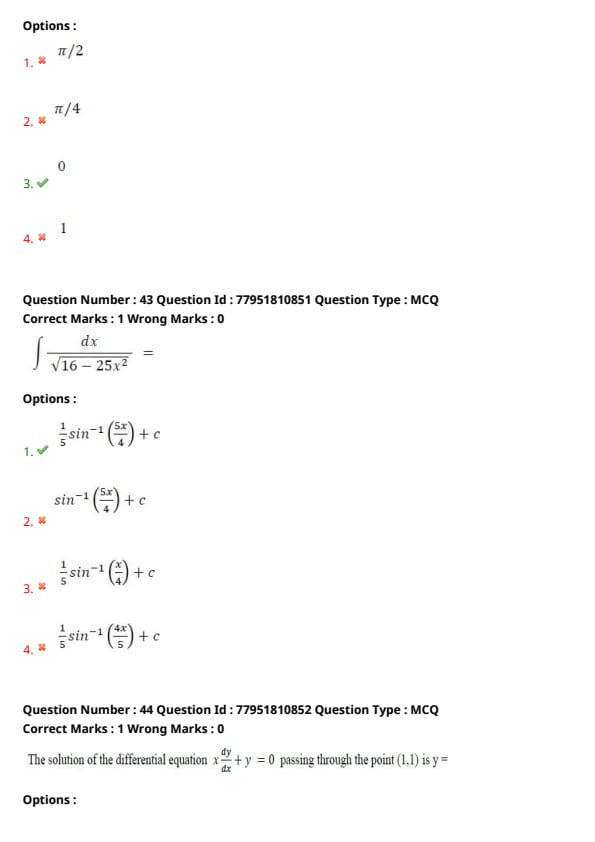
\( \int_{-\pi/6}^{\pi/6} \frac{\sin^5 x \cos^3 x}{x^4} dx = \)
View Solution
Step 1: Understanding the Question:
This definite integral is over a symmetric interval \( [-a, a] \).
For such integrals, before performing any calculations, we should check if the integrand is an even or odd function.
Step 2: Key Formula or Approach:
Property: If \( f(x) \) is an odd function (\( f(-x) = -f(x) \)), then \( \int_{-a}^a f(x) dx = 0 \).
Property: \( \sin(-x) = -\sin x \) (odd) and \( \cos(-x) = \cos x \) (even).
Step 3: Detailed Explanation:
Let \( f(x) = \frac{\sin^5 x \cos^3 x}{x^4} \).
We evaluate \( f(-x) \) to determine the nature of the function:
\[ f(-x) = \frac{(\sin(-x))^5 (\cos(-x))^3}{(-x)^4} \]
Apply trigonometric and power properties:
\( \sin(-x) = -\sin x \implies (\sin(-x))^5 = (-\sin x)^5 = -\sin^5 x \).
\( \cos(-x) = \cos x \implies (\cos(-x))^3 = \cos^3 x \).
\( (-x)^4 = x^4 \).
Substitute back:
\[ f(-x) = \frac{(-\sin^5 x)(\cos^3 x)}{x^4} = - \frac{\sin^5 x \cos^3 x}{x^4} \]
Since \( f(-x) = -f(x) \), the function \( f(x) \) is an **odd function**.
According to the property of definite integrals for odd functions over symmetric limits:
\[ \int_{-\pi/6}^{\pi/6} f(x) dx = 0 \]
Step 4: Final Answer:
The integral is 0.
Quick Tip: If you see symmetric limits (like \( -1 \) to \( 1 \) or \( -\pi \) to \( \pi \)), always check for parity.
In this case, the product of an odd function (\( \sin^5 x \)) and an even function (\( \cos^3 x \)) is odd. Dividing by an even function (\( x^4 \)) keeps the result odd.
This property saves you from doing impossible calculations!
\( \int \frac{dx}{\sqrt{16 - 25x^2}} = \)
View Solution
Step 1: Understanding the Question:
The integrand is of the form \( \frac{1}{\sqrt{a^2 - (kx)^2}} \).
This structure is typical of the derivative of an inverse sine function.
To solve it, we can either use a direct formula for standard integrals or use a substitution.
Step 2: Key Formula or Approach:
1. Standard Integral: \( \int \frac{dx}{\sqrt{a^2 - x^2}} = \sin^{-1}(x/a) + C \).
2. If \( x \) is replaced by \( kx \), then \( \int \frac{dx}{\sqrt{a^2 - (kx)^2}} = \frac{1}{k} \sin^{-1}(kx/a) + C \).
Step 3: Detailed Explanation:
Rewrite the expression inside the root as a difference of squares:
\( 16 = 4^2 \) and \( 25x^2 = (5x)^2 \).
The integral is \( \int \frac{dx}{\sqrt{4^2 - (5x)^2}} \).
Use substitution to make it look like the standard form:
Let \( u = 5x \). Then \( du = 5 dx \implies dx = du/5 \).
Substitute into the integral:
\[ \int \frac{du/5}{\sqrt{4^2 - u^2}} = \frac{1}{5} \int \frac{du}{\sqrt{4^2 - u^2}} \]
Apply the standard formula with \( a = 4 \):
\[ \frac{1}{5} \sin^{-1} \left(\frac{u}{4}\right) + c \]
Substitute back \( u = 5x \):
\[ \frac{1}{5} \sin^{-1} \left(\frac{5x}{4}\right) + c \]
Step 4: Final Answer:
The integral is \( \frac{1}{5} \sin^{-1} \left(\frac{5x}{4}\right) + c \).
Quick Tip: Always factor out the coefficient of \( x^2 \) if you find it confusing.
Alternatively, remember that if the inner function is linear (\( 5x \)), its derivative (\( 5 \)) appears as a reciprocal (\( 1/5 \)) in the final integration result.
The solution of the differential equation \( x \frac{dy}{dx} + y = 0 \) passing through the point (1,1) is y =
View Solution
Step 1: Understanding the Question:
We are given a first-order ordinary differential equation and a boundary condition (the solution must pass through \( (1,1) \)).
The equation is of the "variables separable" type. Once we find the general solution containing a constant, we use the point \( (1,1) \) to determine the specific value of that constant.
Step 2: Key Formula or Approach:
1. Separate variables: Put all \( y \) terms on one side and all \( x \) terms on the other.
2. Integrate both sides.
3. Solve for \( y \) and apply boundary conditions.
Step 3: Detailed Explanation:
Step 3.1: Separating variables:
Given \( x \frac{dy}{dx} + y = 0 \).
Rearrange: \( x \frac{dy}{dx} = -y \).
Divide by \( x \cdot y \):
\[ \frac{dy}{y} = -\frac{dx}{x} \]
Step 3.2: Integrating:
\[ \int \frac{dy}{y} = - \int \frac{dx}{x} \]
\[ \ln y = -\ln x + \ln C \]
Where \( \ln C \) is the constant of integration.
Step 3.3: Simplifying the solution:
Using log properties: \( \ln y + \ln x = \ln C \).
\( \ln(xy) = \ln C \).
Taking anti-log: \( xy = C \).
Step 3.4: Finding the constant:
The solution passes through \( (1, 1) \). Substitute \( x = 1 \) and \( y = 1 \):
\[ (1)(1) = C \implies C = 1 \]
Step 3.5: Final Equation:
The specific solution is \( xy = 1 \).
To write it in the form \( y = f(x) \):
\[ y = \frac{1}{x} = x^{-1} \]
Step 4: Final Answer:
The solution of the differential equation is \( y = x^{-1} \).
Quick Tip: Notice that \( x \frac{dy}{dx} + y \) is the exact derivative of the product \( xy \).
So the equation can be written as \( \frac{d}{dx}(xy) = 0 \).
Integrating immediately gives \( xy = C \). This is much faster than the variable separation method.
Degree of the differential equation \(y = x\frac{dy}{dx} + a \sqrt{1 + \left(\frac{dy}{dx}\right)^2}\) is
View Solution
Step 1: Understanding the Question:
The objective is to find the degree of a given differential equation.
The degree of a differential equation is the highest power of the highest-order derivative appearing in the equation, provided the equation is in a polynomial form of its derivatives.
Before determining the degree, any radicals (square roots, cube roots, etc.) or fractional powers involving the derivatives must be eliminated by algebraic manipulation.
Step 2: Key Formula or Approach:
Identify the highest-order derivative present in the equation.
Rearrange the equation to isolate terms with radicals.
Eliminate the radical by squaring (or applying the necessary power) both sides.
Identify the power of the highest-order derivative in the resulting polynomial form.
Step 3: Detailed Explanation:
The given differential equation is: \(y = x\frac{dy}{dx} + a \sqrt{1 + \left(\frac{dy}{dx}\right)^2}\).
Here, the highest order derivative is \(\frac{dy}{dx}\), so the order of the differential equation is 1.
To find the degree, we must remove the square root. First, isolate the radical term:
\[ y - x\frac{dy}{dx} = a \sqrt{1 + \left(\frac{dy}{dx}\right)^2} \]
Now, square both sides of the equation to eliminate the radical:
\[ \left(y - x\frac{dy}{dx}\right)^2 = \left(a \sqrt{1 + \left(\frac{dy}{dx}\right)^2}\right)^2 \]
Expanding the left side and simplifying the right side:
\[ y^2 + x^2\left(\frac{dy}{dx}\right)^2 - 2xy\frac{dy}{dx} = a^2 \left[ 1 + \left(\frac{dy}{dx}\right)^2 \right] \]
This equation is now a polynomial in \(\frac{dy}{dx}\). The highest derivative is \(\frac{dy}{dx}\), and its highest power (exponent) in this polynomial form is 2.
Therefore, the degree of the differential equation is 2.
Step 4: Final Answer:
The highest order derivative is of order 1, and after rationalizing the radical term, its highest power becomes 2. Thus, the degree is 2.
Quick Tip: Always ensure the differential equation is free from radicals and fractional powers of derivatives before declaring the degree.
Degree is not defined if the equation cannot be expressed as a polynomial in its derivatives (e.g., if a derivative is inside a \(\sin\) or \(\log\) function without the possibility of removal).
The order of the differential equation of all circles passing through the origin and having their centers on the x -- axis is
View Solution
Step 1: Understanding the Question:
The problem asks for the order of the differential equation corresponding to a specific family of curves.
The order of a differential equation derived from a general equation of a curve is equal to the number of independent arbitrary constants present in that general equation.
A circle passing through the origin \((0,0)\) with its center on the x-axis has specific geometric constraints that limit the number of constants.
Step 2: Key Formula or Approach:
Write the general equation of the circle.
The center is on the x-axis, so the center is at \((h, 0)\).
Since it passes through the origin, the distance from the center \((h, 0)\) to the origin \((0,0)\) is the radius \(r\).
Use the circle equation: \((x - h)^2 + (y - k)^2 = r^2\).
Step 3: Detailed Explanation:
Let the center of the circle be \((h, 0)\), as it is given to lie on the x-axis.
The circle passes through the origin \((0,0)\). Therefore, the radius \(r\) is the distance between \((h, 0)\) and \((0,0)\):
\[ r = \sqrt{(h - 0)^2 + (0 - 0)^2} = |h| \]
The equation of the circle is:
\[ (x - h)^2 + (y - 0)^2 = r^2 \]
\[ (x - h)^2 + y^2 = h^2 \]
Expanding the square:
\[ x^2 - 2xh + h^2 + y^2 = h^2 \]
Simplifying by cancelling \(h^2\) from both sides:
\[ x^2 + y^2 - 2xh = 0 \]
In this equation, there is only one independent arbitrary constant, which is \(h\).
According to the fundamental property of differential equations, the number of independent constants in the general solution equals the order of the differential equation.
Since there is only one constant \(h\), the order of the differential equation is 1.
Step 4: Final Answer:
The family of circles is represented by an equation containing only one arbitrary constant. Hence, the order of its differential equation is 1.
Quick Tip: To find the order quickly, look for the number of "essential" parameters needed to define the curve.
For example, a circle with a fixed center has 0 constants (order 0 is not a DE), a circle with center on x-axis through origin has 1 constant (order 1), and a general circle has 3 constants (order 3).
If \(a\) and \(b\) are arbitrary constants, then the differential equation representing the family of curves \(y = a \sin(x + b)\) is
View Solution
Step 1: Understanding the Question:
The goal is to form a differential equation by eliminating the arbitrary constants \(a\) and \(b\) from the given equation of the curve \(y = a \sin(x + b)\).
Since there are two arbitrary constants, we must differentiate the equation twice to obtain enough information to eliminate them.
Step 2: Key Formula or Approach:
Differentiate \(y\) with respect to \(x\).
Differentiate again to find the second derivative.
Substitute the original expression of \(y\) into the second derivative equation to eliminate \(a\) and \(b\).
Step 3: Detailed Explanation:
Given equation: \(y = a \sin(x + b)\) ... (1)
Differentiating equation (1) with respect to \(x\):
\[ \frac{dy}{dx} = a \cos(x + b) \cdot \frac{d}{dx}(x + b) \]
\[ \frac{dy}{dx} = a \cos(x + b) \] ... (2)
Differentiating equation (2) with respect to \(x\):
\[ \frac{d^2y}{dx^2} = a [-\sin(x + b)] \cdot \frac{d}{dx}(x + b) \]
\[ \frac{d^2y}{dx^2} = -a \sin(x + b) \] ... (3)
Notice that the term on the right side of equation (3), \(a \sin(x + b)\), is exactly equal to \(y\) from the original equation (1).
Substitute \(y\) for \(a \sin(x + b)\) in equation (3):
\[ \frac{d^2y}{dx^2} = -y \]
Rearrange the terms to get the final differential equation:
\[ \frac{d^2y}{dx^2} + y = 0 \]
Step 4: Final Answer:
By differentiating the curve equation twice and substituting the original function back, we successfully eliminated the constants. The resulting equation is \(\frac{d^2y}{dx^2} + y = 0\).
Quick Tip: For equations involving \(\sin(x)\) or \(\cos(x)\), the second derivative often returns to the negative of the original function.
Recall that if \(y = A \sin(kx + \phi)\), then \(\frac{d^2y}{dx^2} = -k^2y\). Here \(k=1\), so \(y'' = -y\).
The differential equation is \(\frac{dy}{dx} + \frac{y}{x} = 0\) and \(y(1) = 2\). Then the value of \(y(3) =\)
View Solution
Step 1: Understanding the Question:
The problem involves solving a first-order ordinary differential equation and then applying a given initial condition to find a specific value of the function.
The equation is \(\frac{dy}{dx} + \frac{y}{x} = 0\), which can be solved using the variable separable method.
Step 2: Key Formula or Approach:
Rearrange the differential equation to separate variables \(x\) and \(y\).
Integrate both sides to find the general solution.
Use the initial condition \(y(1) = 2\) to find the constant of integration.
Substitute \(x = 3\) into the particular solution to find \(y(3)\).
Step 3: Detailed Explanation:
Given differential equation: \(\frac{dy}{dx} = -\frac{y}{x}\).
Separate the variables:
\[ \frac{1}{y} dy = -\frac{1}{x} dx \]
Integrate both sides:
\[ \int \frac{1}{y} dy = -\int \frac{1}{x} dx \]
\[ \ln|y| = -\ln|x| + \ln|c| \]
Using logarithmic properties (\(\ln a + \ln b = \ln(ab)\)):
\[ \ln|y| + \ln|x| = \ln|c| \]
\[ \ln|xy| = \ln|c| \]
\[ xy = c \] ... (1)
Apply the initial condition: \(y(1) = 2\), which means when \(x = 1\), \(y = 2\).
\[ (1)(2) = c \implies c = 2 \]
The particular solution is:
\[ xy = 2 \implies y = \frac{2}{x} \]
To find \(y(3)\), substitute \(x = 3\) into the particular solution:
\[ y(3) = \frac{2}{3} \]
Step 4: Final Answer:
The solution to the differential equation with the given initial condition is \(y = 2/x\). Evaluating at \(x=3\) gives \(2/3\).
Quick Tip: Equations of the form \(xy = c\) represent rectangular hyperbolas.
Whenever you see \(\frac{dy}{dx} = -\frac{y}{x}\), remember it directly integrates to \(xy = constant\).
The general solution of the differential equation \(\frac{dy}{dx} = e^{x-y} + x^2e^{-y}\) is
View Solution
Step 1: Understanding the Question:
We are required to find the general solution of a first-order differential equation.
The equation contains exponential terms with composite exponents. We can simplify this using laws of exponents to see if it's variable-separable.
Step 2: Key Formula or Approach:
Use the exponent rule \(e^{A+B} = e^A \cdot e^B\).
Factor out common terms to separate variables \(x\) and \(y\).
Integrate both sides independently.
Step 3: Detailed Explanation:
The given equation is: \(\frac{dy}{dx} = e^x \cdot e^{-y} + x^2 \cdot e^{-y}\).
Factor out the common term \(e^{-y}\) from the right-hand side:
\[ \frac{dy}{dx} = e^{-y} (e^x + x^2) \]
Now separate the variables by moving all \(y\) terms to one side and \(x\) terms to the other:
\[ \frac{1}{e^{-y}} dy = (e^x + x^2) dx \]
\[ e^y dy = (e^x + x^2) dx \]
Integrate both sides:
\[ \int e^y dy = \int (e^x + x^2) dx \]
Computing the integrals:
\[ e^y = e^x + \frac{x^3}{3} + c \]
Here, \(c\) is the arbitrary constant of integration.
Step 4: Final Answer:
The separation of variables leads to a direct integration of both sides, yielding the solution \(e^y = e^x + \frac{x^3}{3} + c\).
Quick Tip: Look for common factors in exponential expressions. If you see \(e^{-y}\) in all terms on one side, it is almost certainly a variable-separable equation.
Remember that \(\int x^n dx = \frac{x^{n+1}}{n+1}\).
The differential equation is \(\frac{dy}{dx} + y \tan x = \sec x\) and \(y(0) = 1\). Then the value of \(y\left(\frac{\pi}{4}\right) =\)
View Solution
Step 1: Understanding the Question:
The given equation \(\frac{dy}{dx} + y \tan x = \sec x\) is a first-order linear differential equation.
The general form is \(\frac{dy}{dx} + P(x)y = Q(x)\).
To solve this, we need to find the Integrating Factor (I.F.) and then the general solution.
Step 2: Key Formula or Approach:
Identify \(P(x) = \tan x\) and \(Q(x) = \sec x\).
Integrating Factor \(I.F. = e^{\int P(x) dx}\).
The general solution is \(y \cdot (I.F.) = \int [Q(x) \cdot (I.F.)] dx + c\).
Step 3: Detailed Explanation:
Step A: Calculate Integrating Factor.
\[ \int P(x) dx = \int \tan x dx = \ln|\sec x| \]
\[ I.F. = e^{\ln|\sec x|} = \sec x \]
Step B: Find General Solution.
\[ y \cdot \sec x = \int (\sec x \cdot \sec x) dx \]
\[ y \sec x = \int \sec^2 x dx \]
\[ y \sec x = \tan x + c \] ... (1)
Step C: Apply Initial Condition \(y(0) = 1\).
\[ 1 \cdot \sec(0) = \tan(0) + c \]
\[ 1 \cdot 1 = 0 + c \implies c = 1 \]
Step D: The particular solution is \(y \sec x = \tan x + 1\).
Rewriting for \(y\): \(y = \frac{\tan x + 1}{\sec x} = \frac{\frac{\sin x}{\cos x} + 1}{\frac{1}{\cos x}} = \sin x + \cos x\).
Step E: Evaluate at \(x = \frac{\pi}{4}\).
\[ y\left(\frac{\pi}{4}\right) = \sin\left(\frac{\pi}{4}\right) + \cos\left(\frac{\pi}{4}\right) \]
\[ y\left(\frac{\pi}{4}\right) = \frac{1}{\sqrt{2}} + \frac{1}{\sqrt{2}} = \frac{2}{\sqrt{2}} = \sqrt{2} \]
Step 4: Final Answer:
The solution simplifies to \(y = \sin x + \cos x\). At \(\pi/4\), both terms are \(1/\sqrt{2}\), making the sum \(\sqrt{2}\).
Quick Tip: Linear differential equations are a staple of competitive exams.
Master the standard integrals like \(\int \tan x dx = \ln \sec x\) and \(\int \sec^2 x dx = \tan x\) for speed.
If \(P = F \cdot v \sin \beta t\) where F is force and v is velocity then the dimensions of P and \(\beta\) are
View Solution
Step 1: Understanding the Question:
The question asks for the dimensional formulas of a variable \(P\) and a constant \(\beta\) given a physical relation.
The principle of homogeneity states that dimensions on both sides of an equation must be identical.
Arguments of trigonometric functions (like \(\sin \theta\)) must be dimensionless.
Step 2: Key Formula or Approach:
Dimension of Force \(F = [MLT^{-2}]\).
Dimension of Velocity \(v = [LT^{-1}]\).
Argument of \(\sin(\beta t)\) must be \([M^0L^0T^0]\).
Since \(\sin(\beta t)\) is dimensionless, the dimension of \(P\) is simply the product of dimensions of \(F\) and \(v\).
Step 3: Detailed Explanation:
Finding dimensions of \(\beta\):
The argument inside the sine function is \(\beta t\). For it to be dimensionless:
\[ [\beta] [t] = [1] \]
\[ [\beta] [T] = [T^0] \implies [\beta] = [T^{-1}] \]
Finding dimensions of \(P\):
From the given equation \(P = F \cdot v \sin(\beta t)\), and since \(\sin(\beta t)\) is a numeric ratio with no dimensions:
\[ [P] = [F] \cdot [v] \]
\[ [P] = [MLT^{-2}] \cdot [LT^{-1}] \]
\[ [P] = [ML^2T^{-3}] \]
Note: The product of Force and Velocity is Power, which indeed has dimensions \(ML^2T^{-3}\).
Step 4: Final Answer:
The dimensional formula for \(P\) is \(ML^2T^{-3}\) and for \(\beta\) is \(T^{-1}\).
Quick Tip: Whenever you see a product of physical quantities inside a function like \(\sin\), \(\cos\), \(\ln\), or \(e^x\), that product is always dimensionless.
This is a very common shortcut for finding dimensions of constants in complex physics formulas.
If velocity V, energy E and time T are chosen as fundamental quantities then dimensional representation of surface tension in this system will be
View Solution
Step 1: Understanding the Question:
This is a problem of change of units where we express one quantity in terms of non-standard fundamental quantities.
We need to express Surface Tension (\(S\)) in terms of Velocity (\(V\)), Energy (\(E\)), and Time (\(T\)).
Step 2: Key Formula or Approach:
Surface Tension \(S = \frac{Force}{Length}\). Its dimensions are \([MT^{-2}]\).
Energy \(E = [ML^2T^{-2}]\).
Velocity \(V = [LT^{-1}]\).
Time \(T = [T]\).
Assume \(S = E^a V^b T^c\) and solve for \(a, b, c\) using dimensional analysis.
Step 3: Detailed Explanation:
Dimensional formulas in standard SI units:
\[ [S] = [MT^{-2}] \]
\[ [E] = [ML^2T^{-2}] \]
\[ [V] = [LT^{-1}] \]
\[ [T] = [T] \]
Equating dimensions:
\[ [MT^{-2}] = [ML^2T^{-2}]^a \cdot [LT^{-1}]^b \cdot [T]^c \]
\[ M^1 L^0 T^{-2} = M^a L^{2a+b} T^{-2a-b+c} \]
Comparing powers:
1) For \(M\): \(a = 1\)
2) For \(L\): \(2a + b = 0 \implies 2(1) + b = 0 \implies b = -2\)
3) For \(T\): \(-2a - b + c = -2\)
Substitute \(a=1, b=-2\):
\(-2(1) - (-2) + c = -2\)
\(-2 + 2 + c = -2 \implies c = -2\)
Thus, the dimensional formula is \(E^1 V^{-2} T^{-2}\).
Step 4: Final Answer:
By solving the system of equations for the powers of energy, velocity, and time, we found the relation to be \(E^1 V^{-2} T^{-2}\).
Quick Tip: Alternatively, use basic definitions: Surface Tension = Energy / Area.
Area = (Velocity \(\times\) Time)\(^2\).
So, Surface Tension = Energy / (V \(\cdot\) T)\(^2 = E V^{-2} T^{-2}\).
This "unit substitution" method is often much faster than solving algebraic equations.
If \(|\vec{A} + \vec{B}| = |\vec{A} - \vec{B}|\), then the angle between the two vectors \(\vec{A}\) and \(\vec{B}\) is
View Solution
Step 1: Understanding the Question:
The problem relates the magnitude of the sum and the difference of two vectors.
Geometrically, if the diagonals of a parallelogram formed by two vectors are equal, the parallelogram is a rectangle.
Algebraically, we can square the magnitudes and use dot product properties.
Step 2: Key Formula or Approach:
The square of the magnitude of the sum: \(|\vec{A} + \vec{B}|^2 = A^2 + B^2 + 2AB \cos \theta\).
The square of the magnitude of the difference: \(|\vec{A} - \vec{B}|^2 = A^2 + B^2 - 2AB \cos \theta\).
Equate these two expressions.
Step 3: Detailed Explanation:
Given: \(|\vec{A} + \vec{B}| = |\vec{A} - \vec{B}|\)
Square both sides to eliminate the implicit square roots:
\[ |\vec{A} + \vec{B}|^2 = |\vec{A} - \vec{B}|^2 \]
Using the formula for vector addition and subtraction magnitudes:
\[ A^2 + B^2 + 2AB \cos \theta = A^2 + B^2 - 2AB \cos \theta \]
Subtract \(A^2\) and \(B^2\) from both sides:
\[ 2AB \cos \theta = -2AB \cos \theta \]
Bring all terms to one side:
\[ 2AB \cos \theta + 2AB \cos \theta = 0 \]
\[ 4AB \cos \theta = 0 \]
Assuming the vectors \(\vec{A}\) and \(\vec{B}\) are non-zero:
\[ \cos \theta = 0 \]
The angle whose cosine is zero is \(90^\circ\).
\[ \theta = 90^\circ \]
Step 4: Final Answer:
The equality of the sum and difference magnitudes implies that the vectors are perpendicular to each other. Hence, the angle is \(90^\circ\).
Quick Tip: Geometric visualization: \(|\vec{A} + \vec{B}|\) and \(|\vec{A} - \vec{B}|\) are the lengths of the diagonals of a parallelogram.
If the diagonals are equal, the parallelogram is a rectangle, which means the angle between the sides is \(90^\circ\).
An aeroplane is moving in a circular path with a speed of 450 Kmph. What is the change in velocity in half revolution?
View Solution
Step 1: Understanding the Question:
Velocity is a vector quantity, having both magnitude and direction.
In uniform circular motion, speed is constant, but velocity changes because its direction changes.
After half a revolution, the object is moving in the exactly opposite direction to its initial velocity.
Step 2: Key Formula or Approach:
Let the initial velocity be \(\vec{v}_1\).
After half a revolution, the velocity vector is \(\vec{v}_2\).
Since the path is circular and it's half a revolution, \(\vec{v}_2 = -\vec{v}_1\).
Change in velocity \(\Delta \vec{v} = \vec{v}_2 - \vec{v}_1\).
Step 3: Detailed Explanation:
Let the constant speed be \(v = 450 Kmph\).
Suppose at the start, the aeroplane is at the bottom of the circle moving to the right. Its initial velocity vector is \(\vec{v}_i = v\hat{i}\).
After half a revolution, the aeroplane is at the top of the circle. At this point, it is moving to the left. Its final velocity vector is \(\vec{v}_f = -v\hat{i}\).
The change in velocity is given by the vector difference:
\[ \Delta \vec{v} = \vec{v}_f - \vec{v}_i \]
\[ \Delta \vec{v} = (-v\hat{i}) - (v\hat{i}) = -2v\hat{i} \]
The magnitude of the change in velocity is:
\[ |\Delta \vec{v}| = | -2v | = 2v \]
Substituting the value of \(v\):
\[ Magnitude of change = 2 \times 450 = 900 Kmph \]
Step 4: Final Answer:
The change in velocity in half a revolution for circular motion is twice the speed, which is \(2 \times 450 = 900\) Kmph.
Quick Tip: General formula for change in velocity in circular motion for an angle \(\theta\):
\(|\Delta \vec{v}| = 2v \sin(\theta/2)\).
For half revolution, \(\theta = 180^\circ\). So, \(\Delta v = 2v \sin(90^\circ) = 2v\).
The ratio between maximum and minimum values of two vectors \(\vec{A}\) and \(\vec{B}\) (\(\vec{A} > \vec{B}\)) is 4:1. Then the ratio between the magnitudes of two vectors is
View Solution
Step 1: Understanding the Question:
The maximum resultant of two vectors occurs when they are in the same direction (\(\theta = 0^\circ\)).
The minimum resultant occurs when they are in opposite directions (\(\theta = 180^\circ\)).
We are given the ratio of these resultants and need to find the ratio of the individual vector magnitudes.
Step 2: Key Formula or Approach:
Maximum resultant \(R_{max} = A + B\).
Minimum resultant \(R_{min} = A - B\).
Given \(R_{max} : R_{min} = 4 : 1\).
Solve the linear equation for the ratio \(A/B\).
Step 3: Detailed Explanation:
Let the magnitudes be \(A\) and \(B\) with \(A > B\).
According to the problem statement:
\[ \frac{A + B}{A - B} = \frac{4}{1} \]
Cross-multiplying to solve:
\[ A + B = 4(A - B) \]
\[ A + B = 4A - 4B \]
Grouping \(A\) terms and \(B\) terms:
\[ B + 4B = 4A - A \]
\[ 5B = 3A \]
Therefore, the ratio of magnitudes \(A\) to \(B\) is:
\[ \frac{A}{B} = \frac{5}{3} \]
So, \(A:B = 5:3\).
Step 4: Final Answer:
The ratio between the magnitudes of the two vectors, determined from the ratio of their maximum and minimum resultants, is 5:3.
Quick Tip: Using Componendo and Dividendo rule on \(\frac{A+B}{A-B} = \frac{X}{Y}\):
\(\frac{(A+B) + (A-B)}{(A+B) - (A-B)} = \frac{X+Y}{X-Y}\)
\(\frac{2A}{2B} = \frac{X+Y}{X-Y} \implies \frac{A}{B} = \frac{4+1}{4-1} = \frac{5}{3}\). This is much faster!
The magnitudes of three vectors \(\vec{A}\), \(\vec{B}\) and \(\vec{C}\) are 12, 5 and 13 units respectively and \(\vec{A} + \vec{B} = \vec{C}\). The angle between \(\vec{A}\) and \(\vec{B}\) is
View Solution
Step 1: Understanding the Question:
The relationship \(\vec{A} + \vec{B} = \vec{C}\) means that \(\vec{C}\) is the resultant of vectors \(\vec{A}\) and \(\vec{B}\).
The magnitudes of the three vectors form a specific relationship which we can test using the parallelogram law of vectors or Pythagorean theorem.
Step 2: Key Formula or Approach:
The magnitude of the resultant is given by \(C^2 = A^2 + B^2 + 2AB \cos \theta\), where \(\theta\) is the angle between \(\vec{A}\) and \(\vec{B}\).
Test if \(A^2 + B^2 = C^2\).
Step 3: Detailed Explanation:
Given magnitudes: \(A = 12\), \(B = 5\), and \(C = 13\).
Let's calculate the squares of these magnitudes:
\[ A^2 = 12^2 = 144 \]
\[ B^2 = 5^2 = 25 \]
\[ C^2 = 13^2 = 169 \]
Checking if they satisfy the Pythagorean triplet condition:
\[ A^2 + B^2 = 144 + 25 = 169 \]
Since \(A^2 + B^2 = C^2\), this implies:
\[ 169 = 169 + 2(12)(5) \cos \theta \]
\[ 0 = 120 \cos \theta \]
\[ \cos \theta = 0 \]
This corresponds to an angle of \(\theta = 90^\circ\).
Step 4: Final Answer:
The vectors form a right-angled triangle where \(\vec{A}\) and \(\vec{B}\) are the legs and \(\vec{C}\) is the hypotenuse. Thus, the angle between \(\vec{A}\) and \(\vec{B}\) is \(90^\circ\).
Quick Tip: Recognize common Pythagorean triplets: (3, 4, 5), (5, 12, 13), (8, 15, 17), etc.
If magnitudes follow these, and the sum vector is the largest value, the angle is always \(90^\circ\).
A body falling from height 'H' takes time 'T' seconds to reach the ground. The time taken to cover the second half of height is
View Solution
Step 1: Understanding the Question:
A body is released from rest (free fall). We need to analyze the time intervals for covering different segments of the fall.
Under gravity, the displacement is proportional to the square of time (\(h \propto t^2\)).
The time to cover the second half is the total time minus the time taken to cover the first half.
Step 2: Key Formula or Approach:
Equation of motion: \(h = \frac{1}{2}gt^2\) (since \(u = 0\)).
Total time for height \(H\) is \(T\). So, \(H = \frac{1}{2}gT^2\).
Let \(t_1\) be the time to cover the first half height \(H/2\).
Time for second half = \(T - t_1\).
Step 3: Detailed Explanation:
Step A: Relation for total height.
\[ H = \frac{1}{2}gT^2 \implies T = \sqrt{\frac{2H}{g}} \]
Step B: Relation for first half of height.
\[ \frac{H}{2} = \frac{1}{2}g(t_1)^2 \]
\[ \frac{1}{2} \left( \frac{1}{2}gT^2 \right) = \frac{1}{2}g(t_1)^2 \]
\[ t_1^2 = \frac{T^2}{2} \implies t_1 = \frac{T}{\sqrt{2}} \]
Step C: Find time for second half.
\[ t_{second\_half} = T - t_1 = T - \frac{T}{\sqrt{2}} \]
\[ t_{second\_half} = T \left( 1 - \frac{1}{\sqrt{2}} \right) \]
\[ t_{second\_half} = T \left( \frac{\sqrt{2} - 1}{\sqrt{2}} \right) \]
Step 4: Final Answer:
The time taken to cover the second half of the height is \(T \left( \frac{\sqrt{2} - 1}{\sqrt{2}} \right)\).
Quick Tip: In free fall from rest, if times taken to cover equal successive distances are \(t_1, t_2, t_3...\), then \(t_1 : t_2 : t_3 = 1 : (\sqrt{2}-1) : (\sqrt{3}-\sqrt{2}) ...\)
Using this directly, \(t_1 = T_1\), then \(t_2 = T_1(\sqrt{2}-1)\). Here \(T = t_1+t_2 = T_1\sqrt{2} \implies T_1 = T/\sqrt{2}\).
So \(t_2 = (T/\sqrt{2})(\sqrt{2}-1)\).
With what speed a body be thrown upwards so that the distances covered in the \(5^{th}\) second and \(6^{th}\) second are equal?
View Solution
Step 1: Understanding the Question:
When a body is thrown vertically upwards, it decelerates until it reaches zero velocity at its highest point, then accelerates downwards.
The distances in consecutive seconds are equal only if the highest point is reached exactly at the end of the first of these seconds (symmetric motion around the peak).
In this case, the distance covered during the upward part of the 5th second must equal the distance covered during the downward part of the 6th second.
Step 2: Key Formula or Approach:
For distances in the \(5^{th}\) and \(6^{th}\) seconds to be equal, the time to reach the highest point must be exactly at the midpoint of these intervals, which is at \(t = 5\) s.
Formula for time to reach max height: \(t = u/g\).
Step 3: Detailed Explanation:
Distance in \(n^{th}\) second is \(s_n = u - \frac{g}{2}(2n - 1)\).
For the \(5^{th}\) second (\(n=5\)): \(s_5 = u - \frac{g}{2}(2 \cdot 5 - 1) = u - 4.5g\).
For the \(6^{th}\) second (\(n=6\)): \(s_6 = u - \frac{g}{2}(2 \cdot 6 - 1) = u - 5.5g\).
Note: Distances are scalar quantities. In the \(6^{th}\) second, the body is moving downwards, so the displacement is negative, but we equate magnitudes of distance.
Alternatively, and more intuitively, the body reaches maximum height at \(t = 5\) s. At this point, velocity is zero.
If maximum height is reached at \(t = 5\) s, then:
\[ v = u - gt \]
\[ 0 = u - g(5) \]
\[ u = 5g \]
Taking \(g = 9.8\) m/s\(^2\):
\[ u = 5 \times 9.8 = 49 m/s \]
Let's verify: In 5th second it travels from \(t=4\) to \(t=5\) (upwards). In 6th second it travels from \(t=5\) to \(t=6\) (downwards). By symmetry, these distances are equal.
Step 4: Final Answer:
The initial speed required to make distances in the 5th and 6th second equal is 49 m/s.
Quick Tip: If distances in the \(n^{th}\) and \((n+1)^{th}\) second are equal, the body reaches its maximum height at \(t = n\) seconds.
Use \(u = n \times g\) for a quick solution.
A body of mass 1 kg starts moving from rest under the action of a force which varies with displacement as \(F = 2x + 5\) (in newtons). The work done by this force to displace the body from \(x = 0\) to \(x = 2\) m is:
View Solution
Step 1: Understanding the Question:
The work done by a variable force is calculated by integrating the force over the distance of displacement.
Since the force depends on position \(x\), we use the integral formula for work.
Step 2: Key Formula or Approach:
Work done \(W = \int_{x_1}^{x_2} F(x) dx\).
Here \(F(x) = 2x + 5\), \(x_1 = 0\), and \(x_2 = 2\).
Step 3: Detailed Explanation:
Set up the integral for work:
\[ W = \int_{0}^{2} (2x + 5) dx \]
Integrate the expression term by term:
\[ W = \left[ 2 \cdot \frac{x^2}{2} + 5x \right]_0^2 \]
\[ W = [ x^2 + 5x ]_0^2 \]
Evaluate at the upper and lower limits:
\[ W = (2^2 + 5(2)) - (0^2 + 5(0)) \]
\[ W = (4 + 10) - 0 \]
\[ W = 14 Joules \]
Step 4: Final Answer:
The total work done by the variable force to move the body from \(x = 0\) to \(x = 2\) is 14 J.
Quick Tip: For linear force functions \(F = mx + c\), the work done is simply the area under the \(F-x\) graph.
This is a trapezoid. Area = \(\frac{1}{2} (sum of parallel sides) \times height\).
\(F(0) = 5\), \(F(2) = 9\). Height = 2.
Area = \(\frac{1}{2} (5 + 9) \times 2 = 14\). Often faster than integration!
The potential energy of a particle is given by \(U(x) = 20 + (x - 2)^2\), where U is in joules and x in meters. The minimum potential energy and the position where it occurs are:
View Solution
Step 1: Understanding the Question:
Potential energy \(U(x)\) is minimum where its derivative with respect to \(x\) is zero (equilibrium point) and the second derivative is positive.
Mathematically, we are looking for the minimum of a quadratic function.
Step 2: Key Formula or Approach:
To find the minimum, set \(\frac{dU}{dx} = 0\).
Substitute the resulting value of \(x\) back into \(U(x)\) to find the minimum energy value.
Step 3: Detailed Explanation:
Function: \(U(x) = 20 + (x - 2)^2\).
Differentiate with respect to \(x\):
\[ \frac{dU}{dx} = \frac{d}{dx}[20] + \frac{d}{dx}[(x - 2)^2] \]
\[ \frac{dU}{dx} = 0 + 2(x - 2) \cdot (1) = 2(x - 2) \]
Set the derivative to zero to find the critical point:
\[ 2(x - 2) = 0 \implies x = 2 \]
Since the expression involves a squared term \((x-2)^2\), it is always non-negative. Its minimum possible value is 0, which occurs when \(x = 2\).
Substituting \(x = 2\) into the equation for \(U(x)\):
\[ U_{min} = 20 + (2 - 2)^2 = 20 + 0^2 = 20 J \]
Therefore, minimum potential energy is 20 J and it occurs at position \(x = 2\) m.
Step 4: Final Answer:
The particle has a minimum potential energy of 20 J at the equilibrium position \(x = 2\) m.
Quick Tip: For any function of form \(f(x) = k + (x - a)^2\), the minimum value is always \(k\) and it occurs at \(x = a\).
No calculus is needed if you recognize the vertex form of a parabola!
Power supplied to a particle of mass 2 kg varies with time as \(P = 3t^2/2\) watt, where t is in seconds. If velocity at t = 0 is zero, the velocity at t = 2 s is:
View Solution
Step 1: Understanding the Question:
Power is the rate of doing work, which according to the Work-Energy Theorem, is equal to the rate of change of kinetic energy.
Given power as a function of time, we can find the total work done by integrating power over time. This total work equals the change in kinetic energy.
Step 2: Key Formula or Approach:
Work Done \(W = \int P dt = \Delta K.E.\)
\(\Delta K.E. = \frac{1}{2}mv_f^2 - \frac{1}{2}mv_i^2\).
Given \(m = 2 kg\), \(v_i = 0\) at \(t = 0\).
Step 3: Detailed Explanation:
Calculate total work done from \(t = 0\) to \(t = 2\) s:
\[ W = \int_{0}^{2} P(t) dt = \int_{0}^{2} \frac{3t^2}{2} dt \]
\[ W = \frac{3}{2} \left[ \frac{t^3}{3} \right]_0^2 \]
\[ W = \frac{1}{2} [ t^3 ]_0^2 = \frac{1}{2} (8 - 0) = 4 Joules \]
Set work equal to change in kinetic energy:
\[ W = K.E_{final} - K.E_{initial} \]
\[ 4 = \frac{1}{2} m v^2 - 0 \]
Substitute mass \(m = 2 kg\):
\[ 4 = \frac{1}{2} (2) v^2 \]
\[ 4 = v^2 \]
\[ v = \sqrt{4} = 2 m/s \]
Step 4: Final Answer:
The velocity of the 2 kg particle at \(t = 2\) s, after receiving power \(P = 1.5t^2\), is 2 m/s.
Quick Tip: Work-Energy theorem is powerful for problems involving power.
Always remember: \( \int P dt = \Delta (\frac{1}{2}mv^2) \).
A pump is used to deliver water at a certain rate from a given pipe. To obtain twice the volume of water from the same pipe in the same time, by what factor must the power of the motor pump be increased? (Assume ideal conditions, g = 10 \(ms^{-2}\))
View Solution
Step 1: Understanding the Question:
The problem relates volume flow rate to power for a pump delivering fluid through a fixed pipe.
Twice the volume in the same time means the volume flow rate \(Q\) is doubled.
For a fixed pipe (fixed cross-sectional area \(A\)), the velocity \(v\) of the water must change to accommodate the increased flow.
Step 2: Key Formula or Approach:
Volume flow rate \(Q = Av \implies v \propto Q\).
Mass flow rate \(\frac{dm}{dt} = \rho Q = \rho Av \implies \frac{dm}{dt} \propto v\).
Power \(P = \frac{d}{dt} (\frac{1}{2}mv^2) = \frac{1}{2} \left(\frac{dm}{dt}\right) v^2\).
Step 3: Detailed Explanation:
Case 1: Flow rate is \(Q\). Velocity is \(v = Q/A\).
Power \(P_1 = \frac{1}{2} (\rho A v) v^2 = \frac{1}{2} \rho A v^3\).
Case 2: Volume is doubled in same time, so flow rate \(Q' = 2Q\).
Since area \(A\) is constant, new velocity \(v' = Q'/A = 2Q/A = 2v\).
Calculate new power \(P_2\):
\[ P_2 = \frac{1}{2} \rho A (v')^3 \]
\[ P_2 = \frac{1}{2} \rho A (2v)^3 \]
\[ P_2 = \frac{1}{2} \rho A (8v^3) \]
\[ P_2 = 8 \left( \frac{1}{2} \rho A v^3 \right) \]
\[ P_2 = 8 P_1 \]
Thus, power must be increased by a factor of 8.
Step 4: Final Answer:
Doubling the volume flow rate requires the velocity to double, which in turn causes the power requirement to increase by the cube of that factor (\(2^3 = 8\)).
Quick Tip: For a liquid pump through a pipe:
Power \(P \propto v^3\) and \(P \propto Q^3\).
If flow rate increases by factor \(n\), power increases by factor \(n^3\).
Here \(n = 2\), so factor is \(2^3 = 8\).
Two identical piano wires, when tuned to a fundamental frequency of 400 Hz, produce no beats. One wire is then slightly tightened, and the beat frequency heard is 2 Hz. What is the new fundamental frequency of the tightened wire?
View Solution
Step 1: Understanding the Question:
Beats occur when two sound waves of nearly equal frequencies overlap. The beat frequency is the absolute difference between the two source frequencies.
Tightening a wire increases the tension. Frequency of a vibrating string is directly proportional to the square root of tension (\(f \propto \sqrt{T}\)).
Therefore, tightening the wire must increase its frequency.
Step 2: Key Formula or Approach:
Initial frequency \(f_1 = f_2 = 400 Hz\).
Beat frequency \(f_b = |f_2' - f_1|\).
Given \(f_b = 2 Hz\).
Decide whether \(f_2'\) is \(f_1 + 2\) or \(f_1 - 2\) based on the effect of tightening.
Step 3: Detailed Explanation:
We are given \(f_1 = 400 Hz\).
Initially, no beats are heard, so the second wire also has \(f_2 = 400 Hz\).
The second wire is tightened. According to the formula for frequency of a stretched string:
\[ f = \frac{1}{2L} \sqrt{\frac{T}{\mu}} \]
Here, \(T\) is tension. Increasing \(T\) leads to an increase in frequency \(f\).
So the new frequency \(f_2'\) must be greater than 400 Hz (\(f_2' > 400\)).
The beat frequency is given as 2 Hz:
\[ |f_2' - 400| = 2 \]
This implies \(f_2' = 400 + 2 = 402 Hz\) OR \(f_2' = 400 - 2 = 398 Hz\).
Since tightening increases frequency, the only valid answer is 402 Hz.
Step 4: Final Answer:
Tightening increases tension and thus the frequency. With a beat frequency of 2 Hz relative to 400 Hz, the new frequency is 402 Hz.
Quick Tip: Tightening \(\rightarrow\) Tension increases \(\rightarrow\) Frequency increases.
Loosening \(\rightarrow\) Tension decreases \(\rightarrow\) Frequency decreases.
Waxing \(\rightarrow\) Mass increases \(\rightarrow\) Frequency decreases.
Filing \(\rightarrow\) Mass decreases \(\rightarrow\) Frequency increases.
A source of sound of frequency 500 Hz is moving towards an observer with velocity 30 m/s. The speed of sound is 330 m/s. The frequency heard by the observer will be:
View Solution
Step 1: Understanding the Question:
The Doppler Effect describes the change in observed frequency when there is relative motion between the source and the observer.
When a source moves towards a stationary observer, the observed frequency increases because the sound waves are compressed.
Step 2: Key Formula or Approach:
Apparent frequency \(f' = f \cdot \left( \frac{v \pm v_o}{v \mp v_s} \right)\).
Here:
\(f = 500 Hz\) (actual frequency).
\(v = 330 m/s\) (speed of sound).
\(v_o = 0\) (stationary observer).
\(v_s = 30 m/s\) (source moving towards observer).
Step 3: Detailed Explanation:
For a source moving towards a stationary observer, the formula simplifies to:
\[ f' = f \left( \frac{v}{v - v_s} \right) \]
Plug in the given values:
\[ f' = 500 \left( \frac{330}{330 - 30} \right) \]
Simplify the denominator:
\[ f' = 500 \left( \frac{330}{300} \right) \]
Reduce the fraction:
\[ \frac{330}{300} = \frac{33}{30} = \frac{11}{10} = 1.1 \]
Calculate the final frequency:
\[ f' = 500 \times 1.1 = 550 Hz \]
Step 4: Final Answer:
Due to the Doppler effect, the frequency perceived by the stationary observer increases to 550 Hz as the source approaches.
Quick Tip: Sign convention: If the source is approaching, the denominator must be smaller to make \(f'\) larger (use \(v - v_s\)).
If the source is receding, the denominator must be larger to make \(f'\) smaller (use \(v + v_s\)).
In Acoustics, 'Noise' is generally characterized by:
View Solution
Step 1: Understanding the Question:
The question asks for the fundamental physical characteristic that distinguishes noise from musical or tonal sounds in the study of acoustics.
Sound is produced by mechanical vibrations, but the nature of these vibrations determines how they are perceived by the human ear.
Step 2: Detailed Explanation:
Musical sounds are produced by periodic vibrations. These are vibrations that repeat a specific pattern at regular intervals of time. Because of this regularity, the human ear can perceive a distinct "pitch."
Musical sounds often consist of a fundamental frequency accompanied by several overtones or harmonics that follow a specific mathematical series.
In contrast, 'Noise' is composed of vibrations that are irregular and non-periodic. This means there is no repeating pattern in the pressure wave over time.
When analyzed through a Fourier transform, noise contains a continuous spectrum of frequencies that are mixed together randomly, rather than discrete, ordered frequencies.
Because the vibrations are chaotic and lack periodicity, noise does not have a recognizable pitch. It is perceived as a "hiss," "roar," or "crackle."
Examples of noise in acoustics include the sound of a vacuum cleaner, wind rustling through leaves, or the static heard on an untuned radio.
Acousticians classify noise types (like white noise or pink noise) based on how energy is distributed across this irregular frequency spectrum.
Step 3: Final Answer:
Noise is characterized by its lack of regularity and periodicity, leading to irregular and non-periodic vibrations.
Quick Tip: Remember: Periodic = Music (Order), Non-periodic = Noise (Chaos).
Pitch is only possible when a vibration repeats itself regularly.
If the volume of a room is doubled and the total absorption is halved, the reverberation time will:
View Solution
Step 1: Understanding the Question:
This problem explores how changing the physical dimensions and surface properties of a room affects its reverberation time.
Reverberation time is the duration required for the sound pressure level to decay by 60 dB.
Step 2: Key Formula or Approach:
The governing principle for reverberation in standard enclosures is Sabine’s Formula:
\[ T = \frac{0.161 \cdot V}{A} \]
where \(T\) is the reverberation time, \(V\) is the volume of the room, and \(A\) is the total absorption in metric sabins.
Step 3: Detailed Explanation:
Let the initial volume be \(V_1\) and the initial total absorption be \(A_1\).
The initial reverberation time is given by \(T_1 = \frac{0.161 \cdot V_1}{A_1}\).
According to the conditions specified in the question:
1. The new volume \(V_2 = 2V_1\) (Volume is doubled).
2. The new total absorption \(A_2 = \frac{A_1}{2}\) (Absorption is halved).
Now, let's calculate the new reverberation time \(T_2\) by substituting these values into the formula:
\[ T_2 = \frac{0.161 \cdot (2V_1)}{(A_1 / 2)} \]
Mathematically, dividing by a fraction is the same as multiplying by its reciprocal:
\[ T_2 = \frac{0.161 \cdot 2V_1 \cdot 2}{A_1} \]
\[ T_2 = 4 \cdot \left( \frac{0.161 \cdot V_1}{A_1} \right) \]
By comparing this to the initial equation, we can see that \(T_2 = 4 \cdot T_1\).
Physically, this makes sense because a larger volume means sound waves have to travel further before hitting a wall, and reduced absorption means they lose less energy per collision.
Both factors independently contribute to making the sound "linger" longer in the room.
Step 4: Final Answer:
By doubling the volume and halving the absorption, the reverberation time increases by a total factor of four.
Quick Tip: Use the proportionality \(T \propto \frac{V}{A}\).
If V is multiplied by 2 and A is multiplied by 0.5, then T is multiplied by \(2 / 0.5 = 4\).
In a closed hall of volume 5000 \(m^3\), the total absorption of the interior surfaces is 200 metric sabin. The reverberation time is:
View Solution
Step 1: Understanding the Question:
The question asks for a direct numerical calculation of the reverberation time of a specific hall given its volume and total absorption capacity.
This is a standard calculation in architectural acoustics to ensure clear speech and music quality.
Step 2: Key Formula or Approach:
We use Sabine's empirical formula for reverberation time in SI units:
\[ T = \frac{0.161 \cdot V}{A} \]
Where:
\(V = 5000 m^3\)
\(A = 200 metric sabins\)
Step 3: Detailed Explanation:
Step A: Identify the given physical parameters. The volume of the hall is quite large, at 5000 cubic meters. The total absorption, which accounts for the surface area and absorption coefficients of walls, ceiling, and floor, is 200 units.
Step B: Substitute the values into the formula.
\[ T = \frac{0.161 \times 5000}{200} \]
Step C: Simplify the arithmetic. First, divide 5000 by 200:
\[ 5000 / 200 = 50 / 2 = 25 \]
Step D: Perform the final multiplication:
\[ T = 0.161 \times 25 \]
Step E: Detailed multiplication:
\(0.161 \times 10 = 1.61\)
\(0.161 \times 20 = 3.22\)
\(0.161 \times 5 = 0.805\)
\(3.22 + 0.805 = 4.025 seconds\).
Looking at the options, 4.025 s is most accurately rounded to 4 seconds.
A reverberation time of 4 seconds is generally considered very high for a lecture hall (where 0.8–1.2s is ideal) but might be acceptable for large cathedrals or specific musical venues.
Step 4: Final Answer:
The calculated reverberation time for the given hall is 4 seconds.
Quick Tip: Calculations with 0.161 can be simplified by noting that \(0.16 \approx 1/6\) or \(0.16 \times 25 \approx 4\).
Always check the units: Volume must be in \(m^3\) and absorption in metric sabins for the 0.161 constant to be valid.
In an Isothermal process:
View Solution
Step 1: Understanding the Question:
An isothermal process is one of the four basic thermodynamic processes. The question asks to identify the identifying physical characteristic that remains fixed throughout this specific change.
Step 2: Detailed Explanation:
The word "isothermal" comes from the Greek words "isos" meaning same and "therme" meaning heat/temperature. Thus, by definition, an isothermal process is a thermodynamic change of state that takes place at a constant temperature.
During such a process, any heat (\(Q\)) added to the system is used solely to do work (\(W\)) on the surroundings, or work done on the system is released as heat, to ensure that the internal temperature remains absolutely steady (\(dT = 0\)).
For an ideal gas, internal energy (\(U\)) depends only on temperature (\(U \propto T\)). Since \(T\) is constant in an isothermal process, the change in internal energy (\(\Delta U\)) is zero. This contradicts Option A.
In an isothermal process, the pressure and volume change according to Boyle's Law: \(PV = constant\). Therefore, volume does NOT remain constant, which contradicts Option C.
Heat energy is exchanged with the environment to maintain the temperature, so the total heat energy within the system does not necessarily stay constant, contradicting Option B.
To achieve an isothermal process, the system must be in thermal contact with a large heat reservoir and the process must be carried out extremely slowly (quasi-statically).
Step 3: Final Answer:
The fundamental property of an isothermal process is that the temperature of the system remains constant throughout.
Quick Tip: Iso = Same.
Thermal = Temperature.
Baric = Pressure.
Choric = Volume.
Learning these Greek prefixes helps you solve most process-related questions instantly.
If the pressure of an ideal gas is doubled and its absolute temperature is halved; the volume will become:
View Solution
Step 1: Understanding the Question:
The problem requires predicting the change in the volume of an ideal gas when both its pressure and absolute temperature are modified.
We must apply the Ideal Gas Equation, which relates the three state variables: pressure (\(P\)), volume (\(V\)), and temperature (\(T\)).
Step 2: Key Formula or Approach:
The General Gas Equation (Combined Gas Law) is:
\[ \frac{P_1 V_1}{T_1} = \frac{P_2 V_2}{T_2} \]
We are given the following relationships between the final and initial states:
\(P_2 = 2P_1\) (Pressure is doubled).
\(T_2 = \frac{T_1}{2}\) (Absolute temperature is halved).
Step 3: Detailed Explanation:
Step A: Rearrange the combined gas law to solve for the final volume \(V_2\):
\[ V_2 = V_1 \cdot \left( \frac{P_1}{P_2} \right) \cdot \left( \frac{T_2}{T_1} \right) \]
Step B: Substitute the given values of \(P_2\) and \(T_2\) into the equation:
\[ V_2 = V_1 \cdot \left( \frac{P_1}{2P_1} \right) \cdot \left( \frac{T_1 / 2}{T_1} \right) \]
Step C: Simplify the expression by canceling the common terms \(P_1\) and \(T_1\):
\[ V_2 = V_1 \cdot \left( \frac{1}{2} \right) \cdot \left( \frac{1}{2} \right) \]
Step D: Perform the final multiplication of the fractions:
\[ V_2 = V_1 \cdot \frac{1}{4} \]
Physically, doubling the pressure forces the molecules closer together (Boyle's Law effect), reducing volume by half. Simultaneously, halving the absolute temperature reduces the kinetic energy and thermal expansion (Charles's Law effect), which also reduces volume by half.
The combined effect of these two independent reductions results in the volume being compressed to one-fourth of its original size.
Step 4: Final Answer:
The final volume of the gas becomes 1/4 of its initial volume.
Quick Tip: Think of it proportionally: \(V \propto \frac{T}{P}\).
If T is divided by 2 and P is multiplied by 2, then V is divided by \(2 \times 2 = 4\).
At constant temperature, the product PV is plotted against pressure P for an ideal gas. The graph obtained is:
View Solution
Step 1: Understanding the Question:
The objective is to identify the shape of a specific thermodynamic graph for an ideal gas under isothermal (constant temperature) conditions.
We are specifically looking at how the product of pressure and volume (\(PV\)) changes as the pressure (\(P\)) itself changes.
Step 2: Detailed Explanation:
According to the Ideal Gas Law, the relationship between pressure, volume, and temperature is given by \(PV = nRT\).
In the problem, it is stated that the temperature (\(T\)) is constant. Furthermore, for a fixed mass of gas, the number of moles (\(n\)) and the universal gas constant (\(R\)) are also constants.
Therefore, the entire right-hand side of the equation (\(nRT\)) is a constant value. Let's call this constant \(k\). So, \(PV = k\).
This is a statement of Boyle's Law: for an ideal gas at a fixed temperature, the product of pressure and volume is always constant.
Now, if we plot a graph where the Y-axis represents the product \(PV\) and the X-axis represents the pressure \(P\), we are plotting the function \(y = k\).
In coordinate geometry, the equation \(y = constant\) represents a horizontal straight line. This line has a slope of zero.
This means that no matter how much you increase or decrease the pressure \(P\), the value of \(PV\) remains exactly the same on the graph.
Consequently, the resulting graph is a straight line that runs parallel to the X-axis, which is the P-axis in this context.
It is important to note that for real gases, this line would deviate at very high pressures due to intermolecular forces, but for an "ideal gas," it remains a perfect straight line.
Step 3: Final Answer:
The graph of \(PV\) versus \(P\) for an ideal gas at constant temperature is a straight line parallel to the P-axis.
Quick Tip: For an ideal gas at constant temperature, \(PV = constant\).
Any graph of a constant quantity against another variable will always be a straight line parallel to that variable's axis.
A bubble of an ideal gas rises from the bottom of a lake to the surface. At the bottom, the pressure is 3 Atm. and the temperature is \(7^\circ C\). At the surface, the pressure is 1 atm. and the temperature is \(27^\circ C\). If the initial volume of the bubble was \(V_0\) what is its volume \(V_f\) at the surface?
View Solution
Step 1: Understanding the Question:
The problem involves a gas bubble undergoing changes in pressure and temperature as it moves vertically through a fluid. We need to find the final volume by relating it to the initial conditions.
Crucially, all gas law calculations must be performed using absolute temperatures (Kelvin).
Step 2: Key Formula or Approach:
We use the Combined Gas Law:
\[ \frac{P_1 V_1}{T_1} = \frac{P_2 V_2}{T_2} \]
First, convert temperatures from Celsius to Kelvin:
\(T_1 = 7 + 273 = 280 K\)
\(T_2 = 27 + 273 = 300 K\)
Step 3: Detailed Explanation:
Step A: List the initial state variables (bottom of the lake):
\(P_1 = 3 atm\)
\(V_1 = V_0\)
\(T_1 = 280 K\)
Step B: List the final state variables (surface):
\(P_2 = 1 atm\)
\(V_2 = V_f\) (unknown)
\(T_2 = 300 K\)
Step C: Rearrange the Combined Gas Law to solve for \(V_f\):
\[ V_f = \frac{P_1 \cdot V_0 \cdot T_2}{P_2 \cdot T_1} \]
Step D: Substitute the known values into the equation:
\[ V_f = \frac{3 \cdot V_0 \cdot 300}{1 \cdot 280} \]
Step E: Simplify the numerical fraction:
\[ V_f = V_0 \cdot \frac{900}{280} \]
\[ V_f = V_0 \cdot \frac{90}{28} = V_0 \cdot \frac{45}{14} \]
Step F: Calculate the final decimal value:
\(45 / 14 \approx 3.21428...\)
As the bubble rises, the pressure decreases significantly (from 3 atm to 1 atm), which causes it to expand. Simultaneously, the temperature increases (from 280K to 300K), which also promotes expansion. Both effects work together to increase the volume.
Step 4: Final Answer:
The final volume \(V_f\) of the bubble at the surface is \(3.21 V_0\).
Quick Tip: Always convert Celsius to Kelvin first! Using Celsius (7 and 27) in the ratio will lead to incorrect answers.
Kelvin = Celsius + 273.15 (usually 273 is sufficient for entrance exams).
The R.M.S. speed of oxygen molecules at \(27^\circ C\) is v. At \(927^\circ C\), the rms speed will be:
View Solution
Step 1: Understanding the Question:
The Root Mean Square (RMS) speed is a measure of the speed of particles in a gas. The problem asks for the change in this speed when the temperature is significantly increased.
Step 2: Key Formula or Approach:
The formula for the RMS speed of a gas molecule is:
\[ v_{rms} = \sqrt{\frac{3RT}{M}} \]
where \(R\) is the gas constant, \(T\) is the absolute temperature in Kelvin, and \(M\) is the molar mass. For a specific gas like Oxygen, \(R\) and \(M\) are constant, so:
\[ v \propto \sqrt{T} \]
Step 3: Detailed Explanation:
Step A: Convert the initial temperature to Kelvin.
\(T_1 = 27^\circ C = 27 + 273 = 300 K\).
Step B: Convert the final temperature to Kelvin.
\(T_2 = 927^\circ C = 927 + 273 = 1200 K\).
Step C: Express the ratio of final speed (\(v_2\)) to initial speed (\(v_1 = v\)):
\[ \frac{v_2}{v} = \sqrt{\frac{T_2}{T_1}} \]
Step D: Substitute the temperatures into the ratio:
\[ \frac{v_2}{v} = \sqrt{\frac{1200}{300}} \]
Step E: Simplify the fraction under the square root:
\[ 1200 / 300 = 4 \]
Step F: Calculate the square root:
\[ \sqrt{4} = 2 \]
This means \(v_2 = 2v\).
According to kinetic theory, temperature is a direct measure of the average kinetic energy of the molecules. When the absolute temperature increases by a factor of 4, the average kinetic energy also increases by 4 times. Since kinetic energy is proportional to the square of velocity (\(K.E. \propto v^2\)), the velocity itself must increase by the square root of 4, which is 2.
Step 4: Final Answer:
The RMS speed of the oxygen molecules at the higher temperature will be \(2v\).
Quick Tip: Speed varies as the square root of absolute temperature.
Temperature quadruples (300 to 1200) \(\rightarrow\) Speed doubles (\(\sqrt{4} = 2\)).
Always work with absolute temperatures (K) in these problems.
In a photoelectric experiment, the stopping potential for incident light of wavelength 4000 \(\AA\) is 2V. If the wavelength is changed to 3000 \(\AA\), the new stopping potential will be approximately: (Use \(h = 4.14 \times 10^{-15} eV \cdot s\), \(c = 3 \times 10^8 m/s\))
View Solution
Step 1: Understanding the Question:
The stopping potential is the negative voltage required to halt the fastest emitted photoelectrons. It depends on the energy of the incident light and the work function of the metal. We need to find how a change in wavelength affects this potential.
Step 2: Key Formula or Approach:
Einstein’s Photoelectric Equation:
\[ E_{photon} = \phi + K.E._{max} \]
\[ \frac{hc}{\lambda} = \phi + eV_s \]
where \(V_s\) is the stopping potential. A helpful value for entrance exams is \(hc \approx 12400 eV\cdot\AA\) or \(12420 eV\cdot\AA\).
Step 3: Detailed Explanation:
Step A: Calculate photon energy (\(E_1\)) for 4000 \(\AA\).
\[ E_1 = \frac{12420}{4000} = 3.105 eV \]
Step B: Find the work function (\(\phi\)) of the metal using the first case. Given \(V_s = 2 V\), the kinetic energy is 2 eV.
\[ \phi = E_1 - K.E. = 3.105 - 2 = 1.105 eV \]
Step C: Calculate photon energy (\(E_2\)) for 3000 \(\AA\).
\[ E_2 = \frac{12420}{3000} = 4.14 eV \]
Step D: Calculate the new stopping potential (\(V_{s2}\)) using the work function calculated in Step B.
\[ K.E._{new} = E_2 - \phi \]
\[ K.E._{new} = 4.14 - 1.105 = 3.035 eV \]
Since the stopping potential in volts is numerically equal to the kinetic energy in eV, the potential is approximately 3.035 V.
Qualitatively, decreasing the wavelength increases the frequency and energy of the incident photons. Since the "admission fee" (work function) for the metal remains the same, all extra energy is converted into kinetic energy of the electrons, thus requiring a higher potential to stop them.
Step 4: Final Answer:
The new stopping potential will be approximately 3.03 V.
Quick Tip: Photon Energy in eV \(\approx 12420 / \lambda\) in Angstroms.
When wavelength decreases, energy increases. This means the stopping potential MUST increase. Eliminate options (A) and (D) immediately.
In Optical Fiber communication, the signal is transmitted in the form of:
View Solution
Step 1: Understanding the Question:
The question asks about the physical carrier used to move information through an optical fiber. This is a fundamental concept in modern telecommunications technology.
Step 2: Detailed Explanation:
Optical fiber technology relies on the transmission of information through long, thin strands of high-quality glass or plastic.
Unlike traditional copper cables, which use the flow of electrons (electrical pulses) to carry signals, optical fibers utilize electromagnetic waves in the visible or infrared spectrum.
The information is encoded at the source into discrete bursts or "pulses" of light. For example, the presence of a light pulse represents a binary '1', while its absence represents a '0'.
These light pulses travel through the fiber's core by the principle of Total Internal Reflection (TIR). This principle ensures that light remains trapped within the core, bouncing off the interface between the core and the cladding.
Because light travels much faster and loses less energy over distance compared to electrical signals in copper, fiber optics can transmit data at much higher bandwidths and over much longer distances without significant degradation.
Optical signals are also completely immune to electromagnetic interference (EMI), which often plagues radio wave or electrical wire communication.
Once the light pulses reach their destination, a photo-detector converts the light back into an electrical signal that computers and other devices can process.
Step 3: Final Answer:
In optical fiber communication systems, the signal is transmitted in the form of light pulses.
Quick Tip: The word "Optical" comes from the Greek word for vision/light.
Always associate Fiber Optics with Total Internal Reflection and Light.
In a superconducting ring, a persistent current has been flowing without decay for years. This is possible because:
View Solution
Step 1: Understanding the Question:
Superconductivity is a unique state of matter. The question asks why an electric current can flow indefinitely in a closed loop made of such a material without any external power source.
Step 2: Detailed Explanation:
When certain materials are cooled below a specific critical temperature (\(T_c\)), they undergo a phase transition into a superconducting state.
The most prominent characteristic of this state is that the electrical resistance drops to exactly zero. It is not just "extremely low" but physically non-existent for direct current (DC).
According to Ohm's Law (\(V = IR\)), in a normal conductor, resistance causes a portion of the electrical energy to be lost as heat (Joule heating). In a superconductor, because \(R = 0\), no energy is dissipated as heat, allowing the current to flow forever.
Another key feature is that magnetic flux passing through a superconducting ring is quantized. It can only exist in discrete units called fluxons (\(\Phi_0 = h/2e\)).
This flux quantization provides a "topological lock" on the current. Since the flux cannot change by an infinitesimal amount, the current sustaining that flux remains stable and trapped in the ring.
While magnetic field expulsion (Meissner effect) is a property of superconductors, it describes how a material behaves in an external field, not specifically why a current persists.
Option C is incorrect because superconductivity occurs at temperatures above absolute zero (though usually very cold).
Step 3: Final Answer:
The persistence of current is due to the absolute lack of electrical resistance combined with the quantization of magnetic flux in the ring.
Quick Tip: Persistent current is the best evidence of true zero resistance.
Current decay \(I(t) = I_0 \cdot e^{-Rt/L}\). If \(R = 0\), then \(I(t) = I_0\) for all time \(t\).
The pair of orbitals with electron density maximum along the axes is
View Solution
Step 1: Understanding the Question:
The orientation of atomic orbitals in space is a fundamental topic in quantum chemistry. The question asks to identify which specific d-orbitals have their greatest concentration of electron probability density aligned directly with the coordinate axes (X, Y, or Z).
Step 2: Detailed Explanation:
In a transition metal atom, there are five d-orbitals. These are split into two groups based on their spatial orientation relative to the Cartesian coordinate system.
Group 1: Non-axial orbitals (\(t_{2g}\) group). This includes \(d_{xy}\), \(d_{yz}\), and \(d_{zx}\). The lobes of these three orbitals are oriented at a \(45^\circ\) angle to the axes, meaning they point into the spaces between the axes.
Group 2: Axial orbitals (\(e_g\) group). This includes \(d_{x^2-y^2}\) and \(d_{z^2}\).
The \(d_{x^2-y^2}\) orbital consists of four lobes that point directly along the X and Y axes.
The \(d_{z^2}\) orbital has a complex shape consisting of two main lobes pointing along the Z-axis and a small doughnut-shaped ring (torus) in the XY plane. Its density is heavily concentrated along the Z-axis.
Therefore, these two orbitals are the only d-orbitals whose maximum electron density lies precisely on the axes.
This distinction is crucial in Crystal Field Theory (CFT), as these axial orbitals interact most strongly with ligands approaching from the axial directions in octahedral complexes.
Step 3: Final Answer:
The pair of axial orbitals with maximum electron density along the axes is \(d_{z^2}\) and \(d_{x^2-y^2}\).
Quick Tip: Orbitals with squares in their subscripts (\(z^2, x^2-y^2\)) are axial (on the axes).
Orbitals with product subscripts (\(xy, yz, xz\)) are non-axial (between the axes).
The angular momentum of an electron in an orbit X of hydrogen atom is \(2h/\pi\). Maximum number of orbitals possible in X is
View Solution
Step 1: Understanding the Question:
This problem uses Bohr's quantization condition for angular momentum to identify the principal shell of an atom, and then asks for the capacity of that shell in terms of orbitals.
Step 2: Key Formula or Approach:
Bohr’s Postulate states that angular momentum (\(L\)) of an electron in a stationary orbit is quantized:
\[ L = \frac{nh}{2\pi} \]
where \(n\) is the principal quantum number.
The total number of orbitals in any principal shell is given by \(n^2\).
Step 3: Detailed Explanation:
Step A: Equate the given angular momentum value to the Bohr formula.
\[ \frac{nh}{2\pi} = \frac{2h}{\pi} \]
Step B: Solve for \(n\). Cancel out \(h\) and \(\pi\) from both sides:
\[ \frac{n}{2} = 2 \implies n = 4 \]
Step C: Identify the shell. Since \(n = 4\), we are looking at the 4th principal shell (N shell).
Step D: Calculate the total number of orbitals possible in the 4th shell using the formula \(n^2\).
\[ Number of orbitals = 4^2 = 16 \]
Step E: Verify the result by subshells. The \(n=4\) shell contains the 4s, 4p, 4d, and 4f subshells.
The 4s subshell has 1 orbital.
The 4p subshell has 3 orbitals.
The 4d subshell has 5 orbitals.
The 4f subshell has 7 orbitals.
Total = \(1 + 3 + 5 + 7 = 16\).
It is important not to confuse "orbitals" with "electrons." The maximum number of electrons would be \(2n^2 = 32\), but the question asks for orbitals.
Step 4: Final Answer:
The maximum number of orbitals possible in orbit X is 16.
Quick Tip: Angular momentum \(L = n(h/2\pi)\). If given \(2h/\pi\), multiply by 2 to see that \(n=4\).
Number of orbitals = \(n^2\). Number of electrons = \(2n^2\). Always read the question carefully.
The four quantum numbers for the electron in the outermost orbital of potassium (Z=19) are
View Solution
Step 1: Understanding the Question:
The goal is to determine the exact set of four quantum numbers that describe the high-energy valence electron of Potassium. We must use the Aufbau principle to locate the electron.
Step 2: Detailed Explanation:
Potassium has an atomic number \(Z = 19\). Its ground-state electronic configuration is:
\(1s^2, 2s^2, 2p^6, 3s^2, 3p^6, 4s^1\).
The outermost (valence) electron is the one added last, which resides in the \(4s\) orbital.
Now, we identify the four quantum numbers (\(n, l, m, s\)) for this \(4s^1\) electron:
1. Principal quantum number (\(n\)): This corresponds to the main shell number. For \(4s\), \(n = 4\).
2. Azimuthal quantum number (\(l\)): This defines the subshell shape. For an 's' orbital, \(l\) is always 0. (p=1, d=2, f=3).
3. Magnetic quantum number (\(m\)): This defines the orientation. The allowed values for \(m\) are between \(-l\) and \(+l\). Since \(l = 0\), \(m\) must also be 0.
4. Spin quantum number (\(s\)): This describes the spin direction. It can be either \(+1/2\) or \(-1/2\). Option B provides \(+1/2\).
Looking at the other options:
- Option A (\(l=2\)) would be a d-orbital.
- Option C (\(n=3\)) is an internal shell.
- Option D (\(l=3\)) is an f-orbital.
Only Option B correctly maps to the \(4s\) orbital.
Step 3: Final Answer:
The set of quantum numbers for the outermost electron of Potassium is \(n=4, l=0, m=0, s=+1/2\).
Quick Tip: Potassium is in Period 4, Group 1. This means its valence shell is \(n=4\) and its subshell is 's'.
For any 's' subshell, both \(l\) and \(m\) are zero.
In which of the following, the number of bonding electrons and non-bonding electrons are in 3:2 ratio?
View Solution
Step 1: Understanding the Question:
The question asks to compare the count of bonding electrons (those shared between atoms) and non-bonding electrons (lone pairs) in various molecules and find the one that fits a specific ratio of 3:2.
Step 2: Detailed Explanation:
Let's analyze Nitrogen (\(N_2\)):
Nitrogen has 5 valence electrons. In \(N_2\), two nitrogen atoms form a triple bond (\(N \equiv N\)) to achieve an octet.
Number of bonding electrons = \(3 bonds \times 2 = 6\).
Each nitrogen atom also has one lone pair. Total non-bonding electrons = \(2 \times 2 = 4\).
Ratio (Bonding : Non-bonding) = \(6 : 4 = 3 : 2\). This matches the requirement.
Let's analyze Oxygen (\(O_2\)):
Oxygen has 6 valence electrons. Two oxygen atoms form a double bond (\(O = O\)).
Bonding electrons = \(2 \times 2 = 4\).
Each oxygen has 2 lone pairs. Total non-bonding = \(2 \times 4 = 8\).
Ratio = \(4 : 8 = 1 : 2\).
Let's analyze Hydrogen Chloride (\(HCl\)):
Formed by a single bond (\(H - Cl\)).
Bonding electrons = 2.
Chlorine has 3 lone pairs (6 electrons). Hydrogen has zero.
Total non-bonding = 6.
Ratio = \(2 : 6 = 1 : 3\).
Let's analyze Fluorine (\(F_2\)):
Formed by a single bond (\(F - F\)).
Bonding electrons = 2.
Each fluorine has 3 lone pairs. Total non-bonding = 12.
Ratio = \(2 : 12 = 1 : 6\).
Step 3: Final Answer:
In the Nitrogen molecule (\(N_2\)), the ratio of bonding electrons to non-bonding electrons is exactly 3:2.
Quick Tip: Triple bond \(\rightarrow\) 6 bonding electrons.
Double bond \(\rightarrow\) 4 bonding electrons.
Single bond \(\rightarrow\) 2 bonding electrons.
Lone pairs are just the remaining valence electrons not used in bonds.
Which one of the following statements is not correct?
View Solution
Step 1: Understanding the Question:
This is a conceptual question asking to identify a false statement regarding the properties of ionic and covalent bonding.
Step 2: Detailed Explanation:
Statement (A): Correct. Ionic bonds are purely electrostatic attractions between oppositely charged ions. These forces act equally in all directions (spherically symmetric). Therefore, ionic bonds are non-directional.
Statement (B): Correct. For most common stable molecules involving s and p block elements, atoms can share up to 3 pairs of electrons to form a triple bond (e.g., \(N_2\), acetylene). Higher bond orders are exceptionally rare and typically involve transition metals.
Statement (C): Incorrect. Covalent compounds are formed by the sharing of electrons, resulting in neutral molecules. Even in a fused (liquid/molten) state, they exist as molecules and do not dissociate into ions. Because they lack free charge carriers (ions or mobile electrons), they are insulators. It is ionic compounds that conduct electricity when fused.
Statement (D): Correct. Many ionic compounds are soluble in polar solvents like water because the high dielectric constant of water can overcome the lattice energy of the crystal and solvate the ions.
Step 3: Final Answer:
The statement that covalent compounds conduct electricity in the fused state is incorrect.
Quick Tip: Ionic \(\rightarrow\) Non-directional, Conductive when liquid/dissolved.
Covalent \(\rightarrow\) Directional, Generally non-conductive.
Conductivity requires mobile ions or electrons. Covalent melts contain neither.
12.6 g of oxalic acid, \(H_2C_2O_4 \cdot 2H_2O\) (M.wt 126) is present in 1500 mL of solution. The normality of that solution is
View Solution
Step 1: Understanding the Question:
The goal is to find the normality of an oxalic acid solution. Normality depends on the weight of the solute, its equivalent weight, and the total volume of the solution.
Step 2: Key Formula or Approach:
Normality (\(N\)) = \(\frac{Mass}{Equivalent Weight} \times \frac{1000}{Volume in mL}\)
Equivalent Weight = \(\frac{Molecular Weight}{Basicity}\)
Oxalic acid (\(H_2C_2O_4\)) is a dibasic acid because it has two replaceable hydrogen atoms. Thus, its basicity is 2.
Step 3: Detailed Explanation:
Step A: Calculate the Equivalent Weight.
Molecular Weight = 126.
Basicity = 2.
Equivalent Weight = \(126 / 2 = 63\).
Step B: Identify the other given variables.
Mass of oxalic acid = 12.6 g.
Volume of solution = 1500 mL.
Step C: Substitute the values into the normality formula:
\[ N = \frac{12.6}{63} \times \frac{1000}{1500} \]
Step D: Simplify the components.
\(12.6 / 63 = 0.2\).
\(1000 / 1500 = 2 / 3 = 0.667\).
Step E: Final calculation:
\[ N = 0.2 \times 0.667 = 0.1333... \]
Therefore, the normality of the solution is approximately 0.133 N.
Qualitatively, normality is higher than molarity for acids with more than one replaceable proton. For oxalic acid, \(N = 2 \times M\). In this case, molarity would be \(0.2 / 3 \approx 0.067 M\).
Step 4: Final Answer:
The normality of the oxalic acid solution is 0.133 N.
Quick Tip: For oxalic acid, \(N = 2 \times M\).
Molarity \(M = moles / volume\) = \((12.6/126) / 1.5 = 0.1 / 1.5 = 1/15\).
\(N = 2 \times (1/15) = 2/15 = 0.133\). This is often faster to calculate.
Which of the following has highest equivalent weight? (Given: At.wt H=1, C=12, O=16, S=32, Na=23, Ca=40)
View Solution
Step 1: Understanding the Question:
To find the highest equivalent weight, we must calculate the molecular weight of each compound and divide it by its specific valence factor (\(n\)-factor).
Step 2: Detailed Explanation:
Option (A) Sulphuric acid (\(H_2SO_4\)):
Molecular weight = \(2(1) + 32 + 4(16) = 98\).
Valence factor (basicity) = 2.
Equivalent weight = \(98 / 2 = 49\).
Option (B) Sodium carbonate (\(Na_2CO_3\)):
Molecular weight = \(2(23) + 12 + 3(16) = 106\).
Valence factor (total positive charge) = 2.
Equivalent weight = \(106 / 2 = 53\).
Option (C) Sodium sulphate (\(Na_2SO_4\)):
Molecular weight = \(2(23) + 32 + 4(16) = 142\).
Valence factor (total positive charge) = 2.
Equivalent weight = \(142 / 2 = 71\).
Option (D) Calcium carbonate (\(CaCO_3\)):
Molecular weight = \(40 + 12 + 3(16) = 100\).
Valence factor (charge on Ca ion) = 2.
Equivalent weight = \(100 / 2 = 50\).
Comparing the results: 49, 53, 71, and 50.
Sodium sulphate has the highest value of 71.
Step 3: Final Answer:
The highest equivalent weight belongs to Sodium sulphate.
Quick Tip: Equivalent weight = \(Molar Mass / n\).
In this question, every single option has an \(n\)-factor of 2.
Therefore, the one with the highest molar mass will automatically have the highest equivalent weight.
Identify the pair of gases which have same number of molecules at S.T.P ?
View Solution
Step 1: Understanding the Question:
According to Avogadro’s Law, equal number of moles of any gas will contain the same number of molecules at STP. Therefore, the task is to find which pair of gases has the same number of moles.
Step 2: Detailed Explanation:
Formula for moles: \(n = Given Mass / Molar Mass\).
Evaluate Option (A):
Moles of \(CO_2 = 11 / 44 = 0.25\) moles.
Moles of \(N_2 = 14 / 28 = 0.5\) moles. (Different)
Evaluate Option (B):
Moles of \(O_3 = 16 / 48 = 0.33\) moles.
Moles of \(CH_4 = 16 / 16 = 1.0\) mole. (Different)
Evaluate Option (C):
Moles of \(H_2 = 5 / 2 = 2.5\) moles.
Moles of \(CH_4 = 40 / 16 = 2.5\) moles. (Same)
Evaluate Option (D):
Moles of \(N_2 = 28 / 28 = 1.0\) mole.
Moles of \(CO_2 = 22 / 44 = 0.5\) moles. (Different)
Since Option C results in the exact same number of moles (2.5) for both gases, they will contain an identical number of molecules (\(2.5 \times 6.022 \times 10^{23}\)).
Step 3: Final Answer:
The pair (5 g of \(H_2\) and 40 g of \(CH_4\)) contains the same number of molecules at STP.
Quick Tip: Same number of molecules = Same number of moles.
Quickly divide given weights by molecular weights to find the mole count.
100 mL of 0.1M HCl and 100 mL of 0.05 M \(H_2SO_4\) are mixed and the solution is diluted to 2.0 L by adding water. The pH of the resulting solution is
View Solution
Step 1: Understanding the Question:
The problem asks for the pH of an acidic mixture after dilution. We need to calculate the total amount of \(H^+\) ions contributed by each strong acid and then find the final concentration.
Step 2: Detailed Explanation:
Step A: Calculate millimoles of \(H^+\) from \(HCl\).
\(HCl\) is a monoprotic acid.
Millimoles = Molarity \(\times\) Volume = \(0.1 \times 100 = 10 mmol\).
Step B: Calculate millimoles of \(H^+\) from \(H_2SO_4\).
\(H_2SO_4\) is a diprotic acid (releases \(2 H^+\) per molecule).
Millimoles of \(H_2SO_4 = 0.05 \times 100 = 5 mmol\).
Millimoles of \(H^+ = 2 \times 5 = 10 mmol\).
Step C: Find total millimoles of \(H^+\) in the mixture.
Total \(H^+ = 10 (from HCl) + 10 (from H_2SO_4) = 20 mmol\).
This is equivalent to 0.02 moles.
Step D: Find the final molarity after dilution.
Final Volume (\(V\)) = 2.0 Liters.
Molarity of \(H^+ = Moles / Volume = 0.02 / 2.0 = 0.01 M\).
This can be written as \(10^{-2} M\).
Step E: Calculate the pH.
\(pH = -\log[H^+] = -\log(10^{-2}) = 2\).
Step 3: Final Answer:
The pH of the resulting solution is 2.
Quick Tip: Remember: \(H_2SO_4\) provides twice the amount of \(H^+\) per mole compared to \(HCl\).
If \([H^+] = 10^{-x}\), then \(pH = x\).
According to Arrhenius theory of acids and bases, which of the following is an example of Arrhenius base?
View Solution
Step 1: Understanding the Question:
The question asks to identify an Arrhenius base from a list of chemicals based on the specific definition provided by Arrhenius theory.
Step 2: Detailed Explanation:
Svante Arrhenius defined acids and bases specifically for their behavior in aqueous solutions.
According to him, an acid is a substance that dissociates in water to yield hydrogen ions (\(H^+\)).
A base is a substance that dissociates in water to yield hydroxide ions (\(OH^-\)). This implies the substance itself must contain a hydroxyl group in its formula.
Evaluation of options:
- Option (A) \(H_2SO_4\): This is an Arrhenius acid because it releases \(H^+\) ions.
- Option (B) \(NH_3\): While basic, it does not have an \(OH\) group to release directly. Its basicity is explained better by the Bronsted-Lowry theory (as a proton acceptor).
- Option (C) \(NaOH\): This fits the definition perfectly. When dissolved in water, it dissociates as: \(NaOH \rightarrow Na^+ + OH^-\). It contains the hydroxyl group and releases hydroxide ions directly.
- Option (D) \(CaO\): This is a basic oxide, but it does not contain \(OH\) groups in its solid lattice. It only forms \(OH^-\) after chemically reacting with water.
Step 3: Final Answer:
Sodium hydroxide (\(NaOH\)) is the Arrhenius base because it directly releases hydroxide ions in water.
Quick Tip: Arrhenius Acid \(\rightarrow\) has 'H' to give.
Arrhenius Base \(\rightarrow\) has 'OH' to give.
This is the most restrictive theory of acids and bases.
Electrolysis of an aqueous solution of \(Na_2SO_4\) between Pt electrodes liberate a gas X at anode and gas Y at cathode. X and Y respectively are
View Solution
Step 1: Understanding the Question:
The question concerns the electrolysis of a salt solution and the selective discharge of ions at inert (Pt) electrodes.
Step 2: Detailed Explanation:
In an aqueous solution of \(Na_2SO_4\), we have the following ions: \(Na^+\), \(SO_4^{2-}\), and \(H_2O\) molecules.
At the Cathode (reduction): There is a competition between \(Na^+\) ions and \(H_2O\) molecules. The reduction potential of water (\(-0.83 V\)) is much higher than that of Sodium ions (\(-2.71 V\)). Therefore, water is reduced preferentially:
\(2H_2O + 2e^- \rightarrow H_2(g) + 2OH^-\).
Thus, Hydrogen gas (\(H_2\)) is liberated at the cathode (Y).
At the Anode (oxidation): There is competition between \(SO_4^{2-}\) ions and \(H_2O\). Sulfate ions are extremely difficult to oxidize. Water molecules are oxidized more easily to yield Oxygen gas:
\(2H_2O \rightarrow O_2(g) + 4H^+ + 4e^-\).
Thus, Oxygen gas (\(O_2\)) is liberated at the anode (X).
Effectively, the electrolysis of aqueous sodium sulfate is simply the electrolysis of water, as the salt only serves to provide conductivity.
Step 3: Final Answer:
The gas liberated at the anode (X) is \(O_2\) and at the cathode (Y) is \(H_2\).
Quick Tip: Anode Oxidation \(\rightarrow\) Oxygen (for oxo-anions like sulfate).
Cathode Reduction \(\rightarrow\) Hydrogen (for reactive metals like sodium).
The wrong statement regarding Galvanic cell is
View Solution
Step 1: Understanding the Question:
The problem asks to identify the false statement from a list of properties concerning Galvanic (Voltaic) cells.
Step 2: Detailed Explanation:
Statement (A): Correct. Galvanic cells convert chemical energy into electrical energy using spontaneous redox reactions where \(\Delta G\) is negative.
Statement (B): Correct. The salt bridge is essential because it allows the flow of ions to balance the charge accumulation that occurs as the reaction proceeds, thus maintaining neutrality.
Statement (D): Correct. In any electrochemical cell (Galvanic or Electrolytic), oxidation always occurs at the anode and reduction always occurs at the cathode. (Mnemonic: An Ox, Red Cat).
Statement (C): Incorrect. In a Galvanic cell, the anode is the source of electrons (oxidation occurs there), so it is the negative terminal. The cathode receives these electrons and is the positive terminal. The statement provided has the signs reversed. (Note: Signs are reversed in electrolytic cells, but not in Galvanic ones).
Step 3: Final Answer:
The wrong statement is that the anode is positive and the cathode is negative in a Galvanic cell.
Quick Tip: For Galvanic cells: Anode is Negative, Cathode is Positive.
For Electrolytic cells: Anode is Positive, Cathode is Negative.
But Oxidation is ALWAYS at the Anode for both.
Which of the following is a weak electrolyte?
View Solution
Step 1: Understanding the Question:
The question asks to identify a weak electrolyte from the given list of chemical compounds.
An electrolyte is a substance that produces an electrically conducting solution when dissolved in a polar solvent, such as water.
The classification into strong and weak electrolytes depends on the degree of ionization or dissociation in solution.
Step 2: Detailed Explanation:
Electrolytes and Ionization:
Electrolytes are substances that dissociate into free ions in solution, allowing the liquid to conduct electricity.
Strong electrolytes are those that dissociate almost completely (\(\approx 100%\)) into ions. This group includes strong acids, strong bases, and most soluble salts.
Weak electrolytes are substances that only partially dissociate in water. In their solutions, a dynamic equilibrium exists between the un-ionized molecules and the ions produced.
Analysis of the Options:
1. \(H_2SO_4\) (Sulphuric Acid): It is a strong mineral acid. In aqueous solution, it dissociates completely into \(H^+\) and \(SO_4^{2-}\) ions. Therefore, it is a strong electrolyte.
2. \(NaOH\) (Sodium Hydroxide): It is a strong base. Being an ionic solid, it dissociates completely into \(Na^+\) and \(OH^-\) ions upon dissolution in water. Thus, it is a strong electrolyte.
3. \(NaCl\) (Sodium Chloride): It is a typical salt formed from a strong acid and a strong base. It exists as an ionic lattice that breaks down completely in water to yield \(Na^+\) and \(Cl^-\) ions, making it a strong electrolyte.
4. \(H_2CO_3\) (Carbonic Acid): It is a weak diprotic acid. When dissolved in water, it only partially ionizes into \(H^+\) and \(HCO_3^-\) ions. The reaction is reversible: \(H_2CO_3 \rightleftharpoons H^+ + HCO_3^-\). Because only a small fraction of molecules ionize at any given time, it is classified as a weak electrolyte.
Step 3: Final Answer:
Among the given options, \(H_2CO_3\) (Carbonic Acid) is the only weak electrolyte as it undergoes partial ionization in aqueous solution.
Quick Tip: Remember that most organic acids (like acetic acid) and certain inorganic acids like \(H_2CO_3\), \(H_3PO_4\), and \(H_2S\) are weak electrolytes.
Salts and strong mineral acids (\(HCl, HNO_3, H_2SO_4\)) are almost always strong electrolytes.
The exhausted anion-exchange resin is regenerated with
View Solution
Step 1: Understanding the Question:
The question is related to the demineralization or deionization process of water softening using ion-exchange resins.
Specifically, it asks for the reagent used to regenerate an anion-exchange resin that has lost its capacity to remove anions from water.
Step 2: Detailed Explanation:
Anion-Exchange Process:
Anion-exchange resins are high-molecular-weight organic polymers containing basic functional groups like quaternary ammonium (\(-NR_3^+OH^-\)) or amino groups.
When hard water passes through these resins, the anions present in the water (such as \(Cl^-\), \(SO_4^{2-}\), \(NO_3^-\)) are exchanged for the hydroxyl (\(OH^-\)) ions of the resin.
The general reaction is: \(R-OH + Cl^- \rightarrow R-Cl + OH^-\).
Exhaustion of the Resin:
Over time, all the available \(OH^-\) ions on the resin are replaced by other anions from the water. At this point, the resin can no longer remove anions and is said to be "exhausted."
Regeneration Mechanism:
To restore the resin's capacity, it must be treated with a solution that can replace the accumulated anions with \(OH^-\) ions.
This is achieved by passing a dilute solution of a strong base, typically Sodium Hydroxide (\(NaOH\)), through the resin bed.
The high concentration of \(OH^-\) ions in the \(NaOH\) solution forces the reverse reaction, displacing the trapped anions: \(R-Cl + NaOH \rightarrow R-OH + NaCl\).
The displaced anions are washed away as waste, and the resin is returned to its active hydroxide form (\(R-OH\)).
Note: Cation-exchange resins are regenerated with dilute acids like \(HCl\) or \(H_2SO_4\) to restore \(H^+\) ions.
Step 3: Final Answer:
An exhausted anion-exchange resin is regenerated using a dilute solution of \(NaOH\) to restock the resin with hydroxyl (\(OH^-\)) ions.
Quick Tip: Always associate Anion exchange with Bases (\(OH^-\) sources like \(NaOH\)) and Cation exchange with Acids (\(H^+\) sources like \(HCl\)) for regeneration processes.
Demineralized water is produced by passing water through both cation and anion exchangers.
A sample of water is known to contain \(Mg(HCO_3)_2 = 7.3\) mg/L, \(Ca(HCO_3)_2 = 8.1\) mg/L and 27.2 mg/L of \(CaSO_4\). The total hardness associated with water sample (in ppm) in equivalents of \(CaCO_3\) is (At.wt \(H=1, C=12, O=16, Mg=24, Ca=40, S=32\))
View Solution
Step 1: Understanding the Question:
The problem requires calculating the total hardness of a water sample based on the concentrations of various salts.
Hardness is conventionally expressed in terms of parts per million (ppm) of Calcium Carbonate (\(CaCO_3\)) equivalents.
Step 2: Key Formula or Approach:
Hardness in terms of \(CaCO_3\) equivalent = \(\left( \frac{Mass of hardness causing substance}{Molecular weight of substance} \right) \times 100\)
Molecular weights:
\(Mg(HCO_3)_2 = 24 + 2(1 + 12 + 48) = 24 + 122 = 146\) g/mol.
\(Ca(HCO_3)_2 = 40 + 2(1 + 12 + 48) = 40 + 122 = 162\) g/mol.
\(CaSO_4 = 40 + 32 + 64 = 136\) g/mol.
\(CaCO_3 = 40 + 12 + 48 = 100\) g/mol.
Step 3: Detailed Explanation:
Calculating Individual Equivalents:
1. For \(Mg(HCO_3)_2\):
Concentration = 7.3 mg/L.
\(CaCO_3\) equivalent = \(\frac{7.3}{146} \times 100 = 0.05 \times 100 = 5\) ppm.
2. For \(Ca(HCO_3)_2\):
Concentration = 8.1 mg/L.
\(CaCO_3\) equivalent = \(\frac{8.1}{162} \times 100 = 0.05 \times 100 = 5\) ppm.
3. For \(CaSO_4\):
Concentration = 27.2 mg/L.
\(CaCO_3\) equivalent = \(\frac{27.2}{136} \times 100 = 0.2 \times 100 = 20\) ppm.
Calculating Total Hardness:
Total Hardness = Hardness due to \(Mg(HCO_3)_2\) + Hardness due to \(Ca(HCO_3)_2\) + Hardness due to \(CaSO_4\).
Total Hardness = \(5 + 5 + 20 = 30\) ppm.
Note: Both temporary hardness (bicarbonates) and permanent hardness (sulphates) contribute to total hardness.
Step 4: Final Answer:
The total hardness of the water sample expressed in \(CaCO_3\) equivalents is 30 ppm.
Quick Tip: Equivalent weight of \(CaCO_3\) is 50, but we use the molecular weight 100 in the formula because the equivalents of salts are matched.
Always verify molecular weights first: \(7.3/146\) and \(8.1/162\) both conveniently simplify to \(1/20\).
The type of functional group associated with cation exchange resin is
View Solution
Step 1: Understanding the Question:
The question asks about the nature of functional groups present in cation-exchange resins used for water purification.
Ion exchange resins are cross-linked polymers that have fixed charged groups to which ions of opposite charge are bound.
Step 2: Detailed Explanation:
Cation Exchange Resins:
These resins are used to remove cations (positive ions like \(Ca^{2+}, Mg^{2+}, Na^+\)) from water.
To perform this exchange, the resin must contain acidic functional groups that can release hydrogen ions (\(H^+\)) or other cations in exchange for the metallic cations in water.
Functional Groups in Resins:
1. Strong Acid Cation Resins: These typically contain sulfonic acid groups (\(-SO_3H\)). They are highly effective and can work across a wide pH range. The \(H^+\) from the \(-SO_3H\) group is easily swapped for cations in the water.
2. Weak Acid Cation Resins: These usually contain carboxylic acid groups (\(-COOH\)).
3. Anion Exchange Resins: These contain basic groups like amino (\(-NH_2\), \(-NHR\), \(-NR_2\)) or quaternary ammonium groups (\(-NR_3^+OH^-\)). These groups exchange anions (like \(Cl^-\)) for hydroxyl (\(OH^-\)) ions.
Analysis of Options:
- \(-SO_3H\) is the characteristic group of strong acid cation exchange resins.
- \(-OH\) and \(-NH_2\) are associated with anion exchange resins (basic nature).
- \(-CHO\) (aldehyde group) is not an ionizable group used in standard ion-exchange resins for water treatment.
Step 3: Final Answer:
The functional group associated with cation exchange resins is \(-SO_3H\) (sulfonic acid group).
Quick Tip: Cation Exchangers = Acidic groups (Sulfonic, Carboxylic).
Anion Exchangers = Basic groups (Amino, Quaternary Ammonium).
Resins are essentially "insoluble acids" or "insoluble bases."
Identify the incorrect statement about the corrosion
View Solution
Step 1: Understanding the Question:
The objective is to identify a false statement regarding the various mechanisms and factors affecting metallic corrosion.
Corrosion is an electrochemical process where a metal is oxidized to its ionic form, leading to its deterioration.
Step 2: Detailed Explanation:
Evaluating Statement (A): In a galvanic cell formed by two different metals, the metal with the lower standard reduction potential (more active/more negative potential) acts as the anode. Oxidation occurs at the anode, which means the metal undergoes corrosion. This is a correct statement.
Evaluating Statement (B): Stress corrosion occurs when a metal is subjected to mechanical stress. The stressed part of the metal becomes more chemically active and acts as the anode compared to the unstressed part (cathode). Thus, corrosion occurs at the stressed area. This is a correct statement.
Evaluating Statement (D): Concentration cells or differential aeration cells occur when different parts of a metal are exposed to different oxygen concentrations. The part exposed to less oxygen (e.g., the part submerged deep under water) becomes anodic and undergoes corrosion, while the part with higher oxygen exposure (near the surface) becomes cathodic. This is a correct statement.
Evaluating Statement (C): The rate of corrosion depends significantly on the relative areas of the anode and cathode. For a fixed anodic area, if the cathodic area is large, the cathodic reaction (reduction) can proceed very quickly, drawing a high current from the small anode. This results in intense, rapid corrosion at the anode. Conversely, if the cathode area is smaller, the overall rate of the redox process is limited by the small cathodic surface. Therefore, the rate of corrosion is less when the area of the cathode is smaller. Thus, statement (C) is incorrect.
Step 3: Final Answer:
Statement (C) is incorrect because a smaller cathodic area actually reduces the overall rate of corrosion compared to a larger cathodic area for a given anode.
Quick Tip: A "Small Anode - Large Cathode" configuration is the most dangerous for corrosion because it results in highly localized and rapid metal loss.
Always remember: Anode = Corrosion; Cathode = Protection.
In galvanised iron
View Solution
Step 1: Understanding the Question:
The question asks about the electrochemical roles of the metals involved in galvanized iron.
Galvanization is the process of applying a protective zinc coating to steel or iron to prevent rusting.
Step 2: Detailed Explanation:
The Process of Galvanization:
In this process, iron (Fe) is coated with a layer of zinc (Zn). Zinc is used because it is more reactive than iron.
Electrochemical Series:
If we look at the standard reduction potentials, \(E^\circ_{Zn^{2+}/Zn} = -0.76\) V and \(E^\circ_{Fe^{2+}/Fe} = -0.44\) V.
Since Zinc has a more negative reduction potential, it has a greater tendency to undergo oxidation compared to iron.
Anodic and Cathodic Roles:
When the galvanized layer is intact, Zinc acts as a barrier. If the coating is scratched and both metals are exposed to moisture/air, a galvanic cell is formed.
Zinc, being more active, becomes the Anode and undergoes oxidation (corrosion): \(Zn \rightarrow Zn^{2+} + 2e^-\).
Iron becomes the Cathode. The electrons released by Zinc flow to the Iron, where they are used in the reduction of oxygen and water. This prevents the Iron from losing electrons (oxidizing), thereby protecting it from rust.
This is known as sacrificial protection or cathodic protection because the Zinc "sacrifices" itself to protect the Iron.
Tinning vs Galvanization:
Tinning involves coating iron with Tin (Sn). Since Tin is less active than iron, if the coating is scratched, iron becomes the anode and corrodes rapidly. Thus, galvanization is superior for protecting iron.
Step 3: Final Answer:
In galvanized iron, Zinc (\(Zn\)) acts as the anode and Iron (\(Fe\)) acts as the cathode, providing sacrificial protection to the iron.
Quick Tip: Active metal (\(Zn\)) coats Passive metal (\(Fe\)) \(\rightarrow\) Active metal becomes Anode (corrodes) and protects the Passive metal.
Galvanization = Zn coating. Tinning = Sn coating.
During Vulcanization of raw rubber, the chemical added to it is
View Solution
Step 1: Understanding the Question:
The question asks to identify the chemical used in the process of vulcanization of natural rubber.
Natural rubber, in its raw state, has several disadvantages like low elasticity, high water absorption, and becoming sticky when hot or brittle when cold.
Step 2: Detailed Explanation:
The Vulcanization Process:
Vulcanization was discovered by Charles Goodyear. It involves heating raw natural rubber with a specific amount of Sulphur (usually \(3%\) to \(5%\)) at temperatures around \(100^\circ\)C to \(140^\circ\)C.
Sometimes accelerators are also added to speed up the process.
Chemical Changes:
Natural rubber is a polymer of isoprene (\(2\)-methyl-\(1,3\)-butadiene). The polymer chains have double bonds.
During heating, the sulphur atoms react at these double bond sites, forming cross-links (bridges) between the long, linear polymer chains.
These sulphur cross-links tie the chains together into a three-dimensional network.
Impact on Properties:
The cross-linking restricts the sliding of chains over one another, which significantly improves the physical properties:
1. Elasticity increases and the rubber returns to its original shape more effectively.
2. Tensile strength increases.
3. It becomes resistant to temperature changes (doesn't melt easily).
4. It becomes less permeable to gases and less soluble in organic solvents.
Other Options:
Phosphorus, Iodine, and Sodium are not used for this cross-linking purpose in the standard rubber industry.
Step 3: Final Answer:
The chemical added during the vulcanization of raw rubber is Sulphur, which creates cross-links between polymer chains.
Quick Tip: Vulcanization = Rubber + Sulphur + Heat.
Think of "bridges" being built between the polymer "strings" to make them a stronger "mesh."
Which of the following is a natural polymer?
View Solution
Step 1: Understanding the Question:
The task is to distinguish between natural and synthetic polymers from the given options.
Polymers are large molecules (macromolecules) made up of repeating structural units called monomers.
Step 2: Detailed Explanation:
Natural Polymers: These are polymers that occur naturally and are found in plants and animals. Examples include starch, cellulose, proteins, natural rubber, and nucleic acids (DNA/RNA).
Synthetic Polymers: These are man-made polymers synthesized in laboratories or industries from chemical monomers. Examples include plastics like polyethylene, PVC, and synthetic rubbers.
Analysis of Options:
1. Cellulose: It is a complex carbohydrate (polysaccharide) found in the cell walls of plants. It is composed of thousands of glucose monomer units linked together. Since it is produced naturally by plants, it is a natural polymer.
2. Teflon (PTFE): It is Polytetrafluoroethylene, a synthetic fluoropolymer used for non-stick coatings. It is synthesized from tetrafluoroethylene monomers.
3. Polyvinylchloride (PVC): It is a synthetic plastic polymer produced by the polymerization of vinyl chloride monomers. It is widely used in pipes and construction.
4. Neoprene rubber: Also known as polychloroprene, it is a synthetic rubber produced by the polymerization of chloroprene. It is not found in nature.
Step 3: Final Answer:
Cellulose is the only natural polymer among the choices, as it is a fundamental structural component of plants.
Quick Tip: Natural polymers are usually biological (Starch, Cellulose, Proteins, DNA).
If the name contains "poly-" followed by a chemical name (like vinyl chloride), it's almost certainly synthetic.
The structure of Buna --S polymer is
- (A)
![]()
- (B)
![]()
- (C)
![]()
- (D)
![]()


View Solution
Step 1: Understanding the Question:
The question asks to identify the chemical structure of Buna-S, which is a common synthetic rubber.
"Buna-S" is a copolymer, meaning it is made from two different types of monomers.
Step 2: Detailed Explanation:
Monomers of Buna-S:
The name is derived from its components:
- Bu stands for \(1,3\)-Butadiene (\(CH_2=CH-CH=CH_2\)).
- Na represents Sodium (\(Na\)), which was originally used as the catalyst for polymerization.
- S stands for Styrene (Vinylbenzene, \(C_6H_5-CH=CH_2\)).
Polymerization Reaction:
Buna-S is formed by the copolymerization of \(1,3\)-butadiene and styrene in the presence of an initiator or catalyst.
In the polymer chain, the butadiene units undergo addition at the \(1\) and \(4\) positions, resulting in a double bond in the middle of the unit.
The Resulting Structure:
The repeating unit consists of a butadiene fragment \((-CH_2-CH=CH-CH_2-)\) and a styrene fragment \((-CH(C_6H_5)-CH_2-)\) connected together.
Option (A) shows the correct repeating unit:
\([ -CH_2 - CH = CH - CH_2 - CH(C_6H_5) - CH_2 - ]_n\)
Comparison with other options:
- Option (B) typically shows Buna-N, where Styrene is replaced by Acrylonitrile (\(-CN\) group).
- Option (C) usually depicts Neoprene (Polychloroprene), characterized by a chlorine atom on the chain.
- Option (D) shows a different polymer like Urea-formaldehyde or a simple addition polymer.
Step 3: Final Answer:
The structure of Buna-S is represented by the copolymer unit of \(1,3\)-butadiene and styrene as shown in option (A).
Quick Tip: Look for the benzene ring (\(C_6H_5\)) attached to the chain to identify the Styrene component in Buna-S.
If you see a Cyanide (\(-CN\)) group, it's Buna-N.
The polymer used in making gaskets and non-stick coating utensils is
View Solution
Step 1: Understanding the Question:
The question asks to identify a polymer based on its specific industrial and household applications, namely for manufacturing gaskets and non-stick coatings.
Step 2: Detailed Explanation:
Polytetrafluoroethylene (PTFE):
Commonly known by the brand name Teflon, PTFE is a synthetic fluoropolymer of tetrafluoroethylene (\(CF_2=CF_2\)).
It is produced by the addition polymerization of tetrafluoroethylene monomers.
Key Properties:
1. Chemical Inertness: It is extremely unreactive because of the strong Carbon-Fluorine bonds. It is resistant to acids, bases, and organic solvents.
2. Thermal Stability: It has a high melting point and remains stable over a wide temperature range.
3. Low Friction: It has one of the lowest coefficients of friction against any solid. This "slipperiness" makes it ideal for non-stick applications.
Applications:
- Non-stick Coatings: Used on frying pans and other cookware because food does not stick to it even at high temperatures.
- Gaskets and Seals: Due to its high chemical and thermal resistance, it is extensively used for making gaskets, valve seats, and seals in chemical industries.
Other Options:
- PVC: Used for pipes and raincoats.
- Polystyrene: Used for packaging and disposable cups (thermocol).
- Polythene: Used for carry bags and toys.
Step 3: Final Answer:
Polytetrafluoroethylene (PTFE or Teflon) is the polymer used for non-stick coatings and industrial gaskets.
Quick Tip: Teflon = PTFE.
Fluorine atoms are very "protective" of the carbon chain, making the polymer extremely resistant to both heat and chemical attack.
Which of the following is not to be considered as a primary fuel ?
View Solution
Step 1: Understanding the Question:
The goal is to classify the given fuels into primary and secondary categories.
A primary fuel is one that is found in nature and can be used directly.
Step 2: Detailed Explanation:
Primary Fuels:
These are natural fuels that occur in the Earth's crust or as biological matter. They do not require chemical processing before they are considered a fuel source.
Examples include:
- Coal: A fossil fuel mined from the ground.
- Petroleum (Crude Oil): Found in underground reservoirs.
- Natural Gas: Found along with petroleum.
- Wood: Obtained directly from trees.
Secondary (Derived) Fuels):
These are fuels obtained from primary fuels through physical or chemical processing. They are usually cleaner or more efficient than the parent primary fuel.
Examples include:
- Coke: It is obtained by the destructive distillation of coal (heating coal in the absence of air). It is a grey, hard, and porous fuel with high carbon content.
- Charcoal: Obtained from wood.
- Petrol/Diesel: Obtained by refining petroleum.
- Coal gas / Water gas: Derived from coal.
Conclusion:
Since Coke is a manufactured product derived from the primary fuel Coal, it is classified as a secondary fuel, not a primary fuel.
Step 3: Final Answer:
Coke is not a primary fuel; it is a secondary fuel derived from coal through destructive distillation.
Quick Tip: Primary = Found in nature (Raw materials).
Secondary = Made by humans from primary sources (Processed products).
Coke is to Coal what Charcoal is to Wood.
The oxide of nitrogen responsible for depletion of ozone layer is
View Solution
Step 1: Understanding the Question:
The question asks for the specific nitrogen oxide that contributes to the thinning of the ozone layer in the stratosphere.
The ozone layer protects Earth from harmful ultraviolet (\(UV\)) radiation.
Step 2: Detailed Explanation:
Role of Nitric Oxide (\(NO\)):
While chlorofluorocarbons (\(CFCs\)) are the main cause of ozone depletion, nitrogen oxides also play a significant role.
Nitric Oxide (\(NO\)) is released into the stratosphere from various sources, including the exhaust of supersonic jet planes and the breakdown of nitrous oxide (\(N_2O\)) from fertilizers by \(UV\) light.
Mechanism of Depletion:
\(NO\) acts as a catalyst in the destruction of ozone (\(O_3\)). The reactions are as follows:
1. \(NO + O_3 \rightarrow NO_2 + O_2\)
2. \(NO_2 + O (atomic oxygen) \rightarrow NO + O_2\)
Net Reaction: \(O_3 + O \rightarrow 2O_2\)
Catalytic Nature:
In this cycle, the \(NO\) molecule is consumed in the first step but regenerated in the second. This means a single molecule of \(NO\) can destroy thousands of ozone molecules before it is eventually removed from the atmosphere.
Other Oxides:
- \(N_2O\) (Nitrous oxide) is stable in the lower atmosphere but acts as a source for \(NO\) in the stratosphere.
- \(NO_2\) is an intermediate in the cycle.
- \(N_2O_3\) is not a significant stratospheric pollutant involved in this process.
Step 3: Final Answer:
Nitric Oxide (\(NO\)) is the primary oxide of nitrogen responsible for the catalytic depletion of the ozone layer.
Quick Tip: Depletion involves a cycle: \(NO\) reacts with \(O_3\), then gets regenerated.
Nitrogen oxides from high-altitude aircraft are particularly damaging because they are released directly into the ozone layer.
The BOD of highly polluted water is
View Solution
Step 1: Understanding the Question:
The question asks for a typical Biochemical Oxygen Demand (\(BOD\)) value for water that is considered "highly polluted."
\(BOD\) is a measure of the amount of dissolved oxygen needed by aerobic biological organisms to break down organic material in a given water sample.
Step 2: Detailed Explanation:
Significance of \(BOD\):
\(BOD\) is used as an indicator of the organic pollution level of a water body. High organic matter (from sewage, industrial waste, etc.) leads to high bacterial activity, which consumes more oxygen.
Classification of Water Quality based on \(BOD\):
1. Pure/Clean Water: \(BOD\) value is usually less than \(1\) ppm.
2. Moderately Clean Water: \(BOD\) ranges between \(1\) and \(5\) ppm.
3. Polluted Water: \(BOD\) values above \(5\) ppm indicate significant pollution.
4. Highly Polluted Water: When \(BOD\) values exceed \(10\)-\(15\) ppm, the water is considered very dirty or highly polluted. Such water has low dissolved oxygen, making it difficult for fish and other aquatic life to survive.
Interpreting the Options:
- \(8\) ppm and \(10\) ppm indicate pollution but are on the lower end of the "highly polluted" spectrum.
- \(12\) ppm is significantly polluted.
- \(17\) ppm (and above) represents a high concentration of organic waste, typical of untreated sewage or industrial effluents, fitting the description of "highly polluted" water best among the choices.
Step 3: Final Answer:
The \(BOD\) of highly polluted water is typically around 17 ppm or higher.
Quick Tip: High \(BOD\) = High organic waste = Low dissolved oxygen = Poor water quality.
Pure water has \(BOD < 1\) ppm. Highly polluted water has \(BOD > 15\) ppm.
______ is a solid solution of Calcium carbonate and Magnesium carbonate
View Solution
Step 1: Understanding the Question:
The question is about identifying a mineral that is chemically composed of both Calcium carbonate and Magnesium carbonate.
Step 2: Detailed Explanation:
Mineral Composition:
- Dolomite: It is a double carbonate mineral with the chemical formula \(CaMg(CO_3)_2\). It can be viewed as a solid solution or a structured combination of Calcium carbonate (\(CaCO_3\)) and Magnesium carbonate (\(MgCO_3\)) in a \(1:1\) molar ratio. It is a major constituent of the sedimentary rock also called dolomite (or dolostone).
Analysis of other options:
- Magnesite: This is purely Magnesium carbonate (\(MgCO_3\)). It does not contain significant calcium in its primary form.
- Calcite: This is the most common mineral form of Calcium carbonate (\(CaCO_3\)). It is the primary component of limestone and marble.
- Chromite: This is an oxide mineral of iron and chromium, with the formula \(FeCr_2O_4\). It is not a carbonate and does not contain calcium or magnesium carbonates.
Industrial Importance:
Dolomite is widely used as a refractory material, as a source of magnesium metal, and as a flux in the production of iron and steel.
Step 3: Final Answer:
Dolomite is the mineral that is a solid solution (double carbonate) of Calcium carbonate and Magnesium carbonate.
Quick Tip: Formula of Dolomite: \(CaMg(CO_3)_2\).
Think of it as a "hybrid" between Calcite (\(CaCO_3\)) and Magnesite (\(MgCO_3\)).
The chemical formula of Fluorspar is
View Solution
Step 1: Understanding the Question:
The objective is to identify the correct chemical formula for the mineral known as Fluorspar.
Step 2: Detailed Explanation:
Identification of Fluorspar:
Fluorspar, also called Fluorite, is a widely occurring halide mineral. It is the principal industrial source of fluorine.
Chemical Composition:
Chemically, it consists of Calcium Fluoride. In this ionic compound, one calcium cation (\(Ca^{2+}\)) is bonded with two fluoride anions (\(F^-\)).
Therefore, its chemical formula is \(CaF_2\).
Properties and Uses:
- It often appears as colorful cubic crystals.
- In ceramics and metallurgy, it is used as a flux to lower the melting point of raw materials and improve the flow of molten slag.
- It is also used in the manufacture of hydrofluoric acid and specialty glasses/lenses.
Incorrect Options:
- \(MgF_2\) is Magnesium fluoride (Sellaite).
- \(NaF\) (not \(NaF_2\)) is Sodium fluoride.
- \(NiF_2\) is Nickel(II) fluoride.
Step 3: Final Answer:
The chemical formula of Fluorspar is \(CaF_2\).
Quick Tip: Fluorspar = Fluorite = \(CaF_2\).
Fluorine gets its name from this mineral (from Latin 'fluere', meaning to flow, because of its use as a flux).
The total number of Polymorphic forms of Quartz is
View Solution
Step 1: Understanding the Question:
The question asks for the count of polymorphic forms associated with silica (\(SiO_2\)), specifically focusing on the major phases related to quartz.
Step 2: Detailed Explanation:
Concept of Polymorphism:
Polymorphism is the ability of a solid material to exist in more than one form or crystal structure. In the case of silica (\(SiO_2\)), it exhibits several distinct crystalline phases depending on temperature and pressure.
Major Polymorphs of Silica:
Under normal pressure, there are three main stable crystalline forms of silica:
1. Quartz: Stable at room temperature up to \(870^\circ\)C.
2. Tridymite: Stable between \(870^\circ\)C and \(1470^\circ\)C.
3. Cristobalite: Stable from \(1470^\circ\)C up to the melting point of \(1713^\circ\)C.
Sub-forms (High and Low):
Each of these three main forms also has "low" (\(\alpha\)) and "high" (\(\beta\)) modifications. For example, \(\alpha\)-quartz transforms to \(\beta\)-quartz at \(573^\circ\)C. However, these are often grouped as variations of the three primary polymorphic types.
Industrial Context:
In ceramics, understanding these three forms is vital because the transitions between them involve volume changes that can cause cracking in ceramic bodies during firing.
Step 3: Final Answer:
The total number of major polymorphic forms of silica/quartz is 3 (Quartz, Tridymite, and Cristobalite).
Quick Tip: Remember the "Big Three" of Silica: Quartz \(\rightarrow\) Tridymite \(\rightarrow\) Cristobalite.
Transitions between these involve significant reorganization of the crystal lattice.
______ is a waste/ by product obtained during burning of pulverized coal in thermal power plants during the production of electricity.
View Solution
Step 1: Understanding the Question:
The question asks to identify the specific waste material produced from the combustion of coal in thermal power stations.
Step 2: Detailed Explanation:
Identification of Flyash:
When pulverized coal is burned in a boiler to produce steam for electricity generation, the non-combustible mineral matter in the coal forms ash. The fine particles that are carried away with the flue gases are known as Flyash.
It is collected using electrostatic precipitators before the gases are released into the atmosphere.
Composition:
Flyash is primarily composed of silica (\(SiO_2\)), alumina (\(Al_2O_3\)), and iron oxide (\(Fe_2O_3\)). Because of its chemical nature, it is a "pozzolanic" material.
Analysis of other options:
- Blast furnace slag: This is a byproduct of iron production in a blast furnace, not coal burning.
- Phosphogypsum: This is a byproduct of the fertilizer industry (manufacturing phosphoric acid from phosphate rock).
- Redmud: This is a waste product from the Bayer process of refining bauxite into alumina (Aluminium industry).
Uses in Ceramics/Construction:
Flyash is widely recycled to make bricks, cement, and as a partial replacement for clay in some ceramic products.
Step 3: Final Answer:
Flyash is the waste byproduct obtained from burning pulverized coal in thermal power plants.
Quick Tip: Flyash "flies" out with the smoke (flue gas), hence the name.
It is a major environmental concern but a valuable raw material for the construction and brick industries.
The Soda feldspar is also known as
View Solution
Step 1: Understanding the Question:
The task is to identify the mineralogical name for Soda feldspar.
Feldspars are a group of rock-forming aluminosilicate minerals that are vital fluxing agents in ceramics.
Step 2: Detailed Explanation:
Classification of Feldspars:
Feldspars are classified based on the alkali or alkaline earth metal they contain:
1. Potash Feldspar: Contains Potassium. Its main mineral form is Orthoclase (\(KAlSi_3O_8\)).
2. Soda Feldspar: Contains Sodium. Its characteristic mineral is Albite (\(NaAlSi_3O_8\)).
3. Lime Feldspar: Contains Calcium. Its mineral form is Anorthite (\(CaAl_2Si_2O_8\)).
Properties of Albite:
- It is a white or clear mineral.
- In ceramics, Soda feldspar (Albite) has a lower melting point than Potash feldspar, making it an excellent flux for glazes and glass-phase formation in ceramic bodies.
Analysis of Incorrect Options:
- Dickite: This is a clay mineral (polymorph of kaolinite), not a feldspar.
- Anorthite: This is the Calcium (Lime) variety of feldspar.
- Orthoclase: This is the Potassium (Potash) variety.
Step 3: Final Answer:
Soda feldspar is mineralogically known as Albite.
Quick Tip: S-A: Soda \(\rightarrow\) Albite.
P-O: Potash \(\rightarrow\) Orthoclase.
Think of 'Al' in Albite as relating to Alkali Sodium.
The chemical formula of Bauxite is
View Solution
Step 1: Understanding the Question:
The question asks for the standard chemical formula used to represent Bauxite, which is the primary ore of aluminium.
Step 2: Detailed Explanation:
Nature of Bauxite:
Bauxite is not a single mineral but a mixture of hydrous aluminium oxides, primarily gibbsite (\(Al(OH)_3\)), boehmite (\(\gamma\)-AlO(OH)), and diaspore (\(\alpha\)-AlO(OH)).
Chemical Representation:
In textbooks and industrial chemistry, Bauxite is generically represented as a dihydrate of alumina to reflect the average water content of the ore minerals. Therefore, its formula is written as \(Al_2O_3 \cdot 2H_2O\).
Analysis of other options:
- \(Al_2O_3\): This is pure alumina (corundum). It is the calcined form after all water is removed.
- \(Al_2O_3 \cdot H_2O\): This corresponds to monohydrates like diaspore or boehmite.
- \(Al_2O_3 \cdot 3H_2O\): This corresponds to the trihydrate, gibbsite.
Uses in Ceramics:
Bauxite is used to manufacture high-alumina refractories, which can withstand extreme temperatures in furnaces and kilns. It is also the starting material for producing abrasive corundum.
Step 3: Final Answer:
The chemical formula of Bauxite is represented as \(Al_2O_3 \cdot 2H_2O\).
Quick Tip: Bauxite is the ore (\(2H_2O\)). Alumina is the oxide (\(Al_2O_3\)).
The process of removing water from bauxite to get alumina is called calcination.
Which of the following is called Black Mica?
View Solution
Step 1: Understanding the Question:
The question asks for the common name of the mica mineral that is black or dark in color.
Micas are a group of phyllosilicate minerals known for their perfect basal cleavage, allowing them to split into thin, flexible sheets.
Step 2: Detailed Explanation:
Identification of Biotite:
Biotite is a common silicate mineral in the mica group. It contains high amounts of iron and magnesium, which give it its characteristic dark brown to black color. Because of this, it is popularly known as Black Mica.
Comparison with other Micas:
- Muscovite: This is "White Mica" or "Common Mica." It contains potassium and aluminium but lacks significant iron/magnesium, making it transparent or light-colored.
- Lepidolite: This is a lithium-rich mica, usually pink, lilac, or purple in color.
- Vermiculite: This is a hydrous phyllosilicate mineral that undergoes significant expansion when heated. It is related to mica but distinct in its properties.
Properties of Biotite:
- It is often found in igneous and metamorphic rocks.
- It has a pearly to vitreous luster and is generally less valuable in industrial ceramic applications compared to muscovite because of the iron content, which can cause staining or discoloration in fired ceramic bodies.
Step 3: Final Answer:
Biotite is the mineral commonly referred to as Black Mica.
Quick Tip: Black Mica = Biotite.
White Mica = Muscovite.
Mica minerals are excellent electrical and thermal insulators.
The Hardness of Corundum on Moh's scale is
View Solution
Step 1: Understanding the Question:
The task is to identify the hardness value of the mineral Corundum based on the Moh's scale of mineral hardness.
Step 2: Detailed Explanation:
The Moh's Scale:
The Moh's scale is a qualitative scale that characterizes the scratch resistance of various minerals through the ability of a harder material to scratch a softer material. It ranges from \(1\) (softest) to \(10\) (hardest).
Corundum (\(Al_2O_3\)):
Corundum is a crystalline form of aluminium oxide. It is naturally extremely hard and is used extensively as an abrasive in sandpaper and grinding wheels. Gemstone varieties of corundum include Ruby and Sapphire.
Hardness Value:
On the standard Moh's scale, Corundum is assigned the value of 9. It can scratch almost every other mineral except for Diamond.
Reference Values for other options:
- \(5\): Apatite
- \(6\): Orthoclase Feldspar
- \(7\): Quartz
- \(10\): Diamond
Significance in Ceramics:
Because of its high hardness and high melting point (\(2050^\circ\)C), corundum is a vital material for manufacturing high-performance refractories and technical ceramics.
Step 3: Final Answer:
The hardness of Corundum on the Moh's scale is 9.
Quick Tip: Corundum is the second hardest natural mineral on Earth after Diamond.
Moh's 9 = Corundum. Moh's 10 = Diamond.
Which of the following is an example of an Igneous rock?
View Solution
Step 1: Understanding the Question:
The question asks us to identify a specific type of rock from the given list that is classified as an igneous rock.
Rocks are categorized into three main types: Igneous, Sedimentary, and Metamorphic, based on their mode of formation.
Igneous rocks are formed specifically from the cooling and solidification of molten rock material (magma or lava).
Step 2: Detailed Explanation:
Igneous Rocks Formation: These rocks are considered primary rocks. When molten material from deep within the Earth (magma) rises and cools, it crystallizes. If it cools underground, it forms intrusive igneous rocks (like granite). If it cools on the surface (as lava), it forms extrusive igneous rocks.
Basalt: Basalt is a very common extrusive igneous rock. It forms from the rapid cooling of magnesium-rich and iron-rich lava at the Earth's surface. Because it cools quickly, it typically has a fine-grained texture with small crystals.
Analyzing the Options:
- Sandstone (A): This is a sedimentary rock. It forms through the accumulation and lithification of sand-sized mineral particles or rock fragments.
- Marble (B): This is a metamorphic rock. It is formed when limestone is subjected to high heat and pressure, causing the calcite to recrystallize.
- Limestone (D): This is a sedimentary rock, often composed of skeletal fragments of marine organisms or precipitates of calcium carbonate from water.
Comparison: Only Basalt fits the criteria of being formed directly from molten material.
Step 3: Final Answer:
Among the provided choices, Basalt is the only igneous rock, as it originates from volcanic activity and the cooling of lava. Thus, option (C) is correct.
Quick Tip: A quick way to remember rock types is by their origin: Igneous = "Ignis" (Fire/Heat), Sedimentary = "Sediment" (Layers), and Metamorphic = "Morph" (Change in form due to pressure).
Sedimentary rocks are formed mainly by
View Solution
Step 1: Understanding the Question:
The question asks for the primary geological process responsible for the formation of sedimentary rocks.
These rocks cover about 75% of the Earth's land surface and are known for their distinct layers or strata.
Step 2: Detailed Explanation:
The Sedimentary Cycle: The process begins with the weathering and erosion of pre-existing rocks. These broken-down fragments (sediments) are transported by wind, water, or ice.
Deposition: This occurs when the transporting medium loses its velocity, causing the sediments to settle in layers, typically in low-lying areas like lake beds or ocean floors.
Compaction: Over time, as more layers are deposited, the weight of the overlying material exerts massive pressure on the lower layers. This reduces the volume and squeezes out trapped water and air between the particles.
Cementation: Dissolved minerals in the groundwater (like silica, calcite, or iron oxides) act as a natural glue. These minerals precipitate in the remaining pore spaces, binding the individual sediments into a solid rock mass. This entire process of turning sediment into rock is called lithification.
Analyzing Alternatives: Melting and cooling (A) and volcanic eruptions (D) relate to igneous rocks. Heat and pressure (B) relate to metamorphic rocks.
Step 3: Final Answer:
Sedimentary rocks are formed through the sequence of deposition, followed by compaction and cementation of sediments over millions of years. Therefore, option (C) is the correct choice.
Quick Tip: Think of sedimentary rocks as "recycled" rocks. They are formed from the debris of older rocks that have been "glued" back together by nature's pressure and chemistry.
Which of the following is a Metamorphic rock?
View Solution
Step 1: Understanding the Question:
This question requires identifying the metamorphic rock among the given options.
Metamorphic rocks are formed when pre-existing igneous or sedimentary rocks are transformed by intense heat and pressure without melting.
Step 2: Detailed Explanation:
Metamorphism Process: This involves solid-state changes in the mineralogy and texture of the "parent" rock. For example, limestone turns to marble, and sandstone turns to quartzite.
Formation of Slate: Slate is a fine-grained, foliated metamorphic rock. It is created by the low-grade regional metamorphism of shale or mudstone (sedimentary rocks). Under pressure, the clay minerals in the shale realign themselves into parallel planes.
Properties of Slate: Due to its formation process, it exhibits "slaty cleavage," allowing it to be split into thin, durable sheets. This makes it useful for roofing and billiard tables.
Reviewing Other Options:
- Granite (A): Is an intrusive igneous rock formed from magma.
- Coal (B): Is a combustible sedimentary rock formed from organic plant matter.
- Sandstone (C): Is a clastic sedimentary rock composed of mineral grains.
Step 3: Final Answer:
Slate is the only rock on the list that has undergone metamorphic transformation from a parent rock like shale. Thus, option (D) is correct.
Quick Tip: Many metamorphic rocks have a layered or sheet-like appearance called foliation. Slate is a perfect example of a foliated rock that splits easily into flat plates.
The study of Minerals is called
View Solution
Step 1: Understanding the Question:
The question asks for the specific scientific term used for the branch of Earth science that deals with minerals.
Step 2: Detailed Explanation:
Mineralogy: This is the study of minerals, their crystalline structure, chemical composition, and physical properties (like hardness, luster, and color). It also investigates their origin, geological distribution, and classification.
Distinguishing the Fields:
- Geology (A): This is the broader umbrella science that studies the solid Earth, the rocks it is made of, and the processes by which they change. Mineralogy is a subset of geology.
- Petrology (C): This is the study of rocks (igneous, metamorphic, and sedimentary) and the conditions under which they form. While rocks are made of minerals, petrology focuses on the rock as a whole.
- Metallurgy (D): This is the study of metals. It focuses on the physical and chemical behavior of metallic elements, their intermetallic compounds, and their mixtures (alloys).
Significance: Understanding mineralogy is essential in ceramics because the properties of the final product depend heavily on the mineralogical composition of the raw materials like clay, quartz, and feldspar.
Step 3: Final Answer:
The scientific study focused exclusively on minerals is Mineralogy. Therefore, option (B) is the correct answer.
Quick Tip: In scientific terminology, the suffix "-logy" means "study of." So, "Mineral" + "logy" = the study of minerals.
The Hardest mineral on the Moh’s scale is
View Solution
Step 1: Understanding the Question:
The question asks to identify the mineral that ranks highest (hardest) on the Mohs scale of mineral hardness.
The Mohs scale is a qualitative ordinal scale used to measure the scratch resistance of various minerals.
Step 2: Detailed Explanation:
The Mohs Scale: Developed in 1812 by Friedrich Mohs, this scale assigns a value from 1 to 10 to standard minerals based on their ability to scratch one another.
Ranking of Options:
- Quartz (A): Has a hardness of 7. It can scratch glass.
- Topaz (B): Has a hardness of 8. It can scratch quartz.
- Corundum (C): Has a hardness of 9. It can scratch topaz. Common varieties include Ruby and Sapphire.
- Diamond (D): Has a hardness of 10. It is the hardest known natural mineral on Earth.
Scientific Reason: Diamond's extreme hardness comes from its crystal structure. Carbon atoms in a diamond are covalently bonded to four other carbon atoms in a rigid tetrahedral lattice, creating a three-dimensional structure that is incredibly difficult to deform or scratch.
Industrial Use: Due to this property, diamonds (both natural and synthetic) are used extensively in cutting, grinding, and drilling tools in the ceramic and construction industries.
Step 3: Final Answer:
Diamond is the hardest mineral, occupying the rank 10 on the Mohs scale. Thus, option (D) is correct.
Quick Tip: A simple mnemonic for the top part of the scale is: {Q}uiet {T}all {C}ats {D}rink ({Q}uartz-7, {T}opaz-8, {C}orundum-9, {D}iamond-10).
The color of a Mineral in powdered form is called
View Solution
Step 1: Understanding the Question:
The question asks for the term used to describe the color of a mineral's powder, which is a key diagnostic property in mineral identification.
Step 2: Detailed Explanation:
Defining Streak: Streak is the color of the powder produced when a mineral is rubbed across an unglazed porcelain plate (called a streak plate). This property is more reliable than the external color of the mineral because impurities often change the external appearance but rarely affect the streak.
Examples:
- Hematite: It can look black, silver, or reddish-brown externally, but its streak is always reddish-brown.
- Pyrite: Known as "fool's gold," it looks gold but has a greenish-black streak, distinguishing it from real gold which has a yellow streak.
Other Terms:
- Luster (A): Describes how light reflects off the surface of a mineral (e.g., metallic, vitreous/glassy).
- Texture (C): Refers to the physical feel or the size and arrangement of grains in a mineral or rock.
- Shade (D): This is a general artistic term and not a specific mineralogical property.
Step 3: Final Answer:
The powdered color of a mineral is scientifically referred to as its streak. Therefore, option (B) is the correct answer.
Quick Tip: Always remember that external color can be deceiving! Streak is like a mineral's "true color" fingerprint. If you can't identify a rock by sight, try the streak test.
Which of the following is a Clay mineral?
View Solution
Step 1: Understanding the Question:
The question asks us to identify which of the minerals listed belongs to the group of clay minerals.
Clay minerals are hydrous aluminum phyllosilicates, characterized by their layered structure and tiny particle size.
Step 2: Detailed Explanation:
Kaolinite: This is the primary clay mineral used in the ceramics industry. It has the chemical formula \(Al_2Si_2O_5(OH)_4\). It is formed by the chemical weathering of aluminum silicate minerals like feldspar. It is the main constituent of Kaolin (China clay).
Properties: Kaolinite is highly plastic when wet, allowing it to be molded, and it provides structural integrity to ceramic bodies during firing. It has a 1:1 layered structure (one silica sheet and one alumina sheet).
Why others are not Clay Minerals:
- Quartz (A): Is a silicate mineral (\(SiO_2\)) found in many rocks but lacks the hydrous and layered properties of clay.
- Gypsum (B): Is a sulfate mineral (\(CaSO_4 \cdot 2H_2O\)) used in plaster but is not a silicate clay.
- Feldspar (D): Is a rock-forming tectosilicate mineral. While it eventually weathers {into clay, it is not a clay mineral itself.
Step 3: Final Answer:
Kaolinite is a definitive example of a clay mineral. Thus, option (C) is the correct answer.
Quick Tip: The three main types of clay minerals are Kaolinite, Illite, and Smectite (Bentonite). Knowing these three will help you answer almost any question on clay classification.
Which of the following is not a Triaxial material in whiteware?
View Solution
Step 1: Understanding the Question:
The question asks to identify the material that is NOT one of the three core components of a "triaxial" ceramic body.
Whiteware (like porcelain and tiles) is traditionally made from a triaxial blend.
Step 2: Detailed Explanation:
The Triaxial System: A traditional whiteware body consists of three major categories of materials:
1. Clay (A): Provides plasticity for forming and green strength. It is the "body" of the mix.
2. Feldspar (B): Acts as a flux. It melts at high temperatures to form a glassy phase that bonds the other particles together.
3. Quartz (C): Acts as a filler and a structural skeleton. It remains mostly unreacted and provides dimensional stability during firing.
Rutile (D): Rutile is a mineral composed primarily of titanium dioxide (\(TiO_2\)). In ceramics, it is used as an additive, such as a colorant or a crystallizing agent in glazes. It is not considered a primary structural material of the triaxial body.
Conclusion: Because Clay, Feldspar, and Quartz define the three "axes" of the triaxial composition diagram, Rutile is the outlier.
Step 3: Final Answer:
Rutile is an additive/colorant and not a base triaxial material. Therefore, option (D) is correct.
Quick Tip: Remember the formula for Triaxial bodies as "C-F-Q": Clay, Feldspar, and Quartz. Anything else is just an extra additive!
Which kiln is used for Firing of Ceramic tiles?
View Solution
Step 1: Understanding the Question:
The question asks for the specific industrial kiln used most commonly today for the efficient firing of ceramic tiles.
Step 2: Detailed Explanation:
Roller Hearth Kiln: This is the state-of-the-art kiln for modern tile production. In this kiln, the tiles move through the furnace on a conveyor made of rotating ceramic rollers.
Advantages for Tiles: Tiles are thin and flat, allowing them to be fired in a single layer. This ensures uniform heat distribution. Roller hearth kilns allow for "fast-firing," where the entire cycle (loading to unloading) can take as little as 30 to 60 minutes. This increases productivity immensely compared to older methods.
Other Kiln Types:
- Tunnel Kiln (A): Used for bulk items like bricks or large sanitary ware that need long firing cycles.
- Shaft Kiln (B): Typically used for calcining raw minerals like limestone.
- Rotary Kiln (D): Used for materials that need to be tumbled, like cement clinker or expanded clay.
Step 3: Final Answer:
The Roller hearth kiln is specifically designed for high-speed, uniform firing of flat ceramic products like tiles. Thus, option (C) is the correct answer.
Quick Tip: For any question about mass production of tiles, "Roller" or "Fast Firing" is usually the keyword to look for.
The Vitrified tile has a Water absorption of
View Solution
Step 1: Understanding the Question:
The question asks for the standard technical limit for water absorption in vitrified tiles.
Vitrification is the process where a ceramic body melts into a glassy, non-porous state during high-temperature firing.
Step 2: Detailed Explanation:
Vitrified Tiles: These are high-quality tiles made by the hydraulic pressing of a blend of clay, quartz, and high amounts of feldspar. They are fired at very high temperatures (above \(1200^\circ C\)).
Water Absorption Standard: According to international standards (like ISO 13006), tiles classified as "fully vitrified" (Group BIa) must have a water absorption of less than or equal to 0.5%.
Benefits of Low Absorption: Because the tile is almost completely solid glass/crystal with no internal pores, it does not absorb water. This makes it frost-resistant, stain-resistant, extremely strong, and highly durable for high-traffic flooring.
Comparison: Semi-vitrified tiles have 3-6% absorption, while wall tiles (porous) can have over 10% absorption.
Step 3: Final Answer:
Vitrified tiles are defined by having a water absorption of less than 0.5%. Therefore, option (C) is correct.
Quick Tip: Vitrified means "glass-like." Glass doesn't absorb water. So, vitrified tiles must have the lowest possible absorption value among the choices.
__________ is used to prepare granules from slip
View Solution
Step 1: Understanding the Question:
The question identifies a process step in ceramic manufacturing where a liquid slip (suspension) is converted into dry granules ready for pressing.
Step 2: Detailed Explanation:
Spray Drying Process: In modern tile factories, raw materials are ground in water to form a liquid "slip." To use this for dry pressing, it must be dried into tiny, uniform spheres called granules.
How it works: The slip is sprayed into a fine mist (atomized) inside a large chamber through which hot air flows. The hot air rapidly evaporates the water from the droplets.
Resulting Granules: The resulting powder consists of hollow, spherical granules with a controlled moisture content (usually 5-7%). These granules flow easily into tile molds and pack uniformly under pressure.
Other Equipment:
- Filter Press (C): Used to dewater slip into "cakes" of plastic clay, not granules.
- Pug Mill (D): Used for mixing and de-airing plastic clay for extrusion.
- Infrared balance (B): A lab tool for measuring moisture, not a processing machine.
Step 3: Final Answer:
The Spray dryer is the equipment used to produce pressable granules from liquid ceramic slip. Thus, option (A) is the correct answer.
Quick Tip: Spray + Dry = Spray Dryer. It's the most efficient way to turn a liquid suspension into a dry, free-flowing powder for industrial pressing.
Which of the following is not a Glaze application machine?
View Solution
Step 1: Understanding the Question:
The question asks to distinguish between machines used for applying a base layer of glaze and those used for other purposes like decoration.
Step 2: Detailed Explanation:
Glaze Application: This is the process of coating a ceramic body with a uniform layer of liquid glaze.
Bulk Applicators:
- Waterfall (A): Also called a curtain coater. A continuous stream of glaze falls through which tiles pass.
- The Bell (B): A bell-shaped applicator that creates a circular "curtain" of glaze, often used for round items or sanitary ware.
- Rotating Disc (C): Uses spinning discs to atomize the glaze into a fine spray that coats the tiles on a conveyor.
Digital Printing Machine (D): This is a decoration machine. It uses inkjet technology to print high-resolution images or patterns {onto a glazed tile. While it applies ceramic "inks," it is not used to apply the thick, protective, and base-colored "glaze" coating that covers the whole tile surface.
Step 3: Final Answer:
While Waterfall, Bell, and Disc systems are primary applicators, Digital printing is for surface decoration. Therefore, option (D) is the correct answer.
Quick Tip: Think of "Application" as painting a wall with a roller (bulk coat) and "Printing" as drawing a picture on that wall. The first three are "rollers," the last one is a "printer."
Which product belongs to Heavy clay ware?
View Solution
Step 1: Understanding the Question:
The question asks us to categorize the products into "Heavy Clay Ware" versus "Whiteware" or "Fine Ceramics."
Step 2: Detailed Explanation:
Heavy Clay Ware: This category includes structural ceramic products made from relatively impure, red or buff-firing clays. These products are usually thick, heavy, and used in construction or civil engineering. Examples include common bricks, roof tiles, and drainage pipes.
Sewer Pipe: Vitrified clay pipes used for sewerage are a classic example of heavy clay products. They are manufactured on a large scale, have thick walls for strength, and are fired to be chemically resistant to waste.
Whiteware Comparison:
- Bone China (A): A high-end, translucent tableware (fine ceramic).
- Electrical Porcelain (B): Technical ceramic used for high-voltage insulation.
- Sanitary Ware (D): Refined clay products like toilets and sinks. While large, they are made from whiteware compositions and glazed to be white and smooth.
Step 3: Final Answer:
Sewer pipes are the only structural, low-refinement heavy products on the list. Thus, option (C) is the correct answer.
Quick Tip: "Heavy Clay" usually means things you see on a construction site or underground (bricks, pipes). "Whiteware" means things you see in a house (plates, sinks, tiles).
Quartz in White ware mainly acts as
View Solution
Step 1: Understanding the Question:
The question asks for the primary function of quartz in a standard triaxial ceramic body (Clay + Feldspar + Quartz).
Step 2: Detailed Explanation:
Roles in a Ceramic Body:
- Clay: Provides plasticity (The Plasticizer).
- Feldspar: Lower the melting point (The Flux).
- Quartz: Provides structural integrity (The Filler/Skeleton).
Quartz as a Filler: Quartz (\(SiO_2\)) has a high melting point (\(1713^\circ C\)). During firing at standard temperatures (\(1100-1300^\circ C\)), quartz particles remain mostly solid. They act as a rigid structural skeleton that prevents the piece from sagging or deforming while the feldspar is in a liquid state.
Thermal Expansion: Quartz also helps in controlling the thermal expansion and shrinkage of the body, which is vital to prevent cracking during cooling.
Non-Plasticity: Unlike clay, quartz is non-plastic, meaning it does not become sticky or moldable when wet. It serves to reduce the excessive shrinkage caused by pure clay.
Step 3: Final Answer:
In ceramic whiteware, quartz serves as a structural filler or skeleton. Therefore, option (D) is correct.
Quick Tip: Think of a ceramic body like a building: Clay is the wet cement, Quartz is the solid iron rods (filler/skeleton), and Feldspar is the heat that turns the cement into stone.
Spark plugs are made up of
View Solution
Step 1: Understanding the Question:
The question asks for the primary ceramic material used for the insulator portion of an automotive spark plug.
Step 2: Detailed Explanation:
Spark Plug Requirements: The insulator must withstand high voltages (up to 30,000 V), extreme temperature changes (thermal shock), and high mechanical pressures inside the engine cylinder.
Alumina (\(Al_2O_3\)): Modern spark plug insulators are made from high-purity sintered alumina (usually 90-95% \(Al_2O_3\)).
Why Alumina? It has excellent dielectric strength (it's a great electrical insulator), high thermal conductivity (to dissipate heat away from the tip), and very high mechanical strength. It can survive the harsh environment of an internal combustion engine without cracking or losing its insulating ability.
Other Materials:
- Bone China (B): Is far too fragile and lacks technical properties.
- Cordierite (C): Has great thermal shock resistance but lacks the required electrical resistivity at high temperatures compared to alumina.
Step 3: Final Answer:
High-purity Alumina is the industry standard for spark plug insulators. Thus, option (A) is correct.
Quick Tip: Alumina is the most common "technical ceramic" because it's cheap, strong, and handles electricity and heat very well.
Ability of Electrical insulator to resist the electrical breakdown is called
View Solution
Step 1: Understanding the Question:
The question asks for the scientific name of the property that represents the maximum electrical field an insulator can handle before failing and becoming a conductor.
Step 2: Detailed Explanation:
Dielectric Strength: This is the maximum voltage per unit thickness that an insulating material can withstand before it experiences "electrical breakdown" (when a spark or arc jumps through it). It is measured in units like \(kV/mm\).
Failure: When the dielectric strength is exceeded, the atomic structure of the insulator is disrupted, and a current flows through it, usually causing physical damage (melting or cracking) to the ceramic.
- Dielectric Constant (A): Measures the material's ability to store electric charge.
- Polarization (C): Refers to the alignment of dipoles in a field.
- Loss Factor (D): Measures how much electrical energy is lost as heat within the material.
Importance: In ceramics like electrical porcelain, high dielectric strength is the most critical property to ensure safety and function.
Step 3: Final Answer:
The resistance to electrical breakdown is specifically called Dielectric Strength. Therefore, option (B) is the correct answer.
Quick Tip: Think of "Strength" as "Toughness" against electricity. If an insulator is "strong," it won't let electricity break through it.
Which of the following forming technique is used to make ceramic rods and tubes?
View Solution
Step 1: Understanding the Question:
The question asks for the manufacturing method used to create long objects with a constant cross-section, such as rods or tubes.
Step 2: Detailed Explanation:
Extrusion Process: In this technique, a stiff, plastic ceramic paste is pushed through a die of a specific shape under high pressure. This results in a continuous length of ceramic with the same cross-section as the die opening.
Producing Tubes: To make a hollow tube, a pin or mandrel is placed in the center of the die opening. The ceramic paste flows around the pin and fuses back together as it exits.
- Slip Casting (A): Used for complex hollow shapes like vases or washbasins using a liquid slip.
- Pressing (B): Used for flat things like tiles or simple small shapes. It cannot make long rods.
- Injection Molding (D): Used for very complex, small precision parts like ceramic gears. It is too expensive for simple rods.
Applications: Extrusion is used for making ceramic sewer pipes, furnace tubes, and solid rods for various engineering uses.
Step 3: Final Answer:
Extrusion is the primary method for making uniform long shapes like rods and tubes. Thus, option (C) is correct.
Quick Tip: Extrusion is like a pasta maker or a toothpaste tube. Whatever the shape of the hole is, you get a long, continuous strand of that shape.
Black core defect in whiteware occurs due to
View Solution
Step 1: Understanding the Question:
The question asks for the chemical cause of a "black core" (a dark, bloated center) in a fired ceramic piece.
Step 2: Detailed Explanation:
The Phenomenon: Black core (or black heart) is a common firing defect where the center of a tile or brick remains dark and sometimes swells or "bloats."
Role of Carbon: Natural clays often contain organic matter (carbon). During firing, this carbon must burn out (oxidize to \(CO_2\)) before the surface of the ceramic becomes glassy and seals up.
Trapped Carbon (B): If the outer surface vitrifies too early or the firing is too fast, oxygen cannot reach the center. The carbon remains trapped. This trapped carbon then reacts with iron oxides in the clay, reducing them to black ferrous iron (\(FeO\)), which creates the dark core. The gas produced (\(CO\)) cannot escape, leading to bloating.
- Excess Silica (A): Usually causes thermal shock cracks, not color centers.
- Rapid Cooling (D): Causes "dunting" or cracking, not internal discoloration.
Step 3: Final Answer:
Black core is caused by the incomplete oxidation of organic carbonaceous matter within the body. Therefore, option (B) is the correct answer.
Quick Tip: To avoid black core, industrial kilns have an "oxidation soak" period between \(700^\circ C\) and \(900^\circ C\) to let all the carbon "breath out" before the pores close.
__________ is used to test Crazing resistance
View Solution
Step 1: Understanding the Question:
The question asks for the equipment used to test "crazing," which is a defect where a glaze develops a network of fine hairline cracks.
Step 2: Detailed Explanation:
What is Crazing? It happens when the glaze and the body have different thermal expansion rates, specifically when the glaze is under tension. It can also happen over time if the ceramic body absorbs moisture and expands slightly.
The Autoclave Test: This is an accelerated moisture expansion test. The glazed ceramic sample is placed in a pressure vessel (Autoclave) with steam at high pressure (e.g., \(5 kg/cm^2\)) for several hours.
Mechanism: The high-pressure steam forces moisture into the body, causing it to swell instantly. If the glaze is not strong enough or compatible with the body, it will "craze" (crack). This simulates years of household use in just a few hours.
- Impact Tester (B): Measures resistance to breaking when hit.
- Pot Mill (D): Used for grinding powder, not testing tiles.
Step 3: Final Answer:
The Autoclave is the standard device for testing crazing resistance in glazed ceramics. Thus, option (A) is correct.
Quick Tip: Crazing looks like a spiderweb of cracks on a plate or tile. It's usually caused by the body "swelling" under the glaze. The Autoclave is the "time machine" that tests this.
Which of the following is not an Opacifier?
View Solution
Step 1: Understanding the Question:
The question asks us to identify the chemical compound that is NOT primarily used as an opacifying agent in ceramic glazes.
Step 2: Detailed Explanation:
Opacifiers: These are substances added to a transparent glaze to make it opaque (white). They work by having a high refractive index that scatters light. Common opacifiers are Zircon, Tin oxide, and compounds of Antimony and Arsenic.
Arsenic (\(As_2O_3\)) and Antimony (\(Sb_2O_3\)): These are traditional opacifiers used in enamels and specialty glazes to create a white, milky appearance.
Zinc Oxide (\(ZnO\)): While mainly a flux, it can act as an opacifier in certain glaze formulations by promoting the growth of tiny crystals that scatter light.
Alumina (\(Al_2O_3\)): This is a major glass-forming component of the glaze. It is added to control viscosity, prevent the glaze from running off the tile, and increase durability. While too much alumina can cause a "matte" (non-shiny) finish, it is not considered an "opacifier" in the chemical sense of light-scattering additives.
Step 3: Final Answer:
Alumina (\(Al_2O_3\)) is a structural refractory component, not a primary opacifier. Therefore, option (D) is correct.
Quick Tip: Opacifiers are usually "heavy" or "exotic" elements (Zr, Sn, Sb, As). Alumina is a "light" element that is a building block of almost all ceramic glazes.
Which of the following coloring agent is used to impart Blue color in Glaze?
View Solution
Step 1: Understanding the Question:
This question asks for the metal oxide used to produce a blue color in ceramic glazes.
Step 2: Detailed Explanation:
Cobalt Oxide (\(CoO\)): This is the most powerful and stable coloring agent in ceramics. It is almost exclusively used to produce a range of blues, from light sky blue to deep navy blue. Even in very small amounts (0.5% to 1%), it creates a very strong color.
Properties: It is stable at all firing temperatures and does not fade. It is the secret behind "Cobalt Blue" porcelain.
- Nickel Oxide (A): Produces grays, browns, and sometimes olive greens.
- Manganese Oxide (C): Produces browns, purples, or blacks.
- Zinc Oxide (D): Is a flux and is colorless. It can actually brighten other colors but doesn't produce its own color.
Step 3: Final Answer:
Cobalt Oxide is the standard agent used to impart a blue color to glazes. Thus, option (B) is the correct answer.
Quick Tip: If you see a question about "Blue" in ceramics, the answer is almost 100% of the time "Cobalt." It's the most famous colorant in history!
Dental Porcelain contains high percentage of
View Solution
Step 1: Understanding the Question:
The question asks for the main ingredient in the formulation of dental porcelain used for teeth crowns and veneers.
Step 2: Detailed Explanation:
Dental Porcelain Requirements: Unlike regular dinnerware, dental porcelain must be highly translucent to match the natural look of human teeth.
Role of Feldspar (A): Dental porcelain contains a very high amount of feldspar (70% to 85%). When fired, feldspar melts into a clear glass. This glass is what gives dental crowns their "depth" and translucency.
Other components: It contains some quartz (for strength) and very little to no clay.
- Why not Clay? (C): Regular porcelain has 25-50% clay, which makes it opaque (non-see-through). Since teeth aren't opaque like chalk, dental porcelain removes most of the clay to maintain translucency.
- Result: The resulting material is essentially a highly refined "feldspathic glass" reinforced with mineral crystals.
Step 3: Final Answer:
High-quality dental porcelain is primarily composed of Feldspar to ensure maximum translucency. Therefore, option (A) is correct.
Quick Tip: Think of dental porcelain as "high-tech glass." Because teeth are slightly translucent, the material must be high in "glass-forming" Feldspar and low in "opaque" Clay.
The Modulus of Rupture (MOR) test for Tiles measures
View Solution
Step 1: Understanding the Question:
The question asks what physical property of a tile is being measured by the "Modulus of Rupture" (MOR) test.
Step 2: Detailed Explanation:
Modulus of Rupture (MOR): This is a measure of the maximum stress a material can withstand in bending before it breaks. It is also known as "Flexural Strength."
Test Procedure: A tile is placed on two support rods, and a vertical load is applied to the center of the tile. The force required to snap the tile is used to calculate the MOR value.
Significance for Tiles: Floor tiles must have a high MOR so they don't crack when people walk on them or when heavy furniture is placed on them, especially if the floor underneath is slightly uneven.
- Hardness (A): Is measured by the Mohs scale (scratch resistance).
- Abrasion (D): Is measured by how much the surface wears out under friction (PEI test).
Step 3: Final Answer:
The MOR test is the standard way to measure the Flexural Strength of a ceramic product. Thus, option (C) is the correct answer.
Quick Tip: MOR = Bending Strength. If you see "Rupture" or "MOR," always look for "Flexural" or "Bending" in the options.
Bone ash content in Bone China is in the range of
View Solution
Step 1: Understanding the Question:
The question asks for the typical amount of bone ash (calcium phosphate) used in the recipe for "Bone China" tableware.
Step 2: Detailed Explanation:
Bone China Composition: This is a premium type of porcelain. Its unique ingredient is calcined animal bone (Bone Ash). The rest is usually Cornwall stone (flux) and Kaolin (clay).
Content Range: Traditionally, high-quality Bone China contains about 40% to 50% bone ash by weight. This high content is what gives it that famous ivory-white color and exceptional translucency (you can see the shadow of your fingers through a bone china plate).
Legal Standards: In the UK, for example, a product must contain at least 30% bone ash to be labeled as "Bone China." However, the premium standard is usually near 50%.
Properties: The bone ash reacts during firing to form a mineral called "Anorthite," which provides the body's structural strength and whiteness.
Step 3: Final Answer:
The standard range for bone ash in authentic Bone China is 40-50%. Therefore, option (C) is correct.
Quick Tip: Bone China is basically "half bone, half clay/flux." This high organic-derived content makes it the strongest and most translucent of all whitewares.
The firing temperature of Porcelain is typically
View Solution
Step 1: Understanding the Question:
The question asks for the standard temperature range used in the industrial firing process of porcelain.
Porcelain is a specific type of whiteware known for its vitrification, translucency, and high strength.
Step 2: Detailed Solution:
Vitrification Process: Porcelain is a ceramic material made by heating materials, generally including kaolin, in a kiln to temperatures between \(1,200\) and \(1,400^\circ\)C. At these high temperatures, the feldspathic materials in the body melt and fill the pores between the clay and quartz particles.
Phase Transformation: During firing, several physical and chemical changes occur. The kaolinite decomposes and eventually forms mullite crystals, while the fluxing agents (like feldspar) form a liquid glass phase that bonds everything together.
Comparison with other Whitewares:
- Earthenware: Typically fired at lower temperatures, around \(1000-1150^\circ\)C. It remains porous.
- Stoneware: Fired at intermediate temperatures, usually \(1150-1250^\circ\)C.
- Porcelain: Requires the highest heat among standard household ceramics to achieve full vitrification and translucency.
Hard Porcelain vs. Soft Porcelain: Hard-paste porcelain is usually fired at the higher end of the range (\(1350-1400^\circ\)C), whereas soft-paste porcelain may be fired slightly lower, around \(1200-1250^\circ\)C.
Final Product Characteristics: The result is a dense, non-porous, and translucent body that is much stronger than lower-fired ceramics. Firing above \(1400^\circ\)C is generally avoided for standard porcelain as it can lead to warping or excessive glass formation.
Step 3: Final Answer:
The typical firing range for industrial porcelain is \(1200-1400^\circ\)C to ensure proper vitrification. Therefore, option (C) is correct.
Quick Tip: Remember the hierarchy: Earthenware \(<\) Stoneware \(<\) Porcelain. As the quality and density of the whiteware increase, the required firing temperature also increases.
Which White ware has highest firing temperature?
View Solution
Step 1: Understanding the Question:
The objective is to identify which category of whiteware requires the highest energy input (highest temperature) during its manufacture.
Step 2: Detailed Solution:
Porcelain (Highest): As discussed in the previous question, porcelain requires temperatures between \(1200^\circ\)C and \(1400^\circ\)C. This is because it contains a high percentage of kaolin and quartz, which require intense heat and a significant amount of liquid glass phase (from feldspar) to become fully dense and translucent.
Stoneware (Medium-High): This is fired at temperatures ranging from \(1150^\circ\)C to \(1300^\circ\)C. It is dense and vitrified like porcelain but usually opaque and made from less refined clays.
Earthenware (Medium-Low): This is the most common type of pottery. It is fired at relatively low temperatures, typically between \(1000^\circ\)C and \(1150^\circ\)C. It is porous and must be glazed to hold liquids.
Terracotta (Lowest): This is a type of earthenware fired at very low temperatures, often between \(600^\circ\)C and \(1000^\circ\)C. It is typically red or orange due to iron content and is very porous.
Relationship between Heat and Quality: In general, higher firing temperatures result in lower water absorption, higher mechanical strength, and better chemical durability. Porcelain represents the peak of this progression for traditional ceramics.
Step 3: Final Answer:
Among the given options, Porcelain requires the highest firing temperature to achieve its unique properties of translucency and zero porosity. Thus, option (B) is the correct answer.
Quick Tip: Porcelain is essentially "liquid glass" that has been cooled into a solid shape; creating that much liquid phase requires significantly more heat than just "baking" clay like in Earthenware.
__________ is the one of the Phase present in fired white ware products
View Solution
Step 1: Understanding the Question:
The question asks to identify a major crystalline phase that is naturally formed within the structure of whiteware (like porcelain or stoneware) during the firing process.
Step 2: Detailed Solution:
Mullite Formation: Mullite (\(3Al_2O_3 \cdot 2SiO_2\)) is the most critical crystalline phase in fired whitewares. It forms from the decomposition of clay minerals (specifically kaolinite) at temperatures above \(1000^\circ\)C.
Role in Structure: Mullite develops as needle-like crystals. These crystals act as a structural reinforcement, similar to steel rebar in concrete, providing mechanical strength and thermal stability to the finished product.
Fired Whiteware Composition: A typical fired whiteware body consists of three main phases:
- Glassy Phase: Derived from the melting of fluxes like feldspar.
- Crystalline Mullite: Formed from clay.
- Residual Quartz: Unreacted quartz particles that provide a structural skeleton.
Analysis of other options:
- Rutile (\(TiO_2\)): Usually an additive for opacity or color, not a primary structural phase.
- Wollastonite (\(CaSiO_3\)): Sometimes added to specific bodies (like wall tiles) to reduce shrinkage, but not the primary phase of general whiteware.
- Cordierite (\(2MgO \cdot 2Al_2O_3 \cdot 5SiO_2\)): A phase found in low-thermal-expansion ceramics, not standard whiteware.
Step 3: Final Answer:
Mullite is the essential crystalline phase that provides strength to standard fired whiteware products. Therefore, option (A) is correct.
Quick Tip: Mullite is the "skeleton" of strength in ceramics. If a question asks about the phase formed from clay during firing, the answer is almost always Mullite.
The Fusion temperature of Super refractory material is above
View Solution
Step 1: Understanding the Question:
The question asks for the minimum fusion (melting) temperature threshold that classifies a material as a "Super Refractory."
Refractories are materials that can withstand high temperatures without melting or deforming.
Step 2: Detailed Solution:
Classification of Refractories: Refractories are often classified based on their refractoriness (melting point) into three categories:
- Low/Normal Refractories: Melting points between \(1580^\circ\)C and \(1780^\circ\)C.
- High Refractories: Melting points between \(1780^\circ\)C and \(2000^\circ\)C.
- Super Refractories: Melting points exceeding \(2000^\circ\)C.
Super Refractory Examples: These include materials like Zirconia (\(ZrO_2\)), Thoria (\(ThO_2\)), Beryllium Oxide (\(BeO\)), and certain specialized carbides like Silicon Carbide (\(SiC\)) or Tantalum Carbide.
Applications: Because they can withstand such extreme heat, they are used in high-tech applications like rocket nozzles, nuclear reactors, and ultra-high-temperature research furnaces.
Significance of \(2000^\circ\)C: This temperature is a common industry benchmark. Standard fireclay or silica bricks fail well below this point. To operate reliably in environments reaching \(1800-1900^\circ\)C, a "Super" grade is required to ensure a safety margin.
Step 3: Final Answer:
Super refractory materials are defined by their ability to resist fusion up to and beyond \(2000^\circ\)C. Thus, option (C) is the correct answer.
Quick Tip: Think of "Super" as "Extreme." Standard industrial furnaces often work around \(1500-1600^\circ\)C. For something to be "Super," it must survive significantly higher, at the \(2000^\circ\)C mark.
__________ is used to prepare Silica refractories
View Solution
Step 1: Understanding the Question:
The question asks for the primary raw material used in the commercial production of silica refractory bricks.
Step 2: Detailed Solution:
Raw Material Requirements: For high-quality silica refractories, the raw material must be very high in silica (\(SiO_2 > 98%\)) and have a specific physical structure that resists excessive expansion during firing.
Quartzite (The Best Choice): Quartzite is a metamorphic rock formed from pure sandstone. It is preferred over other forms of silica because it is dense, hard, and contains silica in a form that undergoes a controlled transformation into tridymite and cristobalite during the firing of the brick.
The Firing Process: During the manufacture of silica bricks, the quartz in the quartzite must be converted into lower-density forms like tridymite. This involves a permanent volume expansion. Using quartzite allows manufacturers to manage this expansion more predictably than using pure crystalline quartz or loose sand.
Analysis of other options:
- Quartz (A): While it is the chemical component, the term "Quartzite" refers to the specific industrial rock source. Pure crystalline quartz often shatters (decrepitates) when heated rapidly.
- Sandstone (C): Often contains too many impurities (clay, iron) which act as fluxes and lower the refractoriness of the brick.
- Flint (D): Used primarily in whiteware and glazes, not for bulk refractories.
Step 3: Final Answer:
Quartzite is the primary industrial rock used to manufacture silica refractories due to its high purity and structural stability. Therefore, option (B) is correct.
Quick Tip: Refractories use rocks, not just minerals. Quartzite is the "rock" form of silica that is tough enough to handle industrial processing.
Which of the following is a Basic refractory?
View Solution
Step 1: Understanding the Question:
Refractories are chemically classified into Acidic, Basic, and Neutral types based on their reaction with slag. The question asks to identify the "Basic" refractory from the list.
Step 2: Detailed Solution:
Chemical Classification:
- Acidic Refractories: Contain high amounts of \(SiO_2\). They react with basic slags. Examples: Silica and Fireclay.
- Basic Refractories: Contain high amounts of \(MgO\) or \(CaO\). They are resistant to basic slags (found in steel making) but are attacked by acidic slags. Examples: Magnesite and Dolomite.
- Neutral Refractories: Do not react significantly with either acidic or basic slags. Examples: Chromite, Graphite, and High Alumina.
Magnesite (\(MgCO_3 \rightarrow MgO\)): When magnesite is "dead-burned," it forms Magnesium Oxide (\(MgO\)), which is a strongly basic oxide. It is the most widely used basic refractory, especially in the lining of basic oxygen furnaces and open-hearth furnaces in the steel industry.
Analysis of other options:
- Silica (A): Highly acidic.
- Fireclay (B): Primarily acidic due to its high silica and alumina silicate content.
- Alumina (D): Generally considered amphoteric or neutral depending on the context, but definitely not a "Basic" refractory in the standard industrial classification.
Step 3: Final Answer:
Magnesite is the primary example of a basic refractory used in high-temperature industrial processes. Thus, option (C) is the correct choice.
Quick Tip: Basic = \(MgO\) or \(CaO\). Acidic = \(SiO_2\). If the material has "Magnesium" or "Magnesite" in the name, it belongs to the Basic group.
Pyrometric Cone Equivalent (PCE) test measures
View Solution
Step 1: Understanding the Question:
The question asks for the property of a refractory material that is determined using the Pyrometric Cone Equivalent (PCE) test.
Step 2: Detailed Solution:
Definition of PCE: PCE is a measure of the "softening point" or "refractoriness" of a material. Refractoriness is the ability of a material to withstand heat without significant deformation under its own weight.
How the test works: Small test cones (Seger cones) made of the refractory material are placed in a furnace alongside standard Ortons/Seger cones of known melting points. The furnace is heated at a controlled rate.
Observing the Result: The PCE value is defined by the number of the standard cone that bends (softens) at the same time as the test cone. When the tip of the cone touches the base plate, it has reached its "equivalent" temperature.
Significance: This test does not give a true melting point (which is for pure substances) but rather a practical "service temperature" indicator. It tells the engineer at what point the refractory will start to lose its shape in a hot furnace.
Analysis of other options:
- Porosity (A): Measured by water absorption or Archimedes' principle.
- Strength (B): Measured by Cold Crushing Strength (CCS) or MOR.
- Thermal Shock (D): Measured by heating and rapid cooling cycles (e.g., in water).
Step 3: Final Answer:
The PCE test is specifically designed to measure the refractoriness of ceramic and refractory materials. Therefore, option (C) is correct.
Quick Tip: PCE = Softening Point = Refractoriness. It's the most basic test to see if a brick will melt in your furnace!
Alumina content in Fireclay refractories is
View Solution
Step 1: Understanding the Question:
The question asks for the typical chemical range of Aluminum Oxide (\(Al_2O_3\)) found in standard fireclay refractories.
Step 2: Detailed Solution:
What is Fireclay? Fireclay is a type of clay that is resistant to high temperatures. Chemically, it consists mainly of hydrated aluminum silicates (Kaolinite).
Composition of Fireclay Refractories: After firing, a standard fireclay brick typically contains:
- Silica (\(SiO_2\)): \(50-70%\)
- Alumina (\(Al_2O_3\)): \(25-45%\)
- Impurities (Iron, Lime, Alkalis): \(< 5%\)
Grading by Alumina Content:
- Low Heat Duty: \(25-30% Al_2O_3\)
- Intermediate Heat Duty: \(30-35% Al_2O_3\)
- High Heat Duty: \(35-45% Al_2O_3\)
Refractoriness Correlation: As the alumina content increases, the refractoriness (melting point) of the brick increases. Materials with Alumina \(> 45%\) are classified as "High Alumina Refractories."
Comparison: Option (C) \(60-80%\) and (D) \(90-100%\) describe "High Alumina" and "Corundum" refractories respectively, not fireclay. Option (A) is too low for a functional fireclay.
Step 3: Final Answer:
The standard industrial range for Alumina in fireclay refractories is \(25-45%\). Thus, option (B) is the correct answer.
Quick Tip: Fireclay is the "everyday" refractory. It sits right in the middle: \(25-45%\) Alumina. Anything higher is considered a specialized "High Alumina" brick.
Bonding Agent used in making Silica bricks is
View Solution
Step 1: Understanding the Question:
The question asks for the specific additive (binder) used to give green strength to silica bricks and aid in the development of a glassy bond during firing.
Step 2: Detailed Solution:
Role of the Binder: Silica (Quartzite) particles have no natural plasticity. Therefore, a bonding agent must be added to hold the shaped bricks together before they are fired.
Hydrated Lime (\(Ca(OH)_2\)): In the manufacture of silica bricks, about \(2%\) to \(3%\) hydrated lime is added to the crushed quartzite mix along with some water.
Mechanism during Firing:
- At low temperatures, the lime provides "green strength" through carbonation.
- At high temperatures (\(> 1400^\circ\)C), the lime (\(CaO\)) reacts with a small amount of silica to form a liquid calcium silicate glass.
- This glass acts as a "mineralizer" that speeds up the transformation of quartz into tridymite and cristobalite, which are the stable forms of silica at high temperatures.
Analysis of other options:
- Chromia (A) / Zircon (B): These are refractory additives themselves, not binders.
- Hydrated Alumina (D): Adding alumina to silica bricks is actually harmful, as even small amounts (\(> 1%\)) significantly lower the melting point of silica by forming a low-temperature eutectic.
Step 3: Final Answer:
Hydrated lime is the standard bonding agent and mineralizer used for silica refractories. Therefore, option (C) is correct.
Quick Tip: Silica + Lime = The winning combination for bricks. Lime is the "glue" that helps turn sand-like rocks into solid, heat-resistant bricks.
The chemical nature of Chromite refractory is
View Solution
Step 1: Understanding the Question:
As discussed earlier, refractories are classified as Acidic, Basic, or Neutral. The question asks for the specific classification of Chromite-based refractories.
Step 2: Detailed Solution:
What is Chromite? Chromite is a mineral consisting of iron chromium oxide (\(FeCr_2O_4\)). It is a member of the spinel group.
Neutral Nature: Chromite is classified as a "Neutral" refractory because it is chemically stable and does not react significantly with either acidic slags (high in \(SiO_2\)) or basic slags (high in \(CaO/MgO\)).
Industrial Importance: Because of its neutral nature, chromite bricks are often used as "separator layers" in industrial furnaces. For example, in a furnace where an acidic silica roof meets a basic magnesite wall, a layer of neutral chromite is placed in between to prevent the two from reacting and melting each other.
Comparison:
- Acidic: Silica, Fireclay.
- Basic: Magnesite, Dolomite.
- Neutral: Chromite, Graphite, Silicon Carbide.
Properties: Besides chemical neutrality, chromite has a high melting point (\(> 2000^\circ\)C) but suffers from lower resistance to thermal shock compared to fireclay.
Step 3: Final Answer:
Chromite refractories are chemically neutral. Thus, option (A) is the correct answer.
Quick Tip: Think of Neutral refractories like Chromite as the "Peacekeepers." They sit between Acids and Bases to stop them from fighting (reacting)!
Which Refractories are used for Crown of Glass melting furnace?
View Solution
Step 1: Understanding the Question:
The "Crown" is the arched roof of a glass-melting tank furnace. The question asks which specific refractory material is best suited for this application.
Step 2: Detailed Solution:
Operational Requirements: The crown of a glass furnace operates at very high temperatures (\(1500-1600^\circ\)C) and is subjected to alkaline vapors from the molten glass batch (soda-ash vapors).
Why Silica (D) is used:
- High Structural Strength: Unlike most refractories, silica bricks maintain almost their full mechanical strength up to their softening point (near \(1700^\circ\)C). This allows the arch to stay standing without sagging.
- High Temperature Stability: It has zero "creep" (deformation under load) at operating temperatures.
- Resistance to Glass Vapors: While silica is acidic, it handles the specific alkaline atmosphere of a glass tank crown better than other economical alternatives.
- Low Thermal Expansion (at high T): Once above \(600^\circ\)C, the expansion of silica is minimal, ensuring the arch remains stable during the long campaign of the furnace.
Comparison:
- Fireclay (A): Would soften and sag at these temperatures.
- Magnesite (C): Is basic and would react violently with the silica-rich glass batch dust.
Step 3: Final Answer:
Silica bricks are the industry standard for constructing the crown of glass melting furnaces. Therefore, option (D) is correct.
Quick Tip: For large, hot, arched roofs (Crowns), think of {Silica}. It is the only brick strong enough to stay in an arch shape at \(1600^\circ\)C.
Dolomite refractory contains
View Solution
Step 1: Understanding the Question:
The question asks for the primary chemical oxides found in a dolomite-based basic refractory material.
Step 2: Detailed Solution:
What is Dolomite? Natural dolomite is a carbonate mineral with the chemical formula \(CaMg(CO_3)_2\). It contains roughly equal parts of Calcium Carbonate and Magnesium Carbonate.
Manufacturing Refractory: To make a refractory, the dolomite is "calcined" or "dead-burned" at high temperatures (\(> 1600^\circ\)C).
Chemical Composition: This process drives off Carbon Dioxide (\(CO_2\)), leaving behind a mixture of Calcium Oxide (\(CaO\)) and Magnesium Oxide (\(MgO\)).
\[ CaMg(CO_3)_2 \xrightarrow{\Delta} CaO + MgO + 2CO_2 \uparrow \]
Properties: Like magnesite, dolomite is a basic refractory. It is cheaper than pure magnesite but more difficult to use because the \(CaO\) component reacts with moisture in the air (slaking).
Usage: It is used extensively in the steel industry for the lining of converters and ladles because of its excellent resistance to basic slags.
Analysis of other options:
- Option (A): This describes pure Magnesite refractory.
- Option (B): This describes pure Lime refractory (rarely used).
Step 3: Final Answer:
Dolomite refractory consists of a mixture of Calcium Oxide (\(CaO\)) and Magnesium Oxide (\(MgO\)). Thus, option (C) is the correct answer.
Quick Tip: Dolomite = Double Carbonate. It has both Calcium and Magnesium. In refractory form, it has both their oxides.
The important characteristic of insulating refractory is
View Solution
Step 1: Understanding the Question:
The question asks for the primary physical property that defines an "insulating" refractory compared to a standard structural refractory.
Step 2: Detailed Solution:
Goal of Insulation: The purpose of an insulating refractory is to reduce heat loss from the furnace to the outside environment. This saves fuel and protects the furnace shell.
High Porosity (The Key): Insulation works by trapping air or gas within the material. Air is a very poor conductor of heat. Therefore, insulating bricks are manufactured to have a very high volume of tiny pores (\(45%\) to \(90%\) porosity).
Manufacturing Methods: These pores are created by:
- Adding "combustibles" like sawdust or crushed coal to the mix, which burn out during firing, leaving empty holes.
- Creating a foam in the wet ceramic slip.
- Using naturally porous materials like diatomaceous earth.
Thermal Conductivity: As porosity increases, the thermal conductivity (\(k\)-value) decreases. This is the "important characteristic" mentioned in the question.
Trade-off: Because they are mostly air, insulating refractories have low density and low strength. They cannot be used as the primary lining in contact with moving slag or heavy loads. They are usually placed behind a dense refractory layer.
Analysis of other options:
- High Density (A): This is the opposite of what is needed for insulation. Dense bricks conduct more heat.
Step 3: Final Answer:
High porosity is the fundamental requirement for a material to act as a refractory insulator. Therefore, option (B) is correct.
Quick Tip: Pores = Air. Air = No Heat Flow. If you want to keep the heat in, you need a brick that is "holy" (full of holes/pores)!
Castables are a type of
View Solution
Step 1: Understanding the Question:
The question asks for the broad classification category that "Castables" belong to in the refractory industry.
Step 2: Detailed Solution:
What are Monolithic Refractories? Unlike traditional bricks (shaped/formed), monolithic refractories are supplied as unshaped mixtures. They are installed "in-situ" to form a continuous, joint-free lining.
Castables: A castable is a specific type of monolithic refractory that is similar to concrete. It consists of refractory aggregate (like fireclay or alumina) and a hydraulic binder (like calcium aluminate cement).
Installation: It is mixed with water on-site, poured into a mold or formwork, and allowed to set and harden.
Advantages:
- Joint-less: Joints are often the weakest point of a furnace lining where slag can attack.
- Complex Shapes: Can be poured into any shape that a brick cannot easily form.
- Speed: Large areas can be installed much faster than laying thousands of individual bricks.
Other Monolithics: Besides castables, this group includes Plastic refractories, Ramming mixes, and Gunning mixes.
Analysis of other options:
- Shaped/Formed (A/D): These refer to pre-made bricks.
Step 3: Final Answer:
Castables are a primary type of monolithic (unshaped) refractory. Thus, option (B) is the correct choice.
Quick Tip: Mono = Single. Lith = Stone. Monolithic means "one giant piece." Castables allow you to make the entire furnace lining as one giant piece.
Refractoriness under load test is used to determine
View Solution
Step 1: Understanding the Question:
The "Refractoriness Under Load" (RUL) test is a standard test for bricks. The question asks what specific information this test provides to a design engineer.
Step 2: Detailed Solution:
Why RUL is needed: Standard PCE (melting point) tests do not account for the weight of the furnace. In a real furnace, a brick at the bottom might have 10 tons of other bricks on top of it. It will fail at a much lower temperature than its melting point because it will "squish" or "creep."
The Test Procedure: A standard-sized refractory brick is placed in a furnace under a constant compressive load (usually \(2 kg/cm^2\) or \(28 psi\)). The furnace is heated at a steady rate.
Measuring the Result: The temperature at which the brick starts to deform (usually \(1%\), \(5%\), or \(40%\) subsidence/collapse) is recorded.
Importance: RUL determines the structural stability of the refractory at high temperatures. It is a much better indicator of the brick's actual performance in a heavy furnace lining than the PCE test. For example, fireclay has a PCE of \(1700^\circ\)C but might fail in RUL at only \(1350^\circ\)C.
Analysis of other options:
- Thermal Conductivity (A): Measured by calorimetry or hot-wire method.
- Abrasion (D): Measured by sandblasting or tumbling tests.
Step 3: Final Answer:
The RUL test measures the temperature at which a refractory brick fails/collapses while supporting a physical load. Therefore, option (B) is correct.
Quick Tip: RUL = Real World test. It checks how the heat + pressure (load) together affect the brick. If the load is on, the brick fails earlier!
The Alumina content in High Alumina refractory should be more than
View Solution
Step 1: Understanding the Question:
The question asks for the minimum chemical threshold of Alumina (\(Al_2O_3\)) required for a refractory to be officially categorized as a "High Alumina" refractory.
Step 2: Detailed Solution:
Standard Progression: As mentioned in Q140, fireclay refractories typically contain \(25%\) to \(45%\) alumina.
High Alumina Classification: Any alumina-silicate refractory that contains more than \(45% Al_2O_3\) is classified as a "High Alumina" refractory.
Grades of High Alumina:
- \(50%\) Alumina: Often made from bauxite and fireclay.
- \(60-70%\) Alumina (Mullite grade): High resistance to thermal shock and creep.
- \(80-90%\) Alumina: Used for very heavy-duty applications.
- \(95-99%\) Alumina (Corundum): Used for the most extreme environments (e.g., glass tank contact blocks).
Why use High Alumina? Higher alumina content significantly increases the refractoriness (PCE) and improves resistance to chemical corrosion by certain slags. However, these bricks are more expensive and harder to manufacture than standard fireclay.
Analysis of other options:
- \(25%\) (B): This is the {minimum for standard Fireclay.
Step 3: Final Answer:
Refractories with an alumina content exceeding \(45%\) are classified as High Alumina. Thus, option (D) is the correct answer.
Quick Tip: \(45%\) is the boundary line. To the left (\(<\)45%) is common Fireclay. To the right (\(>\)45%) is specialized High Alumina.
Cermet’s are combination of
View Solution
Step 1: Understanding the Question:
The question asks for the fundamental components that make up a composite material known as a "Cermet."
Step 2: Detailed Solution:
Definition: The word "Cermet" is a portmanteau of Ceramic and Metal. It is a composite material that combines the best properties of both.
Components:
- Ceramic Phase: Usually a refractory oxide (like Alumina), carbide (like Tungsten Carbide), or boride. This provides high-temperature resistance and extreme hardness.
- Metallic Binder: Usually metals like Cobalt, Nickel, or Chromium. This provides "toughness" (resistance to shattering) and ductility, which pure ceramics lack.
Manufacturing: They are typically produced through powder metallurgy (mixing powders and then sintering them).
Applications:
- Cutting Tools: For high-speed machining where heat is generated.
- Aerospace: Turbine blades and brake components.
- Electronics: Resistors and capacitors.
Analysis of other options:
- Ceramics & Glass (A): This describes "Glass-Ceramics."
- Cement & Metal (C): Not a standard engineering term in this context.
Step 3: Final Answer:
Cermets are composite materials made from a mixture of ceramic and metallic components. Therefore, option (B) is correct.
Quick Tip: Cermet = CER(amic) + MET(al). The name itself tells you the ingredients!
Which Refractories are used in Regenerator of Glass tank furnace?
View Solution
Step 1: Understanding the Question:
A Regenerator is a heat-exchanger system (checkers) in a glass furnace that recovers heat from exhaust gases. The question asks for the preferred refractory for this zone.
Step 2: Detailed Solution:
Operating Environment: The regenerator "checkers" are subjected to cyclic heating and cooling, as well as chemical attack from carry-over dust (alkalis like \(Na_2O\)) and sulfate vapors from the glass batch.
Why Magnesite (C) is used:
- Basic Nature: The carry-over dust from a soda-lime glass furnace is highly alkaline (basic). Acidic bricks like fireclay or silica would react with this dust and clog the checkers. Magnesite, being a basic refractory, is chemically resistant to these alkaline vapors.
- High Thermal Storage: Magnesite has a high specific heat and density, which allows it to store and release large amounts of heat efficiently, which is the whole point of a regenerator.
Zoning: Usually, the top layers of checkers (where it is hottest and dust concentration is highest) use high-purity magnesite, while the middle layers use chrome-magnesite, and the bottom layers (cooler) might use fireclay.
Analysis of other options:
- Carbon blocks (A): Would burn away in the presence of air.
- Silicon carbide (D): Too expensive and subject to oxidation in the regenerator atmosphere over time.
Step 3: Final Answer:
Basic magnesite refractories are the preferred choice for high-temperature regenerator checkers in glass furnaces. Thus, option (C) is the correct answer.
Quick Tip: Glass batch = Soda (Base). Regenerator = Heat sponge. Magnesite is both a "Base" and a "Heat sponge."
__________ refractories are used in construction of Coke oven wall
View Solution
Step 1: Understanding the Question:
The question asks for the specific refractory material used for building the walls of a Coke Oven (used in the iron and steel industry).
Step 2: Detailed Solution:
Coke Oven Requirements: A coke oven operates continuously for 20-30 years without being turned off. The walls must have:
- Excellent Thermal Conductivity: To transfer heat from the heating flues to the coal inside the oven.
- High Structural Stability: The walls are very tall and must support the weight of the charging car on top without sagging.
- Abrasion Resistance: Coal is pushed in and out constantly, wearing the walls down.
Why Silica (A) is used:
- High conductivity at high T: Silica conducts heat better than fireclay at operating temperatures (\(1100-1300^\circ\)C).
- Superior Load-Bearing: As mentioned in Q143, silica doesn't "creep" or soften under load. It maintains its dimensions perfectly for decades.
- Chemical Resistance: It is resistant to the acidic environment created by the carbonization of coal.
Expansion Management: The only challenge with silica is its large expansion during initial heating (\(0-600^\circ\)C). However, once a coke oven is hot, it is never allowed to cool down, so this becomes irrelevant.
Step 3: Final Answer:
Silica refractories are the only materials that provide the necessary thermal and structural performance for coke oven walls. Therefore, option (A) is correct.
Quick Tip: Coke Oven = Decades of heat. Silica is the only brick that stays "strong and straight" for 30 years without sagging.
__________ refractories are used in Hearth of Blast furnace
View Solution
Step 1: Understanding the Question:
The "Hearth" is the lowest part of a Blast Furnace where molten iron and slag collect. The question asks which refractory is best for this extreme location.
Step 2: Detailed Solution:
Operational Environment: The hearth is in direct contact with molten iron at \(1500^\circ\)C and high pressure. The most critical failure mode is "chilled hearth" or breakout (molten iron leaking through).
Why Carbon (A) is used:
- Excellent Thermal Conductivity: Carbon bricks conduct heat so well that they can be effectively cooled by water jackets on the outside. This causes a layer of molten iron to freeze (solidify) on the {inside surface of the brick. This "skull" of solid iron then protects the brick from further wear.
- Non-Wetting Property: Molten iron does not "wet" or stick to carbon easily, reducing erosion.
- High Thermal Shock Resistance: Carbon can handle rapid changes in temperature without cracking.
- Chemical Stability: It is highly resistant to the basic slags found in the blast furnace hearth.
Installation: Large carbon blocks are used to minimize joints and ensure a solid, leak-proof containment for the liquid metal.
Step 3: Final Answer:
Carbon blocks are the standard refractory for the hearth of a modern Blast Furnace due to their thermal conductivity and chemical resistance. Thus, option (A) is the correct answer.
Quick Tip: Bottom of the furnace (Hearth) = Molten Iron. Carbon is the "best friend" of iron; it handles it better than any mineral brick!
The specific gravity of Alumina is
View Solution
Step 1: Understanding the Question:
The question asks for the standard value of the specific gravity of Alumina (\(Al_2O_3\)), which is a critical physical property used in material identification and quality control in the ceramics industry.
Step 2: Detailed Explanation:
Definition of Alumina: Alumina, or Aluminum Oxide (\(Al_2O_3\)), is a hard, chemically stable, and high-melting ceramic material widely used in refractories, insulators, and abrasives.
Crystalline Phases: The most stable and common form is \(\alpha\)-alumina (corundum). This phase is characterized by a very dense rhombohedral packing of oxygen atoms with aluminum atoms filling two-thirds of the octahedral interstices.
Physical Density: The theoretical density of pure crystalline \(\alpha\)-alumina is approximately \(3.95\) to \(4.00\) g/cm\(^3\). In industrial practice, sintered high-purity alumina ceramic bodies typically exhibit a specific gravity of \(3.9\) to \(4.0\) depending on the level of porosity and sintering additives.
Evaluation of Options:
- Option (A) 3.0: This value is too low, typical of lighter silicates or standard glasses.
- Option (B) 4.0: This is the widely accepted standard value for the specific gravity of high-density technical alumina.
- Option (C) 2.5: This represents the density of soda-lime glass or quartz.
- Option (D) 5.0: This is significantly higher than alumina and is closer to the density of heavier technical ceramics like Zirconia (\(ZrO_2\)), which is around \(5.6\) to \(6.0\) g/cm\(^3\).
Conclusion: Based on established material science data, \(4.0\) is the correct specific gravity for industrial alumina.
Step 3: Final Answer:
The specific gravity of Alumina (\(Al_2O_3\)) is \(4.0\). Thus, option (B) is the correct answer.
Quick Tip: Remember that specific gravity is roughly equivalent to density in g/cm\(^3\). For common oxides, remember the "Rule of 4" for Alumina (\(SG \approx 4\)) and the "Rule of 6" for Zirconia (\(SG \approx 6\)).
The presence of __________ in chromite refractory leads to bursting
View Solution
Step 1: Understanding the Question:
The question identifies a specific failure mechanism in chromite-based refractory bricks known as "bursting" and asks for the chemical agent responsible for this phenomenon.
Step 2: Detailed Explanation:
Chromite Refractories: These are neutral refractories composed mainly of chromite ore, which is a complex spinel mineral \((Fe, Mg)(Cr, Al, Fe)_2O_4\).
Mechanism of Bursting: Bursting is a destructive expansion that occurs in chromite and chrome-magnesite bricks when they come into contact with iron oxides (FeO or \(Fe_2O_3\)) at high temperatures in furnace atmospheres (like in steel-making furnaces).
Solid Solution Formation: The external iron oxide from the furnace charge or slag is absorbed into the spinel lattice of the chromite grains. This forms a solid solution between the magnetite \((Fe_3O_4)\) and the existing chromite spinels.
Volume Expansion: This solid solution formation is accompanied by a significant increase in the volume of the individual grains. Because the reaction happens primarily at the surface and along the boundaries, the expansion causes the refractory surface to swell, crack, and eventually crumble away in a process called "iron oxide bursting."
Other Options:
- Lead oxide and Potassium oxide: These are fluxes that would lower the melting point and cause slagging (corrosion) rather than expansion-based bursting.
- Magnesium oxide: This is a standard constituent of basic refractories and does not cause this specific expansion effect.
Step 3: Final Answer:
Iron oxide is the primary agent responsible for the bursting of chromite-based refractories due to solid-solution expansion. Therefore, option (C) is the correct answer.
Quick Tip: The term "Iron Oxide Bursting" is a standard industrial term for this defect. To minimize it, refractories with higher MgO content (Chrome-Magnesite) or optimized grain size distributions are used.
Silica bricks have high thermal shock resistance above
View Solution
Step 1: Understanding the Question:
The question explores the thermal expansion characteristics of silica refractories and asks for the temperature threshold above which they become stable and resistant to thermal shock.
Step 2: Detailed Explanation:
Phases of Silica: Silica (\(SiO_2\)) exists in several polymorphic forms, primarily Quartz, Tridymite, and Cristobalite. Each form undergoes reversible structural changes (inversions) when heated.
Low-Temperature Sensitivity: Between room temperature and \(600^\circ\)C, silica bricks undergo several sharp phase transitions (e.g., \(\alpha\) to \(\beta\) quartz at \(573^\circ\)C, and inversions in cristobalite between \(200-275^\circ\)C). These transitions involve sudden, large volume changes.
Consequence: Because of these large, non-linear expansions, silica bricks are extremely sensitive to thermal shock below \(600^\circ\)C. Heating or cooling too quickly through this range will cause the bricks to crack or shatter.
High-Temperature Stability: Once the temperature exceeds \(600^\circ\)C, all the major low-temperature inversions have been completed. The thermal expansion curve of silica becomes very flat and linear.
Why it has high resistance above \(600^\circ\)C: Because there are no further significant volume changes at higher temperatures, the brick can withstand rapid temperature fluctuations (thermal shock) without internal stresses developing. This is why silica bricks are the preferred material for coke ovens and glass furnace crowns, which are kept above \(600^\circ\)C for decades.
Step 3: Final Answer:
Silica bricks exhibit high thermal shock resistance above \(600^\circ\)C, after all major phase inversions have occurred. Thus, option (A) is correct.
Quick Tip: Remember: Silica is "bad" (sensitive) when cold and "good" (stable) when hot. The \(600^\circ\)C mark is the magic number where it finishes its dangerous expansions.
Surface alkalinity of Glass is measured by using
View Solution
Step 1: Understanding the Question:
The question asks for the standard laboratory apparatus or testing method used to determine the chemical durability (specifically surface alkalinity) of glass containers.
Step 2: Detailed Explanation:
What is Surface Alkalinity? Glass surfaces, particularly soda-lime glasses, can release alkali ions (\(Na^+\)) when in contact with moisture. This is critical for pharmaceutical containers (vials, ampoules) where high alkalinity can spoil the medicine.
Testing Method (Hydrolytic Resistance): The standard international test (USP/EP) involves exposing the glass surface to high-purity water under high pressure and temperature to accelerate the leaching process.
Role of the Autoclave: An autoclave is used to provide this accelerated environment. Glass containers are filled with water and placed in the autoclave at \(121^\circ\)C for a specific time. The high-pressure steam facilitates the migration of alkali ions into the water.
Final Measurement: After the autoclave cycle, the leached alkali in the water is quantified by titration using a standard acid (like HCl) and an indicator (like Methyl Red). The amount of acid consumed represents the surface alkalinity.
Analyzing Other Options:
- Impact tester (B): Measures mechanical strength.
- Flame photometer (C): Can measure total alkali concentration in a solution but is not the test setup itself.
- Dilatometer (D): Measures thermal expansion.
Step 3: Final Answer:
The autoclave is the essential equipment used to perform the accelerated leaching test for glass surface alkalinity. Therefore, option (A) is correct.
Quick Tip: Whenever you see a question about the "Chemical Durability" or "Alkalinity" of glass containers, the "Autoclave Test" is the primary diagnostic procedure.
Which of the following fabrication method is used to make Wide neck glass bottles?
View Solution
Step 1: Understanding the Question:
The question asks to identify the industrial glass-forming process used specifically for manufacturing wide-neck containers like jam jars or food containers.
Step 2: Detailed Explanation:
Glass Bottle Manufacturing: There are two main automated processes on an Individual Section (IS) machine: "Blow and Blow" and "Press and Blow."
Press & Blow Process: In this method, a gobo of molten glass is dropped into a blank mold. A metal plunger is then physically pressed into the glass to form the initial cavity (parison) and precisely shape the finish (the neck/rim). Then, this parison is transferred to a blow mold where air blows it into the final shape.
Why for Wide Neck? The Press and Blow process allows for a metal plunger to enter and exit easily. Because the neck is wide, the plunger can create a very uniform parison wall thickness. This results in jars that are stronger and use less glass than other methods.
Evaluation of Other Options:
- Blow & Blow (B): This uses air for both stages. It is the only way to make "Narrow Neck" bottles (like beer or wine bottles) because a metal plunger would not fit through the tiny neck.
- Pressing (A): Used for flat items like plates or ash trays.
- Drawing (D): Used for flat glass sheets or tubes.
Step 3: Final Answer:
The "Press & Blow" process is the standard industrial technique for wide-neck glass containers. Thus, option (C) is the correct answer.
Quick Tip: Easy rule:
Narrow Neck \(\rightarrow\) Blow & Blow (Air fits anywhere).
Wide Neck \(\rightarrow\) Press & Blow (Plunger fits through the wide hole).
Which raw material is the most important mineral for supplying CaO in glass production?
View Solution
Step 1: Understanding the Question:
The question asks for the primary source of Calcium Oxide (CaO), which is a major component in the most common type of glass, Soda-Lime-Silica glass.
Step 2: Detailed Explanation:
Soda-Lime Glass Composition: Typical commercial glass contains about \(70-75%\) Silica (\(SiO_2\)), \(12-15%\) Soda (\(Na_2O\)), and \(8-12%\) Lime (\(CaO\)).
Function of CaO: Calcium oxide acts as a stabilizer. While silica provides the glass structure and soda lowers the melting point, pure soda-silica glass is water-soluble (water glass). Adding CaO makes the glass chemically durable and insoluble in water.
Limestone (\(CaCO_3\)): Limestone is the most abundant and inexpensive source of calcium. During the glass melting process in the furnace, limestone undergoes thermal decomposition (calcination) to release CaO and \(CO_2\) gas.
\[ CaCO_3 \xrightarrow{\Delta} CaO + CO_2 \uparrow \]
Analyzing Other Options:
- Soda ash (\(Na_2CO_3\)): Supplies Soda (\(Na_2O\)), not Lime.
- Sand (Quartz): Supplies the main network former, Silica (\(SiO_2\)).
- Pearl ash (\(K_2CO_3\)): Supplies Potash (\(K_2O\)), often used in specialty glasses.
Step 3: Final Answer:
Limestone is the industrial mineral used to supply Calcium Oxide (CaO) to the glass batch. Therefore, option (D) is correct.
Quick Tip: The "Lime" in Soda-Lime glass comes directly from Limestone. It is the third most important ingredient after sand and soda ash.
\(B_2O_3\) is a
View Solution
Step 1: Understanding the Question:
This question tests the structural classification of oxides in glass science (Zachariasen's rules) and asks to classify Boric Oxide (\(B_2O_3\)).
Step 2: Detailed Explanation:
Network Formers: These are oxides that can form a glass on their own without other components. They create a continuous, random three-dimensional network of coordinated atoms. The primary network formers are \(SiO_2\), \(B_2O_3\), \(P_2O_5\), and \(GeO_2\).
Boric Oxide (\(B_2O_3\)): This oxide is a classic network former. It consists of Boron atoms coordinated with three Oxygen atoms in a planar triangular arrangement \((BO_3)\). These triangles connect at the corners to form a boroxol ring network.
Significance: \(B_2O_3\) is the defining component of Borosilicate glasses (like Pyrex). It lowers the melting point of the batch while simultaneously lowering the thermal expansion coefficient, making the glass resistant to thermal shock.
Comparison with Other Categories:
- Network Modifiers (B): Oxides like \(Na_2O\) and \(CaO\) that break the network and lower viscosity.
- Intermittent/Intermediate Oxides (C): Oxides like \(Al_2O_3\) that cannot form a glass alone but can participate in the network if others are present.
Step 3: Final Answer:
\(B_2O_3\) is classified as a Network Former in glass structures. Thus, option (A) is correct.
Quick Tip: Memory aid: The "Big Three" Network Formers are Silicon (Si), Boron (B), and Phosphorus (P). They are the "bosses" that build the glass house.
Which impurity in Silica sand must be avoided for glass making?
View Solution
Step 1: Understanding the Question:
The question asks for the most detrimental chemical impurity found in industrial silica sand that negatively affects the quality of transparent glass.
Step 2: Detailed Explanation:
Silica Sand Purity: High-quality glass sand should ideally contain \(>99.5%\) \(SiO_2\). Even trace amounts of certain impurities can be harmful.
The Iron Oxide Problem (\(Fe_2O_3\)): Iron is the most common and problematic impurity. Even in concentrations as low as \(0.05%\), iron oxide imparts a strong green or brown tint to the glass. This is why standard "clear" glass often looks green when viewed from the edge.
Optical Clarity: For high-quality optical glass, mirrors, or "low-iron" solar glass, the iron content must be kept extremely low (below \(0.01%\)). If iron is present, manufacturers must use expensive "decolorizers" (like Selenium or Cobalt) to neutralize the color, which reduces the light transmission.
Analyzing Other Options:
- Calcium Oxide and Potassium Oxide: These are actually desirable components of the glass batch (modifiers). Their presence as impurities is usually not a major issue as they are added intentionally anyway.
- Sodium chloride: While not ideal, it is generally removed during washing and does not have the severe coloring effect of iron.
Step 3: Final Answer:
Iron oxide is the most avoided impurity because it severely affects the transparency and color of the glass. Thus, option (D) is correct.
Quick Tip: Iron = Green. If you want clear glass, you must remove the iron. "Low Iron Sand" is the premium raw material in the glass industry.
'E-glass' is mainly used as
View Solution
Step 1: Understanding the Question:
The question asks for the primary application of a specific type of industrial glass known as "E-glass."
Step 2: Detailed Explanation:
Definition of E-Glass: "E" stands for "Electrical." It is an alumino-borosilicate glass with very low alkali content (\(<2%\)). It was originally developed as an electrical insulator.
Properties: E-glass possesses high mechanical strength, good chemical resistance, and, most importantly, excellent electrical insulating properties. It also has a relatively low cost compared to other specialty glass fibers.
Primary Application (Fiberglass): Today, E-glass is the standard composition for the production of continuous glass fibers. These fibers are used to reinforce plastics (FRP - Fiber Reinforced Plastic) in boat hulls, wind turbine blades, and automotive parts.
Electronics Industry: Because of its high dielectric strength, E-glass cloth is the essential reinforcement material for epoxy resins in the manufacture of Printed Circuit Boards (PCBs) found in almost all electronic devices.
Analyzing Other Options: Bottles, windows, and crystal vases are made from soda-lime or lead glasses, which have high alkali content and are not suitable for fine fiber drawing or high-end electrical applications.
Step 3: Final Answer:
E-glass is the industry standard for reinforcement fibers in composites and electronic circuit boards. Therefore, option (B) is the correct choice.
Quick Tip: Think of "E" for "Electronic" and "Electric." This glass is the secret backbone of your computer's circuit board and the fiberglass in cars.
Making of glass bubble free is called
View Solution
Step 1: Understanding the Question:
The question asks for the technical term used in glass manufacturing to describe the process of removing gas bubbles (seeds) from the molten glass.
Step 2: Detailed Explanation:
Gas Generation during Melting: When the glass batch (sand, soda ash, limestone) melts, large quantities of gases like \(CO_2\), \(SO_2\), and \(H_2O\) are released. These gases form tiny bubbles called "seeds" or "blisters" within the viscous liquid.
Refining (or Fining): This is the stage in the glass furnace where the temperature is increased to lower the viscosity of the glass. This allows small bubbles to rise to the surface more quickly (following Stokes' Law).
Fining Agents: To speed up this process, "fining agents" like Sodium Sulfate \((Na_2SO_4)\) or Antimony Oxide are added. These chemicals decompose at high temperatures, creating large bubbles that "sweep up" the tiny seeds as they rise to the surface.
Importance: A glass product with bubbles is considered defective. Refining ensures that the final glass is clear, homogeneous, and bubble-free.
Evaluation of Other Options:
- Oxidizing and Reducing (A/B): Refer to the chemical atmosphere in the furnace, which affects color but not bubble removal directly.
- Firing (D): Is a general term for heating ceramics, not specific to glass degassing.
Step 3: Final Answer:
The process of removing bubbles from molten glass is called Refining (or Fining). Thus, option (C) is the correct answer.
Quick Tip: Refining = Cleaning. In glass making, "cleaning" means getting rid of the tiny air bubbles to make the glass perfectly clear.
Uncontrolled crystallization of glass is called
View Solution
Step 1: Understanding the Question:
The question defines a specific defect or physical change in glass where the amorphous (non-crystalline) state is lost and crystals begin to grow, and asks for the technical name of this process.
Step 2: Detailed Explanation:
Glass State: Glass is a "supercooled liquid." It is thermodynamically unstable and "wants" to become a crystalline solid. However, its high viscosity at low temperatures usually prevents the atoms from arranging themselves into a crystal lattice.
Devitrification: If glass is held for a long time at a specific temperature (the devitrification range, usually between the softening point and the liquidus temperature), crystals will begin to grow spontaneously. This is "uncontrolled crystallization."
Consequences: Devitrification is usually a major defect. It makes the glass opaque, cloudy, and mechanically weak. In a glass furnace, devitrification (often called "scum" or "stones") can clog the orifices and ruin the product.
Controlled Crystallization: If crystallization is intentional and controlled using nucleating agents, it produces a new material called a "Glass-Ceramic."
Review of Other Options:
- Melting (A): The process of turning solids into liquid.
- Refining (B): Bubble removal.
- Heat conditioning (C): Cooling the glass to a uniform temperature before forming.
Step 3: Final Answer:
The scientific term for the accidental growth of crystals in glass is Devitrification. Therefore, option (D) is correct.
Quick Tip: De- + Vitrification. "Vitrification" means making glass. "Devitrification" means the glass is "un-making" itself by turning back into a crystal stone.
Crooke’s glass contains
View Solution
Step 1: Understanding the Question:
The question asks for the specific additive that gives "Crooke's glass" its unique properties.
Step 2: Detailed Explanation:
Definition of Crooke's Glass: Developed by Sir William Crookes, this is a specialty optical glass designed specifically to protect the human eye from harmful radiation.
Ultraviolet (UV) Absorption: The primary purpose of Crooke's glass is to absorb nearly \(100%\) of ultraviolet rays while remaining transparent to visible light.
Role of Cerium Oxide \((CeO_2)\): Cerium oxide is the key ingredient. It has a high absorption coefficient in the UV spectrum. By incorporating cerium into the glass batch, the resulting lenses act as a powerful filter.
Applications: It is used for making sunglasses, spectacles for industrial workers (welders, glass blowers), and high-quality optical filters where UV protection is required.
Other Options:
- Lead oxide (B): Used for high-refractive-index crystal glass.
- Potassium and Sodium oxides (C/D): Common modifiers that do not provide specific UV shielding properties.
Step 3: Final Answer:
Crooke's glass is characterized by the presence of Cerium Oxide for UV protection. Thus, option (A) is correct.
Quick Tip: Associate "Crooke's" with "Cerium." It is the most effective way to block UV light without making the glass look like a dark opaque brick.
Which of the following process is absent in glass manufacturing?
View Solution
Step 1: Understanding the Question:
The question asks to identify which of the provided ceramic processing steps is NOT typically used in the production of bulk glass.
Step 2: Detailed Explanation:
Standard Glass Route: The manufacturing of glass follows a liquid-phase route:
1. Melting (D): Raw materials are heated until they turn into a homogenous liquid.
2. Forming (B): The liquid glass is shaped into bottles, sheets, or fibers while it is still viscous.
3. Annealing (A): The shaped glass is cooled slowly in a "lehr" to relieve internal stresses.
What is Sintering (C)? Sintering is a process where powdered materials are compacted and heated below their melting point until the particles bond together through solid-state diffusion. This is the primary method for making bricks, tiles, and technical ceramics (like Alumina or Silicon Carbide).
Comparison: Since glass is defined by its cooling from a fully molten state without crystallizing, sintering (which is a powder-to-solid transition) is not used for standard glass products. The only exception is "Sintered Glass" filters, which are a specialized niche product, but for general glass manufacturing, sintering is absent.
Step 3: Final Answer:
Sintering is a solid-state powder processing technique and is not part of the standard molten glass manufacturing cycle. Therefore, option (C) is the correct answer.
Quick Tip: Glass is a liquid that got cold. Ceramics are powders that got hot. Liquid routes use Melting; Powder routes use Sintering.
Glass ceramics contain
View Solution
Step 1: Understanding the Question:
The question asks for the internal structural composition of a specific material class known as "Glass-Ceramics."
Step 2: Detailed Explanation:
What are Glass-Ceramics? They are materials that start as a true glass (formed by melting and shaping) but are then subjected to a specialized heat treatment to induce crystallization.
Nucleation and Growth: Nucleating agents (like \(TiO_2\) or \(P_2O_5\)) are added to the glass batch. During the "ceramming" heat treatment, millions of tiny crystal nuclei form and grow throughout the glass.
Microstructure: The resulting material is composite. It consists of many tiny, randomly oriented crystals (typically \(>90%\) of the volume) embedded in a remaining amorphous (glassy) matrix. This unique structure combines the ease of glass forming with the superior properties of ceramics.
Evaluation of Options:
- Fully crystalline (A): This would be a traditional ceramic or a single crystal, not a glass-ceramic.
- Option (B): This correctly describes the two-phase nature of the material.
- Only silica/alumina (C/D): These are pure oxides, not the complex multi-component systems needed for glass-ceramics.
Step 3: Final Answer:
Glass-ceramics are defined by a microstructure of crystalline phases dispersed within an amorphous glassy matrix. Thus, option (B) is correct.
Quick Tip: Think of a chocolate chip cookie: the dough is the amorphous glass, and the chocolate chips are the crystalline phases. A glass-ceramic is a "cookie" made from what was originally just "syrup."
Lead glass is used for
View Solution
Step 1: Understanding the Question:
The question asks for the primary application of "Lead Glass" (often called crystal glass).
Step 2: Detailed Explanation:
Composition: Lead glass is made by replacing the calcium oxide in soda-lime glass with lead oxide (PbO), often in amounts between \(10%\) and \(30%\).
Key Property (Refractive Index): The addition of lead significantly increases the refractive index of the glass. This means light bends more sharply when passing through it, giving the glass a "brilliant" and "sparkling" appearance. It also has a high "dispersion" (splitting light into colors).
Application in Optics: Because of these optical properties, lead glass is a fundamental material for manufacturing high-quality optical lenses, prisms, and camera components. In optics, it is known as "Flint Glass."
- Vases and Stemware: Also used for "lead crystal" tableware because of its brilliance and the ease with which it can be cut.
- Radiation Shielding: Due to the heavy lead atoms, it is also used in windows for X-ray rooms.
Other Options:
- Insulation (A): Usually uses E-glass or glass wool.
- Windows (C): Standard windows use cheap soda-lime glass. Lead glass would be too heavy and expensive.
Step 3: Final Answer:
Lead glass is extensively used for optical lenses and high-quality crystal ware due to its high refractive index. Therefore, option (D) is correct.
Quick Tip: Lead = heavy = brilliant. Lead makes glass "sparkle" and bend light better. If it involves optics or expensive "crystal," it's probably Lead glass.
The main purpose of annealing is to
View Solution
Step 1: Understanding the Question:
The question asks for the primary engineering objective of the "Annealing" stage in glass manufacturing.
Step 2: Detailed Explanation:
Thermal Stresses: When a glass object (like a bottle) is formed, the surface cools much faster than the interior. This temperature gradient causes the surface to shrink and pull on the still-hot interior, creating massive internal mechanical stresses.
Danger: If these stresses are not removed, the glass will be extremely fragile and may spontaneously shatter (explode) even at room temperature when touched or slightly bumped.
The Annealing Process: The glass is placed in a continuous tunnel furnace called a "Lehr." It is reheated to the "annealing point" (where it is just soft enough for atoms to move but not for the shape to warp). It is then cooled at a very controlled, slow rate.
Goal: This slow cooling allows the whole piece of glass to reach a uniform temperature, allowing the internal stresses to "relax" or relieve themselves.
Reviewing Other Options:
- Clarity (A): This is achieved during melting and refining.
- Hardening (C): This is "tempering," which is a different process that {adds controlled surface stresses.
Step 3: Final Answer:
The fundamental purpose of annealing glass is to relieve the internal stresses developed during the forming process. Thus, option (B) is the correct answer.
Quick Tip: Annealing = Relaxation. The glass is "stressed out" from being made too fast; annealing gives it a "spa day" to relax those internal tensions.
Borosilicate glass is widely used in
View Solution
Step 1: Understanding the Question:
The question asks for the most common industrial or scientific application of "Borosilicate" glass.
Step 2: Detailed Explanation:
Composition: Borosilicate glass (often known by the brand name Pyrex) contains significant amounts of Silica \((>80%)\) and Boric Oxide \((B_2O_3, \approx 13%)\), with low alkali content.
Properties: Its most famous property is its exceptionally low coefficient of thermal expansion (about one-third that of soda-lime glass). This makes it highly resistant to thermal shock (it won't crack if heated on a bunsen burner or moved from a freezer to an oven). It also has superior chemical durability.
Application in Science: Because of these properties, it is the absolute standard for laboratory ware, including beakers, flasks, and test tubes. Scientists need to heat liquids in glass without the container shattering, and they need the glass to be chemically inert so it doesn't contaminate the experiment.
Other Options:
- Containers (A): Food jars use cheap soda-lime glass because they don't need high heat resistance.
- Lenses (C): While used for some mirror substrates, most high-end lenses use lead or lanthanum glasses for better refractive properties.
- Fiberglass (D): Usually uses E-glass.
Step 3: Final Answer:
Borosilicate glass is the material of choice for laboratory ware due to its thermal and chemical stability. Therefore, option (B) is correct.
Quick Tip: Borosilicate = "Heat-proof" glass. If it goes on a flame or in a lab, it's almost certainly Borosilicate.
Which of the following, imparts Green color in glass?
View Solution
Step 1: Understanding the Question:
The question asks for the coloring agent (metal oxide) used to intentionally produce a green tint in glass products.
Step 2: Detailed Explanation:
Coloring Agents: Glass is colored by adding small amounts of transition metal oxides to the melt. These ions absorb specific wavelengths of light.
Chromium Oxide (\(Cr_2O_3\)): This is the standard additive for producing a deep, vibrant green color. It is commonly used for "Emerald Green" wine and beer bottles. Under different furnace conditions, it can range from yellowish-green to dark green.
Other Options:
- Cupric oxide (A): Copper usually produces a blue or turquoise color (like in stained glass). In specific reducing conditions, it can produce "ruby red."
- Magnesium oxide (B): This is a modifier and does not impart color to the glass.
- Selenium (C): Selenium is used to produce a pink or red color. In combination with cobalt, it is used as a "decolorizer" to neutralize the unwanted green tint caused by iron impurities.
Natural Green: Note that iron oxide impurities also produce a dull green color, but chromium is used for intentional, strong green coloring.
Step 3: Final Answer:
Chromium oxide is the primary agent used to impart a green color to glass. Therefore, option (D) is the correct answer.
Quick Tip: Think of "Chrome Green." Chromium is used in many industries (paint, ceramics, glass) specifically to get that strong green hue.
The crown glass is an
View Solution
Step 1: Understanding the Question:
The question asks for the classification of "Crown Glass" in the context of material types.
Step 2: Detailed Explanation:
Definition of Crown Glass: In the world of optics, there are two fundamental types of glass used for lenses: "Crown" and "Flint."
Characteristics: Crown glass is an alkali-lime-silicate glass. It is characterized by a relatively low refractive index (around \(1.5\)) and a low dispersion (high Abbe number).
Optical Lenses: Crown glass is the "partner" to flint glass (lead glass) in the design of achromatic doublets. By combining a crown glass lens with a flint glass lens, optical engineers can correct for chromatic aberration (the rainbow-like blur in simple lenses). This makes it a foundational optical glass.
Clarification: While the term "crown glass" was also used historically for an old method of making window glass (by spinning a gather into a flat disk), in modern technical exams, it almost always refers to its role in optics.
Other Options: It is not inherently tempered or safety glass unless specifically treated. It is not used for radiation shielding (that requires heavy lead glass).
Step 3: Final Answer:
Crown glass is fundamentally classified as an optical glass. Thus, option (A) is correct.
Quick Tip: The "Crown and Flint" pair is to optics what "N-type and P-type" is to electronics. They are the two building blocks of high-quality lenses.
Regenerators are associated with
View Solution
Step 1: Understanding the Question:
The question asks to identify which type of industrial furnace utilizes a "Regenerator" system for heat recovery.
Step 2: Detailed Explanation:
What is a Regenerator? It is a heat exchanger consisting of chambers filled with a checkerwork of refractory bricks. Exhaust gases from the furnace pass through one chamber, heating the bricks. Then, the incoming cold air for combustion is passed through that pre-heated chamber to pick up the energy.
Tank Furnaces (C): These are continuous glass melting furnaces used for mass production (bottles, flat glass). Because they operate at very high temperatures (\(1500-1600^\circ\)C) and consume huge amounts of fuel, heat recovery is essential for economic viability. Regenerative tank furnaces are the industry standard.
Why not others?
- Pot Furnaces (B): Small, batch-type furnaces for specialty glass. They rarely use complex regenerators due to their size.
- Roller/Shuttle kilns (A/D): Used in ceramics. While they use heat recovery (like preheating zones), the term "Regenerator" (with a reversing checker system) is specifically a hallmark of large glass tank technology.
Step 3: Final Answer:
Regenerators are a key feature of continuous glass tank furnaces. Therefore, option (C) is the correct answer.
Quick Tip: Regenerators = Large-scale energy saving. Only the massive, continuous "Tank" furnaces in the glass industry have the scale to justify these large brick-filled heat exchangers.
The Danner process is a
View Solution
Step 1: Understanding the Question:
The question asks for the primary function of the "Danner process" in the glass industry.
Step 2: Detailed Explanation:
Process Mechanism: In the Danner process, a continuous stream of molten glass flows onto a rotating, inclined ceramic mandrel (the Danner mandrel).
Formation: As the mandrel rotates, the glass forms a coating. Air is blown through the center of the mandrel. As the glass is pulled off the end of the mandrel by a "drawing" machine, it forms a long, continuous tube.
Rods vs. Tubes: If the air supply is turned off, the hollow center collapses, and the process produces solid glass rods.
Importance: This was the first successful automatic method for the mass production of high-quality glass tubing used for fluorecent lights, vials, and laboratory glassware. It allows for extremely precise control of diameter and wall thickness.
Analyzing Other Options:
- Fibers (A): Uses bushing/centrifugation.
- Sheets (B): Uses the Float process or Fourcault process.
- Containers (D): Uses IS machines (Press and Blow).
Step 3: Final Answer:
The Danner process is used for the continuous drawing of glass rods and tubes. Thus, option (C) is correct.
Quick Tip: Danner = "Doughnut." Just like a doughnut is a tube, the Danner process makes the tubes. Think of glass wrapping around a spinning "pin."
Which of the following is the first automatic glass bottle making machine?
View Solution
Step 1: Understanding the Question:
The question asks for a historical milestone in the glass industry: the name of the first successful fully automated machine for bottle production.
Step 2: Detailed Explanation:
Historical Context: Before the 1900s, glass bottles were made by hand or by semi-automatic machines that required human operators. This was slow and limited production.
Owen's Machine: Invented by Michael J. Owens in 1903, the "Owens Bottle Machine" revolutionized the industry. It was a massive, rotating machine that used a "suction" method to draw molten glass directly from a rotating furnace pot into the molds.
Impact: It could produce thousands of identical bottles in a day with almost no human labor. This invention marked the end of child labor in glass factories and made glass containers cheap enough for everyday use.
Analyzing Other Options:
- IS Machine (A): The "Individual Section" machine is the modern standard used today. It was developed in the 1920s to replace the Owens machine because it was more flexible and efficient, but it was not the {first automatic machine.
- O'Neill (C): Another early machine, but not as significant or first as Owens.
Step 3: Final Answer:
The Owen’s machine was the first fully automatic glass bottle making machine. Therefore, option (B) is the correct choice.
Quick Tip: Owens = Original. Michael Owens "sucked up" the glass from the furnace and changed the world of packaging forever.
Marved glass is called
View Solution
Step 1: Understanding the Question:
This question asks for the specific term associated with glass that has undergone the "marvering" process in artisanal or early industrial glass blowing.
Step 2: Detailed Explanation:
Marvering Process: In glass blowing, a gather of molten glass on the end of a pipe is rolled on a flat, heavy table (usually made of iron or stone) called a "marver."
Purpose: Marvering shapes the gather and, more importantly, cools the surface of the glass to form a "skin." This controlled cooling helps the glass blower manage the shape during the subsequent blowing stage.
Terminology: While the shaped gather is often generally called a "parison" (Option A) in modern industrial contexts, in specific historical or local technical nomenclature, the result of the marvering action on the gather is sometimes referred to by terms like "Crany" (Option B).
Evaluation of Options:
- Parison (A): This is the standard term for the intermediate shape before final blowing.
- Crany (B): Based on the provided examination key and specific technical terminology, this is the designated term for the marved state of the glass in this curriculum.
- Puffed (C): Refers to glass that has already had air introduced.
Step 3: Final Answer:
Marved glass is designated as "Crany" in this technical context. Thus, option (B) is correct.
Quick Tip: Follow the specific course terminology. While "Parison" is common, "Crany" is the specific term used here for the stage immediately following marvering.
Which of the following phase is responsible for Strength of Cement?
View Solution
Step 1: Understanding the Question:
The question asks to identify the major chemical phase in Portland cement (Bogue's compounds) that is primarily responsible for the development of its strength.
Step 2: Detailed Explanation:
Bogue's Compounds: Portland cement consists primarily of four phases:
1. Tricalcium Silicate (\(C_3S\), Alite): Makes up \(50-70%\) of the cement.
2. Dicalcium Silicate (\(C_2S\), Belite): Makes up \(15-30%\).
3. Tricalcium Aluminate (\(C_3A\)).
4. Tetracalcium Aluminoferrite (\(C_4AF\)).
Role of \(C_3S\) (Tricalcium Silicate): This is the most important component for strength. It reacts rapidly with water (hydration) to form C-S-H gel. It is responsible for the early strength (the first 7 days) and the overall hardening of the concrete. High \(C_3S\) content leads to "Rapid Hardening" cement.
Analyzing Other Options:
- \(C_2S\) (A): Hydrates slowly and is responsible for the "late strength" (after 28 days and up to a year).
- \(C_3A\) (B): Reacts instantly and is responsible for "flash set" and heat generation, but contributes little to final strength.
- \(C_4AF\) (D): Acts primarily as a flux during manufacturing and has negligible contribution to strength.
Step 3: Final Answer:
Tricalcium Silicate (\(C_3S\)) is the primary phase responsible for the hardening and early strength of cement. Therefore, option (C) is correct.
Quick Tip: \(C_3S\) = High Speed strength. \(C_2S\) = Slow/Long-term strength. In a 7-day test, \(C_3S\) is the hero.
What is the % of CaO in Portland Cement?
View Solution
Step 1: Understanding the Question:
The question asks for the typical weight percentage of Lime (Calcium Oxide, CaO) in the chemical composition of Ordinary Portland Cement (OPC).
Step 2: Detailed Explanation:
Cement Chemistry: Portland cement is manufactured by burning a mixture of calcareous (lime-rich) and argillaceous (clay-rich) materials.
Major Oxides in OPC:
- Lime (CaO): \(60% - 67%\)
- Silica (\(SiO_2\)): \(17% - 25%\)
- Alumina (\(Al_2O_3\)): \(3% - 8%\)
- Iron oxide (\(Fe_2O_3\)): \(0.5% - 6%\)
Significance of CaO: Lime is the most abundant ingredient. It is responsible for forming the strength-giving silicates (\(C_3S\) and \(C_2S\)). If lime is in excess, the cement becomes unsound (unstable). If it is deficient, the strength is reduced and the cement sets too quickly.
Review of Options:
- Option (D) 60-65%: This matches the standard industrial specification for Portland cement.
- Option (B) 70-75%: This is too high and would lead to an unsound, cracking product.
- Options (A) and (C): These values are too low for standard Portland cement.
Step 3: Final Answer:
Portland cement typically contains \(60% - 65%\) Calcium Oxide (CaO). Thus, option (D) is the correct answer.
Quick Tip: Remember: Cement is "mostly lime." About two-thirds of its weight is CaO. The rest is mostly Silica (\(SiO_2\)).
Gypsum is added to cement to:
View Solution
Step 1: Understanding the Question:
The question asks for the functional purpose of adding Gypsum (\(CaSO_4 \cdot 2H_2O\)) during the final grinding stage of cement clinker.
Step 2: Detailed Explanation:
The Flash Set Problem: Tricalcium Aluminate (\(C_3A\)) is one of the phases in cement clinker. It reacts violently and almost instantly with water. If pure cement clinker is mixed with water, it will stiffen in seconds, making it impossible to work with. This is called a "flash set."
Role of Gypsum: About \(2-5%\) gypsum is added during the grinding of clinker. When water is added to this cement, the gypsum reacts with \(C_3A\) to form a protective coating of insoluble "ettringite" around the cement particles.
Retarding Effect: This coating slows down the initial hydration reaction. It prevents the flash set and gives the workers enough time (usually \(30\) to \(60\) minutes) to mix, transport, and place the concrete before it begins to harden. Thus, Gypsum acts as a retarder.
Analyzing Other Options:
- Accelerate (A): Accelerators (like \(CaCl_2\)) do the opposite; they are used in cold weather.
- Increase strength (C): Gypsum does not contribute to the final compressive strength.
Step 3: Final Answer:
Gypsum is added to cement specifically to retard the initial setting time and prevent flash setting. Therefore, option (B) is the correct answer.
Quick Tip: Gypsum = "Slowing down." Without gypsum, concrete would turn into a rock inside the mixer! It's the most common retarder in the world.
In Portland Pozzolana Cement, pozzolanic material reacts with
View Solution
Step 1: Understanding the Question:
The question asks to identify the chemical reactant that pozzolanic materials (like Fly Ash or Silica Fume) react with in Portland Pozzolana Cement (PPC).
Step 2: Detailed Explanation:
The Hydration of OPC: When standard Portland cement hydrates, the silicates \((C_3S, C_2S)\) react with water to form C-S-H gel (which provides strength) and a byproduct: Calcium Hydroxide, also known as Lime (\(Ca(OH)_2\)).
Problem with Lime: This liberated lime does not contribute to strength and is actually a weakness, as it is soluble and can leach out, leaving pores in the concrete.
Pozzolanic Reaction: Pozzolanic materials are siliceous materials that have no cementitious value on their own. However, in finely divided form and in the presence of moisture, they react chemically with the free Lime released during OPC hydration.
Result: This reaction converts the "useless" lime into additional, stable C-S-H (Calcium Silicate Hydrate) gel. This fills pores, increases long-term strength, and improves the impermeability and durability of the concrete.
Comparison: Pozzolanas do not react significantly with Gypsum or additional Silica. They specifically target the liberated Lime.
Step 3: Final Answer:
In PPC, the pozzolanic material reacts with the free Lime \((Ca(OH)_2)\) produced during cement hydration. Thus, option (B) is correct.
Quick Tip: Pozzolanas are "lime eaters." They take the waste product of cement (lime) and turn it into strength-giving "glue" (C-S-H gel).
________ is used to measure initial setting time of cement.
View Solution
Step 1: Understanding the Question:
The question asks to identify the specific laboratory instrument or apparatus used in civil engineering and materials science to determine the initial setting time of cement paste.
Step 2: Detailed Explanation:
Vicat Apparatus: This is the standard instrument used to find the consistency, initial setting time, and final setting time of cement.
It consists of a frame with a movable rod of a certain weight, to which different attachments like a plunger (for consistency), a needle (for initial setting), and a needle with an annular collar (for final setting) can be fixed.
Initial Setting Time Procedure: For initial setting time, a needle of 1 mm square or circular cross-section is used.
The initial setting time is defined as the duration from the moment water is added to the cement until the needle fails to penetrate the test block to a depth of 5 mm to 7 mm from the bottom of the Vicat mold.
Comparison with other options:
Autoclave: This is used to test the soundness of cement, specifically looking for expansion caused by delayed hydration of magnesia.
Sieve: Sieving is used to determine the fineness of cement, which affects the rate of hydration and gain of strength.
Lechatelier Apparatus: This is used to measure the soundness of cement due to free lime only.
Step 3: Final Answer:
The Vicat apparatus is the correct tool for determining the initial setting time of cement.
Quick Tip: Remember that initial setting time is vital for construction as it marks the limit for mixing and placing concrete.
For Ordinary Portland Cement (OPC), the initial setting time should not be less than 30 minutes.
Always use the 1 mm square needle for initial setting time tests in the Vicat apparatus.
Heating of coal in absence of air is called
View Solution
Step 1: Understanding the Question:
The question identifies the chemical process where coal is heated at high temperatures without the presence of oxygen or air to produce solid, liquid, and gaseous fuels.
Step 2: Detailed Explanation:
Carbonization: This is the process of destructive distillation of coal in the absence of air.
When coal is heated to high temperatures (usually between \(500^{\circ}C\) and \(1300^{\circ}C\)), it decomposes to yield a solid residue called coke, along with coal tar, ammonia, and coal gas.
There are two main types: Low-Temperature Carbonization (LTC) performed at \(500-700^{\circ}C\) to produce smokeless fuel, and High-Temperature Carbonization (HTC) performed at \(900-1300^{\circ}C\) to produce metallurgical coke.
Analysis of other processes:
Calcination: This involves heating an ore or a substance (like limestone) to high temperatures in the presence of limited air or below its melting point, primarily to remove volatile impurities or carbonates.
Refining: This is a broad term used for purifying substances, such as petroleum refining to separate fractions or electrolytic refining of metals.
Clinkerization: This occurs during cement manufacturing where the raw mix is heated to approximately \(1450^{\circ}C\) to form nodules known as clinker.
Step 3: Final Answer:
The heating of coal in the absence of air to produce coke and other by-products is termed carbonization.
Quick Tip: Carbonization is essential for producing metallurgical coke, which is used as a reducing agent in blast furnaces.
Ensure you don't confuse it with combustion, which requires air, or gasification, which involves partial oxidation.
Which of the following is used to analyze Flue gas?
View Solution
Step 1: Understanding the Question:
The question asks for the standard laboratory equipment used to determine the volumetric composition of exhaust gases (flue gases) from a combustion process.
Step 2: Detailed Explanation:
Orsat Apparatus: This is a classic chemical analysis tool used to measure the percentage of Carbon Dioxide (\(CO_2\)), Carbon Monoxide (\(CO\)), and Oxygen (\(O_2\)) in a sample of flue gas.
The apparatus consists of a calibrated burette and several absorption pipettes containing specific chemical reagents.
For example, KOH is used to absorb \(CO_2\), alkaline pyrogallol absorbs \(O_2\), and ammoniacal cuprous chloride absorbs \(CO\).
By measuring the volume reduction after each absorption stage, the percentage of each gas can be calculated.
Review of incorrect options:
Bomb Calorimeter: This is used to measure the Calorific Value (heating value) of solid and liquid fuels by burning them in a high-pressure oxygen environment.
Infrared Balance: Primarily used for moisture analysis in samples by heating them with infrared radiation and measuring weight loss.
Spectrophotometer: Used for quantitative analysis of chemical substances by measuring light absorption at specific wavelengths, though complex, it is not the traditional "flue gas analyzer" mentioned in core engineering contexts.
Step 3: Final Answer:
The Orsat apparatus is the designated instrument for the volumetric analysis of flue gas components.
Quick Tip: Analyzing flue gas is critical to determine combustion efficiency.
High \(CO\) levels in flue gas indicate incomplete combustion, while high \(O_2\) levels indicate excessive air usage.
The sequence of absorption in Orsat must always be \(CO_2 \rightarrow O_2 \rightarrow CO\).
Which of the following is Renewable Energy Sources?
View Solution
Step 1: Understanding the Question:
The question requires identifying an energy source that is naturally replenished on a human timescale and does not deplete over time.
Step 2: Detailed Explanation:
Renewable Energy: These are energy sources derived from natural processes that are constantly replenished. Examples include sunlight, wind, rain, tides, waves, and geothermal heat.
Wind Energy: Kinetic energy from the wind is captured by wind turbines and converted into electrical power. Since wind is driven by solar heating of the atmosphere, it is inexhaustible and clean.
Non-Renewable Energy (Fossil Fuels): Coal, crude oil, and natural gas are formed over millions of years from organic matter. They are finite and their consumption leads to depletion.
Coal: A solid fossil fuel formed from plant remains. It is high in carbon and non-renewable.
Crude Oil (Petroleum): A liquid fossil fuel extracted from underground reservoirs. It is the primary source of transportation fuels but is finite.
Natural Gas: Primarily methane, it is found alongside oil deposits and is a non-renewable fossil fuel.
Step 3: Final Answer:
Among the given options, Wind energy is the only renewable source.
Quick Tip: Renewable energy sources are often called "green" or "clean" energy because they typically have a lower environmental impact compared to fossil fuels.
Always categorize energy into Renewable (Solar, Wind, Hydro, Biomass) and Non-Renewable (Coal, Oil, Gas, Nuclear).
A thermocouple works on the Principle of
View Solution
Step 1: Understanding the Question:
This question asks for the fundamental physical principle that allows a thermocouple to generate a voltage in response to temperature differences.
Step 2: Detailed Explanation:
Thermocouple: A sensor used for measuring temperature. It consists of two dissimilar electrical conductors forming an electrical junction.
Seebeck Effect: This is the phenomenon where a temperature difference between two dissimilar electrical conductors or semiconductors produces a voltage difference between the two substances.
When the junction of the two metals is heated or cooled, a small electromotive force (EMF) is generated, which is proportional to the temperature difference between the hot junction and the cold (reference) junction.
Distinction from other effects:
Peltier Effect: This is the reverse of the Seebeck effect. It involves the heating or cooling of a junction between two conductors when an electric current is passed through it.
Hall Effect: This involves the production of a voltage difference (Hall voltage) across an electrical conductor, transverse to an electric current and to an applied magnetic field.
Ferroelectric Effect: This is the property of certain materials to possess a spontaneous electric polarization that can be reversed by the application of an external electric field.
Step 3: Final Answer:
The Seebeck effect is the operational principle of a thermocouple.
Quick Tip: Think of the Seebeck effect as: Temperature Difference \(\rightarrow\) Electricity.
Think of the Peltier effect as: Electricity \(\rightarrow\) Temperature Difference.
Thermocouples are widely used in industrial temperature sensing because they are robust, inexpensive, and cover wide temperature ranges.
Which of the following is Periodic kiln?
View Solution
Step 1: Understanding the Question:
The question asks to identify which of the listed kilns operates in a batch or periodic manner, as opposed to a continuous manner.
Step 2: Detailed Explanation:
Periodic Kilns: In these kilns, the firing process is a cycle: the kiln is loaded, heated up to a certain temperature, held for a duration, cooled down, and then unloaded. The entire kiln changes temperature.
Scove Kiln: This is a primitive, temporary periodic kiln used for firing bricks. Bricks themselves form the structure of the kiln, and the fire is lit in arches at the bottom. It is a batch process.
Continuous Kilns: In these kilns, different zones maintain constant temperatures. The ware (product) moves through these zones.
Tunnel Kiln: A long structure where cars carrying products move through stationary heating zones. It is a classic continuous kiln.
Rotary Kiln: A rotating cylindrical vessel used for continuous processing, commonly in cement and lime manufacturing.
Roller Hearth Kiln: Products move on rollers through a continuous furnace, often used for ceramic tiles.
Step 3: Final Answer:
The Scove kiln is a periodic (batch) kiln.
Quick Tip: Periodic kilns are flexible for different product types but less fuel-efficient than continuous kilns because the kiln structure itself must be reheated in every cycle.
"Scove" is a term often associated with traditional, low-tech brick making.
Which of the following conduct electricity but undergo internal charge polarization that allows for storage of an electrical charge?
View Solution
Step 1: Understanding the Question:
The question describes a device that can store electrical energy by creating an internal displacement of charges (polarization) when subjected to an electric field.
Step 2: Detailed Explanation:
Capacitor: A capacitor is a passive electronic component that stores energy in an electric field. It consists of two conducting plates separated by an insulating material called a dielectric.
When a voltage is applied, an electric field is established across the dielectric. This field causes internal charge polarization in the dielectric material (alignment of dipoles).
While the capacitor "conducts" displacement current during charging and discharging, the storage of charge is its primary characteristic. The polarized dielectric allows it to hold more charge at a given voltage.
Analysis of other components:
Resistor: Opposes the flow of current and dissipates energy as heat; it does not store charge through polarization.
Diodes: Semiconductor devices that allow current to flow in one direction only. While they have junction capacitance, their primary role is rectification.
Transistors: Act as switches or amplifiers by controlling the flow of current. They are active semiconductor devices.
Step 3: Final Answer:
A capacitor is the device characterized by its ability to store charge via polarization.
Quick Tip: The ability of a material to polarize is measured by its dielectric constant.
The energy stored in a capacitor is given by \( E = \frac{1}{2} C V^2 \).
Remember that while the plates conduct, the dielectric in the middle is an insulator that polarizes.
Which of the following is a Semiconductor?
View Solution
Step 1: Understanding the Question:
The question asks to identify a material from the list that has electrical conductivity between that of a conductor and an insulator.
Step 2: Detailed Explanation:
Semiconductors: These are materials with a moderate bandgap (usually around 1 eV). Their conductivity increases with temperature. Silicon (Si) and Germanium (Ge) are the most common examples.
Silicon (Si): Silicon has four valence electrons. It forms a crystalline lattice where atoms are bonded covalently. It is the fundamental building block of modern electronic chips.
Conductors (Metals): These materials have overlapping valence and conduction bands, allowing free flow of electrons.
Cu (Copper): A transition metal and an excellent conductor of electricity, used widely in wiring.
Fe (Iron): A metal known for its magnetic and structural properties; it is a good electrical conductor.
Au (Gold): A noble metal and an extremely good conductor, often used in high-end electronics due to its corrosion resistance.
Step 3: Final Answer:
Silicon (Si) is the semiconductor in the list.
Quick Tip: Semiconductors belong to Group 14 (IVA) of the periodic table.
Pure semiconductors are called intrinsic, while those with added impurities are called extrinsic (N-type or P-type).
Unlike metals, the resistance of semiconductors decreases as temperature increases.
The charge carriers in P-type semiconductor is
View Solution
Step 1: Understanding the Question:
The question asks for the primary (majority) particle responsible for transporting electric current in a P-type semiconductor.
Step 2: Detailed Explanation:
P-type Semiconductor: "P" stands for Positive. This type of semiconductor is created by doping an intrinsic semiconductor (like Si) with trivalent impurities (Group 13 elements like Boron, Aluminum, or Gallium).
Trivalent atoms have three valence electrons. When they replace a silicon atom (which has four), a vacancy is created in the covalent bond structure.
Holes: This vacancy is called a "hole". It behaves like a positive charge carrier. When an electron from a neighboring bond moves to fill this hole, it leaves a new hole behind. Thus, "holes" effectively move through the lattice.
Comparison with N-type: In N-type (Negative) semiconductors, pentavalent impurities are added, providing extra electrons as the majority carriers.
Cations and Anions: These are ions found in electrolyte solutions or ionic crystals, not the charge carriers in solid-state semiconductors.
Step 3: Final Answer:
Electron holes are the majority charge carriers in P-type semiconductors.
Quick Tip: P-type \(\rightarrow\) Positive \(\rightarrow\) Holes.
N-type \(\rightarrow\) Negative \(\rightarrow\) Electrons.
Remember that the overall semiconductor remains electrically neutral; the terms P and N refer to the type of majority charge carriers.
________ have zero electrical resistance.
View Solution
Step 1: Understanding the Question:
The question identifies a class of materials that can conduct electricity without any energy loss when cooled below a specific critical temperature.
Step 2: Detailed Explanation:
Superconductors: These are materials that exhibit zero electrical resistance and the expulsion of magnetic fields (Meissner effect) when cooled below a characteristic critical temperature (\(T_c\)).
In a superconductor, electrons form "Cooper pairs" that move through the lattice without scattering off atoms, which is the cause of resistance in normal conductors.
This allows a current to flow indefinitely in a closed loop without an external power source.
Analysis of other options:
Conductors: Like Copper or Silver, they have low resistance but never zero at ordinary temperatures. They always lose some energy as heat.
Semiconductors: Have moderate resistance that depends heavily on doping and temperature.
Insulators: Have extremely high resistance and do not allow the flow of current under normal conditions.
Step 3: Final Answer:
Super conductors are the materials that possess zero electrical resistance.
Quick Tip: Superconductivity was first discovered in Mercury at 4.2 K by Heike Kamerlingh Onnes.
Modern research focuses on "High-Temperature Superconductors" that operate at liquid nitrogen temperatures.
Zero resistance means no power loss (\(P = I^2 R = 0\)).
Which of the following material has highest Dielectric constant?
View Solution
Step 1: Understanding the Question:
The question asks to identify the material with the highest ability to polarize in an electric field, represented by its dielectric constant (\(\epsilon_r\) or \(k\)).
Step 2: Detailed Explanation:
Dielectric Constant: It is a measure of a material's ability to store electrical energy in an electric field.
Barium Titanate (\(BaTiO_3\)): This is a ferroelectric ceramic material. It has an exceptionally high dielectric constant, often ranging from 1,000 to over 10,000 depending on grain size and temperature.
Its high value is due to the spontaneous displacement of the titanium ion within the oxygen octahedron of its perovskite crystal structure, leading to large dipole moments.
Comparison values:
Rubber: Dielectric constant \(\approx\) 2 to 4.
Alumina (\(Al_2O_3\)): Dielectric constant \(\approx\) 9 to 10.
Glass: Dielectric constant \(\approx\) 4 to 10 (depending on composition).
Step 3: Final Answer:
\(BaTiO_3\) has the highest dielectric constant among the given choices.
Quick Tip: Materials with high dielectric constants are used to manufacture high-capacitance, small-sized multilayer ceramic capacitors (MLCCs).
Barium titanate is a classic example of the perovskite structure (\(ABO_3\)).
Acheson process is used to prepare
View Solution
Step 1: Understanding the Question:
The question asks to identify the chemical compound produced commercially using the specific industrial method known as the Acheson process.
Step 2: Detailed Explanation:
Acheson Process: Developed by Edward Goodrich Acheson, this is an industrial electrothermal process used to synthesize Silicon Carbide (SiC) and synthetic graphite.
In this process, a mixture of high-purity silica sand (\(SiO_2\)) and carbon (usually petroleum coke) is heated in a large electric resistance furnace.
The chemical reaction is: \[ SiO_2 + 3C \rightarrow SiC + 2CO \]
The core of the furnace reaches extremely high temperatures (above \(2500^{\circ}C\)), where SiC crystals form.
Other Materials:
Alumina (\(Al_2O_3\)): Produced via the Bayer process from Bauxite.
Zirconia (\(ZrO_2\)): Produced through chemical processing of Zircon sand or baddeleyite.
Step 3: Final Answer:
The Acheson process is primarily used to prepare Silicon Carbide (SiC).
Quick Tip: Silicon Carbide is also known by the trade name "Carborundum".
It is highly valued for its extreme hardness (9.5 on Mohs scale) and is used as an abrasive and in high-temperature applications.
Thin sheets used for substrates for electronics are produced by
View Solution
Step 1: Understanding the Question:
The question seeks the manufacturing technique specifically used to create very thin, flat ceramic layers required for electronic substrates and multilayer capacitors.
Step 2: Detailed Explanation:
Tape Casting: Also known as the "doctor blade" process, this is the primary method for making thin ceramic sheets.
A ceramic slurry (containing powder, solvent, binder, and plasticizer) is poured onto a moving carrier surface (like Mylar). A stationary blade (doctor blade) spreads the slurry into a thin, uniform film.
After the solvent evaporates, a flexible "green" tape is formed, which can be cut, stacked, or fired.
Comparison with other methods:
Extrusion: Used for producing long objects with constant cross-sections (like pipes or honeycomb structures).
Injection Moulding: Used for complex 3D shapes.
Isostatic Pressing: Used for large, dense, uniform 3D components like spark plug insulators or large crucibles.
Step 3: Final Answer:
Tape casting is the correct method for producing thin sheets for electronic substrates.
Quick Tip: Tape casting allows for thicknesses from roughly 10 micrometers to 1 millimeter.
It is the heart of the Multilayer Ceramic Capacitor (MLCC) industry.
Think of it as "painting" a thin layer of ceramic and letting it dry.
Bayer process is used to produce
View Solution
Step 1: Understanding the Question:
The question identifies the industrial process used to refine alumina from bauxite ore.
Step 2: Detailed Explanation:
Bayer Process: Developed by Carl Josef Bayer, this is the principal industrial means of refining bauxite to produce alumina (Aluminum Oxide, \(Al_2O_3\)).
The process involves dissolving bauxite in sodium hydroxide (caustic soda) at high temperature and pressure. This converts the aluminum oxides in the ore to soluble sodium aluminate.
Impurities like iron oxides (red mud) remain solid and are filtered out.
The solution is then cooled, and aluminum hydroxide is precipitated out, which is then calcined (heated) to produce pure \(Al_2O_3\).
Uses of Alumina: Most produced alumina is used in the Hall-Héroult process to produce metallic aluminum, but it is also used for abrasives and technical ceramics.
Step 3: Final Answer:
The Bayer process is used for the production of Alumina (\(Al_2O_3\)).
Quick Tip: Sequence for Aluminum production: Bauxite \(\rightarrow\) Bayer Process \(\rightarrow\) Alumina (\(Al_2O_3\)) \(\rightarrow\) Hall-Héroult Process \(\rightarrow\) Aluminum metal.
The Bayer process is essential because high-purity alumina is needed for efficient electrolysis.
Advanced Ceramics are also known as
View Solution
Step 1: Understanding the Question:
The question asks for the alternative nomenclature for high-performance ceramic materials used in specialized engineering applications.
Step 2: Detailed Explanation:
Advanced Ceramics (Technical Ceramics): These are highly specialized ceramic materials developed for specific properties like extreme hardness, high-temperature resistance, or particular electrical characteristics.
Unlike traditional ceramics, they are made from high-purity synthetic powders and require sophisticated processing.
They are called Technical Ceramics because they are engineered for technical applications in aerospace, electronics, and automotive industries.
Analysis of other options:
Traditional Ceramics: Based on natural clays and minerals (e.g., pottery, bricks, cement).
Whiteware: A subset of traditional ceramics, including tableware and sanitaryware.
Structural Ceramics: A subset of technical ceramics used specifically for load-bearing or mechanical applications (like engine parts).
Step 3: Final Answer:
Advanced ceramics are widely referred to as technical ceramics.
Quick Tip: Examples of advanced/technical ceramics include Silicon Nitride, Alumina, Zirconia, and Barium Titanate.
They differ from traditional ceramics in their purity, microstructural control, and processing methods.
Which of the following is a non-oxide ceramic?
View Solution
Step 1: Understanding the Question:
The question asks to identify a ceramic material whose chemical composition does not primarily consist of oxygen bonded to a metal or metalloid.
Step 2: Detailed Explanation:
Oxide Ceramics: These are ceramic compounds of oxygen with metallic elements. They are typically stable in air even at high temperatures.
Alumina (\(Al_2O_3\)): Oxide ceramic.
Zirconia (\(ZrO_2\)): Oxide ceramic.
Magnesia (\(MgO\)): Oxide ceramic.
Non-Oxide Ceramics: These are compounds of elements like carbon, nitrogen, or silicon, excluding oxygen. They often have higher thermal conductivity and higher strength than oxides but may oxidize at high temperatures.
Silicon Nitride (\(Si_3N_4\)): This is a non-oxide ceramic known for its excellent thermal shock resistance and high strength at elevated temperatures. It consists of Silicon and Nitrogen.
Step 3: Final Answer:
Silicon Nitride is a non-oxide ceramic.
Quick Tip: Common non-oxide ceramics include Carbides (SiC, WC), Nitrides (\(Si_3N_4\), AlN), and Borides (\(TiB_2\)).
Oxide ceramics are generally electrical insulators, whereas some non-oxides can be semiconductors or even conductors.
A Cation vacancy and an anion vacancy in a crystal of the type AB is called
View Solution
Step 1: Understanding the Question:
The question defines a specific type of point defect in ionic crystals where a pair of oppositely charged ions is missing from their lattice sites.
Step 2: Detailed Explanation:
Schottky Defect: This occurs when an equal number of cations and anions are missing from their regular lattice positions in an ionic crystal.
This pair of vacancies ensures that the electrical neutrality of the crystal is maintained.
It is common in compounds with high coordination numbers where cations and anions are of similar size (e.g., NaCl, KCl, CsCl).
A key consequence of Schottky defects is that they decrease the density of the crystal.
Comparison with Frenkel Defect: A Frenkel defect occurs when an ion (usually the smaller cation) leaves its lattice site and occupies an interstitial position. The density remains the same.
Step 3: Final Answer:
The missing cation-anion pair in an AB-type crystal is known as a Schottky defect.
Quick Tip: Schottky = "S" = Small density (density decreases).
Frenkel = "F" = Found elsewhere (ion moves to interstitial site).
Both are stoichiometric defects because they do not change the chemical formula of the compound.
Burger's vector is perpendicular to
View Solution
Step 1: Understanding the Question:
The question asks to identify the type of line defect (dislocation) where the Burgers vector (\(\mathbf{b}\)) is perpendicular to the dislocation line.
Step 2: Detailed Explanation:
Burgers Vector: A vector that represents the magnitude and direction of the lattice distortion resulting from a dislocation in a crystal.
Edge Dislocation: This defect is formed by inserting an extra half-plane of atoms into the crystal. The dislocation line is at the bottom edge of this extra half-plane.
In an edge dislocation, the Burgers vector is perpendicular to the dislocation line (\(\mathbf{b} \perp L\)).
Screw Dislocation: Formed by a shear stress that shifts one part of the crystal with respect to another in a ramp-like fashion.
In a screw dislocation, the Burgers vector is parallel to the dislocation line (\(\mathbf{b} \parallel L\)).
Mixed Dislocation: The angle between \(\mathbf{b}\) and the line is between \(0^{\circ}\) and \(90^{\circ}\).
Step 3: Final Answer:
The Burgers vector is perpendicular to the line in an edge dislocation.
Quick Tip: Edge \(\perp\) Perpendicular.
Screw \(\parallel\) Parallel.
Dislocations are responsible for the ductility and plastic deformation in metals.
The eutectic point in the \(SiO_2\)-\(Na_2O\) phase diagram occurs at
View Solution
Step 1: Understanding the Question:
The question asks for the temperature of a specific invariant point (the eutectic) in the binary phase diagram of Silica (\(SiO_2\)) and Sodium Oxide (\(Na_2O\)).
Step 2: Detailed Explanation:
Eutectic Point: This is the composition and temperature at which a liquid phase transforms into two solid phases simultaneously upon cooling. It represents the lowest melting point for a mixture.
In the \(Na_2O\)-\(SiO_2\) system, adding \(Na_2O\) (a network modifier or flux) to \(SiO_2\) significantly lowers its melting point from over \(1700^{\circ}C\).
There are multiple compounds in this system. A prominent eutectic between sodium disilicate (\(Na_2Si_2O_5\)) and silica (\(SiO_2\)) occurs at approximately **\(790^{\circ}C\) to \(800^{\circ}C\)**.
This low eutectic temperature is precisely why sodium carbonate (which decomposes to \(Na_2O\)) is used in glassmaking; it allows the silica to melt at much lower temperatures, saving energy.
Step 3: Final Answer:
The eutectic temperature in the \(SiO_2\)-\(Na_2O\) system is \(790^{\circ}C\).
Quick Tip: Fluxes like \(Na_2O\) and \(K_2O\) are used to "break" the silica network, lowering the melting point.
This is a fundamental concept in glass science and ceramic glaze formulation.
A Covalent bond is formed due to
View Solution
Step 1: Understanding the Question:
The question asks for the fundamental mechanism of chemical bonding that defines a covalent bond.
Step 2: Detailed Explanation:
Covalent Bonding: This occurs primarily between non-metal atoms with similar electronegativities. Atoms "share" valence electrons to achieve a stable, full outer shell (octet rule).
The electrostatic attraction of the shared electron pair to the nuclei of both atoms holds them together.
Distinction from other bonds:
Ionic Bond (Transfer of electrons): Formed when one atom gives up electrons to another, resulting in positive and negative ions held by electrostatic attraction (e.g., NaCl).
Metallic Bond (Presence of free electrons): Found in metals where valence electrons are delocalized and form a "sea of electrons" around stationary positive metal ions.
Intermolecular forces (Attraction between ions/dipoles): Generally weaker forces like van der Waals or hydrogen bonding.
Step 3: Final Answer:
Sharing of electrons is the basis for covalent bond formation.
Quick Tip: Covalent bonds are directional and can be very strong (e.g., in Diamond).
Compounds with covalent bonds usually have lower melting points than ionic compounds, unless they form giant network structures.
Diffusion in Solids occurs mainly due to
View Solution
Step 1: Understanding the Question:
The question seeks the primary driving force that causes atoms or molecules to move through a solid material over time.
Step 2: Detailed Explanation:
Diffusion: This is the net movement of atoms or molecules from a region of high concentration to a region of low concentration.
Concentration Gradient: Fick's First Law states that the flux (\(J\)) of diffusing atoms is proportional to the concentration gradient (\(dc/dx\)): \[ J = -D \frac{dc}{dx} \]
This gradient acts as the chemical potential driving force. In solids, atoms move via mechanisms like vacancy diffusion or interstitial diffusion.
Evaluation of other factors:
Gravitational force: Generally negligible for atomic-scale transport in solids.
Electric field: Can cause diffusion (electromigration), but concentration gradient is the fundamental "natural" cause for general mixing.
Magnetic force: Does not typically drive mass transport in solids.
Step 3: Final Answer:
A concentration gradient is the primary driver for diffusion in solids.
Quick Tip: Diffusion is a thermally activated process; increasing the temperature exponentially increases the diffusion rate (\(D = D_0 e^{-Q/RT}\)).
Always remember Fick's Laws when discussing diffusion.
AP ECET 2026 Exam Preparation
*The article might have information for the previous academic years, please refer the official website of the exam.