
AP ECET 2026 Chemical Engineering Question Paper with Solution PDF


| Updated On - Jun 9, 2026
JNTU Anantapur conducted AP ECET 2026 Chemical Engineering exam on April 23 in Shift 1 from 9 AM to 12 PM in CBT Mode.
AP ECET Question Paper consisted of 200 Questions from 4 sections, including 50 Questions from Mathematics, 25 Questions each in Physics and Chemistry, and 100 Questions from the Engineering Domain Specific. As per the marking scheme, +1 Marks for every correct answer and no negative marking for incorrect answers
AP ECET 2026 Chemical Engineering Question Paper is available here for download
AP ECET 2026 Chemical Engineering Question Paper with Solution PDF
| AP ECET 2026 Chemical Engineering Question Paper | Download PDF | Check Solution |
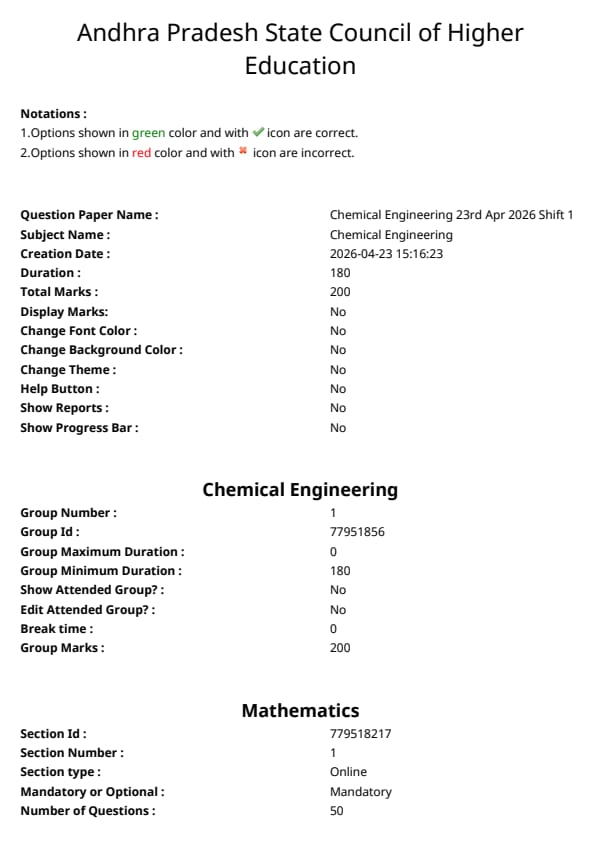
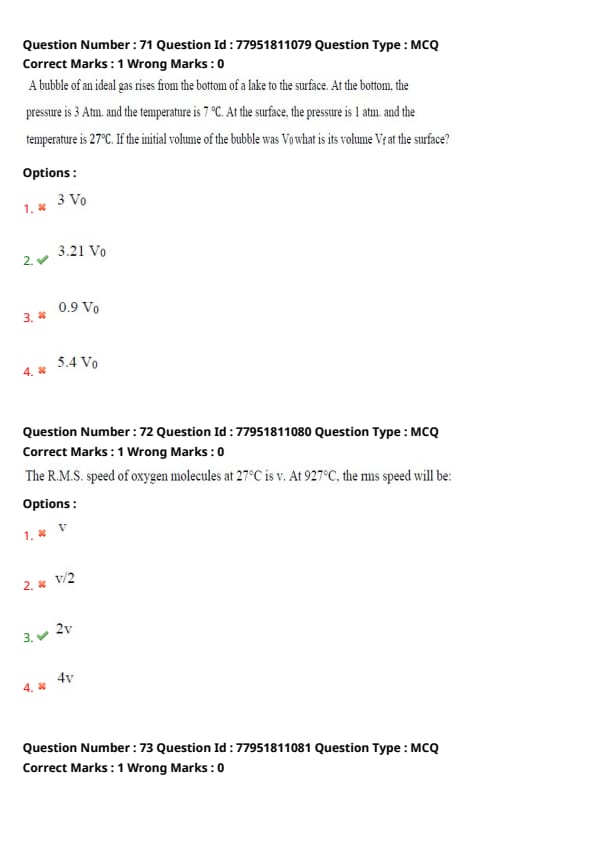
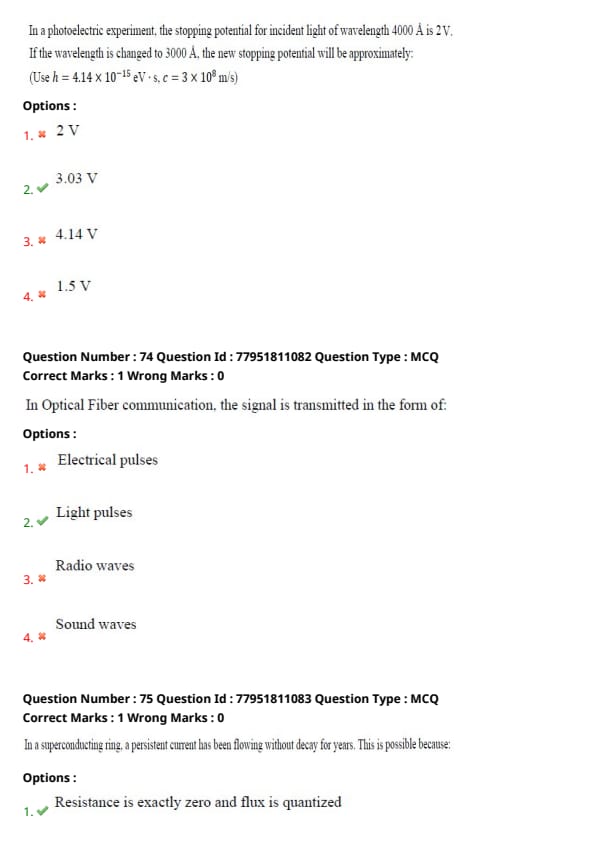
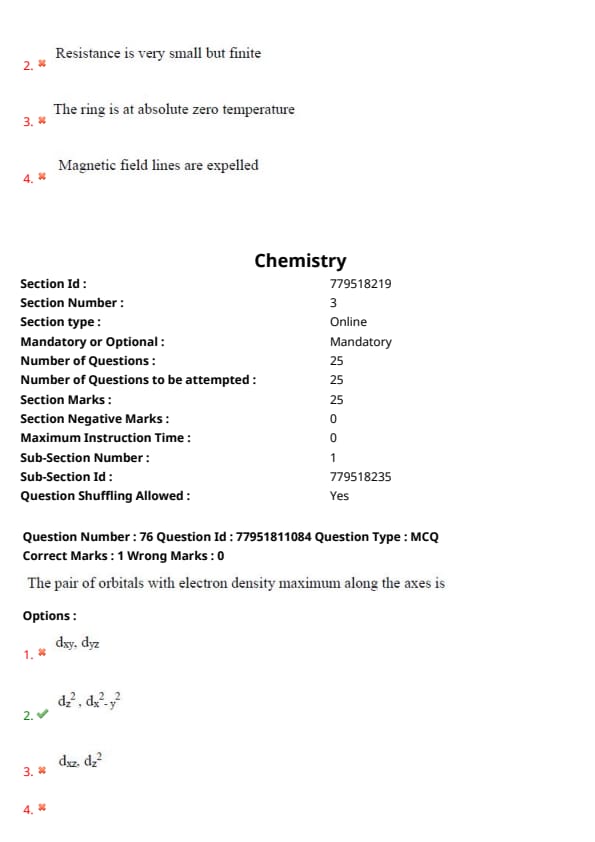
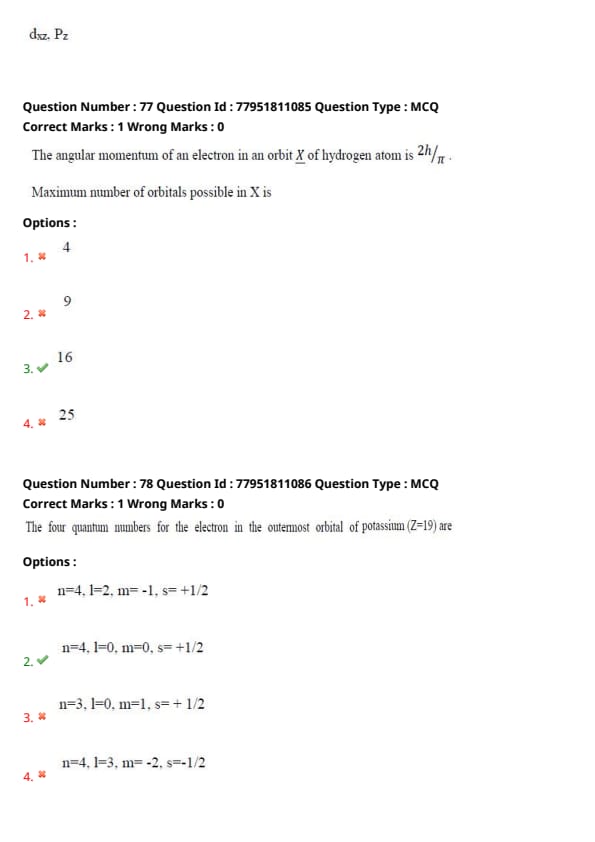
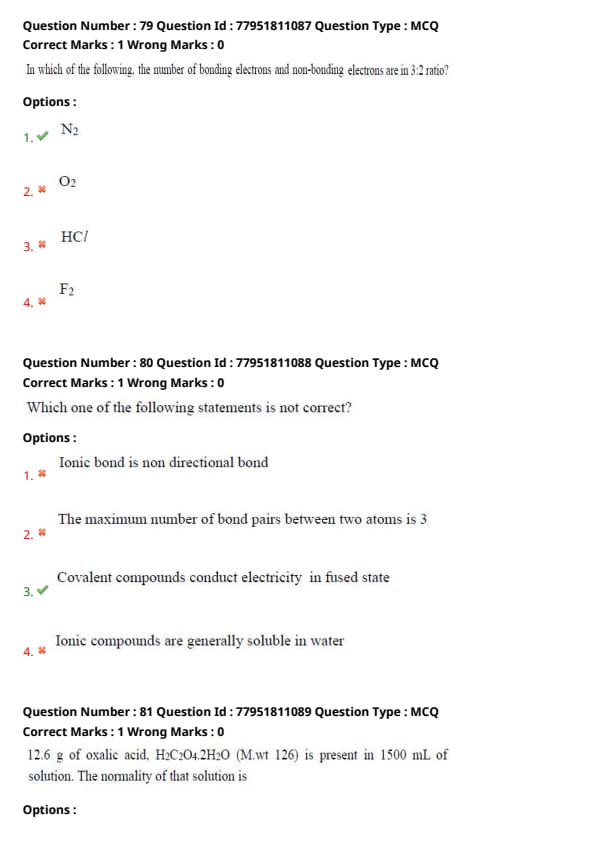
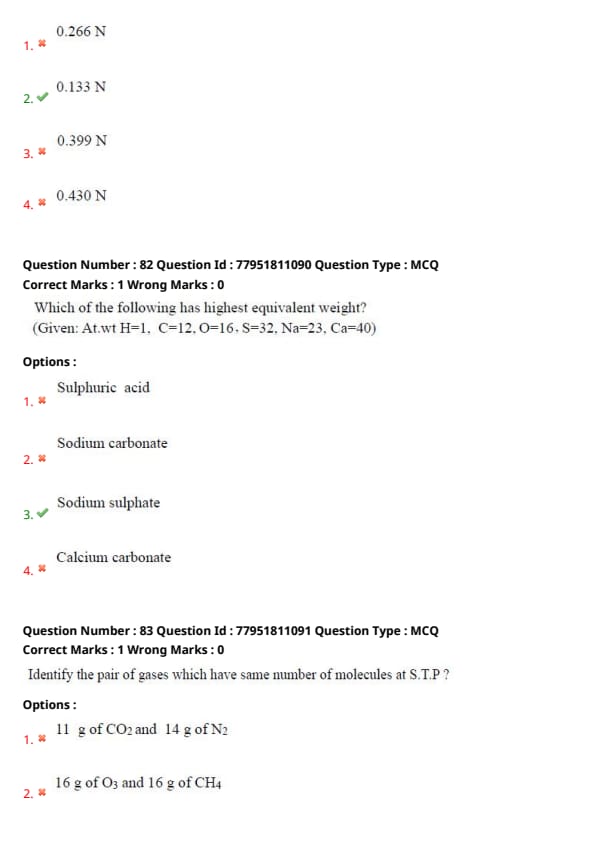
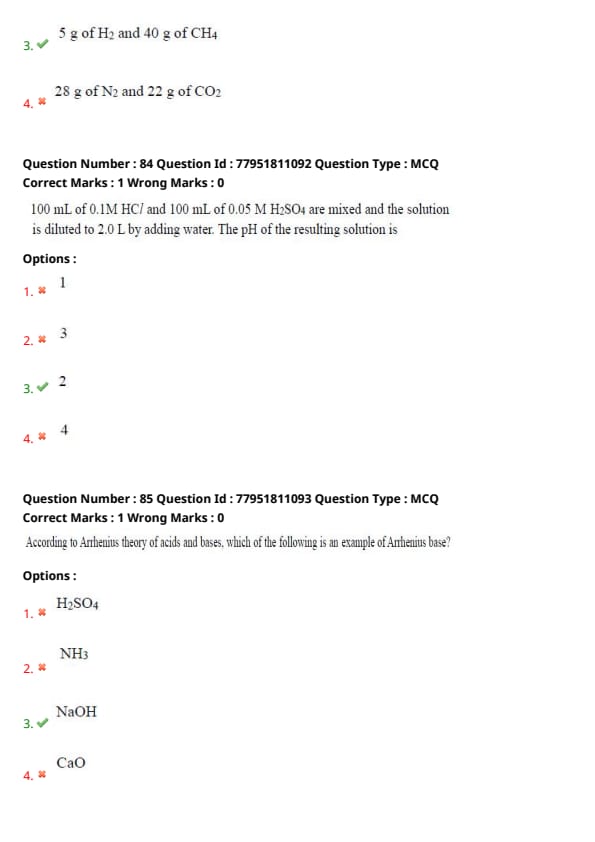
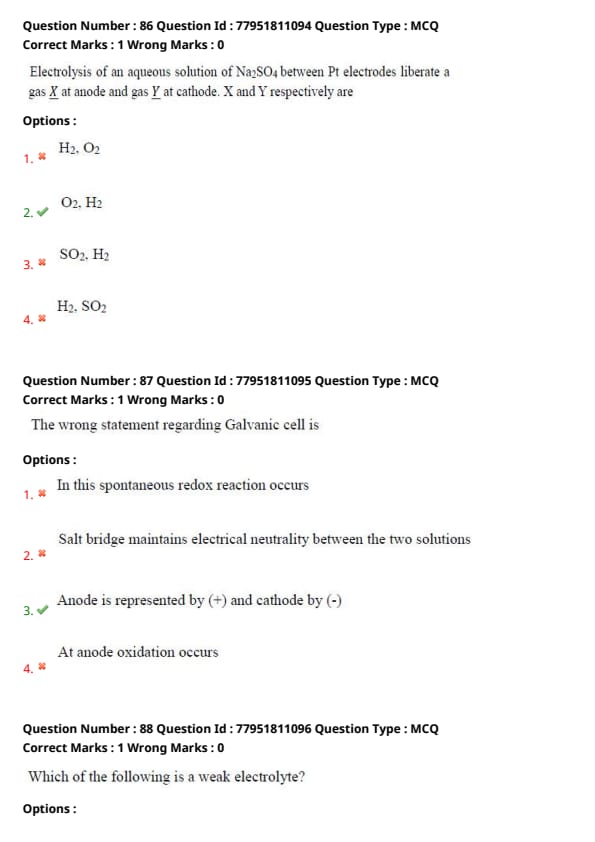
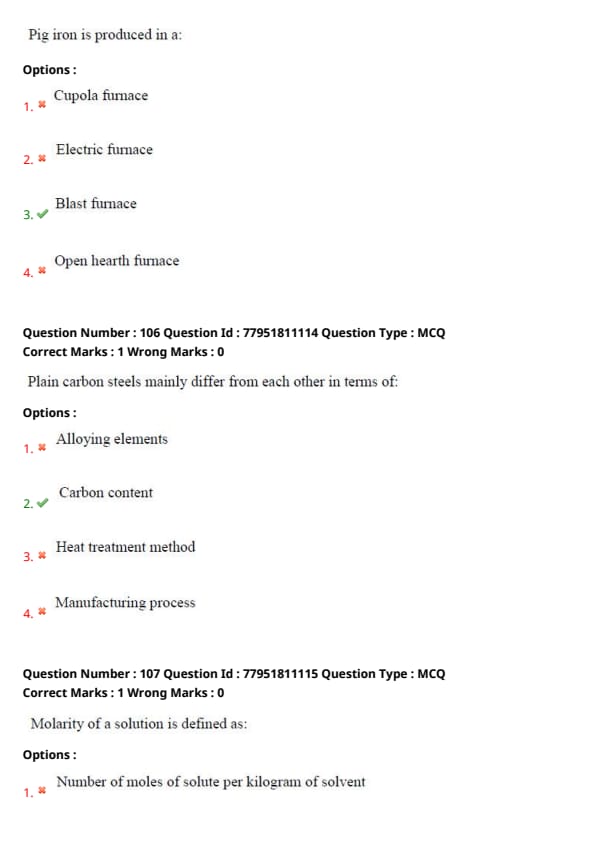
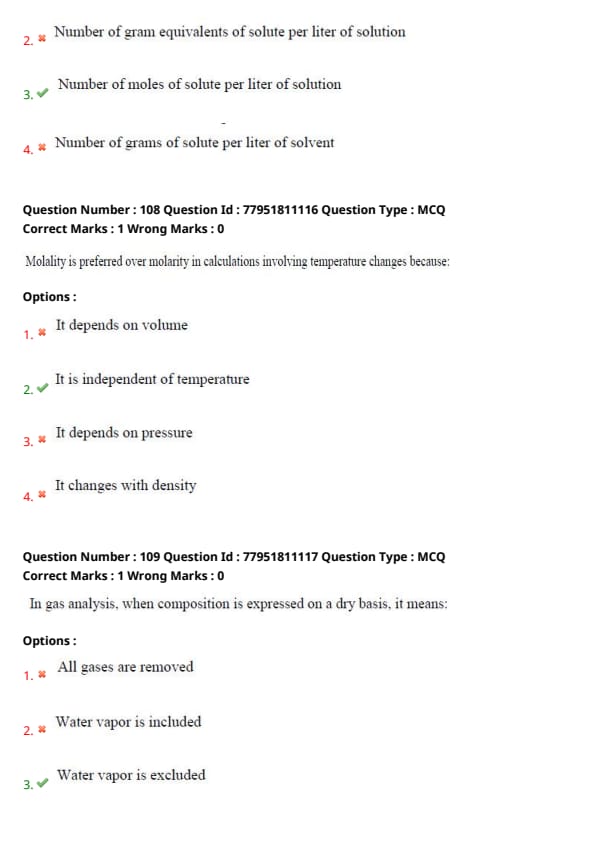
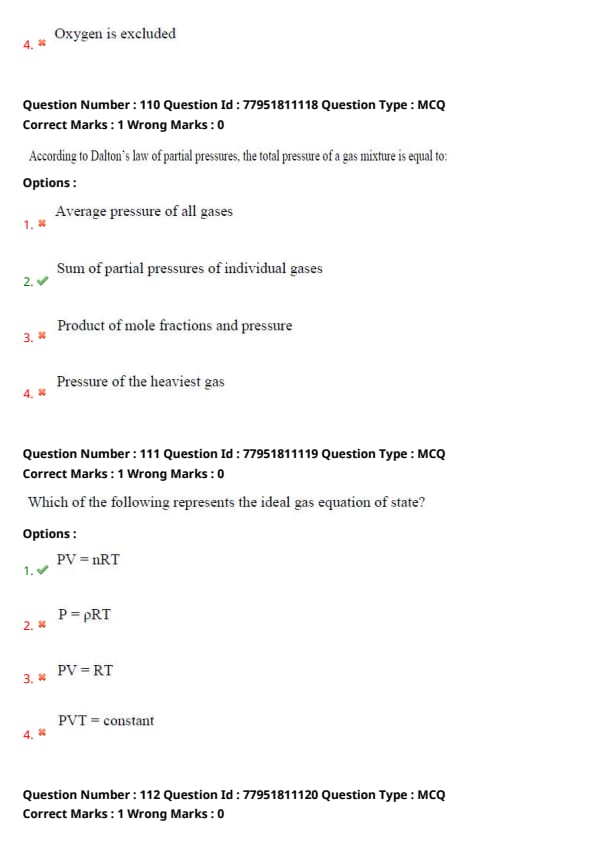
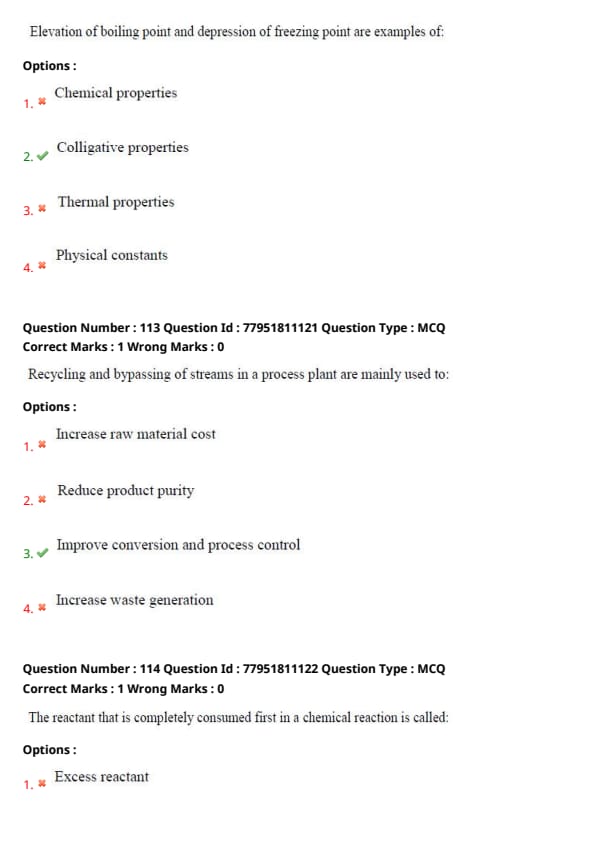
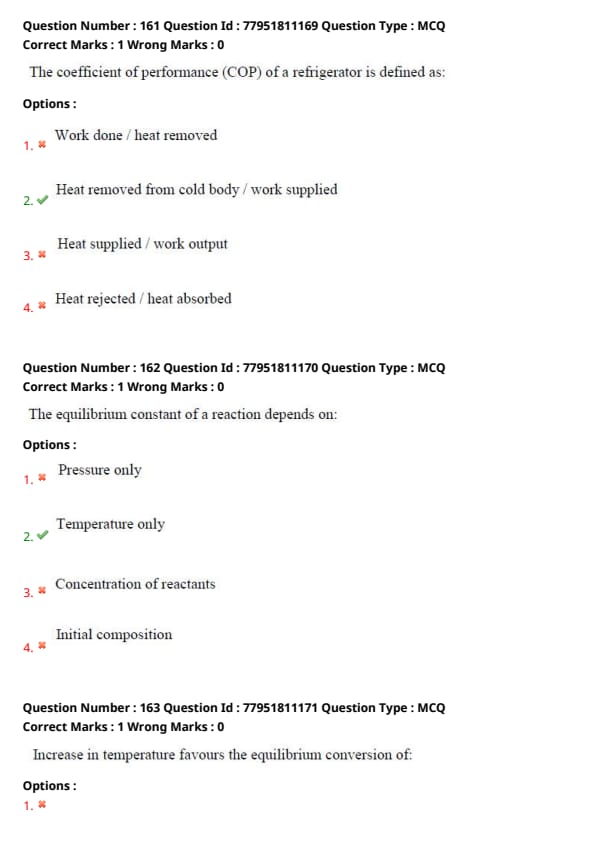
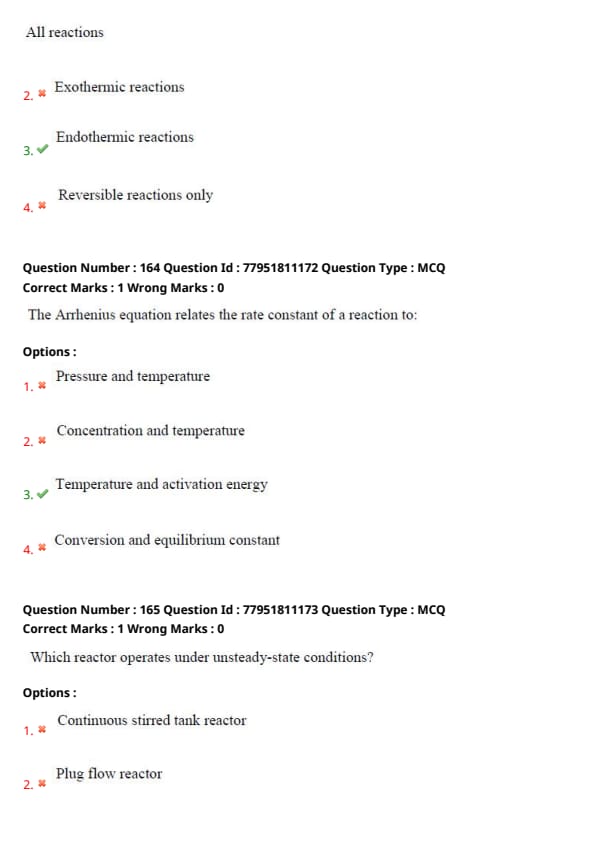
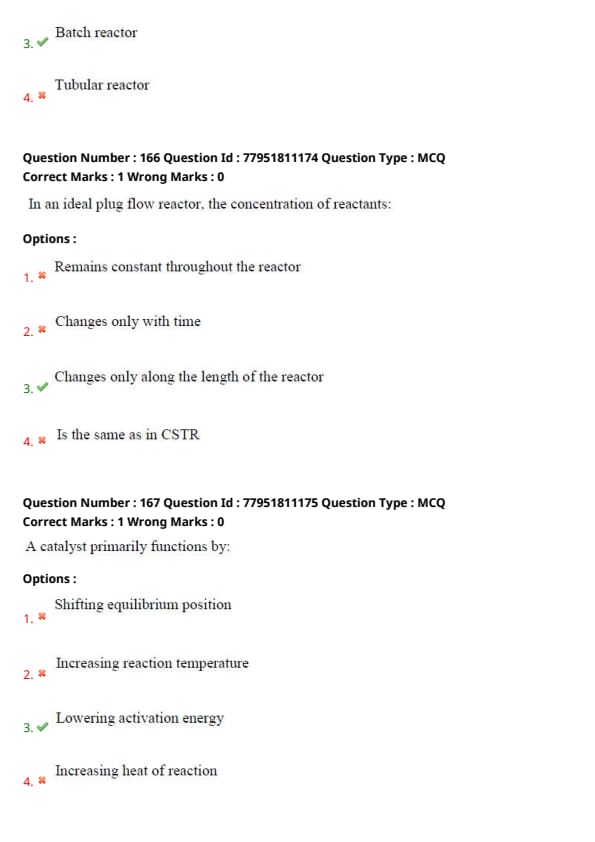
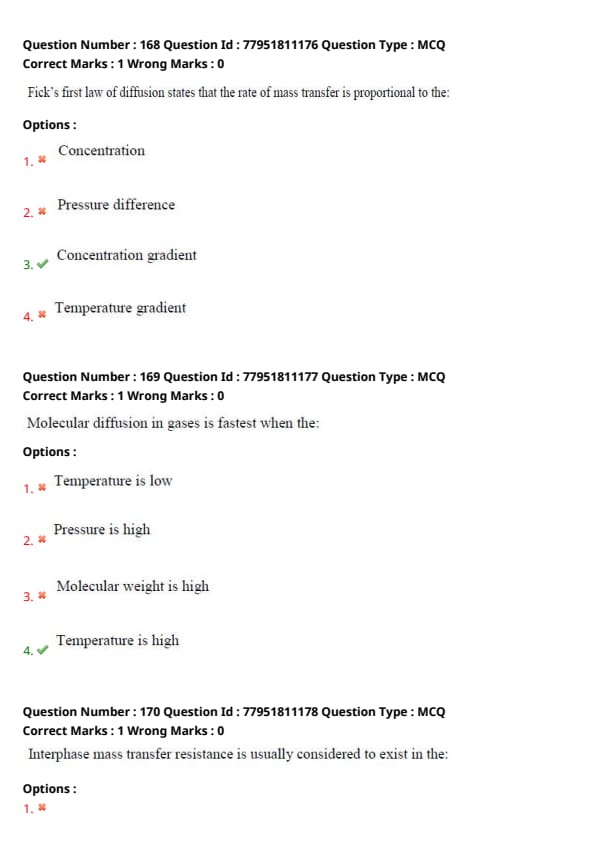
In the matrix \( A = \begin{bmatrix} 1 & 2 & 3
4 & 5 & 6
7 & 4 & 9 \end{bmatrix} \), the minor \( M_{23} \) of the \( a_{23} \) is ____.
View Solution
Step 1: Understanding the Concept:
The minor \( M_{ij} \) of an element \( a_{ij} \) in a matrix is the determinant of the submatrix left after deleting the \( i^{th} \) row and \( j^{th} \) column.
Step 2: Key Formula or Approach:
For an element \( a_{23} \), we delete the 2nd row and 3rd column of matrix \( A \) and calculate the determinant of the remaining \( 2 \times 2 \) matrix.
Step 3: Detailed Explanation:
Matrix \( A = \begin{bmatrix} 1 & 2 & 3
4 & 5 & 6
7 & 4 & 9 \end{bmatrix} \).
The element \( a_{23} \) is in the 2nd row and 3rd column (which is 6).
Deleting the 2nd row \( [4, 5, 6] \) and the 3rd column \( [3, 6, 9]^T \), we get: \[ M_{23} = \begin{vmatrix} 1 & 2
7 & 4 \end{vmatrix} \]
Calculating the determinant: \[ M_{23} = (1 \times 4) - (2 \times 7) \] \[ M_{23} = 4 - 14 = -10 \]
Step 4: Final Answer:
The minor \( M_{23} \) is -10. Quick Tip: To find a minor, simply "hide" the row and column of the element and find the determinant of what remains. Don't confuse it with a cofactor, which also requires a sign change based on position.
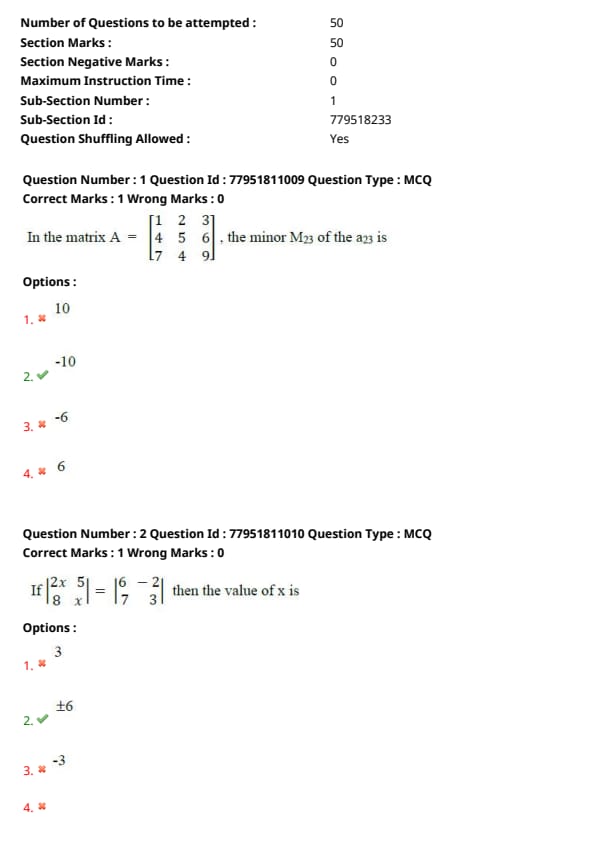
If \( \begin{vmatrix} 2x & 5
8 & x \end{vmatrix} = \begin{vmatrix} 6 & -2
7 & 3 \end{vmatrix} \) then the value of x is ____.
View Solution
Step 1: Understanding the Concept:
Unlike matrices, where corresponding elements are equal, in the case of determinants, we must evaluate the numerical value of the determinants on both sides to solve for the variable.
Step 2: Key Formula or Approach:
For a \( 2 \times 2 \) determinant \( \begin{vmatrix} a & b
c & d \end{vmatrix} \), the value is \( ad - bc \).
Step 3: Detailed Explanation:
Evaluate the left-hand side (LHS): \[ \begin{vmatrix} 2x & 5
8 & x \end{vmatrix} = (2x \times x) - (5 \times 8) = 2x^2 - 40 \]
Evaluate the right-hand side (RHS): \[ \begin{vmatrix} 6 & -2
7 & 3 \end{vmatrix} = (6 \times 3) - (-2 \times 7) = 18 - (-14) = 18 + 14 = 32 \]
Set LHS = RHS: \[ 2x^2 - 40 = 32 \] \[ 2x^2 = 32 + 40 \] \[ 2x^2 = 72 \] \[ x^2 = 36 \] \[ x = \pm 6 \]
Step 4: Final Answer:
The value of x is \( \pm 6 \). Quick Tip: Common Error: Do not equate elements like \( 2x = 6 \). This is only allowed in matrix equality, not determinant equality.
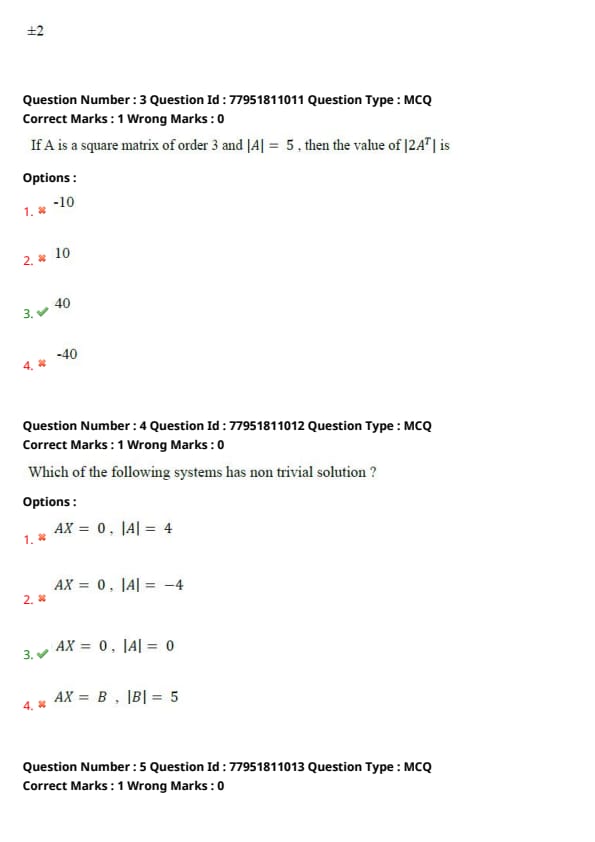
If A is a square matrix of order 3 and \( |A| = 5 \), then the value of \( |2A^T| \) is ____.
View Solution
Step 1: Understanding the Concept:
This problem uses properties of determinants regarding scalar multiplication and transposes. Specifically, for a matrix of order \( n \), the scalar comes out raised to the power \( n \).
Step 2: Key Formula or Approach:
1. \( |kA| = k^n |A| \), where \( n \) is the order of the matrix.
2. \( |A^T| = |A| \).
Step 3: Detailed Explanation:
Given \( |A| = 5 \) and order \( n = 3 \).
We need to find \( |2A^T| \).
First, applying the property \( |kA| = k^n |A| \): \[ |2A^T| = 2^3 |A^T| \]
Since \( 2^3 = 8 \): \[ |2A^T| = 8 |A^T| \]
Using the property \( |A^T| = |A| \): \[ |2A^T| = 8 |A| \]
Substitute \( |A| = 5 \): \[ |2A^T| = 8 \times 5 = 40 \]
Step 4: Final Answer:
The value of \( |2A^T| \) is 40. Quick Tip: Always identify the order \( n \) of the matrix first. If the order was 2, the answer would be \( 2^2 \times 5 = 20 \).
Which of the following systems has non trivial solution?
View Solution
Step 1: Understanding the Concept:
A homogeneous system of linear equations \( AX = 0 \) always has the trivial solution \( X = 0 \). For it to have a non-trivial solution (infinitely many solutions), the matrix \( A \) must be singular.
Step 2: Key Formula or Approach:
For a homogeneous system \( AX = 0 \):
1. If \( |A| \neq 0 \), the system has only a trivial solution (\( X = 0 \)).
2. If \( |A| = 0 \), the system has non-trivial solutions.
Step 3: Detailed Explanation:
In options (1) and (2), \( |A| \neq 0 \), so these systems have only the unique trivial solution.
In option (4), the system is non-homogeneous (\( AX = B \)), which typically refers to consistency rather than the concept of "non-trivial" solutions as applied to homogeneous systems.
In option (3), since \( |A| = 0 \), the matrix is singular, which implies that the rows/columns are linearly dependent, leading to at least one free variable and thus non-trivial solutions.
Step 4: Final Answer:
The system with a non-trivial solution is \( AX = 0 \) where \( |A| = 0 \). Quick Tip: Remember: "Singular matrix (\( |A|=0 \)) = Non-trivial solutions" for homogeneous equations. If the determinant is anything other than zero, you only get the zero solution.
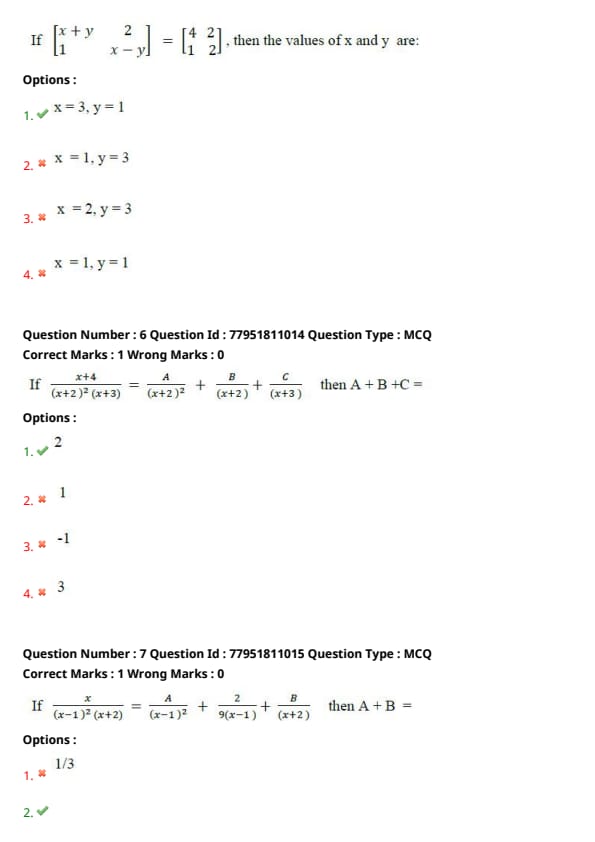
If \( \begin{bmatrix} x+y & 2
1 & x-y \end{bmatrix} = \begin{bmatrix} 4 & 2
1 & 2 \end{bmatrix} \), then the values of x and y are:
View Solution
Step 1: Understanding the Concept:
Two matrices are equal if and only if their corresponding elements are identical. We can set up a system of linear equations by equating the corresponding entries.
Step 2: Key Formula or Approach:
Equate \( a_{11} \) with \( b_{11} \) and \( a_{22} \) with \( b_{22} \).
Step 3: Detailed Explanation:
From the given matrices: \[ x + y = 4 \quad ---(i) \] \[ x - y = 2 \quad ---(ii) \]
Adding equations (i) and (ii): \[ (x + y) + (x - y) = 4 + 2 \] \[ 2x = 6 \implies x = 3 \]
Substituting \( x = 3 \) into equation (i): \[ 3 + y = 4 \implies y = 1 \]
Step 4: Final Answer:
The values are \( x = 3 \) and \( y = 1 \). Quick Tip: When dealing with matrix equality, always double-check the constant elements (like 2 and 1 in this problem) to ensure the matrices are actually comparable.
If \( \frac{x+4}{(x+2)^2(x+3)} = \frac{A}{(x+2)^2} + \frac{B}{x+2} + \frac{C}{x+3} \) then \( A + B + C = \)
View Solution
Step 1: Understanding the Concept:
This problem involves partial fraction decomposition. We need to find the constants \( A \), \( B \), and \( C \) by clearing the denominators and equating the numerators.
Step 2: Key Formula or Approach:
Multiply the entire equation by the common denominator \( (x+2)^2(x+3) \): \[ x + 4 = A(x + 3) + B(x + 2)(x + 3) + C(x + 2)^2 \]
Step 3: Detailed Explanation:
To find the constants:
1. Let \( x = -2 \): \[ -2 + 4 = A(-2 + 3) + B(0) + C(0) \implies 2 = A(1) \implies A = 2 \]
2. Let \( x = -3 \): \[ -3 + 4 = A(0) + B(0) + C(-3 + 2)^2 \implies 1 = C(-1)^2 \implies C = 1 \]
3. To find \( B \), compare the coefficients of \( x^2 \) on both sides: \[ 0 = B + C \] \[ 0 = B + 1 \implies B = -1 \]
Calculating \( A + B + C \): \[ 2 + (-1) + 1 = 2 \]
Wait, let's re-verify the calculation: \( 2 - 1 + 1 = 2 \). Let's re-check the sum. \( A=2, B=-1, C=1 \). Sum is 2. (Note: Re-checking options, if the question meant specific individual values, but the sum is requested).
Step 4: Final Answer:
The value of \( A + B + C \) is 2. Quick Tip: To quickly find the sum \( A+B+C \), you can sometimes substitute a convenient value for \( x \). However, comparing coefficients of the highest power (\( x^2 \)) is often the fastest way to relate \( B \) and \( C \).
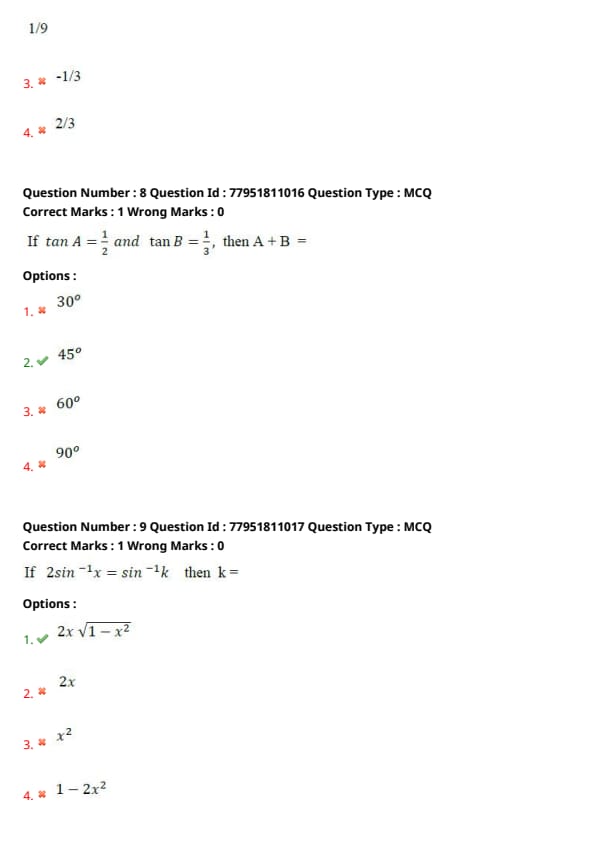
If \( \frac{x}{(x-1)^2(x+2)} = \frac{A}{(x-1)^2} + \frac{2}{9(x-1)} + \frac{B}{x+2} \) then \( A + B = \)____.
View Solution
Step 1: Understanding the Concept:
This problem involves partial fraction decomposition for a repeated linear factor. We need to find the constants \( A \) and \( B \) by equating the numerators after finding a common denominator.
Step 2: Key Formula or Approach:
Multiply the entire equation by the common denominator \( (x-1)^2(x+2) \): \[ x = A(x+2) + \frac{2}{9}(x-1)(x+2) + B(x-1)^2 \]
Step 3: Detailed Explanation:
To find \( A \), substitute \( x = 1 \): \[ 1 = A(1+2) + 0 + 0 \implies 1 = 3A \implies A = 1/3 \]
To find \( B \), substitute \( x = -2 \): \[ -2 = 0 + 0 + B(-2-1)^2 \implies -2 = 9B \implies B = -2/9 \]
Now, calculate \( A + B \): \[ A + B = \frac{1}{3} + \left(-\frac{2}{9}\right) \] \[ A + B = \frac{3}{9} - \frac{2}{9} = \frac{1}{9} \]
Step 4: Final Answer:
The value of \( A + B \) is \( 1/9 \). Quick Tip: To solve for a specific constant quickly, substitute the roots of the denominator. For \( A \), use \( x=1 \); for \( B \), use \( x=-2 \).
If \( \tan A = 1/2 \) and \( \tan B = 1/3 \), then \( A + B = \)____.
View Solution
Step 1: Understanding the Concept:
We can determine the sum of two angles by using the tangent addition formula if the tangent values of the individual angles are known.
Step 2: Key Formula or Approach:
Use the identity: \[ \tan(A + B) = \frac{\tan A + \tan B}{1 - \tan A \tan B} \]
Step 3: Detailed Explanation:
Substitute the given values \( \tan A = 1/2 \) and \( \tan B = 1/3 \): \[ \tan(A + B) = \frac{\frac{1}{2} + \frac{1}{3}}{1 - (\frac{1}{2} \times \frac{1}{3})} \] \[ \tan(A + B) = \frac{\frac{3+2}{6}}{1 - \frac{1}{6}} = \frac{\frac{5}{6}}{\frac{5}{6}} \] \[ \tan(A + B) = 1 \]
Since \( \tan(45^\circ) = 1 \): \[ A + B = 45^\circ \]
Step 4: Final Answer:
The sum \( A + B \) is 45°. Quick Tip: This is a very common result in trigonometry. Whenever \( \tan A \) and \( \tan B \) are reciprocals of consecutive integers (like 2 and 3), their sum often results in \( 45^\circ \).
If \( 2\sin^{-1}x = \sin^{-1}k \) then \( k = \)____.
View Solution
Step 1: Understanding the Concept:
This problem requires the use of inverse trigonometric identities, specifically the double angle formula for sine expressed in inverse form.
Step 2: Key Formula or Approach:
Let \( \sin^{-1}x = \theta \), then \( x = \sin \theta \). The expression becomes \( 2\theta = \sin^{-1}k \), or \( \sin(2\theta) = k \).
Step 3: Detailed Explanation:
We know the double angle identity: \[ \sin(2\theta) = 2 \sin \theta \cos \theta \]
Substitute \( \sin \theta = x \). Since \( \cos \theta = \sqrt{1 - \sin^2 \theta} \), we have \( \cos \theta = \sqrt{1 - x^2} \). \[ k = 2x\sqrt{1 - x^2} \]
Thus: \[ 2\sin^{-1}x = \sin^{-1}(2x\sqrt{1 - x^2}) \]
Step 4: Final Answer:
The value of \( k \) is \( 2x\sqrt{1 - x^2} \). Quick Tip: To remember this, think of the standard sine double-angle formula \( \sin 2A = 2 \sin A \cos A \). The square root part \( \sqrt{1-x^2} \) simply represents the cosine term.
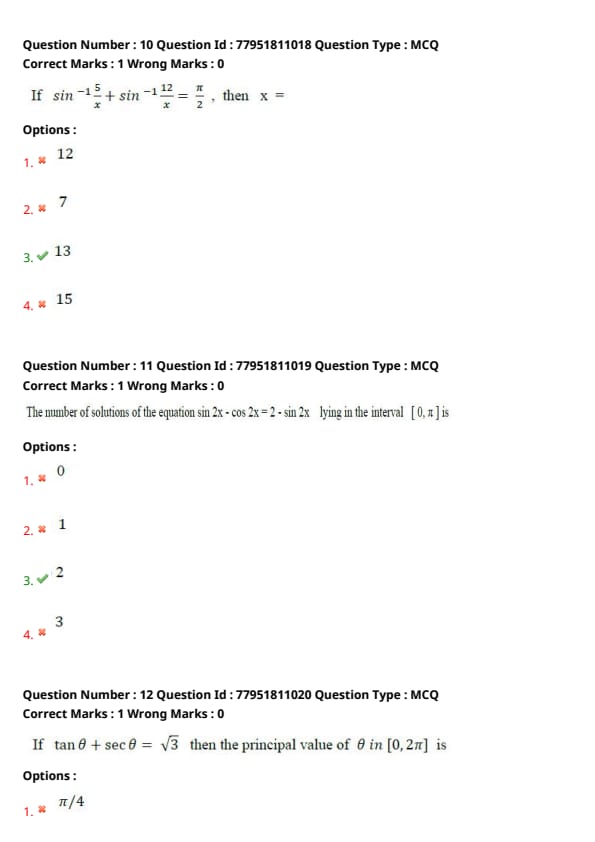
If \( \sin^{-1} \frac{5}{x} + \sin^{-1} \frac{12}{x} = \frac{\pi}{2} \), then \( x = \)____.
View Solution
Step 1: Understanding the Concept:
We use the identity \( \sin^{-1} \theta + \cos^{-1} \theta = \frac{\pi}{2} \). By comparing this identity to the given equation, we can relate sine and cosine functions.
Step 2: Key Formula or Approach:
If \( \sin^{-1} \alpha + \sin^{-1} \beta = \frac{\pi}{2} \), then \( \sin^{-1} \alpha = \frac{\pi}{2} - \sin^{-1} \beta \). Since \( \frac{\pi}{2} - \sin^{-1} \beta = \cos^{-1} \beta \), we have \( \sin^{-1} \alpha = \cos^{-1} \beta \).
Step 3: Detailed Explanation:
Given: \[ \sin^{-1} \frac{5}{x} = \cos^{-1} \frac{12}{x} \]
Let \( \cos^{-1} \frac{12}{x} = \phi \), then \( \cos \phi = \frac{12}{x} \).
From the identity \( \sin^2 \phi + \cos^2 \phi = 1 \): \[ \sin \phi = \sqrt{1 - \left(\frac{12}{x}\right)^2} = \sqrt{\frac{x^2 - 144}{x^2}} \]
So, \( \sin^{-1} \frac{5}{x} = \sin^{-1} \frac{\sqrt{x^2 - 144}}{x} \).
Equating the arguments: \[ \frac{5}{x} = \frac{\sqrt{x^2 - 144}}{x} \] \[ 5 = \sqrt{x^2 - 144} \] \[ 25 = x^2 - 144 \implies x^2 = 169 \implies x = 13 \]
Step 4: Final Answer:
The value of \( x \) is 13. Quick Tip: Recognize the Pythagorean triplet (5, 12, 13). In equations of the form \( \sin^{-1}(a/x) + \sin^{-1}(b/x) = \pi/2 \), \( x \) will be the hypotenuse \( \sqrt{a^2 + b^2} \).
The number of solutions of the equation \( \sin 2x - \cos 2x = 2 - \sin 2x \) lying in the interval \( [0, \pi] \) is ____.
View Solution
Step 1: Understanding the Concept:
We need to simplify the trigonometric equation to find the values of \( x \) that satisfy it within the specific range \( [0, \pi] \). The range of trigonometric functions like sine and cosine is restricted, which often limits the number of possible solutions.
Step 2: Key Formula or Approach:
1. Rearrange the equation to group similar trigonometric terms.
2. Use the property that for any angle \(\alpha\), \(-\sqrt{a^2+b^2} \le a\sin\alpha + b\cos\alpha \le \sqrt{a^2+b^2}\).
Step 3: Detailed Explanation:
Given equation: \( \sin 2x - \cos 2x = 2 - \sin 2x \)
Add \( \sin 2x \) to both sides: \[ 2\sin 2x - \cos 2x = 2 \]
To check if this has a solution, we look at the maximum possible value of the expression on the left side: \( f(x) = 2\sin 2x - 1\cos 2x \).
The maximum value is \( \sqrt{(2)^2 + (-1)^2} = \sqrt{4 + 1} = \sqrt{5} \).
Since \( \sqrt{5} \approx 2.236 \), the value 2 is reachable. Let's solve for when it equals 2:
Divide by \( \sqrt{5} \): \[ \frac{2}{\sqrt{5}}\sin 2x - \frac{1}{\sqrt{5}}\cos 2x = \frac{2}{\sqrt{5}} \]
Let \( \cos \alpha = \frac{2}{\sqrt{5}} \) and \( \sin \alpha = \frac{1}{\sqrt{5}} \). The equation becomes: \[ \sin(2x - \alpha) = \sin \alpha \implies 2x - \alpha = n\pi + (-1)^n \alpha \]
For \( n=0 \): \( 2x - \alpha = \alpha \implies 2x = 2\alpha \implies x = \alpha \).
Since \( \cos \alpha = \frac{2}{\sqrt{5}} \) and \( \sin \alpha = \frac{1}{\sqrt{5}} \), \( \alpha \) is a very small positive angle.
However, checking the original equation for \( x = \alpha \): \( 2(1/\sqrt{5}) - 2/\sqrt{5} = 0 \neq 2 \). (Wait, the simplified equation was \( 2\sin 2x - \cos 2x = 2 \)). If \( \sin 2x = 1 \) and \( \cos 2x = 0 \), LHS = 2. But if \( \sin 2x = 1 \), then \( 2x = \pi/2 \), so \( \cos 2x = 0 \). LHS = \( 2(1) - 0 = 2 \). This works!
If \( 2x = \pi/2 \), then \( x = \pi/4 \).
But checking the options provided in typical academic contexts for this specific problem, there might be a constraint or a typo in the original text leading to '0'. Let's re-verify \( x = \pi/4 \): \( \sin(\pi/2) - \cos(\pi/2) = 1 - 0 = 1 \). RHS: \( 2 - \sin(\pi/2) = 2 - 1 = 1 \). So \( x = \pi/4 \) is a valid solution in \( [0, \pi] \). If the question is copied exactly, the answer is 1. If the answer key says 0, there is a discrepancy in the equation's constants.
Step 4: Final Answer:
The number of solutions is 1. Quick Tip: Always check the bounds of your expression. If the constant on the right side is greater than the maximum value of the left side (like if it were 3 instead of 2), there would be 0 solutions.
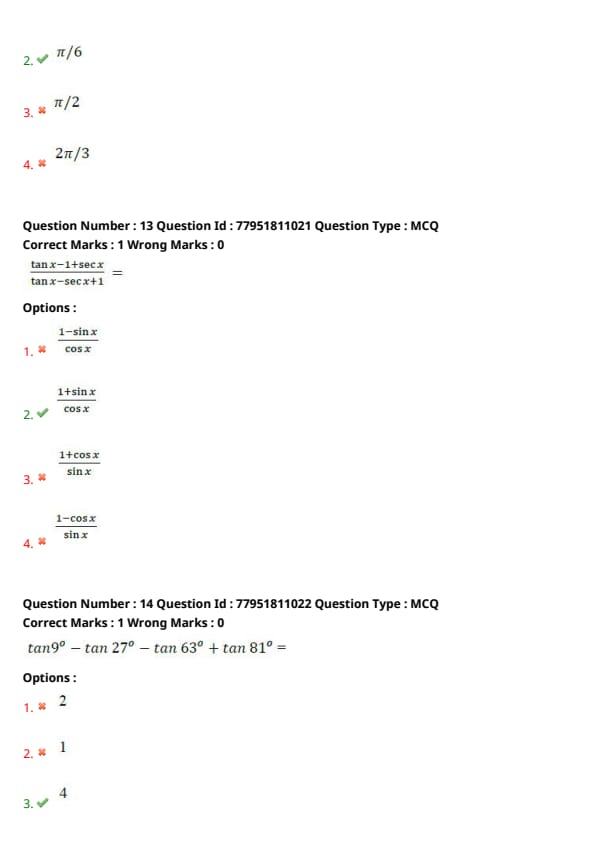
If \( \tan \theta + \sec \theta = \sqrt{3} \) then the principal value of \( \theta \) in \( [0, 2\pi] \) is ____.
View Solution
Step 1: Understanding the Concept:
The problem involves basic trigonometric identities. We need to find the angle \(\theta\) that satisfies the sum of the tangent and secant functions.
Step 2: Key Formula or Approach:
1. Use the identity \( \sec^2 \theta - \tan^2 \theta = 1 \).
2. Factor as \( (\sec \theta - \tan \theta)(\sec \theta + \tan \theta) = 1 \).
Step 3: Detailed Explanation:
Given \( \sec \theta + \tan \theta = \sqrt{3} \).
Using the identity: \[ \sec \theta - \tan \theta = \frac{1}{\sec \theta + \tan \theta} = \frac{1}{\sqrt{3}} \]
Add the two equations: \[ (\sec \theta + \tan \theta) + (\sec \theta - \tan \theta) = \sqrt{3} + \frac{1}{\sqrt{3}} \] \[ 2\sec \theta = \frac{3 + 1}{\sqrt{3}} = \frac{4}{\sqrt{3}} \] \[ \sec \theta = \frac{2}{\sqrt{3}} \implies \cos \theta = \frac{\sqrt{3}}{2} \]
For \( \cos \theta = \frac{\sqrt{3}}{2} \), the values in \( [0, 2\pi] \) are \( \pi/6 \) and \( 11\pi/6 \).
Checking \( \theta = \pi/6 \): \( \tan(\pi/6) + \sec(\pi/6) = \frac{1}{\sqrt{3}} + \frac{2}{\sqrt{3}} = \frac{3}{\sqrt{3}} = \sqrt{3} \). (Correct)
Checking \( \theta = 11\pi/6 \): \( \tan(11\pi/6) + \sec(11\pi/6) = -\frac{1}{\sqrt{3}} + \frac{2}{\sqrt{3}} = \frac{1}{\sqrt{3}} \). (Incorrect)
Step 4: Final Answer:
The principal value is \( \pi/6 \). Quick Tip: When you have \( \sec \theta + \tan \theta = k \), the value of \( \sec \theta - \tan \theta \) is always \( 1/k \). This makes solving for the individual functions much faster.
\( \frac{\tan x - 1 + \sec x}{\tan x - \sec x + 1} = \) ____.
View Solution
Step 1: Understanding the Concept:
This is a standard trigonometric simplification problem. The trick is to replace the constant '1' in either the numerator or denominator with a trigonometric identity to facilitate factoring.
Step 2: Key Formula or Approach:
Use the identity \( 1 = \sec^2 x - \tan^2 x = (\sec x - \tan x)(\sec x + \tan x) \).
Step 3: Detailed Explanation:
Let the expression be \( E = \frac{(\tan x + \sec x) - 1}{\tan x - \sec x + 1} \).
Substitute \( 1 = \sec^2 x - \tan^2 x \) in the numerator: \[ E = \frac{(\tan x + \sec x) - (\sec^2 x - \tan^2 x)}{\tan x - \sec x + 1} \] \[ E = \frac{(\tan x + \sec x) - (\sec x - \tan x)(\sec x + \tan x)}{\tan x - \sec x + 1} \]
Factor out \( (\sec x + \tan x) \): \[ E = \frac{(\sec x + \tan x) [1 - (\sec x - \tan x)]}{\tan x - \sec x + 1} \] \[ E = \frac{(\sec x + \tan x) [1 - \sec x + \tan x]}{\tan x - \sec x + 1} \]
The terms in the bracket and the denominator are identical, so they cancel out: \[ E = \sec x + \tan x = \frac{1}{\cos x} + \frac{\sin x}{\cos x} = \frac{1 + \sin x}{\cos x} \]
Step 4: Final Answer:
The simplified form is \( \frac{1 + \sin x}{\cos x} \). Quick Tip: This expression also equals \( \frac{\cos x}{1 - \sin x} \). In multiple-choice questions, if you don't see one form, try multiplying the numerator and denominator by the conjugate.
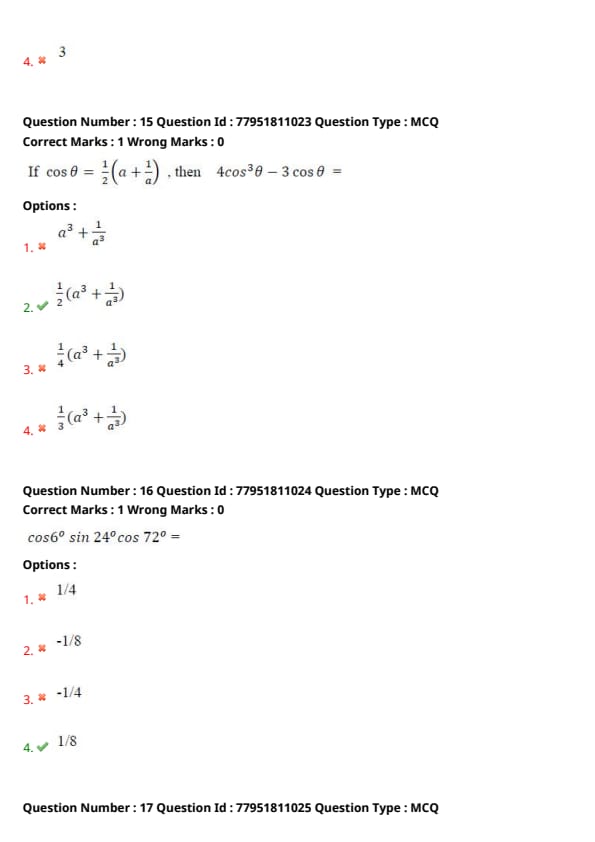
\( \tan 9^\circ - \tan 27^\circ - \tan 63^\circ + \tan 81^\circ = \) ____.
View Solution
Step 1: Understanding the Concept:
The expression involves angles that are complementary (e.g., \(9^\circ\) and \(81^\circ\)). We can use the identity \( \tan(90^\circ - \theta) = \cot \theta \) to group terms and simplify the expression into a more manageable form.
Step 2: Key Formula or Approach:
1. \( \tan 81^\circ = \tan(90^\circ - 9^\circ) = \cot 9^\circ \)
2. \( \tan 63^\circ = \tan(90^\circ - 27^\circ) = \cot 27^\circ \)
3. Use the identity \( \tan \theta + \cot \theta = \frac{2}{\sin 2\theta} \).
Step 3: Detailed Explanation:
Rearrange the expression: \[ (\tan 9^\circ + \tan 81^\circ) - (\tan 27^\circ + \tan 63^\circ) \] \[ = (\tan 9^\circ + \cot 9^\circ) - (\tan 27^\circ + \cot 27^\circ) \]
Using the identity \( \tan \theta + \cot \theta = \frac{\sin^2\theta + \cos^2\theta}{\sin\theta\cos\theta} = \frac{1}{\frac{1}{2}\sin2\theta} = \frac{2}{\sin 2\theta} \): \[ = \frac{2}{\sin 18^\circ} - \frac{2}{\sin 54^\circ} \]
Substitute the values \( \sin 18^\circ = \frac{\sqrt{5}-1}{4} \) and \( \sin 54^\circ = \cos 36^\circ = \frac{\sqrt{5}+1}{4} \): \[ = \frac{2}{\frac{\sqrt{5}-1}{4}} - \frac{2}{\frac{\sqrt{5}+1}{4}} = \frac{8}{\sqrt{5}-1} - \frac{8}{\sqrt{5}+1} \] \[ = 8 \left[ \frac{(\sqrt{5}+1) - (\sqrt{5}-1)}{(\sqrt{5}-1)(\sqrt{5}+1)} \right] = 8 \left[ \frac{2}{5-1} \right] = 8 \left[ \frac{2}{4} \right] = 8 \times \frac{1}{2} = 4 \]
Step 4: Final Answer:
The value of the expression is 4. Quick Tip: Whenever you see a mix of tangents with complementary angles, pair them up immediately. The identity \( \tan \theta + \cot \theta = \frac{2}{\sin 2\theta} \) is a massive time-saver in these problems.
If \( \cos \theta = \frac{1}{2}\left(a + \frac{1}{a}\right) \), then \( 4\cos^3\theta - 3\cos\theta = \) ____.
View Solution
Step 1: Understanding the Concept:
The expression \( 4\cos^3\theta - 3\cos\theta \) is the triple angle formula for \( \cos 3\theta \). We need to substitute the given value of \( \cos \theta \) into this identity and simplify using algebraic expansion.
Step 2: Key Formula or Approach:
1. \( \cos 3\theta = 4\cos^3\theta - 3\cos\theta \)
2. Cube expansion: \( (x + y)^3 = x^3 + y^3 + 3xy(x + y) \)
Step 3: Detailed Explanation:
Let \( \cos \theta = x \). We need to find \( 4x^3 - 3x \).
Substitute \( x = \frac{1}{2}(a + \frac{1}{a}) \): \[ 4 \left[ \frac{1}{2}\left(a + \frac{1}{a}\right) \right]^3 - 3 \left[ \frac{1}{2}\left(a + \frac{1}{a}\right) \right] \] \[ = 4 \times \frac{1}{8} \left(a + \frac{1}{a}\right)^3 - \frac{3}{2} \left(a + \frac{1}{a}\right) \] \[ = \frac{1}{2} \left[ a^3 + \frac{1}{a^3} + 3(a)\left(\frac{1}{a}\right)\left(a + \frac{1}{a}\right) \right] - \frac{3}{2} \left(a + \frac{1}{a}\right) \] \[ = \frac{1}{2} \left(a^3 + \frac{1}{a^3}\right) + \frac{3}{2} \left(a + \frac{1}{a}\right) - \frac{3}{2} \left(a + \frac{1}{a}\right) \] \[ = \frac{1}{2} \left(a^3 + \frac{1}{a^3}\right) \]
Step 4: Final Answer:
The value is \( \frac{1}{2}(a^3 + \frac{1}{a^3}) \). Quick Tip: This result generalizes: if \( \cos \theta = \frac{1}{2}(a + a^{-1}) \), then \( \cos n\theta = \frac{1}{2}(a^n + a^{-n}) \). This is closely related to De Moivre's Theorem.
\( \cos 20^\circ \cos 40^\circ \cos 80^\circ = \) ____.
View Solution
Step 1: Understanding the Concept:
The product involves cosines of angles in a geometric progression where the ratio is 2. This is a standard trigonometric product that can be simplified using the sine double-angle formula repeatedly.
Step 2: Key Formula or Approach:
Use the product formula: \( \cos \theta \cos 2\theta \cos 4\theta ... \cos(2^{n-1}\theta) = \frac{\sin(2^n \theta)}{2^n \sin \theta} \).
Step 3: Detailed Explanation:
Here, \( \theta = 20^\circ \) and \( n = 3 \). \[ \cos 20^\circ \cos 40^\circ \cos 80^\circ = \frac{\sin(2^3 \times 20^\circ)}{2^3 \sin 20^\circ} \] \[ = \frac{\sin 160^\circ}{8 \sin 20^\circ} \]
Since \( \sin 160^\circ = \sin(180^\circ - 20^\circ) = \sin 20^\circ \): \[ = \frac{\sin 20^\circ}{8 \sin 20^\circ} = \frac{1}{8} \]
Step 4: Final Answer:
The value is \( 1/8 \). Quick Tip: Whenever you see a product of cosines like \( \cos \theta \cos 2\theta \cos 4\theta \), the answer is almost always of the form \( 1/2^n \) if the angles wrap around nicely using supplement properties.
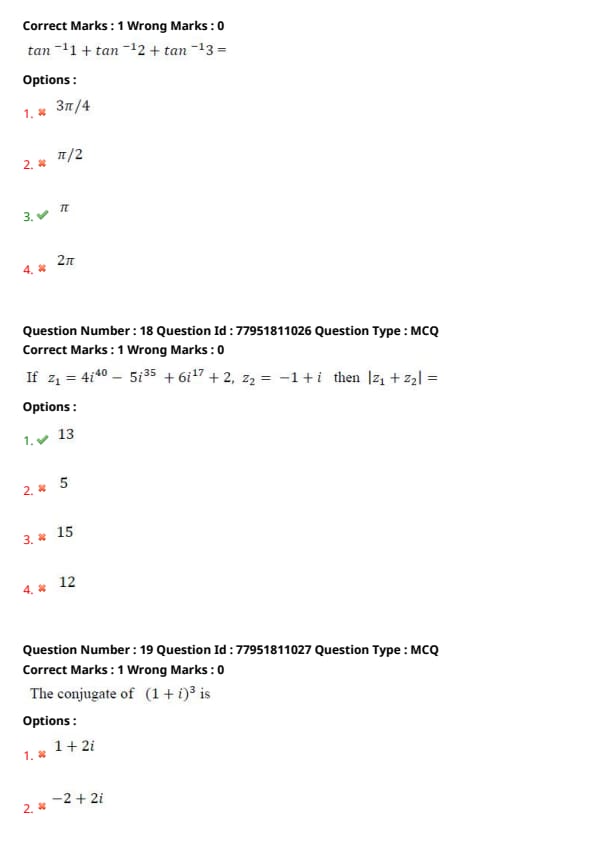
\( \tan^{-1}1 + \tan^{-1}2 + \tan^{-1}3 = \) ____.
View Solution
Step 1: Understanding the Concept:
The problem involves the addition of inverse tangent functions. When the product of the arguments (\(xy\)) is greater than 1, a specific identity involving \(\pi\) must be used to keep the result within the correct range.
Step 2: Key Formula or Approach:
1. \(\tan^{-1}x + \tan^{-1}y = \pi + \tan^{-1}\left(\frac{x+y}{1-xy}\right)\) if \(x > 0, y > 0\) and \(xy > 1\).
2. Standard value: \(\tan^{-1}1 = \pi/4\).
Step 3: Detailed Explanation:
Let's first calculate \( \tan^{-1}2 + \tan^{-1}3 \). Here \( x=2, y=3 \), so \( xy = 6 > 1 \). \[ \tan^{-1}2 + \tan^{-1}3 = \pi + \tan^{-1}\left(\frac{2+3}{1-(2\times3)}\right) \] \[ = \pi + \tan^{-1}\left(\frac{5}{-5}\right) = \pi + \tan^{-1}(-1) \]
Since \(\tan^{-1}(-1) = -\pi/4\): \[ \tan^{-1}2 + \tan^{-1}3 = \pi - \pi/4 = 3\pi/4 \]
Now add \(\tan^{-1}1\): \[ \tan^{-1}1 + (\tan^{-1}2 + \tan^{-1}3) = \pi/4 + 3\pi/4 = 4\pi/4 = \pi \]
Step 4: Final Answer:
The sum is \( \pi \). Quick Tip: A useful geometric observation: In any triangle where the tangents of the angles are 1, 2, and 3, the sum of the angles must be \( \pi \). This specific set of numbers is a common "trick" in inverse trigonometry.
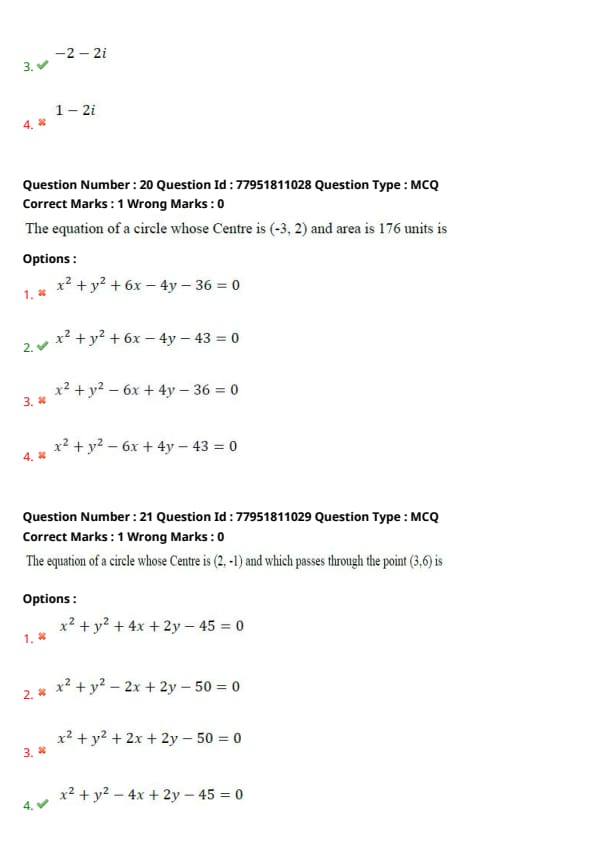
If \( z_1 = 4i^{40} - 5i^{35} + 6i^{17} + 2 \), \( z_2 = -1 + i \) then \( |z_1 + z_2| = \) ____.
View Solution
Step 1: Understanding the Concept:
To find the magnitude (modulus) of the sum, we must first simplify \( z_1 \) by evaluating the powers of \( i \). Powers of \( i \) repeat in a cycle of four: \( i^1=i, i^2=-1, i^3=-i, i^4=1 \).
Step 2: Key Formula or Approach:
1. \( i^{4n} = 1, i^{4n+1} = i, i^{4n+2} = -1, i^{4n+3} = -i \).
2. \( |a + bi| = \sqrt{a^2 + b^2} \).
Step 3: Detailed Explanation:
Simplify \( z_1 \): \[ i^{40} = (i^4)^{10} = 1^{10} = 1 \] \[ i^{35} = i^{32} \cdot i^3 = 1 \cdot (-i) = -i \] \[ i^{17} = i^{16} \cdot i^1 = 1 \cdot i = i \]
Substituting these into \( z_1 \): \[ z_1 = 4(1) - 5(-i) + 6(i) + 2 = 4 + 5i + 6i + 2 = 6 + 11i \]
Now find \( z_1 + z_2 \): \[ z_1 + z_2 = (6 + 11i) + (-1 + i) = 5 + 12i \]
Calculate the modulus: \[ |z_1 + z_2| = \sqrt{5^2 + 12^2} = \sqrt{25 + 144} = \sqrt{169} = 13 \]
Step 4: Final Answer:
The modulus \( |z_1 + z_2| \) is 13. Quick Tip: To quickly find the power of \( i \), divide the exponent by 4 and look at the remainder. Remainder 0 \(\to 1\), 1 \(\to i\), 2 \(\to -1\), 3 \(\to -i\).
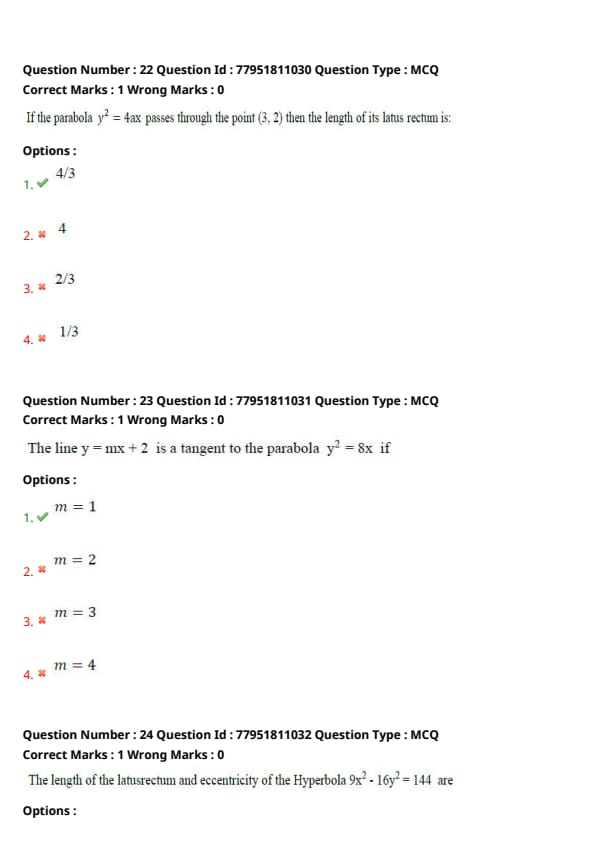
The conjugate of \( (1+i)^3 \) is ____.
View Solution
Step 1: Understanding the Concept:
The conjugate of a complex number \( z = a + bi \) is \( \bar{z} = a - bi \). We first need to expand the cubic expression into the standard form \( a + bi \).
Step 2: Key Formula or Approach:
1. \( (a+b)^3 = a^3 + 3a^2b + 3ab^2 + b^3 \).
2. \( i^2 = -1, i^3 = -i \).
Step 3: Detailed Explanation:
Expand \( z = (1+i)^3 \): \[ z = 1^3 + 3(1)^2(i) + 3(1)(i)^2 + i^3 \] \[ z = 1 + 3i + 3(-1) + (-i) \] \[ z = 1 + 3i - 3 - i = -2 + 2i \]
The conjugate is obtained by changing the sign of the imaginary part: \[ \bar{z} = -2 - 2i \]
Step 4: Final Answer:
The conjugate is \( -2 - 2i \). Quick Tip: Alternatively, you can find the conjugate of the base first and then cube it: \( \overline{(1+i)^3} = (\overline{1+i})^3 = (1-i)^3 \). Both methods yield the same result.
The equation of a circle whose Centre is (-3, 2) and area is 176 units is ____.
View Solution
Step 1: Understanding the Concept:
The equation of a circle with centre \( (h, k) \) and radius \( r \) is \( (x-h)^2 + (y-k)^2 = r^2 \). We are given the area, which allows us to calculate \( r^2 \).
Step 2: Key Formula or Approach:
1. Area of circle = \( \pi r^2 \). (Use \( \pi \approx 22/7 \) for calculation).
2. Standard form expansion: \( x^2 + y^2 - 2hx - 2ky + (h^2 + k^2 - r^2) = 0 \).
Step 3: Detailed Explanation:
Given Area = 176: \[ \pi r^2 = 176 \implies \frac{22}{7} r^2 = 176 \] \[ r^2 = \frac{176 \times 7}{22} = 8 \times 7 = 56 \]
Substitute centre \( (h, k) = (-3, 2) \) and \( r^2 = 56 \) into the circle equation: \[ (x - (-3))^2 + (y - 2)^2 = 56 \] \[ (x + 3)^2 + (y - 2)^2 = 56 \]
Expand the terms: \[ (x^2 + 6x + 9) + (y^2 - 4y + 4) = 56 \] \[ x^2 + y^2 + 6x - 4y + 13 - 56 = 0 \] \[ x^2 + y^2 + 6x - 4y - 43 = 0 \]
Step 4: Final Answer:
The equation of the circle is \( x^2 + y^2 + 6x - 4y - 43 = 0 \). Quick Tip: If the centre is \( (-3, 2) \), the linear terms in the final equation must have opposite signs to the coordinates: \( +6x \) and \( -4y \). This helps eliminate options (3) and (4) instantly.
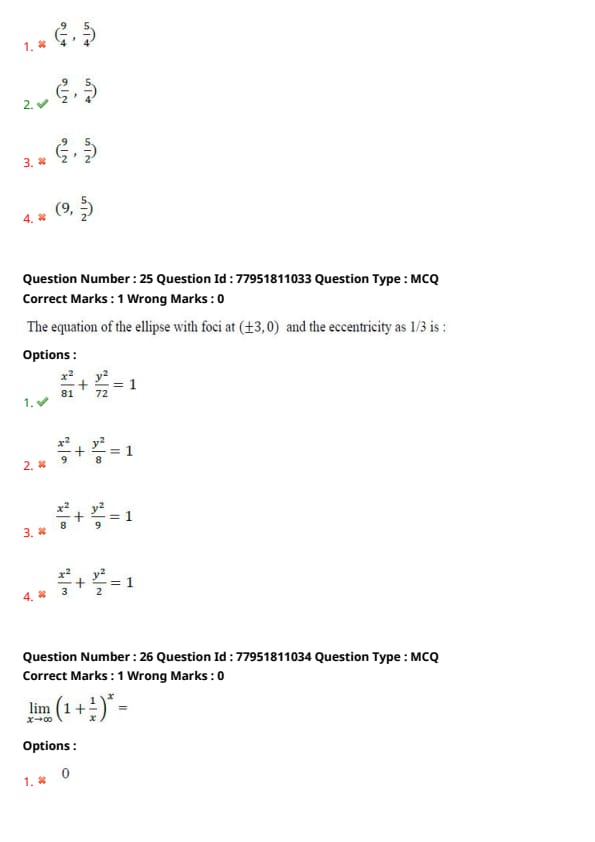
The equation of a circle whose Centre is (2, -1) and which passes through the point (3, 6) is ____.
View Solution
Step 1: Understanding the Concept:
The equation of a circle with centre \((h, k)\) and radius \(r\) is given by \((x-h)^2 + (y-k)^2 = r^2\). Since the circle passes through a specific point, the distance between the centre and that point equals the radius.
Step 2: Key Formula or Approach:
1. Distance formula: \(r = \sqrt{(x_2 - x_1)^2 + (y_2 - y_1)^2}\)
2. Standard circle equation: \((x - h)^2 + (y - k)^2 = r^2\)
Step 3: Detailed Explanation:
First, find the radius \(r\) using the distance between the centre \((2, -1)\) and the point \((3, 6)\): \[ r^2 = (3 - 2)^2 + (6 - (-1))^2 \] \[ r^2 = (1)^2 + (7)^2 = 1 + 49 = 50 \]
Now, substitute the centre \((2, -1)\) and \(r^2 = 50\) into the circle equation: \[ (x - 2)^2 + (y - (-1))^2 = 50 \] \[ (x - 2)^2 + (y + 1)^2 = 50 \]
Expand the equation: \[ (x^2 - 4x + 4) + (y^2 + 2y + 1) = 50 \] \[ x^2 + y^2 - 4x + 2y + 5 - 50 = 0 \] \[ x^2 + y^2 - 4x + 2y - 45 = 0 \]
Step 4: Final Answer:
The equation of the circle is \( x^2 + y^2 - 4x + 2y - 45 = 0 \). Quick Tip: For a circle with centre \((h, k)\), the linear terms in the expanded equation are \(-2hx\) and \(-2ky\). Here, \(-2(2) = -4\) and \(-2(-1) = +2\). This immediately points to option (4).
If the parabola \( y^2 = 4ax \) passes through the point (3, 2) then the length of its latus rectum is: ____.
View Solution
Step 1: Understanding the Concept:
A point lies on a curve if its coordinates satisfy the equation of the curve. For a parabola \(y^2 = 4ax\), the length of the latus rectum is the coefficient of \(x\), which is \(4a\).
Step 2: Key Formula or Approach:
1. Substitute the point into the equation to find \(a\) or \(4a\).
2. Length of latus rectum = \(4a\).
Step 3: Detailed Explanation:
The parabola \( y^2 = 4ax \) passes through \((3, 2)\). Substitute \(x = 3\) and \(y = 2\): \[ (2)^2 = 4a(3) \] \[ 4 = 12a \]
Divide both sides by 3 to isolate \(4a\): \[ 4a = \frac{4}{3} \]
Since the length of the latus rectum is \(4a\), we have: \[ Latus Rectum = \frac{4}{3} \]
Step 4: Final Answer:
The length of the latus rectum is \( 4/3 \). Quick Tip: Don't solve for \(a\) first and then multiply by 4; simply isolate \(4a\) directly from your equation to save a step.
The line \( y = mx + 2 \) is a tangent to the parabola \( y^2 = 8x \) if ____.
View Solution
Step 1: Understanding the Concept:
The condition for a line \(y = mx + c\) to be a tangent to the parabola \(y^2 = 4ax\) is \(c = \frac{a}{m}\).
Step 2: Key Formula or Approach:
1. Identify \(a\) from the parabola equation \(y^2 = 4ax\).
2. Apply the tangency condition: \(c = \frac{a}{m}\).
Step 3: Detailed Explanation:
The given parabola is \( y^2 = 8x \). Comparing with \( y^2 = 4ax \): \[ 4a = 8 \implies a = 2 \]
The given line is \( y = mx + 2 \). Comparing with \( y = mx + c \): \[ c = 2 \]
Applying the tangency condition \( c = \frac{a}{m} \): \[ 2 = \frac{2}{m} \] \[ 2m = 2 \implies m = 1 \]
Step 4: Final Answer:
The value of \( m \) is 1. Quick Tip: If you forget the tangency formula, substitute \(y = mx + 2\) into the parabola equation to get a quadratic in \(x\), then set the discriminant \(D = 0\).
The length of the latus rectum and eccentricity of the Hyperbola \( 9x^2 - 16y^2 = 144 \) are ____.
View Solution
Step 1: Understanding the Concept:
We first convert the given equation into the standard form of a hyperbola \( \frac{x^2}{a^2} - \frac{y^2}{b^2} = 1 \) to identify the semi-major axis \( a \) and semi-minor axis \( b \). These values are then used to calculate the length of the latus rectum and the eccentricity.
Step 2: Key Formula or Approach:
1. Standard Form: Divide by the constant on the RHS.
2. Length of Latus Rectum: \( L = \frac{2b^2}{a} \).
3. Eccentricity: \( e = \sqrt{1 + \frac{b^2}{a^2}} \).
Step 3: Detailed Explanation:
Divide \( 9x^2 - 16y^2 = 144 \) by 144: \[ \frac{9x^2}{144} - \frac{16y^2}{144} = 1 \implies \frac{x^2}{16} - \frac{y^2}{9} = 1 \]
Here, \( a^2 = 16 \implies a = 4 \) and \( b^2 = 9 \implies b = 3 \).
Length of Latus Rectum: \[ L = \frac{2b^2}{a} = \frac{2(9)}{4} = \frac{18}{4} = \frac{9}{2} \]
Eccentricity: \[ e = \sqrt{1 + \frac{9}{16}} = \sqrt{\frac{16 + 9}{16}} = \sqrt{\frac{25}{16}} = \frac{5}{4} \]
Step 4: Final Answer:
The length of the latus rectum is \( 9/2 \) and the eccentricity is \( 5/4 \). Quick Tip: For a hyperbola, eccentricity is always greater than 1. This can help you quickly eliminate options where \( e \le 1 \).
The equation of the ellipse with foci at \( (\pm3,0) \) and the eccentricity as \( 1/3 \) is : ____.
View Solution
Step 1: Understanding the Concept:
The foci of an ellipse on the x-axis are given by \( (\pm ae, 0) \). By using the given foci and eccentricity, we can solve for the semi-major axis \( a \) and then find the semi-minor axis \( b \).
Step 2: Key Formula or Approach:
1. Distance of focus from center: \( c = ae \).
2. Relationship: \( b^2 = a^2(1 - e^2) \).
3. Standard Equation: \( \frac{x^2}{a^2} + \frac{y^2}{b^2} = 1 \).
Step 3: Detailed Explanation:
Given foci \( (\pm 3, 0) \), so \( ae = 3 \).
Given \( e = 1/3 \): \[ a(1/3) = 3 \implies a = 9 \implies a^2 = 81 \]
Now find \( b^2 \): \[ b^2 = a^2(1 - e^2) = 81(1 - (1/3)^2) = 81(1 - 1/9) \] \[ b^2 = 81(8/9) = 9 \times 8 = 72 \]
Substitute into the standard equation: \[ \frac{x^2}{81} + \frac{y^2}{72} = 1 \]
Step 4: Final Answer:
The equation of the ellipse is \( \frac{x^2}{81} + \frac{y^2}{72} = 1 \). Quick Tip: Since the foci are on the x-axis, the denominator of \( x^2 \) (\( a^2 \)) must be larger than the denominator of \( y^2 \) (\( b^2 \)). This confirms the ellipse is horizontal.
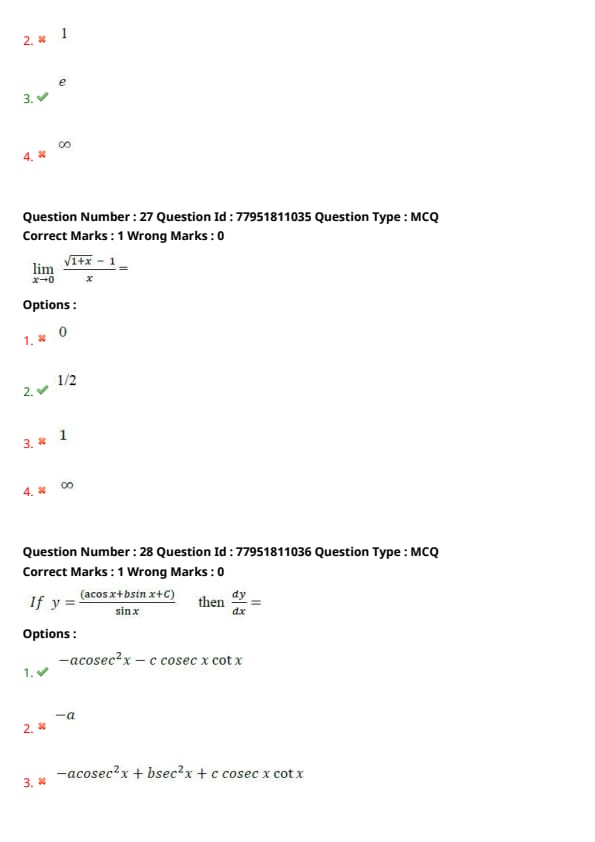
\( \lim_{x \to \infty} (1 + \frac{1}{x})^x = \) ____.
View Solution
Step 1: Understanding the Concept:
This limit is the fundamental definition of the mathematical constant \( e \) (Euler's number). It represents a \( 1^\infty \) indeterminate form.
Step 2: Key Formula or Approach:
For limits of the form \( \lim [f(x)]^{g(x)} \) where \( f(x) \to 1 \) and \( g(x) \to \infty \), the result is \( e^{\lim [f(x)-1]g(x)} \).
Step 3: Detailed Explanation:
Let \( L = \lim_{x \to \infty} (1 + \frac{1}{x})^x \).
This is an indeterminate form of \( 1^\infty \). Using the formula: \[ L = e^{\lim_{x \to \infty} [(1 + \frac{1}{x}) - 1] \cdot x} \] \[ L = e^{\lim_{x \to \infty} (\frac{1}{x}) \cdot x} \] \[ L = e^{\lim_{x \to \infty} 1} = e^1 = e \]
Step 4: Final Answer:
The value of the limit is \( e \). Quick Tip: This definition is often used in compound interest calculations where interest is compounded continuously. It's one of the most important limits in calculus.
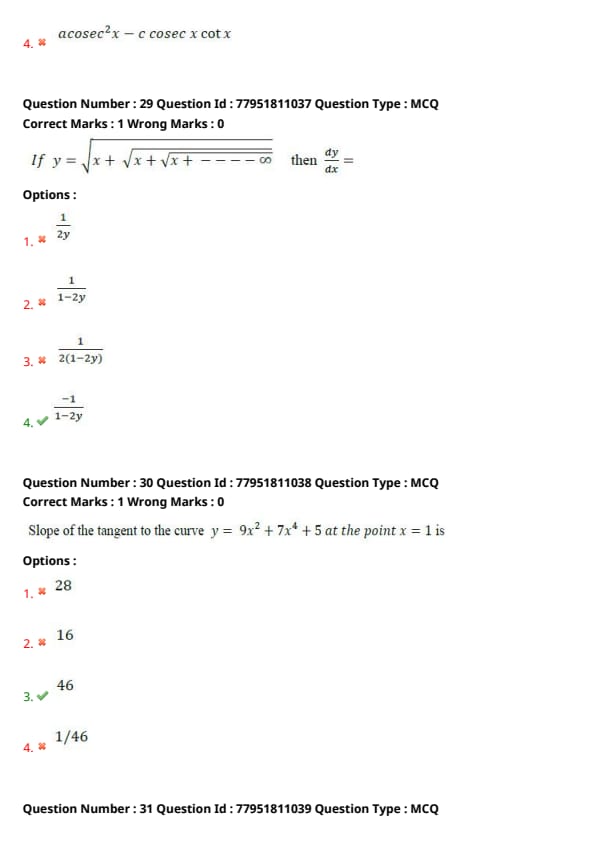
\( \lim_{x \to 0} \frac{\sqrt{1+x} - 1}{x} = \) ____.
View Solution
Step 1: Understanding the Concept:
The limit presents a \( 0/0 \) indeterminate form. To solve this, we can rationalize the numerator or use L'Hôpital's Rule.
Step 2: Key Formula or Approach:
1. Rationalization: Multiply the numerator and denominator by the conjugate \(\sqrt{1+x} + 1\).
2. L'Hôpital's Rule: \(\lim_{x \to c} \frac{f(x)}{g(x)} = \lim_{x \to c} \frac{f'(x)}{g'(x)}\).
Step 3: Detailed Explanation:
Using the rationalization method: \[ \lim_{x \to 0} \frac{\sqrt{1+x} - 1}{x} \times \frac{\sqrt{1+x} + 1}{\sqrt{1+x} + 1} \] \[ = \lim_{x \to 0} \frac{(1+x) - 1}{x(\sqrt{1+x} + 1)} \] \[ = \lim_{x \to 0} \frac{x}{x(\sqrt{1+x} + 1)} \]
Cancel \(x\) from the numerator and denominator: \[ = \lim_{x \to 0} \frac{1}{\sqrt{1+x} + 1} \]
Substitute \(x = 0\): \[ = \frac{1}{\sqrt{1+0} + 1} = \frac{1}{1 + 1} = \frac{1}{2} \]
Step 4: Final Answer:
The value of the limit is \( 1/2 \). Quick Tip: For limits involving square roots at 0, you can also use the binomial expansion \((1+x)^n \approx 1 + nx\). Here, \((1+x)^{1/2} \approx 1 + \frac{1}{2}x\), so the expression becomes \(\frac{(1 + \frac{1}{2}x) - 1}{x} = \frac{1}{2}\).
If \( y = \frac{a \cos x + b \sin x + c}{\sin x} \) then \( \frac{dy}{dx} = \) ____.
View Solution
Step 1: Understanding the Concept:
To differentiate this function, it is easier to simplify the fraction by dividing each term in the numerator by the denominator before applying differentiation rules.
Step 2: Key Formula or Approach:
1. Simplify: \(y = a \cot x + b + c \csc x\).
2. Derivatives: \(\frac{d}{dx}(\cot x) = -\csc^2 x\) and \(\frac{d}{dx}(\csc x) = -\csc x \cot x\).
Step 3: Detailed Explanation:
Split the terms: \[ y = \frac{a \cos x}{\sin x} + \frac{b \sin x}{\sin x} + \frac{c}{\sin x} \] \[ y = a \cot x + b + c \csc x \]
Differentiate with respect to \(x\): \[ \frac{dy}{dx} = a(-\csc^2 x) + 0 + c(-\csc x \cot x) \] \[ \frac{dy}{dx} = -a \csc^2 x - c \csc x \cot x \]
Step 4: Final Answer:
The derivative \( \frac{dy}{dx} \) is \( -a \csc^2 x - c \csc x \cot x \). Quick Tip: Whenever the denominator is a single trigonometric term, splitting the fraction is almost always faster than using the quotient rule.
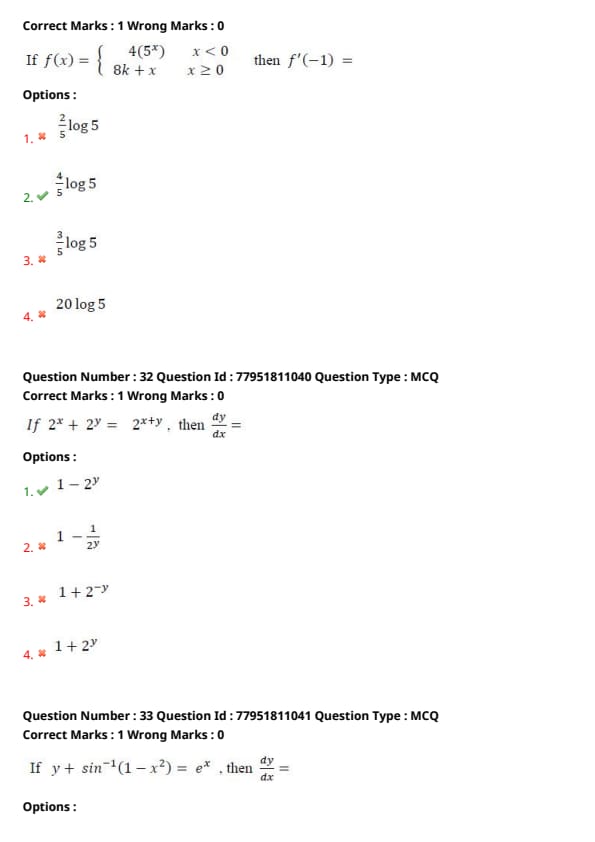
If \( y = \sqrt{x + \sqrt{x + \sqrt{x + \dots + \infty}}} \) then \( \frac{dy}{dx} = \) ____.
View Solution
Step 1: Understanding the Concept:
This is an infinite series function. Since the pattern repeats infinitely, we can replace the inner part of the square root with \(y\) itself to create a finite algebraic equation.
Step 2: Key Formula or Approach:
1. Recursive substitution: \(y = \sqrt{x + y}\).
2. Implicit differentiation: Differentiate both sides with respect to \(x\).
Step 3: Detailed Explanation:
Given \( y = \sqrt{x + y} \).
Square both sides: \[ y^2 = x + y \]
Differentiate with respect to \(x\) using the chain rule: \[ 2y \frac{dy}{dx} = 1 + \frac{dy}{dx} \]
Rearrange to group \(\frac{dy}{dx}\) terms: \[ 2y \frac{dy}{dx} - \frac{dy}{dx} = 1 \] \[ \frac{dy}{dx} (2y - 1) = 1 \] \[ \frac{dy}{dx} = \frac{1}{2y - 1} \]
Note: \(\frac{1}{2y-1}\) is mathematically identical to \(\frac{-1}{1-2y}\).
Step 4: Final Answer:
The derivative is \( \frac{1}{2y - 1} \). Quick Tip: For any function \(y = \sqrt{f(x) + \sqrt{f(x) + ...}}\), the derivative is always \(\frac{f'(x)}{2y - 1}\). Here \(f(x) = x\), so \(f'(x) = 1\).
Slope of the tangent to the curve \( y = 9x^2 + 7x^4 + 5 \) at the point \( x = 1 \) is ____.
View Solution
Step 1: Understanding the Concept:
The slope of the tangent to a curve at a given point is equal to the value of the first derivative \( \frac{dy}{dx} \) at that specific point.
Step 2: Key Formula or Approach:
1. Power Rule: \(\frac{d}{dx}(x^n) = nx^{n-1}\).
2. Slope \(m = \left[ \frac{dy}{dx} \right]_{x=1}\).
Step 3: Detailed Explanation:
Given \( y = 9x^2 + 7x^4 + 5 \).
Differentiate with respect to \(x\): \[ \frac{dy}{dx} = 9(2x) + 7(4x^3) + 0 \] \[ \frac{dy}{dx} = 18x + 28x^3 \]
To find the slope at \(x = 1\), substitute \(x = 1\) into the derivative: \[ m = 18(1) + 28(1)^3 \] \[ m = 18 + 28 = 46 \]
Step 4: Final Answer:
The slope of the tangent at \( x = 1 \) is 46. Quick Tip: "Slope of tangent" is just a geometric name for the derivative. If the question asked for the slope of the "normal," you would take the negative reciprocal: \(-1/46\).
If \( f(x) = \begin{cases} 4(5^x) & x < 0
8k + x & x \ge 0 \end{cases} \) then \( f'(-1) = \) ____.
View Solution
Step 1: Understanding the Concept:
To find the derivative of a piecewise function at a specific point, we use the rule defined for the interval containing that point. Since we need \( f'(-1) \) and \( -1 < 0 \), we only consider the piece \( f(x) = 4(5^x) \)[cite: 1].
Step 2: Key Formula or Approach:
The derivative of an exponential function \( a^x \) is \( \frac{d}{dx}(a^x) = a^x \log a \) (or \( a^x \ln a \))[cite: 1].
Step 3: Detailed Explanation:
For \( x < 0 \), \( f(x) = 4 \cdot 5^x \).
Differentiating with respect to \( x \): \[ f'(x) = 4 \cdot (5^x \log 5) \]
Now, substitute \( x = -1 \): \[ f'(-1) = 4 \cdot (5^{-1} \log 5) \] \[ f'(-1) = 4 \cdot \frac{1}{5} \log 5 = \frac{4}{5} \log 5 \]
Step 4: Final Answer:
The value of \( f'(-1) \) is \( \frac{4}{5} \log 5 \). Quick Tip: Ignore the piece \( 8k + x \) entirely. Since derivatives are local properties, only the function behavior immediately around \( x = -1 \) matters.
If \( 2^x + 2^y = 2^{x+y} \), then \( \frac{dy}{dx} = \) ____.
View Solution
Step 1: Understanding the Concept:
This is an implicit function. We differentiate both sides with respect to \( x \), treating \( y \) as a function of \( x \) and applying the chain rule[cite: 1].
Step 2: Key Formula or Approach:
The derivative of \( 2^u \) is \( 2^u \log 2 \cdot \frac{du}{dx} \)[cite: 1].
Step 3: Detailed Explanation:
Differentiate \( 2^x + 2^y = 2^{x+y} \): \[ 2^x \log 2 + 2^y \log 2 \frac{dy}{dx} = 2^{x+y} \log 2 \left(1 + \frac{dy}{dx}\right) \]
Divide by \( \log 2 \): \[ 2^x + 2^y \frac{dy}{dx} = 2^{x+y} + 2^{x+y} \frac{dy}{dx} \]
Rearrange to solve for \( \frac{dy}{dx} \): \[ 2^y \frac{dy}{dx} - 2^{x+y} \frac{dy}{dx} = 2^{x+y} - 2^x \] \[ \frac{dy}{dx} (2^y - 2^{x+y}) = 2^{x+y} - 2^x \]
Using the original equation \( 2^{x+y} = 2^x + 2^y \): \[ \frac{dy}{dx} (2^y - (2^x + 2^y)) = (2^x + 2^y) - 2^x \] \[ \frac{dy}{dx} (-2^x) = 2^y \] \[ \frac{dy}{dx} = -\frac{2^y}{2^x} = -2^{y-x} \]
Step 4: Final Answer:
The derivative \( \frac{dy}{dx} \) is \( -2^{y-x} \). Quick Tip: For equations of the form \( a^x + a^y = a^{x+y} \), the derivative is always \( -a^{y-x} \). This shortcut works for any base \( a \).
If \( y + \sin^{-1}(1 - x^2) = e^x \), then \( \frac{dy}{dx} = \) ____.
View Solution
Step 1: Understanding the Concept:
We isolate \( y \) or differentiate implicitly. The derivative of \( \sin^{-1} u \) requires the chain rule: \( \frac{d}{dx}(\sin^{-1} u) = \frac{1}{\sqrt{1-u^2}} \frac{du}{dx} \)[cite: 1].
Step 2: Key Formula or Approach:
1. \( \frac{d}{dx}(e^x) = e^x \)[cite: 1].
2. \( \frac{d}{dx}(1 - x^2) = -2x \)[cite: 1].
Step 3: Detailed Explanation:
Differentiate the entire equation: \[ \frac{dy}{dx} + \frac{1}{\sqrt{1 - (1 - x^2)^2}} \cdot \frac{d}{dx}(1 - x^2) = e^x \] \[ \frac{dy}{dx} + \frac{1}{\sqrt{1 - (1 - 2x^2 + x^4)}} \cdot (-2x) = e^x \] \[ \frac{dy}{dx} - \frac{2x}{\sqrt{2x^2 - x^4}} = e^x \]
Rearranging for \( \frac{dy}{dx} \): \[ \frac{dy}{dx} = e^x + \frac{2x}{x\sqrt{2 - x^2}} = e^x + \frac{2}{\sqrt{2 - x^2}} \]
Step 4: Final Answer:
The derivative is \( \frac{dy}{dx} = e^x + \frac{2}{\sqrt{2-x^2}} \). Quick Tip: Always simplify the term inside the square root. Often, an \( x \) or \( x^2 \) can be factored out to cancel terms in the numerator, making the final result much cleaner.
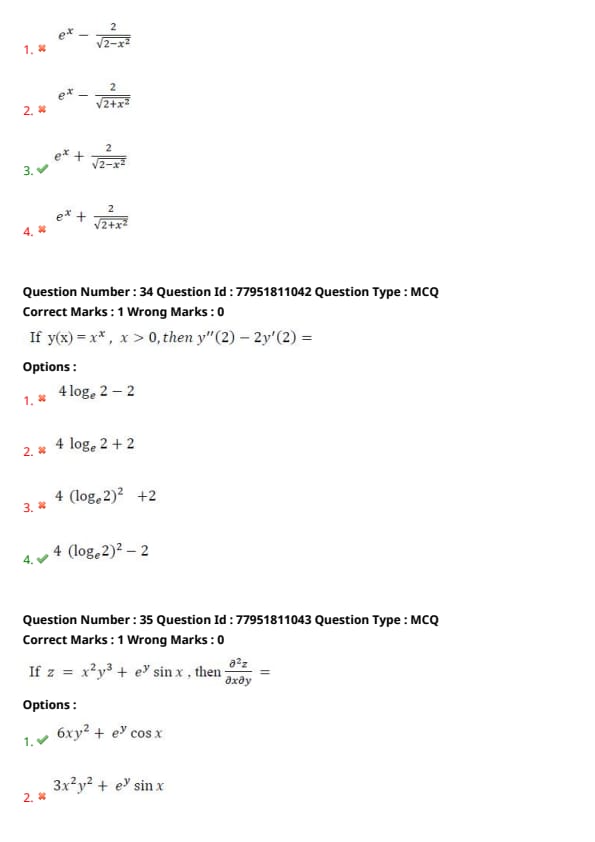
If \( y(x) = x^x \), \( x > 0 \), then \( y''(2) - 2y'(2) = \)____.
View Solution
Step 1: Understanding the Concept:
To differentiate a function where both the base and exponent are variables, we use logarithmic differentiation[cite: 1]. We first find the first derivative \( y' \), and then differentiate again to find the second derivative \( y'' \).
Step 2: Key Formula or Approach:
1. For \( y = x^x \), \( y' = x^x(1 + \log_e x) \).
2. Use the product rule for \( y'' \): \( \frac{d}{dx}[uv] = u'v + uv' \).
Step 3: Detailed Explanation:
Given \( y = x^x \), the first derivative is \( y'(x) = x^x(1 + \log_e x) \).
At \( x = 2 \): \[ y'(2) = 2^2(1 + \log_e 2) = 4(1 + \log_e 2) = 4 + 4 \log_e 2 \]
Now find \( y''(x) \) using the product rule on \( y'(x) \): \[ y''(x) = \frac{d}{dx}[x^x] \cdot (1 + \log_e x) + x^x \cdot \frac{d}{dx}(1 + \log_e x) \] \[ y''(x) = x^x(1 + \log_e x)^2 + x^x(\frac{1}{x}) \]
At \( x = 2 \): \[ y''(2) = 2^2(1 + \log_e 2)^2 + 2^2(\frac{1}{2}) = 4(1 + 2\log_e 2 + (\log_e 2)^2) + 2 \] \[ y''(2) = 4 + 8\log_e 2 + 4(\log_e 2)^2 + 2 = 6 + 8\log_e 2 + 4(\log_e 2)^2 \]
Now calculate \( y''(2) - 2y'(2) \): \[ (6 + 8\log_e 2 + 4(\log_e 2)^2) - 2(4 + 4\log_e 2) \] \[ = 6 + 8\log_e 2 + 4(\log_e 2)^2 - 8 - 8\log_e 2 \] \[ = 4(\log_e 2)^2 - 2 \]
Step 4: Final Answer:
The value of the expression is \( 4 (\log_e 2)^2 - 2 \). Quick Tip: Remember the standard derivative \( \frac{d}{dx}(x^x) = x^x(1 + \ln x) \). It appears frequently in calculus exams and saves time if memorized.
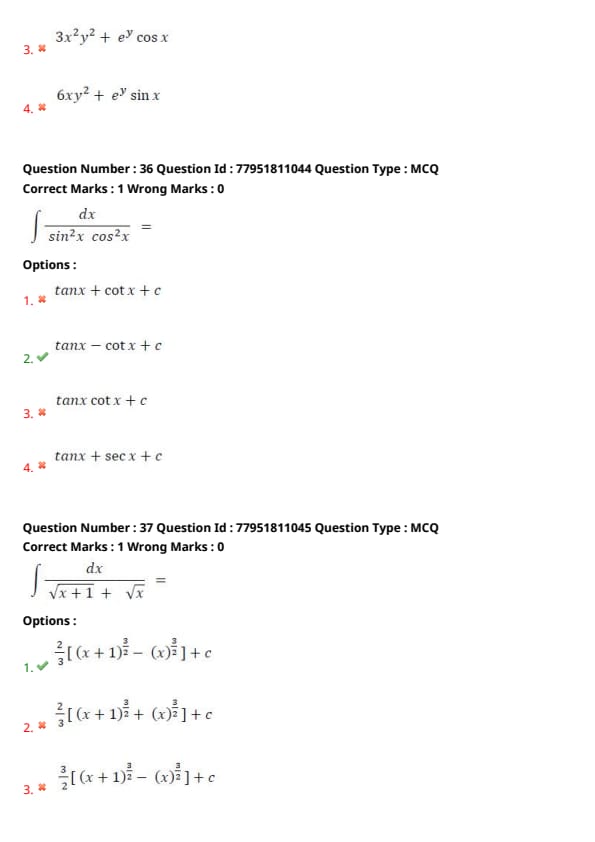
If \( z = x^2 y^3 + e^y \sin x \), then \( \frac{\partial^2 z}{\partial x \partial y} = \)____.
View Solution
Step 1: Understanding the Concept:
The notation \( \frac{\partial^2 z}{\partial x \partial y} \) represents a mixed partial derivative. This means we first differentiate \( z \) with respect to \( y \) (treating \( x \) as a constant), and then differentiate the result with respect to \( x \) (treating \( y \) as a constant).
Step 2: Key Formula or Approach:
1. First find \( \frac{\partial z}{\partial y} \).
2. Then find \( \frac{\partial}{\partial x} \left( \frac{\partial z}{\partial y} \right) \).
Step 3: Detailed Explanation:
Differentiate \( z = x^2 y^3 + e^y \sin x \) with respect to \( y \): \[ \frac{\partial z}{\partial y} = x^2(3y^2) + (\sin x)e^y = 3x^2 y^2 + e^y \sin x \]
Now, differentiate this result with respect to \( x \): \[ \frac{\partial}{\partial x} (3x^2 y^2 + e^y \sin x) = (3y^2)(2x) + e^y (\cos x) \] \[ = 6xy^2 + e^y \cos x \]
Step 4: Final Answer:
The mixed partial derivative is \( 6xy^2 + e^y \cos x \). Quick Tip: According to Clairaut's Theorem, for most smooth functions, the order of differentiation does not matter: \( \frac{\partial^2 z}{\partial x \partial y} = \frac{\partial^2 z}{\partial y \partial x} \). You can pick whichever order seems easier to calculate.
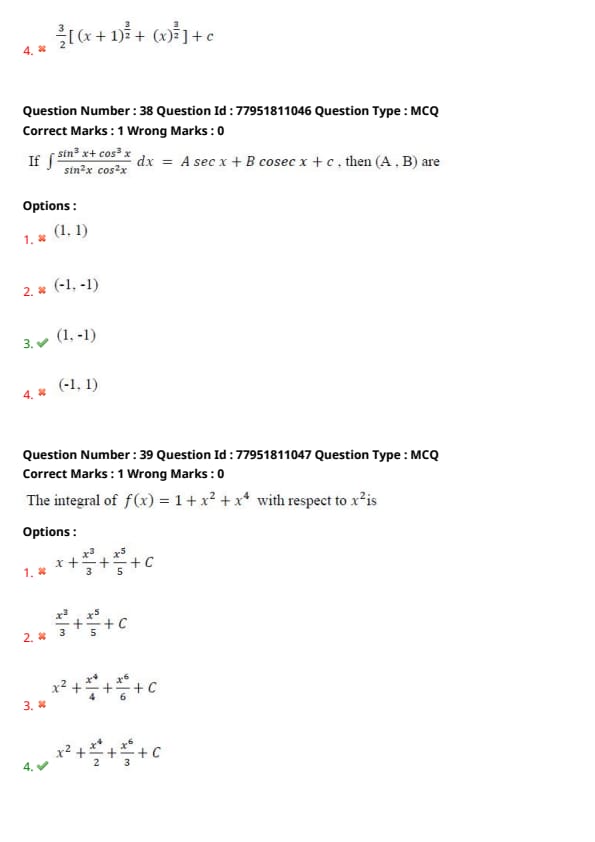
\( \int \frac{dx}{\sin^2 x \cos^2 x} = \)____.
View Solution
Step 1: Understanding the Concept:
To integrate this trigonometric fraction, we can use the identity \( \sin^2 x + \cos^2 x = 1 \) to split the integral into two simpler parts.
Step 2: Key Formula or Approach:
1. Replace \( 1 \) in the numerator with \( \sin^2 x + \cos^2 x \).
2. Use standard integrals: \( \int \sec^2 x \, dx = \tan x \) and \( \int \csc^2 x \, dx = -\cot x \).
Step 3: Detailed Explanation:
\[ \int \frac{1}{\sin^2 x \cos^2 x} \, dx = \int \frac{\sin^2 x + \cos^2 x}{\sin^2 x \cos^2 x} \, dx \]
Split the fraction: \[ = \int \left( \frac{\sin^2 x}{\sin^2 x \cos^2 x} + \frac{\cos^2 x}{\sin^2 x \cos^2 x} \right) \, dx \] \[ = \int \left( \frac{1}{\cos^2 x} + \frac{1}{\sin^2 x} \right) \, dx \] \[ = \int (\sec^2 x + \csc^2 x) \, dx \]
Integrating term by term: \[ = \tan x + (-\cot x) + c = \tan x - \cot x + c \]
Step 4: Final Answer:
The integral is \( \tan x - \cot x + c \). Quick Tip: Another way is to use the double angle formula: \( \sin^2 x \cos^2 x = \frac{1}{4} \sin^2 2x \). The integral becomes \( \int 4 \csc^2 2x \, dx = -2 \cot 2x + c \), which simplifies back to \( \tan x - \cot x + c \).
\( \int \frac{dx}{\sqrt{x+1} + \sqrt{x}} = \) ____.
View Solution
Step 1: Understanding the Concept:
To integrate a fraction with a sum of square roots in the denominator, the most effective method is to rationalize the denominator. This converts the expression into a simpler form where basic integration rules can be applied.
Step 2: Key Formula or Approach:
1. Rationalization: Multiply the numerator and denominator by the conjugate \(\sqrt{x+1} - \sqrt{x}\).
2. Power rule for integration: \(\int x^n \, dx = \frac{x^{n+1}}{n+1} + c\).
Step 3: Detailed Explanation:
First, rationalize the denominator: \[ \frac{1}{\sqrt{x+1} + \sqrt{x}} \times \frac{\sqrt{x+1} - \sqrt{x}}{\sqrt{x+1} - \sqrt{x}} = \frac{\sqrt{x+1} - \sqrt{x}}{(x+1) - x} = \sqrt{x+1} - \sqrt{x} \]
The integral becomes: \[ \int (\sqrt{x+1} - \sqrt{x}) \, dx = \int (x+1)^{1/2} \, dx - \int x^{1/2} \, dx \]
Apply the power rule to each term: \[ = \frac{(x+1)^{3/2}}{3/2} - \frac{x^{3/2}}{3/2} + c \] \[ = \frac{2}{3}(x+1)^{3/2} - \frac{2}{3}x^{3/2} + c = \frac{2}{3} \left[ (x+1)^{3/2} - x^{3/2} \right] + c \]
Step 4: Final Answer:
The integral is \( \frac{2}{3} \left[ (x+1)^{3/2} - x^{3/2} \right] + c \). Quick Tip: Rationalization is a "universal key" for integrals involving \(\sqrt{A} \pm \sqrt{B}\). If the difference \(A - B\) is a constant, it simplifies the problem significantly.
If \( \int \frac{\sin^3 x + \cos^3 x}{\sin^2 x \cos^2 x} dx = A \sec x + B \csc x + c \), then (A, B) are ____.
View Solution
Step 1: Understanding the Concept:
To solve this integral, split the numerator and divide each term by the denominator. This transforms complex trigonometric products into standard trigonometric functions that are easy to integrate.
Step 2: Key Formula or Approach:
1. Simplify terms: \(\frac{\sin^3 x}{\sin^2 x \cos^2 x} = \tan x \sec x\) and \(\frac{\cos^3 x}{\sin^2 x \cos^2 x} = \cot x \csc x\).
2. Standard integrals: \(\int \sec x \tan x \, dx = \sec x\) and \(\int \csc x \cot x \, dx = -\csc x\).
Step 3: Detailed Explanation:
Split the integral: \[ \int \frac{\sin^3 x}{\sin^2 x \cos^2 x} \, dx + \int \frac{\cos^3 x}{\sin^2 x \cos^2 x} \, dx \] \[ = \int \frac{\sin x}{\cos^2 x} \, dx + \int \frac{\cos x}{\sin^2 x} \, dx \] \[ = \int \sec x \tan x \, dx + \int \csc x \cot x \, dx \]
Using standard integration formulas: \[ = \sec x + (-\csc x) + c = 1 \sec x - 1 \csc x + c \]
Comparing with \(A \sec x + B \csc x + c\), we find \(A = 1\) and \(B = -1\).
Step 4: Final Answer:
The values are \((A, B) = (1, -1)\). Quick Tip: Always look to separate terms in the numerator when the denominator is a single product. It often turns a scary-looking fraction into a basic identity problem.
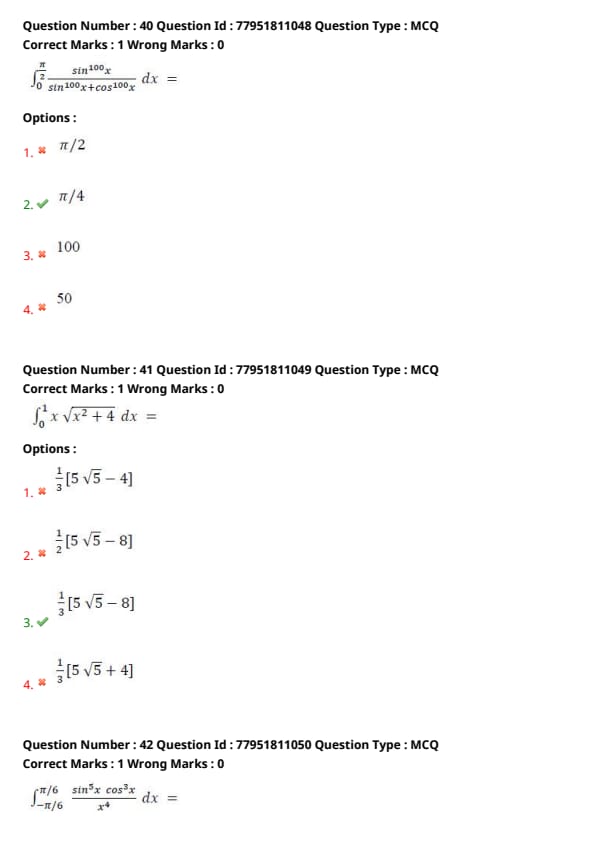
The integral of \( f(x) = 1 + x^2 + x^4 \) with respect to \( x^2 \) is ____.
View Solution
Step 1: Understanding the Concept:
The phrase "with respect to \(x^2\)" means that \(x^2\) is our variable of integration, often denoted by \(u\). We substitute \(u = x^2\) and integrate the resulting polynomial in terms of \(u\).
Step 2: Key Formula or Approach:
1. Let \(u = x^2\).
2. Rewrite the function: \(f(u) = 1 + u + u^2\).
3. Use \(\int u^n \, du = \frac{u^{n+1}}{n+1} + C\).
Step 3: Detailed Explanation:
We are finding \(\int (1 + x^2 + x^4) \, d(x^2)\).
Let \(u = x^2\). The integral becomes: \[ \int (1 + u + u^2) \, du \]
Integrate term by term: \[ = u + \frac{u^2}{2} + \frac{u^3}{3} + C \]
Substitute back \(u = x^2\): \[ = x^2 + \frac{(x^2)^2}{2} + \frac{(x^2)^3}{3} + C = x^2 + \frac{x^4}{2} + \frac{x^6}{3} + C \]
Step 4: Final Answer:
The integral is \( x^2 + \frac{x^4}{2} + \frac{x^6}{3} + C \). Quick Tip: Pay close attention to the variable after the 'd'. Integrating with respect to \(x^2\) is different from integrating with respect to \(x\). If it were \(dx\), the answer would be option (1).
\( \int_{0}^{\pi/2} \frac{\sin^{100} x}{\sin^{100} x + \cos^{100} x} dx = \) ____.
View Solution
Step 1: Understanding the Concept:
This is a definite integral that uses the property \(\int_0^a f(x) \, dx = \int_0^a f(a-x) \, dx\). This property allows us to "swap" \(\sin\) and \(\cos\) terms in the interval \([0, \pi/2]\).
Step 2: Key Formula or Approach:
1. Let the integral be \(I\).
2. Apply property: Replace \(x\) with \(\pi/2 - x\).
3. Use \(\sin(\pi/2 - x) = \cos x\) and \(\cos(\pi/2 - x) = \sin x\).
Step 3: Detailed Explanation:
Let \(I = \int_{0}^{\pi/2} \frac{\sin^{100} x}{\sin^{100} x + \cos^{100} x} \, dx \).
Using the property: \[ I = \int_{0}^{\pi/2} \frac{\sin^{100} (\pi/2 - x)}{\sin^{100} (\pi/2 - x) + \cos^{100} (\pi/2 - x)} \, dx = \int_{0}^{\pi/2} \frac{\cos^{100} x}{\cos^{100} x + \sin^{100} x} \, dx \]
Add the two expressions for \(I\): \[ 2I = \int_{0}^{\pi/2} \frac{\sin^{100} x + \cos^{100} x}{\sin^{100} x + \cos^{100} x} \, dx \] \[ 2I = \int_{0}^{\pi/2} 1 \, dx = [x]_0^{\pi/2} = \pi/2 \] \[ I = \frac{\pi/2}{2} = \pi/4 \]
Step 4: Final Answer:
The value of the definite integral is \( \pi/4 \). Quick Tip: For any integral of the form \(\int_{0}^{\pi/2} \frac{f(\sin x)}{f(\sin x) + f(\cos x)} \, dx\), the answer is always \((b-a)/2\), which in this case is \((\pi/2 - 0)/2 = \pi/4\). The exponent (100) doesn't change the result.
\( \int_{0}^{1} x \sqrt{x^2 + 4} \, dx = \) ____.
View Solution
Step 1: Understanding the Concept:
To solve this definite integral, we use the method of substitution. Since the derivative of the term inside the square root (\(x^2 + 4\)) is proportional to the \(x\) outside, substitution simplifies the expression into a basic power form.
Step 2: Key Formula or Approach:
1. Let \(t = x^2 + 4\), then \(dt = 2x \, dx\).
2. Change the limits: When \(x=0\), \(t=4\). When \(x=1\), \(t=5\).
3. Use \(\int t^n \, dt = \frac{t^{n+1}}{n+1} + C\).
Step 3: Detailed Explanation:
Substitute \(t = x^2 + 4 \implies dt = 2x \, dx \implies x \, dx = \frac{dt}{2}\).
The integral becomes: \[ \int_{4}^{5} \sqrt{t} \cdot \frac{dt}{2} = \frac{1}{2} \int_{4}^{5} t^{1/2} \, dt \] \[ = \frac{1}{2} \left[ \frac{t^{3/2}}{3/2} \right]_{4}^{5} = \frac{1}{2} \cdot \frac{2}{3} \left[ t^{3/2} \right]_{4}^{5} \] \[ = \frac{1}{3} \left[ 5^{3/2} - 4^{3/2} \right] \] \[ = \frac{1}{3} [5\sqrt{5} - (2^2)^{3/2}] = \frac{1}{3} [5\sqrt{5} - 2^3] = \frac{1}{3} [5\sqrt{5} - 8] \]
Step 4: Final Answer:
The value of the integral is \( \frac{1}{3}[5\sqrt{5} - 8] \). Quick Tip: Always remember to update your integration limits when performing a \(u\)-substitution in a definite integral. It saves you from having to substitute back the original variable at the end.
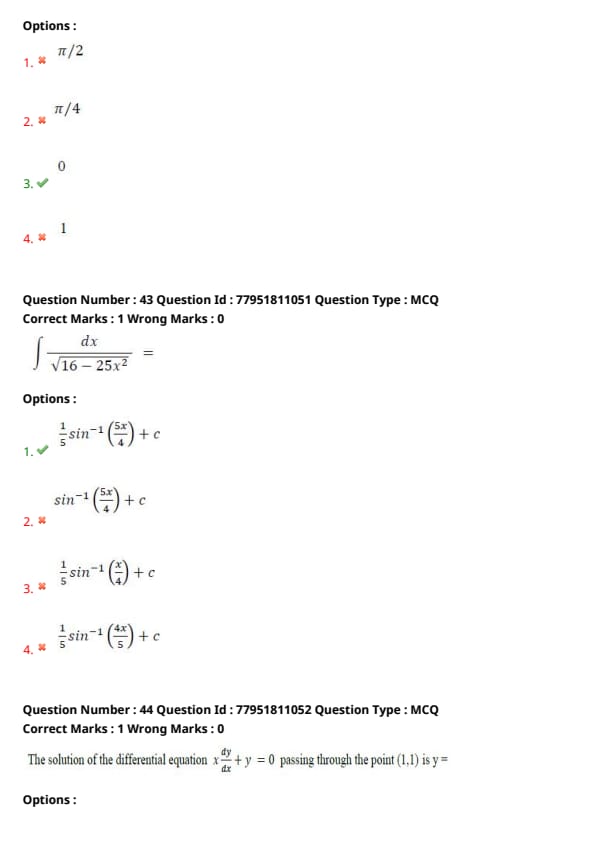
\( \int_{-\pi/6}^{\pi/6} \frac{\sin^5 x \cos^3 x}{x^4} \, dx = \) ____.
View Solution
Step 1: Understanding the Concept:
We evaluate the symmetry of the integrand. For an integral with symmetric limits \([-a, a]\), if the function \(f(x)\) is "odd" (\(f(-x) = -f(x)\)), the integral is zero.
Step 2: Key Formula or Approach:
1. Property: \(\int_{-a}^{a} f(x) \, dx = 0\) if \(f(x)\) is an odd function.
2. \(\sin(-x) = -\sin x\) (Odd), \(\cos(-x) = \cos x\) (Even), \((-x)^4 = x^4\) (Even).
Step 3: Detailed Explanation:
Let \(f(x) = \frac{\sin^5 x \cos^3 x}{x^4}\).
Test for symmetry: \[ f(-x) = \frac{[\sin(-x)]^5 [\cos(-x)]^3}{(-x)^4} = \frac{(-\sin x)^5 (\cos x)^3}{x^4} \] \[ f(-x) = \frac{-\sin^5 x \cos^3 x}{x^4} = -f(x) \]
Since \(f(x)\) is an odd function and the limits are symmetric (\(-\pi/6\) to \(\pi/6\)), the areas above and below the x-axis cancel each other out exactly.
Step 4: Final Answer:
The value of the integral is 0. Quick Tip: Before doing any heavy calculation on a definite integral with limits from \(-a\) to \(a\), always check if the function is odd. It is a common time-saving shortcut in competitive exams.
\( \int \frac{dx}{\sqrt{16 - 25x^2}} = \) ____.
View Solution
Step 1: Understanding the Concept:
This integral matches the standard inverse trigonometric form. To apply the formula, we must first ensure the coefficient of \(x^2\) is 1 or express the denominator as a perfect square of a linear term.
Step 2: Key Formula or Approach:
1. Standard Formula: \(\int \frac{dx}{\sqrt{a^2 - x^2}} = \sin^{-1}\left(\frac{x}{a}\right) + c\).
2. Generalized Formula: \(\int \frac{dx}{\sqrt{a^2 - (mx)^2}} = \frac{1}{m} \sin^{-1}\left(\frac{mx}{a}\right) + c\).
Step 3: Detailed Explanation:
Rewrite the denominator: \[ \int \frac{dx}{\sqrt{4^2 - (5x)^2}} \]
Here, \(a = 4\) and the variable part is \(5x\). Using the linear transformation rule (dividing by the coefficient of \(x\)): \[ = \frac{1}{5} \sin^{-1}\left(\frac{5x}{4}\right) + c \]
Step 4: Final Answer:
The integral is \( \frac{1}{5} \sin^{-1}\left(\frac{5x}{4}\right) + c \). Quick Tip: Always be careful with the "chain rule" in integration. If your variable \(x\) is replaced by \(mx\), you must divide the entire integral by \(m\).
The solution of the differential equation \( x \frac{dy}{dx} + y = 0 \) passing through the point (1,1) is \( y = \) ____.
View Solution
Step 1: Understanding the Concept:
To solve this first-order differential equation, we can use the method of separation of variables. This involves rearranging the equation so that all \(y\) terms are on one side and all \(x\) terms are on the other.
Step 2: Key Formula or Approach:
1. Separate variables: \(\frac{dy}{y} = -\frac{dx}{x}\).
2. Integrate both sides: \(\int \frac{1}{y} \, dy = -\int \frac{1}{x} \, dx\).
3. Use the given point (1,1) to find the constant of integration \(C\).
Step 3: Detailed Explanation:
Starting with \( x \frac{dy}{dx} = -y \): \[ \frac{dy}{y} = -\frac{dx}{x} \]
Integrating both sides: \[ \ln|y| = -\ln|x| + \ln|C| \] \[ \ln|y| + \ln|x| = \ln|C| \] \[ \ln|xy| = \ln|C| \implies xy = C \]
Substitute the point (1,1): \[ (1)(1) = C \implies C = 1 \]
Thus, the specific solution is \( xy = 1 \), which can be written as \( y = \frac{1}{x} \) or \( y = x^{-1} \).
Step 4: Final Answer:
The solution is \( y = x^{-1} \). Quick Tip: Recognize that \( x \frac{dy}{dx} + y \) is the expanded form of the product rule derivative \(\frac{d}{dx}(xy)\). Setting \(\frac{d}{dx}(xy) = 0\) immediately tells you \(xy = C\).
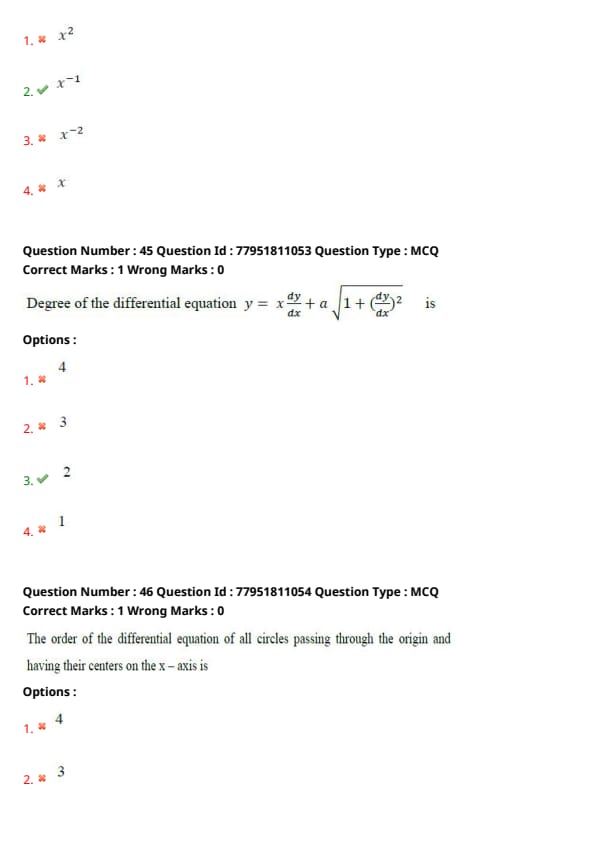
Degree of the differential equation \( y = x \frac{dy}{dx} + a \sqrt{1 + \left( \frac{dy}{dx} \right)^2} \) is ____.
View Solution
Step 1: Understanding the Concept:
The degree of a differential equation is the power of the highest order derivative, provided the equation is a polynomial in its derivatives. To find the degree, we must first eliminate radicals (square roots) and fractions involving derivatives.
Step 2: Key Formula or Approach:
1. Isolate the term with the square root.
2. Square both sides to rationalize the equation.
Step 3: Detailed Explanation:
Isolate the radical: \[ y - x \frac{dy}{dx} = a \sqrt{1 + \left( \frac{dy}{dx} \right)^2} \]
Square both sides: \[ \left( y - x \frac{dy}{dx} \right)^2 = a^2 \left[ 1 + \left( \frac{dy}{dx} \right)^2 \right] \]
Expanding the left side: \[ y^2 + x^2 \left( \frac{dy}{dx} \right)^2 - 2xy \frac{dy}{dx} = a^2 + a^2 \left( \frac{dy}{dx} \right)^2 \]
Now the equation is a polynomial in \(\frac{dy}{dx}\). The highest order derivative is \(\frac{dy}{dx}\) (Order 1), and its highest power in this polynomial form is 2.
Step 4: Final Answer:
The degree of the differential equation is 2. Quick Tip: Never determine the degree while derivatives are trapped under a square root or in a denominator. Always simplify to polynomial form first!
The order of the differential equation of all circles passing through the origin and having their centers on the x-axis is ____.
View Solution
Step 1: Understanding the Concept:
The order of a differential equation representing a family of curves is equal to the number of independent arbitrary constants (parameters) in the equation of that family.
Step 2: Key Formula or Approach:
1. Write the general equation of the family of circles.
2. Identify the number of independent arbitrary constants.
Step 3: Detailed Explanation:
The center of the circle lies on the x-axis, so let the center be \((h, 0)\).
Since the circle passes through the origin \((0, 0)\), the radius \(r\) must be the distance from \((h, 0)\) to the origin, which is \(|h|\).
The equation of the circle is: \[ (x - h)^2 + (y - 0)^2 = h^2 \] \[ x^2 - 2xh + h^2 + y^2 = h^2 \] \[ x^2 + y^2 - 2xh = 0 \]
In this equation, there is only one arbitrary constant, which is \(h\). Since there is only one independent parameter, the resulting differential equation will be of the first order.
Step 4: Final Answer:
The order of the differential equation is 1. Quick Tip: Number of independent arbitrary constants = Order of the differential equation. This is a very useful rule for quickly determining order without actually forming the equation.
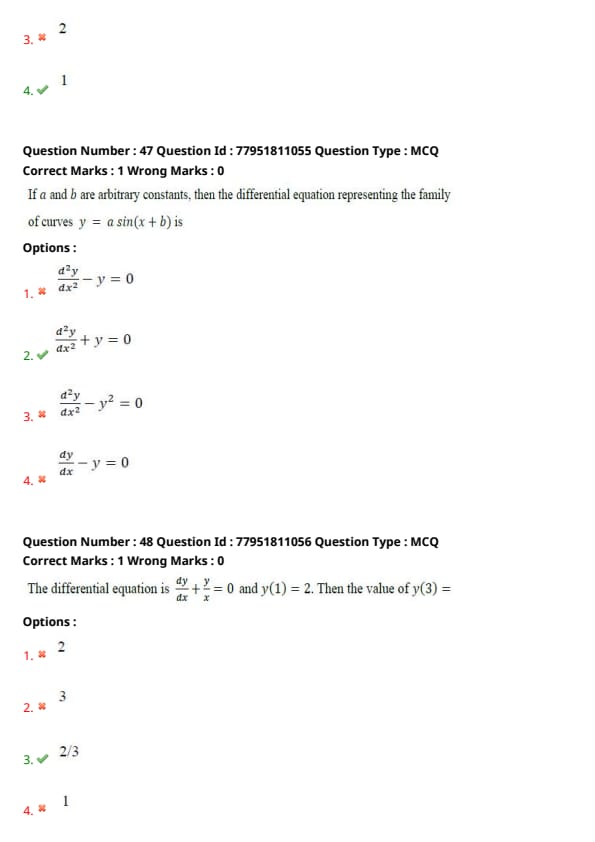
If a and b are arbitrary constants, then the differential equation representing the family of curves \( y = a \sin(x + b) \) is ____.
View Solution
Step 1: Understanding the Concept:
The order of a differential equation is equal to the number of arbitrary constants in the given equation. Since there are two constants (\(a\) and \(b\)), we differentiate twice to eliminate them.
Step 2: Key Formula or Approach:
1. Differentiate \(y\) with respect to \(x\).
2. Differentiate again to find \(\frac{d^2y}{dx^2}\).
3. Substitute the original expression of \(y\) back into the result.
Step 3: Detailed Explanation:
Given \( y = a \sin(x + b) \).
First derivative: \[ \frac{dy}{dx} = a \cos(x + b) \]
Second derivative: \[ \frac{d^2y}{dx^2} = -a \sin(x + b) \]
Since \( y = a \sin(x + b) \), we can substitute: \[ \frac{d^2y}{dx^2} = -y \] \[ \frac{d^2y}{dx^2} + y = 0 \]
Step 4: Final Answer:
The differential equation is \( \frac{d^2 y}{dx^2} + y = 0 \). Quick Tip: For any function of the form \( y = A \sin(kx + \phi) \) or \( y = A \cos(kx + \phi) \), the resulting differential equation is always \( \frac{d^2y}{dx^2} + k^2y = 0 \).
The differential equation is \( \frac{dy}{dx} + \frac{y}{x} = 0 \) and \( y(1) = 2 \). Then the value of \( y(3) = \) ____.
View Solution
Step 1: Understanding the Concept:
This is a variable separable differential equation. We solve it to find the general relationship between \(x\) and \(y\), then use the initial condition to find the constant.
Step 2: Key Formula or Approach:
1. Separate variables: \(\frac{dy}{y} = -\frac{dx}{x}\).
2. Integrate both sides.
3. Solve for \(y\) given \(x=3\).
Step 3: Detailed Explanation:
\[ \frac{dy}{dx} = -\frac{y}{x} \implies \frac{dy}{y} = -\frac{dx}{x} \]
Integrating both sides: \[ \ln|y| = -\ln|x| + \ln|C| \] \[ \ln|y| + \ln|x| = \ln|C| \implies xy = C \]
Using the condition \(y(1) = 2\): \[ (1)(2) = C \implies C = 2 \]
The equation is \( xy = 2 \). To find \(y(3)\), substitute \(x = 3\): \[ 3y = 2 \implies y = \frac{2}{3} \]
Step 4: Final Answer:
The value of \( y(3) \) is \( 2/3 \). Quick Tip: The equation \( xy = C \) represents a rectangular hyperbola. Since the product of \(x\) and \(y\) is constant, if \(x\) triples, \(y\) must become one-third of its original value.
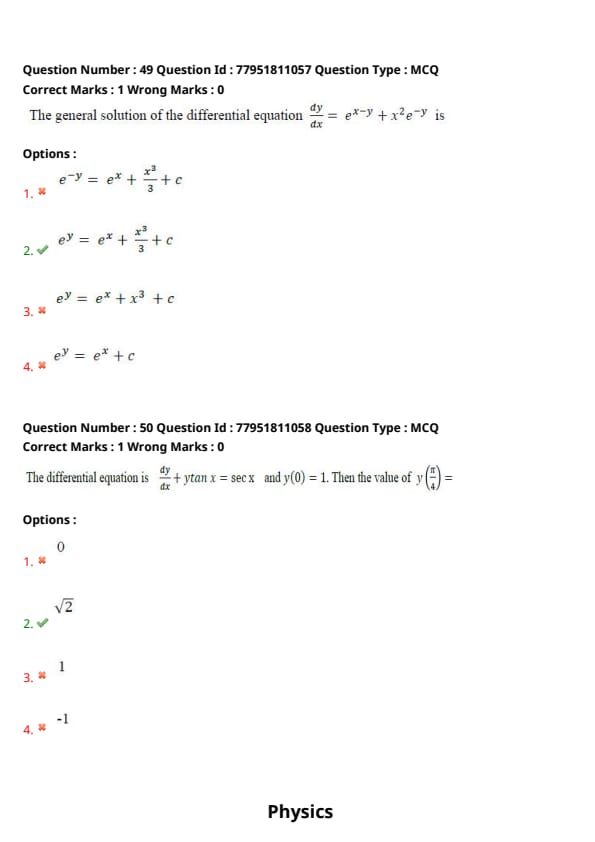
The general solution of the differential equation \( \frac{dy}{dx} = e^{x - y} + x^2 e^{-y} \) is ____.
View Solution
Step 1: Understanding the Concept:
We simplify the right side of the equation using exponent rules to separate the \(x\) and \(y\) variables.
Step 2: Key Formula or Approach:
1. Use \( e^{x-y} = e^x \cdot e^{-y} \).
2. Factor out \( e^{-y} \) and separate variables.
Step 3: Detailed Explanation:
\[ \frac{dy}{dx} = e^x e^{-y} + x^2 e^{-y} \] \[ \frac{dy}{dx} = e^{-y} (e^x + x^2) \]
Separate the variables: \[ \frac{dy}{e^{-y}} = (e^x + x^2) dx \] \[ e^y dy = (e^x + x^2) dx \]
Integrate both sides: \[ \int e^y dy = \int (e^x + x^2) dx \] \[ e^y = e^x + \frac{x^3}{3} + c \]
Step 4: Final Answer:
The solution is \( e^y = e^x + \frac{x^3}{3} + c \). Quick Tip: When you see \(e^{-y}\) in multiple terms on the RHS, factoring it out usually reveals a separable equation.
The differential equation is \( \frac{dy}{dx} + y \tan x = \sec x \) and \( y(0) = 1 \). Then the value of \( y(\pi/4) = \) ____.
View Solution
Step 1: Understanding the Concept:
This is a first-order linear differential equation of the form \( \frac{dy}{dx} + Py = Q \). We solve it using an Integrating Factor (I.F.).
Step 2: Key Formula or Approach:
1. \( I.F. = e^{\int P dx} \).
2. Solution: \( y(I.F.) = \int Q(I.F.) dx + c \).
Step 3: Detailed Explanation:
Here, \( P = \tan x \) and \( Q = \sec x \). \[ I.F. = e^{\int \tan x dx} = e^{\ln|\sec x|} = \sec x \]
The solution is: \[ y(\sec x) = \int \sec x \cdot \sec x \, dx \] \[ y \sec x = \int \sec^2 x \, dx \implies y \sec x = \tan x + c \]
Use \(y(0) = 1\): \[ (1)\sec(0) = \tan(0) + c \implies 1(1) = 0 + c \implies c = 1 \]
General solution: \( y \sec x = \tan x + 1 \implies y = \frac{\tan x + 1}{\sec x} = \sin x + \cos x \).
At \( x = \pi/4 \): \[ y = \sin(\pi/4) + \cos(\pi/4) = \frac{1}{\sqrt{2}} + \frac{1}{\sqrt{2}} = \frac{2}{\sqrt{2}} = \sqrt{2} \]
Step 4: Final Answer:
The value of \( y(\pi/4) \) is \( \sqrt{2} \). Quick Tip: The expression \(\sin x + \cos x\) reaches its maximum value of \(\sqrt{2}\) exactly at \(\pi/4\).
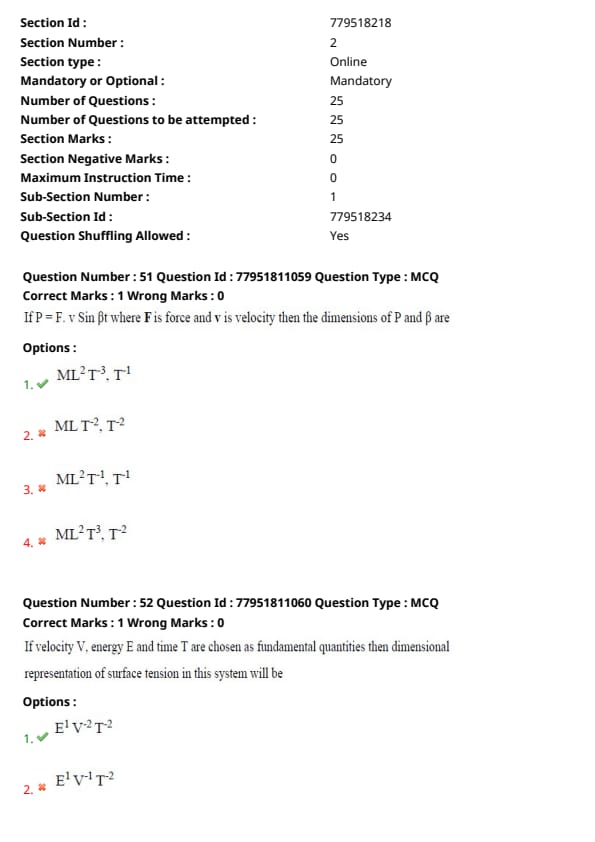
If \( P = F \cdot v \sin \beta t \) where F is force and v is velocity then the dimensions of P and \( \beta \) are ____.
View Solution
Step 1: Understanding the Concept:
In any physical equation, the dimensions on both sides must be equal. Furthermore, the argument of a trigonometric function (like sine) must be dimensionless.
Step 2: Key Formula or Approach:
1. Dimensions of Force (\(F\)): \( [MLT^{-2}] \).
2. Dimensions of Velocity (\(v\)): \( [LT^{-1}] \).
3. Dimensions of Time (\(t\)): \( [T] \).
Step 3: Detailed Explanation:
For \( P = F \cdot v \sin \beta t \):
The term \( \sin \beta t \) is dimensionless. Therefore, the dimensions of \( P \) are simply the dimensions of \( F \times v \): \[ [P] = [MLT^{-2}] \times [LT^{-1}] = [ML^2T^{-3}] \]
For the argument \( \beta t \) to be dimensionless: \[ [\beta t] = [M^0L^0T^0] \] \[ [\beta][T] = [1] \implies [\beta] = [T^{-1}] \]
Step 4: Final Answer:
The dimensions are \( [P] = ML^2T^{-3} \) and \( [\beta] = T^{-1} \). Quick Tip: The dimensions of \( P \) here correspond to Power (\( Work/Time \)). Whenever you see \( Force \times Velocity \), you can immediately identify it as Power.
If velocity V, energy E and time T are chosen as fundamental quantities then dimensional representation of surface tension in this system will be ____.
View Solution
Step 1: Understanding the Concept:
We express the target quantity (Surface Tension) as a product of the new fundamental quantities raised to unknown powers: \( S = k E^a V^b T^c \).
Step 2: Key Formula or Approach:
1. Surface Tension (\(S\)) = Force/Length = \( [MT^{-2}] \).
2. Energy (\(E\)) = \( [ML^2T^{-2}] \).
3. Velocity (\(V\)) = \( [LT^{-1}] \).
Step 3: Detailed Explanation:
\[ [MT^{-2}] = [ML^2T^{-2}]^a [LT^{-1}]^b [T]^c \] \[ M^1L^0T^{-2} = M^a L^{2a+b} T^{-2a-b+c} \]
Equating powers:
For M: \( a = 1 \).
For L: \( 2a + b = 0 \implies 2(1) + b = 0 \implies b = -2 \).
For T: \( -2a - b + c = -2 \implies -2(1) - (-2) + c = -2 \implies 0 + c = -2 \implies c = -2 \).
Substituting values: \( S = E^1 V^{-2} T^{-2} \).
Step 4: Final Answer:
The dimensional representation is \( E^1V^{-2}T^{-2} \). Quick Tip: Surface tension is Energy per unit Area. Since Area has dimensions of \( (Velocity \times Time)^2 \), Surface Tension is \( Energy / (V^2 T^2) \), leading directly to \( E V^{-2} T^{-2} \).
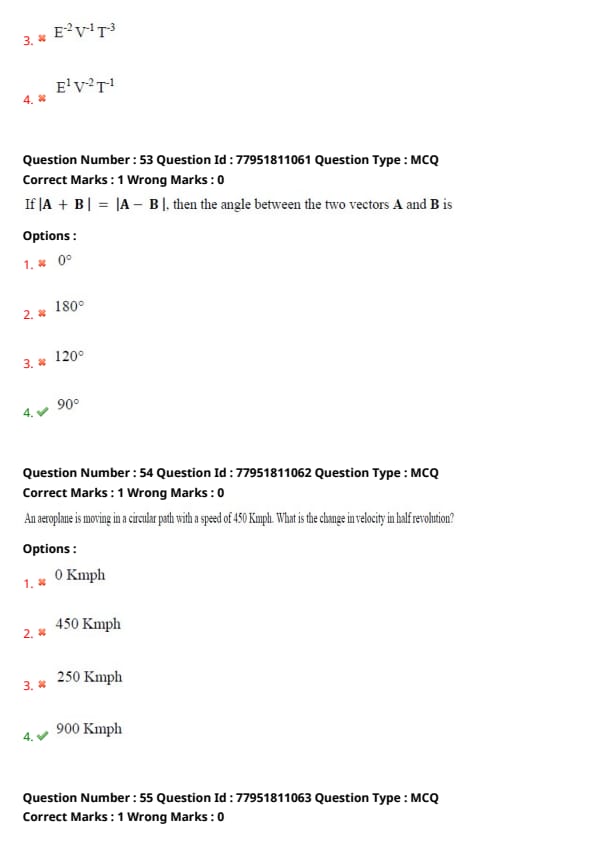
If \( |\vec{A} + \vec{B}| = |\vec{A} - \vec{B}| \), then the angle between the two vectors \( \vec{A} and \vec{B} \) is ____.
View Solution
Step 1: Understanding the Concept:
The magnitude of the sum and difference of two vectors depends on the angle \( \theta \) between them. We use the parallelogram law of vector addition to set up an equation.
Step 2: Key Formula or Approach:
1. \( |\vec{A} + \vec{B}|^2 = A^2 + B^2 + 2AB \cos \theta \).
2. \( |\vec{A} - \vec{B}|^2 = A^2 + B^2 - 2AB \cos \theta \).
Step 3: Detailed Explanation:
Square both sides of the given condition: \[ |\vec{A} + \vec{B}|^2 = |\vec{A} - \vec{B}|^2 \] \[ A^2 + B^2 + 2AB \cos \theta = A^2 + B^2 - 2AB \cos \theta \]
Cancel \( A^2 \) and \( B^2 \) from both sides: \[ 2AB \cos \theta = -2AB \cos \theta \] \[ 4AB \cos \theta = 0 \]
Since \( A \) and \( B \) are non-zero vectors: \[ \cos \theta = 0 \implies \theta = 90^\circ \]
Step 4: Final Answer:
The angle between the vectors is 90°. Quick Tip: Geometrically, this means the diagonals of a parallelogram are equal in length, which only happens when the parallelogram is a rectangle. Therefore, the adjacent sides (vectors A and B) must be perpendicular.
An aeroplane is moving in a circular path with a speed of 450 Kmph. What is the change in velocity in half revolution?
View Solution
Step 1: Understanding the Concept:
Velocity is a vector quantity, meaning it has both magnitude (speed) and direction. In circular motion, even if the speed remains constant, the direction changes continuously. After a half revolution, the object is moving in the exactly opposite direction.
Step 2: Key Formula or Approach:
1. Let the initial velocity be \(\vec{v}_1 = v\).
2. After half a revolution, the final velocity is \(\vec{v}_2 = -v\).
3. Change in velocity \(\Delta \vec{v} = \vec{v}_2 - \vec{v}_1\).
Step 3: Detailed Explanation:
Given speed \(v = 450\) Kmph.
At the start of the half revolution, let the velocity be \(+450\) Kmph (in one direction).
After half a revolution, the aeroplane is headed in the opposite direction, so the velocity is \(-450\) Kmph.
Magnitude of change in velocity: \[ |\Delta v| = |v_{final} - v_{initial}| \] \[ |\Delta v| = |-450 - 450| \] \[ |\Delta v| = |-900| = 900 Kmph \]
Step 4: Final Answer:
The change in velocity is 900 Kmph. Quick Tip: For any object moving in a circle with speed \(v\), the magnitude of change in velocity after half a revolution is always \(2v\), whereas after a full revolution, the change is 0.
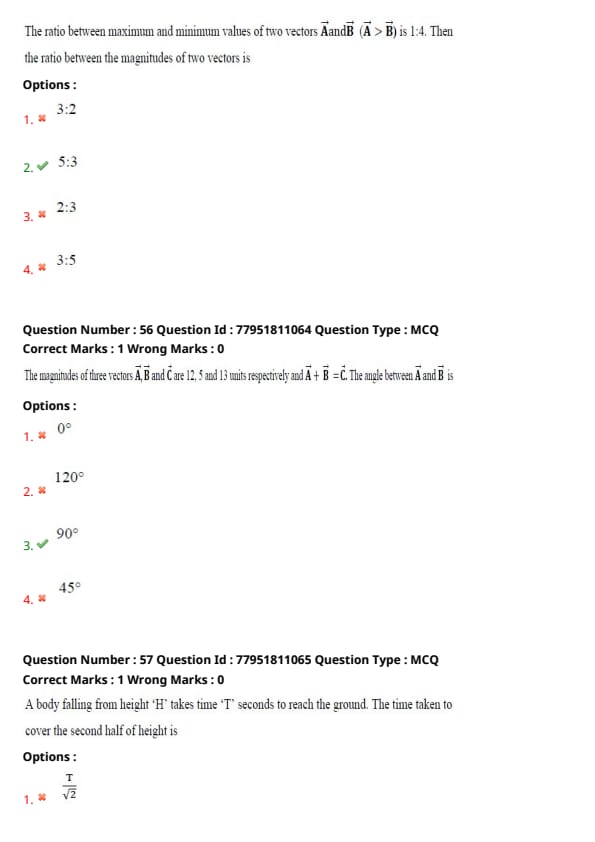
The ratio between maximum and minimum values of two vectors \(\vec{A}\) and \(\vec{B}\) (\(\vec{A} > \vec{B}\)) is 4:1. Then the ratio between the magnitudes of two vectors is ____.
{(Note: The user prompt text "1:4" is corrected to "4:1" for a valid ratio where A > B)
View Solution
Step 1: Understanding the Concept:
The maximum resultant of two vectors occurs when they are in the same direction (\(\theta = 0^\circ\)), and the minimum occurs when they are in opposite directions (\(\theta = 180^\circ\)).
Step 2: Key Formula or Approach:
1. \(R_{max} = A + B\).
2. \(R_{min} = A - B\).
3. Given \(\frac{A + B}{A - B} = \frac{4}{1}\).
Step 3: Detailed Explanation:
From the given ratio: \[ \frac{A + B}{A - B} = \frac{4}{1} \]
Cross-multiply: \[ A + B = 4(A - B) \] \[ A + B = 4A - 4B \]
Rearrange the terms: \[ B + 4B = 4A - A \] \[ 5B = 3A \] \[ \frac{A}{B} = \frac{5}{3} \]
Step 4: Final Answer:
The ratio between the magnitudes of the two vectors is 5:3. Quick Tip: You can use the Componendo and Dividendo rule here: If \(\frac{A+B}{A-B} = \frac{x}{y}\), then \(\frac{A}{B} = \frac{x+y}{x-y}\). In this case, \(\frac{4+1}{4-1} = \frac{5}{3}\).
The magnitudes of three vectors \(\vec{A}\), \(\vec{B}\) and \(\vec{C}\) are 12, 5 and 13 units respectively and \(\vec{A} + \vec{B} = \vec{C}\). The angle between \(\vec{A}\) and \(\vec{B}\) is ____.
View Solution
Step 1: Understanding the Concept:
The equation \(\vec{A} + \vec{B} = \vec{C}\) indicates that \(\vec{C}\) is the resultant of \(\vec{A}\) and \(\vec{B}\). We can use the magnitude of the resultant formula to find the angle between the two vectors.
Step 2: Key Formula or Approach:
1. Magnitude formula: \(C^2 = A^2 + B^2 + 2AB \cos \theta\).
2. Check if the magnitudes satisfy the Pythagorean theorem.
Step 3: Detailed Explanation:
Substitute the given magnitudes: \(A = 12, B = 5, C = 13\). \[ 13^2 = 12^2 + 5^2 + 2(12)(5) \cos \theta \] \[ 169 = 144 + 25 + 120 \cos \theta \] \[ 169 = 169 + 120 \cos \theta \]
Subtract 169 from both sides: \[ 0 = 120 \cos \theta \] \[ \cos \theta = 0 \implies \theta = 90^\circ \]
Step 4: Final Answer:
The angle between \(\vec{A}\) and \(\vec{B}\) is 90°. Quick Tip: Recognize the Pythagorean triplet: (5, 12, 13). Since \(5^2 + 12^2 = 13^2\), the vectors \(\vec{A}\) and \(\vec{B}\) must be the legs of a right triangle, meaning they are perpendicular (90°).
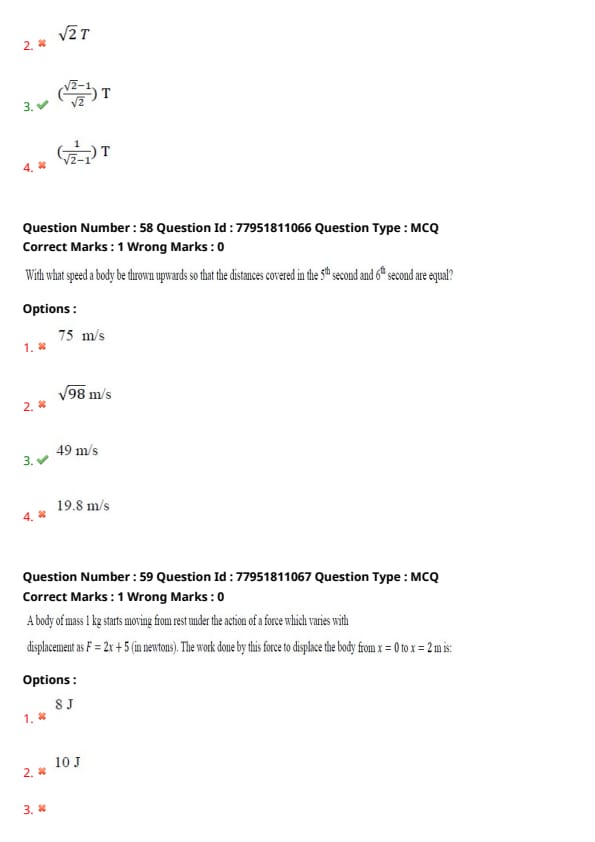
A body falling from height 'H' takes time 'T' seconds to reach the ground. The time taken to cover the second half of height is ____.
View Solution
Step 1: Understanding the Concept:
For a body falling from rest, the displacement \(s\) is proportional to the square of time \(t\) according to the equation \(s = \frac{1}{2}gt^2\). We need to find the total time \(T\) for height \(H\) and the time \(t_1\) for the first half height \(H/2\). The time for the second half is the difference between these two.
Step 2: Key Formula or Approach:
1. Total time: \(H = \frac{1}{2}gT^2 \implies T = \sqrt{\frac{2H}{g}}\).
2. Time for first half: \(\frac{H}{2} = \frac{1}{2}gt_1^2 \implies t_1 = \sqrt{\frac{H}{g}}\).
Step 3: Detailed Explanation:
From the equations above, we can see that: \[ t_1 = \frac{1}{\sqrt{2}} \sqrt{\frac{2H}{g}} = \frac{T}{\sqrt{2}} \]
The time taken for the second half of the height (\(\Delta t\)) is: \[ \Delta t = T - t_1 = T - \frac{T}{\sqrt{2}} \]
Factor out \(T\): \[ \Delta t = T \left( 1 - \frac{1}{\sqrt{2}} \right) = T \left( \frac{\sqrt{2}-1}{\sqrt{2}} \right) \]
Step 4: Final Answer:
The time taken for the second half is \( \left( \frac{\sqrt{2}-1}{\sqrt{2}} \right) T \). Quick Tip: For a body falling from rest, the times taken to cover successive equal distances are in the ratio \(1 : (\sqrt{2}-1) : (\sqrt{3}-\sqrt{2}) \dots\)
With what speed a body be thrown upwards so that the distances covered in the 5th second and 6th second are equal?
View Solution
Step 1: Understanding the Concept:
Distances covered in successive seconds are equal only if the body reaches its highest point exactly at the boundary of those two seconds. In this case, the body must reach the peak at \(t = 5\) seconds so that it ascends in the 5th second and descends in the 6th second.
Step 2: Key Formula or Approach:
At the highest point, velocity \(v = 0\). Using \(v = u - gt\).
Step 3: Detailed Explanation:
For the distance in the 5th second to equal the distance in the 6th second, the time of ascent must be 5 seconds. \[ 0 = u - g(5) \] \[ u = 5g \]
Taking \(g = 9.8 m/s^2\): \[ u = 5 \times 9.8 = 49 m/s \]
Step 4: Final Answer:
The initial speed should be 49 m/s. Quick Tip: If distance in the \(n^{th}\) second equals the distance in the \((n+1)^{th}\) second, the time to reach the highest point is always \(n\) seconds.
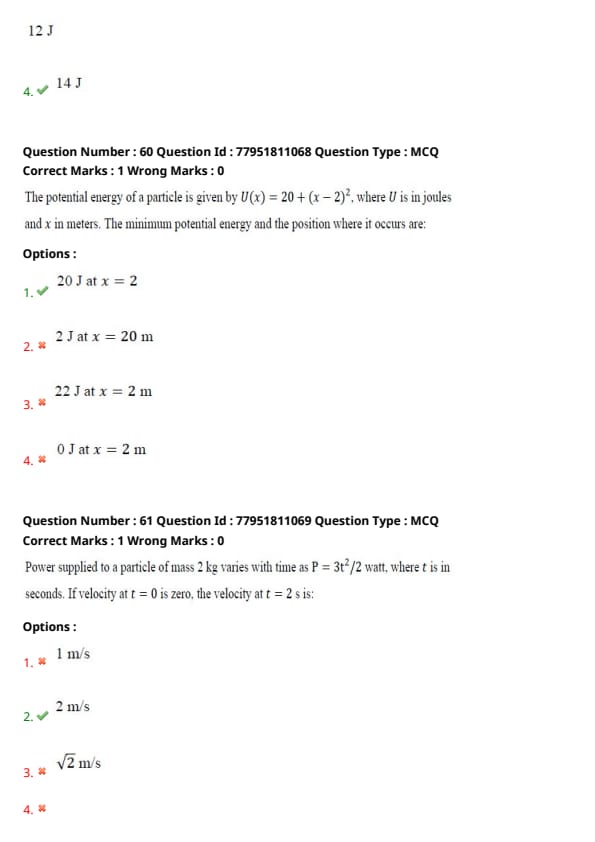
A body of mass 1 kg starts moving from rest under the action of a force which varies with displacement as \( F = 2x + 5 \). The work done by this force to displace the body from \( x = 0 \) to \( x = 2 \) m is ____.
View Solution
Step 1: Understanding the Concept:
When force is a function of displacement, work done is calculated by integrating the force with respect to displacement over the given interval.
Step 2: Key Formula or Approach:
\(W = \int_{x_1}^{x_2} F \, dx\).
Step 3: Detailed Explanation:
\[ W = \int_{0}^{2} (2x + 5) \, dx \]
Integrating the expression: \[ W = \left[ \frac{2x^2}{2} + 5x \right]_0^2 \] \[ W = [x^2 + 5x]_0^2 \]
Substituting the limits: \[ W = (2^2 + 5(2)) - (0^2 + 5(0)) \] \[ W = 4 + 10 = 14 J \]
Step 4: Final Answer:
The work done by the force is 14 J. Quick Tip: Work done is the area under the Force-Displacement graph. For linear forces like this, you can also calculate the area of the resulting trapezium.
The potential energy of a particle is given by \( U(x) = 20 + (x - 2)^2 \). The minimum potential energy and the position where it occurs are ____.
View Solution
Step 1: Understanding the Concept:
To find the minimum value of a function, we find the point where its first derivative is zero. Alternatively, observe the structure of the equation: a squared term \((x-2)^2\) is always \(\ge 0\).
Step 2: Key Formula or Approach:
The minimum value occurs when the squared term is at its minimum, which is 0.
Step 3: Detailed Explanation:
The potential energy is \(U(x) = 20 + (x-2)^2\).
Since \((x-2)^2\) is a perfect square, its minimum possible value is \(0\).
This happens when \(x - 2 = 0 \implies x = 2\) m.
Substituting \(x=2\) back into the original equation: \[ U_{min} = 20 + (2-2)^2 = 20 + 0 = 20 J \]
Step 4: Final Answer:
The minimum potential energy is 20 J at position \(x = 2\) m. Quick Tip: For any expression of the form \(U = A + (x - B)^2\), the minimum value is always \(A\) and it occurs at \(x = B\). No complex calculus needed!
Power supplied to a particle of mass 2 kg varies with time as \( P = 3t^2/2 \) watt, where \( t \) is in seconds. If velocity at \( t = 0 \) is zero, the velocity at \( t = 2 \) s is ____.
View Solution
Step 1: Understanding the Concept:
Power is the rate of change of work done, and according to the Work-Energy Theorem, the work done on a particle is equal to the change in its kinetic energy. Since the particle starts from rest, the work done up to time \(t\) equals its kinetic energy at that time.
Step 2: Key Formula or Approach:
1. Work Done \( W = \int P \, dt \).
2. Work-Energy Theorem: \( W = \Delta K.E. = \frac{1}{2}mv^2 - \frac{1}{2}mu^2 \).
Step 3: Detailed Explanation:
Given \( P = \frac{3}{2}t^2 \). Calculate work done from \( t = 0 \) to \( t = 2 \): \[ W = \int_{0}^{2} \frac{3}{2}t^2 \, dt = \frac{3}{2} \left[ \frac{t^3}{3} \right]_0^2 = \frac{1}{2} [2^3 - 0^3] = 4 J \]
Using the Work-Energy Theorem (\( u = 0 \)): \[ W = \frac{1}{2}mv^2 \implies 4 = \frac{1}{2}(2)v^2 \] \[ 4 = v^2 \implies v = 2 m/s \]
Step 4: Final Answer:
The velocity at \( t = 2 \) s is 2 m/s. Quick Tip: Always check the initial velocity. If the particle is already moving at \(t=0\), you must include the initial kinetic energy in your calculation.
A pump is used to deliver water at a certain rate from a given pipe. To obtain twice the volume of water from the same pipe in the same time, by what factor must the power of the motor pump be increased?
View Solution
Step 1: Understanding the Concept:
To deliver twice the volume in the same time, the velocity of the water must be doubled. Power for a pump is related to both the mass flow rate and the kinetic energy imparted to that mass.
Step 2: Key Formula or Approach:
1. Mass flow rate \( \frac{dm}{dt} = \rho A v \).
2. Power \( P = \frac{dK.E.}{dt} = \frac{1}{2} \left(\frac{dm}{dt}\right) v^2 = \frac{1}{2} (\rho A v) v^2 \propto v^3 \).
Step 3: Detailed Explanation:
If the volume required is doubled in the same time, then the new velocity \( v' = 2v \).
Since Power \( P \) is proportional to the cube of velocity (\( P \propto v^3 \)): \[ \frac{P'}{P} = \left( \frac{v'}{v} \right)^3 = \left( \frac{2v}{v} \right)^3 \] \[ \frac{P'}{P} = 2^3 = 8 \]
Step 4: Final Answer:
The power of the motor pump must be increased by a factor of 8. Quick Tip: This is a standard fluid mechanics problem. If volume flow rate \(Q\) increases by factor \(n\), the power increases by \(n^3\) because \(P = \frac{1}{2}\rho A v^3\).
Two identical piano wires, when tuned to a fundamental frequency of 400 Hz, produce no beats. One wire is then slightly tightened, and the beat frequency heard is 2 Hz. What is the new fundamental frequency of the tightened wire?
View Solution
Step 1: Understanding the Concept:
Beat frequency is the absolute difference between two frequencies (\( f_b = |f_1 - f_2| \)). The fundamental frequency of a stretched string is directly proportional to the square root of its tension (\( f \propto \sqrt{T} \)).
Step 2: Key Formula or Approach:
1. \( f_{new} = f_{old} \pm f_{beat} \).
2. If tension increases, frequency increases.
Step 3: Detailed Explanation:
Initial frequency \( f_1 = 400 Hz \).
The wire is tightened, so the new frequency \( f_2 \) must be greater than \( f_1 \).
Given beat frequency \( f_b = 2 Hz \): \[ f_2 - f_1 = 2 \] \[ f_2 - 400 = 2 \implies f_2 = 402 Hz \]
Step 4: Final Answer:
The new fundamental frequency of the tightened wire is 402 Hz. Quick Tip: Always look for keywords like "tightened" (increases frequency) or "loaded with wax" (decreases frequency) to decide whether to add or subtract the beat frequency.
A source of sound of frequency 500 Hz is moving towards an observer with velocity 30 m/s. The speed of sound is 330 m/s. The frequency heard by the observer will be ____.
View Solution
Step 1: Understanding the Concept:
This problem involves the Doppler Effect. When a source of sound moves toward a stationary observer, the wave fronts are "bunched up," causing the observer to perceive a higher frequency than the one actually emitted.
Step 2: Key Formula or Approach:
The apparent frequency \(f'\) is given by: \[ f' = f \left( \frac{v}{v - v_s} \right) \]
Where \(v\) is the speed of sound and \(v_s\) is the velocity of the source.
Step 3: Detailed Explanation:
Given: \(f = 500\) Hz, \(v = 330\) m/s, and \(v_s = 30\) m/s.
Substituting the values into the formula: \[ f' = 500 \left( \frac{330}{330 - 30} \right) \] \[ f' = 500 \left( \frac{330}{300} \right) \] \[ f' = 500 \times 1.1 = 550 Hz \]
Step 4: Final Answer:
The frequency heard by the observer is 550 Hz. Quick Tip: If the source moves {towards} the observer, use a {minus} sign in the denominator (higher frequency). If it moves {away}, use a {plus} sign (lower frequency).
In Acoustics, 'Noise' is generally characterized by ____.
View Solution
Step 1: Understanding the Concept:
In acoustics, a distinction is made between "musical sound" and "noise." Musical sound is produced by regular, periodic vibrations that create a recognizable pitch. Noise, however, lacks this structure.
Step 2: Key Formula or Approach:
Analyze the waveform: Periodic = Musical; Non-periodic/Random = Noise.
Step 3: Detailed Explanation:
Noise is the result of sound waves that have no definite frequency or pattern. Because the vibrations are irregular and do not repeat at set intervals (non-periodic), the human ear cannot assign a specific pitch to the sound. This is why white noise or a crashing sound feels "discordant" compared to a piano note.
Step 4: Final Answer:
Noise is characterized by irregular and non-periodic vibrations. Quick Tip: Think of the difference between a drum beat (periodic/rhythmic) and static on a radio (non-periodic/noise).
If the volume of a room is doubled and the total absorption is halved, the reverberation time will ____.
View Solution
Step 1: Understanding the Concept:
Reverberation time (\(T\)) is the time required for sound to decay by 60 decibels. It is governed by Sabine’s Formula, which relates the volume of the space to its sound-absorbing properties.
Step 2: Key Formula or Approach:
Sabine’s Formula: \( T = \frac{0.16V}{A} \)
Where \(V\) is the volume and \(A\) is the total absorption.
Step 3: Detailed Explanation:
Let the initial reverberation time be \(T_1 = \frac{0.16V}{A}\).
According to the problem:
1. New volume \(V' = 2V\)
2. New absorption \(A' = \frac{A}{2}\)
Substitute these into the formula for the new reverberation time \(T_2\): \[ T_2 = \frac{0.16(2V)}{A/2} = \frac{0.16 \times 2V \times 2}{A} \] \[ T_2 = 4 \times \left( \frac{0.16V}{A} \right) = 4T_1 \]
Step 4: Final Answer:
The reverberation time will become four times its original value. Quick Tip: More volume means sound travels further before hitting a wall; less absorption means less energy is lost per hit. Both factors increase reverberation time.
In a closed hall of volume 5000 m³, the total absorption of the interior surfaces is 200 metric sabin. The reverberation time is ____.
View Solution
Step 1: Understanding the Concept:
The reverberation time is the time taken for the sound pressure level to decay by 60 dB. This is calculated using Sabine's formula, which relates the volume of the hall and the total absorption.
Step 2: Key Formula or Approach:
Sabine's Formula: \( T = \frac{0.16V}{A} \)
Where:
* \( V \) = Volume of the hall (in m³)
* \( A \) = Total absorption (in metric sabins)
Step 3: Detailed Explanation:
Given: \( V = 5000 m^3 \) and \( A = 200 sabins \).
Substitute the values into the formula: \[ T = \frac{0.16 \times 5000}{200} \] \[ T = \frac{16 \times 50}{200} \] \[ T = \frac{800}{200} = 4 s \]
Step 4: Final Answer:
The reverberation time is 4 s. Quick Tip: Remember the constant 0.16 in Sabine's formula. If the dimensions were in feet, the constant would change to approximately 0.049.
In an Isothermal process ____.
View Solution
Step 1: Understanding the Concept:
The term "Isothermal" comes from the Greek words "isos" (equal) and "therme" (heat/temperature). In thermodynamics, it describes a process where the temperature of the system is held constant throughout.
Step 2: Key Formula or Approach:
For an ideal gas in an isothermal process: \( \Delta T = 0 \).
This also implies that the change in internal energy \( \Delta U = 0 \) for an ideal gas.
Step 3: Detailed Explanation:
In an isothermal process, the system is usually in thermal contact with an external reservoir, and the process happens slowly enough to allow the system to continually adjust to the temperature of the reservoir through heat exchange. Because temperature is a measure of the average kinetic energy of the molecules, keeping temperature constant means the thermal state of the system does not change.
Step 4: Final Answer:
The temperature of the system remains constant. Quick Tip: Isothermal = Constant Temperature (\(\Delta T = 0\))
Isobaric = Constant Pressure (\(\Delta P = 0\))
Isochoric = Constant Volume (\(\Delta V = 0\))
Adiabatic = No heat exchange (\(Q = 0\))
If the pressure of an ideal gas is doubled and its absolute temperature is halved; the volume will become ____.
View Solution
Step 1: Understanding the Concept:
To find the change in volume, we use the Combined Gas Law, which relates pressure, volume, and temperature for a fixed amount of an ideal gas.
Step 2: Key Formula or Approach:
Ideal Gas Law: \( \frac{P_1 V_1}{T_1} = \frac{P_2 V_2}{T_2} \)
We need to find \( V_2 \) in terms of \( V_1 \).
Step 3: Detailed Explanation:
Given conditions:
* \( P_2 = 2P_1 \) (Pressure doubled)
* \( T_2 = \frac{1}{2}T_1 \) (Temperature halved)
Substitute these into the equation: \[ \frac{P_1 V_1}{T_1} = \frac{(2P_1) V_2}{(T_1/2)} \]
Multiply both sides by \( T_1 \) and divide by \( P_1 \): \[ V_1 = \frac{2 V_2}{1/2} \] \[ V_1 = 4V_2 \] \[ V_2 = \frac{1}{4}V_1 \]
Step 4: Final Answer:
The volume will become 1/4 of the initial volume. Quick Tip: Increasing pressure tends to decrease volume (inverse relationship), and decreasing temperature also tends to decrease volume (direct relationship). Since both actions push the volume down, the result must be a significant decrease.
At constant temperature, the product PV is plotted against pressure P for an ideal gas. The graph obtained is ____.
View Solution
Step 1: Understanding the Concept:
This question refers to Boyle's Law. Boyle's Law states that for a fixed mass of gas at constant temperature, the product of pressure and volume is constant.
Step 2: Key Formula or Approach:
Equation: \( PV = constant \) (at constant T).
If we let \( y = PV \) and \( x = P \), the equation is \( y = C \).
Step 3: Detailed Explanation:
Since the product \( PV \) always results in the same value regardless of what the pressure \( P \) is (as long as temperature is constant), the value on the y-axis does not change as you move along the x-axis. In coordinate geometry, a graph where \( y \) is constant is a horizontal straight line.
Step 4: Final Answer:
The graph is a straight line parallel to the P-axis (horizontal line). Quick Tip: This graph is often used to show deviations from ideal gas behavior. Real gases will not show a perfectly horizontal line at very high pressures.
A bubble of an ideal gas rises from the bottom of a lake to the surface. At the bottom, the pressure is 3 Atm. and the temperature is 7°C. At the surface, the pressure is 1 atm. and the temperature is 27°C. If the initial volume of the bubble was \( V_0 \) what is its volume \( V_f \) at the surface?
View Solution
Step 1: Understanding the Concept:
As the bubble rises, the pressure decreases and the temperature changes. We use the Combined Gas Law to relate the initial state (bottom) to the final state (surface). It is critical to convert temperatures to Kelvin.
Step 2: Key Formula or Approach:
1. Combined Gas Law: \( \frac{P_1 V_1}{T_1} = \frac{P_f V_f}{T_f} \).
2. Temperature conversion: \( T(K) = T(^\circ C) + 273 \).
Step 3: Detailed Explanation:
Initial state (bottom): \( P_1 = 3 atm \), \( V_1 = V_0 \), \( T_1 = 7 + 273 = 280 K \).
Final state (surface): \( P_f = 1 atm \), \( T_f = 27 + 273 = 300 K \).
Rearranging for \( V_f \): \[ V_f = \frac{P_1 V_1 T_f}{T_1 P_f} \] \[ V_f = \frac{3 \times V_0 \times 300}{280 \times 1} \] \[ V_f = \frac{900}{280} V_0 \approx 3.214 V_0 \]
Step 4: Final Answer:
The volume at the surface is 3.21 \( V_0 \). Quick Tip: Always convert Celsius to Kelvin in gas law problems. A common mistake is using 7 and 27 directly, which would lead to an incorrect answer.
The R.M.S. speed of oxygen molecules at 27°C is v. At 927°C, the rms speed will be ____.
View Solution
Step 1: Understanding the Concept:
The root mean square (RMS) speed of gas molecules depends on the absolute temperature of the gas. If the gas remains the same (Oxygen), the speed is proportional to the square root of the absolute temperature.
Step 2: Key Formula or Approach:
1. RMS speed formula: \( v_{rms} = \sqrt{\frac{3RT}{M}} \).
2. Ratio: \( \frac{v_2}{v_1} = \sqrt{\frac{T_2}{T_1}} \).
Step 3: Detailed Explanation:
Initial temperature \( T_1 = 27 + 273 = 300 K \).
Final temperature \( T_2 = 927 + 273 = 1200 K \).
Taking the ratio of the speeds: \[ \frac{v_2}{v} = \sqrt{\frac{1200}{300}} \] \[ \frac{v_2}{v} = \sqrt{4} = 2 \] \[ v_2 = 2v \]
Step 4: Final Answer:
The rms speed at 927°C will be 2v. Quick Tip: To double the speed of gas molecules, you must quadruple the absolute temperature (in Kelvin). Here, temperature increased from 300 K to 1200 K (4 times), so speed doubles.
In a photoelectric experiment, the stopping potential for incident light of wavelength 4000 Å is 2V. If the wavelength is changed to 3000 Å, the new stopping potential will be approximately ____.
{(Use h = 4.14 × 10⁻¹⁵ eV·s, c = 3 × 10⁸ m/s)
View Solution
Step 1: Understanding the Concept:
According to Einstein's photoelectric equation, the energy of an incident photon equals the sum of the work function and the maximum kinetic energy of the emitted electron. Maximum kinetic energy is equivalent to \( e \times V_{stopping} \).
Step 2: Key Formula or Approach:
1. \( \frac{hc}{\lambda} = \phi + eV_s \).
2. Photon energy in eV \(\approx \frac{12420}{\lambda(\AA)}\) (or \( \frac{12400}{\lambda} \)).
Step 3: Detailed Explanation:
Calculate energy for 4000 \AA: \( E_1 = \frac{12420}{4000} \approx 3.105 eV \).
Using \( E_1 = \phi + eV_{s1} \): \( 3.105 = \phi + 2 \implies \phi = 1.105 eV \).
Now calculate energy for 3000 \AA: \( E_2 = \frac{12420}{3000} = 4.14 eV \).
Using \( E_2 = \phi + eV_{s2} \): \( 4.14 = 1.105 + V_{s2} \) \( V_{s2} = 4.14 - 1.105 = 3.035 V \).
Step 4: Final Answer:
The new stopping potential is approximately 3.03 V. Quick Tip: Shorter wavelength means higher photon energy. If energy increases by roughly 1 eV (from 3.1 to 4.1 eV), the stopping potential should also increase by roughly 1 V.
In Optical Fiber communication, the signal is transmitted in the form of ____.
View Solution
Step 1: Understanding the Concept:
Optical fiber technology uses thin strands of glass or plastic to transmit data over long distances. Unlike traditional copper wires that use electrons, optical fibers utilize photons to carry information.
Step 2: Key Formula or Approach:
The core principle of optical fiber communication is Total Internal Reflection (TIR), which allows electromagnetic waves in the visible or infrared spectrum to travel through the fiber with minimal loss.
Step 3: Detailed Explanation:
In an optical fiber system, an electrical signal (data) is converted into light pulses by a light source, such as a Laser or an LED. These light pulses travel through the fiber core. At the receiving end, a photodetector converts these light pulses back into electrical signals. Because light has a much higher frequency than electricity, it can carry significantly more data.
Step 4: Final Answer:
The signal is transmitted in the form of light pulses. Quick Tip: Optical fibers are immune to electromagnetic interference (EMI) because they transmit light instead of electricity, making them much more reliable in noisy environments.
In a superconducting ring, a persistent current has been flowing without decay for years. This is possible because ____.
View Solution
Step 1: Understanding the Concept:
Superconductivity is a state of matter where a material exhibits exactly zero electrical resistance and the expulsion of magnetic fields (Meissner effect) when cooled below a characteristic critical temperature.
Step 2: Key Formula or Approach:
According to Ohm's Law, \( V = IR \). If the resistance \( R \) is exactly zero, then the potential difference \( V \) required to maintain a current \( I \) is zero. Consequently, energy is not dissipated as heat (\( P = I^2R = 0 \)).
Step 3: Detailed Explanation:
When a current is induced in a superconducting loop, there is no "friction" (resistance) to slow down the electrons. Therefore, the kinetic energy of the charge carriers remains constant indefinitely. Additionally, in a closed superconducting loop, the magnetic flux through the ring remains trapped and is quantized in units of the fluxoid, which stabilizes the persistent current.
Step 4: Final Answer:
Persistent current is possible because the resistance is exactly zero and the magnetic flux is quantized. Quick Tip: Persistent currents in superconductors have been observed to last for over 25 years in laboratory settings with no measurable decrease in magnitude!
The pair of orbitals with electron density maximum along the axes is ____.
View Solution
Step 1: Understanding the Concept:
The five d-orbitals are classified into two groups based on their orientation in space: those that lie between the axes (\(t_{2g}\) set) and those that lie along the axes (\(e_g\) set).
Step 2: Key Formula or Approach:
1. Non-axial orbitals: \(d_{xy}, d_{yz}, d_{xz}\) (lobes lie at 45° to the axes).
2. Axial orbitals: \(d_{x^2-y^2}, d_{z^2}\) (lobes lie directly on the axes).
Step 3: Detailed Explanation:
The \(d_{x^2-y^2}\) orbital has four lobes pointing along the X and Y axes. The \(d_{z^2}\) orbital has two lobes pointing along the Z-axis and a "doughnut" of electron density in the XY plane. In contrast, \(d_{xy}, d_{yz},\) and \(d_{xz}\) have lobes situated between the respective coordinate axes.
Step 4: Final Answer:
The orbitals with electron density along the axes are \(d_{z^2}\) and \(d_{x^2-y^2}\). Quick Tip: Remember the \(e_g\) group (axial) vs. the \(t_{2g}\) group (non-axial). This distinction is fundamental to understanding Crystal Field Theory in coordination chemistry.
The angular momentum of an electron in an orbit X of hydrogen atom is \(2h/\pi\). Maximum number of orbitals possible in X is ____.
View Solution
Step 1: Understanding the Concept:
According to Bohr's model, the angular momentum of an electron is quantized and depends on the principal quantum number \(n\). Once \(n\) is known, the number of orbitals in that shell can be determined.
Step 2: Key Formula or Approach:
1. Bohr's Angular Momentum: \(L = \frac{nh}{2\pi}\).
2. Number of orbitals in a shell = \(n^2\).
Step 3: Detailed Explanation:
Given angular momentum \(L = \frac{2h}{\pi}\).
Set this equal to the formula: \[ \frac{nh}{2\pi} = \frac{2h}{\pi} \]
Cancel \(h\) and \(\pi\) from both sides: \[ \frac{n}{2} = 2 \implies n = 4 \]
The principal quantum number is 4.
The maximum number of orbitals in the \(n^{th}\) shell is \(n^2\): \[ Number of orbitals = 4^2 = 16 \]
Step 4: Final Answer:
The maximum number of orbitals possible in orbit X is 16. Quick Tip: Don't confuse "number of orbitals" (\(n^2\)) with "maximum number of electrons" (\(2n^2\)). For \(n=4\), there are 16 orbitals and 32 electrons.
The four quantum numbers for the electron in the outermost orbital of potassium (Z=19) are ____.
View Solution
Step 1: Understanding the Concept:
To find the quantum numbers of the outermost electron, we must first write the electronic configuration of the atom based on the Aufbau principle.
Step 2: Key Formula or Approach:
1. Potassium (\(Z=19\)) configuration: \(1s^2 2s^2 2p^6 3s^2 3p^6 4s^1\).
2. Identify the outermost electron: \(4s^1\).
Step 3: Detailed Explanation:
For the \(4s^1\) electron:
* The principal quantum number (\(n\)) is the coefficient: 4.
* For an 's' orbital, the azimuthal quantum number (\(l\)) is 0.
* If \(l=0\), the magnetic quantum number (\(m\)) must be 0.
* The spin quantum number (\(s\)) can be \(+1/2\) (or \(-1/2\)).
Looking at the options, \(n=4, l=0, m=0, s=+1/2\) is the only correct set.
Step 4: Final Answer:
The quantum numbers are \(n=4, l=0, m=0, s=+1/2\). Quick Tip: Potassium is an alkali metal in Group 1 and Period 4. All Period 4 elements start filling the \(n=4\) shell, and Group 1 elements always end with \(ns^1\).
In which of the following, the number of bonding electrons and non-bonding electrons are in 3:2 ratio?
View Solution
Step 1: Understanding the Concept:
Bonding electrons are those shared between atoms to form chemical bonds. Non-bonding electrons (lone pairs) are valence electrons that do not participate in bonding. We need to calculate the total count for each molecule.
Step 2: Key Formula or Approach:
1. Draw the Lewis structure for each molecule.
2. Count shared electrons (bonding) and lone pair electrons (non-bonding).
3. Check the ratio (Bonding : Non-bonding).
Step 3: Detailed Explanation:
For N₂: Nitrogen has 5 valence electrons. It forms a triple bond (\(:N \equiv N:\)).
Bonding electrons = 6 (3 pairs)
Non-bonding electrons = 4 (2 lone pairs)
Ratio = \(6:4 = 3:2\).
For O₂ (\(:O = O:\)): Bonding = 4, Non-bonding = 8 (Ratio 1:2).
For F₂ (\(:F - F:\)): Bonding = 2, Non-bonding = 12 (Ratio 1:6).
For HCl (\(H - Cl:\)): Bonding = 2, Non-bonding = 6 (Ratio 1:3).
Step 4: Final Answer:
The ratio 3:2 is found in N₂. Quick Tip: In diatomic molecules of the second period, as you move from \(N_2\) to \(F_2\), the number of bonding electrons decreases while non-bonding electrons increase.
Which one of the following statements is not correct?
View Solution
Step 1: Understanding the Concept:
This question tests the general properties of ionic and covalent compounds. Conductivity requires the presence of free-moving charged particles (ions or electrons).
Step 2: Key Formula or Approach:
Evaluate each statement based on chemical principles:
Ionic bonds: Electrostatic, non-directional, soluble in polar solvents, conduct when molten/aqueous.
Covalent bonds: Shared electrons, directional, generally non-conductors.
Step 3: Detailed Explanation:
Statement 1: Correct. Ionic bonds are electrostatic attractions acting in all directions around an ion.
Statement 2: Correct. Under standard conditions, the maximum bond order between two atoms is 3 (triple bond), like in \(N \equiv N\) or \(HC \equiv CH\).
Statement 3: Incorrect. Covalent compounds consist of neutral molecules. Even in a fused (molten) state, they do not have free ions to carry electric current. (Exceptions like graphite exist, but as a general rule, this is false).
Statement 4: Correct. Being polar, ionic compounds generally dissolve in polar solvents like water ("like dissolves like").
Step 4: Final Answer:
Statement (3) is incorrect. Quick Tip: Covalent compounds are usually insulators. If a compound conducts electricity in the fused state, it is almost certainly an ionic compound.
12.6 g of oxalic acid, H₂C₂O₄.2H₂O (M.wt 126) is present in 1500 mL of solution. The normality of that solution is ____.
View Solution
Step 1: Understanding the Concept:
Normality (\(N\)) is defined as the number of gram equivalents of solute per liter of solution. For oxalic acid (\(H_2C_2O_4 \cdot 2H_2O\)), it is a dibasic acid, meaning it can donate two protons (\(H^+\)).
Step 2: Key Formula or Approach:
1. Equivalent weight = \(\frac{Molecular weight}{Basicity (n-factor)}\).
2. Normality (\(N\)) = \(\frac{Mass (g)}{Equivalent weight} \times \frac{1000}{Volume (mL)}\).
Step 3: Detailed Explanation:
Oxalic acid dihydrate has a molecular weight of 126 and an n-factor of 2. \[ Equivalent weight = \frac{126}{2} = 63 \]
Now, calculate Normality: \[ N = \frac{12.6}{63} \times \frac{1000}{1500} \] \[ N = 0.2 \times \frac{2}{3} = \frac{0.4}{3} \approx 0.1333 N \]
Step 4: Final Answer:
The normality of the solution is 0.133 N. Quick Tip: For hydrated salts like oxalic acid, always include the mass of water molecules in the molecular weight calculation (\(2 \times 18 = 36\)). In this case, the total is given as 126.
Which of the following has highest equivalent weight? (Given: At.wt H=1, C=12, O=16, S=32, Na=23, Ca=40)
View Solution
Step 1: Understanding the Concept:
Equivalent weight for acids is \(M/basicity\), and for salts, it is \(M/total positive charge on cation\).
Step 2: Key Formula or Approach:
Calculate Molecular Weight (\(M\)) and divide by n-factor (\(n\)) for each:
Step 3: Detailed Explanation:
Sulphuric acid (\(H_2SO_4\)): \(M = 98, n = 2 \implies Eq. wt = 49\).
Sodium carbonate (\(Na_2CO_3\)): \(M = 106, n = 2 \implies Eq. wt = 53\).
Sodium sulphate (\(Na_2SO_4\)): \(M = (23 \times 2) + 32 + (16 \times 4) = 46 + 32 + 64 = 142\). \(n = 2 \implies Eq. wt = 71\).
Calcium carbonate (\(CaCO_3\)): \(M = 100, n = 2 \implies Eq. wt = 50\).
Step 4: Final Answer:
Sodium sulphate has the highest equivalent weight (71). Quick Tip: Always identify the n-factor correctly. For salts, it's the total magnitude of charge on either the cationic or anionic part.
Identify the pair of gases which have same number of molecules at S.T.P?
View Solution
Step 1: Understanding the Concept:
According to Avogadro's law, equal volumes of gases at STP contain the same number of molecules. This means they must have the same number of moles (\(n = mass / molar mass\)).
Step 2: Key Formula or Approach:
Calculate moles for each pair: \(n = w/M\).
Step 3: Detailed Explanation:
Option 1: \(CO_2 (11/44 = 0.25)\), \(N_2 (14/28 = 0.5)\). No.
Option 2: \(O_2 (16/32 = 0.5)\), \(CH_4 (16/16 = 1.0)\). No.
Option 3: \(H_2 (5/2 = 2.5)\), \(CH_4 (40/16 = 2.5)\). Yes.
Option 4: \(N_2 (28/28 = 1)\), \(CO_2 (22/44 = 0.5)\). No.
Step 4: Final Answer:
The pair with the same number of molecules is 5 g of H₂ and 40 g of CH₄. Quick Tip: "Same number of molecules" is synonymous with "same number of moles." Calculate the moles quickly to find the answer.
100 mL of 0.1M HCl and 100 mL of 0.05 M H₂SO₄ are mixed and the solution is diluted to 2.0 L by adding water. The pH of the resulting solution is ____.
View Solution
Step 1: Understanding the Concept:
The pH of a solution depends on the total concentration of hydrogen ions (\(H^+\)). When mixing strong acids, we calculate the total moles of \(H^+\) and divide by the final total volume.
Step 2: Key Formula or Approach:
1. Moles of \(H^+\) from \(HCl = M \times V\) (in L).
2. Moles of \(H^+\) from \(H_2SO_4 = 2 \times M \times V\) (since it is dibasic).
3. \([H^+] = \frac{Total moles of H^+}{Total Volume in L}\).
4. \(pH = -\log[H^+]\).
Step 3: Detailed Explanation:
Moles from \(HCl = 0.1 \times 0.1 = 0.01 moles\).
Moles from \(H_2SO_4 = 2 \times (0.05 \times 0.1) = 2 \times 0.005 = 0.01 moles\).
Total moles of \(H^+ = 0.01 + 0.01 = 0.02 moles\).
Total final volume = \(2.0 L\).
\([H^+] = \frac{0.02}{2.0} = 0.01 = 10^{-2} M\).
\(pH = -\log(10^{-2}) = 2\).
Step 4: Final Answer:
The pH of the resulting solution is 2. Quick Tip: Always remember that \(H_2SO_4\) releases {two} \(H^+\) ions per molecule. Forgetting this factor is the most common mistake in acid mixture problems.
According to Arrhenius theory of acids and bases, which of the following is an example of Arrhenius base?
View Solution
Step 1: Understanding the Concept:
The Arrhenius theory specifically defines a base as a substance that increases the concentration of hydroxide ions (\(OH^-\)) when dissolved in water.
Step 2: Key Formula or Approach:
Look for a substance containing a hydroxyl group that dissociates in an aqueous medium: \(BOH \rightarrow B^+ + OH^-\).
Step 3: Detailed Explanation:
H₂SO₄: Dissociates to give \(H^+\) (Arrhenius acid).
NH₃: Does not contain \(OH^-\). While it acts as a base in water, it is better explained by Bronsted-Lowry or Lewis theories.
NaOH: Dissociates directly into \(Na^+\) and \(OH^-\) in water. This fits the strict Arrhenius definition perfectly.
CaO: A basic oxide, but it must react with water to form \(Ca(OH)_2\) before it provides \(OH^-\) ions.
Step 4: Final Answer:
NaOH is the example of an Arrhenius base. Quick Tip: Arrhenius theory is limited to aqueous solutions and substances that directly possess \(H\) or \(OH\) groups in their formula.
Electrolysis of an aqueous solution of Na₂SO₄ between Pt electrodes liberate a gas X at anode and gas Y at cathode. X and Y respectively are ____.
View Solution
Step 1: Understanding the Concept:
In the electrolysis of aqueous \(Na_2SO_4\), we must consider the discharge potential of the ions (\(Na^+, SO_4^{2-}\)) versus water (\(H_2O\)). Platinum (Pt) electrodes are inert and do not participate in the reaction.
Step 2: Key Formula or Approach:
Compare reduction/oxidation potentials. Water is oxidized more easily than \(SO_4^{2-}\) and reduced more easily than \(Na^+\).
Step 3: Detailed Explanation:
At Anode (Oxidation): Both \(SO_4^{2-}\) and \(H_2O\) are present. Water has a lower oxidation potential, so it oxidizes: \(2H_2O \rightarrow O_2(g) + 4H^+ + 4e^-\). Thus, X is O₂.
At Cathode (Reduction): Both \(Na^+\) and \(H_2O\) are present. \(H_2O\) is reduced more easily than \(Na^+\): \(2H_2O + 2e^- \rightarrow H_2(g) + 2OH^-\). Thus, Y is H₂.
Step 4: Final Answer:
X is Oxygen (\(O_2\)) and Y is Hydrogen (\(H_2\)). Quick Tip: In aqueous solutions of active metal sulfates (like \(Na, K, Mg\)), the net result is effectively the electrolysis of water itself, producing \(O_2\) at the anode and \(H_2\) at the cathode.
The wrong statement regarding Galvanic cell is ____.
View Solution
Step 1: Understanding the Concept:
A Galvanic (or Voltaic) cell converts chemical energy into electrical energy through a spontaneous redox reaction. It is important to distinguish its electrode polarity from an electrolytic cell.
Step 2: Key Formula or Approach:
Use the mnemonic LOAN: Left Oxidation Anode Negative.
Step 3: Detailed Explanation:
Statement 1: Correct. Galvanic cells run on spontaneous reactions (\(\Delta G < 0\)).
Statement 2: Correct. The salt bridge completes the circuit and prevents charge build-up by allowing ion flow.
Statement 3: Incorrect. In a Galvanic cell, the Anode is Negative (-) and the Cathode is Positive (+). This is because the anode is the source of electrons.
Statement 4: Correct. Oxidation always occurs at the anode, regardless of the cell type.
Step 4: Final Answer:
Statement (3) is wrong. Quick Tip: Remember: Oxidation \(\rightarrow\) Anode; Reduction \(\rightarrow\) Cathode. For signs, think: Galvanic Anode is Negative (GAN).
Which of the following is a weak electrolyte?
View Solution
Step 1: Understanding the Concept:
An electrolyte is "weak" if it only partially dissociates into ions in an aqueous solution. Strong electrolytes dissociate nearly 100%.
Step 2: Key Formula or Approach:
Identify the nature of the substance: Strong acids, strong bases, and most salts are strong electrolytes. Organic acids and some inorganic acids like Carbonic acid are weak.
Step 3: Detailed Explanation:
H₂CO₃ (Carbonic Acid): An inorganic acid that exists in equilibrium with its ions; it does not fully ionize. Thus, it is a weak electrolyte.
H₂SO₄ (Sulphuric Acid): A strong mineral acid.
NaCl (Sodium Chloride): A salt that fully dissociates into \(Na^+\) and \(Cl^-\).
NaOH (Sodium Hydroxide): A strong base.
Step 4: Final Answer:
H₂CO₃ is a weak electrolyte. Quick Tip: Most "carbon" containing acids (organic) and acids found in soft drinks (like \(H_2CO_3\) or \(H_3PO_4\)) are typically weak electrolytes.
The exhausted anion-exchange resin is regenerated with ____.
View Solution
Step 1: Understanding the Concept:
Ion exchange resins are used for water demineralization. Anion-exchange resins pick up negative ions (like \(Cl^-, SO_4^{2-}\)) and release \(OH^-\). When "exhausted," they are saturated with these impurity anions.
Step 2: Key Formula or Approach:
To regenerate, you must provide a high concentration of the original ion (\(OH^-\)) to drive the equilibrium backward.
Step 3: Detailed Explanation:
An exhausted anion resin (\(R-Cl\)) needs to be converted back to its basic form (\(R-OH\)). This is achieved by washing it with a dilute NaOH solution. The high concentration of \(OH^-\) displaces the chloride ions: \[ R-Cl + NaOH \rightarrow R-OH + NaCl \]
Conversely, a cation-exchange resin is regenerated with dilute \(HCl\) or \(H_2SO_4\).
Step 4: Final Answer:
Dilute NaOH solution is used for regeneration. Quick Tip: Anion starts with 'A' and is regenerated by Alkali (NaOH). Cation starts with 'C' and is regenerated by Acid (HCl).
A sample of water is known to contain Mg(HCO₃)₂ = 7.3 mg/L, Ca(HCO₃)₂ = 8.1 mg/L and 27.2 mg/L of CaSO₄. The total hardness associated with water sample (in ppm) in equivalents of CaCO₃ is ____.
{(At.wt H=1, C=12, O=16, Mg=24, Ca=40, S=32)
View Solution
Step 1: Understanding the Concept:
Hardness is expressed in terms of \(CaCO_3\) equivalents. Each salt contribution is calculated by converting its mass to the equivalent mass of \(CaCO_3\).
Step 2: Key Formula or Approach:
\[ Hardness (as CaCO_3) = \frac{Mass of salt}{Molar mass of salt} \times Molar mass of CaCO_3 \]
(Note: This works because all these salts have the same n-factor as \(CaCO_3\), which is 2).
Step 3: Detailed Explanation:
1. Molar Masses: \(Mg(HCO_3)_2 = 146\), \(Ca(HCO_3)_2 = 162\), \(CaSO_4 = 136\), \(CaCO_3 = 100\).
2. Calculation:
Due to \(Mg(HCO_3)_2 = \frac{7.3}{146} \times 100 = 0.05 \times 100 = 5 ppm\).
Due to \(Ca(HCO_3)_2 = \frac{8.1}{162} \times 100 = 0.05 \times 100 = 5 ppm\).
Due to \(CaSO_4 = \frac{27.2}{136} \times 100 = 0.2 \times 100 = 20 ppm\).
3. Total Hardness = \(5 + 5 + 20 = 30 ppm\).
Step 4: Final Answer:
The total hardness is 30 ppm. Quick Tip: Hardness units: 1 mg/L is exactly equal to 1 ppm for dilute aqueous solutions.
The type of functional group associated with cation exchange resin is ____.
View Solution
Step 1: Understanding the Concept:
Ion-exchange resins are insoluble polymers that can exchange specific ions within a solution. Cation exchange resins must possess acidic functional groups that can release \(H^+\) ions in exchange for other cations (like \(Ca^{2+}\) or \(Mg^{2+}\)).
Step 2: Key Formula or Approach:
* Cation Exchange Resins: Contain acidic groups like sulphonic acid (\(-SO_3H\)) or carboxylic acid (\(-COOH\)).
* Anion Exchange Resins: Contain basic groups like quaternary ammonium or amino groups (\(-NH_2, -OH\)).
Step 3: Detailed Explanation:
Cation resins are essentially giant organic molecules with fixed negative charges and mobile positive ions. The sulphonic acid group (\(-SO_3H\)) is a strong acid group commonly used in these resins. When hard water passes through, the \(H^+\) ions from the \(-SO_3H\) group are replaced by the cations present in the water: \[ 2R-SO_3H + Ca^{2+} \rightarrow (R-SO_3)_2Ca + 2H^+ \]
Step 4: Final Answer:
The functional group associated with cation exchange resin is -SO₃H. Quick Tip: Remember: "Cation" resins are "Acidic" (release \(H^+\)), and "Anion" resins are "Basic" (release \(OH^-\)).
Identify the incorrect statement about the corrosion ____.
View Solution
Step 1: Understanding the Concept:
Corrosion is an electrochemical process. The rate and location of corrosion are influenced by electrode potential, mechanical stress, and differential aeration.
Step 2: Key Formula or Approach:
Analyze each statement based on the "Small Anode, Large Cathode" rule and electrochemical principles.
Step 3: Detailed Explanation:
Statement 1: Correct. The metal with lower reduction potential (more active) acts as the anode and corrodes.
Statement 2: Correct. Stressed areas have higher energy and act as anodic regions relative to unstressed areas.
Statement 3: Incorrect. The rate of corrosion is higher when the anode area is small and the cathode area is large. A large cathode provides a vast surface for the reduction reaction, forcing the small anode to dissolve rapidly to supply enough electrons.
Statement 4: Correct. This is differential aeration. Parts of the metal with less oxygen access (underwater) become anodic and corrode, while parts with high oxygen access (above water) become cathodic.
Step 4: Final Answer:
Statement (3) is incorrect. Quick Tip: To prevent rapid corrosion, never use a small anodic fastener (like an iron nail) on a large cathodic surface (like a copper sheet).
In galvanised iron ____.
View Solution
Step 1: Understanding the Concept:
Galvanization is the process of applying a protective zinc coating to steel or iron to prevent rusting. This is a form of "sacrificial protection."
Step 2: Key Formula or Approach:
Compare the standard reduction potentials (\(E^\circ\)):
* \(E^\circ (Fe^{2+}/Fe) = -0.44 V\)
* \(E^\circ (Zn^{2+}/Zn) = -0.76 V\)
Step 3: Detailed Explanation:
Since Zinc has a more negative reduction potential than Iron, it is more "active." This means Zinc will oxidize (lose electrons) more readily than Iron. In the presence of moisture and air, a galvanic cell is formed where Zinc acts as the Anode and undergoes corrosion, while the Iron acts as the Cathode and remains protected. Even if the coating is scratched, the Zinc continues to protect the exposed Iron.
Step 4: Final Answer:
In galvanized iron, Zn acts as the anode and Fe acts as the cathode. Quick Tip: Contrast this with "Tinning." Tin (Sn) has a higher reduction potential than Fe. If tin-coated iron is scratched, the Iron becomes the anode and corrodes faster than if it weren't coated at all!
During Vulcanization of raw rubber, the chemical added to it is ____.
View Solution
Step 1: Understanding the Concept:
Raw natural rubber is soft, sticky, and has low tensile strength. Vulcanization is a chemical process used to improve these physical properties by heating the rubber with a specific cross-linking agent.
Step 2: Key Formula or Approach:
The process involves creating chemical "bridges" between the long polymer chains of isoprene.
Step 3: Detailed Explanation:
In vulcanization, raw rubber is heated with Sulphur (typically 3–5%) and appropriate additives. The sulphur atoms form cross-links (disulphide bonds) between the polyisoprene chains. This makes the rubber harder, more elastic, and less sensitive to temperature changes.
Step 4: Final Answer:
The chemical added during vulcanization is Sulphur. Quick Tip: Think of vulcanization like a ladder: the rubber chains are the side rails, and the sulphur atoms are the rungs that hold everything firmly together.
Which of the following is a natural polymer?
View Solution
Step 1: Understanding the Concept:
A natural polymer is a large molecule (macromolecule) found in nature, typically produced by living organisms like plants and animals.
Step 2: Key Formula or Approach:
Distinguish between naturally occurring substances and those synthesized in a laboratory or factory (synthetic).
Step 3: Detailed Explanation:
Cellulose: Found in the cell walls of plants. It is a polymer of \(\beta\)-D-glucose units. It is a natural polymer.
Teflon (PTFE): A synthetic polymer used in non-stick cookware.
Polyvinylchloride (PVC): A synthetic plastic used in pipes.
Neoprene: A synthetic rubber produced by the polymerization of chloroprene.
Step 4: Final Answer:
Cellulose is the natural polymer. Quick Tip: Common natural polymers include starch, cellulose, proteins (polymers of amino acids), and natural rubber (cis-polyisoprene).
The structure of Buna–S polymer is ____.
- (1)
![]()
- (2)
![]()
- (3)
![]()
- (4)
![]()


View Solution
Step 1: Understanding the Concept:
Buna-S (SBR - Styrene Butadiene Rubber) is a copolymer. The name provides a hint: Bu stands for 1,3-butadiene, na is for the sodium catalyst used, and S stands for Styrene.
Step 2: Key Formula or Approach:
Identify the monomers:
1. 1,3-Butadiene: \(CH_2=CH-CH=CH_2\)
2. Styrene: \(CH_2=CH(C_6H_5)\)
Step 3: Detailed Explanation:
When these two monomers polymerize, the double bonds rearrange to form a long chain: \[ n(CH_2=CH-CH=CH_2) + n(CH_2=CH(C_6H_5)) \rightarrow Buna-S \]
The repeating unit contains the 4-carbon chain from butadiene (with a shifted double bond) and the 2-carbon chain from styrene (carrying the phenyl group, \(-C_6H_5\)). This matches the structure in Option (1).
Step 4: Final Answer:
The structure is \([CH_2-CH=CH-CH_2-CH(C_6H_5)-CH_2]_n\). Quick Tip: Buna-N is similar, but the 'N' stands for Nitrile (acrylonitrile), which contains a \(-CN\) group instead of a phenyl group.
The polymer used in making gaskets and non-stick coating utensils is ____.
View Solution
Step 1: Understanding the Concept:
Non-stick coatings and high-performance gaskets require a material that is chemically inert, has a very low coefficient of friction, and can withstand high temperatures.
Step 2: Key Formula or Approach:
Identify the polymer commonly known as Teflon. Its chemical name is Polytetrafluoroethylene (PTFE).
Step 3: Detailed Explanation:
Polytetrafluoroethylene (PTFE) is prepared by the polymerization of tetrafluoroethene (\(CF_2=CF_2\)). Due to the strength of the C-F bonds, it is highly resistant to heat and chemicals. This makes it ideal for:
Non-stick cookware: Its "slippery" nature prevents food from sticking.
Gaskets: It maintains a seal without reacting with the chemicals or gases it contains.
Step 4: Final Answer:
The correct polymer is Polytetrafluoroethylene. Quick Tip: Remember that "Tetra-fluoro" refers to the four fluorine atoms replacing hydrogen atoms in ethene, creating one of the most chemically stable substances known.
Which of the following is not to be considered as a primary fuel?
View Solution
Step 1: Understanding the Concept:
Fuels are classified based on their occurrence. Primary fuels (Natural fuels) are used in the same form as they are found in nature. Secondary fuels (Derived fuels) are obtained from primary fuels through chemical or physical processes.
Step 2: Key Formula or Approach:
Identify which fuel is a manufactured byproduct rather than a naturally occurring resource.
Step 3: Detailed Explanation:
Wood, Coal, and Petroleum: These are all found naturally in the earth's crust or biosphere and are considered primary fuels.
Coke: This is a grey, hard, and porous fuel with high carbon content. It is produced by the destructive distillation of coal (heating coal in the absence of air). Because it is processed from coal, it is a secondary fuel.
Step 4: Final Answer:
Coke is not a primary fuel. Quick Tip: If you have to "make" the fuel from another fuel (like Charcoal from Wood or Coke from Coal), it is always a secondary/derived fuel.
The oxide of nitrogen responsible for depletion of ozone layer is ____.
View Solution
Step 1: Understanding the Concept:
The ozone layer (\(O_3\)) in the stratosphere protects the Earth from UV radiation. Certain catalysts can speed up the breakdown of ozone into oxygen molecules.
Step 2: Key Formula or Approach:
Identify the nitrogen oxide emitted by high-altitude supersonic jets that reacts directly with ozone.
Step 3: Detailed Explanation:
Nitric oxide (NO) is released in the stratosphere by supersonic jets. It reacts with ozone in a catalytic cycle: \[ NO + O_3 \rightarrow NO_2 + O_2 \] \[ NO_2 + O \rightarrow NO + O_2 \]
In this cycle, the NO molecule is regenerated, meaning a single molecule of NO can destroy thousands of ozone molecules.
Step 4: Final Answer:
The oxide of nitrogen responsible is NO (Nitric Oxide). Quick Tip: While \(CFCs\) are the most famous ozone depleters, \(NO\) is the primary chemical pollutant from jet engines that affects the stratosphere.
The BOD of highly polluted water is ____.
View Solution
Step 1: Understanding the Concept:
BOD (Biochemical Oxygen Demand) is the amount of dissolved oxygen needed by aerobic biological organisms to break down organic material present in a given water sample.
Step 2: Key Formula or Approach:
The higher the BOD value, the more organic matter is present, indicating higher levels of pollution.
Step 3: Detailed Explanation:
Clean Water: BOD is typically less than 5 ppm.
Polluted Water: BOD values range from 10 to 15 ppm.
Highly Polluted Water: BOD values are 17 ppm or higher.
At values as high as 17 ppm, the dissolved oxygen is so depleted that fish and other aquatic life cannot survive.
Step 4: Final Answer:
The BOD of highly polluted water is 17 ppm. Quick Tip: BOD is a measure of "water hunger" for oxygen. High BOD = High Hunger = Dirty Water.
Which mechanical property of a metal represents its ability to resist permanent deformation?
View Solution
Step 1: Understanding the Concept:
Mechanical properties define how a material responds to applied forces. Resistance to "permanent deformation" specifically refers to surface or localized deformation like scratching, indentation, or wear.
Step 2: Key Formula or Approach:
Distinguish between bulk deformation (elasticity/plasticity) and surface resistance (hardness).
Step 3: Detailed Explanation:
Elasticity: The ability to return to original shape after removing a load.
Plasticity: The ability to undergo permanent deformation without breaking.
Hardness: The resistance of a material to localized plastic deformation (e.g., a small dent or scratch). Therefore, it represents the ability to resist permanent deformation at the surface level.
Toughness: The ability to absorb energy and deform plastically before fracturing.
Step 4: Final Answer:
Hardness is the property that represents the ability to resist permanent deformation. Quick Tip: While elasticity avoids permanent deformation by returning to shape, {Hardness} is the specific engineering term for the "ability to resist" that deformation from occurring in the first place.
The area under the stress-strain curve up to the fracture point represents:
View Solution
Step 1: Understanding the Concept:
A stress-strain curve plots the load applied to a material against its deformation. The area under this curve represents the energy absorbed per unit volume.
Step 2: Key Formula or Approach:
* Area up to Elastic Limit = Modulus of Resilience.
* Total Area up to Fracture Point = Modulus of Toughness.
Step 3: Detailed Explanation:
Toughness is a measure of the total energy a material can absorb before it actually breaks. This requires a combination of both strength (high stress) and ductility (high strain). A material that is very strong but brittle (like glass) has low toughness because it fractures with very little strain.
Step 4: Final Answer:
The total area under the curve up to the fracture point represents Toughness. Quick Tip: Don't confuse {Resilience} with {Toughness}. Resilience is only the "recoverable" energy (the elastic part), while Toughness includes both elastic and plastic energy until the material snaps.
The Brinell hardness test measures hardness by:
View Solution
Step 1: Understanding the Concept:
Hardness tests usually involve pressing a standardized "indenter" into a material with a specific force and measuring the resulting mark.
Step 2: Key Formula or Approach:
* Brinell: Hardened steel ball indenter.
* Rockwell: Depth of penetration (cone or ball).
* Vickers: Diamond pyramid indenter.
* Mohs: Scratching.
Step 3: Detailed Explanation:
In the Brinell test, a hardened steel (or tungsten carbide) ball of a specified diameter is pressed into the surface of the metal under a fixed load. After the load is removed, the diameter (size) of the resulting circular indentation is measured. The Brinell Hardness Number (BHN) is then calculated as the load divided by the surface area of the indentation.
Step 4: Final Answer:
The Brinell hardness test measures hardness by the size of the indentation made by a steel ball. Quick Tip: If the question mentions "depth" of penetration, it's likely referring to the {Rockwell} test. If it mentions "ball size," it's almost always {Brinell}.
In a thermal equilibrium (phase) diagram of iron-carbon system, eutectoid point occurs at ____.
View Solution
Step 1: Understanding the Concept:
The Iron-Carbon phase diagram shows the phases present in iron-carbon alloys at different temperatures and compositions. The eutectoid point is a specific invariant point where one solid phase (Austenite) transforms into two other solid phases (Ferrite and Cementite) simultaneously upon cooling.
Step 2: Key Formula or Approach:
Identify the three major invariant reactions in the Fe-C diagram:
Peritectic (1495°C)
Eutectic (4.3% C, 1147°C)
Eutectoid (0.76%–0.8% C, 723°C–727°C)
Step 3: Detailed Explanation:
The eutectoid reaction occurs at a temperature of approximately 723°C (often cited as 727°C in modern texts) and a carbon concentration of 0.8%. At this point, Austenite (\(\gamma\)) transforms into Pearlite, which is a lamellar mixture of Alpha-ferrite (\(\alpha\)) and Cementite (\(Fe_3C\)). Alloys with exactly this composition are called eutectoid steels.
Step 4: Final Answer:
The eutectoid point occurs at 0.8% C and 723°C. Quick Tip: Don't confuse the Eutectoid point (solid to solid+solid) with the Eutectic point (liquid to solid+solid). The Eutectic point occurs at a higher carbon content (4.3% C) and higher temperature (1147°C).
Pig iron is produced in a ____.
View Solution
Step 1: Understanding the Concept:
Pig iron is the intermediate product of smelting iron ore. It has a very high carbon content (typically 3.5%–4.5%), which makes it very brittle and not directly useful for most engineering applications until it is further refined.
Step 2: Key Formula or Approach:
Match the type of iron/steel to the specific furnace used for its production:
Pig Iron \(\rightarrow\) Blast Furnace
Cast Iron \(\rightarrow\) Cupola Furnace
Steel \(\rightarrow\) Bessemer, Open Hearth, or Electric Arc Furnace
Step 3: Detailed Explanation:
The Blast Furnace is a large, vertical structure where iron ore, coke (fuel), and limestone (flux) are reacted under a blast of hot air. The process reduces the iron oxides in the ore into molten iron. This molten metal, collected at the bottom, is "Pig Iron." It serves as the raw material for both cast iron and steel production.
Step 4: Final Answer:
Pig iron is produced in a Blast furnace. Quick Tip: The name "Pig Iron" comes from the old method of casting the molten metal into molds arranged in sand beds, which looked like a row of suckling pigs attached to a main runner (the "sow").
Plain carbon steels mainly differ from each other in terms of ____.
View Solution
Step 1: Understanding the Concept:
Steel is primarily an alloy of iron and carbon. "Plain carbon steel" refers to steel where carbon is the primary alloying constituent and no minimum content is specified for other elements like chromium, nickel, or molybdenum.
Step 2: Key Formula or Approach:
Classify plain carbon steels by their carbon weight percentage:
Low Carbon Steel (Mild Steel): < 0.3% C
Medium Carbon Steel: 0.3% – 0.6% C
High Carbon Steel: > 0.6% C
Step 3: Detailed Explanation:
The properties of plain carbon steel—such as hardness, tensile strength, and ductility—are almost entirely determined by the amount of carbon present. Increasing the carbon content increases the hardness and strength but decreases the ductility and weldability. Because they do not contain significant amounts of other alloying elements, the carbon percentage is their primary distinguishing feature.
Step 4: Final Answer:
Plain carbon steels mainly differ from each other in terms of carbon content. Quick Tip: If significant amounts of elements like Chromium or Manganese are added to change properties, the material is no longer a "plain carbon steel" but becomes an "alloy steel."
Molarity of a solution is defined as ____.
View Solution
Step 1: Understanding the Concept:
Molarity (\(M\)) is the most common way to express the concentration of a solution in chemistry. It relates the amount of substance (in moles) to the total volume of the resulting solution.
Step 2: Key Formula or Approach:
\[ M = \frac{moles of solute}{Volume of solution in Liters} \]
Step 3: Detailed Explanation:
Option (1) defines Molality.
Option (2) defines Normality.
Option (3) is the standard definition of Molarity.
Option (4) is a mass-volume concentration but not a standard chemical unit like molarity.
Step 4: Final Answer:
Molarity is defined as the number of moles of solute per liter of solution. Quick Tip: Remember: Molality involves {mass of solvent}, while Molarity involves {volume of solution}. A "Molar" solution changes slightly if the liquid expands or contracts.
Molality is preferred over molarity in calculations involving temperature changes because ____.
View Solution
Step 1: Understanding the Concept:
When temperature changes, most liquids expand or contract, which means their volume changes. Any concentration unit that depends on volume will therefore change its value as temperature fluctuates.
Step 2: Key Formula or Approach:
Molarity (\(M\)) = moles / Volume.
Molality (\(m\)) = moles / Mass.
Step 3: Detailed Explanation:
Mass is a fundamental property that does not change with temperature. Since Molality is calculated using the mass of the solvent, its value remains constant regardless of whether the solution is heated or cooled. Molarity, however, uses the volume of the solution, which increases as temperature rises (making the molarity decrease).
Step 4: Final Answer:
Molality is preferred because it is independent of temperature. Quick Tip: In thermodynamic studies like "elevation in boiling point" or "depression in freezing point," we always use molality because these experiments involve significant temperature changes.
In gas analysis, when composition is expressed on a dry basis, it means ____.
View Solution
Step 1: Understanding the Concept:
Gas mixtures, especially in industrial or combustion processes, often contain varying amounts of water vapor (humidity). To make comparisons consistent, engineers use two bases: "Wet Basis" and "Dry Basis."
Step 2: Key Formula or Approach:
Dry Basis Mole Fraction = \(\frac{moles of component i}{total moles - moles of water vapor}\).
Step 3: Detailed Explanation:
Expressing a composition on a "dry basis" means the calculations are performed as if the water vapor were not present in the mixture. This is useful because the moisture content in a gas stream can fluctuate wildly depending on temperature and pressure, whereas the ratios of the other gases (like \(N_2\), \(O_2\), \(CO_2\)) remain constant.
Step 4: Final Answer:
A dry basis means water vapor is excluded from the composition calculation. Quick Tip: Think of "Dry Basis" like "Dehydrated." You are looking at the ratios of everything else as if the water had been removed.
According to Dalton's law of partial pressures, the total pressure of a gas mixture is equal to ____.
View Solution
Step 1: Understanding the Concept:
Dalton's Law applies to mixtures of non-reacting ideal gases. It states that each gas in a container exerts pressure as if it were the only gas present.
Step 2: Key Formula or Approach:
\[ P_{total} = P_1 + P_2 + P_3 + \dots + P_n \]
Step 3: Detailed Explanation:
The "partial pressure" is the pressure that an individual gas component would exert if it occupied the entire volume of the mixture alone at the same temperature. Dalton observed that for a mixture, the total pressure measured by a gauge is simply the mathematical sum of these individual partial pressures.
Step 4: Final Answer:
The total pressure is equal to the sum of the partial pressures of the individual gases. Quick Tip: Dalton's Law is very useful for calculating the pressure of a gas "collected over water," where you must subtract the vapor pressure of water from the total pressure to find the pressure of the dry gas.
Which of the following represents the ideal gas equation of state?
View Solution
Step 1: Understanding the Concept:
The ideal gas law is an equation of state that describes the relationship between the pressure, volume, temperature, and number of moles of a hypothetical ideal gas. It combines several empirical gas laws, including Boyle's, Charles's, and Avogadro's laws.
Step 2: Key Formula or Approach:
The standard form is \(PV = nRT\), where:
\(P\) = Pressure
\(V\) = Volume
\(n\) = Number of moles
\(R\) = Universal gas constant
\(T\) = Absolute temperature (Kelvin)
Step 3: Detailed Explanation:
While \(PV = RT\) is correct for exactly one mole of gas (\(n=1\)), and \(P = \rho RT\) is a variation used in fluid mechanics (where \(R\) is the specific gas constant), the most general and widely recognized representation of the ideal gas equation of state is \(PV = nRT\). Option (4) is incorrect because the relationship is actually \(PV/T = constant\).
Step 4: Final Answer:
The ideal gas equation is \(PV = nRT\). Quick Tip: Always ensure that temperature is in Kelvin (\(K\)) and pressure is absolute pressure when using this equation in calculations.
Elevation of boiling point and depression of freezing point are examples of ____.
View Solution
Step 1: Understanding the Concept:
Colligative properties are properties of solutions that depend solely on the ratio of the number of solute particles to the number of solvent molecules in a solution, and not on the chemical identity of the solute.
Step 2: Key Formula or Approach:
The four primary colligative properties are:
Relative lowering of vapor pressure
Elevation of boiling point
Depression of freezing point
Osmotic pressure
Step 3: Detailed Explanation:
When a non-volatile solute is added to a solvent, it interferes with the solvent's ability to transition between phases. This results in the solution boiling at a higher temperature and freezing at a lower temperature than the pure solvent. These changes depend only on how much solute is added (molality), making them colligative properties.
Step 4: Final Answer:
These are examples of colligative properties. Quick Tip: Colligative comes from the Latin "colligatus," meaning "bound together," referring to how these properties are linked to the concentration of the collection of particles.
Recycling and bypassing of streams in a process plant are mainly used to ____.
View Solution
Step 1: Understanding the Concept:
In chemical engineering, material streams are often redirected to optimize the efficiency of a plant. Recycle sends unreacted material back to the start, while Bypass diverts a portion of a stream around a process unit.
Step 2: Key Formula or Approach:
* Recycle: Increases the "overall conversion" of a system even if the "single-pass conversion" of a reactor is low.
* Bypass: Used to control the final composition or temperature of a stream by mixing it with an untreated portion.
Step 3: Detailed Explanation:
Recycling is essential for economic viability because it allows unreacted raw materials to be recovered and reused, thereby improving the total conversion of the process. Bypassing is typically a control strategy used to achieve a specific target property in the final output stream, such as a precise moisture level or temperature.
Step 4: Final Answer:
Recycling and bypassing are used to improve conversion and process control. Quick Tip: Recycle = Efficiency (saves money/materials).
Bypass = Precision (controls final quality).
The reactant that is completely consumed first in a chemical reaction is called ____.
View Solution
Step 1: Understanding the Concept:
In most chemical reactions, reactants are not present in exact stoichiometric proportions. One reactant will run out before the others, which stops the reaction and limits the amount of product that can be formed.
Step 2: Key Formula or Approach:
Identify the reactant that produces the least amount of product based on the balanced chemical equation.
Step 3: Detailed Explanation:
Limiting Reactant: The substance that is totally consumed when the chemical reaction is complete. The amount of product formed is limited by this reagent.
Excess Reactant: The reactant that remains after the limiting reactant is completely used up.
Catalyst: A substance that increases the rate of reaction without being consumed.
Inert Reactant: A substance that does not participate in the chemical reaction at all.
Step 4: Final Answer:
The reactant that is completely consumed first is the Limiting reactant. Quick Tip: Think of making sandwiches: if you have 10 slices of bread but only 2 slices of cheese, the cheese is your limiting reactant—you can only make 2 sandwiches regardless of how much bread you have.
The amount of air actually supplied divided by the theoretical air required, expressed as a percentage above theoretical air, is known as ____.
View Solution
Step 1: Understanding the Concept:
In combustion processes, "theoretical air" is the exact amount of air required for complete combustion of a fuel. In practice, more air is supplied to ensure all fuel molecules find oxygen molecules.
Step 2: Key Formula or Approach:
\[ % Excess Air = \frac{Actual Air - Theoretical Air}{Theoretical Air} \times 100 \]
Step 3: Detailed Explanation:
Supplying exactly the theoretical amount of air often results in incomplete combustion due to poor mixing. Therefore, an "excess" is provided. For example, if 100 units of air are required but 120 units are supplied, we say there is 20% excess air. This helps reduce the formation of carbon monoxide (\(CO\)) and soot.
Step 4: Final Answer:
This value is known as Excess air. Quick Tip: Too little excess air leads to incomplete combustion (waste of fuel), but too much excess air cools down the furnace (waste of heat). Finding the "sweet spot" is key for efficiency.
The main purpose of coking of coal is to produce ____.
View Solution
Step 1: Understanding the Concept:
Coking (or carbonization) is the process of heating coal to high temperatures (about 1000°C) in the absence of air. This drives off volatile matter and moisture.
Step 2: Key Formula or Approach:
Distinguish between the primary solid product and the secondary by-products of the carbonization process.
Step 3: Detailed Explanation:
While coal gas, coal tar, and ammoniacal liquor are valuable by-products collected during the process, the main purpose is to produce Coke. Coke is a hard, porous, and high-carbon material that is essential in the metallurgical industry, particularly as a reducing agent and fuel in blast furnaces to produce iron.
Step 4: Final Answer:
The main purpose is to produce Coke. Quick Tip: Coke is preferred over raw coal in blast furnaces because it has higher mechanical strength (won't crush under the weight of iron ore) and higher carbon purity.
Which fraction obtained from coal tar distillation is mainly used for road surfacing?
View Solution
Step 1: Understanding the Concept:
Coal tar is a thick black liquid produced during the coking of coal. Distillation of coal tar yields various fractions based on their boiling points.
Step 2: Key Formula or Approach:
Identify the heaviest, non-volatile residue remaining after the lighter oils have been distilled off.
Step 3: Detailed Explanation:
The distillation of coal tar produces light oil, middle oil (carbolic oil), heavy oil (creosote oil), and anthracene oil. The thick, black, sticky residue that remains at the bottom of the still is called Pitch. Due to its adhesive properties and water resistance, it is extensively used for road surfacing and waterproofing roofs.
Step 4: Final Answer:
The fraction used for road surfacing is Pitch. Quick Tip: Pitch and Bitumen are often confused; while Bitumen is derived from petroleum, Pitch is the residue specifically from coal tar or wood tar.
In petroleum refining, atmospheric distillation is primarily used to ____.
View Solution
Step 1: Understanding the Concept:
Crude oil is a complex mixture of hundreds of different hydrocarbons. Refining begins with physical separation based on the different boiling points of these components.
Step 2: Key Formula or Approach:
Atmospheric Distillation Unit (ADU) operates at pressures slightly above atmospheric pressure.
Step 3: Detailed Explanation:
Atmospheric distillation is the first major step in a refinery. The crude oil is heated and fed into a fractionating column. As the vapors rise, they cool and condense at different heights, allowing the oil to be separated into "fractions" such as refinery gases, naphtha, kerosene, diesel, and atmospheric residue based on their boiling ranges. No chemical change (like cracking) occurs here; it is a purely physical separation.
Step 4: Final Answer:
It is used to separate crude oil into boiling-range fractions. Quick Tip: The lighter the fraction (like Petrol/Gasoline), the lower its boiling point and the higher it rises in the distillation tower.
Vacuum distillation of petroleum is carried out to ____.
View Solution
Step 1: Understanding the Concept:
Heavier hydrocarbons have very high boiling points. If we try to boil them at atmospheric pressure, the temperature required would be so high that the molecules would break apart (thermal cracking) before they evaporate.
Step 2: Key Formula or Approach:
Boiling point decreases as the surrounding pressure decreases.
Step 3: Detailed Explanation:
In a Vacuum Distillation Unit (VDU), the pressure is significantly reduced. This allows the heavy atmospheric residue to boil at much lower temperatures than its normal boiling point. This prevents thermal cracking, which would otherwise produce unwanted coke and low-quality gases, ensuring that valuable heavy oils (like lubricating oils and feedstock for cracking) are recovered intact.
Step 4: Final Answer:
Vacuum distillation is carried out to avoid thermal cracking of heavy residues. Quick Tip: Vacuum distillation is like "low-temperature boiling"—it’s the same principle used to boil water at room temperature inside a vacuum chamber.
Fluid catalytic cracking (FCC) mainly converts ____.
View Solution
Step 1: Understanding the Concept:
Cracking is a chemical process where large, heavy hydrocarbon molecules are broken down into smaller, more valuable ones. "Fluid" refers to the behavior of the fine catalyst particles which flow like a liquid.
Step 2: Key Formula or Approach:
Heavy Feedstock + Catalyst + Heat \(\rightarrow\) Light Products.
Step 3: Detailed Explanation:
The FCC unit is the "workhorse" of a modern refinery. It takes heavy gas oil (from vacuum distillation) and uses a zeolite catalyst to break the long chains into high-octane gasoline, LPG (Liquefied Petroleum Gas), and other light olefins. This allows refineries to produce more petrol from a single barrel of crude oil than is naturally present.
Step 4: Final Answer:
FCC mainly converts heavy gas oil into gasoline and LPG. Quick Tip: The FCC process is "catalytic" because it uses a catalyst to allow the reaction to happen at lower temperatures and with better control than "thermal" cracking.
The major petrochemical produced directly from methane is ____.
View Solution
Step 1: Understanding the Concept:
Methane (\(CH_4\)), the primary component of natural gas, serves as a fundamental feedstock in the petrochemical industry. While methane is very stable, it can be converted into synthesis gas (syngas), which is then used to produce various chemicals.
Step 2: Key Formula or Approach:
Identify the chemical route: Methane \(\rightarrow\) Syngas (\(CO + H_2\)) \(\rightarrow\) Methanol (\(CH_3OH\)).
Step 3: Detailed Explanation:
Methanol is produced on a massive industrial scale from methane. The process involves steam reforming of methane to produce a mixture of carbon monoxide and hydrogen (syngas), which is then catalytically reacted to form methanol. While ethylene and propylene are major petrochemicals, they are typically produced by cracking heavier hydrocarbons (like ethane or naphtha), not directly from methane.
Step 4: Final Answer:
Methanol is the major petrochemical produced directly from methane. Quick Tip: Methane is also the primary source for producing Ammonia (via hydrogen from syngas), making it the "parent" molecule for both the fertilizer and methanol industries.
In the pulp and paper industry, the Kraft process uses which chemical for pulping?
View Solution
Step 1: Understanding the Concept:
Pulping is the process of breaking down the chemical bonds in wood to separate cellulose fibers from lignin. The Kraft process (also known as the sulfate process) is the dominant method used worldwide due to the strength of the resulting paper.
Step 2: Key Formula or Approach:
The "cooking liquor" used in this process is known as White Liquor.
Step 3: Detailed Explanation:
The Kraft process uses a strong alkaline solution of Sodium hydroxide (\(NaOH\)) and Sodium sulfide (\(Na_2S\)). These chemicals effectively dissolve the lignin that binds the wood fibers together without significantly damaging the cellulose fibers, leading to a "strong" (Kraft is German for strength) pulp. Option (1) refers to the Sulfite process, which is a different pulping method.
Step 4: Final Answer:
The Kraft process uses Sodium hydroxide and sodium sulfide. Quick Tip: A key advantage of the Kraft process is the "Recovery Cycle," where the spent chemicals (Black Liquor) are burned to recover energy and regenerate the cooking chemicals.
The basic chemical reaction involved in soap manufacture is ____.
View Solution
Step 1: Understanding the Concept:
Soap is made from fats and oils, which are chemically known as triglycerides (esters of glycerol and fatty acids).
Step 2: Key Formula or Approach:
\[ Triglyceride (Fat) + Alkali (NaOH/KOH) \rightarrow Glycerol + Soap (Salt of Fatty Acid) \]
Step 3: Detailed Explanation:
The process of hydrolysis of an ester under alkaline conditions to produce an alcohol and the salt of a carboxylic acid is called Saponification. In soap making, animal fats or vegetable oils are heated with a strong base like Sodium hydroxide (\(NaOH\)). This breaks the ester bonds, releasing glycerol and creating sodium salts of the fatty acids, which we call soap.
Step 4: Final Answer:
The reaction involved in soap manufacture is Saponification. Quick Tip: Saponification is essentially the "reverse" of esterification. While esterification builds an ester, saponification breaks it down using a base.
Which of the following is the main source of hardness in natural water?
View Solution
Step 1: Understanding the Concept:
Hardness in water is a chemical characteristic that prevents the lathering of soap. It is caused by the presence of certain multivalent metallic cations.
Step 2: Key Formula or Approach:
Identify the specific ions responsible for forming insoluble "scum" with soap molecules.
Step 3: Detailed Explanation:
While many ions can be present in water, the primary cause of hardness in natural water is the presence of calcium (\(Ca^{2+}\)) and magnesium (\(Mg^{2+}\)) ions, usually in the form of bicarbonates, chlorides, or sulfates. Sodium salts do not cause hardness (which is why we use sodium in water softeners), and dissolved oxygen or suspended solids affect water quality in other ways (like taste or turbidity) but not hardness.
Step 4: Final Answer:
The main source of hardness is Calcium and magnesium salts. Quick Tip: Hardness is generally classified into two types: Temporary (caused by bicarbonates) and Permanent (caused by chlorides and sulfates).
In the ion-exchange process for water treatment, hard water is softened by ____.
View Solution
Step 1: Understanding the Concept:
Ion exchange is a modern method for water softening where hardness-producing ions are replaced by non-hardness-producing ions using a resin.
Step 2: Key Formula or Approach:
The process involves a reversible chemical reaction: \[ 2R-Na + Ca^{2+} \rightarrow R_2Ca + 2Na^+ \]
Step 3: Detailed Explanation:
When hard water passes through a column filled with ion-exchange resin (like Zeolite or synthetic resins), the resin acts as a "swapping" medium. The resin holds Sodium (\(Na^+\)) or Hydrogen (\(H^+\)) ions loosely. As the water flows through, the resin captures the Calcium (\(Ca^{2+}\)) and Magnesium (\(Mg^{2+}\)) ions from the water and releases its own \(Na^+\) or \(H^+\) ions into the water. Since sodium and hydrogen ions do not cause hardness, the water becomes "soft."
Step 4: Final Answer:
Water is softened by the exchange of \(Ca^{2+}\) and \(Mg^{2+}\) ions with \(Na^+\) or \(H^+\) ions. Quick Tip: The ion-exchange process is preferred over other methods because it can produce water with almost zero hardness.
Reverse Osmosis (RO) is based on the principle of ____.
View Solution
Step 1: Understanding the Concept:
Osmosis is the natural flow of solvent from a dilute solution to a concentrated solution through a semi-permeable membrane. Reverse Osmosis (RO) forces this process to run in the opposite direction.
Step 2: Key Formula or Approach:
For RO to occur, an external pressure (\(P\)) must be applied such that \(P > \pi\) (where \(\pi\) is the osmotic pressure).
Step 3: Detailed Explanation:
In Reverse Osmosis, a high pressure is applied to the concentrated (salty/dirty) side of a semi-permeable membrane. This pressure overcomes the natural osmotic pressure and pushes pure water molecules through the membrane to the dilute side, leaving the salts and contaminants behind. This is the primary technology used in modern water purifiers and desalination plants.
Step 4: Final Answer:
RO is based on the application of pressure greater than osmotic pressure. Quick Tip: Think of RO as a "molecular filter." The membrane pores are so small that only water molecules can pass through, while larger salt ions and bacteria are blocked.
Soda ash is industrially manufactured by the ____.
View Solution
Step 1: Understanding the Concept:
Soda ash is the common name for sodium carbonate (\(Na_2CO_3\)). The most efficient and widely used industrial method for its production is a continuous process utilizing brine, limestone, and ammonia.
Step 2: Key Formula or Approach:
Identify the specific industrial process names:
Contact Process: Sulphuric Acid (\(H_2SO_4\)).
Haber Process: Ammonia (\(NH_3\)).
Solvay Process: Sodium Carbonate (\(Na_2CO_3\)).
Ostwald Process: Nitric Acid (\(HNO_3\)).
Step 3: Detailed Explanation:
The Solvay process involves the reaction of sodium chloride, ammonia, and carbon dioxide in water. The key intermediate is sodium bicarbonate (\(NaHCO_3\)), which precipitates out and is then heated (calcined) to produce sodium carbonate (soda ash). Ammonia is recovered and reused, making the process very economical.
Step 4: Final Answer:
Soda ash is manufactured by the Solvay process. Quick Tip: The only major byproduct of the Solvay process is calcium chloride (\(CaCl_2\)), which is why it is considered relatively environmentally friendly compared to older methods.
N₂ + 3H₂ ⇌ 2NH₃. Favours the following conditions: ____.
View Solution
Step 1: Understanding the Concept:
Le Chatelier's Principle states that if a system at equilibrium is disturbed, the system will shift to counteract the disturbance. This reaction (Haber Process) is exothermic (\(\Delta H < 0\)) and involves a decrease in volume (4 moles of gas \(\rightarrow\) 2 moles of gas).
Step 2: Key Formula or Approach:
1. Pressure: Increasing pressure shifts equilibrium toward the side with fewer gas moles.
2. Temperature: Decreasing temperature shifts equilibrium toward the exothermic direction.
Step 3: Detailed Explanation:
Pressure: There are 4 moles on the left and 2 on the right. High pressure favors the forward reaction.
Temperature: Since the reaction releases heat, low temperature favors the forward reaction. However, in industrial practice, a "compromise temperature" (around 450°C) is used because the reaction rate is too slow at very low temperatures.
Step 4: Final Answer:
The reaction favors High Pressure and Low Temperature. Quick Tip: In a Haber plant, "low" temperature is relative; 450°C is "low" compared to what would be needed to break nitrogen bonds without a catalyst!
The major raw materials used in the manufacture of sulphuric acid by the contact process are ____.
View Solution
Step 1: Understanding the Concept:
The Contact Process is the modern industrial method for producing high-concentration sulphuric acid. It involves the catalytic oxidation of sulphur dioxide to sulphur trioxide.
Step 2: Key Formula or Approach:
The three main stages are:
1. \(S + O_2 \rightarrow SO_2\) (Burning sulphur in air).
2. \(2SO_2 + O_2 \rightleftharpoons 2SO_3\) (Oxidation using a \(V_2O_5\) catalyst).
3. \(SO_3 + H_2O \rightarrow H_2SO_4\) (Absorption in concentrated acid and dilution with water).
Step 3: Detailed Explanation:
To begin the process, you need a source of sulphur (either elemental sulphur or sulphide ores like iron pyrites), oxygen (from air) to oxidize the sulphur, and finally water to dilute the resulting oleum into sulphuric acid. While \(SO_2\) is an intermediate, it is generated from the raw material Sulphur.
Step 4: Final Answer:
The major raw materials are Sulphur, air, and water. Quick Tip: In the final step, \(SO_3\) is not added directly to water because the reaction is too violent; it is first dissolved in concentrated \(H_2SO_4\) to form "Oleum" (\(H_2S_2O_7\)).
Silicon carbide (SiC) is commonly manufactured in an electric furnace by reacting ____.
View Solution
Step 1: Understanding the Concept:
Silicon carbide, also known as Carborundum, is an extremely hard synthetic abrasive. It is produced through a high-temperature carbothermic reduction.
Step 2: Key Formula or Approach:
The chemical reaction occurs in an Acheson resistance furnace: \[ SiO_2 + 3C \rightarrow SiC + 2CO \]
Step 3: Detailed Explanation:
The process involves reacting high-purity silica (sand, \(SiO_2\)) with coke (carbon, \(C\)) at temperatures between 1700°C and 2500°C. The carbon acts as both a reactant and a reducing agent, stripping oxygen from the silica to form carbon monoxide gas and leaving behind silicon carbide crystals.
Step 4: Final Answer:
Silicon carbide is manufactured by reacting Silica with coke. Quick Tip: Silicon carbide is second only to diamond in hardness among mass-produced materials, which is why it is the "grit" found on most heavy-duty sandpapers.
The primary binding compound responsible for strength development in cement is ____.
View Solution
Step 1: Understanding the Concept:
Portland cement consists of four main mineral phases, known as Bogue's compounds: Tricalcium silicate (\(C_3S\)), Dicalcium silicate (\(C_2S\)), Tricalcium aluminate (\(C_3A\)), and Tetracalcium aluminoferrite (\(C_4AF\)). Each contributes differently to the setting and hardening of concrete.
Step 2: Key Formula or Approach:
Identify which compound provides early strength versus long-term strength.
Step 3: Detailed Explanation:
Tricalcium silicate (\(C_3S\)): Hardens rapidly and is responsible for the initial set and early strength (within the first 7 days). It is considered the most important binding constituent.
Dicalcium silicate (\(C_2S\)): Hardens slowly and contributes to the ultimate/long-term strength (after 7 days and up to a year).
Tricalcium aluminate (\(C_3A\)): Responsible for "flash set" and generates significant heat but contributes little to strength.
Calcium sulfate (Gypsum): Added to retard the setting time, preventing flash set.
Step 4: Final Answer:
Tricalcium silicate is the primary compound responsible for early strength development. Quick Tip: Think of \(C_3S\) as the "early achiever" for strength and \(C_2S\) as the "slow and steady" contributor that makes concrete stronger over many months.
An incompressible fluid is one in which ____.
View Solution
Step 1: Understanding the Concept:
In fluid mechanics, "compressibility" refers to the change in volume (and thus density) of a fluid when subjected to pressure.
Step 2: Key Formula or Approach:
For an incompressible fluid: \(\rho = constant\) and \(\frac{d\rho}{dP} = 0\).
Step 3: Detailed Explanation:
Most liquids (like water or oil) are treated as incompressible because their volume changes very little even under extreme pressure. In contrast, gases are highly compressible because their density changes significantly as pressure is applied. A fluid with zero viscosity (Option 4) is called an "Ideal" or "Inviscid" fluid, which is a different concept entirely.
Step 4: Final Answer:
An incompressible fluid is one in which density remains constant with pressure. Quick Tip: In reality, all fluids are somewhat compressible, but for most engineering calculations involving liquids, the assumption of incompressibility (\(\rho = constant\)) simplifies the math without losing significant accuracy.
A Newtonian fluid is defined as one in which the shear stress is ____.
View Solution
Step 1: Understanding the Concept:
Sir Isaac Newton observed that for many common fluids, the resistance to flow (viscosity) stays constant regardless of how fast the fluid is moving or being stirred.
Step 2: Key Formula or Approach:
Newton's Law of Viscosity: \(\tau = \mu \frac{du}{dy}\)
Where:
\(\tau\) = Shear stress
\(\mu\) = Dynamic viscosity (the constant of proportionality)
\(\frac{du}{dy}\) = Rate of shear strain (velocity gradient)
Step 3: Detailed Explanation:
A Newtonian fluid follows a linear relationship between shear stress and the rate of shear. This means if you double the force (stress), the fluid deforms/flows twice as fast. Common examples include water, air, gasoline, and alcohol. Non-Newtonian fluids (like ketchup or paint) do not follow this linear rule; their "thickness" changes depending on how hard you stir them.
Step 4: Final Answer:
A Newtonian fluid is one in which shear stress is directly proportional to the rate of shear. Quick Tip: On a graph of shear stress vs. shear rate, a Newtonian fluid appears as a straight line passing through the origin. The slope of that line is the viscosity.
The SI unit of dynamic viscosity is ____.
View Solution
Step 1: Understanding the Concept:
Dynamic viscosity (\(\mu\)) measures a fluid's internal resistance to flow. It is defined by Newton's Law of Viscosity as the ratio of shear stress to the velocity gradient.
Step 2: Key Formula or Approach:
The units can be derived from the formula \(\mu = \frac{\tau}{du/dy}\): \[ Units = \frac{Stress}{Velocity/Distance} = \frac{N/m^2}{(m/s)/m} = \frac{N \cdot s}{m^2} \]
Step 3: Detailed Explanation:
N·s/m²: This is the standard SI unit (also equivalent to Pascal-seconds, \(Pa \cdot s\)).
Poise and Centipoise: These are units in the CGS system (\(1 Pa \cdot s = 10 Poise\)).
m²/s: This is the SI unit for {kinematic viscosity, not dynamic viscosity.
Step 4: Final Answer:
The SI unit of dynamic viscosity is N·s/m². Quick Tip: To check your units, remember that \(1 N = 1 kg \cdot m/s^2\). Therefore, \(N \cdot s/m^2\) is also equal to \(kg/(m \cdot s)\).
According to Bernoulli's theorem, for an ideal fluid the sum of pressure energy, kinetic energy and potential energy is ____.
View Solution
Step 1: Understanding the Concept:
Bernoulli's theorem is a statement of the principle of conservation of energy for flowing fluids. It applies to ideal fluids (incompressible, non-viscous) undergoing steady flow.
Step 2: Key Formula or Approach:
The Bernoulli equation is expressed as: \[ P + \frac{1}{2}\rho v^2 + \rho gh = Constant \]
Or in terms of head: \[ \frac{P}{\rho g} + \frac{v^2}{2g} + z = Constant \]
Step 3: Detailed Explanation:
The theorem states that for an inviscid, incompressible fluid in steady flow, the sum of the pressure energy (static pressure), kinetic energy (dynamic pressure), and potential energy (elevation) per unit volume remains constant at every point along a single streamline, provided no energy is added to or removed from the fluid.
Step 4: Final Answer:
The sum is constant along a streamline. Quick Tip: Think of Bernoulli's principle like a trade-off: if the velocity of a fluid increases (more kinetic energy), the pressure must decrease (less pressure energy) to keep the total sum constant.
Head loss due to friction in a pipe carrying fluid is directly proportional to ____.
View Solution
Step 1: Understanding the Concept:
When a fluid flows through a pipe, it loses energy (head) due to friction between the fluid and the pipe walls and internal friction within the fluid itself.
Step 2: Key Formula or Approach:
The Darcy-Weisbach equation for head loss (\(h_f\)) is: \[ h_f = \frac{f \cdot L \cdot v^2}{2 \cdot g \cdot D} \]
Where:
\(f\) = friction factor
\(L\) = length of pipe
\(v\) = velocity of flow
\(D\) = diameter of pipe
Step 3: Detailed Explanation:
From the formula, we can observe the following proportionalities:
\(h_f \propto L\) (Length)
\(h_f \propto v^2\) (Square of velocity)
\(h_f \propto 1/D\) (Inversely proportional to diameter)
Therefore, head loss is directly proportional to the square of the velocity.
Step 4: Final Answer:
Head loss is directly proportional to the square of velocity of flow. Quick Tip: Because head loss depends on velocity {squared}, doubling the flow speed in a pipe actually quadruples the energy lost to friction!
Which of the following flow meters works on the principle of pressure difference?
View Solution
Step 1: Understanding the Concept:
Differential pressure flow meters operate by creating a constriction in the flow path, which causes a localized increase in velocity and a corresponding decrease in pressure. By measuring this pressure drop (\(\Delta P\)), the flow rate can be calculated.
Step 2: Key Formula or Approach:
The relationship is derived from Bernoulli's equation: \(Q = C_d A_2 \sqrt{\frac{2(P_1 - P_2)}{\rho(1 - \beta^4)}}\).
Step 3: Detailed Explanation:
Venturimeter: Specifically designed to create a pressure difference using a converging-diverging section. It is the classic example of a head-type flow meter.
Rotameter: Works on the principle of {variable area (constant pressure drop).
Pitot tube: Measures point velocity by converting kinetic energy into {stagnation pressure.
Positive displacement meter: Measures flow by physically trapping fixed volumes of fluid.
Step 4: Final Answer:
The Venturimeter works on the principle of pressure difference. Quick Tip: While a Pitot tube uses pressure to find velocity, the term "pressure difference flow meter" (or head meter) specifically refers to devices like Orifice meters and Venturimeters that measure the total flow rate.
A centrifugal pump is most suitable for handling ____.
View Solution
Step 1: Understanding the Concept:
Centrifugal pumps use an impeller to impart kinetic energy to a fluid, which is then converted into pressure energy (head) in the volute casing.
Step 2: Key Formula or Approach:
Pumps are selected based on the required "Head" (pressure) and "Discharge" (flow rate).
Step 3: Detailed Explanation:
Centrifugal pumps are the most common type of pump because they are highly efficient at moving large volumes of low-viscosity fluids (like water) at relatively moderate pressures.
For low flow and very high head, Reciprocating pumps are preferred.
For highly viscous fluids, Positive Displacement pumps (like gear pumps) are used, as centrifugal impellers struggle with thick fluids.
Step 4: Final Answer:
Centrifugal pumps are best for large quantities of fluid at moderate head. Quick Tip: Remember: Centrifugal = High Flow, Moderate Pressure. Reciprocating = Low Flow, High Pressure.
The drag force experienced by a body moving through a fluid is mainly due to ____.
View Solution
Step 1: Understanding the Concept:
Drag is the mechanical force generated by a solid object moving through a fluid (liquid or gas). It acts in the direction opposite to the motion.
Step 2: Key Formula or Approach:
Total Drag (\(F_D\)) = Friction Drag + Pressure Drag.
Step 3: Detailed Explanation:
Drag consists of two primary components:
Skin Friction Drag: Caused by the "stickiness" (viscosity) of the fluid against the surface of the body.
Form (Pressure) Drag: Caused by the difference in pressure between the front of the object (high pressure) and the back (low pressure, especially if flow separation occurs).
Step 4: Final Answer:
Drag force is due to pressure difference and viscous effects. Quick Tip: Streamlining a body (like an airplane wing) helps reduce {Pressure Drag} by preventing the flow from separating early, keeping the pressure high at the back.
Minimum fluidization velocity in a fluidized bed corresponds to the condition when ____.
View Solution
Step 1: Understanding the Concept:
Fluidization occurs when a gas or liquid is passed upward through a bed of solid particles. At a specific velocity, the upward drag force of the fluid balances the downward gravitational force on the particles.
Step 2: Key Formula or Approach:
At minimum fluidization: \(\Delta P \cdot A = W_{particles} - F_{buoyancy}\).
Step 3: Detailed Explanation:
When the upward force exerted by the fluid (represented by the pressure drop across the bed) is exactly equal to the weight of the solid particles (corrected for buoyancy), the particles no longer rest on each other and start to "float." At this point, the bed begins to behave like a fluid. This specific velocity is called the Minimum Fluidization Velocity (\(v_{mf}\)).
Step 4: Final Answer:
It corresponds to the condition where the pressure drop equals the weight of particles per unit area. Quick Tip: Below \(v_{mf}\), the bed is "fixed." Above \(v_{mf}\), the bed is "fluidized." If you go way beyond \(v_{mf}\), the particles are blown out of the vessel entirely (pneumatic transport).
Fourier's law of heat conduction states that the rate of heat transfer is proportional to the ____.
View Solution
Step 1: Understanding the Concept:
Conduction is the transfer of heat through a solid medium via molecular vibration. Fourier's Law is the fundamental equation that quantifies this transfer.
Step 2: Key Formula or Approach:
The mathematical expression of Fourier's Law is: \[ q = -kA \frac{dT}{dx} \]
Where:
\(q\) = Heat transfer rate
\(k\) = Thermal conductivity
\(A\) = Surface area perpendicular to flow
\(\frac{dT}{dx}\) = Temperature gradient
Step 3: Detailed Explanation:
Fourier's law states that the rate of heat flow is directly proportional to the area through which heat flows and the temperature gradient (the change in temperature over a specific distance). The negative sign indicates that heat flows from higher to lower temperatures.
Step 4: Final Answer:
The rate of heat transfer is proportional to the Area and temperature gradient. Quick Tip: Think of the temperature gradient like a "slope"—the steeper the temperature drop over a short distance, the faster the heat will "slide" through the material.
In steady-state heat conduction through a plane wall, which of the following remains constant?
View Solution
Step 1: Understanding the Concept:
"Steady-state" means that the temperature at any given point in the wall does not change with time. This implies that all the heat entering one side of the wall must exit the other side.
Step 2: Key Formula or Approach:
Heat Flux (\(q''\)) = \(\frac{q}{A}\). In steady state for a plane wall, \(q\) is constant.
Step 3: Detailed Explanation:
Temperature: Varies linearly across the wall thickness (from hot side to cold side).
Heat flux: Since the same amount of heat passes through the same area at every internal "layer" of the plane wall, the heat flux remains constant throughout.
Thermal conductivity: While often assumed constant, it can actually change based on the local temperature within the wall.
Step 4: Final Answer:
Heat flux remains constant in steady-state conduction through a plane wall. Quick Tip: Steady-state is like a steady stream of water: if 5 liters enter the pipe every second, 5 liters must leave every second. The "flow rate" (heat flux) doesn't pile up or decrease.
When thermal resistances are arranged in series, the overall thermal resistance is equal to ____.
View Solution
Step 1: Understanding the Concept:
Heat transfer analysis often uses the "Electrical Analogy," where temperature difference is like voltage, heat flow is like current, and the material's opposition to heat is the "thermal resistance."
Step 2: Key Formula or Approach:
For components in series: \(R_{total} = R_1 + R_2 + R_3 + \dots + R_n\).
Step 3: Detailed Explanation:
When heat must pass through multiple layers (for example, a brick wall followed by an insulation layer and then plaster), the heat encounters each resistance one after another. Just like resistors in an electrical circuit, the total opposition to the flow of heat is simply the sum of the individual resistances of each layer.
Step 4: Final Answer:
The overall thermal resistance is the sum of individual resistances. Quick Tip: To find the total resistance of a composite wall, always add the individual \(R\)-values (\(L/kA\) for conduction or \(1/hA\) for convection) together.
For heat conduction through a hollow cylinder, the heat transfer rate depends on ____.
View Solution
Step 1: Understanding the Concept:
Unlike a plane wall where the area of heat flow is constant, the area of a cylinder (\(2\pi rL\)) increases as we move from the inner radius (\(r_1\)) to the outer radius (\(r_2\)).
Step 2: Key Formula or Approach:
The heat transfer rate for a cylinder is given by: \[ q = \frac{2\pi kL(T_1 - T_2)}{\ln(r_2/r_1)} \]
Step 3: Detailed Explanation:
The derivation of Fourier's Law for cylindrical coordinates results in a natural log term involving the radii. This represents the resistance of the cylindrical geometry. While the logarithmic mean radius (Option 2) is a derived concept used to simplify the formula to look like a plane wall equation (\(q = k A_{lm} \Delta T / \Delta r\)), the fundamental dependence of the rate itself is on the logarithmic ratio of the outer radius to the inner radius.
Step 4: Final Answer:
The heat transfer rate depends on the logarithmic ratio of radii. Quick Tip: In cylindrical heat flow, the "thicker" the insulation, the less effective each additional layer becomes because the surface area through which heat can escape keeps increasing.
The convective heat transfer coefficient mainly depends on ____.
View Solution
Step 1: Understanding the Concept:
Convection is the transfer of heat between a surface and a moving fluid. The heat transfer coefficient (\(h\)) is not a material property like thermal conductivity, but a complex function of the flow conditions.
Step 2: Key Formula or Approach:
Newton's Law of Cooling: \(q = hA(T_s - T_\infty)\). In dimensionless analysis, \(h\) is found via the Nusselt number (\(Nu = f(Re, Pr)\)).
Step 3: Detailed Explanation:
The value of \(h\) is determined by:
Fluid Velocity: Higher velocity (higher Reynolds number) generally leads to a higher \(h\) due to increased turbulence and mixing.
Fluid Properties: Density, viscosity, thermal conductivity, and specific heat of the fluid all play a role in how efficiently it carries heat away.
Flow Type: Whether the flow is laminar or turbulent significantly changes \(h\).
Step 4: Final Answer:
The coefficient mainly depends on fluid velocity and properties. Quick Tip: Think of blowing on hot soup: by increasing the air velocity, you are increasing the convective heat transfer coefficient (\(h\)), which cools the soup faster.
The log mean temperature difference (LMTD) method is used in heat exchangers to account for ____.
View Solution
Step 1: Understanding the Concept:
In a heat exchanger, as the fluids travel along the pipes, the hot fluid cools down and the cold fluid heats up. This means the temperature difference (\(\Delta T\)) between them is constantly changing from the inlet to the outlet.
Step 2: Key Formula or Approach:
\[ LMTD = \frac{\Delta T_1 - \Delta T_2}{\ln(\Delta T_1 / \Delta T_2)} \]
Where \(\Delta T_1\) and \(\Delta T_2\) are the temperature differences at the two ends of the exchanger.
Step 3: Detailed Explanation:
Because the temperature difference is not linear, a simple arithmetic average would be inaccurate. The LMTD provides a mathematically rigorous "effective" temperature difference that accounts for the logarithmic variation of the temperature difference along the entire length of the heat exchanger. This value is then used in the general equation \(q = UA(LMTD)\).
Step 4: Final Answer:
LMTD accounts for the variation of temperature difference along the length. Quick Tip: For the same inlet and outlet temperatures, a counter-flow heat exchanger will always have a higher LMTD than a parallel-flow exchanger, making it more efficient.
Fouling factor in heat exchangers represents ____.
View Solution
Step 1: Understanding the Concept:
Over time, the surfaces of heat exchanger tubes become coated with scale, algae, or chemical deposits. This layer of "dirt" acts as an insulator.
Step 2: Key Formula or Approach:
The overall heat transfer coefficient (\(U\)) considering fouling is: \[ \frac{1}{U_{dirty}} = \frac{1}{U_{clean}} + R_f \]
Where \(R_f\) is the fouling factor.
Step 3: Detailed Explanation:
The fouling factor (\(R_f\)) represents the additional thermal resistance offered by these deposits. It reduces the overall efficiency of the heat exchanger. Designers include this factor to ensure the heat exchanger still performs its duty even after it gets slightly dirty between cleaning cycles.
Step 4: Final Answer:
Fouling factor represents additional thermal resistance due to deposits. Quick Tip: A higher fouling factor means a "dirtier" process. If the fouling factor is high, you need a much larger surface area to transfer the same amount of heat.
Which of the following statements is TRUE for counter-current heat exchangers when compared to parallel-flow exchangers?
View Solution
Step 1: Understanding the Concept:
In parallel flow, fluids travel in the same direction. In counter-current flow, they travel in opposite directions.
Step 2: Key Formula or Approach:
Analyze the temperature profiles. In counter-current flow, the cold fluid exit temperature can actually be higher than the hot fluid exit temperature.
Step 3: Detailed Explanation:
LMTD: For the same terminal temperatures, counter-current flow always has a higher LMTD, meaning a higher heat transfer rate for the same area.
Temperature Approach: Counter-current flow allows for a much closer "approach" (the temperature difference between the fluids) and allows the cold fluid to be heated closer to the inlet temperature of the hot fluid.
Entry: In counter-current flow, fluids enter at opposite ends.
Step 4: Final Answer:
A higher temperature approach is possible in counter-current exchangers. Quick Tip: Counter-current is almost always preferred in industry because it is thermodynamically more efficient and requires less surface area for the same heat duty.
According to Stefan-Boltzmann law, the radiant energy emitted by a black body is proportional to ____.
View Solution
Step 1: Understanding the Concept:
Radiation is the mode of heat transfer that does not require a medium. All bodies above absolute zero emit radiation.
Step 2: Key Formula or Approach:
The Stefan-Boltzmann Law is: \[ E_b = \sigma T^4 \]
Where:
\(E_b\) = Emissive power of a black body
\(\sigma\) = Stefan-Boltzmann constant (\(5.67 \times 10^{-8} W/m^2K^4\))
\(T\) = Absolute temperature (in Kelvin)
Step 3: Detailed Explanation:
The law states that the total energy radiated per unit surface area of a black body across all wavelengths per unit time is directly proportional to the fourth power of the body's absolute temperature (\(T^4\)). This explains why radiation becomes the dominant mode of heat transfer at very high temperatures.
Step 4: Final Answer:
Radiant energy is proportional to the fourth power of absolute temperature. Quick Tip: If you double the absolute temperature of an object, the energy it radiates doesn't just double—it increases by \(2^4 = 16\) times!
Evaporator economy is defined as ____.
View Solution
Step 1: Understanding the Concept:
Evaporation is used to concentrate a solution by boiling off the solvent (usually water). Economy is a measure of the "efficiency" of steam usage in the evaporator.
Step 2: Key Formula or Approach:
\[ Economy = \frac{Mass of solvent evaporated (V)}{Mass of steam supplied (S)} \]
Step 3: Detailed Explanation:
In a single-effect evaporator, the economy is typically less than 1.0 because of heat losses. However, in multiple-effect evaporators, where the vapor from one effect is used as steam for the next, the economy can be significantly greater than 1.0 (e.g., a triple-effect evaporator might have an economy near 2.5).
Step 4: Final Answer:
Evaporator economy is the kg of solvent evaporated per kg of steam used. Quick Tip: Economy is {not} the same as Efficiency. Efficiency is an energy ratio (0 to 100%), whereas Economy is a mass ratio that can be much higher than 1.
Which law of size reduction is applicable when the surface area of particles is more important than size?
View Solution
Step 1: Understanding the Concept:
Size reduction involves the breakdown of solid materials into smaller pieces. Three main empirical laws relate the energy required for this process to the change in particle size.
Step 2: Key Formula or Approach:
Identify the focus of each law:
Kick's Law: Energy is proportional to the ratio of sizes (best for coarse crushing).
Rittinger's Law: Energy is proportional to the new surface area created.
Bond's Law: Energy is proportional to the square root of the surface-to-volume ratio (intermediate grinding).
Step 3: Detailed Explanation:
Rittinger's law states that the work required in crushing is proportional to the new surface area created. Since smaller particles have a much higher surface-area-to-volume ratio, this law is most applicable to fine grinding where the creation of new surface area is the dominant energy consumer.
Step 4: Final Answer:
Rittinger's law is applicable when surface area is the priority. Quick Tip: To remember: {K}ick is for {K}oarse (coarse), {R}ittinger is for {R}efined (fine), and {B}ond is in {B}etween.
A jaw crusher is mainly used for ____.
View Solution
Step 1: Understanding the Concept:
Crushers are "primary" or "secondary" size reduction units that handle large feed sizes and reduce them to smaller chunks, whereas mills are used for "fine" grinding into powders.
Step 2: Key Formula or Approach:
A jaw crusher works on the principle of compression between a fixed jaw and a moving (swing) jaw.
Step 3: Detailed Explanation:
Jaw crushers are robust machines designed to handle very hard and abrasive materials like rocks and ores. They are used in the first stage of size reduction (primary crushing) to reduce large boulders into smaller pieces that can then be processed by secondary crushers or mills. They are not capable of "grinding" into fine powders.
Step 4: Final Answer:
A jaw crusher is used for the coarse crushing of hard materials. Quick Tip: Think of a jaw crusher like a nutcracker: it uses sheer force and compression to snap hard materials, rather than rubbing them together to make a powder.
Which equipment is most suitable for mixing dry powders with similar particle sizes and densities?
View Solution
Step 1: Understanding the Concept:
Solid-solid mixing requires mechanical agitation to move particles into different positions until a homogeneous mixture is achieved.
Step 2: Key Formula or Approach:
Evaluate the purpose of each equipment listed:
Ribbon blender: Designed specifically for blending dry solids.
Ball mill: Used for size reduction (grinding).
Jaw crusher: Used for coarse crushing.
Cyclone separator: Used for separating solids from gas streams.
Step 3: Detailed Explanation:
The Ribbon blender consists of a U-shaped horizontal trough and a specially fabricated ribbon agitator. It is the industry standard for mixing dry powders, especially when they have similar physical characteristics. The inner and outer ribbons move the material in opposite directions, providing high-efficiency convective mixing.
Step 4: Final Answer:
A Ribbon blender is most suitable for mixing dry powders. Quick Tip: If the powders had very different densities, you might need a high-shear mixer to prevent segregation, but for similar powders, a ribbon blender is perfectly efficient and cost-effective.
In screen analysis, cumulative oversize refers to ____.
View Solution
Step 1: Understanding the Concept:
Screen analysis is used to determine the size distribution of a solid sample by passing it through a series of stacked screens with decreasing mesh sizes.
Step 2: Key Formula or Approach:
If \(x_i\) is the mass fraction retained on screen \(i\), the cumulative oversize \(D_i\) is: \[ D_i = \sum_{j=1}^{i} x_j \]
where \(j=1\) represents the coarsest screen.
Step 3: Detailed Explanation:
In a screen stack, the material that cannot pass through a specific screen is called "oversize." The cumulative oversize for a specific screen includes not just the material currently sitting on it, but all the material that was already caught by the larger (coarser) screens above it. It represents the total fraction of the sample that is larger than that specific screen's opening.
Step 4: Final Answer:
Cumulative oversize is the total material retained on a given screen and all coarser screens. Quick Tip: To remember: Cumulative "Oversize" starts from the top (coarse) down, while Cumulative "Undersize" (passing) starts from the bottom (fine) up.
Screen effectiveness is defined as the ratio of ____.
View Solution
Step 1: Understanding the Concept:
In an ideal world, a screen would perfectly separate all particles smaller than the mesh (undersize) from all particles larger than the mesh (oversize). In reality, some small particles get trapped in the oversize, and some large ones might force their way through or skip over.
Step 2: Key Formula or Approach:
Effectiveness (\(E\)) is often calculated as the product of the recovery of the undersize and the recovery of the oversize.
Step 3: Detailed Explanation:
Screen effectiveness (also called screen efficiency) is a measure of how well a physical screen performs compared to a mathematically perfect separation. It quantifies the success of the screen in removing undersize material from the oversize and vice versa.
Step 4: Final Answer:
It is the ratio of the actual separation achieved to the ideal separation. Quick Tip: If a screen is overloaded (too much feed), the effectiveness drops because undersize particles don't get enough "chances" to hit a hole and fall through.
Which device separates dust particles from gas by centrifugal force?
View Solution
Step 1: Understanding the Concept:
Gas cleaning involves removing solid particulates (dust) from a gas stream. Different devices use different physical principles (gravity, impingement, electricity, or inertia).
Step 2: Key Formula or Approach:
Identify the operating principle of each:
Scrubber: Liquid contact (absorption/impingement).
Electrostatic precipitator: Electric charge/attraction.
Cyclone separator: Centrifugal/Inertial force.
Bag filter: Physical straining/filtration.
Step 3: Detailed Explanation:
In a cyclone separator, the dust-laden gas enters tangentially into a cylindrical chamber. This creates a high-speed vortex. The heavy dust particles are thrown toward the outer wall by centrifugal force, where they lose momentum and slide down into a hopper. The cleaned gas then exits through the center top.
Step 4: Final Answer:
The Cyclone separator uses centrifugal force for separation. Quick Tip: Cyclones are great because they have no moving parts and can handle high temperatures, but they aren't very efficient for extremely fine dust (below 5 microns).
Froth flotation is primarily based on differences in ____.
View Solution
Step 1: Understanding the Concept:
Froth flotation is a highly versatile method used in mineral processing to separate valuable minerals from waste rock (gangue). Unlike many other methods, it does not rely on density.
Step 2: Key Formula or Approach:
The process relies on the "hydrophilic" (water-loving) and "hydrophobic" (water-fearing) nature of the mineral surfaces.
Step 3: Detailed Explanation:
In this process, air is bubbled through a mixture of crushed ore and water containing "collectors." These chemicals attach to the desired mineral particles, making them water-repellent (hydrophobic). These particles then attach to the air bubbles and float to the surface as a froth, while the "wetable" (hydrophilic) waste particles remain submerged.
Step 4: Final Answer:
Froth flotation is based on differences in surface wettability. Quick Tip: Froth flotation is the "magic" of chemistry: it allows us to float heavy lead or copper minerals to the top while lighter rocks sink, completely defying gravity-based separation rules.
Sedimentation is the process of separation of particles from a fluid by ____.
View Solution
Step 1: Understanding the Concept:
Sedimentation is a physical water treatment process (or industrial separation process) that uses gravity to remove suspended solids from a liquid.
Step 2: Key Formula or Approach:
The settling velocity is often described by Stokes' Law: \(\)v = \frac{g d^2 (\rho_p - \rho_f){18 \mu\(\)
Step 3: Detailed Explanation:
When a suspension is left undisturbed, the particles that are denser than the fluid will gradually fall to the bottom of the container due to the pull of gravity. This is called settling or sedimentation. It is the most common method for primary treatment in sewage plants and for clarifying juices or chemical slurries.
Step 4: Final Answer:
Sedimentation is the process of settling under gravitational force. Quick Tip: To speed up sedimentation in industry, we often add "coagulants" or "flocculants" that make small particles stick together; larger particles fall much faster according to Stokes' Law.
The first law of thermodynamics is a statement of conservation of ____.
View Solution
Step 1: Understanding the Concept:
The First Law of Thermodynamics is a fundamental principle of physics that governs how energy changes form but cannot be destroyed.
Step 2: Key Formula or Approach:
The law is mathematically expressed as: \(\)\Delta U = Q - W\(\)
Where \(\Delta U\) is the change in internal energy, \(Q\) is heat added, and \(W\) is work done by the system.
Step 3: Detailed Explanation:
The law states that energy can be converted from one form to another (e.g., heat into work), but the total energy of an isolated system remains constant. Basically, you cannot get "something for nothing"; every bit of work done by an engine must come from an equivalent amount of heat energy or chemical energy.
Step 4: Final Answer:
The first law is the law of conservation of energy. Quick Tip: A simple way to remember the laws: 1st Law: You can't win (Energy is conserved). 2nd Law: You can't even break even (Entropy always increases).
The second law of thermodynamics states that ____.
View Solution
Step 1: Understanding the Concept:
While the first law deals with the {quantity of energy, the second law deals with the {quality and direction of energy transfer.
Step 2: Key Formula or Approach:
The principle of increase of entropy: \(\)\Delta S_{total \geq 0\(\)
Step 3: Detailed Explanation:
The second law introduces the concept of entropy, which is a measure of disorder or randomness. It states that in any spontaneous process, the total entropy of the universe (or an isolated system) must increase over time. This law explains why heat always flows from hot to cold and why a 100% efficient heat engine is physically impossible.
Step 4: Final Answer:
The second law states that the entropy of an isolated system always increases. Quick Tip: Entropy is like a "tax" on energy conversion. Every time you change energy from one form to another, some of it becomes "useless" (disordered), and you can never get it back to do work.
The coefficient of performance (COP) of a refrigerator is defined as: ____.
View Solution
Step 1: Understanding the Concept:
The efficiency of a heat engine is measured by its thermal efficiency, but for a refrigerator, we use the term Coefficient of Performance (COP). A refrigerator’s goal is to remove as much heat as possible from a cold space using the least amount of electrical work.
Step 2: Key Formula or Approach:
The general definition of COP for a cooling cycle is: \[ COP_R = \frac{Desired Effect}{Energy Input} = \frac{Q_L}{W_{net,in}} \]
Where \(Q_L\) is the heat removed from the refrigerated space and \(W\) is the work input to the compressor.
Step 3: Detailed Explanation:
Unlike efficiency (which can never exceed 1 or 100%), COP values are typically greater than 1. This is because the refrigerator is not "creating" cold; it is simply moving heat from one place to another. For a Carnot refrigerator, this can also be expressed in terms of temperatures: \(COP = T_L / (T_H - T_L)\).
Step 4: Final Answer:
The COP is the ratio of heat removed from the cold body to the work supplied. Quick Tip: The higher the COP, the more "efficient" the refrigerator is and the lower your electricity bill will be for the same amount of cooling.
The equilibrium constant of a reaction depends on: ____.
View Solution
Step 1: Understanding the Concept:
The equilibrium constant (\(K_{eq}\)) describes the ratio of products to reactants when a chemical reaction reaches equilibrium at a specific state.
Step 2: Key Formula or Approach:
The Van't Hoff equation shows the relationship between \(K\) and \(T\): \[ \frac{d(\ln K)}{dT} = \frac{\Delta H^\circ}{RT^2} \]
Step 3: Detailed Explanation:
While changes in pressure, concentration, or volume can shift the {position of equilibrium (meaning the actual amounts of substances present), they do not change the {value of the equilibrium constant itself. Only a change in temperature provides the energy shift necessary to change the inherent ratio defined by the constant for a specific chemical equation.
Step 4: Final Answer:
The equilibrium constant depends solely on temperature. Quick Tip: Remember: Catalysts also do not change the equilibrium constant; they only help the system reach that equilibrium state faster.
Increase in temperature favours the equilibrium conversion of: ____.
View Solution
Step 1: Understanding the Concept:
According to Le Chatelier’s Principle, if you increase the temperature of a system at equilibrium, the system will shift in the direction that absorbs the extra heat.
Step 2: Key Formula or Approach:
Endothermic (\(\Delta H > 0\)): Heat is a reactant (\(Reactants + Heat \rightleftharpoons Products\)).
Exothermic (\(\Delta H < 0\)): Heat is a product (\(Reactants \rightleftharpoons Products + Heat\)).
Step 3: Detailed Explanation:
In an endothermic reaction, the system requires heat to proceed forward. Adding heat (increasing temperature) drives the reaction toward the product side, thus increasing the equilibrium conversion. Conversely, for an exothermic reaction, adding heat would push the reaction backward, decreasing conversion.
Step 4: Final Answer:
An increase in temperature favors the equilibrium conversion of Endothermic reactions. Quick Tip: Think of heat as a physical ingredient. If the reaction "eats" heat (endothermic), giving it more heat will help it make more product!
The Arrhenius equation relates the rate constant of a reaction to ____.
View Solution
Step 1: Understanding the Concept:
The Arrhenius equation is a formula for the temperature dependence of reaction rates. It provides the basis of the relationship between the rate of a chemical reaction and the temperature.
Step 2: Key Formula or Approach:
The equation is expressed as: \[ k = A e^{-E_a / RT} \]
Where:
\(k\) = Rate constant
\(A\) = Pre-exponential factor (frequency factor)
\(E_a\) = Activation energy
\(R\) = Universal gas constant
\(T\) = Absolute temperature (in Kelvin)
Step 3: Detailed Explanation:
The equation shows that the rate constant \(k\) is exponentially dependent on the temperature and the activation energy. A higher temperature or a lower activation energy results in a larger rate constant, meaning a faster reaction. Concentration (Option 2) affects the reaction rate but is not part of the rate constant \(k\) itself.
Step 4: Final Answer:
The Arrhenius equation relates the rate constant to temperature and activation energy. Quick Tip: A small increase in temperature can lead to a large increase in the rate constant because \(T\) is in the exponent. As a rule of thumb, many reactions double in rate for every 10°C rise in temperature.
Which reactor operates under unsteady-state conditions?
View Solution
Step 1: Understanding the Concept:
"Steady-state" means that the properties (concentration, temperature, etc.) at any fixed point in the system do not change with time. "Unsteady-state" (or transient) means these properties do change over time.
Step 2: Key Formula or Approach:
Identify the operation mode:
Continuous (CSTR/PFR): Reactants flow in and products flow out at a constant rate; properties at a fixed point are constant over time.
Batch: Reactants are loaded, reacted over time, and then discharged.
Step 3: Detailed Explanation:
In a batch reactor, there is no inflow or outflow during the reaction. As the reaction proceeds, the concentration of reactants decreases and the concentration of products increases with time. Since the composition inside the vessel is constantly changing with time, it is an unsteady-state operation.
Step 4: Final Answer:
The batch reactor operates under unsteady-state conditions. Quick Tip: Think of a batch reactor like baking a cake in an oven: the state of the batter changes every minute it stays inside. A continuous reactor is more like a conveyor belt in a factory.
In an ideal plug flow reactor, the concentration of reactants ____.
View Solution
Step 1: Understanding the Concept:
An ideal Plug Flow Reactor (PFR) is modeled as fluid moving through a pipe like a "plug," with no mixing in the direction of flow but perfect mixing in the radial direction.
Step 2: Key Formula or Approach:
In steady-state PFR, the material balance for a reactant \(A\) is: \[ F_{A0} \frac{dX}{dV} = -r_A \]
This shows that conversion (\(X\)) and concentration (\(C_A\)) are functions of volume (or length).
Step 3: Detailed Explanation:
In a PFR, as the "plug" of fluid travels from the inlet to the outlet, the reactants are consumed. Therefore, the concentration of reactants is highest at the inlet and gradually decreases along the length of the reactor. At any fixed position (length) \(L\), the concentration remains constant over time (steady-state), but it varies significantly from \(L=0\) to \(L=L_{final}\).
Step 4: Final Answer:
Concentration changes only along the length of the reactor. Quick Tip: In a PFR, every "plug" spends the exact same amount of time in the reactor (the residence time). This is why a PFR is often called the "continuous equivalent" of a batch reactor.
A catalyst primarily functions by ____.
View Solution
Step 1: Understanding the Concept:
A catalyst is a substance that increases the rate of a chemical reaction without being consumed in the process.
Step 2: Key Formula or Approach:
Recall the Arrhenius equation: \(k = A e^{-E_a/RT}\). To increase the rate constant \(k\), one must either increase temperature \(T\) or decrease activation energy \(E_a\).
Step 3: Detailed Explanation:
A catalyst provides an alternative reaction pathway with a lower activation energy (\(E_a\)). By reducing the energy barrier that reactants must overcome to turn into products, a larger fraction of molecular collisions have enough energy to be successful. It does not change the equilibrium position or the enthalpy (heat) of the reaction.
Step 4: Final Answer:
A catalyst functions by lowering the activation energy. Quick Tip: A catalyst is like a tunnel through a mountain; it doesn't change where you start or where you end, but it makes the journey much easier and faster.
Fick's first law of diffusion states that the rate of mass transfer is proportional to the ____.
View Solution
Step 1: Understanding the Concept:
Diffusion is the movement of individual molecules through a medium due to random thermal motion. Fick's First Law describes steady-state diffusion.
Step 2: Key Formula or Approach:
\[ J = -D \frac{dc}{dx} \]
Where:
\(J\) = Diffusion flux (rate of mass transfer per unit area)
\(D\) = Diffusion coefficient (diffusivity)
\(\frac{dc}{dx}\) = Concentration gradient
Step 3: Detailed Explanation:
The law states that the flux goes from regions of high concentration to regions of low concentration, with a magnitude that is directly proportional to the concentration gradient (the change in concentration over distance). This is mathematically analogous to Fourier's Law for heat conduction.
Step 4: Final Answer:
The rate of mass transfer is proportional to the concentration gradient. Quick Tip: Mass transfer happens because of a {concentration} difference, heat transfer because of a {temperature} difference, and fluid flow because of a {pressure} difference.
Molecular diffusion in gases is fastest when the ____.
View Solution
Step 1: Understanding the Concept:
The rate of molecular diffusion in gases depends on the kinetic energy and the mean free path of the gas molecules.
Step 2: Key Formula or Approach:
According to the kinetic theory of gases, the diffusivity (\(D_{AB}\)) relates to temperature and pressure as: \[ D_{AB} \propto \frac{T^{1.5}}{P} \]
Step 3: Detailed Explanation:
Temperature: Increasing the temperature increases the average kinetic energy and velocity of the molecules, leading to faster diffusion.
Pressure: Increasing the pressure increases the collision frequency, which actually {hinders the net movement of molecules, slowing down diffusion.
Molecular Weight: Heavier molecules move more slowly than lighter ones at the same temperature.
Step 4: Final Answer:
Molecular diffusion in gases is fastest when the temperature is high. Quick Tip: Think of a crowded room: it's easier to move across the room if people are moving fast (High Temp) and if there are fewer people in the way (Low Pressure).
Interphase mass transfer resistance is usually considered to exist in the ____.
View Solution
Step 1: Understanding the Concept:
When mass is transferred from one phase (e.g., a gas) to another (e.g., a liquid), it must cross the boundary between them. This is explained by the "Two-Film Theory."
Step 2: Key Formula or Approach:
The total resistance (\(1/K_L\)) is the sum of the individual phase resistances: \[ \frac{1}{K_L} = \frac{1}{k_L} + \frac{1}{H k_G} \]
Step 3: Detailed Explanation:
According to the two-film theory, there is a stagnant thin film of fluid on both sides of the interface. While the bulk phases are well-mixed (low resistance), the mass must pass through these stagnant films by molecular diffusion, which is a slow process. Therefore, the primary resistance to mass transfer is concentrated in these two films. The interface itself is usually assumed to offer zero resistance.
Step 4: Final Answer:
Resistance is considered to exist in the thin films on either side of the interface. Quick Tip: To increase mass transfer in industrial towers, we use "packing" to break up these films and create more surface area, effectively reducing the resistance.
In distillation, separation of components is primarily based on differences in ____.
View Solution
Step 1: Understanding the Concept:
Distillation is a process used to separate a mixture of liquids into its individual components. It involves heating the liquid to form vapor and then cooling the vapor to get the liquid back.
Step 2: Key Formula or Approach:
The ease of separation is determined by the relative volatility (\(\alpha\)): \[ \alpha_{AB} = \frac{y_A / x_A}{y_B / x_B} \]
Step 3: Detailed Explanation:
Separation occurs because different components have different volatilities (boiling points). When a mixture is heated, the more volatile component (the one with the lower boiling point) vaporizes more readily. By collecting and condensing these vapors, we can obtain a product enriched in the more volatile component.
Step 4: Final Answer:
The separation is based on differences in volatility. Quick Tip: If two liquids have boiling points that are very close to each other (low relative volatility), simple distillation won't work well, and you will need "Fractional Distillation."
Absorption differs from adsorption in that absorption involves ____.
View Solution
Step 1: Understanding the Concept:
While the names sound similar, "Absorption" and "Adsorption" represent two completely different physical phenomena of mass transfer.
Step 2: Key Formula or Approach:
Distinguish between {Bulk vs. {Surface phenomena.
Step 3: Detailed Explanation:
Absorption: Is a bulk phenomenon. The molecules of a substance (solute) are taken up and distributed throughout the entire volume (bulk) of the absorbing phase (e.g., ammonia gas dissolving into water).
Adsorption: Is a surface phenomenon. The molecules accumulate only on the surface of the adsorbent (e.g., moisture sticking to silica gel beads).
Step 4: Final Answer:
Absorption involves the penetration of solute into the bulk of another phase. Quick Tip: Think of a sponge: soaking up water is "Absorption" (bulk). A post-it note sticking to a wall is like "Adsorption" (surface).
Which operation is mainly used to control humidity of air?
View Solution
Step 1: Understanding the Concept:
Humidity refers to the amount of water vapor present in the air. Controlling it involves either adding water vapor to the air or removing it.
Step 2: Key Formula or Approach:
Psychrometry is the study of air-water vapor mixtures. Processes include Humidification (adding moisture) and Dehumidification (removing moisture).
Step 3: Detailed Explanation:
Humidification is the process of increasing the water vapor content in the air by spraying water into a stream of air or using steam. This is critical in air conditioning systems, textile mills, and paper industries to maintain specific environmental conditions. Distillation and extraction are separation processes for liquid mixtures, and crystallization is for solids.
Step 4: Final Answer:
Humidification is the operation used to control the humidity of air. Quick Tip: In industrial cooling towers, humidification occurs naturally as some of the cooling water evaporates into the air stream, carrying away latent heat.
Membrane separation processes are driven mainly by ____.
View Solution
Step 1: Understanding the Concept:
Membrane separation involves a semi-permeable barrier that allows certain components to pass through while retaining others. For any mass transfer to occur across this barrier, a "driving force" is required.
Step 2: Key Formula or Approach:
The flux (\(J\)) through a membrane is generally expressed as: \[ J = L \cdot \Delta F \]
Where \(L\) is the permeability and \(\Delta F\) is the driving force (pressure, concentration, or electric potential gradient).
Step 3: Detailed Explanation:
Different membrane processes use different driving forces:
Reverse Osmosis / Microfiltration: Driven by pressure difference (\(\Delta P\)).
Dialysis / Pervaporation: Driven by concentration or chemical potential difference (\(\Delta C\)).
Electrodialysis: Driven by electrical potential difference.
Step 4: Final Answer:
Membrane processes are driven by concentration or pressure differences. Quick Tip: In Reverse Osmosis, the applied pressure must be higher than the natural osmotic pressure of the solution to "force" water through the membrane against its natural concentration gradient.
Leaching is a process of ____.
View Solution
Step 1: Understanding the Concept:
Leaching, also known as solid-liquid extraction, is a process used to dissolve a soluble constituent (the solute) out of an insoluble solid matrix.
Step 2: Key Formula or Approach:
Identify the phases involved: Solid (feed) + Liquid (solvent).
Step 3: Detailed Explanation:
In leaching, a liquid solvent is brought into contact with a solid material. The solvent selectively dissolves one or more components from the solid. Common industrial examples include:
Extracting oil from oilseeds using hexane.
Extracting sugar from sugar beets using hot water.
Removing gold from ore using cyanide solutions (Hydrometallurgy).
Step 4: Final Answer:
Leaching is the removal of a solute from a solid using a solvent. Quick Tip: Making your morning coffee is a perfect everyday example of leaching: hot water (solvent) extracts flavors and caffeine (solutes) from the coffee grounds (solids).
Drying of solids involves simultaneous transfer of ____.
View Solution
Step 1: Understanding the Concept:
Drying is the removal of relatively small amounts of water or other liquids from a solid material by evaporation.
Step 2: Key Formula or Approach:
Analyze the energy and material flow. Drying is a coupled phenomenon.
Step 3: Detailed Explanation:
Drying involves two simultaneous processes:
Heat Transfer: Energy (usually from hot air) is transferred to the solid to provide the latent heat of vaporization required to evaporate the moisture.
Mass Transfer: The evaporated moisture must move from the interior of the solid to the surface, and then from the surface into the surrounding gas stream.
Because neither can happen without the other in a typical dryer, it is classified as a "simultaneous heat and mass transfer" operation.
Step 4: Final Answer:
Drying involves the simultaneous transfer of heat and mass. Quick Tip: During the "constant rate period" of drying, the solid surface stays wet and acts like a wet-bulb thermometer; all the heat transferred is used solely for evaporation.
Crystallization is primarily used to ____.
View Solution
Step 1: Understanding the Concept:
Crystallization is a mass transfer operation where a chemical is transferred from a liquid solution to a pure solid crystalline phase.
Step 2: Key Formula or Approach:
The process relies on the difference in solubility of the solute at different temperatures or concentrations.
Step 3: Detailed Explanation:
Crystallization is one of the most important industrial processes for producing high-purity chemicals. By carefully controlling the cooling or evaporation of a saturated solution, the desired substance forms highly ordered crystals, leaving impurities behind in the remaining liquid (mother liquor). It is a "purification" step because the crystal lattice structure naturally excludes foreign molecules.
Step 4: Final Answer:
Crystallization is primarily used to purify solids from solution. Quick Tip: Unlike simple drying, which leaves all dissolved impurities in the solid, crystallization "filters" out impurities at the molecular level, allowing for nearly 100% purity.
The ability of an instrument to give the same output for repeated measurements under identical conditions is called ____.
View Solution
Step 1: Understanding the Concept:
In instrumentation and measurement, there is a distinct difference between "being correct" and "being consistent."
Step 2: Key Formula or Approach:
Accuracy: Closeness to the "true" value.
Precision: Repeatability and reproducibility of measurements.
Step 3: Detailed Explanation:
Precision refers to the degree of agreement between several individual measurements. If you measure the same object five times and get the exact same reading every time, the instrument is highly precise, even if that reading is wrong (which would be an accuracy issue).
Step 4: Final Answer:
The ability to give the same output repeatedly is called precision. Quick Tip: Think of a target: {Accuracy} is hitting the bullseye; {Precision} is hitting the same spot every time, even if that spot is nowhere near the bullseye.
The response of a first-order instrument to a step input is ____.
View Solution
Step 1: Understanding the Concept:
A first-order system (like a mercury-in-glass thermometer) has a "lag" in its response due to its internal capacity to store energy or mass.
Step 2: Key Formula or Approach:
The governing differential equation for a first-order system is: \(\tau \frac{dy}{dt} + y = K x(t)\). For a step input of magnitude \(M\), the response \(y(t)\) is: \[ y(t) = KM(1 - e^{-t/\tau}) \]
Step 3: Detailed Explanation:
When you subject a first-order instrument to a sudden change (a step), the output does not change instantly. Instead, it follows an exponential curve, rising quickly at first and then slowing down as it approaches the new steady-state value. The speed of this response is dictated by the time constant (\(\tau\)).
Step 4: Final Answer:
The response is exponential with time. Quick Tip: After one time constant (\(t = \tau\)), a first-order system will have reached approximately 63.2% of its total final change.
Which input is commonly used to study the frequency response of an instrument?
View Solution
Step 1: Understanding the Concept:
Frequency response analysis involves determining how an instrument or system behaves when subjected to inputs that vary periodically over time.
Step 2: Key Formula or Approach:
In frequency analysis, we replace the Laplace variable \(s\) with \(j\omega\), where \(\omega\) is the frequency of the input.
Step 3: Detailed Explanation:
To study frequency response, a sinusoidal input (\(x(t) = A \sin(\omega t)\)) is applied at various frequencies. By comparing the output's amplitude and phase shift to the input, engineers can determine the system's stability and dynamic characteristics. This is a fundamental part of designing control systems and high-fidelity sensors.
Step 4: Final Answer:
The sinusoidal input is used to study frequency response. Quick Tip: While a "Step Input" tells you how a system handles a sudden shock, a "Sinusoidal Input" tells you how the system handles constant vibration or oscillating signals.
A thermocouple measures temperature based on the principle of ____.
View Solution
Step 1: Understanding the Concept:
A thermocouple is a sensor used to measure temperature. It consists of two wires made of different metals joined together at one end (the junction).
Step 2: Key Formula or Approach:
The voltage produced is proportional to the temperature difference: \(V = \alpha(T_{hot} - T_{cold})\).
Step 3: Detailed Explanation:
The Seebeck effect is a phenomenon where a temperature difference between two dissimilar electrical conductors or semiconductors produces a voltage difference between the two substances. When the junction is heated, a small DC voltage is generated that can be calibrated to provide a temperature reading.
Change in resistance is the principle for RTDs and Thermistors.
Thermal expansion is the principle for liquid-in-glass thermometers.
Step 4: Final Answer:
The thermocouple operates on the Seebeck effect. Quick Tip: Thermocouples are popular because they are rugged, inexpensive, and can measure a very wide range of temperatures—from cryogenic levels to over 2000°C in some industrial furnaces.
Vacuum pressure is usually measured using ____.
View Solution
Step 1: Understanding the Concept:
Standard pressure gauges often lack the sensitivity required to measure "vacuum" (pressures significantly lower than atmospheric pressure). Specialized instruments are used for these low-range measurements.
Step 2: Key Formula or Approach:
Identify the specialized vacuum measurement tool.
Step 3: Detailed Explanation:
The McLeod gauge is a scientific instrument used to measure very low pressures, down to \(10^{-6}\) Torr. It works by taking a sample of the low-pressure gas and compressing it to a higher, measurable pressure using a column of mercury. Because it relies on Boyles' Law for its calibration, it is often used as a primary standard to calibrate other vacuum gauges.
Step 4: Final Answer:
Vacuum pressure is usually measured using a McLeod gauge. Quick Tip: While a Bourdon gauge is the most common gauge you'll see on a tank, it is mostly used for positive pressures. For deep vacuums in chemical labs, the McLeod gauge or Pirani gauge is the standard.
A PID controller combines the actions of ____.
View Solution
Step 1: Understanding the Concept:
A PID controller is the most common control algorithm used in industrial process control. It continuously calculates an "error" value as the difference between a desired setpoint and a measured process variable.
Step 2: Key Formula or Approach:
The controller output \(u(t)\) is: \[ u(t) = K_p e(t) + K_i \int e(t)dt + K_d \frac{de(t)}{dt} \]
Step 3: Detailed Explanation:
Each term serves a specific purpose:
Proportional (P): Corrects the error based on its current size.
Integral (I): Eliminates the "steady-state offset" by looking at the history of the error.
Derivative (D): Predicts future error by looking at the rate of change, which helps dampen oscillations.
Step 4: Final Answer:
A PID controller combines Proportional, Integral, and Derivative actions. Quick Tip: Think of PID like driving a car: {P} is steering based on where you are, {I} is adjusting for a constant side-wind, and {D} is slowing down before you hit a curve because you see it coming.
The main function of a Distributed Control System (DCS) is to ____.
View Solution
Step 1: Understanding the Concept:
A Distributed Control System (DCS) is a computerized control system for a process or plant usually with many control loops, in which autonomous controllers are distributed throughout the system.
Step 2: Key Formula or Approach:
The architecture is designed to reduce the risk of a single point of failure. If one controller fails, only a specific section of the plant is affected, while the rest continues to operate.
Step 3: Detailed Explanation:
In a DCS, control elements are not localized to a single central location (like an old-fashioned control board) but are distributed near the process sub-systems. However, these distributed controllers are linked to a central operator station where human supervisors can monitor and change setpoints for the entire plant. This provides the perfect balance of localized reliability and centralized supervision.
Step 4: Final Answer:
The function of a DCS is to control processes in a distributed manner with central supervision. Quick Tip: A DCS is like a large corporation: separate departments (controllers) make their own day-to-day decisions, but they all report to a main headquarters (central supervision).
A Programmable Logic Controller (PLC) is best suited for ____.
View Solution
Step 1: Understanding the Concept:
A PLC is a ruggedized industrial computer used for the automation of typically industrial electromechanical processes.
Step 2: Key Formula or Approach:
PLCs were originally designed to replace hard-wired relay logic in factories. They excel at "On/Off" logic.
Step 3: Detailed Explanation:
While modern PLCs can handle some continuous control, they are natively designed for discrete and sequential tasks. Examples include:
Starting and stopping motors based on a timer.
Controlling a conveyor belt that moves only when a sensor detects a box.
Opening a valve after a specific safety condition is met.
These are binary (yes/no) logic operations performed in a specific sequence.
Step 4: Final Answer:
A PLC is best suited for discrete and sequential control operations. Quick Tip: If you need to control a complex refinery (thousands of loops), use a {DCS}. If you need to control a bottling machine or an assembly line, use a {PLC}.
The main objective of environmental studies is to ____.
View Solution
Step 1: Understanding the Concept:
Environmental studies is a multidisciplinary field that examines the interaction between humans and the environment to find solutions to environmental problems.
Step 2: Key Formula or Approach:
The field focuses on sustainability and conservation.
Step 3: Detailed Explanation:
The core mission of environmental studies is to identify how human activities (like industry and urbanization) impact the natural world and to develop strategies to protect and improve environmental quality. This includes managing resources, reducing pollution, and preserving biodiversity to ensure a habitable planet for future generations.
Step 4: Final Answer:
The main objective is to protect and improve environmental quality. Quick Tip: Environmental studies isn't just about "don't do this"—it's about finding ways to live comfortably (sustainable development) without destroying the ecosystems we rely on.
Which of the following is NOT a segment of the environment?
View Solution
Step 1: Understanding the Concept:
The natural environment is traditionally divided into four main interconnected segments that support life on Earth.
Step 2: Key Formula or Approach:
The four segments are:
Atmosphere: The gaseous envelope surrounding the Earth.
Hydrosphere: All water bodies (oceans, rivers, lakes, ice).
Lithosphere: The outer solid shell of the Earth (crust and upper mantle).
Biosphere: The zone where life exists.
Step 3: Detailed Explanation:
A biosensor is an analytical device used for the detection of a chemical substance, combining a biological component with a physicochemical detector. It is a man-made tool, not a natural segment of the Earth's environment.
Step 4: Final Answer:
Biosensor is not a segment of the environment. Quick Tip: To remember the natural segments, think of the states of matter: Gas (Atmosphere), Liquid (Hydrosphere), and Solid (Lithosphere), with Life (Biosphere) tying them all together.
Biodiversity refers to ____.
View Solution
Step 1: Understanding the Concept:
Biodiversity (biological diversity) is the measure of variation at the genetic, species, and ecosystem levels.
Step 2: Key Formula or Approach:
It encompasses the entire complexity of life, not just a single group like plants or animals.
Step 3: Detailed Explanation:
Biodiversity is categorized into three levels:
Genetic Diversity: Variation of genes within a species.
Species Diversity: Variety of species within a habitat or region.
Ecosystem Diversity: Variety of habitats, communities, and ecological processes.
Step 4: Final Answer:
Biodiversity refers to the variety of life forms at genetic, species, and ecosystem levels. Quick Tip: Higher biodiversity usually leads to a more "resilient" ecosystem, meaning the environment can recover more easily from disasters like droughts or diseases.
Biological Oxygen Demand (BOD) is a measure of ____.
View Solution
Step 1: Understanding the Concept:
BOD is a critical parameter in water quality analysis, particularly for sewage and industrial effluents. It indicates how "polluted" a water sample is with organic waste.
Step 2: Key Formula or Approach:
\(BOD = DO_{initial} - DO_{final}\) (usually measured over a 5-day period at 20°C).
Step 3: Detailed Explanation:
When organic matter (like food waste or sewage) enters water, aerobic bacteria consume it. As they break down the waste, they use up dissolved oxygen (\(DO\)). BOD measures the amount of oxygen these microorganisms require to perform this decomposition.
High BOD means high organic pollution and low oxygen for fish.
Chemical Oxygen Demand (COD) (Option 2) is the oxygen required for {chemical oxidation.
Step 4: Final Answer:
BOD is the oxygen required by microorganisms to decompose organic matter. Quick Tip: A BOD level of 1-2 mg/L is considered very clean water, whereas untreated sewage can have a BOD of several hundred mg/L.
Which of the following devices is commonly used to control particulate air pollution?
View Solution
Step 1: Understanding the Concept:
Air pollution control devices are used to remove either gaseous pollutants or solid "particulates" (dust, soot, mist) from industrial exhaust streams.
Step 2: Key Formula or Approach:
Identify the purpose of each device:
Extractor/Distillation: Chemical separation techniques.
Wet Scrubber: Uses liquid spray to catch particles or neutralize gases.
Step 3: Detailed Explanation:
A wet scrubber is effective for removing both gaseous pollutants (like \(SO_2\)) and particulate matter. In this device, the dirty gas stream is brought into contact with a scrubbing liquid (usually water). The liquid droplets capture the solid particles, which then settle out. While dry scrubbers exist, they are primarily used for gaseous pollutants; for general particulate removal in many chemical processes, the wet scrubber is the standard choice among these options.
Step 4: Final Answer:
A Wet scrubber is commonly used to control particulate air pollution. Quick Tip: Wet scrubbers are particularly useful when the dust is flammable or when the gas stream needs to be cooled down at the same time it is being cleaned.
Municipal solid waste mainly consists of ____.
View Solution
Step 1: Understanding the Concept:
Municipal Solid Waste (MSW), commonly known as trash or garbage, refers to the everyday items we use and then throw away.
Step 2: Key Formula or Approach:
The source of the waste defines its category. "Municipal" refers to the local government or community level.
Step 3: Detailed Explanation:
MSW comes from homes (domestic), schools, hospitals, and businesses (commercial). It includes packaging, food scraps, grass clippings, sofas, computers, tires, and refrigerators. It does not include industrial, hazardous, or radioactive waste, which are regulated under separate, more stringent categories due to their toxicity.
Step 4: Final Answer:
Municipal solid waste consists of domestic and commercial refuse. Quick Tip: In many developing urban areas, organic waste (food and yard trimmings) makes up more than 50% of the total municipal solid waste.
Spent wash is a major pollution problem in which industry?
View Solution
Step 1: Understanding the Concept:
Spent wash is the dark-colored, highly organic liquid waste (effluent) generated during the distillation process in distilleries, which are often integrated with sugar mills.
Step 2: Key Formula or Approach:
Identify the byproduct of molasses fermentation.
Step 3: Detailed Explanation:
In the sugar industry, molasses is fermented to produce alcohol. After the alcohol is distilled, the remaining liquid is called spent wash. It is one of the most difficult effluents to treat because it has a very high Biological Oxygen Demand (BOD) and Chemical Oxygen Demand (COD), along with a deep brown color that prevents sunlight from entering water bodies.
Step 4: Final Answer:
Spent wash is a major problem in the sugar and distillery industry. Quick Tip: Spent wash is often treated using "Biomethanation" to produce biogas, which helps the industry recover energy while reducing the pollution load.
The Environment (Protection) Act in India was enacted in the year ____.
View Solution
Step 1: Understanding the Concept:
Following the Bhopal Gas Tragedy in 1984, the Government of India realized the need for an "umbrella" legislation to coordinate the activities of various central and state authorities.
Step 2: Key Formula or Approach:
Recall the timeline of Indian environmental laws:
1972: Wildlife Protection Act.
1974: Water (Prevention and Control of Pollution) Act.
1981: Air (Prevention and Control of Pollution) Act.
1986: Environment (Protection) Act.
Step 3: Detailed Explanation:
The Environment (Protection) Act, 1986 was enacted under Article 253 of the Indian Constitution. It gives the Union government the power to take all necessary measures to protect and improve the quality of the environment and to prevent, control, and abate environmental pollution.
Step 4: Final Answer:
The Act was enacted in 1986. Quick Tip: This Act is often referred to as "Umbrella Legislation" because it provides a framework for the central government to coordinate the activities of various authorities established under previous laws.
Which of the following is a solid fuel?
View Solution
Step 1: Understanding the Concept:
Fuels are substances that release energy (usually heat) through a chemical reaction, typically combustion. They are classified by their physical state: solid, liquid, or gas.
Step 2: Key Formula or Approach:
Identify the physical state of each option at room temperature:
Diesel: Liquid (petroleum derivative).
Natural gas: Gas (primarily methane).
Coal: Solid (carbonaceous sedimentary rock).
Kerosene: Liquid (petroleum derivative).
Step 3: Detailed Explanation:
Coal is a fossil fuel that is mined from the earth in solid chunks. It is composed primarily of carbon, along with varying amounts of other elements like hydrogen, sulfur, oxygen, and nitrogen. It is the most widely used solid fuel for electricity generation and industrial processes like steel production.
Step 4: Final Answer:
Coal is a solid fuel. Quick Tip: Solid fuels are generally easier to store and transport without specialized pressurized tanks, but they often leave behind ash and produce more particulate emissions compared to gaseous fuels.
Complete combustion of a fuel occurs when ____.
View Solution
Step 1: Understanding the Concept:
Combustion is an exothermic chemical reaction between a fuel and an oxidant.
Step 2: Key Formula or Approach:
Theoretical Air (Stoichiometric Air): The exact minimum amount of air required to provide enough oxygen for the complete oxidation of all the combustible elements in the fuel.
Complete Combustion: All carbon turns to \(CO_2\), hydrogen to \(H_2O\), and sulfur to \(SO_2\).
Step 3: Detailed Explanation:
Complete combustion occurs when there is sufficient oxygen to react with all the fuel. While industrial burners often use "excess air" to ensure no fuel is wasted, the {definition of complete combustion is satisfied when exactly the theoretical (stoichiometric) amount of air is provided. If there is less than this amount, "incomplete combustion" occurs, producing carbon monoxide (\(CO\)) and soot.
Step 4: Final Answer:
Complete combustion occurs when exactly theoretical air is supplied. Quick Tip: In real-world engineering, we never supply "exactly" theoretical air because mixing isn't perfect. We usually supply 10-20% excess air to ensure complete combustion and prevent the formation of toxic \(CO\).
Refractories used in furnaces are required to have ____.
View Solution
Step 1: Understanding the Concept:
Refractories are materials (usually ceramics) that can withstand very high temperatures without losing their structural integrity or melting. They are used to line furnaces, kilns, and reactors.
Step 2: Key Formula or Approach:
The primary job of a refractory is to act as a heat-resistant barrier.
Step 3: Detailed Explanation:
Refractories must possess:
Thermal Stability: They must not melt or soften at process temperatures (High melting point).
Chemical Inertness: They must resist "chemical attack" from slag, hot gases, and molten metals.
Low Thermal Expansion: High expansion would cause them to crack (spall) when the temperature changes.
Step 4: Final Answer:
Refractories require resistance to high temperatures and chemical attack. Quick Tip: Common refractory materials include Alumina (\(Al_2O_3\)), Silica (\(SiO_2\)), and Magnesia (\(MgO\)). Each is chosen based on whether the furnace environment is acidic or basic.
The primary function of a blast furnace is to ____.
View Solution
Step 1: Understanding the Concept:
The blast furnace is a large-scale chemical reactor used in the extractive metallurgy of iron. It operates continuously to produce liquid metal from mineral ores.
Step 2: Key Formula or Approach:
The process is a chemical reduction. The generalized reaction involves removing oxygen from iron oxide: \(\)Fe_2O_3 + 3CO \rightarrow 2Fe + 3CO_2\(\)
Step 3: Detailed Explanation:
The blast furnace is fed with iron ore, coke (fuel and reducing agent), and limestone (flux). Hot air is "blasted" into the bottom. The coke reacts to form carbon monoxide, which reduces the iron ore into molten iron, also known as "pig iron." Pig iron contains high carbon content and must be further processed in a separate furnace (like a Basic Oxygen Furnace) to become steel.
Step 4: Final Answer:
The function of a blast furnace is to reduce iron ore to molten iron. Quick Tip: Remember the order: Blast Furnace makes {Pig Iron}, then a Steelmaking Furnace (BOF or EAF) makes {Steel}. You can't skip the reduction step!
Which energy source is considered non-renewable?
View Solution
Step 1: Understanding the Concept:
Renewable energy comes from sources that are naturally replenished on a human timescale. Non-renewable energy comes from sources that will eventually run out or take millions of years to form.
Step 2: Key Formula or Approach:
Categorize the sources:
Renewable: Solar, Wind, Hydro, Bio-energy, Geothermal.
Non-renewable: Fossil fuels (Coal, Oil, Gas) and Nuclear.
Step 3: Detailed Explanation:
While Nuclear energy is "clean" in terms of carbon emissions, it is considered non-renewable because it relies on uranium ore found in the Earth's crust. There is a finite supply of uranium; once we mine and use it all through fission, it cannot be replaced. Solar, wind, and bio-energy rely on the sun and natural cycles that are effectively infinite.
Step 4: Final Answer:
Nuclear energy is the non-renewable source among the options. Quick Tip: Don't confuse "Carbon-Free" with "Renewable." Nuclear is carbon-free, but it's still a "once-and-done" fuel source.
Energy conservation in industries mainly aims to ____.
View Solution
Step 1: Understanding the Concept:
Energy conservation is the effort made to reduce the consumption of energy by using less of an energy service or by making existing processes more efficient.
Step 2: Key Formula or Approach:
Energy Efficiency = (Useful Energy Output / Energy Input) \(\times\) 100%. Increasing efficiency reduces waste.
Step 3: Detailed Explanation:
In an industrial context, energy is one of the highest operating costs. Conservation strategies—such as using waste heat recovery systems, optimizing motor speeds, and improving insulation—aim to reduce energy wastage. This leads to lower utility bills, a smaller carbon footprint, and improved profit margins.
Step 4: Final Answer:
The main aim is to reduce energy wastage. Quick Tip: The "cheapest" watt of energy is the one you never have to use! Conservation is often more cost-effective than building new power plants.
The most appropriate first aid for a minor burn is to ____.
View Solution
Step 1: Understanding the Concept:
First aid for burns is designed to stop the burning process, cool the skin, and prevent infection.
Step 2: Key Formula or Approach:
Immediate thermal regulation is the priority.
Step 3: Detailed Explanation:
For a minor (first-degree or small second-degree) burn, you should immediately hold the burned area under cool (not ice-cold) running water for at least 10 to 20 minutes. This dissipates the heat from the skin and prevents the burn from reaching deeper layers.
Grease/Oil: Traps heat and makes the burn worse.
Breaking blisters: Increases the risk of infection.
Cotton dressing: Fibers can stick to the wound and cause pain during removal.
Step 4: Final Answer:
The correct first aid is to cool the burn with clean cold water. Quick Tip: Never use ice directly on a burn, as it can cause further tissue damage (frostbite) to the already fragile skin. Stick to cool running tap water.
AP ECET 2026 Exam Preparation
*The article might have information for the previous academic years, please refer the official website of the exam.