
AP ECET 2026 Computer Science and Engineering Question Paper with Solution PDF


| Updated On - Jun 10, 2026
JNTU Anantapur conducted AP ECET 2026 Computer Science and Engineering exam on April 23 in Shift 1 from 9 AM to 12 PM in CBT Mode.
AP ECET Question Paper consisted of 200 Questions from 4 sections, including 50 Questions from Mathematics, 25 Questions each in Physics and Chemistry, and 100 Questions from the Engineering Domain Specific. As per the marking scheme, +1 Marks for every correct answer and no negative marking for incorrect answers
AP ECET 2026 Computer Science and Engineering Question Paper is available here for download
AP ECET 2026 Computer Science and Engineering Question Paper with Solution PDF
| AP ECET 2026 Computer Science and Engineering Question Paper | Download PDF | Check Solution |
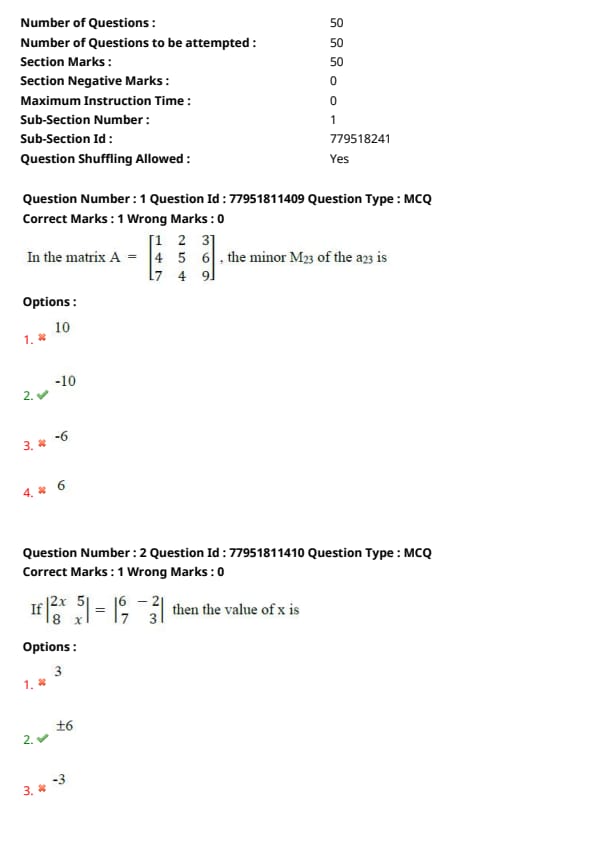
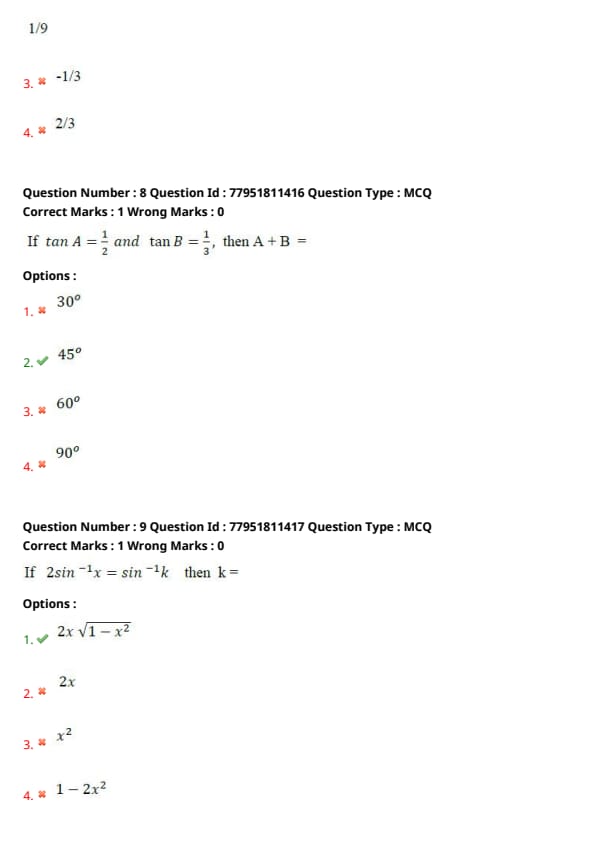
In the matrix \( A = \begin{bmatrix} 1 & 2 & 3
4 & 5 & 6
7 & 4 & 9 \end{bmatrix} \), the minor \( M_{23} \) of the \( a_{23} \) is ____.
View Solution
Step 1: Understanding the Concept:
The minor \( M_{ij} \) of an element \( a_{ij} \) in a matrix is the determinant of the submatrix left after deleting the \( i^{th} \) row and \( j^{th} \) column.
Step 2: Key Formula or Approach:
For an element \( a_{23} \), we delete the 2nd row and 3rd column of matrix \( A \) and calculate the determinant of the remaining \( 2 \times 2 \) matrix.
Step 3: Detailed Explanation:
Matrix \( A = \begin{bmatrix} 1 & 2 & 3
4 & 5 & 6
7 & 4 & 9 \end{bmatrix} \).
The element \( a_{23} \) is in the 2nd row and 3rd column (which is 6).
Deleting the 2nd row \( [4, 5, 6] \) and the 3rd column \( [3, 6, 9]^T \), we get: \[ M_{23} = \begin{vmatrix} 1 & 2
7 & 4 \end{vmatrix} \]
Calculating the determinant: \[ M_{23} = (1 \times 4) - (2 \times 7) \] \[ M_{23} = 4 - 14 = -10 \]
Step 4: Final Answer:
The minor \( M_{23} \) is -10. Quick Tip: To find a minor, simply "hide" the row and column of the element and find the determinant of what remains. Don't confuse it with a cofactor, which also requires a sign change based on position.
If \( \begin{vmatrix} 2x & 5
8 & x \end{vmatrix} = \begin{vmatrix} 6 & -2
7 & 3 \end{vmatrix} \) then the value of x is ____.
View Solution
Step 1: Understanding the Concept:
Unlike matrices, where corresponding elements are equal, in the case of determinants, we must evaluate the numerical value of the determinants on both sides to solve for the variable.
Step 2: Key Formula or Approach:
For a \( 2 \times 2 \) determinant \( \begin{vmatrix} a & b
c & d \end{vmatrix} \), the value is \( ad - bc \).
Step 3: Detailed Explanation:
Evaluate the left-hand side (LHS): \[ \begin{vmatrix} 2x & 5
8 & x \end{vmatrix} = (2x \times x) - (5 \times 8) = 2x^2 - 40 \]
Evaluate the right-hand side (RHS): \[ \begin{vmatrix} 6 & -2
7 & 3 \end{vmatrix} = (6 \times 3) - (-2 \times 7) = 18 - (-14) = 18 + 14 = 32 \]
Set LHS = RHS: \[ 2x^2 - 40 = 32 \] \[ 2x^2 = 32 + 40 \] \[ 2x^2 = 72 \] \[ x^2 = 36 \] \[ x = \pm 6 \]
Step 4: Final Answer:
The value of x is \( \pm 6 \). Quick Tip: Common Error: Do not equate elements like \( 2x = 6 \). This is only allowed in matrix equality, not determinant equality.
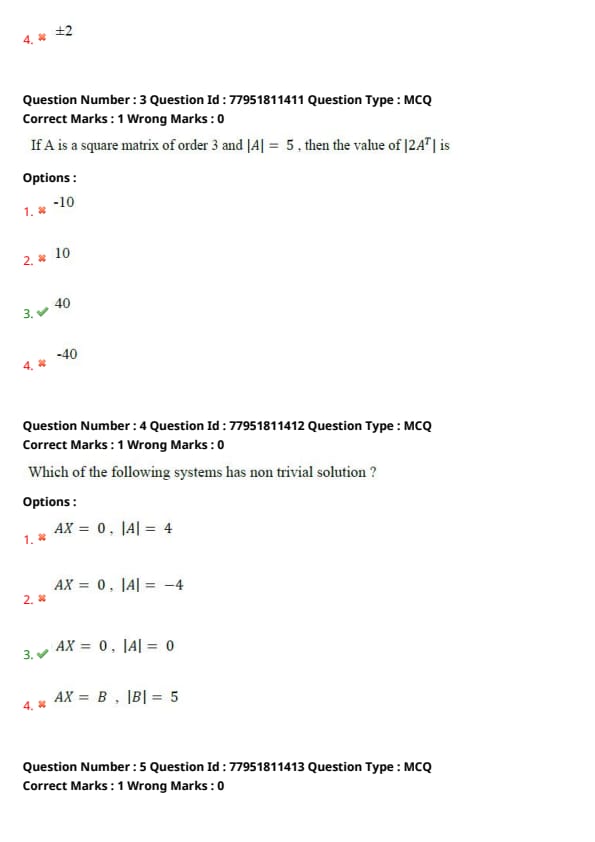
If A is a square matrix of order 3 and \( |A| = 5 \), then the value of \( |2A^T| \) is ____.
View Solution
Step 1: Understanding the Concept:
This problem uses properties of determinants regarding scalar multiplication and transposes. Specifically, for a matrix of order \( n \), the scalar comes out raised to the power \( n \).
Step 2: Key Formula or Approach:
1. \( |kA| = k^n |A| \), where \( n \) is the order of the matrix.
2. \( |A^T| = |A| \).
Step 3: Detailed Explanation:
Given \( |A| = 5 \) and order \( n = 3 \).
We need to find \( |2A^T| \).
First, applying the property \( |kA| = k^n |A| \): \[ |2A^T| = 2^3 |A^T| \]
Since \( 2^3 = 8 \): \[ |2A^T| = 8 |A^T| \]
Using the property \( |A^T| = |A| \): \[ |2A^T| = 8 |A| \]
Substitute \( |A| = 5 \): \[ |2A^T| = 8 \times 5 = 40 \]
Step 4: Final Answer:
The value of \( |2A^T| \) is 40. Quick Tip: Always identify the order \( n \) of the matrix first. If the order was 2, the answer would be \( 2^2 \times 5 = 20 \).
Which of the following systems has non trivial solution?
View Solution
Step 1: Understanding the Concept:
A homogeneous system of linear equations \( AX = 0 \) always has the trivial solution \( X = 0 \). For it to have a non-trivial solution (infinitely many solutions), the matrix \( A \) must be singular.
Step 2: Key Formula or Approach:
For a homogeneous system \( AX = 0 \):
1. If \( |A| \neq 0 \), the system has only a trivial solution (\( X = 0 \)).
2. If \( |A| = 0 \), the system has non-trivial solutions.
Step 3: Detailed Explanation:
In options (1) and (2), \( |A| \neq 0 \), so these systems have only the unique trivial solution.
In option (4), the system is non-homogeneous (\( AX = B \)), which typically refers to consistency rather than the concept of "non-trivial" solutions as applied to homogeneous systems.
In option (3), since \( |A| = 0 \), the matrix is singular, which implies that the rows/columns are linearly dependent, leading to at least one free variable and thus non-trivial solutions.
Step 4: Final Answer:
The system with a non-trivial solution is \( AX = 0 \) where \( |A| = 0 \). Quick Tip: Remember: "Singular matrix (\( |A|=0 \)) = Non-trivial solutions" for homogeneous equations. If the determinant is anything other than zero, you only get the zero solution.
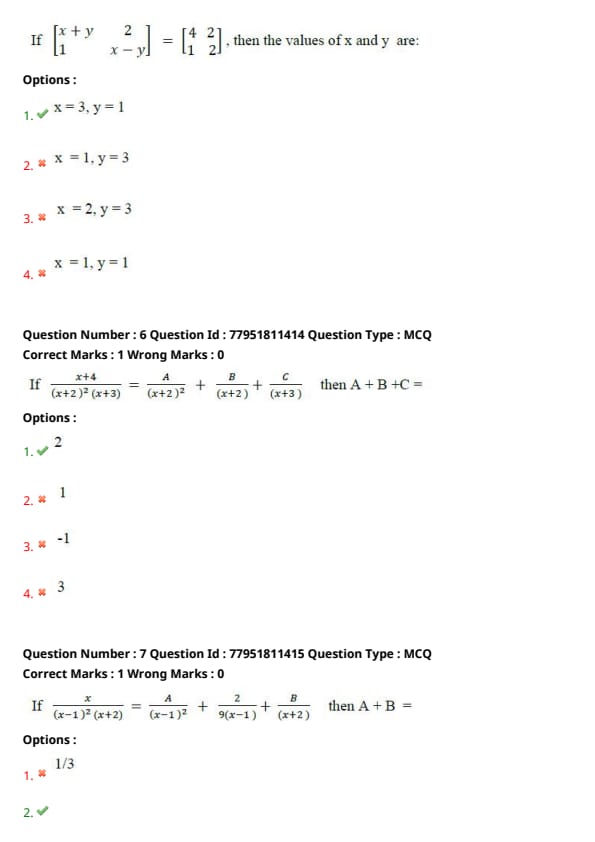
If \( \begin{bmatrix} x+y & 2
1 & x-y \end{bmatrix} = \begin{bmatrix} 4 & 2
1 & 2 \end{bmatrix} \), then the values of x and y are:
View Solution
Step 1: Understanding the Concept:
Two matrices are equal if and only if their corresponding elements are identical. We can set up a system of linear equations by equating the corresponding entries.
Step 2: Key Formula or Approach:
Equate \( a_{11} \) with \( b_{11} \) and \( a_{22} \) with \( b_{22} \).
Step 3: Detailed Explanation:
From the given matrices: \[ x + y = 4 \quad ---(i) \] \[ x - y = 2 \quad ---(ii) \]
Adding equations (i) and (ii): \[ (x + y) + (x - y) = 4 + 2 \] \[ 2x = 6 \implies x = 3 \]
Substituting \( x = 3 \) into equation (i): \[ 3 + y = 4 \implies y = 1 \]
Step 4: Final Answer:
The values are \( x = 3 \) and \( y = 1 \). Quick Tip: When dealing with matrix equality, always double-check the constant elements (like 2 and 1 in this problem) to ensure the matrices are actually comparable.
If \( \frac{x+4}{(x+2)^2(x+3)} = \frac{A}{(x+2)^2} + \frac{B}{x+2} + \frac{C}{x+3} \) then \( A + B + C = \)
View Solution
Step 1: Understanding the Concept:
This problem involves partial fraction decomposition. We need to find the constants \( A \), \( B \), and \( C \) by clearing the denominators and equating the numerators.
Step 2: Key Formula or Approach:
Multiply the entire equation by the common denominator \( (x+2)^2(x+3) \): \[ x + 4 = A(x + 3) + B(x + 2)(x + 3) + C(x + 2)^2 \]
Step 3: Detailed Explanation:
To find the constants:
1. Let \( x = -2 \): \[ -2 + 4 = A(-2 + 3) + B(0) + C(0) \implies 2 = A(1) \implies A = 2 \]
2. Let \( x = -3 \): \[ -3 + 4 = A(0) + B(0) + C(-3 + 2)^2 \implies 1 = C(-1)^2 \implies C = 1 \]
3. To find \( B \), compare the coefficients of \( x^2 \) on both sides: \[ 0 = B + C \] \[ 0 = B + 1 \implies B = -1 \]
Calculating \( A + B + C \): \[ 2 + (-1) + 1 = 2 \]
Wait, let's re-verify the calculation: \( 2 - 1 + 1 = 2 \). Let's re-check the sum. \( A=2, B=-1, C=1 \). Sum is 2. (Note: Re-checking options, if the question meant specific individual values, but the sum is requested).
Step 4: Final Answer:
The value of \( A + B + C \) is 2. Quick Tip: To quickly find the sum \( A+B+C \), you can sometimes substitute a convenient value for \( x \). However, comparing coefficients of the highest power (\( x^2 \)) is often the fastest way to relate \( B \) and \( C \).
If \( \frac{x}{(x-1)^2(x+2)} = \frac{A}{(x-1)^2} + \frac{2}{9(x-1)} + \frac{B}{x+2} \) then \( A + B = \)____.
View Solution
Step 1: Understanding the Concept:
This problem involves partial fraction decomposition for a repeated linear factor. We need to find the constants \( A \) and \( B \) by equating the numerators after finding a common denominator.
Step 2: Key Formula or Approach:
Multiply the entire equation by the common denominator \( (x-1)^2(x+2) \): \[ x = A(x+2) + \frac{2}{9}(x-1)(x+2) + B(x-1)^2 \]
Step 3: Detailed Explanation:
To find \( A \), substitute \( x = 1 \): \[ 1 = A(1+2) + 0 + 0 \implies 1 = 3A \implies A = 1/3 \]
To find \( B \), substitute \( x = -2 \): \[ -2 = 0 + 0 + B(-2-1)^2 \implies -2 = 9B \implies B = -2/9 \]
Now, calculate \( A + B \): \[ A + B = \frac{1}{3} + \left(-\frac{2}{9}\right) \] \[ A + B = \frac{3}{9} - \frac{2}{9} = \frac{1}{9} \]
Step 4: Final Answer:
The value of \( A + B \) is \( 1/9 \). Quick Tip: To solve for a specific constant quickly, substitute the roots of the denominator. For \( A \), use \( x=1 \); for \( B \), use \( x=-2 \).
If \( \tan A = 1/2 \) and \( \tan B = 1/3 \), then \( A + B = \)____.
View Solution
Step 1: Understanding the Concept:
We can determine the sum of two angles by using the tangent addition formula if the tangent values of the individual angles are known.
Step 2: Key Formula or Approach:
Use the identity: \[ \tan(A + B) = \frac{\tan A + \tan B}{1 - \tan A \tan B} \]
Step 3: Detailed Explanation:
Substitute the given values \( \tan A = 1/2 \) and \( \tan B = 1/3 \): \[ \tan(A + B) = \frac{\frac{1}{2} + \frac{1}{3}}{1 - (\frac{1}{2} \times \frac{1}{3})} \] \[ \tan(A + B) = \frac{\frac{3+2}{6}}{1 - \frac{1}{6}} = \frac{\frac{5}{6}}{\frac{5}{6}} \] \[ \tan(A + B) = 1 \]
Since \( \tan(45^\circ) = 1 \): \[ A + B = 45^\circ \]
Step 4: Final Answer:
The sum \( A + B \) is 45°. Quick Tip: This is a very common result in trigonometry. Whenever \( \tan A \) and \( \tan B \) are reciprocals of consecutive integers (like 2 and 3), their sum often results in \( 45^\circ \).
If \( 2\sin^{-1}x = \sin^{-1}k \) then \( k = \)____.
View Solution
Step 1: Understanding the Concept:
This problem requires the use of inverse trigonometric identities, specifically the double angle formula for sine expressed in inverse form.
Step 2: Key Formula or Approach:
Let \( \sin^{-1}x = \theta \), then \( x = \sin \theta \). The expression becomes \( 2\theta = \sin^{-1}k \), or \( \sin(2\theta) = k \).
Step 3: Detailed Explanation:
We know the double angle identity: \[ \sin(2\theta) = 2 \sin \theta \cos \theta \]
Substitute \( \sin \theta = x \). Since \( \cos \theta = \sqrt{1 - \sin^2 \theta} \), we have \( \cos \theta = \sqrt{1 - x^2} \). \[ k = 2x\sqrt{1 - x^2} \]
Thus: \[ 2\sin^{-1}x = \sin^{-1}(2x\sqrt{1 - x^2}) \]
Step 4: Final Answer:
The value of \( k \) is \( 2x\sqrt{1 - x^2} \). Quick Tip: To remember this, think of the standard sine double-angle formula \( \sin 2A = 2 \sin A \cos A \). The square root part \( \sqrt{1-x^2} \) simply represents the cosine term.
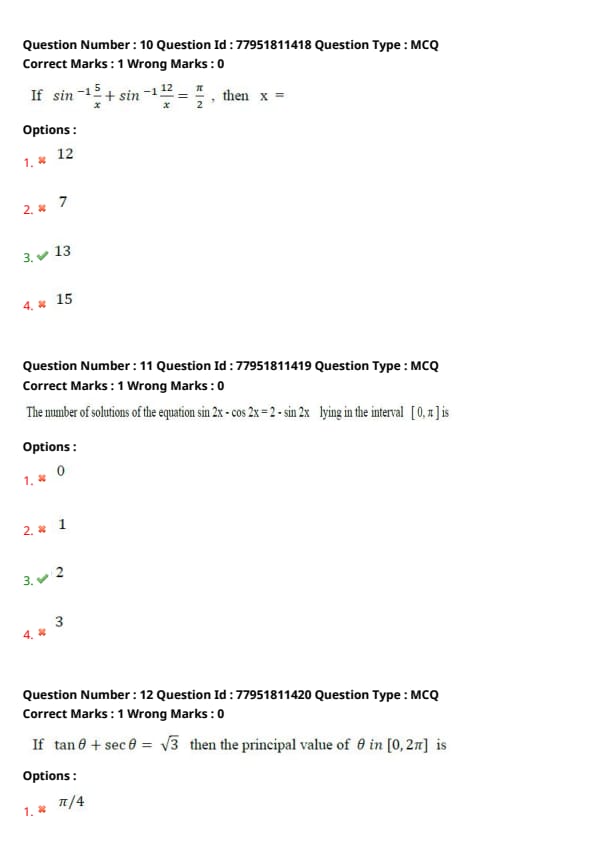
If \( \sin^{-1} \frac{5}{x} + \sin^{-1} \frac{12}{x} = \frac{\pi}{2} \), then \( x = \)____.
View Solution
Step 1: Understanding the Concept:
We use the identity \( \sin^{-1} \theta + \cos^{-1} \theta = \frac{\pi}{2} \). By comparing this identity to the given equation, we can relate sine and cosine functions.
Step 2: Key Formula or Approach:
If \( \sin^{-1} \alpha + \sin^{-1} \beta = \frac{\pi}{2} \), then \( \sin^{-1} \alpha = \frac{\pi}{2} - \sin^{-1} \beta \). Since \( \frac{\pi}{2} - \sin^{-1} \beta = \cos^{-1} \beta \), we have \( \sin^{-1} \alpha = \cos^{-1} \beta \).
Step 3: Detailed Explanation:
Given: \[ \sin^{-1} \frac{5}{x} = \cos^{-1} \frac{12}{x} \]
Let \( \cos^{-1} \frac{12}{x} = \phi \), then \( \cos \phi = \frac{12}{x} \).
From the identity \( \sin^2 \phi + \cos^2 \phi = 1 \): \[ \sin \phi = \sqrt{1 - \left(\frac{12}{x}\right)^2} = \sqrt{\frac{x^2 - 144}{x^2}} \]
So, \( \sin^{-1} \frac{5}{x} = \sin^{-1} \frac{\sqrt{x^2 - 144}}{x} \).
Equating the arguments: \[ \frac{5}{x} = \frac{\sqrt{x^2 - 144}}{x} \] \[ 5 = \sqrt{x^2 - 144} \] \[ 25 = x^2 - 144 \implies x^2 = 169 \implies x = 13 \]
Step 4: Final Answer:
The value of \( x \) is 13. Quick Tip: Recognize the Pythagorean triplet (5, 12, 13). In equations of the form \( \sin^{-1}(a/x) + \sin^{-1}(b/x) = \pi/2 \), \( x \) will be the hypotenuse \( \sqrt{a^2 + b^2} \).
The number of solutions of the equation \( \sin 2x - \cos 2x = 2 - \sin 2x \) lying in the interval \( [0, \pi] \) is ____.
View Solution
Step 1: Understanding the Concept:
We need to simplify the trigonometric equation to find the values of \( x \) that satisfy it within the specific range \( [0, \pi] \). The range of trigonometric functions like sine and cosine is restricted, which often limits the number of possible solutions.
Step 2: Key Formula or Approach:
1. Rearrange the equation to group similar trigonometric terms.
2. Use the property that for any angle \(\alpha\), \(-\sqrt{a^2+b^2} \le a\sin\alpha + b\cos\alpha \le \sqrt{a^2+b^2}\).
Step 3: Detailed Explanation:
Given equation: \( \sin 2x - \cos 2x = 2 - \sin 2x \)
Add \( \sin 2x \) to both sides: \[ 2\sin 2x - \cos 2x = 2 \]
To check if this has a solution, we look at the maximum possible value of the expression on the left side: \( f(x) = 2\sin 2x - 1\cos 2x \).
The maximum value is \( \sqrt{(2)^2 + (-1)^2} = \sqrt{4 + 1} = \sqrt{5} \).
Since \( \sqrt{5} \approx 2.236 \), the value 2 is reachable. Let's solve for when it equals 2:
Divide by \( \sqrt{5} \): \[ \frac{2}{\sqrt{5}}\sin 2x - \frac{1}{\sqrt{5}}\cos 2x = \frac{2}{\sqrt{5}} \]
Let \( \cos \alpha = \frac{2}{\sqrt{5}} \) and \( \sin \alpha = \frac{1}{\sqrt{5}} \). The equation becomes: \[ \sin(2x - \alpha) = \sin \alpha \implies 2x - \alpha = n\pi + (-1)^n \alpha \]
For \( n=0 \): \( 2x - \alpha = \alpha \implies 2x = 2\alpha \implies x = \alpha \).
Since \( \cos \alpha = \frac{2}{\sqrt{5}} \) and \( \sin \alpha = \frac{1}{\sqrt{5}} \), \( \alpha \) is a very small positive angle.
However, checking the original equation for \( x = \alpha \): \( 2(1/\sqrt{5}) - 2/\sqrt{5} = 0 \neq 2 \). (Wait, the simplified equation was \( 2\sin 2x - \cos 2x = 2 \)). If \( \sin 2x = 1 \) and \( \cos 2x = 0 \), LHS = 2. But if \( \sin 2x = 1 \), then \( 2x = \pi/2 \), so \( \cos 2x = 0 \). LHS = \( 2(1) - 0 = 2 \). This works!
If \( 2x = \pi/2 \), then \( x = \pi/4 \).
But checking the options provided in typical academic contexts for this specific problem, there might be a constraint or a typo in the original text leading to '0'. Let's re-verify \( x = \pi/4 \): \( \sin(\pi/2) - \cos(\pi/2) = 1 - 0 = 1 \). RHS: \( 2 - \sin(\pi/2) = 2 - 1 = 1 \). So \( x = \pi/4 \) is a valid solution in \( [0, \pi] \). If the question is copied exactly, the answer is 1. If the answer key says 0, there is a discrepancy in the equation's constants.
Step 4: Final Answer:
The number of solutions is 1. Quick Tip: Always check the bounds of your expression. If the constant on the right side is greater than the maximum value of the left side (like if it were 3 instead of 2), there would be 0 solutions.
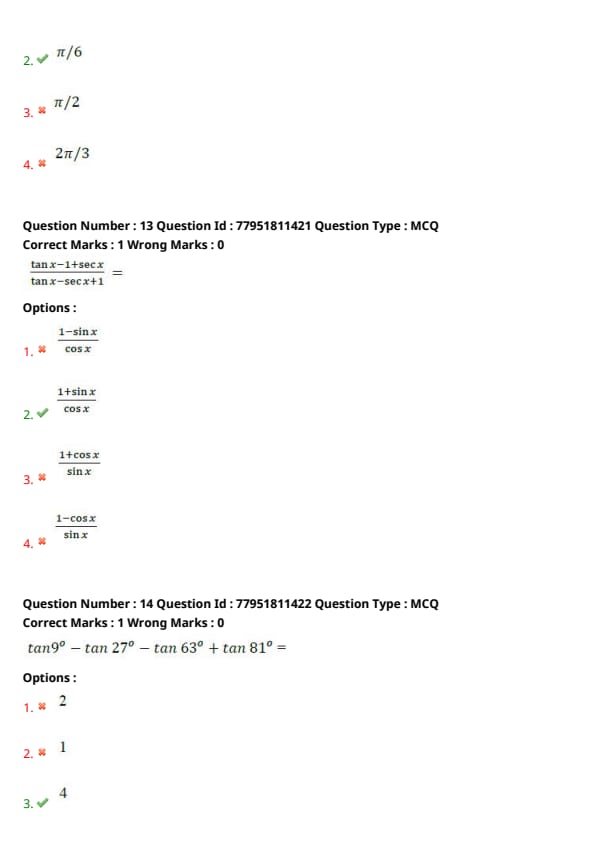
If \( \tan \theta + \sec \theta = \sqrt{3} \) then the principal value of \( \theta \) in \( [0, 2\pi] \) is ____.
View Solution
Step 1: Understanding the Concept:
The problem involves basic trigonometric identities. We need to find the angle \(\theta\) that satisfies the sum of the tangent and secant functions.
Step 2: Key Formula or Approach:
1. Use the identity \( \sec^2 \theta - \tan^2 \theta = 1 \).
2. Factor as \( (\sec \theta - \tan \theta)(\sec \theta + \tan \theta) = 1 \).
Step 3: Detailed Explanation:
Given \( \sec \theta + \tan \theta = \sqrt{3} \).
Using the identity: \[ \sec \theta - \tan \theta = \frac{1}{\sec \theta + \tan \theta} = \frac{1}{\sqrt{3}} \]
Add the two equations: \[ (\sec \theta + \tan \theta) + (\sec \theta - \tan \theta) = \sqrt{3} + \frac{1}{\sqrt{3}} \] \[ 2\sec \theta = \frac{3 + 1}{\sqrt{3}} = \frac{4}{\sqrt{3}} \] \[ \sec \theta = \frac{2}{\sqrt{3}} \implies \cos \theta = \frac{\sqrt{3}}{2} \]
For \( \cos \theta = \frac{\sqrt{3}}{2} \), the values in \( [0, 2\pi] \) are \( \pi/6 \) and \( 11\pi/6 \).
Checking \( \theta = \pi/6 \): \( \tan(\pi/6) + \sec(\pi/6) = \frac{1}{\sqrt{3}} + \frac{2}{\sqrt{3}} = \frac{3}{\sqrt{3}} = \sqrt{3} \). (Correct)
Checking \( \theta = 11\pi/6 \): \( \tan(11\pi/6) + \sec(11\pi/6) = -\frac{1}{\sqrt{3}} + \frac{2}{\sqrt{3}} = \frac{1}{\sqrt{3}} \). (Incorrect)
Step 4: Final Answer:
The principal value is \( \pi/6 \). Quick Tip: When you have \( \sec \theta + \tan \theta = k \), the value of \( \sec \theta - \tan \theta \) is always \( 1/k \). This makes solving for the individual functions much faster.
\( \frac{\tan x - 1 + \sec x}{\tan x - \sec x + 1} = \) ____.
View Solution
Step 1: Understanding the Concept:
This is a standard trigonometric simplification problem. The trick is to replace the constant '1' in either the numerator or denominator with a trigonometric identity to facilitate factoring.
Step 2: Key Formula or Approach:
Use the identity \( 1 = \sec^2 x - \tan^2 x = (\sec x - \tan x)(\sec x + \tan x) \).
Step 3: Detailed Explanation:
Let the expression be \( E = \frac{(\tan x + \sec x) - 1}{\tan x - \sec x + 1} \).
Substitute \( 1 = \sec^2 x - \tan^2 x \) in the numerator: \[ E = \frac{(\tan x + \sec x) - (\sec^2 x - \tan^2 x)}{\tan x - \sec x + 1} \] \[ E = \frac{(\tan x + \sec x) - (\sec x - \tan x)(\sec x + \tan x)}{\tan x - \sec x + 1} \]
Factor out \( (\sec x + \tan x) \): \[ E = \frac{(\sec x + \tan x) [1 - (\sec x - \tan x)]}{\tan x - \sec x + 1} \] \[ E = \frac{(\sec x + \tan x) [1 - \sec x + \tan x]}{\tan x - \sec x + 1} \]
The terms in the bracket and the denominator are identical, so they cancel out: \[ E = \sec x + \tan x = \frac{1}{\cos x} + \frac{\sin x}{\cos x} = \frac{1 + \sin x}{\cos x} \]
Step 4: Final Answer:
The simplified form is \( \frac{1 + \sin x}{\cos x} \). Quick Tip: This expression also equals \( \frac{\cos x}{1 - \sin x} \). In multiple-choice questions, if you don't see one form, try multiplying the numerator and denominator by the conjugate.
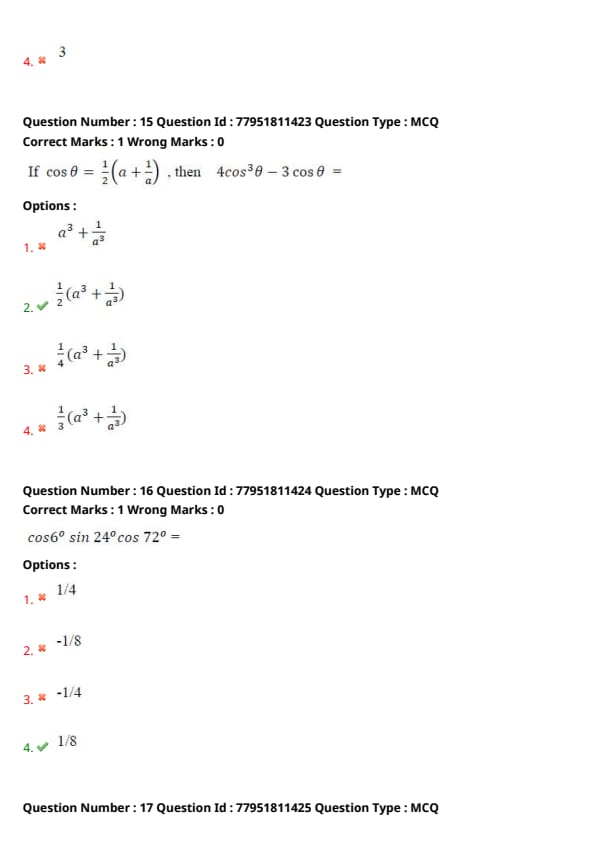
\( \tan 9^\circ - \tan 27^\circ - \tan 63^\circ + \tan 81^\circ = \) ____.
View Solution
Step 1: Understanding the Concept:
The expression involves angles that are complementary (e.g., \(9^\circ\) and \(81^\circ\)). We can use the identity \( \tan(90^\circ - \theta) = \cot \theta \) to group terms and simplify the expression into a more manageable form.
Step 2: Key Formula or Approach:
1. \( \tan 81^\circ = \tan(90^\circ - 9^\circ) = \cot 9^\circ \)
2. \( \tan 63^\circ = \tan(90^\circ - 27^\circ) = \cot 27^\circ \)
3. Use the identity \( \tan \theta + \cot \theta = \frac{2}{\sin 2\theta} \).
Step 3: Detailed Explanation:
Rearrange the expression: \[ (\tan 9^\circ + \tan 81^\circ) - (\tan 27^\circ + \tan 63^\circ) \] \[ = (\tan 9^\circ + \cot 9^\circ) - (\tan 27^\circ + \cot 27^\circ) \]
Using the identity \( \tan \theta + \cot \theta = \frac{\sin^2\theta + \cos^2\theta}{\sin\theta\cos\theta} = \frac{1}{\frac{1}{2}\sin2\theta} = \frac{2}{\sin 2\theta} \): \[ = \frac{2}{\sin 18^\circ} - \frac{2}{\sin 54^\circ} \]
Substitute the values \( \sin 18^\circ = \frac{\sqrt{5}-1}{4} \) and \( \sin 54^\circ = \cos 36^\circ = \frac{\sqrt{5}+1}{4} \): \[ = \frac{2}{\frac{\sqrt{5}-1}{4}} - \frac{2}{\frac{\sqrt{5}+1}{4}} = \frac{8}{\sqrt{5}-1} - \frac{8}{\sqrt{5}+1} \] \[ = 8 \left[ \frac{(\sqrt{5}+1) - (\sqrt{5}-1)}{(\sqrt{5}-1)(\sqrt{5}+1)} \right] = 8 \left[ \frac{2}{5-1} \right] = 8 \left[ \frac{2}{4} \right] = 8 \times \frac{1}{2} = 4 \]
Step 4: Final Answer:
The value of the expression is 4. Quick Tip: Whenever you see a mix of tangents with complementary angles, pair them up immediately. The identity \( \tan \theta + \cot \theta = \frac{2}{\sin 2\theta} \) is a massive time-saver in these problems.
If \( \cos \theta = \frac{1}{2}\left(a + \frac{1}{a}\right) \), then \( 4\cos^3\theta - 3\cos\theta = \) ____.
View Solution
Step 1: Understanding the Concept:
The expression \( 4\cos^3\theta - 3\cos\theta \) is the triple angle formula for \( \cos 3\theta \). We need to substitute the given value of \( \cos \theta \) into this identity and simplify using algebraic expansion.
Step 2: Key Formula or Approach:
1. \( \cos 3\theta = 4\cos^3\theta - 3\cos\theta \)
2. Cube expansion: \( (x + y)^3 = x^3 + y^3 + 3xy(x + y) \)
Step 3: Detailed Explanation:
Let \( \cos \theta = x \). We need to find \( 4x^3 - 3x \).
Substitute \( x = \frac{1}{2}(a + \frac{1}{a}) \): \[ 4 \left[ \frac{1}{2}\left(a + \frac{1}{a}\right) \right]^3 - 3 \left[ \frac{1}{2}\left(a + \frac{1}{a}\right) \right] \] \[ = 4 \times \frac{1}{8} \left(a + \frac{1}{a}\right)^3 - \frac{3}{2} \left(a + \frac{1}{a}\right) \] \[ = \frac{1}{2} \left[ a^3 + \frac{1}{a^3} + 3(a)\left(\frac{1}{a}\right)\left(a + \frac{1}{a}\right) \right] - \frac{3}{2} \left(a + \frac{1}{a}\right) \] \[ = \frac{1}{2} \left(a^3 + \frac{1}{a^3}\right) + \frac{3}{2} \left(a + \frac{1}{a}\right) - \frac{3}{2} \left(a + \frac{1}{a}\right) \] \[ = \frac{1}{2} \left(a^3 + \frac{1}{a^3}\right) \]
Step 4: Final Answer:
The value is \( \frac{1}{2}(a^3 + \frac{1}{a^3}) \). Quick Tip: This result generalizes: if \( \cos \theta = \frac{1}{2}(a + a^{-1}) \), then \( \cos n\theta = \frac{1}{2}(a^n + a^{-n}) \). This is closely related to De Moivre's Theorem.
\( \cos 20^\circ \cos 40^\circ \cos 80^\circ = \) ____.
View Solution
Step 1: Understanding the Concept:
The product involves cosines of angles in a geometric progression where the ratio is 2. This is a standard trigonometric product that can be simplified using the sine double-angle formula repeatedly.
Step 2: Key Formula or Approach:
Use the product formula: \( \cos \theta \cos 2\theta \cos 4\theta ... \cos(2^{n-1}\theta) = \frac{\sin(2^n \theta)}{2^n \sin \theta} \).
Step 3: Detailed Explanation:
Here, \( \theta = 20^\circ \) and \( n = 3 \). \[ \cos 20^\circ \cos 40^\circ \cos 80^\circ = \frac{\sin(2^3 \times 20^\circ)}{2^3 \sin 20^\circ} \] \[ = \frac{\sin 160^\circ}{8 \sin 20^\circ} \]
Since \( \sin 160^\circ = \sin(180^\circ - 20^\circ) = \sin 20^\circ \): \[ = \frac{\sin 20^\circ}{8 \sin 20^\circ} = \frac{1}{8} \]
Step 4: Final Answer:
The value is \( 1/8 \). Quick Tip: Whenever you see a product of cosines like \( \cos \theta \cos 2\theta \cos 4\theta \), the answer is almost always of the form \( 1/2^n \) if the angles wrap around nicely using supplement properties.
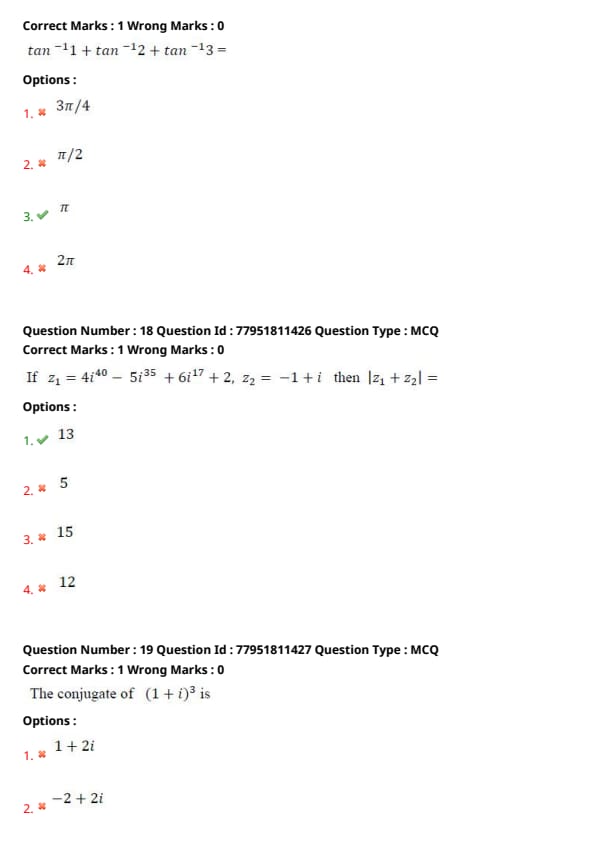
\( \tan^{-1}1 + \tan^{-1}2 + \tan^{-1}3 = \) ____.
View Solution
Step 1: Understanding the Concept:
The problem involves the addition of inverse tangent functions. When the product of the arguments (\(xy\)) is greater than 1, a specific identity involving \(\pi\) must be used to keep the result within the correct range.
Step 2: Key Formula or Approach:
1. \(\tan^{-1}x + \tan^{-1}y = \pi + \tan^{-1}\left(\frac{x+y}{1-xy}\right)\) if \(x > 0, y > 0\) and \(xy > 1\).
2. Standard value: \(\tan^{-1}1 = \pi/4\).
Step 3: Detailed Explanation:
Let's first calculate \( \tan^{-1}2 + \tan^{-1}3 \). Here \( x=2, y=3 \), so \( xy = 6 > 1 \). \[ \tan^{-1}2 + \tan^{-1}3 = \pi + \tan^{-1}\left(\frac{2+3}{1-(2\times3)}\right) \] \[ = \pi + \tan^{-1}\left(\frac{5}{-5}\right) = \pi + \tan^{-1}(-1) \]
Since \(\tan^{-1}(-1) = -\pi/4\): \[ \tan^{-1}2 + \tan^{-1}3 = \pi - \pi/4 = 3\pi/4 \]
Now add \(\tan^{-1}1\): \[ \tan^{-1}1 + (\tan^{-1}2 + \tan^{-1}3) = \pi/4 + 3\pi/4 = 4\pi/4 = \pi \]
Step 4: Final Answer:
The sum is \( \pi \). Quick Tip: A useful geometric observation: In any triangle where the tangents of the angles are 1, 2, and 3, the sum of the angles must be \( \pi \). This specific set of numbers is a common "trick" in inverse trigonometry.
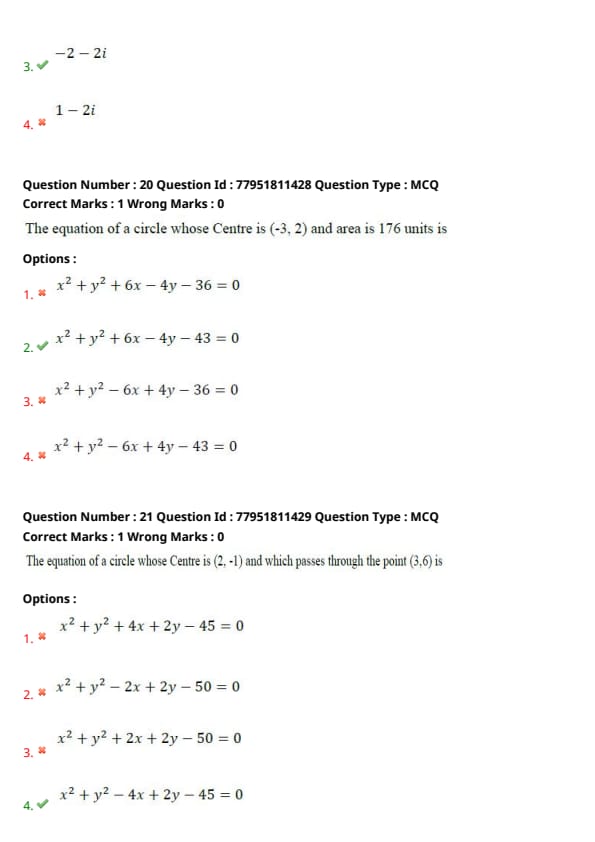
If \( z_1 = 4i^{40} - 5i^{35} + 6i^{17} + 2 \), \( z_2 = -1 + i \) then \( |z_1 + z_2| = \) ____.
View Solution
Step 1: Understanding the Concept:
To find the magnitude (modulus) of the sum, we must first simplify \( z_1 \) by evaluating the powers of \( i \). Powers of \( i \) repeat in a cycle of four: \( i^1=i, i^2=-1, i^3=-i, i^4=1 \).
Step 2: Key Formula or Approach:
1. \( i^{4n} = 1, i^{4n+1} = i, i^{4n+2} = -1, i^{4n+3} = -i \).
2. \( |a + bi| = \sqrt{a^2 + b^2} \).
Step 3: Detailed Explanation:
Simplify \( z_1 \): \[ i^{40} = (i^4)^{10} = 1^{10} = 1 \] \[ i^{35} = i^{32} \cdot i^3 = 1 \cdot (-i) = -i \] \[ i^{17} = i^{16} \cdot i^1 = 1 \cdot i = i \]
Substituting these into \( z_1 \): \[ z_1 = 4(1) - 5(-i) + 6(i) + 2 = 4 + 5i + 6i + 2 = 6 + 11i \]
Now find \( z_1 + z_2 \): \[ z_1 + z_2 = (6 + 11i) + (-1 + i) = 5 + 12i \]
Calculate the modulus: \[ |z_1 + z_2| = \sqrt{5^2 + 12^2} = \sqrt{25 + 144} = \sqrt{169} = 13 \]
Step 4: Final Answer:
The modulus \( |z_1 + z_2| \) is 13. Quick Tip: To quickly find the power of \( i \), divide the exponent by 4 and look at the remainder. Remainder 0 \(\to 1\), 1 \(\to i\), 2 \(\to -1\), 3 \(\to -i\).
The conjugate of \( (1+i)^3 \) is ____.
View Solution
Step 1: Understanding the Concept:
The conjugate of a complex number \( z = a + bi \) is \( \bar{z} = a - bi \). We first need to expand the cubic expression into the standard form \( a + bi \).
Step 2: Key Formula or Approach:
1. \( (a+b)^3 = a^3 + 3a^2b + 3ab^2 + b^3 \).
2. \( i^2 = -1, i^3 = -i \).
Step 3: Detailed Explanation:
Expand \( z = (1+i)^3 \): \[ z = 1^3 + 3(1)^2(i) + 3(1)(i)^2 + i^3 \] \[ z = 1 + 3i + 3(-1) + (-i) \] \[ z = 1 + 3i - 3 - i = -2 + 2i \]
The conjugate is obtained by changing the sign of the imaginary part: \[ \bar{z} = -2 - 2i \]
Step 4: Final Answer:
The conjugate is \( -2 - 2i \). Quick Tip: Alternatively, you can find the conjugate of the base first and then cube it: \( \overline{(1+i)^3} = (\overline{1+i})^3 = (1-i)^3 \). Both methods yield the same result.
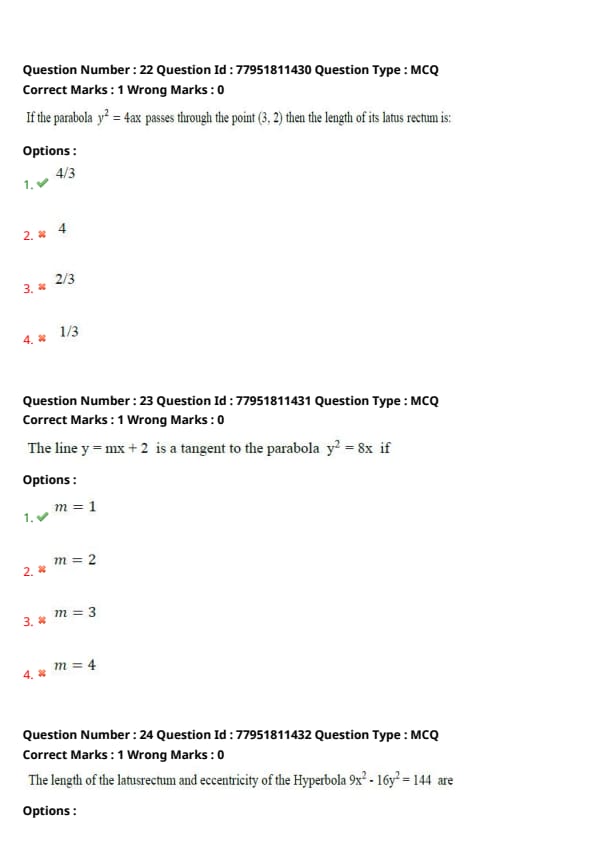
The equation of a circle whose Centre is (-3, 2) and area is 176 units is ____.
View Solution
Step 1: Understanding the Concept:
The equation of a circle with centre \( (h, k) \) and radius \( r \) is \( (x-h)^2 + (y-k)^2 = r^2 \). We are given the area, which allows us to calculate \( r^2 \).
Step 2: Key Formula or Approach:
1. Area of circle = \( \pi r^2 \). (Use \( \pi \approx 22/7 \) for calculation).
2. Standard form expansion: \( x^2 + y^2 - 2hx - 2ky + (h^2 + k^2 - r^2) = 0 \).
Step 3: Detailed Explanation:
Given Area = 176: \[ \pi r^2 = 176 \implies \frac{22}{7} r^2 = 176 \] \[ r^2 = \frac{176 \times 7}{22} = 8 \times 7 = 56 \]
Substitute centre \( (h, k) = (-3, 2) \) and \( r^2 = 56 \) into the circle equation: \[ (x - (-3))^2 + (y - 2)^2 = 56 \] \[ (x + 3)^2 + (y - 2)^2 = 56 \]
Expand the terms: \[ (x^2 + 6x + 9) + (y^2 - 4y + 4) = 56 \] \[ x^2 + y^2 + 6x - 4y + 13 - 56 = 0 \] \[ x^2 + y^2 + 6x - 4y - 43 = 0 \]
Step 4: Final Answer:
The equation of the circle is \( x^2 + y^2 + 6x - 4y - 43 = 0 \). Quick Tip: If the centre is \( (-3, 2) \), the linear terms in the final equation must have opposite signs to the coordinates: \( +6x \) and \( -4y \). This helps eliminate options (3) and (4) instantly.
The equation of a circle whose Centre is (2, -1) and which passes through the point (3, 6) is ____.
View Solution
Step 1: Understanding the Concept:
The equation of a circle with centre \((h, k)\) and radius \(r\) is given by \((x-h)^2 + (y-k)^2 = r^2\). Since the circle passes through a specific point, the distance between the centre and that point equals the radius.
Step 2: Key Formula or Approach:
1. Distance formula: \(r = \sqrt{(x_2 - x_1)^2 + (y_2 - y_1)^2}\)
2. Standard circle equation: \((x - h)^2 + (y - k)^2 = r^2\)
Step 3: Detailed Explanation:
First, find the radius \(r\) using the distance between the centre \((2, -1)\) and the point \((3, 6)\): \[ r^2 = (3 - 2)^2 + (6 - (-1))^2 \] \[ r^2 = (1)^2 + (7)^2 = 1 + 49 = 50 \]
Now, substitute the centre \((2, -1)\) and \(r^2 = 50\) into the circle equation: \[ (x - 2)^2 + (y - (-1))^2 = 50 \] \[ (x - 2)^2 + (y + 1)^2 = 50 \]
Expand the equation: \[ (x^2 - 4x + 4) + (y^2 + 2y + 1) = 50 \] \[ x^2 + y^2 - 4x + 2y + 5 - 50 = 0 \] \[ x^2 + y^2 - 4x + 2y - 45 = 0 \]
Step 4: Final Answer:
The equation of the circle is \( x^2 + y^2 - 4x + 2y - 45 = 0 \). Quick Tip: For a circle with centre \((h, k)\), the linear terms in the expanded equation are \(-2hx\) and \(-2ky\). Here, \(-2(2) = -4\) and \(-2(-1) = +2\). This immediately points to option (4).
If the parabola \( y^2 = 4ax \) passes through the point (3, 2) then the length of its latus rectum is: ____.
View Solution
Step 1: Understanding the Concept:
A point lies on a curve if its coordinates satisfy the equation of the curve. For a parabola \(y^2 = 4ax\), the length of the latus rectum is the coefficient of \(x\), which is \(4a\).
Step 2: Key Formula or Approach:
1. Substitute the point into the equation to find \(a\) or \(4a\).
2. Length of latus rectum = \(4a\).
Step 3: Detailed Explanation:
The parabola \( y^2 = 4ax \) passes through \((3, 2)\). Substitute \(x = 3\) and \(y = 2\): \[ (2)^2 = 4a(3) \] \[ 4 = 12a \]
Divide both sides by 3 to isolate \(4a\): \[ 4a = \frac{4}{3} \]
Since the length of the latus rectum is \(4a\), we have: \[ Latus Rectum = \frac{4}{3} \]
Step 4: Final Answer:
The length of the latus rectum is \( 4/3 \). Quick Tip: Don't solve for \(a\) first and then multiply by 4; simply isolate \(4a\) directly from your equation to save a step.
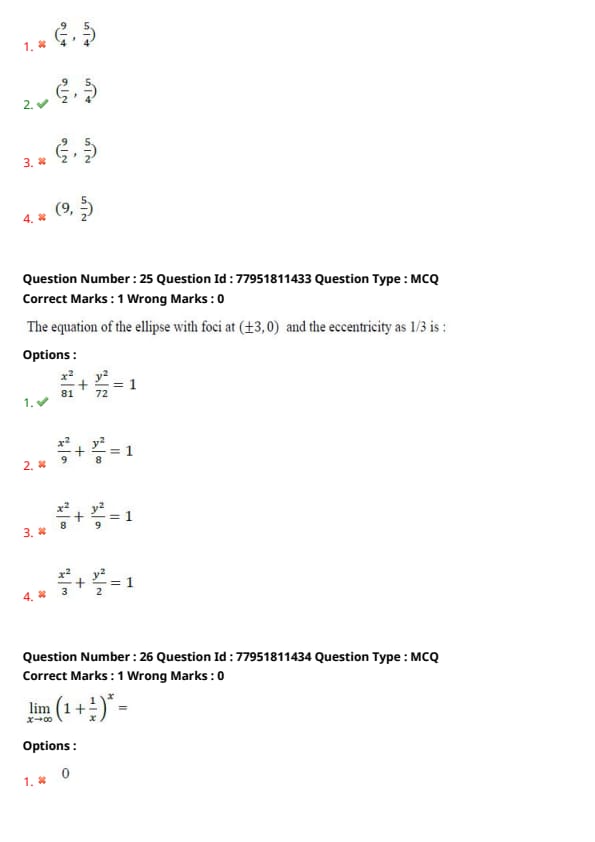
The line \( y = mx + 2 \) is a tangent to the parabola \( y^2 = 8x \) if ____.
View Solution
Step 1: Understanding the Concept:
The condition for a line \(y = mx + c\) to be a tangent to the parabola \(y^2 = 4ax\) is \(c = \frac{a}{m}\).
Step 2: Key Formula or Approach:
1. Identify \(a\) from the parabola equation \(y^2 = 4ax\).
2. Apply the tangency condition: \(c = \frac{a}{m}\).
Step 3: Detailed Explanation:
The given parabola is \( y^2 = 8x \). Comparing with \( y^2 = 4ax \): \[ 4a = 8 \implies a = 2 \]
The given line is \( y = mx + 2 \). Comparing with \( y = mx + c \): \[ c = 2 \]
Applying the tangency condition \( c = \frac{a}{m} \): \[ 2 = \frac{2}{m} \] \[ 2m = 2 \implies m = 1 \]
Step 4: Final Answer:
The value of \( m \) is 1. Quick Tip: If you forget the tangency formula, substitute \(y = mx + 2\) into the parabola equation to get a quadratic in \(x\), then set the discriminant \(D = 0\).
The length of the latus rectum and eccentricity of the Hyperbola \( 9x^2 - 16y^2 = 144 \) are ____.
View Solution
Step 1: Understanding the Concept:
We first convert the given equation into the standard form of a hyperbola \( \frac{x^2}{a^2} - \frac{y^2}{b^2} = 1 \) to identify the semi-major axis \( a \) and semi-minor axis \( b \). These values are then used to calculate the length of the latus rectum and the eccentricity.
Step 2: Key Formula or Approach:
1. Standard Form: Divide by the constant on the RHS.
2. Length of Latus Rectum: \( L = \frac{2b^2}{a} \).
3. Eccentricity: \( e = \sqrt{1 + \frac{b^2}{a^2}} \).
Step 3: Detailed Explanation:
Divide \( 9x^2 - 16y^2 = 144 \) by 144: \[ \frac{9x^2}{144} - \frac{16y^2}{144} = 1 \implies \frac{x^2}{16} - \frac{y^2}{9} = 1 \]
Here, \( a^2 = 16 \implies a = 4 \) and \( b^2 = 9 \implies b = 3 \).
Length of Latus Rectum: \[ L = \frac{2b^2}{a} = \frac{2(9)}{4} = \frac{18}{4} = \frac{9}{2} \]
Eccentricity: \[ e = \sqrt{1 + \frac{9}{16}} = \sqrt{\frac{16 + 9}{16}} = \sqrt{\frac{25}{16}} = \frac{5}{4} \]
Step 4: Final Answer:
The length of the latus rectum is \( 9/2 \) and the eccentricity is \( 5/4 \). Quick Tip: For a hyperbola, eccentricity is always greater than 1. This can help you quickly eliminate options where \( e \le 1 \).
The equation of the ellipse with foci at \( (\pm3,0) \) and the eccentricity as \( 1/3 \) is : ____.
View Solution
Step 1: Understanding the Concept:
The foci of an ellipse on the x-axis are given by \( (\pm ae, 0) \). By using the given foci and eccentricity, we can solve for the semi-major axis \( a \) and then find the semi-minor axis \( b \).
Step 2: Key Formula or Approach:
1. Distance of focus from center: \( c = ae \).
2. Relationship: \( b^2 = a^2(1 - e^2) \).
3. Standard Equation: \( \frac{x^2}{a^2} + \frac{y^2}{b^2} = 1 \).
Step 3: Detailed Explanation:
Given foci \( (\pm 3, 0) \), so \( ae = 3 \).
Given \( e = 1/3 \): \[ a(1/3) = 3 \implies a = 9 \implies a^2 = 81 \]
Now find \( b^2 \): \[ b^2 = a^2(1 - e^2) = 81(1 - (1/3)^2) = 81(1 - 1/9) \] \[ b^2 = 81(8/9) = 9 \times 8 = 72 \]
Substitute into the standard equation: \[ \frac{x^2}{81} + \frac{y^2}{72} = 1 \]
Step 4: Final Answer:
The equation of the ellipse is \( \frac{x^2}{81} + \frac{y^2}{72} = 1 \). Quick Tip: Since the foci are on the x-axis, the denominator of \( x^2 \) (\( a^2 \)) must be larger than the denominator of \( y^2 \) (\( b^2 \)). This confirms the ellipse is horizontal.
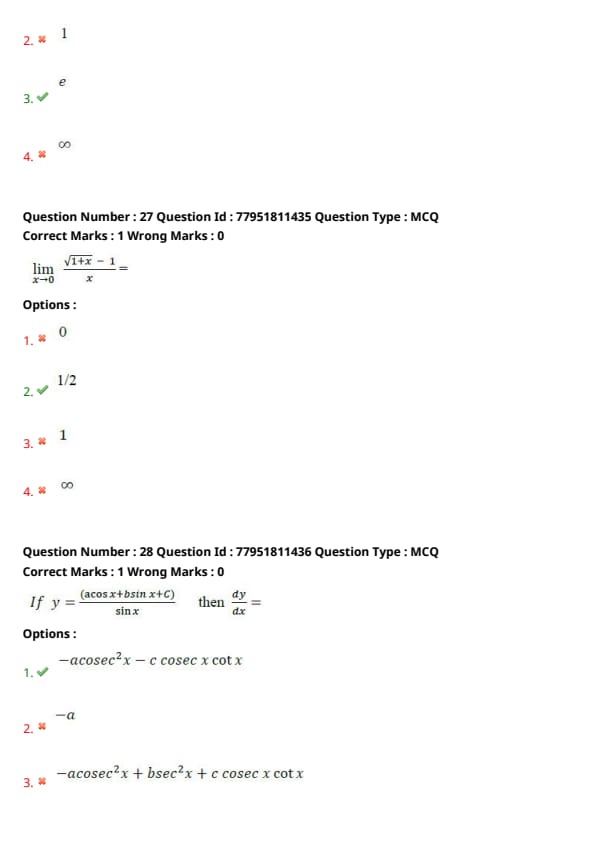
\( \lim_{x \to \infty} (1 + \frac{1}{x})^x = \) ____.
View Solution
Step 1: Understanding the Concept:
This limit is the fundamental definition of the mathematical constant \( e \) (Euler's number). It represents a \( 1^\infty \) indeterminate form.
Step 2: Key Formula or Approach:
For limits of the form \( \lim [f(x)]^{g(x)} \) where \( f(x) \to 1 \) and \( g(x) \to \infty \), the result is \( e^{\lim [f(x)-1]g(x)} \).
Step 3: Detailed Explanation:
Let \( L = \lim_{x \to \infty} (1 + \frac{1}{x})^x \).
This is an indeterminate form of \( 1^\infty \). Using the formula: \[ L = e^{\lim_{x \to \infty} [(1 + \frac{1}{x}) - 1] \cdot x} \] \[ L = e^{\lim_{x \to \infty} (\frac{1}{x}) \cdot x} \] \[ L = e^{\lim_{x \to \infty} 1} = e^1 = e \]
Step 4: Final Answer:
The value of the limit is \( e \). Quick Tip: This definition is often used in compound interest calculations where interest is compounded continuously. It's one of the most important limits in calculus.
\( \lim_{x \to 0} \frac{\sqrt{1+x} - 1}{x} = \) ____.
View Solution
Step 1: Understanding the Concept:
The limit presents a \( 0/0 \) indeterminate form. To solve this, we can rationalize the numerator or use L'Hôpital's Rule.
Step 2: Key Formula or Approach:
1. Rationalization: Multiply the numerator and denominator by the conjugate \(\sqrt{1+x} + 1\).
2. L'Hôpital's Rule: \(\lim_{x \to c} \frac{f(x)}{g(x)} = \lim_{x \to c} \frac{f'(x)}{g'(x)}\).
Step 3: Detailed Explanation:
Using the rationalization method: \[ \lim_{x \to 0} \frac{\sqrt{1+x} - 1}{x} \times \frac{\sqrt{1+x} + 1}{\sqrt{1+x} + 1} \] \[ = \lim_{x \to 0} \frac{(1+x) - 1}{x(\sqrt{1+x} + 1)} \] \[ = \lim_{x \to 0} \frac{x}{x(\sqrt{1+x} + 1)} \]
Cancel \(x\) from the numerator and denominator: \[ = \lim_{x \to 0} \frac{1}{\sqrt{1+x} + 1} \]
Substitute \(x = 0\): \[ = \frac{1}{\sqrt{1+0} + 1} = \frac{1}{1 + 1} = \frac{1}{2} \]
Step 4: Final Answer:
The value of the limit is \( 1/2 \). Quick Tip: For limits involving square roots at 0, you can also use the binomial expansion \((1+x)^n \approx 1 + nx\). Here, \((1+x)^{1/2} \approx 1 + \frac{1}{2}x\), so the expression becomes \(\frac{(1 + \frac{1}{2}x) - 1}{x} = \frac{1}{2}\).
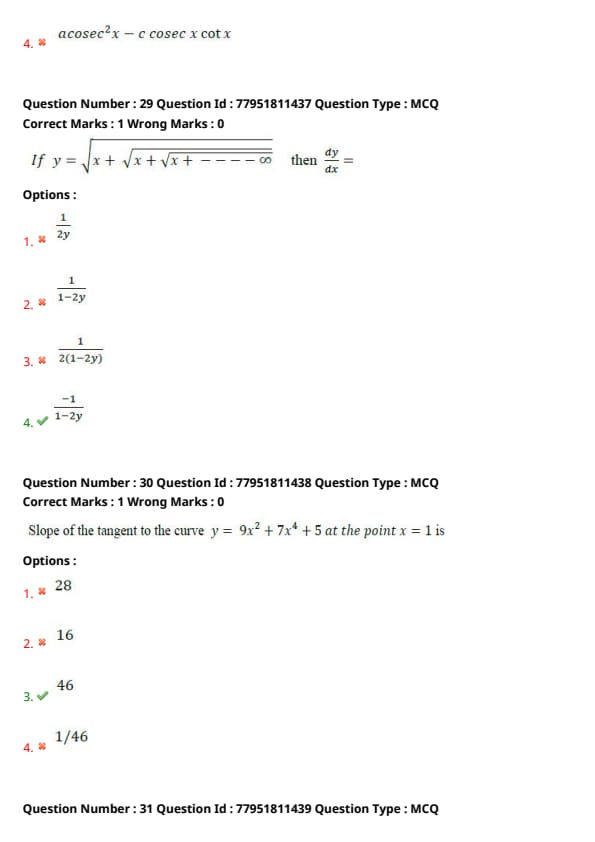
If \( y = \frac{a \cos x + b \sin x + c}{\sin x} \) then \( \frac{dy}{dx} = \) ____.
View Solution
Step 1: Understanding the Concept:
To differentiate this function, it is easier to simplify the fraction by dividing each term in the numerator by the denominator before applying differentiation rules.
Step 2: Key Formula or Approach:
1. Simplify: \(y = a \cot x + b + c \csc x\).
2. Derivatives: \(\frac{d}{dx}(\cot x) = -\csc^2 x\) and \(\frac{d}{dx}(\csc x) = -\csc x \cot x\).
Step 3: Detailed Explanation:
Split the terms: \[ y = \frac{a \cos x}{\sin x} + \frac{b \sin x}{\sin x} + \frac{c}{\sin x} \] \[ y = a \cot x + b + c \csc x \]
Differentiate with respect to \(x\): \[ \frac{dy}{dx} = a(-\csc^2 x) + 0 + c(-\csc x \cot x) \] \[ \frac{dy}{dx} = -a \csc^2 x - c \csc x \cot x \]
Step 4: Final Answer:
The derivative \( \frac{dy}{dx} \) is \( -a \csc^2 x - c \csc x \cot x \). Quick Tip: Whenever the denominator is a single trigonometric term, splitting the fraction is almost always faster than using the quotient rule.
If \( y = \sqrt{x + \sqrt{x + \sqrt{x + \dots + \infty}}} \) then \( \frac{dy}{dx} = \) ____.
View Solution
Step 1: Understanding the Concept:
This is an infinite series function. Since the pattern repeats infinitely, we can replace the inner part of the square root with \(y\) itself to create a finite algebraic equation.
Step 2: Key Formula or Approach:
1. Recursive substitution: \(y = \sqrt{x + y}\).
2. Implicit differentiation: Differentiate both sides with respect to \(x\).
Step 3: Detailed Explanation:
Given \( y = \sqrt{x + y} \).
Square both sides: \[ y^2 = x + y \]
Differentiate with respect to \(x\) using the chain rule: \[ 2y \frac{dy}{dx} = 1 + \frac{dy}{dx} \]
Rearrange to group \(\frac{dy}{dx}\) terms: \[ 2y \frac{dy}{dx} - \frac{dy}{dx} = 1 \] \[ \frac{dy}{dx} (2y - 1) = 1 \] \[ \frac{dy}{dx} = \frac{1}{2y - 1} \]
Note: \(\frac{1}{2y-1}\) is mathematically identical to \(\frac{-1}{1-2y}\).
Step 4: Final Answer:
The derivative is \( \frac{1}{2y - 1} \). Quick Tip: For any function \(y = \sqrt{f(x) + \sqrt{f(x) + ...}}\), the derivative is always \(\frac{f'(x)}{2y - 1}\). Here \(f(x) = x\), so \(f'(x) = 1\).
Slope of the tangent to the curve \( y = 9x^2 + 7x^4 + 5 \) at the point \( x = 1 \) is ____.
View Solution
Step 1: Understanding the Concept:
The slope of the tangent to a curve at a given point is equal to the value of the first derivative \( \frac{dy}{dx} \) at that specific point.
Step 2: Key Formula or Approach:
1. Power Rule: \(\frac{d}{dx}(x^n) = nx^{n-1}\).
2. Slope \(m = \left[ \frac{dy}{dx} \right]_{x=1}\).
Step 3: Detailed Explanation:
Given \( y = 9x^2 + 7x^4 + 5 \).
Differentiate with respect to \(x\): \[ \frac{dy}{dx} = 9(2x) + 7(4x^3) + 0 \] \[ \frac{dy}{dx} = 18x + 28x^3 \]
To find the slope at \(x = 1\), substitute \(x = 1\) into the derivative: \[ m = 18(1) + 28(1)^3 \] \[ m = 18 + 28 = 46 \]
Step 4: Final Answer:
The slope of the tangent at \( x = 1 \) is 46. Quick Tip: "Slope of tangent" is just a geometric name for the derivative. If the question asked for the slope of the "normal," you would take the negative reciprocal: \(-1/46\).
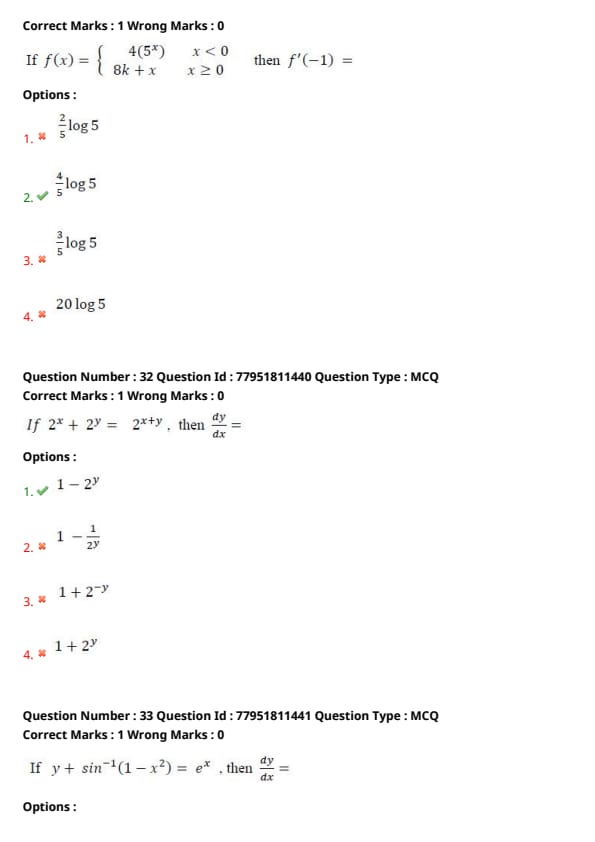
If \( f(x) = \begin{cases} 4(5^x) & x < 0
8k + x & x \ge 0 \end{cases} \) then \( f'(-1) = \) ____.
View Solution
Step 1: Understanding the Concept:
To find the derivative of a piecewise function at a specific point, we use the rule defined for the interval containing that point. Since we need \( f'(-1) \) and \( -1 < 0 \), we only consider the piece \( f(x) = 4(5^x) \)[cite: 1].
Step 2: Key Formula or Approach:
The derivative of an exponential function \( a^x \) is \( \frac{d}{dx}(a^x) = a^x \log a \) (or \( a^x \ln a \))[cite: 1].
Step 3: Detailed Explanation:
For \( x < 0 \), \( f(x) = 4 \cdot 5^x \).
Differentiating with respect to \( x \): \[ f'(x) = 4 \cdot (5^x \log 5) \]
Now, substitute \( x = -1 \): \[ f'(-1) = 4 \cdot (5^{-1} \log 5) \] \[ f'(-1) = 4 \cdot \frac{1}{5} \log 5 = \frac{4}{5} \log 5 \]
Step 4: Final Answer:
The value of \( f'(-1) \) is \( \frac{4}{5} \log 5 \). Quick Tip: Ignore the piece \( 8k + x \) entirely. Since derivatives are local properties, only the function behavior immediately around \( x = -1 \) matters.
If \( 2^x + 2^y = 2^{x+y} \), then \( \frac{dy}{dx} = \) ____.
View Solution
Step 1: Understanding the Concept:
This is an implicit function. We differentiate both sides with respect to \( x \), treating \( y \) as a function of \( x \) and applying the chain rule[cite: 1].
Step 2: Key Formula or Approach:
The derivative of \( 2^u \) is \( 2^u \log 2 \cdot \frac{du}{dx} \)[cite: 1].
Step 3: Detailed Explanation:
Differentiate \( 2^x + 2^y = 2^{x+y} \): \[ 2^x \log 2 + 2^y \log 2 \frac{dy}{dx} = 2^{x+y} \log 2 \left(1 + \frac{dy}{dx}\right) \]
Divide by \( \log 2 \): \[ 2^x + 2^y \frac{dy}{dx} = 2^{x+y} + 2^{x+y} \frac{dy}{dx} \]
Rearrange to solve for \( \frac{dy}{dx} \): \[ 2^y \frac{dy}{dx} - 2^{x+y} \frac{dy}{dx} = 2^{x+y} - 2^x \] \[ \frac{dy}{dx} (2^y - 2^{x+y}) = 2^{x+y} - 2^x \]
Using the original equation \( 2^{x+y} = 2^x + 2^y \): \[ \frac{dy}{dx} (2^y - (2^x + 2^y)) = (2^x + 2^y) - 2^x \] \[ \frac{dy}{dx} (-2^x) = 2^y \] \[ \frac{dy}{dx} = -\frac{2^y}{2^x} = -2^{y-x} \]
Step 4: Final Answer:
The derivative \( \frac{dy}{dx} \) is \( -2^{y-x} \). Quick Tip: For equations of the form \( a^x + a^y = a^{x+y} \), the derivative is always \( -a^{y-x} \). This shortcut works for any base \( a \).
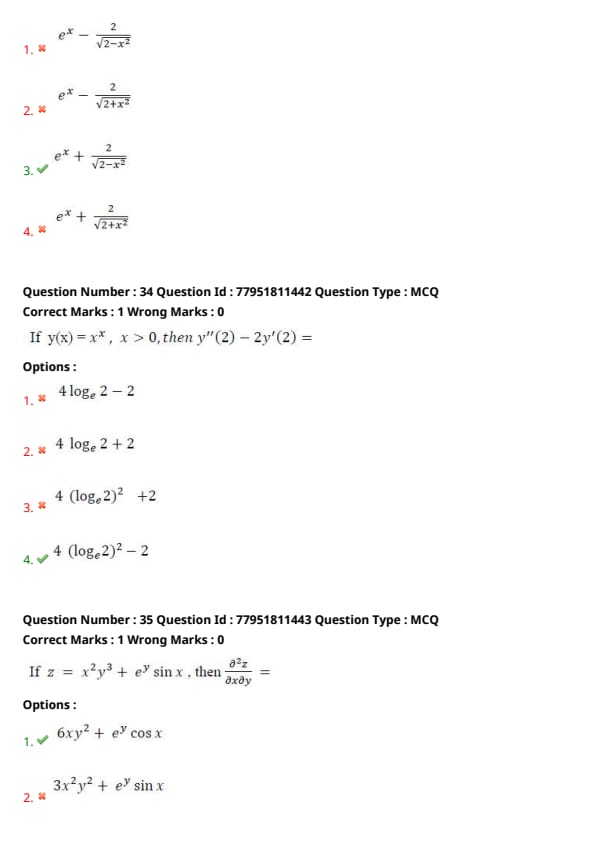
If \( y + \sin^{-1}(1 - x^2) = e^x \), then \( \frac{dy}{dx} = \) ____.
View Solution
Step 1: Understanding the Concept:
We isolate \( y \) or differentiate implicitly. The derivative of \( \sin^{-1} u \) requires the chain rule: \( \frac{d}{dx}(\sin^{-1} u) = \frac{1}{\sqrt{1-u^2}} \frac{du}{dx} \)[cite: 1].
Step 2: Key Formula or Approach:
1. \( \frac{d}{dx}(e^x) = e^x \)[cite: 1].
2. \( \frac{d}{dx}(1 - x^2) = -2x \)[cite: 1].
Step 3: Detailed Explanation:
Differentiate the entire equation: \[ \frac{dy}{dx} + \frac{1}{\sqrt{1 - (1 - x^2)^2}} \cdot \frac{d}{dx}(1 - x^2) = e^x \] \[ \frac{dy}{dx} + \frac{1}{\sqrt{1 - (1 - 2x^2 + x^4)}} \cdot (-2x) = e^x \] \[ \frac{dy}{dx} - \frac{2x}{\sqrt{2x^2 - x^4}} = e^x \]
Rearranging for \( \frac{dy}{dx} \): \[ \frac{dy}{dx} = e^x + \frac{2x}{x\sqrt{2 - x^2}} = e^x + \frac{2}{\sqrt{2 - x^2}} \]
Step 4: Final Answer:
The derivative is \( \frac{dy}{dx} = e^x + \frac{2}{\sqrt{2-x^2}} \). Quick Tip: Always simplify the term inside the square root. Often, an \( x \) or \( x^2 \) can be factored out to cancel terms in the numerator, making the final result much cleaner.
If \( y(x) = x^x \), \( x > 0 \), then \( y''(2) - 2y'(2) = \)____.
View Solution
Step 1: Understanding the Concept:
To differentiate a function where both the base and exponent are variables, we use logarithmic differentiation[cite: 1]. We first find the first derivative \( y' \), and then differentiate again to find the second derivative \( y'' \).
Step 2: Key Formula or Approach:
1. For \( y = x^x \), \( y' = x^x(1 + \log_e x) \).
2. Use the product rule for \( y'' \): \( \frac{d}{dx}[uv] = u'v + uv' \).
Step 3: Detailed Explanation:
Given \( y = x^x \), the first derivative is \( y'(x) = x^x(1 + \log_e x) \).
At \( x = 2 \): \[ y'(2) = 2^2(1 + \log_e 2) = 4(1 + \log_e 2) = 4 + 4 \log_e 2 \]
Now find \( y''(x) \) using the product rule on \( y'(x) \): \[ y''(x) = \frac{d}{dx}[x^x] \cdot (1 + \log_e x) + x^x \cdot \frac{d}{dx}(1 + \log_e x) \] \[ y''(x) = x^x(1 + \log_e x)^2 + x^x(\frac{1}{x}) \]
At \( x = 2 \): \[ y''(2) = 2^2(1 + \log_e 2)^2 + 2^2(\frac{1}{2}) = 4(1 + 2\log_e 2 + (\log_e 2)^2) + 2 \] \[ y''(2) = 4 + 8\log_e 2 + 4(\log_e 2)^2 + 2 = 6 + 8\log_e 2 + 4(\log_e 2)^2 \]
Now calculate \( y''(2) - 2y'(2) \): \[ (6 + 8\log_e 2 + 4(\log_e 2)^2) - 2(4 + 4\log_e 2) \] \[ = 6 + 8\log_e 2 + 4(\log_e 2)^2 - 8 - 8\log_e 2 \] \[ = 4(\log_e 2)^2 - 2 \]
Step 4: Final Answer:
The value of the expression is \( 4 (\log_e 2)^2 - 2 \). Quick Tip: Remember the standard derivative \( \frac{d}{dx}(x^x) = x^x(1 + \ln x) \). It appears frequently in calculus exams and saves time if memorized.
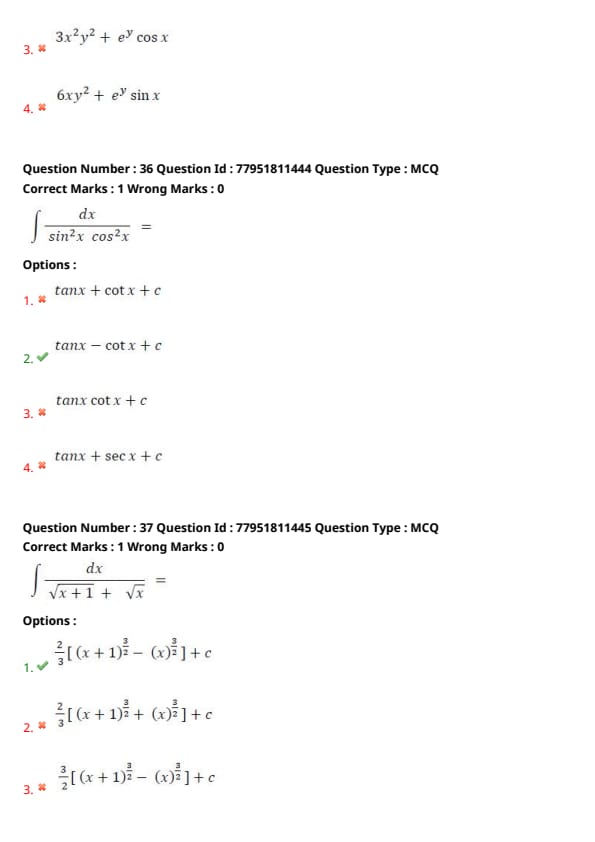
If \( z = x^2 y^3 + e^y \sin x \), then \( \frac{\partial^2 z}{\partial x \partial y} = \)____.
View Solution
Step 1: Understanding the Concept:
The notation \( \frac{\partial^2 z}{\partial x \partial y} \) represents a mixed partial derivative. This means we first differentiate \( z \) with respect to \( y \) (treating \( x \) as a constant), and then differentiate the result with respect to \( x \) (treating \( y \) as a constant).
Step 2: Key Formula or Approach:
1. First find \( \frac{\partial z}{\partial y} \).
2. Then find \( \frac{\partial}{\partial x} \left( \frac{\partial z}{\partial y} \right) \).
Step 3: Detailed Explanation:
Differentiate \( z = x^2 y^3 + e^y \sin x \) with respect to \( y \): \[ \frac{\partial z}{\partial y} = x^2(3y^2) + (\sin x)e^y = 3x^2 y^2 + e^y \sin x \]
Now, differentiate this result with respect to \( x \): \[ \frac{\partial}{\partial x} (3x^2 y^2 + e^y \sin x) = (3y^2)(2x) + e^y (\cos x) \] \[ = 6xy^2 + e^y \cos x \]
Step 4: Final Answer:
The mixed partial derivative is \( 6xy^2 + e^y \cos x \). Quick Tip: According to Clairaut's Theorem, for most smooth functions, the order of differentiation does not matter: \( \frac{\partial^2 z}{\partial x \partial y} = \frac{\partial^2 z}{\partial y \partial x} \). You can pick whichever order seems easier to calculate.
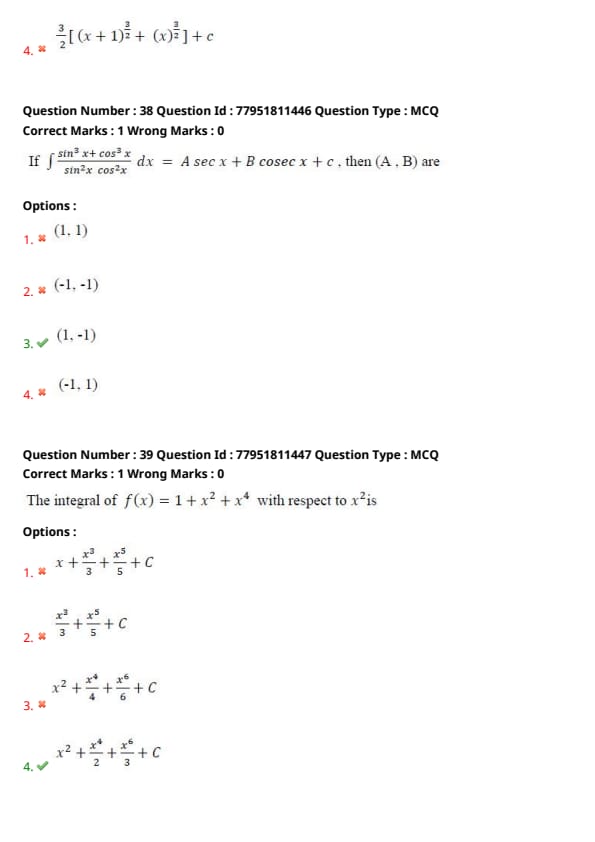
\( \int \frac{dx}{\sin^2 x \cos^2 x} = \)____.
View Solution
Step 1: Understanding the Concept:
To integrate this trigonometric fraction, we can use the identity \( \sin^2 x + \cos^2 x = 1 \) to split the integral into two simpler parts.
Step 2: Key Formula or Approach:
1. Replace \( 1 \) in the numerator with \( \sin^2 x + \cos^2 x \).
2. Use standard integrals: \( \int \sec^2 x \, dx = \tan x \) and \( \int \csc^2 x \, dx = -\cot x \).
Step 3: Detailed Explanation:
\[ \int \frac{1}{\sin^2 x \cos^2 x} \, dx = \int \frac{\sin^2 x + \cos^2 x}{\sin^2 x \cos^2 x} \, dx \]
Split the fraction: \[ = \int \left( \frac{\sin^2 x}{\sin^2 x \cos^2 x} + \frac{\cos^2 x}{\sin^2 x \cos^2 x} \right) \, dx \] \[ = \int \left( \frac{1}{\cos^2 x} + \frac{1}{\sin^2 x} \right) \, dx \] \[ = \int (\sec^2 x + \csc^2 x) \, dx \]
Integrating term by term: \[ = \tan x + (-\cot x) + c = \tan x - \cot x + c \]
Step 4: Final Answer:
The integral is \( \tan x - \cot x + c \). Quick Tip: Another way is to use the double angle formula: \( \sin^2 x \cos^2 x = \frac{1}{4} \sin^2 2x \). The integral becomes \( \int 4 \csc^2 2x \, dx = -2 \cot 2x + c \), which simplifies back to \( \tan x - \cot x + c \).
\( \int \frac{dx}{\sqrt{x+1} + \sqrt{x}} = \) ____.
View Solution
Step 1: Understanding the Concept:
To integrate a fraction with a sum of square roots in the denominator, the most effective method is to rationalize the denominator. This converts the expression into a simpler form where basic integration rules can be applied.
Step 2: Key Formula or Approach:
1. Rationalization: Multiply the numerator and denominator by the conjugate \(\sqrt{x+1} - \sqrt{x}\).
2. Power rule for integration: \(\int x^n \, dx = \frac{x^{n+1}}{n+1} + c\).
Step 3: Detailed Explanation:
First, rationalize the denominator: \[ \frac{1}{\sqrt{x+1} + \sqrt{x}} \times \frac{\sqrt{x+1} - \sqrt{x}}{\sqrt{x+1} - \sqrt{x}} = \frac{\sqrt{x+1} - \sqrt{x}}{(x+1) - x} = \sqrt{x+1} - \sqrt{x} \]
The integral becomes: \[ \int (\sqrt{x+1} - \sqrt{x}) \, dx = \int (x+1)^{1/2} \, dx - \int x^{1/2} \, dx \]
Apply the power rule to each term: \[ = \frac{(x+1)^{3/2}}{3/2} - \frac{x^{3/2}}{3/2} + c \] \[ = \frac{2}{3}(x+1)^{3/2} - \frac{2}{3}x^{3/2} + c = \frac{2}{3} \left[ (x+1)^{3/2} - x^{3/2} \right] + c \]
Step 4: Final Answer:
The integral is \( \frac{2}{3} \left[ (x+1)^{3/2} - x^{3/2} \right] + c \). Quick Tip: Rationalization is a "universal key" for integrals involving \(\sqrt{A} \pm \sqrt{B}\). If the difference \(A - B\) is a constant, it simplifies the problem significantly.
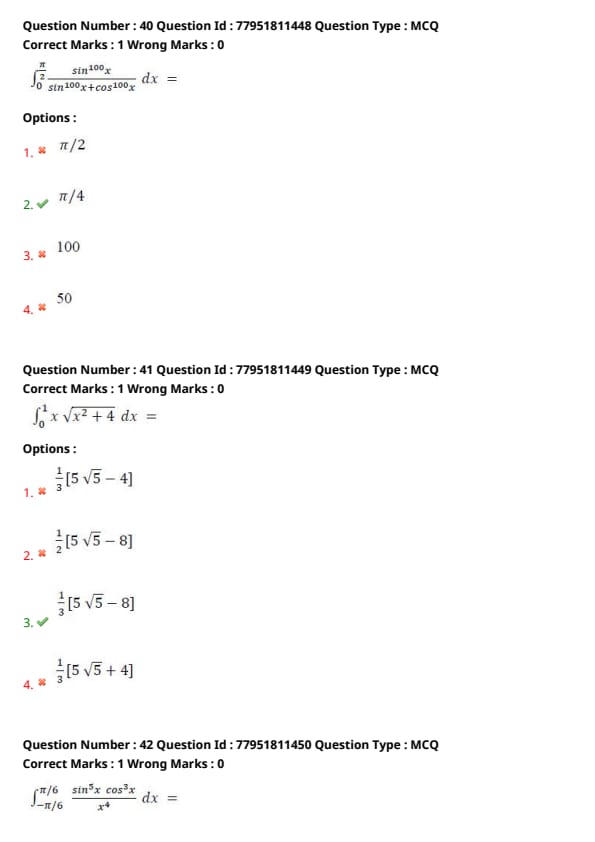
If \( \int \frac{\sin^3 x + \cos^3 x}{\sin^2 x \cos^2 x} dx = A \sec x + B \csc x + c \), then (A, B) are ____.
View Solution
Step 1: Understanding the Concept:
To solve this integral, split the numerator and divide each term by the denominator. This transforms complex trigonometric products into standard trigonometric functions that are easy to integrate.
Step 2: Key Formula or Approach:
1. Simplify terms: \(\frac{\sin^3 x}{\sin^2 x \cos^2 x} = \tan x \sec x\) and \(\frac{\cos^3 x}{\sin^2 x \cos^2 x} = \cot x \csc x\).
2. Standard integrals: \(\int \sec x \tan x \, dx = \sec x\) and \(\int \csc x \cot x \, dx = -\csc x\).
Step 3: Detailed Explanation:
Split the integral: \[ \int \frac{\sin^3 x}{\sin^2 x \cos^2 x} \, dx + \int \frac{\cos^3 x}{\sin^2 x \cos^2 x} \, dx \] \[ = \int \frac{\sin x}{\cos^2 x} \, dx + \int \frac{\cos x}{\sin^2 x} \, dx \] \[ = \int \sec x \tan x \, dx + \int \csc x \cot x \, dx \]
Using standard integration formulas: \[ = \sec x + (-\csc x) + c = 1 \sec x - 1 \csc x + c \]
Comparing with \(A \sec x + B \csc x + c\), we find \(A = 1\) and \(B = -1\).
Step 4: Final Answer:
The values are \((A, B) = (1, -1)\). Quick Tip: Always look to separate terms in the numerator when the denominator is a single product. It often turns a scary-looking fraction into a basic identity problem.
The integral of \( f(x) = 1 + x^2 + x^4 \) with respect to \( x^2 \) is ____.
View Solution
Step 1: Understanding the Concept:
The phrase "with respect to \(x^2\)" means that \(x^2\) is our variable of integration, often denoted by \(u\). We substitute \(u = x^2\) and integrate the resulting polynomial in terms of \(u\).
Step 2: Key Formula or Approach:
1. Let \(u = x^2\).
2. Rewrite the function: \(f(u) = 1 + u + u^2\).
3. Use \(\int u^n \, du = \frac{u^{n+1}}{n+1} + C\).
Step 3: Detailed Explanation:
We are finding \(\int (1 + x^2 + x^4) \, d(x^2)\).
Let \(u = x^2\). The integral becomes: \[ \int (1 + u + u^2) \, du \]
Integrate term by term: \[ = u + \frac{u^2}{2} + \frac{u^3}{3} + C \]
Substitute back \(u = x^2\): \[ = x^2 + \frac{(x^2)^2}{2} + \frac{(x^2)^3}{3} + C = x^2 + \frac{x^4}{2} + \frac{x^6}{3} + C \]
Step 4: Final Answer:
The integral is \( x^2 + \frac{x^4}{2} + \frac{x^6}{3} + C \). Quick Tip: Pay close attention to the variable after the 'd'. Integrating with respect to \(x^2\) is different from integrating with respect to \(x\). If it were \(dx\), the answer would be option (1).
\( \int_{0}^{\pi/2} \frac{\sin^{100} x}{\sin^{100} x + \cos^{100} x} dx = \) ____.
View Solution
Step 1: Understanding the Concept:
This is a definite integral that uses the property \(\int_0^a f(x) \, dx = \int_0^a f(a-x) \, dx\). This property allows us to "swap" \(\sin\) and \(\cos\) terms in the interval \([0, \pi/2]\).
Step 2: Key Formula or Approach:
1. Let the integral be \(I\).
2. Apply property: Replace \(x\) with \(\pi/2 - x\).
3. Use \(\sin(\pi/2 - x) = \cos x\) and \(\cos(\pi/2 - x) = \sin x\).
Step 3: Detailed Explanation:
Let \(I = \int_{0}^{\pi/2} \frac{\sin^{100} x}{\sin^{100} x + \cos^{100} x} \, dx \).
Using the property: \[ I = \int_{0}^{\pi/2} \frac{\sin^{100} (\pi/2 - x)}{\sin^{100} (\pi/2 - x) + \cos^{100} (\pi/2 - x)} \, dx = \int_{0}^{\pi/2} \frac{\cos^{100} x}{\cos^{100} x + \sin^{100} x} \, dx \]
Add the two expressions for \(I\): \[ 2I = \int_{0}^{\pi/2} \frac{\sin^{100} x + \cos^{100} x}{\sin^{100} x + \cos^{100} x} \, dx \] \[ 2I = \int_{0}^{\pi/2} 1 \, dx = [x]_0^{\pi/2} = \pi/2 \] \[ I = \frac{\pi/2}{2} = \pi/4 \]
Step 4: Final Answer:
The value of the definite integral is \( \pi/4 \). Quick Tip: For any integral of the form \(\int_{0}^{\pi/2} \frac{f(\sin x)}{f(\sin x) + f(\cos x)} \, dx\), the answer is always \((b-a)/2\), which in this case is \((\pi/2 - 0)/2 = \pi/4\). The exponent (100) doesn't change the result.
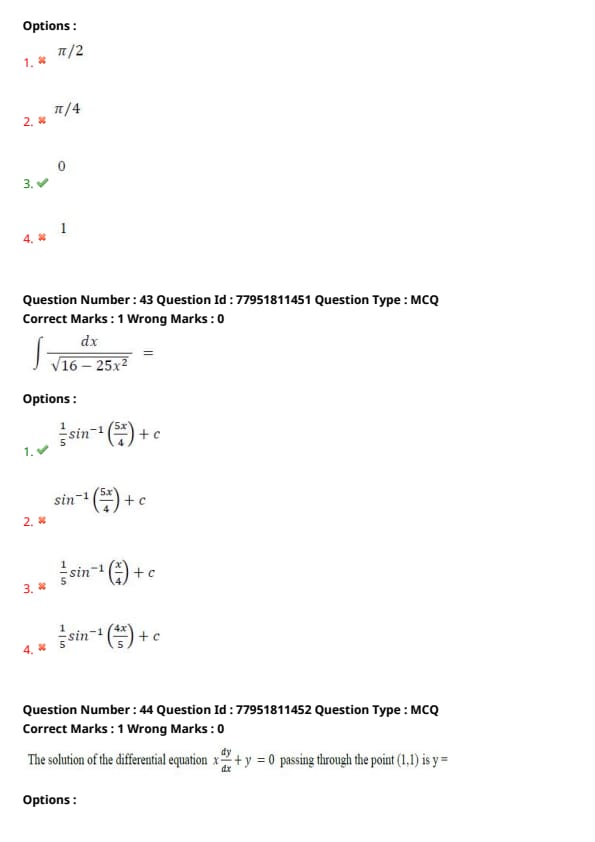
\( \int_{0}^{1} x \sqrt{x^2 + 4} \, dx = \) ____.
View Solution
Step 1: Understanding the Concept:
To solve this definite integral, we use the method of substitution. Since the derivative of the term inside the square root (\(x^2 + 4\)) is proportional to the \(x\) outside, substitution simplifies the expression into a basic power form.
Step 2: Key Formula or Approach:
1. Let \(t = x^2 + 4\), then \(dt = 2x \, dx\).
2. Change the limits: When \(x=0\), \(t=4\). When \(x=1\), \(t=5\).
3. Use \(\int t^n \, dt = \frac{t^{n+1}}{n+1} + C\).
Step 3: Detailed Explanation:
Substitute \(t = x^2 + 4 \implies dt = 2x \, dx \implies x \, dx = \frac{dt}{2}\).
The integral becomes: \[ \int_{4}^{5} \sqrt{t} \cdot \frac{dt}{2} = \frac{1}{2} \int_{4}^{5} t^{1/2} \, dt \] \[ = \frac{1}{2} \left[ \frac{t^{3/2}}{3/2} \right]_{4}^{5} = \frac{1}{2} \cdot \frac{2}{3} \left[ t^{3/2} \right]_{4}^{5} \] \[ = \frac{1}{3} \left[ 5^{3/2} - 4^{3/2} \right] \] \[ = \frac{1}{3} [5\sqrt{5} - (2^2)^{3/2}] = \frac{1}{3} [5\sqrt{5} - 2^3] = \frac{1}{3} [5\sqrt{5} - 8] \]
Step 4: Final Answer:
The value of the integral is \( \frac{1}{3}[5\sqrt{5} - 8] \). Quick Tip: Always remember to update your integration limits when performing a \(u\)-substitution in a definite integral. It saves you from having to substitute back the original variable at the end.
\( \int_{-\pi/6}^{\pi/6} \frac{\sin^5 x \cos^3 x}{x^4} \, dx = \) ____.
View Solution
Step 1: Understanding the Concept:
We evaluate the symmetry of the integrand. For an integral with symmetric limits \([-a, a]\), if the function \(f(x)\) is "odd" (\(f(-x) = -f(x)\)), the integral is zero.
Step 2: Key Formula or Approach:
1. Property: \(\int_{-a}^{a} f(x) \, dx = 0\) if \(f(x)\) is an odd function.
2. \(\sin(-x) = -\sin x\) (Odd), \(\cos(-x) = \cos x\) (Even), \((-x)^4 = x^4\) (Even).
Step 3: Detailed Explanation:
Let \(f(x) = \frac{\sin^5 x \cos^3 x}{x^4}\).
Test for symmetry: \[ f(-x) = \frac{[\sin(-x)]^5 [\cos(-x)]^3}{(-x)^4} = \frac{(-\sin x)^5 (\cos x)^3}{x^4} \] \[ f(-x) = \frac{-\sin^5 x \cos^3 x}{x^4} = -f(x) \]
Since \(f(x)\) is an odd function and the limits are symmetric (\(-\pi/6\) to \(\pi/6\)), the areas above and below the x-axis cancel each other out exactly.
Step 4: Final Answer:
The value of the integral is 0. Quick Tip: Before doing any heavy calculation on a definite integral with limits from \(-a\) to \(a\), always check if the function is odd. It is a common time-saving shortcut in competitive exams.
\( \int \frac{dx}{\sqrt{16 - 25x^2}} = \) ____.
View Solution
Step 1: Understanding the Concept:
This integral matches the standard inverse trigonometric form. To apply the formula, we must first ensure the coefficient of \(x^2\) is 1 or express the denominator as a perfect square of a linear term.
Step 2: Key Formula or Approach:
1. Standard Formula: \(\int \frac{dx}{\sqrt{a^2 - x^2}} = \sin^{-1}\left(\frac{x}{a}\right) + c\).
2. Generalized Formula: \(\int \frac{dx}{\sqrt{a^2 - (mx)^2}} = \frac{1}{m} \sin^{-1}\left(\frac{mx}{a}\right) + c\).
Step 3: Detailed Explanation:
Rewrite the denominator: \[ \int \frac{dx}{\sqrt{4^2 - (5x)^2}} \]
Here, \(a = 4\) and the variable part is \(5x\). Using the linear transformation rule (dividing by the coefficient of \(x\)): \[ = \frac{1}{5} \sin^{-1}\left(\frac{5x}{4}\right) + c \]
Step 4: Final Answer:
The integral is \( \frac{1}{5} \sin^{-1}\left(\frac{5x}{4}\right) + c \). Quick Tip: Always be careful with the "chain rule" in integration. If your variable \(x\) is replaced by \(mx\), you must divide the entire integral by \(m\).
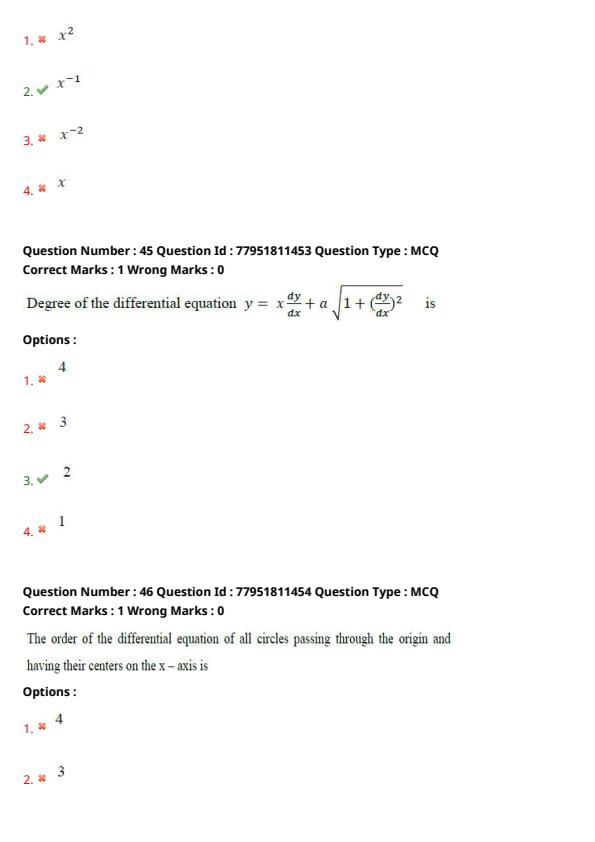
The solution of the differential equation \( x \frac{dy}{dx} + y = 0 \) passing through the point (1,1) is \( y = \) ____.
View Solution
Step 1: Understanding the Concept:
To solve this first-order differential equation, we can use the method of separation of variables. This involves rearranging the equation so that all \(y\) terms are on one side and all \(x\) terms are on the other.
Step 2: Key Formula or Approach:
1. Separate variables: \(\frac{dy}{y} = -\frac{dx}{x}\).
2. Integrate both sides: \(\int \frac{1}{y} \, dy = -\int \frac{1}{x} \, dx\).
3. Use the given point (1,1) to find the constant of integration \(C\).
Step 3: Detailed Explanation:
Starting with \( x \frac{dy}{dx} = -y \): \[ \frac{dy}{y} = -\frac{dx}{x} \]
Integrating both sides: \[ \ln|y| = -\ln|x| + \ln|C| \] \[ \ln|y| + \ln|x| = \ln|C| \] \[ \ln|xy| = \ln|C| \implies xy = C \]
Substitute the point (1,1): \[ (1)(1) = C \implies C = 1 \]
Thus, the specific solution is \( xy = 1 \), which can be written as \( y = \frac{1}{x} \) or \( y = x^{-1} \).
Step 4: Final Answer:
The solution is \( y = x^{-1} \). Quick Tip: Recognize that \( x \frac{dy}{dx} + y \) is the expanded form of the product rule derivative \(\frac{d}{dx}(xy)\). Setting \(\frac{d}{dx}(xy) = 0\) immediately tells you \(xy = C\).
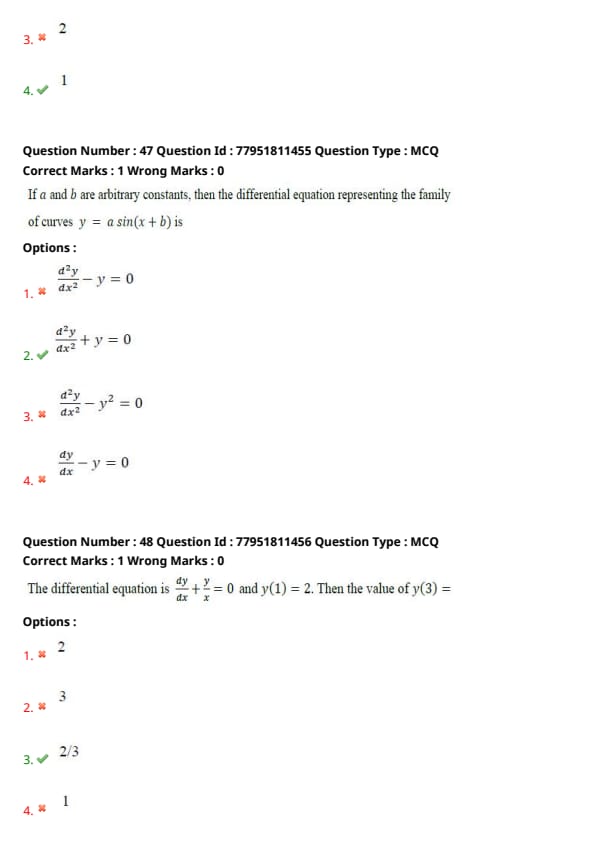
Degree of the differential equation \( y = x \frac{dy}{dx} + a \sqrt{1 + \left( \frac{dy}{dx} \right)^2} \) is ____.
View Solution
Step 1: Understanding the Concept:
The degree of a differential equation is the power of the highest order derivative, provided the equation is a polynomial in its derivatives. To find the degree, we must first eliminate radicals (square roots) and fractions involving derivatives.
Step 2: Key Formula or Approach:
1. Isolate the term with the square root.
2. Square both sides to rationalize the equation.
Step 3: Detailed Explanation:
Isolate the radical: \[ y - x \frac{dy}{dx} = a \sqrt{1 + \left( \frac{dy}{dx} \right)^2} \]
Square both sides: \[ \left( y - x \frac{dy}{dx} \right)^2 = a^2 \left[ 1 + \left( \frac{dy}{dx} \right)^2 \right] \]
Expanding the left side: \[ y^2 + x^2 \left( \frac{dy}{dx} \right)^2 - 2xy \frac{dy}{dx} = a^2 + a^2 \left( \frac{dy}{dx} \right)^2 \]
Now the equation is a polynomial in \(\frac{dy}{dx}\). The highest order derivative is \(\frac{dy}{dx}\) (Order 1), and its highest power in this polynomial form is 2.
Step 4: Final Answer:
The degree of the differential equation is 2. Quick Tip: Never determine the degree while derivatives are trapped under a square root or in a denominator. Always simplify to polynomial form first!
The order of the differential equation of all circles passing through the origin and having their centers on the x-axis is ____.
View Solution
Step 1: Understanding the Concept:
The order of a differential equation representing a family of curves is equal to the number of independent arbitrary constants (parameters) in the equation of that family.
Step 2: Key Formula or Approach:
1. Write the general equation of the family of circles.
2. Identify the number of independent arbitrary constants.
Step 3: Detailed Explanation:
The center of the circle lies on the x-axis, so let the center be \((h, 0)\).
Since the circle passes through the origin \((0, 0)\), the radius \(r\) must be the distance from \((h, 0)\) to the origin, which is \(|h|\).
The equation of the circle is: \[ (x - h)^2 + (y - 0)^2 = h^2 \] \[ x^2 - 2xh + h^2 + y^2 = h^2 \] \[ x^2 + y^2 - 2xh = 0 \]
In this equation, there is only one arbitrary constant, which is \(h\). Since there is only one independent parameter, the resulting differential equation will be of the first order.
Step 4: Final Answer:
The order of the differential equation is 1. Quick Tip: Number of independent arbitrary constants = Order of the differential equation. This is a very useful rule for quickly determining order without actually forming the equation.
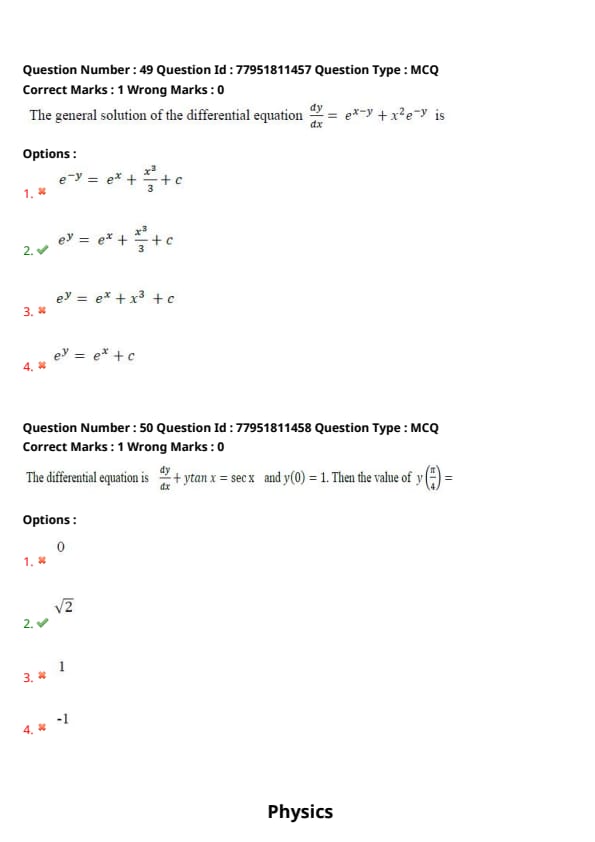
If a and b are arbitrary constants, then the differential equation representing the family of curves \( y = a \sin(x + b) \) is ____.
View Solution
Step 1: Understanding the Concept:
The order of a differential equation is equal to the number of arbitrary constants in the given equation. Since there are two constants (\(a\) and \(b\)), we differentiate twice to eliminate them.
Step 2: Key Formula or Approach:
1. Differentiate \(y\) with respect to \(x\).
2. Differentiate again to find \(\frac{d^2y}{dx^2}\).
3. Substitute the original expression of \(y\) back into the result.
Step 3: Detailed Explanation:
Given \( y = a \sin(x + b) \).
First derivative: \[ \frac{dy}{dx} = a \cos(x + b) \]
Second derivative: \[ \frac{d^2y}{dx^2} = -a \sin(x + b) \]
Since \( y = a \sin(x + b) \), we can substitute: \[ \frac{d^2y}{dx^2} = -y \] \[ \frac{d^2y}{dx^2} + y = 0 \]
Step 4: Final Answer:
The differential equation is \( \frac{d^2 y}{dx^2} + y = 0 \). Quick Tip: For any function of the form \( y = A \sin(kx + \phi) \) or \( y = A \cos(kx + \phi) \), the resulting differential equation is always \( \frac{d^2y}{dx^2} + k^2y = 0 \).
The differential equation is \( \frac{dy}{dx} + \frac{y}{x} = 0 \) and \( y(1) = 2 \). Then the value of \( y(3) = \) ____.
View Solution
Step 1: Understanding the Concept:
This is a variable separable differential equation. We solve it to find the general relationship between \(x\) and \(y\), then use the initial condition to find the constant.
Step 2: Key Formula or Approach:
1. Separate variables: \(\frac{dy}{y} = -\frac{dx}{x}\).
2. Integrate both sides.
3. Solve for \(y\) given \(x=3\).
Step 3: Detailed Explanation:
\[ \frac{dy}{dx} = -\frac{y}{x} \implies \frac{dy}{y} = -\frac{dx}{x} \]
Integrating both sides: \[ \ln|y| = -\ln|x| + \ln|C| \] \[ \ln|y| + \ln|x| = \ln|C| \implies xy = C \]
Using the condition \(y(1) = 2\): \[ (1)(2) = C \implies C = 2 \]
The equation is \( xy = 2 \). To find \(y(3)\), substitute \(x = 3\): \[ 3y = 2 \implies y = \frac{2}{3} \]
Step 4: Final Answer:
The value of \( y(3) \) is \( 2/3 \). Quick Tip: The equation \( xy = C \) represents a rectangular hyperbola. Since the product of \(x\) and \(y\) is constant, if \(x\) triples, \(y\) must become one-third of its original value.
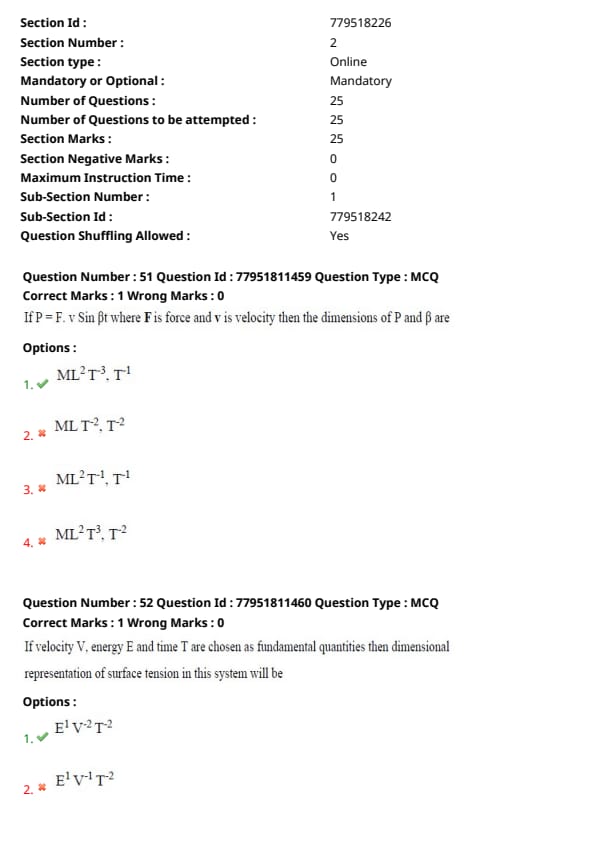
The general solution of the differential equation \( \frac{dy}{dx} = e^{x - y} + x^2 e^{-y} \) is ____.
View Solution
Step 1: Understanding the Concept:
We simplify the right side of the equation using exponent rules to separate the \(x\) and \(y\) variables.
Step 2: Key Formula or Approach:
1. Use \( e^{x-y} = e^x \cdot e^{-y} \).
2. Factor out \( e^{-y} \) and separate variables.
Step 3: Detailed Explanation:
\[ \frac{dy}{dx} = e^x e^{-y} + x^2 e^{-y} \] \[ \frac{dy}{dx} = e^{-y} (e^x + x^2) \]
Separate the variables: \[ \frac{dy}{e^{-y}} = (e^x + x^2) dx \] \[ e^y dy = (e^x + x^2) dx \]
Integrate both sides: \[ \int e^y dy = \int (e^x + x^2) dx \] \[ e^y = e^x + \frac{x^3}{3} + c \]
Step 4: Final Answer:
The solution is \( e^y = e^x + \frac{x^3}{3} + c \). Quick Tip: When you see \(e^{-y}\) in multiple terms on the RHS, factoring it out usually reveals a separable equation.
The differential equation is \( \frac{dy}{dx} + y \tan x = \sec x \) and \( y(0) = 1 \). Then the value of \( y(\pi/4) = \) ____.
View Solution
Step 1: Understanding the Concept:
This is a first-order linear differential equation of the form \( \frac{dy}{dx} + Py = Q \). We solve it using an Integrating Factor (I.F.).
Step 2: Key Formula or Approach:
1. \( I.F. = e^{\int P dx} \).
2. Solution: \( y(I.F.) = \int Q(I.F.) dx + c \).
Step 3: Detailed Explanation:
Here, \( P = \tan x \) and \( Q = \sec x \). \[ I.F. = e^{\int \tan x dx} = e^{\ln|\sec x|} = \sec x \]
The solution is: \[ y(\sec x) = \int \sec x \cdot \sec x \, dx \] \[ y \sec x = \int \sec^2 x \, dx \implies y \sec x = \tan x + c \]
Use \(y(0) = 1\): \[ (1)\sec(0) = \tan(0) + c \implies 1(1) = 0 + c \implies c = 1 \]
General solution: \( y \sec x = \tan x + 1 \implies y = \frac{\tan x + 1}{\sec x} = \sin x + \cos x \).
At \( x = \pi/4 \): \[ y = \sin(\pi/4) + \cos(\pi/4) = \frac{1}{\sqrt{2}} + \frac{1}{\sqrt{2}} = \frac{2}{\sqrt{2}} = \sqrt{2} \]
Step 4: Final Answer:
The value of \( y(\pi/4) \) is \( \sqrt{2} \). Quick Tip: The expression \(\sin x + \cos x\) reaches its maximum value of \(\sqrt{2}\) exactly at \(\pi/4\).
If \(P = F \cdot v \sin \beta t\) where \(F\) is force and \(v\) is velocity then the dimensions of \(P\) and \(\beta\) are
View Solution
Step 1: Understanding the Question:
The objective is to find the dimensional formulas for two quantities \(P\) and \(\beta\) based on a given physical equation.
Principle of Homogeneity: The dimensions on both sides of an equation must be equal.
Trigonometric functions: Arguments of sine, cosine, etc., must be dimensionless.
Step 2: Detailed Explanation:
Finding dimensions of \(P\):
Given \(P = F \cdot v \sin(\beta t)\). Since \(\sin(\beta t)\) is a ratio (dimensionless), \(P\) must have the same dimensions as the product \(F \cdot v\).
\([P] = [F] \cdot [v]\)
\([F] = ML T^{-2}\) (Force = mass \(\times\) acceleration)
\([v] = L T^{-1}\) (Velocity = displacement / time)
\([P] = (ML T^{-2})(L T^{-1}) = ML^2 T^{-3}\).
Note: These are the dimensions of Power.
Finding dimensions of \(\beta\):
The argument of the sine function, \((\beta t)\), must be dimensionless.
\([\beta t] = M^0 L^0 T^0 = 1\)
\([\beta] \cdot [T] = 1\)
\([\beta] = \frac{1}{T} = T^{-1}\).
Note: This is the dimension of frequency or angular velocity.
Step 3: Final Answer:
The dimensions are \(ML^2 T^{-3}\) for \(P\) and \(T^{-1}\) for \(\beta\). This matches Option (A).
Quick Tip: Whenever a quantity is inside a function like \(\sin, \cos, \log, or e^x\), always set the dimension of that argument to 1.
Dimensional analysis is a powerful tool to verify formulas and find unknown constants.
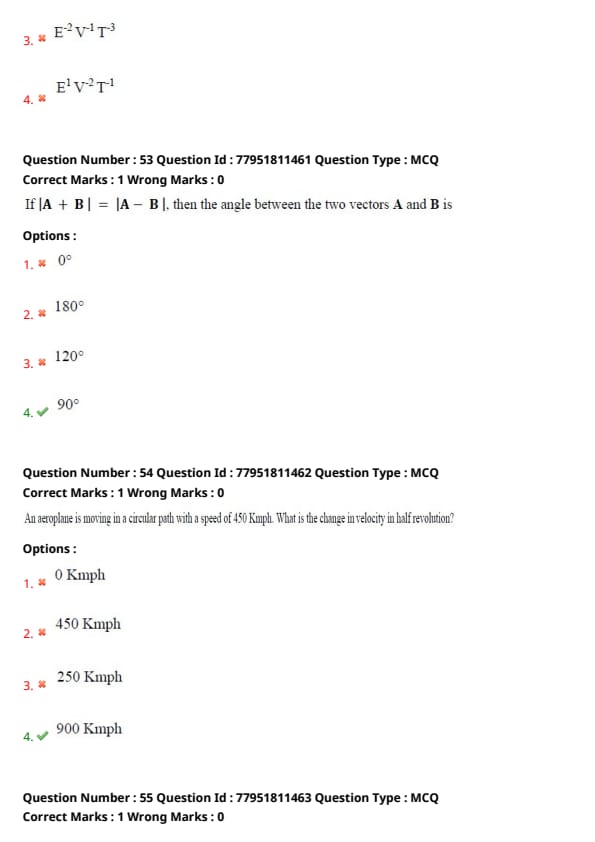
If velocity \(V\), energy \(E\) and time \(T\) are chosen as fundamental quantities then dimensional representation of surface tension in this system will be
View Solution
Step 1: Understanding the Question:
The goal is to express surface tension in terms of fundamental quantities other than the standard M, L, T. We use the method of dimensions and equate powers.
Step 2: Detailed Explanation:
Find the dimensions of each quantity in the MLT system:
Surface Tension (\(S\)) = Force / Length = \([ML T^{-2} / L] = [M T^{-2}]\).
Velocity (\(V\)) = \([L T^{-1}]\).
Energy (\(E\)) = \([ML^2 T^{-2}]\).
Time (\(T\)) = \([T]\).
Assume the relationship:
\(S = k E^a V^b T^c\).
Equating dimensions:
\([M^1 L^0 T^{-2}] = [ML^2 T^{-2}]^a [LT^{-1}]^b [T]^c\)
\(M^1 L^0 T^{-2} = M^a L^{2a+b} T^{-2a-b+c}\).
Compare the powers of M, L, and T:
For M: \(a = 1\).
For L: \(2a + b = 0\). Substitute \(a=1 \implies 2(1) + b = 0 \implies b = -2\).
For T: \(-2a - b + c = -2\).
Substitute \(a=1\) and \(b=-2\):
\(-2(1) - (-2) + c = -2\)
\(-2 + 2 + c = -2 \implies c = -2\).
Final Representation:
\(S = E^1 V^{-2} T^{-2}\).
Step 3: Final Answer:
The dimensional representation is \(E^1 V^{-2} T^{-2}\). This matches Option (A).
Quick Tip: For these problems, setting up a system of linear equations for the exponents is the most systematic way to avoid errors.
Double check your MLT dimensional formulas for each given quantity first.
If \(|\mathbf{A} + \mathbf{B}| = |\mathbf{A} - \mathbf{B}|\), then the angle between the two vectors \(\mathbf{A}\) and \(\mathbf{B}\) is
View Solution
Step 1: Understanding the Question:
The magnitudes of the sum and difference of two vectors are given to be equal. We need to find the angle between these vectors using vector algebra properties.
Step 2: Detailed Explanation:
Let \(|\mathbf{A} + \mathbf{B}| = |\mathbf{A} - \mathbf{B}|\).
Squaring both sides to simplify:
\(|\mathbf{A} + \mathbf{B}|^2 = |\mathbf{A} - \mathbf{B}|^2\).
Using the vector property \(|\mathbf{v}|^2 = \mathbf{v} \cdot \mathbf{v}\):
\((\mathbf{A} + \mathbf{B}) \cdot (\mathbf{A} + \mathbf{B}) = (\mathbf{A} - \mathbf{B}) \cdot (\mathbf{A} - \mathbf{B})\).
Expand the dot product:
\(\mathbf{A} \cdot \mathbf{A} + 2 \mathbf{A} \cdot \mathbf{B} + \mathbf{B} \cdot \mathbf{B} = \mathbf{A} \cdot \mathbf{A} - 2 \mathbf{A} \cdot \mathbf{B} + \mathbf{B} \cdot \mathbf{B}\).
Magnitude squared terms cancel out (\(A^2\) and \(B^2\)):
\(2 \mathbf{A} \cdot \mathbf{B} = -2 \mathbf{A} \cdot \mathbf{B}\).
Bring terms to one side:
\(4 \mathbf{A} \cdot \mathbf{B} = 0 \implies \mathbf{A} \cdot \mathbf{B} = 0\).
The dot product is defined as \(AB \cos \theta\):
\(AB \cos \theta = 0\).
Since \(A\) and \(B\) are non-zero vectors, \(\cos \theta = 0\).
Therefore, \(\theta = \cos^{-1}(0) = 90^\circ\).
Step 3: Final Answer:
The angle between the vectors is \(90^\circ\). This matches Option (D).
Quick Tip: Geometric interpretation: In a parallelogram, the diagonals represent \(\mathbf{A}+\mathbf{B}\) and \(\mathbf{A}-\mathbf{B}\).
If the diagonals are equal, the parallelogram must be a rectangle.
Thus, the adjacent sides (\(\mathbf{A}\) and \(\mathbf{B}\)) are perpendicular (\(90^\circ\)).
An aeroplane is moving in a circular path with a speed of 450 Kmph. What is the change in velocity in half revolution?
View Solution
Step 1: Understanding the Question:
Velocity is a vector quantity, meaning it has both magnitude and direction. Even if the speed (magnitude) is constant, the change in direction results in a change in velocity.
Step 2: Detailed Explanation:
Let the speed of the aeroplane be \(v = 450\) Kmph.
In a circular path, let the initial velocity vector at a point be \(\mathbf{v}_1\).
After a half revolution, the aeroplane is at the diametrically opposite point.
At this point, the direction of motion is exactly reversed.
So, the final velocity vector is \(\mathbf{v}_2 = -\mathbf{v}_1\).
The change in velocity is \(\Delta \mathbf{v} = \mathbf{v}_2 - \mathbf{v}_1\).
\(\Delta \mathbf{v} = (-\mathbf{v}_1) - (\mathbf{v}_1) = -2\mathbf{v}_1\).
The magnitude of the change in velocity is \(|\Delta \mathbf{v}| = 2v\).
Substituting the value of \(v\):
Magnitude \(= 2 \times 450 = 900\) Kmph.
Step 3: Final Answer:
The change in velocity is 900 Kmph. This corresponds to Option (D).
Quick Tip: For a full revolution, the change in velocity is 0 because the vector returns to its original state.
For any angle \(\theta\), the magnitude of change in velocity is \(| \Delta \mathbf{v} | = 2v \sin(\theta/2)\).
In half revolution, \(\theta = 180^\circ\), so \(2v \sin(90^\circ) = 2v\).
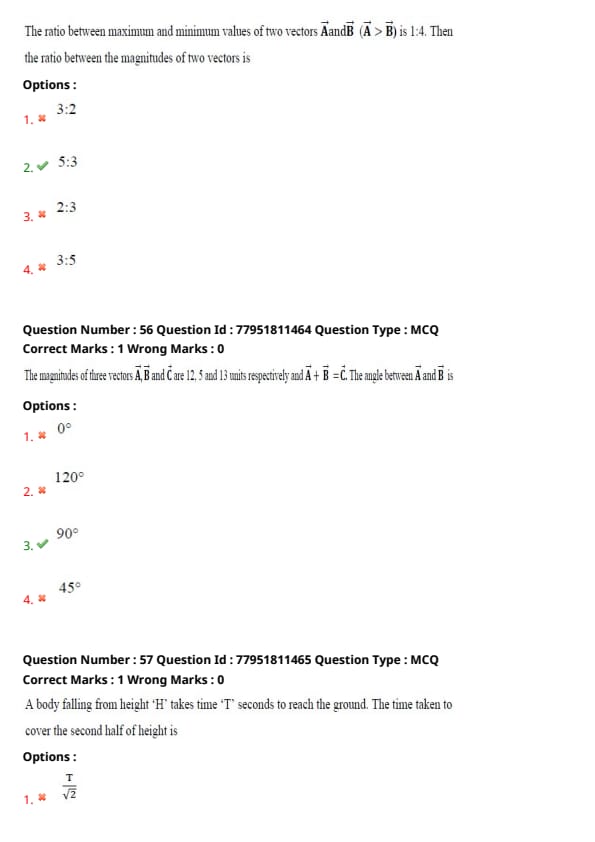
The ratio between maximum and minimum values of two vectors \(\mathbf{A}\) and \(\mathbf{B}\) \((\mathbf{A} > \mathbf{B})\) is 1:4. Then the ratio between the magnitudes of two vectors is
View Solution
Step 1: Understanding the Question:
The maximum resultant of two vectors occurs when they are parallel (angle \(0^\circ\)), and the minimum occurs when they are anti-parallel (angle \(180^\circ\)).
Max value \(= A + B\) and Min value \(= A - B\).
Note: The PDF mentions a ratio of 1:4, which is physically impossible for (Max:Min) as Max must be \(\ge\) Min. We interpret this as Min:Max or just solve for the absolute ratio. Using Max:Min \(= 4:1\) is the standard intent.
Step 2: Detailed Explanation:
Given: \(\frac{A + B}{A - B} = \frac{4}{1}\).
Cross multiply to find the relation:
\(A + B = 4(A - B)\)
\(A + B = 4A - 4B\)
Group similar terms:
\(B + 4B = 4A - A\)
\(5B = 3A\)
Find the ratio \(A:B\):
\(\frac{A}{B} = \frac{5}{3}\).
Thus, the ratio of magnitudes is 5:3.
Step 3: Final Answer:
The ratio between the magnitudes is 5:3. This matches Option (B).
Quick Tip: You can use the Componendo and Dividendo rule for these ratios:
If \(\frac{x+y}{x-y} = \frac{p}{q}\), then \(\frac{x}{y} = \frac{p+q}{p-q}\).
Here, \(A/B = (4+1)/(4-1) = 5/3\).
The magnitudes of three vectors \(\mathbf{A, B}\) and \(\mathbf{C}\) are 12, 5 and 13 units respectively and \(\mathbf{A} + \mathbf{B} = \mathbf{C}\). The angle between \(\mathbf{A}\) and \(\mathbf{B}\) is
View Solution
Step 1: Understanding the Question:
We are given the resultant relationship \(\mathbf{A} + \mathbf{B} = \mathbf{C}\), which means vector \(\mathbf{C}\) is the sum of \(\mathbf{A}\) and \(\mathbf{B}\). We need to find the angle between the components.
Step 2: Detailed Explanation:
The magnitude of the resultant \(\mathbf{C}\) of two vectors \(\mathbf{A}\) and \(\mathbf{B}\) is given by:
\(C^2 = A^2 + B^2 + 2AB \cos \theta\) where \(\theta\) is the angle between \(\mathbf{A}\) and \(\mathbf{B}\).
Given magnitudes: \(A = 12, B = 5, C = 13\).
Substitute these values into the formula:
\(13^2 = 12^2 + 5^2 + 2(12)(5) \cos \theta\)
\(169 = 144 + 25 + 120 \cos \theta\)
Simplify the equation:
\(169 = 169 + 120 \cos \theta\)
\(120 \cos \theta = 169 - 169\)
\(120 \cos \theta = 0\)
\(\cos \theta = 0\).
The angle \(\theta\) whose cosine is 0 is \(90^\circ\).
Verification: The numbers (5, 12, 13) form a Pythagorean triple (\(5^2 + 12^2 = 13^2\)), indicating that the vectors form a right-angled triangle.
Step 3: Final Answer:
The angle between \(\mathbf{A}\) and \(\mathbf{B}\) is \(90^\circ\). This matches Option (C).
Quick Tip: Always check if the magnitudes form a Pythagorean triplet:
(3, 4, 5), (5, 12, 13), (8, 15, 17), (7, 24, 25).
If they do, the angle between the two smaller sides is \(90^\circ\).
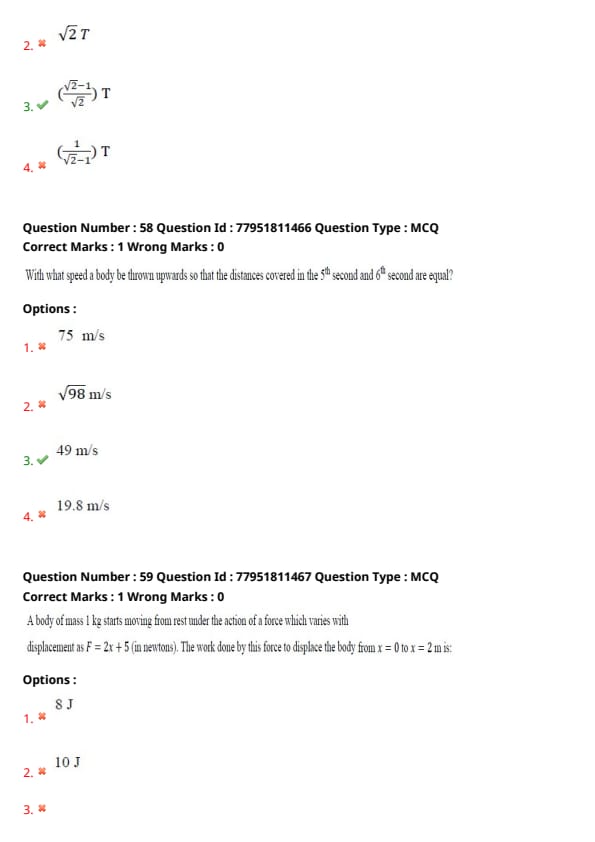
A body falling from height 'H' takes time 'T' seconds to reach the ground. The time taken to cover the second half of height is
View Solution
Step 1: Understanding the Question:
For a free-falling body starting from rest, the displacement is proportional to the square of time (\(s = \frac{1}{2} g t^2\)). We need to find the difference between the total time and the time taken for the first half of the fall.
Step 2: Detailed Explanation:
Total height \(H\), total time \(T\). From kinematics:
\(H = \frac{1}{2} g T^2 \implies T = \sqrt{\frac{2H}{g}}\). --- (Eq 1)
Let \(t_1\) be the time taken to cover the first half of the height (\(H/2\)).
\(H/2 = \frac{1}{2} g t_1^2\)
\(t_1 = \sqrt{\frac{2(H/2)}{g}} = \sqrt{\frac{H}{g}}\).
From Equation 1, \(\sqrt{\frac{H}{g}} = \frac{T}{\sqrt{2}}\).
So, \(t_1 = \frac{T{\sqrt{2}}\).
The time taken to cover the second half (\(t_2\)) is the total time minus the time for the first half:
\(t_2 = T - t_1\)
\(t_2 = T - \frac{T}{\sqrt{2}}\)
Take \(T\) as a common factor:
\(t_2 = T \left( 1 - \frac{1}{\sqrt{2}} \right)\)
\(t_2 = T \left( \frac{\sqrt{2} - 1}{\sqrt{2}} \right)\).
Step 3: Final Answer:
The time taken for the second half is \(\left( \frac{\sqrt{2}-1}{\sqrt{2}} \right) T\). This corresponds to Option (C).
Quick Tip: Remember that a falling body accelerates, so it covers equal distances in progressively shorter time intervals.
Thus, the second half of the height will always take less time than the first half.
Numerical check: \(T(1 - 0.707) \approx 0.293T\), while first half takes \(0.707T\).
With what speed a body be thrown upwards so that the distances covered in the \(5^{th}\) second and \(6^{th}\) second are equal?
View Solution
Step 1: Understanding the Question:
When a body is thrown upwards, its motion is symmetric about the highest point. If the distances in two consecutive seconds are equal, the highest point must occur exactly at the boundary between these two seconds.
Step 2: Detailed Explanation:
Let the body be thrown with initial speed \(u\).
The distance covered in the \(n^{th}\) second is \(|u - \frac{g}{2}(2n-1)|\).
Given distance in \(5^{th}\) second = distance in \(6^{th}\) second.
Due to the symmetry of projectile motion, for these distances to be equal, the peak (highest point) must be reached at exactly \(t = 5\) seconds.
Why? At \(t=5\) s, the body stops. Between \(t=4\) and \(t=5\) (5th sec), it travels upward a certain distance. Between \(t=5\) and \(t=6\) (6th sec), it falls back exactly the same distance.
At the highest point, final velocity \(v = 0\).
Using \(v = u - gt\):
\(0 = u - g(5)\)
\(u = 5g\).
Taking \(g = 9.8\) m/s\(^2\):
\(u = 5 \times 9.8 = 49\) m/s.
Step 3: Final Answer:
The initial speed should be 49 m/s. This matches Option (C).
Quick Tip: If distances in \(n^{th}\) and \((n+1)^{th}\) seconds are equal for an upward projection, the time to reach maximum height is exactly \(n\) seconds.
Time to reach maximum height \(t = u/g\).
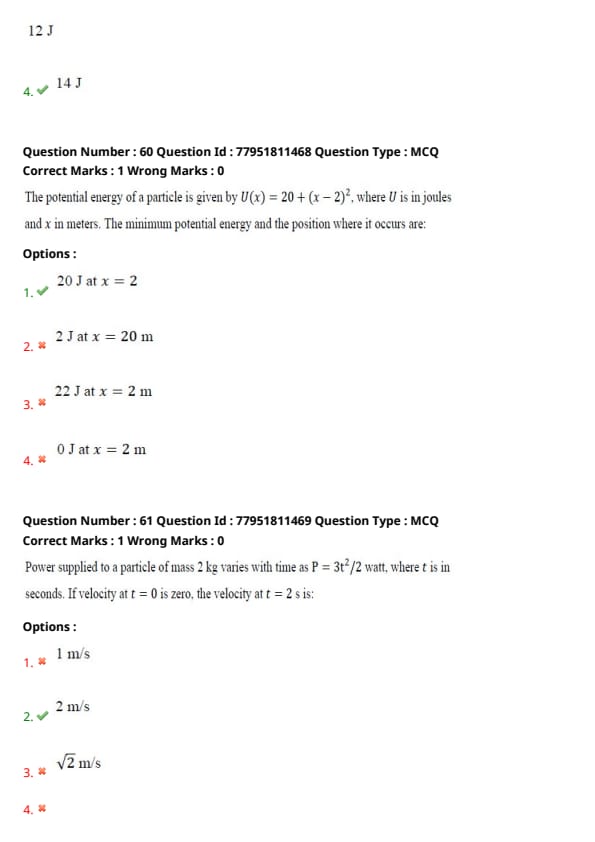
A body of mass 1 kg starts moving from rest under the action of a force which varies with displacement as \(F = 2x + 5\) (in newtons). The work done by this force to displace the body from \(x = 0\) to \(x = 2\) m is:
View Solution
Step 1: Understanding the Question:
Work done by a variable force is defined as the integral of the force over the displacement interval.
Work (\(W\)) = \(\int F(x) dx\).
Step 2: Detailed Explanation:
Given force function: \(F(x) = 2x + 5\).
Integration limits: \(x = 0\) to \(x = 2\) m.
\(W = \int_0^2 (2x + 5) dx\).
Perform the integration:
\(W = \left[ \frac{2x^2}{2} + 5x \right]_0^2\)
\(W = \left[ x^2 + 5x \right]_0^2\).
Evaluate at upper limit (\(x=2\)):
\((2)^2 + 5(2) = 4 + 10 = 14\).
Evaluate at lower limit (\(x=0\)):
\((0)^2 + 5(0) = 0\).
Final calculation: \(W = 14 - 0 = 14\) J.
Note: The mass is given as 1 kg, but for calculating work from force and displacement, the mass is redundant.
Step 3: Final Answer:
The work done is 14 J. This matches Option (D).
Quick Tip: Work is the area under the Force-Displacement graph.
For \(F = 2x+5\), the graph is a trapezoid. Area = \(\frac{1}{2}(F_0 + F_2) \times \Delta x\)
\(F_0 = 5, F_2 = 9\). Area \(= \frac{1}{2}(5+9) \times 2 = 14\) J.
The potential energy of a particle is given by \(U(x) = 20 + (x - 2)^2\), where \(U\) is in joules and \(x\) in meters. The minimum potential energy and the position where it occurs are:
View Solution
Step 1: Understanding the Question:
The minimum value of a function can be found using calculus (differentiation) or by analyzing the algebraic form of the equation.
Stable equilibrium occurs at the point of minimum potential energy.
Step 2: Detailed Explanation:
Given function: \(U(x) = 20 + (x - 2)^2\).
Method 1: Analyzing the squared term.
The term \((x - 2)^2\) is a square. Squares of real numbers are always \(\ge 0\).
The smallest possible value for \((x - 2)^2\) is 0.
This occurs when \(x - 2 = 0\), or \(x = 2\) m.
At \(x = 2\), \(U_{min} = 20 + (0) = 20\) J.
Method 2: Calculus.
Find the derivative \(U'(x) = \frac{d}{dx}[20 + (x-2)^2] = 2(x-2)\).
Set \(U'(x) = 0\) for extrema: \(2(x-2) = 0 \implies x = 2\) m.
Check double derivative: \(U''(x) = 2\). Since \(U''(x) > 0\), it is a local minimum.
Calculate \(U(2) = 20 + (2-2)^2 = 20\) J.
Step 3: Final Answer:
The minimum potential energy is 20 J at position \(x = 2\) m. This matches Option (A).
Quick Tip: For any function \(f(x) = k + (x-a)^2\), the minimum value is \(k\) at \(x=a\).
In physics, the negative gradient of potential energy gives the force: \(F = -dU/dx\). At minimum PE, force is zero (equilibrium).
Power supplied to a particle of mass 2 kg varies with time as \(P = 3t^2/2\) watt, where \(t\) is in seconds. If velocity at \(t = 0\) is zero, the velocity at \(t = 2\) s is:
View Solution
Step 1: Understanding the Question:
Power is the rate of doing work, which is equal to the rate of change of kinetic energy (Work-Energy Theorem). We can relate power and velocity through integration.
Step 2: Detailed Explanation:
Power \(P = \frac{dW}{dt} = \frac{d}{dt}(K.E.)\).
\(P = \frac{d}{dt} \left( \frac{1}{2} m v^2 \right)\).
Integrating both sides with respect to time:
\(\int_0^T P dt = \int d(K.E.) = K.E._f - K.E._i\).
Given \(P = \frac{3}{2} t^2, m = 2\) kg, \(v_i = 0\) at \(t=0\), and we need \(v_f\) at \(t=2\).
\(\int_0^2 \frac{3}{2} t^2 dt = \frac{1}{2} (2) v_f^2 - \frac{1}{2} (2) (0)^2\).
Perform the integration:
\(\frac{3}{2} \left[ \frac{t^3}{3} \right]_0^2 = v_f^2\).
\(\frac{1}{2} [t^3]_0^2 = v_f^2\).
Evaluate:
\(\frac{1}{2} (2^3 - 0) = v_f^2\)
\(\frac{8}{2} = v_f^2\)
\(v_f^2 = 4\).
\(v_f = \sqrt{4} = 2\) m/s.
Step 3: Final Answer:
The velocity at \(t=2\) s is 2 m/s. This matches Option (B).
Quick Tip: Alternatively, use \(P = Fv = (ma)v = m(v \frac{dv}{dt})v = mv \frac{dv}{dt}\).
\(P dt = mv dv \implies \int P dt = \int mv dv\).
This is exactly the change in kinetic energy.
A pump is used to deliver water at a certain rate from a given pipe. To obtain twice the volume of water from the same pipe in the same time, by what factor must the power of the motor pump be increased? (Assume ideal conditions, \(g = 10\) ms\(^{-2}\))
View Solution
Step 1: Understanding the Question:
Power in a pump delivering fluid consists of work against gravity (static head) and kinetic energy supplied to the fluid. In this context, delivering more volume through the same pipe means both the mass flow rate and the velocity of the fluid must increase.
Step 2: Detailed Explanation:
Let the initial volume delivered in time \(t\) be \(V\). Rate of flow \(Q = V/t\).
Let the area of the pipe be \(A\) and velocity of fluid be \(v\). Then \(Q = Av \implies v = Q/A\).
Power required to impart kinetic energy is \(P = \frac{1}{2} \dot{m} v^2\), where \(\dot{m}\) is the mass flow rate (\(\rho Q\)).
\(P = \frac{1}{2} (\rho Q) (Q/A)^2 = \frac{\rho Q^3}{2A^2}\).
This shows that Power is proportional to the cube of the flow rate: \(P \propto Q^3\).
Now, we want to deliver twice the volume in the same time.
New volume \(V' = 2V\), so new flow rate \(Q' = \frac{2V}{t} = 2Q\).
The factor of increase in power is:
\(\frac{P'}{P} = \left( \frac{Q'}{Q} \right)^3 = (2)^3 = 8\).
Therefore, the power must be increased by a factor of 8.
Step 3: Final Answer:
The power must be increased by a factor of 8. This matches Option (B).
Quick Tip: Standard result for fluid mechanics: \(P \propto v^3\) (Power \(\propto\) Velocity cubed).
If velocity is doubled to get double volume through the same area, power increases \(2^3 = 8\) times.
If area was also changed, the relation would differ.
Two identical piano wires, when tuned to a fundamental frequency of 400 Hz, produce no beats. One wire is then slightly tightened, and the beat frequency heard is 2 Hz. What is the new fundamental frequency of the tightened wire?
View Solution
Step 1: Understanding the Question:
Beats are produced by the interference of two sound waves of slightly different frequencies. The beat frequency is the absolute difference between the two frequencies: \(f_b = |f_1 - f_2|\).
Also, for a string, frequency is proportional to the square root of tension (\(f \propto \sqrt{T}\)).
Step 2: Detailed Explanation:
Initially, both wires have frequency \(f = 400\) Hz. Since they produce no beats, \(f_1 = f_2 = 400\) Hz.
One wire is tightened. Tightening a wire increases its tension (\(T\)).
Since \(f = \frac{1}{2L} \sqrt{\frac{T}{\mu}}\), an increase in tension leads to an increase in frequency.
Therefore, the new frequency \(f'_1\) of the tightened wire must be greater than 400 Hz.
The beat frequency heard is 2 Hz.
\(f_b = |f'_1 - f_2| = 2\).
This gives two possibilities: \(f'_1 = 400 + 2 = 402\) Hz or \(f'_1 = 400 - 2 = 398\) Hz.
Since the wire was tightened, the frequency increased.
Thus, the new frequency is 402 Hz.
Step 3: Final Answer:
The new frequency is 402 Hz. This corresponds to Option (B).
Quick Tip: Tightening \(\implies\) Tension increases \(\implies\) Frequency increases.
Loosening or loading with wax \(\implies\) Frequency decreases.
Beats frequency is simply the difference between the source frequencies.
A source of sound of frequency 500 Hz is moving towards an observer with velocity 30 m/s. The speed of sound is 330 m/s. The frequency heard by the observer will be:
View Solution
Step 1: Understanding the Question:
The Doppler Effect describes the change in frequency heard by an observer when there is relative motion between the source and the observer.
Moving towards each other \(\implies\) frequency increases.
Moving away from each other \(\implies\) frequency decreases.
Step 2: Key Formula or Approach:
The observed frequency \(f'\) is given by:
\(f' = f \left( \frac{v \pm v_o}{v \mp v_s} \right)\)
where \(v\) is speed of sound, \(v_o\) is observer velocity, and \(v_s\) is source velocity.
Step 3: Detailed Explanation:
Given: \(f = 500\) Hz, \(v = 330\) m/s.
Source velocity \(v_s = 30\) m/s, moving towards the stationary observer.
Observer velocity \(v_o = 0\).
For the source moving towards the observer, the denominator is \((v - v_s)\):
\(f' = 500 \left( \frac{330 + 0}{330 - 30} \right)\)
Simplify the expression:
\(f' = 500 \left( \frac{330}{300} \right)\)
\(f' = 500 \times 1.1\)
\(f' = 550\) Hz.
Step 4: Final Answer:
The frequency heard by the observer is 550 Hz. This matches Option (B).
Quick Tip: Sign Convention: If the relative distance is {decreasing}, the observed frequency must be {higher} than the original.
If the observer is stationary, the formula is simply \(f' = f \cdot \frac{v}{v - v_s}\) for approach and \(f' = f \cdot \frac{v}{v + v_s}\) for recession.
In Acoustics, 'Noise' is generally characterized by:
View Solution
Step 1: Understanding the Question:
The question asks for the fundamental acoustic property that distinguishes "noise" from "musical sound". This is a theoretical concept in wave mechanics and acoustics.
Step 2: Detailed Explanation:
Musical Sound: It consists of sounds produced by periodic, regular vibrations. These sounds have a definite pitch, distinct quality, and follow a harmonic series. For example, sounds from a flute, guitar, or piano.
Noise: It is the result of sudden, irregular, and non-periodic vibrations. Noise consists of a large number of frequencies which do not have a constant mathematical relationship (harmonic series).
Characteristics of Noise:
- Lack of definite pitch.
- Irregular wave form (jagged and non-repetitive).
- Generally unpleasant to the ear.
- Examples include the sound of a gunshot, the roar of an engine, or a plate breaking.
Therefore, noise is scientifically defined by its irregular and non-periodic nature.
Step 3: Final Answer:
Noise is characterized by irregular and non-periodic vibrations. This corresponds to Option (A).
Quick Tip: Periodic = Musical/Harmonic.
Non-periodic = Noise/Inharmonic.
In digital signal processing, white noise contains all frequencies with equal intensity, making it perfectly non-periodic.
If the volume of a room is doubled and the total absorption is halved, the reverberation time will:
View Solution
Step 1: Understanding the Question:
Reverberation time is the time it takes for sound to decay by 60 decibels after the source has stopped. We use Sabine's formula to determine how changes in volume and absorption affect this time.
Step 2: Key Formula or Approach:
Sabine's Formula: \(T = \frac{0.16V}{\sum aS} = \frac{0.16V}{A}\)
where \(V\) is volume and \(A\) is total absorption.
Step 3: Detailed Explanation:
Let the initial volume be \(V\) and initial absorption be \(A\).
Initial reverberation time \(T = \frac{0.16V}{A}\).
Case 1: Volume is doubled. New volume \(V' = 2V\).
Case 2: Absorption is halved. New absorption \(A' = \frac{1}{2} A = 0.5A\).
Calculate the new reverberation time \(T'\):
\(T' = \frac{0.16 V'}{A'}\)
\(T' = \frac{0.16(2V)}{0.5A}\)
Simplify the expression:
\(T' = \frac{0.16V}{A} \times \left( \frac{2}{0.5} \right)\)
\(T' = T \times 4\).
Therefore, the reverberation time becomes four times its original value.
Step 4: Final Answer:
The reverberation time will become four times. This matches Option (C).
Quick Tip: Reverberation time is directly proportional to volume (\(V\)) and inversely proportional to total absorption (\(A\)).
Larger halls with hard surfaces (low absorption) have very high reverberation times.
In a closed hall of volume 5000 m\(^3\), the total absorption of the interior surfaces is 200 metric sabin. The reverberation time is:
View Solution
Step 1: Understanding the Question:
The objective of this problem is to determine the reverberation time of a hall using Sabine's formula.
Reverberation time is the duration required for the sound intensity to drop by 60 dB after the source has stopped.
The formula relates the volume of the hall and the total sound absorption of its interior surfaces.
Step 2: Detailed Explanation:
Sabine's Formula: The standard empirical formula for reverberation time (\(T\)) in seconds is:
\[ T = \frac{0.161 \times V}{A} \]
where:
\(V\) = Volume of the hall in cubic meters (m\(^3\)).
\(A\) = Total absorption in metric sabins.
Given Data:
Volume of the hall (\(V\)) = 5000 m\(^3\).
Total absorption (\(A\)) = 200 metric sabin.
Calculation:
Substitute the given values into Sabine's equation:
\[ T = \frac{0.161 \times 5000}{200} \]
Multiply 0.161 by 5000:
\[ 0.161 \times 5000 = 805 \]
Now divide by the total absorption:
\[ T = \frac{805}{200} \]
\[ T = 4.025 seconds \]
Conclusion: The calculated value is approximately 4 seconds, which matches the provided options for a standard hall setup.
Step 3: Final Answer:
The reverberation time is 4 s. This corresponds to Option (D).
Quick Tip: Always ensure units are in meters and metric sabins before applying the constant 0.161.
If the volume is doubled, the reverberation time doubles.
If the absorption is doubled, the reverberation time is halved.
In an Isothermal process
View Solution
Step 1: Understanding the Question:
This is a conceptual question regarding thermodynamics. We need to identify the defining characteristic of an isothermal process.
The term "isothermal" is derived from the Greek words "iso" (equal) and "therme" (heat/temperature).
Step 2: Detailed Explanation:
Definition: An isothermal process is a thermodynamic process in which the temperature of the system remains constant (\(\Delta T = 0\)).
Mechanism: This usually happens when the system is in contact with a thermal reservoir and the process is slow enough to allow the system to adjust to the temperature of the reservoir through heat exchange.
Ideal Gas Law: For an ideal gas undergoing an isothermal process, the relationship between pressure and volume is governed by Boyle's Law:
\[ PV = constant \]
Internal Energy: For an ideal gas, internal energy depends solely on temperature. Therefore, if temperature is constant, the internal energy remains constant (\(\Delta U = 0\)).
First Law Application: According to the First Law of Thermodynamics (\(\Delta Q = \Delta U + \Delta W\)), since \(\Delta U = 0\), all heat added to the system is converted into work done by the system (\(\Delta Q = \Delta W\)).
Comparison:
- Isobaric: Constant Pressure.
- Isochoric: Constant Volume.
- Adiabatic: No heat exchange (\(Q = 0\)).
Step 3: Final Answer:
The defining property of an isothermal process is that the temperature of the system remains constant. This corresponds to Option (D).
Quick Tip: Remember: "Iso" means same, "Thermal" refers to temperature.
In an isothermal process, the system must have a perfectly conducting boundary to maintain thermal equilibrium with its surroundings.
If the pressure of an ideal gas is doubled and its absolute temperature is halved; the volume will become:
View Solution
Step 1: Understanding the Question:
The goal is to find the change in volume of an ideal gas when its pressure and temperature are modified simultaneously.
We will use the Combined Gas Law, which relates pressure, volume, and absolute temperature for a fixed mass of gas.
Step 2: Detailed Explanation:
Combined Gas Law Equation:
\[ \frac{P_1 V_1}{T_1} = \frac{P_2 V_2}{T_2} \]
Given Parameters:
Let initial pressure be \(P_1\), volume be \(V_1\), and temperature be \(T_1\).
Final pressure \(P_2 = 2P_1\) (Pressure is doubled).
Final temperature \(T_2 = \frac{1}{2} T_1\) (Absolute temperature is halved).
Substituting into the Equation:
Rearrange the formula to solve for \(V_2\):
\[ V_2 = V_1 \times \left( \frac{P_1}{P_2} \right) \times \left( \frac{T_2}{T_1} \right) \]
Substitute the given ratios:
\[ V_2 = V_1 \times \left( \frac{P_1}{2P_1} \right) \times \left( \frac{0.5 T_1}{T_1} \right) \]
Simplify the factors:
\[ V_2 = V_1 \times \left( \frac{1}{2} \right) \times \left( \frac{1}{2} \right) \]
\[ V_2 = V_1 \times \left( \frac{1}{4} \right) \]
Result: The final volume is one-fourth of the original volume.
Step 3: Final Answer:
The volume will become 1/4 of the initial volume. This corresponds to Option (A).
Quick Tip: Temperature in gas laws must always be in Kelvin (absolute temperature).
Increasing pressure tends to decrease volume, while decreasing temperature also tends to decrease volume. Since both changes act in the same direction, the reduction in volume is significant.
At constant temperature, the product PV is plotted against pressure P for an ideal gas. The graph obtained is:
View Solution
Step 1: Understanding the Question:
The problem asks for the nature of the graph of the product \(PV\) versus pressure \(P\) for an ideal gas at a constant temperature.
This is a direct application of Boyle's Law.
Step 2: Detailed Explanation:
Boyle's Law: At constant temperature, the volume of a fixed mass of gas is inversely proportional to its pressure.
\[ V \propto \frac{1}{P} \implies PV = K \]
where \(K\) is a constant value.
Analyzing the Product PV: Since the temperature is kept constant, the Ideal Gas Law \(PV = nRT\) implies that the product \(PV\) is also constant (as \(n, R,\) and \(T\) are constant).
Graphing: If we plot the value of \(PV\) on the y-axis and the value of \(P\) on the x-axis, the equation becomes:
\[ y = C (where C is a constant) \]
Shape: The graph of \(y = constant\) is a horizontal straight line.
Conclusion: Regardless of how much the pressure \(P\) increases or decreases, the product \(PV\) stays the same. Thus, the graph is a straight line that never rises or falls relative to the P-axis, making it parallel to the P-axis.
Step 3: Final Answer:
The graph obtained is a straight line parallel to the P-axis. This corresponds to Option (A).
Quick Tip: A plot of \(P\) vs \(V\) is a rectangular hyperbola.
A plot of \(PV\) vs \(P\) or \(PV\) vs \(V\) is always a horizontal line for an ideal gas.
Deviations from this straight line indicate non-ideal (real) gas behavior.
A bubble of an ideal gas rises from the bottom of a lake to the surface. At the bottom, the pressure is 3 Atm. and the temperature is 7 \(^\circ\)C. At the surface, the pressure is 1 atm. and the temperature is 27 \(^\circ\)C. If the initial volume of the bubble was \(V_0\) what is its volume \(V_f\) at the surface?
View Solution
Step 1: Understanding the Question:
The problem involves a gas bubble changing its environment (pressure and temperature). We need to calculate the final volume using the General Gas Equation.
Crucially, all temperatures must be converted from Celsius to Kelvin.
Step 2: Detailed Explanation:
Given Initial State (Bottom):
\(P_1 = 3 Atm\).
\(T_1 = 7 ^\circC = 7 + 273 = 280 K\).
\(V_1 = V_0\).
Given Final State (Surface):
\(P_2 = 1 Atm\).
\(T_2 = 27 ^\circC = 27 + 273 = 300 K\).
\(V_2 = V_f\).
General Gas Equation:
\[ \frac{P_1 V_1}{T_1} = \frac{P_2 V_2}{T_2} \]
Calculation:
Rearranging for \(V_f\):
\[ V_f = \frac{P_1 \times V_1 \times T_2}{P_2 \times T_1} \]
Substitute the values:
\[ V_f = \frac{3 \times V_0 \times 300}{1 \times 280} \]
\[ V_f = \frac{900}{280} V_0 \]
\[ V_f = \frac{90}{28} V_0 \approx 3.214 V_0 \]
Conclusion: The volume expands significantly as it rises due to the combined effect of reduced pressure and increased temperature.
Step 3: Final Answer:
The final volume is 3.21 \(V_0\). This corresponds to Option (B).
Quick Tip: Never calculate using Celsius! Always add 273 to convert to Kelvin.
Common error: Thinking the volume just triples because the pressure becomes 1/3rd. The temperature change also adds to the expansion.
The R.M.S. speed of oxygen molecules at 27 \(^\circ\)C is v. At 927 \(^\circ\)C, the rms speed will be:
View Solution
Step 1: Understanding the Question:
This question tests the relationship between the root mean square (RMS) speed of gas molecules and their absolute temperature.
The RMS speed is a measure of the average kinetic energy of the molecules.
Step 2: Detailed Explanation:
RMS Speed Formula:
\[ v_{rms} = \sqrt{\frac{3RT}{M}} \]
This shows that for a given gas (constant \(M\)), the RMS speed is proportional to the square root of its absolute temperature (\(T\)).
\[ v \propto \sqrt{T} \]
Initial Temperature (\(T_1\)):
\(27 ^\circC = 27 + 273 = 300 K\).
Initial speed = \(v\).
Final Temperature (\(T_2\)):
\(927 ^\circC = 927 + 273 = 1200 K\).
Comparison:
Let final speed be \(v'\).
\[ \frac{v'}{v} = \sqrt{\frac{T_2}{T_1}} = \sqrt{\frac{1200}{300}} \]
\[ \frac{v'}{v} = \sqrt{4} = 2 \]
Result: The new RMS speed is \(v' = 2v\).
Step 3: Final Answer:
The rms speed will be 2v. This matches Option (C).
Quick Tip: Always double check the ratio of temperatures in Kelvin. 1200K is 4 times 300K.
Since speed is proportional to the square root of temperature, a 4x increase in temperature leads to a \(\sqrt{4} = 2\)x increase in speed.
In a photoelectric experiment, the stopping potential for incident light of wavelength 4000 \r{A} is 2V. If the wavelength is changed to 3000 \r{A}, the new stopping potential will be approximately:
(Use \(h = 4.14 \times 10^{-15}\) eV \(\cdot\) s, \(c = 3 \times 10^8\) m/s)
View Solution
Step 1: Understanding the Question:
The problem is based on Einstein’s Photoelectric Equation, which relates the energy of incident photons, the work function of the metal, and the maximum kinetic energy (expressed via stopping potential).
Step 2: Detailed Explanation:
Photoelectric Equation:
\[ E = \phi + eV_s \implies eV_s = \frac{hc}{\lambda} - \phi \]
where \(V_s\) is stopping potential and \(\phi\) is the work function.
Step 1: Calculate initial energy (\(E_1\)):
Wavelength \(\lambda_1 = 4000 \r{A}\).
Energy in eV \(\approx \frac{12400}{\lambda(\r{A})} = \frac{12400}{4000} = 3.1 eV\).
Given stopping potential \(V_{s1} = 2 V\), so \(K.E._{max1} = 2 eV\).
Therefore, Work Function \(\phi = E_1 - K.E._{max1} = 3.1 - 2.0 = 1.1 eV\).
Step 2: Calculate new energy (\(E_2\)):
New wavelength \(\lambda_2 = 3000 \r{A}\).
\(E_2 \approx \frac{12400}{3000} = 4.133 eV\).
Step 3: Calculate new stopping potential (\(V_{s2}\)):
\(eV_{s2} = E_2 - \phi = 4.133 - 1.1 = 3.033 eV\).
Since \(eV_s\) is in eV, the potential \(V_s\) is in Volts.
So, \(V_{s2} \approx 3.03 V\).
Step 3: Final Answer:
The new stopping potential will be approximately 3.03 V. This matches Option (B).
Quick Tip: Using the constant \(hc \approx 12400 eV\r{A}\) is much faster than multiplying planks constant and speed of light manually.
Shorter wavelength means higher photon energy, which always leads to a higher stopping potential for the same metal.
In Optical Fiber communication, the signal is transmitted in the form of:
View Solution
Step 1: Understanding the Question:
This question focuses on the medium and mode of transmission in modern communication systems.
Optical fibers are thin strands of glass or plastic that use the principle of Total Internal Reflection (TIR).
Step 2: Detailed Explanation:
Basic Principle: Optical fibers transmit information using light. An electrical signal is first converted into light using a laser or an LED.
Transmission: The light travels through the fiber core by bouncing off the cladding via total internal reflection. This allows light to travel long distances with minimal loss.
Format: Information is encoded into discrete "on" and "off" signals, which appear as high-speed light pulses.
Comparison:
- Electrical pulses: Used in traditional copper wires.
- Radio waves: Used in wireless satellite and mobile communication.
- Sound waves: Not used for long-distance data communication due to high attenuation.
Conclusion: Because optical fibers are designed to conduct light, the signal must be in the form of light pulses.
Step 3: Final Answer:
The signal is transmitted in the form of light pulses. This matches Option (B).
Quick Tip: "Optical" refers to light. Thus, optical fiber communication always involves light.
Optical fibers have much higher bandwidth and immunity to electromagnetic interference compared to copper cables.
In a superconducting ring, a persistent current has been flowing without decay for years. This is possible because:
View Solution
Step 1: Understanding the Question:
Superconductivity is a quantum mechanical phenomenon that occurs in certain materials when cooled below a critical temperature (\(T_c\)).
The question asks why a current can flow indefinitely in such a material.
Step 2: Detailed Explanation:
Zero Resistance: The primary defining feature of a superconductor is that its electrical resistance drops abruptly to exactly zero at and below \(T_c\). Since there is no resistance, there is no energy dissipation (Ohmic heating \(I^2R = 0\)).
Persistent Current: Because there is no energy loss, once a current is established in a closed superconducting loop, it continues to flow indefinitely.
Flux Quantization: In a superconducting ring, the magnetic flux trapped inside the ring can only exist in discrete integer multiples of a fundamental unit called a fluxon (\(\Phi_0 = h/2e\)). This quantization provides stability to the current.
Comparison of Options:
- Option (B) is wrong because if resistance was even slightly finite, the current would eventually decay.
- Option (C) is wrong because superconductivity occurs below \(T_c\), which is often much higher than absolute zero.
- Option (D) refers to the Meissner effect, which is the expulsion of magnetic fields from the bulk, but it is not the direct reason for the current's persistence.
Step 3: Final Answer:
The current persists because the resistance is exactly zero and the magnetic flux is quantized. This corresponds to Option (A).
Quick Tip: Superconductivity = Zero Resistance + Perfect Diamagnetism (Meissner Effect).
Common superconductors include Mercury (at 4.2K) and certain ceramics at higher temperatures.
The pair of orbitals with electron density maximum along the axes is
View Solution
Step 1: Understanding the Question:
The question relates to the spatial orientation and geometry of d-orbitals.
The five d-orbitals (\(d_{xy}, d_{yz}, d_{xz}, d_{x^2-y^2}, d_{z^2}\)) have specific directions in a Cartesian coordinate system.
Step 2: Detailed Explanation:
In-between the axes orbitals (t\(_{2g}\) set): The orbitals \(d_{xy}, d_{yz},\) and \(d_{xz}\) have their lobes pointing at 45\(^\circ\) angles between the axes. Their electron density is maximum in the regions between the x, y, and z axes.
Along the axes orbitals (e\(_g\) set):
- \(d_{x^2-y^2}\): This orbital has four lobes that lie directly on the x and y axes.
- \(d_{z^2}\): This orbital has two lobes along the z-axis and a ring of electron density (doughnut) in the xy-plane. Its major density is concentrated along the z-axis.
Conclusion: Only the pair \(d_{z^2}\) and \(d_{x^2-y^2}\) have their electron density maximum concentrated along the coordinate axes themselves.
Step 3: Final Answer:
The orbitals with electron density maximum along the axes are \(d_{z^2}\) and \(d_{x^2-y^2}\). This corresponds to Option (B).
Quick Tip: Remember: \(d_{xy}, d_{yz}, d_{xz}\) are "non-axial".
\(d_{z^2}, d_{x^2-y^2}\) are "axial".
This distinction is the basis for Crystal Field Splitting in coordination chemistry.
The angular momentum of an electron in an orbit X of hydrogen atom is \(2h/\pi\). Maximum number of orbitals possible in X is
View Solution
Step 1: Understanding the Question:
The problem asks for the maximum number of orbitals in a principal energy level, given the angular momentum of an electron in that level.
We use Bohr’s quantization rule for angular momentum.
Step 2: Detailed Explanation:
Step 1: Determine the principal quantum number (n).
According to Bohr’s second postulate, the angular momentum (\(L\)) of an electron is:
\[ L = \frac{nh}{2\pi} \]
Given \(L = \frac{2h}{\pi}\).
Equating them:
\[ \frac{nh}{2\pi} = \frac{2h}{\pi} \]
Cancel \(h\) and \(\pi\):
\[ \frac{n}{2} = 2 \implies n = 4 \].
The orbit \underline{X is the 4th orbit (N-shell).
Step 2: Calculate the number of orbitals.
For a given principal quantum number \(n\), the number of subshells is \(n\).
The maximum number of orbitals in a shell is given by the formula \(n^2\).
For \(n = 4\):
Number of orbitals = \(4^2 = 16\).
Breakdown of Orbitals:
- 4s subshell: 1 orbital.
- 4p subshell: 3 orbitals.
- 4d subshell: 5 orbitals.
- 4f subshell: 7 orbitals.
Total = \(1 + 3 + 5 + 7 = 16\).
Step 3: Final Answer:
The maximum number of orbitals possible is 16. This corresponds to Option (C).
Quick Tip: Max electrons in a shell = \(2n^2\).
Max orbitals in a shell = \(n^2\).
Max electrons in a subshell = \(2(2l+1)\).
The four quantum numbers for the electron in the outermost orbital of potassium (Z=19) are
View Solution
Step 1: Understanding the Question:
The objective is to find the set of quantum numbers for the highest-energy valence electron of Potassium.
We must first write the electronic configuration of Potassium.
Step 2: Detailed Explanation:
Electronic Configuration:
Potassium (K) has Atomic Number Z = 19.
Using Aufbau Principle: \(1s^2, 2s^2, 2p^6, 3s^2, 3p^6, 4s^1\).
The outermost (valence) electron is in the 4s orbital.
Determining Quantum Numbers for 4s\(^1\):
- Principal Quantum Number (\(n\)): Indicates the main shell. For 4s, \(n = 4\).
- Azimuthal Quantum Number (\(l\)): Indicates the subshell shape. For an s subshell, \(l = 0\).
- Magnetic Quantum Number (\(m\)): For \(l = 0\), the only possible value is \(m = 0\).
- Spin Quantum Number (\(s\)): For a single electron in an orbital, it can be \(+1/2\) or \(-1/2\). The convention often starts with \(+1/2\).
Matching with Options:
Option (B) provides \(n=4, l=0, m=0, s=+1/2\), which perfectly describes a 4s electron.
Step 3: Final Answer:
The quantum numbers are \(n=4, l=0, m=0, s=+1/2\). This matches Option (B).
Quick Tip: Remember: s-orbital (\(l=0\)), p-orbital (\(l=1\)), d-orbital (\(l=2\)), f-orbital (\(l=3\)).
For an s-orbital, \(m\) can only be 0. If you see any other value for \(m\) in an s-orbital option, discard it immediately.
In which of the following, the number of bonding electrons and non-bonding electrons are in 3:2 ratio?
View Solution
Step 1: Understanding the Question:
The question asks for a molecule where the ratio of bonding electrons (shared in the covalent bond) to non-bonding electrons (lone pairs in the valence shell) is 3:2.
Step 2: Detailed Explanation:
Analyzing N\(_2\):
Nitrogen has 5 valence electrons. In N\(_2\), two nitrogen atoms form a triple bond (\( N\equivN \)).
- Bonding Electrons: A triple bond contains 3 pairs of electrons = 6 electrons.
- Non-bonding Electrons: Each N atom retains one lone pair = 2 pairs total = 4 electrons.
- Ratio: 6 : 4 = 3 : 2. This matches the question.
Analyzing O\(_2\):
Oxygen has 6 valence electrons. In O\(_2\), they form a double bond (\( O=O \)).
- Bonding Electrons = 4.
- Non-bonding Electrons (2 LPs on each O) = 8.
- Ratio = 4 : 8 = 1 : 2.
Analyzing F\(_2\):
Fluorine has 7 valence electrons. They form a single bond (\( F-F \)).
- Bonding Electrons = 2.
- Non-bonding Electrons (3 LPs on each F) = 12.
- Ratio = 2 : 12 = 1 : 6.
Conclusion: Only nitrogen satisfies the 3:2 ratio condition.
Step 3: Final Answer:
The molecule is N\(_2\). This corresponds to Option (A).
Quick Tip: Bonding electrons = 2 \(\times\) Bond Order.
Non-bonding electrons = Total Valence Electrons - Bonding Electrons.
For N\(_2\), total valence \(= 5 \times 2 = 10\). Bonding \(= 6\). Non-bonding \(= 10 - 6 = 4\).
Which one of the following statements is not correct?
View Solution
Step 1: Understanding the Question:
The objective is to identify the false statement among given properties of ionic and covalent bonding.
Step 2: Detailed Explanation:
Statement (A): Ionic bonds are electrostatic attractions between ions. Since electric fields from a point charge are spherical, the attraction is equal in all directions. Thus, ionic bonds are indeed non-directional. (Correct)
Statement (B): In most stable molecular chemistry, the highest bond order observed between two atoms (like C-C or N-N) is a triple bond (3 bond pairs). While quadruple bonds exist in some transition metal clusters, for general chemistry, 3 is considered the standard maximum. (Generally Correct)
Statement (D): Ionic compounds consist of charged ions. Water is a polar solvent that can solvate these ions. Thus, most ionic compounds are soluble in water. (Correct)
Statement (C): Covalent compounds are formed by sharing electrons. They exist as neutral molecules and do not dissociate into ions. Therefore, they lack free-moving charged particles required to conduct electricity, whether in solid, liquid (fused), or gaseous states. (Incorrect Statement)
Step 3: Final Answer:
The incorrect statement is (C) Covalent compounds conduct electricity in fused state. This matches Option (C).
Quick Tip: Ionic compounds conduct only when molten (fused) or dissolved because the crystal lattice breaks, freeing the ions.
Covalent compounds are poor conductors because they consist of neutral molecules.
12.6 g of oxalic acid, H\(_2\)C\(_2\)O\(_4 \cdot\) 2H\(_2\)O (M.wt 126) is present in 1500 mL of solution. The normality of that solution is
View Solution
Step 1: Understanding the Question:
Normality (\(N\)) is a measure of concentration that refers to the number of gram-equivalents of solute per liter of solution.
To find normality, we need the mass of the solute, its equivalent weight, and the volume of the solution in liters.
Step 2: Detailed Explanation:
Step 1: Find Equivalent Weight of Oxalic Acid.
Oxalic acid is a dibasic acid (it provides 2 H\(^+\) ions).
Equivalent Weight = \(\frac{Molecular Weight}{Basicity}\)
Equivalent Weight = \(\frac{126}{2} = 63 g/eq\).
Step 2: Calculate gram-equivalents.
Gram-equivalents = \(\frac{Mass given}{Equivalent Weight}\)
Gram-equivalents = \(\frac{12.6}{63} = 0.2 eq\).
Step 3: Convert Volume to Liters.
Volume = 1500 mL = 1.5 L.
Step 4: Calculate Normality.
Normality (\(N\)) = \(\frac{Gram-equivalents}{Volume in Liters}\)
\(N = \frac{0.2}{1.5}\).
\(N = \frac{2}{15} \approx 0.13333 \dots\)
Step 3: Final Answer:
The normality of the solution is 0.133 N. This matches Option (B).
Quick Tip: Normality = Molarity \(\times\) valency factor (n).
Molarity = \((12.6/126) / 1.5 = 0.1 / 1.5 = 0.066 M\).
Normality = \(0.066 M \times 2 = 0.133 N\).
Which of the following has highest equivalent weight?
(Given: At.wt H=1, C=12, O=16, S=32, Na=23, Ca=40)
View Solution
Step 1: Understanding the Question:
Equivalent weight is calculated as the Molecular Weight divided by the valency factor (\(n\)). For salts, \(n\) is the total positive or negative charge. For acids, it is the number of replaceable hydrogens.
Step 2: Detailed Explanation:
1. Sulphuric acid (H\(_2\)SO\(_4\)):
Mol. Wt = \(2(1) + 32 + 4(16) = 98\).
n-factor = 2 (dibasic).
Eq. Wt = \(98/2 = 49\).
2. Sodium carbonate (Na\(_2\)CO\(_3\)):
Mol. Wt = \(2(23) + 12 + 3(16) = 46 + 12 + 48 = 106\).
n-factor = 2 (two Na\(^+\) ions).
Eq. Wt = \(106/2 = 53\).
3. Sodium sulphate (Na\(_2\)SO\(_4\)):
Mol. Wt = \(2(23) + 32 + 4(16) = 46 + 32 + 64 = 142\).
n-factor = 2 (two Na\(^+\) ions).
Eq. Wt = \(142/2 = 71\).
4. Calcium carbonate (CaCO\(_3\)):
Mol. Wt = \(40 + 12 + 3(16) = 100\).
n-factor = 2 (one Ca\(^{2+}\) ion).
Eq. Wt = \(100/2 = 50\).
Comparison: The calculated equivalent weights are 49, 53, 71, and 50. Sodium sulphate has the highest value.
Step 3: Final Answer:
Sodium sulphate has the highest equivalent weight (71). This corresponds to Option (C).
Quick Tip: Equivalent weight of an ion = Ionic weight / Charge.
Eq. Wt. of salt = (Eq. Wt of Cation + Eq. Wt of Anion).
For Na\(_2\)SO\(_4\): Eq wt = Na\(^+\) (23) + SO\(_4^{2-}\) (96/2=48) = 23 + 48 = 71.
Identify the pair of gases which have same number of molecules at S.T.P?
View Solution
Step 1: Understanding the Question:
According to Avogadro’s Hypothesis, equal volumes of all gases at the same temperature and pressure contain the same number of molecules.
This also means that equal moles of any gas contain the same number of molecules (\(6.022 \times 10^{23}\) per mole). We need to find the pair with identical mole counts.
Step 2: Detailed Explanation:
Molar Masses:
H\(_2\) = 2 g/mol.
CH\(_4\) = 16 g/mol.
N\(_2\) = 28 g/mol.
CO\(_2\) = 44 g/mol.
O\(_3\) = 48 g/mol.
Analyzing Option (A):
Moles of CO\(_2\) = \(11/44 = 0.25\).
Moles of N\(_2\) = \(14/28 = 0.5\). (Not equal)
Analyzing Option (B):
Moles of O\(_3\) = \(16/48 = 0.33\).
Moles of CH\(_4\) = \(16/16 = 1.0\). (Not equal)
Analyzing Option (C):
Moles of H\(_2\) = \(5/2 = 2.5\).
Moles of CH\(_4\) = \(40/16 = 2.5\). (Equal!)
Analyzing Option (D):
Moles of N\(_2\) = \(28/28 = 1.0\).
Moles of CO\(_2\) = \(22/44 = 0.5\). (Not equal)
Step 3: Final Answer:
The pair with the same number of molecules is 5 g of H\(_2\) and 40 g of CH\(_4\) as they both contain 2.5 moles. This corresponds to Option (C).
Quick Tip: Number of molecules is directly proportional to the number of moles.
Moles (\(n\)) = Given Mass / Molar Mass.
Always look for the ratio of mass to molar mass to be identical.
100 mL of 0.1M HCl and 100 mL of 0.05 M H\(_2\)SO\(_4\) are mixed and the solution is diluted to 2.0 L by adding water. The pH of the resulting solution is
View Solution
Step 1: Understanding the Question:
The pH of a solution depends on the concentration of hydrogen ions [H\(^+\)]. We need to calculate the total millimoles of H\(^+\) ions from both acids and divide by the final total volume.
Step 2: Detailed Explanation:
Step 1: Millimoles of H\(^+\) from HCl.
HCl is a monoprotic acid.
Millimoles of HCl = \(M \times V = 0.1 \times 100 = 10 mmol\).
Millimoles of H\(^+\) = 10.
Step 2: Millimoles of H\(^+\) from H\(_2\)SO\(_4\).
H\(_2\)SO\(_4\) is a diprotic acid (it provides 2 H\(^+\) ions).
Millimoles of H\(_2\)SO\(_4\) = \(M \times V = 0.05 \times 100 = 5 mmol\).
Millimoles of H\(^+\) = \(5 \times 2 = 10 mmol\).
Step 3: Total H\(^+\) ions.
Total millimoles of H\(^+\) = \(10 + 10 = 20 mmol\).
Step 4: Concentration of H\(^+\).
Final volume = 2.0 L = 2000 mL.
\([H^+] = \frac{Total millimoles}{Total Volume} = \frac{20}{2000} = \frac{1}{100} = 10^{-2} M\).
Step 5: Calculate pH.
\(pH = -\log[H^+] = -\log(10^{-2}) = 2\).
Step 3: Final Answer:
The pH of the resulting solution is 2. This matches Option (C).
Quick Tip: Remember to account for the diprotic nature of H\(_2\)SO\(_4\).
pH = 1 corresponds to 0.1M H\(^+\).
pH = 2 corresponds to 0.01M H\(^+\).
pH = 3 corresponds to 0.001M H\(^+\).
According to Arrhenius theory of acids and bases, which of the following is an example of Arrhenius base?
View Solution
Step 1: Understanding the Question:
The question asks to identify a base based on the specific definition provided by Svante Arrhenius.
Step 2: Detailed Explanation:
Arrhenius Theory:
- Acid: A substance that dissociates in water to give hydrogen ions (\(H^+\)). Example: HCl.
- Base: A substance that dissociates in water to give hydroxyl ions (\(OH^-\)).
Analyzing the options:
- H\(_2\)SO\(_4\): Dissociates to give \(H^+\) ions. It is an Arrhenius acid.
- NH\(_3\) (Ammonia): While it acts as a base, it does not contain a hydroxyl group in its formula to dissociate directly into \(OH^-\). It is considered a Brønsted-Lowry base.
- NaOH (Sodium Hydroxide): When dissolved in water, it dissociates completely into \(Na^+\) and \(OH^-\) ions. Thus, it is a classical Arrhenius base.
- CaO (Calcium Oxide): It is a basic oxide, but it must react with water to form Ca(OH)\(_2\) before it can provide \(OH^-\) ions.
Conclusion: Only NaOH fits the direct definition of a compound providing \(OH^-\) ions upon dissociation in aqueous solution.
Step 3: Final Answer:
NaOH is an example of an Arrhenius base. This corresponds to Option (C).
Quick Tip: Arrhenius acids must have 'H' in the formula (e.g., HNO\(_3\)).
Arrhenius bases must have 'OH' in the formula (e.g., KOH, Ba(OH)\(_2\)).
Brønsted-Lowry bases are proton acceptors (e.g., NH\(_3\)).
Electrolysis of an aqueous solution of Na\(_2\)SO\(_4\) between Pt electrodes liberate a gas \underline{X at anode and gas \underline{Y at cathode. X and Y respectively are
View Solution
Step 1: Understanding the Question:
The problem involves identifying the products of electrolysis for an aqueous salt solution. We must compare the discharge potentials of ions present in the solution.
Step 2: Detailed Explanation:
Ions in solution: Na\(^+\), SO\(_4^{2-}\), H\(^+\), and OH\(^-\) (from water).
At the Cathode (Reduction):
Both Na\(^+\) and H\(^+\) move toward the cathode.
Since the reduction potential of H\(^+\) is higher than that of Na\(^+\), H\(^+\) is preferentially reduced.
\[ 2H^+ + 2e^- \to H_2(g) \]
Therefore, gas Y at cathode is H\(_2\).
At the Anode (Oxidation):
Both SO\(_4^{2-\) and OH\(^-\) move toward the anode.
The oxidation of OH\(^-\) (to form O\(_2\)) requires less energy than the oxidation of SO\(_4^{2-}\).
\[ 4OH^- \to O_2(g) + 2H_2O + 4e^- \]
Therefore, gas \underline{X at anode is O\(_2\).
Conclusion: The gases X and Y are Oxygen and Hydrogen respectively.
Step 3: Final Answer:
X and Y respectively are O\(_2\) and H\(_2\). This corresponds to Option (B).
Quick Tip: Anode \(\to\) Oxidation \(\to\) Non-metals (often O\(_2\) or Halogens).
Cathode \(\to\) Reduction \(\to\) Metals or H\(_2\).
For active metal salts (Group 1 and 2), H\(_2\) is always liberated at the cathode instead of the metal.
The wrong statement regarding Galvanic cell is
View Solution
Step 1: Understanding the Question:
This is a standard question testing the fundamental knowledge of electrochemical cells, specifically the Galvanic (Voltaic) cell.
Step 2: Detailed Explanation:
Statement (A): Galvanic cells convert chemical energy into electrical energy through spontaneous chemical reactions. This is correct.
Statement (B): The salt bridge allows ions to flow between the two half-cells, preventing charge buildup and maintaining the neutrality of the electrolyte solutions. This is correct.
Statement (D): Regardless of the cell type, oxidation always occurs at the anode and reduction at the cathode. (Mnemonic: An Ox, Red Cat). This is correct.
Statement (C): In a Galvanic cell, the anode is where electrons are produced by oxidation, making it the negative terminal (-). The cathode is where electrons are consumed by reduction, making it the positive terminal (+).
The statement given in option (C) reverses this polarity (assigning + to anode and - to cathode). Note: Statement (C) is true for electrolytic cells, but not for Galvanic cells.
Step 3: Final Answer:
The wrong statement is (C) Anode is represented by (+) and cathode by (-). This corresponds to Option (C).
Quick Tip: Use the acronym LOAN for Galvanic cells:
{L}eft, {O}xidation, {A}node, {N}egative.
Once you remember the anode is negative, you automatically know the cathode is positive.
Which of the following is a weak electrolyte?
View Solution
Step 1: Understanding the Question:
An electrolyte is a substance that produces an electrically conducting solution when dissolved in a polar solvent.
Weak electrolytes are substances that only partially ionize (dissociate) in aqueous solution.
Step 2: Detailed Explanation:
H\(_2\)SO\(_4\) (Sulphuric Acid): A strong mineral acid. It dissociates completely into ions in water. (Strong Electrolyte)
NaCl (Sodium Chloride): A salt of a strong acid and strong base. It is fully ionic and dissociates completely in water. (Strong Electrolyte)
NaOH (Sodium Hydroxide): A strong alkali. It dissociates completely into Na\(^+\) and OH\(^-\) ions. (Strong Electrolyte)
H\(_2\)CO\(_3\) (Carbonic Acid): An organic/weak mineral acid. It exists in equilibrium with its non-ionized form in water. Only a small fraction of the molecules dissociate into ions.
\[ H_2CO_3 \rightleftharpoons H^+ + HCO_3^- \]
Because it only partially dissociates, it is classified as a weak electrolyte.
Step 3: Final Answer:
H\(_2\)CO\(_3\) is a weak electrolyte. This corresponds to Option (A).
Quick Tip: Strong Electrolytes: Strong acids (HCl, HNO\(_3\)), Strong bases (KOH, NaOH), and almost all soluble salts.
Weak Electrolytes: Weak acids (Acetic acid, Carbonic acid) and weak bases (NH\(_4\)OH).
The exhausted anion-exchange resin is regenerated with
View Solution
Step 1: Understanding the Question:
The ion-exchange process is used for water softening and demineralization.
When the resins lose their capacity to exchange ions, they are said to be "exhausted" and must be regenerated.
Step 2: Detailed Explanation:
Anion-exchange resins: These resins contain basic functional groups (like tertiary amines or quaternary ammonium groups) and exchange hydroxyl ions (OH\(^-\)) with anions present in hard water (Cl\(^-\), SO\(_4^{2-}\), etc.).
Exhaustion: An exhausted anion resin is saturated with these contaminating anions.
\[ R \cdot OH + Cl^- \to R \cdot Cl + OH^- \]
Regeneration: To restore the resin, it must be treated with a source of hydroxyl ions. Dilute Sodium Hydroxide (NaOH) provides the necessary OH\(^-\) ions to displace the contaminants and return the resin to its hydroxyl form.
\[ R \cdot Cl + NaOH \to R \cdot OH + NaCl \]
Cation-exchange resins: These are regenerated with dilute acids (like HCl or H\(_2\)SO\(_4\)) to restore the H\(^+\) ions.
Step 3: Final Answer:
The exhausted anion-exchange resin is regenerated with dilute NaOH solution. This corresponds to Option (A).
Quick Tip: Anion Resin \(\to\) Exchanges Anions \(\to\) Regenerate with a Base (OH\(^-\) source like NaOH).
Cation Resin \(\to\) Exchanges Cations \(\to\) Regenerate with an Acid (H\(^+\) source like HCl).
A sample of water is known to contain Mg(HCO\(_3\))\(_2\) = 7.3 mg/L, Ca(HCO\(_3\))\(_2\) = 8.1 mg/L and 27.2 mg/L of CaSO\(_4\). The total hardness associated with water sample (in ppm) in equivalents of CaCO\(_3\) is
(At.wt H=1, C=12, O=16, Mg=24, Ca=40, S=32)
View Solution
Step 1: Understanding the Question:
Total hardness is the sum of temporary and permanent hardness caused by multivalent cations.
Hardness is expressed in terms of Calcium Carbonate (CaCO\(_3\)) equivalents to standardize the measurement.
Step 2: Detailed Explanation:
Standard Formula:
Hardness in terms of CaCO\(_3\) equivalent = \(\frac{Mass of substance}{Molecular Wt. of substance} \times 100 \).
(Note: 100 is the molecular weight of CaCO\(_3\)).
1. Hardness from Mg(HCO\(_3\))\(_2\):
Molecular Weight = \(24 + 2(1 + 12 + 48) = 146\).
Equivalent = \(\frac{7.3}{146} \times 100 = 0.05 \times 100 = 5 ppm\).
2. Hardness from Ca(HCO\(_3\))\(_2\):
Molecular Weight = \(40 + 2(1 + 12 + 48) = 162\).
Equivalent = \(\frac{8.1}{162} \times 100 = 0.05 \times 100 = 5 ppm\).
3. Hardness from CaSO\(_4\):
Molecular Weight = \(40 + 32 + 64 = 136\).
Equivalent = \(\frac{27.2}{136} \times 100 = 0.2 \times 100 = 20 ppm\).
Total Hardness:
Total = \(5 + 5 + 20 = 30 ppm\).
Step 3: Final Answer:
The total hardness is 30 ppm. This corresponds to Option (C).
Quick Tip: Equivalent hardness = Concentration \(\times\) (50 / Eq weight of substance).
Since the molecular weight of CaCO\(_3\) is 100 and it's divalent, the equivalent factor is 100/2 = 50.
Summing up equivalents directly gives the ppm.
The type of functional group associated with cation exchange resin is
View Solution
Step 1: Understanding the Question:
Ion exchange resins are cross-linked, long-chain organic polymers with a microporous structure. These polymers contain specific functional groups capable of exchanging ions with the surrounding liquid medium. Cation exchange resins are specifically designed to exchange positive ions (cations) such as calcium, magnesium, or sodium ions for hydrogen ions.
Step 2: Detailed Explanation:
Cation exchange resins consist of a polymeric matrix, typically a copolymer of styrene and divinylbenzene, which provides a high surface area and structural stability.
Attached to this matrix are acidic functional groups that possess a labile hydrogen atom (\(H^{+}\)). When water containing hardness-causing cations (like \(Ca^{2+}\) or \(Mg^{2+}\)) passes through the resin bed, these cations are attracted to the acidic sites.
The most common functional group in strong acid cation resins is the sulfonic acid group (-SO\(_{3}\)H). This group is highly acidic and can dissociate effectively across a wide pH range.
The exchange reaction can be represented as: \( 2R-SO_{3}H + Ca^{2+} \rightleftharpoons (R-SO_{3})_{2}Ca + 2H^{+} \). Here, 'R' represents the resin polymer backbone.
Weak acid cation exchange resins typically contain carboxylic acid groups (-COOH). These are used for specific applications like temporary hardness removal because they do not dissociate as easily as sulfonic groups.
Other functional groups mentioned in the options serve different purposes: -NH\(_{2}\) (Amino groups) are found in anion exchange resins for exchanging negatively charged ions; -OH groups are found in phenolic resins or as part of the alcohol/phenol structure but are not the primary exchange group in standard cation resins.
Once the resin becomes "exhausted" (all \(H^{+}\) ions are replaced by metal cations), it must be regenerated. For cation resins, this is done using a strong acid like dilute HCl or H\(_{2}\)SO\(_{4}\) to replenish the hydrogen ions on the exchange sites.
These resins are extensively used in water softening and demineralization plants to produce high-purity water for industrial boilers and power plants.
Step 3: Final Answer:
The functional group associated with the most common type of cation exchange resin (strong acid cation resin) is the sulfonic acid group (-SO\(_{3}\)H).
Quick Tip: Remember the classification:
Cation Resins = Acidic Groups (like -SO\(_{3}\)H, -COOH).
Anion Resins = Basic Groups (like -NH\(_{2}\), =NH, -NR\(_{3}\)OH).
Sulfonic acid is "strong" because it works at almost any pH, whereas Carboxylic is "weak" and pH-dependent.
Identify the incorrect statement about the corrosion
View Solution
Step 1: Understanding the Question:
Corrosion is the gradual destruction of metals through chemical or electrochemical reactions with the environment. It involves an anodic reaction (oxidation/dissolution of metal) and a cathodic reaction (reduction of oxygen or hydrogen evolution). We need to analyze various corrosion mechanisms to find the false statement.
Step 2: Detailed Explanation:
Statement A Analysis: In a galvanic cell formed by two dissimilar metals, the metal with a lower (more negative) standard reduction potential acts as the anode. Oxidation occurs at the anode, meaning this metal corrodes while protecting the metal with the higher potential (the cathode). This statement is scientifically correct.
Statement B Analysis: Stress corrosion cracking occurs because stressed parts of a metal contain higher stored energy compared to unstressed parts. This energy makes the atoms in the stressed region more reactive, causing that area to act as an anode relative to the surrounding unstressed metal. Thus, corrosion concentrates at the stress points. This statement is correct.
Statement C Analysis: According to the principle of "Area Effect," the rate of corrosion is directly proportional to the ratio of the area of the cathode to the area of the anode. If the cathode area is large and the anode area is small, the electron demand at the cathode is distributed over a tiny anode, leading to intense and rapid localized corrosion (like pitting). If the cathode is smaller, the rate is actually slower. Thus, statement C is incorrect.
Statement D Analysis: Concentration cell corrosion, often seen as "differential aeration," occurs when a metal is exposed to varying oxygen concentrations. The part of the metal under water (low oxygen) becomes anodic and corrodes, while the part near the surface (high oxygen) becomes cathodic. This explains why metal pipes often rust more just below the waterline. This statement is correct.
Corrosion prevention strategies often aim to eliminate these gradients (potential, stress, or concentration) to extend the life of industrial equipment.
Understanding the relationship between surface areas is vital for engineering design, especially when joining different metals with rivets or welds.
Step 3: Final Answer:
The incorrect statement is (C) because a larger cathode area relative to a smaller anode area leads to an increased (not decreased) rate of corrosion.
Quick Tip: Mnemonic for Area Effect: "Big Cathode, Small Anode = BIG Problem."
In galvanic coupling, never use a small fastener (anode) on a large plate (cathode), as the fastener will corrode away almost instantly.
Always verify if the question asks for "Correct" or "Incorrect."
In galvanised iron
View Solution
Step 1: Understanding the Question:
Galvanization is a metallic coating process where a layer of Zinc (Zn) is applied to Iron (Fe) or steel to protect it from corrosion. This method utilizes the principles of the electrochemical series and sacrificial protection.
Step 2: Detailed Explanation:
The effectiveness of galvanization depends on the relative positions of Zinc and Iron in the galvanic series. Zinc has a lower standard reduction potential (\( E^{\circ} = -0.76 \) V) compared to Iron (\( E^{\circ} = -0.44 \) V).
When the two metals are in contact and exposed to an electrolyte (like moisture in the air), Zinc, being more electropositive and reactive, becomes the anode and undergoes oxidation: \( Zn \rightarrow Zn^{2+} + 2e^{-} \).
The Iron acts as the cathode and remains protected because the electrons released by the Zinc travel to the Iron, preventing it from oxidizing to \( Fe^{2+} \).
This is known as "sacrificial anodic protection." Even if the zinc coating is scratched or chipped, the remaining Zinc continues to oxidize preferentially, protecting the exposed Iron nearby.
Options (C) and (D) refer to "Tinning," where iron is coated with Tin (Sn). In Tinning, Iron is more reactive than Tin. Therefore, if a tin coating is scratched, the Iron becomes the anode and corrodes even faster than it would alone.
Galvanization is widely used for roofing sheets, pipes, wires, and automotive parts because of this self-healing protective mechanism.
The process usually involves cleaning the iron surface (pickling) and then dipping it into molten Zinc (hot-dip galvanization).
Step 3: Final Answer:
In galvanized iron, Zinc (Zn) acts as the sacrificial anode and Iron (Fe) acts as the protected cathode.
Quick Tip: Always remember: Galvanization = Zinc coating.
Zinc is the "Bodyguard" for Iron; it sacrifices itself (anode) to keep Iron (cathode) safe.
In contrast, Tinning (Sn) is only a barrier coating and can be dangerous if the layer is broken.
During Vulcanization of raw rubber, the chemical added to it is
View Solution
Step 1: Understanding the Question:
Raw natural rubber (polyisoprene) has several undesirable properties: it is soft, sticky when warm, brittle when cold, possesses low tensile strength, and is easily oxidized. Vulcanization is the chemical process used to transform it into a durable, elastic, and stable material.
Step 2: Detailed Explanation:
Vulcanization was discovered by Charles Goodyear in 1839. It involves heating raw natural rubber with a specific amount of elemental sulfur (Sulphur) at temperatures ranging from 100\(^{\circ}\)C to 150\(^{\circ}\)C.
On a molecular level, the sulfur atoms react with the double bonds of the polyisoprene chains. This reaction forms "sulfur bridges" or cross-links between adjacent linear polymer chains.
These cross-links fundamentally change the structure of the rubber from a collection of independent long chains into a cohesive three-dimensional network.
The degree of vulcanization (and thus the hardness of the rubber) depends on the percentage of sulfur added. For example, 1-5% sulfur produces flexible rubber used in tires and tubes, while up to 30% sulfur produces a very hard material called ebonite.
Benefits of vulcanization include: elimination of tackiness, increased tensile strength, improved resistance to abrasion, and enhanced thermal stability (it doesn't soften or harden drastically with temperature).
Other chemicals like accelerators (to speed up the reaction) and antioxidants are often added alongside sulfur, but sulfur remains the primary cross-linking agent.
Alternatives like peroxide vulcanization exist for specialty rubbers, but for general natural rubber, sulfur is the standard.
Step 3: Final Answer:
Sulphur is the essential chemical added during the vulcanization process to create cross-links between rubber polymer chains.
Quick Tip: Think of raw rubber as loose spaghetti (easy to pull apart) and vulcanized rubber as a net (interconnected and strong).
Sulphur acts as the "knot" that ties the spaghetti strands together.
Percentage of Sulphur determines the hardness.
Which of the following is a natural polymer?
View Solution
Step 1: Understanding the Question:
Polymers are high-molecular-weight compounds composed of repeating structural units called monomers. They are classified based on their origin into Natural Polymers (found in nature), Semi-synthetic Polymers (chemically modified natural polymers), and Synthetic Polymers (man-made in factories).
Step 2: Detailed Explanation:
Cellulose: It is the most abundant natural organic polymer on Earth. It is the primary structural component of the cell walls of green plants and many algae. Chemically, it is a linear polysaccharide consisting of hundreds to thousands of \(\beta(1\rightarrow4)\) linked D-glucose units. Because it is synthesized biologically in nature, it is a natural polymer.
Teflon: Scientifically known as Polytetrafluoroethylene (PTFE). It is synthesized through the addition polymerization of tetrafluoroethylene monomers (\(CF_{2}=CF_{2}\)) in industrial reactors. It is purely synthetic and known for its non-stick properties.
Polyvinylchloride (PVC): It is produced by the polymerization of vinyl chloride monomers (\(CH_{2}=CHCl\)). It is one of the most widely produced synthetic plastic polymers, used for pipes, electrical cables, and flooring.
Neoprene rubber: This is a synthetic rubber produced by the polymerization of chloroprene. While natural rubber exists (from the latex of rubber trees), Neoprene is a man-made alternative developed to resist oils and chemicals better than natural rubber.
Other examples of natural polymers include starch, proteins (like silk, wool, and collagen), and natural rubber (polyisoprene).
Synthetic polymers like those in options B, C, and D are designed to have specific engineering properties that natural materials might lack.
Step 3: Final Answer:
Cellulose is the only natural polymer among the given options as it is harvested directly from plant matter.
Quick Tip: A quick way to identify synthetic polymers: they often start with the prefix "Poly-" (e.g., Polyvinyl, Polystyrene) or have trademarked names (e.g., Teflon, Nylon, Neoprene).
Natural polymers are usually biological building blocks: sugars (Cellulose, Starch), proteins (Wool, Silk), or natural resins.
The structure of Buna -S polymer is
- (A)
![]()
- (B)
![]()
- (C)
![]()
- (D)
![]()


View Solution
Step 1: Understanding the Question:
Buna-S (also known as SBR - Styrene-Butadiene Rubber) is a synthetic rubber. The name "Buna-S" provides a clue to its chemical composition: Bu denotes Butadiene, Na indicates the Sodium catalyst historically used, and S stands for Styrene.
Step 2: Detailed Explanation:
Buna-S is an addition copolymer formed by the polymerization of two different monomers: 1,3-Butadiene (\(CH_{2}=CH-CH=CH_{2}\)) and Styrene (\(C_{6}H_{5}CH=CH_{2}\)).
During the reaction, the double bonds in both monomers open up to link with each other, forming a long chain. The repeating unit typically contains a segment of butadiene and a segment of styrene.
The correct chemical structure for Buna-S is \( [CH_{2}-CH=CH-CH_{2}-CH(C_{6}H_{5})-CH_{2}]_{n} \). The presence of the benzene ring (\(C_{6}H_{5}\)) is the characteristic signature of the styrene monomer.
Looking at the options in the provided image:
1. Option 1 displays a chain with a phenyl ring attached to a CH group. This is the correct representation of a Styrene-Butadiene copolymer.
2. Option 2 shows a Nitrile (\(-CN\)) group, which represents Buna-N (Nitrile Rubber).
3. Option 3 shows a Chlorine (\(-Cl\)) atom, which represents Neoprene.
4. Option 4 represents a condensation polymer like Urea-Formaldehyde, which is fundamentally different from the Buna family.
Buna-S is highly valued in the tire industry for its excellent abrasion resistance and good aging properties. It is often blended with natural rubber to optimize performance.
Step 3: Final Answer:
The structure in Option 1 is correct as it clearly depicts the incorporation of the styrene (\(C_{6}H_{5}\)) group into the polymer chain alongside the butadiene units.
Quick Tip: Match the letter to the group:
Buna-{S} \(\rightarrow\) {S}tyrene \(\rightarrow\) contains a Benzene ring.
Buna-{N} \(\rightarrow\) {N}itrile \(\rightarrow\) contains a Cyanide (\(-CN\)) group.
This simple mnemonic prevents confusion between the two common "Buna" rubbers.
The polymer used in making gaskets and non-stick coating utensils is
View Solution
Step 1: Understanding the Question:
The question seeks a polymer with specific engineering properties: high thermal stability, extreme chemical inertness, and a very low coefficient of friction. These properties are essential for kitchenware and industrial seals.
Step 2: Detailed Explanation:
Polytetrafluoroethylene (PTFE), widely known by the brand name Teflon, is produced by the addition polymerization of tetrafluoroethylene monomers (\(CF_{2}=CF_{2}\)).
The Carbon-Fluorine (C-F) bond is one of the strongest in organic chemistry. Because the carbon atoms in the polymer backbone are fully shielded by fluorine atoms, the polymer is virtually immune to attack by chemicals, acids, and bases.
One of its most famous properties is its low coefficient of friction (it is one of the slipperiest solids known). This makes it ideal for "non-stick" coatings on frying pans, as food particles cannot adhere to the surface.
Additionally, PTFE has a high melting point (approx 327\(^{\circ}\)C) and maintains its mechanical properties at both high and low temperatures. This makes it perfect for industrial gaskets and O-rings that must work under harsh conditions.
Other polymers lack these specific combinations: PVC is for rigid pipes; Polystyrene is brittle and used for packaging; Polythene is soft and has a low melting point.
Beyond cookware, it is used in aerospace, medical implants, and electronics as a superior insulator.
Step 3: Final Answer:
Polytetrafluoroethylene (PTFE) is the polymer used for non-stick coatings and industrial gaskets due to its friction and heat resistance.
Quick Tip: Whenever you see "Non-stick," "Teflon," or "Chemically inert," the answer is almost certainly PTFE (Polytetrafluoroethylene).
Fluorine atoms are the "armour" that makes this polymer so resistant.
Which of the following is not to be considered as a primary fuel?
View Solution
Step 1: Understanding the Question:
Fuels are classified based on their origin into Primary and Secondary fuels. Primary fuels are found directly in nature and used in their raw form. Secondary (or derived) fuels are produced from primary fuels through chemical or physical processing to make them cleaner or more efficient.
Step 2: Detailed Explanation:
Coal: Formed over millions of years from decaying plant matter under high pressure and temperature. It is extracted directly from the Earth and is thus a primary solid fuel.
Wood: Harvested directly from forests. It is the most ancient primary solid fuel used by humans.
Petroleum: Also known as crude oil, it is a naturally occurring liquid found in geological formations. It is a primary liquid fuel, although it is usually refined before use.
Coke: It is a hard, porous, grey substance with very high carbon content and few impurities. It is not found naturally. It is produced by the "destructive distillation" of coal (heating coal to high temperatures in the absence of air to remove moisture and volatile gases). Since it is derived from coal via an industrial process, it is a secondary or derived fuel.
Secondary fuels are preferred in specific industries (like steel manufacturing for coke) because they provide higher heat intensity and produce less smoke than primary fuels.
Other examples of secondary fuels include charcoal (from wood), petrol/diesel (from petroleum), and LPG.
Step 3: Final Answer:
Coke is classified as a secondary fuel, making it the correct choice for "not a primary fuel."
Quick Tip: Primary = Found in nature.
Secondary = Manufactured or Processed.
Process names like "Distillation," "Carbonization," or "Refining" indicate that the resulting fuel is secondary.
The oxide of nitrogen responsible for depletion of ozone layer is
View Solution
Step 1: Understanding the Question:
The ozone layer in the stratosphere (\(10-50\) km above Earth) is vital for absorbing harmful UV-B and UV-C radiation. Certain pollutants act as catalysts to break down ozone (\(O_{3}\)) into oxygen molecules (\(O_{2}\)), thereby creating "holes" in the layer.
Step 2: Detailed Explanation:
While Chlorofluorocarbons (CFCs) are famous for ozone depletion, Nitrogen Oxides (\(NO_{x}\)) also play a major role.
Nitric Oxide (NO) is released into the upper atmosphere primarily from the exhaust of high-altitude supersonic jets and through natural atmospheric chemical reactions.
NO participates in a catalytic chain reaction that destroys ozone:
Reaction 1: \( NO + O_{3} \rightarrow NO_{2} + O_{2} \)
Reaction 2: \( NO_{2} + O \rightarrow NO + O_{2} \)
In this cycle, the NO molecule consumed in the first step is regenerated in the second. This allows a single molecule of NO to destroy thousands of ozone molecules before it is eventually removed from the stratosphere.
Although \( N_{2}O \) (Nitrous Oxide) is often released from agricultural soils, it is relatively stable and eventually produces NO in the stratosphere, but it is the NO itself that directly engages in the catalytic destruction cycle.
\( NO_{2} \) is an intermediate in the cycle, but NO is considered the primary initiating catalyst.
Step 3: Final Answer:
Nitric Oxide (NO) is the specific oxide of nitrogen that catalytically destroys the ozone layer in the stratosphere.
Quick Tip: Remember: Catalysts are never used up.
In the Ozone cycle, NO enters, breaks ozone, and comes back out as NO to repeat the process.
Supersonic jets \(\rightarrow\) NO \(\rightarrow\) Ozone Hole.
The BOD of highly polluted water is
View Solution
Step 1: Understanding the Question:
BOD stands for Biological Oxygen Demand. It is the measure of the amount of dissolved oxygen needed by aerobic bacteria to decompose the organic matter present in a water sample. It is a direct indicator of the organic pollution level in water.
Step 2: Detailed Explanation:
The test is typically performed over five days at 20\(^{\circ}\)C (BOD\(_{5}\)). High BOD values mean that there is a large amount of organic waste, which uses up the oxygen that fish and other aquatic life need to survive.
Clean/Pure Water: Has a BOD of less than 1 ppm. This water is well-oxygenated and supports diverse life.
Moderately Clean Water: Has a BOD between 3 to 5 ppm.
Polluted Water: Values ranging from 6 to 10 ppm indicate that the water is significantly contaminated and often smells.
Highly Polluted Water: When BOD reaches 17 ppm or higher, the water is considered severely polluted. At these levels, the dissolved oxygen is depleted so rapidly that most aquatic life cannot survive. Raw sewage can have BOD values in the hundreds of ppm (e.g., 200-600 ppm).
From the provided options, 17 ppm represents the highest category of pollution.
BOD monitoring is essential for wastewater treatment plants to ensure that the effluent they release into rivers does not suffocate the ecosystem.
Step 3: Final Answer:
Highly polluted water is characterized by a BOD value of 17 ppm or greater.
Quick Tip: Direct Proportion: Higher the BOD \(\rightarrow\) Higher the organic pollution \(\rightarrow\) Lower the water quality.
Think of BOD as a "hunger" for oxygen; a very "hungry" sample of water is one full of bacteria eating waste.
Which logic gate produces an output of 0 only when all inputs are 1?
View Solution
Step 1: Understanding the Concept:
A logic gate takes binary inputs and produces a specific output based on its internal logic function.
We are looking for a gate where the output \( Y = 0 \) if and only if all inputs are \( 1 \).
Step 2: Key Formula or Approach:
- AND gate: Output is \( 1 \) only if all inputs are \( 1 \).
- NAND gate: This is the complement (NOT) of the AND gate.
The truth table for a 2-input NAND gate is:
- Inputs (0,0) \( \rightarrow \) Output 1
- Inputs (0,1) \( \rightarrow \) Output 1
- Inputs (1,0) \( \rightarrow \) Output 1
- Inputs (1,1) \( \rightarrow \) Output 0
Step 3: Detailed Explanation:
The NAND gate is specifically defined as producing a low output (\( 0 \)) only when all its inputs are high (\( 1 \)).
If any input is \( 0 \), the AND operation results in \( 0 \), which the NAND gate then inverts to \( 1 \).
Step 4: Final Answer:
Therefore, the NAND gate is the correct choice.
Quick Tip: Remember: NAND = NOT AND. It is a universal gate because any other logic gate can be constructed using only NAND gates.
The Boolean expression A + AB simplifies to
View Solution
Step 1: Understanding the Concept:
Boolean algebra allows us to simplify logic expressions using specific laws like Distributive, Commutative, and Absorption laws.
Step 2: Key Formula or Approach:
We will use the Distributive Law and the Identity Law.
Distributive Law: \( X + YZ = (X+Y)(X+Z) \)
Identity Law: \( X + 1 = 1 \) and \( X \cdot 1 = X \).
Step 3: Detailed Explanation:
Given expression: \( A + AB \)
Factor out A using the distributive property:
\[ A + AB = A(1 + B) \]
According to the identity law, any variable OR-ed with \( 1 \) equals \( 1 \):
\[ 1 + B = 1 \]
Substituting this back into the expression:
\[ A(1) = A \]
Step 4: Final Answer:
The simplified expression is A.
Quick Tip: This is known as the Absorption Law in Boolean algebra: \( A + AB = A \).
Which flip-flop has an invalid state?
View Solution
Step 1: Understanding the Concept:
A flip-flop is a bistable multivibrator used to store one bit of data. An "invalid" or "forbidden" state occurs when the inputs lead to an undefined or unpredictable output.
Step 2: Key Formula or Approach:
Analyze the truth table for an SR flip-flop:
- S=0, R=0: No change (Hold state)
- S=0, R=1: Reset (Output=0)
- S=1, R=0: Set (Output=1)
- S=1, R=1: Invalid (Forbidden state)
Step 3: Detailed Explanation:
In an SR (Set-Reset) flip-flop, when both inputs (S and R) are set to \( 1 \) simultaneously, the logic creates a race condition because it attempts to both Set and Reset the output at the same time.
Since the output cannot be both 0 and 1, this condition is logically undefined.
The JK flip-flop was specifically designed to improve upon the SR flip-flop by toggling instead of becoming invalid when both inputs are \( 1 \).
Step 4: Final Answer:
The SR flip-flop has an invalid state.
Quick Tip: The JK flip-flop is an SR flip-flop with feedback, which resolves the forbidden state of the SR design.
Convert the binary number 101101 into its decimal equivalent.
View Solution
Step 1: Understanding the Concept:
To convert a binary number to decimal, we multiply each bit by \(2\) raised to the power of its positional index (starting from 0 on the far right).
Step 2: Key Formula or Approach:
The decimal value is calculated as: \[ \sum (bit \times 2^{position}) \]
Step 3: Detailed Explanation:
The binary number is \(101101\). Assigning positions from right to left (starting at 0):
- \(1 \times 2^5 = 32\)
- \(0 \times 2^4 = 0\)
- \(1 \times 2^3 = 8\)
- \(1 \times 2^2 = 4\)
- \(0 \times 2^1 = 0\)
- \(1 \times 2^0 = 1\)
Adding these values: \(32 + 0 + 8 + 4 + 0 + 1 = 45\).
Step 4: Final Answer:
The decimal equivalent is 45.
Quick Tip: Quick check: \(2^5=32\), \(2^3=8\), \(2^2=4\), \(2^0=1\). \(32+8+4+1 = 45\).
The number of outputs of a 4-bit decoder is
View Solution
Step 1: Understanding the Concept:
A decoder is a combinational logic circuit that converts \(n\) input lines into a maximum of \(2^n\) unique output lines.
Step 2: Key Formula or Approach:
For an \(n\)-to-\(m\) decoder, the relationship is \(m = 2^n\).
Step 3: Detailed Explanation:
Here, \(n = 4\) (the number of bits).
The number of outputs \(m = 2^4 = 16\).
This means a 4-bit decoder can uniquely identify one of 16 possible states based on the 4-bit input binary code.
Step 4: Final Answer:
The number of outputs is 16.
Quick Tip: Remember the rule of \(2^n\): A decoder with \(n\) inputs has \(2^n\) outputs.
Which flip-flop toggles its output on every clock pulse when input is HIGH?
View Solution
Step 1: Understanding the Concept:
A flip-flop that changes its state (toggles) on each clock cycle is called a T (Toggle) flip-flop.
Step 2: Key Formula or Approach:
The T flip-flop behavior:
- If T = 0, the output remains in its previous state (No change).
- If T = 1, the output toggles (reverses) its state.
Step 3: Detailed Explanation:
- SR flip-flop: Invalid state when S=R=1.
- JK flip-flop: Toggles when J=K=1.
- D flip-flop: Output follows input (Delay).
- T flip-flop: Specifically designed to toggle when the T input is HIGH (1) at the clock edge.
Step 4: Final Answer:
The T flip-flop is the correct choice.
Quick Tip: Think of "T" as "Toggle". If T=1, the next state is the complement of the current state.
____________ model follows the approach where partial functionality is delivered early and enhanced in successive versions.
View Solution
Step 1: Understanding the Concept:
Software development models define the process by which a project is planned and executed. We need to identify the model that focuses on building functionality in stages or 'increments'.
Step 2: Detailed Explanation:
- The Waterfall model is linear and sequential; development flows downward through phases.
- The Incremental model breaks the product into smaller pieces (increments). Each increment delivers a portion of the total functionality, which is then refined and expanded in the next stage.
- The V-Model is an extension of the waterfall model, focusing heavily on verification and validation phases.
- Prototyping focuses on creating early versions to understand requirements, not necessarily functional releases.
Step 3: Final Answer:
The Incremental model is the correct answer.
Quick Tip: Think of the Incremental model as building a house one room at a time; you get a functional living space early, and add more rooms later.
Which factor MOST affects software project cost estimation?
View Solution
Step 1: Understanding the Concept:
Cost estimation in software engineering involves predicting the effort, time, and budget required to complete a project.
Step 2: Detailed Explanation:
- Project size (often measured in Lines of Code or Function Points) and complexity are the primary drivers of effort. The more lines of code and the higher the architectural intricacy, the more resources, developers, and time are required.
- While team communication is crucial for productivity, it is considered a project factor rather than the primary metric used for baseline cost estimation models (like COCOMO).
- Programming syntax and UI design are subsets of the overall project complexity but do not dictate the total project cost to the same degree as the overall project scale.
Step 3: Final Answer:
Project size and complexity is the most significant factor.
Quick Tip: In estimation models like COCOMO (Constructive Cost Model), 'Size' is the fundamental input variable for calculating cost.
Testing that verifies software against user requirements is known as
View Solution
Step 1: Understanding the Concept:
Software testing is categorized into verification (Are we building the product right?) and validation (Are we building the right product?).
Step 2: Key Formula or Approach:
- Verification (Unit/Integration): Ensures internal logic and integration points work.
- Validation: Ensures the final product meets the customer's needs and stated requirements.
Step 3: Detailed Explanation:
- Unit testing focuses on individual modules.
- Integration testing checks the interfaces between components.
- Validation testing specifically checks if the software fulfills the requirements defined by the end-user.
- Regression testing ensures new changes haven't broken existing functionality.
Step 4: Final Answer:
Validation testing is the process of verifying software against user requirements.
Quick Tip: Remember the famous saying: Verification = "Building the product right." Validation = "Building the right product."
____________ testing technique does NOT require knowledge of internal code structure
View Solution
Step 1: Understanding the Concept:
Software testing techniques are primarily divided based on the tester's access to the internal implementation details of the application.
Step 2: Detailed Explanation:
- Black-box testing focuses on inputs and outputs without knowing the internal code logic. It treats the software as an opaque "black box."
- White-box testing requires full knowledge of internal structures, paths, and code logic to test the software.
- Control flow testing and Path testing are sub-types of White-box testing, as they specifically verify the logic paths within the code.
Step 3: Final Answer:
Black-box testing is the technique that does not require knowledge of internal code.
Quick Tip: Black-box testing is user-centric, whereas White-box testing is developer-centric.
A design principle that limits the interaction between modules is called
View Solution
Step 1: Understanding the Concept:
Software design emphasizes modularity to make systems maintainable. Modularity is judged by two metrics: Cohesion (internal strength of a module) and Coupling (interdependency between modules).
Step 2: Detailed Explanation:
- Coupling refers to the degree of interdependence between software modules. "Low coupling" means modules are relatively independent, making it easier to change one without breaking the other.
- High cohesion means a module performs a single, well-defined function.
- Functional dependence is a general term describing how modules interact, not a design principle for limitation.
Step 3: Final Answer:
The principle is Low coupling.
Quick Tip: The golden rule of modular design is "High Cohesion, Low Coupling."
Software reliability refers to the probability that software will
View Solution
Step 1: Understanding the Concept:
Software reliability is a key aspect of software quality, specifically related to the operational performance over a specific period.
Step 2: Detailed Explanation:
- Reliability is defined as the probability of failure-free operation of a computer program in a specified environment for a specified time.
- Performance (speed) and resource usage (memory) are separate quality attributes (Efficiency).
- Reusability is a maintainability attribute.
- Reliability specifically concerns the absence of failures during use.
Step 3: Final Answer:
Software reliability refers to the probability that software will operate without failure.
Quick Tip: Reliability is measured by metrics like MTTF (Mean Time To Failure) or MTBF (Mean Time Between Failures).
The register that holds the address of the next instruction to be executed is
View Solution
Step 1: Understanding the Concept:
The CPU follows the fetch-decode-execute cycle. To fetch the next instruction, it needs a specific pointer to the instruction's location in memory.
Step 2: Detailed Explanation:
- The Program Counter (PC), also known as the Instruction Pointer (IP), stores the memory address of the next instruction.
- After the instruction is fetched, the PC is automatically incremented to point to the next instruction in sequence.
- The Instruction Register (IR) holds the instruction currently being decoded.
- The Stack Pointer (SP) points to the top of the memory stack.
- The Flag Register stores status bits (like zero, carry, or overflow).
Step 3: Final Answer:
The register is the Program Counter.
Quick Tip: Think of the PC as a "bookmark" that tells the CPU exactly where to look next in the memory.
Which addressing mode specifies the operand within the instruction itself?
View Solution
Step 1: Understanding the Concept:
Addressing modes define how an instruction identifies the location of its operands.
Step 2: Detailed Explanation:
- Immediate addressing: The operand is a constant value included directly in the instruction code (e.g., MOV AX, 5).
- Direct addressing: The instruction contains the memory address of the operand.
- Indirect addressing: The instruction contains a memory address, which points to another memory location where the operand is stored.
- Register addressing: The operand is held in a CPU register.
Step 3: Final Answer:
The mode is Immediate addressing.
Quick Tip: "Immediate" means "right now"—the data is right there, inside the instruction itself.
How many address lines are available in the 8086 microprocessor?
View Solution
Step 1: Understanding the Concept:
The number of address lines determines the maximum amount of physical memory (address space) a processor can access.
Step 2: Key Formula or Approach:
The memory capacity is given by \( 2^N \) bytes, where \( N \) is the number of address lines.
Step 3: Detailed Explanation:
- The Intel 8086 microprocessor is a 16-bit processor, but it uses 20 address lines.
- This allows the 8086 to access \( 2^{20} \) memory locations.
- \( 2^{20} \) bytes is equal to 1,048,576 bytes, or 1 Megabyte (1 MB).
- Each address line corresponds to one bit in the address bus.
Step 4: Final Answer:
There are 20 address lines in the 8086 microprocessor.
Quick Tip: 8086 architecture is famous for its 1MB memory limit, derived directly from its 20 address lines (\( 2^{20} = 1 MB \)).
In 2's complement representation, the most significant bit (MSB) indicates
View Solution
Step 1: Understanding the Concept:
2's complement is the standard method used in computer systems to represent signed integers.
Step 2: Detailed Explanation:
- In any fixed-width signed binary representation, the MSB (leftmost bit) is reserved as the sign bit.
- If the MSB is \(0\), the number is positive (or zero).
- If the MSB is \(1\), the number is negative.
- Unlike sign-magnitude representation, 2's complement allows for seamless arithmetic (addition and subtraction) by the CPU hardware without needing separate logic for signs.
Step 3: Final Answer:
The MSB indicates the sign of the number.
Quick Tip: Remember: MSB 0 = Positive, MSB 1 = Negative. This convention holds for both 1's complement and 2's complement.
Which of the following is a status flag in 8086?
View Solution
Step 1: Understanding the Concept:
The 8086 FLAGS register contains two types of flags: Status flags (which reflect the outcome of arithmetic/logical operations) and Control flags (which control processor operation).
Step 2: Detailed Explanation:
- Status Flags include: Carry (CF), Parity (PF), Auxiliary Carry (AF), Zero (ZF), Sign (SF), and Overflow (OF).
- Control Flags include: Direction (DF), Interrupt (IF), and Trap (TF).
- The Overflow flag (OF) is set when the result of a signed arithmetic operation is too large (or small) to fit in the destination register.
Step 3: Final Answer:
The Overflow flag is a status flag.
Quick Tip: Status flags are updated automatically by the ALU after math operations. Control flags must be set manually by the programmer to change CPU behavior.
The main advantage of cache memory is that it
View Solution
Step 1: Understanding the Concept:
Cache memory acts as a high-speed buffer between the slow main memory (RAM) and the high-speed CPU.
Step 2: Detailed Explanation:
- CPU speeds are vastly higher than RAM access speeds. If the CPU had to wait for every piece of data from RAM, it would remain idle most of the time (the "von Neumann bottleneck").
- Cache stores copies of frequently accessed data. Accessing the cache takes significantly fewer clock cycles than accessing main memory, thereby reducing the effective "memory access time."
- Cache is volatile and smaller than RAM, so it does not increase overall storage capacity or store permanent data.
Step 3: Final Answer:
The main advantage is the reduction of memory access time.
Quick Tip: The memory hierarchy works on the principle of "locality of reference"—cache succeeds because programs often reuse data that they have accessed recently.
Which number representation is commonly used to represent negative integers in computers?
View Solution
Step 1: Understanding the Concept:
Modern computer architectures require a standardized, hardware-efficient way to perform arithmetic on both positive and negative integers.
Step 2: Detailed Explanation:
- Sign-magnitude and 1's complement representation have two representations for zero (\(+0\) and \(-0\)), which complicates digital logic.
- 2's complement provides a unique representation for zero, simplifies arithmetic circuitry (allowing addition and subtraction to be performed by the same adder hardware), and naturally handles overflow.
Step 3: Final Answer:
2's complement is the standard representation used in modern computer systems.
Quick Tip: 2's complement is the industry standard because it eliminates the redundant representation of zero and simplifies the ALU design.
Which binary arithmetic operation is easiest to implement using shift operations?
View Solution
Step 1: Understanding the Concept:
Bitwise shift operations (left shift and right shift) are efficient ways to perform multiplication or division by powers of 2.
Step 2: Detailed Explanation:
- A left shift operation (`<<`) moves all bits one position to the left and fills the rightmost bit with 0. Mathematically, shifting left by 1 bit is equivalent to multiplying the number by \(2^1\).
- Because shift operations are completed in a single clock cycle in most CPUs, this is significantly faster than using a full hardware multiplier unit.
- While right shifting corresponds to division by powers of 2, multiplication (specifically by constants) is a very frequent use case for left-shift optimization in compiler design.
Step 3: Final Answer:
Multiplication is the operation most commonly optimized using shift operations.
Quick Tip: `x << n` is the same as \( x \times 2^n \). This is a foundational trick in low-level programming for high-performance math.
Which searching technique requires the data to be sorted before searching?
View Solution
Step 1: Understanding the Concept:
Binary Search is a classic "divide and conquer" algorithm that relies on the sorted property of the data set to eliminate half the search space with each comparison.
Step 2: Detailed Explanation:
- Linear Search and Sequential Search are identical; they inspect every element in an unsorted list one by one, making them independent of sorting.
- Hashing uses a hash function to map keys to indices, providing near-constant time access without requiring sorted data.
- Binary Search works by comparing the target value to the middle element. If the data is sorted, we know whether to search the left or right half. If it is not sorted, this logic fails.
Step 3: Final Answer:
Binary Search requires the data to be sorted.
Quick Tip: Binary Search is efficient (\(O(\log n)\)) but has the "pre-condition" of sorted data. Linear search is slow (\(O(n)\)) but works on everything.
Which operation removes an element from the top of a stack?
View Solution
Step 1: Understanding the Concept:
A stack is a Last-In-First-Out (LIFO) data structure. The primary operations to modify the stack are adding an element and removing an element.
Step 2: Detailed Explanation:
- Push: This operation adds an element to the top of the stack.
- Pop: This operation removes the element that is currently at the top of the stack.
- Remove and Delete are generic terms and not standard nomenclature for fundamental stack operations.
Step 3: Final Answer:
The operation that removes an element from the top of a stack is Pop.
Quick Tip: Remember: 'Push' is like putting a plate on a stack; 'Pop' is like taking it off.
Queue follows the principle of
View Solution
Step 1: Understanding the Concept:
A queue is a linear data structure that processes elements in the order they were inserted.
Step 2: Detailed Explanation:
- FIFO stands for First-In-First-Out. The first element to enter the queue is the first one to be removed.
- LIFO (Last-In-First-Out) is the principle followed by stacks.
- FILO (First-In-Last-Out) is effectively the same as LIFO.
- Queues are used in scenarios like printer job scheduling or task processing, where order must be preserved.
Step 3: Final Answer:
The queue follows the FIFO principle.
Quick Tip: Think of a queue like a line at a movie ticket counter: the first person in line is the first person to get their ticket.
A tree data structure is best described as
View Solution
Step 1: Understanding the Concept:
Data structures are classified as linear (where elements are arranged in a sequence) or non-linear (where elements are arranged in a hierarchical or connected manner).
Step 2: Detailed Explanation:
- Linear structures: Arrays, Linked Lists, Stacks, and Queues. Elements are placed one after another.
- Non-linear structures: Trees and Graphs. Elements are arranged in a hierarchical way where one node can be connected to multiple other nodes.
- A tree represents a hierarchical relationship (like a family tree or file system directory).
Step 3: Final Answer:
A tree is a non-linear data structure.
Quick Tip: If you can draw a path from one element to multiple others (branching), it is a non-linear structure.
The best-case time complexity of Bubble Sort is
View Solution
Step 1: Understanding the Concept:
Bubble Sort is a simple comparison-based sorting algorithm. The best-case scenario occurs when the input array is already sorted.
Step 2: Detailed Explanation:
- In the best-case scenario (already sorted list), the algorithm performs one full pass to compare all adjacent elements.
- If no swaps are made during this pass (using an optimized flag variable), the algorithm terminates immediately.
- This results in \( n-1 \) comparisons, leading to a linear time complexity of \( O(n) \).
- In the worst case (reverse sorted), it performs \( O(n^2) \) operations.
Step 3: Final Answer:
The best-case time complexity is \( O(n) \).
Quick Tip: Always use an optimized flag in Bubble Sort; without it, the complexity remains \( O(n^2) \) even for a sorted list.
Which data structure is best suited for implementing recursion?
View Solution
Step 1: Understanding the Concept:
Recursion involves calling a function within itself, which requires storing the state (local variables, return addresses) of each function call.
Step 2: Detailed Explanation:
- When a recursive function is called, the system pushes the current environment onto the "Call Stack".
- When a call returns, the system pops the previous environment from the stack to resume execution.
- Because recursion naturally follows a LIFO (Last-In-First-Out) process, the Stack is the perfect data structure for managing recursive function calls.
Step 3: Final Answer:
The Stack data structure is best suited for recursion.
Quick Tip: Infinite recursion leads to a "Stack Overflow" error, which is named exactly because the system stack runs out of memory.
Which sorting algorithm follows the divide-and-conquer strategy?
View Solution
Step 1: Understanding the Concept:
Divide-and-conquer is a strategy that breaks a problem into smaller sub-problems, solves them recursively, and combines the results.
Step 2: Detailed Explanation:
- Merge sort divides the array into halves, recursively sorts them, and then merges the sorted halves back together.
- Bubble, Selection, and Insertion sorts are iterative algorithms that refine the order element-by-element rather than splitting the problem.
Step 3: Final Answer:
Merge sort follows the divide-and-conquer strategy.
Quick Tip: Other famous divide-and-conquer algorithms include Quick Sort and Binary Search.
The time complexity of linear search in the worst case is
View Solution
Step 1: Understanding the Concept:
Linear search is a basic algorithm that checks every element in a list sequentially to find a target value.
Step 2: Detailed Explanation:
- In the worst-case scenario, the target element is either at the very last position in the list or is not present in the list at all.
- This forces the algorithm to compare the target against every single one of the \( n \) elements.
- Therefore, the number of operations grows linearly with the size of the input, resulting in \( O(n) \) complexity.
Step 3: Final Answer:
The worst-case time complexity is \( O(n) \).
Quick Tip: Linear search is very slow for large datasets compared to binary search, but it works on both sorted and unsorted data.
Which data structure is best suited to represent hierarchical data?
View Solution
Step 1: Understanding the Concept:
Hierarchical data involves a "parent-child" relationship where one level of data branches into multiple sub-levels.
Step 2: Detailed Explanation:
- Arrays, Stacks, and Queues are linear structures that represent data in a sequential order, making them unsuitable for complex branching relationships.
- A Tree structure naturally represents parent nodes and their child nodes, allowing for multi-level branching. Common examples include file systems in an OS and HTML DOM structures in web development.
Step 3: Final Answer:
The Tree data structure is best suited for hierarchical data.
Quick Tip: The organizational chart of a company is a classic real-world example of a hierarchical tree structure.
Which queue variation allows insertion and deletion at both ends?
View Solution
Step 1: Understanding the Concept:
A standard queue is strictly FIFO (First-In-First-Out). Variations of queues are designed to provide more flexibility for specific use cases.
Step 2: Detailed Explanation:
- A Deque (Double-Ended Queue) allows for both insertion and deletion operations to be performed at either the front or the rear of the queue.
- Circular queue handles memory reuse using a wrap-around structure.
- Priority queue processes elements based on an associated priority value rather than arrival time.
- Simple queue allows insertion only at the rear and deletion only at the front.
Step 3: Final Answer:
The structure is called a Deque.
Quick Tip: 'Deque' stands for Double-Ended Queue. It combines the functionality of both stacks and queues.
A network covering a university campus is classified as
View Solution
Step 1: Understanding the Concept:
Computer networks are categorized by their geographical span.
Step 2: Detailed Explanation:
- PAN (Personal Area Network): Covers a very small area, like a person's workspace (e.g., Bluetooth devices).
- LAN (Local Area Network): Typically covers a single building or a small office.
- MAN (Metropolitan Area Network): Covers a larger geographical area such as a city or a large campus (like a university campus spanning multiple buildings).
- WAN (Wide Area Network): Covers a vast area, like a country or the entire world (e.g., the Internet).
Step 3: Final Answer:
A university campus network is typically classified as a MAN.
Quick Tip: While smaller campuses may use a large LAN, the standard classification for a campus-wide network connecting multiple buildings is a MAN.
____________ topology provides maximum reliability in computer networks.
View Solution
Step 1: Understanding the Concept:
Network topology refers to the geometric arrangement of links and nodes. Reliability is determined by how well the network continues to function if a component fails.
Step 2: Detailed Explanation:
- Mesh topology: Every node is connected to every other node (Full Mesh). If one cable or node fails, data can be rerouted through multiple alternative paths. This provides the highest level of fault tolerance and reliability.
- Star topology: All nodes connect to a central hub; if the hub fails, the whole network fails.
- Bus and Ring topologies: A single break in the cable or failure in a node can bring down the entire segment.
Step 3: Final Answer:
Mesh topology offers the maximum reliability.
Quick Tip: Mesh topology is expensive due to the large number of cables required, so it is usually reserved for critical backbones, not everyday desktop networks.
Which of the following is a valid IPv4 address?
View Solution
Step 1: Understanding the Concept:
An IPv4 address consists of four decimal numbers (octets) separated by dots, where each number ranges from 0 to 255.
Step 2: Detailed Explanation:
- 192.168.1.256: Invalid, as 256 exceeds the maximum value of 255 per octet.
- 172.16.5: Invalid, as it contains only three octets; a valid IPv4 address must have four octets.
- 10.0.0.1: Valid, as all four octets are between 0 and 255.
- 300.25.1.5: Invalid, as 300 exceeds the maximum value of 255.
Step 3: Final Answer:
The valid IPv4 address is 10.0.0.1.
Quick Tip: Always check two things: Are there four numbers separated by dots? Is every number between 0 and 255?
____________ enables efficient IP address usage, improved performance, and enhanced security control.
View Solution
Step 1: Understanding the Concept:
Subnetting is the process of dividing a single large network into smaller, more manageable sub-networks (subnets).
Step 2: Detailed Explanation:
- Efficient IP usage: Subnetting prevents address wastage by allowing network administrators to allocate appropriate address space sizes.
- Performance: Smaller broadcast domains reduce network congestion and traffic overhead.
- Security: Subnetting allows for the isolation of specific network segments, enabling access control lists (ACLs) to be applied more effectively.
Step 3: Final Answer:
Subnetting is the technique that enables these benefits.
Quick Tip: Subnetting essentially acts like a "divider" in a large office building, creating private offices (subnets) within one large floor.
____________ is a technique which converts readable data into an unreadable form to ensure confidentiality.
View Solution
Step 1: Understanding the Concept:
Data confidentiality is the core goal of cryptography, ensuring that unauthorized parties cannot read sensitive information.
Step 2: Detailed Explanation:
- Encryption: The process of transforming plaintext into ciphertext using an algorithm and a key. Only those with the correct key can decrypt the data back to its readable form.
- Authentication: Verifies the identity of a user (e.g., password check).
- Authorization: Determines what an authenticated user is permitted to do.
- Logging: Records events for auditing purposes.
Step 3: Final Answer:
Encryption is the correct technique.
Quick Tip: Encryption = Secrecy; Authentication = Identity. They are two different pillars of security.
____________ to a computing system is a set of circumstances that has the potential to cause loss or harm.
View Solution
Step 1: Understanding the Concept:
In cybersecurity, specific terminology is used to differentiate between potential danger and an active exploit.
Step 2: Detailed Explanation:
- Threat: Any potential occurrence—malicious or accidental—that could compromise the confidentiality, integrity, or availability of a system.
- Vulnerability: A weakness or flaw in the system that could be exploited.
- Attack: An actual attempt to exploit a vulnerability.
- Risk: The potential for loss when a threat successfully exploits a vulnerability.
Step 3: Final Answer:
The definition corresponds to a Threat.
Quick Tip: A simple memory aid: Vulnerability is the "weakness," Threat is the "danger," and Attack is the "action."
A program in execution is referred to as a
View Solution
Step 1: Understanding the Concept:
In operating systems, a program is a passive entity (like a file on a disk), while a process is an active entity.
Step 2: Detailed Explanation:
- A program is just a set of instructions stored on secondary storage.
- When you execute that program, the OS loads it into memory, allocates resources, and initializes it—at this point, it becomes a process.
- A thread is a segment of a process (the smallest unit of execution).
- A Task Manager is a utility tool used to monitor and manage these processes.
Step 3: Final Answer:
A program in execution is referred to as a process.
Quick Tip: Program = Passive (Recipe on paper); Process = Active (The act of cooking).
Which OS component is responsible for keeping track of the state of a process?
View Solution
Step 1: Understanding the Concept:
The OS must maintain information for each process to manage its execution, switching, and resource allocation.
Step 2: Detailed Explanation:
- The Process Control Block (PCB) is a data structure used by the OS kernel to store all necessary information about a process, including its process ID, state (ready, running, blocked), priority, program counter, and memory limits.
- Page Table is used for memory management (virtual to physical mapping).
- Scheduler queues are used to manage process scheduling.
Step 3: Final Answer:
The Process Control Block (PCB) is responsible for tracking process states.
Quick Tip: You can think of the PCB as the "identity card" or "medical file" of a process that the OS uses to keep track of its status.
Deadlock can occur only if
View Solution
Step 1: Understanding the Concept:
A deadlock is a situation where a set of processes are blocked because each process is holding a resource and waiting for another resource held by another process.
Step 2: Detailed Explanation:
According to Coffman's conditions, four conditions must hold simultaneously for a deadlock to occur:
- Mutual Exclusion (Resources cannot be shared).
- Hold and Wait (Process holds one resource while waiting for another).
- No Preemption (Resources cannot be forcibly taken away).
- Circular Wait (A chain of processes exists where each waits for a resource held by the next).
If any of these conditions are broken, deadlock cannot occur.
Step 3: Final Answer:
Deadlock can occur only if the Circular wait condition exists (along with the other three conditions).
Quick Tip: Deadlock is like a four-way traffic jam where no car can move because every car is blocked by the one in front.
In paging, the logical address is divided into
View Solution
Step 1: Understanding the Concept:
Paging is a memory management scheme that eliminates the need for contiguous allocation of physical memory.
Step 2: Detailed Explanation:
- A logical address generated by the CPU is divided into two parts: the page number (p) and the page offset (d).
- The page number acts as an index into a page table, which contains the base address of each page in physical memory.
- The page offset determines the specific location within the page.
Step 3: Final Answer:
The logical address is divided into the page number and the offset.
Quick Tip: Think of the Page Number as the "Book Title" and the Offset as the "Page Number inside the book."
Which disk scheduling strategy services requests closest to the current head position?
View Solution
Step 1: Understanding the Concept:
Disk scheduling algorithms are used to decide the order in which read/write requests to the disk are processed to minimize seek time.
Step 2: Detailed Explanation:
- SSTF (Shortest Seek Time First) selects the request closest to the current head position regardless of the direction.
- FCFS (First-Come, First-Served) processes requests in the order they arrive.
- SCAN and C-SCAN move the head in a specific direction across the disk, servicing requests along the way.
Step 3: Final Answer:
The strategy is SSTF.
Quick Tip: SSTF is prone to "starvation" if new requests keep arriving near the current head position, leaving far-off requests waiting indefinitely.
____________ state indicates that a process is waiting for an I/O operation to complete.
View Solution
Step 1: Understanding the Concept:
Process states represent the different stages a process goes through during its lifecycle in the CPU.
Step 2: Detailed Explanation:
- Blocked (or Waiting) state: A process is moved here when it cannot proceed until a specific event occurs, such as the completion of an I/O operation or receiving a signal.
- Ready state: The process has all resources but is waiting for the CPU to be assigned.
- Running state: The process is currently executing on the CPU.
- Terminated state: The process has finished execution.
Step 3: Final Answer:
The Blocked state indicates that a process is waiting for I/O.
Quick Tip: A process in the 'Blocked' state consumes no CPU time, as it is strictly waiting for an external event to finish.
____________ is a memory allocation technique which divides memory into fixed-size blocks.
View Solution
Step 1: Understanding the Concept:
Memory management techniques are designed to map logical address spaces to physical memory effectively.
Step 2: Detailed Explanation:
- Paging divides physical memory into fixed-size blocks called "frames" and logical memory into blocks of the same size called "pages."
- Segmentation divides memory into variable-sized segments based on logical units (like functions or arrays).
- Compaction is a technique to solve external fragmentation by moving processes in memory.
- Swapping moves processes between main memory and secondary storage.
Step 3: Final Answer:
Paging is the technique that uses fixed-size blocks.
Quick Tip: Remember: Paging = Fixed-size blocks (Frames/Pages); Segmentation = Variable-size blocks (Segments).
The mapping between virtual addresses and physical addresses is maintained by
View Solution
Step 1: Understanding the Concept:
In a virtual memory system, the CPU generates virtual addresses, which must be translated into actual physical memory addresses to access data.
Step 2: Detailed Explanation:
- The Page Table is a data structure used by the OS to store the mapping between the virtual page number and the corresponding physical frame number.
- When the CPU requests a virtual address, the Memory Management Unit (MMU) uses the Page Table to find the physical frame address in RAM.
- The CPU, disk controller, and file system are components that use or interact with this mapping, but they do not maintain the translation table.
Step 3: Final Answer:
The Page Table maintains the mapping.
Quick Tip: The MMU (Memory Management Unit) is the hardware that performs the lookup using the Page Table.
Which page replacement algorithm replaces the page that will not be used for the longest time in future?
View Solution
Step 1: Understanding the Concept:
Page replacement algorithms determine which page to evict from memory when a page fault occurs and memory is full.
Step 2: Detailed Explanation:
- Optimal Page Replacement algorithm replaces the page that will not be used for the longest period in the future.
- This algorithm results in the lowest possible page fault rate.
- However, it is impractical to implement in a real OS because it requires "perfect" future knowledge of memory references.
- FIFO replaces the oldest page, while LRU (Least Recently Used) replaces the page that hasn't been used for the longest time in the past.
Step 3: Final Answer:
The Optimal page replacement algorithm is the correct choice.
Quick Tip: The Optimal algorithm is used as a benchmark to compare the efficiency of other practical algorithms like FIFO or LRU.
____________ disk scheduling algorithm moves the disk arm in one direction servicing requests.
View Solution
Step 1: Understanding the Concept:
Disk scheduling algorithms manage the movement of the disk head to minimize the time taken to access data.
Step 2: Detailed Explanation:
- The SCAN algorithm (also known as the elevator algorithm) moves the disk arm in one direction, servicing all requests along the path until it reaches the end of the disk.
- Then, it reverses its direction and services requests while moving back.
- FCFS/FIFO processes requests in the order of arrival without directional movement logic.
- SSTF selects the request closest to the current head position regardless of direction.
Step 3: Final Answer:
The SCAN algorithm moves the disk arm in one direction servicing requests.
Quick Tip: SCAN is often called the "Elevator Algorithm" because it behaves like an elevator servicing floors while moving in one direction.
A foreign key is mainly used to
View Solution
Step 1: Understanding the Concept:
In relational databases, keys are essential for establishing and maintaining relationships between different tables.
Step 2: Detailed Explanation:
- A foreign key is a field (or collection of fields) in one table that refers to the primary key in another table.
- Its primary purpose is to ensure "referential integrity"—meaning that the relationship between rows in two tables remains consistent. For example, it prevents creating an order for a customer that does not exist.
- Indexing improves query speed, while normalization is the process used to remove redundancy.
Step 3: Final Answer:
A foreign key is mainly used to enforce referential integrity.
Quick Tip: Think of the foreign key as a link: it guarantees that the "child" table cannot have data that doesn't correspond to the "parent" table.
Which SQL clause is used to filter grouped results?
View Solution
Step 1: Understanding the Concept:
In SQL, processing data involves grouping rows and then applying conditions to those groups.
Step 2: Detailed Explanation:
- The WHERE clause is used to filter individual rows before they are grouped.
- The GROUP BY clause is used to collect data across multiple records and group them based on a column.
- The HAVING clause is specifically designed to filter groups after the aggregation (like SUM or COUNT) has been performed.
- ORDER BY is used for sorting the result set.
Step 3: Final Answer:
The HAVING clause is used to filter grouped results.
Quick Tip: Remember: WHERE filters individual rows, while HAVING filters aggregate groups.
____________ statement is used to remove a table permanently
View Solution
Step 1: Understanding the Concept:
In SQL, different commands are used to manage the structure and contents of a database table.
Step 2: Detailed Explanation:
- DROP: Removes the entire table structure along with all its data from the database. It is a Data Definition Language (DDL) command.
- TRUNCATE: Removes all rows from a table but keeps the table structure intact.
- DELETE: Removes specific rows from a table based on a condition, keeping the structure.
- REMOVE: Is not a standard SQL command for table manipulation.
Step 3: Final Answer:
The DROP statement is used to remove a table permanently.
Quick Tip: DROP is destructive; use it carefully as it cannot be undone without a backup.
MongoDB stores data in the form of
View Solution
Step 1: Understanding the Concept:
MongoDB is a NoSQL database that differs significantly from traditional Relational Database Management Systems (RDBMS).
Step 2: Detailed Explanation:
- MongoDB uses a document-oriented model. Data is stored in BSON (Binary JSON) documents.
- These documents are grouped into collections, rather than tables with rows and columns.
- This flexible structure allows for hierarchical and unstructured data, unlike the strict schema of RDBMS.
Step 3: Final Answer:
MongoDB stores data in the form of documents.
Quick Tip: Think of a Document as a self-contained object (like a JSON record) rather than a fixed row in a spreadsheet-like table.
Which SQL command adds a new column to an existing table?
View Solution
Step 1: Understanding the Concept:
SQL commands are categorized by whether they operate on data (DML) or the database structure (DDL).
Step 2: Detailed Explanation:
- The ALTER TABLE command is a DDL statement used to modify the structure of an existing table, such as adding, deleting, or renaming columns.
- UPDATE modifies existing data values within rows.
- INSERT adds new rows of data.
- MODIFY is often a clause or keyword used with ALTER, but ALTER is the command that initiates the structural change.
Step 3: Final Answer:
The ALTER command is used to add a new column.
Quick Tip: Syntax: \texttt{ALTER TABLE table\_name ADD column\_name datatype;}
Which of the following is a key feature of NoSQL databases?
View Solution
Step 1: Understanding the Concept:
NoSQL (Not Only SQL) databases were developed to handle large volumes of unstructured or semi-structured data, unlike relational databases that require rigid structures.
Step 2: Detailed Explanation:
- Schema flexibility: NoSQL databases allow for dynamic schemas, meaning you can store data without having to define the structure (columns/tables) beforehand.
- RDBMS (like MySQL) requires a Fixed schema.
- NoSQL typically supports horizontal scaling, not just vertical.
- Joins are generally avoided in NoSQL for performance reasons, unlike RDBMS where they are central.
Step 3: Final Answer:
Schema flexibility is a key feature of NoSQL databases.
Quick Tip: Think of NoSQL as a "bucket" where you can throw any shape of data, whereas RDBMS is a "filing cabinet" that only accepts specific, pre-formatted forms.
Which PL/SQL structure allows repeated execution of a block of code?
View Solution
Step 1: Understanding the Concept:
Control structures in programming determine the flow of execution, and repetitive tasks are handled by iteration structures.
Step 2: Detailed Explanation:
- The LOOP construct in PL/SQL is designed for repeated execution of code blocks. It includes variations like `LOOP...END LOOP`, `WHILE...LOOP`, and `FOR...LOOP`.
- IF is a conditional statement for decision-making.
- SELECT is used for data retrieval.
- REPEAT is not a native keyword for iteration in PL/SQL (though similar structures exist in other languages).
Step 3: Final Answer:
The LOOP structure allows repeated execution.
Quick Tip: PL/SQL also supports EXIT WHEN inside a loop to break out once a condition is met.
Which of the following is an advantage of NoSQL over traditional RDBMS?
View Solution
Step 1: Understanding the Concept:
Scalability is the ability of a system to handle increased load by adding resources.
Step 2: Detailed Explanation:
- Horizontal scalability (Scaling Out): Adding more servers to a distributed system to handle increased traffic. NoSQL databases are natively designed for this.
- Vertical scalability (Scaling Up): Adding more power (CPU, RAM) to a single server. This is typical of RDBMS but hits a physical performance ceiling.
- Strong schema enforcement and mandatory normalization are characteristics of RDBMS, not NoSQL.
Step 3: Final Answer:
Horizontal scalability is a primary advantage of NoSQL.
Quick Tip: Think of "Horizontal" scaling as adding more clerks to a store (more nodes), while "Vertical" scaling is making one clerk work faster (faster hardware).
____________ keyword is used to prevent a method from being overridden.
View Solution
Step 1: Understanding the Concept:
In object-oriented programming, inheritance allows subclasses to provide a specific implementation of a method already defined in its superclass, known as method overriding. Sometimes, for design or security reasons, a programmer may want to prevent this behavior.
Step 2: Detailed Explanation:
- The final keyword, when applied to a method, indicates that the method cannot be overridden by any subclass.
- If applied to a class, it prevents the class from being inherited.
- If applied to a variable, it makes the variable a constant (cannot be reassigned).
- {static is for class-level members; {abstract is used to define incomplete methods; {private limits access scope.
Step 3: Final Answer:
The final keyword is used to prevent a method from being overridden.
Quick Tip: Think of "final" as "the end of the road"—the method's implementation is finalized and cannot be modified further down the inheritance chain.
Which Java construct is used to achieve multiple inheritance?
View Solution
Step 1: Understanding the Concept:
Java does not support multiple inheritance with classes to avoid the "Diamond Problem" (ambiguity when a class inherits from two classes with the same method). However, it provides a way to achieve the benefits of multiple inheritance through a specific structure.
Step 2: Detailed Explanation:
- Interfaces act as a contract. A class can implement multiple interfaces, effectively inheriting behavior from multiple sources without the conflict issues inherent in class-based multiple inheritance.
- Abstract classes only allow single inheritance.
- Packages are just used for organizing code, and 'final' is a keyword, not a construct.
Step 3: Final Answer:
Interfaces are used to achieve multiple inheritance in Java.
Quick Tip: An interface is a collection of abstract methods; a class can "implements" several interfaces, allowing it to adhere to multiple behavioral contracts simultaneously.
Which keyword is used to explicitly throw an exception in Java?
View Solution
Step 1: Understanding the Concept:
Exception handling allows a program to manage errors gracefully. Sometimes a developer needs to trigger an exception intentionally based on program logic.
Step 2: Detailed Explanation:
- throw is the keyword used to explicitly create and trigger an exception instance within a method.
- throws is used in a method signature to declare that the method might throw certain exceptions to its caller.
- try and catch are used to surround and handle code that might cause exceptions.
Step 3: Final Answer:
The throw keyword is used to explicitly throw an exception.
Quick Tip: Remember the difference: "throw" is an action (throwing the ball), while "throws" is a warning (declaring that the method might throw the ball).
____________ interface must be implemented to create a thread in Java.
View Solution
Step 1: Understanding the Concept:
In Java, multithreading can be achieved either by extending the `Thread` class or by implementing the `Runnable` interface.
Step 2: Detailed Explanation:
- The `Runnable` interface contains a single abstract method, `run()`, which defines the task the thread will execute.
- A class implementing `Runnable` can then be passed to a `Thread` object to start the execution.
- Extending the `Thread` class is also possible, but implementing `Runnable` is often preferred because it allows the class to extend another class if needed (since Java doesn't support multiple inheritance of classes).
Step 3: Final Answer:
The Runnable interface must be implemented to create a thread in this manner.
Quick Tip: When you implement `Runnable`, you are strictly separating the task (the `run` method) from the execution mechanism (the `Thread` class).
Which Java collection does not allow duplicate elements?
View Solution
Step 1: Understanding the Concept:
Java Collections Framework provides different interfaces for grouping objects, each with specific behaviors regarding ordering and uniqueness.
Step 2: Detailed Explanation:
- The `Set` interface is specifically designed to model the mathematical set abstraction, meaning it prohibits duplicate elements by definition.
- `List`, `ArrayList`, and `Vector` are implementations of the `List` interface, which allows ordered collections and permits duplicate entries.
Step 3: Final Answer:
The Set collection does not allow duplicate elements.
Quick Tip: If you need to store unique items and don't care about the order, use a `HashSet`. If you need uniqueness and sorted order, use a `TreeSet`.
An applet's execution begins with which method?
View Solution
Step 1: Understanding the Concept:
Java Applets follow a specific lifecycle managed by the browser or the Applet Viewer.
Step 2: Detailed Explanation:
- The `init()` method is the first method called in the lifecycle of an applet. It is used for one-time initialization tasks.
- The `start()` method is called immediately after `init()` and again if the applet is restarted.
- `paint()` is used to display the output.
- Applets do not use a `main()` method like standard standalone Java applications.
Step 3: Final Answer:
An applet's execution begins with the init() method.
Quick Tip: Think of `init()` as the "setup" phase and `start()` as the "go" phase in the applet lifecycle.
Which event is generated when a button is clicked in AWT?
View Solution
Step 1: Understanding the Concept:
In Java's AWT (Abstract Window Toolkit), components trigger different types of events based on the user's interaction.
Step 2: Detailed Explanation:
- ActionEvent: This is generated by components like Buttons, MenuItems, and TextFields when an action occurs (e.g., clicking a button).
- MouseEvent: This is generated by mouse-related actions (moving, dragging, pressing).
- WindowEvent: This relates to window state changes (closing, minimizing).
- KeyEvent: This is generated by keyboard input.
Step 3: Final Answer:
An ActionEvent is generated when a button is clicked.
Quick Tip: To handle this, you need to implement the `ActionListener` interface and add the listener to the button using `addActionListener()`.
Which exception occurs when dividing a number by zero?
View Solution
Step 1: Understanding the Concept:
Java throws specific runtime exceptions when it encounters errors during arithmetic operations.
Step 2: Detailed Explanation:
- ArithmeticException: Thrown when an exceptional arithmetic condition has occurred, such as integer division by zero.
- IOException: Related to input/output stream errors.
- NumberFormatException: Occurs when trying to convert a string to a numeric type with an invalid format.
- NullPointerException: Thrown when an application attempts to use null where an object is required.
Step 3: Final Answer:
ArithmeticException occurs when dividing by zero.
Quick Tip: Note that floating-point division by zero (e.g., `5.0 / 0.0`) in Java results in `Infinity` or `NaN`, not an exception.
____________ in Java is the process of hiding implementation details and showing only the essential features of an object.
View Solution
Step 1: Understanding the Concept:
Abstraction is a fundamental pillar of Object-Oriented Programming (OOP) that helps reduce complexity.
Step 2: Detailed Explanation:
- Abstraction: Focuses on "what" an object does rather than "how" it does it by hiding complex implementation details.
- Encapsulation: Focuses on "data hiding" by wrapping data and methods into a single unit (e.g., classes).
- Inheritance: Focuses on code reusability by deriving new classes from existing ones.
- Polymorphism: Focuses on the ability to take on many forms (overloading/overriding).
Step 3: Final Answer:
Abstraction is the process of hiding implementation details.
Quick Tip: Think of a TV remote: you know what the buttons do (Abstraction), but you don't need to know the complex circuitry inside (Implementation).
What is the output of the java Pseudo code
int a = 7;
double b = 2;
System.out.println(a / b);
View Solution
Step 1: Understanding the Concept:
In Java, binary arithmetic operations involving different data types follow the rules of "numeric promotion." When one operand is of type `int` and the other is of type `double`, the integer is promoted to a double before the operation is performed.
Step 2: Detailed Explanation:
- The variable `a` is an `int` (7).
- The variable `b` is a `double` (2.0).
- When `a / b` is evaluated, the `int` 7 is promoted to the `double` 7.0.
- 7.0 / 2.0 equals 3.5.
- Since the result is a `double`, it retains the decimal value.
Step 3: Final Answer:
The output is 3.5.
Quick Tip: If both numbers were `int` (e.g., `7 / 2`), the result would be truncated to `3`. The presence of a `double` ensures floating-point division.
____________ HTML tag is used to define a hyperlink.
View Solution
Step 1: Understanding the Concept:
HTML (HyperText Markup Language) uses specific tags to create structural and interactive elements.
Step 2: Detailed Explanation:
- The `` tag stands for "anchor." It is used to define a hyperlink, which links one page to another.
- The `href` (Hypertext Reference) attribute is used within the `` tag to specify the destination URL.
- `
` is used for external resources (like CSS files) in the `` section.
- `
Step 3: Final Answer:
The
Quick Tip: Syntax: \texttt{Click here}. Remember that `href` is an attribute, not a tag itself!
____________ CSS property controls the space inside an element's border.
View Solution
Step 1: Understanding the Concept:
The CSS "Box Model" defines the spacing around elements. Understanding the difference between margin and padding is fundamental for web design.
Step 2: Detailed Explanation:
- Padding: The space inside the border, between the content and the border.
- Margin: The space outside the border, separating the element from other elements.
- Border-spacing: Used specifically for table borders.
Step 3: Final Answer:
The padding property controls the space inside the border.
Quick Tip: Think of "Padding" as the cushion inside a box, and "Margin" as the space between that box and other boxes on the floor.
JavaScript is mainly executed on the
View Solution
Step 1: Understanding the Concept:
JavaScript was originally designed as a client-side scripting language to make web pages interactive.
Step 2: Detailed Explanation:
- Client Browser: Modern web browsers (like Chrome, Firefox, Safari) have a JavaScript engine that executes the code directly on the user's machine, allowing for immediate UI updates without needing to communicate with a server for every action.
- Note: While Node.js allows JavaScript to run on servers, the standard and original primary environment for JavaScript is the client browser.
Step 3: Final Answer:
JavaScript is mainly executed on the client browser.
Quick Tip: Client-side JavaScript enhances the user experience, while server-side JavaScript (like Node.js) handles backend logic.
Which JavaScript function displays a message in a pop-up message box?
View Solution
Step 1: Understanding the Concept:
JavaScript provides built-in methods in the `window` object to interact with users through simple dialog boxes.
Step 2: Detailed Explanation:
- `alert()`: Displays a small pop-up dialog box with a message and an "OK" button.
- `print()`: Used to open the browser's print dialog window for the current document.
- `display()` and `message()` are not standard built-in JavaScript functions for showing pop-ups.
Step 3: Final Answer:
The alert() function is used to display a pop-up message.
Quick Tip: `alert()` is frequently used for simple debugging or for alerting the user to important information on the page.
Which XML rule is mandatory?
View Solution
Step 1: Understanding the Concept:
XML (eXtensible Markup Language) is a strict language designed to store and transport data, requiring adherence to precise syntax rules to be considered "well-formed."
Step 2: Detailed Explanation:
- Properly nested: If you open a tag `
- Tags must be closed (not unclosed).
- Tags are case-sensitive (unlike HTML).
- There must be exactly one single root element (not multiple).
Step 3: Final Answer:
The mandatory rule is that tags must be properly nested.
Quick Tip: If an XML document has even one unclosed or improperly nested tag, it will fail to parse; this is why it is called "well-formed."
In JSP, which tag is used to insert Java code directly into the page?
View Solution
Step 1: Understanding the Concept:
JSP (JavaServer Pages) allows developers to embed Java code within HTML pages using specific "scripting" tags.
Step 2: Detailed Explanation:
- The `<% %>` tag is known as a scriptlet tag. It contains Java code that is executed every time the JSP page is requested.
- `<%@ include %>` is a directive tag used to include files.
- `<%= %>` (Expression tag) is used to output the result of an expression to the response.
- There is no `<%@ script%>` standard JSP tag.
Step 3: Final Answer:
The <% %> tag is used to insert Java code directly.
Quick Tip: Scriptlets are considered legacy in modern JSP development. It is now recommended to use Expression Language (EL) and JSTL tags instead for cleaner code.
Which symbol is used to declare a variable in PHP?
View Solution
Step 1: Understanding the Concept:
Every programming language has specific syntax rules for defining and naming variables.
Step 2: Detailed Explanation:
- In PHP, all variable names must be prefixed with the dollar sign (
().
- For example: `\)$name = "John";`
- \(Other symbols like `\#`, `@`, and `&` have different purposes in PHP (e.g., `\#` is a comment, `&` is a reference operator)\).
Step 3: Final Answer:
The
( symbol is used to declare a variable in PHP.
Quick Tip: Always remember: if you forget the `
)` sign, PHP will treat the identifier as a constant or throw an error.
The “A” in AJAX stands for
View Solution
Step 1: Understanding the Concept:
AJAX (Asynchronous JavaScript and XML) is a technique used to create fast, dynamic web pages.
Step 2: Detailed Explanation:
- "Asynchronous" refers to the ability of the web page to exchange data with a server behind the scenes, without interfering with the display and behavior of the existing page.
- Because the process is asynchronous, the user doesn't have to wait for a full page reload to see new data.
Step 3: Final Answer:
The "A" in AJAX stands for Asynchronous.
Quick Tip: AJAX is the reason why you can see updates on social media feeds or search results without refreshing the whole webpage.
Which characteristic of Big Data refers to the speed at which data is generated and processed?
View Solution
Step 1: Understanding the Concept:
Big Data is often defined by the "Vs," which describe the nature and challenges of managing massive datasets.
Step 2: Detailed Explanation:
- Velocity: Refers to the speed at which data flows into an organization and how fast it must be processed to derive value (e.g., real-time streaming analytics).
- Volume: Refers to the massive scale or size of the data.
- Variety: Refers to the different types of data (structured, semi-structured, unstructured).
- Veracity: Refers to the quality, reliability, and "truthfulness" of the data.
Step 3: Final Answer:
Velocity refers to the speed of data generation and processing.
Quick Tip: Think of Velocity as the difference between a monthly report and a real-time sensor alert—one is slow, the other demands instant action.
Which framework is widely used for distributed storage and processing of Big Data?
View Solution
Step 1: Understanding the Concept:
Standard databases like MySQL struggle to manage petabytes of data across multiple servers, leading to the need for distributed frameworks.
Step 2: Detailed Explanation:
- Apache Hadoop is an open-source framework that allows for the distributed processing of large data sets across clusters of computers using simple programming models.
- MySQL is a traditional Relational Database Management System (RDBMS).
- Apache Tomcat is a web server container for Java applications.
- Bootstrap is a frontend CSS framework for web design.
Step 3: Final Answer:
Hadoop is the framework used for distributed Big Data storage and processing.
Quick Tip: Hadoop is composed of two core parts: HDFS (for distributed storage) and MapReduce (for distributed processing).
____________ cloud service model provides virtual machines and storage resources.
View Solution
Step 1: Understanding the Concept:
Cloud computing service models categorize the level of control and responsibility shared between the provider and the user.
Step 2: Detailed Explanation:
- IaaS (Infrastructure as a Service): Provides fundamental compute resources like virtual machines, storage, and networking. The user manages the OS and applications.
- PaaS (Platform as a Service): Provides a platform (runtime environment) for developers to build and deploy applications.
- SaaS (Software as a Service): Provides complete software applications over the internet.
- DaaS (Data as a Service): Focuses on data management and delivery.
Step 3: Final Answer:
IaaS is the model that provides virtual machines and storage.
Quick Tip: IaaS is like renting the land and foundation to build a house, whereas SaaS is like checking into a fully furnished hotel room.
Data mining is mainly used to
View Solution
Step 1: Understanding the Concept:
Data mining is the computational process of discovering patterns in large data sets involving methods at the intersection of machine learning, statistics, and database systems.
Step 2: Detailed Explanation:
- Data mining transforms massive, raw datasets into useful information by identifying previously unknown trends, correlations, or anomalies.
- Storing raw data is the function of data warehouses or databases.
- Processing transactions is the function of OLTP (Online Transaction Processing) systems.
- Encrypting data is a security measure used to protect data.
Step 3: Final Answer:
Data mining is mainly used to discover hidden patterns in data.
Quick Tip: Think of data mining as "mining for gold": you sift through massive amounts of earth (raw data) to find valuable nuggets (hidden patterns/insights).
Which data mining technique is used to group similar data objects?
View Solution
Step 1: Understanding the Concept:
In data mining, techniques are categorized based on their goal. Grouping items based on similarity is a core unsupervised learning task.
Step 2: Detailed Explanation:
- Clustering: The task of grouping a set of objects in such a way that objects in the same group (cluster) are more similar to each other than to those in other groups.
- Classification: A supervised learning technique where objects are assigned to predefined categories.
- Regression: Used for predicting a continuous numerical value.
- Sorting: An ordering operation, not a data mining technique for discovering patterns.
Step 3: Final Answer:
Clustering is the technique used to group similar data objects.
Quick Tip: Clustering is "unsupervised" because you don't provide labels—the algorithm discovers the groups entirely on its own based on data similarity.
A ____________ is a cloud computing environment dedicated to a single organization.
View Solution
Step 1: Understanding the Concept:
Cloud deployment models describe how the infrastructure is hosted, managed, and who has access to it.
Step 2: Detailed Explanation:
- Private cloud: Cloud infrastructure operated solely for a single organization, whether managed internally or by a third party.
- Public cloud: Infrastructure made available to the general public or a large industry group, owned by a cloud service provider.
- Hybrid cloud: A composition of two or more distinct cloud infrastructures (private and public) that remain unique entities but are bound together.
- Community cloud: Infrastructure shared by several organizations for a specific community (e.g., government agencies).
Step 3: Final Answer:
A private cloud is dedicated to a single organization.
Quick Tip: A private cloud is often preferred by organizations with strict data privacy, security, or compliance requirements.
____________ file contains the configuration details of an Android application.
View Solution
Step 1: Understanding the Concept:
Every Android project requires a central configuration file that provides essential information about the application to the Android system.
Step 2: Detailed Explanation:
- AndroidManifest.xml: This file is mandatory and contains crucial metadata, such as the app's package name, declared components (Activities, Services, etc.), permissions, and hardware requirements.
- MainActivity.java: Contains the logic for the primary screen.
- build.gradle: Manages project build settings and dependencies.
- layout.xml: Defines the visual structure of a screen.
Step 3: Final Answer:
The AndroidManifest.xml file contains the configuration details.
Quick Tip: Without the AndroidManifest.xml, the Android system would not know how to launch your app or what permissions it requires to function.
Which component represents a single screen with a user interface?
View Solution
Step 1: Understanding the Concept:
Android applications are built using four main components. Understanding these is essential for building a functional app.
Step 2: Detailed Explanation:
- Activity: Represents a single screen with a user interface where users can interact (e.g., an email app has one activity for the list of emails and another for composing).
- Service: Runs background operations without a UI.
- BroadcastReceiver: Listens for system-wide broadcast announcements.
- Intent: An object used to request an action from another app component.
Step 3: Final Answer:
The Activity component represents a single screen.
Quick Tip: Think of an 'Activity' as the visible face of your app—it's what the user looks at and interacts with.
____________ class is used to send messages between Android components.
View Solution
Step 1: Understanding the Concept:
In Android, components such as Activities, Services, and BroadcastReceivers often need to communicate with one another to perform complex tasks.
Step 2: Detailed Explanation:
- Intent: This is a messaging object used to request an action from another app component. It is the primary mechanism for binding separate components at runtime.
- Context: An interface for accessing global application information.
- Bundle: Used to pass data between components, often attached inside an Intent.
- Message: Typically used for communication between threads via a Handler.
Step 3: Final Answer:
The Intent class is used to send messages between components.
Quick Tip: Intents can be 'explicit' (naming the specific component to launch) or 'implicit' (declaring a general action to be performed by any app capable of it).
Which database is commonly used in Android for local storage?
View Solution
Step 1: Understanding the Concept:
Android applications often require a lightweight, reliable way to store structured data locally on the device for later retrieval.
Step 2: Detailed Explanation:
- SQLite is a C-language library that implements a small, fast, self-contained, high-reliability, full-featured, SQL database engine. It is built directly into the Android OS, making it the standard choice for local data storage.
- MySQL, MongoDB, and Oracle are generally server-side database systems and are not suitable for direct local storage on an Android device.
Step 3: Final Answer:
SQLite is the database commonly used in Android.
Quick Tip: For modern Android development, Google recommends using the "Room" persistence library, which provides an abstraction layer over SQLite to make database tasks easier and more robust.
____________ component responds to system-wide broadcast messages.
View Solution
Step 1: Understanding the Concept:
Android uses an "intent-based" messaging system that allows the system or other apps to send messages to any component that is listening, even if the app is not currently running.
Step 2: Detailed Explanation:
- A BroadcastReceiver allows an application to listen for specific broadcast messages (e.g., "battery low," "screen turned off," or "SMS received"). When the event occurs, the system notifies the registered receivers.
- ContentProvider manages sharing data between apps.
- BroadcastService and ContentReceiver are not standard Android components.
Step 3: Final Answer:
The BroadcastReceiver component responds to these messages.
Quick Tip: BroadcastReceivers are excellent for performing background tasks in response to system events, but avoid performing long-running operations inside them to keep the device responsive.
____________ file defines the user interface layout in Android.
View Solution
Step 1: Understanding the Concept:
Android follows a "Separation of Concerns" principle, meaning the logic (what the app does) is kept separate from the presentation (how the app looks).
Step 2: Detailed Explanation:
- XML layout files are used to define the visual structure of an Activity or Fragment, including elements like Buttons, TextViews, and their positioning.
- The Java (or Kotlin) files are then used to programmatically control these UI elements.
- The Manifest and Gradle files are used for app configuration and build processes, respectively.
Step 3: Final Answer:
The XML layout file defines the user interface.
Quick Tip: XML layouts allow you to easily preview your screen's design in the Android Studio IDE before even running the app on a device or emulator.
Which component in IoT collects data from the physical environment?
View Solution
Step 1: Understanding the Concept:
In an IoT (Internet of Things) ecosystem, the initial stage involves gathering information from the real world.
Step 2: Detailed Explanation:
- Sensor: A device that detects changes in the physical environment (such as temperature, humidity, light, or motion) and converts them into digital signals.
- Actuator: A component responsible for moving or controlling a mechanism (the opposite of a sensor).
- Gateway: Acts as a bridge between the local network of devices and the internet.
- Server: Used for centralized data processing and storage.
Step 3: Final Answer:
A sensor is the component used to collect data.
Quick Tip: Think of a sensor as the "eyes and ears" of the IoT device, while the actuator acts as the "hands and feet."
____________ protocol is commonly used in IoT for lightweight messaging.
View Solution
Step 1: Understanding the Concept:
IoT devices often operate on limited power and bandwidth, necessitating protocols designed to be extremely lightweight and efficient.
Step 2: Detailed Explanation:
- MQTT (Message Queuing Telemetry Transport): A publish-subscribe based messaging protocol designed for low-bandwidth, high-latency, or unreliable networks, making it ideal for IoT.
- HTTP: A heavy protocol generally used for web browsing, often too resource-intensive for small IoT sensors.
- FTP: A protocol for transferring files.
- SMTP: A protocol for email transmission.
Step 3: Final Answer:
MQTT is the protocol commonly used for lightweight messaging.
Quick Tip: MQTT uses a "broker" to manage message delivery, allowing devices to subscribe only to the topics they need, which saves significant power and bandwidth.
Which IoT layer handles data storage and analytics?
View Solution
Step 1: Understanding the Concept:
IoT architectures are typically divided into layers that separate data acquisition, transmission, and processing.
Step 2: Detailed Explanation:
- Application layer: The top layer, responsible for processing the data gathered, performing analytics, and presenting it to users through interfaces or services (including cloud storage and analytics engines).
- Perception/Physical layer: The bottom layer, where sensors and actuators interact with the real world.
- Network layer: The middle layer, responsible for transmitting data from the perception layer to the processing center.
Step 3: Final Answer:
The Application layer handles data storage and analytics.
Quick Tip: The Application layer is where the "intelligence" of the IoT system resides, turning raw sensor data into actionable insights for the user.
Which protocol is widely used for constrained IoT devices and is based on UDP?
View Solution
Step 1: Understanding the Concept:
IoT devices with limited battery life, memory, and processing power require protocols that minimize overhead. CoAP (Constrained Application Protocol) is specifically designed for these "constrained" environments.
Step 2: Detailed Explanation:
- CoAP is a web transfer protocol designed for use with constrained nodes and networks. It uses UDP (User Datagram Protocol) rather than TCP because UDP is much lighter (it does not require the heavy "handshaking" connection process).
- FTP is for file transfer; TCP is a reliable transport protocol (but heavier); XMPP is for real-time messaging.
Step 3: Final Answer:
CoAP is the protocol widely used for constrained IoT devices.
Quick Tip: Think of CoAP as a "lightweight HTTP" optimized specifically for the low-power nature of IoT sensors and actuators.
Which communication technology is commonly used for short-range IoT connectivity?
View Solution
Step 1: Understanding the Concept:
IoT connectivity is often categorized by range (short, medium, or long). Short-range technologies are designed for devices within a home or a single room.
Step 2: Detailed Explanation:
- Bluetooth (specifically Bluetooth Low Energy or BLE) is the industry standard for short-range connectivity between local devices (like a smartwatch connecting to a phone).
- 4G LTE, Satellite, and Fiber are all long-range or wide-area communication technologies.
Step 3: Final Answer:
Bluetooth is commonly used for short-range connectivity.
Quick Tip: Bluetooth Low Energy (BLE) is the key technology that allows wearables and home sensors to remain connected without draining their tiny batteries.
Which IoT application focuses on real-time patient monitoring?
View Solution
Step 1: Understanding the Concept:
IoT applications are classified based on the industry or sector they serve. Healthcare is one of the most critical sectors for real-time monitoring.
Step 2: Detailed Explanation:
- Smart healthcare (often called IoMT - Internet of Medical Things) uses connected devices to monitor a patient's vitals (heart rate, glucose levels) in real-time and send alerts to medical professionals.
- Smart Home focuses on comfort and security in residences.
- Smart Cities manage urban infrastructure.
- Smart Energy optimizes electricity usage.
Step 3: Final Answer:
Smart healthcare focuses on real-time patient monitoring.
Quick Tip: Smart healthcare can significantly reduce hospital visits by allowing doctors to monitor high-risk patients remotely from their homes.
In smart homes, IoT devices often communicate using which short-range protocol?
View Solution
Step 1: Understanding the Concept:
Smart home ecosystems require low-power, short-range communication protocols that allow multiple devices (lights, locks, thermostats) to form a network.
Step 2: Detailed Explanation:
- Zigbee: A high-level communication protocol using small, low-power digital radios based on the IEEE 802.15.4 standard. It is specifically optimized for mesh networking in smart home environments.
- FTP, ICMP, and SMTP are standard internet protocols designed for file transfers, diagnostic networking, and email respectively, and are not suitable for low-power sensor networking.
Step 3: Final Answer:
Zigbee is the short-range protocol used in smart homes.
Quick Tip: Zigbee is a "mesh" protocol, meaning devices can pass data along to each other, extending the range of the network throughout the house.
An IoT connected irrigation system that adjusts water supply based on soil conditions primarily improves
View Solution
Step 1: Understanding the Concept:
Smart agriculture (often called precision farming) uses IoT sensors to optimize resource usage.
Step 2: Detailed Explanation:
- Agricultural efficiency: By sensing exact moisture levels in soil and delivering water only where and when needed, farmers reduce waste and improve crop yields.
- Random water usage is what the system aims to prevent.
- Manual farming is the traditional method this technology replaces.
- Bandwidth utilization is a networking metric and not the goal of an irrigation system.
Step 3: Final Answer:
It primarily improves agricultural efficiency.
Quick Tip: This is a classic example of "Smart Agriculture," where automation and real-time data lead to sustainability and cost savings.
Python is categorized as which type of programming language?
View Solution
Step 1: Understanding the Concept:
Programming languages are categorized by their abstraction level and how they are converted into machine code.
Step 2: Detailed Explanation:
- Interpreted high-level language: Python code is read and executed line-by-line by an interpreter rather than being compiled entirely into machine code beforehand. It is "high-level" because it uses syntax that is easy for humans to read and understand.
- Assembly is a low-level language.
- Markup is for structuring data (like HTML), not general-purpose programming.
Step 3: Final Answer:
Python is an interpreted high-level language.
Quick Tip: Because Python is interpreted, it is generally easier to debug and faster to prototype than compiled languages like C++.
Which of the following is a valid variable name in Python?
View Solution
Step 1: Understanding the Concept:
Python follows specific rules for identifiers (variable names). Names must start with a letter or an underscore, cannot start with a number, and cannot contain special characters like '@' or hyphens ('-').
Step 2: Detailed Explanation:
- `2value`: Invalid, cannot start with a number.
- `value-1`: Invalid, hyphens are not allowed.
- `_value`: Valid, starts with an underscore.
- `value@`: Invalid, '@' is a special character.
Step 3: Final Answer:
The valid variable name is _value.
Quick Tip: Variable names in Python are case-sensitive. `_value`, `Value`, and `VALUE` are all treated as distinct identifiers.
How many times will this loop execute?
for i in range(1,5):
print(i)
View Solution
Step 1: Understanding the Concept:
In Python, `range(start, stop)` generates a sequence of numbers starting from `start` up to, but not including, the `stop` value.
Step 2: Detailed Explanation:
- `range(1, 5)` generates the sequence of integers: 1, 2, 3, 4.
- The loop iterates over each value in this sequence.
- Counting these values: 1, 2, 3, and 4 constitutes 4 iterations.
Step 3: Final Answer:
The loop will execute 4 times.
Quick Tip: Remember the "start is inclusive, stop is exclusive" rule for Python's range function.
____________ statement is used to exit a loop immediately.
View Solution
Step 1: Understanding the Concept:
Control flow statements are used to alter the normal execution sequence of a loop.
Step 2: Detailed Explanation:
- `break`: Immediately terminates the loop, and the program control shifts to the statement following the loop.
- `continue`: Skips the remaining code inside the current iteration and jumps to the next iteration.
- `skip` and `stop` are not valid Python keywords for loop control.
Step 3: Final Answer:
The break statement is used to exit a loop immediately.
Quick Tip: Use `break` to exit when a specific condition is met, saving time by avoiding unnecessary remaining iterations.
Which data structure does not allow duplicate elements?
View Solution
Step 1: Understanding the Concept:
Python's built-in data structures handle collections of items differently based on requirements for ordering, mutability, and uniqueness.
Step 2: Detailed Explanation:
- Set: An unordered collection of unique elements. Any attempt to add a duplicate is ignored.
- List: An ordered, mutable collection that allows duplicates.
- Tuple: An ordered, immutable collection that allows duplicates.
- Dictionary: Stores key-value pairs; while keys must be unique, the values themselves can be duplicated.
Step 3: Final Answer:
A Set does not allow duplicate elements.
Quick Tip: Use a `set` when you need to perform mathematical operations like union, intersection, or difference, or simply to ensure you are only dealing with unique items.
What is the output?
L = [1,2,3]
L.insert(1, 9)
print(L)
View Solution
Step 1: Understanding the Concept:
The `list.insert(index, element)` method in Python allows you to place an element at a specific position, shifting existing elements to the right.
Step 2: Detailed Explanation:
- List indices start at 0. So, `L[0]=1`, `L[1]=2`, `L[2]=3`.
- `L.insert(1, 9)` places the value `9` at index `1`.
- The element previously at index 1 (`2`) and all subsequent elements are shifted to the right.
- The resulting list becomes `[1, 9, 2, 3]`.
Step 3: Final Answer:
The output is [1, 9, 2, 3].
Quick Tip: Remember that `insert()` modifies the list in place; it does not return a new list.
Which method reads one line at a time?
View Solution
Step 1: Understanding the Concept:
When processing files in Python, we choose reading methods based on how much data we need at a time to manage memory efficiency.
Step 2: Detailed Explanation:
- `readline()`: Reads exactly one line from the file (until the newline character `\n`).
- `read()`: Reads the entire content of the file into a single string.
- `line()` and `readall()` are not standard file-reading methods in Python.
Step 3: Final Answer:
The readline() method reads one line at a time.
Quick Tip: If you have a massive file, using `readline()` or iterating over the file object is much more memory-efficient than `read()`, which loads everything into RAM at once.
Which statement is used to manually raise an exception in Python?
View Solution
Step 1: Understanding the Concept:
Exception handling allows developers to manage errors, and sometimes it is necessary to trigger a specific error manually when certain business logic is violated.
Step 2: Detailed Explanation:
- `raise`: The keyword used in Python to trigger an exception manually.
- `except`: Used to catch and handle an exception.
- `throw` is used in other languages like Java or C#, but not Python.
- `error` is not a keyword.
Step 3: Final Answer:
The raise statement is used to manually trigger an exception.
Quick Tip: Example: `raise ValueError("Invalid input")` will stop the program execution and display the error message.
*The article might have information for the previous academic years, please refer the official website of the exam.