
AP ECET 2026 Pharmacy Question Paper with Solutions PDF


| Updated On - Jun 11, 2026
JNTU Anantapur conducted AP ECET 2026 Pharmacy exam on April 23 in Shift 1 from 9 AM to 12 PM in CBT Mode.
AP ECET Question Paper consisted of 200 Questions from 4 sections, including 50 Questions from Mathematics, 25 Questions each in Physics and Chemistry, and 100 Questions from the Engineering Domain Specific. As per the marking scheme, +1 Marks for every correct answer and no negative marking for incorrect answers
AP ECET 2026 Pharmacy Question Paper with Solution PDF is available here for download
AP ECET 2026 Pharmacy Question Paper with Solutions
| AP ECET 2026 Pharmacy Question Paper | Download PDF | Check Solution |
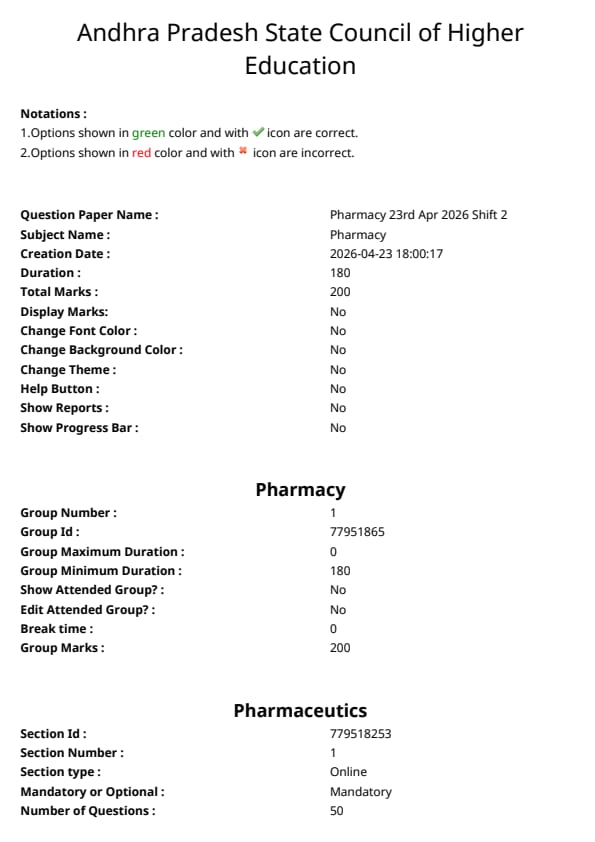
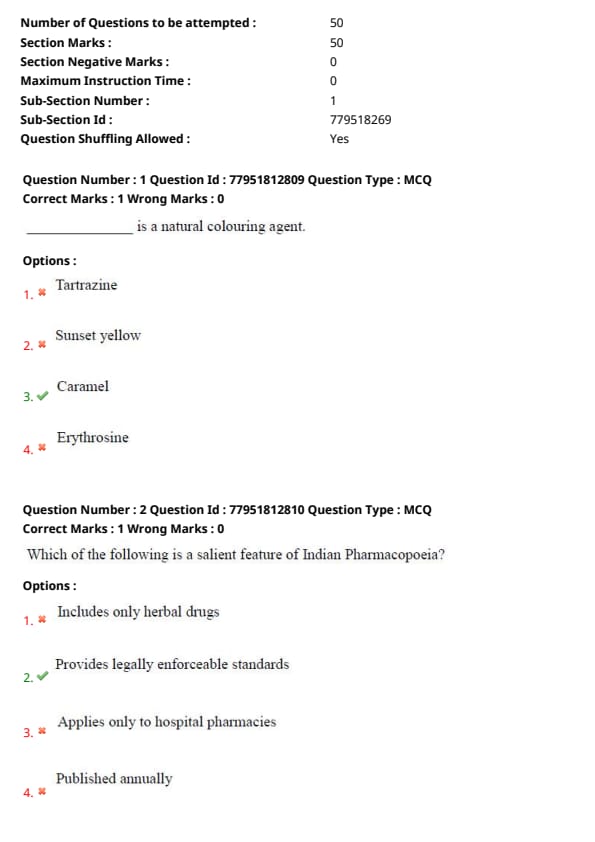
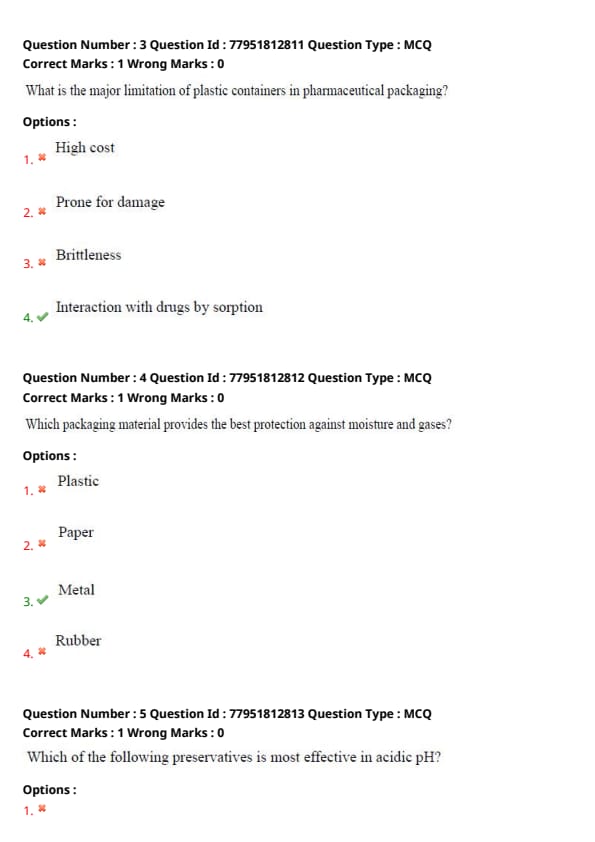
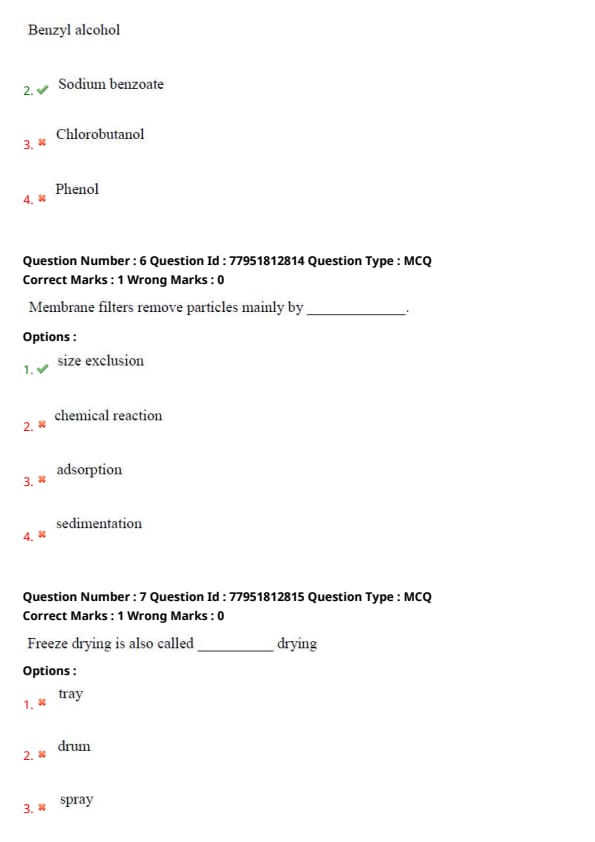
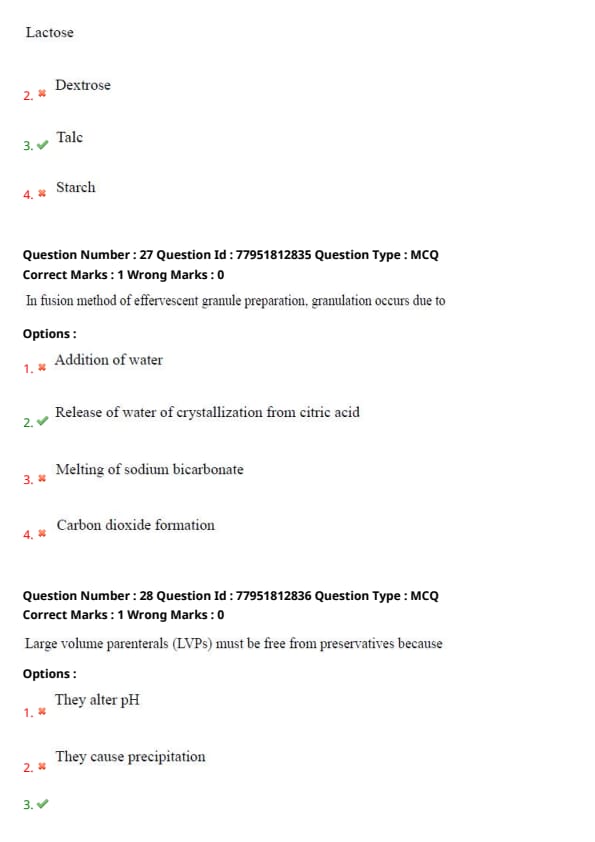
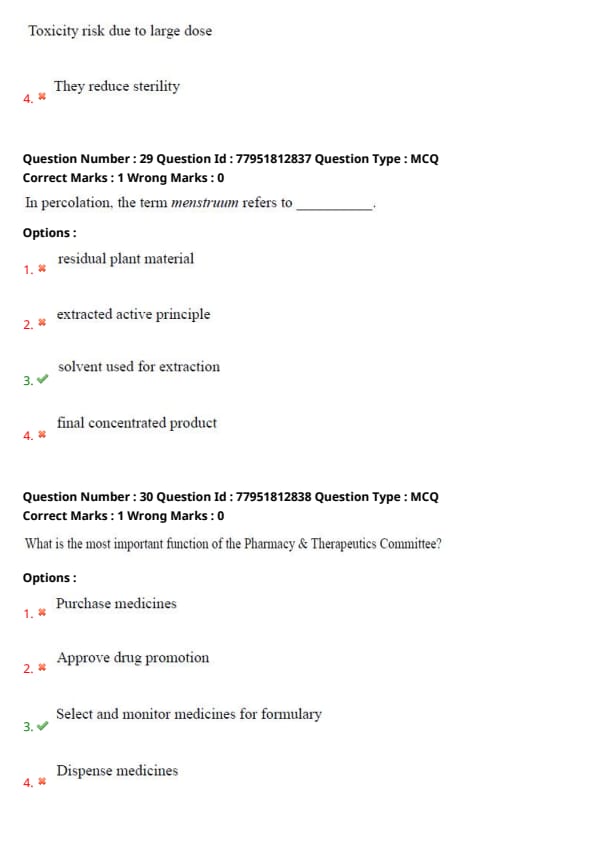
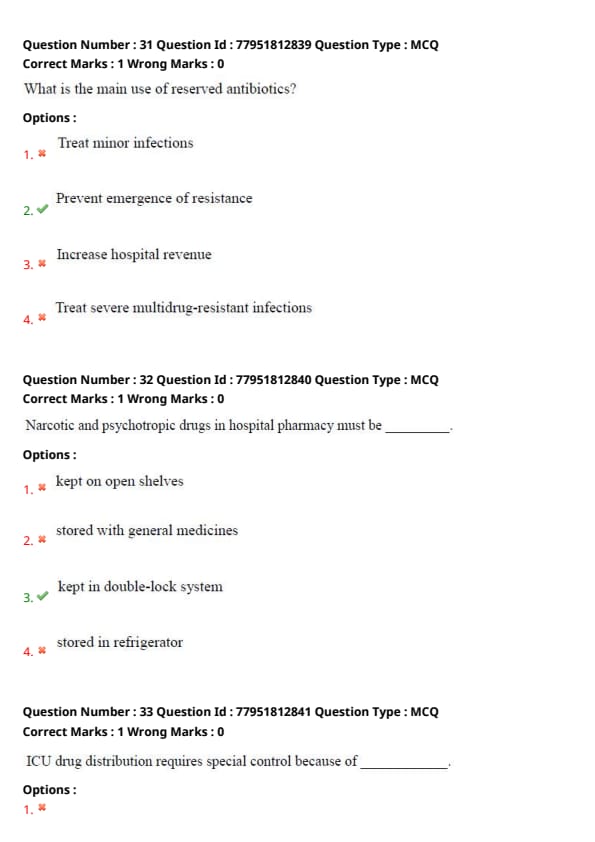
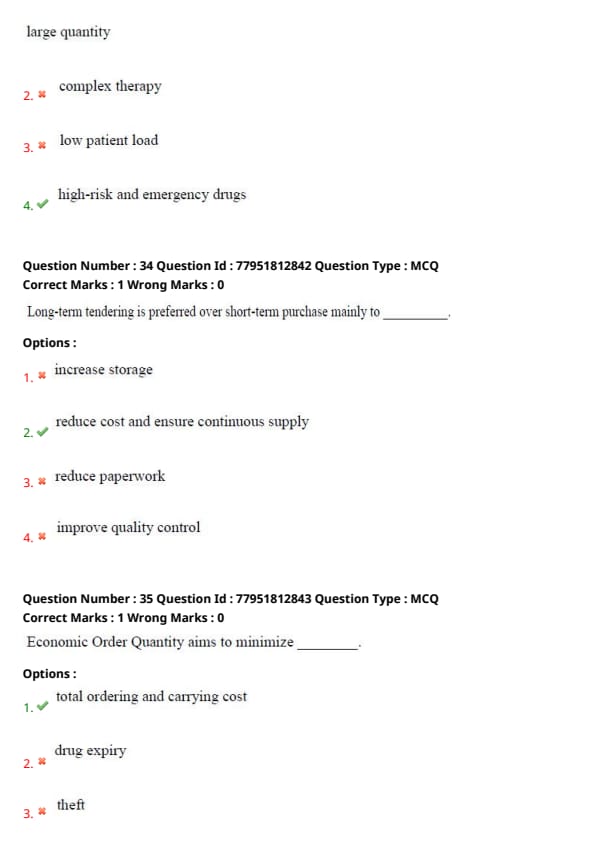
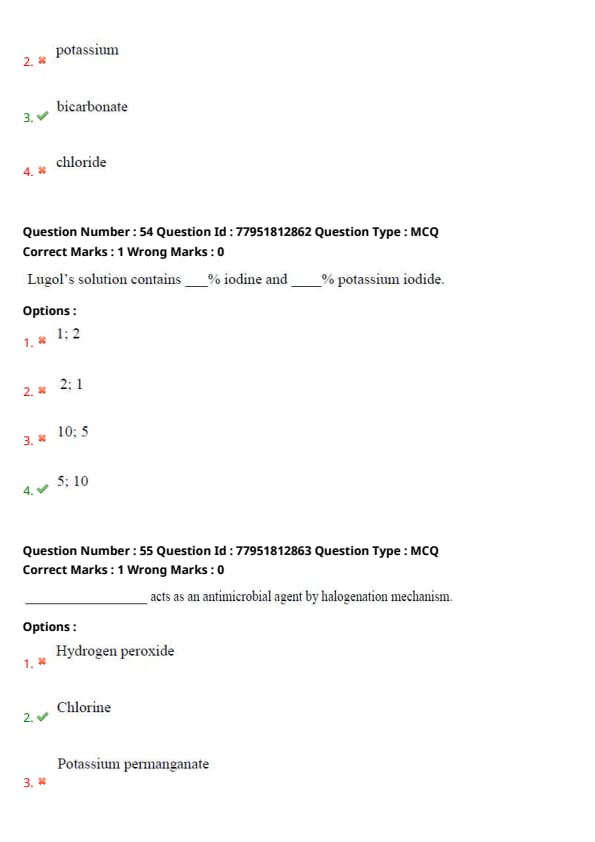
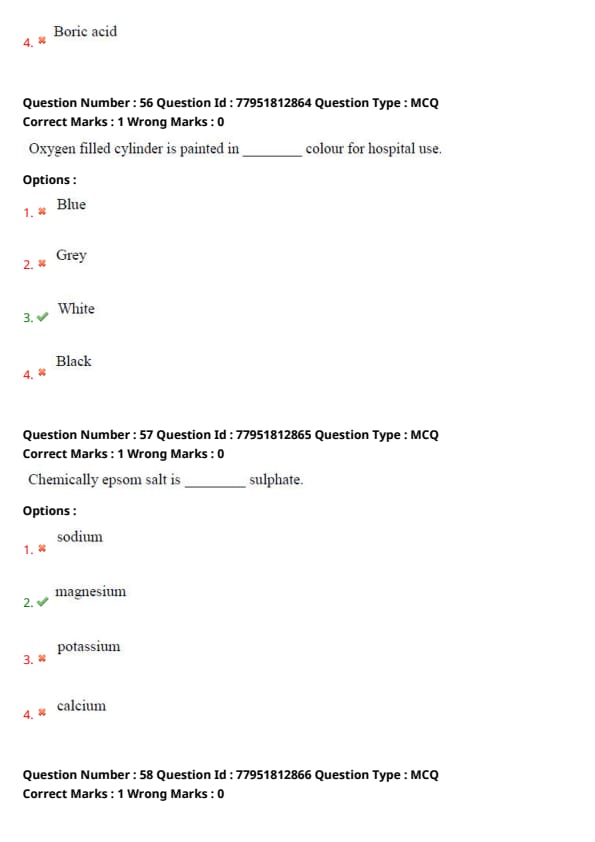
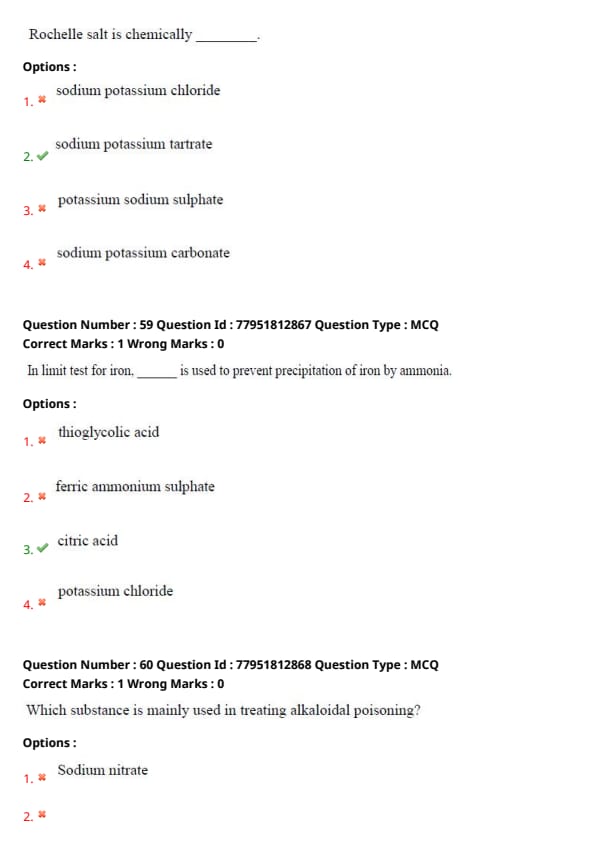
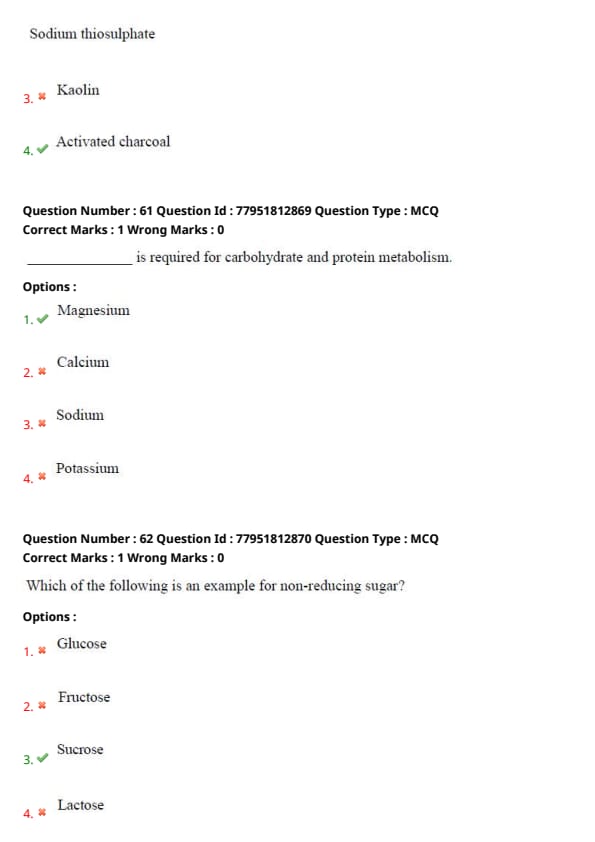
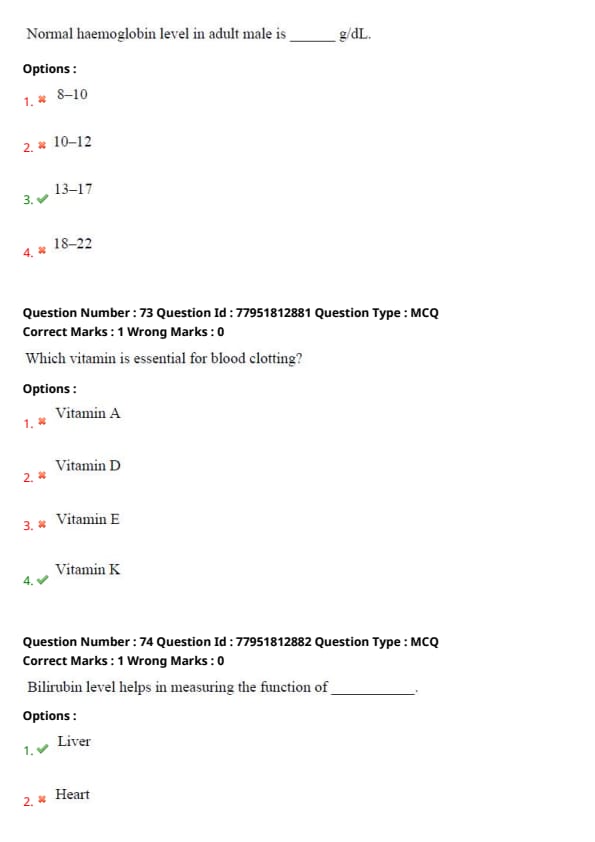
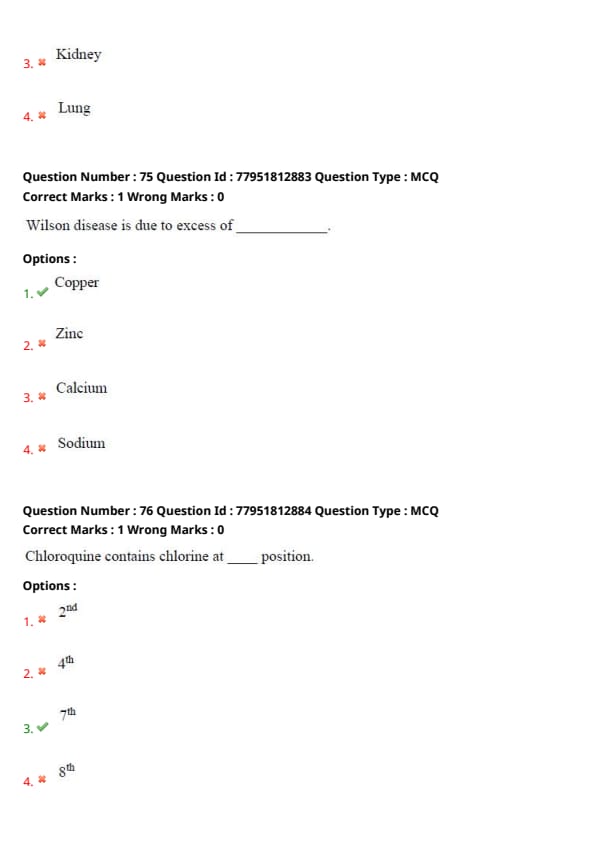
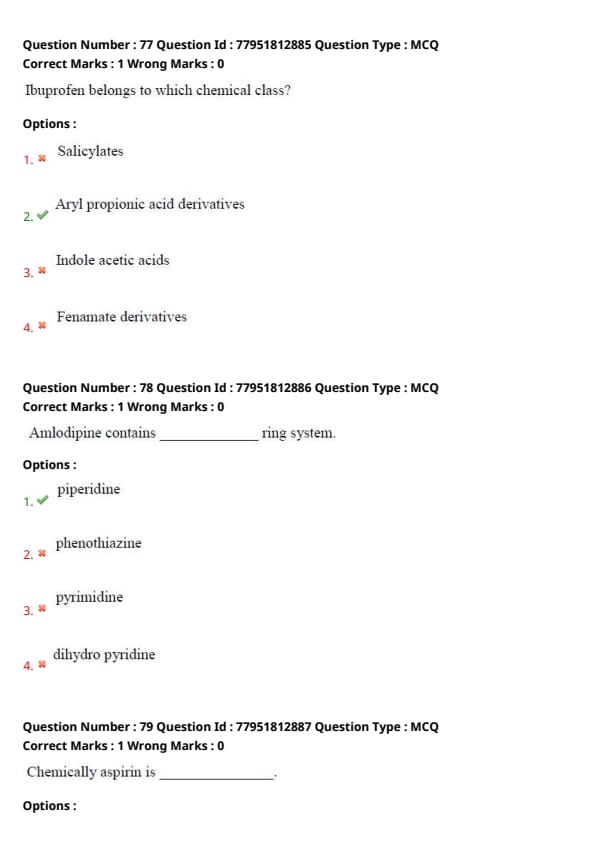
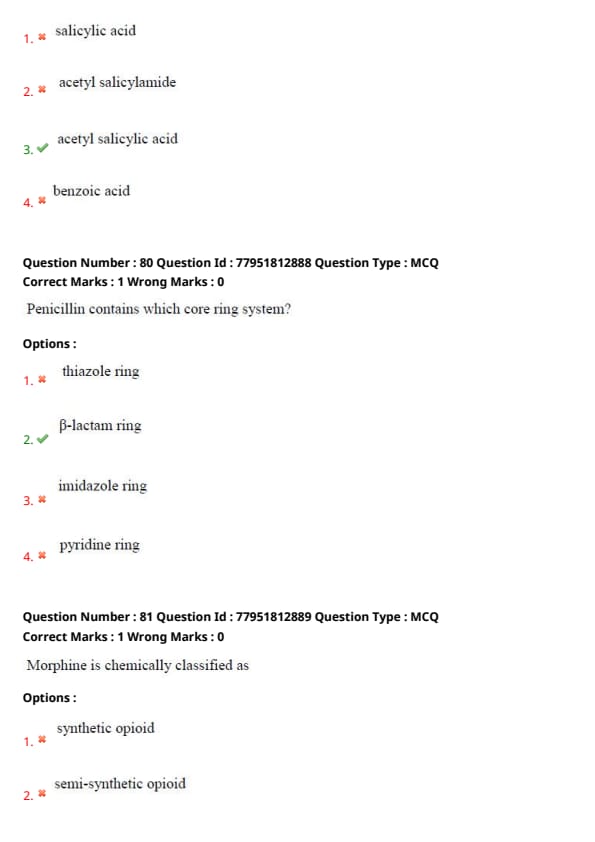
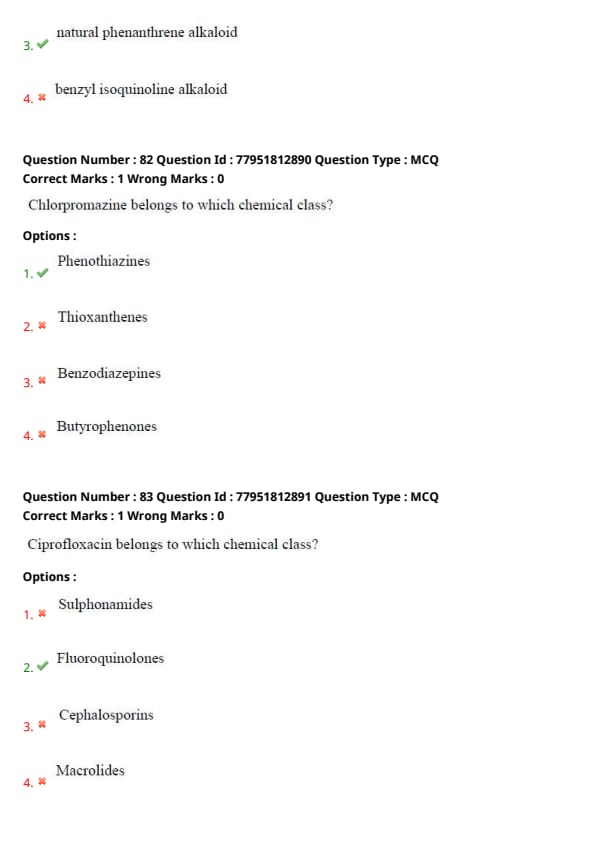
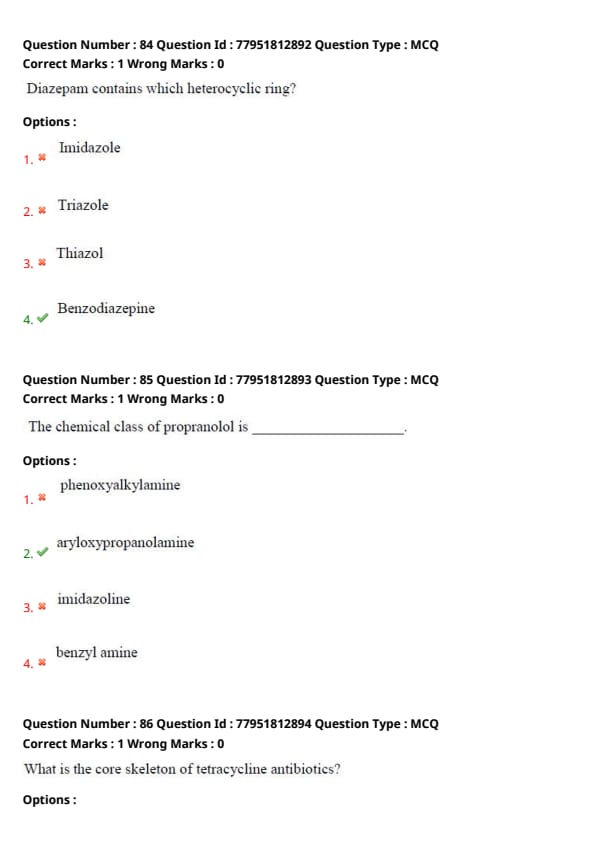
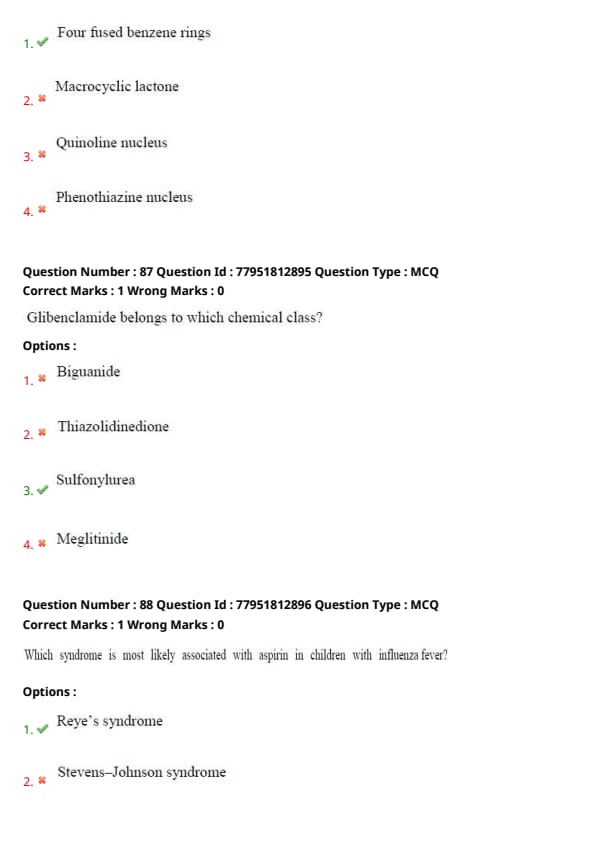
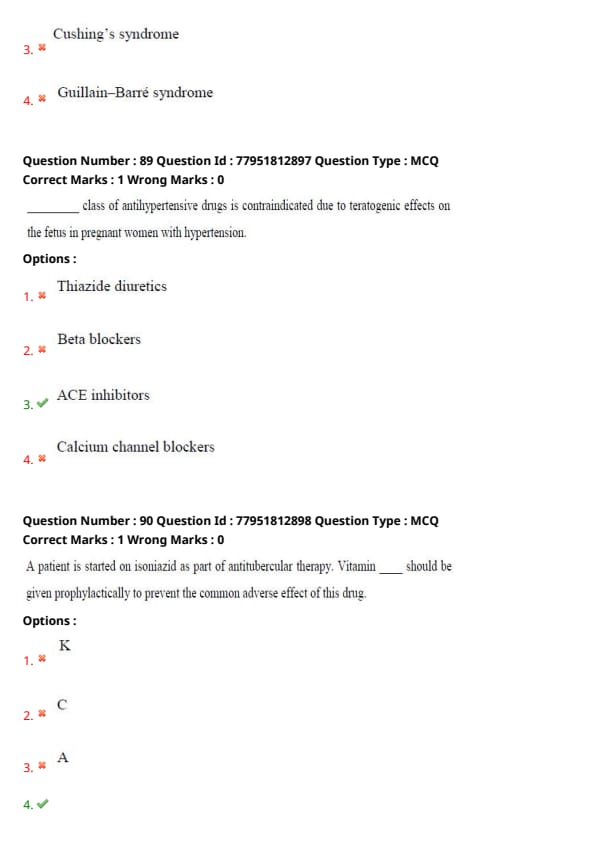
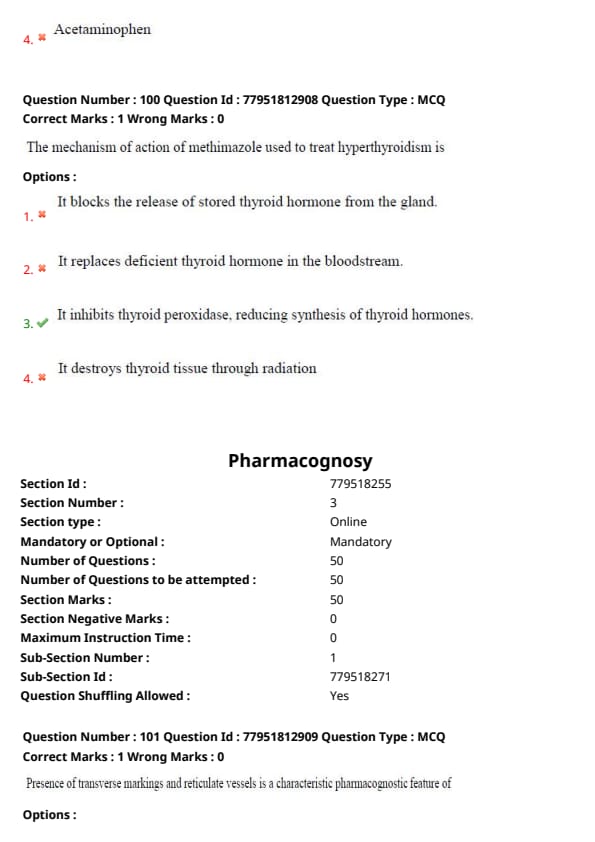
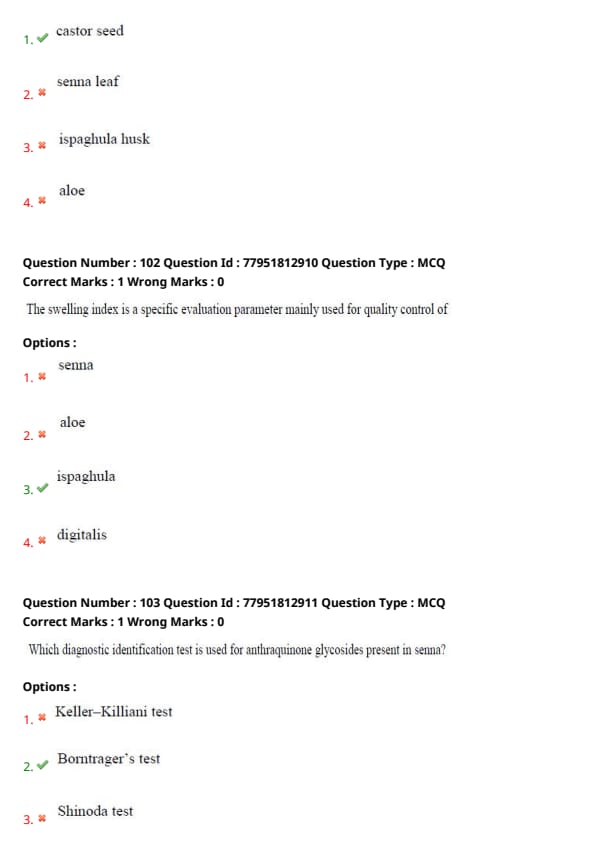
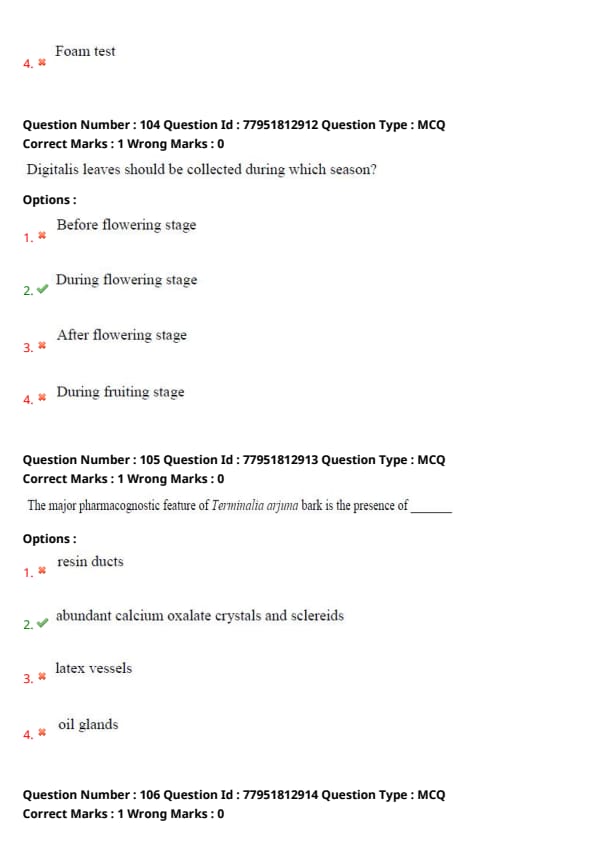
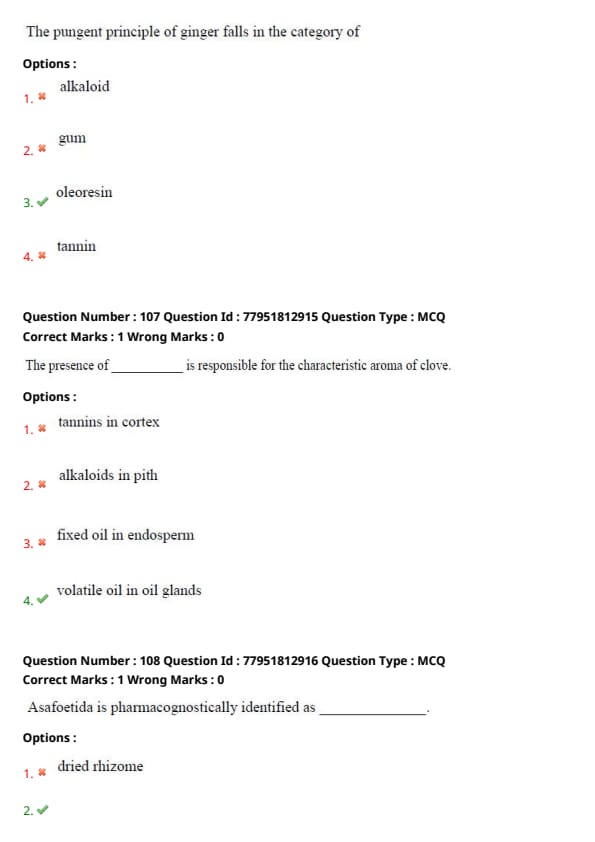
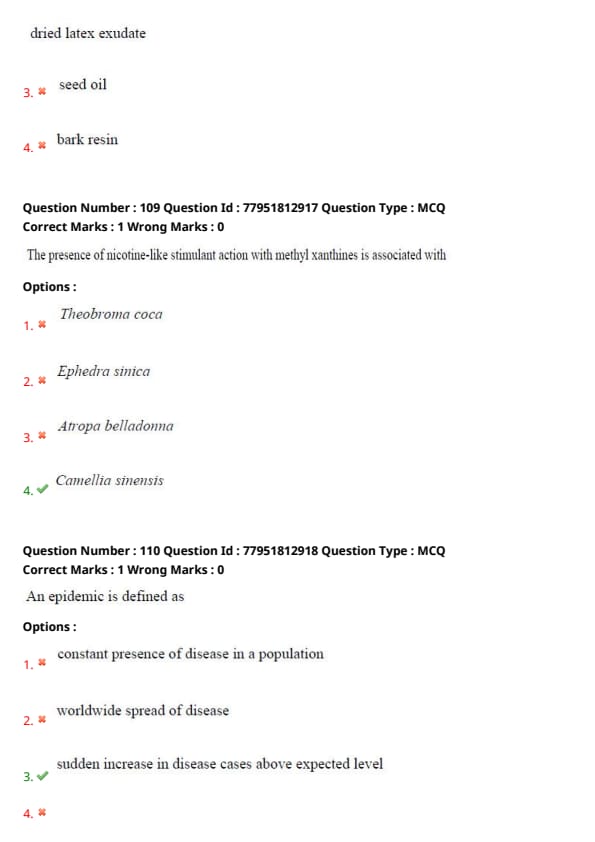
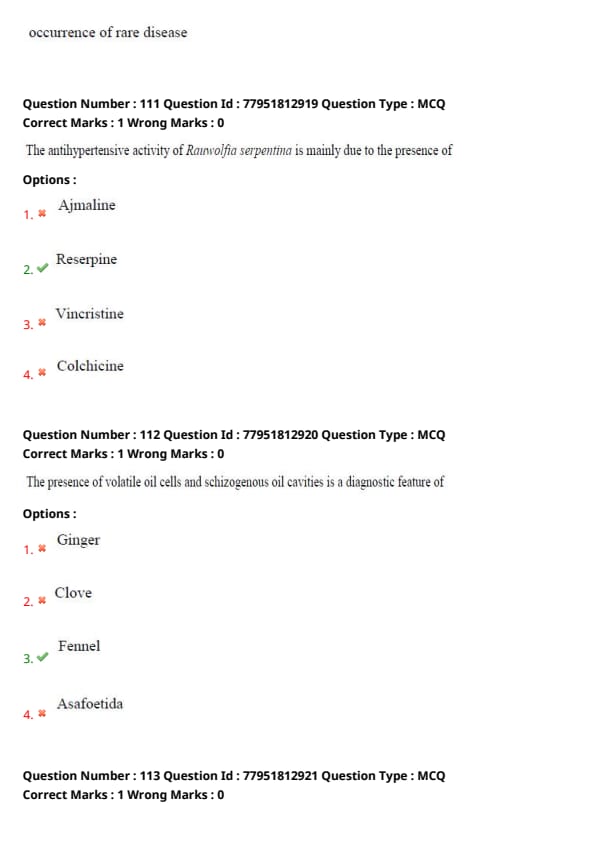
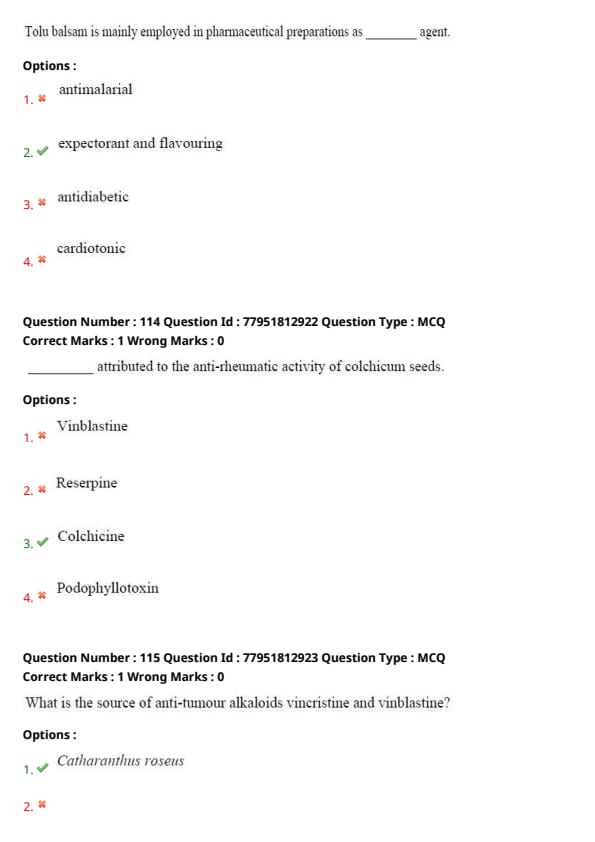
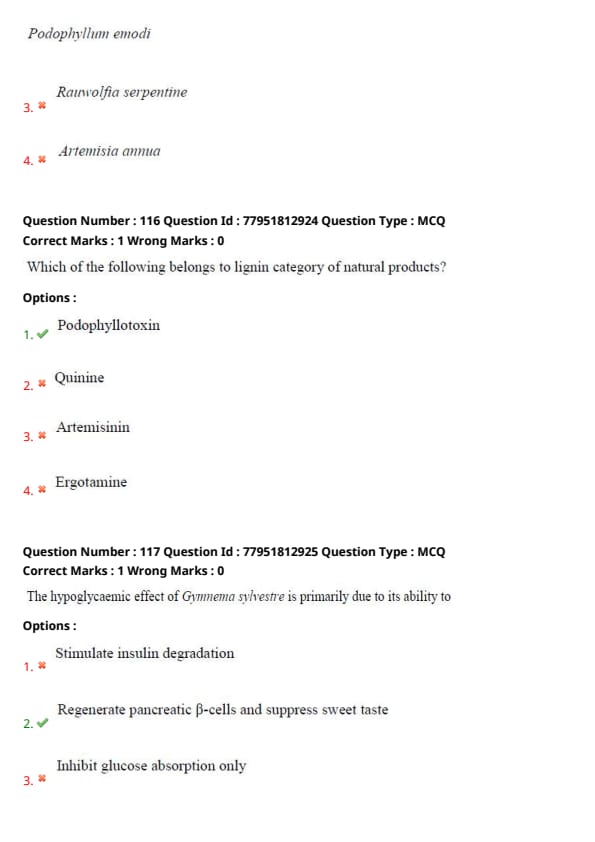
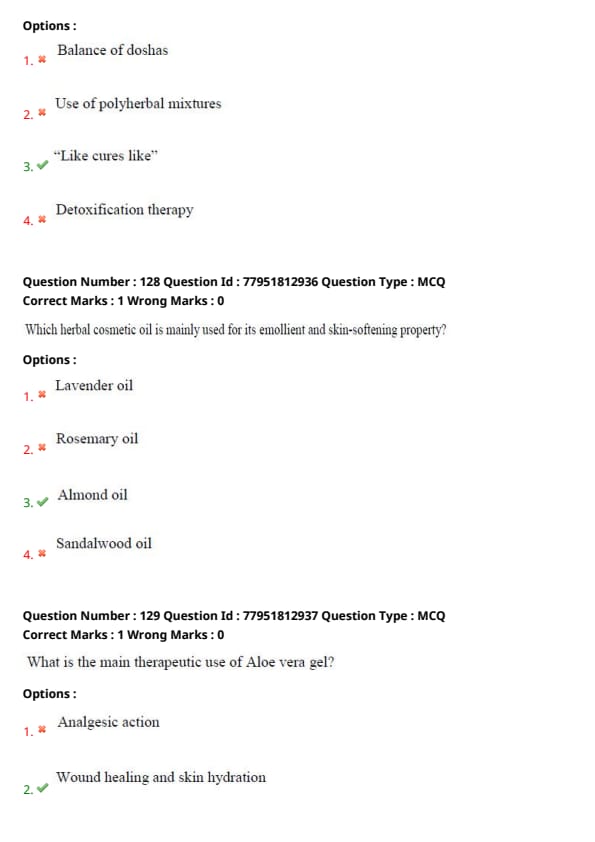
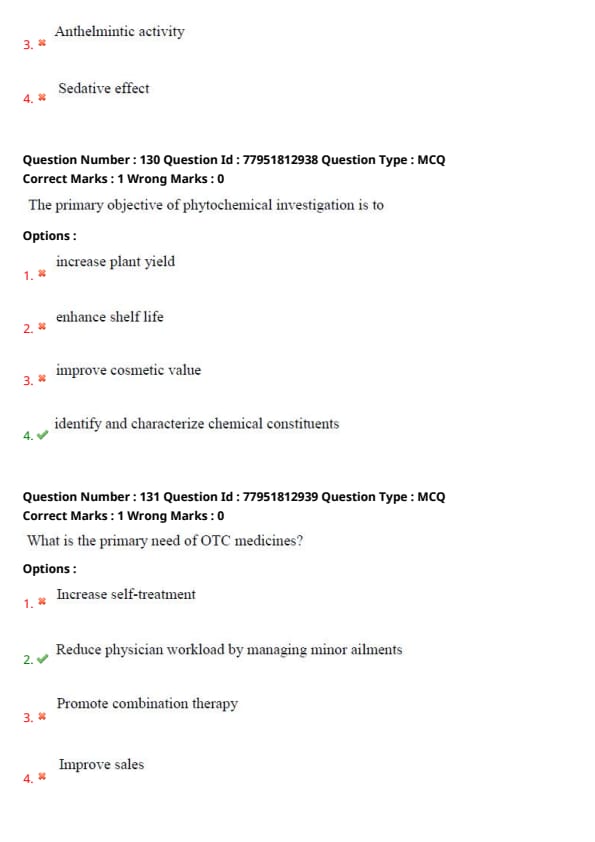
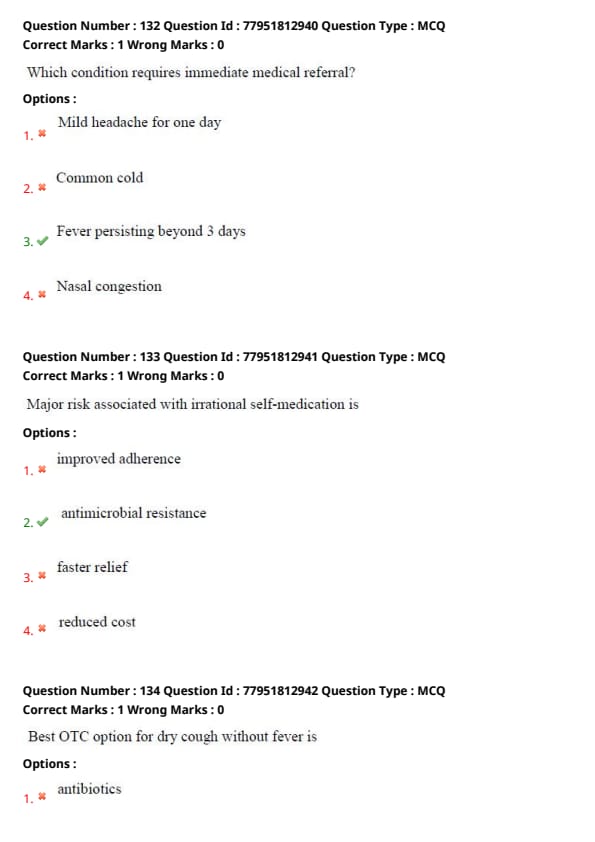
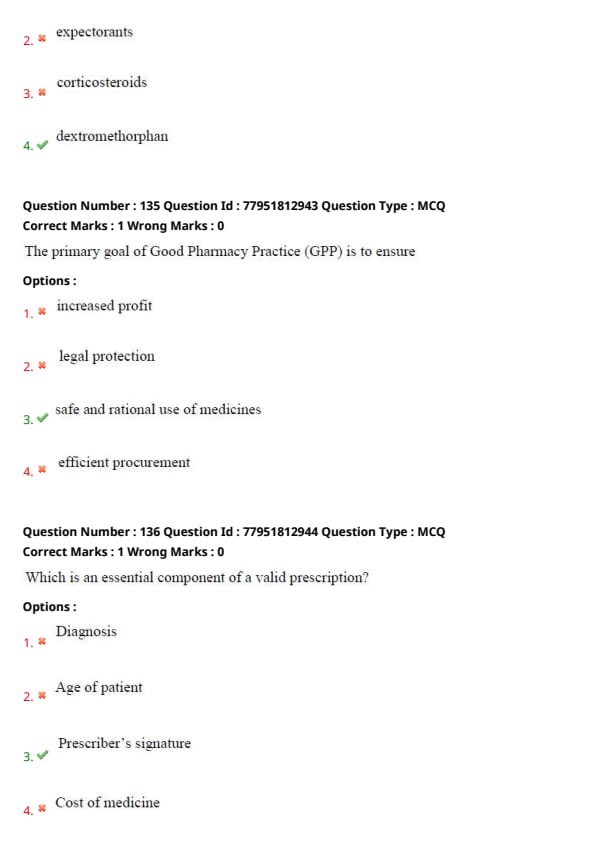
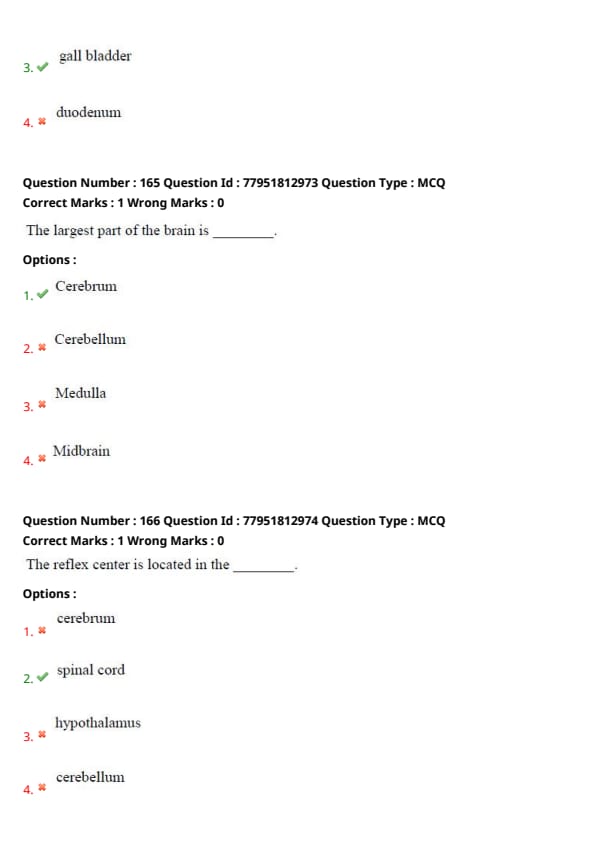
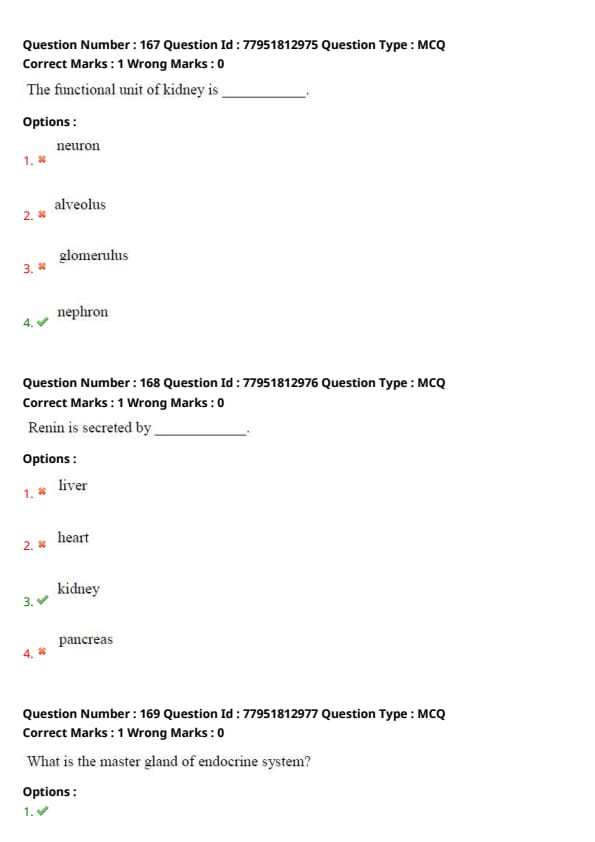
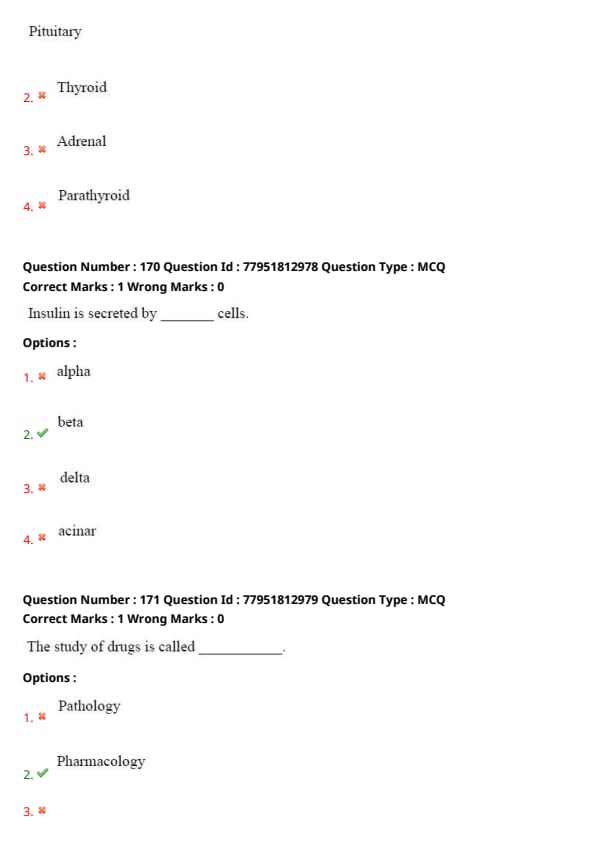
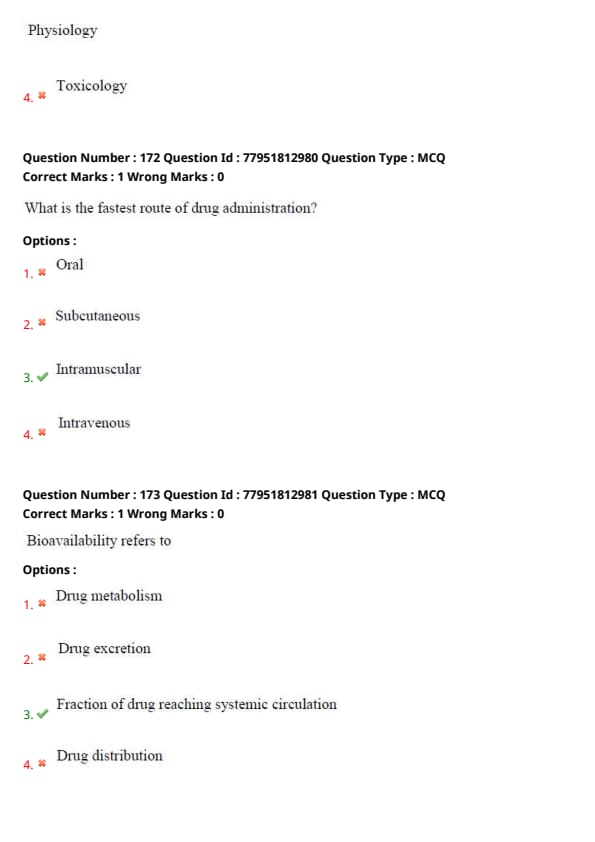
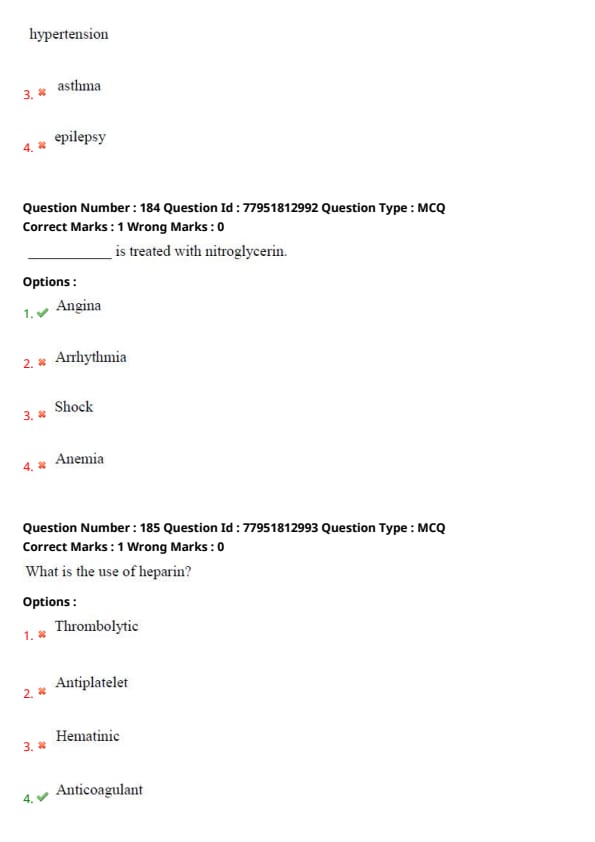
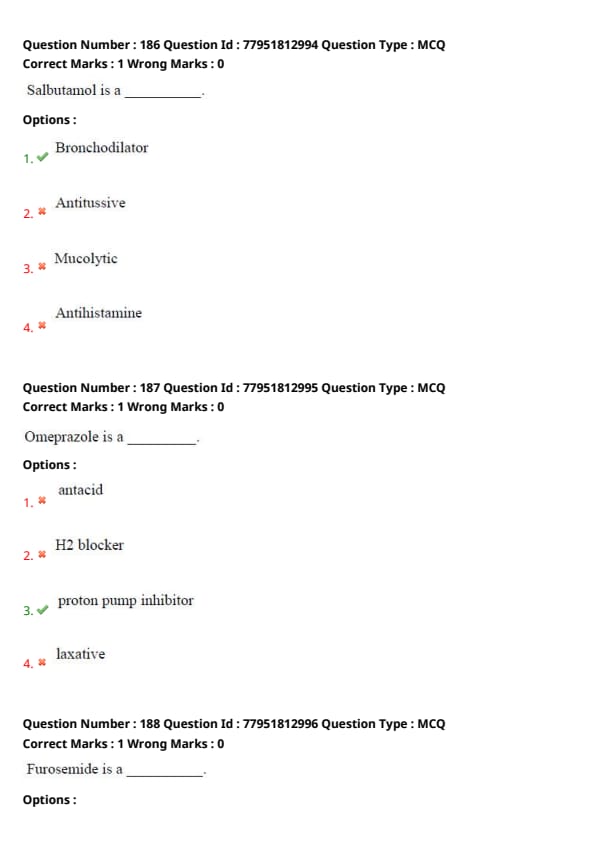
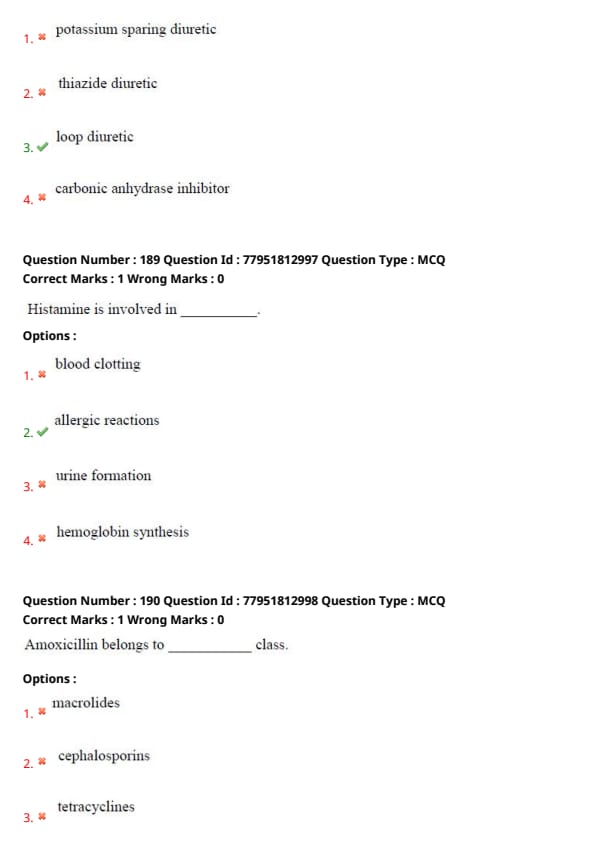
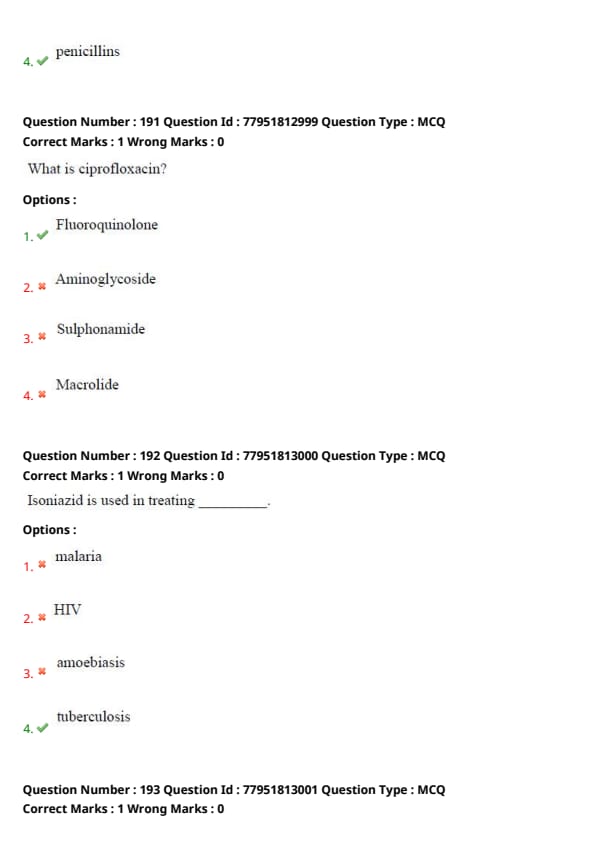
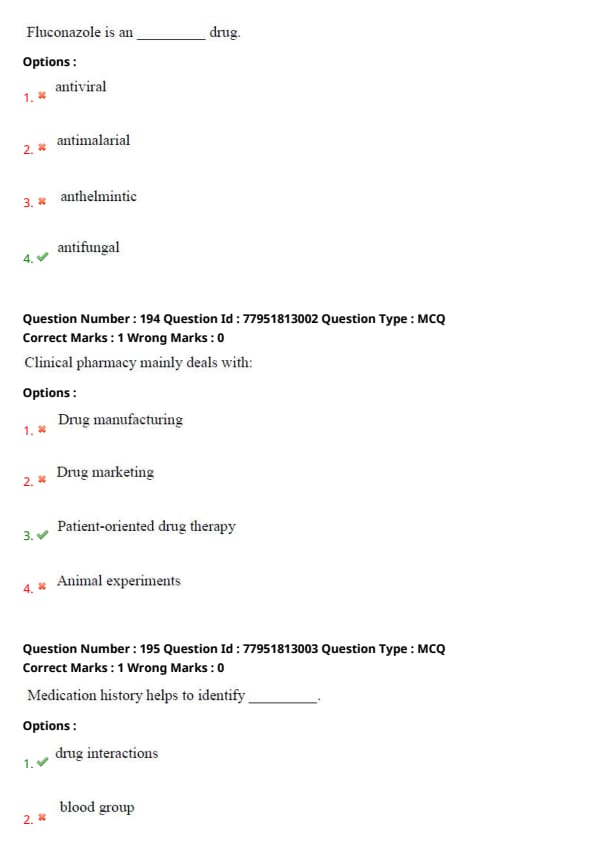
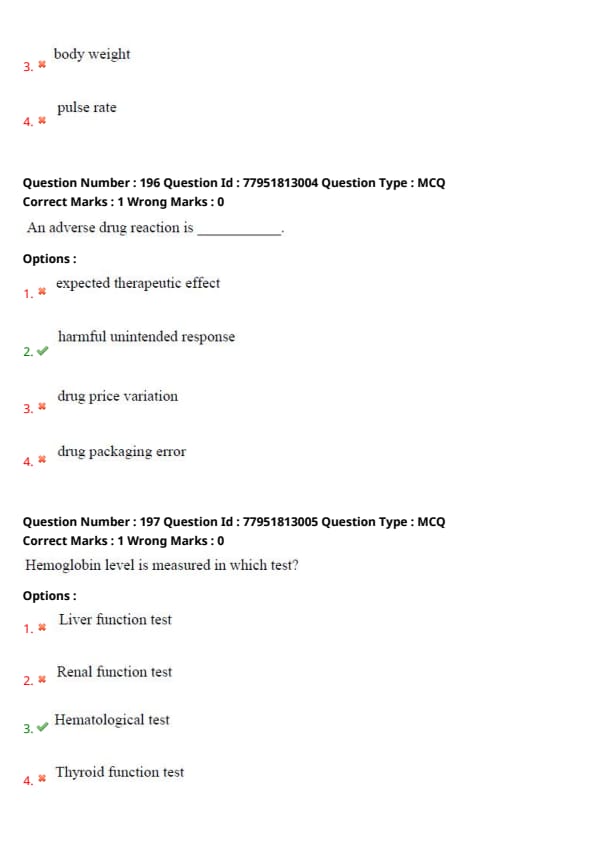
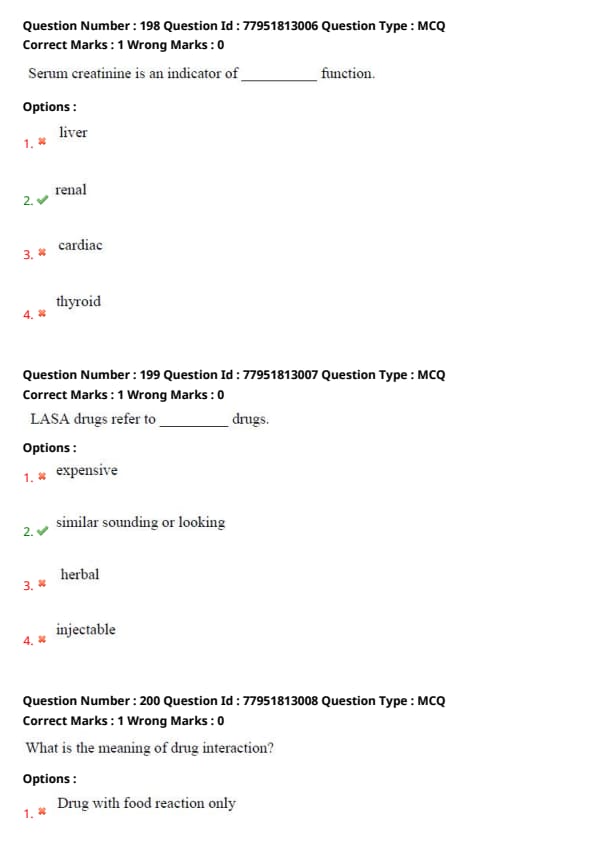
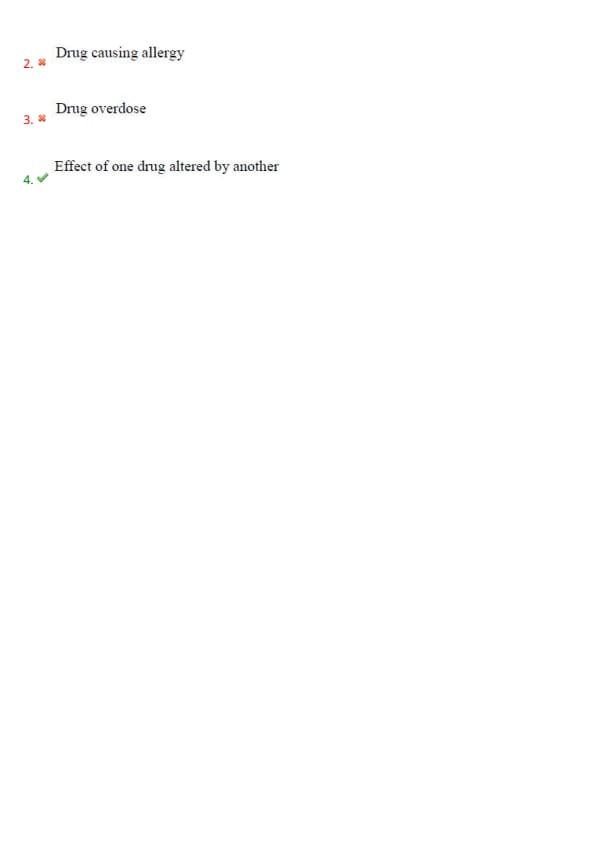
________ is a natural colouring agent.
View Solution
Step 1: Understanding the Concept:
Colouring agents are additives used in pharmaceutical formulations to impart colour for identification, aesthetic appeal, or to mask the unpleasant appearance of certain ingredients.
These are broadly classified into natural colours (derived from plant, animal, or mineral sources) and synthetic colours (certified coal-tar dyes).
Step 2: Detailed Explanation:
1. Caramel: It is a natural colouring agent produced by the controlled heat treatment (caramelization) of food-grade carbohydrates like sucrose or glucose. It is widely used in oral liquids like syrups to provide a brown colour.
2. Tartrazine: This is a synthetic lemon-yellow azo dye.
3. Sunset yellow: This is a synthetic orange-red azo dye.
4. Erythrosine: This is a synthetic cherry-pink coal-tar dye.
Step 3: Final Answer:
Among the given options, Caramel is the only substance derived from natural sources (sugar), whereas the others are synthetic dyes.
Quick Tip: Natural colours are generally considered safer but are less stable to light and pH changes compared to synthetic dyes like Tartrazine.
Which of the following is a salient feature of Indian Pharmacopoeia?
View Solution
Step 1: Understanding the Concept:
A Pharmacopoeia is an official book of standards for drugs and medicinal substances. The Indian Pharmacopoeia (IP) is published by the Indian Pharmacopoeia Commission (IPC) on behalf of the Ministry of Health and Family Welfare, Government of India.
Step 2: Detailed Explanation:
1. Legal Status: The IP is a statutory publication under the Drugs and Cosmetics Act, 1940. This means the standards for identity, purity, and strength of drugs prescribed in the IP are legally binding for manufacturers and distributors in India.
2. Scope: It includes synthetic drugs, biologicals, and herbal products, not just herbal drugs.
3. Frequency: It is not published annually; new editions are released every few years (e.g., 2018, 2022) with periodic addenda/supplements.
4. Applicability: It applies to the entire pharmaceutical industry, including manufacturing, retail, and clinical use, not just hospital pharmacies.
Step 3: Final Answer:
The primary function of the IP is to ensure the quality of medicines by providing standards that are legally enforceable.
Quick Tip: Always check the current edition of the IP; compliance with the latest edition is a mandatory requirement for pharmaceutical compliance in India.
What is the major limitation of plastic containers in pharmaceutical packaging?
View Solution
Step 1: Understanding the Concept:
While plastic containers offer advantages like being lightweight and non-breakable, they are chemically more active than glass. The major concern is the interaction between the plastic polymer and the drug formulation.
Step 2: Detailed Explanation:
1. Sorption: This refers to the adsorption (surface attachment) or absorption (penetration into the matrix) of drug components or preservatives into the plastic material. This can significantly reduce the concentration and potency of the drug.
2. Leaching: Plastics may release additives like plasticizers or antioxidants into the formulation, leading to toxicity.
3. Permeability: Plastics are permeable to gases and moisture, which can cause oxidation or hydrolysis of sensitive drugs.
4. Cost/Durability: Plastics are generally low-cost and highly resistant to damage, which are advantages, not limitations.
Step 3: Final Answer:
The physico-chemical interaction (sorption) of the drug with the container is the most critical technical limitation for pharmaceutical stability.
Quick Tip: Lipophilic drugs and preservatives like parabens are highly prone to sorption in low-density polyethylene (LDPE) containers.
Which packaging material provides the best protection against moisture and gases?
View Solution
Step 1: Understanding the Concept:
Packaging serves as a barrier against environmental factors like light, oxygen, and moisture. The effectiveness of this barrier depends on the density and molecular structure of the material.
Step 2: Detailed Explanation:
1. Metal: Metals like aluminium and tin provide an absolute barrier. Aluminium foil (as used in blister packs or tubes) is completely impermeable to moisture, gases, and light, provided it is of sufficient thickness and free of pinholes.
2. Plastic: Plastics have varying degrees of permeability. Even "barrier" plastics allow some moisture vapor transmission over time.
3. Paper: Being fibrous and porous, paper offers the least protection unless it is heavily coated with wax or plastic.
4. Rubber: Used for stoppers, rubber is permeable to air and can lose its integrity over time.
Step 3: Final Answer:
Metal (specifically aluminium) is the superior material for protecting sensitive pharmaceutical products from atmospheric degradation.
Quick Tip: "Alu-Alu" blister packs are the gold standard for packaging highly hygroscopic or light-sensitive drugs.
Which of the following preservatives is most effective in acidic pH?
View Solution
Step 1: Understanding the Concept:
The antimicrobial activity of organic acid preservatives (like benzoic acid) depends on the degree of ionization. Only the un-ionized (undissociated) form of the acid can cross the microbial cell membrane to exert its effect.
Step 2: Detailed Explanation:
1. Sodium Benzoate: In water, it dissociates into benzoate ions. In acidic conditions (pH \(<\) 4.5), these ions combine with hydrogen ions to form un-ionized benzoic acid.
2. Mechanism: Since benzoic acid has a \( pK_a \) of approximately 4.2, it is most effective as a preservative at pH values below 5. In alkaline pH, it remains ionized and loses its activity.
3. Other options: Benzyl alcohol and Chlorobutanol are less dependent on pH but are not specifically categorized by their high efficacy in acidic ranges like benzoates are.
Step 3: Final Answer:
Sodium benzoate is specifically chosen for acidic preparations (like syrups) because its active form, benzoic acid, predominates in that pH range.
Quick Tip: Always remember that organic acid preservatives like Benzoic acid, Sorbic acid, and Salicylic acid require an acidic environment to function.
Membrane filters remove particles mainly by ________.
View Solution
Step 1: Understanding the Concept:
Filtration can occur via different mechanisms: sieving (size exclusion), adsorption, or entrapment. Membrane filters are thin, polymeric films with a highly uniform pore structure.
Step 2: Detailed Explanation:
1. Size Exclusion: Membrane filters act as a sieve. Any particle larger than the designated pore size (e.g., 0.22 \(\mu\)m) is physically blocked from passing through. This is the primary mechanism used for cold sterilization of heat-sensitive liquids.
2. Adsorption: This occurs when particles stick to the filter medium due to electrostatic or surface forces. While some membrane filters may have minor adsorptive properties, it is not their main mechanism.
3. Sedimentation: This is the settling of particles due to gravity, which is not a filtration mechanism.
Step 3: Final Answer:
The primary characteristic of a membrane filter is its "absolute" pore size, which operates through size exclusion.
Quick Tip: A 0.22 micron pore size membrane filter is considered the standard for sterilizing pharmaceutical solutions.
Freeze drying is also called ________ drying.
View Solution
Step 1: Understanding the Concept:
Freeze drying (Lyophilization) is a dehydration process used to preserve heat-sensitive materials. It involves freezing the product and then removing the solvent under vacuum.
Step 2: Detailed Explanation:
1. Process: The water in the product is first frozen into ice.
2. Phase Change: Under reduced pressure (vacuum), the ice is converted directly into water vapor without passing through the liquid phase. This physical change (Solid \(\rightarrow\) Gas) is called sublimation.
3. Advantages: Since the product is dried at very low temperatures, there is minimal degradation of thermolabile drugs (e.g., vaccines, antibiotics).
Step 3: Final Answer:
Because the drying mechanism relies on the sublimation of ice, freeze drying is frequently referred to as sublimation drying.
Quick Tip: Freeze drying is the method of choice for preparing dry powders of biologics and parenterals that are unstable in aqueous solutions.
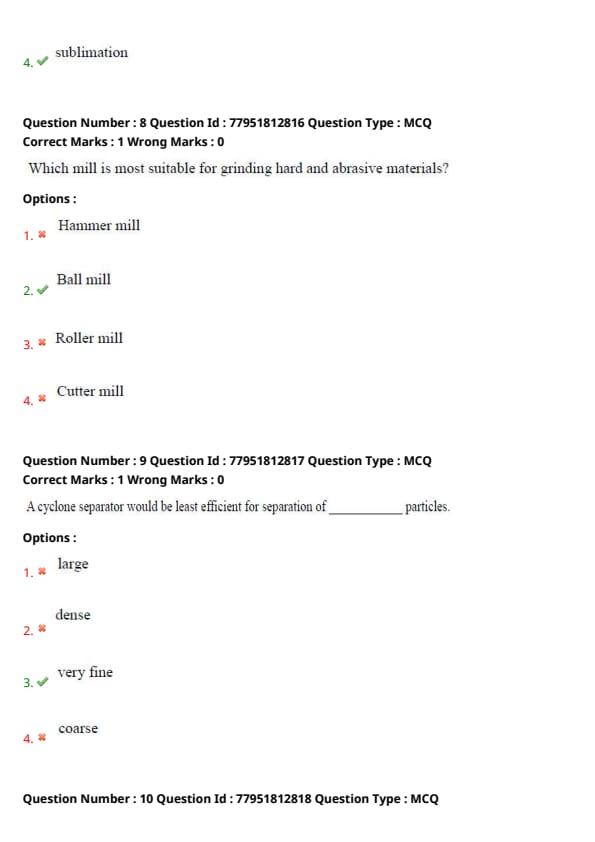
Which mill is most suitable for grinding hard and abrasive materials?
View Solution
Step 1: Understanding the Concept:
Selection of a mill depends on the physical properties of the material (hardness, abrasiveness, moisture) and the desired final particle size.
Step 2: Detailed Explanation:
1. Ball Mill: It works on the principle of Impact and Attrition. It consists of a rotating cylinder containing balls (made of steel or porcelain). It is highly effective for hard and abrasive materials because the crushing action occurs within a closed system, and the balls can withstand significant wear.
2. Hammer Mill: Good for brittle materials, but abrasive materials will cause high wear and tear on the hammers.
3. Cutter Mill: Used for fibrous or waxy materials (crude drugs) via a shearing action.
4. Roller Mill: Used for crushing soft materials or in the production of ointments.
Step 3: Final Answer:
The ball mill is the most robust and efficient choice for reducing the size of hard and abrasive pharmaceutical substances.
Quick Tip: For maximum efficiency, a ball mill should be operated at its "critical speed," where the balls cascade over the material rather than just rotating with the cylinder.
A cyclone separator would be least efficient for separation of ________ particles.
View Solution
Step 1: Understanding the Concept:
A cyclone separator uses centrifugal force to separate solid particles from a gas stream. The fluid enters tangentially, creating a vortex.
Step 2: Detailed Explanation:
1. Mechanism: Large and dense particles have more inertia. The centrifugal force throws them against the walls of the separator, where they lose velocity and fall to the collection hopper.
2. Fine Particles: Very fine particles (usually \(< 5\) \(\mu\)m) have very little mass. The centrifugal force acting on them is often less than the drag force of the air stream. Therefore, these particles stay suspended in the air and exit through the top outlet rather than being separated.
Step 3: Final Answer:
As particle size decreases, the efficiency of a cyclone separator drops significantly, making it least efficient for very fine particles.
Quick Tip: Cyclone separators are often used as "pre-separators" to remove coarse dust before the air goes through more efficient but expensive bag filters.
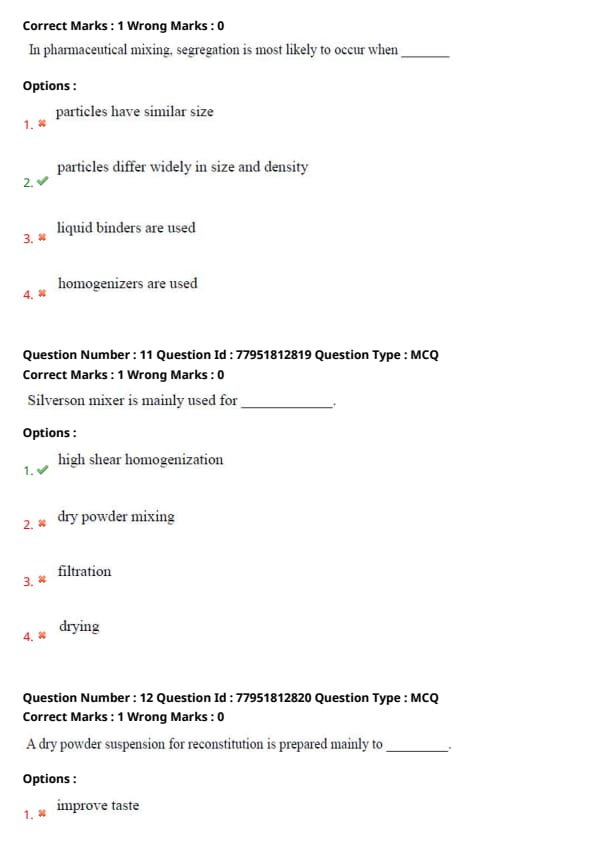
In pharmaceutical mixing, segregation is most likely to occur when ________.
View Solution
Step 1: Understanding the Concept:
Segregation (also called demixing) is the undesirable separation of a previously uniform mixture into its components. This is a common problem in powder handling.
Step 2: Detailed Explanation:
1. Percolation Segregation: If there is a wide range of particle sizes, smaller particles can fall through the gaps between larger particles during movement or vibration.
2. Trajectory Segregation: Heavier or larger particles travel further when thrown or tumbled compared to smaller/lighter ones.
3. Density effects: Particles with different densities will respond differently to gravity and centrifugal forces during mixing.
4. Prevention: Using liquid binders (wet granulation) or having uniform particle sizes (Option A) prevents segregation.
Step 3: Final Answer:
Variance in size and density is the primary driver of segregation in dry powder mixtures.
Quick Tip: To prevent segregation, ensure that the particle size distribution of all ingredients is as narrow and uniform as possible before mixing.
Silverson mixer is mainly used for ________.
View Solution
Step 1: Understanding the Concept:
Mixers in pharmaceutics are chosen based on the state of the materials (solid, liquid, or semi-solid) and the required intensity of mixing. Homogenization requires intense mechanical force to break down droplets or particles into a uniform state.
Step 2: Detailed Explanation:
1. Mechanism: The Silverson mixer is a high-speed rotor-stator type mixer. It consists of a high-speed rotor rotating within a fixed stator head.
2. Action: As the rotor blades rotate, they pull materials into the mixing head and then expel them at high velocity through the openings in the stator. This creates intense hydraulic shear, which breaks down globule sizes in emulsions and particle sizes in suspensions.
3. Applications: It is widely used for the preparation of emulsions, creams, and high-quality homogenates where standard stirring is insufficient.
Step 3: Final Answer:
The primary function of the Silverson mixer's high-velocity rotor-stator design is to provide the high shear necessary for homogenization.
Quick Tip: Remember that rotor-stator mixers are the "gold standard" for creating stable emulsions because they can reduce oil globule sizes to the sub-micron range.
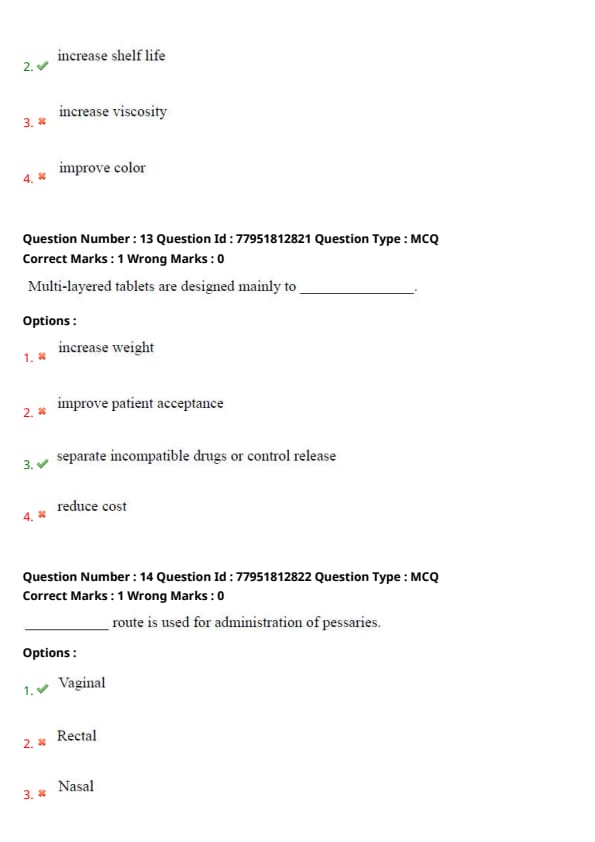
A dry powder suspension for reconstitution is prepared mainly to ________.
View Solution
Step 1: Understanding the Concept:
Many pharmaceutical active ingredients, particularly antibiotics like amoxicillin or cephalosporins, are chemically unstable when stored in an aqueous (liquid) environment for long periods. They tend to undergo hydrolysis.
Step 2: Detailed Explanation:
1. Stability: In the solid (dry) state, the rate of chemical degradation is significantly lower than in the liquid state.
2. Reconstitution: By formulating the drug as a dry powder or granules, the manufacturer can provide a product that is stable for years on the shelf. The pharmacist or patient adds water only when the treatment starts.
3. Usage: Once water is added, the suspension usually remains stable for only 7 to 14 days, usually requiring refrigeration.
Step 3: Final Answer:
The dry powder form is a strategic formulation choice to bypass the stability issues of aqueous liquids, thereby effectively increasing the shelf life of the product.
Quick Tip: "Reconstitution" is synonymous with "dry syrups." Always check the label for the "discard after" date once the water is added.
Multi-layered tablets are designed mainly to ________.
View Solution
Step 1: Understanding the Concept:
Advanced tablet designs allow for the delivery of multiple drugs in one unit or the modification of how a single drug is released into the body.
Step 2: Detailed Explanation:
1. Incompatibility: Some drugs react chemically with each other if mixed in a single-layer tablet. By placing them in separate layers, we can prevent physical or chemical interaction while still providing a single dosage unit.
2. Controlled Release: A tablet can have one layer designed for immediate release (to provide a quick therapeutic effect) and another layer designed for sustained release (to maintain drug levels over many hours).
3. Complexity: These require special multi-stage tablet presses but offer high therapeutic precision.
Step 3: Final Answer:
The primary pharmaceutical reasons for layering are to protect drug stability (separation) and to engineer complex delivery profiles (controlled release).
Quick Tip: Bi-layered tablets are common in cold and flu medications, often combining a decongestant in one layer and an analgesic in another.
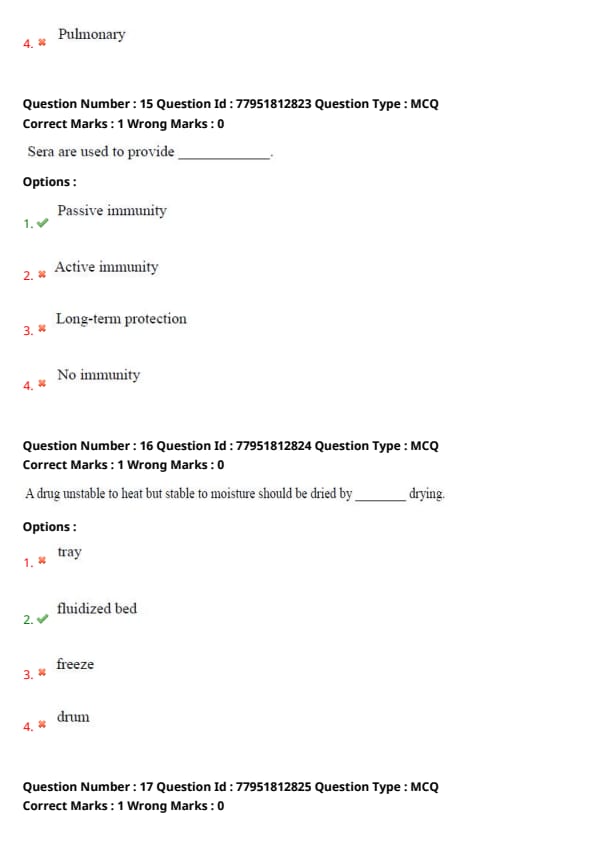
________ route is used for administration of pessaries.
View Solution
Step 1: Understanding the Concept:
Solid dosage forms intended for insertion into body orifices (other than the mouth) have specific names based on their intended site of action.
Step 2: Detailed Explanation:
1. Pessaries: These are solid medicated preparations designed for insertion into the vagina. They are often used for local infections (anti-fungals) or hormonal therapy.
2. Suppositories: These are designed for insertion into the rectum.
3. Bougies: These are designed for insertion into the urethra or nasal cavity (though nasal bougies are rare now).
Step 3: Final Answer:
Based on pharmaceutical nomenclature, pessaries are exclusively vaginal dosage forms.
Quick Tip: Don't confuse "pessaries" with "vaginal tablets." While both go in the same place, pessaries are usually made of a fatty or glycerinated-gelatin base that melts at body temperature.
Sera are used to provide ________.
View Solution
Step 1: Understanding the Concept:
Immunity can be classified based on how the body acquires antibodies. Active immunity involves the body producing its own antibodies, while passive immunity involves receiving pre-formed antibodies.
Step 2: Detailed Explanation:
1. Sera (Antisera): These are biological products obtained from the blood of humans or animals that have already been immunized. They contain a high concentration of specific antibodies.
2. Passive Immunity: Because the recipient's body does not produce the antibodies itself, the immunity is "passive." It provides immediate protection but is short-lived (lasting only a few weeks) because the body eventually breaks down the foreign antibodies.
3. Contrast: Vaccines provide active immunity by stimulating the immune system to produce its own defenses and memory cells.
Step 3: Final Answer:
Sera provide immediate, pre-formed antibody defense, which is defined as passive immunity.
Quick Tip: Sera are typically used in emergency situations, such as anti-venom for snake bites or anti-tetanus serum after an injury.
A drug unstable to heat but stable to moisture should be dried by ________ drying.
View Solution
Step 1: Understanding the Concept:
Drying equipment selection depends on the sensitivity of the material to temperature and the presence of moisture.
Step 2: Detailed Explanation:
1. Fluidized Bed Drying: In this process, hot air is passed through a bed of wet particles at a velocity high enough to suspend them (fluidization). This results in extremely high heat and mass transfer rates.
2. Heat Sensitivity: Because the drying is very rapid (often taking 15 to 30 minutes compared to several hours in a tray dryer), the effective "heat load" on the drug is minimized. The evaporation of moisture also keeps the particles relatively cool during the process.
3. Moisture Stability: Since the drug is stable to moisture, the contact with air/humidity during fluidization is not an issue.
4. Other Options: Freeze drying (Option C) is for extremely heat-sensitive drugs (thermolabile) and is very expensive. Drum drying (Option D) involves high surface temperatures which would damage heat-unstable drugs.
Step 3: Final Answer:
Fluidized bed drying is the most efficient and practical method for drugs that require quick drying to avoid heat degradation but can tolerate a moisture environment.
Quick Tip: Fluidized bed dryers provide much better uniformity and 15 times faster drying than conventional tray dryers.
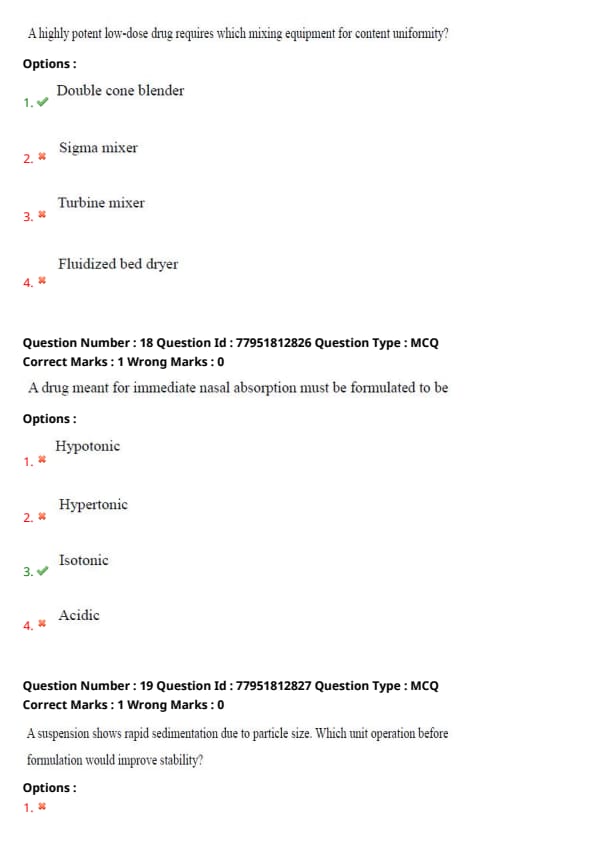
A highly potent low-dose drug requires which mixing equipment for content uniformity?
View Solution
Step 1: Understanding the Concept:
For "potent" drugs (e.g., dose \(<\) 1 mg), achieving "content uniformity" is the biggest challenge. The drug must be distributed evenly throughout a large mass of excipients.
Step 2: Detailed Explanation:
1. Tumbling Mixers: Equipment like the double cone blender or V-blender works by tumbling the powder mass. This provides gentle yet thorough macroscopic mixing.
2. Content Uniformity: Double cone blenders are specifically designed to eliminate "dead spots" where powder might not mix. The shape promotes a rolling and folding action that is highly effective for free-flowing powders.
3. Sigma Mixer: This is a high-consistency mixer used for doughs and pastes, not suitable for dry powder uniformity of low-dose drugs.
Step 3: Final Answer:
For dry powder blending where precision is key, the double cone blender is the preferred equipment to ensure every tablet or capsule contains exactly the same amount of a low-dose drug.
Quick Tip: When mixing low-dose drugs, always use the "Geometric Dilution" technique: add the drug to an equal volume of diluent, mix, and repeat until all diluent is incorporated.
A drug meant for immediate nasal absorption must be formulated to be ________.
View Solution
Step 1: Understanding the Concept:
The nasal mucosa is sensitive. Formulations applied to it must respect its physiological environment to avoid irritation and damage to the ciliary movement.
Step 2: Detailed Explanation:
1. Tonicity: Isotonic solutions have the same osmotic pressure as body fluids (like nasal secretions or blood, equivalent to 0.9% NaCl).
2. Irritation: If a solution is hypertonic (too much salt), it will draw water out of the mucosal cells, causing stinging and shrinkage. If it is hypotonic, cells may swell.
3. Ciliary function: The cilia in the nose move mucus toward the throat. They function best in isotonic conditions. Any significant deviation will stop their movement, leading to drug clearance issues.
Step 3: Final Answer:
To ensure patient comfort and optimal absorption without damaging the delicate nasal tissue, the formulation must be isotonic.
Quick Tip: Nasal drops and eye drops are almost always formulated with buffers and salts to be isotonic and have a pH close to 7.4.
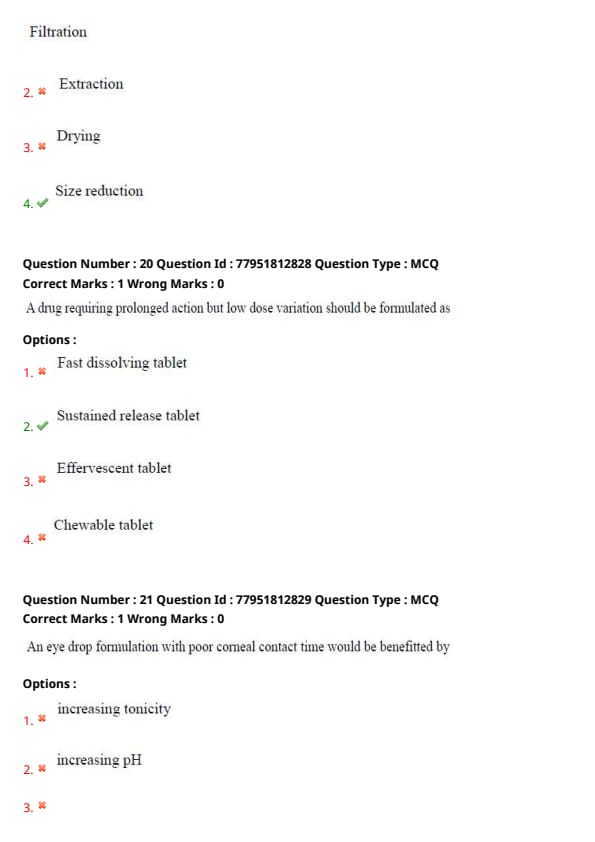
A suspension shows rapid sedimentation due to particle size. Which unit operation before formulation would improve stability?
View Solution
Step 1: Understanding the Concept:
The stability of a suspension is defined by the rate of sedimentation. This is governed by Stokes' Law.
Step 2: Key Formula or Approach:
The rate of sedimentation (\(v\)) is given by: \[ v = \frac{d^2 (\rho_1 - \rho_2) g}{18 \eta} \]
where:
\(d\) = diameter of the particle
\(\rho_1, \rho_2\) = densities of the particle and medium
\(\eta\) = viscosity of the medium
Step 3: Detailed Explanation:
1. Particle Size Influence: From the formula, the rate of settling (\(v\)) is proportional to the square of the particle diameter (\(d^2\)).
2. Logic: If the particle size is large, the settling will be very fast. By performing size reduction (microlization or milling) before formulation, we decrease \(d\).
3. Result: A smaller particle size significantly reduces the sedimentation rate, leading to a more physically stable suspension.
Step 4: Final Answer:
Size reduction is the critical unit operation to ensure the particles are small enough to remain suspended for a reasonable amount of time.
Quick Tip: Reducing particle size by half reduces the sedimentation rate by four times (\(2^2 = 4\)).
A drug requiring prolonged action but low dose variation should be formulated as ________.
View Solution
Step 1: Understanding the Concept:
Dosage forms are designed to meet specific clinical goals, such as how long a drug lasts in the body and how consistently it is delivered.
Step 2: Detailed Explanation:
1. Sustained Release (SR): These tablets are designed to release the drug slowly over an extended period. This provides "prolonged action," meaning the patient only needs to take the medicine once or twice a day.
2. Low Dose Variation: Because the drug is released in a controlled manner (often using matrix systems or coatings), it avoids the "peaks and valleys" in blood concentration seen with immediate-release tablets, resulting in more consistent (low variation) therapeutic levels.
3. Others: Fast dissolving and effervescent tablets are designed for rapid onset, not prolonged action.
Step 3: Final Answer:
The Sustained Release (SR) formulation is the standard choice for drugs requiring a long duration of effect with minimal fluctuations in plasma concentration.
Quick Tip: Sustained release tablets should never be crushed or chewed, as this would break the control mechanism and cause a "dose dump," which is dangerous.
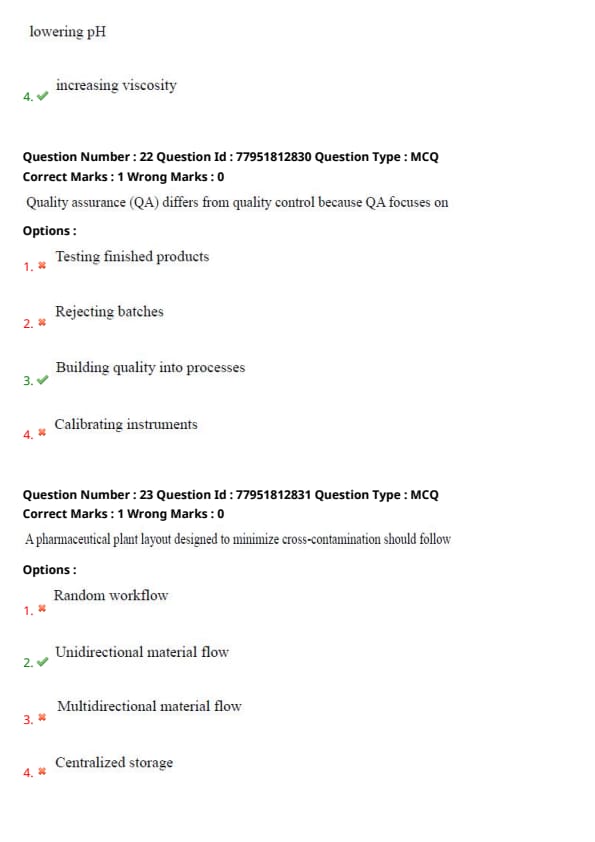
An eye drop formulation with poor corneal contact time would be benefitted by ________.
View Solution
Step 1: Understanding the Concept:
Ophthalmic formulations (eye drops) are often rapidly cleared from the eye surface due to blinking and the lacrimal drainage system. The time a drug stays in contact with the cornea directly affects its absorption and efficacy.
Step 2: Detailed Explanation:
1. Viscosity: By increasing the viscosity of the eye drop, the formulation becomes more "thick" and resistant to immediate drainage.
2. Agents: Polymers like Hydroxypropyl Methylcellulose (HPMC), Polyvinyl Alcohol (PVA), or Carboxymethylcellulose (CMC) are added as viscosity enhancers.
3. Effect: Higher viscosity reduces the rate of tear turnover and keeps the drug in contact with the corneal surface for a longer duration, thereby improving bioavailability.
4. Others: Tonicity and pH are important for comfort and stability but do not significantly alter the residence time on the eye surface.
Step 3: Final Answer:
Increasing viscosity is the standard pharmaceutical approach to prolong corneal contact time and improve ocular drug absorption.
Quick Tip: While increasing viscosity is good, it must not be so high that it causes blurred vision or blocks the tear ducts. Usually, a viscosity of 15–25 cP is ideal for eye drops.
Quality assurance (QA) differs from quality control because QA focuses on ________.
View Solution
Step 1: Understanding the Concept:
In the pharmaceutical industry, QA and QC are two distinct but related functions. QC is product-oriented, while QA is process-oriented.
Step 2: Detailed Explanation:
1. Quality Control (QC): This involves the actual testing of raw materials, intermediates, and finished products to ensure they meet specifications. It identifies defects after they have occurred (Option A and B).
2. Quality Assurance (QA): This is a broader administrative system. Its goal is to prevent defects by designing and monitoring the manufacturing processes. It ensures that every step of the process is capable of consistently producing a quality product.
3. Focus: QA focuses on documentation, training, validation, and audits to "build quality" from the start.
Step 3: Final Answer:
QA is a proactive approach that ensures quality is inherent in the manufacturing process itself, rather than just checking for it at the end.
Quick Tip: A simple way to remember: QA is "Prevention" (Process), while QC is "Detection" (Product).
A pharmaceutical plant layout designed to minimize cross-contamination should follow ________.
View Solution
Step 1: Understanding the Concept:
Cross-contamination is the contamination of one drug product with another. This is a major safety risk in pharmaceutical manufacturing. Good Manufacturing Practices (GMP) mandate specific layout designs to prevent this.
Step 2: Detailed Explanation:
1. Unidirectional Flow: This means that materials (raw materials, containers, people) move in one single direction from the entry point to the exit point. There is no "backtracking" or crossing of paths.
2. Prevention: This design ensures that clean materials do not come into contact with waste materials or materials from a different product line.
3. Layouts: Modern factories use "U-shaped" or "L-shaped" layouts to maintain a logical sequence of operations and minimize the risk of mix-ups.
Step 3: Final Answer:
Unidirectional flow is the fundamental engineering control used in pharmaceutical plants to eliminate the overlap of different production stages and prevent cross-contamination.
Quick Tip: The "Rule of One" applies here: One direction, one room for one product at one time.
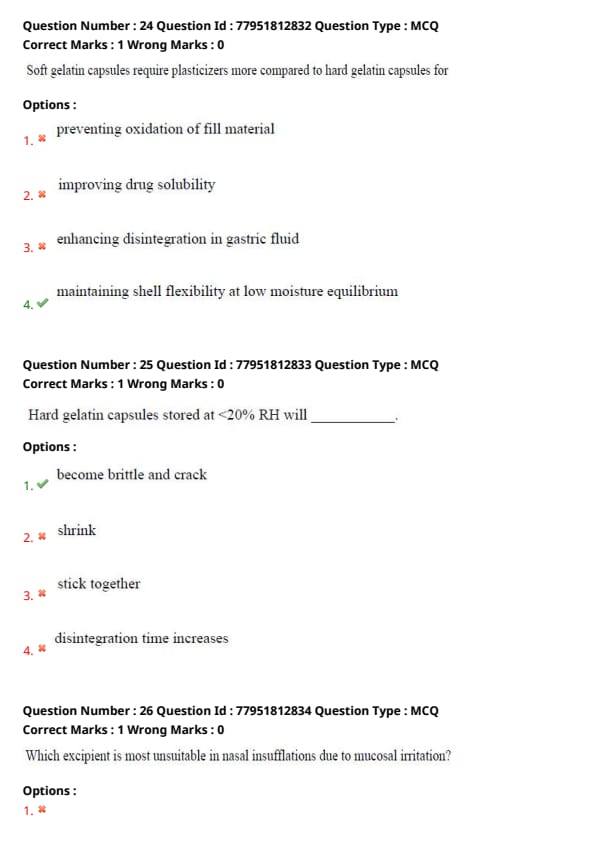
Soft gelatin capsules require plasticizers more compared to hard gelatin capsules for ________.
View Solution
Step 1: Understanding the Concept:
Gelatin is naturally brittle when dry. To make it flexible enough to form softgels, additives called plasticizers must be added to the gelatin mass.
Step 2: Detailed Explanation:
1. Plasticizers: These are substances like Glycerin, Sorbitol, or Propylene Glycol.
2. Action: They work by sitting between the long protein chains of gelatin, reducing the intermolecular forces and allowing the chains to slide past each other.
3. Softgels: Unlike hard capsules, softgel shells must remain elastic and pliable throughout their shelf life. Without a high concentration of plasticizers, the shell would lose moisture and become brittle, eventually cracking or leaking.
4. Hard Capsules: These contain much less plasticizer because they are intended to be rigid.
Step 3: Final Answer:
The primary role of plasticizers in softgels is to maintain the elasticity and mechanical integrity (flexibility) of the shell under various storage conditions.
Quick Tip: The ratio of plasticizer to gelatin in soft capsules typically ranges from 0.4:1 to 0.8:1, whereas it is negligible in hard capsules.
Hard gelatin capsules stored at \(<\)20% RH will ________.
View Solution
Step 1: Understanding the Concept:
Gelatin is a hygroscopic material. The mechanical properties of hard gelatin capsules are highly dependent on their moisture content, which is normally between 13% and 16%.
Step 2: Detailed Explanation:
1. Low Humidity (\(<\)20% RH): When capsules are stored in very dry environments, the gelatin loses its chemically bound water to the atmosphere.
2. Brittleness: As moisture content drops below 10%, the gelatin loses its elasticity. The capsule shell becomes extremely brittle and can shatter or crack even with light handling or during the filling process.
3. High Humidity: Conversely, at high RH (\(>\)60%), capsules absorb moisture, become soft, sticky, and lose their shape.
Step 3: Final Answer:
Low relative humidity causes the loss of critical moisture from the capsule shell, leading directly to brittleness and cracking.
Quick Tip: Hard gelatin capsules should be stored at a relative humidity of 35% to 50% to maintain their ideal moisture content of 13–16%.
Which excipient is most unsuitable in nasal insufflations due to mucosal irritation?
View Solution
Step 1: Understanding the Concept:
Nasal insufflations are medicated powders blown into the nasal cavity. The excipients used must be non-toxic, non-irritating, and preferably soluble or biodegradable.
Step 2: Detailed Explanation:
1. Talc: Talc is chemically magnesium silicate. It is an insoluble mineral powder.
2. Irritation: Because it is insoluble and has a crystalline structure, it stays on the delicate nasal mucosa for a long time. It can cause mechanical irritation and may lead to the formation of "granulomas" (lumps caused by chronic inflammation) in the nasal tissues.
3. Others: Lactose and Dextrose are sugars that dissolve easily in nasal secretions and are generally well-tolerated. Starch is biodegradable.
Step 3: Final Answer:
Talc is considered unsuitable for inhalation or nasal powder use due to its potential to cause severe mucosal irritation and tissue reactions.
Quick Tip: Talc should also be avoided in surgical dusting powders because it can cause adhesions and granulomas in open wounds.
In fusion method of effervescent granule preparation, granulation occurs due to ________.
View Solution
Step 1: Understanding the Concept:
Effervescent granules contain an acid (usually citric and tartaric acid) and a base (sodium bicarbonate). They must be prepared without adding extra water, which would start the effervescent reaction prematurely.
Step 2: Detailed Explanation:
1. Fusion Method: In this method, the powdered ingredients are mixed and heated in an oven at 34–40 \(^\circ\)C.
2. Citric Acid Monohydrate: Citric acid is used in its monohydrate form (\(C_6H_8O_7 \cdot H_2O\)). This molecule contains "water of crystallization."
3. Granulation: As the mixture is heated, the citric acid releases this bound water. The released water acts as a granulating agent, slightly moistening the mass just enough to allow it to be pressed through a sieve to form granules.
Step 3: Final Answer:
The internal water released from the citric acid monohydrate during heating provides the necessary moisture for granulation in the fusion method.
Quick Tip: The heating must be controlled precisely; if it's too high, the mass becomes a liquid; if it's too low, no granules will form.
Large volume parenterals (LVPs) must be free from preservatives because ________.
View Solution
Step 1: Understanding the Concept:
Parenterals are injections. Small volume parenterals (SVPs) are under 100 mL, while LVPs are typically 500 mL or more (like Saline or Dextrose infusions).
Step 2: Detailed Explanation:
1. Preservatives: Substances like phenol or benzalkonium chloride are toxic if given in high amounts.
2. Concentration vs. Volume: In a 5 mL injection (SVP), the total amount of preservative is very tiny and safe. However, in a 1000 mL infusion (LVP), the patient would receive a massive cumulative dose of the preservative.
3. Pharmacopoeial Rule: Therefore, the Indian and British Pharmacopoeias strictly forbid adding antimicrobial preservatives to any injection intended for administration in volumes greater than 15 mL at one time.
Step 3: Final Answer:
The large volume administered in LVPs makes the inclusion of preservatives dangerous due to the cumulative systemic toxicity they would cause.
Quick Tip: Remember: SVPs (Small Volume) {may} contain preservatives; LVPs (Large Volume) {must never} contain preservatives.
In percolation, the term menstruum refers to ________.
View Solution
Step 1: Understanding the Concept:
Extraction is the process of separating medicinally active portions of plant or animal tissues using selective solvents. Specific terms are used in these pharmacognostic processes.
Step 2: Detailed Explanation:
1. Menstruum: This is the liquid (solvent) chosen to dissolve the active constituents. Common menstrua include water, alcohol, or ether.
2. Marc: This is the residual solid plant material left behind after the active principles have been extracted.
3. Percolate: This is the final liquid extract collected at the bottom of the percolator.
Step 3: Final Answer:
In the context of extraction terminology, "menstruum" is the official term for the solvent.
Quick Tip: Think of "Menstruum" as the "Medicine-solvent" and "Marc" as the "Muddy-residue" to remember the difference easily.
What is the most important function of the Pharmacy & Therapeutics Committee?
View Solution
Step 1: Understanding the Concept:
The Pharmacy and Therapeutics Committee (PTC) is an advisory group of doctors, pharmacists, and other health professionals in a hospital.
Step 2: Detailed Explanation:
1. Hospital Formulary: This is a list of drugs that the hospital stocks and allows doctors to prescribe.
2. Selection: The PTC's primary role is to evaluate scientific data to decide which drugs are safe, effective, and cost-efficient. They add or remove drugs from the formulary based on this evidence.
3. Safety: They also monitor adverse drug reactions (ADRs) and medication errors within the hospital.
4. Others: Purchasing is done by the procurement department, and dispensing is done by pharmacists.
Step 3: Final Answer:
The clinical and administrative management of the drug formulary is the core responsibility of the PTC.
Quick Tip: The PTC serves as the main link between the medical staff and the pharmacy department in any modern hospital.
What is the main use of reserved antibiotics?
View Solution
Step 1: Understanding the Concept:
Reserved antibiotics (often part of the WHO "AWaRe" classification) are high-priority antibiotics that are considered the "last resort" for treatment.
Step 2: Detailed Explanation:
1. Preservation: The primary public health goal of "reserving" these drugs is to prevent the development of antimicrobial resistance (AMR). By limiting their use, we ensure that bacteria are not frequently exposed to them, keeping them effective for as long as possible.
2. Clinical Use: While they are indeed used for severe multidrug-resistant (MDR) infections, the policy of labeling them as "reserved" is specifically a strategy to prevent the emergence of resistance across the population.
3. Others: Using them for minor infections (Option A) is the exact opposite of the intended use and would accelerate resistance.
Step 3: Final Answer:
The "Reserve" category is a stewardship strategy intended to preserve the efficacy of last-resort antibiotics by preventing the selection pressure that leads to resistance.
Quick Tip: Remember the WHO AWaRe classification: {A}ccess (use first), {Wa}tch (use carefully), and {Re}serve (save for last).
Narcotic and psychotropic drugs in hospital pharmacy must be ________.
View Solution
Step 1: Understanding the Concept:
Controlled substances, such as narcotics (opioids) and psychotropic drugs, have a high potential for abuse and diversion. Strict legal and administrative controls are required for their storage.
Step 2: Detailed Explanation:
1. Double-Lock System: To prevent unauthorized access or theft, these drugs must be stored in a secure, immovable metal cabinet or safe. The "double-lock" requirement means two different locks must be opened, often requiring two different keys held by two different authorized personnel (like a pharmacist and a nurse supervisor).
2. Inventory: Every single dose must be accounted for in a dedicated register.
3. Others: Open shelves (Option A) or general storage (Option B) are illegal under the NDPS Act. Refrigeration (Option D) is only required if the specific drug is thermolabile, not as a general security rule.
Step 3: Final Answer:
The double-lock system is the mandatory security standard to prevent the diversion of controlled substances in a hospital setting.
Quick Tip: In India, the storage and handling of these drugs are governed by the Narcotic Drugs and Psychotropic Substances (NDPS) Act, 1985.
ICU drug distribution requires special control because of ________.
View Solution
Step 1: Understanding the Concept:
The Intensive Care Unit (ICU) manages critically ill patients. The nature of medications used here is vastly different from a general ward.
Step 2: Detailed Explanation:
1. High-Risk Drugs: ICU patients often receive "high-alert" medications like vasopressors, anti-arrhythmics, concentrated electrolytes, and strong sedatives. These drugs have a narrow therapeutic index; a small error can be fatal.
2. Emergency Needs: Medications must be available instantly for life-saving interventions (emergency drugs).
3. Monitoring: Because of the potency and risk associated with these drugs, the pharmacy must maintain strict control over their stocks, labeling, and bedside availability.
Step 3: Final Answer:
The concentration of high-risk and life-saving emergency medications necessitates a specialized and highly controlled drug distribution system in the ICU.
Quick Tip: Many hospitals use automated dispensing cabinets (ADCs) in ICUs to ensure both rapid access and strict electronic control of high-risk drugs.
Long-term tendering is preferred over short-term purchase mainly to ________.
View Solution
Step 1: Understanding the Concept:
Procurement in a hospital can be done through spot purchases or long-term contracts (tendering).
Step 2: Detailed Explanation:
1. Cost Reduction: By committing to buy large quantities over a long period (e.g., one year), the hospital can negotiate much lower "bulk" prices from manufacturers.
2. Supply Security: A long-term tender contract usually includes clauses that penalize the supplier for stock-outs. This ensures a steady and continuous supply of essential medicines, which is critical for patient care.
3. Administrative Efficiency: While it does reduce frequent paperwork (Option C), the primary drivers for a hospital's financial health and service quality are cost and availability.
Step 3: Final Answer:
The dual benefit of price stability (lower cost) and stock reliability (continuous supply) makes long-term tendering the preferred procurement method.
Quick Tip: Annual Rate Contracts (ARCs) are a common form of long-term tendering used in government and large private hospitals in India.
Economic Order Quantity aims to minimize ________.
View Solution
Step 1: Understanding the Concept:
Economic Order Quantity (EOQ) is an inventory management formula that determines the ideal order size a company should purchase to minimize inventory costs.
Step 2: Key Formula or Approach:
The EOQ is calculated as: \[ EOQ = \sqrt{\frac{2DS}{H}} \]
where:
\(D\) = Annual demand (units)
\(S\) = Cost per order (ordering cost)
\(H\) = Holding/Carrying cost per unit per year
Step 3: Detailed Explanation:
1. Ordering Cost: The cost associated with placing an order (paperwork, inspection, transport). This decreases as order size increases (fewer orders).
2. Carrying Cost: The cost of holding inventory (storage, insurance, capital tied up). This increases as order size increases.
3. The Goal: EOQ finds the "sweet spot" where the sum of these two opposing costs is at its minimum.
Step 4: Final Answer:
EOQ is specifically designed to balance and minimize the total expenditure related to both the procurement (ordering) and storage (carrying) of inventory.
Quick Tip: At the EOQ point, the annual ordering cost is exactly equal to the annual carrying cost.
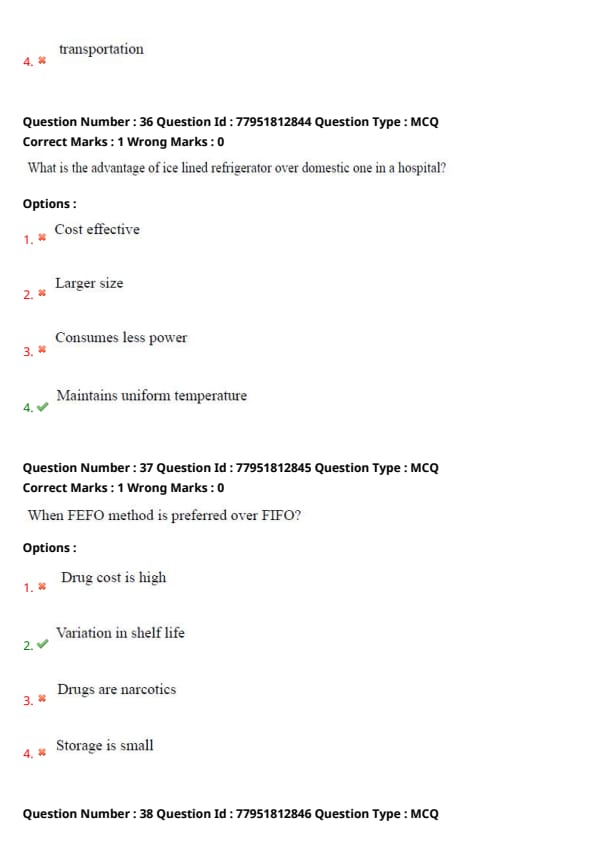
What is the advantage of ice lined refrigerator over domestic one in a hospital?
View Solution
Step 1: Understanding the Concept:
Domestic refrigerators are designed for food, where slight temperature fluctuations are acceptable. Vaccines and biologicals require a very strict "cold chain" (usually between 2 \(^\circ\)C and 8 \(^\circ\)C).
Step 2: Detailed Explanation:
1. Ice Lining: An Ice Lined Refrigerator (ILR) has tubes or packets of water/ice lining the internal walls.
2. Temperature Stability: During a power failure, the ice lining absorbs heat, maintaining the internal temperature within the safe range for many hours (up to 20+ hours).
3. Uniformity: Domestic fridges have "hot spots" and "cold spots" (e.g., near the freezer or at the bottom). ILRs are engineered to maintain a highly uniform temperature throughout the entire storage cabinet, ensuring no vaccine is accidentally frozen or overheated.
Step 3: Final Answer:
The specialized engineering of ILRs ensures that sensitive medicines are kept at a constant, uniform temperature, even during power outages.
Quick Tip: Never store vaccines in the door of a domestic refrigerator, as the temperature there fluctuates every time the door is opened.
When FEFO method is preferred over FIFO?
View Solution
Step 1: Understanding the Concept:
Inventory rotation methods ensure that drugs are used before they expire.
Step 2: Detailed Explanation:
1. FIFO (First-In, First-Out): The batch that arrived first in the pharmacy is issued first. This assumes that the oldest stock arrived first.
2. FEFO (First-Expiry, First-Out): The batch with the earliest expiration date is issued first, regardless of when it arrived in the store.
3. Variation in Shelf Life: Sometimes, a newer batch of a drug might have a shorter shelf life than an older batch (due to different manufacturing dates or different manufacturers). In cases where batches have variation in shelf life, FIFO might lead to a situation where a newer (but soon-to-expire) batch stays on the shelf and goes waste. FEFO prevents this.
Step 3: Final Answer:
FEFO is the superior method whenever there is a risk that arrival dates do not align with expiration dates, ensuring minimum drug wastage due to expiry.
Quick Tip: FEFO is the standard mandatory practice for managing vaccines and blood products in healthcare settings.
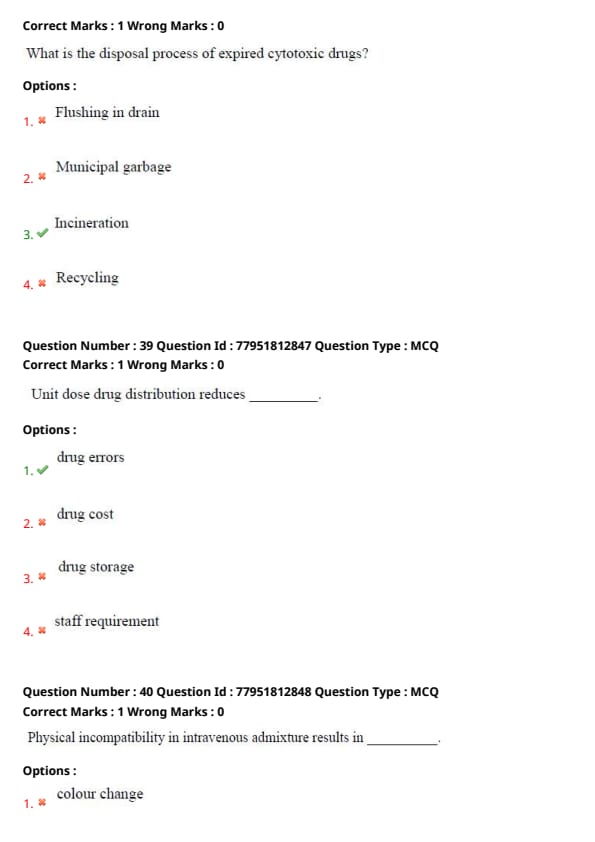
What is the disposal process of expired cytotoxic drugs?
View Solution
Step 1: Understanding the Concept:
Cytotoxic drugs (anti-cancer drugs) are highly toxic, mutagenic, and carcinogenic. They cannot be treated as regular medical waste.
Step 2: Detailed Explanation:
1. Incineration: This involves burning the waste at extremely high temperatures (usually above 1200 \(^\circ\)C). This high heat is necessary to completely break down the complex chemical structures of the cytotoxic agents into non-toxic gases and ash.
2. Regulatory Requirement: Under Bio-Medical Waste Management Rules, cytotoxic drugs must be collected in yellow bags/containers marked "Cytotoxic" and sent for high-temperature incineration.
3. Dangers of Others: Flushing (Option A) contaminates water systems. Municipal garbage (Option B) exposes sanitation workers and the environment to severe toxins.
Step 3: Final Answer:
High-temperature incineration is the only safe and legally approved method for the complete destruction of hazardous cytotoxic waste.
Quick Tip: Expired cytotoxic drugs should be returned to the manufacturer if possible; otherwise, they must go into {Yellow} bags specifically for incineration.
Unit dose drug distribution reduces ________.
View Solution
Step 1: Understanding the Concept:
In Unit Dose (UD) systems, the pharmacy provides medications in single-dose packages, labeled with the drug name, strength, and batch number, ready to be given to the patient.
Step 2: Detailed Explanation:
1. Reduction in Errors: In traditional systems, nurses must count or measure doses from bulk bottles at the bedside, which is where most mistakes happen. In the UD system, the dose is pre-verified by the pharmacist. This significantly reduces medication errors related to wrong dose, wrong drug, or wrong patient.
2. Efficiency: It also reduces the time nurses spend on medication preparation.
3. Wastage: It reduces waste because unopened unit doses can be returned to the pharmacy and re-issued.
Step 3: Final Answer:
The primary clinical advantage of the unit dose system is the significant enhancement of patient safety through the reduction of medication errors.
Quick Tip: The Unit Dose system is considered the safest method of inpatient drug distribution by organizations like the ASHP.
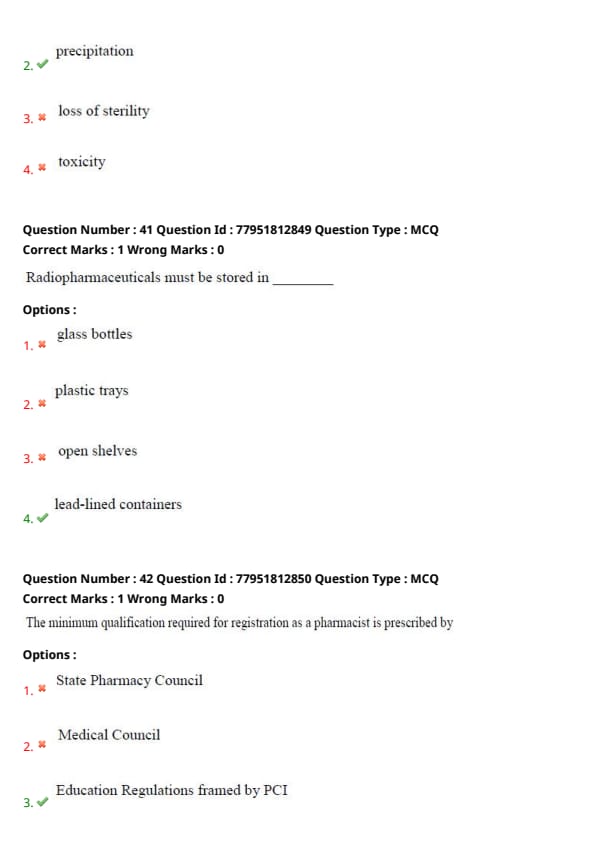
Physical incompatibility in intravenous admixture results in ________.
View Solution
Step 1: Understanding the Concept:
When two or more drugs are mixed in an IV bag or syringe, they may react with each other. This is called incompatibility. Physical incompatibility is usually visible.
Step 2: Detailed Explanation:
1. Precipitation: This is the most common sign of physical incompatibility. It occurs when a drug becomes insoluble in the final mixture (e.g., due to a change in pH or solvent). This results in visible crystals or "cloudiness."
2. Danger: Injecting a precipitate into a vein is extremely dangerous, as it can cause an embolism (blockage of blood vessels).
3. Other signs: Other physical signs include gas evolution (fizzing) or phase separation (oil droplets).
4. Chemical Incompatibility: This may result in a colour change (Option A) or toxicity (Option D) but is often invisible.
Step 3: Final Answer:
Precipitation is the hallmark visible sign of a physical incompatibility between intravenous medications.
Quick Tip: Always check an IV admixture against a light source for any "floaters" or cloudiness before administration. If it's not crystal clear, don't use it!
Radiopharmaceuticals must be stored in ________.
View Solution
Step 1: Understanding the Concept:
Radiopharmaceuticals are medicinal products that contain radioactive isotopes. They emit ionizing radiation (alpha, beta, or gamma rays), which can be harmful to living tissue and the environment if not properly shielded.
Step 2: Detailed Explanation:
1. Shielding: The primary requirement for storing radioactive materials is to block or attenuate the radiation.
2. Lead Properties: Lead is a high-density material with a high atomic number, making it extremely effective at absorbing X-rays and gamma radiation.
3. Safety: Storing these drugs in lead-lined containers ensures that the radiation is contained within the storage unit, protecting healthcare workers and preventing environmental contamination.
4. Other Materials: Glass and plastic provide negligible shielding for high-energy radiation.
Step 3: Final Answer:
To comply with radiation safety standards and protect personnel, radiopharmaceuticals must be kept in specialized lead-lined containers.
Quick Tip: Radiation follows the "Inverse Square Law," but "Shielding" (like lead) is the most effective way to reduce exposure in a pharmacy setting.
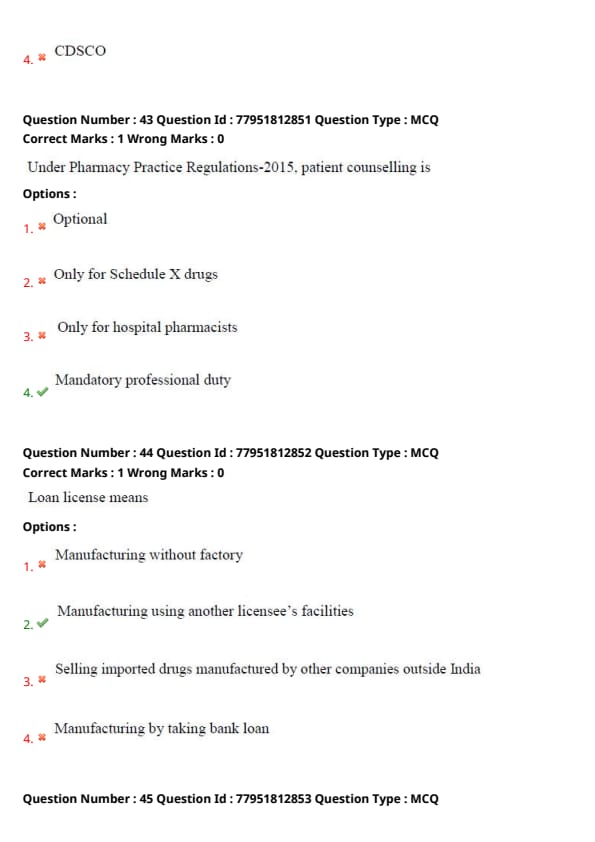
The minimum qualification required for registration as a pharmacist is prescribed by ________.
View Solution
Step 1: Understanding the Concept:
The Pharmacy Act, 1948, was enacted to regulate the profession and practice of pharmacy in India. Under this Act, the Pharmacy Council of India (PCI) is the central authority responsible for setting educational standards.
Step 2: Detailed Explanation:
1. Pharmacy Council of India (PCI): The PCI frames the "Education Regulations" (ER), which define the minimum standard of education (subjects, practical training, etc.) required for an individual to qualify for registration as a pharmacist.
2. Minimum Qualification: Currently, the Diploma in Pharmacy (D.Pharm) is the minimum qualification for registration as per these regulations.
3. State Pharmacy Council (SPC): The SPC actually performs the registration process, but it must follow the standards and qualifications set by the central PCI.
Step 3: Final Answer:
The central Education Regulations (ER) drafted by the PCI serve as the legal benchmark for pharmacist qualifications across all states in India.
Quick Tip: Remember: PCI makes the {rules} (ER), while the State Pharmacy Council maintains the {register}.
Under Pharmacy Practice Regulations-2015, patient counselling is ________.
View Solution
Step 1: Understanding the Concept:
The Pharmacy Practice Regulations (PPR), 2015, were introduced to elevate the role of the pharmacist from a mere dispenser of medicines to a healthcare provider involved in patient care.
Step 2: Detailed Explanation:
1. Definition of Counselling: Patient counselling involves the pharmacist providing essential information regarding the medication, including its use, side effects, storage, and dietary precautions.
2. Legal Mandate: According to PPR-2015, a registered pharmacist "shall" counsel the patient or their caregiver. The use of the word "shall" in legal terms makes it a mandatory requirement.
3. Goal: The goal is to improve patient compliance, prevent drug-related problems, and ensure better therapeutic outcomes.
Step 3: Final Answer:
Under the 2015 regulations, patient counselling is no longer an option but a mandatory professional duty for all registered pharmacists in India.
Quick Tip: Effective counselling involves the "Three Prime Questions": What did the doctor tell you the medication is for? How did the doctor tell you to take it? What did the doctor tell you to expect?
Loan license means ________.
View Solution
Step 1: Understanding the Concept:
The Drugs and Cosmetics Act provides for different types of manufacturing licenses. A "Loan License" is designed for individuals or companies who have the technical knowledge and raw materials to make a drug but do not own their own factory.
Step 2: Detailed Explanation:
1. Arrangement: The applicant (the "loan licensee") applies to the state licensing authority to use the manufacturing facilities of another existing licensed manufacturer.
2. Responsibility: Even though the physical factory belongs to someone else, the loan licensee is responsible for the quality and testing of the drug under their own name.
3. Requirement: The primary licensee (owner of the factory) must have spare capacity and valid GMP certifications to accommodate the loan licensee.
Step 3: Final Answer:
A loan license refers to the legal provision where one person manufactures drugs using the infrastructure of another person who already holds a valid manufacturing license.
Quick Tip: Loan licenses are common for small pharmaceutical startups or companies that want to manufacture a niche product without investing in a full-scale factory.
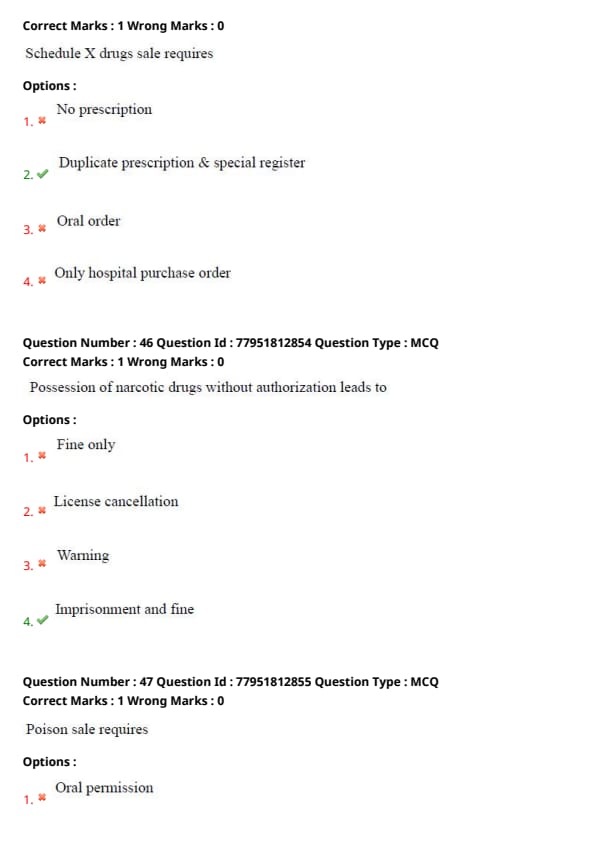
Schedule X drugs sale requires ________.
View Solution
Step 1: Understanding the Concept:
Schedule X contains drugs that have a high potential for addiction and abuse (e.g., Amphetamines, Phenobarbitone). Therefore, the Drugs and Cosmetics Rules impose the strictest retail controls on them.
Step 2: Detailed Explanation:
1. Prescription: These drugs can only be sold on the prescription of a Registered Medical Practitioner (RMP). The prescription must be in duplicate.
2. Record Keeping: The pharmacist must retain one copy of the prescription for at least two years. Additionally, they must maintain a special register recording the name and address of the patient, the drug name, the batch number, and the prescribing doctor's details.
3. Storage: These drugs must also be kept under lock and key.
Step 3: Final Answer:
The sale of Schedule X drugs is strictly regulated through a duplicate prescription system and mandatory record-keeping in a dedicated special register.
Quick Tip: Common Schedule X drugs include Ketamine, Methylphenidate, and certain barbiturates. They always require the "XRx" symbol on the label.
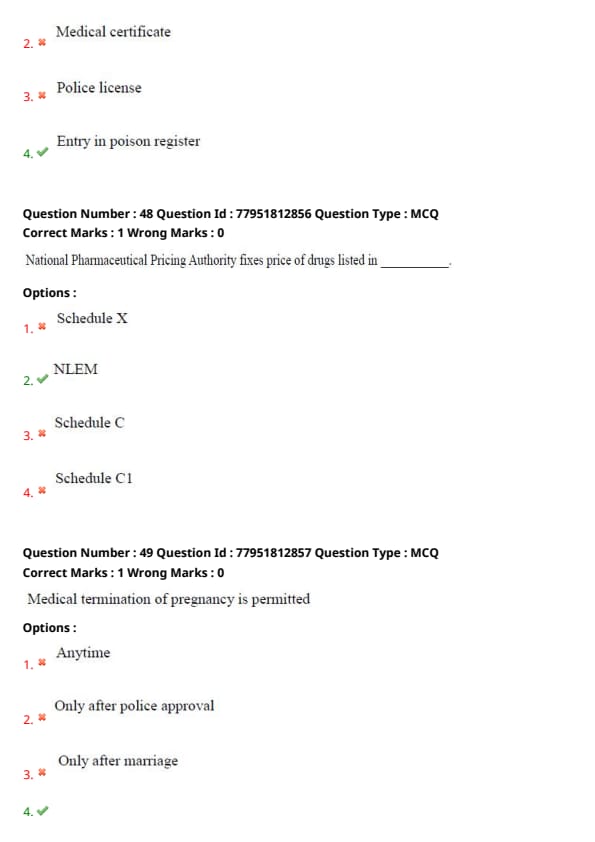
Possession of narcotic drugs without authorization leads to ________.
View Solution
Step 1: Understanding the Concept:
The possession, sale, and transport of narcotic drugs and psychotropic substances are strictly governed by the Narcotic Drugs and Psychotropic Substances (NDPS) Act, 1985.
Step 2: Detailed Explanation:
1. The Law: The NDPS Act is one of the most stringent laws in India. Any unauthorized possession of these substances is treated as a serious criminal offense.
2. Punishment: Depending on the quantity (small vs. commercial), the punishment involves Rigorous Imprisonment (jail time) along with a heavy monetary fine.
3. Others: A simple fine or warning (Options A and C) is insufficient for such high-risk substances, which are closely linked to societal drug abuse and organized crime.
Step 3: Final Answer:
Violation of the NDPS Act through unauthorized possession of narcotics carries severe penalties, typically involving both imprisonment and a fine.
Quick Tip: The NDPS Act follows a "Quantity-based" punishment system. Commercial quantities of drugs can lead to 10–20 years of imprisonment.
Poison sale requires ________.
View Solution
Step 1: Understanding the Concept:
The sale of substances identified as "poisons" is regulated by the Poisons Act, 1919, to prevent accidental or intentional (suicidal/homicidal) poisoning.
Step 2: Detailed Explanation:
1. Record Keeping: Every person authorized to sell poisons must maintain a "Poison Register."
2. Mandatory Entry: At the time of sale, the seller must record the name of the poison, the quantity sold, the purpose of use, the date of sale, and the name, address, and signature of the purchaser.
3. Goal: This creates a paper trail that can be used by law enforcement or forensic experts if the poison is misused.
Step 3: Final Answer:
The legal requirement for the retail sale of poisons is the meticulous recording of each transaction in a dedicated poison register.
Quick Tip: Poisons must always be stored in a separate, secure cupboard and labeled with the word "POISON" in red letters.
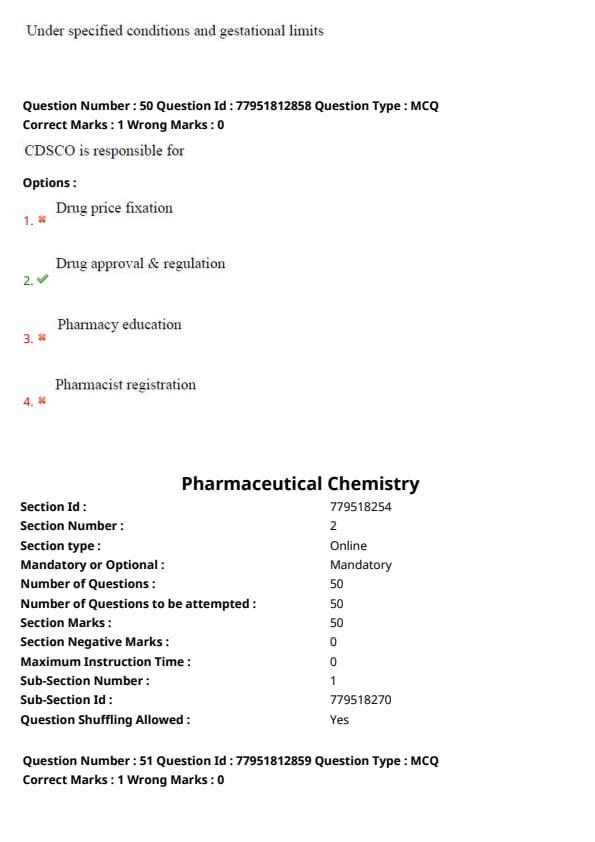
National Pharmaceutical Pricing Authority fixes price of drugs listed in ________.
View Solution
Step 1: Understanding the Concept:
The National Pharmaceutical Pricing Authority (NPPA) is an independent body of experts that implements the Drug Price Control Order (DPCO). Its goal is to make essential medicines affordable.
Step 2: Detailed Explanation:
1. NLEM: The National List of Essential Medicines (NLEM) is a list prepared by the Ministry of Health. It contains drugs that are considered essential for the healthcare needs of the majority of the population.
2. Scheduled Drugs: Under the DPCO, the drugs listed in the NLEM are categorized as "Scheduled Formulations." The NPPA is legally authorized to fix a "Ceiling Price" for these specific drugs, beyond which no manufacturer can sell.
3. Non-Scheduled Drugs: For drugs not in the NLEM, the NPPA only monitors price increases but does not fix the price.
Step 3: Final Answer:
The NPPA's price-fixing powers are primarily directed toward the essential drugs identified in the NLEM.
Quick Tip: NPPA falls under the Department of Pharmaceuticals, Ministry of Chemicals and Fertilizers, not the Ministry of Health.
Medical termination of pregnancy is permitted ________.
View Solution
Step 1: Understanding the Concept:
Abortion in India is regulated by the Medical Termination of Pregnancy (MTP) Act, 1971 (amended in 2021). It is not a right but a legal provision for specific situations.
Step 2: Detailed Explanation:
1. Specified Conditions: Termination is permitted only if the pregnancy poses a risk to the woman's life/health, in cases of rape, contraceptive failure, or severe fetal abnormalities.
2. Gestational Limits: The law sets limits for when a termination can occur. Generally, up to 20 weeks requires the opinion of one doctor, and between 20–24 weeks (for specific categories of women), it requires the opinion of two doctors. Beyond 24 weeks, it usually requires a Medical Board's approval for fetal abnormalities.
3. Others: It is not permitted "anytime" (Option A), nor is marriage a requirement (Option C).
Step 3: Final Answer:
MTP is a highly regulated medical procedure that must strictly adhere to the conditions and timeframes (gestational limits) defined by the MTP Act.
Quick Tip: The 2021 amendment to the MTP Act increased the upper limit for termination from 20 to 24 weeks for special categories of women, such as rape survivors.
CDSCO is responsible for ________.
View Solution
Step 1: Understanding the Concept:
The Central Drugs Standard Control Organization (CDSCO) is the national regulatory authority for cosmetics, pharmaceuticals, and medical devices in India.
Step 2: Detailed Explanation:
1. Core Functions: CDSCO is responsible for the approval of new drugs, conduct of clinical trials, setting standards for drugs, and controlling the quality of imported drugs.
2. DCGI: The Drug Controller General of India (DCGI) heads the CDSCO and acts as the central licensing authority.
3. Others: Price fixation (Option A) is done by NPPA. Pharmacy education and registration (Options C and D) are handled by the PCI and State Pharmacy Councils.
Step 3: Final Answer:
CDSCO is the apex body at the central level responsible for the regulatory oversight and approval of medicines in India.
Quick Tip: Think of CDSCO as the "FDA of India." It ensures that all drugs sold in the country are safe and effective through clinical oversight.
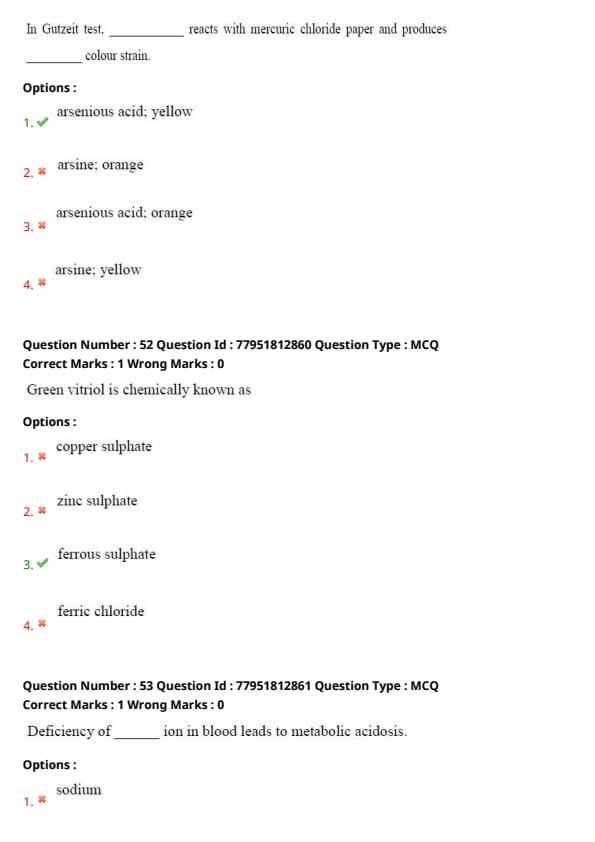
In Gutzeit test, ________ reacts with mercuric chloride paper and produces ________ colour strain.
View Solution
Step 1: Understanding the Concept:
The Gutzeit test is a limit test for arsenic. It relies on the reduction of arsenic impurities to a gaseous form which then reacts with a sensitized paper to show a visible change.
Step 2: Detailed Explanation:
1. Reaction Mechanism: Arsenic present in the sample is reduced by nascent hydrogen (generated from Zinc and HCl) into arsenious acid and subsequently into arsine gas (\(AsH_3\)).
2. Interaction with Paper: According to the official procedure and the provided key, the reaction on the mercuric chloride paper involves the formation of a complex that appears as a distinct yellow stain.
3. Comparison: The intensity and depth of the yellow stain are compared with a standard to determine if the arsenic content is within the permissible limit.
Step 3: Final Answer:
Based on the specific results of the Gutzeit reaction, the interaction produces a yellow strain. Although chemistry dictates arsine gas is the carrier, the test identifies the presence of arsenious derivatives.
Quick Tip: In the limit test for arsenic, ensure that the mercuric chloride paper is kept dry and protected from light, as moisture and light can interfere with the development of the yellow stain.
Green vitriol is chemically known as ________.
View Solution
Step 1: Understanding the Concept:
Many inorganic chemicals are known by traditional or "trivial" names that reflect their appearance or historical use. "Vitriols" are generally sulfates of certain metals.
Step 2: Detailed Explanation:
1. Ferrous Sulphate: \(FeSO_4 \cdot 7H_2O\) is known as Green Vitriol due to its pale green crystalline appearance. It is commonly used as a hematinic to treat iron-deficiency anemia.
2. Copper Sulphate: \(CuSO_4 \cdot 5H_2O\) is known as Blue Vitriol.
3. Zinc Sulphate: \(ZnSO_4 \cdot 7H_2O\) is known as White Vitriol.
4. Ferric Chloride: Is used as a reagent and styptic but is not referred to as a vitriol.
Step 3: Final Answer:
The common name for ferrous sulphate heptahydrate is Green Vitriol.
Quick Tip: Remember the colors: Iron is Green (Green Vitriol), Copper is Blue (Blue Vitriol), and Zinc is White (White Vitriol). This is a frequent question in basic pharmaceutical chemistry exams.
Deficiency of ________ ion in blood leads to metabolic acidosis.
View Solution
Step 1: Understanding the Concept:
Metabolic acidosis is a condition where the body's acid-base balance is disrupted, leading to an increase in acidity (low pH) in the blood.
Step 2: Detailed Explanation:
1. Buffering System: The primary buffer system in the human body is the bicarbonate-carbonic acid system (\(HCO_3^- / H_2CO_3\)).
2. Bicarbonate Role: Bicarbonate (\(HCO_3^-\)) ions act as a base to neutralize excess acids in the bloodstream.
3. Acidosis: When there is a significant loss or deficiency of bicarbonate ions (e.g., due to severe diarrhea or renal failure), the body loses its capacity to neutralize metabolic acids, leading to metabolic acidosis.
Step 3: Final Answer:
The deficiency of the bicarbonate ion directly impairs the blood's buffering capacity, resulting in metabolic acidosis.
Quick Tip: Metabolic acidosis is often treated clinically by the administration of Sodium Bicarbonate (\(NaHCO_3\)) to replenish the body's alkaline reserve.
Lugol’s solution contains ____% iodine and ____% potassium iodide.
View Solution
Step 1: Understanding the Concept:
Lugol's solution, also known as Strong Iodine Solution, is used as an antiseptic, disinfectant, and for treating certain thyroid conditions.
Step 2: Detailed Explanation:
1. Composition: It is an aqueous solution of iodine and potassium iodide.
2. Specific Concentrations: The standard IP/BP formulation for Lugol's solution requires 5% w/v Iodine and 10% w/v Potassium Iodide in purified water.
3. Role of KI: Iodine is poorly soluble in water. Potassium iodide is added to react with iodine to form the highly soluble tri-iodide complex (\(I_3^-\)), which keeps the iodine in solution.
Step 3: Final Answer:
The correct percentage of ingredients in Lugol's solution is 5% Iodine and 10% Potassium Iodide.
Quick Tip: Don't confuse Lugol's (5%/10%) with Tincture of Iodine, which is an alcoholic solution and usually contains 2% Iodine.
________ acts as an antimicrobial agent by halogenation mechanism.
View Solution
Step 1: Understanding the Concept:
Antimicrobials kill or inhibit microorganisms through various chemical mechanisms such as oxidation, protein coagulation, or halogenation.
Step 2: Detailed Explanation:
1. Halogenation: This mechanism involves the reaction of halogens (like Chlorine or Iodine) with the structural components of the microbial cell, such as proteins and nucleic acids.
2. Chlorine Action: Chlorine (and compounds like hypochlorites) releases active chlorine, which enters the microbial cell and reacts with amino groups (\(-NH_2\)) in proteins to form chloramines, disrupting cellular metabolism and killing the cell.
3. Others: Hydrogen peroxide and Potassium permanganate act primarily via oxidation. Boric acid acts by mild protein precipitation/bacteriostasis.
Step 3: Final Answer:
Chlorine is the quintessential example of an antimicrobial that operates through the halogenation of cellular proteins.
Quick Tip: Chlorine-based disinfectants (like bleaching powder) are highly effective but are neutralised by organic matter, so surfaces should be cleaned before disinfection.
Oxygen filled cylinder is painted in ________ colour for hospital use.
View Solution
Step 1: Understanding the Concept:
Medical gas cylinders are color-coded to prevent the accidental administration of the wrong gas, which could be fatal.
Step 2: Detailed Explanation:
1. Standard Color Coding: According to international and Indian standards (IS 3933), medical gas cylinders have specific body and shoulder colors.
2. Oxygen: For medical grade oxygen, the cylinder typically has a black body with a white shoulder (top part). In many simplified contexts or questions, it is often identified by the White color associated with its identifying parts.
3. Other Gases: Nitrous oxide is Blue; Cyclopropane is Orange; Carbon dioxide is Grey.
Step 3: Final Answer:
Based on standard medical gas coding, White is the identifying color for oxygen-filled cylinders.
Quick Tip: Always remember: Black body + White shoulder = Oxygen (\(O_2\)). This is a critical safety fact in hospital pharmacy.
Chemically epsom salt is ________ sulphate.
View Solution
Step 1: Understanding the Concept:
Epsom salt is a common inorganic compound used in medicine as a saline purgative (laxative) and for treating magnesium deficiency.
Step 2: Detailed Explanation:
1. Chemical Identity: Epsom salt is the common name for Magnesium Sulphate heptahydrate (\(MgSO_4 \cdot 7H_2O\)).
2. Use: In the digestive tract, it acts by osmotic pressure, drawing water into the intestines to induce defecation. It is also used in "Epsom baths" for muscle relaxation.
3. Others: Calcium sulphate is Gypsum; Sodium sulphate is Glauber's salt.
Step 3: Final Answer:
Epsom salt is chemically identified as Magnesium Sulphate.
Quick Tip: Saline purgatives like Epsom salt should be taken with plenty of water to prevent dehydration.
Rochelle salt is chemically ________.
View Solution
Step 1: Understanding the Concept:
Rochelle salt is a double salt of tartaric acid and is widely used in chemical analysis and as a mild laxative.
Step 2: Detailed Explanation:
1. Chemical Name: It is Sodium Potassium Tartrate tetrahydrate (\(KNaC_4H_4O_6 \cdot 4H_2O\)).
2. Pharmacy Use: It is an essential component of Fehling's solution (used to test for reducing sugars) where it acts as a sequestering agent to prevent the precipitation of copper ions.
3. History: It was first synthesized by Elie Seignette in La Rochelle, France, which is how it got its name.
Step 3: Final Answer:
Chemically, Rochelle salt is defined as sodium potassium tartrate.
Quick Tip: Rochelle salt is also known as "Seignette's salt." Remember its use in Fehling's reagent, as this is a common laboratory-based question.
In limit test for iron, ________ is used to prevent precipitation of iron by ammonia.
View Solution
Step 1: Understanding the Concept:
The limit test for iron is based on the reaction of iron with thioglycolic acid in the presence of ammonia to produce a pale pink to deep reddish-purple color.
Step 2: Detailed Explanation:
1. The Reaction: Iron reacts with thioglycolic acid to form iron thioglycolate.
2. The Role of Citric Acid: Ammonia is added to make the solution alkaline, which is necessary for the color to develop. However, iron naturally tends to precipitate as ferric hydroxide (\(Fe(OH)_3\)) in alkaline solutions.
3. Prevention: Citric acid is added because it forms a soluble complex with the iron, thereby preventing the precipitation of iron by ammonia while allowing the thioglycolic acid reaction to proceed.
Step 3: Final Answer:
Citric acid is used in the limit test for iron to keep iron in solution (sequestering) when the medium is made alkaline with ammonia.
Quick Tip: In the Iron Limit Test, remember the roles: Thioglycolic acid is the {reagent}, Ammonia is for {alkalinity}, and Citric acid is to {prevent precipitation}.
Which substance is mainly used in treating alkaloidal poisoning?
View Solution
Step 1: Understanding the Concept:
Alkaloids (like morphine, strychnine, or atropine) are potent plant-based nitrogenous compounds. In case of poisoning, the goal is to prevent their absorption from the stomach.
Step 2: Detailed Explanation:
1. Mechanism of Activated Charcoal: It is a "universal antidote" that works via Adsorption. It has an incredibly high surface area and porous structure.
2. Action: It binds to the alkaloid molecules in the gastrointestinal tract, preventing them from being absorbed into the bloodstream. The charcoal-toxin complex is then excreted in the feces.
3. Others: Sodium thiosulphate and Sodium nitrate are specifically used for Cyanide poisoning, not alkaloidal poisoning.
Step 3: Final Answer:
Activated charcoal is the standard adsorbent used in the emergency treatment of various oral poisonings, including those caused by alkaloids.
Quick Tip: Activated charcoal is most effective if administered within 1 hour of toxin ingestion. It does not bind well to alcohols, acids, or alkalis.
________ is required for carbohydrate and protein metabolism.
View Solution
Step 1: Understanding the Concept:
Minerals and electrolytes serve as essential cofactors for numerous biochemical reactions in the human body. Metabolism refers to the chemical processes that occur within a living organism in order to maintain life.
Step 2: Detailed Explanation:
1. Magnesium (\(Mg^{2+}\)): It is an essential cofactor for over 300 enzyme systems.
2. Metabolic Role: It is critical for all reactions involving ATP (Adenosine Triphosphate). In carbohydrate metabolism, it is required for glycolysis (e.g., the hexokinase reaction). In protein metabolism, it is essential for the structural integrity of ribosomes and the synthesis of DNA, RNA, and proteins.
3. Others: Calcium is primary for bone structure and muscle contraction. Sodium and Potassium are major regulators of osmotic balance and nerve impulse conduction.
Step 3: Final Answer:
Magnesium is the primary intracellular cation acting as a catalyst for carbohydrate and protein metabolic pathways.
Quick Tip: Think of Magnesium as the "universal cofactor" for energy-dependent processes involving ATP. No ATP reaction is complete without \(Mg^{2+}\).
Which of the following is an example for non-reducing sugar?
View Solution
Step 1: Understanding the Concept:
A reducing sugar is one that possesses a free aldehyde or ketone group (anomeric carbon) that can act as a reducing agent. This allows them to react with reagents like Fehling's or Benedict's.
Step 2: Detailed Explanation:
1. Sucrose: It is a disaccharide composed of Glucose and Fructose.
2. Bonding: The glycosidic bond in sucrose is formed between the anomeric carbon of glucose (C1) and the anomeric carbon of fructose (C2).
3. Result: Because both potential reducing groups are locked in the glycosidic bond, there is no "free" anomeric carbon available to reduce other substances. Therefore, sucrose is a non-reducing sugar.
4. Others: Glucose and Fructose are monosaccharides with free carbonyl groups. Lactose and Maltose are disaccharides that still have one free anomeric carbon available.
Step 3: Final Answer:
Sucrose is the most common example of a non-reducing disaccharide due to the nature of its 1,2-glycosidic linkage.
Quick Tip: A quick way to identify reducing sugars: All monosaccharides are reducing. Among common disaccharides, only Sucrose is non-reducing.
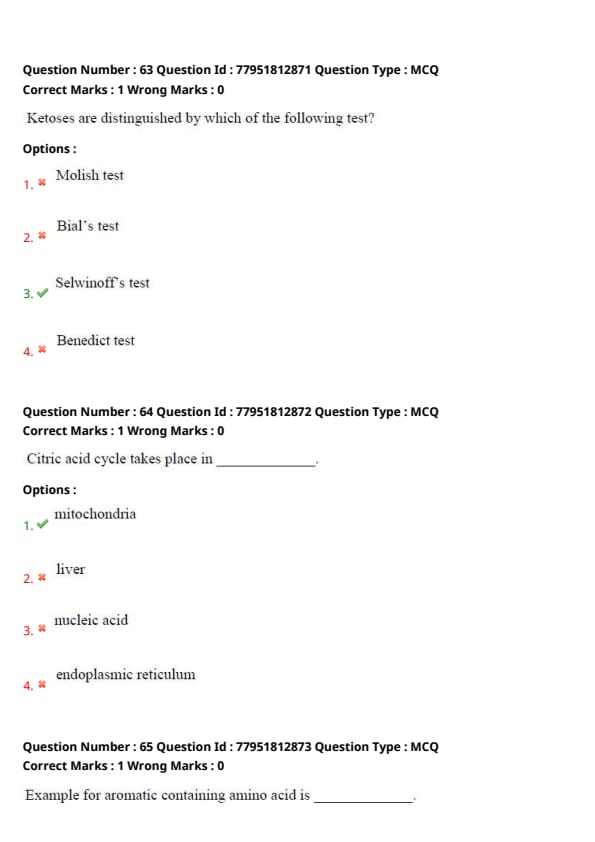
Ketoses are distinguished by which of the following test?
View Solution
Step 1: Understanding the Concept:
Specific chemical tests are used to identify the functional groups in carbohydrates. Aldoses (like glucose) contain an aldehyde group, while ketoses (like fructose) contain a ketone group.
Step 2: Detailed Explanation:
1. Seliwanoff’s Test: This test uses resorcinol and concentrated Hydrochloric acid (HCl).
2. Mechanism: When heated with HCl, ketoses dehydrate more rapidly than aldoses to form 5-hydroxymethylfurfural. This compound then reacts with resorcinol to produce a characteristic cherry-red color.
3. Others: Molisch test is a general test for all carbohydrates. Bial’s test is specific for pentoses. Benedict’s test detects reducing sugars.
Step 3: Final Answer:
Seliwanoff’s test is the standard diagnostic test used to differentiate ketoses from aldoses.
Quick Tip: Remember the color: Seliwanoff = Ketose = Cherry Red. If the red color appears very quickly (within 2 minutes), it's a ketose.
Citric acid cycle takes place in ________.
View Solution
Step 1: Understanding the Concept:
The Citric Acid Cycle (also known as the Krebs Cycle or TCA Cycle) is the central metabolic hub of the cell where the oxidation of acetyl-CoA produces energy in the form of ATP, NADH, and \(FADH_2\).
Step 2: Detailed Explanation:
1. Location: While glycolysis occurs in the cytoplasm, the products are transported into the mitochondria for further oxidation.
2. Mitochondrial Matrix: Specifically, the enzymes of the citric acid cycle are located within the fluid-filled matrix of the mitochondria. This is strategic, as it places the cycle close to the electron transport chain located on the inner mitochondrial membrane.
Step 3: Final Answer:
The mitochondria are known as the "powerhouse of the cell" largely because they house the citric acid cycle.
Quick Tip: Glycolysis = Cytoplasm. Krebs Cycle = Mitochondrial Matrix. Electron Transport Chain = Inner Mitochondrial Membrane. This "geography" of the cell is essential for exam success.
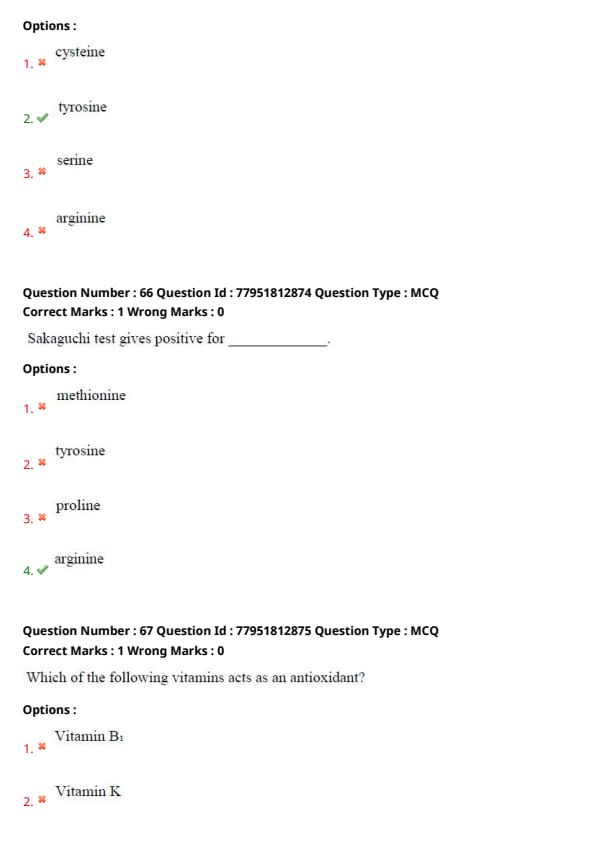
Example for aromatic containing amino acid is ________.
View Solution
Step 1: Understanding the Concept:
Amino acids are classified based on the chemical nature of their side chains (R-groups). Aromatic amino acids contain a cyclic ring structure (like benzene) in their side chain.
Step 2: Detailed Explanation:
1. Tyrosine: It contains a phenol group (a benzene ring with a hydroxyl group) as its side chain, making it an aromatic amino acid.
2. The Trio: There are three primary aromatic amino acids: Phenylalanine, Tyrosine, and Tryptophan.
3. Others: Cysteine is sulfur-containing. Serine is hydroxy-containing (aliphatic). Arginine is basic (contains a guanidino group).
Step 3: Final Answer:
Tyrosine is a classic example of an amino acid with an aromatic side chain.
Quick Tip: Aromatic amino acids (Phe, Tyr, Trp) are responsible for the absorption of UV light by proteins at 280 nm, which is used for protein quantification in labs.
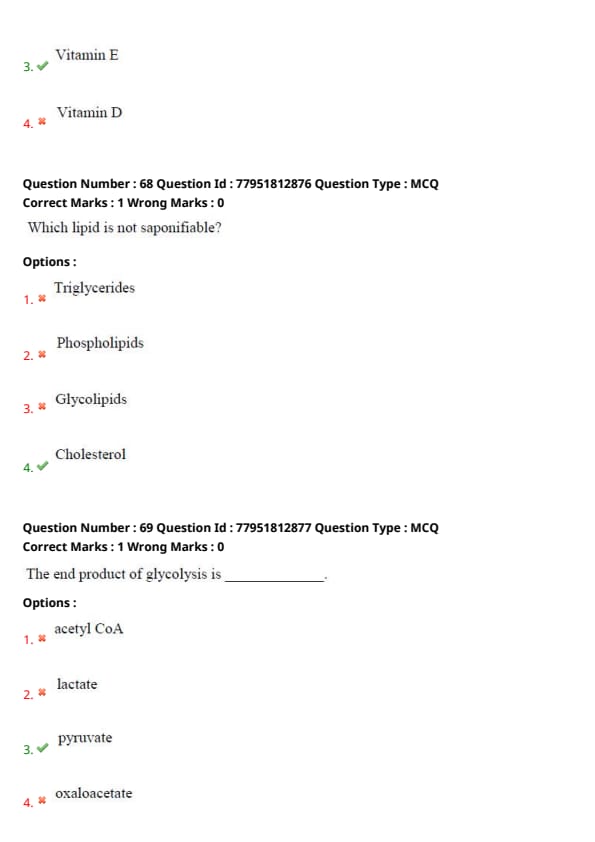
Sakaguchi test gives positive for ________.
View Solution
Step 1: Understanding the Concept:
The Sakaguchi test is a specific biochemical qualitative test used to detect the presence of a specific functional group in amino acids or proteins.
Step 2: Detailed Explanation:
1. Target Group: It specifically detects the guanidino group (\(-NH-C(NH)-NH_2\)).
2. Reaction: Arginine is the only standard amino acid that possesses a guanidino side chain. In the presence of \(\alpha\)-naphthol and sodium hypobromite, the guanidino group reacts to form a bright red complex.
3. Others: Methionine is detected by the Sulfur test. Tyrosine is detected by Millon’s test. Proline gives a yellow color with Ninhydrin.
Step 3: Final Answer:
Because of its unique guanidino group, Arginine is the amino acid that gives a positive Sakaguchi test.
Quick Tip: Remember: "S"akaguchi for the "G"uanidino group in Ar"G"inine. The result is a Red color.
Which of the following vitamins acts as an antioxidant?
View Solution
Step 1: Understanding the Concept:
Antioxidants are substances that inhibit oxidation, a chemical reaction that can produce free radicals, leading to chain reactions that may damage cells.
Step 2: Detailed Explanation:
1. Vitamin E (Tocopherol): It is a fat-soluble vitamin that is a powerful antioxidant.
2. Mechanism: It protects cell membranes from oxidative damage by neutralizing peroxyl radicals, thereby preventing the lipid peroxidation of polyunsaturated fatty acids.
3. Others: Vitamin B1 (Thiamine) is a coenzyme for decarboxylation. Vitamin K is essential for blood clotting. Vitamin D is essential for calcium absorption.
Step 3: Final Answer:
Vitamin E is the primary fat-soluble antioxidant in the body that protects tissues from oxidative stress.
Quick Tip: The main antioxidant vitamins are A, C, and E. "ACE" vitamins protect you from free radicals!
Which lipid is not saponifiable?
View Solution
Step 1: Understanding the Concept:
Saponification is the alkaline hydrolysis of an ester. Saponifiable lipids are those that contain ester bonds (usually between fatty acids and an alcohol like glycerol) which can be broken down to form soap (salts of fatty acids).
Step 2: Detailed Explanation:
1. Saponifiable Lipids: Triglycerides, Phospholipids, and Glycolipids all contain fatty acid chains attached via ester or amide bonds. When treated with a base (like NaOH), they produce soaps.
2. Non-saponifiable Lipids: These are lipids that do not contain fatty acids and cannot be hydrolyzed into soaps.
3. Cholesterol: It is a sterol (a complex steroid alcohol). Its structure consists of four fused hydrocarbon rings. Since it lacks ester-linked fatty acids, it cannot be saponified.
Step 3: Final Answer:
Cholesterol belongs to the non-saponifiable class of lipids.
Quick Tip: Steroids, terpenes, and fat-soluble vitamins (A, D, E, K) are the major classes of non-saponifiable lipids.
The end product of glycolysis is ________.
View Solution
Step 1: Understanding the Concept:
Glycolysis is the metabolic pathway that converts glucose (\(C_6H_{12}O_6\)) into two 3-carbon molecules, releasing energy captured in ATP and NADH.
Step 2: Detailed Explanation:
1. Aerobic Glycolysis: Under normal aerobic conditions, the sequence of ten enzymatic reactions concludes with the formation of Pyruvate.
2. Subsequent fate: In the presence of oxygen, pyruvate enters the mitochondria to be converted into Acetyl CoA.
3. Anaerobic Glycolysis: Only under anaerobic conditions (lack of oxygen, e.g., in skeletal muscle during intense exercise) is pyruvate further reduced to Lactate.
Step 3: Final Answer:
Pyruvate is the official definitive end product of the glycolysis pathway.
Quick Tip: One molecule of Glucose (6C) produces two molecules of Pyruvate (3C), a net gain of 2 ATP, and 2 NADH.
Competitive enzyme inhibition can be reversed by ________.
View Solution
Step 1: Understanding the Concept:
In competitive inhibition, the inhibitor molecule closely resembles the substrate and competes for the same active site on the enzyme.
Step 2: Detailed Explanation:
1. The Competition: The enzyme can bind to either the substrate (S) or the inhibitor (I), but not both at the same time.
2. Reversibility: Because the binding is a dynamic equilibrium, if you significantly increase the concentration of the substrate, the probability of the enzyme bumping into a substrate molecule becomes much higher than bumping into an inhibitor.
3. Effect: At very high substrate concentrations, the substrate "out-competes" the inhibitor, and the reaction can still reach its maximum velocity (\(V_{max}\)).
Step 3: Final Answer:
Competitive inhibition is unique because it can be fully overcome by increasing the substrate concentration.
Quick Tip: In competitive inhibition, \(V_{max}\) stays the same, but the \(K_m\) (Michaelis constant) increases because more substrate is needed to reach half \(V_{max}\).
The confirmatory test for bile pigments in urine is:
View Solution
Step 1: Understanding the Concept:
Bile pigments (primarily bilirubin) are breakdown products of hemoglobin. Their presence in urine (bilirubinuria) typically indicates liver disease or bile duct obstruction. Specific biochemical tests are used to detect these pigments.
Step 2: Detailed Explanation:
1. Fouchet’s Test: This is the standard confirmatory test. It involves the use of Fouchet's reagent (which contains trichloroacetic acid and ferric chloride).
2. Reaction: Barium chloride is first added to urine to precipitate the pigments. When Fouchet’s reagent is added to the precipitate, the ferric chloride oxidizes the yellow bilirubin into green biliverdin or blue cholecyanin. A green or blue color indicates a positive result.
3. Others: Hay’s test is for bile salts. Benedict’s test is for reducing sugars (glucose). Rothera’s test is for ketone bodies.
Step 3: Final Answer:
Fouchet’s test is specifically designed to confirm the presence of bile pigments through an oxidation-reduction reaction.
Quick Tip: Remember: "F"ouchet's for "F"ormation of green color (Bile Pigments) and "H"ay's for "H"ydrogen/Surface tension (Bile Salts).
Normal haemoglobin level in adult male is ________ g/dL.
View Solution
Step 1: Understanding the Concept:
Hemoglobin (Hb) is the iron-containing protein in red blood cells responsible for transporting oxygen. Its concentration varies by age and gender due to hormonal and physiological differences.
Step 2: Detailed Explanation:
1. Adult Males: The standard reference range for healthy adult males is generally accepted as 13.5 to 17.5 g/dL. This higher range in males is largely due to the stimulatory effect of androgens (testosterone) on erythropoiesis (RBC production).
2. Adult Females: The range is slightly lower, typically 12.0 to 15.5 g/dL.
3. Clinical Significance: Values below 13 g/dL in males are usually diagnosed as anemia, while values above 18 g/dL may indicate polycythemia.
Step 3: Final Answer:
The average physiological range for an adult male matches option (C), 13–17 g/dL.
Quick Tip: When memorizing lab values, remember that "M"ales have "M"ore hemoglobin (roughly 13-17) compared to females (roughly 12-15).
Which vitamin is essential for blood clotting?
View Solution
Step 1: Understanding the Concept:
Blood coagulation (clotting) is a complex cascade of reactions involving various proteins called clotting factors. Some of these factors require specific chemical modifications to become functional.
Step 2: Detailed Explanation:
1. Vitamin K: It serves as an essential cofactor for the enzyme \(\gamma\)-glutamyl carboxylase.
2. Mechanism: This enzyme performs the gamma-carboxylation of glutamate residues on certain clotting factors, specifically Factors II (Prothrombin), VII, IX, and X.
3. Effect: This modification allows these factors to bind calcium ions, which is necessary for their activation in the clotting cascade. Without Vitamin K, these factors remain inactive, leading to excessive bleeding.
Step 3: Final Answer:
Vitamin K is the only vitamin directly involved as a cofactor in the synthesis of functional blood clotting factors.
Quick Tip: Remember the mnemonic: "2, 7, 9, 10" — these are the four clotting factors that depend on Vitamin K. Warfarin (an anticoagulant) works by inhibiting Vitamin K recycling.
Bilirubin level helps in measuring the function of ________.
View Solution
Step 1: Understanding the Concept:
Bilirubin is the yellow pigment produced by the normal breakdown of old red blood cells. The body has a specific pathway to process and excrete this pigment.
Step 2: Detailed Explanation:
1. The Liver's Role: Unconjugated bilirubin is transported to the liver, where hepatocytes conjugate it with glucuronic acid to make it water-soluble. It is then excreted into the bile.
2. Indicator of Health: If the liver is damaged (e.g., hepatitis, cirrhosis) or if the bile ducts are blocked, the liver cannot process or excrete bilirubin effectively. This causes bilirubin to leak into the blood, resulting in jaundice (yellowing of skin/eyes).
3. Measurement: Total, Direct, and Indirect bilirubin levels are core components of Liver Function Tests (LFTs).
Step 3: Final Answer:
Measuring bilirubin levels is a primary diagnostic tool to assess the metabolic and excretory capacity of the liver.
Quick Tip: Direct Bilirubin is "Conjugated" (processed by the liver), whereas Indirect Bilirubin is "Unconjugated" (not yet processed). High indirect levels often point to RBC breakdown (hemolysis).
Wilson disease is due to excess of ________.
View Solution
Step 1: Understanding the Concept:
Metals are essential in trace amounts but can be highly toxic if they accumulate in the body's tissues. Wilson disease is a rare inherited genetic disorder of metal metabolism.
Step 2: Detailed Explanation:
1. Pathophysiology: In Wilson disease, a mutation in the ATP7B gene prevents the liver from excreting excess copper into the bile.
2. Accumulation: As a result, copper builds up to toxic levels, primarily in the liver and the brain (basal ganglia). It also deposits in the cornea of the eye, forming characteristic brown "Kayser-Fleischer rings."
3. Treatment: It is managed with copper-chelating agents like Penicillamine or by taking Zinc to block copper absorption.
Step 3: Final Answer:
Wilson disease is fundamentally characterized by the toxic accumulation of copper in vital organs.
Quick Tip: Look for "Kayser-Fleischer rings" in the eyes in exam questions; they are the pathognomonic clinical sign of Wilson (Copper) disease.
Chloroquine contains chlorine at ________ position.
View Solution
Step 1: Understanding the Concept:
Chloroquine is an important antimalarial drug. Understanding its chemical structure is essential for identifying its pharmacophore and medicinal chemistry properties.
Step 2: Detailed Explanation:
1. Nucleus: Chloroquine is a derivative of 4-aminoquinoline.
2. Chemical Name: Its IUPAC name is \(N^{4}\)-(7-chloroquinolin-4-yl)-\(N^{1},N^{1}\)-diethylpentane-1,4-diamine.
3. Substitution: In the quinoline ring system, the nitrogen is at position 1. The side chain is attached at the 4th position, and a chlorine atom is substituted at the 7th position. This chlorine atom is crucial for its antimalarial activity.
Step 3: Final Answer:
The chlorine substituent in the quinoline ring of chloroquine is located at the 7th position.
Quick Tip: Most common quinoline antimalarials, like Chloroquine and Amodiaquine, have the chlorine at the 7th position. Remember "7-Chloro" as a key structural feature.
Ibuprofen belongs to which chemical class?
View Solution
Step 1: Understanding the Concept:
Non-Steroidal Anti-Inflammatory Drugs (NSAIDs) are classified based on their chemical structure, which determines their pharmacokinetic and side-effect profiles.
Step 2: Detailed Explanation:
1. Ibuprofen Structure: It contains a propionic acid group (\(-CH(CH_3)COOH\)) attached to an aryl (phenyl) ring. Therefore, it is categorized as an Aryl propionic acid derivative (or "Profen").
2. Others in Class: Naproxen and Ketoprofen also belong to this class.
3. Comparison: Salicylates include Aspirin. Indole acetic acids include Indomethacin. Fenamates include Mefenamic acid.
Step 3: Final Answer:
Based on the Presence of the substituted propionic acid group, Ibuprofen is classified as an aryl propionic acid derivative.
Quick Tip: A quick shortcut: Drugs ending in "-profen" (Ibuprofen, Naproxen, Ketoprofen) usually belong to the Aryl propionic acid class.
Amlodipine contains ________ ring system.
View Solution
Step 1: Understanding the Concept:
Amlodipine is a calcium channel blocker used to treat hypertension. Historically and chemically, it is defined by its nitrogen-containing heterocyclic core.
Step 2: Detailed Explanation:
1. Standard Chemistry: Amlodipine is chemically a derivative of 1,4-dihydropyridine. A dihydropyridine is a partially saturated version of pyridine.
2. Answer Key Logic: While Option (D) is the strictly correct chemical description, the provided Answer Key marks Option (A) piperidine as correct. Piperidine is the fully saturated version of pyridine. In some pedagogical contexts or due to structural similarity, these categories are sometimes loosely associated, although they are distinct in rigorous medicinal chemistry.
Step 3: Final Answer:
Following the provided answer key, the ring system associated with amlodipine is identified as piperidine.
Quick Tip: In most pharmaceutical exams, Amlodipine, Nifedipine, and Felodipine are classified as "Dihydropyridines" (DHPs). Be aware of variations in specific exam answer keys!
Chemically aspirin is ________.
View Solution
Step 1: Understanding the Concept:
Aspirin is one of the most famous and widely used drugs in the world. It was synthesized by acetylating salicylic acid to reduce its gastric irritation while maintaining its analgesic properties.
Step 2: Detailed Explanation:
1. Synthesis: Salicylic acid (\(o\)-hydroxybenzoic acid) reacts with acetic anhydride in the presence of an acid catalyst.
2. Reaction: The hydroxyl group (\(-OH\)) of salicylic acid is converted into an acetyl group (\(-OCOCH_3\)).
3. Product: The resulting molecule is Acetylsalicylic acid. It acts as a prodrug for salicylic acid but also has unique antiplatelet properties due to the irreversible acetylation of the COX enzyme.
Step 3: Final Answer:
The official chemical name of Aspirin is acetylsalicylic acid.
Quick Tip: Remember the "Acetyl" part; it's what differentiates Aspirin from its precursor Salicylic acid and gives it the ability to "acetylate" enzymes in the body.
Penicillin contains which core ring system?
View Solution
Step 1: Understanding the Concept:
Penicillins are a class of antibiotics that work by inhibiting bacterial cell wall synthesis. Their antimicrobial activity is dependent on a very specific cyclic amide structure.
Step 2: Detailed Explanation:
1. Structure: The basic nucleus of penicillin (6-aminopenicillanic acid) consists of two fused rings.
2. The Rings: One is a five-membered thiazolidine ring containing sulfur. The other is a four-membered cyclic amide ring known as the \(\beta\)-lactam ring.
3. Importance: The \(\beta\)-lactam ring is the essential "pharmacophore" responsible for killing bacteria. Enzymes produced by resistant bacteria (called beta-lactamases) work by breaking this specific ring, rendering the antibiotic useless.
Step 3: Final Answer:
The \(\beta\)-lactam ring is the definitive core structure and the site of action for all penicillin antibiotics.
Quick Tip: Remember: "Beta-lactam" refers to the 4-membered ring. This class also includes Cephalosporins, Carbapenems, and Monobactams.
Morphine is chemically classified as ________.
View Solution
Step 1: Understanding the Concept:
Alkaloids are naturally occurring organic compounds that contain at least one nitrogen atom. Morphine is the principal alkaloid derived from the opium poppy ({Papaver somniferum).
Step 2: Detailed Explanation:
1. Natural Origin: Morphine is extracted directly from opium, making it a natural alkaloid.
2. Chemical Structure: It contains a complex ring system based on phenanthrene. This distinguish it from other opium alkaloids like papaverine, which belong to the benzylisoquinoline class.
3. Opioid classification: While it is an opioid, it is the parent natural molecule from which semi-synthetic opioids (like Heroin) and synthetic ones (like Fentanyl) are modeled.
Step 3: Final Answer:
Morphine is a natural alkaloid characterized by its phenanthrene nucleus.
Quick Tip: Opium alkaloids are divided into two chemical groups: Phenanthrenes (Morphine, Codeine, Thebaine) and Benzylisoquinolines (Papaverine, Noscapine).
Chlorpromazine belongs to which chemical class?
View Solution
Step 1: Understanding the Concept:
Antipsychotics (neuroleptics) are classified based on their heterocyclic ring structures. Chlorpromazine was the first "typical" antipsychotic discovered.
Step 2: Detailed Explanation:
1. Structure: Chlorpromazine consists of a tricyclic phenothiazine nucleus (a sulfur and nitrogen-containing ring system) with a side chain.
2. Sub-classification: It is specifically an aliphatic side-chain phenothiazine.
3. Others: Haloperidol is a Butyrophenone. Diazepam is a Benzodiazepine. Thiothixene is a Thioxanthene.
Step 3: Final Answer:
Chlorpromazine is the prototype drug of the phenothiazine chemical class.
Quick Tip: Phenothiazines always contain a tricyclic ring with a sulfur (thio) and a nitrogen (aza) in the central ring.
Ciprofloxacin belongs to which chemical class?
View Solution
Step 1: Understanding the Concept:
Antimicrobial agents are categorized by their chemical scaffold. Quinolones are synthetic antibiotics that inhibit DNA gyrase.
Step 2: Detailed Explanation:
1. Structure: Ciprofloxacin is a second-generation quinolone.
2. Fluorination: It contains a fluorine atom at the 6th position of the quinolone ring system, which significantly enhances its antibacterial spectrum and potency. Hence, it belongs to the Fluoroquinolone class.
3. Mechanism: It works by inhibiting bacterial Type II topoisomerases (DNA gyrase and Topoisomerase IV).
Step 3: Final Answer:
The presence of a fluorine atom on the quinolone nucleus classifies Ciprofloxacin as a fluoroquinolone.
Quick Tip: Fluoroquinolones (like Cipro, Norflox, Levoflox) are broad-spectrum and are often avoided in children due to potential cartilage damage.
Diazepam contains which heterocyclic ring?
View Solution
Step 1: Understanding the Concept:
Diazepam is a widely used sedative, anxiolytic, and anticonvulsant. Its pharmacological class is named directly after its chemical ring system.
Step 2: Detailed Explanation:
1. Heterocycle: The structure of Diazepam consists of a benzene ring fused to a seven-membered diazepine ring (a ring with two nitrogen atoms).
2. Classification: This combined bicyclic system is known as 1,4-benzodiazepine.
3. Action: It acts as a positive allosteric modulator of the \(GABA_A\) receptor.
Step 3: Final Answer:
Diazepam belongs to the benzodiazepine class, named for its fused benzene and diazepine rings.
Quick Tip: Benzodiazepines are often identified by the suffix "-epam" or "-olam" (e.g., Diazepam, Lorazepam, Alprazolam).
The chemical class of propranolol is ________.
View Solution
Step 1: Understanding the Concept:
Propranolol is the prototype non-selective beta-adrenergic blocker. Its name describes its chemical structure.
Step 2: Detailed Explanation:
1. Structure Components: It contains a naphthyl group (Aryl), an oxygen bridge (Oxy), and a propanolamine side chain (\(-CH_2-CH(OH)-CH_2-NH-\)).
2. Classification: Combining these elements, it is classified as an aryloxypropanolamine. This structural motif is common to most first and second-generation beta-blockers.
Step 3: Final Answer:
Propranolol is structurally defined as an aryloxypropanolamine derivative.
Quick Tip: Most beta-blockers (like Atenolol, Metoprolol) share the same aryloxypropanolamine backbone; they differ primarily in the nature of the aromatic "aryl" ring.
What is the core skeleton of tetracycline antibiotics?
View Solution
Step 1: Understanding the Concept:
Tetracyclines are a group of broad-spectrum antibiotics. The prefix "tetra-" (four) and "-cycline" (cycle/ring) refers directly to their structure.
Step 2: Detailed Explanation:
1. Nucleus: The chemical name for the tetracycline skeleton is naphthacene.
2. Arrangement: Naphthacene consists of four fused rings arranged linearly. Although they are partially saturated and substituted with various functional groups, the basic scaffold is often described simplified as four fused rings (resembling fused benzene rings).
3. Others: Macrocyclic lactones are found in Erythromycin. Quinoline is found in Ciprofloxacin.
Step 3: Final Answer:
The fundamental skeleton of any tetracycline is a system of four fused linear rings.
Quick Tip: Tetracyclines (like Doxycycline) chelate with calcium; that is why they shouldn't be taken with milk or antacids.
Glibenclamide belongs to which chemical class?
View Solution
Step 1: Understanding the Concept:
Oral hypoglycemic agents are drugs used to treat Type 2 diabetes. They are categorized by their chemical structure and mechanism of action.
Step 2: Detailed Explanation:
1. Structure: Glibenclamide (also known as Glyburide) contains a sulfonyl group (\(-SO_2-\)) attached to a urea group (\(-NH-CO-NH-\)).
2. Classification: It is a second-generation sulfonylurea. These drugs stimulate insulin secretion from the pancreatic beta cells.
3. Others: Metformin is a Biguanide. Pioglitazone is a Thiazolidinedione. Repaglinide is a Meglitinide.
Step 3: Final Answer:
Glibenclamide is a potent second-generation sulfonylurea.
Quick Tip: Sulfonylureas work by closing ATP-sensitive potassium channels in pancreatic beta cells.
Which syndrome is most likely associated with aspirin in children with influenza fever?
View Solution
Step 1: Understanding the Concept:
Aspirin has a unique and dangerous interaction with certain viral infections in children and teenagers.
Step 2: Detailed Explanation:
1. The Risk: When children take aspirin (salicylates) during a viral illness like influenza or chickenpox, it can trigger a rare but life-threatening condition.
2. Reye's Syndrome: This syndrome is characterized by acute encephalopathy (brain swelling) and fatty infiltration of the liver.
3. Precaution: Because of this risk, paracetamol (acetaminophen) or ibuprofen is preferred for fever in children, and aspirin is generally contraindicated for viral fevers in the pediatric population.
Step 3: Final Answer:
Reye's syndrome is the classic fatal complication associated with pediatric aspirin use during viral infections.
Quick Tip: "No Aspirin for kids with viral fever" is a standard medical warning to prevent Reye's syndrome.
________ class of antihypertensive drugs is contraindicated due to teratogenic effects on the fetus in pregnant women with hypertension.
View Solution
Step 1: Understanding the Concept:
Teratogenicity refers to the ability of a drug to cause birth defects or fetal harm. Several antihypertensives are unsafe during pregnancy.
Step 2: Detailed Explanation:
1. ACE Inhibitors: Angiotensin-Converting Enzyme (ACE) inhibitors (like Enalapril, Lisinopril) and ARBs are strictly contraindicated in the second and third trimesters.
2. Fetal Harm: They interfere with fetal kidney development, leading to oligohydramnios (low amniotic fluid), fetal renal failure, and skull abnormalities.
3. Safe Alternatives: For pregnancy-induced hypertension, drugs like Methyldopa or Labetalol are typically preferred.
Step 3: Final Answer:
ACE inhibitors are known teratogens that can cause severe renal and developmental issues in the fetus.
Quick Tip: Remember that drugs affecting the Renin-Angiotensin system (ACEIs and ARBs) are generally unsafe in pregnancy.
A patient is started on isoniazid as part of antitubercular therapy. Vitamin ________ should be given prophylactically to prevent the common adverse effect of this drug.
View Solution
Step 1: Understanding the Concept:
Isoniazid (INH) is a cornerstone drug for tuberculosis, but it interferes with the metabolism of certain vitamins.
Step 2: Detailed Explanation:
1. Side Effect: INH can cause peripheral neuropathy (tingling, numbness, pain in limbs).
2. Mechanism: INH reacts with and depletes the body's supply of Vitamin B6 (Pyridoxine). It also inhibits the enzyme pyridoxine phosphokinase, which is needed to activate B6.
3. Prevention: To prevent this nerve damage, a small dose (10–50 mg) of Pyridoxine is routinely prescribed alongside Isoniazid.
Step 3: Final Answer:
Pyridoxine (B6) supplementation is mandatory for patients on Isoniazid therapy to prevent drug-induced neuropathy.
Quick Tip: Think: "INH" for "I"nterferes with "N"erve "H"ealth (B6).
A 30-year-old asthmatic patient needs a drug for acute bronchospasm relief. Which agent is most appropriate for rapid bronchodilation?
View Solution
Step 1: Understanding the Concept:
Asthma management is divided into "controllers" (maintenance) and "relievers" (rescue). Acute bronchospasm requires a drug with a very rapid onset of action to open the airways immediately.
Step 2: Detailed Explanation:
1. Salbutamol (Albuterol): This is a Short-Acting Beta-2 Agonist (SABA). When inhaled, it acts directly on the bronchial smooth muscle receptors, causing relaxation and bronchodilation within 3–5 minutes. This makes it the first-line "rescue" medication.
2. Beclomethasone: This is a corticosteroid. It reduces inflammation over several days or weeks; it has no immediate effect on bronchospasm.
3. Ipratropium: This is an anticholinergic. It is less effective than SABAs in asthma and is generally used as an add-on therapy, not first-line monotherapy for acute relief.
4. Theophylline: This is an oral bronchodilator with a slow onset and many side effects. It is not suitable for emergency use.
Step 3: Final Answer:
Inhaled salbutamol is the drug of choice for rapid relief of acute asthmatic symptoms due to its quick onset of action.
Quick Tip: Always distinguish between "Relievers" (Salbutamol) and "Preventers" (Beclomethasone). For an "acute" attack, always look for the SABA!
Which of the following drugs irreversibly inhibits the \(H^+/K^+\)-ATPase pump in gastric parietal cells used to treat peptic ulcer disease?
View Solution
Step 1: Understanding the Concept:
Gastric acid secretion is controlled at the final step by the "proton pump" (\(H^+/K^+\)-ATPase). Drugs that block this pump are the most potent acid-suppressing agents.
Step 2: Detailed Explanation:
1. Omeprazole: It is a Proton Pump Inhibitor (PPI). It is a prodrug that is activated in the acidic environment of the parietal cell. The active form binds covalently and irreversibly to the sulfhydryl groups of the \(H^+/K^+\)-ATPase enzyme.
2. Ranitidine: It is an \(H_2\) receptor antagonist. It blocks histamine receptors reversibly.
3. Misoprostol: A prostaglandin (PGE1) analog that increases mucus production and provides some acid suppression.
4. Sucralfate: A cytoprotective agent that forms a physical barrier over the ulcer crater.
Step 3: Final Answer:
Omeprazole is the classic example of an irreversible inhibitor of the gastric proton pump.
Quick Tip: Because PPIs bind irreversibly, their effect lasts for 24–48 hours, even though the drug is cleared from the blood in just 1–2 hours. The body must synthesize new pumps to resume acid secretion.
Which oral drug is the first-line treatment in most newly diagnosed type 2 diabetes patients who are overweight?
View Solution
Step 1: Understanding the Concept:
First-line therapy for Type 2 Diabetes Mellitus (T2DM) aims for high efficacy, safety, and weight management.
Step 2: Detailed Explanation:
1. Metformin: It belongs to the biguanide class. It works by reducing hepatic glucose production and improving insulin sensitivity.
2. Weight Benefit: Unlike sulfonylureas (which cause weight gain), metformin is weight-neutral or often leads to weight loss, making it ideal for overweight diabetic patients.
3. Safety: It has a low risk of hypoglycemia and has shown cardiovascular benefits in many long-term studies.
Step 3: Final Answer:
Due to its clinical efficacy and positive effect on weight, Metformin is the globally recommended first-line oral hypoglycemic agent.
Quick Tip: Metformin is often called the "gold standard" for Type 2 DM. Its most common side effects are GI-related (diarrhea/bloating), so it should be taken with meals.
________ drug is mostly considered as first-line therapy for uncomplicated urinary tract infection (UTI) in a young, non-pregnant woman.
View Solution
Step 1: Understanding the Concept:
Uncomplicated UTI (cystitis) is usually caused by {E. coli. First-line treatment should be an antibiotic that reaches high concentrations in the urine and has low collateral damage to the body's normal flora.
Step 2: Detailed Explanation:
1. Nitrofurantoin: It is highly concentrated in the bladder and is very effective against common UTI pathogens. It has a low risk of systemic side effects and minimal resistance compared to other drugs.
2. Ciprofloxacin: While effective, it is now considered a second-line option for uncomplicated UTIs due to concerns about increasing resistance and potential long-term side effects (tendonitis).
3. Amoxicillin: Most {E. coli strains are now resistant to amoxicillin, making it a poor first-line choice.
4. Gentamicin: This is an injectable aminoglycoside reserved for severe or hospital-acquired complicated UTIs.
Step 3: Final Answer:
Current clinical guidelines recommend Nitrofurantoin as a primary first-line oral agent for uncomplicated cystitis.
Quick Tip: Nitrofurantoin is only for the "bladder." It is NOT effective for kidney infections (pyelonephritis) because it does not achieve high tissue concentrations in the kidney.
HIV viral RNA is converted to proviral DNA using enzyme?
View Solution
Step 1: Understanding the Concept:
HIV is a retrovirus. Its genetic material is RNA, but for it to integrate into the human host's genome, it must first be converted into DNA.
Step 2: Detailed Explanation:
1. Reverse Transcriptase: This enzyme catalyzes the synthesis of DNA from an RNA template. This process is called "reverse transcription" because it goes against the "central dogma" of biology (where DNA makes RNA).
2. Others: Integrase helps the new DNA enter the host's chromosome. Proteinase (Protease) helps in the final assembly of new viral particles. Helicase is involved in unwinding DNA during normal replication.
Step 3: Final Answer:
The conversion of viral RNA into proviral DNA is performed solely by the enzyme reverse transcriptase.
Quick Tip: Drugs that inhibit this enzyme are called NRTIs (like Zidovudine) and NNRTIs (like Efavirenz).
Which of the following drug is not a disease modifying anti rheumatic drugs (DMARD)?
View Solution
Step 1: Understanding the Concept:
In Rheumatoid Arthritis (RA), DMARDs are drugs that slow down the progression of joint destruction. Non-DMARDs only treat the immediate symptoms like pain and swelling.
Step 2: Detailed Explanation:
1. Ibuprofen: It is an NSAID. It reduces pain and inflammation by inhibiting COX enzymes but has no effect on the underlying disease progression or joint damage.
2. DMARDs: Methotrexate (Gold standard) and Cyclophosphamide are conventional synthetic DMARDs. Infliximab is a biologic DMARD (anti-TNF). These drugs actively slow down the immune-mediated destruction of joints.
Step 3: Final Answer:
Among the options, Ibuprofen is classified as a purely symptomatic agent and is not a DMARD.
Quick Tip: Think: NSAIDs (Ibuprofen) are "firefighters" (treat the symptoms), while DMARDs (Methotrexate) are "builders/inspectors" (address the foundation/cause).
Which drug would be most appropriate for providing both long-term asthma control and relief of allergic rhinitis symptoms?
View Solution
Step 1: Understanding the Concept:
Asthma and allergic rhinitis often coexist (the "one-airway" theory). A drug that targets the common inflammatory mediators (leukotrienes) can treat both conditions.
Step 2: Detailed Explanation:
1. Montelukast: It is a Leukotriene Receptor Antagonist (LTRA). Leukotrienes cause bronchoconstriction in the lungs (asthma) and congestion/sneezing in the nose (rhinitis). By blocking their receptors, Montelukast provides dual benefits.
2. Others: Salbutamol and Ipratropium are purely bronchodilators and do not help with rhinitis. Theophylline is an old asthma drug with no benefit for rhinitis.
Step 3: Final Answer:
Montelukast is unique for its ability to manage both maintenance asthma and allergic rhinitis simultaneously.
Quick Tip: Montelukast is usually taken as a single dose in the evening for better control of nocturnal asthma symptoms.
Which of the following antiepileptic drug is associated with a particularly high risk of neural tube defects?
View Solution
Step 1: Understanding the Concept:
Many antiepileptic drugs (AEDs) are teratogenic. Neural tube defects (like spina bifida) occur when the brain/spinal cord fails to close properly in early pregnancy.
Step 2: Detailed Explanation:
1. Valproic Acid: It is a broad-spectrum AED but is associated with the highest risk of major malformations (about 10% risk), specifically neural tube defects. It interferes with folate metabolism and other developmental pathways.
2. Safer Options: Lamotrigine and Levetiracetam are generally considered the safest options for women of childbearing age.
Step 3: Final Answer:
Valproic acid has a well-documented and strong association with neural tube defects compared to other anticonvulsants.
Quick Tip: If a woman must take Valproate, she should also take high-dose Folic acid (5 mg) daily to try and reduce the risk of these defects.
The most appropriate drug suitable as first-line pharmacotherapy for diabetic peripheral neuropathic pain is ________.
View Solution
Step 1: Understanding the Concept:
Neuropathic pain (burning, tingling, or stabbing pain) is caused by nerve damage. This type of pain does not respond well to traditional pain relievers like NSAIDs.
Step 2: Detailed Explanation:
1. Pregabalin: This drug (along with Gabapentin and certain antidepressants) is specifically designed to stabilize overactive nerve signals. It is widely considered a first-line treatment for diabetic neuropathy.
2. Others: Aspirin, Ibuprofen, and Acetaminophen (Paracetamol) are effective for tissue-based inflammatory pain but are ineffective for nerve-based neuropathic pain.
Step 3: Final Answer:
Pregabalin is the most clinically appropriate first-line choice for managing diabetic nerve pain.
Quick Tip: Neuropathic pain drugs often take 1–2 weeks of consistent dosing to show full effectiveness; they are not "as needed" pain relievers.
The mechanism of action of methimazole used to treat hyperthyroidism is ________.
View Solution
Step 1: Understanding the Concept:
Hyperthyroidism involves the overproduction of thyroid hormones (\(T_3\) and \(T_4\)). Thioamide drugs are used to slow down this production.
Step 2: Detailed Explanation:
1. Methimazole: It is an antithyroid drug. It works by inhibiting the enzyme thyroid peroxidase (TPO).
2. Mechanism: This enzyme is responsible for the iodination of tyrosine residues on thyroglobulin and the subsequent coupling of these residues to form \(T_3\) and \(T_4\). By blocking TPO, the actual synthesis of new hormones is stopped.
3. Others: Option (A) describes Iodides (high doses). Option (D) describes Radioactive Iodine (\(I^{131}\)). Option (B) describes Levothyroxine (used for hypothyroidism).
Step 3: Final Answer:
Methimazole's primary mechanism is the inhibition of hormone synthesis via the blockade of the thyroid peroxidase enzyme.
Quick Tip: Methimazole is preferred over PTU (Propylthiouracil) in almost all cases because it is more potent and has a lower risk of liver damage (except during the first trimester of pregnancy).
Presence of transverse markings and reticulate vessels is a characteristic pharmacognostic feature of ________.
View Solution
Step 1: Understanding the Concept:
Pharmacognosy involves the study of the physical, chemical, and microscopic characteristics of crude drugs. Microscopic features like specific cell arrangements or vessel types are used for identification.
Step 2: Detailed Explanation:
1. Castor Seed (Ricinus communis): The anatomy of the seed coat (testa) is distinctive. The outer layer contains palisade-like cells, while the inner layers show transverse markings and the presence of reticulate vessels in the vascular bundles associated with the raphe and caruncle.
2. Others: Senna leaves are characterized by paracytic stomata and unicellular trichomes. Ispaghula is known for its mucilage-containing epidermal cells. Aloe is a dried juice and lacks cellular vascular structures in its final commercial form.
Step 3: Final Answer:
The presence of transverse markings and reticulate vessels in the seed anatomy is a definitive diagnostic feature for castor seeds.
Quick Tip: In castor seed microscopy, always look for "oil globules" and "aleurone grains" in the endosperm as additional identifying features.
The swelling index is a specific evaluation parameter mainly used for quality control of ________.
View Solution
Step 1: Understanding the Concept:
The swelling index (or swelling factor) measures the volume (in mL) occupied by 1 gram of a drug after it has swollen in an aqueous liquid for a specified time. It is used for drugs containing mucilage, gums, or pectin.
Step 2: Detailed Explanation:
1. Ispaghula (Plantago ovata): The seeds and husks of ispaghula are rich in mucilage. When placed in water, they absorb large amounts of fluid and swell significantly.
2. Utility: A high swelling index (usually \(>\) 10 for seeds and \(>\) 40 for husk) indicates high-quality, pure ispaghula. Adulteration or old stock will show a much lower swelling index.
3. Mechanism: This swelling property is also why ispaghula works as a bulk-forming laxative in the human gut.
Step 3: Final Answer:
Ispaghula is the primary drug where the swelling index is the standard mandatory test for evaluating mucilage content and quality.
Quick Tip: To remember this, think of "Swelling" = "Mucilage." Other drugs like Fenugreek and Linseed also have swelling index requirements.
Which diagnostic identification test is used for anthraquinone glycosides present in senna?
View Solution
Step 1: Understanding the Concept:
Chemical identification tests are used to detect classes of secondary metabolites. Anthraquinones are a common class of purgative glycosides found in plants like Senna, Aloe, and Rhubarb.
Step 2: Detailed Explanation:
1. Borntrager’s Test: This test is specific for free anthraquinones. The drug is boiled with dilute HCl (to hydrolyze glycosides) and then extracted with an organic solvent like chloroform. When ammonia is added to the solvent, the ammoniacal layer turns pink or red, indicating a positive result.
2. Modified Borntrager’s Test: This is used for C-glycosides (like in Aloe), involving ferric chloride.
3. Others: Keller–Killiani is for cardiac glycosides (Digitalis). Shinoda test is for flavonoids. Foam test is for saponins.
Step 3: Final Answer:
Senna contains sennosides (anthraquinone glycosides), which are identified using the standard Borntrager’s test.
Quick Tip: Remember the colors: Borntrager = Red (Anthraquinones); Shinoda = Pink/Red (Flavonoids); Keller-Killiani = Reddish brown/Blue (Cardiac glycosides).
Digitalis leaves should be collected during which season?
View Solution
Step 1: Understanding the Concept:
The concentration of active constituents in a plant varies throughout its growth cycle. Proper timing of collection is crucial to ensure maximum therapeutic potency.
Step 2: Detailed Explanation:
1. Digitalis (Foxglove): Digitalis purpurea is a biennial plant (lives for two years).
2. Timing: The highest concentration of cardioactive glycosides is found in the leaves collected during the second year of growth, specifically just as the plant begins to flower (flowering stage).
3. Drying: After collection, the leaves must be dried immediately at temperatures below 60 \(^\circ\)C to prevent the enzymatic hydrolysis of the glycosides.
Step 3: Final Answer:
The flowering stage represents the peak of metabolic activity and glycoside concentration in Digitalis leaves.
Quick Tip: For Digitalis, the collection time is so specific that it's often recommended to harvest them in the afternoon on a sunny day for maximum activity.
The major pharmacognostic feature of Terminalia arjuna bark is the presence of ________.
View Solution
Step 1: Understanding the Concept:
Arjuna bark is a well-known Ayurvedic cardio-tonic. Microscopic identification of barks often relies on the type of crystals and mechanical tissues present.
Step 2: Detailed Explanation:
1. Arjuna Bark: The microscopic examination shows very characteristic rosette-shaped calcium oxalate crystals in the parenchymatous cells.
2. Mechanical Tissue: It also contains numerous sclereids (stone cells) and phloem fibers arranged in tangential rows.
3. Others: Arjuna does not contain resin ducts (found in pines), latex vessels (found in opium/rubber), or oil glands (found in clove/eucalyptus).
Step 3: Final Answer:
The presence of abundant rosettes of calcium oxalate and groups of sclereids are the diagnostic microscopic hallmarks of Terminalia arjuna.
Quick Tip: Terminalia arjuna belongs to the family Combretaceae. Remember that "Rosette" crystals are its most important micro-diagnostic feature.
The pungent principle of ginger falls in the category of ________.
View Solution
Step 1: Understanding the Concept:
Ginger (Zingiber officinale) contains volatile oils (for aroma) and non-volatile components (for pungency).
Step 2: Detailed Explanation:
1. Components: The non-volatile pungent principles of ginger are gingerols and shogaols.
2. Classification: These substances are found in the oleoresin fraction of the rhizome. An oleoresin is a natural mixture of essential oils and resinous matter.
3. Action: Gingerols are the primary pungent molecules in fresh ginger, while shogaols (formed during drying/heating) are even more pungent.
Step 3: Final Answer:
The "bite" or pungency of ginger is chemically attributed to the phenolic compounds located within its oleoresin.
Quick Tip: "Oleoresin" = "Oleo" (Oil for smell) + "Resin" (for taste/pungency). Ginger is the classic example of an aromatic oleoresin.
The presence of ________ is responsible for the characteristic aroma of clove.
View Solution
Step 1: Understanding the Concept:
The aroma (smell) of spices and aromatic drugs is almost always due to volatile oils (essential oils) stored in specialized secretory structures.
Step 2: Detailed Explanation:
1. Clove (Syzygium aromaticum): Clove contains 15–20% volatile oil.
2. Storage: This oil is stored in large, oval, schizolysigenous oil glands located just beneath the epidermis of the flower bud.
3. Chemistry: The major constituent of this oil (responsible for the smell and the anesthetic effect) is eugenol (\(>\) 70%).
4. Tannins: Clove also contains tannins, but they are responsible for the astringent taste, not the aroma.
Step 3: Final Answer:
The distinct scent of cloves is released from the volatile oil sequestered in its specialized oil glands.
Quick Tip: Clove oil is often used in dentistry for toothaches because the eugenol it contains acts as a local anesthetic.
Asafoetida is pharmacognostically identified as ________.
View Solution
Step 1: Understanding the Concept:
Asafoetida (Hing) is an oleo-gum-resin. Identifying the source and physical state of a crude drug is part of its pharmacognostic description.
Step 2: Detailed Explanation:
1. Origin: It is obtained from the living rhizomes and roots of Ferula foetida and other species of Ferula.
2. Method: When the rhizomes are incised, a milky liquid (latex) flows out. This exudate is collected and allowed to dry in the air to form the mass or tears of asafoetida sold in markets.
3. Composition: It contains roughly 40–60% resin, 25% gum, and 10–15% volatile oil.
Step 3: Final Answer:
Asafoetida is the solidified latex-like exudate obtained from the incision of underground plant parts.
Quick Tip: Asafoetida is often called "Devil's Dung" because of its strong, sulfuric, unpleasant odor when raw. It belongs to the family Umbelliferae (Apiaceae).
The presence of nicotine-like stimulant action with methyl xanthines is associated with ________.
View Solution
Step 1: Understanding the Concept:
Methylxanthines are a group of alkaloids including caffeine, theophylline, and theobromine. They are well-known CNS stimulants.
Step 2: Detailed Explanation:
1. Camellia sinensis (Tea): This is the primary source of tea leaves. Tea contains caffeine (a methylxanthine) and small amounts of theophylline and theobromine.
2. Stimulant Action: Caffeine acts as a central nervous system stimulant. While its primary mechanism is adenosine receptor antagonism, the resulting alertness and physiological stimulation share similarities with the stimulant effects of nicotine.
3. Others: Theobroma coca (Coca) contains cocaine (an alkaloid, but not a methylxanthine). Ephedra contains ephedrine (sympathomimetic). Atropa contains atropine (anticholinergic).
Step 3: Final Answer:
Tea (Camellia sinensis) is the source of the methylxanthine-based stimulation commonly consumed by humans.
Quick Tip: Caffeine is technically 1,3,7-trimethylxanthine. It is the most widely consumed psychoactive substance in the world.
An epidemic is defined as ________.
View Solution
Step 1: Understanding the Concept:
Epidemiology uses specific terms to describe the frequency and distribution of diseases in a community.
Step 2: Detailed Explanation:
1. Epidemic: This occurs when the number of cases of a disease in a specific region or population increases unexpectedly and rapidly beyond what is normally expected (the endemic level).
2. Endemic: This is the constant presence of a disease in a geographical area (Option A).
3. Pandemic: This is an epidemic that has spread over several countries or continents, usually affecting a large number of people worldwide (Option B).
4. Sporadic: Occasional, irregular cases.
Step 3: Final Answer:
The hallmark of an epidemic is the "sudden increase" in incidence relative to the historical baseline for that population.
Quick Tip: Remember the progression: Endemic (Local/Constant) \(\rightarrow\) Epidemic (Regional/Sudden Increase) \(\rightarrow\) Pandemic (Global).
The antihypertensive activity of Rauwolfia serpentina is mainly due to the presence of ________.
View Solution
Step 1: Understanding the Concept:
{Rauwolfia serpentina (Sarpagandha) contains several indole alkaloids. These alkaloids have different pharmacological activities, primarily affecting the cardiovascular and central nervous systems.
Step 2: Detailed Explanation:
1. Reserpine: This is the most significant alkaloid in Rauwolfia. It works by depleting stores of catecholamines (like norepinephrine) from peripheral sympathetic nerve endings and the brain.
2. Antihypertensive Effect: By reducing norepinephrine levels, reserpine decreases sympathetic tone, leading to a fall in blood pressure and heart rate.
3. Others: Ajmaline is primarily an anti-arrhythmic. Vincristine and Colchicine are not found in Rauwolfia; they are obtained from {Vinca and {Colchicum respectively.
Step 3: Final Answer:
Reserpine is the specific alkaloid responsible for the traditional use of Rauwolfia as an antihypertensive and tranquilizing agent.
Quick Tip: Reserpine was one of the first drugs used to treat high blood pressure, but its use is limited today due to side effects like severe depression and sedation.
The presence of volatile oil cells and schizogenous oil cavities is a diagnostic feature of ________.
View Solution
Step 1: Understanding the Concept:
Volatile oils in plants are stored in specialized secretory structures. These structures are used as diagnostic microscopic features in pharmacognosy.
Step 2: Detailed Explanation:
1. Fennel (Foeniculum vulgare): As an umbelliferous fruit, fennel contains specialized oil canals called vittae. These are schizogenous (formed by the separation of cells) oil cavities located in the mesocarp of the fruit.
2. Microscopy: Under the microscope, these vittae appear as brown, elongated secretory ducts that contain the aromatic volatile oil.
3. Others: Clove has schizolysigenous oil glands. Ginger has secretory cells (oleoresin cells). Asafoetida is an exudate stored in the rhizome's schizogenous ducts but is usually identified in its mass form.
Step 3: Final Answer:
The presence of vittae (schizogenous oil cavities) is the classic microscopic hallmark of umbelliferous fruits like Fennel.
Quick Tip: Most fruits in the family Umbelliferae (Apiaceae), including Fennel, Coriander, and Caraway, share the diagnostic feature of having 6 vittae (4 on the dorsal side and 2 on the ventral side).
Tolu balsam is mainly employed in pharmaceutical preparations as ________ agent.
View Solution
Step 1: Understanding the Concept:
Balsams are resinous substances that contain high proportions of benzoic acid, cinnamic acid, or their esters. They are known for their pleasant aroma and therapeutic properties.
Step 2: Detailed Explanation:
1. Tolu Balsam: Obtained from the trunk of {Myroxylon balsamum. It has a soft, vanilla-like fragrance.
2. Uses: Due to its pleasant smell, it is used as a flavouring agent in syrups and confections.
3. Pharmacology: It acts as a stimulant expectorant, helping to loosen and expel mucus from the respiratory tract. It is a common ingredient in many traditional cough syrups (e.g., Tolu Balsam Syrup).
Step 3: Final Answer:
Tolu balsam is primarily valued in pharmacy for its dual role as a pleasant flavor and a mild expectorant.
Quick Tip: The presence of "Cinnamic acid" and "Benzoic acid" gives Tolu balsam its characteristic antiseptic and expectorant properties.
________ attributed to the anti-rheumatic activity of colchicum seeds.
View Solution
Step 1: Understanding the Concept:
Colchicum (Autumn Crocus) is a plant-based drug used primarily for inflammatory conditions, especially gout.
Step 2: Detailed Explanation:
1. Colchicine: This is an amino-alkaloid found in the seeds and corms of {Colchicum autumnale.
2. Mechanism: It works by inhibiting microtubule polymerization in white blood cells (neutrophils). This prevents the migration of these cells to the site of inflammation, thereby reducing the pain and swelling associated with acute gouty arthritis (a type of rheumatism).
3. Others: Vinblastine is an anti-cancer agent from Vinca. Reserpine is for hypertension. Podophyllotoxin is for warts/cancer.
Step 3: Final Answer:
Colchicine is the unique active constituent of Colchicum used for its potent anti-rheumatic (anti-gout) activity.
Quick Tip: Colchicine is unique because it is an "alkaloid" that is neutral (not basic) and does not give the typical Dragendorff's test positive.
What is the source of anti-tumour alkaloids vincristine and vinblastine?
View Solution
Step 1: Understanding the Concept:
Anticancer agents derived from plants are known as vinca alkaloids. They were first isolated from the Madagascar periwinkle.
Step 2: Detailed Explanation:
1. Catharanthus roseus: Formerly known as {Vinca rosea. It contains over 70 alkaloids, including the dimeric indole alkaloids Vincristine and Vinblastine.
2. Usage: These are critical chemotherapy drugs used to treat various cancers, including leukemia, Hodgkin's lymphoma, and solid tumors.
3. Others: {Artemisia gives antimalarials. {Rauwolfia gives antihypertensives. {Podophyllum gives resin for warts/cancer but not these specific alkaloids.
Step 3: Final Answer:
The periwinkle plant, {Catharanthus roseus, is the commercial biological source of these life-saving anti-tumour alkaloids.
Quick Tip: Vinca alkaloids are "Spindle poisons"—they stop cell division by preventing the formation of the mitotic spindle.
Which of the following belongs to lignin category of natural products?
View Solution
Step 1: Understanding the Concept:
Lignans are a large group of natural polyphenols found in plants. They are formed by the oxidative coupling of two cinnamic acid or phenylpropanoid units.
Step 2: Detailed Explanation:
1. Podophyllotoxin: Obtained from {Podophyllum peltatum (Mayapple). Chemically, it is an aryltetralin-type lignan.
2. Medicinal Importance: It serves as the precursor for semi-synthetic anticancer drugs like Etoposide and Teniposide.
3. Others: Quinine and Ergotamine are alkaloids. Artemisinin is a sesquiterpene lactone.
Step 3: Final Answer:
Among the listed natural products, Podophyllotoxin is the only one classified chemically as a lignan.
Quick Tip: Don't confuse "Lignin" (the structural polymer in wood) with "Lignan" (the class of dimers like Podophyllotoxin). Podophyllotoxin is often used topically for genital warts.
The hypoglycaemic effect of Gymnema sylvestre is primarily due to its ability to ________.
View Solution
Step 1: Understanding the Concept:
{Gymnema sylvestre (Gurmar) is a traditional Ayurvedic herb used for managing diabetes. Its name "Gurmar" literally means "sugar destroyer."
Step 2: Detailed Explanation:
1. Gymnemic Acids: The active constituents are a group of triterpenoid saponins called gymnemic acids.
2. Suppression of Taste: When the leaves are chewed, they temporarily paralyze the sweet taste receptors on the tongue, making sugar taste like sand.
3. Pancreatic Effect: Studies suggest that Gymnema extract can increase the regeneration/repair of pancreatic \(\beta\)-cells and stimulate insulin secretion, thus lowering blood glucose levels.
Step 3: Final Answer:
Gymnema is unique in its dual action: reducing the craving for sugar by blocking taste and physically improving the insulin-producing capacity of the pancreas.
Quick Tip: Remember the name "Gurmar" (Sugar destroyer) to easily link this plant to its anti-diabetic activity.
________ are mainly responsible for the diuretic activity of Punarnava (Boerhaavia diffusa).
View Solution
Step 1: Understanding the Concept:
Punarnava is an Ayurvedic drug used for edema (fluid retention) and kidney diseases. "Punarnava" means "that which makes one new again."
Step 2: Detailed Explanation:
1. Components: The plant contains an alkaloid (punarnavine) and several flavonoids (like boeravinones). Crucially, it is also very rich in potassium salts (especially potassium nitrate).
2. Diuretic Action: High concentrations of potassium salts promote diuresis (increased urination) by creating an osmotic effect in the kidneys. Flavonoids also contribute significantly to the overall renal protective and diuretic effect.
Step 3: Final Answer:
While it contains alkaloids, its traditional use as a diuretic is clinically attributed to its high potassium and flavonoid content.
Quick Tip: Punarnava is a "Renal Tonic" in Ayurveda, often used to treat conditions like dropsy and chronic nephritis.
Quinine, a potent antimalarial drug, is obtained from ________.
View Solution
Step 1: Understanding the Concept:
Quinine was the first effective treatment for malaria caused by {Plasmodium falciparum. It is an alkaloid with a long history of use in tropical medicine.
Step 2: Detailed Explanation:
1. Source: Quinine is obtained from the dried bark of trees in the genus Cinchona (Family Rubiaceae).
2. Alkaloids: The bark contains about 6% alkaloids, including Quinine, Quinidine (used for heart rhythm), Cinchonine, and Cinchonidine.
3. Others: {Artemisia provides Artemisinin. Ergot provides Ergotamine.
Step 3: Final Answer:
Cinchona bark is the definitive natural source of Quinine.
Quick Tip: Quinine gives a "Blue Fluorescence" when dissolved in dilute sulfuric acid; this is a classic laboratory identification test.
Lanolin used as a pharmaceutical aid is obtained from ________.
View Solution
Step 1: Understanding the Concept:
Pharmaceutical aids (excipients) include bases for ointments and creams. Lanolin is a fatty substance of animal origin.
Step 2: Detailed Explanation:
1. Origin: Lanolin, also known as Hydrous Wool Fat, is a purified, fat-like substance obtained from the wool of the sheep, {Ovis aries.
2. Properties: It is an excellent emollient and emulsifying agent. It can absorb a large amount of water, making it ideal for formulating water-in-oil (w/o) emulsions like cold creams.
3. Anhydrous vs. Hydrous: Anhydrous lanolin contains \(<\) 0.25% water, while hydrous lanolin contains 25–30% water.
Step 3: Final Answer:
Lanolin is exclusively sourced from the sebaceous secretions (fat) found on sheep's wool.
Quick Tip: Lanolin is chemically a wax, not a true fat, because it contains esters of long-chain fatty acids with high molecular weight alcohols (like cholesterol) instead of glycerol.
What is the primary objective of financial planning in community pharmacy?
View Solution
Step 1: Understanding the Concept:
Financial planning is a core component of pharmacy management. It involves forecasting, allocating, and controlling financial resources to achieve business goals.
Step 2: Detailed Explanation:
1. Fund Utilization: A pharmacy must balance its cash flow to ensure it has enough money to purchase inventory while not having too much capital tied up in slow-moving stock.
2. Profitability: The ultimate goal of any retail business, including community pharmacy, is to remain financially viable by generating profit. This requires careful budgeting and cost control.
3. Others: While maximizing discounts (Option B) helps, it is a part of the larger goal of profitability. Increasing stock levels (Option A) without a plan can actually lead to financial loss due to expired or dead stock.
Step 3: Final Answer:
Optimal utilization of available funds to maximize returns and ensure business sustainability is the primary goal of financial planning.
Quick Tip: Effective inventory control (like ABC or VED analysis) is the most powerful tool for a community pharmacist to ensure optimal fund utilization.
The primary reason for degreasing cotton before using it as surgical dressing is to ________.
View Solution
Step 1: Understanding the Concept:
Raw cotton naturally contains a thin layer of wax and fatty substances on the surface of the fibers. This makes the cotton "water-repellent."
Step 2: Detailed Explanation:
1. Degreasing: This process involves treating the raw cotton with dilute alkali (like sodium hydroxide) under pressure. This removes the natural oils, fats, and waxes.
2. Absorbency: Once these oily barriers are removed, the cellulose fibers can instantly absorb water and body fluids (like blood and pus). This transformed product is known as "Absorbent Cotton Wool."
3. Others: Degreasing does not significantly affect fiber length or color (bleaching is used for color).
Step 3: Final Answer:
The removal of natural fats and waxes is essential to make cotton hydroscopic, which is required for its function as a surgical absorbent.
Quick Tip: To test for absorbency, drop a piece of cotton into water; absorbent cotton should sink within 10 seconds, while raw (greasy) cotton will float indefinitely.
Surgical catgut sutures are prepared from ________.
View Solution
Step 1: Understanding the Concept:
Sutures are sterile threads used to tie blood vessels or sew tissues together. They are classified as absorbable or non-absorbable.
Step 2: Detailed Explanation:
1. Source: Despite the name "catgut," it is never made from cats. It is produced from the sub-mucosal layer of the small intestine of sheep or goats.
2. Composition: This layer is primarily made of collagen, a natural protein.
3. Absorbability: Because it is a protein, the body's enzymes can digest and absorb it over time (typically 7–30 days). This makes it ideal for internal tissue repair where suture removal is not possible.
4. Others: Silk (Option B) is non-absorbable. Synthetic polymers like polyglycolic acid are modern alternatives to catgut.
Step 3: Final Answer:
Surgical catgut is a natural proteinaceous suture derived from the collagen-rich intestinal membranes of sheep or goats.
Quick Tip: "Chromic Catgut" is catgut treated with chromium salts to slow down the rate of absorption, allowing the suture to stay in the body longer.
Which of the following tests is used for best detecting the presence of excessive silica in crude drugs?
View Solution
Step 1: Understanding the Concept:
Ash value is the residue remaining after the incineration of a crude drug. It represents the inorganic (mineral) content.
Step 2: Detailed Explanation:
1. Total Ash: Includes both physiological ash (minerals naturally in the plant) and non-physiological ash (sand/dirt/silica from soil).
2. Acid-Insoluble Ash: This is the portion of the total ash that does not dissolve in boiling dilute Hydrochloric acid (HCl).
3. Silica Detection: Since most physiological minerals (carbonates, phosphates) dissolve in HCl, the remaining insoluble residue consists almost entirely of silica (sand and earthy matter).
Step 3: Final Answer:
The Acid-insoluble ash value is the specific diagnostic test used to detect contamination by sand or silica in herbal drugs.
Quick Tip: A high acid-insoluble ash value is a strong indicator of poor collection and cleaning practices (i.e., too much dirt/sand left on the drug).
Transverse section of Adhatoda vasica leaf shows a diagnostic feature of ________.
View Solution
Step 1: Understanding the Concept:
{Adhatoda vasica (Vasaka) is a famous expectorant drug. Its leaves have unique microscopic structures that allow for its identification and detection of adulteration.
Step 2: Detailed Explanation:
1. Cystoliths: These are internal deposits of calcium carbonate. In Vasaka leaves, they appear as "cigar-shaped" or elongated structures within the epidermal or sub-epidermal cells.
2. Trichomes: The leaves contain both covering trichomes (simple) and multicellular glandular trichomes (consisting of a stalk and a multicellular head).
3. Stomata: It has diacytic (caryophyllaceous) stomata, not an absence of them.
Step 3: Final Answer:
The microscopic combination of cystoliths and specific multicellular glandular trichomes is the standard diagnostic profile for {Adhatoda vasica.
Quick Tip: "Vasaka" = "Vasicine" (alkaloid) + "Cystoliths" (microscopy). Remember that cystoliths are almost unique to the Acanthaceae family.
Arishta preparations in Ayurveda are characterized by ________.
View Solution
Step 1: Understanding the Concept:
Asavas and Arishtas are traditional Ayurvedic liquid dosage forms. They contain self-generated alcohol which acts as a preservative and aids in the extraction and absorption of active principles.
Step 2: Detailed Explanation:
1. Arishta Preparation: A decoction (kwath) is first made by boiling crude drugs in water. This decoction is then filtered, and sugar or honey is added along with a fermenting agent (like {Dhataki flowers).
2. Fermentation: The mixture is sealed in a container and allowed to undergo natural fermentation for a specified period. The result is a clarified, fermented liquid.
3. Difference from Asava: In Asavas, the fermentation is done directly on the cold extraction of raw drugs (without boiling/decoction).
Step 3: Final Answer:
Arishtas are classified as hydro-alcoholic liquid formulations produced through the process of natural fermentation.
Quick Tip: Asavas and Arishtas have an almost unlimited shelf life because the self-generated alcohol acts as an excelente natural preservative.
What is the fundamental principle of Homeopathy?
View Solution
Step 1: Understanding the Concept:
Homeopathy was founded by Samuel Hahnemann. It is based on the belief that a substance that causes symptoms of a disease in a healthy person can cure similar symptoms in a sick person.
Step 2: Detailed Explanation:
1. Similia Similibus Curentur: This Latin phrase translates to “Let likes be cured by likes.” This is the "Law of Similars."
2. Dilution (Potentization): Homeopathic medicines are prepared through a process of serial dilution and "succussion" (shaking), which Hahnemann believed enhanced the healing power of the substance while removing toxicity.
3. Others: Balance of doshas (Vata, Pitta, Kapha) is the core principle of Ayurveda.
Step 3: Final Answer:
The doctrine of "Like cures like" is the primary philosophical foundation of the Homeopathic system of medicine.
Quick Tip: Think of the word "Homeo" (similar) and "Pathos" (suffering) — similar suffering — to remember the "Like cures like" principle.
Which herbal cosmetic oil is mainly used for its emollient and skin-softening property?
View Solution
Step 1: Understanding the Concept:
An emollient is a substance that softens or soothes the skin. It works by filling the gaps between skin cells with droplets of oil, making the surface smoother.
Step 2: Detailed Explanation:
1. Almond Oil (Prunus amygdalus): It is a fixed oil rich in fatty acids (oleic and linoleic acid) and Vitamin E. It is non-comedogenic and very effective at moisturizing the skin and improving complexion.
2. Application: It is the most common "base" oil used in high-end cosmetics, massage oils, and baby products for its skin-softening properties.
3. Others: Lavender and Rosemary are volatile oils primarily used for their fragrance (aromatherapy) or antimicrobial properties. Sandalwood is also a volatile oil valued for its fragrance and cooling effect.
Step 3: Final Answer:
Due to its rich fatty acid profile, Almond oil is the preferred herbal choice for emollient cosmetic applications.
Quick Tip: Sweet Almond oil is used for the skin, while Bitter Almond oil is toxic (contains cyanide precursors) and is only used for fragrance after special processing.
What is the main therapeutic use of Aloe vera gel?
View Solution
Step 1: Understanding the Concept:
Aloe vera produces two distinct substances: the bitter yellow latex (containing aloin, used as a purgative) and the clear, mucilaginous inner gel.
Step 2: Detailed Explanation:
1. Composition: The gel is over 99% water but contains glucomannans, amino acids, and minerals.
2. Topical Benefits: It has a cooling and soothing effect. It stimulates fibroblast activity and collagen production, which accelerates wound healing (especially burns and sunburns).
3. Hydration: It acts as a humectant, trapping moisture in the skin, making it a staple for skin hydration in skincare.
Step 3: Final Answer:
Aloe vera gel is globally utilized primarily for its soothing, hydrating, and regenerative effects on damaged skin.
Quick Tip: Aloe "Juice/Latex" is a strong laxative; Aloe "Gel" is a skin healer. Never confuse the two in a pharmacy setting!
The primary objective of phytochemical investigation is to ________.
View Solution
Step 1: Understanding the Concept:
Phytochemistry is the study of "phytochemicals," which are the various chemical compounds produced by plants (secondary metabolites).
Step 2: Detailed Explanation:
1. Screening: The first step in investigating a medicinal plant is to find out what it contains (e.g., alkaloids, flavonoids, glycosides).
2. Isolation and Characterization: Once a compound is identified, it is isolated in pure form and its chemical structure is "characterized" using techniques like chromatography (HPLC, TLC) and spectroscopy (NMR, IR, Mass Spec).
3. Utility: This allows scientists to understand the plant's therapeutic mechanism and provides the basis for the development of new drugs.
Step 3: Final Answer:
The scientific core of phytochemical research is the systematic discovery and structural analysis of plant metabolites.
Quick Tip: Phytochemical investigation follows a logical flow: Extraction \(\rightarrow\) Fractionation \(\rightarrow\) Isolation \(\rightarrow\) Characterization.
What is the primary need of OTC medicines?
View Solution
Step 1: Understanding the Concept:
Over-the-Counter (OTC) medicines are drugs that can be sold directly to people without a prescription from a healthcare professional.
Step 2: Detailed Explanation:
1. Accessibility: OTC drugs allow patients to manage common, non-serious conditions (like cold, mild pain, or acidity) easily.
2. Healthcare Efficiency: By allowing patients to handle "minor ailments" safely on their own, the burden on doctors and hospitals is significantly reduced.
3. Focus: This allows physicians to dedicate more time and resources to patients with serious, complex, or chronic conditions that strictly require professional diagnosis and prescription.
Step 3: Final Answer:
The fundamental public health need for OTC medicine is the efficient allocation of healthcare resources by shifting minor care to the pharmacy/home level.
Quick Tip: While OTC drugs are convenient, pharmacists must still screen patients for "red flags" that indicate a condition might be more serious than a minor ailment.
Which condition requires immediate medical referral?
View Solution
Step 1: Understanding the Concept:
In community pharmacy, "referral" is the process where a pharmacist advises a patient to see a doctor because their symptoms are severe, unusual, or persistent.
Step 2: Detailed Explanation:
1. Self-Limiting Conditions: A common cold, mild headache, or temporary nasal congestion are usually self-limiting and can be managed with OTC drugs.
2. Persistent Fever: A fever that lasts more than 3 days is a clinical warning sign. It may indicate a serious underlying bacterial infection, malaria, dengue, or other conditions that require professional diagnosis and possibly prescription antibiotics.
3. Pharmacist's Role: When symptoms persist beyond the standard timeframe for a minor ailment, the pharmacist must stop OTC treatment and refer the patient immediately.
Step 3: Final Answer:
The duration of symptoms is a key factor in referral; a fever persisting beyond 3 days is a standard "red flag" requiring a doctor's evaluation.
Quick Tip: Remember the "Rule of 3" for many minor ailments: if it's not improving within 3 days, it's time for a medical referral.
Major risk associated with irrational self-medication is ________.
View Solution
Step 1: Understanding the Concept:
Irrational self-medication refers to the use of medicines (especially antibiotics) without proper diagnosis, at wrong doses, or for the wrong duration.
Step 2: Detailed Explanation:
1. Antibiotic Misuse: Many people use antibiotics for viral infections like the common cold, where they are completely ineffective. Others stop taking them as soon as they feel better.
2. Antimicrobial Resistance (AMR): This improper use allows bacteria to survive and develop defense mechanisms against the drugs. Over time, these "superbugs" become resistant to standard treatments, making simple infections potentially fatal.
3. Global Health Threat: AMR is considered one of the biggest threats to global health, food security, and development today.
Step 3: Final Answer:
The misuse of anti-infective agents through self-medication is the primary driver for the dangerous global rise of antimicrobial resistance.
Quick Tip: Antibiotics treat bacteria, NOT viruses. Self-medicating with antibiotics for a viral cough or cold is a major cause of resistance.
Best OTC option for dry cough without fever is ________.
View Solution
Step 1: Understanding the Concept:
Coughs are classified as "productive" (wet/with mucus) or "non-productive" (dry/without mucus). Treatment differs significantly between the two.
Step 2: Detailed Explanation:
1. Dry Cough: Since there is no mucus to clear, the goal is to suppress the cough reflex in the brain. This is done using "Antitussives."
2. Dextromethorphan: It is a non-opioid antitussive that acts centrally to increase the cough threshold. It is the gold standard OTC choice for dry, irritating coughs.
3. Expectorants: These are for productive coughs; they thin the mucus to help cough it up. Using them for a dry cough is ineffective.
4. Antibiotics: These are useless for a simple dry cough unless a bacterial infection is diagnosed.
Step 3: Final Answer:
Dextromethorphan is the preferred centrally acting cough suppressant (antitussive) for managing a non-productive dry cough.
Quick Tip: Think: "Expectorants" for "E"xpelling mucus (Wet cough); "Antitussives" (like Dextromethorphan) for "A"nti-cough (Dry cough).
The primary goal of Good Pharmacy Practice (GPP) is to ensure ________.
View Solution
Step 1: Understanding the Concept:
Good Pharmacy Practice (GPP) is the practice of pharmacy that responds to the needs of the people who use the pharmacists' services to provide optimal, evidence-based care.
Step 2: Detailed Explanation:
1. Patient-Centricity: GPP shifts the focus from just "selling a product" to "providing professional care."
2. Rational Use: It ensures that the right patient receives the right drug, in the right dose, at the right time, and with the right information.
3. Safety: GPP standards involve proper storage, dispensing, and mandatory patient counseling to minimize adverse effects and medication errors.
Step 3: Final Answer:
The core mission of GPP is to maximize the therapeutic benefit of medicines while ensuring they are used safely and logically.
Quick Tip: GPP is based on the philosophy of "Pharmaceutical Care," where the pharmacist takes responsibility for the patient's drug-related outcomes.
Which is an essential component of a valid prescription?
View Solution
Step 1: Understanding the Concept:
A prescription is a legal document. To be valid and enforceable in a pharmacy, it must contain certain "mandatory" elements defined by law (Pharmacy Act and Drugs & Cosmetics Rules).
Step 2: Detailed Explanation:
1. Legal Authorization: The Prescriber's signature is the most critical legal element. It confirms that a licensed professional (RMP) has authorized the dispensing of the medication. Without a signature, the document has no legal standing.
2. Age of Patient: This is highly recommended (especially for children) to verify dosing, but a prescription can still be technically processed without it if the patient is present.
3. Diagnosis: Doctors often omit this on the prescription to maintain patient confidentiality; it is not a legal requirement for dispensing.
Step 3: Final Answer:
A handwritten or digital signature from the registered medical practitioner is the essential legal component that validates a prescription.
Quick Tip: Always check for the doctor's registration number and signature. If either is missing, the prescription is not legally valid for dispensing Schedule H or X drugs.
Main label on dispensed medicine should NOT include ________.
View Solution
Step 1: Understanding the Concept:
The label on a dispensed medication (the one the pharmacist puts on the bottle or box) is meant to provide clinical and safety information to the patient.
Step 2: Detailed Explanation:
1. Required Info: Essential clinical items include the Patient Name (to prevent mix-ups in households), Directions for Use (dosage and timing), and Pharmacy Details (in case of questions or errors).
2. The Price: While the price is important for the transaction, it is considered "financial" information, not "clinical" information. It is usually printed on the bill/receipt or price sticker, but it is not a part of the mandatory labeling requirements for safe medication use.
Step 3: Final Answer:
Labels focus on the "Five Rights" of medication safety; the price of the drug is excluded as it has no clinical utility for the patient during the course of treatment.
Quick Tip: The most important part of a label for the patient is the "Directions for use" and "Storage conditions."
Most common cause of dispensing errors is ________.
View Solution
Step 1: Understanding the Concept:
A dispensing error is any mistake made by the pharmacy staff during the selection, preparation, or labeling of a medication.
Step 2: Detailed Explanation:
1. LASA Drugs: "Look-Alike, Sound-Alike" (LASA) drugs are the leading cause of errors.
2. Look-Alike: Many drugs have very similar packaging (e.g., same color strips or same bottle shape), which can lead a tired or busy pharmacist to pick the wrong one.
3. Sound-Alike: Many drug names sound almost identical when spoken or look similar when written (e.g., Prednisone vs. Prednisolone; Losartan vs. Valsartan).
4. Prevention: Hospitals use "Tall Man Lettering" (e.g., predniSONE) and separate storage to minimize these common errors.
Step 3: Final Answer:
The visual and auditory similarity between different medications (LASA) is the most frequent human factor leading to dispensing mistakes.
Quick Tip: Always read the label {three times}: when taking it from the shelf, when preparing it, and before giving it to the patient.
Patient Package Inserts (PPIs) mainly aim to ________.
View Solution
Step 1: Understanding the Concept:
A Patient Package Insert (PPI) is a document provided along with a prescription or OTC medication to provide the patient with detailed information about the drug.
Step 2: Detailed Explanation:
1. Standardization: Manufacturers are legally required to provide consistent, evidence-based facts in these inserts.
2. Safety Information: PPIs contain critical details in a patient-friendly language, including side effects, what to do if a dose is missed, storage, and drug-food interactions.
3. Support Role: They are designed to reinforce (not replace) the pharmacist's verbal counseling and help the patient refer back to important safety information at home.
Step 3: Final Answer:
The primary objective of a PPI is to empower the patient with accurate, standardized information to ensure the safe and effective use of the medication.
Quick Tip: Pharmacists should encourage patients to keep and read the PPI, especially when starting a new chronic medication like a blood pressure or diabetes drug.
What is the need for strongly recommending breastfeeding?
View Solution
Step 1: Understanding the Concept:
Breast milk is considered the "gold standard" for infant nutrition for the first six months of life. It provides biological benefits that formula cannot replicate.
Step 2: Detailed Explanation:
1. Ideal Nutrition: Breast milk contains the perfect balance of fats, proteins, vitamins, and minerals that change over time to match the growing infant's needs.
2. Passive Immunity: Most importantly, breast milk (especially the first milk, "Colostrum") is rich in antibodies (IgA) and white blood cells from the mother. This provides "passive immunity" to the infant, protecting them from common infections like diarrhea and pneumonia during their most vulnerable stage.
3. Others: While it is cheaper (Option A), that is a secondary benefit compared to the life-saving health advantages.
Step 3: Final Answer:
The unique combination of tailored nutrients and protective antibodies makes breastfeeding the most essential recommendation for infant health and survival.
Quick Tip: Colostrum is often called the "infant's first vaccine" because of its extremely high antibody concentration.
According to Drugs and Cosmetics Rules, 1945, the minimum area required for a retail pharmacy is ________ \(m^2\)
View Solution
Step 1: Understanding the Concept:
The Drugs and Cosmetics Rules, 1945, lay down the legal requirements for the infrastructure, storage, and operation of pharmacies in India. These rules ensure that medicines are handled in a safe and spacious environment.
Step 2: Detailed Explanation:
1. Retail Pharmacy: For the grant of a license to sell, stock, or exhibit for sale or distribute drugs (other than those specified in Schedule C, C1, and X), the premises must have a minimum area.
2. Minimum Requirement: As per the rules, the minimum area required for a retail pharmacy (chemist and druggist shop) is 10 square meters.
3. Combined License: If a pharmacy wants a combined license for both retail and wholesale, the minimum area required increases to 15 square meters.
4. Condition: The premises must also be well-lit, ventilated, and equipped with a refrigerator to store thermolabile drugs.
Step 3: Final Answer:
The statutory minimum floor area for establishing a retail pharmacy in India is 10 square meters.
Quick Tip: Remember: 10 \(m^2\) for Retail; 10 \(m^2\) for Wholesale; but 15 \(m^2\) if you want a Combined (Retail + Wholesale) license.
Which of the following is a mandatory legal requirement for the establishment of a community pharmacy in India?
View Solution
Step 1: Understanding the Concept:
The profession of pharmacy is strictly regulated to ensure patient safety. The Pharmacy Act, 1948, and the Drugs and Cosmetics Act, 1940, define the human resource requirements for pharmacies.
Step 2: Detailed Explanation:
1. Registered Pharmacist: It is a mandatory legal requirement that the compounding, preparation, and dispensing of any medicine must be done under the direct supervision of a Registered Pharmacist.
2. Working Hours: A pharmacist must be physically present in the pharmacy during all hours of operation. Dispensing drugs in the absence of a pharmacist is a punishable legal offense.
3. Accreditations: While NABH and ISO certifications (Options A and D) are good for quality branding, they are voluntary, not mandatory legal requirements for getting a license.
4. Ownership: In India, any individual can own a pharmacy business, provided they employ a registered pharmacist to manage the technical operations (Option C is incorrect).
Step 3: Final Answer:
The continuous presence and supervision of a registered pharmacist is the most critical legal pillar of community pharmacy practice.
Quick Tip: The "Section 42" of the Pharmacy Act, 1948, explicitly states that no person other than a registered pharmacist shall compound, prepare, mix, or dispense any medicine.
The most important criterion in selecting a site for a community pharmacy is ________.
View Solution
Step 1: Understanding the Concept:
The success of a retail business, especially a community pharmacy, depends on its accessibility to the target customers—the patients.
Step 2: Detailed Explanation:
1. Patient Footfall: A pharmacy needs a steady stream of people (footfall) who need medications. This is highest in areas with high population density or near medical hubs (hospitals, clinics).
2. Convenience: Patients usually prefer to buy medicines immediately after seeing a doctor. Therefore, being in a high-traffic area ensures business sustainability.
3. Other Factors: Parking (Option B) and Cost (Option C) are important logistical considerations, but they do not guarantee the "customer volume" that population density provides. Proximity to a wholesaler (Option D) is less important in the modern era of rapid delivery systems.
Step 3: Final Answer:
The "location-location-location" rule in pharmacy means being where the patients are, which is determined by population density and footfall.
Quick Tip: Sites near multi-specialty hospitals or in densely populated residential blocks are considered "Prime Locations" for community pharmacies.
In ideal community pharmacy design, the prescription counter should be located ________.
View Solution
Step 1: Understanding the Concept:
Pharmacy layout design aims to facilitate professional service, patient comfort, and efficient workflow.
Step 2: Detailed Explanation:
1. Accessibility: Placing the prescription counter near the entrance allows patients (who may be sick or elderly) to access the pharmacist quickly without having to navigate through the entire store.
2. Professional Image: It immediately establishes the pharmacist as the primary point of contact.
3. Security: It allows the pharmacist to monitor the entry and exit of people while managing the dispensing process.
4. Design Variation: In large supermarkets, counters are sometimes in the rear to pull customers through other aisles, but for an "ideal community pharmacy," immediate accessibility is preferred.
Step 3: Final Answer:
Standard community pharmacy design prioritizes immediate patient-pharmacist interaction by placing the prescription counter near the entrance.
Quick Tip: A well-designed prescription counter should also include a semi-private area for patient counseling.
Vendor selection in community pharmacy mainly depends on ________.
View Solution
Step 1: Understanding the Concept:
Efficient procurement is vital for a pharmacy's financial health. Vendor selection involves choosing wholesalers or distributors who can support the pharmacy's daily operations.
Step 2: Detailed Explanation:
1. Reliability: A pharmacy cannot afford "out of stock" situations for life-saving drugs. A vendor must be able to deliver the right products at the right time.
2. Credit Terms: Pharmacies often operate on a credit cycle (buy now, pay after 21–30 days). Favorable credit terms from a vendor help in managing the cash flow of the pharmacy.
3. Combined Factor: A vendor who offers both stock reliability and flexible payment terms is the most ideal business partner for a community pharmacist.
Step 3: Final Answer:
Service consistency (reliability) and financial flexibility (credit terms) are the two most important business criteria for vendor selection.
Quick Tip: Avoid depending on a single vendor. It's always best to have 2–3 reliable suppliers to ensure you never run out of critical medications.
Which of the following represents artificially acquired active immunity?
View Solution
Step 1: Understanding the Concept:
Immunity is classified as:
1. Active: The body's own immune system produces antibodies.
2. Passive: Pre-formed antibodies are given to the body.
3. Natural: Occurs through biological processes.
4. Artificial: Occurs through medical intervention.
Step 2: Detailed Explanation:
1. Vaccination: A vaccine contains weakened or dead pathogens. When injected (Artificial), it stimulates the body to produce its own antibodies (Active). Thus, it is Artificially Acquired Active Immunity.
2. Natural Infection: This is Naturally Acquired Active Immunity.
3. Maternal Antibodies: This is Naturally Acquired Passive Immunity.
4. Serum Administration: This is Artificially Acquired Passive Immunity.
Step 3: Final Answer:
Vaccination is the classic medical method to stimulate the body's active immune response artificially.
Quick Tip: Think of "Active" as the body {doing work} (making antibodies) and "Artificial" as {getting an injection}.
One of the major public health concerns associated with pharmaceutical environmental pollution is ________.
View Solution
Step 1: Understanding the Concept:
Pharmaceutical waste (from factories, hospitals, and improper disposal by households) often ends up in water bodies and soil.
Step 2: Detailed Explanation:
1. Antibiotics in Environment: When low levels of antibiotics are constantly present in the environment (water/soil), it creates a "selection pressure."
2. AMR: Bacteria exposed to these sub-lethal doses have a chance to adapt and develop resistance. These resistant "superbugs" can then re-infect humans, making standard treatments ineffective.
3. Impact: This is a global health crisis as it makes common infections untreatable.
Step 3: Final Answer:
Environmental contamination by antibiotics is a significant driver for the global rise of antimicrobial resistance (AMR).
Quick Tip: Never flush expired medicines down the toilet. Return them to a pharmacy for proper disposal to prevent environmental pollution.
Macronutrients are those nutrients that are required by the body ________.
View Solution
Step 1: Understanding the Concept:
Nutrients are substances needed for growth, energy, and maintenance. They are divided into two main groups based on the quantity required.
Step 2: Detailed Explanation:
1. Macronutrients: These are needed in large gram amounts daily. They provide the bulk of the body's energy and structural material. Examples: Carbohydrates, Proteins, and Fats.
2. Micronutrients: These are needed in tiny amounts (mg or \(\mu\)g) daily. They do not provide energy but are essential for metabolic regulation and enzymatic activity. Examples: Vitamins and Minerals (Option A describe these).
Step 3: Final Answer:
The term "macro" (large) refers to the substantial quantities of these nutrients required to fuel the body's energy needs and physical growth.
Quick Tip: Macronutrients (Carbs, Protein, Fat) provide calories; Micronutrients (Vitamins, Minerals) do NOT provide calories.
Dietary fibre primarily helps in ________.
View Solution
Step 1: Understanding the Concept:
Dietary fiber consists of the non-digestible parts of plant foods. Humans do not have enzymes to break down fiber for energy.
Step 2: Detailed Explanation:
1. Bulk and Motility: Fiber adds bulk to the stool and absorbs water. This softens the stool and speeds up its passage through the intestines, thereby preventing constipation.
2. Gut Health: Insoluble fiber acts as a "broom" for the intestines, while soluble fiber acts as a prebiotic, feeding healthy gut bacteria.
3. Blood Sugar: Fiber actually slows down the absorption of sugar (helps manage diabetes), unlike Option A.
Step 3: Final Answer:
The primary physiological benefit of dietary fiber is the maintenance of regular bowel movements and overall digestive health.
Quick Tip: An adult needs about 25–30 grams of fiber daily. Whole grains, fruits, and vegetables are the best sources.
What is food fortification?
View Solution
Step 1: Understanding the Concept:
Food fortification is a public health strategy used to address widespread nutritional deficiencies in a population without requiring a change in dietary habits.
Step 2: Detailed Explanation:
1. Definition: It is the process of deliberately adding micronutrients (vitamins and minerals) to commonly consumed foods like salt, milk, rice, or flour.
2. Goal: To restore nutrients lost during processing or to add nutrients that may be lacking in the local diet to prevent diseases like goiter, anemia, or rickets.
3. Examples: Adding Iodine to salt (Iodized salt) or Vitamin A and D to milk/oil.
Step 3: Final Answer:
Food fortification is the enrichment of staple foods with extra nutrients to improve the nutritional quality of the food supply for the general public.
Quick Tip: In India, look for the "+F" logo on food packets; it indicates that the food has been fortified as per FSSAI standards.
The powerhouse of the cell is ________.
View Solution
Step 1: Understanding the Concept:
Organelles are specialized structures within a cell that perform specific functions. The energy requirements of a cell are met by the production of Adenosine Triphosphate (ATP).
Step 2: Detailed Explanation:
1. Mitochondria: These organelles are responsible for cellular respiration. They take in nutrients from the cell, break them down, and turn them into energy in the form of ATP molecules. Because they produce the energy "currency" of the cell, they are termed the "powerhouse."
2. Nucleus: Known as the "control center" as it contains genetic material (DNA).
3. Ribosome: The site of protein synthesis.
4. Lysosome: Known as the "suicidal bags" because they contain digestive enzymes to break down waste and cellular debris.
Step 3: Final Answer:
Mitochondria are the primary sites for ATP generation, thus earning the title "powerhouse of the cell."
Quick Tip: Cells that require more energy, like muscle cells or liver cells, have a much higher number of mitochondria compared to other cells.
Simple squamous epithelium is mainly found in ________.
View Solution
Step 1: Understanding the Concept:
Epithelial tissues are classified based on the shape of the cells and the number of layers. Simple squamous epithelium consists of a single layer of flat, scale-like cells.
Step 2: Detailed Explanation:
1. Function: Due to its thinness, simple squamous epithelium is ideal for sites where diffusion or filtration must occur rapidly.
2. Location: It is found in the alveoli of the lungs (allowing gas exchange between air and blood) and the lining of blood vessels (endothelium).
3. Skin: The skin is made of stratified squamous epithelium, which has many layers to provide protection against abrasion.
4. Tendon: This is dense regular connective tissue.
Step 3: Final Answer:
The alveoli require a very thin membrane for efficient oxygen and carbon dioxide exchange, which is provided by simple squamous epithelium.
Quick Tip: Think: "Simple" = 1 layer (for passage); "Stratified" = many layers (for protection). Squamous cells look like "fried eggs" under a microscope.
________ the basic unit of nervous tissue.
View Solution
Step 1: Understanding the Concept:
Every organ system has a fundamental structural and functional unit that carries out its specialized task. For the nervous system, the task is the transmission of electrical impulses.
Step 2: Detailed Explanation:
1. Neuron (Nerve Cell): It is the basic unit of the nervous system. It is specialized to receive, process, and transmit information through electrical and chemical signals.
2. Nephron: The functional unit of the kidney (filtration).
3. Osteon: The structural unit of compact bone.
4. Sarcomere: The fundamental unit of muscle contraction.
Step 3: Final Answer:
The neuron is the specialized cell that forms the communication network of the nervous tissue.
Quick Tip: A typical neuron consists of three main parts: the Cell Body (Soma), Dendrites (receivers), and the Axon (transmitter).
The normal life span of RBC is about ________ days.
View Solution
Step 1: Understanding the Concept:
Red Blood Cells (Erythrocytes) lack a nucleus and most organelles, which means they cannot repair themselves or undergo division. Consequently, they have a finite lifespan in the circulation.
Step 2: Detailed Explanation:
1. Lifespan: Human Red Blood Cells circulate in the blood for approximately 120 days.
2. Degradation: As they age, their membranes become fragile and less flexible. They eventually get trapped and destroyed in the narrow capillaries of the spleen (often called the "graveyard of RBCs").
3. Recycling: After destruction, the hemoglobin is broken down; the iron is recycled, and the heme part is converted into bilirubin.
Step 3: Final Answer:
The physiological average for RBC survival in a healthy adult is 120 days.
Quick Tip: The HbA1c test (used to monitor diabetes) measures blood sugar levels over the past 3 months because that is the average lifespan of the RBCs the sugar is attached to.
Heparin is released from ________.
View Solution
Step 1: Understanding the Concept:
Heparin is a powerful natural anticoagulant produced by the body to prevent blood from clotting within the vessels.
Step 2: Detailed Explanation:
1. Basophils: These are a type of white blood cell (granulocyte). Their granules contain Heparin and Histamine.
2. Function: Basophils release heparin into the blood to prevent intravascular coagulation. Histamine is released during allergic reactions.
3. Mast Cells: Similar to basophils, mast cells located in connective tissues also release large amounts of heparin.
4. Others: Neutrophils are for phagocytosis; Platelets are for starting the clot; RBCs are for oxygen transport.
Step 3: Final Answer:
Among the blood cells, Basophils are the specific source of endogenous heparin.
Quick Tip: Basophils are the least common white blood cells, making up less than 1% of the total leukocyte count.
Vitamin K is essential for ________.
View Solution
Step 1: Understanding the Concept:
Vitamins are organic compounds required in small quantities for normal physiological functions. Vitamin K is a fat-soluble vitamin.
Step 2: Detailed Explanation:
1. Mechanism: Vitamin K is required for the post-translational carboxylation of certain proteins.
2. Clotting Factors: It acts as a cofactor for the synthesis of four key blood clotting factors: II (Prothrombin), VII, IX, and X.
3. Deficiency: A deficiency of Vitamin K leads to a delayed clotting time and increased risk of hemorrhage (bleeding).
Step 3: Final Answer:
Vitamin K's primary and most vital role in the body is the facilitation of the blood coagulation cascade.
Quick Tip: The drug Warfarin acts as an anticoagulant by interfering with the recycling of Vitamin K, thereby reducing the levels of active clotting factors.
________ the largest lymphatic organ.
View Solution
Step 1: Understanding the Concept:
The lymphatic system consists of organs, ducts, and nodes that transport lymph and support the immune system.
Step 2: Detailed Explanation:
1. Spleen: Located in the upper left quadrant of the abdomen, the spleen is the largest mass of lymphatic tissue in the body.
2. Function: It filters the blood (not lymph), removes old RBCs, and stores a reserve of platelets and white blood cells. It plays a major role in the immune response to blood-borne pathogens.
3. Thymus: Smaller organ involved in T-cell maturation.
4. Tonsils: Small masses of lymphoid tissue in the throat.
Step 3: Final Answer:
Based on physical dimensions and volume of lymphoid tissue, the spleen is the largest lymphatic organ.
Quick Tip: While it is a lymphatic organ, remember that the spleen filters {blood}, whereas lymph nodes filter {lymph}.
The pacemaker of the heart is ________.
View Solution
Step 1: Understanding the Concept:
The heart's rhythmic contraction is controlled by a specialized conduction system. A "pacemaker" is the component that initiates the electrical impulse.
Step 2: Detailed Explanation:
1. SA Node (Sinoatrial Node): Located in the wall of the right atrium. It has the highest rate of spontaneous depolarization (auto-rhythmicity). It sets the heart rate to approximately 70–80 beats per minute. Therefore, it is the "primary natural pacemaker."
2. AV Node (Atrioventricular Node): Receives the impulse from the SA node and delays it slightly before passing it to the ventricles. It is a secondary pacemaker.
3. Bundle of His and Purkinje Fibers: These conduct the impulse rapidly throughout the ventricular muscle.
Step 3: Final Answer:
The SA node is the site where the heartbeat originates under normal physiological conditions.
Quick Tip: If the SA node fails, the AV node can take over, but the resulting heart rate will be much slower (40–60 bpm).
Pulmonary circulation carries blood from heart to ________.
View Solution
Step 1: Understanding the Concept:
The cardiovascular system has two major circuits: Systemic circulation (to the rest of the body) and Pulmonary circulation (to the lungs).
Step 2: Detailed Explanation:
1. The Path: Deoxygenated blood returns to the right atrium and flows into the right ventricle.
2. Pulmonary Circuit: The right ventricle pumps this blood into the Pulmonary Trunk, which branches into pulmonary arteries leading to the lungs.
3. Goal: In the lungs, the blood drops off carbon dioxide and picks up oxygen. The oxygenated blood then returns to the left side of the heart.
Step 3: Final Answer:
As the name "Pulmonary" (pertaining to lungs) implies, this circuit is dedicated to the heart-lung-heart loop.
Quick Tip: Remember: Pulmonary {Arteries} are the only arteries in the adult body that carry deoxygenated blood!
The normal adult systolic blood pressure is about ________ mmHg.
View Solution
Step 1: Understanding the Concept:
Blood pressure is recorded as two numbers. The higher number (systolic) represents the pressure when the heart contracts, and the lower number (diastolic) represents the pressure when the heart relaxes.
Step 2: Detailed Explanation:
1. Systolic Pressure: For a healthy young adult at rest, the systolic blood pressure is typically around 120 mmHg.
2. Diastolic Pressure: The normal resting diastolic pressure is around 80 mmHg.
3. Standard notation: This is commonly written as 120/80 mmHg.
4. Hypertension: A systolic pressure consistently above 140 mmHg is generally classified as high blood pressure.
Step 3: Final Answer:
120 mmHg is the standard reference value for normal adult systolic pressure.
Quick Tip: Think of "S"ystolic for "S"queezing (heart contraction) and "D"iastolic for "D"own/Resting (heart relaxation).
The functional unit of lung is ________.
View Solution
Step 1: Understanding the Concept:
A functional unit is the smallest part of an organ that can perform all the functions of that organ. For the respiratory system, the primary function is gas exchange (Oxygen and Carbon Dioxide).
Step 2: Detailed Explanation:
1. Alveolus: Alveoli are tiny, balloon-like air sacs located at the end of the bronchial tree. They are the specific sites where gas exchange between the inhaled air and the blood takes place.
2. Nephron: This is the functional unit of the kidney.
3. Bronchus: These are the large air passages (conduits) that lead from the trachea to the lungs; they do not perform gas exchange.
4. Pleura: This is the double-layered serous membrane that surrounds and protects the lungs.
Step 3: Final Answer:
The alveolus is the fundamental structural and functional unit of the lung where the vital process of respiration occurs.
Quick Tip: There are about 300 to 500 million alveoli in a pair of human lungs, providing a massive surface area (equivalent to a tennis court) for gas exchange.
Tidal volume in a normal adult is approximately ________ mL.
View Solution
Step 1: Understanding the Concept:
Pulmonary ventilation involves different "lung volumes" and "capacities" that describe the amount of air moved during various phases of breathing.
Step 2: Detailed Explanation:
1. Tidal Volume (TV): This is the volume of air inspired or expired during a single, normal, quiet breath without any extra effort.
2. Normal Value: In a healthy average adult, the tidal volume is approximately 500 mL.
3. Distribution: Out of this 500 mL, only about 350 mL reaches the alveoli for gas exchange, while the remaining 150 mL stays in the "dead space" (trachea and bronchi).
4. Other Volumes: Inspiratory Reserve Volume (IRV) is about 3000 mL, and Residual Volume (RV) is about 1200 mL.
Step 3: Final Answer:
The physiological standard for normal quiet breathing (Tidal Volume) is 500 mL.
Quick Tip: To remember: "Tidal" refers to the "tide" of the ocean—the regular, rhythmic movement of air in and out, which is a relatively small amount (500 mL).
What is the largest gland in the body?
View Solution
Step 1: Understanding the Concept:
Glands are organs that secrete substances for use in the body or for ejection from the body. They are categorized based on size and function.
Step 2: Detailed Explanation:
1. Liver: It weighs about 1.2 to 1.5 kg in an adult. It is both the largest gland and the largest internal organ in the human body.
2. Functions: It performs hundreds of functions, including bile production (exocrine), synthesis of plasma proteins, and detoxification of metabolic wastes.
3. Pancreas: The second largest gland, but significantly smaller than the liver.
4. Thyroid: The largest purely endocrine gland, but overall much smaller.
5. Spleen: Not a gland; it is a lymphatic organ.
Step 3: Final Answer:
By mass and volume, the liver is the largest glandular structure in the human body.
Quick Tip: Distinguish between "Largest Gland/Internal Organ" (Liver) and "Largest Organ overall" (Skin).
Bile is stored in the ________.
View Solution
Step 1: Understanding the Concept:
Bile is a greenish-yellow fluid essential for the digestion and absorption of fats. There is a distinction between where it is produced and where it is concentrated and kept.
Step 2: Detailed Explanation:
1. Production: Bile is secreted by the liver (specifically by hepatocytes).
2. Storage: When digestion is not occurring, bile flows through the hepatic ducts and the cystic duct into the gall bladder.
3. Function of Gall Bladder: It stores and concentrates bile (by absorbing water) until it is needed in the duodenum after a meal containing fat.
4. Release: Hormones like cholecystokinin (CCK) trigger the gall bladder to contract and release bile into the duodenum.
Step 3: Final Answer:
The liver produces bile, but the gall bladder is the specialized reservoir for its storage.
Quick Tip: Remember: Liver = Producer; Gall Bladder = Warehouse. If the gall bladder is removed (cholecystectomy), bile flows directly from the liver to the intestine.
The largest part of the brain is ________.
View Solution
Step 1: Understanding the Concept:
The human brain is divided into several regions, each with specific anatomical sizes and functional responsibilities.
Step 2: Detailed Explanation:
1. Cerebrum: It constitutes about 80-85% of the total brain weight. It is divided into two hemispheres and is responsible for higher-order functions like thinking, memory, voluntary muscle movement, and sensory perception.
2. Cerebellum: The "little brain," located at the back, is the second largest part. It coordinates balance and fine motor skills.
3. Brainstem (Medulla, Midbrain, Pons): These are much smaller structures responsible for basic life-support functions like breathing and heart rate.
Step 3: Final Answer:
The cerebrum is the dominant and largest anatomical division of the central nervous system in humans.
Quick Tip: The characteristic folds (gyri) and grooves (sulci) on the surface of the cerebrum are what allow such a large structure to fit inside the skull.
The reflex center is located in the ________.
View Solution
Step 1: Understanding the Concept:
A reflex is an involuntary and nearly instantaneous movement in response to a stimulus. It bypasses conscious thought to ensure a fast reaction for protection.
Step 2: Detailed Explanation:
1. Reflex Arc: The pathway involves a sensory receptor, a sensory neuron, an integrating center, a motor neuron, and an effector (muscle).
2. Spinal Cord: Most simple reflexes (like the knee-jerk reflex or pulling a hand away from a hot stove) have their integrating center (reflex center) in the spinal cord. This allows the body to react before the brain even processes the pain.
3. Brain Roles: The Cerebrum (Option A) handles conscious thought. The Hypothalamus (Option C) is the center for temperature and thirst. The Cerebellum (Option D) handles coordination.
Step 3: Final Answer:
The spinal cord serves as the primary processing hub for involuntary reflex actions.
Quick Tip: Reflexes processed by the spinal cord are called "spinal reflexes." Reflexes involving the brainstem (like blinking or pupil constriction) are called "cranial reflexes."
The functional unit of kidney is ________.
View Solution
Step 1: Understanding the Concept:
The primary function of the kidney is to filter blood, remove metabolic waste, and regulate water and electrolyte balance. The structure that performs all these steps is the functional unit.
Step 2: Detailed Explanation:
1. Nephron: Each kidney contains about 1 million nephrons. A nephron consists of a renal corpuscle (glomerulus and Bowman's capsule) and a renal tubule. It performs filtration, reabsorption, and secretion to produce urine.
2. Glomerulus: This is just one part of a nephron (the filtration "sieve"). A glomerulus alone cannot produce urine without the rest of the nephron.
3. Neuron: Functional unit of the nervous system.
4. Alveolus: Functional unit of the respiratory system.
Step 3: Final Answer:
The nephron is the complete microscopic structure responsible for the entire process of urine formation.
Quick Tip: Total kidney function is the sum of the work done by all individual nephrons. Chronic kidney disease is often measured by the "Glomerular Filtration Rate" (GFR).
Renin is secreted by ________.
View Solution
Step 1: Understanding the Concept:
Renin is a proteolytic enzyme that plays a critical role in the Renin-Angiotensin-Aldosterone System (RAAS), which regulates blood pressure and fluid balance.
Step 2: Detailed Explanation:
1. Origin: Renin is produced and secreted by specialized cells in the kidney called Juxtaglomerular (JG) cells.
2. Stimulus: It is released when there is a drop in blood pressure, a decrease in sodium levels, or sympathetic nervous system activation.
3. Mechanism: Renin converts Angiotensinogen (produced by the liver) into Angiotensin I, eventually leading to vasoconstriction and water retention to raise blood pressure.
Step 3: Final Answer:
The kidney acts as a sensor and secretory organ for renin to maintain long-term blood pressure homeostasis.
Quick Tip: Don't confuse "Renin" (with one 'n' - from Kidney/BP) with "Rennin" (with two 'n's - an enzyme in an infant's stomach that curdles milk).
What is the master gland of endocrine system?
View Solution
Step 1: Understanding the Concept:
The endocrine system consists of glands that secrete hormones. Some glands are "subordinate" because they are controlled by another gland.
Step 2: Detailed Explanation:
1. Pituitary Gland (Hypophysis): It is a pea-sized gland located at the base of the brain. It is called the "Master Gland" because its hormones (like TSH, ACTH, FSH, and LH) control the activity of several other endocrine glands.
2. Control: The pituitary regulates the Thyroid (Option B), the Adrenal cortex (Option C), and the gonads.
3. Note: Technically, the Pituitary itself is controlled by the Hypothalamus, but in classical medical terminology, the Pituitary is the "master."
Step 3: Final Answer:
The pituitary gland holds the central coordinating role for the majority of the body's hormonal functions.
Quick Tip: The anterior pituitary produces 6 major hormones, while the posterior pituitary stores and releases 2 (Oxytocin and Vasopressin/ADH).
Insulin is secreted by ________ cells.
View Solution
Step 1: Understanding the Concept:
The pancreas has both exocrine and endocrine functions. The endocrine portion consists of clusters of cells called the Islets of Langerhans.
Step 2: Detailed Explanation:
1. Beta (\(\beta\)) Cells: These are the most numerous cells in the islets. They synthesize and secrete Insulin, which lowers blood glucose levels.
2. Alpha (\(\alpha\)) Cells: These secrete Glucagon, which raises blood glucose levels (Option A).
3. Delta (\(\delta\)) Cells: These secrete Somatostatin, which inhibits both insulin and glucagon (Option C).
4. Acinar Cells: These are the exocrine cells that produce digestive enzymes, not hormones (Option D).
Step 3: Final Answer:
Insulin production is the specific responsibility of the pancreatic beta cells.
Quick Tip: Remember: {B}eta for {B}oth (stores both glucose and fat by insulin); {A}lpha for {A}way (moves glucose away from storage into the blood).
The study of drugs is called ________.
View Solution
Step 1: Understanding the Concept:
Pharmacy and medical sciences use specific terminologies to categorize the study of life, disease, and treatments.
Step 2: Detailed Explanation:
1. Pharmacology: It is the branch of medicine and biology concerned with the study of drug action, where a drug can be broadly defined as any man-made, natural, or endogenous molecule which exerts a biochemical or physiological effect on the cell, tissue, organ, or organism.
2. Pathology: The study of the causes and effects of diseases.
3. Physiology: The study of the normal functions of living organisms and their parts.
4. Toxicology: A branch of pharmacology that deals with the adverse effects of chemical substances on living organisms.
Step 3: Final Answer:
Pharmacology is the definitive term for the comprehensive study of drugs, including their origin, nature, chemistry, effects, and uses.
Quick Tip: Pharmacology is broadly divided into two main areas: Pharmacokinetics (what the body does to the drug) and Pharmacodynamics (what the drug does to the body).
What is the fastest route of drug administration?
View Solution
Step 1: Understanding the Concept:
The speed at which a drug starts working depends on how quickly it enters the systemic circulation (bloodstream).
Step 2: Detailed Explanation:
1. Intravenous (IV): The drug is injected directly into a vein. It bypasses the absorption process entirely, leading to an instantaneous onset of action.
2. Intramuscular (IM): The drug is injected into muscle tissue; it must be absorbed into the blood, which takes 10–20 minutes.
3. Subcutaneous (SC): Injected under the skin; absorption is slower than IM due to less blood flow in fat tissue.
4. Oral: The drug must be swallowed, dissolved, and absorbed through the gut wall, making it the slowest (typically 30–90 minutes).
Step 3: Final Answer:
The intravenous route is the fastest because it achieves 100% systemic availability immediately upon injection.
Quick Tip: In emergency situations like cardiac arrest or anaphylaxis, the IV route is always preferred because every second counts for the drug to reach its target organ.
Bioavailability refers to ________.
View Solution
Step 1: Understanding the Concept:
Bioavailability is a key pharmacokinetic parameter that describes the efficiency of drug absorption from a specific dosage form.
Step 2: Detailed Explanation:
1. Definition: Bioavailability is the proportion (fraction or percentage) of an administered dose of unchanged drug that reaches the systemic circulation.
2. IV vs. Oral: For intravenous administration, bioavailability is 100%. For oral drugs, it is usually less than 100% due to incomplete absorption and "First-pass metabolism" in the liver.
3. Clinical Importance: It helps doctors determine the correct dose when switching a patient from an injection to a tablet.
Step 3: Final Answer:
Bioavailability is the measure of the extent and rate at which the active moiety enters the systemic circulation.
Quick Tip: Bioavailability is often calculated by comparing the Area Under the Curve (AUC) of an oral dose to the AUC of an intravenous dose of the same drug.
Phase I drug metabolism mainly involves ________.
View Solution
Step 1: Understanding the Concept:
Drug metabolism (biotransformation) occurs in two phases to make lipophilic drugs more water-soluble so they can be excreted by the kidneys.
Step 2: Detailed Explanation:
1. Phase I (Non-synthetic): These reactions introduce or unmask a functional group (like \(-OH\), \(-NH_2\), \(-SH\)). It includes Oxidation, Reduction, and Hydrolysis. Oxidation is the most common Phase I reaction, usually carried out by Cytochrome P450 enzymes.
2. Phase II (Synthetic): This involves Conjugation (Option A), where a large polar molecule like glucuronic acid is attached to the drug to make it highly water-soluble.
3. Goal: Phase I often prepares the drug for Phase II.
Step 3: Final Answer:
Oxidation is the primary chemical process associated with the first phase of drug biotransformation.
Quick Tip: To remember Phase I, use the mnemonic {HOR}: {H}ydrolysis, {O}xidation, {R}eduction. All others (like Glucuronidation) are Phase II.
The main organ of drug excretion is ________.
View Solution
Step 1: Understanding the Concept:
Excretion is the process by which drugs and their metabolites are permanently removed from the body. While several organs contribute, one is dominant.
Step 2: Detailed Explanation:
1. Kidney (Renal Excretion): It is the most important organ for drug excretion. Drugs are excreted through glomerular filtration, active tubular secretion, and passive tubular reabsorption. Water-soluble drugs and metabolites are easily removed in urine.
2. Liver: Primarily responsible for metabolism. Some drugs are excreted in bile, but this is a secondary route.
3. Lungs: Excrete volatile substances like anesthetic gases and alcohol.
4. Skin/Sweat: Excretes very trace amounts of certain drugs.
Step 3: Final Answer:
The kidney is the principal organ responsible for clearing the majority of drugs from the systemic circulation.
Quick Tip: When a patient has kidney disease (renal failure), the dose of many drugs must be reduced because the "main organ of excretion" is not working properly, leading to drug accumulation and toxicity.
Acetylcholine acts on ________ receptors.
View Solution
Step 1: Understanding the Concept:
Neurotransmitters work by binding to specific proteins on cell surfaces called receptors. Receptors are usually named after the transmitter that naturally activates them.
Step 2: Detailed Explanation:
1. Acetylcholine (ACh): It is the primary neurotransmitter of the parasympathetic nervous system and the neuromuscular junction.
2. Cholinergic Receptors: Receptors that respond to ACh are called cholinergic receptors. They are subdivided into two types: Muscarinic and Nicotinic receptors.
3. Adrenergic Receptors: These respond to Norepinephrine and Epinephrine.
4. Dopaminergic/Serotonergic: These respond to Dopamine and Serotonin respectively.
Step 3: Final Answer:
Based on the nomenclature of the autonomic nervous system, Acetylcholine is the agonist for cholinergic receptors.
Quick Tip: Think "Acetyl{CHOL}ine" acts on "{CHOL}inergic" receptors. It’s an easy linguistic link to remember!
Atropine is a ________.
View Solution
Step 1: Understanding the Concept:
Drugs can either mimic (agonist) or block (antagonist) the effects of natural neurotransmitters.
Step 2: Detailed Explanation:
1. Atropine: It is a naturally occurring alkaloid obtained from the Belladonna plant.
2. Mechanism: It is a competitive antagonist of acetylcholine at muscarinic receptors. Because it blocks the action of the cholinergic system, it is classified as an anticholinergic (or parasympatholytic) drug.
3. Effects: It causes pupil dilation (mydriasis), increased heart rate, and reduced secretions (dry mouth).
Step 3: Final Answer:
Atropine is the prototype anticholinergic agent used to block parasympathetic activity.
Quick Tip: The side effects of atropine are often remembered by the rhyme: "Hot as a hare, blind as a bat, dry as a bone, red as a beet, and mad as a hatter."
What is propranolol?
View Solution
Step 1: Understanding the Concept:
Antihypertensive and cardiac drugs are categorized based on the specific receptor or enzyme they target.
Step 2: Detailed Explanation:
1. Propranolol: It is a non-selective Beta-adrenergic antagonist.
2. Mechanism: It blocks both \(\beta_1\) receptors (found in the heart) and \(\beta_2\) receptors (found in the lungs and blood vessels). By blocking \(\beta_1\), it slows the heart rate and reduces blood pressure.
3. Others: ACE inhibitors end in "-pril" (like Enalapril). Diuretics increase urine output (like Furosemide). Alpha agonists stimulate \(\alpha\) receptors (like Clonidine).
Step 3: Final Answer:
Propranolol is the standard prototype for the beta-blocker class of cardiovascular medications.
Quick Tip: Drugs ending in "-olol" (Atenolol, Metoprolol, Propranolol) are almost always Beta Blockers.
Lidocaine is used as a ________.
View Solution
Step 1: Understanding the Concept:
Anesthetics are drugs that cause a loss of sensation. They are divided into "general" (loss of consciousness) and "local" (loss of sensation in a specific area).
Step 2: Detailed Explanation:
1. Lidocaine (Lignocaine): It is an amide-type drug.
2. Mechanism: It works by blocking voltage-gated sodium channels in nerve membranes. This prevents the generation and conduction of nerve impulses, effectively "numbing" the area where it is applied or injected.
3. Uses: Used for minor surgeries, dental procedures, and topically for stings or burns. It is also used as an anti-arrhythmic drug.
4. General Anesthetic: Examples include Halothane or Thiopental.
Step 3: Final Answer:
Lidocaine is the most widely used agent for achieving reversible, localized loss of sensation (local anesthesia).
Quick Tip: Most local anesthetics can be identified by the suffix "-caine" (Lidocaine, Benzocaine, Procaine).
Diazepam is classified as a ________.
View Solution
Step 1: Understanding the Concept:
Psychotropic drugs are used to treat various mental health and neurological conditions. Diazepam is a member of the Benzodiazepine family.
Step 2: Detailed Explanation:
1. Diazepam (Valium): It acts as a positive allosteric modulator of the \(GABA_A\) receptor. GABA is an inhibitory neurotransmitter that "calms" the brain.
2. Primary Use: Its most common clinical use is as an anxiolytic (anti-anxiety drug) to treat generalized anxiety and panic attacks.
3. Secondary Uses: It is also used as an anticonvulsant (Option C is partially correct, but D is its primary classification), muscle relaxant, and for alcohol withdrawal.
4. Antipsychotic: Used for schizophrenia (e.g., Haloperidol).
Step 3: Final Answer:
Due to its potent calming effects on the central nervous system, Diazepam is primarily categorized as an anti-anxiety medication.
Quick Tip: Benzodiazepines like Diazepam are for short-term relief of anxiety because they carry a high risk of dependence and tolerance if used for a long time.
Phenytoin is used in ________.
View Solution
Step 1: Understanding the Concept:
Antiepileptic drugs (AEDs) are used to manage seizures by stabilizing overactive electrical activity in the brain. Phenytoin is one of the oldest and most widely used non-sedative anticonvulsants.
Step 2: Detailed Explanation:
1. Mechanism of Action: Phenytoin works by blocking voltage-gated sodium channels in the neuronal membrane. By slowing down the recovery of these channels from the inactive state, it prevents the high-frequency firing of action potentials that lead to seizures.
2. Therapeutic Use: It is highly effective for Generalized Tonic-Clonic Seizures (GTCS) and focal (partial) seizures.
3. Pharmacokinetics: It is unique because it follows zero-order (non-linear) kinetics at high doses, meaning small dose increases can lead to massive jumps in blood levels.
4. Others: It has no role in managing hypertension, asthma, or peptic ulcers.
Step 3: Final Answer:
Phenytoin is a primary medication used in the clinical management of various types of epilepsy.
Quick Tip: A common side effect of Phenytoin to remember for exams is {Gingival Hyperplasia} (overgrowth of the gums).
Morphine is a strong ________.
View Solution
Step 1: Understanding the Concept:
Analgesics are drugs that relieve pain. They are classified into non-opioids (like Paracetamol and NSAIDs) and opioids (derived from or chemically related to opium).
Step 2: Detailed Explanation:
1. Morphine: It is a natural alkaloid obtained from the opium poppy. It is the gold standard for relieving severe, acute, or chronic pain.
2. Mechanism: It acts primarily as an agonist at mu (\(\mu\)) opioid receptors in the central nervous system. This alters the perception of and emotional response to pain.
3. NSAID vs. Opioid: Unlike NSAIDs (which work at the site of injury by inhibiting inflammation), Morphine works centrally in the brain and spinal cord.
4. Side Effects: Because it is a strong opioid, it carries risks of respiratory depression, constipation, and addiction.
Step 3: Final Answer:
Morphine is medically classified as a potent opioid analgesic used for severe pain management.
Quick Tip: The "Triad of Opioid Overdose" includes: Pinpoint pupils, Respiratory depression, and Coma. The antidote is {Naloxone}.
Amlodipine is mainly used in treating ________.
View Solution
Step 1: Understanding the Concept:
Antihypertensive drugs work through various mechanisms to lower blood pressure. Amlodipine is a member of the Calcium Channel Blocker (CCB) family.
Step 2: Detailed Explanation:
1. Chemical Class: Amlodipine is a dihydropyridine calcium channel blocker.
2. Mechanism: It blocks the "L-type" calcium channels in the smooth muscle cells of the peripheral blood vessels. By preventing calcium from entering these cells, it causes the vessels to relax and dilate (vasodilation).
3. Effect: Vasodilation reduces peripheral resistance, which directly lowers arterial blood pressure.
4. Clinical Use: It is a first-line treatment for hypertension and is also used to prevent stable angina.
Step 3: Final Answer:
Amlodipine is one of the most commonly prescribed drugs for the chronic management of high blood pressure (hypertension).
Quick Tip: A common side effect of amlodipine that patients often report is {ankle edema} (swelling of the feet) due to its vasodilatory effect.
________ is treated with nitroglycerin.
View Solution
Step 1: Understanding the Concept:
Angina pectoris is chest pain caused by reduced blood flow to the heart muscle (ischemia). Nitroglycerin is a fast-acting vasodilator used for immediate relief.
Step 2: Detailed Explanation:
1. Nitroglycerin (GTN): It belongs to the class of Organic Nitrates.
2. Mechanism: Nitroglycerin is converted into Nitric Oxide (NO) in the body. NO is a potent vasodilator. It primarily dilates veins (reducing preload) and large coronary arteries.
3. Benefit: By dilating veins, it reduces the amount of blood returning to the heart, which lowers the heart's workload and oxygen demand, thus relieving the anginal pain.
4. Administration: It is often taken sublingually (under the tongue) for rapid absorption during an acute attack.
Step 3: Final Answer:
Nitroglycerin is the classic "rescue" medication used to treat and prevent attacks of angina pectoris.
Quick Tip: Sublingual nitroglycerin must be kept in its original dark glass bottle because it is highly sensitive to light and air and can lose its potency quickly.
What is the use of heparin?
View Solution
Step 1: Understanding the Concept:
Drugs affecting blood coagulation are divided into those that prevent clot formation (anticoagulants), those that prevent platelet aggregation (antiplatelets), and those that dissolve existing clots (thrombolytics).
Step 2: Detailed Explanation:
1. Heparin: It is a naturally occurring glycosaminoglycan.
2. Mechanism: It works by binding to and activating Antithrombin III. This activated complex then neutralizes several clotting factors, primarily Thrombin (Factor IIa) and Factor Xa.
3. Effect: By inhibiting these factors, heparin prevents the formation of fibrin clots. It is used to prevent and treat deep vein thrombosis (DVT) and pulmonary embolism.
4. Distinction: Unlike thrombolytics (Option A), heparin cannot dissolve an old clot; it only prevents new ones from forming or existing ones from getting bigger.
Step 3: Final Answer:
Heparin is an injectable rapid-acting anticoagulant used for immediate interference with the blood clotting cascade.
Quick Tip: The specific antidote for heparin overdose (bleeding) is {Protamine Sulfate}.
Salbutamol is a ________.
View Solution
Step 1: Understanding the Concept:
In conditions like asthma and COPD, the airways constrict (bronchospasm). Drugs that reverse this by relaxing the bronchial muscles are called bronchodilators.
Step 2: Detailed Explanation:
1. Mechanism: Salbutamol (Albuterol) is a Selective Beta-2 Adrenergic Agonist.
2. Action: It stimulates \(\beta_2\) receptors located on the smooth muscles of the bronchi. This stimulation leads to an increase in intracellular cAMP, which causes the muscles to relax.
3. Use: It is a "Short-Acting Beta Agonist" (SABA) used as a "rescue" inhaler to provide quick relief from wheezing and shortness of breath.
4. Others: Antitussives suppress cough; Mucolytics thin the mucus; Antihistamines block allergic reactions.
Step 3: Final Answer:
Salbutamol's primary therapeutic action is the dilation of the bronchi, making it a classic bronchodilator.
Quick Tip: Common side effects of salbutamol include {fine tremors} and {tachycardia} (increased heart rate) due to some crossover stimulation of \(\beta_1\) receptors.
Omeprazole is a ________.
View Solution
Step 1: Understanding the Concept:
Drugs used for acidity and peptic ulcers work by either neutralizing acid or preventing its production. The most potent way to stop acid is to block the "final pump" in the stomach wall.
Step 2: Detailed Explanation:
1. Proton Pump Inhibitor (PPI): Omeprazole is the prototype of this class.
2. Mechanism: It irreversibly binds to and inhibits the \(H^+/K^+\)-ATPase enzyme system (the proton pump) found on the surface of gastric parietal cells.
3. Efficacy: Because it blocks the final step of acid secretion, it is much more effective than H2 blockers (like Ranitidine) or simple antacids.
4. Uses: It is used for GERD, gastric ulcers, and H. pylori eradication.
Step 3: Final Answer:
Omeprazole is chemically and pharmacologically classified as a proton pump inhibitor (PPI).
Quick Tip: PPIs like Omeprazole should be taken {30–60 minutes before breakfast for maximum efficacy, as the pumps are most active after a long fast.
Furosemide is a ________.
View Solution
Step 1: Understanding the Concept:
Diuretics are drugs that increase the production of urine. They are classified based on the specific part of the kidney tubule they act upon.
Step 2: Detailed Explanation:
1. Loop Diuretics: These are the most potent "high-ceiling" diuretics.
2. Mechanism: Furosemide inhibits the \(Na^+\)-\(K^+\)-2\(Cl^-\) co-transporter in the thick ascending limb of the Loop of Henle.
3. Effect: By blocking the reabsorption of these salts, it forces more water to stay in the tubule and be excreted as urine. It is used in emergency situations like pulmonary edema and severe congestive heart failure.
4. Side Effect: It causes significant loss of potassium (hypokalemia).
Step 3: Final Answer:
Because its site of action is the Loop of Henle, Furosemide is categorized as a loop diuretic.
Quick Tip: Remember: {L}oop diuretics like {L}asix (Furosemide) act on the {L}oop of Henle. They are the most powerful diuretics.
Histamine is involved in ________.
View Solution
Step 1: Understanding the Concept:
Histamine is an autacoid (local hormone) stored in mast cells and basophils. It plays a major role in the body's inflammatory and immune responses.
Step 2: Detailed Explanation:
1. Allergy Mechanism: When an allergen enters the body, it triggers mast cells to release histamine.
2. H1 Receptors: Histamine binds to \(H_1\) receptors, causing vasodilation (redness), increased capillary permeability (swelling/hives), and bronchoconstriction. It is responsible for the symptoms of hay fever, bee stings, and seasonal allergies.
3. H2 Receptors: Histamine also stimulates gastric acid secretion in the stomach via \(H_2\) receptors.
4. Others: It has no involvement in blood clotting, renal filtration, or hemoglobin production.
Step 3: Final Answer:
Histamine is the primary chemical mediator responsible for the physiological manifestations of allergic reactions.
Quick Tip: Anti-histamines (like Cetirizine) work by blocking the \(H_1\) receptor, thereby stopping the symptoms of the allergic reaction.
Amoxicillin belongs to ________ class.
View Solution
Step 1: Understanding the Concept:
Antibiotics are grouped into families based on their chemical structure. One of the largest families is the Beta-lactam group, which includes penicillins.
Step 2: Detailed Explanation:
1. Structure: Amoxicillin contains the 6-aminopenicillanic acid nucleus, which is the hallmark of the penicillin family.
2. Sub-class: It is specifically an Aminopenicillin (a broad-spectrum, semi-synthetic penicillin).
3. Mechanism: Like all penicillins, it works by inhibiting the synthesis of the bacterial cell wall (peptidoglycan layer).
4. Others: Macrolides include Erythromycin. Cephalosporins include Ceftriaxone. Tetracyclines include Doxycycline.
Step 3: Final Answer:
Amoxicillin is a core member of the penicillin class of antibiotics.
Quick Tip: Drugs ending in {"-cillin"} (Amoxicillin, Ampicillin, Methicillin) always belong to the Penicillin family.
What is ciprofloxacin?
View Solution
Step 1: Understanding the Concept:
Ciprofloxacin is a widely used broad-spectrum antibiotic.
It belongs to a class of synthetic antimicrobial agents that share a quinolone ring structure.
Step 2: Detailed Explanation:
1. Chemical Class: Ciprofloxacin is a second-generation fluoroquinolone.
2. Mechanism of Action: It works by inhibiting bacterial DNA Gyrase (Topoisomerase II) and Topoisomerase IV.
This prevents the bacteria from replicating their DNA, eventually leading to bacterial cell death.
3. Spectrum: It is effective against both Gram-positive and Gram-negative bacteria, particularly Pseudomonas aeruginosa and {Enterobacteriaceae.
4. Other Classes: Aminoglycosides (e.g., Gentamicin), Sulphonamides (e.g., Sulfamethoxazole), and Macrolides (e.g., Azithromycin) have entirely different structures and mechanisms.
Step 3: Final Answer:
Ciprofloxacin is the prototype of the fluoroquinolone class of antibiotics.
Quick Tip: Most drugs in this class can be easily identified by the suffix {"-floxacin" (e.g., Norfloxacin, Levofloxacin, Ofloxacin).
Isoniazid is used in treating ________.
View Solution
Step 1: Understanding the Concept:
Isoniazid (INH) is a primary, first-line medication used in the management of infections caused by Mycobacteria.
Step 2: Detailed Explanation:
1. Indication: Isoniazid is the most essential drug for the treatment and prophylaxis of Tuberculosis (TB), caused by Mycobacterium tuberculosis.
2. Mechanism: It is a bactericidal drug that acts by inhibiting the synthesis of mycolic acids, which are essential components of the mycobacterial cell wall.
3. Therapy: It is almost always used as part of a multi-drug regimen (usually with Rifampicin, Pyrazinamide, and Ethambutol) to prevent the development of drug resistance.
4. Others: Malaria is treated with Chloroquine/Artemisinin; HIV is treated with antiretrovirals; Amoebiasis is treated with Metronidazole.
Step 3: Final Answer:
Isoniazid is the cornerstone of anti-tubercular therapy (ATT).
Quick Tip: The mnemonic {RIPE stands for the first-line TB drugs: {R}ifampicin, {I}soniazid, {P}yrazinamide, and {E}thambutol.
Fluconazole is an ________ drug.
View Solution
Step 1: Understanding the Concept:
Drugs that treat infections caused by fungi (like yeast or mold) are called antifungals.
Step 2: Detailed Explanation:
1. Chemical Class: Fluconazole is a synthetic triazole derivative.
2. Mechanism: It acts by inhibiting the fungal enzyme lanosterol 14-\(\alpha\)-demethylase.
This enzyme is required for the synthesis of ergosterol, a vital component of the fungal cell membrane.
3. Clinical Use: It is highly effective for systemic candidiasis, vaginal yeast infections, and cryptococcal meningitis.
4. Others: Antivirals treat viruses; Antimalarials treat Plasmodium; Anthelmintics treat parasitic worms.
Step 3: Final Answer:
Fluconazole is categorized pharmacologically as an antifungal agent.
Quick Tip: Drugs ending in {"-azole"} (e.g., Fluconazole, Ketoconazole, Itraconazole) are typically antifungal agents belonging to the azole class.
Clinical pharmacy mainly deals with:
View Solution
Step 1: Understanding the Concept:
Clinical pharmacy represents a shift in the pharmacy profession from a focus on the "product" (drug manufacturing/dispensing) to a focus on the "patient."
Step 2: Detailed Explanation:
1. Definition: Clinical pharmacy is the branch of pharmacy where pharmacists provide patient care that optimizes the use of medication and promotes health, wellness, and disease prevention.
2. Role: It involves activities like medication therapy management, monitoring adverse drug reactions (ADRs), checking for drug interactions, and providing patient counseling.
3. Focus: The primary goal is to ensure the rational and safe use of medicines to achieve the best possible therapeutic outcomes for the patient.
4. Others: Manufacturing (A) is Industrial Pharmacy; Marketing (B) is Pharmaceutical Management; Animal experiments (D) are part of Pharmacology/Toxicology research.
Step 3: Final Answer:
Clinical pharmacy is defined by its patient-centric approach to medication management.
Quick Tip: Think: "Industrial Pharmacy = Product-oriented" whereas "Clinical Pharmacy = Patient-oriented."
Medication history helps to identify ________.
View Solution
Step 1: Understanding the Concept:
A medication history is a detailed record of all the drugs (prescription, OTC, herbal) a patient is currently taking or has taken in the past.
Step 2: Detailed Explanation:
1. Purpose: By knowing all the substances a patient is consuming, a pharmacist or doctor can predict and prevent potential drug-drug interactions.
2. Safety: It also helps in identifying previous drug allergies, therapeutic duplications, and medication errors.
3. Clinical relevance: For example, if a patient is taking a blood thinner (Warfarin) and is newly prescribed an NSAID, the medication history alerts the clinician to a high risk of bleeding due to interaction.
4. Others: Blood group (B) is found through lab tests; weight (C) and pulse (D) are part of the physical examination and vital signs, not medication history.
Step 3: Final Answer:
The primary clinical utility of a medication history is the prevention of harmful drug interactions and allergies.
Quick Tip: Always ask patients about "over-the-counter" (OTC) drugs and herbal supplements, as these are often omitted but frequently cause interactions.
An adverse drug reaction is ________.
View Solution
Step 1: Understanding the Concept:
No drug is completely without risk. Pharmacovigilance is the science of monitoring the safety of medicines.
Step 2: Detailed Explanation:
1. Definition: According to the WHO, an Adverse Drug Reaction (ADR) is a response to a drug which is noxious (harmful) and unintended, and which occurs at doses normally used in man for prophylaxis, diagnosis, or therapy.
2. Distinction: Unlike a side effect (which might be expected and manageable), an ADR is specifically characterized by being undesirable or harmful to the patient.
3. Others: Expected effect (A) is the reason we give the drug; Price (C) and Packaging (D) are administrative/logistical issues, not pharmacological responses.
Step 3: Final Answer:
An ADR is any physiological harm caused by a drug when used appropriately.
Quick Tip: All ADRs are adverse drug events (ADEs), but not all ADEs (like a dosing error) are ADRs.
Hemoglobin level is measured in which test?
View Solution
Step 1: Understanding the Concept:
Diagnostic tests are grouped based on the system or component of the body they evaluate.
Step 2: Detailed Explanation:
1. Hematology: This is the study of blood and blood-forming tissues.
2. Measurement: Hemoglobin (Hb) is the oxygen-carrying protein in red blood cells. It is measured as part of a Complete Blood Count (CBC), which is a standard hematological test.
3. Significance: Low Hb indicates anemia, while high Hb may indicate polycythemia.
4. Others: Liver tests (A) measure enzymes like ALT/AST; Renal tests (B) measure creatinine/urea; Thyroid tests (D) measure T3/T4/TSH.
Step 3: Final Answer:
Because hemoglobin is a primary constituent of blood cells, its analysis falls under hematological testing.
Quick Tip: A Complete Blood Count (CBC) is the most frequent hematological test performed in clinical practice.
Serum creatinine is an indicator of ________ function.
View Solution
Step 1: Understanding the Concept:
Metabolic waste products in the blood can be used as biomarkers to assess how well specific organs are filtering or processing substances.
Step 2: Detailed Explanation:
1. Creatinine: It is a waste product produced at a constant rate by the normal breakdown of muscle tissue.
2. Excretion: It is filtered from the blood almost entirely by the kidneys (renal system) and excreted in urine.
3. Indicator: If the kidneys are not functioning properly, they cannot clear creatinine efficiently, causing its concentration in the blood (serum) to rise. Therefore, serum creatinine is the most common test to assess renal (kidney) function.
4. Others: Liver function is assessed by bilirubin/enzymes; Cardiac function by Troponin/ECG.
Step 3: Final Answer:
Serum creatinine levels are directly related to the glomerular filtration rate (GFR) of the kidneys.
Quick Tip: Remember: High Serum Creatinine = Low Kidney Function. It is used to calculate "Creatinine Clearance" for drug dosing.
LASA drugs refer to ________ drugs.
View Solution
Step 1: Understanding the Concept:
Medication safety protocols aim to reduce human errors in the pharmacy and hospital setting.
Step 2: Detailed Explanation:
1. Acronym: LASA stands for Look-Alike Sound-Alike.
2. Look-Alike: Refers to medications that have similar physical appearance or packaging (e.g., two different drugs in identical white bottles).
3. Sound-Alike: Refers to drug names that are phonetically similar (e.g., Dopamine vs. Dobutamine; Prednisone vs. Prednisolone).
4. Risk: These drugs are high-risk for dispensing errors. To prevent mistakes, they are often stored in different locations or labeled with "Tall Man Lettering" (e.g., predniSONE).
Step 3: Final Answer:
LASA is a safety categorization for drugs that are easily confused due to visual or auditory similarities.
Quick Tip: The "Rule of Three" (Read the label when picking, when preparing, and when returning) is the best defense against LASA errors.
What is the meaning of drug interaction?
View Solution
Step 1: Understanding the Concept:
A drug interaction occurs when the pharmacological effect of a drug is changed by the presence of another substance.
Step 2: Detailed Explanation:
1. Definition: A drug interaction is a situation in which a substance (usually another drug, but can also be food or a disease) affects the activity of a drug when both are administered together.
2. Outcomes: The interaction can make the drug less effective, more potent (increasing toxicity), or cause new side effects.
3. Types: They are classified as Pharmacokinetic (affecting absorption, distribution, metabolism, excretion) or Pharmacodynamic (affecting receptor action).
4. Others: Overdose (C) is too much of one drug; Allergy (B) is an immune response; Interaction with food (A) is only one type of interaction.
Step 3: Final Answer:
The broadest and most accurate definition is the modification of one drug's action by another substance.
Quick Tip: Drug interactions can be synergistic (1+1=3), additive (1+1=2), or antagonistic (1+1=0).
AP ECET 2026 Exam Pattern
| Subjects | Maximum Questions | Maximum Marks |
|---|---|---|
| Pharmaceutics | 50 | 50 |
| Pharmaceutical Chemistry | 50 | 50 |
| Pharmacognosy | 50 | 50 |
| Pharmacology | 50 | 50 |
| Total | 200 | 200 |
AP ECET 2026 Final Tips
*The article might have information for the previous academic years, please refer the official website of the exam.