
GUJCET 2023 Biology Question Paper with Solutions PDF


| Updated On - Jan 22, 2026
GUJCET 2023 Biology Question Paper with Answer Key PDF for April 03, 2023, is available for download. The exam was successfully conducted by GSEB on April 03, 2023, in the morning session. As per the students’ initial reactions, the GUJCET 2023 Biology Question Paper was reported as Moderately Challenging. Section A was considered Easy to Moderate, Section B was of Moderate difficulty, while Section C was reported as Difficult by most students.
GUJCET 2023 Biology Question Paper with Answer Key PDF
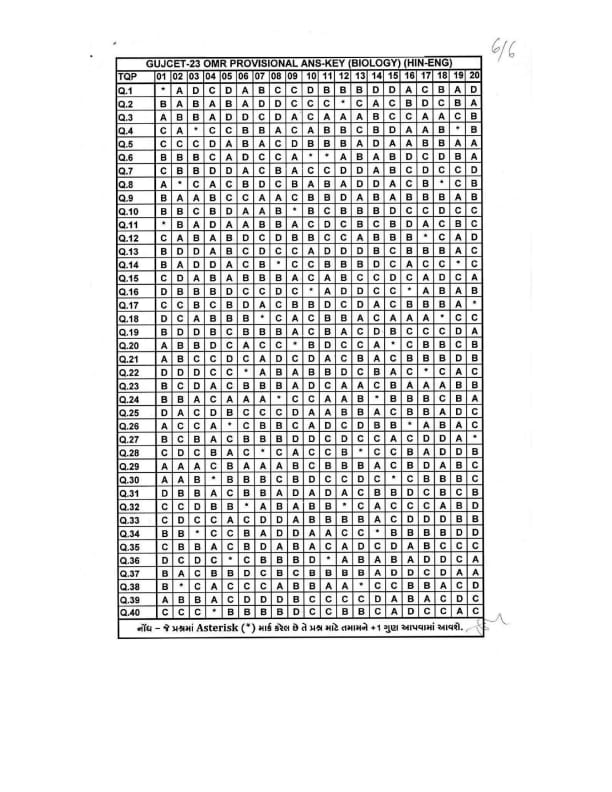
Candidates can download the GUJCET 2023 Biology Question Paper with Answer Key PDFs using the link below.
| GUJCET 2023 Biology Question Paper with Answer Key |  Download Download |
Check Solution |
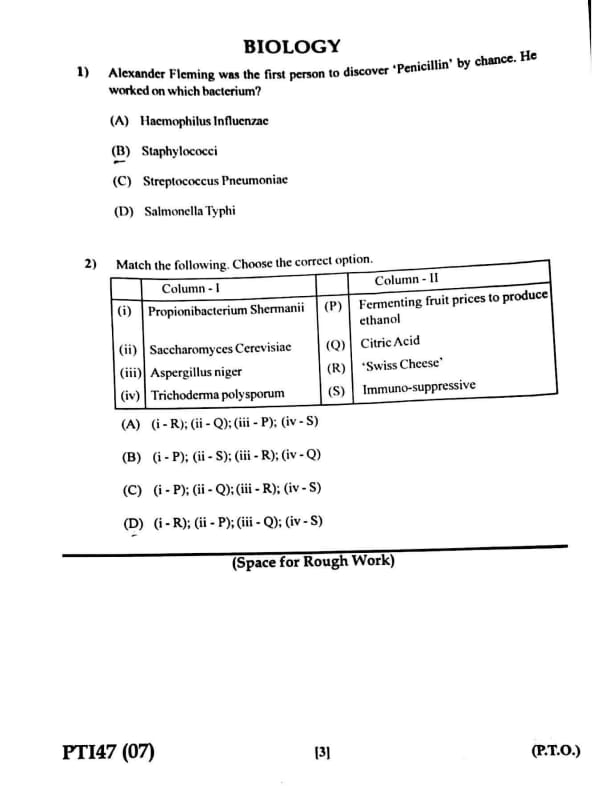
Alexander Fleming was the first person to discover 'Penicillin' by chance. He worked on which bacterium?
View Solution
Step 1: Understanding the Concept:
Antibiotics are chemical substances produced by some microbes that can kill or retard the growth of other disease-causing microbes. Penicillin was the first antibiotic to be discovered, and it was a "Serendipitous" (by chance) discovery.
Step 2: Key Formula or Approach:
Historical Context: While working on a specific bacterium, Fleming observed a mold growing in one of his unwashed culture plates around which the bacteria could not grow.
Step 3: Detailed Explanation:
Alexander Fleming was working on Staphylococci bacteria. He observed that a mold called \textit{Penicillium notatum prevented the growth of these bacteria in its vicinity. He concluded that the mold produced a chemical (Penicillin) that inhibited the bacterial growth.
Step 4: Final Answer:
The bacterium Alexander Fleming was working on was Staphylococci. Quick Tip: While Fleming discovered it, the full potential of Penicillin as an effective antibiotic was established later by Ernest Chain and Howard Florey.
Match the following. Choose the correct option.
Column - I Column - II
(i) Propionibacterium Shermanii (P) Fermenting fruit juices to produce ethanol
(ii) Saccharomyces Cerevisiae (Q) Citric Acid
(iii) Aspergillus niger (R) 'Swiss Cheese'
(iv) Trichoderma polysporum (S) Immuno-suppressive agent
View Solution
Step 1: Understanding the Concept:
Microorganisms are used industrially to produce a variety of products, including acids, enzymes, and bioactive molecules like immunosuppressants.
Step 2: Key Formula or Approach:
Match each microbe to its specific industrial or biological product.
Step 3: Detailed Explanation:
(i) Propionibacterium Shermanii: Used in the production of Swiss Cheese (large holes are due to \(CO_2\) production). \(\rightarrow\) (R)
(ii) Saccharomyces Cerevisiae: Also known as Brewer’s yeast, used for fermenting fruit juices and malted cereals to produce ethanol. \(\rightarrow\) (P)
(iii) Aspergillus niger: A fungus used for the commercial production of Citric Acid. \(\rightarrow\) (Q)
(iv) Trichoderma polysporum: A fungus used to produce Cyclosporin A, an immuno-suppressive agent used in organ transplant patients. \(\rightarrow\) (S)
Step 4: Final Answer:
The correct matching sequence is (i - R); (ii - P); (iii - Q); (iv - S). Quick Tip: Remember: S. cerevisiae is both "Baker's Yeast" (bread) and "Brewer's Yeast" (alcohol).
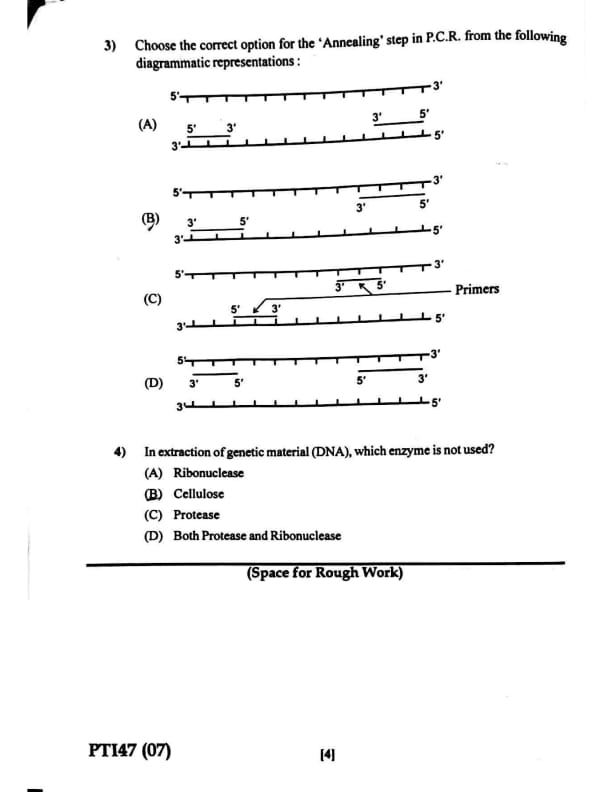
Choose the correct option for the 'Annealing' step in P.C.R. from the following diagrammatic representations:

View Solution
Step 1: Understanding the Concept:
PCR (Polymerase Chain Reaction) involves three steps: Denaturation, Annealing, and Extension. Annealing is the step where two sets of primers bind to the separated DNA strands.
Step 2: Key Formula or Approach:
Primers always bind to the 3' end of the template strand so that DNA polymerase can extend the new strand in the 5' \(\rightarrow\) 3' direction.
Step 3: Detailed Explanation:
During annealing, the temperature is lowered to allow primers to hydrogen-bond to their complementary sequences on the template DNA. Since DNA is antiparallel:
On the 5' \(\rightarrow\) 3' template, the primer binds at the 3' end.
On the 3' \(\rightarrow\) 5' template, the primer binds at the 3' end.
The primers themselves are oriented 5' \(\rightarrow\) 3' facing toward each other across the region to be amplified.
Step 4: Final Answer:
The correct representation shows primers binding to the 3' ends of the template strands, allowing 5' \(\rightarrow\) 3' extension. Quick Tip: DNA polymerase can ONLY add nucleotides to the 3'-OH group of a pre-existing polynucleotide chain. No 3' end, no extension!
In extraction of genetic material (DNA), which enzyme is not used?
View Solution
Step 1: Understanding the Concept:
To isolate pure DNA, we must break open the cell and remove other macromolecules like RNA, proteins, and polysaccharides using specific enzymes.
Step 2: Key Formula or Approach:
Protease \(\rightarrow\) breaks down Proteins.
Ribonuclease (RNase) \(\rightarrow\) breaks down RNA.
Cellulase \(\rightarrow\) breaks down Cellulose (plant cell walls).
Step 3: Detailed Explanation:
In a standard DNA extraction protocol:
1. Ribonuclease is used to remove RNA.
2. Protease is used to remove proteins (histones).
3. Cellulase (not "Cellulose") is used if the source is plant tissue.
The question asks which is not used. If (B) refers to the substance "Cellulose," it is not an enzyme. However, in many contexts, this question implies that while RNase and Protease are universal for purifying DNA from any source, enzymes like Cellulase are only for specific (plant) sources. Given the phrasing, Cellulose is a substrate/molecule, not an enzyme.
Step 4: Final Answer:
Cellulose (as a molecule) is not an enzyme used in extraction. Quick Tip: Purified DNA finally precipitates out after the addition of chilled ethanol.
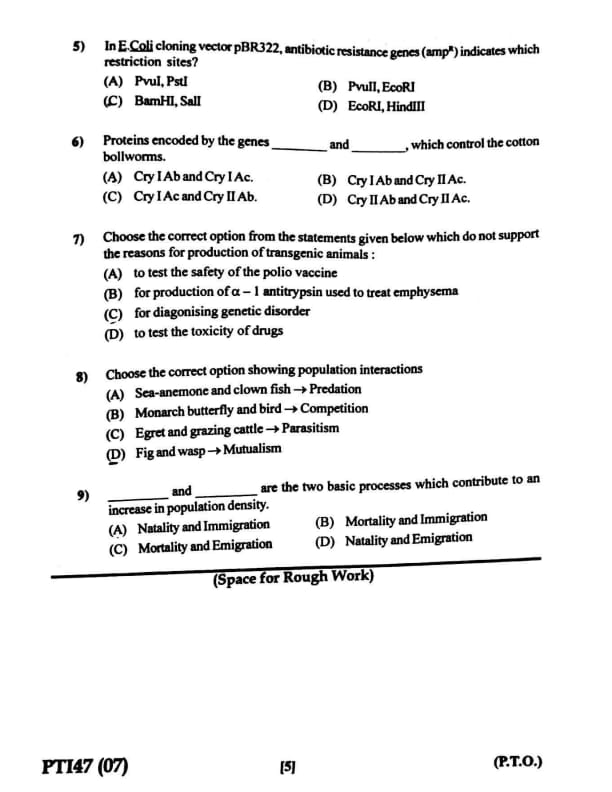
In E.Coli cloning vector pBR322, antibiotic resistance genes (\(amp^R\)) indicates which restriction sites?
View Solution
Step 1: Understanding the Concept:
pBR322 is a standard cloning vector. It contains selectable markers (antibiotic resistance genes) which have specific recognition sites for restriction endonucleases.
Step 2: Key Formula or Approach:
\(amp^R\) (Ampicillin resistance) region contains: PstI, PvuI.
\(tet^R\) (Tetracycline resistance) region contains: BamHI, SalI.
Step 3: Detailed Explanation:
The ampicillin resistance gene (\(amp^R\)) in pBR322 has unique restriction sites for PstI and PvuI. If you insert a foreign DNA fragment at these sites, the \(amp^R\) gene becomes inactivated (insertional inactivation), allowing you to select for recombinants.
Step 4: Final Answer:
The restriction sites in the \(amp^R\) gene are PvuI and PstI. Quick Tip: To remember \(tet^R\) sites, use the mnemonic: "Bam! Salt!" for BamHI and SalI.
Proteins encoded by the genes ______ and ______, which control the cotton bollworms.
View Solution
Step 1: Understanding the Concept:
\textit{Bacillus thuringiensis produces crystal (Cry) proteins that are toxic to specific insect pests. These genes have been incorporated into crops like Bt cotton to provide resistance against pests.
Step 2: Key Formula or Approach:
Specific Cry genes control specific insects:
Cotton Bollworms: \textit{cryIAc and \textit{cryIIAb.
Corn Borer: \textit{cryIAb.
Step 3: Detailed Explanation:
The toxins are coded by genes named \textit{cry. There are several types. The proteins encoded by the genes cryIAc and cryIIAb are specifically effective against cotton bollworms, whereas cryIAb is used to control corn borer. Choice (C) correctly identifies the pair for bollworms.
Step 4: Final Answer:
The proteins are encoded by Cry I Ac and Cry II Ab. Quick Tip: To remember: "Bollworms" needs two genes (Ac and Ab), while "Corn borer" only needs one (Ab).
Choose the correct option from the statements given below which do not support the reasons for production of transgenic animals :
View Solution
Step 1: Understanding the Concept:
Transgenic animals are animals that have had their DNA manipulated to possess and express an extra (foreign) gene. They are produced for specific economic, medical, or scientific benefits.
Step 2: Key Formula or Approach:
Evaluate common uses of transgenic animals:
1. Vaccine safety (Transgenic mice for Polio).
2. Biological products (Rosie the cow, \(\alpha\)-1 antitrypsin).
3. Chemical safety/Toxicity testing.
Step 3: Detailed Explanation:
(A), (B), and (D) are well-established reasons for creating transgenic models.
(C) is the outlier. While transgenic animals are created to serve as models for studying human diseases (like cancer or cystic fibrosis), they are not a tool used to diagnose a genetic disorder in a patient. Diagnosis is done through techniques like PCR, ELISA, or amniocentesis.
Step 4: Final Answer:
Diagnosing genetic disorders is not a reason for the production of transgenic animals. Quick Tip: The first transgenic cow, Rosie, produced human protein-enriched milk (2.4 grams per litre) containing human alpha-lactalbumin.
Choose the correct option showing population interactions
View Solution
Step 1: Understanding the Concept:
Population interactions describe how different species living in the same community influence each other. These can be beneficial (+), harmful (-), or neutral (0).
Step 2: Key Formula or Approach:
Mutualism: (+/+)
Commensalism: (+/0)
Parasitism/Predation: (+/-)
Competition: (-/-)
Step 3: Detailed Explanation:
Sea-anemone and clown fish: This is Commensalism (+/0). The fish gets protection; the anemone is unaffected.
Egret and cattle: This is Commensalism (+/0). The bird eats insects stirred up by cattle.
Fig and wasp: This is Mutualism (+/+). The wasp pollinates the fig inflorescence, and the fig provides a site for egg-laying and developing seeds for the larvae to feed on.
Step 4: Final Answer:
The correct interaction is Fig and wasp \(\rightarrow\) Mutualism. Quick Tip: In Mutualism, both species are so dependent on each other that they often co-evolve!
______ and ______ are the two basic processes which contribute to an increase in population density.
View Solution
Step 1: Understanding the Concept:
Population density (\(N\)) fluctuates based on four main processes: Natality (births), Mortality (deaths), Immigration (moving in), and Emigration (moving out).
Step 2: Key Formula or Approach:
\(\)N_{t+1 = N_t + [(B + I) - (D + E)]\(\)
Where \(B = Natality\), \(I = Immigration\), \(D = Mortality\), \(E = Emigration\).
Step 3: Detailed Explanation:
To increase population density, you need to add individuals to the population. This happens via:
1. Natality: Production of new individuals through reproduction.
2. Immigration: Individuals of the same species coming into the habitat from elsewhere.
Mortality and Emigration decrease the number of individuals.
Step 4: Final Answer:
Natality and Immigration contribute to an increase in population density. Quick Tip: Under normal conditions, Natality and Mortality are the most important factors. Immigration becomes significant only when a new habitat is being colonized.
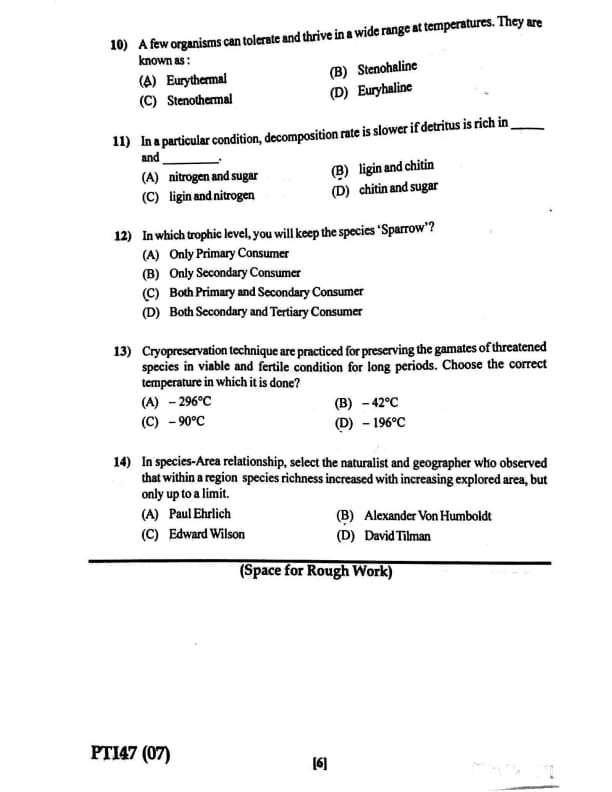
A few organisms can tolerate and thrive in a wide range at temperatures. They are known as:
View Solution
Step 1: Understanding the Concept:
Organisms have different levels of tolerance for environmental factors like temperature and salinity. The prefixes "Eury-" (wide) and "Steno-" (narrow) are used to describe these ranges.
Step 2: Key Formula or Approach:
Thermal = Temperature
Haline = Salinity (Salt)
Eury = Wide range
Steno = Narrow range
Step 3: Detailed Explanation:
Organisms that can tolerate a wide range of temperatures are called Eurythermal. In contrast, those restricted to a narrow range of temperature are Stenothermal. Most organisms are stenothermal, which is why global warming is such a significant threat to biodiversity.
Step 4: Final Answer:
Organisms that tolerate a wide temperature range are Eurythermal. Quick Tip: Think "Eury-" sounds like "Every" (can live everywhere/wide range).
In a particular condition, decomposition rate is slower if detritus is rich in ______ and _______.
View Solution
Step 1: Understanding the Concept:
Decomposition is an oxygen-requiring process where complex organic matter is broken down into inorganic substances. The rate of decomposition is heavily influenced by the chemical composition of the detritus and climatic factors.
Step 2: Key Formula or Approach:
Fast decomposition: Detritus rich in Nitrogen and water-soluble substances (like sugars).
Slow decomposition: Detritus rich in complex structural polymers.
Step 3: Detailed Explanation:
Lignin and chitin are complex, tough organic compounds. Lignin provides structural support in plants, and chitin is found in the fungal cell walls and arthropod exoskeletons. Because these molecules are difficult for microbes to break down enzymatically, their presence significantly slows down the decomposition rate.
Step 4: Final Answer:
Decomposition is slower if detritus is rich in lignin and chitin. Quick Tip: Temperature and soil moisture are the most important climatic factors that regulate decomposition through their effects on the activities of soil microbes.
In which trophic level, you will keep the species 'Sparrow'?
View Solution
Step 1: Understanding the Concept:
A species may occupy more than one trophic level in the same ecosystem at the same time, depending on its food source.
Step 2: Key Formula or Approach:
Primary Consumer: Eats producers (plants/seeds).
Secondary Consumer: Eats primary consumers (insects/worms).
Step 3: Detailed Explanation:
A sparrow is an omnivore. When it eats seeds, fruits, or grain, it occupies the second trophic level as a primary consumer. However, when it eats insects or worms, it occupies the third trophic level as a secondary consumer.
Step 4: Final Answer:
The sparrow is kept in both Primary and Secondary Consumer levels. Quick Tip: The trophic level represents a functional level, not a fixed species as such. A single individual can belong to multiple levels.
Cryopreservation technique are practiced for preserving the gametes of threatened species in viable and fertile condition for long periods. Choose the correct temperature in which it is done?
View Solution
Step 1: Understanding the Concept:
Cryopreservation is an ex-situ conservation method where biological materials are stored at ultra-low temperatures to preserve their genetic integrity.
Step 2: Key Formula or Approach:
The standard medium for cryopreservation is Liquid Nitrogen.
Step 3: Detailed Explanation:
Gametes of threatened species, as well as seeds of different genetic strains, can be preserved for long periods using liquid nitrogen at a temperature of -196°C. At this temperature, all biological activity effectively stops, preventing degradation.
Step 4: Final Answer:
Cryopreservation is done at -196°C. Quick Tip: Cryopreservation is part of "advanced ex-situ conservation," which also includes tissue culture and genomic banks.
In species-Area relationship, select the naturalist and geographer who observed that within a region species richness increased with increasing explored area, but only up to a limit.
View Solution
Step 1: Understanding the Concept:
The species-area relationship describes how the number of species increases with the area being sampled. This is a fundamental concept in island biogeography and conservation biology.
Step 2: Key Formula or Approach:
\(\log S = \log C + Z \log A\)
Where \(S = Species richness\), \(A = Area\), \(Z = slope\), \(C = Y-intercept\).
Step 3: Detailed Explanation:
The German naturalist and geographer Alexander von Humboldt explored the South American jungles and observed that within a region, species richness increases with increasing explored area, but only up to a certain limit. On a logarithmic scale, this relationship is a straight line.
Step 4: Final Answer:
The naturalist is Alexander Von Humboldt. Quick Tip: For most regions, the value of \(Z\) (slope) stays between 0.1 and 0.2, regardless of the taxonomic group or the region.
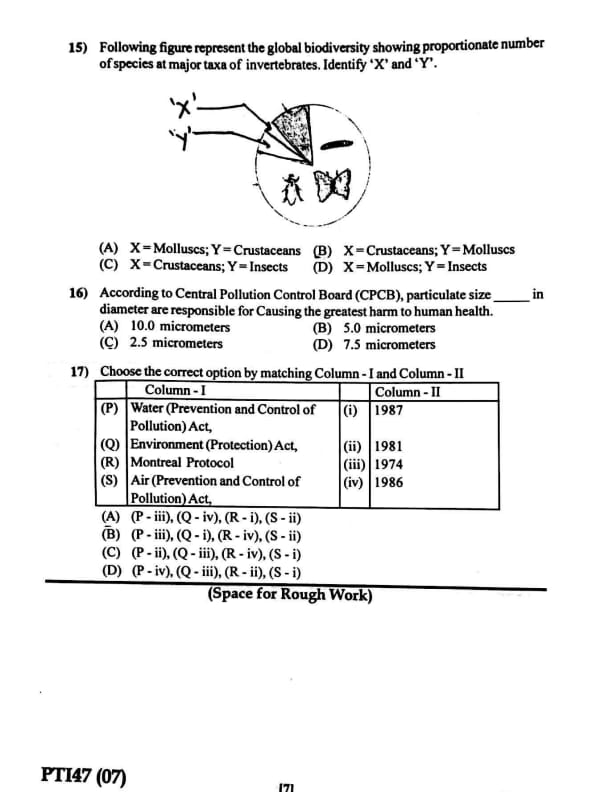
Following figure represent the global biodiversity showing proportionate number of species at major taxa of invertebrates. Identify 'X' and 'Y'.

View Solution
Step 1: Understanding the Concept:
Invertebrates make up the vast majority of animal species on Earth. Among them, certain phyla are significantly more diverse than others.
Step 2: Key Formula or Approach:
Proportion of Invertebrates:
1. Insects (Largest group, ~70%)
2. Other animal groups
3. Molluscs (Second largest phylum)
4. Crustaceans
Step 3: Detailed Explanation:
In the standard pie chart for major taxa of Invertebrates:
The largest slice represents Insects.
The next largest slice (labeled X in typical diagrams) represents Molluscs.
The next slice (labeled Y) represents Crustaceans.
Therefore, X = Molluscs and Y = Crustaceans.
Step 4: Final Answer:
X is Molluscs and Y is Crustaceans. Quick Tip: Out of every 10 animals on this planet, 7 are insects!
According to Central Pollution Control Board (CPCB), particulate size ______ in diameter are responsible for causing the greatest harm to human health.
View Solution
Step 1: Understanding the Concept:
Air pollutants consist of gaseous substances and particulate matter. The impact of particulate matter on human health depends largely on the size of the particles, as this determines how deeply they can penetrate the respiratory system.
Step 2: Key Formula or Approach:
The CPCB has identified \(PM_{2.5}\) (Particulate Matter 2.5) as the most dangerous category of air pollutants for human lungs.
Step 3: Detailed Explanation:
According to the CPCB, particulate size 2.5 micrometers or less in diameter (\(PM_{2.5}\)) are responsible for causing the greatest harm to human health. Because they are so small, these particles can be inhaled deep into the lungs (alveolar region) and can even enter the bloodstream, causing breathing and respiratory problems, irritation, inflammations, damage to the lungs, and premature deaths.
Step 4: Final Answer:
The particulate size responsible for greatest harm is 2.5 micrometers. Quick Tip: To visualize this, a human hair is roughly 50-70 micrometers in diameter—about 30 times larger than a \(PM_{2.5}\) particle!
Choose the correct option by matching Column - I and Column - II
(P) Water (Prevention and Control of Pollution) Act (i) 1987
(Q) Environment (Protection) Act (ii) 1981
(R) Montreal Protocol (iii) 1974
(S) Air (Prevention and Control of Pollution) Act (iv) 1986
View Solution
Step 1: Understanding the Concept:
Environmental legislation and international treaties are implemented to protect the environment and regulate pollution. Memorizing the specific years these acts were passed is essential for environmental studies.
Step 2: Key Formula or Approach:
Match the specific environmental law/treaty with its effective year.
Step 3: Detailed Explanation:
(P) Water Act: Passed in 1974 to safeguard water resources. \(\rightarrow\) (iii)
(Q) Environment (Protection) Act: Passed in 1986 as an "umbrella" legislation. \(\rightarrow\) (iv)
(R) Montreal Protocol: Signed in 1987 (effective 1989) to control Ozone-depleting substances. \(\rightarrow\) (i)
(S) Air Act: Passed in 1981 (amended in 1987 to include noise). \(\rightarrow\) (ii)
Step 4: Final Answer:
The correct matching is (P - iii), (Q - iv), (R - i), (S - ii). Quick Tip: Remember the order: Water (1974) came before Air (1981), and Environment Protection (1986) followed shortly after.
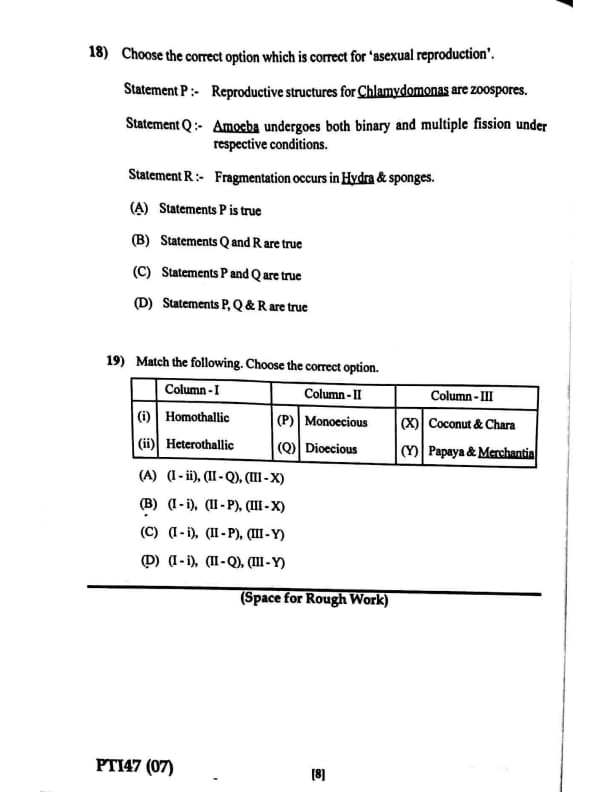
Choose the correct option which is correct for 'asexual reproduction'.
Statement P :- Reproductive structures for Chlamydomonas are zoospores.
Statement Q :- Amoeba undergoes both binary and multiple fission under respective conditions.
Statement R :- Fragmentation occurs in Hydra & sponges.
View Solution
Step 1: Understanding the Concept:
Asexual reproduction involves the production of offspring by a single parent without the fusion of gametes. Various organisms use different specialized structures or methods.
Step 2: Key Formula or Approach:
Analyze each biological statement for accuracy based on known reproductive methods.
Step 3: Detailed Explanation:
Statement P: Correct. Chlamydomonas (an alga) reproduces asexually via flagellated, motile zoospores.
Statement Q: Correct. \textit{Amoeba reproduces via binary fission in favorable conditions and multiple fission (after encystation) in unfavorable conditions.
Statement R: Correct. Both \textit{Hydra and sponges (as well as Planaria) have the capacity for fragmentation where a piece of the body can grow into a new individual.
Step 4: Final Answer:
All three statements (P, Q, and R) are correct. Quick Tip: While \textit{Hydra is famous for budding, it also exhibits high regenerative capacity via fragmentation.
Match the following. Choose the correct option.
(i) Homothallic (P) Monoecious (X) Coconut & Chara
(ii) Heterothallic (Q) Dioecious (Y) Papaya & Marchantia
View Solution
Step 1: Understanding the Concept:
Terms like Homothallic/Monoecious and Heterothallic/Dioecious describe the distribution of male and female reproductive organs in plants and fungi.
Step 2: Key Formula or Approach:
Homothallic = Monoecious (Both sexes on one body).
Heterothallic = Dioecious (Sexes on separate bodies).
Step 3: Detailed Explanation:
(i) Homothallic: This is synonymous with Monoecious (P). Examples include Coconut and the alga Chara (X). \(\rightarrow\) (i-P-X)
(ii) Heterothallic: This is synonymous with Dioecious (Q). Examples include Papaya and the liverwort Marchantia (Y). \(\rightarrow\) (ii-Q-Y)
Step 4: Final Answer:
The correct combination is (I - i), (II - P), (III - X). Quick Tip: "Mono-" means "one" (one house for both sexes), and "Di-" means "two" (separate houses for male and female).
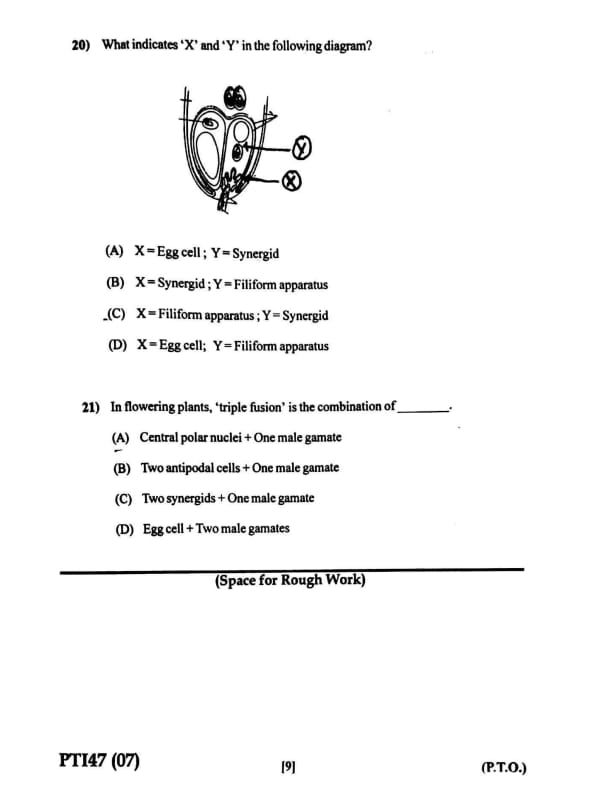
What indicates 'X' and 'Y' in the following diagram?

View Solution
Step 1: Understanding the Concept:
The female gametophyte (embryo sac) in angiosperms is a 7-celled, 8-nucleate structure. The micropylar end contains the egg apparatus, consisting of two synergids and one egg cell.
Step 2: Key Formula or Approach:
Identify the components of the egg apparatus:
Two large cells: Synergids.
Cellular thickenings at the base: Filiform apparatus.
Step 3: Detailed Explanation:
In standard diagrams of the embryo sac:
X usually points to the Synergid (one of the two helper cells).
Y points to the finger-like projections at the micropylar tip of the synergids, known as the Filiform apparatus. The filiform apparatus plays an important role in guiding the pollen tube into the synergid.
Step 4: Final Answer:
X indicates the Synergid and Y indicates the Filiform apparatus. Quick Tip: The filiform apparatus is chemically active; it secretes chemo-attractants to lead the pollen tube to the egg.
In flowering plants, 'triple fusion' is the combination of ______.
View Solution
Step 1: Understanding the Concept:
Double fertilization is a unique feature of angiosperms. It involves two types of fusion: syngamy and triple fusion. Triple fusion results in the formation of the Primary Endosperm Nucleus (PEN), which later develops into the endosperm to nourish the embryo.
Step 2: Key Formula or Approach:
The reaction for triple fusion is: \(n (male gamete) + 2n (two polar nuclei in the central cell) \rightarrow 3n (PEN)\)
Step 3: Detailed Explanation:
In the embryo sac, one male gamete moves toward the egg cell and fuses with it (syngamy). The second male gamete moves toward the two polar nuclei located in the central cell and fuses with them to produce a triploid primary endosperm nucleus. Because this involves the fusion of three haploid nuclei, it is termed triple fusion.
Step 4: Final Answer:
Triple fusion is the combination of central polar nuclei and one male gamete. Quick Tip: The central cell, after triple fusion, becomes the Primary Endosperm Cell (PEC).
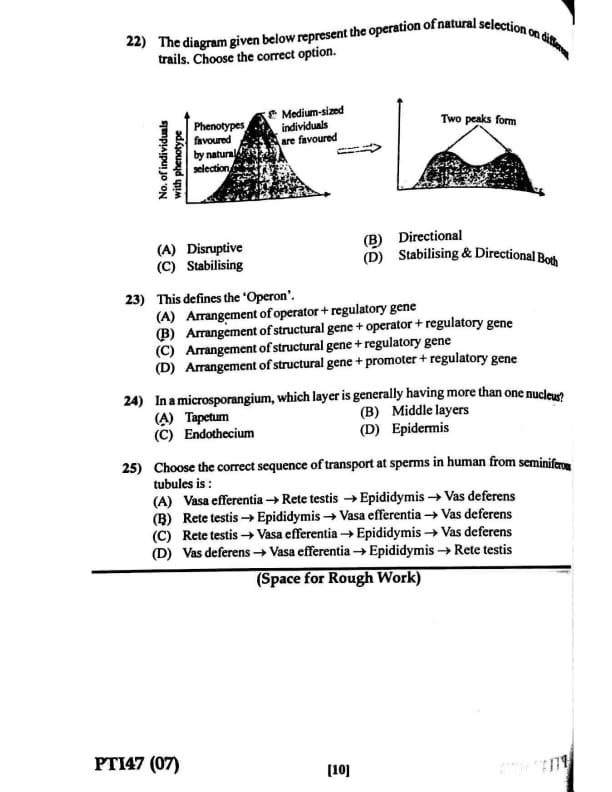
The diagram given below represent the operation of natural selection on different trails. Choose the correct option.

View Solution
Step 1: Understanding the Concept:
Natural selection can lead to stabilization, directional change, or disruption of a population's traits based on which phenotypes are favored by the environment.
Step 2: Key Formula or Approach:
Stabilizing: Favors the average/mean trait; peak gets higher/narrower.
Directional: Favors one extreme; peak shifts in one direction.
Disruptive: Favors both extremes; two peaks form.
Step 3: Detailed Explanation:
In Directional selection, individuals at one extreme of the distribution have higher fitness than those in the middle or at the other extreme. This causes the entire curve of the population's trait distribution to shift toward that favored extreme over generations. A classic example is the industrial melanism in peppered moths.
Step 4: Final Answer:
The operation where the peak shifts is Directional selection. Quick Tip: Stabilizing selection "conserves" the current state, while Directional selection "moves" the population toward a new adaptation.
This defines the 'Operon'.
View Solution
Step 1: Understanding the Concept:
An operon is a functional unit of genomic DNA containing a cluster of genes under the control of a single promoter. This system allows for the coordinated regulation of gene expression in prokaryotes.
Step 2: Key Formula or Approach:
Components of an Operon:
1. Regulatory Gene (i gene)
2. Promoter (P)
3. Operator (O)
4. Structural Genes (e.g., z, y, a in lac operon)
Step 3: Detailed Explanation:
A polycistronic structural gene is often regulated by a common promoter and regulatory genes. Such an arrangement is very common in bacteria and is referred to as an Operon. It essentially includes the structural genes that code for proteins and the control elements (operator, promoter, and regulatory gene) that determine when those proteins are made.
Step 4: Final Answer:
An Operon is the arrangement of structural gene, operator, and regulatory gene. Quick Tip: The "i" gene in the lac operon does not stand for "induced," but for "inhibitor."
In a microsporangium, which layer is generally having more than one nucleus?
View Solution
Step 1: Understanding the Concept:
A microsporangium (pollen sac) is surrounded by four wall layers. The outer three are protective and help in dehiscence, while the innermost layer is nutritive.
Step 2: Key Formula or Approach:
Wall Layers (Outer to Inner):
Epidermis \(\rightarrow\) Endothecium \(\rightarrow\) Middle layers \(\rightarrow\) Tapetum.
Step 3: Detailed Explanation:
The Tapetum is the innermost layer. It nourishes the developing pollen grains. Cells of the tapetum possess dense cytoplasm and generally have more than one nucleus. This multinucleate condition often arises due to endomitosis or nuclear division without cytokinesis, allowing the cells to be highly active metabolically.
Step 4: Final Answer:
The Tapetum layer generally has more than one nucleus. Quick Tip: The tapetum also produces sporopollenin, the most resistant organic material known, which forms the outer layer (exine) of pollen.
Choose the correct sequence of transport at sperms in human from seminiferous tubules is :
View Solution
Step 1: Understanding the Concept:
Sperm are produced in the seminiferous tubules of the testes. They must then travel through a series of accessory ducts to reach the outside for ejaculation.
Step 2: Key Formula or Approach:
The path of sperm:
Seminiferous tubules \(\rightarrow\) Rete testis \(\rightarrow\) Vasa efferentia \(\rightarrow\) Epididymis \(\rightarrow\) Vas deferens \(\rightarrow\) Ejaculatory duct \(\rightarrow\) Urethra.
Step 3: Detailed Explanation:
The seminiferous tubules open into the rete testis. From there, the sperm enter the vasa efferentia. These ducts then lead to the epididymis, which is located along the posterior surface of each testis. Finally, the epididymis leads to the vas deferens that ascends into the abdomen.
Step 4: Final Answer:
The correct sequence is Rete testis \(\rightarrow\) Vasa efferentia \(\rightarrow\) Epididymis \(\rightarrow\) Vas deferens. Quick Tip: Sperm undergo functional maturation and gain motility primarily while stored in the epididymis.
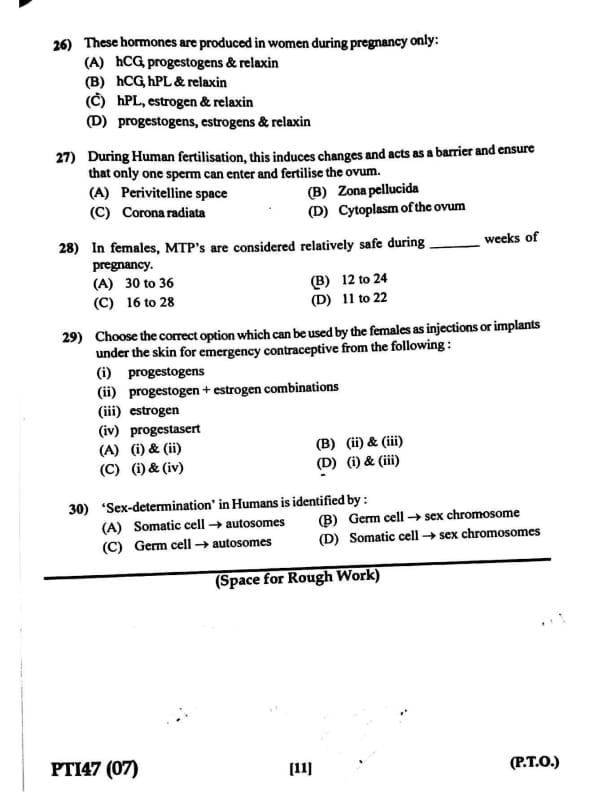
These hormones are produced in women during pregnancy only:
View Solution
Step 1: Understanding the Concept:
During pregnancy, the placenta acts as a temporary endocrine gland. It produces several hormones essential for fetal growth and the maintenance of pregnancy that are not present in non-pregnant women.
Step 2: Key Formula or Approach:
Identify hormones exclusive to pregnancy:
hCG (human Chorionic Gonadotropin)
hPL (human Placental Lactogen)
Relaxin (produced by the ovary/placenta in later stages of pregnancy)
Step 3: Detailed Explanation:
While hormones like estrogen and progestogen are produced during the normal menstrual cycle and increase during pregnancy, hCG, hPL, and relaxin are produced in women only during pregnancy. hCG is the hormone detected in pregnancy tests.
Step 4: Final Answer:
The hormones are hCG, hPL, and relaxin. Quick Tip: Estrogen and Progestogen levels increase significantly during pregnancy, but they are also present in non-pregnant women during the luteal phase of the cycle.
During Human fertilisation, this induces changes and acts as a barrier and ensure that only one sperm can enter and fertilise the ovum.
View Solution
Step 1: Understanding the Concept:
To prevent "polyspermy" (fertilization by more than one sperm), the egg must undergo rapid changes once the first sperm makes contact.
Step 2: Key Formula or Approach:
The sperm comes in contact with the outermost layers of the ovum in this order:
Corona radiata \(\rightarrow\) Zona pellucida \(\rightarrow\) Plasma membrane.
Step 3: Detailed Explanation:
When a sperm comes into contact with the zona pellucida layer of the ovum, it induces changes in the membrane that block the entry of additional sperms. This is called the cortical reaction, which hardens the zona pellucida and ensures that only one sperm can fertilize the egg.
Step 4: Final Answer:
The Zona pellucida acts as the barrier to ensure monospermy. Quick Tip: The acrosome of the sperm contains enzymes (hyaluronidase) specifically designed to digest through the zona pellucida.
In females, MTP's are considered relatively safe during ______ weeks of pregnancy.
View Solution
Step 1: Understanding the Concept:
Medical Termination of Pregnancy (MTP) or induced abortion is the voluntary termination of pregnancy before full term. Its safety decreases as the fetus develops.
Step 2: Key Formula or Approach:
First Trimester (up to 12 weeks): Relatively safe.
Second Trimester (up to 24 weeks): Much more risky for the mother.
Step 3: Detailed Explanation:
MTPs are considered relatively safe during the first trimester (up to 12 weeks). While the medical procedure is still practiced in the second trimester (up to 24 weeks per Indian law for certain categories), the biological risk to the mother is significantly higher. Given the options, (B) covers the range allowed by the 2021 Amendment, though the safest period is specifically the first 12 weeks.
Step 4: Final Answer:
MTPs are considered within the safety/legal range during 12 to 24 weeks (with 12 being the safest limit). Quick Tip: MTP was legalized in India in 1971 with strict conditions to avoid misuse (such as female foeticide).
Choose the correct option which can be used by the females as injections or implants under the skin for emergency contraceptive from the following :
(i) progestogens
(ii) progestogen + estrogen combinations
(iii) estrogen
(iv) progestasert
View Solution
Step 1: Understanding the Concept:
Contraceptive methods like injections and implants work similarly to oral pills by inhibiting ovulation and thickening cervical mucus. They provide long-term protection compared to daily pills.
Step 2: Key Formula or Approach:
Identify the hormonal components of implants/injections:
They use either progestogens alone or in combination with estrogen.
Step 3: Detailed Explanation:
Progestogens alone or in combination with estrogen can be used by females as injections or implants under the skin. Their mode of action is similar to that of pills and their effective periods are much longer. Administration of these within 72 hours of coitus has been found to be very effective as emergency contraceptives. Progestasert (iv) is an IUD, not an implant.
Step 4: Final Answer:
The correct option is (i) & (ii). Quick Tip: Implants are usually placed just under the skin of the inner upper arm and can last for 3 to 5 years.
'Sex-determination' in Humans is identified by :
View Solution
Step 1: Understanding the Concept:
In humans, sex is determined by the chromosomal composition of the gametes (germ cells) that fuse during fertilization. Humans have 22 pairs of autosomes and 1 pair of sex chromosomes.
Step 2: Key Formula or Approach:
Female Gamete (Ovum): Always carries an X chromosome.
Male Gamete (Sperm): Carries either an X or a Y chromosome.
Step 3: Detailed Explanation:
The sex of the child is determined at the moment of fertilization by the type of sex chromosome present in the germ cell (sperm) that fertilizes the egg. If a sperm carrying 'X' fuses with the egg, the child is female (XX). If a sperm carrying 'Y' fuses with the egg, the child is male (XY).
Step 4: Final Answer:
Sex-determination is identified by the sex chromosomes in the germ cells. Quick Tip: Since the mother only produces 'X' gametes, it is scientifically the father's genetic contribution that determines the sex of the offspring.
In Turner's Syndrome, during cell division, which type of Aneuploidy is seen?
View Solution
Step 1: Understanding the Concept:
Aneuploidy is a chromosomal aberration caused by the failure of chromatids to segregate during cell division, resulting in the gain or loss of a chromosome. Turner's Syndrome is a specific type of genetic disorder caused by the absence of one of the X chromosomes.
Step 2: Key Formula or Approach:
Trisomy: (2n + 1)
Monosomy: (2n - 1)
Turner's Syndrome Karyotype: 45 with X0.
Step 3: Detailed Explanation:
In Turner's Syndrome, a female is born with only one X chromosome instead of two. This loss of a single chromosome from a diploid set is called monosomy. Since the normal diploid number (\(2n\)) is 46, the condition is represented as \(2n - 1 = 45\). Individuals are phenotypically female but typically sterile with rudimentary ovaries.
Step 4: Final Answer:
The type of aneuploidy seen in Turner's Syndrome is (2n - 1). Quick Tip: Contrast this with Klinefelter's Syndrome, which is (2n + 1), resulting in an XXY karyotype.
A cross was made by Mendel with pea plant between violet flower (VV) in axial position (AA) and white flower (vv) in terminal position (aa). What ratio of white flowers (vv) phenotypically he had received in F\(_2\) generation?
View Solution
Step 1: Understanding the Concept:
This is a dihybrid cross involving two traits: flower color (Violet/White) and flower position (Axial/Terminal). Mendel's Law of Independent Assortment applies here.
Step 2: Key Formula or Approach:
Dihybrid phenotypic ratio: 9 : 3 : 3 : 1
9 Violet Axial
3 Violet Terminal
3 White Axial
1 White Terminal
Step 3: Detailed Explanation:
The question asks for the total number of "white flowers" phenotypically in the standard 16-square F\(_2\) Punnett square.
White-Axial (\(vvA\_\)): 3 individuals
White-Terminal (\(vvaa\)): 1 individual
Total White flowers = \(3 + 1 = 4\).
This represents \(4/16\) of the offspring.
Step 4: Final Answer:
The ratio (count out of 16) of white flowers is 4. Quick Tip: Regardless of the second trait, if you look at just one trait in a dihybrid cross, it always follows the 3:1 monohybrid ratio. \(3/4\) of 16 is 12 (Violet), and \(1/4\) of 16 is 4 (White).
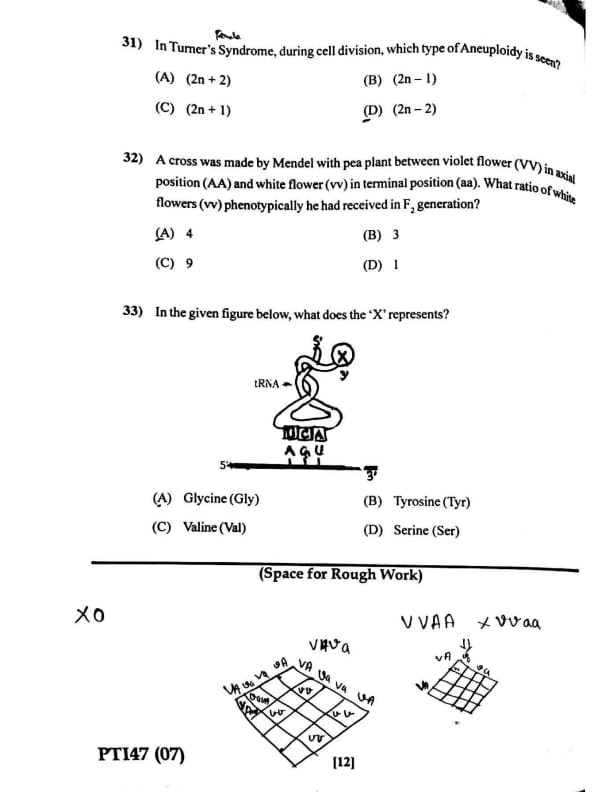
In the given figure below, what does the 'X' represents?

View Solution
Step 1: Understanding the Concept:
Sickle cell anemia is an autosomal recessive disorder caused by a point mutation in the gene coding for the \(\beta\)-globin chain of hemoglobin.
Step 2: Key Formula or Approach:
Normal HbA: Glutamic acid (Glu) at 6th position.
Sickle HbS: Valine (Val) at 6th position.
Step 3: Detailed Explanation:
The mutation involves the substitution of Glutamic acid (a polar amino acid) by Valine (a non-polar amino acid) at the sixth position of the beta-globin chain. This change is caused by a single base substitution at the mRNA level, where GAG is replaced by GUG. This 'X' in the diagram represents the mutant amino acid, Valine.
Step 4: Final Answer:
'X' represents Valine (Val). Quick Tip: This substitution causes the hemoglobin molecule to undergo polymerization under low oxygen tension, changing the shape of RBCs from biconcave discs to sickle-like structures.
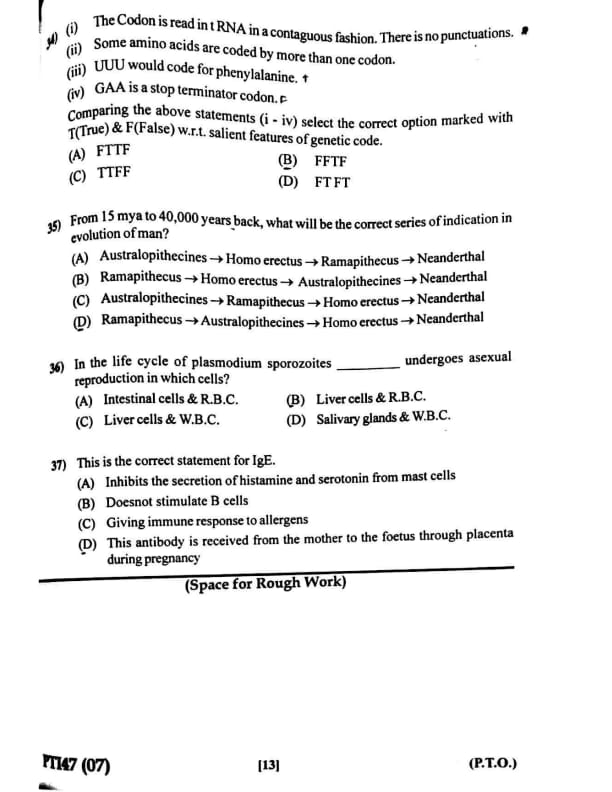
(i) The Codon is read in tRNA in a contagious fashion. There is no punctuations.
(ii) Some amino acids are coded by more than one codon.
(iii) UUU would code for phenylalanine.
(iv) GAA is a stop terminator codon.
Select the correct option marked with T(True) & F(False).
View Solution
Step 1: Understanding the Concept:
The genetic code has specific features: it is universal, comma-less, non-overlapping, and degenerate.
Step 2: Key Formula or Approach:
Stop Codons: UAA, UAG, UGA.
Phenylalanine Codon: UUU.
Degeneracy: One amino acid, multiple codons.
Step 3: Detailed Explanation:
(i) False: The codon is read in mRNA (not tRNA) in a contiguous fashion.
(ii) True: This is called the "degeneracy" of the genetic code.
(iii) True: UUU was the first codon deciphered (by Nirenberg and Matthaei) and it codes for phenylalanine.
(iv) False: GAA codes for Glutamic acid. The stop codons are UAA, UAG, and UGA.
Step 4: Final Answer:
The sequence is False, True, True, False (FTTF). Quick Tip: The only amino acids coded by a single codon are Methionine (AUG) and Tryptophan (UGG).
From 15 mya to 40,000 years back, what will be the correct series of indication in evolution of man?
View Solution
Step 1: Understanding the Concept:
Human evolution involves a series of morphological and behavioral changes over millions of years. The timeline is tracked using fossil evidence and cranial capacity.
Step 2: Key Formula or Approach:
Chronological Order:
1. Ramapithecus (~15 mya)
2. Australopithecines (~2-4 mya)
3. Homo habilis (~2 mya)
4. Homo erectus (~1.5 mya)
5. Neanderthal (100,000 - 40,000 years ago)
Step 3: Detailed Explanation:
Ramapithecus was more man-like and walked erect (15 mya).
Australopithecines lived in East African grasslands and hunted with stone weapons.
Homo erectus had a large brain (900cc) and likely ate meat.
Neanderthal man (1400cc) lived in near east and central Asia and buried their dead.
Step 4: Final Answer:
The correct series is Ramapithecus \(\rightarrow\) Australopithecines \(\rightarrow\) Homo erectus \(\rightarrow\) Neanderthal. Quick Tip: Dryopithecus (ape-like) and Ramapithecus (man-like) existed at the same time around 15 million years ago.
In the life cycle of plasmodium sporozoites ________ undergoes asexual reproduction in which cells?
View Solution
Step 1: Understanding the Concept:
\textit{Plasmodium (the malaria parasite) requires two hosts to complete its life cycle: a human and a female \textit{Anopheles mosquito. The human phase is primarily focused on asexual multiplication.
Step 2: Key Formula or Approach:
The parasite enters the human body as sporozoites. It follows a specific path:
Sporozoites \(\rightarrow\) Liver (Asexual) \(\rightarrow\) Blood/RBCs (Asexual) \(\rightarrow\) Gametocytes.
Step 3: Detailed Explanation:
When an infected female \textit{Anopheles bites a human, sporozoites are injected. These sporozoites first reach the liver cells where they multiply asexually. They then burst out and attack the Red Blood Cells (RBCs), where they undergo further rounds of asexual reproduction. This cyclic bursting of RBCs leads to the release of hemozoin, causing the characteristic malarial chills and fever.
Step 4: Final Answer:
Asexual reproduction occurs in liver cells and R.B.C.s. Quick Tip: Sexual reproduction of the parasite occurs in the gut of the mosquito, while the human host is used for asexual amplification.
This is the correct statement for IgE.
View Solution
Step 1: Understanding the Concept:
Antibodies (Immunoglobulins) are specialized proteins produced by B-lymphocytes. There are five main types: IgA, IgD, IgE, IgG, and IgM, each with a specific role in the immune system.
Step 2: Key Formula or Approach:
IgG: Crosses placenta.
IgA: Present in colostrum.
IgE: Involved in allergy.
Step 3: Detailed Explanation:
IgE is specifically produced in response to allergens (like pollen, dust, or mites). When IgE binds to mast cells, it triggers the release of chemicals like histamine and serotonin, which cause allergic symptoms. (A) is wrong because it stimulates secretion, not inhibits. (D) is wrong because only IgG can cross the placenta.
Step 4: Final Answer:
The correct statement is that IgE gives an immune response to allergens. Quick Tip: To remember IgE, think "E" for "Everything that makes you sneeze" (Allergies).
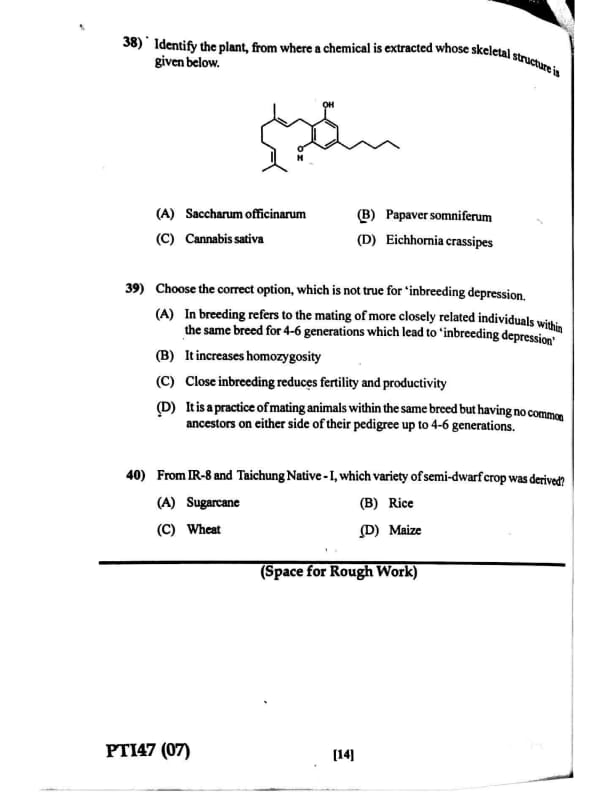
Identify the plant, from where a chemical is extracted whose skeletal structure is given below.

View Solution
Step 1: Understanding the Concept:
Many drugs are derived from plants. Morphine comes from poppies (Papaver somniferum), and cannabinoids come from the hemp plant (\textit{Cannabis sativa).
Step 2: Key Formula or Approach:
Identify the structure:
Multiple rings with a long hydrocarbon tail \(\rightarrow\) Cannabinoid (\textit{Cannabis sativa).
Complex fused rings with nitrogen \(\rightarrow\) Morphine (\textit{Papaver somniferum).
Step 3: Detailed Explanation:
In most standard biology exams, the skeletal structure shown is that of a cannabinoid. These chemicals are obtained from the inflorescences of the plant Cannabis sativa. They interact with cannabinoid receptors in the brain and are known for their effects on the cardiovascular system.
Step 4: Final Answer:
The plant is Cannabis sativa. Quick Tip: Marijuana, hashish, charas, and ganja are all derived from the flower tops, leaves, and resins of \textit{Cannabis sativa.
Choose the correct option, which is not true for 'inbreeding depression'.
View Solution
Step 1: Understanding the Concept:
Inbreeding is the mating of closely related individuals. While it helps in evolving pure lines, continued close inbreeding often results in a loss of vigor, known as inbreeding depression.
Step 2: Key Formula or Approach:
Distinguish between Inbreeding and Out-crossing:
Inbreeding: Mating related individuals (Common ancestors).
Out-crossing: Mating unrelated individuals (No common ancestors).
Step 3: Detailed Explanation:
(A), (B), and (C) are correct descriptions of inbreeding and its consequences (homozygosity and reduced fertility).
(D) is actually the definition of Out-crossing. Inbreeding specifically requires common ancestors within 4-6 generations. Therefore, (D) is "not true" for inbreeding depression; in fact, out-crossing is the solution to fix inbreeding depression.
Step 4: Final Answer:
Statement (D) is the incorrect description of inbreeding. Quick Tip: To overcome inbreeding depression, selected animals of the inbreeding population should be mated with unrelated superior animals of the same breed (Out-crossing).
From IR-8 and Taichung Native - I, which variety of semi-dwarf crop was derived?
View Solution
Step 1: Understanding the Concept:
During the Green Revolution, semi-dwarf varieties of wheat and rice were developed to increase crop yield and resist lodging (falling over).
Step 2: Key Formula or Approach:
Wheat: Sonalika, Kalyan Sona (derived from Nobel laureate Norman Borlaug's work).
Rice: IR-8, Taichung Native-1.
Step 3: Detailed Explanation:
Semi-dwarf rice varieties were derived from IR-8 (developed at the International Rice Research Institute - IRRI, Philippines) and Taichung Native-1 (from Taiwan). Later, better-yielding semi-dwarf varieties like \textit{Jaya and \textit{Ratna were developed in India.
Step 4: Final Answer:
The crop is Rice. Quick Tip: The Green Revolution in India was largely successful due to these semi-dwarf varieties, which could respond to fertilizers without growing too tall and collapsing.

*The article might have information for the previous academic years, please refer the official website of the exam.