
GUJCET 2024 Mathematics Question Paper Pdf - Check Solutions with Answer Key Pdf

.jpg?tr=h-55,w-55,c-force)
Content Strategist|Tech-innovator|National Hackathon Winner | Updated On - Feb 1, 2025
GUJCET 2024 Mathematics Question Paper with Answer Key PDF for March 31, 2024, is available for download. GSEB successfully conducted the exam on March 31, 2024, in the morning session. As per the students’ initial reaction, GUJCET 2024 Mathematics Question Paper was reported as Moderately Challenging. Section A in GUJCET 2024 Mathematics Question Paper was reported as Easy to Moderate, Section B as Moderate, and Section C as Difficult by most students.
GUJCET 2024 Mathematics Question Paper with Answer Key PDF
Candidates can download the official GUJCET 2024 Mathematics Question Paper with Answer Key PDF using the link below.
| GUJCET 2024 Mathematics Question Paper with Answer Key Pdf |  Download Download |
Check Solution |
GUJCET 2024 Mathematics Questions with Solutions
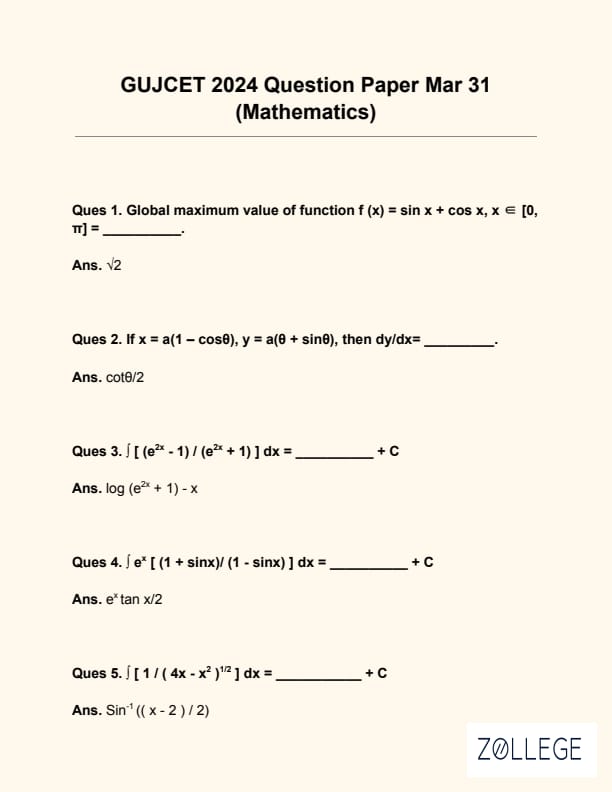
Question 1:
Global maximum value of function f(x) = sin x + cos x, x∈ [0, π] is:_______
View Solution
Solution: Step 1: Expressing the function in an alternate form. The given function is:
f(x) = sin x + cos x.
We rewrite it using the identity:
sin x + cos x = √2 sin(x + π⁄4)
Thus, the function can be rewritten as:
f(x) = √2 sin(x + π⁄4)
Step 2: Determining the maximum value. Since the maximum value of sin θ is 1, the maximum value of f(x) is:
√2 × 1 = √2.
This maximum is attained when:
sin(x + π⁄4) = 1.
Step 3: Finding x in the given domain. Solving for x:
x + π⁄4 = π⁄2
x = π⁄2 - π⁄4
x = π⁄4
Since x = π⁄4 lies within the given domain [0, π], the global maximum value is confirmed as √2.
Conclusion: The global maximum value of f(x) in the given interval is √2.
Question 2:
If x = a(1 − cos θ), y = a(θ + sin θ), then dy⁄dx is: _______
View Solution
Solution: Step 1: Differentiate x with respect to θ. Given:
x = a(1 − cos θ)
Differentiate both sides with respect to θ:
dx⁄dθ = a sin θ.
Step 2: Differentiate y with respect to θ. Given:
y = a(θ + sin θ)
Differentiate both sides with respect to θ:
dy⁄dθ = a(1 + cos θ).
Step 3: Compute dy⁄dx. Using the chain rule:
dy⁄dx = dy⁄dθ × dθ⁄dx = a(1 + cos θ)⁄a sin θ
Simplify:
dy⁄dx = 1 + cos θ⁄sin θ
Using the identity:
1 + cos θ = 2 cos²(θ⁄2)
and
sin θ = 2 sin(θ⁄2) cos(θ⁄2)
we get:
dy⁄dx = 2 cos²(θ⁄2)⁄2 sin(θ⁄2) cos(θ⁄2)
Canceling common terms:
dy⁄dx = cos(θ⁄2)⁄sin(θ⁄2) = cot(θ⁄2)
Conclusion: The correct answer is cot(θ⁄2).
Question 3:
Evaluate ∫e2x⁄e2x + 1 dx.
View Solution
Solution: Step 1: Substituting t = e2x. Let:
t = e2x ⇒ dt = 2e2x dx = 2t dx.
Rewriting the integral:
I = ∫e2x⁄e2x + 1 dx.
Step 2: Splitting the fraction. Rewrite the numerator:
e2x = e2x + 1 − 1 = (e2x + 1) − 2.
Thus, the integral becomes:
I = ∫(e2x + 1) − 2⁄e2x + 1 dx
Splitting:
I = ∫ (1 - 2⁄e2x + 1) dx.
Step 3: Solving the integral. The first term:
∫ 1 dx = x.
For the second term, let:
t = e2x + 1 ⇒ dt = 2e2x dx = 2(t − 1)dx.
Rearrange:
dx = dt⁄2(t-1)
Thus:
∫2⁄e2x + 1 dx = ∫ 2⁄t dt⁄2(t-1) = ∫dt⁄t = log|t|.
Substituting back t = e2x + 1:
log|e2x + 1|.
Step 4: Conclusion.
I = log(e2x + 1) − x + C.
Thus, the correct answer is log(e2x + 1) − x + C.
Question 4:
Evaluate the integral ∫ ex (1 + sin x)⁄1 - sin x dx.
View Solution
Solution: Step 1: Start by simplifying the given expression. We use the identity for 1 + sin x⁄1 - sin x to convert it into a more convenient form:
1 + sin x⁄1 - sin x = 2⁄cos2(x⁄2) = 2 tan2(x⁄2)
Step 2: Substitute this identity into the integral:
∫ ex(1 + sin x)⁄1 - sin x dx = ∫ ex 2 tan2(x⁄2) dx.
Step 3: Now, perform substitution. Let:
u = x⁄2 ⇒ du = dx⁄2 ⇒ dx = 2du.
The integral becomes:
∫ e2u 2 tan(u) 2du = 4∫ e2u tan(u)du.
Step 4: Using standard integral techniques, the result of the integral is:
ex tan(x⁄2) + C.
Question 5:
Evaluate the integral ∫ 1⁄√4x - x2 dx.
View Solution
Solution: Step 1: Rewrite the quadratic expression inside the square root. We can complete the square for 4x – x2:
4x - x2 = 4 − (x − 2)2.
Thus, the integral becomes:
∫ 1⁄√4 - (x-2)2 dx.
Step 2: Use the standard trigonometric substitution x − 2 = 2 sin θ. Then, dx = 2 cos θ dθ, and the expression inside the square root becomes:
4 − (x − 2)2 = 4 − 4 sin2 θ = 4 cos2 θ.
So, the integral simplifies to:
∫ 2 cos θ dθ⁄2 cos θ = ∫ dθ.
Step 3: Integrating dθ, we get:
θ + C.
Step 4: Substitute θ = sin-1(x - 2⁄2), yielding:
sin-1(x - 2⁄2) + C.
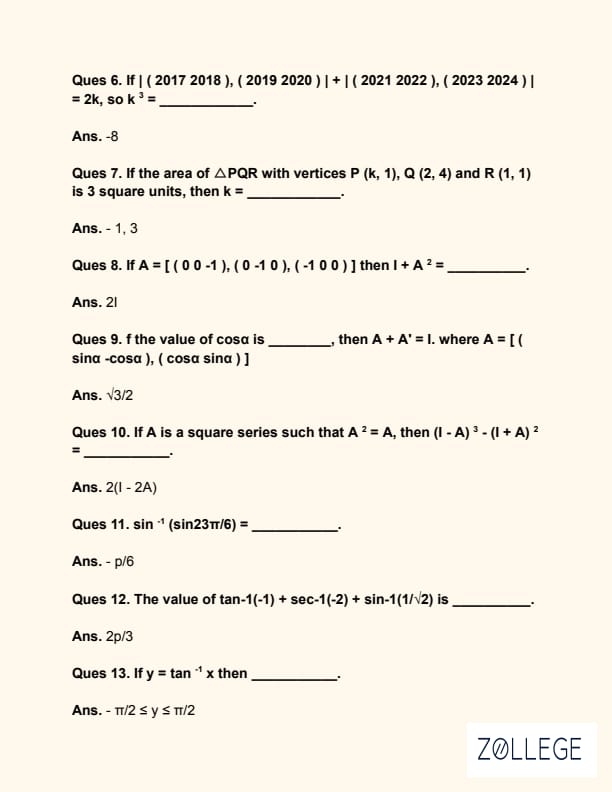
Question 6:
If |2017 2018⁄2019 2020| + |2021 2022⁄2023 2024| = 2k, find k3.
View Solution
Solution: Step 1: Begin by calculating the determinants of the two matrices. The determinant of a 2x2 matrix |a b⁄c d| is given by:
Determinant = ad − bc.
For the first matrix |2017 2018⁄2019 2020|, the determinant is:
|2017 2018⁄2019 2020| = (2017)(2020) – (2018)(2019).
Simplifying:
2017 × 2020 = 4064340, 2018 × 2019 = 4064342,
so the determinant is:
4064340 - 4064342 = -2.
For the second matrix |2021 2022⁄2023 2024| , the determinant is:
|2021 2022⁄2023 2024| = (2021)(2024) – (2022)(2023).
Simplifying:
2021 × 2024 = 4084644, 2022 × 2023 = 4084646,
so the determinant is:
4084644 - 4084646 = -2.
Step 2: Now, we add the two determinants:
−2 + (−2) = −4.
Step 3: According to the given equation |2017 2018⁄2019 2020| + |2021 2022⁄2023 2024| = 2k, we have:
−4 = 2k ⇒ k = -2.
Step 4: Finally, we calculate k3:
k3 = (−2)3 = -8.
Question 7:
If the area of △PQR with vertices P(k, 1), Q(2, 4), R(1, 1) is 3 square units, find k.
View Solution
Solution: Step 1: The area of a triangle with vertices (x1, y1), (x2, y2), (x3, y3) is given by the formula:
Area = 1⁄2|x1(y2 − y3) + x2(y3 − y1) + x3(y1 − y2)|.
Substituting the coordinates P(k, 1), Q(2, 4), R(1, 1) into this formula:
Area = 1⁄2 |k(4 − 1) + 2(1 − 1) + 1(1 − 4)|.
Step 2: Simplifying the expression:
Area = 1⁄2 |k(3) + 0 + 1(−3)| = 1⁄2 |3k − 3| .
Step 3: We are given that the area is 3 square units, so:
1⁄2 |3k − 3| = 3 ⇒ |3k - 3| = 6.
Step 4: Solving the absolute value equation:
3k - 3 = 6 or 3k - 3 = -6.
For 3k − 3 = 6:
3k = 9 ⇒ k = 3.
For 3k − 3 = −6:
3k = -3 ⇒ k = -1.
Step 5: Therefore, the possible values of k are k = −1 and k = 3.
Question 8:
If A = |0 0 -1⁄0 -1 0|, find I + A2, where I is the identity matrix. |-1 0 0|
View Solution
Solution: Step 1: Begin by calculating A2. Multiply the matrix A by itself:
A = |0 0 -1⁄0 -1 0|.
|-1 0 0|
Perform the matrix multiplication A × A:
A2 = |0 0 -1⁄0 -1 0| × |0 0 -1⁄0 -1 0|.
|-1 0 0| |-1 0 0|
Step 2: Carry out the multiplication:
A2 = |(0)(0) + (0)(0) + (-1)(-1) (0)(0) + (0)(-1) + (-1)(0) (0)(-1) + (0)(0) + (-1)(0)⁄(0)(0) + (-1)(0) + (0)(-1) (0)(0) + (-1)(-1) + (0)(0) (0)(-1) + (-1)(0) + (0)(0)|
|(-1)(0) + (0)(0) + (0)(-1) (-1)(0) + (0)(-1) + (0)(0) (-1)(-1) + (0)(0) + (0)(0)|
Simplifying:
A2 = |1 0 0⁄0 1 0|
|0 0 1|
Step 3: Now, compute I + A2, where I is the identity matrix:
I = |1 0 0⁄0 1 0| ; A2 = |1 0 0⁄0 1 0|
|0 0 1| |0 0 1|
Thus:
I + A2 = |1 0 0⁄0 1 0| + |1 0 0⁄0 1 0| = |2 0 0⁄0 2 0|.
|0 0 1| |0 0 1| |0 0 2|
This is equal to 2I.
Question 9:
If the value of cos α is 1⁄2, then A + A' = I, where A = |sin α -cos α⁄cos α sin α|.
View Solution
Solution: Step 1: Compute the transpose of matrix A. The transpose of A, denoted as A', is obtained by swapping the off-diagonal elements:
A' = |sin α cos α⁄-cos α sin α|
Step 2: Add A and A'.
A + A' = |sin α -cos α⁄cos α sin α| + |sin α cos α⁄-cos α sin α|
Adding corresponding elements:
A + A' = |sin α + sin α -cos α + cos α⁄cos α - cos α sin α + sin α|
Simplifying:
A + A' = |2 sin α 0⁄0 2 sin α|
Step 3: Equating to the identity matrix. The identity matrix is:
I = |1 0⁄0 1|
Thus, equating:
|2 sin α 0⁄0 2 sin α| = |1 0⁄0 1|
From which:
2 sin α = 1 ⇒ sin α = 1⁄2
Step 4: Finding cos α. Using the Pythagorean identity:
sin2 α + cos2 α = 1.
Substituting sin α = 1⁄2:
(1⁄2)2 + cos2 α = 1.
1⁄4 + cos2 α = 1.
cos2 α = 3⁄4
cos α = √3⁄2.
Conclusion: The correct answer is √3⁄2.
Question 10:
If A is a square matrix such that A2 = A, then (I – A)3 – (I + A)2 =
View Solution
Solution: Step 1: Given that A2 = A, this means that A is a idempotent matrix.
Step 2: Let's first expand (I – A)3 using the binomial expansion:
(I – A)3 = I3 − 3I2A + 3IA2 − A3 = I − 3A + 3A – A = I – A.
Thus:
(I – A)3 = I – A.
Step 3: Now, expand (I + A)2:
(I + A)2 = I2 + 2IA + A2 = I + 2A + A = I + 3A.
Step 4: Subtract (I + A)2 from (I – A)3:
(I – A)3 – (I + A)2 = (I – A) − (I + 3A) = I – A – I – 3A = -4A.
Step 5: Now, factorize the result:
−4A = 2(I – 2A).
Thus, the final expression is:
(I – A)3 – (I + A)2 = 2(I – 2A).
Question 11:
Find sin-1(sin 23π⁄6) =______
View Solution
Solution: Step 1: We are given sin-1(sin 23π⁄6), and we need to simplify the expression.
Step 2: First, simplify 23π⁄6 by reducing it within the range of the sine inverse function, which is -π⁄2 ≤ θ ≤ π⁄2.
To do this, observe that:
23π⁄6 = 2π + 11π⁄6
Since sin(θ) is periodic with period 2π, we have:
sin(23π⁄6) = sin(11π⁄6)
Step 3: Now, 11π⁄6 lies in the fourth quadrant. In the fourth quadrant,
sin(11π⁄6) = - sin(π⁄6) = -1⁄2.
Step 4: Therefore, we have:
sin-1(sin 23π⁄6) = sin-1(-1⁄2).
Step 5: The angle whose sine is −1⁄2 in the range -π⁄2 ≤ θ ≤ π⁄2 is - π⁄6.
Thus,
sin-1(sin 23π⁄6) = -π⁄6
Question 12:
The value of tan-1(-1) + sec-1(-2) + sin-1(1⁄√2) is _______.
View Solution
Solution: Step 1: Begin by evaluating each term separately.
Step 2: For tan-1(−1), we know that:
tan-1(-1) = -π⁄4
since the tangent of -π⁄4 is -1.
Step 3: Next, evaluate sec-1(−2). The value of sec-1(−2) corresponds to the angle θ such that sec θ = -2. Since sec θ = 1⁄cos θ, we have cos θ = -1⁄2, and the angle that satisfies this condition is θ = 2π⁄3 (since cos(2π⁄3) = -1⁄2).
Step 4: Now, evaluate sin-1(1⁄√2). The angle whose sine is 1⁄√2 is π⁄4 , since sin(π⁄4) = 1⁄√2.
Step 5: Now, add all the results together:
tan-1(-1) + sec-1(-2) + sin-1(1⁄√2) = -π⁄4 + 2π⁄3 + π⁄4.
Step 6: Simplify the expression:
-π⁄4 + π⁄4 = 0,
so the expression becomes: 2π⁄3
Thus, the final value is:
tan-1(-1) + sec-1(-2) + sin-1(1⁄√2) = 2π⁄3.
Question 13:
If y = tan-1 x, then
View Solution
Solution: Step 1: The function y = tan-1 x is the inverse of the tangent function. By the definition of the inverse tangent (or arctangent), it returns the angle y such that:
tan y = x.
Step 2: The range of the arctangent function tan-1 x is restricted to -π⁄2 < y < π⁄2. This is because the tangent function is periodic, and the principal value of the inverse tangent is chosen to lie within this interval to ensure it is a one-to-one function.
Thus, we conclude:
-π⁄2 < y < π⁄2.
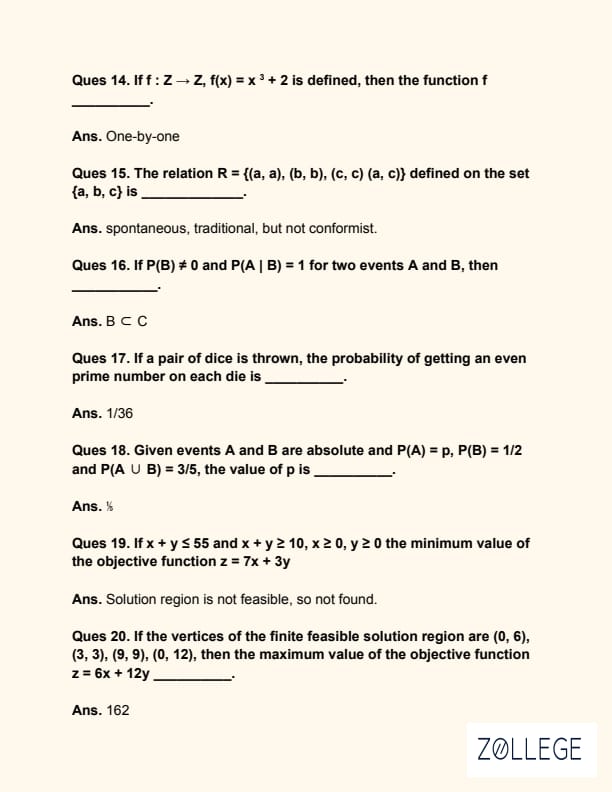
Question 14:
If f : Z → Z, defined by f(x) = x3 + 2, then the function f is _______.
View Solution
Solution: Step 1: Understanding one-to-one (injective) functions. A function f is one-to-one (injective) if:
f(a) = f(b) ⇒ a = b.
Step 2: Checking injectivity of f(x). Given:
f(x) = x3 + 2.
Let f(a) = f(b):
a3 + 2 = b3 + 2.
Canceling 2 from both sides:
a3 = b3.
Taking the cube root:
a = b.
Since the function satisfies the condition for injectivity, it is one-to-one.
Step 3: Checking onto (surjective) property. For surjectivity, f(x) must cover all integers. Since cube functions do not necessarily map to all integers, f(x) is not necessarily onto over Z.
Conclusion: The function f(x) is one-to-one.
Question 15:
The relation R = {(a, a), (b, b), (c, c), (a, c)} defined on the set {a, b, c} is _______.
View Solution
Solution: Step 1: To determine the type of relation, we need to analyze the properties of the given relation R on the set {a, b, c}.
The relation R is defined as:
R = {(a, a), (b, b), (c, c), (a, c)}.
Step 2: Check for the following properties:
- Reflexive: A relation is reflexive if for every element x ∈ S, (x, x) belongs to the relation. In this case, (a, a), (b, b), (c, c) are in the relation, so the relation is reflexive.
- Symmetric: A relation is symmetric if for every pair (x, y) in the relation, the pair (y, x) is also in the relation. Since (a, c) is in the relation but (c, a) is not, the relation is not symmetric.
- Transitive: A relation is transitive if whenever (x, y) and (y, z) are in the relation, (x, z) must also be in the relation. Since (a, c) is in the relation but there is no corresponding (c, a), the relation is not transitive.
Step 3: The relation is reflexive but not symmetric or transitive, which makes it spontaneous, traditional, but not conformist.
Thus, the relation R is spontaneous, traditional, but not conformist.
Question 16:
If P(B) ≠ 0 and P(A|B) = 1 for two events A and B, then __________.
View Solution
Solution: Step 1: We are given that P(B) ≠ 0 and P(A|B) = 1. The conditional probability P(A|B) is defined as:
P(A|B) = P(A ∩ B)⁄P(B).
Since P(A|B) = 1, this implies:
P(A ∩ B)⁄P(B) = 1.
Multiplying both sides by P(B), we get:
P(A ∩ B) = P(B).
Step 2: The equation P(A ∩ B) = P(B) means that the probability of the intersection of A and B is equal to the probability of B. This implies that every outcome in B is also in A, i.e., B ⊂ A.
Thus, the correct conclusion is:
B ⊂ A.
Question 17:
If a pair of dice is thrown, the probability of getting an even prime number on each die is ___________.
View Solution
Solution: Step 1: An even prime number is a number that is both even and prime. The only even prime number is 2.
Step 2: Each die has the numbers 1, 2, 3, 4, 5, 6. For the condition to be satisfied (getting an even prime number on each die), both dice must show the number 2.
Step 3: The total number of possible outcomes when two dice are thrown is:
6 × 6 = 36.
Step 4: The only favorable outcome is when both dice show 2, so there is exactly one favorable outcome.
Step 5: Therefore, the probability of getting an even prime number on each die is:
1⁄36
Thus, the correct answer is 1⁄36.
Question 18:
Given events A and B are absolute and P(A) = p, P(B) = 1⁄2, and P(A∪B) = 3⁄5, the value of p is ________ .
View Solution
Solution: Step 1: We are given the following probabilities:
P(A) = p, P(B) = 1⁄2 , P(A ∪ B) = 3⁄5.
The formula for the probability of the union of two events is:
P(A ∪ B) = P(A) + P(B) − P(A ∩ B).
Step 2: Substitute the given values into the formula:
3⁄5 = p + 1⁄2 − P(A ∩ B).
Step 3: Since events A and B are absolute, P(A ∩ B) = 0, as they do not overlap. Thus, the equation becomes:
3⁄5 = p + 1⁄2.
Step 4: Solving for p:
p = 3⁄5 - 1⁄2
To subtract the fractions, find a common denominator:
p = 6⁄10 - 5⁄10 = 1⁄10.
Thus, the value of p is 1⁄10.
Question 19:
If x + y ≤ 55 and x + y ≥ 10, with x ≥ 0, y ≥ 0, then the minimum value of the objective function z = 7x + 3y is: _________.
View Solution
Solution: Step 1: Understanding the constraints. The given constraints are:
x + y ≤ 55,
x + y ≥ 10,
x ≥ 0, y ≥ 0.
These constraints define a feasible region in the first quadrant where the values of x and y lie.
Step 2: Identifying the feasible region. The inequalities define a strip in the first quadrant between the lines: x + y = 10 (lower boundary). - x + y = 55 (upper boundary). However, for a solution to exist, the feasible region should be a bounded region where an optimal solution can be determined.
Step 3: Checking feasibility for optimization. Since the given constraints do not form a closed bounded region (it extends infinitely), there is no minimum bound for the function z = 7x + 3y. Thus, the solution region is not feasible for determining the minimum value.
Conclusion: Since the feasible region does not bound the function properly, the minimum value cannot be determined.
Question 20:
If the vertices of the finite feasible solution region are (0, 6), (3, 3), (9, 9), (0, 12), then the maximum value of the objective function z = 6x + 12y is ________.
View Solution
Solution: Step 1: The objective function is z = 6x + 12y.
Step 2: To find the maximum value of the objective function, we evaluate z at each of the given vertices:
- At (0,6):
z = 6(0) + 12(6) = 0 + 72 = 72.
- At (3, 3):
z = 6(3) + 12(3) = 18 + 36 = 54.
- At (9,9):
z = 6(9) + 12(9) = 54 + 108 = 162.
- At (0, 12):
z = 6(0) + 12(12) = 0 + 144 = 144.
Step 3: The maximum value of z is 162, which occurs at the vertex (9,9).
Thus, the maximum value of the objective function is 162.
*The article might have information for the previous academic years, please refer the official website of the exam.