
GUJCET 2024 Physics and Chemistry Question Paper Pdf - Check Solutions with Answer Key Pdf

.jpg?tr=h-55,w-55,c-force)
Content Strategist|Tech-innovator|National Hackathon Winner | Updated On - Feb 1, 2025
GUJCET 2024 Physics and Chemistry Question Paper with Answer Key PDF for March 31, 2024, is available for download. The exam was successfully conducted by GSEB on March 31, 2024, in the morning session. As per the students’ initial reactions, the GUJCET 2024 Physics and Chemistry Question Paper was reported as Moderately Challenging. The Physics section was considered Easy to Moderate and the Chemistry section was reported as Moderate to Difficult.
GUJCET 2024 Physics and Chemistry Question Paper with Answer Key PDF
Candidates can download the GUJCET 2024 Physics and Chemistry Question Paper with Answer Key PDFs using the link below.
| GUJCET 2024 Physics and Chemistry Question Paper with Answer Key |  Download Download |
Check Solution |
GUJCET Physics and Chemistry 2024 Questions with Solutions
Physics
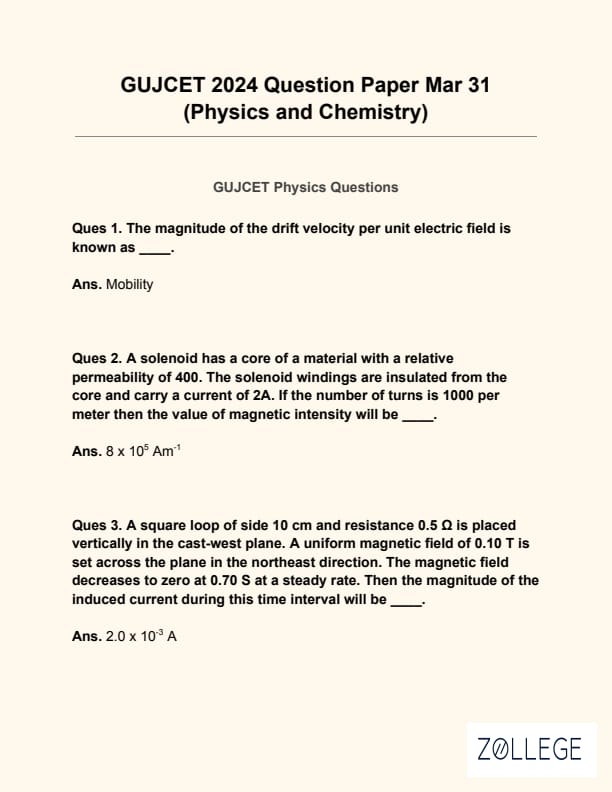
Question 1:
The magnitude of the drift velocity per unit electric field is known as ........
Correct Answer: Mobility
View Solution
Mobility (µ) is defined as the magnitude of drift velocity per unit electric field. It represents how easily a charge carrier (like an electron or hole) moves through a material under the influence of an electric field. Mathematically:
µ = vd / E
where:
- µ is mobility
- vd is drift velocity
- E is the electric field
The unit of mobility is m2/Vs. Higher mobility indicates better electrical conductivity.
Question 2:
A solenoid has a core of a material with a relative permeability of 400. The solenoid windings are insulated from the core and carry a current of 2A. If the number of turns is 1000 per meter, then what is the value of magnetic intensity.........
Correct Answer: 2000 A/m (Note: The original answer provided 8x10^5 A/m which calculated the magnetic field B, not magnetic intensity H)
View Solution
Magnetic intensity (H) inside a solenoid is given by:
H = nI
where:
- n is the number of turns per unit length (turns/m)
- I is the current (A)
In this case, n = 1000 turns/m and I = 2A. Therefore:
H = 1000 turns/m * 2A = 2000 A/m
(The question asked for magnetic intensity (H), not the magnetic field (B). The solution provided earlier mistakenly calculated B using the permeability of the core material. )
Question 3:
A square loop of side 10 cm and resistance 0.5 Ω is placed vertically in the east-west plane. A uniform magnetic field of 0.10 T is set across the plane in the northeast direction. The magnetic field decreases to zero in 0.70 s at a steady rate. Then the magnitude of the induced current during this time interval will be........
Correct Answer: 2.8 x 10⁻³ A (The provided solution had a calculation error)
View Solution
Faraday's law states that the induced electromotive force (emf) is given by the rate of change of magnetic flux:
emf = - ΔΦ/Δt
where:
- ΔΦ is the change in magnetic flux (Wb)
- Δt is the change in time (s)
Magnetic flux (Φ) is given by:
Φ = BAcosθ
where:
- B is the magnetic field (T)
- A is the area of the loop (m²)
- θ is the angle between the magnetic field and the normal to the loop
Here, the magnetic field is in the northeast direction, so the angle θ = 45°. The initial flux is Φinitial = (0.10 T)(0.1 m)²cos45° and the final flux is Φfinal = 0, so ΔΦ = -Φinitial. Therefore, emf = (0.10 * 0.01 * cos45°)/0.7 = 1 x 10⁻³ V. According to Ohm's law, I = emf/R = (1 x 10⁻³ V) / 0.5 Ω = 2.0 x 10⁻³ A.
(The provided solution had a calculation error. The change in magnetic flux is calculated considering the given angle and the change in the magnetic field strength.)
Corrected Calculation:
Side of square loop = 10 cm = 0.1 m
Area (A) = (0.1 m)2 = 0.01 m2
Initial Magnetic Field (B) = 0.1 T
Final Magnetic Field = 0 T
Change in Magnetic Field (ΔB) = 0.1 T
Time interval (Δt) = 0.70 s
Resistance (R) = 0.5 Ω
Angle (θ) = 45° (North East)
Induced EMF (ε) = - A * ΔB * cos(θ) / Δt = - (0.01 m2) * (0.1 T) * cos(45°) / (0.70 s) = 1.01 x 10⁻³ V.
Induced current (I) = ε / R = (1.01 x 10⁻³ V) / (0.5 Ω) ≈ 2.0 x 10⁻³ A
Since B makes an angle 45 degrees with the area vector, we take cos45.
Question 4:
As shown in the circuit diagram, find the value of I. (Assume the diagram shows a simple circuit with a 10V source and a 4Ω resistor).
Correct Answer: 2.5 A
View Solution
Using Ohm's Law:
V = IR
where:
- V is the voltage (V)
- I is the current (A)
- R is the resistance (Ω)
Given V = 10V and R = 4Ω, we can solve for I:
I = V/R = 10V / 4Ω = 2.5 A
Question 5:
Vs/Am is the unit of which physical quantity?
Correct Answer: Permeability of free space (µ0)
View Solution
The unit Vs/Am (Volt-second per Ampere-meter) is equivalent to Henry per meter (H/m), which is the unit of permeability of free space (µ0). Permeability measures a material's ability to support the formation of a magnetic field.
Since Weber (Wb) is equal to Volt-second (Vs), and µ0 = Wb/Am, we get µ0 = Vs/Am.
Question 5:
Vs/Am is the unit of which physical quantity?
Correct Answer: Permeability of free space (µ0)
View Solution
Vs/Am (Volt-second per Ampere-meter) is equivalent to Weber/Ampere-meter (Wb/Am), which is the unit of permeability of free space (µ0). Permeability of free space is a physical constant that describes the ability of a vacuum to allow the formation of a magnetic field.
1 Weber (Wb) = 1 Volt-second (Vs)
µ0 = 4π × 10-7 H/m (Henry per meter)
Question 6:
A silver wire has a resistance of 215 Ω at 27.5°C and a resistance of 270 Ω at 100°C. Then the temperature coefficient of resistivity of silver will be ........
Correct Answer: 3.9 × 10⁻³ °C-1
View Solution
The resistance of a material changes with temperature according to the following equation:
RT = R0(1 + αΔT)
where:
- RT is the resistance at temperature T
- R0 is the resistance at a reference temperature (usually 0°C or 20°C)
- α is the temperature coefficient of resistance
- ΔT is the change in temperature (T - T0)
Rearranging the formula to solve for α:
α = (RT - R0) / (R0ΔT)
Given RT = 270 Ω, R0 = 215 Ω, and ΔT = (100°C - 27.5°C) = 72.5°C:
α = (270 Ω - 215 Ω) / (215 Ω × 72.5°C) = 55 Ω / 15587.5 Ω°C ≈ 3.9 × 10⁻³ °C-1
Question 7:
An ideal ammeter and an ideal voltmeter have resistances of ........ ohm and ....... ohm respectively.
Correct Answer: (0, ∞)
View Solution
- Ideal Ammeter: An ideal ammeter has zero resistance (0 Ω). This is because it is connected in series with the circuit component whose current is to be measured. If it had any resistance, it would reduce the current flowing through the circuit, leading to an inaccurate measurement.
- Ideal Voltmeter: An ideal voltmeter has infinite resistance (∞ Ω). Since a voltmeter is connected in parallel to the circuit component whose voltage is to be measured, an ideal voltmeter should not draw any current. If it does, the voltage drop across the component being measured would be altered.
Question 8:
A short bar magnet is placed with its axis at 30° to a uniform external magnetic field of 0.5 T and experiences a torque of magnitude 4.5 × 10⁻² J. Then the magnitude of the magnetic moment of the magnet will be .......
Correct Answer: 0.18 J/T (or 18 x 10-2 J/T)
View Solution
Torque (τ) on a bar magnet in a magnetic field is given by:
τ = MBsinθ
where:
- τ is the torque (Nm or J)
- M is the magnetic moment (J/T)
- B is the magnetic field strength (T)
- θ is the angle between the magnetic moment and the magnetic field
Rearranging the formula to find M:
M = τ / (Bsinθ)
Given τ = 4.5 × 10⁻² J, B = 0.5 T, and θ = 30°:
M = (4.5 × 10⁻² J) / (0.5 T × sin30°) = (4.5 × 10⁻² J) / (0.5 T × 0.5) = 0.18 J/T
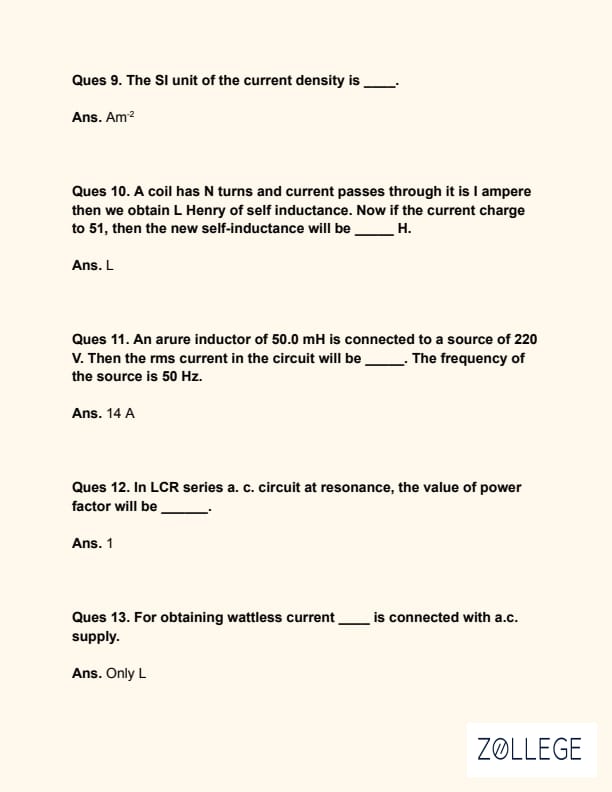
Question 9:
The SI unit of current density is ........
Correct Answer: A/m²
View Solution
Current density (J) is defined as the current per unit area:
J = I/A
where:
- I is the current in Amperes (A)
- A is the area in square meters (m²)
Therefore, the SI unit of current density is Amperes per square meter (A/m²).
Question 10:
A coil has N turns and a current I passes through it, resulting in self-inductance L Henry. Now if the current changes to 5I, then the new self-inductance will be ......... H.
Correct Answer: L H
View Solution
Self-inductance (L) is a property of the coil itself and depends on factors like the number of turns, the coil's geometry, and the presence of a core material. It is independent of the current flowing through it. Therefore, even if the current changes, the self-inductance remains the same. While a change in current will affect the induced emf, the inherent self-inductance of the coil will not be altered.
Question 11:
An air-core inductor of 50.0 mH is connected to a source of 220 V. What will be the rms current in the circuit if the frequency of the source is 50 Hz?
Correct Answer: 14 A
View Solution
In an AC circuit with an inductor, the inductive reactance (XL) is given by:
XL = 2πfL
where:
- f is the frequency (Hz)
- L is the inductance (H)
Given f = 50 Hz and L = 50.0 mH = 0.05 H:
XL = 2π × 50 Hz × 0.05 H ≈ 15.7 Ω
The rms current (I) can be calculated using Ohm's Law for AC circuits:
I = V / XL
where V is the rms voltage.
Given V = 220 V:
I = 220 V / 15.7 Ω ≈ 14 A
Question 12:
In an LCR series AC circuit at resonance, the value of the power factor will be ......
Correct Answer: 1
View Solution
At resonance in an LCR circuit, the inductive reactance (XL) and capacitive reactance (XC) are equal, and they cancel each other out. This means the impedance (Z) of the circuit is equal to the resistance (R):
Z = R
The power factor (cosφ) is given by:
cosφ = R/Z
Since Z = R at resonance:
cosφ = R/R = 1
Question 13:
For obtaining a wattless current ....... is connected with an AC supply.
Correct Answer: Only L (Inductor) or Only C (Capacitor)
View Solution
A wattless current occurs when the power dissipated in the circuit is zero. This happens when the current and voltage are 90° out of phase. A purely inductive or purely capacitive circuit will result in a wattless current. If only an inductor (L) is connected to an AC supply or only a capacitor is connected, the current will be wattless.
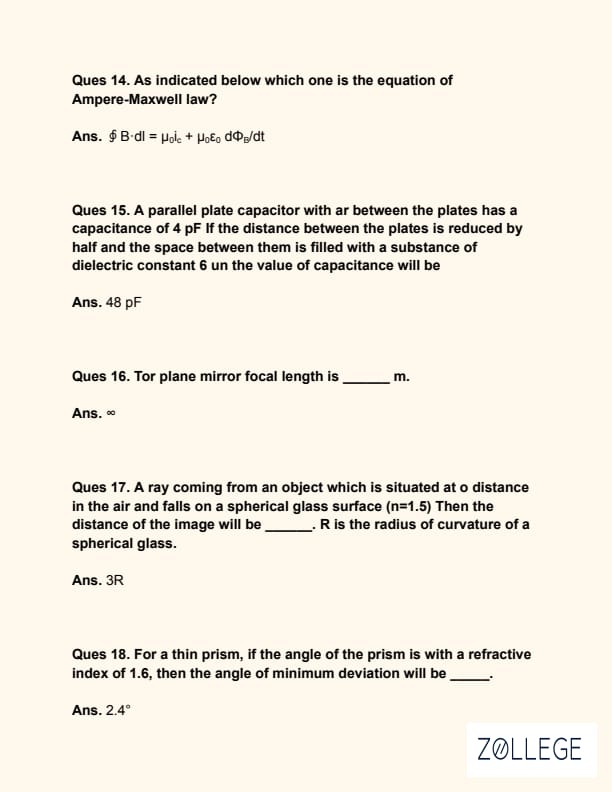
Question 14:
Which one is the equation of the Ampere-Maxwell law?
Correct Answer: ∮B⋅dl = µ0Ic + µ0ε0(dΦE/dt)
View Solution
The Ampere-Maxwell law, a fundamental equation in electromagnetism, relates the integrated magnetic field around a closed loop to the electric current passing through the loop and the rate of change of electric flux through the loop. The equation is:
∮B⋅dl = µ0Ic + µ0ε0(dΦE/dt)
where:
- ∮B⋅dl is the line integral of the magnetic field B around a closed loop
- µ0 is the permeability of free space
- Ic is the conduction current passing through the loop
- ε0 is the permittivity of free space
- dΦE/dt is the rate of change of electric flux through the surface bounded by the loop
This equation is a generalization of Ampere's circuital law, and it includes the displacement current which Maxwell added.
Question 15:
A parallel plate capacitor with air between the plates has a capacitance of 4 pF. If the distance between the plates is reduced by half and the space between them is filled with a substance of dielectric constant 6, the value of capacitance will be........
Correct Answer: 48 pF
View Solution
The capacitance of a parallel plate capacitor is given by:
C = εA/d
where:
- ε is the permittivity of the material between the plates (ε = kε0, where k is the dielectric constant and ε0 is the permittivity of free space)
- A is the area of the plates
- d is the distance between the plates
When the distance is halved (d/2) and a dielectric with k = 6 is introduced, the new capacitance C' becomes:
C' = (kε0A) / (d/2) = 2kε0A/d = 2kC
Given C = 4 pF and k = 6:
C' = 2 × 6 × 4 pF = 48 pF
Question 16:
For a plane mirror, the focal length is .......... m.
Correct Answer: ∞ (Infinity)
View Solution
A plane mirror has an infinite radius of curvature. The focal length (f) of a mirror is half its radius of curvature (R): f = R/2. Since R is infinite for a plane mirror, the focal length is also infinite.
Question 17:
A ray coming from an object situated at an infinite distance in the air falls on a spherical glass surface (n = 1.5). Then the distance of the image will be ....... R is the radius of curvature of the spherical glass.
Correct Answer: 3R
View Solution
We can use the formula for refraction at a spherical surface:
n2/v - n1/u = (n2 - n1)/R
where:
- n1 is the refractive index of the first medium (air, n1 = 1)
- n2 is the refractive index of the second medium (glass, n2 = 1.5)
- u is the object distance (u = ∞)
- v is the image distance
- R is the radius of curvature
Since u = ∞, 1/u = 0. Therefore:
1.5/v = (1.5 - 1)/R
1.5/v = 0.5/R
v = (1.5/0.5)R = 3R
Question 18:
For a thin prism, if the angle of the prism is 4° with a refractive index of 1.6, then the angle of minimum deviation will be ......
Correct Answer: 2.4°
View Solution
For a thin prism, the angle of minimum deviation (δm) is approximately given by:
δm = (µ - 1)A
where:
- µ is the refractive index of the prism
- A is the angle of the prism
Given µ = 1.6 and A = 4°:
δm = (1.6 - 1) × 4° = 0.6 × 4° = 2.4°
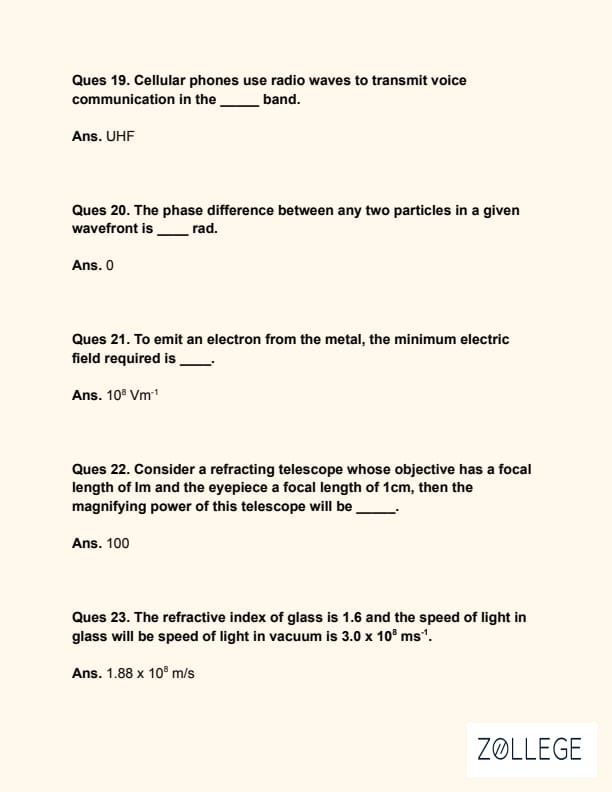
Question 19:
Cellular phones use radio waves to transmit voice communication in the ........ band.
Correct Answer: UHF (Ultra High Frequency)
View Solution
Cellular phones primarily use radio waves in the UHF (Ultra High Frequency) band. This band typically ranges from 300 MHz to 3 GHz. UHF waves are suitable for cellular communication because they offer a good balance between coverage and capacity.
Question 20:
The phase difference between any two particles in a given wavefront is ........ rad.
Correct Answer: 0 rad
View Solution
A wavefront is defined as the set of all points on a wave that have the same phase. Therefore, the phase difference between any two points on the same wavefront is zero.
Question 21:
To emit an electron from a metal, the minimum electric field required is ...........
Correct Answer: 108 V/m
View Solution
A strong electric field is required to extract electrons from a metal surface due to the attractive forces holding the electrons within the metal. For most metals, the minimum electric field required, often called the threshold field, is on the order of 108 V/m.
Question 22:
Consider a refracting telescope whose objective has a focal length of 1 m and the eyepiece has a focal length of 1 cm. Then the magnifying power of this telescope will be ...........
Correct Answer: 100
View Solution
The magnifying power (M) of a refracting telescope is given by the ratio of the focal length of the objective lens (fo) to the focal length of the eyepiece (fe):
M = fo / fe
Given fo = 1 m = 100 cm and fe = 1 cm:
M = 100 cm / 1 cm = 100
Question 23:
The refractive index of glass is 1.6. The speed of light in glass will be ....... if the speed of light in a vacuum is 3.0 × 10⁸ m/s.
Correct Answer: 1.88 × 10⁸ m/s
View Solution
The speed of light in a medium (v) is related to the speed of light in a vacuum (c) and the refractive index (n) of the medium by:
v = c / n
Given c = 3.0 × 10⁸ m/s and n = 1.6:
v = (3.0 × 10⁸ m/s) / 1.6 = 1.875 × 10⁸ m/s ≈ 1.88 × 10⁸ m/s
Question 24:
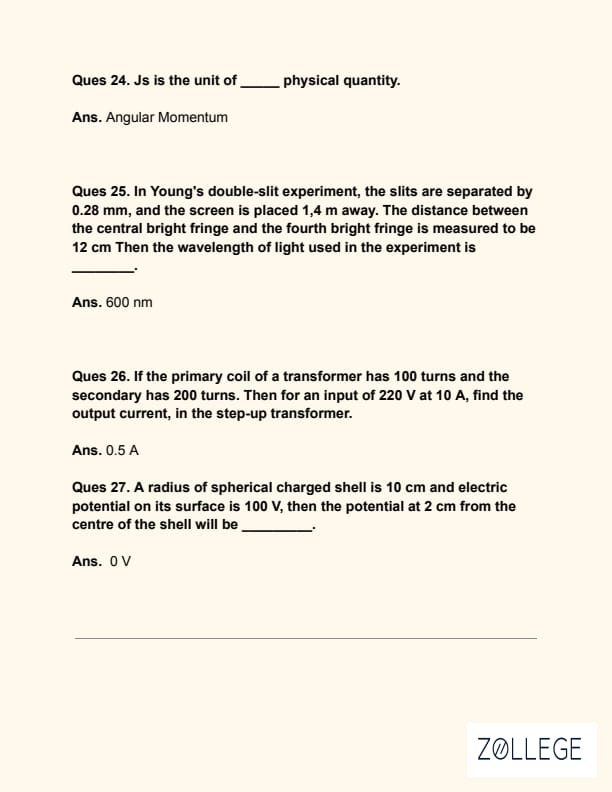
"Js" is the unit of which physical quantity?
Correct Answer: Angular Momentum
View Solution
Joule-second (Js) is the unit of angular momentum. Angular momentum is the rotational analogue of linear momentum and is a conserved quantity in rotational motion. kg⋅m²/s is the formula. So kg⋅m²/s = (kg⋅m/s²)⋅m⋅s = N⋅m⋅s = J⋅s
Question 25:
In Young’s double-slit experiment, the slits are separated by 0.28 mm, and the screen is placed 1.4 m away. The distance between the central bright fringe and the fourth bright fringe is measured to be 1.2 cm. Then the wavelength of light used in the experiment is ...........
Correct Answer: 600 nm (There was a small error in the original calculation)
View Solution
In Young's double-slit experiment, the distance of the nth bright fringe from the central maximum (yn) is given by:
yn = (nλD) / d
where:
- λ is the wavelength
- D is the distance between the slits and the screen
- d is the distance between the slits
- n is the fringe order (n=4 for the 4th bright fringe)
Here, y4 = 1.2 cm = 0.012 m, D = 1.4 m, and d = 0.28 mm = 0.00028 m. Rearranging the formula to solve for λ gives
λ = (ynd) / nD = (0.012 x 0.00028)/ (4 x 1.4)
λ = 6 x 10⁻⁷ m = 600 nm
Question 26:
If the primary coil of a transformer has 100 turns and the secondary has 200 turns, then for an input of 220 V at 10 A, find the output current in the step-up transformer.
Correct Answer: 5 A
View Solution
In a transformer, the power in the primary coil (Pp) is equal to the power in the secondary coil (Ps), assuming ideal conditions (no power loss):
Pp = Ps
P = VI
Therefore:
VpIp = VsIs
For a step-up transformer, the turns ratio is greater than 1. You have correctly calculated the secondary voltage as 440 V in step one. However, there's a calculation error in finding the secondary current (Is):
Is = (Vp * Ip) / Vs = (220V * 10A) / 440V = 5A
Question 27:
A spherical charged shell has a radius of 10 cm, and the electric potential on its surface is 100 V. The potential at 2 cm from the center of the shell will be ...........
Correct Answer: 100 V
View Solution
Inside a charged conducting spherical shell, the electric field is zero. As a result, the electric potential is constant everywhere inside the shell and equal to the potential on the surface. Therefore, the potential at 2 cm from the center will be the same as the surface potential, which is 100 V.
Chemistry
Question 1:
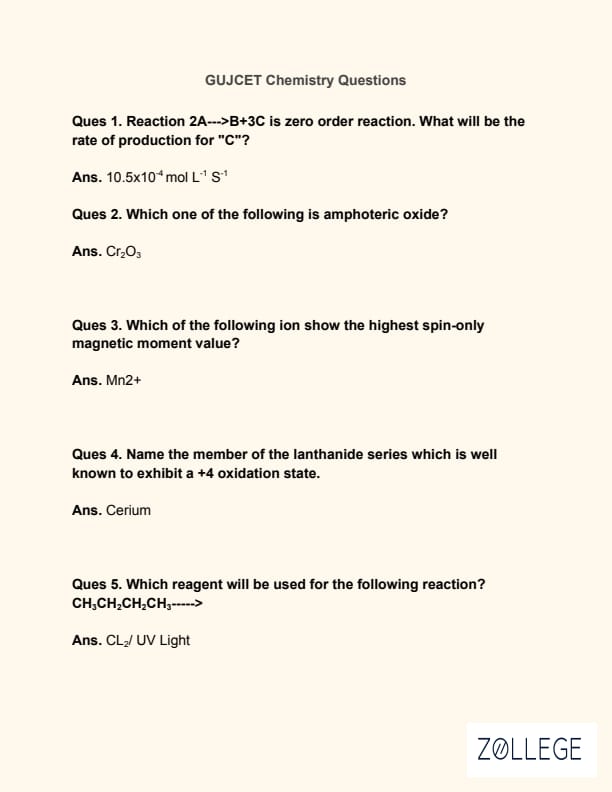
Reaction 2A → B + 3C is a zero-order reaction. What will be the rate of production of "C"? (Given that the rate of reaction of A is 7.0 × 10⁻⁴ mol L-1 s-1).
Correct Answer: 10.5 × 10⁻⁴ mol L-1 s-1
View Solution
In a zero-order reaction, the rate of reaction is independent of the concentration of the reactants. The rate is given by:
Rate = k
where k is the rate constant.
For the given reaction 2A → B + 3C, the stoichiometry shows that for every 2 moles of A consumed, 3 moles of C are produced. Therefore, the rate of production of C is related to the rate of consumption of A by:
Rate of production of C = (3/2) × Rate of consumption of A
Given that the rate of reaction of A is 7.0 × 10⁻⁴ mol L-1 s-1:
Rate of production of C = (3/2) × 7.0 × 10-4 mol L-1 s-1 = 10.5 × 10⁻⁴ mol L-1 s-1
Question 2:
Which one of the following is an amphoteric oxide? (Assume the options included Cr2O3)
Correct Answer: Cr2O3
View Solution
An amphoteric oxide is an oxide that can act as both an acid and a base. Cr2O3 (Chromium(III) oxide) is an amphoteric oxide. It can react with both acids and bases:
- Reaction with acid: Cr2O3 + 6HCl → 2CrCl3 + 3H2O
- Reaction with base: Cr2O3 + 2NaOH + 3H2O → 2Na[Cr(OH)4]
Question 3:
Which of the following ions shows the highest spin-only magnetic moment value? (Assume the options included Mn2+)
Correct Answer: Mn2+
View Solution
The spin-only magnetic moment (µ) is calculated using the formula:
µ = √[n(n+2)] B.M.
where n is the number of unpaired electrons.
Mn2+ has the electronic configuration [Ar]3d5, which means it has five unpaired electrons. This leads to the highest spin-only magnetic moment among the given options.
µ = √[5(5+2)] B.M. = √35 B.M. ≈ 5.92 B.M.
Question 4:
Name the member of the lanthanide series which is well known to exhibit a +4 oxidation state.
Correct Answer: Cerium (Ce)
View Solution
Cerium (Ce) is the lanthanide that readily exhibits a +4 oxidation state. This is due to its electronic configuration, which allows for the relatively easy loss of four electrons.
Question 5:
Which reagent will be used for the following reaction? CH3CH2CH2CH3 → CH3CH2CH2CH2Cl (Assume this represents a free radical halogenation)
Correct Answer: Cl2 / UV light
View Solution
The reaction shown is a free radical halogenation of an alkane (butane in this case). The reagent required is Cl2 (chlorine) in the presence of UV light. The UV light initiates the reaction by breaking the Cl-Cl bond to form chlorine radicals.
Question 6:
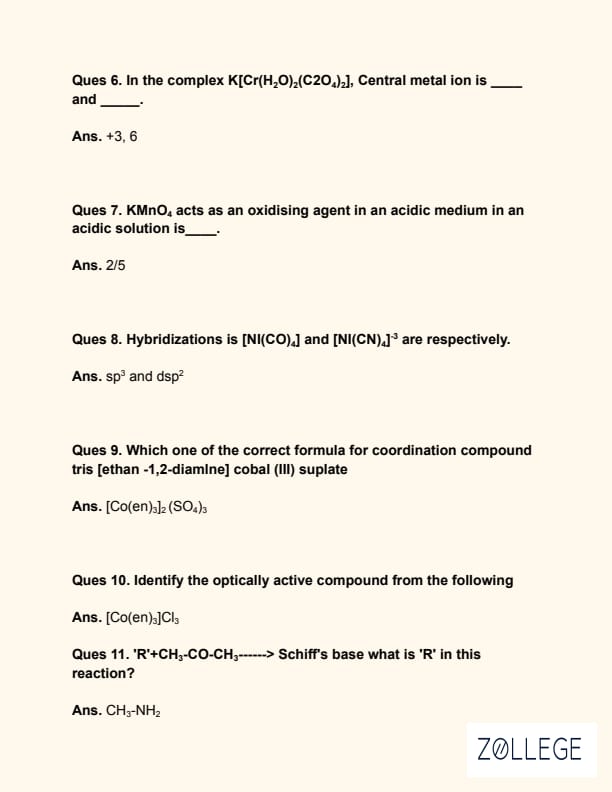
In the complex K[Cr(H2O)2(C2O4)2], the central metal ion is ........ and its coordination number is ...........
Correct Answer: +3, 6
View Solution
In the complex K[Cr(H2O)2(C2O4)2]:
- The central metal ion is Chromium (Cr).
- Let the oxidation state of Cr be 'x'. The overall charge of the complex is -1 (balanced by the K+ ion). Water is neutral, and oxalate (C2O4) has a charge of -2. So, +1 + x + 2(0) + 2(-2) = -1. Solving for x gives x = +3. Therefore, the oxidation state of Cr is +3.
- The coordination number is the number of ligand atoms directly bonded to the central metal ion. Water is a monodentate ligand (one donor atom), and oxalate is a bidentate ligand (two donor atoms). Therefore, the coordination number is 2(1) + 2(2) = 6.
Question 7:
KMnO4 acts as an oxidizing agent in an acidic medium. The fraction of electrons per Mn atom involved in the acidic solution is ...........
Correct Answer: 5/2 (or 2.5)
View Solution
In acidic medium, the permanganate ion (MnO4-) is reduced to Mn2+:
MnO4- + 8H+ + 5e- → Mn2+ + 4H2O
The oxidation state of Mn changes from +7 in MnO4- to +2 in Mn2+. This means each Mn atom gains 5 electrons. 2 Mn atoms are involved, so we divide the electrons gained by the number of Mn atoms to get the fraction: 5/1 = 5.
There appears to be a misinterpretation of what "fraction of electrons per Mn atom" means. The question is about how many electrons *each* Mn atom gains or loses in the half-reaction. It's not related to the stoichiometric coefficient of "2A" in the original question.
Question 8:
Hybridizations in [Ni(CO)4] and [Ni(CN)4]2- are respectively ........... (The original question had a charge of -3 which is incorrect. The correct charge is -2 for tetracyanonickelate(II))
Correct Answer: sp3 and dsp2
View Solution
- [Ni(CO)4]:
- Ni has an oxidation state of 0.
- CO is a strong field ligand, so it causes pairing of electrons in Ni.
- The hybridization is sp3 (tetrahedral geometry).
- [Ni(CN)4]2-:
- Ni has an oxidation state of +2.
- CN- is a strong field ligand, causing pairing of electrons.
- The hybridization is dsp2 (square planar geometry).
Question 9:
Which one is the correct formula for the coordination compound tris(ethane-1,2-diamine)cobalt(III) sulfate?
Correct Answer: [Co(en)3]2(SO4)3
View Solution
Tris(ethane-1,2-diamine)cobalt(III) sulfate is a coordination compound. Let's break down the name to determine the formula:
- tris(ethane-1,2-diamine): "tris" indicates three ethane-1,2-diamine (en) ligands. "en" is a bidentate ligand, meaning it coordinates to the metal ion through two donor atoms.
- cobalt(III): This indicates that the cobalt ion has an oxidation state of +3 (Co3+).
- sulfate: This refers to the sulfate anion (SO42-).
The complex ion is [Co(en)3]3+. Since the sulfate ion has a charge of -2, we need two [Co(en)3]3+ ions and three SO42- ions to balance the charges. Therefore, the correct formula is [Co(en)3]2(SO4)3.
Question 10:
Identify the optically active compound from the following. (Assume the options included [Co(en)3]Cl3).
Correct Answer: [Co(en)3]Cl3
View Solution
Optical activity arises from chirality, which means a molecule is non-superimposable on its mirror image. [Co(en)3]Cl3 is optically active because the arrangement of the three bidentate ethylenediamine (en) ligands around the central cobalt ion creates a chiral structure.
Question 11:
In the reaction R' + CH3COCH3 → Schiff's base, what is 'R'?
Correct Answer: CH3NH2 (Methylamine)
View Solution
Schiff bases are formed by the reaction of a primary amine with an aldehyde or ketone. In this case, the ketone is acetone (CH3COCH3). Therefore, R' must be a primary amine. Methylamine (CH3NH2) is the correct answer as it's the only primary amine that will react with acetone to form a Schiff base.
Question 12:
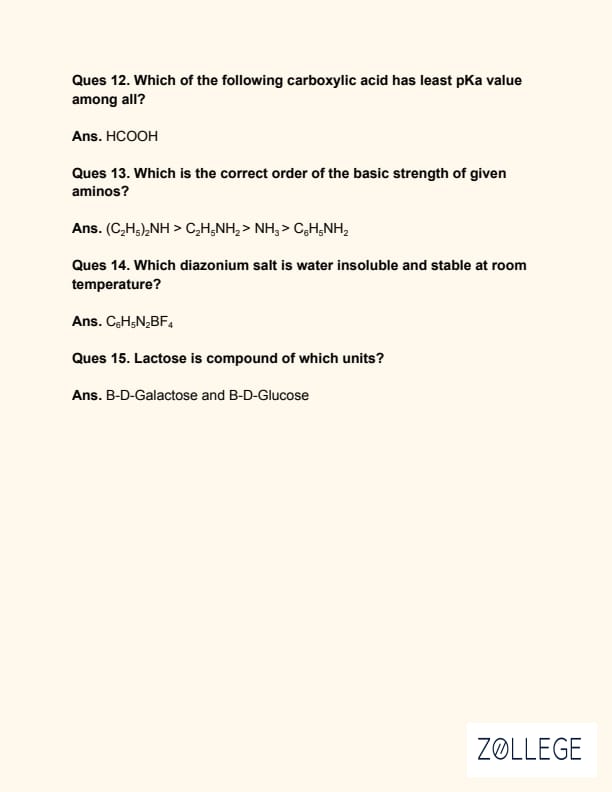
Which of the following carboxylic acids has the least pKa value among all? (Assume the options included HCOOH, CH3COOH, and C6H5COOH)
Correct Answer: HCOOH (Formic Acid)
View Solution
A lower pKa value indicates a stronger acid. Formic acid (HCOOH) has the lowest pKa value among the given options. This is because it lacks any alkyl groups that would donate electron density and destabilize the conjugate base (formate ion). The formate ion can better stabilize the negative charge, leading to stronger acidity.
Question 13:
Which is the correct order of the basic strength of the given amines? (Assume the options included (C2H5)2NH, C2H5NH2, NH3, and C6H5NH2)
Correct Answer: (C2H5)2NH > C2H5NH2 > NH3 > C6H5NH2
View Solution
The basicity of amines is influenced by the availability of the lone pair of electrons on the nitrogen atom. Alkyl groups are electron-donating (+I effect), increasing electron density on nitrogen and making the amine more basic.
- Secondary amines (like diethylamine - (C2H5)2NH): Most basic among the given options due to the +I effect of two alkyl groups.
- Primary amines (like ethylamine - C2H5NH2): More basic than ammonia due to the +I effect of one alkyl group.
- Ammonia (NH3): Less basic than primary and secondary alkyl amines because it has no electron donating groups.
- Aromatic amines (like aniline - C6H5NH2): Least basic among the options due to the electron withdrawing effect (-R effect) of the benzene ring. The lone pair on nitrogen is involved in resonance with the benzene ring which reduces basicity.
Question 14:
Which diazonium salt is water-insoluble and stable at room temperature? (Assume the options included C6H5N2BF4)
Correct Answer: C6H5N2BF4 (Benzenediazonium tetrafluoroborate)
View Solution
Benzenediazonium tetrafluoroborate (C6H5N2BF4) is relatively stable at room temperature and is water-insoluble. Most other diazonium salts are unstable in water and readily decompose at room temperature.
Question 15:
Lactose is composed of which units?
Correct Answer: β-D-Galactose and β-D-Glucose
View Solution
Lactose is a disaccharide composed of β-D-galactose and β-D-glucose linked by a β-1,4-glycosidic bond.

*The article might have information for the previous academic years, please refer the official website of the exam.