
GUJCET 2026 Physics & Chemistry Question Paper with Solutions PDF


| Updated On - Apr 1, 2026
The GUJCET 2026 exam for Physics and Chemistry is conducted by the GSEB in a single shift from 10:00 AM to 12:00 PM in PBT mode.
The GUJCET Question Paper 2026 had 40 questions from each subject, Physics and Chemistry. You will get 1 mark for every correct answer and -0.25 will be deducted for each incorrect answer.
GUJCET 2026 Physics and Chemistry Question Paper with Solution PDF is available for download here.
GUJCET 2026 Physics & Chemistry Question Paper with Solution PDF
| GUJCET 2026 Physics & Chemistry Question Paper with Solution PDF | Download | Check Solution |

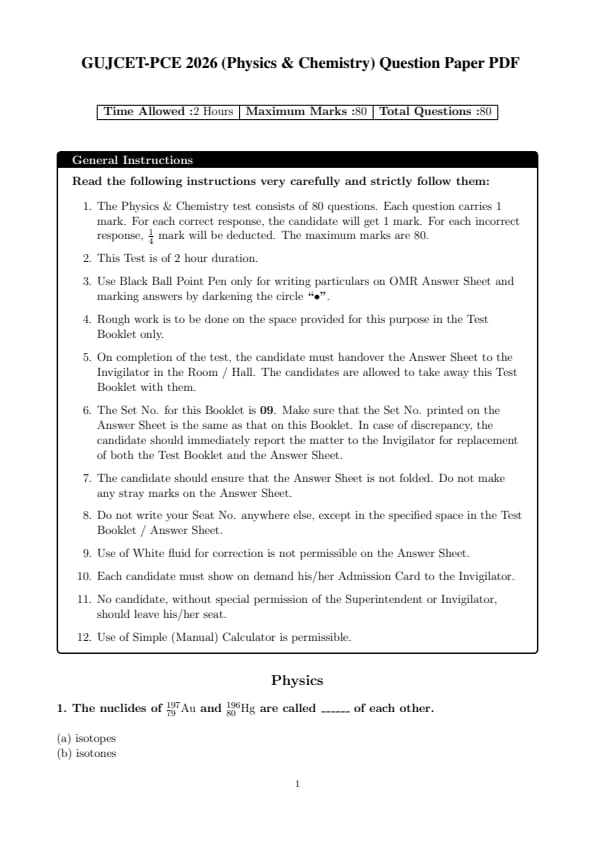
The nuclides of \(^{197}_{79}\mathrm{Au}\) and \(^{196}_{80}\mathrm{Hg}\) are called ______ of each other.
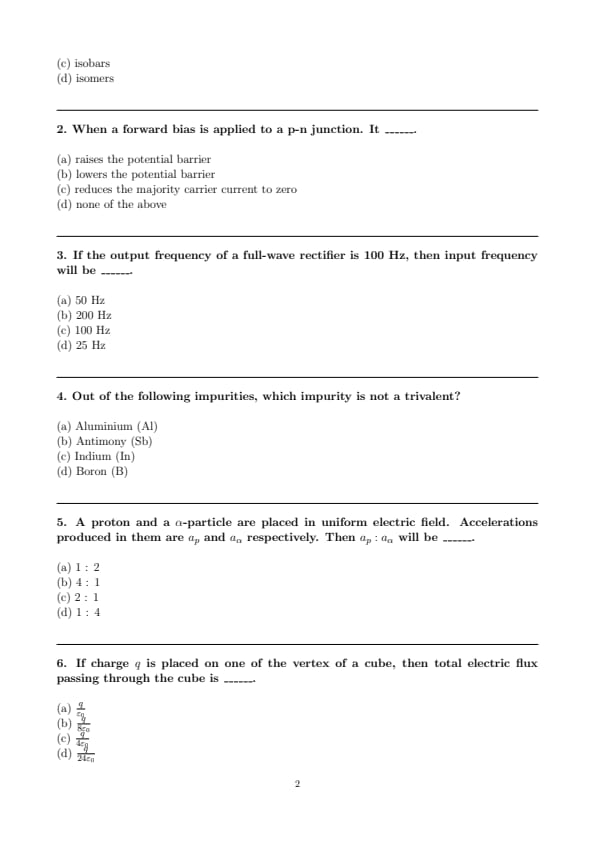
When a forward bias is applied to a p-n junction. It ______.
If the output frequency of a full-wave rectifier is 100 Hz, then input frequency will be ______.
Out of the following impurities, which impurity is not a trivalent?
A proton and a \(\alpha\)-particle are placed in uniform electric field. Accelerations produced in them are \(a_p\) and \(a_\alpha\) respectively. Then \(a_p : a_\alpha\) will be ______.
If charge \(q\) is placed on one of the vertex of a cube, then total electric flux passing through the cube is ______.
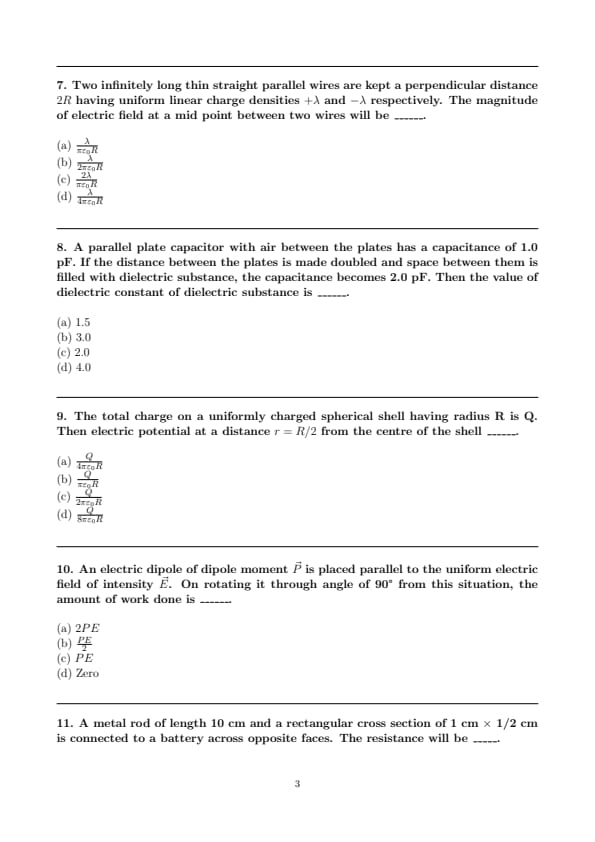
Two infinitely long thin straight parallel wires are kept a perpendicular distance \(2R\) having uniform linear charge densities \(+\lambda\) and \(-\lambda\) respectively. The magnitude of electric field at a mid point between two wires will be ______.
A parallel plate capacitor with air between the plates has a capacitance of 1.0 pF. If the distance between the plates is made doubled and space between them is filled with dielectric substance, the capacitance becomes 2.0 pF. Then the value of dielectric constant of dielectric substance is ______.
The total charge on a uniformly charged spherical shell having radius R is Q. Then electric potential at a distance \(r = R/2\) from the centre of the shell ______.
An electric dipole of dipole moment \(\vec{P}\) is placed parallel to the uniform electric field of intensity \(\vec{E}\). On rotating it through angle of 90° from this situation, the amount of work done is ______.
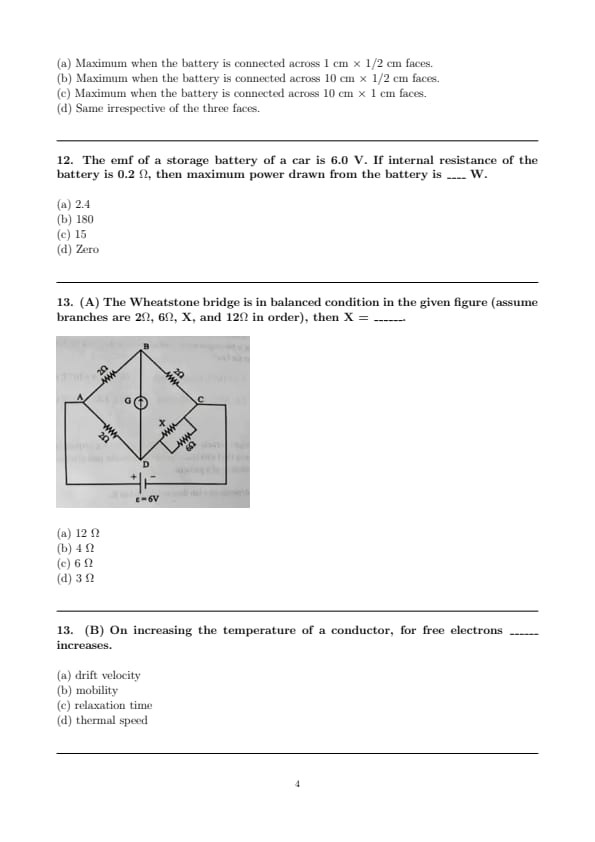
A metal rod of length 10 cm and a rectangular cross section of 1 cm \(\times\) 1/2 cm is connected to a battery across opposite faces. The resistance will be _____.
The emf of a storage battery of a car is 6.0 V. If internal resistance of the battery is 0.2 \(\Omega\), then maximum power drawn from the battery is ____ W.
The Wheatstone bridge is in balanced condition in the given figure (assume branches are 2\(\Omega\), 6\(\Omega\), X, and 12\(\Omega\) in order), then X = ______.

On increasing the temperature of a conductor, for free electrons ______ increases.
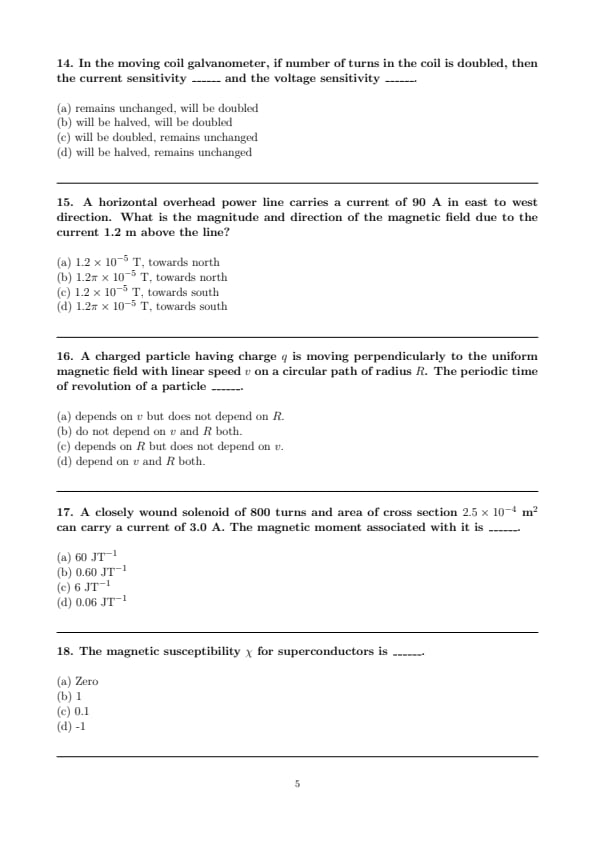
In the moving coil galvanometer, if number of turns in the coil is doubled, then the current sensitivity ______ and the voltage sensitivity ______.
A horizontal overhead power line carries a current of 90 A in east to west direction. What is the magnitude and direction of the magnetic field due to the current 1.2 m above the line?
A charged particle having charge \(q\) is moving perpendicularly to the uniform magnetic field with linear speed \(v\) on a circular path of radius \(R\). The periodic time of revolution of a particle ______.
A closely wound solenoid of 800 turns and area of cross section \(2.5 \times 10^{-4}\) m\(^2\) can carry a current of 3.0 A. The magnetic moment associated with it is ______.
The magnetic susceptibility \(\chi\) for superconductors is ______.
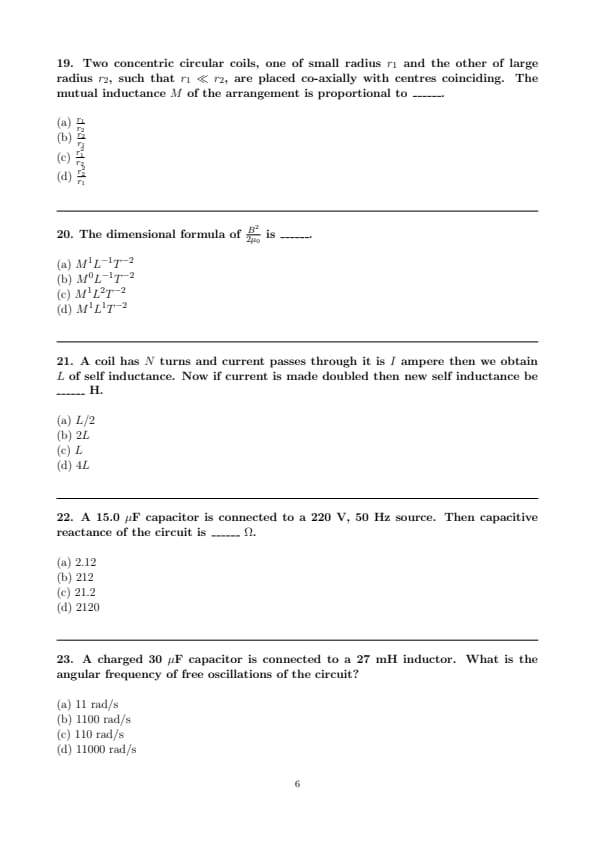
Two concentric circular coils, one of small radius \(r_1\) and the other of large radius \(r_2\), such that \(r_1 \ll r_2\), are placed co-axially with centres coinciding. The mutual inductance \(M\) of the arrangement is proportional to ______.
The dimensional formula of \(\frac{B^2}{2\mu_0}\) is ______.
A coil has \(N\) turns and current passes through it is \(I\) ampere then we obtain \(L\) of self inductance. Now if current is made doubled then new self inductance be ______ H.
A 15.0 \(\mu\)F capacitor is connected to a 220 V, 50 Hz source. Then capacitive reactance of the circuit is ______ \(\Omega\).
A charged 30 \(\mu\)F capacitor is connected to a 27 mH inductor. What is the angular frequency of free oscillations of the circuit?
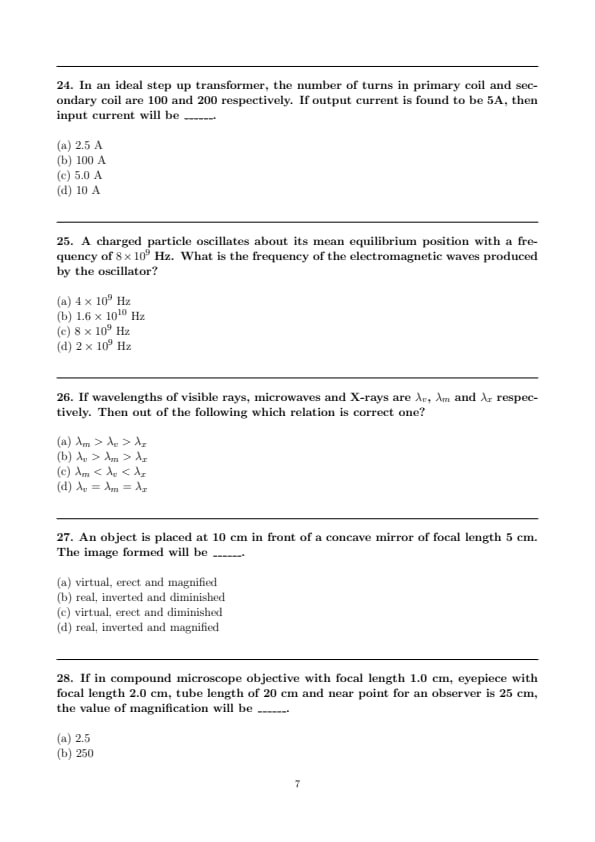
In an ideal step up transformer, the number of turns in primary coil and secondary coil are 100 and 200 respectively. If output current is found to be 5A, then input current will be ______.
A charged particle oscillates about its mean equilibrium position with a frequency of \(8 \times 10^9\) Hz. What is the frequency of the electromagnetic waves produced by the oscillator?
If wavelengths of visible rays, microwaves and X-rays are \(\lambda_v\), \(\lambda_m\) and \(\lambda_x\) respectively. Then out of the following which relation is correct one?
An object is placed at 10 cm in front of a concave mirror of focal length 5 cm. The image formed will be ______.
If in compound microscope objective with focal length 1.0 cm, eyepiece with focal length 2.0 cm, tube length of 20 cm and near point for an observer is 25 cm, the value of magnification will be ______.
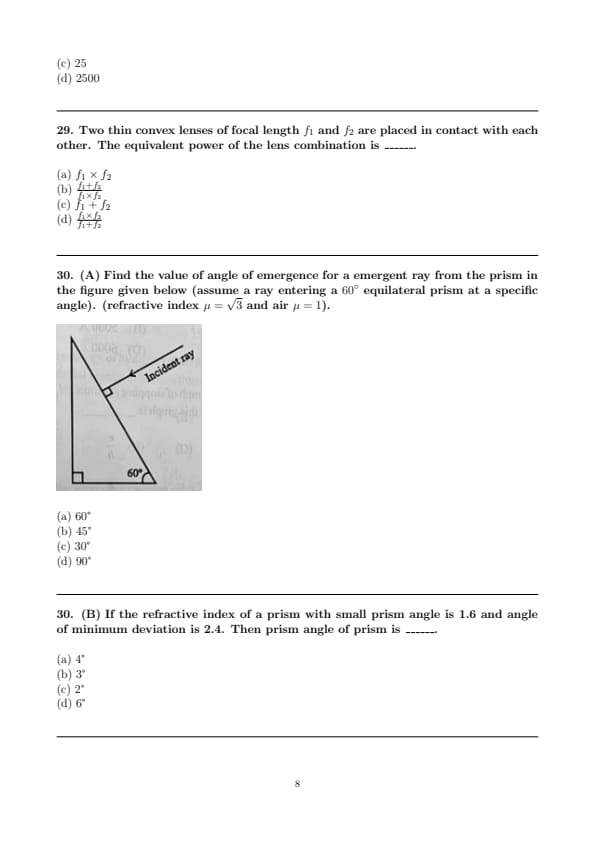
Two thin convex lenses of focal length \(f_1\) and \(f_2\) are placed in contact with each other. The equivalent power of the lens combination is ______.
Find the value of angle of emergence for a emergent ray from the prism in the figure given below (assume a ray entering a \(60^\circ\) equilateral prism at a specific angle). (refractive index \(\mu = \sqrt{3}\) and air \(\mu = 1\)).

If the refractive index of a prism with small prism angle is 1.6 and angle of minimum deviation is 2.4. Then prism angle of prism is ______.
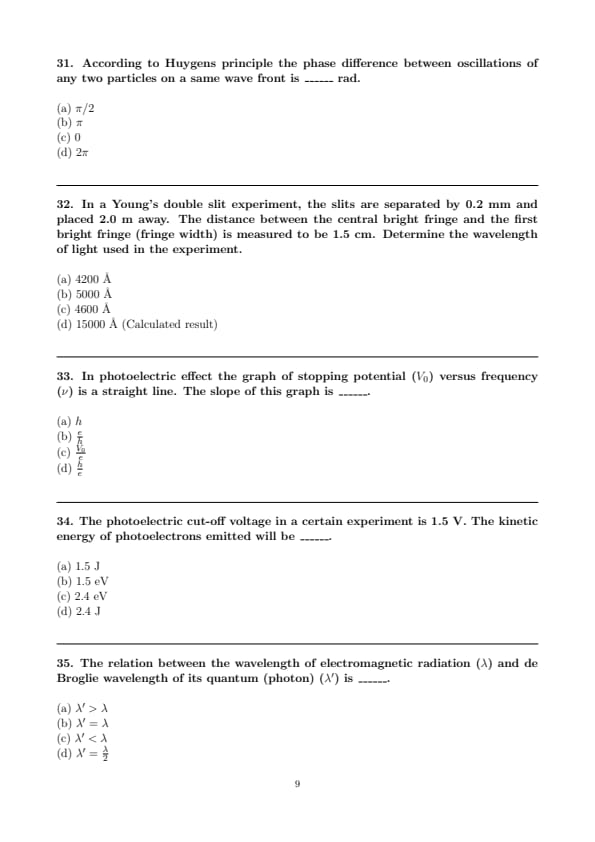
According to Huygens principle the phase difference between oscillations of any two particles on a same wave front is ______ rad.
In a Young's double slit experiment, the slits are separated by 0.2 mm and placed 2.0 m away. The distance between the central bright fringe and the first bright fringe (fringe width) is measured to be 1.5 cm. Determine the wavelength of light used in the experiment.
In photoelectric effect the graph of stopping potential (\(V_0\)) versus frequency (\(\nu\)) is a straight line. The slope of this graph is ______.
The photoelectric cut-off voltage in a certain experiment is 1.5 V. The kinetic energy of photoelectrons emitted will be ______.
The relation between the wavelength of electromagnetic radiation (\(\lambda\)) and de Broglie wavelength of its quantum (photon) (\(\lambda'\)) is ______.
Out of the following physical quantities which quantity has the same unit as that of Planck's constant?
The ground state energy of hydrogen atom is -13.6 eV. What is the ratio of kinetic energy and potential energy of the electron of this state?
The radius of the innermost electron orbit of a hydrogen atom is \(5.3 \times 10^{-11}\) m. What is the radius of the \(n=3\) orbit?
The energy equivalent of 1.0 kg of substance is ______.

GUJCET 2026 Preparation
*The article might have information for the previous academic years, please refer the official website of the exam.