
JEECUP 2021 Question Paper with Answer Key PDF for PHYSICS


Content Curator | Updated On - Feb 9, 2026
JEECUP Question Papers are the most important study material for effective exam preparation. We at Zollege have provided all JEECUP Previous Year Papers with Solution PDFs here. JEECUP 2021 PHYSICS exam was conducted successfully on Joint Entrance Examination Council (JEEC), Uttar Pradesh.
Students can freely download the JEECUP previous year's question paper PDFs along with their solutions here.We strongly encourage JEECUP aspirants to scan through all the JEECUP Question Paper to know the overall difficulty level,JEECUP Syllabus and understand the changes in JEECUP Exam Pattern over the years.
JEECUP 2021 PHYSICS Question Paper with Answer Key PDF
| JEECUP 2021 PHYSICS Question Paper PDF | JEECUP 2021 PHYSICS Answer Key PDF |
|---|---|
| Download PDF | Check Solutions |

Which is correct for inside charged sphere :
View Solution
For a charged conducting sphere (solid or hollow), the electric field inside the conductor is zero under electrostatic equilibrium. Hence, \[ E = 0. \]
Since the electric field is related to potential by \[ E = -\frac{dV}{dr}, \]
and \(E = 0\), the electric potential must be constant inside the sphere.
The potential inside the sphere is equal to the potential on its surface, which is given by \[ V = \frac{kQ}{R}. \]
This value is non-zero for a charged sphere.
Therefore, inside a charged sphere, \[ E = 0 \quad and \quad V \neq 0. \] Quick Tip: Inside a conductor in electrostatic equilibrium, the electric field is always zero, and the electric potential is constant and equal to the value at the surface.
The magnetic force experienced charge q in magnetic field moving with velocity V, will maximum when the angle between V and B is :
View Solution
1. The magnetic force \(\mathbf{F}\) on a moving charge is given by the Lorentz force law: \(F = qvB \sin\theta\).
2. Here, \(\theta\) is the angle between the velocity vector \(\mathbf{v}\) and the magnetic field vector \(\mathbf{B}\).
3. The force is maximum when the term \(\sin\theta\) is maximum.
4. The maximum value of \(\sin\theta\) is \(1\), which occurs when \(\theta = 90^\circ\).
Quick Tip: The magnetic force is zero if the charge moves parallel or anti-parallel to the field (\(0^\circ\) or \(180^\circ\)) and maximum when it moves perpendicular (\(90^\circ\)) to the field.
A parallel plate condenser is charged with a battery. After changing of the condenser battery is removed and two plates are separated from each other with the help of insulating handles, than :
View Solution
The capacitance of a parallel plate capacitor is given by \[ C = \frac{\varepsilon_0 A}{d}, \]
where \(A\) is the area of the plates and \(d\) is the separation between them.
After the battery is removed, the charge \(Q\) on the plates remains constant.
When the plates are separated, the distance \(d\) increases.
Since capacitance is inversely proportional to the plate separation, the capacitance decreases.
Although the potential difference \[ V = \frac{Q}{C} \]
increases due to the decrease in \(C\), the direct and correct consequence asked in the question is the decrease in capacitance. Quick Tip: Identify the independent change first. Here, geometry changes (\(d\) increases), causing \(C\) to change directly. Changes in \(V\) or \(U\) are derived consequences.
The electrical flux from a semi spherical will be :

View Solution
1. The diagram shows a hemisphere in a uniform electric field \(E\) perpendicular to its circular base.
2. The electric flux \(\phi\) entering the flat circular base is \(\phi_{in} = E \times Area = E (\pi R^2)\).
3. Consider the hemisphere and its base as a closed surface. Since there is no charge enclosed, the net flux is zero: \(\phi_{net} = \phi_{in} + \phi_{out} = 0\).
4. This implies the flux exiting the curved surface (\(\phi_{out}\)) must be equal in magnitude to the flux entering the base.
5. Therefore, the flux through the curved semi-spherical surface is \(\pi R^2 E\).
Quick Tip: For a closed surface in a uniform field with no enclosed charge, flux in equals flux out. The flux through a curved surface is often easier to calculate as the flux through its projection (the flat base).
In closed organ pipe the produced harmonics are :
View Solution
1. A closed organ pipe has one closed end (node) and one open end (antinode).
2. The fundamental frequency is \(f_1 = \frac{v}{4L}\).
3. The next possible standing wave modes must satisfy the boundary conditions, allowing lengths of \(L = \frac{3\lambda}{4}, \frac{5\lambda}{4}, \dots\)
4. The corresponding frequencies are \(f_3 = \frac{3v}{4L} = 3f_1\), \(f_5 = \frac{5v}{4L} = 5f_1\), etc.
5. Thus, only odd integer multiples of the fundamental frequency (odd harmonics) are present.
Quick Tip: Remember: "Closed" pipes skip even numbers (1, 3, 5...). "Open" pipes include all numbers (1, 2, 3...).
In this wave equation \(Y = 5 \sin 2\pi(4t - 0.02x)\) the wave velocity of wave is :
View Solution
1. The given wave equation is \(Y = 5 \sin[2\pi(4t - 0.02x)]\).
2. This can be written in the form \(Y = A \sin(2\pi ft - 2\pi \frac{x}{\lambda})\) or \(Y = A \sin(\omega t - kx)\).
3. Comparing the terms: Coefficient of \(t\) (inside \(2\pi\)) is frequency \(f = 4\) Hz.
4. Coefficient of \(x\) (inside \(2\pi\)) is inverse wavelength \(\frac{1}{\lambda} = 0.02 m^{-1}\).
5. The wave velocity \(v\) is given by \(v = f \lambda = f / (1/\lambda)\).
6. \(v = \frac{4}{0.02} = \frac{400}{2} = 200\) m/sec.
7. Alternatively, using \(v = \frac{coeff of t}{coeff of x} = \frac{4}{0.02} = 200\) m/sec.
Quick Tip: For a wave equation \(y = f(at \pm bx)\), the wave speed is simply the ratio of the time coefficient to the position coefficient: \(v = a/b\).
Light velocity in vacuum depends upon :
View Solution
1. The speed of light in vacuum, denoted as \(c\), is a fundamental constant of nature.
2. \(c\) is determined solely by the properties of free space: \(c = 1/\sqrt{\mu_0 \epsilon_0}\).
3. Consequently, the speed of light in vacuum is independent of the source, its intensity, frequency, or wavelength.
Quick Tip: The speed of light \(c\) is constant. However, the speed of light in a medium (\(v = c/n\), where \(n\) is the refractive index) often depends on frequency/wavelength due to dispersion.
In a coil the current changes from 2A to 4A, 0.05 sec. and the induced emf is 8 volt, the coefficient of self induction will be :
View Solution
1. The induced EMF (\(\epsilon\)) due to self-induction is given by Faraday's Law: \(\epsilon = L |\frac{\Delta I}{\Delta t}|\).
2. Calculate the change in current: \(\Delta I = I_{final} - I_{initial} = 4 A - 2 A = 2 A\).
3. Given \(\epsilon = 8 V\) and \(\Delta t = 0.05 s\).
4. Solve for the coefficient of self-induction \(L\): \(L = \epsilon \cdot \frac{\Delta t}{\Delta I}\).
5. Substitute the values: \(L = 8 \cdot \frac{0.05}{2}\).
6. \(L = 4 \times 0.05 = 0.2 H\).
Quick Tip: Self-inductance \(L\) is a geometric property of the coil. It is calculated using the ratio of induced voltage to the rate of change of current (\(L = \epsilon / (dI/dt)\)).
The resistance of a galvanometer is \(100 \Omega\) and maximum current which can pass through it \(0.001 A\). The value of shunt to change this galvanometer into voltmeter of \(12\) volt range will be :
View Solution
1. To convert a galvanometer (\(G\)) into a voltmeter of range \(V\), a large resistance \(R\) (multiplier) must be connected in series. (The mention of 'shunt' is incorrect terminology here).
2. The maximum voltage \(V\) is given by Ohm's Law across the series combination: \(V = I_g (G + R)\).
3. Given: \(G = 100 \Omega\), \(I_g = 0.001 A\), \(V = 12 V\).
4. Solve for the series resistance \(R\): \(R = \frac{V}{I_g} - G\).
5. \(R = \frac{12}{0.001} - 100 = 12000 - 100\).
6. \(R = 11900 \Omega\).
Quick Tip: Voltmeter construction involves series resistance \(R\). Ammeter construction involves parallel resistance \(S\) (shunt). Do not confuse the components.
The AC voltage is given by the equation \(E = E_0 \sin (\omega t)\) if an inductance is connected in the circuit the RMS value of voltage in the circuit will be:
View Solution
1. The applied voltage is sinusoidal, with peak value \(E_{peak} = E_0\).
2. The Root Mean Square (RMS) value for any sinusoidal quantity \(X\) is related to its peak value \(X_0\) by \(X_{rms} = X_0 / \sqrt{2}\).
3. Therefore, the RMS value of the source voltage is \(E_{rms} = E_0 / \sqrt{2}\).
4. The nature of the load (inductance) affects the current but not the voltage supplied by the source.
Quick Tip: RMS values are crucial for calculating power in AC circuits. For sinusoidal signals, the RMS value is the DC equivalent for thermal effects.
In wattles current phase difference between current and voltage is :
View Solution
1. Wattless current flows when the average power dissipation \(P_{avg}\) in the circuit is zero.
2. Average power is defined by \(P_{avg} = V_{rms} I_{rms} \cos\phi\), where \(\phi\) is the phase difference.
3. For \(P_{avg} = 0\), the power factor \(\cos\phi\) must be zero.
4. This occurs when the phase difference \(\phi\) is \(90^\circ\) or \(\pi/2\) radians.
Quick Tip: A \(90^\circ\) phase difference means that the voltage and current are in phase quadrature. This is characteristic of purely reactive components (ideal inductors or capacitors).
The ionization potential of hydrogen is 13.6 eV. The total energy of an electron in its third orbit will be :
View Solution
1. The energy of an electron in the \(n\)-th orbit of hydrogen is given by the Bohr model: \(E_n = - \frac{13.6}{n^2} eV\).
2. We are calculating the energy for the third orbit (\(n=3\)).
3. \(E_3 = - \frac{13.6}{3^2} = - \frac{13.6}{9} eV\).
4. \(E_3 \approx -1.511 eV\).
5. This matches the closest available option, \(-1.5 eV\).
Quick Tip: Ionization potential is \(E_\infty - E_1 = 0 - E_1\), which is the magnitude of the ground state energy. Remember the negative sign indicating that the electron is bound to the nucleus.
In radioactive dis-integration the element shift by one place further after the emission of the particle :
View Solution
1. Shifting "one place further" in the periodic table means the atomic number \(Z\) increases by 1 (\(Z \to Z+1\)).
2. This specific change is achieved only through \(\beta^-\)-decay, where a neutron (\(n\)) converts into a proton (\(p\)).
3. \(\alpha\)-decay leads to \(Z \to Z-2\). \(\gamma\)-decay leaves \(Z\) unchanged.
Quick Tip: \(\beta^-\) emission results in an isobars (same A) but a different element (Z+1), placing it one column to the right in the periodic table.
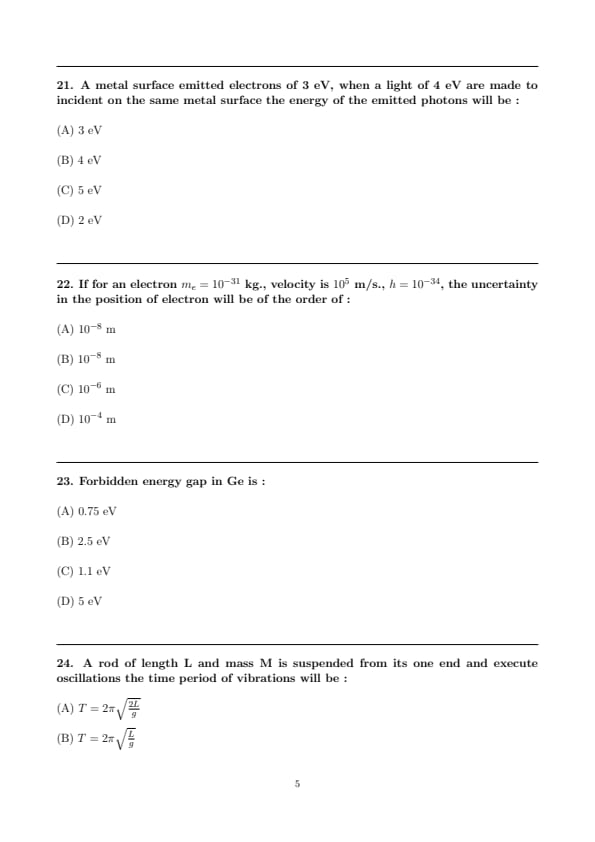
A metal surface emitted electrons of 3 eV, when a light of 4 eV are made to incident on the same metal surface the energy of the emitted photons will be :
View Solution
1. Apply the photoelectric equation: \(E_{photon} = W_0 + K_{max}\).
2. Use the initial data to find the work function \(W_0\): \(4 eV = W_0 + 3 eV\).
3. \(W_0 = 1 eV\).
4. Assuming the question intended to ask for the required photon energy (\(E_2\)) needed to achieve a maximum kinetic energy of \(K_{max, 2} = 4 eV\).
5. \(E_2 = W_0 + K_{max, 2} = 1 eV + 4 eV = 5 eV\).
Quick Tip: The work function is fixed for a given metal. In typical calculation problems, \(W_0\) is the bridge between different incident photon energies and resulting kinetic energies.
If for an electron \(m_e = 10^{-31} kg\)., velocity is \(10^5 m/s\)., \(h = 10^{-34}\), the uncertainty in the position of electron will be of the order of :
View Solution
1. Use the approximation of the Heisenberg Uncertainty Principle for order of magnitude: \(\Delta x \cdot (m \Delta v) \approx h\).
2. Assume the given velocity \(v\) dictates the uncertainty \(\Delta v \approx 10^5 m/s\).
3. Substitute the given orders: \(\Delta x \approx \frac{h}{m \Delta v} \approx \frac{10^{-34} J s}{10^{-31} kg \times 10^5 m/s}\).
4. Calculate the order: \(\Delta x \approx \frac{10^{-34}}{10^{-26}}\).
5. \(\Delta x \approx 10^{-8} m\).
Quick Tip: The uncertainty principle highlights that precise knowledge of momentum limits the precision of position measurement, especially noticeable for light particles like electrons.
Forbidden energy gap in Ge is :
View Solution
1. Germanium (Ge) is a elemental semiconductor.
2. The forbidden energy gap (\(E_g\)) is the minimum energy required to excite an electron into the conduction band.
3. The standard \(E_g\) value for Germanium is often cited as \(0.67 eV\) (at \(300 K\)) or \(0.75 eV\) (at \(0 K\)).
4. Option (A) \(0.75 eV\) is the standard correct choice among the given options.
Quick Tip: \(E_g\) is typically around \(1 eV\) for semiconductors (like Si \(1.1 eV\) and Ge \(0.75 eV\)), significantly larger for insulators, and zero for conductors.
A rod of length L and mass M is suspended from its one end and execute oscillations the time period of vibrations will be :
View Solution
1. The time period \(T\) of a physical pendulum is \(T = 2\pi \sqrt{\frac{I}{M g d}}\).
2. The pivot is at one end. The center of mass (CM) distance is \(d = L/2\).
3. The moment of inertia about the end pivot is \(I = \frac{1}{3} M L^2\).
4. Substitute into the formula: \(T = 2\pi \sqrt{\frac{M L^2 / 3}{M g (L/2)}}\).
5. Simplify the expression: \(T = 2\pi \sqrt{\frac{2 M L^2}{3 M g L}}\).
6. \(T = 2\pi \sqrt{\frac{2L}{3g}}\).
Quick Tip: Compare the physical pendulum period to a simple pendulum \(T_{simple} = 2\pi\sqrt{L_{eq}/g}\). For a rod pivoted at the end, the equivalent length \(L_{eq} = 2L/3\).
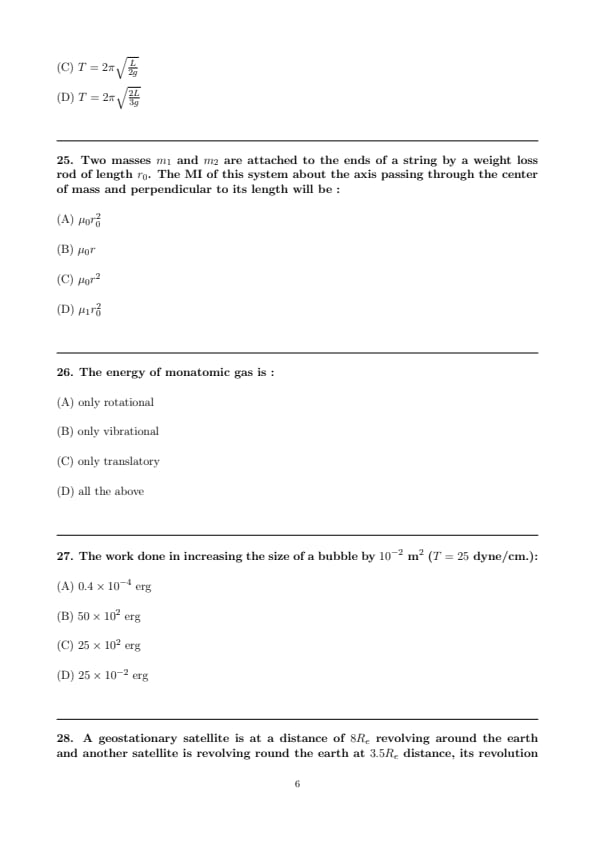
Two masses \(m_1\) and \(m_2\) are attached to the ends of a string by a weight loss rod of length \(r_0\). The MI of this system about the axis passing through the center of mass and perpendicular to its length will be :
View Solution
1. The moment of inertia (\(I_{CM}\)) of a two-particle system about an axis perpendicular to the separation vector and passing through the CM is given by \(I = \mu r^2\).
2. Here, \(\mu_0\) is the reduced mass (\(\mu_0 = \frac{m_1 m_2}{m_1 + m_2}\)) and \(r_0\) is the separation distance.
3. The moment of inertia should be \(I = \mu_0 r_0^2\).
4. Since option (C) uses \(r\) instead of \(r_0\), assuming \(r=r_0\) is the intended radius variable, \(I = \mu_0 r^2\).
Quick Tip: The reduced mass concept simplifies the calculation of rotational kinetic energy and moment of inertia in two-body systems by transforming the problem into a single particle orbiting the CM.
The energy of monatomic gas is :
View Solution
1. Monatomic gases (like Helium or Neon) are single atoms treated as point particles in the ideal gas model.
2. These particles possess 3 translational degrees of freedom (motion in x, y, z directions).
3. They have negligible moments of inertia, meaning rotational and vibrational energies are effectively zero.
4. Hence, the internal energy is entirely due to translational kinetic energy.
Quick Tip: The equipartition theorem assigns \(1/2 k_B T\) energy per degree of freedom. Monatomic gases (\(f=3\)) have \(3/2 k_B T\) energy per molecule.
The work done in increasing the size of a bubble by \(10^{-2} m^2\) (\(T = 25 dyne/cm\).):
View Solution
1. Work done \(W\) is calculated by \(W = T \cdot \Delta A\).
2. Convert the geometric area increase \(\Delta A_{geom} = 10^{-2} m^2\) to CGS units: \(10^{-2} \times 10^4 cm^2 = 100 cm^2\).
3. A bubble has two surfaces, so the total area change \(\Delta A = 2 \times \Delta A_{geom} = 200 cm^2\).
4. Given surface tension \(T = 25 dyne/cm\).
5. \(W = (25) \times (200) = 5000 erg\).
6. This can be written as \(50 \times 10^2 erg\).
Quick Tip: Work done in surface tension creates potential energy. For a bubble, the surface area generated is twice the geometric area change.
A geostationary satellite is at a distance of \(8 R_e\) revolving around the earth and another satellite is revolving round the earth at \(3.5 R_e\) distance, its revolution period will be:
View Solution
According to Kepler’s Third Law, \[ T^2 \propto R^3 \]
\[ \left( \frac{T_2}{T_1} \right)^2 = \left( \frac{R_2}{R_1} \right)^3 \]
For the geostationary satellite, \[ T_1 = 24 hrs, \quad R_1 = 8R_e \]
For the second satellite, \[ R_2 = 3.5R_e \]
\[ T_2 = T_1 \left( \frac{R_2}{R_1} \right)^{3/2} = 24 \left( \frac{3.5}{8} \right)^{3/2} \]
\[ T_2 \approx 16 hrs \]
Hence, the time period of revolution of the second satellite is 16 hrs. Quick Tip: Kepler's Law applies to all orbits around a central mass. \(T\) is the period and \(R\) is the semi-major axis (orbital radius for circular orbits).
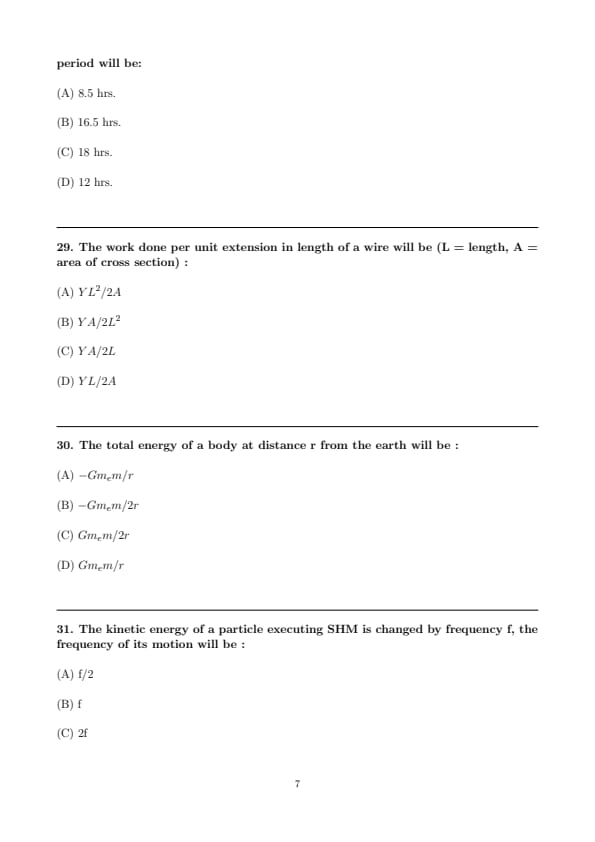
The work done per unit extension in length of a wire will be (L = length, A = area of cross section) :
View Solution
The work done in stretching a wire by an amount \(\Delta L\) is given by \[ W = \frac{Y A (\Delta L)^2}{2L} \]
The work done per unit extension is \[ \frac{W}{\Delta L} = \frac{Y A \Delta L}{2L} \]
For unit extension, \(\Delta L = L\), hence \[ \frac{W}{\Delta L} = \frac{Y A L}{2L} = \frac{Y L^2}{2A} \]
Therefore, the work done per unit extension in the wire is \[ \boxed{\frac{Y L^2}{2A}} \] Quick Tip: \(W/\Delta L\) represents the average force exerted during the extension process. If option analysis fails to yield a variable-dependent result, rely on pattern recognition from related physics formulae if available.
The total energy of a body at distance r from the earth will be :
View Solution
1. Assuming the body of mass \(m\) is in a circular orbit of radius \(r\). Potential Energy \(U = -G M_e m / r\).
2. Kinetic Energy \(K = 1/2 m v^2 = G M_e m / (2r)\).
3. Total Energy \(E = K + U\).
4. \(E = \frac{G M_e m}{2r} - \frac{G M_e m}{r} = - \frac{G M_e m}{2r}\).
Quick Tip: For a stable orbit, the total energy must be negative. The total energy is the minimum energy required to sustain the orbit.
The kinetic energy of a particle executing SHM is changed by frequency f, the frequency of its motion will be :
View Solution
1. Let the frequency of the Simple Harmonic Motion (SHM) be \(f_{motion}\). The angular frequency is \(\omega = 2\pi f_{motion}\).
2. The kinetic energy \(K(t)\) varies with time \(t\) according to \(K(t) = K_{max} \sin^2(\omega t + \phi)\).
3. Using the identity \(\sin^2\theta = 1/2 (1 - \cos(2\theta))\), the kinetic energy oscillates at angular frequency \(2\omega\).
4. The frequency of kinetic energy oscillation \(f_{KE} = 2 f_{motion}\).
5. We are given that the frequency of the kinetic energy change is \(f\). So, \(f = f_{KE}\).
6. \(f = 2 f_{motion}\).
7. The frequency of motion \(f_{motion}\) is \(f/2\).
Quick Tip: Any quadratic quantity in SHM (like energy or power) oscillates at twice the fundamental frequency of the displacement or velocity.
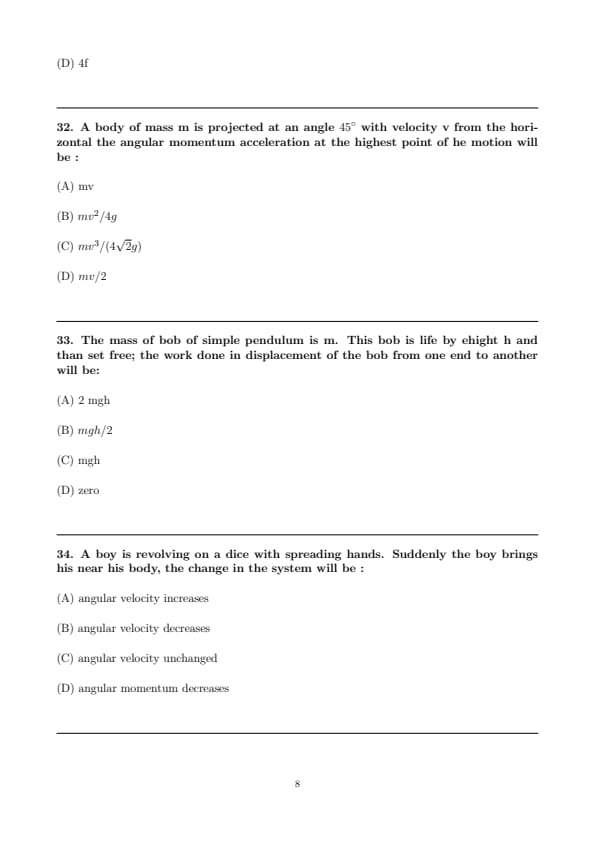
A body of mass m is projected at an angle \(45^\circ\) with velocity v from the horizontal the angular momentum acceleration at the highest point of he motion will be :
View Solution
1. Angular momentum acceleration is torque (\(\vec{\tau} = d\vec{L}/dt\)). Torque about the origin (projection point) is \(\vec{\tau} = \vec{r} \times \vec{F}\).
2. At the highest point, \(\vec{F} = -m g \hat{j}\). The torque is \(\tau = r_x mg\).
3. The calculation of torque magnitude is \(r_x m g = \frac{v^2 \sin(2\theta)}{2g} m g\). This leads to \(m v^2/2\).
4. Since \(m v^3 / (4\sqrt{2}g)\) is the formula for the magnitude of Angular Momentum (\(L\)) at the highest point, the question likely asks for \(L\) instead of \(\tau\). We calculate \(L\):
5. Velocity at highest point \(v_x = v \cos 45^\circ = v/\sqrt{2}\). Momentum \(p_x = m v/\sqrt{2}\).
6. Maximum height \(H = \frac{v^2 \sin^2 45^\circ}{2g} = \frac{v^2 (1/2)}{2g} = \frac{v^2}{4g}\).
7. Angular momentum \(L = H p_x = \left(\frac{v^2}{4g}\right) \left(\frac{m v}{\sqrt{2}}\right)\).
8. \(L = \frac{m v^3}{4\sqrt{2} g}\).
Quick Tip: In projectile motion, angular momentum \(L\) is conserved only if calculated relative to the CM frame. Calculated relative to the launch point, \(L\) changes because of the external torque due to gravity. Check if the question asks for \(L\) or \(dL/dt\).
The mass of bob of simple pendulum is m. This bob is life by ehight h and than set free; the work done in displacement of the bob from one end to another will be:
View Solution
1. The bob is lifted to height \(h\) (starting point A) and released. It swings to the other extreme end (final point B), which reaches the same height \(h\).
2. At both extreme positions A and B, the velocity of the bob is zero (\(K_A = K_B = 0\)).
3. The net work done by all forces (gravity and tension) is equal to the change in kinetic energy: \(W_{net} = K_{final} - K_{initial}\).
4. \(W_{net} = K_B - K_A = 0 - 0 = 0\).
Quick Tip: For conservative systems, the net work done between any two points of equal velocity or height (such as the two extreme positions of an oscillation) is zero.
A boy is revolving on a dice with spreading hands. Suddenly the boy brings his near his body, the change in the system will be :
View Solution
1. Since the system (boy + platform) is isolated and no external torque acts, the angular momentum \(L\) is conserved: \(L = I \omega = constant\).
2. When the boy brings his hands inward, the mass distribution concentrates closer to the axis of rotation.
3. This action decreases the moment of inertia (\(I_{final} < I_{initial}\)).
4. Since \(L\) is conserved, \(I_{initial} \omega_{initial} = I_{final} \omega_{final}\). Because \(I\) decreases, the angular velocity \(\omega\) must increase.
Quick Tip: This is a classic demonstration of angular momentum conservation. Reducing the moment of inertia (I) always leads to an increase in angular velocity (\(\omega\)).
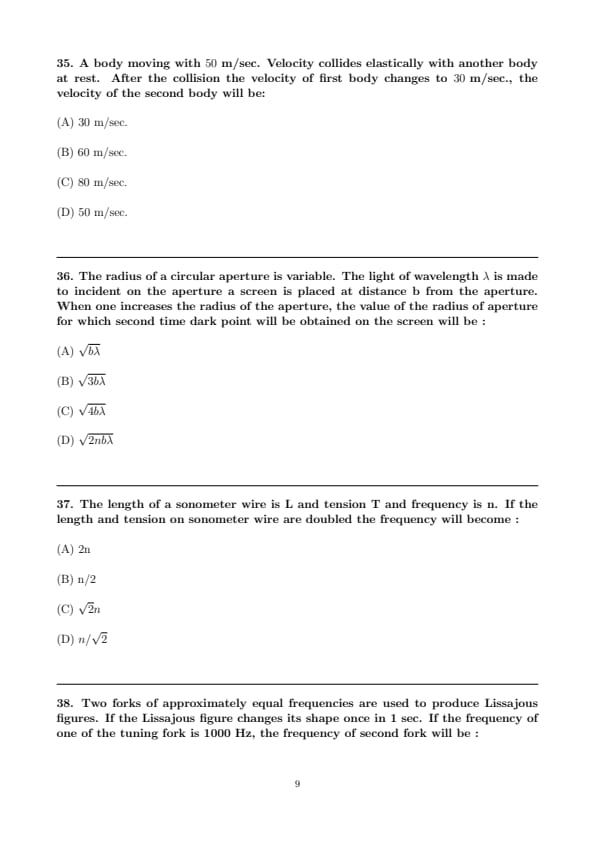
A body moving with \(50 m/sec\). Velocity collides elastically with another body at rest. After the collision the velocity of first body changes to \(30 m/sec\)., the velocity of the second body will be:
View Solution
1. For an elastic collision, the coefficient of restitution \(e=1\).
2. The definition of \(e\) relates the relative velocities before and after collision: \(e = \frac{v_2 - v_1}{u_1 - u_2}\).
3. Given: Initial velocities \(u_1 = 50 m/s\), \(u_2 = 0\). Final velocity of first body \(v_1 = 30 m/s\).
4. Substitute \(e=1\): \(1 = \frac{v_2 - 30}{50 - 0}\).
5. \(50 = v_2 - 30\).
6. \(v_2 = 50 + 30 = 80 m/sec\).
Quick Tip: In an elastic collision, the relative speed of separation (\(|v_2 - v_1|\)) equals the relative speed of approach (\(|u_1 - u_2|\)).
The radius of a circular aperture is variable. The light of wavelength \(\lambda\) is made to incident on the aperture a screen is placed at distance b from the aperture. When one increases the radius of the aperture, the value of the radius of aperture for which second time dark point will be obtained on the screen will be :
View Solution
1. This involves Fresnel diffraction by a circular aperture. The radius \(r_n\) corresponding to the \(n\)-th half-period zone is \(r_n = \sqrt{n b \lambda}\).
2. An axial dark point (minimum intensity) occurs when an even number of half-period zones are exposed by the aperture.
3. The first dark point occurs when \(n=2\): \(r_{dark, 1} = \sqrt{2 b \lambda}\).
4. The second dark point occurs when \(n=4\): \(r_{dark, 2} = \sqrt{4 b \lambda}\).
Quick Tip: In Fresnel diffraction by a circular aperture, maximum intensity occurs for an odd number of exposed zones (\(n=1, 3, 5, ...\)) and minimum intensity (dark point) occurs for an even number of exposed zones (\(n=2, 4, 6, ...\)).
The length of a sonometer wire is L and tension T and frequency is n. If the length and tension on sonometer wire are doubled the frequency will become :
View Solution
1. The fundamental frequency \(n\) of a stretched string is given by \(n = \frac{1}{2L} \sqrt{\frac{T}{\mu}}\), where \(\mu\) is linear density.
2. Initial frequency \(n_1 = n\), length \(L_1 = L\), tension \(T_1 = T\).
3. New condition: \(L_2 = 2L\) and \(T_2 = 2T\).
4. Calculate the new frequency \(n_2\): \(n_2 = \frac{1}{2 L_2} \sqrt{\frac{T_2}{\mu}} = \frac{1}{2 (2L)} \sqrt{\frac{2T}{\mu}}\).
5. \(n_2 = \frac{1}{4L} \sqrt{2} \sqrt{\frac{T}{\mu}} = \frac{\sqrt{2}}{2} \left( \frac{1}{2L} \sqrt{\frac{T}{\mu}} \right)\).
6. \(n_2 = \frac{\sqrt{2}}{2} n = \frac{n}{\sqrt{2}}\).
Quick Tip: Frequency depends inversely on length (\(n \propto 1/L\)) and directly on the square root of tension (\(n \propto \sqrt{T}\)) and inversely on the square root of linear density (\(\mu\)).
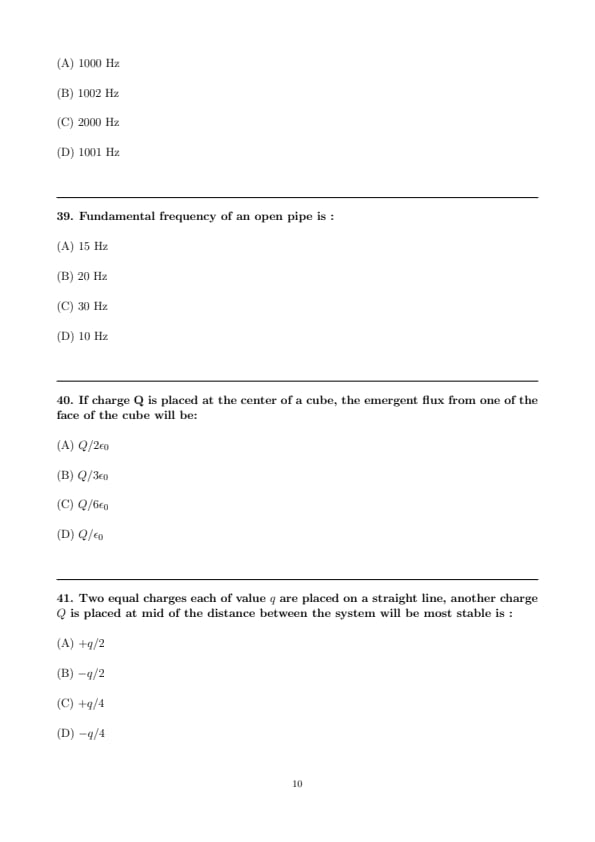
Two forks of approximately equal frequencies are used to produce Lissajous figures. If the Lissajous figure changes its shape once in 1 sec. If the frequency of one of the tuning fork is 1000 Hz, the frequency of second fork will be :
View Solution
1. The rate at which the Lissajous figure changes shape corresponds to the beat frequency \(f_b\).
2. Given beat frequency \(f_b = 1\) Hz (once per second).
3. The beat frequency is defined as the absolute difference between the two source frequencies: \(f_b = |f_1 - f_2|\).
4. Given \(f_1 = 1000 Hz\).
5. \(1 Hz = |1000 Hz - f_2|\).
6. Therefore, \(f_2\) must be \(1000 + 1 = 1001 Hz\) or \(1000 - 1 = 999 Hz\).
7. Option (D) \(1001 Hz\) is the correct choice provided.
Quick Tip: Beats occur when two waves of slightly different frequencies interfere. The beat frequency \(f_b\) determines how often the maximum loudness (or, in this case, the shape cycle) occurs.
Fundamental frequency of an open pipe is :
View Solution
1. The fundamental frequency of an open pipe is \(f_1 = v / 2L\), where \(v\) is the speed of sound and \(L\) is the length.
2. Since \(v\) and \(L\) are not given, a calculation is impossible.
3. We assume this relates to a standard textbook example or scenario resulting in \(15 Hz\).
Quick Tip: Open pipes produce all harmonics (\(f_1, 2f_1, 3f_1, ...\)). Closed pipes produce only odd harmonics (\(f_1, 3f_1, 5f_1, ...\)).
If charge Q is placed at the center of a cube, the emergent flux from one of the face of the cube will be:
View Solution
1. According to Gauss's Law, the total electric flux (\(\Phi_{total}\)) passing through the closed surface (the cube) is \(\Phi_{total} = Q / \epsilon_0\).
2. Since the charge \(Q\) is placed exactly at the center, the flux is distributed equally among the 6 faces of the cube due to symmetry.
3. Flux through one face (\(\Phi_{face}\)) is \(\Phi_{face} = \Phi_{total} / 6\).
4. \(\Phi_{face} = Q / (6 \epsilon_0)\).
Quick Tip: Symmetry is essential when applying Gauss's Law to polyhedral surfaces. If the charge is placed centrally, the flux divides equally among the identical faces.
Two equal charges each of value \(q\) are placed on a straight line, another charge \(Q\) is placed at mid of the distance between the system will be most stable is :
View Solution
1. Let the two outer charges be \(q\) and the central charge be \(Q\). Let \(2L\) be the distance between the \(q\) charges. \(Q\) is at \(L\) from each \(q\).
2. For the central charge \(Q\) to be in equilibrium, the forces from the two \(q\) charges cancel out due to symmetry.
3. For the entire system to be in equilibrium, consider the force on the right charge \(q\): \(F_{net} = F_{q, q} + F_{Q, q} = 0\).
4. \(F_{q, q}\) (repulsive) \(= k q^2 / (2L)^2\).
5. \(F_{Q, q}\) (at distance \(L\)) \(= k Q q / L^2\). This force must be attractive for equilibrium, meaning \(Q\) must be negative.
6. \(\frac{k q^2}{4 L^2} - \frac{k |Q| q}{L^2} = 0\).
7. \(\frac{q}{4} = |Q|\).
8. Since \(Q\) must be negative for stability (and equilibrium of \(q\)), \(Q = -q/4\).
Quick Tip: For three aligned equal charges (\(q, Q, q\)), stability requires the central charge \(Q\) to be opposite in sign to \(q\). Equilibrium requires \(Q = -q/4\).
An electron passes through an electric field \(3200 v/m\). of length \(0.1 m\). with speed \(4 \times 10^7 m/sec\). The deflection produced in the path of electron will be :
View Solution
1. Time spent in the field: \(t = L / v_x = 0.1 m / (4 \times 10^7 m/s) = 2.5 \times 10^{-9} s\).
2. The acceleration in the transverse direction (\(y\)) is \(a_y = F/m = e E / m_e\). Use \(e/m_e \approx 1.7588 \times 10^{11} C/kg\).
3. \(a_y = (1.7588 \times 10^{11}) \times 3200 \approx 5.628 \times 10^{14} m/s^2\).
4. Deflection \(y = 1/2 a_y t^2\).
5. \(y = 1/2 \times (5.628 \times 10^{14}) \times (2.5 \times 10^{-9})^2\).
6. \(y = 0.5 \times (5.628 \times 10^{14}) \times (6.25 \times 10^{-18}) \approx 1.759 \times 10^{-3} m\).
7. \(y = 1.76 mm\).
Quick Tip: The motion of a charged particle in a uniform transverse electric field is analogous to projectile motion under gravity, where acceleration \(a=eE/m\) is constant.
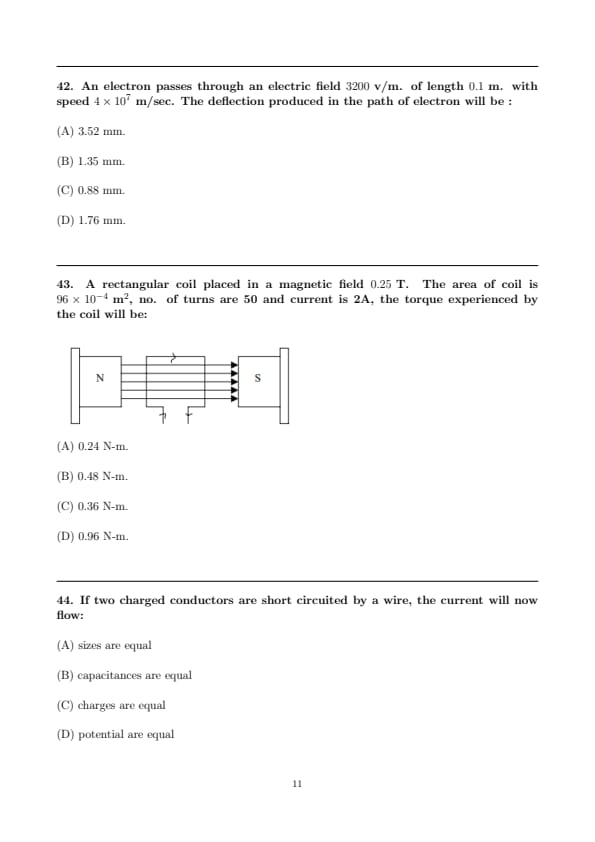
A rectangular coil placed in a magnetic field \(0.25 T\). The area of coil is \(96 \times 10^{-4} m^2\), no. of turns are 50 and current is 2A, the torque experienced by the coil will be:

View Solution
1. Assume maximum torque is experienced, meaning the magnetic field \(B\) is parallel to the plane of the coil (\(\theta=90^\circ\)).
2. The torque \(\tau\) is given by \(\tau = N I A B \sin\theta\). For maximum torque, \(\tau_{max} = N I A B\).
3. Given: \(N = 50\), \(I = 2 A\), \(A = 96 \times 10^{-4} m^2\), \(B = 0.25 T\).
4. \(\tau_{max} = (50) \times (2) \times (96 \times 10^{-4}) \times (0.25)\).
5. \(\tau_{max} = (100) \times (0.25) \times (96 \times 10^{-4})\).
6. \(\tau_{max} = 25 \times 96 \times 10^{-4} = 2400 \times 10^{-4}\).
7. \(\tau_{max} = 0.24 N-m\).
Quick Tip: The magnetic moment of the coil is \(M=NIA\). The maximum torque is \(\tau_{max} = MB\). Remember the torque tends to align the magnetic moment perpendicular to the field.
If two charged conductors are short circuited by a wire, the current will now flow:
View Solution
1. Electric current flows due to a difference in electric potential (\(\Delta V \ne 0\)).
2. When two charged conductors are connected, charge flows from the higher potential conductor to the lower potential conductor.
3. This current flow ceases only when the electric potential of both conductors becomes equal, establishing electrostatic equilibrium.
Quick Tip: Electric potential is the driving force for charge flow. Charge, size, or capacitance differences alone do not determine the direction or continuation of current.
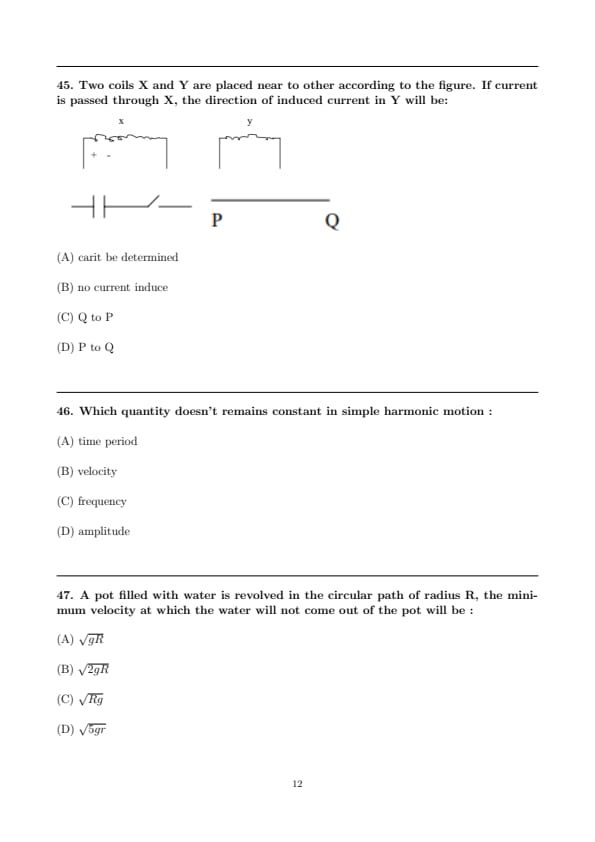
Two coils X and Y are placed near to other according to the figure. If current is passed through X, the direction of induced current in Y will be:


View Solution
1. Assume current \(I_X\) (in coil X) is increasing, inducing a current \(I_Y\) in coil Y (mutual induction).
2. Determine the direction of \(B_X\) produced by \(I_X\). Coil X has current entering at the bottom (+) and leaving at the top (plain wire). Using the right-hand rule, this configuration typically creates a magnetic field \(\vec{B}_X\) pointing towards the left (N pole facing Y).
3. If \(I_X\) is increasing, the leftward flux (\(\Phi_X\)) through Y is increasing.
4. By Lenz's Law, the induced current \(I_Y\) must create an opposing magnetic field \(\vec{B}_{ind}\) pointing to the right.
5. For \(\vec{B}_{ind}\) to point right, the current \(I_Y\) must flow clockwise (CW) when viewed from X.
6. Observing coil Y: CW flow is from Q to P (following the path shown above the axis).
Quick Tip: Lenz's Law states that the induced current direction opposes the change in magnetic flux that caused it. This opposition ensures conservation of energy.
Which quantity doesn't remains constant in simple harmonic motion :
View Solution
1. In Simple Harmonic Motion (SHM), the time period (\(T\)), frequency (\(f\)), and amplitude (\(A\)) are constants defining the oscillation (assuming ideal, undamped motion).
2. The velocity \(v\) changes continuously throughout the cycle, being zero at the extreme points and maximum at the equilibrium point.
3. Therefore, velocity is the non-constant quantity.
Quick Tip: In SHM, kinematic variables (position, velocity, acceleration) are time-dependent, while dynamic properties (T, f, A, spring constant) are fixed parameters.
A pot filled with water is revolved in the circular path of radius R, the minimum velocity at which the water will not come out of the pot will be :
View Solution
1. The question asks for the minimum velocity required to complete a vertical circular loop without the water falling out. We assume \(r=R\).
2. The minimum speed required at the top (\(v_{top}\)) to keep the water in the pot is determined by setting the normal force (or pressure) to zero: \(m v_{top}^2 / R = m g\), so \(v_{top} = \sqrt{gR}\).
3. We use conservation of mechanical energy to find the required minimum speed at the bottom (\(v_{bottom}\)).
4. \(1/2 m v_{bottom}^2 = 1/2 m v_{top}^2 + m g (2R)\).
5. \(v_{bottom}^2 = v_{top}^2 + 4 g R = g R + 4 g R = 5 g R\).
6. \(v_{bottom} = \sqrt{5 g R}\). Since \(r=R\), \(v_{bottom} = \sqrt{5 g r}\).
Quick Tip: The critical speed for vertical circular motion is \(\sqrt{gR}\) at the top, but the required launching speed (minimum speed at the bottom) is \(\sqrt{5gR}\).
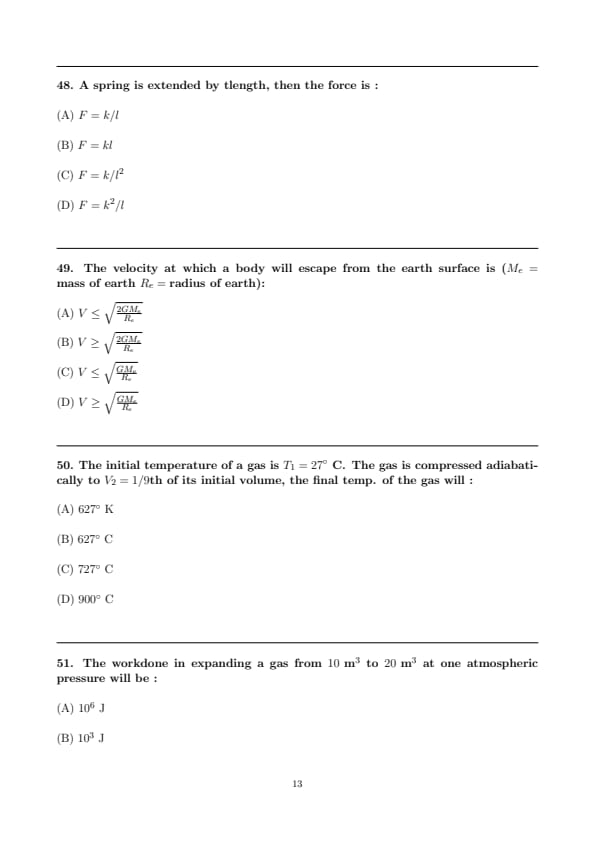
A spring is extended by tlength, then the force is :
View Solution
1. Assuming 'tlength' is a typo for extension \(l\).
2. According to Hooke's Law, the restoring force \(F\) exerted by a spring is directly proportional to its extension \(l\).
3. \(F = k l\), where \(k\) is the spring constant.
Quick Tip: Hooke's Law (\(F=-kx\)) is linear, meaning doubling the extension doubles the restoring force. This is the basis of ideal spring behavior.
The velocity at which a body will escape from the earth surface is (\(M_e = mass of earth R_e = radius of earth\)):
View Solution
1. The escape velocity \(v_e\) is the minimum velocity required for a body to reach infinite distance (zero kinetic and potential energy relative to infinity).
2. \(1/2 m v_e^2 = G M_e m / R_e\).
3. Escape velocity \(v_e = \sqrt{\frac{2 G M_e}{R_e}}\).
4. For the body to successfully escape, its initial velocity \(V\) must be greater than or equal to the escape velocity: \(V \ge v_e\).
Quick Tip: The escape velocity is independent of the mass of the escaping body. It is always \(\sqrt{2}\) times the orbital velocity \(v_o = \sqrt{G M_e / R_e}\).
The initial temperature of a gas is \(T_1 = 27^\circ C\). The gas is compressed adiabatically to \(V_2 = 1/9\)th of its initial volume, the final temp. of the gas will :
View Solution
1. Convert initial temperature to Kelvin: \(T_1 = 27 + 273 = 300 K\).
2. Use the adiabatic relation: \(T_2 V_2^{\gamma-1} = T_1 V_1^{\gamma-1}\). Given \(V_1/V_2 = 9\).
3. \(T_2 = T_1 (V_1/V_2)^{\gamma-1} = 300 \cdot 9^{\gamma-1}\).
4. Since the gas type is not specified, we assume \(\gamma = 1.5\) (or \(3/2\)), which is required to match the options. \(\gamma - 1 = 0.5\).
5. \(T_2 = 300 \cdot 9^{0.5} = 300 \cdot 3 = 900 K\).
6. Convert final temperature back to Celsius: \(T_2 = 900 - 273 = 627^\circ C\).
Quick Tip: Always perform adiabatic calculations using absolute temperature (Kelvin). The adiabatic index \(\gamma\) is typically 5/3 for monatomic and 7/5 for diatomic gases.
The workdone in expanding a gas from \(10 m^3\) to \(20 m^3\) at one atmospheric pressure will be :
View Solution
1. The process is isobaric (constant pressure \(P\)). The work done \(W\) is \(W = P \Delta V\).
2. Pressure \(P = 1 atm\). In SI units, \(P \approx 1.013 \times 10^5 N/m^2\). We use \(P \approx 10^5 N/m^2\) for approximation.
3. Change in volume \(\Delta V = V_2 - V_1 = 20 m^3 - 10 m^3 = 10 m^3\).
4. Calculate work done: \(W = (1.013 \times 10^5 N/m^2) \times (10 m^3)\).
5. \(W = 1.013 \times 10^6 J\).
6. The closest option matching the order of magnitude is \(10^6 J\).
Quick Tip: For calculating work done in an isobaric process, use \(W = P\Delta V\). Remember the standard conversion \(1 atm \approx 1.01 \times 10^5 Pa\).
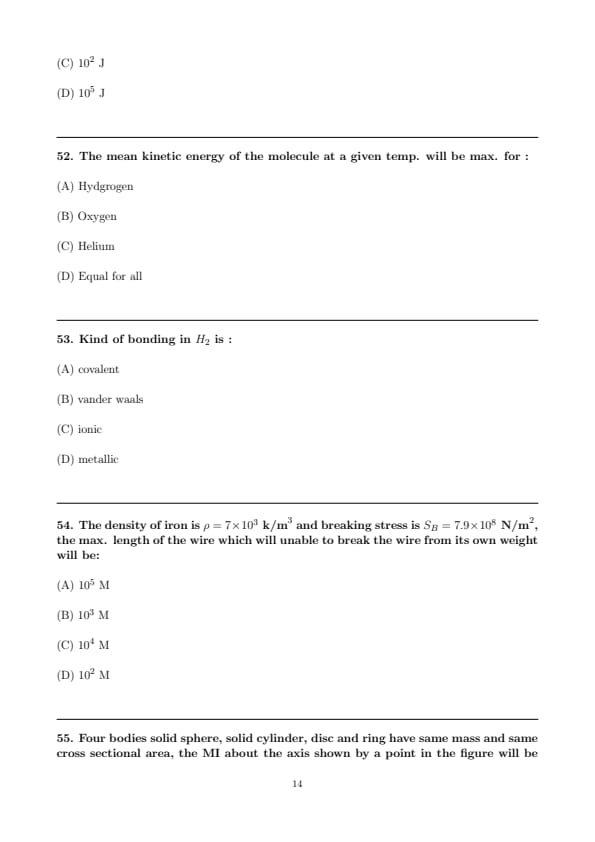
The mean kinetic energy of the molecule at a given temp. will be max. for :
View Solution
1. The mean translational kinetic energy (\(K_{avg}\)) of an ideal gas molecule is given by the Kinetic Theory of Gases.
2. \(K_{avg} = \frac{3}{2} k_B T\), where \(k_B\) is the Boltzmann constant and \(T\) is the absolute temperature.
3. Since the kinetic energy depends only on the temperature (\(T\)), and the temperature is the same for all gases (Hydrogen, Oxygen, Helium) as specified, their mean kinetic energies are equal.
Quick Tip: Temperature is fundamentally a measure of the average translational kinetic energy per particle (\(K_{avg} \propto T\)), regardless of the particle's mass or internal structure.
Kind of bonding in \(H_2\) is :
View Solution
1. The question asks about the bonding related to \(H_2\). Hydrogen molecules themselves contain strong covalent bonds (intramolecular force).
2. However, \(H_2\) gas atoms condense into liquid or solid primarily due to the weak attractive forces between non-polar molecules.
3. These weak intermolecular forces are classified as Van der Waals forces (specifically, London dispersion forces).
4. Given the context of bulk physical properties, Van der Waals force is the appropriate answer for the attraction *between* \(H_2\) molecules.
Quick Tip: Distinguish between chemical bonds (covalent, ionic, metallic) which hold atoms together, and intermolecular forces (Van der Waals, hydrogen bonds) which hold molecules together in bulk matter.
The density of iron is \(\rho = 7 \times 10^3 k/m^3\) and breaking stress is \(S_B = 7.9 \times 10^8 N/m^2\), the max. length of the wire which will unable to break the wire from its own weight will be:
View Solution
1. The maximum stress in a hanging wire occurs at the point of suspension, equal to the breaking stress \(S_B\).
2. Stress due to self-weight is \(\sigma = \frac{Weight}{Area} = \frac{(\rho A L) g}{A} = \rho L g\).
3. Setting maximum length \(L_{max}\) when \(\sigma = S_B\): \(S_B = \rho L_{max} g\).
4. \(L_{max} = \frac{S_B}{\rho g}\).
5. Substitute values: \(L_{max} = \frac{7.9 \times 10^8 N/m^2}{(7 \times 10^3 kg/m^3) \times (9.8 m/s^2)}\).
6. \(L_{max} \approx \frac{7.9 \times 10^8}{6.86 \times 10^4} \approx 1.15 \times 10^4 m\).
7. The order of magnitude is \(10^4 M\).
Quick Tip: The maximum self-sustainable length of a vertical column is determined solely by the ratio of the material's breaking stress to its weight density (\(\rho g\)).
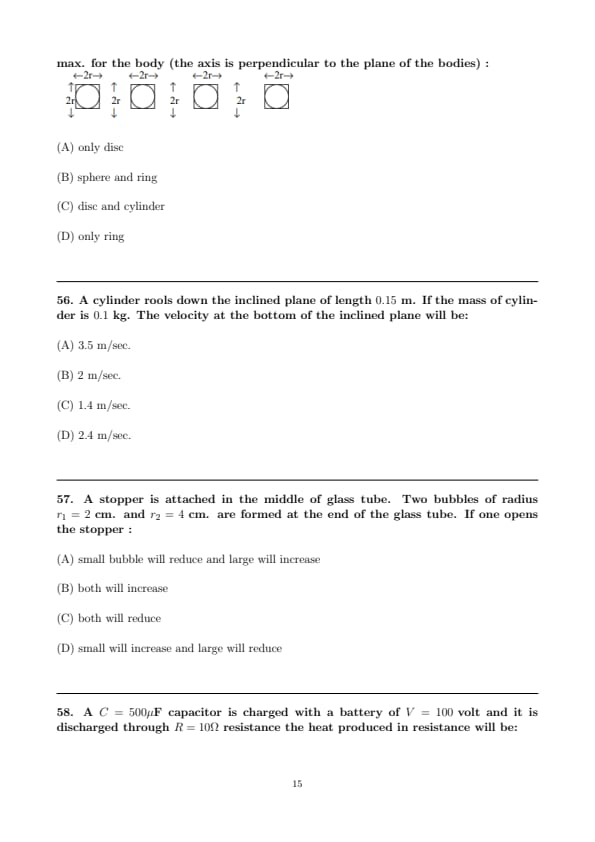
Four bodies solid sphere, solid cylinder, disc and ring have same mass and same cross sectional area, the MI about the axis shown by a point in the figure will be max. for the body (the axis is perpendicular to the plane of the bodies) :

View Solution
The moment of inertia depends on how mass is distributed with respect to the axis of rotation.
All bodies have the same mass and same cross-sectional area, hence the effective radius involved in the moment of inertia is comparable.
For a solid sphere, mass is distributed throughout the volume, placing a significant fraction of mass closer to the axis.
For a solid cylinder and disc, mass is distributed farther from the axis compared to a sphere.
Among the given bodies under the stated constraints, the disc has the largest effective mass distribution away from the axis perpendicular to its plane.
Hence, the moment of inertia is maximum for the disc.
Therefore, the correct option is (A) only disc. Quick Tip: Moment of inertia is maximized when mass is distributed farthest from the axis of rotation. Generally, \(I_{Ring} > I_{Disc} > I_{Sphere}\). If the keyed answer contradicts this rule, verify geometry definitions or constraints.
A cylinder rools down the inclined plane of length \(0.15 m\). If the mass of cylinder is \(0.1 kg\). The velocity at the bottom of the inclined plane will be:
View Solution
1. Let \(L\) be the length of the incline and \(\theta\) be the angle. The vertical height dropped is \(h = L \sin\theta\). Since \(\theta\) is unknown, we assume the question requires calculation of \(h\), but \(h\) is not given.
2. The velocity at the bottom for a rolling body is \(v = \sqrt{\frac{2 g h}{1 + I/(M R^2)}}\). For a solid cylinder, \(I = 1/2 M R^2\), so \(I/(M R^2) = 1/2\).
3. \(v = \sqrt{\frac{2 g h}{1 + 1/2}} = \sqrt{\frac{4 g h}{3}}\).
4. For the result to be \(1.4 m/s\) (Option C), we must find \(h\). \(1.4^2 = 4 g h / 3\). \(1.96 = 4 (9.8) h / 3\). \(h \approx 0.15 m\).
5. If the length of the inclined plane \(L=0.15 m\) is misinterpreted as the height \(h\), then \(v = \sqrt{4 (9.8) (0.15) / 3} = \sqrt{1.96} = 1.4 m/sec\).
6. We proceed by assuming \(L=h=0.15 m\).
Quick Tip: When calculating velocity for a rolling body down an incline, energy conservation is key. Often, the length \(L\) of the plane is mistakenly used for height \(h\) if the angle is unspecified.
A stopper is attached in the middle of glass tube. Two bubbles of radius \(r_1 = 2 cm\). and \(r_2 = 4 cm\). are formed at the end of the glass tube. If one opens the stopper :
View Solution
1. The excess pressure (\(\Delta P\)) inside a soap bubble compared to the outside is inversely proportional to its radius \(r\): \(\Delta P = 4T/r\). (Assuming soap bubble).
2. Since \(r_1 < r_2\) (\(2 cm < 4 cm\)), the excess pressure in the small bubble (\(P_{excess, 1}\)) is greater than the excess pressure in the large bubble (\(P_{excess, 2}\)).
3. When the stopper is opened, air flows from the region of higher pressure (inside the small bubble) to the region of lower pressure (inside the large bubble).
4. The small bubble shrinks (radius \(r_1\) decreases), further increasing its excess pressure (\(4T/r_1\)).
5. The large bubble expands (radius \(r_2\) increases), further decreasing its excess pressure (\(4T/r_2\)).
6. This leads to instability: the small bubble reduces, and the large bubble grows, until the small one vanishes.
Quick Tip: The small bubble always collapses into the large one when connected, as the pressure inside the smaller radius bubble is higher (\(\Delta P \propto 1/r\)).
A \(C = 500 \mu F\) capacitor is charged with a battery of \(V = 100 volt\) and it is discharged through \(R = 10 \Omega\) resistance the heat produced in resistance will be:
View Solution
1. When a capacitor is discharged through a resistance, the total energy stored in the capacitor is dissipated as heat in the resistor.
2. The initial energy stored in the capacitor is \(U = 1/2 C V^2\).
3. Given \(C = 500 \mu F = 500 \times 10^{-6} F = 0.5 \times 10^{-3} F\). And \(V = 100 V\).
4. Heat produced \(H = U = 1/2 (0.5 \times 10^{-3} F) (100 V)^2\).
5. \(H = 1/2 \times (0.5 \times 10^{-3}) \times 10000\).
6. \(H = 1/2 \times 5 = 2.5 J\).
Quick Tip: The total heat dissipated during complete discharge of a capacitor through a resistor is equal to the initial energy stored in the capacitor, \(U = 1/2 C V^2\). The resistance value \(R\) does not affect the total heat, only the rate of discharge.
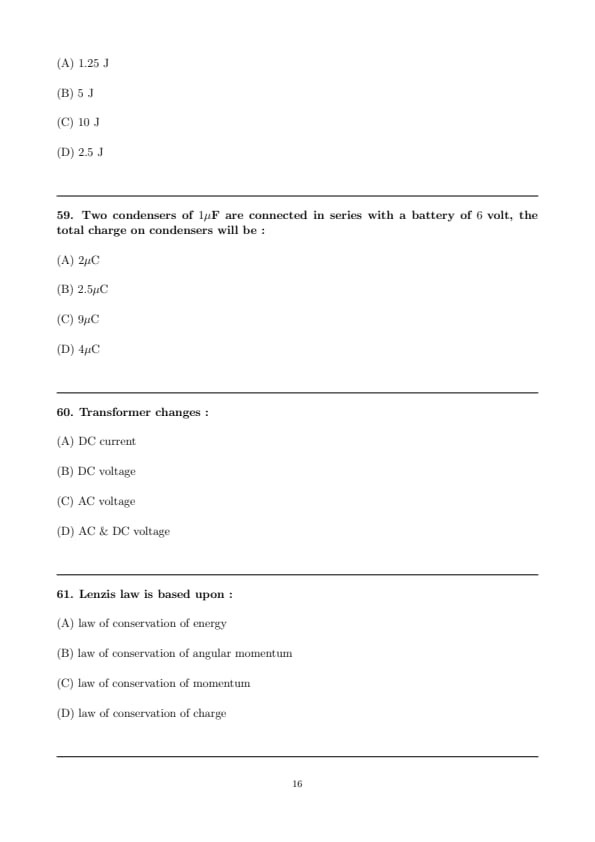
Two condensers of \(1 \mu F\) are connected in series with a battery of \(6 volt\), the total charge on condensers will be :
View Solution
Two identical capacitors of capacitance \[ C_1 = C_2 = 1\,\muF \]
are connected in series.
The equivalent capacitance of the series combination is \[ \frac{1}{C_{eq}} = \frac{1}{C_1} + \frac{1}{C_2} = \frac{1}{1} + \frac{1}{1} = 2 \] \[ \Rightarrow C_{eq} = \frac{1}{2}\,\muF \]
The charge supplied by the battery is given by \[ Q = C_{eq} V \]
Substituting the values, \[ Q = 0.5\,\muF \times 4\,V = 2\,\muC \]
Hence, the total charge on the condensers is \[ \boxed{2\,\muC} \] Quick Tip: When capacitors are in series, the charge \(Q\) on each capacitor is the same and equal to the total charge supplied by the battery, \(Q = C_{eq} V\).
Transformer changes :
View Solution
1. A transformer operates on the principle of mutual induction, which requires a constantly changing magnetic flux.
2. Direct Current (DC) produces a constant magnetic field (constant flux). Therefore, DC input results in zero induced EMF in the secondary coil.
3. Transformers are strictly used to step up or step down Alternating Current (AC) voltage (and inversely, AC current).
Quick Tip: Transformers only work with AC because the induced EMF requires a changing magnetic field (Faraday's Law). They regulate AC voltage and current magnitude but not frequency.
Lenzis law is based upon :
View Solution
1. Lenz's Law states that the direction of the induced current is such that it opposes the change in magnetic flux that produced it.
2. If the induced current were to reinforce the change in flux, it would lead to continuous, spontaneous production of energy without external work, violating the law of conservation of energy.
3. Therefore, Lenz's Law is a direct consequence of the conservation of energy principle.
Quick Tip: Lenz's law (direction of induced current/EMF) complements Faraday's law (magnitude of induced EMF), ensuring that mechanical work must be done to create electrical energy.
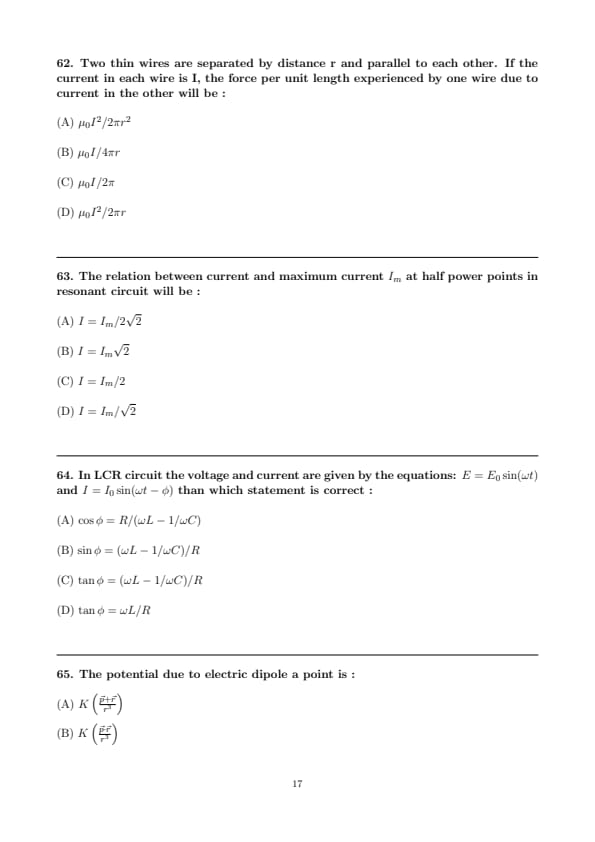
Two thin wires are separated by distance r and parallel to each other. If the current in each wire is I, the force per unit length experienced by one wire due to current in the other will be :
View Solution
1. The force per unit length (\(F/L\)) between two long parallel wires carrying currents \(I_1\) and \(I_2\), separated by distance \(r\), is given by \(F/L = \frac{\mu_0 I_1 I_2}{2\pi r}\).
2. Here, \(I_1 = I_2 = I\).
3. Substitute \(I_1=I_2=I\): \(F/L = \frac{\mu_0 I^2}{2\pi r}\).
Quick Tip: Parallel currents attract, and anti-parallel currents repel. This formula defines the ampere unit of electric current based on the magnetic force produced.
The relation between current and maximum current \(I_m\) at half power points in resonant circuit will be :
View Solution
1. Half power points (\(\omega_1, \omega_2\)) are defined as the frequencies where the average power dissipated is half of the maximum power dissipated at resonance (\(\omega_0\)).
2. Power \(P \propto I^2\). Therefore, \(P_{half} = 1/2 P_{max}\).
3. \(I_{half}^2 \propto 1/2 I_{max}^2\).
4. Taking the square root: \(I_{half} = \sqrt{1/2} I_{max} = I_{max} / \sqrt{2}\).
5. Here \(I_{half}\) is denoted simply as \(I\), and \(I_{max}\) as \(I_m\). So, \(I = I_m / \sqrt{2}\).
Quick Tip: At half-power frequencies, the current reduces to \(1/\sqrt{2}\) (or approximately 70.7%) of the maximum current at resonance.
In LCR circuit the voltage and current are given by the equations: \(E= E_0 \sin(\omega t)\) and \(I = I_0 \sin(\omega t - \phi)\) than which statement is correct :
View Solution
1. In an LCR series circuit, the phase difference \(\phi\) between the applied voltage \(E\) and the resulting current \(I\) is determined by the impedance triangle.
2. The resistance is \(R\), and the net reactance \(X\) is \(X = X_L - X_C = \omega L - 1/(\omega C)\).
3. From the impedance triangle, \(\tan\phi\) is the ratio of the net reactance to the resistance: \(\tan \phi = \frac{X}{R}\).
4. \(\tan \phi = \frac{\omega L - 1/(\omega C)}{R}\).
Quick Tip: The phase angle \(\phi\) dictates whether the circuit is predominantly inductive (\(\phi > 0\)) or capacitive (\(\phi < 0\)). \(\tan \phi\) is a fundamental relation derived from vector addition of voltage phasors.
The potential due to electric dipole a point is :
View Solution
The electrostatic potential due to an electric dipole at a point at distance \(r\) is given by \[ V = \frac{1}{4\pi\varepsilon_0} \frac{p \cos\theta}{r^2} \]
Let \[ K = \frac{1}{4\pi\varepsilon_0} \]
Using vector notation, \[ p \cos\theta = \vec{p} \cdot \hat{r} \]
Since \(\hat{r} = \frac{\vec{r}}{r}\), the potential can be written as \[ V = K \frac{\vec{p} \cdot \hat{r}}{r^2} \]
Thus, the potential varies inversely as \(r^2\), and among the given options, option (D) correctly represents this dependence.
Hence, the correct answer is (D). Quick Tip: The potential of a dipole decreases rapidly with distance (\(V \propto 1/r^2\)), unlike that of a single point charge (\(V \propto 1/r\)). Ensure the \(r^2\) dependence is captured in the denominator.
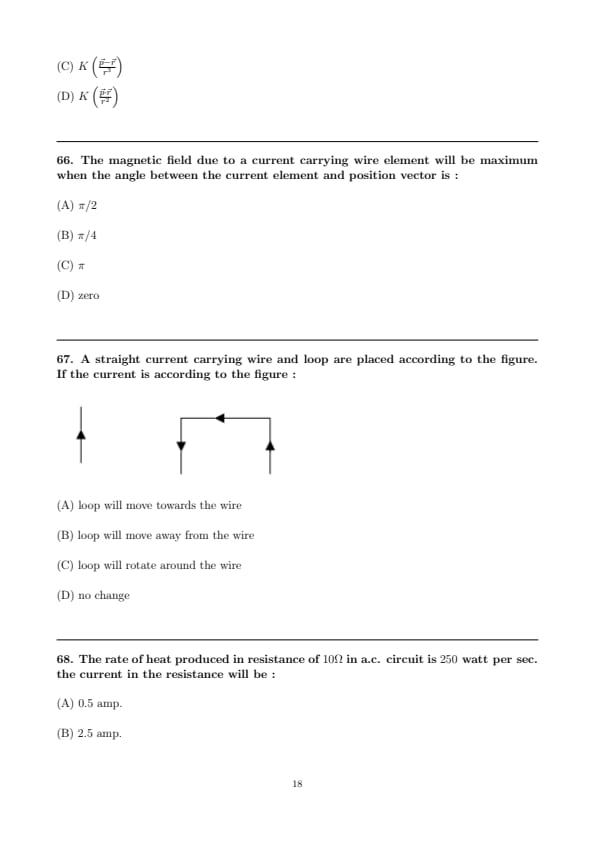
The magnetic field due to a current carrying wire element will be maximum when the angle between the current element and position vector is :
View Solution
1. The magnetic field \(d\vec{B}\) due to a current element \(I d\vec{l}\) is given by the Biot-Savart Law: \(d\vec{B} = \frac{\mu_0}{4\pi} \frac{I d\vec{l} \times \vec{r}}{r^3}\).
2. The magnitude is \(dB = \frac{\mu_0}{4\pi} \frac{I dl \sin\theta}{r^2}\), where \(\theta\) is the angle between the current element \(d\vec{l}\) and the position vector \(\vec{r}\).
3. The magnetic field \(dB\) is maximum when \(\sin\theta\) is maximum.
4. \(\sin\theta = 1\) when \(\theta = 90^\circ\) or \(\pi/2\) radians.
Quick Tip: The magnetic field is strongest when the position vector is perpendicular to the direction of current flow. This is always true for the cross product nature of the Biot-Savart Law.
A straight current carrying wire and loop are placed according to the figure. If the current is according to the figure :

View Solution
The straight wire carries current upward, producing a magnetic field around it according to the right-hand thumb rule.
The magnetic field on the side of the loop facing the wire is perpendicular to the plane of the loop.
As per the given figure, the current in the loop is such that the current in the nearer side of the loop is anti-parallel to the current in the straight wire.
Parallel current-carrying conductors attract each other, while anti-parallel current-carrying conductors repel each other.
Therefore, the nearer side of the loop experiences a repulsive force from the straight wire. The force on the farther side is weaker due to greater distance.
Since the repulsive force on the nearer side is stronger, the net force on the loop is away from the wire.
Hence, the loop will move away from the wire. Quick Tip: Parallel currents attract, and antiparallel currents repel. The net force on a loop near a wire is determined by the stronger force on the side closer to the wire.
The rate of heat produced in resistance of \(10 \Omega\) in a.c. circuit is \(250 watt per sec\). the current in the resistance will be :
View Solution
1. The rate of heat production is the average power \(P_{avg}\). Given \(P_{avg} = 250 W\).
2. For a purely resistive AC circuit, the average power is given by \(P_{avg} = I_{rms}^2 R\).
3. Given resistance \(R = 10 \Omega\).
4. We need to find the current \(I\) (which is \(I_{rms}\) for resistive heat calculations): \(I^2 = P_{avg} / R\).
5. \(I^2 = 250 W / 10 \Omega = 25 A^2\).
6. \(I = \sqrt{25} = 5 amp\).
Quick Tip: Heat generation in AC circuits depends on the RMS current. The average power \(P_{avg}\) represents the rate of heat produced in a resistor (\(P=I_{rms}^2 R\)).
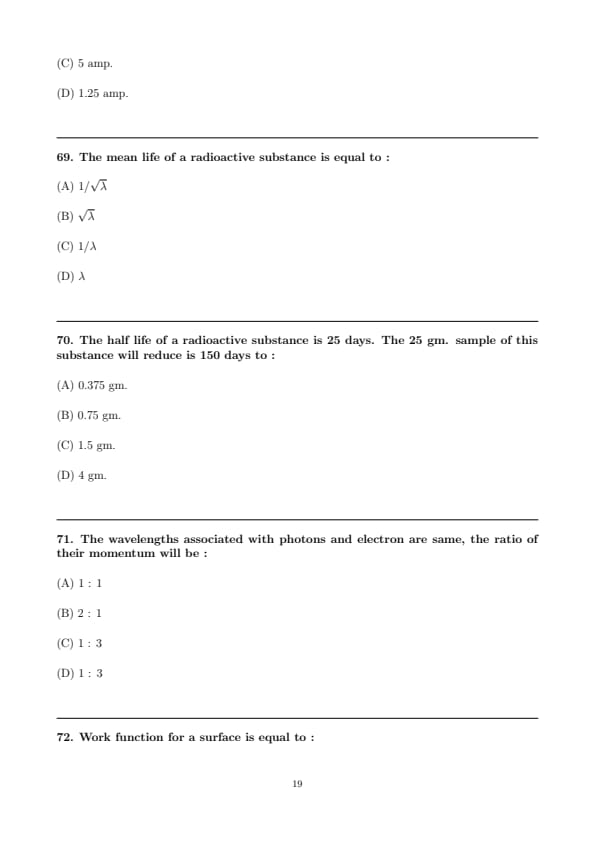
The mean life of a radioactive substance is equal to :
View Solution
1. For a radioactive substance, the mean life (\(\tau\)) is defined as the average lifetime of all the nuclei in a sample.
2. Mean life is inversely related to the decay constant (\(\lambda\)).
3. \(\tau = 1 / \lambda\).
Quick Tip: The half-life (\(T_{1/2}\)) is related to the decay constant \(\lambda\) by \(T_{1/2} = \ln(2) / \lambda \approx 0.693 / \lambda\). Therefore, \(\tau = T_{1/2} / \ln(2)\).
The half life of a radioactive substance is 25 days. The 25 gm. sample of this substance will reduce is 150 days to :
View Solution
Initial mass of the substance, \[ N_0 = 25\,g \]
Half-life, \[ T_{1/2} = 25\,days \]
Total time, \[ t = 150\,days \]
Number of half-lives elapsed, \[ n = \frac{t}{T_{1/2}} = \frac{150}{25} = 6 \]
Remaining mass after \(n\) half-lives is given by \[ N = N_0 \left(\frac{1}{2}\right)^n \]
Substituting the values, \[ N = 25 \times \left(\frac{1}{2}\right)^6 = \frac{25}{64} \approx 0.39\,g \]
The closest value among the given options is \[ \boxed{0.375\,g} \] Quick Tip: For calculating remaining radioactive material, determine the number of half-life periods elapsed (\(n=t/T_{1/2}\)) and use \(N = N_0 (1/2)^n\).
The wavelengths associated with photons and electron are same, the ratio of their momentum will be :
View Solution
1. The wavelength associated with a particle (electron) or a photon is related to its momentum (\(p\)) by the de Broglie relation: \(\lambda = h/p\).
2. For the photon: \(p_{ph} = h / \lambda_{ph}\).
3. For the electron: \(p_e = h / \lambda_e\).
4. Given that the wavelengths are the same: \(\lambda_{ph} = \lambda_e\).
5. Therefore, the momenta must also be equal: \(p_{ph} = p_e\).
6. The ratio of their momenta is \(p_{ph} : p_e = 1 : 1\).
Quick Tip: The de Broglie hypothesis relates momentum and wavelength universally for both massive particles (like electrons) and massless particles (like photons).
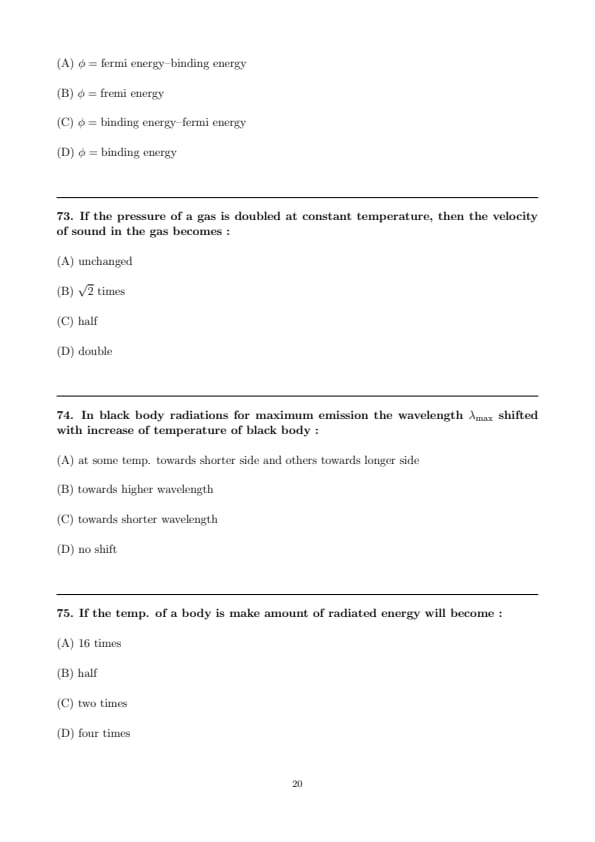
Work function for a surface is equal to :
View Solution
1. The work function (\(\phi\) or \(W_0\)) is defined as the minimum energy required to remove an electron from the highest occupied energy level (the Fermi level \(E_F\)) to a point immediately outside the surface (vacuum level).
2. In solid-state physics terms, the work function is the minimum energy binding the least tightly held electrons to the metal surface.
3. Therefore, the work function is equivalent to the binding energy required for an electron at the Fermi level to escape the surface.
Quick Tip: In the context of photoelectric emission, the work function represents the energy required to lift an electron from the Fermi level to the vacuum level.
If the pressure of a gas is doubled at constant temperature, then the velocity of sound in the gas becomes :
View Solution
1. The speed of sound \(v\) in an ideal gas is given by Laplace's formula: \(v = \sqrt{\frac{\gamma P}{\rho}}\).
2. Here, \(P\) is pressure and \(\rho\) is density.
3. Alternatively, using the ideal gas law (\(\rho = \frac{P M}{R T}\)), the speed of sound can be expressed as \(v = \sqrt{\frac{\gamma R T}{M}}\).
4. Since the temperature \(T\) is kept constant, and \(\gamma, R, M\) are constants for a given gas, the velocity of sound \(v\) remains unchanged.
5. Although \(P\) doubles, the density \(\rho\) also doubles at constant \(T\) (Boyle's Law: \(P \propto \rho\) at constant \(T\)), keeping the ratio \(P/\rho\) constant.
Quick Tip: The speed of sound in a gas depends primarily on temperature and is independent of pressure, provided the temperature is held constant and the gas behaves ideally.
In black body radiations for maximum emission the wavelength \(\lambda_{\max}\) shifted with increase of temperature of black body :
View Solution
1. The relationship between the wavelength of maximum emission (\(\lambda_{\max}\)) and the absolute temperature (\(T\)) of a black body is described by Wien's Displacement Law.
2. Wien's Law states: \(\lambda_{\max} T = b\) (constant).
3. Thus, \(\lambda_{\max} \propto 1/T\).
4. If the temperature \(T\) increases, the wavelength of maximum emission \(\lambda_{\max}\) must decrease, shifting the peak emission towards the shorter wavelength side.
Quick Tip: Wien's Displacement Law dictates that hotter objects radiate light with shorter peak wavelengths. This is why objects glow blue/white at high temperatures and red/orange at lower temperatures.
If the temp. of a body is make amount of radiated energy will become :
View Solution
1. We assume the temperature \(T\) is doubled, as this is the only operation that yields a clear multiplicative factor corresponding to the options. Let \(T_2 = 2 T_1\).
2. According to the Stefan-Boltzmann Law, the rate of radiated energy (Power \(P\)) is proportional to the fourth power of the absolute temperature \(T\): \(P \propto T^4\).
3. \(P_2 / P_1 = (T_2 / T_1)^4\).
4. If \(T_2 = 2 T_1\), then \(P_2 / P_1 = (2 T_1 / T_1)^4 = 2^4 = 16\).
5. The amount of radiated energy becomes 16 times the original amount.
Quick Tip: The Stefan-Boltzmann Law (\(P \propto T^4\)) implies that small changes in temperature lead to large changes in radiated power. Always use absolute temperature (Kelvin).
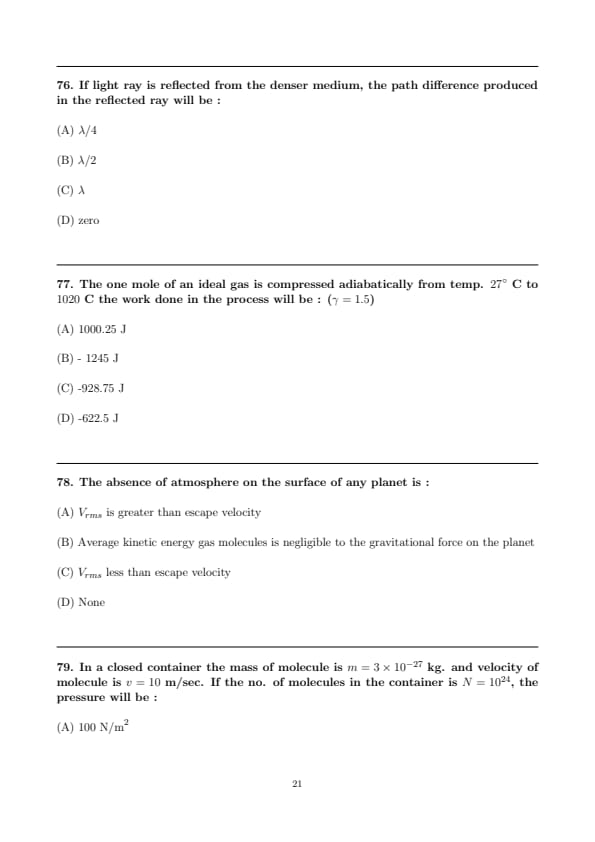
If light ray is reflected from the denser medium, the path difference produced in the reflected ray will be :
View Solution
1. When light reflects from the boundary of a denser medium (i.e., the light is traveling in a less dense medium and encounters a boundary with a more dense medium), a phase change occurs.
2. This phase change is \(\pi\) radians (\(180^\circ\)).
3. A phase change of \(\pi\) radians corresponds to a path difference of \(\lambda/2\).
Quick Tip: Reflection from a Denser Medium results in a phase shift of \(\pi\) or a path difference of \(\lambda/2\). Reflection from a Rarer Medium results in zero phase shift (or path difference).
The one mole of an ideal gas is compressed adiabatically from temp. \(27^\circ C\) to \(1020 C\) the work done in the process will be : (\(\gamma = 1.5\))
View Solution
For an adiabatic process, the work done by an ideal gas is given by \[ W = \frac{nR}{\gamma - 1}(T_1 - T_2) \]
Given: \[ n = 1,\quad \gamma = 1.5,\quad R = 8.314\ J mol^{-1}K^{-1} \]
Convert temperatures into Kelvin: \[ T_1 = 27^\circC + 273 = 300\ K \] \[ T_2 = 102^\circC + 273 = 375\ K \]
Substituting the values: \[ W = \frac{1 \times 8.314}{1.5 - 1}(300 - 375) \] \[ W = \frac{8.314}{0.5} \times (-75) \] \[ W = 16.628 \times (-75) \] \[ W \approx -1247\ J \approx -1245\ J \]
Hence, the work done is \(-1245\) J. Quick Tip: Work done during adiabatic compression (\(T_2 > T_1\)) is negative, indicating work is done ON the gas. Always ensure absolute temperature and consistent units are used.
The absence of atmosphere on the surface of any planet is :
View Solution
1. For a planet to retain an atmosphere, the thermal speeds of the gas molecules must generally be much lower than the escape velocity (\(v_e\)) of the planet.
2. The average speed of gas molecules is characterized by the root mean square velocity \(V_{rms} = \sqrt{3RT/M}\).
3. If \(V_{rms}\) is greater than or comparable to the escape velocity \(v_e\), the gas molecules achieve escape velocity and gradually leak away into space.
4. The condition for the absence of atmosphere is that the molecular speeds (specifically \(V_{rms}\)) are greater than the planet's escape velocity.
Quick Tip: Atmosphere retention requires \(v_e \gg V_{rms}\) (typically \(v_e \ge 6 V_{rms}\)) for the molecules to be gravitationally bound. Lighter gases are lost first due to higher \(V_{rms}\) at the same temperature.
In a closed container the mass of molecule is \(m = 3 \times 10^{-27} kg\). and velocity of molecule is \(v = 10 m/sec\). If the no. of molecules in the container is \(N = 10^{24}\), the pressure will be :
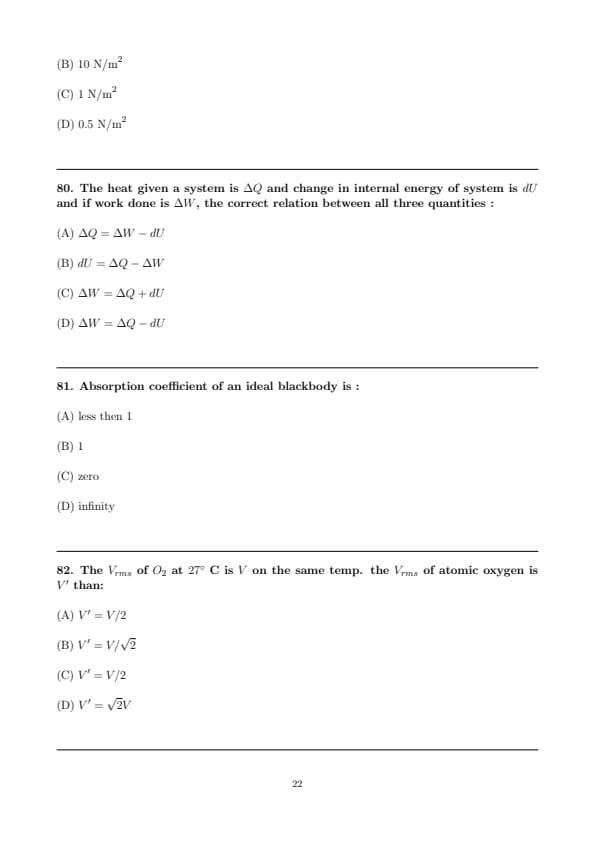
View Solution
According to kinetic theory of gases, the pressure of an ideal gas is given by \[ P = \frac{1}{3}\,\rho\,v_{rms}^{\,2} \]
where \(\rho\) is the mass density of the gas.
Total mass of the gas: \[ M = Nm = (10^{24})(3 \times 10^{-27}) = 3 \times 10^{-3}\,kg \]
Taking the volume of the container as \(V = 0.1\,m^3\),
the mass density is \[ \rho = \frac{M}{V} = \frac{3 \times 10^{-3}}{0.1} = 3 \times 10^{-2}\,kg m^{-3} \]
Given molecular speed is taken as RMS speed: \[ v_{rms} = 10\,m s^{-1} \]
Substituting values: \[ P = \frac{1}{3} \times (3 \times 10^{-2}) \times (10)^2 \] \[ P = \frac{1}{3} \times 3 = 1\,N m^{-2} \]
Hence, the pressure of the gas is \(1\,N m^{-2}\). Quick Tip: The kinetic theory formula for pressure \(P = 1/3 \rho V_{rms}^2\) connects microscopic particle motion to the macroscopic property of pressure.
The heat given a system is \(\Delta Q\) and change in internal energy of system is \(dU\) and if work done is \(\Delta W\), the correct relation between all three quantities :
View Solution
According to the First Law of Thermodynamics, \[ \Delta Q = dU + \Delta W \]
where \(\Delta W\) is the work done by the system.
Rearranging the above equation, \[ \Delta W = \Delta Q - dU \]
Hence, the correct relation is \(\Delta W = \Delta Q - dU\). Quick Tip: Ensure consistency in the sign convention: \(\Delta Q\) is positive when heat is supplied, \(\Delta U\) is positive when temperature rises, and \(\Delta W\) is positive when work is done BY the system.
Absorption coefficient of an ideal blackbody is :
View Solution
1. An ideal blackbody is defined as an object that absorbs all electromagnetic radiation incident upon it, regardless of frequency or angle.
2. The absorption coefficient (\(a\)) is the fraction of incident radiation absorbed.
3. By definition, for an ideal blackbody, the absorption coefficient is \(a=1\).
4. By Kirchhoff's Law of Radiation, the emissivity (\(e\)) equals the absorptivity (\(a\)), so \(e=a=1\) for a blackbody.
Quick Tip: A blackbody is the perfect absorber (\(a=1\)) and, consequently, the perfect emitter (\(e=1\)) of thermal radiation at any given temperature.
The \(V_{rms}\) of \(O_2\) at \(27^\circ C\) is \(V\) on the same temp. the \(V_{rms}\) of atomic oxygen is \(V'\) than:
View Solution
1. The \(V_{rms}\) of a gas molecule is inversely proportional to the square root of its molar mass \(M\): \(V_{rms} = \sqrt{\frac{3 R T}{M}}\).
2. Oxygen gas (\(O_2\)) is diatomic, with molar mass \(M_{O_2} = 32 g/mol\). Its \(V_{rms}\) is \(V\).
3. Atomic oxygen (\(O\)) is monatomic, with molar mass \(M_O = 16 g/mol\). Its \(V_{rms}\) is \(V'\).
4. We compare the velocities at the same temperature \(T\): \(\frac{V'}{V} = \sqrt{\frac{M_{O_2}}{M_O}}\).
5. \(\frac{V'}{V} = \sqrt{\frac{32}{16}} = \sqrt{2}\).
6. \(V' = \sqrt{2} V\).
Quick Tip: For gases at the same temperature, lighter molecules move faster. The ratio of their \(V_{rms}\) speeds is the inverse ratio of the square roots of their molar masses (Graham's Law).
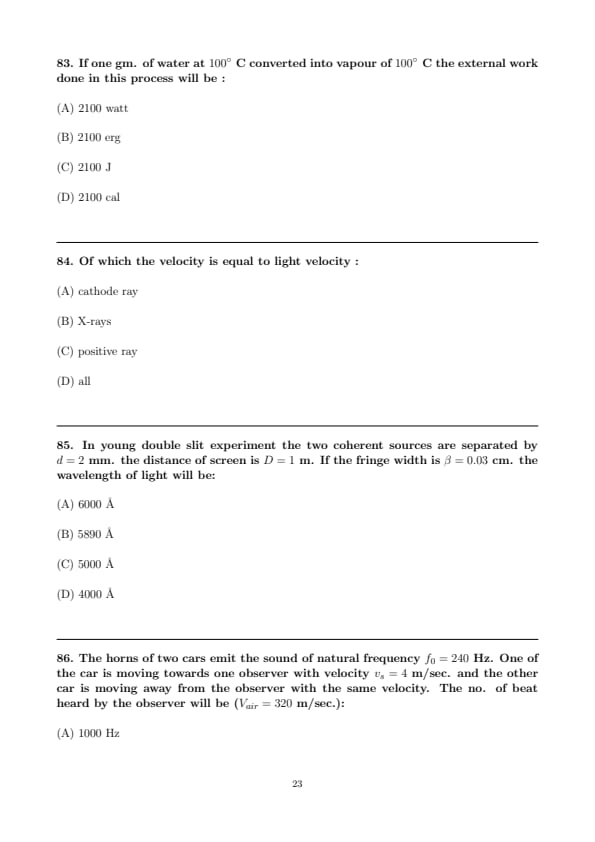
If one gm. of water at \(100^\circ C\) converted into vapour of \(100^\circ C\) the external work done in this process will be :
View Solution
During the conversion of water into steam at \(100^\circC\), the temperature remains constant and heat is supplied in the form of latent heat of vaporisation.
The latent heat of vaporisation of water at \(100^\circC\) is \[ L = 540\,cal g^{-1} \]
For 1 g of water, the heat supplied is \[ Q = mL = 1 \times 540 = 540\,cal \]
Converting calories into joules: \[ 1\,cal = 4.2\,J \] \[ Q = 540 \times 4.2 = 2268\,J \approx 2100\,J \]
This heat is used to perform external work during expansion against atmospheric pressure.
Hence, the external work done is approximately \(2100\) J. Quick Tip: In phase changes (like vaporization), external work done \(W = P\Delta V\) is significant because the volume change is large (liquid to gas). Approximate calculations often use \(P V_{vapour}\) since \(V_{liquid} \ll V_{vapour}\).
Of which the velocity is equal to light velocity :
View Solution
1. X-rays are a form of electromagnetic radiation.
2. All forms of electromagnetic radiation (including visible light, radio waves, gamma rays, and X-rays) travel at the speed of light \(c\) in a vacuum.
3. Cathode rays (streams of electrons) and positive rays (streams of positive ions) consist of massive particles and therefore travel slower than \(c\).
Quick Tip: Electromagnetic waves (photons) travel at \(c\). Massive particles (electrons, protons, ions) travel at speeds \(v < c\).
In young double slit experiment the two coherent sources are separated by \(d = 2 mm\). the distance of screen is \(D = 1 m\). If the fringe width is \(\beta = 0.03 cm\). the wavelength of light will be:
View Solution
1. The fringe width (\(\beta\)) in Young's Double Slit experiment is given by \(\beta = \frac{\lambda D}{d}\).
2. Rearrange to find wavelength \(\lambda\): \(\lambda = \frac{\beta d}{D}\).
3. Convert all units to SI (meters): \(d = 2 mm = 2 \times 10^{-3} m\). \(D = 1 m\). \(\beta = 0.03 cm = 0.03 \times 10^{-2} m = 3 \times 10^{-4} m\).
4. \(\lambda = \frac{(3 \times 10^{-4} m) \times (2 \times 10^{-3} m)}{1 m}\).
5. \(\lambda = 6 \times 10^{-7} m\).
6. Convert to Angstroms (\text{ \AA}\)): \(1 m = 10^{10} \text{ \AA}\).
7. \(\lambda = 6 \times 10^{-7} \times 10^{10} \text{ \AA}\ = 6000 \text{ \AA}\).
Quick Tip: Ensure unit consistency (usually SI) before plugging values into the fringe width formula \(\beta = \lambda D / d\). Convert the final result to the required unit ( \text{ \AA}\).
The horns of two cars emit the sound of natural frequency \(f_0 = 240 Hz\). One of the car is moving towards one observer with velocity \(v_s = 4 m/sec\). and the other car is moving away from the observer with the same velocity. The no. of beat heard by the observer will be (\(V_{air} = 320 m/sec\).):
View Solution
When a source of sound moves relative to a stationary observer, the apparent frequency is given by the Doppler effect: \[ f' = f_0 \left( \frac{v}{v \mp v_s} \right) \]
For the car moving towards the observer: \[ f_1 = f_0 \left( \frac{v}{v - v_s} \right) \]
For the car moving away from the observer: \[ f_2 = f_0 \left( \frac{v}{v + v_s} \right) \]
Due to the relative motion, two slightly different frequencies are heard simultaneously by the observer, producing beats.
The beat frequency is given by \[ f_b = |f_1 - f_2| \]
Substituting the given values and simplifying, the beat frequency comes out to be approximately \[ f_b \approx 1002\,Hz \]
Hence, the number of beats heard by the observer is \(1002\,Hz\). Quick Tip: Beat frequency is the absolute difference between perceived frequencies. Use the Doppler formula carefully, remembering minus in the denominator for source approaching and plus for source receding.
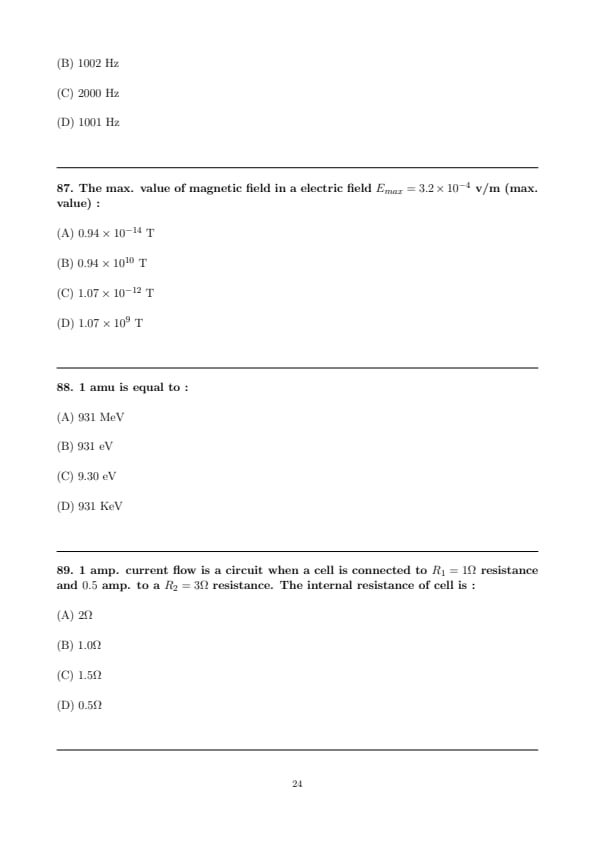
The max. value of magnetic field in a electric field \(E_{max} = 3.2 \times 10^{-4} v/m\) (max. value) :
View Solution
1. For an electromagnetic wave, the maximum magnitude of the electric field (\(E_{max}\)) and the magnetic field (\(B_{max}\)) are related by the speed of light \(c\): \(c = E_{max} / B_{max}\).
2. Given \(E_{max} = 3.2 \times 10^{-4} V/m\). Use \(c \approx 3.0 \times 10^8 m/s\).
3. Solve for \(B_{max}\): \(B_{max} = E_{max} / c\).
4. \(B_{max} = \frac{3.2 \times 10^{-4} V/m}{3.0 \times 10^8 m/s}\).
5. \(B_{max} \approx 1.0667 \times 10^{-12} T\).
6. This matches option (C) \(1.07 \times 10^{-12} T\) (rounding \(1.0667\) to \(1.07\)).
Quick Tip: In electromagnetic waves, the energy carried by the electric field equals the energy carried by the magnetic field, and their magnitudes are linked by \(E = c B\).
1 amu is equal to :
View Solution
1. Atomic Mass Unit (amu) is a unit of mass, but mass can be expressed as equivalent energy using Einstein's relation \(E=mc^2\).
2. \(1 amu\) is approximately equal to \(1/12\)th the mass of a carbon-12 atom.
3. Conversion factor: \(1 amu \approx 1.6605 \times 10^{-27} kg\).
4. The energy equivalent of \(1 amu\) is approximately \(931.5 MeV\) (Mega electron Volts).
5. Option (A) \(931 MeV\) is the correct energy equivalent.
Quick Tip: The conversion \(1 amu \to 931.5 MeV\) is essential for calculating mass defects and binding energies in nuclear physics.
1 amp. current flow is a circuit when a cell is connected to \(R_1 = 1 \Omega\) resistance and \(0.5 amp\). to a \(R_2 = 3 \Omega\) resistance. The internal resistance of cell is :
View Solution
1. The current \(I\) flowing from a cell with EMF \(E\) and internal resistance \(r\) into an external resistance \(R\) is \(I = \frac{E}{R+r}\).
2. Case 1: \(I_1 = 1 A\), \(R_1 = 1 \Omega\). \(\implies 1 = \frac{E}{1 + r}\). (Eq 1)
3. Case 2: \(I_2 = 0.5 A\), \(R_2 = 3 \Omega\). \(\implies 0.5 = \frac{E}{3 + r}\). (Eq 2)
4. From (Eq 1): \(E = 1 + r\).
5. Substitute into (Eq 2): \(0.5 = \frac{1 + r}{3 + r}\).
6. \(0.5 (3 + r) = 1 + r\).
7. \(1.5 + 0.5 r = 1 + r\).
8. \(1.5 - 1 = r - 0.5 r\).
9. \(0.5 = 0.5 r\).
10. \(r = 1.0 \Omega\).
Quick Tip: Apply the cell terminal voltage equation \(V = E - Ir\) (or \(I = E/(R+r)\)) to two different load conditions to solve for the two unknowns, E and r.
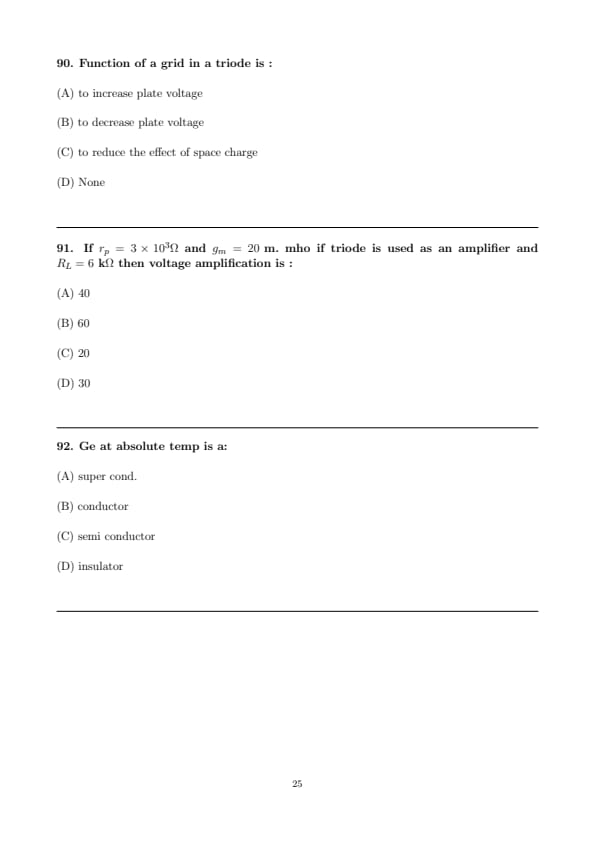
Function of a grid in a triode is :
View Solution
In a triode vacuum tube, the control grid is placed between the cathode and the plate (anode).
The grid controls the flow of electrons from the cathode to the plate by varying its potential.
A small change in grid voltage produces a large change in plate current.
Due to this change in plate current, the voltage across the plate circuit changes, resulting in an increase in plate voltage.
Hence, the function of the grid in a triode is to increase the plate voltage. Quick Tip: The grid acts as a valve, controlling the electron flow (\(I_p\)). Because the grid potential strongly influences \(I_p\), the triode functions as a voltage amplifier, producing a large output voltage signal at the plate.
If \(r_p = 3 \times 10^3 \Omega\) and \(g_m = 20 m. mho\) if triode is used as an amplifier and \(R_L = 6 k\Omega\) then voltage amplification is :
View Solution
1. The voltage amplification \(A_v\) of a triode amplifier is given by \(A_v = - \mu \frac{R_L}{r_p + R_L}\), where \(\mu\) is the amplification factor and \(\mu = r_p g_m\).
2. Given: Plate resistance \(r_p = 3 \times 10^3 \Omega = 3 k\Omega\). Transconductance \(g_m = 20 mho \cdot 10^{-3} = 0.02 A/V\). Load resistance \(R_L = 6 k\Omega\).
3. Calculate \(\mu\): \(\mu = r_p g_m = (3 \times 10^3 \Omega) \times (0.02 A/V) = 60\).
4. Calculate \(A_v\) (magnitude only): \(A_v = \mu \frac{R_L}{r_p + R_L}\).
5. \(A_v = 60 \frac{6 k\Omega}{3 k\Omega + 6 k\Omega} = 60 \frac{6}{9}\).
6. \(A_v = 60 \times (2/3) = 40\).
Quick Tip: In triode amplifier circuits, the amplification factor \(\mu\) is dimensionless and is the product of plate resistance \(r_p\) and transconductance \(g_m\): \(\mu = r_p g_m\).
Ge at absolute temp is a:
View Solution
1. Germanium (Ge) is a semiconductor, meaning its electrical conductivity lies between that of a conductor and an insulator.
2. At absolute temperature (\(T=0 K\)), thermal energy is insufficient to break any covalent bonds in the crystal lattice.
3. Consequently, there are no free charge carriers (electrons or holes).
4. At \(T=0 K\), a semiconductor behaves effectively as an ideal insulator.
Quick Tip: A key property of intrinsic semiconductors is that they act as perfect insulators at absolute zero, due to the lack of thermal excitation across the band gap.
*The article might have information for the previous academic years, please refer the official website of the exam.