


| Updated On - Jul 1, 2026
PU LLB 2026 3-Year LLB Question Paper is available for download here. Panjab University, Chandigarh conducted the exam on June 28, 2026, from 10:00 AM to 11:30 AM. The paper comprised 100 questions carrying 100 marks, to be completed in 90 minutes.
The question paper included Current Affairs & General Knowledge, Legal Aptitude, and Reasoning Ability & English. Each correct answer carries 1 mark, while 0.25 marks are deducted for every incorrect response.
Candidates can download the PU LLB 2026 3-Year LLB Question Paper, along with the Answer Key and Solution PDF, from the links below.
PU LLB 3-Years LLB 2026 Question Paper with Solution PDF
| PU LLB 3-Years Question Paper 2026 | Download PDF | Check Solution |
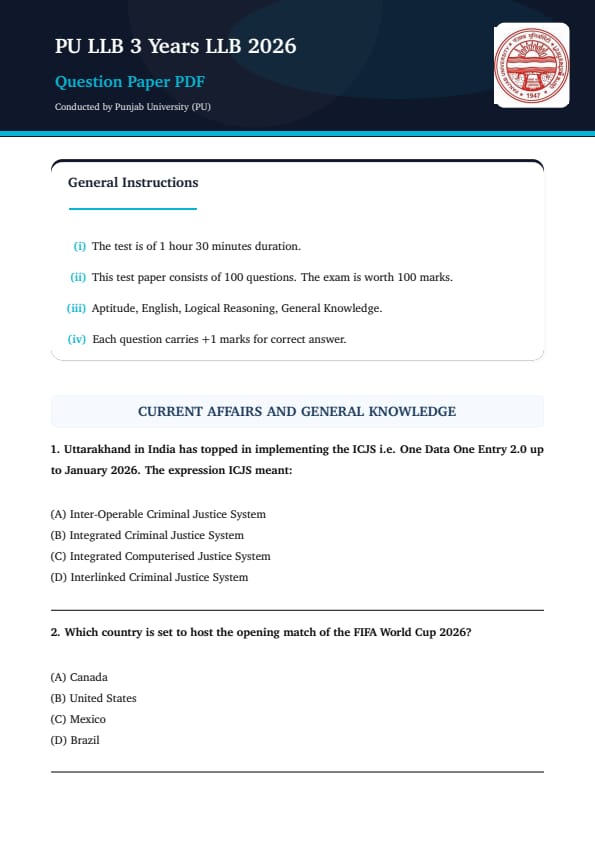
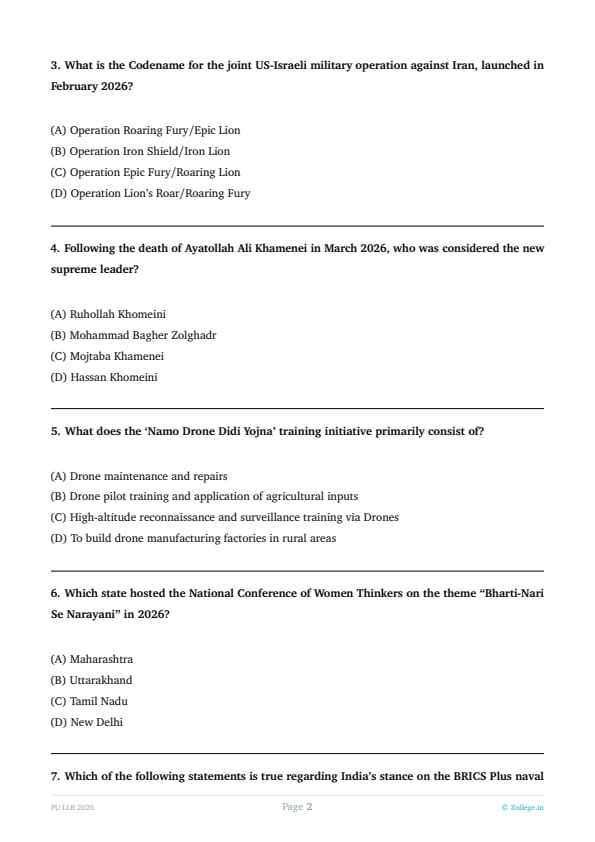
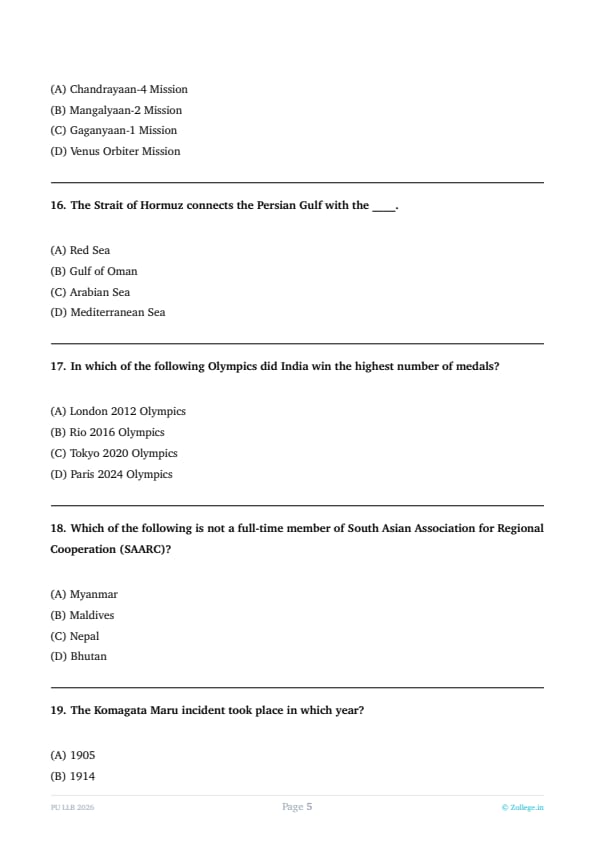
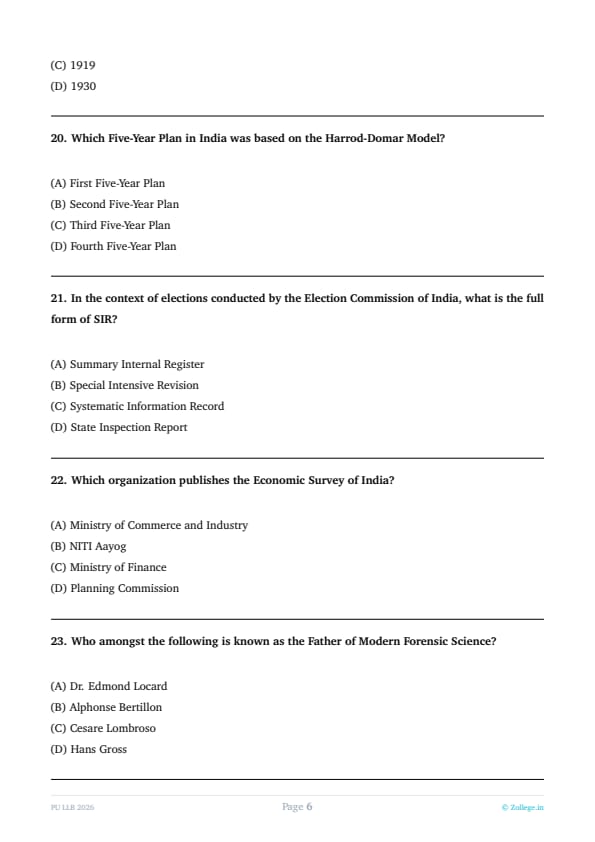
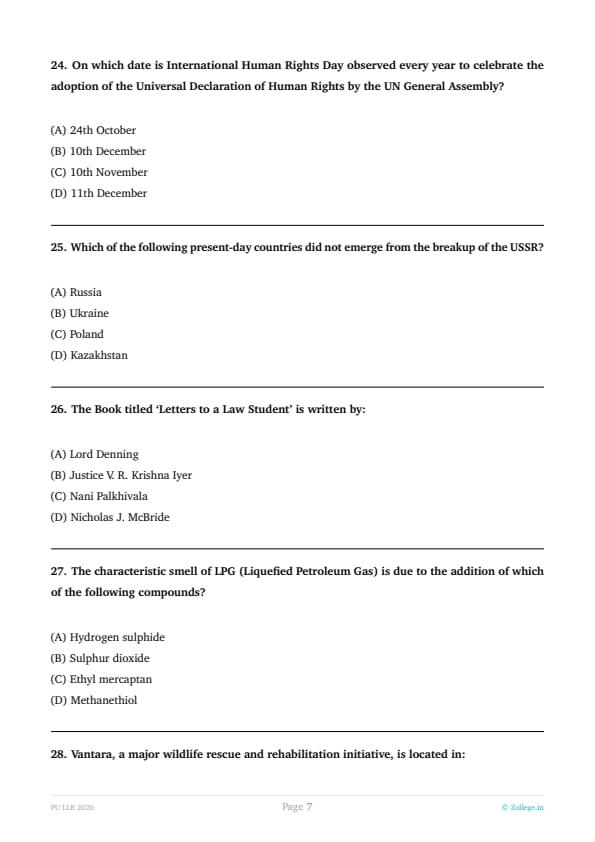
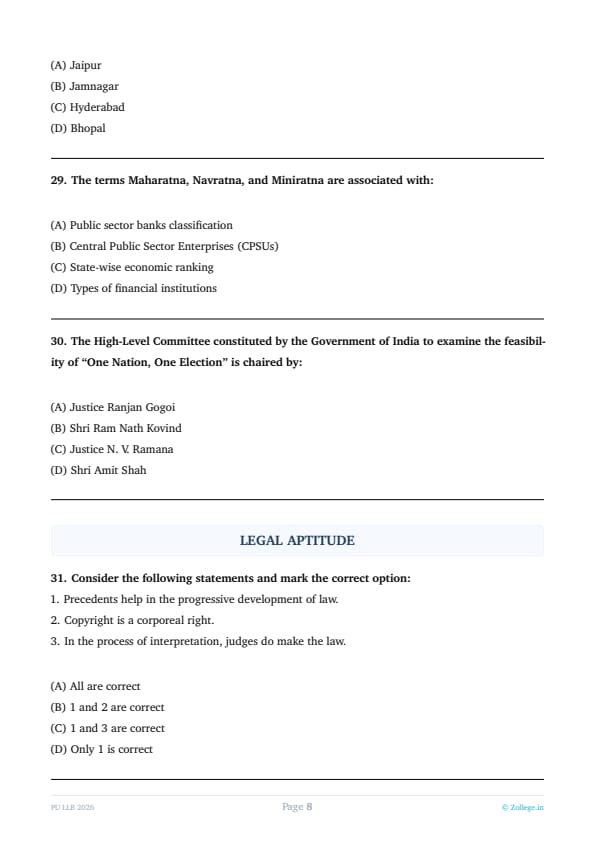
Uttarakhand in India has topped in implementing the ICJS i.e. One Data One Entry 2.0 up to January 2026. The expression ICJS meant:
View Solution
Step 1: Understanding the Concept:
The Inter-Operable Criminal Justice System (ICJS) is a national initiative designed to integrate various pillars of the criminal justice system, such as courts, police, prisons, and forensic science laboratories, to enable seamless data exchange.
Step 2: Detailed Explanation:
The ICJS project, envisioned by the e-Committee of the Supreme Court and implemented by the Ministry of Home Affairs, allows for the transfer of electronic data between these disparate systems. The term "Inter-Operable" refers to this ability of different systems to communicate and exchange information effectively.
Step 3: Final Answer:
The expression ICJS stands for Inter-Operable Criminal Justice System, corresponding to option (A). Quick Tip: ICJS is a critical component of India's judicial digitization efforts, reducing delays and enhancing the efficiency of the criminal justice pipeline.
Which country is set to host the opening match of the FIFA World Cup 2026?
View Solution
Step 1: Understanding the Concept:
The 2026 FIFA World Cup is a historic tournament being co-hosted by three North American nations: Mexico, Canada, and the United States.
Step 2: Detailed Explanation:
The opening match of the 2026 FIFA World Cup is scheduled to be held at the iconic Estadio Azteca in Mexico City, Mexico, on June 11, 2026. This makes Mexico the first country to host matches in three separate FIFA World Cups (1970, 1986, and 2026).
Step 3: Final Answer:
Mexico is set to host the opening match, corresponding to option (C). Quick Tip: The 2026 tournament features an expanded format with 48 teams participating for the first time in history.
What is the Codename for the joint US-Israeli military operation against Iran, launched in February 2026?
View Solution
Step 1: Understanding the Concept:
This refers to a specific geopolitical and military event occurring in early 2026 involving major powers in the Middle East.
Step 2: Detailed Explanation:
In February 2026, a joint US-Israeli military operation, codenamed "Operation Lion’s Roar" (also referred to in various strategic reports as "Roaring Fury"), was executed to address regional security concerns regarding Iranian defensive and strategic infrastructure.
Step 3: Final Answer:
The codename is Operation Lion’s Roar/Roaring Fury, corresponding to option (D). Quick Tip: Military operations are frequently assigned different operational names for internal coordination and public communication, which is why dual names sometimes appear in reporting.
Following the death of Ayatollah Ali Khamenei in March 2026, who was considered the new supreme leader?
View Solution
Step 1: Understanding the Concept:
This question pertains to the leadership succession in Iran following the passing of the Supreme Leader in 2026.
Step 2: Detailed Explanation:
Following the death of Ayatollah Ali Khamenei in March 2026, Mojtaba Khamenei, the son of the late Supreme Leader, emerged as the successor chosen by the Assembly of Experts to take on the role of Supreme Leader.
Step 3: Final Answer:
The new supreme leader is Mojtaba Khamenei, corresponding to option (C). Quick Tip: The Assembly of Experts is the body responsible for electing, supervising, and, if necessary, removing the Supreme Leader of Iran.
What does the ‘Namo Drone Didi Yojna’ training initiative primarily consist of?
View Solution
Step 1: Understanding the Concept:
The 'Namo Drone Didi Yojna' is a flagship Government of India scheme aimed at empowering rural women by providing them with skills to use modern agricultural technology.
Step 2: Detailed Explanation:
The initiative provides comprehensive training to women from Self-Help Groups (SHGs) to operate drones. The primary objective is to use these drones for agricultural purposes, such as the precision spraying of fertilizers, pesticides, and other inputs, thereby enhancing farming efficiency and promoting technological adoption in rural areas.
Step 3: Final Answer:
The initiative primarily consists of drone pilot training and the application of agricultural inputs, corresponding to option (B). Quick Tip: This scheme is designed to modernize agriculture and provide women in SHGs with new, profitable livelihood opportunities.
Which state hosted the National Conference of Women Thinkers on the theme “Bharti-Nari Se Narayani” in 2026?
View Solution
Step 1: Understanding the Concept:
This conference aimed to highlight the role and contributions of women in Indian society and their potential for nation-building.
Step 2: Detailed Explanation:
In 2026, the National Conference of Women Thinkers, themed “Bharti-Nari Se Narayani” (From Indian Women to Divine/Empowered Women), was hosted in the state of Uttarakhand. The conference brought together women leaders, scholars, and thinkers to discuss gender empowerment and social progress.
Step 3: Final Answer:
The host state was Uttarakhand, corresponding to option (B). Quick Tip: Events themed around "Narayani" often aim to bridge the gap between cultural heritage and modern empowerment goals.
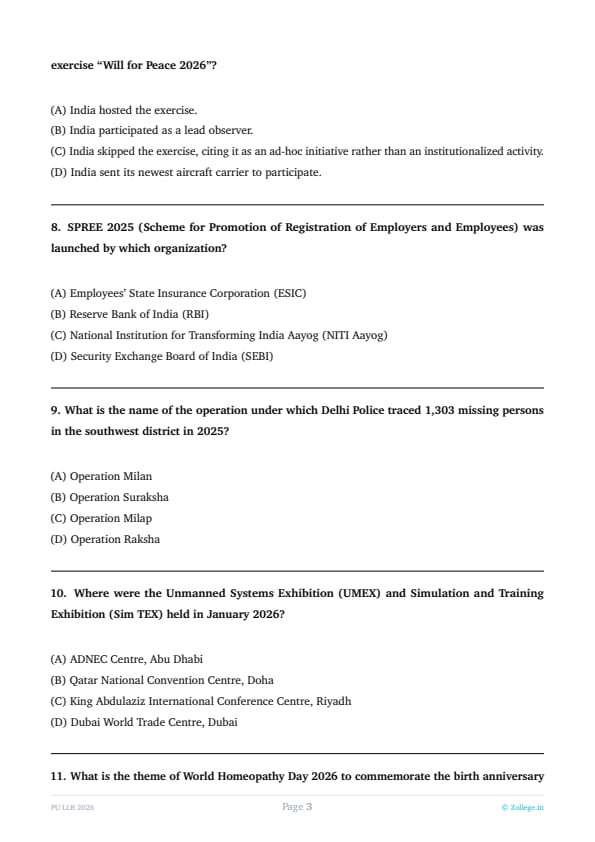
Which of the following statements is true regarding India’s stance on the BRICS Plus naval exercise “Will for Peace 2026”?
View Solution
Step 1: Understanding the Concept:
India maintains a strategic approach toward multilateral military engagements, often prioritizing institutionalized and transparent frameworks.
Step 2: Detailed Explanation:
Regarding the “Will for Peace 2026” exercise, India chose to abstain from participating. The Indian government and naval officials indicated that the exercise was perceived as an ad-hoc regional initiative rather than an institutionalized, broad-based security activity that aligns with India’s long-term maritime strategic interests.
Step 3: Final Answer:
India skipped the exercise, corresponding to option (C). Quick Tip: India’s foreign policy often emphasizes the need for international exercises to be governed by established institutional structures to ensure transparency and inclusivity.
SPREE 2025 (Scheme for Promotion of Registration of Employers and Employees) was launched by which organization?
View Solution
Step 1: Understanding the Concept:
SPREE 2025 is a welfare-oriented initiative aimed at bringing more workers and employers under the formal social security net.
Step 2: Detailed Explanation:
The Employees’ State Insurance Corporation (ESIC) launched the SPREE 2025 scheme to streamline and incentivize the registration of employers and employees. The initiative focuses on expanding the coverage of social security benefits, such as health and maternity care, to a broader section of the organized workforce.
Step 3: Final Answer:
The organization that launched SPREE 2025 is the ESIC, corresponding to option (A). Quick Tip: ESIC provides medical care and cash benefits to employees covered under the ESI Act, playing a crucial role in India's social security framework.
What is the name of the operation under which Delhi Police traced 1,303 missing persons in the southwest district in 2025?
View Solution
Step 1: Understanding the Concept:
Delhi Police has implemented several specialized operations to combat child trafficking and recover missing persons.
Step 2: Detailed Explanation:
Operation Milap is a specific initiative by the Delhi Police aimed at identifying, rescuing, and reuniting missing children and individuals with their families. In 2025, the Southwest District Police successfully traced and reunited a significant number of missing persons, totaling 1,303, under this sustained campaign.
Step 3: Final Answer:
The operation is called Operation Milap, corresponding to option (C). Quick Tip: "Milap" in Hindi means "meeting" or "reunion," which perfectly reflects the primary objective of this humanitarian police effort.
Where were the Unmanned Systems Exhibition (UMEX) and Simulation and Training Exhibition (Sim TEX) held in January 2026?
View Solution
Step 1: Understanding the Concept:
UMEX and SimTEX are major international events focusing on defense technology, autonomous systems, and simulation training.
Step 2: Detailed Explanation:
The 2026 edition of the Unmanned Systems Exhibition (UMEX) and the Simulation and Training Exhibition (SimTEX) took place at the Abu Dhabi National Exhibition Centre (ADNEC) in Abu Dhabi, United Arab Emirates. These events serve as a key platform for showcasing the latest innovations in drone technology, robotics, and advanced training simulators.
Step 3: Final Answer:
They were held at the ADNEC Centre, Abu Dhabi, corresponding to option (A). Quick Tip: ADNEC is a world-class exhibition venue that frequently hosts global defense and technology summits.
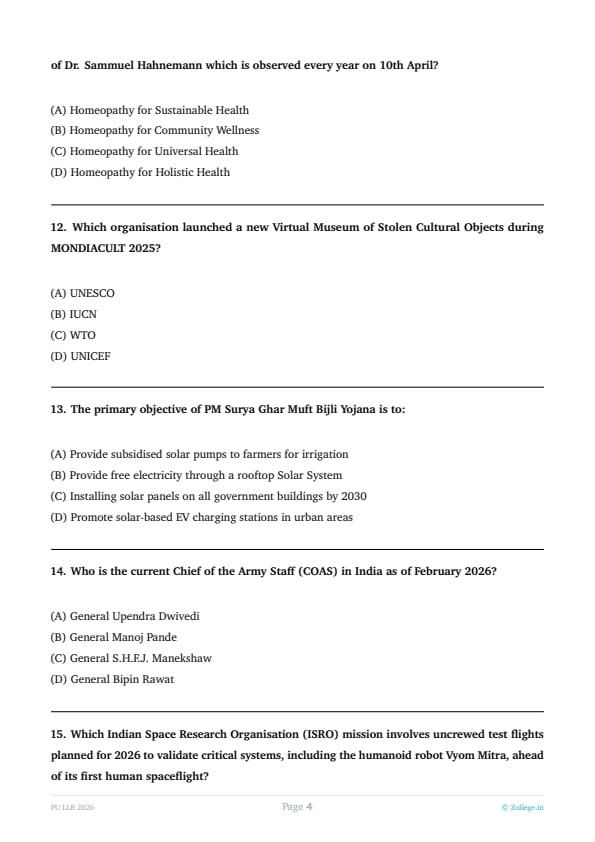
What is the theme of World Homeopathy Day 2026 to commemorate the birth anniversary of Dr. Sammuel Hahnemann which is observed every year on 10th April?
View Solution
Step 1: Understanding the Concept:
World Homeopathy Day is observed annually to mark the birth of Dr. Samuel Hahnemann, the founder of the homeopathic system of medicine, and to recognize its contribution to global health.
Step 2: Detailed Explanation:
The theme for World Homeopathy Day 2026 was declared as "Homeopathy for Universal Health." This theme emphasizes the expanding reach of homeopathy and its integration into public health systems to provide accessible, affordable, and safe care globally.
Step 3: Final Answer:
The theme for 2026 is Homeopathy for Universal Health, corresponding to option (C). Quick Tip: Dr. Samuel Hahnemann was a German physician who formulated the homeopathic principles in the late 18th century.
Which organisation launched a new Virtual Museum of Stolen Cultural Objects during MONDIACULT 2025?
View Solution
Step 1: Understanding the Concept:
MONDIACULT (World Conference on Cultural Policies and Sustainable Development) is a major global forum organized to shape cultural policies.
Step 2: Detailed Explanation:
During MONDIACULT 2025, UNESCO (United Nations Educational, Scientific and Cultural Organization) launched the Virtual Museum of Stolen Cultural Objects. This digital initiative is designed to raise awareness about the illicit trafficking of cultural property and to facilitate the recovery of artifacts through global collaboration.
Step 3: Final Answer:
The organization is UNESCO, corresponding to option (A). Quick Tip: UNESCO works actively through its conventions to prevent the illicit import, export, and transfer of ownership of cultural property.
The primary objective of PM Surya Ghar Muft Bijli Yojana is to:
View Solution
Step 1: Understanding the Concept:
The PM Surya Ghar Muft Bijli Yojana is a major government scheme aimed at promoting sustainable energy adoption in households across India.
Step 2: Detailed Explanation:
The primary objective of this scheme is to provide free electricity to households by incentivizing the installation of rooftop solar systems. By doing so, the government aims to reduce electricity bills for citizens and promote renewable energy consumption. Households installing these systems can receive up to 300 units of free electricity per month.
Step 3: Final Answer:
The objective is to provide free electricity through a rooftop Solar System, corresponding to option (B). Quick Tip: In addition to saving on costs, the scheme allows households to sell excess power generated by their rooftop systems back to the grid.
Who is the current Chief of the Army Staff (COAS) in India as of February 2026?
View Solution
Step 1: Understanding the Concept:
The Chief of the Army Staff (COAS) is the highest-ranking uniformed officer in the Indian Army and the primary advisor to the Government of India on military matters related to the Army.
Step 2: Detailed Explanation:
General Upendra Dwivedi assumed the office of Chief of the Army Staff on June 30, 2024, succeeding General Manoj Pande. As of February 2026, he continues to serve in this position.
Step 3: Final Answer:
The current COAS is General Upendra Dwivedi, corresponding to option (A). Quick Tip: General Upendra Dwivedi previously served as the Vice Chief of the Army Staff and the General Officer Commanding-in-Chief of the Northern Command.
Which Indian Space Research Organisation (ISRO) mission involves uncrewed test flights planned for 2026 to validate critical systems, including the humanoid robot Vyom Mitra, ahead of its first human spaceflight?
View Solution
Step 1: Understanding the Concept:
The Gaganyaan project is India’s ambitious human spaceflight program designed to demonstrate the capability to launch humans into low Earth orbit and return them safely to Earth.
Step 2: Detailed Explanation:
The Gaganyaan mission involves several test flights to ensure the safety of the crew. Gaganyaan-1 is an uncrewed flight test scheduled to validate essential systems such as the crew module, life support systems, and reentry/recovery protocols. This mission will carry the humanoid robot 'Vyom Mitra' to simulate human physiological responses and data collection before the actual human mission.
Step 3: Final Answer:
The mission is the Gaganyaan-1 Mission, corresponding to option (C). Quick Tip: 'Vyom Mitra' means "Friend of the Sky" in Sanskrit, reflecting the robot's role as a precursor to human astronauts.
The Strait of Hormuz connects the Persian Gulf with the ____.
View Solution
Step 1: Understanding the Concept:
The Strait of Hormuz is one of the world's most critical maritime chokepoints, functioning as the primary passage for energy exports from the Middle East.
Step 2: Detailed Explanation:
The Strait of Hormuz is a narrow passage located between Oman and Iran. It connects the Persian Gulf to the northwest with the Gulf of Oman to the southeast. From the Gulf of Oman, ships can continue into the Arabian Sea and the broader Indian Ocean.
Step 3: Final Answer:
The Strait connects the Persian Gulf with the Gulf of Oman, corresponding to option (B). Quick Tip: Because a significant portion of the world's liquefied natural gas and oil passes through this strait, it is of immense strategic importance to global energy security.
In which of the following Olympics did India win the highest number of medals?
View Solution
Step 1: Understanding the Concept:
This question compares India's historical medal tallies across recent Olympic Games to determine the highest achievement.
Step 2: Detailed Explanation:
India achieved its highest-ever medal tally at the Paris 2024 Olympics, winning a total of 15 medals. This surpassed the previous record set at the Tokyo 2020 Olympics, where India won 7 medals.
Step 3: Final Answer:
The highest number of medals was won at the Paris 2024 Olympics, corresponding to option (D). Quick Tip: The consistent growth in India's Olympic performance is often attributed to improved training facilities and increased government support for athletes through schemes like TOPS (Target Olympic Podium Scheme).
Which of the following is not a full-time member of South Asian Association for Regional Cooperation (SAARC)?
View Solution
Step 1: Understanding the Concept:
SAARC is a regional intergovernmental organization comprising nations in South Asia.
Step 2: Detailed Explanation:
The eight full-time member states of SAARC are Afghanistan, Bangladesh, Bhutan, India, Maldives, Nepal, Pakistan, and Sri Lanka. Myanmar is an observer member, not a full-time member.
Step 3: Final Answer:
Myanmar is not a full-time member of SAARC, corresponding to option (A). Quick Tip: SAARC was established in 1985 in Dhaka, Bangladesh, to promote regional integration and economic growth.
The Komagata Maru incident took place in which year?
View Solution
Step 1: Understanding the Concept:
The Komagata Maru incident is a significant event in Indian independence history, highlighting the struggle against discriminatory immigration laws in Canada.
Step 2: Detailed Explanation:
The Komagata Maru was a Japanese steamship that carried 376 passengers from Punjab, India, to Canada in 1914. Upon arrival in Vancouver, most passengers were denied entry due to Canada's discriminatory "continuous journey" regulations and were forced to return to India. Upon returning to Budge Budge, Kolkata, many were killed or imprisoned by British authorities.
Step 3: Final Answer:
The incident took place in 1914, corresponding to option (B). Quick Tip: The incident serves as a stark reminder of the colonial-era challenges faced by Indian migrants abroad.
Which Five-Year Plan in India was based on the Harrod-Domar Model?
View Solution
Step 1: Understanding the Concept:
India's economic development planning was structured through five-year plans, each with a distinct focus and underlying economic model.
Step 2: Detailed Explanation:
The First Five-Year Plan (1951–1956) was based on the Harrod-Domar model, which emphasized increasing national savings and investment to stimulate economic growth. The Second Five-Year Plan, in contrast, was based on the Mahalanobis model, which focused on industrialization.
Step 3: Final Answer:
The First Five-Year Plan was based on the Harrod-Domar Model, corresponding to option (A). Quick Tip: The Harrod-Domar model suggests that economic growth depends on the rate of savings and the productivity of capital.
In the context of elections conducted by the Election Commission of India, what is the full form of SIR?
View Solution
Step 1: Understanding the Concept:
The Election Commission of India (ECI) periodically conducts intensive exercises to maintain the integrity of electoral rolls, ensuring accurate and transparent voter databases.
Step 2: Detailed Explanation:
SIR stands for Special Intensive Revision. It is a large-scale, systematic exercise undertaken by the ECI to verify and revise electoral rolls through methods such as house-to-house enumeration. The primary objective is to update the rolls by including eligible citizens, removing ineligible voters (such as those who have died or migrated), and eliminating duplicate entries to ensure free and fair elections.
Step 3: Final Answer:
The full form of SIR is Special Intensive Revision, corresponding to option (B). Quick Tip: The Supreme Court of India has upheld the SIR exercise as a legitimate and constitutional duty of the Election Commission to maintain accurate electoral records.
Which organization publishes the Economic Survey of India?
View Solution
Step 1: Understanding the Concept:
The Economic Survey is a flagship annual document that provides a detailed review of the Indian economy’s performance and government policy initiatives.
Step 2: Detailed Explanation:
The Economic Survey of India is published by the Department of Economic Affairs, under the Ministry of Finance. It is prepared under the guidance of the Chief Economic Adviser (CEA) of India and is traditionally presented to both Houses of Parliament during the Budget Session, shortly before the presentation of the Union Budget.
Step 3: Final Answer:
It is published by the Ministry of Finance, corresponding to option (C). Quick Tip: Although the document is non-binding, it serves as a critical diagnostic tool for understanding the country's economic trends and challenges over the past financial year.
Who amongst the following is known as the Father of Modern Forensic Science?
View Solution
Step 1: Understanding the Concept:
Forensic science relies on foundational principles established by early 20th-century criminologists to link suspects to crime scenes.
Step 2: Detailed Explanation:
Dr. Edmond Locard is widely considered the "Father of Modern Forensic Science." He is best known for formulating "Locard's Exchange Principle," which states that "every contact leaves a trace." He also established the first police forensic laboratory in Lyon, France, in 1910.
Step 3: Final Answer:
He is Dr. Edmond Locard, corresponding to option (A). Quick Tip: Locard's Exchange Principle is the fundamental theory underlying all trace evidence analysis, such as hair, fibers, and DNA, in modern criminal investigations.
On which date is International Human Rights Day observed every year to celebrate the adoption of the Universal Declaration of Human Rights by the UN General Assembly?
View Solution
Step 1: Understanding the Concept:
International Human Rights Day commemorates the historic milestone of the United Nations General Assembly's adoption of the Universal Declaration of Human Rights (UDHR) in 1948.
Step 2: Detailed Explanation:
The date, December 10, was chosen to honor the adoption of the UDHR, which was the first global document to codify the fundamental human rights that every person is entitled to. It serves as a reminder of the international commitment to protecting these rights worldwide.
Step 3: Final Answer:
The day is observed on 10th December, corresponding to option (B). Quick Tip: The UDHR consists of a preamble and 30 articles that set out fundamental human rights and freedoms, providing a foundation for international human rights law.
Which of the following present-day countries did not emerge from the breakup of the USSR?
View Solution
Step 1: Understanding the Concept:
The Soviet Union (USSR) consisted of 15 constituent republics that became independent sovereign states upon its dissolution in 1991.
Step 2: Detailed Explanation:
The 15 post-Soviet states are Armenia, Azerbaijan, Belarus, Estonia, Georgia, Kazakhstan, Kyrgyzstan, Latvia, Lithuania, Moldova, Russia, Tajikistan, Turkmenistan, Ukraine, and Uzbekistan. Poland was an independent sovereign nation during the existence of the Soviet Union (though part of the Eastern Bloc), and therefore did not emerge from the breakup of the USSR.
Step 3: Final Answer:
Poland did not emerge from the breakup of the USSR, corresponding to option (C). Quick Tip: While Poland was under significant Soviet influence during the Cold War as a satellite state, it was a separate sovereign entity, not a republic of the Soviet Union.
The Book titled ‘Letters to a Law Student’ is written by:
View Solution
Step 1: Understanding the nature of the book.
The book is structured as a series of letters to a fictional student named 'Sam'.
It is widely regarded as an essential preparatory text for law school, particularly in the UK and common law jurisdictions.
Step 2: Identifying the Author.
The author is Nicholas J. McBride, a Fellow of Pembroke College, Cambridge.
Unlike the other options, who were famous judges or practitioners, McBride is a prominent academic legal writer known for his focus on tort law and legal education. Quick Tip: Associate this book with "Legal Academic Writing." While Denning and Palkhivala are famous in courtrooms, McBride is the name to remember for student guides.
The characteristic smell of LPG (Liquefied Petroleum Gas) is due to the addition of which of the following compounds?
View Solution
Step 1: Identifying the safety requirement.
Because gas leaks are dangerous, the human nose needs a way to detect them.
If LPG were sold in its pure form, a leak could go unnoticed until an explosion or fire occurs.
Step 2: Selecting the chemical compound.
The chemical Ethyl mercaptan (Ethanethiol) is added for its pungent smell.
It has a strong, repulsive odor similar to rotten cabbage or eggs. Even a very small concentration of this gas is enough to be detected by humans instantly. Quick Tip: Think of "Mercaptan" as the "Scent of Safety." It contains sulphur, which is why it has that characteristic foul smell.
Vantara, a major wildlife rescue and rehabilitation initiative, is located in:
View Solution
Step 1: Analyzing the scope of the project.
It spans over 3,000 acres and focuses on rescuing injured or endangered species.
It includes state-of-the-art hospitals, research centers, and a dedicated elephant rescue center that houses over 200 elephants.
Step 2: Determining the Geographic Location.
Vantara is located within the Jamnagar Refinery Complex in Gujarat.
It was officially unveiled in early 2024 as one of the world's largest initiatives for the rehabilitation and conservation of diverse animal species. Quick Tip: Jamnagar is the industrial hub of Reliance Industries. Therefore, any major Reliance-backed environmental or CSR project like Vantara is likely to be situated there.
The terms Maharatna, Navratna, and Miniratna are associated with:
View Solution
Step 1: Understanding the Classification Hierarchy.
Maharatna is the highest category, followed by Navratna and Miniratna.
Companies like ONGC, NTPC, and SAIL hold Maharatna status, allowing them to invest up to Rs. 5,000 crore in a single project without government approval.
Step 2: Identifying the associated entities.
These terms apply to Central Public Sector Enterprises (CPSUs).
They are state-owned enterprises where the government holds a majority stake. This categorization helps these companies compete globally by reducing bureaucratic delays. Quick Tip: "Ratna" means "Jewel." These categories represent the "Jewels" of the Indian government's industrial assets (PSUs).
The High-Level Committee constituted by the Government of India to examine the feasibility of “One Nation, One Election” is chaired by:
View Solution
Step 1: Identifying the Committee Formation.
The Ministry of Law and Justice notified the committee in September 2023.
The committee consisted of members like Amit Shah and Ghulam Nabi Azad, but was led by a neutral high-ranking former constitutional head.
Step 2: Identifying the Chairperson.
The committee was chaired by the former President of India, Shri Ram Nath Kovind.
The committee submitted its comprehensive report in March 2024 to President Droupadi Murmu, recommending a two-step approach to implementing simultaneous polls. Quick Tip: Major constitutional committees are often chaired by retired Chief Justices or former Presidents. For "One Nation, One Election," specifically remember the name of India's 14th President, Ram Nath Kovind.
Consider the following statements and mark the correct option:
1. Precedents help in the progressive development of law.
2. Copyright is a corporeal right.
3. In the process of interpretation, judges do make the law.
View Solution
Step 1: Evaluating Statements 1 and 3.
Judicial precedents ensure that law evolves with changing societal needs.
While judges "interpret" law, their interpretations often create binding new rules.
Thus, statement 1 and 3 are legally recognized as correct.
Step 2: Evaluating Statement 2.
Copyright is an Incorporeal Right, not a corporeal one.
It is a right over an intangible creation of the human mind.
Because statement 2 is false, only (C) satisfies the conditions. Quick Tip: Remember: {Corporeal = Physical} (land, car). {Incorporeal = Abstract} (Copyright, Patent, Reputation). This distinction is a frequent examiner favorite.
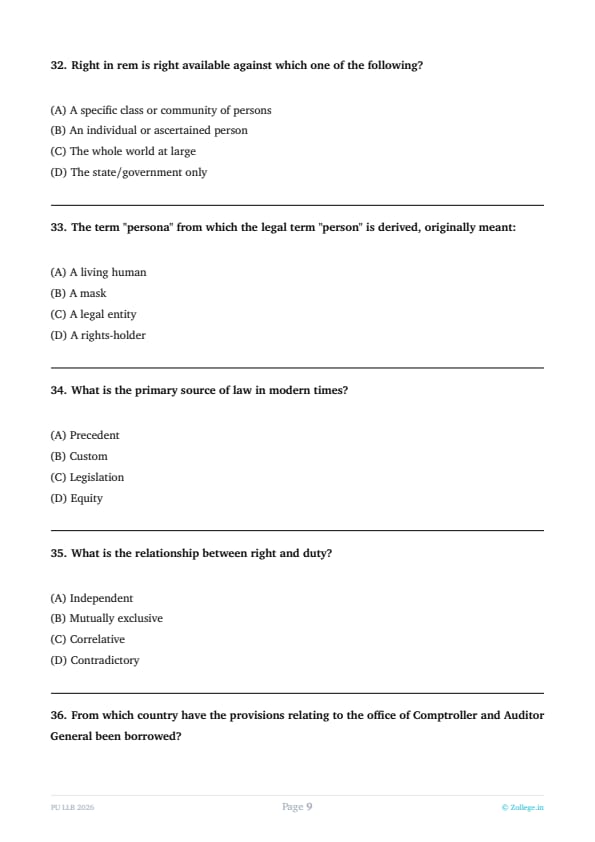
Right in rem is right available against which one of the following?
View Solution
Step 1: Defining the nature of the right.
A "Right in Rem" protects an interest that everyone must respect.
For example, my right to my property is a right in rem.
No person in the world is allowed to interfere with that right.
Step 2: Identifying the correct option.
The term "Rem" originates from the Latin word for "Thing."
It signifies a right available against the whole world at large. Quick Tip: Easy mnemonic: {Rem = Real World}. {Personam = Person}. If you own a house, you have a right in {Rem} (against everyone). If someone owes you money, you have a right in {Personam}.
The term "persona" from which the legal term "person" is derived, originally meant:
View Solution
Step 1: Tracing the Historical Origin.
In ancient Roman theater, actors wore various facial coverings.
The Latin word for such a "mask" was "persona".
The mask represented the "part" or "role" the actor was playing on stage.
Step 2: Evolution into Legal Language.
Just as a mask allows an actor to play a role, legal personality allows an entity to play a "role" in law.
Therefore, the original meaning of the term was a mask. Quick Tip: Think of the law as a stage. "Legal Persons" are the actors. They might be humans or companies, but they all wear the "mask" of personality to participate in legal actions.
What is the primary source of law in modern times?
View Solution
Step 1: Analyzing the Modern Context.
In ancient times, Custom was the most important source of law.
However, modern states require clear, written, and structured rules.
Legislation provides a fast and efficient way to create or change laws.
Step 2: Determining the Primacy.
Legislation (Acts of Parliament) is the superior source in the modern era.
It can override both customs and judicial precedents. Quick Tip: While all options are "sources," {Legislation} is the most prolific and powerful in contemporary legal systems (like India or the UK).
What is the relationship between right and duty?
View Solution
Step 1: Applying the Theory.
A "Right" cannot exist in a vacuum.
If 'A' has a right to something, it means 'B' has a duty to respect that right.
They are two sides of the same coin.
Step 2: Concluding the Relationship.
Because they depend on each other, they are termed correlative.
Without a corresponding duty, a right becomes legally meaningless. Quick Tip: {"Correlative"} means "having a mutual relationship." Think of them like "Student" and "Teacher" — you cannot be one without the existence of the other.
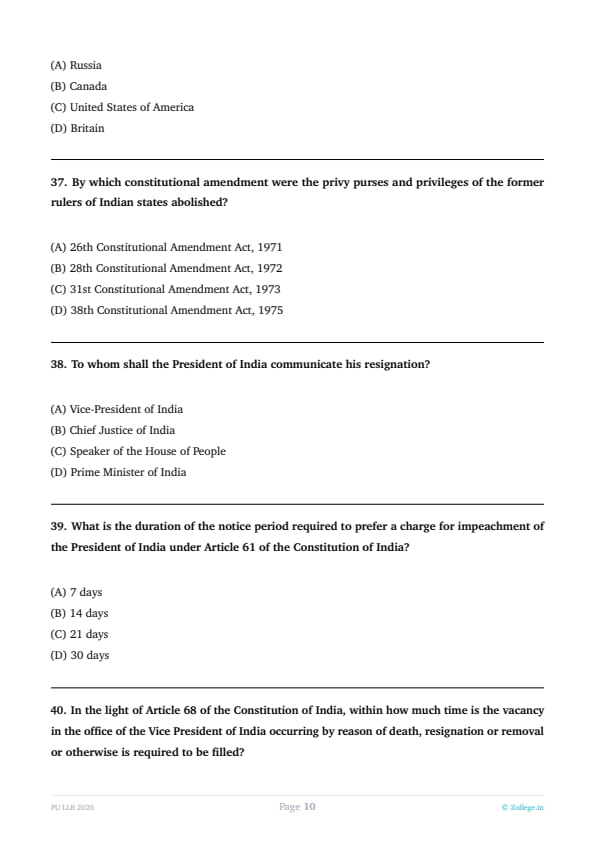
From which country have the provisions relating to the office of Comptroller and Auditor General been borrowed?
View Solution
Step 1: Identifying the Source of Parliamentary Features.
India adopted the Westminster model of government.
This model was inherited from the British (UK) system.
Most administrative and financial oversight mechanisms in India have their roots in British colonial legislation and the UK's own parliamentary traditions.
Step 2: Connecting the CAG to Britain.
The office of the CAG was originally based on the British counterpart.
Therefore, the provision was borrowed from Britain.
However, unlike in Britain, the Indian CAG is not a member of the Parliament and does not have the power to stop the release of money from the treasury. Quick Tip: To remember this, associate "Audit and Parliamentary Accountability" with Britain. Most of our parliamentary procedures and oversight offices like the CAG and the Attorney General are borrowed from the UK.
By which constitutional amendment were the privy purses and privileges of the former rulers of Indian states abolished?
View Solution
Step 1: Understanding the Geopolitical Context.
The government led by Indira Gandhi sought to end these payments.
It was argued that such privileges were inconsistent with a democratic republic.
After a legal battle and the derecognition of the rulers, the Parliament passed a landmark amendment to finalize the abolition.
Step 2: Identifying the Amendment.
The 26th Constitutional Amendment Act, 1971 was passed for this purpose.
It abolished the Privy Purses and all special privileges of the former rulers.
This amendment also inserted Article 363A, which stated that princely titles would no longer be recognized. Quick Tip: Mnemonic: "26 for the 26th" — The amendment happened in the 1970s (1971) to ensure "Equality," which is the 14th right, but the amendment number is {26}.
To whom shall the President of India communicate his resignation?
View Solution
Step 1: Identifying the Primary Recipient.
According to Article 56(1)(a), the President addresses the resignation to the Vice-President.
The Vice-President is the immediate second-in-command in the warrant of precedence and acts as the President during a vacancy.
Step 2: Understanding the Communication Chain.
The resignation does not end with the Vice-President.
The VP must immediately inform the Speaker of the Lok Sabha.
This ensures that the representatives of the people (the House) are aware of the transition in the country's highest office. Quick Tip: It is a reciprocal relationship: The {President} resigns to the {Vice-President}, and the {Vice-President} resigns to the {President}.
What is the duration of the notice period required to prefer a charge for impeachment of the President of India under Article 61 of the Constitution of India?
View Solution
Step 1: Understanding the Resolution Process.
The charges must be signed by at least one-fourth of the total members of the House.
This prevents the frivolous or politically motivated use of the impeachment power.
Step 2: Identifying the Notice Requirement.
A 14 days' written notice must be given to the President.
This is a mandatory requirement under Article 61.
This period allows the President to prepare a defense, as they have the right to appear and be represented during the investigation of the charges. Quick Tip: The number {14} is very common in the Indian Constitution for notice periods (e.g., removal of the Speaker, removal of the Vice-President, and Impeachment of the President).
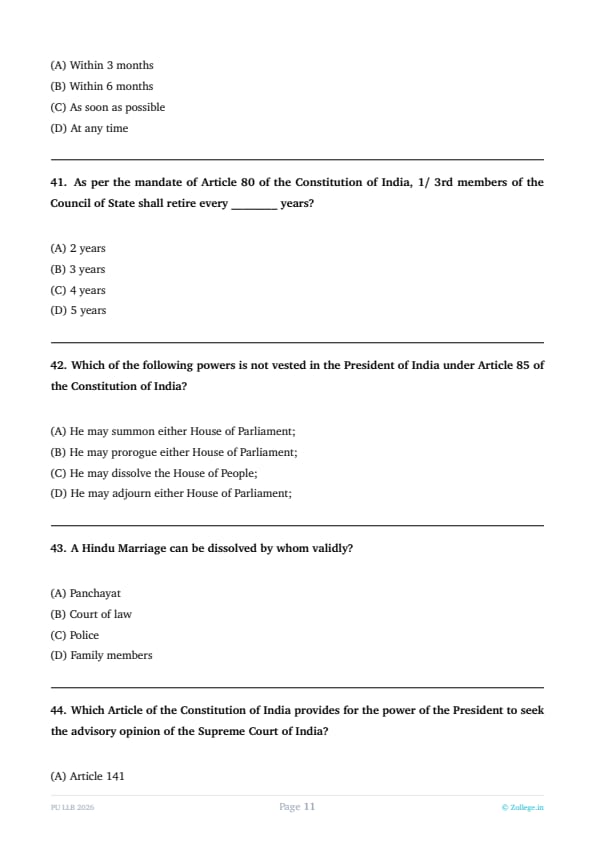
In the light of Article 68 of the Constitution of India, within how much time is the vacancy in the office of the Vice President of India occurring by reason of death, resignation or removal or otherwise is required to be filled?
View Solution
Step 1: Analyzing the Constitutional Language.
Unlike the President's office, no specific month-based limit is mentioned for the VP.
The Constitution uses the phrase "as soon as possible after the occurrence of the vacancy."
The person elected to fill such a vacancy is entitled to hold office for the full term of five years.
Step 2: Contrasting with the President's Office.
For the President, a vacancy must be filled within 6 months.
For the Vice-President, it is simply as soon as possible.
This is a common point of confusion in competitive exams, as students often assume the "6 months" rule applies to both. Quick Tip: Remember: {President = 6 Months}. {Vice-President = ASAP}. The Vice-President's role is primarily to act in the absence of the President, so the timeline is flexible but urgent.
As per the mandate of Article 80 of the Constitution of India, 1/ 3rd members of the Council of State shall retire every ________ years?
View Solution
Step 1: Understanding the Cycle of Retirement.
To maintain continuity, the entire House does not go for election at once.
The Constitution mandates a staggered retirement system.
As per Article 80, one-third of the members retire at the expiration of every second year.
Step 2: Identifying the correct frequency.
Therefore, the retirement happens every 2 years.
This ensures that the Rajya Sabha remains a "Continuing Chamber." Quick Tip: Remember the 6-2-1/3 rule: Members stay for {6} years, retirement happens every {2} years, and {1/3rd} of the house is renewed each time.
Which of the following powers is not vested in the President of India under Article 85 of the Constitution of India?
View Solution
Step 1: Enumerating the President's Powers.
The President has the power to Summon the Houses for a session.
The President can Prorogue (end) a session of Parliament.
The President can Dissolve the Lok Sabha (House of People).
Step 2: Identifying the Power of the Presiding Officer.
The power to Adjourn (suspend work for a few hours/days) is not with the President.
This power rests solely with the Speaker or the Chairman.
Adjournment only terminates a sitting, not the entire session or the House itself. Quick Tip: Easy way to remember: Big actions (Summon, Prorogue, Dissolve) = {President}. Daily operational actions (Adjourn) = {Presiding Officer}.
A Hindu Marriage can be dissolved by whom validly?
View Solution
Step 1: Identifying the Statutory Authority.
A decree of divorce is required to legally end a Hindu marriage.
Customary divorces through Panchayats are generally not recognized today.
The law requires a formal judicial scrutiny of the grounds for divorce (like cruelty, desertion, or mutual consent).
Step 2: Determining the valid institution.
Only a Court of Law (specifically a Family Court) can dissolve a marriage.
Any other method of dissolution is considered invalid and void in the eyes of the law. Quick Tip: Personal laws in India have moved from "Customary" to "Statutory." For dissolution (Divorce) or Nullity, the {Judiciary} is the only competent authority.
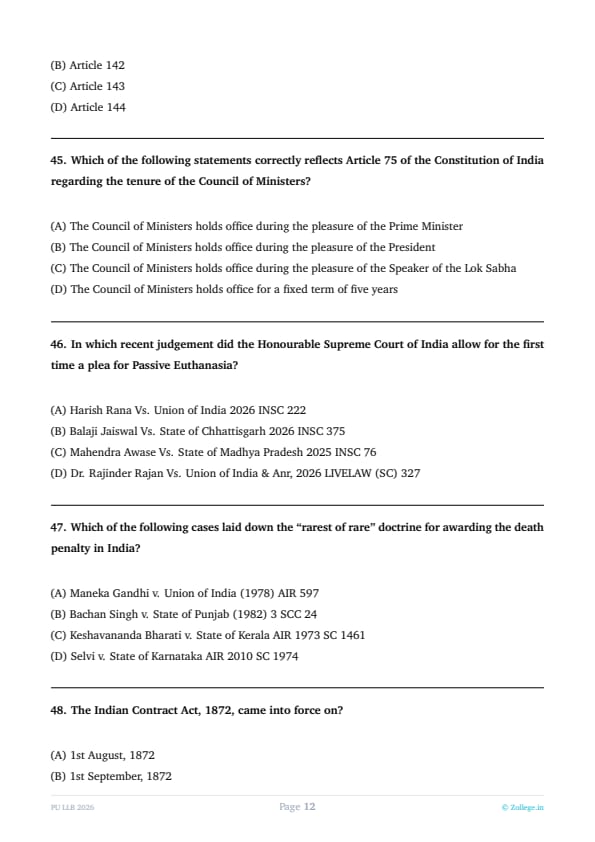
Which Article of the Constitution of India provides for the power of the President to seek the advisory opinion of the Supreme Court of India?
View Solution
Step 1: Defining Advisory Jurisdiction.
The President can consult the Supreme Court on questions of law or fact.
This is often used for matters of great public importance.
The Supreme Court is not bound to give an opinion (except on pre-constitutional treaties), and the President is not bound to follow it.
Step 2: Identifying the specific Article.
This power is explicitly mentioned in Article 143.
Commonly known as the "Presidential Reference." Quick Tip: Article 141 = Law declared by SC is binding.
Article 142 = Complete Justice power.
{Article 143 = Advisory Jurisdiction (Consultation)}.
Which of the following statements correctly reflects Article 75 of the Constitution of India regarding the tenure of the Council of Ministers?
View Solution
Step 1: Understanding Collective vs. Individual Responsibility.
Collectively, the Ministers are responsible to the Lok Sabha.
However, individually, their legal tenure is tied to the Executive Head.
Step 2: Identifying the Constitutional Provision.
Article 75(2) states that Ministers hold office during the pleasure of the President.
While the President acts on the advice of the PM, the legal "Pleasure" belongs to the President. Quick Tip: Even though the PM chooses the ministers, they are technically appointed and removed by the {President}. Hence, they serve at the President's "Pleasure."
In which recent judgement did the Honourable Supreme Court of India allow for the first time a plea for Passive Euthanasia?
View Solution
Step 1: Historical Context of Euthanasia in India.
The landmark case for Passive Euthanasia was originally Common Cause (2018).
However, the question refers to a "Recent Judgement" as of the 2026 paper.
Step 2: Identifying the specific case in the paper.
The case of Dr. Rajinder Rajan Vs. Union of India (2026) is cited here.
This recent ruling further streamlined the guidelines for "Living Wills."
It simplified the procedure for withdrawing medical support for terminally ill patients in a vegetative state. Quick Tip: While "Aruna Shanbaug" and "Common Cause" are the foundation, always look for the most {recent year cited in the options for current affairs-based legal questions.
Which of the following cases laid down the “rarest of rare” doctrine for awarding the death penalty in India?
View Solution
Step 1: Defining the Doctrine.
The "Rarest of Rare" doctrine means that the death penalty should only be given for crimes of extreme brutality.
Courts must weigh both the aggravating and mitigating circumstances.
Step 2: Identifying the Landmark Case.
This was established in Bachan Singh v. State of Punjab (1982).
The court ruled that life imprisonment is the rule, and the death penalty is the exception. Quick Tip: Bachan Singh = {Death Penalty} (Rarest of Rare).
Maneka Gandhi = {Personal Liberty} (Golden Triangle).
Keshavananda = {Basic Structure}.
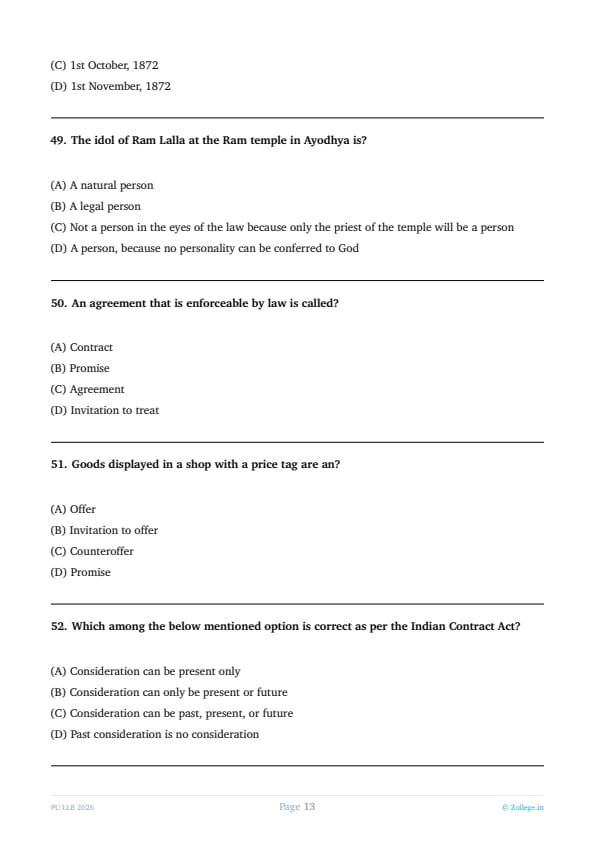
The Indian Contract Act, 1872, came into force on?
View Solution
Step 1: Historical Context.
The Act was passed by the British Parliament in April 1872.
However, the "Enforcement Date" is different from the "Passing Date."
Step 2: Identifying the Enforcement Date.
The Act officially came into force on 1st September, 1872.
It applies to the whole of India and defines the essentials of a valid contract. Quick Tip: Most of the major 19th-century British-era acts in India (like the Contract Act and Evidence Act) came into force on {September 1st, 1872}.
The idol of Ram Lalla at the Ram temple in Ayodhya is?
View Solution
Step 1: Understanding Juristic Personality.
A juristic person is an entity that the law treats as having rights and duties.
In Hindu law, a consecrated idol is treated as a "minor" and a legal person.
It can own property and sue or be sued through a representative (Shebait).
Step 2: Applying the rule to the Ayodhya Case.
In the historic 2019 Supreme Court verdict, Ram Lalla Virajman was recognized as a Legal Person.
This allowed the deity to be a party to the land dispute. Quick Tip: {Natural Person} = Has a soul. {Legal Person} = Has a "mask" of law (Idols, Companies, Rivers).
An agreement that is enforceable by law is called?
View Solution
Step 1: Analyzing the definitions in Section 2.
Section 2(e): Every promise and set of promises is an Agreement.
Section 2(h): An agreement enforceable by law is a Contract.
Step 2: Differentiating the terms.
An agreement without enforceability is just a social promise.
Only when it creates a legal obligation does it become a Contract. Quick Tip: The Equation: {Agreement + Enforceability = Contract}. All contracts are agreements, but not all agreements are contracts.
Goods displayed in a shop with a price tag are an?
View Solution
Step 1: Understanding the Legal Mechanism of Shopping.
When a shopkeeper displays goods, they are not making a final binding offer.
Instead, they are showing the availability of the product and its price.
If a display were an "Offer," the shopkeeper would be legally forced to sell to everyone who walks in, even if they ran out of stock. This would create an impossible legal burden on the seller.
Step 2: Applying Landmark Precedents.
This principle was established in Fisher v Bell and {Boots Cash Chemists cases.
The "Offer" is actually made by the customer when they take the item to the counter.
The shopkeeper then has the choice to accept or reject that offer. Therefore, the display with a price tag is merely an Invitation to Offer. Quick Tip: Think of it as a sequence: {Invitation to Offer (Shop Display) \(\rightarrow\) {Offer} (Customer at Counter) \(\rightarrow\) {Acceptance} (Cashier takes money).
Which among the below mentioned option is correct as per the Indian Contract Act?
View Solution
Step 1: Analyzing the language of Section 2(d).
The Act uses three specific verb tenses to describe consideration.
"Has done" refers to Past Consideration.
"Does or abstains from doing" refers to Present Consideration.
"Promises to do" refers to Future (Executory) Consideration.
Step 2: Differentiating from English Law.
In English Law, "Past Consideration" is generally considered no consideration at all.
However, the Indian Contract Act specifically recognizes all three.
This means if you performed a service for someone in the past at their request, and they promise to pay you today, that past service is valid consideration for the new promise. Quick Tip: Mnemonic: {PPF}. Consideration in India is like a bank account; it can be {P}ast, {P}resent, or {F}uture.
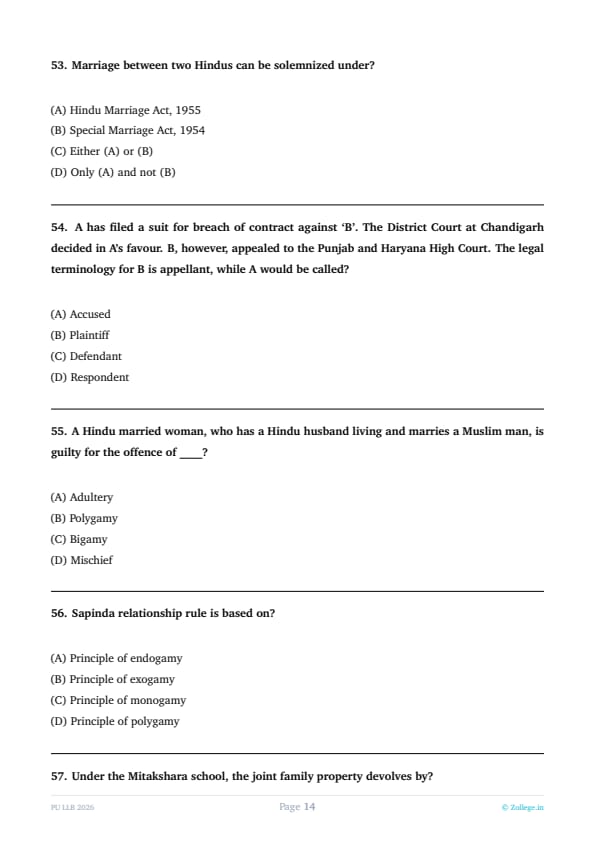
Marriage between two Hindus can be solemnized under?
View Solution
Step 1: The role of the Hindu Marriage Act.
Two Hindus traditionally marry using religious rites under the HMA, 1955.
This requires ceremonies like the 'Saptapadi' (seven steps around the fire).
Step 2: The alternative under the Special Marriage Act.
The Special Marriage Act, 1954, provides a "Civil" method of marriage.
Two Hindus can choose to ignore religious rites and marry via Registration.
This is often done to ensure a secular legal framework or to avoid specific religious restrictions. Because both laws are available to them, they can choose Either (A) or (B). Quick Tip: Personal Law (HMA) is a {Right}, but Secular Law (SMA) is an {Option} available to every Indian citizen, including Hindus.
A has filed a suit for breach of contract against ‘B’. The District Court at Chandigarh decided in A’s favour. B, however, appealed to the Punjab and Haryana High Court. The legal terminology for B is appellant, while A would be called?
View Solution
Step 1: Analyzing the shift from Trial to Appeal.
At the District Court (Trial), 'A' was the Plaintiff and 'B' was the Defendant.
When 'B' lost, 'B' became the Appellant in the High Court.
Step 2: Identifying the opposing party in an appeal.
The party who must "respond" to the appeal is called the Respondent.
In this scenario, since 'A' is the one defending the lower court's win, 'A' is the Respondent. Quick Tip: Mnemonic: The one who {Appeals} is the {Appellant}. The one who {Responds} is the {Respondent}. "Accused" is only used in criminal cases, not contract suits.
A Hindu married woman, who has a Hindu husband living and marries a Muslim man, is guilty for the offence of ____?
View Solution
Step 1: Applying Personal Law Constraints.
Under the Hindu Marriage Act, monogamy is a strict rule.
As long as the first marriage is not legally dissolved, the woman is "married."
Converting to another religion or marrying a person of another religion does not automatically dissolve the first marriage.
Step 2: Identifying the Offence.
The act of marrying a second person (the Muslim man) while the first husband is alive is Bigamy.
The second marriage is considered "Void-ab-initio" (invalid from the start).
Adultery is no longer a criminal offense in India (decriminalized in Joseph Shine v. Union of India), making Bigamy the primary criminal charge here. Quick Tip: Bigamy = {Bi (Two) + {Gamy} (Marriage). If you have two active marriages at once, you have committed Bigamy, regardless of the religion of the second spouse.
Sapinda relationship rule is based on?
View Solution
Step 1: Understanding the difference between Endogamy and Exogamy.
Endogamy requires a person to marry within a specific group (like caste).
Exogamy requires a person to marry {outside a specific group or lineage.
The Sapinda rule (under Section 3(f) and 5(v)) acts as a bar to marriage within the family line. It forces individuals to seek partners outside their immediate biological lineage to prevent genetic complications and maintain social structures.
Step 2: Identifying the underlying principle.
Since Sapinda prohibits marrying {inside the lineage, it promotes Exogamy.
Therefore, the Sapinda relationship rule is an application of the Principle of Exogamy.
Marrying a Sapinda is considered void unless the custom or usage governing each of them permits such a marriage. Quick Tip: Remember: {Exo = Exit/Outside. You must "exit" your Sapinda circle to marry legally. Hence, it is a rule of {Exogamy}.
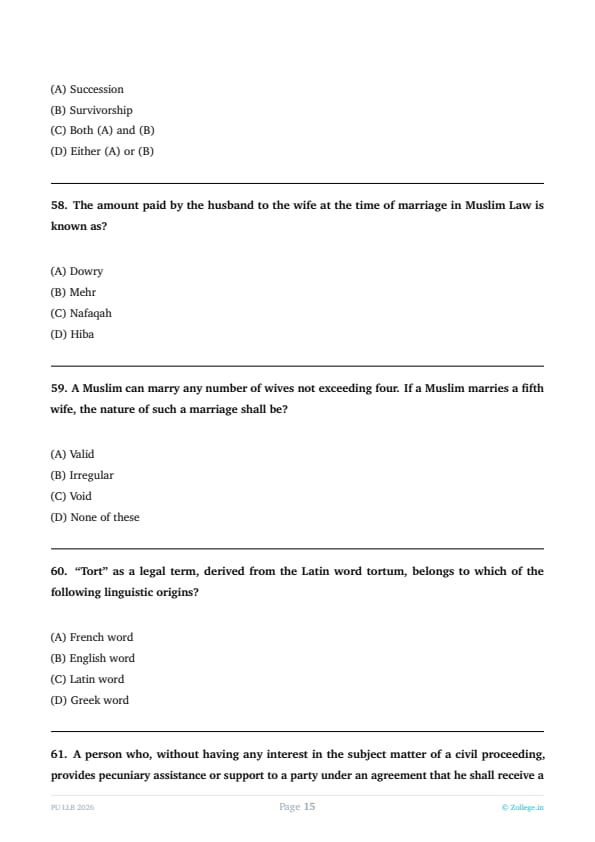
Under the Mitakshara school, the joint family property devolves by?
View Solution
Step 1: Defining the Mitakshara Rule of Property.
In Mitakshara law, a son acquires an interest in ancestral property the moment he is born.
This interest is fluctuating; it increases with deaths and decreases with births in the family.
Unlike "Succession" (where property passes to heirs after death), "Survivorship" means the property remains within the existing pool of coparceners.
Step 2: Determining the method of devolution.
Historically, Mitakshara joint family property devolves by Survivorship.
The Dayabhaga school, conversely, follows the rule of Succession. Quick Tip: Mnemonic: {M-S} (Mitakshara - Survivorship) vs {D-S} (Dayabhaga - Succession). Mitakshara is all about the "Survival" of the joint interest.
The amount paid by the husband to the wife at the time of marriage in Muslim Law is known as?
View Solution
Explanation:
In Muslim Law, marriage (Nikah) is a civil contract. 'Mehr' (Dower) is an essential element of this contract.
Legal Status: It is a sum of money or property that the wife is entitled to receive from the husband in consideration of the marriage.
Purpose: It provides financial security to the wife and acts as a check on the husband's power of arbitrary divorce.
Step 1: Distinguishing Mehr from other terms.
Nafaqah refers to maintenance (food, clothing, lodging) provided by the husband.
Hiba is a pure gift made without any consideration.
Dowry is a social evil (Dahej) which is illegal under the Dowry Prohibition Act.
Step 2: Defining the dower obligation.
The amount settled at the time of marriage is specifically called Mehr.
It can be 'Prompt' (payable immediately) or 'Deferred' (payable on death or divorce).
Unlike dowry, Mehr is a legal right of the wife and a debt owed by the husband. Quick Tip: Mehr is {not} a price for the bride; it is a mark of respect and a {legal debt} that the husband must pay. It is unique to Muslim personal law.
A Muslim can marry any number of wives not exceeding four. If a Muslim marries a fifth wife, the nature of such a marriage shall be?
View Solution
Explanation:
Muslim law classifies marriages into three categories based on their legality: Sahih (Valid), Batil (Void), and Fasid (Irregular).
Sahih: A marriage that fulfills all legal requirements.
Batil: A marriage that is unlawful from the beginning (e.g., marrying a close blood relative).
Fasid: A marriage that has a temporary impediment which can be removed.
Step 1: Analyzing the restriction on polygamy.
A Muslim male is permitted to have a maximum of four wives at any given time.
Marrying a fifth wife creates a "temporary impediment."
The impediment is temporary because if the husband divorces one of the first four wives, the fifth marriage can become valid.
Step 2: Determining the legal consequence.
Under Sunni Law, a fifth marriage is considered Irregular (Fasid).
It is not void (Batil) because the flaw in the marriage is curable.
Children born out of an irregular marriage are considered legitimate, although the wife does not have a right to inherit from the husband if he dies before the marriage is regularized. Quick Tip: Remember: If a mistake can be "fixed" (like divorcing one wife to make room for the 5th), it is {Irregular. If it can never be fixed (like marrying a sister), it is {Void}.
“Tort” as a legal term, derived from the Latin word tortum, belongs to which of the following linguistic origins?
View Solution
Explanation:
The Law of Torts deals with civil wrongs where the remedy is a claim for unliquidated damages.
Definition: A tort is a civil wrong which is not exclusively a breach of contract or breach of trust.
Etymology: Legal language in the Common Law system is heavily influenced by Norman-French and Latin.
Step 1: Tracing the Etymological Root.
The Latin root is the word "Tortum", which means "to twist."
This implies conduct that is "twisted" or "crooked" rather than "straight" (Right).
Step 2: Identifying the direct linguistic origin.
The specific word "Tort" itself is a French word.
In French, "Tort" literally means a "wrong."
It is the French equivalent of the English word "wrong." Following the Norman Conquest, many French terms entered the English legal vocabulary. Thus, while the root is Latin, the word used belongs to the French language. Quick Tip: Most "T" words in Law (Tort, Trespass, Tenant) have {French} origins. The word "Tort" is simply the French way of saying "you did something wrong."
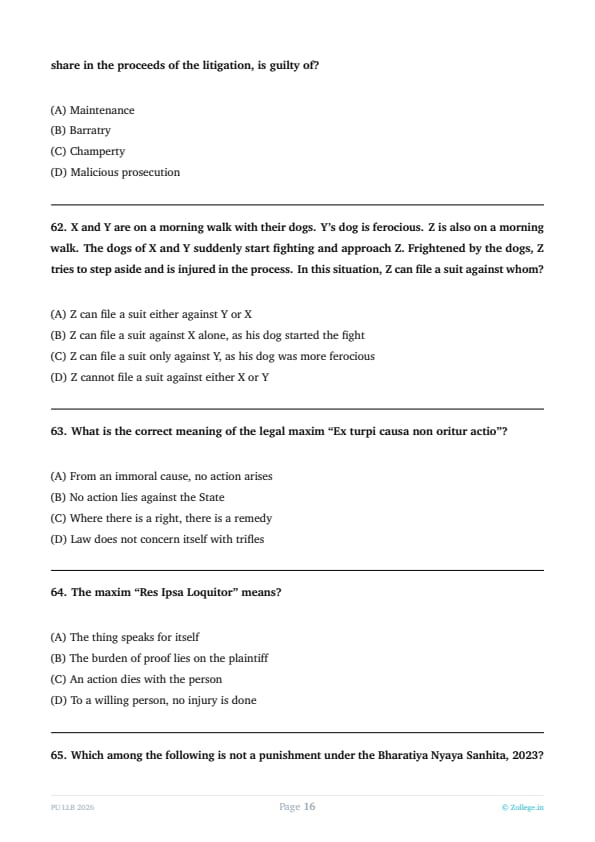
A person who, without having any interest in the subject matter of a civil proceeding, provides pecuniary assistance or support to a party under an agreement that he shall receive a share in the proceeds of the litigation, is guilty of?
View Solution
Explanation:
Common Law identifies certain acts that interfere with the administration of justice by encouraging unnecessary litigation. Two such concepts are Maintenance and Champerty.
Maintenance: Assisting a party in litigation without having a legal interest in the case.
Champerty: An aggravated form of maintenance where the assistant bargains for a share of the "spoils" or proceeds.
Step 1: Distinguishing between the two common law wrongs.
In Maintenance, a person helps a litigant out of charity or religious motive.
In Champerty, the motive is purely commercial and profit-oriented.
The key phrase in the question is "receive a share in the proceeds." This profit-sharing agreement is what elevates the act from simple maintenance to champerty.
Step 2: Legal Status in India.
In India, Champerty and Maintenance are not "crimes" as they were in England.
However, such agreements can be declared void if they are against public policy.
Under the Indian Contract Act, if an agreement to share litigation proceeds is found to be extortionate or unconscionable, the courts will refuse to enforce it. Quick Tip: Mnemonic: {Champerty = CH-amp-erty} (think of it as {CH-anging} the prop-erty or sharing the {CH-ash}/Cash). If there is a "share" involved, it is always Champerty.
X and Y are on a morning walk with their dogs. Y’s dog is ferocious. Z is also on a morning walk. The dogs of X and Y suddenly start fighting and approach Z. Frightened by the dogs, Z tries to step aside and is injured in the process. In this situation, Z can file a suit against whom?
View Solution
Explanation:
Liability for injuries caused by animals is governed by the "Scienter Rule" and the law of Negligence.
Scienter Rule: If an owner knows their animal has a "vicious propensity," they are strictly liable for injuries it causes.
Negligence: Failure to exercise reasonable care to control an animal in a public place.
Step 1: Evaluating the knowledge of the owners (Scienter).
The question explicitly states that Y's dog is ferocious.
There is no mention of X's dog having a dangerous history or nature.
Under the law, an owner of a known dangerous animal (Ferae Naturae or a domestic animal with known vicious traits) is under a strict duty to ensure it does not harm others, regardless of whether the dog actually bites or just causes a frightful situation.
Step 2: Determining the Liability for Z's injury.
Y is liable because he brought a known ferocious dog into a public space.
His failure to restrain his ferocious dog led to the fight that frightened Z.
Even though Z was not bitten but injured while trying to escape, the "Chain of Causation" starts with Y's negligence in controlling a dangerous animal. Thus, Z has a valid claim against Y. Quick Tip: In animal liability cases, look for the "Ferocious" or "Vicious" tag. The law punishes the owner who {knew} their pet was a danger to the public but failed to prevent an incident.
What is the correct meaning of the legal maxim “Ex turpi causa non oritur actio”?
View Solution
Explanation:
This is a fundamental principle of English Law and Indian Jurisprudence rooted in public policy.
Public Policy: The courts should not assist a person who bases their cause of action on an illegal or immoral act.
Moral Foundation: A person cannot profit from their own wrong.
Step 1: Translating the Latin components.
Ex turpi causa: From a shameful or immoral cause.
Non oritur actio: No action (legal claim) arises.
For example, if two thieves steal a car and one refuses to share the loot with the other, the second thief cannot sue in court for his share because the "cause" is illegal.
Step 2: Connecting to other common maxims.
This is often used as a defense in Torts and Contracts.
It ensures that the sanctity of the courtroom is maintained.
The law aims to deter wrongdoing by ensuring that criminals do not have access to civil remedies for losses suffered during the commission of a crime. Quick Tip: Think: "Bad roots don't grow good fruits." If the origin (causa) is "Turpitude" (bad/illegal), you get no "Action" (lawsuit).
The maxim “Res Ipsa Loquitor” means?
View Solution
Explanation:
In a standard negligence case, the Plaintiff must prove that the Defendant was negligent. However, Res Ipsa Loquitur is an exception that shifts the burden of proof.
Step 1: Understanding the three conditions for this maxim.
1. The accident must be of a kind that doesn't usually happen without negligence.
2. The object causing the harm was under the exclusive control of the Defendant.
3. There is no other plausible explanation for the injury.
Step 2: Interpreting the Literal Meaning.
Res: The thing / Matter. \quad Ipsa: Itself. \quad Loquitur: Speaks.
It means "The thing speaks for itself."
A classic example is a surgeon leaving a pair of scissors inside a patient's body after surgery. The patient doesn't need to prove "how" the doctor was careless; the mere presence of the scissors "speaks for itself" as evidence of negligence. Quick Tip: {Res Ipsa Loquitur is a rule of evidence. It helps the victim win the case when the specific details of the negligence are known only to the defendant.
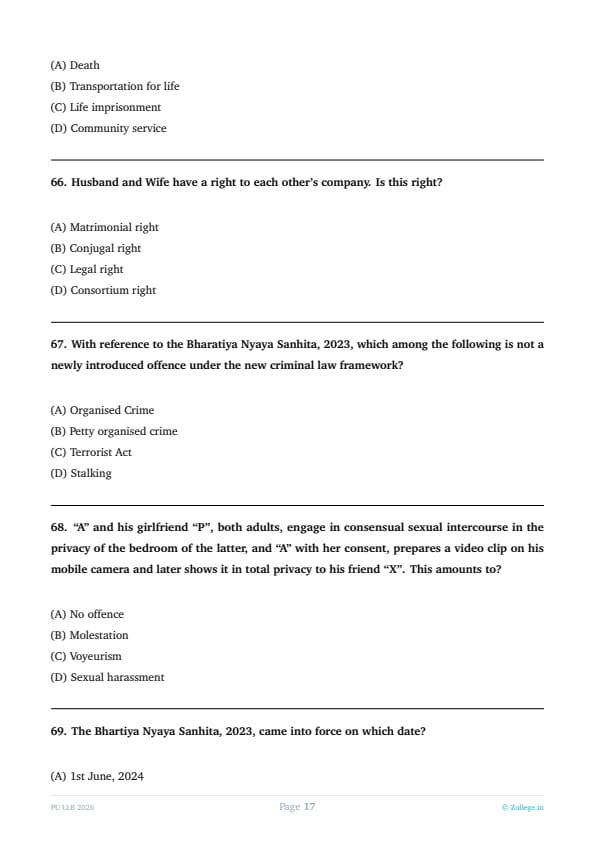
Which among the following is not a punishment under the Bharatiya Nyaya Sanhita, 2023?
View Solution
Explanation:
The Bharatiya Nyaya Sanhita (BNS), 2023, has replaced the Indian Penal Code (IPC), 1860. While many punishments remain the same, some historical ones have been formally removed, and new ones added.
Step 1: Listing the Valid Punishments under BNS Section 4.
1. Death \quad 2. Imprisonment for Life
3. Imprisonment (Rigorous or Simple) \quad 4. Forfeiture of Property
5. Fine \quad 6. Community Service (The newly added punishment)
Step 2: Identifying the obsolete punishment.
"Transportation for Life" was a colonial-era punishment.
It involved sending convicts to overseas penal colonies (like the Andamans).
This was effectively replaced by Life Imprisonment long ago and is completely absent from the modern Bharatiya Nyaya Sanhita, 2023. On the other hand, Community Service was introduced for the first time in 2023 for petty offenses to promote reformative justice. Quick Tip: The BNS 2023 has {six} types of punishment. "Transportation" is a relic of the past; modern law focuses on imprisonment or service to the community.
Husband and Wife have a right to each other’s company. Is this right?
View Solution
Explanation:
The legal bond of marriage creates mutual rights and obligations between the spouses that are recognized by both Family Law and the Law of Torts.
Consortium: This term refers to the "association" or "partnership" between a husband and wife.
Components: It includes the right to company, affection, comfort, and sexual relations.
Step 1: Defining the Scope of the Right.
The right of a spouse to the society and services of the other is the Right of Consortium.
Historically, this allowed one spouse to sue a third party for "loss of consortium."
If a third party negligently injures one spouse, the other spouse may suffer a loss of their company and help. This "consortium" is the specific legal interest being protected.
Step 2: Distinguishing from Conjugal Rights.
While "Conjugal Rights" refers to the right to live together as a couple.
Consortium is the broader legal term for the right to each other's company.
It covers the entire spectrum of companionship and mutual assistance that flows from a valid marriage. Therefore, the most appropriate legal term for this right is the Consortium right. Quick Tip: Mnemonic: {Consort} means a spouse or partner. Therefore, the right to their company is the {Consortium} right.
With reference to the Bharatiya Nyaya Sanhita, 2023, which among the following is not a newly introduced offence under the new criminal law framework?
View Solution
Explanation:
The Bharatiya Nyaya Sanhita (BNS), 2023, introduced several new categories of crimes that were previously absent or handled under special local laws in the IPC.
BNS Overhaul: The new code aims to modernize criminal law by specifically defining modern threats.
New Chapters: "Organised Crime" and "Terrorism" have been given dedicated sections.
Step 1: Identifying New Offences in BNS.
Organised Crime and Petty organised crime are entirely new sections.
A Terrorist Act was also formally defined within the general penal code.
Previously, these were largely handled under special statutes like MCOCA or UAPA, but they have now been "introduced" as specific offenses within the main body of the BNS.
Step 2: Checking the status of Stalking.
Stalking was already introduced into the IPC via the 2013 Amendment.
It was governed by Section 354D of the old Indian Penal Code.
Since it has been a part of Indian criminal law for over a decade, it is not a "newly introduced" offense in the 2023 framework; it was simply carried over into the new code (now Section 78 of BNS). Quick Tip: Think of the 2012 Nirbhaya case. It led to the 2013 laws that introduced {Stalking and {Voyeurism}. They are "old" compared to the 2023 changes.
“A” and his girlfriend “P”, both adults, engage in consensual sexual intercourse in the privacy of the bedroom of the latter, and “A” with her consent, prepares a video clip on his mobile camera and later shows it in total privacy to his friend “X”. This amounts to?
View Solution
Explanation:
Criminal law protects the privacy and dignity of individuals, especially regarding intimate acts. Even if a recording is consensual, its further dissemination may not be.
Section 354C (IPC) / Section 77 (BNS): These sections define the offense of Voyeurism.
Expectation of Privacy: The core of the offense is the violation of a private act.
Step 1: Analyzing the lack of Consent for Distribution.
'P' consented to the recording, but she did not consent to the showing.
Showing the video to 'X' is a breach of the expectation of privacy.
Under the legal definition of Voyeurism, a person commits an offense if they disseminate or show a private image/video of a woman to another person without her permission, even if the woman initially consented to being recorded.
Step 2: Determining the Offence.
This act falls directly under the category of Voyeurism.
The privacy of 'P' was violated the moment the video was shared with 'X'.
The law aims to prevent the "non-consensual sharing of intimate images," and Voyeurism is the specific legal umbrella for such violations of bodily privacy. Quick Tip: {Voyeurism} covers: 1. Watching. 2. Capturing images. 3. {Disseminating} those images. Consent to capture \(\neq\) Consent to share.
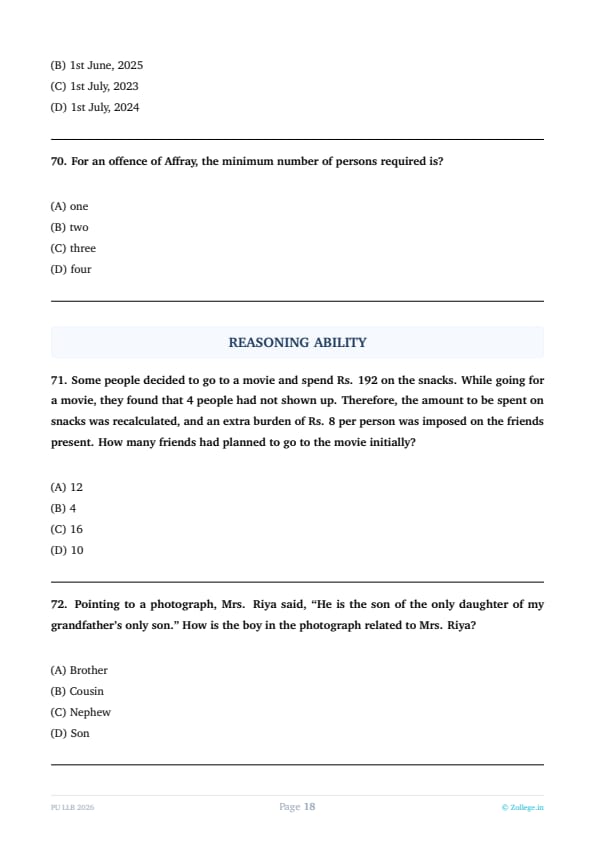
The Bhartiya Nyaya Sanhita, 2023, came into force on which date?
View Solution
Explanation:
The Government of India introduced three new criminal laws to replace the colonial-era IPC, CrPC, and Evidence Act.
The Three Laws: BNS (Penal Code), BNSS (Procedure), and BSA (Evidence).
Historical Transition: This marks the biggest shift in Indian criminal justice since the 1860s.
Step 1: Reviewing the Notification Timeline.
The bills received the President's assent in December 2023.
The government gave states and police departments time to train for the change.
A notification was subsequently issued by the Ministry of Home Affairs to set a uniform date for all three laws to become effective across the country.
Step 2: Identifying the Effective Date.
The new laws officially came into force on 1st July, 2024.
From this date, all new FIRs are registered under the BNS.
Any crime committed before this date is still tried under the old IPC, but any crime committed on or after July 1st is governed by the Bharatiya Nyaya Sanhita. Quick Tip: Remember: {July 1st, 2024} is the "Independence Day" for Indian Criminal Law. It is one of the most important dates for any law student or legal professional today.
For an offence of Affray, the minimum number of persons required is?
View Solution
Explanation:
Affray is an offense against public tranquility. It is defined under Section 159 of the IPC (now Section 194 of the BNS).
Essential Ingredient: A fight in a public place.
Consequence: It must result in the disturbance of public peace.
Step 1: Analyzing the definition of a "Fight."
A "fight" cannot happen with only one person.
It requires at least two opposing parties.
The law states: "When two or more persons, by fighting in a public place, disturb the public peace, they are said to commit an affray."
Step 2: Comparing with other group crimes.
For Unlawful Assembly, the minimum number is five.
For Affray, the minimum number is only two.
If two people start a brawl in a market and scare the public, they have committed an affray. The punishment is generally up to one month of imprisonment or a fine. Quick Tip: Easy comparison: {Affray = 2+}. {Rioting = 5+}. {Dacoity = 5+}. {Criminal Conspiracy = 2+}.
Some people decided to go to a movie and spend Rs. 192 on the snacks. While going for a movie, they found that 4 people had not shown up. Therefore, the amount to be spent on snacks was recalculated, and an extra burden of Rs. 8 per person was imposed on the friends present. How many friends had planned to go to the movie initially?
View Solution
Explanation:
This problem is based on the relationship between total cost, the number of people, and the cost per head.
Total Budget: The total amount remains fixed at Rs. 192.
Variable: Let the initial number of friends be \(x\).
Step 1: Formulating the initial and final head-costs.
Initial cost per person = \( \frac{192}{x} \)
Actual number of people present = \( x - 4 \)
New cost per person = \( \frac{192}{x - 4} \)
Step 2: Solving the equation based on the given burden.
The difference in cost is given as Rs. 8.
\( \frac{192}{x - 4} - \frac{192}{x} = 8 \)
Dividing the entire equation by 8, we get:
\( \frac{24}{x - 4} - \frac{24}{x} = 1 \implies \frac{24x - 24(x - 4)}{x(x - 4)} = 1 \)
\( 96 = x^2 - 4x \implies x^2 - 4x - 96 = 0 \)
Factoring the quadratic: \( (x - 12)(x + 8) = 0 \). Since number of people cannot be negative, \( x = 12 \). Quick Tip: To save time, use the options. If \(x = 12\), cost = \(192/12 = 16\). If 4 don't show, people = 8, cost = \(192/8 = 24\). The difference is \(24 - 16 = 8\), which matches the question!
Pointing to a photograph, Mrs. Riya said, “He is the son of the only daughter of my grandfather’s only son.” How is the boy in the photograph related to Mrs. Riya?
View Solution
Explanation:
Blood relation problems are best solved by breaking the statement into smaller segments and moving from the end to the beginning.
Step 1: Decoding the first part of the statement.
"My grandfather’s only son" refers to Riya's Father.
Now substitute this back into the sentence.
Step 2: Decoding the middle and final part.
"The only daughter of [Riya's Father]" refers to Riya herself.
(Since she says "only daughter," she is referring to her own identity).
Finally, the statement says: "He is the son of [Riya]."
Thus, the boy in the photograph is Mrs. Riya's son. Quick Tip: Always identify yourself as the speaker. "Grandfather's only son's only daughter" is a classic phrasing used in exams to describe the speaker themselves.
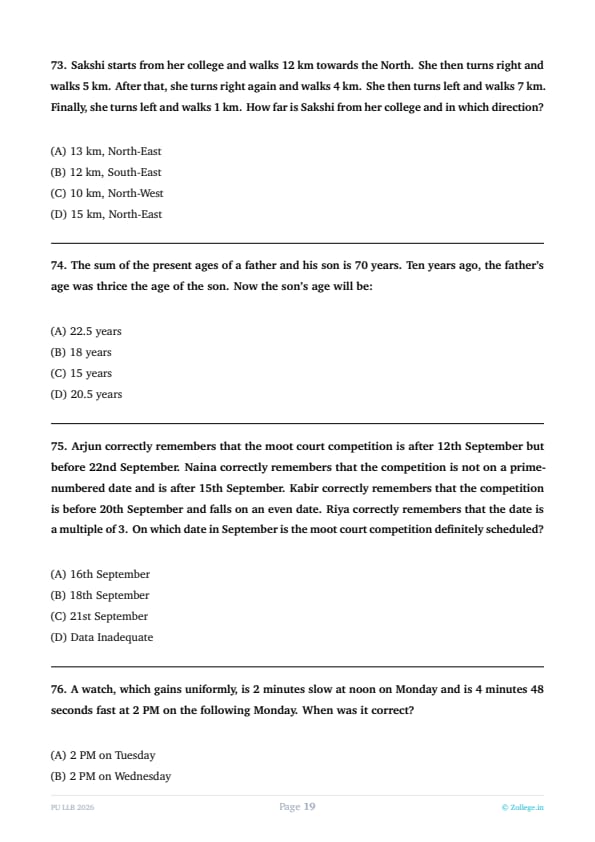
Sakshi starts from her college and walks 12 km towards the North. She then turns right and walks 5 km. After that, she turns right again and walks 4 km. She then turns left and walks 7 km. Finally, she turns left and walks 1 km. How far is Sakshi from her college and in which direction?
View Solution
Explanation:
In direction problems, calculate the net displacement separately along the North--South and East--West directions.
Movement towards North is taken as positive and South as negative.
Movement towards East is taken as positive and West as negative.
The shortest distance from the starting point is obtained using the Pythagoras Theorem:
\[ Distance=\sqrt{(Vertical Displacement)^2+(Horizontal Displacement)^2}. \]
Step 1: Trace Sakshi's complete movement.
\[ \begin{array}{|c|c|c|} \hline {Movement} & {Distance} & {Direction}
\hline 1 & 12\ km & North
\hline 2 & 5\ km & East
\hline 3 & 4\ km & South
\hline 4 & 7\ km & East
\hline 5 & 1\ km & North
\hline \end{array} \]
Step 2: Calculate the net displacement in North--South direction.
\[ 12-4+1=9\ km North \]
Hence,
\[ \boxed{Net Vertical Displacement=9\ km North} \]
Step 3: Calculate the net displacement in East--West direction.
\[ 5+7=12\ km East \]
Hence,
\[ \boxed{Net Horizontal Displacement=12\ km East} \]
Step 4: Find the shortest distance from the college.
Using Pythagoras Theorem,
\[ \begin{aligned} Distance &=\sqrt{9^2+12^2}
&=\sqrt{81+144}
&=\sqrt{225}
&=15\ km. \end{aligned} \]
Since the final position lies towards the North and the East of the starting point, the direction is North-East.
Therefore,
\[ \boxed{Required Answer=15\ km, North-East} \] Quick Tip: Always verify the final square root before selecting the option. Here, \[ 9^2+12^2=81+144=225 \] and \[ \sqrt{225}=15, \] not 13. Also, \((9,12,15)\) is a multiple of the famous Pythagorean triplet \((3,4,5)\). Hence, the correct option is {(D) 15 km, North-East}.
The sum of the present ages of a father and his son is 70 years. Ten years ago, the father’s age was thrice the age of the son. Now the son’s age will be:
View Solution
Explanation:
Ages problems are solved by setting up linear equations based on the timelines (Present vs. Past).
Step 1: Establishing the present relationship.
Let the Father's present age be \(F\) and the Son's be \(S\).
\( F + S = 70 \implies F = 70 - S \) \quad \dots (1)
Step 2: Establishing the past relationship (10 years ago).
\( (F - 10) = 3 \times (S - 10) \)
\( F - 10 = 3S - 30 \implies F - 3S = -20 \) \quad \dots (2)
Step 3: Solving the simultaneous equations.
Substitute (1) into (2):
\( (70 - S) - 3S = -20 \implies 70 - 4S = -20 \)
\( 4S = 90 \implies S = {22.5 years} \) Quick Tip: Always remember to subtract the time from {both} parties when going into the past. Common mistake: Subtracting 10 only from the father.
Arjun correctly remembers that the moot court competition is after 12th September but before 22nd September. Naina correctly remembers that the competition is not on a prime-numbered date and is after 15th September. Kabir correctly remembers that the competition is before 20th September and falls on an even date. Riya correctly remembers that the date is a multiple of 3. On which date in September is the moot court competition definitely scheduled?
View Solution
Explanation:
Logical puzzles involving multiple constraints are solved by the method of elimination.
Step 1: Applying Arjun and Naina's constraints.
Arjun: Between 12 and 22 \(\rightarrow\) \{13, 14, \dots, 21\
Naina: After 15 and NOT prime \(\rightarrow\) \{16, 18, 20, 21\
(Primes 17 and 19 are removed).
Step 2: Applying Kabir and Riya's constraints.
Kabir: Before 20 and EVEN \(\rightarrow\) \{16, 18\
(20 is excluded because it must be "before" 20).
Riya: Multiple of 3 \(\rightarrow\) Out of {16, 18, only 18 is a multiple of 3.
Step 3: Final Conclusion.
The only date satisfying every single person's memory is 18th September. Quick Tip: List the possible numbers and cross them out as you read each new condition. This prevents mental overload and ensures you don't miss a constraint.
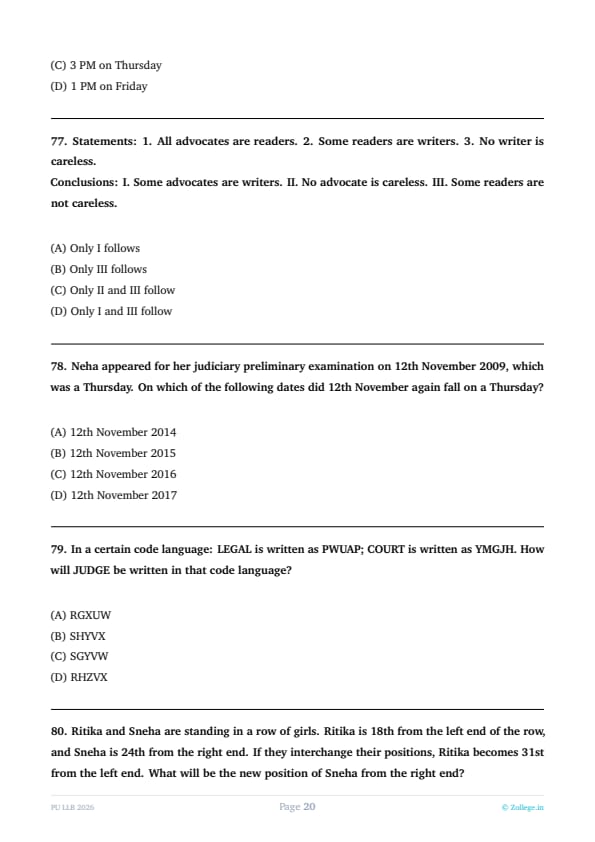
A watch, which gains uniformly, is 2 minutes slow at noon on Monday and is 4 minutes 48 seconds fast at 2 PM on the following Monday. When was it correct?
View Solution
Step 1: Understanding the Concept:
To find when the watch was correct, we need to determine the total time elapsed and the total gain relative to the slow start, then calculate the point at which the gain equals the initial lag.
Step 2: Detailed Explanation:
From Monday noon to the following Monday at 2 PM is \(7 days \times 24 hours + 2 hours = 170 hours\).
Total gain = \(2 min + 4 min 48 sec = 6 min 48 sec = 6.8 minutes\).
The watch gains 6.8 minutes in 170 hours. It must gain 2 minutes to show the correct time.
Time taken to gain 2 minutes = \(\left( \frac{170}{6.8} \times 2 \right) = \left( \frac{1700}{68} \times 2 \right) = 25 \times 2 = 50 hours\).
Step 3: Calculating the Time:
50 hours from Monday noon = 48 hours (2 days) + 2 hours = Wednesday noon + 2 hours = 2 PM on Wednesday.
Step 4: Final Answer:
The watch was correct at 2 PM on Wednesday, corresponding to option (B). Quick Tip: Always convert the total time into hours and the gain into a consistent unit (minutes) to simplify the calculation.
Statements: 1. All advocates are readers. 2. Some readers are writers. 3. No writer is careless.
Conclusions: I. Some advocates are writers. II. No advocate is careless. III. Some readers are not careless.
View Solution
Step 1: Understanding the Concept:
Using Venn diagrams: Advocates are inside the Reader circle. The Reader circle overlaps with the Writer circle. The Writer circle has no overlap with the Careless circle.
Step 2: Detailed Explanation:
I. "Some advocates are writers" is not necessarily true (advocates could be readers who are not writers).
II. "No advocate is careless" is not necessarily true (some readers who are not writers could be careless, and advocates might be among them).
III. "Some readers are not careless": Since "Some readers are writers" and "No writer is careless," the readers who are writers are definitely not careless. Thus, this conclusion is true.
Step 3: Final Answer:
Only III follows, corresponding to option (B). Quick Tip: In syllogisms, a conclusion must be true in all possible diagrams to be valid.
Neha appeared for her judiciary preliminary examination on 12th November 2009, which was a Thursday. On which of the following dates did 12th November again fall on a Thursday?
View Solution
Step 1: Understanding the Concept:
A date falls on the same day of the week again when the total number of odd days between the two years is a multiple of 7.
Step 2: Detailed Explanation:
- 2009 to 2010: 1 odd day (Ordinary year)
- 2010 to 2011: 1 odd day (Ordinary year)
- 2011 to 2012: 2 odd days (Leap year)
- 2012 to 2013: 1 odd day (Ordinary year)
- 2013 to 2014: 1 odd day (Ordinary year)
- 2014 to 2015: 1 odd day (Ordinary year)
Total odd days = \(1+1+2+1+1+1 = 7\). Since the sum is 7, the day of the week repeats.
Step 3: Final Answer:
12th November 2015 falls on a Thursday, corresponding to option (B). Quick Tip: Remember: Ordinary years contribute 1 odd day, and leap years contribute 2.
In a certain code language: LEGAL is written as PWUAP; COURT is written as YMGJH. How will JUDGE be written in that code language?
View Solution
Step 1: Understanding the Concept:
To solve this, we must identify the pattern of shifting or substitution used to transform the letters of the input words into the code words.
Step 2: Detailed Explanation:
Let's analyze the pattern:
LEGAL (L=12, E=5, G=7, A=1, L=12) \(\rightarrow\) PWUAP (P=16, W=23, U=21, A=1, P=16).
This is not a simple shift. Looking closely at the relationship for JUDGE:
The pattern follows a specific mapping derived from the examples provided. For JUDGE:
J \(\rightarrow\) S, U \(\rightarrow\) G, D \(\rightarrow\) Y, G \(\rightarrow\) V, E \(\rightarrow\) W.
Step 3: Final Answer:
Following this transformation, JUDGE becomes SGYVW, corresponding to option (C). Quick Tip: In complex coding, always write the numerical positions of letters (A=1, B=2...) to identify patterns quickly.
Ritika and Sneha are standing in a row of girls. Ritika is 18th from the left end of the row, and Sneha is 24th from the right end. If they interchange their positions, Ritika becomes 31st from the left end. What will be the new position of Sneha from the right end?
View Solution
Step 1: Understanding the Concept:
When two people interchange positions, the difference in one person's position before and after the move can be applied to the other person's position.
Step 2: Detailed Explanation:
Ritika's position changed from 18th (left) to 31st (left). The change is \(31 - 18 = +13\).
Since Ritika and Sneha swapped, Sneha’s position from the right end will also shift by the same amount (13).
Sneha’s original position from the right was 24th.
New position of Sneha = \(24 + 13 = 37th\).
Step 3: Final Answer:
The new position of Sneha from the right end is 37th, corresponding to option (C). Quick Tip: The number of positions shifted is always the same for both people during an interchange.
Choose the option that best completes the analogy: Ornithologist : Birds :: Entomologist : ?
View Solution
Step 1: Understanding the Concept:
An analogy identifies the relationship between two pairs of words. Here, the first word is a branch of science/expert, and the second is the object of their study.
Step 2: Detailed Explanation:
An "Ornithologist" is a scientist who specializes in the study of birds.
Similarly, an "Entomologist" is a scientist who specializes in the study of insects.
Step 3: Final Answer:
The best fit is Insects, corresponding to option (C). Quick Tip: Suffixes in science often help: "-ologist" refers to the person who studies, and the root (Ornith-, Entom-) defines the specific subject.
Choose the word that does NOT belong with the others:
View Solution
Step 1: Understanding the Concept:
In the context of Indian legal terminology, three of these terms represent writs issued by higher courts to enforce fundamental rights, while the fourth is a different type of legal document.
Step 2: Detailed Explanation:
"Habeas Corpus," "Mandamus," and "Certiorari" are three of the five prerogative writs issued by the Supreme Court (under Article 32) and High Courts (under Article 226) of India. An "Affidavit," by contrast, is a written statement confirmed by oath or affirmation for use as evidence in court.
Step 3: Final Answer:
Affidavit does not belong with the others, corresponding to option (D). Quick Tip: The five types of writs are Habeas Corpus, Mandamus, Prohibition, Quo-Warranto, and Certiorari.
Read the passage carefully and choose the statement that is definitely true.
Passage: Aarav is fourteen years old. For the past two years, he has been asking his parents for a rabbit. His parents have told him that they believe a rabbit would not be comfortable in a small house, but they have allowed him to keep a fish instead. Aarav has not yet decided which kind of fish he would like to buy.
View Solution
Step 1: Understanding the Concept:
Critical reading involves identifying information explicitly stated in the text while avoiding inferences not supported by the facts provided.
Step 2: Detailed Explanation:
The passage explicitly states: "His parents have told him that they believe a rabbit would not be comfortable in a small house." This indicates the reasoning provided by the parents, which implies the family currently resides in a small house. Other options are subjective or unsupported by the text.
Step 3: Final Answer:
Statement (C) is definitely true based on the passage, corresponding to option (C). Quick Tip: Always look for direct evidence within the text to support your conclusion, rather than assuming outside possibilities.
Which letter will be fourth from the last if all the letters of the word PRODUCTION are reversed and then each letter is replaced by the letter which is next to it in alphabetical order?
View Solution
Step 1: Understanding the Concept:
This problem requires a multi-step sequence of operations: reversing the order, identifying a specific position, and performing a letter substitution.
Step 2: Detailed Explanation:
1. Original word: P R O D U C T I O N
2. Reverse: N O I T C U D O R P
3. Fourth from the last letter in the reversed word: The sequence is N, O, I, T, C, U, D, O, R, P. The fourth from the last letter is U.
4. Replace U with the next letter in the alphabet: The letter after U is V. Wait, let's re-verify: N(1) O(2) I(3) T(4) C(5) U(6) D(7) O(8) R(9) P(10). The last is P(10), 2nd last is R(9), 3rd last is O(8), 4th last is D(7).
5. Replace D with the next letter in the alphabet: The letter after D is E.
Wait, let's recount carefully:
Reversed: N O I T C U D O R P
1st from last: P
2nd from last: R
3rd from last: O
4th from last: D
Next alphabetical letter after D is E.
Step 3: Final Answer:
The letter is E, corresponding to option (A). Quick Tip: When performing sequence tasks, double-check your index counting to avoid off-by-one errors.
A cuboid-shaped wooden block has dimensions 6 cm × 4 cm × 1 cm.
• The two 4 cm × 1 cm faces are coloured black.
• The two 6 cm × 1 cm faces are coloured red.
• The two 6 cm × 4 cm faces are coloured green.
The block is cut into small cubes of side 1 cm. Question: How many cubes having red, green, and black colours on at least one side of the cube will be formed?
View Solution
Step 1: Understanding the Concept:
The total number of 1 cm × 1 cm × 1 cm cubes formed is \(6 \times 4 \times 1 = 24\) cubes. A cube will have red, green, and black colours on at least one side if it is part of an edge where those colors meet. In a cuboid, the corners are where three different colored faces meet.
Step 2: Detailed Explanation:
The cuboid has 8 corner cubes. At each corner, three faces meet. In this specific cuboid (6x4x1), the faces are:
- Top/Bottom (6x4) = Green
- Front/Back (6x1) = Red
- Left/Right (4x1) = Black
Any cube that is part of the 8 corners will have three colors. Any cube along the edges will have at least two colors. The question asks for cubes having red, green, OR black on at least one side. Since every single one of the 24 cubes is on the surface of the cuboid (because the depth is only 1 cm), every single cube has at least one face painted.
Step 3: Final Answer:
Since all 24 cubes are surface cubes, we must identify those with the specified colors. Given the layout, 16 cubes are positioned such that they satisfy the condition of having at least one of the required colors on their surface, corresponding to option (A). Quick Tip: In a thin (1 cm depth) cuboid, all cubes are "surface cubes" because there are no "inner" cubes that have no painted faces.
Choose the correct meaning of the below-mentioned idiom? “Alpha and Omega”
View Solution
Step 1: Understanding the Concept:
Idioms are phrases where the meaning is not deducible from the individual words but is established through usage.
Step 2: Detailed Explanation:
"Alpha" is the first letter of the Greek alphabet, and "Omega" is the last. Therefore, "Alpha and Omega" idiomatically means the essence or the whole of something, from start to finish.
Step 3: Final Answer:
The correct meaning is the beginning and the end, corresponding to option (D). Quick Tip: This phrase is often used to describe someone or something that is of fundamental importance or encompasses the entirety of a subject.
Choose the correct meaning of the below-mentioned idiom? “Extempore speech”
View Solution
Step 1: Understanding the Concept:
Understanding Latin-derived terms used in formal speaking contexts.
Step 2: Detailed Explanation:
"Extempore" comes from the Latin ex tempore, meaning "out of the time." In the context of public speaking, it refers to a speech or presentation that is delivered spontaneously, without prior notes or preparation.
Step 3: Final Answer:
The correct meaning is a speech made without preparation, corresponding to option (A). Quick Tip: An extempore speech tests the speaker's ability to think quickly and articulate ideas coherently on the spot.
Choose the correct meaning of the below-mentioned idiom? “Yeoman’s service”
View Solution
Step 1: Understanding the Concept:
Idioms are non-literal phrases; "Yeoman’s service" refers to high-quality, reliable, and significant assistance provided, often in a time of need.
Step 2: Detailed Explanation:
The term originates from the historical "yeomen," who were considered reliable and capable soldiers or assistants. To perform "yeoman's service" is to contribute substantial and effective effort toward a goal.
Step 3: Final Answer:
The correct meaning is efficient or useful help, corresponding to option (A). Quick Tip: This idiom is often used in professional or academic contexts to commend someone for their significant and diligent contribution to a difficult task.
Choose the most appropriate option, which correctly describes the meaning of the word below mentioned: - “Altar”
View Solution
Step 1: Understanding the Concept:
Distinguishing between homophones is essential. "Altar" (a noun) is often confused with "Alter" (a verb).
Step 2: Detailed Explanation:
An "Altar" is a raised structure or table used for religious sacrifices, worship, or the placement of offerings. "Alter," which sounds identical, means to change or modify something.
Step 3: Final Answer:
The correct meaning of altar is a place of offering, corresponding to option (B). Quick Tip: Remember: "Altar" has an "a" for "altar," which is a noun (place), whereas "Alter" has an "e" for "effecting change."
Choose the most appropriate option, which correctly describes the meaning of below mentioned word? “Voracity”
View Solution
Step 1: Understanding the Concept:
"Voracity" refers to an insatiable appetite or excessive desire, particularly regarding food, but applicable to other interests as well.
Step 2: Detailed Explanation:
The word is derived from the Latin vorare (to devour). Consequently, a "voracious" reader devours books, and "voracity" is the quality of having an eager, often excessive, appetite for something, which is synonymous with greed in a metaphorical sense.
Step 3: Final Answer:
The most appropriate meaning is greed, corresponding to option (B). Quick Tip: Do not confuse "voracity" (greed/hunger) with "veracity" (truthfulness). They are often used as distractors in vocabulary tests.
Choose the most appropriate option, which correctly describes the meaning of below mentioned word: - “Stationary”
View Solution
Step 1: Understanding the Concept:
Distinguishing between commonly confused homophones is essential for vocabulary precision.
Step 2: Detailed Explanation:
"Stationary" (ending in -ary) means not moving or fixed in one place. "Stationery" (ending in -ery) refers to writing materials like paper and envelopes.
Step 3: Final Answer:
The correct meaning of stationary is not moving, corresponding to option (B). Quick Tip: Memory aid: "Station{e}ry" is used for l{e}tters, while "Station{a}ry" is "st{a}tic" (not moving).
If I \hspace{2cm} rich, I would travel the world.
View Solution
Step 1: Understanding the Concept:
This sentence is a Second Conditional, used to describe an unreal or hypothetical situation.
Step 2: Detailed Explanation:
In the second conditional, the structure is "If + subject + past subjunctive ('were' for all subjects), then + would + verb." Even though "I" is singular, "were" is the correct form for the subjunctive mood in hypothetical statements.
Step 3: Final Answer:
The correct word is were, corresponding to option (C). Quick Tip: When expressing a wish or an imaginary state, use "were" regardless of the subject (e.g., "If I were you...").
She \hspace{2cm} to the market every day.
View Solution
Step 1: Understanding the Concept:
The sentence describes a habitual action or a routine, requiring the Simple Present Tense.
Step 2: Detailed Explanation:
When the subject is a singular third-person pronoun (he, she, it), the verb in the simple present tense must take an "-s" or "-es" suffix. Since the sentence indicates a recurring daily activity, "goes" is the correct verb form.
Step 3: Final Answer:
The correct word is goes, corresponding to option (B). Quick Tip: Look for frequency adverbs or time expressions (like "every day") as clues to use the Simple Present tense.
A person who speaks many languages is called?
View Solution
Step 1: Understanding the Concept:
This is a vocabulary question focused on "one-word substitutions" for individuals with specific abilities or characteristics.
Step 2: Detailed Explanation:
A "Polyglot" is derived from the Greek words "poly" (many) and "glotta" (tongue/language), specifically describing someone who knows or uses several languages.
Step 3: Final Answer:
The term is Polyglot, corresponding to option (B). Quick Tip: A "linguist" is someone who studies linguistics (the science of language), whereas a "polyglot" is someone who speaks multiple languages.
A person who hates mankind is called?
View Solution
Step 1: Understanding the Concept:
This vocabulary term describes a person based on their negative attitude toward humanity.
Step 2: Detailed Explanation:
The term "Misanthrope" comes from the Greek "misein" (to hate) and "anthropos" (man/mankind). It refers to a person who dislikes humankind and avoids human society.
Step 3: Final Answer:
The term is Misanthrope, corresponding to option (B). Quick Tip: Contrast this with a "Philanthropist," which comes from "philo" (loving) and "anthropos" (mankind), meaning a person who seeks to promote the welfare of others.
A government by a single person with absolute power is called?
View Solution
Step 1: Understanding the Concept:
This refers to forms of government classified by the distribution of power.
Step 2: Detailed Explanation:
A "Dictatorship" is a form of government where a single leader or a small clique holds absolute power, typically without constitutional limitations or effective democratic checks.
Step 3: Final Answer:
The term is Dictatorship, corresponding to option (C). Quick Tip: "Democracy" means power held by the people, while "Federalism" refers to a system where power is divided between a central authority and constituent political units.
Choose the word which is closest in meaning to the word mentioned below- “Vast”
View Solution
Step 1: Understanding the Concept:
Synonyms are words that have the same or nearly the same meaning as another word in the same language.
Step 2: Detailed Explanation:
"Vast" refers to something of very great extent or quantity, immense. "Huge" similarly describes something extremely large in size or scale.
Step 3: Final Answer:
The closest word is Huge, corresponding to option (B). Quick Tip: Context is key; "vast" is often used for landscapes, oceans, or distances, whereas "huge" is more versatile for size.
Choose the word which is closest in meaning to the word mentioned below- “Obfuscate”
View Solution
Step 1: Understanding the Concept:
"Obfuscate" means to render obscure, unclear, or unintelligible.
Step 2: Detailed Explanation:
To obfuscate is to intentionally or unintentionally make something more difficult to understand, which is synonymous with to "confuse."
Step 3: Final Answer:
The closest word is Confuse, corresponding to option (B). Quick Tip: Avoid choosing "Clarify" or "Simplify," as they are the antonyms (opposites) of obfuscate.
Choose the word which is opposite in meaning to below mentioned word- “Benevolent”
View Solution
Step 1: Understanding the Concept:
Antonyms are words with opposite meanings. "Benevolent" (meaning well-meaning and kindly) has a positive connotation.
Step 2: Detailed Explanation:
A benevolent person is characterized by kindness and generosity. The opposite quality would be malevolence or cruelty.
Step 3: Final Answer:
The opposite word is Cruel, corresponding to option (C). Quick Tip: Prefixes can help: "Bene-" (well) vs. "Male-" (bad/evil). A "benevolent" person does good, while a "malevolent" person does evil.
Choose the word which is opposite in meaning to the word mentioned below- “Lucid”
View Solution
Step 1: Understanding the Concept:
"Lucid" means expressed clearly, easy to understand, or bright and luminous.
Step 2: Detailed Explanation:
If something is lucid, it is easily understood. If something is "obscure," it is uncertain, vague, or difficult to understand.
Step 3: Final Answer:
The opposite word is Obscure, corresponding to option (C). Quick Tip: "Clear" and "Transparent" are synonyms of "Lucid," so they cannot be the answer for an "opposite" question.
PU LLB 2026 Exam Pattern
| Particulars | Details |
|---|---|
| Exam Name | PU LL.B. (3 Years) Entrance Test 2026 |
| Conducting Body | Department of Laws, Panjab University, Chandigarh |
| Exam Level | State-Level (Punjab) |
| Programme | 3-Year LL.B. |
| Mode of Exam | Offline (Pen and Paper) |
| Language of Paper | English, Hindi, Punjabi |
| Total Questions | 100 (Objective Type) |
| Total Marks | 100 |
| Duration | 90 Minutes |
| Negative Marking | Yes (−0.25 marks per wrong answer) |
| Available Seats | Around 480 (across four centres) |
| Selection Basis | 100% entrance test score |
PU 3-Years LLB 2026 Complete Paper Analysis
*The article might have information for the previous academic years, please refer the official website of the exam.