
Rajasthan Board 2026 Class 12 English(Compulsory) Question Paper (Memory Based) with Solutions


| Updated On - Feb 13, 2026
The Rajasthan Board 2026 Class 12 English Question Paper with Solution PDF is available here for download. The English exam was held on 13th February, 2026 from 8:30 am to 11:45 am. The exam was conducted for 3 hours.
You can find the link to download the Question Paper and the Solution Pdf below.
Rajasthan Board Class 12 English Question Paper 2026 with Solution Pdf – Memory Based
| Rajasthan Board Class 12 English Question Paper 2026 | Download PDF | Check Solutions |

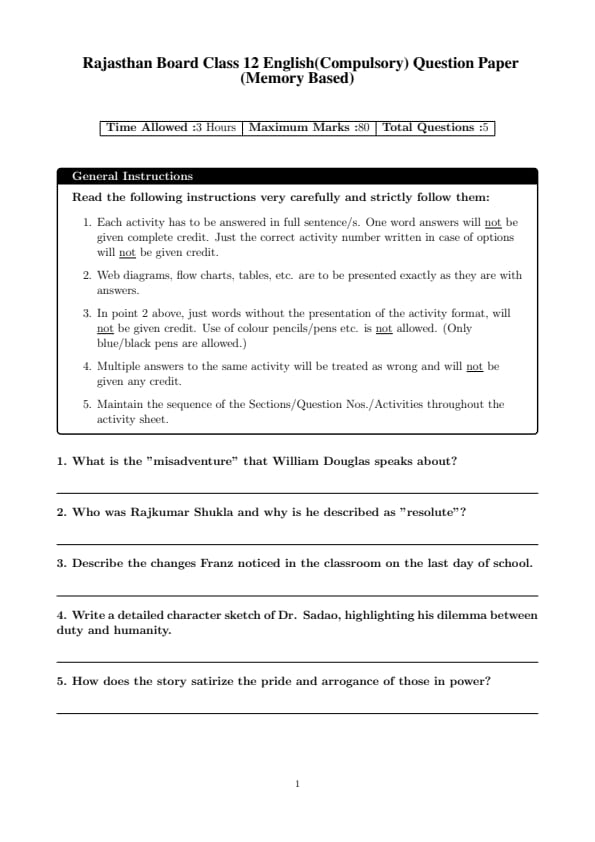
What is the ”misadventure” that William Douglas speaks about?
View Solution
Step 1: Understanding the Concept:
The question is based on the autobiographical essay "Deep Water" by William Douglas. It explores the themes of fear and the determination required to overcome it. The "misadventure" is the central event that triggered his intense hydrophobia.
Step 2: Detailed Explanation:
The incident occurred when Douglas was about ten or eleven years old and had just started learning to swim at the YMCA pool in Yakima. One day, while he was sitting alone on the edge of the pool waiting for others to arrive, a "big bruiser" of a boy (around eighteen years old) picked him up and tossed him into the nine-foot-deep end for fun. Douglas landed in a sitting position, swallowed water, and went straight to the bottom.
During this struggle, he nearly drowned. Despite making three frantic attempts to spring upward and reach the surface, he was unable to save himself and eventually lost consciousness. He was rescued just in time, but the experience left him with a deep-seated terror of water that haunted him for years.
Step 3: Final Answer:
The "misadventure" was the traumatic incident at the YMCA pool where Douglas was thrown into the deep end by a bully, resulting in a near-death experience that caused him severe psychological trauma and a lasting fear of water.
Quick Tip: To remember this answer, visualize the contrast between the "safe" shallow end and the "nine-foot" deep end. Focus on Douglas's mental plan: "hit the bottom, make a big jump, and come to the surface."
Who was Rajkumar Shukla and why is he described as ”resolute”?
View Solution
Step 1: Understanding the Concept:
This question pertains to the chapter "Indigo" by Louis Fischer. It describes the beginning of the first Satyagraha in India and highlights the importance of individual persistence in the face of systemic injustice.
Step 2: Detailed Explanation:
Rajkumar Shukla was an illiterate but determined peasant from Champaran, Bihar. He was a victim of the sharecropping system where British landlords forced Indian peasants to grow indigo on 15% of their land. He had come to the 1916 annual convention of the Indian National Congress in Lucknow to seek Gandhi's help.
He is described as "resolute" (determined/unwavering) because:
1. When Gandhi mentioned he had prior appointments in Cawnpore and other parts of India, Shukla did not leave.
2. He followed Gandhi to his ashram near Ahmedabad and stayed there for weeks.
3. He accompanied Gandhi to Calcutta and waited until Gandhi was free.
4. His tenacity and persistence eventually impressed Gandhi, who finally agreed to travel with him to Patna and then to Champaran.
Step 3: Final Answer:
Rajkumar Shukla was a sharecropper from Champaran. He is described as "resolute" because he showed unwavering determination by following Gandhi across the country for weeks, refusing to leave his side until he secured a commitment from Gandhi to address the grievances of the indigo farmers.
Quick Tip: The word "resolute" is the key to his character. In exams, emphasize that despite being "illiterate," his "resoluteness" was what changed the course of Indian history at Champaran.
Describe the changes Franz noticed in the classroom on the last day of school.
View Solution
Step 1: Understanding the Concept:
The story "The Last Lesson" by Alphonse Daudet is set during the Franco-Prussian War. After the occupation of Alsace and Lorraine, an order from Berlin arrived stating that only German would be taught in schools. This historical shift completely changed the atmosphere of Franz's school.
Step 2: Detailed Explanation:
Franz noticed several striking changes that made the day feel different from any other school day:
1. Unusual Silence: Normally, there was a great bustle, the opening and closing of desks, and lessons repeated in unison. On this day, everything was as quiet as a Sunday morning.
2. M. Hamel’s Attire: M. Hamel, the teacher, was wearing his beautiful green coat, frilled shirt, and a little black silk cap—all embroidered. He only wore these on inspection or prize days.
3. Presence of Villagers: The back benches, which were usually empty, were occupied by village elders like old Hauser, the former mayor, and the former postmaster. They looked sad and had come to pay their respects.
4. Teacher's Behavior: Instead of his usual "terrible iron ruler" and cranky demeanor, M. Hamel was exceptionally kind and gentle, even when Franz was late and couldn't recite his lesson.
Step 3: Final Answer:
Franz noticed that the school was strangely quiet, the teacher was dressed in his finest Sunday clothes, and the village elders were sitting at the back of the room to honor the forty years of M. Hamel's faithful service.
Quick Tip: The "Sunday morning" comparison is a vital detail to include in your answer, as it highlights the transition from the chaotic "business as usual" to the solemnity of a final farewell.
Write a detailed character sketch of Dr. Sadao, highlighting his dilemma between duty and humanity.
View Solution
Step 1: Understanding the Concept:
The story "The Enemy" by Pearl S. Buck is set during World War II. Dr. Sadao, a Japanese surgeon, finds a wounded American soldier (a prisoner of war) on the coast. His character is defined by the struggle between his ingrained patriotism and his medical oath.
Step 2: Detailed Explanation:
Dr. Sadao is a highly skilled surgeon and scientist. His father’s influence made him a disciplined patriot, but his education in America instilled in him a deep sense of humanity and professional ethics.
His Dilemma:
1. As a Citizen: Japan was at war with America. Helping a POW was an act of treason. His servants abandoned him, and he lived in constant fear of being arrested.
2. As a Doctor: His medical training compelled him to save a life, regardless of the person's identity. He tells himself, "I do not know why I am doing it," yet he operates with surgical precision to save the "enemy."
Resolution:
Dr. Sadao resolves his dilemma through a middle path. He saves the man's life first (humanity), informs the General about him (duty), and when the General fails to send assassins, he helps the soldier escape (mercy). He proves that human compassion transcends narrow national boundaries.
Step 3: Final Answer:
Dr. Sadao is a man of high integrity. While he remains a loyal Japanese, his "humanity" triumphs over his "prejudice," making him a hero who chooses to save life rather than destroy it.
Quick Tip: When writing a character sketch, use contrasting adjectives like "Patriotic yet Compassionate" or "Disciplined yet Empathetic" to capture the essence of his internal conflict.
How does the story satirize the pride and arrogance of those in power?
View Solution
Step 1: Understanding the Concept:
Kalki uses irony and satire in "The Tiger King" to mock the whims of autocratic rulers. The Maharaja of Pratibandapuram challenges destiny out of sheer ego, believing he can conquer even death.
Step 2: Detailed Explanation:
The satire is evident through several instances:
1. Meaningless Vows: The King vows to attend to all other state affairs only after killing a hundred tigers. This shows how rulers often prioritize personal whims over public duty.
2. Abuse of Power: He doubles taxes when he can't find the hundredth tiger and fires staff on a whim. His arrogance is so high that he treats his subjects as mere tools for his quest.
3. The Irony of the Death: The King killed 99 real tigers with guns and traps, but he was eventually killed by a "sliver" from a poorly made wooden toy tiger. This mocks his "bravery" and proves that fate cannot be cheated by arrogance.
4. Bureaucratic Mockery: The story also satirizes the "Dewan" and other officials who flattery the King just to keep their jobs, illustrating a corrupt and spineless administration.
Step 3: Final Answer:
The story satirizes the arrogance of power by portraying the King as a fool who mistakes cruelty for courage. His death by a toy tiger is the ultimate punchline, proving that the pride of the powerful is often hollow and destined for a fall.
Quick Tip: Satire often uses "dramatic irony." In this story, the fact that the King thinks he killed the 100th tiger (when he actually missed) is a perfect example of mocking his supposed "triumph."
*The article might have information for the previous academic years, please refer the official website of the exam.