
Maharashtra Board Class 12 2025 Maths and Statistics Question Paper with Solutions


| Updated On - Sep 13, 2025
The Maharashtra Board Class 12 Maths and Statistics Question Paper PDF with Solutions is available for download. The Maharashtra State Board of Secondary and Higher Secondary Education (MSBSHSE) conducted the Class 12 examination for a total duration of 3 hours, and the question paper had a total of 80 marks.
Maharastra Board Class 12 Maths and Statistics Question Paper with Solutions
| Maharastra Board Class 12 Maths and Statistics Question Paper | Download PDF | Check Solutions |

Question 1:
(i)
If \( p \): He is intelligent, \( q \): He is strong. Then, symbolic form of statement "It is wrong that he is intelligent or strong" is:
View Solution
Step 1: Identify the individual logical statements, which are \( p \): "He is intelligent" and \( q \): "He is strong".
Step 2: Translate the phrase "he is intelligent or strong". The logical operator for "or" is disjunction (\( \lor \)). Thus, this phrase becomes \( p \lor q \).
Step 3: Translate the negation "It is wrong that...". This corresponds to the negation operator (\( \sim \)) applied to the entire statement that follows.
Step 4: Combine the parts. Applying the negation to the expression from Step 2 gives \( \sim(p \lor q) \). Quick Tip: When translating from English to symbolic logic, pay close attention to phrases that indicate grouping. "It is wrong that..." negates the entire clause that follows, requiring parentheses around the expression being negated.
(ii)
The value of \( \int \left(x + \frac{1}{x}\right)^3 dx \) is equal to:
View Solution
Step 1: Expand the integrand using the binomial theorem \( (a+b)^3 = a^3 + 3a^2b + 3ab^2 + b^3 \). \[ \left(x + \frac{1}{x}\right)^3 = x^3 + 3(x^2)\left(\frac{1}{x}\right) + 3(x)\left(\frac{1}{x^2}\right) + \left(\frac{1}{x}\right)^3 = x^3 + 3x + \frac{3}{x} + x^{-3} \]
Step 2: Integrate the expanded expression term by term using the power rule. \[ \int \left(x^3 + 3x + 3x^{-1} + x^{-3}\right) dx = \frac{x^4}{4} + \frac{3x^2}{2} + 3\log|x| + \frac{x^{-2}}{-2} + c \]
Step 3: Simplify the final expression. \[ \frac{x^4}{4} + \frac{3x^2}{2} + 3\log x - \frac{1}{2x^2} + c \] Quick Tip: For integrals of polynomials or rational functions raised to a small integer power, it is often easiest to expand the expression algebraically first. This simplifies the problem to integrating a sum of power functions.
(iii)
The value of the definite integral \( \int_2^7 \frac{\sqrt{x}}{\sqrt{x} + \sqrt{9-x}} dx \) is:
View Solution
Step 1: Let \( I = \int_2^7 \frac{\sqrt{x}}{\sqrt{x} + \sqrt{9-x}} dx \). Use the property \( \int_a^b f(x) dx = \int_a^b f(a+b-x) dx \). Here, \( a=2, b=7 \), so \( a+b=9 \).
Step 2: Apply the property by replacing \( x \) with \( 9-x \). \[ I = \int_2^7 \frac{\sqrt{9-x}}{\sqrt{9-x} + \sqrt{9-(9-x)}} dx = \int_2^7 \frac{\sqrt{9-x}}{\sqrt{9-x} + \sqrt{x}} dx \]
Step 3: Add the original and transformed integrals. \[ 2I = \int_2^7 \frac{\sqrt{x} + \sqrt{9-x}}{\sqrt{x} + \sqrt{9-x}} dx = \int_2^7 1 \, dx \]
Step 4: Evaluate the simple integral. \[ 2I = [x]_2^7 = 7 - 2 = 5 \implies I = \frac{5}{2} \] Quick Tip: Recognize the special form \( \int_a^b \frac{f(x)}{f(x) + f(a+b-x)} dx \). Integrals of this type evaluate to \( \frac{b-a}{2} \). Here, \( \frac{7-2}{2} = \frac{5}{2} \).
(iv)
The area of the region bounded by the curve \(y=x^2\) and the line \(y=4\) is:
View Solution
Step 1: Find the points of intersection by setting the equations equal: \( x^2 = 4 \implies x = \pm 2 \). These are the limits of integration.
Step 2: Set up the definite integral for the area. The area is the integral of the upper curve minus the lower curve. Here, \(y=4\) is the upper curve and \(y=x^2\) is the lower curve. \[ A = \int_{-2}^{2} (4 - x^2) dx \]
Step 3: Use the property of even functions to simplify the integral. Since \(4-x^2\) is an even function, \( \int_{-a}^{a} f(x) dx = 2\int_{0}^{a} f(x) dx \). \[ A = 2 \int_{0}^{2} (4 - x^2) dx \]
Step 4: Evaluate the integral. \[ A = 2 \left[4x - \frac{x^3}{3}\right]_0^2 = 2 \left( (8 - \frac{8}{3}) - 0 \right) = 2 \left( \frac{16}{3} \right) = \frac{32}{3} \] Quick Tip: When finding the area between curves, always sketch the graphs to identify the upper and lower functions and the region of integration. Utilizing symmetry for even or odd functions can simplify the calculation.
(v)
The order and degree of the differential equation \( \left(\frac{d^2y}{dx^2}\right)^2 + \left(\frac{dy}{dx}\right)^2 = a^x \) are ________ respectively.
View Solution
Step 1: Determine the order of the differential equation. The order is the order of the highest derivative present. The highest derivative is \( \frac{d^2y}{dx^2} \), which is the second derivative. Therefore, the order is 2.
Step 2: Determine the degree of the differential equation. The degree is the highest power of the highest-order derivative, after the equation has been cleared of radicals and fractions with respect to its derivatives. The equation is already a polynomial in its derivatives. The highest-order derivative is \( \frac{d^2y}{dx^2} \), and its power is 2. Therefore, the degree is 2. Quick Tip: - \textbf{Order:} Look for the highest derivative (e.g., \( y' \), \( y'' \), \( y''' \)). - \textbf{Degree:} Look for the exponent of the highest derivative. Ensure the equation is a polynomial in its derivatives before determining the degree.
(vi)
The integrating factor of the differential equation \( \frac{dy}{dx} + \frac{y}{x} = x^3 - 3 \) is:
View Solution
Step 1: Identify the form of the differential equation. The equation is in the linear form \( \frac{dy}{dx} + P(x)y = Q(x) \).
Step 2: Identify the function \( P(x) \). By comparing the given equation to the standard form, we find that \( P(x) = \frac{1}{x} \).
Step 3: Calculate the integrating factor (I.F.) using the formula I.F. = \( e^{\int P(x) dx} \). \[ I.F. = e^{\int \frac{1}{x} dx} \]
Step 4: Evaluate the integral and simplify. \[ I.F. = e^{\ln x} = x \] Quick Tip: The integrating factor for a first-order linear differential equation \( y' + P(x)y = Q(x) \) is always \( e^{\int P(x) dx} \). The key is to correctly identify the \( P(x) \) term, which is the coefficient of the \( y \) term.
(i)
If A is a matrix and K is a constant, then \( (KA)^T = K A^T \).
View Solution
Step 1: Recall the properties of the transpose of a matrix. One of the fundamental properties is that for any scalar \( k \) and any matrix \( A \), the transpose of their product is the scalar multiplied by the transpose of the matrix.
Step 2: Applying this property, we have \( (KA)^T = K(A^T) \). The statement is therefore correct. Quick Tip: A scalar can be factored out of a transpose operation. This is different from the transpose of a product of two matrices, where the order is reversed: \( (AB)^T = B^T A^T \).
(ii)
The value of \( \int \log x \, dx = x \log x + x + c \).
View Solution
Step 1: Use integration by parts, where \( \int u \, dv = uv - \int v \, du \). Let \( u = \log x \) and \( dv = dx \).
Step 2: Differentiate \( u \) and integrate \( dv \). We get \( du = \frac{1}{x} dx \) and \( v = x \).
Step 3: Substitute these into the integration by parts formula: \[ \int \log x \, dx = (\log x)(x) - \int x \left(\frac{1}{x}\right) dx = x \log x - \int 1 \, dx = x \log x - x + c. \]
The given statement has a positive sign before the \(x\), so it is false. Quick Tip: The integral of \( \log x \) is a standard result that is frequently used. It's helpful to remember it: \( \int \log x \, dx = x \log x - x + c \).
(iii)
The differential equation obtained by eliminating arbitrary constants from \( bx + ay = ab \) is \( \frac{d^2y}{dx^2} = 0 \).
View Solution
Step 1: Differentiate the given equation \( bx + ay = ab \) with respect to \( x \). \[ b + a\frac{dy}{dx} = 0 \]
Step 2: This first derivative shows that \( \frac{dy}{dx} = -\frac{b}{a} \), which is a constant value since \(a\) and \(b\) are constants.
Step 3: Differentiate the result from Step 1 again with respect to \( x \). The derivative of a constant (\(b\)) is zero, and the derivative of a constant times a function (\(a\frac{dy}{dx}\)) is the constant times the derivative of the function. \[ 0 + a\frac{d^2y}{dx^2} = 0 \implies \frac{d^2y}{dx^2} = 0 \]
The statement is true. Quick Tip: To form a differential equation from a relation with \(n\) arbitrary constants, you generally need to differentiate the relation \(n\) times and then eliminate the constants from the resulting equations.
(i)
The average revenue \( R_A \) is 50 and elasticity of demand \( \eta \) is 5, the marginal revenue \( R_M \) is ______.
View Solution
Step 1: Recall the formula that relates marginal revenue (\(R_M\)), average revenue (\(R_A\)), and the elasticity of demand (\(\eta\)). \[ R_M = R_A \left(1 - \frac{1}{\eta}\right) \]
Step 2: Substitute the given values \( R_A = 50 \) and \( \eta = 5 \) into the formula. \[ R_M = 50 \left(1 - \frac{1}{5}\right) \]
Step 3: Simplify the expression. \[ R_M = 50 \left(\frac{4}{5}\right) = 10 \times 4 = 40 \] Quick Tip: This formula is a key application of derivatives in economics. It helps businesses understand how a change in price will affect their total revenue, based on how sensitive demand is to price changes.
(ii)
\( \int e^x \left(\frac{1}{x} - \frac{1}{x^2}\right) dx = \_\_\_\_\_\_ + c \)
View Solution
Step 1: Identify the integral's form. It matches the special property \( \int e^x [f(x) + f'(x)] dx = e^x f(x) + c \).
Step 2: Let \( f(x) = \frac{1}{x} \). Find its derivative, \( f'(x) \). \[ f'(x) = \frac{d}{dx}(x^{-1}) = -1 \cdot x^{-2} = -\frac{1}{x^2} \]
Step 3: Confirm that the integrand matches the form \( e^x[f(x) + f'(x)] \). \[ e^x \left(\frac{1}{x} - \frac{1}{x^2}\right) = e^x [f(x) + f'(x)] \]
The form is correct. Therefore, the integral is \( e^x f(x) + c \).
Step 4: Substitute back \( f(x) = \frac{1}{x} \) to get the final answer. \[ \int e^x \left(\frac{1}{x} - \frac{1}{x^2}\right) dx = \frac{e^x}{x} + c \] Quick Tip: When you see an integral involving \( e^x \) multiplied by a sum or difference of functions, always check if it fits the form \( \int e^x [f(x) + f'(x)] dx \). Recognizing this pattern saves a lot of time compared to using integration by parts.
(iii)
If \( f'(x) = x^2 + 5 \) and \( f(0) = -1 \) then \( f(x) = \_\_\_\_\_\_.\)
View Solution
Step 1: Find the general form of \( f(x) \) by integrating \( f'(x) \) with respect to \( x \). \[ f(x) = \int (x^2 + 5) dx = \frac{x^3}{3} + 5x + C \]
where \( C \) is the constant of integration.
Step 2: Use the given initial condition, \( f(0) = -1 \), to find the value of \( C \). \[ f(0) = \frac{0^3}{3} + 5(0) + C = -1 \] \[ C = -1 \]
Step 3: Substitute the value of \( C \) back into the expression for \( f(x) \). \[ f(x) = \frac{x^3}{3} + 5x - 1 \] Quick Tip: This type of problem is called an initial value problem. The process is always the same: integrate to find the general solution with a constant \(C\), then use the given point (the initial value) to solve for \(C\) and find the particular solution.
(i)
Write the converse, inverse and contrapositive of the statement "If a triangle is equilateral then it is equiangular".
View Solution
Let \(p\) be the statement "a triangle is equilateral" and \(q\) be the statement "it is equiangular". The given statement is in the form \( p \to q \).
Step 1: Converse (\(q \to p\)))
The converse is formed by swapping the hypothesis and the conclusion.
Statement: "If a triangle is equiangular then it is equilateral."
Step 2: Inverse (\(\sim p \to \sim q\)))
The inverse is formed by negating both the hypothesis and the conclusion.
Statement: "If a triangle is not equilateral then it is not equiangular."
Step 3: Contrapositive (\(\sim q \to \sim p\)))
The contrapositive is formed by negating and swapping the hypothesis and the conclusion.
Statement: "If a triangle is not equiangular then it is not equilateral." Quick Tip: Remember the transformations for a statement "If p, then q": - \textbf{Converse:} "If q, then p." (Swap) - \textbf{Inverse:} "If not p, then not q." (Negate) - \textbf{Contrapositive:} "If not q, then not p." (Swap and Negate) A statement is always logically equivalent to its contrapositive.
(ii) Find x, y, z if
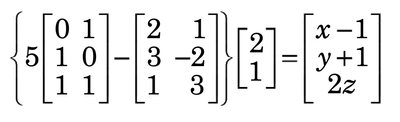
View Solution
Step 1: Multiply the first two matrices. \[ \begin{bmatrix} 5 & 1 & 0
1 & 1 & 1 \end{bmatrix}_{2\times3} \begin{bmatrix} 0 & 1 & -2
1 & -2 & 3
-1 & 1 & 1 \end{bmatrix}_{3\times3} = \begin{bmatrix} (0+1-0) & (5-2+0) & (-10+3+0)
(0+1-1) & (1-2+1) & (-2+3+1) \end{bmatrix} = \begin{bmatrix} 1 & 3 & -7
0 & 0 & 2 \end{bmatrix} \]
Step 2: Multiply the resulting matrix by the column vector. \[ \begin{bmatrix} 1 & 3 & -7
0 & 0 & 2 \end{bmatrix}_{2\times3} \begin{bmatrix} x-1
y+1
2z \end{bmatrix}_{3\times1} = \begin{bmatrix} 1(x-1) + 3(y+1) - 7(2z)
0(x-1) + 0(y+1) + 2(2z) \end{bmatrix} = \begin{bmatrix} x - 1 + 3y + 3 - 14z
4z \end{bmatrix} = \begin{bmatrix} x + 3y - 14z + 2
4z \end{bmatrix} \]
Step 3: Set the resulting matrix equal to the right-hand side and solve the system of equations. \[ \begin{bmatrix} x + 3y - 14z + 2
4z \end{bmatrix} = \begin{bmatrix} 2
1 \end{bmatrix} \]
From the second row: \( 4z = 1 \implies z = \frac{1}{4} \).
From the first row: \( x + 3y - 14z + 2 = 2 \implies x + 3y - 14z = 0 \).
Substitute \( z = \frac{1}{4} \): \( x + 3y - 14(\frac{1}{4}) = 0 \implies x + 3y - \frac{7}{2} = 0 \implies x + 3y = \frac{7}{2} \).
The problem does not yield a unique solution for x and y. The solution is \(z = \frac{1}{4}\) and any x, y that satisfy \(x + 3y = \frac{7}{2}\). Quick Tip: When multiplying matrices, always check that the inner dimensions match (e.g., \(m \times n\) times \(n \times p\)). The resulting matrix will have the outer dimensions (\(m \times p\)). Proceed with multiplication step-by-step to avoid errors.
(iii) Evaluate: \( \int \frac{1}{x(x^6 + 1)} dx \)
View Solution
Step 1: Multiply the numerator and denominator by \( x^5 \) to prepare for a substitution. \[ \int \frac{x^5}{x^6(x^6 + 1)} dx \]
Step 2: Let \( u = x^6 \). Then \( du = 6x^5 dx \), which implies \( x^5 dx = \frac{du}{6} \).
Step 3: Substitute \(u\) and \(du\) into the integral. \[ \int \frac{1}{u(u+1)} \frac{du}{6} = \frac{1}{6} \int \frac{1}{u(u+1)} du \]
Step 4: Use partial fraction decomposition for the integrand. \[ \frac{1}{u(u+1)} = \frac{A}{u} + \frac{B}{u+1} \implies 1 = A(u+1) + Bu \]
If \( u=0 \), \( 1 = A \). If \( u=-1 \), \( 1 = -B \implies B=-1 \).
So, \( \frac{1}{u(u+1)} = \frac{1}{u} - \frac{1}{u+1} \).
Step 5: Integrate the resulting expression. \[ \frac{1}{6} \int \left(\frac{1}{u} - \frac{1}{u+1}\right) du = \frac{1}{6} (\ln|u| - \ln|u+1|) + C \]
Step 6: Simplify using logarithm properties and substitute back \( u=x^6 \). \[ \frac{1}{6} \ln\left|\frac{u}{u+1}\right| + C = \frac{1}{6} \ln\left|\frac{x^6}{x^6+1}\right| + C \] Quick Tip: For integrals involving a term like \( x(x^n+k) \), the substitution \( u=x^n \) is often effective after multiplying the numerator and denominator by \( x^{n-1} \).
(i)
Solve the following equations by the method of inversion: \( 2x-y+z=1 \), \( x+2y+3z=8 \), \( 3x+y-4z=1 \).
View Solution
The system can be written in matrix form \( AX=B \), where: \[ A = \begin{bmatrix} 2 & -1 & 1
1 & 2 & 3
3 & 1 & -4 \end{bmatrix}, \quad X = \begin{bmatrix} x
y
z \end{bmatrix}, \quad B = \begin{bmatrix} 1
8
1 \end{bmatrix} \]
The solution is \( X = A^{-1}B \).
Step 1: Find the determinant of A. \[ |A| = 2(-8-3) - (-1)(-4-9) + 1(1-6) = 2(-11) + 1(-13) - 5 = -22 - 13 - 5 = -40 \]
Step 2: Find the adjugate of A.
The matrix of cofactors is: \[ C = \begin{bmatrix} -11 & 13 & -5
-3 & -11 & -5
-5 & -5 & 5 \end{bmatrix} \]
The adjugate is the transpose of the cofactor matrix: \[ adj(A) = C^T = \begin{bmatrix} -11 & -3 & -5
13 & -11 & -5
-5 & -5 & 5 \end{bmatrix} \]
Step 3: Find the inverse of A. \[ A^{-1} = \frac{1}{|A|} adj(A) = -\frac{1}{40} \begin{bmatrix} -11 & -3 & -5
13 & -11 & -5
-5 & -5 & 5 \end{bmatrix} \]
Step 4: Calculate \( X = A^{-1}B \). \[ X = -\frac{1}{40} \begin{bmatrix} -11 & -3 & -5
13 & -11 & -5
-5 & -5 & 5 \end{bmatrix} \begin{bmatrix} 1
8
1 \end{bmatrix} = -\frac{1}{40} \begin{bmatrix} -11(1) - 3(8) - 5(1)
13(1) - 11(8) - 5(1)
-5(1) - 5(8) + 5(1) \end{bmatrix} \] \[ X = -\frac{1}{40} \begin{bmatrix} -11 - 24 - 5
13 - 88 - 5
-5 - 40 + 5 \end{bmatrix} = -\frac{1}{40} \begin{bmatrix} -40
-80
-40 \end{bmatrix} = \begin{bmatrix} 1
2
1 \end{bmatrix} \]
Thus, \( x=1, y=2, z=1 \). Quick Tip: The matrix inversion method is procedural. Be careful with arithmetic, especially with negative signs when calculating the determinant and cofactors. Always check your final answer by plugging it back into the original equations.
(ii)
Find MPC, MPS, APC and APS, if the expenditure \(E_c\) of a person with income I is given as \( E_c = (0.0003)I^2 + (0.075)I \); when \( I=1000 \).
View Solution
Given the consumption function \( C = E_c = 0.0003I^2 + 0.075I \) and \( I=1000 \).
Step 1: Calculate Consumption (C) and Savings (S). \[ C = 0.0003(1000)^2 + 0.075(1000) = 0.0003(1000000) + 75 = 300 + 75 = 375 \] \[ S = Income - Consumption = I - C = 1000 - 375 = 625 \]
Step 2: Calculate Average Propensities (APC and APS). \[ APC = \frac{C}{I} = \frac{375}{1000} = 0.375 \] \[ APS = \frac{S}{I} = \frac{625}{1000} = 0.625 \]
Step 3: Calculate Marginal Propensities (MPC and MPS).
First, find the derivative of the consumption function with respect to income. \[ MPC = \frac{dC}{dI} = \frac{d}{dI}(0.0003I^2 + 0.075I) = 0.0006I + 0.075 \]
Now, evaluate MPC at \( I=1000 \). \[ MPC = 0.0006(1000) + 0.075 = 0.6 + 0.075 = 0.675 \] \[ MPS = 1 - MPC = 1 - 0.675 = 0.325 \]
Final Answer: APC = 0.375, APS = 0.625, MPC = 0.675, MPS = 0.325. Quick Tip: Remember the key relationships: `APC + APS = 1` and `MPC + MPS = 1`. 'Average' refers to the overall ratio (C/I), while 'Marginal' refers to the instantaneous rate of change (dC/dI).
(iii)
Evaluate: \( \int_1^2 \frac{dx}{x^2+6x+5} \)
View Solution
Step 1: Factor the denominator and set up the partial fraction decomposition. \[ x^2+6x+5 = (x+1)(x+5) \] \[ \frac{1}{(x+1)(x+5)} = \frac{A}{x+1} + \frac{B}{x+5} \]
Multiplying by the denominator gives \( 1 = A(x+5) + B(x+1) \).
Step 2: Solve for A and B.
If \( x = -1 \), then \( 1 = A(4) \implies A = \frac{1}{4} \).
If \( x = -5 \), then \( 1 = B(-4) \implies B = -\frac{1}{4} \).
Step 3: Rewrite the integral with the partial fractions. \[ \int_1^2 \left(\frac{1/4}{x+1} - \frac{1/4}{x+5}\right) dx = \frac{1}{4} \int_1^2 \left(\frac{1}{x+1} - \frac{1}{x+5}\right) dx \]
Step 4: Integrate and evaluate the definite integral. \[ \frac{1}{4} [\ln|x+1| - \ln|x+5|]_1^2 = \frac{1}{4} \left[\ln\left|\frac{x+1}{x+5}\right|\right]_1^2 \] \[ = \frac{1}{4} \left( \ln\left|\frac{2+1}{2+5}\right| - \ln\left|\frac{1+1}{1+5}\right| \right) = \frac{1}{4} \left( \ln\left(\frac{3}{7}\right) - \ln\left(\frac{2}{6}\right) \right) \] \[ = \frac{1}{4} \left( \ln\left(\frac{3}{7}\right) - \ln\left(\frac{1}{3}\right) \right) = \frac{1}{4} \ln\left(\frac{3/7}{1/3}\right) = \frac{1}{4} \ln\left(\frac{9}{7}\right) \] Quick Tip: For rational functions \( \frac{P(x)}{Q(x)} \), if the denominator \( Q(x) \) can be factored into linear terms, partial fraction decomposition is the standard method to simplify the integrand into a sum of simpler fractions.
(i)
Find \( \frac{dy}{dx} \) if \( y = x^x + a^x \).
View Solution
This function is a sum of two parts. We will differentiate each part separately. Let \( u = x^x \) and \( v = a^x \), so \( y = u + v \). Then \( \frac{dy}{dx} = \frac{du}{dx} + \frac{dv}{dx} \).
Step 1: Differentiate \( u = x^x \).
This requires logarithmic differentiation. \[ \ln u = \ln(x^x) = x \ln x \]
Differentiating both sides with respect to \( x \): \[ \frac{1}{u} \frac{du}{dx} = (1)(\ln x) + x\left(\frac{1}{x}\right) = \ln x + 1 \] \[ \frac{du}{dx} = u(1 + \ln x) = x^x(1 + \ln x) \]
Step 2: Differentiate \( v = a^x \).
This is a standard derivative of an exponential function. \[ \frac{dv}{dx} = a^x \ln a \]
Step 3: Combine the results. \[ \frac{dy}{dx} = \frac{du}{dx} + \frac{dv}{dx} = x^x(1 + \ln x) + a^x \ln a \] Quick Tip: When differentiating a function of the form \(f(x)^{g(x)}\), always use logarithmic differentiation. Do not confuse it with the power rule (\(x^n\)) or the exponential rule (\(a^x\)).
(ii)
Find the area of the region bounded by the parabola \( y^2 = 25x \) and the line \( x=5 \).
View Solution
Step 1: Visualize the region.
The parabola \( y^2 = 25x \) opens to the right with its vertex at the origin. The line \( x=5 \) is a vertical line. The region is bounded on the left by the y-axis (\(x=0\)) and on the right by \(x=5\). The region is symmetric about the x-axis.
Step 2: Set up the integral.
We can find the area of the top half and double it. From \( y^2 = 25x \), the upper half is \( y = \sqrt{25x} = 5\sqrt{x} \). The limits of integration are from \( x=0 \) to \( x=5 \). \[ Area = 2 \int_0^5 5\sqrt{x} \, dx = 10 \int_0^5 x^{1/2} \, dx \]
Step 3: Evaluate the integral.
Using the power rule for integration: \[ Area = 10 \left[ \frac{x^{3/2}}{3/2} \right]_0^5 = 10 \left[ \frac{2}{3}x^{3/2} \right]_0^5 \] \[ = \frac{20}{3} [5^{3/2} - 0^{3/2}] = \frac{20}{3} (5\sqrt{5}) = \frac{100\sqrt{5}}{3} \]
The area is \( \frac{100\sqrt{5}}{3} \) square units. Quick Tip: For regions bounded by curves that are functions of \(x\), use vertical strips (\(dx\)). The area is \( \int_a^b (y_{upper} - y_{lower}) \, dx \). Utilizing symmetry can often simplify the calculation.
(iii)
Find the differential equation by eliminating arbitrary constants from the relation \( y = Ae^{3x} + Be^{-3x} \).
View Solution
Since there are two arbitrary constants (\(A\) and \(B\)), we need to differentiate the relation twice.
Step 1: Differentiate with respect to \(x\). \[ \frac{dy}{dx} = 3Ae^{3x} - 3Be^{-3x} \quad \cdots (1) \]
Step 2: Differentiate again with respect to \(x\). \[ \frac{d^2y}{dx^2} = 9Ae^{3x} + 9Be^{-3x} \quad \cdots (2) \]
Step 3: Eliminate the constants.
Factor out 9 from the right side of equation (2): \[ \frac{d^2y}{dx^2} = 9(Ae^{3x} + Be^{-3x}) \]
Notice that the expression in the parentheses is the original expression for \(y\). \[ \frac{d^2y}{dx^2} = 9y \]
The required differential equation is \( \frac{d^2y}{dx^2} - 9y = 0 \). Quick Tip: The order of the resulting differential equation is equal to the number of independent arbitrary constants in the original relation. Differentiate that many times and then use algebra to eliminate the constants.
(i)
Using the truth table, verify \( p \lor (q \land r) \equiv (p \lor q) \land (p \lor r) \).
View Solution
We construct a truth table to evaluate both sides of the equivalence.
\begin{tabular{|c|c|c|c|c|c|c|c|
\hline \(p\) & \(q\) & \(r\) & \(q \land r\) & \(p \lor (q \land r)\) & \(p \lor q\) & \(p \lor r\) & \((p \lor q) \land (p \lor r)\)
\hline
T & T & T & T & T & T & T & T
T & T & F & F & T & T & T & T
T & F & T & F & T & T & T & T
T & F & F & F & T & T & T & T
F & T & T & T & T & T & T & T
F & T & F & F & F & T & F & F
F & F & T & F & F & F & T & F
F & F & F & F & F & F & F & F
\hline
\end{tabular
Since the truth values in the columns for \( p \lor (q \land r) \) and \( (p \lor q) \land (p \lor r) \) are identical for all possible truth values of \(p, q, \) and \(r\), the given equivalence (the distributive law) is verified. Quick Tip: When constructing a truth table for \(n\) variables, there will be \(2^n\) rows. Be systematic in listing all possible combinations of T and F to ensure you don't miss any cases.
(ii)
If \( x = \frac{4t}{1+t^2} \), \( y = 3\left(\frac{1-t^2}{1+t^2}\right) \), then show that \( \frac{dy}{dx} = -\frac{9x}{4y} \).
View Solution
This is a parametric differentiation problem. We will find \( \frac{dy}{dt} \) and \( \frac{dx}{dt} \) first.
Step 1: Find \( \frac{dx}{dt} \).
Using the quotient rule: \[ \frac{dx}{dt} = \frac{(4)(1+t^2) - (4t)(2t)}{(1+t^2)^2} = \frac{4+4t^2-8t^2}{(1+t^2)^2} = \frac{4(1-t^2)}{(1+t^2)^2} \]
Step 2: Find \( \frac{dy}{dt} \). \( y = \frac{3-3t^2}{1+t^2} \). Using the quotient rule: \[ \frac{dy}{dt} = \frac{(-6t)(1+t^2) - (3-3t^2)(2t)}{(1+t^2)^2} = \frac{-6t-6t^3-6t+6t^3}{(1+t^2)^2} = \frac{-12t}{(1+t^2)^2} \]
Step 3: Find \( \frac{dy}{dx} \). \[ \frac{dy}{dx} = \frac{dy/dt}{dx/dt} = \frac{-12t / (1+t^2)^2}{4(1-t^2) / (1+t^2)^2} = \frac{-12t}{4(1-t^2)} = \frac{-3t}{1-t^2} \]
Step 4: Evaluate the right-hand side. \[ -\frac{9x}{4y} = -\frac{9(\frac{4t}{1+t^2})}{4(3\frac{1-t^2}{1+t^2})} = -\frac{36t/(1+t^2)}{12(1-t^2)/(1+t^2)} = -\frac{36t}{12(1-t^2)} = \frac{-3t}{1-t^2} \]
Since \( \frac{dy}{dx} \) and \( -\frac{9x}{4y} \) both simplify to the same expression in terms of \(t\), we have shown that \( \frac{dy}{dx} = -\frac{9x}{4y} \). Quick Tip: For parametric differentiation, the key formula is \( \frac{dy}{dx} = \frac{dy/dt}{dx/dt} \). After finding the derivative in terms of the parameter \(t\), you may need to substitute the original expressions for \(x\) and \(y\) to show equivalence.
(i)
Divide the number 84 into two parts such that the product of one part and square of the other is maximum.
View Solution
Let one part be \(x\) then the other part will be \(84-x\).
Let the product be \( P(x) \). We can define the function as \( P(x) = x^2(84-x) \). \[ f(x) = \mathbf{84x^2 - x^3} \] \[ \therefore f'(x) = 168x - 3x^2 \]
For extreme values \( f'(x)=0 \). \[ 168x - 3x^2 = 0 \] \[ \therefore 3x(56-x) = 0 \] \[ \therefore x = \mathbf{0} OR x = \mathbf{56} \]
Now, \( f''(x) = 168 - 6x \).
If \( x=0, f''(0) = 168 - 6(0) = 168 > 0 \). \(\therefore\) function attains minimum at \(x=0\).
If \( x=56, f''(56) = \mathbf{168 - 336 = -168} < 0 \). \(\therefore\) function attains maximum at \(x=56\).
Two parts of 84 are \(\mathbf{56}\) and \(\mathbf{28}\). Quick Tip: To find the maximum or minimum of a function, find the first derivative and set it to zero to find critical points. Then use the second derivative test to determine whether each point is a maximum (\(f'' < 0\)) or a minimum (\(f'' > 0\)).
(ii)
Solve the following differential equation \( (x^2 - yx^2)dy + (y^2 + xy^2)dx = 0 \).
View Solution
Separating the variables, the given equation can be written as: \[ x^2(1-y)dy + y^2(1+x)dx = 0 \] \[ \frac{1-y}{y^2} dy + \frac{1+x}{x^2} dx = 0 \] \[ \therefore \left( \frac{1}{y^2} - \frac{1}{y} \right) dy + \left( \frac{1}{x^2} + \frac{1}{x} \right) dx = 0 \] \[ \mathbf{y^{-2}} dy - \frac{1}{y} dy + x^{-2} dx + \mathbf{\frac{1}{x}} dx = 0 \]
Integrating we get, \[ \int y^{-2}dy - \int \frac{1}{y}dy + \int x^{-2}dx + \int \frac{1}{x}dx = 0 \] \[ \therefore \frac{y^{-1}}{-1} - \mathbf{\log y} + \frac{x^{-1}}{-1} + \mathbf{\log x} = c \] \[ -\frac{1}{y} - \frac{1}{x} + \log x - \log y = c \] \[ \log x - \log y = \mathbf{\frac{1}{x} + \frac{1}{y}} + c \]
is the required solution. Quick Tip: For first-order differential equations, always check if the variables can be separated. This method transforms the equation into two separate integrals, which are often easier to solve.
An agent who gives guarantee to his principal that the party will pay the sale price of goods is called --
View Solution
A Del credere agent is a type of mercantile agent who, for an extra commission (called a del credere commission), guarantees the solvency of the third party and the performance of the contract. In the context of a sale, this means they guarantee that the buyer will pay for the goods. If the buyer fails to pay, the del credere agent is liable to pay the amount to the principal. Quick Tip: Think of "Del credere" as "extra credit" or "extra credibility." The agent gets extra pay for taking on the extra risk of guaranteeing the payment.
In an ordinary annuity, payments or receipts occur at
View Solution
An annuity is a series of equal payments made at regular intervals. The key distinction between different types of annuities is the timing of the payments. In an ordinary annuity (or annuity immediate), the payments are made at the end of each payment period. In contrast, an annuity due has payments at the beginning of each period. Quick Tip: Remember: "Ordinary" is what's most common or standard. Most loan payments (like for a car or mortgage) are due at the end of the month, making them ordinary annuities. "Annuity Due" is for payments made in advance (like rent).
Moving averages are useful in identifying
View Solution
The moving average method is a time series analysis technique used to smooth out short-term fluctuations and highlight longer-term trends. By averaging the data points over a specific period, the method reduces the impact of random, irregular variations and seasonal effects. This makes the underlying trend component of the series much easier to see. Quick Tip: Think of a moving average as "blurring" a noisy picture. The blur removes the sharp, random "pixels" (fluctuations) so you can see the main shape (the trend) more clearly.
If \(P_{01}(L)=90\) and \(P_{01}(P)=40\), then \(P_{01}(D-B)\) is _____.
View Solution
The question asks for the Dorbish-Bowley Price Index, \(P_{01}(D-B)\), given Laspeyres' Price Index, \(P_{01}(L)\), and Paasche's Price Index, \(P_{01}(P)\).
The formula for the Dorbish-Bowley index is the arithmetic mean of the Laspeyres and Paasche indices: \[ P_{01}(D-B) = \frac{P_{01}(L) + P_{01}(P)}{2} \]
Given:
\(P_{01}(L) = 90\)
\(P_{01}(P) = 40\)
Substitute the values into the formula: \[ P_{01}(D-B) = \frac{90 + 40}{2} = \frac{130}{2} = 65 \]
Therefore, the Dorbish-Bowley Price Index is 65. Quick Tip: Remember the three main "averaged" index numbers: \textbf{Dorbish-Bowley}: Arithmetic Mean of L \& P. \textbf{Fisher}: Geometric Mean of L \& P (\(\sqrt{L \times P}\)). \textbf{Marshall-Edgeworth}: Uses the sum of base and current year quantities.
The objective of an assignment problem is to assign
View Solution
An assignment problem is a special type of linear programming problem. Its primary objective is to assign a set of resources (e.g., persons, machines) to a set of tasks (e.g., jobs) on a one-to-one basis. The goal is to find the assignment that optimizes a given objective function, which is most commonly to minimize the total cost or time. While maximization problems (e.g., maximizing profit) also exist, the standard and most fundamental objective is minimization. Option (b) is the most complete and accurate description of the standard assignment problem. Quick Tip: Think of the classic assignment problem: "Assign n workers to n jobs to minimize the total cost." This core idea helps distinguish it from other optimization problems.
The expected value of the sum of two numbers obtained when two fair dice are rolled is _____.
View Solution
Let \(X_1\) be the outcome of the first die and \(X_2\) be the outcome of the second die. We want to find the expected value of the sum, \(E(X_1 + X_2)\).
By the linearity of expectation, \(E(X_1 + X_2) = E(X_1) + E(X_2)\).
First, find the expected value of a single fair die roll. The possible outcomes are \{1, 2, 3, 4, 5, 6\, each with a probability of \(1/6\).
The expected value \(E(X_1)\) is: \[ E(X_1) = \sum x \cdot P(x) = 1(\frac{1}{6}) + 2(\frac{1}{6}) + 3(\frac{1}{6}) + 4(\frac{1}{6}) + 5(\frac{1}{6}) + 6(\frac{1}{6}) \] \[ E(X_1) = \frac{1+2+3+4+5+6}{6} = \frac{21}{6} = 3.5 \]
Since the second die is also fair, its expected value is the same: \(E(X_2) = 3.5\).
Now, the expected value of the sum is: \[ E(X_1 + X_2) = E(X_1) + E(X_2) = 3.5 + 3.5 = 7 \] Quick Tip: The expected value of a single die roll is 3.5. For \(n\) dice, the expected sum is just \(n \times 3.5\). Also, note that 7 is the most probable outcome when rolling two dice.
If \( b_{yx} + b_{xy} = 1.30 \) and \( r = 0.75 \) then the given data is inconsistent.
View Solution
One of the properties of regression coefficients (\(b_{yx}\) and \(b_{xy}\)) and the correlation coefficient (\(r\)) is that the arithmetic mean of the regression coefficients must be greater than or equal to the correlation coefficient. \[ \frac{b_{yx} + b_{xy}}{2} \geq |r| \]
Let's check this condition with the given data:
\( b_{yx} + b_{xy} = 1.30 \)
\( r = 0.75 \)
The arithmetic mean of the regression coefficients is: \[ \frac{1.30}{2} = 0.65 \]
Comparing this to the correlation coefficient: \[ 0.65 \geq 0.75 \]
This statement is false. Since the condition is violated, the given data is inconsistent. Therefore, the original statement is True. Quick Tip: For regression and correlation coefficients to be consistent, two key rules must hold: 1. Both regression coefficients must have the same sign as the correlation coefficient. 2. The correlation coefficient cannot be greater than the average of the regression coefficients.
Cyclic variation can occur several times in a year.
View Solution
In time series analysis, variations are categorized based on their duration.
Seasonal variations are short-term fluctuations that occur regularly within a period of one year or less (e.g., higher sales of ice cream in summer).
Cyclic variations are long-term oscillations that occur over a period of more than one year (e.g., business cycles of boom and recession).
The statement describes seasonal variation, not cyclic variation. Therefore, the statement is False. Quick Tip: Remember the time frames: \textbf{S}easonal is \textbf{S}hort-term (within a year). \textbf{C}yclic is for longer \textbf{C}ycles (more than a year).
Cost of living index number is used in calculating purchasing power of money.
View Solution
The Cost of Living Index Number (also known as the Consumer Price Index or CPI) measures the change in the general price level of goods and services that a household consumes. The purchasing power of money is the value of a currency in terms of the goods it can buy. It is inversely proportional to the price level. The formula to calculate it is: \[ Purchasing Power of Money = \frac{1}{Cost of Living Index Number} \times 100 \]
Since the index is a direct component of the calculation, the statement is True. Quick Tip: Think of it this way: if the Cost of Living Index goes up (inflation), your money's Purchasing Power goes down because you can buy less with the same amount. They are inversely related.
The amount paid to the holder of the bill after deducting banker's discount is known as _______.
View Solution
When a bank discounts a bill of exchange, it calculates the interest on the face value of the bill for the unexpired period. This interest is called the Banker's Discount (B.D.). The bank deducts this amount from the face value and pays the remaining amount to the holder. This net amount received by the holder is known as the Cash Value (C.V.) or the proceeds of the bill. Quick Tip: The formula is: \textbf{Cash Value = Face Value - Banker's Discount}. The Banker's Discount is the bank's fee for giving you the money early.
The simplest method of measuring trend of time series is _______.
View Solution
There are several methods for measuring the trend in a time series, including the method of moving averages, the method of least squares, and the graphical method. The graphical or freehand method is the simplest as it involves plotting the time series data on a graph and then drawing a smooth, freehand curve or a straight line through the points that seems to best fit the overall trend, without requiring complex calculations. Quick Tip: "Simplest" in statistics often means the least mathematical or computational. Drawing a line by eye is far simpler than calculating averages or regression lines.
Quantity index number by weighted aggregate method is given by _______.
View Solution
A weighted aggregate quantity index number measures the change in the quantity of a group of items over time, with each item's quantity being weighted by its importance (usually its price). The general formula is \( \frac{\sum q_1 w}{\sum q_0 w} \times 100 \), where \(q_1\) is the current year quantity, \(q_0\) is the base year quantity, and \(w\) is the weight. The most common form is Laspeyres' Quantity Index, which uses base year prices (\(p_0\)) as weights: \[ Q_{01}(L) = \frac{\sum q_1 p_0}{\sum q_0 p_0} \times 100 \] Quick Tip: For any index, remember \(\frac{\sum (current)}{\sum (base)} \times 100\). For a \textbf{quantity} index, the changing variables are quantities (\(q_1\) and \(q_0\)). The weights (prices) are the constant part. Laspeyres uses base-year weights (\(p_0\)), while Paasche uses current-year weights (\(p_1\)).
Compute the appropriate regression equation for the following data :
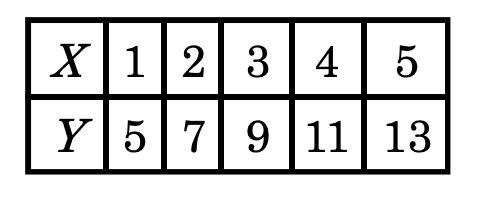
X is the independent variable and Y is the dependent variable.
View Solution
Since X is the independent variable and Y is the dependent variable, we need to find the regression equation of Y on X, which is given by \( Y_c = a + b_{yx}X \).
We first prepare a table to calculate the necessary sums:
Here, \(n=5\).
First, we find the means: \[ \bar{X} = \frac{\sum X}{n} = \frac{15}{5} = 3 \] \[ \bar{Y} = \frac{\sum Y}{n} = \frac{45}{5} = 9 \]
Next, we calculate the regression coefficient \(b_{yx}\): \[ b_{yx} = \frac{n\sum XY - (\sum X)(\sum Y)}{n\sum X^2 - (\sum X)^2} = \frac{5(155) - (15)(45)}{5(55) - (15)^2} = \frac{775 - 675}{275 - 225} = \frac{100}{50} = 2 \]
Now, we calculate the constant \(a\): \[ a = \bar{Y} - b_{yx}\bar{X} = 9 - (2)(3) = 9 - 6 = 3 \]
The appropriate regression equation is \( Y = 3 + 2X \). Quick Tip: The formula for \(b_{yx}\) is central to finding the regression line. A good way to check your calculation is to see if the line passes through the point of means, \((\bar{X}, \bar{Y})\). Here, if \(X=3\), \(Y = 3 + 2(3) = 9\), which matches our mean \( \bar{Y} \).
A company makes concrete bricks made up of cement and sand. The weight of a concrete brick has to be at least 5 kg. Cement costs INR 20 per kg and sand costs INR 6 per kg. Strength consideration dictate that a concrete brick should contain minimum 4 kg of cement and not more than 2 kg of sand. Formulate the L.P.P. for the cost to be minimum.
View Solution
Step 1: Define the variables.
Let \(x\) be the weight of cement in kg.
Let \(y\) be the weight of sand in kg.
Step 2: Formulate the objective function.
The objective is to minimize the cost of the brick. The cost function (\(Z\)) is: \[ Minimize Z = 20x + 6y \]
Step 3: Formulate the constraints.
The constraints are based on the conditions given:
Total weight constraint: The total weight must be at least 5 kg.
\[ x + y \geq 5 \]
Cement constraint: The brick must contain a minimum of 4 kg of cement.
\[ x \geq 4 \]
Sand constraint: The brick must contain not more than 2 kg of sand.
\[ y \leq 2 \]
Non-negativity constraints: The amount of cement and sand cannot be negative.
\[ x \geq 0, y \geq 0 \]
The complete L.P.P. formulation is:
Minimize \(Z = 20x + 6y\)
Subject to the constraints: \[ x + y \geq 5 \] \[ x \geq 4 \] \[ y \leq 2 \] \[ x, y \geq 0 \] Quick Tip: When formulating an L.P.P., always follow three steps: 1. Identify the decision variables (what you can control, e.g., kg of cement/sand). 2. Write the objective function (what you want to maximize or minimize, e.g., cost). 3. List all the constraints (the rules and limitations).
Find the mean of number of heads in three tosses of a fair coin.
View Solution
This is an example of a binomial distribution.
Let \(X\) be the random variable representing the number of heads.
The number of trials (tosses), \(n = 3\).
The probability of success (getting a head) in a single trial, \(p = \frac{1}{2}\).
The mean, or expected value \(E(X)\), of a binomial distribution is given by the formula \(E(X) = np\).
Substituting the values: \[ E(X) = 3 \times \frac{1}{2} = 1.5 \]
The mean number of heads in three tosses of a fair coin is 1.5.
Alternatively, we can list the sample space and calculate the mean directly:
The possible outcomes are: HHH, HHT, HTH, THH, HTT, THT, TTH, TTT.
Number of heads (X) can be 0, 1, 2, or 3.
P(X=0) [TTT] = 1/8
P(X=1) [HTT, THT, TTH] = 3/8
P(X=2) [HHT, HTH, THH] = 3/8
P(X=3) [HHH] = 1/8
The mean is \(E(X) = \sum x \cdot P(X=x)\): \[ E(X) = (0 \times \frac{1}{8}) + (1 \times \frac{3}{8}) + (2 \times \frac{3}{8}) + (3 \times \frac{1}{8}) \] \[ E(X) = \frac{0 + 3 + 6 + 3}{8} = \frac{12}{8} = 1.5 \] Quick Tip: For any binomial experiment (a fixed number of independent trials with two outcomes), the mean is simply the number of trials times the probability of success. It's a quick and powerful shortcut.
Obtain the trend value for the following data using 4-yearly centered moving averages :

View Solution
The trend values are: 2.25, 2.75, 3.25, 3.875, 4.875, and 6.25 for the years 1978 to 1983, respectively. The key to centered moving averages for an even period (like 4 years) is the two-step centering process. First, find the moving totals and place them *between* the years. Second, add adjacent pairs of these totals to center them *on* a year. Finally, divide by the total number of data points used (4 x 2 = 8).
Find the sequence that minimizes the total elapsed time to complete the following jobs in the order AB. Find the total elapsed time and idle time for machine B :
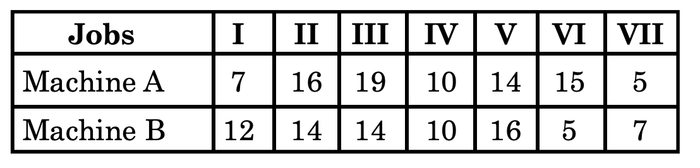
View Solution
We use Johnson's algorithm to find the optimal sequence.
The minimum processing time is 5, for Job VI on Machine B and Job VII on Machine A.
Job VII goes first, Job VI goes last. Sequence: [VII, _, _, _, _, _, VI].
The next smallest time is 7 for Job I on Machine A. It goes next. Sequence: [VII, I, _, _, _, _, VI].
The next smallest is 10 for Job IV on both machines. We schedule it from Machine A's side. Sequence: [VII, I, IV, _, _, _, VI].
The next smallest is 14 for V on A, and II and III on B. We schedule V from A's side, and II and III from B's side. Let's place II before III. Sequence: [VII, I, IV, V, _, III, II, VI]. The order of III and II at the end does not matter for the total time but we will use one. Let's use smallest job time on A for tie break: B(II)=14, B(III)=14 -> tie -> A(II)=16, A(III)=19. So II is better. Schedule II after III. Sequence: [VII, I, IV, V, III, II, VI].
The optimal sequence is VII - I - IV - V - III - II - VI.
Total Elapsed Time = 91 hours.
Idle Time for Machine B = (Initial wait) + (Time between jobs) \[ Idle Time = 5 + (36 - 34) + (55 - 52) + (71 - 69) + (86 - 85) = 5 + 2 + 3 + 2 + 1 = \textbf{13 hours}. \] Quick Tip: Johnson's rule is simple: find the smallest time in the table. If it's on the first machine, schedule that job as early as possible. If it's on the second machine, schedule it as late as possible. Cross off the job and repeat.
Five cards are drawn successively with replacement from a well shuffled deck of 52 cards. Find the probability that : (a) all the five cards are spades (b) only 3 cards are spades.
View Solution
This is a binomial probability problem.
Number of trials, \(n = 5\).
Probability of success (drawing a spade), \(p = \frac{13}{52} = \frac{1}{4}\).
Probability of failure (not drawing a spade), \(q = 1 - p = \frac{3}{4}\).
The binomial probability formula is \(P(X=x) = {}^nC_x \cdot p^x \cdot q^{n-x}\).
(a) All the five cards are spades:
Here, \(x = 5\). \[ P(X=5) = {}^5C_5 \left(\frac{1}{4}\right)^5 \left(\frac{3}{4}\right)^{5-5} = 1 \cdot \frac{1}{1024} \cdot \left(\frac{3}{4}\right)^0 = \frac{1}{1024} \]
(b) Only 3 cards are spades:
Here, \(x = 3\). \[ P(X=3) = {}^5C_3 \left(\frac{1}{4}\right)^3 \left(\frac{3}{4}\right)^{5-3} \] \[ {}^5C_3 = \frac{5!}{3!(5-3)!} = \frac{5 \times 4}{2 \times 1} = 10 \] \[ P(X=3) = 10 \cdot \left(\frac{1}{64}\right) \cdot \left(\frac{3}{4}\right)^2 = 10 \cdot \frac{1}{64} \cdot \frac{9}{16} = \frac{90}{1024} = \frac{45}{512} \] Quick Tip: Anytime you see a fixed number of independent trials ("with replacement" is a key hint) with a constant probability of success, think "binomial distribution." The formula \(nCx \cdot p^x \cdot q^{n-x}\) will be your tool.
A house valued at INR 8,00,000 is insured at 75% of its value. If the rate of premium is 0.80%, find the premium paid by the owner of the house. If agent's commission is 9% of the premium, find agent's commission.
View Solution
Step 1: Calculate the insured value of the house.
The house is valued at INR 8,00,000 and is insured for 75% of its value. \[ Insured Value = 8,00,000 \times 75% = 8,00,000 \times \frac{75}{100} = INR 6,00,000 \]
Step 2: Calculate the premium paid.
The rate of premium is 0.80% of the insured value. \[ Premium = 6,00,000 \times 0.80% = 6,00,000 \times \frac{0.80}{100} = 6,000 \times 0.8 = INR 4,800 \]
Step 3: Calculate the agent's commission.
The agent's commission is 9% of the premium. \[ Agent's Commission = 4,800 \times 9% = 4,800 \times \frac{9}{100} = 48 \times 9 = INR 432 \]
So, the premium paid is INR 4,800 and the agent's commission is INR 432. Quick Tip: Insurance calculations follow a clear sequence: 1. Find the \textbf{Policy Value} (the amount insured). 2. Calculate the \textbf{Premium} based on that value. 3. Calculate the \textbf{Commission} based on the premium. Always base each calculation on the result of the previous step.
Solve the following L.P.P. by graphical method.
Maximize : \(z = 4x + 6y\)
Subject to : \(3x + 2y \leq 12\), \(x + y \geq 4\), \(x, y \geq 0\)
View Solution
Step 1: Convert inequalities to equations and find points.
For \(3x + 2y = 12\):
If \(x=0\), \(2y=12 \implies y=6\). Point is (0, 6).
If \(y=0\), \(3x=12 \implies x=4\). Point is (4, 0).
The region \(3x+2y \leq 12\) is on the origin side of this line.
For \(x + y = 4\):
If \(x=0\), \(y=4\). Point is (0, 4).
If \(y=0\), \(x=4\). Point is (4, 0).
The region \(x+y \geq 4\) is on the non-origin side of this line.
Step 2: Graph the lines and find the feasible region.
The feasible region is the area bounded by the lines that satisfies all constraints, including \(x \geq 0\) and \(y \geq 0\). The corner points of the feasible region are:
A = (0, 4)
B = (4, 0)
C = (0, 6)
The intersection point of \(x+y=4\) and \(3x+2y=12\) is not needed as it lies outside the region defined by the combination of inequalities. The feasible region is the triangle formed by points A, B, and C.
Step 3: Evaluate the objective function at the corner points.
We evaluate \(Z = 4x + 6y\) at each vertex:
At A(0, 4): \(Z = 4(0) + 6(4) = 24\)
At B(4, 0): \(Z = 4(4) + 6(0) = 16\)
At C(0, 6): \(Z = 4(0) + 6(6) = 36\)
Step 4: Determine the maximum value.
The maximum value of Z is 36, which occurs at the point (0, 6).
So, the optimal solution is \(x=0\), \(y=6\), with a maximum value of \(Z = 36\). Quick Tip: The optimal solution for an L.P.P. always occurs at one of the corner points (vertices) of the feasible region. Once you've graphed the region, just test all the vertices in the objective function to find the maximum or minimum.
Defects on plywood sheet occur at random with the average of one defect per 50 sq.ft. Find the probability that such a sheet has : (a) no defect (b) at least one defect (use \(e^{-1} = 0.3678\))
View Solution
This is an example of a Poisson distribution, which is used for modeling the number of events occurring in a fixed interval of time or space.
The average number of defects (\(\lambda\)) per 50 sq.ft. is given as 1.
So, the mean of the distribution is \(m = 1\).
The Poisson probability formula is \( P(X=x) = \frac{e^{-m} m^x}{x!} \).
(a) Probability of no defect:
Here, we need to find \(P(X=0)\). \[ P(X=0) = \frac{e^{-1} (1)^0}{0!} \]
Since \(1^0 = 1\) and \(0! = 1\): \[ P(X=0) = e^{-1} \]
Given \(e^{-1} = 0.3678\), the probability of no defect is 0.3678.
(b) Probability of at least one defect:
"At least one defect" means \(X \geq 1\). The easiest way to calculate this is by using the complement rule: \[ P(X \geq 1) = 1 - P(X=0) \]
We already calculated \(P(X=0)\) in part (a). \[ P(X \geq 1) = 1 - 0.3678 = \textbf{0.6322} \]
The probability of at least one defect is 0.6322. Quick Tip: For Poisson problems, remember that "at least one" is almost always calculated as "1 minus the probability of zero." It saves you from having to calculate an infinite series of probabilities (\(P(1) + P(2) + ...\)).
The equations of two regression lines are \(10x-4y=80\) and \(10y-9x=-40\). Find
(a) \(\bar{x}\) and \(\bar{y}\)
(b) \(b_{yx}\) and \(b_{xy}\)
(c) \(r\)
(d) If Var(Y) = 36, obtain var (X).
View Solution
(a) Find \(\bar{x}\) and \(\bar{y}\):
The two regression lines intersect at the point of means \((\bar{x}, \bar{y})\). We solve the two equations simultaneously.
1) \(10x - 4y = 80 \implies 5x - 2y = 40\)
2) \(10y - 9x = -40 \implies -9x + 10y = -40\)
Multiply equation (1) by 5: \(25x - 10y = 200\).
Add this to equation (2): \[ (25x - 10y) + (-9x + 10y) = 200 - 40 \] \[ 16x = 160 \implies \bar{x} = 10 \]
Substitute \(\bar{x}=10\) into \(5x - 2y = 40\): \[ 5(10) - 2y = 40 \implies 50 - 2y = 40 \implies 2y = 10 \implies \bar{y} = 5 \]
So, \(\bar{x} = 10\) and \(\bar{y} = 5\).
(b) Find \(b_{yx}\) and \(b_{xy}\):
Assume the first line is Y on X: \(10x - 80 = 4y \implies y = \frac{10}{4}x - 20\). So, \(b_{yx} = \frac{10}{4} = 2.5\).
Assume the second line is X on Y: \(10y + 40 = 9x \implies x = \frac{10}{9}y + \frac{40}{9}\). So, \(b_{xy} = \frac{10}{9}\).
Let's check the condition \(|r| \leq 1\), which means \(b_{yx} \cdot b_{xy} \leq 1\). \( 2.5 \times \frac{10}{9} = \frac{25}{9} \approx 2.78 \).
This is greater than 1, so our assumption is wrong.
Let's switch the assumptions.
Line of Y on X: \(10y - 9x = -40 \implies 10y = 9x - 40 \implies y = \frac{9}{10}x - 4\). So, \(b_{yx} = \frac{9}{10} = 0.9\).
Line of X on Y: \(10x - 4y = 80 \implies 10x = 4y + 80 \implies x = \frac{4}{10}y + 8\). So, \(b_{xy} = \frac{4}{10} = 0.4\).
Check: \(b_{yx} \cdot b_{xy} = 0.9 \times 0.4 = 0.36\). This is \(\leq 1\), so the assumption is correct. \(b_{yx} = 0.9\) and \(b_{xy} = 0.4\).
(c) Find \(r\):
The correlation coefficient \(r\) is the geometric mean of the regression coefficients. \[ r = \sqrt{b_{yx} \cdot b_{xy}} = \sqrt{0.36} = 0.6 \]
Since both \(b_{yx}\) and \(b_{xy}\) are positive, \(r\) is also positive. So, \(r = 0.6\).
(d) Find Var(X):
We know that \(b_{yx} = r \frac{\sigma_y}{\sigma_x}\). The variance is the square of the standard deviation (\(\sigma^2\)). \[ b_{yx}^2 = r^2 \frac{\sigma_y^2}{\sigma_x^2} = r^2 \frac{Var(Y)}{Var(X)} \] \[ 0.9^2 = (0.6)^2 \frac{36}{Var(X)} \] \[ 0.81 = 0.36 \frac{36}{Var(X)} \] \[ Var(X) = \frac{0.36 \times 36}{0.81} = \frac{12.96}{0.81} = 16 \]
The variance of X is 16. Quick Tip: When identifying regression lines, calculate both possibilities for \(b_{yx}\) and \(b_{xy}\). The correct assignment is the one where their product is less than or equal to 1.
Find x if the cost of living index is 150 :
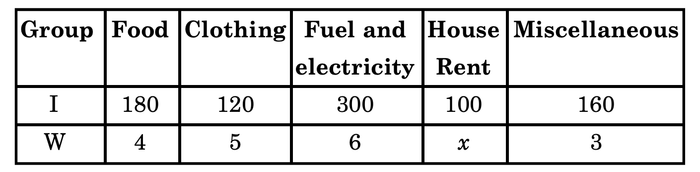
View Solution
The Cost of Living Index Number (CLI) is calculated using the formula for the weighted aggregate method: \[ CLI = \frac{\sum IW}{\sum W} \]
Where \(I\) represents the price index for each group and \(W\) represents the weight.
Given:
CLI = 150
We first calculate \(\sum IW\) and \(\sum W\) from the table.
\(\sum IW = (180 \times 4) + (120 \times 5) + (300 \times 6) + (100 \times x) + (160 \times 3)\)
\[ \sum IW = 720 + 600 + 1800 + 100x + 480 = 3600 + 100x \]
\(\sum W = 4 + 5 + 6 + x + 3 = 18 + x\)
Now, substitute these into the CLI formula: \[ 150 = \frac{3600 + 100x}{18 + x} \]
Multiply both sides by \((18 + x)\): \[ 150(18 + x) = 3600 + 100x \] \[ 2700 + 150x = 3600 + 100x \]
Rearrange the terms to solve for \(x\): \[ 150x - 100x = 3600 - 2700 \] \[ 50x = 900 \] \[ x = \frac{900}{50} = 18 \]
The value of x is 18. Quick Tip: This is essentially a weighted average problem. The formula \(Average = \frac{\sum (Value \times Weight)}{\sum Weight}\) is fundamental. Just plug in the knowns and solve the resulting linear equation for the unknown weight.
A bill of INR 18,000 was discounted for INR 17,568 at a bank on 25th October 2017. If the rate of interest was 12% p.a. what is the legal due date?
View Solution
N/A Quick Tip: The "legal due date" is found by adding 3 grace days to the "nominal due date". Always remember this final step after calculating the period.
Solve the following assignment problem for minimization :
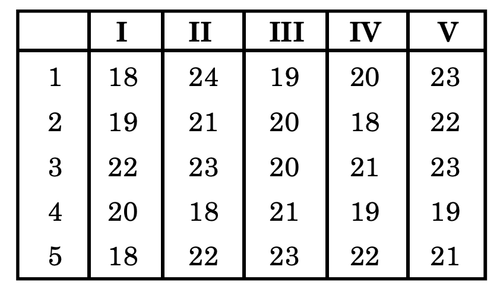
View Solution
The Hungarian method is iterative. You repeat the line-covering and matrix-improving steps until the minimum number of lines needed to cover all zeros is equal to the size of the matrix. At that point, you can find the unique assignment.
*The article might have information for the previous academic years, please refer the official website of the exam.