
Maharashtra Board Class 12 2026 Physics Question Paper with Solutions


| Updated On - Feb 16, 2026
The Maharashtra Board 2026 Class 12 Physics Question Paper with Solution PDF will be available here immediately after the board exam concludes. The Physics exam is scheduled to be held on 16 February, 2026 in the Morning Session from 11:00 AM to 2:00 PM.
The Maharashtra Board Class 12 Physics exam 2026 consists of a 70-mark theory paper and 30-mark practical, based on a reduced syllabus for 2025-26. The exam includes MCQs, short, and long answer questions, often with a 40% theory, 30% derivation, and 30% numerical split. Key topics include Rotational Dynamics, Optics, and Electrodynamics, with high-weightage chapters like Thermodynamics, Fluids, and Semiconductor Devices.
Maharashtra Board 2026 Physics Question Paper with Solution PDF
| Maharashtra Board 2026 Physics Question Paper with Solutions PDF | Download PDF | Check Solutions |

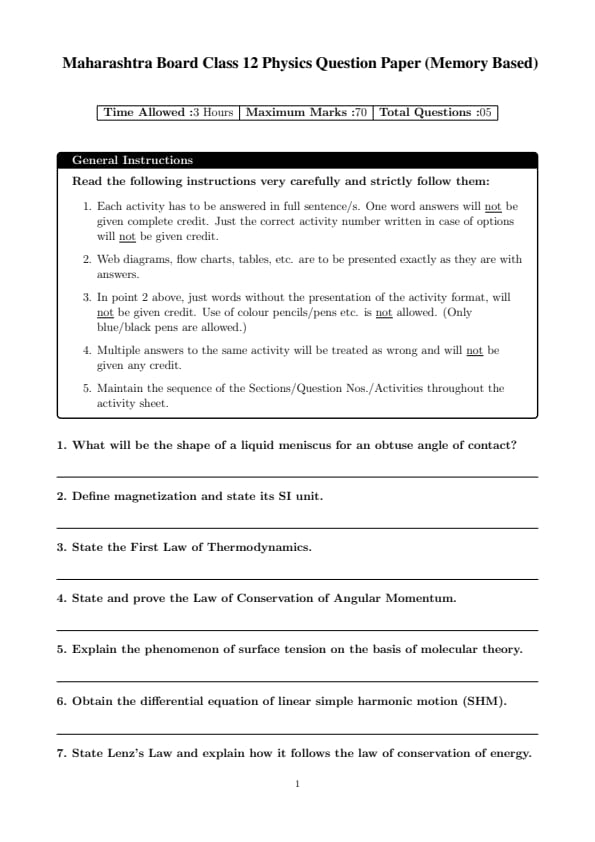
What will be the shape of a liquid meniscus for an obtuse angle of contact?
View Solution
Step 1: Understanding the Concept:
The shape of a liquid surface (meniscus) in a tube depends on the relative strengths of cohesive forces (between liquid molecules) and adhesive forces (between liquid and tube wall). This relationship is quantified by the angle of contact.
Step 2: Key Formula or Approach:
1. Acute Angle (\( < 90^\circ \)): Adhesive forces \(>\) Cohesive forces \(\rightarrow\) Concave meniscus.
2. Obtuse Angle (\( > 90^\circ \)): Cohesive forces \(>\) Adhesive forces \(\rightarrow\) Convex meniscus.
Step 3: Detailed Explanation:
When the angle of contact is obtuse, the liquid molecules are more strongly attracted to each other than to the container walls. As a result, the liquid tends to "pull away" from the surface, curving downwards at the edges and creating a hump in the middle. A classic example is mercury in a glass tube.
Step 4: Final Answer:
The shape of the liquid meniscus for an obtuse angle of contact is convex. Quick Tip: To remember this: Liquids that "wet" the surface (like water) form a concave meniscus, while liquids that "do not wet" the surface (like mercury) form a convex meniscus.
Define magnetization and state its SI unit.
View Solution
Step 1: Understanding the Concept:
Magnetization (also called magnetic polarization) represents the extent to which a material becomes magnetized when placed in an external magnetic field. It characterizes the density of permanent or induced magnetic dipole moments in a magnetic material.
Step 2: Key Formula or Approach:
\[ \mathbf{M} = \frac{\mathbf{m}_{net}}{V} \]
Where:
\(\mathbf{M}\) = Magnetization vector.
\(\mathbf{m}_{net}\) = Net magnetic dipole moment.
\(V\) = Volume of the material.
Step 3: Detailed Explanation:
In a non-magnetized material, atomic dipoles are randomly oriented. When an external field is applied, these dipoles align, creating a net magnetic moment. Magnetization is the vector sum of these moments divided by the total volume.
1. SI Unit Derivation: Magnetic moment is measured in \(A \cdot m^2\) and volume in \(m^3\).
2. Thus, the unit is \(\frac{A \cdot m^2}{m^3} = A/m\).
Step 4: Final Answer:
Magnetization is defined as the net magnetic moment per unit volume of a material. Its SI unit is A/m. Quick Tip: Magnetization (\(M\)) and Magnetic Field Intensity (\(H\)) share the same SI unit (A/m), making them easy to relate in the formula \(B = \mu_0(H + M)\).
State the First Law of Thermodynamics.
View Solution
Step 1: Understanding the Concept:
The First Law of Thermodynamics is essentially a statement of the Law of Conservation of Energy specifically adapted for thermodynamic systems. It establishes that energy can be transformed from one form to another (heat and work) but cannot be created or destroyed.
Step 2: Key Formula or Approach:
\[ \Delta U = Q - W \]
Where:
\(\Delta U\) = Change in internal energy.
\(Q\) = Heat added to the system.
\(W\) = Work done by the system.
Step 3: Detailed Explanation:
When heat energy (\(Q\)) is supplied to a system, it is utilized in two ways:
1. To increase the internal energy (\(\Delta U\)) of the system (raising the temperature).
2. To enable the system to perform external work (\(W\)) on its surroundings.
The total energy remains constant throughout the process.
Step 4: Final Answer:
The First Law of Thermodynamics states that the change in internal energy of a closed system is equal to the heat added to the system minus the work done by the system. Quick Tip: Be careful with sign conventions! In some chemistry textbooks, the law is written as \(\Delta U = Q + W\), where \(W\) is defined as work done on the system.
State and prove the Law of Conservation of Angular Momentum.
View Solution
Step 1: Understanding the Concept:
Angular momentum (\( L \)) is the rotational equivalent of linear momentum. Just as linear momentum is conserved when net force is zero, angular momentum is conserved when net torque is zero.
Step 2: Key Formula or Approach:
1. Angular Momentum: \( L = I\omega \)
2. Newton's Second Law for Rotation: \( \tau_{ext} = \frac{dL}{dt} \)
Step 3: Detailed Explanation:
Statement: The angular momentum of a rigid body remains constant if the net external torque acting on it is zero.
Proof:
1. The relation between torque (\( \tau \)) and angular momentum (\( L \)) is given by: \[ \tau = \frac{dL}{dt} \]
2. If the net external torque is zero (\( \tau = 0 \)): \[ \frac{dL}{dt} = 0 \]
3. Since the derivative of a constant is zero, we have: \[ L = constant \]
4. Therefore, \( I_1\omega_1 = I_2\omega_2 \). If the moment of inertia (\( I \)) decreases, the angular velocity (\( \omega \)) must increase to keep \( L \) constant.
Step 4: Final Answer:
The law states that for a closed system, total angular momentum is conserved (\( \Delta L = 0 \)) in the absence of external torque. Quick Tip: A classic example is a diver pulling their arms in; they decrease their moment of inertia (\( I \)), which causes them to spin faster (increase \( \omega \)).
Explain the phenomenon of surface tension on the basis of molecular theory.
View Solution
Step 1: Understanding the Concept:
Molecular theory explains surface tension by looking at the forces of attraction (cohesive forces) between liquid molecules. We categorize molecules into two types: those deep within the liquid and those at the surface.
Step 2: Key Formula or Approach:
Surface Tension (\( T \)) is defined as force per unit length: \( T = \frac{F}{l} \).
Step 3: Detailed Explanation:
1. Molecules in the Bulk: A molecule deep inside the liquid is surrounded by other molecules on all sides. The cohesive forces act equally in all directions, resulting in a net force of zero.
2. Molecules at the Surface: A molecule on the surface has liquid molecules only below and beside it. There are no (or very few) liquid molecules above it.
3. Net Inward Pull: Consequently, surface molecules experience a net downward cohesive force toward the interior of the liquid.
4. Surface Energy: This inward pull creates a state of tension and causes the surface to behave like a stretched elastic membrane, minimizing its surface area.
Step 4: Final Answer:
Surface tension is the result of unbalanced cohesive forces at the liquid-air interface, which exerts an inward pressure on the surface layer. Quick Tip: Small droplets of liquid are spherical because the sphere is the shape with the minimum surface area for a given volume, satisfying the inward pull of surface tension.
Obtain the differential equation of linear simple harmonic motion (SHM).
View Solution
Step 1: Understanding the Concept:
Simple Harmonic Motion (SHM) is a type of periodic motion where the restoring force is directly proportional to the displacement and acts in the opposite direction.
Step 2: Key Formula or Approach:
1. Restoring Force: \( F = -kx \)
2. Newton's Second Law: \( F = ma = m \frac{d^2x}{dt^2} \)
Step 3: Detailed Explanation:
1. In SHM, the restoring force is: \[ F = -kx \]
2. According to Newton's Second Law: \[ m \frac{d^2x}{dt^2} = -kx \]
3. Rearranging the terms: \[ m \frac{d^2x}{dt^2} + kx = 0 \]
4. Divide by mass (\( m \)): \[ \frac{d^2x}{dt^2} + \frac{k}{m}x = 0 \]
5. Let \( \omega^2 = \frac{k}{m} \), where \( \omega \) is the angular frequency. The equation becomes: \[ \frac{d^2x}{dt^2} + \omega^2x = 0 \]
Step 4: Final Answer:
The differential equation for linear SHM is \( \frac{d^2x}{dt^2} + \omega^2x = 0 \). Quick Tip: The general solution to this differential equation is \( x(t) = A \sin(\omega t + \phi) \), where \( A \) is the amplitude and \( \phi \) is the phase constant.
State Lenz’s Law and explain how it follows the law of conservation of energy.
View Solution
Step 1: Understanding the Concept:
Lenz's Law provides the physical significance of the negative sign in Faraday's Law of Induction. It ensures that the universe doesn't create "infinite energy" from a simple change in a magnetic field.
Step 2: Key Formula or Approach:
Faraday-Lenz Law: \[ \mathcal{E} = -N \frac{d\Phi_B}{dt} \]
Step 3: Detailed Explanation:
1. Statement: The polarity of induced emf is such that it tends to produce a current which opposes the change in magnetic flux that conditioned it.
2. Conservation of Energy: If the induced current supported the change (e.g., attracted an approaching magnet), the magnet would accelerate indefinitely, creating kinetic energy and electrical energy from nothing.
3. Mechanical Work: Instead, the induced current creates a magnetic field that repels an approaching magnet. To keep the magnet moving, external mechanical work must be done.
4. Energy Conversion: This mechanical work done against the magnetic repulsion is what is converted into electrical energy (induced current).
Step 4: Final Answer:
Lenz's Law follows the law of conservation of energy because the electrical energy produced by induction comes at the cost of the mechanical work required to overcome the opposing force. Quick Tip: Think of Lenz's Law as "Nature's inertia" for electromagnetism—it resists any change in the existing magnetic state.
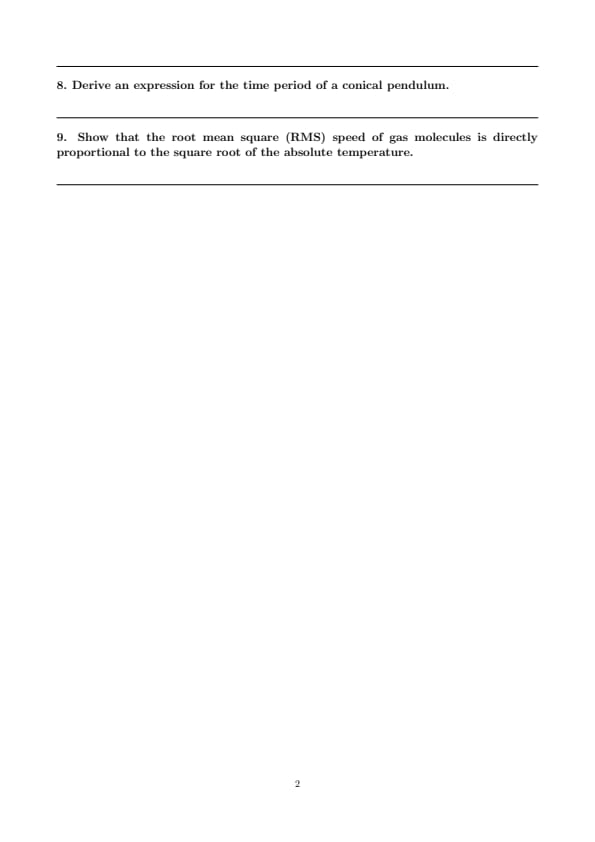
Derive an expression for the time period of a conical pendulum.
View Solution
Step 1: Understanding the Concept:
A conical pendulum consists of a bob rotating in a horizontal circle at a constant speed, such that the string describes the surface of a cone. We analyze the forces in both the vertical and horizontal directions.
Step 2: Key Formula or Approach:
1. Vertical equilibrium: \( T \cos \theta = mg \)
2. Centripetal force: \( T \sin \theta = m r \omega^2 \)
Step 3: Detailed Explanation:
1. Dividing the centripetal equation by the vertical equation: \[ \frac{T \sin \theta}{T \cos \theta} = \frac{m r \omega^2}{mg} \implies \tan \theta = \frac{r \omega^2}{g} \]
2. From the geometry of the cone, \( r = L \sin \theta \). Substitute this: \[ \frac{\sin \theta}{\cos \theta} = \frac{L \sin \theta \omega^2}{g} \implies \omega^2 = \frac{g}{L \cos \theta} \]
3. The angular velocity is \( \omega = \sqrt{\frac{g}{L \cos \theta}} \).
4. Time period \( T = \frac{2\pi}{\omega} \): \[ T = 2\pi \sqrt{\frac{L \cos \theta}{g}} \]
Step 4: Final Answer:
The time period of a conical pendulum is \( T = 2\pi \sqrt{\frac{L \cos \theta}{g}} \). Quick Tip: Note that as the angle \( \theta \) approaches 0, the formula becomes the same as a simple pendulum: \( T = 2\pi \sqrt{L/g} \).
Show that the root mean square (RMS) speed of gas molecules is directly proportional to the square root of the absolute temperature.
View Solution
Step 1: Understanding the Concept:
The Kinetic Theory of Gases relates the macroscopic property of temperature to the microscopic property of the average kinetic energy of gas molecules.
Step 2: Key Formula or Approach:
1. Pressure of an ideal gas: \( P = \frac{1}{3} \frac{M}{V} v_{rms}^2 \)
2. Ideal Gas Equation: \( PV = RT \) (for 1 mole)
Step 3: Detailed Explanation:
1. From the pressure formula: \[ PV = \frac{1}{3} M v_{rms}^2 \]
2. Substitute \( PV = RT \) from the ideal gas law: \[ RT = \frac{1}{3} M v_{rms}^2 \]
3. Solve for \( v_{rms} \): \[ v_{rms}^2 = \frac{3RT}{M} \] \[ v_{rms} = \sqrt{\frac{3RT}{M}} \]
4. Since \( 3 \), \( R \), and \( M \) (molar mass) are constants for a specific gas: \[ v_{rms} \propto \sqrt{T} \]
Step 4: Final Answer:
The RMS speed is shown to be proportional to the square root of the absolute temperature (\( T \)). Quick Tip: Remember that \( T \) must always be in Kelvin. Doubling the Celsius temperature does not double the energy; doubling the Kelvin temperature does.
Maharashtra Board 2026 Physics Revision
*The article might have information for the previous academic years, please refer the official website of the exam.