
Maharashtra Board Class 12 Book Keeping and Accountancy (50-J-897) Question Paper 2024 Available- Download Solution PDF with Answer Key

.jpg?tr=h-55,w-55,c-force)
Content Strategist|Tech-innovator|National Hackathon Winner | Updated On - Feb 24, 2025
The Maharashtra Board 2024 Class 12th Book Keeping and Accountancy exam is being conducted (March 7, 2024). The question paper along with the solution PDF will be available here to download once the exam is conducted successfully.
The Maharashtra Board 12th Boards Book Keeping and Accountancy exam is expected to be easy to moderate based on previous year trends. The Book Keeping and Accountancy exam includes journal entries, ledger posting, trial balance, final accounts, cash flow statements, partnership and company accounts, financial statement analysis, and computerized accounting systems.
Maharashtra Board Class 12 Book Keeping and Accountancy( 50-J-897) Question Paper 2024 with Solutions
| Maharashtra Board Class 12 Book Keeping and Accountancy Question Paper with Answer Key |  Download Download |
Check Solution |
Maharashtra Board Class 12 Book Keeping and Accountancy( 50-J-897) Question Paper 2024 with Solutions
Question 1(a):
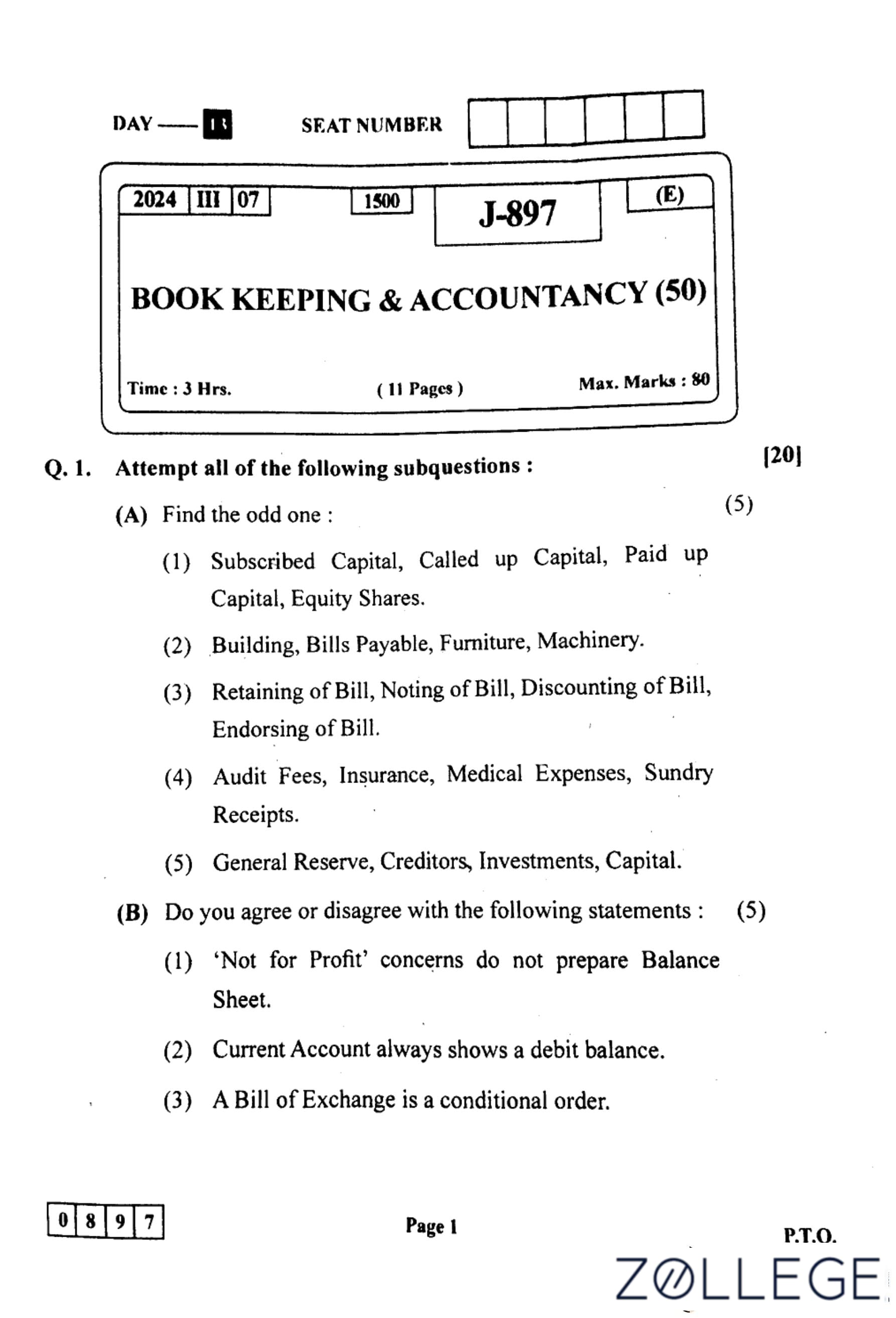
Attempt all of the following subquestions:
Find the odd one
(i). Subscribed Capital, Called up Capital, Paid up Capital, Equity Shares
View Solution
Subscribed Capital, Called-up Capital, and Paid-up Capital represent different stages of capital
commitment in a company, whereas Equity Shares refer to ownership units and do not represent a stage of
capital.
(ii). Building, Bills Payable, Furniture, Machinery
View Solution
Building, Furniture, and Machinery are fixed assets (tangible property). Bills Payable, however, is
a liability, making it the odd one out.
(iii) Retaining of Bill, Noting of Bill, Discounting of Bill, Endorsing of Bill
View Solution
Noting, Discounting, and Endorsing of a Bill are all financial actions taken on a bill. Retaining of
Bill means keeping it without taking any financial action, making it the odd one out.
(iv). Audit Fees, Insurance, Medical Expenses, Sundry Receipts
View Solution
Audit Fees, Insurance, and Medical Expenses are expenses incurred by a business. Sundry Receipts
refer to income and not an expense, making it the odd one out.
(v). General Reserve, Creditors, Investments, Capital
View Solution
General Reserve, Investments, and Capital are company-owned funds, whereas Creditors represent an external liability, making it the odd one out. Quick Tip: Identifying the odd one requires understanding categories of financial terms, such as assets, liabilities, expenses, and revenues.
(i). ‘Not for Profit’ concerns do not prepare Balance Sheet.
Correct Answer:Disagree
View Solution
Non-Profit Organizations (NPOs) do prepare a Balance Sheet (also called Receipts & Payments
Account or Statement of Affairs). This statement shows their assets, liabilities, and capital funds, even though
their primary objective is not profit-making.
(ii). Current Account always shows a debit balance.
Correct Answer:
Disagree
View Solution
(iii). A Bill of Exchange is a conditional order.
Correct Answer:
Disagree
View Solution
A Bill of Exchange is an unconditional order to pay a specified amount to a certain person at a fixed
date. According to the Negotiable Instruments Act, bills of exchange must be unconditional to ensure clarity
and enforceability.
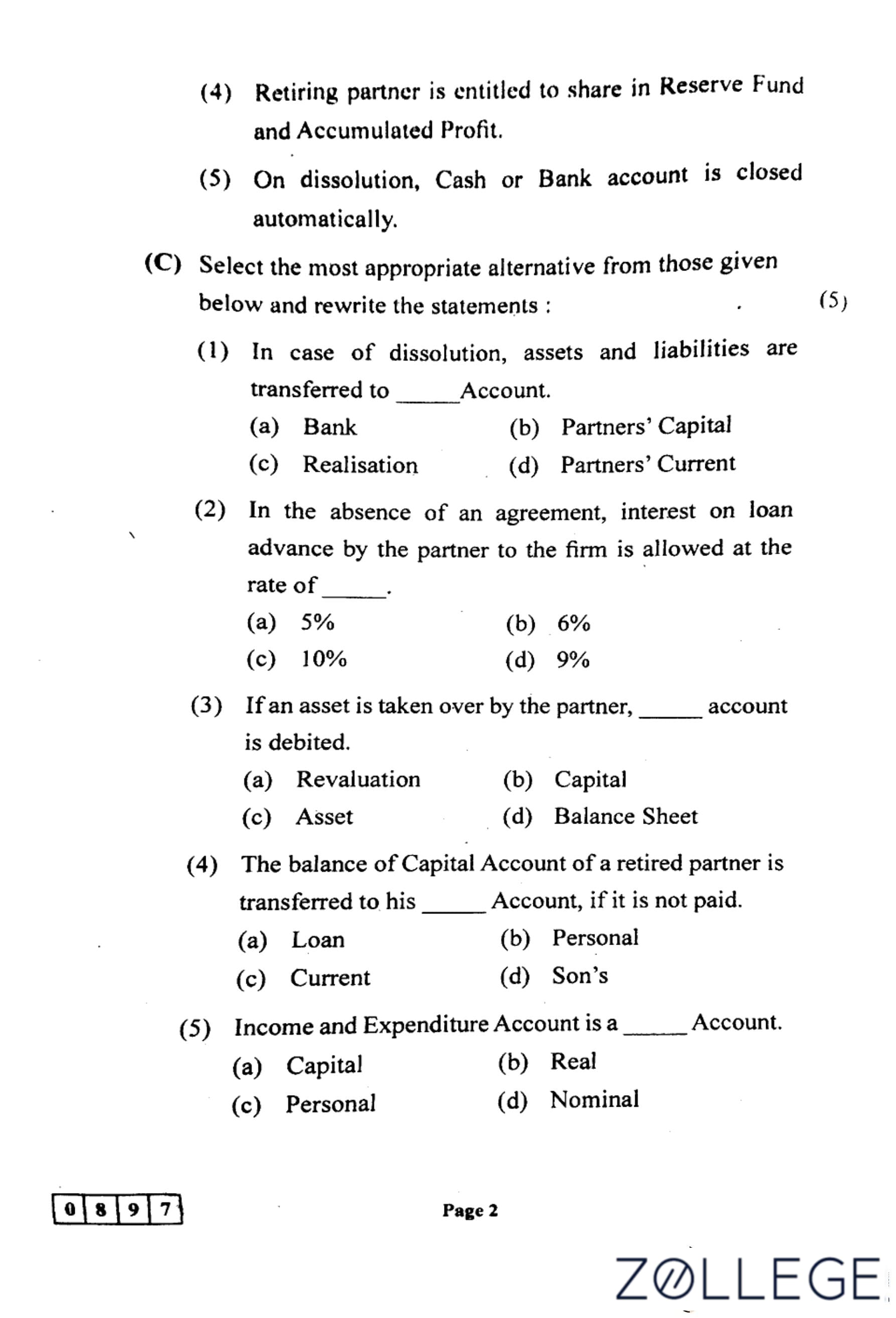
(iv). Retiring partner is entitled to share in Reserve Fund and Accumulated Profit.
Correct Answer:
Agree
View Solution
(v). On dissolution, Cash or Bank account is closed automatically.
View Solution
On dissolution, all accounts must be closed manually by adjusting final payments to creditors, partners, and shareholders.
The Cash or Bank Account is closed only after all transactions are settled, and the firm ceases operations. Quick Tip: A Bill of Exchange is always unconditional, and a Current Account can have both debit or credit balances.
Question 1(c):
Select the most appropriate alternative from those given below and rewrite the statements:
(i). In case of dissolution, assets and liabilities are transferred to ____ Account.
(a) Bank
View Solution
At the time of dissolution of a firm, all assets and liabilities are transferred to the Realisation Account
to determine profit or loss on the sale of assets and settlement of liabilities.
(ii). In the absence of an agreement, interest on loan advanced by the partner to the firm is allowed at the rate of ____.
View Solution
According to the Indian Partnership Act, 1932, if there is no agreement, interest on a partner’s loan
is allowed at 6% per annum.
(iii). If an asset is taken over by the partner, ____ account is debited.
View Solution
When a partner takes over an asset, the value of the asset is debited to the Partner’s Capital Account
as it reduces the amount due to the partner.
(iv). The balance of the Capital Account of a retired partner is transferred to his ____ Account, if it is not paid.
View Solution
If the retiring partner’s capital balance is not immediately paid, it is transferred to the Loan Account
and treated as a liability of the firm.
(v) Income and Expenditure Account is a ____ Account.
View Solution
The Income and Expenditure Account is a Nominal Account as it records revenues and expenses of a Non-Profit Organization (NPO) during an accounting period. Quick Tip: The Realisation Account is used during dissolution, and a retiring partner’s unpaid capital is converted into a loan.
Question 1(d):
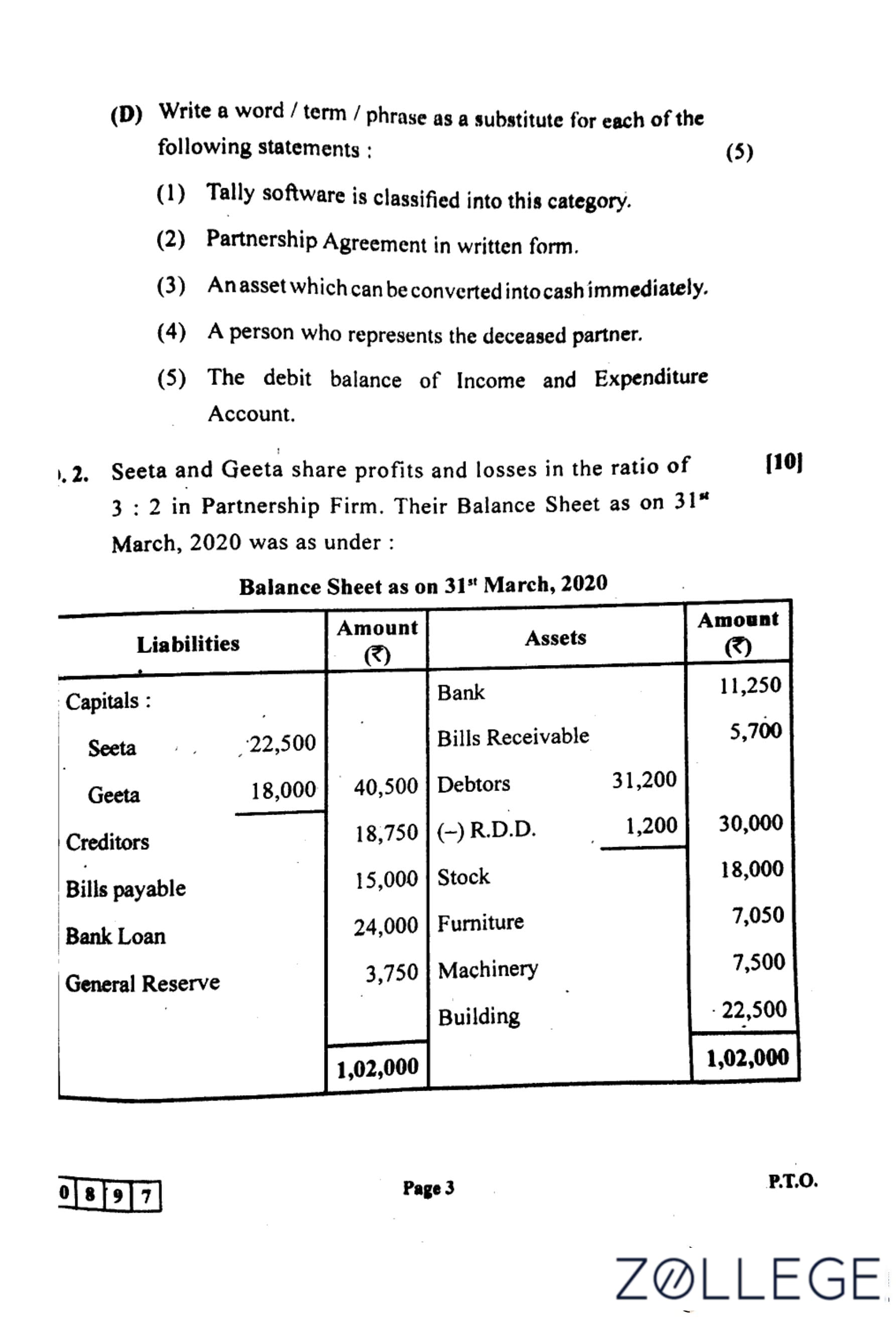
Write a word/term/phrase as a substitute for each of the following statements:
(i). Tally software is classified into this category.
View Solution
Tally is an Accounting Software used for financial transactions, bookkeeping, and GST compliance.
(ii). Partnership Agreement in written form.
View Solution
A Partnership Deed is a legal document that outlines the rights, duties, and responsibilities of
partners in a firm.
(iii). An asset which can be converted into cash immediately.
View Solution
Liquid Assets are those assets that can be quickly converted into cash without a significant loss in
value. Examples: Cash, Bank Deposits, Marketable Securities.
(iv). A person who represents the deceased partner.
View Solution
A Legal Representative is a person (heir/executor) who manages the assets, liabilities, and legal
matters of a deceased partner.
(v). The debit balance of the Income and Expenditure Account.
View Solution
A Deficit occurs when expenses exceed income in a Non-Profit Organization’s Income and Expenditure Account. Quick Tip: A Partnership Deed is a legal document that defines partner responsibilities, profit sharing, and dispute resolution.
Seeta and Geeta share profits and losses in the ratio of 3:2 in a partnership firm. Their Balance Sheet as on 31st March, 2020 was as under:
Balance Sheet as on 31st March, 2020
| Liabilities | Amount (₹) | Assets | Amount (₹) |
|---|---|---|---|
| Capitals: | Bank | 11,250 | |
| Seeta | 22,500 | Bills Receivable | 5,700 |
| Geeta | 18,000 | Debtors | 31,200 |
| 40,500 | Less: R.D.D | (1,200) | |
| Creditors | 18,750 | Stock | 18,000 |
| Bills Payable | 15,000 | Furniture | 7,050 |
| Bank Loan | 24,000 | Machinery | 7,500 |
| General Reserve | 3,750 | Building | 22,500 |
| Total | 1,02,000 | Total | 1,02,000 |
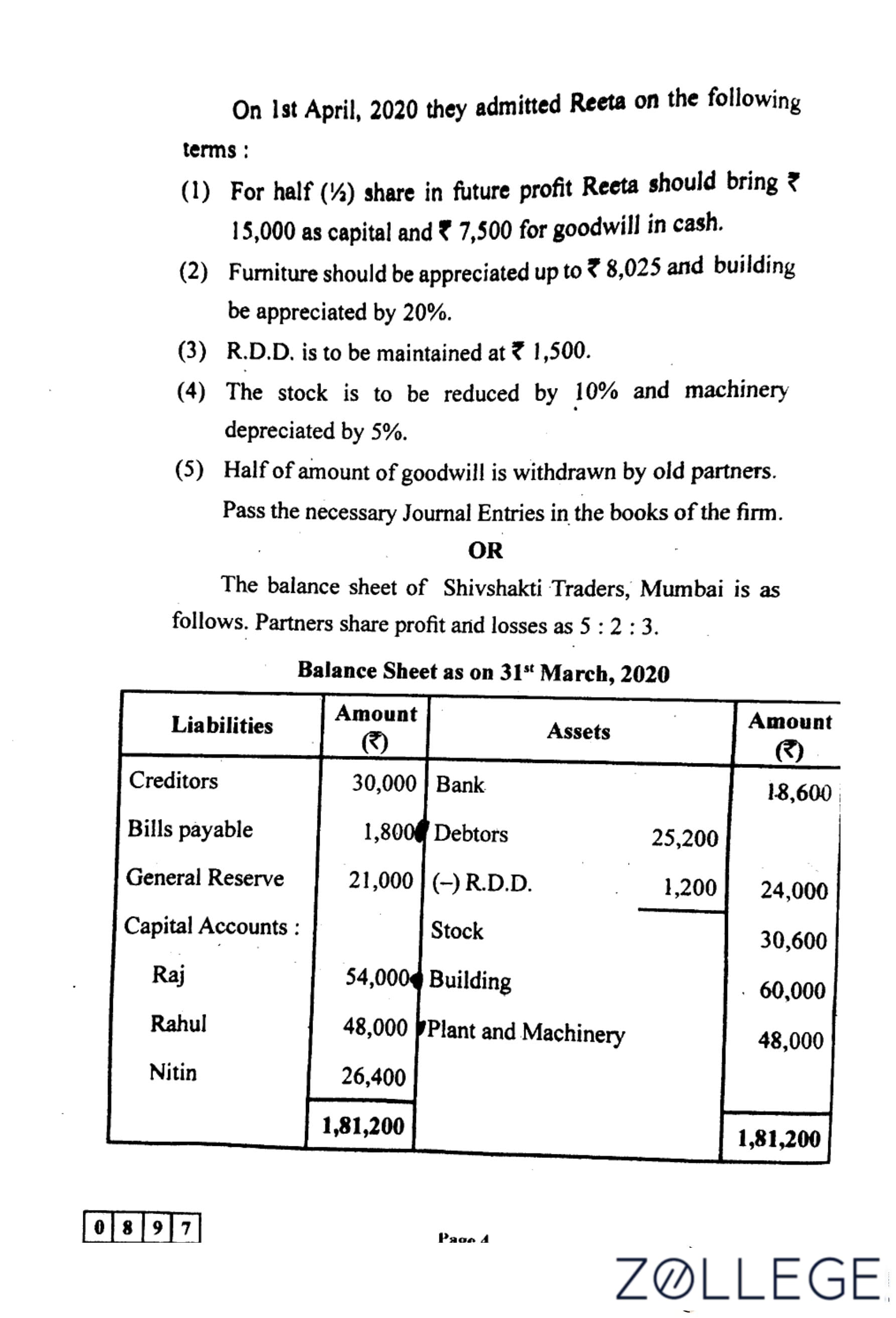
On 1st April, 2020, they admitted Reeta on the following terms:
(1).For half (½) share in future profit, Reeta should bring Rs. 15,000 as capital and Rs. 7,500 for goodwill in cash.
(2).Furniture should be appreciated up to Rs. 8,025 and building be appreciated by 20%.
(3).R.D.D. is to be maintained at Rs. 1,500.
(4).The stock is to be reduced by 10% and machinery depreciated by 5%.
(5).Half of the amount of goodwill is withdrawn by old partners.
View Solution
Journal Entries in the Books of the Firm
| Date | Particulars | Dr. (₹) | Cr. (₹) |
|---|---|---|---|
| 1-Apr-2020 | Bank A/c Dr. | 22,500 | |
| To Reeta’s Capital A/c | 15,000 | ||
| To Goodwill A/c | 7,500 | ||
| 1-Apr-2020 | Furniture A/c Dr. | 975 | |
| Building A/c Dr. | 4,500 | ||
| To Revaluation A/c | 5,475 | ||
| 1-Apr-2020 | Revaluation A/c Dr. | 1,500 | |
| To R.D.D A/c | 300 | ||
| To Stock A/c | 1,800 | ||
| To Machinery A/c | 375 | ||
| 1-Apr-2020 | Revaluation A/c Dr. | 75 | |
| To Seeta’s Capital A/c | 45 | ||
| To Geeta’s Capital A/c | 30 | ||
| 1-Apr-2020 | Goodwill A/c Dr. | 7,500 | |
| To Seeta’s Capital A/c | 4,500 | ||
| To Geeta’s Capital A/c | 3,000 | ||
| 1-Apr-2020 | Seeta’s Capital A/c Dr. | 2,250 | |
| Geeta’s Capital A/c Dr. | 1,500 | ||
| To Bank A/c | 3,750 |
Revaluation Account
| Particulars | Dr. (₹) | Particulars | Cr. (₹) |
|---|---|---|---|
| To R.D.D Increase | 300 | By Furniture Appreciation | 975 |
| To Stock Depreciation | 1,800 | By Building Appreciation | 4,500 |
| To Machinery Depreciation | 375 | ||
| To Profit Transferred: | 75 | ||
| Seeta (3:2) | 45 | ||
| Geeta (3:2) | 30 | ||
| Total | 2,550 | Total | 5,475 |
Adjusted Balance Sheet as on 1st April, 2020
| Liabilities | Amount (₹) | Assets | Amount (₹) |
|---|---|---|---|
| Capitals: | 59,250 | Bank | 30,000 |
| Seeta | 24,750 | Bills Receivable | 5,700 |
| Geeta | 19,500 | Debtors | 31,200 |
| Reeta | 15,000 | Less: R.D.D | (1,500) |
| Creditors | 18,750 | Stock | 16,200 |
| Bills Payable | 15,000 | Furniture | 8,025 |
| Bank Loan | 24,000 | Machinery | 7,125 |
| General Reserve | 3,750 | Building | 27,000 |
| Total | 1,20,750 | Total | 1,20,750 |
Quick Tip: On admission of a partner, goodwill is credited to old partners, and assets are revalued to reflect the current market value.
Question 2(b):
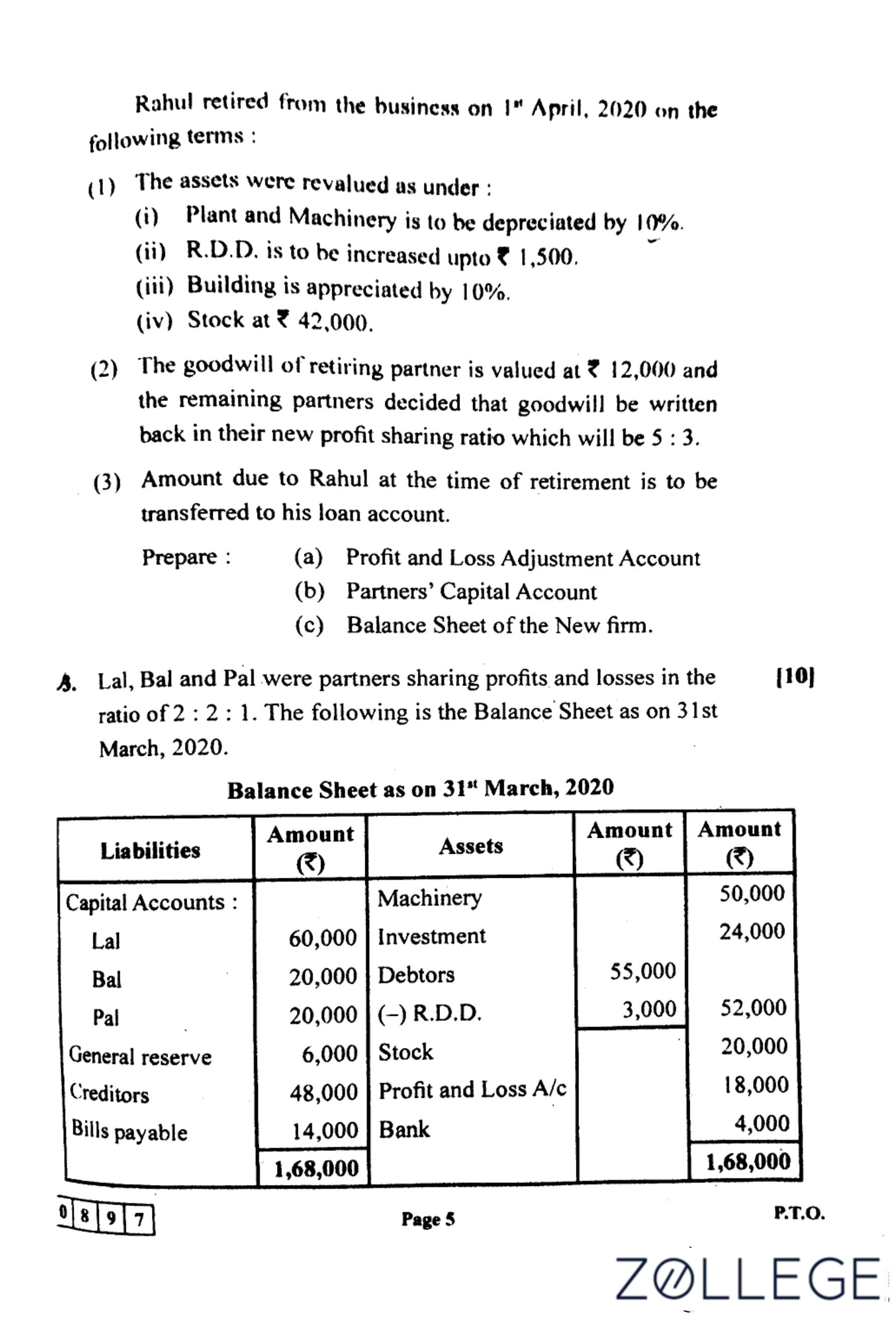
The balance sheet of Shivshakti Traders, Mumbai is as follows. Partners share profit and
losses as 5:2:3.
Balance Sheet as on 31st March, 2020
| Liabilities | Amount (₹) | Assets | Amount (₹) |
|---|---|---|---|
| Creditors | 30,000 | Bank | 18,600 |
| Bills Payable | 1,800 | Debtors | 25,200 |
| General Reserve | 21,000 | Less: R.D.D | (1,200) |
| Capital Accounts: | Stock | 30,600 | |
| Raj | 54,000 | Building | 60,000 |
| Rahul | 48,000 | Plant and Machinery | 48,000 |
| Nitin | 26,400 | ||
| Total | 1,81,200 | Total | 1,81,200 |
Rahul retired from the business on 1st April, 2020 on the following terms:
1. The assets were revalued as under:
• Plant and Machinery to be depreciated by 10%.
• R.D.D. to be increased up to |1,500.
• Building is appreciated by 10%.
• Stock at |42,000.
2. The goodwill of retiring partner is valued at |12,000 and the remaining partners decided that goodwill
will be written back in their new profit-sharing ratio, which will be 5:3.
3. Amount due to Rahul at the time of retirement is to be transferred to his loan account.
(i). Profit and Loss Adjustment Account (Revaluation Account)
View Solution
| Particulars | Dr. (₹) | Particulars | Cr. (₹) |
|---|---|---|---|
| To Plant and Machinery Depreciation (10%) | 4,800 | By Stock Increase | 11,400 |
| To R.D.D Increase | 300 | By Building Appreciation (10%) | 6,000 |
| To Profit Transferred: | Raj (5/10) | 6,150 | |
| Rahul (2/10) | 2,460 | ||
| Nitin (3/10) | 3,690 | ||
| Total | 17,400 | Total | 17,400 |
(ii). Partners’ Capital Account
View Solution
| Particulars | Raj (₹) | Rahul (₹) | Nitin (₹) |
|---|---|---|---|
| To Goodwill Written Off | 7,500 | 0 | 4,500 |
| To Rahul’s Loan A/c (Settlement) | 0 | 69,960 | 0 |
| By Balance b/d | 54,000 | 48,000 | 26,400 |
| By Revaluation Profit | 6,150 | 2,460 | 3,690 |
| By General Reserve | 10,500 | 4,200 | 6,300 |
| By Goodwill Share | 7,500 | 0 | 4,500 |
| Total | 70,650 | 69,960 | 40,890 |
(iii). Adjusted Balance Sheet as on 1st April, 2020
View Solution
| Liabilities | Amount (₹) | Assets | Amount (₹) |
|---|---|---|---|
| Creditors | 30,000 | Bank | 18,600 |
| Bills Payable | 1,800 | Debtors | 25,200 |
| Rahul’s Loan A/c | 69,960 | Less: R.D.D | (1,500) |
| Capital Accounts: | Stock | 42,000 | |
| Raj | 70,650 | Building | 66,000 |
| Nitin | 40,890 | Plant and Machinery | 43,200 |
| Total | 1,81,200 | Total | 1,81,200 |
Explanation of Adjustments:
Profit and Loss Adjustment Account: Records revaluation of assets and distribution of profits among partners.
Partners’ Capital Account: Adjusts each partner’s share, goodwill adjustments, and the transfer of Rahul’s amount to his loan account.
Balance Sheet: Reflects the adjusted figures post-retirement of Rahul.
%Quicktip Quick Tip: At retirement, a partner’s goodwill is shared among remaining partners in their new profit-sharing ratio.
Question 3(a):Lal, Bal, and Pal were partners sharing profits and losses in the ratio of 2:2:1. The following
is the Balance Sheet as on 31st March, 2020.
Balance Sheet as on 31st March, 2020
| Liabilities | Amount (₹) | Assets | Amount (₹) |
|---|---|---|---|
| Capital Accounts: | Machinery | 50,000 | |
| Lal | 60,000 | Investment | 24,000 |
| Bal | 20,000 | Debtors | 55,000 |
| Pal | 20,000 | Less: R.D.D | (3,000) |
| General Reserve | 6,000 | Stock | 20,000 |
| Creditors | 48,000 | Profit and Loss A/c | 18,000 |
| Bills Payable | 14,000 | Bank | 4,000 |
| Total | 1,68,000 | Total | 1,68,000 |
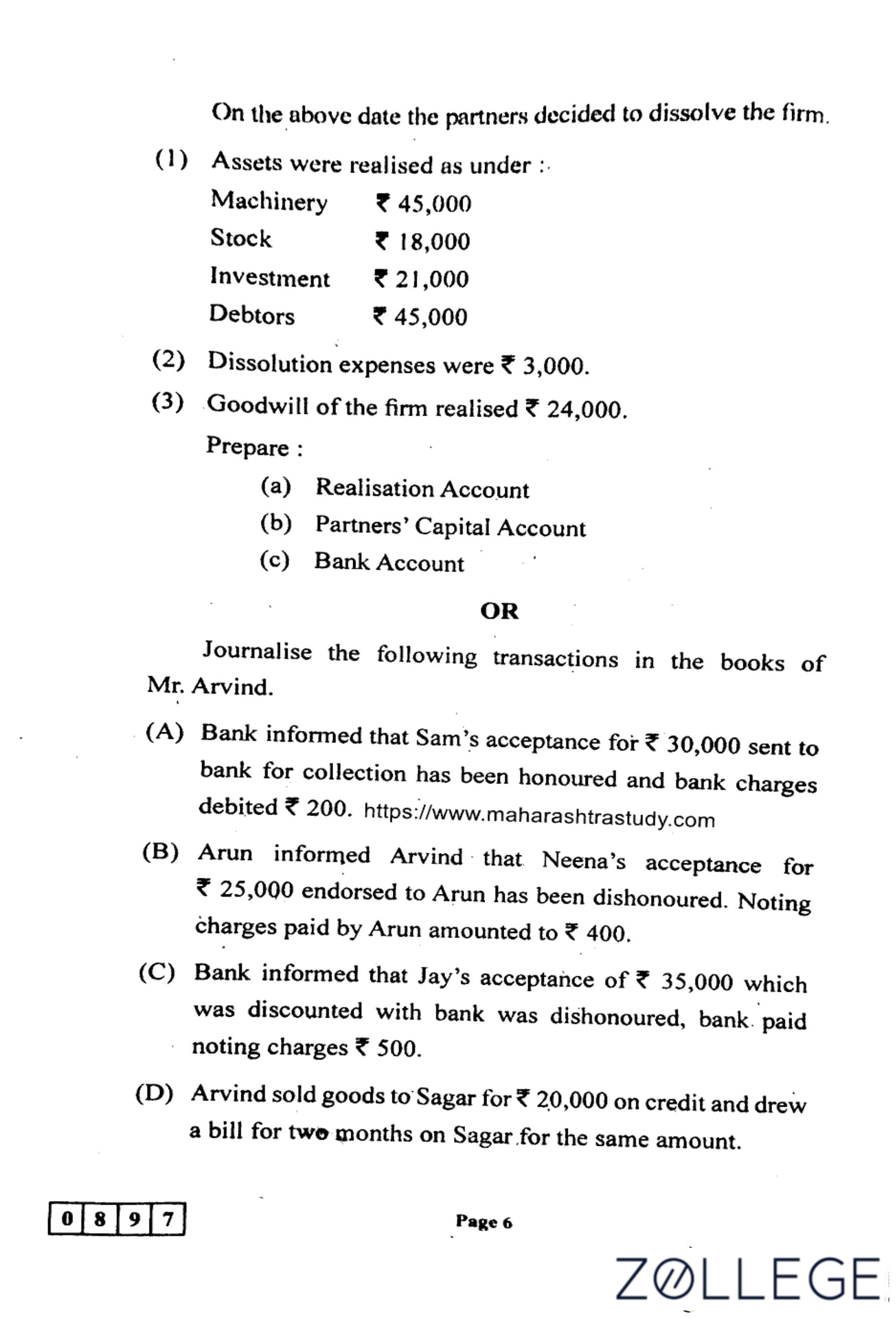
On the above date, the partners decided to dissolve the firm.
1. Assets were realised as under:
• Machinery ₹45,000
• Stock ₹18,000
• Investment ₹21,000
• Debtors ₹45,000
2. Dissolution expenses were ₹3,000.
3. Goodwill of the firm realised ₹24,000.
3(i). Realisation Account
View Solution
| Particulars | Dr. (₹) | Particulars | Cr. (₹) |
|---|---|---|---|
| To Machinery | 50,000 | By Bank (Machinery) | 45,000 |
| To Investment | 24,000 | By Bank (Stock) | 18,000 |
| To Debtors | 55,000 | By Bank (Investment) | 21,000 |
| To Stock | 20,000 | By Bank (Debtors) | 45,000 |
| To Creditors | 48,000 | By Bank (Goodwill) | 24,000 |
| To Bills Payable | 14,000 | By Partners’ Capital A/c (Loss) | 3,000 |
| To Dissolution Expenses | 3,000 | Lal (2/5) | 1,200 |
| Bal (2/5) | 1,200 | ||
| Pal (1/5) | 600 | ||
| Total | 1,68,000 | Total | 1,68,000 |
(ii). Partners’ Capital Account
View Solution
| Particulars | Lal (₹) | Bal (₹) | Pal (₹) |
|---|---|---|---|
| To Realisation A/c (Loss) | 1,200 | 1,200 | 600 |
| To Cash/Bank A/c (Final Payment) | 64,800 | 22,800 | 25,800 |
| By Balance b/d | 60,000 | 20,000 | 20,000 |
| By General Reserve | 2,400 | 2,400 | 1,200 |
| By Profit | 3,600 | 1,600 | 5,200 |
| Total | 66,000 | 24,800 | 27,000 |
(iii). Bank Account
View Solution
| Particulars | Dr. (₹) | Particulars | Cr. (₹) |
|---|---|---|---|
| To Balance b/d | 4,000 | By Dissolution Expenses | 3,000 |
| To Realisation A/c | 1,53,000 | By Lal (Final Payment) | 64,800 |
| By Bal (Final Payment) | 22,800 | ||
| By Pal (Final Payment) | 25,800 | ||
| Total | 1,57,000 | Total | 1,57,000 |
Explanation of Adjustments:
Realisation Account: Records the sale of assets, payment of liabilities, and expenses.
Partners’ Capital Account: Reflects the final settlements of partners' capital balances.
Bank Account: Shows cash inflow from the sale of assets and outflow for liability payments and final settlement.
%Quicktip Quick Tip: At the time of dissolution, all assets are sold, liabilities paid, and the remaining balance is distributed among partners according to their capital balances.
Journalise the following transactions in the books of Mr. Arvind.
(A) Bank informed that Sam's acceptance for Rs. 30,000 sent to bank for collection has been honoured and bank charges debited Rs. 200.
(B) Arun informed Arvind that Neena's acceptance for Rs. 25,000 endorsed to Arun has been dishonoured. Noting charges paid by Arun amounted to Rs. 400.
(C) Bank informed that Jay's acceptance of Rs. 35,000 which was discounted with bank was dishonoured, bank. paid noting charges Rs. 500.
(D) Arvind sold goods to Sagar for Rs. 20,000 on credit and drew a bill for two months on Sagar for the same amount.
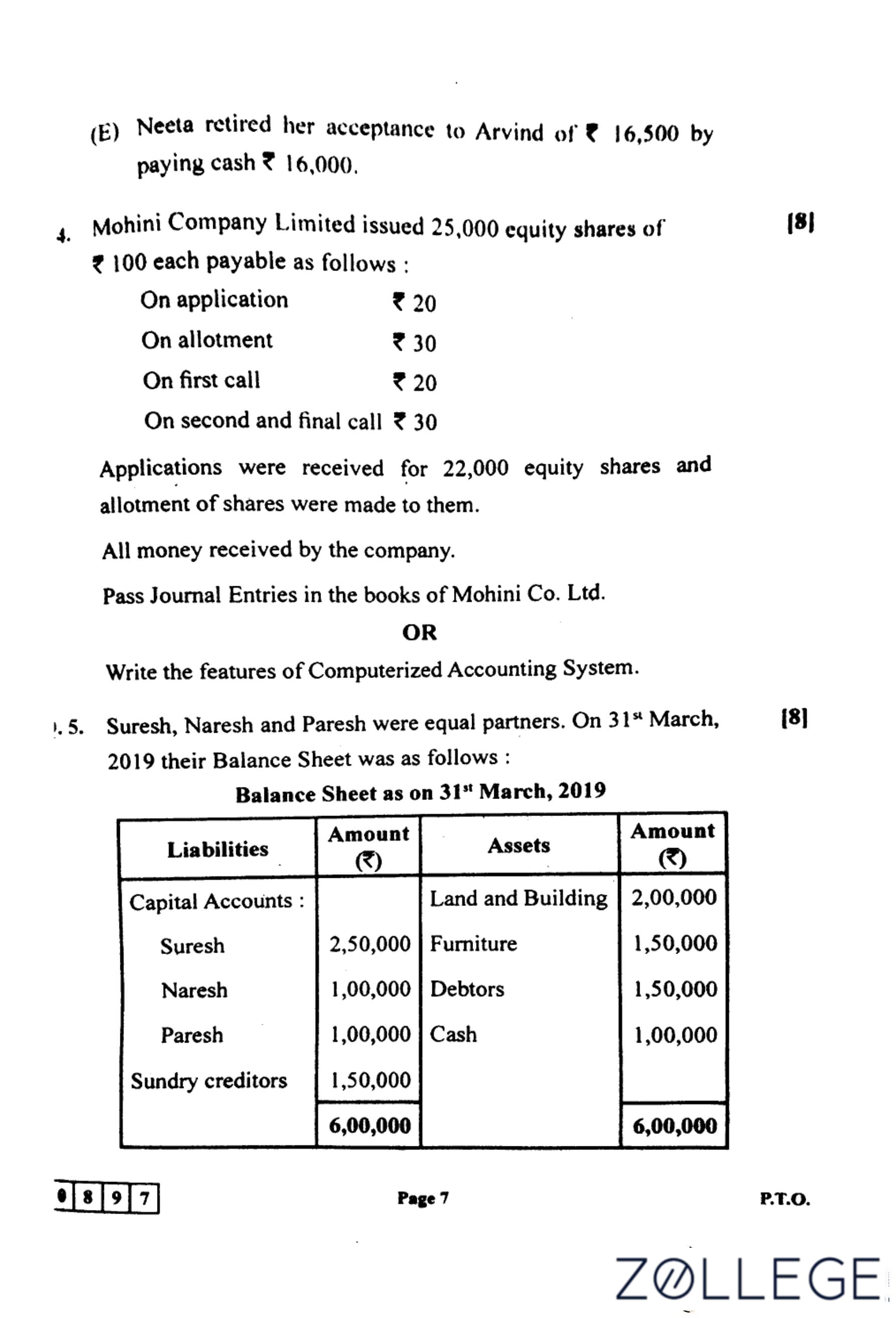
(E) Neeta retired her acceptance to Arvind of Rs. 16,500 by paying cash Rs. 16,000.
View Solution
Journal Entries in the Books of Mr. Arvind
| Date | Particulars | Dr. (₹) | Cr. (₹) |
|---|---|---|---|
| (A) | Bank A/c Dr. | 29,800 | |
| Bank Charges A/c Dr. | 200 | ||
| To Bills Receivable A/c | 30,000 | ||
| (Being Sam’s acceptance collected by the bank and bank charges deducted) | |||
| (B) | Arvind’s A/c Dr. | 25,400 | |
| To Arun’s A/c | 25,000 | ||
| To Noting Charges A/c | 400 | ||
| (Being Neena’s acceptance dishonoured and noting charges paid by Arun) | |||
| (C) | Jay’s A/c Dr. | 35,500 | |
| To Bank A/c | 35,000 | ||
| To Noting Charges A/c | 500 | ||
| (Being Jay’s acceptance dishonoured and noting charges paid by bank) | |||
| (D) | Sagar’s A/c Dr. | 20,000 | |
| To Sales A/c | 20,000 | ||
| (Being goods sold on credit to Sagar and bill drawn for the same) | |||
| (E) | Cash A/c Dr. | 16,000 | |
| Discount Allowed A/c Dr. | 500 | ||
| To Neeta’s A/c | 16,500 | ||
| (Being Neeta retired her acceptance by paying ₹16,000 in cash) |
Explanation of Entries:
(A) The bill received from Sam was collected by the bank, but bank charges of Rs. 200 were deducted.
(B) Neena’s bill was dishonoured, and noting charges were paid by Arun, which Arvind needs to reimburse.
(C) Jay’s bill was dishonoured after it was discounted with the bank, and noting charges were borne by the bank.
(D) Goods were sold on credit to Sagar, and a bill was drawn for the same amount.
(E) Neeta settled her acceptance early by paying Rs. 16,000 instead of Rs. 16,500, leading to a discount allowed of Rs. 500. Quick Tip: When a bill is dishonoured, the amount is debited back to the drawee's account along with any noting charges.
Mohini Company Limited issued 25,000 equity shares of Rs. 100 each payable as follows:
On Application Rs. 20
On Allotment Rs. 30
On First Call Rs. 20
On Second and Final Call Rs. 30
Applications were received for 22,000 equity shares, and allotment of shares was made accordingly.
All money was received by the company.
Pass Journal Entries in the books of Mohini Co. Ltd.
View Solution
Journal Entries in the Books of Mohini Co. Ltd.
| Date | Particulars | Dr. (₹) | Cr. (₹) |
|---|---|---|---|
| (1) | Bank A/c Dr. | 4,40,000 | |
| To Equity Share Application A/c | 4,40,000 | ||
| (Being application money received for 22,000 shares at ₹20 per share) | |||
| (2) | Equity Share Application A/c Dr. | 4,40,000 | |
| To Equity Share Capital A/c | 4,40,000 | ||
| (Being application money transferred to share capital) | |||
| (3) | Bank A/c Dr. | 6,60,000 | |
| To Equity Share Allotment A/c | 6,60,000 | ||
| (Being allotment money received for 22,000 shares at ₹30 per share) | |||
| (4) | Bank A/c Dr. | 4,40,000 | |
| To Equity Share First Call A/c | 4,40,000 | ||
| (Being first call money received for 22,000 shares at ₹20 per share) | |||
| (5) | Bank A/c Dr. | 6,60,000 | |
| To Equity Share Second and Final Call A/c | 6,60,000 | ||
| (Being second and final call money received for 22,000 shares at ₹30 per share) |
Explanation of Entries:
(1) Application money received for 22,000 shares at Rs. 20 per share.
(2) Application money transferred to Share Capital Account.
(3) Allotment money received for 22,000 shares at Rs. 30 per share.
(4) First Call money received for 22,000 shares at Rs. 20 per share.
(5) Second and Final Call money received for 22,000 shares at Rs. 30 per share. Quick Tip: In share issue transactions, all application money first goes to the Application Account, and upon allotment, it is transferred to the Share Capital Account.
Write the features of Computerized Accounting System.
View Solution
Features of a Computerized Accounting System:
Automation: The entire process of accounting, from recording transactions to generating financial statements, is automated.
Accuracy: Reduces errors in calculations and data entry, ensuring precise financial records.
Speed: Transactions are processed much faster compared to manual accounting.
Scalability: Can handle large volumes of financial data efficiently.
Integration: Easily integrates with other business applications such as inventory management, payroll, and taxation.
Security: Provides restricted access to authorized users, ensuring data confidentiality.
Backup and Recovery: Enables automatic backups, reducing the risk of data loss.
Data Analysis and Reporting: Generates real-time reports and financial analysis for better decision-making.
Multi-User Access: Allows multiple users to work simultaneously without data conflicts.
Compliance with Accounting Standards: Ensures adherence to financial regulations and tax laws. Quick Tip: A Computerized Accounting System improves efficiency by reducing human intervention and increasing accuracy in financial transactions.
Question 5(a):
Suresh, Naresh, and Paresh were equal partners. On 31st March, 2019, their Balance Sheet
was as follows:
Balance Sheet as on 31st March, 2019
| Liabilities | Amount (₹) | Assets | Amount (₹) |
|---|---|---|---|
| Capital Accounts: | Land and Building | 2,00,000 | |
| Suresh | 2,50,000 | Furniture | 1,50,000 |
| Naresh | 1,00,000 | Debtors | 1,50,000 |
| Paresh | 1,00,000 | Cash | 1,00,000 |
| Sundry Creditors | 1,50,000 | ||
| Total | 6,00,000 | Total | 6,00,000 |
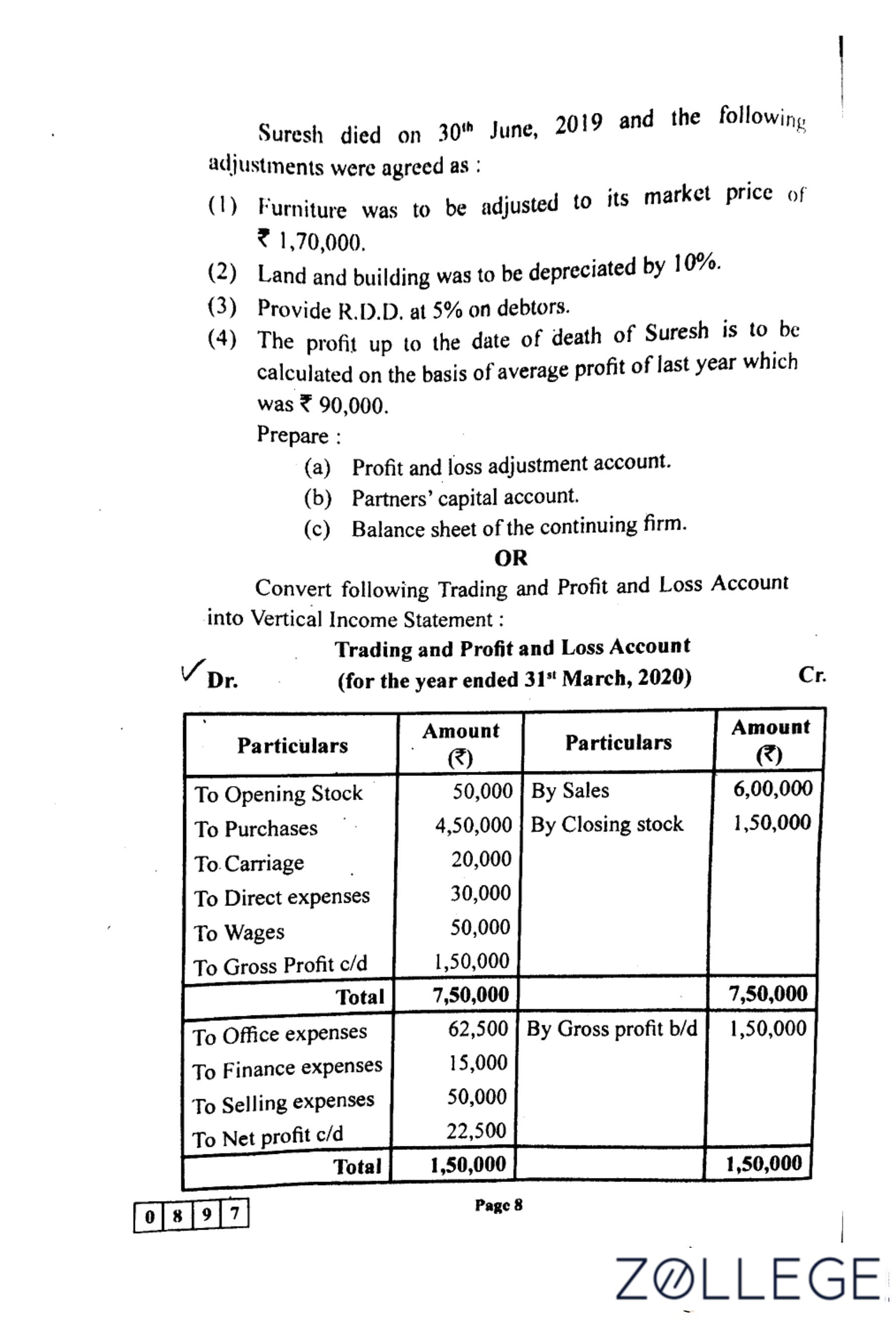
Suresh died on 30th June, 2019, and the following adjustments were agreed upon:
1. Furniture to be adjusted to its market price of ₹1,70,000.
2. Land and building to be depreciated by 10%.
3. Provide R.D.D. at 5% on debtors.
4. The profit up to the date of death of Suresh is to be calculated on the basis of average profit of last year,
which was ₹90,000.
(i). Profit and Loss Adjustment Account (Revaluation Account)
View Solution
| Particulars | Dr. (₹) | Particulars | Cr. (₹) |
|---|---|---|---|
| To Land and Building Depreciation (10%) | 20,000 | By Furniture Appreciation | 20,000 |
| To R.D.D Increase (5% on ₹1,50,000) | 7,500 | By Profit Transferred: | |
| To Profit Transferred: | 7,500 | Suresh (1/3) | 2,500 |
| Naresh (1/3) | 2,500 | ||
| Paresh (1/3) | 2,500 | ||
| Total | 35,000 | Total | 35,000 |
(ii). Partners’ Capital Account
View Solution
| Particulars | Suresh (₹) | Naresh (₹) | Paresh (₹) |
|---|---|---|---|
| To Executor of Suresh A/c (Final Settlement) | 2,87,500 | 0 | 0 |
| By Balance b/d | 2,50,000 | 1,00,000 | 1,00,000 |
| By Revaluation Profit | 2,500 | 2,500 | 2,500 |
| By Profit Share (₹90,000 × 1/3) | 30,000 | 0 | 0 |
| Total | 2,87,500 | 1,02,500 | 1,02,500 |
(iii). Adjusted Balance Sheet of the Continuing Firm as on 30th June, 2019
View Solution
| Liabilities | Amount (₹) | Assets | Amount (₹) |
|---|---|---|---|
| Sundry Creditors | 1,50,000 | Land and Building (90%) | 1,80,000 |
| Executor of Suresh A/c | 2,87,500 | Furniture | 1,70,000 |
| Capital Accounts: | Debtors (After 5% R.D.D) | 1,42,500 | |
| Naresh | 1,02,500 | Cash | 1,47,500 |
| Paresh | 1,02,500 | ||
| Total | 6,42,500 | Total | 6,42,500 |
Explanation of Adjustments:
Profit and Loss Adjustment Account: Reflects revaluation of assets and liabilities.
Partners’ Capital Account: Adjusts each partner’s capital, including profit up to the date of death and revaluation profit.
Balance Sheet: Shows the adjusted financial position of the firm after the death of Suresh. Quick Tip: At the time of a partner's death, revaluation of assets and settlement of the deceased partner’s share must be made before preparing the new balance sheet.
Convert the following Trading and Profit and Loss Account into Vertical Income Statement for the year ended 31st March, 2020.
Trading and Profit and Loss Account (for the year ended 31st March, 2020)
| Particulars | Amount (₹) | Particulars | Amount (₹) |
|---|---|---|---|
| To Opening Stock | 50,000 | By Sales | 6,00,000 |
| To Purchases | 4,50,000 | By Closing Stock | 1,50,000 |
| To Carriage | 20,000 | ||
| To Direct Expenses | 30,000 | ||
| To Wages | 50,000 | ||
| To Gross Profit c/d | 1,50,000 | ||
| Total | 7,50,000 | Total | 7,50,000 |
| Particulars | Amount (₹) | Particulars | Amount (₹) |
|---|---|---|---|
| To Office Expenses | 62,500 | By Gross Profit b/d | 1,50,000 |
| To Finance Expenses | 15,000 | ||
| To Selling Expenses | 50,000 | ||
| To Net Profit c/d | 22,500 | ||
| Total | 1,50,000 | Total | 1,50,000 |
View Solution
Vertical Income Statement for the year ended 31st March, 2020
| Particulars | Amount (₹) |
|---|---|
| Revenue: | |
| Sales | 6,00,000 |
| Add: Closing Stock | 1,50,000 |
| Total Revenue | 7,50,000 |
| Less: Cost of Goods Sold (COGS) | |
| Opening Stock | 50,000 |
| Purchases | 4,50,000 |
| Carriage | 20,000 |
| Direct Expenses | 30,000 |
| Wages | 50,000 |
| Total COGS | 6,00,000 |
| Gross Profit | 1,50,000 |
| Less: Operating Expenses | |
| Office Expenses | 62,500 |
| Finance Expenses | 15,000 |
| Selling Expenses | 50,000 |
| Total Operating Expenses | 1,27,500 |
| Net Profit | 22,500 |
Explanation of Vertical Income Statement:
Revenue Section: Includes Sales and Closing Stock.
Cost of Goods Sold (COGS): Includes all direct expenses such as purchases, wages, and carriage.
Gross Profit: Difference between total revenue and COGS.
Operating Expenses: Includes office, finance, and selling expenses.
Net Profit: The final profit after deducting all expenses. Quick Tip: A Vertical Income Statement presents financial data in a step-wise manner, making it easy to analyze profitability.
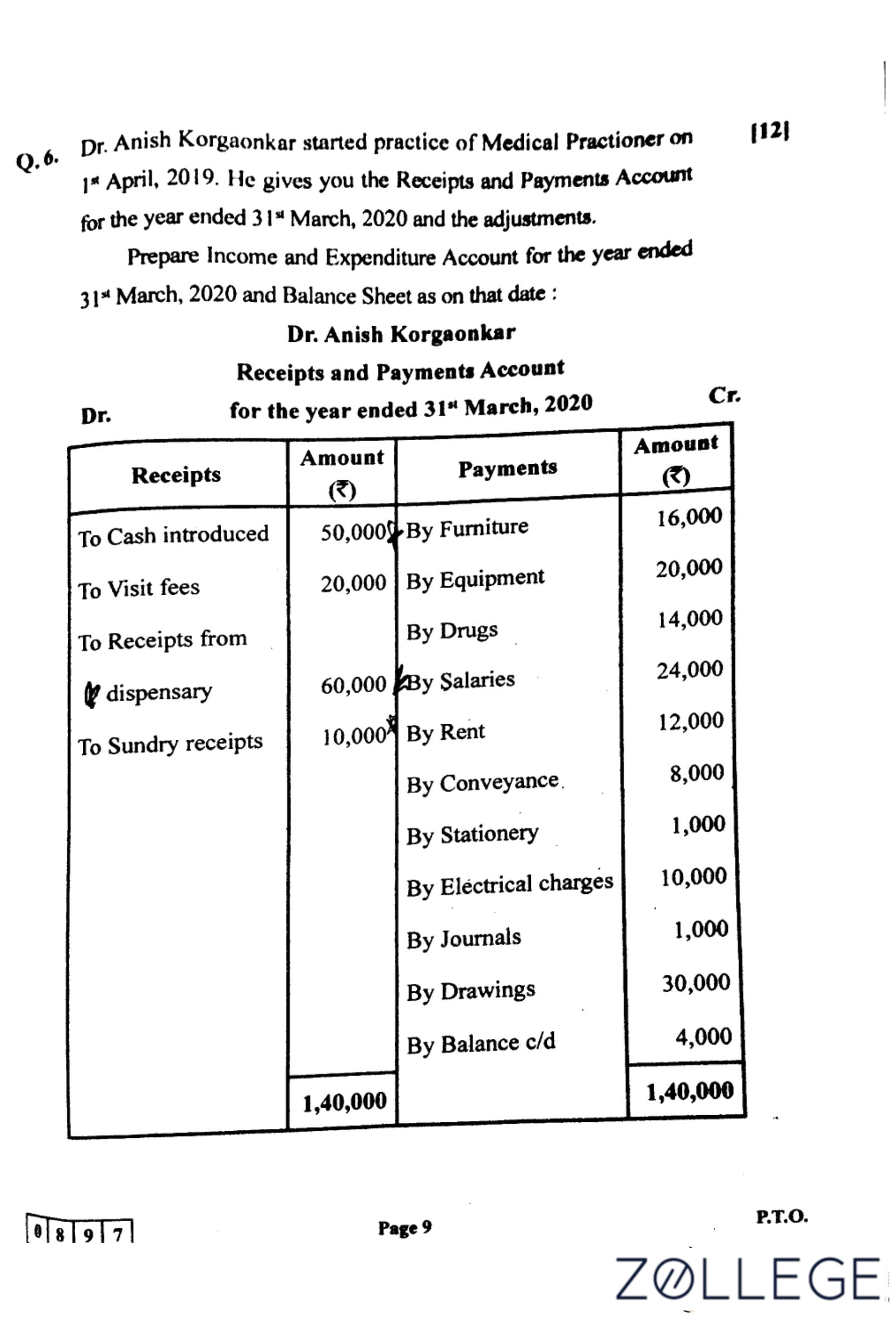
Question 6:
Dr. Anish Korgaonkar started practice as a Medical Practitioner on 1st April, 2019. He
provides the Receipts and Payments Account for the year ended 31st March, 2020. Based on the
adjustments, prepare the Income and Expenditure Account and Balance Sheet as on 31st March,
2020.
6(a). Income and Expenditure Account for the year ended 31st March, 2020
View Solution
| Expenditure | Amount (₹) | Income | Amount (₹) |
|---|---|---|---|
| To Drugs Consumed (₹14,000 - ₹2,000) | 12,000 | By Visit Fees (₹20,000 + ₹4,000) | 24,000 |
| To Salaries (₹24,000 + ₹2,000 O/S) | 26,000 | By Dispensary Receipts (₹60,000 + ₹1,000) | 61,000 |
| To Rent (₹8,000 + ₹1,000 O/S) | 9,000 | By Sundry Receipts | 10,000 |
| To Conveyance (₹8,000 - 40% domestic) | 4,800 | ||
| To Stationery | 1,000 | ||
| To Electrical Charges | 10,000 | ||
| To Journals | 1,000 | ||
| To Depreciation on Furniture (8% of ₹16,000) | 1,280 | ||
| To Depreciation on Equipment (₹1,000) | 1,000 | ||
| To Surplus (Net Income) | 28,920 | Total | 95,720 |
Balance Sheet as on 31st March, 2020
View Solution
| Liabilities | Amount (₹) | Assets | Amount (₹) |
|---|---|---|---|
| Outstanding Rent | 1,000 | Cash Balance | 4,000 |
| Outstanding Salaries | 2,000 | Visit Fees Receivable | 4,000 |
| Capital (₹50,000 + ₹28,920 Net Income) | 78,920 | Dispensary Receipts Receivable | 1,000 |
| Drugs Stock | 2,000 | ||
| Furniture (₹16,000 - ₹1,280 Depreciation) | 14,720 | ||
| Equipment (₹20,000 - ₹1,000 Depreciation) | 19,000 | ||
| Total | 81,920 | Total | 81,920 |
\hrule
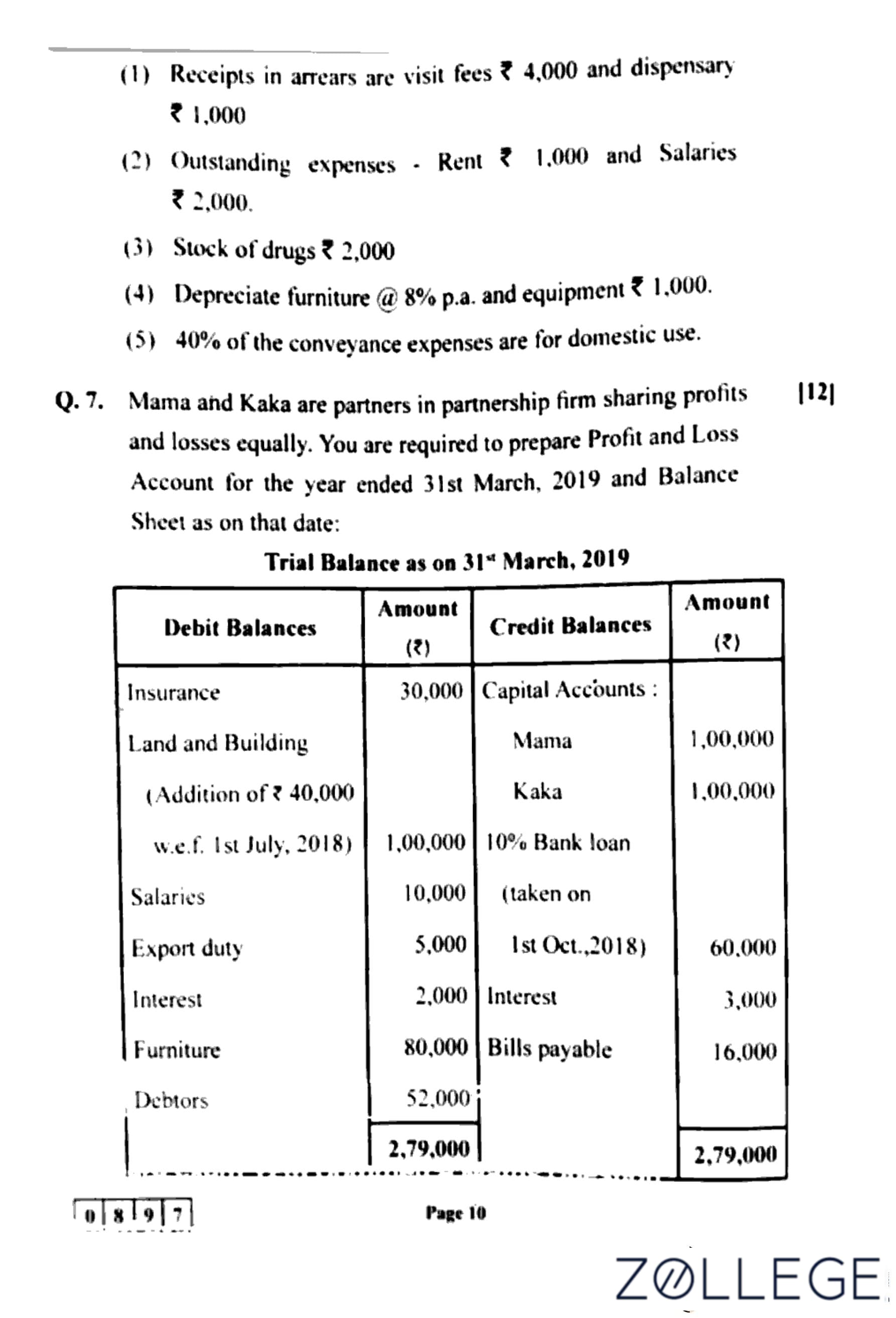
Explanation of Adjustments:
Receipts in Arrears: Visit fees Rs. 4,000 and dispensary receipts Rs. 1,000 are added to income.
Outstanding Expenses: Salaries Rs. 2,000 and Rent Rs. 1,000 added to liabilities and expenditure.
Stock of Drugs: Rs. 2,000 is deducted from drug expenses.
Depreciation: Furniture is depreciated at 8% (Rs. 1,280), Equipment is depreciated by Rs. 1,000.
Conveyance: 40% used for personal purposes is deducted from total.
%Quicktip Quick Tip: An Income and Expenditure Account records only revenue items, while a Balance Sheet records assets and liabilities.
Question 7:
Mama and Kaka are partners in a partnership firm sharing profits and losses equally. You are
required to prepare the Profit and Loss Account for the year ended 31st March, 2019, and the
Balance Sheet as on that date.
7(a). Profit and Loss Account for the year ended 31st March, 2019
View Solution
| Expenditure | Amount (₹) | Income | Amount (₹) |
|---|---|---|---|
| To Salaries | 10,000 | By Gross Profit | 69,000 |
| To Export Duty | 5,000 | By Interest Received | 3,000 |
| To Interest on Loan (₹60,000 × 10% × 6/12) | 3,000 | ||
| To Insurance (₹30,000 - ₹7,500 Prepaid) | 22,500 | ||
| To Depreciation on Land & Building (10% of ₹1,00,000) | 10,000 | ||
| To Depreciation on Furniture (5% of ₹80,000) | 4,000 | ||
| To Bad Debts Written Off | 2,000 | ||
| To R.D.D. (5% of ₹50,000) | 2,500 | ||
| To Net Profit c/d | 13,000 | Total | 72,000 |
Partners’ Capital Account
View Solution
| Particulars | Mama (₹) | Kaka (₹) |
|---|---|---|
| To Balance c/d | 1,06,500 | 1,06,500 |
| By Balance b/d | 1,00,000 | 1,00,000 |
| By Net Profit (₹13,000 ÷ 2) | 6,500 | 6,500 |
| Total | 1,06,500 | 1,06,500 |
Balance Sheet as on 31st March, 2019
View Solution
| Liabilities | Amount (₹) | Assets | Amount (₹) |
|---|---|---|---|
| 10% Bank Loan | 60,000 | Land & Building (After 10% Depreciation) | 90,000 |
| Bills Payable | 16,000 | Furniture (After 5% Depreciation) | 76,000 |
| Capital Accounts: | Debtors (₹52,000 - ₹2,000 Bad Debts - ₹2,500 R.D.D.) | 47,500 | |
| Mama | 1,06,500 | Closing Stock | 69,000 |
| Kaka | 1,06,500 | Prepaid Insurance | 7,500 |
| Total | 2,89,000 | Total | 2,89,000 |
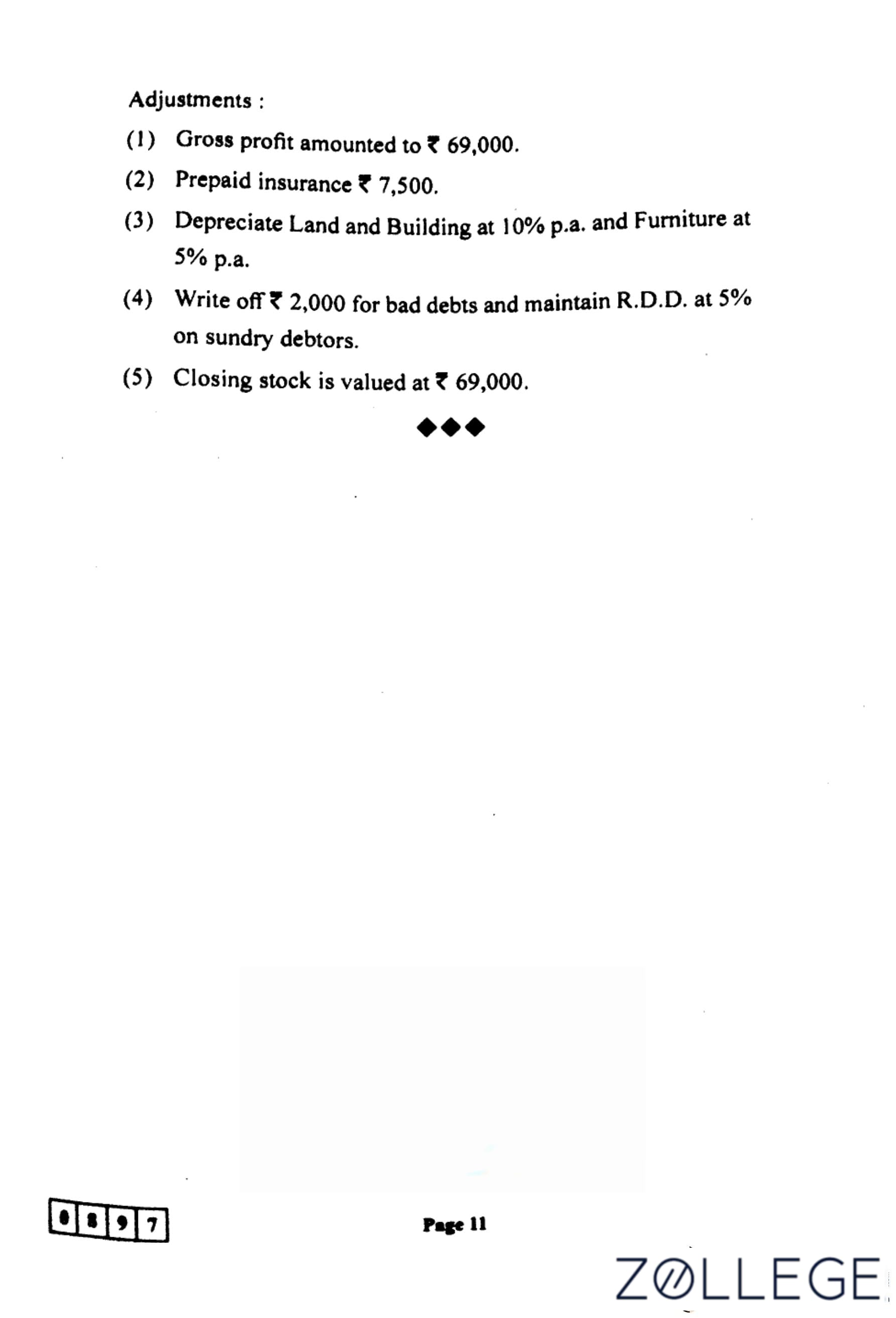
Explanation of Adjustments:
Gross Profit: Given as Rs. 69,000.
Prepaid Insurance: Rs. 7,500 deducted from Insurance Expense.
Depreciation: 10% on Land \& Building (Rs. 10,000) and 5% on Furniture (Rs. 4,000).
Bad Debts Written Off: Rs. 2,000 deducted from debtors.
R.D.D.: 5% on Sundry Debtors after Bad Debts (Rs. 2,500).
Closing Stock: Rs. 69,000 included in Balance Sheet.
Quick Tip: In a partnership, profits are divided equally unless stated otherwise in the agreement.
*The article might have information for the previous academic years, please refer the official website of the exam.