
Maharashtra Board Class 12 Book keeping and Accountancy Question Paper with Solutions 2025


Content Writer | Updated On - Sep 12, 2025
The Maharashtra Board Class 12 Book Keeping and Accountancy Question Paper PDF with Solutions is available for download. The Maharashtra State Board of Secondary and Higher Secondary Education (MSBSHSE) conducted the Class 12 Book Keeping and Accountancy examination for a total duration of 3 hours, and the question paper had a total of 80 marks.

Maharastra Board Class 12 Book Keeping and Accountancy Question Paper
| Maharastra Board Class 12 Book Keeping and Accountancy Question Paper | Download PDF | Check Solutions |
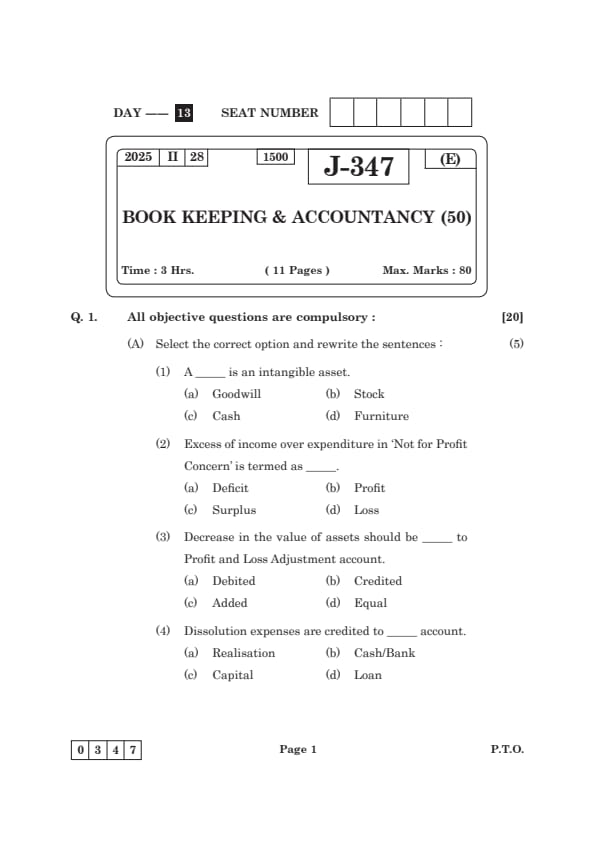
A ___ is an intangible asset.
View Solution
Step 1: Recall the definition of intangible asset.
An intangible asset is a non-physical asset that has value due to its rights and privileges, such as patents, copyrights, and goodwill.
Step 2: Evaluate the options.
- Goodwill is an intangible asset, as it represents the value of a company's brand, customer relationships, and intellectual property.
- Stock, Cash, and Furniture are tangible assets, not intangible.
Step 3: Conclusion.
Hence, the correct answer is Goodwill, which is an intangible asset.
Final Answer: \[ \boxed{Goodwill} \] Quick Tip: Intangible assets like goodwill do not have a physical presence but contribute significantly to a company's value.
Excess of income over expenditure in ‘Not for Profit Concern’ is termed as ___.
View Solution
Step 1: Recall the definition.
In a 'Not for Profit Concern', if the income exceeds the expenditure, it results in a surplus, unlike a profit in a profit-making organization.
Step 2: Evaluate the options.
- Deficit: Occurs when expenditure exceeds income.
- Profit: A surplus in a for-profit organization.
- Surplus: Correct answer, as it indicates excess income over expenditure in non-profit organizations.
- Loss: Occurs when income is less than expenditure.
Step 3: Conclusion.
Therefore, the correct term is Surplus.
Final Answer: \[ \boxed{Surplus} \] Quick Tip: In a 'Not for Profit Concern', the term Surplus refers to excess income over expenditure.
Decrease in the value of assets should be ___ to Profit and Loss Adjustment account.
View Solution
Step 1: Recall accounting principles.
When there is a decrease in the value of assets, it is treated as a loss and debited to the Profit and Loss Adjustment account.
Step 2: Evaluate the options.
- Debited: Correct answer, as a decrease in asset value is treated as a loss.
- Credited: Would apply to an increase in asset value.
- Added: Not applicable in this case.
- Equal: Does not apply in this context.
Step 3: Conclusion.
Thus, the correct action is to debit the decrease in asset value.
Final Answer: \[ \boxed{Debited} \] Quick Tip: A decrease in the value of assets is recorded as a debit to the Profit and Loss Adjustment account.
Dissolution expenses are credited to ___ account.
View Solution
Step 1: Understand dissolution expenses.
Dissolution expenses are incurred when closing or liquidating a business, and they are credited to the Realisation account.
Step 2: Evaluate the options.
- Realisation: Correct answer, as dissolution expenses are credited here.
- Cash/Bank: These are used for paying dissolution expenses, not for crediting.
- Capital: Would not be credited with dissolution expenses.
- Loan: Not applicable for dissolution expense crediting.
Step 3: Conclusion.
Hence, the correct account is Realisation.
Final Answer: \[ \boxed{Realisation} \] Quick Tip: Dissolution expenses are credited to the Realisation account during liquidation.
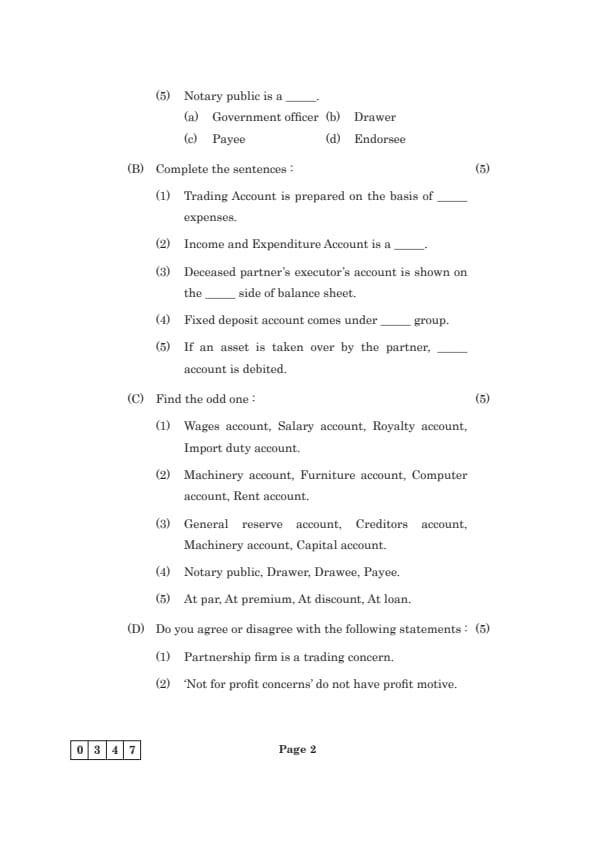
Notary public is a ___.
View Solution
Step 1: Understand the role of a notary public.
A notary public is an official appointed by the government to witness signatures on legal documents and administer oaths.
Step 2: Evaluate the options.
- Government officer: Correct answer, as a notary public is appointed by the government.
- Drawer: A drawer is someone who writes a check or draft.
- Payee: The person who receives the payment.
- Endorsee: A person to whom a negotiable instrument is transferred.
Step 3: Conclusion.
Thus, a notary public is a government officer.
Final Answer: \[ \boxed{Government \; officer} \] Quick Tip: A notary public is an official who verifies the authenticity of signatures on documents.
(1) Trading Account is prepared on the basis of ___ expenses.
View Solution
Step 1: Recall the purpose of the Trading Account.
The Trading Account is used to calculate the gross profit or loss by comparing the sales and the cost of goods sold (which includes direct expenses like materials, labor, etc.).
Step 2: Evaluate the options.
- Direct expenses are related to the production of goods or services, so they are the basis for preparing the Trading Account.
- Indirect expenses do not directly affect the production process and are accounted for in the Profit and Loss Account.
Step 3: Conclusion.
Hence, the correct answer is Direct expenses.
Final Answer: \[ \boxed{Direct} \] Quick Tip: Direct expenses are essential for determining the cost of goods sold and the gross profit in the Trading Account.
Income and Expenditure Account is a ___.
View Solution
Step 1: Define the type of account.
The Income and Expenditure Account is a type of Nominal Account because it deals with incomes and expenses, which are temporary in nature.
Step 2: Evaluate the options.
- Nominal Account: Correct, as it deals with incomes and expenditures.
- Real Account: Deals with assets and liabilities.
- Personal Account: Deals with individuals or entities.
- Mixed Account: A combination of the above types.
Step 3: Conclusion.
Therefore, Income and Expenditure Account is a Nominal Account.
Final Answer: \[ \boxed{Nominal \; Account} \] Quick Tip: Nominal Accounts relate to incomes, expenses, and losses, and are closed at the end of the period.
Deceased partner’s executor’s account is shown on the ___ side of the balance sheet.
View Solution
Step 1: Understand the treatment of the deceased partner’s account.
The deceased partner's executor’s account is created to settle the financial affairs of the deceased partner, and it is treated as a liability of the partnership firm.
Step 2: Evaluate the options.
- Debit: Correct, as the account of the deceased partner’s executor represents a liability.
- Credit: Does not apply in this case, as the balance would not be shown on the credit side.
Step 3: Conclusion.
Therefore, the deceased partner’s executor’s account is shown on the Debit side of the balance sheet.
Final Answer: \[ \boxed{Debit} \] Quick Tip: Liabilities of the partnership, including the deceased partner's account, are shown on the debit side of the balance sheet.
Fixed deposit account comes under ___ group.
View Solution
Step 1: Understand the classification of fixed deposit accounts.
A fixed deposit is considered a non-current asset as it represents a long-term investment with a fixed maturity period.
Step 2: Evaluate the options.
- Non-Current Assets: Correct, as it is a long-term investment.
- Non-Current Liabilities: Fixed deposits are not liabilities.
- Current Liabilities: Does not apply here.
- Current Assets: Fixed deposits are not part of the current assets category.
Step 3: Conclusion.
Hence, the fixed deposit account is classified under Non-Current Assets.
Final Answer: \[ \boxed{Non-Current \; Assets} \] Quick Tip: Fixed deposits with a maturity period of more than one year are classified as non-current assets.
If an asset is taken over by the partner, ___ account is debited.
View Solution
Step 1: Understand the process of asset transfer in a partnership.
When an asset is taken over by a partner, the asset is debited to the Realisation account, as it is a part of the dissolution process.
Step 2: Evaluate the options.
- Realisation: Correct, as it reflects the transfer of assets and liabilities during dissolution.
- Cash/Bank: Not applicable in this context.
- Capital: Not the correct account for asset transfer.
- Loan: Does not apply in asset transfer scenarios.
Step 3: Conclusion.
Thus, the correct account is Realisation.
Final Answer: \[ \boxed{Realisation} \] Quick Tip: During the dissolution of a partnership, assets taken over by a partner are debited to the Realisation account.
Find the odd one:
(1) Wages account, Salary account, Royalty account, Import duty account.
View Solution
Step 1: Analyze the accounts.
- Wages, Salary, and Royalty are all related to expenses or incomes in the Profit and Loss Account, representing payments or receipts related to operational activities.
- Import Duty, on the other hand, is related to a liability or a cost to be paid to the government for importing goods, making it different from the others.
Step 2: Conclusion.
Therefore, the odd one out is Import duty account, as it represents a different type of expense compared to the others.
Final Answer: \[ \boxed{Import \; duty \; account} \] Quick Tip: Accounts related to operational income and expenses are different from statutory payments such as import duty.
(2) Machinery account, Furniture account, Computer account, Rent account.
View Solution
Step 1: Analyze the accounts.
- Machinery, Furniture, and Computer accounts represent assets that are tangible and are recorded as non-current assets on the balance sheet.
- Rent, however, is an expense and is recorded in the Profit and Loss Account, not an asset.
Step 2: Conclusion.
Therefore, the odd one out is Rent account, as it is an expense while the other accounts represent assets.
Final Answer: \[ \boxed{Rent \; account} \] Quick Tip: Assets are recorded on the balance sheet, while expenses are recorded in the Profit and Loss Account.
(3) General reserve account, Creditors account, Machinery account, Capital account.
View Solution
Step 1: Analyze the accounts.
- General reserve, Machinery, and Capital accounts represent long-term items (reserves and assets).
- Creditors account represents a liability, which is a short-term obligation.
Step 2: Conclusion.
Therefore, Creditors account is the odd one out, as it represents a liability, whereas the others represent long-term items.
Final Answer: \[ \boxed{Creditors \; account} \] Quick Tip: Liabilities like Creditors account differ from reserves and assets, which are long-term in nature.
(4) Notary public, Drawer, Drawee, Payee.
View Solution
Step 1: Analyze the terms.
- Drawer, Drawee, and Payee are all related to negotiable instruments (like cheques or bills of exchange).
- Notary public, however, is a government-appointed official responsible for witnessing signatures and certifying documents.
Step 2: Conclusion.
Therefore, the odd one out is Notary public, as it is not related to negotiable instruments.
Final Answer: \[ \boxed{Notary \; public} \] Quick Tip: Drawer, Drawee, and Payee are terms related to negotiable instruments, while Notary public refers to an official role.
(5) At par, At premium, At discount, At loan.
View Solution
Step 1: Analyze the terms.
- At par, At premium, and At discount refer to the terms used in the context of bonds, shares, or securities trading.
- At loan refers to borrowing money, which is unrelated to the trading or valuation of securities.
Step 2: Conclusion.
Therefore, At loan is the odd one out, as it does not relate to the trading of securities.
Final Answer: \[ \boxed{At \; loan} \] Quick Tip: Terms like "At par", "At premium", and "At discount" are used in securities trading, whereas "At loan" relates to borrowing.
(1) Partnership firm is a trading concern.
View Solution
Step 1: Understand the concept of a partnership firm.
A partnership firm can indeed be a trading concern, as it can operate with the purpose of conducting business activities, such as trading or providing services.
Step 2: Evaluate the statement.
Partnership firms are often established with the goal of running a trading business, which aligns with the notion of a "trading concern."
Step 3: Conclusion.
Therefore, the statement "Partnership firm is a trading concern" is correct, and I agree with it.
Final Answer: \[ \boxed{Agree} \] Quick Tip: A partnership firm can operate as a trading concern, focused on business operations for profit.
‘Not for profit concerns’ do not have profit motive.
View Solution
Step 1: Understand the nature of 'Not for profit concerns.'
'Not for profit concerns' are organizations formed with the objective of providing services or benefits rather than making a profit, such as charities or educational institutions.
Step 2: Evaluate the statement.
These organizations aim to use their income to further their mission, not to distribute profits to owners or shareholders.
Step 3: Conclusion.
Thus, the statement that 'Not for profit concerns do not have profit motive' is correct, and I agree with it.
Final Answer: \[ \boxed{Agree} \] Quick Tip: Not-for-profit concerns focus on providing services or benefits without the aim of generating profit.
Retiring partner is called an outgoing partner.
View Solution
Step 1: Understand the term 'Retiring Partner.'
A retiring partner is a partner who decides to leave the partnership, either by choice or by the terms of the partnership agreement.
Step 2: Evaluate the statement.
The retiring partner is commonly referred to as the outgoing partner, as they are exiting the partnership.
Step 3: Conclusion.
Thus, the statement that a retiring partner is called an outgoing partner is correct, and I agree with it.
Final Answer: \[ \boxed{Agree} \] Quick Tip: The term 'outgoing partner' refers to a partner who is retiring or leaving the partnership.
Gain ratio is calculated at the time of admission of a new partner.
View Solution
Step 1: Understand the concept of Gain Ratio.
The gain ratio is the ratio in which the existing partners share the gain of the new partner’s entry. It is calculated at the time of admission of a new partner to determine how much of the new partner's share is taken from the existing partners.
Step 2: Evaluate the statement.
The gain ratio is indeed calculated when a new partner joins to establish the terms for profit sharing.
Step 3: Conclusion.
Therefore, the statement that Gain ratio is calculated at the time of admission of a new partner is correct, and I agree with it.
Final Answer: \[ \boxed{Agree} \] Quick Tip: The gain ratio determines how much of the new partner's share is taken from the existing partners during admission.
Financial statement includes only balance sheet.
View Solution
Step 1: Understand the components of financial statements.
A financial statement includes not only the balance sheet but also the Income Statement (Profit and Loss Account) and other statements, such as cash flow statements.
Step 2: Evaluate the statement.
The statement that financial statements include only the balance sheet is incorrect, as it omits important financial reports like the Profit and Loss account.
Step 3: Conclusion.
Thus, I disagree with the statement.
Final Answer: \[ \boxed{Disagree} \] Quick Tip: A complete financial statement includes the balance sheet, income statement, and other relevant financial reports.
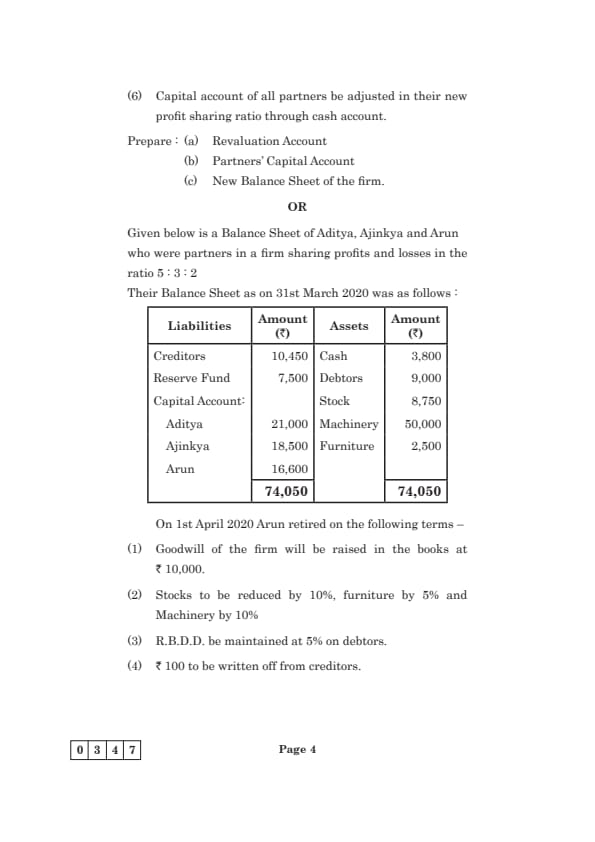
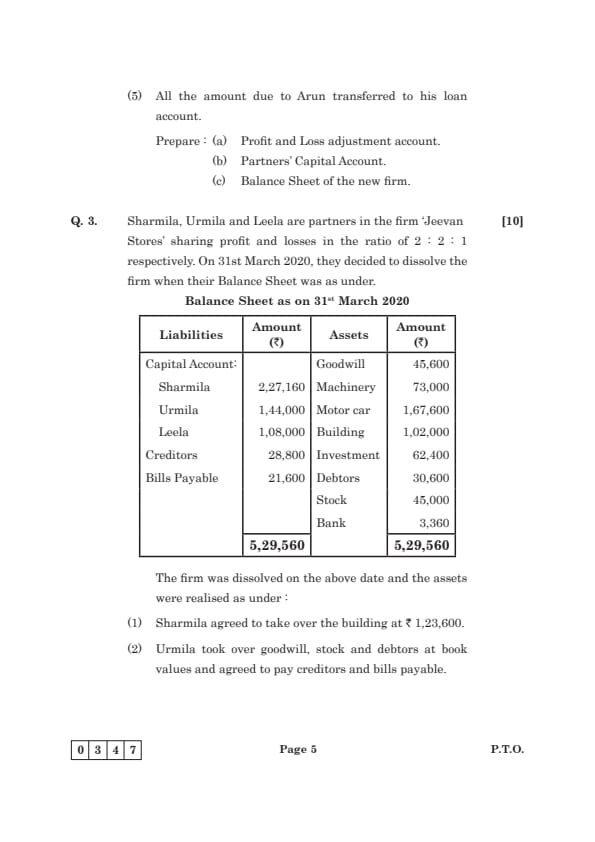
Given below is a Balance Sheet of Aditya, Ajinkya, and Arun who were partners in a firm sharing profits and losses in the ratio 5:3:2. Their Balance Sheet as on 31st March 2020 was as follows:
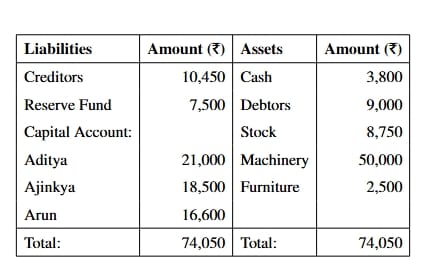
On 1st April 2020, Arun retired on the following terms:
Goodwill of the firm will be raised in the books at Rs. 10,000.
Stocks to be reduced by 10%, Furniture by 5%, and Machinery by 10%.
A provision of 5% R.D.D. to be maintained on debtors.
Rs. 100 to be written off from creditors.
All the amount due to Arun will be transferred to his loan account.
Prepare:
(a) Profit and Loss Adjustment Account
(b) Partners' Capital Account
(c) Balance Sheet of the new firm
View Solution
N/A Quick Tip: When a partner retires, adjustments for goodwill, asset valuations, and liabilities are made in the accounts. The retiring partner’s share is transferred to their loan account if applicable.
Sharmila, Urmila, and Leela are partners in the firm 'Jeevan Stores' sharing profit and losses in the ratio 2 : 2 : 1 respectively. On 31st March 2020, they decided to dissolve the firm when their Balance Sheet was as follows:
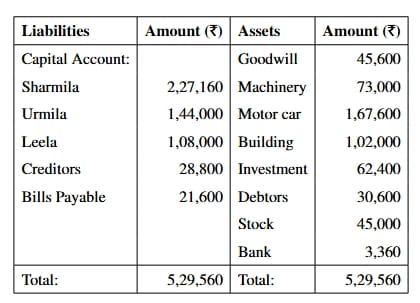
The firm was dissolved on the above date and the assets were realised as under:
Sharmila agreed to take over the building at Rs. 1,23,600.
Urmila took over goodwill, stock, and debtors at book value and agreed to pay creditors and bills payable.
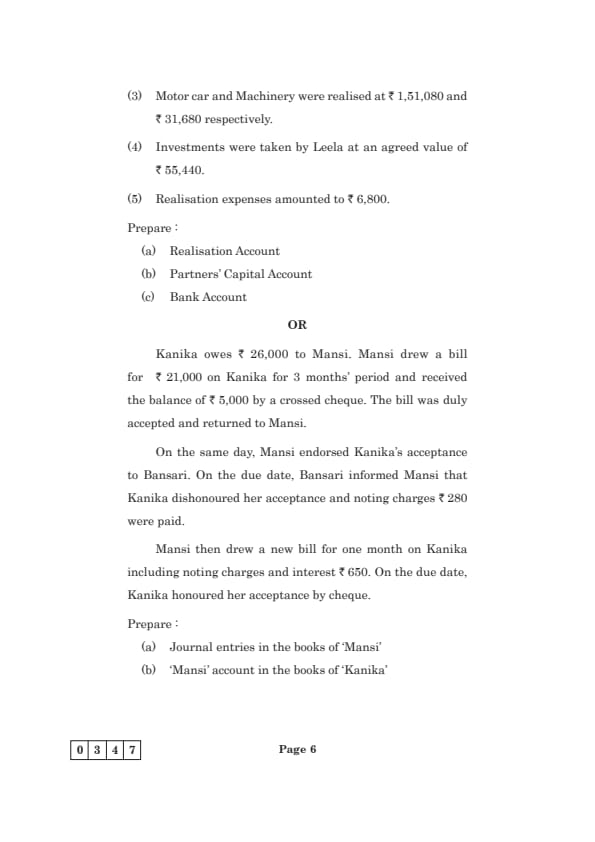
Motor car and Machinery were realised at Rs. 1,51,080 and Rs. 31,680 respectively.
Investments were taken by Leela at an agreed value of Rs. 55,440.
Realisation expenses amounted to Rs. 6,800.
Prepare:
(a) Realisation Account
(b) Partners’ Capital Account
(c) Bank Account
View Solution
(a) Realisation Account
\begin{tabbing
\hspace{6cm \= \hspace{4cm \= \kill
Realisation Account \> Dr. \> Cr.
\hline
\text{To Sharmila (Building) \> Rs. 1,23,600 && \text{By Goodwill \> Rs. 45,600
\text{To Realisation Expenses \> Rs. 6,800 && \text{By Machinery (Realised) \> Rs. 31,680
\text{To Motor car (Realised) \> Rs. 1,51,080 && \text{By Motor car (Realised) \> Rs. 1,51,080
\text{To Machinery (Realised) \> Rs. 31,680 && \text{By Building (Taken over by Sharmila) \> Rs. 1,23,600
\text{To Leela (Investment) \> Rs. 55,440 && \text{By Debtors (Taken over by Urmila) \> Rs. 30,600
\text{To Debtors (Taken over by Urmila) \> Rs. 30,600 && \text{By Stock (Taken over by Urmila) \> Rs. 45,000
\text{To Stock (Taken over by Urmila) \> Rs. 45,000 && \text{By Creditors \> Rs. 28,800
\text{To Creditors \> Rs. 28,800 & \text{By Bills Payable \> Rs. 21,600
\hline
\text{Total \> Rs. 3,92,500 & \text{Total \> Rs. 3,92,500
\hline
\end{tabbing
(b) Partners’ Capital Account
\begin{tabbing
\hspace{6cm \= \hspace{4cm \= \kill
Partners’ Capital Account \> Dr. \> Cr.
\hline
\text{To Realisation Account (Sharmila's Share) \> Rs. 1,23,600 && \text{By Balance b/d (Sharmila) \> Rs. 2,27,160
\text{To Realisation Account (Urmila's Share) \> Rs. 1,44,000 && \text{By Realisation Account (Urmila's Share) \> Rs. 1,44,000
\text{To Realisation Account (Leela's Share) \> Rs. 1,08,000 && \text{By Realisation Account (Leela's Share) \> Rs. 1,08,000
\hline
\text{Total \> Rs. 3,75,600 & \text{Total \> Rs. 3,75,600
\hline
\end{tabbing
(c) Bank Account
\begin{tabbing
\hspace{6cm \= \hspace{4cm \= \kill
Bank Account \> Dr. \> Cr.
\hline
\text{To Balance b/d (Cash from Realisation) \> Rs. 3,360 & \text{By Creditors (Paid) \> Rs. 28,800
\hline
\text{Total \> Rs. 3,360 & \text{Total \> Rs. 28,800
\hline
\end{tabbing
Final Answer:
The Realisation Account shows the distribution of assets and liabilities as they are realised. The Partners' Capital Account reflects the adjustments made in the capital accounts of the partners. The Bank Account shows the cash balance post-settlement of creditors and other liabilities.
% Quicktip
\begin{quicktipbox
In a partnership dissolution, assets are realised, liabilities settled, and any remaining amounts are distributed among the partners based on their profit-sharing ratio.
\end{quicktipbox Quick Tip: In a partnership dissolution, assets are realised, liabilities settled, and any remaining amounts are distributed among the partners based on their profit-sharing ratio.
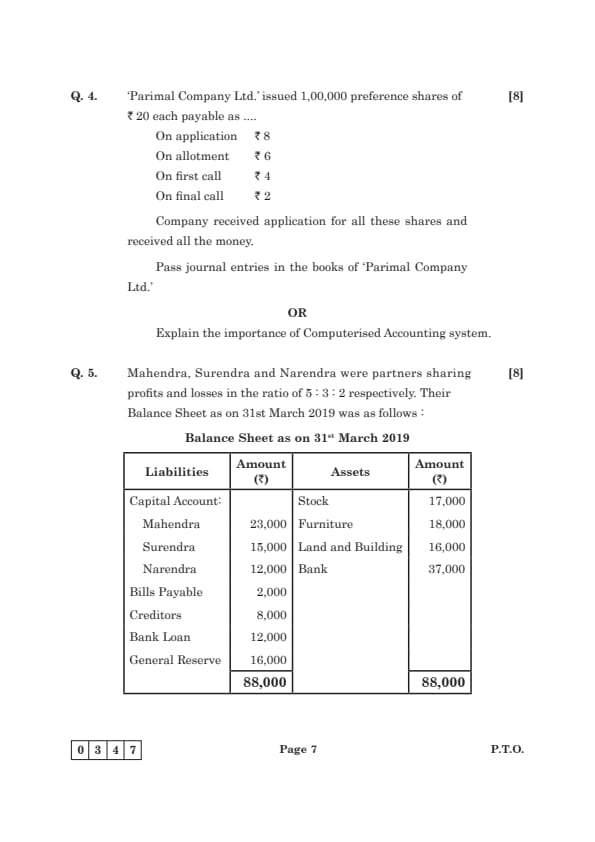
'Parimal Company Ltd.' issued 1,00,000 preference shares of Rs. 20 each payable as ....
On application Rs. 8
On allotment Rs. 6
On first call Rs. 4
On final call Rs. 2
Company received application for all these shares and received all the money.
Pass journal entries in the books of ‘Parimal Company Ltd.’
View Solution
We need to pass the journal entries for the issuance and receipt of the money for the preference shares. The total value of each share is Rs. 20, and payments are received in installments.
Step 1: Journal Entry for Share Application
The company received Rs. 8 per share on 1,00,000 shares. Therefore, the total amount received is:
\[ 1,00,000 \times 8 = Rs. 8,00,000 \]
The journal entry for the receipt of the application money is:
\begin{verbatim
Bank A/c Dr. 8,00,000
To Share Application A/c 8,00,000
\end{verbatim
Step 2: Journal Entry for Share Allotment
The company received Rs. 6 per share on 1,00,000 shares. Therefore, the total amount received is:
\[ 1,00,000 \times 6 = Rs. 6,00,000 \]
The journal entry for the receipt of the allotment money is:
\begin{verbatim
Bank A/c Dr. 6,00,000
To Share Allotment A/c 6,00,000
\end{verbatim
Step 3: Journal Entry for Share First Call
The company received Rs. 4 per share on 1,00,000 shares. Therefore, the total amount received is:
\[ 1,00,000 \times 4 = Rs. 4,00,000 \]
The journal entry for the receipt of the first call money is:
\begin{verbatim
Bank A/c Dr. 4,00,000
To Share First Call A/c 4,00,000
\end{verbatim
Step 4: Journal Entry for Share Final Call
The company received Rs. 2 per share on 1,00,000 shares. Therefore, the total amount received is:
\[ 1,00,000 \times 2 = Rs. 2,00,000 \]
The journal entry for the receipt of the final call money is:
\begin{verbatim
Bank A/c Dr. 2,00,000
To Share Final Call A/c 2,00,000
\end{verbatim
Final Answer:
\begin{verbatim
1. Bank A/c Dr. 8,00,000
To Share Application A/c 8,00,000
2. Bank A/c Dr. 6,00,000
To Share Allotment A/c 6,00,000
3. Bank A/c Dr. 4,00,000
To Share First Call A/c 4,00,000
4. Bank A/c Dr. 2,00,000
To Share Final Call A/c 2,00,000
\end{verbatim Quick Tip: When all money is received in advance, the journal entries reflect only the installment amounts and are recorded under their respective heads such as Share Application, Share Allotment, First Call, and Final Call.
Explain the importance of Computerised Accounting system.
View Solution
The importance of a Computerised Accounting System (CAS) cannot be overstated in today’s digital world. Below are the key reasons why CAS is highly beneficial:
1. Accuracy:
Computerised accounting systems reduce the risk of human errors, ensuring that calculations and financial reports are accurate. It helps avoid mistakes such as incorrect entries, duplication, and miscalculations, which are common in manual accounting.
2. Speed and Efficiency:
CAS can process large amounts of data much faster than manual accounting, significantly improving efficiency. Tasks such as generating reports, calculating taxes, and preparing financial statements can be done in a fraction of the time.
3. Real-Time Data Access:
With a computerised system, businesses can access their financial data in real time. This allows for better decision-making, as managers and accountants can get instant updates on financial status and performance, leading to timely interventions.
4. Cost Savings:
Although setting up a computerised system may have an initial cost, it saves money in the long run. With fewer errors and reduced need for manual labor, businesses can operate more efficiently, minimizing operational costs.
5. Enhanced Security:
Computerised systems provide better security for financial data. Access can be restricted to authorized personnel, and data can be backed up regularly to prevent loss due to theft, fire, or other unforeseen events.
6. Easy Reporting:
Generating financial reports, such as profit and loss statements, balance sheets, and cash flow statements, becomes simple with computerised accounting. These reports can be generated in multiple formats and provide in-depth insights into the company’s financial health.
7. Integration with Other Systems:
Computerised systems can integrate seamlessly with other business functions, such as inventory management, payroll systems, and sales reporting, enabling a cohesive and comprehensive management approach.
8. Tax Compliance:
A computerised accounting system ensures that businesses comply with tax regulations by calculating taxes correctly and generating reports in the required format for submission to tax authorities. Quick Tip: Adopting a computerised accounting system is crucial for businesses aiming to scale efficiently and accurately. It enhances productivity and minimizes financial risks.
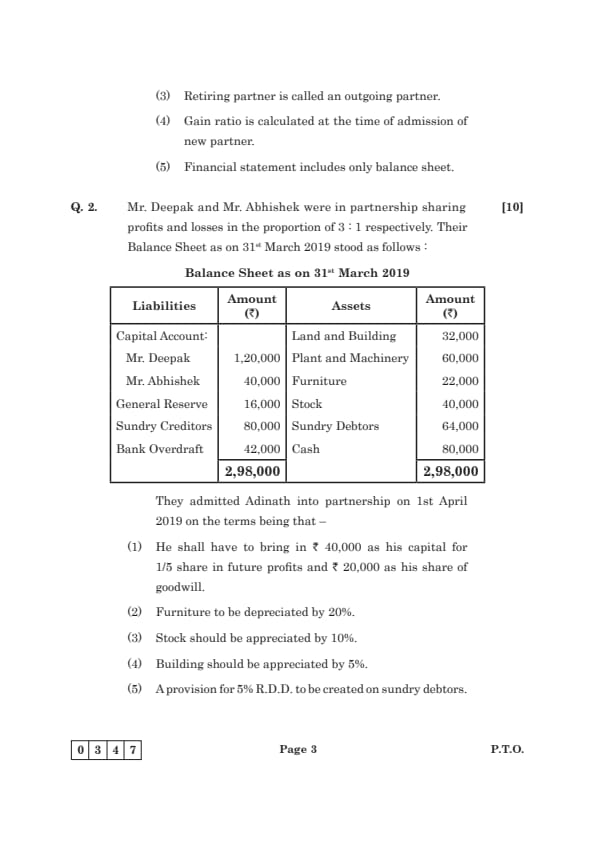
Mahendra, Surendra and Narendra were partners sharing profits and losses in the ratio 5 : 3 : 2 respectively. Their Balance Sheet as on 31st March 2019 was as follows:

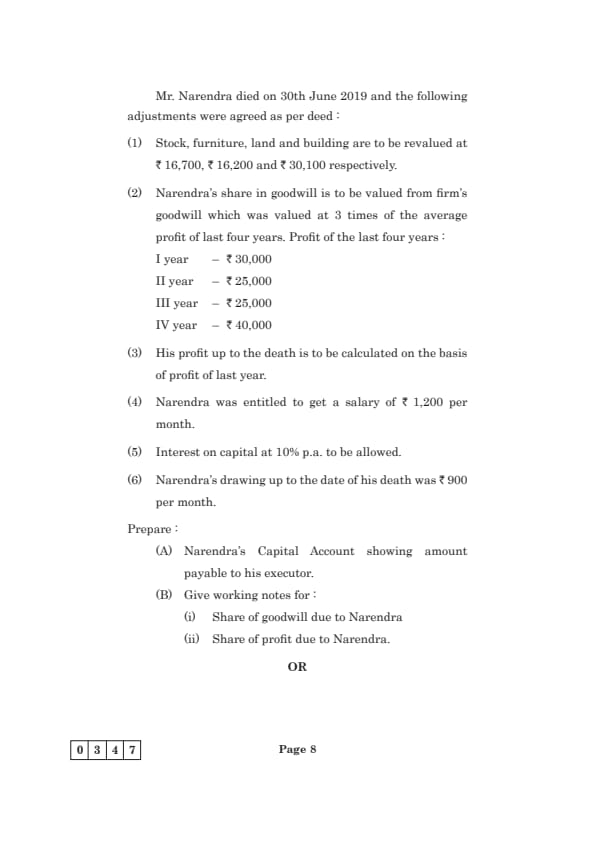
Mr. Narendra died on 30th June 2019 and the following adjustments were agreed as per deed:
Stock, furniture, land and building are to be revalued at ₹ 16,700, ₹ 16,200 and ₹ 30,100 respectively.
Narendra’s share in goodwill is to be valued from the firm’s goodwill, which was valued at 3 times the average profit of the last four years. The profits for the last four years were:
I year – ₹ 30,000
II year – ₹ 25,000
III year – ₹ 25,000
IV year – ₹ 40,000
His profit up to the death is to be calculated on the basis of the profit of last year.
Narendra was entitled to get a salary of ₹ 1,200 per month.
Interest on capital at 10% p.a. to be allowed.
Narendra’s drawing up to the date of his death was ₹ 900 per month.
Prepare:
[(A)] Narendra’s Capital Account showing amount payable to his executor.
[(B)] Give working notes for:
[(i)] Share of goodwill due to Narendra
[(ii)] Share of profit due to Narendra
View Solution
Step 1: Revaluation of assets
The assets are to be revalued as per the agreement:
- Stock: ₹16,700
- Furniture: ₹16,200
- Land and Building: ₹30,100
Step 2: Calculate the profit share of Narendra up to his death
Narendra’s share of profit up to the date of his death will be based on the profit of the last year, which was ₹40,000. His share in profits is \(\frac{2}{10}\), since the profit-sharing ratio is 5:3:2.
Profit share = \(\frac{2}{10} \times 40,000 = ₹8,000\).
Step 3: Calculate the goodwill
The average profit of the last four years is:
\[ Average Profit = \frac{30,000 + 25,000 + 25,000 + 40,000}{4} = ₹30,000 \]
Narendra’s share in goodwill is valued at 3 times the average profit. Therefore, his share in goodwill is:
\[ Goodwill = 3 \times ₹30,000 = ₹90,000 \]
Since his share in the profit ratio is 2 parts, his share in goodwill is:
\[ Narendra's share in goodwill = \frac{2}{10} \times ₹90,000 = ₹18,000 \]
Step 4: Calculate the salary and drawings adjustment
Narendra was entitled to a monthly salary of ₹1,200. He passed away on 30th June 2019, so the total salary due is for 3 months:
\[ Salary due = 3 \times ₹1,200 = ₹3,600 \]
His monthly drawing was ₹900, so the total drawing up to the date of his death is:
\[ Total drawing = 3 \times ₹900 = ₹2,700 \]
Step 5: Calculate the interest on capital
Interest on capital is to be allowed at 10% per annum. Narendra's capital balance on 31st March 2019 was ₹12,000, so the interest due is:
\[ Interest on capital = \frac{10}{100} \times ₹12,000 = ₹1,200 \]
Step 6: Prepare the Capital Account of Narendra
Now, let us prepare Narendra's Capital Account, showing the amount payable to his executor:
\[ \begin{array}{|c|c|c|} \hline \textbf{Particulars} & \textbf{Debit (₹)} & \textbf{Credit (₹)}
\hline Balance b/d & 12,000 &
Profit share up to death & 8,000 &
Goodwill share & 18,000 &
Salary due & 3,600 &
Interest on capital & 1,200 &
Drawings & & 2,700
\hline Amount payable to executor & & \boxed{₹38,100}
\hline \end{array} \]
Final Answer:
The amount payable to Narendra’s executor is ₹38,100. Quick Tip: Ensure to account for all adjustments like profit share, goodwill, salary, drawings, and interest while preparing a partner’s capital account in case of death.
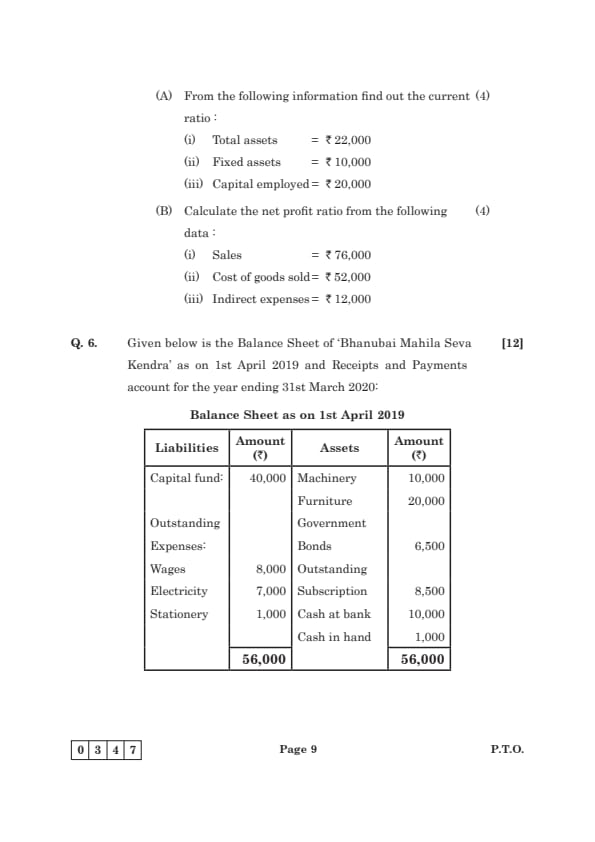
From the following information, find out the current ratio and net profit ratio:
(A) From the following information, find out the current ratio:
(i) Total assets = ₹22,000
(ii) Fixed assets = ₹10,000
(iii) Capital employed = ₹20,000
(B) Calculate the net profit ratio from the following data:
(i) Sales = ₹76,000
(ii) Cost of goods sold = ₹52,000
(iii) Indirect expenses = ₹12,000
View Solution
Part (A) - Current Ratio:
The formula for the current ratio is given by: \[ Current Ratio = \frac{Current Assets}{Current Liabilities} \]
We are given the total assets and fixed assets. The current assets can be calculated as: \[ Current Assets = Total Assets - Fixed Assets = 22,000 - 10,000 = ₹12,000 \]
To find the current liabilities, we use the formula for capital employed: \[ Capital Employed = Owner's Equity + Liabilities \]
Since we do not have direct information about liabilities, we assume the current liabilities are derived based on the total assets and current assets.
Step 1: Calculate current liabilities.
Current liabilities = Total Assets - Current Assets = ₹22,000 - ₹12,000 = ₹10,000
Step 2: Calculate Current Ratio.
Now, we can calculate the current ratio: \[ Current Ratio = \frac{12,000}{10,000} = 1.2 \]
Part (B) - Net Profit Ratio:
Net Profit Ratio is calculated using the formula: \[ Net Profit Ratio = \frac{Net Profit}{Sales} \times 100 \]
Step 1: Calculate Net Profit.
Net profit is calculated as: \[ Net Profit = Sales - Cost of Goods Sold - Indirect Expenses \]
Substituting the values: \[ Net Profit = 76,000 - 52,000 - 12,000 = ₹12,000 \]
Step 2: Calculate Net Profit Ratio.
Now, we calculate the net profit ratio: \[ Net Profit Ratio = \frac{12,000}{76,000} \times 100 = 15.79% \]
Final Answer:
\text{(A) Current Ratio = 1.2
\text{(B) Net Profit Ratio = 15.79% Quick Tip: The current ratio provides insights into the firm's liquidity, while the net profit ratio indicates the profitability of the firm in relation to its sales.
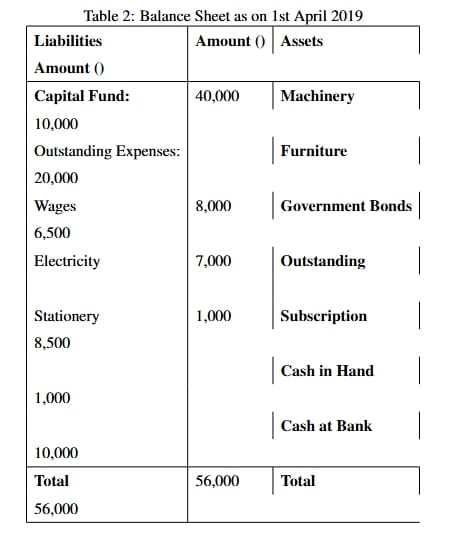
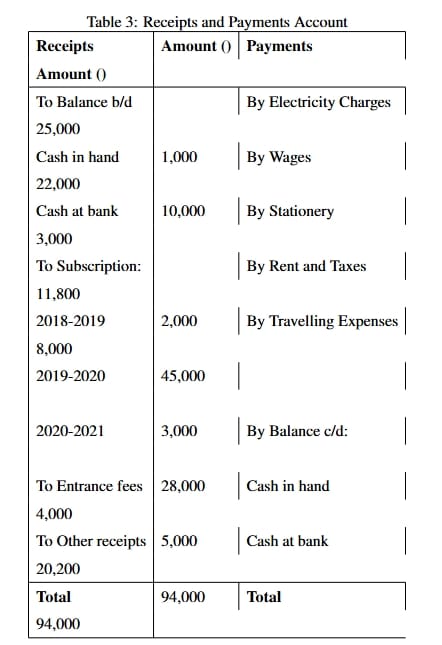
Given below is the Balance Sheet of ‘Bhanubai Mahila Seva Kendra’ as on 1st April 2019 and Receipts and Payments account for the year ending 31st March 2020:
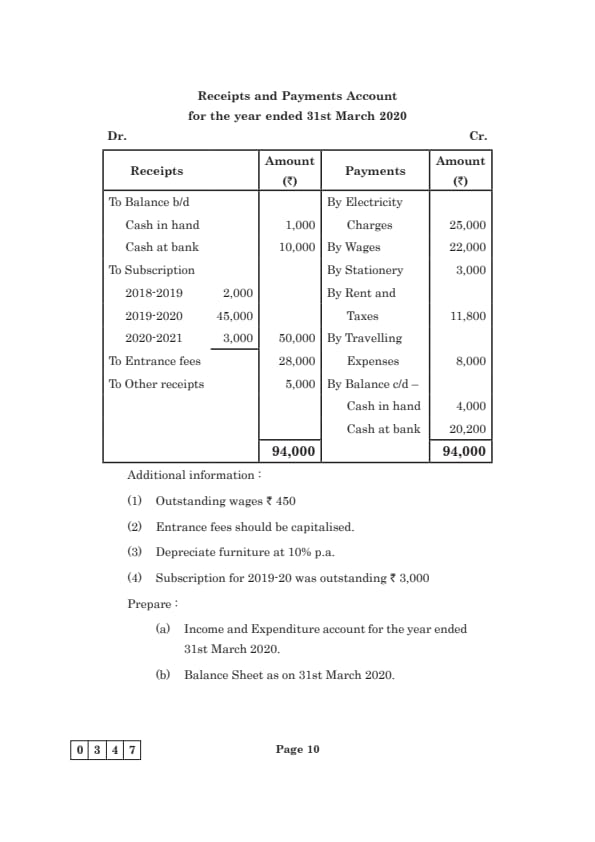
Receipts and Payments Account for the year ended 31st March 2020:
Additional information:
Outstanding wages ₹ 450
Entrance fees should be capitalised.
Depreciate furniture at 10% p.a.
Subscription for 2019-20 was outstanding ₹ 3,000.
Prepare:
[(a)] Income and Expenditure account for the year ended 31st March 2020.
[(b)] Balance Sheet as on 31st March 2020.
View Solution
Step 1: Prepare the Income and Expenditure Account for the year ended 31st March 2020.
Income and Expenditure Account is prepared as a summary of the receipts and payments, distinguishing between revenue and capital items.
Income:
- Subscriptions received: ₹45,000 (for the year 2019-20)
- Entrance fees received: ₹28,000
- Add: Subscription outstanding for 2019-20 (₹3,000)
Expenditure:
- Wages: ₹22,000 (Paid) + ₹450 (Outstanding Wages)
- Electricity Charges: ₹25,000
- Rent and Taxes: ₹11,800
- Travelling Expenses: ₹8,000
- Stationery: ₹3,000
- Depreciation on Furniture at 10%: ₹2,000 (on ₹20,000 furniture)
Income and Expenditure Account for the year ended 31st March 2020
\[ \begin{array}{|c|c|c|} \hline \textbf{Particulars} & \textbf{Dr. (₹)} & \textbf{Cr. (₹)}
\hline To Subscription (2019-20) & 45,000 &
To Entrance Fees & 28,000 &
To Outstanding Subscription (2019-20) & 3,000 &
\hline By Wages (Paid + Outstanding) & & 22,450
By Electricity Charges & & 25,000
By Rent and Taxes & & 11,800
By Travelling Expenses & & 8,000
By Stationery & & 3,000
By Depreciation on Furniture (10% of ₹20,000) & & 2,000
\hline Net Surplus/Deficit & & 5,750
\hline \end{array} \]
Step 2: Prepare the Balance Sheet as on 31st March 2020.
The final Balance Sheet is prepared after adjustments for the surplus or deficit, depreciation, and outstanding items.
Balance Sheet as on 31st March 2020
\[ \begin{array}{|c|c|c|} \hline \textbf{Liabilities} & \textbf{Amount (₹)} & \textbf{Assets} & \textbf{Amount (₹)}
\hline Capital Fund & 40,000 & Machinery & 10,000
Outstanding Wages & 450 & Furniture (after depreciation) & 18,000
Electricity & 7,000 & Government Bonds & 6,500
Stationery & 1,000 & Outstanding Subscription & 3,000
Current Liabilities & & Cash at Bank & 10,000
\hline Total Liabilities & 56,450 & Total Assets & 56,450
\hline \end{array} \]
Final Answer:
\text{(a) Income and Expenditure account shows a surplus of ₹5,750.
\text{(b) The Balance Sheet as on 31st March 2020 is balanced at ₹56,450. Quick Tip: Income and Expenditure account reflects the profit or loss from operations, while the Balance Sheet shows the financial position, adjusted for capital, liabilities, and assets.
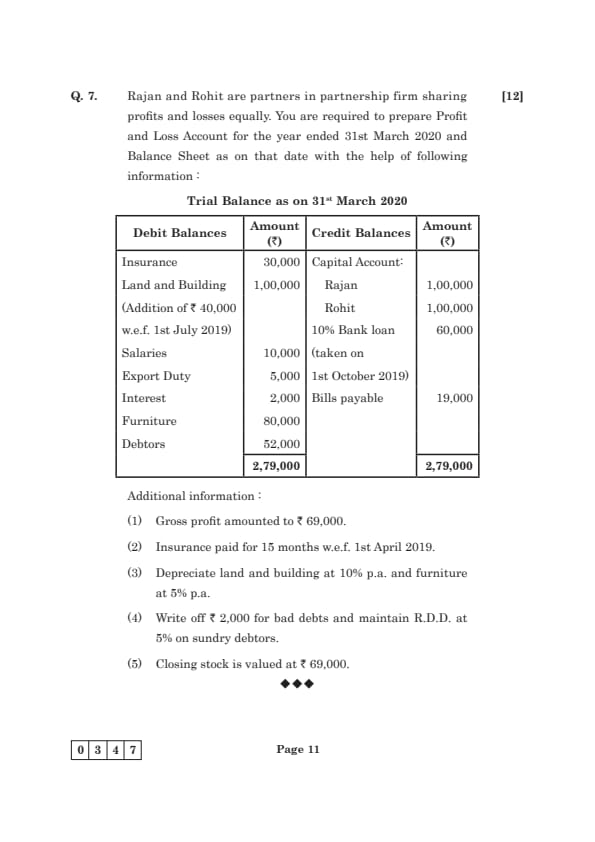
Rajan and Rohit are partners in a partnership firm sharing profits and losses equally. You are required to prepare the Profit and Loss Account for the year ended 31st March 2020 and the Balance Sheet as on that date with the help of the following information:
Trial Balance as on 31st March 2020
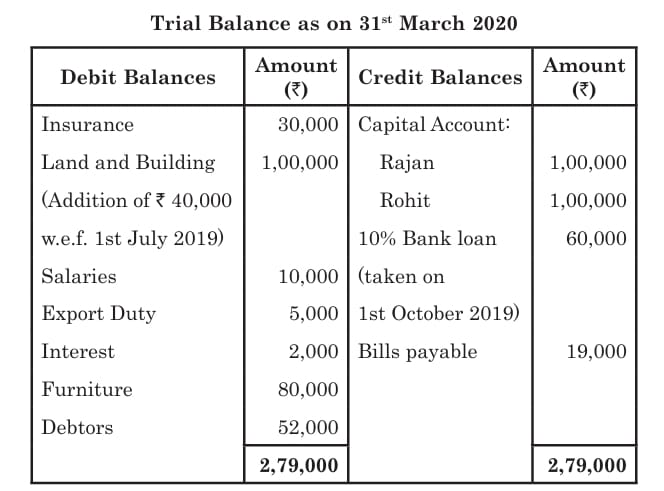
Additional information :
(1) Gross profit amounted to ` 69,000.
(2) Insurance paid for 15 months w.e.f. 1st April 2019.
(3) Depreciate land and building at 10% p.a. and furniture at 5% p.a.
(4) Write off ` 2,000 for bad debts and maintain R.D.D. at 5% on sundry debtors.
(5) Closing stock is valued at ` 69,000.
View Solution
Step 1: Prepare the Profit and Loss Account for the year ended 31st March 2020.
We begin with the gross profit, which is already given as ₹69,000. Adjustments like depreciation, bad debts, and interest will be made as we proceed.
Expenses:
- Salaries: ₹10,000
- Insurance: ₹30,000 (paid for 15 months from 1st April 2019)
The portion relating to the current year (12 months) = \(\frac{12}{15} \times 30,000 = ₹24,000\)
- Depreciation on Land and Building: 10% of ₹1,00,000 (since the addition is made on 1st July 2019, we take half-year depreciation) = ₹5,000
- Depreciation on Furniture: 5% of ₹80,000 = ₹4,000
- Bad Debts (₹2,000) and R.D.D. (5% of ₹52,000 Debtors = ₹2,600)
Profit and Loss Account for the year ended 31st March 2020

Step 2: Prepare the Balance Sheet as on 31st March 2020.
The Balance Sheet includes assets and liabilities adjusted for depreciation, bad debts, and capital balances.
Balance Sheet as on 31st March 2020
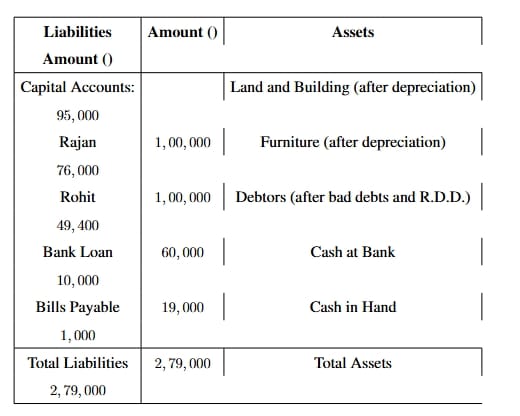
Final Answer:
\text{(a) The Profit and Loss Account shows a net profit of ₹41,400.
\text{(b) The Balance Sheet as on 31st March 2020 is balanced at ₹2,79,000. Quick Tip: Ensure to account for depreciation, bad debts, and other adjustments to ensure the accurate preparation of Profit and Loss Account and Balance Sheet.
*The article might have information for the previous academic years, please refer the official website of the exam.