
Maharashtra Board Class 12 Chemistry (55-J-852) Question Paper 2024 Available- Download Solution PDF with Answer Key

.jpg?tr=h-55,w-55,c-force)
Content Strategist|Tech-innovator|National Hackathon Winner | Updated On - Feb 26, 2025
The Maharashtra Board 2024 Class 12th Chemistry exam is being conducted (March 7, 2024). The question paper along with the solution PDF will be available here to download once the exam is conducted successfully.
The Maharashtra Board 12th Boards Chemistry exam is expected to be easy to moderate based on previous year trends. The Chemistry exam includes basic concepts of chemistry, states of matter, chemical thermodynamics, electrochemistry, organic chemistry, coordination compounds, and chemistry in everyday life, ensuring a comprehensive review of essential chemistry concepts and applications.
Maharashtra Board Class 12 Chemistry(55-J-852) Question Paper 2024 with Solutions
| Maharashtra Board Class 12 Biology Question Paper with Answer Key |  Download Download |
Check Solution |
Question 1:
Select and write the correct answer for the following multiple choice type ques-
tions:
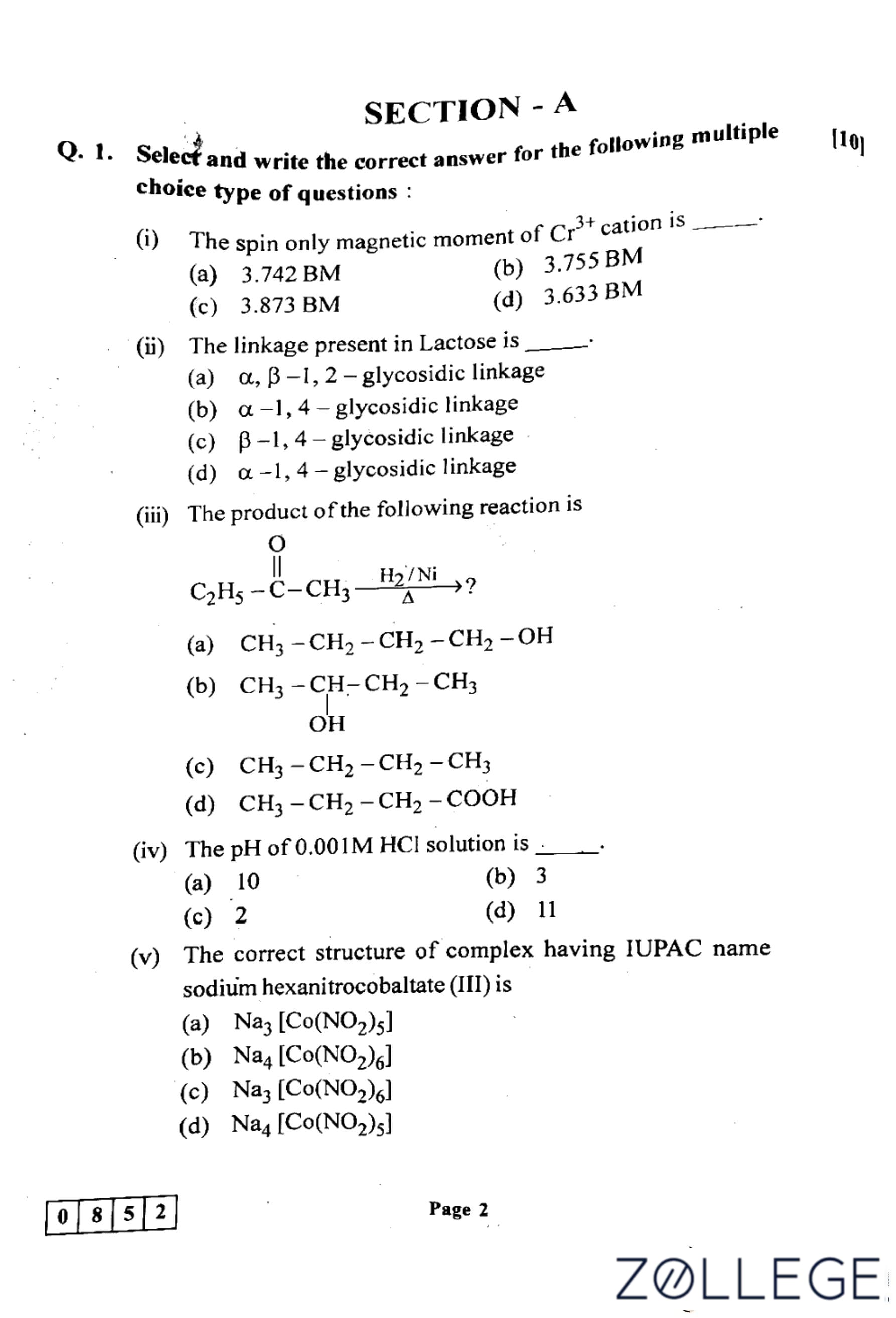
(i). The spin-only magnetic moment of Cr\(^{3+}\) cation is ............ .
View Solution
The spin-only magnetic moment \(\mu\) is given by:
\[ \mu = \sqrt{n(n+2)} BM \]
For Cr\(^{3+}\), the electronic configuration is \(3d^3\) (as it loses 3 electrons from its neutral state). The number of unpaired electrons (\(n\)) is 3.
\[ \mu = \sqrt{3(3+2)} = \sqrt{15} = 3.873 BM \]
Thus, the correct answer is (C) \(3.873\) BM. Quick Tip: The spin-only magnetic moment depends on the number of unpaired electrons and is calculated using \(\mu = \sqrt{n(n+2)}\) BM.
The linkage present in Lactose is ............. .
View Solution
Lactose is a disaccharide composed of one molecule of \(\beta\)-D-galactose and one molecule of D-glucose linked via a \(\beta-1,4\) glycosidic bond.
Thus, the correct answer is (C) \(\beta-1,4\) glycosidic linkage. Quick Tip: Lactose consists of galactose and glucose linked by a \(\beta-1,4\) glycosidic bond, making it a reducing sugar.
The product of the following reaction is:
\[ C_2H_5 - \overset{O}{\overset{||}{C}} - CH_3 \quad \xrightarrow{H_2/Ni, \ \Delta} \quad ? \]
View Solution
The given compound is butanone (\(C_2H_5 - \overset{O}{\overset{||}{C}} - CH_3\)). When treated with hydrogen (\(H_2\)) in the presence of a nickel (\(Ni\)) catalyst and heat (\(\Delta\)), the reaction involves the reduction of the carbonyl group (\(C=O\)) into a hydroxyl group, resulting in the formation of a secondary alcohol.
The reaction proceeds as follows:
\[ CH_3 - \overset{O}{\overset{||}{C}} - CH_2 - CH_3 \quad \xrightarrow{H_2/Ni, \ \Delta} \quad CH_3 - CH(OH) - CH_2 - CH_3 \]
Thus, the correct product is a secondary alcohol, which is \( CH_3 - CH(OH) - CH_2 - CH_3 \).
The correct answer is (B). Quick Tip: Reduction of ketones with \(H_2/Ni\) forms a secondary alcohol by converting the carbonyl group to a hydroxyl group.
The pH of a 0.001 M HCl solution is ............. .
View Solution
The pH of an acidic solution is given by:
\[ pH = -\log [H^+] \]
For a 0.001 M HCl solution:
\[ pH = -\log (1 \times 10^{-3}) = 3 \]
Thus, the correct answer is (C) \(3\). Quick Tip: For strong acids like HCl, the pH can be calculated directly as \(-\log [H^+]\).
The correct structure of the complex having IUPAC name sodium hexanitrocobaltate(III) is:
View Solution
The given IUPAC name is sodium hexanitrocobaltate(III).
- "Hexanitro-" refers to six \(NO_2\) ligands.
- "Cobaltate" indicates the presence of a complex anion.
- The oxidation state of cobalt is (III), meaning \(Co^{3+}\).
- The charge of \([Co(NO_2)_6]^{3-}\) requires three \(Na^+\) ions for charge neutrality.
Thus, the correct formula is \( Na_3 [Co(NO_2)_6] \), making the correct answer (c). Quick Tip: For complex salts, the number of counterions must balance the charge of the coordination complex.
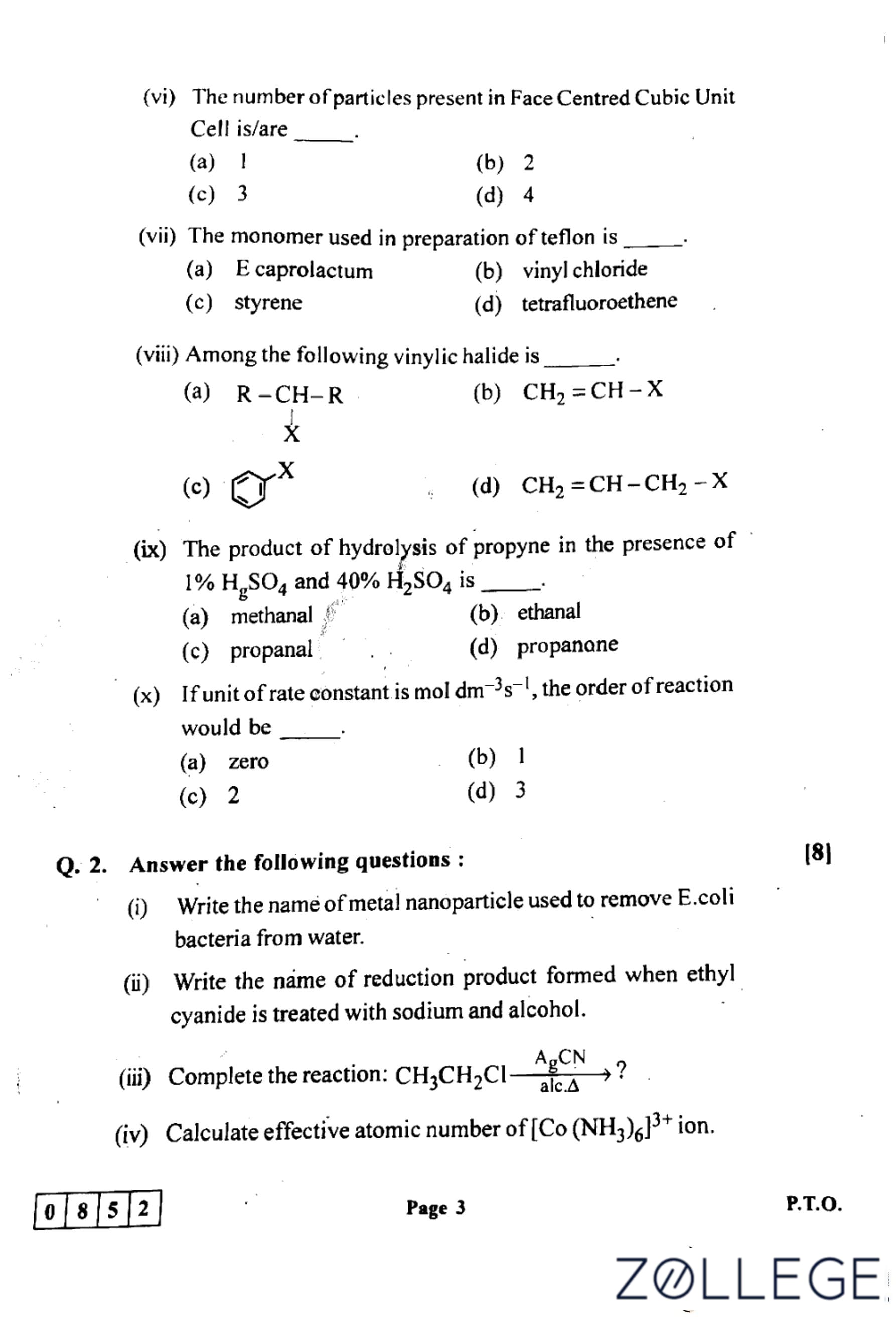
The number of particles present in a Face-Centered Cubic (FCC) unit cell is/are ................ .
View Solution
A face-centered cubic (FCC) unit cell consists of:
- 8 corner atoms, each contributing \( \frac{1}{8} \) of an atom.
- 6 face-centered atoms, each contributing \( \frac{1}{2} \) of an atom.
Thus, the total number of atoms per unit cell is:
\[ 8 \times \frac{1}{8} + 6 \times \frac{1}{2} = 1 + 3 = 4 \]
Therefore, the correct answer is (d) \( 4 \). Quick Tip: FCC unit cells have a total of 4 atoms per unit cell due to contributions from both corner and face-centered atoms.
The monomer used in the preparation of Teflon is ........... .
View Solution
Teflon is a polymer formed by the polymerization of tetrafluoroethene (\(C_2F_4\)). The reaction follows:
\[ n \, F_2C=CF_2 \quad \xrightarrow{polymerization} \quad [ -CF_2-CF_2]_n \]
Thus, the correct answer is (d) tetrafluoroethene. Quick Tip: Teflon (PTFE) is synthesized from tetrafluoroethene and is known for its high chemical resistance and non-stick properties.
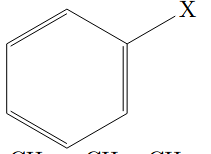
Among the following, the vinylic halide is ............. .
- (a) \( R - CH(X) - R \)
- (b) \( CH_2 = CH - X \)
- (c)
![]()
- (d) \( CH_2 = CH - CH_2 - X \)
View Solution
Vinylic halides are compounds in which the halogen (\(X\)) is directly bonded to a doubly bonded carbon (alkene carbon).
- (a) Contains a halogen on a saturated carbon, making it an alkyl halide.
- (c) Represents an aryl halide (halogen attached to a benzene ring).
- (d) Contains a halogen on an allylic position, making it an allylic halide.
- (b) Contains a halogen directly bonded to a doubly bonded carbon, making it a vinylic halide.
Thus, the correct answer is (b) \( CH_2 = CH - X \). Quick Tip: Vinylic halides have halogens attached directly to a double-bonded carbon, distinguishing them from allylic or aryl halides.
The product of hydrolysis of propyne in the presence of 1% \(HgSO_4\) and 40% \(H_2SO_4\) is .......... .
View Solution
The hydration of propyne (\(CH_3 - C \equiv CH\)) in the presence of 1% \(HgSO_4\) and 40% \(H_2SO_4\) follows Markovnikov's rule. The reaction undergoes keto-enol tautomerism, leading to the formation of propanone (\(CH_3 - CO - CH_3\)) as the final stable product.
Thus, the correct answer is (d) \( propanone \). Quick Tip: Hydration of alkynes follows Markovnikov's rule, leading to enol formation, which tautomerizes to a more stable ketone.
If the unit of rate constant is mol \(dm^{-3}s^{-1}\), the order of the reaction would be ............ .
View Solution
The unit of the rate constant for a reaction of order \( n \) is given by:
\[ k = \left( mol^{1-n} dm^{3(n-1)} s^{-1} \right) \]
For a zero-order reaction:
\[ k = mol \ dm^{-3} s^{-1} \]
which matches the given unit. Thus, the correct answer is (a) zero. Quick Tip: The unit of the rate constant changes with reaction order and follows the formula \( mol^{1-n} dm^{3(n-1)} s^{-1} \).
Question 2:
Answer the following questions:
(i). Write the name of the metal nanoparticle used to remove E. coli bacteria from water.
View Solution
Nanoparticles have been extensively used in water purification. Among them, certain metal nanoparticles exhibit strong antibacterial properties and are effective in eliminating \textit{E. coli bacteria. Quick Tip: Metal nanoparticles such as silver (Ag) and copper (Cu) exhibit strong antimicrobial properties.
Write the name of the reduction product formed when ethyl cyanide is treated with sodium and alcohol.
View Solution
Reduction of ethyl cyanide (\(CH_3CH_2CN\)) using sodium in the presence of alcohol leads to the formation of the corresponding amine. Quick Tip: The reduction of nitriles with sodium and alcohol produces primary amines via catalytic hydrogenation.
Complete the reaction:
\[ CH_3CH_2Cl \quad \xrightarrow{AgCN, \ alc., \ \Delta} \quad ? \]
View Solution
The reaction of ethyl chloride (\(CH_3CH_2Cl\)) with silver cyanide (\(AgCN\)) in alcoholic medium produces ethyl isocyanide (\(CH_3CH_2NC\)) instead of ethyl cyanide due to the ambident nature of the cyanide ion. Quick Tip: Silver cyanide (\(AgCN\)) favors isocyanide (\(NC\)) formation, whereas alkali cyanides (\(NaCN\) or \(KCN\)) favor cyanide (\(CN\)) formation.
Calculate the effective atomic number (EAN) of \([Co(NH_3)_6]^{3+}\) ion.
View Solution
The effective atomic number (EAN) is calculated using the formula:
\[ EAN = Atomic number of metal - Oxidation state + 2 \times Coordination number \]
For \([Co(NH_3)_6]^{3+}\):
- Atomic number of cobalt = 27
- Oxidation state of cobalt = +3
- Coordination number = 6
\[ EAN = 27 - 3 + 2(6) = 36 \] Quick Tip: The EAN rule helps predict the stability of metal complexes; a value of 36 suggests a noble gas configuration.
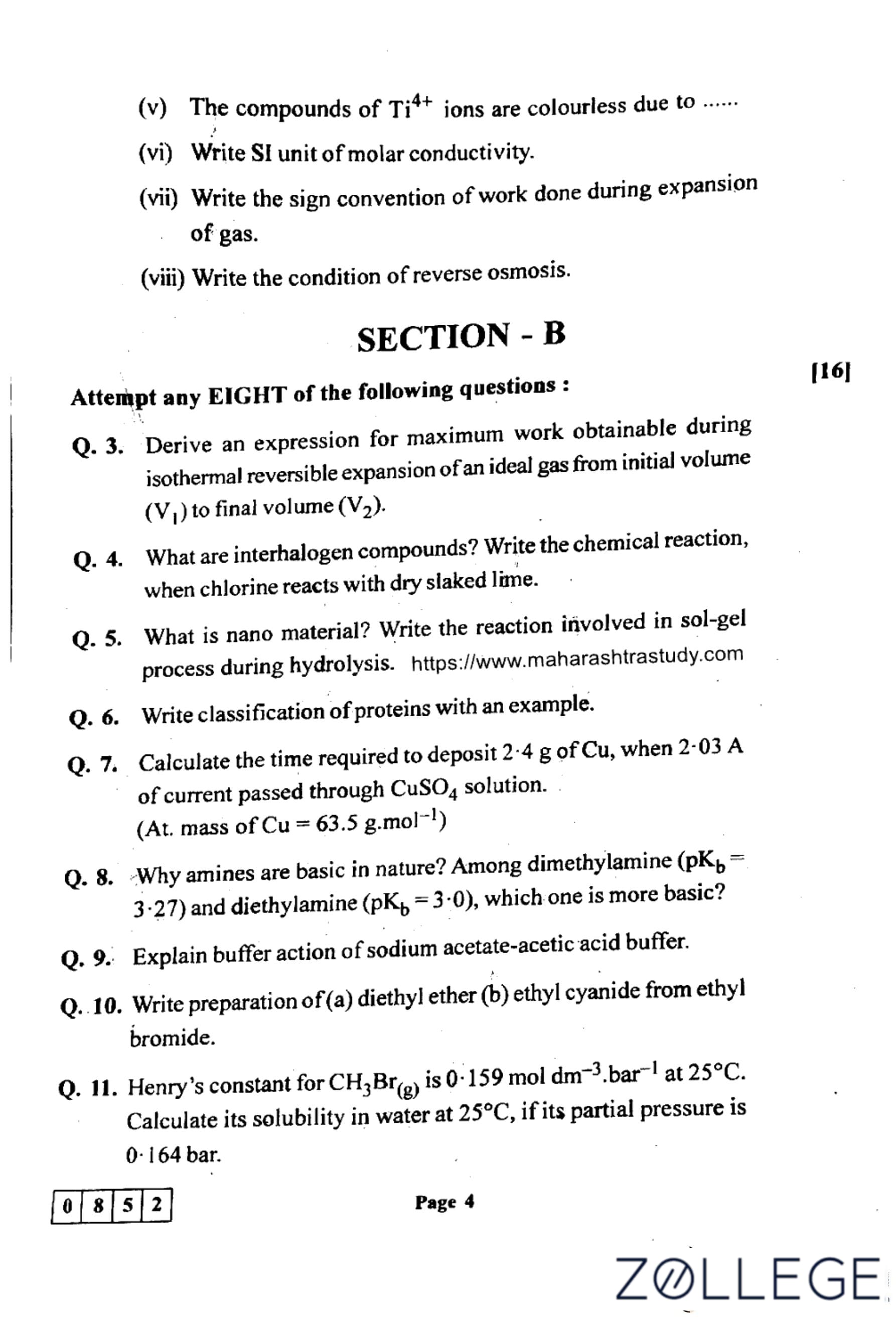
The compounds of Ti\(^{4+}\) ions are colourless due to \underline{\hspace{2cm.
View Solution
Titanium (\(Ti^{4+}\)) has an electronic configuration of \([Ar]\), meaning it has no d-electrons. Since the colour of transition metal compounds arises due to d-d transitions, the absence of d-electrons in \(Ti^{4+}\) prevents such transitions, making its compounds colourless. Quick Tip: Transition metal ions without d-electrons do not exhibit d-d transitions and appear colourless.
Write the SI unit of molar conductivity.
View Solution
The SI unit of molar conductivity (\(\Lambda_m\)) is:
\[ S m^2 mol^{-1} \]
where:
- S (Siemens) is the unit of conductivity,
- m\(^2\) accounts for molar volume considerations,
- mol\(^{-1}\) represents per mole of electrolyte. Quick Tip: Molar conductivity is measured in \(S m^2 mol^{-1}\) and depends on electrolyte concentration.
Write the sign convention of work done during the expansion of gas.
View Solution
In thermodynamics, the sign convention for work done (\(W\)) is:
\[ W is negative when the gas expands \] \[ W is positive when the gas is compressed \]
Since the system (gas) does work on the surroundings during expansion, energy leaves the system, making work negative. Quick Tip: Expansion: \( W < 0 \), Compression: \( W > 0 \), as per the first law of thermodynamics.
Write the condition of reverse osmosis.
View Solution
Reverse osmosis (RO) occurs when pressure greater than the osmotic pressure is applied to the concentrated solution, forcing water molecules to move from the concentrated side to the dilute side through a semi-permeable membrane. Quick Tip: Reverse osmosis requires pressure exceeding osmotic pressure to force water through a semi-permeable membrane.
Section-B
Question 3:
Derive an expression for maximum work obtainable during isothermal reversible expansion of an ideal gas from initial volume \(V_1\) to final volume \(V_2\).
View Solution
For an isothermal reversible expansion of an ideal gas, the work done (\(W\)) is given by:
\[ W = nRT \ln \left( \frac{V_2}{V_1} \right) \]
where:
- \( n \) is the number of moles of gas,
- \( R \) is the universal gas constant,
- \( T \) is the absolute temperature,
- \( V_1 \) and \( V_2 \) are initial and final volumes, respectively. Quick Tip: Isothermal expansion follows Boyle's Law, where \( PV = constant \).
What are interhalogen compounds? Write the chemical reaction when chlorine reacts with dry slaked lime.
View Solution
Interhalogen compounds are molecules formed by the combination of two different halogens. These compounds have the general formula \( AB_x \), where \( x = 1, 3, 5, 7 \).
The reaction of chlorine with dry slaked lime (\(Ca(OH)_2\)) produces bleaching powder:
\[ Ca(OH)_2 + Cl_2 \rightarrow CaOCl_2 + H_2O \] Quick Tip: Bleaching powder (\(CaOCl_2\)) is widely used as a disinfectant and oxidizing agent.
What is a nanomaterial? Write the reaction involved in the sol-gel process during hydrolysis.
View Solution
Nanomaterials are materials with structural features on the nanometer scale (1-100 nm). They exhibit unique optical, electrical, and mechanical properties.
The sol-gel process involves hydrolysis and condensation of metal alkoxides (\(M(OR)_x\)):
\[ M(OR)_x + x H_2O \rightarrow M(OH)_x + x ROH \] Quick Tip: The sol-gel process is widely used for synthesizing nanoparticles, ceramics, and glass coatings.
Write the classification of proteins with an example.
View Solution
Proteins are classified based on their structure and function:
1. Fibrous Proteins (e.g., Keratin, Collagen) - Structural proteins providing support.
2. Globular Proteins (e.g., Hemoglobin, Enzymes) - Functional proteins involved in biological processes. Quick Tip: Proteins are essential macromolecules, functioning as enzymes, structural components, and transport molecules.
Calculate the time required to deposit 2.4 g of Cu, when 2.03 A of current is passed through \(CuSO_4\) solution.
(At. mass of Cu = 63.5 g mol\(^{-1}\))
View Solution
Using Faraday’s first law of electrolysis:
\[ m = \frac{ZIt}{F} \]
where:
- \( m \) = mass deposited (2.4 g),
- \( I \) = current (2.03 A),
- \( F \) = Faraday’s constant (96500 C/mol),
- \( Z \) = electrochemical equivalent = \(\frac{M}{nF}\) (for Cu, \( M = 63.5 \), \( n = 2 \)).
We need to first calculate the electrochemical equivalent \( Z \) for copper:
\[ Z = \frac{M}{nF} = \frac{63.5}{2 \times 96500} = \frac{63.5}{193000} \approx 3.296 \times 10^{-4} \, g/C \]
Now, rearrange the formula to solve for \( t \):
\[ t = \frac{m}{Z I} \]
Substituting the given values:
\[ t = \frac{2.4}{(3.296 \times 10^{-4}) \times 2.03} \]
\[ t = \frac{2.4}{6.686 \times 10^{-4}} \approx 3593.34 \, seconds \]
Thus, the time required to deposit 2.4 g of Cu is approximately 3593.34 seconds. Quick Tip: Faraday’s laws relate the amount of substance deposited to the quantity of electric charge passed.
Why are amines basic in nature? Among dimethylamine (pK\(_b\) = 3.27) and diethylamine (pK\(_b\) = 3.0), which one is more basic?
View Solution
Amines are basic in nature because the nitrogen atom contains a lone pair of electrons that can accept protons (\(H^+\)), making them Lewis bases.
Since a lower \( pK_b \) value corresponds to a stronger base, diethylamine (\( pK_b = 3.0 \)) is more basic than dimethylamine (\( pK_b = 3.27 \)). Quick Tip: Amines with larger alkyl groups are more basic due to the electron-donating inductive effect, which increases electron density on nitrogen.
Explain the buffer action of the sodium acetate-acetic acid buffer.
View Solution
A sodium acetate-acetic acid buffer maintains pH by neutralizing added acids or bases.
\[ CH_3COOH \rightleftharpoons CH_3COO^- + H^+ \]
- When \(H^+\) is added, it reacts with acetate ions (\(CH_3COO^-\)), preventing a pH drop.
- When \(OH^-\) is added, it reacts with acetic acid (\(CH_3COOH\)), preventing a pH rise. Quick Tip: Buffer solutions resist changes in pH upon the addition of small amounts of acids or bases.
Write the preparation of (a) diethyl ether and (b) ethyl cyanide from ethyl bromide.
View Solution
(a) Diethyl Ether Preparation (Williamson Ether Synthesis):
\[ C_2H_5Br + C_2H_5ONa \rightarrow C_2H_5-O-C_2H_5 + NaBr \]
(b) Ethyl Cyanide Preparation:
\[ C_2H_5Br + KCN \rightarrow C_2H_5CN + KBr \] Quick Tip: Williamson ether synthesis uses alkyl halides and sodium alkoxides to produce ethers.
Henry’s constant for CH\(_3\)Br(g) is 0.159 mol dm\(^{-3}\) bar\(^{-1}\) at 25\(^\circ\)C. Calculate its solubility in water at 25\(^\circ\)C if its partial pressure is 0.164 bar.
View Solution
Henry’s law states:
\[ C = k_H P \]
where:
- \( C \) = solubility (mol dm\(^{-3}\)),
- \( k_H \) = Henry’s constant (0.159 mol dm\(^{-3}\) bar\(^{-1}\)),
- \( P \) = partial pressure (0.164 bar).
\[ C = (0.159 \times 0.164) = 0.0261 mol dm^{-3} \] Quick Tip: Henry’s law states that the solubility of a gas in a liquid is directly proportional to its partial pressure.
Question 12:
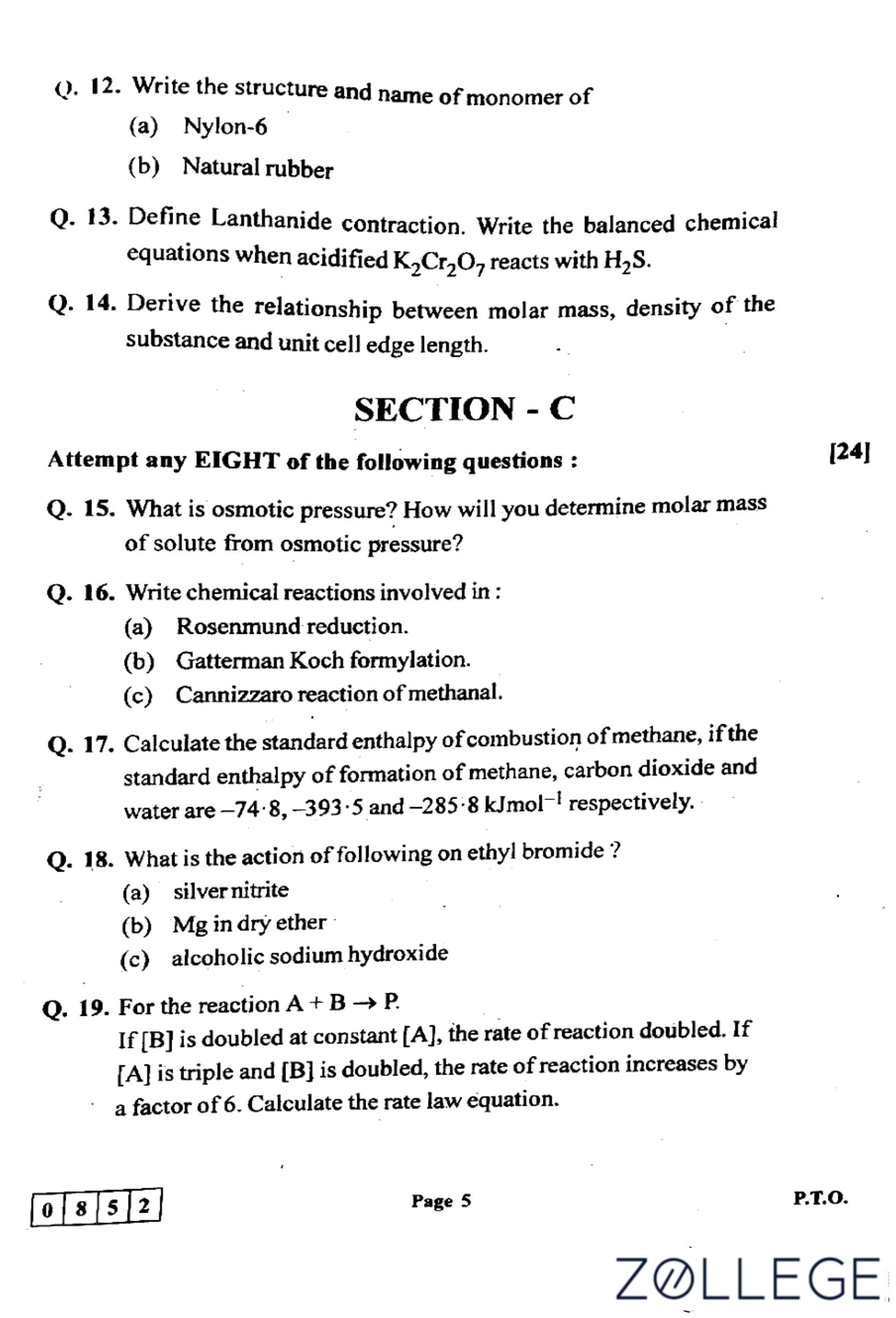
Write the structure and name of the monomer of:
(a). Nylon-6
View Solution
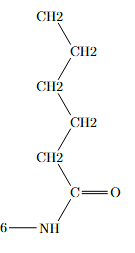
(a) Nylon-6 Monomer:
The monomer for Nylon-6 is caprolactam.
Quick Tip: Nylon-6 is synthesized by ring-opening polymerization of caprolactam.
(b). Natural rubber
View Solution
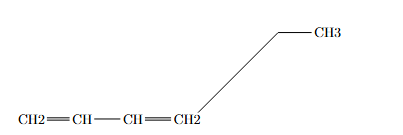
(b) Natural Rubber Monomer:
The monomer of natural rubber is isoprene (\( 2\)-methyl-1,3-butadiene).
Quick Tip: Natural rubber consists of polyisoprene chains.
Define Lanthanide contraction. Write the balanced chemical equation when acidified \(K_2Cr_2O_7\) reacts with \(H_2S\).
View Solution
Lanthanide Contraction:
Lanthanide contraction refers to the gradual decrease in atomic and ionic radii of lanthanide elements across the series due to poor shielding of the nuclear charge by 4f electrons.
Reaction of Acidified \(K_2Cr_2O_7\) with \(H_2S\):
\[ K_2Cr_2O_7 + 3H_2SO_4 + 3H_2S \rightarrow 2Cr_2(SO_4)_3 + 7H_2O + 3S \] Quick Tip: Lanthanide contraction impacts transition metal chemistry, making elements of the 5d series similar in size to their 4d counterparts.
Derive the relationship between molar mass, density of the substance, and unit cell edge length.
View Solution
The density (\(\rho\)) of a crystalline solid is defined as the mass per unit volume. The volume of a unit cell is \( a^3 \), where \( a \) is the edge length of the unit cell.
1. Number of atoms per unit cell:
The number of formula units in a unit cell is denoted by \( Z \). For example, in a simple cubic lattice, \( Z = 1 \), in a body-centered cubic (BCC) lattice, \( Z = 2 \), and in a face-centered cubic (FCC) lattice, \( Z = 4 \).
2. Mass of the unit cell:
The mass of one formula unit of the substance is equal to its molar mass \( M \) divided by Avogadro's number \( N_A \). Therefore, the mass of the unit cell is:
\[ Mass of unit cell = \frac{ZM}{N_A} \]
3. Volume of the unit cell:
The volume of the unit cell is the cube of the edge length \( a \), so:
\[ V_{unit cell} = a^3 \]
4. Density of the substance:
The density is defined as mass per unit volume. Therefore, the density of the substance is:
\[ \rho = \frac{Mass of unit cell}{Volume of unit cell} = \frac{\frac{ZM}{N_A}}{a^3} \]
Simplifying the expression:
\[ \rho = \frac{ZM}{N_A a^3} \]
Thus, the relationship between molar mass, density, and unit cell edge length is given by:
\[ \rho = \frac{ZM}{N_A a^3} \]
where:
- \( Z \) = Number of formula units per unit cell,
- \( M \) = Molar mass,
- \( N_A \) = Avogadro’s number (\(6.022 \times 10^{23} mol^{-1}\)),
- \( a \) = Edge length of the unit cell. Quick Tip: This equation helps determine the density of a solid using X-ray crystallography data.
Section-C
Question 15:
What is osmotic pressure? How will you determine the molar mass of a solute from osmotic pressure?
View Solution
Osmotic Pressure (\(\pi\)) is the pressure required to prevent the net flow of solvent molecules through a semipermeable membrane from a dilute solution to a concentrated one.
The osmotic pressure is given by the van’t Hoff equation:
\[ \pi = CRT \]
where:
- \( \pi \) = osmotic pressure,
- \( C \) = molar concentration of the solution,
- \( R \) = universal gas constant (\( 0.0821 L atm mol^{-1} K^{-1} \)),
- \( T \) = absolute temperature in Kelvin.
Determination of Molar Mass from Osmotic Pressure:
Since concentration (\( C \)) is defined as:
\[ C = \frac{n}{V} = \frac{m}{M V} \]
where \( n \) = moles of solute, \( m \) = mass of solute, and \( M \) = molar mass of the solute, we can rearrange the osmotic pressure equation:
\[ \pi V = \frac{mRT}{M} \]
Solving for \( M \):
\[ M = \frac{mRT}{\pi V} \]
Thus, by measuring the osmotic pressure (\(\pi\)) of a solution of known mass (\(m\)) and volume (\(V\)), the molar mass (\(M\)) of the solute can be determined. Quick Tip: Osmotic pressure is a colligative property used to determine the molar mass of large biomolecules like proteins and polymers.
Question 16:
Write chemical reactions involved in:
(a). Rosenmund Reduction
View Solution
Rosenmund reduction is used to convert acid chlorides to aldehydes using hydrogen gas in the presence of palladium (Pd) catalyst poisoned with barium sulfate (\(BaSO_4\)).
\[ RCOCl + H_2 \xrightarrow[BaSO_4]{Pd} RCHO + HCl \]
Example:
\[ CH_3COCl + H_2 \xrightarrow[BaSO_4]{Pd} CH_3CHO + HCl \] Quick Tip: Rosenmund reduction selectively converts acid chlorides to aldehydes, preventing further reduction to alcohols.
(b). Gattermann-Koch Formylation
View Solution
The Gattermann-Koch reaction introduces a formyl (\(-CHO\)) group into benzene or activated aromatic rings using carbon monoxide (\(CO\)) and hydrogen chloride (\(HCl\)) in the presence of a Lewis acid catalyst such as \(AlCl_3\) and \(CuCl\).
\[ C_6H_6 + CO + HCl \xrightarrow{AlCl_3, CuCl} C_6H_5CHO \] Quick Tip: The Gattermann-Koch reaction is used to introduce formyl (\(-CHO\)) groups into benzene rings, producing benzaldehyde derivatives.
(c). Cannizzaro Reaction of Methanal
View Solution
The Cannizzaro reaction is a redox reaction in which non-enolizable aldehydes (without \(\alpha\)-hydrogen) undergo disproportionation in the presence of a strong base (\(NaOH\)) to form an alcohol and a carboxylate ion.
For methanal (formaldehyde):
\[ 2HCHO + NaOH \rightarrow HCOO^- Na^+ + CH_3OH \] Quick Tip: The Cannizzaro reaction occurs in aldehydes without \(\alpha\)-hydrogen atoms, leading to simultaneous oxidation and reduction.
Calculate the standard enthalpy of combustion of methane, if the standard enthalpy of formation of methane, carbon dioxide, and water are -74.8, -393.5, and -285.8 kJ mol\(^{-1}\) respectively.
View Solution
The standard enthalpy of combustion (\(\Delta H_c^\circ\)) of methane is determined using the enthalpy of formation values and the balanced combustion equation:
\[ CH_4 + 2O_2 \rightarrow CO_2 + 2H_2O \]
Using Hess’s Law:
\[ \Delta H_c^\circ = \sum \Delta H_f^\circ (products) - \sum \Delta H_f^\circ (reactants) \]
Substituting given values:
\[ \Delta H_c^\circ = \left[ \Delta H_f^\circ (CO_2) + 2 \times \Delta H_f^\circ (H_2O) \right] - \left[ \Delta H_f^\circ (CH_4) + 2 \times \Delta H_f^\circ (O_2) \right] \]
Since \(\Delta H_f^\circ (O_2) = 0\):
\[ \Delta H_c^\circ = \left[ (-393.5) + 2 \times (-285.8) \right] - (-74.8) \]
\[ = (-393.5 - 571.6) + 74.8 \]
\[ = -890.3 kJ mol^{-1} \] Quick Tip: The standard enthalpy of combustion is always negative, as combustion reactions are exothermic.
Question 18:
What is the action of the following on ethyl bromide ?
(a). Silver Nitrite
View Solution
When ethyl bromide reacts with silver nitrite (\(AgNO_2\)), ethyl nitrite is formed due to the ambident nature of the nitrite ion.
\[ C_2H_5Br + AgNO_2 \rightarrow C_2H_5ONO + AgBr \] Quick Tip: Silver nitrite favors the formation of alkyl nitrites (\(R-ONO\)), whereas alkali metal nitrites (\(NaNO_2\)) form alkyl nitro compounds (\(R-NO_2\)).
(b). Magnesium in Dry Ether
View Solution
Ethyl bromide reacts with magnesium in dry ether to form an ethyl magnesium bromide (Grignard reagent).
\[ C_2H_5Br + Mg \xrightarrow{dry ether} C_2H_5MgBr \] Quick Tip: Grignard reagents (\(R-MgBr\)) are highly reactive and can be used for nucleophilic addition reactions with carbonyl compounds.
(c). Alcoholic Sodium Hydroxide
View Solution
Ethyl bromide undergoes dehydrohalogenation in the presence of alcoholic sodium hydroxide (\(NaOH\)), leading to the formation of ethene.
\[ C_2H_5Br + alc. NaOH \rightarrow C_2H_4 + HBr \] Quick Tip: Alcoholic NaOH promotes elimination (E2) reactions, forming alkenes, whereas aqueous NaOH promotes nucleophilic substitution (SN2).
For the reaction \( A + B \rightarrow P \):
If \([B]\) is doubled at constant \([A]\), the rate of reaction doubles.
If \([A]\) is tripled and \([B]\) is doubled, the rate of reaction increases by a factor of 6.
Calculate the rate law equation.
View Solution
The rate law equation is given by:
\[ Rate = k [A]^m [B]^n \]
where \( m \) and \( n \) are the reaction orders with respect to \( A \) and \( B \), respectively.
Step 1: Determine \( n \)
From the first condition:
\[ [B] is doubled at constant [A] \Rightarrow Rate doubles \]
\[ \frac{Rate_2}{Rate_1} = \left( \frac{[B]_2}{[B]_1} \right)^n \]
\[ 2 = (2)^n \]
Taking \(\log\):
\[ \log 2 = n \log 2 \]
\[ n = 1 \]
Step 2: Determine \( m \)
From the second condition:
\[ [A] is tripled and [B] is doubled \Rightarrow Rate increases by factor of 6 \]
\[ \frac{Rate_2}{Rate_1} = \left( \frac{[A]_2}{[A]_1} \right)^m \times \left( \frac{[B]_2}{[B]_1} \right)^n \]
\[ 6 = (3)^m (2)^1 \]
\[ 6 = 3^m \times 2 \]
\[ \frac{6}{2} = 3^m \]
\[ 3^m = 3^1 \]
\[ m = 1 \]
Final Rate Law:
\[ Rate = k [A]^1 [B]^1 \]
or
\[ Rate = k [A][B] \] Quick Tip: Reaction order is determined by analyzing how changes in reactant concentration affect the rate of reaction.
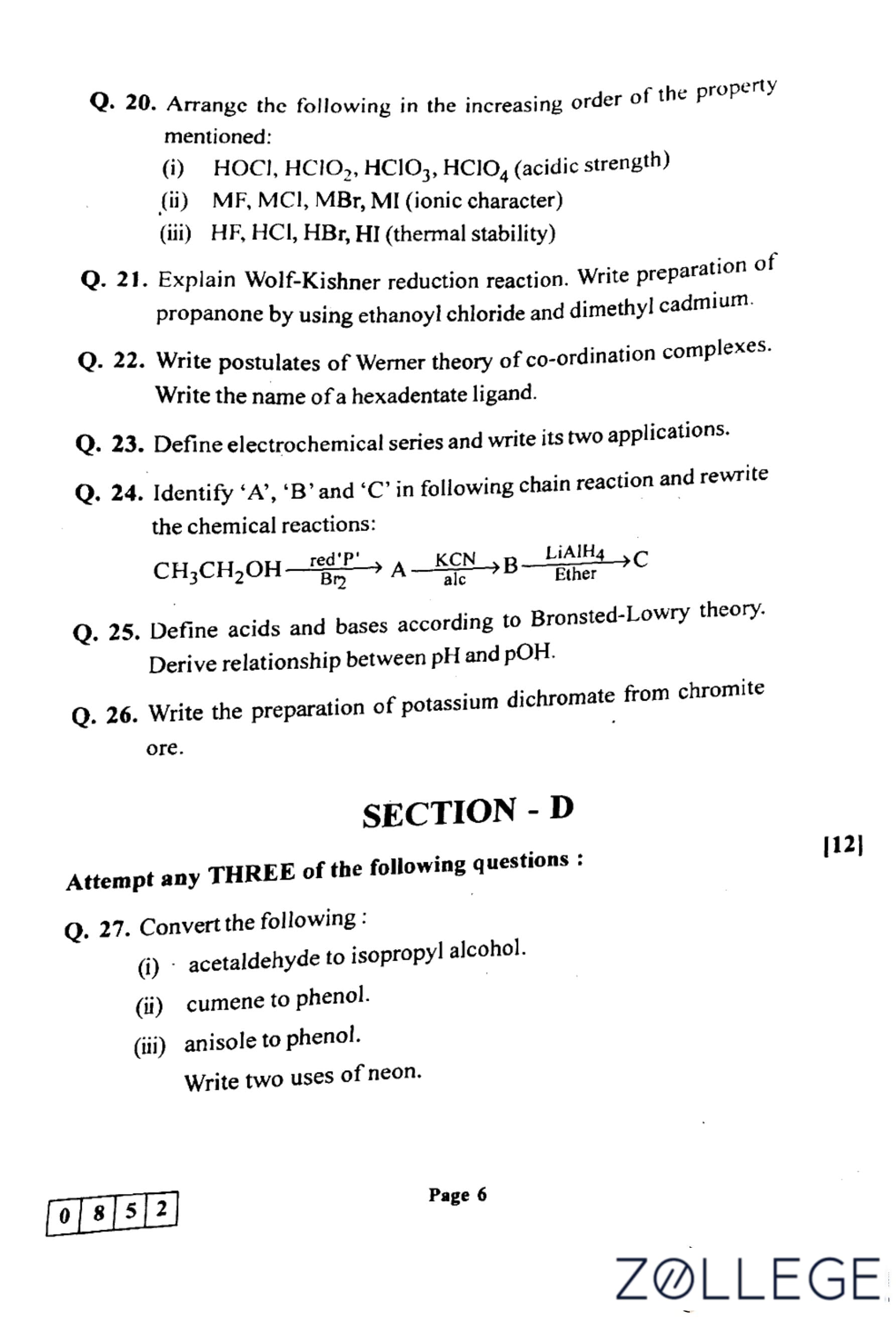
Question 20:
Arrange the following in increasing order of the property mentioned:
(i). \(HOCl, HClO_2, HClO_3, HClO_4\) (acidic strength)
View Solution
Increasing Order of Acidic Strength:
The acidic strength of oxyacids of chlorine increases with the oxidation state of chlorine. Higher oxidation states stabilize the conjugate base, making the acid stronger.
\[ HOCl < HClO_2 < HClO_3 < HClO_4 \] Quick Tip: Acidic strength of oxyacids increases as the oxidation state of the central atom increases.
(ii). \(MF, MCl, MBr, MI\) (ionic character)
View Solution
Increasing Order of Ionic Character:
Ionic character is influenced by the difference in electronegativity between the metal (\(M\)) and the halogen. As the halogen moves down the group, electronegativity decreases, leading to decreased ionic character. Therefore, the ionic character decreases as we go from \(F\) to \(I\) due to the decreasing electronegativity of the halogens.
\[ MI < MBr < MCl < MF \] Quick Tip: Ionic character decreases as the size of the halide ion increases, since larger halides form weaker ionic bonds.
(iii). \(HF, HCl, HBr, HI\) (thermal stability)
View Solution
Increasing Order of Thermal Stability:
Thermal stability of hydrogen halides (\(HX\)) decreases down the group due to decreasing bond strength (\(H-F\) being the strongest and \(H-I\) the weakest).
\[ HI < HBr < HCl < HF \] Quick Tip: Thermal stability of hydrogen halides decreases as bond strength weakens down the group.
Explain Wolff-Kishner reduction reaction. Write the preparation of propanone by using ethanoyl chloride and dimethyl cadmium.
View Solution
(i) Wolff-Kishner Reduction Reaction:
Wolff-Kishner reduction is a method used to reduce carbonyl compounds (\(C=O\)) to alkanes using hydrazine (\(N_2H_4\)) and a strong base (\(KOH\)) in a high-boiling solvent like glycol.
\[ R-C=O + N_2H_4 \xrightarrow{KOH, heat} R-CH_2 + N_2 \]
Example:
\[ CH_3COCH_3 + N_2H_4 \xrightarrow{KOH, heat} CH_3CH_2CH_3 + N_2 \] Quick Tip: Wolff-Kishner reduction is useful for converting aldehydes and ketones into alkanes without affecting other functional groups.
(ii) Preparation of Propanone Using Ethanoyl Chloride and Dimethyl Cadmium:
Dimethyl cadmium ((CH3)2Cd) reacts with ethanoyl chloride (CH3COCl) to form propanone.
CH3COCl + (CH3)2Cd → CH3COCH3 + CdCl2
Quick Tip:
Dimethyl cadmium is a reagent used in organic synthesis for preparing ketones from
acid chlorides.
Write postulates of Werner’s theory of coordination complexes. Write the name of a hexadentate ligand.
View Solution
Postulates of Werner’s Coordination Theory:
1. Primary Valency corresponds to oxidation state and is ionizable.
2. Secondary Valency determines coordination number and is non-ionizable.
3. The metal ion satisfies its secondary valency by forming coordinate bonds with ligands.
4. The spatial arrangement of ligands around the metal ion leads to different geometries.
Example of a Hexadentate Ligand:
Ethylenediaminetetraacetate (EDTA) is a hexadentate ligand that binds metal ions through six donor atoms.
\[ EDTA^{4-} \] Quick Tip: Werner’s theory explains the structure and bonding in coordination complexes, distinguishing primary and secondary valencies.
Define the electrochemical series and write its two applications.
View Solution
Definition of Electrochemical Series:
The electrochemical series is a list of standard electrode potentials (\(E^\circ\)) of elements arranged in order of increasing or decreasing ability to lose or gain electrons.
Applications of the Electrochemical Series:
1. Predicting Redox Reactions
- A species with a lower reduction potential acts as a reducing agent.
- A species with a higher reduction potential acts as an oxidizing agent.
2. Determining Electrochemical Cell Feasibility
- A spontaneous reaction occurs when \(E^\circ_{cell} = E^\circ_{cathode} - E^\circ_{anode}\) is positive. Quick Tip: The electrochemical series helps predict the spontaneity of redox reactions and determines electrode potential differences in cells.
Identify ‘A’, ‘B’ and ‘C’ in the following chain reaction and rewrite the chemical reactions:
\[ CH_3CH_2OH \xrightarrow{red 'P', Br_2} A \xrightarrow{KCN, alc} B \xrightarrow{LiAlH_4, Ether} C \]
View Solution
1. Conversion of Ethanol to Ethyl Bromide (\(A\)):
Ethanol reacts with bromine in the presence of red phosphorus to form ethyl bromide.
\[ CH_3CH_2OH + Br_2 \xrightarrow{red P} CH_3CH_2Br + HBr \]
So, A = Ethyl Bromide (\(CH_3CH_2Br\)).
2. Conversion of Ethyl Bromide to Propanenitrile (\(B\)):
Ethyl bromide reacts with alcoholic potassium cyanide (\(KCN\)) to form propanenitrile.
\[ CH_3CH_2Br + KCN \rightarrow CH_3CH_2CN + KBr \]
So, B = Propanenitrile (\(CH_3CH_2CN\)).
3. Conversion of Propanenitrile to Propylamine (\(C\)):
Propanenitrile undergoes reduction with lithium aluminum hydride (\(LiAlH_4\)) in ether to form propylamine.
\[ CH_3CH_2CN + 4[H] \xrightarrow{LiAlH_4, Ether} CH_3CH_2CH_2NH_2 \]
So, C = Propylamine (\(CH_3CH_2CH_2NH_2\)). Quick Tip: This reaction sequence involves nucleophilic substitution (\(S_N2\)) followed by reduction of nitriles to primary amines.
Define acids and bases according to Bronsted-Lowry theory. Derive the relationship between pH and pOH.
View Solution
(i) Bronsted-Lowry Definition:
- Acids: Proton (\(H^+\)) donors.
- Bases: Proton (\(H^+\)) acceptors.
Example:
\[ NH_3 + H_2O \rightleftharpoons NH_4^+ + OH^- \]
Here, \(NH_3\) acts as a Bronsted base (accepting \(H^+\)), and \(H_2O\) acts as a Bronsted acid (donating \(H^+\)).
(ii) Relationship Between pH and pOH:
We know:
\[ pH = -\log [H^+] \]
\[ pOH = -\log [OH^-] \]
Since,
\[ [H^+] [OH^-] = 10^{-14} \]
Taking logarithm,
\[ pH + pOH = 14 \] Quick Tip: pH and pOH are related by \(pH + pOH = 14\), which applies to aqueous solutions at 25°C.
Write the preparation of potassium dichromate from chromite ore.
View Solution
Potassium dichromate (\(K_2Cr_2O_7\)) is prepared from chromite ore (\(FeCr_2O_4\)) through the following steps:
1. Roasting with Sodium Carbonate:
\[ FeCr_2O_4 + 4Na_2CO_3 + 7O_2 \rightarrow 2Na_2CrO_4 + 2Fe_2O_3 + 4CO_2 \]
2. Conversion to Dichromate:
\[ 2Na_2CrO_4 + H_2SO_4 \rightarrow Na_2Cr_2O_7 + Na_2SO_4 + H_2O \]
3. Formation of Potassium Dichromate:
\[ Na_2Cr_2O_7 + 2KCl \rightarrow K_2Cr_2O_7 + 2NaCl \] Quick Tip: Potassium dichromate is a powerful oxidizing agent used in redox reactions and analytical chemistry.
Section-D
Question 27:
Convert the following:
(i). Acetaldehyde to Isopropyl Alcohol
View Solution
Acetaldehyde (\(CH_3CHO\)) can be converted to isopropyl alcohol (\(CH_3CH(OH)CH_3\)) through the following steps:
1. Aldol Condensation:
\[ 2CH_3CHO \xrightarrow{Dil. NaOH} CH_3CH(OH)CH_2CHO \]
2. Catalytic Hydrogenation:
\[ CH_3CH(OH)CH_2CHO + H_2 \xrightarrow{Ni, Heat} CH_3CH(OH)CH_3 \]
Thus, acetaldehyde undergoes aldol condensation followed by hydrogenation to yield isopropyl alcohol. Quick Tip: Aldol condensation forms \(\beta\)-hydroxy aldehydes or ketones, which can be hydrogenated to alcohols.
(ii). Cumene to Phenol
View Solution
Cumene (\(C_6H_5CH(CH_3)_2\)) is converted to phenol by the cumene hydroperoxide process:
1. Oxidation of Cumene:
\[ C_6H_5CH(CH_3)_2 + O_2 \rightarrow C_6H_5C(CH_3)_2OOH \]
2. Acidic Hydrolysis:
\[ C_6H_5C(CH_3)_2OOH \xrightarrow{H^+} C_6H_5OH + CH_3COCH_3 \]
Thus, cumene is oxidized to cumene hydroperoxide, which undergoes acid hydrolysis to give phenol and acetone as a byproduct. Quick Tip: Cumene hydroperoxide rearranges under acidic conditions to produce phenol and acetone.
(iii). Anisole to Phenol
View Solution
Anisole (\(C_6H_5OCH_3\)) can be converted to phenol (\(C_6H_5OH\)) via hydrolysis using hydrobromic acid:
\[ C_6H_5OCH_3 + HBr \xrightarrow{Heat} C_6H_5OH + CH_3Br \] Quick Tip: Anisole undergoes cleavage in the presence of \(HBr\), forming phenol and methyl bromide.
(i). Write two uses of neon.
View Solution
Neon (\(Ne\)) is a noble gas with various applications. Two important uses include:
1. Illumination: Used in neon lights and advertising signs.
2. Cryogenics: Used in high-performance cooling systems, especially in refrigeration. Quick Tip: Neon is chemically inert and primarily used in lighting and cooling applications.
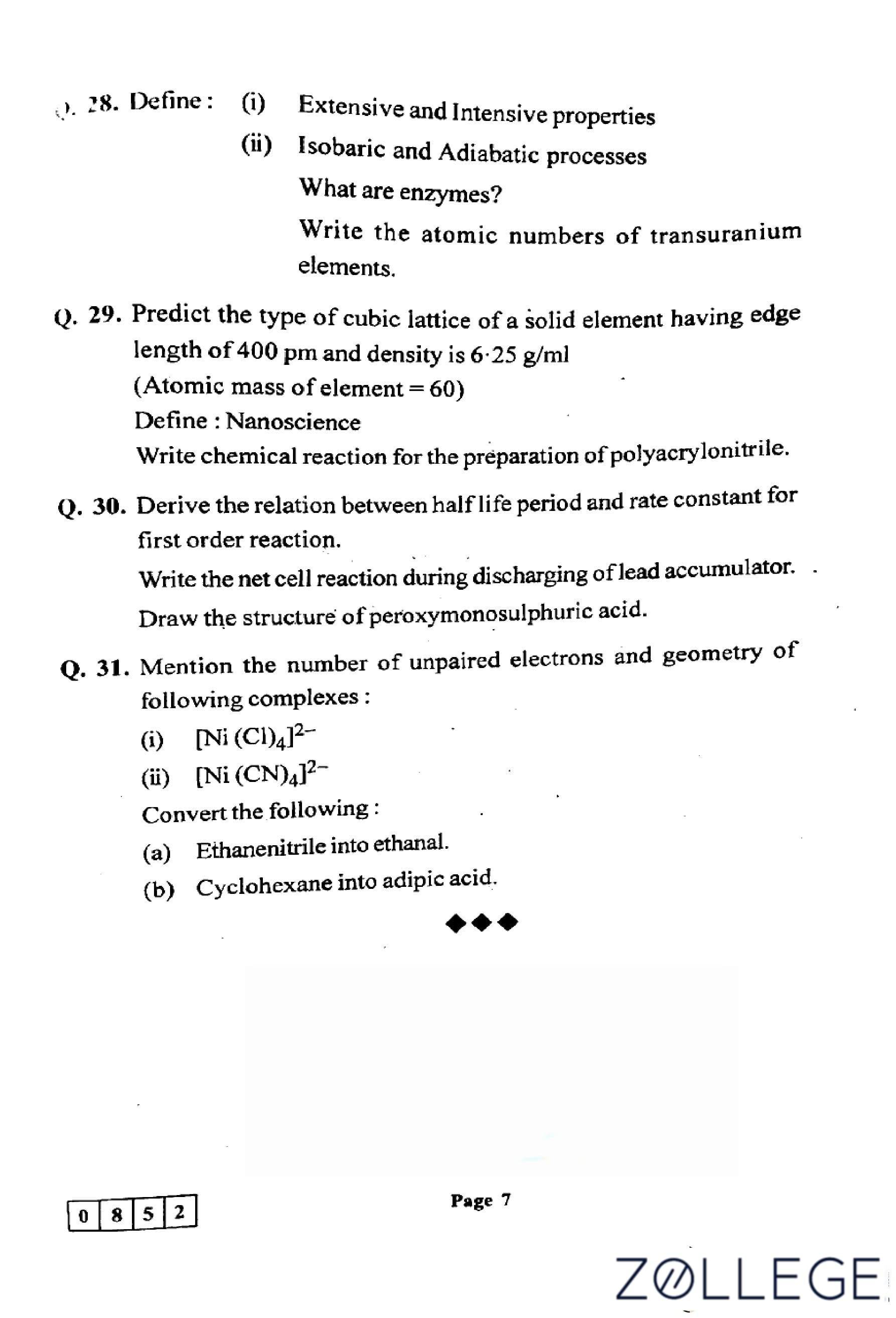
Question 28:
Define:
(i). Extensive and Intensive Properties
View Solution
Extensive Properties:
Extensive properties depend on the amount of matter present in the system. These properties change when the quantity of substance changes.
Examples:
- Mass
- Volume
- Energy
- Enthalpy
Intensive Properties:
Intensive properties do not depend on the amount of substance. These properties remain unchanged regardless of the quantity of the system.
Examples:
- Temperature
- Density
- Pressure
- Refractive index Quick Tip: Extensive properties depend on the system’s size, whereas intensive properties remain independent of the system size.
(ii). Isobaric and Adiabatic Processes
View Solution
Isobaric Process:
An isobaric process occurs at constant pressure, meaning:
\[ \Delta P = 0 \]
Example:
- Heating water in an open container at constant atmospheric pressure.
Work done in an isobaric process:
\[ W = P \Delta V \]
Adiabatic Process:
An adiabatic process occurs without heat exchange between the system and surroundings.
\[ q = 0 \]
Example:
- Sudden expansion or compression of gas in an insulated container.
For an adiabatic process:
\[ PV^\gamma = constant \] Quick Tip: Isobaric processes occur at constant pressure, while adiabatic processes involve no heat exchange.
What are Enzymes?
View Solution
Enzymes are biological catalysts that speed up chemical reactions in living organisms. They are typically proteins and function by lowering the activation energy of biochemical reactions.
Characteristics of Enzymes:
1. Highly specific in action.
2. Work under mild conditions (temperature and pH).
3. Can be regulated by inhibitors or activators.
Examples of Enzymes:
- Amylase: Converts starch into maltose.
- Lipase: Breaks down lipids into fatty acids and glycerol.
- Catalase: Decomposes hydrogen peroxide into water and oxygen. Quick Tip: Enzymes act as biological catalysts, facilitating metabolic reactions without being consumed.
Write the Atomic Numbers of Transuranium Elements.
View Solution
Transuranium elements are elements with atomic numbers greater than uranium (\( Z > 92 \)). They are artificially synthesized in laboratories.
Atomic Numbers of Some Transuranium Elements:
1. Neptunium (Np) - 93
2. Plutonium (Pu) - 94
3. Americium (Am) - 95
4. Curium (Cm) - 96
5. Berkelium (Bk) - 97
6. Californium (Cf) - 98 Quick Tip: Transuranium elements (\(Z > 92\)) are synthetic and often radioactive.
Predict the type of cubic lattice of a solid element having edge length of 400 pm and density of 6.25 g/ml.
(Atomic mass of element = 60)
View Solution
The type of cubic lattice can be determined using the formula:
\[ Z = \frac{\rho N_A a^3}{M} \]
where:
- \( Z \) = Number of atoms per unit cell,
- \( \rho \) = Density (\(6.25\) g/cm\(^3\)),
- \( N_A \) = Avogadro’s number (\(6.022 \times 10^{23}\) mol\(^{-1}\)),
- \( a \) = Edge length (\(400\) pm = \(4.0 \times 10^{-8}\) cm),
- \( M \) = Atomic mass (\(60\) g/mol).
\[ Z = \frac{(6.25) \times (6.022 \times 10^{23}) \times (4.0 \times 10^{-8})^3}{60} \]
Solving, we get \( Z = 4 \), indicating a Face-Centered Cubic (FCC) Lattice. Quick Tip: A simple cubic lattice has \(Z = 1\), a body-centered cubic (BCC) lattice has \(Z = 2\), and a face-centered cubic (FCC) lattice has \(Z = 4\).
Define: Nanoscience
View Solution
Nanoscience is the study of materials and structures at the nanoscale (1-100 nm). At this scale, materials exhibit unique physical and chemical properties due to the high surface area-to-volume ratio.
Applications of Nanoscience:
- Medical: Drug delivery using nanoparticles.
- Electronics: Quantum dots for display technology.
- Energy: Solar cells with nanostructured coatings. Quick Tip: Nanoscience enables innovations in medicine, electronics, and environmental sustainability.
Write the chemical reaction for the preparation of Polyacrylonitrile.
View Solution
Polyacrylonitrile (PAN) is synthesized by the polymerization of acrylonitrile in the presence of a radical initiator.
\[ n CH_2=CH-CN \xrightarrow{Peroxide} [-CH_2-CH(CN)-]_n \]
Polyacrylonitrile is used in textiles and as a precursor for carbon fibers. Quick Tip: Radical polymerization of acrylonitrile produces PAN, a precursor for synthetic fibers and carbon materials.
Derive the relation between half-life period and rate constant for a first-order reaction.
View Solution
For a first-order reaction:
\[ Rate = k [A] \]
The integrated rate law is:
\[ [A] = [A]_0 e^{-kt} \]
At half-life (\( t_{1/2} \)), \([A] = \frac{[A]_0}{2}\),
\[ \frac{[A]_0}{2} = [A]_0 e^{-k t_{1/2}} \]
Taking \(\ln\) on both sides:
\[ \ln \frac{1}{2} = -k t_{1/2} \]
\[ t_{1/2} = \frac{0.693}{k} \]
Thus, \( t_{1/2} \) is independent of concentration for first-order reactions. Quick Tip: First-order reactions have a constant half-life, useful in radioactive decay and pharmacokinetics.
Write the net cell reaction during discharging of a lead accumulator.
View Solution
During discharging, lead (\(Pb\)) acts as the anode, and lead dioxide (\(PbO_2\)) acts as the cathode in a sulfuric acid medium.
\[ Pb + PbO_2 + 2H_2SO_4 \rightarrow 2PbSO_4 + 2H_2O \] Quick Tip: Lead-acid batteries work on reversible redox reactions and are used in vehicles and backup power systems.
Draw the structure of Peroxymonosulfuric Acid.
View Solution
The chemical formula of Peroxymonosulfuric Acid (Caro’s Acid) is \( H_2SO_5 \). Its structure contains one peroxy (\(-O-O-\)) bond:
\[ \chemfig{HO-S(=O)(=O)-O-OH} \]
It is a strong oxidizing agent used in organic synthesis. Quick Tip: Peroxymonosulfuric acid (\(H_2SO_5\)) is a strong oxidizer, often used in wastewater treatment.
Question 31:
Mention the number of unpaired electrons and geometry of the following
complexes:
(i). [Ni(Cl)\(_4\)]\(^{2-}\)
View Solution
- Oxidation State of Ni:
\[ x + 4(-1) = -2 \Rightarrow x = +2 \]
Thus, Ni is in the +2 oxidation state.
- Electronic Configuration of Ni\(^{2+}\):
\[ [Ar] 3d^8 4s^0 \]
- Nature of Ligand:
- Chloride (Cl\(^-\)) is a weak field ligand, so it does not cause strong pairing.
- The tetrahedral geometry is favored.
- Unpaired Electrons \& Hybridization:
- Hybridization: sp\(^3\)
- Unpaired electrons: 2
- Geometry: Tetrahedral Quick Tip: Weak field ligands (like Cl\(^-\)) favor high spin configurations and tetrahedral geometry.
(ii). [Ni(CN)\(_4\)]\(^{2-}\)
View Solution
- Oxidation State of Ni:
\[ x + 4(-1) = -2 \Rightarrow x = +2 \]
So, Ni is in the +2 oxidation state.
- Electronic Configuration of Ni\(^{2+}\):
\[ [Ar] 3d^8 4s^0 \]
- Nature of Ligand:
- Cyanide (CN\(^-\)) is a strong field ligand, which causes pairing of electrons.
- The square planar geometry is preferred.
- Unpaired Electrons \& Hybridization:
- Hybridization: dsp\(^2\)
- Unpaired electrons: 0
- Geometry: Square Planar Quick Tip: Strong field ligands (like CN\(^-\)) induce low-spin configurations, leading to square planar geometry.
(i). Ethanentrile into Ethanal
View Solution
Ethanenitrile (CH\(_3\)CN) can be converted to ethanal (CH\(_3\)CHO) using partial reduction with DIBAL-H (Diisobutylaluminium Hydride).
\[ CH_3CN + DIBAL-H \xrightarrow{-78^\circ C} CH_3CHO \] Quick Tip: DIBAL-H selectively reduces nitriles to aldehydes under controlled conditions.
(ii). Cyclohexane into Adipic Acid
View Solution
Cyclohexane (C\(_6\)H\(_{12}\)) is oxidized using nitric acid (HNO\(_3\)) or potassium permanganate (KMnO\(_4\)) to yield adipic acid (C\(_6\)H\(_{10}\)O\(_4\)).
\[ C_6H_{12} + [O] \xrightarrow{HNO_3} HOOC-(CH_2)_4-COOH \] Quick Tip: Adipic acid is an important precursor for Nylon-6,6 and is produced via controlled oxidation of cyclohexane.
*The article might have information for the previous academic years, please refer the official website of the exam.