
Maharashtra Board Class 12 Crop Science (P2-B-4-V-288) Question Paper 2024 Available- Download Solution PDF with Answer Key

.jpg?tr=h-55,w-55,c-force)
Content Strategist|Tech-innovator|National Hackathon Winner | Updated On - Feb 25, 2025
The Maharashtra Board 2024 Class 12th Crop Science exam is being conducted (March 4, 2024). The question paper along with the solution PDF will be available here to download once the exam is conducted successfully.
The Maharashtra Board 12th Boards Crop Science exam is expected to be easy to moderate based on previous year trends. The Crop Science exam includes agriculture science, such as crop production, plant protection, soil science, and agricultural economics.
Maharashtra Board Class 12 Crop Sciennce(P2-B-4-V-288) Question Paper 2024 with Solutions
| Maharashtra Board Class 12 Crop Science Question Paper with Answer Key |  Download Download |
Check Solution |
Maharashtra Board Class 12 Crop Sciennce(P2-B-4-V-288) Question Paper 2024 with Solutions
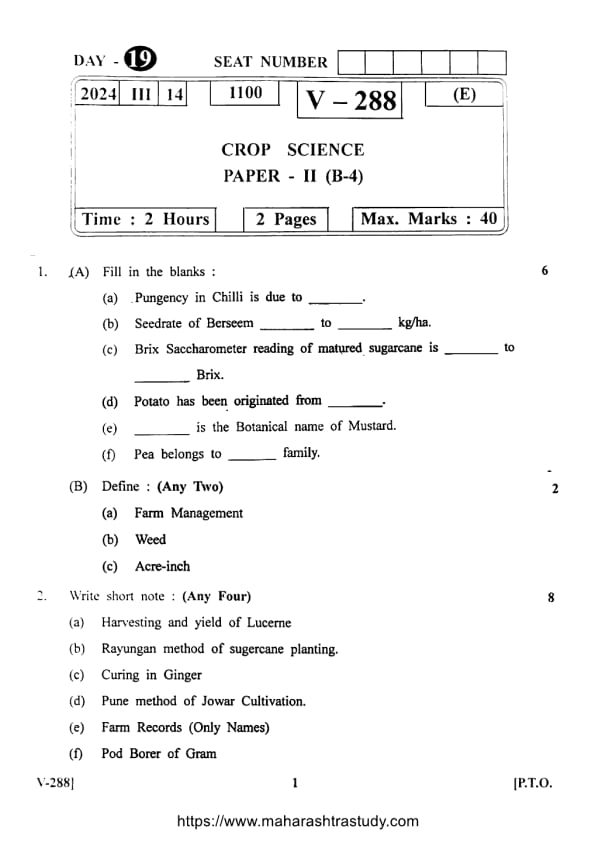
Question 1(A):
Fill in the blanks:
(a) Pungency in Chilli is due to ............. .
(b) Seed rate of Berseem ............ to \underline{\hspace{2cm kg/ha.
(c) Brix Saccharometer reading of matured sugarcane is ............. to .............. Brix.
(d) Potato has been originated from ............ .
(e) .............. is the Botanical name of Mustard.
(f) Pea belongs to ................ family.
View Solution
(a) Pungency in Chilli is due to Capsaicin.
(b) Seed rate of Berseem 20 to 25 kg/ha.
(c) Brix Saccharometer reading of matured sugarcane is 18 to 21 Brix.
(d) Potato has been originated from South America.
(e) Brassica juncea is the Botanical name of Mustard.
(f) Pea belongs to Leguminosae (Fabaceae) family.
Quick Tip: For definitions, concise and clear explanations with examples help in better understanding.
(a). Farm Management
View Solution
Farm management is the process of planning, organizing, and controlling farm activities to maximize productivity and profitability. It involves decision-making regarding resource allocation, crop selection, labor management, and financial planning to ensure efficient agricultural production.
(b). Weed
View Solution
A weed is an unwanted plant that grows in agricultural fields and competes with main crops for nutrients, water, sunlight, and space. Weeds can significantly reduce crop yield, lower quality, and increase production costs. Effective weed management is essential for sustainable farming.
(c). Acre-inch
View Solution
An acre-inch is a unit of measurement used in irrigation, representing the volume of water required to cover one acre of land to a depth of one inch. It is approximately equal to 27,154 gallons (123,344 liters) of water. This measurement helps in planning efficient water usage in agricultural fields.
Quick Tip: Understanding fundamental agricultural terms like farm management, weeds, and irrigation units (acre-inch) is essential for efficient farming practices. Proper farm management and weed control strategies lead to increased crop productivity.
Write short note:
(a) Harvesting and yield of Lucerne
(b) Rayungan method of sugarcane planting
(c) Curing in Ginger
(d) Pune method of Jowar Cultivation
(e) Farm Records (Only Names)
(f) Pod Borer of Gram
View Solution
(a) Harvesting and yield of Lucerne:
Lucerne is a perennial forage crop harvested at the 10 percent flowering stage to obtain maximum yield and high nutritional value. The first cut is taken about 60-70 days after sowing, followed by subsequent cuts at intervals of 25-30 days.
- Average yield: 80-100 tons of green fodder per hectare annually.
- The harvested crop is dried in shade to retain its nutritive value before being stored or fed to livestock.
(b) Rayungan method of sugarcane planting:
This method is commonly practiced in Maharashtra and involves planting whole sugarcane stalks in deep furrows or trenches horizontally instead of using setts.
- The soil is covered lightly, and irrigation is provided to enhance germination.
- This method ensures a better root system, improved moisture conservation, and high productivity.
- It is beneficial in water-scarce areas.
(c) Curing in Ginger:
Curing is the process of removing excess moisture from freshly harvested ginger rhizomes to improve storage and quality.
- Steps in curing:
- Rhizomes are washed and cleaned properly.
- They are dried under shade for 2-3 days to reduce moisture.
- Treated with lime water or Bordeaux mixture to prevent fungal infections.
- Cured ginger has a stronger aroma and longer shelf life, making it suitable for export.
(d) Pune method of Jowar Cultivation:
It is a special method of growing Jowar in Maharashtra using paired-row planting for better aeration and sunlight penetration.
- The crop is planted in rows spaced at 30-45 cm apart, with wider spacing between pairs.
- This method increases yield by improving photosynthesis and reducing competition for nutrients.
- It is best suited for rain-fed conditions.
(e) Farm Records (Only Names):
- Crop Record
- Livestock Record
- Machinery Record
- Financial Record
- Weather Record
- Input-Output Record
(f) Pod Borer of Gram:
The pod borer {Helicoverpa armigera is a major pest affecting gram crops.
- It damages pods by feeding on developing seeds, causing {20-30% yield loss.
- Control measures:
- Use of resistant varieties.
- Biological control using \textit{Trichogramma parasitoids.
- Application of neem-based pesticides and insecticides like {Chlorpyrifos or Spinosad.
Quick Tip: Adopting scientific methods like improved harvesting techniques, effective pest control, and proper farm record-keeping enhances productivity and farm sustainability. Proper curing methods improve crop storage and market value.
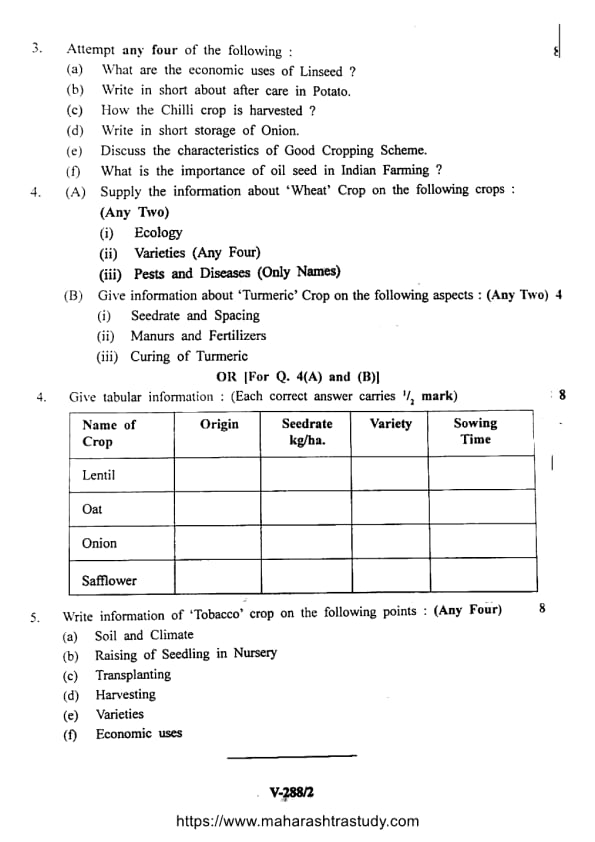
(a) What are the economic uses of Linseed?
(b) Write in short about after care in Potato.
(c) How the Chilli crop is harvested?
(d) Write in short storage of Onion.
(e) Discuss the characteristics of Good Cropping Scheme.
(f) What is the importance of oil seed in Indian Farming?
View Solution
(a) Economic uses of Linseed:
- Linseed {Linum usitatissimum is an important oilseed crop used for multiple purposes.
- It is a rich source of Omega-3 fatty acids and is used in edible oil production.
- The oil is widely used in paints, varnishes, and printing inks.
- Linseed cake is used as animal feed due to its high protein content.
- The fiber from linseed plants is used in making linen fabric and paper.
(b) After care in Potato:
- Irrigation: Potatoes require regular irrigation at an interval of 7-10 days to ensure proper tuber development.
- Weeding and Earthing up: Weeds should be removed periodically, and soil should be heaped around plants (earthing up) to prevent tuber exposure.
- Pest and Disease Control: Protection against late blight (\textit{Phytophthora infestans) using fungicides like Mancozeb.
- Fertilization: Application of potassium and phosphorus ensures better tuber quality.
(c) Harvesting of Chilli crop:
- Chilli crop is ready for harvesting 90-120 days after transplanting.
- Harvesting is done in multiple pickings as chillies mature at different times.
- Fully ripe, red-colored fruits are plucked manually.
- The harvested chillies are dried under sunlight for 7-10 days to reduce moisture content and enhance shelf life.
(d) Short storage of Onion:
- Onions should be stored in a well-ventilated, dry place to prevent rotting.
- Storage structures with 50-60% humidity and temperature around 25°C are ideal.
- Onion bulbs should be cured before storage by drying in shade for 10-15 days.
- Stacking onions in mesh bags or ventilated wooden crates prevents fungal infection.
(e) Characteristics of Good Cropping Scheme:
- Utilizes land efficiently with proper crop rotation.
- Ensures high yield and profitability.
- Incorporates soil fertility management through green manuring and organic farming.
- Includes intercropping to maximize production.
- Minimizes soil erosion and conserves moisture.
(f) Importance of oil seed in Indian Farming:
- Oilseed crops like mustard, soybean, and groundnut contribute significantly to India’s agricultural economy.
- They provide raw materials for edible oil, biofuel, and industrial products.
- Oilseeds enhance soil fertility as some are nitrogen-fixing crops.
- They offer employment in processing industries.
- India is a leading producer of oilseeds, reducing dependency on imported edible oils.
Quick Tip: Proper harvesting, storage, and cropping techniques play a crucial role in improving agricultural productivity. Oilseeds and linseed are essential for food security and industrial use.
Supply the information about ‘Wheat’ Crop on the following topics: (Any Two)
(i) Ecology
(ii) Varieties (Any Four)
(iii) Pests and Diseases (Only Names)
(B) Give information about ‘Turmeric’ Crop on the following aspects: (Any Two)
(i) Seed rate and Spacing
(ii) Manures and Fertilizers
(iii) Curing of Turmeric
View Solution
(A) Information about Wheat Crop:
(i) Ecology of Wheat:
- Wheat is a rabi (winter) season crop grown in cool and dry climates.
- It requires a temperature of 10-15°C during germination and 21-26°C during grain filling.
- Annual rainfall requirement is 50-100 cm.
- It is mainly grown in well-drained loamy or clayey soils with a pH of 6.0-7.5.
- Major wheat-producing states in India: Uttar Pradesh, Punjab, Haryana, Madhya Pradesh, Rajasthan.
Quick Tip: Wheat requires proper climatic conditions and soil fertility management to achieve high productivity. Timely sowing and irrigation are crucial for better yield.
(ii) Varieties of Wheat (Any Four):
- HD 2967 – High-yielding variety grown in North India.
- PBW 343 – Suitable for late-sown conditions.
- WH 1105 – Disease-resistant variety.
- Lok-1 – Popular in Central and Western India.
Quick tip:
Selecting the right variety of wheat based on climate, soil type, and disease resistance ensures a higher
yield and better quality of produce.
(iii) Pests and Diseases (Only Names):
- Pests:
- Termites (Odontotermes spp.)
- Armyworm (Mythimna separata)
- Aphids (Rhopalosiphum maidis)
- Diseases:
- Rust (Yellow Rust, Brown Rust, Black Rust)
- Loose Smut
- Karnal Bunt
- Powdery Mildew
Quick tip:
Effective pest and disease management in wheat involves crop rotation, resistant varieties, and timely
application of fungicides and insecticides.4(B). Information about Turmeric Crop:
(i) Seed Rate and Spacing:
- Turmeric is propagated through rhizomes instead of seeds.
- Seed rate: 2,500-3,000 kg/ha.
- Spacing: 30 cm row-to-row and 25 cm plant-to-plant.
Quick tip:Proper spacing and the right seed rate in turmeric cultivation ensure uniform growth and higher rhi-
zome yield.
(ii) Manures and Fertilizers:
- Organic Manure: 25-30 tons/ha of well-decomposed farmyard manure (FYM).
- Chemical Fertilizers:
- Nitrogen: 120 kg/ha (split doses).
- Phosphorus: 60 kg/ha.
- Potassium: 90 kg/ha.
- Micronutrients like Zinc and Boron improve rhizome quality.
Quick tip:
Balanced fertilizer application and organic manure usage enhance the yield and quality of turmeric
rhizomes.
(iii) Curing of Turmeric:
- After harvesting, rhizomes are cleaned and boiled for 40-60 minutes to remove raw odor.
- They are then sun-dried for 10-15 days to reduce moisture.
- Polishing is done by rubbing dried rhizomes to improve appearance.
- Proper curing enhances color, aroma, and storage life.
Quick tip:
Proper curing methods improve the market value and storage life of turmeric, making it more suitable
for trade and export.
Tabular Information:
View Solution
| Name of Crop | Origin | Seed Rate (kg/ha) | Variety | Sowing Time |
|---|---|---|---|---|
| Lentil | Southwest Asia | 30-40 | Pusa 4076, L 4147 | Rabi season |
| Oat | Europe | 80-100 | Kent, UPO-212 | October-November |
| Onion | Central Asia | 5-7 | N-53, Agrifound Light Red | Kharif & Rabi |
| Safflower | South Asia | 10-12 | Bhima, A-1 | October-November |
Write information of ‘Tobacco’ crop on the following points: (Any Four)
(a) Soil and Climate
(b) Raising of Seedling in Nurser
(c) Transplanting
(d) Harvesting
(e) Varieties
(f) Economic Uses
View Solution
(a) Soil and Climate:
- Tobacco grows well in light-textured, well-drained loamy or sandy loam soils with a pH of 5.5 to 7.5.
- A warm and humid climate is ideal, with an optimal temperature range of 20-30°C.
- The crop requires 500-1000 mm of well-distributed rainfall during the growing period.
- Bright sunny days and dry conditions during the maturity stage enhance leaf quality.
Quick Tip: For good-quality tobacco, ensure well-drained soils and avoid waterlogging. Proper climatic conditions improve leaf aroma and texture.
b) Raising of Seedlings in Nursery:
- Tobacco seeds are very small and are first raised in nurseries before transplanting.
- Seed Rate: 500-600 g/ha.
- Nursery Bed Preparation:
- Beds are prepared in well-drained soil and sterilized using formalin or solarization to prevent fungal diseases.
- Seeds are mixed with fine sand and broadcast evenly on beds.
- Light watering is done regularly to maintain moisture.
- 45-50 days old seedlings(10-15 cm tall) are ready for transplanting.
Quick tip:
Using healthy and disease-free seedlings ensures a high survival rate after transplanting and better
crop establishment.
c) Transplanting:
- Transplanting is done in well-prepared fields after seedlings reach 10-15 cm height.
- Spacing: 75 cm row-to-row and 50 cm plant-to-plant ensures proper aeration and growth.
- Transplanting is best done in moist soil after light irrigation or rainfall.
- Shading is provided for the first few days to reduce transplanting shock.
Quick tip:
Proper spacing and transplanting at the right time improve plant growth and quality of tobacco
leaves.d) Harvesting:
- Tobacco is harvested 90-120 days after transplanting, depending on variety and purpose. - Types of Harvest-
ing: - Priming: Harvesting mature leaves from the bottom upward at intervals of 7-10 days.
- Stalk-cutting: Entire plant is cut at the base when all leaves are mature.
- Proper curing methods like air-curing, flue-curing, or sun-curing are used to improve tobacco quality.
Quick tip:
Timely harvesting and curing methods significantly affect the final quality and market value of to-
bacco leaves.
e) Varieties:
- Flue-cured varieties:
- Kanchan, Jayasri, Anand-119
- Air-cured varieties:
- Abirami, Swarna, Bhavya - Chewing tobacco varieties:
- Dharani, Lal Ganga, Manasi
Quick tip:
Choosing the right variety depends on climate, soil type, and end-use of tobacco (smoking, chewing,
cigar, etc.).
(f ) Economic Uses:
- Cigarette and Cigar Industry: Major raw material for global tobacco product manufacturing.
- Chewing and Snuff Industry: Used in different forms like gutkha, snuff, and chewing tobacco.
- Pharmaceutical Industry: Nicotine extracted from tobacco is used in nicotine patches and gum for smoking
cessation.
- Pesticides and Biopesticides: Nicotine-based products are used as natural insecticides.
- Revenue Generation: Tobacco contributes significantly to India’s economy through exports and employment.
Quick tip:
Tobacco plays a major role in global trade and industry. While profitable, regulations on production
and consumption vary across countries.


*The article might have information for the previous academic years, please refer the official website of the exam.