
Maharashtra Board 2025 Class 12 Economics Question Paper PDF with Solutions


Content Writer | Updated On - Sep 14, 2025
The Maharashtra Board Class 12 Economics Question Paper PDF with Solutions is available for download. The Maharashtra State Board of Secondary and Higher Secondary Education (MSBSHSE) conducted the Class 12 Economics examination for a total duration of 3 hours, and the question paper had a total of 80 marks.

Maharastra Board Class 12 Economics Question Paper with Solutions
| Maharastra Board Class 12 Economics Question Paper with Solutions | Download PDF | Check Solutions |
Give economic terms:
(i) A desire which is backed by willingness to purchase and ability to pay.
View Solution
(i) A desire which is backed by willingness to purchase and ability to payQuick Tip: Economic terms often define key concepts and measurements in economics, and understanding them is crucial for analyzing market behavior and international trade.
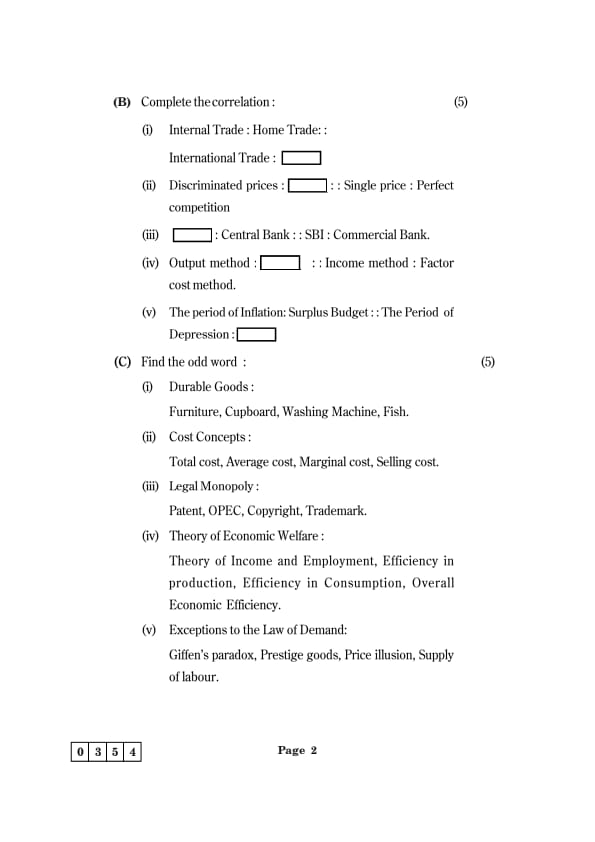
Find the odd word:
(i) Durable Goods :
Furniture, Cupboard, Washing Machine, Fish.
View Solution
Odd Word: Fish.
Explanation: Fish is perishable, while the other items (Furniture, Cupboard, Washing Machine) are durable goods.
(ii) Cost Concepts :
Total cost, Average cost, Marginal cost, Selling cost.
% Solution
Solution:
Odd Word: Selling cost.
Explanation: Selling cost is an expense related to the sale of goods, while the other costs (Total cost, Average cost, Marginal cost) are production-related costs.
(iii) Legal Monopoly :
Patent, OPEC, Copyright, Trademark.
% Solution
Solution:
Odd Word: OPEC.
Explanation: OPEC is an international organization, whereas Patent, Copyright, and Trademark are legal concepts related to intellectual property rights.
(iv) Theory of Economic Welfare :
Theory of Income and Employment, Efficiency in production, Efficiency in Consumption, Overall Economic Efficiency.
% Solution
Solution:
Odd Word: Theory of Income and Employment.
Explanation: Theory of Income and Employment is an economic theory, while the others (Efficiency in production, Efficiency in Consumption, Overall Economic Efficiency) are specific aspects of economic welfare.
(v) Exceptions to the Law of Demand:
Giffen's paradox, Prestige goods, Price illusion, Supply of labour.
% Solution
Solution:
Odd Word: Supply of labour.
Explanation: Supply of labour is not directly related to the Law of Demand, while the others (Giffen’s paradox, Prestige goods, Price illusion) are exceptions to the Law of Demand. Quick Tip: When identifying the odd word, look for key differences in categories, functions, or relevance to the given topic.
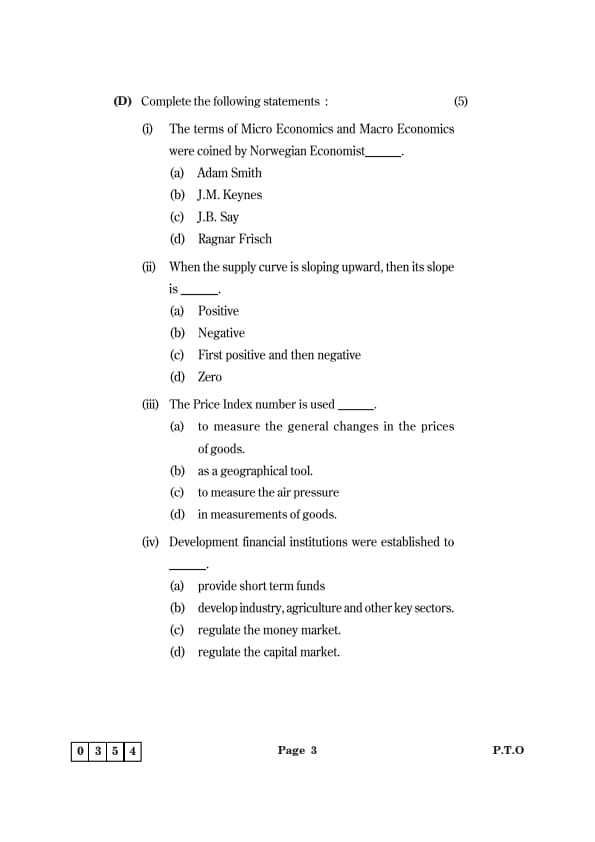
The terms of Micro Economics and Macro Economics were coined by Norwegian Economist .................
View Solution
Step 1: Recall the background.
Ragnar Frisch was a Norwegian economist who introduced the distinction between Microeconomics and Macroeconomics in the 1930s.
Step 2: Analyze the options.
- Adam Smith was a classical economist but not the one who coined these terms.
- J.M. Keynes focused on aggregate demand and government intervention, but didn't coin these terms.
- J.B. Say was a French economist known for Say's Law, but didn't coin these terms either.
- Ragnar Frisch is the correct answer, as he coined these terms in the 1930s.
Step 3: Conclude.
Thus, Ragnar Frisch was the economist who coined the terms Microeconomics and Macroeconomics.
Final Answer: \[ \boxed{Ragnar \; Frisch} \] Quick Tip: Ragnar Frisch played a pivotal role in the development of modern macroeconomics and econometrics.
The Price Index number is used ........
View Solution
Step 1: Define the Price Index.
The Price Index is a statistical measure that shows how the average price of a basket of goods and services changes over time, reflecting the general changes in the price levels.
Step 2: Analyze the options.
- Option (a) is correct because the Price Index measures changes in the general price level of goods.
- Option (b) is incorrect because the Price Index is not used for geographical measurements.
- Option (c) is incorrect as the Price Index is not related to air pressure.
- Option (d) is incorrect as it is not used for measuring individual goods.
Step 3: Conclude.
Therefore, the correct answer is that the Price Index number is used to measure the general changes in the prices of goods.
Final Answer: \[ \boxed{to \; measure \; the \; general \; changes \; in \; the \; prices \; of \; goods.} \] Quick Tip: The Price Index helps to determine inflation and monitor the cost of living over time.
Development financial institutions were established to ..........
View Solution
Step 1: Understand the role of development financial institutions.
Development financial institutions (DFIs) are set up by governments to provide long-term capital for the growth and expansion of industries, infrastructure, and other critical sectors like agriculture.
Step 2: Analyze the options.
- Option (a) is incorrect because DFIs are primarily focused on long-term investments, not short-term funds.
- Option (b) is correct as DFIs aim to develop key sectors like industry and agriculture.
- Option (c) and (d) are incorrect because DFIs do not primarily regulate the money or capital markets.
Step 3: Conclude.
Thus, development financial institutions were established to promote the development of industries, agriculture, and other key sectors.
Final Answer: \[ \boxed{develop \; industry, \; agriculture \; and \; other \; key \; sectors.} \] Quick Tip: DFIs help in financing projects that promote long-term economic growth and employment.
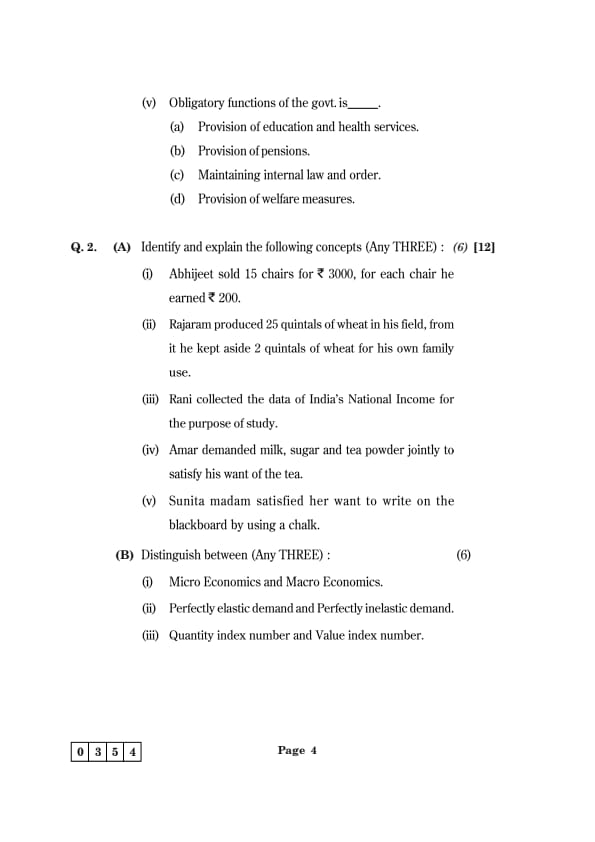
Obligatory functions of the govt. is ............
View Solution
Step 1: Define obligatory functions.
Obligatory functions of the government refer to the essential responsibilities that a government must fulfill to ensure the well-being and safety of its citizens.
Step 2: Analyze the options.
- Option (a) is incorrect because providing education and health services, while important, is not always mandatory in all governmental systems.
- Option (b) is incorrect because the provision of pensions is a welfare measure, not an obligatory function.
- Option (c) is correct as maintaining internal law and order is a primary and obligatory function of any government to ensure the security and stability of the nation.
- Option (d) is incorrect because the provision of welfare measures, while essential, is typically not an obligatory function under all circumstances.
Step 3: Conclude.
Therefore, the correct answer is maintaining internal law and order, which is a fundamental and obligatory function of the government.
Final Answer: \[ \boxed{Maintaining \; internal \; law \; and \; order.} \] Quick Tip: The primary function of government is to ensure the safety and security of its citizens by enforcing law and order.
Abhijeet sold 15 chairs for Rs. 3000, for each chair he earned Rs. 200.
View Solution
Step 1: Identify the concept.
This is an example of **profit earning** through sales. The concept used here is **unit profit** which is calculated by dividing the total profit by the number of items sold.
Step 2: Calculation of profit per chair.
The total earnings from selling 15 chairs = Rs. 3000
Profit per chair = \frac{Total Earnings{\text{Number of chairs = \frac{3000{15 = Rs. 200.
Step 3: Conclude.
Therefore, Abhijeet earned a profit of Rs. 200 for each chair sold.
Final Answer: \[ \boxed{Profit \; earned \; per \; chair \; = Rs. 200 \] Quick Tip: Unit profit is calculated by dividing total profit by the number of units sold.
Rajaram produced 25 quintals of wheat in his field, from it he kept aside 2 quintals of wheat for his own family use.
View Solution
Step 1: Identify the concept.
This is an example of **production for personal consumption**. Rajaram produced wheat, but kept some of it aside for personal use, which is different from selling or distributing it for economic exchange.
Step 2: Explanation.
The total production of wheat = 25 quintals.
The quantity kept for personal use = 2 quintals.
The remaining wheat for economic exchange = 25 - 2 = 23 quintals.
Step 3: Conclude.
Thus, Rajaram produced 23 quintals of wheat for market exchange, and 2 quintals for his own use.
Final Answer: \[ \boxed{23 \; quintals \; for \; market \; exchange, \; 2 \; quintals \; for \; personal \; use} \] Quick Tip: Production for personal consumption refers to producing goods for one's own use rather than for sale.
Rani collected the data of India’s National Income for the purpose of study.
View Solution
Step 1: Identify the concept.
This refers to **National Income Accounting**. National income data collection helps in measuring the total economic output of a country.
Step 2: Purpose.
The primary purpose of collecting National Income data is to assess the overall economic health, plan policies, and understand the income distribution in the country.
Step 3: Conclude.
Therefore, Rani is collecting data for the study of India's National Income to understand economic indicators like GDP, GNP, etc.
Final Answer: \[ \boxed{National \; Income \; Accounting} \] Quick Tip: National income data is crucial for formulating effective economic policies and understanding a country's economic performance.
Amar demanded milk, sugar, and tea powder jointly to satisfy his want for tea.
View Solution
Step 1: Identify the concept.
This is an example of **complementary goods**. Complementary goods are goods that are consumed together, such as tea, sugar, and milk.
Step 2: Explanation.
When a consumer demands two or more products together to satisfy a single want, they are called complementary goods.
Step 3: Conclude.
Therefore, Amar's demand for milk, sugar, and tea powder is an example of complementary goods to satisfy his want for tea.
Final Answer: \[ \boxed{Complementary \; Goods} \] Quick Tip: Complementary goods are those that are typically consumed together to fulfill a single need or want.
Sunita madam satisfied her want to write on the blackboard by using a chalk.
View Solution
Step 1: Identify the concept.
This is an example of **satisfaction of wants** using **consumer goods**. The chalk is the good used by Sunita to satisfy her want to write on the blackboard.
Step 2: Explanation.
Sunita's want for writing on the board is fulfilled by using chalk, a consumer good designed for this purpose.
Step 3: Conclude.
Thus, Sunita used chalk, a consumer good, to satisfy her want of writing on the blackboard.
Final Answer: \[ \boxed{Satisfaction \; of \; Wants \; using \; Consumer \; Goods} \] Quick Tip: Consumer goods are the final products used by individuals to satisfy their needs and wants.
Distinguish between Micro Economics and Macro Economics.
View Solution
Micro Economics is the study of individual economic units such as households, firms, and industries. It focuses on the behavior of individual agents and how their decisions affect supply and demand, prices, and resource allocation.
Macro Economics is the study of the economy as a whole. It focuses on aggregate economic variables such as national income, inflation, unemployment, and economic growth. It deals with broader economic issues at the national or global level.
Final Answer: \[ \boxed{Micro \; Economics \; focuses \; on \; individual \; units, \; whereas \; Macro \; Economics \; studies \; the \; economy \; as \; a \; whole.} \] Quick Tip: Micro Economics analyzes small-scale economic decisions, while Macro Economics analyzes large-scale national and global economic phenomena.
Distinguish between Perfectly elastic demand and Perfectly inelastic demand.
View Solution
Perfectly Elastic Demand refers to a situation where the demand for a good is extremely sensitive to price changes. A small change in price leads to an infinite change in the quantity demanded. The demand curve is horizontal, indicating that consumers are willing to buy any quantity at a given price.
Perfectly Inelastic Demand refers to a situation where the demand for a good is completely unresponsive to price changes. No matter how much the price changes, the quantity demanded remains constant. The demand curve is vertical.
Final Answer: \[ \boxed{Perfectly \; Elastic \; Demand \; shows \; infinite \; response \; to \; price \; changes, \; while \; Perfectly \; Inelastic \; Demand \; shows \; no \; response.} \] Quick Tip: Perfectly elastic demand implies consumers will only buy at one price, while perfectly inelastic demand means consumers will buy the same quantity regardless of price.
Distinguish between Quantity index number and Value index number.
View Solution
Quantity Index Number measures the relative change in the quantity of a group of commodities over a period of time. It compares the quantity of goods in one period to the quantity in a base period.
Value Index Number measures the relative change in the value of a group of commodities. It is calculated by multiplying the quantity of goods by their prices and comparing the total value over time.
Final Answer: \[ \boxed{Quantity \; Index \; measures \; change \; in \; quantities, \; while \; Value \; Index \; measures \; change \; in \; total \; value.} \] Quick Tip: Quantity index reflects the physical quantity change, while value index accounts for both price and quantity changes.
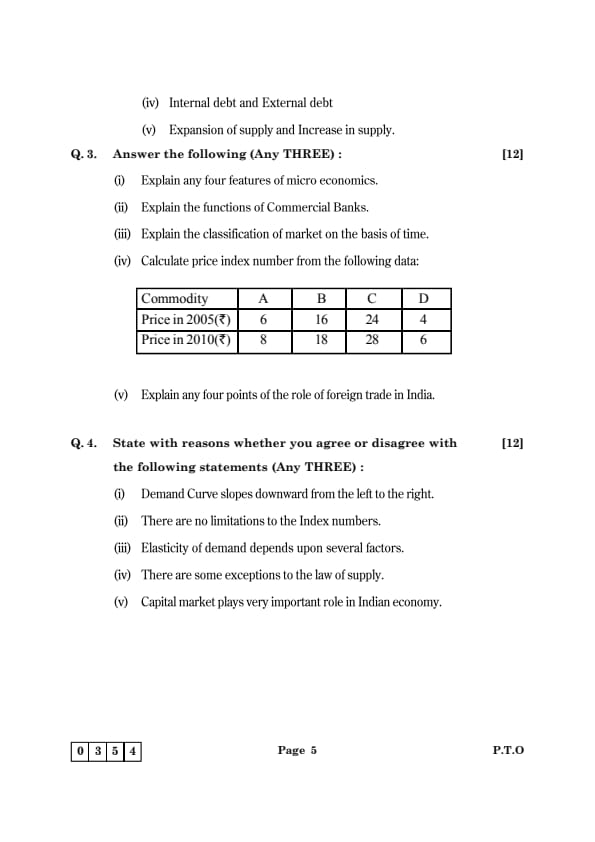
Distinguish between Internal debt and External debt.
View Solution
Internal Debt is the debt incurred by the government from its own citizens, institutions, or banks within the country. It is usually in the form of government bonds or treasury bills.
External Debt refers to the debt borrowed by the government from foreign countries or international financial institutions. This debt is usually in foreign currency and may involve international loans or bonds.
Final Answer: \[ \boxed{Internal \; Debt \; is \; borrowed \; within \; the \; country, \; while \; External \; Debt \; is \; borrowed \; from \; foreign \; sources.} \] Quick Tip: Internal debt is owed to domestic creditors, whereas external debt is owed to foreign creditors and is subject to currency exchange risk.
Distinguish between Expansion of supply and Increase in supply.
View Solution
Expansion of Supply refers to an increase in the quantity supplied due to a fall in price, along a fixed supply curve. It happens when price decreases and producers offer more goods.
Increase in Supply refers to a shift in the supply curve itself, resulting from factors like technology improvement or lower production costs, which increase the supply at all price levels.
Final Answer: \[ \boxed{Expansion \; of \; Supply \; is \; a \; movement \; along \; the \; curve, \; while \; Increase \; in \; Supply \; is \; a \; shift \; of \; the \; curve.} \] Quick Tip: Expansion of supply is price-induced, while an increase in supply results from non-price factors like technology.
Explain any four features of micro economics.
View Solution
Step 1: Define Microeconomics.
Microeconomics is the branch of economics that studies the behavior of individual economic units, such as households, firms, and industries, and how they make decisions regarding the allocation of limited resources.
Step 2: Four features of microeconomics.
1. **Individual Focus**: Microeconomics focuses on individual economic agents such as consumers and producers, rather than the economy as a whole.
2. **Price Determination**: It deals with how the prices of goods and services are determined through the interaction of supply and demand.
3. **Resource Allocation**: Microeconomics studies how resources are allocated efficiently within the economy.
4. **Market Structure**: It examines different market structures, such as perfect competition, monopolies, and oligopolies, and their effects on prices and output.
Final Answer: \[ \boxed{Microeconomics \; focuses \; on \; individual \; decision-making, \; price \; determination, \; resource \; allocation, \; and \; market \; structures.} \] Quick Tip: Microeconomics is primarily concerned with the decisions of individual agents in the economy, and how these decisions interact in markets.
Explain the functions of Commercial Banks.
View Solution
Step 1: Define Commercial Banks.
Commercial banks are financial institutions that provide a wide range of financial services, including accepting deposits, making loans, and providing other financial services to individuals and businesses.
Step 2: Key functions of commercial banks.
1. **Accepting Deposits**: Commercial banks accept various types of deposits, such as savings, current, and fixed deposits from individuals and businesses.
2. **Granting Loans and Advances**: They provide loans to individuals, businesses, and governments to promote economic activity.
3. **Facilitating Payments**: Commercial banks provide payment services like issuing checks, debit and credit cards, and electronic transfers.
4. **Investment Services**: They invest in government securities and other financial instruments to earn a return on their reserves.
Final Answer: \[ \boxed{The \; functions \; of \; commercial \; banks \; include \; accepting \; deposits, \; granting \; loans, \; facilitating \; payments, \; and \; offering \; investment \; services.} \] Quick Tip: Commercial banks play a key role in the financial system by mobilizing savings and channeling them into productive investments.
Explain the classification of market on the basis of time.
View Solution
Step 1: Define Market.
A market is a place where buyers and sellers interact to exchange goods and services. Markets can be classified in various ways, including according to time.
Step 2: Classification of Market on the Basis of Time.
1. **Short-run Market**: In the short-run, some factors of production are fixed, and firms can only adjust variable factors like labor. Prices and quantities in the market can change, but not drastically.
2. **Long-run Market**: In the long run, all factors of production are variable, and firms can adjust all inputs. The long run allows firms to enter or exit the market, and prices and output levels adjust fully to market conditions.
Final Answer: \[ \boxed{Markets \; are \; classified \; into \; short-run \; and \; long-run, \; based \; on \; the \; flexibility \; of \; factors \; of \; production.} \] Quick Tip: The short-run is a period where some factors are fixed, while in the long run all factors can be adjusted by firms.
Calculate price index number from the following data:
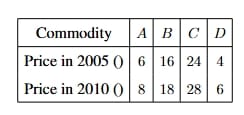
View Solution
Step 1: Formula for Price Index Number.
The formula for calculating the Price Index number is:
\[ Price Index = \frac{Price in 2010}{Price in 2005} \times 100 \]
Step 2: Calculate for each commodity.
For Commodity A: \[ Price Index for A = \frac{8}{6} \times 100 = 133.33 \]
For Commodity B: \[ Price Index for B = \frac{18}{16} \times 100 = 112.50 \]
For Commodity C: \[ Price Index for C = \frac{28}{24} \times 100 = 116.67 \]
For Commodity D: \[ Price Index for D = \frac{6}{4} \times 100 = 150.00 \]
Step 3: Conclude.
The Price Index numbers for the commodities are: \[ \boxed{A = 133.33, B = 112.50, C = 116.67, D = 150.00} \] Quick Tip: The Price Index number is a measure of the relative change in prices between two time periods.
Explain any four points of the role of foreign trade in India.
View Solution
Step 1: Define Foreign Trade.
Foreign trade refers to the exchange of goods and services between different countries. It plays a vital role in the economic development of a nation.
Step 2: Four points on the role of foreign trade in India.
1. **Economic Growth**: Foreign trade helps in the growth of the economy by promoting the exchange of goods and services.
2. **Employment Generation**: Export activities create jobs, especially in sectors like agriculture, manufacturing, and services.
3. **Foreign Exchange Earnings**: It helps the country earn foreign exchange, which is crucial for financing imports and maintaining a stable balance of payments.
4. **Technology Transfer**: Foreign trade facilitates the transfer of technology and knowledge, helping India upgrade its industries and improve productivity.
Final Answer: \[ \boxed{Foreign \; trade \; contributes \; to \; economic \; growth, \; employment, \; foreign \; exchange \; earnings, \; and \; technology \; transfer.} \] Quick Tip: Foreign trade plays a key role in boosting economic development by expanding markets and improving efficiency.
Demand Curve slopes downward from the left to the right.
View Solution
Agree:
The demand curve typically slopes downward from left to right due to the **law of demand**, which states that as the price of a good decreases, the quantity demanded increases, and vice versa. This negative relationship between price and quantity demanded results in a downward-sloping curve.
However, this is true for most goods but may not hold for certain types of goods such as Giffen goods or Veblen goods.
Final Answer: \[ \boxed{Agree: \; The \; demand \; curve \; generally \; slopes \; downward \; from \; left \; to \; right.} \] Quick Tip: The downward slope of the demand curve reflects the inverse relationship between price and quantity demanded.
There are no limitations to the Index numbers.
View Solution
N/A Quick Tip: Index numbers are useful but come with limitations such as the choice of base year and data quality.
Elasticity of demand depends upon several factors.
View Solution
N/A Quick Tip: The more substitutes a good has, the more elastic its demand will be.
There are some exceptions to the law of supply.
View Solution
N/A Quick Tip: Exceptions to the law of supply occur in special cases like Giffen goods and markets with limited capacity.
Capital market plays a very important role in the Indian economy.
View Solution
N/A Quick Tip: The capital market supports long-term economic development by connecting investors with businesses in need of funds.
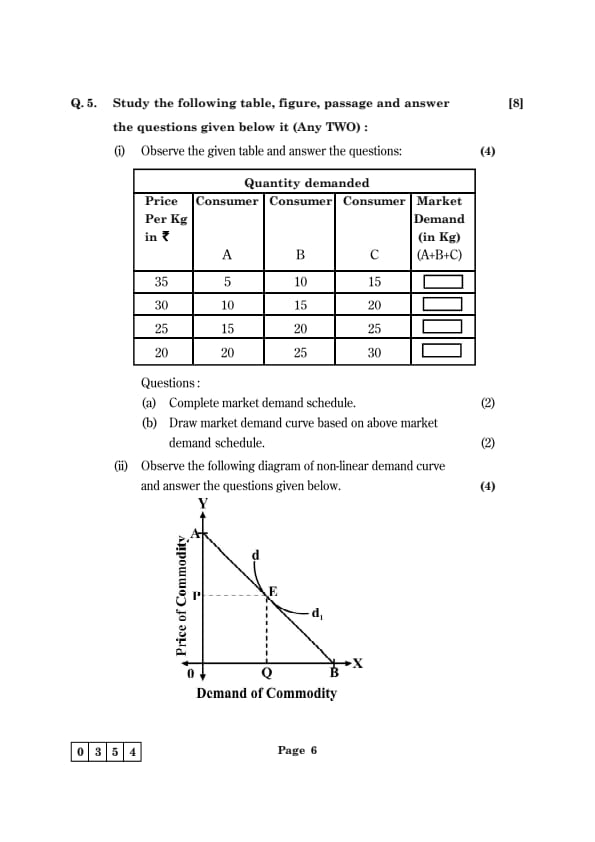
Observe the given table and answer the questions below.
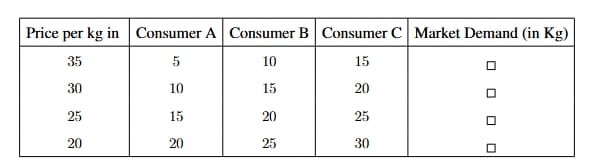
View Solution
N/A Quick Tip: Market demand is the sum of individual consumers' demands at each price level.
Observe the following diagram of the non-linear demand curve and answer the questions given below.
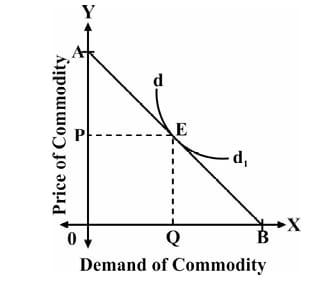
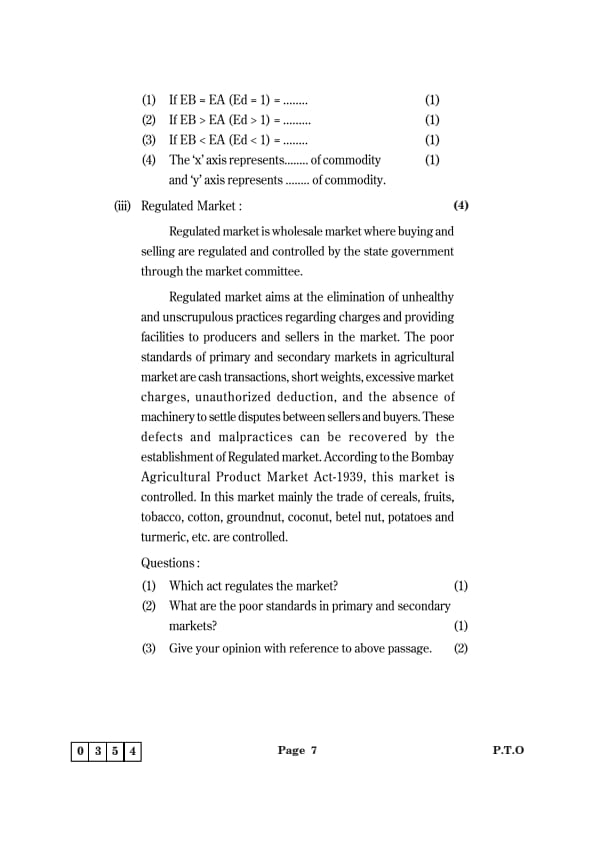
(1) If \( EB = EA \) (\( Ed = 1 \)) = .......
(2) If \( EB > EA \) (\( Ed > 1 \)) = .......
(3) If \( EB < EA \) (\( Ed < 1 \)) = .......
(4) The 'x' axis represents ........ of commodity and 'y' axis represents ........ of commodity.
View Solution
Step 1: Understand the Diagram.
The given diagram represents a non-linear demand curve where the price is plotted on the y-axis and the quantity demanded on the x-axis. There is a point labeled "E" where the demand curve intersects a horizontal price line. Points "d" and "d₁" represent different demand points for the commodity.
Step 2: Answer the Questions.
(1) If EB = EA (Ed = 1) = ........
Answer:
When EB = EA, it implies that the price elasticity of demand (Ed) is 1. Therefore, at point E, the demand is **unitary elastic**.
So, the answer is: \[ \boxed{Ed = 1 \; (unitary elasticity)} \]
(2) If EB > EA (Ed > 1) = ........
Answer:
When EB > EA, it implies that the price elasticity of demand (Ed) is greater than 1. This indicates **elastic demand** where the quantity demanded is highly responsive to price changes.
So, the answer is: \[ \boxed{Ed > 1 \; (elastic demand)} \]
(3) If EB < EA (Ed < 1) = .........
Answer:
When EB < EA, it implies that the price elasticity of demand (Ed) is less than 1. This indicates **inelastic demand** where the quantity demanded is less responsive to price changes.
So, the answer is: \[ \boxed{Ed < 1 \; (inelastic demand)} \]
(4) The ‘x’ axis represents ......... of commodity and ‘y’ axis represents ........ of commodity.
Answer:
The ‘x’ axis represents the **quantity demanded** of the commodity, and the ‘y’ axis represents the **price** of the commodity.
So, the answer is: \[ \boxed{Quantity demanded, Price} \] Quick Tip: Elasticity of demand measures the responsiveness of quantity demanded to price changes: Ed > 1 for elastic demand, Ed < 1 for inelastic demand, and Ed = 1 for unitary elasticity.
Regulated market is a wholesale market where buying and selling are regulated and controlled by the state government through the market committee.
Regulated market aims at the elimination of unhealthy and unscrupulous practices regarding charges and providing facilities to producers and sellers in the market. The poor standards of primary and secondary markets in agricultural market are cash transactions, short weights, excessive market charges, unauthorized deduction, and the absence of machinery to settle disputes between sellers and buyers. These defects and malpractices can be recovered by the establishment of Regulated market. According to the Bombay Agricultural Product Market Act-1939, this market is controlled. In this market mainly the trade of cereals, fruits, tobacco, cotton, groundnut, coconut, betel nut, potatoes and turmeric, etc. are controlled.
(1) Which act regulates the market?
(2) What are the poor standards in primary and secondary markets?
(3) Give your opinion with reference to the above passage.
View Solution
(1) Which act regulates the market?
The **Bombay Agricultural Product Market Act-1939** regulates the market. According to this act, the state government controls the wholesale market to ensure fair practices and eliminate malpractices.
(2) What are the poor standards in primary and secondary markets?
The poor standards in primary and secondary markets include:
1. **Cash Transactions**: Transactions are conducted in cash, which can be prone to fraud.
2. **Short Weights**: Goods may be sold with short weights, leading to unfair trading practices.
3. **Excessive Market Charges**: Sellers may be charged excessive fees for using market facilities.
4. **Unauthorized Deductions**: Unauthorized deductions may be made from the price received by the seller.
5. **Lack of Machinery for Dispute Resolution**: There is no effective system to resolve disputes between sellers and buyers.
(3) Give your opinion with reference to the above passage.
In my opinion, the establishment of a **regulated market** is essential to eliminate the malpractices mentioned above. By ensuring fair practices, transparent charges, and a proper dispute resolution mechanism, regulated markets can improve the efficiency and fairness of agricultural trade. The government's control through laws like the **Bombay Agricultural Product Market Act-1939** is a necessary step toward protecting both producers and consumers from exploitation and promoting a healthier market environment. Furthermore, controlled markets for essential commodities like cereals, fruits, and tobacco can stabilize prices and ensure equitable trade.
Final Answer: \[ \boxed{The \; Bombay \; Agricultural \; Product \; Market \; Act-1939 \; regulates \; the \; market.} \] Quick Tip: Regulated markets aim to establish transparency, fairness, and efficiency by controlling malpractices and setting up dispute resolution systems.
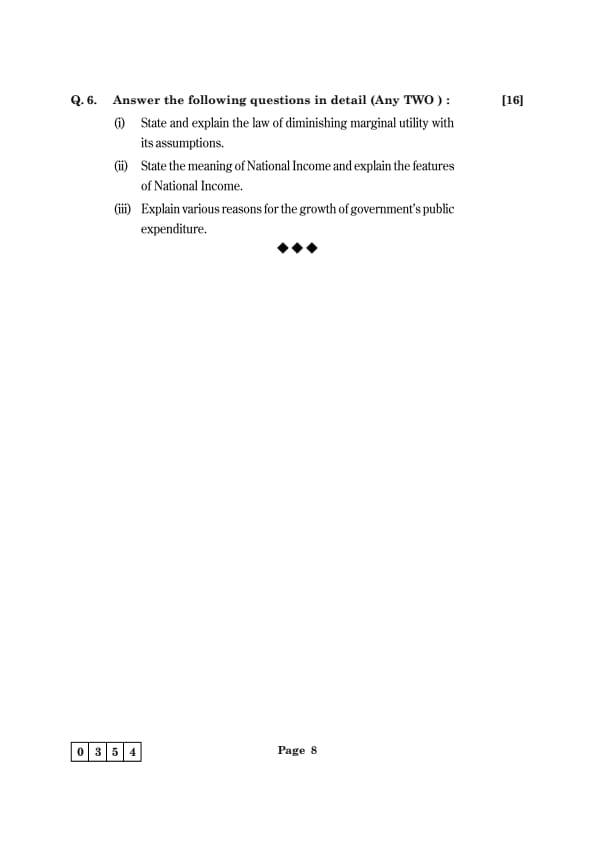
State and explain the law of diminishing marginal utility with its assumptions.
View Solution
Step 1: State the Law of Diminishing Marginal Utility.
The law of diminishing marginal utility states that as a person consumes more units of a good, the satisfaction (utility) derived from each additional unit decreases, while the total utility continues to increase, but at a diminishing rate. In other words, the marginal utility (the utility of consuming one more unit) decreases with each additional unit consumed.
Step 2: Assumptions of the Law.
1. **Constant Conditions**: The consumer’s taste and preferences remain constant while consuming the good.
2. **No Change in the Quality of Goods**: The quality of the good consumed remains the same.
3. **Independent of Other Goods**: The consumption of one good is not affected by the consumption of another good.
4. **Short Time Period**: The consumer is consuming the good within a limited period of time.
Final Answer: \[ \boxed{The \; law \; of \; diminishing \; marginal \; utility \; states \; that \; as \; consumption \; of \; a \; good \; increases, \; the \; additional \; satisfaction \; derived \; from \; each \; extra \; unit \; decreases.} \] Quick Tip: The law applies when each additional unit of a good provides less satisfaction than the previous unit, assuming other conditions remain constant.
State the meaning of National Income and explain the features of National Income.
View Solution
Step 1: Meaning of National Income.
National Income is the total monetary value of all goods and services produced within a country's borders over a specific period of time, usually measured annually. It is an indicator of a country’s economic health and is used to compare the economic performance of different nations.
Step 2: Features of National Income.
1. **Inclusive of All Economic Activities**: National income includes all goods and services produced, both market and non-market.
2. **Measurement of Economic Performance**: It serves as a measure of a country's economic performance and standard of living.
3. **Income Distribution**: National income also reflects how income is distributed among the various sectors of the economy, such as labor, capital, and entrepreneurship.
4. **Excludes Non-Market Activities**: Non-market activities, such as household labor and volunteer work, are not counted in national income.
Final Answer: \[ \boxed{National \; Income \; is \; the \; total \; value \; of \; goods \; and \; services \; produced \; in \; a \; country \; over \; a \; given \; period. \; Its \; features \; include \; inclusivity, \; performance \; measurement, \; and \; income \; distribution.} \] Quick Tip: National income is an important indicator that helps in understanding the overall economic health of a country.
Explain various reasons for the growth of government’s public expenditure.
View Solution
Step 1: Introduction to Public Expenditure.
Public expenditure refers to the spending by the government on goods and services that benefit the public. Over the years, public expenditure has increased due to various reasons.
Step 2: Reasons for the Growth of Government’s Public Expenditure.
1. **Population Growth**: As the population grows, the demand for public goods and services such as healthcare, education, and infrastructure increases, leading to higher expenditure.
2. **Economic Development**: With economic development, governments tend to invest more in infrastructure, social welfare programs, and public services to support the growing economy.
3. **Defense and Security**: Increased expenditure on national defense and security is a major factor for growing public spending, especially during times of political instability or war.
4. **Social Welfare Programs**: Governments have been increasing their spending on social welfare programs, including unemployment benefits, pensions, and healthcare, to address inequality and poverty.
5. **Technological Advancements**: With advancements in technology, governments need to invest in new technologies and modernize public services, which increases expenditure.
6. **Environmental Concerns**: Spending on environmental protection, climate change measures, and natural resource management has increased as environmental issues have become more urgent.
Final Answer: \[ \boxed{The \; growth \; of \; government \; expenditure \; is \; due \; to \; factors \; like \; population \; growth, \; economic \; development, \; defense, \; social \; welfare, \; and \; technological \; advancements.} \] Quick Tip: Government expenditure increases in response to the growing needs of the population, economic challenges, and the demand for social services and infrastructure.
*The article might have information for the previous academic years, please refer the official website of the exam.