
Maharashtra Board 2024 Class 12 English Question Paper PDF - Check Solutions with Answer Key Pdf (01-J-801)


Content Writer | Updated On - Feb 26, 2025
Maharashtra Board Class 12 2024 English Question Paper (01-J-801) PDF is available for download. The exam was successfully conducted by MSBSHSE in February 2024 for a total of 80 marks with a duration of 3 hours. As per students’ initial reactions, the Maharashtra Board Class 12 English 2024 question paper was reported as Moderate. Reading Comprehension and Grammar sections were considered Easy to Moderate, while the Writing Skills and Literature sections were reported as Moderate to Difficult.
Maharashtra Board Class 12 English Question Paper 2024 with Answer Key (01-J-801)
Candidates can use the link below to download the Maharashtra Board Class 12 English (01-J-801) Question Paper with detailed solutions.
| Maharashtra Class 12 2024 English Question Paper With Answer Key |  Download Download |
Check Solutions |

Maharashtra Board Class 12 English Question Paper With Solutions
(I) Read the text given below
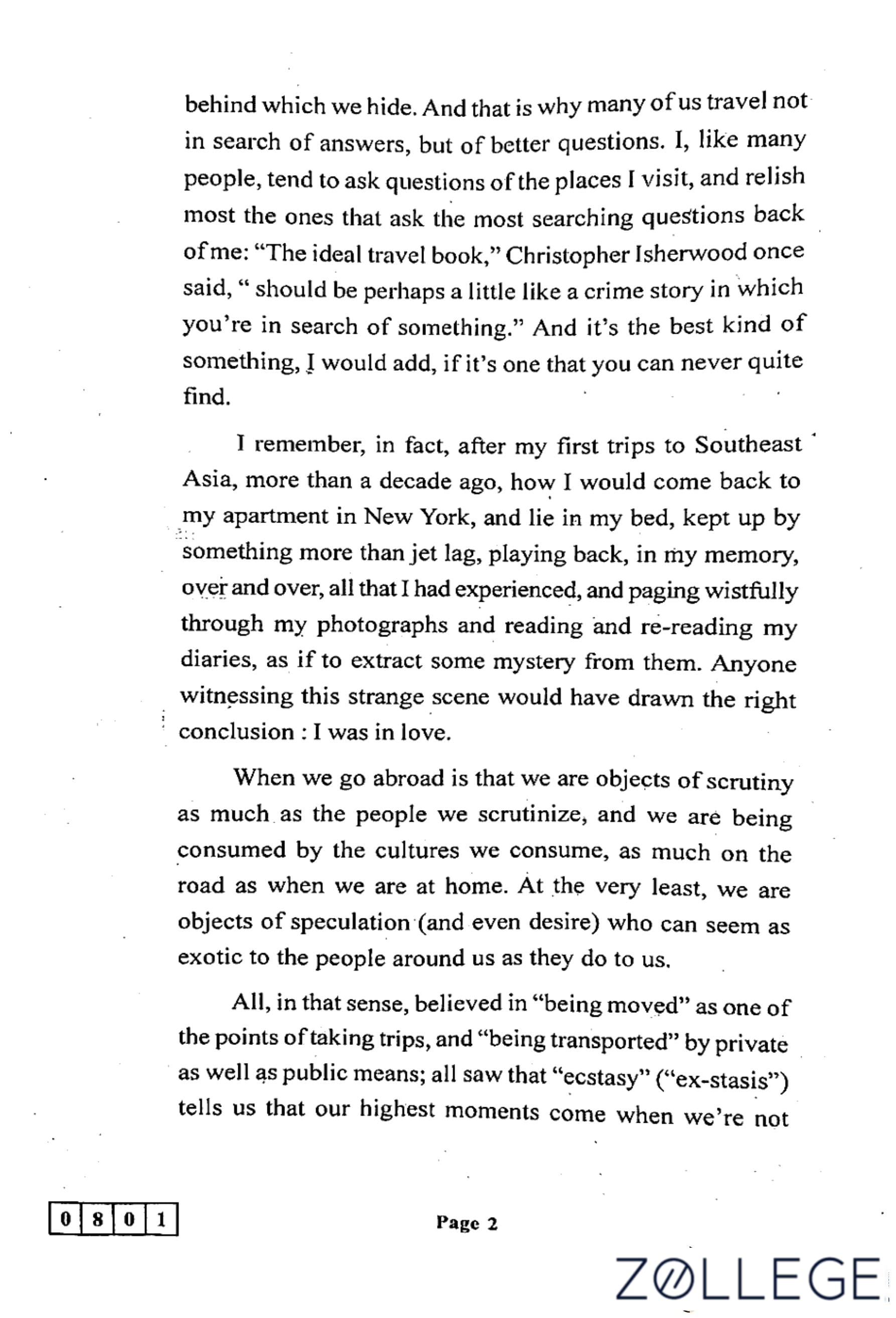
This is what Camus meant when he said that “what gives value to travel is fear” — disruption, in other words, (or emancipation) from circumstance, and all the habits behind which we hide. And that is why many of us travel not in search of answers, but of better questions. I, like many people, tend to ask questions of the places I visit, and relish most the ones that ask the most searching questions back of me: “The ideal travel book,” Christopher Isherwood once said, “should be perhaps a little like a crime story in which you’re in search of something.” And it’s the best kind of something, I would add, if it’s one that you can never quite find.
I remember, in fact, after my first trips to Southeast Asia, more than a decade ago, how I would come back to my apartment in New York, and lie in my bed, kept up by something more than jet lag, playing back, in my memory, over and over, all that I had experienced, and paging wistfully through my photographs and reading and re-reading my diaries, as if to extract some mystery from them. Anyone witnessing this strange scene would have drawn the right conclusion: I was in love.
View More
When we go abroad is that we are objects of scrutiny as much as the people we scrutinize, and we are being consumed by the cultures we consume, as much on the road as when we are at home. At the very least, we are objects of speculation (and even desire) who can seem as exotic to the people around us as they do to us.
All, in that sense, believed in “being moved” as one of the points of taking trips, and “being transported” by private as well as public means; all saw that “ecstasy” (“ex-stasis”) tells us that our highest moments come when we’re not stationary, and that epiphany can follow movement as much as it precipitates it.
(a) A traveller may sink in love with his travel memoirs.
View Solution
Step 1: As mentioned in the passage, the author states how he was deeply engrossed in his travel memories, revisiting them through photographs and diaries, which indicates a deep emotional attachment, almost like being in love with the experience.
Quick Tip: Traveling allows one to relive experiences and build a deep connection with their past journeys, making them unforgettable.
(b) One gets inspected as he inspects the world around him.
View Solution
Step 1: The passage states that when we travel, we are scrutinized just as much as we scrutinize others, implying that travellers are also observed by the locals and their cultures.
Quick Tip: Traveling not only lets us observe different cultures but also makes us a subject of curiosity for others.
Match the persons given in column 'A' with opinions/characteristics given in column 'B'.
| Column 'A' | Column 'B' |
|---|---|
| (1) Narrator | (b) in love with his memoirs. |
| (2) Camus | (d) fear gives value to travel. |
| (3) Isherwood | (a) ideal travel should be like a crime story. |
| (4) Traveller | (c) more happy when on move. |
View Solution
Step 1: The narrator in the story is in love with his memoirs, thus matching with (b).
Step 2: Camus is someone who feels more happy when on the move, matching with (c).
Step 3: Isherwood views travel as an ideal crime story, matching with (a).
Step 4: The traveller believes that fear gives value to travel, thus matching with (d).
Quick Tip: Matching opinions with persons helps in understanding their viewpoints more clearly, which is an essential skill in literary analysis.
Give reasons: "We are objects of scrutiny," because…
View Solution
View Solution
(i) When we travel, we observe and analyze the cultures, traditions, and behaviors of the people around us. However, at the same time, we also become subjects of observation for the locals.
(ii) The cultures we consume while traveling influence us, and in return, we become a part of their scrutiny as they analyze our way of living and behaviors.
Quick Tip: When we travel, it’s not only about learning new things but also about being perceived differently by others.
(i) I like to ask questions of the places I visit.
View Solution
Step 1: The sentence "I like to ask questions of the places I visit." describes a habit or repeated action, which is why it is in the simple present tense.
Quick Tip: Simple present tense is used for habits, general truths, and repeated actions.
Find out the words from the passage which mean:
(i) Reminiscence
View Solution
Step 1: The word "memoirs" refers to a written record of past events, which is closely related to "reminiscence" as it involves recalling past experiences.
Quick Tip: The passage states, "A traveller may sink in love with his travel memoirs," which directly relates to the act of reminiscing about past experiences.
Identify and rewrite the correct ‘indirect narration’ from the following options.
Avneesh said, “Sanchit, what are you doing in the garden at this time?”
View Solution
Step 1: In indirect speech, "what are you doing" is rephrased to "wanted to know from Sanchit his cause of being there".
Step 2: This transformation follows the rules of indirect speech, making option (B) the most accurate conversion.
Quick Tip: While converting direct to indirect speech, question words such as "what" often turn into phrases like "wanted to know" or "asked about".
Choose the correct option from the following sentences which uses a more definite modal auxiliary.
Neeraj Chopra may not participate in the world championship due to an ankle injury.
View Solution
The modal auxiliary "cannot" expresses a more definite restriction on participation, implying that participation is impossible rather than just uncertain. "May not" and "might not" indicate possibilities, whereas "should not" suggests advice rather than certainty.
Quick Tip: "Cannot" is a stronger modal verb that indicates complete restriction or prohibition, making it the most definite choice among the given options.Choose the correct option from the following options to change the sentence beginning with ‘If.....’
Unless you are confident, you will not succeed.
View Solution
The phrase "Unless you are confident" means that confidence is necessary for success. The correct transformation should retain the meaning while using "If...". "If you have confidence" accurately rephrases "Unless you are confident," making option (B) the correct choice.
Quick Tip: "Unless" is a negative conditional, meaning "If not." When converting "Unless" sentences to "If" sentences, ensure that the sentence structure maintains the original meaning.Spot the error and rewrite the correct sentence.
He prescribe medicine alongwith a few exercises to his patients.
View Solution
The errors in the given sentence are: 1. "prescribe" should be "prescribes" to match the singular subject "He". 2. "alongwith" should be "along with", as "alongwith" is incorrect usage in English.
Quick Tip: Singular subjects (he, she, it) require verbs in the third-person singular form (e.g., prescribes, eats, writes). Also, "along with" should always be written as two separate words.Read the following extract and complete the activities given below:
Love is a great force in private life; it is indeed the greatest of all things; but love in public affairs does not work. It has been tried again and again... The fact is we can only love what we know personally. And we cannot know much. In public affairs, in the rebuilding of civilization, something much less dramatic and emotional is needed, namely tolerance...
Choose two correct alternatives which define the theme of the extract:
View Solution
The passage emphasizes that love works in personal affairs but is not practical for public affairs. Instead, tolerance is needed for rebuilding civilization, and patience plays a key role in resolving confrontations.
Quick Tip: The passage suggests that tolerance and patience are necessary for civilization rather than love alone, as seen in historical failures of love-based governance.Complete the following table with the help of the extract:
| Concept | Merit | Demerit |
|---|---|---|
| Love | Love fosters close personal relationships. | Love in public affairs is unrealistic and impractical. |
| Patience | Patience allows people to tolerate differences and build peace. | Excessive patience may lead to inaction or endurance of injustice. |
View Solution
According to the passage, love is valuable in private life but ineffective in public affairs. On the other hand, patience helps in handling conflicts but could sometimes result in stagnation if taken to extremes.
Quick Tip: The passage contrasts love and tolerance, explaining that while love is more personal, patience and tolerance are essential for a stable society.Write how we can build up a civilized society with the help of the extract.
View Solution
A civilized society can be built on tolerance rather than love. Love is unrealistic for governing public affairs, but tolerance allows people to coexist peacefully despite differences. This approach ensures stability, cooperation, and long-term unity among different communities.Step 1: According to the passage, tolerance helps different races and classes settle together, making it a key factor in building a civilized society.
Step 2: Unlike love, which is more personal, tolerance ensures peaceful coexistence among diverse groups. Quick Tip: Tolerance is more crucial than love in public affairs because it ensures peace and harmony among diverse groups.
‘Love and tolerance are the true indicators of a civilized person.’ Justify.
View Solution
A civilized person should exhibit both love and tolerance. While love is essential in personal life, tolerance is necessary for managing social and public affairs. A person who tolerates others' differences and remains patient in difficult situations contributes to peace and harmony in society.Step 1: The passage highlights that tolerance is more critical than love in maintaining a civilized society, as it helps people coexist peacefully.
Step 2: Love builds personal relationships, while tolerance ensures stability in diverse communities. Quick Tip: The balance of love and tolerance defines a truly civilized person, fostering personal relationships and social stability.
(i) It has been tried again and again.
(Identify the correct Active Voice of the above sentence from the given options and rewrite.)
View Solution
Step 1: In active voice, the subject performs the action. The given sentence is in the passive voice with present perfect tense ("has been tried").
Step 2: The correct transformation retains the present perfect tense while making the subject explicit, which is achieved in Option (D). Quick Tip: When converting passive to active voice, identify the doer of the action and restructure the sentence while keeping the tense unchanged.
Find out the words from the passage which mean:
(i) Reminiscence
View Solution
"Reminiscence" refers to the act of recalling or thinking about past memories. It denotes the reflection on past events or experiences, and in this context, it fits well with the passage.Step 1: "Reminiscence" is often used to describe the action of thinking back on past experiences.
Step 2: It can be a pleasant or nostalgic process, depending on the context. Quick Tip: The word "reminiscence" is closely related to memory and nostalgia, often describing fond recollections.
Identify and rewrite the correct ‘indirect narration’ from the following options.
Avneesh said, “Sanchit, what are you doing in the garden at this time?”
View Solution
Step 1: The sentence is converted to indirect speech by changing the direct question into a statement.
Step 2: The present continuous tense "are you doing" becomes past continuous "was doing," and "this" becomes "that." Option (B) is the correct transformation as it uses the proper indirect speech rules. Quick Tip: In indirect speech, questions that begin with "what," "where," or "how" typically remain unchanged. The tense and pronouns are the primary elements that change.
Choose the correct option from the following sentences which uses a more definite modal auxiliary.
Neeraj Chopra may not participate in the world championship due to an ankle injury.
View Solution
Step 1: In this sentence, "will not" is the most definite modal auxiliary as it clearly indicates a firm decision regarding Neeraj Chopra’s non-participation in the world championship.
Step 2: The modal "may" is less definite compared to "will," making (B) the correct choice. Quick Tip: When indicating a more definite future action, "will" is stronger than "may" or "might."
Unless you are confident, you will not succeed.
(Choose the correct option from the following options to change the sentence beginning with 'If...')
View Solution
Step 1: The correct form of the sentence involves using the condition "If you have confidence" to form a proper conditional sentence.
Step 2: "Confidence" is a noun and should be used instead of "are confidence," which is grammatically incorrect. Thus, Option (B) is the correct answer.
Quick Tip: When changing sentences with 'unless,' use the appropriate conditional form by substituting 'unless' with 'if' and adjusting the verb form accordingly.
Spot the error and rewrite the correct sentence:
He prescribe medicine along with a few exercises to his patients.
View Solution
Step 1: The error in the sentence is the use of "prescribe." The correct verb form should be "prescribes" as the subject "He" requires a singular verb in the present tense.
Step 2: The correct sentence should be: He prescribes medicine along with a few exercises to his patients.
Quick Tip: Remember, subject-verb agreement is important. In the present tense, use "prescribes" with singular subjects such as "he," "she," or "it."
Read the following extract and complete the activities given below:
Love is a great force in private life; it is indeed the greatest of all things; but love in public affairs does not work. It has been tried again and again; by the people of the Middle Ages, and also by the French Revolution, a secular movement which reasserted the Brotherhood of Man. And it has always failed. The idea that nations should love one another, or that business concerns or marketing boards should love one another or that a man in Portugal should love a man in Peru of whom he has never heard — it is absurd, unreal, dangerous. ‘Love is what is needed,’ we chant, and then sit back and the world goes on as before. The fact is we can only love what we know personally. And we cannot know much. In public affairs, in the rebuilding of civilization, something much less dramatic and emotional is needed, namely tolerance. Tolerance is a very dull virtue. It is boring. It is negative. It merely means putting up with people, being able to stand things. No one has ever written an ode to tolerance, or raised a statue to her. Yet this is the quality which will be most needed after the war. This is the sound state of mind which we are looking for. This is the only force which will enable different races and classes and interests to settle down together to the work of reconstruction.
View More
The world is very full of people— appallingly full; it has never been so full before, and they are all tumbling over each other. Most of these people one doesn’t know and some of them one doesn’t like. Well, what is one to do? If you don’t like people, put up with them as well as you can. Don’t try to love them; you can’t. But try to tolerate them. On the basis of that tolerance a civilized future may be built. Certainly, I can see no other foundation for the post-war world.
Choose two correct alternatives which define the theme of the extract:
View Solution
Step 1: The extract stresses the importance of love in private life but highlights that love in public affairs is inadequate.
Step 2: It suggests that in rebuilding civilization, tolerance is more essential than love, as it is a more pragmatic virtue. Thus, the correct alternatives are (B) and (C).
Quick Tip: Tolerance is emphasized as a key quality for public affairs and rebuilding civilization. It is often more practical than love, as it allows us to coexist despite differences.
Complete the following table with the help of the extract:
| Concept | Merit | Demerit |
|---|---|---|
| Love | Love is a great force in private life and fosters deep personal connections. | Love fails in public affairs, as it is impractical on a large scale. |
| Patience | Patience allows for peaceful coexistence despite differences, a key quality for rebuilding civilization. | Excessive patience may lead to passivity and inaction when dealing with issues. |
View Solution
Step 1: In the extract, it is mentioned that Love is a great force in private life, but it fails in public affairs because it is not practical on a large scale.
Step 2: On the other hand, Patience is emphasized as the necessary quality for rebuilding civilization as it allows individuals and nations to coexist despite differences. However, excessive patience may lead to passivity and stagnation in solving issues.
Write how we can build up a civilized society with the help of the extract.
View Solution
The extract emphasizes that building a civilized society requires more than just love; it requires patience and tolerance. Patience allows us to endure challenges and differences, while tolerance helps in accepting others despite disagreements. These qualities are fundamental for peaceful co-existence and for rebuilding societies after conflicts, as they promote understanding and cooperation.Step 1: The extract shows that love alone is not sufficient for rebuilding civilization. It stresses the need for tolerance and patience.
Step 2: A civilized society is based on mutual respect, understanding, and the willingness to tolerate different perspectives without animosity.
Quick Tip: A civilized society thrives on cooperation and tolerance, especially in the aftermath of conflict.
‘Love and tolerance are the true indicators of a civilized person.’ Justify.
View Solution
In the extract, the writer argues that love in public life does not always work, and a more effective tool is tolerance. A civilized person is someone who understands the importance of patience and tolerance over emotional attachment. These qualities allow a person to function rationally in society, accept diversity, and foster peaceful relationships. Love, while essential, may not always be practical or sufficient in resolving public issues, whereas tolerance ensures stability and harmony.Step 1: Love is vital for personal relationships, but tolerance is the key to a peaceful and functioning society.
Step 2: A civilized person promotes understanding, acceptance, and coexistence, which helps foster a peaceful environment.
Quick Tip: Love and tolerance are the pillars that uphold a peaceful and progressive society by promoting acceptance, understanding, and coexistence.
Do as directed:
(i) It has been tried again and again.
(Identify the correct Active Voice of the above sentence from the given options and rewrite.)
View Solution
Step 1: The sentence “It has been tried again and again” is in passive voice.
Step 2: In active voice, the subject “they” is used, and the verb tense is changed to the simple past tense.
Step 3: The correct transformation is option (C): “They tried it again and again.”
Quick Tip: To convert passive voice to active voice, remove the auxiliary verb "has been" and adjust the verb tense accordingly.
Match the words in column ‘A’ with their meanings in column ‘B’.
| Column ‘A' | Column ‘B' |
|---|---|
| (i) Secular | (a) feeling of great friendship and understanding between people. |
| (ii) Absurd | (d) not at all logical or sensible. |
| (iii) Civilization | (b) a society which has its own highly developed culture and ways of life. |
| (iv) Brotherhood | (c) not connected with any religion. |
View Solution
Step 1: Secular means "not connected with any religion." So, (i) is matched with (c).
Step 2: Absurd refers to something that is "not at all logical or sensible," so (ii) matches with (d).
Step 3: Civilization refers to a "society which has its own highly developed culture and ways of life," so (iii) matches with (b).
Step 4: Brotherhood is the "feeling of great friendship and understanding between people," so (iv) matches with (a).
Quick Tip: Matching words with their meanings helps to better understand the vocabulary and its usage in context. It is useful for building a stronger grasp on the language.
Summarizing:
Write a ‘summary’ of the above extract by using the following points.
(Love as a force — its limitations — tolerance — need of tolerance)
View Solution
The extract discusses the power of love in private life but its limitations in public affairs. It mentions how love in public situations has often failed and how tolerance is needed to rebuild civilization. The author stresses the importance of tolerance in bringing about a civilized future and how it plays a key role in overcoming differences in societies.Step 1: Love is effective in personal relationships, but it often fails in public affairs due to its emotional nature.
Step 2: Tolerance, however, is practical and necessary for rebuilding societies as it allows for peaceful coexistence despite differences.
Quick Tip: When writing a summary, make sure to capture the key points from the extract while focusing on the main ideas.
Mind Mapping
Prepare a mind map on ‘Effects of Music on Human Life’ using your ideas/thoughts/concepts to illustrate.
View Solution
A mind map on the "Effects of Music on Human Life" can include the following points:- Emotional Impact: Music influences mood, reduces stress, and can uplift spirits.
- Cognitive Benefits: Enhances memory, concentration, and creativity.
- Therapeutic Effects: Used in music therapy to aid mental health and physical healing.
- Social Connection: Brings people together through concerts, festivals, and shared experiences.
- Cultural Influence: Reflects and preserves cultural heritage and traditions.
Step 1: Music has a profound impact on emotions and mental well-being.
Step 2: It also plays a significant role in social and cultural bonding. Music can be used for both personal enjoyment and therapeutic purposes.
Quick Tip: When creating a mind map, use branches to connect related ideas. Start with a central theme and expand outward with different aspects or categories.
Read the extract and complete the activities given below:
She walks in beauty, like the night
Of cloudless climes and starry skies;
And all that’s best of dark and bright
Meet in her aspect and her eyes;
Thus mellowed to that tender light
Which heaven to gaudy day denies.
One shade the more, one ray the less,
Had half impaired the nameless grace
Which waves in every raven tress,
Or softly lightens o’er her face;
Where thoughts serenely sweet express,
How pure, how dear their dwelling-place.
And on that cheek, and o’er that brow,
So soft, so calm, yet eloquent,
The smiles that win, the tints that glow,
But tell of days in goodness spent,
A mind at peace with all below,
A heart whose love is innocent!
Select and write the two statements from the given list which justify the theme of the poem.
(D) Beauty lies in the eyes of the beholder.
View Solution
Step 1: The poet emphasizes the balance between internal and external beauty. The lady’s external beauty is complemented by the purity and goodness within her.
Step 2: The poet also suggests that beauty is subjective and depends on the perspective of the observer.
Quick Tip: Romantic poets often celebrated both external beauty and inner grace, reinforcing that true beauty is beyond mere appearance.
Complete the following web describing the various aspects of the lady’s beauty. One is done for you at the center place.
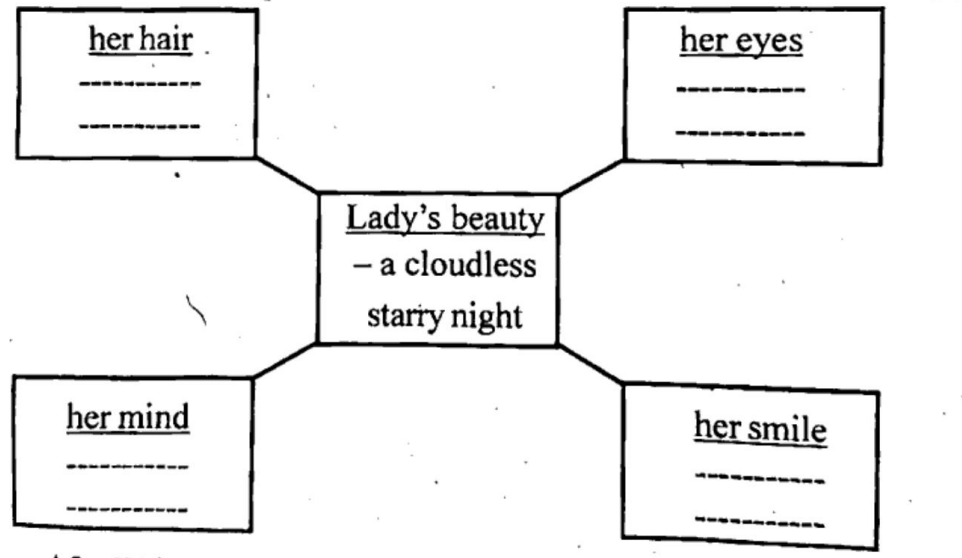
View Solution
Step 1: The poet admires the lady’s beauty holistically, appreciating both her physical appearance and the serenity reflected in her mind and expressions.
Step 2: The poet uses natural imagery to describe the lady’s beauty, comparing her to a cloudless, starry night, symbolizing a perfect balance of light and dark.
Quick Tip: The poet uses natural imagery to describe the lady’s beauty, comparing her appearance to a cloudless starry night, which represents a perfect balance of dark and bright.
Write your idea of ‘a beautiful person’ in your own words.
View Solution
A truly beautiful person is not just defined by their outward appearance but by their kindness, compassion, and inner peace. True beauty lies in a pure heart, a thoughtful mind, and the ability to spread happiness and love to others.Step 1: True beauty transcends physical appearance and includes emotional and moral qualities.
Step 2: A beautiful person is someone who makes the world better with their kindness, compassion, and positive energy.
Quick Tip: Physical beauty may fade, but a kind heart and a gentle soul remain beautiful forever.
Find out and explain an example of ‘Antithesis’ from the given extract.
View Solution
The example of antithesis from the extract is:"One shade the more, one ray the less."
This line presents a contrast between "shade" (darkness) and "ray" (light), highlighting the balance of opposites in the lady's beauty. The poet uses this contrast to emphasize that even a slight change in balance would affect the perfection of her beauty.
Step 1: Antithesis is used here to highlight the delicate balance of light and dark in the lady’s beauty.
Step 2: The poet uses this contrast to stress that even a minor change in this balance would impact her flawless beauty.
Quick Tip: Antithesis is a literary device where two opposite ideas are placed together to create a striking contrast, often used to highlight balance or contrast.
Compose a poem of your own in about 2 to 4 lines on the topic ‘Beauty’.
View Solution
Beauty is the glow of a kind-hearted smile,
A charm that lingers beyond a while.
Not in the face, but in the soul,
True beauty makes a person whole.
Step 1: A short poem should have a rhythmic flow and express deep meaning in a few lines.
Step 2: Expressing the idea that true beauty goes beyond physical appearance and is rooted in one's character.
Quick Tip: A short poem should have a rhythmic flow and should express deep meaning in a few lines.
Read the extract and write the appreciation of the poem:
The Inchcape Rock
By Robert Southey
Poem Extract:
They hear no sound, the swell is strong;
Though the wind hath fallen they drift along,
Till the vessel strikes with a shivering shock,—
‘O Christ! it is the Inchcape Rock!’

Sir Ralph the Rover tore his hair;
He curst himself in his despair;
The waves rush in every side,
The ship is sinking beneath the tide.

But even in his dying fear
One dreadful sound could the Rover hear,
A sound as if with the Inchcape Bell,
The Devil below was ringing his knell.
View Solution
Appreciation:Title: The Inchcape Rock
Poet: Robert Southey
Theme: The poem conveys the idea that evil actions lead to one’s downfall. It tells the story of Sir Ralph the Rover, a pirate who removes the warning bell from the Inchcape Rock to cause ships to crash. Ironically, he himself falls victim to his own deceit when his ship hits the rock, leading to his doom.
Poetic Devices: The poem employs literary devices like alliteration (“They hear no sound, the swell is strong”), imagery (the vivid description of the storm and sinking ship), and symbolism (the Inchcape Bell representing safety and good deeds).
Mood and Tone: The mood shifts from arrogance to despair, while the tone is cautionary, warning about the consequences of evil actions.
Message / Moral: The poem teaches a moral lesson about karma—those who commit wrongful deeds will eventually face the consequences. It highlights the importance of good deeds and warns against greed and wickedness.
My Opinion: The poem is gripping and conveys a strong message in a rhythmic and engaging manner. The poetic devices enhance the dramatic impact of Sir Ralph’s fate, making it an impactful and thought-provoking read.
Quick Tip: To write a poem appreciation, focus on the title, poet, theme, poetic devices, tone, and moral lesson. Express your opinion about the poem at the end.
Imagine you have to conduct an interview of a ‘Famous Actor’. With the help of the format given below, draft questions on the given fields. (Do not change the sequence of the questions.)
Name of the interviewee:
Field / Reputation:
Date / Venue / Time:
Duration of Interview:
Questions based on:
View Solution
To conduct an interview, follow the structure provided above by ensuring that each question is relevant to the specified category. Questions should flow logically, with each part focusing on the actor’s motivation, support system, early experiences, and goals. For instance, under "Motivation," a possible question could be, "What inspired you to pursue acting?" Similarly, under "Support," a good question could be, "Who supported you the most in your early career?" Ensure all questions align with the given categories.Step 1: Ensure that the questions align with the categories provided. For example, under "Motivation," ask about what drove the actor to pursue this career. Under "Support," inquire about the people who helped them during their early career.
Step 2: Keep each question specific and engaging to allow the interviewee to share insights about their journey.
Quick Tip: When drafting interview questions, focus on framing questions that elicit detailed responses, as this helps in creating an engaging and insightful interview.
i. Imagine you are preparing for an elocution competition and you wish to speak on the topic 'Green Revolution.' Draft a speech in about 150 words on the given topic.
View Solution
Green Revolution is a crucial step in the progress of agricultural practices, especially in developing countries. It focuses on increased food production through modern techniques such as the use of high-yielding variety seeds, chemical fertilizers, and advanced irrigation methods. This revolution has significantly contributed to food security and alleviated poverty in many regions. However, it also poses environmental challenges due to over-reliance on chemical fertilizers and pesticides. Thus, it is important to embrace sustainable agricultural practices alongside these innovations to ensure long-term benefits for society and the environment.Step 1: Begin by explaining the importance of the Green Revolution in increasing food production.
Step 2: Acknowledge the benefits and challenges that come with it, including both food security and environmental concerns.
Quick Tip: In a speech, it is important to present both sides of an issue to provide a balanced view, but focus on a positive solution that encourages progress.
ii. Imagine you are given the responsibility to 'compe' a programme by your college authorities. You need to prepare your script on the programme titled 'Cultural Fest 2024.' Draft the script to decide the flow of the programme. You may take help of the given points.
View Solution
Ladies and Gentlemen, a very warm welcome to the Cultural Fest 2024!We begin today’s event with a prayer, invoking the blessings of the divine for a successful event.
Next, we proceed with the lighting of the lamp, symbolizing the removal of darkness and the beginning of enlightenment.
Now, I would like to invite our respected Principal to give the opening speech and set the tone for today’s event.
Following the speech, we have the felicitation of our esteemed guests, who have supported the event.
Let us now move forward with the Cultural Fest Programme, where students from different faculties will showcase their talents.
Afterward, we’ll hear the Speech of the Chief Guest, followed by the Presidential address.
As we conclude, the Prize distribution ceremony will be held to honor the best performers.
Finally, I will deliver the Vote of thanks, expressing gratitude to all those who contributed to making this event a success.
View Solution
Step 1: Create a smooth flow for the event, ensuring each segment is logically placed.
Step 2: Start with formal rituals, followed by speeches, performances, and a closing vote of thanks.
Quick Tip: When writing a script for compering, ensure that the flow of the event is smooth and transitions between segments are clear for the audience.
(iii) Expand the following idea with the help of the points given below (100 to 150 words): 'Manners Maketh Man'
View Solution
Manners are a reflection of a person's character, and it is often said that 'manners maketh man.' Being polite and respectful is not only about speaking kindly but also about our body language, tone, and overall demeanor. Essential virtues like politeness make interactions more pleasant and show respect for others. A kind speech, accompanied by appropriate tone and gestures, conveys empathy and understanding. Being courteous and amiable ensures that one fosters harmonious relationships and makes a positive impression. These traits help in building trust and respect, whether in professional or personal interactions. Hence, good manners are essential for establishing a positive and respectful society.Step 1: Good manners encompass polite speech, respectful tone, and body language.
Step 2: These qualities help in building trust and forming better relationships, making a significant impact on both personal and professional lives.
Quick Tip: Good manners are not just about speaking kindly; they also involve being attentive to others' needs and showing respect through your actions.
Attempt ‘Any One’ of the following activities:
(i) Review:
You have recently read a famous book/magazine. Write a Review on the same with the help of the following points:
- title, front page, back page
- language, features, contents
- Pictures, quality, presentation
- Values, vision, and variety
View Solution
Step 1: Begin by discussing the design, content, and focus of the book or magazine.
Step 2: Reflect on its impact, values, and how it communicates its message.
Quick Tip: When reviewing a book or magazine, make sure to include details about the design, content, and message it conveys.
Write a ‘Blog’ in a proper format on ‘Body Language’ with the help of the following points (100 to 150 words):
- Meaning and features
- Characteristics and scope
- Benefits / Importance
- Uses / Ways to utilize
View Solution
Body language refers to non-verbal communication, where physical behaviors express thoughts and emotions. It includes gestures, facial expressions, posture, and eye contact. The scope of body language extends to personal and professional communication, as it influences how others perceive us. Its benefits include improved communication, trust-building, and conveying emotions without words. Recognizing and utilizing body language effectively can enhance interactions, whether in interviews, presentations, or daily conversations. Being mindful of body language helps convey confidence and understanding in various contexts.Step 1: Explain the importance of body language in both personal and professional settings.
Step 2: Emphasize its benefits in improving communication, building trust, and enhancing interactions.
Quick Tip: Understanding and using body language can significantly improve your communication skills in both personal and professional settings.
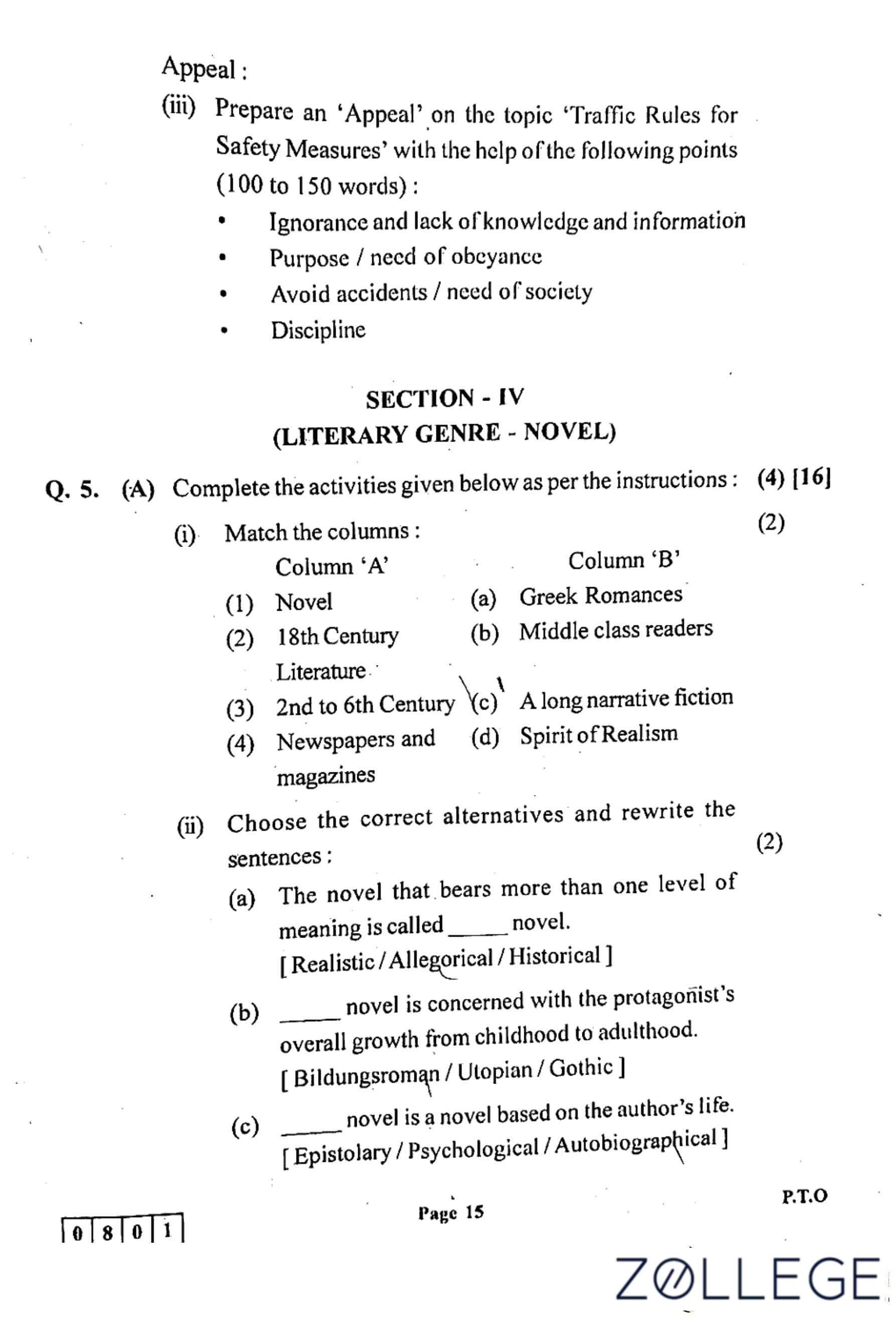
Prepare an ‘Appeal’ on the topic ‘Traffic Rules for Safety Measures’ with the help of the following points (100 to 150 words):
- Ignorance and lack of knowledge and information
- Purpose / need of obedience
- Avoid accidents / need of society
- Discipline
View Solution
In this appeal, stress the importance of adhering to traffic rules for the safety of all. Highlight how ignorance and lack of knowledge about traffic rules often lead to accidents. Emphasize that the purpose of obeying traffic rules is to ensure smooth and safe movement, benefiting society as a whole. Point out that discipline on the roads can help avoid accidents, reduce traffic jams, and save lives. Urge people to respect and follow traffic rules for the welfare of everyone.Step 1: Emphasize the importance of following traffic rules for safety.
Step 2: Urge people to take responsibility for their actions and follow rules to create a safer, more disciplined society.
Quick Tip: When drafting an appeal, ensure to address the importance and urgency of the issue while urging the audience to take immediate action.
(i) Match the columns:
| Column ‘A’ | Column ‘B’ |
|---|---|
| (1) Novel | (c) A long narrative fiction |
| (2) 18th Century Literature | (d) Spirit of Realism |
| (3) 2nd to 6th Century | (a) Greek Romances |
| (4) Newspapers and magazines | (b) Middle class readers |
2 - d
3 - a
4 - b
View Solution
The correct matching pairs are based on literary history and classifications. The novel is a long narrative fiction, which became prominent in the 18th century with the rise of realism. Greek romances belong to early literature, from the 2nd to 6th century. Newspapers and magazines reflect the rise of middle-class readers and the spirit of realism.
(ii) Choose the correct alternatives and rewrite the sentences:
(a) The novel that bears more than one level of meaning is called _____ novel.
[Realistic / Allegorical / Historical]
View Solution
An allegorical novel uses symbolism and deeper meanings to represent moral, philosophical, or political ideas. Examples include "Animal Farm" by George Orwell.
(b) _____ novel is concerned with the protagonist’s overall growth from childhood to adulthood.
[Bildungsroman / Utopian / Gothic]
View Solution
Bildungsroman novels focus on character development and personal growth, such as "David Copperfield" by Charles Dickens.
(c) _____ novel is a novel based on the author’s life.
[Epistolary / Psychological / Autobiographical]
View Solution
Autobiographical novels contain elements from the author's life but may include fictionalized events. An example is "The Bell Jar" by Sylvia Plath.
(d) The novel based on an imaginary community possessing ideal qualities is called _____ novel.
[Utopian / Epistolary / Picaresque]
View Solution
Utopian novels depict ideal societies and explore themes of political and social perfection. An example is "Utopia" by Thomas More.
(B) Answer this questions in 50 words:
Question (i): Write a character-sketch of the narrator E.R. Braithwaite in "To Sir With Love."
View Solution
E.R. Braithwaite, the narrator in "To Sir With Love," is a young, ambitious, and determined teacher. As a black man in a racially prejudiced society, he faces significant challenges. However, his confidence, intellect, and perseverance allow him to win the respect and trust of his students. Braithwaite is patient, empathetic, and highly skilled in dealing with the struggles of his students. Through his work and dedication, he gradually changes both the attitudes of his students and the community. His character represents growth, understanding, and the power of education.Question (ii): Consider 'student-teacher relationship' as one of the themes of "To Sir With Love."
View Solution
The theme of the student-teacher relationship is central to "To Sir With Love." Initially, the students of the school are unruly and disrespectful towards Braithwaite, but as the story progresses, they start recognizing his dedication and understanding. Braithwaite's patience, kindness, and willingness to listen and learn from his students create a bond of mutual respect. This evolving relationship demonstrates how a teacher can impact their students beyond academics by fostering trust, respect, and personal growth. Ultimately, it highlights the transformative power of education.(C) Answer this questions in 50 words:
Question (i): Appreciate Phileas Fogg as the protagonist of 'Around the World in Eighty Days.'
View Solution
Phileas Fogg, the protagonist of "Around the World in Eighty Days," is a methodical, disciplined, and determined individual. He is a man of few words, relying on actions and calculations. His decision to travel around the world in eighty days, driven by a wager, shows his adventurous spirit and his belief in logic and precision. Fogg’s journey, full of challenges and unpredictable events, reveals his resilience, intelligence, and calm demeanor in the face of adversity. He is a character that exemplifies the values of perseverance and adventure.Question (ii): The most interesting part of the extract 'Around the World in Eighty Days' is its climax. Discuss.
View Solution
The climax of "Around the World in Eighty Days" is the most thrilling and impactful part of the story. As Phileas Fogg races against time to complete his journey and win the wager, he faces numerous challenges that threaten to delay his return. However, his discovery that he has missed the deadline is compounded by the realization that he has already won—by being late, he has arrived just in time to prevent his rival from claiming victory. This twist highlights the story's themes of fate, time, and the unpredictability of life. The tension and suspense leading to the climax are what make this part of the story particularly captivating.(D) Answer this questions in 50 words:
Question (i): Mary Morstan encourages Dr. Watson to get involved in her case. Justify the statement with reference to 'The Sign of Four.'
View Solution
In "The Sign of Four," Mary Morstan encourages Dr. Watson to get involved in her case due to her trust in him and his abilities. She approaches Watson after receiving mysterious pearls and learning about her father's disappearance. Realizing that she cannot solve the case on her own, she turns to Watson for help, knowing that he is capable and reliable. This action signifies her reliance on Watson’s intellect and character. Throughout the story, Mary’s faith in Watson allows him to be more than just an observer—he plays an active role in solving the mystery.Question (ii): Write the importance of various places such as 'Holmes' residence, Lyceum Theatre and unknown destination with reference to 'The Sign of Four.'
View Solution
In "The Sign of Four," the various places like Holmes' residence, Lyceum Theatre, and the unknown destination play significant roles in advancing the story. Holmes' residence is crucial as it serves as the backdrop for many of his investigative processes, where Watson is often brought into the fold of Sherlock’s reasoning. The Lyceum Theatre represents a setting where Watson and Mary Morstan encounter a moment of intrigue, revealing more about their relationship and the unfolding mystery. The unknown destination is the place where the final confrontation occurs, a critical setting for the resolution of the plot and the unmasking of the antagonist. These locations help set the tone for the story and create an atmosphere of mystery and suspense.



*The article might have information for the previous academic years, please refer the official website of the exam.