
Maharashtra Board 2025 Class 12 English Question Paper PDF with Solutions


Content Writer | Updated On - Sep 14, 2025
The Maharashtra Board Class 12th English Question Paper PDF with Solutions is available for download. The Maharashtra State Board of Secondary and Higher Secondary Education (MSBSHSE) conducted the Class 12 English examination for a total duration of 3 hours, and the question paper had a total of 80 marks.

Maharastra Board Class 12 English Question Paper with Solutions
| Maharastra Board Class 12 English Question Paper with Solutions | Download PDF | Check Solutions |
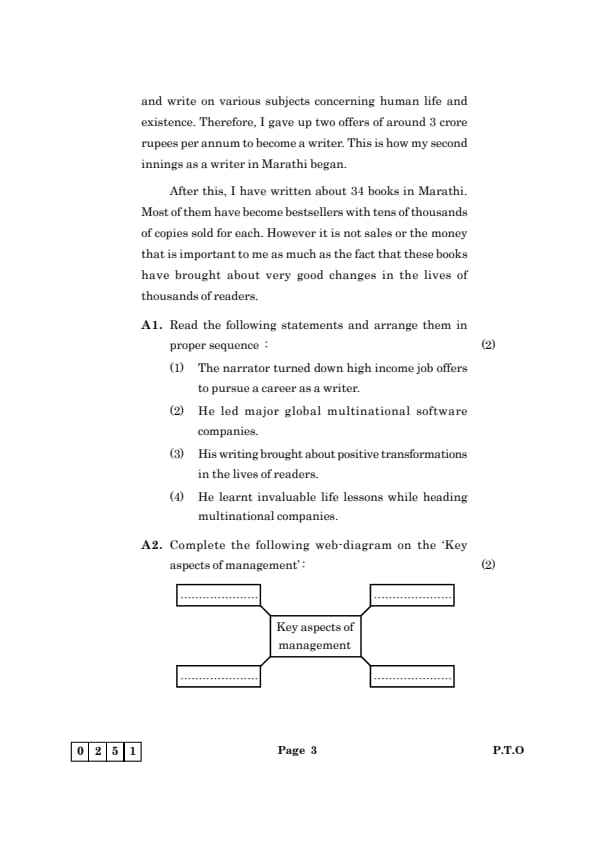
Question 1:
Arrange the following statements in proper sequence:
View Solution
Step 1: Identify the logical order.
To arrange the statements logically, we need to follow the narrator's career journey from his time in the multinational software companies to his transition into writing and the impact of his writing.
Step 2: Examine each statement in context.
- Statement (1) is the starting point of the narrator’s shift towards writing. He first made the decision to leave his high-income job offers to pursue writing.
- Statement (2) talks about his background leading multinational software companies, which happened before his transition into writing.
- Statement (4) mentions the valuable life lessons he learned while heading multinational companies, which follows his experience in the companies.
- Statement (3) discusses the impact of his writing after he began his new career, which is the logical conclusion to his journey.
Step 3: Conclude.
Therefore, the proper sequence is:
1. The narrator turned down high income job offers to pursue a career as a writer. (Start of his journey)
2. He led major global multinational software companies. (His background in the industry)
3. He learnt invaluable life lessons while heading multinational companies. (The lessons he learned in the process)
4. His writing brought about positive transformations in the lives of readers. (The impact of his writing)
Final Answer: (1), (2), (4), (3) Quick Tip: To arrange sentences logically, focus on the sequence of events in the story and the cause-effect relationships between them.
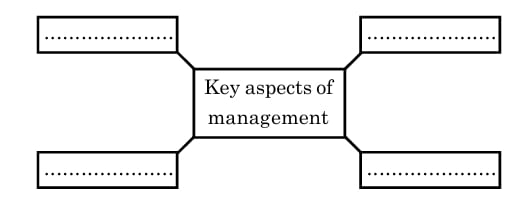
Complete the following web-diagram on the 'Key aspects of management':
View Solution
The key aspects of management typically include:
Planning: Setting goals and outlining steps to achieve them.
Organizing: Allocating resources and tasks to achieve goals.
Leading: Motivating and managing the team to meet objectives.
Controlling: Monitoring and evaluating performance to ensure goals are met.
% Quicktip
\begin{quicktipbox
Remember, the four key aspects of management—Planning, Organizing, Leading, and Controlling—are often referred to as the "P-O-L-C" framework.
\end{quicktipbox Quick Tip: Remember, the four key aspects of management—Planning, Organizing, Leading, and Controlling—are often referred to as the "P-O-L-C" framework.
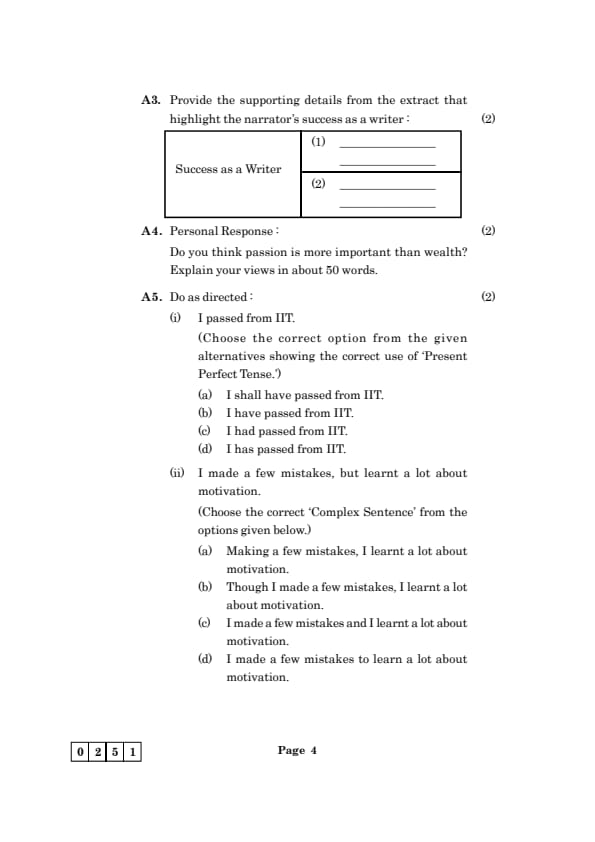
Provide the supporting details from the extract that highlight the narrator’s success as a writer:
(2) Books have brought about very good changes in the lives of thousands of readers.
View Solution
The narrator's success as a writer is reflected in the large number of books written, most of which became bestsellers. Additionally, the impact these books have had on readers' lives is a testament to the narrator's success, showing that the true value of his writing lies in the positive changes it has inspired in others. Quick Tip: Look for details in the extract where the narrator discusses the volume of books written, their success in sales, and the positive impact on readers' lives.
Personal Response:
Do you think passion is more important than wealth?
Explain your views in about 50 words.
View Solution
In my view, passion is more important than wealth. Passion drives us to pursue our dreams, learn, and grow, while wealth, though important, is a byproduct of dedication and hard work. Without passion, wealth becomes meaningless. Passion fuels fulfillment, success, and happiness in life. Quick Tip: When answering a personal response, focus on your beliefs and provide concise reasoning that aligns with your values.
(i) I passed from IIT.
(Choose the correct option from the given alternatives showing the correct use of ‘Present Perfect Tense.’)
View Solution
Step 1: Present Perfect Tense
The Present Perfect tense is used to describe actions that were completed at some indefinite point in the past but have relevance to the present. The structure is: \[ Subject + have/has + past participle. \]
Step 2: Apply the rule
The correct option is "I have passed from IIT." because it uses "have" as the auxiliary verb in the present perfect tense and the past participle "passed."
Final Answer: \[ \boxed{I have passed from IIT.} \]
% Quicktip
\begin{quicktipbox
Use the Present Perfect tense for actions that happened at an indefinite time in the past and have relevance to the present.
\end{quicktipbox Quick Tip: Use the Present Perfect tense for actions that happened at an indefinite time in the past and have relevance to the present.
(ii) I made a few mistakes, but learnt a lot about motivation.
(Choose the correct ‘Complex Sentence’ from the options given below.)
View Solution
Step 1: Complex Sentence
A complex sentence consists of an independent clause and a dependent clause. The correct conjunction to join the clauses is "though," which indicates a contrast between making mistakes and learning from them.
Step 2: Apply the rule
"Though I made a few mistakes" is a dependent clause, and "I learnt a lot about motivation" is the independent clause. The correct option is "Though I made a few mistakes, I learnt a lot about motivation."
Final Answer: \[ \boxed{Though I made a few mistakes, I learnt a lot about motivation.} \]
% Quicktip
\begin{quicktipbox
In complex sentences, use subordinating conjunctions like "though" to show contrast between ideas.
\end{quicktipbox Quick Tip: In complex sentences, use subordinating conjunctions like "though" to show contrast between ideas.
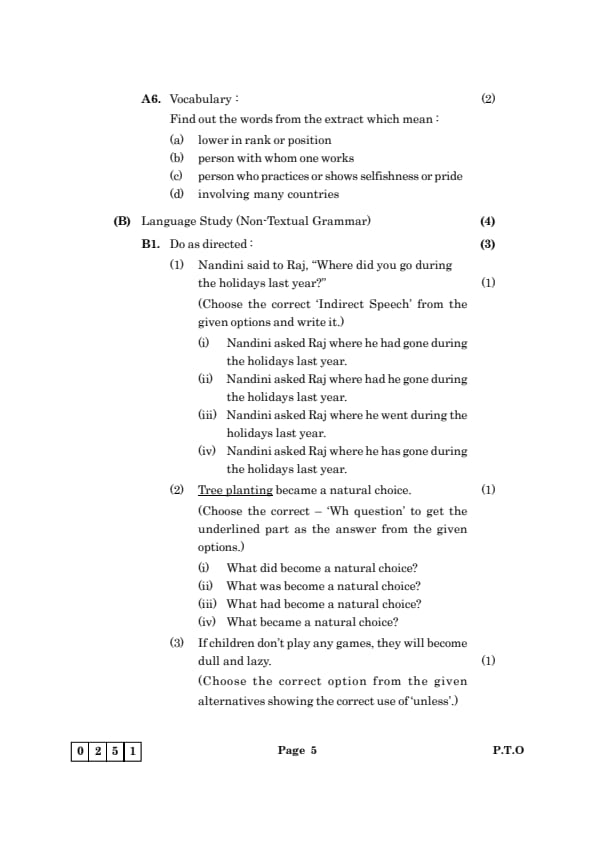
Nandini said to Raj, “Where did you go during the holidays last year?”
(Choose the correct 'Indirect Speech' from the given options and write it.)
View Solution
In indirect speech, when the direct speech contains a question in the past tense, the verb in the indirect speech changes to the past perfect tense. Thus, the correct indirect speech form is: \[ Direct speech: “Where did you go?” \Rightarrow Indirect speech: Nandini asked Raj where he had gone. \]
Final Answer: \[ \boxed{Nandini asked Raj where he had gone during the holidays last year.} \] Quick Tip: When converting from direct to indirect speech, the tense often changes. In this case, the past simple tense changes to the past perfect tense.
Tree planting became a natural choice.
(Choose the correct ‘Wh question’ to get the underlined part as the answer from the given options.)
View Solution
Since the verb "became" is in the past tense, the corresponding question must also use the past tense form "became". Thus, the correct "Wh question" is: \[ What became a natural choice? \]
Final Answer: \[ \boxed{What became a natural choice?} \] Quick Tip: When forming 'Wh' questions with past tense verbs, make sure the question uses the same tense.
If children don’t play any games, they will become dull and lazy.
(Choose the correct option from the given alternatives showing the correct use of 'unless'.)
View Solution
The structure "unless" is used to mean "if not." In this case, the correct sentence is: \[ If children don't play any games, they will become dull and lazy. \Rightarrow Unless children play any games, they will become dull and lazy. \]
The verb form "will" should be used after "unless," and it needs to be in the present tense in the conditional clause. Therefore, option (ii) is correct.
Final Answer: \[ \boxed{Unless children play any games, they will become dull and lazy.} \] Quick Tip: “Unless” is used to express a condition that means "if not." The sentence after "unless" should have the affirmative form of the verb.
(i) She is more shorter than her brother.
View Solution
The error in the sentence is the use of "more" with "shorter." The word "shorter" is already the comparative form of "short," so adding "more" is redundant. In English, we do not use "more" before comparatives that already end in "er." Thus, the correct sentence is: \[ \boxed{She is shorter than her brother.} \] Quick Tip: When using comparatives ending in "er," do not add "more." Just use the comparative form directly.
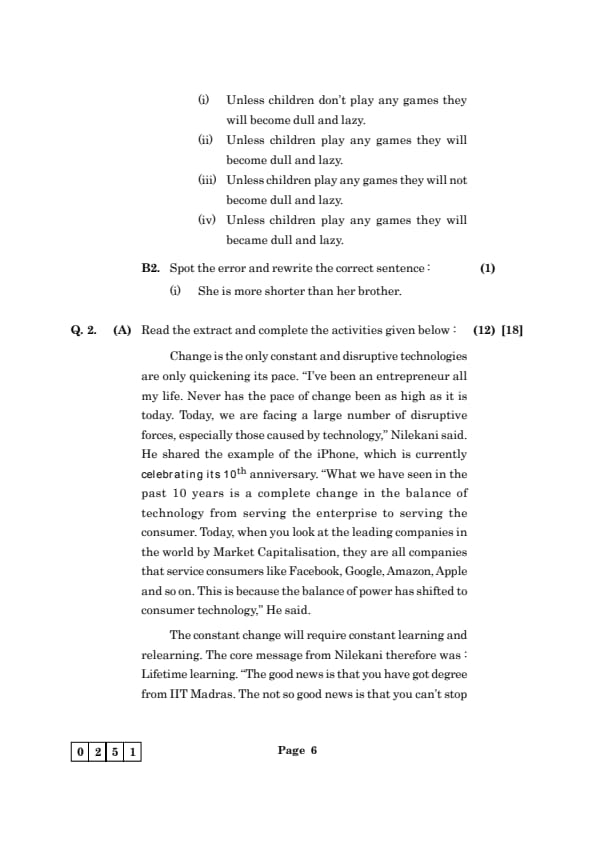
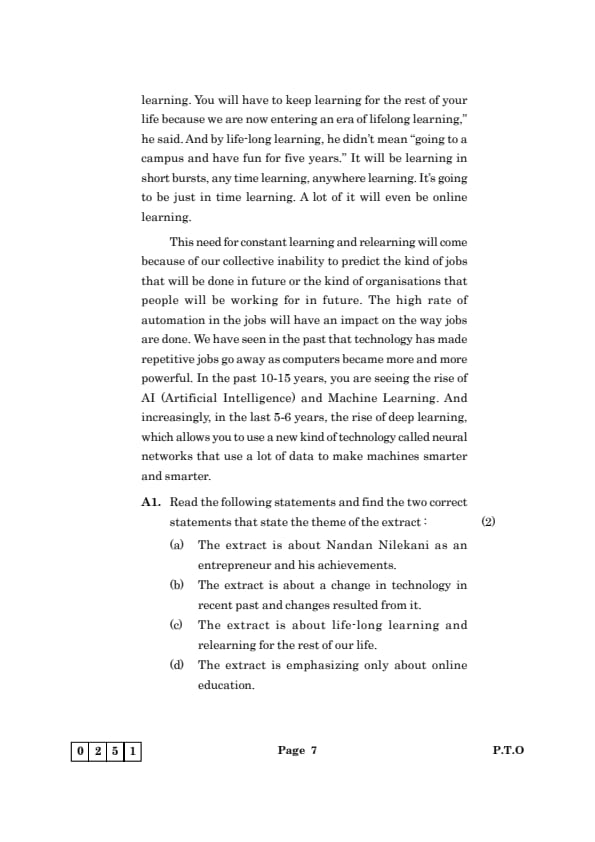
A1. Read the following statements and find the two correct statements that state the theme of the extract:
\textbf{Correct Answer:} (c) The extract is about life-long learning and relearning for the rest of our life.
View Solution
The extract discusses the rapid pace of change, especially technological disruption, and emphasizes the need for constant learning and relearning in light of these changes. It specifically mentions the shift in technology from serving enterprises to consumers and highlights the necessity of life-long learning due to unpredictable changes in job requirements and technology.
Thus, statements (b) and (c) are the correct ones as they match the main themes discussed in the extract.
Final Answer: \[ \boxed{(b) The extract is about a change in technology in recent past and changes resulted from it.} \] \[ \boxed{(c) The extract is about life-long learning and relearning for the rest of our life.} \] Quick Tip: When identifying the theme of a text, focus on the main points that are repeatedly emphasized throughout the passage.
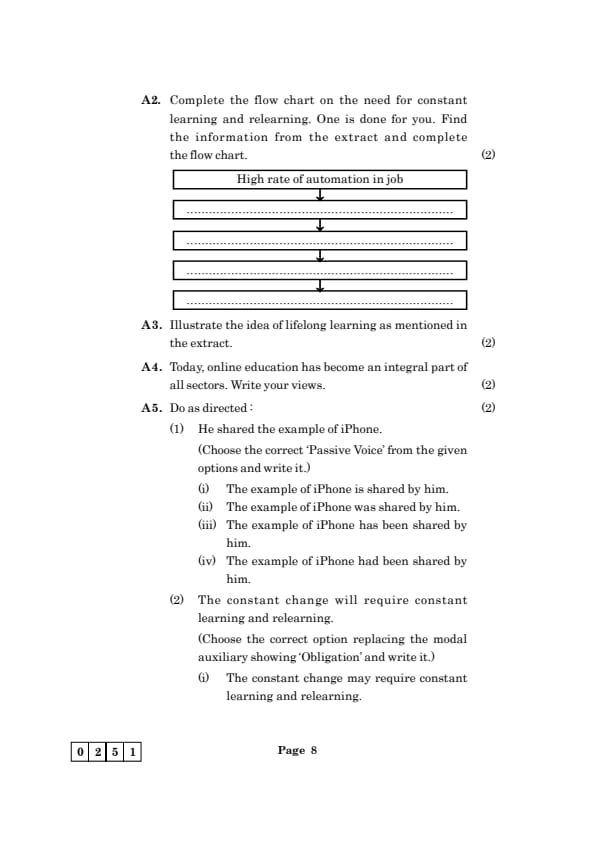
A2. Complete the flow chart on the need for constant learning and relearning. One is done for you. Find the information from the extract and complete the flow chart.
High rate of automation in job
Repetitive jobs are eliminated
Rise of AI and Machine Learning
Need for constant learning and relearning
Lifelong learning through short bursts, anywhere and anytime.
View Solution
The flow chart shows the sequence of events leading to the necessity of lifelong learning. The key steps based on the extract are:
1. The high rate of automation in jobs leads to the elimination of repetitive tasks.
2. With the rise of AI, machine learning, and deep learning, new technologies drive the need for workers to adapt.
3. As a result, lifelong learning is essential, which occurs through learning in short bursts and anytime, anywhere, including online education.
Final Answer:
The completed flow chart is as follows:
High rate of automation in job
Repetitive jobs are eliminated
Rise of AI and Machine Learning
Need for constant learning and relearning
Lifelong learning through short bursts, anywhere and anytime. Quick Tip: The flow chart helps break down complex processes into simple steps, making it easier to understand sequential events and their impact.
A3. Illustrate the idea of lifelong learning as mentioned in the extract.
View Solution
The extract emphasizes the importance of lifelong learning in the current era of rapid technological advancements. Nandan Nilekani stresses that the pace of change in the world today is unprecedented, and this requires individuals to constantly learn and relearn throughout their lives.
He mentions that life-long learning is not about traditional education at a campus but is about continuous learning in short bursts, at any time and anywhere. With the rise of AI, machine learning, and other disruptive technologies, the skills required for future jobs are constantly evolving. This makes it essential for individuals to embrace a mindset of constant learning, leveraging various modes like online education to remain relevant and adaptable to new challenges.
Final Answer:
Lifelong learning is essential as technology continues to evolve at a rapid pace. It involves continuous, on-demand education, often in short bursts, to keep up with changes in the job market and society. Quick Tip: Lifelong learning is not just about formal education, but about continually updating skills through diverse learning methods like online courses, workshops, and self-study.
A4. Today, online education has become an integral part of all sectors. Write your views.
View Solution
Online education has revolutionized learning, making it accessible to a global audience. With technological advancements, it is now easier to take courses from top universities, get certifications, and even learn new skills at one's own pace. This flexibility is crucial, especially in today's fast-paced world, where individuals need to constantly upskill to stay competitive in the job market.
The COVID-19 pandemic further accelerated the adoption of online education, with schools, colleges, and even workplaces shifting to digital platforms. Online education caters to various sectors such as technology, healthcare, business, and more, providing courses tailored to industry needs. Additionally, it allows people from different walks of life, regardless of their location, to access quality education.
Moreover, online education also plays a vital role in lifelong learning, as it offers opportunities for continuous learning throughout one's career. The convenience and wide range of available courses make it easier for professionals to learn new skills and keep up with the latest developments in their field.
Final Answer:
Online education has become an indispensable tool for both formal and informal learning. It empowers individuals to acquire knowledge, enhance skills, and adapt to the evolving demands of the global job market. Quick Tip: Online education allows for personalized learning experiences and offers flexibility, making it easier for individuals to balance their studies with work and other commitments.
(1) He shared the example of iPhone.
(Choose the correct 'Passive Voice' from the given options and write it.)
View Solution
To change an active voice sentence to passive voice, we follow the structure: \[ Subject (object of active sentence) + verb (in the correct tense) + by + agent (subject of active sentence) \]
In the given sentence, "He shared the example of iPhone," the subject "He" becomes the agent in passive voice, and "the example of iPhone" becomes the subject of the sentence. The correct passive voice form is: \[ \boxed{The example of iPhone was shared by him.} \] Quick Tip: In passive voice, the object of the active sentence becomes the subject, and the verb tense changes accordingly.
(2) The constant change will require constant learning and relearning.
(Choose the correct option replacing the modal auxiliary showing 'Obligation' and write it.)
View Solution
In this sentence, the modal auxiliary verb "will" shows a strong obligation or necessity. The correct replacement for showing obligation is "must," which expresses a strong necessity. The correct sentence is: \[ \boxed{The constant change must require constant learning and relearning.} \] Quick Tip: "Must" is used to express strong obligation, while "may" and "might" express possibility.
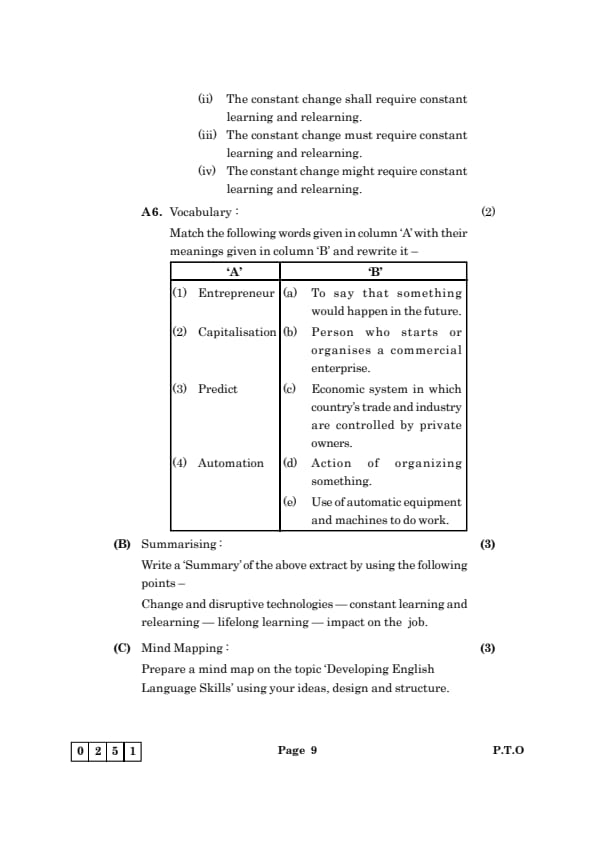
Match the following words given in column ‘A’ with their meanings given in column ‘B’ and rewrite it –
\begin{tabular{|c|c|
\hline
‘A’ & ‘B’
(1) Entrepreneur & (b) Person who starts or organises a commercial enterprise.
(2) Capitalisation & (c) Economic system in which country’s trade and industry are controlled by private owners.
(3) Predict & (a) To say that something would happen in the future.
(4) Automation & (e) Use of automatic equipment and machines to do work.
View Solution
- **Entrepreneur** matches with **(b)**: Person who starts or organises a commercial enterprise.
- **Capitalisation** matches with **(c)**: Economic system in which country’s trade and industry are controlled by private owners.
- **Predict** matches with **(a)**: To say that something would happen in the future.
- **Automation** matches with **(e)**: Use of automatic equipment and machines to do work.
Final Answer:
(1) Entrepreneur \(\to\) (b) Person who starts or organises a commercial enterprise.
(2) Capitalisation \(\to\) (c) Economic system in which country’s trade and industry are controlled by private owners.
(3) Predict \(\to\) (a) To say that something would happen in the future.
(4) Automation \(\to\) (e) Use of automatic equipment and machines to do work. Quick Tip: When matching vocabulary, ensure to connect the term with its precise definition. Pay attention to the context of usage for accuracy.
Write a ‘Summary’ of the above extract by using the following points –
Change and disruptive technologies — constant learning and relearning — lifelong learning — impact on the job.
View Solution
The extract highlights the rapid pace of technological change, specifically disruptive technologies, and their significant impact on the workforce. Nandan Nilekani emphasizes the need for constant learning and relearning due to the high rate of change, particularly in AI and automation. He stresses the importance of lifelong learning, where individuals must continuously update their skills to stay relevant in a job market characterized by automation and AI. This constant learning is not restricted to traditional learning but involves learning in short bursts, any time and anywhere. The extract underscores the importance of embracing new learning methods to adapt to the changing demands of work in the digital age.
Final Answer:
The extract focuses on how disruptive technologies are driving the need for constant and lifelong learning, with a major emphasis on how such changes are impacting job roles and the nature of work in the future. Quick Tip: When summarizing, focus on the main points, highlighting the cause and effect relationship, and keeping it concise while covering all key aspects.
Prepare a mind map on the topic ‘Developing English Language Skills’ using your ideas, design, and structure.
View Solution
A mind map on 'Developing English Language Skills' could be structured as follows:
Main Topic: Developing English Language Skills
Listening
Active Listening
Podcasts/Audio Books
Conversations
Speaking
Daily Conversations
Pronunciation Practice
Language Exchange
Reading
News Articles
Literature
Online Resources
Writing
Journals/Essays
Blogs/Articles
Academic Writing
Grammar and Vocabulary
Online Grammar Courses
Flashcards for Vocabulary
Regular Practice
Final Answer:
A comprehensive mind map will show the interconnections between listening, speaking, reading, writing, grammar, and vocabulary, with a focus on practical methods to improve each skill, such as using digital tools, engaging in real-world practices, and incorporating routine exercises. Quick Tip: Mind maps help visualize connections and organize thoughts efficiently, especially for learning processes like developing language skills.
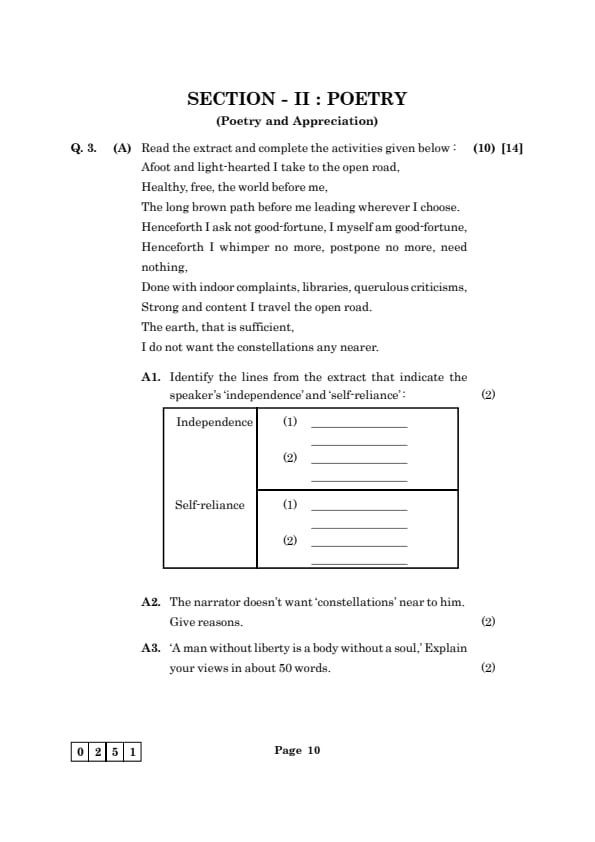
Afoot and light-hearted I take to the open road,
Healthy, free, the world before me,
The long brown path before me leading wherever I choose.
Henceforth I ask not good-fortune, I myself am good-fortune,
Henceforth I whimper no more, postpone no more, need nothing,
Done with indoor complaints, libraries, querulous criticisms,
Strong and content I travel the open road.
The earth, that is sufficient,
I do not want the constellations any nearer.
Question 20:
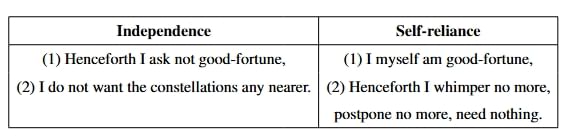
A1. Identify the lines from the extract that indicate the speaker’s ‘independence’ and ‘self-reliance’:
View Solution
- **Independence:**
The speaker expresses their independence through the line, "I do not want the constellations any nearer," which shows their desire to be independent of external forces or expectations.
- **Self-reliance:**
The speaker's self-reliance is highlighted in "I myself am good-fortune" and "Henceforth I whimper no more, postpone no more, need nothing," which reflect their belief in their ability to rely on themselves and not depend on external factors for happiness or success.
Final Answer:
- **Independence:**
- (1) Henceforth I ask not good-fortune,
- (2) I do not want the constellations any nearer.
- **Self-reliance:**
- (1) I myself am good-fortune,
- (2) Henceforth I whimper no more, postpone no more, need nothing. Quick Tip: When identifying independence and self-reliance in literature, focus on phrases where the speaker rejects external help or control, emphasizing their internal strength and independence.
A2. The narrator doesn’t want ‘constellations’ near to him. Give reasons.
View Solution
The narrator does not want the ‘constellations’ near him because he seeks independence and self-reliance. He expresses his desire to be free from external influences or expectations. The ‘constellations’ symbolize distant, external factors that are out of his control. He wishes to remain grounded in the present, relying only on himself for guidance and purpose. The line, "I do not want the constellations any nearer," emphasizes his desire for personal autonomy, free from external intervention.
Final Answer:
The narrator does not want the ‘constellations’ near him because he values his independence and self-reliance, seeking to live without external influences or expectations. Quick Tip: In literature, when characters reject external symbols like stars or constellations, it often represents their desire for self-control and independence.
A3. ‘A man without liberty is a body without a soul,’ Explain your views in about 50 words.
View Solution
The quote implies that liberty is essential for the fulfillment of life. Without liberty, a person is like a body without a soul, meaning they lack purpose, autonomy, and the ability to make choices. True freedom allows individuals to express themselves, pursue their goals, and live authentically. Without it, life loses its essence.
Final Answer:
Liberty is the foundation of a meaningful life. A person without liberty is like a body without a soul, as freedom allows self-expression, choice, and personal growth. Without liberty, a person’s existence is incomplete and lacks purpose. Quick Tip: This quote highlights the importance of freedom in shaping a person’s identity and life choices. Without liberty, there is no true self-expression.
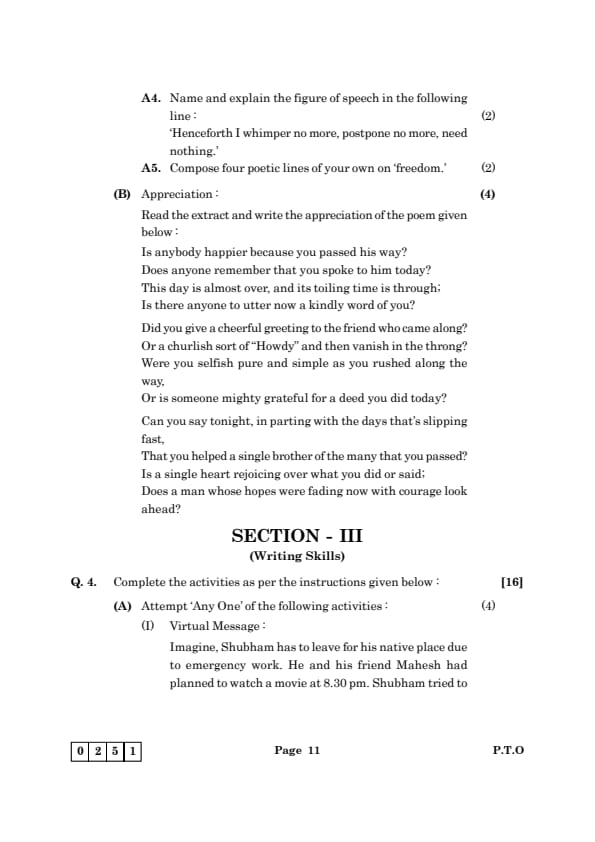
A4. Name and explain the figure of speech in the following line:
'Henceforth I whimper no more, postpone no more, need nothing.'
View Solution
The figure of speech used in the line is **Anaphora**. Anaphora is the repetition of a word or phrase at the beginning of successive clauses or sentences. In this line, the repetition of "no more" emphasizes the speaker’s decision to cease actions such as whimpering, postponing, and needing, which signals a strong commitment to independence and self-reliance.
Final Answer:
The figure of speech is **Anaphora**, which involves the repetition of "no more" to stress the speaker's resolve to stop certain actions and embrace freedom. Quick Tip: Anaphora is often used to create emphasis and rhythm by repeating the same word or phrase at the beginning of successive lines or clauses.
A5. Compose four poetic lines of your own on ‘freedom.’
View Solution
\textit{Freedom is the light that guides my way,
\textit{A strength within that none can sway.
\textit{To speak my truth and walk my path,
\textit{Freedom’s the fire that shields my wrath.
Final Answer:
The four lines emphasize freedom as an internal force, symbolized by light and fire, giving the speaker strength and protection. Quick Tip: When writing about freedom, focus on its empowering and liberating qualities, highlighting how it affects one's choices and actions.
Read the extract and write the appreciation of the poem given below:
Is anybody happier because you passed his way?
Does anyone remember that you spoke to him today?
This day is almost over, and its toiling time is through;
Is there anyone to utter now a kindly word of you?
Did you give a cheerful greeting to the friend who came along?
Or a churlish sort of "Howdy" and then vanish in the throng?
Were you selfish pure and simple as you rushed along the way,
Or is someone mighty grateful for a deed you did today?
Can you say tonight, in parting with the days that’s slipping fast,
That you helped a single brother of the many that you passed?
Is a single heart rejoicing over what you did or said?
Does a man whose hopes were fading now with courage look ahead?
View Solution
The poem is a reflection on selflessness and the impact of our actions on others. The speaker questions whether their interactions with others have been meaningful and whether they have helped anyone in any way. The rhetorical questions encourage introspection, urging the reader to consider how they treat others and whether they make a positive impact on the world around them.
The poem asks whether the speaker has contributed to someone’s happiness, whether they’ve greeted others warmly, or whether they’ve simply passed through life without noticing the people they’ve encountered. It highlights the importance of kindness, gratitude, and compassion, urging individuals to live with a sense of purpose and to leave a positive mark on others’ lives.
The tone is contemplative, and the poem effectively emphasizes the theme of self-reflection and the importance of small deeds in the course of daily life.
Final Answer:
This is a reflective poem that encourages the reader to evaluate their daily interactions, urging them to live with kindness, selflessness, and awareness. It reminds us that our actions, no matter how small, can have a lasting effect on others. Quick Tip: When appreciating a poem, focus on the message it conveys, its tone, and the emotional impact it has on the reader. Consider the use of rhetorical devices and the central themes the poet addresses.
(I) Virtual Message:
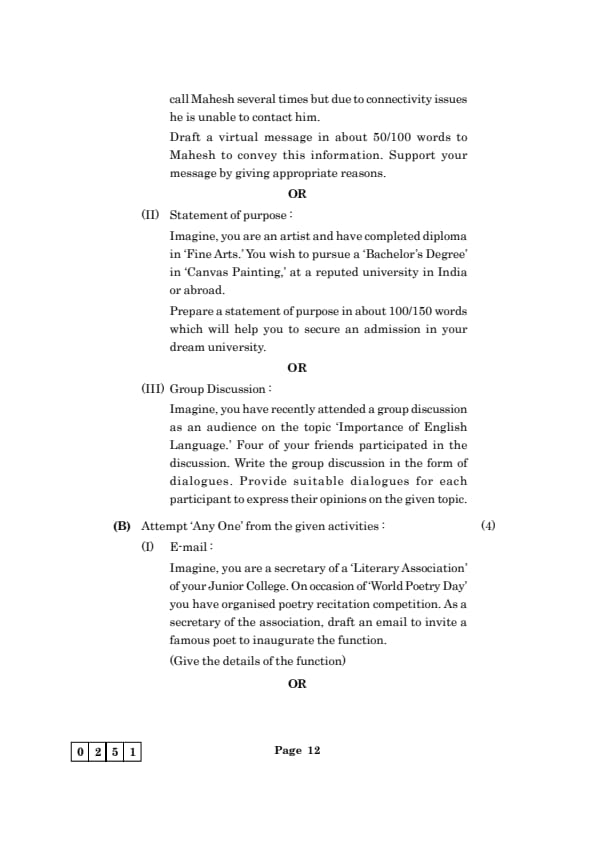
Imagine, Shubham has to leave for his native place due to emergency work. He and his friend Mahesh had planned to watch a movie at 8.30 pm. Shubham tried to call Mahesh several times but due to connectivity issues he is unable to contact him.
Draft a virtual message in about 50/100 words to Mahesh to convey this information. Support your message by giving appropriate reasons.
View Solution
\textit{Dear Mahesh,
I hope this message finds you well. Unfortunately, I won’t be able to make it to the movie we had planned for tonight at 8:30 pm. I am leaving for my native place due to an emergency, and I tried calling you several times to inform you, but I couldn’t get through due to connectivity issues. I apologize for the last-minute change. I’ll update you once I’m available again.
Take care,
Shubham
Final Answer:
A polite virtual message explaining the situation, including the reason for not being able to attend and the issue with connectivity. Quick Tip: When composing a virtual message, be sure to be clear and polite. Briefly explain the situation and provide a reasonable explanation for any changes or delays.
Imagine, you are an artist and have completed a diploma in ‘Fine Arts.’ You wish to pursue a ‘Bachelor’s Degree’ in ‘Canvas Painting,’ at a reputed university in India or abroad.
Prepare a statement of purpose in about 100/150 words which will help you to secure an admission in your dream university.
View Solution
\textit{Statement of Purpose:
I am a passionate artist who has recently completed my diploma in Fine Arts. My academic journey so far has provided me with a strong foundation in various artistic techniques, and I have developed a particular interest in Canvas Painting. I aspire to pursue a Bachelor’s Degree in Canvas Painting from a renowned university to further refine my skills and broaden my creative horizons. My goal is to learn from accomplished professors and work in an environment that fosters artistic innovation. I believe that pursuing this degree will allow me to grow as an artist and prepare me for a successful career in the art world. I am confident that my background in Fine Arts, coupled with my dedication and commitment, makes me a suitable candidate for this program. I am eager to contribute to and learn from the dynamic artistic community at your esteemed institution.
Final Answer:
The statement of purpose should express the applicant’s passion for the field, outline their academic journey, and explain why they are applying to the program. It should also emphasize the applicant’s aspirations and how the program will help them achieve their goals. Quick Tip: A statement of purpose should reflect your passion, articulate your academic goals, and demonstrate how the program aligns with your future career. Keep it clear, focused, and professional.
Imagine, you have recently attended a group discussion as an audience on the topic ‘Importance of English Language.’ Four of your friends participated in the discussion. Write the group discussion in the form of dialogues. Provide suitable dialogues for each participant to express their opinions on the given topic.
View Solution
\textit{Group Discussion on ‘Importance of English Language’
Participant 1 (Rahul):
Good morning, everyone! I believe that the English language has become an essential tool for communication worldwide. It is the global language of business, education, and science. Proficiency in English opens up numerous career opportunities and helps in connecting with people from different cultures.
Participant 2 (Priya):
I agree, Rahul. English is the primary language of the internet, which makes it even more important in today’s digital age. Without a good command of English, one might struggle to access information or engage with global networks. In fact, many educational institutions require proficiency in English for admission.
Participant 3 (Ravi):
While I understand your points, I feel that we should not underestimate the importance of regional languages. English is crucial, but we should not forget our native languages, which also carry immense cultural value. We must ensure that we strike a balance between learning English and preserving our mother tongues.
Participant 4 (Meera):
That’s an interesting point, Ravi. However, I believe that knowing English does not diminish our attachment to our native language. It simply enhances our ability to access more resources and expand our knowledge. In fact, bilingualism can strengthen cognitive abilities and improve overall communication skills.
Participant 1 (Rahul):
Exactly! Learning English is not about abandoning our culture or language, but rather about empowering ourselves. It helps us in the professional world, where English is often the medium of instruction and business. Being proficient in English provides us with an edge in a competitive world.
Participant 2 (Priya):
I completely agree. English acts as a bridge between different cultures. It is the language of international diplomacy, technology, and academic research. In fact, a strong command of English can also enhance one’s confidence when communicating with people from different parts of the world.
Participant 3 (Ravi):
I see your point. English does offer many advantages, and I do not oppose learning it. However, it’s important that we promote bilingualism and not focus solely on English at the cost of our native languages.
Participant 4 (Meera):
I think we all agree that learning English is important, but we must ensure that we do not neglect our own cultures and languages. It’s all about finding the right balance, and that’s the key to embracing both global and local identities.
Final Answer:
This group discussion highlights the importance of English as a global language while also acknowledging the significance of preserving native languages and cultures. The participants emphasize the need to strike a balance between the two for holistic development. Quick Tip: In a group discussion, it’s important to present clear arguments, listen to others’ opinions, and offer solutions that balance different perspectives.
(I) E-mail:
Imagine, you are a secretary of a ‘Literary Association’ of your Junior College. On the occasion of ‘World Poetry Day,’ you have organised a poetry recitation competition. As the secretary of the association, draft an email to invite a famous poet to inaugurate the function. (Give the details of the function)
View Solution
\begin{flushleft
Subject: Invitation to Inaugurate World Poetry Day Function
Dear [Poet's Name],
I hope this email finds you in the best of health and spirits. I am writing to extend a heartfelt invitation to you on behalf of the Literary Association of [Your College's Name]. On the occasion of World Poetry Day, we are organizing a Poetry Recitation Competition, which will take place on [Date] at [Time], at our college campus. The event will be held in the [Venue/Location].
We would be honored if you could inaugurate the function and grace the occasion with your presence. Your inspirational words and presence would undoubtedly make the event even more special for all the participants and attendees. We are eager to hear your thoughts on the importance of poetry and how it has shaped society.
We look forward to your positive response, and we would be grateful for your time and consideration.
Please feel free to contact me if you require any further details.
Thank you for considering our invitation.
Warm regards,
[Your Full Name]
Secretary, Literary Association
[Your College's Name]
[Contact Information]
Final Answer:
A formal invitation email, providing all the necessary details about the event and requesting the poet's presence for the inauguration. Quick Tip: In an email invitation, always be clear, concise, and polite. Mention all relevant details, such as date, time, location, and purpose, while also conveying respect for the recipient's time.
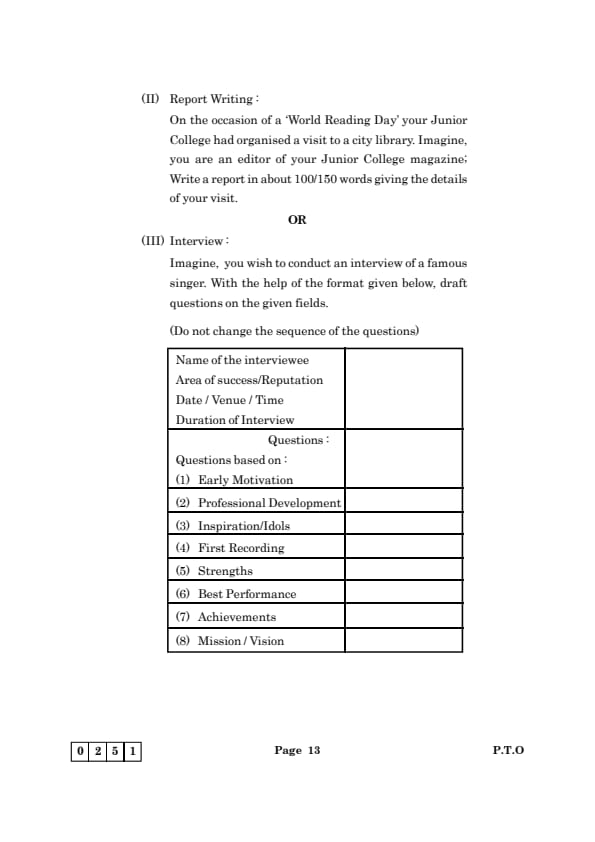
On the occasion of ‘World Reading Day,’ your Junior College had organised a visit to a city library. Imagine, you are an editor of your Junior College magazine; Write a report in about 100/150 words giving the details of your visit.
View Solution
\textit{Report on the Visit to City Library on World Reading Day
On the occasion of World Reading Day, our Junior College organised a visit to the city library on [Date]. The visit aimed to encourage students to embrace reading as a valuable habit. A group of enthusiastic students, along with the faculty members, gathered at the library at 10 a.m.
The library staff gave us a warm welcome and guided us through the library's vast collection of books, journals, and other resources. We explored sections on literature, science, history, and art, and were introduced to the latest digital library facilities. A special interactive session was organised where the librarian explained the importance of reading and the various programs offered by the library.
The visit was highly informative and motivating. It not only deepened our understanding of the vast world of books but also inspired us to make reading a regular part of our lives. The event concluded with a vote of thanks to the library staff for their cooperation.
Final Answer:
The report captures the essence of the event, highlighting the significance of World Reading Day and the informative experience provided by the city library. Quick Tip: In report writing, focus on providing a clear and concise description of the event, mentioning key activities, participants, and outcomes. Always maintain a formal tone.
Imagine, you wish to conduct an interview of a famous singer. With the help of the format given below, draft questions on the given fields. (Do not change the sequence of the questions)
Name of the interviewee: [Name of the Singer]
Area of success/Reputation: Famous Singer, [Genre of Music]
Date / Venue / Time: [Date], [Venue], [Time]
Duration of Interview: [Duration]
View Solution
N/A Quick Tip: In an interview, it’s important to ask open-ended questions that allow the interviewee to share personal stories and insights. Make sure to ask questions that are relevant to their career and experiences.
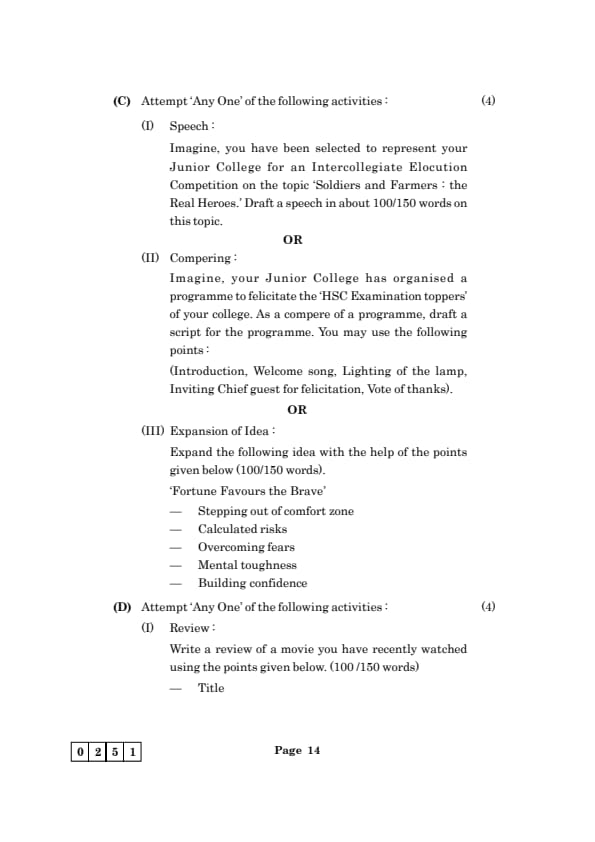
(I) Speech:
Imagine, you have been selected to represent your Junior College for an Intercollegiate Elocution Competition on the topic ‘Soldiers and Farmers: the Real Heroes.’ Draft a speech in about 100/150 words on this topic.
View Solution
\textit{Speech on 'Soldiers and Farmers: the Real Heroes'
Respected judges, teachers, and my dear friends,
Good morning! Today, I stand before you to speak on the topic ‘Soldiers and Farmers: the Real Heroes.’
Heroes come in different forms. While we often hear about brave soldiers who protect our borders, we must not forget the unsung heroes who work tirelessly in the fields to feed the nation – our farmers. Soldiers lay down their lives to defend the sovereignty of our country, fighting in the harshest conditions. On the other hand, farmers work tirelessly in the scorching sun, monsoons, and chilly winters to ensure we have food on our plates.
Both soldiers and farmers contribute to the progress of our nation. The soldier secures the land, while the farmer secures our future. Their efforts, though different, are both equally vital for the welfare of the country.
Let us recognize their sacrifices, express our gratitude, and honor these true heroes every day.
Thank you.
Final Answer:
This speech emphasizes the significance of both soldiers and farmers, highlighting their sacrifices and their vital roles in shaping the nation's future. Quick Tip: When delivering a speech, always focus on the key points, maintain a clear and respectful tone, and engage the audience with relatable content.
Imagine, your Junior College has organised a programme to felicitate the ‘HSC Examination toppers’ of your college. As a compere of the programme, draft a script for the programme. You may use the following points:
(Introduction, Welcome song, Lighting of the lamp, Inviting Chief guest for felicitation, Vote of thanks).
View Solution
\textit{Script for the Programme
Introduction:
Good [morning/afternoon/evening] everyone!
I, [Your Name], on behalf of [College Name], extend a warm welcome to all present here today. It gives me immense pleasure to be the compere for this prestigious occasion, where we have gathered to celebrate the hard work and excellence of the 'HSC Examination Toppers' of our college. Today, we honor the brilliance and dedication of our students who have brought pride to our institution.
Welcome Song:
To begin this auspicious event, I would now like to invite our talented students to present a beautiful welcome song. Let us all enjoy the melody as we prepare to honor our toppers.
Lighting of the Lamp:
Thank you for that soul-stirring performance. Now, I request [Name of Chief Guest] to kindly come forward and light the lamp, symbolizing the beginning of this wonderful ceremony.
Inviting the Chief Guest for Felicitation:
Thank you, [Chief Guest Name], for your gracious presence. Now, I invite our respected Chief Guest to address the gathering and felicitate our toppers. Sir/Madam, please.
Vote of Thanks:
Thank you, [Chief Guest Name], for your inspiring words. It is truly an honor to have you with us today.
Before we conclude this ceremony, I would like to take a moment to express our sincere gratitude. A big thank you to our Chief Guest for joining us and blessing the event with their presence. A heartfelt thank you to our students for their dedication and hard work, and to all the faculty members for their constant support.
Let us all join together to applaud the success of our toppers and wish them the very best for their future.
Thank you, and have a wonderful day ahead!
Final Answer:
The script for the programme provides a structured and respectful approach to compering an event, ensuring each part of the ceremony is introduced with grace and clarity. Quick Tip: When compering, maintain a calm and clear voice, stay on schedule, and ensure you engage the audience with enthusiasm while keeping the event flowing smoothly.
Expand the following idea with the help of the points given below (100/150 words).
‘Fortune Favours the Brave’
— Stepping out of comfort zone
— Calculated risks
— Overcoming fears
— Mental toughness
— Building confidence
View Solution
\textit{Expansion on the Topic ‘Fortune Favours the Brave’
The saying ‘Fortune Favours the Brave’ emphasizes that only those who dare to step out of their comfort zones are rewarded with success. It is often easy to stick to what is familiar, but true growth comes from taking risks. By stepping out of one’s comfort zone, an individual challenges themselves to explore new opportunities and experiences.
Calculated risks are an essential aspect of achieving success. Taking risks without proper planning may lead to failure, but with careful consideration and preparation, risks can open new avenues for growth and progress. Overcoming fears is another crucial factor. Fear often holds people back from reaching their potential. When we face our fears, we become mentally tougher and more resilient.
Building confidence is another result of bravery. As we take steps towards our goals and succeed, even in small things, we gain self-assurance. In the end, it is the brave who, despite the challenges, find fortune on their side.
Final Answer:
This expansion elaborates on how stepping out of one’s comfort zone, taking calculated risks, overcoming fears, building mental toughness, and growing confidence can lead to success, demonstrating that fortune does indeed favor the brave. Quick Tip: When expanding an idea, ensure that your points flow logically and are well-supported with examples or explanations. Focus on clarity and coherence to make your argument more impactful.
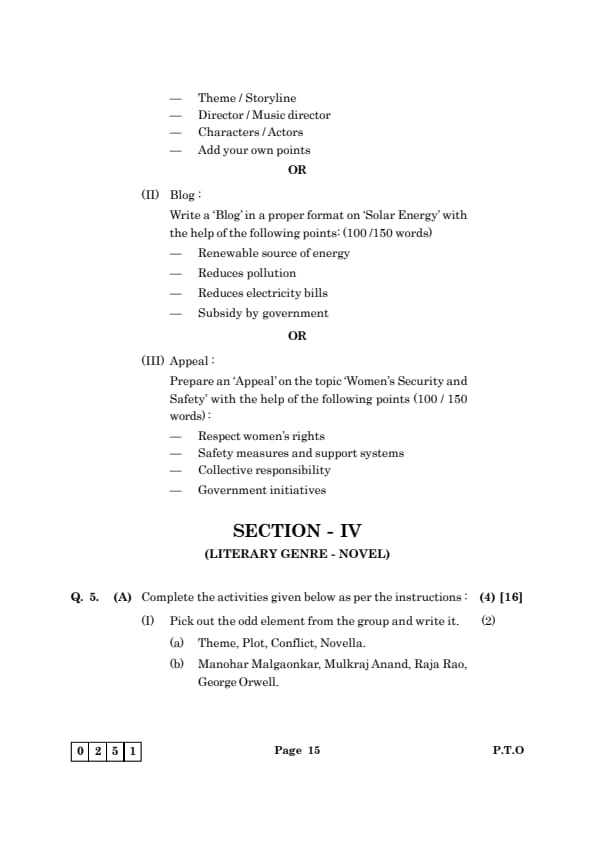
(I) Review:
Write a review of a movie you have recently watched using the points given below. (100/150 words)
— Title
— Theme / Storyline
— Director / Music director
— Characters / Actors
— Add your own points
View Solution
\textit{Movie Review: ‘Inception’
Title: Inception
Director / Music Director: Directed by Christopher Nolan, Music by Hans Zimmer
Theme / Storyline:
Inception is a mind-bending thriller that explores the concept of shared dreams and the subconscious. The film follows Dom Cobb, a skilled thief who steals secrets from deep within the subconscious during the dream state. Cobb is given a chance to have his criminal record erased if he can successfully implant an idea in someone’s mind—referred to as ‘inception’. The movie takes the audience on a journey through complex layers of dreams within dreams, questioning reality itself.
Characters / Actors:
Leonardo DiCaprio stars as Dom Cobb, delivering an excellent performance. The supporting cast includes Joseph Gordon-Levitt, Ellen Page, Tom Hardy, and Marion Cotillard, all contributing to the depth of the plot. The performances are gripping and draw the audience into the surreal world of dreams.
Personal Opinion:
Inception is a visually stunning and intellectually stimulating film. The gripping storyline keeps you on the edge of your seat, and the brilliant direction makes it a unique cinematic experience. The music by Hans Zimmer adds to the intensity of the plot, leaving a lasting impression. This is a must-watch for fans of science fiction and thriller genres.
Final Answer:
This review covers the key aspects of the film Inception, including its title, director, storyline, cast, and personal opinion, giving a clear and concise overview of the movie. Quick Tip: When writing a movie review, be sure to include key elements like the theme, characters, and your personal reaction to the film. Aim to summarize without revealing too much of the plot, especially if it contains twists.
Write a ‘Blog’ in a proper format on ‘Solar Energy’ with the help of the following points: (100/150 words)
— Renewable source of energy
— Reduces pollution
— Reduces electricity bills
— Subsidy by government
View Solution
\textit{Blog on Solar Energy
Solar energy is a renewable source of energy that has gained significant attention in recent years. Unlike fossil fuels, solar energy is abundant and sustainable, making it a perfect alternative for meeting global energy demands. As a clean energy source, solar power helps reduce pollution and contributes to a greener planet. By harnessing the sun’s power through solar panels, we can produce electricity without emitting harmful gases or relying on non-renewable resources.
One of the biggest advantages of solar energy is its potential to reduce electricity bills. Once installed, solar panels generate free electricity, significantly lowering monthly energy expenses for households and businesses. Additionally, the government offers subsidies and incentives to encourage solar adoption, making it a more affordable option for many people.
Solar energy not only benefits individuals but also plays a crucial role in reducing our carbon footprint and combatting climate change. By investing in solar power, we move closer to a cleaner, more sustainable future.
Final Answer:
This blog outlines the importance of solar energy as a renewable source, its benefits in reducing pollution and electricity costs, and government subsidies that support its adoption. Quick Tip: When writing a blog, focus on making your writing engaging and informative. Use simple language to explain complex concepts and highlight the benefits of the topic.
Prepare an ‘Appeal’ on the topic ‘Women’s Security and Safety’ with the help of the following points: (100/150 words)
— Respect women’s rights
— Safety measures and support systems
— Collective responsibility
— Government initiatives
View Solution
\textit{Appeal on Women’s Security and Safety
Dear Citizens,
I come to you with a heartfelt appeal for the security and safety of women. The rights of women are human rights, and it is our collective responsibility to ensure their safety in all spheres of life. It is time that we recognize the need to respect women’s rights and create a society where women feel safe and empowered.
We must also ensure that safety measures and support systems are in place. Women must have access to proper security, both at home and in public spaces. This includes a strong legal framework and quick response teams to address issues of harassment and violence.
It is not just the responsibility of the government but of every individual in society to contribute towards women’s safety. Let us stand together, raise our voices, and take action to create a safer world for women.
Let us all work towards making women feel secure and valued in our communities.
Final Answer:
This appeal emphasizes the collective responsibility for women's safety, highlighting the importance of respecting women's rights, providing safety measures, and government initiatives to protect women. Quick Tip: When writing an appeal, aim to inspire action. Use direct and persuasive language to appeal to the emotions of the audience, encouraging them to take responsibility and contribute to the cause.
(i) Pick out the odd element from the group and write it.
View Solution
N/A
(b) Manohar Malgaonkar, Mulkraj Anand, Raja Rao, George Orwell.
View Solution
N/A
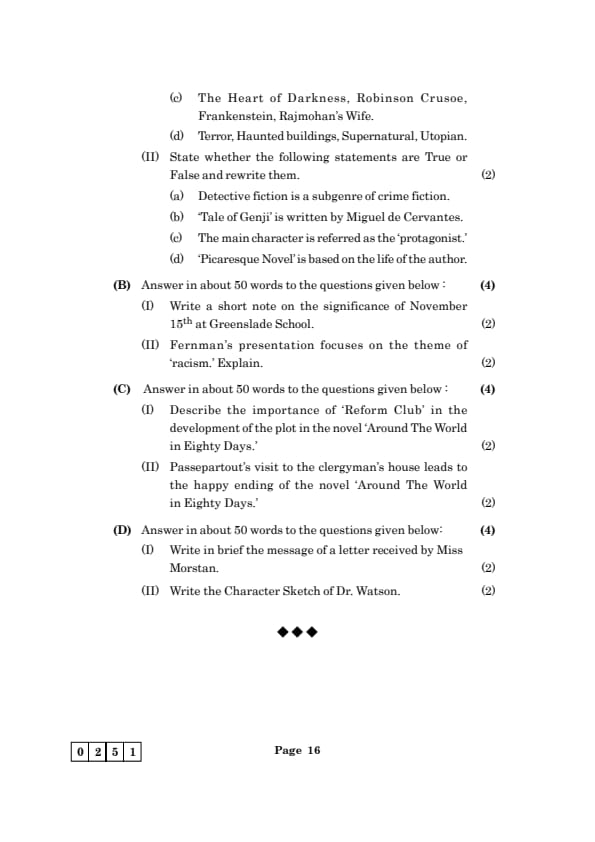
(c) The Heart of Darkness, Robinson Crusoe, Frankenstein, Rajmohan’s Wife.
View Solution
N/A
(d) Terror, Haunted buildings, Supernatural, Utopian.
View Solution
Step 1: Analyze the terms.
- Terror, Haunted buildings, and Supernatural are all associated with Gothic literature or horror themes.
- Utopian refers to idealistic or perfect societies, a completely different genre.
Step 2: Conclusion.
Utopian is the odd element, as it relates to a different genre than the others.
Answer:
\boxed{Utopian
% Quicktip
\begin{quicktipbox
Odd one out questions require recognizing the different genre, form, or context among the given elements.
\end{quicktipbox Quick Tip: Odd one out questions require recognizing the different genre, form, or context among the given elements.
(i) Detective fiction is a subgenre of crime fiction.
View Solution
N/A
(ii) 'Tale of Genji' is written by Miguel de Cervantes.
View Solution
N/A
(iii) The main character is referred to as the 'protagonist.'
View Solution
N/A
(iv) 'Picaro Novel' is based on the life of the author.
View Solution
Step 1: Analyze the statement.
This statement is False. A Picaro Novel is a type of picaresque novel, which typically features a roguish protagonist of low social class, who survives through various adventures. It is not directly based on the life of the author.
Step 2: Correct the statement.
'Picaro Novel' refers to a novel about a roguish, often lower-class protagonist, engaging in episodic adventures.
Answer:
\textit{'Picaro Novel' refers to a novel about a roguish, often lower-class protagonist, engaging in episodic adventures.
% Quicktip
\begin{quicktipbox
The picaresque novel often satirizes society through the misadventures of its roguish protagonist.
\end{quicktipbox Quick Tip: The picaresque novel often satirizes society through the misadventures of its roguish protagonist.
(i) Write a short note on the significance of November 15th at Greenslade School.
View Solution
Step 1: Identify the event.
November 15th is a significant date for Greenslade School as it marks an important event in the school's history or tradition. It is celebrated annually with various activities or commemorations.
Step 2: Connect to the school's culture.
The event may symbolize unity, historical importance, or an educational achievement that is celebrated by students, faculty, and staff alike.
Answer:
November 15th holds special significance at Greenslade School as it marks an annual celebration of the school’s history, bringing together the school community through events that foster a sense of pride and unity.
% Quicktip
\begin{quicktipbox
When answering short note questions, focus on the key theme and provide a concise explanation without losing important details.
\end{quicktipbox Quick Tip: When answering short note questions, focus on the key theme and provide a concise explanation without losing important details.
(ii) Fernman’s presentation focuses on the theme of ‘racism.’ Explain.
View Solution
Step 1: Identify the main theme.
Fernman’s presentation addresses the theme of racism, highlighting how racial prejudice continues to impact society.
Step 2: Explain the focus.
Through his analysis, Fernman explores the social, cultural, and historical factors that perpetuate racism and advocates for greater awareness and change.
Answer:
Fernman’s presentation emphasizes racism as a pervasive issue in society, examining its roots in history and culture while urging collective action to address racial inequality and prejudice.
% Quicktip
\begin{quicktipbox
When answering short note questions, focus on the key theme and provide a concise explanation without losing important details.
\end{quicktipbox Quick Tip: When answering short note questions, focus on the key theme and provide a concise explanation without losing important details.
(ii) Passepartout’s visit to the clergyman’s house leads to the happy ending of the novel ‘Around The World in Eighty Days.’
View Solution
Step 1: Discuss Passepartout’s visit.
Passepartout’s visit to the clergyman’s house is crucial because it leads to the revelation that Phileas Fogg still has time to complete his journey. This visit allows him to realize that he has a day to spare, which results in the novel’s happy ending.
Step 2: Conclusion.
Without Passepartout’s visit, Fogg would have missed the opportunity to win the bet, making it essential for the happy ending.
Answer:
Passepartout’s visit to the clergyman’s house is pivotal, as it reveals that Fogg still has time to complete his journey and win the bet, leading to the novel’s happy ending.
% Quicktip
\begin{quicktipbox
Key plot moments, like Passepartout’s realization, often serve to drive the story toward its conclusion and resolution.
\end{quicktipbox Quick Tip: Key plot moments, like Passepartout’s realization, often serve to drive the story toward its conclusion and resolution.
(i) Write in brief the message of a letter received by Miss Morstan.
View Solution
Step 1: Identify the letter’s content.
The letter received by Miss Morstan in Sherlock Holmes's "The Sign of the Four" contains a mysterious message, which invites her to meet a person who has information about her missing father and the treasure connected to his disappearance.
Step 2: Conclusion.
The message sets the stage for Miss Morstan's involvement in the central mystery of the story.
Answer:
The letter Miss Morstan receives invites her to meet a person with vital information about her father’s disappearance and the hidden treasure, initiating the plot’s central mystery.
% Quicktip
\begin{quicktipbox
Dr. Watson’s role as the narrator and Watson’s reliable nature makes him a key figure in the development of the plot in Sherlock Holmes’s stories.
\end{quicktipbox Quick Tip: Dr. Watson’s role as the narrator and Watson’s reliable nature makes him a key figure in the development of the plot in Sherlock Holmes’s stories.
(ii) Write the Character Sketch of Dr. Watson.
View Solution
Step 1: Describe Dr. Watson’s role.
Dr. Watson is a loyal friend, a keen observer, and the narrator of most Sherlock Holmes stories. He is compassionate, dependable, and often serves as a foil to Holmes's eccentric genius.
Step 2: Conclusion.
Although Watson is not as intellectually sharp as Holmes, his character is essential for providing insight and support throughout their cases.
Answer:
Dr. Watson is a loyal and compassionate companion to Sherlock Holmes. As the narrator, he provides a grounded perspective and serves as a foil to Holmes’s brilliant yet eccentric character.
% Quicktip
\begin{quicktipbox
Dr. Watson’s role as the narrator and Watson’s reliable nature makes him a key figure in the development of the plot in Sherlock Holmes’s stories.
\end{quicktipbox Quick Tip: Dr. Watson’s role as the narrator and Watson’s reliable nature makes him a key figure in the development of the plot in Sherlock Holmes’s stories.
*The article might have information for the previous academic years, please refer the official website of the exam.