
Maharashtra Board 2025 Class 12 Geography Question Paper PDF with Solutions


Content Writer | Updated On - Sep 14, 2025
The Maharashtra Board Class 12 Geography Question Paper PDF with Solutions is available for download. The Maharashtra State Board of Secondary and Higher Secondary Education (MSBSHSE) conducted the Class 12 Geography examination for a total duration of 3 hours, and the question paper had a total of 80 marks.

Maharastra Board Class 12 Geography Question Paper with Solutions
| Maharastra Board Class 12 Geography Question Paper with Solutins | Download PDF | Check Solutions |
Complete the chain and rewrite in your answer paper:

View Solution
Step 1: Understand the chain completion concept.
This question requires matching the correct pairings from columns A, B, and C to form a logical connection.
Step 2: Analyze the pairs.
- \text{Amazon River basin is related to \text{Manufacturing Activities and \text{Tata Iron and Steel Industries.
- \text{Constructive Pyramid connects to \text{Commercial cattle rearing and \text{Low population density.
- \text{Industrial Region leads to \text{Individual and then to \text{Low birth rate and least death rate.
- \text{Pampas Grassland connects to \text{Dense equatorial forest and \text{South America.
- \text{Private is related to \text{More old age Population and \text{Availability of Employment.
Step 3: Final chain conclusion.
The correct completions are derived from analyzing the logical connections between each term in the columns.
Final Answer:
The completed chains are written above with the logical connections between the terms. Quick Tip: When solving chain completion questions, focus on logical connections and common associations between the terms from different columns.
Appalachian mountain region of U.S.A has dense population because-
View Solution
Step 1: Understand the question.
The question asks for the reason why the Appalachian Mountain region of the USA has a dense population. We need to identify the correct factor influencing this population density.
Step 2: Analyze each option.
- Option (A) uneven physical condition: This is not a reason for a dense population. In fact, uneven physical conditions often discourage settlement in some areas.
- Option (B) inaccessible mountainous region: This would typically hinder population density, as difficult accessibility often limits settlement.
- Option (C) development of iron-ore and coal mines: The presence of important industries like coal and iron-ore mines in the region attracts a large population for work, leading to density.
- Option (D) war-like condition: This is irrelevant to the population density of the Appalachian region.
Step 3: Conclude the correct option.
The correct answer is (C), as the development of iron-ore and coal mines in the region created jobs and attracted a dense population.
Final Answer:
The correct reason is the development of iron-ore and coal mines. Quick Tip: Industrial development in a region can lead to population density by providing job opportunities, attracting people for work.
Ideal location for fishing.
View Solution
Step 1: Understand the key factors for fishing.
The ideal location for fishing typically includes shallow seas, cold climate, and a continental shelf where plankton can thrive.
Step 2: Analyze each option.
- Option (A): This is not ideal as hot climates generally do not support plankton growth.
- Option (B): This is partially correct but lacks the rugged coast and focuses too much on ocean currents.
- Option (C): This is not ideal as good fishing skills are irrelevant to location.
- Option (D): This is the correct answer as it mentions the most favorable conditions for fishing.
Final Answer:
The correct answer is (D) continental shelf, rugged coasts, growth of planktons, cold climate.
% Quicktip
\begin{quicktipbox
Cold climates and rich plankton growth are key factors for ideal fishing locations.
\end{quicktipbox Quick Tip: Cold climates and rich plankton growth are key factors for ideal fishing locations.
In USA, industrial areas are found in the North-Eastern region.
View Solution
Step 1: Understand the reasons for industrialization.
In the USA, the North-Eastern region is an industrial hub due to the abundance of raw materials and resources.
Step 2: Analyze each option.
- Option (A): Dense population may attract industries, but availability of resources is a stronger factor.
- Option (B): Capital is necessary, but without resources, industries wouldn't be able to thrive.
- Option (C): Availability of coal and iron-ore is a key factor for industrial growth in this region.
- Option (D): Transport routes are important but secondary to the presence of raw materials.
Final Answer:
The correct answer is (C) availability of rich deposits of coal and iron-ore.
% Quicktip
\begin{quicktipbox
Natural resources like coal and iron-ore play a significant role in industrialization.
\end{quicktipbox Quick Tip: Natural resources like coal and iron-ore play a significant role in industrialization.
Choose one subregion in the northern plain region of India.
View Solution
Step 1: Understand the northern plains of India.
The northern plain region of India is characterized by major river systems such as the Ganga and Yamuna.
Step 2: Analyze each option.
- Option (A): The Nile plain is in Egypt, not in India.
- Option (B): The Ganga-Yamuna plain is a part of the northern plains of India.
- Option (C): The Mississippi Basin is in the USA.
- Option (D): The Amazon Basin is in South America.
Final Answer:
The correct answer is (B) The Ganga-Yamuna plain.
% Quicktip
\begin{quicktipbox
The Ganga-Yamuna plain is a major subregion of the northern plains of India.
\end{quicktipbox Quick Tip: The Ganga-Yamuna plain is a major subregion of the northern plains of India.
Major physical factor which affects regional development.
View Solution
Step 1: Understand the physical factors affecting regional development.
Natural resources are the primary physical factor that impacts the development of a region, as they provide the necessary raw materials for industry and agriculture.
Step 2: Analyze each option.
- Option (A): Natural resources such as minerals, water, and land are essential for economic growth and development.
- Option (B): Sex-ratio, while important for social factors, does not directly affect regional development.
- Option (C): School register ratio is related to education but does not directly impact the economic development of a region.
- Option (D): Employment opportunities are influenced by many factors, including natural resources.
Final Answer:
The correct answer is (A) Natural resources.
% Quicktip
\begin{quicktipbox
The availability of natural resources is crucial for the economic and industrial development of a region.
\end{quicktipbox Quick Tip: The availability of natural resources is crucial for the economic and industrial development of a region.
Identify the correct co-relation in the given statements and write:
% Assertion and Reasoning
A : Assertion \hspace{1cm R : Reasoning
(1) A: Hardwood trees are found in equatorial evergreen forests.
R: Lumbering is not developed on a commercial level in equatorial regions.
View Solution
Step 1: Analyze the assertion.
- Assertion A: "Hardwood trees are found in equatorial evergreen forests." This statement is correct because equatorial regions, particularly the Amazon and Congo basins, are known for their dense hardwood forests.
Step 2: Analyze the reasoning.
- Reasoning R: "Lumbering is not developed on a commercial level in equatorial regions." This statement is also correct because although hardwood trees are abundant, the harsh climate, dense forests, and environmental concerns make commercial lumbering challenging in many equatorial regions.
Step 3: Determine the relationship between assertion and reasoning.
- While both A and R are correct, the reasoning does not fully explain the assertion. The presence of hardwood trees in equatorial regions does not directly lead to the lack of commercial lumbering; rather, other factors like climate, logistics, and environmental concerns play a more significant role in limiting commercial lumbering.
Final Answer:
The correct answer is (D) Both A and R are correct but R is not the correct explanation of A.
% Quicktip
\begin{quicktipbox
Assertion and reasoning-based questions test the understanding of the correlation between statements, but it's important to differentiate between statements that are true and their direct correlation.
\end{quicktipbox Quick Tip: Assertion and reasoning-based questions test the understanding of the correlation between statements, but it's important to differentiate between statements that are true and their direct correlation.
A: In India, industrial areas are found concentrated in a few regions.
R: India is an agricultural country.
View Solution
Step 1: Analyze the assertion.
Assertion A: "In India, industrial areas are found concentrated in a few regions." This is correct as industrialization in India is primarily concentrated in a few areas like Mumbai, Delhi, Kolkata, and Chennai.
Step 2: Analyze the reasoning.
Reasoning R: "India is an agricultural country." This is also correct, as a large portion of India's economy is based on agriculture.
Step 3: Determine the relationship.
- While both A and R are correct, the reasoning does not directly explain why industrial areas are concentrated in a few regions. Industrial concentration is more due to factors like infrastructure, availability of raw materials, and government policies, rather than being an explanation of India's agricultural nature.
Final Answer:
The correct answer is (D) Both A and R are correct but R is not the correct explanation of A.
% Quicktip
\begin{quicktipbox
Assertion-Reasoning questions require understanding the correlation between the statements. Be careful to identify if the reasoning directly supports the assertion.
\end{quicktipbox Quick Tip: Assertion-Reasoning questions require understanding the correlation between the statements. Be careful to identify if the reasoning directly supports the assertion.
A: In tertiary occupation, there is no derivation from nature.
R: It provides only services so it is known as a service sector.
View Solution
Step 1: Analyze the assertion.
Assertion A: "In tertiary occupation, there is no derivation from nature." This is correct, as tertiary occupations, such as services, do not directly derive resources from nature (e.g., education, healthcare, finance).
Step 2: Analyze the reasoning.
Reasoning R: "It provides only services so it is known as a service sector." This is also correct, but it does not explain why tertiary occupations do not derive from nature. The explanation focuses on the type of occupation rather than the natural derivation aspect.
Step 3: Determine the relationship.
- Both A and R are correct, but the reasoning does not directly explain the assertion. The explanation focuses more on the nature of tertiary occupations rather than why they do not derive from nature.
Final Answer:
The correct answer is (D) Both A and R are correct but R is not the correct explanation of A.
% Quicktip
\begin{quicktipbox
In Assertion-Reasoning questions, carefully differentiate between valid facts and the actual explanation.
\end{quicktipbox Quick Tip: In Assertion-Reasoning questions, carefully differentiate between valid facts and the actual explanation.
A: Each formal region has distinct boundaries which make them easy to identify.
R: Region is bounded by economic activities.
View Solution
Step 1: Analyze the assertion.
Assertion A: "Each formal region has distinct boundaries which make them easy to identify." This is correct. Formal regions are typically defined by clear boundaries, such as political or administrative boundaries, that make them easy to identify.
Step 2: Analyze the reasoning.
Reasoning R: "Region is bounded by economic activities." This is also true, as many regions are defined by the type of economic activities taking place within them. However, this does not explain why formal regions have distinct boundaries.
Step 3: Determine the relationship.
- Both A and R are correct, but the reasoning does not directly explain why formal regions are easy to identify. Formal regions are identified based on their political, administrative, or cultural boundaries, not solely by economic activities.
Final Answer:
The correct answer is (D) Both A and R are correct but R is not the correct explanation of A.
% Quicktip
\begin{quicktipbox
Assertion-Reasoning questions require identifying not only the correctness of each statement but also whether the reasoning explains the assertion effectively.
\end{quicktipbox Quick Tip: Assertion-Reasoning questions require identifying not only the correctness of each statement but also whether the reasoning explains the assertion effectively.
A: Physical or human factors are not static but highly dynamic. They change over time.
R: The earth is dynamic. We find there are variations in its physical and cultural environments.
View Solution
Step 1: Analyze the assertion.
Assertion A: "Physical or human factors are not static but highly dynamic. They change over time." This is correct. Physical and human factors (such as climate, population, and technology) are constantly evolving and changing.
Step 2: Analyze the reasoning.
Reasoning R: "The earth is dynamic. We find there are variations in its physical and cultural environments." This is also correct, as the earth and its human and physical environments change over time due to natural processes and human activities.
Step 3: Determine the relationship.
- Both A and R are correct, and the reasoning explains the assertion effectively. The earth’s dynamism leads to changes in both the physical and human environments, which supports the assertion that these factors are not static.
Final Answer:
The correct answer is (C) Both A and R are correct and R is the correct explanation of A.
% Quicktip
\begin{quicktipbox
In Assertion-Reasoning questions, pay attention to how the reasoning explains the assertion. If the reasoning offers a direct explanation, it strengthens the relationship between the two.
\end{quicktipbox Quick Tip: In Assertion-Reasoning questions, pay attention to how the reasoning explains the assertion. If the reasoning offers a direct explanation, it strengthens the relationship between the two.
Identify the incorrect factor and write:
(1) Densely populated region due to mineral deposits -
View Solution
Step 1: Analyze the options.
- Option (a): The gold mine region of the Australian desert is known to have mineral deposits that lead to population density.
- Option (b): The mineral oil region of South West Asia is rich in oil deposits and is also densely populated due to the extraction and trade of oil.
- Option (c): The Chhota Nagpur region in India is rich in minerals such as coal, iron ore, and mica, which contribute to its population density.
- Option (d): The prairie grassland region in North America is primarily an agricultural region, and although it has some resources, it is not typically dense in mineral deposits.
Step 2: Conclude the incorrect factor.
- The prairie grassland region in North America is not a mineral-producing region, hence it is the incorrect factor in the list.
Final Answer:
The incorrect factor is (d) Prairie grassland region in North America.
% Quicktip
\begin{quicktipbox
When identifying incorrect factors, look for regions that are not associated with the specific characteristic mentioned in the question, such as mineral deposits or natural resources.
\end{quicktipbox Quick Tip: When identifying incorrect factors, look for regions that are not associated with the specific characteristic mentioned in the question, such as mineral deposits or natural resources.
Primary occupations depending upon natural resources -
View Solution
Step 1: Analyze the options.
- Option (a): Agriculture is a primary occupation that directly depends on natural resources such as land, water, and soil.
- Option (b): Hunting is a primary occupation dependent on natural resources, as it involves the use of animals and ecosystems.
- Option (c): The motor industry, however, is a secondary industry that involves manufacturing and does not directly depend on natural resources in the same way as primary occupations like agriculture or hunting.
- Option (d): Lumbering depends on natural resources such as forests and trees.
Step 2: Conclude the incorrect factor.
- The motor industry is the incorrect factor as it does not qualify as a primary occupation based on natural resources.
Final Answer:
The incorrect factor is (c) Motor industry.
% Quicktip
\begin{quicktipbox
In primary occupations, the work is directly related to natural resources, unlike industries that involve manufacturing or processing.
\end{quicktipbox Quick Tip: In primary occupations, the work is directly related to natural resources, unlike industries that involve manufacturing or processing.
Footloose industries:
View Solution
Step 1: Understand footloose industries.
Footloose industries are industries that are not dependent on specific locations or resources. They can be set up anywhere because they do not rely on local resources like raw materials or power.
Step 2: Analyze each option.
- Option (a): Cement industries are usually location-bound due to the need for raw materials like limestone.
- Option (b): Clock-making industries typically require skilled labor but are not completely footloose.
- Option (c): Diamond cutting industries are a perfect example of footloose industries, as they can be established anywhere, mainly due to the high value of the product and the low weight-to-value ratio.
- Option (d): Hairpin making industries may require labor but do not depend on a specific location or resource.
Final Answer:
The correct answer is (c) Diamond cutting industries.
% Quicktip
\begin{quicktipbox
Footloose industries are those industries that are not tied to any specific location or resource, allowing them flexibility in choosing their location.
\end{quicktipbox Quick Tip: Footloose industries are those industries that are not tied to any specific location or resource, allowing them flexibility in choosing their location.
Permanent Human Settlements are not found in Antarctica.
View Solution
Step 1: Understand the conditions for human settlements.
Human settlements are influenced by factors like climate, soil fertility, land conditions, and resources.
Step 2: Analyze each option.
- Option (a): Very cool climates are a challenge for permanent human settlements but do not make them impossible.
- Option (b): Fertile soil is not a factor in Antarctica, which is largely devoid of arable land.
- Option (c): Frozen land is the correct answer, as the extreme cold and permanent ice sheets make it uninhabitable for permanent settlements.
- Option (d): Long winters alone do not prevent human settlements if other conditions are suitable.
Final Answer:
The correct answer is (c) Frozen land.
% Quicktip
\begin{quicktipbox
Antarctica's extreme climate, including frozen land, makes it unsuitable for permanent human settlements.
\end{quicktipbox Quick Tip: Antarctica's extreme climate, including frozen land, makes it unsuitable for permanent human settlements.
Factors studied in physical geography:
View Solution
Step 1: Understand the factors in physical geography.
Physical geography studies the natural features of the earth, such as the atmosphere, landforms, water bodies, and ecosystems.
Step 2: Analyze each option.
- Option (a): Atmospheric factors, such as weather and climate, are an important part of physical geography.
- Option (b): Relief, which refers to the physical features of the land, is a core component of physical geography.
- Option (c): Lakes are studied in physical geography as part of water bodies and ecosystems.
- Option (d): Transport is not a physical geography factor; it is more relevant to human geography, as it deals with the movement of people and goods.
Final Answer:
The correct answer is (d) Transport.
% Quicktip
\begin{quicktipbox
Physical geography focuses on natural elements like landforms, climate, and water bodies, while transport is primarily a human geography factor.
\end{quicktipbox Quick Tip: Physical geography focuses on natural elements like landforms, climate, and water bodies, while transport is primarily a human geography factor.
Give geographical reasons (Any FOUR):
Reason 1 - Literacy rate is the indicator of economic and social development of the country.
(1) Literacy rate is the indicator of economic and social development of the country.
View Solution
Reasoning:
A higher literacy rate is directly linked to economic and social development. Educated individuals are more likely to participate in the workforce, contribute to technological advancements, and improve the overall standard of living, leading to better economic growth and development in society.
% Quicktip
\begin{quicktipbox
Higher literacy rates improve workforce productivity and contribute to overall economic growth.
\end{quicktipbox Quick Tip: Higher literacy rates improve workforce productivity and contribute to overall economic growth.
Differentiate between (Any THREE):
Differentiation 1 - Land use and Land cover
(1) Land use and Land cover
View Solution
Land use refers to how humans use the land, such as for agriculture, industry, residential purposes, or recreational purposes. It is concerned with human activities and management practices.
Land cover refers to the physical material present on the surface of the earth, such as forests, grasslands, water bodies, and built-up areas. It is more concerned with the natural and physical attributes of the land.
% Quicktip
\begin{quicktipbox
Land use is human-centered, while land cover refers to the physical and natural aspects of the land's surface.
\end{quicktipbox Quick Tip: Land use is human-centered, while land cover refers to the physical and natural aspects of the land's surface.
Public sector industry and Private industry
View Solution
Public sector industry refers to industries owned and operated by the government, such as Bharat Heavy Electricals Limited (BHEL), Indian Oil Corporation (IOC), and others. These industries are focused on serving public welfare and are funded by taxpayer money.
Private sector industry refers to industries owned and operated by private individuals or companies. These industries focus on profit-making and are not directly controlled by the government. Examples include Tata Steel, Reliance Industries, etc.
% Quicktip
\begin{quicktipbox
Public sector industries aim to serve societal needs, while private sector industries are driven by profit motives.
\end{quicktipbox Quick Tip: Public sector industries aim to serve societal needs, while private sector industries are driven by profit motives.
Physical region and Political region
View Solution
Physical region refers to a region defined by natural features such as mountains, rivers, forests, or climate zones. These regions are based on the physical characteristics of the earth’s surface.
Political region refers to areas defined by political boundaries, such as countries, states, or provinces. These boundaries are created by human decisions and are not based on physical features.
% Quicktip
\begin{quicktipbox
Physical regions are based on nature, while political regions are human-made boundaries.
\end{quicktipbox Quick Tip: Physical regions are based on nature, while political regions are human-made boundaries.
Regional development and Regional imbalance
View Solution
Regional development refers to the process of improving the economic, social, and infrastructural conditions of a region. It aims at reducing disparities and promoting balanced growth.
Regional imbalance refers to the unequal distribution of resources, development, and opportunities across different regions. This often leads to some regions being more developed than others, creating disparities in living standards and economic outcomes.
% Quicktip
\begin{quicktipbox
Regional development focuses on improving conditions, while regional imbalance highlights the disparities between regions.
\end{quicktipbox Quick Tip: Regional development focuses on improving conditions, while regional imbalance highlights the disparities between regions.
Possibilism and Determinism
View Solution
Possibilism is the theory in geography that suggests human beings have the ability to adapt and choose various ways to live in different environments. It argues that people can modify their environment to suit their needs.
Determinism is the theory that the environment strictly controls human actions and behavior. It suggests that people are limited by the physical environment, and they can only develop in ways determined by environmental factors.
% Quicktip
\begin{quicktipbox
Possibilism emphasizes human agency in adapting to the environment, while determinism emphasizes the environment's control over human activities.
\end{quicktipbox Quick Tip: Possibilism emphasizes human agency in adapting to the environment, while determinism emphasizes the environment's control over human activities.
Mark and name the following on the outline map of the world with suitable index (Any SIX):
% Reason 1 - Thinly populated region of South America.
(1) Thinly populated region of South America.
View Solution
The thinly populated region in South America is the Amazon Basin, which is covered with dense rainforests and has limited urban development due to its harsh tropical climate.
% Quicktip
\begin{quicktipbox
Dense rainforests and difficult terrain contribute to low population density in the Amazon Basin.
\end{quicktipbox Quick Tip: Dense rainforests and difficult terrain contribute to low population density in the Amazon Basin.
Read the following map/graphs and answer the questions given below:
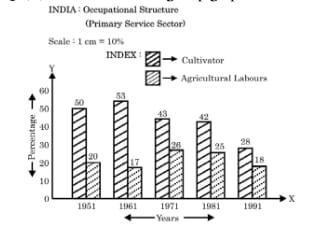
What is shown in the above graph?
Which decade has the maximum percentage of cultivators?
Which decade has the minimum percentage of agricultural labourers?
In the present graph, which factor has the maximum percentage in every decade?
In 1971, what is the percentage of cultivators and agricultural labour?
View Solution
(1) What is shown in the above graph?
The graph shows the occupational structure of India in terms of cultivators and agricultural labourers from 1951 to 1991. It displays the percentage of the population engaged in these two occupations, marking the changes over the decades.
(2) Which decade has the maximum percentage of cultivators?
The decade 1961 has the maximum percentage of cultivators, with 53% of the population engaged in cultivation.
(3) Which decade has the minimum percentage of agricultural labourers?
The decade 1991 has the minimum percentage of agricultural labourers, with only 18% of the population engaged in agricultural labour.
(4) In the present graph, which factor has the maximum percentage in every decade?
In each decade, cultivators have the maximum percentage compared to agricultural labourers, with cultivators consistently showing higher percentages throughout the decades.
(5) In 1971, what is the percentage of cultivators and agricultural labour?
In 1971, the percentage of cultivators is 43%, and the percentage of agricultural labour is 26%.
% Quicktip
\begin{quicktipbox
The graph shows a clear trend of decreasing percentages of cultivators and increasing percentages of agricultural labourers over the decades, reflecting changes in the agricultural sector and labour dynamics.
\end{quicktipbox Quick Tip: The graph shows a clear trend of decreasing percentages of cultivators and increasing percentages of agricultural labourers over the decades, reflecting changes in the agricultural sector and labour dynamics.
Write short notes on the following (Any THREE):
Reason 1 - Correlation between birth rate and death rate
(1) Correlation between birth rate and death rate
View Solution
The birth rate refers to the number of live births per 1,000 people in a given year, while the death rate refers to the number of deaths per 1,000 people in the same time period.
In a population, when the birth rate is higher than the death rate, the population grows. Conversely, if the death rate exceeds the birth rate, the population declines. In countries undergoing demographic transition, both birth rates and death rates fall, leading to slower population growth.
% Quicktip
\begin{quicktipbox
The correlation between birth rate and death rate influences the population growth of a country or region.
\end{quicktipbox Quick Tip: The correlation between birth rate and death rate influences the population growth of a country or region.
Read the following passage and answer the questions given below:
Considering the latitudinal distribution of animal husbandry in the world, it is located between 30°N to 60°N and 30°S to 55°S latitudes.
Climate is one of the most influencing factors in the development of animal husbandry. It is more developed in the Northern Hemisphere. Presence of grasslands in Australia and North and South America has led to the distribution of this occupation. But, this occupation is influenced by advanced technology, market, and availability of large estates.
It has developed on a commercial basis in North America, South America, and Australia. The animal husbandry in North and South America is carried out with the help of advanced technology on a commercial scale.
Dense forests, inhospitable climate, low-quality fodder in the equatorial region has discouraged the development of animal husbandry in these regions.
Questions:
In which latitude is the world distribution of animal husbandry found?
Which hemisphere has the maximum development of animal husbandry?
Which factor affects animal husbandry in Australia and South and North America continents?
Which continents have maximum mechanization of animal husbandry in the world?
View Solution
(1) In which latitude is the world distribution of animal husbandry found?
The world distribution of animal husbandry is found between latitudes of 30°N to 60°N and 30°S to 55°S.
(2) Which hemisphere has the maximum development of animal husbandry?
The Northern Hemisphere has the maximum development of animal husbandry due to favorable climatic conditions and the presence of large grasslands in regions like North America and Europe.
(3) Which factor affects animal husbandry in Australia and South and North America continents?
The primary factor affecting animal husbandry in Australia and North and South America is the availability of grasslands, which provide the necessary resources for large-scale livestock farming. Additionally, the use of advanced technology and the availability of large estates play a key role.
(4) Which continents have maximum mechanization of animal husbandry in the world?
North America, South America, and Australia have the maximum mechanization of animal husbandry in the world due to the use of advanced technology, large estates, and modern farming practices.
% Quicktip
\begin{quicktipbox
The development of animal husbandry is closely linked to environmental factors like climate and the availability of grasslands, as well as technological advancements and estate size.
\end{quicktipbox Quick Tip: The development of animal husbandry is closely linked to environmental factors like climate and the availability of grasslands, as well as technological advancements and estate size.
Draw neat, labelled diagrams (Any TWO):
Reason 1 - Stationary Pyramid
(1) Stationary Pyramid
View Solution
A stationary population pyramid indicates a stable population, where the birth rate and death rate are balanced, and the population size is not growing or shrinking. This is typically seen in developed countries with low birth and death rates.
\begin{figure[h]
\centering
\caption{Stationary Population Pyramid
\end{figure
% Quicktip
\begin{quicktipbox
Stationary population pyramids show equal numbers of people in each age group, indicating a stable population.
\end{quicktipbox Quick Tip: Stationary population pyramids show equal numbers of people in each age group, indicating a stable population.
(2) Circular Settlement
View Solution
Circular settlements are characterized by houses arranged around a central point, often seen in rural or agricultural communities. The central point is typically a water source or marketplace.
\begin{figure[h]
\centering
\caption{Circular Settlement Diagram
\end{figure
% Quicktip
\begin{quicktipbox
Circular settlements usually grow around central points like wells or markets, with roads radiating outwards.
\end{quicktipbox Quick Tip: Circular settlements usually grow around central points like wells or markets, with roads radiating outwards.
(3) Relationship of Geography with Other Subjects
View Solution
Geography is closely related to subjects like History, Economics, Biology, and Political Science. For example:
- History uses geography to understand the development of civilizations.
- Economics is linked to geography in terms of resource distribution and regional development.
- Biology studies ecosystems and species distribution, which is deeply influenced by geography.
- Political Science relates to geography through the study of borders, resources, and regional conflicts.
\begin{figure[h]
\centering
\caption{Relationship of Geography with Other Subjects
\end{figure
% Quicktip
\begin{quicktipbox
Geography plays a critical role in understanding natural processes and human activities, making it a link between multiple subjects.
\end{quicktipbox Quick Tip: Geography plays a critical role in understanding natural processes and human activities, making it a link between multiple subjects.
Answer the following questions in detail (Any ONE):
(1) Explain the human factors affecting the distribution of population.
View Solution
The distribution of population is influenced by both physical and human factors. While physical factors such as climate, topography, and natural resources play a significant role, human factors are also critical in shaping where people live. These factors include:
1. Economic Factors:
Regions with abundant economic opportunities, such as jobs, industries, and infrastructure, tend to have higher population densities. Urban areas with better employment opportunities, advanced industries, and higher wages attract more people, while rural areas with limited economic prospects experience lower population densities.
2. Social Factors:
The presence of good healthcare, education, and social services tends to attract populations to specific areas. People are more likely to live in regions with better social infrastructure, as they provide better living conditions for families and communities.
3. Political Factors:
Government policies such as migration laws, urban planning, and the provision of subsidies for industries in certain regions can significantly affect the distribution of population. Additionally, areas that offer political stability, security, and freedom attract more people, whereas areas affected by political unrest or wars may experience population decline.
4. Cultural and Historical Factors:
Historical factors, such as the development of cities, trade routes, and colonial settlements, have shaped population distribution over time. For example, major cultural centers or areas with religious significance often attract large populations. Moreover, migration driven by historical ties or ethnic affiliations can influence population distribution.
5. Technological Factors:
Advancements in technology, especially in transport and communication, have made it easier for people to move to and settle in different regions. Regions that have access to better technology and infrastructure, such as airports, highways, and modern industries, often witness greater population inflow.
6. Urbanization:
Urbanization is one of the most significant human factors affecting population distribution. As cities expand, they attract people from rural areas due to better living standards, healthcare, and education, leading to the growth of metropolitan regions.
% Quicktip
\begin{quicktipbox
Human factors such as economic opportunities, social services, and government policies play a crucial role in the distribution of population.
\end{quicktipbox Quick Tip: Human factors such as economic opportunities, social services, and government policies play a crucial role in the distribution of population.
(2) Explain the factors affecting trade.
View Solution
Trade between nations is influenced by a variety of factors, both natural and human-made. These factors determine the ease with which goods and services can be exchanged between countries and regions. The main factors affecting trade include:
1. Natural Resources:
The availability of natural resources such as oil, minerals, agricultural products, and water bodies for fishing plays a major role in determining a country’s trade. Nations rich in resources like petroleum or precious metals often trade these goods internationally to benefit economically.
2. Geography and Location:
A country’s location, including its proximity to trade routes, seas, and borders with other nations, is a crucial factor for trade. Countries with access to ports, waterways, and well-established trade routes tend to engage in more international trade.
3. Economic Policies and Tariffs:
Government policies, such as tariffs, subsidies, and trade agreements, directly affect the flow of goods across borders. Lower tariffs and trade agreements can encourage more trade between nations, while higher tariffs and protectionist policies can restrict trade.
4. Infrastructure:
The availability of efficient transportation networks (roads, railways, ports, and airports) and communication systems is vital for trade. Well-developed infrastructure ensures the smooth movement of goods and minimizes delays, reducing costs and improving efficiency.
5. Political Stability:
Countries that are politically stable tend to have more favorable trade relationships. Political instability or conflict can disrupt trade, hinder foreign investment, and lead to the imposition of sanctions, which negatively impacts trade.
6. Technology and Innovation:
Advancements in technology have made trade easier and faster. Improved transportation (like cargo ships, planes, and trucks) and communication systems (such as the internet) help in expanding trade. Innovations in logistics, manufacturing, and packaging also reduce costs and improve the volume of trade.
7. Demand and Supply:
The level of demand and supply of particular goods affects their trade. Countries may export goods that are in high demand and import those that are in short supply or not produced domestically.
% Quicktip
\begin{quicktipbox
Natural resources, infrastructure, economic policies, and political stability all play key roles in influencing international trade.
\end{quicktipbox Quick Tip: Natural resources, infrastructure, economic policies, and political stability all play key roles in influencing international trade.
*The article might have information for the previous academic years, please refer the official website of the exam.