
Maharashtra Board 2025 Class 12 History Question Paper PDF with Solutions


Content Writer | Updated On - Sep 14, 2025
The Maharashtra Board Class 12 History Question Paper PDF with Solutions is available for download. The Maharashtra State Board of Secondary and Higher Secondary Education (MSBSHSE) conducted the Class 12 History examination for a total duration of 3 hours, and the question paper had a total of 80 marks.
Maharastra Board Class 12 History Question Paper with Solutions
| Maharastra Board Class 12 History Question Paper with Solutions | Download PDF | Check Solutions |
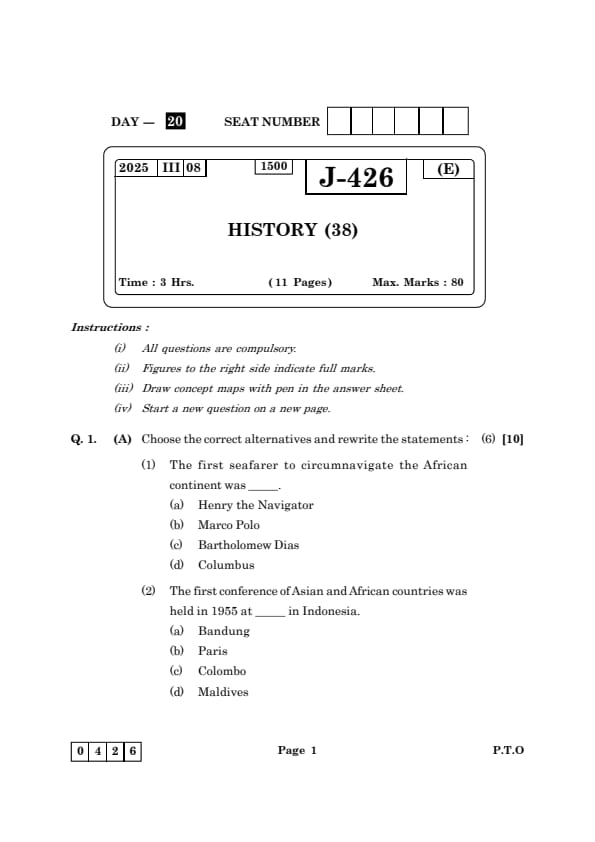
Choose the correct alternatives and rewrite the statements:
The first seafarer to circumnavigate the African continent was .........
View Solution
Step 1: Understanding the question.
The question is asking for the first person to successfully navigate around the African continent.
Step 2: Historical context.
- Henry the Navigator was instrumental in advancing Portuguese maritime exploration but did not circumnavigate Africa.
- Marco Polo was an explorer of Asia, not Africa.
- Bartholomew Dias was the first to successfully navigate around the southern tip of Africa (Cape of Good Hope), opening the sea route to Asia.
- Columbus was famous for discovering the Americas, not Africa.
Step 3: Conclusion.
Bartholomew Dias is the correct answer as he was the first to reach the southern tip of Africa in 1488.
Final Answer: \[ \boxed{(c) \; Bartholomew \; Dias} \] Quick Tip: Bartholomew Dias was the first to sail around the southern tip of Africa, proving the route to Asia by sea.
The first conference of Asian and African countries was held in 1955 at ........... in Indonesia.
View Solution
Step 1: Recall the historical event.
The first Asian-African Conference, also known as the Bandung Conference, was held in 1955 in Bandung, Indonesia. The conference aimed to promote economic and cultural cooperation among the newly independent Asian and African countries and was significant for the development of the Non-Aligned Movement.
Step 2: Conclusion.
The correct answer is Bandung, where the conference was held.
Final Answer: \[ \boxed{(a) \; Bandung} \] Quick Tip: The Bandung Conference in 1955 was a landmark in the history of post-colonial international relations.
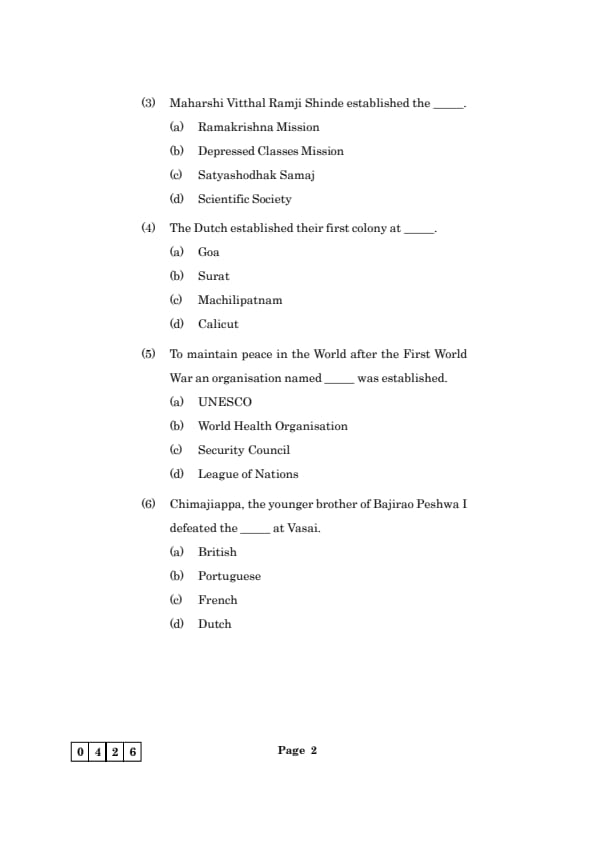
Maharshi Vitthal Ramji Shinde established the ..............
View Solution
Step 1: Understand the historical context.
Maharshi Vitthal Ramji Shinde was a social reformer in India who played an important role in the upliftment of the Depressed Classes (lower castes) in the 19th century. He founded the Depressed Classes Mission to promote their welfare.
Step 2: Conclusion.
The correct answer is the Depressed Classes Mission, which was established by Maharshi Vitthal Ramji Shinde.
Final Answer: \[ \boxed{(b) \; Depressed \; Classes \; Mission} \] Quick Tip: Maharshi Vitthal Ramji Shinde was one of the key figures in the movement to uplift the Dalits and backward classes.
The Dutch established their first colony at ...............
View Solution
Step 1: Historical reference.
The Dutch first established a colony in India at Calicut (in present-day Kerala) in 1605. The Dutch East India Company took control of the spice trade and established its presence in the region.
Step 2: Conclusion.
The correct answer is Calicut, where the Dutch established their first colony.
Final Answer: \[ \boxed{(d) \; Calicut} \] Quick Tip: The Dutch East India Company played a major role in colonial trade in India, especially in spices.
To maintain peace in the World after the First World War an organisation named ........ was established.
View Solution
Step 1: Understand the historical context.
The League of Nations was established after World War I in 1920 as part of the Treaty of Versailles. Its primary aim was to maintain world peace and prevent future conflicts. However, it failed to prevent World War II.
Step 2: Conclusion.
The correct answer is the League of Nations, which was established to maintain peace after World War I.
Final Answer: \[ \boxed{(d) \; League \; of \; Nations} \] Quick Tip: The League of Nations was the precursor to the United Nations, which was formed after World War II.
Chimajiappa, the younger brother of Bajirao Peshwa I defeated the ........... at Vasai.
View Solution
Step 1: Historical context.
Chimajiappa, the brother of Bajirao Peshwa I, led the Marathas in the battle of Vasai against the Portuguese in 1739. He successfully defeated the Portuguese and secured Maratha control over the region.
Step 2: Conclusion.
The correct answer is Portuguese, as Chimajiappa defeated them at Vasai.
Final Answer: \[ \boxed{(b) \; Portuguese} \] Quick Tip: Chimajiappa's victory at Vasai was a significant event in the Maratha Empire's struggle against European colonial powers.
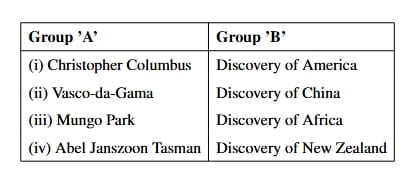
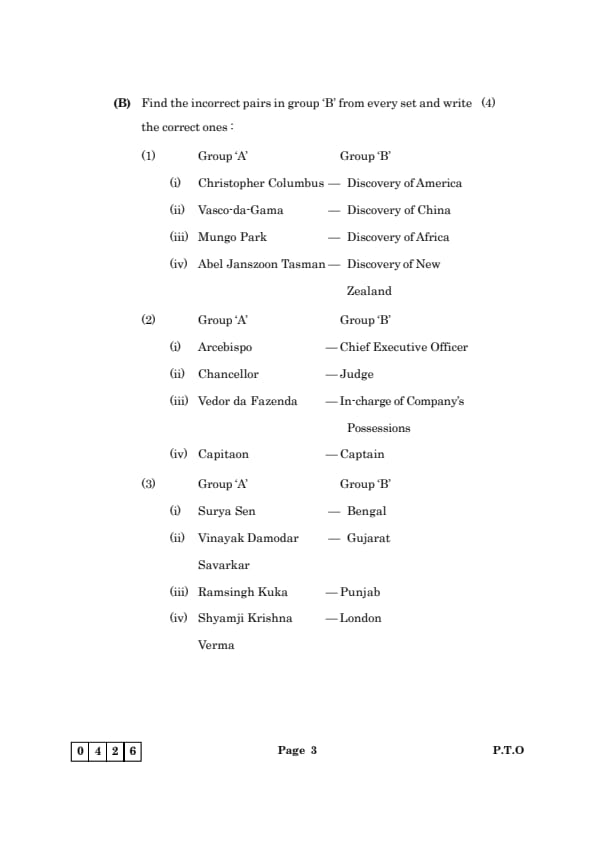
Find the incorrect pairs in group 'B' from every set and write the correct ones:
View Solution
Step 1: Identify the incorrect pairs.
- Christopher Columbus is credited with discovering America, so this pair is correct.
- Vasco-da-Gama is often associated with the discovery of the sea route to India, not China, making this pair incorrect.
- Mungo Park is known for exploring parts of Africa, specifically the Niger River, so this pair is correct.
- Abel Janszoon Tasman is famous for discovering Tasmania, not New Zealand, which makes this pair incorrect.
Step 2: Write the correct pairs.
The correct pairs should be:
- Vasco-da-Gama - Discovery of India
- Abel Janszoon Tasman - Discovery of Tasmania
Final Answer: \[ \boxed{(ii) \; Vasco-da-Gama \; - \; Discovery \; of \; India}
\boxed{(iv) \; Abel \; Janszoon \; Tasman \; - \; Discovery \; of \; Tasmania} \] Quick Tip: Vasco-da-Gama's voyage to India in 1498 marked a key moment in the Age of Discovery. Abel Tasman, on his voyages, reached Tasmania and the western coast of New Zealand but did not "discover" New Zealand as commonly believed.
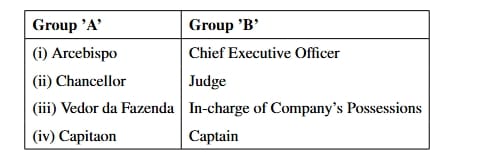
Find the incorrect pairs in group 'B' from every set and write the correct ones:
View Solution
Step 1: Identify the incorrect pairs.
- Arcebispo is the Portuguese term for "Archbishop," so the pair with Chief Executive Officer is incorrect.
- Chancellor is a title for a senior official, especially in universities or governments, not a judge, so this pair is incorrect.
- Vedor da Fazenda refers to a treasurer in Portuguese history, not an "In-charge of Company's Possessions," making this pair incorrect.
- Capitaon is a misspelling of Captain, so this pair is correct (it’s simply a typographical error).
Step 2: Write the correct pairs.
The correct pairs should be:
- Arcebispo - Archbishop
- Chancellor - Head of University or Government
- Vedor da Fazenda - Treasurer
Final Answer: \[ \boxed{(i) \; Arcebispo \; - \; Archbishop}
\boxed{(ii) \; Chancellor \; - \; Head \; of \; University}
\boxed{(iii) \; Vedor \; da \; Fazenda \; - \; Treasurer} \] Quick Tip: Chancellor titles vary by country and institution; in most European contexts, they are associated with universities or government positions, not judiciary roles.
Find the incorrect pairs in group 'B' from every set and write the correct ones:

View Solution
Step 1: Identify the incorrect pairs.
- Surya Sen is famously associated with Bengal for his involvement in the Chittagong Armoury Raid, so this pair is correct.
- Vinayak Damodar Savarkar is associated with the Andaman Islands and the Cellular Jail, not Gujarat, making this pair incorrect.
- Ramsingh Kuka is often associated with the Kuka movement, which was primarily centered in Punjab, but it was more connected to Haryana. Therefore, this pair is incorrect.
- Shyamji Krishna Verma, who spent significant time in London leading the movement for Indian independence, has the correct pair with London.
Step 2: Write the correct pairs.
The correct pairs should be:
- Vinayak Damodar Savarkar - Andaman
- Ramsingh Kuka - Haryana
Final Answer: \[ \boxed{(ii) \; Vinayak \; Damodar \; Savarkar \; - \; Andaman}
\boxed{(iii) \; Ramsingh \; Kuka \; - \; Haryana} \] Quick Tip: Vinayak Damodar Savarkar's association with the Andaman Cellular Jail played a significant role in his later life and political activities.
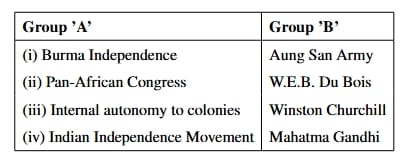
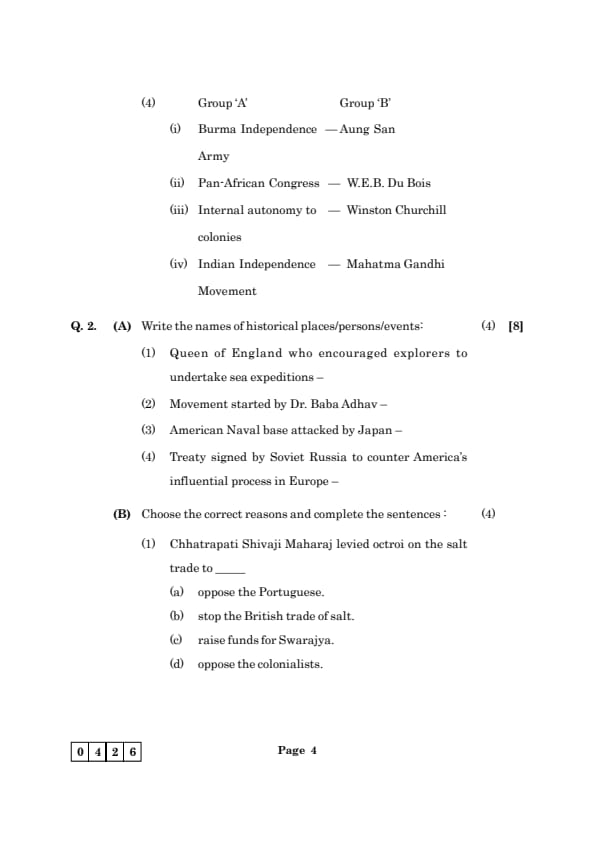
Find the incorrect pairs in group 'B' from every set and write the correct ones:
View Solution
Step 1: Identify the incorrect pairs.
- Burma Independence is correctly associated with the Aung San Army, as Aung San played a key role in Burma's independence from British rule.
- The Pan-African Congress is associated with W.E.B. Du Bois, but it was Kwame Nkrumah who was a central figure in the Pan-African movement in later years.
- Winston Churchill, while a key figure in British politics, is not the right person for internal autonomy to colonies, as he opposed granting significant autonomy to the colonies.
- Indian Independence Movement is correctly associated with Mahatma Gandhi, as he was the leader of the Indian independence movement.
Step 2: Write the correct pairs.
The correct pairs should be:
- Pan-African Congress - Kwame Nkrumah
- Internal autonomy to colonies - British Government
Final Answer: \[ \boxed{(ii) \; Pan-African \; Congress \; - \; Kwame \; Nkrumah}
\boxed{(iii) \; Internal \; autonomy \; to \; colonies \; - \; British \; Government} \] Quick Tip: W.E.B. Du Bois was an important figure in the Pan-African Congress, but Kwame Nkrumah played a more significant role in its post-colonial evolution. Winston Churchill's policies were often against granting autonomy to colonies.
Write the names of historical places/persons/events:
(1) Queen of England who encouraged explorers to undertake sea expeditions
(2) Movement started by Dr. Baba Adhav
(3) American Naval base attacked by Japan
(4) Treaty signed by Soviet Russia to counter America’s influential process in Europe
View Solution
Queen of England who encouraged explorers to undertake sea expeditions - Queen Elizabeth I
Movement started by Dr. Baba Adhav - Bharat Nirmal Movement
American Naval base attacked by Japan - Pearl Harbor
Treaty signed by Soviet Russia to counter America’s influential process in Europe - Warsaw Pact Quick Tip: Queen Elizabeth I's support for exploration was crucial in the Age of Discovery. The Pearl Harbor attack in 1941 led to the United States' entry into World War II.
Choose the correct reasons and complete the sentences:
View Solution
Step 1: Understanding the reason for the levy.
Chhatrapati Shivaji Maharaj, during his rule, was focused on strengthening Swarajya (self-rule). One of the methods he employed to support his administration and military was the collection of taxes on essential goods like salt, which would generate income for the state.
Step 2: Historical context.
Shivaji Maharaj’s objective was to raise funds for his administration and to build a strong independent Maratha empire, not specifically to oppose the Portuguese or the British in the salt trade.
Step 3: Conclusion.
Therefore, the correct answer is that Shivaji Maharaj levied octroi on the salt trade to raise funds for Swarajya.
Final Answer: \[ \boxed{(c) \; raise \; funds \; for \; Swarajya} \] Quick Tip: Shivaji Maharaj's administration relied on local taxes like octroi to fund the establishment of a self-sustaining and strong Maratha Empire.
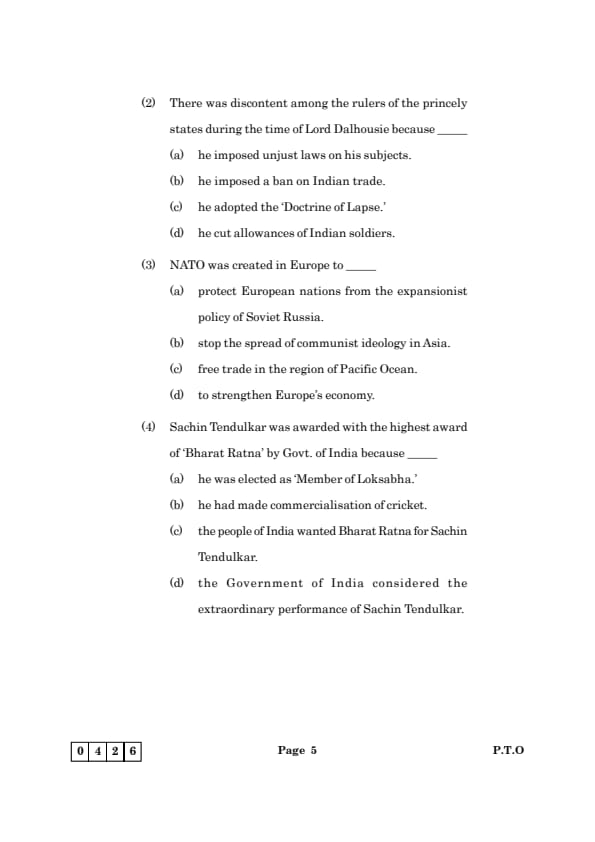
There was discontent among the rulers of the princely states during the time of Lord Dalhousie because ...........
View Solution
Step 1: Understand the historical context.
The Doctrine of Lapse was introduced by Lord Dalhousie in the mid-19th century. It allowed the British to annex any princely state if the ruler died without a natural heir. This policy caused discontent among Indian rulers, as it led to the annexation of several states like Satara, Jhansi, and others.
Step 2: Conclusion.
The correct reason for the discontent among rulers was Lord Dalhousie's adoption of the Doctrine of Lapse.
Final Answer: \[ \boxed{(c) \; he \; adopted \; the \; 'Doctrine \; of \; Lapse.'} \] Quick Tip: The Doctrine of Lapse played a significant role in the annexation of various princely states and heightened tensions leading up to the Revolt of 1857.
NATO was created in Europe to ........
View Solution
Step 1: Understand NATO's purpose.
NATO (North Atlantic Treaty Organization) was created in 1949 primarily to counter the expansionist policies of the Soviet Union during the Cold War. It aimed to provide collective security against the threat of Soviet aggression in Europe.
Step 2: Conclusion.
The correct answer is that NATO was created to protect European nations from the expansionist policy of Soviet Russia.
Final Answer: \[ \boxed{(a) \; protect \; European \; nations \; from \; the \; expansionist \; policy \; of \; Soviet \; Russia.} \] Quick Tip: NATO played a crucial role in the Cold War, maintaining a military alliance against the Soviet Union and later expanding to include former Eastern Bloc countries.
Sachin Tendulkar was awarded the highest award of 'Bharat Ratna' by Govt. of India because .............
View Solution
Step 1: Understand the award.
Sachin Tendulkar, widely regarded as one of the greatest cricketers of all time, was awarded the Bharat Ratna in 2014 for his exceptional contributions to Indian cricket. The Government of India recognized his extraordinary achievements on the field, including his records and achievements.
Step 2: Conclusion.
The correct reason for his receiving the Bharat Ratna is the recognition of his extraordinary performance in cricket.
Final Answer: \[ \boxed{(d) \; the \; Government \; of \; India \; considered \; the \; extraordinary \; performance \; of \; Sachin \; Tendulkar.} \] Quick Tip: Sachin Tendulkar's contributions to cricket made him the first sportsman to receive India's highest civilian award, Bharat Ratna.
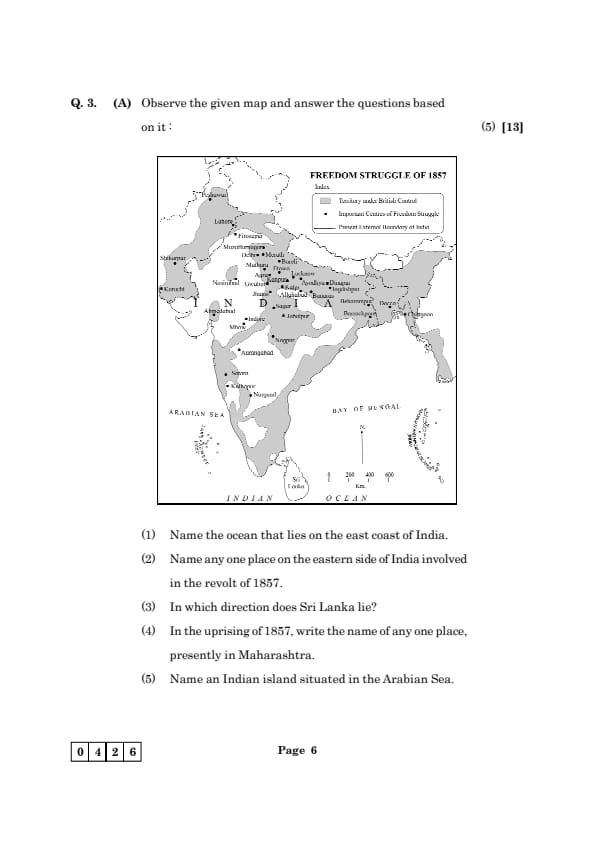
Observe the given map and answer the questions based on it:
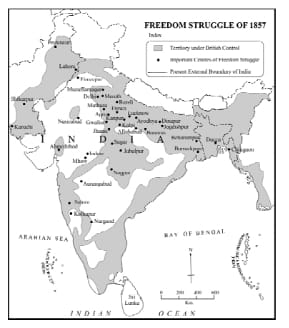
(1) Name the ocean that lies on the east coast of India.
(2) Name any one place on the eastern side of India involved in the revolt of 1857.
(3) In which direction does Sri Lanka lie?
(4) In the uprising of 1857, write the name of any one place, presently in Maharashtra.
(5) Name an Indian island situated in the Arabian Sea.
View Solution
Name the ocean that lies on the east coast of India - Bay of Bengal.
Name any one place on the eastern side of India involved in the revolt of 1857 - Calcutta (now Kolkata).
In which direction does Sri Lanka lie? - South of India.
In the uprising of 1857, write the name of any one place, presently in Maharashtra - Aurangabad.
Name an Indian island situated in the Arabian Sea - Diu. Quick Tip: The 1857 revolt, known as India's First War of Independence, involved several key locations in both northern and southern India. The map highlights significant sites of this struggle.
Complete the concept maps (Any FOUR):
View Solution
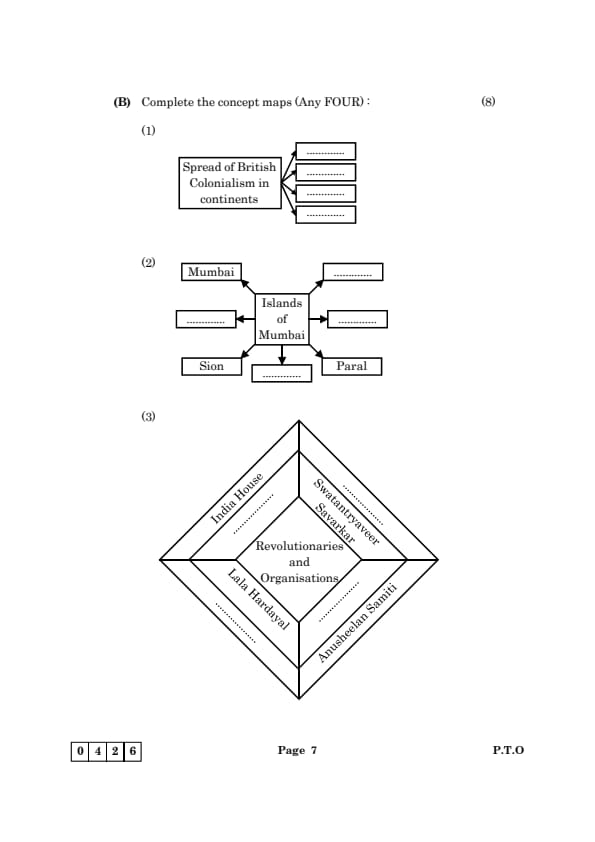
(1)
Spread of British Colonialism in Continents:
Asia - British rule in India, Burma, and Malaya.
Africa - British Empire in Egypt, South Africa, Kenya.
Australia - British colonization of Australia and Tasmania.
North America - British colonies like New York, Canada, and the Thirteen Colonies. Quick Tip: The British Empire was the largest empire in history, covering vast territories across Asia, Africa, and the Americas. It was marked by both exploitation and the spread of British culture and institutions.
Complete the concept maps (Any FOUR):
View Solution
Islands of Mumbai:
Mumbai - A cluster of islands and now part of the city of Mumbai.
Sion - Sion is an area on the main island of Mumbai and close to the eastern part of the city.
Paral - An island located to the north of Mumbai, part of the group of small islands near the coast.
Elephanta - Famous for its ancient rock-cut temples and caves.
Worli - Part of the Mumbai city and located to the west of Sion and near the sea.
Colaba - A peninsula and important part of Mumbai. Quick Tip: Mumbai, originally a series of islands, was merged over time through land reclamation and human intervention to become the city it is today. Elephanta Island is particularly famous for its cave temples.
Complete the concept maps (Any FOUR):
View Solution
Revolutionaries and Organisations:
India House - Established by Shyamji Krishna Verma to inspire Indian youth and promote independence from British rule.
Swatantryaveer Savarkar - A revolutionary leader, one of the key figures in the freedom movement who promoted the idea of Hindutva.
Lala Hardayal - A prominent freedom fighter and intellectual, one of the leading members of the Ghadar Party.
Anushilan Samiti - A revolutionary organisation founded in Bengal, which played a key role in the revolutionary movement in the early 20th century. Quick Tip: India House in London and the Ghadar Party were both significant in inspiring revolutionary movements to free India from British rule. Lala Hardayal was deeply involved in both.
Complete the concept maps (Any FOUR):
View Solution
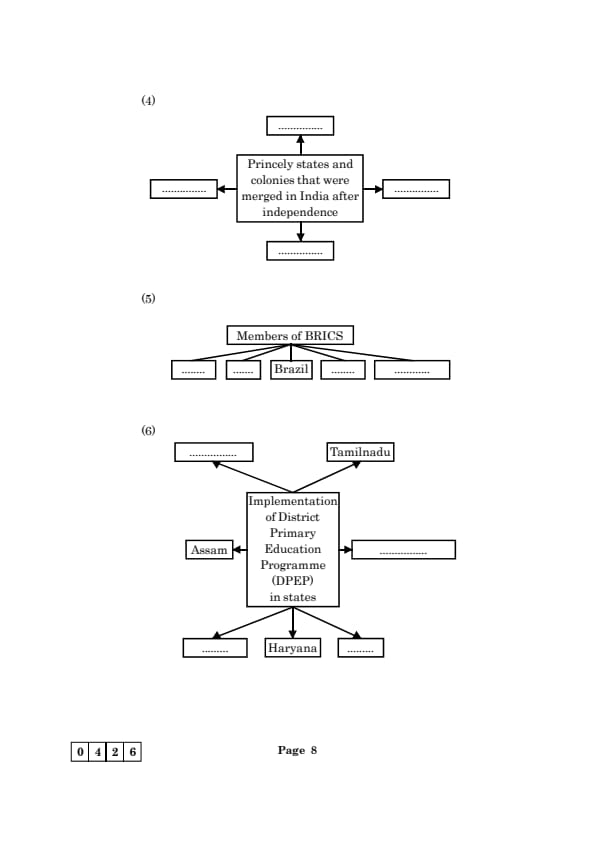
Princely States and Colonies that were merged in India after independence:
Hyderabad - One of the largest princely states, merged with India in 1948 after Operation Polo.
Junagadh - A princely state in Gujarat, which acceded to India in 1947.
Goa - A Portuguese colony, merged with India in 1961 after military intervention.
Kashmir - The princely state of Jammu and Kashmir, which acceded to India in 1947 after the partition. Quick Tip: The integration of princely states into the Indian Union was a complex process, with several states initially reluctant to join due to political reasons or pressure from the British.
Complete the concept maps (Any FOUR):
View Solution
Members of BRICS:
Brazil
Russia
India
China
South Africa Quick Tip: BRICS is an association of five major emerging economies: Brazil, Russia, India, China, and South Africa. They collaborate on economic, political, and social issues to enhance their global influence.
Complete the concept maps (Any FOUR):
View Solution
Implementation of District Primary Education Programme (DPEP) in States:
Assam
Tamil Nadu
Haryana
Kerala
Madhya Pradesh Quick Tip: The DPEP program was launched in India in the 1990s to improve primary education access, quality, and enrollment rates in various states across the country.
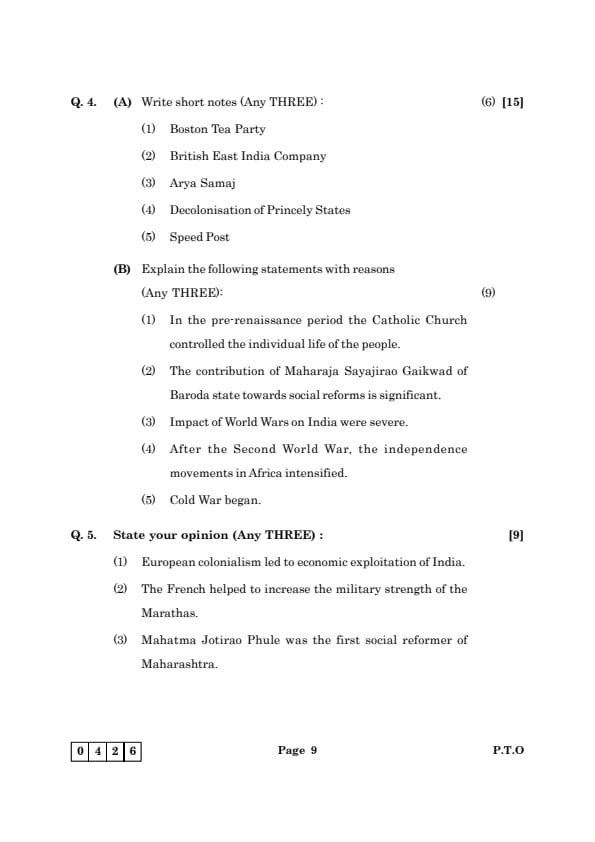
Write short notes (Any THREE):
(1) Boston Tea Party:
View Solution
N/A
(2) British East India Company:
View Solution
N/A
(3) Arya Samaj:
View Solution
N/A
(4) Decolonisation of Princely States:
View Solution
N/A
(5) Speed Post:
View Solution
Speed Post is a premium postal service offered by India Post, introduced in 1986, to provide fast and reliable mail delivery across India and internationally. It guarantees delivery within a specific time frame, often within 1-2 days for domestic deliveries and varying times for international shipments. Speed Post offers tracking, insurance, and delivery confirmation services, making it one of the most widely used and trusted postal services in India for sending documents and parcels quickly. Quick Tip: The Arya Samaj’s emphasis on education and social reform played a major role in the intellectual awakening in India during the 19th century, paving the way for many other reform movements.
Explain the following statements with reasons (Any THREE):
(1) In the pre-renaissance period the Catholic Church controlled the individual life of the people.
View Solution
N/A
(2) The contribution of Maharaja Sayajirao Gaikwad of Baroda state towards social reforms is significant.
View Solution
N/A
(3) Impact of World Wars on India were severe.
View Solution
N/A
(4) After the Second World War, the independence movements in Africa intensified.
View Solution
N/A
(5) Cold War began.
View Solution
Explanation:
The Cold War began after the Second World War, primarily between the two emerging superpowers: the United States and the Soviet Union. The ideological differences between the capitalist West (led by the US) and the communist East (led by the Soviet Union) led to a global political and military rivalry. The Cold War was marked by an arms race, nuclear weapons buildup, and proxy wars, but direct military conflict between the US and USSR was avoided. The world became divided into two blocs: the Western bloc, led by the US, and the Eastern bloc, led by the Soviet Union. The Cold War had a profound impact on global politics for nearly half a century, shaping international relations and leading to events like the Cuban Missile Crisis, the Vietnam War, and the eventual collapse of the Soviet Union. Quick Tip: The Cold War shaped international relations for decades, influencing global conflicts, economic policies, and the balance of power. It ended with the dissolution of the Soviet Union in 1991, marking the end of the bipolar world order.
State your opinion (Any THREE):
(1) European colonialism led to economic exploitation of India.
View Solution
N/A
(2) The French helped to increase the military strength of the Marathas.
View Solution
N/A
(3) Mahatma Jyotirao Phule was the first social reformer of Maharashtra.
View Solution
N/A
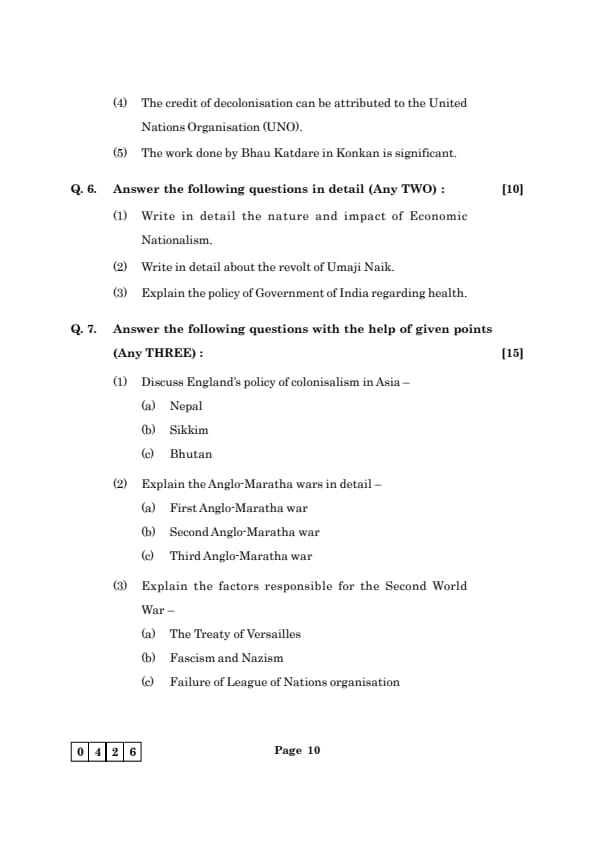
(4) The credit of decolonisation can be attributed to the United Nations Organisation (UNO).
View Solution
N/A
(5) The work done by Bhau Katdare in Konkan is significant.
View Solution
Opinion:
Bhau Katdare was a social reformer from the Konkan region, who worked towards the upliftment of the marginalized sections of society, especially the lower castes. His efforts in Konkan were focused on improving the social and economic conditions of the Dalits and other oppressed communities. Bhau Katdare's advocacy for education, his fight against untouchability, and his support for the betterment of the rural population made him an influential figure in Maharashtra's social reform movement. His work has had a lasting impact on the Konkan region and contributed to the wider social change in the state. Quick Tip: The contributions of social reformers like Jyotirao Phule and Bhau Katdare were instrumental in laying the foundation for India's social justice movements, which continue to inspire reform even today.
Answer the following questions in detail (Any TWO):
(1) Write in detail the nature and impact of Economic Nationalism.
View Solution
N/A
(2) Write in detail about the revolt of Umaji Naik.
View Solution
N/A
(3) Explain the policy of Government of India regarding health.
View Solution
Explanation:
The Government of India has always placed a strong emphasis on the health of its citizens, and several policies have been introduced to improve the overall health standards in the country. The primary focus of India’s health policies has been to address issues like malnutrition, maternal and child health, sanitation, and the prevention and control of infectious diseases.
National Health Policy (NHP):
The National Health Policy (NHP) of India was first formulated in 1983, with an aim to provide universal access to healthcare services. The NHP aims to reduce the disparities in health service delivery and increase healthcare access in rural and remote areas. The 2002 version of the policy focused on increasing the private sector’s involvement in healthcare and establishing more efficient healthcare delivery systems.
Recent Developments:
India’s health policy has also evolved with the introduction of the National Rural Health Mission (NRHM) in 2005, which aimed to improve healthcare infrastructure in rural areas, and the Ayushman Bharat scheme in 2018, aimed at providing health insurance coverage for vulnerable families. These initiatives have improved access to healthcare services, reduced health disparities, and focused on creating an efficient healthcare system.
Impact:
These policies have significantly reduced mortality rates, increased life expectancy, and improved health outcomes. However, challenges remain, such as the high burden of non-communicable diseases, shortage of healthcare professionals, and inadequate funding for the public health system. Quick Tip: India’s National Health Policy aims to make healthcare accessible, affordable, and effective for all sections of society, with a particular focus on vulnerable and underserved populations.
(a) Nepal
View Solution
N/A
(b) Sikkim
View Solution
N/A
(c) Bhutan
View Solution
Bhutan’s relationship with British colonialism was shaped by its location between British India and Tibet. The British first intervened in Bhutan’s affairs in the early 19th century due to concerns over trade routes and strategic interests. Following the Bhutan War (1864-1865), the British forced Bhutan to cede some territories and accept British suzerainty. Bhutan remained an autonomous kingdom under British influence until India’s independence in 1947, after which Bhutan became an independent kingdom with close relations to India. Quick Tip: The British employed various strategies to control neighboring regions like Nepal, Sikkim, and Bhutan, balancing between direct colonial rule and indirect influence through protectorates and treaties.
Explain the Anglo-Maratha wars in detail –
(a) First Anglo-Maratha War (1775-1782):
View Solution
N/A
(b) Second Anglo-Maratha War (1803-1805):
View Solution
N/A
(c) Third Anglo-Maratha War (1817-1818):
View Solution
Explanation:
The Third Anglo-Maratha War was the final and decisive conflict between the British East India Company and the Maratha Empire. After the Marathas attempted to resist British influence in India and sought to restore their power, the British declared war. The conflict saw a series of battles, culminating in the Battle of Koregaon, where the British decisively defeated the Marathas. The Peshwa, Baji Rao II, was defeated and exiled to Bithoor. The Maratha Empire effectively ceased to exist, and the British became the undisputed rulers of most of India, marking the end of Maratha power and the establishment of British hegemony. Quick Tip: The Anglo-Maratha Wars were crucial in shaping the future of British India. After the Third Anglo-Maratha War, the Marathas were significantly weakened, and the British East India Company consolidated control over India.
Explain the factors responsible for the Second World War –
(a) The Treaty of Versailles
View Solution
N/A
(b) Fascism and Nazism
View Solution
N/A
(c) Failure of League of Nations Organisation
View Solution
Explanation:
The League of Nations, established after World War I with the aim of maintaining peace and preventing future conflicts, failed to prevent the outbreak of the Second World War. The League lacked the authority and military power to enforce its decisions and relied on collective security, which proved ineffective. Several major powers, including the United States, did not join the League, weakening its ability to act decisively. Additionally, the League failed to prevent the aggressive actions of fascist powers, such as Italy's invasion of Ethiopia and Germany's remilitarization of the Rhineland. The League's inability to curb these acts of aggression led to the erosion of international trust in its ability to maintain peace, directly contributing to the outbreak of World War II. Quick Tip: The Treaty of Versailles, along with the rise of fascism and the failure of the League of Nations, created an environment where conflict was inevitable, leading to the outbreak of the Second World War.
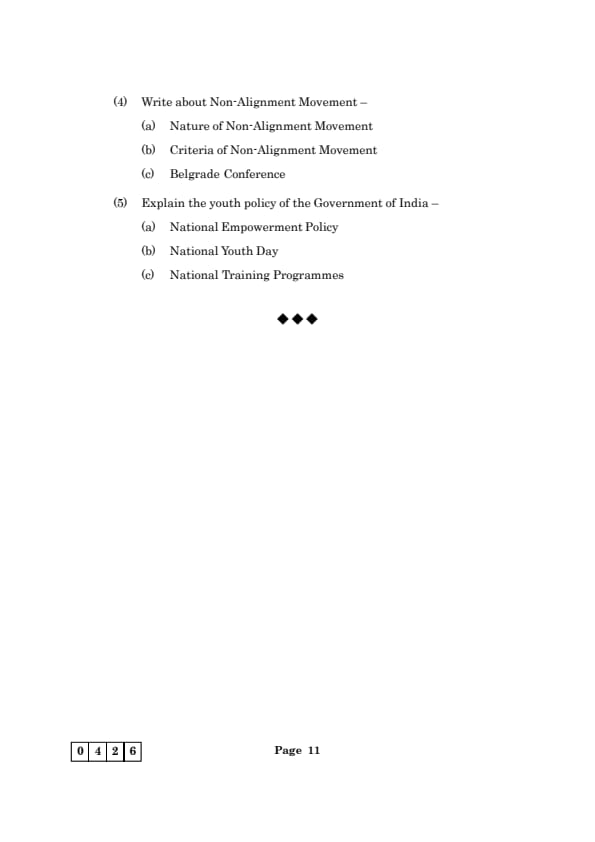
Write about Non-Alignment Movement –
(a) Nature of Non-Alignment Movement
View Solution
N/A
(b) Criteria of Non-Alignment Movement
View Solution
N/A
(c) Belgrade Conference
View Solution
Explanation:
The Belgrade Conference was held in 1961 in Yugoslavia and marked the first official conference of the Non-Alignment Movement. The conference brought together representatives from 25 countries, including key leaders such as Jawaharlal Nehru (India), Gamal Abdel Nasser (Egypt), and Josip Broz Tito (Yugoslavia). The conference focused on advocating for the promotion of world peace, independence, and solidarity among developing countries. The main aim was to avoid military and political alignment with either the US or the Soviet Union during the Cold War. The Belgrade Conference also laid the foundations for the movement’s principles and strategy, emphasizing neutrality, non-interference, and collective action for global peace. Quick Tip: The Non-Alignment Movement was significant during the Cold War as it gave smaller and newly independent nations a platform to assert their independence and push for peaceful coexistence.
Explain the youth policy of the Government of India –
(a) National Empowerment Policy
View Solution
N/A
(b) National Youth Day
View Solution
N/A
(c) National Training Programmes
View Solution
Explanation:
National Training Programmes refer to the various skill development and training initiatives organized by the Government of India aimed at empowering the youth with relevant skills to enhance employability and productivity. The government runs a number of training schemes, such as those under the Skill India Mission, to equip young people with technical, vocational, and soft skills. These programs are designed to meet the demands of different industries and sectors, providing opportunities for the youth to receive training and certifications that enhance their career prospects. The aim is to address the skill gap in the workforce and promote self-employment among young people. Quick Tip: Youth empowerment and skill development are key to achieving India's socio-economic growth. Programs like the National Youth Day and National Training Programs are vital for youth development and employment opportunities.
*The article might have information for the previous academic years, please refer the official website of the exam.