
Maharashtra Board 2024 Class 12 Mathematics and Statistics Question Paper PDF - Check Solutions with Answer Key Pdf (40-J-862)


Content Writer | Updated On - Feb 26, 2025
Maharashtra Board Class 12 2024 Mathematics and Statistics Question Paper (40-J-826) PDF for free download. Conducted by MSBSHSE in February 2024, the exam, worth 80 marks and lasting 3 hours, tested students on key topics. As per initial student feedback, the Maharashtra Board Class 12 Mathematics and Statistics 2024 question paper was rated Moderate. Calculus and Probability sections were Easy to Moderate, while Statistics and Algebra were Moderate to Difficult.
Maharashtra Board Question Paper 2024 Class 12th PDF Maths
Candidates can use the link below to download the Maharashtra Board Class 12 Mathematics and Statistics (40-J-862) Question Paper with detailed solutions.
| Maharashtra Board Maths Question Paper 2024 Class 12th With Answer Key |  Download Download |
Check Solutions |

Maharashtra Board Question Paper 2024 Class 12th Maths Solutions
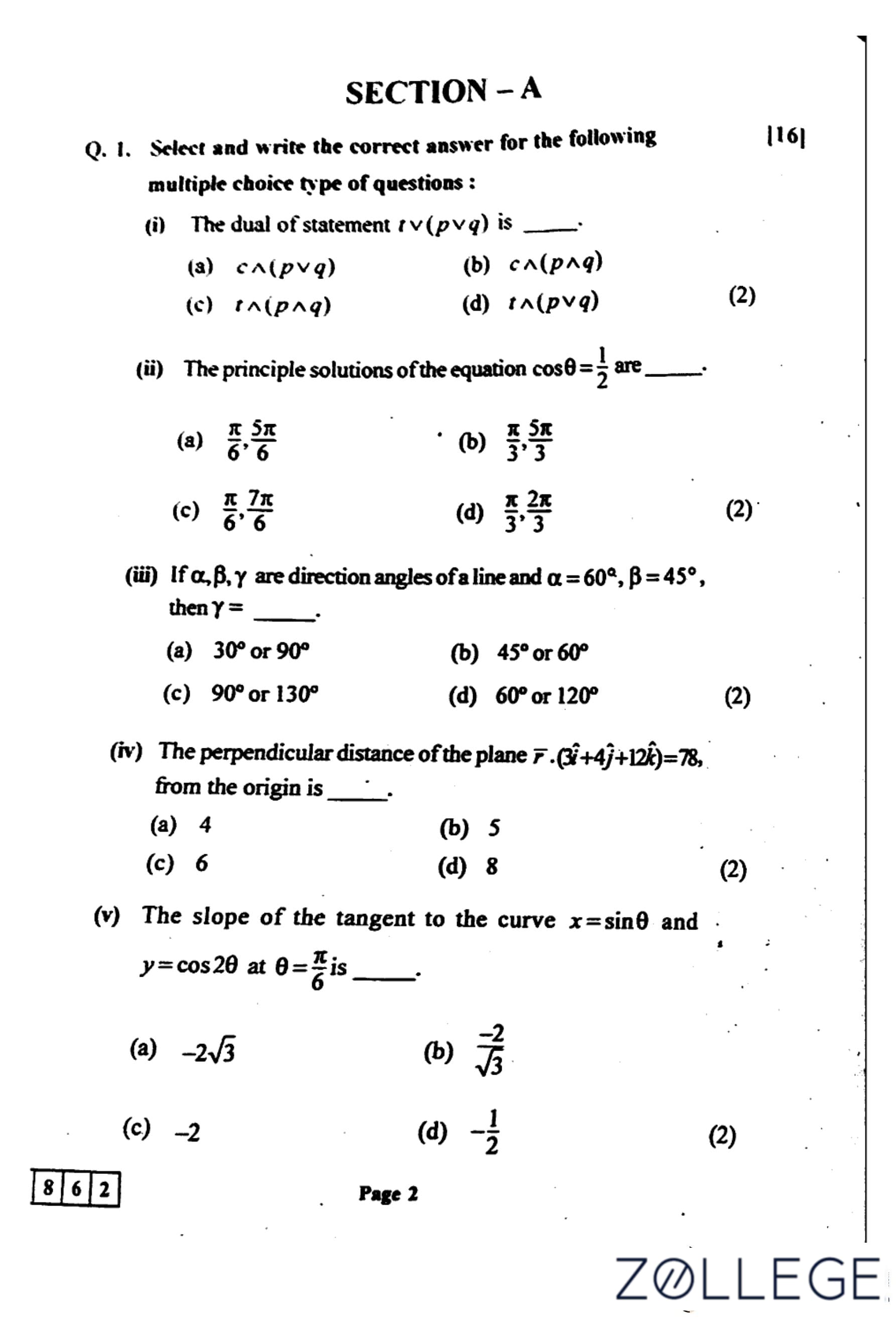
Question 1. Select and write the correct answer for the following multiple-choice type of questions:(i) The dual of statement t ∨ (p ∨ q) is ____.
(Identify the correct answer from the given options and rewrite.)
View Solution
Step 1: In logical duality, we replace:
- ∨ (OR) with ∧ (AND), and vice versa.
- 1 with 0, and vice versa.
Step 2: Applying duality to the given statement:
t ∨ (p ∨ q) → t ∧ (p ∧ q)
Quick Tip: In logical duality, swap ∨ with ∧ while keeping the order unchanged.
(ii) The principal solutions of the equation cosθ = 1/2 are ____.
(Identify the correct answer from the given options and rewrite.)
View Solution
Step 1: Finding the general solutions:
The equation cosθ = 1/2 holds at:
θ = ± cos⁻¹(1/2) + 2kπ, k ∈ ℤ
Step 2: Principal solutions within [0, 2π]:
θ = π/3, 5π/3.
Quick Tip: For cosθ = a, the principal solutions are θ = ±cos⁻¹(a) in the given domain.
(iii) If α, β, γ are direction angles of a line and α = 60°, β = 45°, then γ is ____.
(Identify the correct answer from the given options and rewrite.)
View Solution
Step 1: Use the equation of direction cosines:
cos²α + cos²β + cos²γ = 1
Step 2: Substituting given values:
cos²(60°) + cos²(45°) + cos²γ = 1
(1/4) + (1/2) + cos²γ = 1
cos²γ = 1/4
γ = 60° or 120°.
Quick Tip: The sum of squares of the direction cosines is always equal to 1.
(iv) The perpendicular distance of the plane r · (3î + 4ĵ + 12k̂) = 78 from the origin is ____.
(Identify the correct answer from the given options and rewrite.)
View Solution
Step 1: The perpendicular distance of a plane Ax + By + Cz = D from the origin is given by:
d = |D| / √(A² + B² + C²)
Step 2: Substituting values:
A = 3, B = 4, C = 12, D = 78
d = |78| / √(3² + 4² + 12²) = 78 / √169 = 78 / 13 = 6.
(v) The slope of the tangent to the curve x = sinθ and y = cos 2θ at θ = π/6 is ____.
(Identify the correct answer from the given options and rewrite.)
View Solution
Step 1: Compute dx/dθ and dy/dθ:
dx/dθ = cosθ, dy/dθ = -2sin2θ
Step 2: Compute dy/dx:
dy/dx = (dy/dθ) / (dx/dθ) = (-2sin 2θ) / cosθ
Step 3: Evaluate at θ = π/6:
sin 2θ = sin π/3 = √3/2, cosθ = √3/2
dy/dx = (-2 × √3/2) / (√3/2) = -2.
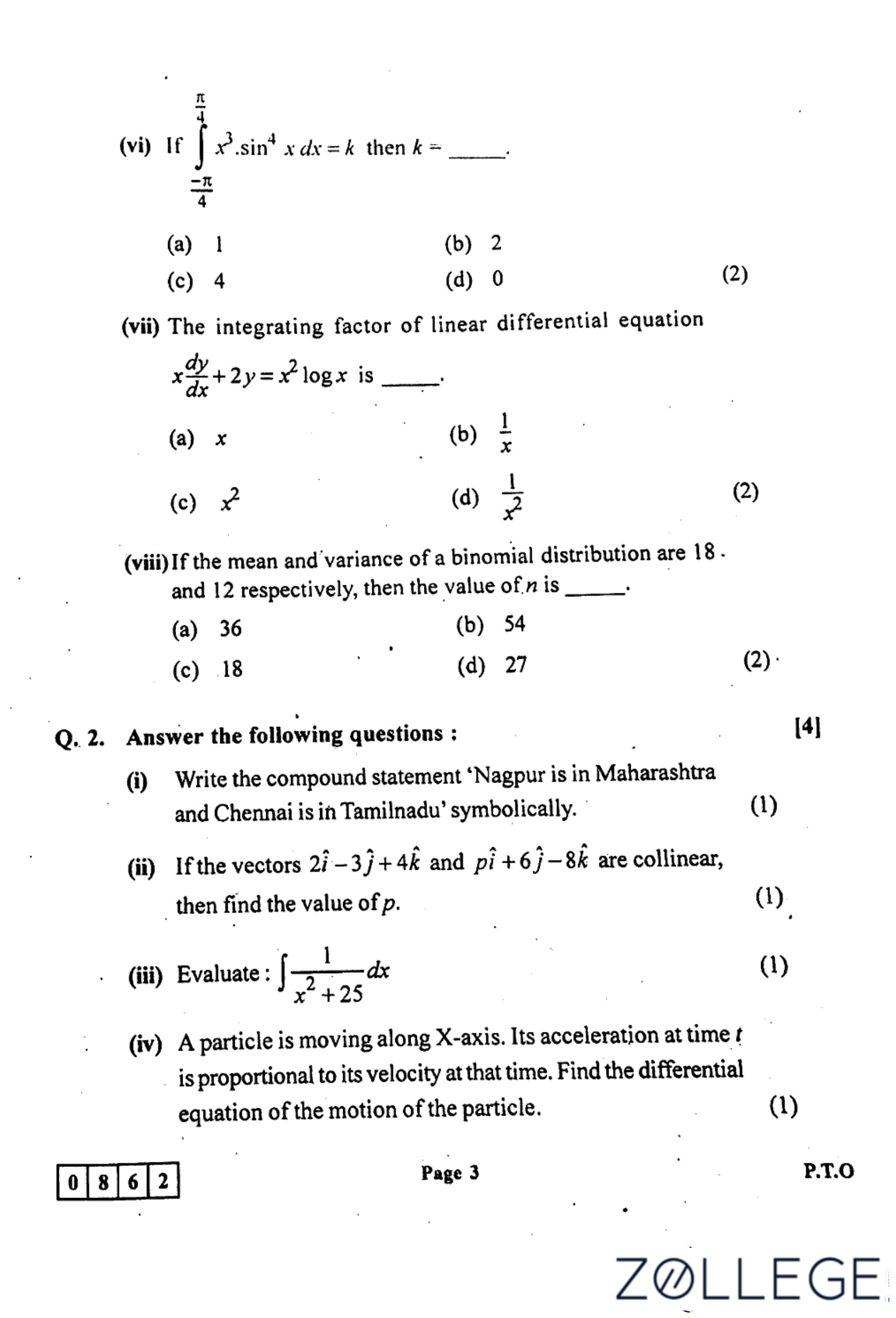
(vi) If ∫-π/4π/4 x³ sin⁴ x dx = k, then k is ____.
(Identify the correct answer from the given options and rewrite.)
View Solution
Step 1: Identify the function type:
f(x) = x³ sin⁴ x is an odd function since x³ is odd and sin⁴ x is even.
Step 2: Property of definite integrals:
∫-aa f(x) dx = 0 for any odd function over a symmetric interval.
Step 3: Since x³ sin⁴ x is odd, the integral evaluates to 0.
(vii) The integrating factor of the linear differential equation x dy/dx + 2y = x² log x is ____.
(Identify the correct answer from the given options and rewrite.)
View Solution
Step 1: Convert to standard form:
dy/dx + (2/x)y = x log x.
Step 2: Compute the integrating factor (IF):
IF = e∫(2/x) dx = e^(2 ln x) = x².
(viii) If the mean and variance of a binomial distribution are 18 and 12 respectively, then the value of n is ____.
(Identify the correct answer from the given options and rewrite.)
View Solution
Step 1: Use binomial distribution formulas:
Mean (μ) = np, Variance (σ²) = np(1 - p).
Step 2: Substituting given values:
np = 18, np(1 - p) = 12.
Step 3: Compute p:
Divide variance by mean: (1 - p) = 12/18 = 2/3, so p = 1/3.
Step 4: Compute n:
n × (1/3) = 18 → n = 54.
Question 2. Answer the following questions:
(i) Write the compound statement ‘Nagpur is in Maharashtra and Chennai is in Tamilnadu’ symbolically.
View Solution
Step 1: Define Propositions
Let:
p represent "Nagpur is in Maharashtra".
q represent "Chennai is in Tamilnadu".
Step 2: Represent the Compound Statement
Since the statement contains "and," we use the logical conjunction (∧):
p ∧ q
(ii) If the vectors 2î - 3ĵ + 4k̂ and p î + 6ĵ - 8k̂ are collinear, then find the value of p.
View Solution
Step 1: Condition for Collinearity
Two vectors A and B are collinear if:
B = k A for some scalar k.
Step 2: Expressing in Terms of Components
(2î - 3ĵ + 4k̂) and (p î + 6ĵ - 8k̂)
Equating components:
p = 2k, 6 = -3k, -8 = 4k
Step 3: Solving for k
From 6 = -3k, solving for k:
k = -2
Step 4: Finding p
p = 2(-2) = -4
(iii) Evaluate: ∫ (1 / (x² + 25)) dx.
View Solution
Step 1: Recognizing the Standard Integral
We use the standard formula:
∫ (1 / (x² + a²)) dx = (1/a) tan⁻¹ (x/a) + C.
Step 2: Substituting a = 5
a² = 25 gives a = 5, so:
∫ (1 / (x² + 25)) dx = (1/5) tan⁻¹ (x/5) + C.
(iv) A particle is moving along the X-axis. Its acceleration at time t is proportional to its velocity at that time. Find the differential equation of the motion of the particle.
View Solution
Step 1: Expressing Acceleration in Terms of Velocity
Given that acceleration a is proportional to velocity v:
a = k v
Since acceleration is the derivative of velocity:
dv/dt = k v.
Step 2: Writing the Differential Equation
Rearrange to separate variables:
(dv/v) = k dt.
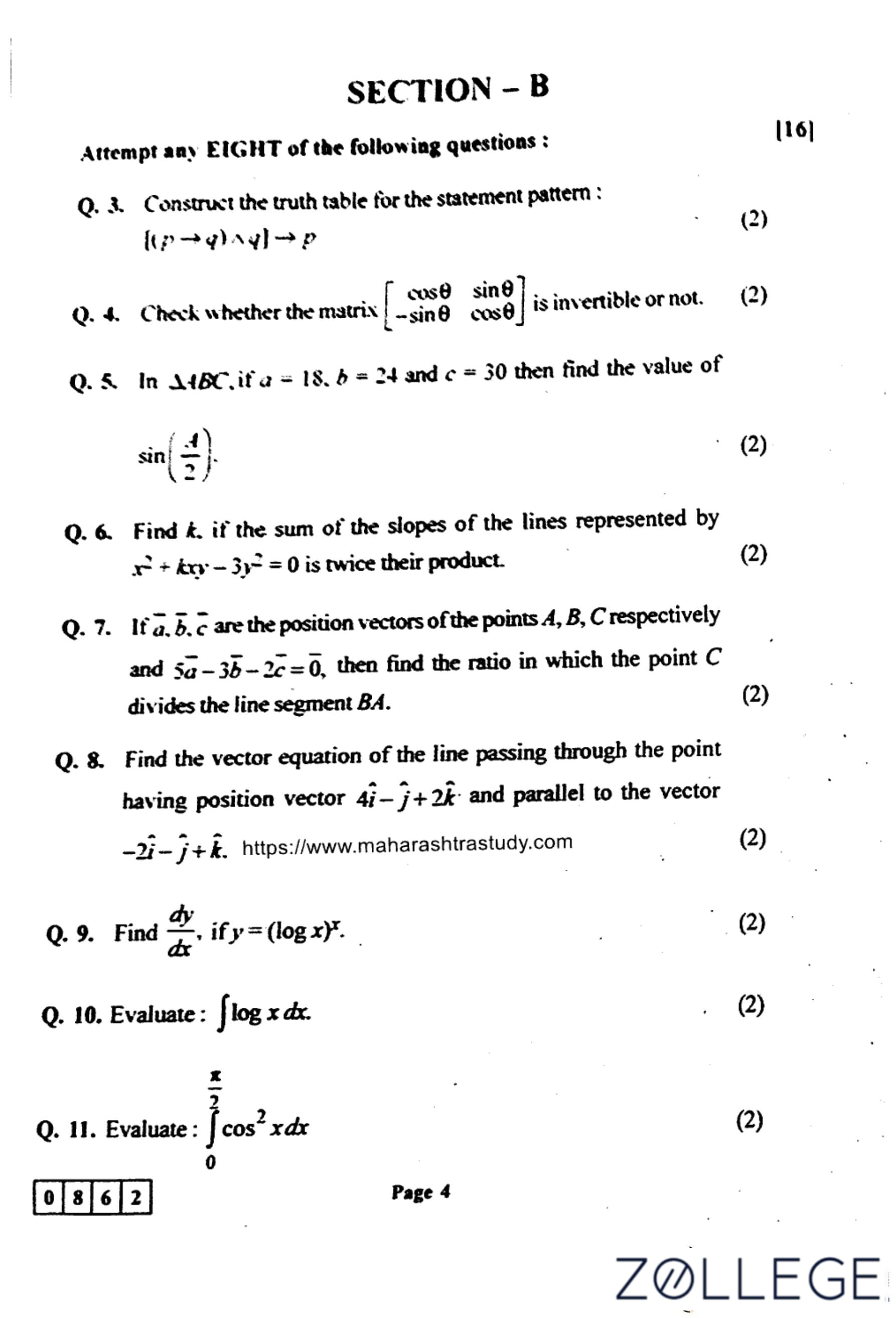
(Question 3:) Construct the truth table for the statement pattern: [(p → q) ∧ q] → p
View Solution
Step 1: Understanding Logical Operators
- p → q means "If p, then q".
- ∧ represents logical AND.
- → represents logical implication.
Step 2: Constructing the Truth Table
| p | q | p → q | (p → q) ∧ q | [(p → q) ∧ q] → p |
|---|---|---|---|---|
| T | T | T | T | T |
| T | F | F | F | T |
| F | T | T | T | F |
| F | F | T | F | F |
(Question 4:) Check whether the matrix A = [ [cosθ, sinθ], [-sinθ, cosθ] ] is invertible or not.
View Solution
Step 1: Compute the Determinant
For a 2 × 2 matrix A = [ [a, b], [c, d] ], the determinant is:
det(A) = (a d - b c).
Step 2: Apply the Invertibility Condition
Substituting values from A:
det(A) = (cosθ × cosθ - sinθ × (-sinθ))
= cos²θ + sin²θ.
Since cos²θ + sin²θ = 1, we get:
det(A) = 1 ≠ 0.
Since the determinant is nonzero, the matrix is invertible.
(Question 5:) In △ABC, if a = 18, b = 24, and c = 30, then find the value of sin(A/2).
View Solution
Step 1: Compute the Semi-Perimeter
s = (a + b + c) / 2 = (18 + 24 + 30) / 2 = 36.
Step 2: Use Half-Angle Formula for Sine
sin(A/2) = √[(s - b)(s - c) / (b c)].
Step 3: Substituting Values
sin(A/2) = √[(36 - 24)(36 - 30) / (24 × 30)].
= √[(12 × 6) / 720] = √(72 / 720) = √(1/10).
= (√10) / 10.
Question 6. Find k, if the sum of the slopes of the lines represented by:
x² + kxy - 3y² = 0
is twice their product.
View Solution
Step 1: Find Slopes of the Lines
The general equation of a homogeneous second-degree equation:
Ax² + 2Hxy + By² = 0 represents two straight lines. The slopes are given by:
m₁, m₂ = (- (H ± √(H² - AB))) / B.
Comparing with x² + kxy - 3y² = 0, we identify:
A = 1, H = k/2, B = -3.
Step 2: Using the Given Condition
The sum of slopes is:
m₁ + m₂ = -2H/B = -k / -3 = k/3.
The product of slopes is:
m₁ m₂ = A/B = 1/-3 = -1/3.
Given m₁ + m₂ = 2(m₁ m₂), we substitute:
k/3 = 2(-1/3).
k/3 = -2/3.
Step 3: Solve for k
k = -2.
Question 7. If a, b, c are the position vectors of the points A, B, C respectively and
5a - 3b - 2c = 0,
then find the ratio in which the point C divides the line segment BA externally.
View Solution
Step 1: Express the position vector of C
Let C divide BA externally in the ratio 5:3. The position vector of C is given by:
c = (5a - 3b) / (5 - 3).
Step 2: Use the given equation
Rewriting the given equation 5a - 3b - 2c = 0, we get:
2c = 5a - 3b.
Step 3: Substitute the expression for c
2 × (5a - 3b) / 2 = 5a - 3b.
Simplifying:
c = (5a - 3b) / 2.
Thus, the point C divides the line segment BA externally in the ratio 5:3.
Question 8. Find the vector equation of the line passing through the point having position vector
(4î - ĵ + 2k̂) and parallel to the vector (-2î - ĵ + k̂).
View Solution
Step 1: Vector Equation of a Line
The vector equation of a line passing through r₀ and parallel to d is:
r = r₀ + λd.
Step 2: Substitute Given Vectors
r₀ = 4î - ĵ + 2k̂, d = -2î - ĵ + k̂.
Step 3: Write the Equation
r = (4î - ĵ + 2k̂) + λ(-2î - ĵ + k̂).
Expanding:
r = (4 - 2λ) î + (-1 - λ) ĵ + (2 + λ) k̂.
Question 9. Find dy/dx, if y = (log x)^x.
View Solution
Step 1: Take the Logarithm
Taking the natural logarithm on both sides:
ln y = x ln (log x).
Step 2: Differentiate Both Sides
(1/y) dy/dx = d/dx (x ln (log x)).
Using the product rule:
d/dx (x ln (log x)) = x × (1/log x) × (1/x) + ln (log x).
= 1/log x + ln (log x).
Step 3: Solve for dy/dx
dy/dx = y (1/log x + ln (log x)).
Substituting y = (log x)^x:
dy/dx = (log x)^x (1/log x + ln (log x)).
Question 10. Evaluate:
∫ log x dx.
View Solution
Step 1: Use Integration by Parts
Using the formula:
∫ u dv = uv - ∫ v du, let:
u = log x, dv = dx.
Step 2: Compute du and v
du = (1/x) dx, v = x.
Step 3: Apply Integration by Parts
∫ log x dx = x log x - ∫ x × (1/x) dx.
= x log x - ∫ dx.
= x log x - x + C.
Question 11. Evaluate:
∫0π/2 cos²x dx.
View Solution
Step 1: Use the Power Reduction Formula
cos²x = (1 + cos 2x) / 2.
Step 2: Substitute into the Integral
∫0π/2 cos²x dx = ∫0π/2 (1 + cos 2x) / 2 dx.
Splitting:
= (1/2) ∫0π/2 dx + (1/2) ∫0π/2 cos 2x dx.
Step 3: Evaluate Each Integral
= (1/2) [x] 0π/2 + (1/2) [sin 2x / 2] 0π/2.
= (1/2) × (π/2) + (1/2) × 0.
= π/4.
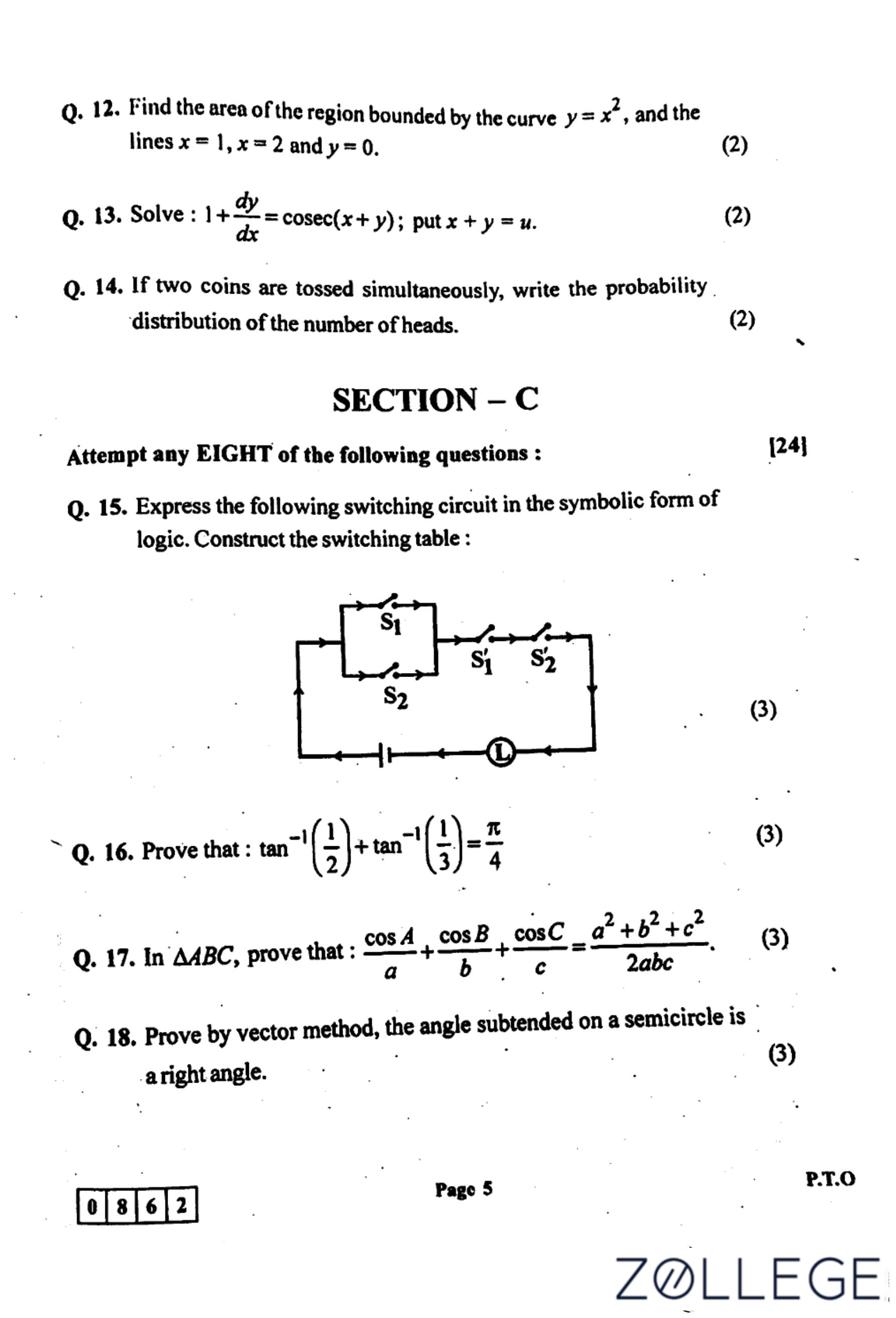
Question 12. Find the area of the region bounded by the curve y = x², and the lines x = 1, x = 2, and y = 0.
View Solution
Step 1: Use Definite Integration for Area
The required area is given by:
A = ∫12 x² dx.
Step 2: Evaluate the Integral
A = [x³ / 3] 12.
= (8/3) - (1/3).
= 7/3.
Question 13. Solve:
1 + dy/dx = cosec(x + y); put x + y = u.
View Solution
Step 1: Substituting u = x + y
du = dx + dy ⇒ du/dx = 1 + dy/dx.
Step 2: Rewrite the Equation
du/dx = cosec u.
Step 3: Solve the Differential Equation
∫ sin u du = ∫ dx.
- cos u = x + C.
- cos(x + y) = x + C.
Question 14. If two coins are tossed simultaneously, write the probability distribution of the number of heads.
View Solution
Step 1: Determine Sample Space
When two fair coins are tossed, the possible outcomes are:
S = { HH, HT, TH, TT }.
Step 2: Count the Number of Heads
| Outcome | Number of Heads (X) |
|---|---|
| HH | 2 |
| HT | 1 |
| TH | 1 |
| TT | 0 |
Step 3: Find the Probability Distribution
| X | P(X) |
|---|---|
| 0 | 1/4 |
| 1 | 1/2 |
| 2 | 1/4 |
Thus, the probability distribution is:
P(X = 0) = 1/4, P(X = 1) = 1/2, P(X = 2) = 1/4.
Question 16. Prove that:
tan⁻¹(1/2) + tan⁻¹(1/3) = π/4.
View Solution
Step 1: Use the Identity
tan⁻¹ a + tan⁻¹ b = tan⁻¹((a + b) / (1 - ab)), if ab < 1.
Step 2: Apply Given Values
tan⁻¹(1/2) + tan⁻¹(1/3) = tan⁻¹((1/2 + 1/3) / (1 - (1/2 × 1/3))).
= tan⁻¹((3 + 2)/6) / (1 - 1/6).
= tan⁻¹(5/6 ÷ 5/6).
= tan⁻¹(1).
= π/4.
Question 17. In △ABC, prove that:
(cos A / a) + (cos B / b) + (cos C / c) = (a² + b² + c²) / 2abc.
View Solution
Step 1: Use the Cosine Rule
cos A = (b² + c² - a²) / 2bc,
cos B = (a² + c² - b²) / 2ac,
cos C = (a² + b² - c²) / 2ab.
Step 2: Compute the Summation
(cos A / a) + (cos B / b) + (cos C / c).
= (1/a) × (b² + c² - a²) / 2bc + (1/b) × (a² + c² - b²) / 2ac + (1/c) × (a² + b² - c²) / 2ab.
Step 3: Simplify
= (b² + c² - a²) / 2abc + (a² + c² - b²) / 2abc + (a² + b² - c²) / 2abc.
= (b² + c² - a² + a² + c² - b² + a² + b² - c²) / 2abc.
= (a² + b² + c²) / 2abc.
Question 18. Prove by vector method, the angle subtended on a semicircle is a right angle.
View Solution
Step 1: Define the Points
Let the semicircle be centered at O with radius r, and points A(-r,0), B(r,0), and P(x,y) on the semicircle.
Step 2: Write the Vectors
Vectors from A and B to P:
AP = (x + r, y), BP = (x - r, y).
Step 3: Find the Dot Product
AP . BP = (x + r, y) . (x - r, y).
= (x + r)(x - r) + y^2.
= x^2 - r^2 + y^2.
Using the equation of the semicircle:
x^2 + y^2 = r^2.
AP . BP = r^2 - r^2 = 0.
Since the dot product is zero, AP is perpendicular to BP, proving a right angle.
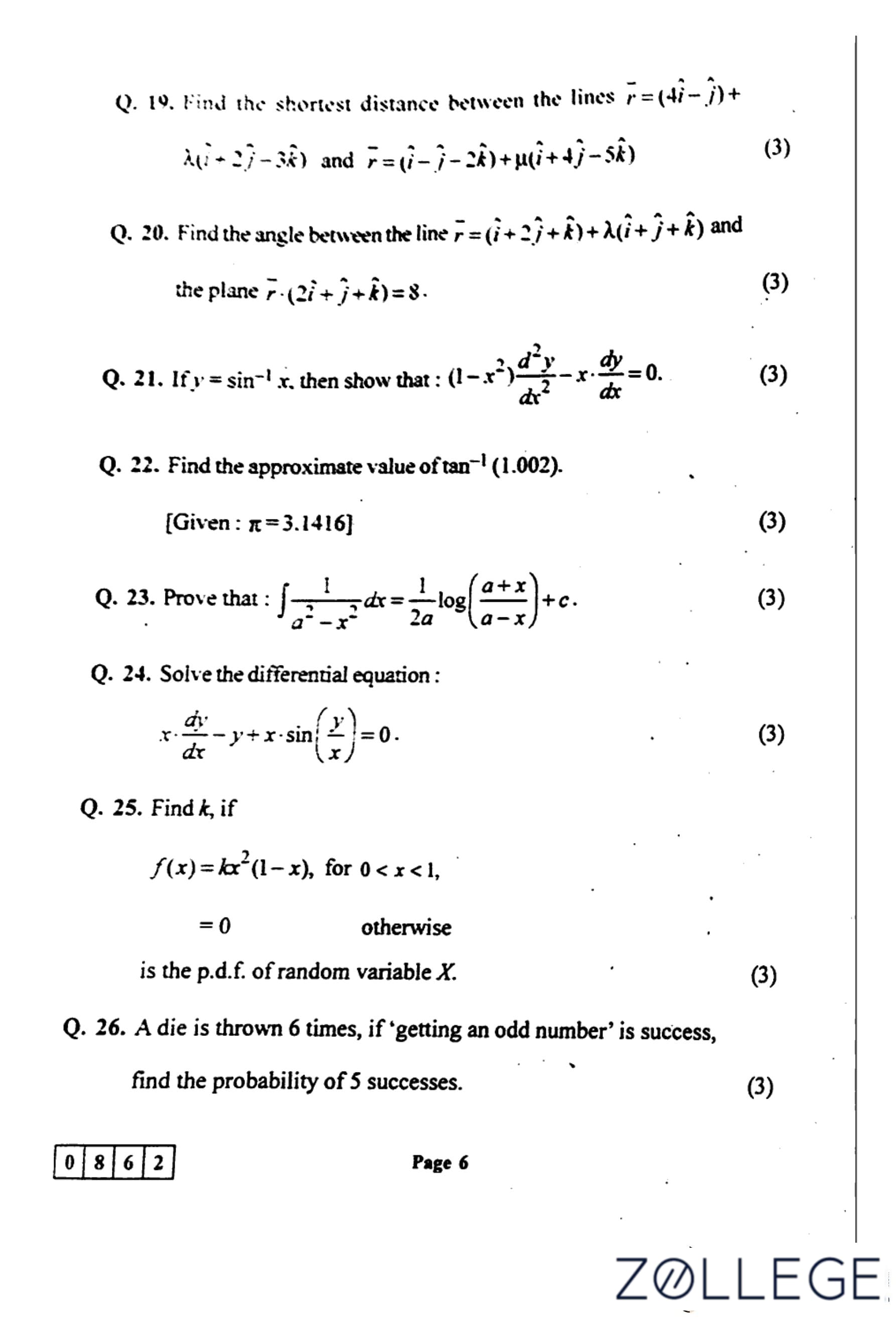
Question 19. Find the shortest distance between the lines
r = (4i - j) + λ(i + 2j - 3k)
and
r = (i - j - 2k) + μ(i + j - 5k).
View Solution
Step 1: Identify points and direction vectors.
Points: a1 = (4,-1,0), a2 = (1,-1,-2).
Direction vectors: b1 = (1,2,-3), b2 = (1,1,-5).
Step 2: Compute the vector between the two points:
a2 - a1 = (-3,0,-2).
Step 3: Find the cross product of the direction vectors:
b1 × b2 = (2, -2, -1).
Step 4: Apply the shortest distance formula:
d = | (-3,0,-2) . (2,-2,-1) | / sqrt(4 + 4 + 1).
d = | (-6 + 2 + 2) | / sqrt(9) = 2 / 3.
The shortest distance is 2/3 units.
Question 20. Find the angle between the line
r = (i + 2j + k) + λ(i + j + k)
and the plane
r . (2i + j + k) = 8.
View Solution
Step 1: Identify Direction Vectors
The direction vector of the line is d = (1,1,1).
The normal vector of the plane is n = (2,1,1).
Step 2: Use the Formula for the Angle
sin θ = |d . n| / |d| |n|.
= | (1,1,1) . (2,1,1) | / sqrt(3) * sqrt(6).
= 4 / sqrt(18) = 2 sqrt(2) / 3.
θ = sin^(-1)( 2 sqrt(2) / 3 ).
Question 21. If y = sin^(-1) x, then show that:
(1 - x^2) d²y/dx² - x dy/dx = 0.
View Solution
Step 1: First Derivative
dy/dx = 1 / sqrt(1 - x^2).
Step 2: Second Derivative
d²y/dx² = -x / (1 - x^2)^(3/2).
Step 3: Verify the Given Identity
(1 - x^2) d²y/dx² - x dy/dx = 0.
Substituting:
(1 - x^2)( -x / (1 - x^2)^(3/2) ) - x / sqrt(1 - x^2).
= - x (1 - x^2) / (1 - x^2)^(3/2) - x / sqrt(1 - x^2).
= - x / sqrt(1 - x^2) * (1 / (1 - x^2)^(1/2) + 1 ) = 0.
Question 22. Find the approximate value of tan^(-1) (1.002).
Given: π = 3.1416.
View Solution
Step 1: Use Approximation Formula
For small x, tan^(-1) (1 + x) ≈ π/4 + x.
Step 2: Apply Given Values
tan^(-1) (1.002) ≈ π/4 + 0.002.
= 3.1416/4 + 0.002.
= 0.7854 + 0.002 = 0.7874.
Question 23. Prove that:
∫ (1 / (a² - x²)) dx = (1 / 2a) log |(a + x) / (a - x)| + C.
View Solution
Step 1: Use Standard Integral Formula
The standard formula for the given integral is:
∫ (1 / (a² - x²)) dx = (1 / 2a) log |(a + x) / (a - x)| + C.
Step 2: Proof via Partial Fractions
Rewriting:
1 / (a² - x²) = 1 / ((a - x)(a + x)).
Using partial fractions:
1 / ((a - x)(a + x)) = A / (a - x) + B / (a + x).
Solving for A and B, we obtain:
A = 1 / 2a, B = -1 / 2a.
Step 3: Integrate
∫ (1 / (a² - x²)) dx = (1 / 2a) ∫ (1 / (a + x)) dx - (1 / 2a) ∫ (1 / (a - x)) dx.
= (1 / 2a) log |a + x| - (1 / 2a) log |a - x|.
= (1 / 2a) log |(a + x) / (a - x)| + C.
Question 24. Solve the differential equation:
x (dy/dx) - y + x sin(y/x) = 0.
View Solution
Step 1: Use Substitution
Let v = y/x, so that:
y = vx and dy/dx = v + x dv/dx.
Step 2: Rewrite the Equation
x (v + x dv/dx) - vx + x sin v = 0.
x v + x² dv/dx - vx + x sin v = 0.
x² dv/dx = -x sin v.
Step 3: Solve the Separable Equation
dv / sin v = -dx / x.
Step 4: Integrate Both Sides
∫ (dv / sin v) = -∫ (dx / x).
log |csc v - cot v| = -log |x| + C.
Step 5: Substitute Back v = y/x
log |csc (y/x) - cot (y/x)| = -log |x| + C.
Taking exponentials on both sides:
|csc (y/x) - cot (y/x)| = C / x.
Question 25. Find k, if the probability density function is given by:
f(x) = kx²(1 - x), for 0 < x < 1,
= 0, otherwise.
View Solution
Step 1: Use the Probability Density Function Property
The total probability must be 1:
∫[0 to 1] f(x) dx = 1.
Step 2: Compute the Integral
∫[0 to 1] kx²(1 - x) dx = 1.
Expanding:
∫[0 to 1] k (x² - x³) dx = 1.
Step 3: Evaluate the Integrals
k [ (x³/3) - (x⁴/4) ] from 0 to 1 = 1.
k (1/3 - 1/4) = 1.
k (1/12) = 1.
k = 12.
Question 26. A die is thrown 6 times. If "getting an odd number" is a success, find the probability of 5 successes.
View Solution
Step 1: Define the Probability of Success
A die has numbers {1,2,3,4,5,6}. The odd numbers are {1,3,5}, so the probability of success (getting an odd number) is:
p = 3/6 = 1/2.
Step 2: Use the Binomial Probability Formula
P(X = k) = C(n,k) p^k (1 - p)^(n-k).
Substituting n = 6, k = 5, and p = 1/2:
P(X = 5) = C(6,5) (1/2)^5 (1/2)¹.
Step 3: Compute the Probability
C(6,5) = 6! / (5!(6-5)!) = 6.
P(X = 5) = 6 × (1/2)^6.
= 6 × 1/64.
= 6/64 = 3/32.
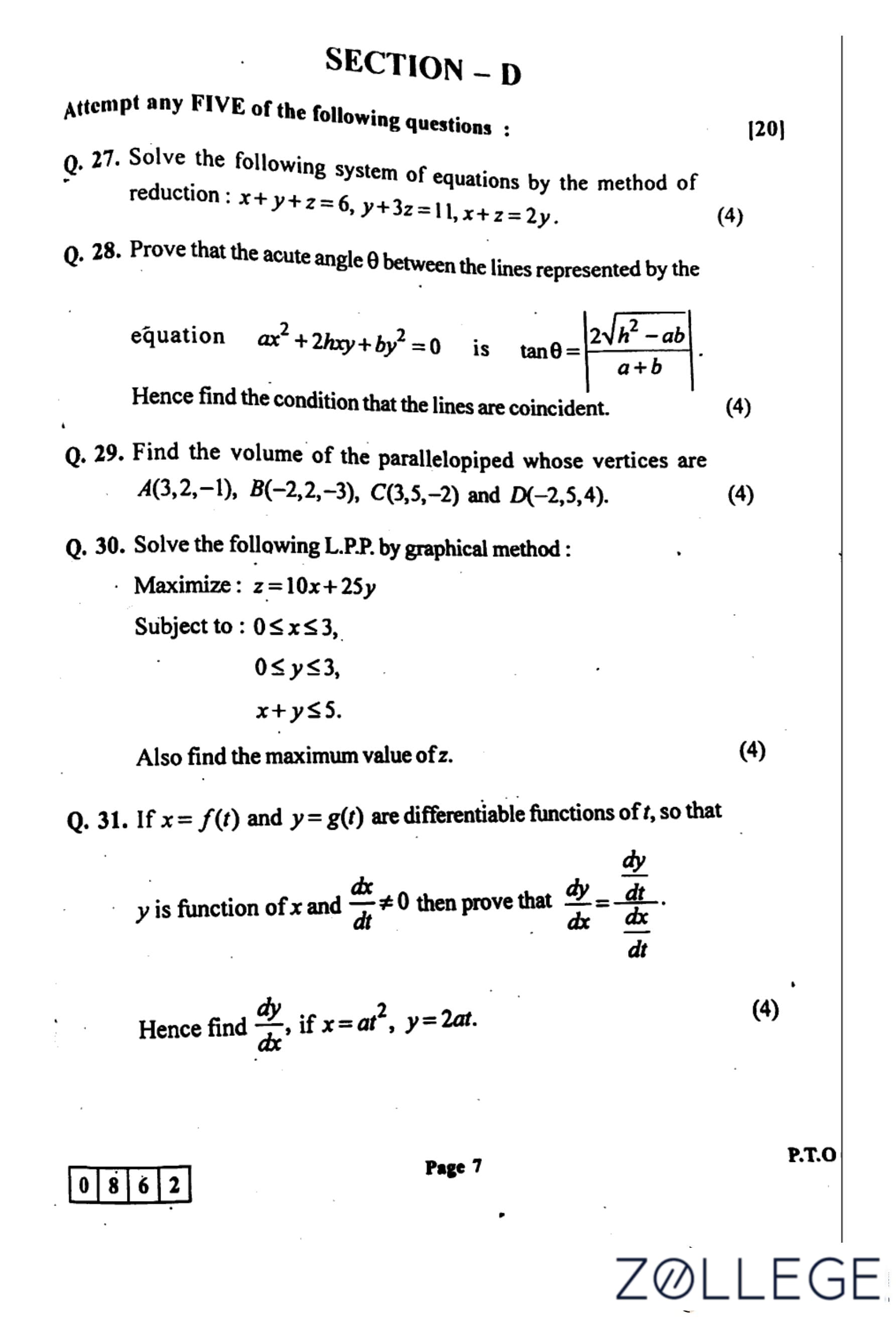
Question 27. Solve the following system of equations by the method of reduction:
x + y + z = 6,
y + 3z = 11,
x + z = 2y.
View Solution
Step 1: Express Equations in a Standard Form
Rewriting the third equation:
x + z = 2y → x - 2y + z = 0.
Thus, the system becomes:
x + y + z = 6,
y + 3z = 11,
x - 2y + z = 0.
Step 2: Solve for Variables
From equation y + 3z = 11:
y = 11 - 3z.
Substituting into the first equation:
x + (11 - 3z) + z = 6.
x + 11 - 2z = 6 → x = 2z - 5.
Step 3: Solve for z
Substituting x = 2z - 5 and y = 11 - 3z into x - 2y + z = 0:
(2z - 5) - 2(11 - 3z) + z = 0.
2z - 5 - 22 + 6z + z = 0.
9z - 27 = 0 → z = 3.
Step 4: Find x and y
y = 11 - 3(3) = 2,
x = 2(3) - 5 = 1.
Final Answer: x = 1, y = 2, z = 3.
Question 28. Prove that the acute angle θ between the lines represented by the equation
ax² + 2hxy + by² = 0
is
tan θ = |(2√(h² - ab)) / (a + b)|.
Hence find the condition that the lines are coincident.
View Solution
Step 1: Find Slopes of the Lines
The given equation represents two straight lines passing through the origin. The slopes are given by:
m₁, m₂ = (- (h ± √(h² - ab))) / b.
Step 2: Use the Angle Formula
tan θ = |(m₁ - m₂) / (1 + m₁m₂)|.
Substituting values:
tan θ = |((-h + √(h² - ab)) / b) - (-h - √(h² - ab)) / b) / (1 + ((-h + √(h² - ab)) / b) × (-h - √(h² - ab)) / b)|.
= |(2√(h² - ab)) / (a + b)|.
Step 3: Condition for Coincidence
For coincident lines, θ = 0, which means:
h² - ab = 0 → h² = ab.
Question 29. Find the volume of the parallelepiped whose vertices are
A(3,2,-1), B(-2,2,-3), C(3,5,-2) and D(-2,5,4).
View Solution
Step 1: Find Three Vectors
AB = (-2 - 3, 2 - 2, -3 + 1) = (-5,0,-2).
AC = (3 - 3, 5 - 2, -2 + 1) = (0,3,-1).
AD = (-2 - 3, 5 - 2, 4 + 1) = (-5,3,5).
Step 2: Compute the Volume
V = |AB ⋅ (AC × AD)|.
AC × AD =
|i j k |
|0 3 -1|
|-5 3 5|
= (15 + 3)i - (0 + 5)j + (0 + 15)k.
= (18,-5,15).
V = |(-5,0,-2) ⋅ (18,-5,15)|.
= |(-5 × 18) + (0 × -5) + (-2 × 15)|.
= |-90 - 30| = |120|.
Final Answer: V = 120.
Question 30. Solve the following L.P.P. by graphical method:
Maximize: z = 10x + 25y.
Subject to: 0 ≤ x ≤ 3, 0 ≤ y ≤ 3, x + y ≤ 5.
View Solution
Step 1: Identify Constraints
1. 0 ≤ x ≤ 3
2. 0 ≤ y ≤ 3
3. x + y ≤ 5 → y = 5 - x
By plotting the graph, the feasible region is the triangle with vertices (0,0), (0,3), and (2,3).
Step 2: Evaluate z at the Vertices
At (0,0): z = 10(0) + 25(0) = 0
At (0,3): z = 10(0) + 25(3) = 75
At (2,3): z = 10(2) + 25(3) = 95
Final Answer: Maximum z = 95 at (2,3).
Question 31. If x = f(t) and y = g(t) are differentiable functions of t, then prove:
(dy/dx) = (dy/dt) / (dx/dt).
Hence find dy/dx if x = at² and y = 2at.
View Solution
Step 1: Proof of Chain Rule
Since y = g(t) and x = f(t), we differentiate:
dx/dt = f'(t), dy/dt = g'(t).
By the chain rule:
dy/dx = (dy/dt) / (dx/dt).
Step 2: Compute dy/dx for Given Functions
x = at², y = 2at.
dx/dt = 2at, dy/dt = 2a.
dy/dx = (2a) / (2at) = 1/t.
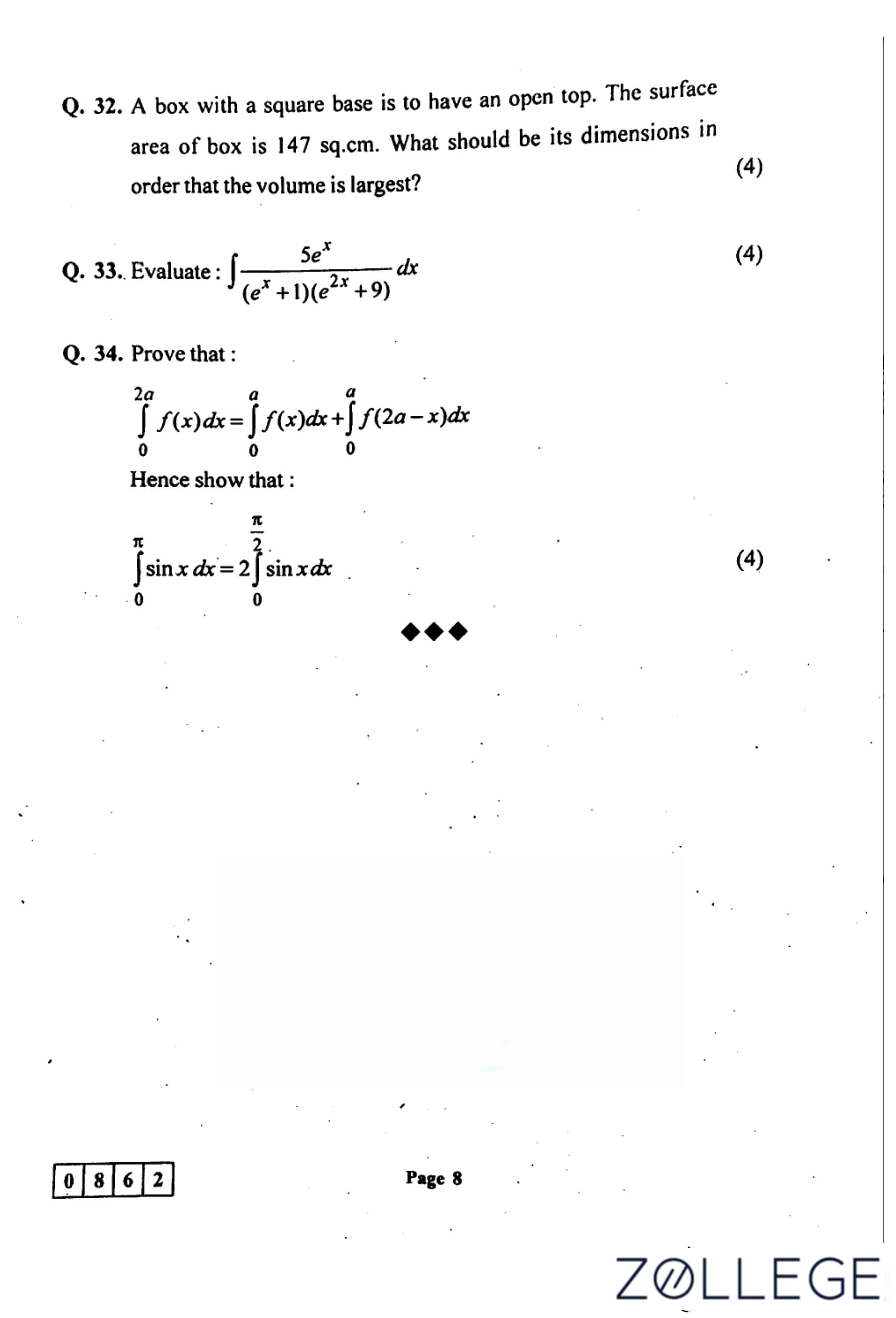
Question 32. A box with a square base is to have an open top. The surface area of the box is 147 cm². What should its dimensions be in order that the volume is largest?
View Solution
Step 1: Define Variables
Let:
- x = side length of the square base,
- h = height of the box.
The total surface area is given by:
x² + 4xh = 147.
Step 2: Express h in Terms of x
h = (147 - x²) / 4x.
Step 3: Maximize Volume
Volume V = x²h = x² (147 - x²) / 4x.
= (x(147 - x²)) / 4.
Differentiate:
dV/dx = (147 - 3x²) / 4.
Setting dV/dx = 0:
147 - 3x² = 0 → x² = 49 → x = 7.
Step 4: Find h
h = (147 - 49) / (4 × 7) = 3.5.
Final Answer: x = 7 cm, h = 3.5 cm.
Question 33. Evaluate:
I = ∫ (5e^x) / ((e^x + 1)(e^(2x) + 9)) dx.
View Solution
Step 1: Use Substitution
Let t = e^x, so that dt = e^x dx. Hence, we have:
dx = dt / t.
Now, substitute into the integral:
I = ∫ (5t) / ((t + 1)(t² + 9)) × (dt / t).
Simplifying, we get:
I = ∫ (5) / ((t + 1)(t² + 9)) dt.
Step 2: Decompose Using Partial Fractions
Using partial fraction decomposition:
5 / ((t + 1)(t² + 9)) = A / (t + 1) + (Bt + C) / (t² + 9).
Solving for A, B, and C:
A = 1/2, B = -1/2, C = 1/2.
Step 3: Substitute the Values
I = ∫ (1/2) / (t + 1) dt + ∫ (-1/2 t + 1/2) / (t² + 9) dt.
Step 4: Evaluate Each Integral
Using standard integration results:
- ∫ dt / (t + 1) = ln |t + 1|
- ∫ t dt / (t² + 9) = (1/2) ln |t² + 9|
- ∫ dt / (t² + 9) = (1/3) tan⁻¹ (t/3)
Thus, the total integral becomes:
I = (1/2) ln |t + 1| - (1/4) ln |t² + 9| + (1/6) tan⁻¹ (t/3) + C.
Step 5: Substitute t = e^x
Final answer:
I = (1/2) ln |e^x + 1| - (1/4) ln |e^(2x) + 9| + (1/6) tan⁻¹ (e^x / 3) + C.
Question 34. Prove that:
∫₀²ₐ f(x) dx = ∫₀ₐ f(x) dx + ∫₀ₐ f(2a - x) dx.
Hence show that:
∫₀^π sin x dx = 2 ∫₀^(π/2) sin x dx.
View Solution
Step 1: Proof of Integral Identity
Using substitution u = 2a - x, we get:
du = -dx.
Changing limits:
∫₀ₐ f(2a - x) dx = ∫₂ₐₐ f(u) (-du) = ∫ₐ²ₐ f(u) du.
Since:
∫₀²ₐ f(x) dx = ∫₀ₐ f(x) dx + ∫ₐ²ₐ f(x) dx,
we conclude:
∫₀²ₐ f(x) dx = ∫₀ₐ f(x) dx + ∫₀ₐ f(2a - x) dx.
Step 2: Apply to Sine Function
For f(x) = sin x, let a = π/2, so 2a = π:
∫₀^π sin x dx = ∫₀^(π/2) sin x dx + ∫₀^(π/2) sin (π - x) dx.
Since sin (π - x) = sin x:
∫₀^π sin x dx = 2 ∫₀^(π/2) sin x dx.
Final Verification:
∫₀^π sin x dx = [-cos x]₀^π = -cos π + cos 0 = 1 + 1 = 2.
∫₀^(π/2) sin x dx = [-cos x]₀^(π/2) = -cos (π/2) + cos 0 = 0 + 1 = 1.
2 × 1 = 2.
*The article might have information for the previous academic years, please refer the official website of the exam.