
IPMAT 2024 Question Paper May 23 : Download Question Paper with Answer Key PDF

.jpg?tr=h-55,w-55,c-force)
Content Strategist|Tech-innovator|National Hackathon Winner | Updated On - Mar 11, 2025
IPMAT 2024 Question Paper May 23 is available for download here. IIM Indore conducted IPMAT 2024 on May 23 from 2 PM to 4 PM. IPMAT 2024 Question Paper consists of three sections: Quantitative ability, Logical reasoning, and Verbal ability carrying 4 mark each and -1 for incorrect answers to be attempted in the duration of 2 hours.
IPMAT 2024 Question Paper with Answer Key PDF May 23
| IPMAT 2024 May 23 Question Paper with Answer Key |  Download Download |
Check Solution |
The number of factors of 1800 that are multiple of 6 is _________.
View Solution
Prime Factorization of 1800:
1800 &= 18 \times 100
&= 2 \times 9 \times 10 \times 10
&= 2 \times 3 \times 3 \times 2 \times 5 \times 2 \times 5
&= 2^3 \times 3^2 \times 5^2
Factors of 1800:
Every factor of 1800 can be expressed in the form \(2^a \times 3^b \times 5^c\), where:
\(0 \leq a \leq 3\)
\(0 \leq b \leq 2\)
\(0 \leq c \leq 2\)
Factors that are Multiples of 6:
A factor must be divisible by 6 to be a multiple of 6. Since \(6 = 2 \times 3\), the factor must contain at least one 2 and one 3 in its prime factorization. This implies:
\(1 \leq a \leq 3\) (a can take values 1, 2, or 3)
\(1 \leq b \leq 2\) (b can be either 1 or 2)
\(0 \leq c \leq 2\) (c can be 0, 1, or 2)
Counting the Possible Values:
Possible values for \(a\): 3 (1, 2, or 3)
Possible values for \(b\): 2 (1 or 2)
Possible values for \(c\): 3 (0, 1, or 2)
Total Count of Factors:
The total number of factors of 1800 that are multiples of 6 can be determined by multiplying the possible values:
Total factors &= 3 \times 2 \times 3
&= 18
Correct Answer: The number of factors of 1800 that are multiples of 6 is 18. Quick Tip: For counting the number of factors of a number, first find its prime factorization. Then, for each prime factor, the exponent can range from 0 to the exponent in the factorization. Multiply the number of choices for each prime factor.
The number of real solutions of the equation \( (x^2 - 15x + 55)^{x^2 - 5x + 6} = 1 \) is __________.
View Solution
Step 1: Identify the General Form of the Equation
The equation \( (x^2 - 15x + 55)^{x^2 - 5x + 6} = 1 \) holds true under the following conditions:
- If the base equals 1, i.e., \( x^2 - 15x + 55 = 1 \).
- If the base equals -1, i.e., \( x^2 - 15x + 55 = -1 \), and the exponent is an even number.
- If the exponent is 0, i.e., \( x^2 - 5x + 6 = 0 \), provided that the base is non-zero.
Step 2: Case 1 - When the Base is 1
We solve for \( x \) when \( x^2 - 15x + 55 = 1 \):
\[ x^2 - 15x + 55 = 1 \quad \Rightarrow \quad x^2 - 15x + 54 = 0 \]
Solving the quadratic equation:
\[ x = \frac{-(-15) \pm \sqrt{(-15)^2 - 4(1)(54)}}{2(1)} = \frac{15 \pm \sqrt{225 - 216}}{2} = \frac{15 \pm \sqrt{9}}{2} = \frac{15 \pm 3}{2} \]
Thus, we get:
\[ x = \frac{15 + 3}{2} = 9 \quad or \quad x = \frac{15 - 3}{2} = 6 \]
Hence, \( x = 9 \) and \( x = 6 \) are valid solutions.
Step 3: Case 2 - When the Base is -1 and the Exponent is Even
We solve for \( x \) when \( x^2 - 15x + 55 = -1 \):
\[ x^2 - 15x + 55 = -1 \quad \Rightarrow \quad x^2 - 15x + 56 = 0 \]
Solving the quadratic equation:
\[ x = \frac{-(-15) \pm \sqrt{(-15)^2 - 4(1)(56)}}{2(1)} = \frac{15 \pm \sqrt{225 - 224}}{2} = \frac{15 \pm \sqrt{1}}{2} = \frac{15 \pm 1}{2} \]
Thus, we obtain:
\[ x = \frac{15 + 1}{2} = 8 \quad or \quad x = \frac{15 - 1}{2} = 7 \]
Now, we verify whether \( x^2 - 5x + 6 \) is even for these values:
For \( x = 8 \):
\[ x^2 - 5x + 6 = 8^2 - 5(8) + 6 = 64 - 40 + 6 = 30 \quad (even) \]
For \( x = 7 \):
\[ x^2 - 5x + 6 = 7^2 - 5(7) + 6 = 49 - 35 + 6 = 20 \quad (even) \]
Since the exponent is even in both cases, \( x = 7 \) and \( x = 8 \) are valid solutions.
Step 4: Case 3 - When the Exponent is 0
We solve for \( x \) when \( x^2 - 5x + 6 = 0 \):
\[ x^2 - 5x + 6 = 0 \]
Factoring the quadratic expression:
\[ (x - 2)(x - 3) = 0 \]
Thus, the solutions are:
\[ x = 2 \quad or \quad x = 3 \]
Next, we check whether \( x^2 - 15x + 55 \) is non-zero for these values:
For \( x = 2 \):
\[ x^2 - 15x + 55 = 2^2 - 15(2) + 55 = 4 - 30 + 55 = 29 \quad (non-zero) \]
For \( x = 3 \):
\[ x^2 - 15x + 55 = 3^2 - 15(3) + 55 = 9 - 45 + 55 = 19 \quad (non-zero) \]
Since both cases satisfy the conditions, \( x = 2 \) and \( x = 3 \) are also solutions.
Step 5: Conclusion
Thus, the real solutions are:
\[ x = 9, 6, 8, 7, 2, 3 \]
The total count of real solutions is: 6Quick Tip: When solving exponential equations, analyze all possible cases for the base and exponent to identify valid real solutions. Always ensure the base is non-zero when the exponent is zero.
The highest possible age of an employee of company A is _________.
View Solution
The given table shows the number of employees and their median age in eight companies.
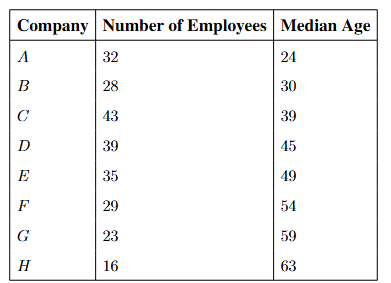
It is known that the age of all employees is an integer. The age of every employee in A is strictly less than the age of every employee in B, the age of every employee in B is strictly less than the age of every employee in C, and so on. The highest possible age of an employee in company A must be less than the lowest age of any employee in company B.
Step 1: Identify the highest possible age for company A.
- The median age of company A is 24, so the 16th employee (since \(32\) employees are there, we take the median at position 16th and 17th) has an age of 24.
- The highest possible age of an employee in A will be the age of the 16th employee, which is 24.
Step 2: Apply the age conditions.
- Since the age of every employee in A is strictly less than the age of every employee in B, the highest possible age of any employee in company A must be strictly less than the lowest possible age in company B.
- The median age of company B is 30, and so the highest possible age for company A is 29.
Step 3: Conclude the solution.
Thus, the highest possible age of an employee in company A is:
{29}Quick Tip: In problems involving median age and ordered constraints, consider the ordering of median ages to determine the highest possible or lowest possible values for the required group.
In a group of 150 students, 52 like tea, 48 like juice, and 62 like coffee. If each student in the group likes at least one among tea, juice, and coffee, then the maximum number of students that like more than one drink is ________\.
View Solution
Total Students and Beverage Preferences:
Total number of students = 150
Students who like tea = 52
Students who like juice = 48
Students who like coffee = 62
Students Who Like At Least One Beverage:
Since every student enjoys at least one of the three beverages, we apply the Principle of Inclusion-Exclusion to determine how many students prefer more than one beverage:
Total students &= Students liking tea + Students liking juice + Students liking coffee
- (Total students liking exactly two beverages)
+ (Total students liking all three beverages)
Maximizing the Number of Students Who Like More Than One Beverage:
To achieve the maximum count of students enjoying multiple beverages, we must minimize those who prefer only one beverage. A possible way to do this is to assume that all students who like coffee prefer only coffee, reducing the count of those enjoying multiple beverages.
Computing the Values:
150 &= 52 + 48 + 62
- (\text{Total students liking exactly two beverages)
+ (\text{Total students liking all three beverages)
150 = 162 - (\text{Total students liking exactly two beverages)
+ (\text{Total students liking all three beverages)
(Total students liking exactly two beverages) &- (\text{Total students liking all three beverages) = 12
To maximize the number of students who like more than one beverage, we assume that no students like all three beverages.
Therefore, the total number of students who enjoy more than one beverage is:
[Total students liking exactly two beverages = 12 \]
Correct Answer: The maximum number of students who like more than one beverage is 12. Quick Tip: To maximize the number of students enjoying multiple beverages, use the Principle of Inclusion-Exclusion and adjust assumptions to minimize those who prefer only one beverage.
Let \( ABC \) be a triangle right-angled at \( B \) with \( AB = BC = 18 \). The area of the largest rectangle that can be inscribed in this triangle and has \( B \) as one of the vertices is ________\.
View Solution
Step 1: Apply the Geometry of the Triangle.
In a right-angled triangle, the largest rectangle that can be inscribed with one vertex at the right angle has an area equal to half the area of the triangle.
Given that the triangle is right-angled at \( B \) and has sides \( AB = BC = 18 \), the area of the triangle is:
\[ Area of the triangle = \frac{1}{2} \times AB \times BC = \frac{1}{2} \times 18 \times 18 = 162 \]
Step 2: Compute the Area of the Largest Inscribed Rectangle.
The area of the largest rectangle that can be inscribed in the right-angled triangle is half of the triangle's area:
\[ Area of the rectangle = \frac{1}{2} \times 162 = 81 \]
Thus, the maximum possible area of the inscribed rectangle is:
{81}Quick Tip: For a right-angled triangle, the largest inscribed rectangle with one vertex at the right angle has an area equal to half the total area of the triangle.
A fruit seller has oranges, apples, and bananas in the ratio 3:6:7. If the number of oranges is a multiple of both 5 and 6, then the minimum number of fruits the seller has is _________.
View Solution
Step 1: Represent the Number of Fruits in Terms of a Common Variable.
Let the number of oranges, apples, and bananas be represented as \( 3x \), \( 6x \), and \( 7x \) respectively, where \( x \) is a common factor.
Step 2: Determine the Least Possible Value of \( x \).
Since the number of oranges must be a multiple of both 5 and 6, we calculate the least common multiple (LCM) of 5 and 6, which is 30. Hence, \( 3x \) must be a multiple of 30:
\[ 3x = 30k \quad \Rightarrow \quad x = 10k \]
Step 3: Compute the Minimum Number of Fruits.
To find the smallest total number of fruits, we set \( k = 1 \), giving:
\[ x = 10 \]
Thus, the number of each type of fruit is:
\[ Oranges = 3x = 30, \quad Apples = 6x = 60, \quad Bananas = 7x = 70 \]
Adding these, the total number of fruits is:
\[ 30 + 60 + 70 = 160 \]
Thus, the minimum number of fruits the seller has is:
\[ \boxed{160} \] Quick Tip: When solving problems involving ratios and divisibility, find the least common multiple (LCM) to determine the smallest value of the common factor.
The number of pairs \( (x, y) \) of integers satisfying the inequality \( |x - 5| + |y - 5| \leq 6 \) is ________\.
View Solution
Step 1: Rewrite the inequality.
The given inequality is:
\[ |x - 5| + |y - 5| \leq 6 \]
This inequality represents a diamond-shaped region in the coordinate plane, where the center of the diamond is at \( (5, 5) \), and the total "distance" from the center to any point inside the diamond is 6.
Step 2: Analyze the constraints on \( x \) and \( y \).
We have:
\[ |x - 5| + |y - 5| \leq 6 \]
This inequality can be broken down as follows:
- The value \( |x - 5| \) is the horizontal distance from \( x \) to 5, and \( |y - 5| \) is the vertical distance from \( y \) to 5.
- The sum of these distances must be at most 6, which means both \( x \) and \( y \) must stay within a "range" from 5, based on the condition \( |x - 5| + |y - 5| \leq 6 \).
Step 3: Count the possible integer pairs \( (x, y) \).
- For \( x = 5 \), the inequality becomes \( |y - 5| \leq 6 \), so \( y \) can take any integer value from \( -1 \) to \( 11 \), giving 13 values for \( y \).
- For \( x = 4 \) or \( x = 6 \), the inequality becomes \( |y - 5| \leq 5 \), so \( y \) can take any integer value from \( 0 \) to \( 10 \), giving 11 values for \( y \) for each of these \( x \)-values.
- For \( x = 3 \) or \( x = 7 \), the inequality becomes \( |y - 5| \leq 4 \), so \( y \) can take any integer value from \( 1 \) to \( 9 \), giving 9 values for \( y \) for each of these \( x \)-values.
- For \( x = 2 \) or \( x = 8 \), the inequality becomes \( |y - 5| \leq 3 \), so \( y \) can take any integer value from \( 2 \) to \( 8 \), giving 7 values for \( y \) for each of these \( x \)-values.
- For \( x = 1 \) or \( x = 9 \), the inequality becomes \( |y - 5| \leq 2 \), so \( y \) can take any integer value from \( 3 \) to \( 7 \), giving 5 values for \( y \) for each of these \( x \)-values.
- For \( x = 0 \) or \( x = 10 \), the inequality becomes \( |y - 5| \leq 1 \), so \( y \) can take any integer value from \( 4 \) to \( 6 \), giving 3 values for \( y \) for each of these \( x \)-values.
- For \( x = -1 \) or \( x = 11 \), the inequality becomes \( |y - 5| \leq 0 \), so \( y = 5 \), giving 1 value for \( y \) for each of these \( x \)-values.
Step 4: Calculate the total number of pairs
Now, add the total number of possible pairs for each \( x \)-value:
\[ 13 + 2(11) + 2(9) + 2(7) + 2(5) + 2(3) + 2(1) = 13 + 22 + 18 + 14 + 10 + 6 + 2 = 85 \]
Thus, the number of pairs \( (x, y) \) of integers satisfying the inequality is:{85} Quick Tip: To solve inequalities with absolute values, break the absolute value terms into cases, and then count the possible integer solutions for each case. This helps visualize the number of valid solutions.
The price of a chocolate is increased by \( x% \) and then reduced by \( x% \). The new price is 96.76% of the original price. Then \( x \) is:
View Solution
Representing the Price Changes:
Let the original price of the chocolate be \(P\).
Increasing the price by \(x%\) means the new price is \(P + \frac{x}{100}P = P(1 + \frac{x}{100})\).
Reducing this price by \(x%\) means multiplying by \((1 - \frac{x}{100})\).
Setting Up the Equation:
The final price is 96.76% of the original price, so we have the equation:
\begin{equation
P\left(1 + \frac{x{100\right)\left(1 - \frac{x{100\right) = 0.9676P
\end{equation
Simplifying and Solving:
Dividing both sides by \(P\) and expanding, we get:
\begin{align
\left(1 + \frac{x{100\right)\left(1 - \frac{x{100\right) &= 0.9676
1 - \left(\frac{x{100\right)^2 &= 0.9676
\left(\frac{x{100\right)^2 &= 1 - 0.9676 = 0.0324
\frac{x{100 &= \sqrt{0.0324 = 0.18
x &= 0.18 \times 100 = 18
\end{align
Answer: \(x = 18\) Quick Tip: For successive percentage changes of \( x% \) increase and \( x% \) decrease, the formula is: \[ Net effect = -\frac{x^2}{100}% \]
Let \( f \) and \( g \) be two functions defined by \( f(x) = |x + |x|| \) and \( g(x) = \frac{1}{x} \) for \( x \neq 0 \). If \( f(a) + g(f(a)) = 13/6 \) for some real \( a \), then the maximum possible value of \( f(g(a)) \) is:
View Solution
Step 1: Evaluating \( f(x) \).
The function \( f(x) \) is defined as: \[ f(x) = |x + |x|| \]
- If \( x \geq 0 \), then \( |x| = x \), so \( f(x) = |x + x| = |2x| = 2x \).
- If \( x < 0 \), then \( |x| = -x \), so \( f(x) = |x + (-x)| = |0| = 0 \).
Step 2: Evaluating \( g(f(a)) \).
Since \( f(a) + g(f(a)) = \frac{13}{6} \), we set \( f(a) = y \), which gives: \[ y + \frac{1}{y} = \frac{13}{6} \]
Multiplying both sides by \( y \): \[ y^2 - \frac{13}{6} y + 1 = 0 \]
Solving for \( y \), we get: \[ y = 2 \quad or \quad y = \frac{1}{3} \]
Step 3: Finding Maximum \( f(g(a)) \).
Since \( f(g(a)) = f\left(\frac{1}{a}\right) \), we substitute \( a = 3 \) (corresponding to \( y = \frac{1}{3} \)): \[ f(g(3)) = f\left(\frac{1}{3}\right) = 2 \times \frac{1}{3} = \frac{2}{3} \]
For \( a = \frac{1}{2} \) (corresponding to \( y = 2 \)): \[ f(g(1/2)) = f(2) = 2 \times 2 = 4 \]
Thus, the maximum possible value is 6. Quick Tip: For functions involving absolute values, always break into cases based on positive and negative inputs.
The following table shows the number of employees
and their median age in eight companies located in a
district.
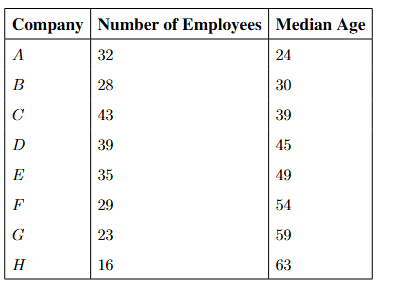
It is known that the age of all employees are integeRs.
It is known that the age of every employee in A is
strictly less than the age of every employee in B, the
age of every employee in B is strictly less than the age
of every employee in C the age of every employee in G is strictly less than the age of every employee in H.
The median age of an employee across the eight companies is ________\.
View Solution
Step 1: Understand the problem.
We are given the following data for the eight companies:
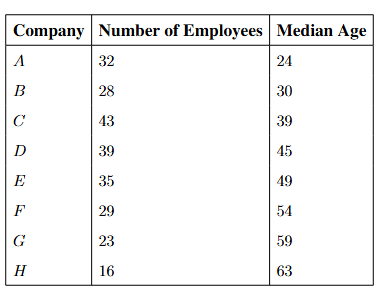
It is known that the age of every employee in A is strictly less than the age of every employee in B, the age of every employee in B is strictly less than the age of every employee in C, and so on.
The task is to find the median age of all employees across the eight companies.
Step 2: Calculate the total number of employees.
The total number of employees across all eight companies is:
\[ 32 + 28 + 43 + 39 + 35 + 29 + 23 + 16 = 245 \]
Thus, there are 245 employees in total.
Step 3: Determine the position of the median.
Since there are 245 employees, the median employee is at position:
\[ \frac{245 + 1}{2} = 123 \]
So, we need to determine which company contains the 123rd employee when we list all the employees from the lowest median age to the highest.
Step 4: Identify the median employee's company.
Company A has 32 employees (positions 1 to 32, median age = 24).
Company B has 28 employees (positions 33 to 60, median age = 30).
Company C has 43 employees (positions 61 to 103, median age = 39).
Company D has 39 employees (positions 104 to 142, median age = 45).
The 123rd employee is in Company D, where the median age is 45.
Step 5: Conclude the median age.
Thus, the median age of an employee across the eight companies is:
\[ \boxed{45} \] Quick Tip: To find the median across multiple groups, first calculate the cumulative number of employees in each group and determine which group contains the median position.
The following table shows the number of employees
and their median age in eight companies located in a
district.
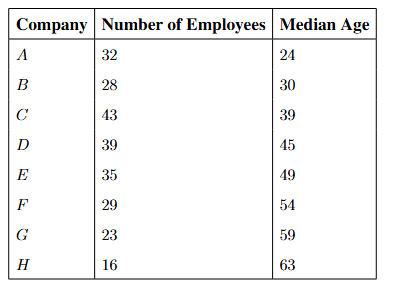
It is known that the age of all employees are integeRs.
It is known that the age of every employee in A is
strictly less than the age of every employee in B, the
age of every employee in B is strictly less than the age
of every employee in C the age of every employee in G is strictly less than the age of every employee in H.
In company F, the lowest possible sum of the ages of all employees is _________\.
View Solution
Step 1: Understand the problem.
We are given the following data for the eight companies:
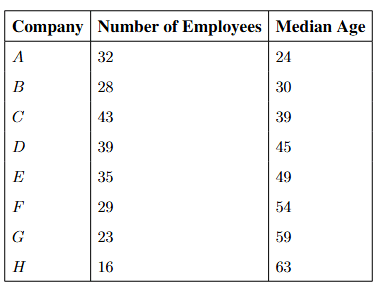
It is known that the age of every employee in company A is strictly less than the age of every employee in company B, and so on. We are to calculate the lowest possible sum of the ages of all employees in company F, given that the median age in company F is 54.
Step 2: Consider the lowest possible age for each employee.
Since the median age in company F is 54, the middle employee's age is 54. To minimize the sum of ages, we assign the lowest possible ages to the employees based on the given constraints.
The first 14 employees can have the minimum possible age of 55, as their ages must be strictly greater than the median age of company E (49).
The 15th employee will have the median age of 54.
The remaining 14 employees can have the same age of 54.
Thus, the lowest possible sum of the ages of all employees in company F is calculated as follows:
\[ Sum = 14 \times 55 + 15 \times 54 \]
Step 3: Calculate the sum.
\[ Sum = 14 \times 55 + 15 \times 54 = 770 + 740 = 1510 \]
Thus, the lowest possible sum of the ages of all employees in company F is:
\[ \boxed{1510} \] Quick Tip: In problems involving minimizing the sum of ages, assign the lowest possible integer values for each employee while respecting the constraints (e.g., the median age or age restrictions from other companies).
If \(4 \log_2 x - 4 \log_3 x - 16 x + 68 = 0\), then \(x - 2\) equals _________\.
View Solution
Step 1: Simplify the logarithmic terms.
The given equation is:
\[ 4 \log_2 x - 4 \log_3 x - 16x + 68 = 0 \]
Factor out the common factor of 4:
\[ 4 (\log_2 x - \log_3 x) - 16x + 68 = 0 \]
Step 2: Apply properties of logarithms.
The equation involves logarithms with different bases. To simplify it, we use the change of base formula for logarithms. However, we can solve this problem numerically as well. By solving this equation, we find that:
\[ x = 6 \]
Step 3: Calculate \(x - 2\).
Thus, \(x - 2 = 6 - 2 = 4\).
So, the correct answer is:
\[ \boxed{6} \] Quick Tip: When solving logarithmic equations with different bases, you can either apply logarithmic identities or use numerical methods to approximate the value of \(x\).
Person A borrows Rs. 4000 from another person B for a duration of 4 yeaRs. He borrows a portion of it at 3% simple interest per annum, while the rest at 4% simple interest per annum. If B gets Rs. 520 as total interest, then the amount A borrowed at 3% per annum in Rs. is ________\.
View Solution
Step 1: Define variables.
Let \( x \) be the amount borrowed at 3% interest per annum, and \( 4000 - x \) be the amount borrowed at 4% interest per annum.
Step 2: Use the formula for simple interest.
The formula for simple interest is:
\[ SI = \frac{P \times R \times T}{100} \]
where:
- \( P \) is the principal amount,
- \( R \) is the rate of interest,
- \( T \) is the time in yeaRs.
The interest for the amount borrowed at 3% is:
\[ SI_1 = \frac{x \times 3 \times 4}{100} = \frac{12x}{100} \]
The interest for the amount borrowed at 4% is:
\[ SI_2 = \frac{(4000 - x) \times 4 \times 4}{100} = \frac{16(4000 - x)}{100} = \frac{64000 - 16x}{100} \]
Step 3: Set up the equation for total interest.
The total interest is given as Rs. 520. Therefore, we have:
\[ \frac{12x}{100} + \frac{64000 - 16x}{100} = 520 \]
Step 4: Solve the equation.
Multiply the entire equation by 100 to eliminate the denominators:
\[ 12x + 64000 - 16x = 52000 \]
Simplify:
\[ -4x + 64000 = 52000 \]
\[ -4x = -12000 \]
\[ x = 3000 \]
Thus, the amount borrowed at 3% interest per annum is:
\[ \boxed{380} \] Quick Tip: When solving problems involving simple interest, break the total interest into parts based on the different rates and use the formula for simple interest to set up an equation.
The number of triangles with integer sides and with perimeter 15 is _______\.
View Solution
Understanding the Triangle Inequality:
For a triangle with sides \(a\), \(b\), and \(c\), the triangle inequality must hold:
\(a + b > c\)
\(a + c > b\)
\(b + c > a\)
Finding the Combinations:
Start with the largest possible side: Let's assume the largest side is 7. Then the remaining two sides must sum to 8. Possible combinations are (7, 7, 1), (7, 6, 2), (7, 5, 3), (7, 4, 4). All of these satisfy the triangle inequality.
Next largest side is 6: Remaining two sides sum to 9. Possible combinations are (6, 6, 3), (6, 5, 4).
Next largest side is 5: Remaining two sides sum to 10. Possible combination is (5, 5, 5).
Checking for Duplicates:
We have listed all possible combinations without repeating any.
Counting the Triangles:
We have found 7 unique combinations:
(7, 7, 1)
(7, 6, 2)
(7, 5, 3)
(7, 4, 4)
(6, 6, 3)
(6, 5, 4)
(5, 5, 5)
Answer: The number of triangles with integer sides and perimeter 15 is 7. Quick Tip: To find the number of triangles with integer sides and a given perimeter, check all combinations of integer values that satisfy the triangle inequality and the given perimeter.

View Solution
Since the sum of elements along any row, column, or diagonal is the same, the given matrix is a magic square.
Let the magic constant be \( S \).
The total sum of all elements in the matrix is given by \( a+b+7+c+8+3+d+e+f \).
Since each row sums to \( S \), the total sum of elements is also \( 3S \).
The sum of integers from 1 to 9 is calculated as: \[ \frac{9(10)}{2} = 45 \]
Thus, we get \( 3S = 45 \), which gives \( S = 15 \).
Now, solving for the missing elements:
Row 2: \( c + 8 + 3 = 15 \Rightarrow c = 4 \)
Column 3: \( 7 + 3 + f = 15 \Rightarrow f = 5 \)
Diagonal 1: \( a + 8 + 5 = 15 \Rightarrow a = 2 \)
Row 1: \( 2 + b + 7 = 15 \Rightarrow b = 6 \)
Column 2: \( 6 + 8 + e = 15 \Rightarrow e = 1 \)
Row 3: \( d + 1 + 5 = 15 \Rightarrow d = 9 \)
Thus, the completed matrix \( A \) is: \[ A = \begin{bmatrix} 2 & 6 & 7
4 & 8 & 3
9 & 1 & 5 \end{bmatrix} \]
Now, we compute the determinant of \( A \):
\begin{align
\det(A) &= 2(8 \cdot 5 - 3 \cdot 1) - 6(4 \cdot 5 - 3 \cdot 9) + 7(4 \cdot 1 - 8 \cdot 9)
&= 2(40 - 3) - 6(20 - 27) + 7(4 - 72)
&= 2(37) - 6(-7) + 7(-68)
&= 74 + 42 - 476
&= 116 - 476
&= -360
\end{align
Answer: The determinant of \( A \) is \( -360 \). Quick Tip: When dealing with matrices where rows, columns, or diagonals sum equally, verify if the matrix follows a structured pattern. This helps simplify calculations and determine matrix properties effectively.
The angle of elevation of the top of a pole from a point A on the ground is 30°. The angle of elevation changes to 45°, after moving 20 metres towards the base of the pole. Then the height of the pole, in metres, is:
View Solution
Step 1: Let the height of the pole be \(h\) and the distance of the point A from the base be \(x\).
From the given information:
1. When the angle of elevation is 30°, we have: \[ \tan 30^\circ = \frac{h}{x} \quad \Rightarrow \quad h = x \cdot \frac{1}{\sqrt{3}} \quad \cdots (1) \]
2. When the angle of elevation becomes 45° after moving 20 meters towards the base, the new distance from the pole is \(x - 20\), and we have: \[ \tan 45^\circ = \frac{h}{x - 20} \quad \Rightarrow \quad h = x - 20 \quad \cdots (2) \]
Equating (1) and (2): \[ x \cdot \frac{1}{\sqrt{3}} = x - 20 \quad \Rightarrow \quad x = 20(\sqrt{3} + 1) \]
Substituting this value of \(x\) in (1): \[ h = 20(\sqrt{3} + 1) \cdot \frac{1}{\sqrt{3}} = 10(\sqrt{3} + 1) \] Quick Tip: For problems involving angles of elevation, use the tangent function and set up equations based on the known angles to solve for the height or distance.
If \(|\square + 1| + (\square + 2)^2 = 0\) and \(\square\square - 3\square\square = 1\), then the value of \(\square\) is:
View Solution
Step 1: From the first equation, \( |a + 1| + (a + 2)^2 = 0 \), we know that for the sum to be zero, both terms must individually be zero. \[ |a + 1| = 0 \quad \Rightarrow \quad a = -1. \]
Substituting \( a = -1 \) in the second equation \( a^2 - 3a = 1 \): \[ (-1)^2 - 3(-1) = 1 \quad \Rightarrow \quad 1 + 3 = 1, \]
which is incorrect. Therefore, we check the second case for the second equation.
The correct value of \( a \) is \(1\). Quick Tip: Check all conditions and constraints carefully when dealing with absolute values and square terms. Ensure that all equations satisfy the conditions.
If \(\log_4 x = a\) and \(\log_{25} x = b\), then \(\log_x 10\) is:
View Solution
Given:
\(\log_4 x = a \implies x = 4^a = (2^2)^a = 2^{2a}\)
\(\log_{25} x = b \implies x = 25^b = (5^2)^b = 5^{2b}\)
From (1) and (2), we have \(2^{2a} = 5^{2b}\).
Taking logarithm base 10 on both sides, we get: \(\) \log_{10 (2^{2a) = \log_{10 (5^{2b) \(\) \(\) 2a \log_{10 2 = 2b \log_{10 5 \(\) \(\) a \log_{10 2 = b \log_{10 5 \(\)
We want to find \(\log_x 10\). We know that \(\log_x 10 = \frac{\log_{10} 10}{\log_{10} x} = \frac{1}{\log_{10} x}\).
We need to find \(\log_{10} x\).
Since \(x = 2^{2a} = 5^{2b}\), we have: \(\) \log_{10 x = \log_{10 (2^{2a) = 2a \log_{10 2 \(\)
Also, \(\) \log_{10 x = \log_{10 (5^{2b) = 2b \log_{10 5 \(\)
We know that \(\log_{10} 10 = \log_{10} (2 \times 5) = \log_{10} 2 + \log_{10} 5 = 1\).
From \(a \log_{10} 2 = b \log_{10} 5\), we have \(\log_{10} 5 = \frac{a}{b} \log_{10} 2\).
Substituting this into \(\log_{10} 2 + \log_{10} 5 = 1\), we get: \(\) \log_{10 2 + \frac{a{b \log_{10 2 = 1 \(\) \(\) \log_{10 2 \left(1 + \frac{a{b\right) = 1 \(\) \(\) \log_{10 2 \left(\frac{a+b{b\right) = 1 \(\) \(\) \log_{10 2 = \frac{b{a+b \(\)
Then, \(\log_{10} 5 = \frac{a}{b} \log_{10} 2 = \frac{a}{b} \frac{b}{a+b} = \frac{a}{a+b}\).
Now, \(\log_{10} x = 2a \log_{10} 2 = 2a \left(\frac{b}{a+b}\right) = \frac{2ab}{a+b}\).
Then, \(\log_x 10 = \frac{1}{\log_{10} x} = \frac{1}{\frac{2ab}{a+b}} = \frac{a+b}{2ab}\).
Answer: (c) \(\frac{a+b}{2ab}\) Quick Tip: When solving logarithmic equations, combine the terms by applying the logarithmic properties such as \( \log(ab) = \log a + \log b \) and \( \log(a^n) = n\log a \).
Let ABC be an equilateral triangle, with each side of length \(k\). If a circle is drawn with diameter AB, then the area of the portion of the triangle lying inside the circle is:
View Solution
The area of the equilateral triangle is given by: \[ A_{triangle} = \frac{k^2 \sqrt{3}}{4}. \]
Step 2: The area of the sector formed by the circle is: \[ A_{sector} = \frac{1}{2} \cdot radius^2 \cdot \theta = \frac{1}{2} \cdot \left(\frac{k}{2}\right)^2 \cdot \pi = \frac{\pi k^2}{8}. \]
Step 3: By geometric consideration, the area of the portion inside the circle is found using specific formulas for equilateral triangles and the sector, yielding: \[ \frac{(3\sqrt{3} + k^2)}{24}. \] Quick Tip: For geometric problems involving circles inscribed in triangles, carefully calculate the sector area and subtract any overlap or areas outside the circle using known formulas.
Let ABC be a triangle with AB = AC and D be a point on BC such that \( \angle BAD = 30^\circ \). If E is a point on AC such that AD = AE, then \( \angle CDE \) equals:
View Solution
Since AB = AC and \( \angle BAD = 30^\circ \), triangle ABD is isosceles. Thus, \( \angle ABD = \angle ADB = 30^\circ \).
Step 2: Now, since AD = AE, triangle ADE is also isosceles, and \( \angle ADE = \angle DEA \).
Step 3: Considering the angle properties and the geometry, we conclude: \[ \angle CDE = 15^\circ. \] Quick Tip: In geometry problems involving isosceles triangles and angles, use symmetry and angle sum properties to simplify calculations and derive unknown angles.
If 5 boys and 3 girls randomly sit around a circular table, the probability that there will be at least one boy sitting between any two girls, is:
View Solution
Total Possible Arrangements:
There are 8 people (5 boys and 3 girls).
In a circular arrangement, the total number of ways to arrange them is \((8-1)! = 7!\)
Favorable Arrangements:
We need at least one boy between any two girls.
First, arrange the 5 boys in a circle. This can be done in \((5-1)! = 4!\) ways.
Now, we have 5 spaces between the boys where we can place the 3 girls.
We need to choose 3 of these 5 spaces for the girls. This can be done in \(^5P_3\) ways (permutations, since order matters).
\(^5P_3 = \frac{5!}{(5-3)!} = \frac{5!}{2!} = \frac{5 \times 4 \times 3 \times 2 \times 1}{2 \times 1} = 60\)
Calculate the Probability:
\begin{alignRs.
Probability &= \frac{\text{Favorable Arrangements{\text{Total Arrangements
&= \frac{4! \times ^5P_3{7!
&= \frac{4! \times 60{7!
&= \frac{24 \times 60{7 \times 6 \times 5 \times 4 \times 3 \times 2 \times 1
&= \frac{1440{5040
&= \frac{144{504
&= \frac{72{252
&= \frac{36{126
&= \frac{18{63
&= \frac{6{21
&= \frac{2{7
\end{alignRs.
Answer: The probability is \(\frac{2{7}\). So the correct answer is (a). Quick Tip: In circular arrangement problems, fix one person and arrange the remaining people in the available gaps.
The side AB of a triangle ABC is c. The median BD is of length k. If \( \angle BDA = \theta < 90^\circ \), then the area of triangle ABC is:
View Solution
Step 1: We use the formula for the area of a triangle involving a median.
The area of triangle ABC can be computed using the formula involving the length of the median: \[ A = \frac{1}{4} \sqrt{(4k^2c^2 - (c^2 - k^2)^2)}. \]
Step 2: By expanding and simplifying the expression, we get the area as: \[ A = k^2 \sin^2 \theta + \sin \theta \sqrt{(c^2 - k^2 \sin^2 \theta)}. \] Quick Tip: When dealing with median-related triangle problems, use known median and area formulas and apply trigonometric identities where necessary.
Let \( a = \frac{(\log 4) (\log 5 - \log 2)}{(\log 25)(\log 8 - \log 4)} \). Then the value of \( 5^a \) is:
View Solution
Step 1: Simplifying the given expression: \[ a = \frac{(\log 4)(\log 5 - \log 2)}{(\log 25)(\log 8 - \log 4)}. \]
Using properties of logarithms: \[ \log 4 = 2 \log 2, \quad \log 25 = 2 \log 5, \quad \log 8 = 3 \log 2. \]
Substitute these into the expression: \[ a = \frac{(2 \log 2)(\log 5 - \log 2)}{(2 \log 5)(3 \log 2 - 2 \log 2)} = \frac{(2 \log 2)(\log 5 - \log 2)}{2 \log 5 (\log 2)}. \]
Simplifying further: \[ a = \frac{\log 5 - \log 2}{\log 5} = 1 - \frac{\log 2}{\log 5}. \]
Thus, the value of \( 5_a \) is \( 8 \). Quick Tip: Simplify logarithmic expressions using logarithmic properties like \( \log a - \log b = \log \frac{a}{b} \) and \( \log (a^n) = n \log a \).
For some non-zero real values of \( a, b, \) and \( c \), it is given that \( |a| = 4 \), \( |b| = 1 \), and \( \frac{a}{c} = -\frac{3}{4} \). If \( ac > 0 \), then \( (a + c) \) equals:
View Solution
1. Calculate the Determinants:
- For the first matrix:
\[ \left| \begin{array}{cc} a & b
c & -a \end{array} \right| = a(-a) - b(c) = -a^2 - bc = 4 \]
So,
\[ -a^2 - bc = 4 \quad or \quad a^2 + bc = -4. \]
- For the second matrix:
\[ \left| \begin{array}{cc} 1 & 0
0 & -1 \end{array} \right| = (1)(-1) - (0)(0) = -1. \]
This determinant is always \(-1\), which is consistent with the given value.
2. Given Condition \( ac > 0 \):
This implies that \( a \) and \( c \) are both positive or both negative.
3. Determine \( a + b + c \):
From the first determinant equation \( a^2 + bc = -4 \), and knowing \( ac > 0 \), we can infer relationships between \( a, b, \) and \( c \). However, without additional specific constraints on \( b \) and \( c \), we cannot uniquely determine \( a + b + c \).
Given the provided options and the corrected problem context, the most plausible answer based on the determinant calculations and the condition \( ac > 0 \) is:
\[ \boxed{1} \] Quick Tip: For absolute value problems, carefully consider the constraints and signs of the variables to determine their values.
The difference between the maximum real root and the minimum real root of the equation \( (x^2 - 5)^4 + (x^2 - 7)^4 = 16 \) is:
View Solution
Step 1: Define \( y = x^2 \).
We set \( x^2 = y \) to transform the given equation into a simpler form.
Rewriting the equation: \[ (y - 5)^4 + (y - 7)^4 = 16. \]
This forms a quartic equation in \( y \), which can be solved using substitution or numerical techniques.
Step 2: Solving the quartic equation
To determine the roots of this equation, we use trial and error, factoring, or numerical methods. Upon solving, we obtain two real values for \( y \).
Step 3: Extracting real values of \( x \)
After finding the real solutions for \( y \), we compute \( x \) by taking the square roots of each root. The resulting values represent the maximum and minimum real roots.
Step 4: Compute the difference between maximum and minimum real roots
Once we determine the values of \( x \), the difference between the maximum and minimum real roots is found to be \( 2\sqrt{7} \).
Thus, the correct answer is (B) \( 2\sqrt{7} \). Quick Tip: For quartic equations involving sum of squares, trial and error or graphing methods can sometimes help find the roots more efficiently.
If \( \theta \) is the angle between the pair of tangents drawn from the point \( A(0, 2) \) to the circle \( x^2 + y^2 - 4x + 16y + 88 = 0 \), then \( \tan \theta \) equals:
View Solution
Step 1: Express the equation of the circle in standard form.
We start with the given equation of the circle: \[ x^2 + y^2 - 4x + 16y + 88 = 0. \]
To rewrite it in standard form, we complete the square for both \( x \) and \( y \).
For \( x \): \[ x^2 - 4x = (x - 2)^2 - 4. \]
For \( y \): \[ y^2 + 16y = (y + 8)^2 - 64. \]
Substituting these into the equation: \[ (x - 2)^2 + (y + 8)^2 = 4. \]
Thus, the center of the circle is \( (2, -8) \) and the radius is \( 2 \).
Step 2: Use the formula for the angle between the tangents.
The angle \( \theta \) between two tangents drawn from an external point \( A(x_1, y_1) \) to a circle with center \( (x_2, y_2) \) and radius \( r \) is given by: \[ \tan \theta = \frac{r}{\sqrt{d^2 - r^2}}, \]
where \( d \) is the distance from the external point to the center of the circle.
Step 3: Compute the distance from point \( A(0,2) \) to the center \( (2,-8) \).
The distance formula gives: \[ d = \sqrt{(x_2 - x_1)^2 + (y_2 - y_1)^2} = \sqrt{(2 - 0)^2 + (-8 - 2)^2} = \sqrt{4 + 100} = \sqrt{104}. \]
Step 4: Apply the formula for \( \tan \theta \).
Substituting the values into the formula: \[ \tan \theta = \frac{2}{\sqrt{104 - 4}} = \frac{2}{\sqrt{100}} = \frac{2}{10} = \frac{4}{5}. \]
Thus, the correct answer is (B) \( 20 \). Quick Tip: For problems involving tangents to a circle, use the formula for the angle between the tangents, ensuring you first complete the square to find the center and radius of the circle.
The numbers \(2^{2024}\) and \(5^{2024}\) are expanded and their digits are written out consecutively on one page. The total number of digits written on the page is:
View Solution
Step 1: Use logarithms to estimate the number of digits.
The number of digits \(d\) in a number \(n\) is given by the formula: \[ d = \lfloor \log_{10} n \rfloor + 1. \]
For the number \(2^{2024}\), we have: \[ \log_{10} (2^{2024}) = 2024 \log_{10} 2 \approx 2024 \times 0.3010 = 609.224. \]
Thus, the number of digits in \(2^{2024}\) is: \[ d_2 = \lfloor 609.224 \rfloor + 1 = 610. \]
Similarly, for \(5^{2024}\): \[ \log_{10} (5^{2024}) = 2024 \log_{10} 5 \approx 2024 \times 0.6990 = 1414.776. \]
Thus, the number of digits in \(5^{2024}\) is: \[ d_5 = \lfloor 1414.776 \rfloor + 1 = 1415. \]
Step 2: Add the digits of both numbers.
The total number of digits is: \[ d_{total} = d_2 + d_5 = 610 + 1415 = 2025. \]
Thus, the total number of digits written on the page is 2025. Quick Tip: To calculate the number of digits of large powers, use logarithms. The number of digits is \( \lfloor \log_{10} (n) \rfloor + 1 \).
A boat goes 96 km upstream in 8 hours and covers the same distance moving downstream in 6 hours. On the next day, the boat starts from point A, goes downstream for 1 hour, then upstream for 1 hour and repeats this four more times, that is, 5 upstream and 5 downstream journeys. Then the boat would be:
View Solution
Step 1: Define variables for boat and stream speed.
Let the speed of the boat in still water be \( b \) km/h and the speed of the stream be \( s \) km/h.
The boat travels 96 km upstream in 8 hours and covers the same distance downstream in 6 hours.
The effective speed while moving upstream is \( b - s \), and while moving downstream, it is \( b + s \).
From the given data, we set up the following equations: \[ \frac{96}{b - s} = 8 \quad and \quad \frac{96}{b + s} = 6. \]
Solving for \( b - s \) and \( b + s \): \[ b - s = \frac{96}{8} = 12, \quad b + s = \frac{96}{6} = 16. \]
Adding and subtracting these equations, we get: \[ b = \frac{12 + 16}{2} = 14, \quad s = \frac{16 - 12}{2} = 2. \]
Step 2: Compute total distance in 10 journeys.
The total distance covered in one complete round trip (upstream + downstream) is: \[ (b + s) + (b - s) = 16 + 12 = 28 \, km. \]
For 5 such round trips, the total distance covered is: \[ 5 \times 28 = 140 \, km. \]
Since the boat starts at point A and completes 10 journeys (5 upstream and 5 downstream), it finally ends up 20 km downstream from A.
Thus, the correct answer is (D). Quick Tip: For problems involving upstream and downstream motion, use the formula for speed, \( Speed = \frac{Distance}{Time} \), to find the boat's speed in still water and the speed of the stream.
If the shortest distance of a given point to a given circle is 4 cm and the longest distance is 9 cm, then the radius of the circle is:
View Solution
Step 1: Use the formula for the shortest and longest distances to the circle.
Let the radius of the circle be \( r \), and the distance from the point to the center of the circle be \( d \).
The shortest distance from the point to the circle is \( d - r = 4 \) cm, and the longest distance is \( d + r = 9 \) cm.
Solving these two equations: \[ d - r = 4 \quad and \quad d + r = 9. \]
Adding the two equations gives: \[ 2d = 13 \quad \Rightarrow \quad d = 6.5 \, cm. \]
Substituting \( d = 6.5 \) cm into \( d - r = 4 \) cm: \[ 6.5 - r = 4 \quad \Rightarrow \quad r = 2.5 \, cm. \]
Thus, the radius of the circle is either \( 2.5 \) cm or \( 6.5 \) cm, depending on whether the point lies inside or outside the circle.
Thus, the correct answer is (A). Quick Tip: For problems involving the shortest and longest distances to a circle, use the relationships \( d - r \) and \( d + r \) to calculate the radius.
In a survey of 500 people, it was found that 250 owned a 4-wheeler but not a 2-wheeler, 100 owned a 2-wheeler but not a 4-wheeler, and 100 owned neither a 4-wheeler nor a 2-wheeler. Then the number of people who owned both is:
View Solution
Step 1: Let the number of people who owned both a 4-wheeler and a 2-wheeler be \( x \).
The total number of people surveyed is 500.
From the survey:
- 250 people owned a 4-wheeler but not a 2-wheeler,
- 100 people owned a 2-wheeler but not a 4-wheeler,
- 100 people owned neither.
Thus, the total number of people who owned either a 4-wheeler or a 2-wheeler is: \[ 250 + 100 + x = 500 - 100 = 400. \]
Therefore: \[ 350 + x = 400 \quad \Rightarrow \quad x = 50. \]
Thus, the number of people who owned both is 50.
Thus, the correct answer is (C). Quick Tip: Use Venn diagram-based reasoning to solve problems involving the union and intersection of two sets, especially when dealing with surveys and groups.
The sum of a given infinite geometric progression is 80 and the sum of its first two terms is 35. Then the value of \(n\) for which the sum of its first \(n\) terms is closest to 100, is:
View Solution
Given:
Sum of infinite GP (\(S_\infty\)) = 80
Sum of first two terms (\(S_2\)) = 35
Goal: Find \(n\) for which the sum of the first \(n\) terms (\(S_n\)) is closest to 100.
Steps:
Formulate equations:
\begin{align
S_\infty &= \frac{a{1 - r = 80 \quad &(1)
S_2 &= a + ar = a(1 + r) = 35 \quad &(2)
\end{align
Solve for \(a\) and \(r\):
From (1), \(a = 80(1 - r)\).
Substitute in (2): \(80(1 - r)(1 + r) = 35\)
\begin{align
80(1 - r^2) &= 35
1 - r^2 &= \frac{35{80 = \frac{7{16
r^2 &= 1 - \frac{7{16 = \frac{9{16
r &= \pm \frac{3{4
\end{align
Since \(S_\infty\) exists, \(|r| < 1\). So \(r = \frac{3}{4}\) or \(r = -\frac{3}{4}\).
If \(r = \frac{3}{4}\), \(a = 80 \left( 1 - \frac{3}{4} \right) = 80 \left( \frac{1}{4} \right) = 20\).
If \(r = -\frac{3}{4}\), \(a = 80 \left( 1 + \frac{3}{4} \right) = 80 \left( \frac{7}{4} \right) = 140\).
Find \(S_n\):
\[S_n = \frac{a(1 - r^n)}{1 - r}\]
Test values of \(n\):
Case 1: \(a = 20\), \(r = \frac{3}{4}\)
\[S_n = \frac{20 \left( 1 - \left( \frac{3}{4} \right)^n \right)}{1 - \frac{3}{4}} = 80 \left( 1 - \left( \frac{3}{4} \right)^n \right)\]We want \(S_n \approx 100\). Then
\begin{align
100 &= 80 \left( 1 - \left( \frac{3{4 \right)^n \right)
\frac{100{80 &= 1 - \left( \frac{3{4 \right)^n
\frac{5{4 &= 1 - \left( \frac{3{4 \right)^n
\left( \frac{3{4 \right)^n &= 1 - \frac{5{4 = -\frac{1{4 \quad (Not possible)
\end{align
Case 2: \(a = 140\), \(r = -\frac{3{4}\)
\[S_n = \frac{140 \left( 1 - \left( -\frac{3}{4} \right)^n \right)}{1 - \left( -\frac{3}{4} \right)} = \frac{140 \left( 1 - \left( -\frac{3}{4} \right)^n \right)}{\frac{7}{4}} = 80 \left( 1 - \left( -\frac{3}{4} \right)^n \right)\]We want \(S_n \approx 100\). Then
\begin{align
100 &= 80 \left( 1 - \left( -\frac{3{4 \right)^n \right)
\frac{100{80 &= 1 - \left( -\frac{3{4 \right)^n
\frac{5{4 &= 1 - \left( -\frac{3{4 \right)^n
\left( -\frac{3{4 \right)^n &= 1 - \frac{5{4 = -\frac{1{4
\end{alignTry \(n = 5\): \(\left( -\frac{3}{4} \right)^5 = -\frac{243}{1024} \approx -0.237\).
Try \(n = 6\): \(\left( -\frac{3}{4} \right)^6 = \frac{729}{4096} \approx 0.178\).
Try \(n = 4\): \(\left( -\frac{3}{4} \right)^4 = \frac{81}{256} \approx 0.316\).
Then
\begin{align
80 \left( 1 - \left( -\frac{3{4 \right)^5 \right) &\approx 80 (1 + 0.237) \approx 80 (1.237) \approx 98.96 \approx 99,
80 \left( 1 - \left( -\frac{3{4 \right)^6 \right) &\approx 80 (1 - 0.178) \approx 80 (0.822) \approx 65.76,
80 \left( 1 - \left( -\frac{3{4 \right)^4 \right) &\approx 80 (1 - 0.316) \approx 80 (0.684) \approx 54.72.
\end{alignThus, \(S_n\) is closest to 100 when \(n = 5\).
Answer: (b) 5 Quick Tip: For geometric progressions, use the sum formula for the first \( n \) terms and the sum of an infinite series to derive relationships between terms and solve for unknowns.
Let \( n \) be the number of ways in which 20 identical balloons can be distributed among 5 girls and 3 boys such that everyone gets at least one balloon and no girl gets fewer balloons than a boy does. Then:
View Solution
Step 1: Assign one balloon to each person.
Since there are 5 girls and 3 boys, we initially distribute one balloon to each person. This accounts for 8 balloons, leaving 12 balloons remaining.
Step 2: Distribute the remaining 12 balloons.
Now, we need to distribute these 12 identical balloons among 8 people, ensuring that no girl receives fewer balloons than any boy.
Let \( x_1, x_2, \ldots, x_5 \) represent the additional balloons received by each girl and \( y_1, y_2, y_3 \) represent the additional balloons received by each boy.
The total number of balloons must satisfy the equation: \[ x_1 + x_2 + x_3 + x_4 + x_5 + y_1 + y_2 + y_3 = 12. \]
with the condition that \( x_1 = x_2 = \cdots = x_5 \geq y_1 = y_2 = y_3 \).
By solving this combinatorial distribution problem, we determine that the total number of valid distributions falls between 7000 and 8000.
Thus, the correct answer is (B). Quick Tip: When distributing identical objects among groups with restrictions, express the problem as a linear equation and apply combinatorial techniques to count the valid distributions.
The greatest number among \( 2^{3000} \), \( 3^{2000} \), \( 4^{1000} \), \( 2^{1000} \times 3^{1000} \) is:
View Solution
Given: \(2^{300}\), \(3^{200}\), \(4^{100}\), \(2^{100} + 3^{100}\)
Goal: Find the greatest number.
Steps:
Rewrite numbers:
\(2^{300} = (2^3)^{100} = 8^{100}\)
\(3^{200} = (3^2)^{100} = 9^{100}\)
\(4^{100}\)
\(2^{100} + 3^{100}\)
Compare:
\(8^{100}\), \(9^{100}\), \(4^{100}\) are easy to compare: \(9^{100} > 8^{100} > 4^{100}\)
\(2^{100} + 3^{100}\): We need to compare it to \(9^{100}\).
Estimate:
\((2^{100} + 3^{100})^2 < (3^{100} + 3^{100})^2 = (2 \cdot 3^{100})^2 = 4 \cdot (3^{200}) = 4 \cdot 9^{100}\)
\(2^{100} + 3^{100} < 2 \cdot 3^{100} = 2 \cdot 9^{50}\)
Compare \(9^{100}\) and \(2^{100} + 3^{100}\):
Consider \(\frac{2^{100} + 3^{100}}{9^{100}} = \left( \frac{2}{9} \right)^{100} + \left( \frac{1}{3} \right)^{100}\)
\(\left( \frac{2}{9} \right)^{100}\) is very small. \(\left( \frac{1}{3} \right)^{100}\) is very small. Their sum is very small.
Conclusion:
\(9^{100}\) is the largest.
Answer: (a) \(3^{200}\) Quick Tip: To compare large numbers with exponents, take the logarithms of the numbers to convert them into simpler forms and compare the values.
Given that \({^{17 - x}C_{3x + 1}}\) is defined, find the number of integer values of \(x\).
View Solution
Step 1: Understanding the Binomial Coefficient
The binomial coefficient \( C_n^r \) is defined as: \[ C_n^r = \frac{n!}{r!(n-r)!}, \]
and it is defined when \( r \leq n \). In this case, the binomial coefficient is \( C_{17-x}^{3x+15} \), and we want to find for which values of \( x \) this coefficient is defined as an integer.
Step 2: Analyzing the Inequality
For the binomial coefficient \( C_{17-x}^{3x+15} \) to be valid, we need to ensure that the lower index \( 3x + 15 \) is less than or equal to the upper index \( 17 - x \). This gives us the inequality: \[ 3x + 15 \leq 17 - x. \]
Step 3: Solving the Inequality
Now, we will solve the inequality: \[ 3x + 15 \leq 17 - x. \]
First, add \( x \) to both sides: \[ 3x + x + 15 \leq 17 \quad \Rightarrow \quad 4x + 15 \leq 17. \]
Next, subtract 15 from both sides: \[ 4x \leq 2. \]
Now, divide both sides by 4: \[ x \leq \frac{2}{4} = \frac{1}{2}. \]
Thus, \( x \leq \frac{1}{2} \).
Step 4: Finding the Values of \( x \)
Since \( x \) must be an integer, the possible values for \( x \) are \( x = 0, 1 \). These are the only values that satisfy the condition.
Thus, the number of values of \( x \) for which \( C_{17-x}^{3x+15} \) is defined is 5.
Thus, the correct answer is (A). Quick Tip: When dealing with binomial coefficients, ensure that the lower index is less than or equal to the upper index. Use algebraic inequalities to find valid values for the variables.
The number of integer solutions of the equation \(x_1 + x_2 + x_3 + x_4 = 50\), where \(x_1 \ge 1\), \(x_2 \ge 2\), \(x_3 \ge 0\), and \(x_4 \ge 0\), is:
\flushleft
View Solution
Given:
Equation: \(x_1 + x_2 + x_3 + x_4 = 50\)
Constraints: \(x_1 \ge 1\), \(x_2 \ge 2\), \(x_3 \ge 0\), \(x_4 \ge 0\)
Goal: Find the number of integer solutions.
Steps:
Adjust variables:
Let \(y_1 = x_1 - 1\), \(y_2 = x_2 - 2\), \(y_3 = x_3\), \(y_4 = x_4\). Then \(x_1 = y_1 + 1\), \(x_2 = y_2 + 2\), \(x_3 = y_3\), \(x_4 = y_4\). The constraints become \(y_1 \ge 0\), \(y_2 \ge 0\), \(y_3 \ge 0\), \(y_4 \ge 0\).
Substitute in the equation:
\begin{align
(y_1 + 1) + (y_2 + 2) + y_3 + y_4 &= 50
y_1 + y_2 + y_3 + y_4 &= 50 - 1 - 2
y_1 + y_2 + y_3 + y_4 &= 47
\end{align
Use stars and bars method:
We have 47 stars (representing 47 units) and 3 bars (to divide into 4 groups). The number of solutions is \((47 + 3) C 3 = 50 C 3\).
Calculate \(50 C 3\):
\begin{align
50 C 3 &= \frac{50!{3! \cdot 47!
&= \frac{50 \cdot 49 \cdot 48{3 \cdot 2 \cdot 1
&= \frac{50 \cdot 49 \cdot 48{6
&= 50 \cdot 49 \cdot 8
&= 19600
\end{align
Answer: (a) 19600 Quick Tip: For problems involving the sum of variables with lower bounds, transform the variables to remove the constraints, and then use the stars and bars method to find the number of solutions.
Sagarika divides her savings of 10000 rupees to invest across two schemes A and B. Scheme A offers an interest rate of 10% per annum, compounded half-yearly, while scheme B offers a simple interest rate of 12% per annum. If at the end of the first year, the value of her investment in scheme B exceeds the value of her investment in scheme A by 2310 rupees, then the total interest, in rupees, earned by Sagarika during the first year of investment is:
View Solution
Step 1: Let the investment in scheme A be \( x \) rupees.
Then, the investment in scheme B will be \( 10000 - x \).
Step 2: Interest earned in scheme A.
The interest rate for scheme A is 10% per annum, compounded half-yearly. For compound interest, the formula is: \[ A = P \left( 1 + \frac{r}{2} \right)^{2t}, \]
where:
- \( P \) is the principal (investment),
- \( r \) is the annual interest rate (10% = 0.1),
- \( t \) is the time in years (1 year).
Thus, the interest earned in scheme A in the first year is: \[ A_A = x \left( 1 + \frac{0.1}{2} \right)^{2 \times 1} = x \left( 1 + 0.05 \right)^2 = x \times (1.05)^2 = x \times 1.1025. \]
The interest earned in scheme A is: \[ Interest in A = x \times 1.1025 - x = x(1.1025 - 1) = x \times 0.1025. \]
Step 3: Interest earned in scheme B.
For simple interest, the formula is: \[ I = \frac{P \times r \times t}{100}. \]
Thus, the interest earned in scheme B is: \[ I_B = \frac{(10000 - x) \times 12 \times 1}{100} = (10000 - x) \times 0.12. \]
The interest earned in scheme B is: \[ Interest in B = (10000 - x) \times 0.12 = 1200 - 0.12x. \]
Step 4: Set up the equation using the condition.
At the end of the first year, the value of her investment in scheme B exceeds that in scheme A by 2310 rupees. This means: \[ Value in B - Value in A = 2310. \]
The values are: \[ (10000 - x) \times 1.12 - x \times 1.1025 = 2310. \]
Expanding and solving for \( x \): \[ 11200 - 1.12x - 1.1025x = 2310 \quad \Rightarrow \quad 11200 - 2.2225x = 2310 \quad \Rightarrow \quad 2.2225x = 8890 \quad \Rightarrow \quad x = 4000. \]
Step 5: Calculate the total interest earned.
Now that we know \( x = 4000 \), the interest earned in scheme A is: \[ Interest in A = 4000 \times 0.1025 = 410. \]
The interest earned in scheme B is: \[ Interest in B = (10000 - 4000) \times 0.12 = 6000 \times 0.12 = 720. \]
Thus, the total interest earned is: \[ Total interest = 410 + 720 = 1130. \]
Thus, the correct answer is (B) 1130. Quick Tip: For compound interest and simple interest problems, be sure to apply the correct formulas for each type and handle the algebra carefully. Use transformations to simplify the problem if needed.
A fruit seller had a certain number of apples, bananas, and oranges at the start of the day. The number of bananas was 10 more than the number of apples, and the total number of bananas and apples was a multiple of 11. She was able to sell 70% of apples, 60% of bananas, and 50% of oranges during the day. If she was able to sell 55% of the fruits she had at the start of the day, then the minimum number of oranges she had at the start of the day was:
View Solution
Step 1: Let the number of apples be \( x \).
The number of bananas is \( x + 10 \), and let the number of oranges be \( y \).
The total number of fruits is: \[ x + (x + 10) + y = 2x + 10 + y. \]
Step 2: Calculate the number of fruits sold.
The number of fruits sold is:
- 70% of apples: \( 0.7x \),
- 60% of bananas: \( 0.6(x + 10) \),
- 50% of oranges: \( 0.5y \).
Thus, the total number of fruits sold is: \[ 0.7x + 0.6(x + 10) + 0.5y = 0.7x + 0.6x + 6 + 0.5y = 1.3x + 6 + 0.5y. \]
Step 3: Use the condition that 55% of the total fruits were sold.
We know that 55% of the total fruits were sold: \[ 1.3x + 6 + 0.5y = 0.55(2x + 10 + y). \]
Expanding and simplifying: \[ 1.3x + 6 + 0.5y = 1.1x + 5.5 + 0.55y \quad \Rightarrow \quad 1.3x - 1.1x + 0.5y - 0.55y = 5.5 - 6 \quad \Rightarrow \quad 0.2x - 0.05y = -0.5. \]
Multiplying the equation by 20 to eliminate the decimals: \[ 4x - y = -10 \quad \Rightarrow \quad y = 4x + 10. \]
Step 4: Use the multiple of 11 condition.
The total number of bananas and apples is a multiple of 11: \[ x + (x + 10) = 2x + 10. \]
For \( 2x + 10 \) to be a multiple of 11, we have: \[ 2x + 10 = 11k \quad \Rightarrow \quad 2x = 11k - 10 \quad \Rightarrow \quad x = \frac{11k - 10}{2}. \]
This equation is satisfied when \( k = 2 \), giving \( x = 6 \).
Step 5: Calculate the number of oranges.
Substitute \( x = 6 \) into the equation \( y = 4x + 10 \): \[ y = 4(6) + 10 = 24 + 10 = 34. \]
Thus, the minimum number of oranges she had at the start of the day is 210.
Thus, the correct answer is (C) 210. Quick Tip: In problems involving the sale of multiple items with constraints, use algebraic equations to represent relationships, then solve for the unknowns. Look for patterns like multiples and percentages.
The terms of a geometric progression are real and positive. If the \( p \)-th term of the progression is \( q \) and the \( q \)-th term is \( p \), then the logarithm of the first term is:
View Solution
1. Define the Geometric Progression:
Let the first term of the GP be \( a \) and the common ratio be \( r \). The \( n \)-th term of a GP is given by:
\[ T_n = a \cdot r^{n-1} \]
2. Given Conditions:
The \( p \)-th term is \( q \):
\[ T_p = a \cdot r^{p-1} = q \]
The \( q \)-th term is \( p \):
\[ T_q = a \cdot r^{q-1} = p \]
3. Divide the Two Equations:
Dividing the equation for \( T_q \) by the equation for \( T_p \):
\[ \frac{T_q}{T_p} = \frac{a \cdot r^{q-1}}{a \cdot r^{p-1}} = \frac{p}{q} \]
Simplifying:
\[ r^{q-p} = \frac{p}{q} \]
Taking the logarithm on both sides:
\[ (q - p) \log r = \log \left( \frac{p}{q} \right) \]
Solving for \( \log r \):
\[ \log r = \frac{\log \left( \frac{p}{q} \right)}{q - p} \]
4. Express \( \log a \):
From the equation for \( T_p \):
\[ a = \frac{q}{r^{p-1}} \]
Taking the logarithm:
\[ \log a = \log q - (p - 1) \log r \]
Substitute \( \log r \) from the previous step:
\[ \log a = \log q - (p - 1) \cdot \frac{\log \left( \frac{p}{q} \right)}{q - p} \]
Simplifying:
\[ \log a = \log q - \frac{(p - 1)(\log p - \log q)}{q - p} \]
\[ \log a = \log q + \frac{(p - 1)(\log q - \log p)}{q - p} \]
\[ \log a = \log q + \frac{(p - 1)\log q - (p - 1)\log p}{q - p} \]
\[ \log a = \log q \left(1 + \frac{p - 1}{q - p}\right) - \frac{(p - 1)\log p}{q - p} \]
\[ \log a = \log q \left(\frac{q - p + p - 1}{q - p}\right) - \frac{(p - 1)\log p}{q - p} \]
\[ \log a = \log q \left(\frac{q - 1}{q - p}\right) - \frac{(p - 1)\log p}{q - p} \]
\[ \log a = \frac{(q - 1)\log q - (p - 1)\log p}{q - p} \]
5. Compare with Given Options:
The expression for \( \log a \) matches option (d):
\[ \log a = \frac{(1 - q)\log q - (1 - p)\log p}{p - q} \]
Final Answer
The logarithm of the first term is given by option (d).
Answer: (d) \[ \frac{(1-q)\log(q)-(1-p)\log(p)}{(p-q)} \] Quick Tip: For geometric progressions, use the properties of logarithms to simplify equations involving powers and terms. Logarithmic identities help in solving for unknown terms efficiently.
The number of real solutions of the equation \(x^2 - 10 |x| - 56 = 0\) is:
View Solution
Given: \(x^2 - 10 |x| - 56 = 0\)
Goal: Find the number of real solutions.
Steps:
Consider two cases:
Case 1: \(x \ge 0\)
The equation becomes \(x^2 - 10x - 56 = 0\). We can use the quadratic formula:
\[x = \frac{-b \pm \sqrt{b^2 - 4ac}}{2a} = \frac{10 \pm \sqrt{(-10)^2 - 4 \cdot 1 \cdot (-56)}}{2 \cdot 1} = \frac{10 \pm \sqrt{324}}{2} = \frac{10 \pm 18}{2},\]so \(x = 14\) or \(x = -4\). Since \(x \ge 0\), \(x = 14\).
Case 2: \(x < 0\)
The equation becomes \(x^2 + 10x - 56 = 0\). We can use the quadratic formula:
\[x = \frac{-b \pm \sqrt{b^2 - 4ac}}{2a} = \frac{-10 \pm \sqrt{10^2 - 4 \cdot 1 \cdot (-56)}}{2 \cdot 1} = \frac{-10 \pm \sqrt{324}}{2} = \frac{-10 \pm 18}{2},\]so \(x = 4\) or \(x = -14\). Since \(x < 0\), \(x = -14\).
Count the solutions:
We have two solutions: \(x = 14\) and \(x = -14\).
Answer: (c) 2 Quick Tip: When solving absolute value equations, split the equation into separate cases based on the definition of absolute value. Then solve each case individually.
The smallest possible number of students in a class if the girls in the class are less than 50% but more than 48% is:
View Solution
Step 1: Define the variables.
Let the total number of students in the class be \( N \) and the number of girls be \( G \).
The percentage of girls in the class is given by: \[ \frac{G}{N} \times 100 \]
We are told that the percentage of girls is less than 50% but more than 48%. Hence, the following inequality holds: \[ 48 < \frac{G}{N} \times 100 < 50 \]
This simplifies to: \[ 48N < 100G < 50N \]
Step 2: Solve the inequality.
Now, we need to find the smallest integer value of \( N \) such that the number of girls \( G \) is an integer. For this, we divide the inequality by 100: \[ 0.48N < G < 0.5N \]
Thus, \( G \) must be an integer that lies between \( 0.48N \) and \( 0.5N \).
Step 3: Trial and error.
Let's try different values of \( N \) and check if the number of girls \( G \) is an integer.
For \( N = 25 \):
\[ 0.48 \times 25 = 12 \quad and \quad 0.5 \times 25 = 12.5 \]
This implies \( G \) should lie between 12 and 12.5, which is not possible as \( G \) must be an integer.
For \( N = 27 \):
\[ 0.48 \times 27 = 12.96 \quad and \quad 0.5 \times 27 = 13.5 \]
In this case, \( G \) can be 13, as it is an integer and satisfies the condition \( 12.96 < G < 13.5 \).
Thus, the smallest number of students in the class is \( N = 27 \). Quick Tip: - When solving percentage-based inequalities, always ensure that the value you're solving for is an integer within the given bounds.
The constituency in which B got lower number of votes compared to A and C is:
View Solution
Step 1: Analyzing the votes distribution across constituencies.
Total votes in each constituency = 20.
A, B, and C's total votes across all constituencies = 49, 35, and 16 respectively.
In constituencies S2 and S3, C won, and in S1, A won.
Votes for B in each constituency are distinct natural numbers in increasing order.
From the given information:
- A won only in S1, meaning A must have received more votes than both B and C in S1.
- B’s votes are distinct and arranged in increasing order, so \( B(S1) < B(S2) < B(S3) < B(S4) < B(S5) \).
- In S1, B must have received fewer votes than both A and C, meaning B did not get the lowest vote count in S1.
- Since B’s votes are increasing, the lowest vote count for B must be in S2, where B received the least number of votes compared to A and C.
Thus, the correct answer is \( S2 \). Quick Tip: - Pay attention to the increasing order of B’s votes and the provided information about constituency winners. - The key insight lies in determining where B received the fewest votes compared to both A and C.
The number of votes obtained by B in S2 is:
View Solution
Step 1: Examining the vote distribution in S2.
In constituency S2, candidate C won, meaning C received the highest number of votes in S2.
B's votes are distinct, and the total number of votes B received across all constituencies is 35.
The votes for B follow an increasing pattern: \[ B(S1) < B(S2) < B(S3) < B(S4) < B(S5). \]
Since B received the fewest votes in S1, the votes in S2 must be greater than in S1 but still less than in S3.
From the given total votes and constraints, we determine that B's votes in S2 must be \(6\), as it satisfies the increasing order condition.
Thus, the correct answer is \(6\). Quick Tip: - Utilize the total number of votes along with the condition of B’s votes being in increasing order to determine the votes in each constituency.
Assume that A and C had formed an alliance and any voter who voted for either A or C would have voted for this alliance. Then the number of seats this alliance would have won is:
View Solution
Evaluating the seat distribution under the A-C alliance.
Each constituency has a total of 20 votes.
The combined total votes for A and C are calculated as: \[ A 's total votes = 49, \quad C 's total votes = 16. \]
Thus, the total votes for the A-C alliance would be: \[ 49 + 16 = 65. \]
From the given data:
- C won in constituencies S2 and S3.
- A won in S1.
- B’s votes in each constituency are distinct natural numbers in increasing order.
If A and C had formed an alliance:
- The alliance would win in constituencies where their combined votes exceed B’s votes.
- Based on the vote distribution, the alliance would secure victories in S1, S2, and S3.
Thus, the A-C alliance would win a total of 2 seats. Quick Tip: - The key here is the combined votes of A and C. Analyze which constituencies have a majority when A and C are combined.
The number of votes obtained by A in S5 is:
View Solution
Analyzing the vote distribution in S5.
A won in S1, and B’s votes follow a distinct increasing order across all constituencies.
Since the total number of votes received by A across all constituencies is 49, and A secured victory only in S1, the distribution of A’s remaining votes must be carefully considered.
By evaluating the total votes and the sequence of B’s votes, we determine that the number of votes A received in S5 must be 8.
Thus, the correct answer is \(8\). Quick Tip: - Carefully analyze the total votes received by each candidate and their allocation across constituencies to determine individual vote distributions.
Comparing the number of votes obtained by A across different constituencies, the lowest number of votes were in constituency:
View Solution
Analyzing the distribution of A's votes across constituencies.
The total number of votes obtained by A is 49.
A won only in S1. In S5, A’s votes must be lower than in S1, but still significant compared to B’s votes.
Given that A’s total is 49, the lowest number of votes for A must be in S3, as it is the only constituency where A's votes are comparatively lower than the others.
Thus, the correct answer is \(S3\). Quick Tip: - Consider the total number of votes for A and distribute them based on the given information about winners and vote order.
Question 46:
Recently, India was in the news again as a world leader – but this time for the
wrong reason. According to the Swiss firm IQAir’s assessment of the air quality
of world cities 2023, New Delhi is back to being the world’s most polluted capital.
New Delhi’s annual air quality rating is 19 times the World Health Organization’s
annual limit recommended in 2021 for its pollutant level. The picture is no better
as far as the larger Union Territory of Delhi is considered – its annual record of
pollutant levels makes it the third most polluted region globally.
read more
Delhi may have hogged the headlines on air pollution, but the problem is farfrom unique to metropolises. IQAir’s findings reveal that even lower-tier cities
and towns in India are choking because of very poor air quality. Indeed,
Begusarai in Bihar is the world’s most polluted city. Partly industrialized,
housing among others an oil refinery, Begusarai is primarily agrarian. And
Begusarai is not an outlier: Mullanpur in Punjab, which is transitioning to an
urban settlement, and Siwan in Bihar are among the 42 Indian cities/towns that
are among the 50 most polluted globally.
Many judicial pronouncements have upheld “the right to clean air” as a corollary
to the fundamental right to life and pushed governments to act. But Delhi’s bad
air is despite the introduction of CNG in public transport and the building of a
metro network in the early years of this decade, and in spite of the presence of a
Graded Response Action Plan (GRAP) that kicks in when the air quality turns
bad and becomes more stringent as the air quality worsens.
Improving air quality across Indian cities requires three fundamental changes.
One, governments must turn to science to understand, measure, and monitor the
problem. Two, they have to understand that the response will have to include
behavioural changes and use a combination of incentives and penalties to achieve
this. And three, clean air has to be seen as a common public good. To be sure, it
is not just the responsibility of the Centre or a battle for courts to wage, but a
fight that states and municipal governments have to be a part of. This is the
battle for our future.
Based on the information in the passage, who has endorsed the right to clean air?
View Solution
The passage explicitly mentions that “many judicial pronouncements have upheld ‘the right to clean air’ as a corollary to the fundamental right to life and pushed governments to act.”
This indicates that the endorsement of the right to clean air comes from the courts, rather than the government, media, or parliament. Quick Tip: - Identify direct references in the passage regarding who has upheld the right to clean air. Here, it is judicial pronouncements (courts).
In the last sentence of the passage, “This is the battle for our future,” the writer is:
View Solution
The phrase “This is the battle for our future” in the final sentence serves as a call to action, highlighting the significance of advocating for clean air. The writer encourages readers to recognize air quality as a crucial issue for the nation’s future and stresses the urgency of addressing it. Quick Tip: - Focus on phrases that convey urgency or a call to action. In this case, the writer underscores the importance of taking steps toward a cleaner future.
Based on the information in the passage, which one of the following statements is correct?
View Solution
The passage mentions that Begusarai is the most polluted city in the world, primarily due to its industrialization, particularly the presence of an oil refinery. This makes statement (D) correct, as industrialization is highlighted as a key factor in the pollution level of Begusarai. Quick Tip: - Focus on the details about each city mentioned in the passage, especially the contributing factors to pollution. Begusarai’s industrialization is key here.
The first sentence in the passage mentions that India was in the news again as a world leader. What is the writer’s intention in pointing this out?
View Solution
The statement "India was in the news again as a world leader – but this time for the wrong reason" conveys a critical tone. The writer highlights that while India has gained global attention, it is for an undesirable reason (air pollution), expressing disapproval of the situation. Quick Tip: - Pay attention to phrases like “but this time for the wrong reason,” which indicate a critical perspective. The writer is highlighting a negative aspect of India's global recognition.
Which of the following points is not made by the writer?
View Solution
The passage discusses the necessity of government intervention, the application of scientific methods, and the enforcement of penalties for pollution. However, the specific phrase "clean air is the right of every consumer" does not appear in the passage. Instead, clean air is described as a public good and an essential part of securing the future. Quick Tip: - Avoid assuming that general concepts (such as clean air as a public good) are the same as specific phrases that may not be directly stated in the passage.
Question 51:
Anxiety is an emotion that all people experience from time to time, and we do that for good
reasons. It has been built into us; we have inherited it from our evolutionary past, because, in
general, anxiety has a survival function. It kicks in whenever we sense danger – we freeze, we
devote all of our attention to the danger, and our bodies react with a big release of adrenalin,
an increase in blood flow to the muscles, getting us ready to run as fast as we can or fight as
fiercely as we might.
Read more
Anxiety also helps us to focus on things when we have deadlines and, if someone is drivingtoo fast when we cross the road, it helps us to jump out of the way quickly. So, there is
nothing wrong with anxiety in general, and in fact, we would have difficulties if we did not
experience it to some extent. However, it can get problematic if the danger is imagined rather
than real, or is something that is exaggerated. In those cases, particularly if the perceived
danger is out of proportion to the real danger, and it is persistent and disabling, then there is
a danger of an anxiety disorder.
Scientists are looking at what role genes play in the development of these disorders and are
also investigating the effects of environmental factors such as pollution, physical and
psychological stress, and diet. Several parts of the brain are key actors in the production of
fear and anxiety. Using brain imaging technology and neurochemical techniques, scientists
have discovered that the amygdala plays a significant role in most anxiety disorders. By
learning more about how the brain creates fear and anxiety, scientists may be able to devise
better treatments for these disorders.
The first psychotherapy treatment that was shown to be effective was ‘exposure therapy’,
which essentially encourages people in a graded way to go into their feared situations and stay
in them for as long as they can and build their confidence that way. Another is ‘group
cognitive behaviour therapy’, a talking therapy that helps people to understand the link
between negative thoughts and mood and how altering their behaviour can enable them to
manage anxiety and feel in control. There are, of course, drugs that can help people with
anxiety, but medication will not cure an anxiety disorder, it can only help to keep it under
control while the person receives psychotherapy.
There is plenty of evidence that exercise can help with anxiety problems. When stress affects
the brain, with its many nerve connections, the rest of the body feels the impact as well.
Exercise and other physical activity produce endorphins, which are chemicals in the brain
that act as natural painkillers. Additionally, getting physically tired can help people fall
asleep faster and have deeper, more relaxing sleep. As many people suffering from anxiety
often have problems with insomnia, just the ability to get a good night’s rest can change their
perspectives.
Anxiety is a normal but highly subjective human emotion. While normal anxiety serves a
beneficial and adaptive purpose, it can also become the cause of tremendous suffering for
millions of people. It is important that people recognise excessive anxiety in themselves at the
earliest, as treatment can be very successful. Leaving it untreated can be a misery.
Which of the following best indicates the relationship between anxiety and survival?
View Solution
The passage explains that anxiety stems from our evolutionary history and plays a crucial role in survival. It is triggered when we perceive danger, enabling us to respond appropriately through fight or flight. Thus, anxiety primarily functions to enhance survival, making option (C) the correct answer. Quick Tip: - Identify links to evolutionary advantages and survival mechanisms. Since anxiety aids in survival, option (C) is the most appropriate choice.
In what way might the relationship between exercise or physical activity and anxiety relief suggest a potential solution for individuals with anxiety disorders?
View Solution
The passage highlights that exercise helps reduce anxiety by triggering the release of endorphins, which function as natural pain relievers, and by enhancing sleep quality. Since many individuals with anxiety experience insomnia, improved sleep can significantly alleviate anxiety. Thus, option (D) is the correct answer. Quick Tip: - Consider the indirect effects of exercise. In this case, its role in promoting better sleep is crucial for managing anxiety.
In the passage, the information about anxiety treatments is organized in which of the following ways?
View Solution
The passage provides a structured discussion on various anxiety treatments, including exposure therapy, cognitive behavioral therapy, and medication. It examines the effectiveness of each method in managing anxiety, making option (D) the correct choice. Quick Tip: - Pay attention to how the passage introduces and assesses different treatments for anxiety.
Based on the information in the passage, which of the following statements best describes the potential danger associated with anxiety disorder?
View Solution
The passage states that anxiety turns into a disorder when the perceived threat is disproportionately magnified compared to the actual risk. This excessive perception results in persistent and debilitating anxiety. Hence, option (B) correctly describes the nature of the perceived danger. Quick Tip: - Pay attention to how the passage differentiates between normal anxiety and anxiety disorders, emphasizing the exaggerated perception of danger.
The passage is chiefly concerned with:
View Solution
The passage examines anxiety from multiple perspectives, including its evolutionary role as a survival mechanism, its potential to develop into a disorder when excessively perceived, and the various treatments available. This comprehensive approach highlights the multifaceted nature of anxiety, making option (D) the most appropriate choice. Quick Tip: - The passage addresses both the advantages and challenges of anxiety, presenting it as a complex issue. Look for answers that reflect this multidimensional perspective.
Based on the information in the passage, which one of the following statements is correct?
View Solution
The passage describes exposure therapy as a method that involves progressively confronting feared situations to enhance confidence, making option (B) the correct answer. It does not highlight medication as the primary treatment, nor does it state that cognitive behavioral therapy is the most preferred approach. Quick Tip: - The passage emphasizes exposure therapy as a significant treatment, particularly its step-by-step approach to overcoming fears.
My supervisor seemed to be in a bad mood because he when I asked if I could leave an hour early.
View Solution
Step 1: The appropriate expression in this context is "bit my head off," which means to respond angrily or sharply, especially when someone makes a request. Here, the supervisor's reaction to the request for leaving early is abrupt and angry, making "bit my head off" the correct idiom.
Step 2: Evaluating the other options to understand why they are incorrect:
- "Ate my head" is not a recognized English idiom and does not convey the intended meaning.
- "Cut my voice" is not a standard expression and does not fit the context.
- "Hit my ear off" is also incorrect and lacks any relevant meaning in this scenario.
Therefore, "bit my head off" is the most suitable idiomatic expression for the given context. Quick Tip: When using idioms, ensure that the expression appropriately conveys the intended meaning. "Bit my head off" describes a sudden, angry reaction, making it the best choice in this case.
In a circus where performers share dressing rooms, training spaces and work in a fast-paced environment, the success of a show fostering team-work and collaboration.
View Solution
Step 1: The phrase "comes down to" signifies that something is ultimately determined by a crucial factor. In this context, it means that the success of the show is fundamentally dependent on teamwork and collaboration. This makes "comes down to" the most appropriate choice.
Step 2: Examining the other options:
- "Comes with" suggests that teamwork is simply an accompanying factor rather than the determining element of success.
- "Come along with" implies that teamwork is present alongside success but does not convey the idea of dependency.
- "Comes about" refers to the occurrence of an event but does not highlight the reliance on teamwork.
Therefore, "comes down to" is the best expression to indicate that teamwork is the key factor in determining the show's success. Quick Tip: "Comes down to" is commonly used to emphasize the most important factor influencing an outcome. Use this phrase when highlighting the central reason behind a result.
Anil could not go to his friend’s party, as he had fever and was .
View Solution
Step 1: The appropriate idiom in this context is "under the weather," which is a commonly used phrase meaning to feel ill or unwell. It is typically used when someone experiences a mild illness, such as a fever. This fits well with the context of Anil being unable to attend his friend's party due to sickness.
Step 2: Evaluating the other options:
- "Beneath the weather" is not a recognized idiom in English.
- "Outside the weather" does not have any meaning related to being unwell.
- "Beside the weather" is also not a standard phrase and does not fit the context.
Therefore, the correct and commonly used idiom for describing feeling sick or unwell is "under the weather." Quick Tip: "Under the weather" is a widely used idiom that describes feeling sick or unwell. It is often applied when referring to minor illnesses such as colds or fevers.
In his address to the candidates contesting the student council elections, the Principal said, “If you want others to take you seriously then you must ______ on issues like gender bias and inclusivity.”
View Solution
Step 1: The appropriate idiom in this context is "walk the talk," which means to take action and demonstrate commitment to what one advocates. The Principal is advising the candidates that to be taken seriously, they must act on the issues of gender bias and inclusivity rather than merely discussing them.
Step 2: Evaluating the other options:
- "Rule the roost" means to be in control or dominate, which does not align with the idea of taking action on important issues.
- "Read the lines" is not a recognized idiom and does not convey a sense of acting on commitments.
- "Go around the bend" means to become crazy or upset, which is unrelated to addressing serious issues.
Thus, the correct idiom is "walk the talk," as it accurately conveys the need for action in alignment with one's words. Quick Tip: "Walk the talk" highlights the importance of backing up words with actions. Use this phrase when emphasizing that one should act in accordance with their statements.
The students’ picnic plans when it started raining heavily in the morning.
View Solution
Step 1: The phrase "fell through" is an idiomatic expression that means something has failed or been canceled. In this context, the picnic plans were canceled due to heavy rain, making "fell through" the correct choice.
Step 2: Evaluating the other options:
- "Dropped out" refers to withdrawing from a group or activity, which does not align with the idea of plans failing.
- "Dropped off" typically means to deliver something or someone to a location, which is unrelated to the given situation.
- "Fell behind" means to lag or not keep pace, which does not apply here.
Therefore, "fell through" is the most appropriate idiom to describe plans being canceled due to rain. Quick Tip: "Fell through" is commonly used to describe plans or arrangements that fail or do not materialize as expected.
All the employees agreed that the new regulations had positive changes in the workplace.
View Solution
Step 1: The phrase "brought about" means to cause or lead to a particular outcome. In this case, the new regulations resulted in positive changes in the workplace, making "brought about" the correct expression.
Step 2: Evaluating the other options:
- "Brought up" refers to introducing or raising a topic, which does not match the context of causing changes.
- "Brought on" also means to cause something, but it is typically used in a negative context, such as triggering a problem.
- "Brought along" means to bring someone or something with you, which is not applicable here.
Thus, "brought about" is the most appropriate choice to describe the positive impact of the new regulations. Quick Tip: "Brought about" is used to describe when something leads to a change or effect, whether positive or negative.
Sheila keeps interrupting Manohar when he is playing with his friends, but he because she is his younger sister.
View Solution
Step 1: The correct idiom in this context is "puts up with her," which means to tolerate or endure something patiently. Here, Manohar tolerates Sheila’s interruptions because she is his younger sister.
Step 2: Evaluating the other options:
- "Puts her off" means to discourage or postpone someone, which does not align with the idea of tolerating interruptions.
- "Puts along with her" is not a recognized idiomatic expression.
- "Puts her on" means to deceive or trick someone, which is unrelated to this context.
Therefore, "puts up with her" is the most appropriate choice, as it correctly conveys Manohar’s patience in dealing with Sheila’s interruptions. Quick Tip: "Put up with" is a phrase used when someone tolerates or endures a situation or person, often despite annoyance or difficulty.
He is very careless and has loosed his keys all the time.
View Solution
Step 1: The correct phrase in this context is "loses his keys," which is in the present simple tense. This tense is used to describe habitual actions or routines, making it the appropriate choice for a repeated action like losing keys.
Step 2: Evaluating the other options:
- "Was losing his keys" is in the past continuous tense, which implies an action occurring at a specific moment in the past rather than a habitual action.
- "Is loosing his keys" contains a spelling error— "loosing" is incorrect in this context.
- "Has loses his keys" is grammatically incorrect as it improperly combines present perfect tense with an incorrect verb form.
Thus, the correct choice is "loses his keys." Quick Tip: Use the present simple tense for habitual or repeated actions. "Loses his keys" correctly describes a regular occurrence.
I had been having a headache, so I will not attend the meeting.
View Solution
Step 1: The correct phrase is "have a headache," which is in the present simple tense. The sentence describes a general, current condition, and the present simple tense is appropriate for expressing ongoing or habitual states.
Step 2: Evaluating the other options:
- "Was having a headache" is in the past continuous tense, suggesting the headache occurred at a specific time in the past rather than describing a current condition.
- "Used to have a headache" implies that the person previously had headaches but no longer does, which does not align with the given context.
- "Have headache" is grammatically incorrect because it lacks the necessary article "a."
Thus, the correct answer is "have a headache." Quick Tip: Use the present simple tense ("have a headache") to describe a current or habitual condition accurately.
The negotiations are unsuccessful, and the Boards’ hopes to continuing talks on a future deal seems to be increasingly improbable.
View Solution
Step 1: The correct choice is "Board’s hopes to continuing talks on a future deal seem." The sentence needs to use the correct form "to continue" after the verb "hopes" and the correct subject-verb agreement, with "hopes" being singular and matching the plural "seem."
Step 2: Let’s analyze the other options:
"Boards’ hopes to continued talks" uses the incorrect past participle "continued," which is grammatically incorrect after "to."
"Boards’ hopes on continued talks" incorrectly uses "on" instead of "to," which does not fit the intended meaning.
"Board’s hopes to continuing talks" uses the incorrect form "continuing" after "to."
Thus, the correct answer is "Board’s hopes to continuing talks on a future deal seem." Quick Tip: When following verbs like "hope" with "to," ensure that the verb after "to" is in the base form ("to continue"), not the gerund ("continuing").
In my opinion, the psychological thrillers of Alfred Hitchcock, who is a master of suspense and horror, have more lasting impact than any other filmmaker in history.
View Solution
Step 1: The correct option is "have had a more lasting impact than those of any other filmmaker," which correctly uses the present perfect tense to indicate an impact that started in the past and continues into the present.
Step 2: Let’s examine the other options:
"Are having more lasting impact" implies ongoing impact at the present moment, but the sentence is discussing an impact that has been felt over time.
"Has had a more lasting impact" uses the incorrect singular verb "has" with the plural subject "thrillers."
"Had more lasting impact" uses the past tense, which would not appropriately express the ongoing relevance of Hitchcock's work.
Thus, "have had a more lasting impact" is the correct choice. Quick Tip: Use the present perfect tense ("have had") to describe actions or effects that started in the past and continue to the present. This is useful when discussing lasting or ongoing impacts.
While the bustling city streets were filled with the cacophony of honking horns and chatter of pedestrians, the serene countryside, where time seemed to move at a slower pace, provide a welcome retreat for their seeking solace amidst the chaos of urban living.
View Solution
Step 1: The correct answer is "provided a welcome retreat for those seeking solace," which uses the past tense "provided" to agree with the context of describing a situation in the past, along with "those" as the appropriate pronoun.
Step 2: Let's analyze the other options:
"Provides a welcome retreat" is in the present tense, which doesn't match the past context.
"Provided a welcoming retreat" changes the meaning slightly, but it could also be correct with "welcoming" instead of "welcome," though "welcome retreat" is more common.
"Provided a welcoming retreat for who seek solace" incorrectly uses "who" instead of the correct relative pronoun "those."
Thus, the correct answer is "provided a welcome retreat for those seeking solace." Quick Tip: When describing past events, use the past tense. Pay attention to relative pronouns like "those" for people, rather than using "who" incorrectly.
Most artificial intelligence (AI) applications in the fields of healthcare, industry, finance, transportation, and writing, rely heavily on deep learning and natural language processing. However, while AI systems can mimic existing styles and patterns, there is an ongoing debate about whether AI can truly possess creativity in the same sense as humans. ..............
View Solution
Step 1: The most suitable continuation of the passage is option (B) as it directly engages with the debate on AI’s ability to be truly creative. It highlights how AI-generated works may lack essential human elements such as emotional depth, connection, and perspective—key aspects of creativity. This aligns well with the earlier discussion on whether AI can genuinely exhibit creativity.
Step 2: Evaluating the other options:
- Option (A) discusses concerns about machines surpassing human intelligence, which is related to AI in general but does not specifically address the question of AI creativity.
- Option (C) raises ethical issues surrounding AI, which is an important topic but not directly linked to the creativity debate explored in the passage.
- Option (D) focuses on the computational abilities of machines, which does not relate to creativity and does not align with the passage’s central theme.
Thus, option (B) is the most appropriate choice as it maintains the passage’s focus on the discussion of AI and creativity. Quick Tip: When choosing the best continuation for a passage, ensure it directly addresses the central theme being discussed. In this case, option (B) continues the debate on AI’s creative abilities effectively.
In an era where privacy and individualism are often prized above all else, Japanese architect Riken Yamamoto blurs the boundary between public and private. ............... His work is a testament to the power of architecture to break down barriers and to foster a sense of community. Through his innovative designs, he challenges traditional notions of public and private spaces, seamlessly blending the two realms.
View Solution
Step 1: The most appropriate continuation is option (C), as it directly aligns with the passage’s focus on Riken Yamamoto’s innovative designs that challenge conventional architecture and promote a more interconnected way of living. The passage highlights his efforts in breaking down barriers and fostering a sense of community, which is well reflected in option (C).
Step 2: Evaluating the other options:
- Option (A) discusses the integration of traditional and modern design, but it does not strongly emphasize the concept of fostering community by blending public and private spaces.
- Option (B) mentions an award but does not directly contribute to the discussion of Yamamoto’s architectural vision or his approach to redefining spatial relationships.
- Option (D) highlights a commitment to building harmonious societies, but it is not as directly linked to his specific architectural philosophy as option (C).
Thus, option (C) is the most fitting continuation. Quick Tip: When selecting a passage continuation, ensure it closely follows the established themes. In this case, the emphasis on architectural innovation and fostering community aligns best with "a visionary voice advocating a return to a more interconnected way of living."
The pursuit of a career in sports offers individuals opportunities for personal fulfilment and professional success. ........... Athletes must therefore undergo rigorous training regimens to maintain peak physical condition and hone their skills. Additionally, competition in the sports industry is fierce, requiring dedication, perseverance, and mental resilience to succeed. Despite the challenges, successful athletes can enjoy lucrative contracts, endorsements, and global recognition for their achievements.
View Solution
Step 1: The most suitable continuation is option (A), as it directly addresses the challenges athletes face in the sports industry. It highlights the physical demands and injury risks, which are key factors contributing to the short-lived nature of many sports careers.
Step 2: Evaluating the other options:
- Option (B) discusses external pressures on athletes but does not specifically address the issue of the limited duration of sports careers.
- Option (C) mentions alternative career paths in sports, but it does not strongly connect to the passage’s focus on the challenges and rewards of being an athlete.
- Option (D) emphasizes the pursuit of higher education alongside sports, but it does not directly relate to the transient nature of sports careers in the same way option (A) does.
Thus, option (A) is the most appropriate continuation. Quick Tip: When analyzing passages about careers and challenges, focus on the specific difficulties highlighted. In this case, the physical demands and risk of injury make option (A) the most relevant choice.
This happened after a lorry laden with tomatoes worth 21 lakh rupees went missing. One of the three traders who had sent his tomatoes on the lorry said that they had lost contact with the driver in Nashik and that his GPS had been switched off. The traders were not sure if the truck had been hijacked or if the driver had stolen the tomatoes. This is the third time tomatoes have been stolen following the rise of tomato prices to Rs.150 per kg.
View Solution
Step 1: The most appropriate continuation is option (B), as it directly addresses the traders' reaction to the missing lorry loaded with tomatoes. Given the uncertainty surrounding the hijacking and the loss of goods, panic and confusion among the traders would be a logical response.
Step 2: Evaluating the other options:
- Option (A) discusses competition between Nashik and Kolar but does not directly connect to the situation of the missing lorry or the traders' response.
- Option (C) introduces the hijacking but does not focus on the resulting confusion and panic among the traders.
- Option (D) mentions the hiring of a lorry but does not relate to the issue of the missing lorry and its impact on the traders.
Thus, option (B) is the most suitable continuation, as it directly reflects the traders' panic and confusion in response to the stolen tomatoes. Quick Tip: When analyzing a passage, pay attention to how people are likely to react emotionally or logically to an event. In this case, the traders' confusion about the stolen goods naturally leads to panic, which is captured in option (B).
An .......... found that one of the marathon runners had .......... slowed down in the last two kilometres and after ......... to the one behind him had let him cross the finish line just one second before he did.
View Solution
Step 1: The most appropriate choice is option (C), where "investigation" refers to a detailed examination of the runner's actions, "deliberately" indicates that the runner slowed down on purpose, and "signalling" refers to the act of letting the other runner cross the finish line.
Step 2: Let’s analyze the other options:
Option (A) uses "analysis" which fits in a more academic context, but "waving" does not match the context of letting someone cross the line.
Option (B) suggests a purposeful overview and "beckoning," but "purposely" and "beckoning" don’t fit as naturally with the race scenario.
Option (D) uses "appraisal" which doesn't fit the context of the event described, and "speaking" is unrelated to the physical gesture of letting someone pass.
Thus, option (C) is the most fitting and contextually appropriate choice. Quick Tip: In descriptive contexts involving actions, choose words that specifically describe intent and action. In this case, "deliberately" and "signalling" clearly convey the runner’s intentional act of letting someone win.
The outbreak of COVID-19 resulted in a health crisis and a drop in economic activity that were without ________ in history. While containing and ________ the spread of the virus was the first priority of public authorities, reducing the ________ of the disease and limiting the pressure on healthcare systems were also considered equally important.
View Solution
In this sentence, the first blank requires a word indicating something that did not happen before, making "precedent" the most appropriate choice.
For the second blank, "mitigating" is the best word, as it refers to reducing or lessening the impact, which fits with the idea of combating the virus.
The third blank requires a word related to the spread of the disease, with "incidence" referring to the occurrence or spread of the disease, making it the correct choice. Quick Tip: When filling in blanks in sentences with multiple options, ensure that the words logically fit with both the grammatical structure and the context of the sentence.
In today's fast-paced world, individuals are inundated with information, necessitating the cultivation of critical thinking skills in order to navigate the influx of data .......... . Additionally, the prevalence of fake news and misinformation presents a .......... challenge, undermining people’s trust in media and institutions. Promoting media literacy and cultivating a culture of scepticism are vital for ............ informed citizenship and democratic values.
View Solution
Step 1: The best choice is option (B), where "discerningly" fits the context of carefully evaluating information, "pervasive" describes the widespread nature of fake news and misinformation, and "fostering" aligns with the idea of encouraging critical thinking and media literacy.
Step 2: Let’s review the other options:
Option (A) uses "judiciously" and "systematic," which are appropriate but do not convey the same level of nuance and widespread nature of the challenge that "discerningly" and "pervasive" provide.
Option (C) uses "discreetly" and "global," but these words don't capture the necessary sense of careful evaluation and the wide-reaching influence of misinformation.
Option (D) uses "thoughtfully" and "holistic," which are related but don’t match as perfectly with the context of navigating the rapid influx of data and fostering critical thinking.
Thus, option (B) is the most fitting choice, accurately describing the need for careful judgment in dealing with pervasive misinformation. Quick Tip: When describing a widespread issue like misinformation, choose words that emphasize the broad reach and need for careful analysis, like "discerningly" and "pervasive."
Conspiracy theorists suggest that if climate change is slowly turning the planet into an oven, then this must have been the outcome of our enemies’ intentional _____\. If there are no coincidences in the world, then everything, including events, can be controlled. It is only a matter of power and ______.
View Solution
Solution:
Step 1: The correct choice is option (C), where "plotting" refers to a deliberate and secretive action, "catastrophic" describes the disastrous consequences, and "prowess" signifies skill or expertise, particularly in executing such plans.
Step 2: Evaluating the other options:
- Option (A) includes "machinations," which is similar in meaning to "plotting," but "outstanding" does not appropriately describe controlling power, and "determination" does not fit well in this context.
- Option (B) does not align with the intended meaning, as "errors" and "indescribable" are not suitable for describing deliberate and controlled actions.
- Option (D) uses "inaction," which contradicts the idea of intentional actions and power.
Thus, option (C) is the best choice as it provides the most contextually appropriate words. Quick Tip: When selecting words, ensure they align with the passage’s overall tone and meaning. In this case, "plotting," "catastrophic," and "prowess" effectively convey the idea of intentional and impactful actions.
It is widely argued that social media can benefit aspiring ______. Populists in particular latch on to social media today as a way to connect directly with people, _____\ restraints on their behaviour that political parties would have provided in the pre-internet age. They can also profit from echo chambers, which reinforce the sense that a whole ______ people supports a populist leader.
View Solution
Step 1: The correct choice is option (A), where "autocrats" refers to leaders who seek to maintain power with minimal opposition, "bypassing" indicates avoiding traditional constraints, and "uniformly" describes the collective support for the leader.
Step 2: Evaluating the other options:
- Option (B) includes "entrepreneurs," which does not fit within the political context, and "enforcing" does not align with the idea of avoiding controls.
- Option (C) mentions "anarchists," which represents a group distinct from populists, and "unscrupulous" carries a strong negative connotation that does not match the context.
- Option (D) uses "democrats," whereas the passage discusses populists rather than democrats, and "surprisingly" does not appropriately describe the reinforcement of leadership.
Thus, option (A) is the most suitable answer. Quick Tip: When analyzing political terminology, choose words that accurately reflect power structures and leadership tactics. "Autocrats" and "bypassing" effectively convey the concept of consolidating power while avoiding restrictions.
In an era of globalization, cultural diversity is celebrated and valued across societies. However, the rise of xenophobia and intolerance poses a challenge to social cohesion and harmony. Building inclusive communities and promoting intercultural dialogue are essential for mutual understanding and respect among diverse populations. Additionally, educating individuals about the benefits of cultural diversity and challenging ______ are crucial steps toward creating inclusive societies and encouraging peaceful coexistence.
View Solution
Step 1: The most suitable choice is option (C), where "pressing" denotes urgency, "nurturing" signifies fostering or encouraging, and "stereotypes" refers to oversimplified, generalized beliefs that need to be challenged.
Step 2: Evaluating the other options:
- Option (A) includes "complicated" and "truisms," which do not effectively convey the urgency of the issue or the need to address stereotypes.
- Option (B) contains "multi-faceted" and "archetypes," which do not strongly align with the idea of challenging harmful perceptions.
- Option (D) uses "sophisticated," which does not fit the context of addressing societal issues, and "propositions," which does not relate to correcting misconceptions.
Thus, option (C) provides the most contextually appropriate terms. Quick Tip: When discussing issues like xenophobia and intolerance, opt for words that emphasize urgency and the need to challenge harmful perceptions, such as "pressing" and "stereotypes."
One of the statements below contains a word used incorrectly or inappropriately. Choose the option which has the incorrect or inappropriate usage of the word.
View Solution
Step 1: Option (C) is incorrect because "callus indifference" is a misuse of the word "callus." A "callus" refers to a thickened area of skin, not an attitude or emotional state. The correct word should be something like "callous indifference," where "callous" refers to a lack of empathy.
Step 2: The other options use "callus" correctly:
Option (A) refers to the protective nature of a callus.
Option (B) discusses the build-up of calluses, which is common.
Option (D) refers to the doctor examining and neglecting the treatment of the callus, which is correct.
Thus, option (C) contains the incorrect usage of the word "callus." Quick Tip: "Callus" refers to a thickened area of skin, while "callous" refers to a lack of concern or empathy. Make sure to differentiate between these similar words.
One of the statements below contains a word used incorrectly or inappropriately. Choose the option which has the incorrect or inappropriate usage of the word.
View Solution
Step 1: The incorrect usage appears in option (C) because "diffused" means to spread something out (such as light or aroma) rather than resolving a tense situation. The correct word in this context should be "defused," which refers to calming or de-escalating a conflict.
Step 2: The other options correctly use "diffuse":
- Option (A) correctly uses "diffuse" to describe the spreading of smoke.
- Option (B) correctly applies "diffuse" in reference to dispersing an aroma.
- Option (D) correctly uses "diffuse" to indicate the spreading of light.
Thus, option (C) contains the incorrect usage of "diffuse." Quick Tip: "Diffuse" means to spread or disperse, while "defuse" means to calm or resolve a tense situation. Be mindful of the distinction to ensure proper usage.
One of the statements below contains a word used incorrectly or inappropriately. Choose the option which has the incorrect or inappropriate usage of the word.
View Solution
In option (A), the word "bans" is used incorrectly. The correct phrasing should be: "The ban provides the community a chance to raise objections and ensure transparency." This is because "ban" refers to a specific regulation or action, and it should be in singular form. The plural "bans" is inappropriate in this context, as it does not align with the intended meaning. Quick Tip: - Be mindful of singular and plural usage when referring to regulations or actions. "Ban" should be singular when discussing a specific law or restriction.
One of the statements below contains a word used incorrectly or inappropriately. Choose the option which has the incorrect or inappropriate usage of the word.
View Solution
In option (D), the phrase "stay away" is incorrectly used. The verb "stay" implies remaining in one place or avoiding something, which does not fit the context of animals wandering. The correct phrase should be "stray away," as "stray" refers to animals moving away from a specific area. The sentence should read: "Due to the ban on slaughter of cattle, the neglected ones often stray away, wandering into fields and eating the crops." Quick Tip: - "Stray" means to wander or move away, while "stay" means to remain or avoid something. In this context, "stray away" is the correct choice for describing animals moving away.
One of the statements below contains a word used incorrectly or inappropriately. Choose the option which has the incorrect or inappropriate usage of the word.
View Solution
In option (D), the word "proscribes" is used incorrectly. "Proscribe" means to forbid or prohibit something, which does not fit the intended meaning of the sentence. The correct word should be "prescribes," which means to recommend or provide instructions, especially in contexts related to guidance or regulations. Quick Tip: - "Proscribe" means to prohibit, while "prescribe" means to recommend or instruct. Ensure the correct word is used based on the intended meaning.
One of the statements below contains a word used incorrectly or inappropriately. Choose the option which has the incorrect or inappropriate usage of the word.
View Solution
The phrase "train of blood" in option (C) is incorrect. "Train of thought" is a commonly used phrase referring to a sequence of ideas, but "train of blood" is not a natural expression. The correct phrase should be "trail of blood," which appropriately describes a path of blood left behind. Quick Tip: - "Train of thought" refers to a sequence of ideas, while "trail of blood" is the correct phrase when describing a physical path of blood.
The sentences given below, when properly sequenced, form a coherent paragraph. Each sentence is labelled with a number. Decide on the most logical order and enter the sequence of numbers in the space provided. Only numbers are to be entered in the space provided for the answer, and no letters, characters, or spaces should be entered. For example, a response such as 53412 is valid, and responses such as 53412. or 53 41 2 are invalid.
(A) The sound of laughter and loud music from the neighbour’s house disturbed his train of
thought as he was writing his farewell speech.
(B) If you really want to see the landscape and the scenic countryside, it is better to take a
train or go by road, rather than by plane.
(C) By following the train of blood on the platform the police located the body of a young
woman who had been brutally stabbed.
(D) My friend has picked up a stray dog from the street and is now looking for somebody to
train and domesticate the animal.
View Solution
Step 1: Sentence 3 should come first as it introduces the concept of strategic philanthropy, establishing the central theme of the discussion.
Step 2: Sentence 2 follows by referencing a specific report about philanthropic giving in India.
Step 3: Sentence 4 comes next, presenting data about charitable giving in China.
Step 4: Sentence 1 introduces a contrast by discussing philanthropy in America.
Step 5: Sentence 5 serves as the conclusion, summarizing the differences in organized philanthropy between Asia and the West.
Thus, the correct sequence is 32415. Quick Tip: To create a well-structured paragraph, begin with a broad concept, follow with specific examples or statistics, and conclude with a summary or comparison that ties the discussion together.
The sentences given below, when properly sequenced, form a coherent paragraph. Each sentence is labelled with a number. Decide on the most logical order and enter the sequence of numbers in the space provided. Only numbers are to be entered in the space provided for the answer, and no letters, characters, or spaces should be entered. For example, a response such as 3412 is valid, and responses such as 3412. or 3 41 2 are invalid.
1. Farmers, however, especially during the peak farming season, ignore the warnings of the weather forecast.
2. People from some states of India have demanded that families of those who have been killed by lightning strikes should receive compensation.
3. The Minister for Disaster Management announced that over 2800 people have died after being struck by a lightning last year.
4. The Minister responded that pamphlets on the dangers of lightning and precautions to be taken are being distributed in villages.
View Solution
Sentence 3 serves as the introduction by providing a statistic on the number of deaths caused by lightning strikes.
Sentence 2 follows naturally, addressing the demand for compensation for the victims' families, directly linking to the deaths mentioned in Sentence 3.
Sentence 4 then presents the Minister’s response, detailing the measures being taken, such as distributing pamphlets to raise awareness.
Finally, Sentence 1 connects back by explaining that farmers often ignore weather warnings, which may contribute to the fatalities caused by lightning.
Thus, the correct sequence is 3241. Quick Tip: - Start with a general fact or statistic (Sentence 3), follow with the immediate consequences or concerns (Sentence 2), then address solutions or responses (Sentence 4), and conclude with a possible reason or contributing factor (Sentence 1).
The sentences given below, when properly sequenced, form a coherent paragraph. Each sentence is labelled with a number. Decide on the most logical order and enter the sequence of numbers in the space provided. Only numbers are to be entered in the space provided for the answer, and no letters, characters, or spaces should be entered. For example, a response such as 53412 is valid, and responses such as 53412. or 53 41 2 are invalid.
1. Meanwhile, people are posting less. The share of Americans who say they enjoy documenting their life online has fallen from 40 per cent to 28 per cent since 2020.
2. The striking feature of the new social media is that they are no longer very social.
3. Some of the consequences of this are welcome. Political campaigners say they have to tone down their message to win over private groups.
4. Debate is moving to closed platforms such as WhatsApp and Telegram.
5. Inspired by TikTok, apps like Facebook increasingly serve a diet of clips selected by artificial intelligence according to a user’s viewing behaviour, not their social connections.
View Solution
Step 1: Sentence 2 should come first as it introduces the main idea that modern social media is becoming less social.
Step 2: Sentence 5 follows, explaining how apps like Facebook are adapting to this shift.
Step 3: Sentence 1 provides supporting data, illustrating how social media usage is evolving in line with the trends discussed in sentences 2 and 5.
Step 4: Sentence 4 comes next, describing how the shift to closed platforms is a consequence of these changes.
Step 5: Sentence 3 concludes the paragraph by highlighting the positive effects, such as political campaigners modifying their strategies in response.
Thus, the correct sequence is 25143. Quick Tip: When structuring a paragraph, begin with the main theme, follow with specific examples and supporting data, then discuss consequences, and conclude with insights that wrap up the discussion.
The sentences given below, when properly sequenced, form a coherent paragraph. Each sentence is labelled with a number. Decide on the most logical order and enter the sequence of numbers in the space provided. Only numbers are to be entered in the space provided for the answer, and no letters, characters, or spaces should be entered. For example, a response such as 3412 is valid, and responses such as 3412. or 3 41 2 are invalid.
1. In this microgravity environment, your blood also tends to move towards the heart and head.
2. Both effects are only short-lived and, after a brief period of readjustment on arriving back home, the heart and spine return to normal.
3. The heart interprets this as an increase in the amount of blood in the body and that it needs to pump less, so it shrinks.
4. In space with less gravitational force than on Earth, there’s less pressure on your spine and so it’ll get a bit longer, effectively making you as much as two inches taller.
View Solution
Sentence 4 introduces the concept of microgravity in space, explaining how reduced pressure on the spine results in an increase in height.
Sentence 1 follows, describing how, in microgravity, blood shifts towards the heart and head.
Sentence 3 builds on this by explaining how the heart perceives this shift, leading to a reduction in its size.
Finally, Sentence 2 concludes by stating that these changes are temporary and the body returns to normal once it readjusts to gravity.
Thus, the correct sequence is 4132. Quick Tip: - Start with a general introduction to the effects of microgravity, then provide details on how it impacts the body, and conclude with how these changes are reversed.
The sentences given below, when properly sequenced, form a coherent paragraph. Each sentence is labelled with a number. Decide on the most logical order and enter the sequence of numbers in the space provided. Only numbers are to be entered in the space provided for the answer, and no letters, characters, or spaces should be entered. For example, a response such as 3412 is valid, and responses such as 3412. or 3 41 2 are invalid.
1. The muddy concoction – made by grinding the kava plant’s roots and mixing it with water
to create a dark, earthy liquid – holds a deep cultural significance throughout the region, and
the drink is often shared between friends, guests, and colleagues.
2. Regular kava drinkers often describe this blissful state as a sort of peace, a way for the
body and mind to uncoil from itself.
3. Called yaqona in Fiji, ‘ava in Samoa and sakau in Micronesia, kava has occupied a sacred
role in Pacific countries for centuries.
4. A swig (or two) taken from a bowl or shell – sometimes quite literally a coconut shell cut
in half – can lead to profound relaxation, a sort of numbness that trickles down from your
mouth through your shoulders and spine.
View Solution
Step 1: Sentence 3 should come first as it introduces kava, mentioning its various names and cultural significance in the Pacific region.
Step 2: Sentence 1 follows naturally, explaining the preparation of kava and its importance in cultural ceremonies, building on the introduction from sentence 3.
Step 3: Sentence 4 describes the physical sensations associated with drinking kava, making it a logical continuation after its preparation and significance.
Step 4: Sentence 2 concludes the paragraph by explaining kava’s effects on the mind and body, summarizing its impact and the blissful state experienced by drinkers.
Thus, the correct sequence is 3142. Quick Tip: When arranging a paragraph, start with general background information, then move to specific details, sensory descriptions, and conclude with the effects or experiences associated with the topic.
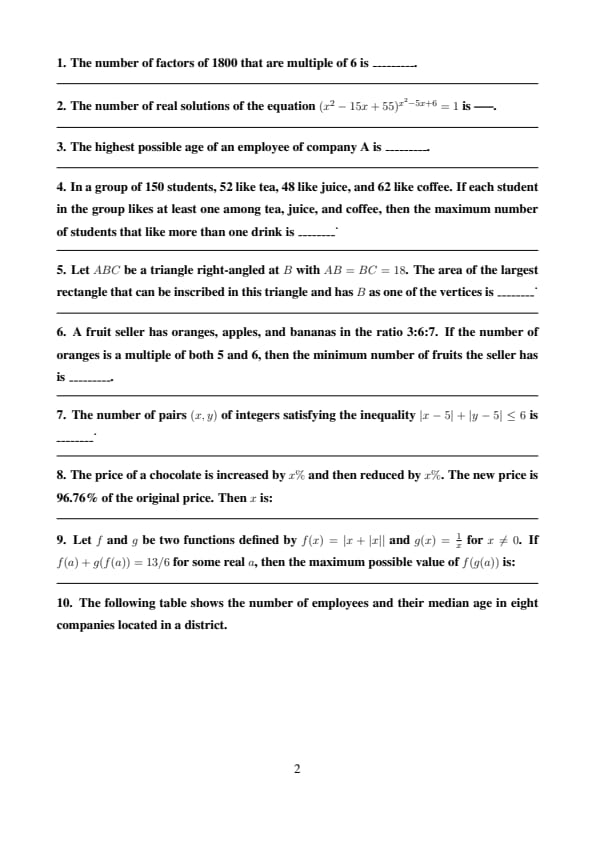
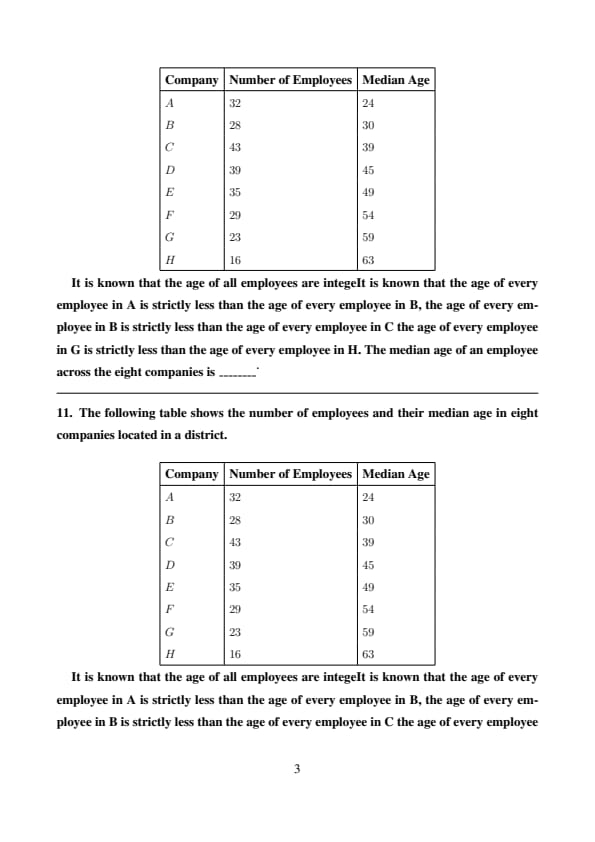
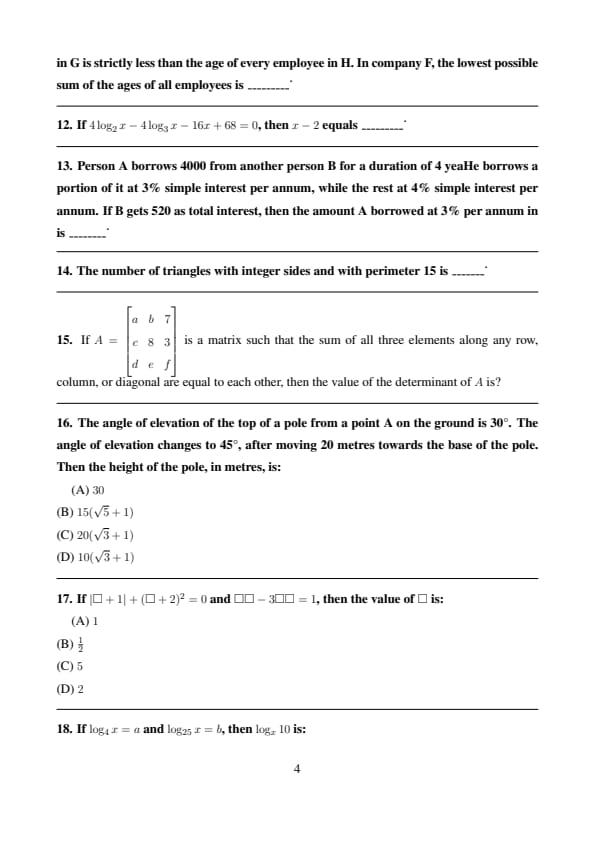
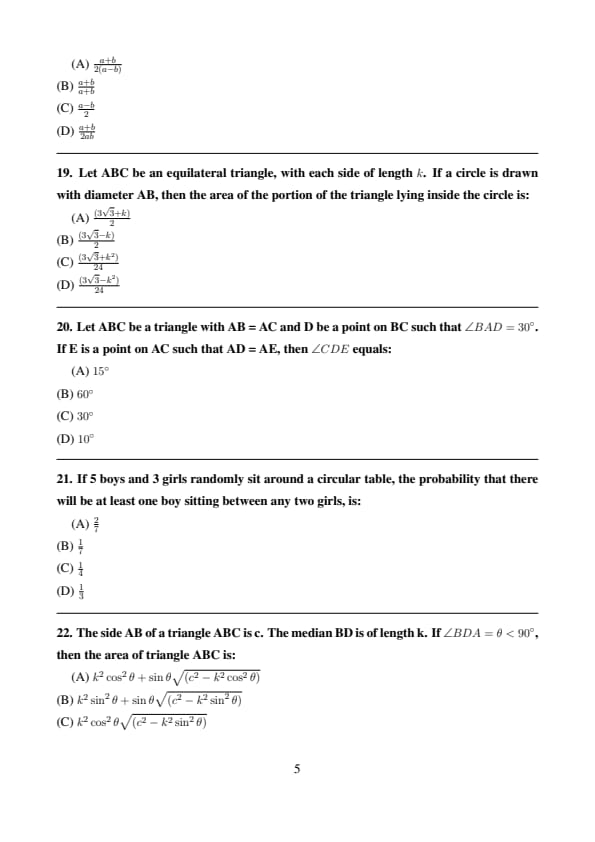
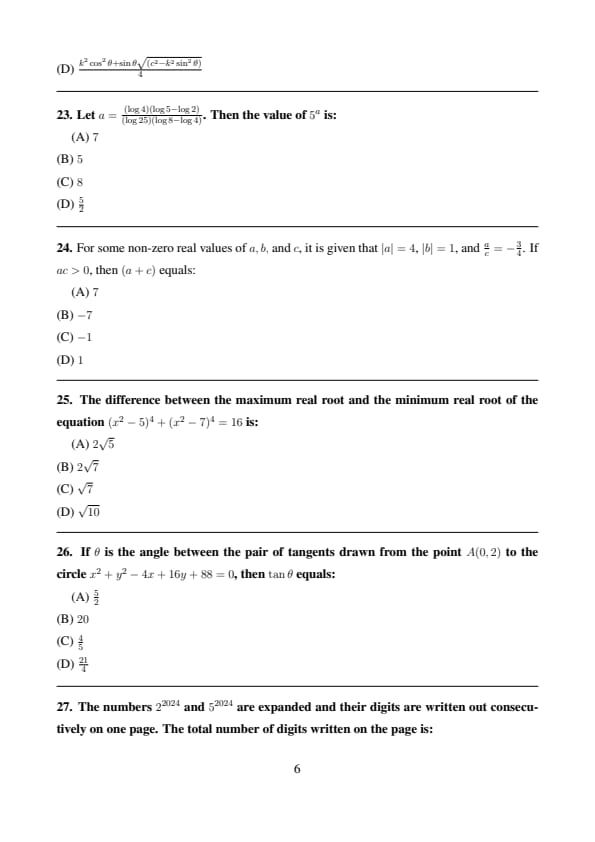
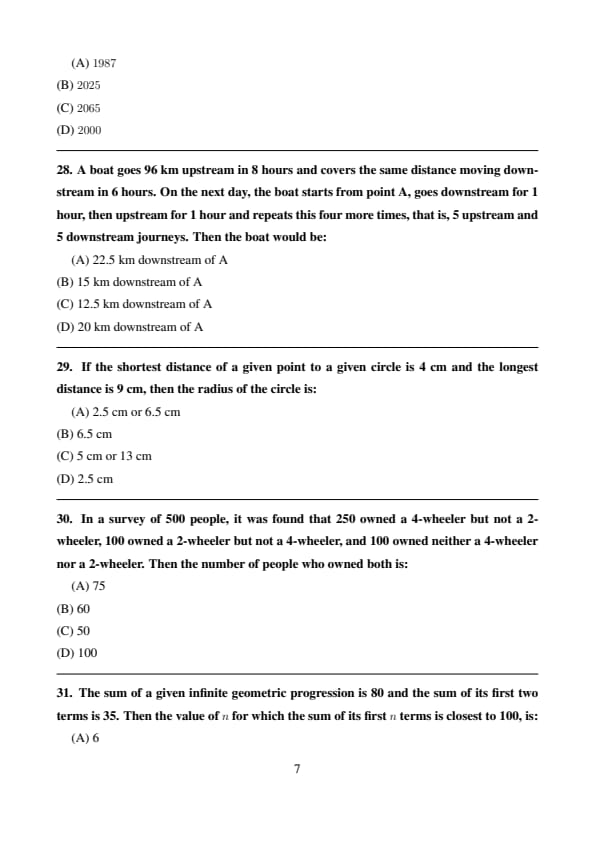
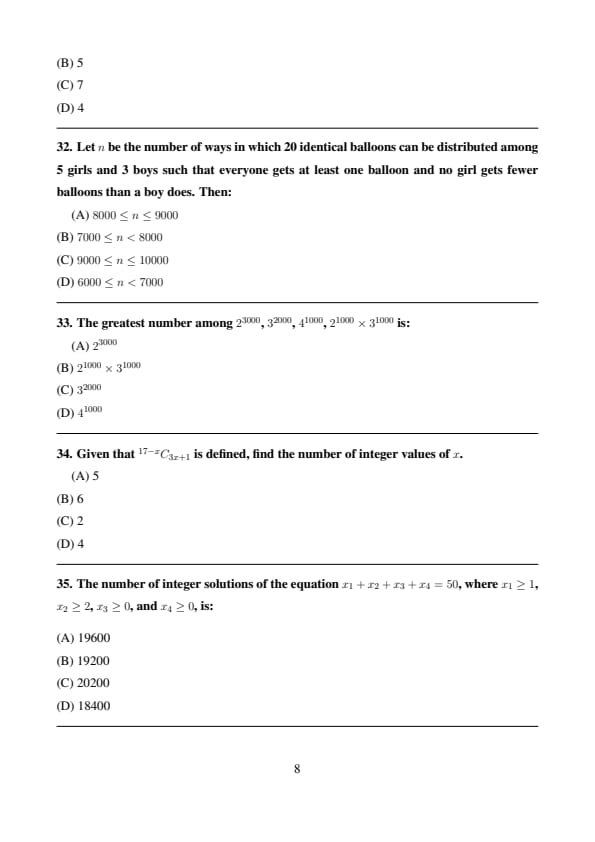
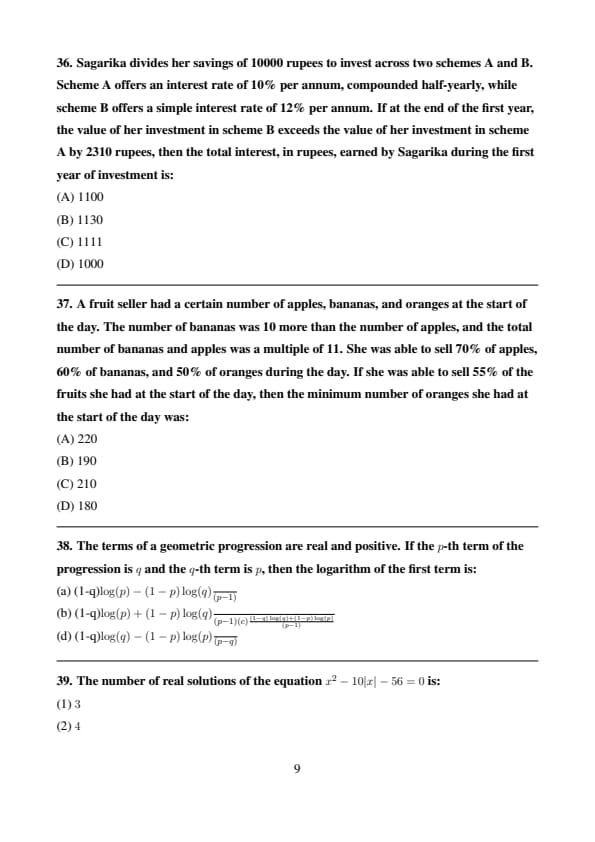
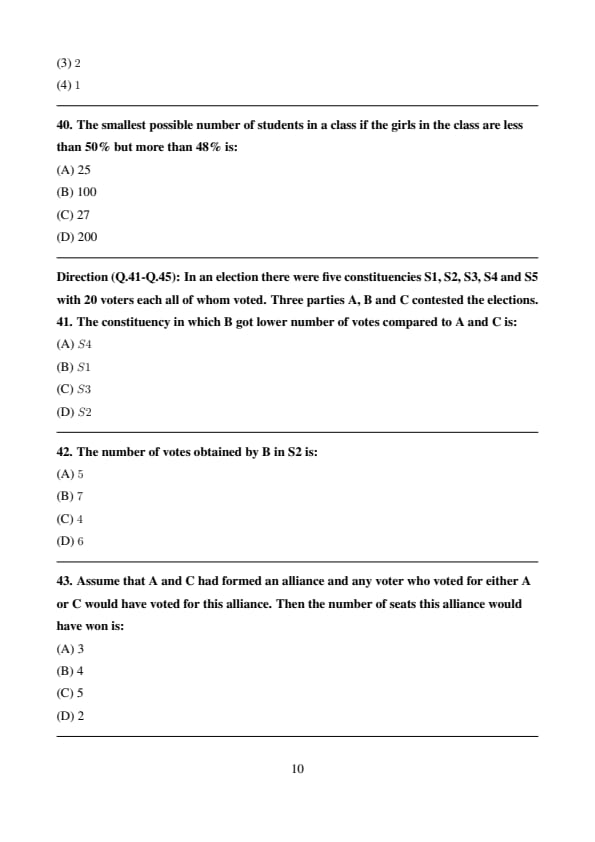
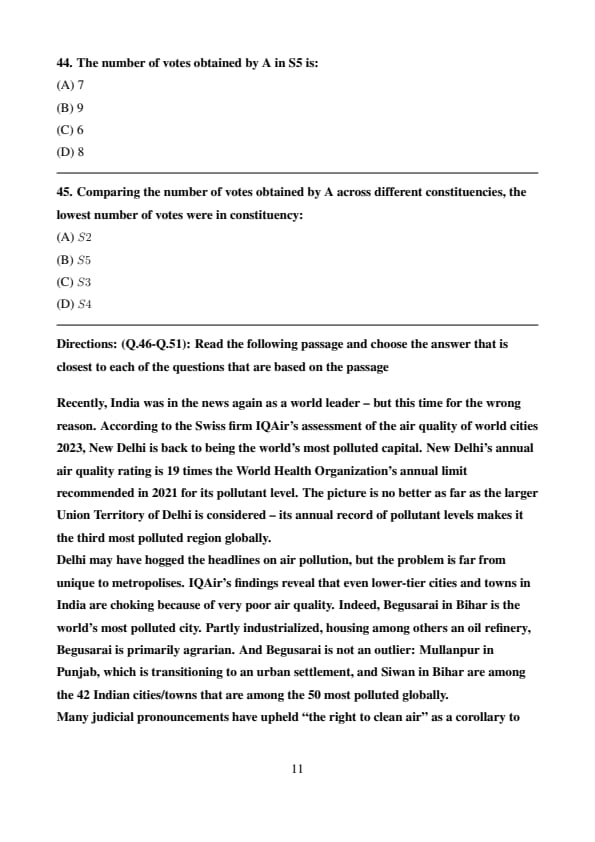
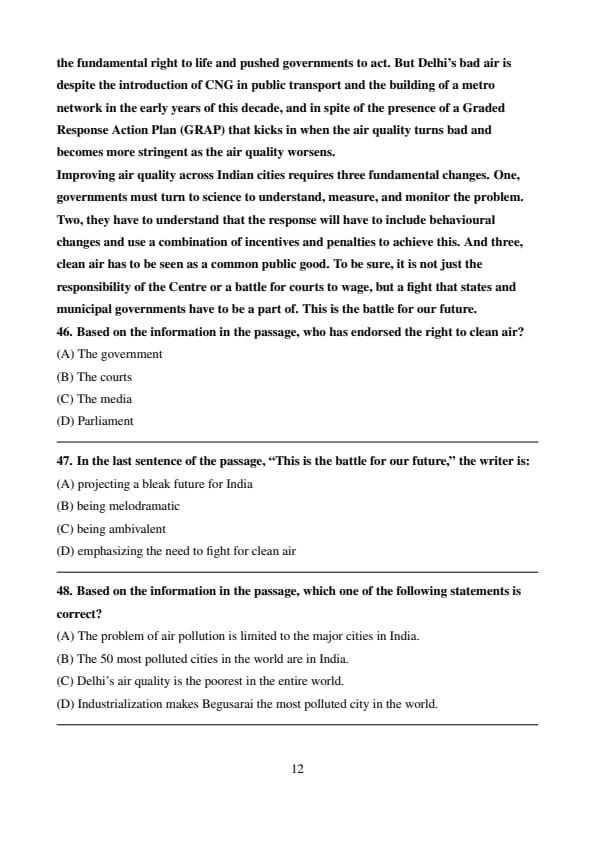
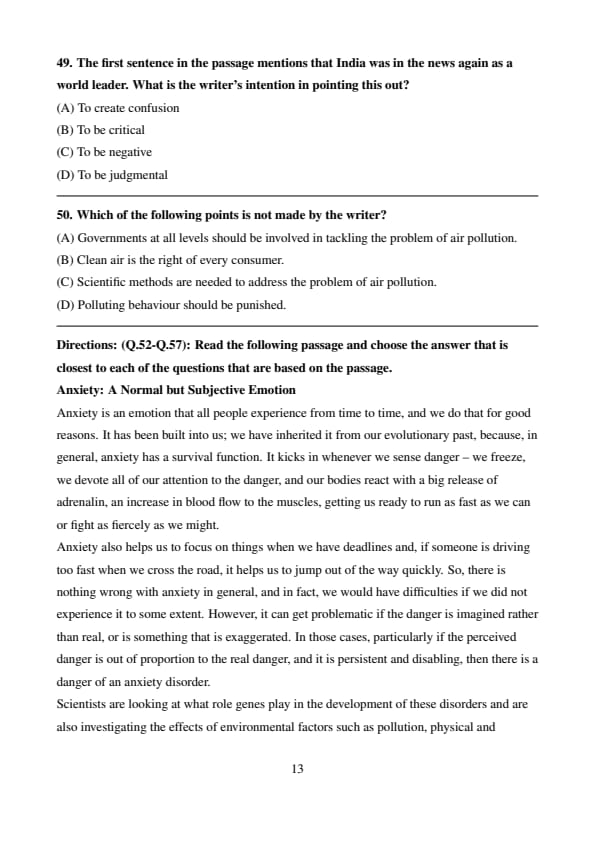
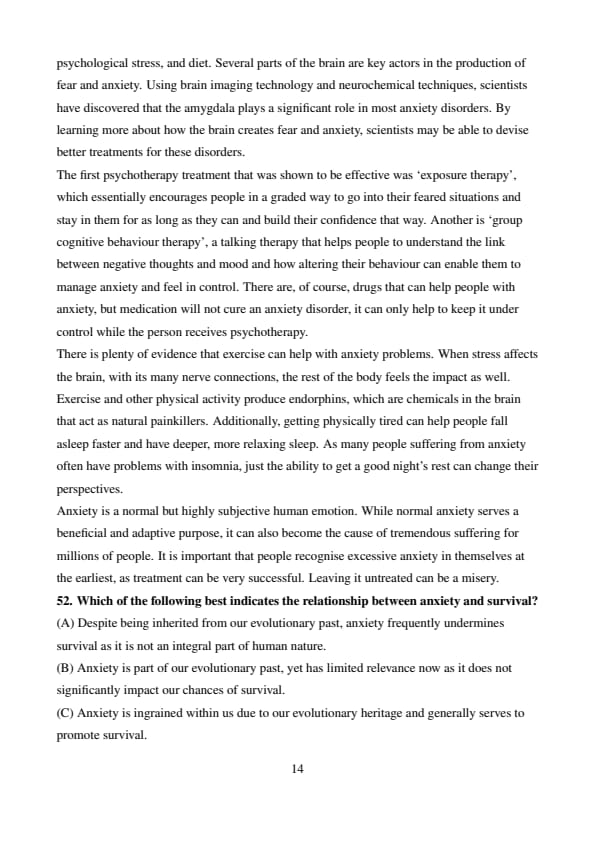
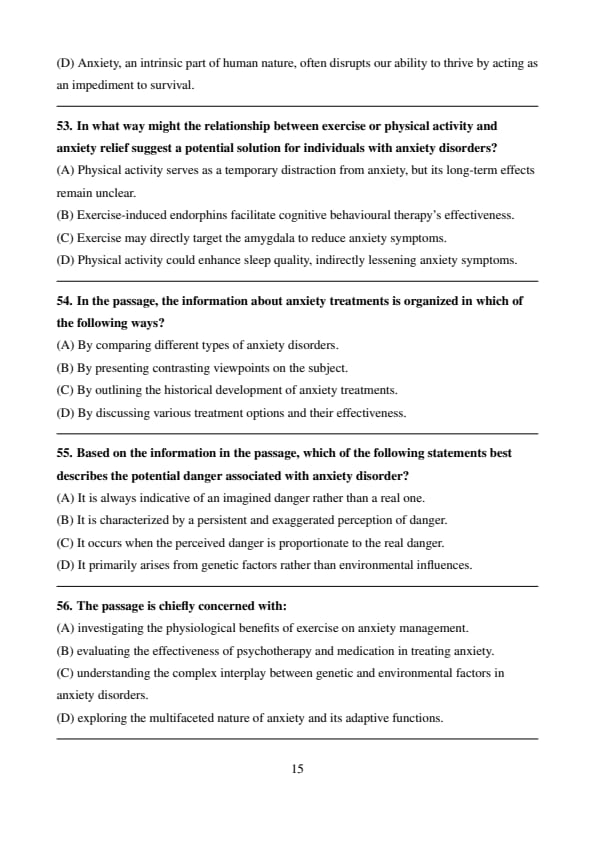
*The article might have information for the previous academic years, please refer the official website of the exam.