
IPMAT 2025 Question Paper with Solutions Pdf


Content Writer | Updated On - Nov 20, 2025
The IPMAT 2025 Question Paper with Solutions is now available for download. The Integrated Programme in Management Aptitude Test (IPMAT), conducted by the Indian Institute of Management (IIM), serves as the national-level entrance examination for admission into the 5-year Integrated Management Programme. The exam was held for a total duration of 2 hours, featuring multiple sections designed to assess quantitative ability, verbal aptitude, and logical reasoning. The question paper followed the official pattern and carried a total of 240 marks. This compiled set of solutions will help candidates analyse the difficulty level, understand section-wise trends, and evaluate their performance effectively.
IPMAT 2025 Question Paper with Solutions
| IPMAT 2025 Question Paper | Download PDF | Check Solutions |

A circle of radius 13 cm touches the adjacent sides AB and BC of a square ABCD at M and N, respectively. If AB = 18 cm and the circle intersects the other two sides CD and DA at P and Q, respectively, then the area, in sq. cm, of triangle PMD is
View Solution
Step 1: Understanding the Concept:
This problem involves coordinate geometry. We can find the area of the triangle PMD by determining the coordinates of its vertices P, M, and D. The coordinates can be found by setting up a coordinate system for the square and using the equation of the circle.
Step 2: Key Formula or Approach:
1. Establish a coordinate system. Let's place the vertex B of the square at the origin (0,0). Since ABCD is a square with side 18 cm, the coordinates of the vertices are B(0,0), A(0,18), C(18,0), and D(18,18).
2. Determine the center and equation of the circle. The circle touches sides AB (line x=0) and BC (line y=0) and has a radius of 13 cm. For it to intersect the other sides of the square (x=18, y=18), its center must be inside the square. The center O will be at (13, 13).
3. The equation of the circle is \((x - h)^2 + (y - k)^2 = r^2\), which becomes \((x - 13)^2 + (y - 13)^2 = 13^2 = 169\).
4. Find the coordinates of points M, P, and D.
5. Calculate the area of the triangle PMD using the formula: Area = \( \frac{1}{2} \times base \times height \).
Step 3: Detailed Explanation:
Coordinates of D:
From our coordinate system, the vertex D is at (18, 18).
Coordinates of M:
Point M is where the circle touches side AB. The line AB is x=0.
Substitute x=0 into the circle's equation:
\[ (0 - 13)^2 + (y - 13)^2 = 169 \] \[ 169 + (y - 13)^2 = 169 \] \[ (y - 13)^2 = 0 \implies y = 13 \]
So, the coordinates of M are (0, 13).
Coordinates of P:
Point P is where the circle intersects side CD. The line CD is x=18.
Substitute x=18 into the circle's equation:
\[ (18 - 13)^2 + (y - 13)^2 = 169 \] \[ 5^2 + (y - 13)^2 = 169 \] \[ 25 + (y - 13)^2 = 169 \] \[ (y - 13)^2 = 144 \implies y - 13 = \pm 12 \]
This gives two possible values for y: \(y = 13 + 12 = 25\) or \(y = 13 - 12 = 1\).
Since P lies on the side CD of the square, its y-coordinate must be between 0 and 18. Thus, we take y=1.
So, the coordinates of P are (18, 1).
Area of Triangle PMD:
The vertices of the triangle are P(18, 1), M(0, 13), and D(18, 18).
We can consider the segment PD as the base of the triangle. Both P and D have the same x-coordinate (18), so the base is a vertical line.
Length of base PD = \(|y_D - y_P| = |18 - 1| = 17\) cm.
The height of the triangle corresponding to this base is the perpendicular distance from vertex M to the line x=18.
Height = \(|x_D - x_M| = |18 - 0| = 18\) cm.
Area of \(\triangle PMD = \frac{1}{2} \times base \times height\).
\[ Area = \frac{1}{2} \times 17 \times 18 = 17 \times 9 = 153 sq. cm. \]
Step 4: Final Answer:
The area of triangle PMD is 153 sq. cm.
Quick Tip: For geometry problems, setting up a coordinate system is often the easiest way to solve them. For calculating the area of a triangle with a vertical or horizontal side, simply use the formula \( \frac{1}{2} \times base \times height \) by identifying the base length and the perpendicular height from the third vertex.
Monica, who is 18 years old, is one-third the age of her father. The age at which she will be half the age of her father is
View Solution
Step 1: Understanding the Concept:
This is a word problem based on ages, which can be solved by setting up linear equations based on the information given.
Step 2: Key Formula or Approach:
1. Determine the current ages of Monica and her father.
2. Let 'x' be the number of years after which the required condition is met.
3. Set up an equation representing their ages after 'x' years and the condition that Monica's age is half of her father's age.
4. Solve for 'x' and then find Monica's age at that time.
Step 3: Detailed Explanation:
Current Ages:
Monica's current age = 18 years.
Monica's age is one-third of her father's age.
So, Father's current age = \(3 \times Monica's age = 3 \times 18 = 54\) years.
Future Ages and Condition:
Let's assume after 'x' years, Monica will be half the age of her father.
After x years:
Monica's age will be \(18 + x\).
Father's age will be \(54 + x\).
The condition is: \(Monica's age = \frac{1}{2} \times Father's age\).
\[ 18 + x = \frac{1}{2} (54 + x) \]
Solving the Equation:
Multiply both sides by 2:
\[ 2(18 + x) = 54 + x \] \[ 36 + 2x = 54 + x \] \[ 2x - x = 54 - 36 \] \[ x = 18 \]
This means the condition will be met in 18 years.
Monica's Age at that Time:
The question asks for the age at which Monica will be half the age of her father. This is her age after 18 years.
Monica's future age = \(18 + x = 18 + 18 = 36\) years.
Verification:
In 18 years, Monica's age will be 36.
In 18 years, her father's age will be \(54 + 18 = 72\).
Is 36 half of 72? Yes, \(36 = \frac{72}{2}\). The condition is satisfied.
Step 4: Final Answer:
Monica's age will be 36 when she is half the age of her father.
Quick Tip: In age-related problems, the difference in ages between two people always remains constant. Current age difference is \(54 - 18 = 36\). When Monica is half her father's age, let her age be M and father's age be F. We have M = F/2 and F - M = 36. Substituting F = 2M gives 2M - M = 36, so M = 36. This is a faster method.
The number of biologists in team E is
View Solution
Step 1: Understanding the Concept:
This question requires using the common data and the deductions made from it to find a specific value, which is the number of biologists in team E (\(B_E\)).
Step 2: Detailed Explanation:
From the detailed analysis of the common data, we constructed a table that shows the number of members from each skill set for every team.
Looking at the row for Team E in the solved table:
Team E has 4 Biologists, 8 Geologists, and 3 Explorers.
Therefore, the number of biologists in team E is 4.
Step 3: Final Answer:
The number of biologists in team E is 4.
Quick Tip: For data interpretation sets, it's crucial to create a structured table to organize all the given information and deductions. This makes answering individual questions straightforward and less prone to error.
If \( \log_{8}(x^2 - 1), \log_{8}(2x^2 + 1) \) and \( \log_{8}(6x^2 + 3) \) are the first three terms of an arithmetic progression, then the sum of the next three terms of the progression is
View Solution
Note: There appears to be a typo in the question. For the answer to be an integer (15), the base of the logarithm should be 3, not 8. The solution below assumes the base is 3.
Step 1: Understanding the Concept:
The problem is based on the properties of an Arithmetic Progression (AP) and logarithms. If three terms a, b, and c are in AP, then the middle term is the arithmetic mean of the other two, i.e., \(2b = a + c\).
Step 2: Key Formula or Approach:
1. Apply the AP condition: \(2 \log_{3}(2x^2 + 1) = \log_{3}(x^2 - 1) + \log_{3}(6x^2 + 3)\).
2. Use logarithm properties (\(n \log a = \log a^n\) and \(\log a + \log b = \log ab\)) to solve for \(x^2\).
3. Find the first three terms of the AP and the common difference (d).
4. Calculate the next three terms (\(a_4, a_5, a_6\)) and find their sum.
Step 3: Detailed Explanation:
Solving for \(x^2\):
Using the AP property: \[ \log_{3}((2x^2 + 1)^2) = \log_{3}((x^2 - 1)(6x^2 + 3)) \]
Equating the arguments: \[ (2x^2 + 1)^2 = (x^2 - 1)(6x^2 + 3) \]
For the logs to be defined, \(x^2 - 1 > 0 \implies x^2 > 1\).
Let \(y = x^2\). The equation becomes: \[ (2y + 1)^2 = (y - 1)(6y + 3) \] \[ 4y^2 + 4y + 1 = 6y^2 - 3y - 3 \] \[ 2y^2 - 7y - 4 = 0 \]
Factoring the quadratic equation: \[ 2y^2 - 8y + y - 4 = 0 \] \[ 2y(y - 4) + 1(y - 4) = 0 \] \[ (2y + 1)(y - 4) = 0 \]
This gives \(y = -1/2\) or \(y = 4\). Since \(y = x^2\), y must be positive. So, \(y = x^2 = 4\). This satisfies \(x^2 > 1\).
Finding the AP and the sum:
Now, substitute \(x^2=4\) to find the first three terms (assuming base 3):
\(a_1 = \log_{3}(4 - 1) = \log_{3}(3) = 1\)
\(a_2 = \log_{3}(2(4) + 1) = \log_{3}(9) = 2\)
\(a_3 = \log_{3}(6(4) + 3) = \log_{3}(27) = 3\)
The AP is 1, 2, 3, ... with a common difference \(d = 1\).
The next three terms are \(a_4, a_5, a_6\).
\(a_4 = a_3 + d = 3 + 1 = 4\)
\(a_5 = a_4 + d = 4 + 1 = 5\)
\(a_6 = a_5 + d = 5 + 1 = 6\)
The sum of the next three terms is \(a_4 + a_5 + a_6 = 4 + 5 + 6 = 15\).
Step 4: Final Answer:
The sum of the next three terms of the progression is 15.
Quick Tip: When a question involving logarithms and progressions seems to lead to a complicated, non-integer answer, double-check for potential typos. Often, the base of the logarithm or a coefficient is chosen to make the terms simplify to simple integers.
English exam and Math exam were conducted separately for a class of 120 students. The number of students who did not appear for the English exam is twice the number of students who did not appear for the Math exam. The number of students who passed the Math exam is twice the number of students who appeared but failed the English exam. If the number of students who passed the English exam is twice the number of students who appeared but failed the Math exam, then the number of students who appeared but failed the English exam is
View Solution
Step 1: Understanding the Concept:
This problem involves setting up and solving a system of linear equations based on the given information about students in two exams. It's a problem of set theory and algebra.
Step 2: Key Formula or Approach:
Define variables for each category of students:
Total students = 120
\(N_E\), \(N_M\): Number of students who did not appear for English, Math.
\(A_E\), \(A_M\): Number of students who appeared for English, Math.
\(P_E\), \(P_M\): Number of students who passed English, Math.
\(F_E\), \(F_M\): Number of students who appeared but failed English, Math.
Formulate equations from the problem statement:
\(N_E = 2 N_M\)
\(P_M = 2 F_E\)
\(P_E = 2 F_M\)
\(A_E = 120 - N_E\) and \(A_M = 120 - N_M\)
\(A_E = P_E + F_E\) and \(A_M = P_M + F_M\)
Solve the system for the required value, which is \(F_E\).
Step 3: Detailed Explanation:
Let's express everything in terms of \(N_M\), \(F_E\), and \(F_M\).
From the relations for students who appeared: \[ A_M = P_M + F_M \implies 120 - N_M = 2F_E + F_M \quad \textbf{(Eq. A)} \] \[ A_E = P_E + F_E \implies 120 - N_E = 2F_M + F_E \]
Since \(N_E = 2N_M\), the second equation becomes: \[ 120 - 2N_M = 2F_M + F_E \quad \textbf{(Eq. B)} \]
Now we have a system of two equations with three variables. Let's try to eliminate variables.
Multiply Eq. B by 2: \[ 2(120 - 2N_M) = 2(2F_M + F_E) \] \[ 240 - 4N_M = 4F_M + 2F_E \quad \textbf{(Eq. C)} \]
From Eq. A, we can express \(2F_E\) as: \[ 2F_E = 120 - N_M - F_M \]
Substitute this expression for \(2F_E\) into Eq. C: \[ 240 - 4N_M = 4F_M + (120 - N_M - F_M) \]
Simplify the equation to find a relation between \(N_M\) and \(F_M\): \[ 240 - 4N_M = 3F_M + 120 - N_M \] \[ 240 - 120 = 3F_M + 4N_M - N_M \] \[ 120 = 3F_M + 3N_M \]
Divide by 3: \[ 40 = F_M + N_M \implies F_M = 40 - N_M \]
Now, substitute this expression for \(F_M\) back into Eq. B: \[ 120 - 2N_M = 2(40 - N_M) + F_E \] \[ 120 - 2N_M = 80 - 2N_M + F_E \]
The term \(-2N_M\) cancels out on both sides: \[ 120 = 80 + F_E \] \[ F_E = 120 - 80 = 40 \]
Step 4: Final Answer:
The number of students who appeared but failed the English exam is 40.
Quick Tip: When faced with a system of equations that seems to have more variables than equations, don't panic. Proceed with substitution or elimination, as some variables might cancel out, leading to a direct solution for the required value.
The number of teams having more geologists than biologists is
View Solution
Step 1: Understanding the Concept:
This question requires comparing the number of geologists and biologists for each of the five teams, based on the completed data table derived from the common information.
Step 2: Detailed Explanation:
Using the final distribution table from the common data analysis:
\begin{table[h!]
\centering
\begin{tabular{|c|c|c|
\hline
Team & Biologists (B) & Geologists (G)
\hline
A & 2 & 6
\hline
B & 7 & 2
\hline
C & 6 & 4
\hline
D & 6 & 5
\hline
E & 4 & 8
\hline
\end{tabular
\end{table
We need to find the teams where \(G > B\). Let's check each team:
Team A: Geologists (6) > Biologists (2). Yes.
Team B: Geologists (2) < Biologists (7). No.
Team C: Geologists (4) < Biologists (6). No.
Team D: Geologists (5) < Biologists (6). No.
Team E: Geologists (8) > Biologists (4). Yes.
Two teams, A and E, have more geologists than biologists.
Step 3: Final Answer:
The number of teams having more geologists than biologists is 2.
Quick Tip: Once the main data table is correctly solved for a logic-based set, subsequent questions are usually simple lookups or comparisons. The key is to invest time in getting the initial setup right.
If \(A = \begin{pmatrix} 2 & p
0 & 3 \end{pmatrix}\) such that \(A^3 = 27 \begin{pmatrix} 4 & q
0 & r \end{pmatrix}\), then \(p+q+r\) equals
View Solution
Step 1: Understanding the Concept:
This problem involves matrix multiplication and solving a matrix equation. We need to compute \(A^3\) and equate it to the given expression to find the values of p, q, and r.
Step 2: Key Formula or Approach:
1. Calculate \(A^2 = A \times A\).
2. Calculate \(A^3 = A^2 \times A\).
3. Expand the right-hand side of the given equation: \(27 \begin{pmatrix} 4 & q
0 & r \end{pmatrix} = \begin{pmatrix} 108 & 27q
0 & 27r \end{pmatrix}\).
4. Equate the corresponding elements of the matrices \(A^3\) and the expanded RHS to form equations.
Step 3: Detailed Explanation:
Calculating \(A^2\): \[ A^2 = \begin{pmatrix} 2 & p
0 & 3 \end{pmatrix} \begin{pmatrix} 2 & p
0 & 3 \end{pmatrix} = \begin{pmatrix} (2)(2)+(p)(0) & (2)(p)+(p)(3)
(0)(2)+(3)(0) & (0)(p)+(3)(3) \end{pmatrix} = \begin{pmatrix} 4 & 5p
0 & 9 \end{pmatrix} \]
Calculating \(A^3\): \[ A^3 = A^2 \times A = \begin{pmatrix} 4 & 5p
0 & 9 \end{pmatrix} \begin{pmatrix} 2 & p
0 & 3 \end{pmatrix} = \begin{pmatrix} (4)(2)+(5p)(0) & (4)(p)+(5p)(3)
(0)(2)+(9)(0) & (0)(p)+(9)(3) \end{pmatrix} = \begin{pmatrix} 8 & 19p
0 & 27 \end{pmatrix} \]
Equating the Matrices:
The given equation is \(A^3 = 27 \begin{pmatrix} 4 & q
0 & r \end{pmatrix}\). \[ \begin{pmatrix} 8 & 19p
0 & 27 \end{pmatrix} = \begin{pmatrix} 27 \times 4 & 27q
0 & 27r \end{pmatrix} = \begin{pmatrix} 108 & 27q
0 & 27r \end{pmatrix} \]
By comparing the corresponding elements of the matrices:
From the top-left element (row 1, column 1): \(8 = 108\).
This is a contradiction. The equality \(8 = 108\) is false, which means that there are no values of p, q, and r that can satisfy the given matrix equation. The question is flawed as stated.
Step 4: Final Answer:
The question contains a mathematical contradiction and cannot be solved as written.
Quick Tip: For triangular matrices, the diagonal elements of the matrix raised to a power are simply the powers of the original diagonal elements. Here, the diagonal of A is (2, 3), so the diagonal of \(A^3\) must be \((2^3, 3^3) = (8, 27)\). This quick check immediately shows a contradiction with the RHS \((108, 27r)\), saving calculation time.
The median number of biologists across five teams is
View Solution
Step 1: Understanding the Concept:
The median is the middle value in a dataset that has been arranged in ascending or descending order. For a dataset with an odd number of values, the median is the single middle value.
Step 2: Detailed Explanation:
From the solved data table, the number of biologists in the five teams (A, B, C, D, E) are: \[ 2, 7, 6, 6, 4 \]
To find the median, we first need to arrange these numbers in ascending order: \[ 2, 4, 6, 6, 7 \]
There are 5 values (an odd number). The median is the middle value, which is the \(\left(\frac{5+1}{2}\right)^{th} = 3^{rd}\) value in the ordered list.
The third value in the list is 6.
Step 3: Final Answer:
The median number of biologists across the five teams is 6.
Quick Tip: Always remember to sort the data before finding the median. Forgetting this step is a common mistake. For an even number of data points, the median is the average of the two middle values.
If the polynomial \(ax^2 + bx + 5\) leaves a remainder 3 when divided by \(x - 1\), and a remainder 2 when divided by \(x + 1\), then \(2b - 4a\) equals
View Solution
Step 1: Understanding the Concept:
This problem uses the Remainder Theorem, which states that if a polynomial \(P(x)\) is divided by a linear factor \((x - c)\), the remainder is \(P(c)\).
Step 2: Key Formula or Approach:
1. Let the polynomial be \(P(x) = ax^2 + bx + 5\).
2. Use the Remainder Theorem for the two given conditions to form two linear equations in terms of 'a' and 'b'.
3. Solve the system of equations for 'a' and 'b'.
4. Calculate the value of the expression \(2b - 4a\).
Step 3: Detailed Explanation:
Condition 1: Remainder is 3 when divided by (x - 1)
According to the Remainder Theorem, \(P(1) = 3\).
\[ P(1) = a(1)^2 + b(1) + 5 = 3 \] \[ a + b + 5 = 3 \] \[ a + b = -2 \quad \textbf{(Eq. 1)} \]
Condition 2: Remainder is 2 when divided by (x + 1)
The divisor is \(x + 1\), which can be written as \(x - (-1)\). So, \(P(-1) = 2\).
\[ P(-1) = a(-1)^2 + b(-1) + 5 = 2 \] \[ a - b + 5 = 2 \] \[ a - b = -3 \quad \textbf{(Eq. 2)} \]
Solving for 'a' and 'b':
We have a system of two linear equations:
\(a + b = -2\)
\(a - b = -3\)
Add Eq. 1 and Eq. 2: \[ (a + b) + (a - b) = -2 + (-3) \] \[ 2a = -5 \implies a = -\frac{5}{2} \]
Substitute the value of 'a' into Eq. 1: \[ -\frac{5}{2} + b = -2 \] \[ b = -2 + \frac{5}{2} = -\frac{4}{2} + \frac{5}{2} = \frac{1}{2} \]
So, we have \(a = -5/2\) and \(b = 1/2\).
Calculating the final expression:
We need to find the value of \(2b - 4a\). \[ 2b - 4a = 2\left(\frac{1}{2}\right) - 4\left(-\frac{5}{2}\right) \] \[ = 1 - (-10) \] \[ = 1 + 10 = 11 \]
Step 4: Final Answer:
The value of \(2b - 4a\) is 11.
Quick Tip: The Remainder Theorem is a shortcut to finding remainders without performing long division. For a divisor \((x-c)\), simply plug \(x=c\) into the polynomial. For \((x+c)\), plug in \(x=-c\).
If m and n are two positive integers such that \(7m + 11n = 200\), then the minimum possible value of \(m + n\) is
View Solution
Step 1: Understanding the Concept:
This problem involves finding integer solutions to a linear Diophantine equation, which is an equation of the form \(ax + by = c\). We are looking for positive integer solutions and need to minimize their sum.
Step 2: Key Formula or Approach:
1. Isolate one variable to analyze the divisibility condition. Let's isolate m: \(7m = 200 - 11n\).
2. Since m must be a positive integer, \(200 - 11n\) must be a positive multiple of 7.
3. Find the possible values of n that satisfy this condition. Since m and n are positive, \(200 - 11n > 0\), which gives a range for n.
4. For each valid n, find the corresponding m.
5. Calculate the sum \(m+n\) for each solution pair and find the minimum sum.
Step 3: Detailed Explanation:
The equation is \(7m + 11n = 200\).
Since m and n are positive integers:
\(7m = 200 - 11n > 0 \implies 11n < 200 \implies n < \frac{200}{11} \approx 18.18\). So \(1 \le n \le 18\).
\(11n = 200 - 7m > 0 \implies 7m < 200 \implies m < \frac{200}{7} \approx 28.57\). So \(1 \le m \le 28\).
From \(7m = 200 - 11n\), we know that \(200 - 11n\) must be divisible by 7.
We can express this using modular arithmetic: \[ 200 - 11n \equiv 0 \pmod{7} \]
Let's find the remainders when 200 and 11 are divided by 7:
\(200 = 28 \times 7 + 4 \implies 200 \equiv 4 \pmod{7}\)
\(11 = 1 \times 7 + 4 \implies 11 \equiv 4 \pmod{7}\)
Substituting these into the congruence: \[ 4 - 4n \equiv 0 \pmod{7} \] \[ 4(1 - n) \equiv 0 \pmod{7} \]
Since 4 and 7 are coprime, we must have \(1 - n \equiv 0 \pmod{7}\), which means \(n \equiv 1 \pmod{7}\).
So, n must be a number that leaves a remainder of 1 when divided by 7.
Possible values for n in the range [1, 18] are:
\(n = 1\)
\(n = 1 + 7 = 8\)
\(n = 8 + 7 = 15\)
Now, let's find the corresponding value of m for each n:
If n = 1: \(7m = 200 - 11(1) = 189 \implies m = \frac{189}{7} = 27\). Solution: (m,n) = (27, 1).
If n = 8: \(7m = 200 - 11(8) = 200 - 88 = 112 \implies m = \frac{112}{7} = 16\). Solution: (m,n) = (16, 8).
If n = 15: \(7m = 200 - 11(15) = 200 - 165 = 35 \implies m = \frac{35}{7} = 5\). Solution: (m,n) = (5, 15).
Finally, calculate the sum \(m+n\) for each pair:
For (27, 1): \(m+n = 27 + 1 = 28\)
For (16, 8): \(m+n = 16 + 8 = 24\)
For (5, 15): \(m+n = 5 + 15 = 20\)
The minimum value among these sums is 20.
Step 4: Final Answer:
The minimum possible value of \(m + n\) is 20.
Quick Tip: For Diophantine equations of the form \(ax+by=c\), once you find one solution \((x_0, y_0)\), all other solutions are given by \(x = x_0 + k(b/d)\) and \(y = y_0 - k(a/d)\), where \(d = \gcd(a,b)\) and k is an integer. In this case, \(\gcd(7,11)=1\), so solutions are \(m = 5 + 11k\) and \(n=15-7k\). We can find the other positive solutions by varying k.
If the sum of the first 21 terms of the sequence \( \ln\frac{m}{n}, \ln\frac{m^2}{n^2}, \ln\frac{m^3}{n^3}, \dots \) is [VALUE MISSING IN QUESTION], then the value of \(m+n\) is
View Solution
Note: The question provided in the image is incomplete. It does not state what the sum of the first 21 terms is equal to. Without this information, the values of m and n, and therefore their sum, cannot be determined. However, assuming there is a missing piece of information that would lead to the given answer of 147, we can analyze the sequence.
Step 1: Understanding the Concept:
The problem involves finding the sum of terms in a sequence. We first need to identify the type of sequence (e.g., arithmetic or geometric) and then use the appropriate summation formula.
Step 2: Key Formula or Approach:
1. Analyze the terms of the sequence using logarithm properties. The k-th term is \(a_k = \ln\frac{m^k}{n^k}\).
2. Simplify the general term: \(a_k = \ln\left(\frac{m}{n}\right)^k = k \ln\left(\frac{m}{n}\right)\).
3. Recognize that this is an Arithmetic Progression (AP) where the first term \(a_1 = \ln(m/n)\) and the common difference \(d = a_2 - a_1 = 2\ln(m/n) - \ln(m/n) = \ln(m/n)\).
4. Use the formula for the sum of the first 'k' terms of an AP: \(S_k = \frac{k}{2}(2a_1 + (k-1)d)\).
Step 3: Detailed Explanation:
The sequence is \( \ln\frac{m}{n}, \ln\frac{m^2}{n^2}, \ln\frac{m^3}{n^3}, \dots \).
The k-th term is \(a_k = k \ln\left(\frac{m}{n}\right)\).
This is an AP with first term \(a_1 = \ln\left(\frac{m}{n}\right)\) and common difference \(d = \ln\left(\frac{m}{n}\right)\).
We need to find the sum of the first 21 terms (\(S_{21}\)).
Using the AP sum formula: \[ S_{21} = \frac{21}{2}[2a_1 + (21-1)d] \] \[ S_{21} = \frac{21}{2}[2\ln\left(\frac{m}{n}\right) + 20\ln\left(\frac{m}{n}\right)] \] \[ S_{21} = \frac{21}{2}[22\ln\left(\frac{m}{n}\right)] \] \[ S_{21} = 21 \times 11 \ln\left(\frac{m}{n}\right) = 231 \ln\left(\frac{m}{n}\right) \]
Using logarithm properties, this can also be written as: \[ S_{21} = \ln\left(\left(\frac{m}{n}\right)^{231}\right) = \ln\left(\frac{m^{231}}{n^{231}}\right) \]
Conclusion on the missing information:
The question is missing the value to which this sum is equal. For example, if the problem stated that the sum is \(231 \ln(2)\), we could deduce that \(m/n = 2\). We would then need another piece of information to find unique values for m and n.
To reach the specific answer \(m+n=147\), the problem must have provided sufficient constraints. For instance, if the sum was equal to \(231 \ln(2)\) and we were told m and n are coprime with sum 147, then \(m=98, n=49\) would give \(m/n=2\) and \(m+n=147\). But this is speculation.
Step 4: Final Answer:
The question is incomplete. Based on the provided answer of 147, we can infer that the missing information would lead to a unique solution for m and n which sum to 147 (e.g., m=98, n=49).
Quick Tip: When working with sequences involving logarithms, always use log properties first to simplify the terms. \(\ln(a/b) = \ln(a) - \ln(b)\) and \(\ln(a^k) = k \ln(a)\) are essential for identifying the pattern. If a question appears unsolvable, re-read carefully to ensure no information was missed.
Arpita and Nikita, working together, can complete an assigned job in 12 days. If Arpita works initially to complete 40% of the job, and the remaining job is completed by Nikita alone, then it takes 24 days to complete the job. The possible number of days that Nikita requires to complete the entire job, working alone, is
View Solution
Step 1: Understanding the Concept:
This is a 'Work and Time' problem. The core idea is to express the rate of work for each person and use the formula: Work = Rate \( \times \) Time.
Step 2: Key Formula or Approach:
1. Let Arpita's rate of work be 'A' jobs per day and Nikita's be 'N' jobs per day. The total work is 1 job.
2. From the first statement: \((A+N) \times 12 = 1 \implies A+N = 1/12\).
3. From the second statement: Arpita does 0.4 of the job and Nikita does the remaining 0.6. The total time taken is 24 days.
Time taken by Arpita = Work/Rate = \(0.4/A\).
Time taken by Nikita = Work/Rate = \(0.6/N\).
So, \(0.4/A + 0.6/N = 24\).
4. Solve the system of two equations to find the value of N. The number of days Nikita takes alone is \(1/N\).
Step 3: Detailed Explanation:
We have the system of equations:
\(A + N = 1/12 \implies A = 1/12 - N\)
\(\frac{0.4}{A} + \frac{0.6}{N} = 24\)
Substitute A from equation (1) into equation (2): \[ \frac{0.4}{(1/12 - N)} + \frac{0.6}{N} = 24 \]
To simplify the first term, rewrite the denominator: \( \frac{1}{12} - N = \frac{1 - 12N}{12} \). \[ \frac{0.4 \times 12}{1 - 12N} + \frac{0.6}{N} = 24 \] \[ \frac{4.8}{1 - 12N} + \frac{0.6}{N} = 24 \]
Combine the fractions on the left side: \[ \frac{4.8N + 0.6(1 - 12N)}{N(1 - 12N)} = 24 \] \[ 4.8N + 0.6 - 7.2N = 24N(1 - 12N) \] \[ 0.6 - 2.4N = 24N - 288N^2 \]
Rearrange into a standard quadratic form \(ax^2+bx+c=0\): \[ 288N^2 - 24N - 2.4N + 0.6 = 0 \] \[ 288N^2 - 26.4N + 0.6 = 0 \]
Multiply the entire equation by 10 to remove decimals: \[ 2880N^2 - 264N + 6 = 0 \]
Divide by 6 to simplify: \[ 480N^2 - 44N + 1 = 0 \]
Solve this quadratic equation for N using factorization or the quadratic formula. Let's factorize: \[ 480N^2 - 20N - 24N + 1 = 0 \] \[ 20N(24N - 1) - 1(24N - 1) = 0 \] \[ (20N - 1)(24N - 1) = 0 \]
This gives two possible values for N:
\(20N - 1 = 0 \implies N = 1/20\)
\(24N - 1 = 0 \implies N = 1/24\)
The number of days Nikita takes to complete the job alone is \(1/N\).
So, the possible number of days are:
If \(N = 1/20\), Nikita takes 20 days.
If \(N = 1/24\), Nikita takes 24 days.
Both are valid mathematical solutions. Since the question asks for "The possible number of days" and provides a single answer field (implying one of the possibilities is expected), and the given answer is 20, we choose 20.
Step 4: Final Answer:
The possible number of days that Nikita requires to complete the entire job alone is 20.
Quick Tip: In 'Work and Time' problems, always work with rates (i.e., work done per unit of time). This approach consistently helps in setting up the correct equations. Also, when a quadratic equation yields two positive solutions, check if the problem context provides additional constraints to eliminate one. If not, both are "possible" answers.
Eight teams take part in a tournament where each team plays against every other team exactly once. In a particular year, one team got suspended after playing 3 matches, due to a disciplinary issue. The organizers decide to proceed, nonetheless, with the remaining matches. The total number of matches that were played in the tournament that year is _______.
View Solution
Step 1: Understanding the Concept:
This problem is based on combinations, specifically for calculating the number of games in a round-robin tournament. A round-robin tournament is one in which each team plays every other team. We need to calculate the total matches played, considering one team was disqualified partway through.
Step 2: Key Formula or Approach:
There are two ways to solve this:
Method 1: Subtraction Method
1. Calculate the total number of matches that would have been played if all 8 teams completed the tournament. The formula for the number of matches in a round-robin tournament with 'n' teams is \( \binom{n}{2} = \frac{n(n-1)}{2} \).
2. Determine how many matches the suspended team was supposed to play.
3. Subtract the number of matches the suspended team did NOT play from the total possible matches.
Method 2: Addition Method
1. Count the number of matches played by the suspended team.
2. Count the number of matches played exclusively among the remaining teams.
3. Add these two counts together.
Step 3: Detailed Explanation:
Using Method 1 (Subtraction Method):
1. Total possible matches: If all 8 teams had completed the tournament, the total number of matches would be:
\[ Total Matches = \binom{8}{2} = \frac{8 \times (8-1)}{2} = \frac{8 \times 7}{2} = 28 matches \]
2. Matches involving the suspended team: The suspended team was supposed to play against the other 7 teams. So, it was scheduled to play 7 matches.
3. Matches played vs. not played by the suspended team: The team played 3 matches before being suspended. Therefore, the number of matches it did not get to play (which were cancelled) is:
\[ Cancelled Matches = 7 - 3 = 4 matches \]
4. Total matches actually played: This is the total possible matches minus the cancelled matches.
\[ Actual Matches Played = 28 - 4 = 24 \]
Using Method 2 (Addition Method):
1. Matches played by the suspended team: The problem states this is 3 matches.
2. Matches among the remaining teams: After one team was suspended, 7 teams remained. These 7 teams played a complete round-robin tournament among themselves. The number of matches among these 7 teams is:
\[ Matches among remaining teams = \binom{7}{2} = \frac{7 \times (7-1)}{2} = \frac{7 \times 6}{2} = 21 matches \]
3. Total matches actually played: This is the sum of the matches played by the suspended team and the matches played among the other teams.
\[ Actual Matches Played = 3 + 21 = 24 \]
Both methods yield the same result.
Step 4: Final Answer:
The total number of matches that were played in the tournament is 24.
Quick Tip: For round-robin tournament problems, the formula \( \binom{n}{2} \) is fundamental. When a team is disqualified, it's often easier to calculate the matches played by the remaining teams (\( \binom{n-1}{2} \)) and add the matches the disqualified team actually played. This addition method can be less prone to errors than the subtraction method.
If a, b, c are three distinct natural numbers, all less than 100, such that \(|a - b| + |b - c| = |c - a|\), then the maximum possible value of b is _______.
View Solution
Step 1: Understanding the Concept:
This problem involves the properties of absolute values. The given equation is a form of the triangle inequality. The equality case of the triangle inequality provides a specific condition on the numbers involved.
Step 2: Key Formula or Approach:
The property of absolute values states that \(|x| + |y| = |x + y|\) holds if and only if \(x\) and \(y\) have the same sign, or one of them is zero (i.e., \(xy \ge 0\)).
We can apply this property to the given equation by setting \(x = a - b\) and \(y = b - c\). Notice that \(x + y = (a - b) + (b - c) = a - c\). The given equation is \(|a - b| + |b - c| = |c - a|\), and since \(|c - a| = |a - c|\), it fits the property.
Step 3: Detailed Explanation:
Let \(x = a - b\) and \(y = b - c\). The given equation is \(|x| + |y| = |-(x+y)| = |x+y|\).
According to the property of absolute values, this equality holds true if and only if \(xy \ge 0\).
Substituting back the expressions for x and y: \[ (a - b)(b - c) \ge 0 \]
This inequality implies two possible cases:
Case 1: Both factors are non-negative. \[ a - b \ge 0 \quad and \quad b - c \ge 0 \] \[ a \ge b \quad and \quad b \ge c \]
Combining these gives \(a \ge b \ge c\).
Case 2: Both factors are non-positive. \[ a - b \le 0 \quad and \quad b - c \le 0 \] \[ a \le b \quad and \quad b \le c \]
Combining these gives \(a \le b \le c\).
So, the condition \(|a - b| + |b - c| = |c - a|\) means that the number 'b' must lie between 'a' and 'c' on the number line (inclusive).
Now, we use the additional constraints given in the problem:
a, b, c are natural numbers, so they are positive integers.
They are all less than 100, so \(1 \le a, b, c \le 99\).
They are distinct numbers, which means \(a \neq b\), \(b \neq c\), and \(a \neq c\).
Because they are distinct, the inequalities become strict:
Either \(a > b > c\) or \(a < b < c\).
Our goal is to find the maximum possible value of 'b'.
Let's consider the case \(a < b < c\). To maximize 'b', we should choose 'c' to be as large as possible. The largest possible value for 'c' is 99 (since it must be less than 100). If \(c = 99\), the largest possible integer value for 'b' that is less than 'c' is 98. We can then choose 'a' to be any distinct natural number less than 'b', for example, \(a = 97\).
This gives the set \(a=97, b=98, c=99\). These values are distinct, natural, and less than 100. They satisfy \(a < b < c\).
Let's consider the case \(a > b > c\). To maximize 'b', we should choose 'a' to be as large as possible. The largest possible value for 'a' is 99. If \(a = 99\), the largest possible integer value for 'b' that is less than 'a' is 98. We can then choose 'c' to be any distinct natural number less than 'b', for example, \(c = 97\).
This gives the set \(a=99, b=98, c=97\). These values satisfy \(a > b > c\).
In both possible orderings, the maximum value that 'b' can take is 98.
Step 4: Final Answer:
The maximum possible value of b is 98.
Quick Tip: The condition \(|x| + |y| = |x+y|\) is a geometric interpretation that three points are collinear. If you consider a, b, c on a number line, the distance from a to b plus the distance from b to c equals the distance from a to c. This is only possible if b is located between a and c. This insight quickly simplifies the problem.
The number of factors of \(3^5 \times 5^8 \times 7^2\) that are perfect squares is _______.
View Solution
Step 1: Understanding the Concept:
This problem is from number theory and deals with finding the number of factors of a given integer that have a specific property, in this case, being a perfect square. The key is to understand the prime factorization of a number and its factors.
Step 2: Key Formula or Approach:
1. Let the given number be \(N = p_1^{a_1} \times p_2^{a_2} \times \dots \times p_k^{a_k}\).
2. Any factor of N will be of the form \(f = p_1^{b_1} \times p_2^{b_2} \times \dots \times p_k^{b_k}\), where \(0 \le b_i \le a_i\) for each \(i\).
3. A number is a perfect square if and only if all the exponents in its prime factorization are even integers.
4. Therefore, for a factor 'f' to be a perfect square, each exponent \(b_i\) must be an even number.
5. We need to count the number of possible even values for each exponent within its allowed range and then multiply these counts together using the fundamental principle of counting.
Step 3: Detailed Explanation:
The given number is \(N = 3^5 \times 5^8 \times 7^2\).
Let a factor of N be \(f = 3^p \times 5^q \times 7^r\), where p, q, r are non-negative integers.
For 'f' to be a factor of N, the exponents must satisfy:
\(0 \le p \le 5\)
\(0 \le q \le 8\)
\(0 \le r \le 2\)
For 'f' to be a perfect square, the exponents p, q, and r must all be even.
Let's find the number of possible even values for each exponent:
For exponent p (power of 3):
The possible values of p are integers in the range [0, 5]. The even values in this range are 0, 2, 4.
So, there are 3 possible choices for p.
For exponent q (power of 5):
The possible values of q are integers in the range [0, 8]. The even values in this range are 0, 2, 4, 6, 8.
So, there are 5 possible choices for q.
For exponent r (power of 7):
The possible values of r are integers in the range [0, 2]. The even values in this range are 0, 2.
So, there are 2 possible choices for r.
By the fundamental principle of counting, the total number of factors that are perfect squares is the product of the number of choices for each exponent. \[ Total perfect square factors = (choices for p) \times (choices for q) \times (choices for r) \] \[ = 3 \times 5 \times 2 = 30 \]
Step 4: Final Answer:
The number of factors of \(3^5 \times 5^8 \times 7^2\) that are perfect squares is 30.
Quick Tip: To find the number of perfect square factors of a number \(N = p_1^{a_1} p_2^{a_2} \dots p_k^{a_k}\), the formula is \((\lfloor \frac{a_1}{2} \rfloor + 1) \times (\lfloor \frac{a_2}{2} \rfloor + 1) \times \dots \times (\lfloor \frac{a_k}{2} \rfloor + 1)\). For this problem: \((\lfloor \frac{5}{2} \rfloor + 1) \times (\lfloor \frac{8}{2} \rfloor + 1) \times (\lfloor \frac{2}{2} \rfloor + 1) = (2+1)(4+1)(1+1) = 3 \times 5 \times 2 = 30\). This is a quick way to verify your answer.
A circle touches the y-axis at (0, 4) and passes through the point (-2, 0). Then the radius of the circle is
View Solution
Step 1: Understanding the Concept:
This problem involves coordinate geometry. We can find the radius of the circle by determining the coordinates of its center using the given geometric properties. The standard equation of a circle with center (h, k) and radius r is \((x - h)^2 + (y - k)^2 = r^2\).
Step 2: Key Formula or Approach:
1. If a circle touches the y-axis at a point (0, k), its center must have the y-coordinate k. So, the center is (h, k).
2. The distance from the center (h, k) to the y-axis is |h|. Since the circle touches the y-axis, this distance must be equal to the radius, r. So, \(r = |h|\).
3. The circle passes through a given point, so the coordinates of that point must satisfy the circle's equation.
Step 3: Detailed Explanation:
The circle touches the y-axis at the point (0, 4). This means the y-coordinate of the center is 4. Let the center of the circle be C(h, 4).
Since the circle touches the y-axis (the line x=0), the radius of the circle, r, is the horizontal distance from the center to the y-axis, which is \(|h|\). So, \(r = |h|\).
The equation of the circle can be written as: \[ (x - h)^2 + (y - 4)^2 = r^2 \]
Substituting \(r^2 = h^2\), we get: \[ (x - h)^2 + (y - 4)^2 = h^2 \]
We are given that the circle passes through the point P(-2, 0). We can substitute the coordinates of P into the equation to find h: \[ (-2 - h)^2 + (0 - 4)^2 = h^2 \] \[ (-(h+2))^2 + (-4)^2 = h^2 \] \[ (h+2)^2 + 16 = h^2 \]
Expand the squared term: \[ (h^2 + 4h + 4) + 16 = h^2 \] \[ h^2 + 4h + 20 = h^2 \]
Subtract \(h^2\) from both sides: \[ 4h + 20 = 0 \] \[ 4h = -20 \] \[ h = -5 \]
The radius of the circle is \(r = |h| = |-5| = 5\).
Step 4: Final Answer:
The radius of the circle is 5. Since this value is not among the given options, the question or the options are incorrect.
Quick Tip: When a circle touches the y-axis, its radius is the absolute value of the x-coordinate of its center. When it touches the x-axis, its radius is the absolute value of the y-coordinate of its center. This is a crucial shortcut for setting up the problem.
In triangle ABC, AB = AC = x, \(\angle ABC = \theta\) and the circumradius is equal to y. Then \(\frac{x}{y}\) equals _______.
View Solution
Step 1: Understanding the Concept:
This problem involves the properties of triangles, specifically the Sine Rule, which relates the sides of a triangle to the sines of its opposite angles and its circumradius.
Step 2: Key Formula or Approach:
The Sine Rule for a triangle ABC with sides a, b, c opposite to angles A, B, C respectively, and with circumradius R is given by: \[ \frac{a}{\sin A} = \frac{b}{\sin B} = \frac{c}{\sin C} = 2R \]
Step 3: Detailed Explanation:
We are given a triangle ABC with the following properties:
AB = AC = x. This means \(\triangle\)ABC is an isosceles triangle.
The sides are c = AB = x and b = AC = x.
\(\angle ABC = \theta\). In an isosceles triangle, angles opposite to equal sides are equal. Therefore, \(\angle ACB = \angle ABC = \theta\).
The circumradius is R = y.
We need to find the ratio \(\frac{x}{y}\).
Let's apply the Sine Rule to the triangle. We can use the side AC (length x) and its opposite angle \(\angle ABC\) (which is \(\theta\)).
According to the Sine Rule: \[ \frac{AC}{\sin(\angle ABC)} = 2R \]
Substitute the given values: AC = x, \(\angle ABC = \theta\), and R = y. \[ \frac{x}{\sin \theta} = 2y \]
We want to find the value of \(\frac{x}{y}\). Rearrange the equation: \[ x = 2y \sin \theta \] \[ \frac{x}{y} = 2 \sin \theta \]
Step 4: Final Answer:
The value of \(\frac{x}{y}\) is \(2 \sin \theta\).
Quick Tip: The Sine Rule is a powerful tool for any triangle, not just right-angled ones. It's especially useful in problems involving the circumradius. Remember the relation: Side / Sine of opposite angle = Diameter of circumcircle.
The remainder when \(11^{1011} + 1011^{11}\) is divided by 9 is
View Solution
Step 1: Understanding the Concept:
This problem requires finding the remainder of a large sum, which can be efficiently solved using modular arithmetic. We need to find the value of the expression modulo 9.
Step 2: Key Formula or Approach:
We will use the properties of congruences. The core idea is to find the remainders of the bases when divided by 9 and then use these simpler numbers in the calculation.
1. Find \(11 \pmod{9}\).
2. Find \(1011 \pmod{9}\). A number is congruent to the sum of its digits modulo 9.
3. Evaluate the powers modulo 9. For powers, we look for a repeating cycle of remainders.
Step 3: Detailed Explanation:
We want to compute \( (11^{1011} + 1011^{11}) \pmod{9} \).
First, let's find the remainders of the bases:
For 11: \(11 = 1 \times 9 + 2\). So, \(11 \equiv 2 \pmod{9}\).
For 1011: The sum of the digits is \(1 + 0 + 1 + 1 = 3\). So, \(1011 \equiv 3 \pmod{9}\).
Now substitute these into the expression: \[ 11^{1011} + 1011^{11} \equiv 2^{1011} + 3^{11} \pmod{9} \]
Let's evaluate each term separately.
For the term \(3^{11} \pmod{9}\): \(3^1 \equiv 3 \pmod{9}\) \(3^2 = 9 \equiv 0 \pmod{9}\)
Since \(3^2 \equiv 0 \pmod{9}\), any higher power of 3 (where the exponent is 2 or more) will also be congruent to 0.
So, \(3^{11} = 3^2 \cdot 3^9 \equiv 0 \cdot 3^9 \equiv 0 \pmod{9}\).
For the term \(2^{1011} \pmod{9}\):
We need to find the pattern of powers of 2 modulo 9. \(2^1 \equiv 2\) \(2^2 \equiv 4\) \(2^3 \equiv 8\) \(2^4 \equiv 16 \equiv 7\) \(2^5 \equiv 14 \equiv 5\) \(2^6 \equiv 10 \equiv 1\)
The cycle of remainders repeats every 6 powers. The length of the cycle is 6.
To find \(2^{1011} \pmod{9}\), we need to find the remainder of the exponent 1011 when divided by the cycle length, 6. \[ 1011 \div 6 \] \(1011 = 1008 + 3 = (6 \times 168) + 3\).
So, \(1011 \equiv 3 \pmod{6}\).
This means \(2^{1011}\) will have the same remainder as \(2^3\) when divided by 9. \[ 2^{1011} \equiv 2^3 \equiv 8 \pmod{9} \]
Combining the results: \[ 2^{1011} + 3^{11} \equiv 8 + 0 \pmod{9} \] \[ \equiv 8 \pmod{9} \]
Step 4: Final Answer:
The remainder when \(11^{1011} + 1011^{11}\) is divided by 9 is 8.
Quick Tip: Euler's totient theorem can be a shortcut. \(\phi(9) = 9(1 - 1/3) = 6\). So \(a^6 \equiv 1 \pmod{9}\) for any 'a' coprime to 9. Since 2 is coprime to 9, we know the cycle length for powers of 2 must divide 6. This confirms our finding that the cycle length is 6.
A natural number n lies between 100 and 400, and the sum of its digits is 10. The probability that n is divisible by 4, is
View Solution
Step 1: Understanding the Concept:
This problem combines number theory and probability. We need to find the total number of integers satisfying the given conditions (this will be our sample space) and then find how many of those integers also satisfy the divisibility condition (favorable outcomes). The probability is the ratio of favorable outcomes to the total outcomes.
Step 2: Key Formula or Approach:
1. List all possible three-digit numbers \(n = 100h + 10t + u\) such that \(101 \le n \le 399\) and \(h+t+u = 10\).
2. Count the total number of such integers (Total Outcomes).
3. From this list, identify the numbers divisible by 4. A number is divisible by 4 if the number formed by its last two digits (\(10t+u\)) is divisible by 4.
4. Count the number of such divisible integers (Favorable Outcomes).
5. Calculate Probability = (Favorable Outcomes) / (Total Outcomes).
Step 3: Detailed Explanation:
The number n lies between 100 and 400, so it's a three-digit number. Let n be represented by its digits h, t, u. So \(n=100h+10t+u\).
The first digit, h, can be 1, 2, or 3.
We are given that the sum of the digits is 10: \(h+t+u = 10\).
Finding the Total Number of Outcomes:
Case 1: h = 1. The equation becomes \(1+t+u=10 \implies t+u=9\). Since t and u are digits, they can range from 0 to 9. The possible pairs (t, u) are (0,9), (1,8), (2,7), (3,6), (4,5), (5,4), (6,3), (7,2), (8,1), (9,0). There are 10 such numbers.
Case 2: h = 2. The equation becomes \(2+t+u=10 \implies t+u=8\). The possible pairs (t, u) are (0,8), (1,7), ..., (8,0). There are 9 such numbers.
Case 3: h = 3. The equation becomes \(3+t+u=10 \implies t+u=7\). The possible pairs (t, u) are (0,7), (1,6), ..., (7,0). There are 8 such numbers.
Total number of possible integers n = \(10 + 9 + 8 = 27\).
Finding the Number of Favorable Outcomes (n is divisible by 4):
We check the numbers from each case.
Case 1 (h=1, t+u=9): The numbers are 109, 118, 127, 136, 145, 154, 163, 172, 181, 190. For divisibility by 4, we check the last two digits: 09, 18, 27, 36, 45, 54, 63, 72, 81, 90. The numbers divisible by 4 are 36 and 72. So, the integers are 136 and 172. (2 numbers)
Case 2 (h=2, t+u=8): The numbers are 208, 217, 226, 235, 244, 253, 262, 271, 280. The last two digits are 08, 17, 26, 35, 44, 53, 62, 71, 80. The numbers divisible by 4 are 08, 44, and 80. So, the integers are 208, 244, and 280. (3 numbers)
Case 3 (h=3, t+u=7): The numbers are 307, 316, 325, 334, 343, 352, 361, 370. The last two digits are 07, 16, 25, 34, 43, 52, 61, 70. The numbers divisible by 4 are 16 and 52. So, the integers are 316 and 352. (2 numbers)
Total number of favorable outcomes = \(2 + 3 + 2 = 7\).
Calculating the Probability: \[ Probability = \frac{Favorable Outcomes}{Total Outcomes} = \frac{7}{27} \]
Step 4: Final Answer:
The probability that n is divisible by 4 is \(\frac{7}{27}\).
Quick Tip: For problems involving digit constraints, it's often best to systematically list the possibilities case by case (e.g., based on the first digit). For divisibility rules, remember: a number is divisible by 4 if the number formed by its last two digits is divisible by 4.
Suppose a, b and c are three real numbers such that Max(a, b, c) + Min(a, b, c) = 15, and Median(a, b, c) - Mean(a, b, c) = 2. Then the median of a, b and c is
View Solution
Step 1: Understanding the Concept:
This problem deals with the statistical measures of a set of three numbers: maximum, minimum, median, and mean. We need to use the given relationships between these measures to find the value of the median.
Step 2: Key Formula or Approach:
1. Let the three numbers be a, b, and c. Without loss of generality, let's assume they are sorted: \(a \le b \le c\).
2. Based on this assumption:
Min(a, b, c) = a
Median(a, b, c) = b
Max(a, b, c) = c
Mean(a, b, c) = \(\frac{a+b+c}{3}\)
3. Translate the given English statements into mathematical equations using these definitions.
4. Solve the resulting system of equations for the median, b.
Step 3: Detailed Explanation:
Let the three real numbers be ordered as \(a \le b \le c\).
The problem provides two conditions:
Max(a, b, c) + Min(a, b, c) = 15
Median(a, b, c) - Mean(a, b, c) = 2
Let's translate these into equations using our ordered variables.
From condition 1: \[ c + a = 15 \quad \textbf{(Eq. 1)} \]
From condition 2: \[ b - \frac{a+b+c}{3} = 2 \quad \textbf{(Eq. 2)} \]
Our goal is to find the value of the median, which is 'b'. Let's work with Eq. 2 to isolate 'b'.
Multiply both sides of Eq. 2 by 3: \[ 3b - (a+b+c) = 6 \]
Distribute the negative sign: \[ 3b - a - b - c = 6 \]
Combine the 'b' terms: \[ 2b - a - c = 6 \]
Factor out the negative sign: \[ 2b - (a+c) = 6 \]
Now we can use the information from Eq. 1. We know that \(a+c = 15\). Substitute this into our modified Eq. 2: \[ 2b - (15) = 6 \]
Now, solve for 'b': \[ 2b = 6 + 15 \] \[ 2b = 21 \] \[ b = \frac{21}{2} = 10.5 \]
The median of the three numbers is 10.5.
Step 4: Final Answer:
The median of a, b and c is 10.5.
Quick Tip: For problems involving statistical measures like mean, median, min, and max, it's always a good strategy to assume an order for the variables (e.g., \(a \le b \le c\)). This simplifies the problem by giving concrete variables to each statistical term, making it easier to set up equations.
Let A(1,3) and B(5,1) be two points. If a line with slope m intersects AB at an angle of 45°, then the possible values of m are
View Solution
Step 1: Understanding the Concept:
This is a coordinate geometry problem that involves finding the slope of a line given its angular relationship with another line segment. The core concept is the formula for the angle between two lines.
Step 2: Key Formula or Approach:
1. First, find the slope of the line segment AB. Let's call this slope \(m_{AB}\). The formula for the slope between two points \((x_1, y_1)\) and \((x_2, y_2)\) is \( \frac{y_2 - y_1}{x_2 - x_1} \).
2. Let the slope of the unknown line be \(m\).
3. The angle \(\theta\) between two lines with slopes \(m\) and \(m_{AB}\) is given by the formula:
\[ \tan \theta = \left| \frac{m - m_{AB}}{1 + m \cdot m_{AB}} \right| \]
4. We are given \(\theta = 45^\circ\), and we know that \(\tan 45^\circ = 1\). We can substitute these values and solve for \(m\).
Step 3: Detailed Explanation:
1. Find the slope of AB:
The coordinates are A(1,3) and B(5,1). \[ m_{AB} = \frac{1 - 3}{5 - 1} = \frac{-2}{4} = -\frac{1}{2} \]
2. Apply the angle formula:
We are given \(\theta = 45^\circ\), so \(\tan \theta = 1\). Let the unknown slope be \(m\). \[ 1 = \left| \frac{m - (-\frac{1}{2})}{1 + m(-\frac{1}{2})} \right| \] \[ 1 = \left| \frac{m + \frac{1}{2}}{1 - \frac{m}{2}} \right| \]
To simplify the complex fraction, multiply the numerator and denominator inside the absolute value by 2: \[ 1 = \left| \frac{2(m + \frac{1}{2})}{2(1 - \frac{m}{2})} \right| = \left| \frac{2m + 1}{2 - m} \right| \]
The equation \(|X| = 1\) implies \(X = 1\) or \(X = -1\). We have two cases to solve.
Case 1: \(\frac{2m + 1}{2 - m} = 1\) \[ 2m + 1 = 2 - m \] \[ 3m = 1 \] \[ m = \frac{1}{3} \]
Case 2: \(\frac{2m + 1}{2 - m} = -1\) \[ 2m + 1 = -(2 - m) \] \[ 2m + 1 = m - 2 \] \[ m = -3 \]
The two possible values for the slope m are \(\frac{1}{3}\) and \(-3\).
Step 4: Final Answer:
The possible values of m are \(-3\) and \(\frac{1}{3}\). This corresponds to option (D).
Quick Tip: Remember that the absolute value in the angle formula leads to two possible solutions for the slope, corresponding to two lines that make the given angle with the reference line. Always solve for both the positive and negative cases (\(X=1\) and \(X=-1\)).
If \(y = a + b \log_e x\) then which of the following is true?
View Solution
Step 1: Understanding the Concept:
This question tests the understanding of proportionality and the ability to manipulate logarithmic and exponential functions. "A is proportional to B" means that \(A = k \cdot B\) for some non-zero constant k.
Step 2: Key Formula or Approach:
The goal is to rearrange the given equation \(y = a + b \log_e x\) to match the form of one of the options. We will use the following properties of logarithms and exponentials:
\(k \log x = \log(x^k)\)
If \(\log_e A = B\), then \(A = e^B\).
\(e^{A+B} = e^A \cdot e^B\) and \(e^{A-B} = \frac{e^A}{e^B}\).
Step 3: Detailed Explanation:
We start with the given equation: \[ y = a + b \log_e x \]
Let's isolate the logarithmic term. \[ y - a = b \log_e x \]
Using the power rule for logarithms, we can move the coefficient 'b' into the logarithm as an exponent: \[ y - a = \log_e(x^b) \]
Now, to eliminate the natural logarithm (\(\log_e\)), we can exponentiate both sides of the equation with base e. \[ e^{(y-a)} = e^{\log_e(x^b)} \]
The exponential and logarithm functions are inverses, so \(e^{\log_e(z)} = z\). Applying this to the right side: \[ e^{(y-a)} = x^b \]
Using the property of exponents \(e^{A-B} = \frac{e^A}{e^B}\), we can rewrite the left side: \[ \frac{e^y}{e^a} = x^b \]
Now, solve for \(e^y\): \[ e^y = e^a \cdot x^b \]
In this equation, 'a' is a constant, which means \(e^a\) is also a constant. Let's call this constant \(k = e^a\).
The equation becomes: \[ e^y = k \cdot x^b \]
This is the definition of proportionality. It shows that \(e^y\) is proportional to \(x^b\), with the constant of proportionality being \(e^a\).
This matches option (B).
Step 4: Final Answer:
The true statement is that \(e^y\) is proportional to \(x^b\).
Quick Tip: When trying to establish a proportionality relationship from a logarithmic or exponential equation, the goal is often to isolate one term and show it equals a constant times another term. The key steps are usually isolating the log/exp term, applying the inverse function (exp/log), and then rearranging.
Consider a triangle with side lengths 4 meters, 6 meters, and 9 meters. A dog runs around the triangle in such a way that the shortest distance of the dog from the triangle is exactly 1 meter. The total distance covered (in meters) by the dog in one round is
View Solution
Step 1: Understanding the Concept:
This is a geometry problem involving the locus of a point moving at a constant distance from a polygon. The path traced by the dog consists of straight segments parallel to the sides of the triangle and circular arcs at the corners.
Step 2: Key Formula or Approach:
The total distance covered by the dog can be broken down into two components:
1. Straight Path Segments: When the dog is moving alongside the edges of the triangle, its path is a straight line parallel to the edge, at a distance of 1 meter. The total length of these straight segments is equal to the perimeter of the triangle.
2. Curved Path Segments: When the dog moves around a vertex (corner) of the triangle, it traces a circular arc to maintain a constant distance of 1 meter from that vertex. The radius of this arc is 1 meter. The sum of the exterior angles of any convex polygon (including a triangle) is 360°, or \(2\pi\) radians. The total length of the curved paths at all vertices will be the circumference of a full circle with a radius equal to the constant distance.
Step 3: Detailed Explanation:
1. Calculate the length of the straight parts:
The straight parts of the dog's path correspond to the sides of the triangle. The total length of these parts is the perimeter of the triangle.
Perimeter = Sum of the side lengths \[ Perimeter = 4 + 6 + 9 = 19 meters \]
2. Calculate the length of the curved parts:
At each of the three vertices of the triangle, the dog's path is a circular arc of radius \(r=1\) meter. The total angle turned by the dog at the corners is the sum of the exterior angles of the triangle, which is always 360° or \(2\pi\) radians.
Therefore, the three curved parts combine to form a complete circle of radius \(r=1\) meter.
The total length of the curved parts is the circumference of this circle. \[ Circumference = 2 \pi r = 2 \pi (1) = 2\pi meters \]
3. Calculate the total distance:
The total distance covered by the dog is the sum of the lengths of the straight parts and the curved parts. \[ Total Distance = (Length of straight parts) + (Length of curved parts) \] \[ Total Distance = 19 + 2\pi meters \]
Step 4: Final Answer:
The total distance covered by the dog is \(19 + 2\pi\) meters.
Quick Tip: This principle applies to any convex polygon. The length of the path traced at a constant distance 'd' around a convex polygon with perimeter 'P' is always \(P + 2\pi d\). This is a very useful formula to remember for competitive exams.
The set of all values of x satisfying the inequality \( \log_{(x+4)} \left[ \log_2\left(\frac{x-1}{x+2}\right) \right]^2 > 0 \) is
View Solution
Step 1: Understanding the Concept:
This problem involves solving a complex logarithmic inequality. The solution process requires careful consideration of the domains of the logarithmic functions and the properties of inequalities, especially when the base of the logarithm is a variable.
Step 2: Key Formula or Approach:
1. Determine the domain: Find the values of x for which all logarithmic expressions are defined.
For \(\log_B(A)\), we need \(A>0\), \(B>0\), and \(B \neq 1\).
2. Solve the inequality: The inequality \(\log_B(A) > 0\) splits into two cases:
Case 1: If the base \(B > 1\), then the inequality becomes \(A > 1\).
Case 2: If the base \(0 < B < 1\), then the inequality becomes \(0 < A < 1\).
3. The final solution is the union of the solutions from the valid cases.
Step 3: Detailed Explanation:
Let the inequality be \( \log_{(x+4)}(A) > 0 \), where \( A = \left[ \log_2\left(\frac{x-1}{x+2}\right) \right]^2 \).
1. Domain Restrictions:
Outer log base: \(x+4 > 0 \implies x > -4\) and \(x+4 \neq 1 \implies x \neq -3\).
Outer log argument: \(A > 0 \implies \left[ \log_2\left(\frac{x-1}{x+2}\right) \right]^2 > 0\). This means the term inside the square cannot be zero. So, \(\log_2\left(\frac{x-1}{x+2}\right) \neq 0 \implies \frac{x-1}{x+2} \neq 1\), which simplifies to \(-1 \neq 2\), so this is always true.
Inner log argument: \(\frac{x-1}{x+2} > 0\). The critical points are x=1 and x=-2. This inequality holds for \(x \in (-\infty, -2) \cup (1, \infty)\).
Combining all domain conditions, the overall valid domain for x is \(x \in (-4, -3) \cup (-3, -2) \cup (1, \infty)\).
2. Solving the Inequality:
Case 1: Base \(x+4 > 1 \implies x > -3\).
The domain for this case is the intersection of \(x>-3\) and the overall domain, which is \(x \in (-3, -2) \cup (1, \infty)\).
The inequality becomes \(A > 1\): \[ \left[ \log_2\left(\frac{x-1}{x+2}\right) \right]^2 > 1 \]
This means \( \log_2\left(\frac{x-1}{x+2}\right) > 1 \) or \( \log_2\left(\frac{x-1}{x+2}\right) < -1 \).
\(\log_2(\dots) > 1 \implies \frac{x-1}{x+2} > 2 \implies \frac{x-1-2(x+2)}{x+2} > 0 \implies \frac{-x-5}{x+2} > 0 \implies \frac{x+5}{x+2} < 0 \implies x \in (-5, -2)\).
\(\log_2(\dots) < -1 \implies \frac{x-1}{x+2} < \frac{1}{2} \implies \frac{2(x-1)-(x+2)}{2(x+2)} < 0 \implies \frac{x-4}{2(x+2)} < 0 \implies x \in (-2, 4)\).
The solution set for \(A>1\) is \(x \in (-5, -2) \cup (-2, 4)\). We must intersect this with the domain for Case 1, which is \(x \in (-3, -2) \cup (1, \infty)\).
Intersection gives: \(x \in (-3, -2) \cup (1, 4)\).
Case 2: Base \(0 < x+4 < 1 \implies -4 < x < -3\).
The domain for this case is \(x \in (-4, -3)\).
The inequality becomes \(0 < A < 1\): \[ 0 < \left[ \log_2\left(\frac{x-1}{x+2}\right) \right]^2 < 1 \]
This means \(-1 < \log_2\left(\frac{x-1}{x+2}\right) < 1\) (and not equal to 0).
This is equivalent to \( \frac{1}{2} < \frac{x-1}{x+2} < 2 \).
\(\frac{x-1}{x+2} > \frac{1}{2} \implies \frac{x-4}{2(x+2)} > 0 \implies x \in (-\infty, -2) \cup (4, \infty)\).
\(\frac{x-1}{x+2} < 2 \implies \frac{-x-5}{x+2} < 0 \implies \frac{x+5}{x+2} > 0 \implies x \in (-\infty, -5) \cup (-2, \infty)\).
The solution for \(0
The final solution is the union of solutions from Case 1 and Case 2, which is just the solution from Case 1.
Solution: \(x \in (-3, -2) \cup (1, 4)\).
Step 4: Final Answer:
The calculated solution set is \(x \in (-3, -2) \cup (1, 4)\). None of the given options match this result. Therefore, the question is flawed.
Quick Tip: Solving logarithmic inequalities requires a very systematic approach. Always start by finding the domain. Then, when the base is a variable, you must split the problem into two cases: base greater than 1, and base between 0 and 1. The inequality sign flips in the second case.
Let P(x) be a quadratic polynomial such that \( \begin{vmatrix} P(0) & P(1)
P(0) & P(2) \end{vmatrix} = 0 \). Let P(0) = 2 and P(1) + P(2) + P(3) = 14. Then P(4) equals
View Solution
Step 1: Understanding the Concept:
The problem involves finding the value of a quadratic polynomial at a specific point, given certain conditions. The conditions involve the determinant of a matrix containing polynomial values.
Step 2: Key Formula or Approach:
1. Evaluate the determinant condition to find a relationship between the polynomial's values.
2. Represent the quadratic polynomial as \(P(x) = ax^2 + bx + c\).
3. Use the given conditions (\(P(0)=2\), the result from the determinant, and the sum condition) to create a system of equations to solve for the coefficients a, b, and c.
4. Once the polynomial is fully determined, calculate P(4).
Step 3: Detailed Explanation:
1. Evaluate the determinant condition:
The determinant is given by \( \begin{vmatrix} P(0) & P(1)
P(0) & P(2) \end{vmatrix} = 0 \).
Calculating the determinant: \[ P(0) \cdot P(2) - P(0) \cdot P(1) = 0 \] \[ P(0) [P(2) - P(1)] = 0 \]
We are given that \(P(0) = 2\). Since \(P(0) \neq 0\), the other factor must be zero: \[ P(2) - P(1) = 0 \implies P(2) = P(1) \]
2. Use the polynomial form \(P(x) = ax^2 + bx + c\):
From \(P(0) = 2\):
\(a(0)^2 + b(0) + c = 2 \implies c = 2\).
So, the polynomial is \(P(x) = ax^2 + bx + 2\).
From \(P(1) = P(2)\):
\(a(1)^2 + b(1) + 2 = a(2)^2 + b(2) + 2\)
\(a + b + 2 = 4a + 2b + 2\)
\(a + b = 4a + 2b\)
\(0 = 3a + b \implies b = -3a\).
Now the polynomial is \(P(x) = ax^2 - 3ax + 2\).
3. Use the sum condition:
We are given \(P(1) + P(2) + P(3) = 14\). Let's find the values of P(1), P(2), and P(3) in terms of 'a'.
\(P(1) = a(1)^2 - 3a(1) + 2 = a - 3a + 2 = -2a + 2\).
\(P(2) = P(1) = -2a + 2\).
\(P(3) = a(3)^2 - 3a(3) + 2 = 9a - 9a + 2 = 2\).
Now substitute these into the sum equation: \[ (-2a + 2) + (-2a + 2) + 2 = 14 \] \[ -4a + 6 = 14 \] \[ -4a = 8 \] \[ a = -2 \]
Now find 'b': \(b = -3a = -3(-2) = 6\).
4. Determine the polynomial and calculate P(4):
The coefficients are \(a=-2, b=6, c=2\). The polynomial is: \[ P(x) = -2x^2 + 6x + 2 \]
We need to find P(4): \[ P(4) = -2(4)^2 + 6(4) + 2 \] \[ P(4) = -2(16) + 24 + 2 \] \[ P(4) = -32 + 26 = -6 \]
Step 4: Final Answer:
The value of P(4) is -6.
Quick Tip: For a quadratic polynomial \(P(x)\), the condition \(P(x_1) = P(x_2)\) implies that the axis of symmetry is at \(x = \frac{x_1 + x_2}{2}\). Here, \(P(1)=P(2)\), so the axis of symmetry is at \(x=1.5\). The vertex x-coordinate is also given by \(-b/2a\). So, \(-b/2a = 1.5\), which gives \(-b=3a\) or \(b=-3a\), providing a quick way to find the relationship between a and b.
If \(8x^2 - 2kx + k = 0\) is a quadratic equation in x, such that one of its roots is p times the other, and p, k are positive real numbers, then k equals
View Solution
Step 1: Understanding the Concept:
This question deals with the relationship between the roots and coefficients of a quadratic equation, often referred to as Vieta's formulas.
Step 2: Key Formula or Approach:
For a quadratic equation \(ax^2 + bx + c = 0\) with roots \(\alpha\) and \(\beta\):
Sum of roots: \(\alpha + \beta = -b/a\)
Product of roots: \(\alpha\beta = c/a\)
We are given that one root is 'p' times the other. Let the roots be \(\alpha\) and \(p\alpha\). We will use Vieta's formulas to establish a relationship between k and p.
Step 3: Detailed Explanation:
The given quadratic equation is \(8x^2 - 2kx + k = 0\).
Here, \(a=8\), \(b=-2k\), and \(c=k\).
Let the roots be \(\alpha\) and \(\beta\). We are given \(\beta = p\alpha\).
1. Apply the sum of roots formula: \[ \alpha + \beta = -\frac{b}{a} \] \[ \alpha + p\alpha = -\frac{-2k}{8} \] \[ \alpha(1+p) = \frac{2k}{8} = \frac{k}{4} \quad \textbf{(Eq. 1)} \]
2. Apply the product of roots formula: \[ \alpha \beta = \frac{c}{a} \] \[ \alpha(p\alpha) = \frac{k}{8} \] \[ p\alpha^2 = \frac{k}{8} \quad \textbf{(Eq. 2)} \]
3. Eliminate \(\alpha\) to find k in terms of p:
From Eq. 1, we can express \(\alpha\) in terms of k and p: \[ \alpha = \frac{k}{4(1+p)} \]
Now, substitute this expression for \(\alpha\) into Eq. 2: \[ p \left( \frac{k}{4(1+p)} \right)^2 = \frac{k}{8} \] \[ p \frac{k^2}{16(1+p)^2} = \frac{k}{8} \]
Since k is a positive real number, we can divide both sides by k: \[ p \frac{k}{16(1+p)^2} = \frac{1}{8} \]
Now, solve for k: \[ k = \frac{16(1+p)^2}{8p} \] \[ k = \frac{2(1+p)^2}{p} \]
4. Match the result with the given options:
The expression we found is \(k = \frac{2(1+2p+p^2)}{p} = 2\left(\frac{1}{p} + 2 + p\right)\).
Let's expand option (D): \[ 2\left(\sqrt{p}+\frac{1}{\sqrt{p}}\right)^2 = 2\left( (\sqrt{p})^2 + 2(\sqrt{p})\left(\frac{1}{\sqrt{p}}\right) + \left(\frac{1}{\sqrt{p}}\right)^2 \right) \] \[ = 2\left( p + 2 + \frac{1}{p} \right) \]
This expression is identical to the one we derived for k.
Step 4: Final Answer:
The value of k is \( 2(\sqrt{p}+\frac{1}{\sqrt{p}})^2 \).
Quick Tip: For problems where roots are in a certain ratio (e.g., \(m:n\)), a useful trick is to assume the roots are \(m\alpha\) and \(n\alpha\). Here, the ratio is \(1:p\), so we choose roots \(\alpha\) and \(p\alpha\). This simplifies the application of Vieta's formulas.
The sum of the first 5 terms of a geometric progression is the same as the sum of the first 7 terms of the same progression. If the sum of the first 9 terms is 24, then the 4th term of the progression is
View Solution
Step 1: Understanding the Concept:
This problem involves the properties of a Geometric Progression (GP), particularly the sum of its terms. We will use the given conditions to determine the common ratio and the first term of the GP.
Step 2: Key Formula or Approach:
Let the first term of the GP be 'a' and the common ratio be 'r'.
The n-th term is \(a_n = ar^{n-1}\).
The sum of the first n terms is \(S_n = a \frac{r^n - 1}{r-1}\) (for \(r \neq 1\)).
1. Use the condition \(S_5 = S_7\) to find the common ratio 'r'.
2. Use the condition \(S_9 = 24\) to find the first term 'a'.
3. Calculate the 4th term, \(a_4 = ar^3\).
Step 3: Detailed Explanation:
1. Using the condition \(S_5 = S_7\):
The condition \(S_7 = S_5\) can be rewritten as \(S_7 - S_5 = 0\).
The expression \(S_7 - S_5\) represents the sum of the terms from the 6th to the 7th, i.e., \(a_6 + a_7\). \[ a_6 + a_7 = 0 \]
Using the formula for the n-th term: \[ ar^5 + ar^6 = 0 \]
Factor out the common term \(ar^5\): \[ ar^5(1 + r) = 0 \]
For a valid GP, we assume the first term \(a \neq 0\). Also, if \(r=0\), then \(a_6=a_7=0\), which satisfies the condition. In this case, \(S_9=a=24\), and the 4th term \(a_4=ar^3=0\), which is not an option. So, we assume \(r \neq 0\).
Therefore, the only possibility is: \[ 1 + r = 0 \implies r = -1 \]
2. Using the condition \(S_9 = 24\):
Now we know the common ratio is -1. The GP is an alternating sequence: \(a, -a, a, -a, \dots\).
Let's find the sum of the first 9 terms: \[ S_9 = a_1+a_2+a_3+a_4+a_5+a_6+a_7+a_8+a_9 \] \[ S_9 = a + (-a) + a + (-a) + a + (-a) + a + (-a) + a \]
The pairs of terms cancel out: \[ S_9 = (a-a) + (a-a) + (a-a) + (a-a) + a = a \]
We are given that \(S_9 = 24\), so we have \(a = 24\).
3. Calculate the 4th term (\(a_4\)):
The 4th term of the GP is given by the formula \(a_4 = ar^3\).
Substituting the values we found for a and r: \[ a_4 = (24)(-1)^3 \] \[ a_4 = 24(-1) = -24 \]
Step 4: Final Answer:
The 4th term of the progression is -24.
Quick Tip: The condition \(S_n = S_m\) (with \(m > n\)) in a GP implies that the sum of the terms from \(n+1\) to \(m\) is zero. This often leads to a simple equation for the common ratio 'r'.
A and B take part in a rifle shooting match. The probability of A hitting the target is 0.4, while the probability of B hitting the target is 0.6. If A has the first shot, post which both strike alternately, then the probability that A hits the target before B hits it is
View Solution
Step 1: Understanding the Concept:
This is a probability problem involving a sequence of alternating, independent events. The situation continues until one of the participants succeeds. This structure suggests the use of an infinite geometric series to sum the probabilities of all the ways A can win.
Step 2: Key Formula or Approach:
Let's define the probabilities of single events:
P(A) = Probability of A hitting = 0.4
P(A') = Probability of A missing = 1 - 0.4 = 0.6
P(B) = Probability of B hitting = 0.6
P(B') = Probability of B missing = 1 - 0.6 = 0.4
A wins if any of the following mutually exclusive events occur:
A hits on the 1st shot.
A misses on the 1st, B misses on the 2nd, and A hits on the 3rd.
A misses, B misses, A misses, B misses, and A hits on the 5th.
... and so on.
The total probability of A winning is the sum of the probabilities of these events. This sum forms an infinite geometric progression. The sum of an infinite GP with first term 'a' and common ratio 'r' (where \(|r|<1\)) is \(S = \frac{a}{1-r}\).
Step 3: Detailed Explanation:
The sequence of shots is A, B, A, B, ...
Let's calculate the probability of the scenarios where A wins.
A wins on the 1st shot:
The probability is P(A) = 0.4.
A wins on the 3rd shot:
This requires A to miss, then B to miss, then A to hit.
Probability = P(A') \(\times\) P(B') \(\times\) P(A) = 0.6 \(\times\) 0.4 \(\times\) 0.4 = 0.096.
A wins on the 5th shot:
This requires (A miss, B miss) twice, then A hits.
Probability = [P(A') \(\times\) P(B')] \(\times\) [P(A') \(\times\) P(B')] \(\times\) P(A) = \((0.6 \times 0.4)^2 \times 0.4\).
The total probability of A winning, P(A wins), is the sum of these probabilities: \[ P(A wins) = P(A) + P(A')P(B')P(A) + (P(A')P(B'))^2 P(A) + \dots \]
This is an infinite geometric series with:
First term (\(a\)) = P(A) = 0.4
Common ratio (\(r\)) = P(A')P(B') = 0.6 \(\times\) 0.4 = 0.24
Since \(|r| = 0.24 < 1\), we can use the formula for the sum of an infinite GP: \[ P(A wins) = \frac{a}{1-r} = \frac{0.4}{1 - 0.24} = \frac{0.4}{0.76} \]
To convert this to a fraction: \[ \frac{0.4}{0.76} = \frac{40}{76} \]
Divide both the numerator and the denominator by their greatest common divisor, which is 4: \[ \frac{40 \div 4}{76 \div 4} = \frac{10}{19} \]
Step 4: Final Answer:
The probability that A hits the target before B hits it is \(\frac{10}{19}\).
Quick Tip: For alternate-turn probability problems ending on the first success, you can define a 'round' as a sequence of turns where each player takes one shot (e.g., A shoots then B shoots). The common ratio 'r' in the geometric series is often the probability that nobody succeeds in one full round.
Two swimmers, Ankit and Bipul, start swimming from the opposite ends of a swimming pool at the same time. Ankit can cover the length of the pool once in 10 minutes. Bipul can cover the length of the pool once in 15 minutes. They swim back and forth for 80 minutes without stopping. The number of times they meet each other is
View Solution
Step 1: Understanding the Concept:
This is a relative speed problem applied to a back-and-forth motion scenario. The key is to determine the time it takes for the first meeting and the time interval between subsequent meetings.
Step 2: Key Formula or Approach:
1. Define the speeds of both swimmers. Let the length of the pool be L.
Speed of Ankit, \(v_A = L/10\).
Speed of Bipul, \(v_B = L/15\).
2. Calculate the time for their first meeting. Since they start at opposite ends and move towards each other, they collectively cover a distance L. The time taken is \(t_1 = \frac{Distance}{Relative Speed} = \frac{L}{v_A + v_B}\).
3. Calculate the time interval for subsequent meetings. After the first meeting, for them to meet again, they must collectively cover a distance of 2L (each swimmer travels to an end and returns towards the other). The time for each subsequent meeting is \(t_{sub} = \frac{2L}{v_A + v_B}\).
4. List the times at which they meet and count how many meetings occur within the 80-minute duration.
Step 3: Detailed Explanation:
Let the length of the pool be L units.
Speed of Ankit, \(v_A = \frac{L}{10}\) units/min.
Speed of Bipul, \(v_B = \frac{L}{15}\) units/min.
Time for the first meeting:
They start from opposite ends, so their relative speed of approach is the sum of their individual speeds.
Relative speed = \(v_A + v_B = \frac{L}{10} + \frac{L}{15} = L\left(\frac{3+2}{30}\right) = \frac{5L}{30} = \frac{L}{6}\) units/min.
The distance they cover together before the first meeting is L.
Time for 1st meeting, \(t_1 = \frac{L}{Relative Speed} = \frac{L}{L/6} = 6\) minutes.
Time between subsequent meetings:
After they meet, they are moving in opposite directions. To meet again, they must each reach an end of the pool and turn back. The total distance they need to cover collectively between any two consecutive meetings is 2L.
Time interval between subsequent meetings, \(t_{sub} = \frac{2L}{Relative Speed} = \frac{2L}{L/6} = 12\) minutes.
Listing the meeting times:
The meetings will occur at the following times:
1st meeting: 6 min
2nd meeting: 6 + 12 = 18 min
3rd meeting: 18 + 12 = 30 min
4th meeting: 30 + 12 = 42 min
5th meeting: 42 + 12 = 54 min
6th meeting: 54 + 12 = 66 min
7th meeting: 66 + 12 = 78 min
The next meeting would be at \(78 + 12 = 90\) minutes, which is beyond the total swimming time of 80 minutes.
So, they meet a total of 7 times within the 80-minute period.
Step 4: Final Answer:
The number of times they meet each other is 7.
Quick Tip: A faster way to solve this is to consider the total number of lengths covered. In 80 minutes, Ankit covers \(80/10=8\) lengths and Bipul covers \(80/15 = 16/3\) lengths. Total lengths covered = \(8 + 16/3 = 40/3 \approx 13.33\). When starting at opposite ends, they meet for the 1st time after covering 1 length, then for every 2 additional lengths. So they meet at 1, 3, 5, 7, 9, 11, 13 total lengths covered. Since they cover 13.33 lengths, they meet 7 times.
Let \(S_1 = [100, 105, 110, 115, \dots]\) and \(S_2 = [100, 95, 90, 85, \dots]\) be two series in arithmetic progression. If \(a_k\) and \(b_k\) are the k-th terms of \(S_1\) and \(S_2\), respectively, then \(\sum a_k b_k\) equals
View Solution
Step 1: Understanding the Concept:
The problem asks for the sum of the product of corresponding terms of two arithmetic progressions. This involves finding the general term for each series, finding the product, and then using summation formulas for polynomials. A key aspect is to determine the number of terms to sum over, which is implicitly defined by the context of the series (e.g., until terms become non-positive).
Step 2: Key Formula or Approach:
1. Find the formula for the k-th term (\(a_k\) and \(b_k\)) for each AP using \(T_k = a + (k-1)d\).
2. Determine the range of 'k' for the summation. The series \(S_2\) is decreasing. It is natural to sum over the terms where \(b_k\) is positive.
3. Calculate the product \(P_k = a_k b_k\). This will be a quadratic expression in k.
4. Calculate the sum \(\sum_{k=1}^{n} P_k\) using the formulas for sum of constants, sum of first n natural numbers, and sum of first n squares:
\(\sum_{k=1}^{n} c = cn\), \(\sum_{k=1}^{n} k = \frac{n(n+1)}{2}\), \(\sum_{k=1}^{n} k^2 = \frac{n(n+1)(2n+1)}{6}\).
Step 3: Detailed Explanation:
1. Find the general terms:
For \(S_1\): First term \(a_1 = 100\), common difference \(d_1 = 5\).
\(a_k = 100 + (k-1)5 = 100 + 5k - 5 = 95 + 5k\).
For \(S_2\): First term \(b_1 = 100\), common difference \(d_2 = -5\).
\(b_k = 100 + (k-1)(-5) = 100 - 5k + 5 = 105 - 5k\).
2. Determine the number of terms (n):
The terms in \(S_2\) are decreasing. Let's find for which k the term becomes non-positive. \(b_k > 0 \implies 105 - 5k > 0 \implies 105 > 5k \implies 21 > k\).
So, there are 20 positive terms in \(S_2\) (for k=1 to k=20). The 21st term is \(b_{21} = 105 - 5(21) = 0\). The summation should naturally stop here. So, we will sum from k=1 to n=20.
3. Calculate the product \(a_k b_k\): \[ a_k b_k = (95 + 5k)(105 - 5k) \]
Factor out 5 from each term to simplify: \[ a_k b_k = 5(19 + k) \cdot 5(21 - k) = 25(19 + k)(21 - k) \]
Expand the product: \[ (19 + k)(21 - k) = 19(21) - 19k + 21k - k^2 = 399 + 2k - k^2 \]
So, \(a_k b_k = 25(399 + 2k - k^2)\).
4. Calculate the sum:
We need to compute \(\sum_{k=1}^{20} a_k b_k = \sum_{k=1}^{20} 25(399 + 2k - k^2)\). \[ = 25 \left[ \sum_{k=1}^{20} 399 + \sum_{k=1}^{20} 2k - \sum_{k=1}^{20} k^2 \right] \] \[ = 25 \left[ 399 \sum_{k=1}^{20} 1 + 2 \sum_{k=1}^{20} k - \sum_{k=1}^{20} k^2 \right] \]
Now use the summation formulas with n=20:
\(\sum_{k=1}^{20} 1 = 20 \implies 399 \times 20 = 7980\)
\(\sum_{k=1}^{20} k = \frac{20(20+1)}{2} = \frac{20 \times 21}{2} = 210 \implies 2 \times 210 = 420\)
\(\sum_{k=1}^{20} k^2 = \frac{20(20+1)(2 \cdot 20 + 1)}{6} = \frac{20 \times 21 \times 41}{6} = 10 \times 7 \times 41 = 2870\)
Substitute these values back into the expression: \[ = 25 [7980 + 420 - 2870] \] \[ = 25 [8400 - 2870] \] \[ = 25 [5530] \] \[ = 138250 \]
Step 4: Final Answer:
The value of \(\sum a_k b_k\) is 138250.
Quick Tip: When summing a polynomial in k, like \(\sum (Ak^2+Bk+C)\), always break it down into sums of individual powers of k (\(A\sum k^2 + B\sum k + C\sum 1\)) and then apply the standard summation formulas. Factoring out constants first can simplify the arithmetic.
Let A and B be two finite sets such that n(A-B), n(A \(\cap\) B), n(B-A) are in an arithmetic progression. Here n(X) denotes the number of elements in a finite set X. If n(A \(\cup\) B) = 18, then n(A) + n(B) is
View Solution
Step 1: Understanding the Concept:
This problem combines concepts from Set Theory and Arithmetic Progressions. We need to use the properties of sets, specifically the relationship between union, intersection, and difference of sets, along with the definition of an arithmetic progression.
Step 2: Key Formula or Approach:
1. Let's use simplified notation:
Let \(x = n(A-B)\) (elements in A only)
Let \(y = n(A \cap B)\) (elements in both A and B)
Let \(z = n(B-A)\) (elements in B only)
2. Use the property of an Arithmetic Progression: If x, y, z are in AP, then the middle term is the average of the other two, i.e., \(2y = x + z\).
3. Use the formula for the union of two sets: \(n(A \cup B) = n(A-B) + n(B-A) + n(A \cap B) = x + z + y\).
4. The goal is to find \(n(A) + n(B)\). We know that \(n(A) = x+y\) and \(n(B) = z+y\). So we need to find \((x+y)+(z+y) = x+z+2y\).
Step 3: Detailed Explanation:
We are given that \(n(A-B)\), \(n(A \cap B)\), and \(n(B-A)\) are in an AP.
Let \(x = n(A-B)\), \(y = n(A \cap B)\), and \(z = n(B-A)\).
Since x, y, and z are in AP, we have: \[ 2y = x + z \quad \textbf{(Eq. 1)} \]
We are also given that \(n(A \cup B) = 18\). The number of elements in the union is the sum of the elements in the three disjoint regions (A only, B only, and both). \[ n(A \cup B) = n(A-B) + n(A \cap B) + n(B-A) = 18 \] \[ x + y + z = 18 \quad \textbf{(Eq. 2)} \]
Now we have a system of two equations. We can substitute the expression for \(x+z\) from Eq. 1 into Eq. 2.
Rearranging Eq. 2: \((x+z) + y = 18\).
Substitute \(x+z = 2y\): \[ 2y + y = 18 \] \[ 3y = 18 \] \[ y = 6 \]
So, we found that \(n(A \cap B) = 6\).
From Eq. 1, we can also find the sum of \(x\) and \(z\): \[ x+z = 2y = 2(6) = 12 \]
The question asks for the value of \(n(A) + n(B)\). Let's express this in terms of x, y, and z. \[ n(A) = n(A-B) + n(A \cap B) = x + y \] \[ n(B) = n(B-A) + n(A \cap B) = z + y \]
Therefore: \[ n(A) + n(B) = (x+y) + (z+y) = (x+z) + 2y \]
Now substitute the values we found for \(x+z\) and \(y\): \[ n(A) + n(B) = (12) + 2(6) = 12 + 12 = 24 \]
Step 4: Final Answer:
The value of \(n(A) + n(B)\) is 24.
Quick Tip: A useful identity in set theory is \(n(A) + n(B) = n(A \cup B) + n(A \cap B)\). We found \(n(A \cup B) = 18\) (given) and \(n(A \cap B) = 6\) (derived). Therefore, \(n(A) + n(B) = 18 + 6 = 24\). This provides a very quick path to the solution once \(n(A \cap B)\) is found.
If \( \log_{25} [5 \log_3 (1+\log_3(1+2\log_2x))] = 1/2 \) then x is
View Solution
Step 1: Understanding the Concept:
This problem involves solving a nested logarithmic equation. The strategy is to work from the outermost logarithm inwards by repeatedly applying the fundamental definition of a logarithm: if \(\log_b a = c\), then \(a = b^c\).
Step 2: Key Formula or Approach:
We will use the property \(\log_b a = c \iff a = b^c\) to simplify the equation step-by-step.
Step 3: Detailed Explanation:
The given equation is: \[ \log_{25} [5 \log_3 (1+\log_3(1+2\log_2x))] = \frac{1}{2} \]
Step 1: Simplify the outermost logarithm.
Applying the definition of logarithm, we raise the base (25) to the power of the right side (1/2): \[ 5 \log_3 (1+\log_3(1+2\log_2x)) = 25^{1/2} \]
Since \(25^{1/2} = \sqrt{25} = 5\), the equation becomes: \[ 5 \log_3 (1+\log_3(1+2\log_2x)) = 5 \]
Step 2: Isolate the next logarithm.
Divide both sides by 5: \[ \log_3 (1+\log_3(1+2\log_2x)) = 1 \]
Step 3: Simplify the second logarithm.
Apply the definition again with base 3: \[ 1+\log_3(1+2\log_2x) = 3^1 \] \[ 1+\log_3(1+2\log_2x) = 3 \]
Step 4: Isolate the third logarithm.
Subtract 1 from both sides: \[ \log_3(1+2\log_2x) = 2 \]
Step 5: Simplify the third logarithm.
Apply the definition again with base 3: \[ 1+2\log_2x = 3^2 \] \[ 1+2\log_2x = 9 \]
Step 6: Isolate the final logarithm. \[ 2\log_2x = 8 \] \[ \log_2x = 4 \]
Step 7: Solve for x.
Apply the definition for the last time with base 2: \[ x = 2^4 \] \[ x = 16 \]
Step 4: Final Answer:
The value of x is 16.
Quick Tip: When faced with nested functions like these, always work from the outside in. Each step should peel away one layer of the function, simplifying the expression until you can isolate the variable.
Area of a regular octagon inscribed in a circle of radius 1 unit is
View Solution
Step 1: Understanding the Concept:
The area of a regular polygon inscribed in a circle can be found by dividing the polygon into congruent isosceles triangles, with the center of the circle as their common vertex. The area of the polygon is the sum of the areas of these triangles.
Step 2: Key Formula or Approach:
1. A regular octagon has 8 sides. We can divide it into 8 identical isosceles triangles.
2. The vertices of each triangle are the center of the circle and two adjacent vertices of the octagon.
3. The two equal sides of each triangle are the radii of the circle (length = 1).
4. The angle between these two sides at the center is \(\frac{360^\circ}{8} = 45^\circ\).
5. The area of a triangle with two sides 'a' and 'b' and the included angle \(\theta\) is given by the formula: Area = \(\frac{1}{2}ab\sin\theta\).
6. The total area of the octagon is 8 times the area of one of these triangles.
Step 3: Detailed Explanation:
Let's consider one of the 8 isosceles triangles formed by connecting the center of the circle to two adjacent vertices of the octagon.
The lengths of the two equal sides of the triangle are equal to the radius of the circle, so \(a=1\) and \(b=1\).
The angle \(\theta\) between these sides is \( \frac{360^\circ}{8} = 45^\circ \).
Now, we calculate the area of this single triangle: \[ Area of one triangle = \frac{1}{2} \times a \times b \times \sin\theta \] \[ = \frac{1}{2} \times 1 \times 1 \times \sin(45^\circ) \]
We know that \(\sin(45^\circ) = \frac{\sqrt{2}}{2}\). \[ Area of one triangle = \frac{1}{2} \times \frac{\sqrt{2}}{2} = \frac{\sqrt{2}}{4} \]
The regular octagon is composed of 8 such identical triangles. So, the total area of the octagon is: \[ Total Area = 8 \times (Area of one triangle) \] \[ = 8 \times \frac{\sqrt{2}}{4} \] \[ = 2\sqrt{2} square units \]
Step 4: Final Answer:
The area of the regular octagon is \(2\sqrt{2}\) square units.
Quick Tip: The area of a regular n-sided polygon inscribed in a circle of radius R is given by the formula \(A = \frac{n R^2}{2} \sin\left(\frac{360^\circ}{n}\right)\). For this problem, n=8 and R=1, so \(A = \frac{8 \cdot 1^2}{2} \sin\left(\frac{360^\circ}{8}\right) = 4 \sin(45^\circ) = 4 \frac{\sqrt{2}}{2} = 2\sqrt{2}\).
The number of integers greater than 5000 and divisible by 5 that can be formed with the digits 1, 3, 5, 7, 8, 9 where no digit is repeated is
View Solution
Step 1: Understanding the Concept:
This is a counting problem that involves permutations with restrictions. We need to count the number of possible integers that satisfy multiple conditions: being greater than 5000, being divisible by 5, using a specific set of digits, and not repeating any digit.
Step 2: Key Formula or Approach:
We need to consider all possible number of digits (4, 5, or 6) separately and then add the counts. The fundamental principle of counting will be used.
Divisibility by 5: The last digit (units place) must be 5.
Greater than 5000: This affects the choice for the first digit of 4-digit numbers. All 5-digit and 6-digit numbers formed from the given digits will be greater than 5000.
No repetition: The number of choices for subsequent positions decreases.
Step 3: Detailed Explanation:
The available digits are \{1, 3, 5, 7, 8, 9\.
Case 1: 4-digit numbers
The number must be of the form _ _ _ 5.
Units place: Must be 5. (1 choice)
Thousands place: The number must be > 5000. The first digit can be 5, 7, 8, or 9. Since 5 is already used in the units place, the choices are 7, 8, or 9. (3 choices)
Hundreds place: We have used two digits (5 and one of \{7,8,9\). From the original 6 digits, 4 are remaining. (4 choices)
Tens place: Now 3 digits are remaining. (3 choices)
Total 4-digit numbers = \(3 \times 4 \times 3 \times 1 = 36\).
Case 2: 5-digit numbers
All 5-digit numbers formed using these digits will be greater than 5000. The number must be of the form _ _ _ _ 5.
Units place: Must be 5. (1 choice)
Remaining 4 places: The remaining 5 digits \{1, 3, 7, 8, 9\ must be arranged in the first four positions. The number of ways to do this is the number of permutations of 5 items taken 4 at a time, \(P(5,4)\).
\(P(5,4) = \frac{5!}{(5-4)!} = 5! = 120\).
Total 5-digit numbers = \(120 \times 1 = 120\).
Case 3: 6-digit numbers
All 6-digit numbers formed using these digits will be greater than 5000. The number must be of the form _ _ _ _ _ 5.
Units place: Must be 5. (1 choice)
Remaining 5 places: The remaining 5 digits \{1, 3, 7, 8, 9\ must be arranged in the first five positions. The number of ways to do this is \(5!\).
\(5! = 120\).
Total 6-digit numbers = \(120 \times 1 = 120\).
Total Count:
The total number of such integers is the sum of the counts from all three cases.
Total = \(36 + 120 + 120 = 276\).
Step 4: Final Answer:
The total number of such integers is 276.
Quick Tip: When dealing with multiple constraints in permutation problems, always handle the most restrictive conditions first. In this case, fixing the units digit (for divisibility by 5) and then considering the first digit (for magnitude) is the most efficient approach.
Let \(f(x) = a^2x^2 + 2bx + c\) where, \(a \neq 0\), b, c are real numbers and x is a real variable then
View Solution
Step 1: Understanding the Concept:
The given function, \(f(x)\), is a quadratic polynomial. The graph of a quadratic polynomial is a parabola. The existence of a maximum or minimum value for the function depends on the orientation of this parabola (whether it opens upwards or downwards).
Step 2: Key Formula or Approach:
For a general quadratic function \(F(x) = Ax^2 + Bx + C\):
If the leading coefficient \(A > 0\), the parabola opens upwards. In this case, the function has a global minimum at its vertex but no maximum value (it tends to \(+\infty\)).
If the leading coefficient \(A < 0\), the parabola opens downwards. In this case, the function has a global maximum at its vertex but no minimum value (it tends to \(-\infty\)).
We need to determine the sign of the leading coefficient of \(f(x) = a^2x^2 + 2bx + c\).
Step 3: Detailed Explanation:
The given function is \(f(x) = a^2x^2 + 2bx + c\).
This is a quadratic function of the form \(Ax^2 + Bx + C\), where:
The leading coefficient is \(A = a^2\).
The coefficient of x is \(B = 2b\).
The constant term is \(C = c\).
We are given that 'a' is a real number and \(a \neq 0\).
The sign of the leading coefficient \(A = a^2\) determines the shape of the parabola.
Since 'a' is a non-zero real number, its square, \(a^2\), will always be strictly positive. \[ A = a^2 > 0 \]
Because the leading coefficient is positive, the parabola representing the function \(f(x)\) opens upwards.
An upward-opening parabola extends infinitely in the positive y-direction, so it has no maximum value.
However, it has a lowest point, which is its vertex. This corresponds to the minimum value of the function.
Therefore, the function \(f(x)\) has a minimum value but no maximum value.
Step 4: Final Answer:
The function f(x) has a minimum and no maximum.
Quick Tip: The key to determining the existence of a max/min for a quadratic function is the sign of the coefficient of the \(x^2\) term. If it's positive, the graph "smiles" (U-shape), having a minimum. If it's negative, it "frowns" (n-shape), having a maximum.
Anindita invests a total of 1 lakh rupees distributed across three schemes A, B and C for a period of two years. These schemes offer an interest rate of 10%, 8% and 12% per annum, respectively, each compounded annually. If the initial investment amount in scheme A is 30000 rupees and the total interest earned from all the three schemes during the first year is 10600 rupees, then the total interest earned, in rupees, from all the three schemes for the second year is
View Solution
Step 1: Understanding the Concept:
This problem involves compound interest and solving a system of linear equations. We first need to determine the principal amounts invested in each scheme using the information from the first year. Then, we calculate the interest for the second year, keeping in mind that the interest is compounded annually.
Step 2: Key Formula or Approach:
1. Let the investments in schemes A, B, and C be \(P_A, P_B, P_C\).
2. Set up equations based on the given information:
\(P_A + P_B + P_C = 100000\)
\(P_A = 30000\)
Interest for Year 1: \(0.10 P_A + 0.08 P_B + 0.12 P_C = 10600\)
3. Solve this system to find \(P_B\) and \(P_C\).
4. For compound interest, the interest for the second year is calculated on the principal at the beginning of the second year, which is (Original Principal + First Year Interest).
5. Interest for Year 2 on an amount P at rate R is \( (P \times R) \times (1+R) \). Or, more simply, it is R% of the new principal (Amount at the end of Year 1).
6. Total Interest for Year 2 = \(I_{A,2} + I_{B,2} + I_{C,2}\).
Step 3: Detailed Explanation:
1. Find the principal amounts \(P_B\) and \(P_C\):
We know \(P_A = 30000\) and \(P_A + P_B + P_C = 100000\), so: \[ 30000 + P_B + P_C = 100000 \implies P_B + P_C = 70000 \quad \textbf{(Eq. 1)} \]
The total interest in the first year is: \[ 0.10(30000) + 0.08 P_B + 0.12 P_C = 10600 \] \[ 3000 + 0.08 P_B + 0.12 P_C = 10600 \] \[ 0.08 P_B + 0.12 P_C = 7600 \]
Multiply by 100 to clear decimals: \(8 P_B + 12 P_C = 760000\).
Divide by 4 to simplify: \(2 P_B + 3 P_C = 190000 \quad \textbf{(Eq. 2)}\).
Now we solve the system of equations. From Eq. 1, \(P_B = 70000 - P_C\). Substitute into Eq. 2: \[ 2(70000 - P_C) + 3 P_C = 190000 \] \[ 140000 - 2P_C + 3P_C = 190000 \] \[ P_C = 190000 - 140000 = 50000 \]
Then, \(P_B = 70000 - 50000 = 20000\).
So, the investments are: \(P_A = 30000, P_B = 20000, P_C = 50000\).
2. Calculate the interest for the second year:
The interest for the second year is calculated on the amount at the end of the first year.
Amount at end of Year 1 = Principal(1 + Rate).
Scheme A: Amount = \(30000(1.10) = 33000\). Interest for Year 2 = \(33000 \times 0.10 = 3300\).
Scheme B: Amount = \(20000(1.08) = 21600\). Interest for Year 2 = \(21600 \times 0.08 = 1728\).
Scheme C: Amount = \(50000(1.12) = 56000\). Interest for Year 2 = \(56000 \times 0.12 = 6720\).
Total interest earned in the second year is the sum of the interest from all three schemes: \[ Total Interest (Year 2) = 3300 + 1728 + 6720 = 11748 \]
Step 4: Final Answer:
The total interest earned for the second year is 11748 rupees.
Quick Tip: For compound interest, the interest earned in year \(n\) is simply \(R%\) of the total amount at the end of year \(n-1\). An even quicker calculation is Interest(Year 2) = Interest(Year 1) \(\times\) (1+R). So, \(I_{A,2} = (0.1 \times 30000)(1.1) = 3000 \times 1.1 = 3300\), and so on.
If \(a_1, a_2, \dots, a_4\) are the roots of the equation \(x^4 + x^3 + x^2 + x + 1 = 0\), then the value of \(a_1^{3025} + a_2^{3025} + a_3^{3025} + a_4^{3025}\) is
View Solution
Note on the question: The original OCR and image seem to indicate the polynomial is of degree 8, but the options and the chosen answer strongly suggest the polynomial is of degree 4. The following solution assumes the question refers to the 4th-degree polynomial \(x^4+x^3+x^2+x+1=0\), as this is the only way to arrive at one of the given answers.
Step 1: Understanding the Concept:
This problem involves the properties of the roots of a polynomial, specifically the roots of unity. The given polynomial is related to the equation \(x^5-1=0\).
Step 2: Key Formula or Approach:
1. Recognize that the polynomial \(1+x+x^2+x^3+x^4\) is a geometric series sum.
2. The sum is equal to \(\frac{x^5-1}{x-1}\).
3. The roots of \(x^4+x^3+x^2+x+1=0\) are the roots of \(x^5-1=0\), except for \(x=1\).
4. This means that if 'a' is a root of the given equation, then \(a^5 = 1\).
5. Use this property to simplify the expression \(a_k^{3025}\).
Step 3: Detailed Explanation:
The equation is \(x^4 + x^3 + x^2 + x + 1 = 0\).
Multiply the equation by \((x-1)\): \[ (x-1)(x^4 + x^3 + x^2 + x + 1) = (x-1)(0) \] \[ x^5 - 1 = 0 \]
The roots of this new equation are the 5th roots of unity. However, since we multiplied by \((x-1)\), we introduced the root \(x=1\). The roots of the original equation, \(a_1, a_2, a_3, a_4\), are the 5th roots of unity, excluding 1.
For any root \(a_k\) of the original equation, it must satisfy \(a_k^5 - 1 = 0\), which means: \[ a_k^5 = 1 \]
We need to calculate the sum \( S = a_1^{3025} + a_2^{3025} + a_3^{3025} + a_4^{3025} \).
Let's simplify the exponent 3025 using the property \(a_k^5 = 1\). We can rewrite \(a_k^{3025}\) as: \[ a_k^{3025} = a_k^{5 \times 605} = (a_k^5)^{605} \]
Since \(a_k^5 = 1\), this becomes: \[ (1)^{605} = 1 \]
So, for each root \(a_k\), the term \(a_k^{3025}\) simplifies to 1.
The sum S becomes: \[ S = 1 + 1 + 1 + 1 \] \[ S = 4 \]
Step 4: Final Answer:
The value of the expression is 4.
Quick Tip: The polynomial \(1+x+x^2+\dots+x^{n-1}\) is called a cyclotomic polynomial. Its roots are the n-th roots of unity, excluding 1. A key property is that for any root \(\alpha\), we have \(\alpha^n=1\). This is extremely useful for simplifying high powers of the roots.
The area of the triangle, formed by the straight lines \(y = 0\), \(12x - 5y = 0\), and \(3x + 4y = 7\), is
View Solution
Step 1: Understanding the Concept:
This is a coordinate geometry problem where we need to find the area of a triangle given the equations of its three sides. The standard approach is to find the coordinates of the three vertices (points of intersection) and then use a formula for the area of a triangle given its vertices.
Step 2: Key Formula or Approach:
1. Find the vertices of the triangle by solving the systems of linear equations for each pair of lines.
2. Let the vertices be A\((x_1, y_1)\), B\((x_2, y_2)\), and C\((x_3, y_3)\).
3. Use the determinant formula for the area of a triangle: Area = \(\frac{1}{2} |x_1(y_2-y_3) + x_2(y_3-y_1) + x_3(y_1-y_2)|\).
4. Alternatively, if one side of the triangle is horizontal or vertical, use the simpler formula: Area = \(\frac{1}{2} \times base \times height\).
Step 3: Detailed Explanation:
Let the three lines be:
\(L_1: y = 0\) (This is the x-axis)
\(L_2: 12x - 5y = 0\)
\(L_3: 3x + 4y = 7\)
Find the vertices:
Vertex A (Intersection of L1 and L2):
Substitute \(y=0\) into \(12x - 5y = 0\).
\(12x - 5(0) = 0 \implies 12x = 0 \implies x = 0\).
So, vertex A is (0, 0).
Vertex B (Intersection of L1 and L3):
Substitute \(y=0\) into \(3x + 4y = 7\).
\(3x + 4(0) = 7 \implies 3x = 7 \implies x = 7/3\).
So, vertex B is (7/3, 0).
Vertex C (Intersection of L2 and L3):
We need to solve the system:
1) \(12x - 5y = 0 \implies y = \frac{12}{5}x\)
2) \(3x + 4y = 7\)
Substitute (1) into (2):
\(3x + 4\left(\frac{12}{5}x\right) = 7\)
\(3x + \frac{48}{5}x = 7\)
Multiply by 5 to clear the fraction: \(15x + 48x = 35 \implies 63x = 35\).
\(x = \frac{35}{63} = \frac{5}{9}\).
Now find y: \(y = \frac{12}{5}x = \frac{12}{5}\left(\frac{5}{9}\right) = \frac{12}{9} = \frac{4}{3}\).
So, vertex C is (5/9, 4/3).
Calculate the area:
The vertices are A(0,0), B(7/3, 0), and C(5/9, 4/3).
Since the side AB lies on the x-axis (\(y=0\)), we can use the base-height formula.
The base of the triangle is the length of the segment AB.
Base = \( \sqrt{(7/3 - 0)^2 + (0-0)^2} = 7/3 \).
The height of the triangle corresponding to this base is the perpendicular distance from vertex C to the x-axis, which is simply the absolute value of the y-coordinate of C.
Height = \( |4/3| = 4/3 \).
Area = \(\frac{1}{2} \times base \times height\) \[ Area = \frac{1}{2} \times \frac{7}{3} \times \frac{4}{3} = \frac{28}{18} = \frac{14}{9} \]
Step 4: Final Answer:
The area of the triangle is \(\frac{14}{9}\) square units.
Quick Tip: Whenever one of the lines forming a triangle is the x-axis or y-axis, finding the area is much simpler. Use that side as the base, and the corresponding coordinate of the third vertex becomes the height. This avoids the more complex determinant formula.
Given that \(1 + \frac{1}{2^2} + \frac{1}{3^2} + \frac{1}{4^2} + \dots = \frac{\pi^2}{6}\), the value of \(1 + \frac{1}{3^2} + \frac{1}{5^2} + \frac{1}{7^2} + \dots\) is
View Solution
Step 1: Understanding the Concept:
This problem involves manipulating an infinite series with a known sum (the Basel problem) to find the sum of a related series. The key is to separate the given series into two parts: one containing the terms we want to find, and another that can be related back to the original series.
Step 2: Key Formula or Approach:
1. Let \(S\) be the sum of the given series: \(S = \sum_{n=1}^{\infty} \frac{1}{n^2} = \frac{\pi^2}{6}\).
2. Split S into the sum of terms with odd denominators and the sum of terms with even denominators.
\(S = \left(1 + \frac{1}{3^2} + \frac{1}{5^2} + \dots\right) + \left(\frac{1}{2^2} + \frac{1}{4^2} + \frac{1}{6^2} + \dots\right)\).
3. Let \(S_{odd} = 1 + \frac{1}{3^2} + \frac{1}{5^2} + \dots\) (this is the sum we need to find).
4. Let \(S_{even} = \frac{1}{2^2} + \frac{1}{4^2} + \frac{1}{6^2} + \dots\).
5. So, \(S = S_{odd} + S_{even}\). We need to express \(S_{even}\) in terms of \(S\).
Step 3: Detailed Explanation:
We are given \(S = \sum_{n=1}^{\infty} \frac{1}{n^2} = \frac{\pi^2}{6}\).
Let's analyze the sum of the even-denominator terms, \(S_{even}\): \[ S_{even} = \frac{1}{2^2} + \frac{1}{4^2} + \frac{1}{6^2} + \dots = \sum_{k=1}^{\infty} \frac{1}{(2k)^2} \]
We can factor out \(\frac{1}{2^2} = \frac{1}{4}\) from each term: \[ S_{even} = \frac{1}{4 \cdot 1^2} + \frac{1}{4 \cdot 2^2} + \frac{1}{4 \cdot 3^2} + \dots \] \[ S_{even} = \frac{1}{4} \left( \frac{1}{1^2} + \frac{1}{2^2} + \frac{1}{3^2} + \dots \right) \]
The expression in the parentheses is the original sum, S.
So, \(S_{even} = \frac{1}{4} S\).
Now, we can find \(S_{odd}\) using the relationship \(S = S_{odd} + S_{even}\): \[ S_{odd} = S - S_{even} \] \[ S_{odd} = S - \frac{1}{4}S \] \[ S_{odd} = \frac{3}{4}S \]
Now substitute the given value of S, which is \(\frac{\pi^2}{6}\): \[ S_{odd} = \frac{3}{4} \times \frac{\pi^2}{6} = \frac{3\pi^2}{24} \]
Simplify the fraction: \[ S_{odd} = \frac{\pi^2}{8} \]
Step 4: Final Answer:
The value of the series \(1 + \frac{1}{3^2} + \frac{1}{5^2} + \frac{1}{7^2} + \dots\) is \(\frac{\pi^2}{8}\).
Quick Tip: This is a classic problem. Remember this technique: to find the sum of odd terms, separate the full sum into odd and even parts, then factor out the common term from the even part to relate it back to the full sum. This method is widely applicable to similar series problems.
Which of the following numbers is divisible by \(3^{10} + 2\)?
View Solution
Step 1: Understanding the Concept:
This problem tests the knowledge of algebraic factorization, specifically the sum of cubes formula. We need to check which of the given options has \(3^{10} + 2\) as a factor.
Step 2: Key Formula or Approach:
The key is to recognize the algebraic structure of the options in relation to the divisor.
Let \(a = 3^{10}\). Then the divisor is \(a+2\). We need to see which option can be written in a form that is divisible by \(a+2\).
The sum of cubes formula is: \(x^3 + y^3 = (x+y)(x^2 - xy + y^2)\). This shows that \(x^3+y^3\) is always divisible by \(x+y\).
Step 3: Detailed Explanation:
Let the divisor be \(D = 3^{10} + 2\). We will examine each option.
(A) \(3^{30} + 2\): We can write \(3^{30}\) as \((3^{10})^3\). So the expression is \((3^{10})^3 + 2\). This is of the form \(a^3+b\), which doesn't have a standard factorization involving \(a+\sqrt[3]{b}\). It is not divisible by \(3^{10}+2\).
(B) \(3^{20} + 4\): We can write this as \((3^{10})^2 + 2^2\). This is a sum of squares, \(a^2+b^2\), which does not have a real factor of \(a+b\).
(C) \(3^{30} + 8\): We can rewrite this expression as:
\[ 3^{30} + 8 = (3^{10})^3 + 2^3 \]
This expression is in the form of a sum of cubes, \(x^3 + y^3\), where \(x = 3^{10}\) and \(y = 2\).
Using the sum of cubes formula, \(x^3 + y^3 = (x+y)(x^2 - xy + y^2)\), we can factor it:
\[ (3^{10})^3 + 2^3 = (3^{10} + 2) \left( (3^{10})^2 - (3^{10})(2) + 2^2 \right) \]
\[ = (3^{10} + 2)(3^{20} - 2 \cdot 3^{10} + 4) \]
Since \(3^{30} + 8\) can be written as the product of \((3^{10} + 2)\) and another integer, it is divisible by \(3^{10} + 2\).
(D) \(3^{20} + 8\): This can be written as \((3^{10})^2 + 8\). This expression does not have an obvious factorization involving \(3^{10}+2\).
Step 4: Final Answer:
The number \(3^{30} + 8\) is divisible by \(3^{10} + 2\).
Quick Tip: Always be on the lookout for expressions that can be mapped to standard algebraic identities like sum/difference of squares (\(a^2-b^2\)) or cubes (\(a^3 \pm b^3\)). Letting a variable substitute for a complex term (like \(x = 3^{10}\)) can make the underlying structure much clearer.
Among the following four months, for which month the value of the Footwear returned (in lakhs of rupees) was the highest?
View Solution
Step 1: Understanding the Concept:
This data interpretation question requires us to calculate an absolute value (value of returned goods) from a base value (sales) and a percentage (return rate) for four different months and then compare them.
Step 2: Key Formula or Approach:
Value of Returned Goods = Sales \(\times\) (Return Percentage / 100). We need to calculate this for the Footwear category for each of the four given months.
Step 3: Detailed Explanation:
We will calculate the value of returned footwear for each of the specified months:
March:
Sales = 121 lakh rupees. Return % = 7%.
Returned Value = \(121 \times 0.07 = 8.47\) lakh rupees.
July:
Sales = 119 lakh rupees. Return % = 9%.
Returned Value = \(119 \times 0.09 = 10.71\) lakh rupees.
June:
Sales = 111 lakh rupees. Return % = 5%.
Returned Value = \(111 \times 0.05 = 5.55\) lakh rupees.
September:
Sales = 118 lakh rupees. Return % = 9%.
Returned Value = \(118 \times 0.09 = 10.62\) lakh rupees.
Comparing the calculated values:
March: 8.47
July: 10.71
June: 5.55
September: 10.62
The highest value is 10.71, which occurred in July.
Step 4: Final Answer:
The value of the Footwear returned was the highest in July.
Quick Tip: For comparison questions, sometimes you can estimate instead of calculating precisely. For instance, comparing July (119 x 9%) and September (118 x 9%), July's value will be slightly higher because the base sales value is higher while the percentage is the same.
By what percentage the net sales for June increased as compared to May in the Footwear category?
View Solution
Step 1: Understanding the Concept:
This question requires calculating the percentage change between two values. We first need to calculate the 'net sales' for two different months and then apply the percentage change formula.
Step 2: Key Formula or Approach:
1. Calculate Net Sales for May: \( Net Sales = Sales \times (1 - \frac{Return %}{100}) \).
2. Calculate Net Sales for June using the same formula.
3. Calculate Percentage Increase: \( % Increase = \frac{Net Sales June - Net Sales May}{Net Sales May} \times 100 \).
Step 3: Detailed Explanation:
1. Calculate Net Sales for May (Footwear):
Sales = 69 lakh rupees.
Return % = 6%.
Returned Value = \(69 \times 0.06 = 4.14\) lakh rupees.
Net Sales May = \(69 - 4.14 = 64.86\) lakh rupees.
2. Calculate Net Sales for June (Footwear):
Sales = 111 lakh rupees.
Return % = 5%.
Returned Value = \(111 \times 0.05 = 5.55\) lakh rupees.
Net Sales June = \(111 - 5.55 = 105.45\) lakh rupees.
3. Calculate the Percentage Increase:
Increase in Net Sales = \(105.45 - 64.86 = 40.59\) lakh rupees.
Percentage Increase = \( \frac{Increase}{Initial Value} \times 100 \)
\[ = \frac{40.59}{64.86} \times 100 \]
\[ \approx 0.62582 \times 100 = 62.582% \]
Rounding to two decimal places, the percentage increase is 62.58%.
Step 4: Final Answer:
The net sales for June increased by 62.58 percent as compared to May.
Quick Tip: To calculate net sales from a return percentage, it's often faster to calculate the percentage that was *not* returned. For example, for May, Net Sales = \(69 \times (100% - 6%) = 69 \times 0.94 = 64.86\). This can save a step.
Which month had highest percentage decline in monthly sales as compared to previous month for the Apparel category?
View Solution
Step 1: Understanding the Concept:
This question asks for the largest relative (percentage) decrease in sales between consecutive months for a specific category. We need to calculate the percentage decline for each of the given options and compare them.
Step 2: Key Formula or Approach:
Percentage Decline = \( \frac{Sales(Previous Month) - Sales(Current Month)}{Sales(Previous Month)} \times 100 \).
We will apply this formula for each of the four months listed in the options.
Step 3: Detailed Explanation:
All calculations are for the Apparel category.
March:
Sales in March = 236. Sales in February (previous month) = 279.
Decline = \(279 - 236 = 43\).
% Decline = \( \frac{43}{279} \times 100 \approx 15.41% \).
June:
Sales in June = 230. Sales in May (previous month) = 249.
Decline = \(249 - 230 = 19\).
% Decline = \( \frac{19}{249} \times 100 \approx 7.63% \).
October:
Sales in October = 222. Sales in September (previous month) = 288.
Decline = \(288 - 222 = 66\).
% Decline = \( \frac{66}{288} \times 100 = \frac{11}{48} \times 100 \approx 22.92% \).
December:
Sales in December = 221. Sales in November (previous month) = 228.
Decline = \(228 - 221 = 7\).
% Decline = \( \frac{7}{228} \times 100 \approx 3.07% \).
Comparing the percentage declines:
March: \(\approx 15.41%\)
June: \(\approx 7.63%\)
October: \(\approx 22.92%\)
December: \(\approx 3.07%\)
The highest percentage decline occurred in October.
Step 4: Final Answer:
October had the highest percentage decline in monthly sales for the Apparel category.
Quick Tip: When comparing percentage changes, be careful to use the correct base for each calculation (always the value from the *previous* period). A large absolute drop does not always mean the largest percentage drop if the base value was also very large.
For which categories the value of the products returned (as a percentage of sales) increased for three consecutive months?
View Solution
Step 1: Understanding the Concept:
The question asks us to identify which product category shows a trend of its return percentage increasing for three consecutive months. This means we are looking for a sequence of four months (M1, M2, M3, M4) where the return percentage of M2 > M1, M3 > M2, and M4 > M3.
Step 2: Key Formula or Approach:
We need to scan the "Value of products returned (as a percentage of sales)" columns for each of the three categories and look for a sequence of three consecutive increases.
Step 3: Detailed Explanation:
Let's analyze the month-over-month change for the return percentage in each category. We will denote an increase with 'I' and a decrease/no change with 'D'.
Apparel Return %: [13, 16, 20, 16, 12, 19, 17, 16, 10, 15, 14, 18]
Changes: I, I, D, D, I, D, D, D, I, D, I.
The longest sequence of consecutive increases ('I') is two (from Jan to Feb, and Feb to Mar). There is no sequence of three consecutive increases.
Footwear Return %: [7, 9, 7, 8, 6, 5, 9, 6, 9, 8, 9, 10]
Changes: I, D, I, D, D, I, D, I, D, I, I.
The longest sequence of consecutive increases ('I') is two (from Oct to Nov, and Nov to Dec). There is no sequence of three consecutive increases.
Electronics Return %: [2, 3, 2, 1, 4, 3, 4, 2, 5, 2, 4, 1]
Changes: I, D, D, I, D, I, D, I, D, I, D.
The longest sequence of consecutive increases ('I') is one. There is no sequence of three consecutive increases.
Based on the analysis, none of the categories show a return percentage that increased for three consecutive months. The longest streak of increases found in any category is two.
Step 4: Final Answer:
The question is flawed, as none of the categories satisfy the condition of having the return percentage increase for three consecutive months based on the provided data.
Quick Tip: When analyzing trends in data tables, be very precise about the wording. "Increased for three consecutive months" implies three sequential periods of growth, which requires checking four consecutive data points. If you analyze the data carefully and cannot find a match for any option, it's possible the question or data contains an error.
Among the following four months, for which month the contribution of the Apparel category in the total monthly sales was the highest?
View Solution
Step 1: Understanding the Concept:
This data interpretation question asks us to find the month in which the Apparel category's sales made up the largest proportion (or percentage) of the total sales for that month. We need to compare this proportion across the four given months.
Step 2: Key Formula or Approach:
The contribution of the Apparel category is calculated as a percentage of the total monthly sales: \[ Contribution % = \frac{Apparel Sales}{Total Sales} \times 100 \]
where Total Sales = Apparel Sales + Footwear Sales + Electronics Sales.
We will calculate this percentage for each of the four specified months and identify the highest one.
Step 3: Detailed Explanation:
Let's calculate the contribution for each month:
January:
Apparel Sales = 262
Total Sales = 262 (Apparel) + 104 (Footwear) + 289 (Electronics) = 655
Contribution = \( \frac{262}{655} \times 100 = 40.0% \)
April:
Apparel Sales = 258
Total Sales = 258 (Apparel) + 58 (Footwear) + 325 (Electronics) = 641
Contribution = \( \frac{258}{641} \times 100 \approx 40.25% \)
August:
Apparel Sales = 252
Total Sales = 252 (Apparel) + 60 (Footwear) + 336 (Electronics) = 648
Contribution = \( \frac{252}{648} \times 100 = \frac{7}{18} \times 100 \approx 38.89% \)
December:
Apparel Sales = 221
Total Sales = 221 (Apparel) + 86 (Footwear) + 268 (Electronics) = 575
Contribution = \( \frac{221}{575} \times 100 \approx 38.43% \)
Comparing the contribution percentages:
January: 40.0%
April: 40.25%
August: 38.89%
December: 38.43%
The highest contribution of the Apparel category was in April.
Step 4: Final Answer:
Among the four given months, the contribution of the Apparel category in the total monthly sales was the highest in April.
Quick Tip: When comparing fractions like \(a/b\) and \(c/d\), you can use cross-multiplication (\(ad\) vs \(bc\)) to determine which is larger without calculating the decimal or percentage values. For this question, comparing January (262/655) and April (258/641): \(262 \times 641 = 167942\) \(258 \times 655 = 168990\) Since \(168990 > 167942\), the fraction for April is slightly larger than for January.
The writer's conclusion is that information available on social media is linked to
View Solution
Step 1: Understanding the Concept:
The question asks for the writer's conclusion about what the information on social media is linked to. We need to analyze the passage, particularly the beginning and end, to understand the author's main argument.
Step 2: Detailed Explanation:
The passage begins by stating, "Meta is recalibrating content on its social media platforms as the political tide has turned in Washington..." This immediately links the content moderation policies (and thus the information available) to the political climate. The writer discusses how fact-checking is being "watered down" in response to accusations of censorship, which are political in nature. The passage further mentions Washington leaning on foreign governments and the influence of political parties ("if the Republicans pull US-owned social media companies further to the right"). The author's final point is about "evidence-based judgement that mediums must adapt to," with content moderation being the "adaptation mechanism." The entire context of this adaptation is political. Therefore, the information available on social media is heavily influenced by, and linked to, the policies and pressures of governments in power.
Step 3: Final Answer:
The writer's conclusion is that information available on social media is linked to the policies of the governments in power.
Quick Tip: In reading comprehension, the first sentence of a passage often sets the stage for the main argument. Pay close attention to it as it can provide a strong clue to the author's primary point.
The writer argues that social media
View Solution
Step 1: Understanding the Concept:
This question asks what the writer argues about social media. We need to scan the passage for direct statements or strong arguments made by the author regarding the role and status of social media.
Step 2: Detailed Explanation:
The passage explicitly states in the second paragraph: "Social media now has enough control over all other forms of media to broaden its reach. It is the connective tissue for mass consumption of entertainment, and alternative platforms are reworking their engagement with social media." This sentence directly supports the idea that social media has become a primary or preferred way to access entertainment. Other options are contradicted by the text. Option (A) is incorrect because the passage says media platforms *must* adapt. Option (B) is incorrect as the text clearly shows social media is affected by debates on misinformation. Option (D) is incorrect as the passage discusses the problems of unfiltered content and the likelihood of regulation.
Step 3: Final Answer:
The writer argues that social media has become the preferred way to access entertainment.
Quick Tip: Look for strong, declarative statements in the passage. Phrases like "It is..." or "Social media now has..." often signal a key argument the author is making.
Technologies are enabling social media to
View Solution
Step 1: Understanding the Concept:
The question asks what technologies are enabling social media to do. We need to find the part of the passage that discusses the role of new technologies in relation to social media's power.
Step 2: Detailed Explanation:
The second paragraph contains the relevant information. It says, "Social media now has enough control over all other forms of media to broaden its reach." Immediately following this, the author states, "Technologies are shaping up to drive this advantage further through synthetic content targeted precisely at its intended audience." This directly implies that technologies are helping social media to expand its advantage, which is its reach and control. "Broaden its reach" and "drive this advantage further" are synonymous with enlarging its sphere of influence and persuasion. Targeted synthetic content is a tool of persuasion.
Step 3: Final Answer:
Technologies are enabling social media to enlarge its sphere of influence and persuasion.
Quick Tip: Pay attention to cause-and-effect language. Phrases like "shaping up to drive..." or "enabling..." indicate a relationship where one thing (technology) causes or facilitates another (enlarging influence).
The writer implies that
View Solution
Step 1: Understanding the Concept:
The question asks what the writer implies. An implication is not stated directly but is strongly suggested by the text. We need to find a statement that logically follows from the author's arguments.
Step 2: Detailed Explanation:
In the third paragraph, the author discusses the "Achilles' Heel" of social media. The writer states, "...unfiltered content can push users away from social media towards legacy forms that have better moderation systems in place." This sentence directly implies that the superior moderation (controls) of older, or "legacy," forms of media is a reason why users might return to them. This makes option (A) a direct and strong implication from the text. The other options are either not supported or contradicted by the passage.
Step 3: Final Answer:
The writer implies that older forms of media will regain users because of their controls.
Quick Tip: Look for conditional statements or predictions in the text. Phrases like "can push users away" suggest a possible future outcome that the author is implying.
The inherent downside associated with social media is that it
View Solution
Step 1: Understanding the Concept:
The question asks to identify an "inherent downside" of social media as described in the passage. We are looking for a fundamental negative characteristic mentioned by the author.
Step 2: Detailed Explanation:
At the end of the first paragraph, the author makes a definitive statement about the fundamental nature of social media: "Yet, that is the nature of the social media beast, designed to amplify bias." "Bias" is a synonym for prejudice. If social media is designed to amplify bias, it inherently creates and spreads prejudice (both innate and acquired). This is presented as a core, inescapable feature—an inherent downside. The other options are not supported. Option (A) is the opposite of what is stated. Option (D) is also contrasted by the author's final statement that "Content moderation, not free speech, is the adaptation mechanism."
Step 3: Final Answer:
The inherent downside associated with social media is that it creates and spreads much innate and acquired prejudice.
Quick Tip: Look for words that describe the fundamental nature or design of something. Phrases like "the nature of the... beast" or "designed to..." point to inherent characteristics.
Social media has succeeded in
View Solution
Step 1: Understanding the Concept:
The question asks what social media has succeeded in doing, according to the passage. We need to identify an area where the author acknowledges social media's success or power.
Step 2: Detailed Explanation:
The second paragraph states: "Social media now has enough control over all other forms of media to broaden its reach. It is the connective tissue for mass consumption of entertainment, and alternative platforms are reworking their engagement with social media." This sentence explicitly states that social media has achieved control over other media forms. This directly corresponds to option (D). The passage indicates that social media is failing at fact-checking (option A), embracing new technology (contradicting option B), and is not independent but rather a "connective tissue" for other media (making option C weak).
Step 3: Final Answer:
Social media has succeeded in controlling other media that depend on it.
Quick Tip: To answer "succeeded in" questions, look for phrases indicating power, influence, or achievement. Words like "control over," "dominance," or "enough power to" are strong indicators.
Why are consumers unhappy with commodities that they have just bought?
View Solution
Step 1: Understanding the Concept:
The question asks for the reason behind consumer unhappiness with their purchases, according to Baudrillard's argument in the passage.
Step 2: Detailed Explanation:
The third paragraph explains this directly. It states, "consumption does not usually lead to happiness. While consumers should ideally be blaming their heightened expectations for their lack of happiness, they blame the commodity instead." This clearly points to exaggerated or "heightened" expectations as the root cause of their dissatisfaction. The passage discusses how consumers chase "signs of happiness" (like the latest phone) expecting it to deliver real happiness, which it fails to do.
Step 3: Final Answer:
Consumers are unhappy with commodities they have just bought because they have exaggerated expectations of commodities.
Quick Tip: When a question asks "Why?", scan the passage for keywords that signal a reason or cause, such as "because," "due to," or, as in this case, a direct explanation like "consumers should ideally be blaming their heightened expectations."
Which of the following is an argument made by Baudrillard?
View Solution
Step 1: Understanding the Concept:
The question asks to identify a specific argument made by Baudrillard in the passage. We need to find the statement that encapsulates one of his key theoretical points.
Step 2: Detailed Explanation:
The fourth paragraph presents a core argument: "Baudrillard argues that consumers have replaced 'real' happiness with 'signs' of happiness." This directly supports option (B). Consumers buy the latest phone (a sign of happiness) in place of seeking actual happiness. This pursuit of signs over the real thing is central to Baudrillard's critique. Option (A) is a misinterpretation; Baudrillard argues that consumption is *experienced* as magical, not that it *is* magical. Option (C) might be true historically but is not the argument Baudrillard is making in this passage. Option (D) is an overstatement; TV commercials are mentioned as contributing to the "miracle" perception, but not as the sole "heart of unhappiness."
Step 3: Final Answer:
An argument made by Baudrillard is that consumers value signs more than the real.
Quick Tip: Look for sentences that explicitly attribute an idea to the subject, such as "Baudrillard argues that..." or "According to Baudrillard...". These phrases introduce the core arguments you are being tested on.
How can consumption be made more satisfying?
View Solution
Step 1: Understanding the Concept:
This is an inferential question. The passage describes why consumption is unsatisfying. To answer how it could be made *more* satisfying, we must infer the solution by identifying the root problem described.
Step 2: Detailed Explanation:
The final paragraph identifies a key problem: "...commodities appear to be distanced from the social processes which lead to their production. In effect, objects of consumption are divorced from the reality which produces them." The author quotes Baudrillard saying consumption isn't experienced as resulting from work or production, but as a "miracle." If this divorce from reality is the problem, then the logical solution would be to bridge that gap. Therefore, understanding the connection between production (the reality) and consumption (the object) would ground the experience and potentially make it more satisfying by managing expectations and removing the false "magical" quality.
Step 3: Final Answer:
Consumption can be made more satisfying by understanding the connection between production and consumption.
Quick Tip: For "how to solve the problem" questions, first identify how the author frames the problem itself. The solution is often the direct opposite or remedy to the stated problem.
How does Baudrillard engage with the cargo myth?
View Solution
Step 1: Understanding the Concept:
The question asks about the purpose of the "cargo myth" in Baudrillard's argument. We need to determine the rhetorical function of this story within the passage.
Step 2: Detailed Explanation:
The second paragraph explicitly states: "Baudrillard believes that the cargo myth holds an important analogy for the ways in which consumers engage with objects of consumption." An analogy is a comparison made to explain something, which is very similar to a metaphor used for critique. The entire passage then develops this analogy: just as the Melanesians used "sham objects" (mock aeroplanes) to magically attract happiness (cargo), modern consumers use "sham objects" (commodities, or 'signs' of happiness) to magically attract real happiness. The myth is not used to describe suffering, promote certain objects, or call consumption a blessing; it is used as a comparative tool to critique the mindset of the modern consumer.
Step 3: Final Answer:
Baudrillard uses the cargo myth as a metaphor to critique modern consumption.
Quick Tip: When a passage introduces a story or anecdote (like the cargo myth), ask yourself what main point it is being used to illustrate. The text often provides a direct link, using words like "analogy," "illustrates," or "is similar to."
What is Baudrillard's position on total happiness?
View Solution
Step 1: Understanding the Concept:
The question asks for Baudrillard's view on "total happiness" as presented in the passage. We need to locate the part of the text that discusses this concept.
Step 2: Detailed Explanation:
The fourth paragraph explains Baudrillard's argument about consumers replacing 'real' happiness with 'signs' of happiness. The final sentence of this paragraph provides the direct answer: "This results in the endless deferment of the arrival of total happiness." "Endless deferment" is synonymous with being "perpetually delayed." Consumers are always waiting for the next product to make them happy, so true, total happiness never arrives.
Step 3: Final Answer:
Baudrillard's position is that total happiness is perpetually delayed.
Quick Tip: Look for key phrases from the question in the passage. Searching for "total happiness" leads directly to the sentence that contains the answer.
What is Baudrillard's position on consumption?
View Solution
Step 1: Understanding the Concept:
The question asks for Baudrillard's overall view of consumption. We need to synthesize the arguments presented throughout the passage to determine his stance.
Step 2: Detailed Explanation:
The entire passage describes consumption as a process based on a "magical way" of thinking, similar to the "cargo myth." Consumers place "sham objects" and wait for happiness "to alight," they have "heightened expectations," and they experience consumption as a "miracle" divorced from the reality of production. This entire description points to a process that is not based on logic, reason, or utility. It is fundamentally an irrational process, driven by myth and the pursuit of signs rather than substance. The passage does not support it being positive, egalitarian (fair for all), or utilitarian (focused on practical use).
Step 3: Final Answer:
Baudrillard's position is that consumption is an irrational process.
Quick Tip: To determine an author's overall position on a topic, look at the descriptive words and analogies they use. Words like "magical," "myth," "sham," and "miracle" strongly suggest a critique of the process as being irrational.
There are so many instances of one or more deer crossing the road, or just standing in the middle of the road, or else __________. It is like the deer cannot hear the noise of the engines or see the headlights.
View Solution
Step 1: Understanding the Concept:
This question requires selecting the phrase that best fits the context of a deer's movement in relation to a road. The sentence lists several actions a deer might take. We need a phrase that describes a common way deer move across a road.
Step 2: Detailed Explanation:
The sentence describes deer "crossing the road" or "standing in the middle." The phrase needs to describe another way a deer might cross a road. "Bounding" means to move quickly with large jumping or leaping steps, which is characteristic of how deer run. "Bounding across the road" is a natural and idiomatic description of a deer's movement. The other options are illogical: "jumping under the road" and "foraging beneath the road" are physically impossible, and "staggering with the road" makes no sense.
Step 3: Final Answer:
The most appropriate phrase is "bounding across the road."
Quick Tip: In fill-in-the-blank questions, consider the typical behaviors and characteristics of the subject (in this case, a deer). This will help you eliminate illogical options and choose the one that makes the most sense.
We hope that the government's new policies will __________ a period of economic growth.
View Solution
Step 1: Understanding the Concept:
This question tests knowledge of phrasal verbs. We need to choose the phrasal verb that means to begin or introduce something new, often a new era or period.
Step 2: Detailed Explanation:
turn up: to appear or arrive unexpectedly.
usher in: to mark the beginning of something new; to introduce. This is often used for new periods, eras, or significant changes. Example: "The new technology ushered in an age of automation."
set in: to begin and seem likely to continue (usually for something unpleasant, like "winter has set in").
set forth: to begin a journey or to state or explain something clearly.
The most appropriate phrasal verb to describe new policies introducing a period of economic growth is "usher in."
Step 3: Final Answer:
The correct phrase is "usher in."
Quick Tip: Learning the precise meanings of common phrasal verbs is crucial for verbal ability sections. Pay attention to the context in which they are typically used (e.g., positive vs. negative situations).
When she inherited some jewellery from a distant relative, she had no idea of its worth and decided __________.
View Solution
Step 1: Understanding the Concept:
This question tests vocabulary, specifically the difference between similar-sounding words (confusables). The context is about determining the monetary worth of jewellery.
Step 2: Detailed Explanation:
appraised: to assess the value or quality of something. This is the correct term for getting a professional valuation of items like jewellery.
approval: permission or agreement. This doesn't fit the context of finding out the worth.
appreciated: to be grateful for something, or to increase in value over time. While the jewellery might be appreciated, the action of finding its worth is not "getting it appreciated."
apprised: to inform or tell someone. It is used in phrases like "keep me apprised of the situation." It does not mean to value something.
The correct action when one has no idea of the worth of an item is to have its value assessed, which is to have it appraised.
Step 3: Final Answer:
The correct phrase is "to have it appraised."
Quick Tip: Be careful with words that sound alike but have different meanings (homophones or near-homophones). 'Appraise' (evaluate) vs. 'apprise' (inform) is a classic example.
The labourers who were fired broke into the office building and destroyed some of the machinery. Rather than finding a solution to their problems, they __________.
View Solution
Step 1: Understanding the Concept:
This question requires choosing the most precise vocabulary word to describe the outcome of the labourers' actions. Their actions (destroying machinery) made a bad situation worse.
Step 2: Detailed Explanation:
extended their troubles: This is plausible but not as precise. It doesn't capture the idea of making things *worse*.
exaggerated their hardships: This means to represent their difficulties as greater than they actually were. This is not what their action of destroying property did.
exacerbated the situation: This means to make a problem, bad situation, or negative feeling worse. This perfectly describes the result of their destructive actions.
extenuated the circumstance: This means to make a fault or offense seem less serious. Their actions did the opposite.
The word "exacerbated" is the most fitting choice as it specifically means to make a bad situation worse.
Step 3: Final Answer:
The correct phrase is "exacerbated the situation."
Quick Tip: Building a strong vocabulary is key. Learn the nuances between similar words. 'Exacerbate' is a powerful verb that often appears in formal writing and verbal tests.
Without a doubt, the widespread use of renewable energy is a key solution to climate change. However, it is not a __________ as efforts in conservation are equally crucial.
View Solution
Step 1: Understanding the Concept:
This question tests knowledge of idioms. We need to find an idiom that means a simple, magical solution to a complex problem.
Step 2: Detailed Explanation:
silver lining: a positive aspect of a bad situation.
silver bullet: a simple and seemingly magical solution to a complicated problem. The sentence structure "it is not a __________ as other efforts are also needed" fits this meaning perfectly.
red herring: something that misleads or distracts from a relevant or important question.
dead ringer: someone or something that is an exact duplicate of another.
The context implies that renewable energy is not the *only* solution, i.e., it's not a single, perfect cure-all. The idiom for this is "silver bullet."
Step 3: Final Answer:
The correct idiom is "silver bullet."
Quick Tip: Idioms are common in verbal reasoning tests. Creating flashcards or keeping a list of common idioms and their meanings can be a very effective study method.
Everyone wondered how the travel vlogger could go around the world all through the year and __________.
View Solution
Step 1: Understanding the Concept:
This question tests vocabulary, specifically the correct word to describe a lifestyle of travelling from place to place.
Step 2: Detailed Explanation:
iterative: relating to or involving repetition. This does not fit the context of a travel vlogger.
itinerary: a planned route or journey. While a vlogger has an itinerary, "itinerary life style" is grammatically awkward and not the correct term for the lifestyle itself.
itinerant: traveling from place to place. An "itinerant life style" is the correct and idiomatic term for the lifestyle of someone who travels constantly for a living, like a travel vlogger.
Option (D) provides the correct adjective ("itinerant") to describe a lifestyle of constant travel.
Step 3: Final Answer:
The correct phrase is "manage his itinerant life style."
Quick Tip: Pay close attention to word choice. 'Itinerary' is a noun (the plan), while 'itinerant' is an adjective (describing the person or lifestyle). Understanding the part of speech can help you choose the correct word for the sentence structure.
Deepak is an unpleasant person, but we all __________ because his sister is a close friend of ours.
View Solution
Step 1: Understanding the Concept:
This question tests the meaning of phrasal verbs related to personal interactions. The context requires a phrasal verb that means "to tolerate" or "to endure" someone unpleasant.
Step 2: Detailed Explanation:
put along with him: Not a standard phrasal verb. The correct expression is "get along with".
put him aside: To ignore or disregard him, or to save something for later. Does not mean tolerate.
put up with him: To tolerate or endure someone or something patiently. This perfectly fits the context of dealing with an unpleasant person for a reason.
put him down: To insult or criticize someone. This is the opposite of the intended meaning.
The sentence implies that despite Deepak's unpleasantness, they tolerate him. The correct phrasal verb for this is "put up with."
Step 3: Final Answer:
The correct phrase is "put up with him."
Quick Tip: The phrasal verb 'put up with' is very common and frequently tested. It's a key one to remember, meaning to endure something or someone you find difficult or annoying.
Although the new policy aims to increase efficiency, reducing costs, and enhancing employee satisfaction, some employees feel that the changes are too abrupt and poorly communicated.
View Solution
Step 1: Understanding the Concept:
This question tests the grammatical principle of parallel structure (parallelism). When listing items in a series, each item should be in the same grammatical form.
Step 2: Detailed Explanation:
The original underlined phrase is a list of three goals of the policy. The introductory phrase is "aims to...". The verb following "to" should be in its base form. The list should maintain this form.
Original: "aims to \underline{increase..., reducing..., and enhancing..." The forms are not parallel (base verb, -ing form, -ing form).
(A) Uses -ing forms and adds unnecessary "of."
(B) "aims to \underline{increase..., reduce..., and enhance..." This option uses the base form for all three verbs in the list (increase, reduce, enhance), creating a perfectly parallel structure.
(C) Breaks the parallel structure ("increase... reduce... and enhancing...").
(D) Breaks the parallel structure ("increase... reducing... and enhanced...").
Option (B) is the only one that correctly maintains the parallel structure required by the sentence.
Step 3: Final Answer:
The correct phrasing is "increase efficiency, reduce costs, and enhance employee satisfaction."
Quick Tip: When you see a list of items joined by "and" or "or," always check for parallel structure. Ensure that all items in the list are in the same grammatical form (e.g., all nouns, all base verbs, all -ing forms, etc.).
Thank goodness, the damage to the car was neglectful.
View Solution
Step 1: Understanding the Concept:
This sentence correction question tests vocabulary, specifically the difference between the words "neglectful," "negligible," and "negligent."
Step 2: Detailed Explanation:
neglectful: (describes a person) failing to give proper care or attention. Example: "a neglectful parent."
negligible: (describes a thing, amount, or effect) so small or unimportant as to be not worth considering; insignificant. Example: "The difference in cost was negligible."
negligent: (describes a person or their actions) failing to take proper care in doing something, often resulting in damage or injury. Example: "The driver was negligent."
neglecting: the present participle form of the verb "to neglect."
The sentence is describing the amount of damage to the car. The intended meaning is that the damage was very small or insignificant. The correct word for this is "negligible."
Step 3: Final Answer:
The correct word is "negligible." The phrase should be "was negligible."
Quick Tip: Remember the distinction: 'Negligent' and 'neglectful' describe people or their behavior. 'Negligible' describes amounts or effects.
Among scientists, the discovery of the double helix structure of DNA and the genetic code it incorporates is widely regarded to be one of the most significant scientific discovery of the twentieth century.
View Solution
Step 1: Understanding the Concept:
This question tests two grammatical points: the correct idiom to use with the verb "regard" and subject-verb agreement (or in this case, noun-modifier agreement).
Step 2: Detailed Explanation:
Idiom with 'Regard': The correct idiomatic expression is "regarded as," not "regarded to be," "regarded like," or "regarded for being." This immediately points to option (D) as the likely correct answer.
Noun Agreement: The phrase "one of the most significant..." must be followed by a plural noun. The original sentence uses the singular "discovery," which is incorrect. The phrase should be "one of the most significant scientific discoveries."
Option (D) correctly uses the idiom "regarded as" and the plural noun "discoveries," making it the grammatically correct choice. The other options use incorrect idioms or incorrect noun forms.
Step 3: Final Answer:
The correct phrasing is "regarded as one of the most significant scientific discoveries."
Quick Tip: Memorize common English idioms. "Regarded as" is a standard construction. Also, remember the rule: "one of the [superlative adjective]..." is always followed by a plural noun (e.g., "one of the best players," not "one of the best player").
When I had to leave town due to office work, I had my brother to give food to my dog twice a day.
View Solution
Step 1: Understanding the Concept:
This question tests the use of the causative verb structure "have someone do something." This structure is used to express that you arrange for someone else to do something for you.
Step 2: Detailed Explanation:
The correct grammatical structure for the causative verb "have" is:
Subject + have + Agent (person) + Base Form of Verb + Object.
In this sentence:
Subject: I
Have: had
Agent: my brother
Verb: The verb should be in its base form, which is "feed".
Object: my dog
Therefore, the correct phrasing is "I had my brother feed my dog." The original sentence incorrectly uses the infinitive "to give" and is awkwardly phrased.
Option (A) correctly uses the base form "feed".
Option (B) incorrectly uses the infinitive "to feed".
Option (C) creates a grammatically incorrect clause.
Option (D) incorrectly uses the present participle "giving".
Step 3: Final Answer:
The correct phrase is "had my brother feed my dog."
Quick Tip: Remember the causative structures: "have someone do something" (base verb) and "get someone to do something" (infinitive). These are common points of confusion and are frequently tested.
If the President knew that his allies would let him down so suddenly, he would have handled them with the greatest care.
View Solution
Step 1: Understanding the Concept:
This question tests the use of conditional sentences, specifically the third conditional, which is used to talk about hypothetical situations in the past. It also tests the inverted form of this conditional.
Step 2: Detailed Explanation:
The main clause of the sentence is "he would have handled them...", which is in the structure of the third conditional (\(would + have + past participle\)). This structure describes a hypothetical past outcome. The "if" clause must, therefore, describe the hypothetical past condition using the past perfect tense (\(had + past participle\)).
The original sentence, "If the President knew...", uses the simple past, which creates a mixed conditional (second and third), but it doesn't fit the context of a sudden past event. The correct form for a hypothetical past condition is the past perfect.
The correct if-clause should be: "If the President had known..."
Now let's look at the options:
(A) is grammatically incorrect.
(B) "Had the President known..." is the correct inverted form of the third conditional. When the "if" is dropped, the auxiliary verb "had" moves to the beginning of the clause. This is a more formal and correct way to express the hypothetical past condition.
(C) is grammatically awkward and incorrect.
(D) uses the simple past "knew" and the incorrect modal "can".
Therefore, the inverted form in option (B) is the best and most grammatically sound replacement for the underlined part.
Step 3: Final Answer:
The correct phrase is "Had the President known that his allies would let him down."
Quick Tip: The third conditional describes unreal past situations. The structure is: "If + past perfect, would + have + past participle." A common and more formal variation is to invert the subject and "had" and drop "if": "Had [subject] [past participle]..."
On the first day of January 2025, the Indian Meteorological Department [IMD] announced that 2024 was the hottest year on record. A study by the Council on Energy, Environment and Water shows that nearly eight out of ten Indians live in districts that are at risk of either a flood, a cyclone, or a drought. Nearly twenty three States in India are heatwave-prone. ___________ In the summer of 2024, India recorded more than 44,000 cases of heatstroke and over 300 heat-related mortalities, as per the bulletin of the Ministry of Health and Family Welfare. Water reservoirs and the energy demand that keeps India powered are impacted too. During a ten-day long heatwave in Delhi, peak power demand was 16% higher than the previous year.
View Solution
Step 1: Understanding the Concept:
This is a paragraph completion question. We need to find the sentence that best fits the logical flow and topic of the paragraph. The sentence should act as a bridge between the preceding and succeeding sentences.
Step 2: Detailed Explanation:
The sentence before the blank establishes the widespread risk of heatwaves in India ("Nearly twenty three States in India are heatwave-prone."). The sentences after the blank provide specific, negative consequences of heatwaves from the summer of 2024: heatstroke cases, mortalities, and increased power demand. The missing sentence should connect the general risk of heatwaves to their specific negative impacts.
(A) contradicts the paragraph's main idea.
(B) This sentence serves as a perfect topic sentence for the details that follow. It introduces the idea of "increasing heat stress" as a "major challenge" that affects "public health and economic productivity," which are precisely the themes elaborated upon in the subsequent sentences (mortalities, heatstroke, power demand).
(C) introduces an unsupported idea (compensation) that doesn't connect with the surrounding sentences.
(D) focuses on the monsoon, which is a related but different topic from the public health and infrastructure impacts being discussed.
Sentence (B) provides the best logical link, summarizing the problem before the paragraph gives specific examples.
Step 3: Final Answer:
The most logically appropriate sentence is "The increasing heat stress remains a major challenge, affecting public health and economic productivity."
Quick Tip: In paragraph completion, look for a sentence that either introduces the idea that will be detailed next or summarizes the idea that was just presented. The correct answer will maintain the paragraph's focus and ensure a smooth transition.
As globalization held sway over the world, communities, which used to live in relative isolation, sought access to the wider world, and in the process, they parted with their own language and adopted a new lingua franca. The loss of language, however, does not merely mean the loss of a mode of communication or the loss of a few thousand words. ___________ So, when a language dies, a way of thinking dies with it.
View Solution
Step 1: Understanding the Concept:
This paragraph completion question asks for a sentence that logically explains why the loss of a language is more than just a loss of words.
Step 2: Detailed Explanation:
The sentence before the blank states that language loss is not just about losing a "mode of communication" or "a few thousand words." The sentence after the blank concludes, "So, when a language dies, a way of thinking dies with it." The missing sentence must bridge these two ideas by explaining what a language represents beyond mere words.
(A), (B), and (C) introduce related but tangential ideas (revival movements, language evolution, endangerment signs) that do not directly explain the connection between language and a "way of thinking."
(D) This sentence perfectly explains the deeper meaning of language. It states that languages are not just for "practical communication" (the idea just refuted) but that they also "convey a linguistic community's entire mindset and its culture." This directly sets up the conclusion that losing a language means losing a "way of thinking."
Sentence (D) provides the necessary explanation to link the preceding statement with the concluding one.
Step 3: Final Answer:
The most logically appropriate sentence is "Languages exist not only for the purposes of practical communication; they convey a linguistic community's entire mindset and its culture."
Quick Tip: Look for logical connectors like "however," "therefore," or "So." The sentence following "So" is a conclusion. The missing sentence must provide the reason or premise for that conclusion.
An island in Japan boasts of numerous dairy farms that own nearly one million cows, and supplies 70% of the milk sold in the country. These dairy farms have now begun to use cow manure to produce hydrogen. The methane from cow manure mingles with steam in a high temperature environment to produce hydrogen, which is used to electrify the local zoo. ___________
View Solution
Step 1: Understanding the Concept:
This question asks for a concluding sentence that best summarizes the significance of the example described in the paragraph.
Step 2: Detailed Explanation:
The paragraph describes a specific, real-world example: dairy farms in Japan are turning a waste product (cow manure) into a useful resource (hydrogen energy) to power a local facility (the zoo). This is a perfect example of a circular economy and sustainable innovation. The missing sentence should capture this broader theme.
(A) is too narrow and makes an unsubstantiated claim about Japan's history with animals.
(B) introduces a suggestion for another country, which is a step beyond simply summarizing the example.
(C) is too generic and clinical ("a case study of a certain animal").
(D) This sentence accurately and effectively summarizes the main point. It highlights the key elements of the story: sustainability ("sustainable source of energy") and cleverness ("innovative technology"). It correctly frames the example as "exemplary."
Step 3: Final Answer:
The most logically appropriate sentence is "This is an exemplary way of creating a sustainable source of energy using innovative technology."
Quick Tip: When a paragraph provides a specific example, the concluding sentence often generalizes the point of the example. Ask yourself, "What larger idea is this story meant to illustrate?"
A report published in Lancet Diabetes and Endocrinology has called for an overhaul of our understanding of obesity. An over-reliance on using Body Mass Index [BMI] as a metric has the peculiar effect of leading to both underdiagnosis and overdiagnosis of the condition. ___________ BMI does not give accurate information about how fat is distributed in an individual's body. It frequently fails to capture the true state of health of an individual. A person's BMI may indicate they are "obese", but their organs and bodily functions may be absolutely normal. Every individual is a unique constellation - not only of genes and other biological variables, but also socio-economic conditions and habits.
View Solution
Step 1: Understanding the Concept:
This paragraph completion question requires a sentence that explains *why* over-reliance on BMI leads to both under- and overdiagnosis.
Step 2: Detailed Explanation:
The sentence before the blank states the problem: using BMI leads to diagnostic errors (under- and overdiagnosis). The sentences after the blank provide the specific details of BMI's failings: it doesn't show fat distribution and can misrepresent a person's actual health. The missing sentence should introduce this explanation.
(A) contradicts the main point of the paragraph, which is critical of BMI.
(B) This sentence perfectly serves as an explanation. It begins with "This is because..." and gives a general reason for BMI's unreliability ("does not provide a reliable picture of health, nor any direct measure of fat"). This general reason is then supported by the specific details that follow.
(C) makes a false claim that BMI can "pinpoint the cause," which the paragraph argues against.
(D) shifts the topic to social media, which is not mentioned elsewhere in the paragraph.
Sentence (B) provides the ideal transition, explaining the statement before the blank and introducing the evidence presented after it.
Step 3: Final Answer:
The most logically appropriate sentence is "This is because BMI does not provide a reliable picture of health, nor any direct measure of fat."
Quick Tip: When a paragraph makes a claim and then provides evidence, the missing sentence between them often acts as a bridge, explicitly stating the reason or the main point that the evidence supports. Look for connecting phrases like "This is because...".
Since chronic stress can ______ the immune system, making individuals more susceptible to illness and ______ their overall well-being, healthcare practitioners often recommend mindfulness practices and proper sleep to ______ these negative effects.
View Solution
Step 1: Understanding the Concept:
This is a sentence completion question with three blanks. We must find the set of three words that fit both the meaning and the logical flow of the sentence.
Step 2: Detailed Explanation:
Let's analyze the sentence part by part:
Blank 1: Stress has a negative effect on the immune system. Words like "compromise," "endanger," "paralyse," or "undermine" would fit.
Blank 2: Stress also has a negative effect on well-being. A word like "impair" (weaken or damage) fits perfectly. "Preserve," "improve," and "elevate" are positive and thus incorrect. This eliminates options B, C, and D.
Blank 3: The goal of mindfulness and sleep is to fight against or neutralize these negative effects. The word "counter" (to act against something) is the best fit. "Decrease," "diminish," and "impede" do not fit the context of a positive intervention.
Option (A) provides the most logical and contextually appropriate words for all three blanks: "compromise" (weaken), "impair" (damage), and "counter" (act against).
Step 3: Final Answer:
The correct set of words is compromise; impair; counter.
Quick Tip: In multiple-blank questions, you can often find the correct answer by focusing on just one blank that has a very specific requirement. In this case, the second blank required a negative verb, which immediately eliminated three of the four options.
Astronauts who stayed for an ______ period of time at the International Space Station displayed a remarkable level of ______ endurance and mental ______.
View Solution
Step 1: Understanding the Concept:
This is a three-blank sentence completion question. We need to select the combination of words that makes the most sense in the context of astronauts on a long space mission.
Step 2: Detailed Explanation:
Let's analyze the blanks:
Blank 1: Describes a long period of time. "Extended" (made longer) fits perfectly. "Expanded" (made larger in volume) and "extensive" (covering a large area) are less appropriate for time. "Explicit" (clear) is incorrect.
Blank 2: Describes a type of endurance needed by astronauts. "Physical" endurance is a key requirement. "Stern" (serious), "stoic" (unemotional), and "dysfunctional" (not working) do not fit before "endurance."
Blank 3: Describes a mental quality needed to cope with the challenges of a long mission. "Resilience" (the ability to recover quickly from difficulties; toughness) is the ideal word. "Acuity" (sharpness of thought), "integrity" (honesty), and "agility" (ability to move quickly) are all positive traits but "resilience" is the most fitting for enduring a long, difficult mission.
Option (B) combines three perfectly suited words: "extended" for time, "physical" for a type of endurance, and "resilience" for a mental quality, creating a logical and coherent sentence.
Step 3: Final Answer:
The correct set of words is extended; physical; resilience.
Quick Tip: Think about the collocations (words that frequently appear together). "Extended period," "physical endurance," and "mental resilience" are all strong, common collocations in English.
Psychologists urge users to remember that social media rarely reflects the full complexity of real life. Influencers often ______ a carefully curated online persona, which can ______ unrealistic standards and occasionally ______ negative self-comparisons amongst their followers.
View Solution
Step 1: Understanding the Concept:
This sentence completion question requires selecting three verbs that accurately describe the process and effects of online influencers creating a curated image.
Step 2: Detailed Explanation:
Blank 1: Influencers work to keep their online image consistent. "Maintain" fits this perfectly. "Profess," "advocate," and "endorse" are also possible but "maintain" best captures the ongoing effort of curating a persona.
Blank 2: A curated, perfect-looking persona can create or give rise to unrealistic standards for followers. "Generate" (produce or create) is an excellent fit. "Perpetuate" (make something continue) also fits well. "Inspire" and "foster" are too positive for the negative context of "unrealistic standards."
Blank 3: Seeing these unrealistic standards can cause or start negative feelings in followers. "Trigger" (cause an event or situation to happen) is the most precise word for this psychological effect. "Stimulate" and "provoke" are similar but "trigger" is often used in this specific context of self-comparison. "Release" is incorrect.
Comparing the viable options, the set in (D) "maintain; generate; trigger" provides the most accurate and logical sequence of actions and consequences described in the sentence.
Step 3: Final Answer:
The correct set of words is maintain; generate; trigger.
Quick Tip: Pay attention to the overall tone of the sentence. Here, the tone is critical and cautionary. The correct verbs should reflect this negative or problematic aspect of social media influence.
Art can be ______ because it encourages individuals to express their emotions through a creative outlet, allowing them to process complex feelings, reduce stress, and ______ self-awareness.
View Solution
Step 1: Understanding the Concept:
This is a two-blank sentence completion question. The sentence describes the positive psychological effects of creating art.
Step 2: Detailed Explanation:
Blank 1: The word should describe the healing or beneficial nature of art, as explained by the rest of the sentence (expressing emotions, processing feelings, reducing stress). "Therapeutic" (having a healing effect) is the perfect word. "Acceptable," "pleasing," and "avoidable" do not capture this specific meaning.
Blank 2: The word should describe the positive effect of this process on self-awareness. "Enhance" (increase or improve) fits perfectly. "Disturb," "decrease," and "mitigate" (make less severe) are all incorrect in this positive context.
Option (B) provides two words, "therapeutic" and "enhance," that are both logically and contextually correct.
Step 3: Final Answer:
The correct pair of words is therapeutic; enhance.
Quick Tip: Use the "because" clause to define the word needed for the first blank. The description of art's benefits (reducing stress, processing feelings) is a definition of the word "therapeutic."
The notion of personhood is ______ on something more than a particular type of genetic material within human beings: it arises only with the larger-scale structural ______ of that material, which permits capacities like ______ thought and moral agency.
View Solution
Step 1: Understanding the Concept:
This is a complex, philosophical sentence with three blanks. We need to choose the set of words that creates a coherent argument about the nature of "personhood."
Step 2: Detailed Explanation:
Blank 1: The sentence explains the foundation or basis of personhood. "Premised on" (based on the idea that) is a very good fit. "Dependent on" and "built on" are also plausible. "Interdependent" is less likely.
Blank 2: The sentence contrasts "a particular type of genetic material" with its "larger-scale structural _____". The word should describe how the material is put together. "Organisation" is the perfect word for this. "Division," "disorganisation," and "distribution" are less precise. "Disorganisation" is the opposite of the intended meaning.
Blank 3: The word should describe a capacity, similar to "moral agency," that arises from the complex organisation of matter. "Consciousness" is the capacity for thought and awareness, which fits perfectly alongside "thought and moral agency." "Differentiation," "deconstruction," and "calibration" do not describe such a capacity.
Option (C) provides the most precise and philosophically coherent set of words: personhood is "premised" on the "organisation" of material, which allows for "consciousness."
Step 3: Final Answer:
The correct set of words is premised; organisation; consciousness.
Quick Tip: For abstract or philosophical sentences, try to paraphrase the core argument in simpler terms. The sentence argues that "being a person isn't just about having human DNA; it's about how that DNA is structured to create a thinking mind." This paraphrase can help you evaluate which words fit best.
While Curcumin, which is an ______ found in turmeric helps to reduce ______, extremely high doses of it can ______ headache and nausea.
View Solution
Step 1: Understanding the Concept:
This sentence completion question deals with the properties of Curcumin, a substance found in turmeric. We need to select three words that are scientifically and logically appropriate.
Step 2: Detailed Explanation:
Blank 1: Curcumin is a chemical component of turmeric. "Ingredient" is the best word to describe this. "Alchemy," "enzyme," and "alkali" are incorrect scientific classifications for curcumin in this context.
Blank 2: Curcumin is well-known for its health benefits, one of which is reducing a certain negative condition. "Inflammation" is famously what curcumin helps to reduce. "Injury," "abrasion," and "infection" are less specific or incorrect.
Blank 3: The sentence describes a negative side effect of high doses. The word should mean "cause" or "bring about." "Induce" means to lead to or cause, and it is the perfect medical term for this context. "Cause," "infuse," and "promote" are less precise or incorrect.
Option (B) provides a perfect set of words: Curcumin is an "ingredient" that reduces "inflammation" but can "induce" side effects.
Step 3: Final Answer:
The correct set of words is ingredient; inflammation; induce.
Quick Tip: Use your general knowledge to help with sentence completion. Even if you're not a scientist, you may have heard that turmeric (containing curcumin) is an anti-inflammatory. This knowledge can quickly point you to the correct answer.
In the context of the conversation, "dynamism" most closely refers to
View Solution
Step 1: Understanding the Concept:
This question asks for the definition of "dynamism" as it is used in the conversation. We need to find where the speaker, Chris Bradley, defines or explains this term.
Step 2: Detailed Explanation:
Chris Bradley explicitly defines dynamism. He says, "...there's another dimension or axis too, which is dynamism. That is measured by a new metric we've come up with called the 'shuffle rate.' How much does the bottom move to the top?" The "shuffle rate" — the degree to which companies at the bottom of an industry rise to the top — is a direct measure of rapid and frequent changes in leadership and market position. High dynamism means high shuffle rate, which means a lot of change. Options A, B, and D all describe the opposite of this concept (stability, slow growth, unchanging practices).
Step 3: Final Answer:
In the context of the conversation, "dynamism" most closely refers to the rapid and frequent changes in leadership and market position within an industry.
Quick Tip: When a speaker introduces a technical term or jargon (like "dynamism" or "shuffle rate"), they often define it immediately afterward. Look for explanatory phrases like "That is measured by..." or "What we mean is..." to find the definition.
In the context of the conversation, the term "arenas of competition" refers to
View Solution
Step 1: Understanding the Concept:
This question asks for the definition of "arenas of competition" as used in the transcript. We need to understand how the speakers are using this phrase to categorize the business world.
Step 2: Detailed Explanation:
Lucia Rahilly introduces the topic as "the industries that will matter most," which she equates with "arenas of competition." Chris Bradley then explains that the new top companies come from "these new arenas or competitive sectors." He later refers to "wizard-ish industries, or arenas." Throughout the conversation, the term is used interchangeably with "industries" and "sectors" to mean large groupings of businesses that compete with each other. It's not about regulations, physical places, or individual companies, but about the broad fields of play.
Step 3: Final Answer:
The term "arenas of competition" refers to broad categories of industries where companies engage in competitive activities.
Quick Tip: Pay attention to how a key phrase is introduced and then used throughout a text. Synonyms or clarifying phrases used by the speakers (like "industries" and "sectors" here) can reveal the intended meaning.
"Muggles" refers to industries that
View Solution
Step 1: Understanding the Concept:
The question asks for the definition of "muggles" in the context of the conversation's analogy. We need to find the description Chris Bradley provides for this group of industries.
Step 2: Detailed Explanation:
Chris Bradley sets up the "wizards versus muggles" analogy. After describing "wizards" as industries with different economic rules, he defines "muggles" by contrast: "...while the rest, the muggles (even though they run the world, finance the world, and energize the world), play by a more traditional set of economic rules." This is a direct definition. Options B, C, and D are characteristics that the conversation attributes to the "wizards," not the "muggles."
Step 3: Final Answer:
"Muggles" refers to industries that operate under traditional economic principles.
Quick Tip: When an analogy or metaphor is used (like wizards vs. muggles), the speaker will almost always define what each part of the analogy represents. Look for the sentence where the term is explained.
Which one of the following does "shuffle rate" not measure?
View Solution
Step 1: Understanding the Concept:
This question is a negative detail question. It asks what the "shuffle rate" does NOT measure, based on its definition in the text.
Step 2: Detailed Explanation:
Chris Bradley defines the shuffle rate by the question, "How much does the bottom move to the top?" This metric is about the movement and change of positions of companies within an industry.
(A) "Volatility of market leadership" is another way of saying that leadership positions change frequently, which is exactly what "bottom move to the top" implies. So, it *does* measure this.
(C) "Relative change within an industry" is a good description of companies changing positions. It *does* measure this.
(D) "Churn within the arena of competition" is also a synonym for companies changing places. It *does* measure this.
(B) "Overall profitability of traditional industries" is a measure of profit, not change or movement. Chris Bradley discusses profitability separately when he talks about "economic profit." The shuffle rate measures dynamism, not profitability itself.
Therefore, "shuffle rate" does not measure overall profitability.
Step 3: Final Answer:
"Shuffle rate" does not measure the overall profitability of traditional industries.
Quick Tip: For "NOT" questions, a good strategy is to go through each option and see if you can find direct support for it in the text. The one you cannot find support for is likely the correct answer.
Which of the following best and correctly summarizes the main idea of the conversation?
View Solution
Step 1: Understanding the Concept:
This question asks for the main idea of the entire conversation. We need to find the statement that best captures the central argument presented by the speakers.
Step 2: Detailed Explanation:
The conversation centers on the contrast between two types of industries: "traditional" ones ("muggles") and a new set of "arenas" ("wizards"). Chris Bradley provides several pieces of evidence to show that the "wizards" are outperforming the "muggles." He states that wizards "hog 45 percent of the growth in market cap," have much higher "dynamism" (shuffle rate), and are where the "economic profit" is concentrated. This all points to the main idea that these newer, dynamic "wizard" industries are where the significant growth and profit are happening now, in contrast to the traditional industries.
(A) This option accurately summarizes this central point.
(B) and (C) state the exact opposite of what the conversation argues.
(D) is a literal and incorrect interpretation of the "wizard" and "muggle" metaphor.
Step 3: Final Answer:
The best summary of the main idea is: "Newer, dynamic industries, termed 'wizards,' are experiencing significantly greater growth and profit compared to traditional industries."
Quick Tip: To find the main idea, ask yourself: "What is the single most important message the speaker wants to convey?" Look for the argument that is supported by the most evidence and examples throughout the conversation.
"Wizard" industries are characterized by
View Solution
Step 1: Understanding the Concept:
This is a detail question asking for the characteristics of "wizard" industries as described in the transcript.
Step 2: Detailed Explanation:
Chris Bradley explicitly lists the characteristics of wizard industries in his final response. He says:
"The economic profit... is in the wizard industries."
"It's where R\&D happens; they're two times more R\&D intensive."
These two points directly support option (B). The other options describe the "muggles" or are directly contradicted by the text. Option (A) is a characteristic of muggles. Options (C) and (D) are the opposite of what is stated about wizards (they have *more* R\&D spending and *faster* market cap growth).
Step 3: Final Answer:
"Wizard" industries are characterized by a higher concentration of economic profit and research and development.
Quick Tip: For "characterized by" questions, scan the text for descriptive phrases associated with the key term. The author often lists characteristics one after another, making them easy to identify.
The sentences given below, when properly sequenced, form a coherent paragraph. Each sentence is labelled with a number. Decide on the most logical order and enter the sequence of numbers in the space provided.
1. In drought conditions, water often depletes in the topsoil and remains accessible only in the deeper subsoil layers.
2. A new study gives new insights into how the acid changes root growth angles to enable plants to reach out deeper subsoils in search of water.
3. Plants rely on their root systems, the primary organs for interacting with soil, to actively seek water.
4. Abscisic acid plays an important role in helping plants adapt to these challenging conditions.
View Solution
Step 1: Understanding the Concept:
This is a paragraph jumble question. The goal is to arrange the four sentences into a logical and coherent paragraph. The best approach is to identify the introductory sentence, find logical links between sentences (such as cause-and-effect or general-to-specific), and identify the concluding thought.
Step 2: Detailed Explanation of the Sequence (3142):
Opening Sentence (3): Sentence 3 is the most general and introductory statement. It introduces the main topic: plants using their root systems to seek water. This provides a broad context for the rest of the paragraph.
Sentence 3 followed by 1: Sentence 1 narrows the focus from the general act of seeking water to a specific problem. It describes "drought conditions," where water is only available in deep subsoil. This presents the challenge that the paragraph will go on to explain how plants solve.
Sentence 1 followed by 4: Sentence 4 introduces the key agent in the solution, "Abscisic acid." The phrase "these challenging conditions" in sentence 4 directly refers to the "drought conditions" described in sentence 1, creating a strong logical link.
Sentence 4 followed by 2 (Conclusion): Sentence 2 provides the specific details of the mechanism. It explains *how* "the acid" (introduced by name in sentence 4) works, citing a "new study" that explains the change in "root growth angles." This level of detail makes it a perfect concluding sentence, explaining the solution to the problem set up earlier.
Thus, the sequence 3-1-4-2 forms a perfectly structured paragraph that moves from a general topic to a specific problem, introduces a solution agent, and then explains the mechanism of that solution.
Step 3: Final Answer:
The most logical order is 3142.
Quick Tip: In scientific or explanatory paragraphs, the logical flow is often: General Topic \(\rightarrow\) Specific Problem \(\rightarrow\) General Solution/Agent \(\rightarrow\) Specific Mechanism. Look for pronouns like "these" or definite articles like "the" which refer back to something previously mentioned.
The sentences given below, when properly sequenced, form a coherent paragraph. Each sentence is labelled with a number. Decide on the most logical order and enter the sequence of numbers in the space provided.
1. Among its major urban centres, Harappa and Mohenjo-Daro stand out as prime examples of this architectural prowess, revealing large public structures, residential areas, and sophisticated water management systems indicative of a complex societal structure.
2. Showing remarkable sophistication for its time, this ancient culture developed meticulously planned cities, complete with advanced sanitation systems and intricate grid layouts that underscore their profound understanding of urban design and engineering.
3. Economically, the civilization thrived on a foundation of extensive trade networks, connecting them with distant lands, alongside a robust agricultural system that sustained their large populations and facilitated surplus production.
4. Despite its impressive achievements and longevity, the reasons behind the eventual decline of this remarkable civilization remain largely enigmatic, prompting ongoing research and speculation among historians and archaeologists.
5. The Indus Valley Civilization, flourishing in the Bronze Age, represents one of humanity's earliest urban societies, evidenced by archaeological discoveries dating back thousands of years.
View Solution
Step 1: Understanding the Concept:
This question requires arranging five sentences about the Indus Valley Civilization into a coherent historical summary. The flow should progress from a general introduction to specific details about its society and economy, and finally to its conclusion.
Step 2: Detailed Explanation of the Sequence (52134):
Opening Sentence (5): Sentence 5 is the ideal introduction. It names the subject ("The Indus Valley Civilization"), places it in a historical context ("Bronze Age," "earliest urban societies"), and provides a broad overview.
Sentence 5 followed by 2: Sentence 2 directly elaborates on the concept of "urban societies" introduced in sentence 5. It describes the general features of these cities, such as being "meticulously planned" with "advanced sanitation."
Sentence 2 followed by 1: Sentence 1 provides specific examples to support the general claims made in sentence 2. The phrase "this architectural prowess" in sentence 1 clearly refers to the urban planning and engineering skills described in sentence 2. Naming "Harappa and Mohenjo-Daro" adds concrete evidence.
Sentence 1 followed by 3: After describing the physical structure of the civilization's cities, the paragraph logically shifts to the economic systems that supported them. Sentence 3 discusses the "extensive trade networks" and "robust agricultural system."
Sentence 3 followed by 4 (Conclusion): Sentence 4 provides a natural conclusion to the historical summary by discussing the "eventual decline" of the civilization. This is a common way to end a description of an ancient society.
The sequence 5-2-1-3-4 creates a well-structured paragraph, moving from a broad introduction to specifics of urban planning, economic structure, and finally, the civilization's end.
Step 3: Final Answer:
The most logical order is 52134.
Quick Tip: Paragraphs about historical subjects often follow a chronological or thematic structure. A common pattern is: Introduction of the subject \(\rightarrow\) Description of key features (e.g., social, political, architectural) \(\rightarrow\) Discussion of the economy or daily life \(\rightarrow\) Conclusion about its decline or legacy.
The sentences given below, when properly sequenced, form a coherent paragraph. Each sentence is labelled with a number. Decide on the most logical order and enter the sequence of numbers in the space provided.
1. Seven of the ten worst affected countries (including India) are low- and middle-income countries.
2. Between 1993 and 2022, India was the sixth worst-affected country in terms of fatalities and damage sustained from extreme weather events wrought by the climate crisis.
3. High income nations, whose economies are founded in industrial era use of fossil fuels, meanwhile, insist that growing economies, especially India and China, shoulder greater responsibility.
4. This reinforces the developing world's contention that it has had to bear a disproportionate burden of climate afflictions despite having contributed little to the crisis.
View Solution
Step 1: Understanding the Concept:
This para jumble constructs an argument about the disproportionate impact of the climate crisis. The correct sequence should present evidence first, then state the argument based on that evidence, and finally introduce a counter-argument.
Step 2: Detailed Explanation of the Sequence (2143):
Opening Sentence (2): Sentence 2 provides a strong, specific, and impactful piece of data about India being one of the worst-affected countries. Starting with a powerful fact is an effective way to begin an argumentative paragraph.
Sentence 2 followed by 1: Sentence 1 logically follows sentence 2 by broadening the scope. It moves from the specific case of India to the general situation of "low- and middle-income countries," showing that India's situation is part of a larger pattern.
Sentence 1 followed by 4: Sentence 4 interprets the evidence presented in sentences 2 and 1. The word "This" at the beginning of sentence 4 refers to the facts just stated (that India and other developing countries are the worst affected). It introduces the main argument or "contention" of the developing world: that they bear a "disproportionate burden."
Sentence 4 followed by 3 (Conclusion): Sentence 3 presents the opposing view of the "High income nations." The word "meanwhile" signals a contrast to the contention just described in sentence 4. Placing the counter-argument last creates a clear point of conflict and effectively concludes the paragraph's setup of the debate.
This sequence 2-1-4-3 effectively builds an argument by presenting data, forming a conclusion from it, and then introducing the opposing viewpoint.
Step 3: Final Answer:
The most logical order is 2143.
Quick Tip: In argumentative paragraphs, a common structure is P-E-E-C (Point-Evidence-Explanation-Counterpoint). Here, the structure is Evidence (2, 1) \(\rightarrow\) Explanation/Point (4) \(\rightarrow\) Counterpoint (3). Identifying the role of each sentence (e.g., evidence, claim, counter-claim) helps in finding the logical order.
The sentences given below, when properly sequenced, form a coherent paragraph. Each sentence is labelled with a number. Decide on the most logical order and enter the sequence of numbers in the space provided.
1. Using the wonders of Artificial Intelligence (AI), they quickly improved upon those skills to become far more dexterous.
2. Inside a robotics laboratory of the Toyota Research Institute, a group of robots is busy cooking. There is nothing special about that; robotic chefs have been around for a while.
3. Despite their extraordinary culinary capabilities, these robots are not destined for a career in catering.
4. But these robots are more proficient than most: flipping pancakes, slicing vegetables, and making pizzas with ease.
5. The difference is that instead of being laboriously programmed to carry out their tasks, the Toyota robots have been taught only a basic set of skills.
View Solution
Step 1: Understanding the Concept:
This para jumble describes a group of advanced cooking robots. The logical flow should introduce the robots, explain what makes them special, detail how they work, and finally offer a concluding thought about their purpose.
Step 2: Detailed Explanation of the Sequence (24513):
Opening Sentence (2): Sentence 2 sets the scene ("a group of robots is busy cooking") and establishes a baseline by stating that this is not new ("robotic chefs have been around for a while"). This creates a perfect setup for a contrast.
Sentence 2 followed by 4: Sentence 4 provides the contrast. The word "But" signals a turn from the idea in sentence 2. It argues that *these* robots are special ("more proficient than most") and lists their advanced skills.
Sentence 4 followed by 5: Sentence 5 explains the reason for their proficiency. It starts with "The difference is that...", directly explaining what makes them different from the older robotic chefs mentioned in sentence 2. The difference lies in their learning method (taught basic skills vs. being programmed).
Sentence 5 followed by 1: Sentence 1 builds directly on sentence 5. It explains how the robots went from the "basic set of skills" (mentioned in 5) to being highly proficient. The phrase "improved upon those skills" in sentence 1 clearly refers back to the "basic set of skills" in sentence 5, explaining that AI was the tool for improvement.
Sentence 1 followed by 3 (Conclusion): Sentence 3 serves as a concluding statement. After fully describing the robots' impressive abilities ("extraordinary culinary capabilities"), it offers a final piece of information about their intended purpose (or lack thereof in catering).
The sequence 2-4-5-1-3 tells a complete and logical story about the robots.
Step 3: Final Answer:
The most logical order is 24513.
Quick Tip: Look for contrast words like "But," "However," or "Yet." They often signal a key turning point in the paragraph. Also, look for explanatory phrases like "The difference is..." or "This is because..." which connect a claim to its reason.
The sentences given below, when properly sequenced, form a coherent paragraph. Each sentence is labelled with a number. Decide on the most logical order and enter the sequence of numbers in the space provided.
1. When we take time to notice these moments, we discover hidden beauty that sparks our creative thoughts because creativity isn't just about rare, amazing events—it's also about finding the special in the ordinary.
2. Creativity is often seen as the ability to look at the world in a new way—to turn everyday sights, sounds, and experiences into art or ideas.
3. In fact, inspiration can come from small details of daily life: the gentle warmth of morning sunlight on a kitchen counter, the steady sound of traffic outside, or the brief smile of a stranger on a busy street.
4. Many people wrongly think that true creativity only comes from big ideas or exciting adventures.
View Solution
Step 1: Understanding the Concept:
This para jumble constructs an argument about the true nature of creativity. The correct sequence should define the term, address a common misconception, provide the correct view with examples, and then conclude with a summary statement.
Step 2: Detailed Explanation of the Sequence (2431):
Opening Sentence (2): Sentence 2 provides a broad, positive definition of creativity ("the ability to look at the world in a new way"). This serves as an effective topic sentence for the paragraph.
Sentence 2 followed by 4: Sentence 4 introduces a common misconception ("Many people wrongly think...") that contrasts with the broader definition. It narrows the focus to a specific debate about the source of creativity (big adventures vs. everyday life). This is a classic "problem-solution" or "myth-reality" paragraph structure.
Sentence 4 followed by 3: Sentence 3 directly refutes the misconception presented in sentence 4. The opening phrase "In fact," signals this contradiction. It provides the correct view—that inspiration comes from "small details of daily life"—and gives concrete examples.
Sentence 3 followed by 1 (Conclusion): Sentence 1 serves as the paragraph's conclusion, summarizing the main idea. The phrase "these moments" directly refers to the small details listed as examples in sentence 3. The sentence then restates the paragraph's thesis: creativity is about "finding the special in the ordinary."
The sequence 2-4-3-1 creates a well-argued paragraph that defines a concept, debunks a myth about it, provides the correct understanding, and summarizes the main point.
Step 3: Final Answer:
The most logical order is 2431.
Quick Tip: A very common paragraph structure starts with a general definition or statement, introduces a common misconception about it, refutes that misconception with evidence or examples, and then concludes by summarizing the correct view. Look for this pattern when arranging sentences.
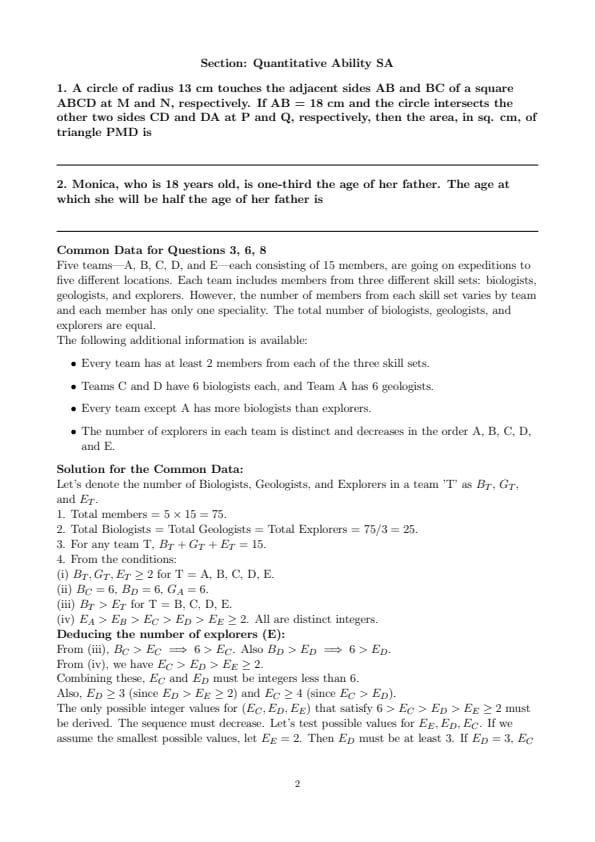
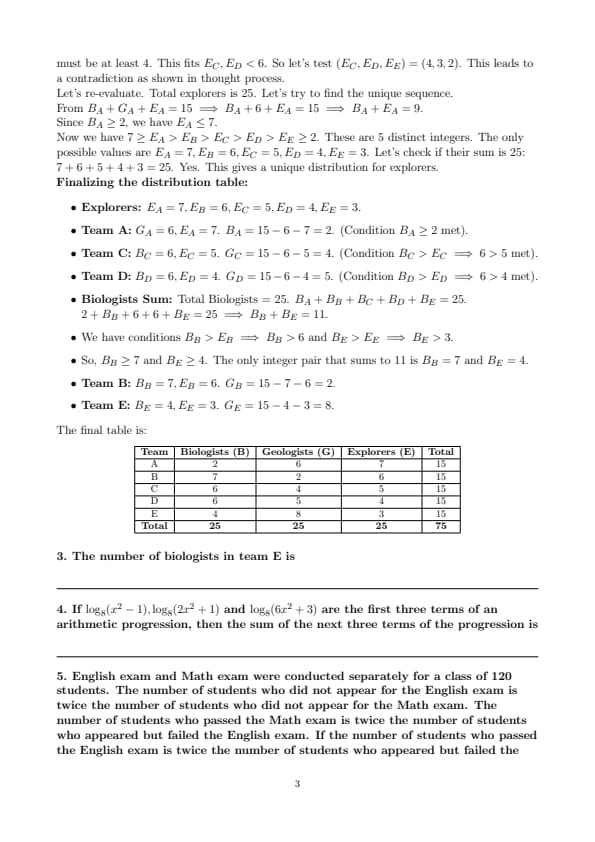
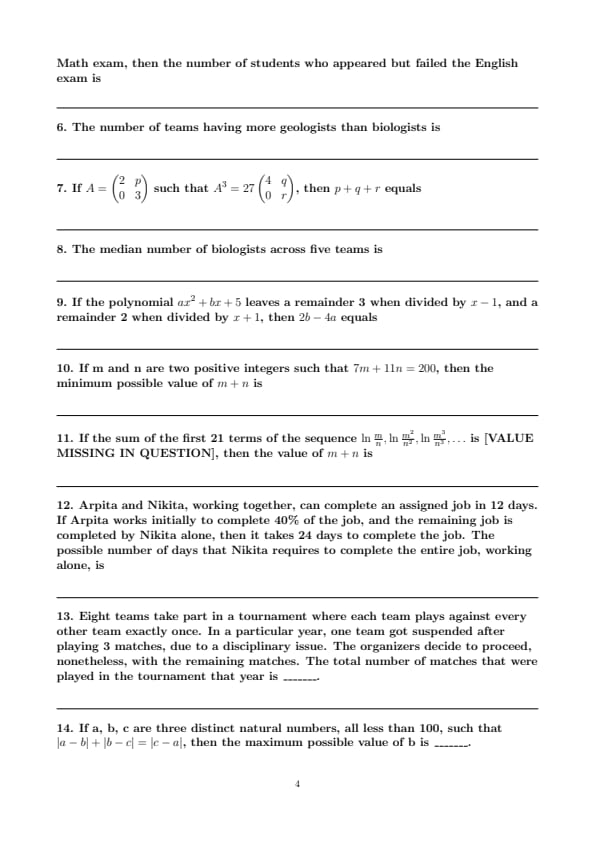
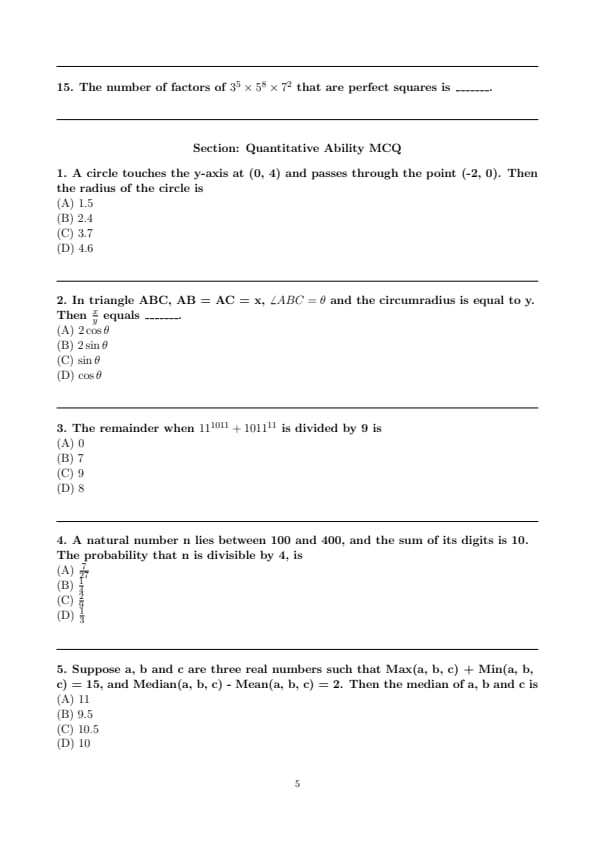
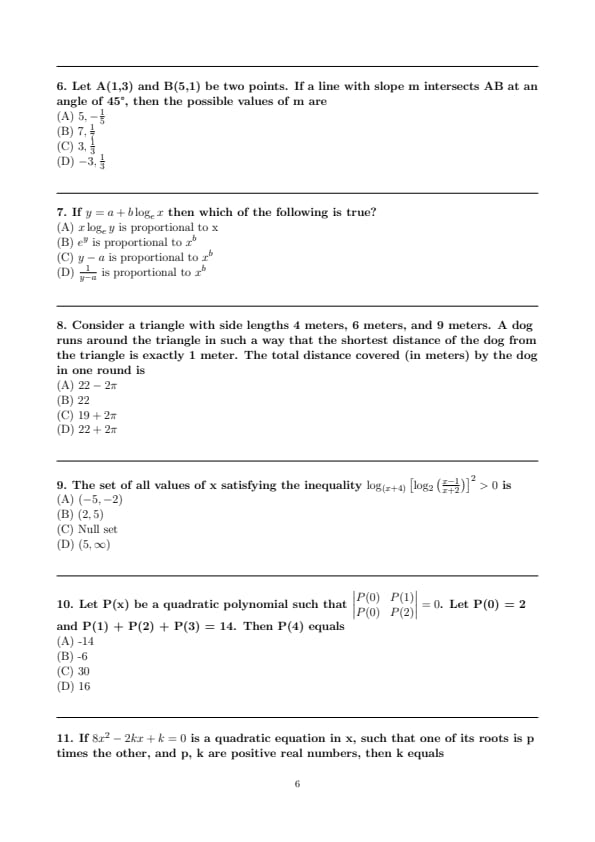
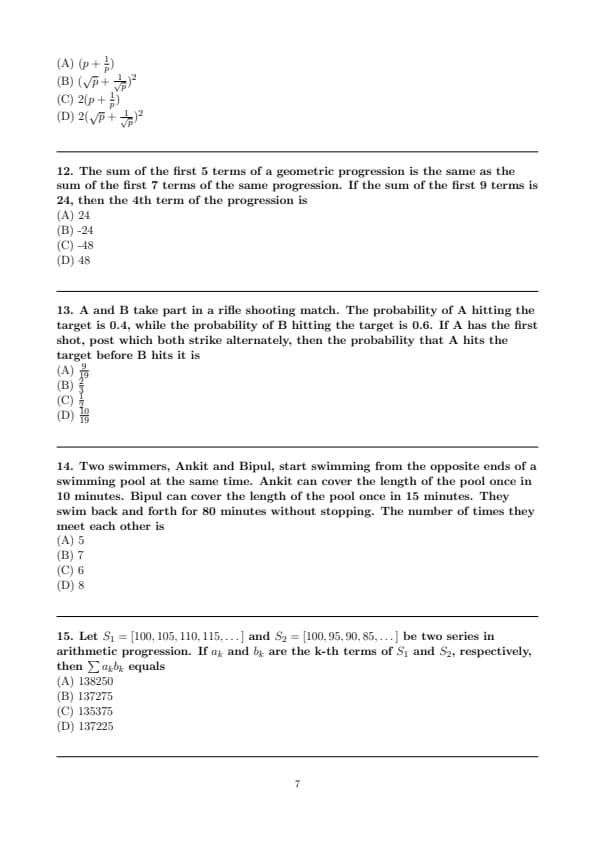
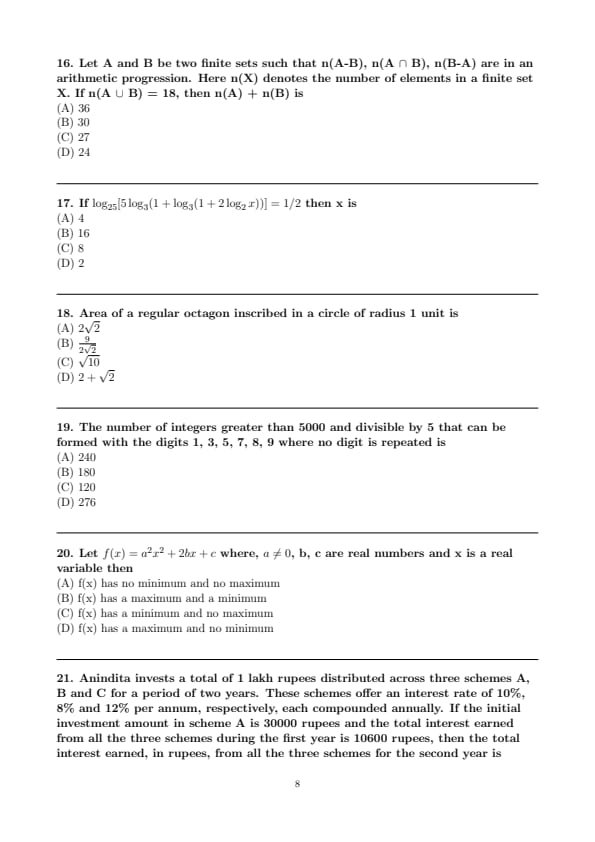
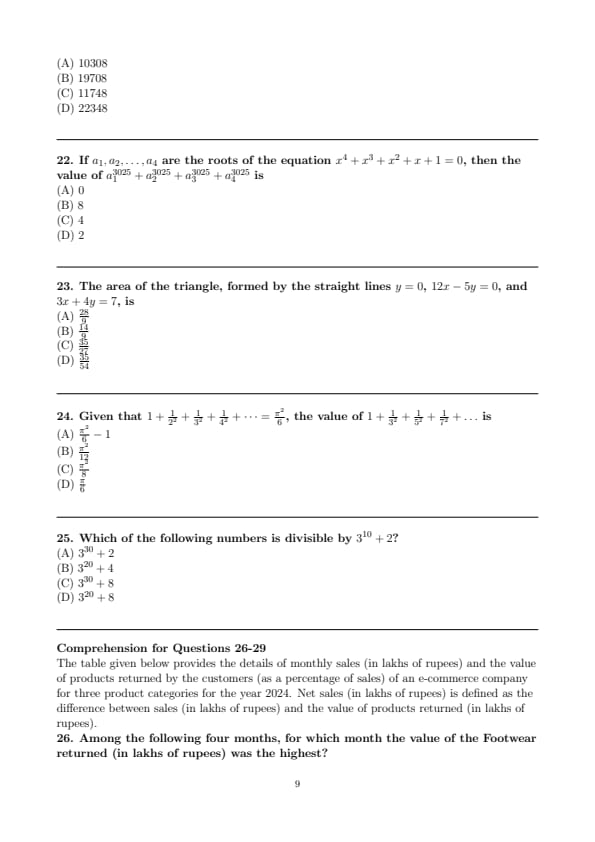
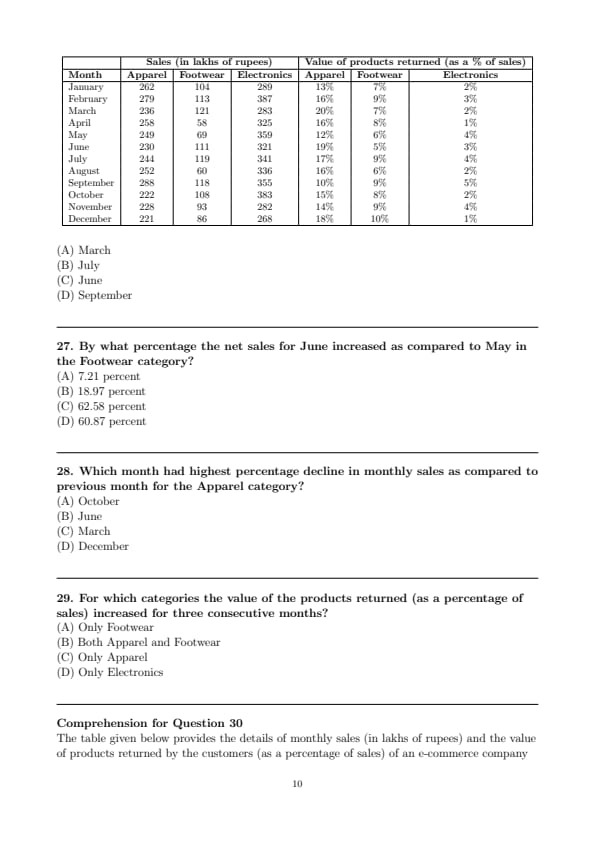
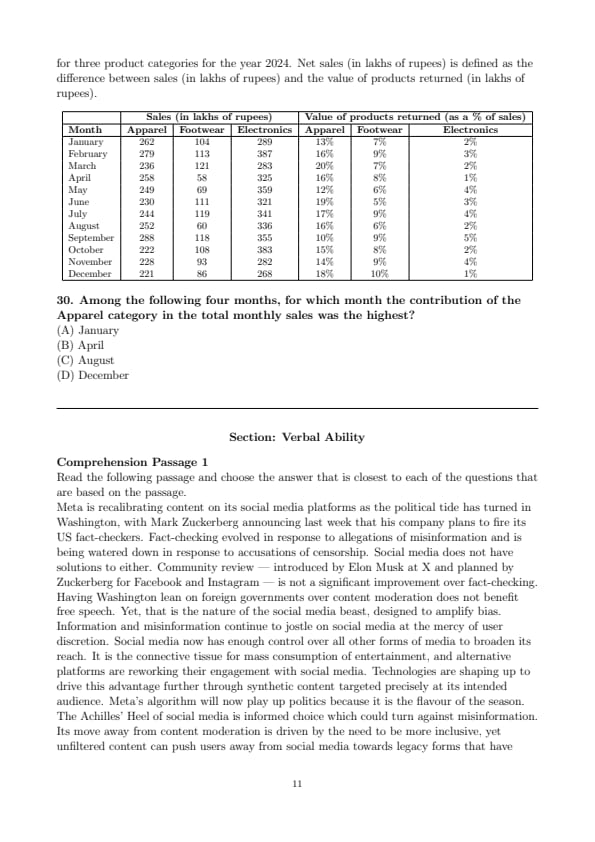
*The article might have information for the previous academic years, please refer the official website of the exam.