

Content Writer | Updated On - Dec 3, 2025
The AIIMS B.Sc. Nursing 2024 Entrance Examination was conducted in an online mode and featured a total of 100 multiple-choice questions carrying 100 marks. The paper was designed to assess a candidate’s understanding of concepts across four key sections: Physics, Chemistry, Biology, and General Knowledge/General Awareness. The exam followed the official pattern released by AIIMS, evaluating both conceptual clarity and application-oriented skills essential for admission into the B.Sc. Nursing programme.
AIIMS B.Sc. Nursing 2024 Question Paper with Solutions PDF
| AIIMS B.Sc. Nursing 2024 Question Paper | Download PDF | Check Solutions |

Inner wall of microsporangia is:
View Solution
Step 1: Understanding the Concept:
The microsporangium (or pollen sac) in angiosperms is surrounded by four distinct wall layers. These layers, from the outermost to the innermost, are the Epidermis, Endothecium, Middle layers, and Tapetum. Each layer has a specific function in the development and protection of the pollen grains (microspores).
Step 2: Detailed Explanation:
Epidermis: This is the single outermost protective layer.
Endothecium: This layer is located just beneath the epidermis. Its cells develop fibrous thickenings which help in the dehiscence (splitting open) of the anther to release pollen grains.
Middle layers: These are 1-3 layers of cells found between the endothecium and the tapetum. They usually degenerate at maturity.
Tapetum: This is the innermost wall layer of the microsporangium, located just outside the sporogenous tissue. Its primary function is to provide nourishment to the developing pollen grains. It is characterized by cells with dense cytoplasm and generally have more than one nucleus. The option (A) "Tepitame" is a common typographical error for "Tapetum".
Step 3: Final Answer:
Based on the structure of the microsporangium, the innermost wall is the tapetum. Therefore, option (A) is the correct answer, assuming "Tepitame" is a misspelling of Tapetum.
Quick Tip: To remember the order of the microsporangium wall layers from outside to inside, you can use the mnemonic: \textbf{E}very \textbf{E}vening \textbf{M}y \textbf{T}eacher (\textbf{E}pidermis, \textbf{E}ndothecium, \textbf{M}iddle Layer, \textbf{T}apetum).
Which of the following hormones is not synthesized by anterior pituitary gland?
View Solution
Step 1: Understanding the Concept:
The pituitary gland is divided into two main parts: the anterior pituitary (adenohypophysis) and the posterior pituitary (neurohypophysis). The anterior pituitary synthesizes and secretes its own hormones, while the posterior pituitary stores and releases hormones that are synthesized by the hypothalamus.
Step 2: Detailed Explanation:
Anterior Pituitary Hormones: This part of the gland synthesizes several key hormones, including:
- Follicle-Stimulating Hormone (FSH)
- Luteinizing Hormone (LH)
- Adrenocorticotropic Hormone (ACTH)
- Thyroid-Stimulating Hormone (TSH)
- Prolactin (PRL)
- Growth Hormone (GH)
Posterior Pituitary Hormones: This part does not synthesize hormones. It stores and releases two hormones produced in the hypothalamus:
- Oxytocin
- Vasopressin (also known as Antidiuretic Hormone or ADH)
From the options, Prolactin, LH, and FSH are all synthesized by the anterior pituitary. Vasopressin is synthesized in the hypothalamus and released by the posterior pituitary.
Step 3: Final Answer:
The question asks which hormone is not synthesized by the anterior pituitary. Vasopressin is synthesized by the hypothalamus, making option (B) the correct answer.
Quick Tip: A useful mnemonic to remember the hormones of the anterior pituitary is \textbf{FLAT PEG}: \textbf{F}SH, \textbf{L}H, \textbf{A}CTH, \textbf{T}SH, \textbf{P}rolactin, \textbf{E}ndorphins, \textbf{G}H. The hormones released by the posterior pituitary are Oxytocin and ADH (Vasopressin).
Pneumotaxic center is present in:
View Solution
Step 1: Understanding the Concept:
The regulation of respiration is controlled by specialized centers in the brainstem, specifically in the medulla oblongata and the pons. These centers work together to maintain a regular breathing rhythm.
Step 2: Detailed Explanation:
Medulla Oblongata: This region contains the primary respiratory rhythm center, which controls the basic rhythm of inspiration and expiration.
Pons: This region has two centers that modulate the activity of the medullary rhythm center. These are:
- The Pneumotaxic Center: Located in the upper part of the pons, it acts as a "switch-off" point for inspiration. It moderates the signals from the medulla, thereby controlling the duration of inspiration and, consequently, the respiratory rate. A strong signal from the pneumotaxic center leads to shorter inspirations and a faster breathing rate.
- The Apneustic Center: Located in the lower part of the pons, it has an excitatory effect on the inspiratory area of the medulla.
Cerebrum and Cerebellum: The cerebrum allows for voluntary control of breathing, while the cerebellum is primarily involved in coordinating motor movements, not the primary regulation of respiration.
Step 3: Final Answer:
The pneumotaxic center, which regulates the respiratory rhythm, is located in the pons region of the brainstem. Therefore, option (C) is the correct answer.
Quick Tip: Associate the letter 'P' in \textbf{P}neumotaxic with the 'P' in \textbf{P}ons to easily remember its location.
PS I first wavelength / reaction center is:
View Solution
Step 1: Understanding the Concept:
Photosynthesis in higher plants involves two pigment-protein complexes called Photosystem I (PS I) and Photosystem II (PS II). Each photosystem has a light-harvesting complex (antenna molecules) and a reaction center. The reaction center contains a special pair of chlorophyll 'a' molecules that absorb light at a specific peak wavelength.
Step 2: Detailed Explanation:
Photosystem I (PS I): The reaction center of PS I is a special chlorophyll 'a' molecule designated as P700. The 'P' stands for pigment, and '700' indicates that it absorbs light most effectively at a wavelength of 700 nanometers (nm).
Photosystem II (PS II): The reaction center of PS II is a special chlorophyll 'a' molecule designated as P680, meaning its peak absorption is at a wavelength of 680 nm.
The question asks for the reaction center of PS I.
Step 3: Final Answer:
The reaction center for Photosystem I (PS I) is P700, which corresponds to chlorophyll absorbing at 700 nm. Therefore, option (B) is the correct answer.
Quick Tip: Remember that although PS II comes first in the Z-scheme of electron transport, it is named "II". PS I (P700) has a higher wavelength number than PS II (P680). A simple way to remember is that 2 comes before 1, and 680 comes before 700.
Which fruit has fibrous mesocarp?
View Solution
Step 1: Understanding the Concept:
The wall of a fruit, called the pericarp, is typically differentiated into three layers: the outer epicarp (skin), the middle mesocarp, and the inner endocarp. The nature of these layers (fleshy, fibrous, stony, etc.) varies among different fruits and is used for their classification. The question asks to identify a fruit with a fibrous mesocarp.
Step 2: Detailed Explanation:
Apple: This is a pome, a false fruit, where the main edible part is the fleshy thalamus, not the pericarp.
Coconut: This is a type of fruit called a drupe. In a coconut, the pericarp is differentiated as follows:
- \textit{Epicarp: The smooth, outer green (or yellow/brown) skin.
- \textit{Mesocarp: The thick, fibrous husk that surrounds the hard shell. This is the fibrous mesocarp.
- \textit{Endocarp: The hard, stony shell inside which the edible seed is present.
Strawberry: This is an aggregate fruit where the fleshy, edible part is the receptacle, and the true fruits are the small 'seeds' (achenes) on the surface.
Mango: This is also a drupe. However, unlike the coconut, its mesocarp is the fleshy, juicy, edible pulp that we eat.
Step 3: Final Answer:
Among the given options, the coconut is the fruit that possesses a fibrous mesocarp (the husk). Therefore, option (B) is the correct answer.
Quick Tip: Both mango and coconut are drupes, but they are excellent examples to contrast the nature of the mesocarp. Remember: Mango has a fleshy mesocarp, while Coconut has a fibrous mesocarp.
Which kingdom is included in all kingdom system classifications?
View Solution
Step 1: Understanding the Concept:
Biological classification systems have evolved over time. The earliest scientific system was the Two-Kingdom system, which has been expanded to the modern Five-Kingdom and Three-Domain systems. We need to identify the kingdoms that have been a constant feature throughout this evolution.
Step 2: Detailed Explanation:
Two-Kingdom System (Linnaeus): This earliest system classified all organisms into two kingdoms: Plantae and Animalia.
Three-Kingdom System (Haeckel): This system added Kingdom Protista for unicellular organisms. Plantae and Animalia were retained.
Four-Kingdom System (Copeland): This system created Kingdom Monera for prokaryotes. Plantae, Animalia, and Protista were retained.
Five-Kingdom System (Whittaker): This widely accepted system separated Fungi into its own kingdom. It includes Monera, Protista, Fungi, Plantae, and Animalia.
As we can see from the historical progression, the kingdoms Monera, Protista, and Fungi were later additions to accommodate new discoveries and understanding. The core kingdoms of Plantae and Animalia have been present in every major classification system since Linnaeus, although the organisms included within them have been redefined over time.
Step 3: Final Answer:
The kingdoms Plantae and Animalia are the only ones included in all major kingdom classification systems, from the earliest two-kingdom system to the more recent five-kingdom system. Therefore, option (D) is the correct answer.
Quick Tip: Think of the foundational classification system by Linnaeus. He started with just two kingdoms: plants and animals. All subsequent systems built upon this foundation, adding new kingdoms but retaining the original two.
In commensalism, two organisms have:
View Solution
Step 1: Understanding the Concept:
Commensalism is a type of ecological interaction between two different species. In these interactions, the effects on the participating organisms can be beneficial (+), harmful (-), or neutral (0).
Step 2: Detailed Explanation:
Let's define the interactions listed:
(A) Benefit to both (+/+): This is called Mutualism. For example, the relationship between bees and flowers.
(B) Harm to both (-/-): This describes Competition, where both species are negatively affected by vying for the same limited resources.
(C) Benefit to one and harm to the other (+/-): This is characteristic of Parasitism or Predation. A parasite benefits at the expense of its host.
(D) Benefit to one and neither harm nor benefit to the other (+/0): This is the definition of Commensalism. One organism, the commensal, benefits, while the other organism, the host, is unaffected. A classic example is an orchid growing on a tree; the orchid gets support and sunlight without affecting the tree. Another example is barnacles on a whale.
Step 3: Final Answer:
The definition of commensalism is an interaction where one species benefits and the other is unaffected. Therefore, option (D) is the correct answer.
Quick Tip: Break down the word "commensalism": com- means "together" and -mensa means "table". It literally means "sharing a table", where one organism gets benefits (like leftover food) while the other is not affected.
Which of the following statements is not true?
View Solution
Step 1: Understanding the Concept:
This question tests the understanding of homologous and analogous organs, which are key concepts in evolutionary biology.
Homologous Organs: Structures that have a common evolutionary origin and similar basic anatomy but may perform different functions. They are a result of divergent evolution.
Analogous Organs: Structures that have different evolutionary origins and anatomy but perform similar functions. They are a result of convergent evolution.
Step 2: Detailed Explanation:
Let's analyze each statement:
(A) Wing of bird and butterfly are analogous organ. This statement is true. A bird's wing is a modified forelimb with bones, while a butterfly's wing is a membrane supported by veins. They have different origins but the same function (flight).
(B) Thorn of bougainvillea and tendril of cucurbita are homologous organ. This statement is true. Both structures are modifications of the axillary bud. They have the same origin but perform different functions (thorns for protection, tendrils for support).
(C) Sweet potato and potato is an example of homologous organ. This statement is false. A sweet potato is a modified adventitious root, while a potato is a modified underground stem (tuber). They have different origins but perform the same function (food storage). This makes them analogous organs, not homologous.
(D) Eyes of octopus and human have similar functions but evolved independently. This statement is true. The eyes of octopuses (molluscs) and humans (vertebrates) are structurally very different in their development and internal anatomy, but they both perform the function of vision. This is a classic example of convergent evolution, leading to analogous structures.
Step 3: Final Answer:
The question asks for the statement that is not true. Statement (C) is false because sweet potato and potato are analogous, not homologous. Therefore, (C) is the correct answer.
Quick Tip: To remember the difference, think: \textbf{H}omologous = \textbf{H}eritage (same origin). \textbf{A}nalogous = \textbf{A}ppearance (similar function/look). Remember the classic pair: potato (stem) and sweet potato (root) are analogous.
What are the organisms that eat dead and decaying matter?
View Solution
Step 1: Understanding the Concept:
This question is about different modes of nutrition in organisms. Organisms can be broadly classified based on how they obtain their energy and carbon.
Step 2: Detailed Explanation:
(A) Autotrophs: These are "self-feeders" that produce their own food from inorganic sources, usually through photosynthesis (like plants) or chemosynthesis (like certain bacteria). They do not eat decaying matter.
(B) Heterotrophs: These are organisms that cannot produce their own food and must obtain nutrients by consuming other organisms. This is a very broad category that includes herbivores, carnivores, omnivores, and saprotrophs. While saprotrophs are a type of heterotroph, "Saprotrophs" is a more specific and accurate answer.
(C) Saprotrophs: These are a specific type of heterotroph that obtain their nutrients from dead and decaying organic matter. They secrete digestive enzymes onto the substrate and then absorb the resulting soluble organic compounds. Fungi and many bacteria are examples of saprotrophs. They are also known as decomposers.
(D) Symbiotic: This term describes a close and long-term interaction between two different biological species. It describes a relationship type (like mutualism, commensalism, parasitism), not a mode of feeding on dead matter.
Step 3: Final Answer:
The specific term for organisms that feed on dead and decaying matter is saprotrophs. Therefore, option (C) is the correct answer.
Quick Tip: The prefix \textbf{sapro-} comes from the Greek word for "rotten" or "putrid". So, a \textbf{saprotroph} is an organism that "feeds on the rotten". This makes it easy to remember their role as decomposers.
Which protein is present in muscle?
View Solution
Step 1: Understanding the Concept:
This question asks to identify a protein that is a key component of muscle tissue. Muscles are primarily composed of proteins that enable contraction.
Step 2: Detailed Explanation:
(A) Myosin: This is a motor protein that, along with another protein called actin, forms the contractile filaments of muscle cells. Myosin molecules have "heads" that bind to actin and use ATP to generate the force for muscle contraction. It is a fundamental protein in muscle tissue.
(B) Keratin: This is a fibrous structural protein. It is the key material making up hair, feathers, horns, claws, and the outer layer of the skin in vertebrates. It is not a muscle protein.
(C) Serine: This is an amino acid. Amino acids are the building blocks (monomers) of proteins, but serine itself is not a protein.
(D) Cellulose: This is a polysaccharide (a complex carbohydrate), not a protein. It is the primary structural component of the cell walls of green plants.
Step 3: Final Answer:
Myosin is a contractile protein found in abundance in muscle tissue. Therefore, option (A) is the correct answer.
Quick Tip: The prefix \textbf{myo-} relates to muscle (e.g., myocyte = muscle cell, myocardium = heart muscle). This can help you associate \textbf{Myo}sin with muscle. The two main contractile proteins to remember are Actin and Myosin.
Chiasmata formation occurs during which sub-stage of meiosis?
View Solution
Step 1: Understanding the Concept:
Meiosis I is divided into Prophase I, Metaphase I, Anaphase I, and Telophase I. Prophase I is a long and complex stage further subdivided into five sub-stages: Leptotene, Zygotene, Pachytene, Diplotene, and Diakinesis. The question asks about the specific sub-stage where chiasmata are formed or become visible.
Step 2: Detailed Explanation:
Let's review the key events of the relevant sub-stages of Prophase I:
Leptotene: Chromosomes start to condense.
Zygotene: Homologous chromosomes pair up in a process called synapsis, forming bivalents. The synaptonemal complex begins to form.
Pachytene: Synapsis is complete. The crucial event of crossing over (the exchange of genetic material between non-sister chromatids of homologous chromosomes) occurs during this stage.
Diplotene: The synaptonemal complex dissolves, and the homologous chromosomes of the bivalents start to separate from each other. However, they remain attached at the sites where crossing over occurred. These X-shaped points of attachment are called chiasmata. Thus, chiasmata become visible during diplotene.
Diakinesis: Chiasmata move towards the ends of the chromatids (terminalization), and the nuclear envelope breaks down.
While the physical event of crossing over happens in pachytene, the resulting chiasmata structures are first clearly observed in diplotene when the chromosomes start to pull apart. The question asks about "chiasmata formation", which is commonly understood as the stage where they become visible structures.
Step 3: Final Answer:
Chiasmata, the visible manifestations of crossing over, are first seen during the Diplotene stage of Prophase I. Therefore, option (B) is the correct answer.
Quick Tip: A useful mnemonic for the stages of Prophase I is: \textbf{L}azy \textbf{Z}ebras \textbf{P}aint \textbf{D}ots \textbf{D}aily (\textbf{L}eptotene, \textbf{Z}ygotene, \textbf{P}achytene, \textbf{D}iplotene, \textbf{D}iakinesis). Remember that \textbf{P}achytene is for "pairing and patching" (crossing over), but you see the "X" marks (\textbf{D}ots/Chiasmata) in \textbf{D}iplotene.
Androgen is secreted by which of the following cells?
View Solution
Step 1: Understanding the Concept:
Androgens are a group of male sex hormones, with testosterone being the most prominent. This question asks to identify the specific cells within the male reproductive system (testes) that are responsible for producing and secreting these hormones.
Step 2: Detailed Explanation:
The testes contain seminiferous tubules and interstitial tissue. Let's look at the function of the cells mentioned:
(A) Sertoli Cell: These cells are located within the seminiferous tubules. Their primary role is to nourish and support the developing sperm cells (spermatids). They do not produce androgens. They are sometimes called "nurse cells".
(B) Leydig Cell: Also known as interstitial cells, these are found in the connective tissue (interstitial space) that lies between the seminiferous tubules. Under the stimulation of Luteinizing Hormone (LH) from the pituitary gland, Leydig cells synthesize and secrete androgens, primarily testosterone.
(C) Follicle Cell: These cells are found in the ovaries of females, where they surround and support the developing oocyte (egg cell). They are involved in the production of female sex hormones like estrogen.
(D) Nurse Cell: This is a more general term. In the context of the testes, it is another name for Sertoli cells.
Step 3: Final Answer:
Androgens are secreted by the Leydig cells (interstitial cells) of the testes. Therefore, option (B) is the correct answer.
Quick Tip: Remember the 'L' connection: \textbf{L}uteinizing \textbf{H}ormone (LH) stimulates \textbf{L}eydig cells to produce androgens. This can help you distinguish their function from Sertoli cells, which are stimulated by FSH (Follicle-Stimulating Hormone).
How is the male frog different from the female frog?
View Solution
Step 1: Understanding the Concept:
This question is about sexual dimorphism in frogs, which means the visible differences between males and females of the species, apart from the reproductive organs themselves.
Step 2: Detailed Explanation:
Let's analyze the options to identify features unique to male frogs:
(A) Copulatory Pad: During the breeding season, male frogs develop thick, pigmented nuptial pads (or copulatory pads) on their first finger (thumb). These pads help the male to firmly grasp the female during amplexus (the mating embrace) to ensure successful fertilization. This feature is absent in females.
(B) Vocal Sac: Male frogs have well-developed vocal sacs, which are flexible membranes of skin that can be inflated with air. They act as resonators to amplify the croaking sound, which is used to attract females during the mating season. Females either lack vocal sacs or have very rudimentary ones.
(C) Cloaca: The cloaca is a common posterior opening for the digestive, urinary, and reproductive tracts. It is present in both male and female frogs.
(D) Abdominal Region: While females might appear more swollen in the abdomen during the breeding season due to carrying eggs, this is not a permanent or primary distinguishing structural feature.
Both the Copulatory Pad and the Vocal Sac are distinct features of male frogs. In multiple-choice questions where more than one option is correct, there might be an issue with the question itself. However, both are valid answers that distinguish males from females. For exam purposes, either would typically be accepted if only one answer can be chosen.
Step 3: Final Answer:
Both copulatory pads and vocal sacs are key features that distinguish male frogs from females. Both (A) and (B) are correct answers. In many contexts, the copulatory pad is considered a very definitive feature for identification.
Quick Tip: To remember the male frog's special features, think about what they do during mating: they "sing" to attract a mate (using \textbf{vocal sacs}) and they "hold on" tight during mating (using \textbf{copulatory pads}).
Which of the following is not a sexually transmitted disease (STD)?
View Solution
Step 1: Understanding the Concept:
A sexually transmitted disease (STD), also known as a sexually transmitted infection (STI), is an infection that is primarily transmitted from person to person through sexual contact. This question requires identifying which of the listed diseases is not transmitted in this way.
Step 2: Detailed Explanation:
Let's examine the mode of transmission for each disease:
(a) Hepatitis B: This is a viral infection that attacks the liver. It is transmitted through contact with infected blood and body fluids, which includes sexual contact, sharing needles, or from mother to child during birth. It is considered an STD.
(b) Syphilis: This is a classic bacterial STD caused by \textit{Treponema pallidum. It is transmitted through direct contact with a syphilis sore during sexual activity.
(c) Gonorrhea: This is another common bacterial STD caused by \textit{Neisseria gonorrhoeae. It spreads through sexual contact involving the penis, vagina, mouth, or anus.
(d) Ascariasis: This is an infection caused by the parasitic roundworm \textit{Ascaris lumbricoides. It is a soil-transmitted helminthiasis. The infection spreads through the fecal-oral route, typically by ingesting food or water contaminated with Ascaris eggs from human feces. It is not transmitted through sexual contact.
Step 3: Final Answer:
Hepatitis B, Syphilis, and Gonorrhea can all be sexually transmitted. Ascariasis is transmitted via the fecal-oral route and is not an STD. Therefore, option (d) is the correct answer.
Quick Tip: When you see a disease caused by a parasitic worm (helminth) like Ascaris, the mode of transmission is most often related to poor sanitation and contamination of food/water/soil (fecal-oral route), not sexual contact.
Correct Match: Match the following compounds with their correct categories:
(A) Carotenoid -- Polymer
(B) Abrin -- Pigment
(C) Cellulose -- Toxin
(D) Morphine -- Alkaloid
View Solution
Step 1: Understanding the Concept:
This question asks to identify the correctly matched pair from the given options. Each option pairs a specific chemical compound with a general biochemical category. We need to evaluate if the compound truly belongs to the given category.
Step 2: Detailed Explanation:
Let's analyze each pair:
(A) Carotenoid -- Polymer: This is an incorrect match. Carotenoids (like beta-carotene in carrots) are organic pigments, which are tetraterpenoids. A polymer is a large molecule made of repeating monomer subunits. While carotenoids can be large, they are not polymers in the typical sense like starch or protein.
(B) Abrin -- Pigment: This is an incorrect match. Abrin is a highly potent toxin (a toxalbumin) found in the seeds of the rosary pea. It is not a pigment.
(C) Cellulose -- Toxin: This is an incorrect match. Cellulose is a structural polysaccharide, which is a polymer of glucose. It is the main component of plant cell walls and is not a toxin.
(D) Morphine -- Alkaloid: This is a correct match. Morphine is a powerful pain-relieving opioid compound derived from the opium poppy. Chemically, it belongs to the class of naturally occurring nitrogen-containing organic compounds known as alkaloids. Other examples of alkaloids include caffeine, nicotine, and quinine.
Step 3: Final Answer:
The only correctly matched pair is Morphine and Alkaloid. Therefore, option (D) is the correct answer.
Quick Tip: Create a mental map or a quick table of common secondary metabolites. For example: Alkaloids (Morphine, Codeine), Toxins (Abrin, Ricin), Lectins (Concanavalin A), Drugs (Vinblastin, Curcumin), Pigments (Carotenoids, Anthocyanins). This helps in quick recall for matching questions.
Correct Statement: Identify the correct scientific statement from the options below:
View Solution
Step 1: Understanding the Concept:
This question requires an evaluation of fundamental statements about the structure of DNA and chromatin. We need to identify the one statement that is factually and precisely correct.
Step 2: Detailed Explanation:
(A) Chargaff's rule: A + T = G + C: This statement is incorrect. Chargaff's rules state that in the DNA of any species, the amount of Adenine (A) equals the amount of Thymine (T), and the amount of Guanine (G) equals the amount of Cytosine (C). This means [A] = [T] and [G] = [C]. A consequence is that the amount of purines ([A] + [G]) equals the amount of pyrimidines ([T] + [C]). The ratio (A+T)/(G+C) is constant for a given species but is generally not equal to 1, so A+T is not equal to G+C.
(B) DNA is a polymer of nucleotides: This statement is correct. Deoxyribonucleic acid (DNA) is a nucleic acid, which is a type of macromolecule. It is a polymer, meaning it is made up of repeating monomer units. The monomer units of DNA are called deoxyribonucleotides (or simply nucleotides).
(C) Euchromatin is loosely connected: This statement is conceptually correct but poorly phrased. Euchromatin is a region of chromatin that is less condensed or "loosely packed". This loose packing makes the DNA accessible for transcription. "Loosely connected" is not the standard terminology, making the statement imprecise.
(D) DNA backbone is composed of nitrogenous bases: This statement is incorrect. The backbone of the DNA double helix is a sugar-phosphate backbone. It is formed by alternating deoxyribose sugar and phosphate groups. The nitrogenous bases (A, T, C, G) are attached to the sugars and project towards the center of the helix, where they pair with bases on the opposite strand.
Step 3: Final Answer:
Statement (B) is the most accurate and fundamental definition among the choices. DNA is a polynucleotide, which is a polymer of nucleotides. Therefore, option (B) is the correct answer.
Quick Tip: Remember the basic structure of a DNA strand: The "sides" of the ladder are the sugar-phosphate backbone, and the "rungs" of the ladder are the paired nitrogenous bases (A-T, G-C).
Which statement about ammonia is false?
View Solution
Step 1: Understanding the Concept:
This question assesses knowledge about nitrogenous waste products in animals, focusing on the properties and handling of ammonia in the body. We need to identify the statement that is factually incorrect.
Step 2: Detailed Explanation:
Let's evaluate the truthfulness of each statement:
(A) Kidney does not excrete ammonia: This statement is false. Although the primary nitrogenous waste excreted by the human kidney is urea, the kidney tubules also actively secrete hydrogen ions (H+) and ammonia (in the form of ammonium ions, NH4+) into the filtrate. This process is crucial for regulating the acid-base balance (pH) of the blood. Therefore, the kidney does excrete ammonia.
(B) More water is required for ammonia excretion: This statement is true. Ammonia is highly toxic and very soluble in water. Organisms that excrete ammonia directly (ammonotelic animals, like most aquatic invertebrates and bony fishes) need access to large amounts of water to dilute it to non-toxic levels before excretion.
(C) Ammonia is a more toxic substance: This statement is true. Compared to other nitrogenous wastes like urea and uric acid, ammonia is the most toxic. This is why terrestrial animals and humans convert it into the less toxic form, urea.
(D) Ammonia is converted into urea: This statement is true. In humans and other ureotelic animals, ammonia produced from amino acid metabolism is transported to the liver, where it is converted into urea through the urea cycle. Urea is less toxic and requires less water for excretion.
Step 3: Final Answer:
The question asks for the false statement. Statement (A) is false because the kidneys do excrete ammonia (as ammonium ions) to regulate blood pH. Therefore, option (A) is the correct answer.
Quick Tip: Remember the relative toxicity and water requirement for nitrogenous wastes: \textbf{Ammonia} (most toxic, most water) \(>\) \textbf{Urea} (less toxic, less water) \(>\) \textbf{Uric acid} (least toxic, least water/excreted as paste).
Which is the incorrect statement about Mycoplasma?
View Solution
Step 1: Understanding the Concept:
Mycoplasma are a genus of bacteria known for several unique characteristics. This question requires identifying the incorrect statement among a list of their features.
Step 2: Detailed Explanation:
Let's analyze each statement about Mycoplasma:
(A) Cell wall present in Mycoplasma: This statement is incorrect. The most defining and famous characteristic of Mycoplasma is that they completely lack a rigid cell wall. This makes them pleomorphic (able to change their shape) and naturally resistant to antibiotics like penicillin that target cell wall synthesis.
(B) Pathogen for plant and animal: This statement is true. Many species of Mycoplasma are pathogenic. For example, \textit{Mycoplasma pneumoniae causes "walking pneumonia" in humans, and phytoplasmas (related organisms) cause various diseases in plants.
(C) Included in Monera: This statement is true. Mycoplasma are bacteria, and in the five-kingdom classification system proposed by R.H. Whittaker, all bacteria are placed in the Kingdom Monera.
(D) Prokaryotic organism: This statement is true. As bacteria, Mycoplasma have a prokaryotic cell structure, meaning they lack a true nucleus and other membrane-bound organelles. They are also known as the smallest living cells capable of autonomous growth.
Step 3: Final Answer:
The question asks for the incorrect statement. The statement that Mycoplasma have a cell wall is factually incorrect. Therefore, option (A) is the correct answer.
Quick Tip: The key fact to remember about Mycoplasma for almost any exam is that they are "bacteria without a cell wall". This single fact makes them resistant to penicillin and allows them to pass through bacterial filters.
Which of the following is the correct melting point order of dichlorobenzene isomers?
View Solution
Step 1: Understanding the Concept:
The melting point of a molecular solid depends on two main factors: the strength of intermolecular forces (like van der Waals forces and dipole-dipole interactions) and the efficiency with which the molecules can pack into a crystal lattice. A more symmetrical molecule generally packs more tightly, leading to stronger intermolecular forces in the solid state and thus a higher melting point.
Step 2: Detailed Explanation:
The three isomers of dichlorobenzene are:
1,4-Dichlorobenzene (para-isomer): This molecule is highly symmetrical. This symmetry allows it to fit perfectly into a crystal lattice. The close and efficient packing leads to strong intermolecular forces that require a significant amount of energy to break, resulting in a high melting point (approx. 53\(^{\circ}\)C).
1,2-Dichlorobenzene (ortho-isomer): This molecule is less symmetrical than the para-isomer. Its shape prevents it from packing as efficiently in the crystal lattice. It has a significant dipole moment, but the effect of poor packing dominates. Its melting point is much lower (approx. -17\(^{\circ}\)C).
1,3-Dichlorobenzene (meta-isomer): This molecule is also unsymmetrical and packs the least efficiently of the three isomers. This results in the weakest intermolecular forces in the solid state and the lowest melting point (approx. -25\(^{\circ}\)C).
Therefore, the decreasing order of melting points is: 1,4-isomer \(>\) 1,2-isomer \(>\) 1,3-isomer.
Step 3: Final Answer:
The correct order of melting points is 1,4-Dichlorobenzene \(>\) 1,2-Dichlorobenzene \(>\) 1,3-Dichlorobenzene. This corresponds to option (B).
Quick Tip: For disubstituted benzene isomers, the para-isomer is almost always the highest melting due to its superior symmetry and packing efficiency. This is a common trend to remember for exams.
Benzaldehyde reacts with conc. NaOH to give:
View Solution
Step 1: Understanding the Concept:
The reaction described is the Cannizzaro reaction. This is a base-induced disproportionation reaction for aldehydes that do not have a hydrogen atom on the \(\alpha\)-carbon (the carbon adjacent to the carbonyl group). Benzaldehyde is an example of such an aldehyde.
Step 2: Detailed Explanation:
In the Cannizzaro reaction, in the presence of a strong concentrated base like NaOH, two molecules of the aldehyde react with each other.
One molecule of the aldehyde is reduced to the corresponding primary alcohol. The reduction of benzaldehyde (C\(_6\)H\(_5\)CHO) yields benzyl alcohol (C\(_6\)H\(_5\)CH\(_2\)OH).
The other molecule of the aldehyde is oxidized to the corresponding carboxylic acid. The oxidation of benzaldehyde yields benzoic acid (C\(_6\)H\(_5\)COOH). Since the reaction occurs in a strong basic medium (NaOH), the acidic product is immediately neutralized to form its salt. Thus, benzoic acid is converted to sodium benzoate (C\(_6\)H\(_5\)COONa).
The overall reaction is:
\[ 2 C_6H_5CHO + conc. NaOH \rightarrow C_6H_5CH_2OH + C_6H_5COONa \] \[ (Benzaldehyde) \qquad (Benzyl alcohol) \quad (Sodium benzoate) \]
Step 3: Final Answer:
The reaction produces both benzyl alcohol and sodium benzoate. Therefore, option (D) is the correct answer.
Quick Tip: Remember the conditions for the Cannizzaro reaction: 1) Aldehyde with no \(\alpha\)-hydrogen, and 2) Concentrated base. The products are always an alcohol (from reduction) and a salt of a carboxylic acid (from oxidation).
Which enzyme converts glucose and fructose both into ethanol?
View Solution
Step 1: Understanding the Concept:
This question is about the enzymatic process of fermentation, specifically the conversion of simple sugars into ethanol. Different enzymes catalyze different steps in the breakdown of carbohydrates.
Step 2: Detailed Explanation:
Let's analyze the function of each enzyme listed:
(A) Invertase: This enzyme, present in yeast, catalyzes the hydrolysis of sucrose (a disaccharide) into its constituent monosaccharides: glucose and fructose. It does not produce ethanol.
(B) Zymase: This is not a single enzyme but a complex mixture of enzymes found in yeast. This complex is responsible for the anaerobic fermentation of simple sugars like glucose and fructose into ethanol and carbon dioxide. This is the final step in ethanol production.
\[ C_6H_{12}O_6 \xrightarrow{Zymase} 2C_2H_5OH + 2CO_2 \]
\[ (Glucose/Fructose) \qquad (Ethanol) \quad (Carbon dioxide) \]
(C) Maltase: This enzyme catalyzes the hydrolysis of the disaccharide maltose into two molecules of glucose.
(D) Diastase: This enzyme (found in malt) catalyzes the breakdown of starch (a polysaccharide) into the disaccharide maltose.
Step 3: Final Answer:
The enzyme complex that converts both glucose and fructose into ethanol is Zymase. Therefore, option (B) is the correct answer.
Quick Tip: Remember the fermentation sequence for sucrose: \textbf{Sucrose} \(\xrightarrow{Invertase}\) \textbf{Glucose + Fructose} \(\xrightarrow{Zymase}\) \textbf{Ethanol}. Zymase is the key to the final conversion to alcohol.
What is the chemical name of Vitamin B6?
View Solution
Step 1: Understanding the Concept:
Vitamins are essential organic compounds that an organism needs in small quantities. They are classified, and each has a specific chemical name. This question tests the knowledge of these common names.
Step 2: Detailed Explanation:
Let's identify the vitamin associated with each name:
(A) Biotin: This is the chemical name for Vitamin B7.
(B) Thiamine: This is the chemical name for Vitamin B1.
(C) Riboflavin: This is the chemical name for Vitamin B2.
(D) Pyridoxine: This is one of the compounds that can be called Vitamin B6. The term Vitamin B6 refers to a group of related compounds: pyridoxine, pyridoxal, and pyridoxamine.
Step 3: Final Answer:
The chemical name for Vitamin B6 is Pyridoxine. Therefore, option (D) is the correct answer.
Quick Tip: Creating flashcards or a small table to memorize the B-complex vitamins and their chemical names is a very effective study strategy for this type of question. For example: B1-Thiamine, B2-Riboflavin, B3-Niacin, B5-Pantothenic Acid, B6-Pyridoxine, B7-Biotin, B9-Folic Acid, B12-Cobalamin.
Chemical formula of Water-gas is:
View Solution
Step 1: Understanding the Concept:
This question asks for the chemical composition of an industrially important gas mixture known as "water-gas". It's important to know the composition of such common chemical mixtures.
Step 2: Detailed Explanation:
Water-gas is a type of synthesis gas (syngas) which is a fuel gas. It is produced by passing steam (water vapor) over red-hot coke (a form of carbon).
The chemical reaction for its production is: \[ C(s) + H_2O(g) \xrightarrow{\Delta} CO(g) + H_2O(g) \]
The resulting mixture is an equimolar mixture of carbon monoxide (CO) and hydrogen gas (H\(_2\)). This mixture is combustible and was historically used for lighting and heating.
Step 3: Final Answer:
The chemical formula representing the composition of water-gas is CO + H\(_2\). Therefore, option (B) is the correct answer.
Quick Tip: Do not confuse "Water-gas" (CO + H\(_2\)) with "Producer gas" (CO + N\(_2\)). Both are industrial fuel gases derived from carbon, but water-gas is made with steam, while producer gas is made with air.
Which of the following correctly represents the order of basic strength among Group 15 hydrides?
View Solution
Step 1: Understanding the Concept:
The hydrides of Group 15 elements (NH\(_3\), PH\(_3\), AsH\(_3\), SbH\(_3\), BiH\(_3\)) are Lewis bases. Their basic character is due to the presence of a lone pair of electrons on the central atom. The basic strength depends on the availability of this lone pair to be donated to a Lewis acid (like H\(_+\)).
Step 2: Detailed Explanation:
The trend in basic strength down Group 15 can be explained as follows:
Atomic Size: As we move down the group from Nitrogen (N) to Bismuth (Bi), the atomic size of the central atom increases significantly.
Electron Density: The lone pair of electrons resides on the central atom. In NH\(_3\), the lone pair is concentrated in a small volume on the small nitrogen atom, leading to a high electron density. As the central atom gets larger (P, As, Sb, Bi), the same lone pair of electrons is spread out over a much larger volume. This results in a decrease in electron density on the central atom.
Availability for Donation: A higher electron density makes the lone pair more readily available for donation to a proton or other Lewis acid. Since the electron density decreases down the group, the tendency to donate the lone pair also decreases.
Therefore, the basic strength of the hydrides decreases as we move down the group.
The correct order is: NH\(_3\) (Ammonia) \(>\) PH\(_3\) (Phosphine) \(>\) AsH\(_3\) (Arsine) \(>\) SbH\(_3\) (Stibine) \(>\) BiH\(_3\) (Bismuthine).
Step 3: Final Answer:
The correct representation of the order of basic strength is given in option (B).
Quick Tip: For Group 15 hydrides, remember this simple trend: as you go down the group, size increases, electron density of the lone pair decreases, and therefore basicity decreases. Ammonia (NH\(_3\)) is the strongest base in the series.
Which of the following is Hinsberg reagent?
View Solution
Step 1: Understanding the Concept:
This is a knowledge-based question that asks to identify a specific named reagent used in organic chemistry. Hinsberg's reagent is used for the distinction of primary, secondary, and tertiary amines.
Step 2: Detailed Explanation:
Hinsberg's Reagent is the common name for benzenesulfonyl chloride. Its chemical formula is C\(_6\)H\(_5\)SO\(_2\)Cl.
Function: It reacts with primary and secondary amines to form sulfonamides.
- A primary amine forms a sulfonamide that is soluble in alkali.
- A secondary amine forms a sulfonamide that is insoluble in alkali.
- A tertiary amine does not react with Hinsberg's reagent.
Let's analyze the options:
(A) C\(_6\)H\(_5\)SO\(_2\)CH\(_3\) is methyl phenyl sulfone.
(B) SnCl\(_2\) is stannous chloride, a reducing agent.
(C) C\(_6\)H\(_5\)SO\(_2\)Cl is benzenesulfonyl chloride, which is Hinsberg's reagent.
(D) CoCl\(_2\) is cobalt(II) chloride.
Step 3: Final Answer:
The chemical formula for Hinsberg's reagent is C\(_6\)H\(_5\)SO\(_2\)Cl. Therefore, option (C) is the correct answer.
Quick Tip: Remembering named reagents is crucial for organic chemistry. Associate "Hinsberg" with "benzenesulfonyl chloride" and its use in testing amines.
Standard electrode potentials of Na, Ni, and Cl are given. Which one has the highest reducing power?
\[ Cl_2(g) + 2e^- \rightarrow 2Cl^- \] \[ Ni^{2+} + 2e^- \rightarrow Ni(s) \] \[ Na^+ + e^- \rightarrow Na(s) \]
View Solution
Step 1: Understanding the Concept:
Reducing power refers to the ability of a substance to donate electrons and get oxidized. In electrochemistry, the reducing power of a species is inversely related to its standard reduction potential (E\(^\circ\)). A substance with a more negative (or less positive) standard reduction potential is a stronger reducing agent. The species listed in the options are oxidizing agents, not reducing agents. The question is flawed but likely intends to ask which element (Na, Ni, or Cl) is the strongest reducing agent.
Step 2: Detailed Explanation:
Let's look at the standard reduction potentials (E\(^\circ\)) for the given half-reactions:
E\(^\circ\)(\( Na^+ / Na \)) = -2.71 V
E\(^\circ\)(\( Ni^{2+} / Ni \)) = -0.25 V
E\(^\circ\)(\( Cl_2 / Cl^- \)) = +1.36 V
The reducing agents in these systems are the species that get oxidized, i.e., Na(s), Ni(s), and Cl\(^-\)(aq). The strength of a reducing agent is determined by its tendency to lose electrons. A more negative E\(^\circ\) value indicates a greater tendency for the reverse reaction (oxidation) to occur.
Na(s) has a very large negative reduction potential, meaning it is very easily oxidized. It is a very strong reducing agent.
Ni(s) has a moderately negative reduction potential, making it a weaker reducing agent than Na.
Cl\(^-\)(aq) has a very large positive reduction potential associated with its oxidized form (Cl\(_2\)), meaning Cl\(^-\) is very difficult to oxidize. It is a very weak reducing agent.
Comparing the three, Na(s) has the highest reducing power. The question options list the oxidizing agents (Cl\(_2\), Ni\(^{2+}\), Na\(^+\)). We must infer that the question is asking which element corresponds to the strongest reducing agent. Since Na is the strongest reducing agent, we select the option related to sodium.
Step 3: Final Answer:
Based on the highly negative standard reduction potential of -2.71 V, Sodium (Na) has the highest reducing power. The option Na\(^+\) points to the correct element. Therefore, (C) is the intended answer.
Quick Tip: For reducing power, look for the MOST NEGATIVE E\(^\circ\) value. For oxidizing power, look for the MOST POSITIVE E\(^\circ\) value. Remember: "LEO the lion says GER" (Lose Electrons Oxidation, Gain Electrons Reduction). Reducing agents are oxidized.
A reaction with reaction quotient Q\(_c\) and equilibrium constant K\(_c\) will proceed in the direction of the products when:
View Solution
Step 1: Understanding the Concept:
The reaction quotient, Q\(_c\), is a measure of the relative amounts of products and reactants present in a reaction at any given time. The equilibrium constant, K\(_c\), is the value of the reaction quotient when the system is at chemical equilibrium. By comparing Q\(_c\) and K\(_c\), we can predict the direction in which a net reaction will occur to reach equilibrium.
Step 2: Key Formula or Approach:
For a general reversible reaction: aA + bB \(\rightleftharpoons\) cC + dD
The reaction quotient is given by: \[ Q_c = \frac{[C]^c [D]^d}{[A]^a [B]^b} \]
where the concentrations are the instantaneous concentrations.
Step 2: Detailed Explanation:
We compare the value of Q\(_c\) with K\(_c\):
If Q\(_c\) \(<\) K\(_c\): The ratio of the concentration of products to reactants is less than what it would be at equilibrium. To reach equilibrium, the concentration of products must increase, and the concentration of reactants must decrease. This means the reaction will proceed in the forward direction (i.e., in the direction of the products).
If Q\(_c\) \(>\) K\(_c\): The ratio of products to reactants is greater than at equilibrium. To reach equilibrium, the concentration of products must decrease, and the concentration of reactants must increase. The reaction will proceed in the reverse direction (towards reactants).
If Q\(_c\) = K\(_c\): The system is already at equilibrium, and there will be no net change in the concentrations of reactants or products.
The question asks when the reaction will proceed in the direction of the products. This occurs when Q\(_c\) is less than K\(_c\).
Step 3: Final Answer:
The condition for the reaction to proceed towards the products is Q\(_c\) \(<\) K\(_c\). Therefore, option (C) is the correct answer.
Quick Tip: Think of Q\(_c\) and K\(_c\) on a number line. If Q\(_c\) is to the left of K\(_c\) (Q\(_c\) \(<\) K\(_c\)), the reaction must move "forward" to the right to reach K\(_c\). If Q\(_c\) is to the right (Q\(_c\) \(>\) K\(_c\)), it must move "reverse" to the left.
Which of the following is not isoelectronic?
View Solution
Step 1: Understanding the Concept:
Isoelectronic species are atoms, ions, or molecules that have the same number of electrons. To solve this problem, we need to calculate the total number of electrons in each of the given species.
Step 2: Detailed Explanation:
Let's calculate the total number of electrons for each option:
(A) CO (Carbon Monoxide):
Number of electrons from Carbon (atomic number 6) = 6
Number of electrons from Oxygen (atomic number 8) = 8
Total electrons = 6 + 8 = 14 electrons.
(B) CN\(^-\) (Cyanide ion):
Number of electrons from Carbon (atomic number 6) = 6
Number of electrons from Nitrogen (atomic number 7) = 7
Add 1 electron for the -1 charge.
Total electrons = 6 + 7 + 1 = 14 electrons.
(C) NO\(^+\) (Nitrosonium ion):
Number of electrons from Nitrogen (atomic number 7) = 7
Number of electrons from Oxygen (atomic number 8) = 8
Subtract 1 electron for the +1 charge.
Total electrons = 7 + 8 - 1 = 14 electrons.
(D) O\(_2^-\) (Superoxide ion):
Number of electrons from two Oxygen atoms = 2 \(\times\) 8 = 16
Add 1 electron for the -1 charge.
Total electrons = 16 + 1 = 17 electrons.
CO, CN\(^-\), and NO\(^+\) each have 14 electrons and are isoelectronic with each other (and with N\(_2\)). O\(_2^-\) has 17 electrons.
Step 3: Final Answer:
O\(_2^-\) is not isoelectronic with the other species. Therefore, option (D) is the correct answer.
Quick Tip: When calculating electrons for ions, remember the rule: for a negative charge, add electrons; for a positive charge, subtract electrons. Always start with the total number of electrons from the neutral atoms.
LiH, HClO\(_4\), O\(_3\), P\(_4\) Oxidation states of the elements are respectively:
View Solution
Step 1: Understanding the Concept:
This question requires the application of standard rules for assigning oxidation states (or oxidation numbers) to elements in different chemical compounds and in their elemental forms. The question asks for the oxidation states of H in LiH, Cl in HClO\(_4\), O in O\(_3\), and P in P\(_4\).
Step 2: Detailed Explanation:
Let's determine the oxidation state for the key element in each substance:
LiH (Lithium Hydride): This is a metal hydride. Group 1 metals (like Li) almost always have an oxidation state of +1 in their compounds. Since the overall charge of the compound is 0, Hydrogen must have an oxidation state of -1. (Rule: H is -1 when bonded to a less electronegative element, like a metal).
HClO\(_4\) (Perchloric Acid): We use the standard rules:
- The oxidation state of H is +1.
- The oxidation state of O is -2.
- Let the oxidation state of Cl be \(x\).
- The sum of oxidation states in a neutral compound is 0.
- Equation: (+1) + \(x\) + 4(-2) = 0 \(\Rightarrow\) 1 + \(x\) - 8 = 0 \(\Rightarrow\) \(x\) = +7.
O\(_3\) (Ozone): This is an allotrope of oxygen. The oxidation state of an element in its free or uncombined elemental form (including allotropes) is always 0.
P\(_4\) (White Phosphorus): This is an allotrope of phosphorus. Similar to ozone, the oxidation state of phosphorus in its elemental form is 0.
The respective oxidation states are -1, +7, 0, and 0.
Step 3: Final Answer:
The sequence of oxidation states is -1, +7, 0, 0. This matches option (A).
Quick Tip: Memorize the key rules for oxidation states: 1) Elements in their elemental form are 0. 2) Group 1 metals are +1, Group 2 are +2. 3) Fluorine is always -1. 4) Hydrogen is usually +1 (except in metal hydrides where it's -1). 5) Oxygen is usually -2 (except in peroxides, superoxides, etc.). 6) The sum of oxidation states equals the overall charge.
Which of the following has a higher dipole moment?
View Solution
Step 1: Understanding the Concept:
The dipole moment of a molecule is the vector sum of all the individual bond dipoles and the dipole due to any lone pairs. It depends on both the polarity of the bonds and the geometry of the molecule. Both NH\(_3\) and NF\(_3\) have a trigonal pyramidal geometry due to a lone pair on the nitrogen atom.
Step 2: Detailed Explanation:
Let's analyze the direction of the dipole moments in each molecule:
In NH\(_3\) (Ammonia):
- Electronegativity: N (3.04) \(>\) H (2.20).
- The bond dipoles of the three N-H bonds point from the less electronegative H atoms towards the more electronegative N atom.
- The lone pair on the nitrogen atom also creates a dipole moment in the same direction as the resultant of the bond dipoles (upwards, away from the base of the pyramid).
- Since the bond dipoles and the lone pair dipole are in the same direction, they add up, resulting in a large net dipole moment (\(\mu \approx\) 1.47 D).
In NF\(_3\) (Nitrogen Trifluoride):
- Electronegativity: F (3.98) \(>\) N (3.04).
- The bond dipoles of the three N-F bonds point from the less electronegative N atom towards the more electronegative F atoms (downwards and outwards).
- The lone pair dipole points in the opposite direction (upwards).
- The resultant of the N-F bond dipoles points downwards, opposing the upwards-pointing lone pair dipole. They partially cancel each other out.
- This cancellation results in a very small net dipole moment (\(\mu \approx\) 0.23 D).
Comparing the two, the dipole moment of NH\(_3\) is significantly higher than that of NF\(_3\).
Step 3: Final Answer:
NH\(_3\) has a higher dipole moment than NF\(_3\). Therefore, option (A) is the correct answer.
Quick Tip: This is a classic comparison question in chemistry. Remember that in NH\(_3\), the dipoles add up (reinforce), while in NF\(_3\), they partially cancel out. Even though the N-F bond is more polar than the N-H bond, the vector addition makes the overall molecular dipole of NF\(_3\) much smaller.
Triclinic crystal system has the following unit cell dimensions:
View Solution
Step 1: Understanding the Concept:
In crystallography, solid crystals are classified into seven crystal systems based on the parameters of their unit cell. The parameters are the lengths of the three axes (a, b, c) and the angles between these axes (\(\alpha\), \(\beta\), \(\gamma\)). The triclinic system is the least symmetrical of all.
Step 2: Detailed Explanation:
Let's review the parameters for the given options and the triclinic system:
(A) a = b = c and \(\alpha\) = \(\beta\) = \(\gamma\) = 90\(^{\circ}\): These are the parameters for the Cubic crystal system.
(B) a = b \(\neq\) c and \(\alpha\) = \(\beta\) = \(\gamma\) = 90\(^{\circ}\): These are the parameters for the Tetragonal crystal system. (Note: The OCR of the question image for this option is faulty, but this is the standard definition for tetragonal).
(C) a \(\neq\) b \(\neq\) c and \(\alpha\) \(\neq\) \(\beta\) \(\neq\) \(\gamma\) \(\neq\) 90\(^{\circ}\): This describes a unit cell with unequal axial lengths and unequal axial angles, none of which are 90\(^{\circ}\). This is the definition of the Triclinic crystal system. It possesses no symmetry elements other than possibly an inversion center.
(D) a = b \(\neq\) c and \(\alpha\) = \(\beta\) = 90\(^{\circ}\), \(\gamma\) = 120\(^{\circ}\): These are the parameters for the Hexagonal crystal system.
Step 3: Final Answer:
The unit cell dimensions for the triclinic crystal system are a \(\neq\) b \(\neq\) c and \(\alpha\) \(\neq\) \(\beta\) \(\neq\) \(\gamma\) \(\neq\) 90\(^{\circ}\). Therefore, option (C) is the correct answer.
Quick Tip: To remember the triclinic system, think "most unsymmetrical". Nothing is equal: no equal sides, no equal angles, and no right angles. It's the "baseline" system with the fewest constraints.
Point out the wrong statement: Physical adsorption is characterised by
View Solution
Step 1: Understanding the Concept:
Adsorption is the accumulation of molecular species at the surface rather than in the bulk of a solid or liquid. It can be classified into two types: physical adsorption (physisorption) and chemical adsorption (chemisorption). This question asks to identify a characteristic that does not apply to physisorption.
Step 2: Detailed Explanation:
Let's evaluate each statement in the context of physical adsorption:
(A) Attraction due to weak van der Waals' forces: This is the defining feature of physisorption. The forces holding the adsorbate molecules to the adsorbent surface are weak, intermolecular forces. This statement is correct.
(B) Irreversible nature of adsorption: Because physisorption involves weak van der Waals' forces, the process is easily reversible. The adsorbed gas can be easily removed from the solid surface by increasing the temperature or decreasing the pressure. Therefore, stating that it is irreversible is wrong. Irreversibility is a characteristic of chemisorption, which involves the formation of strong chemical bonds.
(C) Multimolecular adsorption layers: Since the forces are weak and non-specific, once a layer of molecules has formed on the surface, additional layers can adsorb on top of the first layer. This leads to the formation of multimolecular layers. This statement is correct.
(D) Decrease in adsorption with increase in temperature: Physical adsorption is an exothermic process (\(\Delta\)H is negative). According to Le Chatelier's principle, if we increase the temperature of a system at equilibrium, the equilibrium will shift in the direction that absorbs heat (the endothermic direction). The reverse of adsorption (desorption) is endothermic. Thus, an increase in temperature favors desorption, and the extent of physical adsorption decreases. This statement is correct.
Step 3: Final Answer:
The statement that physical adsorption is irreversible is wrong. Therefore, option (B) is the correct answer.
Quick Tip: Create a comparison table between Physisorption and Chemisorption covering key points like forces involved, reversibility, number of layers, heat of adsorption, and effect of temperature. This helps in quickly answering such questions. Key difference: Physisorption is weak, reversible, multi-layered, while Chemisorption is strong, irreversible, mono-layered.
With excess bromine, phenol reacts to form
- (A)
![]()
- (B)
![]()
- (C)
![]()
- (D) Mixture of (A) and (B)


View Solution
Step 1: Understanding the Concept:
This reaction is an example of electrophilic aromatic substitution on a highly activated benzene ring. The hydroxyl (-OH) group of phenol is a powerful activating group. It increases the electron density on the benzene ring, particularly at the ortho (2,6) and para (4) positions, through the +R (resonance) effect. This makes the ring highly susceptible to attack by electrophiles like Br\(^+\) (from bromine).
Step 2: Detailed Explanation:
When phenol reacts with bromine water (an aqueous solution of bromine), the polar solvent (water) promotes the ionization of Br\(_2\) to generate the electrophile Br\(^+\). The -OH group is so strongly activating that substitution occurs at all available ortho and para positions. When an excess of bromine is used, all three of these positions (2, 4, and 6) are substituted with bromine atoms.
The reaction is as follows:
The product formed is 2,4,6-tribromophenol, which is a white precipitate. Option (c) in the question correctly depicts this structure.
Step 3: Final Answer:
The reaction of phenol with excess bromine water results in the formation of 2,4,6-tribromophenol. Therefore, option (c) is the correct answer.
Quick Tip: Remember the reaction conditions are key. Phenol with Br\(_2\) in a non-polar solvent like CS\(_2\) at low temperature gives a mixture of ortho- and para-bromophenol (monosubstitution). In contrast, phenol with excess aqueous bromine (bromine water) gives 2,4,6-tribromophenol (polysubstitution).
The IUPAC name of the complex compound [CoCl\(_2\)(en)\(_2\)]Cl is:
View Solution
Step 1: Understanding the Concept:
This question requires applying the IUPAC rules for naming coordination compounds. This involves identifying the cation and anion, naming the ligands alphabetically, naming the central metal atom, and determining its oxidation state.
Step 2: Detailed Explanation:
The compound is [CoCl\(_2\)(en)\(_2\)]Cl.
Identify Cation and Anion: The compound ionizes to [CoCl\(_2\)(en)\(_2\)]\(^+\) (the complex cation) and Cl\(^-\) (the counter anion). The cation is named first, followed by the anion.
Name the Ligands:
Cl is an anionic ligand named chlorido. Since there are two, it's dichloro.
(en) is the abbreviation for the neutral bidentate ligand ethane-1,2-diamine (its common name is ethylenediamine). Since its name already contains a numerical prefix ('di'), we use prefixes like 'bis' for two, 'tris' for three, etc. Here, we have two, so it's bis(ethane-1,2-diamine).
Order the Ligands: Ligands are named alphabetically. 'Chlorido' comes before 'ethane-1,2-diamine' (we ignore the prefixes 'di' and 'bis' for alphabetization).
Determine Oxidation State of Metal: Let the oxidation state of cobalt (Co) be \(x\). The charge of Cl is -1, and the charge of en is 0. The overall charge of the complex ion is +1 (to balance the Cl\(^-\) anion).
\[ x + 2(-1) + 2(0) = +1 \]
\[ x - 2 = +1 \Rightarrow x = +3 \]
The oxidation state is +3, so we write cobalt(III).
Assemble the Cation Name: Dichlorido + bis(ethane-1,2-diamine) + cobalt(III) \(\rightarrow\) Dichloridobis(ethane-1,2-diamine)cobalt(III).
Write the Full Compound Name: Name the cation, then the anion.
Dichloridobis(ethane-1,2-diamine)cobalt(III) chloride.
Step 3: Final Answer:
The correct IUPAC name according to the rules is Dichloridobis(ethane-1,2-diamine)cobalt(III) chloride. This matches option (A).
Quick Tip: When a ligand's name already contains a number prefix (like \textbf{di}amine or \textbf{tri}phenylphosphine), use bis-, tris-, tetrakis- etc., to indicate the number of such ligands, and enclose the ligand name in parentheses.
Muscle cells contain _________ protein.
View Solution
Step 1: Understanding the Concept:
This question asks to identify a protein found in muscle cells. Muscle tissue is primarily composed of proteins responsible for its structure and contractile function.
Step 2: Detailed Explanation:
Let's analyze the options:
(A) Casein: This is the main protein found in milk, responsible for its white color and an important source of amino acids. It is not a muscle protein.
(B) Actin: This is a major contractile protein in muscle cells. It forms the thin filaments of the sarcomere (the basic contractile unit of a muscle fiber).
(C) Myosin: This is another major contractile protein in muscle cells. It is a motor protein that forms the thick filaments. The heads of myosin molecules bind to actin filaments and use energy from ATP to slide the filaments past each other, causing muscle contraction.
(D) Lactose: This is a disaccharide (a sugar), not a protein. It is the main sugar found in milk.
Both Actin and Myosin are correct answers as they are the two primary proteins that make up the contractile machinery of muscle cells. The question is slightly ambiguous by listing both as separate options. However, both are fundamental components.
Step 3: Final Answer:
Both Actin and Myosin are the correct proteins present in muscle cells. In the context of a single-choice question, this question is flawed. However, both (B) and (C) are factually correct.
Quick Tip: Remember the two main contractile proteins of muscle: Actin (forms thin filaments) and Myosin (forms thick filaments). Their interaction causes muscle contraction.
Which of the following shows ferrimagnetism?
View Solution
Step 1: Understanding the Concept:
Ferrimagnetism is a type of magnetism observed in solids. In ferrimagnetic materials, the magnetic moments of atoms on different sublattices are aligned anti-parallel (opposite directions), similar to antiferromagnetism. However, the opposing magnetic moments are unequal in magnitude, so they do not completely cancel each other out. This results in a net spontaneous magnetic moment, and the material behaves similarly to a ferromagnet.
Step 2: Detailed Explanation:
Let's analyze the magnetic properties of the given substances:
(A) TiO\(_2\) (Titanium dioxide): This is a diamagnetic material.
(B) CrO\(_2\) (Chromium dioxide): This is a ferromagnetic material, used in magnetic recording tapes.
(C) MnO (Manganese(II) oxide): This is an antiferromagnetic material below its Néel temperature (118 K). The magnetic moments of adjacent Mn\(^{2+}\) ions are anti-parallel and equal in magnitude, resulting in zero net magnetization.
(D) Fe\(_3\)O\(_4\) (Magnetite): This is the classic example of a ferrimagnetic material. It has an inverse spinel crystal structure. The magnetic moments of the Fe\(^{2+}\) and Fe\(^{3+}\) ions in different lattice sites (tetrahedral and octahedral) are aligned anti-parallel, but they are unequal and do not cancel out, leading to a strong net magnetization.
Step 3: Final Answer:
Fe\(_3\)O\(_4\) is a well-known ferrimagnetic substance. Therefore, option (D) is the correct answer.
Quick Tip: Associate ferrimagnetism with "ferrites". Fe\(_3\)O\(_4\) (magnetite) is a prime example. The name itself, \textbf{ferri}magnetism, can be a hint.
What is the conjugate base of HSO\(_3^-\)?
View Solution
Step 1: Understanding the Concept:
According to the Brønsted-Lowry acid-base theory, a conjugate base is the species that is formed when a Brønsted-Lowry acid donates a proton (H\(^+\)). An acid and its conjugate base differ by only one proton. The acid has one more H\(^+\) than its conjugate base.
Step 2: Detailed Explanation:
The given species is the bisulfite ion, HSO\(_3^-\). To find its conjugate base, we must remove one proton (H\(^+\)) from it.
The reaction showing HSO\(_3^-\) acting as an acid is: \[ \underset{(acid)}{HSO_3^-} \rightleftharpoons \underset{(proton)}{H^+} + \underset{(conjugate base)}{SO_3^{2-}} \]
When HSO\(_3^-\) loses an H\(^+\) ion, it forms the sulfite ion, SO\(_3^{2-}\). Therefore, SO\(_3^{2-}\) is the conjugate base of HSO\(_3^-\).
Note that HSO\(_3^-\) is amphoteric; it can also act as a base by accepting a proton to form its conjugate acid, H\(_2\)SO\(_3\) (sulfurous acid), which is option (B).
Step 3: Final Answer:
The conjugate base of HSO\(_3^-\) is SO\(_3^{2-}\). Therefore, option (A) is the correct answer.
Quick Tip: To find the conjugate base of any species, simply remove one H\(^+\). To find the conjugate acid, add one H\(^+\). Remember to adjust the charge accordingly.
Amorphous substances show
View Solution
Step 1: Understanding the Concept:
Amorphous solids (like glass, rubber, and plastics) are substances that lack the well-defined, ordered crystal structure of crystalline solids. Their constituent particles (atoms, molecules, or ions) are arranged in a random, disordered manner. This disordered structure gives rise to their characteristic properties.
Step 2: Detailed Explanation:
Let's analyze the given properties:
(A) Isotropic: Due to the random arrangement of particles, the physical properties of amorphous solids (such as refractive index, thermal conductivity, electrical resistance) are the same in all directions. This property is called isotropy. This statement is correct.
(B) Short range order: While amorphous solids lack a repeating long-range pattern, the arrangement of particles is not completely chaotic. There is some order in the arrangement of immediate neighboring particles. This is called short-range order. This statement is correct.
(C) Long range order: This is the defining characteristic of crystalline solids, where there is a regular, repeating pattern of particles extending throughout the entire crystal. Amorphous solids lack long-range order. This statement is incorrect.
(D) Have no sharp M.P.: Amorphous solids do not have a definite melting point. Instead, they soften gradually over a range of temperatures as the intermolecular forces weaken progressively. This statement is correct.
The question is poorly framed as options (A), (B), and (D) are all correct characteristics of amorphous substances. In such cases, one must choose the "best" or most encompassing answer, but all three are fundamental properties.
Step 3: Final Answer:
Amorphous substances are isotropic, have short-range order, and do not have sharp melting points. Options (A), (B), and (D) are all correct statements.
Quick Tip: A good way to remember the properties of amorphous solids is to think of glass. It breaks into irregular shards (no cleavage planes), softens over a temperature range, and is transparent in the same way regardless of the direction you look through it (isotropic).
Which of the following series in the spectrum of hydrogen atom lies in the visible region of the electromagnetic spectrum?
View Solution
Step 1: Understanding the Concept:
The emission spectrum of the hydrogen atom consists of several series of spectral lines. Each series is named after its discoverer and corresponds to electronic transitions from higher energy levels to a specific lower energy level. The region of the electromagnetic spectrum where these lines appear depends on the energy difference between these levels.
Step 2: Detailed Explanation:
The main spectral series of the hydrogen atom are:
Lyman series: Occurs when electrons transition from higher energy levels (\(n = 2, 3, 4, ...\)) down to the ground state (\(n = 1\)). These transitions involve large energy changes and the emitted photons lie in the Ultraviolet (UV) region.
Balmer series: Occurs when electrons transition from higher energy levels (\(n = 3, 4, 5, ...\)) down to the first excited state (\(n = 2\)). The energy changes for these transitions correspond to photons in the Visible light region (as well as some in the UV). The four most prominent lines are H-\(\alpha\) (red), H-\(\beta\) (blue-green), H-\(\gamma\) (violet), and H-\(\delta\) (violet).
Paschen series: Occurs when electrons transition from higher energy levels (\(n = 4, 5, 6, ...\)) down to the second excited state (\(n = 3\)). These photons lie in the Infrared (IR) region.
Brackett series: Occurs when electrons transition from higher energy levels (\(n = 5, 6, 7, ...\)) down to the third excited state (\(n = 4\)). These photons also lie in the Infrared (IR) region.
Step 3: Final Answer:
The Balmer series is the only series among the options that has its prominent spectral lines in the visible region of the electromagnetic spectrum. Therefore, option (b) is the correct answer.
Quick Tip: A simple mnemonic to remember the order of the series is: \textbf{L}yman \textbf{B}almer \textbf{P}aschen \textbf{B}rackett \textbf{P}fund, corresponding to final states n=1, 2, 3, 4, 5. Remember that only the Balmer series falls in the visible range.
Calculate the angular velocity of an electron in a hydrogen atom in the second orbit (n = 2).
View Solution
Step 1: Understanding the Concept:
According to the Bohr model for the hydrogen atom, the angular velocity (\(\omega\)) of an electron in a particular orbit is related to its linear velocity (\(v\)) and the radius of the orbit (\(r\)) by the equation \(\omega = v/r\). The values of \(v\) and \(r\) are quantized and depend on the principal quantum number \(n\).
Step 2: Key Formula or Approach:
The linear velocity of an electron in the n-th orbit is given by: \[ v_n = \frac{e^2}{2\epsilon_0 h n} = \frac{v_1}{n} \approx \frac{2.18 \times 10^6}{n} \, m/s \]
The radius of the n-th orbit is given by: \[ r_n = \frac{n^2 h^2 \epsilon_0}{\pi m e^2} = r_1 n^2 \approx (0.529 \times 10^{-10}) n^2 \, m \]
The angular velocity is \(\omega_n = \frac{v_n}{r_n}\).
Substituting the expressions for \(v_n\) and \(r_n\): \[ \omega_n = \frac{v_1/n}{r_1 n^2} = \frac{v_1}{r_1 n^3} = \frac{\omega_1}{n^3} \]
Step 2: Detailed Explanation:
We need to calculate \(\omega_2\) for the hydrogen atom (Z=1, n=2).
First, let's find the angular velocity in the first orbit, \(\omega_1\): \[ \omega_1 = \frac{v_1}{r_1} = \frac{2.18 \times 10^6 \, m/s}{0.529 \times 10^{-10} \, m} \approx 4.12 \times 10^{16} \, rad/s \]
Now, we can find \(\omega_2\) using the relation \(\omega_n = \omega_1 / n^3\): \[ \omega_2 = \frac{\omega_1}{2^3} = \frac{4.12 \times 10^{16}}{8} \] \[ \omega_2 = 0.515 \times 10^{16} \, rad/s = 5.15 \times 10^{15} \, rad/s \]
Step 3: Final Answer:
The calculated angular velocity for an electron in the second orbit is 5.15 \(\times\) 10\(^{15}\) rad/s. This matches option (A).
Quick Tip: Remember the proportionality relations from the Bohr model for quick checks: \(v_n \propto 1/n\), \(r_n \propto n^2\), and therefore \(\omega_n = v_n/r_n \propto 1/n^3\). This allows you to quickly find the value for any orbit if you know the value for the ground state.
Which planet is referred to as the "Swift" planet?
View Solution
Step 1: Understanding the Concept:
This is a general knowledge question related to astronomy and the naming of planets. The nicknames of planets often relate to their mythological namesakes or their physical or orbital characteristics.
Step 2: Detailed Explanation:
The planet Mercury is named after the Roman messenger of the gods, Mercury (equivalent to the Greek god Hermes). This god was known for his incredible speed. The planet itself is the "swiftest" in our solar system for two reasons:
It has the shortest orbital period, taking only about 88 Earth days to complete one revolution around the Sun.
It has the highest average orbital speed, moving at approximately 47 km/s.
Because of this rapid movement, it was named after the swift messenger god and is often referred to as the "Swift Planet".
Step 3: Final Answer:
The planet referred to as the "Swift" planet is Mercury. Therefore, option (C) is the correct answer.
Quick Tip: Associate the planets with their Roman mythological names. Mercury, the messenger, was known for speed. Mars, the god of war, is the "Red Planet". Venus, the goddess of love and beauty, is the bright "Morning/Evening Star".
Who was the first Indian woman to receive the Arjuna Award?
View Solution
Step 1: Understanding the Concept:
This is a general knowledge question about the history of the Arjuna Awards, a prestigious sporting honor in India. The question asks to identify the first female recipient.
Step 2: Detailed Explanation:
The Arjuna Awards were instituted in 1961 by the Government of India to recognize outstanding achievement in national sports. Let's look at the years the athletes in the options received the award:
(A) P. T. Usha (Athletics): Received the Arjuna Award in 1983.
(B) Karnam Malleswari (Weightlifting): Received the Arjuna Award in 1994.
(C) Mary Kom (Boxing): Received the Arjuna Award in 2003.
(D) N. Lumsden (Hockey): Was one of the recipients of the Arjuna Award in its inaugural year, 1961. According to official records from the Sports Authority of India, she was among the first batch of awardees and was the first female hockey player to be honored.
Given the options, N. Lumsden is the earliest female recipient listed, receiving the award in the very first year it was given.
Step 3: Final Answer:
Among the given choices, N. Lumsden was the first Indian woman to receive the Arjuna Award in 1961. Therefore, option (D) is the correct answer.
Quick Tip: For questions about "firsts" in awards, it's helpful to know the year the award was established. The Arjuna Award started in 1961, so any recipient from that year would be among the first.
A book always has:
View Solution
Step 1: Understanding the Concept:
This is a logical reasoning question that asks for the most essential and indispensable component of an object, in this case, a book. We need to identify the feature without which the object would cease to be what it is.
Step 2: Detailed Explanation:
Let's analyze the options:
(A) Pages: The fundamental definition of a book involves a set of written, printed, or blank sheets, made of paper, parchment, or other material, fastened together along one side. These sheets are the pages. Without pages, a book cannot exist.
(B) Chapter: Many books are not divided into chapters, such as books of poetry, dictionaries, atlases, or children's picture books. Therefore, chapters are not an essential component.
(C) Diagram: Most novels and many non-fiction books do not contain any diagrams. They are not essential.
(D) Cover: While almost all modern books have a cover for protection and identification, it is not strictly essential to the definition. A set of bound pages can still be considered a book even if it lacks a formal cover. The pages are the core component.
Of all the options, pages are the one absolute necessity for something to be called a book.
Step 3: Final Answer:
A book must, by definition, have pages. Therefore, option (A) is the correct answer.
Quick Tip: For "always has" type questions, use the method of elimination. Ask yourself, "Can I find an example of a [book] that does not have a [chapter/cover/diagram]?" If you can, then that option is not the answer.
An object is placed 10 cm in front of a concave mirror with a focal length of 20 cm. What is the magnification produced?
View Solution
Step 1: Understanding the Concept:
This problem involves using the mirror formula to find the image position and then the magnification formula for a spherical mirror. We must use the Cartesian sign convention.
Step 2: Key Formula or Approach:
Sign Convention:
Distances measured in the direction of incident light are positive.
Distances measured opposite to the direction of incident light are negative.
The object is placed to the left of the mirror, so incident light travels from left to right.
Given values:
Object distance, \(u = -10\) cm (object is in front of the mirror)
Focal length of a concave mirror, \(f = -20\) cm (focal point is in front of the mirror)
Mirror Formula: \[ \frac{1}{f} = \frac{1}{v} + \frac{1}{u} \]
Magnification Formula: \[ m = -\frac{v}{u} \]
Step 2: Detailed Explanation:
1. Calculate the image distance (v):
Substitute the known values into the mirror formula: \[ \frac{1}{-20} = \frac{1}{v} + \frac{1}{-10} \] \[ \frac{1}{v} = \frac{1}{-20} - \frac{1}{-10} = -\frac{1}{20} + \frac{1}{10} \] \[ \frac{1}{v} = \frac{-1 + 2}{20} = \frac{1}{20} \] \[ v = +20 \, cm \]
The positive sign for \(v\) indicates that the image is formed behind the mirror. It is a virtual image. This happens because the object is placed between the pole and the focus of the concave mirror (\(|u| < |f|\)).
2. Calculate the magnification (m):
Substitute the values of \(v\) and \(u\) into the magnification formula: \[ m = -\frac{v}{u} = -\frac{+20}{-10} \] \[ m = +2 \]
The magnification is +2. The positive sign indicates that the image is erect and virtual. The value '2' indicates that the image is twice the size of the object.
Step 3: Final Answer:
The magnification produced is 2. Therefore, option (B) is the correct answer.
Quick Tip: For a concave mirror, if the object is placed between the pole and the focus (\(u < f\)), the image formed is always virtual, erect, and magnified. The magnification will always be positive and greater than 1.
What is the angular momentum of an electron in an atom if the principal quantum number n = 2?
View Solution
Step 1: Understanding the Concept:
This question applies Bohr's second postulate, which states that the angular momentum of an electron orbiting a nucleus is quantized. It can only take on discrete values that are integer multiples of a fundamental unit.
Step 2: Key Formula or Approach:
According to Bohr's quantization condition, the angular momentum (L) of an electron in the n-th stationary orbit is given by the formula: \[ L = n \frac{h}{2\pi} \]
where \(n\) is the principal quantum number (\(n = 1, 2, 3, ...\)) and \(h\) is Planck's constant.
Step 2: Detailed Explanation:
We are given that the principal quantum number is \(n = 2\). We substitute this value into the formula: \[ L = 2 \times \frac{h}{2\pi} \] \[ L = \frac{2h}{2\pi} = \frac{h}{\pi} \]
Step 3: Final Answer:
The angular momentum of the electron in the n=2 orbit is \(\frac{h}{\pi}\). This corresponds to option (A).
Quick Tip: The quantity \(\frac{h}{2\pi}\) is often written as \(\hbar\) (h-bar). So, the Bohr quantization condition is \(L = n\hbar\). This is a fundamental equation in atomic physics.
If L = 40 mH, C = 100 \(\mu\)F, what is the angular frequency \(\omega\) at resonance?
View Solution
Step 1: Understanding the Concept:
In a series LCR circuit, resonance occurs when the inductive reactance (\(X_L\)) equals the capacitive reactance (\(X_C\)). At this point, the impedance of the circuit is minimum (equal to the resistance R), and the current is maximum. The angular frequency at which this occurs is called the resonant angular frequency.
Step 2: Key Formula or Approach:
The formula for the resonant angular frequency (\(\omega_0\)) is: \[ \omega_0 = \frac{1}{\sqrt{LC}} \]
Given values:
Inductance, L = 40 mH = \(40 \times 10^{-3}\) H
Capacitance, C = 100 \(\mu\)F = \(100 \times 10^{-6}\) F = \(10^{-4}\) F
Step 2: Detailed Explanation:
First, calculate the product LC: \[ LC = (40 \times 10^{-3} \, H) \times (100 \times 10^{-6} \, F) \] \[ LC = 40 \times 10^{-3} \times 10^{-4} \, s^2 \] \[ LC = 40 \times 10^{-7} \, s^2 = 4 \times 10^{-6} \, s^2 \]
Now, take the square root of LC: \[ \sqrt{LC} = \sqrt{4 \times 10^{-6}} = 2 \times 10^{-3} \, s \]
Finally, calculate the resonant angular frequency \(\omega_0\): \[ \omega_0 = \frac{1}{\sqrt{LC}} = \frac{1}{2 \times 10^{-3}} = \frac{1000}{2} = 500 \, rad/s \]
Step 3: Final Answer:
The angular frequency at resonance is 500 rad/s. Therefore, option (C) is the correct answer.
Quick Tip: Be careful with the units and powers of ten. It's often easier to convert all values to standard SI units (Henry for L, Farad for C) before plugging them into the formula.
What is the molar specific heat at constant volume C\(_V\) of a diatomic gas molecule if one additional vibrational degree of freedom is considered?
View Solution
Step 1: Understanding the Concept:
The molar specific heat at constant volume (\(C_V\)) of a gas is related to its internal energy (\(U\)) by \(C_V = \frac{dU}{dT}\). According to the law of equipartition of energy, the internal energy is determined by the number of degrees of freedom (\(f\)) of the gas molecules. Each degree of freedom contributes \(\frac{1}{2}RT\) to the molar internal energy.
Step 2: Key Formula or Approach:
The molar internal energy of an ideal gas is given by: \[ U = \frac{f}{2}RT \]
The molar specific heat at constant volume is: \[ C_V = \frac{dU}{dT} = \frac{f}{2}R \]
We need to find the total degrees of freedom (\(f\)) for a diatomic gas considering vibrational modes.
Step 2: Detailed Explanation:
Translational Degrees of Freedom: Any molecule has 3 translational degrees of freedom, corresponding to motion along the x, y, and z axes. (\(f_{trans} = 3\))
Rotational Degrees of Freedom: A diatomic molecule (which is linear) has 2 rotational degrees of freedom, for rotation about two axes perpendicular to the internuclear axis. (\(f_{rot} = 2\))
Vibrational Degrees of Freedom: The question specifies to consider the vibrational mode. A single vibrational mode has two degrees of freedom: one for the kinetic energy of the atoms oscillating and one for the potential energy stored in the bond between them. (\(f_{vib} = 2\))
The total number of degrees of freedom is the sum of all types: \[ f = f_{trans} + f_{rot} + f_{vib} = 3 + 2 + 2 = 7 \]
Now, we can calculate \(C_V\): \[ C_V = \frac{f}{2}R = \frac{7}{2}R \]
Step 3: Final Answer:
The molar specific heat at constant volume for a diatomic gas with one vibrational mode is \(\frac{7}{2}R\). Therefore, option (C) is the correct answer.
Quick Tip: Remember the standard degrees of freedom: Monatomic: f = 3 (translation only) \(\Rightarrow C_V = \frac{3}{2}R\) Diatomic (rigid): f = 3 + 2 = 5 (translation + rotation) \(\Rightarrow C_V = \frac{5}{2}R\) Diatomic (vibrating): f = 3 + 2 + 2 = 7 \(\Rightarrow C_V = \frac{7}{2}R\)
If the energy band gap is 0.72 eV, what is the wavelength of the emitted photon?
View Solution
Step 1: Understanding the Concept:
In a semiconductor, when an electron transitions from the conduction band to the valence band, it can release energy in the form of a photon. The energy of this photon (\(E\)) is equal to the energy band gap (\(E_g\)). The energy of a photon is related to its wavelength (\(\lambda\)) by the Planck-Einstein relation.
Step 2: Key Formula or Approach:
The energy of a photon is given by: \[ E = \frac{hc}{\lambda} \]
where \(h\) is Planck's constant, \(c\) is the speed of light, and \(\lambda\) is the wavelength.
For practical calculations, a very useful formula relates the energy in electron volts (eV) to the wavelength in micrometers (\(\mu\)m): \[ \lambda (\mum) = \frac{1.24}{E (eV)} \]
Given: Energy band gap, \(E_g = 0.72\) eV. The photon energy \(E = E_g\).
Step 2: Detailed Explanation:
Using the shortcut formula: \[ \lambda = \frac{1.24}{0.72} \, \mum \] \[ \lambda \approx 1.722 \, \mum \]
This value is closest to 1.7 \(\mu\)m.
Calculation using fundamental constants (for verification):
\(h = 6.626 \times 10^{-34}\) J\(\cdot\)s
\(c = 3 \times 10^8\) m/s
\(1 eV = 1.602 \times 10^{-19}\) J
Energy in Joules: \(E = 0.72 eV \times (1.602 \times 10^{-19} J/eV) = 1.153 \times 10^{-19}\) J
\[ \lambda = \frac{hc}{E} = \frac{(6.626 \times 10^{-34}) \times (3 \times 10^8)}{1.153 \times 10^{-19}} \] \[ \lambda = \frac{19.878 \times 10^{-26}}{1.153 \times 10^{-19}} \approx 17.24 \times 10^{-7} \, m = 1.724 \times 10^{-6} \, m = 1.724 \, \mum \]
Step 3: Final Answer:
The wavelength of the emitted photon is approximately 1.7 \(\mu\)m. Therefore, option (C) is the correct answer.
Quick Tip: Memorize the formula \(\lambda(nm) = \frac{1240}{E(eV)}\) or \(\lambda(\mum) = \frac{1.24}{E(eV)}\). It's a huge time-saver for calculations involving photon energy and wavelength in semiconductor and modern physics problems.
A current of I = 20 \(\mu\)A flows in a long straight wire. What is the magnetic field B at a distance r = 1 cm from the wire?
View Solution
Step 1: Understanding the Concept:
A current-carrying wire produces a magnetic field around it. For a long, straight wire, the magnitude of the magnetic field at a perpendicular distance from the wire can be calculated using Ampere's Law.
Step 2: Key Formula or Approach:
The magnetic field (\(B\)) at a distance \(r\) from a long straight wire carrying a current \(I\) is given by: \[ B = \frac{\mu_0 I}{2\pi r} \]
where \(\mu_0\) is the permeability of free space, \(\mu_0 = 4\pi \times 10^{-7}\) T\(\cdot\)m/A.
Given values:
Current, \(I = 20 \, \muA = 20 \times 10^{-6}\) A
Distance, \(r = 1 \, cm = 1 \times 10^{-2}\) m
Step 2: Detailed Explanation:
Substitute the values into the formula: \[ B = \frac{(4\pi \times 10^{-7}) \times (20 \times 10^{-6})}{2\pi \times (1 \times 10^{-2})} \]
We can cancel \(2\pi\) from the numerator and denominator: \[ B = \frac{2 \times 10^{-7} \times (20 \times 10^{-6})}{10^{-2}} \] \[ B = \frac{40 \times 10^{-13}}{10^{-2}} \] \[ B = 40 \times 10^{-13 - (-2)} = 40 \times 10^{-11} \, T \]
Step 3: Final Answer:
The magnetic field at the given distance from the wire is 40 \(\times\) 10\(^{-11}\) T. Therefore, option (C) is the correct answer.
Quick Tip: The expression \(\frac{\mu_0}{2\pi}\) simplifies to \(2 \times 10^{-7}\) T\(\cdot\)m/A. So you can use the formula \(B = (2 \times 10^{-7}) \frac{I}{r}\) for quick calculations involving long straight wires.
In an inelastic collision, two bodies with masses m\(_1\) = 1 kg and m\(_2\) = 3 kg collide. Their initial velocities are u\(_1\) = 2 m/s and u\(_2\) = 0 m/s, respectively. What is the change in kinetic energy (\(\Delta\)K)?
View Solution
Step 1: Understanding the Concept:
An inelastic collision is one in which kinetic energy is not conserved, although momentum is always conserved. The problem asks for the change in kinetic energy (\(\Delta\)K), which is the difference between the final kinetic energy (K\(_{final}\)) and the initial kinetic energy (K\(_{initial}\)). For an inelastic collision, there is a loss of kinetic energy, so \(\Delta\)K will be negative. The options provided are positive values, implying we need to find the magnitude of the change, i.e., the loss in kinetic energy.
Step 2: Key Formula or Approach:
Conservation of Linear Momentum: In any collision, the total initial momentum equals the total final momentum.
\[ m_1 u_1 + m_2 u_2 = (m_1 + m_2) v \]
where \(v\) is the common final velocity since the bodies stick together after an inelastic collision (or move with a common velocity).
Kinetic Energy: The kinetic energy (K) of a body is given by \(K = \frac{1}{2}mv^2\).
Change in Kinetic Energy: Loss in K.E. = \(K_{initial} - K_{final}\).
\[ K_{initial} = \frac{1}{2}m_1 u_1^2 + \frac{1}{2}m_2 u_2^2 \]
\[ K_{final} = \frac{1}{2}(m_1 + m_2)v^2 \]
Step 2: Detailed Explanation:
Given values: \(m_1 = 1\) kg, \(m_2 = 3\) kg, \(u_1 = 2\) m/s, \(u_2 = 0\) m/s.
1. Calculate the initial kinetic energy (K\(_{initial}\)): \[ K_{initial} = \frac{1}{2}(1)(2)^2 + \frac{1}{2}(3)(0)^2 = \frac{1}{2}(1)(4) + 0 = 2 \, J \]
2. Calculate the final velocity (v) using conservation of momentum: \[ (1)(2) + (3)(0) = (1 + 3)v \] \[ 2 = 4v \] \[ v = \frac{2}{4} = 0.5 \, m/s \]
3. Calculate the final kinetic energy (K\(_{final}\)): \[ K_{final} = \frac{1}{2}(1 + 3)(0.5)^2 = \frac{1}{2}(4)(0.25) = 2 \times 0.25 = 0.5 \, J \]
4. Calculate the loss in kinetic energy: \[ Loss in K.E. = K_{initial} - K_{final} = 2 \, J - 0.5 \, J = 1.5 \, J \]
The change in kinetic energy \(\Delta\)K is -1.5 J, representing a loss of 1.5 J.
Step 3: Final Answer:
The change (loss) in kinetic energy is 1.5 J. Therefore, option (C) is the correct answer.
Quick Tip: For a completely inelastic collision with one body initially at rest (\(u_2=0\)), the loss in kinetic energy can be calculated directly with the formula: \(Loss = \frac{1}{2} \frac{m_1 m_2}{m_1 + m_2} u_1^2\). Here, it would be \(\frac{1}{2} \frac{1 \times 3}{1+3} (2^2) = \frac{1}{2} \frac{3}{4} (4) = 1.5\) J. This is a useful shortcut.
A moon completes one revolution around the Earth in 27 days. If the size (mass) of the moon becomes four times its original size, what will be the new time period?
View Solution
Step 1: Understanding the Concept:
This question relates to orbital mechanics, specifically Kepler's Third Law of Planetary Motion. The time period (T) of a satellite (like the moon) orbiting a central body (like the Earth) depends on the radius of the orbit (r) and the mass of the central body (M), but not on the mass of the satellite itself (m), assuming the satellite's mass is negligible compared to the central body's mass.
Step 2: Key Formula or Approach:
The formula for the orbital period T of a satellite is given by: \[ T = 2\pi\sqrt{\frac{r^3}{GM}} \]
where \(r\) is the orbital radius, \(G\) is the gravitational constant, and \(M\) is the mass of the central body (Earth). The mass of the satellite (moon) does not appear in this formula.
Step 2: Detailed Explanation:
The question states that the mass of the moon becomes four times its original value. Based on the formula for the orbital period, the period T is independent of the mass of the orbiting body. Therefore, changing the moon's mass should not affect its orbital period around the Earth. The time period should remain 27 days.
Analysis of the Flawed Question:
Since "27 days" is not an option, the question is likely flawed. A common mistake in setting such questions is to confuse the mass of the satellite with the mass of the central body. Let's explore what would happen if the mass of the Earth became four times its original size:
Let M' be the new mass of the Earth, M' = 4M. The new time period T' would be: \[ T' = 2\pi\sqrt{\frac{r^3}{G(4M)}} = \frac{1}{\sqrt{4}} \left( 2\pi\sqrt{\frac{r^3}{GM}} \right) = \frac{1}{2}T \]
Given T = 27 days, the new time period would be: \[ T' = \frac{1}{2} \times 27 \, days = 13.5 \, days \]
This matches option (B). It is highly probable that this was the intended question.
Step 3: Final Answer:
Strictly following the laws of physics, the time period should not change. However, assuming a flaw in the question where the change was intended for the Earth's mass, the new period would be 13.5 days. Thus, (B) is the most likely intended answer.
Quick Tip: Remember this key concept: The orbital period of a small satellite depends on the mass of the central body it orbits, not on its own mass. Be wary of questions that try to trick you with this. If the expected answer isn't an option, consider common ways the question might be flawed.
1 mole of oxygen is heated at constant pressure (1 atm) from 20\(^{\circ}\)C to 80\(^{\circ}\)C, and then cooled from 80\(^{\circ}\)C to 20\(^{\circ}\)C at constant volume. If C\(_p\) = 7.03 cal/mol\(^{\circ}\)C and C\(_v\) = 5.04 cal/mol\(^{\circ}\)C, what is the difference between the heat supplied and the heat rejected?
View Solution
Step 1: Understanding the Concept:
The problem involves two thermodynamic processes: an isobaric (constant pressure) heating process and an isochoric (constant volume) cooling process. We need to calculate the heat transferred in each process and then find their difference.
Step 2: Key Formula or Approach:
Heat supplied at constant pressure (Q\(_p\)): The heat supplied during the isobaric heating process is given by:
\[ Q_{supplied} = n C_p \Delta T \]
Heat rejected at constant volume (Q\(_v\)): The heat rejected during the isochoric cooling process is given by:
\[ Q_{rejected} = n C_v \Delta T \]
where \(n\) is the number of moles, \(C_p\) is the molar specific heat at constant pressure, \(C_v\) is the molar specific heat at constant volume, and \(\Delta T\) is the change in temperature.
Step 2: Detailed Explanation:
Given values:
\(n = 1\) mole
\(C_p = 7.03\) cal/mol\(^{\circ}\)C
\(C_v = 5.04\) cal/mol\(^{\circ}\)C
Process 1: Isobaric Heating
Initial temperature, \(T_1 = 20^{\circ}\)C
Final temperature, \(T_2 = 80^{\circ}\)C
Temperature change, \(\Delta T_1 = T_2 - T_1 = 80 - 20 = 60^{\circ}\)C
Heat supplied: \[ Q_{supplied} = (1 \, mol) \times (7.03 \, cal/mol^{\circ}C) \times (60^{\circ}C) = 421.8 \, cal \]
Process 2: Isochoric Cooling
Initial temperature, \(T_2 = 80^{\circ}\)C
Final temperature, \(T_1 = 20^{\circ}\)C
Temperature change magnitude, \(|\Delta T_2| = |T_1 - T_2| = |20 - 80| = 60^{\circ}\)C
Heat rejected (we take the magnitude): \[ Q_{rejected} = (1 \, mol) \times (5.04 \, cal/mol^{\circ}C) \times (60^{\circ}C) = 302.4 \, cal \]
Calculate the difference:
The question asks for the difference between the heat supplied and the heat rejected. \[ Difference = Q_{supplied} - Q_{rejected} = 421.8 \, cal - 302.4 \, cal = 119.4 \, cal \]
Step 3: Final Answer:
The difference between the heat supplied and the heat rejected is 119.4 cal. Therefore, option (B) is the correct answer.
Quick Tip: The difference can also be calculated as \(n(C_p - C_v)\Delta T\). Here, \((C_p - C_v) = 7.03 - 5.04 = 1.99\) cal/mol\(^{\circ}\)C. This difference is close to the gas constant R (\(\approx 1.987\) cal/mol\(\cdot\)K). The difference in heat is \(1 \times 1.99 \times 60 = 119.4\) cal. This represents the net work done by the gas during the cycle.
If the day before yesterday was Tuesday, what will be the day after tomorrow?
View Solution
Step 1: Understanding the Concept:
This is a logical reasoning puzzle that involves navigating days of the week based on a given reference point.
Step 2: Detailed Explanation:
Let's break down the timeline step-by-step:
The statement is "The day before yesterday was Tuesday".
If the day before yesterday was Tuesday, then yesterday must have been Wednesday.
If yesterday was Wednesday, then today must be Thursday.
The question asks for "the day after tomorrow".
If today is Thursday, then tomorrow will be Friday.
If tomorrow is Friday, then the day after tomorrow will be Saturday.
So, the day after tomorrow will be Saturday.
Step 3: Final Answer:
Based on the logical deduction, the day after tomorrow is Saturday. Therefore, option (B) is the correct answer.
Quick Tip: For these types of questions, always establish "Today" first. Once you know what day it is today, any other day can be easily found.
Ram said, "Anu's mother is the only daughter of my mother." How is Anu related to Ram?
View Solution
Step 1: Understanding the Concept:
This is a blood relation puzzle. The key is to deconstruct the statement made by Ram to establish the relationship between the individuals.
Step 2: Detailed Explanation:
Let's break down Ram's statement: "Anu's mother is the only daughter of my mother."
"...the only daughter of my mother.": The speaker is Ram. The only daughter of Ram's mother is Ram's sister. (This implies Ram does not have any other sisters).
"Anu's mother is...": This means Anu's mother is the person identified in the first part.
Combining the parts: We can conclude that "Anu's mother" is "Ram's sister".
Final Relationship: If Anu's mother is Ram's sister, then Anu is the daughter of Ram's sister. The daughter of one's sister is one's niece.
The question asks, "How is Anu related to Ram?". Therefore, Anu is Ram's niece. Ram, in turn, is Anu's maternal uncle.
Step 3: Final Answer:
Anu is the niece of Ram. Therefore, option (B) is the correct answer.
Quick Tip: In blood relation questions, start from the end of the statement and work your way backward. "my mother" -> "daughter of my mother" (my sister) -> "Anu's mother is [my sister]". Also, pay close attention to who the question is asking about (e.g., "How is A related to B?" vs "How is B related to A?").
Identify the odd one out in the sequence: 5, 7, 9, 12, 14, 16
View Solution
Step 1: Understanding the Concept:
This is an "odd one out" problem within a number sequence. The goal is to identify a pattern that all numbers except one follow. The number that doesn't fit the pattern is the odd one out.
Step 2: Detailed Explanation:
Let's analyze the sequence: 5, 7, 9, 12, 14, 16.
One common method is to look at the differences between consecutive terms.
7 - 5 = 2
9 - 7 = 2
12 - 9 = 3
14 - 12 = 2
16 - 14 = 2
The sequence of differences is 2, 2, 3, 2, 2. The pattern is clearly "add 2", but this is broken by the difference of 3 between 9 and 12. The number that causes this break in the pattern is 12. If 12 were replaced with 11, the sequence of differences would be 2, 2, 2, 3, 2, which doesn't resolve the issue cleanly for the whole sequence. However, focusing solely on the differences, the jump from 9 to 12 is the anomaly.
Another way to look at it is through properties:
Odd numbers: 5, 7, 9
Even numbers: 12, 14, 16
The odd numbers form a sequence with a common difference of 2. The even numbers also form a sequence with a common difference of 2. The transition from the odd number group to the even number group occurs at 12. But the number 12 itself is the first in its group.
Considering the difference pattern is the most direct mathematical approach. The consistent difference is +2, and the term that violates this is 12.
Step 3: Final Answer:
All consecutive numbers in the sequence have a difference of 2, except for the pair (9, 12). Therefore, 12 is the odd one out. Option (C) is the correct answer.
Quick Tip: When faced with a number sequence, always check the differences between consecutive terms first. It's often the simplest and most common pattern.
Seema earns ₹800 per week. After 30 days, her weekly income becomes ₹960. What is the percentage increase in her income?
View Solution
Step 1: Understanding the Concept:
This problem requires calculating the percentage increase between an initial value and a final value. The information "After 30 days" is extraneous and does not affect the calculation of the percentage increase in her weekly income.
Step 2: Key Formula or Approach:
The formula for percentage increase is: \[ Percentage Increase = \frac{Final Value - Initial Value}{Initial Value} \times 100% \]
or \[ Percentage Increase = \frac{Increase in Value}{Original Value} \times 100% \]
Step 2: Detailed Explanation:
Initial weekly income = ₹800
Final weekly income = ₹960
1. Find the increase in income: \[ Increase = Final Income - Initial Income = 960 - 800 = ₹160 \]
2. Calculate the percentage increase: \[ Percentage Increase = \frac{160}{800} \times 100% \]
Simplifying the fraction: \[ \frac{160}{800} = \frac{16}{80} = \frac{1}{5} \]
Now, convert the fraction to a percentage: \[ \frac{1}{5} \times 100% = 20% \]
Step 3: Final Answer:
The percentage increase in Seema's weekly income is 20%. Therefore, option (C) is the correct answer.
Quick Tip: In percentage change problems, always identify the "base" or "original" value, which goes in the denominator. Also, be careful to read what the question is asking for (e.g., increase in income, not final income as a percentage of initial).
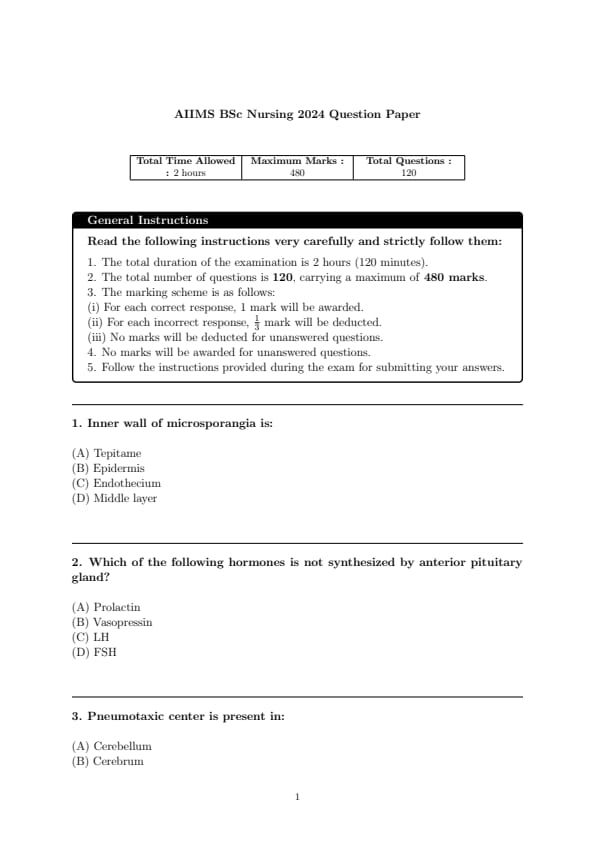
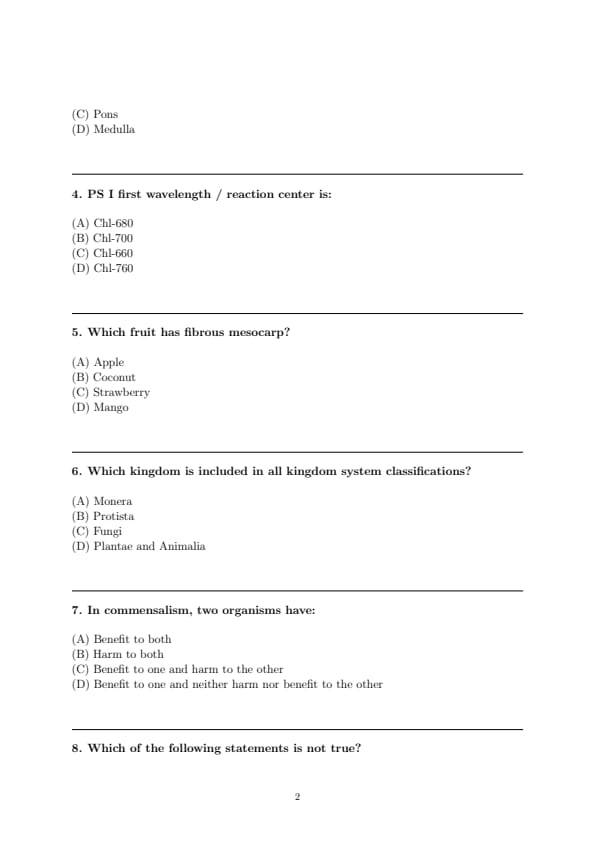
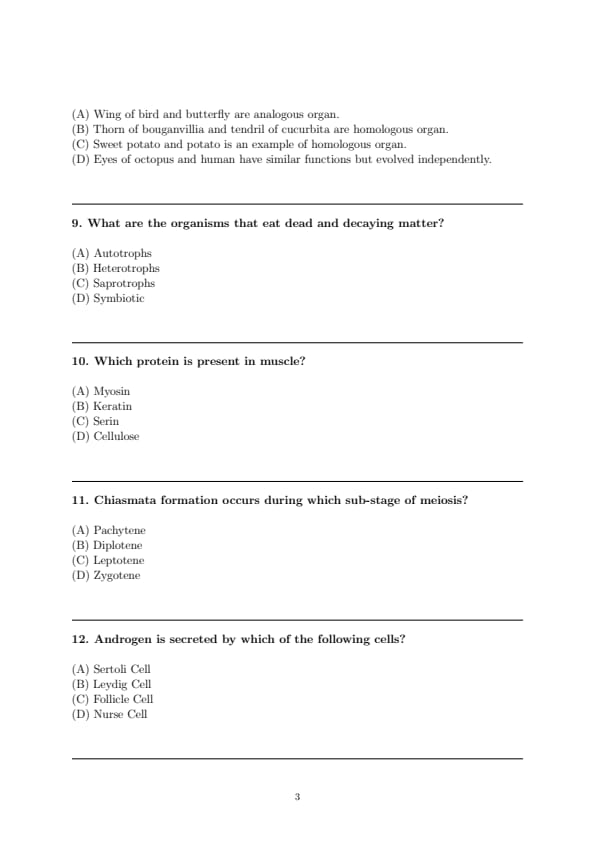
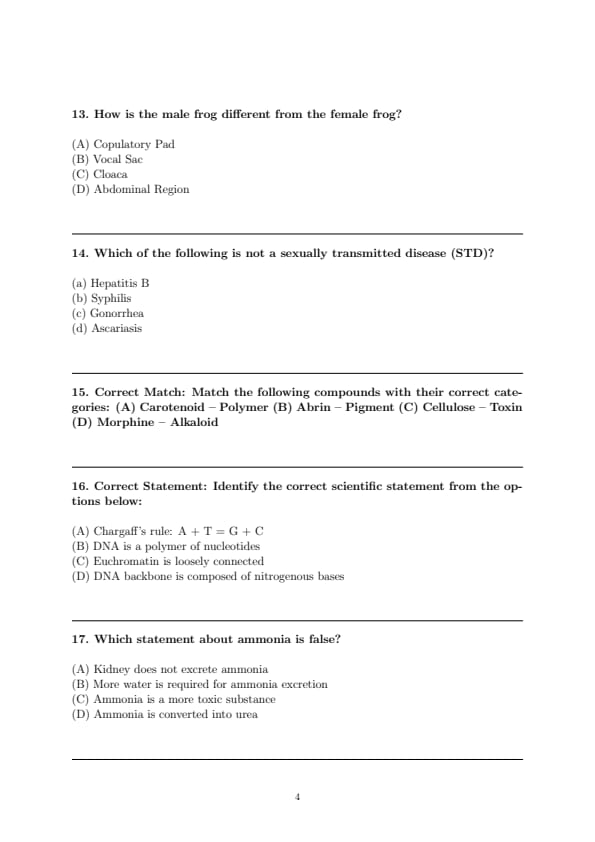
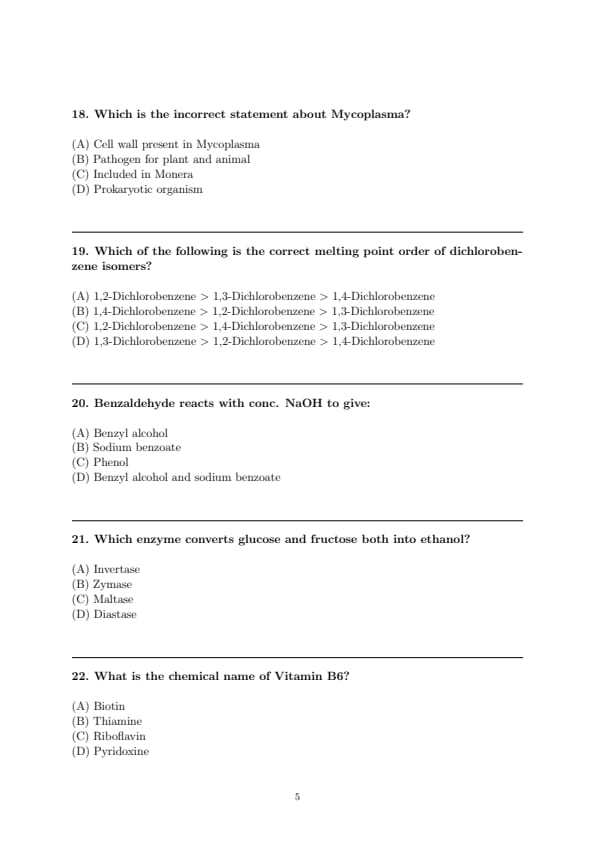
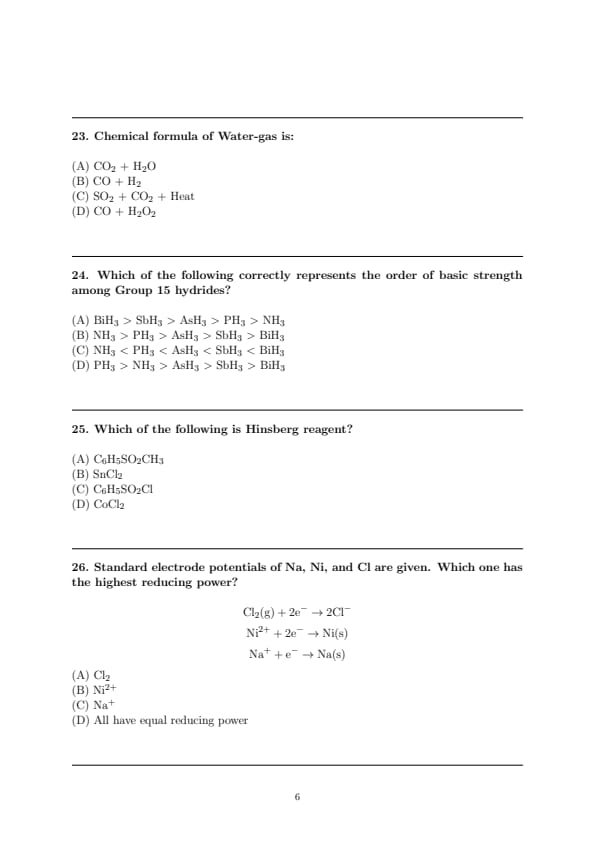
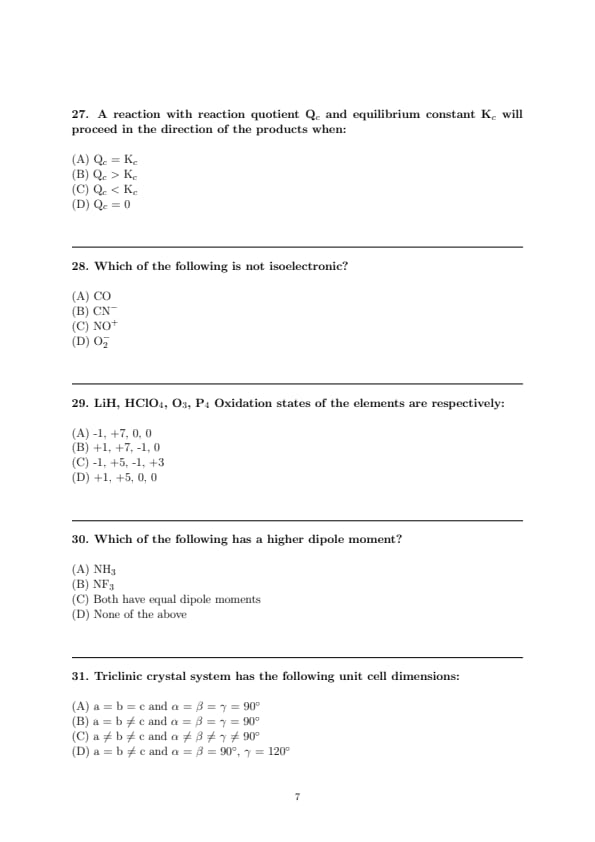
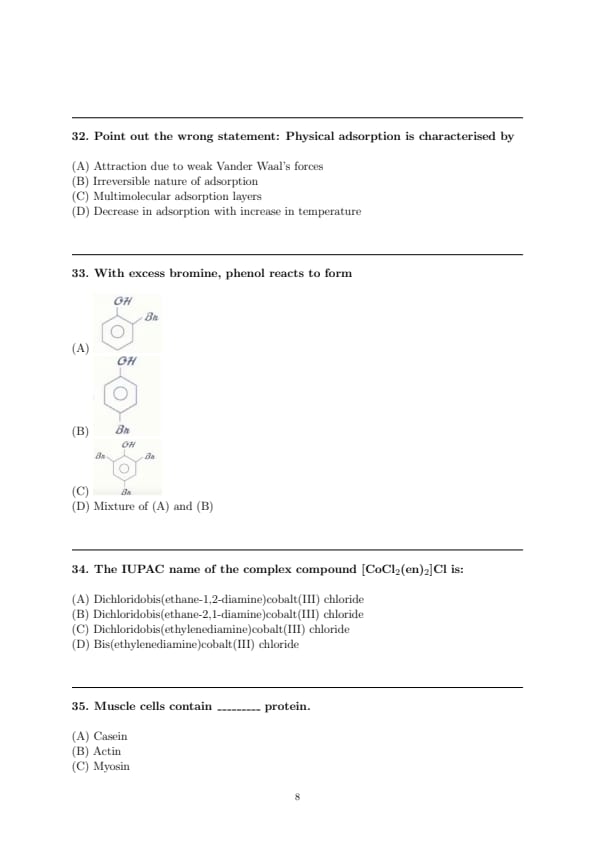
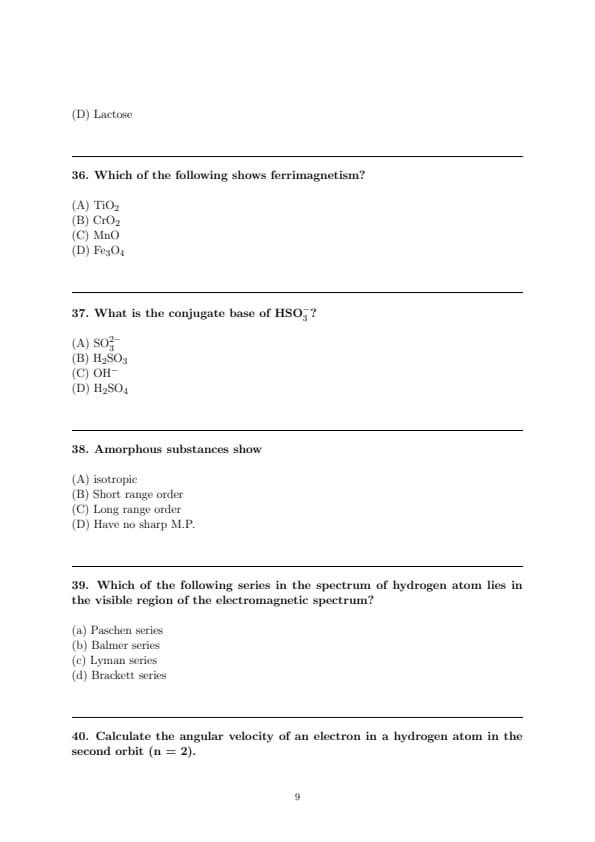
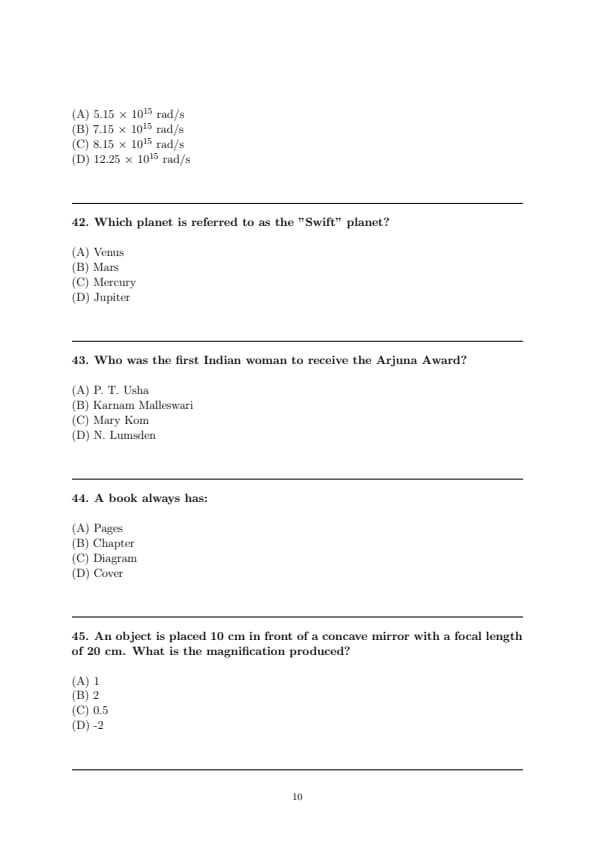
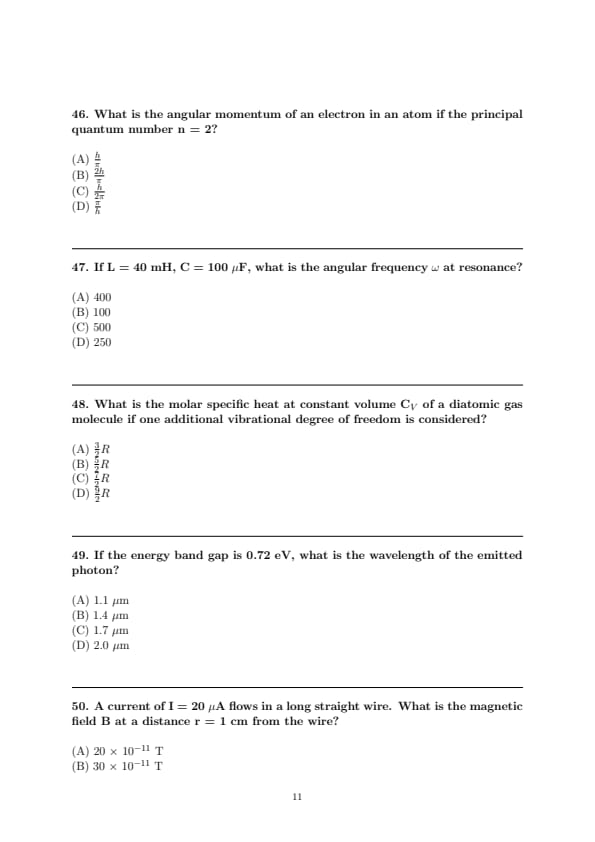
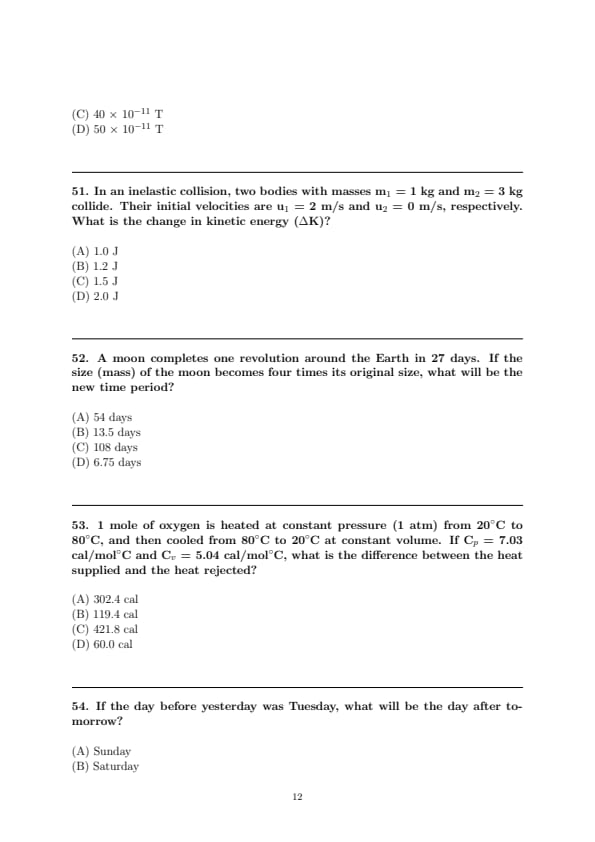
*The article might have information for the previous academic years, please refer the official website of the exam.