

Content Curator | Updated On - Jul 3, 2026
AIIMS Delhi conducted the B.Sc Nursing Exam on June 27 in shift 1 from 9.30 AM to 11.30 AM.
TheAIIMS B.Sc Nursing 2026 Question Paper consisted of 4 sections: Physics, Chemistry, Biology and General Knowledge/General Awareness with 100 Questions carrying a total of 100 Marks, as per the AIIMS B.Sc Nursing Marking Scheme, +1 Marks for every correct answer, and -1/3 mark will be deducted for every wrong answer.
AIIMS B.Sc Nursing 2026 Shift 1 Question Paper with Solution PDF is available here for download.
AIIMS B.Sc. Nursing 2026 Question Paper Shift 1 with Solutions PDF
| AIIMS B.Sc. Nursing 2026 Question Paper Shift 1 | Download PDF | Check Solutions |
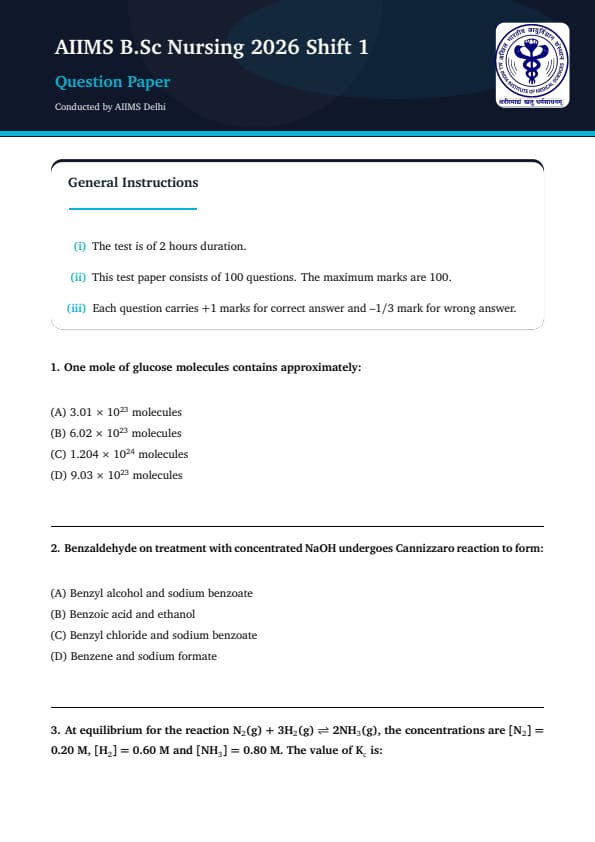
One mole of glucose molecules contains approximately:
Benzaldehyde on treatment with concentrated NaOH undergoes Cannizzaro reaction to form:
At equilibrium for the reaction \( N_2(g) + 3H_2(g) \rightleftharpoons 2NH_3(g) \), the concentrations are [N\(_2\)] = 0.20 M, [H\(_2\)] = 0.60 M and [NH\(_3\)] = 0.80 M. The value of K\(_p\) is:
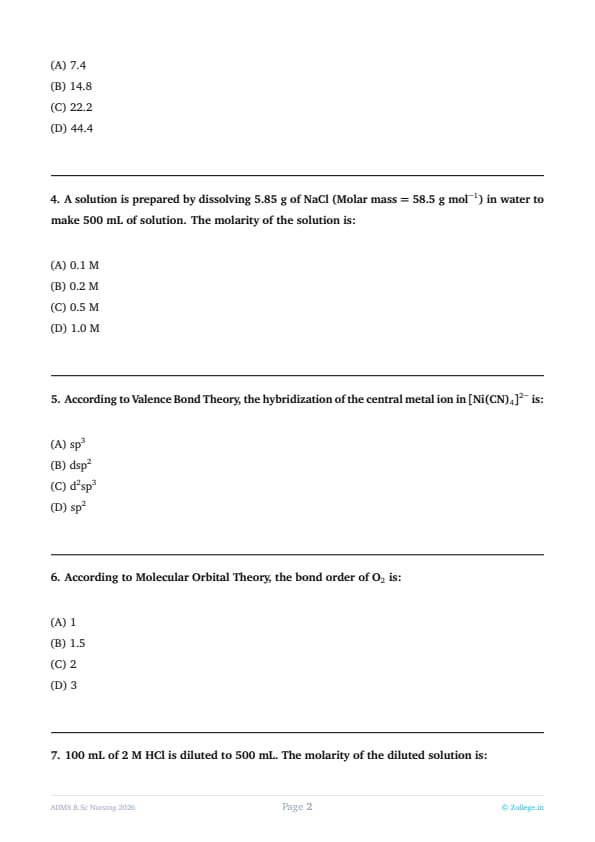
A solution is prepared by dissolving 5.85 g of NaCl (Molar mass = 58.5 g mol⁻¹) in water to make 500 mL of solution. The molarity of the solution is:
According to Valence Bond Theory, the hybridization of the central metal ion in [Ni(CN)₄]²⁻ is:
According to Molecular Orbital Theory, the bond order of O₂ is:
100 mL of 2 M HCl is diluted to 500 mL. The molarity of the diluted solution is:
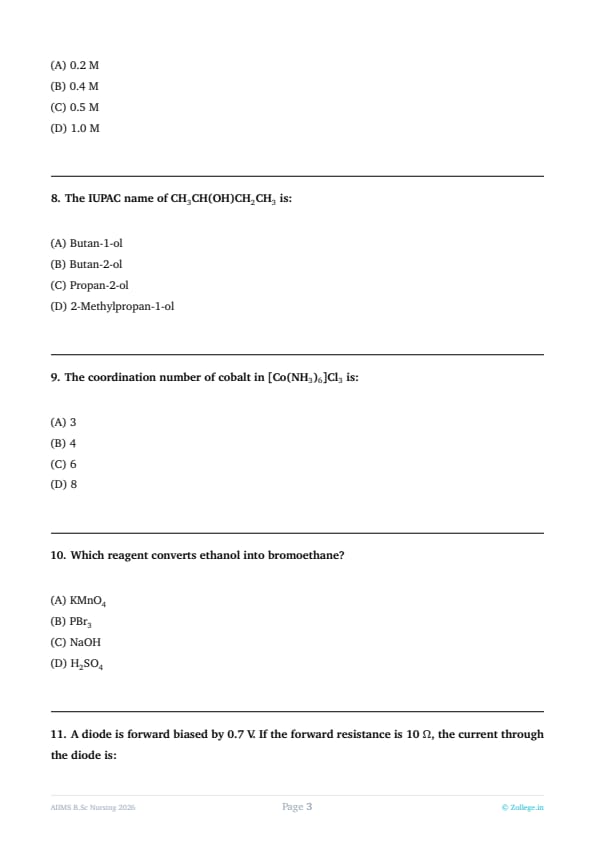
The IUPAC name of CH₃CH(OH)CH₂CH₃ is:
The coordination number of cobalt in [Co(NH₃)₆]Cl₃ is:
Which reagent converts ethanol into bromoethane?
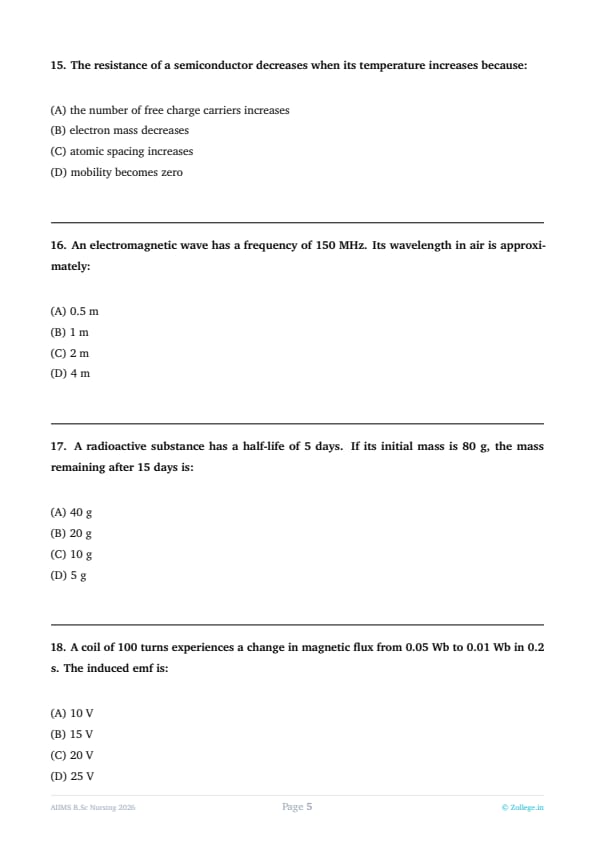
A diode is forward biased by 0.7 V. If the forward resistance is 10 Ω, the current through the diode is:
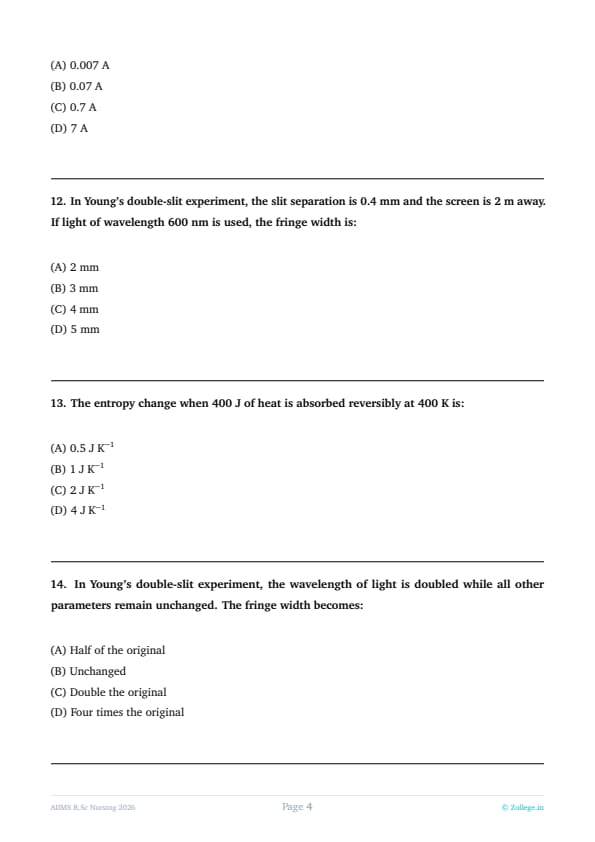
In Young’s double-slit experiment, the slit separation is 0.4 mm and the screen is 2 m away. If light of wavelength 600 nm is used, the fringe width is:
The entropy change when 400 J of heat is absorbed reversibly at 400 K is:
In Young’s double-slit experiment, the wavelength of light is doubled while all other parameters remain unchanged. The fringe width becomes:
The resistance of a semiconductor decreases when its temperature increases because:
An electromagnetic wave has a frequency of 150 MHz. Its wavelength in air is approximately:
A radioactive substance has a half-life of 5 days. If its initial mass is 80 g, the mass remaining after 15 days is:
A coil of 100 turns experiences a change in magnetic flux from 0.05 Wb to 0.01 Wb in 0.2 s. The induced emf is:
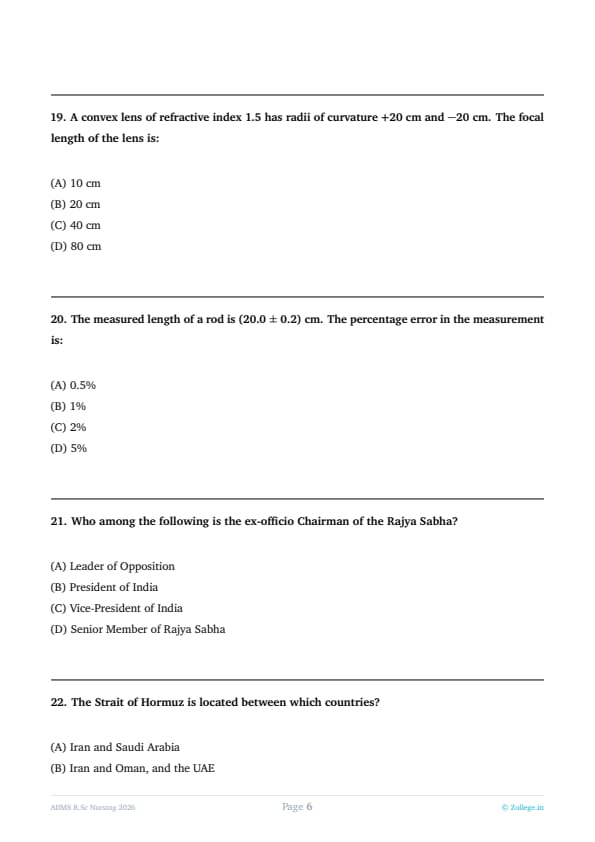
A convex lens of refractive index 1.5 has radii of curvature +20 cm and −20 cm. The focal length of the lens is:
The measured length of a rod is (20.0 ± 0.2) cm. The percentage error in the measurement is:
Who among the following is the ex-officio Chairman of the Rajya Sabha?
The Strait of Hormuz is located between which countries?
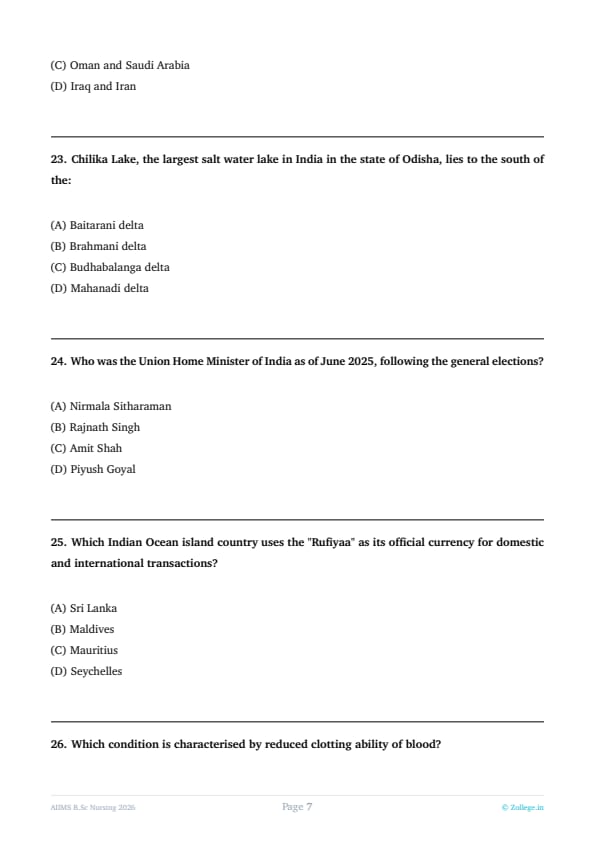
Chilika Lake, the largest salt water lake in India in the state of Odisha, lies to the south of the:
Who was the Union Home Minister of India as of June 2025, following the general elections?
Which Indian Ocean island country uses the "Rufiyaa" as its official currency for domestic and international transactions?
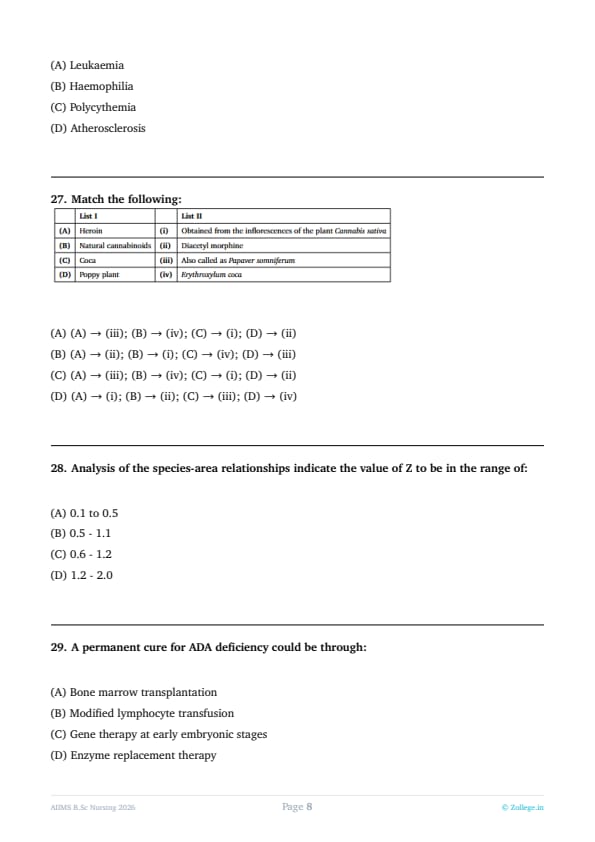
Which condition is characterised by reduced clotting ability of blood?
Match the following:

Analysis of the species-area relationships indicate the value of Z to be in the range of:
A permanent cure for ADA deficiency could be through:
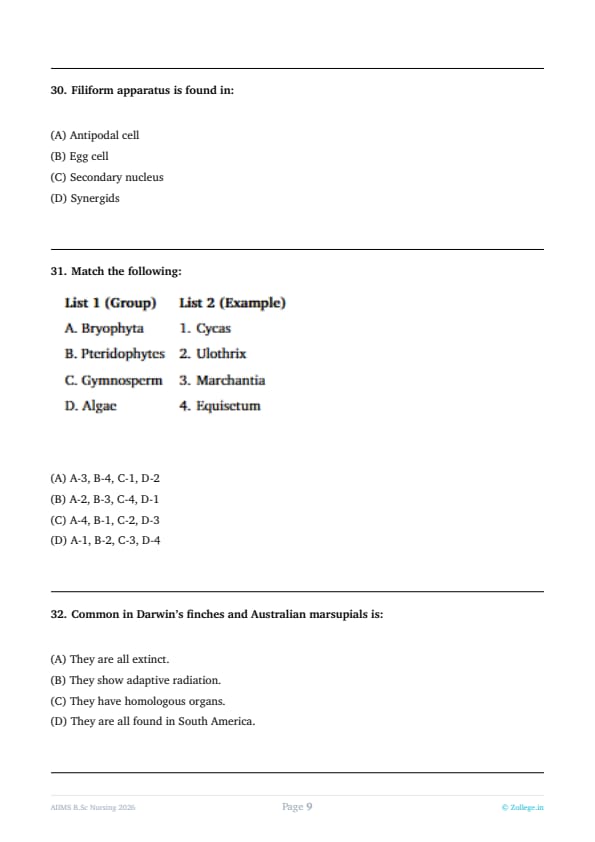
Filiform apparatus is found in:
Match the following:

Common in Darwin’s finches and Australian marsupials is:
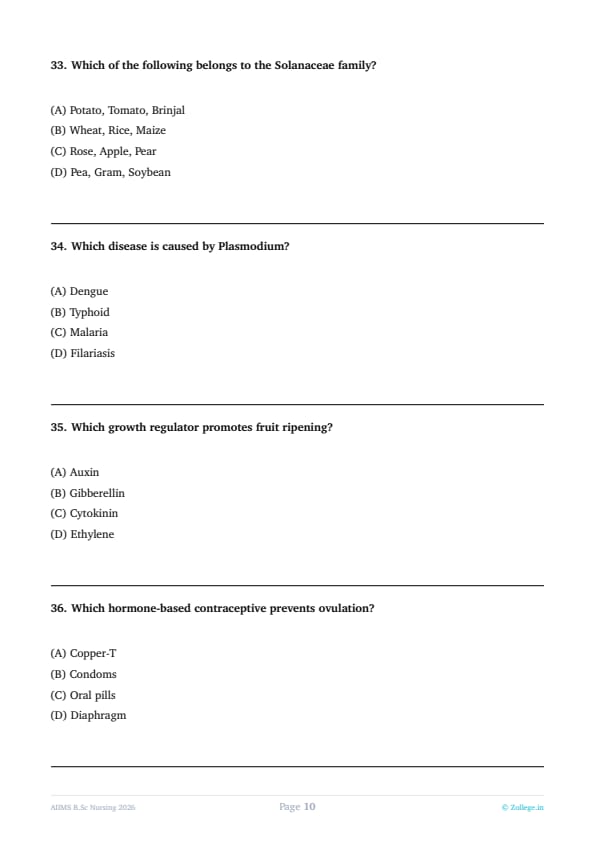
Which of the following belongs to the Solanaceae family?
Which disease is caused by Plasmodium?
Which growth regulator promotes fruit ripening?
Which hormone-based contraceptive prevents ovulation?
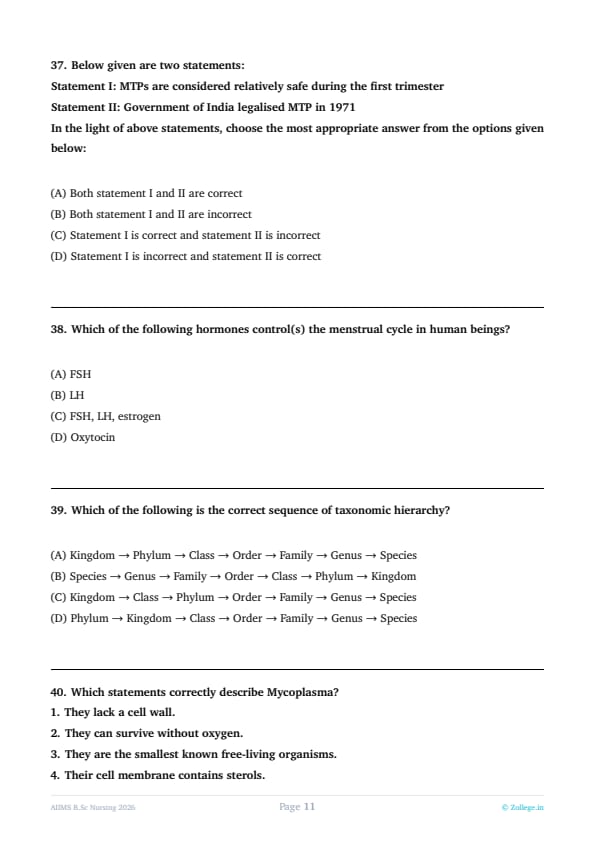
Below given are two statements:
Statement I: MTPs are considered relatively safe during the first trimester
Statement II: Government of India legalised MTP in 1971
In the light of above statements, choose the most appropriate answer from the options given below:
Which of the following hormones control(s) the menstrual cycle in human beings?
Which of the following is the correct sequence of taxonomic hierarchy?
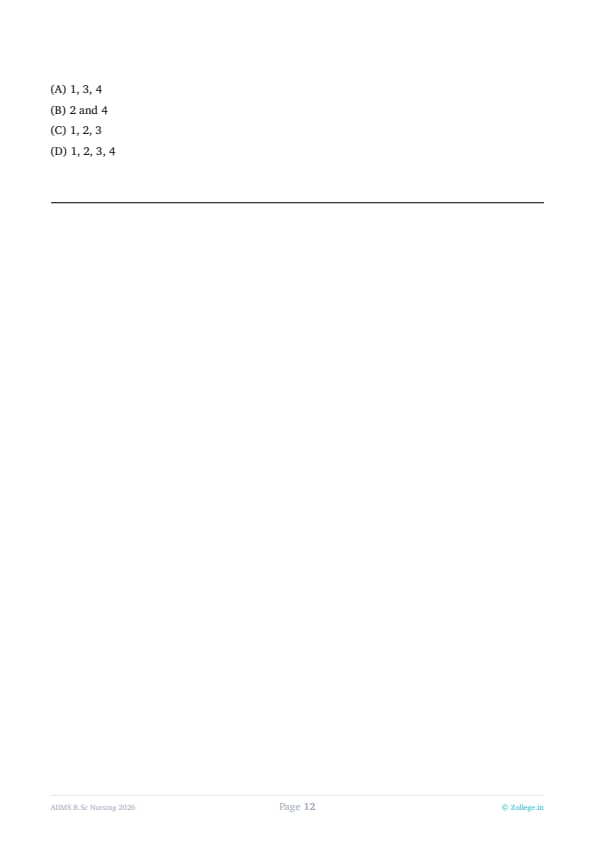
Which statements correctly describe Mycoplasma?
1. They lack a cell wall.
2. They can survive without oxygen.
3. They are the smallest known free-living organisms.
4. Their cell membrane contains sterols.
AIIMS B.Sc Nursing 2026 Exam Pattern
| Particulars | Details |
|---|---|
| Exam Level | Undergraduate |
| Exam Frequency | Once a year |
| Exam duration | 120 minutes (2 Hours) |
| Mode of exam | Computer-based test(CBT)/Online |
| Language of the Exam | English |
| Type of questions | Multiple-choice questions (MCQs) |
| Total Marks | 100 |
| Total Questions | 100 |
| Sections | Physics |
| Chemistry | |
| Biology | |
| General knowledge | |
| Marking Scheme | +1 for each correct answer |
| -1/3 for each incorrect answer | |
| 0 for Not answered | |
| Total marks | 100 |
AIIMS B.Sc Nursing 2026 Paper Analysis
*The article might have information for the previous academic years, please refer the official website of the exam.