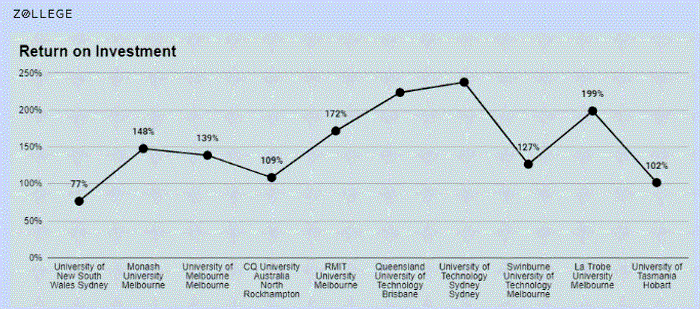
Masters in Information Technology in Australia is a 2 years post graduate masters degree program offered by more than 25 universities. This study in Australia course is taught in various specializations in Australia including cybersecurity, information analysis, computing and more. The average tuition cost for master of management in information systems in Australia is AUD 30,000 to 50,000. You can get an average salary of AUD 87,000 (INR 47,17,050). Hence you get more than what you have spent during your studies annually. This helps to improve the return on investment for most universities in Australia.
The IELTS requirement for international students for master of information technology management in Australia is 6.5 bands. Minimum GPA score required is 2.5 out of 4.0 scale which is 70-76%. You will also require a bachelor's degree for enrollment into master of information and communication technology in Australia.
The application process for top Australian universities are simple and done mostly via the website. You must check the application requirements and the dealine atleast 6 months before the admission session. This will give you enough time to prepare the documents required for admissions. You must also opt for scholarships during the admission process. The amount received in scholarships will help you financially support your education.
|
Table Of Contents |
Why Study MS in IT in Australia?
- More than 80,000 job openings are available for students after masters in information technology in Australia.
- The tuition cost is affordable as compared to other countries.
- Australia experiences more than 4 lakh students every semester from all over the world making it the 3rd best destination for education.
- Students are offered monetary and financial assistance in terms of scholarships and awards.
- You also get Australian work Visa right after graduation to work and stay in Australia
Top Universities for Masters in IT in Australia
There are more than 25 universities which offer masters in information technology in Australia. Following is the list of top universities of Australia and information technology programs they offer:
| University Name | Program Name |
|---|---|
| University of New South Wales Sydney, Australia | Master of Information Technology E-commerce Systems |
| Monash University Melbourne, Australia | Master of Information technology |
| University of Melbourne Melbourne, Australia | Master of Information technology |
| CQ University Australia North Rockhampton, Australia | Master of Information technology |
| RMIT University Melbourne, Australia | Master of Information technology |
| Queensland University of Technology Brisbane, Australia | Master of Information technology |
| University of Technology Sydney Sydney, Australia | Master of Information technology Cybersecurity |
| Swinburne University of Technology Melbourne, Australia | Master of Information technology (professional computing) |
| La Trobe University Melbourne, Australia | Master of Information technology Cloud Analytics |
| University of Tasmania Hobart, Australia | Master of Information technology and system |
| University of Wollongong Sydney, Australia | Master of Information technology |
| Deakin University | Master of Information technology |
| University of Western Australia | Master of Information technology |
Admission Process for MS in IT in Australia
The admission is usually done via the official website. You can check how to apply to Australian university here.
- Select the university and check its admission deadlines, eligibility criteria and admission requirements.
- Go to the official website of the university and select the course.
- Fill all the necessary details on the admission portal and submit necessary documents.
- Pay the application fees and submit the application.
Admission Deadlines for Masters in IT in Australia
International Students must submit applications before the admission deadline in Australia to proceed further with the visa and other requirements. Students can check the admission deadlines of universities providing masters in information technology in Australia from the table given below:
| University Name | Admission Deadlines |
|---|---|
| University of New South Wales Sydney, Australia | 1 July 2024 |
| Monash University Melbourne, Australia | June 30, 2023 |
| University of Melbourne Melbourne, Australia | Closed |
| CQ University Australia North Rockhampton, Australia | June 26, 2023 |
| RMIT University Melbourne, Australia | July 24, 2023 |
| Queensland University of Technology Brisbane, Australia | June 30, 2023 |
| University of Technology Sydney Sydney, Australia | Closed |
| Swinburne University of Technology Melbourne, Australia | Before July |
| La Trobe University Melbourne, Australia | July 3, 2023 |
| University of Tasmania Hobart, Australia | Closed |
| University of Wollongong Sydney, Australia | May 31, 2023 |
| Deakin University | June 25, 2023 |
| University of Western Australia | July 29, 2023 |
Eligibility Criteria for MS in IT in Australia
The eligibility criteria as per Australian grading system for MS in IT in Australia are:
- Bachelor's degree with 65% or higher
- IELTS Score: 6.5 bands minimum
- TOEFL: 85 minimum
- GPA: 2.5 or higher
Admission Requirements for Masters in IT in Australia
The admission requirements include multiple documents to study in Australia. The required documents for higher education in Australia are:
- Financial documents
- Australia Student Visa (for international students)
- Valid passport
- Letter of recommendation
- Statement of purpose
- Transcripts and certificates
- GPA
- Scores of IELTS/TOEFL
- Bachelor's degree
- Application Fees
- Medical Insurance
- Resume
- Work Experience (for some universities)
- Bank statements
- Scholarship certificate (if any)
- Medical insurance
Masters in IT in Australia Course Fee
The average cost of tuition fee for masters in information technology in Australia is AUD 30,000 to 50,000 (INR 16,25,534 - 27,09,224). You can also check PR courses in Australia and their fees. The tuition cost varies for different Universities as provided in the table below:
| University Name | Program Name | Fee |
|---|---|---|
| University of New South Wales Sydney, Australia | Master of Information Technology E-commerce Systems | AUD 1,00,320 (INR 54,30,848) |
| Monash University Melbourne, Australia | Master of Information technology | AUD 46,700 (INR 25,28,116) |
| University of Melbourne Melbourne, Australia | Master of Information technology | AUD 50,272 (INR 27,21,487) |
| CQ University Australia North Rockhampton, Australia | Master of Information technology | AUD 67,980 (INR 36,80,114) |
| RMIT University Melbourne, Australia | Master of Information technology | AUD 38,400 (INR 20,78,793) |
| Queensland University of Technology Brisbane, Australia | Master of Information technology | AUD 26,800 (INR 14,50,824) |
| University of Technology Sydney Sydney, Australia | Master of Information technology Cybersecurity | AUD 24,270 (INR 13,13,862) |
| Swinburne University of Technology Melbourne, Australia | Master of Information technology (professional computing) | AUD 56,400 (INR 30,53,228) |
| La Trobe University Melbourne, Australia | Master of Information technology Cloud Analytics | AUD 31,600 (INR 17,10,673) |
| University of Tasmania Hobart, Australia | Master of Information technology and system | AUD 73,158 (INR 39,60,426) |
| University of Wollongong Sydney, Australia | Master of Information technology | AUD 69,696 (INR 37,73,010) |
| Deakin University | Master of Information technology | AUD 29,400 (INR 15,91,576) |
| University of Western Australia master of information technology | Master of Information technology | AUD 43,800 (INR 23,71,123) |
Cost of Living for MS in IT in Australia
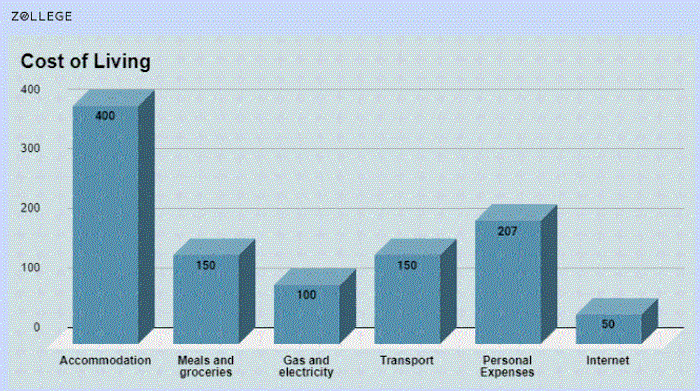
The Cost of living for Australia for masters in Information technology includes the expenses of internet, accommodation, transport and more. Following table provides the estimated cost of living for MS in IT in Australia:
Scholarships for Masters in IT in Australia
Universities of Australia provides several scholarships to international students to help them carry out expenses of tuition and living costs. Following are a few famous scholarships provided to students for masters in information technology in Australia:
| Scholarship Name | University | Award |
|---|---|---|
| Ericsson Technology Scholarship | University of Technology Sydney | AUD 24,000 (INR 12,99,246) |
| Melbourne Mobility Award | Master of information technology in melbourne Australia | Up to AUD 6,000 (INR 3,24,811) |
| Excellence scholarship | La Trobe University | 25% reduction in fee |
| Sir John Monash Fee Scholarship | Monash University | AUD 24,000 (INR 12,99,246) |
| Destination Australia Scholarship | Deakin University | Up To AUD 15,000 (INR 8,12,028) |
| Future Leader Scholarship | RMIT University | 20% in fee reduction |
Jobs after Masters in information technology in Australia
The average salary of a student with masters in information technology in Australia is AUD 87,000 (INR 47,14,050). Following are a few job titles for international students and average salaries for masters in information technology in Australia:
| Job Title | Average Salary |
|---|---|
| Network Administrator | AUD 80,000 - 1,00,000 (INR 43,30,820 - 54,13,525) |
| IT Trainer | AUD 85,204 (INR 46,12,539) |
| IT Consultant | AUD 90,000 (INR 48,72,172) |
| Systems Analyst | AUD 95,000 - 1,15,000 (INR 51,42,848 - 62,25,553) |
| Data Center Technician | AUD 1,00,000 - 1,20,000 (INR 54,13,525 - 64,96,230) |
| Database administrator | AUD 95,000 - 1,15,000 (INR 51,42,848 - 62,25,553) |
| Information Security Specialist | AUD 1,15,000 - 1,35,000 (INR 62,25,553 - 73,08,258) |
| Solutions Architect | 1,60,000 - 1,80,000 (INR 86,61,640 - 97,44,345) |
Top Recruiters for MS in IT in Australia
Following are the top recruiters for masters in information technology in Australia:
- Greythorn
- Clicks IT Recruitment
- Canva
- Prospa
- Uno
Work Permit after Masters in IT in Australia
You need an Australian work visa to stay and work in Australia.
- Work permit after masters in information technology in Australia is valid for 5 years.
- Students will have to provide a proof of study in Australia.
- Students can apply for a work permit within 6 months after completing Masters in information technology.
- Students must be employed under a registered occupation as per Australian Home office.
- Students must be below 50 years of age. After getting a work permit in Australia students can also apply for permanent residency after 2 years of employment.
Master of information technology in Australia syllabus includes Cyber Security, analysis, software development and more. Master of applied information technology victoria university Sydney is among the top University courses of Australia. Students are provided a number of scholarships by universities for MS in IT in Australia.
FAQs
Ques: What is a Master's in Information Technology (IT) in Australia?
Ans: A Master's in Information Technology program in Australia is a postgraduate degree designed to provide advanced knowledge and skills in various aspects of IT, including software development, data analytics, cybersecurity, and network administration.
Ques: How long does it take to complete a Master's in Information Technology in Australia?
Ans: Typically, a Master's in IT program in Australia takes 1.5 to 2 years for full-time students. Part-time options may be available, extending the duration accordingly.
Ques: What are the admission requirements for a Master's in IT program in Australia?
Ans: Admission requirements usually include a relevant undergraduate degree, such as computer science or information technology. Some universities may require work experience or standardized test scores like the GRE or GMAT. Additionally, proficiency in English is necessary for international students, often demonstrated through tests like IELTS or TOEFL.
Ques: Are there scholarships available for international students pursuing a Master's in IT in Australia?
Ans: Yes, many Australian universities offer scholarships specifically for international students pursuing postgraduate studies, including Master's in IT programs. These scholarships may be merit-based, need-based, or specifically targeted to certain demographics or regions.
Ques: Can I work while studying for my Master's in IT in Australia?
Ans: Yes, international students with a valid student visa are usually allowed to work part-time during the academic year and full-time during scheduled breaks. However, it's important to check the specific regulations set by the Australian government and your university.
Ques: What are the career prospects after completing a Master's in IT in Australia?
Ans: Graduates of Master's in IT programs in Australia are well-positioned for a variety of career paths, including software development, IT consulting, project management, cybersecurity, data analysis, and more. Australia's growing tech industry offers numerous opportunities for skilled IT professionals.
Ques: Are there opportunities for internships or practical experience during the Master's in IT program?
Ans: Many universities in Australia offer internships, co-op programs, or industry placements as part of their Master's in IT curriculum. These experiences provide valuable real-world skills and networking opportunities for students.
Ques: How much does it cost to pursue a Master's in IT in Australia for international students?
Ans: Tuition fees for Master's in IT programs vary depending on the university and the specific program. On average, international students can expect to pay between AUD 30,000 to AUD 45,000 per year for tuition. Living expenses should also be factored in.
Ques: Can I apply for a post-study work visa after completing my Master's in IT in Australia?
Ans: Yes, international students who graduate from an Australian institution with a Master's degree may be eligible to apply for a Temporary Graduate visa (subclass 485), allowing them to work in Australia temporarily after their studies to gain practical experience.
Ques: How do I choose the right university for my Master's in IT in Australia?
Ans: Consider factors such as university reputation, program accreditation, faculty expertise, available specializations, research opportunities, internship placements, and location preferences. Researching each university's curriculum and alumni outcomes can also help in making an informed decision.
![Australian National University [ANU]](https://static.zollege.in/public/college_data/images/studyabroad/logos/college_597_12-11:31_anu_logo_fb_350.png?tr=w-50,h-50,c-force?tr=h-40,w-35,c-force)
![The University of Melbourne [unimelb]](https://static.zollege.in/public/college_data/images/studyabroad/logos/college_609_20-15:00_mel-Logo.jpeg?tr=w-50,h-50,c-force?tr=h-40,w-35,c-force)
![University of New South Wales [UNSW]](https://static.zollege.in/public/college_data/images/studyabroad/logos/college_603_29-10:36_logo.jpeg?tr=w-50,h-50,c-force?tr=h-40,w-35,c-force)
![The University of Sydney [USYD]](https://static.zollege.in/public/college_data/images/studyabroad/logos/college_620_29-11:04_logo.jpeg?tr=w-50,h-50,c-force?tr=h-40,w-35,c-force)
![The University of Queensland [UQ]](https://static.zollege.in/public/college_data/images/studyabroad/logos/college_596_29-11:20_queensland_Logo.jpeg?tr=w-50,h-50,c-force?tr=h-40,w-35,c-force)