A Canada Permanent Resident Visa is a gateway to permanent resident status in Canada. Canada PR Visa is valid for 5 years, and candidates with a Canada PR card can live, study, and work in Canada freely. Based on your eligibility, you can apply for a Canadian citizenship. Canada PR requirements include several criteria like age, education level, experience and skills of English. The ranking of the country at #2 position as per 2024 World Happiness Report makes candidates apply for permanent residency. You can apply for a permanent residency after studying in Canada.
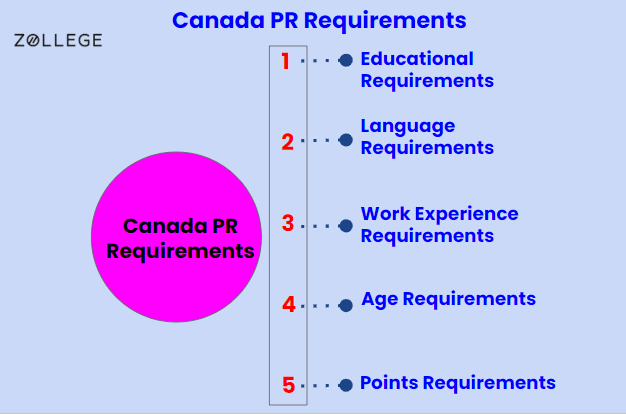
Candidates get eligible to apply for Canada PR only after receiving a job offer from employers. PR in Canada eligibility demands educational qualifications equivalent to Canadian Standards of higher education. Students must get 67 points out of 100 to obtain permanent residency visa. Students need a Canada PR IELTS score of minimum of 6 bands. Applicants must have a minimum of 1 year of full-time or part-time job experience in 3 years before applying for visa. Canada PR visa holders enjoy protection under Canadian law. Candidates receive healthcare coverage and other social benefits after attaining permanent residency in Canada.
Candidates with permanent resident status in Canada can enjoy many of the rights of Canadian citizens, although they remain citizens of their home countries unless they apply for and are granted Canadian citizenship. Canada PR process is an easy 7-step procedure for applicants who meet the eligibility and requirements. Following the 7 steps, you can process your Canada PR visa application. You can also apply for PR via Canada PNP. So what are you waiting for? Check the rules for PR in Canada for international students and apply now.
Type of Canada PR
The validity of Permanent Residency Visa Canada is 5 years. Candidates can change their PR status into Canadian citizens after working and staying for 3 years on a PR card. Express Entry Canada PR includes 3 skilled economic immigration programs as follows:
- Federal Skilled Worker Program (FSWP): Enabled foreign skilled workers to attain permanent residency in Canada. Candidates must have language ability, skilled worker experience and education equivalent to Canadian education to be eligible for Federal Skilled Worker.
- Provincial Nominee Program: Canadian Federal skilled worker visa (PR) is an alternative to this program. It enables candidates to attain permanent residency. Students are able to get more chances of receiving ITA with good Provincial nominations.
- Canadian Experience Class (CEC): This work permit for Canada is meant for skilled workers intending to attain permanent residency status in Canada. Applicants must meet the language levels and 1 year of skilled work experience to attain Canadian Experience Class.
Canada PR Eligibility and Requirements
Candidates must score 67 points for immigration and attain cutoff CRS score of each draw to meet PR in Canada eligibility criteria. Canada PR requirements for Indian are detailed below. Canada PR requirements are different from that Canada student visa. Canada PR requirements for international students include:
- Age: Candidates aged between 18-35 achieve maximum points. Applicants with age 35+ attain lesser points. However, 45 years is the maximum age limit for permanent residency in Canada.
- Education: Applicants must have educational qualifications equivalent to Canadian degrees.
- Work experience: Candidates must have minimum of 1 year of work experience (full-time) to get minimum points. Work experience for more years will lead to attaining more points. NOC (National Occupational Classification) lists the occupational qualification of the applicants as Skill Type 0 or Skill Level A or B
- Language ability: Minimum IELTS score for Canada PR is 6 bands. The IELTS score must not exceed more than 2 years old. Applicants having proficiency in French language attain extra points.
- Adaptability: Spouse or common-law partner intending to migrate with applicants to Canada will give applicants 10 more points for adaptability.
- Arranged employment: Applicants receiving valid offer letters from employers will attain at least 10 points.
Documents Required for Canada PR
Canada Permanent Residency for Indian demands certain documents that must be submitted. The list of documents required for Canada PR from India is as follows and is somewhat similar to PGWP Canada:
- Submit a signed and completed application.
- Valid Passport or travel document
- 2 identical photos taken within 1 year of the application date.
- Language sufficiency in exams required to study in Canada.
- A copy of the payment receipt.
- Proof of residence for outside Canada applicants living for a long period (1095 days).
- Birth certificates for applicants below 18 years of age.
- Copies of academic transcripts, mark sheets and attendance records.
Funds Required for Canada PR
Candidates must make Canada permanent residency investment to attain citizenship. The table below highlights the cost for permanent residency in Canada which is a mandatory aspect along with IELTS Score for Canada PR:
|
Categories |
Canada PR Cost |
|
Business Immigration |
Application Processing Fee: CAD 1,625 |
|
Caregivers |
Application Processing Fee: CAD 570 |
|
Economic Immigration (includes Express Entry Canada PR) |
Application Processing Fee: CAD 850 |
|
Humanitarian and compassionate |
Application Processing Fee: CAD 570 |
|
Permanent Resident card |
CAD 50 |
|
Biometrics fees (per person) |
CAD 85 |
|
Biometrics fees (per family) (2 or more people) |
CAD 170 |
How to Apply for PR in Canada
Canada PR visa for Indians can be attained by arranging all requirements properly. Here given below the steps to file a Canadian PR application from India which differs from how to study in Canada application.
- Complete the English/French Language Test
- CRS Score Calculation needs to be done by calculating age, education, work experience, language test etc.
- Apply for Education Credential Assessment
- Create Express Entry Profile
- Gather the required documents
- Get an invitation to apply, if CRS score is higher or equal to the current draw cutoff score
- Submit PR Application by uploading all documents and paying the PR fees
- Submit Biometrics (required for applicants and family members traveling with the applicants)
- Receive PR status confirmation and a COPR (Confirmation of Permanent Residence) card.
- Apply for a PR card and book a ticket for Canada.
Canada PR Application Processing Time
Canadian PR application processing time defines the duration of processing the most complete applications. In case of an incomplete application, Canada PR visa process may be delayed, or the application may be sent back to applicants. The table below highlights the processing time to apply for PR in Canada from India which differs from that Canada visitor visa processing time.
|
Application Type |
Processing Time |
|
New PR card |
28 days |
|
Renewing or replacing a PR card |
95 days |
Canada PR requirements for international students ask candidates to score 67 points for immigration. Students must attain cutoff CRS score for each draw. Applicants must meet Canada PR requirements IELTS score. Applicants must gather all the required documents and submit the PR application as per the above-mentioned steps.
FAQs
Ques: What are the requirements for PR in Canada?
Ans. Candidates must score 67 points out of 100 to attain PR in Canada. Applicants must be below 40 years and must attain the IELTS exam.
Ques: How to get 67 points for Canada PR?
Ans. Applicants score well if they get employed for a full-time job of 30 hours per week for 1 year. Applicants with more work experience will get more points.
Ques: What is the maximum age to apply for Canada PR?
Ans. Applicants need to be 18 years or above to attain a Canada PR visa. Candidates aged between 18-35 achieve maximum points. Applicants with age 35+ attain lesser points. However, 45 years is the maximum age limit for permanent residency in Canada.
Ques: How can I get Canadian PR from India?
Ans. Candidates must complete the English/French Language Test and apply for Education Credential Assessment. It is required to create Express Entry Profile and gather the required documents. Candidates must upload all documents and pay the PR fees.
Ques: How much IELTS score required for Canada PR?
Ans. Students need a Canada PR IELTS score of minimum of 6 bands.
Ques: Which country offers PR for Indians?
Ans. Canada is considered one of the easy PR countries for Indians. Candidates can apply for PR by submitting an online application.
Ques: Can you stay in India after getting Canada PR?
Ans. Yes, applicants can stay in India after obtaining Canadian PR. However, applicants are no longer Indian citizens and will become a citizen of Canada.
Ques: Which country is best for Indian PR?
Ans. Canada is the leading country for Indian PR. Other countries are New Zealand, Australia, Singapore, Norway etc.
Ques: How much it will cost for Canada PR from India?
Ans. For Economic Immigration, application processing fee is CAD 850 (INR 52,999) and the right of permanent residence fee is CAD 515 (INR 32,111). The processing fee for a child is CAD 230 (INR 14,340).
Ques: What is PR full form in Canada?
Ans. The full form of PR in Canada is the permanent resident card. It is a gateway to permanent resident status in Canada. Canada PR Visa is valid for 5 years, and candidates with a Canada PR card can live, study, and work in Canada freely.
Ques: Can international students apply for permanent residency (PR) in Canada after completing their studies?
Ans: Yes, international students in Canada can apply for permanent residency after completing their studies through various immigration pathways such as the Canadian Experience Class (CEC), Provincial Nominee Programs (PNPs), or the Express Entry system. However, eligibility criteria may vary depending on the specific program and province.
Ques: What are the eligibility requirements for international students to apply for PR in Canada?
Ans: Eligibility requirements for international students to apply for PR in Canada include completing a program of study at a designated learning institution, obtaining relevant work experience in Canada, meeting language proficiency requirements (usually English or French), and meeting other criteria specified by the immigration program they are applying under.
Ques: How does the Canadian Experience Class (CEC) pathway benefit international students seeking PR?
Ans: The Canadian Experience Class (CEC) pathway is specifically designed for individuals with skilled work experience in Canada, including international students who have completed their studies. By gaining at least one year of skilled work experience in Canada, international students become eligible to apply for PR under the CEC, which often provides a faster route to permanent residency.
Ques: Can international students apply for PR through PNP in Canada?
Ans: International students can apply for PR through Provincial Nominee Programs (PNPs) in Canada. Many provinces have specific streams within their PNPs that are tailored to international graduates, allowing them to apply for nomination based on factors such as their education, work experience, and ties to the province.
Ques: Do I need to have a job offer to apply for PR in Canada after completing their studies?
Ans: While having a job offer can enhance an international student's eligibility for certain immigration pathways, it is not always required to apply for PR in Canada. Programs such as the Canadian Experience Class (CEC) and Provincial Nominee Programs (PNPs) may have different eligibility criteria, some of which may or may not include a job offer as a requirement.
![University of Toronto [U of T]](https://static.zollege.in/public/college_data/images/studyabroad/logos/college_104_25-12:44_University_of_Toronto-logo-2417C8AF32-seeklogo.jpeg?tr=w-50,h-50,c-force?tr=h-40,w-35,c-force)
![The University of British Columbia [UBC]](https://static.zollege.in/public/college_data/images/studyabroad/logos/college_64_25-11:13_Capture.jpeg?tr=w-50,h-50,c-force?tr=h-40,w-35,c-force)

![University of Montreal [U de M]](https://static.zollege.in/public/college_data/images/studyabroad/logos/college_71_24-17:54_udem.jpeg?tr=w-50,h-50,c-force?tr=h-40,w-35,c-force)
![University of Alberta [UAlberta]](https://static.zollege.in/public/college_data/images/studyabroad/logos/college_9_24-17:46_alberta-.jpeg?tr=w-50,h-50,c-force?tr=h-40,w-35,c-force)