LOR for Canada is required by most Canadian Universities, mostly for Post Graduate programs than for Undergraduate courses. The LOR for Canada can be written by past mentors, professors, and employers who can acknowledge the applicant's academic and professional accomplishments the best. The LORs for Canada help the Admissions Committee to evaluate your academic profile and experience. Top Canadian universities have specific documents requirement like LOR, Resume, SOP or Essays. LOR Format for Canada must follow all the rules as it highlights the candidate’s potential in front of the admissions committee.
Types of LOR for Canada
Candidates wonder, “what is LOR letter?” The LOR requirements asked for by most Canadian Universities can be broadly divided into Academic LOR and Professional LOR, which are discussed in detail as follows to study in Canada.
| Academic LOR | Professional LOR |
|
|
List Of Recommenders To Choose From
How to get LOR from employer? Choosing the right referee or recommender makes the LOR stronger. For candidates looking for “is LOR required for Canada student visa?” Here are a few referees to choose from.
- In case you are applying for a program (usually Master's) with no prior work experience, LOR for Canada study visa from a Faculty or Academic advisor will be accepted.
- If you have relevant work experience, an LOR from your employer or from the internship provider should be submitted.
- If the admission to the program demands previous research work (usually for PhD applicants), an LOR from your Research Mentor or Thesis Coordinator should be submitted.
LOR Format for Canada
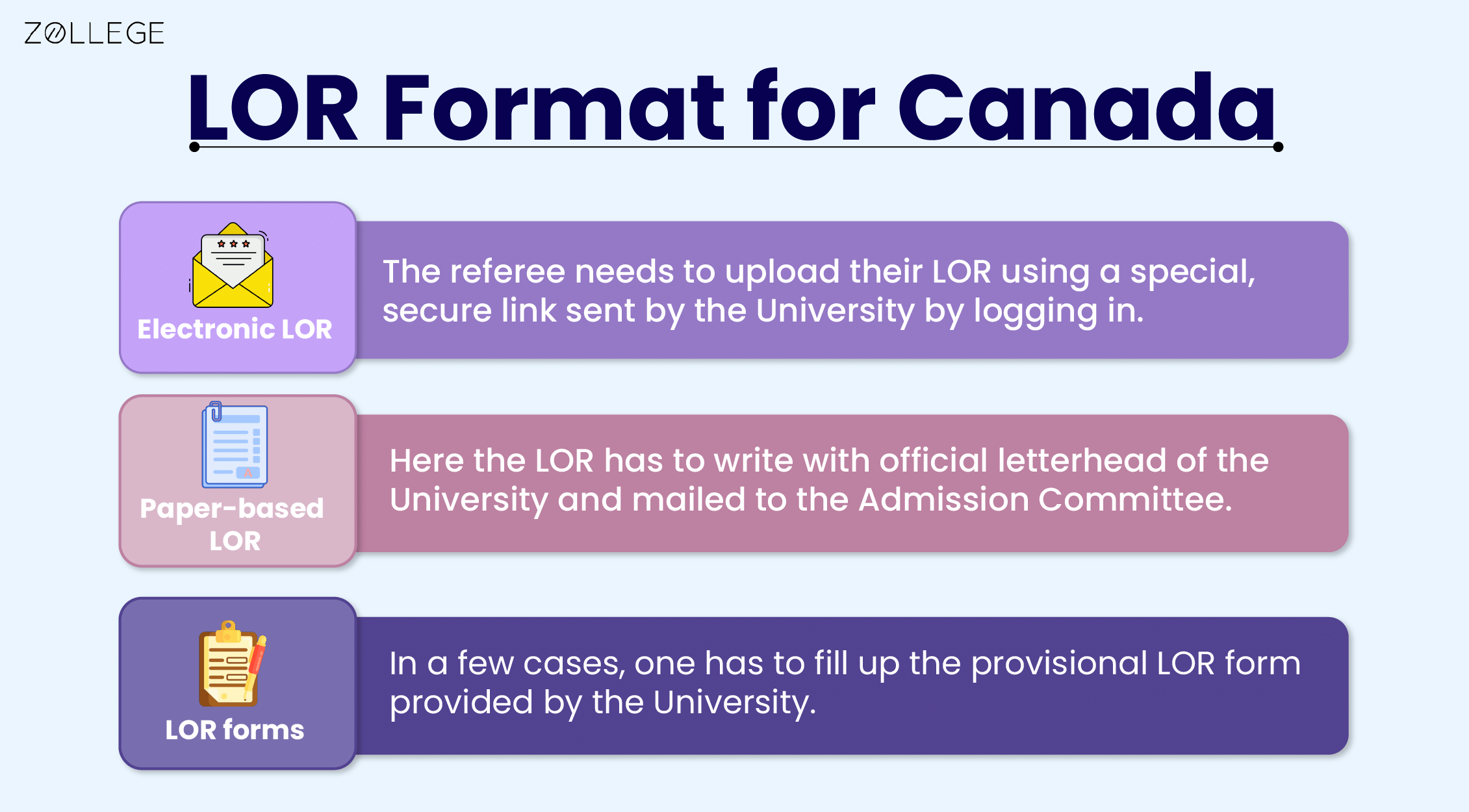
The mode of submission of the LOR for Canada varies across different Universities as,
Format for Writing a Strong LOR for Canada
The basic format for writing a strong LOR for Canada is mentioned here.
- Relation with Applicant (Paragraph 1): Begin with explaining your relationship with the applicant. You must mention which first interaction fostered a good student-mentor or student-employer relationship between you and the applicant and since how long you have known the applicant.
- Reason for recommendation (Paragraph 2): Emphasise on the skills and unique qualities for which you recommend him or her. Shed some light on their academic milestones and their career progression. State how you see the student in another ten years.
- Extracurriculars (Paragraph 3): Here you can shed some light on the research projects, inter-college competitions and seminars that the student has participated in. Shed some light on their internship and work experiences (in case of Professional LOR).
- Closing remarks and invitation to be contacted (Paragraph 4): Surmise how you think the applicant will be fit for the University and how he can contribute to its overall flourishing. Extend an invitation to be contacted in case of queries or further details mentioning your preferred time slots for the same.
Close the LOR with apposite business professional closing remarks such as "Regards", "Sincerely", "Thanking you", etc. Attach your contact information at the end.
Guidelines for Writing an LOR for Canadian Universities
Here are a few tips you should take a note of before writing the LOR for Canada for your student.
- Candidates should write the LOR in the first place only if the following conditions are met:
- Can write the LOR "wholeheartedly" to recommend the student to the Admission Committee.
- Must have known the applicant long enough to demonstrate their Personal development, academic achievements and work experiences.
- Have sufficient time to write the LOR and can access the official documents to write the letter.
- You must be able to access the following (in order of pertinence) for writing the letter:
- Academic transcripts
- CV or Resume
- Clear knowledge of the applicant's research projects (if any) and their research plan.
- Eligibility criteria for applying to the program.
- Samples of the Student's academic work and projects.
- Standardized exam scores (GRE, GMAT and ELP exams like IELTS and TOEFL).
- Understanding of the applicant's career plans.
LOR Requirements for Canadian University
Candidates looking for “how many LORs required for MS in Canada?” The additional specifications made by the top Canadian Universities in regard to Writing the LOR samples for MS in Canada, LOR for MBA in Canada are given below.
| University Name | LOR for PG Diploma | LOR for MS | LOR for MBA |
| University of Toronto | 2 Academic LOR | 2 Academic LORs | 2 Academic LORs |
| University of British Columbia | 3 Academic & Professional LOR | 3 Academic & Professional LOR | 3 Academic & Professional LOR |
| McGill University | 2 Academic LORs | 2 Academic LORs | 2 Academic LORs |
| University of Montreal | 1 Academic LOR | 1 Academic LOR | 1 Academic LOR |
| McMaster University | 2 Academic LORs | 2 Academic LORs | 2 Academic LORs |
| University of Alberta | 2 Academic LORs | 2 Academic LORs | 2 Academic LORs |
| University of Waterloo | 2 Academic LORs | 2 Academic LOR | 2 Academic LORs |
| Western University | 2 Academic LORs | 2 Academic LOR | 2 Academic LORs |
LOR for Canada can be written by past mentors, professors, and employers who can acknowledge the applicant's academic and professional accomplishments the best.
FAQs
Ques. What is a Letter of Recommendation (LOR), and why is it required for Canadian applications?
Ans. A Letter of Recommendation (LOR) is a document that provides an assessment of your skills, character, and suitability for a particular program or position. Canadian institutions often require LORs to gain insights into your qualifications and potential.
Ques. How many LORs are typically required for Canadian applications?
Ans. The number of LORs required can vary by institution and program. On average, most Canadian universities and colleges request two to three LORs.
Ques. Who should write my LOR for a Canadian application?
Ans. LORs are typically written by individuals who are familiar with your academic or professional background. Professors, employers, supervisors, or mentors are common choices.
Ques. Are there specific guidelines for formatting and content in a Canadian LOR?
Ans. Yes, Canadian institutions may have specific formatting and content requirements for LORs. It's important to review the guidelines provided by each institution to ensure compliance.
Ques. Should I waive my right to see the LOR content in Canada?
Ans. It's generally advisable to waive your right to view the LOR content, as this adds credibility to the recommendation. Canadian institutions often prefer confidential LORs.
Ques. How can I request an LOR from a potential recommender in Canada?
Ans. Politely request the LOR in advance, providing your recommender with relevant information, such as your academic/professional achievements, career goals, and application deadlines.
Ques. Can I use the same LOR for multiple Canadian institutions?
Ans. While you can use the same LOR for multiple applications, it's recommended to customize each LOR to align with the specific program and institution's requirements.
Ques. Is there a preferred format for submitting LORs in Canada?
Ans. Canadian institutions often have online application portals where you can upload LORs directly. Follow the instructions provided by the institution regarding the format and submission process.
Ques. What should be included in a well-written LOR for Canadian applications?
Ans. A strong LOR should include your relationship with the recommender, your qualifications, achievements, character traits, and how you would contribute to the program or organization.
Ques. Are there any common mistakes to avoid when submitting LORs for Canadian applications?
Ans. Avoid submitting generic or impersonal LORs. Ensure that your LORs are tailored to the specific requirements of each institution and program. Also, adhere to any word limits and submission deadlines provided by the institutions.?
![University of Toronto [U of T]](https://static.zollege.in/public/college_data/images/studyabroad/logos/college_104_25-12:44_University_of_Toronto-logo-2417C8AF32-seeklogo.jpeg?tr=w-50,h-50,c-force?tr=h-40,w-35,c-force)
![The University of British Columbia [UBC]](https://static.zollege.in/public/college_data/images/studyabroad/logos/college_64_25-11:13_Capture.jpeg?tr=w-50,h-50,c-force?tr=h-40,w-35,c-force)

![University of Montreal [U de M]](https://static.zollege.in/public/college_data/images/studyabroad/logos/college_71_24-17:54_udem.jpeg?tr=w-50,h-50,c-force?tr=h-40,w-35,c-force)
![University of Alberta [UAlberta]](https://static.zollege.in/public/college_data/images/studyabroad/logos/college_9_24-17:46_alberta-.jpeg?tr=w-50,h-50,c-force?tr=h-40,w-35,c-force)