Study in Canada is a great way for applicants to get an opportunity to apply to a multitude of top-ranked universities recognized globally by prestigious agencies. Top universities in Canada include University of Toronto,The University of British Columbia, McMaster University, etc and several others. While applying for Canada student visa requires applicants to submit certain eligibility criteria including documents, scores, and proof of financial statements. Canadian government has invested CAD 147.9 million dollars towards International Education Strategy (IES). Universities in Canada for masters offer top courses in disciplines like Computer Science, Business, Engineering, Information Technology, MBA etc. International students Canada are required to pay an average tuition fee of CAD 36,100 (INR 22,46,389.80) per year for undergraduate courses and CAD 21,100 (INR 13,13,134.66) per year for graduate courses.
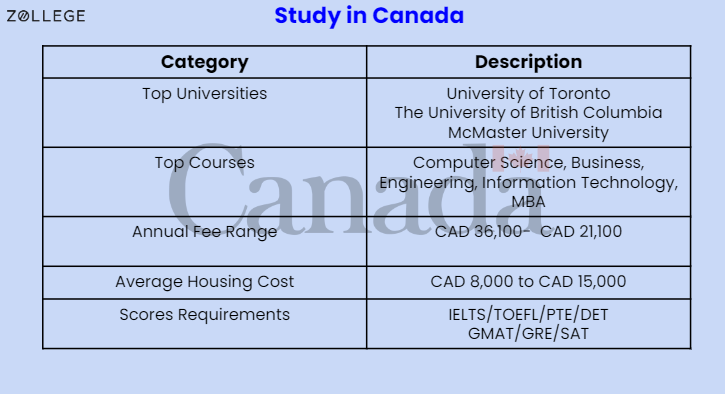
Studying in Canada provides chances for networking, cultural exploration, and academic and personal development. Participate in extracurricular activities, visit the nation's attractions, and form deep connections to make the most of your time. Students most often get a high ROI after their study in Canada. Specific requirements for admissions in Canada may vary depending on the program and institution. Some document requirements include submission of academic transcripts, results from English language proficiency exams such as the TOEFL or IELTS, letters of recommendation, a statement of purpose, and, depending on the program, a resume or portfolio are usually required. GMAT/GRE scores are required for STEM courses and also managemnt courses by top universities.
A rewarding experience in education can be had studying in Canada because of the nation's excellent educational system, diverse population, and stunning natural surroundings. The cost of living in Canada might vary as per student preferences. The cost of living in dorms at a university or college can vary from CAD 8,000 (INR 489,420) to CAD 15,000 (INR 917,662.50) per academic year. Depending on the area and kind of housing, renting an apartment or shared housing off-campus can run you anywhere from CAD 600 (INR 36,706.50) to CAD 2,500 (INR 152,943.75) per month. City-specific public transportation passes typically cost between CAD 100 (INR 6,117.75) and CAD 150 (INR 9,176.63) per month for unlimited city travel. The cost of groceries for a single person can range from CAD 300 (INR 18,353.25) to CAD 600 (INR 36,706.50) per month, depending on diet and eating habits.
Admission Requirement for Study in Canada
To be eligible to study in Canada, applicants must meet the minimum admission requirements. Candidates as international students in Canada are required to submit a number of documents to prove their eligibility for admission in desired courses offered by universities in Canada. These are also needed by top MBA colleges in Canada. Mentioned below are the admission requirements to study in Canada:
- Entrance exams.
- English proficiency test scores.
- Academic and personal documents
Exams Required to Study in Canada
Applicants willing to apply for courses like UG, PG or PhD in Canada are required to qualify and submit score reports or have certificates of exams required to study in Canada. A portfolio of work or an audition may be required as part of the admissions process for some programs in performing arts, arts, design, and music.When organizing their application process for Canadian universities, international students should also take into account elements like test dates, registration deadlines, exam preparation, and score reporting.
|
Exam |
Minimum Score |
|
1200-1300 for undergraduate programs |
|
|
ACT |
27-30 for undergraduate programs |
|
650-700 for MBA programs |
|
|
310-320 for master's programs |
|
|
LSAT |
150-160 for law school |
English Language Proficiency Scores to Study in Canada
Exam requirements for entry into Canadian universities can change based on the school, program, and academic level i.e., graduate or undergraduate. There is also requirement for IELTS score for Canada student visa. The table mentioned below highlights the English Language proficiency test scores which is a crucial aspect of Canada student visa requirement and to study in Canada:
|
English Proficiency Test |
Average Minimum Score |
|
6.5 |
|
|
90 |
|
|
PTE |
54+ |
|
100 |
Documents Required to Study in Canada
Applicants are required to submit a number of documents in order to Study in Canada. These documents are applicable for all the courses including Executive MBA in Canada. Mentioned below are the documents required:
- A valid passport. You will need a valid passport to study in Canada.
- Proof of acceptance by a top MBA colleges in Canada. This is a letter from the university or college you have been accepted to.
- Proof of English language proficiency. Most Canadian universities require international students to demonstrate their English language proficiency by taking an English language test such as IELTS, TOEFL, or PTE.
- Academic transcripts. You will need to provide official transcripts from your previous schools.
- A statement of purpose (SOP). An SOP is a personal statement that explains your reasons for wanting to study in Canada and your plans for the future.
- Letter of recommendation (LORs). LORs are letters from people who can attest to your academic abilities and character.
- Financial documentation. You will need to provide proof that you have enough money to support yourself during your studies in Canada.
- Immigration medical exam (IME). You will need to pass an immigration medical exam to ensure that you are healthy enough to study in Canada.
Cost to Study in Canada
Cost to study in Canada varies based on the location of the university applicants are willing to enroll for. In addition, each of the university has a different tuition fee structure that might differ from each other in large proportions. For MBA applicants Canada offers the choice of several top cheap universities in Canada. But cost to study in Canada also incurs the cost of living in Canada which is based on several factors. Table mentioned below highlights the cost for several different courses in Canada:
|
Program Name |
Average Fee |
Duration (years) |
|
Undergraduate |
CAD 10400.01- CAD 26000.04 |
3-5 years |
|
CAD 15358.54 |
1-2 years |
|
| Masters in Computer Science | ||
| Masters in Mechanical Engineering | ||
|
CAD 14173.64 - CAD 47250.84 |
1 year |
|
|
PhD |
CAD 8424.66 - CAD 18053.52 |
3-6 years |
CAD 1=INR 61.18, as on 20th March 2024
Universities to Study in Canada for International Students
Universities in Canada offer applicants with a number of courses that can be availed by applicants willing to study in Canada. Students who graduate from these universities also receive high average salary in Canada. With a competitive fee structure, these universities also offer for Indian students and are remarked as cheapest university in Canada. Table mentioned below highlights few of the Canada universities along with their global rankings:
|
University or College |
QS Global Ranking 2024 |
|
#21 |
|
|
#=34 |
|
|
#=189 |
|
| University of Waterloo | #112 |
| University of Alberta | #111 |
|
#=486 |
|
|
#671-680 |
|
|
Memorial University of Newfoundland |
#641-650 |
|
University of Northern British Columbia |
#781-790 |
|
#182 |
|
|
#318 |
|
|
#345 |
|
|
#=387 |
|
|
#1001-1200 |
Cost of Living
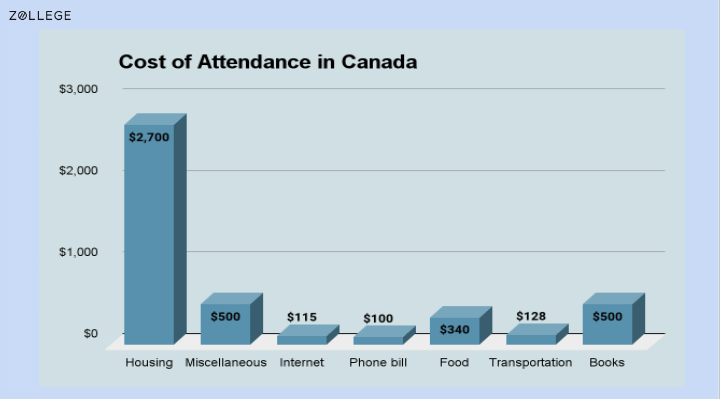
While studying in Canada, a lot of students look into part-time jobs in Canada to help with living expenses. Overall, you can plan and manage your finances during your time in Canada more successfully by making a detailed budget and investigating particular costs in the city or region of your choice. It is crucial to remember that these are estimates, and that actual costs may differ depending on your unique situation, your lifestyle, and the city or province in which you reside. International students should also account for one-time costs like health insurance, visa application fees, and initial setup fees after arriving in Canada. Given below is an estimated cost of attendance in Canda Graph that any aspirant can follow while planning their study in Canada.
Intakes in Canada Universities
Table mentioned below highlights the intakes in Canada which is essential for international students to follow. It's crucial for foreign students intending to study in Canada to confirm the precise start dates and application deadlines for the program and university of their choice. It is advised to begin the application process well in advance to guarantee enough time for processing, acquiring a study permit, and arranging for the required lodging and transportation. The table can be followed for intake details.
|
Type of Intake |
Starts from |
|
Fall/September Intake |
September – December/early January |
|
Winter/January Intake |
January – May |
|
Summer/Spring/May Intake |
May – August |
Scholarships
Each of the universities in Canada offer scholarships in Canada for international students that cover tuition fee or cost of living or both. A lot of scholarships demand that applicants send in thorough applications, official transcripts from their schools, recommendation letters, and personal statements summarizing their goals, accomplishments, and community service. Table mentioned below highlights Canada scholarships for Indian students:
|
Scholarship |
Eligibility |
|
Canadian Commonwealth Scholarship Program (CCSP) |
Applicants who have been accepted to a master's or doctoral program at a Canadian university. |
|
Mitacs Globalink Research Internship |
Applicants who are enrolled in a master's or doctoral program at an Indian university. |
|
Schulich Leader Scholarships |
Applicants who have been accepted to a master's or doctoral program in engineering, science, or mathematics at a Canadian university. |
|
University of British Columbia (UBC) International Leader of Tomorrow Award |
Applicants who have been accepted to an undergraduate program at UBC. |
|
York University International Student Scholarship Program |
Applicants who have been accepted to an undergraduate program at York University. |
|
Lester B. Pearson International Scholarships |
Applicants who have been accepted to a master's or doctoral program at a Canadian university. |
Canada Student Visa Requirements
Mentioned below are the documents required for Canada student visa application. Send your completed application for a study permit to the relevant visa office or processing center after obtaining all required paperwork. It is important to apply well in advance of your intended start date because processing times can differ. You will obtain your study permit upon approval, enabling you to continue your program-long studies in Canada.
- proof of acceptance
- proof of identity
- proof of financial support
- a letter of explanation
- an attestation of issuance of your Quebec Acceptance Certificate (CAQ)
- a medical exam
- a custodian declaration (minors only), or
- other documents; on request
Study in Canada requires candidates to consider a number of factors. These include shortlisting colleges and desired courses, tuition fee and cost of living, scholarships that are offered to international students and several other things. For student visas Canada, candidates are required to submit specific documents that have been mentioned above.
FAQs
Ques: How do I apply to study in Canada?
Ans: You can apply to study in Canada by following these steps:
Research Canadian universities/colleges and programs.
Meet the admission requirements.
Apply directly to the institution of your choice.
Obtain a study permit (student visa).
Ques: What are the eligibility criteria for a Canadian study permit?
Ans: Eligibility criteria for a Canadian study permit include an acceptance letter from a Designated Learning Institution, proof of sufficient funds to cover tuition fees and living expenses, a clean criminal record, and a medical examination if required.
Ques: How much does it cost to study in Canada?
Ans: Tuition fees in Canada vary depending on the institution and program, but on average, international students can expect to pay between CAD 15,000 to CAD 30,000 per year for undergraduate programs.
Ques: Are there scholarships available for international students in Canada?
Ans: Yes, there are scholarships and financial aid opportunities available for international students in Canada. Many universities offer scholarships based on academic merit and other criteria.
Ques: Can I work while studying in Canada?
Ans: Yes, international students with a valid study permit can work on or off-campus while studying in Canada, usually up to 20 hours per week during academic sessions and full-time during scheduled breaks.
Ques: What is the process for extending my study permit in Canada?
Ans: To extend your study permit, you need to apply to the Immigration, Refugees, and Citizenship Canada (IRCC) before your current permit expires. Make sure to apply at least 30 days before the expiry date.
Ques: Can international students apply for permanent residency after studying in Canada?
Ans: Yes, international students may be eligible for Canadian permanent residency through various pathways, such as the Canadian Experience Class (CEC), Provincial Nominee Program (PNP), or Express Entry.
Ques: Is health insurance mandatory for international students in Canada?
Ans: Yes, most provinces in Canada require international students to have health insurance. Some institutions may include health coverage in their fees, while others may require you to purchase private health insurance.
Ques: How is the quality of education in Canada compared to other countries?
Ans: Canada is known for its high-quality education system. Many of its universities and colleges are ranked among the top in the world. The country offers a diverse range of programs and research opportunities.
Ques: Can I bring my family with me while studying in Canada?
Ans: Yes, under certain conditions, you can bring your spouse or common-law partner, as well as dependent children, with you to Canada while you study. They may also be eligible for open work permits or study permits, depending on the situation.
Ques: How much does it cost to study in Canada?
Ans: The location, program, and school all affect how much it costs to study in Canada. International students' annual tuition costs for undergraduate programs typically range from CAD 15,000 to CAD 35,000, while graduate programs can cost anywhere from CAD 10,000 to CAD 50,000. The cost of living varies by lifestyle and city as well.
Ques: Can international students work while studying in Canada?
Ans: Yes, during the academic year, international students with a valid study permit are typically permitted to work part-time; during the scheduled breaks, they are permitted to work full-time. But the IRCC has put limitations and requirements in place.
Ques: What is the process for obtaining a post-graduation work permit (PGWP) in Canada?
Ans: You need to have finished your studies at an approved Canadian institution, have a current study permit, and apply for a PGWP within a certain amount of time after finishing your program. The length of your study program determines how long the PGWP will last.
Ques: Are there opportunities for permanent residency (PR) in Canada after studying?
Ans: Yes, Canada provides a number of avenues for foreign students to become permanent residents, including the Canadian Experience Class (CEC), Provincial Nominee Programs (PNPs), and Express Entry system.
Ques: What are the top universities in Canada?
Ans: The University of Toronto, McGill University, University of British Columbia, University of Alberta, and McMaster University are a few of Canada's best universities. Rankings may differ according to distinct factors and academic disciplines.
Ques: What is the student life like in Canada?
Ans: The student life in Canada is dynamic and multicultural, with a wide range of extracurricular activities, clubs, sporting teams, cultural events, and chances for community involvement. The natural beauty, outdoor pursuits, and urban attractions of Canada are also available for students to discover.
![University of Toronto [U of T]](https://static.zollege.in/public/college_data/images/studyabroad/logos/college_104_25-12:44_University_of_Toronto-logo-2417C8AF32-seeklogo.jpeg?tr=w-50,h-50,c-force?tr=h-40,w-35,c-force)
![The University of British Columbia [UBC]](https://static.zollege.in/public/college_data/images/studyabroad/logos/college_64_25-11:13_Capture.jpeg?tr=w-50,h-50,c-force?tr=h-40,w-35,c-force)

![University of Montreal [U de M]](https://static.zollege.in/public/college_data/images/studyabroad/logos/college_71_24-17:54_udem.jpeg?tr=w-50,h-50,c-force?tr=h-40,w-35,c-force)
![University of Alberta [UAlberta]](https://static.zollege.in/public/college_data/images/studyabroad/logos/college_9_24-17:46_alberta-.jpeg?tr=w-50,h-50,c-force?tr=h-40,w-35,c-force)